
The Way of You

START HERE BY READING
The Way of You
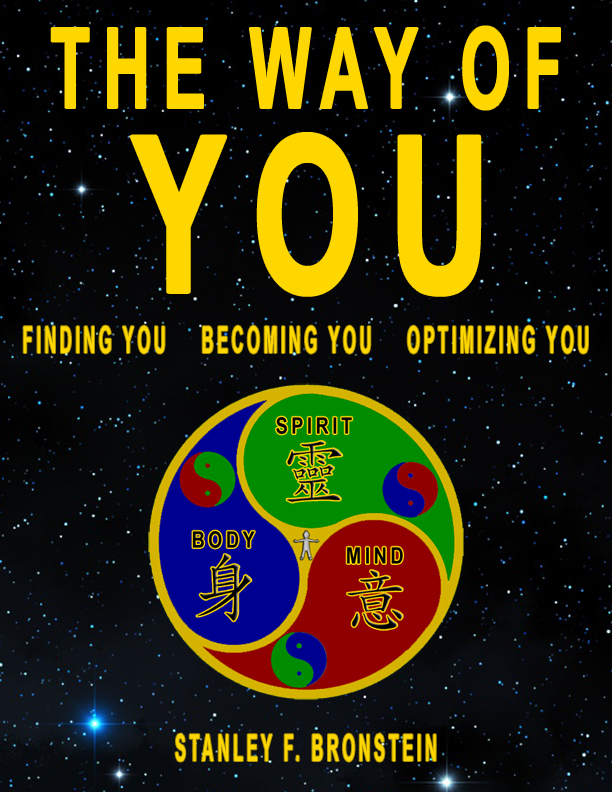
Finding You – Becoming You – Optimizing You
By Stanley F. Bronstein – Creator of The Way of Excellence System
Click The Tabs Below To Read Each Chapter Of The Book Online
Or
📘 Download Your Free Copy In Your Preferred Format
The Way of You
by Stanley F. Bronstein
How to use this page:
Click a chapter title to open it then scroll down to read.
When you click the title of the next chapter, the previous one will close.
Take your time.
Read, reflect, and do the experiments and assignments before you move on.
EMPTY ITEM
Foreword
When I first began taking my own growth seriously, I didn’t think of it as a “path” or a “way.” I just knew something in my life didn’t match what I believed was possible for me.
Like a lot of people, I tried fixing things on the surface. I changed diets, tried different routines, read books, started and stopped habits. Some of it worked for a while. Much of it didn’t. What I didn’t understand back then was this:
I wasn’t just trying to change what I did.
I was trying to change who I was.
Over time, through a lot of trial and error, I realized that real change doesn’t come from a single breakthrough or a perfect plan. It comes from the way you live with yourself every single day, for your entire life.
It comes from:
- The way you tell yourself the truth (or don’t).
- The way you speak to yourself when you succeed and when you fall short.
- The way you treat your body, your time, your energy, and the people around you.
In other words, it comes from the way of you.
I have spent years creating and refining The Way of Excellence. That system is the foundation behind everything in this book. But systems and principles only become real when they land in a human life – when they meet your history, your fears, your hopes, your responsibilities, and your dreams.
That’s what this book is about.
This isn’t a book of quick fixes, hacks, or magic buttons. It’s an invitation to build a relationship with yourself that is honest, respectful, disciplined, and deeply kind. It’s about learning to live in a way that matches who you truly are and who you’re capable of becoming.
Along the way, I’ve discovered some steady truths:
- That you don’t need to become a different person overnight. You just need to be willing to become a slightly truer version of yourself today.
- That excellence isn’t about perfection, image, or comparison – it’s about alignment between your mind, your body, your spirit, and your actions.
- That when you begin to live in alignment, life feels less like constant struggle and more like a clear path you can keep walking, even on hard days.
You’ll see three big sections throughout this book: Finding You, Becoming You, and Optimizing You.
- Finding You is about waking up from autopilot and telling the truth about where you are and how you got here.
- Becoming You is about choosing who you want to be and building your days, habits, and decisions around that choice.
- Optimizing You is about refining, integrating, and deepening what you’ve built, so your life not only works for you, but also serves the people around you.
Whether you’re just beginning to ask, “Who am I really?” or you’ve been on a growth journey for years and feel ready for a clearer structure, my hope is that this book will walk beside you. I wrote it so you would have something steady to return to when life gets noisy, confusing, or overwhelming.
If you stay with this work, something remarkable can happen. Your choices start to line up. Your habits begin to reflect your values. Your mind gets clearer, your body feels more supported, and your spirit feels less cramped and more at home.
You realize you aren’t just trying to fix parts of your life.
You’re learning how to live as you – fully, honestly, and excellently.
So let’s begin. Take this book one chapter at a time. Reflect. Experiment. Come back to it as often as you need.
I’ll be right here with you, as you keep discovering – and living – the Way of You.
– Stanley F. Bronstein
How to Use This Book: Experiments, Assignments, and the TWOE System
This is not a book you read once, nod your head at, and then forget.
My intention is for The Way of You to become a book you work with – a companion you return to as your life changes, as you move through new seasons, and as you grow into new versions of yourself.
To get the most from it, it helps to know how it’s designed and how I suggest you use it.
1. Read it in order the first time
The structure of this book is intentional. It mirrors the three movements I talked about in the Foreword:
- Finding You
- Becoming You
- Optimizing You
You’ll see these three movements as:
- Part I – Finding You
- Part II – Becoming You
- Part III – Optimizing You
On your very first read, I strongly recommend you go in order:
- Foreword
- How to Use This Book (this section)
- Part I – Finding You (Chapters 1-7)
- Part II – Becoming You (Chapters 8-14)
- Part III – Optimizing You (Chapters 15-20)
- Part IV – Conclusion
You may be tempted to skip ahead to the “action” chapters – the habits, systems, and optimization parts. I understand that impulse. But those chapters will mean far more (and work far better) if you’ve first:
- Looked honestly at where you are now.
- Understood how your current identity has shaped your choices.
- Begun to see your life story as training rather than just a sequence of events.
Once you’ve taken one full pass through the book, you can absolutely jump around and revisit the sections that fit your current season. But for now, give yourself the gift of seeing the whole picture first.
2. Think of this book as three interlocking journeys
Each part of the book has its own “job”:
- Part I – Finding You
Helps you wake up from autopilot, tell the truth about your life, see your story clearly, and understand the identity that has been quietly driving your behavior. - Part II – Becoming You
Helps you choose who you want to be next, define your direction, build identity-based habits, set boundaries and standards, and start living as the person you have chosen. - Part III – Optimizing You
Helps you refine your life, deepen the integration of mind, body, and spirit, shape your environment, pursue mastery, and let your personal excellence flow outward into your impact on others.
These are not strictly linear. You don’t “finish” Finding You, then never return to it. You will:
- Find yourself at a deeper level.
- Become a new version of you.
- Optimize that version.
- Then, at some later point, discover that it’s time to Find You again at an even deeper level.
The book is designed so you can move through it cyclically over the course of your life.
3. Understand the difference between Experiments and Assignments
Most chapters will end with two kinds of practical invitations:
- Experiments
- Assignments
They are both important, but they are not the same thing.
Experiments: low-pressure tests
An Experiment is something you try, not something you promise.
Experiments are designed to:
- Help you see yourself more clearly.
- Help you gather information about what actually happens when you change something.
- Let you interact with the ideas in the chapter in a concrete way, without the pressure of “I must now do this perfectly forever.”
Examples of Experiments might include:
- Paying attention to how you talk to yourself for one day.
- Writing a brutally honest snapshot of one area of your life.
- Trying a small adjustment to your morning or evening routine for a few days and noticing how it feels.
You cannot “fail” an Experiment. Whatever happens, you learn something.
Experiments are about discovery.
Assignments: self-chosen commitments
An Assignment is different. It is something you decide to commit to, for a defined period of time, because you believe it will move you in the direction of excellence.
Assignments are where you begin to activate:
- Your Discipline.
- Your Commitment.
- Your willingness to think and act for the Long-Term.
- Your Personal Responsibility for what comes next.
Examples of Assignments might include:
- Walking a certain number of minutes every day for the next 30 days.
- Scheduling and having a difficult but necessary conversation you’ve been avoiding.
- Implementing a weekly review ritual and sticking with it for three months.
You are always in charge of what becomes an Assignment. Do not turn everything into an Assignment. That is a great way to overwhelm yourself and quit.
A good rule of thumb:
- Use Experiments to explore, learn, and tell yourself the truth.
- Use Assignments to build the new you, brick by brick.
Both are important. Experiments show you reality. Assignments reshape it.
4. Keep TWOE in the background as your operating system
Behind this book sits a system: The Way of Excellence (TWOE).
TWOE is built around:
- 20 Concepts
- 20 Untils
- 20 Laws
- 20 Benefits
The entire TWOE system is outlined in detail on the master website TheWayOfExcellence.com and in The Way of Excellence Journal, which you can download for free from that website.
You do not need to memorize all of TWOE to move forward with this book, but it’s important to know that every chapter you’re about to read is grounded in that structure.
When I talk about excellence, responsibility, integrity, Long-Term thinking, persistence, telling it like it is, and integrating mind, body, and spirit, I am drawing directly from TWOE.
You can think of it this way:
- TWOE is the operating system – the underlying logic of how excellence works.
- The Way of You is an application – a specific way that operating system gets installed and lived out in one human life: yours.
If you haven’t already done so, I strongly recommend that you study The Way of Excellence system on TheWayOfExcellence.com and in The Way of Excellence Journal as you work through The Way of You. Let the two works support each other:
- This book will help you apply excellence personally.
- TWOE and The Way of Excellence Journal will give you the full, detailed framework behind everything we’re doing here.
You can go back and forth between them at whatever pace feels right to you.
5. Use a journal to capture your journey
You will get far more value from this book if you don’t just think about the ideas, but also write with them.
I encourage you to pick one place to capture everything related to The Way of You:
- A physical notebook.
- A document on your computer.
- A note-taking app – whatever you’ll actually use.
Use it to:
- Answer the reflection questions at the end of chapters.
- Record your Experiments and what you noticed.
- List your Assignments and track how well you followed through.
- Capture key insights about your story, your identity, your patterns, and your progress.
Your journal will become your personal record of:
- How you Found You at this stage of your life.
- How you Chose to Become a new version of you.
- How you Optimized that version over time.
Months or years from now, reading back through those pages will show you just how far you’ve come.
6. Set a pace that respects your life and still stretches you
There is no single “correct” pace for reading and using this book.
Some people will want to:
- Read one chapter per day, doing a light version of the exercises, then come back later for a deeper pass.
Others will want to:
- Take one chapter per week or even one chapter per month, fully working through the Experiments and Assignments before moving on.
You know your life, your responsibilities, and your current energy level. I suggest choosing a pace that meets two criteria:
- You can realistically sustain it for at least a few months.
- It challenges you enough that you are genuinely growing, not just coasting.
If it feels too easy, you’re probably skimming.
If it feels impossible, you’re probably trying to do too much, too fast.
You’re free to adjust the pace as you go.
7. Expect to come back to this book again and again
You are not meant to “finish” The Way of You one time and be done.
As your life unfolds, you will encounter:
- New situations.
- New challenges.
- New opportunities.
- New versions of yourself.
Each time that happens, you can come back to this book with new eyes:
- During a major transition, you might revisit Part I – Finding You to take a fresh inventory and see your story clearly from where you are now.
- When you feel ready to grow into a bigger version of yourself, you might spend more time in Part II – Becoming You.
- When you want to refine what’s already working and deepen your contribution, you might live for a while in Part III – Optimizing You.
Think of this book not as a one-time event, but as a manual for your life that you can keep on your desk, your nightstand, or your device, and return to whenever you need clarity, structure, or a nudge to live more excellently.
8. Above all, treat yourself with honesty and respect
The real power of this work does not come from reading my words. It comes from the way you choose to live with yourself as you read them.
My invitation is simple:
- Be as honest with yourself as you can.
- Be as kind with yourself as you can.
- Be as committed to your own excellence as you can.
If you do that, this book will not just be something you’ve read.
It will become part of The Way of You.
INTRODUCTION TO PART I - FINDING YOU
Awakening, Truth, and the Real Starting Line
Most people go through life without ever really stopping to ask, “Who am I, really?” We get busy. We play the roles we were handed. We respond to whatever is right in front of us. Years pass. One day, we look up and realize we’ve been living on autopilot for a long time.
Part I is about turning the autopilot off.
Finding You is not a slogan. It’s the process of waking up to your actual life as it is today – without filters, excuses, or performance. It means seeing clearly how you’ve been living, how you’ve been thinking, how you’ve been treating yourself and others, and how your current identity has been quietly steering your choices.
This section will help you:
- Notice where your life is running on default settings.
- Tell the truth about your present reality.
- Understand the story you’ve been telling yourself about who you are.
- See how that story has shaped your behavior, your results, and your sense of what’s possible.
We will not fix everything in Part I. That’s not its job.
The job of Part I is to give you a brutally honest snapshot of where you are starting from and how you got here. It is your real starting line – not the one you wish you had, not the one you try to show other people, but the one you actually stand on today.
From there, in Part II, you will begin to choose who you want to be and how you want to live. But first, we Find You.
Chapter 1 - The Problem of a Life on Autopilot
Most people don’t wake up one morning and say, “I’ve decided to live my life on autopilot.”
It happens quietly.
You follow the path that seems to be in front of you. You do what’s expected. You meet your responsibilities. You react to whatever is loudest or most urgent. You keep going.
Days become weeks. Weeks become years.
Then, at some point, you have a moment – sometimes small, sometimes devastating – where you realize you’ve been moving without really steering for a long time.
This chapter is about that realization.
It’s about seeing, clearly and honestly, the ways your life may be running itself while you sit quietly in the passenger seat.
Finding You starts right here: by noticing where you’ve gone to sleep in your own life.
What “Autopilot” Really Means
When I say “autopilot,” I don’t mean responsibility, routine, or discipline. Those are good things. They are necessary for excellence.
Autopilot is something different.
Autopilot is when:
- Your days feel scripted, but you’re not the one who wrote the script.
- You keep doing the same things without ever asking whether they still fit the person you want to be.
- Your actions are driven by habit, fear, convenience, or inertia – rather than by conscious choice and clear values.
On the outside, a life on autopilot might look successful or stable. Bills are paid. You answer emails. You show up where you are supposed to be. You keep going.
On the inside, it often feels like:
- Numbness
- Restlessness
- Quiet resentment
- An ongoing sense that “something is off,” even if you can’t name what it is
Autopilot is not always dramatic. Often it’s subtle. But it carries a cost.
How We Drift Into Autopilot
Nobody chooses autopilot on purpose. We drift into it.
Here are some of the most common ways that happens.
1. Living as the Role, Not the Person
From early on, most of us are handed roles:
- The good student
- The responsible child
- The provider
- The caregiver
- The successful professional
- The one who holds everything together
Those roles can be meaningful. They can even be noble. But when the role becomes more real than the person playing it, you start to lose track of yourself.
You make decisions based on:
- “What would a good person do?”
- “What will keep everyone else happy?”
- “What will keep the peace?”
You rarely ask: “What is excellent and honest for me in this situation?”
Over time, you can end up living a life that is very good at maintaining the role and very bad at honoring the person.
2. Getting Buried in Busyness
Autopilot feeds on speed and clutter.
If your days are filled from the moment you wake up until the moment you collapse into bed, you don’t have much space to think. And if you don’t think, you don’t question. You just keep going.
Busyness can come from:
- Work demands
- Family responsibilities
- Social obligations
- Digital distractions
- A constant sense that you need to “keep up”
It is entirely possible to be doing many good things – and still be on autopilot. The question is not “Am I busy?” The question is “Am I consciously choosing the things I am busy with?”
3. Letting Comfort Quietly Take Over
Not all autopilot is frantic. Sometimes it looks like comfort.
- You numb out in front of a screen night after night.
- You eat what’s easiest instead of what truly supports your body.
- You choose what is familiar, even if it’s not healthy or meaningful.
You tell yourself:
- “I deserve this.”
- “I’m too tired to think about it.”
- “I’ll deal with this later, when life calms down.”
Comfort has its place. Rest is not the enemy. But when comfort becomes your primary organizing principle, you start slowly trading away your potential for temporary ease.
4. Accepting “This Is Just How Life Is”
Another way autopilot sets in is when you start believing that what you see around you is simply “the way life works,” and therefore not yours to question.
- “Everyone in my field is stressed and overworked.”
- “Everyone eats like this.”
- “Everyone is glued to their phone.”
- “Everyone is tired, overwhelmed, and behind.”
When “everyone” becomes your standard, excellence gets quietly lowered to average.
You begin to settle. Not because you genuinely want to, but because you’ve stopped imagining that another way is possible for you.
Signs You May Be Living on Autopilot
The details will be different for each person, but here are some common indicators that autopilot is running more of your life than you might like to admit.
You don’t need to have all of these to be on autopilot. Even a few, especially if they’ve been around for a while, are worth paying attention to.
- You feel like you are always “on,” but rarely fully present.
You’re in the room, but your mind is somewhere else – past, future, or on the next thing on your list. - Your days blur together.
When you look back on the last month, it’s hard to remember what happened on which day. Everything feels the same. - You keep postponing what matters most.
You say you value your health, your relationships, your growth – but those things often get pushed to “later” while urgent but less important tasks win your attention. - You are often exhausted, but not fulfilled.
You collapse at the end of the day, not with the satisfaction of a meaningful effort, but with the numbness of “I got through it.” - You rarely stop to ask real questions.
Questions like “Is this working?”, “Who am I becoming from this?”, and “Is this excellent?” don’t come up often. - You feel a quiet, persistent sense that “this can’t be all there is.”
You may not be in crisis. But you know, somewhere inside, that you are capable of more – more honesty, more alignment, more contribution, more life.
If you recognize yourself in any of these, don’t use that as ammunition to beat yourself up. Use it as information.
Information is power – if you’re willing to look at it.
Why Autopilot Is a Problem (Even If Life Looks “Fine”)
If your life on autopilot is reasonably stable, you might be asking:
“What’s the problem? I’m not in crisis. Things are fine. Lots of people have it much worse.”
You’re right. Many people do have it worse. Gratitude matters. Perspective matters. But “worse” is not your standard. “Fine” is not your standard.
Excellence is your standard.
Here’s the real cost of autopilot, even when life looks okay from the outside.
1. You Lose Relationship With Yourself
When you don’t regularly check in with your own truth, your own values, and your own inner voice, you slowly lose relationship with yourself.
You become:
- A performer in your own life, not a participant.
- A function, not a person.
- Someone you carry around, not someone you actually know.
From the outside, you might look responsible and capable. Inside, you may feel like you don’t really know who you are anymore, beyond your roles and obligations.
2. Your Identity Stagnates
Who you think you are – your identity – acts like a magnet for your choices.
On autopilot, that identity rarely gets updated. You keep making decisions based on an outdated version of you:
- The person who got hurt and decided never to trust again.
- The person who failed at something and decided, “This just isn’t for me.”
- The person who was once told, “This is who you are,” and never challenged it.
Over time, you outgrow the identity, but the identity doesn’t get the memo.
Autopilot keeps you living as who you were, not who you could be.
3. You Drift Away From Excellence
Excellence is not just about extra effort or high performance. It is about alignment between:
- What you say you value.
- What you actually do.
- Who you are becoming as a result of those actions.
Autopilot slowly separates those three.
You may still talk about the things you value – health, integrity, growth, contribution – but your actual choices are driven more by habit, convenience, and fear.
The more that gap widens, the more internal friction you feel.
4. You Miss the Chance to Choose Your Life
Perhaps the greatest cost of autopilot is this:
You don’t fully get to choose your life.
It gets chosen for you by:
- Circumstances
- Other people’s expectations.
- Old stories.
- Unquestioned habits.
- The easiest available option in the moment.
You end up living a life that you never consciously selected.
Finding You is about reclaiming that choice.
Waking Up: The First Step of Finding You
If all of this feels uncomfortably familiar, you are not alone.
You’re also not broken.
Autopilot is common. In a world that rewards speed, distraction, and performance, it may even feel normal.
But if you’re reading this book, I am going to assume something about you:
You don’t want “normal.”
You are willing to do the work of waking up.
Finding You begins with a simple, powerful shift:
You move from automatic to aware.
You start to notice:
- “I’m doing this because it’s what I’ve always done.”
- “I’m saying yes, even though I want to say no.”
- “I’m scrolling my phone instead of feeling what I’m feeling.”
- “I’m living out a script that doesn’t really fit me anymore.”
You don’t have to fix all of that today.
Right now, your only job is to see it.
Because once you see it, you can begin to change it.
How This Sets Up the Rest of the Book
This chapter is about awareness.
In the chapters that follow, we will:
- Look more closely at how you tell yourself the truth about your life (Chapter 3).
- Explore the difference between fault and responsibility (Chapter 4).
- Re-examine your life story and the identity it has created (Chapters 5 and 6).
- Take an honest inventory of where you are today (Chapter 7).
But all of that starts here – with the recognition that a life on autopilot is not the life you want to live.
In the next chapter, we’ll introduce The Way of Excellence (TWOE) as the operating system underneath this work – the structure that will help you move from autopilot to intentional, excellent living.
Before we go there, let’s ground this chapter in your real life.
Reflection Questions
Take a few minutes with each of these. Write your answers if you can.
- In what areas of your life do you feel most like you are on autopilot?
(Think about work, relationships, health, daily routines, technology use, etc.) - If a close, honest friend described how you’ve been living lately, what might they say?
- Where do you feel a quiet, ongoing sense of “this can’t be all there is,” even if you haven’t spoken it out loud?
- If nothing about your current way of living changed for the next five years, how would you feel about that?
Experiment: A Day of Observation
For one day, your only job is to notice.
- Notice when you make a choice without really thinking about it (what you eat, what you say yes to, when you reach for your phone, etc.).
- Notice when you feel like you’re going through the motions.
- Notice any moments where you feel a small inner tug that says, “This isn’t quite right,” even if you ignore it.
At the end of the day, write down:
- Three moments where you clearly saw yourself on autopilot.
- One moment – however small – where you chose differently.
You are not judging yourself. You are gathering data.
Assignment: Name One Area You’re Willing to Wake Up In
If you’re ready to take this further, choose one area of your life where you are willing to begin waking up.
Examples:
- How you use your phone in the evenings.
- How you eat when you’re stressed.
- How you say yes to commitments you don’t really want.
- How you talk to yourself when you make a mistake.
For the next seven days:
- Write that area at the top of a page or note:
“I am waking up in the way I __________.” - Each day, briefly note:
- One time you caught yourself on autopilot in that area.
- One small, more conscious choice you made instead (or wish you had made).
You are not trying to be perfect. You are practicing awareness plus choice.
That’s how autopilot begins to lose its grip.
And that’s how you begin, slowly and steadily, to find yourself.
Chapter 2 - TWOE: The Operating System of Excellence
In Chapter 1, we looked at the problem of a life on autopilot.
You saw how easy it is to drift onto default settings – letting roles, habits, fears, and other people’s expectations quietly run your life while you sit in the passenger seat. You also began to see that waking up means more than just changing a few habits. It means changing the way you live with yourself.
That’s where The Way of Excellence (TWOE) comes in.
This chapter is about the system behind this book – the structure that will support you as you move from autopilot to intentional, excellent living. Think of TWOE as the operating system underneath everything you are about to do with The Way of You.
Why You Need an Operating System
Every device you own has an operating system. You don’t see it most of the time, but it runs everything:
- It defines what’s possible and what isn’t.
- It coordinates all the different parts so they can work together.
- It makes sure that when you give a command, something reliable happens.
Your life has an operating system too.
Your operating system is made up of:
- The beliefs you hold about yourself, other people, and the world.
- The principles and values you actually live by (not just the ones you talk about).
- The way you make decisions, respond to problems, and pursue what you want.
Even if you’ve never written it down, you have an operating system. The question is:
Is your current operating system designed for excellence, or is it just a collection of leftovers from your past?
The Way of Excellence is an attempt to consciously design that operating system.
TWOE gives you a framework – a set of Concepts, Untils, Laws, and Benefits – that define what excellence means and how it actually works in real life.
The Way of You sits on top of that framework. This book is about installing that operating system into one life: yours.
What The Way of Excellence (TWOE) Is
The Way of Excellence is a comprehensive system built around four elements:
- 20 Concepts – the core ideas of excellence.
- 20 Untils – the conditions that must be met for us to “achieve our maximum potential and evolve as a species.”
- 20 Laws – the non-negotiable principles of how excellence works.
- 20 Benefits – the results we create when we live by those Laws, individually and collectively.
Each Concept has a matching Until, Law, and Benefit.
For example:
- Concept #1 – Learning To Tell It Like It Is
- Until #1 – Until We Tell It Like It Is
- Law #1 – The Law Of Actuality
- Benefit #1 – Living In The Real World
Taken together, they say:
- We must learn to tell it like it is.
- Until we start “telling it like it is” and then begin adjusting our actions accordingly, we will never achieve our maximum potential and evolve as a species.
- No living person or system can remain in existence for very long without first having arrived at a level of full, realistic awareness of their own existence, sensations, thoughts and surroundings and then responding accordingly after having done so.
- By incorporating The Law Of Actuality into our lives, we will be creating a society where people truthfully and accurately assess and acknowledge their situation, and as a result, begin acting appropriately.
That’s how the system works.
Each Concept asks something of you.
Each Until tells you what must change.
Each Law tells you how reality actually operates.
Each Benefit shows you what’s possible when you live that way.
The entire TWOE system is laid out in detail on the master website TheWayOfExcellence.com and in my book, The Way of Excellence Journal, which you can download for free from that site. I strongly recommend that you study TWOE – on the website and in the Journal – as you work through this book. Let them work together:
- TWOE and the Journal give you the full architecture.
- The Way of You helps you live that architecture personally.
The Four Elements of TWOE
Let’s look a little more closely at the four parts of the system, so you know what’s behind the chapters that follow.
1. The 20 Concepts – What Excellence Requires
The Concepts describe the key ideas you must embrace if you want to live excellently, not just occasionally, but as a way of life.
Some examples:
- Concept #1 – Learning To Tell It Like It Is
- Concept #2 – Adopting Long-Term Thinking
- Concept #3 – Taking Personal Responsibility
- Concept #4 – Embracing Change
- Concept #5 – Focusing On The Possible
- Concept #6 – Changing Our Perspective
- Concept #7 – Envisioning A Brighter Future
- Concept #8 – Learning To Give First
- Concept #9 – Allocating Our Resources Wisely
- Concept #10 – Taking Consistent Action
- Concept #11 – The Power Of Persistence
- Concept #12 – Building A Foundation Of Integrity
- Concept #13 – Respect
- Concept #14 – Learning To Think WinWin
- Concept #15 – Creating A Balanced Life
- Concept #16 – The Willingness Factor
- Concept #17 – The Belief Factor
- Concept #18 – The Discipline Factor
- Concept #19 – The Commitment Factor
- Concept #20 – Integration Of Mind, Body & Spirit
You don’t need to master all 20 at once. But you do need to understand that excellence is not one thing. It is the integration of all of these Concepts over time.
This book will keep circling back to them, even when I don’t mention them by number. For instance:
- When we talk about telling the truth about your life, we are in Concept #1 – Learning To Tell It Like It Is.
- When we talk about designing your direction, we are in Concept #2 – Adopting Long-Term Thinking and Concept #7 – Envisioning A Brighter Future.
- When we talk about consistent habits, we are in Concept #10 – Taking Consistent Action, Concept #11 – The Power Of Persistence, Concept #18 – The Discipline Factor, and Concept #19 – The Commitment Factor.
- When we talk about mind, body, and spirit, we are in Concept #20 – Integration Of Mind, Body & Spirit.
The Concepts are the pillars. Everything you build in your life rests on them.
2. The 20 Untils – The Line in the Sand
The Untils are the tough-love part of TWOE.
Each Until starts with the word “Until” and states a condition that must be met “or we will never achieve our maximum potential and evolve as a species.”
Examples:
- Until #1 – Until We Tell It Like It Is
- Until #2 – Until We Adopt Long-Term Thinking
- Until #3 – Until We Stop Blaming
- Until #16 – Until We Are Willing To Permanently Change
- Until #17 – Until We Believe It Is Possible
- Until #18 – Until We Develop The Required Discipline
- Until #19 – Until We Develop The Required Level Of Commitment
- Until #20 – Until We Integrate Our Mind, Body & Spirit
Untils are uncompromising on purpose.
They say, in effect:
“Unless this changes, you are not going to reach your potential.”
They don’t care about excuses. They don’t argue with reality. They tell you clearly where the line is between autopilot and excellence.
As you work through this book, you will notice where you are bumping into the Untils. When you feel resistance, it’s often because an Until is being activated.
3. The 20 Laws – How Excellence Actually Works
The Laws describe how excellence operates – whether you agree with them or not.
You don’t “believe” a Law into existence. You recognize it and then decide whether you’re going to work with it or against it.
Examples:
- Law #1 – The Law Of Actuality
- Law #2 – The Law Of The Long-Term
- Law #3 – The Law Of Personal Response-Ability
- Law #4 – The Law Of Change
- Law #5 – The Law Of Focus
- Law #7 – The Law Of Vision
- Law #10 – Law Of Action
- Law #11 – The Law Of Persistence
- Law #12 – The Law Of Integrity
- Law #15 – The Law Of Balance
- Law #16 – The Law Of Willingness
- Law #17 – The Law Of Belief
- Law #18 – The Law Of Discipline
- Law #19 – The Law Of Commitment
- Law #20 – The Law Of Integration
A few highlights:
- The Law Of Actuality says you cannot live excellently if you refuse to see reality clearly and respond accordingly.
- The Law Of The Long-Term says that repeated shortterm discipline brings Long-Term rewards – and that you must place reasonable limits on shortterm pleasures if you want Long-Term benefits.
- The Law Of Personal Response-Ability says blame is irrelevant and that the real question is always, “What are you going to do to fix the problem?”
- The Law Of Discipline says discipline is not something you have to do; it is something you get to do – and disciplined people get things done.
- The Law Of Integration says your mind, body, and spirit are parts of a whole and that no part can reach its optimum level without the support of the others.
When we talk in later chapters about how to design your habits, structure your environment, protect your standards, and build a long-term life system, we are simply applying these Laws.
4. The 20 Benefits – The World You’re Helping Build
The Benefits describe what becomes possible when you live by the Laws personally and when enough of us begin doing so collectively.
Examples:
- Benefit #1 – Living In The Real World
- Benefit #2 – Living In A Sustainable World
- Benefit #3 – Living In A World Of Problem Solvers
- Benefit #5 – Living In A World Without Negativity
- Benefit #7 – Living In A World Of Conscious Choice
- Benefit #8 – Living In A World Of Givers
- Benefit #11 – Living In A World Where We Ultimately Succeed
- Benefit #13 – Living In A World Where Everyone Is Respected
- Benefit #15 – Living In A World Without Excess Or Lack
- Benefit #18 – Living In A World Where Things Get Done
- Benefit #19 – Living In A World Where Everyone Is Working Toward Excellence
- Benefit #20 – Living In A World Where All Work Toward The Benefit Of Others
These Benefits matter for two reasons:
- They remind you that excellence is not just about your It is about the kind of world we are building together.
- They pull you forward. They give you a vision of what you are moving toward, not just what you are moving away from.
When you practice The Way of You, you are not only improving your own life. You are quietly contributing to The Way of Us.
How TWOE and The Way of You Work Together
Now that you have a sense of what TWOE is, let’s connect it to this book.
You can think of it this way:
- The Way of Excellence (TWOE) defines what excellence is and how it works.
- The Way of You (TWOY) is about how you will live that excellence in your specific life.
As you move through the chapters:
- Part I – Finding You will lean heavily on Concept #1 – Learning To Tell It Like It Is, Concept #2 – Adopting Long-Term Thinking, Concept #3 – Taking Personal Responsibility, and Concept #6 – Changing Our Perspective, among others.
- Part II – Becoming You will lean on Concept #7 – Envisioning A Brighter Future, Concept #10 – Taking Consistent Action, Concept #11 – The Power Of Persistence, Concept #16 – The Willingness Factor, Concept #17 – The Belief Factor, Concept #18 – The Discipline Factor, and Concept #19 – The Commitment Factor.
- Part III – Optimizing You will lean on Concept #9 – Allocating Our Resources Wisely, Concept #12 – Building A Foundation Of Integrity, Concept #15 – Creating A Balanced Life, and Concept #20 – Integration Of Mind, Body & Spirit.
You don’t need to track any of this consciously. But it helps to know that there is a deeper structure underneath what you’re reading.
If you haven’t already:
- Visit TheWayOfExcellence.com
- Download The Way of Excellence Journal for free.
- Read through the Concepts, Untils, Laws, and Benefits at least once as you move through this book.
Let TWOE and TWOY reinforce each other. The more familiar you are with the operating system, the easier it will be to build a life that truly runs on it.
Reflection Questions
Take a few minutes to consider and, if possible, write about these:
- When you look at the list of Concepts (even just the titles), which three feel most natural to you right now? Why?
- Which one or two Concepts feel most challenging or uncomfortable? What might that be telling you?
- How do you currently think about “excellence”? How is that similar to – or different from – the vision of excellence implied by TWOE?
- If you fully lived Concept #1 – Learning To Tell It Like It Is and Concept #3 – Taking Personal Responsibility, how might your life start to look different over the next year?
Experiment: Meet the System
Over the next few days, do this simple Experiment:
- Go to TheWayOfExcellence.com
- Find the overview of The Way of Excellence system and the download link for The Way of Excellence Journal.
- Skim through all 20 Concepts, along with their matching Untils, Laws, and Benefits. Don’t try to master them yet – just get familiar.
As you read, note:
- Any Concept that makes you nod and think, “Yes, I already live this.”
- Any Concept that makes you wince or feel resistance.
- Any Law that feels especially true to your experience (for better or worse).
You’re just meeting the operating system. No pressure. No test. Just exposure.
Assignment: Choose Your Anchor Concept for This Season
If you’re ready to make a small but meaningful commitment, choose one Concept to serve as your anchor for the next 30 days.
It could be:
- Concept #1 – Learning To Tell It Like It Is
- Concept #2 – Adopting Long-Term Thinking
- Concept #3 – Taking Personal Responsibility
- Concept #18 – The Discipline Factor
- Concept #20 – Integration Of Mind, Body & Spirit
Or any other Concept that feels right for where you are now.
For the next 30 days:
- Write your chosen Concept at the top of a page or note:
“This month, I am focusing on Concept #__ – [exact title].” - Each day, briefly jot down:
- One way you honored that Concept in your actions, even in a small way.
- One situation where you ignored or forgot it – and what you learned from that.
You are not trying to live all 20 Concepts perfectly.
You are beginning to install the operating system – deliberately, one piece at a time.
From here, we’re going to start bringing TWOE into direct contact with your life.
In the next chapter, we’ll take on Radical Honesty: Telling the Truth About Your Life and begin building your Brutally Honest Snapshot – the foundation for everything that follows.
Chapter 3 - Radical Honesty: Telling the Truth About Your Life (The Brutally Honest Snapshot)
Autopilot thrives in half-truths.
“I’m fine.”
“It’s not that bad.”
“I’ll deal with it later.”
“This is just how life is.”
None of these statements is always a lie. But when they become the default soundtrack of your life, they blur your vision. They help you keep moving without ever really looking at what is going on.
If you want to live The Way of You instead of the way of autopilot, you cannot build that life on fog.
You need clarity.
And clarity begins with radical honesty.
This chapter is about learning to tell the truth about your life as it actually is right now – not the way you wish it were, not the way you present it to others, and not the way you defend it in your head. Just the truth.
That’s the purpose of what I call The Brutally Honest Snapshot.
Concept #1 – Learning To Tell It Like It Is
The very first pillar of The Way of Excellence is:
Concept #1 – Learning To Tell It Like It Is
That is not an accident.
Excellence begins with reality.
Concept #1 is paired with:
Until #1 – Until We Tell It Like It Is
Until we start “telling it like it is” and then begin adjusting our actions accordingly, we will never achieve our maximum potential and evolve as a species.
and:
Law #1 The Law Of Actuality
No living person or system can remain in existence for very long without first having arrived at a level of full, realistic awareness of their own existence, sensations, thoughts and surroundings and then responding accordingly after having done so.
and finally:
Benefit #1 Living In The Real World
By incorporating Law #1 The Law of Actuality into our lives, we will be creating a society where its members truthfully and accurately assess and acknowledge their situation, and as a result, begin acting appropriately.
Put simply:
- You must learn to tell it like it is.
- Until you start doing that and adjust your actions accordingly, you will not reach your maximum potential.
- Reality will not cooperate with you if you insist on denying it.
- The reward for living this way is that you get to live in the real world, where real change is possible.
The Brutally Honest Snapshot is a concrete way to practice Concept #1 – Learning To Tell It Like It Is and Law #1 The Law Of Actuality in your own life.
It’s the moment you stop negotiating with reality and simply describe it.
What Radical Honesty Is (and Isn’t)
Before we build your snapshot, it’s important to understand what I mean – and do not mean – by radical honesty.
Radical honesty is not:
- Attacking yourself.
- Attacking other people.
- Dumping your unfiltered reactions on everyone around you.
- Confessing every passing thought to prove how “honest” you are.
Radical honesty, as we’re using it here, is internal first.
It is you, with yourself, telling the truth.
- The truth about your health.
- The truth about your habits.
- The truth about your relationships.
- The truth about your work.
- The truth about your money.
- The truth about your emotional and spiritual life.
It is not cruelty. It is clarity.
You do not need to dramatize anything. You do not need to exaggerate how bad things are. Radical honesty is not “Everything is terrible.” It is: “This is what is true.”
It may sting. But it should not be abusive.
A simple test:
If the way you’re talking to yourself leaves you hopeless, frozen, or ashamed to move forward,
you’re not practicing radical honesty.
You’re practicing self-attack.
Radical honesty tells the truth so that you can move.
Why We Avoid Telling It Like It Is
If telling it like it is is so powerful, why don’t we all just do it?
Because telling it like it is feels dangerous.
Here are some of the common fears that keep people from taking a brutally honest look at their lives:
- Fear of what the truth will demand.
“If I admit how bad this is, I’ll have to do something about it.” - Fear of what the truth will mean about you.
“If I admit this, it will prove I’m lazy / weak / broken / a failure.” - Fear of losing comfort.
“If I stop lying to myself about my habits, I might have to give up the things that numb me.” - Fear of conflict.
“If I admit how unhappy I am in this situation, I might have to confront someone or make a big change.” - Fear of overwhelm.
“If I really look at everything that’s wrong, it will be too much. I’ll shut down.”
Every one of these fears is understandable. I have felt them myself.
But here’s what I’ve learned from living with Law #1 The Law Of Actuality:
- The truth is almost never as deadly as we imagine.
- The truth is often painful at first – and freeing afterward.
- The energy you spend avoiding the truth is far greater than the energy it takes to face it.
The purpose of the Brutally Honest Snapshot is not to drown you. It is to give you a solid floor to stand on.
You can’t build anything stable on a moving target.
The Brutally Honest Snapshot: What It Is
The Brutally Honest Snapshot is a written, no-spin picture of your life as it is today.
It is:
- Specific, not vague.
- Concrete, not theoretical.
- Focused on facts and honest observations – not excuses, not justifications, and not performances.
Think of it like a diagnostic scan.
A good doctor doesn’t start helping you by guessing. They order tests, ask questions, run scans. They want a clear picture of what’s going on.
The Brutally Honest Snapshot is that clear picture for The Way of You.
It looks at the major arenas of your life:
- Health & body
- Mind & emotional life
- Relationships & connection
- Work & contribution
- Money & resources
- Meaning, purpose, and spirit
You are not trying to solve anything yet.
You are not writing goals.
You are not writing affirmations.
You are not writing your ideal future.
You are writing what is.
Later in the book, you will come back to this snapshot to measure growth. But first, we simply get it onto the page.
How to Create Your Brutally Honest Snapshot
Set aside some time where you won’t be interrupted. An hour is ideal. If that’s not possible, start with 20-30 minutes and plan to come back.
Grab your journal or a blank document.
At the top, write:
“The Brutally Honest Snapshot – [today’s date]”
Then walk through the steps below.
Step 1: Start With Facts, Not Stories
For each area, begin by writing simple, factual statements.
Facts look like:
- “I weigh __ pounds.”
- “I average about __ hours of sleep per night.”
- “I walk about __ steps per day.”
- “My last bloodwork showed __.”
- “My closest relationships feel mostly __ (distant, supportive, tense, etc.).”
- “I have approximately __ dollars of debt / savings.”
- “I work approximately __ hours per week.”
- “I spend about __ hours a day on screens outside of work.”
Avoid dramatic language. Avoid blame. Avoid justification.
You are just writing what is true.
If you don’t know a number exactly, write your best honest estimate and note that it’s an estimate.
Step 2: Add How It Actually Feels
After the facts, add a few sentences about how each area feels from the inside.
Examples:
- “I feel tired most days by early afternoon.”
- “I feel embarrassed about my debt and avoid looking at my accounts.”
- “I feel alone, even when I’m around people.”
- “I feel proud of the way I’ve been moving my body lately.”
- “I feel like I’m wasting a lot of my time on things that don’t matter to me.”
- “I feel spiritually disconnected / flat / hungry.”
Be specific and honest. This is not being written for an audience. It’s being written for truth.
Step 3: Name Your Contribution (Without Shame)
Next, for each area, answer this question:
“How have I contributed to things being the way they are?”
This is where you begin to bring Concept #3 Taking Personal Responsibility, Until #3 Until We Stop Blaming, and Law #3 The Law Of Personal Response-Ability into your snapshot.
Remember what Law #3 says:
One must stop blaming others for anything wrong in their life. In fact, one must also stop blaming themselves. BLAME IS IRRELEVANT. All that matters is what are you going to do to fix the problem?
This is about ownership, not self-condemnation.
You are not writing:
- “It’s all my fault, I’m terrible.”
You are writing things like:
- “I have been overeating at night to cope with stress.”
- “I have been avoiding difficult conversations, which has kept this relationship stuck.”
- “I have not been tracking my spending, so I’m not in control of my money.”
- “I have been saying yes to too many things at work to avoid disappointing people.”
You cannot control everything that has happened to you. But you can name the part you are playing in maintaining your current reality.
That is where your power lies.
Step 4: Spot the Lies (or Half-Truths) You’ve Been Living On
Finally, ask yourself:
“What have I been pretending is ‘fine’ that is not actually fine?”
“Where have I been minimizing, exaggerating, or avoiding the truth?”
Examples:
- “I’ve been telling myself, ‘I’ll deal with my health later,’ even though I know I’m worried now.”
- “I’ve been telling myself, ‘At least I have a job,’ to avoid admitting that my work is draining me.”
- “I’ve been telling myself, ‘It’s not that bad,’ about a relationship that is slowly eroding my self-respect.”
- “I’ve been telling myself, ‘I don’t care about money,’ when really I’m scared to look at it.”
Write these down.
This is you applying Concept #1 – Learning To Tell It Like It Is at a deeper level.
Again: no drama. Just truth.
Common Reactions (And How to Handle Them)
As you write your Brutally Honest Snapshot, you may notice some strong emotions rising to the surface.
You might feel:
- Sadness
- Anger
- Regret
- Fear
- Shame
- Relief
All of these are normal.
A few suggestions:
- If you feel overwhelmed, pause. Take a breath. Stand up. Get a drink of water. Then come back and do just one more area. You don’t have to complete the entire snapshot in one sitting.
- If you feel shame, remind yourself:
“This snapshot is a starting line, not a verdict.”
You are not being sentenced. You are being honest.
- If you feel defensive, notice any urge to minimize or justify. Gently bring yourself back to the question: “What is simply true?”
- If you feel relief, that’s a sign you were carrying the weight of unspoken truth. Let that relief teach you that, in the long run, honesty is lighter than denial.
You are not doing this to prove how bad things are.
You are doing this to get solid ground under your feet.
How This Sets Up the Rest of the Work
Your Brutally Honest Snapshot becomes a key reference point for the rest of the book.
- In Chapter 4, we’ll talk about taking full responsibility for what comes next – without shame, and without confusing responsibility with fault.
- In Chapters 5 and 6, we’ll look at the story you’ve been telling yourself about your life and the identity that has grown from it.
- In Chapter 7, we’ll use your snapshot to build a structured “Baseline of Excellence” across your life domains.
You can’t steer without a map. The Brutally Honest Snapshot is your first map.
Now let’s ground this chapter with some questions and practices.
Reflection Questions
Take your time with these. If you’re willing, write your answers.
- When you think about telling the full truth about your life, what emotions come up first – fear, relief, dread, curiosity, something else?
- Where in your life do you suspect you are downplaying the truth (telling yourself “it’s fine” when it isn’t)?
- Where in your life do you suspect you are overdramatizing the truth (telling yourself “it’s hopeless” when it isn’t)?
- How might your life be different a year from now if you consistently practiced Concept #1 – Learning To Tell It Like It Is and honored Law #1 The Law Of Actuality in your thoughts, your conversations, and your decisions?
Experiment: A Mini Snapshot in One Area
Before you write the full Brutally Honest Snapshot, try a smaller version.
Choose one area of your life:
- Health & body
- A particular relationship
- Work
- Money
- Your emotional life
- Your use of time and technology
Then:
- Write down five factual statements about that area (no spin, no story).
- Write three sentences about how it actually feels.
- Write one paragraph beginning with:
“If I’m fully honest, my part in this has been…”
That’s it. One area. One short snapshot.
Notice how it feels to tell the truth more fully in just this one place.
Assignment: Write Your Brutally Honest Snapshot
When you’re ready, this is your Assignment:
Over the next 3-7 days, write your Brutally Honest Snapshot of your life as it is today.
- Set aside at least one focused session, ideally an hour. If needed, split it into two or three shorter sessions.
- Use the structure from this chapter:
- Set aside at least one focused session, ideally an hour. If needed, split it into two or three shorter sessions.
- Use the structure from this chapter:
o Facts.
o Feelings. - Your contribution.
- The lies or half-truths you’ve been living on.
- Cover at least these areas:
- Health & body
- Mind & emotional life
- Relationships & connection
- Work & contribution
- Money & resources
- Meaning, purpose, and spirit
When you’re done, don’t immediately turn it into a to-do list.
For now:
- Read it once, slowly.
- Acknowledge that this is where you are starting from.
- Thank yourself for having the courage to write it.
You have just taken a powerful step into Benefit #1 Living In The Real World.
You are honoring Concept #1 – Learning To Tell It Like It Is, living Law #1 The Law Of Actuality, and beginning to embody Until #1 – Until We Tell It Like It Is.
From here, we can begin the next step:
What are you going to do with this truth?
That is the work of the next chapter: Taking Full Responsibility Without Shame (Responsibility vs. Fault).
Chapter 4 - Taking Full Responsibility Without Shame (Responsibility vs. Fault)
By now, you’ve begun to see your life more clearly.
- In Chapter 1, you noticed where you’ve been living on autopilot.
- In Chapter 3, you created (or started to create) your Brutally Honest Snapshot – a clear, unfiltered picture of where you are today.
That alone is a major act of courage.
But honesty, by itself, isn’t enough.
Once you see the truth, the next question is:
“Now that I see this… what am I going to do about it?”
This is where responsibility comes in.
And this is also where a lot of people get stuck, confused, or crushed – because they confuse responsibility with fault, and they confuse ownership with blame.
This chapter is about untangling those knots.
Concept #3 – Taking Personal Responsibility
The third pillar of The Way of Excellence is:
Concept #3 Taking Personal Responsibility
It’s paired with:
Until #3 Until We Stop Blaming
Blame is irrelevant. Until we stop blaming others (and ourselves for that matter) and start fixing our problems, we will never achieve our maximum potential and evolve as a species.
and:
Law #3 The Law Of Personal Response-Ability
One must stop blaming others for anything wrong in their life. In fact, one must also stop blaming themselves. BLAME IS IRRELEVANT. All that matters is what are you going to do to fix the problem?
And finally:
Benefit #3 Living In A World Of Problem Solvers
By incorporating Law #3 The Law of Personal Response-Ability into our lives, we will be creating a society where people are encouraged to become problem solvers, as opposed to being complainers who either do nothing or possibly make the situation worse.
There’s a lot packed into that, but notice two key phrases:
- “Blame is irrelevant.”
- “All that matters is what are you going to do to fix the problem?”
This is the heart of taking full responsibility without shame.
Responsibility in TWOE is not about assigning guilt. It is about claiming response-ability – your ability to respond.
Responsibility vs. Fault
Most people mix up two very different ideas:
- Fault – Who caused this? Who messed up? Who is to blame?
- Responsibility – Given that this is here, what am I going to do now?
Sometimes you are at fault. You did something careless, harmful, or shortsighted, and there are consequences.
Sometimes you are absolutely not at fault. Something happened to you:
- You were mistreated.
- You were lied to.
- You were laid off unfairly.
- You were born into circumstances you did not choose.
- You were affected by someone else’s addiction, neglect, or abandonment.
In those cases, looking at “fault” is understandable, but it doesn’t get you very far.
Fault points backward.
Responsibility points forward.
In the language of TWOE:
- You can spend your life blaming – others or yourself – and stay stuck.
- Or you can step into Law #3 The Law Of Personal Response-Ability and ask:
“Given that this is true… what is within my power to do now?”
Responsibility is about what happens next.
Why Blame Keeps You Stuck
Blame feels powerful, but it is actually a form of powerlessness.
When you are blaming:
- You are focused on what someone else did or didn’t do.
- You are focused on the past, which cannot be changed.
- You are making your progress conditional on someone else changing, apologizing, or “making it right.”
Blame can sound like:
- “I’d be farther ahead if they hadn’t done that to me.”
- “I can’t move on until they admit what they did.”
- “I’d be healthy / stable / successful if my family hadn’t been like this.”
- “I wouldn’t have this problem if the system weren’t so unfair.”
Sometimes, there is truth in those sentences.
People really do hurt each other. Systems really can be unfair. Circumstances really can be difficult.
But Law #3 says:
BLAME IS IRRELEVANT. All that matters is what are you going to do to fix the problem?
Blame may explain how you got here.
It does not decide where you go next.
Why Self-Blame Is Also a Trap
Many people understand that blaming others keeps them stuck – but they turn that same energy inward and begin blaming themselves.
This might sound like:
- “It’s all my fault. I ruined everything.”
- “If I were stronger, smarter, or more disciplined, I wouldn’t be in this mess.”
- “Other people figured it out. What’s wrong with me?”
Self-blame can masquerade as responsibility, but it is really just blame turned inward.
Notice what happens when you’re deep in self-blame:
- You feel small, defective, or hopeless.
- You replay the past over and over.
- You punish yourself emotionally instead of doing something productive.
- You’re less likely to take action, because you feel unworthy or doomed to repeat the same mistake.
That is not responsibility.
Responsibility is not “I am trash.”
Responsibility is:
“Whether or not I caused this, I am willing to work with it.”
Law #3 is explicit about this:
One must stop blaming others for anything wrong in their life. In fact, one must also stop blaming themselves.
You stop blaming others.
You stop blaming yourself.
You start asking a new question:
“What am I going to do to fix the problem – or at least improve the situation – from where I am now?”
That is personal response-ability.
What Taking Full Responsibility Actually Means
Taking full responsibility means:
- You acknowledge reality.
You honor Concept #1 – Learning To Tell It Like It Is and Law #1 The Law Of Actuality. You stop minimizing, exaggerating, or hiding. - You acknowledge your part.
You honor Concept #3 Taking Personal Responsibility. You look at how your choices, patterns, or avoidance have contributed to where you are. - You drop blame as your main focus.
You honor Until #3 Until We Stop Blaming – others and yourself – and recognize that blame is irrelevant to forward motion. - You choose a response.
You live Law #3 The Law Of Personal Response-Ability by repeatedly asking:
“Given this, what can I do now?”
Not “What should they do?” Not “Why is this fair or unfair?” but “What is my next honest step?”
- You keep choosing again and again.
Responsibility is not a one-time moment. It is an ongoing orientation:
“Whatever comes my way, I will look for my response, not my excuse.”
It is not about controlling everything.
It is about owning what you can.
How Responsibility and Shame Differ
One of the biggest fears people have when they start taking responsibility is:
“If I really own my part, I’ll drown in shame.”
But responsibility and shame are not the same.
- Shame says: “There is something wrong with me.”
- Responsibility says: “There is something here for me to do.”
- Shame attacks your identity.
- Responsibility activates your agency.
- Shame makes you want to hide.
- Responsibility invites you to show up.
When you combine radical honesty (Chapter 3) with shame, you get despair.
When you combine radical honesty with responsibility, you get direction.
You begin to move from being a character in a story that happens to you, to being a co-author of the next chapter.
Moving From Victimhood to Problem Solver
“Victim” is a complicated word because:
- Sometimes we are victims of someone else’s choices or of circumstances beyond our control.
- But staying in a victim identity long after the event has passed keeps us stuck.
Benefit #3 describes the alternative:
Benefit #3 Living In A World Of Problem Solvers
By incorporating Law #3 The Law of Personal Response-Ability into our lives, we will be creating a society where people are encouraged to become problem solvers, as opposed to being complainers who either do nothing or possibly make the situation worse.
You don’t deny what happened.
You don’t deny the hurt.
But you refuse to live as “the one who was hurt” forever.
Instead, you ask:
- “What problem is in front of me now?”
- “What part of this problem is inside my circle of influence?”
- “What small action can I take that would make this 1% better?”
You are training yourself to live as a problem solver, not a complainer.
That shift alone can change the entire trajectory of your life.
Applying Responsibility to Your Brutally Honest Snapshot
Let’s bring this directly into the work you did in Chapter 3.
Look back at your Brutally Honest Snapshot and pick one area of your life – just one – to focus on:
- Health & body
- Mind & emotional life
- A key relationship
- Work & contribution
- Money & resources
- Meaning, purpose, or spirit
Then move through three questions:
- What is true here?
(You’ve already done this in your snapshot.) - How have I been relating to this – through blame, self-blame, or responsibility?
- Have I been mostly blaming others?
- Mostly blaming myself?
- Or quietly avoiding the whole thing?
- What is one way I can shift from blame to responsibility, starting now?
Not “What can I fix all at once?” but “What is a next step that is fully mine to take?”
You are not trying to solve your entire life in one move.
You are practicing a new reflex:
From “Whose fault is this?” to “What is my next honest response?”
Reflection Questions
Take a few minutes with each of these. Writing your answers will deepen the work.
- When you hear the phrase “Blame is irrelevant”, what is your first reaction – agreement, resistance, confusion, anger, relief? Why do you think that is?
- In your Brutally Honest Snapshot, where do you see yourself:
- Blaming others?
- Blaming yourself?
Pick one example of each.
- Think of a time in your life when you shifted from blame to responsibility.
- What changed in your behavior?
- How did it feel?
- What did it make possible that wasn’t possible before?
- What would it mean, in practical terms, for you to begin living more fully under Law #3 The Law Of Personal Response-Ability over the next 6-12 months?
Experiment: Rewrite One Story From “Fault” to “Response”
Choose a specific situation from your life that still carries emotional weight. It might be:
- A breakup or divorce.
- A business failure.
- A health crisis.
- A betrayal.
- A lost opportunity.
Then do this:
- Write the story the way you usually tell it.
Don’t edit. Just write it as if you were telling a good friend what happened. - Underline every sentence or phrase that focuses on fault.
Example: “They never supported me.” “If only I had started earlier.” “The system is rigged.” - Now, on a new page, rewrite the story focusing on response instead of fault.
Include:- What happened (briefly, without drama).
- What you did then.
- What you can choose to do now, given where things are today.
You are not rewriting history.
You are rewriting your relationship to it.
Assignment: Create a Responsibility Statement for One Area of Your Life
Over the next few days, choose one area of your life from your Brutally Honest Snapshot where you are ready to move from blame (or avoidance) to responsibility.
Then write a Responsibility Statement using this structure:
“In the area of __________, I acknowledge that:
– This is my current reality: ____________________________.
– These are the ways I have contributed to it: ___________________________.
– These are the things outside my control: ____________________________.
– Starting now, I choose to take responsibility for: ________________________.
– Over the next 30 days, my specific actions will be: _____________________.”
Keep it concrete and realistic. You’re not promising to fix everything. You are naming where you are willing to step into personal response-ability.
You might even read this statement out loud to yourself once a day for the next week.
You are training your nervous system to recognize:
- You are not powerless.
- You are not the sum of your mistakes.
- You are someone who sees the truth and responds to it.
That is Taking Personal Responsibility in the spirit of TWOE.
And that is the bridge from simply seeing your life (Chapter 3) to actively shaping it.
In the next chapter, we’ll go a level deeper into your internal world as we explore Seeing Your Life Story Clearly: From Storyline to Training – how the story you’ve been telling yourself about your past shapes your identity, and how to begin rewriting that story in a way that supports The Way of You.
Chapter 5 - Seeing Your Life Story Clearly: From Storyline to Training
By now you’ve done three big things:
- You’ve noticed where life has been running on autopilot.
- You’ve told the truth about where you are now in your Brutally Honest Snapshot.
- You’ve started shifting from blame to personal response-ability, asking, “What am I going to do about it?”
The next step is subtle but powerful:
Changing the story you tell yourself about what your life has meant so far.
Because you are not just living events.
You are also constantly explaining those events to yourself.
“I’m the kind of person who…”
“Stuff like this always happens to me.”
“I guess I’m just not cut out for…”
“I was never given a chance.”
Those explanations quietly become your identity, your expectations, and your limits.
This chapter is about seeing that story clearly – then learning how to treat your past not as a permanent storyline, but as training for the person you are becoming.
The Stories You’ve Been Living Inside
Every life includes:
- Things that happened to you.
- Things you did.
- Things you didn’t do.
But your experience of your life is shaped less by the raw events and more by the story you wrap around them.
Same event, different stories:
- “My business failed”
- Storyline A: “I’m a failure. I should never try again.”
- Storyline B: “I just got a very expensive education. I’m wiser now.”
- “My partner left”
- Storyline A: “I’m unlovable.”
- Storyline B: “That relationship was a training ground. Now I know what I will and won’t tolerate.”
- “I’ve struggled with my health for years”
- Storyline A: “My body is broken. It’s just who I am.”
- Storyline B: “My health challenges have trained me to pay attention, to be disciplined, and to appreciate my body more deeply.”
The facts are the same.
The story you tell about them determines:
- How much energy you have.
- How much possibility you can see.
- How you treat yourself.
- What you believe is worth attempting from here.
TWOE speaks directly to this shift in several of its Concepts.
The fifth pillar of The Way of Excellence is:
Concept #5 Focusing On The Possible
Paired with:
Until #5 Until We Focus On The Possible
Until we start focusing on the wonderful things that are possible and stop focusing on the negative things that are holding us back, we will never achieve our maximum potential and evolve as a species.
and:
Law #5 The Law Of Focus
Whatever we focus our attention on expands in our lives…
This law is brutally simple:
- Focus on the negative, and the negative grows.
- Focus on the possible, and the possible grows.
Your life story can either be:
- A record of everything that has limited you, or
- A record of everything that has prepared
Concept #5 challenges you to look at your past and ask:
“What possibilities did this experience open up – or train me for – that I haven’t fully claimed yet?”
Instead of:
- “This ruined me,” ask: “What did this train in me?”
- “This proves I’m not capable,” ask: “What if this experience is part of what makes me uniquely capable?”
That doesn’t mean pretending the pain wasn’t real. It means refusing to let the pain be the final meaning of the story.
Concept #6 – Changing Our Perspective
Next, TWOE gives you:
Concept #6 Changing Our Perspective
With:
Until #6 Until We Change Our Perspective
Until we change our perspective and realize that everything we give and everything we receive in life is a privilege, we will never achieve our maximum potential and evolve as a species.
and:
Law #6 The Law Of Perspective
Sometimes life requires a change in perspective. One’s previous life challenges have made them into the person they are today and given them the potential to develop a fuller perspective as a result, provided they learn from said experiences and move on, as opposed to dwelling on them and looking back.
The key line here:
Previous life challenges have made you into the person you are today and given you the potential to develop a fuller perspective, provided you learn from them and move on.
That is exactly the shift from storyline to training.
- Storyline says: “This is the proof of what’s wrong with me.”
- Training says: “This is one of the ways I was shaped. What perspective, strength, or sensitivity did this experience give me?”
Concept #6 invites you to see:
- Your hardships as privilege – not in the sense that they were enjoyable, but in the sense that they gave you depth, wisdom, and empathy that others may not have.
- Your scars as credentials for service and contribution, not just evidence of damage.
When you change your perspective, the same events mean something different.
Concept #7 – Envisioning A Brighter Future
Concept #7 takes this even further:
Concept #7 Envisioning A Brighter Future
With:
Until #7 Until We Envision A Brighter Future
Until we begin envisioning the biggest, boldest and brightest possible future for ourselves, we will never achieve our maximum potential and evolve as a species.
and:
Law #7 The Law Of Vision
Visionaries see the future, finished in advance… one must look inside themselves and form a vision of their best possible future. No one else will do it for you.
If Concept #5 is about what you focus on right now, and Concept #6 is about how you interpret your past, then Concept #7 is about what you see in your future.
Your story so far is not the whole book.
The question is:
“Given everything that has happened – good, bad, and in between – what is the brightest, boldest future I am willing to envision and work toward?”
You are not rewriting your past to pretend it was all wonderful.
You are reclaiming your past as training for a future you are now willing to envision.
Storyline vs. Training
Let’s define the two modes clearly.
Storyline
“Storyline” is the dramatic narrative you’ve been living inside.
It tends to sound like:
- “I am the one who always…”
- “My life is basically about…”
- “Things like this always happen to me.”
- “This is just who I am.”
Storyline:
- Is usually emotionally charged.
- Often has heroes, villains, and victims.
- Feels fixed (“That’s just my story”).
- Can quietly justify staying stuck.
Examples:
- “I’m the responsible one who always takes care of everyone else but never gets taken care of.”
- “I’m the screw-up in my family who never lives up to their potential.”
- “I’m the survivor who has to always be on guard.”
There may be elements of truth in these descriptions. But when they become your identity, they also become your ceiling.
Training
“Training” is a different lens.
Training says:
“These are the experiences I’ve had.
This is what they cost me.
This is what they taught me.
This is what they prepared me to do next.”
Training:
- Stays closer to the facts.
- Emphasizes skill, perspective, and capacity gained.
- Is oriented toward growth.
- Leaves room for new choices.
Examples, rewritten as training:
- “I spent years taking care of everyone else and neglecting myself. That trained me to be highly responsible and attentive to others’ needs. Now I’m learning to direct some of that responsibility toward my own health and boundaries.”
- “I have a history of starting things and not finishing them. That gave me lots of ‘first draft’ experience – but not much follow-through. Now I know that persistence and structure are my core training focus.”
- “I grew up in an unpredictable environment, which trained me to read people and sense tension quickly. I want to use that sensitivity now in a way that serves me and others, instead of keeping me in permanent defense mode.”
Same life. Different meaning.
How to Spot Your Old Storyline
Before you can reframe your life as training, you need to see the storyline you’ve been living in.
Look for phrases like:
- “I always…” / “I never…”
- “People like me can’t…”
- “My family has always been…”
- “The story of my life is…”
- “That’s just who I am.”
You may also notice:
- The same “chapter” repeating in different situations (different job, same dynamic; different partner, same pattern).
- A familiar emotional tone (disappointment, resentment, martyrdom, bitterness, quiet resignation).
Take a moment and answer this sentence, as honestly as you can:
“If I were to summarize the story I’ve been telling myself about my life in one paragraph, it would sound like…”
Write it down.
You are not endorsing this story as truth. You’re simply surfacing it so you can work with it.
Rewriting Your Story as Training
Now we bring Concepts #5, #6, and #7 together.
Here’s a simple structure for reframing part of your life as training:
- What happened?
Brief, factual description.
“I went through a divorce.”
“I lost a lot of money in a business venture.”
“I struggled with my weight for decades.” - What did it cost?
Acknowledge the real pain or loss.
“It hurt deeply and shook my confidence.”
“It created debt, stress, and shame.”
“It limited my mobility and made me feel trapped in my own body.” - What did it train in me (or offer to train)?
This is where Concept #6 and the Law Of Perspective come alive.
“It trained me to communicate more honestly.”
“It trained me to pay attention to risk, not just excitement.”
“It trained me to understand how habits and emotions impact health.” - What possibilities does this open?
Concept #5 – Focusing On The Possible.
“Now I can use this wisdom to build healthier relationships.”
“Now I can help others avoid some of the mistakes I made.”
“Now I can build a sustainable, healthy lifestyle with deep empathy for others on the same path.” - What future am I willing to envision from here?
Concept #7 – Envisioning A Brighter Future.
“I’m willing to envision a future where this chapter is part of my strength, not my shame.”
This is not spin. You’re not saying, “It was all good.”
You’re saying, “It happened. It hurt. And I am not going to waste the training.”
Reflection Questions
- If you had to finish this sentence without overthinking it:
“The story I’ve secretly been telling myself about my life is…”
what would you write?
- Where in that story do you hear words like always, never, or everyone? What might those words be hiding or exaggerating?
- Pick one painful chapter of your life.
- What has it trained in you – skills, awareness, empathy, or strength – that you might not have developed otherwise?
- When you imagine your “brighter future,” how much of your current story feels like a script you have to follow, and how much feels like raw material you can use?
Experiment: Turn One Story into a Training Log
Choose a specific situation from your past – big or small – that still carries emotional charge.
Then:
- Write it once as a storyline, using your usual language.
Let it be as dramatic, frustrated, or resigned as it normally feels. - On a new page, rewrite it as a training log using the five-part structure:
- What happened.
- What it cost.
- What it trained in you (or offered to train).
- What possibilities it opens.
- What future you’re now willing to envision.
Notice how you feel after writing the training version.
Even if nothing in the outer world changes, your relationship to that chapter has already shifted.
Assignment: Your Life Story – From Storyline to Training
Over the next week, set aside time to do a deeper version of this:
- Write a one-page “Current Storyline” of your life.
Don’t try to make it wise or positive. Just write the story as you have been living it. - Then, on a new page, write a one-page “Training Story” of your life, guided by Concepts #5, #6, and #7:
- What has your life trained you to see, feel, understand, and do?
- What perspectives have your challenges given you?
- What possibilities do those perspectives open for you and for others?
- What brighter future are you now willing to envision?
- When you are done, keep both pages.
- Your Current Storyline shows you the script you’ve been unconsciously following.
- Your Training Story shows you the script you are choosing to write now.
You are not erasing your past.
You are reclaiming authorship of what it means.
From this point forward, every new experience can be seen through this lens:
- Not “What does this prove about me?”
- But “What is this training in me – and how can I use that training to live The Way of You more fully?”
In the next chapter, we’ll build on this work by looking at Clarifying Your Current Identity: The Magnet of Behavior – how the identity you carry (often shaped by your story) pulls your behavior toward it, and how to begin reshaping that identity in line with excellence.
Chapter 6 - Clarifying Your Current Identity: The Magnet of Behavior
By now you’ve done a lot of courageous work:
- You’ve seen where your life is running on autopilot.
- You’ve created a Brutally Honest Snapshot of where you are today.
- You’ve started shifting from blame to personal response-ability.
- You’ve begun to reinterpret your past as training, not just storyline.
Now we need to look at something that quietly drives almost everything:
The identity you’re carrying around – the “kind of person” you believe you are.
Because your identity is not just a description.
It’s a magnet of behavior.
“I’m the kind of person who…”
…gets things done.
…never follows through.
…is always there for others.
…can’t trust anyone.
…just isn’t disciplined.
…is big-boned / the heavy one / the anxious one / the screw-up / the strong one.
Those sentences do not just sit in your head. They pull your actions toward them.
This chapter is about:
- Making your current identity visible.
- Seeing how it has been magnetizing your behavior.
- Preparing you to consciously design a new identity in the next chapter.
What Identity Really Is
For our purposes, your identity is:
The collection of beliefs, stories, and assumptions you hold about who you are
and what is possible (or impossible) for someone like you.
It includes:
- The labels you’ve accepted: “responsible one,” “black sheep,” “caretaker,” “workhorse,” “rebel,” “overachiever,” “late bloomer.”
- The “I am” statements you repeat: “I’m not a morning person.” “I’m terrible with money.” “I’m shy.” “I’m the rock everyone leans on.”
- The ceilings you’ve installed: “I could never earn more than ___.” “People like me don’t do that.” “That kind of life is for other people.”
Some of this identity came from:
- Your family and early environment.
- Your culture, community, or faith background.
- Your successes and failures.
- How other people treated you or talked about you.
- The storylines you explored in Chapter 5.
Over time, those influences solidified into a felt sense of:
“This is just who I am.”
That “just who I am” feeling is powerful – because it quietly dictates what you will and won’t attempt, tolerate, or sustain.
Identity as the Magnet of Behavior
Here’s the key idea:
Your behavior tends to move toward your identity the way iron filings move toward a magnet.
A few examples:
- If you see yourself as “someone who always shows up”, you will do uncomfortable things to keep that identity true – get up early, push through, honor commitments.
- If you see yourself as “the one who always quits”, you will unconsciously look for exit ramps when things get hard, because finishing contradicts your identity.
- If you see yourself as “the big one in the family”, you may unconsciously maintain weight that matches that role, even while saying you want to be healthier.
- If you see yourself as “the anxious one”, you may scan for danger, worry constantly, and feel strangely uneasy when things are calm – because calm doesn’t match who you think you are.
Your identity magnet does three things:
- Attracts behavior that matches it.
You naturally gravitate toward actions that feel “like you.” - Repels behavior that contradicts it.
Actions that don’t fit your identity feel fake, awkward, or “not me,” even when they’re good for you. - Explains away evidence to protect itself.
When you do something that contradicts your identity (like staying consistent or setting a boundary), you may tell yourself, “That was a fluke,” instead of, “This is who I’m becoming.”
If you don’t examine your identity, you will keep trying to change your life with a magnet still pulling you back.
That’s why so many attempts at change feel like fighting yourself.
TWOE and Identity: Long-Term, Willingness, Belief, Discipline, Commitment
The Way of Excellence speaks directly to identity – even if it doesn’t use that word.
Several Concepts are especially relevant here:
- Concept #2 – Adopting Long-Term Thinking
- Concept #16 – The Willingness Factor
- Concept #17 – The Belief Factor
- Concept #18 – The Discipline Factor
- Concept #19 – The Commitment Factor
Put together, they say:
- Identity is a long-term project, not a quick fix. (Concept #2 and The Law Of The Long-Term.)
- You must be willing to change at a deep level, in line with excellence. (Concept #16 – The Willingness Factor.)
- You must believe a new identity is genuinely possible for you. (Concept #17 – The Belief Factor.)
- You must build the discipline to act like that new person consistently. (Concept #18 – The Discipline Factor.)
- You must commit all-in to that identity, not half-hearted. (Concept #19 – The Commitment Factor.)
In other words:
Identity is not just “who I am.”
It is “who I am willing to become, believe I can become,
and am disciplined and committed enough to live as over the long-term.”
This chapter is the bridge from the old identity magnet to the new one you’ll design in Chapter 8.
But first, we need to see clearly what magnet you’re carrying now.
Inherited Identity vs. Chosen Identity
Not all identity is consciously chosen.
Inherited Identity
You may have inherited identity from:
- Family labels
“You’re the smart one.” “You’re the difficult one.” “You’re the responsible one.” - Early experiences
A teacher’s comment. A coach’s criticism. A childhood failure or success. - Culture and messaging
Stereotypes, expectations, “people like you” narratives.
Inherited identity often sounds like:
- “In our family, we’re just ___.”
- “I was always the one who ___.”
- “People like me don’t ___.”
If you never examine these, they quietly run the show.
Chosen Identity
Chosen identity is different.
Chosen identity starts with questions like:
- “What kind of person do I want to be, moving forward?”
- “What identity would be aligned with excellence and The Way of You?”
- “What kind of character would I be proud to live as every day?”
Chosen identity acknowledges your history – but is not confined by it.
It asks:
“Given everything I’ve lived through and learned,
who am I willing to become now?”
This book is about shifting from inherited identity to chosen identity.
You can’t choose well, though, until you see what you’ve already been living as.
How to Surface Your Current Identity
Let’s make this practical.
You’re going to uncover your current identity in three ways:
- Direct “I am” statements.
- Behavior-as-data.
- What you assume is impossible for you.
1. Your “I Am” Statements
Start by finishing these sentences quickly, without editing:
- “I am the kind of person who…”
- “When people describe me, they usually say I’m…”
- “Deep down, I see myself as someone who…”
Write at least 10-15 answers. Don’t aim for sounding good. Aim for honest.
Include both positive and negative:
- “I am reliable.”
- “I am disorganized.”
- “I am a caretaker.”
- “I am bad with money.”
- “I am not athletic.”
- “I am stubborn.”
- “I am resilient.”
- “I am always behind.”
These are pieces of your current identity magnet.
2. Behavior as data
Next, look at your life as if you were a neutral scientist studying someone else.
Ask:
“If I only had this person’s behavior to go on, what would I conclude they believe about who they are?”
For example:
- If your calendar is always overloaded, you might be living as “the one who can never say no.”
- If you never schedule rest, you might be living as “the one whose worth is in what they produce.”
- If your finances are chaotic, you might be living as “someone who isn’t capable of handling money well.”
- If you always rescue others but rarely ask for help, you might be living as “the strong one who doesn’t need support.”
Behavior is often more honest than self-image.
You’re not judging yourself. You’re analyzing.
3. What You Assume Is Impossible for You
Finally, look at what you dismiss quickly.
When you think about:
- Being calm and grounded under pressure
- Being financially stable and generous
- Being strong, fit, and energized
- Being in a deeply respectful, mutually supportive relationship
- Doing work that is meaningful and well-compensated
Do any of these trigger an immediate inner response like:
- “Not me.”
- “Too late for me.”
- “That’s for other people.”
- “That’s just not who I am.”
Wherever you feel that “not me” reflex, you are bumping into the edges of your current identity.
Identity Is a Process, Not a Prison
It’s important to say this clearly:
Your current identity is not a life sentence.
It is a snapshot of who you have been being up to now.
TWOE is fundamentally about change over the long-term.
- Concept #2 – Adopting Long-Term Thinking reminds you that real change unfolds over time and requires placing limits on short-term comfort to gain long-term benefits.
- Concept #16 – The Willingness Factor says lasting change requires a willingness to permanently change in ways consistent with excellence.
- Concept #17 – The Belief Factor says that believing change is possible is essential if you want to actually do the thing.
- Concept #18 – The Discipline Factor and Concept #19 – The Commitment Factor say excellence requires constant improvement, disciplined regimens, and going 100% all-in toward what you truly want.
Identity is where all of that gets applied.
Instead of:
- “This is who I am, period,”
you begin to live as:
- “This is who I have been.
This is who I am becoming.
These are the ways I am willing to live that, believe that, and commit to that over time.”
In the next chapter, you’ll design The Character Blueprint – your chosen identity.
First, let’s finish clarifying the identity you’re working with now.
Reflection Questions
Take some time with these. Writing your answers will make them much more powerful.
- If you had to finish this sentence honestly:
“Deep down, I am the kind of person who…”
what are three to five answers that come up first?
- Looking at your recent behavior (over the last 6-12 months), what identity does it suggest?
For example, “someone who puts everyone else first,” “someone who avoids conflict,” “someone who pushes through no matter what,” etc. - What are three things you quickly think are “not for you” (a certain level of health, success, peace, love, impact, etc.)?
What identity might be underneath that assumption? - Where do you already see signs of a stronger identity trying to emerge – moments where you surprised yourself by acting with more honesty, courage, discipline, or self-respect than your old identity would predict?
Experiment: Identity in the Mirror
For the next three days, do this simple experiment:
- Once a day, stand in front of a mirror. Look yourself in the eyes.
- Say out loud, slowly:
“Right now, I have been living mostly as someone who __________.”
- Then add:
“And I am open to becoming someone who __________.”
Don’t force big, dramatic language. Use words that feel just slightly beyond your current identity – stretch, not fantasy.
Notice:
- Any resistance (“That’s not true…”)
- Any emotion (sadness, anger, hope, relief)
- Any small shifts in how you carry yourself afterward
You are beginning to loosen the old magnet and introduce a new one.
Assignment: Map Your Current Identity
Over the next few days, create a written Current Identity Map.
Use these steps:
- List your “I am” statements.
- Write at least 20 “I am…” statements that feel true or familiar.
- Mark each one as (+), (-), or (mixed) based on whether it supports or undermines The Way of You.
- List your behavioral evidence.
- Under headings like Health, Work, Relationships, Money, Inner Life, list key patterns of behavior.
- For each pattern, ask: “What must I believe about who I am for this to feel normal?”
- List your “Not for me” assumptions.
- List at least 5 things you tend to think are “not for you.”
- Next to each, write the identity that might be blocking it (for example, “I’m the one who never finishes,” “I’m the one who always has to struggle,” etc.).
- Summarize your current identity in one paragraph.
Start with:
“Up to now, I have mostly been living as someone who…”
and see what comes out.
Keep this Identity Map. You’ll use it in Chapter 8 when we build The Character Blueprint – your chosen identity, aligned with excellence and with The Way of You.
For now, you’ve done something most people never do:
- You’ve taken your identity off autopilot.
- You’ve brought it into conscious awareness.
- You’ve seen the magnet that has been pulling your behavior.
From here, you don’t have to keep living as the person you accidentally became.
You can begin, intentionally, to become the person you were meant to be.
In the next chapter, we’ll start exactly there: Designing Who You Choose to Be: The Character Blueprint.
Chapter 7 - The Baseline of Excellence: Inventory of Today
Up to this point, you’ve done a lot of inner work.
- You’ve seen where your life has been running on autopilot.
- You’ve told the truth about where you are now in your Brutally Honest Snapshot.
- You’ve shifted from blame to personal response-ability.
- You’ve begun to reinterpret your past as training and surfaced the identity you’ve been living from.
Now it’s time to do something very practical:
Turn all of that honest awareness into a clear, structured baseline for your life.
Not a baseline of shame.
A Baseline of Excellence.
Excellence is not just about “doing better.” It is about measuring your life against the standards you’ve chosen to live by and tracking progress over the long-term. To do that, you need more than vague impressions like “doing okay” or “could be better.” You need a real inventory.
This chapter is about creating that inventory.
You’re going to transform your Brutally Honest Snapshot into a set of clear categories, ratings, and benchmarks that will help you:
- See where you are strong.
- See where you are out of balance.
- Decide where to focus next.
- Measure how far you’ve come as you keep living The Way of You.
Why Excellence Requires an Inventory
The Way of Excellence is full of ideas that only come alive when they touch how you actually live day to day. Several Concepts are especially relevant here:
- Concept #9 – Allocating Our Resources Wisely reminds you that your time, energy, money, and attention are limited resources. You must know where they’re going if you want to use them wisely.
- Concept #12 – Building A Foundation Of Integrity reminds you that integrity includes being honest with yourself about what is actually happening in your life.
- Concept #15 – Creating A Balanced Life reminds you that imbalance – too much in one area, too little in another – prevents you from reaching your maximum potential.
A Baseline of Excellence lets you apply these Concepts in a concrete way.
Instead of:
- “I should probably take better care of my health.”
You’ll have:
- “Right now, I’m at a 3/10 in energy, a 2/10 in sleep, and a 5/10 in movement. Here’s what that actually looks like in my daily life.”
Instead of:
- “My life is pretty busy and stressful.”
You’ll have:
- “I’m investing most of my time and energy in work, barely any in rest and relationships. That’s not the balance I want.”
Excellence loves clarity. An inventory gives you clarity.
From Snapshot to Structure
Your Brutally Honest Snapshot was wide open and narrative. It allowed you to pour everything out on the page: facts, feelings, your contribution, and the half-truths you’ve been living with.
Now we’re going to organize that truth.
Think of it like this:
- The Snapshot is the full, detailed scan.
- The Baseline of Excellence is the summary report with key numbers, categories, and notes you can revisit and update.
We’re going to build a simple framework with:
- Clear life domains.
- A 1-10 rating in each domain (for today).
- A few concrete indicators in each domain.
- A short “Excellence Gap” description – what’s the difference between how you’re living now and how you want to live.
This will become your reference point for the rest of the book and beyond.
Choosing Your Life Domains
You can slice life into categories in many ways. For our purposes, let’s use six core domains that line up well with The Way of Excellence and The Way of You:
- Health & Body
- Mind & Emotional Life
- Relationships & Connection
- Work, Service & Contribution
- Money & Resources
- Meaning, Purpose & Spirit
You’re free to adjust these later, but start here. Each domain will get its own mini-inventory.
The 1-10 Scale: A Snapshot, Not a Judgment
For each domain, you’re going to give yourself a rating from 1 to 10:
- 1-3: This area is really not working right now. It’s dragging me down or causing significant problems.
- 4-6: Mixed. Some things are okay, some are not. I’m functioning, but not in an excellent way.
- 7-8: Solid, but with room for improvement. It’s working well most of the time, and a little attention could make it even stronger.
- 9-10: This area is aligned with my values and with excellence. It’s not perfect, but it’s very strong, and I’m maintaining it intentionally.
A few important reminders:
- This is today’s rating, not a final verdict on you as a person.
- You are not comparing yourself to other people. You are comparing your current reality to your own values and potential.
- The numbers will change over time. That’s the point.
Your job is not to impress anyone. Your job is to tell it like it is so you can work with it.
Building Your Baseline: Domain by Domain
Here’s a template you can use for each domain.
1. Health & Body
Ask yourself:
- How is my energy, day to day?
- How is my sleep, most nights?
- How am I eating – consistently, not just on “good” days?
- How much am I moving my body?
- How often do I feel strong, capable, and comfortable in my own body?
Then:
- Give yourself a 1-10 rating for Health & Body today.
- Write 3-5 concrete indicators that justify that rating (for example: “I sleep 5-6 hours,” “I walk most days,” “I get winded going up stairs,” “I’m consistently eating whole foods,” etc.).
- Write a short Excellence Gap sentence:
- “Excellence in this domain would look like…”
- “Right now, I’m here instead…”
You’re not solving it yet. You’re just defining it.
2. Mind & Emotional Life
Ask:
- How often do I feel calm, focused, and present?
- How often do I feel anxious, scattered, or overwhelmed?
- Do I have tools for dealing with stress – or do I mostly numb out?
- How do I speak to myself when I make mistakes?
- Do I give myself time to think, reflect, and process?
Then repeat the same structure:
- 1-10 rating.
- 3-5 concrete indicators (for example: “Check my phone within 5 minutes of waking,” “Have some form of reflection or journaling most days,” “Experience constant low-level anxiety, etc.”).
- Excellence Gap: “Excellence in my mind and emotional life would look like…, while right now it looks like…”
3. Relationships & Connection
Ask:
- Who are “my people”? Do I have them?
- Do I feel seen, heard, and respected in my closest relationships?
- How am I showing up for others – present, distracted, resentful, generous?
- Do I set boundaries, or do I allow resentment to build?
- Do I feel mostly connected, or mostly alone?
Then:
- 1-10 rating.
- 3-5 concrete indicators.
- Excellence Gap description.
4. Work, Service & Contribution
Ask:
- How do I feel about the work I do (paid or unpaid)?
- Do I feel that my work uses my strengths?
- Do I believe my work contributes something meaningful – to myself, to others, or both?
- Am I growing, or just going through the motions?
- Do I feel constantly burned out, or appropriately challenged?
Then:
- 1-10 rating.
- 3-5 concrete indicators.
- Excellence Gap description.
5. Money & Resources
Ask:
- Do I know what’s coming in and what’s going out?
- Am I living within my means?
- Am I always in crisis mode, or do I have some margin?
- Do I use money in ways that align with my values?
- Do I feel constant stress about money?
Then:
- 1-10 rating.
- 3-5 concrete indicators.
- Excellence Gap description.
6. Meaning, Purpose & Spirit
Ask:
- Do I feel my life has direction and meaning – or am I just drifting?
- Do I feel connected to something larger than myself – however I define that (truth, service, spirit, God, humanity, etc.)?
- Do I ever feel deeply at peace or in alignment – or mostly restless and empty?
- Do I make time for practices that feed my spirit (quiet, nature, prayer, meditation, service, reflection)?
- Do I feel that who I am and how I live makes sense to me?
Then:
- 1-10 rating.
- 3-5 concrete indicators.
- Excellence Gap description.
Take your time with this process. You don’t have to finish all six domains in one sitting. But do your best to complete them within a week so your snapshot is still fresh.
Balance, Resources, and Integrity
Once you’ve filled out your Baseline, step back and look at it as a whole.
Here’s what you’re looking for:
1. Balance (Concept #15 – Creating A Balanced Life)
Are there areas that are clearly overemphasized and others that are clearly neglected?
For example:
- Work at 8/10, Money at 7/10… but Health at 3/10 and Relationships at 2/10.
- Health at 8/10, Movement strong… but Purpose & Spirit at 3/10, feeling empty or directionless.
This is where Creating A Balanced Life and the Law Of Balance come into play. A system that is out of balance cannot reach its maximum level of productivity or excellence. Your inventory will show you where that imbalance lives.
2. Resource Use (Concept #9 – Allocating Our Resources Wisely)
Look at where your time, energy, and money are actually going – not where you think they are.
Ask:
- “Given this baseline, does my current use of time and energy match what I say I value?”
- “What domains are starving for resources that I’ve been unconsciously diverting elsewhere?”
You may notice, for example, that “I don’t have time” was really “I’ve been giving almost all my time to work and almost none to my health or spirit.”
3. Integrity (Concept #12 – Building A Foundation Of Integrity)
Integrity is not only about how you treat others. It is also about how honestly you live in relation to your own values and standards.
Ask:
- “Where am I most out of integrity with myself?”
- “Where is the gap between what I say I value and what I actually do the widest?”
Your Baseline of Excellence is a mirror. It shows you where your life is aligned and where it isn’t yet.
That awareness is not an accusation. It’s an invitation.
Reflection Questions
- Looking at your domain ratings, which area surprised you the most – either higher or lower than you expected? Why do you think that is?
- Where do you see the biggest Excellence Gap: the largest difference between how you’re living now and how you truly want to live?
- How does your current allocation of time, energy, and money line up with what you say are your top three values? Where is there a mismatch?
- In which domain do you feel the most out of integrity with yourself – and what is one honest sentence that describes that gap?
Experiment: One Small Adjustment in Resource Allocation
Pick one domain with a low rating that matters deeply to you right now.
For the next seven days:
- Decide on one small, concrete way to allocate a bit more time or energy to that domain.
- For example: 10 minutes of walking, 10 minutes of journaling, one focused conversation with someone important to you, 15 minutes looking at your finances.
- Protect that time as if it were an appointment with someone you respect.
- At the end of each day, note whether you did it and how it felt.
You’re not trying to fix the entire domain in a week. You’re training yourself to use your resources more deliberately, in line with excellence.
Assignment: Create and Keep Your Baseline of Excellence
Over the next week, complete your Baseline of Excellence:
- For each of the six domains:
- Give yourself a 1-10 rating.
- List 3-5 concrete indicators that justify that rating.
- Write a short Excellence Gap statement.
- When you’re done, choose:
- One domain to stabilize (something that’s already okay and you want to keep strong).
- One domain to improve (something that clearly needs attention and you’re ready to address).
- Write at the bottom of your Baseline:
- “For the next 90 days, I will focus on stabilizing __________ and improving __________.”
Put this Baseline somewhere you’ll see it regularly – inside a journal, near your desk, or in a digital note you check often.
You now have:
- A clear picture of where you are.
- A structured inventory aligned with The Way of Excellence.
- A starting point for designing who you choose to be and how you will live over the long-term.
In the next chapter (in Part II – Becoming You), we’ll begin building on this foundation with Designing Who You Choose to Be: The Character Blueprint – turning all this awareness into a clear, chosen identity you can live into every day.
INTRODUCTION TO PART II - BECOMING YOU
Identity, Design, and Daily Practice
Part I was about waking up.
You stepped off autopilot.
You told the truth about your life as it is today.
You started to separate blame from personal response-ability.
You looked at your past not as a life sentence, but as training.
You surfaced the identity you’ve been living from and created a Baseline of Excellence.
That work alone puts you ahead of most people. Many never do it once in their entire life.
But now we reach a turning point.
Finding You is about seeing clearly.
Becoming You is about choosing deliberately.
Part II is where you stop asking only, “Who have I been?” and start asking, very directly:
“Who do I choose to be from here?”
Not someday. Not when life calms down. Not when you’ve “fixed” yourself enough to be worthy of a better life.
Right now. In the middle of your real life, exactly as it is.
Becoming You is not a personality transplant. It’s not about becoming someone else. It’s about designing and then living as the truest, most excellent version of you that you’re capable of becoming over the long-term.
This section is where we begin building that version of you on purpose.
In The Way of Excellence, several Concepts come together powerfully here:
- Adopting Long-Term Thinking reminds you that Becoming You is not a weekend project. It is a long-term craft. You’re building a life, not chasing a quick fix.
- Envisioning A Brighter Future challenges you to form a vision of your best possible future, instead of assuming your past story must repeat itself.
- Taking Consistent Action and The Power Of Persistence make it clear that who you become is shaped less by what you do once and more by what you do repeatedly.
- The Willingness Factor, The Belief Factor, The Discipline Factor, and The Commitment Factor together remind you that lasting change requires deep willingness, real belief, daily discipline, and an all-in level of commitment toward excellence.
In Part II, you’ll see how these principles move from abstract ideas to concrete daily behavior.
You will not just think about excellence.
You will begin to design a life that requires you to live it.
Part II has a simple logic:
- Chapter 8 – Designing Who You Choose to Be: The Character Blueprint will help you translate your insights from Part I into a clear, written picture of the kind of person you are choosing to become. Not just what you want to have, but who you want to be in terms of character, values, and way of living.
- Chapter 9 – Aligning Your Direction with Your Chosen Identity will help you examine your goals, plans, and priorities through the lens of that new identity. You’ll begin to ask, “Does this direction fit the person I’ve chosen to become, or is it a leftover from the old version of me?”
- Chapter 10 – Building Identity-Based Habits of Excellence will show you how to turn your chosen identity into specific daily and weekly habits – actions that repeatedly say, “This is who I am now,” until your new identity becomes more familiar than the old one.
- Chapter 11 – Boundaries, Standards, and Protecting the New You (The Declaration of Personal Response-Ability) will help you protect what you’re building. Becoming You requires saying yes and saying no in new ways. You will clarify the standards you now live by and the boundaries that keep you in integrity with yourself.
- Chapter 12 – Navigating Resistance, Fear, and Self-Sabotage (The Resistance Map) will help you deal with the predictable pushback. When you start changing, fear, habits, and old identities don’t just quietly leave. They resist. This chapter will help you recognize and work with that resistance instead of letting it quietly derail you.
- Chapter 13 – The Bridge to Integration and Alignment: Unifying Mind, Body, and Spirit will begin the shift from “parts” to “whole.” You will explore what it means to be the same person in your thoughts, your body, your choices, your relationships, and your deeper sense of meaning.
- Chapter 14 – Designing a Durable Life System (The Long Game) will zoom out. Instead of relying on willpower and short bursts of motivation, you’ll begin to design systems, structures, and rhythms that make it easier to be who you’ve chosen to be – today, next year, and ten years from now.
Taken together, these chapters will help you answer three crucial questions:
- Who am I choosing to become?
- How does that person live, decide, and behave day to day?
- What structures, habits, and protections will I put in place to make that identity durable over the long-term?
As you move into Part II, it’s important to remember something:
You are not starting from zero.
Your past training, your current strengths, your struggles, your insights from Part I – these are not obstacles to Becoming You. They are the raw materials.
You may feel excitement, resistance, or both as you read these chapters. That’s normal. It means you’re close to something real.
When you feel resistance, remember:
- You are not trying to become perfect.
- You are not trying to impress anyone.
- You are not erasing who you’ve been.
You are choosing, step by step, to become more honest, more aligned, more excellent in how you live your one life.
Becoming You is the middle of the book for a reason.
It is the bridge between awakening and optimization.
You’ve found yourself.
Now you begin to build yourself.
Let’s start that work together in Chapter 8: Designing Who You Choose to Be: The Character Blueprint.
Chapter 8 - Designing Who You Choose to Be: The Character Blueprint
Up to now, most of the work you’ve done has been about discovery.
You’ve seen where your life has been on autopilot.
You’ve told the truth about your current reality.
You’ve shifted from blame to personal response-ability.
You’ve reinterpreted your past as training.
You’ve surfaced the identity you’ve been living from and created a Baseline of Excellence across your life.
Now we pivot from discovery to design.
Finding You asked, “Who have I been, really?”
Becoming You asks, “Who do I choose to be, going forward?”
This chapter is about creating something concrete: your Character Blueprint.
The Character Blueprint is a written, clear description of the kind of person you are choosing to become, expressed in terms of character, values, and way of living. It does not ignore your past, but it is not chained to it. It takes seriously several pillars of The Way of Excellence:
- Adopting Long-Term Thinking.
- Envisioning A Brighter Future.
- Building A Foundation Of Integrity.
- The Willingness Factor, The Belief Factor, The Discipline Factor, and The Commitment Factor.
In other words, this is where you stop trying to tweak your life around the edges and begin to define the kind of human being you are all-in on becoming.
You are not choosing a fantasy persona. You are choosing a direction for your character.
Character vs. Personality
Before we build the blueprint, it helps to distinguish two things that are often confused: personality and character.
- Personality is your style. It includes your temperament, your quirks, your sense of humor, your introversion or extroversion, how you naturally express yourself.
- Character is your way. It is how you show up when it matters. It includes your honesty, courage, discipline, generosity, persistence, kindness, responsibility, and integrity.
Personality can be interesting. Character is what makes a life trustworthy and excellent.
When you design your Character Blueprint, you are not trying to erase your personality. You are deciding what kind of character you want that personality to serve.
A playful person can be irresponsible or deeply reliable.
A serious person can be rigid or deeply compassionate.
A driven person can be selfish or profoundly generous.
The difference is character.
The blueprint you are about to design will describe the character you choose to grow into over the long-term.
The Role of Vision and Long-Term Thinking
The Way of Excellence is very clear: you cannot become someone new without vision and long-term thinking.
Envisioning A Brighter Future says you must be willing to form a vision of your best possible future. Adopting Long-Term Thinking says you must be willing to pay the price of repeated short-term effort for long-term benefit.
Your Character Blueprint lives at the intersection of those two ideas:
- It is a vision of who you are becoming, not a report of who you have been.
- It is designed to be lived out over the long-term, not achieved by the end of the week.
Think of it this way:
Your Baseline of Excellence (Chapter 7) was your “You Are Here” marker.
Your Character Blueprint is your “This Is Where I’m Heading” marker.
Between those two points lies the path of Becoming You.
What a Character Blueprint Is (and Is Not)
A Character Blueprint is:
- A concise, written description of the kind of person you are choosing to be.
- Rooted in your deepest values and in the principles of excellence.
- Specific enough to guide daily choices, but broad enough to cover your whole life.
- A living document you can revisit and refine as you grow.
A Character Blueprint is not:
- A list of everything you wish you were, written in vague clichés.
- A performance piece meant to impress anyone else.
- A rigid script that leaves no room for learning or change.
- A tool for beating yourself up when you fall short.
It is a compass, not a cage.
The question is not, “Can I live this perfectly every day?” The question is, “Is this the kind of person I am willing to aim myself at, again and again, for the rest of my life?”
The Components of Your Character Blueprint
We will build your blueprint in five parts:
- Core Values and Principles.
- Core Character Qualities.
- Identity Statements: “I am the kind of person who…”
- Role Expressions: How you show up in key roles.
- Standards and Non-Negotiables.
You can do this all at once or in stages, but we’ll walk through it in order.
1. Core Values and Principles
Start with this question:
“What values and principles do I want to be the foundation of my life?”
Look at the Concepts of TWOE and the work you have already done:
- Learning To Tell It Like It Is.
- Adopting Long-Term Thinking.
- Taking Personal Responsibility.
- Embracing Change.
- Focusing On The Possible.
- Changing Our Perspective.
- Envisioning A Brighter Future.
- Allocating Our Resources Wisely.
- Taking Consistent Action.
- The Power Of Persistence.
- Building A Foundation Of Integrity.
- Respect
- Learning To Think Win-Win.
- Creating A Balanced Life.
- The Willingness Factor.
- The Belief Factor.
- The Discipline Factor.
- The Commitment Factor.
- Integration Of Mind, Body & Spirit.
You do not need to list all of them. You are looking for the ones that feel like they belong at the very center of how you want to live.
Choose three to five and write them out as values or principles in your own words.
Examples:
- “I value truth and reality. I tell it like it is, starting with myself.”
- “I live with a long-term perspective. I make decisions that my future self will be grateful for.”
- “I take personal responsibility. Blame is irrelevant. I focus on what I can do now.”
- “I aim for Win-Win outcomes. I want my life to benefit both me and others.”
- “I seek integration. I want my mind, body, and spirit to support each other, not fight each other.”
These core values and principles will sit at the top of your Character Blueprint. Everything else flows from them.
2. Core Character Qualities
Next, answer this:
“If people who know me well described my character at my best, what words would I want them to use?”
Think in terms of traits like:
- Honest
- Courageous
- Compassionate
- Disciplined
- Persistent
- Generous
- Humble
- Respectful
- Balanced
- Wise
- Reliable
- Curious
- Forgiving
- Clear
You are not writing what you think other people would say about you today. You are writing what you are choosing to grow into.
Pick five to ten qualities that resonate deeply. Then write one sentence for each, describing how that quality looks in real life.
Examples:
- “I am honest. I tell the truth kindly but clearly, first with myself and then with others.”
- “I am disciplined. I keep my promises to myself and follow through on what matters, even when I don’t feel like it.”
- “I am compassionate. I remember that everyone is carrying something I cannot see, including me.”
- “I am persistent. I keep showing up and taking the next step, especially when it would be easier to quit.”
- “I am respectful. I treat myself and others as people who matter.”
These sentences begin to define the character you are building.
3. Identity Statements: “I Am the Kind of Person Who…”
Now we connect character to identity.
Earlier, you explored the “I am” statements that have quietly shaped your behavior. Many of them came from your past and were not chosen.
Now you will choose.
Write a series of “I am the kind of person who…” statements that reflect your chosen character and values.
Make them behavioral and concrete.
Examples:
- “I am the kind of person who tells myself the truth, even when it is uncomfortable, and then acts on that truth.”
- “I am the kind of person who thinks long-term and is willing to trade short-term comfort for long-term benefit.”
- “I am the kind of person who moves my body every day because my health matters.”
- “I am the kind of person who keeps my word, to myself and others.”
- “I am the kind of person who chooses Win-Win solutions whenever possible.”
- “I am the kind of person who is all-in on my most important commitments.”
- “I am the kind of person who integrates mind, body, and spirit instead of neglecting one part of myself.”
You are not claiming perfection. You are defining direction.
These are statements you can read daily, especially while you are still growing into them. They are identity magnets you are intentionally strengthening.
4. Role Expressions: How You Show Up in Key Roles
Character is most meaningful in context.
You live your life through roles: partner, parent, friend, professional, community member, creator, leader, neighbor, citizen, and more.
Take a moment and list your three to five most important roles right now.
For each role, write one to three sentences describing how your chosen character shows up in that role.
Examples:
- As a partner: “As a partner, I am honest, kind, and present. I listen. I tell the truth with respect. I work toward Win-Win solutions.”
- As a parent: “As a parent, I am patient, consistent, and responsible. I model the discipline and integrity I want my children to develop.”
- As a professional: “As a professional, I am reliable, curious, and committed to excellence. I show up prepared and I keep learning.”
- As a friend: “As a friend, I am supportive and truthful. I celebrate others’ wins and stand with them in their struggles.”
- As a community member: “As a community member, I look for ways to contribute, not just consume. I remember that my actions affect the larger whole.”
This section of your Character Blueprint helps you translate your inner commitments into relational behavior.
5. Standards and Non-Negotiables
Finally, you will define a small set of standards or non-negotiables.
These are not about perfection. They are about drawing clear lines that reflect your chosen identity.
Ask:
“What are a few things I simply do not do anymore, and a few things I always do, because of who I am choosing to be?”
Examples:
- “I do not lie to myself about my health.”
- “I do not stay in relationships where respect is consistently missing, including my relationship with myself.”
- “I do not make major decisions from a place of panic.”
- “I always move my body in some way every day.”
- “I always pause before saying yes to new commitments, to make sure they align with my long-term direction.”
- “I always own my mistakes and make amends when needed.”
You do not need many. Three to seven clear standards is enough. They act as guardrails for your behavior as you live your Character Blueprint.
Putting It Together: Your First Draft Blueprint
Once you’ve written each component, assemble them into a single, coherent page or two.
It might look something like this (in structure, not in wording):
- Heading: “The Way of You – Character Blueprint – [Your Name] – [Date]”
- Section 1: Core Values and Principles (3-5 bullet points or short paragraphs).
- Section 2: Core Character Qualities (each with a one-sentence description).
- Section 3: Identity Statements (“I am the kind of person who…”).
- Section 4: Role Expressions (sentences for each key role).
- Section 5: Standards and Non-Negotiables.
This is your first draft. It does not need to be perfect. In fact, it should not be. You are going to live with it, test it, and refine it over time.
What matters most is that it feels:
- Honest
- Inspiring to you.
- A little bit challenging, but not impossible.
- Aligned with The Way of Excellence and with the truest version of you that you can sense right now.
Reflection Questions
- As you begin to describe the person you choose to be, what feelings arise first: excitement, doubt, grief for lost time, fear of failure, hope, something else?
- Looking at your chosen character qualities and identity statements, which one feels most natural already, and which one feels like the biggest stretch?
- When you imagine living this Character Blueprint consistently for the next five years, what changes do you immediately see in your health, relationships, work, and inner life?
- What old “I am…” statements from earlier chapters clearly do not belong in this new blueprint? Are you willing to begin letting them go?
Experiment: Read Your Blueprint as a Daily Script
For the next seven days, once you have a first draft:
- Read your Character Blueprint out loud once a day, preferably in the morning.
- After reading it, ask yourself: “If this is who I am choosing to be, what is one way I can live that today?”
- At the end of the day, briefly note one moment when you acted in alignment with your blueprint, and one moment when you did not.
You are not grading yourself. You are training your awareness and strengthening the new identity magnet.
Assignment: Write and Date Your Character Blueprint
Over the next week, complete a written first draft of your Character Blueprint:
- Write out the five components:
- Core Values and Principles.
- Core Character Qualities (with one-sentence descriptions).
- “I am the kind of person who…” identity statements.
- Role Expressions for your key roles.
- Standards and Non-Negotiables.
- Put it all together into one document or journal entry and clearly date it.
- At the bottom, write a brief declaration, such as:
“This is the character I am choosing to grow into over the long-term. I do not expect perfection. I do expect myself to keep coming back to this blueprint and to act in alignment with it more and more over time.”
Keep this blueprint somewhere you can see or access easily. We will be referring back to it in the chapters ahead as we align your direction, habits, boundaries, and systems with the person you have chosen to become.
In the next chapter, you will take this a step further by Aligning Your Direction with Your Chosen Identity – making sure that where you are headed in life matches who you are now committed to being.
Chapter 9 - Aligning Your Direction with Your Chosen Identity
In Chapter 8, you designed your Character Blueprint.
You named your core values and principles.
You defined the character qualities you are choosing to grow into.
You wrote “I am the kind of person who…” statements.
You described how you want to show up in your key roles.
You clarified a few standards and non-negotiables.
Now we face a simple but uncomfortable question:
If this is who you are choosing to be,
does the direction of your life actually match it?
Not your wishes.
Not your words.
Your direction.
You can have a beautiful Character Blueprint on paper, while your daily direction is still being set by fear, habit, old identity, or other people’s expectations. In this chapter, you will begin closing that gap.
You will look at where your current choices are actually taking you over the Long-Term and begin aligning your goals, plans, and priorities with the identity you’ve chosen in The Way of You.
Identity, Outcomes, and Direction
To align your life, it helps to distinguish three layers:
- Identity – Who you believe you are and are becoming. (“I am the kind of person who…”)
- Direction – Where you are headed over time. (The general trajectory of your life.)
- Outcomes – What happens along the way. (Specific results: jobs, achievements, projects, milestones.)
Most people focus almost entirely on outcomes:
- “I want to lose 30 pounds.”
- “I want to double my income.”
- “I want to retire by 60.”
- “I want to find a partner.”
But outcomes without a clear identity and direction are unstable. You might hit a goal and then slowly drift back into old patterns because the person who achieved the outcome is not the person you are still living as day to day.
The Way of You reverses the order:
- Identity first: Who do I choose to be?
- Direction next: Given who I choose to be, what kind of life am I walking toward?
- Outcomes last: What specific goals and projects naturally flow from that direction?
Chapter 8 gave you identity.
This chapter is about direction.
The Default Direction: Where Your Current Path Is Taking You
Before we talk about aligning your direction with your new identity, we need to look honestly at the direction you are already on.
This connects directly to Concept #2 – Adopting Long-Term Thinking. Excellence requires you to look beyond today’s comfort and ask where your repeated choices are taking you over the long-term.
Imagine taking your Baseline of Excellence from Chapter 7 and simply extending it forward.
If nothing significant changed in the next:
- 2 years
- 5 years
- 10 years
Where would your current patterns take you in:
- Health & Body?
- Mind & Emotional Life?
- Relationships & Connection?
- Work, Service & Contribution?
- Money & Resources?
- Meaning, Purpose & Spirit?
For example:
- If your current direction in health is “work first, rest later” with inconsistent movement and stress-eating, where does that lead by 60, 70, or 80?
- If your current direction in relationships is “I’m always too busy,” what does that mean for your sense of connection five or ten years from now?
- If your current direction in work is “say yes to everything, stay on the safe path, don’t rock the boat,” what does that mean for your sense of purpose and contribution over time?
This isn’t about scaring yourself. It’s about finally telling the truth about your trajectory.
It is very possible to be a fundamentally good person whose life is headed in a direction they never actually chose – simply because they never stopped to look.
The first step in aligning your direction with your chosen identity is admitting:
“This is where things are currently headed, if I keep doing what I’m doing.”
TWOE and Direction: Vision, Long-Term, Action, and Balance
Several Concepts from The Way of Excellence are crucial here:
- Concept #2 – Adopting Long-Term Thinking reminds you that repeated short-term discipline brings long-term rewards, and that you must place reasonable limits on short-term pleasures to gain long-term benefits.
- Concept #7 – Envisioning A Brighter Future reminds you that you must look inside yourself and form a vision of your best possible future; no one else will do this for you.
- Concept #9 – Allocating Our Resources Wisely reminds you that your time and energy are limited and must be used wisely if you want to reach your maximum potential.
- Concept #10 – Taking Consistent Action reminds you that seeing possibilities and preparing for them means nothing if you do not take action that matches your stated desires.
- Concept #15 – Creating A Balanced Life reminds you that any system out of balance will not reach its maximum productivity, including your life.
Direction sits at the intersection of all of these:
- Long-Term thinking asks: “Where is this leading?”
- Vision asks: “Where do I truly want to go?”
- Resource allocation asks: “Am I using my time and energy in a way that will actually get me there?”
- Consistent action asks: “Are my daily choices moving me in that direction?”
- Balance asks: “Can I sustain this direction without burning out or neglecting other critical areas of life?”
Your chosen identity should answer: “Who do I want to be while I walk that path?”
Your direction should answer: “What path am I actually walking?”
Identity as the Filter for Direction
Your Character Blueprint is not just a piece of personal philosophy. It is meant to be used as a filter.
A direction that does not match your identity will constantly pull you out of integrity with yourself. You might be “successful” on the outside but internally conflicted, exhausted, or numb.
A direction aligned with your identity may still be hard, but it feels coherent. Your challenges may be difficult, but they make sense.
To align your direction, you can begin asking identity-based questions like:
- “Given the kind of person I am choosing to be, does this goal make sense?”
- “Does this career path align with my values and character – or just my fear and conditioning?”
- “Does the way I currently structure my days support the person I say I am becoming?”
- “Is this relationship helping me live my Character Blueprint, or constantly pulling me away from it?”
- “If I keep walking this path as this person, will I be proud of where it leads?”
Identity does not just describe you; it is meant to steer you.
From Random Goals to Aligned Direction
Most goals are chosen reactively:
- You see what others have and feel behind.
- You feel pain in one area and set a goal to make that pain go away.
- You chase what looks impressive, safe, or familiar.
This often leads to:
- Goals that conflict with one another.
- Short-term bursts of effort that fizzle out.
- Successes that feel strangely hollow because they don’t fit who you really are.
Aligned direction works differently. It starts with:
- Your Character Blueprint.
- Your Baseline of Excellence.
- Your Long-Term vision in key domains.
From there, you can begin to ask:
- “Given who I choose to be, what kind of health trajectory am I committed to?”
- “Given who I choose to be, what kind of relationships am I building?”
- “Given who I choose to be, what kind of work am I willing to do and not do?”
- “Given who I choose to be, how do I intend to show up financially and in my community?”
Instead of making random goals, you begin to define directional commitments.
Directional Commitments vs. Fragile Goals
A directional commitment is broader and more stable than a single outcome. It sounds like:
- “I am committed to becoming and remaining strong, mobile, and energized in my body for the rest of my life.”
- “I am committed to relationships built on mutual respect, honesty, and Win-Win thinking.”
- “I am committed to doing work that uses my strengths and contributes meaningfully to others.”
- “I am committed to living within my means, using money wisely, and being increasingly generous.”
- “I am committed to living a life of integrity and conscious choice, not autopilot.”
Specific goals can then sit under those commitments:
- “Walk at least 20 minutes a day.”
- “Have one tech-free meal with my family each day.”
- “Apply for roles that better use my strengths, or redesign my current role to do so.”
- “Create and follow a simple spending plan and savings habit.”
- “Start and end my day with a brief check-in with myself.”
If a goal fails or changes, the directional commitment still stands. You can choose a different specific goal without changing who you are or where you’re heading.
This is a core way identity and direction work together:
Identity defines who you are becoming.
Directional commitments define the general path you are walking.
Goals are tools you use along the way.
Checking Your Current Direction Against Your Blueprint
Let’s make this concrete.
Take your Character Blueprint and your Baseline of Excellence and set them side by side. Then, for each major domain, ask two questions:
- “If I keep living the way I am now, where does this direction lead in 5-10 years?”
- “Does that direction match the kind of person I’ve chosen to be?”
For example, suppose:
- Your Character Blueprint says: “I am disciplined, I keep my promises to myself, and I value my health and energy.”
- Your Baseline shows: you regularly sacrifice sleep, skip movement, and self-medicate with food or screens.
If nothing changes, the direction is clear: decreased health, lower energy, and increasing internal conflict between who you say you are and how you live.
Aligned direction might look like:
- Restructuring your evenings to protect sleep.
- Making movement a daily non-negotiable.
- Reducing or eliminating specific habits that drain your energy.
- Choosing work commitments that allow for sustainable health practices.
Or suppose:
- Your Character Blueprint says: “I am honest, respectful, and committed to Win-Win relationships.”
- Your current direction in relationships includes frequent avoidance of hard conversations, resentment, and staying in dynamics that consistently violate your boundaries.
Then an aligned direction might involve:
- Learning and practicing direct, respectful communication.
- Redefining or ending relationships that cannot honor mutual respect and Win-Win thinking.
- Building new relationships with people who share your values.
This is not theory. It is the practical work of aligning your life with your identity.
Long-Term, Win-Win, and Balance in Your Direction
As you adjust your direction, three questions from TWOE are especially helpful:
- Is this direction truly Long-Term?
Or is it a short-term reaction dressed up as a plan? Long-Term direction will make sense to the future you, not just the scared or excited present you. - Is this direction Win-Win?
Does it benefit both you and others, or does it require someone to lose so you can “win”? Over the long run, directions that require other people’s loss usually create guilt, isolation, or backlash. - Is this direction balanced?
Are you building a life where health, relationships, work, money, and meaning can all be addressed in a sustainable way? A direction that maximizes one domain while wrecking the others is not aligned with excellence.
When you find a direction that is Long-Term, Win-Win, and balanced, you are very likely standing near The Way of You.
Reflection Questions
Take your time with these. They are meant to be revisited, not rushed.
- When you look honestly at your current trajectory in one key domain (health, relationships, work, money, or spirit), what does the next 5-10 years look like if nothing changes? Does that picture match your Character Blueprint?
- In what area of your life do you feel the biggest mismatch between who you say you are (your identity) and where your life is currently headed (your direction)?
- What directional commitments feel most natural and obvious given your Character Blueprint? What commitments feel scary but necessary?
- Where are you still chasing outcomes that don’t actually fit the person you’re becoming, just because they look impressive, safe, or familiar?
Experiment: Identity-Based Decision Filter
For the next seven days, use the following filter on at least one decision each day:
- When you face a choice (large or small), pause and ask:
- “If I were fully living my Character Blueprint, what would ‘someone like that’ choose here?”
- Notice the answer, even if you don’t act on it yet.
- If it’s safe and appropriate, follow that answer in one small way.
- At the end of the day, briefly journal about one decision where you used this filter and what you did.
You’re training yourself to let identity shape direction, not just impulse or habit.
Assignment: Draft Your Directional Map
Over the next week, create a simple “Directional Map” for your life that connects your identity to your direction.
- Revisit your Character Blueprint and highlight three to five statements that feel most central right now.
- For each of the six domains from your Baseline of Excellence (Health & Body; Mind & Emotional Life; Relationships & Connection; Work, Service & Contribution; Money & Resources; Meaning, Purpose & Spirit), write:
- One or two sentences describing your current direction if nothing changes.
- One or two sentences describing the Long-Term direction you are now choosing, in alignment with your Character Blueprint.
- One directional commitment for that domain, beginning with: “Over the Long-Term, I am committed to…”
- At the bottom of your Directional Map, write:
“I am choosing to align my life’s direction with who I truly am and who I am becoming. My goals, plans, and daily choices will increasingly reflect this alignment.”
Keep your Directional Map with your Character Blueprint and Baseline of Excellence. Together, they form a living system:
- Who you are choosing to be (identity).
- Where you actually are (baseline).
- Where you are heading (direction).
In the next chapter, you will take this further by Building Identity-Based Habits of Excellence – the small, repeatable actions that turn aligned direction into lived reality, day after day, over the Long-Term.
Chapter 10 - Building Identity-Based Habits of Excellence
You now have three powerful pieces in place:
- A Baseline of Excellence (where you truly are today).
- A Character Blueprint (who you are choosing to become).
- A Directional Map (where you are choosing to go over the Long-Term).
Now comes the part most people misunderstand and most systems gloss over:
Turning all of that into what you actually do, repeatedly, in real life.
That means habits.
Not just any habits. Identity-based habits of excellence – small, repeatable actions that say, “This is who I am,” over and over again, until your life begins to reflect your chosen identity almost automatically.
In The Way of Excellence, this is where several Concepts converge:
- Concept #10 – Taking Consistent Action
- Concept #11 – The Power Of Persistence
- Concept #18 – The Discipline Factor
- Concept #19 – The Commitment Factor
Together, they say very clearly:
- It is not enough to have vision.
- It is not enough to prepare and hope.
- It is not enough to want to change.
At some point, your thoughts, words, and actions must become consistent. You must persist. You must develop discipline. You must go 100% all-in on what you truly want.
Habits are how you do that, one day at a time.
Why Habits Must Match Identity
Most people build habits backwards.
They say:
- “I want to lose 20 pounds, so I’ll follow this plan.”
- “I want more money, so I’ll force myself to stick to a budget.”
- “I want to be less stressed, so I’ll try meditation for a week.”
The focus is on outcomes and methods, not on identity. As a result:
- They treat the habit as something they are doing temporarily, to get a result, not as something they are doing because of who they are.
- Once the initial motivation fades or the outcome is delayed, the habit feels fragile and optional.
Identity-based habits flip that logic.
Instead of, “I’m doing this to get that,” the logic becomes:
“I’m doing this because this is who I am now.”
For example:
- “I am the kind of person who moves my body every day” leads naturally to a habit of daily walking or exercise.
- “I am the kind of person who tells myself the truth” leads naturally to a habit of honest weekly review.
- “I am the kind of person who treats my future self with respect” leads naturally to habits around sleep, money, and time.
In other words, identity-based habits are expressions of character, not merely tools for results.
They are how you live your Character Blueprint in the real world.
TWOE on Action, Persistence, Discipline, and Commitment
The Way of Excellence is very direct about this.
- Concept #10 – Taking Consistent Action teaches that until your thoughts, actions, and deeds become consistent with your stated words and expressed desires, you will never achieve your maximum potential and evolve as a species. Law #10, the Law Of Action, reminds you that envisioning, attracting, and preparing for opportunities accomplishes nothing if you fail to act. You must set appropriate goals and then take appropriate action toward them.
- Concept #11 – The Power Of Persistence teaches that until you learn to persist, despite all obstacles, you will never achieve your maximum potential and evolve as a species. Law #11, the Law Of Persistence, states that nothing can take the place of persistence – patience, persistence, and hard work are an unbeatable combination for success.
- Concept #18 – The Discipline Factor teaches that until you develop the discipline required for the task at hand, and exercise that discipline, you will never achieve your maximum potential and evolve as a species. Law #18, the Law Of Discipline, explains that excellence requires constant and neverending improvement through a disciplined regimen that develops and improves your mind, body, and spirit. Discipline is not something you have to do; it is something you get to do. Disciplined people get things done.
- Concept #19 – The Commitment Factor teaches that until you go 100% all-in toward achieving that which you truly want, you will never achieve your maximum potential and evolve as a species. Law #19, the Law Of Commitment, says that anything less than 100% will, at best, only get you part of the way there.
Put simply:
- Habits are the form that Taking Consistent Action takes in daily life.
- The Power Of Persistence keeps those habits going when it would be easier to quit.
- The Discipline Factor gives those habits structure and regularity.
- The Commitment Factor keeps you all-in when distractions and temptations arise.
If you try to live The Way of You without habits that reflect these four Concepts, your progress will be accidental and fragile.
What Is an Identity-Based Habit?
An identity-based habit is any repeated behavior that:
- Is small and specific enough to do reliably.
- Is tied directly to your Character Blueprint and Directional Map.
- Acts as a vote for the person you are becoming.
You can think of it this way:
Every time you perform an identity-based habit, you are casting a vote in favor of your chosen self.
No single vote decides the outcome. But over time, the votes add up.
Examples:
- If your blueprint says, “I am the kind of person who respects my body,” an identity-based habit might be: “I walk for at least 10-20 minutes every day, no matter what.”
- If your blueprint says, “I am honest and responsive,” a habit might be: “I do a 10-minute end-of-day check-in where I tell myself the truth about how the day went and what I will adjust tomorrow.”
- If your blueprint says, “I am all-in on my Long-Term growth,” a habit might be: “I schedule and protect a weekly 30-minute review of my goals and direction.”
Note what these habits have in common:
- They are doable.
- They are clear.
- They are connected to identity, not just outcomes.
The Anatomy of a Habit: Trigger, Action, Reward
To build habits that actually stick, it helps to understand how they work in practice.
Most habits can be understood in three parts:
- Trigger – The cue that starts the behavior. (A time, place, feeling, or preceding action.)
- Action – The specific behavior you do.
- Reward – The immediate payoff your brain receives (feeling accomplished, relaxed, proud, relieved, soothed, connected, etc.).
For example:
- Trigger: Finish dinner.
- Action: Automatically reach for dessert or grab your phone.
- Reward: Short-term pleasure, distraction, or comfort.
Identity-based habits reuse this structure, but align it with excellence.
For example:
- Trigger: Finish dinner.
- Action: Take a 10-minute walk outside and reflect on one thing you did well today.
- Reward: A sense of movement, digestion support, and a small feeling of pride and completion.
Or:
- Trigger: Sit down at your desk in the morning.
- Action: Spend five minutes reviewing your Character Blueprint and Directional Map, and choose your top one to three important tasks for the day.
- Reward: Clarity, focus, and a sense of living on purpose.
You do not need to become a scientist of habit formation. You simply need to respect this structure and design habits that work with it instead of against it.
Choosing Your Keystone Identity-Based Habits
You do not need dozens of new habits. In fact, trying to overhaul everything at once almost guarantees failure.
Instead, you will select a few keystone habits – small, identity-based habits that create positive ripple effects in multiple areas.
Use this three-step process:
Step 1: Return to Your Character Blueprint and Directional Map
Ask:
- “Given who I am choosing to be, what is one small daily action that would best express that identity?”
- “What is one habit that, if I did it consistently for the next year, would most transform my health, relationships, work, or inner life?”
Scan your Baseline of Excellence and Directional Map. Look for:
- Domains where the gap between current reality and chosen direction is largest.
- Habits that could make a significant difference if done consistently.
Step 2: Make It Concrete and Small
For each potential habit, ask:
- “Can I describe this in one simple sentence?”
- “Is this reasonable to do even on a bad day?”
Examples of good habit statements:
- “I walk for at least 10 minutes every day after breakfast.”
- “I write down three honest sentences about my day each night before bed.”
- “I review my money for five minutes every weekday at 6 p.m.”
- “I send one message of appreciation to someone important to me three times per week.”
Avoid vague habits like:
- “Eat better.”
- “Be more present.”
- “Manage stress.”
Turn them into behaviors:
- “I prepare a simple, healthy lunch the night before work.”
- “When I talk to someone, I keep my phone away and make eye contact for at least five minutes.”
- “When I feel stressed, I take three slow breaths and ask, ‘What is the next right thing?’”
Step 3: Limit Yourself (On Purpose)
Pick no more than three new identity-based habits to focus on at first.
You can label them across domains:
- One for Health & Body.
- One for Mind & Emotional Life or Meaning & Spirit.
- One for Relationships or Work & Contribution.
You can add more later. For now, depth beats breadth. Consistency beats ambition.
Minimum Standards and Stretch Standards
To support Taking Consistent Action, it helps to distinguish between a Minimum Standard and a Stretch Standard for each habit.
- Minimum Standard = The smallest version of the habit you commit to doing every day (or on its scheduled days), no matter what.
- Stretch Standard = The “ideal” version you do when you have the time, energy, and circumstances.
For example:
- Minimum: “I walk for at least 10 minutes.”
- Stretch: “I walk for 30-45 minutes when I can.”
- Minimum: “I write at least one sentence in my journal each night.”
- Stretch: “I journal thoughtfully for 10-15 minutes when I have more energy.”
Minimum Standards protect The Power Of Persistence. They keep the chain unbroken and maintain your identity: “I am the kind of person who does this, even on tough days.”
Stretch Standards allow growth and progress without turning the habit into an all-or-nothing test.
This approach also supports The Discipline Factor: you are developing a disciplined regimen that is sustainable, not punishing.
Making Habits Easier to Do (Allocating Resources Wisely)
You are more likely to stick with a habit when it is easy to start and fits into your existing life.
This is where Concept #9 – Allocating Our Resources Wisely becomes practical. Your time, energy, and attention are limited. You must position your habits where they can actually succeed.
Some practical ways to do this:
- Tie habits to existing routines: “After I brush my teeth, I…”, “After I start the coffee, I…”, “After I sit down at my desk, I…”.
- Set up your environment: Put walking shoes where you’ll see them. Place your journal and pen on your pillow. Keep healthy food easy to reach and less healthy options out of sight.
- Reduce friction: If a habit always feels complicated, simplify it. Shorten the duration. Remove unnecessary steps.
- Plan for real life: If you travel, have a “travel version” of the habit. If you have irregular work hours, define the habit around events (“after work”) instead of clock time.
The question to keep asking is:
“How can I make it easier to do the right thing, and harder to do the wrong thing?”
That is Allocating Our Resources Wisely in action.
Tracking and Honoring Your Habits
Habits are easier to maintain when you can see them.
You do not need an elaborate system. But you do need some simple way of tracking:
- Did I do the habit today?
- If not, what got in the way?
Options:
- A simple calendar where you mark an X for each day you complete a habit.
- A small table in your journal.
- A note on your phone that you update each evening.
The goal is not self-criticism. The goal is awareness and pattern recognition.
Over time, you may notice:
- Certain days or times are consistently difficult.
- Certain triggers (fatigue, conflict, boredom) predict missed habits.
- Certain supports (preparing the night before, doing the habit with someone else) consistently help.
This is how you practice The Power Of Persistence intelligently: you adjust your approach, instead of simply trying harder with the same flawed strategy.
And when you do keep a habit going, honor it.
- Acknowledge the streak.
- Feel the quiet satisfaction.
- Let yourself feel like someone who does what they say they will do.
That positive identity feeling is one of the most powerful rewards you can give yourself.
When You Miss: Learning Instead of Quitting
No matter how committed you are, you will have days when you miss.
How you respond to those days determines whether your habits become a permanent part of The Way of You – or just another failed attempt.
When you miss:
- Drop the blame. Remember Taking Personal Responsibility and the Law Of Personal Response-Ability: blame is irrelevant. The question is not, “Whose fault is this?” The question is, “What am I going to do now?”
- Ask what happened. Were you exhausted, overcommitted, unprepared, triggered, distracted? Learn from it.
- Adjust, don’t abandon. Maybe the habit needs to be smaller. Maybe the trigger needs to be different. Maybe you need to remove a bit of friction.
- Recommit quickly. Don’t let one missed day become a week. Get back on track at the next available opportunity.
This is The Power Of Persistence and The Commitment Factor in real time:
- You keep going, despite obstacles.
- You go 100% all-in on what you truly want – not by being perfect, but by refusing to give up.
Reflection Questions
- Looking at your Character Blueprint, which one or two statements feel most natural to express through daily habits right now?
- Which habit from your past (good or bad) has had the biggest impact on your life so far? What does that teach you about the power of repeated actions?
- Where have you been more “all-or-nothing” than “consistent and persistent”? How has that affected your growth?
- How would your sense of identity change if you followed through on just two or three small habits every day for the next year?
Experiment: One Habit, Seven Days
Choose one identity-based habit that feels both meaningful and realistic.
For the next seven days:
- Write it out clearly as a sentence: “After [trigger], I will [action] for [minimum time].”
- Each day, do the Minimum Standard version, even if you don’t feel like it.
- On days when you have more energy, you can do the Stretch Standard, but it is optional.
- Each evening, briefly note:
- Did I do it?
- If yes, how did it feel afterward?
- If no, what got in the way, and what can I adjust?
You are not trying to transform your entire life in a week. You are proving to yourself that you can live one small piece of your Character Blueprint consistently.
Assignment: Design Your First Set of Identity-Based Habits
Over the coming days, complete the following:
- Review your Character Blueprint and Directional Map. Highlight three to five statements that matter most right now.
- For each of the following domains, design one identity-based habit:
- Health & Body
- Mind & Emotional Life or Meaning & Spirit
- Relationships or Work & Contribution
- For each habit, define:
- The Trigger (“After I…, I will…”).
- The Action (clear, specific behavior).
- The Minimum Standard (the version you will do even on hard days).
- The Stretch Standard (the fuller version for days with more time/energy).
- Decide how you will track your habits (calendar, journal, simple chart).
- At the bottom of your habit plan, write a short declaration, such as:
“These habits are how I will practice Taking Consistent Action, The Power Of Persistence, The Discipline Factor, and The Commitment Factor in my daily life. I do not need to be perfect. I do need to keep showing up.”
Keep this plan with your Baseline of Excellence, Character Blueprint, and Directional Map.
With these identity-based habits in place, you’ll begin to feel something subtle but profound:
- You’re no longer just thinking about The Way of You.
- You’re no longer just talking about who you want to become.
You are living it, in small, consistent, disciplined ways.
In the next chapter, we will protect what you are building by exploring Boundaries, Standards, and Protecting the New You (The Declaration of Personal Response-Ability) – so the life you are designing has room to grow and endure.
Chapter 11 - Boundaries, Standards, and Protecting the New You (The Declaration of Personal Response-Ability)
You’ve done a lot of building in Part II so far.
- You clarified your current identity and the story you’ve been living.
- You created a Character Blueprint: who you choose to be.
- You aligned your long-term direction with that identity.
- You began designing identity-based habits of excellence.
Now we face a very practical reality:
If you don’t protect the New You, the Old You will slowly take your life back.
Not because you are weak, broken, or doomed to repeat the past, but because:
- Old patterns are familiar.
- Other people are used to a certain version of you.
- Your environment is set up for who you’ve been, not who you are becoming.
This chapter is about protection.
Not protection in the sense of hiding, but protection in the sense of guardrails:
- Boundaries that protect your time, energy, and integrity.
- Standards that define what you will and will not tolerate, from yourself and others.
- A clear Declaration of Personal Response-Ability that anchors you when life pushes back.
You are not building a fortress. You are building a strong, open, healthy life that can withstand pressure without collapsing back into autopilot.
Why the New You Needs Protection
When you start changing, several things happen:
- Your old habits don’t disappear; they wait for moments of stress, fatigue, or distraction.
- Your old identity doesn’t dissolve; it whispers: “This is who you really are. Stop pretending.”
- Some people in your life may feel unsettled, threatened, or confused by your new behavior, especially if they benefited from the old you never saying no.
- Your environment (your schedule, your digital world, your physical space) is still tuned for your old ways of living.
Without protection:
- You say yes when you mean no.
- You keep old obligations that contradict your new direction.
- You allow disrespectful behavior to continue.
- You sacrifice your health, sanity, or integrity to keep the peace.
- You treat your Character Blueprint and habits as “nice ideas” instead of non-negotiables.
Protection is not hostility. Protection is self-respect in action.
TWOE on Integrity, Respect, Win-Win, and Balance
Several Concepts from The Way of Excellence apply directly to this chapter:
- Concept #12 – Building A Foundation Of Integrity
- Until we rebuild our lives and our society upon a foundation of integrity, we will never achieve our maximum potential and evolve as a species.
- The Law Of Integrity reminds you that nothing can take the place of being kind, genuine, faithful, loyal, honest, and sincere. With integrity, you have nothing to fear, as you have nothing to hide.
- Concept #13 – Respect
- Until we learn to respect ourselves and to respect each other, we will never achieve our maximum potential and evolve as a species.
- The Law Of Respect reminds you that you must respect others in order to receive respect from others, and you must respect yourself before others will respect you.
- Concept #14 – Learning To Think Win-Win
- Until we learn that it’s possible for everyone to win and that others don’t have to lose in order for us to win, we will never achieve our maximum potential and evolve as a species.
- The Law Of Alternatives tells you there are always alternatives – always a way around, over, or through – and encourages you to look for the Win-Win at every opportunity.
- Concept #15 – Creating A Balanced Life
- Until we bring all our systems (individually and collectively) into balance by increasing that which is deficient and decreasing that which is excessive, we will never achieve our maximum potential and evolve as a species.
- The Law Of Balance reminds you that a balanced system is a productive system, and any system out of balance will not reach its maximum level of productivity.
And woven through all of this is Concept #3 – Taking Personal Responsibility and Law #3 – The Law Of Personal Response-Ability:
- Blame is irrelevant.
- You must stop blaming others and yourself and ask, “What am I going to do to fix the problem?”
Boundaries and standards are how you live integrity, respect, Win-Win thinking, balance, and personal response-ability in your actual relationships and calendar.
Boundaries, Standards, and Response-Ability: What’s the Difference?
These three concepts are related but distinct.
Boundaries
A boundary is a clear line that defines:
- What is and is not acceptable behavior in your life.
- What you will and will not do.
- What you will and will not allow into your space, time, mind, and body.
Examples:
- “I don’t accept being yelled at or insulted.”
- “I don’t answer work emails after 7 p.m.”
- “I don’t discuss certain topics when the conversation is aggressive or disrespectful.”
- “I don’t lend money when I know I’ll resent it.”
Boundaries are not about controlling other people. They are about controlling your response.
A healthy boundary sounds like:
- “If you speak to me that way, I will end the conversation.”
- “If the job requires me to be on call 24/7, I won’t accept that role.”
- “If this event serves junk food only, I will bring something that works for me or eat beforehand.”
Boundaries are how you honor your identity, values, and direction.
Standards
A standard is a rule you set for yourself about how you live, regardless of what others do.
Examples:
- “I show up on time.”
- “I tell the truth kindly and clearly.”
- “I do my best work, even when no one is watching.”
- “I take care of my body as a daily non-negotiable.”
Standards are internal. They are about your integrity.
You don’t enforce standards through threats. You enforce them by:
- Holding yourself to them.
- Adjusting or ending situations that constantly require you to violate them.
Personal Response-Ability
Personal Response-Ability is your commitment to:
- Stop waiting for others to change.
- Stop blaming others or yourself.
- Take ownership of your responses, choices, and environment.
It connects directly to boundaries and standards because it asks:
“Given what is happening, what is within my power to do that honors my integrity, respect, Win-Win thinking, and balance?”
Boundaries and standards are the structures, and Personal Response-Ability is the attitude that uses them.
Boundaries Are Not Walls
Many people avoid boundaries because they fear:
- “People will think I’m selfish.”
- “I’ll hurt others’ feelings.”
- “I’ll lose relationships or opportunities.”
- “I’ll be seen as difficult.”
Others go too far and build walls:
- Cutting people off without conversation.
- Refusing to engage in any disagreement.
- Using “boundaries” as an excuse to never be challenged.
Let’s make an important distinction:
- Walls are built to keep everything and everyone out. They’re rigid and absolute.
- Boundaries are built to allow healthy connection while protecting what matters.
Healthy boundaries:
- Are clear (“This is okay / this is not okay”).
- Are communicated respectfully.
- Are enforced through your own behavior, not by trying to control others.
- Are flexible over time, as you grow and circumstances change.
Unhealthy “boundaries” look more like:
- Silent resentment instead of clear communication.
- Punishing people instead of stating your limits.
- Using boundaries to never take responsibility for your own behavior.
The Way of Excellence is not about building a small, safe life behind thick walls. It is about living in the world with integrity, respect, Win-Win thinking, and balance. Boundaries are what make that sustainable.
Protecting the New You: Where Boundaries Are Needed Most
To protect the New You, start where pressure is highest.
Common pressure points:
- Time and Schedule
- People asking for “just a quick favor.”
- Work creeping into every evening and weekend.
- Saying yes to commitments you don’t actually have the capacity to handle.
- Health and Energy
- Social situations that revolve around unhealthy habits you’re trying to change.
- Expectations that you be “on” and available, even when you’re exhausted.
- Your own tendency to sacrifice sleep, movement, or healthy food when things get busy.
- Relationships
- People who regularly dismiss your needs or feelings.
- Dynamics where you give far more than you receive.
- Patterns of criticism, sarcasm, or emotional manipulation.
- Work and Money
- Jobs that ask you to violate your integrity.
- Clients or colleagues who treat you disrespectfully.
- Spending patterns that contradict your financial direction.
- Inner Life
- Constant digital noise that keeps your mind fragmented.
- Self-talk that is abusive or shaming.
- No time or space for reflection, stillness, or spiritual practice.
In each of these areas, your Character Blueprint and Directional Map tell you who you are and where you want to go. Boundaries and standards protect that path.
The Declaration of Personal Response-Ability
At this point in your journey, it’s time to formalize something:
A personal declaration that states, clearly and unapologetically, how you are going to take responsibility for your life going forward.
Think of it as a written commitment that combines:
- Your refusal to live in blame (of others or yourself).
- Your commitment to integrity and respect.
- Your willingness to set and enforce boundaries.
- Your choice to live as a problem solver, not a complainer.
A Declaration of Personal Response-Ability might include statements like:
- “Blame is irrelevant. I will not waste my life waiting for other people to fix my problems.”
- “I take full responsibility for my responses, choices, and habits from this day forward, whether or not I caused the conditions I’m in.”
- “I will honor my own boundaries around health, time, relationships, and work, even when it is uncomfortable.”
- “I will say no when saying yes would violate my integrity, my values, or my Long-Term direction.”
- “I will treat myself and others with respect, and I will no longer remain in situations where respect is consistently absent.”
- “I will look for Win-Win solutions and alternatives, instead of assuming someone must lose for me to win.”
- “I will adjust my environment, schedule, and commitments to create a balanced life that I can sustain.”
- “When I make mistakes, I will own them, learn from them, and move forward, instead of drowning in shame.”
You can write your own declaration in your own words later in this chapter’s assignment, or you can use the one I am providing. For now, understand what it represents:
- It is a line in the sand between the old way of living and the New You.
- It is the mental and emotional backbone behind your boundaries and standards.
- It is your agreement with yourself to live The Way of You with courage and clarity.
How to Set a Boundary (Without Burning Everything Down)
Boundaries are often avoided because people don’t know how to set them without creating drama. Here’s a simple framework:
- Clarify the boundary internally first.
- What behavior is not okay?
- What behavior is okay?
- What will you do if the boundary is crossed?
- Express it simply and respectfully.
- Use clear language: “I statements,” not attacks.
- Example: “When conversations involve yelling or name-calling, I will end the conversation. I’m willing to talk when we can both stay respectful.”
- Enforce it with your own actions.
- If the line is crossed, follow through calmly.
- You’re not punishing; you are honoring the limit you set.
- Accept that some relationships or situations may change.
- Some people will adjust.
- Some will not.
- Protecting the New You sometimes means letting go of what can’t adapt to who you’re becoming.
This is where The Commitment Factor shows up again: you are 100% all-in on living in integrity, even when it costs you short-term comfort.
Self-Boundaries: Standards You Hold with Yourself
Protecting the New You is not only about other people. It is also about protecting yourself from your own old patterns.
Self-boundaries might sound like:
- “I do not talk to myself in ways I would never use with a friend.”
- “I do not make major decisions when I am exhausted, furious, or deeply afraid.”
- “I do not use food, substances, or screens as my primary way of dealing with emotions.”
- “I do not scroll mindlessly at night; I put my phone away at a set time.”
- “I do not sacrifice sleep unless it is a genuine emergency.”
These standards don’t make you rigid. They make you reliable to yourself.
They are how you practice Building A Foundation Of Integrity with yourself, not just with others.
Reflection Questions
- Where in your life right now do you feel most out of integrity with yourself – not because you are a bad person, but because you keep tolerating something that clearly doesn’t fit your Character Blueprint or Directional Map?
- What is one situation where a lack of boundaries has consistently drained your energy, time, or self-respect? What would a clear boundary look like there?
- What is one standard you would like to hold with yourself that, if you honored it, would immediately change how you see yourself?
- How does the idea of writing a Declaration of Personal Response-Ability make you feel – resistant, relieved, intimidated, hopeful? What might that be telling you?
Experiment: One Boundary, One Week
For the next seven days, choose one simple boundary to practice, either with yourself or with someone else.
Examples:
- With yourself: “I put my phone away 30 minutes before bed.”
- With others: “I do not check work email after 7 p.m.”
- With a relationship: “If the conversation becomes insulting, I will end it.”
Then:
- Write the boundary clearly in one sentence.
- If it involves another person, communicate it calmly and respectfully once.
- For one week, enforce it consistently through your own behavior.
- Each day, note briefly:
- Did I honor this boundary today?
- If not, what got in the way, and what can I adjust tomorrow?
Notice not just the external results, but the internal ones:
- Do you feel more self-respect?
- Do you feel more aligned with your Character Blueprint?
- Do you feel more or less resentment?
Assignment: Write Your Declaration of Personal Response-Ability or Use the One Provided
Over the next few days, create your own Declaration of Personal Response-Ability or use the one provided at the end of this chapter. Use these steps:
- Review your work so far.
- Your Brutally Honest Snapshot.
- Your Baseline of Excellence.
- Your Character Blueprint.
- Your Directional Map.
- Any identity-based habits you’ve begun.
- Answer three prompts in your journal:
- “From this point forward, how will I treat blame (of others and myself) in my life?”
- “From this point forward, how will I protect my integrity, respect, Win-Win thinking, and balance?”
- “From this point forward, how will I handle situations that repeatedly violate my values or boundaries?”
- Draft your declaration in your own words.
Aim for one to two pages. Include:- Clear statements about refusing to live in blame.
- Clear commitments about taking responsibility for your responses, choices, and environment.
- A few specific boundary and standard commitments you are willing to live by from now on.
- A closing line that feels like a promise to yourself.
For example, you might close with:
- “From this day forward, I accept full responsibility for my responses and my life. I will honor my identity, my values, and my Long-Term direction with integrity, respect, Win-Win thinking, and balance. I will not be perfect, but I will not abandon myself.”
- Sign and date it.
Treat it like a meaningful agreement. - Keep it visible.
Place it somewhere you can revisit regularly – inside a journal, on your desk, or as a note on your phone.
This declaration, combined with your boundaries and standards, is how you protect the New You that you are becoming.
You are telling yourself and the world:
- “I am done living as an accident of my past.”
- “I am done living at the mercy of other people’s expectations.”
- “I am choosing to live as a person of integrity, respect, Win-Win thinking, balance, discipline, and commitment.”
In the next chapter, we’ll turn to the inner resistance that often rises when you begin to live this way – Navigating Resistance, Fear, and Self-Sabotage (The Resistance Map) – so you can stay on The Way of You even when your old patterns try to pull you back.
SAMPLE - Declaration of Personal Responsibility
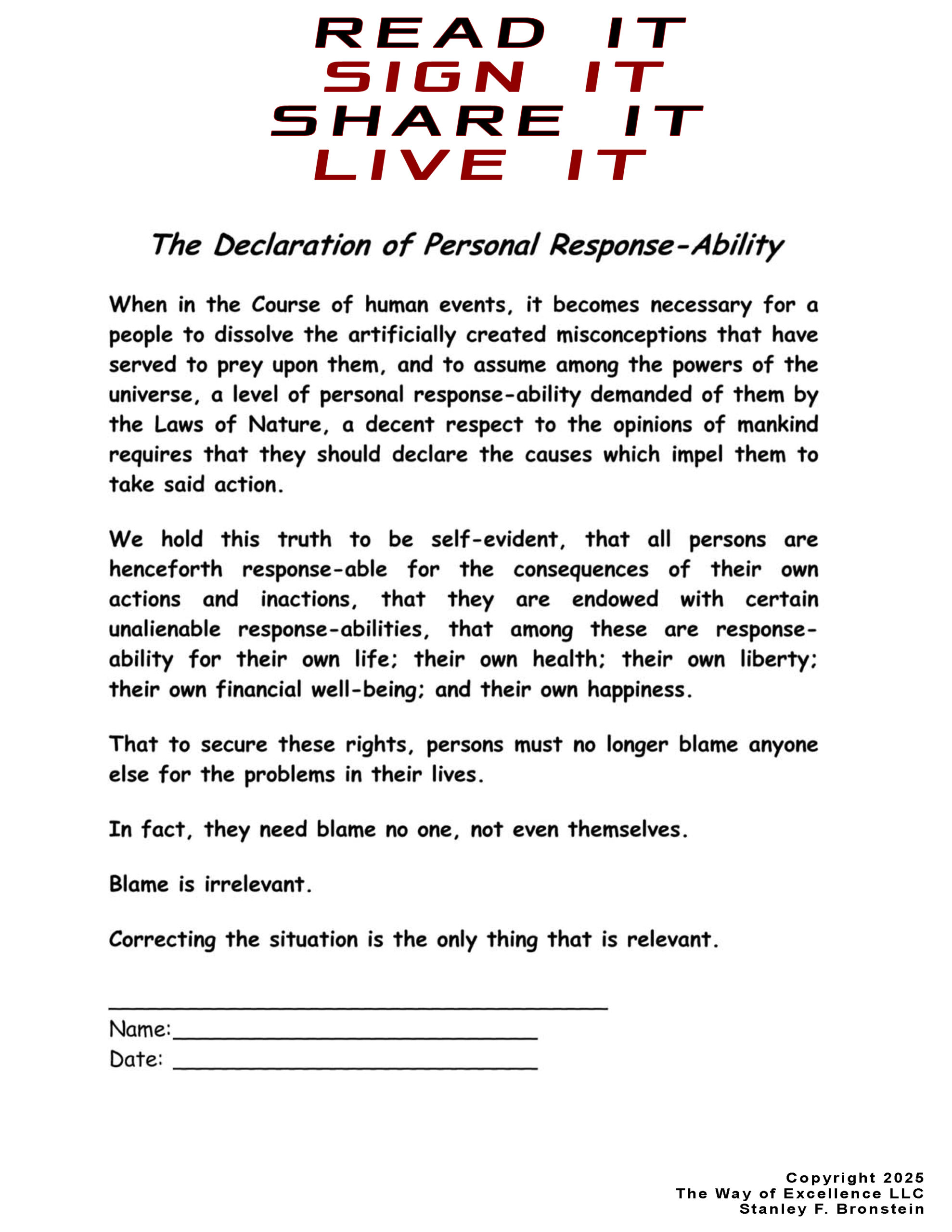
Chapter 12 - Navigating Resistance, Fear, and Self-Sabotage (The Resistance Map)
You have done a tremendous amount of constructive work so far.
- You have told the truth about your life.
- You have taken Personal Responsibility and signed (or at least considered) your Declaration of Personal Response-Ability.
- You have drawn a Character Blueprint and Directional Map.
- You have begun building identity-based habits of excellence and set boundaries and standards to protect the New You.
If the story ended there, this would be a simple book.
But you and I both know what happens next in real life.
You wake up one morning and:
- You suddenly “don’t feel like it.”
- You start bargaining with yourself: “I’ll get back on track tomorrow.”
- You feel a wave of fear, anxiety, or shame and quietly slide back into old behaviors.
- You catch yourself doing the very thing you promised yourself you were done with.
Nothing catastrophic happened. No major crisis. Just a quiet, familiar pull back toward the old way of living.
That pull has a name.
We will call it Resistance.
This chapter is about understanding Resistance, Fear, and Self-Sabotage so well that, instead of being surprised and defeated by them, you know exactly where you are on the map and what to do next.
What Resistance Really Is (And What It Is Not)
First, let’s de-shame this.
Resistance is not proof that:
- You are weak.
- You are broken.
- Your goals are unrealistic.
- The New You is fake.
Resistance is:
- Your nervous system trying to protect you from change.
- Old identity and habit pathways trying to stay alive.
- Your brain’s preference for the familiar over the unfamiliar, even when the familiar hurts.
Think of Resistance as an automatic safety system that has been miscalibrated.
In the past, this system may have helped you survive:
- Criticism by staying small.
- Chaos by clinging to routines that numbed you.
- Uncertainty by over-controlling or over-working.
- Emotional pain by overeating, over-scrolling, over-spending, or over-pleasing.
That old system is still running in the background.
Now that you are choosing excellence, identity-based habits, and Long-Term direction, the system interprets your new behavior as a threat and tries to pull you back to “safety.”
Resistance is not the enemy. It is a predictable part of the process.
The question is not, “How do I get rid of Resistance forever?” The question is:
“When Resistance shows up, how do I recognize it quickly, map what is happening, and respond excellently instead of automatically?”
That is what The Resistance Map is for.
How TWOE Frames Resistance, Fear, and Self-Sabotage
Several Concepts from The Way of Excellence speak directly to this territory:
- Concept #2 – Adopting Long-Term Thinking reminds you that repeated short-term discipline brings Long-Term rewards and that you must place reasonable limits on short-term pleasures in service of Long-Term benefits.
- Concept #3 – Taking Personal Responsibility and The Law Of Personal Response-Ability tell you that blame is irrelevant and the only real question is: “What am I going to do to fix the problem?”
- Concept #4 – Embracing Change states clearly that everyone wants change, but few are willing to change, and that change starts with you.
- Concept #5 – Focusing On The Possible and The Law Of Focus remind you that whatever you focus your attention on expands in your life.
- Concept #6 – Changing Our Perspective and The Law Of Perspective help you see that past challenges can give you a fuller perspective if you learn from them instead of dwelling in them.
- Concept #7 – Envisioning A Brighter Future invites you to form a vision of your best possible future, instead of living by the visions of others.
- Concept #10 – Taking Consistent Action and The Law Of Action insist that envisioning, attracting, and preparing accomplish nothing if you fail to act.
- Concept #11 – The Power Of Persistence teaches that nothing can take the place of persistence – patience, persistence, and hard work are an unbeatable combination.
- Concept #16 – The Willingness Factor makes it clear that permanent, positive change requires a willingness to make permanent, positive changes.
- Concept #17 – The Belief Factor reminds you that if you truly believe you can do a thing, you are more likely to do it; if you believe you cannot, you probably never will.
- Concept #18 – The Discipline Factor and Concept #19 – The Commitment Factor explain that excellence requires a disciplined regimen and a level of commitment where you go 100% all-in toward what you truly want.
In other words:
Resistance will show up at the exact points where your Willingness, Belief, Discipline, Commitment, and Long-Term Thinking are being stretched.
That is not a sign you are off the Way of You.
That is a sign you are walking it.
Common Faces of Resistance
Resistance rarely announces itself directly.
It tends to disguise itself as:
- “I’ll do it later.”
- “This is not the right time.”
- “This is too much; I should just be realistic.”
- “I already know this stuff; I don’t need to actually do the assignments.”
- “It doesn’t really matter if I skip just this once.”
Some of the main forms Resistance can take:
- Procrastination
- You delay starting the important task, even when you have the time.
- You suddenly remember ten “urgent” but trivial things that must be done first.
- Perfectionism
- “If I can’t do it perfectly, I won’t do it at all.”
- You wait for the perfect plan, mood, or conditions that never arrive.
- Numbing and Distraction
- Screens, food, substances, busyness, scrolling, shopping, gossip.
- Anything that keeps you from feeling the discomfort of growth.
- Self-Criticism and Shame Attacks
- “Who do you think you are?”
- “You always quit; you’ll blow this too.”
- Attacking yourself so harshly that you give up to escape the pain.
- Over-Complication
- Turning simple steps into complicated systems you never quite implement.
- Constantly researching, learning, and tweaking – but rarely acting.
- Rebellion
- When the New You sets a boundary, an old part of you feels trapped and rebels.
- “No one tells me what to do, not even me.”
- Collapse and Hopelessness
- The sense that it’s all too late, or too hard, or that your past disqualifies you.
- You abandon effort to avoid the pain of hope.
Every one of these patterns is understandable.
Every one of them is also compatible with a mediocre life.
The Way of You asks more of you – not harshly, but truthfully.
Introducing The Resistance Map
When you get lost while driving, a map is only useful if it shows two things:
- Where you are.
- Where you want to go.
The Resistance Map does the same thing for your inner world.
It helps you see, on paper, what is actually happening in moments when Resistance appears, so you can choose an Excellent response instead of an automatic one.
The Resistance Map has eight parts:
- Trigger – What set this off?
- Emotion(s) – What am I feeling in my body and emotions?
- Story / Thought – What is my mind telling me?
- Old Identity Voice – What version of me is speaking?
- Old Behavior / Escape – What do I usually do next?
- Short-Term Payoff – What do I get immediately from that behavior?
- Long-Term Cost – What does it cost the New Me and my Long-Term direction?
- Excellent Response – What would The Way of Excellence and The Way of You invite me to do instead, right now?
Let’s walk through each part.
1. Trigger
This is the event, situation, or internal state that activates Resistance.
Examples:
- You sit down to work on a difficult project.
- Someone criticizes you, or you fear they might.
- You feel lonely, bored, overwhelmed, or rejected.
- You hit a plateau with your health or finances.
- You are about to take a step that matters (making a call, having a conversation, setting a boundary, starting a new habit).
Naming the trigger doesn’t blame it. It simply acknowledges, “This is where Resistance tends to show up for me.”
2. Emotion(s)
What are you actually feeling?
Not what you think about it, but what you feel:
- Tightness in the chest.
- Knot in the stomach.
- Restlessness, agitation, fatigue.
- Fear, anxiety, irritation, sadness, shame.
Most self-sabotage is an unconscious attempt to escape a particular feeling.
Mapping the emotion helps you see, “I am not the feeling; I am the one noticing the feeling.”
3. Story / Thought
What is your mind saying at that moment?
Common stories:
- “This will never work.”
- “If I fail, everyone will see I’m a fraud.”
- “I shouldn’t have to work this hard.”
- “One time won’t matter.”
- “I’m too old, too broken, too late.”
Write the story down exactly as it appears in your mind.
You are not agreeing with it. You are simply documenting it.
4. Old Identity Voice
Which version of you is speaking?
Is it:
- The teenager who learned that staying quiet or small kept the peace?
- The overachiever who only felt valuable when performing perfectly?
- The people-pleaser who believed that saying no would mean rejection?
- The exhausted adult who has been told, explicitly or implicitly, that they don’t matter?
Naming the identity voice allows you to see:
“This is not the New Me. This is an older survival pattern trying to protect me in the only way it knows how.”
That awareness opens the door to compassion and choice.
5. Old Behavior / Escape
What do you usually do next when this pattern runs?
Do you:
- Procrastinate?
- Overeat or overdrink?
- Dive into social media or news?
- Lash out at someone?
- Abandon your boundaries?
- Quit the new habit?
- Overwork to avoid feeling?
Write the behavior clearly. Don’t soften or dramatize it. Just describe it.
6. Short-Term Payoff
Every self-sabotaging behavior has a payoff, or you wouldn’t do it.
Common payoffs:
- Temporary relief from anxiety, shame, or fear.
- A burst of pleasure or distraction.
- The comfort of familiarity.
- Avoidance of conflict or confrontation.
- Avoidance of potential failure.
When you see the payoff clearly, you can acknowledge:
“This behavior has been trying to help me feel safe or comfortable. It’s not evil; it’s just outdated.”
7. Long-Term Cost
This is where Concept #2 – Adopting Long-Term Thinking becomes non-negotiable.
Ask:
- “If I keep responding this way over the next year, what will it cost me?”
- “What will it cost my health, relationships, work, finances, or spirit?”
- “What will it cost the people who depend on me or look up to me?”
Be honest.
- Maybe it costs you another decade of living below your potential.
- Maybe it costs you trust with yourself.
- Maybe it costs you respect in your closest relationships.
- Maybe it costs you the future you envisioned in your Directional Map.
Writing down the Long-Term cost wakes up your vision and your conscience.
8. Excellent Response
Now you ask:
“Given everything I’ve just mapped, what is one Excellent response available to me right now?”
This is not about perfection. It is about:
- Taking Personal Responsibility.
- Embracing Change.
- Focusing On The Possible.
- Changing Your Perspective.
- Acting with Willingness, Belief, Discipline, Commitment, and Persistence.
Examples:
- Instead of procrastinating entirely, you commit to working on the task for 10 focused minutes.
- Instead of punishing yourself with shame, you speak to yourself as you would to a dear friend and then take the next right step.
- Instead of overeating to numb, you sit with the feeling for two minutes, breathe, and choose a different coping strategy.
- Instead of abandoning your boundary, you restate it calmly and follow through.
Your Excellent response might feel small.
That’s okay.
Excellent responses, repeated, change lives.
Working With Fear Instead of Against It
Fear plays a huge role in Resistance.
It often says things like:
- “If you change, you’ll lose love, belonging, or safety.”
- “If you are visible, you’ll be attacked or judged.”
- “If you try and fail, you’ll feel unbearable shame.”
Instead of trying to crush fear, try listening and reassuring:
- “Thank you for trying to protect me.”
- “Yes, this is new, and new things feel risky.”
- “But I am not that helpless child anymore.”
- “I have tools now: awareness, TWOE, The Way of You, boundaries, habits.”
- “We are allowed to grow.”
Fear is often a sign that you are moving toward something meaningful.
The key is not to obey fear blindly.
The key is to consult fear, learn from it, and then let your Character Blueprint and Directional Map make the final decision.
Reflection Questions
- Which forms of Resistance show up most often for you – procrastination, perfectionism, numbing, self-criticism, rebellion, collapse, or something else?
- In what situations do you notice Resistance most strongly – health, relationships, work, money, personal growth, spiritual practice?
- When you imagine mapping one of your recurring patterns using the Resistance Map, which Trigger and Emotion come to mind first?
- What Long-Term cost are you most unwilling to keep paying? What makes that cost unacceptable to you now?
Experiment: Map One Real Episode of Resistance
Over the next week, pay attention to one recurring pattern where you often sabotage your own progress (for example, late-night eating, skipping movement, avoiding an important project, abandoning a boundary, or numbing with screens).
Then:
- When you catch the pattern starting – or right after it happens – grab your journal and walk through the eight parts of The Resistance Map:
- Trigger
- Emotion(s)
- Story / Thought
- Old Identity Voice
- Old Behavior / Escape
- Short-Term Payoff
- Long-Term Cost
- Excellent Response
- Do this at least once, ideally two or three times, for the same pattern over the week.
- At the end of the week, review your maps and ask:
- What did I learn about how this pattern tries to “protect” me?
- Where could I have chosen an Excellent response earlier in the sequence?
The goal is not to fix the pattern instantly.
The goal is to become so familiar with it that you can feel Resistance rising and say, “I know where I am on the map,” and choose differently.
Assignment: Create Your Personalized Resistance Map Template
To make this practical and reusable, create a one-page template you can photocopy, print, or recreate in your journal whenever needed.
- On a single page, write eight headings with space under each:
- Trigger
- Emotion(s)
- Story / Thought
- Old Identity Voice
- Old Behavior / Escape
- Short-Term Payoff
- Long-Term Cost
- Excellent Response
- Under the title, write a short reminder sentence, something like:
“This map helps me see Resistance clearly so I can respond with Willingness, Belief, Discipline, Commitment, and Persistence instead of old habits.” - Keep a few blank copies with your other TWOY materials (near your Baseline of Excellence, Character Blueprint, Directional Map, identity-based habit plans, and Declaration of Personal Response-Ability).
- Commit to using a Resistance Map whenever you notice yourself repeatedly stuck in a pattern that conflicts with your Character Blueprint and Long-Term direction.
The more often you map and respond, the less power Resistance has to blindside you.
Instead of seeing setbacks as proof you are failing, you will see them as opportunities to practice excellence under pressure.
In the next chapter, we will build on this work by exploring The Bridge to Integration and Alignment: Unifying Mind, Body, and Spirit, so that your inner world is not a battleground of competing parts, but a coordinated team working together in service of The Way of You.
Chapter 13 - The Bridge to Integration and Alignment: Unifying Mind, Body, and Spirit
Up to this point in The Way of You, you’ve done a lot of powerful work:
- You have told the truth about your life as it is.
- You have created a Character Blueprint and a Directional Map.
- You have started building identity-based habits and protecting the New You with boundaries, standards, and Personal Response-Ability.
- You have learned to notice and map Resistance instead of being blindsided by it.
All of that is essential.
But there is a deeper layer you cannot ignore if you want a life that truly works:
The relationship between your mind, your body, and your spirit.
Most people live as if these three parts are separate departments:
- The mind worries, plans, analyzes, replays conversations, and tries to think its way through everything.
- The body is treated as a vehicle or a problem – pushed, neglected, numbed, or used – but rarely listened to as a source of wisdom.
- The spirit (however you define it – meaning, values, conscience, connection to something larger) is often squeezed into the margins, saved for rare moments or crises.
When these three are not communicating, life becomes a constant negotiation:
- Your mind sets goals your body cannot sustain.
- Your body sends signals your mind ignores.
- Your spirit calls you in one direction while your habits and fears pull you in another.
This chapter is about building a bridge between these parts of you – so that mind, body, and spirit begin to function as one integrated system instead of three competing agendas.
This is where The Way of You begins to touch the deepest level of The Way of Excellence.
Concept #20 – Integration Of Mind, Body & Spirit
The Way of Excellence ends with a Concept that is not an afterthought; it is the capstone:
Concept #20 – Integration Of Mind, Body & Spirit
The teaching is simple and profound: until we bring our mind, body, and spirit together into an integrated, aligned whole, we will never achieve our maximum potential and evolve as a species. The corresponding Law explains that when these three are working in harmony, everything in life works better. When they are in conflict, everything becomes harder than it needs to be.
In earlier chapters, you’ve touched each part:
- Your mind in your stories, beliefs, identity, and mental habits.
- Your body in your Baseline of Excellence and your health-related habits.
- Your spirit in your sense of meaning, direction, and your Declaration of Personal Response-Ability.
Now we focus on how they interact.
Integration Of Mind, Body & Spirit is not about making any part disappear. It is about alignment and communication. It is the difference between:
- A team of talented players all doing their own thing, and
- A team playing the same game, with the same strategy, in the same direction.
Fragmentation: When Mind, Body, and Spirit Are Out of Sync
Before we talk about integration, we need to name what you may already be living with: fragmentation.
Fragmentation shows up when:
- Your mind knows what to do (“I want to eat well, move, rest, tell the truth, protect my time”), but your body feels exhausted or addicted to old rhythms, and your spirit feels discouraged or numb.
- Your body is screaming for rest, movement, or nourishment, but your mind insists, “There’s no time, just push through,” while your spirit feels ignored or used.
- Your spirit is calling you toward a more honest, meaningful life, but your mind is busy rationalizing why you should stay in place, and your body is stuck in routines that keep you distracted.
Typical signs of fragmentation:
- Chronic tiredness that does not go away with a single night of sleep.
- Repeated cycles of “getting on track” and “falling off the wagon.”
- Anxiety or depression that feel disconnected from specific events, as if something is “off” in a way you cannot name.
- A sense of living multiple lives: the version of you other people see, the version of you in your thoughts, and the version of you that appears when no one is watching.
Fragmentation is not a moral failure. It is what happens when different parts of you are trying to solve different problems in different ways, without a shared plan.
The Way of You offers that shared plan.
Mind, Body, Spirit: What Each Brings to the Table
To integrate these three, it helps to respect what each is good at.
Mind
Your mind is excellent at:
- Thinking, analyzing, planning, imagining, and problem-solving.
- Creating stories and meanings about what happens to you.
- Focusing attention (when trained) on what matters.
When untrained or overloaded, your mind can:
- Worry, catastrophize, and ruminate.
- Overthink to avoid action.
- Create harsh inner narratives that sabotage your confidence.
Body
Your body is excellent at:
- Detecting danger and safety through sensation.
- Providing energy, strength, stamina, and mobility.
- Signaling truth through physical response: a knot in your stomach, a tight chest, relaxed shoulders, a sense of lightness or heaviness.
When neglected, pushed, or numbed, your body can:
- Break down in the form of pain, illness, or chronic fatigue.
- Seek quick comfort through food, substances, or inactivity.
- Become a convenient target for self-hatred instead of a partner in your growth.
Spirit
Your spirit (again, however you define it) is excellent at:
- Pointing you toward meaning, purpose, and deeper values.
- Helping you sense what is right for you beyond fear and ego.
- Connecting you to something larger than your individual problems: truth, love, service, God, humanity, nature, or the bigger story of your life.
When ignored or silenced, your spirit can:
- Express itself as a sense of emptiness, restlessness, or “Is this all there is?”
- Show up as a quiet ache when you know you are betraying your values.
- Withdraw, leaving you feeling like you are just “going through the motions.”
Integration Of Mind, Body & Spirit begins when you stop asking one part to carry the entire weight of your life and instead allow each part to play its role.
Alignment: One Direction, Three Voices
You already have a direction: your Character Blueprint and Directional Map.
Integration means:
- Your mind understands and supports that direction.
- Your body is cared for and trained so it can walk that path.
- Your spirit is honored so that the path feels meaningful, not empty.
In practice:
- When your mind sets a goal, it checks with your body’s capacity and your spirit’s values.
- When your body sends a signal – fatigue, tension, pain, ease – your mind listens and adjusts plans instead of overriding everything.
- When your spirit raises a red flag (“This is not honest,” “This is not who we are anymore”), your mind and body help you make changes, even when it’s uncomfortable.
Alignment is less about feeling perfect harmony all the time and more about having a conversation among the three and choosing in favor of integrity.
Your goal is to live as the person at the center of this symbol – a whole human being with mind, body, and spirit in balance. Each part is distinct, but they work together in harmony, continually supporting and feeding one another.
This is what Integration Of Mind, Body & Spirit looks like in practice: not three separate departments, but one integrated and aligned Way of You.
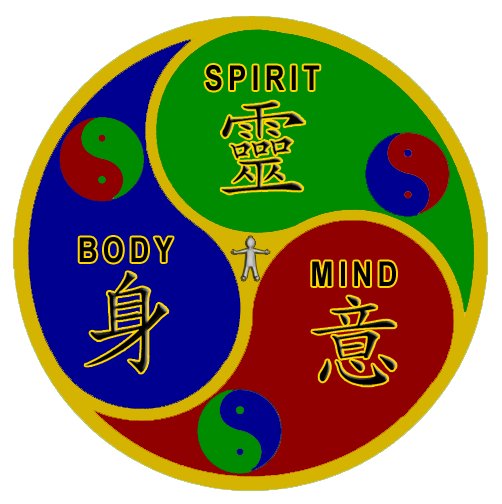
The Bridge Practices: Inviting Each Part to the Table
To build this bridge, you do not need exotic rituals. You need simple, repeatable practices that:
- Help your mind listen instead of just talk.
- Help your body be felt instead of ignored.
- Help your spirit be consulted instead of sidelined.
Here are several categories of “bridge practices” you can experiment with.
1. Mind – Body Check-Ins
Once or twice a day, pause for one or two minutes and ask:
- “What am I thinking right now?” (Mind)
- “What am I feeling in my body?” (Body)
- “What matters most to me in this moment?” (Spirit)
You don’t need deep answers at first. The purpose is simply to notice.
Over time, these check-ins:
- Help you catch early signs of stress, burnout, or misalignment.
- Bring you out of autopilot.
- Create space for your spirit’s perspective to come through.
2. Conscious Movement
Movement is not just a health habit; it is a bridge.
When you move your body with awareness – walking, stretching, breathing, exercising – your mind and body are in conversation.
To use movement as integration:
- Pick at least one movement practice (walking, stretching, yoga, lifting, dance, simple mobility work) and bring your attention to your body as you do it.
- Notice where you feel strong, weak, stiff, or free.
- Allow thoughts and emotions to rise and fall without judgment.
You are sending a message: “Body, you matter. I am listening. We are in this together.”
3. Stillness and Reflection
Your spirit rarely shouts over noise and distraction. It tends to speak in:
- Quiet inner nudges.
- Gut feelings that do not go away.
- Longings and values that keep resurfacing.
To hear it more clearly, create small pockets of stillness:
- A few minutes of silence in the morning or evening.
- Sitting quietly after a walk with no phone or input.
- Writing in a journal about what feels meaningful, true, or off in your life.
You do not have to label these practices as religious or spiritual. They are simply ways of turning your attention toward what is deeper than your to-do list.
4. Alignment Questions
When facing a decision, big or small, ask three questions:
- “Does this make sense to my mind?” (Is it logical, reasonable, aligned with my plans and responsibilities?)
- “How does this feel in my body?” (Tension, heaviness, ease, openness?)
- “Is this consistent with my spirit – my values, my Character Blueprint, and The Way of Excellence?” (Does it feel honest, respectful, Long-Term, Win-Win, balanced?)
When all three say “yes,” you can move forward with confidence.
When one of them says “no” or “something’s off,” slow down and listen.
How Integration Supports Excellence
Integration Of Mind, Body & Spirit is not a vague ideal. It has very practical effects on your ability to live The Way of You.
Clarity and Focus (Mind)
When your body is cared for and your spirit is consulted, your mind can:
- Think more clearly.
- Worry less.
- Focus its energy on what actually matters.
Concept #5 – Focusing On The Possible and The Law Of Focus become much easier to live when your body is not constantly screaming for basic care and your spirit is not constantly protesting ignored values.
Energy and Resilience (Body)
When your mind and spirit are aligned:
- You are more motivated to move, nourish, and rest your body.
- Habits like walking, stretching, sleeping, and eating well become acts of respect, not punishment.
- Your body responds with more energy, resilience, and feedback.
Concept #15 – Creating A Balanced Life and The Law Of Balance show up here: you begin to see your body as a crucial part of your balanced system, not an afterthought.
Meaning and Direction (Spirit)
When your mind and body are aligned with your deeper values:
- Your life feels less like a series of disconnected tasks and more like a coherent story.
- You can endure short-term discomfort because it is connected to a Long-Term purpose.
- Your Declaration of Personal Response-Ability feels less like a document and more like a way of being.
This is where Envisioning A Brighter Future, The Willingness Factor, The Belief Factor, The Discipline Factor, and The Commitment Factor move from words to a lived spiritual posture.
Integration Is a Process, Not a Destination
Just like everything else in this book, integration is not something you “achieve” once.
It is a practice.
Some days your mind will be ahead of your body and spirit. Other days your body will be tired or in pain, and you’ll need to adjust your expectations. Some days your spirit will nudge you to change course when your plans were set in another direction.
Integration Of Mind, Body & Spirit means:
- You notice those shifts.
- You bring the three parts back into conversation.
- You make decisions that respect all three as much as possible.
You will not do this perfectly. No one does.
Excellence does not demand perfection. It demands honest, ongoing alignment.
Reflection Questions
- In your current life, do you tend to over-rely on your mind, your body, or your spirit? Which part gets most of your attention, and which part gets the least?
- Think of a recent decision that left you feeling off. Looking back, what did your mind say? What did your body say? What did your spirit say? Which voice did you ignore?
- What is one way you have treated your body more like an enemy or a tool than a partner? What might it look like to treat your body as a teammate instead?
- When was the last time you felt a moment of true integration – where your thoughts, your physical state, and your sense of meaning were all pointing in the same direction? What were you doing, and what can you learn from that moment?
Experiment: A Week of Three-Point Check-Ins
For the next seven days, once per day, do a brief three-point check-in. It can take as little as two or three minutes.
- Sit or stand quietly. Take a slow breath.
- Ask yourself three questions and write down one short sentence for each:
- “Mind: What am I thinking about most today?”
- “Body: What am I feeling in my body right now?”
- “Spirit: What actually matters most to me today?”
- After writing, ask: “Is there one small action I can take in the next 24 hours that honors all three?”
Examples:
- Mind: “I’m worried about a deadline.”
- Body: “Tight shoulders, low energy.”
- Spirit: “I want to do honest, quality work without sacrificing my health.”
- Action: “Take a 10-minute walk at lunch, then work in a 25-minute focused block on the most important task.”
You are training yourself to live as one integrated person instead of three disconnected parts.
Assignment: Design Your Personal Integration Practices
Over the coming days, choose and commit to a simple set of integration practices that fit your life.
- Mind Practice (Daily or Weekly)
- Examples: journaling, a weekly review of your Character Blueprint and Directional Map, focused reading or learning that supports your Long-Term direction.
- Body Practice (Daily)
- Examples: a minimum daily movement commitment, a sleep routine, choosing nourishing food most of the time, regular stretching or mobility work.
- Spirit Practice (Regular)
- Examples: quiet reflection, prayer, meditation, time in nature, service to others, gratitude lists, honest conversations about what matters.
For each practice, write:
- What you will do.
- When you will do it.
- How it serves your integration of mind, body, and spirit.
At the bottom of your plan, add a short statement, such as:
“These practices are how I honor Integration Of Mind, Body & Spirit in my daily life. I will not treat any part of myself as expendable. I am learning to live as one whole, integrated human being.”
Keep this Integration Plan with your other TWOY materials.
In the next chapter, you will zoom out and begin Designing a Durable Life System (The Long Game) – so that all of this work does not depend on momentary motivation, but is supported by structures and rhythms that can carry you through the years ahead on The Way of You.
Chapter 14 - Designing a Durable Life System (The Long Game)
By now you have built a lot:
- A Brutally Honest Snapshot of where you started.
- A Baseline of Excellence showing your current reality.
- A Character Blueprint that defines who you choose to become.
- A Directional Map that points your life toward that identity.
- Identity-based habits that express that identity daily.
- Boundaries, standards, and a Declaration of Personal Response-Ability to protect the New You.
- Bridge practices that begin integrating Mind, Body & Spirit.
It is a lot of progress.
But there is still a problem.
If all of this depends on you “trying really hard” day after day, it will eventually crack under pressure. Life will get busy. A crisis will hit. Motivation will dip. Old patterns will whisper. And if everything is resting on willpower alone, the old structure of your life will quietly pull you back.
To live The Way of You over the Long-Term, you need more than effort.
You need a life system.
A life system is the set of structures, rhythms, and supports that make it easier to live as your best self and harder to drift back into autopilot. It is the Long-Term container that holds your identity, habits, and commitments in place when things get noisy.
This chapter is about designing that system.
Excellence and the Long Game
The Way of Excellence is very clear that excellence is a Long-Term endeavor.
- Concept #2 – Adopting Long-Term Thinking reminds you that repeated short-term discipline brings Long-Term rewards, and that you must place reasonable limits on short-term pleasures in order to gain Long-Term benefits.
- Concept #9 – Allocating Our Resources Wisely reminds you that your time, energy, and money are finite and must be used wisely if you want to reach your maximum potential.
- Concept #10 – Taking Consistent Action and Concept #11 – The Power Of Persistence insist that success comes from repeated action and persistence, not from occasional bursts of effort.
- Concept #15 – Creating A Balanced Life reminds you that any system out of balance will not reach its maximum level of productivity.
- Concept #18 – The Discipline Factor and Concept #19 – The Commitment Factor teach that excellence requires a disciplined regimen and that you must go 100% all-in toward what you truly want.
- Concept #20 – Integration Of Mind, Body & Spirit tells you that your systems must support the whole of you, not just one part.
A durable life system is how you live all of that, practically.
It does not guarantee that every day will go perfectly. It does make sure that when life pushes you, you bend instead of breaking and you return to your path more quickly.
What Is a Life System?
A life system is not a rigid schedule that never changes. It is:
- A set of repeatable rhythms for your days, weeks, and months.
- A handful of review and reset points where you step back, reflect, and realign.
- A network of supports and safeguards that protect your priorities, energy, and integrity.
- A way of structuring your life so that The Way of You is the default, not the exception.
You already have a system, whether you designed it or not.
Your current habits, routines, sleep patterns, digital usage, social circles, work style, and coping mechanisms all add up to a system. The question is not, “Do I have a system?” The question is, “Is my current system designed to support excellence, or did it just grow around my past, my fears, and other people’s expectations?”
Designing a durable life system means answering that question on purpose.
The Four Pillars of a Durable Life System
We will build your system around four pillars:
- Rhythms – Daily and weekly patterns that anchor you.
- Reviews – Regular times to reflect, measure, and adjust.
- Relationships – People who support, challenge, and walk with you.
- Reserves – Margin in time, energy, and money that keeps you from running on fumes.
Each pillar is grounded in The Way of Excellence and The Way of You.
1. Rhythms: Anchors, Not Chains
Rhythms are repeating patterns in your days and weeks that support your identity and direction.
They are not strict timetables you must follow minute by minute. They are anchors that keep you from drifting too far when life gets choppy.
Good rhythms:
- Are simple enough to remember.
- Are flexible enough to survive interruptions.
- Include space for mind, body, and spirit.
- Express your Character Blueprint and directional commitments.
Common types of rhythms:
- Morning anchors – A small set of actions that start your day aligned: movement, reflection, reviewing your Character Blueprint, planning your top priorities.
- Evening anchors – A simple wind-down: closing the day, noting wins and lessons, preparing for tomorrow, protecting sleep.
- Workday structure – Blocks of focused work, intentional breaks, and clear stopping times.
- Health rhythms – Movement, food choices, and rest woven into your week, not added on as an afterthought.
- Connection rhythms – Regular time with important people: meals, check-ins, shared activities.
When rhythms are in place, you do not need to re-decide everything every day. You follow your anchors unless there is a good reason not to. That is The Discipline Factor in action: a regimen that supports your mind, body, and spirit.
2. Reviews: Look Back to Move Forward
Excellence requires feedback.
Without it, even the best intentions drift. Reviews are your structured times to apply:
- Concept #3 – Taking Personal Responsibility
- Concept #5 – Focusing On The Possible
- Concept #6 – Changing Our Perspective
- Concept #12 – Building A Foundation Of Integrity
Instead of ignoring the past week or month, you ask:
- “What actually happened?”
- “What did I do well?”
- “Where did I drift away from The Way of You?”
- “What will I adjust?”
Three review levels are especially powerful:
- Daily resets (5 – 10 minutes). Briefly scan your day: habits, boundaries, moments of integrity or drift, how mind, body, and spirit feel. This connects directly to your identity-based habits and your Resistance Map.
- Weekly reviews (20 – 40 minutes). Revisit your Baseline of Excellence, Character Blueprint, and Directional Map. Look at how your time and energy were used. Identify one or two course corrections for the coming week.
- Monthly or quarterly reviews (45 – 90 minutes). Zoom out. Are you moving in your chosen direction in health, relationships, work, money, and meaning? Where are you significantly out of balance? Do any commitments, projects, or habits need to be added, adjusted, or retired?
Reviews are not about harsh judgment. They are about integrity: aligning your stories about yourself with the facts of your behavior and then choosing responses that honor your values.
3. Relationships: You Are Not Meant to Walk Alone
The Way of You is deeply personal, but it is not meant to be solitary.
- You need people who support your growth.
- You need people who will tell you the truth when you drift.
- You need people you can serve and encourage in return.
This pillar connects directly to:
- Concept #13 – Respect and the Law Of Respect.
- Concept #14 – Learning To Think Win-Win and the Law Of Alternatives.
- The larger vision that your life will ultimately feed into The Way of Us.
A durable life system includes:
- Anchoring relationships – People who know your commitments and encourage you when you struggle.
- Growth partners – Friends, mentors, or groups who share similar goals and hold each other accountable.
- Boundaried relationships – Clear decisions about which relationships you will invest in and which ones you need to limit or leave in order to protect your integrity and energy.
You do not need a large crowd. You need a reliable few.
Part of designing your system is asking:
- “Who is walking with me on this path?”
- “Who needs to know what I am trying to become?”
- “Where do I need to upgrade the quality of my conversations and connections?”
Relationships are one of the strongest forms of The Commitment Factor. When you say your commitments out loud to people you respect, they become more real.
4. Reserves: Margin for Real Life
Most people try to build a better life on top of a schedule, budget, and energy level that are already maxed out.
Then they wonder why nothing sticks.
Reserves are the intentional margins you create:
- Time reserves – White space in your calendar. Time that is not pre-committed so you can rest, think, handle emergencies, or pursue opportunities.
- Energy reserves – Practices that refill your energy rather than draining it: sleep, movement, nutrition, joy, solitude, play.
- Financial reserves – Saving and spending habits that keep you from living at the edge of crisis.
This pillar reflects Creating A Balanced Life and Allocating Our Resources Wisely. Without reserves:
- Small problems feel like disasters.
- Growth work gets sacrificed every time there is friction.
- You are forced to live in chronic reactivity instead of Long-Term design.
Building reserves may require painful choices at first: saying no, reducing commitments, simplifying, downsizing, or changing spending patterns. But it is one of the most powerful ways to support The Way of You over decades, not just months.
Designing Your Life System: Putting It All Together
Let’s make this concrete.
You are going to sketch a first version of your life system, knowing it will evolve.
Step 1: Define Your Non-Negotiable Anchors
Based on everything you have designed so far, choose:
- One morning rhythm that aligns your mind, body, and spirit.
- One evening rhythm that helps you close the day with integrity.
- One weekly rhythm that protects something important (for example, a specific block for health, learning, or connection).
Keep each one simple enough that you can actually do it most of the time.
Step 2: Schedule Review Points
Decide when and how you will do:
- A brief daily reset (end of day or first thing in the morning).
- A weekly review (pick a consistent day and time).
- A monthly or quarterly review (put it in your calendar now).
Use these reviews to revisit your Baseline of Excellence, Character Blueprint, Directional Map, identity-based habits, boundaries, and Integration practices.
Step 3: Clarify Your Support Network
Write down:
- The names of one to three people who can support your growth.
- How you will connect with them (a monthly call, a weekly message, a regular meeting, a shared habit or project).
- Which commitments or boundaries you may need to communicate to key people so they understand the changes you are making.
If you do not currently have these relationships, your system may include the goal of finding or building them over time.
Step 4: Build Margin Intentionally
Look at your current calendar, energy, and finances. Then ask:
- “Where can I create even a small pocket of time each week that is truly open?”
- “What one habit would most increase my energy reserves?”
- “What one financial decision would begin moving me away from crisis and toward stability?”
You are not trying to solve everything at once. You are starting the process of moving from a life lived at 100% capacity to a life with some breathing room.
Rigid Flexibility: Strong Direction, Flexible Expression
As you design your system, remember this:
You want rigid direction and flexible expression.
Rigid, in the sense that:
- Your identity, values, and Long-Term direction are non-negotiable.
- Your commitment to excellence, integrity, and integration is firm.
Flexible, in the sense that:
- Your specific rhythms can be adjusted as seasons change.
- Your exact habits can evolve as you learn what works best.
- Your supports and structures can be upgraded over time.
If you hold your system too loosely, nothing changes. If you hold it too tightly, you will break it the first time life does not cooperate.
The Long Game is about staying all-in on who you are becoming, while being willing to adapt how you express that commitment as your life unfolds.
Reflection Questions
- Where in your current life do you already have healthy rhythms that support The Way of You? Where do you have rhythms that clearly pull you away from excellence?
- When was the last time you did a genuine review of your week, month, or year, rather than just surviving it and moving on? What did you learn?
- Who in your life supports your growth, tells you the truth, and wants to see you live as your best self? How intentionally are you nurturing those relationships?
- How much margin do you currently have in your time, energy, and money? What is one concrete step you could take in the next month to increase reserves in one area?
Experiment: One Week of System Awareness
For the next seven days, instead of trying to change everything, simply watch your current system.
Each day, jot down brief notes on:
- The rhythms you naturally fall into (morning, workday, evening).
- Moments when your existing system supported your Character Blueprint.
- Moments when it pulled you away from The Way of You.
- Where you felt the lack of reviews, relationships, or reserves.
At the end of the week, ask:
- “If my life keeps running on this system for the next five years, where is it taking me?”
- “What are the first two or three upgrades that would make the biggest difference?”
You are training your eyes to see systems, not just isolated events.
Assignment: Draft Your First Life System Blueprint
Over the next several days, create a one- to two-page Life System Blueprint that you can refine over time. Include:
- Rhythms
- Morning anchor: 3 – 5 bullet points.
- Evening anchor: 3 – 5 bullet points.
- Weekly anchor: one or two key blocks of time you will protect.
- Reviews
- Daily reset: when and how you will do it.
- Weekly review: when, where, and what questions you will ask.
- Monthly or quarterly review: when and what you will revisit (Baseline of Excellence, Character Blueprint, Directional Map, Integration practices, habits).
- Relationships
- Names and roles of one to three key support people.
- How often and in what format you will connect with them about your growth.
- Any boundaries or conversations you need to initiate to protect your system.
- Reserves
- One concrete step you will take in the next 30 days to increase time margin.
- One step to increase energy margin.
- One step to increase financial margin.
- Statement of Intent
- A short paragraph that begins with something like:
“This Life System Blueprint is how I will play the Long Game of excellence. It is designed to support my identity, protect my energy, and keep me aligned with The Way of You over time. I expect it to evolve, but I commit to living within some version of this system for the Long-Term.”
- A short paragraph that begins with something like:
Keep this blueprint with your other core documents: your Baseline of Excellence, Character Blueprint, Directional Map, habit plans, Resistance Map template, Integration practices, and Declaration of Personal Response-Ability.
You now have not just ideas, but a structure.
With this in place, you are ready to move into Part III – Optimizing You, where we will refine, deepen, and expand everything you have built so far, bringing your environment, craft, and contribution into alignment with The Way of You for the rest of your excellent life.
INTRODUCTION TO PART III - OPTIMIZING YOU
Refinement, Mastery, Integration, and Contribution
By the time you arrive here, you’ve already done something most people never do.
In Part I – Finding You, you stepped off autopilot and told the truth about your life.
You created a Brutally Honest Snapshot, a Baseline of Excellence, and began to see your past not as a prison, but as training.
In Part II – Becoming You, you moved from discovery to design.
You wrote your Character Blueprint, aligned your Long-Term direction with who you choose to be, built identity-based habits, set boundaries and standards, claimed your Personal Response-Ability, mapped Resistance, and began integrating Mind, Body & Spirit. You even drafted a Life System Blueprint to hold all of that in place.
That alone is enough to change the trajectory of a life.
But The Way of You is not just about improvement.
It is about optimization.
Optimization is often misunderstood. People hear the word and think:
- Perfectionism.
- Obsession.
- Endless tweaking.
- Never being satisfied.
That is not what we are doing here.
When I say Optimizing You, I mean something very specific:
Taking the life you’ve begun to build and refining it so that more and more of your time, energy, relationships, environment, and contribution line up with who you truly are and what you are here to give.
Optimization is not about becoming someone else.
It is about becoming more fully you, with less friction and less waste.
From Building to Refining
In Parts I and II, you laid foundations:
- Truth instead of denial.
- Personal Response-Ability instead of blame.
- Long-Term Thinking instead of short-term fixes.
- Character and identity instead of surface-level goals.
- Habits, boundaries, and systems instead of scattered efforts.
In Part III, we shift from building to refining.
You will:
- Clarify what optimization really means so you don’t turn it into a new form of self-attack.
- Deepen your Integration Of Mind, Body & Spirit so you can function as one coherent whole.
- Shape your environment to support excellence instead of constantly fighting against it.
- Explore mastery – not as perfection, but as a Long-Term relationship with your craft and your life.
- Begin the shift from me to we, seeing how The Way of You naturally feeds into The Way of Us.
- Craft a personal manifesto for living The Way of You for the rest of your excellent life.
Optimization is where The Way of Excellence becomes visible to others.
People can see it in how you walk through the world, how you handle challenges, how you treat your own body and mind, how you show up in relationships, and how you use your gifts.
The Role of TWOE in Optimizing You
Several Concepts of The Way of Excellence become especially important here:
- Adopting Long-Term Thinking – Optimization assumes you are in this for the Long-Term. You are not chasing quick highs; you are crafting a life.
- Allocating Our Resources Wisely – As you refine your life system, you must use your time, energy, money, and attention with increasing wisdom.
- Creating A Balanced Life – Optimization that costs you your health, relationships, or integrity is not excellence; it is imbalance.
- The Willingness Factor, The Belief Factor, The Discipline Factor, The Commitment Factor – You will draw on all four as you fine-tune your habits, systems, and environment.
- Integration Of Mind, Body & Spirit – Optimization is not just about efficiency; it is about harmony. The stronger your integration, the more gracefully you can live The Way of You under real-world pressure.
Part III is where these Concepts stop being ideas on a page and become the operating principles of your daily existence.
Optimization Is Not Constant Self-Fixing
A crucial distinction:
You are not entering Part III because you are “not good enough yet.”
You are entering Part III because:
- You have already honored the truth about where you are.
- You have already committed to who you are becoming.
- You are now ready to live that commitment more fully, with less friction and more impact.
Optimization is not:
- Adding endless demands to your already full life.
- Finding new ways to criticize yourself.
- Hitting some imagined finish line where you never struggle again.
Optimization is:
- Removing what clearly no longer fits the person you have chosen to be.
- Strengthening what supports your Long-Term direction.
- Designing an environment and way of living that make excellence feel increasingly natural, even when life is difficult.
Instead of “What else is wrong with me?” the guiding question becomes:
“How can I make it easier and more natural to live as my best self, more of the time?”
From Me to We: Why Optimizing You Matters Beyond You
You might be tempted to think of optimization as a purely personal project.
It isn’t.
As you move through these final chapters, you’ll begin to see clearly:
- The healthier and more integrated you become, the more available you are to the people you care about.
- The more disciplined and Long-Term your choices, the more stable and trustworthy you become in your relationships, work, and community.
- The more you align your life with your deepest values, the more your very existence becomes an invitation for others to do the same.
Optimizing You is the bridge to The Way of Us.
Your courage to live an excellent life – in your health, your relationships, your work, and your contribution – creates ripples. Family. Friends. Colleagues. Strangers who see you walking a different way.
Part III will make that connection explicit, especially in Chapter 19, where we explore how The Way of You feeds The Way of Us.
What to Expect in Part III
Here is how this final section will unfold:
- Chapter 15 – What Optimization Really Means: Alignment, Not Obsession
You’ll define optimization clearly so it does not turn into perfectionism or self-punishment. You’ll learn to measure progress by alignment rather than image or comparison. - Chapter 16 – Deep Integration: When Mind, Body, and Spirit Align
Building on Concept #20, you’ll explore what it looks like when your thoughts, your physical life, and your sense of meaning start pulling in the same direction – and how to deepen that in daily practice. - Chapter 17 – Refining Your Environment for Excellence (The Environmental Audit)
You’ll examine your physical spaces, digital world, relationships, and habits of consumption, and redesign them to support your Character Blueprint and Long-Term direction. - Chapter 18 – Mastery, Excellence, and The Long-Term Craft
You’ll explore mastery as a lifelong craft – how to keep growing, learning, and contributing without burning out or losing yourself. - Chapter 19 – From Me to We: The Way of You Feeds The Way of Us
You’ll see how your personal excellence naturally contributes to the collective – your family, community, and the larger human story. - Chapter 20 – Living The Way of You for the Rest of Your Excellent Life (The Manifesto)
You’ll bring everything together into a personal manifesto – a clear, written statement of how you intend to live The Way of You from this point forward.
Stepping Into the Long Game
As you enter Part III, remember:
You are no longer just trying to fix a problem.
You are learning to live an excellent life.
You have already shown Willingness, Belief, Discipline, and Commitment simply by coming this far and doing the work.
Now we turn toward the Long-Term.
- We are going to tune your life system.
- We are going to deepen your integration.
- We are going to refine your environment.
- We are going to place your life in a larger context.
You are not starting from scratch. You are building on everything you have already done.
Take a breath.
Acknowledge how far you have come.
Then step with me into Part III, where we will explore What Optimization Really Means: Alignment, Not Obsession – and begin shaping the Way of You for the rest of your excellent life.
Chapter 15 - What Optimization Really Means: Alignment, Not Obsession
The word “optimize” can be dangerous.
For many people, it immediately triggers:
- Perfectionism: “If I can’t do it flawlessly, why bother?”
- Hustle culture: “Sleep when you’re dead. Grind harder.”
- Endless tweaking: new apps, new hacks, new routines – without much real change.
- Self-attack: “If I were serious, I’d be doing more, faster.”
If that’s what optimization means to you, it will eventually crush you.
The Way of You defines optimization very differently:
Optimization is the process of bringing more and more of your life into honest alignment with who you truly are and what you are here to give – without sacrificing your health, your relationships, your integrity, or your spirit.
Not more pressure.
More alignment.
In this chapter, we will:
- Redefine optimization in a way that fits The Way of Excellence.
- Expose the difference between obsessive optimization and aligned optimization.
- Show how Concepts like Creating A Balanced Life, Allocating Our Resources Wisely, and Integration Of Mind, Body & Spirit set the boundaries for healthy optimization.
- Give you practical tools to measure your life by alignment rather than by image, comparison, or perfection.
TWOE’s Guardrails Around Optimization
The Way of Excellence already contains powerful guardrails that prevent optimization from turning into self-destruction.
Several Concepts are especially important here:
- Concept #2 – Adopting Long-Term Thinking
You are playing the Long-Term game. Repeated short-term discipline brings Long-Term rewards. Short-term extremes that destroy your health or relationships are not excellence; they are self-sabotage. - Concept #9 – Allocating Our Resources Wisely
Your time, energy, and money are limited. You cannot optimize everything at once. You must decide what matters most and invest accordingly. - Concept #10 – Taking Consistent Action and Concept #11 – The Power Of Persistence
Excellence is built on consistency and persistence, not frantic bursts of effort. - Concept #15 – Creating A Balanced Life
Any system out of balance will not reach its maximum level of productivity. Optimization that costs you your health, family, integrity, or spirit is not excellence; it is imbalance. - Concept #18 – The Discipline Factor and Concept #19 – The Commitment Factor
You are called to develop disciplined routines and to go 100% all-in toward what you truly want – but within the boundaries of balance, respect, and integration. - Concept #20 – Integration Of Mind, Body & Spirit
Your optimization must serve the whole of you. Mind, body, and spirit must work together, not be sacrificed one for another.
These Concepts define the container for optimization.
Inside that container, optimization is powerful. Outside of it, optimization becomes obsession.
Obsession vs. Alignment: Two Very Different Paths
Let’s draw a clear line between two styles of “optimization.”
Obsessive Optimization
Obsessive optimization sounds like:
- “More, faster, harder – always.”
- “Rest is weakness.”
- “If I am not beating someone else, I am losing.”
- “If I can’t maintain this extreme pace, I am a failure.”
It usually leads to:
- Burnout and health problems.
- Strained or broken relationships.
- Constant anxiety and never-ending self-criticism.
- A life that looks impressive from the outside and feels empty on the inside.
In obsessive optimization:
- The mind tries to dominate everything.
- The body is pushed until it breaks or rebels.
- The spirit is ignored or used as a prop for achievement.
This is not The Way of You.
Aligned Optimization
Aligned optimization sounds like:
- “How can I live more and more in alignment with my Character Blueprint?”
- “How can I make it easier and more natural to do what I know is right, most of the time, over the Long-Term?”
- “How can I reduce friction and waste so my time, energy, and gifts are used well?”
- “How can I grow in a way that strengthens my health, relationships, integrity, and contribution together?”
It leads to:
- Steady, sustainable improvement.
- Deepening trust in yourself.
- Increasing capacity to serve and contribute.
- A life that feels coherent – you recognize yourself in how you live.
In aligned optimization:
- The mind plans and focuses.
- The body is trained and cared for.
- The spirit keeps everything anchored in meaning and values.
Aligned optimization is not about being the best in the world.
It is about becoming the best, truest version of you – in a way that you can sustain for the rest of your excellent life.
Alignment as the Core Measure
Most people measure their life by:
- External markers (income, status, achievements).
- Comparison (how they stack up against others).
- Short-term feelings (how “motivated” or “on track” they feel this week).
The Way of You offers a different core measure:
Alignment – the degree to which your daily life matches your Character Blueprint, Directional Map, and Integration Of Mind, Body & Spirit.
When you are aligned:
- Your choices reflect your values most of the time.
- Your habits support your Long-Term direction.
- Your body is treated as a partner, not a dumping ground.
- Your relationships are more honest, respectful, and Win-Win.
- Your work and contribution feel increasingly connected to who you are.
When you are misaligned:
- You feel that inner split between what you say you believe and what you actually do.
- You find yourself breaking your own agreements with yourself.
- You experience more resentment, numbness, or shame.
Alignment is not about never slipping.
It’s about:
- Slipping less often.
- Noticing more quickly.
- Returning to your path more gracefully.
Your goal in optimization is not to become a flawless person; it is to become a deeply aligned person.
The Alignment Triangle: Identity, Behavior, Environment
To make alignment practical, it helps to think in terms of three corners of a triangle:
- Identity – Who you say you are (your Character Blueprint).
- Behavior – What you repeatedly do (your habits, choices, and actions).
- Environment – The spaces, tools, relationships, and systems that surround you.
Optimizing You means gradually bringing those three into harmony.
- If your Identity and Behavior match, but your Environment constantly undermines you (junk food everywhere, chaotic schedule, disrespectful people), you will be in constant friction.
- If your Identity and Environment are supportive, but your Behavior hasn’t changed, you are living in theory, not practice.
- If your Behavior and Environment are efficient, but your Identity (values, meaning, spirit) is ignored, you may feel successful and miserable at the same time.
Aligned optimization asks:
- “How can I make my identity, behavior, and environment support one another more fully, over the Long-Term?”
The next chapters will explore each corner in more depth – especially your environment and your craft – but for now, we’ll begin with a simple tool.
The Alignment Scale: A Different Way to Score Your Life
Instead of giving yourself a pass/fail score on whether you “stuck to the plan,” try using an Alignment Scale from 1 to 10.
Once a day or once a week, ask:
“On a scale from 1 to 10, how aligned was I with my Character Blueprint and Directional Map this past day (or week)?”
- 1 – 3 – Mostly misaligned. I repeatedly ignored what I know is true and important.
- 4 – 6 – Some good alignment, some drift, some autopilot.
- 7 – 8 – Largely aligned. I lived in line with my values most of the time.
- 9 – 10 – Deeply aligned. Not perfect, but I clearly showed up as the person I am becoming.
Then ask two follow-up questions:
- “What did I do that increased alignment?”
- “Where did I drift, and what small adjustment would increase alignment next time?”
This changes the focus from:
“Was I perfect?” to “Was I honest and aligned, and how can I grow?”
It is a very different energy.
Perfectionism punishes.
Alignment teaches.
Optimization and Integration Of Mind, Body & Spirit
Optimization that ignores Integration Of Mind, Body & Spirit is just a prettier form of fragmentation.
To keep optimization healthy, keep asking:
- Mind: “Is this plan realistic, wise, and Long-Term?”
- Body: “Can my body sustain this pace? Does this support my health?”
- Spirit: “Is this consistent with my deeper values? Does this honor the kind of human being I want to be?”
If:
- Your mind is thrilled,
- but your body is exhausted,
- and your spirit feels uneasy or compromised,
that is not optimization. That is imbalance.
Aligned optimization looks more like:
- A schedule that includes focused work and
- Health habits that support your ability to contribute over decades, not weeks.
- Boundaries that allow you to be generous without being depleted.
- Goals that excite your mind, feel sustainable in your body, and resonate with your spirit.
When you feel friction, check all three.
Very often, misalignment in one area is the source of the “drag” you are feeling in the others.
Letting Go of “More, More, More”
One of the hardest parts of optimization is this:
You cannot optimize everything.
You will have to:
- Choose a few domains to focus on more deeply at a time.
- Accept that some areas will be in “maintenance mode” while you give special attention elsewhere.
- Say no to opportunities, projects, and even some good things, in order to protect the excellent things.
This is where Allocating Our Resources Wisely and Creating A Balanced Life become non-negotiable.
Ask yourself:
- “Given my current season of life, what are the one to three areas where increased alignment would make the biggest difference?”
- “What am I willing to let be ‘good enough’ for now while I focus on those?”
Optimization is not about doing everything better.
It is about doing the right things better, in a way that serves the whole of your life.
Reflection Questions
- When you hear the word “optimize,” what emotions and thoughts come up – excitement, pressure, cynicism, hope, dread? What does that reveal about your past experiences with self-improvement?
- Think of a time when you were chasing improvement obsessively. What did it cost your health, relationships, or integrity? How might aligned optimization have approached that situation differently?
- On an Alignment Scale from 1 to 10, how aligned do you feel your current life is with your Character Blueprint and Directional Map? What specific behaviors or situations pull that score down?
- Which corner of the Alignment Triangle feels weakest for you right now – Identity (clarity and commitment), Behavior (habits and follow-through), or Environment (spaces, systems, relationships)?
Experiment: One Week of Alignment Scoring
For the next seven days, at the end of each day:
- Give yourself an Alignment score from 1 to 10 for that day.
- Write a quick note:
- One thing you did that increased
- One point where you drifted from your Character Blueprint.
- Ask: “What tiny adjustment would move tomorrow one point higher on the Alignment Scale?”
Do not use this as a weapon.
Use it as a mirror.
You are not judging your worth. You are simply looking at how closely your life today matched who you have already chosen to be.
Assignment: Define Your Personal Optimization Rules
To protect yourself from slipping into obsession, write down a short set of personal “rules” for how you will approach optimization from now on.
In your journal, respond to:
- “In The Way of You, optimization means…”
Finish this sentence in your own words in one or two paragraphs. - “When I optimize, I commit that I will not…”
List three to five things you will not do in the name of optimization (for example: “I will not sacrifice sleep for vanity goals,” “I will not use optimization as an excuse to mistreat myself or others,” “I will not chase endless tweaks instead of doing the simple work.”). - “When I optimize, I commit that I will…”
List three to five principles you will honor (for example: “I will prioritize Long-Term over short-term highs,” “I will honor Integration Of Mind, Body & Spirit,” “I will measure progress by alignment, not perfection,” “I will build reserves, not run at the edge.”). - At the end, write a brief statement like:
“Optimization, for me, is the art of living more and more in alignment with my Character Blueprint, Directional Map, and Integration Of Mind, Body & Spirit. I will not use it to punish myself. I will use it to support the best version of me – for my own sake and for the people my life touches.”
Keep this page with your Life System Blueprint.
When you feel yourself tipping into obsession, overexertion, or self-attack, come back to these rules. Let them pull you back to alignment.
In the next chapter, we’ll go deeper into Deep Integration: When Mind, Body, and Spirit Align, exploring what it actually feels like to live in integrated optimization – and how to cultivate that state more often in your everyday life on The Way of You.
Chapter 16 - Deep Integration: When Mind, Body, and Spirit Align
When you began this journey, your life probably felt fragmented.
Your mind wanted one thing, your body did another, and your spirit – your deepest sense of meaning and value – was often left out of the conversation entirely. You could be “successful” on paper and still feel empty. You could know what was right and still not do it. You could be surrounded by people yet feel strangely disconnected from yourself.
Much of Parts I and II has been about naming and untangling that fragmentation:
- Seeing where you were on autopilot.
- Taking Personal Response-Ability for your choices.
- Rewriting your relationship with your past.
- Choosing who you want to be.
- Building identity-based habits and boundaries.
- Beginning to integrate your life through your Life System Blueprint.
Now we go deeper.
This chapter is about Concept #20 – Integration Of Mind, Body & Spirit and Law #20 – The Law Of Integration:
Until we integrate our mind, body and spirit and they work together as an integrated whole, we will never achieve our maximum potential and evolve as a species.
Our minds, bodies and spirits are parts of the whole of our existence. Our mind feeds our body and our spirit. Our body feeds our mind and our spirit. Our spirit feeds our mind and our body. No individual part can reach its optimum level without the aid of the other parts.
You saw the visual of this in the TWOE symbol that you saw earlier: three distinct sections – Mind, Body, Spirit – with a human figure in the center.
Your goal is to live as that person in the middle: equal parts mind, body, and spirit, working together in harmony and feeding each other.
This chapter will help you understand:
- What deep integration really is (and what it is not).
- The signs that you are fragmented versus integrated.
- How Mind, Body, and Spirit each contribute to The Way of You.
- Practical practices for strengthening integration in daily life.
What Deep Integration Is (and Is Not)
Integration does not mean:
- You never have inner conflict.
- You never feel anxious, tired, or discouraged.
- Every area of your life is perfectly balanced at all times.
Integration means:
- Your mind, body, and spirit are in conversation with each other.
- You listen to all three and make decisions that honor the whole.
- You move through life as one person, not as three competing departments.
Think of a well-run organization:
- Different departments (strategy, operations, finance) each have a voice.
- They sometimes disagree.
- But they share a mission and coordinate their actions.
Deep integration is like becoming the CEO of your own inner organization.
- Your mind handles thinking, planning, problem solving, and perspective.
- Your body handles energy, health, movement, and physical presence.
- Your spirit handles meaning, values, purpose, and connection.
When you are integrated:
- Your mind chooses goals that honor your spirit and respect your body.
- Your body is treated as a partner, not a slave or an afterthought.
- Your spirit guides your choices while staying grounded in reality through mind and body.
When you are fragmented:
- Your mind makes promises your body cannot keep.
- Your body rebels (fatigue, illness, cravings, burnout) but you ignore it.
- Your spirit feels sidelined, and you experience emptiness, cynicism, or despair.
The Way of Excellence is not interested in building a “successful” life that destroys your health or your soul.
Deep integration is how you live excellence from the inside out.
Signs of Fragmentation vs. Signs of Integration
Before we talk about practices, it helps to know what you are looking for.
Signs of Fragmentation
You might be fragmented when:
- You regularly override your body’s signals – pushing through exhaustion, ignoring pain, using food, substances, or screens to cope, and then wondering why you feel worse.
- You tell yourself stories that your actual behavior never matches (“I value health,” “Family first,” “Integrity matters”) and you feel that split between who you say you are and what you actually do.
- You feel spiritually numb – disconnected from any sense of meaning, purpose, or larger context for your life.
- You bounce between extremes: overworking then collapsing, dieting then binging, being over-responsible then checking out.
- You treat different areas of your life as if they are unrelated – one person at work, another at home, another in private.
Fragmentation often shows up as whiplash – swinging from one extreme to the other – and as a sense that your life is a series of unrelated scenes instead of a coherent story.
Signs of Emerging Integration
You know you are moving toward integration when:
- Your decisions start taking mind, body, and spirit into account at the same time.
- You notice body signals earlier and treat them as information, not as enemies.
- Your habits increasingly match your Character Blueprint and values.
- You feel more at home in your own skin – even when life is challenging.
- You experience fewer wild swings and more steady, Long-Term growth.
- People around you begin to comment that you seem calmer, clearer, more grounded, or more “yourself.”
Integration does not make life easy. It makes life coherent.
The Three Voices: Mind, Body, Spirit
To deepen integration, you must learn what each part is trying to tell you – and how to let them work together.
1. The Mind: Clarity, Focus, Interpretation
Your mind:
- Notices patterns.
- Tells stories about what things mean.
- Plans, organizes, predicts, and evaluates.
At its best, your mind:
- Applies Adopting Long-Term Thinking, Focusing On The Possible, and Changing Our Perspective.
- Helps you set clear Long-Term directions and daily priorities.
- Reframes challenges as training, not punishment.
At its worst, your mind:
- Overthinks.
- Catastrophizes.
- Ruminates on past failures.
- Invents stories of doom or inadequacy with very little evidence.
Deep integration does not silence the mind.
It trains the mind to work for you instead of against you.
You do this by:
- Feeding it better questions (“What is the next right step?” instead of “Why am I such a failure?”).
- Giving it appropriate tasks (planning the day, designing habits) instead of letting it endlessly replay old memories.
- Pairing it with body and spirit so it is not the only voice in the room.
2. The Body: Energy, Presence, Reality Check
Your body:
- Carries your history in the form of habits, tension, and posture.
- Speaks through sensations: fatigue, tightness, ease, pain, hunger, restlessness.
- Keeps score of how you actually live – not how you wish you lived.
At its best, your body:
- Provides energy for focused work, creativity, and service.
- Grounds you in the present moment through movement and sensation.
- Serves as an early-warning system when something is off.
At its worst (or when ignored), your body:
- Breaks down from neglect or abuse.
- Develops chronic tension, pain, or illness as a result of unexpressed stress.
- Tries to compensate for emotional or spiritual starvation with numbing behaviors.
Deep integration requires respecting your body as a partner:
- Moving it regularly.
- Feeding it wisely.
- Letting it rest.
- Listening when it whispers so it does not have to scream.
3. The Spirit: Meaning, Values, Connection
Your spirit:
- Asks, “Why am I here?” and “What kind of human being do I want to be?”
- Holds your deepest values – what you believe is right, good, and worthy.
- Longs for connection: with others, with something larger than yourself, with a sense of purpose.
At its best, your spirit:
- Guides your choices through your Character Blueprint and values.
- Keeps you from trading your integrity for short-term gain.
- Reminds you that you are part of something bigger than your individual story.
When neglected or distorted, your spirit:
- Feels empty, cynical, or hopeless.
- Becomes confused with image, ego, or the need to impress others.
- May try to fill the void with compulsive achievement, consumption, or distraction.
Deep integration means giving your spirit a vote in your daily decisions.
You ask:
- “Does this align with who I want to be?”
- “Does this honor the kind of world I want to help create?”
- “Will I be glad I chose this when I look back from the end of my life?”
Practicing Inner Alignment: The Daily Check-In
One of the simplest ways to deepen integration is a brief Mind – Body – Spirit check-in.
Once or twice a day, pause for two or three minutes and ask:
- Mind: “What am I thinking right now? What story am I telling?”
- Name the dominant thought or story: “I’m behind,” “This is impossible,” “I’m doing pretty well,” “I’m afraid I’ll fail.”
- Ask: “Is this story accurate and helpful? What would a more truthful, empowering story be?”
- Body: “What am I feeling physically right now?”
- Scan your body from head to toe. Notice tension, tightness, lightness, heaviness, energy, fatigue.
- Ask: “What might this sensation be telling me? Do I need movement, food, water, rest, breath, or medical attention?”
- Spirit: “What am I feeling at the level of meaning?”
- Notice emotions like gratitude, emptiness, peace, irritation, joy, resentment, or longing.
- Ask: “What matters most right now? Is how I’m living today consistent with the person I want to be?”
Then ask one final question:
“Given what I just noticed in my mind, body, and spirit, what is one small aligned action I can take in the next hour?”
Sometimes that action will be:
- Adjusting your self-talk.
- Taking a short walk or stretch.
- Drinking water and stepping away from the screen.
- Apologizing to someone.
- Saying no to something that violates your boundaries.
- Returning your attention to the most important task at hand.
You are teaching your system to operate as one integrated whole.
Building Integration Into Your Life System
In Chapter 14, you designed a Life System Blueprint with rhythms, reviews, relationships, and reserves.
Now you will weave integration directly into that system.
You can do this by:
- Including Mind – Body – Spirit check-ins as part of your morning or evening anchors.
- Making sure your weekly review asks, “How integrated did I feel this week? Where did I ignore one part of myself?”
- Treating health practices not as side projects, but as non-negotiable supports for your identity and contribution.
- Choosing relationships and communities that encourage you to be the same person in all areas of life (no compartmentalizing).
Integration is not just an internal feeling. It is supported – or undermined – by your external systems and environment.
The next chapter will take this even further as we address Refining Your Environment for Excellence (The Environmental Audit).
Reflection Questions
- When you look at your life over the past year, where do you see the clearest signs of fragmentation between your mind, body, and spirit?
- Which of the three – mind, body, or spirit – tends to dominate your decisions? Which one tends to be ignored or overridden?
- Think of a recent decision you made that you later regretted. If you had listened equally to your mind, body, and spirit, how might that decision have been different?
- Recall a moment when you felt deeply “like yourself” – aligned, present, and at peace even if life was not perfect. What was happening with your mind, body, and spirit in that moment?
Experiment: A Week of Mind – Body – Spirit Check-Ins
For the next seven days, choose two times per day (for example, mid-morning and evening) to do a brief integration check-in.
Each time:
- Write down one sentence for each:
- Mind: “The main story I’m telling myself is…”
- Body: “My body currently feels…”
- Spirit: “At the level of meaning, I feel…”
- Then write: “One small aligned action I will take in the next hour is…”
Keep your notes short – no more than a few lines each time.
At the end of the week, review what you wrote and ask:
- “What patterns do I notice?”
- “Where do I consistently ignore one part of myself?”
- “What small ongoing change would support deeper integration?”
Assignment: Your Personal Integration Statement
To anchor this work, write a one-page Personal Integration Statement that describes how you intend to live as the person in the center of the TWOE symbol.
Include:
- A description of each part
- One paragraph on how you want your mind to function at its best.
- One paragraph on how you want your body to be treated and to feel.
- One paragraph on how you want your spirit to guide your life.
- A description of the whole
- One paragraph beginning with:
“When my mind, body, and spirit are integrated, I live like this…”
Describe how you show up, how you make decisions, and how others experience you.
- Three integration practices
- List three specific habits or practices you will use to support integration (for example, a daily check-in, a walking practice, a weekly review question, a spiritual or reflective practice, a specific health commitment).
- A closing commitment
- Write a short sentence such as:
“I commit to honoring my mind, my body, and my spirit as parts of one whole life. I will listen to each and choose actions that support the integration of all three as I walk The Way of You.”
Place this statement with your Character Blueprint and Life System Blueprint.
You are not promising to be perfectly integrated every moment.
You are committing to live as one person – mind, body, and spirit aligned – as you continue along The Way of You.
In the next chapter, we will turn outward and examine how your environment – physical spaces, digital tools, relationships, and habits of consumption – can either support or sabotage this integration and your pursuit of an excellent life.
Chapter 17 - Refining Your Environment for Excellence (The Environmental Audit)
By now, you have done a tremendous amount of inner work.
- You have told the truth about your life.
- You have chosen who you want to be.
- You have begun building identity-based habits.
- You have claimed your Personal Response-Ability.
- You have started integrating your mind, body, and spirit.
- You’ve begun sketching a Life System Blueprint.
There is one more powerful factor that can either quietly support all of this work or slowly erode it.
Your environment.
You can have the best intentions, the clearest Character Blueprint, and a strong Long-Term vision – but if you live inside an environment that constantly pulls you back toward the old you, you will be fighting an uphill battle every day.
This chapter is about turning that around.
You are going to learn how to refine your environment so it supports excellence instead of undermining it, and you will begin that work through a structured Environmental Audit.
Why Your Environment Matters More Than You Think
Most people overestimate willpower and underestimate environment.
You’ve probably lived this:
- You decide to eat differently – but your kitchen is set up for your old habits.
- You promise yourself you’ll sleep more – but your bedroom is a glowing, buzzing screen zone.
- You commit to deeper work – but your workspace is cluttered, distracting, and full of interruptions.
- You dedicate yourself to honesty and excellence – but you spend most of your time surrounded by people and systems that reward shortcuts, gossip, or cynicism.
It is not just you against your habits.
It is you, your habits, and the world you live in every day.
A simple truth:
Your environment always pushes. The question is: In which direction?
The Way of Excellence has a lot to say about this, even if it does not use the word “environment” directly.
- Concept #2 – Adopting Long-Term Thinking reminds you that repeated short-term discipline brings Long-Term rewards. A supportive environment makes that discipline far easier; an unsupportive one makes it far harder.
- Concept #9 – Allocating Our Resources Wisely points out that your time and energy are finite resources. A well-designed environment wastes less of them.
- Concept #10 – Taking Consistent Action and Concept #11 – The Power Of Persistence become much more realistic when your environment helps you show up instead of constantly tempting you to drift.
- Concept #15 – Creating A Balanced Life teaches that any system out of balance will not reach its maximum level of productivity. Your environment is part of that system.
- Concept #18 – The Discipline Factor and Concept #19 – The Commitment Factor both point to the need for a disciplined regimen and 100% all-in commitment toward what you truly want. A supportive environment is one of the most practical expressions of that commitment.
- Concept #20 – Integration Of Mind, Body & Spirit reminds you that your environments for mind, body, and spirit all need to work together instead of tearing each other apart.
In other words: if you want to live The Way of You over the Long-Term, you must consciously shape the world around you, not just the world inside you.
What Counts as “Environment”?
When you hear “environment,” you might think of physical spaces only – your home, your office, your car.
Those matter, but your environment is bigger than that.
For our purposes, your environment includes:
- Physical environment – Your home, workspace, car, neighborhood, the places where you move, rest, and live your daily life.
- Digital environment – Your phone, computer, apps, notifications, inboxes, social media feeds, and the content you consume.
- Relational environment – The people you spend the most time with, your conversations, your relational norms, and your expectations of each other.
- Structural environment – Your schedule, routines, workflows, and systems – how your days are arranged.
- Mental and emotional environment – The “diet” of thoughts, media, and emotional inputs you surround yourself with.
All of these form the “weather system” you walk through every day.
The Environmental Audit will help you see which parts of that system are:
- Fuel – things that support The Way of You.
- Friction – things that slow you down, distract you, or pull you off course.
Your goal is not to create a perfect, controlled environment. That is impossible.
Your goal is to tilt your environment:
- Less friction for the behaviors and choices that support your Character Blueprint.
- More friction for the old habits and patterns that sabotage you.
Environment and Identity: Making the New You the Default
Back in earlier chapters, you began building identity-based habits:
- “I am a person who tells the truth.”
- “I am a person who takes care of my body.”
- “I am a person who shows up and does what I said I would do.”
- “I am a person who treats others and myself with respect.”
- “I am a person who thinks Long-Term.”
Your environment can either:
- Make those identities easy to express, or
- Make them feel like a constant uphill fight.
For example:
- If you see your workout shoes by the door and your walking route is familiar, it is easier to act like a person who moves regularly.
- If your kitchen counters are covered in ultra-processed snacks, it is harder to act like someone who nourishes their body.
- If your workspace is organized with clear cues for your most important project, it is easier to act like someone who does deep, focused work.
- If your phone is packed with distracting apps and nonstop notifications, it is harder to act like someone who protects their attention and energy.
Identity, behavior, and environment are constantly interacting.
You have already worked on identity and behavior. Now we align the environment.
The Environmental Audit: Overview
An Environmental Audit is a structured review of your environments with one purpose:
To identify which elements of your current environment support The Way of You – and which ones quietly drag you back into the old way of living.
You do not need to overhaul your entire life in one weekend.
You begin by seeing clearly.
The audit will look at five main arenas:
- Physical environment.
- Digital environment.
- Relational environment.
- Structural environment (time, tasks, routines).
- Mental and emotional environment (what you “feed” your mind and spirit).
For each arena, you will:
- Observe your current reality.
- Ask how it affects your mind, body, and spirit.
- Decide on one to three small but meaningful changes that increase alignment.
Let’s walk through each arena.
1. Physical Environment: Spaces That Support Excellence
Your physical spaces constantly send messages to your mind, body, and spirit.
Look at:
- Your bedroom.
- Your kitchen.
- Your main work area.
- The places where you relax.
- The places where you move (or could move).
Ask yourself:
- Does this space make it easier or harder to live as my Character Blueprint?
- Is this space aligned with the person in the center of the TWOE symbol – mind, body, and spirit working together?
- Does this space invite clarity, movement, rest, and reflection – or clutter, distraction, and stagnation?
Common friction points:
- Cluttered surfaces that create mental noise.
- Work materials spilling into rest spaces (like your bed or couch).
- No clear place for movement or simple exercise.
- Visual cues of old habits you are trying to leave behind.
Common supports:
- A clear, simple workspace for your most important work.
- A nightstand with a book or journal instead of just a glowing screen.
- A visible, easy-to-access setup for basic movement (shoes, mat, simple equipment).
- A kitchen that makes whole, simple food easier to see and prepare.
You do not need a magazine-perfect home.
You need spaces that say: “This is where a person like me lives.”
2. Digital Environment: Protecting Your Attention and Energy
Your digital environment might be where the most hidden damage occurs.
Ask yourself:
- How many notifications do I receive each day?
- How often do I pick up my phone without a clear reason?
- Which apps or sites consistently pull me away from The Way of You?
- What kinds of messages, images, and stories am I consuming daily?
- Does my digital life support Long-Term thinking, or does it keep me stuck in instant reaction?
Friction here can look like:
- Constant interruptions that shatter your focus.
- Algorithms that feed you outrage, comparison, and distraction.
- Inboxes that feel like bottomless pits of other people’s priorities.
- Late-night scrolling that damages your sleep and mood.
Support can look like:
- Turning off non-essential notifications.
- Removing or limiting apps that consistently lead to numbing, comparison, or wasted time.
- Setting specific times for email and messages instead of living in them.
- Curating your feeds to include more learning, encouragement, and truth – and less noise.
Your attention is a core resource. Allocating it wisely is part of Allocating Our Resources Wisely.
3. Relational Environment: People, Conversations, and Norms
You do not become yourself in a vacuum.
The people around you – family, friends, colleagues, communities – shape:
- What feels “normal.”
- What is considered acceptable or unacceptable.
- How you talk, behave, and see yourself.
Ask:
- Who are the five to ten people I interact with most often?
- Do they support, ignore, or undermine The Way of You?
- Do our conversations lift us toward integrity, Long-Term thinking, and excellence – or toward gossip, cynicism, and excuses?
- Who brings out the best in me? Who consistently pulls me toward my worst?
You do not need to judge anyone as “good” or “bad.”
But you do need to acknowledge:
- Some relationships are fertile soil for The Way of You.
- Some relationships are rocky ground where excellence struggles to take root.
Refining your relational environment may include:
- Investing more time and honesty with people who share your commitment to growth.
- Setting boundaries with people whose behavior violates your values.
- Reducing exposure to conversations or contexts that consistently pull you away from your Character Blueprint.
- Actively being a source of excellence and respect in your circles, instead of waiting for others to change first.
Respect, Win-Win thinking, and balance all apply here.
4. Structural Environment: Time, Tasks, and Workflows
This is the environment of how your days unfold.
Questions to ask:
- Does my schedule reflect my true priorities, or just what is loudest and most urgent?
- Do I have clear blocks of time for my most important work and habits?
- Do I constantly feel rushed, or do I have some margin?
- Are my systems for tasks, notes, and projects simple and reliable – or chaotic and scattered?
Friction here looks like:
- No clear plan for the day.
- A schedule packed to 100% with no reserves.
- Constant context-switching and multitasking.
- Trying to keep everything in your head.
Support looks like:
- A simple daily plan that identifies your top one to three priorities.
- Intentional blocks for focused work, movement, and rest.
- A trusted place for tasks and notes so your mind is not cluttered.
- Built-in pauses to reset, reflect, and realign.
This is where your Life System Blueprint comes alive.
5. Mental and Emotional Environment: What You Feed Your Mind and Spirit
Finally, consider the “diet” of your inner world.
Ask:
- What kinds of stories, ideas, and emotions am I feeding myself each day?
- Do I regularly expose myself to truth, wisdom, and inspiration – or mostly to fear, outrage, and noise?
- Do I have regular time for reflection, gratitude, prayer, meditation, or other spiritual practices?
- How do I speak to myself internally? With respect and encouragement, or with cruelty and contempt?
Friction here:
- Constant news consumption that inflames fear or helplessness without leading to meaningful action.
- Entertainment that leaves you more numb than renewed.
- Self-talk that is harsher than anything you would ever say to another person.
Support here:
- Regular reading or listening that nourishes your mind and spirit.
- Time set aside for stillness, reflection, and connection to something larger.
- Deliberate gratitude or appreciation practices.
- A commitment to speak to yourself as you would to someone you love and respect.
This is where Integration Of Mind, Body & Spirit is either strengthened or weakened every day.
From Awareness to Action: Small Changes, Big Effects
An Environmental Audit is not about flipping your life upside down overnight.
It is about seeing your environments clearly and then asking:
“What one small change in this space would make it easier for me to live The Way of You?”
Examples:
- Physical: Clearing one surface in your home and dedicating it to reading, writing, or reflection.
- Digital: Turning off push notifications for everything except true emergencies.
- Relational: Having one honest conversation about your new boundaries or goals.
- Structural: Protecting one block of time each morning for your most important work or habit.
- Mental/emotional: Replacing 10 minutes of doom-scrolling with 10 minutes of reading something that aligns with your Character Blueprint.
You are not aiming for perfection.
You are aiming for momentum in the right direction.
Reflection Questions
- When you think about your current environments (physical, digital, relational, structural, mental/emotional), which one feels most clearly out of alignment with The Way of You? Why?
- Where do you most feel like your environment is still built for the old version of you, not the person you are becoming?
- Which space in your life – room, app, relationship, routine – could become a powerful support for your Character Blueprint with just a few small changes?
- How does your environment currently affect Integration Of Mind, Body & Spirit? Does it support harmony, or does it pit these parts of you against each other?
Experiment: One-Room, One-Device, One-Relationship Tweak
For the next week, choose three small environmental experiments:
1) One room or physical area
Example: your desk, your kitchen counter, your nightstand.
Make one change that clearly supports The Way of You (clear it, reorganize it, remove a temptation, add a positive cue).
2) One device or digital space
Example: your phone’s home screen, your email inbox, one social media app.
Make one change that reduces distraction or increases support (turn off notifications, remove one app, create a “growth” folder with only helpful tools).
3) One relational or structural tweak
Example: one conversation, one boundary, or one schedule adjustment.
Make one change that protects your time, energy, or integrity (say no to a recurring commitment, ask for what you need, set a specific start or end time for work).
For seven days, notice:
- How do these small changes affect your behavior?
- How do they affect your internal state – mind, body, spirit?
You are gathering data for a larger Environmental Audit.
Assignment: Your First Environmental Audit
Set aside 45 – 90 minutes in the next week to conduct a simple Environmental Audit.
In your journal, create five sections:
- Physical Environment
- Digital Environment
- Relational Environment
- Structural Environment
- Mental and Emotional Environment
For each section:
- Describe your current reality.
A few honest sentences or bullets. What is it like now? - Label fuel and friction.
- Fuel: list the elements that support The Way of You.
- Friction: list the elements that pull you away from your Character Blueprint and Long-Term direction.
- Choose one to three changes.
Pick small, concrete changes that would:- Reduce friction for aligned behaviors, and
- Increase friction for misaligned behaviors.
- Tie it to your identity.
For each change, write one sentence that begins with:- “Because I am a person who ________, I will ________ in this environment.”
For example:
- “Because I am a person who honors my health, I will keep whole, nourishing foods visible and put ultra-processed snacks out of immediate reach or remove them from my home.”
- “Because I am a person who protects my attention, I will turn off non-essential notifications on my phone.”
- “Because I am a person who values respect and truth, I will spend less time in conversations that revolve around gossip and more time with people who are also working on themselves.”
Finally, at the end of your Environmental Audit, write a short statement such as:
“I understand now that my environments are not neutral. They are either supporting The Way of You or pulling me away from it. I commit to gradually refining my physical, digital, relational, structural, and inner environments so that they increasingly reflect my Character Blueprint, my Long-Term direction, and the Integration of Mind, Body & Spirit.”
Keep this Environmental Audit with your Life System Blueprint and revisit it during your weekly or monthly reviews.
In the next chapter, we will build on this work by looking at Mastery, Excellence, and The Long-Term Craft – how to bring the same spirit of alignment and refinement to your work, your skills, and your contribution to the world as you continue to live The Way of You.
Chapter 18 - Mastery, Excellence, and The Long-Term Craft
By this point in the journey, you’ve done something VERY rare that most people NEVER do and FEAR to even attempt:
- You have faced the truth about your life.
- You have chosen who you want to be.
- You have built identity-based habits and boundaries.
- You have claimed your Personal Response-Ability.
- You have begun integrating mind, body, and spirit.
- You have started to design a Life System and refine your environment.
That alone is a powerful transformation.
But there is another layer available to you – one that unfolds not over weeks or months, but over years and decades.
That layer is mastery.
Mastery is not a title you earn once. It is a Long-Term relationship with your craft, your character, and your life. It is what happens when you keep showing up, again and again, with excellence as your standard – not perfection, not performance for others, but excellence as a way of being.
This chapter is about:
- What mastery really is (and what it is not).
- How mastery connects to The Way of Excellence and The Way of You.
- Why thinking in terms of craft changes how you approach work, growth, and contribution.
- How to begin treating your life itself as a Long-Term craft.
What Mastery Is Not
When people hear “mastery,” they often picture:
- A flawless expert who never struggles.
- Someone with perfect discipline who never wavers.
- A public success with trophies, awards, or status.
That is the myth.
In reality, mastery looks much more human:
- Mastery contains struggle.
- Mastery includes doubt, plateaus, and setbacks.
- Mastery demands humility – you are always learning.
What mastery is not:
- It is not perfectionism.
- It is not an obsession with image or external validation.
- It is not grinding yourself into the ground to impress others.
- It is not a finish line where everything suddenly becomes easy.
Perfectionism says: “If I cannot do it perfectly, I am failing.”
Mastery says: “I am committed to getting a little better, for a very long time.”
Perfectionism lives in shame and fear.
Mastery lives in curiosity and commitment.
The TWOE Foundations of Mastery
The Way of Excellence contains everything you need to understand mastery as a way of life.
Several Concepts are central here:
- Adopting Long-Term Thinking (Concept #2)
Mastery is, by definition, Long-Term. It is the result of repeated short-term disciplines over years, not a single burst of effort. - Taking Personal Responsibility (Concept #3)
Masters take ownership of their craft. They do not blame conditions, other people, or their past for their lack of progress. They ask, “What am I going to do to improve?” - Embracing Change (Concept #4)
Mastery requires constant adaptation. You are always learning, adjusting, refining. You cannot cling to old ways of doing things. - Taking Consistent Action (Concept #10)
Mastery is built on showing up frequently, not occasionally. You act, learn, adjust, and act again. - The Power Of Persistence (Concept #11)
You keep going. When others stop, you keep learning. When you get knocked down, you get up. Persistence is one of the most important ingredients of mastery. - Allocating Our Resources Wisely (Concept #9)
You devote time, energy, and attention to your craft deliberately. You cannot master everything; you choose where to go deep. - Creating A Balanced Life (Concept #15)
Mastery that destroys your health, relationships, or integrity is not true excellence. It is imbalance. Real mastery serves the whole of your life. - The Willingness, Belief, Discipline, and Commitment Factors (Concepts #16–#19)
These four are the inner engine of mastery:- Willingness to make permanent, positive changes.
- Belief that your efforts matter.
- Discipline to follow a regimen that supports your craft and your life.
- Commitment that is 100% all-in toward what you truly want.
- Integration Of Mind, Body & Spirit (Concept #20)
True mastery draws on all three. Your mind learns and refines. Your body practices and carries the work. Your spirit keeps you anchored in why it matters.
When you put these together, you get a powerful definition:
Mastery is the Long-Term practice of living The Way of Excellence in a specific domain of your life – guided by Long-Term thinking, fuelled by persistence and discipline, protected by balance, and grounded in the integration of mind, body, and spirit.
The Shift from Goals to Craft
In earlier chapters, you set goals and directions:
- Health goals.
- Relationship goals.
- Work and financial goals.
- Personal growth and contribution goals.
Goals are useful. They give you orientation and focus.
But if you stop at goals, you will always feel like you are chasing something just out of reach.
Masters think in terms of craft.
A craft is something you practice for its own sake, again and again, over time.
Examples:
- A musician practices their instrument – not just to play one concert, but because playing itself is their craft.
- A great teacher practices the craft of teaching – designing lessons, reading people, explaining ideas, adjusting to each student.
- A wise leader practices the craft of leading – listening, deciding, communicating, taking responsibility.
For you, your “craft” might include:
- The way you do your work or business.
- The way you parent, partner, or relate to others.
- The way you steward your health and body.
- The way you think and learn.
- The way you live The Way of You.
When you treat something as a craft:
- You are less obsessed with quick results.
- You are more interested in learning and improving.
- You become more resilient, because setbacks become information, not identity.
Goals ask, “Did I hit the target yet?”
Craft asks, “How am I practicing today?”
The Way of You invites you to treat your entire life as a Long-Term craft.
Domains of Mastery in The Way of You
You do not need to master everything. That is impossible.
But there are a few domains where treating your efforts as a craft will transform your experience:
- The Craft of Living in Alignment
- This includes your Character Blueprint, your habits, your boundaries, your Life System, your integration of mind, body, and spirit.
- You are learning the art of making your daily life match who you say you are.
- The Craft of Health and Energy
- How you move, eat, rest, and manage stress.
- Your goal is not a temporary “fix,” but a lifelong relationship with your body.
- The Craft of Relationships
- How you listen, speak truth, respect boundaries, and show up for others.
- How you repair when things go wrong.
- How you create Win-Win dynamics.
- The Craft of Work and Contribution
- How you bring excellence to whatever you do – paid or unpaid.
- How you build skills, make decisions, and create value for others.
- How you connect your work to something larger than yourself.
- The Craft of Attention and Inner Life
- How you manage your focus in a distracting world.
- How you cultivate your mental and spiritual environment.
- How you respond to your own thoughts and emotions.
You may have other crafts as well – art, writing, music, building, teaching, mentoring.
The key is to ask:
“In which areas of my life do I want to pursue mastery, not just adequacy?”
Mastery and the Long-Term Arc
Mastery can feel intimidating if you think of it as a standard you are supposed to meet now.
It becomes much more humane if you think of it as an arc across your life.
Imagine your life as a series of overlapping arcs:
- Your health arc.
- Your relationship arc.
- Your work arc.
- Your inner growth arc.
- Your contribution arc.
Each arc has:
- A starting point (where you came from).
- A trajectory (where you are heading).
- A slope (how steeply you are growing).
The question of mastery is not, “Am I at the top of the arc yet?” but:
- “Is my arc still rising?”
- “Am I learning from each season?”
- “Am I using setbacks as training, not as reasons to quit?”
When you think this way:
- A bad week is just a data point, not a verdict.
- A plateau is a signal to adjust, not a sign that you’re done.
- A setback becomes part of your training story, not the end of it.
You are living a Long-Term story.
Mastery is what happens when you keep walking The Way of You all the way through it.
The Inner Experience of Mastery
You might wonder what it feels like when you begin to touch mastery in an area.
It often feels like:
- Less drama, more steadiness. You still care, but you are less rattled by every small fluctuation.
- Deeper engagement. You are more absorbed in the work or practice itself. Time may pass quickly when you are doing it.
- Respect for the process. You complain less about how long things take and more about how to practice well today.
- Humility with confidence. You know you are good at what you do, but you also know how much there still is to learn.
- Service orientation. Your focus shifts from “How do I look?” to “How can this help, serve, or uplift others?”
At mastery levels, you are not just using a craft to serve yourself.
You are using your craft to serve others and to contribute to The Way of Us.
Mastery and the Four Factors: Willingness, Belief, Discipline, Commitment
You saw earlier that most people fail to create lasting change because they are missing one or more of the Four Factors:
- Willingness.
- Belief.
- Discipline.
- Commitment.
Mastery requires all four – over and over again.
- Willingness: You are willing to be a beginner again and again, at deeper levels. You are willing to be uncomfortable. You are willing to practice things you are not good at yet.
- Belief: You believe that your efforts matter. You believe that, over time, practice changes you. You believe that excellence is possible for you, not just for other people.
- Discipline: You set up and follow a regimen that supports your craft – regular practice, reflection, learning. You do not rely only on motivation; you rely on structure.
- Commitment: You go all-in on the crafts that truly matter to you. You decide you are not going to dabble forever. You are going to walk the path fully.
When these four are active, mastery is not a question of “if,” but of when and how far.
Reflection Questions
- When you think of the word “mastery,” what comes up for you: excitement, pressure, skepticism, inspiration? Why?
- In which areas of your life have you already begun to experience a hint of mastery – a sense of depth, steadiness, and ongoing growth? What did you do to cultivate that?
- In which one or two domains do you most want to pursue mastery over the next decade (for example, your health, your primary work, your closest relationships, your craft, your inner life)?
- Looking at the Four Factors (Willingness, Belief, Discipline, Commitment), which one is currently your greatest strength, and which one is your biggest growth edge?
Experiment: Practice Like a Craftsperson (Seven-Day Trial)
Choose one domain you care about deeply – something you want to treat as a craft.
For the next seven days:
- Define a small, daily practice in that domain.
- For health: a specific walk, stretch, or movement routine.
- For work: a focused block of time on your most important project.
- For relationships: one meaningful check-in or gesture of care.
- For inner life: a short daily reflection, meditation, or gratitude practice.
- Before each practice, ask:
- “If I were a craftsperson here, how would I approach this session?”
- “What am I trying to learn, refine, or notice today?”
- After each session, write one or two sentences:
- What did I learn?
- What would I do differently next time?
Do not rate yourself on perfection.
Rate yourself on showing up and learning.
At the end of seven days, ask:
- “How did treating this as a craft change my experience?”
- “What did I discover about my relationship to practice, effort, and growth?”
Assignment: Choose Your Long-Term Crafts
Set aside some quiet time and write about the following:
- List your potential crafts.
Write down the areas of your life that feel important enough to treat as Long-Term crafts (for example: health, parenting, partnership, teaching, writing, leadership, a particular skill, your overall way of living). - Choose one primary and one secondary craft for the next few years.
- Your primary craft: the one you will prioritize for deeper development.
- Your secondary craft: another domain you will steadily nurture.
- For each chosen craft, write a half-page description that answers:
- “What does excellence look like in this craft – for me?”
- “How would I practice this craft over the next 5–10 years?”
- “How will this craft serve not only me, but also others and The Way of Us?”
- Connect it to TWOE.
For each craft, write a few bullet points about how you will use:- Long-Term Thinking.
- Personal Response-Ability.
- Consistent Action and Persistence.
- Balanced Life.
- The Four Factors (Willingness, Belief, Discipline, Commitment).
- Integration Of Mind, Body & Spirit.
- Write a short commitment statement. For example:
“Over the coming years, I will treat my health and my core work as crafts. I will not chase quick fixes or compare myself endlessly to others. I will practice, learn, adjust, and persist. I will use The Way of Excellence as my guide and The Way of You as my path, so that my mastery serves not only my own life, but also the people my life touches.”
Keep this with your Character Blueprint and Life System Blueprint. Revisit it during your monthly or quarterly reviews.
You are no longer just trying to improve individual habits.
You are shaping the Long-Term crafts of your life.
In the next chapter, we will widen the lens even further and explore From Me to We: The Way of You Feeds The Way of Us – how your personal mastery and excellence are not just for you, but are part of a larger story of how we grow, heal, and evolve together.
Chapter 19 - From Me to We: The Way of You Feeds The Way of Us
If you’ve come this far, you have already done something few people ever do:
You have faced yourself.
You’ve looked honestly at your life, your patterns, your stories, your habits, your identity, your environment, and your choices. You’ve chosen a different way forward. You’ve begun to live The Way of You.
That alone is extraordinary.
But there is a hard truth underneath all of this:
One of the biggest problems in the world today is that, far too often, far too many of us care only about ourselves.
We build entire lives, systems, and societies around “me”:
- My comfort.
- My convenience.
- My status.
- My side.
- My gain.
The Way of You cannot stop with you.
If it does, then all we’ve done is create a more polished, more efficient version of the same old problem: individuals focused only on their own story, their own comfort, and their own success.
This chapter is about the next turn in the path:
From Me to We.
From an excellent you to an excellent us.
From The Way of You to The Way of Us.
You do not need to have the whole world figured out to begin this shift. You only need to understand how your personal excellence naturally feeds the collective, and how The Way of You becomes a living contribution to everyone your life touches.
The Limits of an Isolated Self-Improvement Project
Most self-improvement is sold as a private project.
- “Fix your habits.”
- “Upgrade your mindset.”
- “Crush your goals.”
It is easy to unconsciously absorb the message:
“As long as my life is improving, I’ve done my job.”
But if you step back for a moment, you know that is not enough.
- What good is a healthy body if you use it only to chase more comfort and consumption?
- What good is a powerful mind if it’s used only to outmaneuver others rather than to uplift them?
- What good is spiritual awareness if it never translates into concrete respect, kindness, and responsibility toward other human beings?
You are not an isolated unit.
You are part of:
- Families.
- Friendships.
- Workplaces.
- Communities.
- Nations.
- The human species.
Your life is constantly sending ripples outward.
The question is not whether your life affects others.
The question is: How?
The Way of You as a Gift to Others
As you live The Way of You more deeply, you begin to notice something important:
Other people feel it.
When you:
- Tell the truth more consistently.
- Take Personal Response-Ability instead of blaming.
- Think Long-Term instead of chasing instant gratification.
- Honor your boundaries and the boundaries of others.
- Treat your body with respect instead of abuse.
- Refuse to participate in gossip, cruelty, or dishonesty.
- Show up reliably over time…
…you become a different kind of presence in the lives around you.
People experience you as:
- More trustworthy.
- More steady.
- Less reactive.
- Less needy.
- More available.
- More real.
You become:
- A calmer center in the middle of other people’s storms.
- A living example that change is possible.
- A person others can lean on, not because you carry their lives for them, but because your own foundation is solid.
This is not about superiority.
It is about service.
The Way of You is not a trophy. It is a gift.
- Your health allows you to show up for others longer and stronger.
- Your clarity allows you to make better decisions that affect more than just you.
- Your integrity creates trust in your family, your work, and your community.
- Your Long-Term thinking helps you consider the impact of your choices on people you may never meet.
Excellence is contagious.
When you live it, quietly and consistently, you give other people permission and inspiration to do the same.
Introducing The Way of Us (TWOU)
If The Way of You is the personal application of The Way of Excellence, then The Way of Us (TWOU) is its collective application.
Where The Way of You asks:
- “Who am I really?”
- “Who do I choose to become?”
- “How do I live that way over the Long-Term?”
The Way of Us asks:
- “Who are we really?”
- “Who do we choose to become together?”
- “How do we live that way, as a group, over the Long-Term?”
The same Concepts, Untils, Laws, and Benefits of The Way of Excellence apply, but at a different scale:
- Adopting Long-Term Thinking becomes: How do families, organizations, and societies make decisions that serve not only today, but future generations?
- Taking Personal Responsibility becomes: How do we share responsibility instead of blaming other groups, parties, or tribes for everything that is wrong?
- Embracing Change becomes: How do we create cultures that adapt, learn, and evolve instead of clinging to old harmful patterns?
- Respect and Learning To Think Win-Win become: How do we treat each other with dignity and seek solutions where everyone can thrive, instead of living in constant “us vs. them” battles?
- Creating A Balanced Life expands into: How do we build balanced systems – in workplaces, communities, economies – that support human well-being instead of burning people out?
The Way of Us is bigger than this book.
It is its own path, with its own phases:
- Phase 1 – Finding Us – Telling the truth about who we have been and how we treat one another.
- Phase 2 – Becoming Us – Choosing shared values, agreements, and ways of living together.
- Phase 3 – Optimizing Us – Refining our systems, structures, and cultures so they reflect our highest values over the Long-Term.
This book does not attempt to solve all of that.
What it does is show you that The Way of You is the starting point.
Because there is no “us” that is not made up of individual “you’s.”
From Self-Interest to Shared Interest
We are often taught, explicitly or implicitly, that life is a zero-sum game:
- If you win, I lose.
- If I take care of myself, there’s less for you.
- If I give, I’ll end up depleted.
This mentality is the opposite of Learning To Think Win-Win.
Win-Win thinking recognizes:
- You matter.
- I matter.
- Our relationship matters.
- Our shared future matters.
From this perspective:
- Your health is not a selfish project; it is something that allows you to contribute and care more effectively.
- Your boundaries are not walls; they are structures that allow for cleaner, healthier connection.
- Your discipline is not just personal toughness; it is a way of reducing chaos so you can be more reliable in the lives of others.
- Your Long-Term thinking is not just about your retirement or your plans; it is about the world your actions are helping to create.
Self-interest says: “How can I get what I want?”
Shared interest says: “How can I live in a way where my good and other people’s good reinforce each other?”
The Way of You is how you stop being part of the problem and start becoming part of the solution.
How Your Personal Habits Scale to “We”
It might be tempting to say, “My little choices don’t matter that much.”
But every “we” you belong to – family, team, neighborhood, organization – is built out of individual habits and choices.
Consider a few examples.
Truth and Personal Response-Ability
When you:
- Tell the truth,
- Own your mistakes,
- Stop blaming and start correcting…
…you change the relational environment around you.
- Conversations become safer and more honest.
- Other people feel less afraid to admit mistakes.
- Blame and defensiveness cool down.
- Problems get addressed rather than endlessly recycled.
One person doing this consistently has a noticeable effect.
A few people doing it together can transform the culture of a group.
Long-Term Thinking
When you:
- Save instead of spending everything.
- Take care of your health instead of burning yourself out.
- Invest in relationships instead of using people.
- Make decisions with an eye on future consequences…
…you change the time horizon of your “we.”
- Families gain more stability.
- Teams and organizations become less reactive and more strategic.
- Communities benefit from people with the energy and resources to show up.
Again: one person makes a difference.
A group of people thinking Long-Term can alter the trajectory of an entire system.
Respect and Win-Win Thinking
When you:
- Refuse to participate in disrespectful speech.
- Walk away from cruelty and gossip.
- Insist on solutions where everyone’s dignity is considered…
…you change what is considered normal.
- People may grumble at first, but over time, norms shift.
- Those who want a healthier way of relating feel less alone.
- You become someone others can trust with their stories and struggles.
The Way of Us begins right where you are, in the “small” circles of your daily life.
There is no shortcut.
Being a Living Invitation, Not a Walking Lecture
There is a real danger at this point:
Once you begin to taste the power of The Way of You, you might be tempted to start trying to fix everyone around you.
- Preaching at them.
- Pointing out their flaws.
- Telling them how they “should” live.
- Using The Way of Excellence as a weapon instead of a guide.
That is not The Way of Us.
The Law Of Personal Response-Ability still applies:
- You are responsible for your choices, not for controlling other people’s.
- You can offer, invite, model, and encourage.
- You cannot force.
The most powerful way to contribute to The Way of Us is not to lecture people.
It is to:
- Live The Way of You so consistently and authentically that other people feel the difference.
- Answer questions honestly when people ask how or why you live the way you do.
- Offer help and perspective when it is requested.
- Respect other people’s pace of growth, just as you want yours respected.
You are not called to save the world.
You are called to live your section of the world – your circles, your relationships, your work – with excellence and integrity.
That is your part of The Way of Us.
Your Spheres of “Us”
To make this concrete, think of your life in terms of concentric circles:
- Inner circle – You and your closest relationships (family, partners, close friends).
- Middle circle – Your work, colleagues, neighbors, communities you participate in regularly.
- Outer circle – The broader society: your city, nation, and the human family.
You are not equally responsible for all circles.
But you do influence all of them.
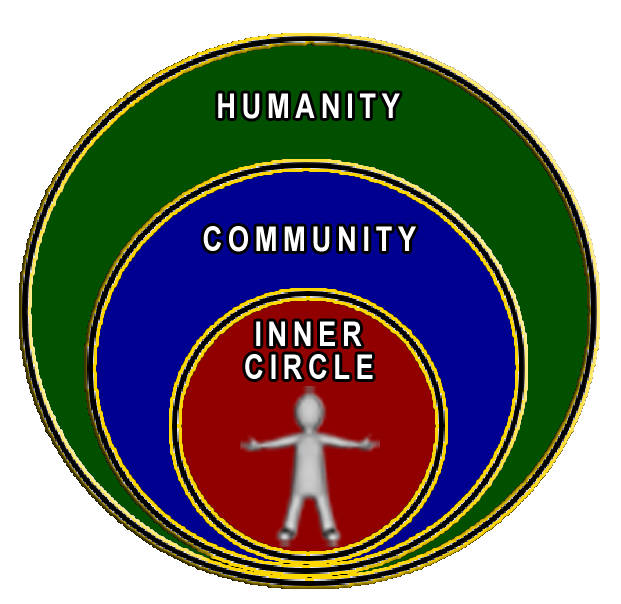
In your inner circle, The Way of You might mean:
- Being more present at the dinner table.
- Repairing old wounds with honesty and humility.
- Modeling healthy boundaries and self-respect.
- Showing that growth is possible at any age.
In your middle circle, it might mean:
- Bringing Long-Term thinking and integrity into your workplace.
- Being the one who follows through, tells the truth, and treats people with respect.
- Starting or supporting positive initiatives in your community.
- Refusing to contribute to toxic dynamics.
In your outer circle, it might mean:
- Voting, spending, and participating in ways that reflect your values.
- Supporting causes and organizations that align with The Way of Excellence.
- Remembering that people you will never meet are affected by the choices you make.
You do not need to “fix” all three circles.
You simply need to ask:
“Given who I am, where I am, and what I have, what is my next excellent step from Me to We?”
Reflection Questions
- When you look at your life so far, where have you seen your personal growth positively affect the people around you – even in small ways?
- In which circle (inner, middle, outer) do you feel the strongest pull right now to bring more of The Way of You into “us”? Why?
- Where are you most tempted to try to control or fix others instead of living your own commitments and offering an invitation?
- If you fully believed that your quiet, consistent excellence could meaningfully influence your family, your workplace, or your community over the next 5–10 years, what would you start doing differently now?
Experiment: One “We” You Can Influence
For the next week, choose one specific “we” – one group, relationship, or setting where you already belong.
Examples:
- Your household.
- A work team.
- A volunteer group.
- A circle of friends.
- A regular meeting or community you attend.
Then:
- Identify one quality of The Way of You that you want to bring more intentionally into this “we” (for example: honesty, respect, Long-Term thinking, follow-through, calm presence).
- Each time you interact with this “we” over the week, ask yourself:
- “How can I embody this quality here, today?”
- At the end of the week, reflect briefly:
- How did my behavior change?
- How did the tone, conversations, or dynamics shift, even slightly?
You are not testing whether you can “change them.”
You are observing what happens when you bring more of The Way of You into The Way of Us.
Assignment: Draft Your “From Me to We” Statement
Set aside a quiet block of time to write a one- to two-page statement called “From Me to We.”
Include:
- Your Why
- A paragraph beginning with:
“The Way of You cannot stop with me because…”
- Explain, in your own words, why your personal excellence matters for more than just your life.
- Your Spheres of Influence
- List your inner, middle, and outer circles.
- Under each, name the specific people, groups, or contexts where you most want to bring The Way of You.
- Your Commitments to “Us”
- For each circle, list three to five concrete commitments. For example:
- Inner circle: “I will repair quickly when I hurt someone,” “I will protect time for real connection,” “I will model healthy boundaries.”
- Middle circle: “I will not participate in gossip,” “I will bring honesty and follow-through to my work,” “I will look for Win-Win solutions.”
- Outer circle: “I will support organizations that align with my values,” “I will make Long-Term, not just short-term, choices as a citizen.”
- For each circle, list three to five concrete commitments. For example:
- Connection to TWOE and TWOU
- A short paragraph tying it together:
“The Way of Excellence is my foundation. The Way of You is my personal path. The Way of Us is where my life touches other lives. I commit to letting my personal growth feed the collective, one choice, one interaction, and one relationship at a time.”
Keep this statement with your other core documents.
You are no longer only asking, “Who am I becoming?”
You are now asking, “What kind of we am I helping to create?”
In the final chapter, you will bring everything together into Living The Way of You for the Rest of Your Excellent Life (The Manifesto) – a clear, personal, written declaration of how you intend to walk this path from this point forward, for your own sake and for the sake of all the “us” you are part of.
Conclusion - Living The Way of You for the Rest of Your Excellent Life (The Manifesto)
You’ve come a long way.
You have done something very rare – something most people never do and are afraid to even attempt:
You have faced yourself.
You have:
- Stepped off autopilot and told the truth about your life.
- Taken Personal Response-Ability for your choices.
- Examined your stories and rewritten your relationship with your past.
- Created a Character Blueprint for who you choose to be.
- Clarified a Long-Term direction for your life.
- Built identity-based habits, boundaries, and standards.
- Mapped resistance instead of being surprised by it.
- Started integrating your mind, body, and spirit.
- Designed a Life System and refined your environment.
- Begun to see your life as a Long-Term craft.
- Opened your eyes to the shift from Me to We.
Now we arrive at a different kind of work.
This final chapter is not about adding more concepts or assignments.
It is about gathering everything you have learned and decided – and shaping it into a clear, written declaration:
Your Manifesto for Living The Way of You for the rest of your excellent life.
This manifesto is not for show.
It is not a performance.
It is not another task to check off.
It is a personal constitution – a document you write for yourself, to yourself, about how you intend to live from this point forward.
The Way of Excellence has given you the foundation.
The Way of You has given you the path.
Your manifesto is how you commit to walking that path for the rest of your days.
A Manifesto Is a Covenant, Not a Fantasy
The word “manifesto” can sound dramatic or political.
In this context, your manifesto is:
- A covenant with yourself.
- A clear statement of what you stand for and how you intend to live.
- A reminder you can return to when life gets loud, messy, or confusing.
It is not:
- A fantasy version of yourself you hope to become “someday” with no real plan.
- A list of impossible rules meant to shame you when you fall short.
- A pledge to live perfectly.
Your manifesto is written in the language of excellence, not perfection.
It recognizes:
- You will still struggle.
- You will still make mistakes.
- You will still have seasons of strength and seasons of weakness.
But it also establishes:
- Who you are.
- What you believe in.
- How you choose to respond – again and again, over the Long-Term.
The Way of Excellence teaches that:
- Adopting Long-Term Thinking is essential.
- Taking Personal Responsibility and embracing The Law Of Personal Response-Ability is non-negotiable.
- The Willingness Factor, The Belief Factor, The Discipline Factor, and The Commitment Factor are required for permanent change.
- Integration Of Mind, Body & Spirit is necessary for you to reach your maximum potential.
Your manifesto weaves all of that into one living statement.
The Four Anchors of Your Manifesto
You can write your manifesto in many different ways.
To make it simple and powerful, we will build it around four anchors:
- Who I Am Choosing to Be – Identity and Character.
- How I Choose to Live – Daily standards and habits.
- How I Relate to Others and the World – From Me to We.
- How I Walk The Way of You Over Time – Long-Term commitment.
Each anchor draws directly from the work you have already done.
You are not starting from a blank page.
You are gathering what you’ve already discovered.
Anchor 1: Who I Am Choosing to Be
This is the identity core of your manifesto.
It is rooted in your Character Blueprint and in the Concepts of TWOE.
You can begin with a simple opening:
“I am a person who…”
And then continue:
- “tells the truth, even when it is uncomfortable.”
- “takes Personal Response-Ability for my choices and my life.”
- “thinks Long-Term and acts accordingly.”
- “respects myself and others.”
- “is willing to change, grow, and evolve.”
- “creates a balanced life so I can reach my maximum potential.”
- “is committed to Integration Of Mind, Body & Spirit.”
This does not mean you will never violate these statements.
It means:
- When you do drift, you will notice it more quickly.
- You will own it.
- You will return to alignment as soon as possible.
You are declaring, in writing:
“This is the kind of human being I choose to be for the rest of my life.”
Anchor 2: How I Choose to Live
This anchor translates identity into daily standards and habits.
Here you draw from:
- Your Baseline of Excellence.
- Your identity-based habits.
- Your boundaries and standards.
- Your Life System Blueprint.
- Your Integration practices.
You might write:
“Because this is who I am, I choose to live in the following ways:”
And then outline specific commitments, such as:
- Regarding truth and responsibility:
- “I tell myself the truth about my life and my behavior.”
- “When I make a mistake, I admit it, correct it, and learn from it.”
- “I do not waste energy blaming others for what is mine to change.”
- Regarding time and energy:
- “I allocate my time and energy wisely, according to my Long-Term values, not just short-term feelings.”
- “I protect time for the work, relationships, and practices that matter most.”
- Regarding health and body:
- “I treat my body with respect as a partner in my life, not as an enemy or an afterthought.”
- “I move regularly, nourish myself as well as I can, and honor my need for rest.”
- Regarding mind and spirit:
- “I guard my attention and mental diet.”
- “I make space for reflection, stillness, and whatever practices help me stay connected to my deepest values.”
- Regarding discipline and commitment:
- “I maintain a disciplined regimen that supports my Long-Term direction.”
- “I go 100% all-in on what truly matters to me and refuse to settle for half-hearted living.”
These are not rigid laws.
They are standing instructions to yourself.
You are saying:
“This is how a person like me lives, most of the time, over the Long-Term.”
Anchor 3: How I Relate to Others and the World
The Way of You cannot stop at your own skin.
This anchor connects your personal excellence to The Way of Us.
Here you draw from:
- Respect
- Win-Win thinking.
- Personal Response-Ability.
- Your “From Me to We” statement.
- Your understanding that you are part of something larger.
You might write:
“My life is not just about me. As I live The Way of You, I commit to bringing excellence into my relationships and into the world around me in the following ways:”
And then:
- In my closest relationships:
- “I treat the people closest to me with respect, honesty, and kindness.”
- “I repair quickly when I hurt someone.”
- “I listen and speak in ways that honor their dignity and my own.”
- In my work and community:
- “I bring excellence, integrity, and reliability into my work – no matter what my role is.”
- “I look for Win-Win solutions where my good and other people’s good can reinforce each other.”
- “I refuse to fuel gossip, cruelty, or dishonesty. I choose to be part of solutions, not part of the problem.”
- In the wider world:
- “I remember that my choices affect people I may never meet.”
- “I strive to make Long-Term, responsible choices as a citizen and as a human being.”
- “I see myself as part of the human story, not as a separate spectator.”
You are not promising to fix the world.
You are committing to:
“Live in such a way that my presence is a net positive in every circle I belong to.”
Your excellence becomes a quiet contribution to The Way of Us.
Anchor 4: How I Walk The Way of You Over Time
The final anchor is about duration.
You are not writing a short-term motivation letter.
You are writing a Long-Term commitment.
This is where you explicitly draw on:
- Adopting Long-Term Thinking.
- The Willingness Factor.
- The Belief Factor.
- The Discipline Factor.
- The Commitment Factor.
- Integration Of Mind, Body & Spirit.
You might write:
“I understand that The Way of You is not a quick fix. It is the way I intend to live for the rest of my life.”
Then spell out how you will continue walking:
- “I am willing to keep growing, learning, and changing, even when it is uncomfortable.”
- “I believe that my efforts matter and that excellence, over time, will change my life and the lives I touch.”
- “I will continue to build and refine disciplined routines that support my identity and Long-Term direction.”
- “I commit 100% to living as the person I have chosen to be, even when no one is watching.”
- “I will regularly review and adjust my life system, my environment, and my habits to stay in alignment with my Character Blueprint and with Integration Of Mind, Body & Spirit.”
- “When I drift – and I will – I will return to The Way of You as soon as I notice, without shame but with honesty and course correction.”
You might close with words like:
“I will live The Way of You for the rest of my excellent life. I will not be perfect, but I will be honest, persistent, and all-in.”
Giving Your Manifesto a Shape
You do not have to follow a rigid template, but it often helps to give your manifesto a simple, memorable structure.
Here is one possible outline:
- Opening Declaration
- A paragraph beginning with: “From this day forward, I choose to live The Way of You…”
- Section 1 – Who I Am
- “I am a person who…” followed by identity statements.
- Section 2 – How I Live
- “Because of who I am, I choose to…” followed by daily standards and habits.
- Section 3 – How I Relate to Others
- “My life is not just about me. Therefore I will…” followed by commitments to your circles of “us.”
- Section 4 – How I Walk Over Time
- “I understand this is a Long-Term path, and I commit to…” followed by Long-Term commitments and the Four Factors.
- Closing Commitment
- A short, powerful closing phrase that feels true for you, such as:
- “This is The Way of You I choose to live.”
- “This is my covenant with myself, with the people I love, and with the life I have been given.”
- “This is how I will walk The Way of You for the rest of my excellent life.”
- A short, powerful closing phrase that feels true for you, such as:
You can write this by hand, type it, or both.
You can revise it over time, but treat it with respect.
It is a living document.
Living With Your Manifesto (Not Just Writing It)
Writing your manifesto is important.
Living with it is even more important.
Some suggestions:
- Read it regularly.
- At first, you might read it daily or weekly.
- Over time, you might return to it monthly or quarterly, or whenever you feel lost.
- Place it where you can see it.
- In a journal you use often.
- In a folder on your devices.
- Printed and kept somewhere private but accessible.
- Review it during your Life System reviews.
- Let it guide adjustments to your habits, environment, and structure.
- Ask: “Is my current life aligned with this manifesto?”
- Let it evolve slowly.
- Do not rewrite it every week.
- But give yourself permission to refine it as you grow and as you understand The Way of You more deeply.
Think of your manifesto the way TWOE thinks of its own system:
- Clear enough to guide you.
- Flexible enough to adapt as you learn.
- Firm enough to pull you back to excellence when you drift.
Reflection Questions
- Which parts of your journey through this book feel most essential to include in your manifesto: truth-telling, Personal Response-Ability, Long-Term thinking, integration, environment, mastery, Me to We, or something else?
- If someone you loved deeply read your manifesto five years from now, what would you want them to see and feel about who you have become?
- Which sentences or commitments feel almost “too big” or “too bold” for you to write right now – and what does that reveal about your Willingness, Belief, Discipline, or Commitment?
- How do you want to remind yourself of this manifesto in daily life so it does not become a document you forget?
Experiment: A Week of Manifesto Reading
Once you have drafted your first version:
For seven days:
- Read your manifesto once in the morning and once in the evening.
- After reading, ask yourself one simple question:
- “What is one small action I can take today (or tomorrow) that is consistent with this manifesto?”
- Take that action – no matter how small.
At the end of the week, notice:
- How did it feel to live with your manifesto in the background each day?
- Did you make different choices – tiny ones – that felt more aligned?
- Did you feel more like the person you described?
You are testing the manifesto as a living tool, not just a piece of writing.
Assignment: Write The Way of You Manifesto
Set aside a focused block of time – 60 to 90 minutes if you can – somewhere quiet.
Have with you:
- Your Baseline of Excellence.
- Your Character Blueprint and Directional Map.
- Your identity-based habits and boundaries.
- Your Life System Blueprint.
- Your Integration Statement.
- Your “From Me to We” statement.
Then:
- Write your manifesto in one sitting.
- Do not try to make it perfect.
- Let it be honest and clear more than polished.
- Use the four anchors as a guide.
- Read it out loud.
- Notice how it feels in your body and spirit.
- Circle any phrases that feel particularly strong and true.
- Underline any parts that feel hollow or forced – those may be areas to grow into.
- Make small adjustments.
- Tighten language where needed.
- Remove anything that is more fantasy than commitment.
- Add anything essential you forgot.
- Sign and date it.
- This is not about legal force; it is about personal significance.
- You might add a line such as:
“Signed on this day, as my commitment to live The Way of You for the rest of my excellent life.”
- Decide when you will review it next.
- For example:
- “I will review this monthly for the first six months, then at least once every quarter.”
- For example:
You have just crafted a compass for the rest of your journey.
Stepping Beyond This Book
This is the final chapter of The Way of You, but it is not the final chapter of your story.
From here:
- The Way of Excellence continues to be your foundation – a system you can revisit at TheWayOfExcellence.com and in The Way of Excellence Journal, which you can download and study as you deepen your practice.
- The Way of You remains your personal path – finding, becoming, and optimizing you, over and over, at higher levels.
- The Way of Us waits as the next horizon – where your excellence joins with others to create something larger than any one person can build.
You will have good days and hard days.
You will feel clear sometimes and lost at others.
You will grow, plateau, stumble, and rise again.
Through all of it, you now have:
- A system (TWOE).
- A path (TWOY).
- A wider context (TWOU).
- And a manifesto – your own words – about how you intend to live.
You are not promised an easy life.
You are offered something better:
The chance to live as fully yourself as you know how.
The chance to walk The Way of You, honestly and excellently, for as long as you are here.
This book has walked with you to this point.
From here, the steps are yours.
Take them with truth.
Take them with courage.
Take them with Long-Term thinking, Personal Response-Ability, Willingness, Belief, Discipline, Commitment, and Integration Of Mind, Body & Spirit.
And when in doubt, return to the simple question at the heart of this entire journey:
“Given who I am choosing to be, what is the next excellent step on The Way of You?”