
The Way of Willingness

START HERE BY READING
The Way of Willingness
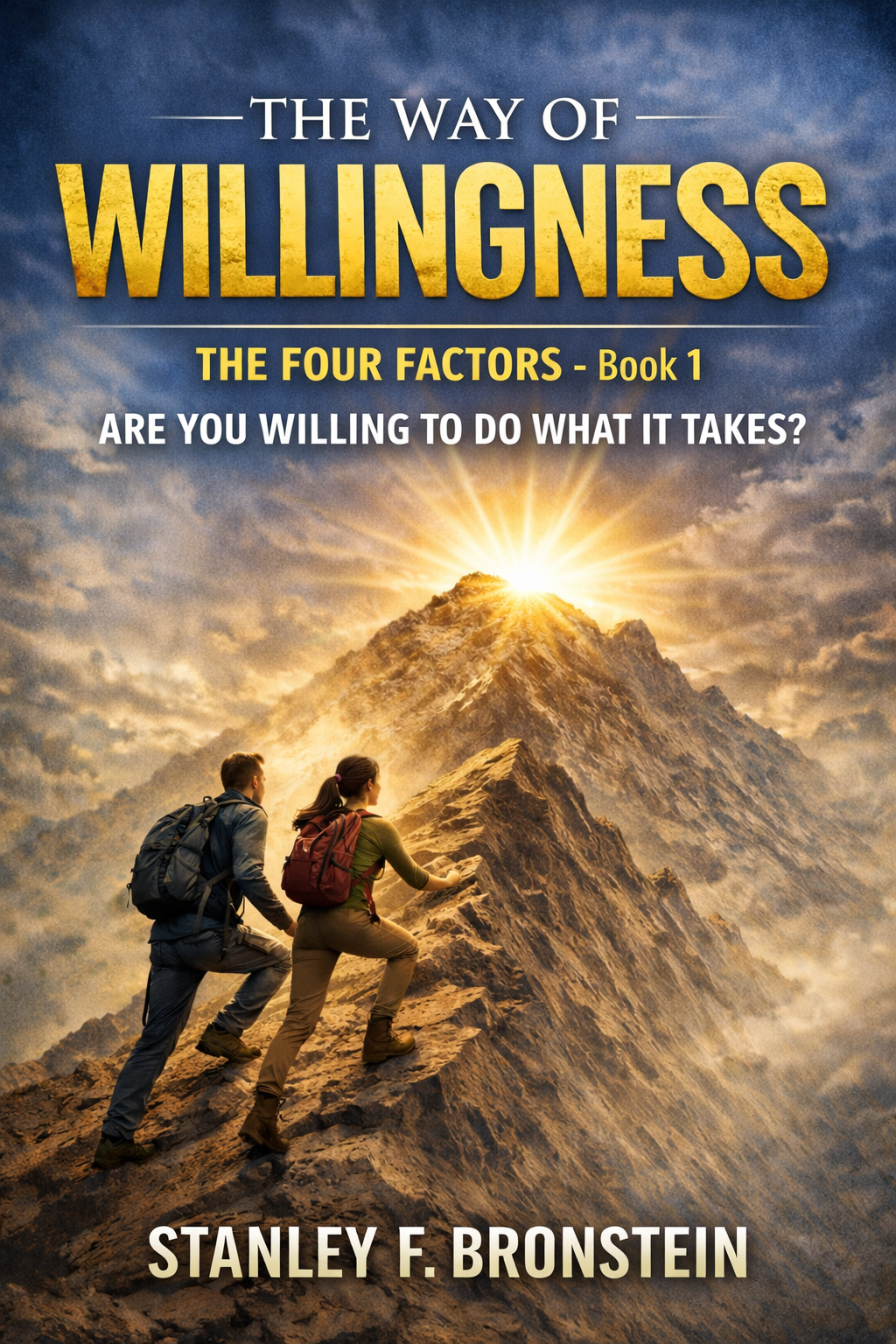
The Four Factors – Book 1
Are You Willing To Do What It Takes?
By Stanley F. Bronstein – Creator of The Way of Excellence System
Click The Tabs Below To Read Each Chapter Of The Book Online
Or
📘 Download Your Free Copy In Your Preferred Format
The Way of Willingness
by Stanley F. Bronstein
How to use this page:
Click a chapter title to open it then scroll down to read.
When you click the title of the next chapter, the previous one will close.
Take your time.
Read, reflect, and do the experiments and assignments before you move on.
EMPTY ITEM
Foreword
Life is a long-term game.
That is one of the most important truths you will ever understand.
Unfortunately, we live in a short-term world.
We live in a world of quick fixes, instant gratification, fast answers, easy promises, and temporary solutions. We are constantly being told that everything should happen faster, easier, and with less effort. We are encouraged to believe that if something takes too long, feels too hard, or requires too much sacrifice, then something must be wrong.
That way of thinking is dangerous.
It is dangerous because it pulls us away from reality.
And reality is this:
Most worthwhile things take time.
Real success takes time.
Better health takes time.
Stronger relationships take time.
Trust takes time.
Growth takes time.
Character takes time.
Excellence takes time.
A better life takes time.
Life is a long-term game.
But many people are trying to play it with a short-term mindset.
That is one of the biggest reasons so many people struggle.
They want immediate results.
They want a quick answer.
They want a shortcut.
They want the reward without the repetition, the outcome without the discipline, the transformation without the sacrifice, and the prize without paying the full price.
In short, they have become unwilling to do the work required.
That is the real issue.
Most people want more.
They want more success, more money, better health, stronger relationships, greater peace of mind, and a better life overall.
Wanting more is easy.
The problem is not what people want.
The problem is what they are willing to do, and how long they are willing to do it, in order to get it.
There is a major difference between wanting a result and being willing to do what it takes to achieve that result.
Many people say they want to succeed.
But they are not willing to prepare, act, persist, and sacrifice over the long term.
Many people say they want to be healthy.
But they are not willing to change the habits that made them unhealthy in the first place.
Many people say they want better relationships.
But they are not willing to tell the truth, take responsibility, communicate clearly, and do the daily work required to build trust.
Many people say they want financial freedom.
But they are not willing to delay gratification, exercise discipline, and think beyond the present moment.
So they stay where they are.
Not because they lack intelligence.
Not because they lack talent.
Not because they lack information.
Not because they lack opportunity.
But because they lack willingness.
That may sound harsh.
But it is also empowering.
Because if the issue were intelligence, talent, or opportunity, then many people would be trapped.
Those things are not distributed equally.
But willingness is different.
Willingness is a choice.
And because it is a choice, it is something you can control.
This book is built around one central question:
Are you willing to do what it takes?
Not when it is convenient.
Not when it is exciting.
Not when it is easy.
But when it is repetitive.
When it is boring.
When it is uncomfortable.
When it is inconvenient.
When it takes longer than you expected.
When the results are delayed.
When nobody is watching.
When no one is applauding.
When the reward is still far away.
Are you still willing?
That is the question.
It is one of the most important questions in all of life.
Because life does not usually reward people for what they intend to do.
Life rewards people for what they are willing to do consistently over time.
That is why this book matters.
This is not a book about hype.
It is not a book about momentary inspiration.
And it is not a book about pretending that life is easy.
It is a book about reality.
It is a book about standards.
It is a book about the kind of willingness that allows a person to keep going long after the excitement fades and the difficulty becomes real.
It is a book about learning to think long-term in a short-term world.
It is a book about understanding that many of the greatest rewards in life belong to those who are willing to prepare, act, persist, change, and stay the course.
In the pages that follow, you will be challenged to look honestly at yourself.
You will be challenged to examine the gap between what you say you want and what your behavior says you are willing to do.
You will be challenged to think about time differently.
You will be challenged to stop chasing instant solutions and start building long-term results.
You will be challenged to raise your level of willingness.
Not for a day.
Not for a week.
Not until it gets hard.
But for however long it takes.
Because that is how real change happens.
That is how real success happens.
And that is how a person raises what I call their Achievement IQ.
Not by becoming smarter.
Not by becoming more talented.
But by becoming more willing.
So as you read this book, keep returning to the same question.
Ask it honestly.
Ask it repeatedly.
Ask it when the answer feels easy, and ask it again when the answer becomes costly.
Ask yourself:
Are you willing to do what it takes?
Because life is a long-term game.
And in the long run, willingness changes everything.
INTRODUCTION TO PART I - THE NATURE OF WILLINGNESS
Before you can improve something, you must understand it.
Before you can strengthen willingness, you must first see it clearly.
Most people use the word “willing” casually.
They say things like:
“I’m willing to try.”
“I’m willing to give it a shot.”
“I’m willing to see what happens.”
But that is not real willingness.
That is hesitation dressed up as effort.
Real willingness is different.
Real willingness is not about trying.
It is about doing.
It is not about starting.
It is about continuing.
It is not about what you say.
It is about what you consistently do, especially when it becomes difficult.
This section of the book is about understanding what willingness actually is.
Not what it sounds like.
Not what we wish it meant.
But what it really is.
Because if you misunderstand willingness, you will overestimate it in yourself and underestimate what is required to succeed.
And that leads to frustration.
It leads to confusion.
It leads to the false belief that something is wrong with the system, when in reality, something is missing in the effort.
That missing piece is often willingness.
Willingness is not a personality trait.
It is not something you either have or do not have.
It is not reserved for certain types of people.
Willingness is a choice.
And like most choices, it is revealed through behavior.
Not once.
Not occasionally.
But consistently over time.
That last part matters.
Because life is a long-term game.
And willingness is not tested in a single moment.
It is tested over days, weeks, months, and years.
Anyone can be willing for a moment.
Anyone can be willing when they feel motivated.
Anyone can be willing when the task is easy, the path is clear, and the reward is close.
But what about when it is none of those things?
What about when the work is repetitive?
When the progress is slow?
When the results are delayed?
When the excitement is gone?
When the effort is required anyway?
That is where real willingness is revealed.
And that is where most people fall short.
Not because they do not want the outcome.
But because they are not willing to do what it takes for as long as it takes.
In this part of the book, you will begin to see the difference.
You will see the difference between wanting and being willing.
You will see the difference between knowing and doing.
You will see the difference between starting and finishing.
You will begin to recognize where you are willing and where you are not.
And that awareness is critical.
Because until you are willing to see the truth, you cannot change it.
This is where the process begins.
Not with action.
Not with strategy.
But with understanding.
Understanding what willingness is.
Understanding how it works.
And understanding why it matters more than most people realize.
Because once you understand willingness clearly, you can begin to evaluate it honestly.
And once you evaluate it honestly, you can begin to increase it intentionally.
That is the goal of this section.
To help you see willingness for what it really is.
And to begin the process of strengthening it.
Because in the end, the question is not whether you want more.
The question is whether you are willing.
Chapter 1 - The Question That Changes Everything
Wanting Is Not Willingness
Most people believe that wanting something is enough.
They believe that if they want it badly enough, things will eventually work out.
That belief is comforting.
It is also wrong.
Wanting something is easy.
Almost everyone wants more.
More success.
More money.
Better health.
Stronger relationships.
Less stress.
More freedom.
Wanting requires nothing.
It costs nothing.
It demands nothing.
That is why it is so common.
Willingness is different.
Willingness requires something from you.
It requires effort.
It requires sacrifice.
It requires discomfort.
It requires consistency.
And most importantly, it requires time.
That is where the separation begins.
Because life is a long-term game.
And willingness is not measured by what you say you want today.
It is measured by what you are willing to do repeatedly over time.
In a short-term world, wanting feels like progress.
But in a long-term game, only willingness produces results.
Reality Check
-
What do you say you want right now?
-
What are you actually doing to get it?
Good Intentions Are Not Enough
Many people have good intentions.
They intend to eat better.
They intend to exercise.
They intend to save money.
They intend to be more disciplined.
They intend to follow through.
Intentions feel productive.
They create the illusion of movement.
But intentions without action do not produce results.
They produce delay.
They produce frustration.
They produce a growing gap between what a person says they want and what their life actually reflects.
That gap is not caused by a lack of knowledge.
Most people already know what to do.
It is not caused by a lack of information.
We live in a time where information is everywhere.
It is not even caused by a lack of opportunity.
Opportunities exist in abundance for those who are prepared to act.
The gap is caused by a lack of willingness.
Because at some point, every intention must face reality.
And reality asks a simple question:
Are you willing to do what this requires?
Not once.
Not when it is convenient.
But consistently, over time.
In a short-term world, intentions feel satisfying.
In a long-term game, only action matters.
Be Honest
-
How many things have you intended to do that you never followed through on?
-
What is the real reason you did not do them?
Behavior Reveals the Truth
People often describe themselves based on what they believe, what they value, or what they intend to do.
But behavior tells the truth.
Not words.
Not plans.
Not promises.
Behavior.
If someone says they value health but consistently chooses habits that damage their health, their behavior tells the truth.
If someone says they want to succeed but avoids the work required to succeed, their behavior tells the truth.
If someone says they are committed but repeatedly fails to follow through, their behavior tells the truth.
This is not a judgment.
It is an observation.
Because willingness is not something you declare.
It is something you demonstrate.
And it is demonstrated through behavior.
Over time.
That last part matters.
Because life is a long-term game.
Anyone can behave well for a day.
Anyone can act disciplined for a week.
Anyone can push hard for a short burst.
But what happens after that?
What happens when the effort becomes routine?
When the excitement fades?
When the results are delayed?
When the process becomes repetitive?
That is when behavior reveals something deeper.
That is when it reveals willingness.
Or the lack of it.
Reality Check
-
What does your daily behavior say about what you are truly willing to do?
The Real Divider Between Success and Failure
Most people assume that success is determined by intelligence, talent, or knowledge.
Those things matter.
But they are not the deciding factor.
If they were, the most intelligent people would always be the most successful.
The most talented people would always win.
The most knowledgeable people would always achieve the best results.
But that is not what we see in the real world.
We see people with average intelligence succeed.
We see people with limited talent succeed.
We see people with little formal knowledge succeed.
And we also see people with high intelligence struggle.
We see people with great talent fall short.
We see people with extensive knowledge fail to follow through.
Why?
Because success is not determined by what a person can do.
It is determined by what a person is willing to do.
Over time.
In a long-term game.
That is the real divider.
Not ability.
Willingness.
The people who succeed are often not the most gifted.
They are the most willing.
Willing to prepare.
Willing to act.
Willing to persist.
Willing to change.
Willing to do what others avoid.
And willing to keep doing it for as long as it takes.
In a short-term world, this truth is easy to miss.
Because we focus on quick results.
Quick wins.
Quick recognition.
But in the long run, those things matter far less than willingness.
Because willingness compounds.
Day after day.
Choice after choice.
Action after action.
Until eventually, it produces results that others cannot match.
The Question
-
Are you willing to do what it takes?
Not just to start.
But to continue.
Not just when it is easy.
But when it is difficult.
Not just for a short period of time.
But for as long as it takes.
Because that is the question that changes everything.
Chapter 2 - Achievement IQ
Rethinking What Determines Success
Most people believe that success is determined by intelligence, talent, or knowledge.
That belief seems logical.
The smarter you are, the more talented you are, the more you know, the more successful you should be.
But when you look at the real world, that assumption does not always hold up.
There are many people who do not have high IQs.
They do not have exceptional talent.
They do not have advanced degrees or specialized knowledge.
And yet, they succeed.
Not just occasionally.
In many cases, they succeed at a very high level.
At the same time, there are many people who are highly intelligent.
They are talented.
They are well educated.
They have access to information, resources, and opportunity.
And yet, they struggle.
They start but do not finish.
They plan but do not act.
They know what to do but do not do it consistently.
So the question becomes:
If intelligence, talent, and knowledge are not the determining factors, what is?
The answer is willingness.
The people who succeed are often not the most gifted.
They are the most willing.
Willing to prepare.
Willing to act.
Willing to persist.
Willing to change.
Willing to do what others avoid.
And willing to keep doing it for as long as it takes.
Because life is a long-term game.
And success does not reward what you know.
It rewards what you consistently do over time.
In a short-term world, this truth is often overlooked.
Because we are trained to look for quick answers and fast results.
But real success rarely works that way.
It belongs to those who are willing to stay in the process long enough to earn it.
Consider This
-
Who do you know that is not the most talented, yet consistently gets results?
-
What are they doing that others are not willing to do?
Defining Achievement IQ
If willingness is the real determining factor in success, then we need a way to think about it clearly.
We need a way to measure it.
We need a way to understand how it shows up in real life.
That is where Achievement IQ comes in.
Achievement IQ is a measure of a person’s willingness to do what it takes.
It is not a measure of intelligence.
It is not a measure of talent.
It is not a measure of knowledge.
It is a measure of willingness.
The higher a person’s willingness, the higher their Achievement IQ.
And the higher a person’s Achievement IQ, the greater their likelihood of success.
This leads to a simple but powerful principle:
The greater the willingness, the greater the likelihood of success, and the higher the Achievement IQ.
This changes the way you think about success.
It shifts the focus away from what you have and toward what you are willing to do.
It removes excuses.
It increases responsibility.
And it puts the outcome back in your hands.
Because willingness is a choice.
And like all choices, it is expressed through behavior over time.
In a long-term game, that is what matters most.
The Question
-
If Achievement IQ is a measure of your willingness, what is your current level?
What Achievement IQ Measures
Achievement IQ measures what most people overlook.
It measures what a person is actually willing to do.
It measures whether a person is willing to:
Tell the truth about where they are.
Face reality without distortion.
Prepare before opportunity arrives.
Take action when action is required.
Persist when things become difficult.
Continue when progress is slow.
Endure discomfort without quitting.
Delay gratification in favor of long-term results.
Learn when learning is necessary.
Change when change is required.
Stay the course long enough to see results.
Pay the full price of what they say they want.
These are not abstract ideas.
These are behaviors.
And those behaviors are what determine outcomes.
Because life does not reward intention.
It rewards action.
And not just action once.
Action repeated over time.
That is why Achievement IQ is so important.
It captures the difference between what a person could do and what they are actually willing to do.
And in the long run, that difference explains most results.
Reality Check
-
Where in your life are you unwilling to do what you know needs to be done?
What Achievement IQ Is Not
Achievement IQ is often misunderstood at first.
So it is important to be clear about what it is not.
It is not intelligence.
A person can be highly intelligent and still have a low Achievement IQ.
It is not talent.
A person can be naturally gifted and still fail to follow through.
It is not knowledge.
A person can know exactly what to do and still not do it.
It is not credentials.
Degrees and certifications do not guarantee execution.
It is not potential.
Potential only matters if it is acted upon.
This is where many people get stuck.
They rely on what they have.
They rely on what they know.
They rely on what they could do.
But they ignore what they are actually willing to do.
And over time, that gap becomes costly.
Because in a long-term game, unused ability has no value.
Only applied effort produces results.
Be Honest
-
Are you relying more on what you could do than on what you are actually doing?
Why This Changes Everything
Understanding Achievement IQ changes the way you see yourself and others.
It removes the illusion that success is reserved for a select few.
It makes success more accessible.
Because willingness is not fixed.
It can be increased.
It can be strengthened.
It can be trained.
It also removes many common excuses.
You can no longer say:
“I’m not smart enough.”
“I’m not talented enough.”
“I don’t know enough.”
Because those are not the deciding factors.
The deciding factor is willingness.
And willingness is within your control.
This is both empowering and demanding.
It is empowering because it gives you the ability to change your trajectory.
It is demanding because it removes your ability to avoid responsibility.
You can no longer hide behind potential.
You must confront your behavior.
And that brings you back to the same question:
Are you willing to do what it takes?
Not once.
Not when it is easy.
But consistently.
Over time.
In a long-term game.
Because that is what raises your Achievement IQ.
And that is what ultimately determines your results.
Decision Point
-
Are you willing to increase your level of willingness, or are you going to stay where you are?
Chapter 3 - The Difference Between Desire and Decision
Wanting Something “Would Be Nice”
Most people spend a great deal of their lives wanting things.
They want better health.
They want more money.
They want stronger relationships.
They want more peace, more freedom, more success, and more control over their lives.
There is nothing unusual about that.
Wanting is normal.
Wanting is easy.
In many cases, wanting is even pleasant.
It allows a person to imagine a better future without requiring them to do anything in the present.
That is one of the reasons wanting can be so seductive.
It creates the feeling of movement without the reality of movement.
A person can say they want to lose weight, want to improve their marriage, want to grow their business, want to get out of debt, or want to change their life, and all of that may be true.
They may sincerely want those things.
But wanting something and doing what is required to get it are two very different matters.
That is where many people get confused.
They mistake desire for commitment.
They mistake wishing for willingness.
They mistake emotional longing for real readiness.
In a short-term world, wanting often feels like enough.
It feels productive to think about what you would like.
It feels satisfying to talk about what you intend to do.
It feels hopeful to imagine what life could become.
But life is a long-term game.
And in a long-term game, wanting is not enough.
Wanting may be the beginning, but it is not the engine.
It is not the force that carries a person through discomfort, repetition, sacrifice, delay, boredom, and uncertainty.
Willingness does that.
Decision does that.
Action does that.
A person who says, “It would be nice,” is still standing on the outside.
They are still observing.
They are still considering.
They are still emotionally attached to the result while remaining uncommitted to the process.
That is not unusual, but it is dangerous.
It is dangerous because it allows a person to live in the illusion of progress.
They feel as though they are engaged with the goal when, in fact, they have not yet stepped toward it in any meaningful way.
Many lives are filled with goals that “would be nice.”
It would be nice to be healthier.
It would be nice to be debt-free.
It would be nice to write the book, build the business, repair the relationship, clean up the mess, tell the truth, or make the change.
But “would be nice” has very little power.
It is weak language.
It is hesitant language.
It is optional language.
It leaves the door open for delay, excuses, compromise, and retreat.
It requires nothing.
It risks nothing.
It changes nothing.
Reality Check
What in your life have you reduced to “it would be nice”?
What have you placed in the category of desire without moving it into the category of decision?
The Moment of Decision
A true decision changes everything.
Not always outwardly at first.
Not always dramatically.
But inwardly, something shifts.
A line is crossed.
A person stops merely admiring the possibility and begins moving toward it.
They stop saying, “That would be nice,” and start saying, “This is going to happen.”
That shift matters.
It matters because desire is passive, but decision is directional.
Desire looks at the goal.
Decision turns toward it.
Desire hopes.
Decision commits.
Desire imagines the result.
Decision accepts the price.
That is why so many people remain stuck.
They have desire without decision.
They have interest without movement.
They have imagination without direction.
The decision is the turning point.
The decision is the moment a person stops negotiating with themselves.
It is the moment they stop treating the goal like an attractive option and begin treating it like an actual destination.
Until that happens, almost everything remains theoretical.
The goal may be real, but the pursuit is not.
The dream may be vivid, but the effort is not.
The intention may be sincere, but the behavior is not yet aligned.
This is one of the reasons real progress is often delayed for so long.
People think the issue is strategy.
Often it is not.
They think the issue is timing.
Often it is not.
They think the issue is information.
Often it is not.
The issue is that they have not yet truly decided.
They are still entertaining the goal instead of pursuing it.
They are still flirting with the future instead of committing to it.
A true decision is not casual.
It is not vague.
It is not “I will try.”
It is not “I hope so.”
It is not “Maybe this time.”
A true decision says, “I am doing this.”
And when that happens, willingness begins to harden into something stronger.
It begins to take shape.
It begins to move from preference into priority.
That does not mean the path suddenly becomes easy.
It does mean the person has now entered the path.
That is a critical difference.
Because life is a long-term game, and long-term results are rarely built by accident.
They are built through decisions that are honored repeatedly over time.
Consider This
How many times have you mistaken emotional intensity for actual decision?
How many times have you felt strongly about something, only to discover later that you had never really decided?
The Cost of Indecision
Indecision has a cost.
In many cases, it has a greater cost than a wrong decision.
A wrong decision can teach.
A wrong decision can be corrected.
A wrong decision can create movement, clarity, feedback, and growth.
Indecision creates drift.
Drift is expensive.
A drifting person often believes they are being careful.
They believe they are keeping their options open.
They believe they are waiting for more clarity, more confidence, better timing, more certainty, or the perfect moment.
But while they are waiting, life keeps moving.
Time keeps passing.
Habits keep forming.
Consequences keep accumulating.
Opportunities keep coming and going.
In a short-term world, indecision often appears harmless.
A person delays a conversation.
They postpone a change.
They avoid a commitment.
They put off the action until tomorrow, next week, next month, next year.
None of that feels dramatic in the moment.
That is precisely what makes it dangerous.
The cost is rarely paid all at once.
It is usually paid little by little, over time.
That is how long-term games work.
Small delays become major losses.
Minor compromises become repeated patterns.
Temporary hesitation becomes permanent stagnation.
The person who does not decide has still made a decision.
They have decided to remain where they are.
They have decided to let existing habits keep governing the future.
They have decided to allow short-term comfort to overpower long-term possibility.
Many people pay a very high price for decisions they never made.
They never clearly decided to stay unhealthy, stay stuck, stay angry, stay scattered, stay broke, stay fearful, or stay unfulfilled.
But by refusing to decide otherwise, that is where they remained.
Indecision is not neutral.
It carries momentum.
It preserves the status quo.
And the status quo, left unchallenged, tends to harden over time.
That is one of the harsh realities of life.
If you do not decide where you are going, you will usually keep going where you are already headed.
That may not bother someone in the short term.
But life is a long-term game.
And in the long term, indecision can cost a person years.
Sometimes decades.
Sometimes an entire life.
Be Honest
Where has indecision cost you time, energy, peace, money, health, or opportunity?
What have you lost by waiting too long to decide?
Decision as the Doorway to Willingness
Willingness does not begin when a person wants something.
Willingness begins when a person decides.
That is when the relationship changes.
Before the decision, the goal is still optional.
After the decision, the goal becomes a direction.
Before the decision, discomfort has more power.
After the decision, discomfort must be dealt with.
Before the decision, obstacles feel like reasons to stop.
After the decision, obstacles become problems to solve.
This is why decision is the doorway to willingness.
Without it, willingness remains weak and undefined.
With it, willingness begins to organize behavior.
A decided person still faces fear.
They still face resistance.
They still face temptation, fatigue, uncertainty, and delay.
But now they face those things as someone moving in a direction.
That changes how they think.
That changes how they respond.
That changes what they tolerate from themselves.
Once a real decision is made, the central question is no longer “Do I feel like it?”
The question becomes “What does this require?”
That is a much stronger question.
It is a more mature question.
It is a more productive question.
It shifts the focus from mood to responsibility, from comfort to standards, and from fantasy to execution.
This is one of the great dividing lines in life.
Undecided people spend much of their time evaluating how they feel.
Decided people spend much of their time doing what is necessary.
That difference compounds over time.
And because life is a long-term game, what compounds over time eventually becomes visible in results.
When a person decides, willingness has a place to stand.
It has a direction to follow.
It has a reason to endure discomfort.
It has a framework within which to act.
That does not mean one decision solves everything.
Far from it.
A decision must be reinforced.
It must be honored.
It must be repeated.
But it is still the beginning of everything that follows.
No serious achievement begins without it.
No meaningful change begins without it.
No long-term transformation begins without it.
Desire may attract your attention.
Decision turns your body, mind, and effort in a direction.
And willingness begins to grow the moment you stop saying, “That would be nice,” and start saying, “This is what I am going to do.”
Decision Point
What in your life must move out of the category of desire and into the category of decision?
What have you wanted long enough?
What is it time to decide?
Chapter 4 - Why People Know What To Do But Do Not Do It
Information Is Not Transformation
We live in a time where information is everywhere.
You can learn almost anything.
At any time.
From almost anywhere.
You can read books.
Watch videos.
Listen to podcasts.
Take courses.
Follow experts.
Access tools.
Gather strategies.
Study systems.
And yet, despite all of this information, many people are not getting the results they want.
That should tell you something important.
Information is not the problem.
And more information is not the solution.
Because information does not produce transformation.
Action produces transformation.
Applied knowledge produces results.
Execution produces change.
Most people already know many of the things they should be doing.
They know they should take better care of their health.
They know they should manage their finances more responsibly.
They know they should communicate more clearly.
They know they should follow through on commitments.
They know they should do the work.
So if they know, why do they not do it?
Because knowing is not the same as being willing.
In a short-term world, it is easy to believe that the next piece of information will fix the problem.
But life is a long-term game.
And in a long-term game, results come from what you consistently do, not from what you occasionally learn.
Consider This
How much of what you already know are you actually applying?
What would change if you consistently did what you already know you should do?
The Knowing-Doing Gap
There is a gap between knowing and doing.
Most people live in that gap.
They gather information.
They understand concepts.
They recognize what needs to be done.
But they do not act consistently.
That gap is where many goals stall.
That gap is where progress slows down.
That gap is where frustration grows.
It is also where excuses multiply.
A person says:
“I know what I should do, I just haven’t done it yet.”
That statement is common.
It is also revealing.
Because it shows that the issue is not awareness.
The issue is willingness.
The knowing-doing gap is not closed by more knowledge.
It is closed by action.
And action requires willingness.
Willingness to start.
Willingness to continue.
Willingness to repeat.
Willingness to do what is required, even when it is not convenient.
In a short-term world, people look for ways to bridge the gap quickly.
They look for hacks.
Shortcuts.
Motivation.
Tricks that make things easier.
But in a long-term game, the gap is closed by consistent behavior.
There is no substitute for that.
Reality Check
Where in your life do you already know what to do, but are not doing it?
What has been sitting in that gap for too long?
The Comfort Trap
Comfort is one of the biggest reasons people do not do what they know they should do.
Comfort feels good.
It feels safe.
It feels familiar.
It reduces stress in the moment.
And because it feels good in the short term, it becomes easy to choose.
That is the trap.
Comfort often conflicts with growth.
The things that lead to improvement are often uncomfortable.
Telling the truth can be uncomfortable.
Changing habits can be uncomfortable.
Taking responsibility can be uncomfortable.
Doing difficult work can be uncomfortable.
Waiting for results can be uncomfortable.
In a short-term world, people are trained to avoid discomfort.
They are encouraged to seek ease.
To reduce effort.
To eliminate friction.
To choose convenience.
But life is a long-term game.
And long-term results are often built through short-term discomfort.
The person who is unwilling to be uncomfortable will struggle to grow.
Not because they lack ability.
But because they are not willing to do what growth requires.
Comfort becomes the default.
And when comfort becomes the default, progress slows down or stops.
This is not about eliminating comfort entirely.
It is about understanding its role.
Comfort is not the goal.
Progress is the goal.
And progress often requires doing things that are not comfortable.
Be Honest
Where are you choosing comfort over progress?
What are you avoiding because it feels uncomfortable?
Excuses, Fear, and Avoidance
When people do not do what they know they should do, they often explain it.
They give reasons.
They justify.
They rationalize.
Those explanations often sound reasonable.
That is what makes them dangerous.
An excuse rarely sounds like an excuse.
It sounds like a valid explanation.
“I don’t have time.”
“I’m too busy.”
“I’ll do it later.”
“I’m not ready.”
“I need to learn more first.”
“I’m waiting for the right moment.”
Sometimes those statements contain elements of truth.
But they also often contain avoidance.
Because behind many excuses are two powerful forces:
Fear and unwillingness.
Fear of failure.
Fear of discomfort.
Fear of being judged.
Fear of getting it wrong.
Fear of what might happen.
And then there is unwillingness.
Unwillingness to feel uncomfortable.
Unwillingness to put in the effort.
Unwillingness to stay consistent.
Unwillingness to pay the full price.
So instead of confronting those things directly, a person explains their way around them.
They delay.
They postpone.
They redirect.
They avoid.
In a short-term world, this can continue for a long time.
Because the consequences are not always immediate.
But life is a long-term game.
And over time, avoidance accumulates.
Missed actions become missed opportunities.
Delayed effort becomes delayed progress.
Repeated excuses become fixed patterns.
And those patterns eventually produce results.
Not the results a person wants.
But the results their behavior creates.
Consider This
What excuses do you use most often?
What might those excuses be protecting you from?
Willingness Sits at the Center
At the center of all of this is willingness.
It sits between knowing and doing.
It sits between intention and action.
It sits between potential and results.
A person can know exactly what to do and still not do it.
A person can have all the information, all the resources, and all the opportunity and still fail to act.
Because the issue is not knowledge.
The issue is willingness.
Willingness to act.
Willingness to persist.
Willingness to be uncomfortable.
Willingness to stay in the process long enough to see results.
Willingness to do what is required, even when it is not appealing.
In a short-term world, it is easy to overlook this.
Because the focus is often on tools, tactics, and techniques.
But in a long-term game, willingness is the deciding factor.
It determines whether knowledge is applied or ignored.
It determines whether intention becomes action or remains an idea.
It determines whether progress is made or postponed.
Once you understand this, you begin to see things differently.
You stop asking, “What else do I need to learn?”
And you start asking, “What am I not willing to do?”
That is a more powerful question.
Because it goes to the root of the issue.
And once you address that, everything else begins to change.
The Question
What do you already know that you are not willing to do?
And what would happen if you became willing?
INTRODUCTION TO PART II - THE PRICE OF WILLINGNESS
Most people want the result.
Fewer people want the process.
Even fewer are willing to pay the full price.
That is where the separation begins.
Every meaningful result in life has a cost.
Not just a financial cost.
A personal cost.
A behavioral cost.
An emotional cost.
A time cost.
A consistency cost.
A discipline cost.
A patience cost.
A truth cost.
A responsibility cost.
A willingness cost.
That is the part many people underestimate.
Or ignore.
Or try to avoid.
They focus on the outcome.
They imagine the reward.
They picture the result.
But they do not fully account for what it takes to get there.
And when the real cost becomes clear, many people hesitate.
They slow down.
They look for an easier path.
They search for a shortcut.
They try to negotiate the price.
That is where things break down.
Because life does not negotiate the price.
It does not discount the cost.
It does not offer long-term rewards in exchange for short-term effort.
Life is a long-term game.
And long-term results require long-term payment.
Not all at once.
But over time.
Repeatedly.
Consistently.
This is where willingness becomes real.
It is easy to say you are willing when you are thinking about the result.
It is much harder to remain willing when you are facing the cost.
When the work is repetitive.
When the progress is slow.
When the effort is required again and again.
When the reward is not immediate.
When the process is not exciting.
When no one is watching.
When no one is praising.
When no one is rewarding the effort yet.
That is when willingness is tested.
Not at the beginning.
But in the middle.
And especially over time.
In a short-term world, people expect quick results.
They expect visible progress.
They expect validation.
And when those things do not come quickly, they begin to question the process.
They begin to question themselves.
They begin to lose momentum.
But the issue is often not the process.
The issue is that they were not fully willing to pay the price required by the process.
They wanted the result.
They were not fully willing to earn it.
This is one of the most important distinctions you can understand.
Because once you accept that every result has a price, everything becomes clearer.
You stop asking, “Why is this so hard?”
And you start asking, “What does this require?”
You stop looking for a way around the work.
And you start engaging with the work.
You stop expecting the process to adjust to you.
And you begin adjusting yourself to the process.
That is a major shift.
It is a shift from preference to responsibility.
From desire to commitment.
From short-term thinking to long-term thinking.
And that shift is necessary.
Because life is a long-term game.
And the people who win in the long term are not the ones who want the result the most.
They are the ones who are willing to pay the price for the longest period of time.
In this part of the book, you will begin to see what that price actually looks like.
Not in theory.
But in reality.
You will begin to understand the costs that most people try to avoid.
You will begin to recognize the areas where your willingness is strong and where it is limited.
And you will begin to see that the issue is not whether the price exists.
The issue is whether you are willing to pay it.
Because in the end, the question is never just:
“What do you want?”
The real question is:
“What are you willing to pay to get it?”
Chapter 5 - Everything Has a Price
The Prize and the Price
Everyone focuses on the prize.
The result.
The outcome.
The reward.
People want to be successful.
They want to be healthy.
They want to have better relationships.
They want financial freedom.
They want peace of mind.
They want control over their time and their life.
There is nothing wrong with wanting those things.
But wanting the prize is only part of the equation.
Every prize has a price.
That is not an opinion.
That is reality.
Health has a price.
Success has a price.
Strong relationships have a price.
Financial stability has a price.
Growth has a price.
Excellence has a price.
Nothing meaningful comes without it.
The problem is not that the price exists.
The problem is that many people focus almost entirely on the prize and give very little thought to the price.
They want the outcome.
But they do not fully consider what it will take to achieve it.
Or they underestimate it.
Or they assume it will be easier than it actually is.
Or they believe they will somehow find a way around it.
That belief leads to frustration.
Because when the real cost becomes clear, it often feels higher than expected.
And that is when willingness is tested.
Because life is a long-term game.
And in a long-term game, the price is rarely paid all at once.
It is paid over time.
Repeatedly.
Through daily choices.
Through consistent behavior.
Through effort that is often unnoticed and uncelebrated.
That is the reality most people do not prepare for.
They imagine the prize.
They do not prepare for the price.
Reality Check
What is something you say you want right now?
What is the actual price of that result?
Have you clearly identified it, or are you still focused only on the outcome?
Why People Want the Prize Without the Price
It is easy to want the reward.
It is much harder to accept the cost.
That is why so many people try to separate the two.
They want the result without the repetition.
They want the outcome without the effort.
They want the benefit without the discipline.
They want the recognition without the work.
They want the success without the sacrifice.
In a short-term world, this way of thinking is reinforced constantly.
People are shown highlights, not process.
They see results, not repetition.
They see outcomes, not effort.
They see the finished product, not the long path it took to get there.
That creates a distorted expectation.
It creates the illusion that success happens quickly or easily.
It creates the belief that there must be a shortcut.
So people begin to look for ways to bypass the price.
They look for hacks.
They look for easier methods.
They look for ways to reduce effort.
They look for ways to get more with less.
Sometimes there are more efficient ways to do things.
But there is no way to eliminate the price entirely.
And when people try to do that, they often end up paying a different price.
They pay with inconsistency.
They pay with poor results.
They pay with frustration.
They pay with wasted time.
They pay with repeated failure.
Because avoiding the real price does not eliminate cost.
It just changes it.
And usually, it makes it worse.
Consider This
Where in your life are you trying to separate the prize from the price?
What are you hoping to achieve without fully accepting what it requires?
Success Is Purchased in Advance
One of the most important truths you can understand is this:
Success is purchased in advance.
The payment comes first.
The reward comes later.
That is the opposite of how many people want it to work.
They want to see results early.
They want proof that their effort is working.
They want feedback.
They want confirmation.
But in many areas of life, the results are delayed.
You put in effort.
You do the work.
You repeat the process.
And for a period of time, you may see very little return.
That is where many people stop.
They assume it is not working.
They assume they are doing something wrong.
They assume the effort is not worth it.
So they quit.
Not because the process is flawed.
But because the timeline did not match their expectations.
Because life is a long-term game.
And in a long-term game, results often show up later.
After the work has been done.
After the effort has been repeated.
After the price has been paid.
The person who understands this stays in the process.
The person who does not understand this often walks away too early.
And that is why so many people never see the results they are capable of achieving.
They stop before the return arrives.
They abandon the investment before it pays off.
Be Honest
Have you ever stopped doing something because you did not see results quickly enough?
What might have happened if you had stayed with it longer?
Willingness as Price-Paying Power
Willingness is what allows a person to pay the price.
Not once.
Not temporarily.
But consistently.
Willingness is what keeps a person engaged in the process when it becomes difficult.
When it becomes repetitive.
When it becomes boring.
When it becomes inconvenient.
When it takes longer than expected.
When the reward is not immediate.
Without willingness, the price feels too high.
With willingness, the price becomes acceptable.
That does not mean it becomes easy.
It means it becomes something a person is prepared to handle.
That is a critical difference.
Because the price does not change.
The requirement does not change.
What changes is the person.
Their standards change.
Their expectations change.
Their mindset changes.
Their behavior changes.
They stop asking, “Why is this so hard?”
And they start asking, “What does this require?”
They stop looking for a way around the work.
And they begin engaging with the work.
They stop negotiating with the process.
And they begin aligning with it.
That is what willingness does.
It aligns a person with reality.
And reality is this:
If you want the prize, you must pay the price.
Not partially.
Not occasionally.
But fully.
And over time.
Because life is a long-term game.
And in the long term, the people who get the results are not the ones who want the prize the most.
They are the ones who are willing to pay the price for the longest period of time.
The Price
What price have you been unwilling to pay?
And what would change if you became willing to pay it?
Chapter 6 - Short-Term Pleasure vs Long-Term Reward
The Trap of Immediate Gratification
We live in a world designed for immediacy.
You can get information instantly.
You can communicate instantly.
You can be entertained instantly.
You can buy something instantly.
You can distract yourself instantly.
Everything is faster.
Everything is easier.
Everything is more convenient.
That sounds like progress.
In some ways, it is.
But it also creates a problem.
It trains people to expect immediate results.
It conditions people to avoid delay.
It reinforces the idea that if something takes too long, it is not worth doing.
That mindset is dangerous.
Because life is a long-term game.
And most meaningful results do not happen instantly.
They happen gradually.
They happen through repetition.
They happen through consistent effort over time.
But when a person becomes accustomed to immediate gratification, they begin to lose patience with anything that requires time.
They want results now.
They want progress now.
They want change now.
And when it does not happen quickly, they begin to lose interest.
They begin to doubt the process.
They begin to look for something else.
That is the trap.
Immediate gratification feels good in the moment.
But it often works against long-term results.
Because it pulls a person away from the behaviors that actually produce meaningful outcomes.
Reality Check
Where in your life are you choosing what feels good now over what would be better later?
What short-term choices are costing you long-term results?
The Power of Delayed Gratification
Delayed gratification is the ability to wait.
To choose a greater reward later instead of a smaller reward now.
That sounds simple.
But it is not easy.
Because it requires a person to act against immediate impulses.
It requires them to resist temptation.
It requires them to stay focused on something that may not produce results right away.
It requires them to think beyond the present moment.
In a short-term world, that kind of thinking is rare.
But in a long-term game, it is essential.
The ability to delay gratification shows up in many areas of life.
Choosing to exercise instead of remaining inactive.
Choosing to save instead of spending.
Choosing to work instead of procrastinating.
Choosing to tell the truth instead of avoiding discomfort.
Choosing to stay consistent instead of quitting.
Each of these choices may feel difficult in the moment.
But over time, they create a significant advantage.
Because small decisions, repeated consistently, begin to compound.
And that compounding effect is what produces long-term results.
The person who is willing to delay gratification is willing to invest in the future.
They are willing to give up something now in order to gain something greater later.
That is a powerful form of willingness.
Consider This
What are you unwilling to delay?
What would happen if you became more willing to wait for better results?
Playing the Long Game
If life is a long-term game, then your strategy must reflect that.
You cannot build long-term results with short-term thinking.
You cannot expect lasting change from temporary effort.
You cannot create sustainable success through inconsistent behavior.
Playing the long game means understanding that results take time.
It means accepting that progress may be slow at first.
It means recognizing that the work must continue even when the results are not yet visible.
It means committing to the process, not just the outcome.
In a short-term world, this can feel frustrating.
Because there is a constant pull toward quick wins and immediate feedback.
But quick wins are often temporary.
They do not always last.
They do not always build a foundation.
The long game is different.
It is less exciting in the beginning.
It is often slower.
It is often less visible.
But it is more powerful.
Because it is built on consistency.
It is built on repetition.
It is built on behaviors that are sustained over time.
And those behaviors eventually produce results that are difficult to replicate through shortcuts.
The person who plays the long game understands that today’s actions are shaping tomorrow’s outcomes.
They are not focused only on how something feels now.
They are focused on where it leads.
Be Honest
Are your daily actions aligned with the long-term results you say you want?
Or are they aligned with short-term comfort?
Willingness Over Time
Willingness is not just about what you do once.
It is about what you are willing to do repeatedly.
Over time.
Anyone can make a good decision once.
Anyone can act with discipline for a short period.
Anyone can push through discomfort temporarily.
But long-term success requires more than that.
It requires sustained willingness.
It requires the ability to continue when the novelty wears off.
When the excitement fades.
When the effort becomes routine.
When the progress is slow.
When the results are delayed.
That is where most people fall off.
Not because they are incapable.
But because they are not willing to continue.
They were willing at the beginning.
They were willing when it was new.
They were willing when it was exciting.
But they were not willing to stay with it long enough.
In a short-term world, this is common.
Because people are used to quick cycles.
Start, stop.
Try, quit.
Begin, abandon.
But life is a long-term game.
And long-term results require long-term behavior.
That is why willingness over time is so important.
It is not just about starting.
It is about continuing.
It is about staying.
It is about repeating the right actions long enough for them to produce results.
That is what creates change.
That is what builds success.
That is what separates those who achieve from those who do not.
Decision Point
Are you willing to trade short-term comfort for long-term results?
Are you willing to stay in the process long enough to see it work?
Or will you continue to chase what feels good now at the expense of what could be better later?
Chapter 7 - The Cost of Honesty
Why Truth Comes First
Nothing improves until it is faced.
Nothing changes until it is acknowledged.
Nothing gets better until it is seen clearly.
That is why truth comes first.
Before strategy.
Before action.
Before improvement.
Before progress.
A person must be willing to see things as they are.
Not as they wish they were.
Not as they hope they will become.
But as they actually are right now.
This is where many people struggle.
Because truth is not always comfortable.
It can be inconvenient.
It can be humbling.
It can be frustrating.
It can expose gaps between what a person says they want and what their behavior reflects.
But without truth, everything else is built on a weak foundation.
If you do not see the situation accurately, you cannot respond to it effectively.
If you misjudge where you are, you will misjudge what you need to do.
And that leads to poor decisions, ineffective actions, and disappointing results.
In a short-term world, it is easy to avoid truth.
It is easy to soften it.
To ignore it.
To explain it away.
To delay dealing with it.
But life is a long-term game.
And in the long term, reality does not go away.
It accumulates.
It compounds.
And it eventually demands attention.
That is why willingness begins with honesty.
Because without honesty, there is no clear starting point.
And without a clear starting point, there is no meaningful progress.
Reality Check
What in your life are you not seeing clearly right now?
What truth have you been avoiding?
The Pain of Seeing Clearly
Seeing the truth is not always easy.
In fact, it is often uncomfortable.
It can force a person to admit that they are not where they thought they were.
It can reveal that they have not been as consistent as they believed.
It can show that their effort has been uneven.
That their standards have been lower than they claimed.
That their follow-through has been incomplete.
That their results are a reflection of their behavior.
Not their intentions.
That can be difficult to accept.
Because it removes the protection of illusion.
It removes the ability to blame circumstances, timing, or other people.
It brings everything back to the individual.
That is where the discomfort comes from.
But that discomfort is not a problem.
It is part of the process.
Because the moment a person sees clearly is the moment they have the opportunity to change.
Clarity creates choice.
And choice creates the possibility of improvement.
Without clarity, there is no meaningful choice.
There is only guesswork.
There is only reaction.
There is only drift.
In a short-term world, people often avoid this discomfort.
They choose the easier path.
They choose to feel better now rather than see clearly now.
But life is a long-term game.
And short-term comfort often leads to long-term consequences.
While short-term discomfort, when faced honestly, often leads to long-term improvement.
That is an important trade.
Consider This
Where are you choosing short-term comfort over long-term clarity?
What might change if you were willing to see things exactly as they are?
Self-Deception and Its Consequences
Self-deception is one of the most common barriers to progress.
It allows a person to avoid reality while maintaining a positive self-image.
It sounds like this:
“I’m doing pretty well.”
“I just need a little more time.”
“I’ll get to it soon.”
“It’s not that bad.”
“I know what I’m doing.”
“I’ve got this under control.”
Sometimes those statements are true.
Often, they are not.
They are not deliberate lies.
They are subtle distortions.
They soften the truth.
They reduce the urgency.
They create space for delay.
They allow a person to stay where they are without fully confronting what needs to change.
That is why self-deception is so dangerous.
It does not feel like a problem.
It feels like reassurance.
But over time, it creates a gap between reality and perception.
And that gap leads to poor decisions.
Because decisions are based on what a person believes to be true.
If that belief is inaccurate, the decisions will be ineffective.
And the results will reflect that.
In a short-term world, self-deception can continue for a long time.
Because the consequences are not always immediate.
But life is a long-term game.
And over time, reality asserts itself.
The truth shows up in results.
It shows up in outcomes.
It shows up in patterns.
It shows up in what is working and what is not.
And eventually, the gap between perception and reality becomes impossible to ignore.
At that point, a person has a choice.
They can continue to avoid the truth.
Or they can face it.
And that is where willingness comes in.
Be Honest
Where might you be telling yourself a story that is more comfortable than it is accurate?
What are you choosing to believe instead of choosing to see?
Willingness to Tell It Like It Is
Willingness is not just about action.
It is also about awareness.
It is about being willing to tell it like it is.
To describe the situation accurately.
To assess your behavior honestly.
To acknowledge what is working and what is not.
To admit where you are falling short.
To recognize where change is required.
This kind of honesty is not negative.
It is not pessimistic.
It is not self-critical in a destructive way.
It is constructive.
It is clarifying.
It is empowering.
Because once you tell it like it is, you can begin to do something about it.
You can adjust.
You can improve.
You can change direction.
You can raise your standards.
But none of that happens without honesty.
This is one of the foundational expressions of willingness.
A person who is unwilling to tell the truth will struggle to make meaningful progress.
Because they are not working with reality.
They are working with a version of reality that has been softened, filtered, or distorted.
And that version is not reliable.
In a long-term game, accuracy matters.
Clarity matters.
Truth matters.
Because small inaccuracies, repeated over time, lead to large errors.
While clear thinking, applied consistently, leads to better decisions and better results.
This is where everything begins.
With a simple but powerful question:
What is actually true?
Not what is comfortable.
Not what is convenient.
Not what sounds good.
But what is true.
And then, just as important:
Are you willing to face it?
The Question
What truth do you need to face right now?
And what will you do once you see it clearly?
Chapter 8 - Responsibility Without Excuses
Owning the Outcome
At some point, everything comes back to you.
Your actions.
Your decisions.
Your habits.
Your patterns.
Your follow-through.
Your results.
That is not always easy to accept.
Because it is often more comfortable to look outward.
To point to circumstances.
To point to other people.
To point to timing.
To point to things that feel outside of your control.
Sometimes those things are real.
Sometimes they do play a role.
But they are rarely the full explanation.
Because regardless of the situation, you still make choices.
You still respond.
You still act.
Or you choose not to act.
That is where responsibility begins.
Responsibility is not about blame.
It is not about beating yourself up.
It is not about guilt or shame.
It is about ownership.
It is about recognizing that your life is shaped, in large part, by what you do and what you do not do.
In a short-term world, it is easy to avoid responsibility.
It is easy to justify.
To explain.
To deflect.
To shift focus away from yourself.
But life is a long-term game.
And in a long-term game, ownership matters.
Because without ownership, there is no control.
And without control, there is no meaningful change.
Reality Check
Where in your life are you not fully owning the outcome?
What are you blaming instead of taking responsibility for?
The Subtle Nature of Excuses
Excuses are not always obvious.
They are not always dramatic.
They do not always sound unreasonable.
In fact, many excuses sound logical.
They sound justified.
They sound like explanations.
“I’ve just been busy.”
“There’s a lot going on right now.”
“I haven’t had the time.”
“I’m dealing with other priorities.”
“I’ll get to it when things settle down.”
Those statements may be true.
But they can also serve another purpose.
They can create space between a person and their responsibility.
They can make it easier to delay action.
They can reduce the pressure to follow through.
That is why excuses are so powerful.
They protect comfort.
They protect the current situation.
They protect a person from having to confront what they are not doing.
And because they sound reasonable, they are easy to accept.
Both from others and from yourself.
But over time, excuses create patterns.
And those patterns create results.
If a person consistently explains why something is not getting done, that thing will continue not to get done.
And the longer that pattern continues, the more normal it becomes.
In a short-term world, this can go unnoticed.
Because the consequences are not always immediate.
But life is a long-term game.
And over time, those patterns accumulate.
They shape outcomes.
They determine direction.
They define results.
Consider This
What explanations do you use most often?
Are they helping you move forward, or helping you stay where you are?
Responsibility as Power
Many people see responsibility as a burden.
As something heavy.
As something they would prefer to avoid.
But responsibility, when understood correctly, is actually power.
Because the moment you take responsibility, you take control.
You stop waiting.
You stop depending on external changes.
You stop hoping that something outside of you will fix the situation.
And you begin to act.
You begin to influence the outcome.
You begin to create change.
That is empowering.
Because if you are responsible, then you are not stuck.
You are not trapped.
You are not dependent on everything going perfectly.
You have options.
You have choices.
You have the ability to respond differently.
That does not mean everything is within your control.
It means your response is.
And your response, over time, shapes your results.
In a long-term game, that matters more than almost anything else.
Because consistent responses create consistent patterns.
And consistent patterns create predictable outcomes.
The person who takes responsibility is not necessarily perfect.
They do not always get it right.
They do not avoid mistakes.
But they do not hide from them either.
They learn.
They adjust.
They improve.
They move forward.
That is what responsibility allows.
Be Honest
Where could you take more ownership right now?
What would change if you stopped explaining and started acting?
No Excuses, Just Action
There is a difference between explaining and executing.
Explaining focuses on why something has not happened.
Executing focuses on making it happen.
One looks backward.
The other looks forward.
One maintains the current situation.
The other changes it.
Excuses live in explanation.
Progress lives in execution.
In a short-term world, it is easy to spend time explaining.
It feels productive.
It feels reasonable.
It feels justified.
But it does not produce results.
Action does.
Execution does.
Follow-through does.
That is where willingness becomes visible.
Not in what a person says.
Not in what they intend.
But in what they do.
A person who is willing does not eliminate all excuses.
They simply stop allowing excuses to determine their behavior.
They recognize them.
They hear them.
But they act anyway.
They move forward anyway.
They do what is required anyway.
That is the difference.
Because in a long-term game, results are built on what is done consistently.
Not on what is explained repeatedly.
The person who shifts from explanation to execution begins to see change.
Not immediately.
Not dramatically.
But steadily.
Because their behavior changes.
And over time, behavior drives outcomes.
The Standard
What would your life look like if you removed your most common excuses?
What would you start doing that you are not doing now?
What would you stop tolerating from yourself?
Responsibility and Willingness
Responsibility and willingness are closely connected.
Because taking responsibility requires willingness.
Willingness to look at yourself honestly.
Willingness to accept your role.
Willingness to change your behavior.
Willingness to act differently.
Without willingness, responsibility feels like pressure.
With willingness, responsibility becomes a tool.
A tool for growth.
A tool for change.
A tool for progress.
That is why this matters.
Because the more responsibility you are willing to take, the more control you have over your life.
And the more control you have, the more you can influence your results.
Not instantly.
Not perfectly.
But over time.
Because life is a long-term game.
And in the long term, the people who take responsibility tend to move forward.
While those who avoid it tend to stay where they are.
The Question
Where do you need to stop making excuses and start taking responsibility?
And what is the first action you will take once you do?
INTRODUCTION TO PART III - THE PRACTICE OF WILLINGNESS
Understanding willingness is one thing.
Living it is something else.
By now, you have seen what willingness is.
You have seen how it differs from desire.
You have seen how it connects to decision.
You have seen the price it requires.
You have seen how it shows up in honesty and responsibility.
All of that matters.
But none of it changes anything unless it is put into practice.
Because willingness is not a theory.
It is not an idea.
It is not something you simply agree with.
It is something you do.
Repeatedly.
Consistently.
Over time.
That is where this part of the book begins.
Not with more explanation.
But with application.
In a short-term world, people often look for quick shifts.
They want a single insight that changes everything.
They want a moment that transforms their behavior.
They want a breakthrough that eliminates the need for sustained effort.
But life is a long-term game.
And long-term results are built through repeated actions.
Not isolated moments.
Not temporary bursts of motivation.
Not short periods of effort followed by long periods of inaction.
Real change comes from what you do over time.
That is why willingness must be practiced.
It must be expressed in behavior.
In choices.
In habits.
In standards.
In how you respond when things are easy.
And in how you respond when things are difficult.
Because willingness is not tested when everything feels good.
It is tested when it does not.
When you are tired.
When you are distracted.
When you are frustrated.
When you are uncertain.
When you do not feel like doing what needs to be done.
That is where willingness becomes real.
That is where it separates from intention.
That is where it shows up in action.
Many people say they are willing.
Fewer people behave as if they are willing.
That is the gap this part of the book is designed to close.
The gap between knowing and doing.
The gap between intention and execution.
The gap between what you say you want and what your behavior reflects.
This is where willingness becomes visible.
Not in what you believe.
Not in what you say.
But in what you do.
Because in the end, willingness is not measured by words.
It is measured by behavior.
It is measured by consistency.
It is measured by how you act over time.
And because life is a long-term game, what you do repeatedly matters far more than what you do occasionally.
In this part, you will begin to focus on how willingness is applied.
How it shows up in daily decisions.
How it shapes habits.
How it influences standards.
How it drives consistency.
And how it ultimately produces results.
Not instantly.
But steadily.
Because that is how real progress happens.
And that is how willingness becomes more than an idea.
It becomes a way of operating.
A way of thinking.
A way of living.
The question is no longer:
“Do you understand willingness?”
The question becomes:
“Are you practicing it?”
Chapter 9 - Doing What You Said You Would Do
The Integrity Gap
There is a gap that exists in many people’s lives.
A gap between what they say and what they do.
A gap between intention and follow-through.
A gap between commitment and action.
This is the integrity gap.
It is not always obvious.
It is not always dramatic.
But it is significant.
Because over time, this gap affects everything.
A person says they will start.
But they delay.
They say they will follow through.
But they do not.
They say they will change.
But their behavior stays the same.
They say they are committed.
But their actions are inconsistent.
This gap may seem small in the moment.
But life is a long-term game.
And small gaps, repeated over time, become large outcomes.
Because what you consistently do carries far more weight than what you occasionally say.
In a short-term world, words are often given too much value.
Intentions are praised.
Plans are discussed.
Goals are declared.
But results are not created by words.
They are created by action.
And when action does not match intention, progress slows down or stops.
That is the integrity gap.
Reality Check
Where in your life are your actions not matching your words?
What have you said you would do that you are not doing?
Why Follow-Through Breaks Down
Most people do not intentionally break their word.
They do not wake up thinking, “I am going to be inconsistent today.”
They have good intentions.
They mean what they say.
At least in the moment.
So why does follow-through break down?
Because something else takes over.
Discomfort.
Distraction.
Fatigue.
Lack of urgency.
Competing priorities.
Short-term thinking.
A person makes a commitment when they are motivated.
When they are clear.
When they are focused.
But later, when the moment to act arrives, the conditions are different.
They may not feel like it.
They may be tired.
They may be distracted.
They may not see immediate results.
And in that moment, willingness is tested.
Because following through requires doing what you said you would do, even when you do not feel like doing it.
That is where many people fall short.
Not because they lack ability.
But because they are not consistently willing.
In a short-term world, people often rely on how they feel.
If they feel motivated, they act.
If they do not feel motivated, they wait.
But life is a long-term game.
And long-term results cannot depend on short-term feelings.
They depend on consistent behavior.
Consider This
How often do you rely on how you feel instead of what you said you would do?
What would change if your actions were based on commitment instead of mood?
The Cost of Broken Promises
Every time you do not follow through, there is a cost.
Not just externally.
But internally.
You begin to lose trust in yourself.
You begin to question your own commitments.
You begin to lower your expectations.
You begin to accept inconsistency as normal.
That is a dangerous pattern.
Because once a person stops trusting themselves, everything becomes harder.
It becomes harder to commit.
Harder to stay consistent.
Harder to push through discomfort.
Harder to believe in their own ability to follow through.
This is not always immediate.
It builds over time.
Small broken promises.
Repeated again and again.
Until they form a pattern.
And that pattern becomes identity.
“I don’t follow through.”
“I start things but don’t finish them.”
“I struggle with consistency.”
Those beliefs are not created overnight.
They are built through repeated behavior.
But the same is true in the other direction.
Trust can be built.
Confidence can be built.
Consistency can be built.
Through action.
Through follow-through.
Through doing what you said you would do.
Even in small ways.
Because small acts of integrity, repeated over time, create strong patterns.
And strong patterns create reliable results.
Be Honest
Where have you broken promises to yourself?
How has that affected your trust in your own behavior?
Keeping Your Word to Yourself
Most people understand the importance of keeping their word to others.
They understand that trust matters.
They understand that reliability matters.
They understand that consistency matters.
But they do not always apply the same standard to themselves.
They make commitments to themselves.
Then they break them.
They set goals.
Then they abandon them.
They create plans.
Then they ignore them.
And over time, they begin to treat their own word as optional.
That is a problem.
Because your relationship with yourself is foundational.
If you cannot rely on yourself, everything becomes unstable.
Keeping your word to yourself is a form of willingness.
It is a form of discipline.
It is a form of integrity.
It is a way of aligning what you say with what you do.
That alignment matters.
Because when your actions match your commitments, you create momentum.
You build trust.
You strengthen your standards.
You reinforce your identity.
“I do what I say I will do.”
That is a powerful identity.
And it is built through repetition.
Not perfection.
But consistency.
Consider This
What commitments have you made to yourself that you are not honoring?
What would change if you started honoring them?
From Intention to Execution
The difference between intention and execution is where results are created.
Intention is where the goal begins.
Execution is where the goal is built.
A person can have strong intentions and still produce weak results.
Because intention without execution does not create change.
Execution does.
This is where willingness becomes visible.
Not in the intention.
But in the execution.
Not in what you plan.
But in what you do.
Execution requires action.
Repeated action.
Consistent action.
It requires doing the work.
Even when it is inconvenient.
Even when it is repetitive.
Even when it is not exciting.
Even when the results are not immediate.
That is what separates those who move forward from those who stay where they are.
Not knowledge.
Not talent.
Not potential.
But execution.
And execution is driven by willingness.
Willingness to act.
Willingness to continue.
Willingness to follow through.
Because life is a long-term game.
And long-term results are built through consistent execution over time.
The Standard
What would your life look like if you consistently did what you said you would do?
What would change if your actions matched your commitments?
Willingness in Action
Willingness is not proven by what you say.
It is proven by what you do.
And one of the clearest expressions of willingness is simple:
Doing what you said you would do.
Not occasionally.
Not when it is easy.
But consistently.
That is where real change begins.
That is where momentum builds.
That is where results are created.
Because when you close the gap between intention and action, everything becomes more aligned.
Your goals.
Your behavior.
Your standards.
Your results.
And that alignment, repeated over time, becomes powerful.
Because life is a long-term game.
And in the long term, the people who follow through are the ones who move forward.
The Question
What is one thing you said you would do that you will now follow through on?
And when will you start?
Chapter 10 - Consistency When You Do Not Feel Like It
The Myth of Motivation
Many people believe they need to feel motivated in order to act.
They wait for the right mood.
The right energy.
The right moment.
They think that once they feel ready, they will begin.
That once they feel inspired, they will follow through.
That once they feel motivated, everything will fall into place.
But that is not how it works.
Motivation is unreliable.
It comes and goes.
It rises and falls.
It is influenced by mood, energy, environment, and circumstances.
Sometimes it is there.
Often it is not.
If your actions depend on motivation, your results will be inconsistent.
Because your behavior will fluctuate with your feelings.
In a short-term world, motivation is often overvalued.
People look for it.
Chase it.
Depend on it.
But life is a long-term game.
And long-term results cannot depend on something that is inconsistent.
They require something more stable.
They require willingness.
Reality Check
How often do you wait until you feel like doing something before you do it?
What has that cost you over time?
Acting Without Feeling Ready
There will be many times when you do not feel like doing what needs to be done.
You will feel tired.
Distracted.
Unmotivated.
Frustrated.
Bored.
Overwhelmed.
That is normal.
That is part of the process.
The question is not whether you feel like it.
The question is whether you will do it anyway.
This is where willingness becomes real.
Because willingness is not about how you feel.
It is about what you do.
It is about acting in alignment with your commitments, regardless of your current mood.
A person who only acts when they feel ready will struggle to maintain consistency.
A person who acts whether they feel ready or not builds momentum.
That difference compounds over time.
In a short-term world, people often prioritize how they feel.
They use it as a guide.
If it feels good, they proceed.
If it does not, they hesitate.
But in a long-term game, feelings are not always a reliable guide.
Because the things that produce long-term results often do not feel good in the moment.
They require effort.
Discipline.
Focus.
Repetition.
That is why action must come first.
Not feeling.
Consider This
What would your life look like if you acted based on commitment instead of feeling?
What would change if “I don’t feel like it” was no longer a stopping point?
Building a Standard
Consistency is not created by accident.
It is created by standards.
A standard is something you hold yourself to.
Something you do regardless of circumstances.
Something you follow through on whether you feel like it or not.
When you build a standard, you remove negotiation.
You remove debate.
You remove the constant question of “Should I do this today?”
The answer becomes clear.
“Yes. This is what I do.”
That shift is powerful.
Because it simplifies decision-making.
It reduces friction.
It eliminates unnecessary delay.
Instead of deciding every time, you follow the standard.
In a short-term world, people often rely on flexibility.
They adjust constantly.
They make decisions based on how they feel in the moment.
That creates inconsistency.
In a long-term game, standards create stability.
They create structure.
They create reliability.
And over time, they produce results.
Because consistent standards lead to consistent behavior.
And consistent behavior leads to predictable outcomes.
Be Honest
What standards have you set for yourself?
Are you following them consistently, or only when it feels convenient?
The Repetition Factor
Consistency is built through repetition.
Not once.
Not occasionally.
But repeatedly.
The same actions.
Over and over again.
That is not always exciting.
It can feel repetitive.
Routine.
Even boring.
But repetition is what creates progress.
It is what builds skill.
It is what reinforces habits.
It is what produces results.
In a short-term world, people often lose interest in repetition.
They want variety.
They want novelty.
They want something new.
But in a long-term game, repetition is where growth happens.
Because each time you repeat an action, you strengthen it.
You make it more automatic.
You make it more consistent.
You make it part of your behavior.
That is how habits are formed.
That is how progress is sustained.
That is how results are achieved.
The person who is willing to repeat the right actions over time gains an advantage.
Not because the actions are extraordinary.
But because they are consistent.
And consistency compounds.
Consider This
What are you unwilling to repeat?
What important actions are you avoiding because they feel repetitive?
Willingness Beyond Emotion
At its core, this comes down to one thing:
Are you willing to act beyond your emotions?
Are you willing to do what is required, even when you do not feel like it?
That is the difference between short-term behavior and long-term progress.
Short-term behavior is driven by emotion.
Long-term progress is driven by commitment.
Emotions will always be part of the experience.
You will feel motivated at times.
You will feel unmotivated at times.
You will feel confident.
You will feel uncertain.
You will feel energized.
You will feel tired.
That is normal.
That does not need to change.
What needs to change is how much influence those feelings have over your actions.
Because if your actions rise and fall with your emotions, your results will do the same.
But if your actions are anchored in commitment, your results will begin to stabilize.
They will begin to build.
They will begin to compound.
Because life is a long-term game.
And in the long term, the people who move forward are not the ones who always feel motivated.
They are the ones who act consistently, regardless of how they feel.
The Standard
What will you do the next time you do not feel like doing what needs to be done?
Will you wait?
Or will you act anyway?
The Choice
In the end, this is a choice.
A simple but powerful one.
You can continue to act based on how you feel.
Or you can begin to act based on what you have committed to.
One leads to inconsistency.
The other leads to progress.
One keeps you reacting.
The other moves you forward.
Because willingness is not measured when everything feels easy.
It is measured when it does not.
And that is where consistency is built.
One action at a time.
One decision at a time.
One moment at a time.
The Question
Are you willing to do what needs to be done, even when you do not feel like doing it?
And if so, when will you start?
Chapter 11 - Staying in the Process Long Enough
The Problem of Starting and Stopping
Many people start.
Fewer people continue.
Even fewer people stay.
This is one of the most common patterns in life.
A person begins with energy.
With excitement.
With intention.
They decide to make a change.
They take action.
They move forward.
For a while.
And then something happens.
The energy fades.
The excitement decreases.
The effort becomes repetitive.
The results are not immediate.
The process feels longer than expected.
And they stop.
Sometimes completely.
Sometimes temporarily.
But often long enough to lose momentum.
Then, at some point, they start again.
With new energy.
New intention.
New commitment.
And the cycle repeats.
Start.
Stop.
Start.
Stop.
In a short-term world, this pattern is common.
Because people are drawn to beginnings.
Beginnings feel fresh.
They feel exciting.
They feel full of possibility.
But life is a long-term game.
And long-term results are not built in the beginning.
They are built in the middle.
They are built in the continuation.
They are built in the part that feels less exciting.
Less visible.
Less rewarding in the moment.
That is where most people fall off.
Not at the start.
But along the way.
Reality Check
Where in your life have you started something but not stayed with it?
How many times have you repeated the start-stop cycle?
The Middle Is Where It Happens
The middle is where progress is created.
Not in the initial burst of effort.
Not in the early excitement.
But in the sustained repetition that follows.
The middle is often quiet.
It is not dramatic.
It is not exciting.
It is not always visible.
It can feel slow.
It can feel uncertain.
It can feel like nothing is happening.
But something is happening.
Every action.
Every repetition.
Every step.
Is building something.
It may not be obvious yet.
But it is accumulating.
That is how long-term results are formed.
Gradually.
Over time.
Through consistent effort.
The problem is that the middle does not provide immediate feedback.
It does not always show clear progress.
And in a short-term world, that can be discouraging.
People want to see results.
They want confirmation.
They want to know it is working.
When that does not happen quickly, they begin to doubt.
They question the process.
They question themselves.
And often, they stop.
Not because the process is wrong.
But because they did not stay in it long enough.
Consider This
What if the process is working, but you have not stayed with it long enough to see the results?
What might change if you simply continued?
The Time Factor
Time is one of the most misunderstood elements of success.
People often underestimate how long things take.
They expect faster progress.
Quicker results.
Shorter timelines.
When reality does not match those expectations, they become frustrated.
They lose patience.
They begin to question whether the effort is worth it.
But in a long-term game, time is part of the process.
It is not an obstacle.
It is a requirement.
Results take time.
Skills take time.
Habits take time.
Growth takes time.
There is no way around that.
You can improve efficiency.
You can improve strategy.
But you cannot eliminate time.
And when a person tries to rush the process, they often create problems.
They cut corners.
They skip steps.
They reduce quality.
They abandon consistency.
And in doing so, they slow themselves down even more.
Because the foundation is not built properly.
In a short-term world, patience is rare.
But in a long-term game, it is essential.
Because the person who is willing to stay with the process over time gains an advantage.
Not because they are faster.
But because they are consistent.
And consistency, applied over time, produces results.
Be Honest
Have you been expecting results too quickly?
Where has impatience caused you to stop too soon?
The Compound Effect of Staying
When you stay with the process, something powerful happens.
Your efforts begin to compound.
Each action builds on the previous one.
Each repetition strengthens the pattern.
Each step adds to the foundation.
At first, this is not obvious.
The progress seems small.
The results seem minimal.
But over time, the effect increases.
What once felt slow begins to accelerate.
What once felt difficult becomes more manageable.
What once felt uncertain becomes more clear.
That is the compound effect.
It is not dramatic at the beginning.
But it becomes powerful over time.
The person who stays long enough experiences this.
The person who stops too soon does not.
That is one of the key differences.
Because the early stages often do not show the full value of the effort.
The real impact appears later.
After the work has been repeated.
After the foundation has been built.
After the process has been followed consistently.
That is why staying matters.
Not just starting.
Not just trying.
But continuing.
Because life is a long-term game.
And long-term results are built through compounded effort over time.
Consider This
What could compound in your life if you stayed consistent for the next year?
What might be different if you simply did not stop?
Willingness to Stay
Willingness is not just about starting.
It is about staying.
Staying when it is repetitive.
Staying when it is slow.
Staying when it is uncertain.
Staying when it is not exciting.
Staying when the results are delayed.
That is where willingness becomes powerful.
Because most people are willing at the beginning.
Fewer are willing in the middle.
Even fewer are willing at the end.
The person who stays gains an advantage.
Not because they are better.
But because they continue.
They do not restart every few weeks.
They do not reset every time it gets difficult.
They stay with the process.
And that continuity creates momentum.
It builds consistency.
It produces results.
Because when you stop, you interrupt the process.
You lose momentum.
You lose progress.
You often have to start again.
And starting again is harder than continuing.
That is why staying matters so much.
It preserves what has already been built.
It allows progress to accumulate.
It moves you forward.
Even when it feels slow.
Even when it is not obvious.
Even when it requires patience.
Because in the long term, staying is what creates results.
The Standard
What would your life look like if you stayed with one important process long enough to see it work?
What would change if you stopped starting over?
The Question
Where do you need to stop stopping?
And what will you commit to staying with, long enough to see it through?
Chapter 12 - Raising Your Standard of Willingness
The Level You Accept
Every person lives at a certain standard.
A standard for effort.
A standard for behavior.
A standard for consistency.
A standard for what they will tolerate from themselves.
That standard may not always be stated.
But it is always present.
It shows up in what you do.
It shows up in what you allow.
It shows up in what you repeat.
It shows up in what you accept as “good enough.”
And over time, that standard determines your results.
Not what you say you want.
Not what you intend to do.
But what you actually accept from yourself.
In a short-term world, standards are often flexible.
They shift based on mood.
Energy.
Convenience.
Circumstances.
A person raises their standard when they feel motivated.
And lowers it when they do not.
That creates inconsistency.
Because the standard is not fixed.
It is negotiable.
But life is a long-term game.
And long-term results require stable standards.
They require a level of behavior that is maintained over time.
Not occasionally.
Not temporarily.
But consistently.
Reality Check
What standard are you currently living at?
Not what you intend.
Not what you say.
But what your behavior reflects.
The Difference Between Interest and Commitment
There is a difference between being interested and being committed.
Interested means you will do something when it is convenient.
When it feels right.
When the conditions are favorable.
Committed means you will do it regardless.
Regardless of how you feel.
Regardless of the conditions.
Regardless of whether it is easy or difficult.
That is a higher standard.
Many people are interested.
Fewer are committed.
Because commitment requires willingness.
It requires consistency.
It requires follow-through.
It requires doing what is required, not just what is comfortable.
In a short-term world, interest often feels like commitment.
A person talks about their goals.
Thinks about their goals.
Plans their goals.
But their behavior does not match.
Because when it comes time to act, interest is not strong enough.
Commitment is.
And commitment is reflected in standards.
In what you require from yourself.
In what you do, even when you do not feel like doing it.
Consider This
Where are you interested but not committed?
What would change if you raised your standard in that area?
Raising the Line
To raise your standard, you must raise the line.
You must decide what is acceptable and what is not.
You must define what you will do and what you will no longer tolerate.
That line cannot be based on how you feel.
It must be based on what is required.
Because if the line moves, your behavior will move with it.
And if your behavior is inconsistent, your results will be inconsistent.
Raising the line means setting a higher expectation for yourself.
It means deciding that certain behaviors are no longer optional.
It means removing negotiation.
It means closing the gap between what you say and what you do.
This is not about perfection.
It is about direction.
It is about consistency.
It is about reducing the distance between your intention and your behavior.
When you raise the line, you may feel resistance.
Because you are asking more of yourself.
You are requiring more consistency.
More discipline.
More effort.
But that is the point.
Because higher standards produce higher results.
Over time.
Not instantly.
But consistently.
Because life is a long-term game.
And standards, applied over time, shape outcomes.
Be Honest
Where have you set the line too low?
What have you been accepting that is below what you say you want?
Identity and Standards
Your standards are connected to your identity.
They reflect how you see yourself.
And how you expect yourself to behave.
If you see yourself as someone who follows through, you are more likely to act that way.
If you see yourself as someone who is inconsistent, your behavior will reflect that.
That is why raising your standard is not just about behavior.
It is also about identity.
It is about deciding who you are.
And then acting in alignment with that decision.
“I am someone who does what I say I will do.”
“I am someone who follows through.”
“I am someone who stays consistent.”
Those are identity statements.
And when they are reinforced through behavior, they become stronger.
But if behavior does not match, the identity weakens.
That is why action matters.
Because it reinforces identity.
And identity influences future behavior.
This creates a cycle.
Higher standards lead to stronger actions.
Stronger actions reinforce a stronger identity.
A stronger identity supports continued action.
And over time, that cycle produces results.
Consider This
What identity are your current standards reinforcing?
What identity do you want to build?
Willingness at a Higher Level
Raising your standard means raising your willingness.
It means being willing to do more.
To do it more consistently.
To do it regardless of how you feel.
It means being willing to accept less from yourself in terms of excuses.
And more from yourself in terms of action.
That is not always comfortable.
But it is necessary for growth.
Because if your willingness does not increase, your results will not increase.
You will continue to operate at the same level.
With the same patterns.
Producing the same outcomes.
Change requires a shift.
A shift in behavior.
A shift in expectation.
A shift in what you are willing to do.
That is where progress begins.
Not with a new idea.
But with a higher standard of execution.
Because in a long-term game, small increases in standards can produce large differences in results.
Over time.
Through repetition.
Through consistency.
Through action.
The Standard
What is one area of your life where you will raise your standard?
What will you begin doing consistently that you have not been doing?
What will you stop tolerating from yourself?
The Question
What would your life look like if your willingness increased by just one level?
And what will you do differently starting now?
INTRODUCTION TO PART IV - THE RESULTS OF WILLINGNESS
Everything leads here.
Not in theory.
In reality.
Not in intention.
In results.
Because in the end, willingness is not measured by what you think.
Or what you say.
Or what you plan.
It is measured by what your life reflects.
By what your behavior produces.
By the results that show up over time.
Up to this point, you have seen what willingness is.
You have seen the price it requires.
You have seen how it must be practiced.
Now it is time to understand what it creates.
Because willingness is not just a mindset.
It is not just a way of thinking.
It is a way of operating.
And over time, the way you operate determines the results you experience.
In a short-term world, people often look for quick outcomes.
They want immediate feedback.
They want fast progress.
They want visible change.
But life is a long-term game.
And the most meaningful results are not always immediate.
They are built.
Gradually.
Consistently.
Through repeated action over time.
That is what willingness produces.
Not overnight success.
Not instant transformation.
But steady, reliable progress.
The kind that compounds.
The kind that lasts.
The kind that becomes difficult to reverse.
Because it is built on behavior.
Not on temporary effort.
In this part, you will begin to see the outcomes of willingness.
Not as isolated events.
But as patterns.
As results that emerge from consistent action.
You will see how willingness influences direction.
How it shapes identity.
How it builds momentum.
How it creates opportunities.
And how it increases the likelihood of success over time.
Because that is the key.
The Greater The Willingness
The Greater The Likelihood Of Success
Not guaranteed.
But increased.
Not immediate.
But eventual.
Because willingness does not control every outcome.
But it strongly influences the probability of better outcomes.
Over time.
That is how a long-term game works.
You do not control everything.
But you influence what is most likely to happen.
Through your actions.
Through your consistency.
Through your willingness.
This is where everything connects.
Your decisions.
Your standards.
Your behavior.
Your follow-through.
Your consistency.
All of it leads somewhere.
All of it produces something.
And in the long term, it produces results that reflect your level of willingness.
The question is no longer:
“What do you want?”
Or even:
“What are you willing to do?”
The question now becomes:
“What is your willingness producing?”
Because the answer to that question is already showing up in your life.
And as you move forward, it will continue to show up.
More clearly.
More consistently.
More predictably.
Because life is a long-term game.
And over time, willingness leaves a trail.
The only question is:
Where is yours leading?
Chapter 13 - Momentum and Opportunity
How Movement Creates Momentum
Momentum is not something you wait for.
It is something you create.
It does not appear at the beginning.
It builds after you start.
After you act.
After you repeat.
After you continue.
This is one of the most misunderstood parts of progress.
People often believe they need momentum before they begin.
They wait to feel it.
They wait for things to start flowing.
They wait for conditions to improve.
But momentum does not come first.
Action does.
Willingness does.
Because life is a long-term game.
And in a long-term game, movement creates momentum.
Not the other way around.
The first steps often feel slow.
Uncertain.
Even awkward.
There is no rhythm yet.
No flow.
No visible progress.
That is normal.
Because momentum has not been built yet.
But once you begin to act consistently, something starts to change.
The actions become more familiar.
The resistance begins to decrease.
The process becomes more natural.
And over time, what once felt difficult begins to feel more manageable.
That is momentum.
It is built through repetition.
Through consistency.
Through staying in the process long enough for things to begin working together.
The person who understands this does not wait for momentum.
They create it.
One action at a time.
Reality Check
Where are you waiting to feel momentum instead of creating it?
What action have you been delaying that could begin building it?
Small Actions, Big Impact
Momentum does not require massive action at the beginning.
It requires consistent action.
Small steps.
Repeated over time.
That is what builds progress.
A single action may not seem significant.
But repeated actions begin to accumulate.
They begin to connect.
They begin to reinforce each other.
And that is when progress becomes visible.
In a short-term world, people often underestimate small actions.
They want big moves.
Big changes.
Big results.
But those are often built on small, consistent behaviors.
The person who is willing to take small steps consistently gains an advantage.
Not because the steps are large.
But because they are repeated.
And repetition creates movement.
Movement creates momentum.
And momentum accelerates progress.
That is how long-term results are built.
Not through occasional bursts of effort.
But through steady, consistent action over time.
Consider This
What small action could you take today that would move you forward?
What would happen if you repeated that action consistently?
How Opportunity Responds to Action
Opportunity is often misunderstood.
People think it appears randomly.
That it shows up at the right time.
That it is a matter of luck.
But opportunity is often connected to action.
It tends to show up more for people who are already moving.
Already doing.
Already engaged.
Because action creates visibility.
It creates exposure.
It creates connections.
It creates learning.
It creates improvement.
All of those things increase the likelihood of opportunity.
The person who is active is more likely to notice opportunities.
More likely to be prepared for them.
More likely to take advantage of them.
The person who is inactive is less likely to see them.
Less likely to recognize them.
Less likely to act on them.
In a short-term world, people often wait for opportunity before they act.
But in a long-term game, action often comes first.
And opportunity follows.
Not always immediately.
Not always predictably.
But more often than not, it shows up in response to movement.
Because movement creates conditions where opportunity can exist.
Be Honest
Are you waiting for opportunity, or are you creating the conditions for it?
What would change if you focused on action instead of waiting?
Willingness Increases Probability
Willingness does not guarantee success.
But it increases the probability of success.
Because it increases action.
It increases consistency.
It increases exposure.
It increases experience.
And all of those factors contribute to better outcomes over time.
The person who is willing acts more.
Learns more.
Adjusts more.
Improves more.
And over time, those improvements accumulate.
They begin to create better results.
More opportunities.
More progress.
This is not about certainty.
It is about probability.
In a long-term game, you do not control every outcome.
But you influence what is most likely to happen.
And willingness shifts the odds.
It moves you in a better direction.
It increases your chances.
Because you are doing more of what produces results.
While others are waiting, hesitating, or stopping.
That difference compounds.
And over time, it becomes visible.
Consider This
How would your life change if you increased your level of willingness?
What opportunities might begin to appear?
From Stuck to Moving
Many people feel stuck.
They feel like they are not making progress.
They feel like things are not changing.
Often, the issue is not complexity.
It is lack of movement.
Because without movement, nothing changes.
Without action, nothing shifts.
Without consistency, nothing builds.
The moment a person begins to act, something changes.
Even if the action is small.
Even if the progress is slow.
Movement creates direction.
It creates feedback.
It creates adjustment.
It creates possibility.
That is how a person moves from stuck to moving.
Not through thinking alone.
Not through planning alone.
But through action.
Through willingness.
Through doing something.
And then doing it again.
And again.
Because life is a long-term game.
And movement, repeated over time, leads somewhere.
The only question is where.
The Standard
What would your life look like if you focused on consistent movement instead of waiting for the perfect moment?
What would change if you acted today instead of waiting for tomorrow?
The Question
What is one action you will take immediately to begin building momentum?
And will you repeat it tomorrow?
Chapter 14 - Confidence Through Action
Why Confidence Follows, Not Leads
Many people are waiting to feel confident before they act.
They believe confidence comes first.
That once they feel ready, they will begin.
That once they believe in themselves, they will take action.
But that is not how it works.
Confidence does not lead action.
Action leads confidence.
Confidence is not something you start with.
It is something you build.
And it is built through experience.
Through doing.
Through trying.
Through following through.
Through facing challenges and continuing anyway.
In a short-term world, people want to feel confident immediately.
They want certainty.
They want assurance.
They want to know things will work out before they begin.
But life is a long-term game.
And in a long-term game, confidence is developed over time.
Not before action.
But because of it.
The person who waits for confidence often delays action.
The person who acts begins to build it.
Reality Check
Where are you waiting to feel confident before you take action?
What has that delay cost you?
The Illusion of Readiness
Many people tell themselves they are not ready.
They believe they need more preparation.
More information.
More clarity.
More certainty.
Sometimes preparation is necessary.
But often, the idea of “not ready” is a form of hesitation.
It is a way to delay action without saying so directly.
Because readiness is rarely complete.
There will almost always be uncertainty.
There will almost always be unknowns.
There will almost always be reasons to wait.
If a person waits until they feel fully ready, they may never begin.
Because that moment rarely arrives.
In a short-term world, people want to eliminate uncertainty before they act.
But in a long-term game, uncertainty is part of the process.
It is something you move through.
Not something you eliminate first.
The person who understands this begins anyway.
They take action.
They learn.
They adjust.
They improve.
And through that process, they become more capable.
More prepared.
More confident.
Consider This
What are you waiting to feel ready for?
What would happen if you started before you felt fully prepared?
Confidence Is Built Through Evidence
Confidence is not built through thinking.
It is built through evidence.
Through proof.
Through experience.
Each time you act, you create evidence.
Each time you follow through, you create proof.
Each time you face discomfort and continue, you strengthen your belief in yourself.
That is how confidence grows.
Not through positive thinking alone.
Not through motivation alone.
But through action.
Repeated over time.
A person who takes action begins to accumulate experiences.
Some will go well.
Some will not.
But each one provides feedback.
Each one builds understanding.
Each one strengthens capability.
And over time, that creates confidence.
Because the person begins to see:
“I can do this.”
“I can handle this.”
“I can figure this out.”
That belief is not based on hope.
It is based on experience.
And experience is created through action.
Be Honest
What evidence have you created through your actions?
What evidence are you not creating because you are not acting?
Willingness to Act Before You Feel Confident
Willingness means acting before you feel confident.
Acting before you feel ready.
Acting despite uncertainty.
That is where growth happens.
Because if you only act when you feel confident, you limit yourself.
You stay within what is familiar.
What is comfortable.
What is known.
But growth happens outside of that.
It happens when you stretch.
When you try something new.
When you step into uncertainty.
When you do not have all the answers.
That requires willingness.
Willingness to be uncomfortable.
Willingness to risk getting it wrong.
Willingness to learn through experience.
That is how capability expands.
That is how confidence is built.
Because once you do something, it is no longer unknown.
It becomes familiar.
It becomes manageable.
And each time you repeat it, it becomes easier.
More natural.
More consistent.
That is the process.
And it only begins with action.
Consider This
Where could you act today, even if you do not feel confident?
What would that begin to build?
From Doubt to Capability
Doubt is normal.
Everyone experiences it.
At different times.
In different situations.
It does not mean you are incapable.
It does not mean you are not ready.
It simply means you are facing something uncertain.
The question is what you do with that doubt.
Do you wait?
Do you hesitate?
Do you delay?
Or do you act anyway?
Because when you act, something changes.
You gain experience.
You gain feedback.
You gain understanding.
And over time, that reduces doubt.
Not because you eliminate uncertainty.
But because you increase capability.
You begin to trust your ability to handle what comes.
You begin to trust your ability to respond.
You begin to trust your ability to continue.
That is where confidence comes from.
Not from avoiding doubt.
But from moving through it.
Because life is a long-term game.
And over time, action transforms doubt into capability.
And capability builds confidence.
The Standard
What would your life look like if you stopped waiting for confidence and started building it through action?
What would change if you acted first and let confidence follow?
The Question
What is one thing you will do today, even if you do not feel confident?
And what might that begin to build over time?
Chapter 15 - The Compounding Effect of Willingness
Small Actions, Big Outcomes
Most people underestimate the power of small actions.
They think in terms of big changes.
Big moves.
Big breakthroughs.
They believe that significant results require dramatic effort.
But that is not how long-term results are built.
They are built through small actions.
Repeated consistently.
Over time.
That is where the real power is.
Because life is a long-term game.
And in a long-term game, what you do repeatedly matters far more than what you do occasionally.
A single action may not seem important.
It may feel insignificant.
It may not produce immediate results.
But when that action is repeated, it begins to accumulate.
It begins to build.
It begins to create momentum.
And over time, those small actions lead to meaningful outcomes.
This is the compounding effect.
And willingness is what drives it.
Because without willingness, actions are inconsistent.
And without consistency, there is no compounding.
Reality Check
What small actions are you currently underestimating?
What could happen if you repeated them consistently over time?
The Power of Repetition
Repetition is not exciting.
It is not dramatic.
It is not always noticeable.
But it is powerful.
Because each repetition reinforces behavior.
Each repetition strengthens patterns.
Each repetition builds progress.
The first time you do something, it may feel difficult.
Uncomfortable.
Unfamiliar.
But as you repeat it, it becomes easier.
More natural.
More automatic.
That is how habits are formed.
That is how skills are developed.
That is how progress is sustained.
In a short-term world, people often lose interest in repetition.
They want something new.
Something different.
Something more exciting.
But in a long-term game, repetition is where results are created.
The person who is willing to repeat the right actions gains an advantage.
Not because the actions are extraordinary.
But because they are consistent.
And consistency compounds.
Consider This
What important action are you not repeating often enough?
What would happen if you committed to doing it regularly?
Compounding Works Both Ways
Compounding is not always positive.
It works in both directions.
Positive actions, repeated over time, produce positive results.
Negative actions, repeated over time, produce negative results.
Inconsistent actions produce inconsistent results.
That is the reality.
Small decisions matter.
Not because of their immediate impact.
But because of their long-term effect.
A small positive action may not seem important today.
But repeated over time, it can lead to significant improvement.
A small negative action may not seem harmful today.
But repeated over time, it can lead to significant decline.
That is why awareness matters.
Because what you repeat becomes your pattern.
And your pattern becomes your outcome.
In a short-term world, this is easy to overlook.
Because the consequences are not immediate.
But life is a long-term game.
And over time, compounding becomes visible.
In your results.
In your habits.
In your outcomes.
Be Honest
What patterns are you currently reinforcing?
Are they leading you toward the results you want?
Or away from them?
Time Magnifies Everything
Time is what makes compounding powerful.
Without time, the effect is small.
With time, the effect grows.
That is why patience matters.
That is why consistency matters.
Because the longer you repeat an action, the greater its impact becomes.
At first, the progress may seem slow.
Minimal.
Almost unnoticeable.
But over time, it begins to accelerate.
It begins to build.
It begins to produce results that seem disproportionate to the effort.
That is the power of compounding.
But it only works if you stay consistent.
If you stop and start.
If you break the pattern.
If you reset repeatedly.
You interrupt the compounding process.
You reduce its impact.
That is why staying matters.
Because compounding requires continuity.
And continuity requires willingness.
Willingness to continue.
Willingness to repeat.
Willingness to stay in the process over time.
Consider This
What would your life look like if you stayed consistent for the next year?
What might compound in your favor?
Willingness Multiplies Results
Willingness does more than create action.
It multiplies results.
Because it drives consistency.
And consistency creates compounding.
The person who is willing does more.
Repeats more.
Stays longer.
And over time, that produces greater results.
Not because they are more talented.
Not because they have better opportunities.
But because they are more consistent.
And that consistency compounds.
This is one of the most important truths you can understand.
Because it shifts your focus.
From looking for big changes.
To focusing on consistent behavior.
From chasing quick results.
To building long-term progress.
From occasional effort.
To repeated action.
That is where real change happens.
Because life is a long-term game.
And in the long term, small actions, repeated consistently, produce significant results.
The Standard
What is one small action you will commit to repeating daily?
What will you do consistently, even when it feels insignificant?
The Question
What would happen if you became more willing to stay consistent?
And how might that change your results over time?
Chapter 16 - Achievement IQ and The Power of Willingness
A Different Way to Measure Success
For a long time, people have believed that success is largely determined by intelligence.
By knowledge.
By talent.
By natural ability.
The assumption is simple.
The smarter you are, the more likely you are to succeed.
But when you look at the real world, that assumption does not always hold up.
There are many people with high intelligence who struggle.
Who underperform.
Who fail to follow through.
Who never fully realize their potential.
And there are many people with average or even below-average intelligence who achieve extraordinary results.
Who build successful businesses.
Who create strong relationships.
Who develop financial stability.
Who consistently move forward.
Why?
What explains the difference?
Because intelligence is not the deciding factor.
Willingness is.
There are many very successful people with low IQs, who may lack talent and knowledge.
But they succeed anyway.
Because they are willing to do what it takes to achieve their desired result.
At the same time, there are many people with high IQs, with significant talent and knowledge, who are not willing.
And as a result, they do not achieve the success they are capable of.
That is a critical distinction.
Because it shifts the focus.
From what you have.
To what you are willing to do.
Introducing Achievement IQ
Achievement IQ is not a measure of intelligence.
It is a measure of willingness.
It is a measure of a person’s willingness to do what it takes.
The higher your willingness, the higher your Achievement IQ.
And the higher your Achievement IQ, the greater your likelihood of achieving your desired goals.
This is not about talent.
It is not about knowledge.
It is not about natural ability.
Those things can help.
But they are not enough on their own.
Because without willingness, they are rarely applied consistently.
And without consistent application, results do not follow.
Achievement IQ focuses on something different.
It focuses on behavior.
On action.
On consistency.
On what a person actually does over time.
Because life is a long-term game.
And in a long-term game, results are driven by what is repeated.
Not by what is known.
Reality Check
What is your current level of willingness?
If your results reflect your behavior, what does that say about your Achievement IQ?
The Greater the Willingness, the Greater the Likelihood
There is a direct relationship between willingness and results.
The Greater The Willingness
The Greater The Likelihood Of Success
That does not mean success is guaranteed.
It means the probability increases.
Because a willing person:
Acts more.
Stays consistent longer.
Pushes through discomfort.
Handles setbacks.
Adjusts when necessary.
Continues when others stop.
All of those behaviors increase the likelihood of success.
Not immediately.
Not perfectly.
But over time.
Because willingness drives action.
Action drives progress.
And progress, sustained over time, produces results.
In contrast, an unwilling person:
Stops when it gets difficult.
Avoids discomfort.
Delays action.
Relies on motivation.
Starts and stops.
Inconsistency limits results.
Regardless of intelligence.
Regardless of talent.
Regardless of potential.
That is why willingness matters so much.
Because it influences what actually gets done.
Consider This
Where is your willingness increasing your chances?
Where is a lack of willingness reducing them?
Achievement IQ in Action
Achievement IQ is not theoretical.
It shows up in behavior.
It shows up in how you respond to challenges.
How you handle discomfort.
How you deal with repetition.
How you follow through.
How you stay consistent over time.
A person with a high Achievement IQ:
Does what is required.
Even when it is inconvenient.
Even when it is repetitive.
Even when it is not exciting.
Even when the results are delayed.
They stay in the process.
They continue.
They adjust.
They improve.
A person with a low Achievement IQ:
Acts when it feels easy.
Stops when it becomes difficult.
Relies on mood.
Avoids discomfort.
Struggles with consistency.
It is not about what they know.
It is about what they do.
That is the difference.
And over time, that difference becomes visible.
In results.
In progress.
In outcomes.
Because life is a long-term game.
And behavior, repeated over time, determines direction.
Be Honest
In your daily actions, are you operating with a high Achievement IQ or a low one?
What does your behavior reveal?
Raising Your Achievement IQ
The good news is that Achievement IQ is not fixed.
It is not something you are born with.
It is something you develop.
It is something you increase.
By increasing your willingness.
By increasing your consistency.
By increasing your follow-through.
By doing more of what is required.
More often.
Over time.
Each time you act when you do not feel like it, your Achievement IQ increases.
Each time you follow through, it increases.
Each time you stay in the process, it increases.
Each time you do what is required instead of what is comfortable, it increases.
This is within your control.
Because willingness is a choice.
Repeated over time.
And those choices shape your results.
The Standard
What would your life look like if you raised your level of willingness?
What would change if you increased your Achievement IQ?
The Question
What is one area of your life where you will increase your willingness?
And how will you begin raising your Achievement IQ starting today?
INTRODUCTION TO PART V - THE DECISION TO LIVE WILLINGLY
Everything now comes back to a decision.
Not a theory.
Not an idea.
Not something you agree with.
A decision.
Because at some point, understanding is no longer enough.
Knowing is no longer enough.
Even believing is no longer enough.
There comes a point where a person must decide how they are going to live.
Up to this point, you have seen what willingness is.
You have seen what it requires.
You have seen how it is practiced.
You have seen what it produces.
Now the question becomes personal.
Not abstract.
Not general.
But specific.
To you.
Because life is a long-term game.
And the direction of that game is shaped by decisions.
Not one-time decisions alone.
But decisions that are made and then lived out.
Repeatedly.
Consistently.
Over time.
That is where everything changes.
A person can understand willingness and still not live it.
A person can agree with everything in this book and still return to old patterns.
Because understanding does not create change.
Decision does.
Followed by action.
Sustained over time.
That is what creates change.
In a short-term world, people often make temporary decisions.
They decide in a moment.
They feel committed.
They feel certain.
But that decision is not reinforced.
It is not lived out.
And over time, it fades.
That is not the kind of decision this part is about.
This is about a different kind of decision.
A decision to live willingly.
To approach life with a different standard.
A different mindset.
A different level of responsibility.
A different level of consistency.
A different level of action.
It is a decision to stop negotiating with what is required.
To stop waiting for the right moment.
To stop depending on how you feel.
To stop separating the prize from the price.
And to begin doing what is necessary.
Consistently.
Over time.
This is not about perfection.
It is not about getting everything right.
It is about direction.
It is about commitment.
It is about raising your level of willingness and maintaining it.
Because the person who decides to live this way begins to operate differently.
They think differently.
They act differently.
They respond differently.
And over time, they produce different results.
Not instantly.
Not dramatically.
But steadily.
Because life is a long-term game.
And a decision, when followed by consistent action, shapes that game.
This is where everything becomes real.
Not in what you have read.
But in what you choose.
And what you do after you choose.
The question is simple.
But it is also powerful.
Are you willing to do what it takes?
Not just once.
Not just when it is easy.
But consistently.
Over time.
Because your answer to that question will shape everything that follows.
Chapter 17 - The Moment You Decide
There Is Always a Moment
Change does not happen gradually at first.
It happens in a moment.
A decision.
A shift.
A point where something becomes clear.
Not intellectually.
But personally.
A moment where a person stops thinking about change and decides to act.
That moment matters.
Because before that moment, everything is optional.
Everything is negotiable.
Everything is uncertain.
After that moment, something changes.
The direction becomes clearer.
The standard becomes higher.
The expectation becomes stronger.
There is always a moment.
The question is whether you recognize it.
And whether you act on it.
In a short-term world, people often move past these moments quickly.
They feel something.
They think about it.
They consider it.
And then they move on.
They get distracted.
They delay.
They return to familiar patterns.
But life is a long-term game.
And those moments are turning points.
If you choose to act on them.
Reality Check
Have you experienced a moment recently where you knew something needed to change?
What did you do with that moment?
From Consideration to Commitment
There is a difference between considering change and committing to it.
Considering is passive.
It is thinking.
Evaluating.
Weighing options.
Imagining possibilities.
Committing is active.
It is deciding.
It is choosing.
It is moving.
Many people spend a long time in consideration.
They think about what they should do.
They talk about what they want to change.
They plan.
They prepare.
But they do not commit.
Because commitment requires willingness.
Willingness to act.
Willingness to follow through.
Willingness to accept the cost.
That is where many people hesitate.
They stay in consideration because it feels safe.
It does not require action.
It does not require risk.
It does not require change.
But it also does not produce results.
Commitment does.
Because commitment moves a person from thinking to doing.
From intention to execution.
From possibility to action.
That is the shift.
And it happens in a moment.
A moment where a person stops considering and starts committing.
Consider This
Where in your life are you still in consideration?
What would it look like to move into commitment?
The Line Is Drawn
When a real decision is made, a line is drawn.
Not externally.
Internally.
A person says:
“This is what I am doing.”
Not “I will try.”
Not “I hope so.”
Not “Maybe this time.”
But a clear, direct decision.
And once that line is drawn, something changes.
The internal conversation changes.
The level of negotiation decreases.
The focus becomes sharper.
Because the decision is no longer being debated.
It is being acted on.
That does not mean everything becomes easy.
It does mean everything becomes clearer.
Because the question is no longer “Should I do this?”
The question becomes “What does this require?”
That is a powerful shift.
Because it moves a person from uncertainty to direction.
And direction creates movement.
In a short-term world, people often redraw the line repeatedly.
They decide.
Then undecide.
They commit.
Then step back.
They move forward.
Then return to old patterns.
That creates inconsistency.
Because the line is not held.
In a long-term game, the decision must be maintained.
It must be reinforced.
It must be lived out.
That is what gives it power.
Be Honest
Have you drawn the line clearly, or are you still negotiating with yourself?
Where have you decided and then stepped back?
The Cost of Delaying the Decision
Every delayed decision has a cost.
Time.
Energy.
Opportunity.
Progress.
When a person delays a decision, they often believe they are being careful.
That they are waiting for clarity.
That they are avoiding mistakes.
But in many cases, they are simply postponing action.
And while they postpone, life continues.
Patterns continue.
Habits continue.
Results continue.
Because not deciding is still a decision.
It is a decision to remain where you are.
And over time, that decision compounds.
It reinforces the current direction.
It strengthens existing patterns.
It maintains the status quo.
In a short-term world, this may not seem significant.
Because the cost is not immediate.
But life is a long-term game.
And over time, delayed decisions create delayed lives.
Opportunities pass.
Time is lost.
Progress is postponed.
And eventually, the cost becomes clear.
Often later than a person would like.
That is why the moment matters.
Because the sooner a real decision is made, the sooner action begins.
And the sooner action begins, the sooner progress starts.
Consider This
What decision have you been delaying?
What is it costing you to wait?
Willingness Begins at Decision
Willingness does not begin with action.
It begins with decision.
Because without decision, action is inconsistent.
It is optional.
It is dependent on mood.
On circumstance.
On convenience.
With decision, action becomes directed.
It becomes intentional.
It becomes consistent.
Because the person has already chosen.
That is where willingness takes root.
In the moment of decision.
And then it grows through action.
Through repetition.
Through consistency.
Because life is a long-term game.
And a decision, when followed by consistent action, changes direction.
It sets a new path.
It creates a new pattern.
It produces different results.
But it all begins in a moment.
A moment where you decide.
Not casually.
Not temporarily.
But clearly.
And then you act.
The Standard
What would your life look like if you made one clear decision and followed through on it consistently?
What would change if you stopped reconsidering and started executing?
The Question
What is the decision you need to make right now?
And are you willing to act on it immediately?
Chapter 18 - Living With No Exit
The Back Door Problem
Most people leave themselves a way out.
A back door.
An option to quit.
To stop.
To step away when things become difficult.
It is not always obvious.
It does not always sound like quitting.
It sounds like this:
“I’ll try.”
“I’ll see how it goes.”
“If it doesn’t work, I can always…”
“I’ll do it for now.”
These statements leave room.
Room to exit.
Room to retreat.
Room to stop when the process becomes uncomfortable.
That is the back door.
And as long as it is open, commitment is limited.
Because part of the mind is already prepared to leave.
Already considering alternatives.
Already planning an escape.
In a short-term world, this feels reasonable.
It feels flexible.
It feels safe.
But life is a long-term game.
And long-term results require sustained commitment.
Not temporary effort.
Not conditional participation.
But ongoing engagement.
The back door weakens that.
Because it makes quitting easier.
It lowers the standard.
It reduces the level of willingness.
Reality Check
Where have you left yourself an exit?
Where have you given yourself permission to stop?
Closing the Exit
There is a different way to approach things.
A more committed way.
A more focused way.
It involves closing the exit.
Removing the option to quit.
Deciding that this is what you are doing.
And that you will continue.
Regardless of how you feel.
Regardless of how long it takes.
Regardless of how difficult it becomes.
That does not mean you never adjust.
Or improve.
Or change strategy.
It means you do not abandon the goal.
You do not walk away when it becomes inconvenient.
You stay engaged.
You stay in the process.
That is what changes everything.
Because when the exit is removed, the focus shifts.
The question is no longer “Should I continue?”
The question becomes “How do I make this work?”
That is a powerful shift.
Because it directs energy toward solutions.
Toward improvement.
Toward progress.
Instead of toward escape.
In a short-term world, people often keep the exit open.
They want flexibility.
They want options.
But in a long-term game, too many options can create inconsistency.
Because the easier it is to leave, the more likely a person is to do so.
Closing the exit increases commitment.
And commitment increases follow-through.
Consider This
What would change if quitting was no longer an option?
How would you approach the process differently?
The Difference Between Adjustment and Exit
Closing the exit does not mean refusing to adapt.
It does not mean continuing in a way that is ineffective.
It does not mean ignoring feedback.
There is a difference between adjustment and exit.
Adjustment improves the process.
Exit abandons it.
Adjustment says, “This is not working, so I will change how I do it.”
Exit says, “This is not working, so I will stop.”
That distinction matters.
Because willingness is not about doing the same thing blindly.
It is about staying committed to the outcome while improving the approach.
That requires awareness.
It requires honesty.
It requires flexibility within commitment.
But it does not involve quitting.
Because quitting resets progress.
It breaks continuity.
It stops compounding.
And often, it leads back to the beginning.
In a long-term game, progress comes from staying in motion.
Not from stopping and restarting repeatedly.
That is why adjustment is valuable.
And exit is costly.
Be Honest
Where do you need to adjust your approach?
Where have you been exiting instead of improving?
Willingness Without Conditions
True willingness is not conditional.
It is not based on convenience.
It is not dependent on how things feel.
It is not tied to immediate results.
It is not limited by temporary difficulty.
Conditional willingness sounds like this:
“I’ll do it as long as it’s not too hard.”
“I’ll continue as long as I see results.”
“I’ll stay with it as long as it fits my schedule.”
That is not full willingness.
That is partial willingness.
And partial willingness produces partial results.
Unconditional willingness is different.
It says:
“I will do what is required.”
“I will stay in the process.”
“I will continue.”
Not perfectly.
But consistently.
That level of willingness changes behavior.
It changes standards.
It changes outcomes.
Because when conditions are removed, consistency increases.
And when consistency increases, results improve.
Because life is a long-term game.
And long-term results require sustained effort.
Not conditional participation.
Consider This
Where is your willingness conditional?
What conditions are limiting your consistency?
The Identity of Someone Who Does Not Quit
At some point, this becomes identity.
A way of seeing yourself.
“I am someone who does not quit.”
Not in a rigid or unrealistic way.
But in a committed way.
A way that reflects persistence.
Follow-through.
Consistency.
That identity influences behavior.
Because when you see yourself that way, you act that way.
You stay.
You continue.
You adjust.
You improve.
You do not exit at the first sign of difficulty.
You do not stop when it becomes uncomfortable.
You remain engaged.
And over time, that creates results.
Because consistency is maintained.
Momentum is preserved.
Progress continues.
This is not about perfection.
It is about persistence.
It is about continuing.
Because in a long-term game, the people who stay are the ones who move forward.
The Standard
What would your life look like if you removed the option to quit?
What would change if you committed fully to the process?
The Question
Where do you need to close the exit?
And what will you do differently once that option is gone?
Chapter 19 - Becoming Someone Who Is Willing
From What You Do to Who You Are
At the beginning, willingness feels like something you do.
A choice.
A decision.
An action.
You decide to act.
You decide to follow through.
You decide to stay in the process.
And those decisions matter.
They are where everything begins.
But over time, something deeper starts to happen.
Willingness begins to move beyond behavior.
It begins to shape identity.
You are no longer just doing willing actions.
You are becoming someone who is willing.
That shift is important.
Because what you do occasionally can change.
But who you are tends to remain consistent.
In a short-term world, people often focus on actions.
On tasks.
On outcomes.
But life is a long-term game.
And long-term consistency is driven by identity.
By how you see yourself.
By what you expect from yourself.
By what you believe is normal for you.
That is where willingness becomes powerful.
Not just as something you do.
But as something you are.
Reality Check
How do you currently see yourself?
Do you see yourself as someone who is willing, or someone who hesitates?
Identity Is Built Through Repetition
Identity is not created in a moment.
It is built over time.
Through repetition.
Through consistent behavior.
Each action you take sends a message.
Each time you follow through, you reinforce a certain identity.
Each time you stop, delay, or avoid, you reinforce a different one.
Over time, these patterns form a belief.
“This is who I am.”
That belief then influences future behavior.
It becomes a cycle.
Action shapes identity.
Identity shapes action.
That is why consistency matters.
Because repeated actions create patterns.
And patterns create identity.
In a short-term world, people often try to change identity through thought.
Through affirmation.
Through intention.
But in a long-term game, identity is shaped by behavior.
By what you do consistently.
Not by what you say once.
Or think occasionally.
That is why willingness must be practiced.
Repeatedly.
Until it becomes part of who you are.
Consider This
What identity are your current actions reinforcing?
What identity do you want to build?
The Shift to “This Is What I Do”
At some point, something changes.
Instead of asking:
“Should I do this?”
You begin to say:
“This is what I do.”
That is an identity shift.
It removes negotiation.
It removes hesitation.
It creates clarity.
A person who sees themselves as someone who follows through does not debate whether to act.
They act.
A person who sees themselves as someone who stays consistent does not rely on motivation.
They follow the pattern.
A person who sees themselves as someone who is willing does not ask if something is comfortable.
They ask what is required.
And then they do it.
That shift simplifies everything.
Because it removes the constant need to decide.
The behavior becomes automatic.
Aligned with identity.
That is where consistency becomes easier.
Not because the work changes.
But because the internal resistance decreases.
Be Honest
Where are you still asking, “Should I?”
What would change if you replaced that with “This is what I do”?
Reinforcing the Identity of Willingness
Becoming someone who is willing requires reinforcement.
It requires repetition.
It requires consistent action.
Each time you act in alignment with willingness, you strengthen that identity.
Each time you follow through, you reinforce it.
Each time you stay in the process, you build it.
This is not about being perfect.
It is about being consistent.
Because identity is not formed by isolated actions.
It is formed by repeated behavior over time.
In a short-term world, people often look for quick identity shifts.
They want to feel different immediately.
But life is a long-term game.
And identity is built gradually.
Through action.
Through experience.
Through repetition.
That is why patience matters.
That is why consistency matters.
Because over time, what you do becomes who you are.
Consider This
What actions will you repeat to reinforce the identity you want?
What behaviors will define you over time?
Willingness as a Way of Life
At the highest level, willingness is not something you turn on and off.
It is not something you use occasionally.
It is not something you apply only in certain areas.
It becomes a way of life.
A way of approaching challenges.
A way of handling discomfort.
A way of responding to opportunity.
A way of engaging with the process.
A person who lives this way does not wait.
They act.
They continue.
They follow through.
They stay consistent.
They adjust when necessary.
But they do not stop.
They do not retreat at the first sign of difficulty.
They do not depend on how they feel.
They operate from a different standard.
A higher standard.
One that is based on what is required.
Not what is convenient.
That is what willingness looks like when it is fully developed.
Not as a concept.
But as a way of living.
Because life is a long-term game.
And the way you live determines the results you produce.
The Standard
What would your life look like if willingness became part of your identity?
What would change if this was simply who you are?
The Question
Who are you becoming through your actions?
And is that aligned with the life you want to create?
INTRODUCTION TO PART VI - THE FOUR FACTORS
This is where everything connects.
Up to this point, the focus has been on willingness.
What it is.
What it requires.
How it is practiced.
What it produces.
But willingness does not exist in isolation.
It is part of a larger system.
A system that governs how people think, act, persist, and ultimately achieve results.
That system is built on four factors:
Willingness
Belief
Discipline
Commitment
Each of these plays a role.
Each of these matters.
Each of these influences outcomes.
But they do not operate independently.
They are connected.
They reinforce each other.
They build on each other.
And most importantly, they are activated by one thing:
Willingness.
This book is Book 1 in a series built around these four factors.
This book focuses on Willingness.
Book 2 will focus on Belief.
Book 3 will focus on Discipline.
Book 4 will focus on Commitment.
Each book will stand on its own.
But together, they form a complete system.
A system designed to help you understand not just what leads to success, but how those elements work together over time.
Because life is a long-term game.
And in a long-term game, nothing begins without a starting point.
Nothing moves without activation.
Nothing develops without engagement.
Willingness is that starting point.
It is the entry point.
It is the gateway.
Without it, the other factors remain limited.
Belief without willingness does not lead to action.
Discipline without willingness does not get applied consistently.
Commitment without willingness does not hold under pressure.
Everything begins with willingness.
This is why it matters so much.
Because it is not just one factor among many.
It is the factor that activates the rest.
In a short-term world, people often focus on individual traits.
They talk about confidence.
They talk about discipline.
They talk about mindset.
They talk about commitment.
But they often overlook what makes those things real.
What makes them active.
What makes them consistent.
Willingness does that.
It is the foundation.
The starting point.
The trigger.
And once it is present, everything else can begin to develop.
Everything else can begin to strengthen.
Everything else can begin to operate as part of a system.
That is what this final part is about.
Understanding how willingness connects to the other three factors.
Understanding how the system works together.
Understanding how each factor supports the others.
And understanding why willingness must come first.
Because without it, nothing else sustains.
And with it, everything else becomes possible.
As you move into this final section, keep one question in mind:
Are you willing to do what it takes?
Because that question does not go away.
It applies at every level.
In every situation.
At every stage of progress.
And your answer to that question will determine how the rest of the system functions.
Not once.
But repeatedly.
Over time.
Because that is how a long-term game is played.
And that is how real results are created.
Chapter 20 - The Gateway Factor
Why Willingness Comes First
Every system has a starting point.
A place where everything begins.
A factor that determines whether anything else can function.
In this system, that starting point is willingness.
Because nothing happens without it.
Not action.
Not progress.
Not change.
Not results.
Willingness comes first because it answers the most important question:
Will you do what is required?
Not what is convenient.
Not what feels good.
Not what is easy.
But what is required.
Until that question is answered with a consistent “yes,” everything else remains limited.
Because life is a long-term game.
And in a long-term game, progress depends on what you are willing to do repeatedly.
Not what you are capable of doing occasionally.
That is why willingness comes first.
It is the entry point.
It is the gateway.
Without it, nothing else sustains.
With it, everything else becomes possible.
Reality Check
Where are you trying to move forward without first establishing willingness?
What are you expecting results from without fully committing to what is required?
How Willingness Activates Everything Else
Willingness does not operate alone.
It activates the other factors.
It brings them to life.
It turns them from ideas into actions.
Consider belief.
A person may say they believe.
They may feel confident.
They may think positively.
But without willingness, that belief does not lead to consistent action.
It remains theoretical.
Willingness turns belief into behavior.
Now consider discipline.
Discipline is often described as doing what needs to be done, even when you do not feel like it.
But discipline requires willingness.
Because without willingness, a person will not apply discipline consistently.
They will rely on mood.
On motivation.
On convenience.
Willingness makes discipline usable.
Then consider commitment.
Commitment is the decision to stay.
To continue.
To follow through over time.
But commitment requires willingness.
Because without willingness, a person will not maintain that decision.
They will step back.
They will exit.
They will stop.
Willingness sustains commitment.
This is how the system works.
Willingness activates belief.
Willingness enables discipline.
Willingness sustains commitment.
Without it, the other factors weaken.
With it, they strengthen.
Consider This
Where are you expecting belief, discipline, or commitment to carry you without first strengthening your willingness?
What changes when willingness comes first?
The Interdependence of the Four Factors
Although willingness comes first, the four factors are interconnected.
They influence each other.
They reinforce each other.
They operate as a system.
Willingness activates belief.
But belief can strengthen willingness.
When a person begins to see progress, their belief increases.
And that increased belief can reinforce their willingness to continue.
Willingness enables discipline.
But discipline can strengthen willingness.
As patterns are established, actions become more consistent.
And that consistency makes it easier to remain willing.
Willingness sustains commitment.
But commitment can strengthen willingness.
As a person stays in the process, their identity begins to shift.
They begin to see themselves as someone who follows through.
And that reinforces their willingness.
This is how the system builds.
Not in isolation.
But through interaction.
Each factor supports the others.
Each factor strengthens the system.
But only if willingness is present.
Because without willingness, the system does not activate.
It does not operate.
It does not sustain.
Because life is a long-term game.
And long-term systems require consistent engagement.
That is what willingness provides.
Be Honest
Which of the four factors is strongest for you?
Which is weakest?
How might increasing your willingness strengthen the entire system?
The Question That Never Goes Away
There is one question that remains constant.
At every level.
In every situation.
At every stage of progress.
It is the same question you saw at the beginning.
And it is the same question that applies now.
Are you willing to do what it takes?
Not once.
Not temporarily.
But consistently.
Over time.
Because that question does not go away.
It shows up when things are easy.
It shows up when things are difficult.
It shows up when you are motivated.
It shows up when you are not.
It shows up at the beginning.
And it shows up when you are deep in the process.
And each time it shows up, your answer matters.
Because your answer determines your behavior.
Your behavior determines your consistency.
And your consistency determines your results.
Over time.
That is how a long-term game works.
The question repeats.
The answer reveals.
And the results follow.
The Standard
What would change if you answered that question with a consistent “yes”?
What would your life look like if willingness became your default response?
The Question
Are you willing to do what it takes?
And will your actions prove it?
CONCLUSION
Everything comes back to one idea.
Willingness.
Not as a concept.
Not as something you agree with.
But as something you live.
Because life is a long-term game.
And over time, your results reflect your behavior.
Not your intentions.
Not your knowledge.
Not your potential.
Your behavior.
Repeated consistently.
That is what produces outcomes.
That is what shapes direction.
That is what determines progress.
Throughout this book, you have seen what willingness is.
You have seen what it requires.
You have seen how it is practiced.
You have seen what it produces.
And you have seen how it connects to a larger system.
The Four Factors:
Willingness
Belief
Discipline
Commitment
But everything begins with willingness.
It is the gateway.
It is the entry point.
It is the factor that activates the rest.
Without it, belief does not translate into action.
Without it, discipline is not applied consistently.
Without it, commitment does not hold.
That is why it matters.
Because it determines whether anything else works.
You have also seen a different way to think about success.
A different way to measure it.
Achievement IQ.
Achievement IQ is not a measure of intelligence.
It is not a measure of talent.
It is not a measure of knowledge.
Achievement IQ is a measure of a person’s willingness to do what it takes.
The higher your willingness, the higher your Achievement IQ.
And the higher your Achievement IQ, the greater your likelihood of achieving your desired goals.
This is the core principle:
The Greater The Willingness
The Greater The Likelihood Of Success
The Higher The Achievement IQ
Not guaranteed.
But increased.
Because willingness drives action.
Action drives consistency.
And consistency, over time, produces results.
In a short-term world, this can be easy to forget.
Because people want immediate outcomes.
They want fast progress.
They want quick solutions.
But life does not work that way.
Because life is a long-term game.
And the most meaningful results are built over time.
Through consistent behavior.
Through repeated action.
Through sustained effort.
That is what willingness creates.
It keeps you in the process.
It keeps you moving.
It keeps you acting.
Even when it is difficult.
Even when it is repetitive.
Even when the results are delayed.
That is where the advantage is.
Not in knowing more.
Not in having more talent.
But in being more willing.
More consistent.
More committed to doing what is required.
That is what increases the likelihood of success.
That is what raises your Achievement IQ.
And that is what separates those who move forward from those who remain stuck.
At the end of this book, everything becomes simple.
Not easy.
But simple.
You know what is required.
You know what it takes.
The question is not whether it works.
The question is whether you will do it.
Because ultimately, this is not about the book.
It is about your life.
Your choices.
Your actions.
Your consistency.
Your willingness.
You are responsible.
Not for everything that happens.
But for how you respond.
For what you do.
For whether you act.
For whether you continue.
For whether you stay in the process long enough for results to appear.
That responsibility cannot be outsourced.
It cannot be avoided.
It cannot be ignored without consequence.
Because over time, your level of willingness will show up in your results.
Clearly.
Consistently.
Predictably.
That is how a long-term game works.
So now, everything comes back to one question.
The same question you have seen throughout this book.
The same question that applies at every level.
In every situation.
At every stage of your life.
Are you willing to do what it takes?
Because your answer to that question will determine everything that follows.
Not once.
But over time.
And in the long term, that answer becomes your results.