
The Way of Simplicity

START HERE BY READING
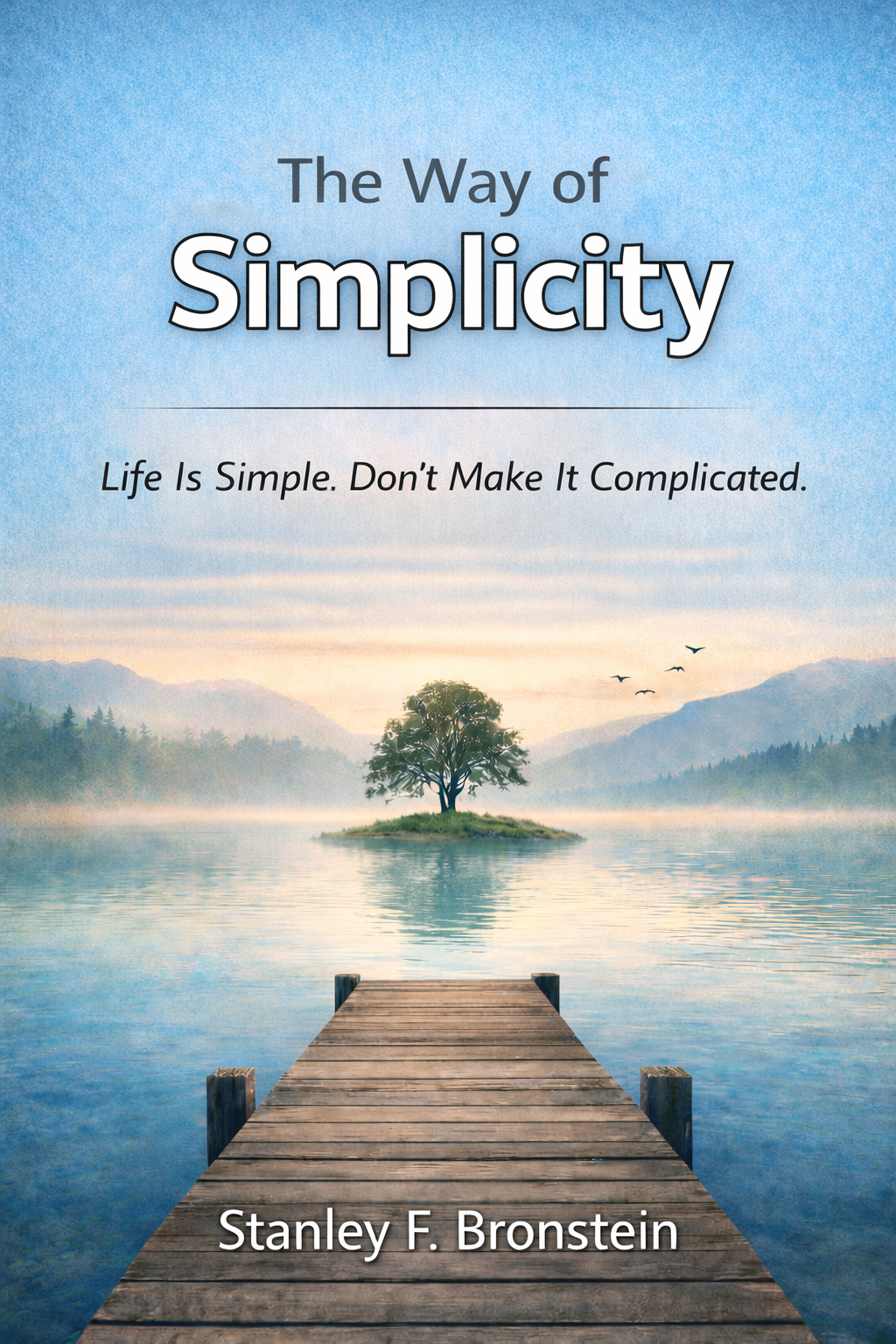
The Way of Simplicity
Life Is Simple. Don’t Make It Complicated.
By Stanley F. Bronstein – Creator of The Way of Excellence System
Click The Tabs Below To Read Each Chapter Of The Book Online
Or
📘 Download Your Free Copy In Your Preferred Format
The Way of Simplicity
by Stanley F. Bronstein
How to use this page:
Click a chapter title to open it then scroll down to read.
When you click the title of the next chapter, the previous one will close.
Take your time.
Read, reflect, and do the experiments and assignments before you move on.
EMPTY ITEM
Foreword
INTRODUCTION TO PART I - LET'S TALK ABOUT SIMPLICITY
Before we apply the 20 Concepts of The Way of Excellence (TWOE) to simplicity, we need to get clear on what simplicity actually means – and why it is so easy to lose.
Most people do not complicate life because they are unintelligent. They complicate life because complexity feels safer. It creates the illusion of control. It creates the illusion of certainty. It creates the illusion that if you just add enough steps, tools, rules, and planning, you can finally guarantee a perfect outcome.
But that illusion comes with a price.
Complexity increases friction. It increases maintenance. It increases overwhelm. It increases delay. And the more complicated something becomes, the easier it is to quit – or to keep “preparing” forever without actually moving forward.
This is where The Way of Simplicity (TWOS) begins.
Simplicity is not laziness. It is not carelessness. It is not minimalism for its own sake. Simplicity is the discipline of choosing clarity, choosing what matters, and choosing the simplest solution that gets the job done, IN AN EXCELLENT MANNER, even if it is not perfect.
Part I is the foundation.
It names the most common traps that pull people into unnecessary complexity.
It gives you a simple filter you can use in any situation to cut through noise and choose the most effective path.
And it sets the standard we will return to again and again throughout the rest of the book:
What is the simplest solution that gets the job done, IN AN EXCELLENT MANNER, even if it is not perfect?
Once that question becomes the way you think, your life starts to change quickly. Not because life becomes easy, but because you stop making it harder than it needs to be.
PART I - Let’s Talk About Simplicity
INTRODUCTION TO PART II - REALIZING SIMPLICITY
Chapter 1 - Learning To Tell It Like It Is - Applying Concept #1
Chapter 2 - Adopting Long-Term Thinking - Applying Concept #2
Simplicity does not survive short-term thinking.
Short-term thinking turns life into a constant series of emergencies. Emergencies demand speed. Speed demands shortcuts. Shortcuts create messes. Messes create more emergencies. And before you know it, you are living inside a loop of pressure, reaction, and unnecessary complexity.
That is why Adopting Long-Term Thinking is Concept #2 in The Way of Excellence (TWOE).
And it is why it is essential in The Way of Simplicity (TWOS).
Long-Term thinking does not make life perfect. It makes life clearer. It helps you choose solutions that last, rather than solutions that merely relieve pressure for a moment.
In TWOS, long-term thinking is the force that keeps you from choosing complicated, fragile solutions that create constant maintenance.
Why Short-Term Thinking Creates Complexity
Short-term thinking is not always obvious. It often hides inside reasonable phrases:
-
I just need to get through this week.
-
I will fix it later.
-
I do not have time to do it right.
-
I need immediate relief.
-
I will start when life calms down.
Short-term thinking creates three predictable problems.
Problem 1 – It Creates Urgency Without Direction
Urgency is not clarity.
Urgency can push you to move, but it rarely pushes you to move wisely.
When urgency is driving, you often pick the fastest solution, not the simplest solution that works.
Problem 2 – It Produces Quick Fixes That Require Repeat Repairs
Quick fixes rarely solve the root problem.
They solve symptoms.
And symptom solutions must be repeated.
Repeated repairs create a life of maintenance.
Simplicity fades when you live in maintenance mode.
Problem 3 – It Encourages Overcomplicated “Rescues”
Short-term fear often creates long-term complexity.
People react by buying something, joining something, adding something, or building something that they then have to manage forever.
Short-term relief becomes long-term burden.
Long-Term thinking breaks that pattern.
What Long-Term Thinking Means In TWOS
Long-Term thinking means you routinely ask:
-
What does this decision create one month from now?
-
What does it create one year from now?
-
What does it create five years from now?
-
What does it require me to maintain?
-
Does it simplify my life or complicate my life over time?
Long-Term thinking favors solutions that are:
-
simpler to execute
-
easier to repeat
-
easier to maintain
-
more durable under stress
-
aligned with excellence instead of perfection
If you want a simple life, you do not only simplify what you do today.
You simplify what you will have to keep doing tomorrow.
The Long-Term Simplicity Principle
Here is a principle you will use throughout this book:
The simplest solution that works today is not always the simplest solution that works long term.
Sometimes the simplest long-term solution takes a little more effort up front, because it removes years of future maintenance.
That is why long-term thinking is not about being slow.
It is about being wise.
It is about choosing the simple solution that stays simple.
The Three Time Horizons That Create Simple Decisions
When you are stuck, use these time horizons. They remove confusion quickly.
Horizon 1 – The Immediate Horizon
What needs to happen now to stop harm, stabilize, or prevent a bigger problem?
This is not where you build complexity. This is where you act cleanly.
Horizon 2 – The Sustained Horizon
What is the simplest routine you can repeat consistently?
This is where most people fail. They choose plans that look impressive, but cannot be sustained.
Horizon 3 – The Compounding Horizon
What choice compounds, rather than resets?
Compounding comes from small actions repeated with excellence.
TWOS favors compounding over restarting.
The 1-Year Test
This is the most useful long-term thinking tool in TWOS.
Ask:
If I had to live with this decision for one year, would it still be the simplest solution that works?
This question removes a lot of fake solutions immediately.
Examples:
-
If I had to follow this eating plan for a year, could I sustain it?
-
If I had to keep this schedule for a year, would it still work?
-
If I had to maintain this tool, this app, or this system for a year, would it still be worth it?
-
If I had to live with the consequences of avoiding this conversation for a year, what would happen?
The 1-Year Test reveals which choices are durable and which ones are temporary performances.
Long-Term Thinking In The Areas That Matter Most
Long-Term Thinking With Health
Short-term health thinking looks like extreme plans, constant resets, and perfection.
Long-Term health thinking looks like fundamentals repeated.
In TWOS, the long-term health question is:
What is the simplest eating and movement structure I can repeat, IN AN EXCELLENT MANNER, for the rest of my life?
That question does not lead to a dramatic plan.
It leads to a clear plan.
Long-Term Thinking With Time
Short-term time thinking tries to do everything.
Long-Term time thinking builds a schedule that protects what matters.
It is easy to fill a calendar.
It is harder to build a calendar that you can live with.
In TWOS, long-term time thinking asks:
What commitments, if I keep them, will force my life to stay complicated?
Then it removes those commitments.
Long-Term Thinking With Money
Short-term money thinking purchases relief.
Long-Term money thinking purchases stability.
Simplicity with money is not about having less.
It is about needing less maintenance.
Long-Term thinking asks:
Does this choice reduce my financial stress in the long term, or does it lock me into more monthly obligations?
Long-Term Thinking With Relationships
Short-term relationship thinking avoids discomfort.
Long-Term relationship thinking tells the truth early.
Avoidance feels easier today.
Avoidance becomes heavier tomorrow.
Long-Term thinking asks:
If I do not address this now, what will it turn into six months from now?
That question pushes you toward the simplest solution that works, which is often a clean, respectful conversation.
Long-Term Thinking With Work
Short-term work thinking chases urgency, reacts to noise, and tries to do everything.
Long-Term work thinking chooses a clear direction, then executes consistently.
TWOS asks:
What is the simplest plan that produces meaningful results, consistently, without constant reinvention?
The Hidden Benefit Of Long-Term Thinking
Long-Term thinking reduces anxiety.
It does that because it removes the pressure to solve your whole life today.
It replaces panic with direction.
It replaces reaction with planning.
It replaces drama with structure.
When you can see further, you stop overreacting to the moment.
And when you stop overreacting, life becomes simpler.
Practice 1 – The Long-Term Decision Filter
Use this when you have a decision that feels complicated.
Write your answers in plain language.
-
What is the decision I am avoiding or overcomplicating?
-
What is the simplest solution that works today?
-
What is the maintenance cost of that solution?
-
What is the simplest solution that will still work one year from now?
-
What is the next step I will take, IN AN EXCELLENT MANNER?
This filter is not designed to make you feel better.
It is designed to make you move forward cleanly.
Practice 2 – The Compounding Choice
Pick one area where you keep restarting.
Health. Time. Work. Money. Relationships.
Then choose one action that is:
-
small enough to repeat daily
-
clear enough to measure
-
simple enough to sustain
-
meaningful enough to matter
Examples:
-
Walk daily.
-
Write daily.
-
Track spending daily.
-
Have one clean conversation weekly.
-
Do one high-value task before noon daily.
The goal is not intensity.
The goal is compounding.
Compounding is simplicity that lasts.
Practice 3 – The Future Maintenance Audit
This is one of the most powerful simplicity exercises in TWOS.
Make a list of the things in your life that require ongoing maintenance:
-
subscriptions
-
tools
-
apps
-
commitments
-
obligations
-
routines
-
complicated systems you built
-
complicated systems you inherited
Then ask:
Which of these are creating value, and which of these are just creating work?
Pick one maintenance burden and remove it this week.
Simplicity grows when maintenance shrinks.
The Standard For This Chapter
Long-Term thinking is not about being serious all the time.
It is about being deliberate.
It is about choosing solutions that do not collapse under pressure.
It is about building a life where forward progress becomes normal.
When you adopt Long-Term thinking, you stop needing constant rescues.
You stop chasing perfect answers.
You stop reinventing your life every week.
And you start living by the TWOS standard:
Choose the simplest solution that gets the job done, IN AN EXCELLENT MANNER, even if it’s not perfect.
Closing question for today:
Where are you choosing short-term relief that is creating long-term complexity, and what is the simplest long-term solution that works?
Chapter 3 - Taking Personal Responsibility - Applying Concept #3
Simplicity requires ownership.
Without ownership, every problem becomes complicated, because it becomes “somebody else’s problem,” “the world’s problem,” “the timing’s problem,” or “the circumstance’s problem.” When that happens, your next step becomes unclear, and when your next step is unclear, life fills up with delay, frustration, and unnecessary complexity.
This is why The Way of Excellence (TWOE) places Taking Personal Responsibility as Concept #3.
And it is why The Way of Simplicity (TWOS) treats responsibility as one of the fastest ways to reduce complexity.
Responsibility is not about blame.
Responsibility is about power.
It is the decision to say: “This is mine to address.”
When you take responsibility, the path becomes simpler because you stop arguing with reality and start choosing the simplest solution that works.
What Personal Responsibility Means In TWOS
Taking personal responsibility means three things, and all three are simple:
-
You tell the truth about what is happening.
-
You own your part in it, without excuses.
-
You take the next step, IN AN EXCELLENT MANNER.
That is it.
It does not require self-criticism.
It does not require shame.
It does not require perfection.
It requires clarity and action.
Why Responsibility Simplifies Life
Responsibility simplifies because it does something complexity cannot do.
It produces a clean next step.
When people avoid responsibility, they often live in one of these mental loops:
-
“I cannot do anything until they change.”
-
“I need to understand everything before I start.”
-
“I need the perfect plan before I act.”
-
“I will begin when life calms down.”
Those loops feel intelligent, but they create paralysis.
Responsibility breaks the loop by asking one question:
What is mine to do next?
That question is simplicity in motion.
The Three Ways People Avoid Responsibility
1 – Blame
Blame says, “This is happening because of them.”
Sometimes other people do contribute to a problem. That can be true.
But blame rarely helps you solve it.
Blame increases complexity because it keeps your focus on what you cannot control.
Responsibility brings focus back to what you can control.
2 – Excuses
Excuses say, “I would do it, but…”
Excuses are often built from real facts. Lack of time. Stress. Money. Energy. Support.
But excuses still create complexity because they keep the problem alive without a next step.
Responsibility does not deny circumstances. It refuses to be ruled by them.
3 – Victim Thinking
Victim thinking says, “This is happening to me.”
Responsibility says, “This is happening, and I decide what I do next.”
That shift does not make life perfect.
It makes life simpler, because it returns power to the only person who can take the next step.
Responsibility Versus Fault
This distinction is essential.
Fault is about the past.
Responsibility is about the future.
Fault asks: “Who caused this?”
Responsibility asks: “What will fix this?”
TWOS is built for forward progress, so it prioritizes responsibility.
You can acknowledge fault when it is relevant, but you do not live there.
You live in the next step.
The Responsibility Move
Here is a simple way to apply this concept immediately.
When you feel stuck, say one sentence:
“This is my responsibility to address, and my next step is _____.”
Examples:
-
“This is my responsibility to address, and my next step is to make the call today.”
-
“This is my responsibility to address, and my next step is to remove one commitment from my schedule.”
-
“This is my responsibility to address, and my next step is to choose one simple routine and repeat it for seven days.”
-
“This is my responsibility to address, and my next step is to have the conversation I have been avoiding.”
Notice what this sentence does.
It removes drama.
It removes debate.
It removes the need for a perfect plan.
It produces motion.
Responsibility Creates Simplicity In Real Life
Responsibility With Time
The responsible truth is usually simple:
-
“My calendar is full because I am not protecting it.”
The simplest solution that works is often:
-
remove one commitment
-
create one protected daily block
-
say no once, cleanly, without overexplaining
Responsibility With Health
The responsible truth is usually simple:
-
“I am not being consistent.”
The simplest solution that works is usually:
-
choose one eating standard you can sustain
-
choose one daily movement standard
-
repeat them, IN AN EXCELLENT MANNER, for a short, clear time window
Responsibility With Relationships
The responsible truth is usually simple:
-
“I have not been clear.”
The simplest solution that works is usually:
-
speak one clean truth
-
ask one direct question
-
set one respectful boundary
Responsibility With Work
The responsible truth is usually simple:
-
“I am avoiding the highest value action.”
The simplest solution that works is usually:
-
identify the single outcome that matters
-
take the first measurable step today
-
stop polishing and deliver the version that meets the excellence standard
Practice 1 – The Ownership Inventory
Write short answers. No stories. No justification.
-
What is the situation I am overcomplicating?
-
What part of this is mine to own?
-
What am I doing that is making it worse, even slightly?
-
What is one thing I can do today that improves it?
-
What is the simplest solution that works, IN AN EXCELLENT MANNER, for the next 24 hours?
This tool does not solve your whole life.
It restores momentum.
Practice 2 – Replace “I Have To” With “I Choose To”
This is a responsibility upgrade that removes resistance.
When you say “I have to,” you feel trapped.
When you say “I choose to,” you feel power.
Examples:
-
“I have to exercise” becomes “I choose to walk because I value my health.”
-
“I have to deal with this” becomes “I choose to address this now so it does not grow.”
-
“I have to say no” becomes “I choose to protect my time.”
This shift does not change facts.
It changes identity.
And identity is what makes simplicity sustainable.
Practice 3 – The No Excuses Next Step
When you are tempted to explain why you cannot, do this instead:
-
Write the best excuse you have.
-
Circle the part you can control.
-
Take one step on that part.
Example:
Excuse: “I do not have time.”
Controllable: “I can find 10 minutes.”
Step: “I will do 10 minutes today, IN AN EXCELLENT MANNER, and stop.”
Responsibility does not always look big.
It looks consistent.
The Standard For This Chapter
If you want a simpler life, you cannot outsource responsibility.
You cannot wait for perfect conditions.
You cannot wait for other people to behave differently.
You can acknowledge those things, but you cannot build your life on them.
In TWOS, personal responsibility is the moment you stop arguing with reality and start acting on it.
It is the moment you stop asking, “Why is this happening?”
And start asking, “What is mine to do next?”
That is how simplicity becomes real.
Closing question for today:
What is one area of your life where taking personal responsibility would immediately reveal the simplest next step that works?
Chapter 4 - Embracing Change - Applying Concept #4
Simplicity requires change.
Not constant change.
Not random change.
Not dramatic change.
But the willingness to change what is not working, instead of building elaborate workarounds to avoid changing it.
Many people live inside complicated systems because they refuse one simple change.
They refuse to tell the truth.
They refuse to set a boundary.
They refuse to make a decision.
They refuse to end something that should end.
They refuse to begin something that should begin.
So they cope. They patch. They add steps. They add tools. They add explanations. They add pressure.
And complexity grows.
That is why Embracing Change is Concept #4 in The Way of Excellence (TWOE).
And that is why it is essential in The Way of Simplicity (TWOS).
Because in TWOS, embracing change is not about becoming someone else. It is about removing what is unnecessary so what matters can work.
Why People Resist Change
People resist change for predictable reasons.
And when you understand the reasons, you can stop judging yourself and start choosing the simplest solution that works.
Reason 1 – Change Feels Like Loss
Even good change can feel like loss.
It can feel like:
-
losing comfort
-
losing identity
-
losing a familiar routine
-
losing an excuse
-
losing a coping mechanism
But what you are really losing is a pattern that is creating complexity.
Reason 2 – Change Creates Discomfort Before It Creates Results
This is the part people forget.
Most change is uncomfortable at first because you are leaving the known, even if the known is not working.
Simplicity asks you to tolerate the short-term discomfort of change so you can avoid the long-term burden of complexity.
Reason 3 – People Want To Change Without Changing
This is one of the most common human contradictions.
People want a better outcome, but they do not want the change required to create it.
So they look for more information, more tools, more hacks, and more complicated solutions.
But the simplest solution that works is often: change the thing.
The Difference Between Useful Change And Unnecessary Change
This book is not promoting change for its own sake.
TWOS is about clarity, not novelty.
So here is the key distinction:
Useful change removes friction and reduces complexity.
Unnecessary change adds moving parts and increases complexity.
Useful change tends to be simple and direct.
Unnecessary change tends to be elaborate, impressive, and hard to maintain.
TWOS teaches you to choose change that simplifies your life.
The TWOS Change Principle
Here is a principle you will return to often:
If you refuse the simple change, you will live with the complicated consequences.
The consequences might not appear immediately.
But they will appear.
And they will usually cost more than the change would have cost.
This is true in health. This is true in relationships. This is true in time. This is true in money. This is true in work. This is true in personal growth.
The question is not whether you will pay.
The question is whether you will pay with a clean change now, or with a complicated mess later.
The Two Types Of Change That Simplify Life
Type 1 – Subtractive Change
This is the change most people avoid, and it is often the most powerful.
Subtractive change means removing something:
-
a commitment
-
a habit
-
a distraction
-
a relationship pattern
-
a source of noise
-
a recurring problem you keep tolerating
Subtractive change is often the simplest solution that works.
And it often feels uncomfortable because it requires saying no, letting go, or closing a door.
Type 2 – Additive Change
This is adding something that improves structure and creates stability:
-
a simple routine
-
a daily standard
-
a weekly review
-
a boundary
-
a practice that reduces stress
Additive change works best when it is small, specific, and repeatable.
If it is complicated, it does not become a routine.
It becomes another project.
TWOS favors small additions that create consistent results.
Change Versus Reinvention
Many people avoid change by reinventing.
Reinvention feels productive because it is exciting, but it often becomes a way to escape the boring work of consistency.
Change in TWOS is simple and practical.
It looks like:
-
one decision
-
one boundary
-
one routine
-
one removal
-
one next step
Reinvention looks like:
-
new plans every week
-
new systems every month
-
new identity every season
-
constant restarts
TWOS is built on change that produces stability, not change that produces novelty.
Where Embracing Change Shows Up In Real Life
Change In Your Calendar
If your calendar is chaotic, the simplest change might be subtractive.
It might be:
-
removing one recurring commitment
-
stopping one unnecessary meeting
-
blocking one protected time window daily
If you do not make that simple change, you will build complicated coping strategies:
-
working late
-
multitasking
-
resenting others
-
constantly feeling behind
A simple change prevents a complicated life.
Change In Your Health
Many people complicate health by chasing perfect routines and perfect plans.
But the simplest change often looks like:
-
removing one trigger food
-
walking daily
-
eating a simple set of meals repeatedly
-
sleeping at a consistent time
Those are not exciting changes.
They are effective changes.
They reduce complexity because they reduce decision fatigue.
Change In Your Relationships
The simplest change is often a conversation.
Not an emotional explosion.
A clean, respectful conversation.
Or a boundary.
Or a decision.
People build years of relational complexity because they refuse one simple change:
telling the truth early.
Change In Your Work
Work becomes complicated when priorities are unclear and avoidance is active.
The simplest change might be:
-
choosing the single highest value outcome
-
saying no to lower value tasks
-
shipping what meets the excellence standard instead of polishing forever
The cost of avoiding that change is usually burnout and chronic frustration.
The Change Ladder
Here is a simple way to approach change without becoming overwhelmed.
Move one rung at a time.
Rung 1 – Notice
Name the pattern.
“I am doing this.”
Rung 2 – Admit
Tell the truth.
“This is not working.”
Rung 3 – Decide
Make a clean decision.
“I will change it.”
Rung 4 – Act
Take the simplest step that works.
Not perfect. Excellent.
Rung 5 – Repeat
Repeat the step until it becomes normal.
Change is not one moment.
Change is repeated action.
Practice 1 – Stop, Start, Continue
Choose one area of life. Then write three short lists.
Stop:
-
one thing that is creating complexity
Start:
-
one simple change that would reduce complexity
Continue:
-
one thing that is working and should remain
Keep the lists short. If you write too much, you are probably overcomplicating.
Then choose one item and act on it today.
Practice 2 – The 48-Hour Change
Many people make change hard by leaving it vague.
TWOS makes change simpler by making it specific.
Choose one change you have been avoiding.
Then do this:
-
Define the change in one sentence.
-
Choose one concrete action.
-
Do it within 48 hours.
If you cannot do it within 48 hours, the action is too big.
Shrink the action until it is executable.
The goal is not drama.
The goal is momentum.
Practice 3 – The Cost Comparison
This is a clarity tool.
Write two short paragraphs.
Paragraph 1:
What does it cost me if I make the change now?
Paragraph 2:
What does it cost me if I do not make the change for six more months?
Most people avoid change because they focus only on the first paragraph.
TWOS makes you look at the second paragraph.
The second paragraph is where reality lives.
The Standard For This Chapter
Embracing change does not mean living in chaos.
It means refusing to cling to what is not working.
It means choosing the simple change that reduces complexity.
It means preferring forward progress over endless refinement.
In TWOS, change is not a personality trait.
It is the decision to stop managing symptoms and start solving the real problem.
That is why this chapter belongs near the beginning.
Because without change, simplicity remains an idea.
With change, simplicity becomes a life.
Closing question for today:
What is one simple change you have been avoiding that would immediately reduce complexity in your life?
Chapter 5 - Focusing On The Possible - Applying Concept #5
Chapter 6 - Changing Our Perspective - Applying Concept #6
Simplicity is often one perspective shift away.
Not because the problem disappears, but because the real problem finally becomes visible.
Many people overcomplicate life because they are solving the wrong problem.
They are reacting to the surface problem.
They are fighting the symptom.
They are arguing with reality.
They are trying to control what cannot be controlled.
And when you solve the wrong problem, the solution has to become complicated, because it is compensating for the fact that it does not fit.
That is why Changing Our Perspective is Concept #6 in The Way of Excellence (TWOE).
And that is why it is essential in The Way of Simplicity (TWOS).
When you change your perspective, you often discover that the simplest solution was available the whole time. You just could not see it from where you were standing.
What Perspective Means In TWOS
Perspective is how you frame what is happening.
It is the meaning you assign.
It is the lens you use.
Perspective answers questions like:
-
What is this really about?
-
What matters most here?
-
What am I making this mean?
-
What is the simplest true explanation?
-
What is the simplest solution that works?
In TWOS, changing perspective is not about pretending everything is fine. It is about seeing more clearly.
Clarity reduces complexity.
Why The Wrong Perspective Creates Complexity
A distorted perspective creates predictable problems.
1 – It Creates Emotional Overreaction
When the meaning is distorted, emotions spike.
When emotions spike, decisions become harder.
When decisions become harder, people overthink.
Overthinking creates complexity.
2 – It Creates Unnecessary Work
If you misdiagnose the problem, you build a solution that is too big, too detailed, and too hard to maintain.
That is complexity created by misunderstanding.
3 – It Creates Conflict
Many conflicts are not about facts. They are about perspective.
When people argue from fixed perspectives, they escalate.
Escalation produces complicated outcomes.
A perspective shift often produces the simplest agreement that works.
The TWOS Perspective Principle
Here is a principle you will use throughout the book:
When you feel stuck, you usually need a better perspective, not a bigger solution.
Bigger solutions often come from fear.
Better perspectives come from clarity.
TWOS favors clarity.
The Three Perspective Traps
Trap 1 – Personalizing
This trap sounds like:
-
They did this to me.
-
This always happens to me.
-
I must be the problem.
Personalizing makes everything heavier.
It turns a solvable situation into an identity crisis.
A simpler perspective is:
-
This is a situation. What is my next step?
Trap 2 – Catastrophizing
This trap sounds like:
-
This is terrible.
-
This is a disaster.
-
This ruins everything.
Catastrophizing expands the problem.
Expanded problems require complex solutions.
A simpler perspective is:
-
What is true, and what is the smallest excellent step that improves this?
Trap 3 – Perfection Framing
This trap sounds like:
-
If it is not perfect, it is not good enough.
-
If I cannot do it all, I should not do any of it.
-
If I cannot guarantee the outcome, I should not begin.
This framing creates delay and overdesign.
A simpler perspective is:
-
What is the simplest solution that works, IN AN EXCELLENT MANNER?
The Perspective Shift Questions
When you feel stuck, ask these questions in order. Keep your answers short.
-
What are the facts, without interpretation?
-
What am I assuming?
-
What else could be true?
-
What is the real problem I can actually solve?
-
What is the simplest solution that works, IN AN EXCELLENT MANNER?
These questions reduce complexity because they replace emotional reaction with clear thinking.
Perspective Changes Everything Without Changing The Facts
Perspective does not change what happened.
It changes what you do next.
Here are examples of the same situation with two perspectives.
Example 1 – Health
Complicating perspective:
-
I failed again, so I might as well start over next week.
Simplifying perspective:
-
I drifted. I can return to the simplest routine today, IN AN EXCELLENT MANNER.
Same facts.
Different outcome.
Example 2 – Time
Complicating perspective:
-
I am overwhelmed and there is too much to do.
Simplifying perspective:
-
I have too many commitments. I will remove one commitment and protect one daily block.
Same facts.
Different solution.
Example 3 – Relationships
Complicating perspective:
-
They should know what I need.
Simplifying perspective:
-
I have not clearly asked for what I need. I will communicate it respectfully.
Same facts.
Different path.
Example 4 – Work
Complicating perspective:
-
I need a better system.
Simplifying perspective:
-
I need one clear priority and a protected block of time to execute it.
Same facts.
Different focus.
Changing Perspective In Real Life
Perspective In Conflict
When conflict appears, most people try to win.
Winning often requires complexity: arguments, evidence, defending, proving, escalating.
A simplicity perspective asks:
-
What is the simplest agreement that works for both of us?
That does not mean you abandon standards.
It means you prioritize clarity over escalation.
Perspective In Stress
When stress rises, people often ask:
-
How do I fix everything?
That question creates overwhelm.
A simplicity perspective asks:
-
What is the next simplest excellent step?
That question creates movement.
Perspective In Decision Making
Many decisions feel complicated because the frame is wrong.
The wrong frame is:
-
What is the perfect decision?
The right frame is:
-
What is the simplest decision that works, IN AN EXCELLENT MANNER, and what is my next step?
Practice 1 – The Perspective Reset
Do this anytime you feel stuck.
Write five lines:
-
The facts are:
-
The story I am telling myself is:
-
A simpler perspective could be:
-
The real problem I can solve is:
-
The simplest solution that works, IN AN EXCELLENT MANNER, is:
This exercise removes fog.
Fog creates complexity.
Clarity creates simplicity.
Practice 2 – The Opposite View
This practice is simple, and it is powerful.
Ask:
-
If the opposite of my current view were true, what would it be?
You are not accepting the opposite as truth. You are using it to loosen your grip.
Rigid perspective creates complicated outcomes.
Flexible perspective creates simple options.
Practice 3 – The 1 Sentence Reframe
Take a situation that feels heavy.
Write one sentence that reframes it in a way that produces action.
Examples:
-
This is not a crisis. This is a decision.
-
This is not a failure. This is feedback.
-
This is not impossible. This is uncomfortable.
-
This is not everything. This is one area that needs clarity.
-
This is not complicated. I am making it complicated.
Then ask:
-
What is the simplest action that follows from this reframe?
The Standard For This Chapter
Changing your perspective does not solve every problem instantly.
It does something more useful.
It reveals the real problem.
And when you can see the real problem, you stop building complicated solutions to symptoms.
You stop chasing perfect answers.
You stop adding steps that do not matter.
You choose the simplest solution that works, IN AN EXCELLENT MANNER, and you take the next step.
That is TWOS applied to real life.
Closing question for today:
Where are you overcomplicating something because of the way you are viewing it, and what perspective shift would reveal the simplest solution that works?
INTRODUCTION TO PART III - MANIFESTING SIMPLICITY
Simplicity is not something you find. Simplicity is something you create.
Part II focused on realizing simplicity: telling the truth, adopting Long-Term thinking, taking personal responsibility, embracing change, focusing on the possible, and changing your perspective. Those Concepts clear the fog. They help you see what is real.
Now we move into Part III: Manifesting Simplicity.
Manifesting is the process of turning clarity into reality. It is the point where insight becomes structure, and intention becomes action.
This Part applies the next Concepts of The Way of Excellence (TWOE), which is your operating system for living and leading with excellence, through the lens of The Way of Simplicity (TWOS), which is the practice of choosing the simplest solution that gets the job done, IN AN EXCELLENT MANNER, even if it’s not perfect.
In this Part, we focus on the actions that move a life forward without overcomplicating it:
-
Envisioning a brighter future so you know what you are creating.
-
Learning to give first so life becomes less transactional and more aligned with meaning.
-
Allocating your resources wisely so your time, energy, and attention go where they matter most.
-
Taking consistent action so progress becomes normal instead of occasional.
-
Persisting so simplicity holds steady when life gets difficult.
A complicated life is often the result of unclear direction combined with inconsistent execution.
A simpler life is the result of clear direction combined with consistent execution.
That is what Part III is designed to help you create.
As you move through these chapters, keep returning to the standard that guides this entire book:
What is the simplest solution that gets the job done, IN AN EXCELLENT MANNER, even if it’s not perfect?
Part III is where you begin answering that question with action.
Chapter 7 - Envisioning A Brighter Future - Applying Concept #7
Simplicity needs direction.
When direction is unclear, life fills itself with noise. You react. You chase. You sample. You start things, stop things, and restart things. You collect ideas, tools, and plans, then wonder why nothing feels settled.
That is not a discipline problem.
It is a direction problem.
This is why Envisioning A Brighter Future is Concept #7 in The Way of Excellence (TWOE), and why it is the first chapter in Part III of The Way of Simplicity (TWOS).
If you want the simplest solution that works, you have to know what you are solving for.
Why A Brighter Future Simplifies The Present
Without a clear future, every option looks equal.
And when every option looks equal, you overthink.
Overthinking creates complexity.
A clear vision does the opposite. It simplifies because it gives you a filter.
It helps you answer questions like:
-
Does this move me toward the life I want?
-
Does this create more peace or more maintenance?
-
Is this essential, or is it noise?
-
Is this the simplest solution that gets the job done, IN AN EXCELLENT MANNER, for the future I am creating?
A brighter future is not fantasy.
It is guidance.
It is a compass.
The Difference Between A Dream And A Direction
A dream is a wish.
A direction is a decision.
A dream says, “Someday I would like…”
A direction says, “This is who I am becoming, and this is what I am building.”
In TWOS, envisioning a brighter future is not about making life more complicated.
It is about making life more clear.
Clarity reduces choices.
Reducing choices reduces complexity.
The Most Common Vision Mistakes That Create Complexity
Mistake 1 – Making The Vision Too Big To Execute
Some people create visions that are inspiring but unusable.
They are too abstract.
They are too broad.
They are too grand.
Then they wonder why they cannot translate the vision into daily action.
A useful vision in TWOS is simple enough to guide the next step.
Mistake 2 – Making The Vision Too Detailed
Other people do the opposite. They create a vision with so many specifics that it becomes fragile.
Life changes.
Circumstances shift.
A vision that depends on perfect conditions creates stress and rigidity.
TWOS favors a vision that is clear, but not brittle.
Mistake 3 – Turning The Vision Into A Perfection Standard
A brighter future is a direction, not a weapon.
If you use the vision to criticize yourself, you will avoid it.
TWOS uses vision to create momentum, not shame.
The TWOS Vision Principle
Here is the principle for this chapter:
A clear future creates a simpler present.
When you know what you are creating, you stop chasing what does not matter.
You stop adding unnecessary steps.
You stop building a life you then have to maintain.
You begin choosing the simplest solutions that actually serve your direction.
The Three Elements Of A Simple Vision
A simple vision has three components:
1 – Identity
Who are you becoming?
Examples:
-
I am becoming a person who lives with clarity and calm.
-
I am becoming a person who keeps simple promises to myself.
-
I am becoming a person who chooses excellence over perfection.
Identity simplifies because it guides behavior.
2 – Outcomes
What results are you creating?
Examples:
-
Better health and higher energy.
-
Cleaner relationships built on truth and respect.
-
A stable schedule with fewer commitments and more focus.
-
A home, business, or life with less maintenance.
Outcomes simplify because they help you measure.
3 – Standards
What rules will you live by?
Examples:
-
I choose the simplest solution that works.
-
I tell the truth and act on it.
-
I do what I can repeat.
-
I do it IN AN EXCELLENT MANNER, even if it is not perfect.
Standards simplify because they reduce decision fatigue.
The Simplicity Filter That Vision Creates
Once you have a simple vision, you can run decisions through a filter.
Ask:
-
Does this support the future I am creating?
-
Does this reduce complexity or increase it?
-
Does this create more freedom or more maintenance?
-
Can I sustain this long term?
-
Is this the simplest solution that gets the job done, IN AN EXCELLENT MANNER?
This is how vision becomes practical.
It turns “someday” into “today.”
A Brighter Future Often Begins With Subtraction
Most people assume a brighter future requires more:
-
more effort
-
more intensity
-
more hours
-
more tools
-
more plans
Sometimes it does require addition.
But often the brightest future begins with subtraction:
-
fewer obligations
-
fewer distractions
-
fewer unnecessary relationships
-
fewer complicated systems
-
fewer goals competing at the same time
In TWOS, a brighter future is often created by removing what blocks peace and progress.
Practice 1 – The One Page Brighter Future
Keep this simple. One page only.
Write three short sections.
1 – My Brighter Future Looks Like
Write 5 to 10 clear statements. Examples:
-
My days feel calmer and more focused.
-
My schedule has space.
-
My health is stable because my habits are consistent.
-
My relationships feel clean because I speak truth early.
-
I do not live in constant maintenance.
2 – I Am Becoming The Kind Of Person Who
Write 5 to 10 identity statements. Examples:
-
chooses clarity over complexity
-
chooses excellence over perfection
-
keeps simple promises
-
acts instead of overthinking
-
returns quickly when I drift
3 – My Standards Are
Write 5 to 10 standards. Examples:
-
I ask, what is the simplest solution that works?
-
I remove what is unnecessary.
-
I protect my time.
-
I do the next step IN AN EXCELLENT MANNER.
-
I stay consistent, not dramatic.
This page becomes your filter.
Practice 2 – The Vision To Action Bridge
A vision is only useful if it creates action.
Answer these questions:
-
What is one part of my brighter future I want to create first?
-
What is the simplest step that moves me toward it?
-
What is one daily action I can repeat, IN AN EXCELLENT MANNER?
-
What is one thing I will remove that is creating complexity?
-
What is the first step I will take in the next 24 hours?
Keep it simple. If it becomes complicated, you are drifting into perfection.
Practice 3 – The “One Thing” Commitment
Choose one focus for the next 30 days.
Not five.
One.
Examples:
-
health consistency
-
schedule simplification
-
a key relationship repair
-
a single project shipped
-
financial cleanup
Write one sentence:
For the next 30 days, my focus is _____.
Then write your simplest daily action.
This practice works because it reduces competing goals, and competing goals are a major source of complexity.
The Standard For This Chapter
A brighter future is not created by thinking harder.
It is created by seeing clearly and choosing cleanly.
When you envision a brighter future, you stop living as if every option is equal.
You stop chasing what does not matter.
You begin choosing what aligns with your direction.
And you begin living the TWOS standard with more consistency:
Choose the simplest solution that gets the job done, IN AN EXCELLENT MANNER, even if it’s not perfect.
Closing question for today:
What is one part of your brighter future that, if you made it clear, would immediately simplify the decisions you make this week?
Chapter 8 - Learning To Give First - Applying Concept #8
Simplicity grows when life stops being transactional.
When everything becomes a negotiation, life becomes complicated. You keep score. You calculate. You hold back. You wait to see what the other person will do first. You protect yourself with strategy, and strategy often turns relationships into maintenance.
That is why Learning To Give First is Concept #8 in The Way of Excellence (TWOE).
And that is why it belongs in The Way of Simplicity (TWOS).
Giving first is not about being naive.
It is not about being weak.
It is not about letting people use you.
Giving first is a way of living that reduces friction, strengthens relationships, and creates trust. Trust is one of the simplest forces on Earth. When trust is present, fewer rules are needed. Fewer explanations are needed. Fewer defenses are needed. Fewer complicated systems are needed.
Giving first simplifies because it improves the quality of the environment you live in.
What “Give First” Means In TWOS
In TWOS, giving first means you lead with value.
You contribute before you demand.
You serve before you ask to be served.
You bring clarity, kindness, effort, or generosity into a situation without requiring a guarantee of return.
Giving first is a posture.
It is a standard.
It is a decision to live from strength, not from scarcity.
And in most situations, it is also the simplest solution that works, because it prevents conflicts that otherwise create long-term complexity.
What Giving First Is Not
To keep this concept clean, we need to name what it is not.
Giving first is not:
-
saying yes to everything
-
abandoning boundaries
-
tolerating disrespect
-
giving beyond your capacity
-
giving to manipulate an outcome
-
giving to earn love or approval
TWOS is not asking you to become a doormat.
TWOS is asking you to become a leader.
Leaders give first, but leaders also choose wisely.
Why Transactional Living Creates Complexity
Transactional living is a hidden source of stress.
It sounds like:
-
I will do this if you do that.
-
I gave last time, so now you owe me.
-
I am not going to reach out first.
-
I am not going to help unless I get credit.
-
I am not going to give unless I can control the return.
This mindset creates complexity in three ways.
1 – It Creates Mental Accounting
Keeping score consumes attention.
Attention is a resource.
When attention is consumed by scorekeeping, it is not available for clear decisions and excellent action.
2 – It Creates Friction In Relationships
Friction creates misunderstandings.
Misunderstandings create arguments.
Arguments create distance.
Distance requires repairs.
Repairs create maintenance.
A simpler way is to reduce friction at the beginning.
3 – It Creates Delay
When people wait for others to go first, life slows down.
Progress becomes dependent.
Dependent progress becomes complicated progress.
Giving first restores momentum.
The TWOS Giving Principle
Here is the principle for this chapter:
When you give first with clarity and boundaries, you reduce complexity and increase trust.
Trust is a multiplier.
It reduces the need for control.
Control is one of the biggest drivers of complexity.
So giving first is not only generous. It is practical.
Giving First Creates Simplicity In Four Areas
1 – Communication
The simplest communication often begins with giving clarity.
Instead of hinting, withholding, or testing, you give the truth respectfully.
You give the context.
You give the intention.
You give a clean request.
This reduces confusion and prevents unnecessary conflict.
2 – Relationships
Relationships become simpler when someone chooses to lead with generosity.
Generosity can be:
-
giving appreciation
-
giving effort
-
giving patience
-
giving forgiveness
-
giving help
-
giving a clean apology
Most relationship complexity is not caused by one big event.
It is caused by small withdrawals with no deposits.
Giving first creates deposits.
3 – Work And Leadership
In work, giving first means you lead with contribution rather than entitlement.
You do not wait to be inspired.
You do not wait to be praised.
You bring value.
That posture simplifies leadership because it reduces politics, resentment, and mistrust.
4 – Inner Life
Giving first also applies inwardly.
Many people are generous to others and harsh with themselves.
That harshness creates internal complexity: guilt, shame, procrastination, perfectionism, and endless restarting.
Giving first to yourself means:
-
giving yourself truth without cruelty
-
giving yourself structure
-
giving yourself patience
-
giving yourself a simple plan you can repeat
-
giving yourself a fair standard: excellence, not perfection
That internal generosity simplifies your life from the inside out.
The Simplest Form Of Giving First
If you want the simplest definition, it is this:
Do the next right thing without requiring a guarantee.
In TWOS language, that becomes:
Choose the simplest solution that gets the job done, IN AN EXCELLENT MANNER, even if it is not perfect, and even if you do not receive immediate credit.
This is a mature form of strength.
Boundaries Make Giving First Sustainable
If you give without boundaries, you do not practice giving first.
You practice leaking.
Leaking creates resentment.
Resentment creates complexity.
So TWOS pairs giving with boundaries.
Here are three boundary questions that keep giving clean:
-
Is this within my capacity?
-
Is this aligned with my values and standards?
-
Am I giving freely, or am I giving to control the outcome?
If the answer is clean, give.
If the answer is not clean, adjust.
Sometimes the simplest solution that works is not giving more.
Sometimes it is giving less, with clarity.
Giving First In Difficult Situations
Giving first is easy when life is easy.
The concept matters most when life is tense.
Here are three examples.
Example 1 – Conflict
In conflict, giving first might mean giving calm.
It might mean giving listening.
It might mean giving a fair statement of the other person’s view before you present your own.
That one choice often reduces the entire argument.
Example 2 – Disappointment
When someone disappoints you, giving first might mean giving a clean conversation instead of silent resentment.
Resentment is complicated.
A clean conversation is simpler.
Example 3 – Leadership Under Pressure
In leadership, giving first might mean giving clarity when everyone is confused.
It might mean giving steadiness when others are reactive.
It might mean giving responsibility instead of blame.
Clarity is one of the most powerful gifts you can give.
Practice 1 – The Daily Give First Habit
Once per day, choose one simple act of giving.
Keep it small. Keep it sincere.
Examples:
-
Send a thank you message.
-
Offer one useful piece of help.
-
Give someone credit publicly.
-
Ask a person a genuine question and listen.
-
Do one task that helps the team.
-
Give yourself a clean reset instead of self-criticism.
The goal is not grand gestures.
The goal is a daily posture.
Consistency creates simplicity.
Practice 2 – The Relationship Simplifier
Choose one relationship that feels tense or distant.
Give first in one of these ways:
-
appreciation
-
responsibility
-
truth
-
an apology
-
an offer to repair
Do not overexplain.
Do not negotiate.
Do one clean act, IN AN EXCELLENT MANNER.
Then observe what happens.
Even if the other person does not respond perfectly, you will have reduced internal complexity, because you will no longer be stuck in waiting and resentment.
Practice 3 – Give First To Your Future Self
This is one of the most practical forms of giving first.
Ask:
What is one thing I can do today that makes tomorrow simpler?
Examples:
-
Prepare a simple meal.
-
Set out walking shoes.
-
Clean one area.
-
Make the appointment.
-
Write the first paragraph.
-
Remove one unnecessary task from your calendar.
This is giving first to your future self.
It reduces future maintenance.
It is one of the simplest ways to create a simpler life.
The Standard For This Chapter
Giving first is not a tactic.
It is a standard.
It is living from the belief that you can lead with value and still maintain boundaries.
It is choosing contribution over calculation.
It is choosing trust over control.
And because trust reduces friction, giving first is often the simplest solution that works.
In TWOS, you do not give first to be perfect.
You give first to be aligned with excellence.
You give first because it simplifies your relationships, your leadership, and your inner life.
Closing question for today:
Where would one act of giving first, done clearly and with boundaries, reduce complexity and create a simpler path forward?
Chapter 9 - Allocating Our Resources Wisely - Applying Concept #9
Simplicity is not only a mindset. It is a management strategy.
Every day, you allocate resources, whether you realize it or not:
-
time
-
energy
-
attention
-
money
-
emotion
-
effort
-
focus
When those resources are allocated poorly, life becomes complicated. You feel stretched, scattered, behind, and reactive. You start patching problems instead of solving them. You start building workarounds instead of building stability.
That is why Allocating Our Resources Wisely is Concept #9 in The Way of Excellence (TWOE).
And that is why it is essential in The Way of Simplicity (TWOS).
Because a simpler life is usually created the same way, over and over: by putting your limited resources where they matter most, and pulling them away from what creates noise, drain, and maintenance.
The Resource Reality
You do not have unlimited time.
You do not have unlimited energy.
You do not have unlimited attention.
So every yes is also a no.
Every choice has a cost.
And if you do not allocate intentionally, life allocates for you. That is how people end up with complicated schedules, complicated obligations, complicated finances, and complicated stress.
TWOS is the decision to allocate on purpose.
Why Poor Allocation Creates Complexity
Poor allocation creates complexity in predictable ways.
1 – It Creates Too Many Open Loops
Unfinished tasks, unresolved conversations, unpaid attention, and ignored decisions do not disappear. They stay open.
Open loops create mental noise.
Mental noise makes simple decisions harder.
Harder decisions lead to more overthinking, and overthinking creates complexity.
2 – It Creates Exhaustion
When energy is spent on low value activities, you do not have enough left for what matters.
Then you fall behind.
Then you rush.
Then you cut corners.
Then you create a mess you have to clean up later.
Exhaustion is expensive, and it always makes life more complicated.
3 – It Creates Maintenance
Some choices create long-term maintenance: subscriptions, obligations, systems, and commitments that require ongoing time and attention.
If you allocate resources without thinking about maintenance, you slowly build a life that requires constant upkeep.
Simplicity fades when maintenance grows.
The TWOS Allocation Principle
Here is the principle for this chapter:
Allocate your best resources to what matters most, and stop funding what creates complexity.
That is not harsh. That is wise.
And it is the path to choosing the simplest solution that gets the job done, IN AN EXCELLENT MANNER, even if it is not perfect.
The Four Core Resources To Manage
1 – Time
Time is the most obvious resource, but it is not the most valuable one.
Time becomes powerful when it is paired with focus and energy.
2 – Energy
Energy determines execution.
A plan that looks great on paper fails if you do not have the energy to sustain it.
TWOS favors solutions that respect your energy and protect it.
3 – Attention
Attention is your life.
What you repeatedly pay attention to becomes your reality.
If attention is scattered, life becomes scattered.
4 – Money
Money is stored time and stored effort.
If money is allocated without intention, it creates stress and obligations that complicate everything else.
The Simplicity Question Behind This Chapter
If you want one question that sums up Concept #9 in TWOS, it is this:
What am I funding that is not serving the life I want?
Funding can mean money.
It can also mean attention, energy, time, and emotion.
When you stop funding the wrong things, life becomes simpler.
The Two Allocation Errors Most People Make
Error 1 – Overinvesting In Low Value
Low value does not always look low value. It often looks urgent.
Low value can be:
-
constant checking and refreshing
-
reworking things that are already good enough
-
agreeing to things out of guilt
-
solving problems other people should solve
-
staying in conversations that go nowhere
-
consuming information with no application
Overinvesting in low value creates the illusion of productivity, but it produces complexity.
Error 2 – Underinvesting In High Value
High value activities are often quiet and unglamorous.
High value is:
-
health fundamentals
-
honest conversations
-
focused work
-
planning the week
-
simplifying systems
-
building routines
-
removing clutter
-
solving root problems
If you underinvest in high value, you will overpay later in stress and maintenance.
Allocating Resources Wisely In Real Life
Health
A complicated health life often comes from poor allocation.
People invest in:
-
searching for new plans
-
chasing perfect routines
-
making extreme changes they cannot sustain
But they underinvest in:
-
simple eating standards
-
consistent movement
-
sleep
-
preparation
-
repetition
TWOS health allocation is simple:
Allocate daily time and energy to fundamentals you can repeat, IN AN EXCELLENT MANNER.
Time And Calendar
Many schedules are complicated because they are built around other people’s priorities.
TWOS asks:
-
What is essential?
-
What is optional?
-
What is draining?
-
What is unnecessary?
Then you allocate time to essentials first, and you remove what forces your life into constant reaction.
Relationships
Many relationship problems are not about love. They are about misallocated attention.
People invest attention in:
-
winning arguments
-
proving points
-
rehearsing resentment
They underinvest attention in:
-
listening
-
truth spoken early
-
repair
-
appreciation
-
boundaries
The simplest relationship allocation is often:
Give your attention to what builds trust, and stop funding what builds friction.
Work
Work becomes complicated when attention is fragmented.
TWOS work allocation asks:
-
What is the single highest value outcome?
-
What is the smallest set of actions that produces it?
-
What distractions am I funding that are stealing my best resources?
Then you protect a block of focused time and do the work IN AN EXCELLENT MANNER, even if it is not perfect.
Money
Money becomes complicated when spending creates obligations.
TWOS money allocation asks:
-
Does this purchase reduce my stress or increase my obligations?
-
Does this simplify my life or complicate it?
-
Is this a tool that reduces maintenance, or a tool that adds maintenance?
The simplest financial strategy is often:
Buy fewer things, maintain fewer things, and reduce recurring obligations.
The Resource Ladder
When you want simplicity, allocate resources in this order:
-
Stabilize the basics (health, sleep, daily structure).
-
Protect focused time for what matters most.
-
Remove commitments that create chronic maintenance.
-
Simplify systems so they stay solved.
-
Invest consistently instead of intensely.
This ladder works because it respects reality.
You cannot build a simpler life on exhaustion and scattered attention.
Practice 1 – The Resource Audit
Pick one week as your audit window.
Then answer these questions plainly:
-
Where did my time actually go?
-
Where did my energy actually go?
-
Where did my attention actually go?
-
Where did my money actually go?
-
Which of these increased simplicity, and which increased complexity?
Do not judge. Just tell the truth.
Truth creates clarity.
Clarity creates better allocation.
Practice 2 – The Stop Funding List
Write a short list titled:
Stop Funding These
Include:
-
one distraction you will reduce
-
one commitment you will remove or renegotiate
-
one recurring obligation you will cancel or simplify
-
one emotional loop you will stop rehearsing
Then do one item within 48 hours.
Simplicity grows when you stop paying for complexity.
Practice 3 – The High Value Daily Block
Choose one daily block of time, even if it is short.
Fifteen minutes is enough to start.
Name it.
Protect it.
Use it for one high value activity.
Examples:
-
walking
-
planning
-
writing
-
cleanup
-
learning
-
preparing meals
-
working on your single priority
Do it IN AN EXCELLENT MANNER.
The block does not need to be perfect.
It needs to be protected and repeated.
That is how simplicity becomes real.
The Standard For This Chapter
Life becomes complicated when resources are spent without intention.
Life becomes simpler when resources are allocated wisely.
In TWOS, wise allocation means:
-
fewer priorities
-
cleaner commitments
-
less maintenance
-
more focus
-
more consistency
And it means you keep returning to the question that simplifies almost everything:
What is the simplest solution that gets the job done, IN AN EXCELLENT MANNER, and what resources will I allocate to make it real?
Closing question for today:
What is one area of your life where you are funding complexity, and what is one resource you can reallocate this week to create simplicity instead?
Chapter 10 - Taking Consistent Action - Applying Concept #10
Simplicity is not an idea.
Simplicity is what remains after you act.
Most people do not fail because they lack intelligence. They fail because they keep waiting for the perfect plan, the perfect mood, the perfect timing, or the perfect level of confidence. That waiting creates complexity because it turns life into an endless design project.
In The Way of Simplicity (TWOS), the solution is simple, but not always easy:
Take consistent action.
That is why Taking Consistent Action is Concept #10 in The Way of Excellence (TWOE), and why it sits at the center of manifesting simplicity.
Because clarity without action becomes frustration.
And action without consistency becomes chaos.
Simplicity is created when action becomes repeatable.
Why Consistency Simplifies Everything
Consistency simplifies because it reduces decision fatigue.
When you repeat the same excellent actions, you stop renegotiating your life every day.
You stop asking:
-
Should I do it today?
-
How should I do it today?
-
What is the perfect version?
-
What if I fail?
Instead, you ask one clean question:
-
What is the next simple action I repeat today, IN AN EXCELLENT MANNER?
Consistency turns progress into a routine instead of an event.
And when progress becomes routine, life becomes simpler.
The Hidden Source Of Complexity: Starting Over
Starting over is one of the most expensive habits in human life.
People start over in:
-
health
-
relationships
-
work
-
money
-
learning
-
personal growth
Starting over feels hopeful, but it is often a form of avoidance.
It lets you escape the discomfort of continuing.
It lets you avoid the humility of small steps.
It lets you chase a new plan instead of practicing a simple one.
In TWOS, the goal is not restarting.
The goal is returning.
Returning is simpler than restarting.
Returning is how consistency is built.
The TWOS Consistency Principle
Here is the principle for this chapter:
The simplest solution that works is the one you will actually do consistently.
Not the one that looks impressive.
Not the one that sounds perfect.
Not the one that works only when you are in the right mood.
The one you can repeat.
Repeated action, done IN AN EXCELLENT MANNER, is what builds a simple life.
Consistent Action Versus Intense Action
Many people confuse intensity with progress.
Intensity looks like:
-
dramatic overhauls
-
extreme plans
-
long, exhausting bursts
-
big promises followed by burnout
Consistency looks like:
-
smaller actions
-
clear standards
-
repeatable routines
-
steady execution
Intensity creates short-term change and long-term exhaustion.
Consistency creates Long-Term results and lower maintenance.
TWOS chooses consistency because it is the simplest path that lasts.
The Minimum Effective Dose
Simplicity often begins with one question:
What is the smallest action that still creates meaningful progress?
This is not lowering standards.
This is removing the unnecessary.
It is choosing a dose you can repeat.
Examples:
-
a daily walk, even if it is short
-
one simple meal standard you repeat
-
one focused work block
-
one page written
-
one drawer cleaned
-
one honest message sent
-
one boundary stated clearly
When the action is small enough to repeat, it becomes consistent.
When it becomes consistent, it compounds.
The Consistency Loop
Here is the loop that creates a simpler life:
-
Choose one simple action that matters
-
Do it daily, IN AN EXCELLENT MANNER
-
Track it with a simple method
-
Return quickly when you drift
-
Repeat until it becomes normal
Notice what is missing.
No perfection.
No drama.
No constant redesign.
Consistency is simple, and simplicity is powerful.
The Three Reasons People Are Inconsistent
Reason 1 – They Choose Actions That Are Too Big
If the action is too big, it requires motivation.
Motivation is unreliable.
Simplicity is built on repeatability, not motivation.
Reason 2 – They Expect Immediate Results
When results do not appear fast enough, people switch plans.
Switching plans creates complexity.
Consistency creates results because it stays long enough to work.
Reason 3 – They Treat Drift As Failure
Drift is normal.
Failure is quitting.
In TWOS, drift is a signal to return, not a reason to restart.
Returning is the skill.
Consistent Action In The Areas That Matter Most
Health
A simple health life is usually built on a few consistent actions:
-
simple eating standards
-
consistent movement
-
basic preparation
-
basic sleep discipline
The complicated approach is constant change.
The simple approach is consistent fundamentals.
Time
A simple calendar is not created by a perfect planner.
It is created by consistent boundaries.
One consistent action can change everything:
-
a daily planning block
-
a weekly review
-
a consistent no to what drains you
-
a consistent yes to what matters
Relationships
Relationships become simpler when communication becomes consistent:
-
truth spoken early
-
appreciation given regularly
-
boundaries stated calmly
-
repair done quickly
Inconsistency creates confusion.
Consistency creates trust.
Trust reduces complexity.
Work
Work becomes simpler when the same execution standard is repeated:
-
one priority chosen
-
one focused block protected
-
one deliverable shipped
-
distractions reduced consistently
The simple path is not doing more.
The simple path is doing what matters, repeatedly.
Practice 1 – The One Action Standard
Choose one action that matters.
Write it in one sentence:
My daily action is _____.
Now add the excellence standard:
I will do it IN AN EXCELLENT MANNER, even if it is not perfect.
Examples:
-
My daily action is walking for 30 minutes.
-
My daily action is writing 300 words.
-
My daily action is planning tomorrow in 10 minutes.
-
My daily action is eating one simple, clean breakfast.
-
My daily action is doing one high value task before noon.
Then do it for seven days.
Do not expand it during the seven days.
Do not redesign it.
Practice consistency.
Practice 2 – The Simple Tracker
Tracking does not have to be complicated.
Use the simplest tracker possible:
-
a calendar with a check mark
-
a note on your phone
-
a paper habit grid
Your tracker has one job: keep the action visible.
Visibility supports consistency.
Consistency creates simplicity.
Practice 3 – The Return Rule
Write this rule and live by it:
When I drift, I return the next day.
Not next week.
Not next month.
The next day.
Returning is what keeps life simple, because it prevents drift from turning into a restart.
The Standard For This Chapter
Consistent action is not glamorous.
It is powerful.
It is what turns a simple idea into a simple life.
In TWOS, you do not aim for perfect execution.
You aim for repeatable execution.
You choose the simplest solution that gets the job done, IN AN EXCELLENT MANNER, and you do it again tomorrow.
That is how simplicity is created.
Closing question for today:
What is one simple action that would meaningfully improve your life if you did it consistently for the next 30 days, and what is the smallest version of that action you can repeat starting today?
Chapter 11 - Persisting - Applying Concept #11
INTRODUCTION TO PART IV - BUILDING YOUR CHARACTER
Simplicity is not only about what you do. Simplicity is about who you are while you are doing it.
A simpler life requires fewer rules and fewer rescue plans when your character is strong. When your character is weak or inconsistent, life has to become more complicated to compensate – more checking, more controlling, more explaining, more fixing, and more rebuilding.
That is why this next section focuses on Building Your Character.
In The Way of Excellence (TWOE), these Concepts are about the inner standards that make excellence sustainable. In The Way of Simplicity (TWOS), they are the qualities that keep you choosing the simplest solution that gets the job done, IN AN EXCELLENT MANNER, even when it would be easier to cut corners, avoid the truth, or chase approval.
Part IV is where simplicity becomes more than a strategy. It becomes a way of being.
In the chapters ahead, we apply Concepts #12 through #15:
-
Building a foundation of integrity
-
Respect
-
Learning to think Win-Win
-
Creating a balanced life
These are not “nice ideas.” They are the character standards that reduce friction, reduce drama, reduce regret, and reduce the need for complicated fixes later.
When character is strong, the path stays simple because the choices stay clean.
And that is exactly what we are practicing here.
Chapter 12 - Building A Foundation Of Integrity - Applying Concept #12
Chapter 13 - Respect - Applying Concept #13
Chapter 14 - Learning To Think Win-Win - Applying Concept #14
Simplicity is often destroyed by one habit: trying to win at someone else’s expense.
When people approach life as Win-Lose, everything becomes harder. Conversations turn into negotiations. Relationships turn into power struggles. Work turns into politics. Even families and friendships turn into quiet scorekeeping.
That is why Learning To Think Win-Win is Concept #14 in The Way of Excellence (TWOE).
-
The Way of Excellence (TWOE) is your operating system for living and leading with excellence.
-
The Way of Simplicity (TWOS) is the practice of choosing the simplest solution that gets the job done, IN AN EXCELLENT MANNER, even if it’s not perfect.
Win-Win thinking matters in TWOS because it reduces friction, reduces repair work, and reduces the need for complicated agreements that nobody truly supports.
Win-Win is not “nice.” Win-Win is efficient.
What Win-Win Means In TWOS
Win-Win means you look for an outcome that works for both sides over the Long-Term.
It does not mean:
-
you give in
-
you avoid hard conversations
-
you sacrifice your standards
-
you accept unfair terms to keep the peace
Win-Win means:
-
you hold your standards
-
you respect the other person’s needs
-
you aim for an outcome that is sustainable
Sustainable outcomes are simpler because they do not require constant renegotiation.
Why Win-Lose Creates Complexity
Win-Lose thinking creates complexity in predictable ways.
1 – It Creates Resistance
When someone feels like they are losing, they resist.
They resist openly or quietly, but they resist.
Resistance slows everything down.
Slower progress creates more meetings, more arguments, more follow up, more emotional drain, and more maintenance.
2 – It Creates Hidden Costs
A Win-Lose agreement might look clean on the surface, but it creates hidden costs:
-
resentment
-
mistrust
-
passive resistance
-
withdrawal of effort
-
future retaliation
Those costs show up later, and they always create complexity.
3 – It Creates Repeat Problems
If one side loses, the problem does not end.
It just relocates.
It returns in a different form.
Win-Win reduces repeat problems because it creates a solution both sides can live with.
The TWOS Win-Win Principle
Here is the guiding principle for this chapter:
The simplest solution is the one that both sides will support.
If the solution requires ongoing pressure, enforcement, or manipulation, it is not simple. It is fragile.
Win-Win solutions tend to be durable because they are built on alignment, not control.
Win-Win Does Not Mean Equal
Win-Win does not mean the outcome is identical for both sides.
It means the outcome is acceptable for both sides.
Sometimes the “wins” look different.
-
One side wins time, the other side wins certainty.
-
One side wins flexibility, the other side wins quality.
-
One side wins speed, the other side wins stability.
Win-Win is not about symmetry.
Win-Win is about sustainability.
The Three Levels Of Win-Win Thinking
Level 1 – Win-Win In Conversation
This is the simplest level, and it changes everything.
Instead of trying to win the argument, you try to solve the problem.
You ask:
-
What outcome would work for both of us?
-
What matters most to you here?
-
What matters most to me here?
-
What is the simplest agreement that works?
This reduces unnecessary conflict.
Level 2 – Win-Win In Agreement
This is Win-Win in decision-making.
You avoid vague, emotional agreements that break later.
You create clear expectations:
-
what we are doing
-
when we are doing it
-
what success looks like
-
what happens if it does not work
Clarity is simpler than confusion.
Level 3 – Win-Win In Culture
This is Win-Win as a way of living.
It means you build relationships, teams, and communities where people feel respected and included.
That culture requires fewer controls because trust is higher.
Trust simplifies.
The Two Win-Win Traps That Still Create Complexity
Trap 1 – Fake Win-Win
Fake Win-Win is when someone says “Win-Win,” but it is really Win-Lose with a polite label.
It sounds like:
-
This is best for both of us, trust me.
-
You will be fine.
-
You do not need that.
Fake Win-Win creates complexity because it creates distrust.
Real Win-Win requires listening and transparency.
Trap 2 – Win-Win Without Standards
Some people use Win-Win as a way to avoid holding boundaries.
They try to keep everyone happy, and they lose themselves.
That is not Win-Win.
That is Win-Lose, and you are the one losing.
In TWOS, Win-Win always includes standards.
Win-Win In Real Life
Relationships
Many relationship problems are not caused by lack of love.
They are caused by a lack of agreements that work for both people.
Win-Win in relationships looks like:
-
clear requests
-
clean boundaries
-
shared responsibility
-
quick repair
-
no scorekeeping
That creates simplicity because it reduces recurring conflict.
Work
Win-Win at work reduces politics.
It creates agreements where:
-
priorities are clear
-
roles are clear
-
expectations are clear
-
feedback is direct
-
credit is shared appropriately
Clarity reduces conflict.
Conflict reduction reduces complexity.
Time And Commitments
Win-Win also applies to your calendar.
If you constantly say yes to keep others happy, your life becomes complicated.
A Win-Win boundary says:
-
I will help, and I will protect my capacity.
-
I will contribute, and I will not overcommit.
That is respect for both sides.
Money
Win-Win financial decisions often look like:
-
clear budgets
-
clear expectations
-
no hidden spending
-
no vague promises
-
no silent resentment
Financial clarity creates a simpler household.
The Win-Win Questions
When a situation feels tense, ask these questions:
-
What does “winning” mean to me here?
-
What does “winning” mean to them here?
-
Where is the overlap?
-
What would a sustainable agreement look like?
-
What is the simplest solution that gets the job done, IN AN EXCELLENT MANNER, and works for both sides?
These questions shift you from conflict to problem-solving.
Problem-solving is simpler than argument.
Practice 1 – The Win-Win Redesign
Choose one relationship or situation that feels tense.
Write:
-
What I want:
-
What they likely want:
-
What I can offer without resentment:
-
What I need as a boundary:
-
A Win-Win proposal in one sentence:
Keep it simple. Do not write a speech.
Then communicate the proposal calmly.
Practice 2 – The Clean Agreement
Many problems repeat because agreements are vague.
Use this structure:
-
Here is what we are agreeing to.
-
Here is what it looks like in action.
-
Here is the timeline.
-
Here is how we will check in.
This is not bureaucracy.
This is simplicity through clarity.
Practice 3 – The No Scorekeeping Reset
Scorekeeping is a major source of relational complexity.
If you notice it, do this:
-
Name it privately: “I am keeping score.”
-
Ask: “What do I need that I have not expressed?”
-
Make a clean request or set a clean boundary.
Scorekeeping is often a signal that a Win-Win conversation is needed.
The Standard For This Chapter
Win-Win thinking is not a slogan.
It is a discipline.
It is the discipline of solving problems in a way that does not create future mess.
In TWOS, Win-Win thinking reduces complexity because it reduces resistance, reduces resentment, and produces sustainable agreements.
It helps you choose solutions that both sides can support, IN AN EXCELLENT MANNER, even if the solution is not perfect.
Closing question for today:
Where are you trying to win, when the simplest solution that works is to create a Win-Win outcome instead?
Chapter 15 - Creating A Balanced Life - Applying Concept #15
Simplicity requires balance.
Without balance, you might still succeed in one area, but your life becomes harder to manage. You compensate. You recover. You repair. You burn out, then restart. That cycle creates complexity.
That is why Creating A Balanced Life is Concept #15 in The Way of Excellence (TWOE).
-
The Way of Excellence (TWOE) is your operating system for living and leading with excellence.
-
The Way of Simplicity (TWOS) is the practice of choosing the simplest solution that gets the job done, IN AN EXCELLENT MANNER, even if it’s not perfect.
Balance matters in TWOS because imbalance creates maintenance.
A balanced life is not a perfect life.
A balanced life is a sustainable life.
Sustainability is simplicity.
What Balance Means In TWOS
Balance does not mean everything gets equal time.
Balance means the important parts of life are not being neglected.
It means you are not building success in one area by slowly destroying another.
In TWOS, balance is a standard that protects you from the kind of “progress” that creates future mess.
Balance looks like:
-
consistent health
-
steady relationships
-
meaningful work
-
enough rest
-
enough reflection
-
enough boundaries
-
enough margin
Margin is one of the simplest assets you can build.
Why Imbalance Creates Complexity
Imbalance creates complexity in three main ways.
1 – Imbalance Creates Emergencies
When you neglect an area long enough, it becomes an emergency.
Neglected health becomes a crisis.
Neglected relationships become a blowup.
Neglected finances become a panic.
Neglected rest becomes exhaustion.
Emergencies always require complicated solutions.
Balance prevents emergencies by maintaining the basics consistently.
2 – Imbalance Creates Compensation
When one area is overworked, another area gets used as a coping mechanism.
Work overload leads to poor eating.
Stress leads to scrolling.
Loneliness leads to unhealthy habits.
That coping creates secondary problems, and secondary problems create complexity.
3 – Imbalance Creates Instability
An imbalanced life is unstable.
It feels like you are always behind.
When you are always behind, you rush.
When you rush, you create mistakes.
Mistakes create repairs.
Repairs create maintenance.
Balance reduces repairs because it reduces rushing.
The TWOS Balance Principle
Here is the principle for this chapter:
Balance is choosing a pace you can sustain.
Many people think they need a better plan.
Often, they need a better pace.
TWOS does not ask you to do everything.
TWOS asks you to do what matters, consistently, without sacrificing the rest of your life to one obsession.
The Balanced Life Is Often The Simplest Life
A balanced life tends to be simpler because it has fewer extremes.
Extremes create complicated management.
Simple examples:
-
extreme work weeks require extreme recovery
-
extreme dieting requires extreme rebound
-
extreme productivity requires extreme burnout
-
extreme people pleasing requires extreme resentment
Balance reduces the need for extremes.
Balance keeps your life in the “repeatable zone.”
Repeatable is simple.
The Five Areas To Balance
TWOS does not require a complicated life map, but it does require awareness.
Here are five areas where imbalance creates the most complexity.
1 – Body
If the body is neglected, everything becomes harder.
Simplicity requires physical stability:
-
movement
-
food quality
-
sleep
-
recovery
2 – Mind
If the mind is overloaded, everything becomes noisy.
Simplicity requires mental stability:
-
focus
-
reflection
-
reducing distractions
-
choosing fewer priorities
3 – Spirit
If the spirit is neglected, life feels empty even when things are “working.”
Simplicity requires spiritual stability:
-
meaning
-
gratitude
-
purpose
-
connection
4 – Relationships
If relationships are neglected, life becomes emotionally expensive.
Simplicity requires relational stability:
-
truth
-
respect
-
repair
-
boundaries
5 – Work And Contribution
If work lacks meaning or structure, it becomes chaos.
Simplicity requires work stability:
-
clear priorities
-
consistent execution
-
limits
-
rest
Balance is not perfection across these areas.
Balance is not letting any one area collapse.
The Two Balance Errors That Create Complexity
Error 1 – All Or Nothing Living
All or nothing living is:
-
on the plan or off the plan
-
productive or worthless
-
focused or scattered
-
perfect or failed
This thinking creates extremes, and extremes create instability.
Stability is simpler than extremes.
Error 2 – Ignoring Warning Signs
Warning signs are early signals of imbalance:
-
irritability
-
consistent fatigue
-
lost joy
-
increased distraction
-
resentment
-
avoidance
-
lack of patience
If you ignore the signs, life forces a correction later.
Forced corrections are usually messy.
Chosen corrections are usually simple.
The Simplest Balance Tool: The Weekly Check-In
Balance becomes complicated only when you ignore it.
So TWOS uses a simple check-in.
Once per week, ask:
-
What area of my life is getting neglected?
-
What is one simple action that restores balance?
-
What will I remove to create space for it?
Then do the action IN AN EXCELLENT MANNER, even if it is not perfect.
Practice 1 – The Balance Snapshot
Rate each area from 1 to 10.
-
Body
-
Mind
-
Spirit
-
Relationships
-
Work And Contribution
Then answer:
-
Which area is lowest?
-
What is one simple action that raises it by one point this week?
-
What is one thing I will remove to make space?
Keep it simple. One point is enough.
Balance is restored gradually, not dramatically.
Practice 2 – The Margin Move
Margin is the space that makes life easier.
If your life feels complicated, you likely have no margin.
Do one of these margin moves this week:
-
cancel one optional commitment
-
create one protected hour
-
remove one recurring obligation
-
reduce one distraction
-
simplify one routine
Margin reduces stress.
Reduced stress reduces reactivity.
Reduced reactivity reduces complexity.
Practice 3 – The Balanced Standard
Write this standard and live by it:
I will not create success in one area by sacrificing the rest of my life.
Then ask:
-
What is the simplest way to honor this standard this week?
That question will usually reveal one obvious correction.
The Standard For This Chapter
Balance is not a luxury.
Balance is a strategy.
It is the strategy that keeps excellence sustainable.
In TWOS, balance means:
-
you choose a pace you can repeat
-
you maintain the basics
-
you avoid extremes
-
you create margin
-
you protect what matters
And you keep returning to the guiding question:
What is the simplest solution that gets the job done, IN AN EXCELLENT MANNER, and still allows my life to remain balanced?
Because a balanced life is easier to manage.
A balanced life is calmer.
A balanced life is sustainable.
And sustainability is simplicity.
Closing question for today:
What area of your life is most out of balance right now, and what is one simple correction you can make this week that restores balance without creating new complexity?
INTRODUCTION TO PART V - APPLYING THE 4 FACTORS
Simplicity is not only about knowing what to do.
Simplicity is doing it when it matters most.
This is where most people get stuck. They can see the simplest solution. They can even agree it is the right solution. But when it is time to act, they hesitate, negotiate, delay, or drift.
That is not a strategy problem.
That is a “Four Factors” problem.
In The Way of Excellence (TWOE), these next four Concepts explain why people do not follow through. In The Way of Simplicity (TWOS), they explain why people abandon the simplest solution that works and return to complicated thinking, complicated planning, and complicated avoidance.
Part V is called Applying The 4 Factors because these Concepts are not theory. They are the inner drivers of execution:
-
Concept #16 – The Willingness Factor
-
Concept #17 – Belief
-
Concept #18 – Self-Discipline
-
Concept #19 – Commitment
If you strengthen these four areas, simplicity becomes easier to live. Not easy, but simpler.
You stop waiting for perfect conditions.
You stop chasing perfect answers.
You stop building elaborate systems to avoid simple action.
You start doing what works, consistently, IN AN EXCELLENT MANNER, even when it is uncomfortable.
This Part is where TWOS becomes real under pressure.
Because when life is hard, simplicity is not tested by your ideas.
Simplicity is tested by your follow through.
Chapter 16 - The Willingness Factor - Applying Concept #16
Simplicity begins with willingness.
Not intelligence.
Not information.
Not motivation.
Willingness.
Most people already know what the simplest solution is. They just do not want to do it. They want an easier path, a more comfortable path, or a path that protects them from discomfort, risk, judgment, or responsibility.
That is why The Willingness Factor is Concept #16 in The Way of Excellence (TWOE).
And that is why it is the first of the Four Factors in The Way of Simplicity (TWOS).
Because if you are not willing, you will complicate.
You will negotiate.
You will delay.
You will redesign.
You will chase perfection.
And you will avoid the simplest solution that works.
What Willingness Means In TWOS
Willingness is the decision to do what works, even when it is uncomfortable.
It is the decision to face:
-
truth
-
effort
-
discipline
-
boundaries
-
discomfort
-
uncertainty
Willingness does not mean you enjoy discomfort.
Willingness means you stop using discomfort as a reason to avoid action.
In TWOS, willingness is the gateway to simplicity because it removes the need for elaborate avoidance strategies.
Why Lack Of Willingness Creates Complexity
Lack of willingness does not usually look like refusal.
It looks like complication.
It looks like:
-
researching instead of acting
-
planning instead of doing
-
refining instead of finishing
-
talking instead of deciding
-
waiting instead of starting
-
blaming instead of owning
These behaviors feel productive, but they are often avoidance wearing a suit.
Willingness ends the avoidance.
And when avoidance ends, simplicity begins.
The TWOS Willingness Principle
Here is the principle for this chapter:
If you are unwilling to do the simple thing, you will live with the complicated thing.
The simple thing might be:
-
telling the truth
-
having the conversation
-
walking daily
-
changing your eating
-
setting a boundary
-
saying no
-
showing up consistently
-
taking responsibility
-
doing the work before you feel ready
If you are willing to do the simple thing, life becomes simpler.
If you are unwilling, life becomes complicated.
The Two Types Of Willingness
1 – Willingness To Face Reality
This is the willingness to stop pretending.
To stop rationalizing.
To stop telling stories that protect your comfort.
Reality is often simple.
It is not always pleasant, but it is clear.
Willingness to face reality is the beginning of clean decisions.
2 – Willingness To Do The Work
This is the willingness to execute without drama.
To repeat the basics.
To be consistent.
To accept that results are earned, not gifted.
This willingness is what allows the simplest solution to actually work.
What People Are Usually Unwilling To Feel
Most unwillingness is not about the action itself.
It is about the feeling the action creates.
People are often unwilling to feel:
-
discomfort
-
uncertainty
-
boredom
-
embarrassment
-
vulnerability
-
temporary failure
-
judgment
-
humility
-
effort
So they choose complicated alternatives that help them avoid those feelings.
But those complicated alternatives come with costs:
-
stress
-
delay
-
regret
-
repeated problems
-
a life that feels heavy
TWOS is the choice to feel the short-term discomfort of simple action, instead of the long-term discomfort of complicated living.
The Willingness Test
This is a simple test you can use in any situation.
Ask:
What am I unwilling to do?
Then ask:
What is the cost of that unwillingness?
Then ask:
What is the simplest action I can take anyway, IN AN EXCELLENT MANNER?
Those questions expose the real issue.
And once you see the real issue, you can stop building complex strategies to avoid it.
Willingness In The Areas That Matter Most
Health
The simplest health solutions are often clear:
-
eat cleaner
-
move consistently
-
sleep enough
-
prepare
-
repeat
People complicate health because they are unwilling to feel:
-
hunger sometimes
-
boredom with simple meals
-
the discomfort of exercise
-
the discomfort of saying no to certain foods
-
the discomfort of being different
Willingness makes health simple, because willingness makes consistency possible.
Relationships
Many relationship problems persist because someone is unwilling to:
-
tell the truth
-
apologize cleanly
-
set a boundary
-
be vulnerable
-
stop controlling
So they hint, avoid, manipulate, or withdraw.
That creates complexity.
Willingness creates simple communication.
Work
Work becomes complicated when people are unwilling to:
-
choose one priority
-
say no
-
do deep work
-
face feedback
-
ship something that is excellent but not perfect
Willingness creates clean execution.
Money
Money becomes complicated when people are unwilling to:
-
look at the numbers
-
stop spending
-
have the hard conversation
-
accept short-term restraint
Willingness creates financial simplicity because it removes denial.
Practice 1 – The Unwillingness Inventory
Write three lines:
-
The simplest solution that works here is _____.
-
I am unwilling because I do not want to feel _____.
-
The simplest step I will take anyway, IN AN EXCELLENT MANNER, is _____.
This exercise turns vague resistance into clear action.
Practice 2 – The 5 Minute Willingness Move
When unwillingness rises, you do not need to win the whole battle.
You need to take one small step.
Choose one action you can do in five minutes:
-
put on shoes and start the walk
-
write the first paragraph
-
send the first sentence of the message
-
open the document
-
prepare one healthy item
-
clean one small area
The action is small, but it breaks the avoidance pattern.
Willingness is practiced through movement.
Practice 3 – The Discomfort Contract
Write this sentence:
I am willing to feel discomfort in the short term to create simplicity in the long term.
Then choose one action that proves it today.
The Standard For This Chapter
Willingness is not a personality trait.
Willingness is a choice.
It is the choice to do what works.
It is the choice to face what is real.
It is the choice to accept discomfort instead of building complicated avoidance strategies.
In TWOS, willingness is what allows you to keep returning to the guiding question:
What is the simplest solution that gets the job done, IN AN EXCELLENT MANNER, even if it’s not perfect?
If you are willing, you can live that standard.
If you are not willing, you will complicate.
Closing question for today:
What is the simplest solution you already know would work, and what feeling are you currently unwilling to face in order to do it?
Chapter 17 - Belief - Applying Concept #17
Simplicity requires belief.
Not belief as wishful thinking.
Belief as conviction.
Belief as the inner decision that says: I can do this, I can learn this, and I can follow through.
Without belief, people do not take simple action. They overthink. They hesitate. They look for more information. They look for someone to reassure them. They search for perfect certainty before they move.
That creates complexity.
That is why Belief is Concept #17 in The Way of Excellence (TWOE).
And that is why it is the second of the Four Factors in The Way of Simplicity (TWOS).
Because when belief is weak, the simplest solution feels too risky.
When belief is strong, the simplest solution feels possible.
What Belief Means In TWOS
Belief is the inner foundation that supports action.
Belief says:
-
I can take the next step.
-
I can handle discomfort.
-
I can adapt if things do not go perfectly.
-
I can return if I drift.
-
I can learn as I go.
-
I can keep my standards.
Belief does not guarantee outcomes.
Belief guarantees effort.
And effort, repeated, is what creates results.
Why Weak Belief Creates Complexity
Weak belief does not always look like doubt.
It often looks like complication.
It looks like:
-
adding extra steps to feel safer
-
overplanning to avoid risk
-
asking too many people for advice
-
delaying until conditions feel perfect
-
refusing to start unless success is guaranteed
These are not just planning behaviors.
They are belief behaviors.
When you do not believe you can handle the outcome, you try to control every variable.
Control creates complexity.
Belief reduces the need for control.
The TWOS Belief Principle
Here is the principle for this chapter:
Belief simplifies because it reduces hesitation.
When you believe you can act, you stop needing perfect certainty.
You choose the simplest solution that works and you do it, IN AN EXCELLENT MANNER, even if it is not perfect.
Belief is what allows you to move forward without needing everything to be perfect first.
The Three Layers Of Belief
1 – Belief In Your Capability
This is the belief that you can do the work.
Not all of it at once.
The next step.
Capability belief is built through small wins and consistent follow through.
2 – Belief In The Process
This is the belief that repetition works.
That fundamentals matter.
That compounding is real.
People abandon simplicity when they do not believe the basics will pay off.
Belief in the process keeps you consistent.
3 – Belief In Your Identity
This is the belief that you are becoming the kind of person who follows through.
Identity belief sounds like:
-
I am a person who returns quickly.
-
I am a person who keeps promises.
-
I am a person who chooses excellence over perfection.
-
I am a person who does what works.
Identity belief makes action simpler because it removes negotiation.
How Belief Is Built
Belief is not built through thinking.
Belief is built through evidence.
Evidence is created by action.
This creates a simple loop:
-
Take a small action
-
Do it IN AN EXCELLENT MANNER
-
Repeat it
-
Collect evidence
-
Belief grows
-
The next step becomes easier
This is why TWOS emphasizes consistency.
Consistency builds evidence.
Evidence builds belief.
Belief makes simplicity sustainable.
The Belief Killers
If you want to protect belief, you need to know what destroys it.
1 – Perfection Standards
If you demand perfection, you create constant failure feelings.
Those feelings weaken belief.
TWOS uses excellence standards, which are achievable and repeatable.
2 – All Or Nothing Thinking
All or nothing thinking says:
-
If I cannot do it perfectly, I will not do it at all.
That thinking creates delay and repeated restarting.
Repeated restarting destroys belief.
Returning builds belief.
3 – Harsh Self-Talk
If your inner voice is cruel, you will avoid action because action becomes emotionally dangerous.
TWOS does not require softness.
TWOS requires fairness.
Firm standards. Fair self-talk.
Belief In Real Life
Belief In Health
People often struggle with belief in health because they have a history of starting and stopping.
They tell themselves:
-
I always fail.
-
I cannot stay consistent.
-
I am not disciplined.
TWOS responds with a simpler belief:
-
I can do the next simple action today, and I can repeat it tomorrow.
Belief grows when you stop demanding an identity transformation overnight and start practicing daily evidence.
Belief In Relationships
Weak belief in relationships often shows up as avoidance.
People do not believe they can handle the conversation, so they delay it.
That delay creates complexity.
Belief says:
-
I can speak the truth respectfully.
-
I can handle discomfort.
-
I can set a boundary.
-
I can repair if needed.
Belief In Work
People often avoid shipping because they do not believe their work is good enough.
So they keep refining.
Refining becomes delay.
Delay becomes complexity.
Belief says:
-
I can deliver what meets the excellence standard.
-
I do not need perfect.
-
I can improve later.
Belief creates momentum.
Practice 1 – The Belief Statement
Write one sentence that is true and usable.
Not fantasy.
Not hype.
Truth.
Examples:
-
I can do one simple action today.
-
I can return quickly when I drift.
-
I can handle discomfort for a short time.
-
I can repeat the basics long enough for them to work.
Then act in a way that proves the statement.
Belief is built through proof.
Practice 2 – The Evidence List
Belief weakens when you forget your evidence.
Write:
-
10 things you have done that prove you can follow through
-
10 times you handled discomfort and survived
-
10 times you improved through repetition
This is not ego.
This is accuracy.
Your mind often remembers failures more vividly than successes.
Accuracy strengthens belief.
Practice 3 – The Belief Ladder
Choose one area where belief is low.
Then build belief through a ladder:
Step 1: Choose an action that is easy enough to do today.
Step 2: Do it IN AN EXCELLENT MANNER.
Step 3: Repeat it for seven days.
Step 4: Slightly increase the action.
Step 5: Repeat.
This is how belief becomes stable.
Stable belief creates simpler action.
The Standard For This Chapter
Belief is not a mood.
Belief is a choice reinforced by evidence.
In TWOS, belief is the inner decision that allows you to stop chasing perfect certainty and start taking simple action.
You choose the simplest solution that works, IN AN EXCELLENT MANNER, and you trust that repeated action will create results.
Because it will.
Closing question for today:
Where is your belief weak right now, and what is one simple action you can take today that creates evidence that you can follow through?
Chapter 18 - Self-Discipline - Applying Concept #18
Self-discipline is where simplicity becomes reliable.
Without self-discipline, you may still have good intentions, good insights, and good plans. But your life will remain inconsistent, because your actions will depend on mood, comfort, and convenience.
In The Way of Simplicity (TWOS), that inconsistency creates complexity.
It creates constant renegotiation.
It creates repeated restarting.
It creates stress, guilt, and self-doubt.
That is why Self-Discipline is Concept #18 in The Way of Excellence (TWOE), and why it is the third of the Four Factors.
Self-discipline is not about being harsh.
Self-discipline is about being dependable.
Dependability is simplicity.
What Self-Discipline Means In TWOS
Self-discipline is the ability to do what matters, when it matters, regardless of mood.
It is the ability to hold the standard when the easy option is available.
It is the ability to choose:
-
the simple action
-
the repeatable action
-
the excellent action
instead of the comfortable action.
Self-discipline is not a personality trait reserved for a few people.
Self-discipline is a skill.
And like any skill, it is built through practice.
Why Lack Of Self-Discipline Creates Complexity
When self-discipline is weak, people compensate by adding complexity.
They add:
-
new plans
-
new tools
-
more structure than they can maintain
-
harsher rules
-
more accountability systems
-
more pressure
Sometimes structure helps.
But if self-discipline is not being practiced, complexity becomes a substitute.
Complexity is often an attempt to control yourself.
Self-discipline is learning to lead yourself.
Leading yourself is simpler than controlling yourself with complicated systems.
The TWOS Self-Discipline Principle
Here is the principle for this chapter:
Self-discipline is choosing the simplest action that works, even when you do not feel like it.
That is the entire skill.
And that is why self-discipline simplifies life. It removes negotiation.
When negotiation disappears, decision fatigue drops.
When decision fatigue drops, consistency rises.
When consistency rises, life becomes simpler.
The Three Parts Of Self-Discipline
1 – Standards
Self-discipline begins with clear standards.
If standards are vague, discipline becomes impossible.
Vague standards sound like:
-
I should eat better.
-
I should be more productive.
-
I should exercise more.
-
I should be more organized.
Clear standards sound like:
-
I walk daily.
-
I eat a simple, clean breakfast.
-
I do one focused work block.
-
I plan tomorrow in 10 minutes.
Simplicity requires standards you can actually follow.
2 – Structure
Structure supports discipline.
Structure is not complexity.
Structure is the simplest environment that makes the right action easier.
Examples:
-
preparing meals
-
setting a start time
-
removing distractions
-
putting shoes by the door
-
setting a simple daily routine
Structure reduces the number of decisions you need to make.
3 – Follow Through
Follow through is the moment discipline is practiced.
You do the action.
You do it again.
You return quickly if you drift.
Follow through is where identity is built.
Self-Discipline Is Built Through Small Reps
People often fail at discipline because they start with too much.
They build a plan that requires a heroic version of themselves.
Then life happens, and the plan collapses.
TWOS uses a simpler method:
Small reps.
Repeatable reps.
Disciplined reps.
Self-discipline is built like muscle.
One repetition at a time.
The Discipline Myths That Create Complexity
Myth 1 – Discipline Means Forcing Yourself
Force works in the short term.
Force usually fails in the Long-Term.
TWOS discipline is not force.
TWOS discipline is identity and structure.
Myth 2 – Discipline Means Never Slipping
Slipping is normal.
Quitting is not.
In TWOS, discipline includes returning quickly.
Returning is disciplined.
Myth 3 – Discipline Means Doing More
Sometimes discipline means doing less.
It means removing what is unnecessary.
It means protecting focus.
It means saying no.
Doing more is not always disciplined.
Doing what matters is disciplined.
Self-Discipline In Real Life
Health
Self-discipline in health is usually not dramatic.
It is simple:
-
eat consistent basics
-
move consistently
-
prepare
-
return quickly
The complicated health life comes from inconsistent discipline and repeated restarting.
Time
Self-discipline with time means you protect your priorities.
You do not let distractions decide for you.
You do not let urgency replace importance.
You choose, then you follow through.
Relationships
Self-discipline in relationships often means:
-
staying calm when triggered
-
speaking truth respectfully
-
repairing quickly
-
not using contempt
-
not using silence as punishment
These are disciplined choices that reduce relational complexity.
Work
Self-discipline at work means:
-
choosing the priority
-
starting on time
-
staying focused
-
finishing
-
shipping what meets the excellence standard
Refining forever is not discipline.
Finishing is discipline.
Practice 1 – The Discipline Anchor
Choose one daily anchor habit.
An anchor habit is a small action that signals: I lead myself.
Examples:
-
a morning walk
-
10 minutes of planning
-
one focused work block
-
one simple meal standard
-
10 minutes of cleanup
Write:
My daily anchor is _____.
Then practice it daily for 14 days.
Do not expand it.
Do not redesign it.
Discipline is built through repetition.
Practice 2 – The “No Negotiation” Time Block
Choose one time block.
It can be short.
Fifteen minutes is enough.
Name it.
Protect it.
Then do the planned action during that block, regardless of mood.
This reduces complexity because it removes daily debate.
Practice 3 – The Discipline Recovery Plan
Write a simple recovery plan now, before you need it.
When I drift, I will:
-
Return the next day.
-
Do the smallest version of the habit.
-
Recommit to the standard.
-
Keep it simple for seven days.
That is discipline.
It is not perfection.
It is the ability to return.
The Standard For This Chapter
Self-discipline is the quiet power that keeps simplicity stable.
It is the ability to do what works without waiting for perfect conditions.
It is choosing excellence over comfort.
It is choosing the simplest action that works, and repeating it.
In TWOS, self-discipline is not about being rigid.
It is about being dependable.
And dependability is one of the simplest ways to live an excellent life.
Closing question for today:
Where do you rely on mood instead of discipline, and what is one simple standard you can hold consistently starting today?
Chapter 19 - Commitment - Applying Concept #19
Commitment is where simplicity stops being a preference and becomes a standard.
Many people say they want a simpler life.
They say they want less stress, less clutter, less drama, less distraction, and less maintenance.
But when it is time to make the choices that create simplicity, they hesitate. They keep options open. They delay. They negotiate. They drift.
That is not because they do not know what to do.
It is because they are not committed.
That is why Commitment is Concept #19 in The Way of Excellence (TWOE), and why it is the final Factor in the Four Factors section of The Way of Simplicity (TWOS).
Commitment is what makes the simplest solution sustainable.
What Commitment Means In TWOS
Commitment is the decision to stay with the standard.
It is the decision to follow through when:
-
you are tired
-
you are busy
-
you are not inspired
-
results are slow
-
discomfort shows up
-
you drift and need to return
Commitment is not a feeling.
Commitment is a choice that creates consistency.
Consistency creates simplicity.
Why Lack Of Commitment Creates Complexity
When commitment is weak, people keep searching for alternatives.
They keep upgrading.
They keep redesigning.
They keep looking for a solution that requires less discomfort.
They keep keeping the door open.
Keeping the door open feels safe, but it has a cost.
It creates:
-
indecision
-
hesitation
-
half-effort
-
repeated restarting
-
constant mental noise
In TWOS, lack of commitment is one of the biggest sources of complexity because it turns life into a perpetual maybe.
A committed life is simpler because it turns maybe into yes.
The TWOS Commitment Principle
Here is the principle for this chapter:
Commitment is what keeps you doing the simple thing long enough for it to work.
Most simple solutions work if you stay with them.
Most complicated lives remain complicated because people do not stay with simple solutions. They switch too soon.
Commitment is staying.
Commitment Versus Motivation
Motivation is emotional.
Commitment is structural.
Motivation rises and falls.
Commitment holds.
In TWOS, you do not build your life on motivation.
You build your life on commitment to a standard:
Choose the simplest solution that gets the job done, IN AN EXCELLENT MANNER, even if it’s not perfect.
Commitment is what makes that standard real on ordinary days.
The Three Levels Of Commitment
1 – Commitment To A Direction
This is commitment to your brighter future.
It is choosing who you are becoming and refusing to drift aimlessly.
A direction simplifies choices because it gives you a filter.
2 – Commitment To A Standard
This is commitment to excellence over perfection.
It means you are not allowed to hide behind complexity.
It means you are not allowed to avoid action by refining forever.
A standard simplifies because it removes debate.
3 – Commitment To A Practice
This is commitment to the daily actions that create results.
Practice is where simplicity is created.
Not in theory.
Not in intention.
In repetition.
What Commitment Requires
Commitment requires two things that many people avoid.
1 – Letting Go Of Options
Options feel like freedom.
Too many options create chaos.
If you want a simpler life, you must close some doors.
You must say:
-
This is the path.
-
This is the practice.
-
This is the standard.
-
This is what I do now.
That is not limitation.
That is clarity.
2 – Accepting Discomfort
Commitment means you accept that discomfort will show up.
Not every day, but often enough.
And you stop treating discomfort as a reason to change the plan.
You treat discomfort as part of the process.
Commitment makes discomfort manageable because it removes the question, “Should I do it?”
You already decided.
The Commitment Traps That Create Complexity
Trap 1 – Conditional Commitment
Conditional commitment sounds like:
-
I will do it if I have time.
-
I will do it if I feel better.
-
I will do it if life calms down.
-
I will do it if I get more support.
Those conditions create delay.
Delay creates complexity.
TWOS commitment is simpler:
-
I do it, and I adjust the dose if needed.
Trap 2 – Overcommitting
Overcommitting is not commitment.
Overcommitting is pressure disguised as ambition.
It creates burnout.
Burnout creates collapse.
Collapse creates restarting.
Restarting creates complexity.
In TWOS, you commit to what you can sustain.
Sustainable commitments create a simple life.
Commitment In Real Life
Health
Commitment in health is rarely about a perfect plan.
It is about not quitting.
It is choosing simple standards and living them.
It is returning quickly when you drift.
That is commitment.
Relationships
Commitment in relationships often means:
-
staying respectful
-
speaking truth early
-
repairing quickly
-
holding boundaries
-
not walking away at the first discomfort
Commitment creates relational stability.
Stability creates simplicity.
Work
Commitment at work means:
-
choosing a priority
-
finishing what matters
-
not chasing endless alternatives
-
delivering what meets the excellence standard
Commitment reduces wasted motion.
Wasted motion is complexity.
Personal Growth
Commitment to growth means you stop treating change like a short project.
You treat it like a practice.
That shift alone simplifies your life because it reduces the pressure to “arrive” and increases the ability to repeat.
Practice 1 – The Commitment Sentence
Write one sentence and keep it visible.
I am committed to _____, and I will do it IN AN EXCELLENT MANNER, even if it’s not perfect.
Examples:
-
I am committed to walking daily.
-
I am committed to a simple eating standard.
-
I am committed to finishing my most important work.
-
I am committed to telling the truth early.
-
I am committed to simplifying my schedule.
The sentence is simple.
The impact is not small.
Practice 2 – The Commitment Boundaries List
Commitment requires boundaries.
Write three boundaries that protect your commitment.
Examples:
-
I will not schedule over my daily anchor.
-
I will not add new projects until the current one is shipped.
-
I will not keep negotiating the same decision.
-
I will not tolerate disrespect in my own home.
-
I will not trade sleep for optional tasks.
Boundaries reduce complexity by protecting what matters.
Practice 3 – The Return Contract
Commitment is not proven by never drifting.
Commitment is proven by returning.
Write this:
When I drift, I return the next day. I do not punish myself. I do not restart my life. I return to the simplest solution that works.
This contract protects simplicity.
The Standard For This Chapter
Commitment is the force that makes simplicity durable.
It is the decision to stop living in maybe.
It is the decision to stop chasing perfect answers.
It is the decision to stop building complicated systems to avoid simple action.
In TWOS, commitment is choosing the simplest solution that gets the job done, IN AN EXCELLENT MANNER, and staying with it long enough for it to change your life.
Closing question for today:
What is one area where stronger commitment would immediately reduce complexity, and what simple standard will you commit to starting now?
Introduction To Part VI - Integration
Chapter 20 - Integration - Applying Concept #20 (Conclusion)
Integration is where simplicity becomes a way of life.
This is the conclusion of The Way of Simplicity (TWOS), but it is not the end of the work. It is the point where everything in this book becomes one living practice.
Most people do not struggle because they lack knowledge.
They struggle because their life is not integrated.
Their intentions do not match their schedule.
Their values do not match their habits.
Their goals do not match their daily choices.
Their health, relationships, work, and inner life run on separate tracks, and when life runs on separate tracks, it requires constant management to keep it from falling apart.
That constant management is complexity.
Integration is the solution.
What Integration Means In TWOS
Integration means your life works as one system.
It means:
-
your thinking supports your actions
-
your actions support your goals
-
your goals support your values
-
your values support your relationships
-
your relationships support your well-being
-
your well-being supports your ability to serve and contribute
Integration is not doing everything.
Integration is aligning everything.
Alignment reduces friction.
Reduced friction reduces maintenance.
Reduced maintenance creates simplicity.
The Cost Of A Non-Integrated Life
A non-integrated life creates predictable problems:
-
You make plans that your schedule cannot support.
-
You set goals that your habits do not serve.
-
You chase improvement in one area while neglecting another.
-
You try to solve internal problems with external changes.
-
You try to solve external problems with internal denial.
-
You live with constant contradiction, and contradiction creates stress.
Stress is expensive.
Stress makes you reactive.
Reactivity makes you choose complicated solutions.
Integration reduces stress because it reduces contradiction.
Integration Is The Simplest Solution That Works
This book has repeated one standard again and again:
What is the simplest solution that gets the job done, IN AN EXCELLENT MANNER, even if it’s not perfect?
Integration is the answer to that question at the highest level.
Because the simplest solution that works is not a new trick, a new plan, or a new tool.
The simplest solution that works is to align your life so fewer things fight each other.
When your life is aligned, you need fewer fixes.
When you need fewer fixes, your life becomes simpler.
How The 20 Concepts Become One Integrated Whole
The 20 Concepts are not separate lessons.
They are one system.
Here is how they fit together in TWOS:
-
You realize simplicity by telling the truth, thinking Long-Term, taking personal responsibility, embracing change, focusing on the possible, and changing your perspective.
-
You manifest simplicity by envisioning a brighter future, learning to give first, allocating your resources wisely, taking consistent action, and persisting.
-
You protect simplicity through character by building a foundation of integrity, respect, learning to think Win-Win, and creating a balanced life.
-
You sustain simplicity through the Four Factors by strengthening willingness, belief, self-discipline, and commitment.
-
You unify it all through integration so your mind, body, and spirit work together in harmony, and your daily life reflects your standards.
When these Concepts work together, your life stops feeling like a set of separate battles.
It becomes one integrated path.
The Three Integrations That Matter Most
1 – Integrating Mind And Action
Many people think clearly but act poorly.
Others act constantly but think poorly.
Integration means your thinking and action support each other.
In TWOS, the goal is not thinking more.
The goal is thinking clearly enough to act cleanly.
Then acting consistently enough to create results.
2 – Integrating Values And Schedule
A simple test of integration is your calendar.
Your calendar shows what you truly value, not what you claim to value.
Integration means the schedule reflects the standard.
If your schedule is chaotic, your life will feel complicated, no matter how good your ideas are.
Simplicity is created when your schedule matches your priorities.
3 – Integrating Health And Purpose
Many people pursue purpose while neglecting health.
That is not integrated.
Purpose requires energy.
Energy requires health.
Health is not vanity. Health is capacity.
Integration means you protect the body so you can live the life you are called to live.
The Integration Question
If you want one question that represents Concept #20 in TWOS, it is this:
What needs to be aligned so my life stops fighting itself?
That question is powerful because it shifts you away from adding new solutions and toward aligning what already matters.
Alignment is simpler than addition.
The Simplest Integration Practice
Integration is not achieved once.
Integration is practiced repeatedly.
Here is the simplest practice:
-
Choose one standard from this book.
-
Apply it today.
-
Notice where your life is out of alignment.
-
Make one adjustment.
-
Repeat tomorrow.
This is TWOS.
This is not perfection.
This is daily alignment.
The Three Signs Your Life Is Becoming Simpler
You will know integration is happening when:
-
Your decisions feel cleaner and faster.
-
Your progress feels steadier and more predictable.
-
Your life requires less emotional management.
You still have challenges.
But you stop creating extra challenges through misalignment.
The Closing Standard
This book began with a simple truth:
Most people overly complicate life by chasing perfect answers and elaborate solutions.
But in most situations, the best, most elegant path is to choose the simplest solution that gets the job done, IN AN EXCELLENT MANNER, even if it’s not perfect.
That is The Way of Excellence (TWOE) applied to real life – clarity over complexity, excellence over perfection, and forward progress over endless refinement.
Now here is the final standard, stated as a way of living:
Return to simplicity.
Return to truth.
Return to your standards.
Return to the next clean action.
Return to what you can repeat.
Return to what works.
If you do that, over and over, your life becomes simpler.
Not because life stops being hard, but because you stop making it harder than it needs to be.
That is TWOS.
That is TWOE in action.
And if you live it, it will change your life.