
The Way of Helping Others

START HERE BY READING
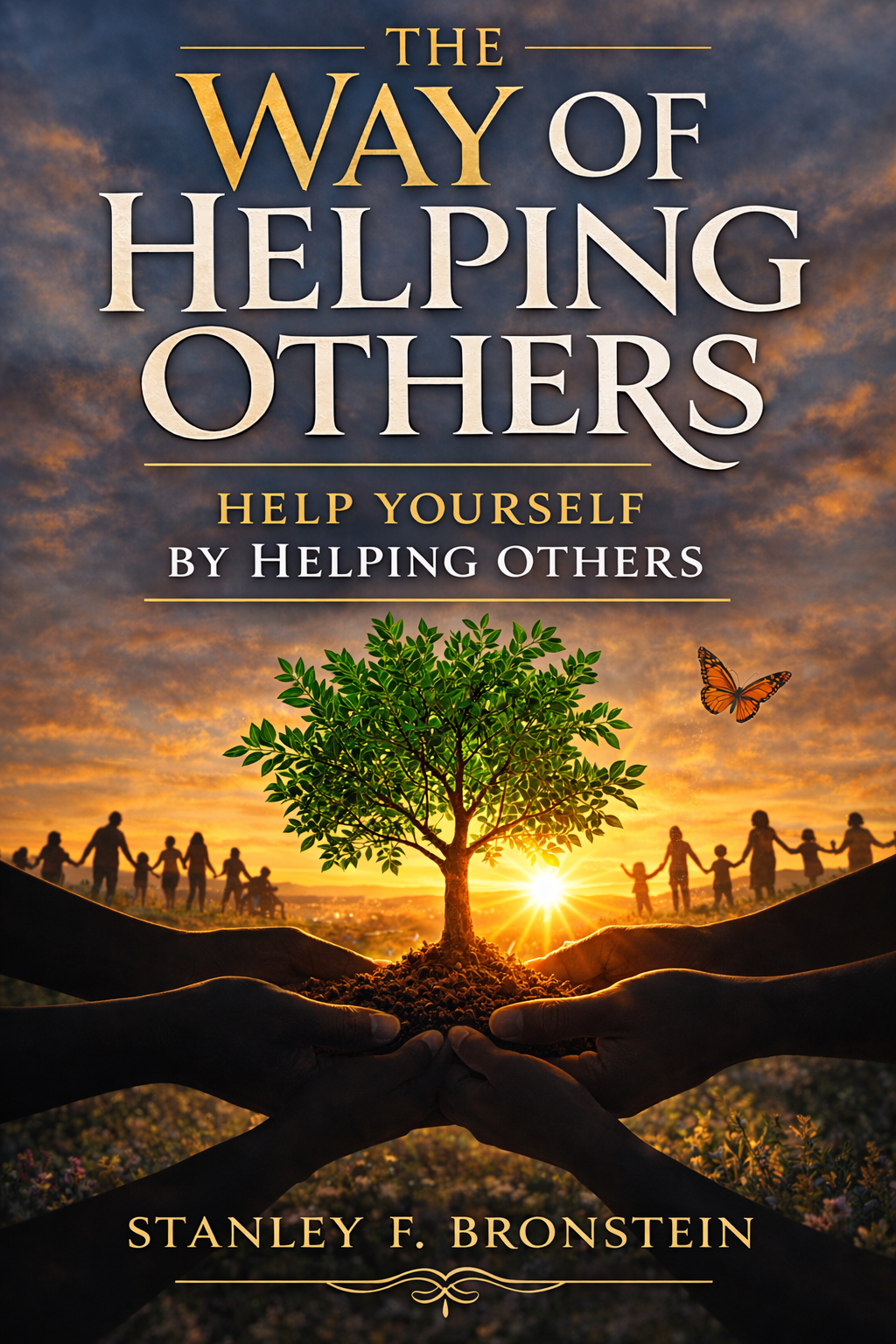
The Way of Helping Others
Help Yourself By Helping Others
By Stanley F. Bronstein – Creator of The Way of Excellence System
Click The Tabs Below To Read Each Chapter Of The Book Online
Or
📘 Download Your Free Copy In Your Preferred Format
The Way of Helping Others
by Stanley F. Bronstein
How to use this page:
Click a chapter title to open it then scroll down to read.
When you click the title of the next chapter, the previous one will close.
Take your time.
Read, reflect, and do the experiments and assignments before you move on.
EMPTY ITEM
Foreword
There are many ways to measure a life.
Some people measure life by money. Some measure it by status. Some measure it by comfort, possessions, power, recognition, or achievement. Some measure it by what they were able to accumulate, control, or impress others with before their time was up.
But there is another way to measure a life – a deeper way.
A life can also be measured by how much good it did.
A life can be measured by how many people were strengthened because that person lived. It can be measured by how many people were encouraged, comforted, taught, lifted, healed, supported, guided, respected, or inspired. It can be measured by how much pain was reduced, how much hope was restored, and how much better the world became because one person chose not merely to live for himself or herself, but to help others.
That is what this book is about.
The Way of Helping Others is built on a simple but powerful truth: when we help others, we also help ourselves.
That does not mean helping others in a manipulative way. It does not mean pretending to care so that we can get something in return. It does not mean turning generosity into a transaction or service into a hidden strategy for personal gain. It means something deeper and more honest than that.
It means that human life is connected.
When we help another person, we strengthen part of the world we ourselves must live in. When we lift another person, we help create a stronger family, a stronger workplace, a stronger community, and a stronger society. When we reduce another person’s suffering, confusion, loneliness, discouragement, or struggle, we are not only helping that one person. We are improving the larger whole of which we are also a part.
In that sense, helping others is never merely about them. It is also about us. It is about the kind of world we are helping to create through the way we live.
There is also something else that happens when we help others in the right way.
We become more fully human.
Helping others calls forth qualities that too often remain underdeveloped – compassion, patience, humility, generosity, attentiveness, discipline, courage, wisdom, and love. It asks us to look beyond ourselves. It asks us to notice what others are carrying. It asks us to care enough to act. It asks us to become people who do not merely talk about kindness, but practice it. People who do not merely admire goodness, but embody it. People who do not merely hope the world gets better, but help make it better.
Helping others changes the one being helped, but it also changes the helper.
It enlarges the heart. It sharpens the conscience. It strengthens character. It deepens meaning. It gives life weight, substance, and purpose.
Many people spend years searching for meaning as though it were hidden in some distant place. They search in achievement, pleasure, praise, control, or accumulation. Yet one of the clearest paths to meaning has been available all along: become useful. Become someone who makes life better for others. Become someone whose presence lightens burdens instead of adding to them. Become someone whose words strengthen, whose actions matter, and whose life contributes.
There is deep meaning in being that kind of person.
There is also great wisdom in it.
Helping others is not merely noble. It is practical. It improves relationships. It builds trust. It creates goodwill. It strengthens communities. It develops maturity. It gives direction to energy that might otherwise be wasted on selfishness, pettiness, vanity, or endless dissatisfaction. It draws us out of the prison of excessive self-focus and places us back into living connection with the rest of humanity.
That is one reason the subtitle of this book is Help Yourself by Helping Others.
The idea is not that helping others should be selfish. The idea is that true helping is one of the most intelligent and life-giving things a person can do. It is good for others, and it is also good for us. It strengthens the one who gives and the one who receives. It lifts both sides. It creates a ripple effect that often travels far beyond what we can see.
One act of help can restore someone’s courage.
One conversation can change someone’s direction.
One expression of belief can keep someone from giving up.
One moment of patience can preserve dignity.
One lesson shared can alter the course of a life.
One example can show another person what is possible.
One decision to care can begin a chain reaction whose final reach no one can measure.
Small acts matter.
Ordinary acts matter.
Quiet acts matter.
Many of the most important forms of help are not dramatic. They do not make headlines. They do not call attention to themselves. They happen in homes, friendships, workplaces, neighborhoods, conversations, and private moments.
They happen when someone listens instead of dismissing.
When someone encourages instead of criticizing.
When someone teaches instead of withholding.
When someone notices instead of ignoring.
When someone gives instead of clinging.
When someone serves instead of demanding.
When someone acts with respect, compassion, and steadiness in a world that often defaults to indifference.
This book is not about grand gestures reserved for a heroic few.
It is about a way of life available to all of us.
It is about becoming the kind of person who helps others consistently, wisely, and well.
That last point matters.
Not all helping is healthy helping.
Some people help in ways that create dependence. Some help in ways that enable weakness. Some help in ways that are driven by ego, guilt, control, or the need to feel superior. Some help so carelessly that they do more harm than good. Some help until they are exhausted, resentful, depleted, and no longer able to sustain the very contribution they hoped to make.
So this book is not merely about helping others.
It is about helping others well.
It is about helping with wisdom, not just impulse. With compassion, not condescension. With humility, not self-importance. With strength, not burnout. With healthy boundaries, not self-erasure. With discernment, not naïveté. With long-term effectiveness in mind, not merely short-term emotional relief.
To help others well, we must become certain kinds of people.
We must learn to see.
We must learn to listen.
We must learn to respect.
We must learn to encourage.
We must learn to give wisely.
We must learn to teach and guide.
We must learn to act with humility, compassion, wisdom, and boundaries.
We must learn to help through our example, our relationships, our work, and our contribution to the communities of which we are a part.
In other words, helping others is not just something we do. It is something we become.
And as we become those kinds of people, we should see these things not as burdens placed upon us, but as privileges entrusted to us.
It is our privilege to see.
It is our privilege to listen.
It is our privilege to respect.
It is our privilege to encourage.
It is our privilege to give wisely.
It is our privilege to teach and guide.
It is our privilege to act with humility, compassion, wisdom, and boundaries.
It is our privilege to help through our example, our relationships, our work, and our contribution to the communities of which we are a part.
That is a powerful change in perspective.
The moment helping others becomes merely an obligation, it can begin to feel heavy, dutiful, and lifeless. But when we understand that helping others is a privilege, everything changes. We are no longer simply checking a moral box. We are being given the opportunity to contribute, to care, to lift, to strengthen, and to become more fully human in the process.
It is a privilege to be in a position to help.
It is a privilege to have something to give.
It is a privilege to be able to lighten another person’s burden.
It is a privilege to be able to remind someone of their worth.
It is a privilege to be able to make life better for another human being.
When we see helping others through that lens, service becomes lighter, cleaner, and more joyful. It becomes something we get to do, not merely something we have to do. And that change in perspective can transform not only the way we help, but the spirit in which we help.
It can also transform the way we see the world itself.
When our perspective changes, our experience changes. What once looked like inconvenience can begin to look like opportunity. What once looked like interruption can begin to look like invitation. What once looked like duty can begin to look like privilege. And when enough people begin to see life that way, they begin to create a different kind of world – a world in which people are encouraged to help each other and to care for each other, not because they are forced to, but because they recognize the privilege of doing so.
That is the kind of world worth building.
That is the kind of person worth becoming.
That is the journey this book invites you to take.
It begins by exploring why helping others matters so much in the first place. It then turns to the ways helping shows up in daily life – in listening, encouraging, respecting, giving, teaching, and guiding. From there, it goes deeper into the inner qualities needed to help well. Finally, it expands outward again into a larger vision of building an entire life around helping others – in relationships, in community, through work, and as a lasting legacy.
The goal is not merely to inspire you for a few moments.
The goal is to help you think differently, live differently, and become different.
The goal is to help you become more intentional about the effect you have on the people around you.
The goal is to help you become the kind of person whose life leaves others better.
A person does not need to be rich, famous, powerful, or perfect to do that.
A person only needs to care, to notice, to grow, and to act.
A person only needs to decide that life is not just about taking up space, pursuing comfort, and protecting self-interest. A person can decide that life is also about contribution. About service. About usefulness. About lifting others. About becoming a force for good in the lives of other people.
That kind of life is available.
It is available to the young and the old. To the wealthy and the poor. To the educated and the uneducated. To the strong and the struggling. To anyone willing to stop asking only, “What can I get from life?” and begin asking, “How can I help?”
That question can change a life.
It can change the life of the one asking it.
And it can change the lives of the people touched by the answer.
My hope is that this book will help you ask that question more often, answer it more wisely, and live it more fully.
My hope is that it will help you see that helping others is not a burden added onto life, but one of the clearest ways to make life meaningful.
My hope is that it will help you understand that by helping others, you are not losing yourself. You are finding a better self. Strengthening a wiser self. Becoming a more useful self. Building a more meaningful self.
You are helping yourself by helping others.
And when enough people begin to live that way, families become stronger. Communities become healthier. Work becomes more meaningful. Society becomes more humane. The world becomes more livable.
We do not rise alone.
We rise together.
May this book help you live that truth with greater clarity, greater courage, and greater consistency.
May it help you become a person who helps others well.
And may the lives you touch be better because you were there.
INTRODUCTION TO PART I - WHY HELPING OTHERS MATTERS
Before we can become better at helping others, we need to understand why helping others matters so much in the first place.
That may sound obvious. Most people would say helping others is a good thing. Most people would say kindness matters. Most people would say we should care about one another. But saying these things in a general way is not the same as deeply understanding them. It is not the same as seeing how central helping others really is to a meaningful life, to a healthy society, and to being a well-formed human being.
Helping others is not just a pleasant extra.
It is not something to think about only after everything else in life has been handled. It is not merely a side topic for especially generous people. It is not just for volunteers, caregivers, teachers, ministers, leaders, or people in helping professions. Helping others is part of what makes life human. It is part of what gives life depth. It is part of what gives life direction. It is part of what gives life meaning.
A life built only around self-interest eventually becomes too small for the human spirit.
A person can chase comfort, pleasure, recognition, possessions, achievement, and control for a very long time, and still feel that something important is missing. A person can accumulate much and yet contribute little. A person can stay busy and still remain empty. Why? Because we are not built merely to consume life. We are also built to contribute to it. We are not here only to get. We are also here to give. We are not here only to protect ourselves. We are also here to strengthen, to encourage, and to lift one another.
That is one reason helping others matters.
It draws us out of ourselves.
It reminds us that we are not alone, and that life is not just about our own preferences, problems, schedules, desires, and ambitions. It teaches us to see beyond the boundaries of self. It teaches us to notice what others are carrying. It teaches us to care enough to act. In doing so, it enlarges us. It stretches the heart. It deepens perspective. It strengthens character. It gives meaning to effort and purpose to action.
Helping others matters because people matter.
That should not be a radical statement, but in practice it often is. In a world that can be distracted, hurried, transactional, and self-absorbed, people are often overlooked. They are rushed past. Spoken over. Used. Dismissed. Reduced to their productivity, to their usefulness, to their appearance, to their status, or to their problems. One of the most powerful things we can do is refuse to participate in that diminishment. We can choose to treat people as people. We can choose to see them, to hear them, to respect them, and to respond to them with care.
That is not weakness.
That is strength.
It takes strength to pay attention.
It takes strength to be patient.
It takes strength to listen.
It takes strength to care in a world that often rewards indifference.
It takes strength to keep showing up for others when selfishness would be easier.
Helping others matters because it pushes us to become stronger in the best ways.
It develops compassion.
It develops humility.
It develops wisdom.
It develops patience.
It develops self-control.
It develops the ability to think beyond immediate convenience.
It develops the willingness to act for the good of someone besides ourselves.
In other words, helping others does not just improve the lives of those we help. It also improves us.
That truth is at the heart of this book.
When we help others in healthy, wise, and sustainable ways, we do not lose ourselves. We strengthen ourselves. We deepen ourselves. We become more useful, more mature, more grounded, and more connected. We become the kind of people whose lives carry weight. The kind of people whose presence makes things better. The kind of people who do not merely move through the world taking from it, but who add something worthwhile to it.
Helping others also matters because human life is connected.
No one lives in complete isolation from everyone else. We affect one another constantly. We affect one another through words, attitudes, decisions, habits, presence, absence, generosity, selfishness, care, and neglect. What we do ripples outward. What we refuse to do ripples outward too. A person who is encouraged becomes more able to encourage others. A person who is respected becomes more likely to respect others. A person who is strengthened becomes more capable of strengthening others. In that way, helping one person is often about far more than one person.
Good spreads.
So does indifference.
So does selfishness.
So does care.
So does courage.
So does hope.
Part of the purpose of this section is to help you see that helping others is not peripheral to a good life. It is central to it. It is not merely something admirable. It is something deeply practical. It improves relationships. It strengthens families. It builds trust. It heals discouragement. It creates possibility. It changes emotional climates. It lifts standards. It improves communities. It contributes to the kind of world in which all of us must live.
This first part of the book will explore that foundation.
It will look at the meaning found in helping others.
It will explore the truth that we help ourselves by helping others.
It will examine the idea that we rise together.
It will show why small acts matter.
And it will begin with the essential discipline of learning to see.
Because before we can help well, we must first understand why helping is worth doing.
And before we can lift others consistently, we must first recognize that helping others is not merely an obligation laid upon us. It is also a privilege available to us. It is a privilege to be able to notice. It is a privilege to be able to care. It is a privilege to be able to strengthen another human being. It is a privilege to be in a position to make life better for someone else.
When we begin to see helping others that way, everything starts to change.
Helping no longer feels like an interruption of life.
It starts to become part of the meaning of life.
That is where this book begins.
Chapter 1: The Meaning of Helping Others
Why This Matters
Human beings want their lives to matter.
They want their lives to mean something. They want to believe their time here counted for something worthwhile. They want to know that they did more than merely exist, consume, struggle, accumulate, and disappear. They want to know that who they were, what they did, and how they lived made some real difference.
That desire is not a weakness.
It is not foolish.
It is not sentimental.
It is one of the deepest and most natural desires of the human spirit.
People often search for meaning in many different places. They search for it in achievement. They search for it in comfort. They search for it in money, recognition, possessions, pleasure, power, security, knowledge, or accomplishment. None of those things are necessarily bad. Some of them can be useful. Some can even be noble in the right context. But none of them, by themselves, are enough to satisfy the deeper hunger to live a meaningful life.
Why?
Because meaning is not found only in what we get.
Meaning is found in what we give.
Meaning is found in contribution.
Meaning is found in usefulness.
Meaning is found in helping others.
That is one of the great truths of life. The more we become a source of strength, encouragement, guidance, relief, healing, support, or hope for other people, the more our own lives begin to feel anchored in something real. We begin to sense that we are not merely taking up space. We begin to sense that we are part of something larger than ourselves. We begin to sense that our lives have weight, direction, and purpose.
That is not accidental.
We are built for more than consumption.
We are built for contribution.
We are built for more than self-protection.
We are built for connection.
We are built for more than private survival.
We are built for shared uplift.
Helping others brings us into contact with that deeper part of what it means to be human.
The Difference Between Existing and Contributing
A person can be very busy and still feel empty.
A person can be highly productive and still feel unfulfilled.
A person can achieve a great deal and still wonder, “Is this all there is?”
That question often arises when life has become too narrow.
A life focused only on personal advancement eventually begins to close in on itself. A life centered only on comfort eventually loses vitality. A life organized only around accumulation eventually feels hollow. There is nothing inherently wrong with wanting to succeed, to build, to achieve, to provide, or to enjoy life. But when those things become the whole story, something important is missing.
Contribution fills that space.
Helping others fills that space.
When you help another person, you step outside the small orbit of self-concern. You stop asking only, “What do I want?” or “What do I need?” or “What do I get?” and begin asking, “What would actually help here?” That question changes the quality of your life. It changes your attention. It changes your priorities. It changes the emotional texture of your days.
A meaningful life is not merely a life in which things happened to you.
It is a life in which something good happened through you.
That is a major difference.
A person who only exists passes through life.
A person who contributes participates in life.
A person who only consumes receives from the world.
A person who helps others adds something to the world.
That is where meaning deepens.
Why Helping Others Creates Meaning
Helping others creates meaning because it connects us to something beyond our own appetites.
When all of life is reduced to our own comfort, our own frustration, our own ambition, our own irritation, our own schedule, and our own private concerns, life becomes cramped. The walls begin to close in. Even small inconveniences can feel enormous when the self is the center of everything.
Helping others breaks that pattern.
It opens the windows.
It lets in air and light.
It reminds us that there are other lives, other burdens, other struggles, other hopes, and other needs all around us. It reminds us that we have the ability to influence those lives for the better. That realization is deeply meaningful because it shows us that we are not powerless spectators in life. We are participants. We are contributors. We are capable of doing good.
Meaning grows when a person realizes, “My life can be used.”
My words can help.
My presence can help.
My effort can help.
My knowledge can help.
My patience can help.
My encouragement can help.
My example can help.
My work can help.
My resources can help.
My willingness to care can help.
There is profound meaning in becoming useful in those ways.
The world does not only need impressive people.
It needs helpful people.
It needs people who notice.
It needs people who care.
It needs people who act.
It needs people who make life better where they are.
A meaningful life is often built in exactly that way.
Meaning Does Not Require Fame
One of the most damaging mistakes people make is assuming that a meaningful life must be a large life in the public sense.
They assume meaning must be dramatic.
They assume meaning must be visible.
They assume meaning must be recognized.
They assume meaning must be praised.
They assume meaning must reach huge numbers of people.
That is not true.
A person can help one child, one spouse, one friend, one client, one student, one employee, one parent, one neighbor, or one struggling stranger, and have lived a deeply meaningful life. A person can quietly strengthen a family, quietly improve a workplace, quietly encourage a discouraged soul, quietly pass along wisdom, quietly serve, quietly support, quietly give, and quietly lift. None of that may become publicly celebrated. It may never be noticed by large numbers of people. But it matters.
It matters greatly.
Meaning is not measured only by scale.
It is measured by substance.
It is measured by whether what we did was real.
It is measured by whether people were better because we were here.
That means a small life, in the eyes of the world, may actually be a very large life in truth.
And a large life, in the eyes of the world, may actually be quite small if it did little good for anyone else.
Helping others protects us from that distortion. It keeps us focused on what matters rather than on what merely looks impressive.
Usefulness and the Human Spirit
There is something powerful about feeling useful.
Not used.
Useful.
To feel used is degrading.
To feel useful is energizing.
When a person knows that what he does matters, that what she gives matters, that the effort being made is helping someone, strengthening someone, solving something, improving something, or lifting something, that person often feels more alive. There is more energy. There is more willingness. There is more resilience. There is more reason to keep going.
Why?
Because usefulness connects effort to meaning.
It connects action to value.
It connects daily life to something worthwhile.
People can endure a great deal when they believe there is a reason for their effort. They can bear difficulty better when they sense that their lives are serving some real purpose. They can work harder, care longer, persist further, and suffer more meaningfully when they know their lives are not only about themselves.
Helping others creates exactly that kind of usefulness.
It does not have to be perfect usefulness.
It does not have to be constant usefulness.
It does not have to be grand usefulness.
But it does need to be real.
Real help gives real meaning.
Helping Others Changes the Helper
Another reason helping others creates meaning is that it changes the one who helps.
A selfish life tends to shrink a person.
A helpful life tends to enlarge a person.
When you regularly help others in healthy ways, you develop parts of yourself that might otherwise remain weak. You develop patience because helping often requires patience. You develop attentiveness because helping requires noticing. You develop humility because helping well is not about your ego. You develop wisdom because not every kind of help is wise. You develop compassion because helping calls you to care about another person’s reality. You develop steadiness because helping often requires consistency, not just enthusiasm.
In that sense, helping others does not merely make life more meaningful in the abstract.
It helps make you into a more meaningful person.
It forms character.
It deepens humanity.
It strengthens the inner life.
A person who lives only for himself may accumulate much and yet remain shallow.
A person who lives in ways that genuinely help others may never be flashy, yet become deep, strong, wise, and substantial.
That is not a small thing.
That is a beautiful thing.
Helping Others Is a Privilege
There is another layer to meaning that is easy to miss.
Helping others is not only important.
It is a privilege.
That is a profound perspective shift.
Many people think of helping others as an obligation. They think of it as a duty, a burden, a demand, or an interruption. Sometimes it may feel that way, especially when life is busy, when energy is low, or when the needs around us feel endless. But there is a better way to see it.
It is a privilege to be able to help.
It is a privilege to have something to give.
It is a privilege to have the capacity to strengthen another human being.
It is a privilege to be in a position to lighten a burden, to clarify confusion, to offer encouragement, to share wisdom, to give relief, or to create hope.
That does not make helping easy.
But it does make helping meaningful.
When a person sees helping as a privilege rather than merely as an obligation, the entire spirit of the act changes. It becomes lighter. It becomes cleaner. It becomes more grateful. It becomes more alive. Instead of thinking, “I have to do this,” the person begins to think, “I get to do this.”
That shift matters.
It changes not only behavior, but also heart.
And meaning lives not only in what we do, but in the spirit in which we do it.
A Life That Leaves Something Good Behind
One of the clearest ways to think about meaning is to ask a simple question:
What is left behind because you lived?
Not what did you own.
Not what title did you hold.
Not how important did you appear.
Not how much attention did you receive.
What is left behind because you lived?
Were people stronger?
Were people wiser?
Were people more hopeful?
Were people better treated?
Were people more encouraged?
Were problems more solved?
Were burdens more shared?
Were good things built?
Was pain reduced?
Was confusion clarified?
Was dignity preserved?
Was love expressed in action?
Those are meaning questions.
Those are contribution questions.
Those are helping questions.
A meaningful life is a life that leaves something good behind in other people and in the world around them. That “something good” may be a lesson, a kindness, a standard, a habit, a memory, a work product, a relationship, a healed wound, a restored sense of hope, or a life that became better because someone cared enough to help.
That is real meaning.
It does not vanish because it was quiet.
It does not become small because it was unseen.
It does not become unimportant because it was ordinary.
Helping others fills ordinary life with extraordinary meaning.
The Beginning of a Better Life
If helping others gives life meaning, then helping others is not merely a moral option.
It is also one of the surest ways to build a better life.
A better life is not always a more comfortable life.
A better life is not always an easier life.
A better life is not always a more luxurious life.
A better life is a life with more substance.
More purpose.
More connection.
More usefulness.
More contribution.
More depth.
More reality.
Helping others moves us in that direction.
It does so because it aligns us with something true. It aligns us with the truth that life is not just about taking. It is also about giving. It is not just about self-protection. It is also about service. It is not just about private gain. It is also about shared good.
When a person begins to live that way, meaning often stops being something pursued directly and starts becoming the natural result of how that person lives.
That is one of the great secrets of a meaningful life.
Meaning often comes as a byproduct of usefulness.
Meaning often comes as a byproduct of contribution.
Meaning often comes as a byproduct of helping others.
What This Chapter Asks of You
This chapter does not ask you to solve the whole world.
It does not ask you to become instantly heroic.
It does not ask you to carry every burden or answer every need.
It asks something both smaller and greater.
It asks you to rethink where meaning comes from.
It asks you to consider the possibility that one of the deepest meanings of your life will be found not only in what you achieve for yourself, but in how you help others. It asks you to consider the possibility that becoming useful may be more fulfilling than becoming impressive. It asks you to consider the possibility that contribution may satisfy parts of the soul that consumption never can.
That is not a minor shift.
That is a life shift.
If you understand that, truly understand it, then the rest of this book will land differently. You will not see helping others as an optional side interest. You will begin to see it as one of the central paths to a life that matters.
And once you see that clearly, you will never look at helping others in quite the same way again.
Assignment: Meaning Through Contribution
Purpose
This assignment is designed to help you connect the idea of meaning with the practice of helping others. The goal is to begin shifting your view of a meaningful life from one based mainly on personal gain to one that includes contribution, usefulness, and real help.
Step 1 – Reflect on Meaning
Write a short response to this question: What has made your life feel most meaningful so far? Be honest. Do not write what sounds good. Write what feels true.
Step 2 – Identify the Pattern
Look at what you wrote. Ask yourself: How much of that meaning came from what I got, and how much came from what I gave? Notice any pattern that appears.
Step 3 – Recall a Moment of Real Help
Think of one time when you genuinely helped another person in a way that mattered. Write down what happened, how it helped them, and how it affected you. Pay attention to how that experience made you feel about yourself and your life.
Step 4 – Identify Your Current Opportunity
Ask yourself: Who in my present life might benefit from my help right now? This does not have to be dramatic. It may be someone who needs listening, encouragement, guidance, patience, practical help, clarity, respect, or support.
Step 5 – Take One Useful Action
Choose one real action you can take within the next twenty-four hours to help someone in a concrete way. Keep it practical. Keep it sincere. Then do it.
Reflection Question
When you think about the most meaningful parts of your life, how often do they connect to helping, strengthening, or lifting someone else?
Chapter 2: Help Yourself by Helping Others
Why This Matters
At first glance, the subtitle of this book may sound selfish.
Help Yourself by Helping Others.
Some people may hear that and think it reduces helping to a strategy. They may think it turns kindness into self-interest, service into calculation, or generosity into a transaction. They may wonder whether helping others is still noble if the helper also benefits.
That is an important concern.
But it rests on a misunderstanding.
The point is not that we should help others only because it benefits us.
The point is that genuine helping often benefits us too.
That is not corruption.
That is reality.
Human life is connected. We do not live, act, grow, suffer, or flourish in isolation. We affect one another constantly. We help shape the emotional, relational, and practical worlds in which we ourselves must live. Because of that, when we help others in healthy, sincere, and wise ways, we are not only doing something good for them. We are also improving the larger world of which we are a part. We are also shaping ourselves into stronger, deeper, more useful people.
In that sense, helping others is not merely an act of kindness.
It is also an act of intelligence.
It is not merely moral.
It is practical.
It is not merely generous.
It is life-giving.
And it is not merely good for others.
It is often good for us.
That is the truth this chapter explores.
We Live in a Shared Human World
Every person lives inside systems of relationship.
We live in families.
We live in friendships.
We live in neighborhoods.
We live in workplaces.
We live in communities.
We live in a society shaped every day by what people choose to do for one another and to one another.
That means the condition of other people affects the condition of our own lives. If the people around us are strengthened, encouraged, respected, and supported, we live in a healthier world. If the people around us are ignored, embittered, depleted, dishonored, and hopeless, we live in a more damaged world.
The world we help create becomes the world we live in.
That is one reason helping others helps us.
When you strengthen another person, you are strengthening part of the human environment around you. When you help someone become more capable, more hopeful, more stable, more grounded, or more clear, you are adding strength to the system you yourself inhabit. When you create trust, you increase the amount of trust in the world around you. When you model care, you increase the amount of care in circulation. When you reduce another person’s burden, you reduce some of the strain that might otherwise spill outward into others.
This is not abstract.
It is daily life.
A parent who helps a child becomes a stronger parent and helps shape a stronger family.
A spouse who helps a partner creates a healthier relationship and also lives inside that healthier relationship.
A leader who helps a team create clarity, trust, and strength does not only help the team. That leader also works in a better environment.
A neighbor who helps build a stronger neighborhood also benefits from living in a stronger neighborhood.
A citizen who helps create a more humane society also benefits from living in a more humane society.
This is one reason we rise together.
Helping others is not always a sacrifice of self for the good of someone else. Very often, it is an investment in the kind of life and world we ourselves will also inhabit.
Helping Others Strengthens the Helper
There is another side to this truth.
Helping others does not only improve the world around us.
It often improves us directly.
When you help others in healthy ways, you often become stronger inside.
You become less trapped in your own problems.
You become less consumed by your own frustrations.
You become less dominated by your own moods.
You become less isolated in your own private concerns.
Helping draws you outward.
It interrupts unhealthy self-absorption.
It reminds you that your life can be useful.
That matters.
A person who believes his life can help someone has a reason to keep going.
A person who knows her presence can strengthen someone has a reason to rise above pettiness.
A person who sees that his words can encourage, that her wisdom can guide, or that their effort can make a difference begins to feel more connected to life, more anchored in reality, and more aware of purpose.
That is not fantasy.
That is a real human response.
Usefulness strengthens the spirit.
Contribution strengthens identity.
Service strengthens character.
Helping others often lifts the helper because it reminds the helper that his life is not meaningless, that her effort is not wasted, and that their existence is not merely about private survival.
It is hard to live with depth while living only for self.
Helping others helps pull us toward depth.
You Become More Useful to Yourself by Becoming More Useful to Others
This may sound strange at first, but it is true:
One of the best ways to become more useful to yourself is to become more useful to others.
Why?
Because the qualities that make a person helpful to others are also qualities that improve that person’s own life.
A person who learns to listen well will usually have better relationships.
A person who learns patience will suffer less from impulsiveness.
A person who learns compassion often becomes less harsh toward self and others.
A person who learns wisdom in helping others often becomes wiser in handling personal life as well.
A person who learns boundaries becomes more sustainable, more honest, and more grounded.
A person who learns to encourage others often becomes more hopeful internally too.
The very traits that make you a blessing to others often make you a stronger, healthier, wiser human being.
That is one of the hidden gifts of helping.
You set out to assist someone else, and in the process, you build qualities that improve your own life.
You help another person, and in doing so, you train your own heart.
You lift another person, and in doing so, you strengthen your own character.
You give to another person, and in doing so, you often become richer in the qualities that matter most.
That is not manipulation.
That is growth.
Helping Others Can Heal the Helper
There are times in life when a person becomes discouraged, wounded, confused, stagnant, or overly inward.
In those seasons, helping others can be deeply healing.
That does not mean service cures everything.
It does not mean people should avoid their own pain by losing themselves in endless activity for others.
It does not mean helping is a substitute for reflection, healing, rest, truth, or healthy self-care.
But it does mean this:
Helping others can help restore perspective.
It can loosen the grip of despair.
It can interrupt the spiral of self-preoccupation.
It can remind a person that life still contains purpose.
It can reawaken the sense that one still has something valuable to offer.
Sometimes when people are hurting, one of the worst things that happens is that they begin to believe they have become useless. They begin to think they are only a problem, only a burden, only a collection of struggles. Helping another person can challenge that lie. It can remind them, “I still have something to give. I still have value. I still matter. I can still do good.”
That realization can be powerful.
It can reintroduce dignity.
It can reintroduce agency.
It can reintroduce hope.
Many people have discovered that some of their own healing began when they stopped asking only, “How do I escape my pain?” and began also asking, “Who can I encourage? Who can I support? Who can I help in some honest, healthy, meaningful way?”
That question does not erase pain.
But it can transform pain into part of a larger life.
And that is often healing.
Helping Others Builds Self-Respect
There is a kind of confidence that comes from appearance, success, praise, achievement, or social approval.
But there is another kind of confidence that goes deeper.
It is self-respect.
Self-respect is built when a person knows, deep down, “I am trying to live in a worthwhile way. I am trying to do some good. I am trying to be useful. I am trying to leave people better rather than worse.”
Helping others helps build that kind of self-respect.
Why?
Because it gives you evidence about your own character.
It gives you evidence that you are not merely reactive, selfish, careless, or passive.
It gives you evidence that you can rise above impulse.
It gives you evidence that you can care.
It gives you evidence that your life can carry moral substance.
That matters.
A person who keeps acting only for private advantage often loses something inwardly, even if outward success increases. But a person who keeps doing sincere good for others often gains something inwardly, even when nobody is watching.
He gains solidity.
She gains moral weight.
They gain the kind of self-respect that comes from knowing their life is not empty.
Helping others does not guarantee self-respect.
But helping others in honest, wise, consistent ways very often helps create it.
Helping Others Improves Relationships
A person cannot build strong relationships while always asking, “What about me?”
Relationships improve when people care for one another.
Relationships improve when people serve one another.
Relationships improve when people notice one another’s burdens and respond in useful ways.
Relationships improve when people listen, encourage, respect, teach, support, and give.
That means helping others often improves the quality of the helper’s own relationships.
A selfish husband damages his own marriage.
A selfish wife damages her own marriage.
A selfish friend damages friendship.
A selfish co-worker damages the work environment.
A selfish leader weakens the team.
A selfish citizen weakens the social fabric.
By contrast, a helpful person creates relational strength and then benefits from living inside the relational strength that has been created.
When you help the people around you, trust tends to grow.
Warmth tends to grow.
Goodwill tends to grow.
Reliability tends to grow.
Closeness tends to grow.
That does not mean every relationship will become healthy just because one person tries to help. Some people reject help. Some people misuse help. Some people remain selfish no matter what others do.
But as a general principle, people who genuinely help others tend to create stronger relationships than people who do not.
And stronger relationships help the helper too.
This Is Not About Secretly Using People
At this point, a warning is necessary.
The truth that helping others helps us can be misunderstood.
It can be twisted into a tactic.
It can become a selfish strategy disguised as generosity.
That is not what this chapter is teaching.
Helping others in order to manipulate, control, impress, obligate, or extract is not the kind of helping this book is about. That is not service. That is disguised self-interest. That is not sincere care. That is calculated positioning.
True helping begins with genuine concern for the other person.
True helping asks, “What would actually benefit this person?”
True helping is willing to give without always keeping score.
True helping is willing to serve without demanding applause.
The fact that sincere helping often benefits the helper does not make the helping selfish.
It simply means life is designed in such a way that what is genuinely good for others is often good for us too.
That is not something to be embarrassed about.
That is something to understand and honor.
Helping Others Makes Life Richer
A life spent only on private advancement can become efficient, productive, and even successful, yet still feel poor in deeper ways.
A life that includes helping others often becomes richer.
Not always richer financially.
Not always easier.
Not always more comfortable.
But richer in meaning.
Richer in relationship.
Richer in gratitude.
Richer in perspective.
Richer in self-respect.
Richer in usefulness.
Richer in depth.
Richer in humanity.
A person who helps others often begins to experience life less as a private competition and more as a shared human journey. That change alone can make life feel more spacious, more alive, and more worthwhile. Instead of moving through the world as a taker, that person begins to move through the world as a contributor. Instead of measuring success only by what has been acquired, that person begins to notice what has been improved, strengthened, relieved, or lifted.
That is a richer way to live.
Helping Others Is a Privilege That Helps Everyone
There is one more angle worth emphasizing.
Helping others is a privilege.
It is a privilege to see someone’s need and be in a position to respond.
It is a privilege to have words that can encourage.
It is a privilege to have knowledge that can guide.
It is a privilege to have patience that can steady.
It is a privilege to have strength that can serve.
It is a privilege to have resources that can be shared.
And it is a privilege not only because it helps the other person.
It is also a privilege because it helps us live in a more meaningful, more connected, more useful, and more human way.
Helping others is one of the ways we participate in the creation of a better world and a better self at the same time.
That is why the subtitle of this book is not a slogan.
It is a truth.
Help yourself by helping others.
Not because helping should be reduced to self-interest.
But because sincere help has a way of blessing both sides.
A Better Way to Think About the Good Life
Many people think the good life is found by arranging life so that they can avoid inconvenience, minimize sacrifice, maximize comfort, and keep as much energy as possible for themselves.
But that is often a small vision of the good life.
A better vision is this:
The good life is a life in which you are growing, contributing, strengthening, helping, and becoming someone whose existence improves the lives of others.
That kind of life helps the world.
And it helps the one living it.
It creates meaning.
It creates connection.
It creates trust.
It creates growth.
It creates self-respect.
It creates richness of soul.
It creates a life that feels real.
That is one of the deepest truths in all of human living:
When we help others well, we help ourselves too.
What This Chapter Asks of You
This chapter does not ask you to turn helping into a personal productivity system.
It does not ask you to help others so that you can brag about your virtue.
It does not ask you to perform kindness as a way of managing your image.
It asks something more honest.
It asks you to recognize that the line between your good and the good of others is often thinner than you thought.
It asks you to see that helping others strengthens the world you live in, strengthens the relationships you live in, and often strengthens the person you are becoming.
It asks you to stop seeing helping as a one-way loss.
It asks you to begin seeing helping as one of the wisest and healthiest ways to live.
When you truly understand that, helping others no longer looks like a subtraction from your life.
It begins to look like one of the best investments you can make in it.
Assignment: The Mutual Benefit of Helping
Purpose
This assignment is designed to help you recognize how helping others often improves your own life at the same time. The goal is to help you see helping not as a one-way drain, but as a healthy and meaningful form of mutual benefit.
Step 1 – Recall a Time You Helped Someone
Think of one situation in which you helped another person in a real and useful way. It may have been through listening, encouraging, teaching, giving, supporting, guiding, or serving. Write down what you did and why it mattered.
Step 2 – Identify How It Helped You
Ask yourself: How did helping that person affect me? Did it strengthen my sense of meaning? Did it improve the relationship? Did it deepen my self-respect? Did it give me perspective? Did it remind me that my life can be useful? Write down every honest benefit you can see.
Step 3 – Examine Your Thinking
Write a short response to this question: Do I usually think of helping others as something that costs me, or as something that can also strengthen me? Be honest about your current mindset.
Step 4 – Identify One Person You Can Help This Week
Choose one person in your present life who could benefit from something you can genuinely offer. It may be your time, your listening, your encouragement, your guidance, your patience, your effort, or your practical help.
Step 5 – Take One Concrete Action
Do one helpful thing for that person within the next seven days. Keep it sincere, practical, and specific. Then notice not only how it affects that person, but also how it affects you.
Reflection Question
What changes in your life when you begin to see helping others not only as a gift to them, but also as a healthy and meaningful way to strengthen yourself?
Chapter 3: We Rise Together
Why This Matters
One of the most damaging illusions in human life is the illusion of separateness.
People often live as though their lives are entirely their own. They think in terms of private goals, private struggles, private gains, private losses, and private worlds. They imagine that what happens to others is mostly about others, and what happens to them is mostly about them. They may acknowledge, in theory, that people are connected, but they often do not live as though that connection is real.
But it is real.
Human life is deeply connected.
We do not rise alone.
We do not fall alone.
We do not heal alone.
We do not hurt alone.
We do not build alone.
We do not break down alone.
We affect one another constantly, whether we intend to or not.
That is one reason helping others matters so much.
When we help another person rise, we are not only doing something for that person. We are also strengthening the larger human fabric of which we ourselves are a part. We are adding strength to the family, the friendship, the workplace, the neighborhood, the community, and the society in which we also live.
That is why we rise together.
It is not just a beautiful thought.
It is a practical truth.
No One Lives Entirely Alone
Every person lives inside a network of influence.
We are shaped by what others do.
Others are shaped by what we do.
The words people speak affect those who hear them.
The attitudes people carry affect those around them.
The standards people live by affect the environments they inhabit.
The kindness people show affects the emotional climate of a home, a workplace, a friendship, or a neighborhood.
The selfishness people practice does the same.
A patient parent helps shape a different household than an impatient parent.
A respectful spouse helps shape a different marriage than a disrespectful spouse.
A generous friend helps shape a different friendship than a selfish friend.
A trustworthy co-worker helps shape a different workplace than an unreliable co-worker.
A thoughtful citizen helps shape a different community than an indifferent one.
Everything ripples.
Some ripples are small.
Some ripples are large.
But they ripple nonetheless.
That means one strengthened person is rarely just one strengthened person. A person who becomes more hopeful often spreads more hope. A person who becomes more stable often creates more stability. A person who becomes more respectful often creates a more respectful environment. A person who becomes more courageous often gives courage to others.
What improves in one life often flows outward.
That is part of what it means to rise together.
The Myth of Isolated Success
Modern culture often celebrates isolated success.
It highlights the individual winner, the self-made achiever, the person who rises above the crowd, the one who stands alone at the top. That image is powerful, but it is incomplete. No one truly rises alone.
Every person’s growth has been touched by other people.
Someone taught.
Someone encouraged.
Someone supported.
Someone opened a door.
Someone showed patience.
Someone modeled a possibility.
Someone believed.
Someone gave a chance.
Someone helped.
Even the strongest, smartest, most disciplined people have benefited from the effort, wisdom, labor, sacrifice, and care of others. Human life is built that way. People are formed in relationship. They are strengthened in relationship. They are given opportunities in relationship. They are wounded in relationship and healed in relationship.
That means isolated success is largely a myth.
People may work hard.
People may sacrifice greatly.
People may persist nobly.
But no one rises without influence, without context, without the help of others, or without the benefit of what others built, taught, maintained, protected, or passed down.
To understand that is to become more humble.
It is also to become more responsible.
Because if others helped create the conditions that allowed us to rise, then we also have the opportunity and the privilege to help create those conditions for others.
When One Person Rises, More Than One Person Benefits
A person who becomes healthier often affects a whole household.
A person who becomes calmer often affects the emotional tone of a whole room.
A person who becomes wiser often affects the decision-making of many others.
A person who becomes stronger often becomes able to carry more responsibility for others.
A person who becomes more disciplined often becomes more reliable to those who depend on him.
A person who becomes more hopeful often becomes a source of hope to those around her.
This is one reason personal growth matters.
Personal growth is never only personal.
It has social consequences.
It affects others.
The same is true of helping others grow.
When you help one person rise, you may be helping every person connected to that person. You may be helping that person’s children, partner, friends, clients, team members, neighbors, or future relationships. You may be helping people you will never meet and cannot foresee. You may be setting in motion effects that extend far beyond the original act.
That is why no act of sincere help is ever as small as it appears.
Its full reach is usually hidden.
Its full influence is often delayed.
Its full effect is often impossible to measure.
But that does not make it less real.
It makes it more profound.
Strength Is Shared
Some people think strength is personal possession.
They think of it as something private – my strength, my discipline, my wisdom, my resources, my stability, my success.
But real strength is meant to be shared.
Not all at once.
Not unwisely.
Not destructively.
But shared.
Strength that helps no one else is limited strength.
Wisdom that helps no one else is limited wisdom.
Resources that help no one else are limited resources.
Stability that helps no one else is limited stability.
The strongest people are often not merely those who can stand on their own. They are those who can help others stand too.
That is a richer form of strength.
It is one thing to climb.
It is another thing to reach back.
It is one thing to become steady.
It is another thing to steady others.
It is one thing to gain clarity.
It is another thing to help others see.
It is one thing to recover hope.
It is another thing to help another person hope again.
That is shared strength.
And shared strength builds a stronger world.
Helping Others Rise Is Not Losing
Some people resist helping because they see life as a competition for limited advantage. They think in terms of scarcity, comparison, and protection. If I help you, I lose something. If you rise, I may fall behind. If I give, I will have less. If I support you, I weaken myself.
Sometimes there are genuine tradeoffs in life. Time is limited. Energy is limited. Resources are limited. Wisdom requires discernment. Boundaries matter. This book is not arguing for careless self-erasure.
But it is arguing against the false idea that helping others rise is usually a form of losing.
Very often, the opposite is true.
When you help someone grow, you may be making your own environment healthier.
When you help someone become more capable, you may be reducing future problems for everyone involved.
When you help someone become stronger, wiser, calmer, clearer, or more responsible, you may be increasing the amount of strength, wisdom, calm, clarity, and responsibility in the system around you.
That benefits you too.
A stronger marriage benefits both spouses.
A stronger family benefits the whole family.
A stronger team benefits the whole team.
A stronger community benefits the whole community.
A stronger society benefits the people living within it.
This is not naive idealism.
It is applied reality.
We often do better when others around us do better too.
A Rising Tide Truly Does Lift More Than One Life
The old image of a rising tide lifting all boats remains powerful because it captures a real truth.
Conditions matter.
Environment matters.
Shared standards matter.
Collective health matters.
When the people around us are rising in healthy ways, we often rise more easily too. When honesty rises, trust rises. When care rises, connection rises. When discipline rises, reliability rises. When wisdom rises, better decisions rise. When mutual respect rises, conflict is handled better. When responsibility rises, shared burdens become more manageable.
The opposite is also true.
When selfishness rises, trust tends to fall.
When carelessness rises, damage tends to spread.
When bitterness rises, relationships weaken.
When irresponsibility rises, other people bear the cost.
What rises in a group changes the experience of everyone in that group.
That is why helping another person rise is not a random private act. It is part of shaping the tide.
And that tide affects many more boats than the helper may ever see.
We Rise Together, But Not Automatically
It is important to say this clearly.
We rise together, but not automatically.
Connection alone is not enough.
Shared humanity alone is not enough.
People can also fall together.
They can become bitter together.
They can become selfish together.
They can become careless together.
They can normalize mediocrity together.
They can spread fear, distrust, indifference, and disrespect together.
That is why intentionality matters.
If we are going to rise together, people must choose to live in ways that make collective rising more possible. They must choose to encourage rather than tear down. They must choose to respect rather than diminish. They must choose to strengthen rather than weaken. They must choose to contribute rather than merely consume. They must choose to care rather than remain indifferent.
In other words, rising together is not automatic.
It is created.
It is built.
It is practiced.
It is reinforced.
It is lived.
And helping others is one of the central ways it is created.
You Do Not Need to Help Everyone to Help the Whole
Some people become overwhelmed by the scale of human need.
There is so much pain.
There is so much confusion.
There is so much loneliness.
There is so much injustice.
There is so much weakness, struggle, and suffering.
Faced with all of that, a person may think, “What difference can I really make?” The need is too large. The world is too broken. My strength is too small.
That feeling is understandable.
But it often rests on a false assumption.
The assumption is that if you cannot help everyone, your help means little.
That is not true.
You do not need to help everyone to help the whole.
You help the whole by helping the person in front of you.
You help the whole by strengthening your part of the human fabric.
You help the whole by adding care where there might otherwise be indifference.
You help the whole by adding steadiness where there might otherwise be chaos.
You help the whole by adding encouragement where there might otherwise be despair.
You help the whole by adding wisdom where there might otherwise be confusion.
The whole is made of parts.
And every stronger part matters.
Every healed part matters.
Every encouraged part matters.
Every wiser part matters.
Every more responsible part matters.
So no, you do not have to save the world.
But you can help strengthen the part of the world you touch.
And that matters more than many people realize.
Helping Others Rise Helps You Rise Too
When you help others rise, something often rises in you as well.
Your perspective rises above self-absorption.
Your standards rise above convenience.
Your character rises through action.
Your gratitude rises as you recognize the privilege of being able to contribute.
Your sense of meaning rises because your life is doing something real.
Your world may rise too, because the people around you become stronger, wiser, calmer, or more capable.
This is one reason helping others is not just generous.
It is intelligent.
It is not just sacrificial.
It is constructive.
It is not just about kindness.
It is also about reality.
Reality is shared.
Life is connected.
Consequences ripple.
And because they ripple, good done for others often becomes good lived by all.
That is why rising together is not a slogan for this book.
It is a truth woven into human life.
What This Chapter Asks of You
This chapter does not ask you to become responsible for everyone’s outcome.
It does not ask you to carry the whole world on your shoulders.
It does not ask you to ignore boundaries, wisdom, or self-care.
It asks something simpler and more powerful.
It asks you to stop thinking of helping others as isolated charity and begin thinking of it as participation in a connected human reality.
It asks you to see that what strengthens others often strengthens the environment you live in too.
It asks you to understand that when one person rises in a healthy way, more than one person usually benefits.
And it asks you to live as though that is true.
Because it is.
We rise together.
Assignment: Strengthen Your Part of the Whole
Purpose
This assignment is designed to help you see the connection between the good you do for others and the larger world you help create. The goal is to move you from abstract agreement to practical participation.
Step 1 – Identify Your Circles
Write down the main circles in which your life has influence right now. These may include your home, your family, your friendships, your work, your neighborhood, your community, or another setting where your attitudes and actions affect others.
Step 2 – Notice the Ripple
Choose one of those circles and ask yourself: When I am patient, respectful, encouraging, responsible, or helpful in this setting, how does it affect other people? Write down the ripple effects you can see.
Step 3 – Identify One Person Who Could Rise
Think of one person in one of your circles who might benefit from your help right now. This does not have to be dramatic. It may be someone who needs encouragement, listening, clarity, support, patience, respect, or practical help.
Step 4 – Choose One Strengthening Action
Decide on one concrete action that could strengthen that person in a healthy way. Keep it specific, useful, and realistic.
Step 5 – Do It and Observe
Take that action within the next few days. Then observe not only how it affects that person, but also how it affects the environment around you and the way you feel inside.
Reflection Question
What changes when you begin to see helping another person not as an isolated act, but as a way of strengthening the larger whole of which you are also a part?
Chapter 4: Small Acts Matter
Why This Matters
Many people underestimate the power of small acts.
They think helping others must be dramatic to be meaningful. They think it must be large, costly, public, or unforgettable to really count. They imagine that only major sacrifice, major generosity, major leadership, or major rescue can make a real difference.
That way of thinking causes many people to do less good than they otherwise could.
Why?
Because if helping seems to require greatness, many people will wait. They will wait until they have more time, more money, more confidence, more energy, more expertise, more influence, or more opportunity. They will assume that when life becomes larger, their contribution can become larger too. Until then, they may overlook the ordinary opportunities for good that sit directly in front of them.
But life is not built only from large moments.
It is built from small ones.
Relationships are built from small moments.
Trust is built from small moments.
Encouragement is built from small moments.
Respect is built from small moments.
Healing is often built from small moments.
So is harm.
So is neglect.
So is discouragement.
So is loneliness.
The small things do not remain small.
They accumulate.
They shape experience.
They shape memory.
They shape atmosphere.
They shape identity.
They shape lives.
That is why small acts matter.
Most of Life Happens in the Ordinary
Most people will not spend most of their lives in dramatic scenes.
They will spend most of their lives in ordinary settings.
At home.
At work.
In conversation.
In routine.
In traffic.
In text messages.
In phone calls.
In kitchens.
In hallways.
In offices.
In waiting rooms.
In grocery stores.
In moments of fatigue, stress, interruption, inconvenience, disappointment, and daily repetition.
That is where much of life actually happens.
And that is where much of helping actually happens too.
It happens when someone pauses long enough to listen.
It happens when someone offers a kind word at the right time.
It happens when someone says thank you.
It happens when someone notices another person’s discouragement.
It happens when someone responds with patience instead of irritation.
It happens when someone takes a burden seriously instead of dismissing it.
It happens when someone follows through.
It happens when someone shows up.
It happens when someone chooses to care in a moment that would have been easy to rush past.
These things may look small from the outside.
But inside the life of the person receiving them, they may not feel small at all.
Sometimes one thoughtful word can steady a person for a day.
Sometimes one act of respect can restore a sense of dignity.
Sometimes one expression of belief can keep a person from giving up.
Sometimes one moment of patience can prevent shame.
Sometimes one quiet kindness can become unforgettable.
That is why we must never confuse “ordinary” with “unimportant.”
The Human Heart Often Responds to Small Things
People are deeply affected by how they are treated in seemingly minor moments.
A door held open may not change a life by itself, but it may communicate notice, courtesy, and regard.
A sincere thank you may take only seconds, but it may communicate value.
A message checking in on someone may be brief, but it may communicate care.
A person’s name remembered may seem trivial, but it may communicate significance.
A calm response during another person’s stress may seem small, but it may communicate safety.
A brief word of encouragement may take almost nothing to give, but it may land with enormous force.
The human heart notices these things.
It notices tone.
It notices attention.
It notices warmth.
It notices indifference.
It notices dismissal.
It notices respect.
It notices contempt.
It notices whether another person treats it as real or as inconvenient.
That means many of the small acts people overlook are not actually small in emotional effect. They may be small in effort but large in impact. They may be small in visibility but large in meaning. They may be small in duration but large in memory.
This is especially true when someone is already carrying more than you can see.
A person under pressure may be affected more deeply by one kind word than you realize.
A lonely person may feel one small gesture of inclusion more deeply than you know.
A discouraged person may draw more strength from one brief expression of belief than you can measure.
A weary person may be more helped by one moment of patience than by a hundred speeches.
People often do not need the spectacular.
They need the sincere.
Small Harm Matters Too
To understand why small acts matter, we must also recognize that small harms matter.
The same principle works in both directions.
Just as small kindnesses can accumulate into trust, warmth, and strength, small acts of carelessness can accumulate into pain, distrust, and distance.
A harsh tone may take only a moment, but it may linger.
A dismissive comment may seem minor to the speaker, but major to the hearer.
Repeated impatience may slowly wear down safety in a relationship.
Repeated indifference may slowly communicate, “You do not matter.”
Repeated failure to notice may slowly create loneliness.
Repeated disrespect may slowly weaken dignity.
Just as relationships are not usually built in one giant act of love, they are not usually destroyed in one giant act of damage. More often, they are built or weakened in patterns. And those patterns are made of small things repeated over time.
That is why small acts matter so much.
They create patterns.
Patterns create environments.
Environments shape lives.
If you want to strengthen a home, a friendship, a workplace, a neighborhood, or a community, you do not always begin with something large. Often you begin with patterns of small good repeated with consistency.
Consistency Gives Small Acts Their Power
One kind word matters.
Ten kind words matter more.
One patient response matters.
A pattern of patient responses matters more.
One act of generosity matters.
A life of everyday generosity matters more.
Small acts gain much of their power through repetition.
A single drop of water may seem insignificant. But steady drops can fill a container, shape stone, nourish roots, and sustain life. In much the same way, repeated small acts of help can create enormous cumulative effect. They can build trust one interaction at a time. They can build hope one conversation at a time. They can build emotional safety one response at a time. They can build confidence one expression of belief at a time.
This is good news.
It means you do not need to do everything at once.
It means you do not need to become extraordinary overnight.
It means you do not need to wait for some grand opportunity.
You can begin where you are.
You can begin with the next conversation.
You can begin with the next response.
You can begin with the next person in front of you.
And if you keep choosing the small good, day after day, it will not remain small forever.
It will become character.
It will become pattern.
It will become influence.
It will become culture.
It will become part of the life you are building and the lives you are affecting.
Why People Overlook Small Opportunities
Many people miss the chance to do good in small ways because they are distracted.
Some are too busy.
Some are too rushed.
Some are too preoccupied.
Some are too consumed by their own concerns.
Some think only large acts count.
Some believe helping must feel important in order to be important.
Some assume someone else will take care of it.
Some simply do not notice.
This chapter is meant to challenge that blindness.
Small opportunities for help are everywhere.
They are everywhere because human need is everywhere.
People need respect.
People need patience.
People need encouragement.
People need clarity.
People need warmth.
People need kindness.
People need steadiness.
People need to be treated as though they matter.
And many of those needs can be met, at least in part, through small acts.
A smile may not solve a person’s whole problem, but it may soften a difficult moment.
A kind response may not remove all pain, but it may reduce unnecessary pain.
A listening ear may not fix everything, but it may keep someone from feeling alone.
A practical favor may not transform a whole life, but it may make the next hour easier and the next step more possible.
That matters.
Not everything must be total to be meaningful.
Not everything must be final to be valuable.
Not everything must be dramatic to be real.
Small Acts Reveal Character
The way a person behaves in large moments certainly matters.
But the way a person behaves in small moments often reveals even more.
Why?
Because small moments are frequent.
They are less staged.
They are less performative.
They are less likely to be managed for appearance.
They reveal how a person actually tends to live.
Anyone can behave impressively for a short time under public attention.
But how does that person treat the waiter?
How does that person respond to interruption?
How does that person speak to family?
How does that person handle inconvenience?
How does that person act when tired?
How does that person respond when another person’s need is not dramatic enough to attract applause?
Those moments matter.
They reveal whether goodness is occasional performance or daily practice.
A life of helping others is not built only in grand gestures.
It is built in repeated small choices that say:
You matter.
I see you.
I will respond with care.
I will not make this harder than it needs to be.
I will add something good here if I can.
That is the kind of life this book encourages.
You Do Not Need to Feel Big to Do Big Good
Some of the best help a person gives may not feel impressive in the moment.
That can be discouraging for people who secretly want visible significance. They may think, “Surely this tiny act does not matter much.” But the need to feel big can blind people to the good they are actually doing.
You do not need to feel powerful to be useful.
You do not need to feel important to be important.
You do not need to feel significant to do something significant.
Many powerful things are quiet while they are happening.
Seeds are quiet.
Roots are quiet.
Steady care is quiet.
Trust-building is quiet.
Character formation is quiet.
Many of the most important processes in life happen slowly, invisibly, and without applause.
Helping others often works that way too.
You may not see the full effect of your patience.
You may not see the full effect of your listening.
You may not see the full effect of your encouragement.
You may not see the full effect of your consistency.
But unseen does not mean unreal.
The person you helped may remember your act long after you forgot it.
The strength you added may continue working long after you moved on.
The pain you reduced may matter more than you know.
The dignity you preserved may remain with someone far longer than you realize.
A Better Standard for a Helpful Life
If you judge helping only by large measurable outcomes, you may become discouraged.
You may think you are doing too little.
You may think your efforts hardly count.
You may think only large impact matters.
But a better standard is this:
Did I add some good where I had the opportunity to do so?
Did I make this moment lighter rather than heavier?
Did I bring patience instead of irritation?
Did I bring respect instead of dismissal?
Did I bring steadiness instead of chaos?
Did I bring encouragement instead of criticism?
Did I bring generosity instead of clinging?
Did I bring care instead of indifference?
Those are meaningful questions.
A person who keeps answering those questions well, in the small places of life, becomes a deeply helpful person over time.
Not because of one great act.
But because of many faithful acts.
That is often how a good life is built.
That is often how a strong relationship is built.
That is often how a trustworthy reputation is built.
That is often how a legacy of goodness is built.
One small act at a time.
Small Acts Are a Privilege
There is another important perspective here.
Small acts of help are privileges.
They are not interruptions to the real work of life.
In many cases, they are part of the real work of life.
It is a privilege to speak kindly.
It is a privilege to notice.
It is a privilege to respond with patience.
It is a privilege to encourage.
It is a privilege to make life a little easier for someone else.
It is a privilege to reduce some unnecessary burden.
It is a privilege to add warmth, clarity, steadiness, or dignity to another person’s day.
When we see small acts that way, we stop dismissing them. We stop waiting for larger stages. We stop imagining that only the spectacular matters. We begin to understand that life is full of holy-looking opportunities disguised as ordinary moments.
Not every small act will change a life.
But some will.
And even when they do not change a life, they may change a moment.
A changed moment is not nothing.
Enough changed moments can change a day.
Enough changed days can change a relationship.
Enough changed relationships can change a home, a workplace, a community, or a life.
This is how the small becomes large.
Not by spectacle.
But by accumulation.
What This Chapter Asks of You
This chapter does not ask you to become dramatic.
It does not ask you to chase visible heroism.
It does not ask you to wait for extraordinary opportunities.
It asks you to stop underestimating the good you can do in ordinary life.
It asks you to pay attention to small opportunities.
It asks you to respect the emotional power of seemingly minor moments.
It asks you to understand that what is repeated becomes influence.
And it asks you to live with the awareness that small acts of help, done sincerely and consistently, can build a life of enormous meaning.
You may never know the full impact of the small good you do.
That is fine.
It still matters.
Small acts matter.
Assignment: Practice the Small Good
Purpose
This assignment is designed to help you become more aware of the ordinary opportunities you have each day to help others in small but meaningful ways. The goal is to train your attention and strengthen your consistency.
Step 1 – Notice the Small Openings
For one full day, pay close attention to the small moments in which you could make life better for someone else. These may include listening, thanking, encouraging, noticing, helping, being patient, being respectful, or making something easier.
Step 2 – Choose Three Small Acts
Identify three small acts of help you can do that day. Keep them simple and specific. Choose acts that are sincere, practical, and appropriate to the people and situations in front of you.
Step 3 – Do Them Fully
Carry out each small act with full attention. Do not rush through it. Do not treat it as trivial. Do it as though it matters, because it does.
Step 4 – Observe the Effect
After each act, take note of what happened. How did the other person respond? How did the atmosphere change? How did you feel afterward? Write down what you noticed.
Step 5 – Build a Pattern
At the end of the day, ask yourself which kind of small act comes most naturally to you and which kind needs more intention. Choose one type of small helpful act you want to practice more consistently over the next week.
Reflection Question
What might change in your life and in the lives around you if you stopped underestimating the power of small acts and began treating them as an important part of how you help others?
Chapter 5: Helping Begins with Seeing
Why This Matters
Before we can help well, we must first see well.
That sounds simple, but it is not.
Many people do not fail to help because they are cruel. They fail to help because they do not notice. They are distracted. They are hurried. They are preoccupied. They are looking at the surface while missing what lies beneath it. They are moving through life so quickly, or so narrowly, that they do not really see the people around them.
And if we do not see, we will not help.
We cannot respond to burdens we do not notice.
We cannot strengthen pain we do not recognize.
We cannot offer comfort to hurt we refuse to acknowledge.
We cannot meet needs we never see.
Helping begins with seeing.
It begins with awareness.
It begins with attention.
It begins with the willingness to look beyond ourselves and beyond appearances.
That is where this chapter begins.
Most People Carry More Than We Can See
One of the most important truths in human life is this:
People are often carrying more than they show.
The calm person may be exhausted.
The cheerful person may be lonely.
The competent person may be discouraged.
The quiet person may be hurting.
The irritable person may be overwhelmed.
The demanding person may be afraid.
The distant person may be wounded.
The strong person may be tired of being strong.
If we judge only by surfaces, we will often miss the deeper reality.
That matters because help is not given to surfaces. Help is given to realities. If we only respond to what is obvious, we may overlook the very people who need care the most. Sometimes the deepest need is hidden behind performance, busyness, humor, pride, anger, or silence.
Seeing well requires more than eyesight.
It requires perception.
It requires attentiveness.
It requires the willingness to look beneath what is immediately visible.
A person who helps others well learns to ask, at least inwardly, “What might be going on here that I cannot see yet?” That question alone can soften judgment, increase patience, and create the possibility of wiser help.
Self-Absorption Blinds Us
One of the greatest obstacles to seeing others is excessive focus on self.
When a person is consumed by personal stress, personal ambition, personal frustration, personal pressure, personal schedule, personal desire, or personal irritation, the ability to notice others tends to shrink. The world narrows. Other people become background. Their needs become interruptions. Their pain becomes inconvenience. Their humanity becomes easy to overlook.
This is one reason helping others begins with getting beyond self-preoccupation.
Not by denying that your own life matters.
Not by pretending your own burdens are unreal.
Not by erasing your legitimate needs.
But by refusing to make yourself the center of every moment.
A self-absorbed life becomes visually narrow. It sees little beyond its own concerns. A helpful life begins widening its field of vision. It notices more. It becomes more alert to what is happening around it. It becomes more capable of reading emotional climates, relational strain, discouragement, fatigue, confusion, loneliness, and need.
That widening matters.
Because the more clearly we see, the more wisely we can respond.
Seeing Requires Slowing Down
Much blindness is not malicious.
It is rushed.
People miss what matters because they are moving too fast.
They are thinking about the next task, the next appointment, the next message, the next obligation, the next problem, the next destination, the next thing they want to say, or the next thing they need to do. In that kind of pace, other people can become scenery.
To see well, we often must slow down enough to notice.
That does not mean living slowly all the time in some idealized sense. It means learning how to be present enough to recognize what is actually happening in front of us. It means not rushing past people so quickly that we miss their humanity. It means making room for observation, for attention, and for response.
A hurried person often sees only function.
A present person sees people.
A hurried person notices efficiency.
A present person notices emotion.
A hurried person sees interruption.
A present person may see invitation.
A hurried person sees inconvenience.
A present person may see need.
This is one reason presence is so powerful. Presence allows perception. Perception allows understanding. Understanding allows appropriate help.
Helping begins with seeing, and seeing often begins with slowing down enough to notice.
Seeing People as People
Many people are not really seen.
They are categorized.
They are judged.
They are reduced.
They are labeled.
They are used.
They are evaluated according to what they produce, what they know, how they look, how useful they are, how agreeable they are, how important they seem, or how they affect someone else’s plans.
To truly see another human being is different.
It is to recognize personhood.
It is to recognize dignity.
It is to recognize that this is not merely a role, a function, a problem, a task, a customer, a competitor, a subordinate, or a source of frustration. This is a person. A real person. A person with hopes, fears, burdens, history, limitations, wounds, longings, and value.
That kind of seeing changes behavior.
When you truly see a person as a person, it becomes harder to dismiss, belittle, ignore, or use that person carelessly. You become more likely to listen, more likely to respect, more likely to be patient, and more likely to ask what might actually help.
Seeing people as people is one of the foundations of helping others.
Without it, helping can become abstract, mechanical, or selective.
With it, helping becomes more humane.
Seeing What Is Needed, Not Merely What Is Obvious
Sometimes a person appears to need one thing, but actually needs another.
The person speaking loudly may not need argument. He may need calm.
The person who is upset may not need correction. She may need to feel heard.
The person who is discouraged may not need a lecture. He may need encouragement.
The person asking for attention may not need indulgence. She may need guidance.
The person making mistakes may not need contempt. He may need teaching.
The person who seems fine may not need to be left alone. She may need someone to notice.
This is why helping begins with seeing accurately.
Not just seeing that there is a situation.
Seeing what kind of situation it is.
Not just seeing that a person is struggling.
Seeing what the struggle may actually be.
Not just seeing behavior.
Seeing possible meaning beneath behavior.
That kind of perception is not perfect. Human beings cannot know everything about everyone. We can misread. We can assume too much. We can project. We can guess wrong.
So seeing well also requires humility.
It requires remembering that perception should lead to curiosity, not arrogance. It should lead us to pay attention more carefully, to listen more deeply, and to ask better questions. It should not lead us to assume that we instantly know everything.
Still, imperfect seeing is better than careless blindness.
And more attentive seeing usually leads to more appropriate help.
Judgment Often Blocks Vision
One of the fastest ways to stop seeing clearly is to begin judging too quickly.
The moment we reduce someone to a label, our curiosity often shuts down.
Lazy.
Difficult.
Weak.
Overly sensitive.
Demanding.
Unreliable.
Immature.
Cold.
Too much.
Once those labels harden, we often stop asking what else may be true. We stop looking. We stop noticing complexity. We stop considering burden, fear, grief, exhaustion, shame, confusion, or unmet need. We may still look at the person, but we are no longer seeing the person.
This does not mean discernment disappears.
Some people are irresponsible.
Some people are manipulative.
Some people do make poor choices.
Some people do cause harm.
Seeing clearly does not mean becoming naive.
But it does mean resisting the rush to flatten another human being into a single negative explanation.
Judgment narrows vision.
Compassion widens it.
Patience widens it.
Humility widens it.
Curiosity widens it.
And widened vision makes wiser help possible.
Seeing Is an Act of Respect
To truly notice another person is a form of respect.
In a distracted world, attention is a gift.
In a rushed world, presence is a gift.
In a dismissive world, seeing another person clearly and taking that person seriously is a gift.
When people feel unseen, they often feel diminished. They may feel unimportant, overlooked, isolated, or reduced. When they feel seen, something changes. Dignity is reinforced. Humanity is affirmed. Space is created for truth.
This is especially important with people who are easily overlooked.
The elderly.
The shy.
The quiet.
The exhausted.
The grieving.
The socially awkward.
The struggling.
The people who do not know how to ask for help well.
The people who are always helping others and are rarely noticed themselves.
The people who function outwardly while suffering inwardly.
To see such people is not a small act.
It is often the beginning of meaningful help.
And even when no further act is possible, genuine seeing still matters. Being recognized as real can itself be a form of relief.
Seeing Creates Opportunity
Many opportunities to help are missed not because people are unwilling, but because they are unaware.
The opportunity was there.
The need was there.
The opening was there.
But nobody saw it.
A person needed encouragement, but no one noticed the discouragement.
A person needed patience, but no one noticed the overload.
A person needed listening, but no one noticed the loneliness.
A person needed practical help, but no one noticed the strain.
A person needed respect, but no one noticed the quiet humiliation.
This is why seeing matters so much.
It creates opportunity.
Once you notice, you can choose.
You can respond.
You can listen.
You can ask.
You can encourage.
You can offer.
You can stay steady.
You can treat the person with greater care.
But until you notice, none of that is available to you.
Seeing opens the door to helping.
Blindness keeps it closed.
Seeing Well Is a Discipline
Some people are naturally more observant than others, but seeing well is not only temperament.
It is a discipline.
It can be developed.
It can be practiced.
It can be strengthened.
A person can learn to pay better attention.
A person can learn to look beneath the obvious.
A person can learn to notice emotional tone.
A person can learn to recognize signs of discouragement, overwhelm, confusion, fatigue, or isolation.
A person can learn to ask better questions.
A person can learn to pause before reacting.
A person can learn to interpret behavior more carefully.
A person can learn to become less distracted and more present.
This matters because helping others is not only about good intentions. It is also about trained attention. The more disciplined your seeing becomes, the more likely your helping will become timely, accurate, and useful.
Without that discipline, even a caring person may help poorly.
With that discipline, even small responses can become powerful.
Seeing Is a Privilege
There is one more important truth here.
Seeing is a privilege.
It is a privilege to notice another human being.
It is a privilege to be trusted with what someone else is carrying.
It is a privilege to perceive a need and be in a position to respond.
It is a privilege to see beneath surface performance and recognize a deeper reality.
When we understand that, attention becomes more than technique.
It becomes service.
It becomes respect.
It becomes part of what it means to live well among other human beings.
To see another person clearly and compassionately is not merely an observational skill. It is part of how we honor life. It is part of how we refuse indifference. It is part of how we prepare ourselves to help in ways that are wise rather than careless.
Helping begins with seeing.
And seeing begins with the decision to care enough to notice.
What This Chapter Asks of You
This chapter does not ask you to become an expert in reading every person perfectly.
It does not ask you to assume too much.
It does not ask you to fix every burden you notice.
It asks something both simpler and deeper.
It asks you to begin paying better attention.
It asks you to become less rushed, less self-absorbed, and less careless in the way you move through human life.
It asks you to notice that people often carry more than they show.
It asks you to see that perception is one of the first forms of help.
And it asks you to understand that if you want to help others well, you must first learn to truly see them.
Because before there can be wise help, there must be honest sight.
Helping begins with seeing.
Assignment: Practice the Discipline of Seeing
Purpose
This assignment is designed to strengthen your awareness of the people around you and to help you notice needs, burdens, and opportunities for help that you might normally miss.
Step 1 – Slow Down on Purpose
Choose one part of your day in which you will be especially intentional about slowing down mentally and emotionally. This may be at home, at work, in a conversation, in a store, or during some ordinary interaction.
Step 2 – Watch More Carefully
During that part of the day, pay close attention to the people around you. Notice tone of voice, pace, expression, posture, energy, and emotional atmosphere. Do not stare. Do not analyze harshly. Simply observe with care.
Step 3 – Ask One Quiet Question
As you notice someone, ask yourself this question: What might this person be carrying that is not obvious on the surface? Do not assume you know the full answer. Use the question to deepen your awareness and soften your judgment.
Step 4 – Respond in One Small Way
Based on what you notice, take one appropriate small action. You may listen more carefully, speak more kindly, respond more patiently, ask a thoughtful question, offer encouragement, or give some practical help.
Step 5 – Reflect on What You Missed Before
At the end of the day, write down one thing you noticed that you might normally have missed. Then ask yourself what changed when you paid closer attention.
Reflection Question
How might your relationships and your ability to help others change if you became a person who truly notices what others are carrying?
INTRODUCTION TO PART II - HOW WE HELP OTHERS IN DAILY LIFE
It is one thing to believe that helping others matters.
It is another thing to live that belief.
That is where this part of the book begins.
Part I established the foundation. It explored why helping others matters, how helping others gives life meaning, how helping others helps the helper, why we rise together, why small acts matter, and why helping begins with seeing. Those ideas matter because they shape how we think. But good thinking, by itself, is not enough. At some point, helping others must leave the level of theory and enter the level of daily life.
That is where many people struggle.
They may agree with the idea of helping others in a general way. They may admire kindness. They may respect generosity. They may believe in service. But when real life becomes busy, demanding, tiring, distracting, and complicated, helping others can become vague. People may want to help, but not know what helping looks like in practice. They may care, but fail to act. They may have good intentions, but no clear habits.
This part of the book is about closing that gap.
It is about taking the idea of helping others and bringing it into ordinary life.
Because that is where most helping happens.
Not in rare heroic moments.
Not on public stages.
Not only through formal service projects or highly visible acts.
But in conversations.
In relationships.
In ordinary decisions.
In habits.
In responses.
In tone of voice.
In what we choose to say.
In what we choose not to say.
In whether we notice.
In whether we pause.
In whether we respond with care, patience, generosity, steadiness, and respect.
That is important to understand.
A helpful life is not built only through big intentions.
It is built through repeated daily expressions.
It is built through the practical forms that care takes in real time.
Sometimes helping means listening.
Sometimes helping means encouraging.
Sometimes helping means showing respect.
Sometimes helping means giving.
Sometimes helping means teaching and guiding.
These are not secondary forms of help.
They are some of the primary ways people actually strengthen one another.
A person can help by listening with full attention instead of interrupting, dismissing, or rushing to fix.
A person can help by encouraging instead of criticizing, weakening, or draining hope.
A person can help by respecting instead of belittling, overlooking, or treating others carelessly.
A person can help by giving time, energy, patience, knowledge, effort, resources, or presence.
A person can help by teaching and guiding in ways that increase another person’s capability, clarity, and confidence.
These are deeply practical forms of help.
They are also deeply human forms of help.
And they are available far more often than many people realize.
This part of the book is meant to make helping more concrete.
It is meant to show that helping others is not just a lofty ideal. It is a lived practice. It is something expressed through attention, language, posture, response, generosity, and daily choices. It is something that can be developed. It is something that can become more skillful. It is something that can move from vague admiration into consistent action.
That shift matters.
Because a person who values helping others but never translates that value into behavior remains only partly formed. A person who says good things about helping, but does not listen well, does not encourage well, does not respect well, does not give well, and does not guide well, has not yet fully embodied the truth.
This part is about embodiment.
It is about expression.
It is about learning how helpfulness actually moves through a human life.
It is also about recognizing that different moments require different forms of help.
Not every situation needs advice.
Not every situation needs action.
Not every situation needs resources.
Not every situation needs correction.
Sometimes the most helpful thing is to listen.
Sometimes the most helpful thing is to encourage.
Sometimes the most helpful thing is to speak respectfully.
Sometimes the most helpful thing is to share what you have.
Sometimes the most helpful thing is to teach what you know.
Part of helping others well is learning to recognize which form of help fits which moment.
That kind of practical wisdom begins here.
As you move through the next five chapters, I want you to keep one central thought in mind:
Helping others is not reserved for extraordinary moments. It lives in ordinary moments.
It lives in whether you truly hear people.
It lives in whether your words strengthen or weaken.
It lives in whether your presence communicates dignity.
It lives in whether you share what you have.
It lives in whether you help others become more capable.
In other words, helping others does not stay abstract for very long. It becomes visible in how we live.
That is what Part II is about.
It is about helping that can be heard.
Helping that can be felt.
Helping that can be seen.
Helping that enters daily life and changes it.
If Part I answered the question, Why does helping others matter? then Part II begins answering the question, How do we actually do it?
That question matters because good intentions, by themselves, do not lighten burdens.
But wise and practical action does.
That is where we go next.
Chapter 6: Helping by Listening
Why This Matters
Many people think helping always requires action.
They think helping means solving, fixing, advising, teaching, rescuing, or intervening. They assume that if they are not doing something visible, they are not really helping.
But one of the most powerful ways to help another human being is far simpler.
Listen.
Listen fully.
Listen patiently.
Listen without rushing.
Listen without interrupting.
Listen without making the moment about yourself.
Listen without assuming you already know what the other person means, feels, needs, or should do.
Listening is one of the most overlooked forms of help.
That is unfortunate, because many people are carrying burdens that do not immediately need solutions. They need space. They need attention. They need understanding. They need to feel heard. They need to know that what they are saying matters, that what they are experiencing is real, and that they are not being dismissed, minimized, or rushed past.
In a noisy world, listening is a gift.
In a distracted world, listening is a form of respect.
In a hurried world, listening is a form of help.
Most People Want to Be Heard Before They Want to Be Fixed
When people are struggling, they often do not first need a lecture.
They do not first need correction.
They do not first need analysis.
They do not first need someone to immediately tell them what to do.
Often, what they need first is to feel heard.
That does not mean advice is never needed.
That does not mean teaching is never needed.
That does not mean action is never needed.
It means that understanding usually needs to come before those things if our help is going to land well.
A person who does not feel heard often does not feel helped.
That person may receive brilliant advice and still feel alone.
That person may receive a workable solution and still feel unseen.
That person may receive good information and still feel emotionally untouched.
Why?
Because human beings are not problems to be processed.
They are people to be understood.
When someone is hurting, confused, overwhelmed, discouraged, ashamed, frustrated, or frightened, listening can communicate something powerful:
You matter.
What you are saying matters.
I am here.
I am not rushing past you.
I am not reducing you to a problem to solve.
I am taking you seriously.
That is often the beginning of real help.
Listening Makes People Feel Less Alone
There is a particular kind of pain that comes from not being heard.
A person may be surrounded by other people and still feel alone if no one is really listening. Words may be exchanged, conversations may happen, opinions may be offered, but if no one is truly receiving the person’s reality, loneliness remains.
Listening helps relieve that loneliness.
It does not always solve the problem.
It does not always remove the burden.
But it often helps carry the burden differently.
There is relief in being able to speak the truth of your experience and know that another person is actually present for it. There is relief in not having to fight to be understood. There is relief in not having to defend every feeling, justify every concern, or compress your reality into something quickly manageable for someone else’s convenience.
A listening presence can steady a person.
A listening presence can calm a person.
A listening presence can help a person sort out what he really thinks.
A listening presence can help a person hear herself more clearly.
This is one of the hidden powers of listening.
Sometimes people do not fully know what they mean until they say it out loud in the presence of someone who is truly listening. The listener does not merely receive the words. The listener helps create the conditions in which clarity becomes possible.
That is help.
Real help.
Listening Is More Than Staying Quiet
Some people think listening simply means not talking.
That is part of it, but not all of it.
A person can be silent and still not really listen.
A person can say nothing and still be distracted, impatient, dismissive, defensive, or mentally elsewhere.
Listening is more than the absence of speech.
It is the presence of attention.
It is focused.
It is receptive.
It is interested.
It is patient.
It is willing to let the other person finish.
It is willing to ask questions instead of rushing to conclusions.
It is willing to stay with the other person’s reality long enough to understand it better.
Good listening involves the mind, not just the ears.
It involves emotional steadiness.
It involves discipline.
It involves restraint.
It involves respect.
It involves the ability to tolerate not being the one in control of the moment.
To listen well is to temporarily place another person’s experience at the center of your attention.
That is not weakness.
That is generosity.
Why People Listen Poorly
If listening is so powerful, why do so many people do it poorly?
There are many reasons.
Some people are impatient.
Some are distracted.
Some are too eager to speak.
Some are uncomfortable with pain.
Some feel pressure to fix everything quickly.
Some assume they already know what the other person is going to say.
Some are more interested in being right than in understanding.
Some turn every conversation back to themselves.
Some simply have not trained themselves to listen.
All of these tendencies weaken helpfulness.
A person who interrupts constantly may communicate, “Your words matter less than mine.”
A person who instantly gives advice may communicate, “I am more interested in my solution than in your experience.”
A person who tells his own story too soon may communicate, “This conversation is now about me.”
A person who mentally checks out may communicate, “You are not worth my full attention.”
Most people do not intend to send those messages.
But they often do.
That is why listening must be practiced intentionally. It does not always happen automatically, especially in a culture that rewards speed, opinion, reaction, and performance more than quiet attention.
Listening Often Reveals What Is Really Needed
One reason listening is so important is that it helps us avoid helping in the wrong way.
If we do not listen first, we may offer the wrong response.
We may give advice when encouragement is needed.
We may give correction when compassion is needed.
We may give information when patience is needed.
We may give solutions when the person first needs to be heard.
We may try to act before we actually understand.
Listening slows us down enough to respond more accurately.
It helps us perceive what kind of help fits the moment.
Is this person asking for understanding?
Is this person asking for space to think out loud?
Is this person asking for practical guidance?
Is this person asking for emotional support?
Is this person asking for truth, accountability, comfort, clarity, or simply presence?
Listening helps answer those questions.
Without listening, we are guessing.
With listening, we begin to see more clearly.
That is why listening is not only compassionate.
It is wise.
Listening Requires Humility
To listen well, a person must become humble enough to accept that another person’s inner world is not immediately obvious.
That person’s experience may be different from yours.
That person’s pain may not unfold the way yours would.
That person’s needs may not match your assumptions.
That person’s perspective may contain truths you have not considered.
Humility creates room for listening.
Pride reduces listening.
A proud person often listens only enough to respond.
A humble person listens long enough to understand.
A proud person may assume, “I already know.”
A humble person may ask, “What am I missing?”
A proud person may force the conversation toward his own conclusions.
A humble person may remain open to what the other person is actually saying.
This matters because helpful listening is not passive. It is disciplined openness. It is the choice to restrain the ego long enough to receive another person’s reality with seriousness and care.
That takes maturity.
And maturity makes better help possible.
Listening Is a Form of Respect
When you truly listen to another person, you are doing more than gathering information.
You are showing respect.
You are showing that the person is real.
You are showing that the person’s words deserve space.
You are showing that the person’s inner life is not trivial.
You are showing that you do not need to control the conversation in order to stay present.
That can be profoundly strengthening to the person being heard.
Respect does not always require agreement.
You can listen respectfully without agreeing with everything said.
You can hear a person fully without endorsing every conclusion.
You can take a person’s experience seriously without surrendering your own judgment.
Listening does not eliminate discernment.
It improves discernment.
It makes discernment more humane.
It makes truth-telling more timely.
It makes correction more credible when correction is actually needed.
A person who feels heard is often far more open to wisdom than a person who feels dismissed.
That is another way listening helps.
It prepares the ground for deeper help later.
Listening Can Be Healing
There are wounds that are not healed by quick answers.
There are struggles that are not relieved by instant advice.
There are sorrows that are not solved, only accompanied.
Listening can be part of that accompaniment.
When people are grieving, processing, unraveling, or trying to make sense of something painful, a listening presence can be deeply healing. It creates room. It reduces pressure. It communicates solidarity. It reminds the person that he does not have to carry the whole emotional weight alone in silence.
Sometimes the healing is not in the words spoken by the listener.
Sometimes the healing is in the quality of presence the listener provides.
Calm presence.
Nonjudgmental presence.
Steady presence.
Patient presence.
Receptive presence.
These forms of presence can help regulate fear, reduce shame, lower isolation, and restore dignity. They can say, without always using words, “You are not too much. You are not alone. You do not have to hurry through this for my comfort.”
That is not a small thing.
That is one of the quiet ways human beings help one another survive and recover.
Listening Is Not Endless Passive Agreeableness
Listening well does not mean never speaking.
It does not mean abandoning wisdom.
It does not mean surrendering boundaries.
It does not mean pretending everything said is correct.
It does not mean allowing manipulation to run unchecked.
It does not mean that every conversation must be endless.
Healthy listening is not passivity.
It is attentiveness.
Sometimes after listening, you may need to guide.
Sometimes after listening, you may need to question.
Sometimes after listening, you may need to clarify.
Sometimes after listening, you may need to say no.
Sometimes after listening, you may need to speak truth.
But when those things come after real listening, they are often received differently. They are more grounded. They are more accurate. They are more respectful. They are more likely to actually help.
Listening is not the whole of helping.
But it is often the beginning of helping.
And without it, later help is often weaker.
Listening Is a Privilege
There is another way to understand listening that can deepen its value.
Listening is a privilege.
It is a privilege to be trusted with another person’s thoughts.
It is a privilege to be trusted with another person’s pain.
It is a privilege to be trusted with another person’s confusion, frustration, fear, grief, or hope.
Not everyone is invited into those spaces.
When a person opens up to you, even a little, you are being entrusted with something human and important. To listen well in that moment is a way of honoring that trust.
That perspective changes listening.
It stops feeling like mere waiting.
It stops feeling like a pause before your turn to speak.
It becomes service.
It becomes care.
It becomes one of the ways you help carry another person’s humanity with dignity.
And that is an important privilege.
What This Chapter Asks of You
This chapter does not ask you to become silent in every conversation.
It does not ask you to suppress wisdom when wisdom is needed.
It does not ask you to become passive, vague, or endlessly available.
It asks something simpler and deeper.
It asks you to recognize listening as one of the strongest forms of everyday help.
It asks you to understand that many people need understanding before they need advice.
It asks you to become more patient, more attentive, more humble, and more present.
It asks you to stop confusing quick reaction with real help.
And it asks you to see that when you listen well, you do more than hear words.
You help reduce loneliness.
You help restore dignity.
You help create clarity.
You help prepare the ground for wiser action.
You help another person feel seen, taken seriously, and less alone.
That is real help.
And often, it begins by simply listening.
Assignment: Practice Helpful Listening
Purpose
This assignment is designed to strengthen your ability to help others through listening. The goal is to help you become more present, less reactive, and more aware of what another person is actually trying to communicate.
Step 1 – Choose One Conversation
Choose one conversation within the next day or two in which you will be especially intentional about listening well. It may be with a spouse, family member, friend, co-worker, client, or anyone who is speaking to you about something that matters.
Step 2 – Restrain the Urge to Interrupt
During that conversation, make a conscious effort not to interrupt, redirect, or rush to solve. Let the other person finish thoughts fully before you respond.
Step 3 – Listen for More Than Words
Pay attention not only to what the person says, but also to tone, pace, emotion, hesitation, and emphasis. Ask yourself what the person may be feeling or needing beneath the surface.
Step 4 – Ask One Clarifying Question
Before offering advice or your own opinion, ask one thoughtful question that helps you understand better. Keep it simple, respectful, and focused on the other person.
Step 5 – Reflect Afterward
After the conversation, write down what changed because you listened more carefully. Did the person open up more? Did you understand more clearly? Did the atmosphere feel different? Did your response become wiser?
Reflection Question
How might your relationships and your ability to help others change if people consistently felt truly heard by you?
Chapter 7: Helping by Encouraging
Why This Matters
Words can strengthen people.
Words can weaken people.
Words can steady people.
Words can shake people.
Words can lift people.
Words can burden people.
Most people know this in theory, but many do not fully appreciate how often encouragement becomes one of the most practical and powerful forms of help available in daily life.
People carry invisible battles.
They carry doubt.
They carry fatigue.
They carry fear.
They carry disappointment.
They carry pressure.
They carry self-criticism.
They carry discouragement.
Many continue functioning outwardly while inwardly losing confidence, losing momentum, or losing heart. In those moments, encouragement can matter far more than it appears to matter from the outside.
Encouragement is not flattery.
It is not manipulation.
It is not pretending everything is fine when it is not.
It is not empty positivity.
Encouragement is the act of putting courage into another person.
It is helping someone remember strength.
It is helping someone see possibility.
It is helping someone keep going.
That is real help.
Many People Are More Discouraged Than They Appear
One reason encouragement matters so much is that discouragement is everywhere.
People may hide it well, but it is there.
A person may look composed and still be deeply uncertain.
A person may look successful and still feel like giving up.
A person may appear confident and still be carrying private fear.
A person may be functioning, producing, smiling, and performing while inwardly feeling worn down.
That matters because discouragement drains life.
It drains energy.
It drains initiative.
It drains vision.
It drains resilience.
It drains willingness.
A discouraged person often begins to shrink inwardly. That person may stop trying, stop believing, stop speaking up, stop taking healthy risks, stop trusting effort, or stop seeing possibility. Discouragement makes the future feel smaller. It makes effort feel heavier. It makes setbacks feel final.
Encouragement pushes in the other direction.
It enlarges the inner world.
It reminds a person that one setback is not the whole story.
It reminds a person that weakness is not final.
It reminds a person that difficulty does not erase worth.
It reminds a person that more is possible than may be visible in the moment.
That is why encouragement helps.
Encouragement Is Not the Same as Complimenting
A compliment can be pleasant.
Encouragement goes deeper.
A compliment often notices something attractive, skillful, impressive, or enjoyable.
Encouragement strengthens the heart.
A compliment may say, “You did a good job.”
Encouragement may say, “Keep going. You can do this.”
A compliment may notice performance.
Encouragement often speaks to courage, effort, possibility, growth, resilience, or worth.
This distinction matters because many people receive occasional compliments while remaining deeply discouraged. They may be praised for what they produce while receiving very little strength for what they are carrying. They may be admired from a distance while lacking the words that help them continue.
Encouragement reaches people differently.
It says:
I see what this is costing you.
I see that you are trying.
I see that this is hard.
I see that you may be tired.
I see that you may be doubting yourself.
And I want to strengthen you, not merely evaluate you.
That kind of speech can be deeply helpful.
Encouragement Restores Strength
There are times when what a person most needs is not information, but strength.
Not more analysis.
Not more criticism.
Not more pressure.
Strength.
A person who already knows what to do may still need encouragement to do it.
A person who already understands the problem may still need encouragement to face it.
A person who has ability may still need encouragement to trust it.
A person who has fallen may still need encouragement to get back up.
This is one reason encouragement is so practical. It meets people where motivation is thinning, where courage is weakening, and where emotional energy is running low.
Encouragement can restore movement.
It can restore confidence.
It can restore willingness.
It can restore perspective.
It can restore heart.
Sometimes one encouraging sentence reaches a person at exactly the right moment and becomes a turning point. Not because the sentence was magical, but because strength arrived when weakness was growing. Help arrived when inward support was thinning.
That matters.
A great many people do not fail because they lack all ability.
They fail because discouragement drains their ability before it can be fully expressed.
Encouragement helps protect against that loss.
Encouragement Helps People See Possibility
Discouragement narrows vision.
It makes the future look smaller.
It makes options feel fewer.
It makes effort seem less worthwhile.
It can make one failure look permanent and one difficulty look defining.
Encouragement widens the field again.
It helps a person remember that the present moment is not the entire story.
It helps a person remember that growth often looks awkward while it is happening.
It helps a person remember that struggle and possibility can exist at the same time.
This does not require lying.
It does not require denial.
It does not require pretending pain is pleasant or that difficulty is easy.
Real encouragement does not deny reality.
It speaks strength into reality.
It says, in effect, “Yes, this is hard. Yes, this may hurt. Yes, this may take time. But do not conclude too quickly that all is lost. Do not surrender your courage yet. Do not make this moment bigger than the whole of your life.”
That is help.
A person who regains possibility often regains action.
A person who regains action often regains momentum.
A person who regains momentum often changes outcomes.
Encouragement can play a major role in that chain.
Encouragement Is Often Most Needed When Someone Is Trying
It is easy to encourage people after success.
It is more valuable to encourage them while they are still in the effort.
Before the result.
Before the victory.
Before the breakthrough.
Before the recognition.
That is when many people most need it.
A child learning something difficult needs encouragement while struggling, not only after mastering it.
A spouse carrying a heavy burden needs encouragement while enduring it, not only after surviving it.
A friend trying to change needs encouragement while failing and learning, not only after getting it right.
A worker trying to improve needs encouragement while growing, not only after achieving.
Encouragement is especially powerful when directed toward honest effort, sincere growth, and courageous trying.
Why?
Because that is when people are most tempted to doubt themselves.
That is when they are most likely to wonder whether the effort is worth it.
That is when they are most vulnerable to quitting too early.
A well-timed encouraging word can help protect effort before it collapses.
It can help preserve momentum before it disappears.
It can help reinforce growth before it hardens into defeat.
This is one of the great services encouragement provides.
It helps keep good effort alive long enough to bear fruit.
Encouragement Is a Form of Generosity
Some forms of generosity involve money.
Some involve time.
Some involve energy.
Encouragement involves generosity of spirit.
It is the willingness to use your words to strengthen rather than diminish.
It is the willingness to notice effort and call it forth.
It is the willingness to add heart where heart is running low.
That kind of generosity is often inexpensive and deeply valuable.
It costs little to say, “I believe in you.”
It costs little to say, “You are making progress.”
It costs little to say, “This is hard, but keep going.”
It costs little to say, “What you are doing matters.”
It costs little to say, “I see the effort you are making.”
But while the cost may be small, the value may be great.
People remember those words.
They carry those words.
They draw on those words later.
Sometimes they repeat those words to themselves in moments when no one else is there.
That is one reason encouragement is such a meaningful form of help. It can keep working after the conversation ends.
Encouragement Requires Attention
You cannot encourage well if you do not notice.
Encouragement begins with seeing.
It begins with paying enough attention to notice where a person may be discouraged, where a person may be trying, where a person may be growing, where a person may be carrying more than is obvious, or where a person may be close to losing heart.
Careless people often miss these moments.
Distracted people often miss them.
Self-absorbed people often miss them.
Encouraging people tend to notice them.
They notice strain.
They notice effort.
They notice quiet progress.
They notice when someone looks more burdened than usual.
They notice when someone needs strength more than evaluation.
This is why encouragement is not merely a personality trait. It is a practice of attention followed by helpful speech.
It requires enough awareness to ask, “What might strengthen this person right now?”
That question can change what comes out of your mouth.
Encouragement Must Be Honest
False encouragement is weak encouragement.
People can often sense when words are hollow.
If encouragement becomes exaggerated, generic, manipulative, or disconnected from reality, it loses force. It may sound nice for a moment, but it will not carry much weight.
Honest encouragement is different.
It is specific.
It is grounded.
It is believable.
It does not need to overstate.
It does not need to flatter.
It simply needs to strengthen truthfully.
For example, it is one thing to say, “You are amazing at everything.”
It is another thing to say, “I can see how hard you are working on this, and I respect it.”
It is one thing to say, “Do not worry. Everything will be perfect.”
It is another thing to say, “This is hard, but I believe you can keep moving through it.”
It is one thing to say, “You have nothing to learn.”
It is another thing to say, “You are growing, even if it does not feel smooth yet.”
Honest encouragement is strong because it does not ask a person to believe something false. It helps the person stand more firmly inside what is true and strengthening.
Encouragement Does Not Mean Avoiding Truth
Some people hesitate to encourage because they think encouragement means becoming soft, unrealistic, or unwilling to tell the truth.
That is not so.
Encouragement and truth are not enemies.
In fact, the best encouragement is often deeply truthful.
A person may need encouragement to face a hard truth.
A person may need encouragement to take responsibility.
A person may need encouragement to stop hiding.
A person may need encouragement to persevere in difficult discipline.
A person may need encouragement to make a needed change.
Encouragement does not mean saying only pleasant things.
It means speaking in ways that strengthen a person toward what is good, true, and possible.
Sometimes criticism weakens a person unnecessarily.
Sometimes truth spoken without encouragement crushes more than it helps.
Sometimes what a person needs is not less truth, but truth delivered in a way that gives courage rather than draining it.
That is why encouragement is not sentimental. It is strong. It helps people move toward better things without being crushed under the weight of the process.
Encouragement Changes Atmosphere
Encouragement does not only affect individuals.
It affects environments.
A home shaped by encouragement feels different from a home shaped by criticism.
A workplace shaped by encouragement feels different from a workplace shaped by fear.
A friendship shaped by encouragement feels different from a friendship shaped by belittling.
A team shaped by encouragement feels different from a team shaped by sarcasm and blame.
Encouragement changes emotional climate.
It makes effort safer.
It makes growth more likely.
It makes people more willing to try, learn, speak honestly, recover from mistakes, and keep going after setbacks.
That is one reason helping by encouraging is so important. It does not only strengthen one person for one moment. It can help create a culture in which people rise more readily.
That matters in families.
That matters in marriages.
That matters in parenting.
That matters in leadership.
That matters in friendship.
That matters almost everywhere human beings live and work together.
Encouragement Is a Privilege
There is another layer to this.
It is a privilege to encourage.
It is a privilege to use your words to add strength to another person’s life.
It is a privilege to be in a position to help another person keep going.
It is a privilege to speak courage where courage is thinning.
It is a privilege to help remind someone of value, possibility, progress, effort, or worth.
When you see encouragement this way, it stops feeling trivial. It stops feeling optional. It becomes one of the ways you can participate in the strengthening of another human being.
Not everyone has great wealth to share.
Not everyone has great power to exercise.
Not everyone has great authority to use.
But almost everyone has words.
Almost everyone has tone.
Almost everyone has the opportunity, at times, to strengthen rather than weaken.
That is a meaningful privilege.
And it is one that can be practiced daily.
What This Chapter Asks of You
This chapter does not ask you to become artificial.
It does not ask you to flatter people.
It does not ask you to deny reality or pretend every struggle is easy.
It asks something better.
It asks you to become a person whose words help put courage into others.
It asks you to notice discouragement more quickly.
It asks you to speak strength more intentionally.
It asks you to use truth in ways that help people keep moving.
It asks you to understand that encouragement is not decoration around real help.
It is real help.
A person who helps others by encouraging does more than make people feel good for a moment.
That person strengthens effort.
That person protects hope.
That person reinforces dignity.
That person helps preserve movement.
That person helps others keep going.
And often, that is exactly what is needed.
Assignment: Speak Strength
Purpose
This assignment is designed to help you become more intentional about using your words to strengthen others. The goal is to move encouragement from a vague good idea into specific daily practice.
Step 1 – Identify One Discouraged or Strained Person
Think of one person in your life who may be carrying discouragement, pressure, uncertainty, or fatigue right now. Choose someone you can speak to directly, honestly, and appropriately.
Step 2 – Notice What Is True
Before you speak, identify one truthful thing you can encourage in that person. It may be effort, growth, courage, persistence, improvement, integrity, resilience, or value. Keep it real. Keep it specific.
Step 3 – Say It Clearly
Within the next day or two, speak that encouragement directly. Do it in person, by phone, or in a message. Use simple words. Do not overdo it. Say what is true in a way that strengthens.
Step 4 – Watch the Effect
Pay attention to what happens afterward. How does the person respond? How does the atmosphere change? How do you feel after choosing to strengthen rather than remain silent?
Step 5 – Repeat the Practice
Over the next week, look for two more opportunities to encourage other people honestly and specifically. Train yourself to notice these moments instead of waiting for them to become obvious.
Reflection Question
How might your relationships and your ability to help others change if your words became a more consistent source of courage, strength, and hope?
Chapter 8: Helping Through Respect
Why This Matters
Respect is one of the most overlooked forms of help.
Many people think of help in terms of action. They think of giving money, solving problems, offering advice, or stepping in during obvious need. Those things can all matter. But there is another form of help that is quieter, more constant, and often more foundational.
Respect.
Respect helps people stand taller.
Respect helps people feel seen.
Respect helps people feel safe enough to speak, to try, to grow, and to recover.
Respect helps preserve dignity.
And dignity matters.
A person can have material assistance and still feel diminished. A person can receive advice and still feel belittled. A person can be surrounded by people and still feel small if he is treated carelessly. A person can be helped outwardly while being weakened inwardly if the help comes wrapped in disrespect.
That is why respect is not a minor courtesy around the edges of real help.
It is real help.
Respect Affirms Personhood
At the center of respect is a simple recognition:
This person matters.
This person is not a thing to be used.
This person is not a problem to be managed.
This person is not an obstacle to be pushed past.
This person is not a role, a label, a category, or a function.
This person is a human being.
To respect another person is to respond to that reality. It is to treat the person as though he has worth. It is to treat the person as though she deserves honesty, seriousness, fairness, patience, and dignity. It is to refuse the impulse to reduce, dismiss, mock, exploit, or carelessly overlook.
That kind of treatment helps.
It helps because people are deeply affected by whether they are treated as though they matter.
Respect says:
I will not talk down to you.
I will not casually humiliate you.
I will not treat your existence as trivial.
I will not use your weakness as an excuse to strip away your dignity.
I will not act as though your humanity depends on your usefulness to me.
Those are powerful forms of help.
Disrespect Does Real Damage
Many people underestimate the damage disrespect can do.
They think it is no big deal.
Just a tone.
Just a joke.
Just impatience.
Just a dismissive comment.
Just rolling the eyes.
Just interrupting.
Just speaking sharply.
Just making someone feel small.
But repeated disrespect can do enormous damage.
It can weaken confidence.
It can create anxiety.
It can harden shame.
It can undermine trust.
It can teach people that they are not safe.
It can make people withdraw.
It can make people defensive.
It can make people afraid to speak, to ask, to try, or to be honest.
In families, disrespect can quietly poison the atmosphere.
In marriages, disrespect can erode closeness.
In friendships, disrespect can weaken trust.
In workplaces, disrespect can crush initiative and morale.
In communities, disrespect can normalize contempt.
That is why helping through respect matters so much. Respect is not simply good manners. It is one of the conditions in which people can function, learn, grow, and relate in healthier ways.
Respect Can Help Before Any Other Help Arrives
Sometimes respect is the first help a person receives.
Before advice.
Before solutions.
Before resources.
Before intervention.
Respect.
A person may be struggling and not yet know what help is needed.
A person may be overwhelmed and not yet know what to ask for.
A person may be hurting and not yet be ready to explain.
But even before the situation is fully clear, respect can already be given.
You can speak respectfully.
You can listen respectfully.
You can ask respectfully.
You can disagree respectfully.
You can correct respectfully.
You can set boundaries respectfully.
You can refuse a request respectfully.
You can respond to weakness respectfully.
That matters because respect does not require perfect understanding first. It requires recognition of dignity first. It creates the relational ground on which wiser forms of help can later stand.
In that sense, respect is often one of the earliest forms of help and one of the most necessary.
Respect Is Especially Important When Someone Is Weak
It is easy to respect people who are strong, capable, polished, and successful.
It is harder, and more revealing, to respect people when they are weak, confused, struggling, inconvenient, needy, awkward, emotional, or dependent.
That is where character shows.
Can you respect the person who is slow?
Can you respect the person who is overwhelmed?
Can you respect the person who asks poorly?
Can you respect the person who is embarrassed?
Can you respect the person who is learning?
Can you respect the person who has little status?
Can you respect the person who has failed?
Can you respect the person who cannot currently do much for you?
That kind of respect is a powerful form of help because weakness often makes people vulnerable to humiliation. They may already feel exposed. They may already feel ashamed. They may already fear being dismissed, judged, or treated as less than.
Respect helps protect them from unnecessary additional harm.
It does not deny reality.
It does not pretend weakness is strength.
It simply refuses to treat weakness as a reason to strip away dignity.
That is a deeply helpful choice.
Respect Makes Learning and Growth More Possible
People grow better in an atmosphere of respect.
They do not always grow well in an atmosphere of contempt.
A child learns better when corrected with dignity than when shamed.
An employee improves better when addressed with seriousness than when belittled.
A spouse responds better when spoken to with respect than with contempt.
A friend receives difficult truth better when it comes with honor than when it comes with superiority.
Respect does not eliminate accountability.
It improves accountability.
Respect does not remove standards.
It strengthens standards by making them more receivable.
Respect does not weaken truth.
It often makes truth easier to hear.
Why?
Because people are more open when they do not feel attacked at the level of personhood. When dignity is preserved, defensiveness often decreases. When contempt is absent, learning becomes more possible. When the tone says, “You still matter,” even while a hard truth is being spoken, the truth has a better chance of landing.
That is why respect helps not only emotionally, but practically. It increases the likelihood that growth, correction, and change will actually happen.
Respect Is Expressed in Small Ways
Just as small acts matter, small forms of respect matter.
Tone matters.
Pace matters.
Facial expression matters.
Patience matters.
Following through matters.
Letting someone finish matters.
Not speaking over someone matters.
Not humiliating someone publicly matters.
Not mocking confusion matters.
Taking questions seriously matters.
Using someone’s name respectfully matters.
Apologizing when needed matters.
Thanking people matters.
Being fair matters.
Respect often lives in these seemingly ordinary forms.
A person does not have to make a speech about human dignity in order to help through respect. Much of it happens in the way one responds in common moments. It happens in whether another person leaves an interaction feeling treated as real, as worthy of seriousness, and as someone whose humanity was honored rather than stepped on.
These things accumulate.
A respectful pattern builds trust.
A disrespectful pattern builds strain.
That is why helping through respect is not occasional. It is daily.
Respect Does Not Require Agreement
Some people think respect means agreement.
It does not.
You can respect a person and still disagree.
You can respect a person and still set limits.
You can respect a person and still say no.
You can respect a person and still hold standards.
You can respect a person and still confront harmful behavior.
In fact, some of the strongest respect is shown in how we disagree. Do we reduce the person to the disagreement? Do we strip away dignity because tension is present? Do we use conflict as an excuse for contempt?
Or do we continue to treat the person as human even while holding firm?
That distinction matters.
Respect is not softness.
Respect is not surrender.
Respect is not passivity.
Respect is strength under control.
It is disciplined dignity in action.
It is the refusal to dehumanize.
That kind of respect helps because it keeps hard moments from becoming needlessly destructive.
Respect Helps People Feel Safe Enough to Be Honest
A person who expects ridicule will hide.
A person who expects contempt will withdraw.
A person who expects dismissal will often stop speaking.
A person who expects belittling may become vague, guarded, defensive, or false.
Respect changes that.
Respect creates room.
Respect makes honesty safer.
Respect makes questions easier to ask.
Respect makes mistakes easier to admit.
Respect makes vulnerability more possible.
Respect makes growth more likely.
This is important in every area of life.
Children need this.
Spouses need this.
Friends need this.
Teams need this.
Clients need this.
Students need this.
Communities need this.
If people are going to speak honestly, admit weakness, ask for help, reveal confusion, and keep trying after failure, they need environments where dignity is not constantly under threat. Respect helps create those environments.
That is one reason it is such an important form of help.
Respect Strengthens the Person Giving It
Just as helping others often strengthens the helper, helping through respect strengthens the one who practices it.
It strengthens self-control.
It strengthens patience.
It strengthens humility.
It strengthens discipline of speech.
It strengthens moral clarity.
Why?
Because it is not always easy to be respectful. It is easier to be sharp, dismissive, sarcastic, or impatient. It is easier to let irritation spill out. It is easier to treat people according to mood, stress, convenience, or status.
Respect asks more of us.
It asks us to remember dignity when emotions are hot.
It asks us to stay governed when we could become careless.
It asks us to hold standards without becoming degrading.
It asks us to be strong without becoming cruel.
That forms character.
And formed character helps the giver too.
Respect Is a Privilege
There is another perspective here that matters.
Respect is a privilege.
It is a privilege to be in another person’s presence.
It is a privilege to be trusted with another person’s time, words, questions, efforts, weakness, or need.
It is a privilege to respond in a way that preserves dignity.
When we see respect this way, it becomes more than etiquette.
It becomes stewardship.
It becomes a way of handling another human life with care.
That does not make every interaction sentimental. It makes it serious. It reminds us that how we treat people matters, even when the moment seems small. It reminds us that we are constantly contributing either to another person’s strengthening or to another person’s diminishment.
Respect chooses strengthening.
That is why respect helps.
What This Chapter Asks of You
This chapter does not ask you to become artificial.
It does not ask you to agree with everyone.
It does not ask you to abandon truth, standards, or boundaries.
It asks something better.
It asks you to recognize respect as one of the practical ways people help one another every day.
It asks you to see that dignity is not a luxury.
It is a human need.
It asks you to understand that many people are strengthened not first by solutions, but by being treated as though they matter.
And it asks you to become more intentional about the way your tone, your words, your patience, your fairness, and your presence affect the dignity of others.
Because when you help through respect, you do more than behave well.
You help create safer relationships.
You help create healthier environments.
You help preserve courage.
You help protect personhood.
You help people stand taller.
That is real help.
Assignment: Practice Respect as Help
Purpose
This assignment is designed to help you become more intentional about using respect as a daily form of help. The goal is to strengthen your awareness of how tone, patience, and dignity affect the people around you.
Step 1 – Choose One Relationship or Setting
Choose one relationship or one setting in which your tone and manner especially matter. This may be your home, your workplace, a friendship, a marriage, a parenting situation, or another recurring environment.
Step 2 – Notice Your Usual Pattern
Ask yourself honestly: In this setting, do people usually feel respected by me? Think about your tone, your patience, your listening, your fairness, and the way you respond under stress.
Step 3 – Identify One Specific Adjustment
Choose one concrete way to increase respect in that setting. You may decide to interrupt less, speak more calmly, let people finish, ask questions more gently, stop using sarcasm, thank people more often, or handle disagreement with more dignity.
Step 4 – Practice It Intentionally
Put that one adjustment into practice over the next few days. Treat it as a meaningful form of help, not as a minor courtesy.
Step 5 – Observe the Effect
Notice what changes. Does the atmosphere become calmer? Do people speak more openly? Do you feel more grounded? Write down what you observe.
Reflection Question
How might your relationships and your ability to help others change if the people around you consistently felt treated with dignity, seriousness, and respect by you?
Chapter 9: Helping by Giving
Why This Matters
Many people hear the word giving and think immediately of money.
Money can certainly be part of giving. It can help. It can relieve burdens. It can create opportunity. It can solve practical problems. But giving is larger than money, deeper than money, and often more daily than money.
People can give time.
People can give attention.
People can give patience.
People can give effort.
People can give knowledge.
People can give energy.
People can give encouragement.
People can give presence.
People can give practical help.
People can give resources.
People can give opportunity.
People can give themselves in ways that genuinely strengthen others.
That matters because one of the most practical ways to help others is to give what is needed, what is useful, and what is appropriate. Giving is one of the clearest ways care becomes concrete. It moves from feeling to action. It moves from goodwill to contribution. It moves from intention to visible help.
Giving says, in effect, “I am willing to let some part of what I have become useful to someone besides myself.”
That is a powerful thing.
Giving Makes Help Tangible
There are times when people do not merely need kind thoughts.
They need something real.
They need time.
They need effort.
They need help carrying something.
They need a meal.
They need information.
They need transportation.
They need a listening ear.
They need practical support.
They need someone to step in.
They need some form of concrete giving.
This is one reason giving matters so much. It makes concern tangible. It is one thing to care in the abstract. It is another thing to translate that care into something real enough to lighten another person’s burden.
A person may feel loved when someone says, “I care.”
A person may feel even more helped when someone also says, “Here is what I can do.”
That does not mean every act of giving must be large.
It does not mean every need must be fully met.
It does not mean we must become all things to all people.
It means that giving is often one of the ways care stops being vague and becomes useful.
That is help.
Giving Begins with the Recognition That What We Have Is Not Only for Ourselves
A life centered entirely on possession asks, “How much can I keep?”
A life shaped by giving also asks, “How much can I share wisely?”
This is not about self-erasure.
It is not about never owning anything.
It is not about guilt.
It is not about pretending your own needs do not matter.
It is about recognizing that what you have is not only for you.
Your time is not only for you.
Your knowledge is not only for you.
Your strength is not only for you.
Your resources are not only for you.
Your experience is not only for you.
Your stability is not only for you.
Your opportunities are not only for you.
Part of the meaning of having is the opportunity to give.
That perspective changes the spirit of life.
A person who sees everything only through the lens of private possession often becomes guarded, cramped, and overly protective. A person who learns to give wisely becomes more open, more useful, and often more alive. Giving reminds us that life is not merely about accumulation. It is also about circulation. Good can move through us, not just stop with us.
That is one reason giving helps both the receiver and the giver.
Not All Giving Is Financial
It is important to say this clearly.
Some of the most important forms of giving do not involve money at all.
A parent gives attention.
A friend gives time.
A spouse gives patience.
A mentor gives guidance.
A teacher gives understanding.
A leader gives clarity.
A neighbor gives practical help.
A co-worker gives support.
A calm person gives steadiness.
A disciplined person gives reliability.
A wise person gives perspective.
These things matter.
In some situations, money is not the needed gift. Presence is. In some situations, advice is not the needed gift. Patience is. In some situations, emotion is not the needed gift. Practical action is. In some situations, a person does not need rescue. The person needs knowledge, direction, or the confidence that someone will stand with him while he takes the next step.
Giving becomes powerful when it matches real need.
That is why the chapter is not simply called giving.
It is about helping by giving.
The giving is meant to help.
It is meant to strengthen.
It is meant to serve what is truly needed, not merely what is easy for us to hand over.
Wise Giving Asks What Is Actually Needed
Not every gift helps.
Some giving relieves.
Some giving enables.
Some giving strengthens.
Some giving weakens.
Some giving supports growth.
Some giving delays growth.
That is why giving must be guided by wisdom.
A person may ask for one thing while needing another.
A person may want immediate relief while needing longer-term responsibility.
A person may welcome a gift that solves today’s discomfort but deepens tomorrow’s dependence.
A person may need support, but not indulgence.
A person may need assistance, but not rescue from every consequence.
This can be difficult.
It requires discernment.
It requires seeing.
It requires listening.
It requires asking what kind of giving would truly help here.
Sometimes wise giving means supplying a practical need.
Sometimes it means supplying truth.
Sometimes it means supplying time.
Sometimes it means supplying boundaries.
Sometimes it means giving help in a way that includes responsibility.
Sometimes it means not giving what is requested because that particular gift would do harm.
This is why giving and wisdom must stay together.
Helpful giving is not merely generous.
It is thoughtful.
Giving Should Strengthen, Not Control
Sometimes people give in order to control.
They give so they can feel superior.
They give so they can create obligation.
They give so they can manage someone’s choices.
They give so they can shape how they are seen.
That is not the kind of giving this chapter encourages.
True giving is not a disguised attempt to dominate.
It is not leverage.
It is not emotional manipulation.
It is not generosity used as a chain.
Healthy giving seeks the good of the other person.
It may include guidance.
It may include limits.
It may include accountability.
But it does not secretly say, “Now you owe me,” or, “Now I own part of you,” or, “Now I get to feel above you.”
That kind of giving weakens dignity rather than strengthening it.
Giving helps best when it is offered in a way that preserves the humanity of the receiver.
This matters because people often need help without needing humiliation. They need support without being made to feel small. They need relief without being treated as though their weakness has erased their worth.
Wise giving remembers that.
Giving Requires Sacrifice, But Not Self-Destruction
Real giving usually costs something.
It costs time.
It costs energy.
It costs attention.
It costs convenience.
It sometimes costs money.
It may cost emotional effort.
It may require rearranging priorities.
If giving cost nothing at all, it would rarely mean very much.
So yes, giving often involves sacrifice.
But sacrifice and self-destruction are not the same.
This chapter is not calling for reckless depletion.
It is not calling for giving until resentment takes over.
It is not calling for helping in ways that destroy your health, abandon your legitimate responsibilities, or train others to consume you without measure.
Healthy giving is generous and sustainable.
It recognizes limits.
It respects boundaries.
It understands that a person who gives everything away carelessly may eventually have less ability to help at all.
That is not wisdom.
A well must be replenished if it is to keep providing water.
In the same way, a person must remain grounded, honest, and sustainable if that person’s giving is going to remain clean and helpful over time.
Giving matters.
So does the condition of the giver.
Giving Can Be Quiet and Ordinary
Some giving is dramatic.
Much giving is not.
A ride to an appointment.
A meal delivered.
A task handled.
A phone call returned.
A burden shared.
A question answered.
An hour set aside.
A favor done.
A skill offered.
A room prepared.
A patient presence maintained.
These acts may seem ordinary, but they are often deeply meaningful. They say, “You are not alone in this.” They say, “Some of what is weighing on you can be carried with you.” They say, “I am willing to turn some of what I have into something useful for you.”
This is one reason giving matters so much in daily life. It is not reserved for major wealth or major moments. It is often built into the ordinary decisions of everyday care.
The person who gives consistently in small, sincere, practical ways can become a tremendous source of help to others.
Not by spectacle.
By steadiness.
Giving Reflects What We Value
What a person gives to reveals much about what that person values.
If all time, energy, attention, and resources flow only toward private comfort, private advancement, and private protection, that tells a story. If some meaningful portion of those same things flows toward strengthening others, that tells another story.
Giving reveals whether the self is the only center.
Giving reveals whether other people’s well-being has real weight in our lives.
Giving reveals whether our values are only spoken or also practiced.
This is not about perfection.
No one gives ideally at all times.
No one meets every need.
No one gets the balance right in every season.
But a helpful life will include giving somewhere, somehow, with some real consistency. It will not be all talk. It will not be all admiration for generosity from a distance. It will include actual contribution.
That is why giving matters.
It turns values into visible choices.
Giving Helps the Giver Too
Just as the earlier chapters have shown, helping others often helps the helper too.
Giving is no exception.
A giving person often becomes less tightly clenched around life.
A giving person often becomes less dominated by fear of lack.
A giving person often becomes more aware of abundance, more aware of connection, and more aware of the privilege of being in a position to share.
Giving can deepen gratitude.
Giving can deepen meaning.
Giving can deepen self-respect.
Giving can deepen humanity.
This does not mean the motive should be selfish.
It means that sincere giving often blesses both sides.
The person receiving is helped by what is given.
The person giving is often strengthened by the act of becoming more open, more useful, more generous, and more aligned with a life larger than self-protection.
That is one of the quiet beauties of giving.
It loosens the grip of excessive self-focus.
It reminds us that we are capable of participating in another person’s good.
That changes us.
Giving Is a Privilege
There is another perspective that matters deeply here.
Giving is a privilege.
It is a privilege to have something to offer.
It is a privilege to be able to lighten someone’s burden.
It is a privilege to be in a position to share.
It is a privilege to use your time, your attention, your knowledge, your strength, your resources, or your presence to make life better for another human being.
That does not mean every act of giving feels easy.
It does not mean giving is never costly.
It means the opportunity itself is meaningful.
To be in a position to help is a privilege.
To have something that can serve another person’s need is a privilege.
When we see giving this way, it becomes more than loss. It becomes participation in something larger and better. It becomes one of the ways we contribute to a more humane world. It becomes one of the ways we live out the truth that we do not rise alone.
Giving is one of the practical ways we rise together.
What This Chapter Asks of You
This chapter does not ask you to give everything to everyone.
It does not ask you to become naive.
It does not ask you to help in ways that destroy your health, your responsibilities, or your judgment.
It asks something more grounded.
It asks you to become more intentional about turning what you have into help for others.
It asks you to broaden your understanding of giving beyond money.
It asks you to consider what you can offer that might genuinely strengthen someone else.
It asks you to practice generosity with wisdom.
And it asks you to see giving not merely as sacrifice, but also as privilege.
Because when giving is wise, sincere, and grounded in real care, it does more than transfer something from one person to another.
It lightens burdens.
It strengthens connection.
It makes values visible.
It improves the life of the receiver.
And it often deepens the life of the giver.
That is real help.
Assignment: Give What Helps
Purpose
This assignment is designed to help you become more intentional about giving in ways that are practical, wise, and genuinely helpful. The goal is to move from a vague desire to be generous to one concrete act of useful giving.
Step 1 – Identify What You Have to Give
Make a short list of things you can give right now. Include more than money. Consider time, attention, patience, knowledge, effort, practical help, resources, contacts, encouragement, or presence.
Step 2 – Identify a Real Need
Think of one person in your life who may have a real need right now. Ask yourself what kind of gift would actually help that person most. Do not assume. Think carefully.
Step 3 – Choose a Wise Form of Giving
Select one form of giving that would be useful, appropriate, and strengthening. Choose something sincere and specific rather than vague.
Step 4 – Give It Clearly
Offer that gift within the next few days. Do it without drama. Do it without superiority. Do it in a way that respects the dignity of the other person.
Step 5 – Reflect on the Experience
Afterward, write down what happened. How did it affect the other person? How did it affect you? Did the act feel clarifying, stretching, meaningful, inconvenient, energizing, or humbling?
Reflection Question
What changes when you begin to see what you have – not only money, but also time, attention, strength, and knowledge – as things that can be used to help others wisely?
Chapter 10: Helping by Teaching and Guiding
Why This Matters
Some forms of help provide immediate relief.
Other forms of help build lasting capability.
Both matter.
If a person is hungry, giving food helps.
If a person is confused, giving clarity helps.
If a person is discouraged, giving encouragement helps.
But there are also times when one of the most powerful ways to help another person is to teach and to guide.
Teaching helps people understand.
Guiding helps people move.
Teaching helps people become more capable.
Guiding helps people become more confident.
Teaching helps people solve not only today’s problem, but future problems.
Guiding helps people take steps they might not have taken alone.
That is one reason teaching and guiding are such important forms of help. They do more than relieve the moment. They strengthen the person.
This chapter is about that kind of help.
Teaching and Guiding Help People Become More Capable
There is a difference between doing something for someone and helping someone become able to do it.
Sometimes doing something for someone is exactly what is needed.
At other times, the deeper help is not to take over, but to teach, explain, coach, clarify, and guide so that the person can grow in understanding and ability.
That matters because capability changes lives.
A person who learns how to think more clearly is helped.
A person who learns how to solve a recurring problem is helped.
A person who learns how to make wiser choices is helped.
A person who learns how to navigate difficulty with more skill is helped.
A person who learns how to stand more steadily becomes stronger not only for one moment, but for many moments to come.
Teaching and guiding create that kind of strength.
They do not merely remove a burden temporarily.
They help build a person who can carry life better.
That is real help.
And often, it is long-term help.
Relief Matters, But So Does Growth
Many people help by stepping in quickly.
That can be good.
At times it is necessary.
A crisis may require direct action.
A beginner may need close support.
A burden may need immediate lifting.
But if we only relieve and never teach, only rescue and never guide, only solve and never explain, then the person being helped may remain dependent in ways that are not healthy.
This is why wisdom matters so much in helping.
Sometimes the best help is immediate relief.
Sometimes the best help is development.
Sometimes it is both.
A loving parent does not only tie the child’s shoes forever.
That parent eventually teaches the child how to tie them.
A wise leader does not only solve every problem for the team.
That leader also teaches the team how to think, decide, and respond more effectively.
A good mentor does not only give answers.
That mentor also helps the other person learn how to ask better questions.
A real teacher does not merely transfer information.
A real teacher increases understanding and capability.
That is what makes teaching and guiding such powerful forms of help. They move a person from repeated helplessness toward greater strength, skill, confidence, and independence.
Teaching Is a Form of Generosity
Knowledge can be hoarded.
Experience can be guarded.
Wisdom can be withheld.
Some people do that because it makes them feel powerful.
If they are the only one who knows, they remain needed in a controlling way. If they keep others confused, they maintain advantage. If they refuse to explain, they keep other people dependent.
That is not generous.
That is not helpful.
Teaching is different.
Teaching says, “What I know does not have to stop with me.”
Teaching says, “What I have learned through effort, error, time, or pain may become useful to someone else.”
Teaching says, “I am willing to share understanding in a way that strengthens another person.”
That is generosity.
It is generosity of knowledge.
It is generosity of experience.
It is generosity of clarity.
It is generosity of patience.
Good teaching takes effort. It often requires slowing down, explaining, repeating, illustrating, and helping someone understand what may feel obvious to the person doing the teaching. That effort is a gift. It turns private knowledge into shared strength.
That is one of the ways we help others rise.
Guiding Is Different from Controlling
Guiding matters, but it must be understood properly.
Guiding is not controlling.
Guiding is not dominating.
Guiding is not forcing another person into your own mold.
Guiding is not making every decision for someone else.
Guiding helps another person move with greater clarity, not with less freedom.
A guide points.
A guide clarifies.
A guide warns.
A guide encourages.
A guide shares perspective.
A guide helps another person see options, consequences, principles, patterns, and next steps more clearly.
But a guide does not erase the other person’s humanity or agency.
This matters because some people confuse helping with taking over. They think guidance means steering every outcome, managing every choice, and placing themselves in the center of another person’s life. That is not healthy help. That is overreach.
Healthy guidance strengthens another person’s ability to think, choose, and act with greater wisdom. It gives support without erasing responsibility. It gives direction without stripping dignity.
That is real guidance.
And that kind of guidance can be deeply helpful.
People Often Need Clarity More Than They Need Pressure
When people are confused, overwhelmed, or inexperienced, adding pressure rarely helps as much as adding clarity.
A person may not need more criticism.
The person may need a clearer explanation.
A person may not need more shame.
The person may need a better framework.
A person may not need more urgency.
The person may need a wiser next step.
Teaching and guiding help meet that need. They reduce confusion. They organize reality. They help separate the important from the trivial. They help a person move from vague struggle to clearer action.
This is especially important because confusion can be exhausting. A person may be willing and sincere, yet stuck because the path is unclear. In such moments, a little wise guidance can save enormous wasted effort. A little sound teaching can prevent repeated mistakes. A little practical instruction can restore forward motion.
That is why teaching and guiding are such important forms of help.
They do not merely say, “Try harder.”
They help a person see better.
And better seeing often leads to better effort.
Teaching Requires Patience
It is easier to do something yourself than to teach another person how to do it.
It is easier to fix the immediate problem than to explain it well.
It is easier to get impatient than to slow down.
That is why teaching requires patience.
A teacher must be willing to repeat.
A teacher must be willing to clarify.
A teacher must be willing to explain what may seem obvious to the teacher but not to the learner.
A guide must be willing to let another person grow at a human pace.
This patience is part of what makes teaching a form of help rather than a display of superiority. The goal is not to prove how much the teacher knows. The goal is to increase understanding in the learner. That means the process must be shaped around what helps the other person learn, not around what makes the teacher feel impressive.
Teaching with impatience often weakens the learner.
Teaching with patience often strengthens the learner.
That difference matters.
A person who is humiliated while learning may shut down.
A person who is respected while learning is more likely to keep growing.
So if teaching is going to help, it must be patient enough to serve the learner rather than the ego of the teacher.
Good Teaching Strengthens Dignity
There is a way to teach that makes people feel small.
There is also a way to teach that makes people feel stronger.
The first way often relies on condescension, irritation, mockery, or subtle superiority. It may transfer information, but it also transfers shame. The second way communicates respect. It says, in effect, “You are capable of learning this. You are worth the effort of explaining this. Your confusion does not make you lesser. Let us work through this.”
That kind of teaching helps at two levels.
It helps the person gain knowledge.
It helps the person retain dignity while gaining knowledge.
That matters because people often learn best when shame is low and respect is high. They are more likely to ask questions. More likely to stay engaged. More likely to keep trying. More likely to remember what they learn.
Guidance works the same way.
A person can be guided in a way that creates dependence and insecurity, or guided in a way that creates confidence and strength. The healthier form of guidance helps the other person feel more capable, not more diminished.
That is how teaching and guiding become forms of help rather than forms of subtle control.
Teaching by Example Is Often the Strongest Teaching
Not all teaching happens through words.
Some of the strongest teaching happens through example.
People watch how others live.
They watch how others respond under pressure.
They watch how others speak, decide, recover, persist, and treat people.
They learn from patterns, not just from instructions.
A parent teaches by example.
A leader teaches by example.
A spouse teaches by example.
A friend teaches by example.
A mentor teaches by example.
This matters because words and example do not always match. A person may teach patience while living impatiently. A person may teach integrity while cutting corners. A person may teach service while behaving selfishly. In such cases, the example often speaks louder than the lesson.
If we want to help others by teaching and guiding, we must remember that we are always teaching something through the way we live. The question is whether what we are teaching by example strengthens others in good directions.
That is one reason character matters so much in helping.
People learn not only from what we say.
They learn from what we consistently are.
Guidance Should Aim Toward Strength, Not Dependence
One of the healthiest questions a helper can ask is this:
“Am I helping this person become stronger, or am I making this person more dependent on me than necessary?”
That question protects both the helper and the person being helped.
Healthy guidance should move a person toward greater clarity, greater confidence, greater responsibility, and greater capability. It should not create unnecessary ongoing helplessness. It should not train the person to look outward for every answer forever. It should not make the guide into the permanent center of the other person’s functioning.
Sometimes people do need sustained support.
Sometimes development takes time.
Sometimes deep mentoring relationships are appropriate and valuable.
But even then, the direction should be toward strengthening the other person, not keeping the other person permanently small.
Real helping wants the other person to grow.
Real helping wants the other person to stand.
Real helping wants the other person to think, choose, and act with increasing maturity.
That is what makes teaching and guiding such honorable forms of help when done well. They are acts of investment in another person’s future strength.
Teaching and Guiding Help the Helper Too
As with the other forms of help in this book, teaching and guiding often strengthen the one who provides them.
They deepen patience.
They deepen clarity.
They deepen responsibility.
They deepen humility.
They deepen mastery.
Why?
Because teaching forces a person to understand more clearly. If you cannot explain something well, you may not understand it as well as you think. Guiding also forces a person to think beyond self. It requires attention to another person’s stage, struggle, pace, and needs.
Helping others learn often makes us wiser in the process.
Helping others grow often reveals our own gaps and strengths.
Helping others move forward often reminds us that what we have learned can become useful beyond ourselves.
That is meaningful.
It is one more way the helper is helped too.
Teaching and Guiding Are Privileges
There is another perspective that belongs here.
It is a privilege to teach.
It is a privilege to guide.
It is a privilege to be in a position to share understanding.
It is a privilege to help another person see more clearly.
It is a privilege to help another person avoid unnecessary pain, confusion, or wasted effort by sharing something learned through your own life.
That does not mean teaching is always easy.
It does not mean guidance is always welcomed.
It does not mean every lesson will land.
But the opportunity itself is meaningful.
To be trusted enough to explain, to coach, to advise, to model, to mentor, or to help another person move forward is a serious and valuable privilege. It allows us to take what life has taught us and turn it into strength for someone else.
That is one of the beautiful ways human beings help one another rise.
What This Chapter Asks of You
This chapter does not ask you to act as though you know everything.
It does not ask you to force advice on everyone.
It does not ask you to control other people’s lives.
It asks something better.
It asks you to recognize teaching and guiding as powerful forms of help.
It asks you to become more willing to share what you know in ways that strengthen others.
It asks you to guide without controlling.
It asks you to teach with patience and respect.
It asks you to aim toward growth, not dependence.
And it asks you to see that helping someone become more capable is one of the deepest gifts you can give.
Because when you teach and guide well, you do more than solve a moment.
You build strength.
You build understanding.
You build confidence.
You build capacity.
You help another person carry life better.
That is real help.
Assignment: Share Something Useful
Purpose
This assignment is designed to help you practice teaching and guiding as a form of help. The goal is to identify something useful you can share and to offer it in a way that strengthens another person’s understanding or capability.
Step 1 – Identify Something You Know
Think of one lesson, skill, perspective, process, or practical insight you have learned that could genuinely help someone else. Choose something real and useful, not something abstract merely because it sounds impressive.
Step 2 – Identify One Person Who Could Benefit
Think of one person in your life who might benefit from that knowledge right now. Choose someone for whom the insight would actually fit the moment.
Step 3 – Decide What Form the Help Should Take
Ask yourself what would be most helpful. Would it help to explain, to demonstrate, to share an example, to ask guiding questions, to give a framework, or to point out a next step? Choose the form that best fits the person’s need.
Step 4 – Offer the Help with Patience and Respect
Share what you know in a way that preserves dignity. Do not show off. Do not overwhelm. Do not control. Aim to strengthen.
Step 5 – Reflect on the Outcome
Afterward, write down what happened. Did the person seem clearer, calmer, stronger, or more confident? Did you notice anything about your own patience, humility, or clarity in the process?
Reflection Question
How might your relationships and your ability to help others change if you became more intentional about turning what you have learned into strength, clarity, and capability for others?
INTRODUCTION TO PART III - BECOMING THE KIND OF PERSON WHO HELPS OTHERS
By this point in the book, we have established two important things.
First, helping others matters.
Second, helping others takes many practical forms in daily life.
We help by listening.
We help by encouraging.
We help through respect.
We help by giving.
We help by teaching and guiding.
Those are real and important forms of help. They take the idea of service out of abstraction and bring it into ordinary life. They show that helping others is not reserved for rare heroic moments. It is lived out in conversation, in response, in generosity, in patience, in presence, and in action.
But there is still a deeper question we must now ask.
What kind of person helps others well?
That question matters because helping is not only about what we do.
It is also about who we are while we do it.
Two people can perform the same outward act and yet not be doing the same kind of helping at all. One person may help with humility. Another may help with superiority. One may help with wisdom. Another may help carelessly. One may help with compassion. Another may help with judgment. One may help in a way that strengthens. Another may help in a way that weakens.
So if we want to become truly helpful people, we must look beneath outward behavior and examine inward character.
That is what this part of the book is about.
It is about becoming the kind of person who helps others in ways that are wise, clean, strong, and sustainable.
Good intentions are not enough.
Many people mean well and still help poorly.
They overstep.
They enable.
They control.
They rescue when they should guide.
They give when they should set a boundary.
They speak when they should listen.
They act from ego instead of service.
They confuse being needed with being helpful.
They drain themselves and then call the exhaustion virtue.
They become resentful and then wonder why helping feels heavy.
All of this happens because helping others well requires more than willingness. It requires formation. It requires maturity. It requires inner strength. It requires the development of certain qualities that make help healthier, wiser, and more life-giving for everyone involved.
That is where we now turn.
This part of the book is about the inner development of a helpful person.
It is about humility.
It is about compassion.
It is about wisdom.
It is about boundaries.
It is about example.
These are not secondary qualities.
They are foundational.
Humility matters because helping easily becomes distorted when the ego gets involved. The moment helping becomes a way to feel superior, gain control, attract admiration, or make ourselves the center, the help begins to lose its purity.
Compassion matters because people do not only need solutions. They need care. They need to feel that they are being met with humanity rather than coldness, impatience, or judgment.
Wisdom matters because not every form of help is truly helpful. Some help strengthens. Some help weakens. Some help relieves in the short term while damaging in the long term. If we are going to help others well, we must learn to tell the difference.
Boundaries matter because helping others should not mean disappearing ourselves. It should not mean taking responsibility for everything, solving everyone’s problems, or allowing ourselves to be used in ways that breed depletion and resentment. Healthy help requires limits. It requires honesty. It requires sustainability.
And example matters because one of the most powerful ways we help others is by the way we live. Long before people follow our advice, they often study our lives. They watch how we act, how we respond, how we recover, how we treat people, and how we carry ourselves. In that sense, we are always teaching something.
This part is about becoming the kind of person whose helping is not merely active, but sound.
Not merely sincere, but wise.
Not merely generous, but grounded.
Not merely available, but effective.
Not merely impressive, but real.
That is important because helping others is too meaningful to do carelessly.
And it is too powerful to do without character.
The stronger the inner life, the cleaner the help.
The deeper the humility, the safer the help.
The greater the wisdom, the more accurate the help.
The healthier the boundaries, the more sustainable the help.
The stronger the example, the more credible the help.
This is one of the central truths of this book:
Helping others well is not only a matter of action.
It is a matter of becoming.
We do not become truly helpful people by adding a few generous acts onto an otherwise careless life. We become truly helpful people by developing into human beings whose character supports healthy help. We become people who can be trusted with influence, with responsibility, with opportunity, and with the lives of others because something solid is being built within us.
That inward development is not a burden.
It is a privilege.
It is a privilege to grow in humility.
It is a privilege to grow in compassion.
It is a privilege to grow in wisdom.
It is a privilege to grow in boundaries.
It is a privilege to become the kind of person whose life helps others not by accident, but by nature.
That is the opportunity before us in this part of the book.
As you move through the next five chapters, I want you to keep this in mind:
The goal is not merely to do more helping.
The goal is to become a better helper.
The goal is to become the kind of person whose help is healthier, truer, steadier, and more transformative because it flows from a stronger inner foundation.
That is what Part III is about.
It is about becoming the kind of person who helps others.
Chapter 11: Helping with Humility
Why This Matters
Humility protects help from becoming contaminated.
A person can do something outwardly generous while inwardly serving the ego. A person can give, advise, teach, rescue, guide, or support while secretly seeking admiration, control, superiority, importance, or emotional leverage. The outward act may look helpful, but the inward spirit changes the nature of the help.
That is why humility matters so much.
Humility keeps helping clean.
Humility keeps helping honest.
Humility keeps helping centered on the good of the other person rather than on the image, appetite, or insecurity of the helper.
Without humility, helping easily becomes performance.
Without humility, helping easily becomes domination.
Without humility, helping easily becomes self-display disguised as service.
That is not the kind of helping this book is about.
This chapter is about becoming the kind of person who can help without needing to stand above, shine over, or control the one being helped.
Helping Can Be Distorted by Ego
Many people think ego only shows up in obviously arrogant people.
That is not so.
Ego can show up in subtle ways.
It can show up in the need to be seen as generous.
It can show up in the need to be the one with the answers.
It can show up in the need to be needed.
It can show up in the need to be admired for sacrifice.
It can show up in the need to rescue.
It can show up in the need to feel morally superior.
It can show up in the desire to be the central figure in someone else’s story.
All of these tendencies can quietly distort helping.
The helper may still do something outwardly useful. But the help is no longer fully clean because part of what is driving it is self-serving. The act becomes partly about feeding identity, feeding status, feeding importance, or feeding control.
Humility interrupts that.
Humility asks a better question.
Not, “How will this make me look?”
Not, “Will this make me seem noble?”
Not, “Will this prove my worth?”
But, “What would actually help this person?”
That question matters.
It turns the attention outward in a healthier way.
Humility Keeps the Other Person at the Center
Real help is centered on the good of the other person.
That sounds obvious, but it is easy to lose.
Once helping becomes about the helper’s image, emotions, or appetite, the center shifts. The person being helped becomes secondary. The need becomes secondary. The outcome becomes secondary. What matters most becomes the helper’s internal experience of being the helper.
Humility resists that shift.
Humility remembers that the purpose of helping is not to create a role for me to enjoy. The purpose is to strengthen, support, guide, encourage, or serve another human being in a healthy way.
That means humility asks:
What does this person actually need?
What form of help fits this moment?
What would serve without diminishing?
What would strengthen without controlling?
What would be clean rather than self-promoting?
Humility helps us ask those questions honestly because it loosens the grip of self-centeredness. It allows the other person’s reality to matter more than our self-image.
That is one reason humility is so foundational to helping well.
Humility Does Not Mean Thinking Less of Yourself
Humility is often misunderstood.
Some people think humility means weakness.
Some think it means low self-esteem.
Some think it means acting small, thinking poorly of yourself, or pretending you have no strengths.
That is not humility.
Humility is not dishonesty about your gifts.
Humility is not denial of your strengths.
Humility is not the refusal to act when you do have something useful to offer.
Humility is accurate proportion.
It is seeing yourself truthfully.
It is knowing that you have strengths without making those strengths the center of everything.
It is knowing that you have something to offer without concluding that this makes you greater in worth than someone else.
It is being willing to serve without needing to stand above.
A humble person may be strong.
A humble person may be wise.
A humble person may be highly capable.
A humble person may have much to give.
What makes the person humble is not the absence of value. It is the absence of self-exaltation.
That distinction matters.
Because if people mistake humility for self-erasure, they may become hesitant to help at all. True humility does not make a person less useful. It often makes a person more useful because the person’s gifts are no longer so tangled up in ego.
Humility Makes Listening Possible
Pride speaks quickly.
Humility listens.
Pride assumes.
Humility asks.
Pride thinks it already knows.
Humility stays curious.
Pride may rush to fix.
Humility first tries to understand.
That is one reason humility is essential in helping others. It keeps us from forcing our assumptions onto people too quickly. It keeps us from acting as though our perspective is automatically sufficient. It makes room for other people’s experience, complexity, and reality.
A proud helper may think, “I know exactly what you need.”
A humble helper is more likely to think, “Let me understand more clearly before I assume.”
That difference matters.
It changes tone.
It changes accuracy.
It changes outcome.
Humility often produces better help because humility is willing to listen long enough to see more clearly.
And clearer seeing usually leads to wiser helping.
Humility Respects the Dignity of the Person Being Helped
One of the ugliest ways helping can go wrong is when it strips dignity from the one receiving help.
This can happen through tone.
It can happen through condescension.
It can happen through overbearing guidance.
It can happen through public self-display.
It can happen through making another person feel small, indebted, incompetent, or inferior.
Humility protects against that.
Humility remembers that the person being helped is still a person of dignity. Weakness does not erase worth. Need does not erase humanity. Confusion does not erase value. Struggle does not make a person lesser.
A humble person may help strongly, but not condescendingly.
A humble person may teach clearly, but not contemptuously.
A humble person may give generously, but not in a way that humiliates.
A humble person may guide firmly, but not as though the other person exists merely to receive commands.
This matters because people often need help most when they are most vulnerable to shame. Humility helps preserve dignity during those moments. It says, in effect, “I may be helping you right now, but I am not above you in human worth.”
That is deeply important.
Humility Accepts That You Are Not the Savior of Everyone
Pride often overreaches.
It imagines that everything depends on it.
It may secretly enjoy feeling indispensable.
It may feel restless when it is not central.
It may insert itself where it does not belong.
It may take on burdens it was never meant to carry.
It may confuse being needed with being meaningful.
Humility is different.
Humility accepts limits.
Humility knows, “I can help, but I am not the answer to everything.”
Humility knows, “I can serve, but I cannot carry every life.”
Humility knows, “I may be one source of support, but I am not the center of another person’s existence.”
This is healthy.
It protects against control.
It protects against burnout.
It protects against emotional entanglement masquerading as virtue.
A humble person can help without needing to become everything.
A humble person can step in without taking over.
A humble person can contribute without turning the whole story into a story about the helper.
That is one reason humility helps make helping sustainable.
Humility Makes Correction More Credible
There are times when helping includes truth.
It includes correction.
It includes warning.
It includes challenge.
It includes saying hard things.
When those things come from arrogance, they often feel like attack.
When they come from humility, they are more likely to feel like care.
Why?
Because humility changes the spirit of the correction.
A proud person often corrects from above.
A humble person corrects from beside.
A proud person may communicate, “I am better than you.”
A humble person is more likely to communicate, “I want what is good for you, and I am speaking from care, not superiority.”
This does not mean correction will always be welcomed.
It does mean humility makes it cleaner, more credible, and more respectful.
The same truth applies to teaching, guiding, and leading. Humility helps strong action remain human. It helps authority remain grounded. It helps truth remain connected to care.
That is a powerful form of help.
Humility Helps You Keep Learning
A proud helper stops growing too soon.
The proud helper assumes competence is complete.
The proud helper assumes motives are pure enough.
The proud helper assumes mistakes are minimal.
The proud helper resists feedback.
Humility does the opposite.
Humility stays teachable.
Humility asks, “Did I help well?”
Humility asks, “What did I miss?”
Humility asks, “How might I have made that harder than it needed to be?”
Humility asks, “Where might my ego have shown up?”
Those questions are important because helping well is a skill and a discipline, not just an intention. We all have blind spots. We all have tendencies that can distort help. We all need refinement.
Humility keeps that refinement possible.
It allows a helper to keep becoming wiser, cleaner, more careful, and more effective over time.
That matters not only for the helper’s growth, but for the good of the people being helped.
Humility and Quiet Service
Some of the best help leaves the ego hungry.
It is quiet.
It is unseen.
It is unpraised.
It is not widely recognized.
It does not increase status.
It does not create applause.
This is often where humility is tested.
Can you still help when no one notices?
Can you still serve when it is not impressive?
Can you still give when it does not add to your image?
Can you still act when the act will not be publicly admired?
A humble person can.
Not perfectly at all times, perhaps, but increasingly.
Why?
Because humility finds meaning in the good being done, not merely in the credit being received. It is satisfied that the burden was lightened, that the person was strengthened, that the help was real. It does not always need the spotlight to confirm the value of the act.
This kind of quiet service is powerful.
It purifies motive.
It strengthens character.
It keeps helping closer to what it is meant to be.
Humility Is a Privilege
It is a privilege to grow in humility.
That may sound strange at first, because humility often involves surrendering ego’s cravings. But it is still a privilege. Why? Because humility makes cleaner helping possible. It makes truer relationships possible. It makes wiser service possible. It makes a more grounded life possible.
It is a privilege to be freed, even gradually, from the need to be the center.
It is a privilege to be able to help without having to shine.
It is a privilege to become the kind of person who can serve without secretly trying to stand above.
That kind of growth is not loss.
It is gain.
It is the gain of freedom.
The gain of clarity.
The gain of cleaner motives.
The gain of stronger character.
And it makes a person far more trustworthy in the work of helping others.
What This Chapter Asks of You
This chapter does not ask you to deny your strengths.
It does not ask you to think poorly of yourself.
It does not ask you to refuse to help where you truly can help.
It asks something deeper.
It asks you to examine what is happening inside you when you help.
It asks you to notice where ego may be mixing itself into service.
It asks you to become more willing to listen, to learn, and to serve without needing to stand above.
It asks you to respect the dignity of those you help.
It asks you to accept your limits.
And it asks you to understand that humility does not weaken help.
It cleans help.
A humble person can still be strong.
A humble person can still be wise.
A humble person can still act decisively.
But that person’s helping is less likely to humiliate, control, perform, or dominate.
That is real progress.
That is real character.
And that is one of the marks of a person who helps others well.
Assignment: Examine the Spirit of Your Help
Purpose
This assignment is designed to help you become more aware of the role humility plays in the way you help others. The goal is to notice where your helping is clean and where ego may be mixing itself into your motives or methods.
Step 1 – Reflect on a Recent Act of Help
Think of one recent situation in which you helped someone. Write down what you did and why you chose to do it.
Step 2 – Examine Your Motives Honestly
Ask yourself: What did I want from that act besides the good of the other person? Did I want appreciation, control, recognition, importance, gratitude, or to feel superior? Be honest without being harsh.
Step 3 – Notice Your Tone and Spirit
Reflect on how you helped. Did you preserve the other person’s dignity? Did you listen enough? Did you rush in too quickly? Did you make the moment too much about yourself? Write down what you notice.
Step 4 – Choose One Humble Adjustment
Identify one way you can help more humbly next time. You may decide to listen longer, speak less, ask more questions, avoid drawing attention to yourself, or focus more clearly on what would truly benefit the other person.
Step 5 – Practice Quiet Service
Within the next few days, do one helpful act that is not likely to bring you praise or recognition. Let the act be enough. Then notice what this reveals about your heart.
Reflection Question
How might your helping become cleaner, wiser, and more strengthening if humility grew deeper in the way you serve others?
Chapter 12: Helping with Compassion
Why This Matters
Help without compassion can become cold.
It can become mechanical.
It can become impatient.
It can become efficient but not human.
A person may solve a problem and still leave the other person feeling unseen. A person may give correct advice and still leave the other person feeling diminished. A person may do something useful outwardly while failing to meet the deeper human need to be treated with care.
That is why compassion matters so much.
Compassion gives warmth to help.
Compassion gives humanity to help.
Compassion helps us respond not only to the problem, but also to the person carrying it.
Without compassion, helping can become harsh.
Without compassion, truth can become cutting.
Without compassion, guidance can become superiority.
Without compassion, even generosity can feel distant.
This chapter is about the quality of heart that allows help to remain human.
Compassion Is More Than Feeling Sorry for Someone
Compassion is often misunderstood.
Some people confuse it with pity.
Some confuse it with softness.
Some confuse it with emotional excess.
Some confuse it with weakness.
But compassion is none of those things.
Compassion is the willingness to recognize another person’s pain, burden, struggle, fear, confusion, or weakness and to respond with care rather than indifference. It is the willingness to let another person’s reality matter to you without turning away, hardening, or reducing the person to a problem.
Pity often looks down.
Compassion comes alongside.
Pity may feel superior.
Compassion preserves dignity.
Pity may merely react emotionally.
Compassion is more solid than that.
It sees.
It understands.
It cares.
And where appropriate, it responds.
That is why compassion is such an important part of helping others well. It keeps our help from becoming detached from the real human being in front of us.
Compassion Begins with Seeing Suffering Clearly
You cannot be compassionate toward what you refuse to see.
Compassion begins when we become willing to acknowledge that another person is carrying something real. It may be grief. It may be fatigue. It may be fear. It may be confusion. It may be failure. It may be loneliness. It may be shame. It may be pressure. It may be pain that the person does not even know how to explain.
Many people avoid seeing suffering clearly because it is uncomfortable. It slows them down. It complicates their day. It demands emotional maturity. It may call them to respond. So they rush past it, minimize it, explain it away, or hide behind judgment.
Compassion does not do that.
Compassion does not say, “This is inconvenient, so I will not look.”
Compassion does not say, “This is messy, so I will stay distant.”
Compassion does not say, “This person should have handled life better, so I owe nothing.”
Compassion is willing to look steadily and humanely at another person’s reality.
That does not mean agreeing with every choice the person made.
It does not mean abandoning discernment.
It means refusing indifference.
That matters deeply.
Compassion Softens Judgment
One of the great enemies of compassion is quick judgment.
The moment we rush to condemn, label, dismiss, or reduce a person, compassion tends to shrink. We stop wondering what burden may be present. We stop asking what fear, pain, exhaustion, or confusion may be shaping the moment. We stop looking for the person beneath the behavior.
This does not mean behavior no longer matters.
It does not mean wrongdoing becomes acceptable.
It does not mean all suffering excuses all action.
But it does mean compassionate people resist the temptation to flatten complex human beings into simple negative conclusions.
Instead of asking only, “What is wrong with this person?” compassion also asks, “What may this person be carrying?” Instead of asking only, “Why is this person acting this way?” compassion may also ask, “What pain, fear, or strain might be underneath this?”
That shift matters.
It makes us slower to condemn.
It makes us more careful.
It makes us more humane.
And it often makes better help possible.
A judgmental helper may react.
A compassionate helper is more likely to understand before responding.
That leads to cleaner help.
Compassion Makes People Feel Safe Enough to Be Real
When people sense coldness, they often hide.
When people sense condemnation, they often defend.
When people sense contempt, they often withdraw.
Compassion changes that.
Compassion creates emotional room.
It communicates, “You do not have to pretend with me.”
It communicates, “Your struggle does not make you untouchable.”
It communicates, “Your pain does not disqualify you from care.”
This matters because people often need help most when they are least polished. They may be embarrassed, defensive, messy, uncertain, ashamed, or emotionally strained. In such moments, compassion helps create enough safety for honesty to emerge.
That is important.
If people cannot be real, they often cannot be helped well.
They may hide the truth.
They may minimize the problem.
They may resist needed guidance.
They may conceal the very things that most need attention.
Compassion does not force honesty, but it often makes honesty more possible. It helps people feel that they will not be crushed just for being human.
That is real help.
Compassion Does Not Eliminate Truth
Some people fear compassion because they think it weakens standards.
They think compassion means never confronting.
They think compassion means avoiding hard conversations.
They think compassion means confusing care with permissiveness.
That is not so.
Compassion and truth belong together.
Compassion does not remove the need for wisdom.
Compassion does not remove the need for boundaries.
Compassion does not remove the need for accountability.
Compassion does not remove the need to say hard things when hard things are needed.
What compassion changes is the spirit in which those things are done.
Without compassion, truth can become a weapon.
With compassion, truth can become medicine.
Without compassion, accountability can become humiliation.
With compassion, accountability can become strengthening.
Without compassion, boundaries can become rejection.
With compassion, boundaries can still preserve dignity.
This is one reason compassion matters so much in helping others. It keeps strength from becoming cruelty. It keeps firmness from becoming contempt. It keeps necessary truth from becoming dehumanizing.
That is a powerful contribution.
Compassion Helps Us Stay Human in the Face of Weakness
It is easy to be patient with strong people.
It is easy to feel warmly toward people who are pleasant, composed, capable, and easy to help.
Compassion is tested when people are weak.
When they are confused.
When they are slow.
When they are emotional.
When they are repetitive.
When they are inconvenient.
When they have made bad choices.
When they are hard to deal with.
That is where compassion becomes more than preference.
It becomes character.
Can you remain human toward another person’s weakness?
Can you remain caring without becoming indulgent?
Can you remain steady without becoming cold?
Can you remain truthful without becoming hard?
These are important questions because helping often happens in the presence of weakness. If weakness automatically triggers irritation, superiority, or contempt in us, then our help will be distorted. Compassion protects against that distortion. It reminds us that weakness is part of being human and that the person in front of us is still worthy of care, even if the moment is difficult.
That does not make compassion easy.
It makes it necessary.
Compassion Requires Emotional Strength
Some people think compassion is delicate.
In reality, compassion often requires strength.
It takes strength to stay open to another person’s pain without shutting down.
It takes strength to remain patient when another person’s struggle is messy.
It takes strength to care when indifference would be easier.
It takes strength to remain tender without becoming unstable.
It takes strength to keep your heart open while still holding truth, standards, and boundaries.
Compassion is not emotional weakness.
It is disciplined humanity.
It is not collapsing into another person’s pain.
It is not losing your center.
It is not becoming unable to function because another person is suffering.
Compassion feels with and cares for while still remaining grounded enough to help.
That is why compassion belongs in this part of the book. It is one of the qualities that make help stronger, not softer in a weak sense. Compassion gives help emotional intelligence. It allows care to remain present even when situations are hard.
That is a strength.
Compassion Often Shows Up in Small Ways
Compassion is not always dramatic.
It often appears in tone.
In patience.
In gentleness.
In the refusal to mock.
In the willingness to pause.
In the willingness to listen longer.
In the willingness to speak kindly.
In the willingness to ask a thoughtful question.
In the willingness to sit with someone without rushing.
In the willingness to remember that another person’s burden is not an annoyance.
These things may seem small, but they often carry real weight. A compassionate tone can calm a tense moment. A compassionate response can reduce shame. A compassionate pause can keep a struggling person from feeling pushed aside. A compassionate presence can make a painful conversation bearable.
This is one reason compassion is so practical. It is not merely an inner sentiment. It expresses itself in the way we handle people. It becomes visible in the quality of our responses.
That means compassion can be practiced daily.
Not only in tragedy.
Not only in crisis.
But in ordinary human interaction.
Compassion Protects Against Helping with Superiority
A person can help and still quietly stand above.
That happens when help is mixed with superiority.
The helper may not say it aloud, but the spirit may still communicate, “I am better than you. I am stronger than you. I would not be in your position. You should be grateful I am even dealing with you.”
Compassion interrupts that poison.
Compassion remembers shared humanity.
It remembers that every person is vulnerable.
It remembers that under different circumstances, we too could be weak, confused, ashamed, exhausted, overwhelmed, or in need of help.
That remembrance matters.
It keeps us from using another person’s weakness as a stage for our ego.
It keeps us from acting as though being in the stronger position for the moment makes us superior in human worth.
Compassion helps us come alongside rather than stand above.
That is deeply important.
Because help given with superiority often wounds.
Help given with compassion is far more likely to strengthen.
Compassion Helps the Helper Too
Just as the other forms of healthy helping help the helper too, compassion shapes and strengthens the one who practices it.
It softens hardness.
It deepens perspective.
It enlarges patience.
It trains the heart away from contempt.
It teaches us to live less narrowly.
A compassionate person often becomes less harsh not only with others, but also with himself or herself. Compassion can make a person wiser about human frailty, more realistic about growth, and more humane in the way life is approached. It does not remove standards. It places standards in a more human frame.
That helps the helper too.
It makes relationships healthier.
It makes leadership healthier.
It makes correction healthier.
It makes service healthier.
It makes life less brittle.
That is no small gift.
Compassion Is a Privilege
It is a privilege to respond to another person’s pain with care.
It is a privilege to be entrusted with another person’s struggle.
It is a privilege to help carry, even in some small way, what another person is bearing.
That does not mean all situations are easy.
It does not mean compassion is never costly.
It does mean that the opportunity to care, to remain human, and to respond with kindness in the face of weakness is meaningful.
When we see compassion as a privilege, we stop treating it as emotional inconvenience. We begin to understand that being able to meet suffering with humanity is part of what makes life meaningful. It is part of how we participate in a world where people are not merely processed, judged, or discarded, but cared for.
That is a privilege worth honoring.
What This Chapter Asks of You
This chapter does not ask you to become permissive.
It does not ask you to abandon truth.
It does not ask you to dissolve your boundaries.
It asks something better.
It asks you to help in a way that remains human.
It asks you to let another person’s pain matter without letting it erase wisdom.
It asks you to soften judgment without surrendering discernment.
It asks you to speak truth without cruelty.
It asks you to become the kind of person who can stay caring, steady, and respectful in the presence of weakness.
Because when you help with compassion, you do more than relieve a problem.
You preserve dignity.
You reduce shame.
You make honesty safer.
You keep truth humane.
You keep strength from becoming cold.
That is real help.
And it is one of the marks of a person who helps others well.
Assignment: Practice Compassion in Response
Purpose
This assignment is designed to help you become more aware of the role compassion plays in the way you respond to others. The goal is to help you remain caring and humane without abandoning truth, wisdom, or steadiness.
Step 1 – Notice a Moment of Irritation or Judgment
Over the next few days, notice one moment when someone frustrates you, disappoints you, inconveniences you, or makes you want to judge quickly.
Step 2 – Pause Before Reacting
Before speaking or acting, pause and ask yourself: What might this person be carrying right now that I do not fully see? Do not assume too much. Use the question to widen your perspective.
Step 3 – Choose a Compassionate Response
Decide how to respond in a way that preserves dignity. This may mean slowing your tone, listening more carefully, speaking more gently, asking a question, or choosing patience over immediate criticism.
Step 4 – Keep Your Standards
If truth, correction, or a boundary is still needed, express it without contempt. Let compassion shape the spirit of your response, not erase the response itself.
Step 5 – Reflect on the Difference
Afterward, write down what changed because you responded with more compassion. How did it affect the other person? How did it affect you? Did the moment become cleaner, calmer, or more human?
Reflection Question
How might your helping become stronger, wiser, and more healing if compassion shaped the way you responded to other people’s weakness, pain, and struggle?
Chapter 13: Helping with Wisdom
Why This Matters
Not every form of help is truly helpful.
That is one of the hardest truths in this entire book.
Many people mean well and still help poorly. They step in too fast. They rescue when they should guide. They give when they should question. They comfort when they should also challenge. They solve today’s problem in a way that creates a larger problem tomorrow. They act from urgency rather than discernment. They respond from emotion rather than wisdom.
The result is that help can sometimes weaken instead of strengthen.
It can create dependence instead of growth.
It can create confusion instead of clarity.
It can create relief without responsibility.
It can create closeness without health.
It can create activity without true progress.
That is why wisdom matters so much.
Wisdom helps us ask not only, “How can I help?” but also, “What kind of help would truly serve here?”
That question changes everything.
Because helping well is not merely about sincerity.
It is about accuracy.
It is about timing.
It is about proportion.
It is about consequence.
It is about understanding what kind of response will strengthen another person rather than merely soothe the moment.
This chapter is about that kind of help.
Good Intentions Are Not Enough
Good intentions matter.
A hard-hearted person is unlikely to help well for very long.
A selfish person is unlikely to serve others cleanly.
So yes, intention matters.
But intention alone is not enough.
A person can intend to help and still overstep.
A person can intend to help and still enable.
A person can intend to help and still interfere in ways that weaken another person’s growth.
A person can intend to help and still make the situation more tangled.
That is because life is complex. People are complex. Needs are layered. What feels kind in one moment may be unwise in another. What gives immediate relief may undermine long-term strength. What appears generous may actually be avoidance. What appears supportive may actually be control.
Wisdom is what helps us navigate these differences.
Wisdom does not cancel kindness.
Wisdom directs kindness.
Wisdom does not cancel compassion.
Wisdom gives compassion form.
Wisdom does not cancel generosity.
Wisdom helps generosity land in the right place, in the right way, at the right time.
Without wisdom, helping can become clumsy.
With wisdom, helping becomes more accurate.
Wisdom Asks What Will Truly Strengthen
The central question of wise helping is simple:
What will truly strengthen this person?
Not merely, “What will make this easier right now?”
Not merely, “What will make me feel helpful?”
Not merely, “What will reduce immediate discomfort?”
But, “What will truly strengthen this person?”
That question brings long-term reality into the picture.
Sometimes the answer will be comfort.
Sometimes the answer will be clarity.
Sometimes the answer will be patience.
Sometimes the answer will be truth.
Sometimes the answer will be practical support.
Sometimes the answer will be a boundary.
Sometimes the answer will be letting the person struggle through something that should not be removed too quickly.
That is why wisdom matters. It keeps helping from becoming automatic. It keeps us from assuming that the same form of help fits every moment. It helps us distinguish between what is relieving and what is strengthening.
And that distinction is crucial.
Because wise helping is not only about easing pain.
It is also about building people.
The Difference Between Support and Enabling
One of the most important distinctions wisdom makes is the distinction between support and enabling.
Support strengthens.
Enabling weakens.
Support helps a person carry what should be carried with help.
Enabling helps a person avoid what should be faced.
Support encourages responsibility.
Enabling often removes it.
Support contributes to growth.
Enabling often delays it.
This can be difficult to discern because enabling often feels kind in the short term. It may relieve tension. It may reduce conflict. It may make the helper feel generous, patient, or needed. But if it repeatedly shields a person from necessary responsibility, repeated consequences, or needed growth, then it is not truly helping.
For example, helping someone learn from a mistake is support.
Repeatedly removing every consequence of avoidable irresponsibility may be enabling.
Listening to someone’s struggle is support.
Constantly feeding patterns of self-deception without ever introducing truth may be enabling.
Assisting someone through a hard season is support.
Making yourself the permanent substitute for that person’s effort may be enabling.
These are not always easy calls.
That is why wisdom is necessary.
Wisdom helps us ask: Am I strengthening this person, or am I making it easier for this person to remain weak?
That is a hard question.
It is also an essential question.
Wisdom Pays Attention to Timing
Even the right help can become unhelpful if the timing is wrong.
Truth given too early may be rejected.
Correction given in the wrong emotional moment may harden defensiveness.
Advice offered before understanding may feel dismissive.
Action taken before enough listening may miss the real issue.
On the other hand, help delayed too long may allow unnecessary damage to continue. Silence may become neglect. Hesitation may become avoidance. Waiting may become an excuse for not acting when action is needed.
Wisdom helps with timing.
Wisdom senses when a person needs presence before instruction.
Wisdom senses when a person needs calm before correction.
Wisdom senses when a person needs encouragement before challenge.
Wisdom senses when a person is finally ready to hear what could not have been heard earlier.
Wisdom also senses when delay has become cowardice and when action now is the loving thing.
This is one reason wise helping requires attentiveness. It is not enough to know what might help in theory. We must also pay attention to when and how that help should be offered.
Right help at the wrong time can land poorly.
Right help at the right time can change everything.
Wisdom Respects Proportion
Not every problem is equally serious.
Not every need requires the same response.
Not every moment deserves maximum intervention.
Wisdom understands proportion.
Some situations call for a small response.
Some call for a serious response.
Some require patience.
Some require immediacy.
Some require a conversation.
Some require stronger boundaries.
Some require outside help.
Some require stepping back.
A person without wisdom may overreact to small matters and underreact to serious ones. That creates confusion. It trains people badly. It weakens judgment. It distorts helping.
A wise helper tries to match response to reality.
That means not turning every difficulty into a crisis.
It also means not treating serious issues casually.
Proportion matters in parenting.
Proportion matters in marriage.
Proportion matters in friendship.
Proportion matters in leadership.
Proportion matters almost everywhere people try to help one another.
Wise helping does not flatten all situations into one category. It recognizes degrees, context, patterns, seriousness, and consequence.
That makes help more fitting.
And fitting help is stronger help.
Wisdom Listens Before It Moves
Impulsive helping often looks generous, but it is not always wise.
When people are uncomfortable watching another person’s struggle, they may rush to act. They want to make the discomfort stop. They want to solve, soothe, rescue, or intervene immediately. Sometimes that is appropriate. Often it is premature.
Wisdom listens before it moves.
It observes.
It asks questions.
It seeks to understand.
It resists the ego’s desire to be quickly useful.
It resists the anxiety that says, “Do something now, even if you do not yet understand.”
This does not mean wise people are passive.
It means wise people do not confuse speed with effectiveness.
A rushed helper may solve the wrong problem.
A listening helper has a better chance of seeing clearly.
This is one reason the earlier chapters on seeing and listening matter so much. Wisdom grows out of those disciplines. If we do not notice carefully and listen honestly, our helping will often be built on shallow understanding.
And shallow understanding rarely produces deep help.
Wisdom Knows That Short-Term Relief Can Create Long-Term Harm
This is one of the hardest realities of helping.
Sometimes what immediately feels compassionate may create long-term damage.
A person may want rescue from discomfort that is actually part of needed growth.
A person may want an escape from responsibility that should not be granted.
A person may want reassurance where honesty is needed.
A person may want indulgence where discipline is needed.
A person may want someone else to carry what he must learn to carry himself.
In such cases, short-term relief may feel loving, but it may weaken the person’s future.
Wisdom sees further.
Wisdom asks what today’s action will produce tomorrow.
Wisdom asks whether this form of help builds strength, clarity, responsibility, maturity, and resilience, or whether it quietly undermines them.
This is not always emotionally easy.
Sometimes wise help feels harder in the moment than unwise help.
It may require saying no.
It may require letting a person experience the consequence of a choice.
It may require refusing to make life easy in a way that would keep the person small.
But difficulty does not always mean cruelty.
Sometimes difficulty is part of strengthening.
Wisdom helps us remember that.
Wisdom Does Not Mean Coldness
At this point, an important clarification is needed.
Wisdom is not the same as emotional distance.
It is not the same as hardness.
It is not the same as standing back with detached superiority while claiming to be wise.
Real wisdom remains human.
It remains compassionate.
It remains aware of suffering.
It remains respectful of dignity.
Wisdom without compassion becomes cold.
Compassion without wisdom becomes unstable.
The goal is not to choose one over the other.
The goal is to join them.
Wise helping can be warm.
Wise helping can be tender.
Wise helping can be patient.
Wise helping can be kind.
But wise helping also sees patterns, consequences, timing, and long-term strength. It does not surrender judgment in the name of care. It does not abandon discernment in the name of kindness.
This is one of the marks of maturity.
The mature helper can care deeply and still think clearly.
That is the kind of person this chapter is trying to help you become.
Wisdom Accepts That Not Every Need Is Yours to Meet
Sometimes people try to help in situations where they are not the right person to help.
They may care deeply, but they may lack the role, the skill, the clarity, the authority, or the emotional distance needed for that situation. In other cases, they may step into matters that are not actually theirs to carry. Their involvement may be driven more by guilt, ego, fear, or the need to feel useful than by true wisdom.
Wisdom accepts limits.
Wisdom knows that caring does not automatically mean taking over.
Wisdom knows that not every problem belongs to you.
Wisdom knows that sometimes the best help is referring, stepping back, or letting another person take the lead.
This is not neglect.
It is discernment.
It protects both the helper and the one being helped.
A helper without wisdom may become entangled.
A helper with wisdom remains clear about role and responsibility.
That clarity matters.
Because unclear helping often becomes messy helping.
And messy helping often stops being truly helpful.
Wisdom Learns from Outcomes
Wise people pay attention to results.
Not in a mechanical way.
Not as though every outcome is fully controllable.
But they do ask:
Did this help actually strengthen?
Did it create more clarity or more confusion?
Did it increase responsibility or reduce it?
Did it preserve dignity?
Did it create dependence?
Did it improve the situation, or did it merely make me feel helpful?
These are important questions because wise helping is refined over time. No one gets every judgment call right. Everyone will sometimes misread, overstep, underhelp, or help in ways that could have been better. Wisdom grows when a person is willing to examine those outcomes honestly.
That requires humility.
It requires teachability.
It requires the courage to say, “I meant well, but I may not have helped well.”
That kind of honesty strengthens future help.
And stronger future help is one of the fruits of wisdom.
Wisdom Is a Privilege
It is a privilege to grow in wisdom.
It is a privilege to learn how to help in ways that truly strengthen.
It is a privilege to become more discerning, more accurate, and more useful in the lives of others.
Why?
Because wisdom allows our care to become more effective. It helps us avoid avoidable harm. It helps us serve more cleanly. It helps us contribute in ways that are not merely sincere, but actually strengthening.
That is meaningful growth.
It is a privilege to be trusted with situations that call for judgment.
It is a privilege to learn from life, from mistakes, from relationships, and from experience.
It is a privilege to become the kind of person who does not merely react to need, but responds to it wisely.
That is one of the forms of maturity this book is inviting you toward.
What This Chapter Asks of You
This chapter does not ask you to become suspicious of kindness.
It does not ask you to become cold, detached, or hesitant to help.
It asks something better.
It asks you to become more thoughtful in the way you help.
It asks you to distinguish between relief and strengthening.
It asks you to notice the difference between support and enabling.
It asks you to pay attention to timing, proportion, and consequence.
It asks you to care enough to think clearly.
And it asks you to understand that wisdom does not weaken help.
It deepens help.
A wise helper is not less loving.
A wise helper is often more loving because that helper is more likely to serve what is truly good.
That is real help.
And that is one of the marks of a person who helps others well.
Assignment: Discern the Difference
Purpose
This assignment is designed to help you practice wise helping by distinguishing between what merely relieves in the moment and what truly strengthens over time.
Step 1 – Reflect on a Recent Helping Situation
Think of one recent situation in which you tried to help someone. Write down what happened, what you did, and why you chose that response.
Step 2 – Ask the Strengthening Question
Now ask yourself: Did my help truly strengthen this person, or did it mainly provide short-term relief? Be honest. Do not judge yourself harshly. Just look clearly.
Step 3 – Look for Patterns
Consider whether you tend to help in one of these ways: rescuing too quickly, giving too easily, avoiding hard truths, stepping in too much, or hesitating when stronger help is needed. Write down any pattern you notice.
Step 4 – Identify a Wiser Alternative
Ask yourself what wiser help might have looked like in that situation. Would it have involved more listening, more patience, more truth, a clearer boundary, less rescuing, or a different kind of support?
Step 5 – Practice One Wise Adjustment
Within the next few days, look for one opportunity to help someone in a way that is both caring and discerning. Choose a response that aims to strengthen, not merely relieve.
Reflection Question
How might your helping become more effective, more respectful, and more strengthening if you consistently asked not only, “How can I help?” but also, “What kind of help will truly serve here?”
Chapter 14: Helping with Boundaries
Why This Matters
Helping others is good.
Losing yourself is not.
That distinction matters because many people confuse helping with overgiving, overfunctioning, overextending, or taking responsibility for more than is truly theirs to carry. They think saying yes is always loving. They think constant availability is always virtuous. They think healthy limits are selfish. They think exhaustion is proof of goodness.
But none of that is necessarily true.
Help without boundaries often becomes unsustainable.
It can become resentful.
It can become enabling.
It can become chaotic.
It can become controlling.
It can become unhealthy for the helper and unhelpful for the person being helped.
That is why boundaries matter so much.
Boundaries protect the integrity of help.
Boundaries help keep generosity from becoming self-erasure.
Boundaries help keep compassion from becoming entanglement.
Boundaries help keep service from becoming disorder.
This chapter is about learning how to help in ways that are strong, honest, sustainable, and healthy.
Boundaries Are Not the Opposite of Love
Many people hear the word boundaries and think of distance, coldness, or selfishness.
They assume boundaries are walls.
They assume boundaries are rejection.
They assume boundaries mean, “I do not care.”
That is not what healthy boundaries mean.
Healthy boundaries mean clarity.
They mean knowing where your responsibility ends and another person’s responsibility begins.
They mean knowing what you can give and what you cannot give honestly.
They mean knowing when your help is strengthening and when it is starting to distort.
They mean knowing that love does not require the abandonment of wisdom, health, truth, or self-respect.
In that sense, boundaries are not the opposite of love.
They are often one of the ways love stays healthy.
A person without boundaries may appear generous for a while, but over time that person may become depleted, bitter, confused, overly responsible, or quietly manipulative. A person with healthy boundaries is more likely to give cleanly because the giving comes from honesty rather than compulsion.
That kind of help is stronger.
Healthy Selfishness Is Part of Healthy Helping
This is where an important distinction must be made.
There is unhealthy selfishness, and there is healthy selfishness.
Unhealthy selfishness says, “Only I matter.”
Unhealthy selfishness says, “My comfort comes first no matter what it costs others.”
Unhealthy selfishness says, “I owe nothing, I give nothing, and I care only about myself.”
That is not what this chapter is defending.
Healthy selfishness is different.
Healthy selfishness says, “I must take proper care of myself if I am going to live well and help well.”
Healthy selfishness says, “My health matters too.”
Healthy selfishness says, “My energy matters too.”
Healthy selfishness says, “My limits are real.”
Healthy selfishness says, “If I destroy myself trying to help everyone else, I will eventually be less able to help anyone.”
That is not moral failure.
That is wisdom.
On an airplane, people are told to put on their own oxygen mask first before helping others. That instruction is not selfish in the unhealthy sense. It is practical. It is wise. If you cannot breathe, you will not be in much position to help the person next to you breathe.
Life often works the same way.
If you are chronically exhausted, emotionally flooded, physically depleted, mentally frayed, and spiritually drained, your capacity to help others well will often decline. You may still try. You may still want to help. But the quality of your help may weaken, and the sustainability of your help may collapse.
Sometimes the most helpful thing you can do for others begins with taking proper care of yourself.
That is healthy selfishness.
And healthy selfishness is not the enemy of helping others.
Often, it is part of what makes helping others possible.
Without Boundaries, Helping Can Become Enabling
One of the main reasons boundaries matter is that they protect us from helping in ways that weaken others.
When a person repeatedly takes responsibility for what another person should be carrying, that help can become enabling. When a person keeps rescuing someone from every consequence, that help can interfere with growth. When a person keeps saying yes out of guilt, fear, or the need to be needed, that help may actually support unhealthy patterns rather than genuine strength.
Boundaries help interrupt that.
Boundaries ask:
What is mine to carry?
What is not mine to carry?
What would support this person without taking over this person’s life?
What kind of help would preserve dignity and responsibility rather than quietly removing them?
These are wise questions.
Without boundaries, a helper may keep saying yes in ways that feel generous but are actually disorderly. The helper may relieve immediate discomfort while increasing long-term weakness. That is not healthy help.
Boundaries do not stop kindness.
They help direct kindness more wisely.
Boundaries Protect the Helper from Resentment
A person can only override truth for so long before resentment begins to grow.
If you keep saying yes when you mean no, resentment often grows.
If you keep giving what you cannot honestly afford to give, resentment often grows.
If you keep taking responsibility for what should not be yours, resentment often grows.
If you keep helping from guilt, fear, pressure, or image rather than from clean willingness, resentment often grows.
That matters because resentment poisons help.
It makes service heavy.
It makes generosity bitter.
It makes care unstable.
It creates inner conflict in the helper and relational confusion in the relationship.
Many people think resentment means they should stop helping altogether.
Sometimes what it really means is that boundaries have been missing.
Resentment can be a signal.
It can mean, “Something about the way I am giving is not honest, not healthy, or not sustainable.”
That does not always mean the other person is doing something wrong. It may mean you have been offering help without enough clarity. It may mean you have been trying to be good in ways that violate your actual limits.
Boundaries help bring honesty back into helping.
And honest help is cleaner help.
Boundaries Make Giving Sustainable
A person who wants to help others over the long term must learn sustainability.
A fire that burns too intensely without being tended may burn out.
A well that is never replenished may run dry.
A helper who never honors limits may eventually become exhausted, cynical, detached, or unavailable.
That is not noble.
It is preventable.
Healthy helping requires stewardship of self.
Not self-obsession.
Not selfishness in the unhealthy sense.
Stewardship.
Your time is limited.
Your energy is limited.
Your attention is limited.
Your emotional capacity is limited.
Your resources are limited.
Your body is limited.
Your mind is limited.
These limits are not moral failures.
They are realities.
Boundaries honor those realities so that help can remain possible over time. A person who helps with healthy limits is often able to help more consistently, more clearly, and more cleanly than a person who tries to be endlessly available to everyone.
That is one reason boundaries matter.
They protect long-term usefulness.
And sometimes that long-term usefulness requires healthy selfishness – proper rest, proper replenishment, proper recovery, proper self-respect, and proper attention to your own condition.
If you do not put your oxygen mask on first, you may not be able to keep helping for very long.
Boundaries Preserve Truth
Helping without boundaries often becomes dishonest.
A person says yes when the honest answer is no.
A person offers more than can be sustained.
A person pretends willingness while inwardly resisting.
A person acts available while inwardly depleted.
A person takes on burdens while quietly blaming the other person for having needs at all.
That is not healthy help.
It may look kind on the surface, but truth is already being violated underneath.
Boundaries protect truth.
They allow you to say:
I care, but I cannot do that.
I want to help, but not in that way.
I can offer this much, but not that much.
I can listen now, but I cannot stay on the phone for an hour.
I can support you, but I cannot make this decision for you.
I can love you, but I cannot let you treat me this way.
These are not cruel sentences.
They are clear sentences.
And clarity is often kinder than false generosity followed by resentment, confusion, or collapse.
Truth matters in helping.
Boundaries help truth stay present.
Boundaries Respect the Other Person Too
At first glance, boundaries may seem mainly protective of the helper.
But healthy boundaries also help the other person.
Why?
Because boundaries preserve dignity and responsibility.
When you refuse to take over what another person needs to face, you respect that person’s agency.
When you do not constantly rescue, you allow space for growth.
When you tell the truth about what you can and cannot do, you give the other person something solid to relate to.
When you refuse unhealthy patterns, you help interrupt confusion.
Boundaries can therefore be a form of respect.
They say, in effect, “I will help you, but I will not participate in what weakens you or what damages us.”
That is not abandonment.
That is mature care.
Some people feel most loved when others have no limits with them. But that feeling can be deceptive. Limitless helping often creates unstable relationships. Healthy relationships need both care and clarity. They need both generosity and truth.
Boundaries help supply that truth.
Helping Is Not the Same as Carrying Everyone
Some people become helpers because they feel deeply responsible.
Sometimes that is noble.
Sometimes it becomes excessive.
They begin to feel that if someone near them is struggling, they must fix it.
If someone is upset, they must stabilize it.
If someone is confused, they must solve it.
If someone is disappointed, they must absorb it.
If someone makes poor choices, they must clean it up.
That is too much.
No human being is meant to carry everyone.
No human being is meant to absorb every emotional burden in the room.
No human being is meant to become the answer to every problem for every person.
Boundaries remind us of that.
They say, “I can care without carrying everything.”
They say, “I can support without taking over.”
They say, “I can be present without becoming responsible for what is not mine.”
That is important because over-responsibility often disguises itself as love. But sometimes it is fear, control, guilt, habit, or identity wrapped in noble language. Boundaries help expose that and restore healthier balance.
Sometimes You Must Help Yourself in Order to Help Others
This deserves to be said plainly.
Sometimes helping yourself is part of helping others.
Sometimes resting is part of helping others.
Sometimes stepping back is part of helping others.
Sometimes saying no is part of helping others.
Sometimes tending to your health is part of helping others.
Sometimes protecting your peace, your energy, your focus, or your recovery is part of helping others.
Why?
Because the condition you are in affects the help you are able to give.
An exhausted person may become impatient.
A depleted person may become resentful.
A flooded person may become unwise.
A chronically overextended person may begin helping badly even while still trying to help a lot.
This is where healthy selfishness matters.
Healthy selfishness does not say, “Forget everyone else.”
Healthy selfishness says, “I need to remain in condition to love well, think clearly, act wisely, and help sustainably.”
That is not selfishness in the ugly sense.
That is stewardship.
That is maturity.
That is wisdom.
Boundaries Require Courage
It is often easier to overgive than to set a limit.
It is easier to say yes than to risk disappointing someone.
It is easier to keep rescuing than to tolerate another person’s frustration.
It is easier to appear endlessly kind than to be honestly clear.
That is why boundaries require courage.
You may be misunderstood.
You may be accused of selfishness.
You may feel guilty.
You may feel uncomfortable.
You may be tempted to return to old patterns just to restore immediate peace.
But courage matters here.
Because short-term discomfort may be the price of long-term health.
A boundary may create tension in the moment, but that tension may be far healthier than years of confusion, resentment, enabling, or self-abandonment.
Helping with boundaries means being willing to endure some discomfort in order to remain truthful, healthy, and clean in the way you help.
That is strength.
Boundaries Can Be Gentle and Firm at the Same Time
Some people think a boundary must sound hard to be real.
It does not.
A boundary can be gentle.
A boundary can be respectful.
A boundary can be calm.
A boundary can be compassionate.
But it still needs to be clear.
For example:
I care about you, but I cannot take this on for you.
I want to support you, but I need you to handle this part.
I am willing to listen, but I cannot continue this conversation if you keep speaking to me that way.
I can help with this today, but I cannot keep doing it every week.
I understand this is hard, but I cannot solve it for you.
These kinds of responses preserve both compassion and truth.
That combination matters.
A vague boundary is often not a real boundary.
A harsh boundary may create unnecessary damage.
A healthy boundary is both clear and respectful.
That is one of the ways boundaries become a form of help rather than merely a form of self-protection.
Boundaries Help You Help from Privilege, Not from Obligation
This book has emphasized that helping others is a privilege, not merely an obligation.
Boundaries help preserve that spirit.
Without boundaries, helping can start to feel compulsory, draining, and heavy. It can begin to feel like you are owned by the needs around you. It can feel like every request is a demand. It can feel like your life is no longer yours to steward wisely.
That is not the spirit of healthy help.
Boundaries help restore privilege by restoring willingness.
When you know you are free to say no, your yes becomes cleaner.
When you know you are not trapped, your giving becomes more honest.
When you know you are allowed to honor your limits, your service becomes more sustainable and more joyful.
In that sense, boundaries do not reduce helping.
They protect the freedom and privilege within helping.
That matters deeply.
Boundaries Help the Helper Too
Just as the other forms of healthy helping help the helper too, boundaries strengthen the one who practices them.
They strengthen honesty.
They strengthen courage.
They strengthen self-respect.
They strengthen discernment.
They strengthen peace.
A person with healthy boundaries often lives with less resentment, less confusion, less emotional chaos, and less hidden anger. That person may not always feel immediately comfortable, but the life is cleaner. The relationships are more truthful. The helping is more deliberate.
That is a gift to the helper.
And because the helper is healthier, it is also a gift to the people receiving help.
Healthy selfishness plays a role here too. When you care properly for yourself, you are often able to show up with greater patience, greater clarity, greater steadiness, and greater generosity. In that sense, caring for yourself well is often not a withdrawal from helping. It is preparation for helping.
Boundaries Are a Privilege
It is a privilege to be able to help from truth.
It is a privilege to be able to care without losing yourself.
It is a privilege to become a person whose generosity is clean rather than compulsive.
It is a privilege to say yes with sincerity and no with integrity.
Healthy boundaries are not signs that love has failed.
They are often signs that love has matured.
They allow help to remain strong.
They allow relationships to remain more honest.
They allow service to remain sustainable.
That is a privilege worth protecting.
What This Chapter Asks of You
This chapter does not ask you to become closed.
It does not ask you to become selfish in the unhealthy sense.
It does not ask you to stop caring.
It asks something wiser.
It asks you to stop confusing healthy help with limitless access.
It asks you to tell the truth about what you can give.
It asks you to notice where helping may have become enabling, resentful, or unsustainable.
It asks you to understand the difference between unhealthy selfishness and healthy selfishness.
It asks you to remember that sometimes you must put your own oxygen mask on first if you want to remain able to help others well.
It asks you to set limits that preserve dignity, responsibility, honesty, and sustainability.
And it asks you to understand that boundaries do not weaken help.
They strengthen help.
They keep help clean.
They keep help truthful.
They keep help sustainable.
They keep the helper from disappearing.
And that makes it far more possible to help others well over the long term.
That is real help.
Assignment: Clarify One Boundary
Purpose
This assignment is designed to help you identify one area where your helping may need more clarity, honesty, and sustainability. The goal is to practice one healthy boundary that protects both your well-being and the integrity of your help.
Step 1 – Identify a Draining Pattern
Think of one situation in which helping has begun to feel heavy, resentful, confusing, or unsustainable. Choose one recurring pattern rather than a vague general feeling.
Step 2 – Tell the Truth About It
Ask yourself honestly: What is making this unhealthy? Am I overgiving? Am I rescuing? Am I saying yes when I mean no? Am I taking responsibility for something that is not mine? Am I neglecting my own oxygen mask? Write down what feels true.
Step 3 – Define the Boundary
Write one clear sentence that expresses a healthier limit. Make it simple, honest, and respectful.
Step 4 – Practice the Boundary
Within the next few days, communicate or act on that boundary in an appropriate way. Stay calm. Stay clear. Do not overexplain.
Step 5 – Reflect on the Result
Afterward, write down what happened. How did it affect you? How did it affect the other person? Did it create discomfort, relief, clarity, or some combination of these?
Reflection Question
How might your helping become cleaner, healthier, and more sustainable if you consistently cared for others without abandoning truth, limits, self-respect, and the healthy selfishness required to remain able to help well?
Chapter 15: Helping by Example
Why This Matters
One of the most powerful ways we help others is by the way we live.
Before people listen to our advice, they often watch our example.
Before they adopt our words, they notice our habits.
Before they trust our guidance, they observe our character.
That is why example matters so much.
A person can say many good things and still weaken others by living badly.
A person can say relatively little and still strengthen others by living well.
This is not because words do not matter.
Words do matter.
Teaching matters.
Guidance matters.
Encouragement matters.
But example gives those things credibility.
Example shows whether what we say has become part of who we are.
Example shows whether our values are lived or merely spoken.
Example shows whether our message has weight.
That is why helping by example is such an important part of this book. It reminds us that one of the most constant forms of influence we have is the life we are living in front of other people.
People Learn from What They See
Human beings are always learning from one another.
They learn through instruction.
They learn through correction.
They learn through conversation.
But they also learn by observation.
Children watch how adults respond to frustration.
Employees watch how leaders handle pressure.
Friends watch how one another deal with setbacks.
Spouses watch how one another speak, rest, work, recover, and treat people.
Communities watch what kinds of lives are normalized and admired.
In all of these settings, example teaches.
It teaches what matters.
It teaches what is acceptable.
It teaches what is possible.
It teaches what is normal.
It teaches whether the values people talk about are real enough to survive contact with actual life.
That means your example is helping other people whether you intend it to or not.
The question is not whether you are influencing.
The question is what you are influencing others toward.
Toward patience or impatience.
Toward steadiness or chaos.
Toward honesty or excuse-making.
Toward discipline or drift.
Toward care or indifference.
Toward responsibility or avoidance.
Toward dignity or carelessness.
Helping by example means taking that reality seriously.
Example Gives Substance to Words
Advice without example often feels thin.
Instruction without example often feels hollow.
Values without example often feel performative.
This is why example matters so much in helping others. It gives substance to words. It says, in effect, “I am not only telling you this. I am trying to live this.”
That does not require perfection.
It does require sincerity.
People do not need to see flawless people.
They do need to see honest people.
They need to see people who are actually trying to live what they claim to believe. They need to see effort. They need to see consistency. They need to see that the words being spoken are connected to a way of life.
That connection creates credibility.
A person who speaks about patience while living with constant irritation weakens the message.
A person who speaks about helping others while living selfishly weakens the message.
A person who speaks about integrity while cutting corners weakens the message.
But a person who is visibly trying to live with patience, service, integrity, humility, and steadiness helps others not only through words, but through embodied proof.
That proof matters.
It helps others believe that the values being discussed are not merely decorative. They are livable.
Example Shows What Is Possible
Many people do not change because they cannot yet imagine change clearly enough.
They may hear ideas.
They may admire principles.
They may agree with values.
But until they see those things expressed in a real human life, they may still doubt that the change is possible, sustainable, or worth the effort.
Example helps with that.
Example makes possibility visible.
A person who sees someone living with dignity under pressure may begin to believe that such steadiness is possible.
A person who sees someone respond with kindness instead of contempt may begin to believe that another way of living is available.
A person who sees someone recover from failure without collapsing may begin to believe that setbacks need not be final.
A person who sees someone live with healthy boundaries may begin to realize that care and clarity can coexist.
A person who sees someone help others consistently may begin to feel called upward.
This is one of the great powers of example.
It does not merely tell people what to do.
It shows them what can be done.
And sometimes that is what unlocks hope.
Example Often Teaches More Deeply Than Explanation
There are lessons people understand more deeply by watching than by being told.
You can tell a child to tell the truth.
But if the child watches adults lie easily, the lesson becomes confused.
You can tell a team to take responsibility.
But if the leader avoids responsibility, the lesson becomes weak.
You can tell people to care about others.
But if your life remains centered only on yourself, the lesson loses force.
This is because example often works beneath words.
It shapes assumptions.
It shapes expectations.
It shapes emotional memory.
It shapes what people come to believe is normal.
That is why helping by example is not a side issue. It is often one of the main ways people are formed. A great deal of who people become comes not only from what they were told, but from what they repeatedly saw.
This should make us more careful.
It should also make us more hopeful.
Because it means that the way we live, even in ordinary moments, may be giving strength to others in ways we do not fully see.
Example Is Especially Powerful in Ordinary Life
Most example is not dramatic.
It is daily.
It is how you speak when tired.
It is how you respond when frustrated.
It is how you act when no one important seems to be watching.
It is how you treat people who cannot do anything for you.
It is how you carry responsibility.
It is how you handle delay, difficulty, disappointment, and inconvenience.
It is how you recover from mistakes.
It is how you apologize.
It is how you keep going.
It is how you show up.
These ordinary expressions of life are where example often teaches most powerfully. Anyone can look impressive in selected moments. Character becomes more visible in repeated ordinary moments. Those are the moments that quietly teach others what your life is really about.
That is why helping by example does not require a platform.
It requires a life.
A life lived with enough integrity, enough steadiness, and enough sincerity that other people can be strengthened by what they see.
Example Must Be Honest, Not Performative
There is a counterfeit version of helping by example.
It is image management.
It is the performance of virtue.
It is looking good rather than being good.
It is curating appearances rather than building character.
That is not the kind of example this chapter is talking about.
Helping by example is not about acting impressive.
It is about living honestly.
It is not about appearing flawless.
It is about becoming real.
It is not about making sure others admire you.
It is about being the kind of person whose life quietly supports the good.
People can often sense the difference.
A performative life may attract attention, but it rarely nourishes deeply. An honest life has more strength in it. It may be quieter. It may be less polished. It may not draw as much applause. But it teaches more cleanly because it is grounded in reality rather than display.
That matters.
Because what people most need is not a polished illusion.
They need living proof that good values can take root in an actual human life.
Example Includes How You Handle Failure
One of the most powerful parts of your example is not only how you behave when things are going well, but how you behave when things are not.
Do you lie or tell the truth?
Do you blame or take responsibility?
Do you hide or learn?
Do you collapse or recover?
Do you become bitter or become wiser?
Do you make excuses or make adjustments?
These moments teach deeply.
In fact, sometimes the example that helps others most is not seeing someone who never struggles, but seeing someone who struggles honestly and responds constructively. People need to see what recovery looks like. They need to see what accountability looks like. They need to see what resilience looks like. They need to see that mistakes do not have to end growth.
That kind of example is deeply helpful.
It gives people permission to remain human without surrendering standards.
It shows that falling is not the same as finishing.
It shows that growth is often imperfect and still real.
That is an important gift.
Example and Integrity Belong Together
Helping by example depends on integrity.
Integrity means wholeness.
It means that what you value, what you say, and how you live are increasingly aligned.
Without that alignment, example weakens.
A divided life teaches confusion.
A hypocritical life teaches cynicism.
A careless life teaches carelessness.
But an increasingly integrated life teaches coherence. It teaches that principles can be lived. It teaches that values can survive pressure. It teaches that words and action do not have to live in separate worlds.
This is not a call to perfection.
It is a call to congruence.
It is a call to reduce the gap between what is said and what is practiced.
That reduction matters because people are strengthened by integrity. They may not always say so, but they feel its weight. They trust it more. They learn from it more. They are steadied by it more.
Helping by example therefore requires us to keep doing our own inner work. It asks us not only to talk about a good life, but to keep building one.
Example Can Encourage Without a Word
Sometimes your example may help someone even when you never know it did.
A person may watch your steadiness and take courage.
A person may observe your discipline and become more serious.
A person may notice your patience and become more gentle.
A person may see your service and begin to rethink selfishness.
A person may watch the way you recover and begin to believe recovery is possible.
Not all influence is visible.
Not all help is acknowledged.
Not all strengthening is spoken aloud.
That is part of the beauty of helping by example. It often works quietly. It may not receive thanks. It may not even be recognized at the time. But it still matters.
This should encourage us to live well even when the effect seems invisible. Not every good influence announces itself. Some of the most important ones work gradually, deeply, and quietly over time.
Example Requires Ongoing Self-Examination
Because example carries influence, it requires honesty.
What is my life teaching?
What are people learning from the way I respond?
What patterns am I normalizing?
Where do my actions contradict my values?
Where is my example strengthening others?
Where is it confusing them?
These are important questions.
They are not meant to produce self-conscious performance.
They are meant to produce thoughtful living.
A person who never examines his example may unknowingly weaken others.
A person who does examine it can grow into a more trustworthy influence.
This is especially important for anyone in a position of relational weight – parents, spouses, leaders, teachers, mentors, coaches, friends, and anyone whose life is being observed by others. But in truth, all of us are examples to someone. All of us are making some way of living look normal, attractive, tolerable, or possible.
That reality should make us more responsible.
And more intentional.
Helping by Example Helps the Helper Too
Just as the other forms of helping in this book strengthen the helper, helping by example strengthens the one living it.
It calls forth integrity.
It calls forth consistency.
It calls forth responsibility.
It calls forth self-awareness.
It encourages us to live more deliberately because we know that our lives are not private in their effect.
That is not a burden in the unhealthy sense.
It is a privilege.
It is a privilege to live in a way that might strengthen someone else.
It is a privilege to become the kind of person whose life quietly teaches what words alone could never fully teach.
Helping by example therefore shapes the helper too. It asks us to become more aligned, more sincere, and more grounded. And that growth helps us in our own lives even as it helps others.
Example Is a Privilege
It is a privilege to be able to help through the life you are living.
It is a privilege to make goodness more visible.
It is a privilege to embody patience, service, responsibility, courage, dignity, and integrity in ways that might strengthen others.
That does not mean all influence is easy.
It does not mean we will always get it right.
It does mean that the opportunity itself is meaningful.
We do not need to wait for a stage to become an example.
We do not need public visibility to become an example.
We become examples through daily living.
That is a serious privilege.
And it is one worth treating with care.
What This Chapter Asks of You
This chapter does not ask you to become an actor.
It does not ask you to cultivate image.
It does not ask you to pretend perfection.
It asks something better.
It asks you to take seriously the fact that your life teaches.
It asks you to recognize that one of the most powerful ways you help others is by the way you live in front of them.
It asks you to align your words more closely with your actions.
It asks you to let integrity, recovery, patience, service, and steadiness become visible.
And it asks you to understand that helping by example is not about impressing others.
It is about strengthening others through embodied truth.
When your life gives visible form to what is good, it becomes a source of help.
It becomes a source of credibility.
It becomes a source of possibility.
It becomes a source of encouragement.
That is real help.
And it is one of the marks of a person who helps others well.
Assignment: Examine Your Example
Purpose
This assignment is designed to help you become more aware of what your life is teaching the people around you. The goal is to identify one part of your example that is already strengthening others and one part that needs stronger alignment.
Step 1 – Identify Your Circles of Influence
Write down the main people or groups who regularly observe your life. These may include family members, friends, co-workers, clients, students, neighbors, or anyone who is affected by your example.
Step 2 – Ask What Your Life Is Teaching
Choose one of those circles and ask yourself: What are people likely learning from the way I currently live, speak, respond, and handle pressure? Write down the honest answer.
Step 3 – Notice One Strength
Identify one way your current example may already be helping others. It may be your steadiness, work ethic, honesty, patience, kindness, discipline, or willingness to keep going.
Step 4 – Notice One Gap
Identify one area where your example may be weaker than your words. Choose one area where greater alignment is needed.
Step 5 – Make One Practical Adjustment
Choose one small, concrete adjustment you can begin making this week so that your life more clearly reflects the values you want to pass on to others.
Reflection Question
If other people learned how to live partly by watching you, what would you most want your life to teach them?
INTRODUCTION TO PART IV - BUILDING A LIFE OF HELPING OTHERS
By this point in the book, we have explored why helping others matters, how helping others takes practical form in daily life, and what kind of inner qualities help us serve others well.
We have looked at meaning.
We have looked at mutual uplift.
We have looked at listening, encouraging, respect, giving, teaching, and guiding.
We have looked at humility, compassion, wisdom, boundaries, and example.
All of that matters.
But there is still one more movement to make.
We must now ask what it means to build an entire life around helping others.
That is what this part of the book is about.
Helping others is not meant to be an occasional act added onto an otherwise self-centered life. It is not meant to appear only in isolated moments of generosity, crisis response, or temporary inspiration. It can become something much deeper than that. It can become part of the structure of a life. It can become part of identity. It can become part of how a person relates, works, contributes, and leaves a mark on the world.
That is where this final part takes us.
It moves from individual acts to enduring patterns.
It moves from isolated choices to a way of living.
It moves from occasional helping to life-building helping.
That distinction matters.
A person can do helpful things without building a helpful life.
A person can perform acts of service without becoming deeply committed to service as a way of being.
A person can respond generously in moments and still fail to organize the larger shape of life around contribution, usefulness, and strengthening others.
This part is about that larger shape.
It is about building a life in which helping others is woven into relationships, into community, into work, and into legacy.
In other words, it is about moving from helping as an event to helping as an orientation.
That kind of life does not happen automatically.
It is built.
It is chosen.
It is practiced.
It is reinforced over time.
It grows through repeated acts, repeated decisions, repeated standards, and repeated awareness of what kind of person you are trying to become.
That is one reason this final part matters so much. It asks not only, “How can I help in this moment?” but also, “What kind of life am I building through the way I help?”
That is a larger question.
And it is an important one.
Because the deepest contribution of a life is often not found in one dramatic act. It is found in what that life consistently gave, consistently strengthened, consistently modeled, and consistently left behind.
This part begins where life is most personal – in relationships.
Helping others is not first tested in grand public settings. It is tested closest to home. It is tested in the daily demands of marriage, friendship, family, and ordinary human closeness. It is tested in whether love becomes practical. It is tested in whether care becomes action. It is tested in whether we show up for the people nearest to us with patience, steadiness, usefulness, and truth.
From there, this part expands outward into community.
Because helping others does not stop at the edge of the personal. We all live in environments shaped by whether people contribute or merely consume, whether people strengthen or merely criticize, whether people take some responsibility for the shared good or leave everything to someone else. A community is affected by what its members bring into it. Helping others therefore has a social dimension. It affects neighborhoods, groups, organizations, and cultures.
Then this part moves into work and contribution.
For many people, a large portion of life is spent working. That means work is one of the major places where helping can either be expressed or ignored. Work can be approached merely as survival, status, or income. But work can also become a means of serving, solving, building, improving, and strengthening the lives of others. When approached that way, work becomes more than labor. It becomes contribution.
Finally, this part turns to legacy.
Because helping others is not only about the immediate present. It is also about what remains after we are gone. It is about what traces of strength, wisdom, kindness, service, and contribution continue because we lived. It is about whether our lives merely passed through the world, or whether they left part of the world better than they found it.
This final movement matters because it takes helping out of the narrow frame of isolated kindness and places it inside the larger frame of a life well lived.
A life of helping others is not always easy.
It is not always publicly rewarded.
It is not always fully recognized.
It is not always comfortable.
But it is meaningful.
It is substantial.
It is deeply human.
And it is one of the clearest ways to build a life that matters.
This part of the book is therefore not about doing more for the sake of doing more.
It is about building more wisely.
It is about building a life in which helping others is not random, occasional, or accidental, but intentional, integrated, and enduring.
That kind of life does not require fame.
It does not require wealth.
It does not require perfection.
It requires willingness.
It requires consistency.
It requires perspective.
It requires the choice to see your life not merely as something to protect, decorate, and enjoy, but as something that can also be used.
Used to strengthen.
Used to encourage.
Used to guide.
Used to serve.
Used to contribute.
Used to leave something good behind.
That is a privilege.
It is a privilege to build a life that helps others.
It is a privilege to become a person whose relationships are stronger because of your presence.
It is a privilege to contribute to a healthier community.
It is a privilege to use your work as a means of service.
It is a privilege to leave a legacy of good.
As you move through the final five chapters, keep this central thought in mind:
Helping others is not just something you do from time to time.
It can become part of who you are.
It can become part of how you live.
It can become part of what your life means.
That is what Part IV is about.
It is about building a life of helping others.
Chapter 16: Helping in Relationships
Why This Matters
If helping others is ever going to become real, it must become real in relationships.
It must become real in marriage.
It must become real in family.
It must become real in friendship.
It must become real in the daily human interactions that make up ordinary life.
It is easy to admire the idea of helping others in the abstract. It is much harder to live helpfully with actual people – people who are close enough to disappoint us, need us, irritate us, misunderstand us, and draw from us over time. But that is exactly where helping matters most.
Helping others is not first tested on public stages.
It is tested in kitchens.
It is tested in conversations.
It is tested in moments of fatigue.
It is tested in repeated routines.
It is tested in how we respond when the people closest to us need patience, encouragement, steadiness, truth, forgiveness, or practical help.
That is why relationships matter so much in this book.
They are the places where love either becomes action or remains mostly a pleasant idea.
They are also among the greatest privileges of human life.
It is a privilege to be close enough to another person to matter in daily ways.
It is a privilege to know what lightens that person’s burden.
It is a privilege to be trusted with ordinary life.
And it is a privilege to use that closeness to strengthen rather than weaken, to support rather than neglect, and to help rather than merely coexist.
The People Closest to Us Often Need Our Help the Most
There is a strange danger in human nature.
People sometimes give their best energy to the outside world while giving their leftovers to the people closest to them.
They can be patient at work and impatient at home.
They can be attentive in public and careless in private.
They can be generous with outsiders and irritable with family.
They can speak respectfully to strangers and dismissively to those they love most.
This happens because familiarity can dull awareness. We begin to assume the people closest to us will simply continue being there. We stop noticing their burdens. We stop seeing their effort. We stop treating their needs with seriousness. We may even reserve our most tired, impatient, and unguarded selves for the very people who should receive some of our best care.
That is a serious mistake.
The people closest to us often carry the greatest portion of our daily impact.
They feel our tone.
They feel our steadiness.
They feel our absence.
They feel our attention or inattention.
They feel whether our love is dependable or mostly theoretical.
That means helping others must include helping those closest to us. In many ways, that is where helping becomes most honest. It is easier to look helpful in brief interactions. It is harder to remain helpful over time in relationships where routine, repetition, inconvenience, and mutual imperfection are part of the landscape.
But that is exactly where help matters deeply.
And it is exactly where privilege lives.
It is a privilege to have people close enough to us that our patience matters to them.
It is a privilege to have people close enough to us that our steadiness can strengthen them.
It is a privilege to be in a position where our daily choices can make another person’s life more breathable, more supported, and more hopeful.
Love Must Become Action
Many people say they love others.
That is good, but love that never takes practical form remains incomplete.
Love must become action.
Love must become listening.
Love must become patience.
Love must become encouragement.
Love must become respect.
Love must become steadiness.
Love must become reliability.
Love must become practical help when practical help is needed.
A spouse may not need grand declarations as much as daily consideration.
A child may not need impressive speeches as much as patient presence.
A friend may not need dramatic rescue as much as consistent support.
A family member may not need vague sentiment as much as concrete help in an actual hard season.
This is one of the deepest truths of relationships: love becomes believable when it becomes useful. Not useful in a cold or transactional sense. Useful in the sense that your presence, your words, your actions, and your habits make life better, stronger, safer, clearer, or lighter for the people who live nearest to you.
That is helping in relationships.
And that is one of the purest forms of helping there is.
It is also a privilege.
It is a privilege to turn love into something another person can actually feel.
It is a privilege to make care visible.
It is a privilege to become a source of steadiness, practical support, and real encouragement in the lives of the people closest to us.
Helping in Relationships Is Often Quiet
Much of the most meaningful help in relationships is not dramatic.
It is quiet.
It is a burden noticed before it is complained about.
It is a task handled without being asked twice.
It is patience offered when another person is worn down.
It is listening given when another person needs to talk.
It is encouragement spoken when another person is losing heart.
It is a truthful but respectful conversation when something important needs to be addressed.
It is the willingness to carry your part.
It is the willingness to remain kind when life is ordinary rather than exciting.
These things do not usually make headlines.
But they build homes.
They build trust.
They build emotional safety.
They build closeness.
They build the lived experience of being cared for.
People are often helped most not by a single great display, but by a pattern of quiet reliability. That pattern says, over time, “You matter to me. I am with you. I will not make this relationship heavier than it needs to be. I will try to make it stronger.”
That kind of help is deeply valuable.
And it is a privilege to give it.
It is a privilege to offer quiet steadiness.
It is a privilege to make ordinary life kinder.
It is a privilege to create an atmosphere in which another person feels safer, stronger, and less alone.
Relationships Need More Than Emotion
Many people think good relationships run mainly on feeling.
Feeling matters.
Affection matters.
Enjoyment matters.
Warmth matters.
But relationships also need something more durable.
They need contribution.
They need responsibility.
They need practical service.
They need the willingness to make another person’s life better in concrete ways.
A relationship cannot remain strong if both people focus mainly on what they are getting. At some point, healthy relationships require each person to ask, “How can I contribute here? How can I lighten a burden? How can I strengthen this person? How can I make this relationship healthier through the way I show up?”
That question changes things.
It pulls the relationship away from entitlement and toward service.
It moves the focus from demand to contribution.
It encourages each person to become not merely a consumer of the relationship, but a builder of it.
That is one of the deepest forms of helping in relationships. It is the choice to help build the relationship itself through the quality of your presence and your participation.
And it is a privilege to be able to build that way.
It is a privilege to contribute rather than merely consume.
It is a privilege to make a relationship stronger because of how you show up inside it.
Helping in Relationships Requires Attention
You cannot help well in relationships if you are not paying attention.
You must notice.
You must notice fatigue.
You must notice discouragement.
You must notice emotional shifts.
You must notice when another person is carrying more than usual.
You must notice repeated strain.
You must notice what strengthens the people closest to you and what weakens them.
This does not mean becoming hypervigilant or trying to read minds. It means being awake enough to the people nearest to you that their reality matters. It means not moving through shared life in such a self-focused way that you continually miss what the other person is carrying.
Attention is one of the first forms of love in relationships.
It is one of the first forms of help too.
When people feel deeply unseen in close relationships, distance grows. When they feel noticed, understood, and taken seriously, closeness grows. That does not solve every problem, but it creates the conditions in which better helping becomes possible.
And it is a privilege to notice.
It is a privilege to know another person’s patterns well enough to recognize strain.
It is a privilege to be entrusted with enough closeness that your attention can itself become a form of care.
Helping in Relationships Requires Reliability
One of the most powerful forms of help in relationships is reliability.
Can people count on you?
Can the people closest to you trust your word?
Can they depend on you to follow through?
Can they rely on you to remain steady enough that life with you does not become unnecessarily chaotic?
Reliability helps because it reduces burden. It reduces anxiety. It reduces the need for constant compensation. In a relationship, unreliability creates work for the other person. It creates uncertainty. It creates strain. It makes life heavier.
Reliability does the opposite.
It says, “I can be counted on.”
It says, “You do not have to carry this alone.”
It says, “I take my role seriously.”
This matters in marriage.
It matters in parenting.
It matters in friendship.
It matters in every close bond where one person’s steadiness becomes part of another person’s lived environment.
A reliable person is a tremendous help in relationship life.
And it is a privilege to be that kind of person.
It is a privilege to reduce unnecessary uncertainty in another person’s life.
It is a privilege to be known as someone whose presence makes life steadier rather than shakier.
Helping in Relationships Includes Truth
Helping in relationships is not only about being nice.
It is also about being truthful.
Sometimes the most helpful thing you can do in a relationship is speak honestly.
Honestly about a concern.
Honestly about a pattern.
Honestly about a hurt.
Honestly about a boundary.
Honestly about something that must change if the relationship is going to stay healthy.
This matters because relationships are not strengthened by constant avoidance. They are strengthened when truth and care are brought together. If all difficult things are left unspoken, problems do not disappear. They often deepen in the dark. Resentment grows. Distance grows. Misunderstanding grows.
Helpful truth interrupts that.
Not harsh truth.
Not truth used as a weapon.
But clean, respectful, timely truth.
That is one of the ways we help those we love. We care enough not to let false peace quietly damage what could still be strengthened.
And even this is a privilege.
It is a privilege to care enough to tell the truth.
It is a privilege to be in relationships where honesty can be part of love.
It is a privilege to help protect the health of a relationship by refusing to let silence do quiet damage.
Helping in Relationships Requires Patience
No close relationship lasts without patience.
People are imperfect.
They repeat themselves.
They misunderstand.
They get tired.
They react poorly.
They have blind spots.
They grow unevenly.
They carry stress badly sometimes.
Helping in relationships means learning how to remain patient through ordinary human imperfection. This does not mean tolerating abuse or abandoning standards. It means not expecting polished performance from real human beings in daily life. It means making room for slowness, for process, for bad days, for correction, and for growth.
Patience helps because impatience can make every weakness heavier. A patient person often creates a more breathable relationship. The other person can think, learn, recover, and speak more honestly without feeling constantly rushed or condemned.
That is help.
Real help.
And in close relationships, it is invaluable.
It is also a privilege to be able to give that kind of breathing room.
It is a privilege to make growth safer for another person.
It is a privilege to lighten the emotional atmosphere by meeting imperfection with steadiness rather than constant irritation.
Helping in Relationships Must Be Mutual, but Not Identical
Healthy relationships are not built on one-sided endless service by one person while the other mainly receives.
Over time, healthy relationships need mutuality.
Not identical contribution in every season.
Not equal energy every day.
Not perfect symmetry in every moment.
But mutuality.
There may be seasons where one person carries more because the other is sick, exhausted, grieving, or overwhelmed. That is part of love. But over the larger course of the relationship, each person must be willing to contribute to the good of the other and to the health of the relationship itself.
When one person always helps and the other always consumes, the relationship eventually weakens.
When both people increasingly ask, “How can I strengthen this?” the relationship tends to deepen.
This is especially important because helping in relationships should not become martyrdom. The goal is not to disappear for the sake of closeness. The goal is to participate in building a bond where care, truth, service, responsibility, and respect can increasingly move in both directions.
That kind of relationship becomes a place of strength.
And it is a privilege to help create that kind of mutual strength.
It is a privilege to take part in a relationship where both lives increasingly contribute to each other rather than merely pull from each other.
Helping in Relationships Includes Forgiveness and Repair
Because relationships involve real people, there will be failure.
Words will be spoken badly.
Needs will be missed.
Expectations will be disappointed.
Mistakes will be made.
No close relationship survives without repair.
Repair means apology.
Repair means ownership.
Repair means forgiveness where appropriate.
Repair means the willingness to address hurt honestly and move toward restoration rather than merely keeping score.
This is an important form of help in relationships. A person who knows how to repair helps keep the relationship from hardening under the weight of imperfection. A person who refuses repair leaves damage to accumulate.
Helping in relationships therefore includes not only preventing harm where possible, but also dealing with harm well when it occurs.
That is maturity.
That is strength.
And that is help.
It is also a privilege.
It is a privilege to have relationships valuable enough to repair.
It is a privilege to help restore what has been strained rather than merely letting it decay.
Relationships Are One of the Main Places We Live Out the Meaning of Life
This chapter belongs early in Part IV for a reason.
Relationships are not a side location for helping.
They are one of the primary locations.
Much of life is lived in relationship. Much of joy is experienced in relationship. Much of pain is carried in relationship. Much of growth is shaped in relationship. Much of healing happens in relationship too.
That means helping others in relationships is not merely one topic among many. It is one of the central ways a life of helping others becomes real.
The way you live with the people closest to you says a great deal about what your life is really about. It says whether your values are staying abstract or becoming embodied. It says whether your concern for others survives daily inconvenience. It says whether love becomes useful, whether truth remains kind, whether patience remains available, and whether service becomes part of how you actually live.
That is deeply important.
Because if helping others never makes it into your closest relationships, it has not yet fully entered your life.
And if it does enter your closest relationships, it becomes one of life’s greatest privileges.
It becomes the privilege of being a strengthening presence.
The privilege of making daily life better for someone else.
The privilege of helping build homes, friendships, and families that are healthier because you were part of them.
Helping in Relationships Is a Privilege
It is a privilege to be close enough to help.
It is a privilege to know another person’s needs well enough to respond meaningfully.
It is a privilege to be trusted with daily life.
It is a privilege to make a home stronger, a friendship steadier, a marriage healthier, a family more breathable, or a shared life more supportive because of the way you show up.
That does not mean relationships are easy.
It does not mean helping in them is always comfortable.
It does mean the opportunity itself is meaningful.
To have people in your life whom you can strengthen in real ways is a privilege. To be able to reduce unnecessary burden, increase steadiness, speak life, bring truth, and help build an environment of care is a privilege.
That is one of the great privileges of human life.
What This Chapter Asks of You
This chapter does not ask you to become dramatic.
It does not ask you to become perfect.
It does not ask you to carry every relationship by yourself.
It asks something more grounded.
It asks you to take seriously the people closest to you.
It asks you to stop assuming that love is fully expressed merely because it is felt.
It asks you to make love more useful.
It asks you to notice where your presence can lighten, strengthen, steady, or clarify life for the people nearest to you.
It asks you to help in ways that are practical, patient, truthful, reliable, and humane.
And it asks you to understand that this is your privilege.
It is your privilege to love in ways that are useful.
It is your privilege to make closeness stronger rather than weaker.
It is your privilege to help the people nearest to you live with more support, more steadiness, and more hope because of how you show up.
That is real help.
And it is one of the deepest ways to build a life of helping others.
Assignment: Strengthen One Close Relationship
Purpose
This assignment is designed to help you translate the ideas of this chapter into one close relationship in your actual life. The goal is to identify one way your presence can become more strengthening, useful, and supportive in that relationship.
Step 1 – Choose One Relationship
Choose one close relationship that matters greatly in your life. It may be a spouse, family member, close friend, or another person whose life regularly intersects with yours.
Step 2 – Ask What Would Truly Help
Ask yourself honestly: What would most help this person right now? Would it be listening, encouragement, patience, practical support, truth, steadiness, reliability, apology, or something else? Be specific.
Step 3 – Identify One Concrete Action
Choose one clear action you can take within the next few days that would make the relationship stronger or the other person’s life lighter, clearer, or more supported.
Step 4 – Do It Quietly and Sincerely
Take that action without drama. Let it be an act of real help rather than an act performed for credit.
Step 5 – Reflect on the Effect
Afterward, write down what happened. How did the person respond? How did the relationship feel? What did you learn about how helping becomes real in close relationships?
Reflection Question
If the people closest to you were asked whether your presence makes their lives stronger, steadier, and more supported, what would you want their answer to be?
Chapter 17: Helping in Community
Why This Matters
No one lives alone.
Even the most private person lives inside a larger human environment. We live among neighbors, groups, organizations, workplaces, associations, congregations, communities, and cultures. We are shaped by them, and they are shaped by us. That means helping others is not only personal. It is also communal.
This matters because many people think of helping only in one-on-one terms. They think of helping a friend, helping a spouse, helping a child, helping a stranger in a visible moment of need. All of that matters. But there is another dimension of helping that is just as real. It is the help we give by contributing to the health, strength, stability, and humanity of the communities in which we live.
That kind of helping may be less dramatic than rescue.
It may be slower than emergency action.
It may be more structural than emotional.
But it matters deeply.
Communities become stronger when people contribute.
Communities become weaker when people only consume.
Communities become healthier when people bring steadiness, service, responsibility, and care.
Communities become more strained when people bring only criticism, neglect, entitlement, and indifference.
That is why helping in community matters so much.
It is one of the ways we help shape the world we ourselves must live in.
And it is one of our great privileges to do so.
Community Is Where Personal Character Becomes Shared Reality
Character does not remain private for long.
The way people live affects the environments around them.
A responsible person helps create a more dependable environment.
A respectful person helps create a more humane environment.
A selfish person helps create a more draining environment.
A careless person helps create a more chaotic environment.
This is true in neighborhoods.
It is true in organizations.
It is true in teams.
It is true in groups of every kind.
When enough people in a community stop asking only, “What do I get from this?” and begin also asking, “What can I contribute to this?” the whole atmosphere begins to change.
Trust grows.
Cooperation grows.
Civility grows.
Strength grows.
The shared environment becomes more livable.
That is important because community life is not built only by policies, systems, and structures. It is also built by the repeated daily conduct of ordinary people. The emotional, moral, and practical quality of a community is shaped by what its people repeatedly bring into it.
That means helping in community is not a side issue.
It is one of the ways a better world gets built.
Communities Do Not Stay Healthy by Accident
Healthy communities do not simply happen.
They are built.
They are maintained.
They are protected.
They are reinforced.
They are strengthened through repeated acts of participation, responsibility, service, and care.
Without those things, communities begin to weaken.
Standards slip.
Trust erodes.
People withdraw.
Cynicism spreads.
Complaints increase.
Contribution decreases.
Eventually, more and more people begin living as though the community exists only to serve them, while fewer and fewer feel responsible to strengthen it.
That is a dangerous shift.
A healthy community requires people who are willing to bring something good into shared life. They bring reliability. They bring effort. They bring concern for the shared good. They bring restraint. They bring respect. They bring problem-solving rather than endless complaining. They bring some measure of responsibility for what affects everyone.
This does not mean every person must solve every communal problem.
It does mean that healthy communities need contributors, not merely consumers.
And it is a privilege to be one of those contributors.
Helping in Community Often Means Strengthening What Is Shared
Community life includes many shared realities.
Shared spaces.
Shared norms.
Shared burdens.
Shared responsibilities.
Shared opportunities.
Shared problems.
Helping in community often means strengthening what is shared.
It may mean maintaining a place rather than neglecting it.
It may mean showing respect in public settings.
It may mean being the kind of person who reduces friction rather than increasing it.
It may mean offering practical help in a group effort.
It may mean stepping up when something needs attention.
It may mean bringing calm where tension is spreading.
It may mean contributing ideas, effort, or stability that benefit more than just yourself.
This kind of help is important because shared life can easily deteriorate when everyone assumes someone else will care for it. One of the marks of a helpful person is the willingness to care about the spaces, systems, and relationships that many people depend on.
That care is not weakness.
It is civic maturity.
It is social maturity.
It is communal responsibility.
And it is a privilege.
It is a privilege to have some part in making a shared environment healthier, safer, steadier, and more humane.
Helping in Community Includes Participation
One of the simplest ways people help in community is by participating.
Not passively existing near others.
Participating.
Showing up.
Contributing.
Taking part.
Being involved where involvement is appropriate.
This does not mean everyone must become highly public, highly visible, or endlessly busy. People differ in temperament, schedule, capacity, and calling. But communities are weakened when people disengage entirely while still expecting the benefits of communal life.
Participation helps because it adds life.
It adds presence.
It adds effort.
It adds accountability.
It adds the stabilizing influence of people who care.
A community with participating members is often healthier than a community filled with detached observers. Participation creates relational fabric. It increases awareness of needs. It increases opportunities for practical help. It increases the sense that people belong to something larger than private life.
That sense of belonging matters.
And helping to create it is a privilege.
Helping in Community Includes Restraint
Not all help in community looks active.
Some help looks like restraint.
Restraint in speech.
Restraint in conflict.
Restraint in selfish behavior.
Restraint in the spread of unnecessary drama.
Restraint in treating public or shared life as though it exists only for personal convenience.
This matters because communities are not only built by what people do. They are also protected by what people refrain from doing. A person helps a community by refusing to add contempt to disagreement. A person helps a community by refusing to spread needless hostility. A person helps a community by refusing to treat common spaces carelessly. A person helps a community by refusing to reward division, pettiness, and selfishness.
Restraint may not look glamorous.
But it is often deeply helpful.
A great deal of communal health depends not only on generosity, but also on disciplined self-restraint.
That too is part of helping others.
Helping in Community Means Caring About More Than Personal Convenience
A person who only thinks in terms of personal convenience will rarely contribute much to communal life.
That person will ask:
Does this serve me?
Does this benefit me immediately?
Does this cost me anything?
Do I feel like doing this?
Those are not always wrong questions, but they are not enough to build healthy community. At some point, communal life requires a larger frame. It requires the willingness to ask:
What would strengthen this group?
What would make this environment healthier?
What would help the people around me?
What can I do that would benefit more than just me?
That shift matters because it moves people out of narrow self-reference and into shared stewardship. It helps create communities where people are not merely using one another’s presence while contributing little. Instead, they begin to understand that shared life improves when people bring some responsibility, some care, and some willingness to contribute to the common good.
That is one of the mature forms of helping others.
And it is a privilege to live that way.
Helping in Community Does Not Require Control
Some people want to help the community, but they confuse helping with controlling.
They assume helping means taking over.
They assume helping means dominating every process.
They assume helping means becoming the central figure.
That is not necessary.
You can help in community without controlling it.
You can contribute without dominating.
You can serve without needing to be the center.
You can strengthen a group without making the group about you.
This matters because community help is healthiest when it is grounded in contribution rather than ego. Some of the best communal helpers are not always the loudest. They are the people who make things work better, calmer, cleaner, or stronger through steady participation and service rather than through constant self-importance.
That kind of help is often more sustainable.
It is also more trustworthy.
Helping in Community Includes Building Culture
Every community has a culture.
A tone.
A spirit.
A set of habits.
A way people tend to treat one another.
A way people tend to handle disagreement, responsibility, effort, and care.
Culture does not come from nowhere.
People build it.
They build it through repeated conduct.
Through repeated tolerance.
Through repeated standards.
Through repeated examples.
That means helping in community includes helping build culture.
A person helps build a healthy culture by speaking respectfully.
By acting responsibly.
By encouraging contribution.
By refusing to normalize contempt.
By handling conflict in more constructive ways.
By showing what steadiness, service, and mutual respect can look like in actual group life.
This matters because culture shapes what becomes easier or harder in a community. In a healthy culture, helping tends to spread more easily. In a bitter or selfish culture, helping tends to shrink or become selective. So when you contribute to healthier culture, you are helping more than one person. You are helping shape the environment in which many people will live and act.
That is significant.
And it is a privilege to take part in building that kind of culture.
Helping in Community Means Leaving Things Better Than You Found Them
One of the simplest ways to think about communal helpfulness is this:
Leave things better than you found them.
Leave the conversation better.
Leave the room better.
Leave the group better.
Leave the project better.
Leave the neighborhood better.
Leave the organization better.
Leave the shared environment better.
This does not require perfection.
It does not require heroic scale.
It does require intention.
A helpful person does not move through community life asking only what can be extracted. A helpful person asks how to add something worthwhile. Sometimes that addition is practical. Sometimes it is emotional. Sometimes it is moral. Sometimes it is relational. Sometimes it is as simple as reducing unnecessary burden and increasing steadiness.
That mindset is powerful.
It turns community from a backdrop into a field of contribution.
It turns shared life into an opportunity to strengthen something larger than yourself.
And that opportunity is a privilege.
Helping in Community Helps the Helper Too
Just as helping in relationships strengthens the helper, helping in community strengthens the one who practices it.
It deepens perspective.
It reduces narrow self-focus.
It increases responsibility.
It increases belonging.
It strengthens usefulness.
It reminds the helper that life is larger than private comfort and private ambition.
A person who contributes to community often experiences a richer sense of participation in life. That person is not merely passing through shared spaces while asking what they provide. That person is helping shape them. There is meaning in that. There is dignity in that. There is a kind of healthy rootedness in that.
Helping in community can therefore help the helper by enlarging the soul. It can connect a person to something broader than isolated self-interest. It can make life feel more shared, more substantive, and more worthwhile.
That is no small benefit.
Helping in Community Is a Privilege
It is a privilege to live among other people and not only take from what they build, but also add something to it.
It is a privilege to contribute to a place, a group, a neighborhood, an organization, or a culture in ways that make it healthier.
It is a privilege to help create a more respectful, more responsible, more humane shared life.
That does not mean community life is easy.
It does not mean every group is healthy.
It does not mean every effort is recognized.
It does mean the opportunity itself is meaningful.
To be able to give something back is a privilege.
To be able to strengthen what many depend on is a privilege.
To be able to participate in building healthier shared life is a privilege.
That is one of the great privileges of helping others.
What This Chapter Asks of You
This chapter does not ask you to save your whole community.
It does not ask you to control every shared setting you enter.
It does not ask you to become endlessly involved in everything.
It asks something more realistic and more important.
It asks you to stop thinking of community as something that merely exists for your use.
It asks you to see yourself as a contributor to shared life.
It asks you to notice where your participation, your restraint, your effort, your tone, and your responsibility can make a communal environment healthier.
It asks you to understand that helping in community is not merely a duty imposed from outside.
It is a privilege available from within.
It is your privilege to contribute.
It is your privilege to strengthen what is shared.
It is your privilege to help build a more respectful, more stable, and more humane community life.
That is real help.
And it is one of the important ways a life of helping others becomes larger than the private self.
Assignment: Strengthen One Shared Environment
Purpose
This assignment is designed to help you practice helping in community life in a concrete way. The goal is to identify one shared environment you are part of and contribute something that makes it healthier, steadier, or more humane.
Step 1 – Choose One Community Setting
Choose one shared environment in which you regularly participate. It may be a neighborhood, workplace, organization, group, congregation, volunteer setting, or another communal space.
Step 2 – Ask What This Setting Needs
Ask yourself honestly: What would strengthen this setting right now? Does it need more responsibility, more encouragement, more participation, more calm, more respect, more practical help, or something else?
Step 3 – Identify One Contribution
Choose one specific thing you can do that would improve that shared environment in a real way. Keep it practical and appropriate.
Step 4 – Do It Without Drama
Carry out that contribution quietly and sincerely. Let it be an act of strengthening rather than an act of self-display.
Step 5 – Reflect on the Effect
Afterward, write down what happened. Did the atmosphere shift? Did anything become easier, steadier, clearer, or healthier? How did the act affect your own sense of contribution and belonging?
Reflection Question
If you consistently approached the communities you belong to as places you have the privilege to strengthen rather than merely use, how might your life and those communities change?
Chapter 18: Helping Through Work
Why This Matters
A large part of human life is spent working.
We work to earn.
We work to provide.
We work to build.
We work to solve problems.
We work to create, maintain, organize, repair, guide, and contribute.
That means work is one of the major places where helping others can either become real or remain disconnected from daily life.
Many people think of work mainly in private terms.
A paycheck.
A career.
A title.
A business.
A set of tasks.
A means of survival or advancement.
All of that may be true. But work can be more than that. Work can also be one of the clearest ways we help others. It can be one of the main ways our effort becomes useful beyond ourselves.
That matters because when work is seen only as personal gain, something important is often lost. Work becomes narrower. It becomes merely transactional. It becomes easier to disconnect effort from meaning. But when work is also understood as contribution, it becomes part of a larger life. It becomes one of the ways we serve, strengthen, solve, support, and improve the lives of other people.
That is one reason this chapter matters.
It is also one reason work itself is a privilege.
It is a privilege to be able to use your effort, your skills, your mind, your discipline, and your experience in ways that solve real problems for real people.
It is a privilege to make your labor useful.
It is a privilege to contribute through what you do each day.
Work Is One of the Main Ways We Contribute
Not everyone will volunteer extensively.
Not everyone will teach publicly.
Not everyone will lead a visible movement.
Not everyone will be in a traditional helping profession.
But almost everyone works in some form.
That means work is one of the most universal channels of contribution in human life.
A teacher helps through teaching.
A doctor helps through care.
A lawyer helps through counsel and advocacy.
A contractor helps by building.
A cashier helps by serving.
A driver helps by transporting.
A cleaner helps by maintaining.
An administrator helps by organizing.
A manager helps by clarifying and leading.
An entrepreneur helps by creating goods, services, and opportunities.
A parent working inside the home helps through labor that makes daily life possible.
In all of these cases, work can be far more than mere activity. It can be a form of helping. It can be a form of service. It can be a form of contribution to the shared human world.
That is important to understand.
Because if you miss that, you may spend much of your life working without fully seeing the larger meaning available inside your work.
Work Helps When It Solves Real Problems
At its best, work solves something.
It meets a need.
It creates value.
It reduces difficulty.
It increases order.
It improves function.
It provides support.
It makes something possible that would otherwise be harder, weaker, more confusing, less stable, or less available.
That is help.
A great deal of work is simply that – helping through the solving of real problems.
A mechanic helps when a vehicle becomes safe and usable again.
A bookkeeper helps when financial confusion is reduced.
A farmer helps when food is grown.
A pharmacist helps when medicine is dispensed properly.
A designer helps when communication becomes clearer.
A repair person helps when something broken works again.
A customer service representative helps when frustration is reduced and a problem is resolved.
A writer helps when words bring clarity, direction, or strength.
A business owner helps when a business truly serves those it claims to serve.
This means that work has moral and human dimension, not just economic dimension. It affects lives. It affects stress. It affects trust. It affects quality. It affects whether other people are better able to live, function, build, heal, learn, or move forward.
When you see that clearly, work becomes more meaningful.
You begin to ask not only, “What am I earning?” but also, “Whom am I helping?” and, “How well am I serving through the work I do?”
Those are important questions.
Work Can Be a Means of Service, Not Just a Means of Income
Income matters.
People need to live.
People need to provide.
People need stability.
There is nothing wrong with wanting your work to support your life well.
But if work is only about income, it easily becomes spiritually thin.
A person may earn well and still feel disconnected.
A person may succeed outwardly and still feel that something is missing.
Often what is missing is the sense of contribution.
The sense that the work means something beyond the self.
The sense that one’s labor is useful to others.
Work becomes richer when it is seen not only as a means of income, but also as a means of service.
That does not mean every job will feel glamorous.
It does not mean every task will feel emotionally inspiring.
It does mean that many forms of work can be approached with a service mindset. A person can ask:
How can I do this in a way that truly helps?
How can I make this experience better for others?
How can I solve this more cleanly?
How can I bring steadiness, clarity, quality, and care into this work?
How can I make my work beneficial, not merely profitable?
These questions do not make work less practical.
They make work more complete.
And it is a privilege to be able to ask them.
Excellence Is a Form of Helping
Poor work burdens people.
Careless work burdens people.
Sloppy work burdens people.
Dishonest work burdens people.
By contrast, excellent work helps people.
When a person does work carefully, honestly, responsibly, and skillfully, that person reduces unnecessary problems for others. Excellence saves time. Excellence reduces confusion. Excellence builds trust. Excellence creates reliability. Excellence often makes life easier, safer, cleaner, or stronger for the people on the receiving end of the work.
That is one reason excellence matters morally, not just professionally.
If your work affects others – and almost all work does – then the quality of your work is part of how you help or fail to help.
A surgeon who works excellently helps more than a careless surgeon.
A contractor who works excellently helps more than a sloppy contractor.
A writer who works excellently helps more than a careless writer.
A leader who works excellently helps more than a confused and undisciplined leader.
In this sense, excellence is not merely self-expression.
It is service.
It is one of the ways work becomes help.
And it is a privilege to offer that kind of help through the quality of what you do.
Work Shapes Other People’s Daily Lives
Sometimes people underestimate the impact of their work because they do not see the whole chain of effect.
They see the task in front of them, but not the lives touched by the task done well or done poorly.
But work often enters other people’s daily lives in direct ways.
Your clarity may reduce someone else’s stress.
Your dependability may reduce someone else’s uncertainty.
Your honesty may protect someone else’s trust.
Your craftsmanship may improve someone else’s environment.
Your patience may make someone else’s difficult day more manageable.
Your thoroughness may prevent someone else’s problem.
Your effort may create opportunity for someone else’s progress.
This means work is rarely just about the worker. It is about all the people downstream from the work. Families, customers, clients, patients, colleagues, neighbors, communities, and strangers may all be affected by whether a person works with care or carelessness, integrity or compromise, service or selfishness.
That should elevate our understanding of work.
And it should humble it too.
Because it means much of our labor carries consequences beyond what we may immediately see.
Helping Through Work Includes How You Treat People at Work
Work is not only about the product.
It is also about the people.
A person can do technically strong work while still making the workplace harder for others through ego, disrespect, selfishness, unreliability, confusion, or poor communication.
That is not full helpfulness.
Helping through work includes how you affect the people you work with and the people you work for.
Do you bring steadiness or chaos?
Do you bring respect or contempt?
Do you bring clarity or confusion?
Do you bring responsibility or excuse-making?
Do you bring support or unnecessary difficulty?
Do you bring reliability or unpredictability?
These things matter because work is relational as well as practical. A healthy worker can help through competence and through character. A harmful worker may undermine through behavior even while claiming to contribute through output.
That is why helping through work includes not only doing the task, but also doing it in a way that improves the environment around the task.
That is part of service.
That is part of contribution.
And it is part of the privilege of working among other human beings.
Work Is Not Just What You Do – It Is Also How You Do It
Two people can hold the same job and not do the same kind of work in the deeper sense.
One may work carelessly.
Another may work conscientiously.
One may work selfishly.
Another may work with service in mind.
One may work resentfully and spread that resentment.
Another may work steadily and create trust.
One may do the minimum.
Another may bring thoughtful effort.
This is important because the moral and human quality of work is shaped not only by the role, but by the spirit and standard brought to the role.
Almost any honest work can be degraded by carelessness.
Almost any honest work can be elevated by integrity, excellence, service, and responsibility.
That means helping through work is available in more places than many people realize. It is not reserved only for obviously noble professions. It can happen anywhere a person chooses to do honest work in ways that truly benefit others.
That is a powerful truth.
It means the opportunity to help through work is often already in front of us.
Work Can Create Opportunity for Others
Some forms of work help not only through direct service, but through opportunity creation.
A business may create jobs.
A leader may create growth opportunities.
A mentor at work may help another person develop.
A competent person may help stabilize a system others depend on.
An entrepreneur may create something that improves many lives.
A manager may create a healthier workplace culture.
A teacher may shape future workers and citizens.
A tradesperson may pass on a skill that gives another person a living.
These are all forms of helping through work.
They matter because they extend beyond the immediate task into the larger ecosystem of human flourishing. Good work often multiplies. It strengthens not only one transaction, but future possibilities for other people.
That is one reason work can become such a meaningful channel of contribution. It does not only meet present need. It may also help create future strength.
And it is a privilege to take part in that.
Helping Through Work Requires Integrity
Work without integrity can harm while appearing to help.
A person can look productive while being dishonest.
A person can appear successful while exploiting others.
A person can generate profit while damaging trust.
A person can build something outwardly impressive while inwardly cutting ethical corners that burden others later.
That is not true helping.
Helping through work requires integrity because work touches real lives. If trust is broken, quality is compromised, or people are used rather than served, the work may still appear effective on the surface while doing hidden harm underneath.
Integrity keeps work clean.
Integrity says:
I will not help by lying.
I will not serve by exploiting.
I will not build by deceiving.
I will not produce results by quietly damaging people.
This matters deeply.
Because work has power.
And power needs integrity if it is to become a force for good.
Helping Through Work Helps the Worker Too
As with the other themes in this book, helping through work also helps the worker.
When a person sees work as contribution, work often gains meaning.
When a person approaches work as service, work often gains dignity.
When a person pursues excellence as a way of helping, work often gains depth.
That does not remove fatigue.
That does not remove difficulty.
That does not remove frustration.
But it often gives the work a larger frame.
The worker is no longer merely earning. The worker is also contributing. The worker is no longer merely getting through tasks. The worker is also helping solve, support, build, organize, guide, or improve.
That can strengthen self-respect.
It can strengthen motivation.
It can strengthen usefulness.
It can strengthen gratitude for the opportunity to labor in ways that matter.
That is no small benefit.
Helping Through Work Is a Privilege
It is a privilege to be able to work in ways that benefit others.
It is a privilege to solve real problems for real people.
It is a privilege to make your effort useful beyond yourself.
It is a privilege to bring honesty, quality, steadiness, skill, and service into the work you do.
It is a privilege to turn daily labor into contribution.
That does not mean all work is easy.
It does not mean all jobs are ideal.
It does not mean every task is exciting.
It does mean that the opportunity to serve through work is meaningful.
Many people miss that.
They see only burden.
They see only pressure.
They see only obligation.
But there is another way to see it.
Work can be one of life’s major channels of helping others.
Work can be one of life’s major privileges.
When seen that way, even ordinary labor can take on greater dignity.
What This Chapter Asks of You
This chapter does not ask you to romanticize every job.
It does not ask you to deny the difficulty, frustration, or strain that work can involve.
It does not ask you to pretend that income does not matter.
It asks something deeper.
It asks you to see work as one of the main places where helping others can become real.
It asks you to recognize that solving problems, doing excellent work, treating people well, creating opportunity, and working with integrity are all forms of service.
It asks you to bring contribution into the way you think about your labor.
And it asks you to understand that this too is your privilege.
It is your privilege to work in ways that help.
It is your privilege to make your effort useful.
It is your privilege to bring value into the lives of others through what you do.
That is real help.
And it is one of the most practical ways a life of helping others is built.
Assignment: Reframe Your Work as Contribution
Purpose
This assignment is designed to help you see your work more clearly as a form of helping and contribution. The goal is to identify how your labor affects others and how you can perform it in a way that serves more intentionally.
Step 1 – Identify Who Your Work Helps
Write down the people who are affected by your work. Think broadly. Include customers, clients, co-workers, family members, team members, patients, readers, students, or anyone else touched by what you do.
Step 2 – Identify the Real Value
Ask yourself: What real problems does my work solve? What burdens does it reduce? What does it make possible, easier, safer, clearer, stronger, or better for other people?
Step 3 – Identify One Area for Greater Service
Choose one aspect of your work where you could become more helpful. It may relate to quality, communication, integrity, reliability, patience, or excellence.
Step 4 – Make One Practical Adjustment
Within the next few days, make one concrete change in how you approach your work so that it more clearly serves the people affected by it.
Step 5 – Reflect on the Shift
Afterward, write down what changed when you approached your work more consciously as contribution. Did it affect your motivation, your care, your standards, or your sense of meaning?
Reflection Question
How might your experience of work change if you consistently saw it not only as a way to earn a living, but also as a privilege and as one of the main ways you help others?
Chapter 19: Helping as Legacy
Why This Matters
Every life leaves something behind.
The question is not whether you will leave an imprint.
The question is what kind of imprint you will leave.
Some people leave behind possessions.
Some leave behind money.
Some leave behind titles, records, buildings, or public recognition.
Some leave behind memories, stories, habits, and influence.
Some leave behind wounds.
Some leave behind strength.
Some leave behind confusion.
Some leave behind clarity.
Some leave behind heavier lives.
Some leave behind better lives.
That is why legacy matters.
Legacy is not only about what remains after we are gone. It is also about what continues because we were here. It is about the effects that outlast our immediate presence. It is about the good, the harm, the wisdom, the care, the service, the example, and the contribution that continue moving through other lives.
This chapter matters because helping others is one of the deepest ways to shape that legacy. A life that helps others leaves something more durable than comfort. It leaves strength in people. It leaves encouragement in people. It leaves guidance in people. It leaves structures, habits, memories, relationships, and examples that continue working after the original act is over.
That is no small thing.
It is also a privilege.
It is a privilege to live in such a way that something good continues because you lived.
Legacy Is Built Long Before the End
Many people think of legacy only near the end of life.
They imagine it as something to think about later, after the major decisions have been made and the years have already passed. But legacy is not built only at the end. It is built all along the way.
It is built in repeated actions.
It is built in repeated words.
It is built in repeated patterns.
It is built in how you treat people.
It is built in what you teach.
It is built in what you tolerate.
It is built in what you strengthen.
It is built in what you pass on.
Legacy is accumulated through living.
That is important because it means legacy is not reserved for famous people, wealthy people, or public figures. Every person is building one. Every day you are reinforcing something that will remain in other people, in relationships, in families, in work, in communities, or in the moral atmosphere around you.
The question is not whether you are building legacy.
The question is what kind of legacy you are building.
And helping others is one of the clearest ways to build a worthy one.
Helping Others Creates Lasting Effects
A person may forget many things.
But people often remember who helped them.
They remember who believed in them.
They remember who encouraged them.
They remember who treated them with dignity.
They remember who showed up.
They remember who guided them.
They remember who helped them through confusion, pain, or weakness.
Those memories matter.
They do not remain static.
They often keep shaping how people live.
A person who was encouraged may become more likely to encourage.
A person who was treated with respect may become more likely to respect.
A person who was helped through a hard season may become more able to help someone else through another hard season.
A person who learned from your example may carry that lesson into decisions you will never see.
This is one reason helping others is such a powerful form of legacy. Help multiplies. It travels. It outlives the original moment. It continues in other people, often in ways the helper never fully witnesses.
That does not mean every act of help changes generations.
It does mean that sincere help often reaches farther than the helper knows.
And that matters.
Legacy Is Not Measured Only by Scale
One of the mistakes people make is assuming that legacy must be large to matter.
They imagine legacy in grand public terms.
Large institutions.
Large audiences.
Large recognition.
Large visible outcomes.
But legacy is not measured only by scale.
It is measured by substance.
A person may never become publicly famous and still leave an extraordinary legacy through children, grandchildren, family, friendships, work, mentorship, service, and quiet influence. A person may never have a large platform and still leave behind stronger people, healthier relationships, wiser habits, deeper standards, and lives that were changed because of how that person lived.
That is real legacy.
It matters.
Helping one person well may matter more than impressing many people shallowly.
Strengthening a family may matter more than attracting public praise.
Living with integrity in ordinary life may outlast highly visible success that lacked depth.
This should free us.
It should free us from the false idea that legacy belongs only to the spectacular.
Legacy belongs to the faithful.
Legacy belongs to the useful.
Legacy belongs to the people whose lives leave something genuinely good behind.
And it is a privilege to build that kind of legacy.
A Helpful Life Outlives Itself
One of the most beautiful truths about helping others is that the good done in one life can continue beyond that life.
A lesson taught may continue in another person’s decisions.
A kindness shown may continue in another person’s treatment of others.
A standard modeled may continue in a family or organization.
A work built with integrity may continue serving.
A truth spoken may continue guiding.
A habit encouraged may continue strengthening.
A wounded person helped toward healing may go on to help others heal.
This is how a helpful life outlives itself.
Not always through monuments.
Often through living influence.
Often through character transferred.
Often through strength planted.
Often through wisdom passed on.
Often through some burden made lighter in a way that changed the course of another life.
That is legacy in one of its purest forms.
And it is a privilege to know that our lives can become seed in that way – something that grows beyond the immediate moment and bears good fruit later.
What You Build into People May Be the Greatest Part of Your Legacy
Some people leave behind money.
Some leave behind property.
Some leave behind professional accomplishments.
Those things may matter.
But one of the greatest parts of a person’s legacy is often what that person built into people.
Did you build courage into people?
Did you build steadiness into people?
Did you build respect into people?
Did you build discipline into people?
Did you build compassion into people?
Did you build wisdom into people?
Did you help people believe they could rise?
Did you help people live with greater clarity, integrity, hope, or usefulness?
These are legacy questions.
And they are helping questions.
Because to build those things into people, you must help them in some way. You must influence, guide, strengthen, model, encourage, teach, correct, serve, or stand with them in ways that leave them better.
That kind of building is slow.
It is often quiet.
It rarely feels flashy.
But it may matter more than many outward achievements.
A person shaped for the better can carry that benefit for decades.
That is lasting help.
That is lasting legacy.
Legacy Includes the Environments You Leave Behind
Legacy is not only personal.
It is also environmental.
What kind of home did you help create?
What kind of workplace did you help shape?
What kind of family culture did you reinforce?
What kind of community influence did you bring?
What kind of emotional atmosphere did your life tend to produce around you?
These things matter because people do not live only as isolated individuals. They live in environments, and those environments are shaped by the repeated contributions of those within them. A person who helps create a healthier family culture leaves a legacy. A person who helps create a more honest workplace leaves a legacy. A person who contributes to a more caring community leaves a legacy.
This broadens the idea of helping as legacy.
It is not only about what you say to individuals.
It is also about the systems, patterns, expectations, and shared conditions your life helped reinforce.
That is significant.
And it is a privilege to know that your presence can help leave environments better than you found them.
Legacy Requires Long-Term Thinking
A person who thinks only about immediate comfort often builds little of lasting value.
Legacy requires longer vision.
It asks:
What will continue because I lived this way?
What am I planting, not only what am I experiencing?
What am I building that may outlast me?
What patterns am I reinforcing that others may inherit?
These are important questions because helping others as legacy often involves decisions whose full fruit will not appear right away. Teaching a child well may not show immediate reward. Modeling integrity may not produce immediate applause. Building something useful may take years before its deeper value becomes visible. Encouraging another person may have effects you never live to see.
Still, the long-term matters.
Legacy-minded helping is willing to invest in good that may outlast immediate recognition. It is willing to plant trees under whose shade the planter may never sit. It is willing to act for future good, not only present convenience.
That is one of the mature forms of helping others.
And it is a privilege to be able to think and live that way.
Legacy Is Shaped by What You Repeatedly Choose
A person does not usually create legacy through one isolated moment.
Legacy is shaped through repetition.
Repeated honesty.
Repeated service.
Repeated reliability.
Repeated kindness.
Repeated courage.
Repeated truth.
Repeated effort.
Repeated care.
Repeated responsibility.
Or, on the negative side, repeated selfishness, repeated contempt, repeated neglect, repeated carelessness, repeated dishonesty.
Over time, these repeated choices become patterns.
Patterns become character.
Character becomes influence.
Influence becomes legacy.
That is why small choices matter so much. They accumulate into what remains. A life of helping others is not built only through occasional inspiration. It is built through repeated choices to strengthen, to support, to contribute, to serve, to tell the truth, to show up, and to leave things better than they would have been otherwise.
That is how legacy is made.
One repeated choice at a time.
Helping as Legacy Helps the Helper Too
As in the other chapters of this book, helping others as legacy also helps the one living that way.
It gives larger meaning to present effort.
It widens perspective beyond the moment.
It deepens responsibility.
It strengthens purpose.
A person who begins thinking in legacy terms often lives differently. That person may become less controlled by short-term irritation, less trapped in trivial competition, less consumed by immediate applause. Why? Because life has been placed in a larger frame. The person begins asking not only, “How do I get through today?” but also, “What kind of life am I building, and what will remain because I lived it?”
That question can purify choices.
It can elevate standards.
It can give dignity to steady effort.
It can strengthen the resolve to live helpfully even when the results are not instantly visible.
That helps the helper too.
It creates a more meaningful life now, even while shaping what remains later.
Helping as Legacy Is a Privilege
It is a privilege to leave something good behind.
It is a privilege to have the chance to strengthen lives that will continue after yours.
It is a privilege to build into people, relationships, families, work, and communities in ways that may keep bearing fruit long after you are gone.
That does not mean every person will see the full effects.
It does not mean every effort will be recognized.
It does mean the opportunity itself is profound.
To live in such a way that your life continues helping others after you are no longer present is one of the great privileges of being alive.
That privilege should not make us proud.
It should make us grateful.
And it should make us intentional.
What This Chapter Asks of You
This chapter does not ask you to become grandiose.
It does not ask you to chase a dramatic public legacy.
It does not ask you to become obsessed with how you will be remembered.
It asks something better.
It asks you to think more long-term about the good your life can leave behind.
It asks you to recognize that helping others is one of the deepest ways to shape that legacy.
It asks you to understand that what you build into people, what you strengthen in environments, and what you repeatedly choose may continue long after you are gone.
And it asks you to understand that this too is your privilege.
It is your privilege to leave something good behind.
It is your privilege to strengthen lives that continue.
It is your privilege to let your life keep serving others even after your direct presence ends.
That is real help.
And it is one of the deepest ways a life of helping others becomes a life that lasts.
Assignment: Define the Legacy of Your Help
Purpose
This assignment is designed to help you think more clearly about the kind of lasting good you want your life to leave behind. The goal is to connect helping others with the long-term legacy you are building.
Step 1 – Reflect on What Remains
Write down your response to this question: If your life were to leave something good behind in other people, what would you most want that to be?
Step 2 – Identify Where You Are Already Leaving a Mark
Think about the people, relationships, environments, and areas of work you are already influencing. Where is your life already leaving a trace, for better or worse?
Step 3 – Choose One Legacy Area
Select one area where you especially want your life to leave stronger good behind. It may be in your family, your work, your community, your relationships, or another sphere of influence.
Step 4 – Identify One Repeated Choice
Ask yourself what repeated choice would build that kind of legacy over time. Keep it practical. Think in terms of habits, not grand gestures.
Step 5 – Begin the Pattern
Take one concrete step this week that reflects the legacy you want to build. Then write down what beginning that pattern means to you.
Reflection Question
If helping others became one of the defining ways your life continued to matter after you are gone, what kind of legacy would you be building right now?
Chapter 20: Becoming a Person Who Helps Others
Why This Matters
At the deepest level, this book is not only about acts of help.
It is about identity.
It is about character.
It is about becoming.
A person can do helpful things from time to time and still not become a helpful person in the deeper sense. A person can respond generously in moments, speak kindly on occasion, and even perform meaningful acts of service, yet still live without a stable orientation toward helping others as a way of life.
That is why this final chapter matters.
The goal of this book has never been merely to add a few helpful behaviors to your life.
The goal has been to help you become the kind of person who helps others.
That is a different thing.
It is more enduring.
It is more integrated.
It is more powerful.
When helping others becomes part of who you are, it stops depending entirely on mood, convenience, praise, or ideal circumstances. It becomes one of the ways you move through the world. It becomes part of your standards. It becomes part of your way of seeing people, of responding to needs, of using your life.
That is the journey this chapter completes.
Helping Others Must Move from Event to Identity
Many people treat helping as an event.
A need appears.
They respond.
Then life returns to normal.
There is nothing wrong with helping in events. Many real needs are met that way. But if helping remains only event-based, it may stay inconsistent, reactive, and largely dependent on circumstance.
Identity is deeper than event.
Identity asks:
Who am I becoming?
What kind of person am I building?
What kind of presence am I in the lives of others?
When helping becomes part of identity, the question shifts from “Should I help in this moment?” to “How does a person like me live?” That is a stronger question because it builds consistency. It connects action to character. It helps goodness become more stable.
A person who sees himself as someone who helps others will often notice more, care more, contribute more, and recover more quickly when selfishness or carelessness shows up. Why? Because the person’s standard is no longer merely occasional behavior. The standard is the kind of person he is trying to become.
That is powerful.
Because what is rooted in identity usually lasts longer than what is rooted only in temporary intention.
Becoming a Helpful Person Begins with the Way You See Life
A person who helps others consistently does not merely perform certain actions.
That person sees life in a certain way.
The person sees people as real.
The person sees needs as meaningful.
The person sees opportunities to strengthen rather than merely opportunities to extract.
The person sees shared life rather than isolated self-interest.
The person sees that what is given to others often returns to the world the giver also inhabits.
The person sees helping not merely as interruption, but as part of the meaning of life.
This way of seeing matters because identity is shaped by perspective. If you see life only as competition, you will help differently. If you see life only as consumption, you will help less. If you see life mainly as self-protection, you will hold back. But if you begin to see life as participation in a shared human world in which you have the privilege of contributing, then helping others begins to make deeper sense.
That is where becoming starts.
It starts in the way you see.
It starts in the way you interpret your role in life.
It starts in the way you understand what it means to live well.
A Helpful Person Is Built Through Repeated Choices
No one becomes a person who helps others through one feeling or one decision.
Identity is built through repetition.
Repeated seeing.
Repeated listening.
Repeated encouraging.
Repeated respect.
Repeated giving.
Repeated truth.
Repeated patience.
Repeated courage.
Repeated service.
Repeated willingness to notice and respond.
Over time, these repeated choices form patterns.
Patterns form habits.
Habits form character.
Character forms identity.
That is why this chapter does not ask whether you have ever helped others. It asks whether you are becoming the kind of person for whom helping others is part of your normal way of being. That kind of person is not built in one dramatic leap. That person is built one decision at a time.
One response at a time.
One act of service at a time.
One honest boundary at a time.
One patient moment at a time.
One choice to contribute instead of merely consume at a time.
This is good news.
It means becoming a person who helps others is not reserved for a rare heroic few. It is available through daily practice. It is available through repeated alignment between values and action.
Helping Others Requires Intention
Helpful identity does not usually happen by accident.
It requires intention.
If you do not decide what kind of person you want to become, drift will often decide for you. Convenience will decide. Mood will decide. Pressure will decide. Self-interest will decide. And if those things dominate long enough, a person may slowly become less helpful, less aware, and less useful without ever having consciously chosen such a path.
That is why intention matters.
A person who wants to become someone who helps others must hold that identity on purpose. The person must choose it, revisit it, reinforce it, and bring life back into alignment with it again and again.
This does not mean constant self-consciousness.
It means clear direction.
It means deciding that helping others is not just something admirable in theory. It is part of the kind of life you mean to live.
That decision matters.
It gives structure to growth.
It helps unify the chapters of this book into an actual way of life.
A Helpful Person Is Not the Same as a People-Pleaser
At this point, an important clarification is necessary.
Becoming a person who helps others is not the same as becoming a people-pleaser.
A people-pleaser often says yes out of fear.
A helpful person says yes out of purpose.
A people-pleaser may help in order to avoid rejection.
A helpful person helps in order to serve what is good.
A people-pleaser often lacks boundaries.
A helpful person may help with strong boundaries.
A people-pleaser may be driven by the need for approval.
A helpful person may act helpfully even when no one applauds.
This matters because some people confuse identity-based helpfulness with self-erasure. They think becoming a person who helps others means becoming endlessly available, endlessly agreeable, endlessly self-sacrificing in unhealthy ways.
That is not the vision of this book.
The person this book calls you to become is not weak, vague, or approval-driven.
This person is strong.
This person is wise.
This person is compassionate.
This person is truthful.
This person has boundaries.
This person helps in ways that strengthen rather than distort.
That is a very different thing.
A Helpful Person Uses Strength Well
To become a person who helps others is not merely to become nicer.
It is to become stronger in the right ways.
Stronger in patience.
Stronger in humility.
Stronger in compassion.
Stronger in wisdom.
Stronger in reliability.
Stronger in honesty.
Stronger in self-governance.
Why?
Because helping others well requires strength. It requires the ability to see beyond self, to act with discipline, to tell the truth when truth is needed, to care without becoming unstable, to set boundaries without becoming cold, to remain useful over time rather than fading into exhaustion or resentment.
A helpful life is therefore not soft in the weak sense.
It is steady.
It is grounded.
It is capable.
It is willing to use strength for the good of others rather than merely for private advantage.
That is one of the beautiful things about becoming a person who helps others. You do not become less of a person. You become more formed. More trustworthy. More substantial. More able to carry life in ways that benefit others as well as yourself.
A Helpful Person Makes Helping Part of Ordinary Life
The person who helps others does not wait only for grand opportunities.
That person helps in ordinary life.
At home.
At work.
In community.
In conversation.
In routine.
In inconvenience.
In moments when no audience is present.
This matters because identity is most visible in the ordinary. Anyone can behave unusually well in exceptional moments. Character appears more clearly in repeated daily conduct. A helpful person becomes someone whose habits tend to reduce unnecessary burden, add steadiness, bring care, speak truth, and strengthen shared life.
This is one reason the chapters in this book have moved from vision to daily expression to inner character to life structure. The point has been to show that helping others is not a rare performance. It can become a way of living in the actual texture of everyday life.
That is where identity becomes real.
A Helpful Person Keeps Growing
No one finishes this work completely.
No one becomes a perfectly helpful person in every moment.
There will still be selfishness to confront.
Still impatience to refine.
Still blind spots to uncover.
Still motives to purify.
Still wisdom to gain.
Still courage to build.
That is why becoming a person who helps others includes ongoing growth. It includes self-examination. It includes humility. It includes the willingness to ask, “Where am I still making life heavier for others? Where could my presence become stronger, cleaner, wiser, more useful?”
These are not questions of shame.
They are questions of formation.
A helpful person keeps growing because helping others is too meaningful to be approached carelessly. Growth keeps the life alive. Growth keeps the service maturing. Growth keeps identity from becoming a slogan detached from reality.
That is important.
Because the goal is not to claim the label of helpful person.
The goal is to keep becoming one.
Becoming a Person Who Helps Others Helps the Whole of Life
When helping others becomes part of identity, it does not stay in one corner of life.
It affects relationships.
It affects work.
It affects community.
It affects decision-making.
It affects tone.
It affects priorities.
It affects what kinds of burdens you notice and what kinds of opportunities you create.
In that sense, becoming a person who helps others is not simply adding one virtue to your life. It is reorienting life around a larger and better center. It is moving from self as the unquestioned center toward contribution, shared good, and meaningful participation in human life.
That shift strengthens the whole of life.
It gives structure to purpose.
It gives substance to love.
It gives direction to strength.
It gives dignity to work.
It gives long-term value to relationships.
It gives legacy to daily living.
That is one reason this identity matters so much. It brings together the entire message of the book into a single lived direction.
Becoming a Person Who Helps Others Is a Privilege
This must be said clearly.
It is a privilege to become this kind of person.
It is a privilege to see.
It is a privilege to listen.
It is a privilege to respect.
It is a privilege to encourage.
It is a privilege to give wisely.
It is a privilege to teach and guide.
It is a privilege to act with humility, compassion, wisdom, and boundaries.
It is a privilege to help through your example, your relationships, your work, your contribution to community, and the legacy you leave behind.
Helping others is not merely a burden laid upon us.
It is one of the great privileges of being alive.
It is a privilege to be in a position to strengthen another human being.
It is a privilege to lighten burden, increase hope, restore dignity, offer clarity, or support growth.
It is a privilege to use your life in ways that leave other lives better.
That perspective matters deeply.
Because when helping is seen only as obligation, it can become heavy and dutiful. But when it is also seen as privilege, it becomes more grateful, more willing, more alive. It becomes something we get to do, not merely something we must do.
And becoming the kind of person who lives that way is itself a privilege.
It is a privilege to become more useful.
It is a privilege to become more aligned.
It is a privilege to become the kind of person whose presence makes life better for others.
This Is the Life the Book Has Been Pointing Toward
From the beginning, this book has argued that helping others gives life meaning.
That helping others helps the helper.
That we rise together.
That small acts matter.
That helping begins with seeing.
That helping can happen through listening, encouraging, respect, giving, teaching, and guiding.
That helping is strengthened by humility, compassion, wisdom, boundaries, and example.
That helping can become woven into relationships, community, work, and legacy.
All of that has been pointing here.
Not merely toward more acts.
Toward a more helpful person.
Not merely toward isolated service.
Toward an integrated life.
Not merely toward admiration of goodness.
Toward embodiment of goodness.
This final chapter is therefore not an ending in the narrow sense. It is an invitation. An invitation to let the themes of this book become part of who you are. An invitation to stop seeing helping others as occasional and start seeing it as central. An invitation to live in such a way that your life becomes steadily more useful, more strengthening, more truthful, more humane, and more aligned with the privilege of contributing to others.
That is a high calling.
And a deeply human one.
What This Chapter Asks of You
This chapter does not ask you to become flawless.
It does not ask you to carry every need.
It does not ask you to build your identity on approval or performance.
It asks something better.
It asks you to choose the kind of person you want to become.
It asks you to let helping others move from event to identity.
It asks you to build repeated habits of service, care, truth, wisdom, and contribution.
It asks you to grow in the qualities that make help healthier and stronger.
And it asks you to understand that this is your privilege.
It is your privilege to become a person who helps others.
It is your privilege to use your life for more than self-interest.
It is your privilege to become someone whose presence strengthens other lives.
That is real help.
That is real growth.
And that is one of the highest forms of a life well lived.
Assignment: Choose the Person You Are Becoming
Purpose
This assignment is designed to help you move from admiring the idea of helping others to intentionally becoming a person for whom helping others is part of identity. The goal is to define that identity clearly and take one step toward embodying it more consistently.
Step 1 – Name the Identity
Write this sentence in your own words: I want to become the kind of person who helps others by ________. Fill in the blank with the qualities or actions you most want to embody.
Step 2 – Identify the Pattern
Ask yourself honestly: In my current daily life, what patterns already support this identity, and what patterns work against it? Write down both.
Step 3 – Choose One Core Practice
Select one daily or weekly practice that would help reinforce your identity as a person who helps others. Keep it simple, concrete, and sustainable.
Step 4 – Connect It to Privilege
Write a short paragraph explaining why becoming a person who helps others is a privilege, not merely an obligation. Make the words your own.
Step 5 – Begin Now
Take one concrete action within the next twenty-four hours that reflects the person you are choosing to become. Let that action be small if needed, but let it be real.
Reflection Question
If helping others truly became part of who you are, rather than something you did only from time to time, how would your life change – and how would the lives around you change too?
Conclusion
A life can be spent in many ways.
It can be spent chasing comfort.
It can be spent chasing recognition.
It can be spent chasing control, status, possessions, security, or praise.
It can be spent protecting self, pleasing self, defending self, and centering self.
Many people live that way, at least in part. And even when they succeed on those terms, something often remains unsettled inside them. Something still asks whether life was meant to be more than this. Whether there was something larger, deeper, truer, and more human that they were meant to live for.
This book has offered one clear answer.
Yes.
Life is meant to be more than self-interest.
Life is also meant to include helping others.
Not in a shallow way.
Not in a performative way.
Not in a guilt-driven way.
Not in a way that destroys the helper.
But in a way that is wise, grounded, humane, and real.
That is what The Way of Helping Others has been about.
It has been about the truth that helping others gives life meaning.
It has been about the truth that helping others also helps the helper.
It has been about the truth that we rise together.
It has been about the truth that small acts matter.
It has been about the truth that helping begins with seeing.
It has been about learning how to help through listening, through encouraging, through respect, through giving, and through teaching and guiding.
It has been about becoming the kind of person who helps others with humility, compassion, wisdom, boundaries, and example.
And it has been about building a life in which helping others becomes real in relationships, in community, through work, through legacy, and through personal identity.
All of those ideas point toward one central reality:
A meaningful life is not only a life in which things happened to you.
It is a life in which something good happened through you.
That does not require fame.
It does not require wealth.
It does not require a public platform.
It does not require perfection.
It requires willingness.
It requires awareness.
It requires practice.
It requires the decision to stop moving through life only asking, “What do I want?” or, “What do I get?” and to begin also asking, “What would help?” “What would strengthen?” “What would lighten this burden?” “What would make this life, this relationship, this place, this moment better?”
Those are helping questions.
Those are meaning questions.
Those are life-shaping questions.
When you begin to live by them, life changes.
You begin to notice more.
You begin to care more intentionally.
You begin to see other people less as obstacles, functions, or background, and more as human beings whose lives can be strengthened by how you show up.
You begin to understand that your words matter.
Your tone matters.
Your effort matters.
Your standards matter.
Your work matters.
Your presence matters.
Your example matters.
What you build into people matters.
What you leave behind matters.
And perhaps most importantly, you begin to understand that helping others is not merely a burden laid upon you.
It is also a privilege entrusted to you.
It is a privilege to see.
It is a privilege to listen.
It is a privilege to respect.
It is a privilege to encourage.
It is a privilege to give wisely.
It is a privilege to teach and guide.
It is a privilege to act with humility, compassion, wisdom, and boundaries.
It is a privilege to help through your example.
It is a privilege to help in your relationships.
It is a privilege to help in your community.
It is a privilege to help through your work.
It is a privilege to leave a legacy of strength, service, and care.
That perspective changes everything.
The moment helping others is seen only as obligation, it can begin to feel heavy, dutiful, and draining. But when it is also seen as privilege, it becomes something fuller. It becomes something freer. It becomes something more grateful. It becomes one of the ways we fully enter life rather than merely endure it.
To be in a position to make another person’s life better is a privilege.
To be able to reduce unnecessary burden is a privilege.
To be able to strengthen courage, restore dignity, offer clarity, increase hope, or help another person rise is a privilege.
And to become the kind of person whose life increasingly does those things is one of life’s great privileges.
This does not mean helping others will always be easy.
It will not.
Sometimes it will require patience when you are tired.
Sometimes it will require truth when silence would feel easier.
Sometimes it will require boundaries when guilt tries to override wisdom.
Sometimes it will require courage when indifference would be more convenient.
Sometimes it will require long-term faithfulness when no one seems to notice.
But difficulty does not make the path less meaningful.
If anything, it often confirms that something real is being asked of you.
And something real is being built in you.
Because helping others well does not only improve other lives.
It shapes your life too.
It makes you more aware.
More useful.
More grounded.
More mature.
More honest.
More connected.
More fully human.
That is part of the beauty of this way of living.
You help others.
And in the process, you become someone stronger, wiser, cleaner, and more alive.
You help others.
And in the process, you help build a world in which more people can live with dignity, support, clarity, and hope.
You help others.
And in the process, you help yourself by becoming the kind of person whose life has real substance.
That is why the subtitle of this book matters.
Help Yourself by Helping Others.
Not because helping should be reduced to self-interest.
But because life is woven together in such a way that sincere help often blesses both sides.
The giver is strengthened.
The receiver is strengthened.
The relationship is strengthened.
The environment is strengthened.
The future is strengthened.
That is one of the great truths this book has tried to show.
We do not rise alone.
We rise together.
So where do you go from here?
You do not need to begin with something dramatic.
You do not need to wait for the perfect opportunity.
You do not need to become someone else before you begin.
You can begin where you are.
You can begin by seeing more clearly.
You can begin by listening more carefully.
You can begin by encouraging more intentionally.
You can begin by treating people with deeper respect.
You can begin by giving what you can give wisely.
You can begin by telling the truth more helpfully.
You can begin by strengthening one relationship.
You can begin by contributing more consciously to your community.
You can begin by doing your work more intentionally as service.
You can begin by deciding what kind of legacy you want your life to leave.
And above all, you can begin by choosing the kind of person you want to become.
A person who helps others.
A person who makes life lighter rather than heavier.
A person who makes life clearer rather than more confusing.
A person who strengthens rather than weakens.
A person who contributes rather than merely consumes.
A person who uses strength well.
A person who lives in such a way that other lives are better because that person was here.
That is a beautiful way to live.
It is a meaningful way to live.
It is a deeply human way to live.
And it is available.
It is available in ordinary moments.
It is available in ordinary relationships.
It is available in ordinary work.
It is available in ordinary choices.
It is available every time you decide to turn some part of your life into help for someone else.
That is the invitation of this book.
Not merely to admire helping.
Not merely to talk about helping.
But to live helpfully.
To live usefully.
To live with the understanding that one of the deepest meanings of life is found in becoming a person who helps others.
May you take that calling seriously.
May you take that privilege gratefully.
May you keep growing in the ability to see, to care, to strengthen, and to serve.
May your life become more and more a source of steadiness, encouragement, truth, dignity, and hope.
May you help others well.
And may the world be better because you were here.