
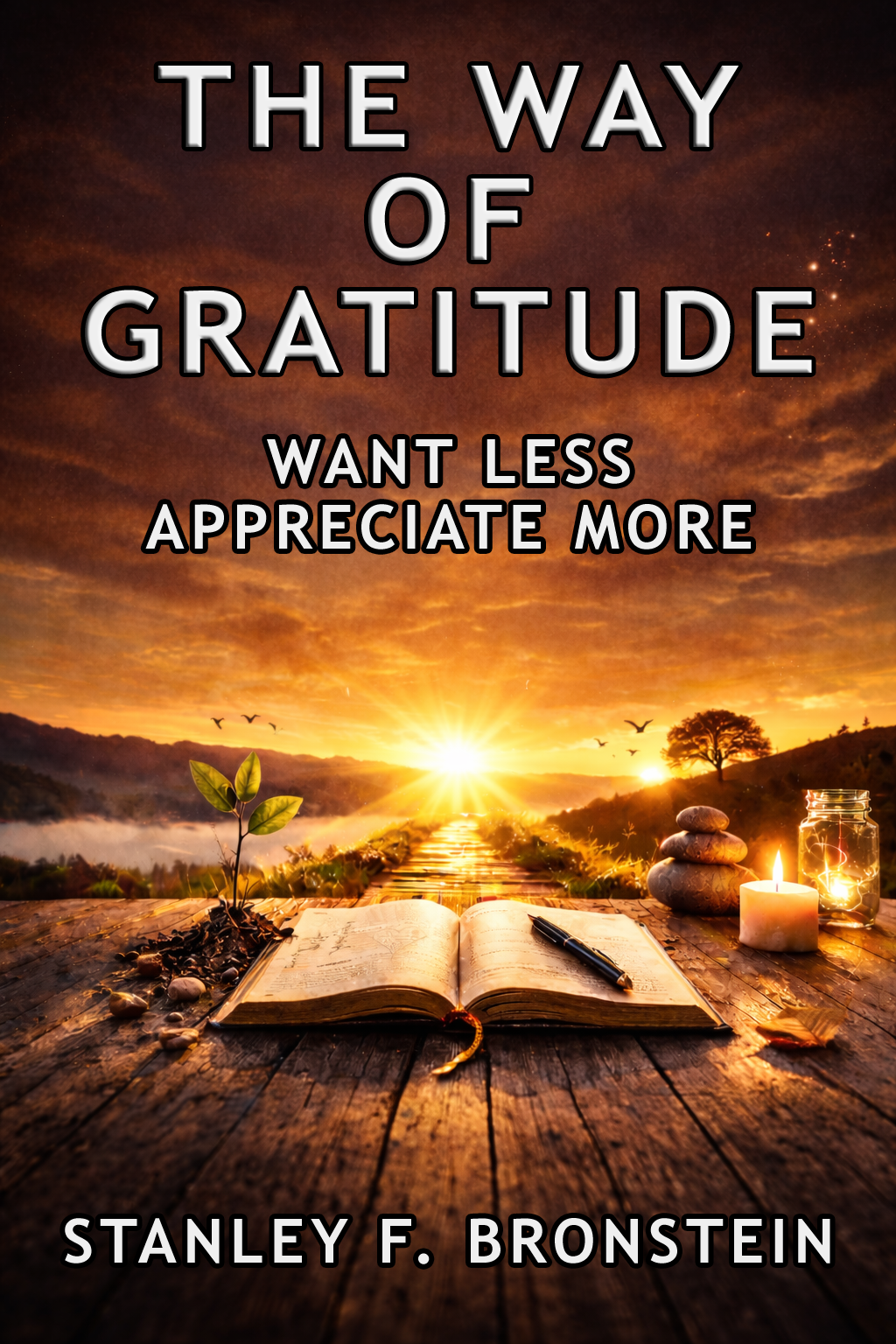
The Way of Gratitude

START HERE BY READING
The Way of Gratitude
Want Less
Appreciate More
By Stanley F. Bronstein – Creator of The Way of Excellence System
Click The Tabs Below To Read Each Chapter Of The Book Online
Or
📘 Download Your Free Copy In Your Preferred Format
The Way of Gratitude
by Stanley F. Bronstein
How to use this page:
Click a chapter title to open it then scroll down to read.
When you click the title of the next chapter, the previous one will close.
Take your time.
Read, reflect, and do the experiments and assignments before you move on.
EMPTY ITEM
Foreword - Gratitude Is A Way Of Life
Gratitude is one of those words everyone agrees with – and almost everyone underuses.
Most people think gratitude is something you feel when life is going well. A good day. A promotion. A compliment. A vacation. A victory. In that version, gratitude is a reaction. It shows up after life gives you a reason.
But the deeper truth is this: gratitude is not a reaction – it is a way of living.
It is a choice. It is a skill. It is a discipline. And like every discipline, it pays you back over time.
The title of this book is The Way of Gratitude, and the subtitle is Want Less Appreciate More. Those four words are not a slogan. They are a formula.
When you want less, you stop chasing what you do not have. When you appreciate more, you start noticing what you do have. That shift changes how you think. It changes how you feel. It changes how you treat the people you love. It changes how you treat your body. It changes your relationship with money. It changes what you believe is possible.
Most importantly, it changes your experience of your own life.
There is a reason so many people feel restless, even when things are going well. Wanting is endless. The mind can always find something missing. Something unfair. Something that should be different. Something someone else has. And when we live inside that mental habit, we are not just unhappy – we are untrained. We have not trained ourselves to see the gifts that are already here.
Gratitude corrects that.
Gratitude is not denial. It is not pretending everything is fine. It is not a way of avoiding pain. Gratitude is the decision to tell the truth about what is good – even when life is hard. It is the decision to notice what still remains – even after loss. It is the decision to appreciate what you can do – even when you are tired. It is the decision to value what matters – even when the world is loud.
In other words, gratitude is a way of returning to reality.
Over the years, I have met people who had every reason to complain – and did not. And I have met people who had every reason to be joyful – and were not. That contrast taught me something I will never forget: your circumstances influence you, but they do not control you. The way you interpret your life becomes the way you experience your life.
This book is built to help you make that shift intentionally.
It is structured into four parts and twenty chapters, with the final chapter serving as the conclusion. Each chapter ends with an assignment because gratitude is not learned by reading – it is learned by doing. The assignments are not complicated. They are designed to be practical, achievable, and real. They are meant to help you create momentum and make gratitude automatic, not occasional.
As you go through this book, do not aim for perfection. Aim for practice. If you miss a day, do not judge yourself. Return. If you feel resistant, do not fight yourself. Notice. If you feel emotional, do not shut it down. Let it teach you.
The goal is not to become someone who is grateful only when life is easy.
The goal is to become someone who can live with appreciation, even when life is not.
Because everything we get to do is a privilege.
If this book helps you want less and appreciate more, it will do something very specific for you: it will give you your life back. Not a different life. Your life – the one you are already living – experienced through a clearer lens, with a steadier heart, and with more peace in the middle of it.
That is the quiet power of gratitude.
And that is why it is worth practicing.
Stanley F. Bronstein
INTRODUCTION TO PART I - THE SHIFT: FROM WANTING TO APPRECIATING
Part I is about one thing – a shift.
Not a shift in your circumstances.
A shift in your focus.
Most people spend a lifetime chasing what they do not have. They call it ambition. They call it motivation. They call it striving. Sometimes it is those things. But very often, it is something else: a habit of wanting more that never turns off.
Wanting more is normal. It is human. It is also profitable for the world we live in. Entire industries are built on one message: you are not enough until you buy, achieve, upgrade, fix, or prove something. That message is loud. It is constant. And if you are not careful, it becomes the background music of your life.
Here is what quietly happens when wanting becomes your default setting.
You stop enjoying what you already have, because your mind is already living in the next thing. The next goal. The next purchase. The next milestone. The next relationship improvement. The next version of you.
You begin to live with a low-grade dissatisfaction – even when your life is objectively good. And because the mind always wants a reason for how it feels, it starts creating stories. It points to what is missing. It points to what is unfair. It points to what someone else has. It points to what should have happened by now.
That is not a character flaw. It is a pattern.
And patterns can be changed.
Gratitude is not just a feeling you stumble into when life goes well. Gratitude is a skill you can train. It is a way of seeing. It is a way of returning to what is real, right now. It is the opposite of mental autopilot.
The shift from wanting to appreciating changes everything, because what you focus on expands in your awareness.
If you focus on what is missing, life feels like a problem to solve.
If you focus on what is present, life starts to feel like a gift.
That does not mean you stop improving. It does not mean you stop growing. It does not mean you stop working toward goals. It means you stop sacrificing your peace in the process. It means you do not postpone your happiness until some future moment. It means you learn how to be both grateful and ambitious at the same time – grateful for what is, while still working to become better.
Part I is designed to create the foundation for that shift.
What Part I Will Do For You
Chapter 1 begins with the decision. Not the emotion. The decision. Because gratitude begins the moment you decide you want to live differently.
Chapter 2 explores wanting. Not to shame it, but to understand it. Wanting more is normal, but it is not always healthy. When wanting is unmanaged, it becomes a quiet thief.
Chapter 3 introduces one of the most powerful words you can learn: enough. Not as a way of settling, but as a way of freeing yourself from endless dissatisfaction.
Chapter 4 brings your attention to what you notice, because what you notice shapes what you feel – and what you feel shapes what you do.
And Chapter 5 closes Part I with the gratitude gap – that painful space between what you have and what you feel you should have. When you learn to close that gap, peace becomes available again.
How to Use Part I
As you move through Part I, do not aim for perfection. Aim for practice.
If you miss a day, do not judge yourself. Return.
If you feel resistant, do not fight yourself. Notice.
If you feel emotional, do not shut it down. Let it teach you.
The goal is not to become someone who is grateful only when life is easy.
The goal is to become someone who can live with appreciation, even when life is not.
Because everything we get to do is a privilege.
If Part I helps you want less and appreciate more, it will do something very specific for you: it will give you your life back. Not a different life. Your life – the one you are already living – experienced through a clearer lens, with a steadier heart, and with more peace in the middle of it.
That is where gratitude begins.
Chapter 1: The Moment You Decide - Gratitude as a Way of Living
Most people think gratitude is something you feel.
A good day happens and you feel grateful. Someone does something kind and you feel grateful. You receive good news and you feel grateful.
That is real gratitude, but it is only one version of it.
The deeper version of gratitude is not something you feel when life gives you a reason. It is something you choose because you have decided you want to live differently. It is a way of living.
And it begins in a moment.
Not a dramatic moment. Not a moment that has to be shared with anyone. Not a moment that gets applause. It can be quiet. It can happen while you are brushing your teeth, driving your car, sitting at your desk, or lying in bed.
It is the moment you decide:
“I am done letting my mind run my life.”
“I am done waiting for perfect conditions to feel at peace.”
“I am done letting wanting control my mood.”
“I am going to live with appreciation.”
That decision matters because without it, gratitude stays random. You experience it when you stumble into it. You feel it when you are in the mood for it. You enjoy it when life is cooperating.
But when you decide gratitude is a way of living, it becomes something you practice – regardless of your mood, regardless of your circumstances, and regardless of what your mind is trying to convince you to focus on.
Why This Decision Changes Everything
Your mind is a meaning-making machine. It is constantly scanning your world and creating a story.
If you do not train it, it defaults to a survival setting. It looks for problems, danger, and what is missing. That helped our ancestors survive, but it does not help you thrive. It keeps you tense. It keeps you restless. It keeps you dissatisfied.
The mind that focuses on what is missing will always find something missing.
Even when your life improves, the mind will adjust and keep looking for the next thing to want. That is why people can achieve major goals and still feel unsettled. It is why people can have more and still feel less. It is why people can be surrounded by blessings and still feel annoyed, bored, resentful, or empty.
A grateful life begins when you stop treating gratitude like a reaction and start treating it like a practice.
Because what you practice becomes your default.
Gratitude Is Not Denial
Some people resist gratitude because they think it means pretending everything is fine.
It does not.
Gratitude is not fake positivity. It is not ignoring hardship. It is not telling yourself you should not feel what you feel. It is not a way of avoiding pain.
Gratitude is simply the decision to tell the full truth.
The full truth is that life can be hard and still contain gifts.
The full truth is that you can be struggling and still have something to appreciate.
The full truth is that pain is real and blessings are real – and both can exist at the same time.
Gratitude does not erase problems. It changes the way you face them.
It gives you stability. It gives you perspective. It gives you strength.
And most importantly, it keeps you from becoming blind to what is still good.
The Two Ways People Live
Most people live in one of two ways.
1) The “When” Life
“I will be grateful when I lose weight.”
“I will be grateful when my business takes off.”
“I will be grateful when I find the right relationship.”
“I will be grateful when I have more money.”
“I will be grateful when I finally have less stress.”
That life never arrives, because the mind always finds a new “when.”
2) The “Now” Life
“I appreciate what is present, and I will improve what I can.”
“I value what I already have, and I will keep growing.”
“I will be grateful now, and I will still work toward my goals.”
This is the life of peace with progress.
The “now” life does not make you passive. It makes you grounded. It keeps you from living in constant mental resistance. It keeps you from postponing your happiness.
And it begins with a decision.
What You Appreciate Grows
What you appreciate grows – in your awareness, in your relationships, and in your life.
When you appreciate a person, they feel seen. They open. They soften. They engage. They show up differently.
When you appreciate your body, you treat it better. You listen to it more. You stop abusing it and start caring for it.
When you appreciate your opportunities, you stop wasting them.
When you appreciate your time, you stop spending it on nonsense.
When you appreciate your life, you stop treating it like something you are entitled to, and you start treating it like something you have been entrusted with.
Gratitude turns ordinary moments into meaningful moments.
And when enough meaningful moments stack up, you start to feel something many people rarely feel:
contentment.
Not complacency. Contentment.
Contentment is the calm center inside a life that is still moving forward.
The Hidden Power of Simple Gratitude
A grateful life is built on small moments.
A warm bed. Clean water. A working shower. A meal. A friend. A conversation. A walk. A sunrise. A phone call. A memory. A second chance. A body that still moves. A mind that can still learn. A heart that can still love.
These things can become invisible when you are living in the habit of wanting.
But when you decide to live with gratitude, you start noticing again.
You start remembering.
You start returning.
That is what this book is designed to help you do.
Your Gratitude Standard
In the chapters ahead, you will learn how to practice gratitude in a way that becomes natural and automatic.
But the foundation is built here, in Chapter 1, with one simple standard:
Gratitude is not something I wait for. Gratitude is something I practice.
Make that your standard, and the rest of this book will work.
Because you have already done the hardest part.
You decided.
Assignment: The 7-Day Gratitude Start
For the next 7 days, write down three specific appreciations every day. Do it in the morning, or do it before bed – but do it daily.
Use this structure:
-
One small thing you usually overlook
-
One personal thing about your life right now
-
One thing you appreciate about yourself (effort counts)
Examples:
-
Small: “Hot water in the shower.”
-
Personal: “A friend who texted me back.”
-
Self: “I kept my word to myself today.”
Important rules
-
Be specific, not general.
-
Do not repeat the same items each day.
-
Keep it simple and honest.
At the end of 7 days, answer this question in writing:
What changed in the way I noticed my life this week?
Chapter 2: Wanting More Is Normal - But It’s Not Always Healthy
Wanting more is normal.
You want more comfort, more security, more time, more freedom, more respect, more love, more success. You want your body to feel better. You want your relationships to feel smoother. You want your work to feel more meaningful. You want your life to improve.
There is nothing wrong with wanting more.
In fact, wanting more has built almost everything good we have. It is the engine behind progress. It is why people invent, create, build, learn, and grow. Wanting more can be a beautiful thing when it is connected to purpose and guided by wisdom.
But wanting more is not always healthy.
It becomes unhealthy when it becomes automatic. When it becomes constant. When it becomes the default setting in your mind.
Because an untrained mind does not just want more occasionally.
It wants more all the time.
And when it wants more all the time, it creates a quiet form of suffering: life is never enough, even when life is good.
The Two Faces of Wanting
There are two versions of wanting.
Healthy wanting is a desire that helps you grow. It is chosen. It is intentional. It is connected to values.
Healthy wanting sounds like this:
-
“I want to be stronger and healthier because I want to be here for the people I love.”
-
“I want to learn a new skill because I want to expand what I can contribute.”
-
“I want to build something meaningful because I want my life to stand for something.”
Healthy wanting is steady. It does not panic. It does not demand. It does not make you miserable while you are working toward your goal.
Unhealthy wanting is different.
It is craving. It is comparison. It is insecurity. It is a mental itch you cannot stop scratching. It is wanting something because you are afraid of not having it, or because you believe you are not enough without it.
Unhealthy wanting sounds like this:
-
“I will finally feel good about myself when…”
-
“If I do not have what they have, I am behind.”
-
“If my life does not look a certain way, it does not count.”
-
“Something is missing, and I have to fix it right now.”
Unhealthy wanting is urgent. It is anxious. It is never satisfied. And it steals your peace.
The Hidden Problem With Unhealthy Wanting
Unhealthy wanting does something very specific: it trains your attention to focus on what is missing.
And whatever you focus on becomes the reality you live inside.
When your attention is trained to scan for what is missing, your life can be full and still feel empty. You can be safe and still feel threatened. You can be loved and still feel lonely. You can be successful and still feel like a fraud.
Not because those things are true, but because your attention is not trained to see clearly.
Wanting more is not the problem. The problem is when wanting becomes your identity.
When wanting becomes your identity, you become a person who is never satisfied. You become a person who cannot enjoy progress because you are too busy judging how far you still have to go. You become a person who is always chasing, always measuring, always comparing.
That is exhausting.
And it is optional.
How Wanting Hijacks Your Joy
There is a simple reason unhealthy wanting destroys joy.
Joy lives in the present.
Wanting lives in the future.
When your mind is addicted to wanting, it spends most of its time somewhere you are not. It is thinking about what should be different. What should have happened. What should happen next. What someone else has. What you do not have.
You can be sitting at a table eating a meal and not taste it.
You can be spending time with people you love and not feel it.
You can be walking outside on a beautiful day and not see it.
You can be living your life and missing it.
The more your mind lives in wanting, the less it lives in now.
And when you do not live in now, gratitude has nowhere to land.
The Want List That Never Ends
Most people put their happiness on a checklist.
-
When I have more money, I will relax.
-
When I lose weight, I will feel confident.
-
When I retire, I will enjoy my life.
-
When my relationship improves, I will feel secure.
-
When my business takes off, I will feel proud.
Then they accomplish the thing.
And the mind immediately creates a new checklist.
That is why there are people with everything they once prayed for who still feel restless. The mind adapts. It normalizes. It starts wanting again.
That is not because they are broken.
It is because the mind is untrained.
What Gratitude Does to Wanting
Gratitude does not eliminate wanting.
It regulates it.
Gratitude puts wanting in its proper place. It turns wanting into a tool instead of a tyrant.
When you live with gratitude:
-
you can want more without feeling like you are missing something
-
you can improve your life without hating your current life
-
you can pursue goals without postponing peace
-
you can be ambitious without being miserable
Gratitude changes the energy of wanting. It transforms it from desperation into direction.
The Five Sources of Unhealthy Wanting
Most unhealthy wanting comes from one of five sources:
-
Fear – wanting more because you are afraid of not being safe
-
Ego – wanting more to prove your worth
-
Comparison – wanting more because someone else has more
-
Habit – wanting more because your mind is used to wanting
-
Avoidance – wanting more because you are trying to escape what you feel
These are not reasons to judge yourself.
They are reasons to become aware.
Because awareness is the beginning of freedom.
The Question That Changes Wanting
Here is the question that begins the shift:
Is this want improving my life – or is it stealing my life?
Some wants improve your life. They help you grow. They help you become healthier. They help you build something meaningful. They help you contribute.
Other wants steal your life. They keep you dissatisfied. They keep you anxious. They keep you comparing. They keep you chasing a version of life that never arrives.
This chapter is not here to convince you to stop wanting.
It is here to help you stop being owned by wanting.
Because once you are no longer owned by wanting, gratitude becomes possible.
And once gratitude becomes possible, peace becomes available again.
That is the shift we are building.
Assignment: The Want Inventory
Write down your top 10 recurring wants. Do not overthink it. Just list what keeps coming up in your mind.
Then label each want as one of the following:
-
Need (basic health, safety, stability, essential support)
-
Preference (nice to have, but not required for peace)
-
Ego (approval, status, proving, image)
-
Fear (security, control, “what if” thinking)
-
Habit (automatic wanting, restlessness, boredom)
Next, choose the top 3 wants on your list and answer these questions:
-
What do I believe this want will give me?
-
What is the cost of carrying this want every day?
-
What would gratitude look like if I pursued this goal from peace instead of pressure?
Finish by writing one sentence:
“I can want this, and I can still appreciate what I already have.”
Chapter 3: Enough - The Most Powerful Word You Can Learn
There is a word that can give you your life back.
It is simple. It is quiet. It is not flashy. It will never trend.
But it is powerful.
That word is enough.
Most people never learn how to use it. They may say it, but they do not live it. They may understand it intellectually, but they do not practice it. And because they do not practice it, they live in a state of constant wanting. Even when life is good, their mind keeps reaching for more.
When you do not have the word “enough” as a lived standard, you become vulnerable to a kind of never-ending dissatisfaction.
Not because you are ungrateful.
Not because you are a bad person.
Because you are untrained.
Why “Enough” Feels So Hard
For many people, “enough” sounds like settling.
It sounds like giving up.
It sounds like stopping growth.
It sounds like you are lowering your standards.
That is not what “enough” means.
“Enough” does not mean you stop improving your life.
It means you stop needing your life to improve in order to feel okay.
That one distinction changes everything.
You can still have goals. You can still be ambitious. You can still work hard. You can still build, grow, achieve, and create.
But you do not have to hate the present in order to build the future.
You do not have to be dissatisfied in order to be driven.
You do not have to treat life like a problem in order to make progress.
“Enough” is not the end of growth.
“Enough” is the end of desperation.
The Cost of Not Having “Enough”
When you do not have “enough” in your life, you pay for it every day.
You pay with:
-
Peace, because your mind is always chasing.
-
Joy, because joy lives in the present and you are always living in the next thing.
-
Relationships, because wanting often turns people into projects.
-
Health, because untrained wanting often becomes stress, and stress always gets paid for somewhere.
-
Time, because you waste it proving, comparing, and worrying.
There are people who have more than they ever imagined and still do not feel like it is enough.
There are people who receive love and still feel empty.
There are people who accomplish major goals and still feel restless.
That is the tragedy of not having “enough.”
No matter what you get, the mind can always ask for more.
Enough Is a Decision
“Enough” is not a number. It is a decision.
There is no amount of money that automatically creates enough.
There is no amount of success that automatically creates enough.
There is no weight, relationship, achievement, or reputation that automatically creates enough.
Because if “enough” is not a decision, the mind will keep moving the finish line.
You have probably seen this in your own life.
You wanted something badly.
You worked for it.
You got it.
And then it became normal.
That is not because you are ungrateful.
It is because the mind adapts. It normalizes. It seeks novelty. It looks for what is missing.
So if you wait for life to give you enough, you may never get there.
But if you decide what enough means, you can get there today.
Enough Is Freedom
“Enough” is the moment you stop arguing with reality.
It is the moment you stop measuring your worth by your results.
It is the moment you stop letting other people’s lives define your life.
It is the moment you stop needing to impress.
It is the moment you stop needing to prove.
It is the moment you stop needing more in order to be okay.
And that is freedom.
Not the freedom of having everything.
The freedom of not needing everything.
The Two Types of Enough
There are two types of enough you need to understand.
1) Enough in the present
This is the ability to say: “What I have right now is sufficient for peace.”
It does not mean you have everything you want.
It means you are no longer at war with what is.
It means you appreciate the blessings that are already present.
It means you can breathe.
2) Enough in the future
This is the ability to set healthy goals without turning them into emotional requirements.
It is the ability to say: “I want to improve, and I do not need improvement to be okay.”
This prevents your goals from becoming chains.
It keeps your goals clean.
It keeps your ambition healthy.
It keeps your striving from turning into suffering.
Enough Is a Gratitude Practice
Gratitude and “enough” are connected.
Gratitude is how you notice what you already have.
Enough is how you decide that what you have matters.
When you combine those, you stop living in the gratitude gap.
You stop living in the space between what is and what should be.
You return to your life.
The Most Common Misunderstanding
Many people think, “If I accept enough, I will stop pushing.”
The opposite is usually true.
When you live in constant dissatisfaction, you burn energy fighting your current life.
You waste mental bandwidth on frustration, resentment, and stress.
When you decide enough, you free that energy.
You become calmer.
You become steadier.
You become more focused.
Your goals become clearer.
And you start making better choices because you are not making them from pressure.
Enough is not the enemy of progress.
Enough is the foundation of progress that does not destroy you.
A Simple Definition
Enough is the ability to appreciate what you have while still working to become better.
That is the sweet spot.
That is peace with progress.
That is the life we are building.
Assignment: The Enough List
Write down 25 things that are already “enough” in your life right now.
They can be big or small. They can be serious or simple. The key is that they must be real.
Examples to get you started:
-
A safe place to sleep
-
Clean water
-
Food in the house
-
A working phone
-
A friend who cares
-
The ability to walk
-
The ability to learn
-
The ability to start again
After you write your list, choose five items and answer this question for each one:
“If this disappeared tomorrow, how would I feel?”
Finally, write one sentence and keep it somewhere you will see it:
“I can want more, and I can live in enough.”
Chapter 4: Appreciation Changes What You Notice - And What You Notice Changes Your Life
Your life is not only shaped by what happens to you.
It is shaped by what you notice.
Two people can live in the same house, eat the same food, have the same schedule, experience the same challenges, and still live in two completely different worlds.
One lives in a world of problems.
The other lives in a world of gifts.
The difference is not intelligence. It is not luck. It is not personality.
It is attention.
What you notice becomes your experience. And your experience becomes your life.
Your Attention Is Your Life
Most people think their life is their calendar.
Their job, their responsibilities, their relationships, their commitments.
But if you look closer, your life is your attention.
Because wherever your attention goes, your thoughts go.
Where your thoughts go, your emotions go.
Where your emotions go, your actions go.
And where your actions go, your results go.
Your attention is the steering wheel of your life.
If you do not take hold of it, something else will.
The Default Setting: Negativity and Missing
The human brain is wired to notice threats, problems, and what is missing.
That is not pessimism. It is survival.
It is why you notice the one rude comment more than the ten kind ones.
It is why you remember the failure more than the success.
It is why you focus on what you did not get done instead of what you did.
It is why you can have a good day and still find a reason to feel dissatisfied.
The brain is trying to protect you, but it is not always serving you.
In a modern life, that default setting can become a constant mental habit:
-
scanning for problems
-
scanning for what is missing
-
scanning for what might go wrong
-
scanning for what someone else has
-
scanning for what you are behind on
And when your mind is scanning like that, it is difficult to feel grateful, because gratitude requires the ability to see what is already here.
Appreciation Trains a New Lens
Appreciation is not a random emotion.
It is a lens.
It is a way of seeing that can be trained.
When you practice appreciation, you are training your mind to notice value.
You are training your mind to notice what is working.
You are training your mind to notice what is good.
You are training your mind to notice what is meaningful.
You are training your mind to notice what is already enough.
This does not make you naive.
It makes you balanced.
It teaches your mind to tell the full truth instead of a partial truth.
The Full Truth
A mind that is stuck in negativity tells a partial truth:
“Here is what is wrong.”
A mind that is trained in appreciation tells the full truth:
“Here is what is wrong, and here is what is still good.”
That is not denial. That is reality.
Reality always contains both.
Life is rarely all good or all bad.
Life is almost always mixed.
Your job is not to force yourself to see only the good.
Your job is to stop letting the mind see only the missing.
Why This Matters So Much
If you are constantly noticing what is missing, you will feel deprived even in abundance.
If you are constantly noticing what is wrong, you will feel unsafe even when you are safe.
If you are constantly noticing what people are not doing, you will feel disappointed even when they love you.
If you are constantly noticing what is not perfect, you will miss what is excellent.
This is why appreciation is life-changing.
It changes what you notice.
And what you notice changes your life.
The Hidden Gifts We Stop Seeing
One of the strangest things about being human is that we stop seeing what is most important.
We stop seeing the things that keep us alive.
We stop seeing the people who help us.
We stop seeing the comforts that make our life easier.
We stop seeing the simple privileges we get to experience every day.
We normalize them.
We stop appreciating them.
And when we stop appreciating them, we stop feeling the richness of life.
That is why gratitude is not only about being thankful.
It is about becoming awake again.
Appreciation Is an Antidote to Autopilot
Autopilot is when you live your day without really living it.
You do what you do.
You go where you go.
You say what you say.
You scroll, you rush, you react, you repeat.
Autopilot creates a life that feels flat.
Not because your life is bad, but because you are not fully there.
Appreciation interrupts autopilot.
It pulls you back into the present.
It asks you to look, to notice, to be here.
It turns routine into meaning.
It turns ordinary into sacred.
It turns “another day” into “a day I get to have.”
A Practical Way to Think About It
Your attention is like a flashlight in a dark room.
Where you point it determines what you see.
If you point it at problems, you see problems.
If you point it at blessings, you see blessings.
If you point it at what is missing, you see lack.
If you point it at what is present, you see abundance.
The room does not change.
The flashlight does.
And that changes your experience of the room.
You Are Already Practicing Something
You are already practicing attention every day.
You are already practicing noticing.
The only question is: what are you practicing?
Are you practicing complaint?
Are you practicing criticism?
Are you practicing comparison?
Are you practicing worry?
Or are you practicing appreciation?
Whatever you practice becomes your default.
So the goal is not to become grateful once in a while.
The goal is to become the kind of person who notices what is good as a normal way of being.
That is how you build a life that feels rich – without needing to add more things to it.
Assignment: The Noticing Walk
Today, take a 20-minute walk with one purpose:
Notice what you usually do not notice.
No music. No podcast. No phone scrolling.
As you walk, write down at least 20 things you notice that you normally overlook.
They can be anything:
-
the temperature on your skin
-
the sound of birds
-
the color of the sky
-
the way your body moves
-
the fact that you can breathe
-
a tree that has been there the whole time
-
a stranger holding a door
-
a home with lights on
-
the simple privilege of being able to walk
When you finish, answer these questions:
-
What did I notice that surprised me?
-
What did I feel when I paid attention?
-
What does this teach me about my usual mental autopilot?
Finally, write one sentence:
“My life improves when my attention improves.”
Chapter 5: The Gratitude Gap - Why People With More Often Feel Less
There is a strange thing that happens when people get what they want.
They feel good – for a while.
Then the feeling fades.
Then the mind adjusts.
Then the mind starts wanting again.
And soon, they are back where they started: feeling like something is missing.
This is why some people can have more than they ever imagined and still feel less.
It is not because they are ungrateful.
It is because they are living in what I call the gratitude gap.
What Is the Gratitude Gap?
The gratitude gap is the distance between:
-
what you have, and
-
what you think you should have
It is the space between reality and expectation.
Reality might be good. Reality might even be great.
But if your expectations are bigger than your appreciation, you will feel deprived.
And the mind is very skilled at creating expectations.
It creates them through:
-
comparison
-
social media
-
culture
-
advertising
-
other people’s opinions
-
your own past disappointments
-
your own future fears
The gratitude gap is not only about money or possessions.
It shows up everywhere.
-
“I should be further along.”
-
“My body should look different.”
-
“My relationship should be easier.”
-
“My business should be bigger.”
-
“My kids should be doing better.”
-
“People should treat me differently.”
-
“Life should not be this hard.”
Whenever you hear the word “should,” you are often listening to the voice of the gratitude gap.
Why the Gap Creates Suffering
The gratitude gap creates suffering because it turns your attention away from what is real and toward what is imagined.
It turns the present into a problem.
It turns your life into a scoreboard.
It turns your blessings into background noise.
It turns your progress into pressure.
And it creates a feeling that many people have but do not know how to name:
restlessness.
The mind says, “This is not enough.”
Even when it is.
The Moving Finish Line
One of the biggest reasons the gratitude gap exists is because the mind moves the finish line.
You want something.
You get it.
Then it becomes normal.
Then the mind says, “Okay, now we need the next thing.”
This is called adaptation. It is built into the mind.
It is why the new car becomes just a car.
It is why the new house becomes just the house.
It is why the new relationship becomes just the relationship.
It is why the promotion becomes just the job.
Your mind adjusts quickly.
If you do not train gratitude, you will spend your life upgrading your circumstances while your mind continues to feel dissatisfied.
That is why the gratitude gap is so dangerous.
It convinces you the problem is your life, when the problem is your lens.
The Gap Can Exist in Any Life
You do not have to be wealthy to live in the gratitude gap.
You can be struggling and still live in it.
You can be comfortable and still live in it.
You can be successful and still live in it.
The gratitude gap is not about your circumstances.
It is about your attention.
It is about what you focus on.
It is about what you count.
It is about what you consider normal.
It is about what you think you are entitled to.
And it is about what you think your life is supposed to look like.
The Most Common Forms of the Gratitude Gap
Here are three common versions.
1) The achievement gap
“I will feel good when I accomplish more.”
This creates a life where you are always productive but rarely peaceful.
2) The comparison gap
“I will feel good when I have what they have.”
This creates a life where you are always measuring and never enjoying.
3) The fairness gap
“I will feel good when life feels fair.”
This creates a life where you are always arguing with reality.
Each one creates the same result:
less appreciation.
More frustration.
Less peace.
More chasing.
Closing the Gratitude Gap
Closing the gratitude gap does not mean you stop wanting to improve your life.
It means you stop making your happiness dependent on improvement.
It means you stop postponing peace.
It means you stop letting your expectations drown out your appreciation.
Here is the key:
The gratitude gap closes when you make appreciation bigger than expectation.
That does not mean you have no expectations.
It means your expectations are not running your life.
A Powerful Truth
If you want a calmer, happier life, learn this:
Your happiness is not determined by what you have. It is determined by what you notice.
People who notice blessings feel rich.
People who notice missing feel poor.
Even with the same circumstances.
That is why gratitude is a skill. It changes what you notice. And what you notice changes what you feel.
The Gratitude Gap Test
You can tell you are living in the gratitude gap when you:
-
feel irritated even after good news
-
feel restless after a win
-
feel like you are behind even when you are progressing
-
feel dissatisfied even when your life is objectively fine
-
struggle to enjoy simple moments because your mind is on the next thing
If any of that sounds familiar, it is not a moral failure.
It is an awareness opportunity.
Because once you see the gap, you can close it.
The Shift
The shift is this:
Instead of living from “I will be happy when…”
You begin living from “I can appreciate now.”
This does not make you passive.
It makes you present.
It makes you stable.
It gives you the strength to improve your life without resenting your life.
And that is the foundation for everything in the chapters ahead.
Assignment: The Gap Journal
For the next 7 days, write one short entry each day using this exact sentence structure:
“I have ___, but I’ve been acting like it’s not enough because ___.”
Examples:
-
“I have food, but I’ve been acting like it’s not enough because I want more variety.”
-
“I have friends, but I’ve been acting like it’s not enough because I want more attention.”
-
“I have a body that moves, but I’ve been acting like it’s not enough because I want it to look different.”
After each sentence, add one more line:
“What I appreciate about this is ___.”
At the end of 7 days, answer:
-
What patterns did I notice about my expectations?
-
Where is my mind moving the finish line?
-
What changes when I choose appreciation first?
Finish with one commitment sentence:
“This week, I will close the gap by appreciating what is already here.”
INTRODUCTION TO PART II - THE PRACTICE: BUILDING A DAILY LIFE OF GRATITUDE
Part I was about the shift.
Part II is about the practice.
A shift can happen in a moment, but a new life is built through repetition. If you want gratitude to become natural, you cannot treat it like an occasional emotion. You have to treat it like a daily discipline – something you return to again and again until it becomes part of who you are.
This is where most people get stuck.
They agree with gratitude. They like the idea of it. They even feel grateful sometimes. But they do not build a system for it. They rely on luck – hoping they will remember to appreciate life when life is going well, and then wondering why they feel so negative, so rushed, or so restless when life is not.
Gratitude does not become a way of living through hope.
It becomes a way of living through practice.
Why You Need a Practice
Your mind has patterns. Some of those patterns serve you. Many of them do not. If you do not intentionally train your mind, it will run the same loops it has always run:
-
what is missing
-
what is wrong
-
what is next
-
what someone else has
-
what you should have done
-
what you are worried about
Gratitude is the practice of redirecting that attention.
Not once.
Daily.
It is the practice of teaching your mind to notice what is good, what is working, what is meaningful, and what is already present – so you are no longer blind to your own life.
The goal of Part II is simple:
To help you build daily gratitude habits that are achievable, sustainable, and real.
Not complicated.
Not time-consuming.
Not fragile.
The Real Target: Automatic Gratitude
You know a practice is working when it becomes automatic.
You do not have to force it.
You do not have to remember it.
You simply notice.
You simply appreciate.
You simply return.
This is not about becoming a person who walks around pretending everything is wonderful. It is about becoming a person who is awake enough to see what is already good – even on an ordinary Tuesday, even in a stressful season, even when life is not perfect.
The Difference Between Intention and Routine
Intention is powerful, but it is not enough.
People intend to eat better, move more, sleep more, stress less, and be kinder. Intention is not the problem.
The problem is that without routine, intention fades.
Routine is what makes intention real.
That is why Part II focuses on building simple practices you can repeat. The practices are designed to fit into real life. They are designed to work when you are busy, when you are tired, and when your mind wants to slip back into negativity.
What You Will Build in Part II
In these chapters, you will create a daily gratitude structure that includes:
-
understanding that gratitude is a skill you train
-
learning the language of appreciation and saying it out loud
-
journaling in a way that actually changes your mind, not just your mood
-
using movement and presence to make gratitude easier
-
building small rituals that remind you why you should be grateful
By the time you finish Part II, gratitude should feel less like something you try to do and more like something you are becoming.
A Reminder Before You Start
Do not aim for perfection.
Aim for consistency.
If you miss a day, do not quit.
Return.
If you do not feel grateful, do not fake it.
Look for something real.
Even if it is small.
The point is not to manufacture gratitude.
The point is to train your attention until gratitude becomes your default lens.
Because when your attention improves, your life improves.
That is what you are building here.
Now let’s begin the practice.
Chapter 6: Gratitude Is a Skill - Train It Like a Muscle
If gratitude were only a feeling, most people would be at its mercy.
They would feel grateful when they felt like it, and they would forget gratitude when they were stressed, busy, tired, disappointed, or irritated. And that is exactly what happens for many people.
They do not lack gratitude.
They lack training.
Gratitude is a skill.
And skills can be built.
The same way you build strength in your body, you build strength in your mind. You build it through repetition. You build it through practice. You build it through returning to the same basic moves until they become natural.
That is what Part II is about.
Why Gratitude Works Like a Muscle
Think of a muscle you have never trained.
It is not strong. It gets tired quickly. It is inconsistent. It does not respond when you need it.
Now think of a trained muscle.
It is reliable. It responds under pressure. It holds steady when life gets heavy.
Your mind works the same way.
If you do not train gratitude, your default mental muscles will dominate:
-
complaint
-
criticism
-
comparison
-
worry
-
negativity
-
impatience
Those are not personality traits. They are practiced patterns.
If you want gratitude to become your default, you have to train it until it is stronger than your old patterns.
The Habit Loop of the Mind
Most people do not realize that the mind has habits.
A habit is simply a repeated pattern that becomes automatic.
If you repeatedly look for what is missing, the mind becomes skilled at missing.
If you repeatedly look for what is wrong, the mind becomes skilled at wrong.
If you repeatedly compare yourself to others, the mind becomes skilled at comparison.
And if you repeatedly look for what is good, the mind becomes skilled at seeing good.
That is why gratitude changes your life.
It changes what your mind is skilled at noticing.
The Secret Most People Miss
Many people believe:
“I will practice gratitude when I feel grateful.”
That is backwards.
You practice gratitude so you can feel grateful.
You practice gratitude when you do not feel like it because that is when the training matters most.
Anyone can appreciate life when life is easy.
The real benefit comes when gratitude becomes strong enough to show up when life is not.
That is what skill looks like.
What Training Actually Means
Training gratitude means you repeatedly do three things:
-
You notice something good
-
You name it
-
You feel it for a moment instead of rushing past it
That is the whole practice.
It sounds simple because it is simple.
It is also powerful because it changes your attention.
Most people notice good things and then immediately move on to the next thought. They do not let the good land. They do not let it register. They do not let it reach the heart.
Training gratitude means you stop skipping over the good.
You let it land.
You let it count.
The Small Stuff Is the Real Stuff
Some people say, “I have nothing to be grateful for.”
That is rarely true. What is usually true is that they are looking for something big, dramatic, or perfect.
Gratitude is built on small things.
The ability to breathe.
The ability to see.
The ability to hear.
A bed.
A shower.
Clean water.
A working phone.
A meal.
A safe place.
A moment of quiet.
A kind message.
A second chance.
The fact that your heart keeps beating without your permission.
If you overlook the small things, you will miss most of life. Most of life is made of ordinary moments.
When you train gratitude, ordinary moments start to feel like gifts again.
The Gratitude Reps
If gratitude is a muscle, then what are the reps?
Here are the reps:
-
noticing one good thing and pausing
-
expressing appreciation to another person
-
writing gratitude down with specificity
-
taking a gratitude walk
-
reviewing your day and naming the wins
-
choosing appreciation in the middle of frustration
-
returning to gratitude after you slip into complaint
These are not complicated.
They are consistent.
That is why they work.
Why This Practice Changes Your Mood
Gratitude changes your mood because it changes your focus.
Your emotions follow your attention.
If your attention is focused on what is missing, you will feel lack.
If your attention is focused on what is wrong, you will feel stress.
If your attention is focused on what is present, you will feel steadier.
If your attention is focused on what is good, you will feel lighter.
This is not magic.
It is training.
The Real Goal: A New Default
The goal is not to force yourself to be grateful every second.
The goal is to build a new default.
A default is what your mind does when you are not paying attention.
Right now, your default might be worry.
Or impatience.
Or criticism.
Or comparison.
Or mental noise.
Gratitude training is how you change the default.
Over time, gratitude becomes easier.
Not because life changes, but because you change.
You become the kind of person who notices.
You become the kind of person who appreciates.
You become the kind of person who lives from a steadier place.
Start Small and Stay Consistent
If you want this to work, do not make it complicated.
Small and daily beats big and occasional.
That is the way skills are built.
That is the way habits become automatic.
That is the way gratitude becomes a way of living.
Assignment: The 5-Minute Daily Practice
For the next 7 days, practice gratitude for five minutes a day.
Use this structure:
Morning (2 minutes)
Write down three specific appreciations.
-
One small thing
-
One person-related thing
-
One opportunity you get today
Evening (3 minutes)
Write down:
-
One moment today that was good (even if it was small)
-
One lesson today taught you
-
One win (effort counts, not perfection)
Rules:
-
Be specific.
-
No repeating the same items every day.
-
If you miss a day, do not restart the program. Just return.
At the end of 7 days, answer:
What changed in my mood, my patience, and my awareness this week?
Chapter 7: The Language of Appreciation - Say It Out Loud
Gratitude becomes more powerful when it stops living only inside your head.
Many people are grateful, but they do not express it. They feel it briefly, but they do not say it. They assume people know. They assume it is understood. They assume it is implied.
And then they are surprised when relationships feel colder than they should, when people seem distant, when connection fades, when life feels a little emptier than it needs to.
Appreciation is a language.
And like every language, it has to be spoken.
Why Saying It Out Loud Matters
When you keep gratitude inside, it still helps you.
But when you express gratitude, it helps everyone.
It strengthens relationships.
It builds trust.
It creates warmth.
It changes the tone of a home.
It changes the culture of a workplace.
It changes the energy between two people.
You can often measure the health of a relationship by one simple factor:
How much appreciation is expressed.
Not how much appreciation is felt.
Expressed.
What Appreciation Does to People
Appreciation does something profound.
It tells someone:
-
“I notice you.”
-
“I value you.”
-
“You matter.”
-
“What you do is not invisible.”
-
“I am not taking you for granted.”
Most people are not starving for praise.
They are starving for being recognized.
They want to know that what they do matters. They want to know they are not just a background character in your life.
When you speak appreciation, you give them that.
The Difference Between Compliments and Appreciation
A compliment is often about a result.
“Nice job.”
“You look great.”
“That was impressive.”
Appreciation is often about value.
“I appreciate how dependable you are.”
“I appreciate the way you keep your word.”
“I appreciate how you handled that with patience.”
“I appreciate you showing up.”
Compliments are nice.
Appreciation is deep.
Compliments feel good for a moment.
Appreciation strengthens bonds.
Why People Do Not Say It
Most people do not express appreciation for predictable reasons.
-
They are busy.
-
They assume it is obvious.
-
They feel awkward.
-
They were not raised that way.
-
They do not want to seem emotional.
-
They do not want to seem soft.
-
They do not want to be vulnerable.
But there is a cost to silence.
If you do not express appreciation, you accidentally teach people that what they do does not matter to you.
That is rarely what you intend.
But it is often what people feel.
Appreciation Is Not Weak
Some people avoid appreciation because they believe it gives away power.
The opposite is true.
Appreciation is strength.
It takes strength to be sincere.
It takes strength to be specific.
It takes strength to say, “I see you, and I value you,” without needing anything in return.
And it is one of the simplest ways to become a better leader, partner, parent, friend, and human being.
The Most Powerful Form of Appreciation
The most powerful appreciation is specific.
General appreciation is fine, but it is easy to ignore because it does not land.
“I appreciate you” is nice.
But this lands deeper:
“I appreciate you for doing ___, because it made me feel ___. It mattered because ___.”
Specific appreciation has three parts:
-
What they did
-
How it helped you or others
-
Why it mattered
That is the language that makes people feel seen.
Appreciate People While You Still Can
One day, you will not get another chance to tell someone what they meant to you.
One day, the conversation will no longer be available.
One day, the person will be gone or the relationship will change.
Many people carry regret because they assumed they would have more time.
Gratitude is not only about being thankful.
It is also about honoring life while it is here.
That includes honoring the people in your life while you still can.
Appreciation Changes You Too
Speaking appreciation does not only affect others.
It affects you.
When you practice appreciation out loud, you train your mind to look for what is good in people.
You train your mind to notice kindness, effort, loyalty, consistency, and care.
That changes the lens through which you see your relationships.
And what you focus on grows.
When you focus on what people do wrong, you will feel irritated.
When you focus on what people do right, you will feel more connected.
This does not mean you ignore problems.
It means you stop overlooking the good.
Appreciation Creates a Culture
Every environment has a culture.
Homes have a culture.
Workplaces have a culture.
Friend groups have a culture.
Families have a culture.
Cultures are built by repeated behaviors.
If criticism is expressed often, criticism becomes the culture.
If appreciation is expressed often, appreciation becomes the culture.
You get to choose what you build.
And it starts with one sentence spoken out loud.
Assignment: The Appreciation Message Challenge
Over the next 5 days, send one appreciation message per day.
Five messages total.
You can send them by text, email, or write them on a note. Keep them short, sincere, and specific.
Use this simple structure:
-
Name what they did or who they are
-
Why you appreciate it
-
How it affected you
Examples:
-
“Thank you for calling me yesterday. I appreciate it because it reminded me I’m not alone.”
-
“I appreciate how dependable you are. It gives me a sense of stability and trust.”
-
“Thank you for your patience this week. It helped me more than you know.”
Rules:
-
Do not wait for the perfect wording. Be real.
-
Do not over-explain. Keep it simple.
-
Do not expect anything back. This is about giving appreciation.
After you send each message, write one sentence in your journal:
What did I notice in myself after expressing appreciation?
At the end of 5 days, answer:
What changed in the way I saw people – and in the way I felt about my life?
Chapter 8: The Gratitude Journal Done Right - Specific Beats General
A gratitude journal can change your life.
It can also become meaningless.
Many people start a gratitude journal with good intentions, then quit because it feels repetitive, fake, or pointless. They write the same vague phrases every day, and nothing really changes.
“I’m grateful for my family.”
“I’m grateful for my health.”
“I’m grateful for my home.”
Those are good statements, but they often do not work as a practice because they do not create impact.
The mind reads them and moves on.
The words do not land.
The heart does not feel them.
And if the practice does not land, it will not last.
That is why this chapter exists.
To help you do it right.
Why Journaling Works
A journal is not magic.
It works because it forces you to do something your mind does not naturally do:
slow down.
Your mind is fast. It jumps from thought to thought. It moves from problem to problem. It scans for what is missing. It runs in loops. It exaggerates.
Writing interrupts that speed.
Writing creates focus.
Writing makes you choose.
And when you choose what to write, you are choosing what to notice.
That is why a gratitude journal works when it works.
It trains attention.
It trains appreciation.
It trains meaning.
The Problem With General Gratitude
General gratitude is easy to write.
General gratitude is also easy to ignore.
A statement like “I’m grateful for my family” is often too large, too vague, and too familiar to create a felt sense of appreciation.
Your mind says, “Yes, yes, family, moving on.”
It becomes wallpaper.
That is how a gratitude journal dies.
Not because gratitude is not real, but because the practice becomes stale.
Specific Beats General
If you want gratitude to become real, make it specific.
Specific gratitude does two important things:
-
It creates emotion.
-
It creates memory.
Specific gratitude is vivid. It has detail. It has texture. It has a moment attached to it.
Compare these two:
-
“I’m grateful for my friends.”
-
“I’m grateful that Jim called me today and made me laugh when I was stressed.”
The second one lands.
It triggers a feeling. It brings you back to the moment. It reminds you what connection actually looks like.
That is the point.
The Three Levels of Gratitude
Here are three levels you can use to upgrade your journaling.
Level 1: What I have
This is appreciation for tangible things and basic supports.
-
food, shelter, clothing, money, resources, tools, conveniences
Level 2: What happened
This is appreciation for moments, experiences, interactions, and events.
-
a conversation, a kind gesture, a moment of beauty, a small win
Level 3: What it means
This is the deepest level. It is appreciation for meaning and values.
-
love, loyalty, growth, resilience, courage, forgiveness, learning
Most people stop at Level 1.
A powerful gratitude journal includes all three.
The Most Effective Prompt
If you only remember one prompt, remember this:
What happened today that I could have easily missed?
That question forces your attention into the present. It forces your mind to search for the overlooked gifts. It turns an ordinary day into a day you can appreciate.
Avoid the Gratitude Lie
Your gratitude journal should never become a place where you lie.
If you write things you do not feel, you will start to resent the practice.
You do not need to write, “I’m grateful for everything that happened today.”
Some days are hard.
Some days are frustrating.
Some days are painful.
On those days, write what is true.
Truthful gratitude might look like:
-
“Today was hard, and I’m grateful I made it through.”
-
“I’m grateful I had one peaceful moment.”
-
“I’m grateful I had food, even though I was stressed.”
-
“I’m grateful I didn’t quit.”
If you keep it honest, the journal will keep working.
The Purpose of a Gratitude Journal
The purpose is not to create perfect thoughts.
The purpose is to train your mind to see what is real and good.
It is to balance your attention.
It is to reduce mental negativity.
It is to strengthen appreciation.
It is to make your life feel richer without needing your life to get bigger.
The One Upgrade That Makes It Stick
Here is a simple upgrade that helps the journal stay fresh:
Do not only write what you are grateful for.
Write why.
The “why” is where the meaning is.
Example:
“I’m grateful for the quiet this morning because it reminded me I can slow down.”
The “why” turns gratitude into wisdom.
It turns a list into a lesson.
It turns a habit into a way of living.
The Gratitude Journal as Evidence
Your mind forgets your wins.
It forgets your good moments.
It forgets the progress you are making.
It forgets the support you have.
A gratitude journal becomes evidence.
It becomes proof that good exists.
It becomes proof that you have blessings.
It becomes proof that you have survived hard days before.
And on a future hard day, you will need that proof.
Assignment: The Specificity Upgrade
Write 10 general gratitude statements, then upgrade each one into specific gratitude.
Step 1: Write 10 general statements
Examples:
-
I’m grateful for my family.
-
I’m grateful for my home.
-
I’m grateful for my health.
-
I’m grateful for my friends.
-
I’m grateful for my job.
Step 2: Upgrade each one with specifics and meaning
Use this template:
“I’m grateful for ___ because ___. It mattered because ___.”
Example:
“I’m grateful for my home because it was warm and quiet last night. It mattered because I needed rest.”
Rules:
-
Use a real moment from the last 48 hours.
-
Include at least 5 items that are small and easily overlooked.
-
Keep it honest.
Finish by writing one sentence:
“The more specific my gratitude is, the more real my gratitude becomes.”
Chapter 9: Gratitude in Motion - Walking, Breathing, and Coming Back to Now
Gratitude is easier when you are present.
That may sound obvious, but most people are rarely present.
They are physically here, but mentally elsewhere. The mind is replaying the past or rehearsing the future. It is solving problems, judging, comparing, worrying, planning, regretting, and rushing.
When the mind is doing that, gratitude feels far away.
Not because there is nothing to be grateful for, but because you are not actually experiencing your life. You are thinking about your life.
This is where motion matters.
Gratitude becomes easier when the body helps the mind return to now.
Walking helps.
Breathing helps.
And coming back to now is the skill that changes everything.
Why Movement Helps Gratitude
Movement does three things that gratitude needs.
-
Movement interrupts mental loops.
When you are stuck in the same thoughts, the body can break the pattern. A walk changes your state. It gives the mind a new rhythm. -
Movement brings you into your senses.
Gratitude lives in the senses. What you see, hear, feel, and notice. Movement makes you notice again. -
Movement reduces the pressure in your system.
Stress makes the mind narrow. Gratitude requires a wider lens. When the body relaxes, your lens widens.
This is why a short walk can change your mood.
Not because your problems disappeared.
Because your nervous system shifted.
Walking Is a Privilege
Many people treat walking as a chore.
Something they should do, something they have to do, something they are behind on.
That mindset misses the point.
Walking is a privilege.
So is breathing.
So is having a body that can move, even if it is imperfect.
So is being able to step outside and feel the air.
So is being alive on a day where you get to take a walk at all.
If you want a practical way to build gratitude, you do not need to start with a journal.
Start with your body.
Your body will bring you back to reality fast.
Gratitude Is a Return
Most people think gratitude is something you create.
In many ways, gratitude is something you return to.
It is already available.
It is available any time you are present enough to notice.
That is why the phrase “come back to now” matters.
Because now is where everything real is happening.
The past is memory.
The future is imagination.
Now is where your life is.
Now is where gratitude is.
The Breath as a Gratitude Anchor
When life feels chaotic, you do not need to solve everything in the moment.
You need to stabilize.
Breathing is one of the fastest ways to stabilize.
A simple breath practice can shift your entire day:
-
inhale slowly
-
exhale slowly
-
repeat
That is not just relaxation.
It is returning to now.
And when you return to now, you can notice something good.
Even if it is small.
Even if it is quiet.
Even if it is simply the fact that you can breathe.
The World Is Not the Problem – The Speed Is
Many people say they are too busy for gratitude.
They are not too busy.
They are too fast.
Their mind is moving too fast to notice anything.
Gratitude requires a small pause.
A small slowing down.
A moment of attention.
Walking and breathing create that pause naturally.
This is why gratitude and movement go together.
The Gratitude Walk as a Daily Reset
A gratitude walk is different from a normal walk.
A normal walk is exercise.
A gratitude walk is presence.
It is a practice.
It is walking while intentionally noticing what is good.
Not what is missing.
Not what you are behind on.
Not what is wrong.
What is good.
This is not pretending.
It is training.
What to Notice on a Gratitude Walk
Here are things you can notice that turn into gratitude quickly:
-
the fact that your body is carrying you
-
the feeling of your feet touching the ground
-
the warmth or coolness of the air
-
the sky
-
the trees
-
a quiet street
-
a dog wagging its tail
-
the sound of birds
-
sunlight on your skin
-
the simple fact that your heart keeps beating
-
the fact that you get to do this
The goal is not to force a feeling.
The goal is to notice the truth: there is goodness present right now.
The Link Between Gratitude and Health
When you move your body with appreciation, you treat your body differently.
You become less harsh.
Less impatient.
Less critical.
You stop treating your body like an enemy.
You start treating your body like a partner.
That is a big shift.
Many people punish their bodies with exercise.
They work out from shame.
They move from criticism.
They chase results from fear.
A gratitude-based approach is different.
You move because you appreciate that you can.
You move because you want to care for your body.
You move because you are grateful for the gift of being able to move at all.
That mindset changes the whole experience.
Coming Back to Now When You Are Not Walking
You cannot always go for a walk.
But you can always return to now.
Here are three simple ways:
-
Look at something and name it.
“Tree. Sky. Light. Chair. Hand.” -
Notice your breath.
“Breathing in. Breathing out.” -
Name one thing you appreciate right now.
Even if it is tiny.
This takes ten seconds.
Ten seconds is enough to interrupt autopilot.
And interrupting autopilot is how gratitude becomes a way of living.
Assignment: The Gratitude Walk
For the next 7 days, take a 20-minute walk.
As you walk, repeat this phrase quietly in your mind:
“Thank you for what is.”
Do not force emotion. Just repeat it.
During the walk, notice at least 10 things you can appreciate right now. Keep them simple.
After your walk, write down:
-
Three things I noticed that I normally overlook
-
One thing my body did well today
-
One moment that felt peaceful
At the end of 7 days, answer:
What changed in my mood and my mindset when I moved with appreciation instead of rushing on autopilot?
Chapter 10: The Gratitude Ritual - Build a Life That Reminds You Why You Should Be Grateful
If you rely on memory to practice gratitude, you will practice it inconsistently.
Not because you are lazy.
Because life is busy, and the mind is distracted.
That is why rituals matter.
A ritual is a reminder built into the structure of your day. It is a small repeated practice that keeps you connected to what matters – especially when you are stressed, tired, rushed, or distracted.
In other words, a ritual protects you from autopilot.
The Problem Rituals Solve
Most people do not wake up intending to be ungrateful.
They wake up intending to handle life.
And then life starts.
Emails.
Texts.
News.
Responsibilities.
Schedules.
Pressures.
The mind goes into problem-solving mode, and by midday, appreciation is gone. Not because the gifts disappeared, but because attention disappeared.
Rituals solve this by turning gratitude into something you do automatically, not something you try to remember.
A Gratitude Ritual Is a Cue
A ritual is built around a cue – something that already happens every day.
Morning coffee.
Brushing your teeth.
Taking a shower.
Sitting in your car.
Eating a meal.
Walking out the front door.
Getting into bed.
These are perfect gratitude anchors because they are already part of your life.
You are not adding time.
You are adding meaning.
The Purpose of a Gratitude Ritual
A ritual is not about doing something impressive.
It is about creating a moment that reminds you:
-
I am alive.
-
I am safe enough right now.
-
I have more blessings than I usually notice.
-
Everything I get to do today is a privilege.
That reminder changes the tone of your day.
It does not eliminate problems.
It gives you a steadier place to face them from.
The Three Types of Gratitude Rituals
Here are three simple types. Choose one, or eventually build all three.
1) A morning ritual
This sets your mind before the world sets it for you.
2) A meal ritual
This interrupts rushing and reconnects you to the basics: food, support, life.
3) A night ritual
This closes the day with appreciation instead of replaying problems in your head.
Each one does the same thing: it brings you back.
Keep the Ritual Small
Small rituals win.
Big rituals often fail.
If your gratitude ritual takes ten minutes, you will skip it when life gets busy. If it takes two minutes, you will actually do it.
Two minutes done daily is more powerful than ten minutes done occasionally.
That is how a life changes – not through massive bursts, but through small repetitions.
Build a Life That Reminds You
You want your life to remind you why you should be grateful.
Because if you do not build reminders, the mind will build distractions.
The mind will remind you of what is missing.
The mind will remind you of what is wrong.
The mind will remind you of what you should have done.
Your ritual is your counterbalance.
It is your chosen reminder.
The Most Effective Ritual Has One Element of Feeling
If you only think gratitude, it stays intellectual.
A ritual becomes powerful when you add a small element of feeling.
That can be as simple as:
-
placing your hand on your chest for one breath
-
closing your eyes for five seconds
-
smiling slightly as you say “thank you”
-
picturing one person you love
-
remembering one moment you would miss if it disappeared
Feeling makes it real.
Sample Gratitude Rituals You Can Use Today
Here are a few you can borrow immediately.
Morning coffee ritual (60 seconds)
Before your first sip, say:
“Thank you for this day.”
Then name three things you appreciate.
Shower ritual (30 seconds)
As the water hits you, say:
“Thank you for clean water and a body that can feel it.”
Then breathe slowly for three breaths.
Meal ritual (20 seconds)
Before eating, pause and say:
“Thank you for food, for the hands that made it possible, and for the life that gets to receive it.”
Car ritual (30 seconds)
Before turning the key, say:
“Thank you for the ability to go where I need to go.”
Then name one opportunity you have today.
Night ritual (2 minutes)
Before sleep, write:
1 good moment
1 lesson
1 win
Then say: “Thank you.”
These are not sacred in themselves.
They become sacred because they change your attention.
The Real Goal: Gratitude Under Pressure
When life is easy, gratitude is easy.
The real test is when life is stressful.
That is why rituals are so valuable. They create stability when your mind is tempted to spiral.
Rituals keep you grounded.
They keep you steady.
They keep you from forgetting what is still good.
Choose One Ritual and Commit
Do not try to do everything at once.
Choose one daily anchor and build one ritual around it.
Once it becomes automatic, add another.
That is how a life of gratitude is built.
Slowly.
Simply.
Reliably.
Assignment: Design Your Ritual
Choose one daily anchor from this list:
-
morning coffee or tea
-
brushing your teeth
-
showering
-
eating one meal
-
getting into your car
-
getting into bed
Now design a 2-minute gratitude ritual using this structure:
-
A pause (one breath)
-
A phrase (a simple sentence you will repeat daily)
-
Three appreciations (specific, not general)
-
A feeling cue (hand on chest, brief smile, eyes closed)
Write your ritual down exactly as you will do it.
Then practice it daily for 7 days.
At the end of the week, answer:
-
Did I do it consistently? If not, why?
-
What changed in my mood or patience?
-
What did this ritual remind me of that I usually forget?
Finish with this sentence:
“I do not rely on memory for gratitude – I build reminders.”
INTRODUCTION TO PART III - GRATITUDE UNDER PRESSURE: THE REAL TEST
Part I was the shift.
Part II was the practice.
Part III is the test.
Because it is one thing to feel grateful when life is smooth.
It is another thing to stay grateful when life is hard.
This is where gratitude becomes real.
Not as a theory. Not as a motivational idea. Not as something you post online.
Real gratitude is what you can access when you are disappointed, exhausted, frustrated, hurting, or grieving. Real gratitude is what remains when life is not cooperating.
And that is exactly why Part III matters.
Why Pressure Reveals Everything
Pressure reveals what is actually inside you.
When you are calm, you can be patient.
When you are stressed, you discover whether patience is a skill or a mood.
When life is going well, you can be grateful.
When life is hard, you discover whether gratitude is a habit or an occasional feeling.
Pressure does not create your patterns.
Pressure exposes them.
And once they are exposed, they can be trained.
The Hidden Truth About Hard Times
Hard times do not eliminate blessings.
They hide them.
They narrow your focus.
They put your mind into survival mode.
They make your attention tunnel into what hurts, what is missing, and what might go wrong.
This is natural.
It is also dangerous, because when your attention narrows, you can lose sight of what is still true and good.
That is when people say:
“Nothing good is happening.”
But the truth is usually:
“I cannot see the good right now because I am under pressure.”
Part III is about widening the lens again – without denying what is hard.
Gratitude Does Not Mean You Like What Happened
Gratitude does not mean you approve of pain.
It does not mean you are happy about loss.
It does not mean you pretend things are fine.
Gratitude means you learn to hold two truths at the same time:
-
this is hard
-
and there is still something worth appreciating
That ability is maturity.
It is strength.
It is emotional resilience.
It is also one of the most valuable skills you can build in your entire life.
Why Gratitude Is Most Valuable Here
Your mind will try to protect you by going negative.
It will look for blame.
It will look for danger.
It will look for what is unfair.
It will look for what someone else has.
It will look for what you lost.
It will replay the story again and again.
That mental habit does not protect you.
It drains you.
Gratitude does not remove the difficulty, but it keeps you from being destroyed by the difficulty. It keeps you from becoming bitter. It keeps you from becoming resentful. It keeps you from losing perspective. It keeps you connected to what still matters.
What You Will Learn in Part III
In Part III, we will take gratitude into the places where people usually abandon it.
-
In Chapter 11, you will see why you should be grateful no matter what, even when life is hard. You will learn this through the powerful example of Peggy Chun, a woman who embodied joy and appreciation in circumstances most people would consider unbearable.
-
In Chapter 12, we confront anger, regret, and resentment – the emotions that block gratitude and quietly steal peace.
-
In Chapter 13, we address loss and grief, and how gratitude can honor what was while strengthening what still is.
-
In Chapter 14, we face comparison, the measuring game that turns blessings into burdens. You will learn this through Charlie “Tremendous” Jones and the truth he taught about appreciation.
-
In Chapter 15, we connect forgiveness and gratitude, because both are doors that lead to the same freedom.
This is not the easy part of the book.
It is the most important part.
Because life will test you.
And when it does, you will need something deeper than inspiration.
You will need a way of living.
One Simple Standard for Part III
As you begin Part III, adopt this standard:
Gratitude is not what I feel when life is easy. Gratitude is who I choose to be when life is hard.
You do not have to be perfect.
You just have to return.
Return to what is good.
Return to what is meaningful.
Return to what you still have.
Return to what you can still do.
Return to appreciation.
Because even under pressure, there is still something to be grateful for.
And that “something” is often the thing that keeps you going.
Chapter 11: When Life Is Hard - Why You Should Be Grateful No Matter What (What We Can Learn From Peggy Chun)
Most people believe gratitude is a luxury.
Something you feel when life is good.
Something you practice when the bills are paid, your body feels strong, your relationships are smooth, and the day is cooperating.
But gratitude is not most valuable when life is easy.
Gratitude is most valuable when life is hard.
Because when life is hard, your mind narrows. It goes into survival mode. It fixates on what is wrong, what is missing, what hurts, what is unfair, and what you wish were different. That is normal. It is human.
It is also the exact moment when gratitude becomes a lifeline.
Not as denial.
Not as pretending everything is fine.
As perspective.
As strength.
As a way to remember what is still true and good, even in the middle of difficulty.
If you want a powerful example of this, I want to tell you about someone I met in 2007.
Her name was Peggy Chun, and she had ALS – also known as Lou Gehrig’s disease.
What ALS (Lou Gehrig’s Disease) Is
ALS stands for amyotrophic lateral sclerosis. Many people know it better as Lou Gehrig’s disease, named after the famous baseball player whose life and career were tragically impacted by it.
ALS is a progressive neurological disease. It damages the nerve cells that control voluntary muscle movement. Over time, the brain can still want the body to move, but the body becomes less and less able to respond. Muscles weaken, and everyday actions become difficult. Walking, lifting, speaking, swallowing – things most of us never think twice about – can become harder and harder.
What makes ALS especially heartbreaking is that it often involves the slow taking away of ordinary abilities. It can feel like someone is losing physical freedoms that most people treat as guaranteed.
Peggy’s condition, when I met her, was advanced.
Meeting Peggy Chun
When I met Peggy, she could not walk.
She could not speak.
She was on a ventilator.
Her ability to move and communicate had been taken away by ALS, but her mind was still there. Her awareness was still there. Her spirit was still there.
The only way she could communicate was through a method that required trained people and tremendous patience.
They would hold up an eye chart with letters, and they would carefully watch her eye movements. With that system, letter by letter, she could spell out words. Word by word, she could form sentences. Sentence by sentence, she could communicate.
Think about what that means.
Most of us speak without effort. We answer questions instantly. We complain casually. We interrupt. We rush. We waste words.
Peggy had to build words one letter at a time with her eyes.
And yet, her attitude was not bitterness.
It was joy.
When I saw her condition, I had an immediate, uncomfortable thought.
I looked at her situation and my initial inclination was that if I ever reached a state like that, I would want to die.
That is hard to admit, but it was honest.
It was also the moment that taught me how limited my understanding of life still was.
Because Peggy did not see her life that way at all.
Peggy had more joy for life than anyone I have ever met in my entire life.
She was not pretending.
She was not performing.
She was not trying to impress anyone.
She was simply joyful.
She was present.
She was appreciative.
And her appreciation was so real, so natural, and so powerful that it forced me to rethink what I believed about hardship.
It forced me to confront a question most people avoid:
What if the ability to appreciate life has far less to do with circumstances than we think?
A Beautiful Day and a Trip to the Park
During my interview with Peggy, she told me she was excited about that day.
Not because something dramatic was happening.
Not because she had received some big breakthrough.
She was excited because it was a beautiful day, and her family was going to take her out to the park with her grandkids.
A beautiful day.
A trip to the park.
Time with her grandkids.
Those were enough to fill her with excitement.
Most people have those opportunities and barely notice them.
Many people treat them as ordinary.
Peggy treated them as extraordinary.
She saw what so many of us miss:
If you can go to the park, you are already wealthy in a way that matters.
If you can be with the people you love, you are already blessed.
If you can experience a beautiful day, you have already been given a gift.
Peggy was not waiting for life to be perfect.
She was enjoying what was available.
“Tell Me About All Those People”
At that time, I told Peggy about something I was preparing to do. I was going to be driving around the country to interview 50 successful people, people like her.
Peggy lit up.
She said that sounded so exciting.
Then she asked me to tell her about all those people.
She wanted to hear their stories.
She wanted to know what I was learning.
She was curious. Fully alive. Fully engaged.
And then she said something that I will never forget.
She told me she wished she could go with me.
Imagine that level of joy and aliveness.
Even with ALS, even with Lou Gehrig’s disease, even with a body that could not walk and a voice that could not speak, she was not focused on what she could not do.
She was focused on what life still offered.
She was focused on wonder, connection, curiosity, and the beauty of being here.
Peggy’s Passing and a Question That Still Guides Me
Peggy passed away about a year after I met her.
Even though it was almost 20 years ago, I still remember her all the time, and I will continue to remember her.
And here is one of the biggest reasons why.
There have been many days in my life when I did not feel like getting out of bed to go walking.
Days when the body felt tired.
Days when the mind wanted comfort.
Days when excuses sounded reasonable.
And on those days, I would think of Peggy and ask myself:
What would Peggy Chun do, if she could?
And the answer was always obvious.
Peggy would have gotten her lazy butt out of bed and gone for a walk.
And she might not have ever come back, because she was having so much fun.
That thought makes me smile, but it also makes me honest.
Because it exposes something we all do.
We treat privileges like burdens.
We treat gifts like obligations.
We act as if we have infinite tomorrows.
We behave as if what we can do today will always be available.
Peggy taught me something simple and permanent:
Everything we get to do is a privilege, and we should appreciate it.
Why You Should Be Grateful No Matter What
This is what Peggy’s life shows us.
Gratitude is not about having an easy life.
It is about having a clear mind and an awake heart.
It is about noticing what is still good.
It is about being grateful for what is still possible.
It is about appreciating what you can do, while you can do it.
Gratitude under pressure does not mean you ignore pain.
It means you refuse to let pain blind you.
It means you refuse to let hardship erase the blessings that still exist.
It means you stop saying, “I have to,” and start remembering, “I get to.”
I get to walk.
I get to breathe.
I get to see the sky.
I get to drink water.
I get to be with people I love.
I get to try again.
I get to learn.
I get to improve.
I get to live another day.
When you truly understand that, gratitude becomes less of an exercise and more of a natural response to the reality of being alive.
The Peggy Chun Standard
Do not wait for perfect conditions to appreciate your life.
Appreciate your life because you have it.
Appreciate what you can do because you can do it.
Appreciate the smallest joys because they are real.
Appreciate the people you love because they are not guaranteed.
And when you do not feel like showing up, moving your body, making the call, doing the work, or taking the next step, ask the question:
What would Peggy Chun do, if she could?
It is hard to stay stuck in self-pity after you ask that question honestly.
Not because your pain is not real.
Because your perspective becomes real.
And perspective is power.
Assignment: What Would Peggy Do?
Choose one thing you have been resisting lately. Keep it simple and specific. Examples:
-
getting out of bed on time
-
taking a walk
-
cooking a healthy meal
-
making an appointment
-
reaching out to someone you have been avoiding
-
starting something you have been procrastinating
-
returning to a habit you know is good for you
Now answer these questions in writing:
-
If I could not do this at all, would I miss it? Why?
-
What privilege is hiding inside this “burden”?
-
What would Peggy Chun do, if she could?
Then do the thing today.
Not perfectly.
With appreciation.
When you finish, write one sentence:
“Everything I get to do is a privilege, and I choose to appreciate it.”
Chapter 12: Anger, Regret, and Resentment - The Hidden Gratitude Blockers
Gratitude is natural when you feel good.
It is harder when you feel wronged.
Anger, regret, and resentment do not just create pain – they block appreciation. They narrow your mind until you can only see what should not have happened, what someone did to you, what you did to yourself, or what life failed to deliver.
They are understandable emotions.
They are also expensive emotions.
Because when these emotions run unchecked, they do more than hurt you.
They steal your ability to experience the good that still exists.
The Problem Is Not the Emotion
Anger is not automatically bad.
Regret is not automatically bad.
Resentment is not automatically bad.
These emotions often begin as signals.
Anger can signal a boundary has been crossed.
Regret can signal a lesson has been learned.
Resentment can signal an expectation has been violated.
The problem is not that you feel them.
The problem is what happens when you live in them.
Because when you live in them, your mind becomes trapped in one story:
This should not have happened.
And when your mind is trapped in that story, gratitude cannot breathe.
Anger: The Fire That Can Burn You or Fuel You
Anger is energy.
It can be destructive, or it can be clarifying.
When anger is healthy, it helps you face reality, speak truth, and set boundaries. It helps you stop tolerating what should not be tolerated.
When anger becomes unhealthy, it becomes identity.
You become “an angry person.”
You replay the same scene.
You rehearse the argument.
You collect evidence.
You keep the fire burning.
And while it burns, it consumes attention.
It consumes peace.
It consumes perspective.
A person who is stuck in anger can be surrounded by blessings and still feel miserable because their attention is chained to what they are angry about.
Regret: The Teacher or the Torturer
Regret can be one of the most valuable teachers in your life.
It can also become a torturer.
Healthy regret says:
“I learned. I will choose differently next time.”
Unhealthy regret says:
“I ruined everything. I cannot forgive myself. I cannot move forward.”
Healthy regret produces wisdom.
Unhealthy regret produces shame.
And shame blocks gratitude because shame tells you that you do not deserve anything good.
That is a lie.
You can be imperfect, learn from your mistakes, and still live with gratitude.
Resentment: The Quiet Thief
Resentment is anger that has been stored.
It is anger that was not expressed, not processed, not resolved.
It sits in the background, and it changes the way you see everything.
Resentment turns kindness into suspicion.
It turns small problems into big ones.
It turns conversations into tension.
It turns appreciation into criticism.
Resentment also has a strange habit:
It convinces you you are protecting yourself.
But resentment does not protect you.
It poisons you.
It steals your present by keeping you stuck in the past.
Why These Emotions Block Gratitude
Gratitude requires the ability to see the full picture.
Anger narrows the picture.
Regret rewinds the picture.
Resentment distorts the picture.
When you are angry, you focus on what is wrong.
When you are full of regret, you focus on what you wish you did differently.
When you are resentful, you focus on what someone else owes you.
All three keep your attention anchored to what is missing.
And when attention is anchored to missing, the gratitude gap opens wide.
A Crucial Truth: You Can Be Right and Still Be Miserable
You can be completely right about what happened.
And still be miserable.
You can be justified.
And still be stuck.
You can be correct.
And still be suffering.
The goal is not to deny what happened.
The goal is to stop letting what happened run your life.
Because life moves forward.
And you deserve to move forward with it.
What Gratitude Does Here
Gratitude does not erase anger, regret, or resentment.
Gratitude gives you a path through them.
Instead of:
“Why did this happen to me?”
You begin to ask:
“What is this teaching me?”
Instead of:
“How could they do that?”
You begin to ask:
“What boundary do I need to set?”
Instead of:
“I can’t believe I did that.”
You begin to ask:
“What will I do differently now?”
Gratitude turns pain into a teacher instead of a prison.
It does not make the pain disappear.
It makes the pain useful.
The Release Is Not Excusing
Some people resist releasing resentment because they think it means excusing what happened.
It does not.
Release means you stop carrying it.
You stop paying interest on it.
You stop letting it occupy your mind.
You can hold someone accountable and still release resentment.
You can set boundaries and still release resentment.
You can end a relationship and still release resentment.
Release is not approval.
Release is freedom.
The Practice: Replace the Story
Here is one of the simplest ways to break the grip of these emotions:
You replace the story.
Not with a lie.
With a better truth.
A better truth might sound like:
-
“This happened, and I can still choose who I will be.”
-
“I cannot change the past, but I can change my next decision.”
-
“I can be disappointed and still appreciate what is good today.”
-
“I can release this because my life is too valuable to waste on this.”
This is not pretending.
This is power.
A Simple Standard
I do not let anger, regret, or resentment steal my ability to appreciate my life today.
That standard does not remove emotion.
It removes captivity.
It gives you the ability to feel what you feel and still stay connected to what is good.
And that is maturity.
That is strength.
That is the path back to gratitude.
Assignment: Resentment Release
Choose one resentment you have been carrying. Start with a small one if you want. The goal is to practice the skill.
Now write your answers to these prompts:
-
What happened? (facts only, no extra story)
-
What did I want that I did not get?
-
What has this resentment cost me? (peace, energy, relationships, time)
-
What boundary, request, or decision does this point to?
-
What am I willing to release today? (be specific)
Now write this sentence:
“I release this resentment not because it was okay, but because my life is too valuable to keep paying for it.”
Finally, do one small action that supports your release:
-
have a conversation
-
set a boundary
-
write a letter you do not send
-
forgive yourself
-
take a walk and let it go with each step
Chapter 13: Loss and Grief - Gratitude for What Was and What Still Is
Loss changes you.
Grief is not a problem to solve. It is a process you move through. It is love looking for somewhere to go. It is the heart adjusting to a new reality.
Most people do not need to be convinced that loss hurts.
They need a way to live after loss without becoming hardened, bitter, or emotionally shut down.
This is where gratitude matters.
Not as a trick.
Not as a shortcut.
As a companion.
Because grief and gratitude can exist in the same heart.
A Misunderstanding That Hurts People
When someone is grieving, they often hear well-meaning phrases that land poorly.
“Be grateful for what you have.”
“Everything happens for a reason.”
“At least it wasn’t worse.”
“Time heals all wounds.”
Those phrases often feel dismissive because they skip the reality of pain.
This book is not going to do that.
Gratitude does not replace grief.
Gratitude does not cancel grief.
Gratitude does not rush grief.
Gratitude helps you carry grief.
Grief Is the Price of Love
This is one of the clearest ways to understand loss.
If you did not love, you would not grieve.
If something did not matter, its absence would not hurt.
Grief is painful, but it is also proof.
Proof that you loved.
Proof that you cared.
Proof that you were connected.
In that sense, grief itself can be honored.
Not as something you want, but as something meaningful.
Gratitude in Grief Is Not Gratitude for the Loss
This is a crucial distinction.
Gratitude in grief is not saying:
“I’m grateful this happened.”
Gratitude in grief is saying:
“I’m grateful for what was.”
“I’m grateful for what remains.”
“I’m grateful for what this relationship gave me.”
“I’m grateful for what I learned.”
“I’m grateful for the love that still lives in me.”
That kind of gratitude is not denial.
It is integration.
It is taking the love and meaning forward instead of letting the loss turn into emptiness.
The Two Gratitudes of Grief
When you are grieving, gratitude has two directions.
1) Gratitude for what was
This is the gratitude that honors the past.
The moments.
The memories.
The laughter.
The lessons.
The presence.
The love.
This gratitude says: It mattered.
2) Gratitude for what still is
This is the gratitude that anchors you in the present.
Even after loss, something remains.
Breath remains.
Time remains.
People remain.
Opportunities remain.
Life remains.
This gratitude says: I am still here, and life is still calling me forward.
Both gratitudes are needed.
One honors what you had.
The other keeps you from drowning in what you lost.
The Danger of Unprocessed Grief
When grief is not processed, it often turns into something else.
It can turn into numbness.
It can turn into bitterness.
It can turn into anger.
It can turn into withdrawal.
It can turn into a life that keeps moving on the outside while being stuck on the inside.
People often say, “I’m fine.”
But they are not fine.
They are armored.
Gratitude, practiced wisely, helps soften the armor.
It helps you feel without being destroyed.
It helps you remember without being trapped.
The Role of Memory
Some people avoid memories because they hurt.
Some people cling to memories because they are afraid to let go.
Gratitude creates a healthier relationship with memory.
It allows you to remember with appreciation.
It allows you to feel the sadness and the love at the same time.
It allows you to honor what was without living there forever.
A Simple Way to Work With Grief
When grief comes, you can do three things.
-
Name the loss
Do not minimize it. Be honest. -
Honor what it gave you
What did it teach you? What did it add to your life? -
Return to what remains
What do you still have? What can you still do?
This is not a formula that fixes grief.
It is a path that keeps grief from turning into a permanent prison.
Grief Teaches Gratitude
Loss has a strange effect.
It reveals what mattered.
It teaches you what was never guaranteed.
It reminds you that time is not promised.
It makes you realize how many ordinary moments were actually priceless.
In that sense, grief can deepen gratitude.
Not because you wanted the loss, but because the loss reveals the value of what you had.
Gratitude for What Still Is
This is one of the hardest and most important parts of this chapter.
Even after loss, life still asks something of you.
It asks you to keep living.
It asks you to keep loving.
It asks you to keep growing.
It asks you to keep moving forward.
Gratitude for what still is does not mean you forget.
It means you choose life.
It means you carry the love forward.
It means you let grief change you without closing you.
And that is strength.
Assignment: The Memory Letter
Choose one person, relationship, season of life, opportunity, or chapter you have lost.
Write a letter to it.
This letter is not for anyone else. You do not have to send it. It is for you.
Use this structure:
-
What I miss
-
What I appreciate about what we had
-
What you gave me (lessons, love, strength, memories)
-
What I carry forward
-
What I release (pain, guilt, unfinished words)
End with one sentence:
“I honor what was, and I choose to live with gratitude for what still is.”
When you are done, take a moment and do one small act of gratitude in the present:
-
step outside and breathe
-
take a short walk
-
call someone you love
-
drink a glass of water slowly
-
sit quietly and notice three things that are still good
Chapter 14: The Trap of Comparison - Gratitude For What You Already Have Ends the Measuring Game (What We Can Learn From Charlie “Tremendous” Jones)
Comparison is one of the fastest ways to ruin a good life.
It is subtle. It is socially acceptable. It often masquerades as motivation.
But when comparison becomes a habit, it turns blessings into burdens. It turns progress into pressure. It turns “I’m doing well” into “I’m behind.”
It is the measuring game, and the measuring game has no finish line.
Because the moment you “win” against one person, your mind finds someone else to compare yourself to.
That is why gratitude matters so much here.
Gratitude ends the measuring game by bringing you back to your own life, your own path, and your own blessings.
And few people taught this better than Charlie “Tremendous” Jones.
The Night I Spent With Charlie “Tremendous” Jones
I interviewed Charlie back in 2007. Before I met him, someone told me, “I promise you that you’ve never met anyone like Charlie.”
They were right.
Charlie had a rare combination of energy, warmth, intensity, wisdom, and joy. He was the kind of person who made you feel more alive just by being in the room with him.
Charlie is famous for a simple quote that captures his philosophy of life:
“You are the same today as you will be in five years, except for two things: the people you meet and the books you read.”
That quote is often shared as a success principle. But what I want to focus on in this chapter is something deeper.
Charlie had a grateful spirit.
And that grateful spirit is exactly what destroys comparison.
Why Comparison Is So Addictive
Comparison is addictive because it gives the mind a quick way to judge where you stand.
Am I ahead?
Am I behind?
Am I winning?
Am I losing?
But those questions are dangerous because they shift your focus away from your life and toward someone else’s life.
Here is what comparison does:
-
It makes you forget your progress.
-
It makes you dismiss your blessings.
-
It makes you disrespect your journey.
-
It makes you feel poor even when you are doing fine.
-
It makes you feel behind even when you are moving forward.
Comparison is the mind’s way of saying, “My life is not enough until it looks like theirs.”
That is the measuring game.
And it never ends.
Charlie’s Gratitude Philosophy
Charlie’s perspective was the opposite of comparison.
He did not live as if life owed him something.
He lived as if life had already given him everything.
Charlie said, “Everything in life is a gift: the air you breathe, your citizenship, your energy – everything.”
That sentence alone can change the way you experience your day.
Because once you truly see life as a gift, comparison becomes harder to justify.
How do you compare when you are already standing inside a gift?
How do you feel deprived when you remember you can breathe?
How do you feel behind when you remember you are alive, and you get another day?
Charlie also said, “If you’re not thankful for what you have, what makes you think you would be thankful if you had any more?”
That is the trap of comparison in one sentence.
Comparison always promises, “You’ll feel better when you have more.”
Charlie’s wisdom tells the truth:
If you do not practice gratitude now, more will not fix you. More will simply give your ungrateful mind a bigger playground.
The Measuring Game Turns Into a Trap
Charlie had a way of talking about gratitude that made it feel like a discipline, not a mood.
He said, “A thankful spirit is what breeds every other quality in a person.”
Think about that.
A thankful spirit is not only a pleasant trait. It is the foundation of everything else you want to build.
Because when you are thankful:
-
you become steadier
-
you become more patient
-
you become more generous
-
you become more grounded
-
you become less reactive
-
you become less entitled
-
you become less jealous
-
you become harder to offend
-
you become easier to live with
-
you become stronger under pressure
Gratitude is not just a feeling.
It is a character-builder.
And it pulls you out of the measuring game because it changes the question from:
“What do they have?”
to:
“What do I already have?”
The Real Cost of Comparison
Comparison does not only steal joy.
It steals time.
It steals attention.
It steals peace.
And over years, that becomes tragic, because you can live a decent life while constantly feeling like you are not living a good life.
You can have blessings and feel like you have none.
You can be making progress and feel like you are losing.
That is what comparison does.
It turns life into a scoreboard.
And when life becomes a scoreboard, gratitude disappears.
Charlie’s way was different.
He valued what he had, and he returned a little of what he owed.
He did not speak like life was a debt to collect.
He spoke like life was a gift to honor.
That mindset is the exit door from the measuring game.
The Gratitude Return
Here is a standard that ends comparison quickly:
When you catch yourself measuring, return to appreciation.
Return to what is real.
Return to what you have.
Return to what you can do.
Return to your path.
Return to gratitude.
Because gratitude for what you already have ends the measuring game.
And once the measuring game ends, peace returns.
Assignment: Comparison Detox
Step 1: Catch the comparison
Any time you notice yourself comparing, pause and write one sentence:
“I’m comparing myself because ___.”
Step 2: Bless and return
Then write:
“I bless them, and I return to my path.”
Step 3: Replace comparison with gratitude
Immediately write three things you already have that you appreciate – and why each one matters.
Step 4: End with one truth
Finish with this sentence:
“Gratitude for what I already have ends the measuring game.”
At the end of the week, answer:
-
Where did comparison show up the most?
-
What did comparison steal from me?
-
What changed when I returned to gratitude instead of continuing to measure?
Chapter 15: Forgiveness and Gratitude - Two Doors to the Same Freedom
Forgiveness and gratitude are closely related.
They look different on the surface, but they lead to the same place.
Freedom.
Gratitude frees you from the constant feeling that something is missing.
Forgiveness frees you from the constant feeling that something is owed.
Both release you from the past.
Both return you to the present.
Both make peace possible again.
This chapter is about how these two doors work together, and why walking through them changes your life.
Why Forgiveness Is So Hard
Forgiveness is hard for one reason.
People confuse it with approval.
They think forgiveness means:
-
what happened was okay
-
the person is off the hook
-
you should trust them again
-
you should forget it
-
you should stop feeling hurt
That is not forgiveness.
Forgiveness is not approval.
Forgiveness is not forgetting.
Forgiveness is not pretending it did not matter.
Forgiveness is not the same as reconciliation.
Forgiveness is a decision to stop paying for something forever.
What Forgiveness Actually Is
Forgiveness is the moment you decide:
-
I will not carry this every day
-
I will not let this define me
-
I will not let this steal my peace
-
I will not let this keep my heart locked
Forgiveness does not deny the harm.
It acknowledges it and then releases the grip it has on you.
Forgiveness is an act of strength.
Not because it excuses someone else, but because it protects you.
The Hidden Cost of Not Forgiving
When you do not forgive, you might think you are holding someone accountable.
But most of the time, you are holding yourself hostage.
Unforgiveness costs you:
-
mental energy
-
emotional energy
-
peace
-
attention
-
sleep
-
health
-
joy
-
presence
Unforgiveness keeps you tied to a person or event that may not even be thinking about you anymore.
That is a painful truth.
But it is also an opportunity, because once you see the cost, you can choose a different path.
How Gratitude Helps Forgiveness
Gratitude helps forgiveness because it widens your lens.
Unforgiveness narrows your lens to one story: what happened.
Gratitude reminds you there is more to your life than what happened.
It reminds you:
-
you are still here
-
you still have people who love you
-
you still have opportunities
-
you still have a future
-
you still have a life worth living
Gratitude does not minimize the hurt.
It prevents the hurt from becoming your whole identity.
It keeps you from building your life around a wound.
How Forgiveness Helps Gratitude
Forgiveness helps gratitude because resentment blocks appreciation.
If you are carrying resentment, your mind is not free.
It is scanning for proof.
It is replaying the story.
It is arguing with reality.
That mental activity leaves little room for gratitude.
When you forgive, you create space.
And gratitude fills that space.
You cannot fully live in appreciation while your heart is full of unresolved bitterness.
Forgiveness clears the channel.
Gratitude flows again.
Forgiveness Can Be Directed at Different People
Most people think forgiveness is about forgiving someone else.
Sometimes it is.
But there are three common forgiveness targets:
-
Forgiving someone who hurt you
-
Forgiving someone who disappointed you
-
Forgiving yourself
Self-forgiveness may be the most important one of all, because people can carry self-blame for decades. They replay the mistake, the decision, the missed opportunity, the moment they wish they could redo.
If that is you, hear this:
Regret can teach you.
But it should not imprison you.
Self-forgiveness is the moment you say:
I learned. I grew. I will choose differently now.
And then you move forward.
The Door You Choose Determines the Life You Live
If you walk through the door of unforgiveness, you will live in the past.
If you walk through the door of forgiveness, you will return to the present.
If you walk through the door of entitlement, you will feel offended often.
If you walk through the door of gratitude, you will feel richer often.
Forgiveness and gratitude are two doors, but they open into the same room.
That room is peace.
That room is emotional freedom.
That room is a life that is no longer controlled by what happened.
The Simplest Way to Practice Forgiveness
Here is a simple process you can use.
-
Tell the truth about what happened.
-
Tell the truth about what it cost you.
-
Decide what you will do to protect yourself going forward.
-
Release the emotional debt.
-
Return to gratitude for what still is.
You can set boundaries and forgive.
You can leave and forgive.
You can protect yourself and forgive.
Forgiveness is not weakness.
It is wisdom.
A Standard to Live By
Here is a standard that connects this whole chapter:
I forgive so I can be free, and I practice gratitude so I can stay free.
That is the path.
That is the life.
Assignment: The Forgiveness Step
Choose one person to forgive – including yourself if that is where the work is.
Now write three short sections.
1) What happened
Write the facts. Keep it clean. No exaggeration.
2) What I learned
What did this teach you about boundaries, people, expectations, or yourself?
3) What I release
Write one sentence:
“I release the emotional debt of this, not because it was okay, but because I am choosing freedom.”
Then do one small gratitude action immediately after:
-
write three specific appreciations
-
take a short walk and repeat “thank you” with each step
-
send one appreciation message to someone who has been good to you
Finally, answer this question:
What feels lighter now that I have chosen release?
INTRODUCTION TO PART IV - THE GRATITUDE LIFE: RELATIONSHIPS, PURPOSE, AND LEGACY
Part I was the shift.
Part II was the practice.
Part III was the test.
Part IV is the life.
This final part is where gratitude becomes more than a personal mindset. It becomes a way you show up in the world. It becomes something that strengthens your relationships, improves your health, changes how you handle money, and turns your appreciation into contribution.
Gratitude is not meant to stay private.
When it is real, it naturally moves outward.
It becomes appreciation.
It becomes stewardship.
It becomes generosity.
It becomes service.
That is the gratitude life.
Why Gratitude Must Become a Life
Many people treat gratitude like a tool.
Something they use when they are anxious.
Something they practice when they want peace.
Something they reach for when they are in a bad mood.
That is fine, but it is incomplete.
Gratitude is not only a tool.
It is a way of living.
When gratitude becomes your way of living, it changes what you value, how you treat people, and what you do with your time. It changes the kind of person you become.
Part IV is about building that kind of person.
The Three Domains Gratitude Touches Most
Gratitude touches everything, but it changes three domains especially powerfully.
1) Relationships
Appreciation is the currency of love. When gratitude becomes your habit, your relationships become warmer, stronger, and more resilient.
2) The Body
Your body is not just something you use. It is something you live in. Gratitude shifts you from criticism to care, and care changes outcomes.
3) Purpose and Legacy
When you appreciate life, you stop wasting it. Gratitude naturally becomes contribution. You begin giving back not because you have to, but because you want to.
Part IV focuses on these domains because this is where gratitude becomes visible.
This is where it becomes real in a way other people can feel.
What You Will Learn in Part IV
In Part IV, we take gratitude into the areas where your life is most influenced by your daily choices.
-
In Chapter 16, you will learn how gratitude transforms relationships and why appreciation is the currency of love.
-
In Chapter 17, you will explore gratitude and health, and the gift of a healthy body – not as a theory, but as a daily standard of care.
-
In Chapter 18, you will shift your relationship with money from scarcity to stewardship, because gratitude changes how you spend, save, give, and value.
-
In Chapter 19, you will turn appreciation into contribution by experiencing the joy of giving back and helping others.
-
In Chapter 20, you will bring it all together in the conclusion, so gratitude is not something you tried for a season, but something you live for the rest of your life.
A Standard for Part IV
Here is the standard that guides this final part of the book:
Gratitude is not only something I feel – it is something I live.
That means you do not just notice blessings.
You honor them.
You protect them.
You build them.
You share them.
You express them.
You give back because you can, and you recognize that everything you get to do is a privilege.
That is the end goal.
Not perfect gratitude.
Living gratitude.
Now let’s build the gratitude life.
Chapter 16: Gratitude in Relationships - Appreciation Is the Currency of Love
Relationships do not fall apart all at once.
Most of the time, they fade.
They fade from neglect.
They fade from distraction.
They fade from unspoken expectations.
They fade from criticism that becomes normal.
They fade from something that is missing far more often than something that is present.
That missing thing is appreciation.
Love without appreciation becomes heavy.
Commitment without appreciation becomes obligation.
Care without appreciation becomes invisible.
And when people feel invisible, connection weakens.
That is why this chapter matters.
If gratitude changes anything quickly, it changes relationships.
Because appreciation is the currency of love.
What Appreciation Does in a Relationship
Appreciation does not just make someone feel good.
It makes them feel seen.
It makes them feel valued.
It makes them feel safe.
It makes them feel like their effort matters.
It makes them feel like they are not taken for granted.
Those feelings are not small.
They are relationship oxygen.
When appreciation is present, relationships breathe.
When appreciation is absent, relationships suffocate.
Why Relationships Break Down
Many people assume relationships break down because of big problems.
Sometimes they do.
But often, they break down because of small patterns repeated over time.
-
expecting without expressing
-
criticizing more than appreciating
-
noticing what is wrong more than what is right
-
focusing on what someone is not doing
-
assuming they should know
That last one is a relationship killer.
Assuming someone should know what you appreciate about them is not the same as telling them.
People do not need mind reading.
They need communication.
The Truth About Being Taken for Granted
Being taken for granted does not always mean someone is unloving.
It often means someone is distracted.
It often means someone has normalized the person they love.
They assume they will always be there.
They assume the effort will always happen.
They assume the relationship will always run.
But relationships do not run on assumption.
They run on attention.
They run on appreciation.
They run on repeated moments of seeing and valuing.
The Most Powerful Relationship Habit
If you want one habit that can change your relationships, it is this:
Notice what is good and say it out loud.
The best relationships are not perfect.
They are appreciated.
They are built by people who refuse to let the good become invisible.
They are built by people who express gratitude not only for big gestures, but for small consistencies.
-
showing up
-
keeping a promise
-
making the effort
-
being patient
-
being steady
-
being loyal
-
being kind
Those are the things that create long-term trust.
And those are the things most people forget to acknowledge.
Complaints Are Easy – Appreciation Takes Intention
Complaints happen automatically.
If you are tired, you see what is wrong.
If you are stressed, you notice what is missing.
If you are irritated, you focus on what someone did not do.
That is normal.
It is also the reason appreciation needs intention.
Appreciation is not difficult, but it is deliberate.
It is a choice to notice the good, even when you could easily focus on the bad.
How Gratitude Changes Conflict
Gratitude does not eliminate conflict.
But it changes how conflict feels.
When appreciation is present, conflict becomes:
-
easier to repair
-
less personal
-
less explosive
-
less hopeless
-
more solution-oriented
When appreciation is absent, conflict becomes:
-
a scoreboard
-
a list of offenses
-
a character attack
-
a threat to the relationship
Appreciation creates emotional safety.
And emotional safety makes hard conversations possible.
What to Appreciate
Some people say, “I do not know what to appreciate.”
That usually means they are focused on what they want.
Shift the focus to what is already happening.
Look for:
-
effort
-
intention
-
consistency
-
sacrifice
-
patience
-
kindness
-
support
-
loyalty
-
honesty
-
growth
You do not need perfect behavior to express appreciation.
You need honest observation.
Appreciation is not flattery.
It is truth.
Appreciation Is Also a Gift You Give Yourself
When you appreciate the people in your life, you experience your life differently.
You become less critical.
You become less entitled.
You become more connected.
You become more satisfied.
You become easier to be around.
Gratitude in relationships is not only for them.
It is for you.
Because the way you see people becomes the way you feel about your life.
The Standard
Here is the relationship standard gratitude creates:
I do not let the good become invisible.
If you live by that standard, your relationships will change.
Not because problems disappear, but because connection increases.
And connection changes everything.
Assignment: The Daily Appreciation Habit
For the next 14 days, practice one simple habit.
Each day, express one sincere appreciation to someone in your life.
It can be your spouse, partner, friend, child, parent, coworker, neighbor, or anyone you interact with regularly.
Step 1: Notice something specific
What did they do? What quality did they show? What effort did you see?
Step 2: Say it out loud
Keep it simple and direct.
Examples:
-
“I appreciate how patient you were today. It helped me.”
-
“Thank you for doing that. It made my day easier.”
-
“I appreciate how consistent you are. I feel safe with you.”
Step 3: Record it
At the end of the day, write one sentence:
What changed in the relationship energy when I expressed appreciation?
At the end of 14 days, answer:
-
What did I notice more?
-
How did people respond?
-
What changed in me?
Chapter 17: Gratitude and Health - The Body Keeps the Score, and the Gift of a Healthy Body
Most people do not appreciate their health until something threatens it.
That is not because people are careless.
It is because health becomes normal.
When the body works, you do not notice it. You move through your day without thinking about breathing, walking, swallowing, digesting, or seeing. You assume the body will keep doing what it does.
And then one day, something changes.
A diagnosis.
An injury.
A scare.
A new limitation.
Pain that does not go away.
Energy that does not return.
And suddenly, you realize what was always true:
Health is a gift.
This chapter is about learning to treat it that way before you have to learn it the hard way.
The Body Keeps the Score
Your body is honest.
It records what you eat.
It records how you sleep.
It records how you handle stress.
It records whether you move.
It records whether you rest.
It records whether you live in tension or in calm.
It records your habits – not your intentions.
That is what I mean when I say the body keeps the score.
Over time, your choices become your condition.
Some people resist that truth because it feels harsh.
I see it as empowering.
Because if your choices shape your condition, then your choices can also reshape your condition.
That is not perfection.
That is possibility.
The Gift of a Healthy Body
A healthy body is not defined by perfection.
It is defined by function.
It is defined by capability.
It is defined by what you can do.
Can you walk?
Can you breathe easily?
Can you climb stairs?
Can you sleep?
Can you focus?
Can you recover?
Can you get through a day without constant pain?
If you can do some of these things, you are already living with a gift that millions of people would trade anything to have.
And if you cannot do some of them, your body still deserves appreciation for what it can do.
Gratitude is not all-or-nothing.
It is honest appreciation for what is still available.
Why Gratitude Improves Health
Gratitude improves health because it changes the way you treat your body.
Many people treat their body like a project they are disappointed in.
They criticize it.
They ignore it.
They punish it.
They demand results.
They speak to it harshly.
They compare it to others.
That mindset does not produce long-term care.
It produces short-term pressure and long-term burnout.
Gratitude creates a different relationship with the body.
It says:
This body has carried me.
This body has survived.
This body has endured.
This body is doing its best.
This body deserves care.
When you feel that way, you do not need motivation as much.
You have respect.
And respect sustains habits longer than motivation ever will.
The Health Gratitude Shift
Most people say:
“I have to eat better.”
“I have to exercise.”
“I have to lose weight.”
“I have to go to bed earlier.”
“I have to stop doing this.”
Gratitude changes the language.
It changes “have to” into “get to.”
“I get to nourish my body.”
“I get to move my body.”
“I get to strengthen my body.”
“I get to take care of myself.”
That shift is not cheesy.
It is powerful.
Because it changes self-care from punishment into privilege.
The Privilege of Movement
Movement is one of the simplest expressions of gratitude.
It is the body saying thank you to life.
You do not have to run marathons.
You do not have to lift heavy weights.
You do not have to do complicated programs.
You simply have to move.
Because if you can move, you are blessed.
And if you struggle to move, whatever movement you can do becomes even more precious.
This is also why walking is such a powerful practice.
Walking is accessible to most people.
It is sustainable.
It clears the mind.
It strengthens the body.
It reconnects you to the present.
It is one of the simplest ways to practice gratitude through action.
Health Is Stewardship
Your body is not a rental car.
It is not something you can abuse and then return.
It is the vehicle you live in.
And you will live in it for the rest of your life.
So the question is not:
How do I get the perfect body?
The question is:
How do I steward the body I have in an excellent manner?
Stewardship means you treat your body with care, respect, and responsibility.
Not from vanity.
From gratitude.
From wisdom.
From the understanding that everything you get to do in life depends on your health.
Food as Gratitude
Food is not only fuel.
It is also a daily chance to practice appreciation.
Food is a privilege.
A meal is a gift.
And what you choose to eat is one of the clearest ways you communicate to your body:
I care about you.
You do not have to eat perfectly.
But you can eat with intention.
You can eat in a way that supports energy, clarity, and long-term health.
And when you do, that is gratitude in action.
The Inner Score: Stress and Calm
Health is not only about food and movement.
It is also about what your nervous system lives in most of the time.
Many people live in chronic stress and call it normal.
But the body keeps that score too.
A grateful mindset does not eliminate stress, but it reduces unnecessary stress by reducing mental fighting.
When you appreciate what is good, you are less reactive.
When you appreciate what is present, you are less anxious.
When you appreciate what you have, you are less restless.
That mental shift shows up physically.
The body keeps the score.
And the body also receives the benefits.
A Simple Standard
Here is the standard for this chapter:
I appreciate my body, and I take care of it because it is a gift.
If you adopt that standard, you will make better choices.
Not because you are forcing yourself.
Because you are honoring something valuable.
Assignment: The Body Appreciation Practice
For the next 7 days, do this simple practice.
Step 1: Write 10 things your body did for you today
Examples:
-
I breathed all day without effort.
-
My legs carried me where I needed to go.
-
My eyes let me see.
-
My hands let me work.
-
My heart kept beating.
-
My body healed something.
-
My body warned me with fatigue.
Be honest and specific.
Step 2: Do one act of care
Choose one:
-
take a 20-minute walk
-
drink more water
-
eat one nourishing meal
-
stretch for 5 minutes
-
go to bed 30 minutes earlier
-
take 10 slow breaths
-
schedule a health appointment you have been avoiding
Step 3: Write one sentence
“What did I do today that honored the gift of my body?”
At the end of 7 days, answer:
What changed when I treated my body with appreciation instead of criticism?
Chapter 18: Gratitude and Money - From Scarcity to Stewardship
Money is one of the most emotionally loaded topics on Earth.
For many people, money is not just money.
It is safety.
It is freedom.
It is worth.
It is stress.
It is fear.
It is comparison.
It is control.
That is why money can create so much anxiety, even for people who have enough.
And that is why gratitude matters here.
Gratitude changes your relationship with money because it changes what money means to you.
It moves you from scarcity to stewardship.
What Scarcity Looks Like
Scarcity is not only a lack of money.
Scarcity is a mindset that says:
-
it’s not enough
-
I’m not safe
-
I’m behind
-
I have to hold on tighter
-
I can’t relax until I have more
People with very little money can live in scarcity.
People with a lot of money can live in scarcity.
Because scarcity is not a number.
It is a relationship.
It is the relationship you have with uncertainty.
It is the relationship you have with control.
It is the relationship you have with fear.
Scarcity tells you that you will never be okay.
That is why it is exhausting.
The Measuring Game Shows Up Here Too
Money is one of the main ways people measure themselves.
Not always publicly.
Often privately.
It shows up as:
-
“I should be earning more.”
-
“I should have saved more.”
-
“I should be further along.”
-
“They have more than I do.”
-
“I’m falling behind.”
That is comparison in financial clothing.
And just like every other form of comparison, it steals peace.
Gratitude interrupts that measuring game by bringing you back to reality.
What do I already have?
What do I already have access to?
What is working?
What am I building?
What am I learning?
What am I capable of?
Gratitude does not ignore financial reality.
It removes unnecessary financial suffering.
Stewardship Is the Upgrade
Stewardship is a powerful word.
It means you are not only a spender.
You are not only a saver.
You are not only an earner.
You are a steward.
A steward is someone who manages resources with care, wisdom, and responsibility.
Stewardship is not tightness.
It is not fear.
It is not obsession.
Stewardship is calm clarity.
Stewardship says:
-
I respect money
-
I do not worship money
-
I do not fear money
-
I manage money
-
I use money intentionally
-
I let money serve life, not replace life
That is a life-changing shift.
Gratitude Creates Calm With Money
When you appreciate what you already have, you make better choices.
Not impulsive choices.
Not emotional spending.
Not spending to impress.
Not spending to numb stress.
Not spending to prove something.
Gratitude reduces the need to use money as an emotional tool.
It also reduces the temptation to make money your identity.
Gratitude reminds you that wealth is more than cash.
Time is wealth.
Health is wealth.
Relationships are wealth.
Peace is wealth.
Meaning is wealth.
And a person who understands that becomes much harder to manipulate, much harder to pressure, and much harder to trap in lifestyle inflation.
The Two Financial Gratitudes
Money gratitude has two directions.
1) Gratitude for what money makes possible
Food. Shelter. Transportation. Education. Comfort. Support. Giving. Choice.
2) Gratitude for what money cannot buy
Love. Trust. Time. Integrity. Health. Presence. Peace.
When you appreciate both, you stop chasing money as if it is the answer to everything.
You still earn.
You still build.
You still plan.
But you do not confuse money with life.
The Hidden Trap: Spending to Feel Better
One of the most common financial problems is not math.
It is emotion.
People spend because they are stressed.
People spend because they are bored.
People spend because they are lonely.
People spend because they want validation.
People spend because they want a quick hit of relief.
That relief is temporary.
Then the bill arrives.
Then the guilt arrives.
Then the cycle repeats.
Gratitude breaks that cycle because it gives you a different source of satisfaction.
It teaches you to feel rich without buying more.
It teaches you to feel content without upgrading.
It teaches you to slow down and ask:
Do I actually need this, or am I trying to change how I feel?
That question is financial wisdom.
A Simple Money Standard
Here is the standard for this chapter:
I manage money with gratitude and stewardship, not fear and scarcity.
If you live by that standard, your money decisions become cleaner.
Your spending becomes more intentional.
Your saving becomes more peaceful.
Your giving becomes more joyful.
And your stress decreases, because your relationship with money becomes healthier.
Assignment: The Spending Gratitude Audit
Set aside 20 minutes and review your spending from the last 30 days.
Do not judge yourself. You are not here to feel guilty.
You are here to become aware.
Step 1: Label each expense
Label each expense in one of these categories:
-
Nourishment (food, health, essentials that support life)
-
Growth (books, learning, tools that improve you)
-
Connection (time, experiences, giving, relationships)
-
Avoidance (spending to escape stress, boredom, discomfort)
-
Ego (status, impressing, proving, comparison spending)
Step 2: Ask two questions
-
Which category did I spend the most on, and what does that reveal?
-
What one change would make my spending more aligned with gratitude and stewardship?
Step 3: Choose one stewardship action this week
Pick one:
-
create a simple budget for one category
-
cancel one unnecessary expense
-
plan one intentional purchase instead of impulse spending
-
save a small amount automatically
-
give a small amount to someone who needs it
-
pause 24 hours before any non-essential purchase
Finish by writing one sentence:
I choose stewardship, not scarcity.
Chapter 19: Gratitude and Purpose - Turning Appreciation Into Contribution (The Joy of Giving Back and Helping Others)
Gratitude is not meant to stop with you.
If it is real, it moves.
It moves from appreciation into contribution.
It moves from noticing blessings into sharing blessings.
It moves from feeling thankful into doing something with that thankfulness.
This is where gratitude becomes purpose.
Not purpose as a job title.
Purpose as a way of living.
Purpose as a reason to show up.
Purpose as a decision to use your life well.
And one of the clearest expressions of purpose is giving back and helping others.
Because the joy of gratitude becomes even deeper when it becomes service.
Why Giving Back Feels So Good
Giving back feels good because it aligns you with something true:
You are not alone.
You are part of something larger.
Other people matter.
Their struggles matter.
Their hopes matter.
And your presence can make a difference.
Helping others also pulls you out of your own mental loops.
When you are stuck in your head, life can feel small.
When you help someone, life becomes bigger.
You remember what matters.
You remember what you have.
You remember what you can do.
And you remember that everything you do is a privilege.
Gratitude Naturally Becomes Contribution
A grateful person starts asking different questions.
Not only:
What do I want?
But also:
What can I give?
Who can I encourage?
How can I make someone’s day easier?
What do I know that could help someone else?
What do I have that could be shared?
That is not guilt.
That is gratitude evolving.
It is gratitude turning into action.
And action is what makes gratitude real.
Purpose Is Not Found – It Is Lived
Many people search for purpose like it is a hidden object.
They think purpose is something they must discover.
In truth, purpose is something you build.
You build it by choosing to contribute.
You build it by choosing to help.
You build it by choosing to serve.
You build it by choosing to make life better for someone else, in some way, with what you have.
Purpose does not require perfection.
Purpose requires willingness.
The Myth That You Need More Before You Give
Many people delay giving because they believe they need more time, more money, more energy, more confidence, or more success before they can help others.
That is rarely true.
You can give without being rich.
You can help without being an expert.
You can encourage without having everything figured out.
You can serve without having unlimited time.
Often the simplest gifts matter the most:
-
a kind word
-
a sincere compliment
-
a phone call
-
a listening ear
-
a small favor
-
a referral
-
a note of appreciation
-
a small donation
-
a shared meal
-
your presence
These are not small to the person receiving them.
Helping Others Strengthens You
There is a hidden benefit to service.
It strengthens you.
It increases your sense of meaning.
It increases your resilience.
It increases your gratitude.
It increases your belief in what is possible.
It also keeps you humble in a healthy way, because you see the real challenges people face, and you recognize how much you have to appreciate.
Service does not drain you when it is chosen from gratitude.
It energizes you.
Because it connects you to purpose.
Gratitude, Contribution, and Legacy
Legacy is not only what you leave behind.
Legacy is what you build while you are here.
It is the impact you have on people.
It is the encouragement you gave.
It is the kindness you showed.
It is the example you set.
It is the standard you lived by.
Most people will not remember your opinions.
They will remember how you made them feel.
Gratitude makes you the kind of person who leaves people better than you found them.
And that is a life well lived.
The Standard
Here is the standard for this chapter:
I express gratitude by giving back and helping others, because I can.
That one sentence contains the entire point.
Not because you have to.
Because you can.
Because everything you do is a privilege.
Because helping others is one of the greatest joys available to a human being.
And because gratitude becomes complete when it becomes contribution.
Assignment: The Contribution Plan
Choose one way to give back this week.
Keep it simple.
Make it real.
Then schedule it.
Do not leave it as a nice idea.
Put it on your calendar.
Step 1: Choose your form of giving
Pick one:
-
time (volunteer, help a neighbor, support a friend)
-
attention (listen deeply, be present, mentor)
-
skill (teach, advise, fix, create)
-
kindness (encouragement, gratitude note, thoughtful act)
-
money (donate, tip generously, support a cause)
Step 2: Choose one person or place
Who will receive your contribution?
Name it clearly.
Step 3: Schedule it
Decide the day and time.
If it is not scheduled, it is unlikely to happen.
Step 4: Reflect
After you give back, write your answers:
-
What did I give?
-
How did it feel?
-
What did it remind me of about gratitude and purpose?
Finish with one sentence:
I turn appreciation into contribution, and that is how I live with purpose.
Chapter 20: Conclusion - Want Less, Appreciate More, Live Free
This book began with a shift.
A shift from wanting to appreciating.
A shift from living in the future to living in the present.
A shift from treating gratitude as an occasional feeling to treating it as a way of living.
Now we bring it all together.
Because the point of this book is not that you read it.
The point is that you live it.
What You Have Built
If you have worked through these chapters, you have built something real.
You have learned how to:
-
recognize when wanting becomes unhealthy
-
choose “enough” as a form of freedom
-
train your attention to notice what you usually overlook
-
close the gratitude gap between what you have and what you think you should have
-
turn gratitude into daily practice through journaling, movement, and ritual
-
stay grateful under pressure without denying reality
-
release anger, regret, and resentment so they do not steal your peace
-
carry grief with love and honor what was while appreciating what still is
-
end comparison by returning to appreciation
-
use forgiveness and gratitude as doors to freedom
-
strengthen relationships through spoken appreciation
-
treat your body as a gift and practice health gratitude
-
approach money with stewardship instead of scarcity
-
turn appreciation into contribution and experience the joy of giving back
That is not a small accomplishment.
That is a new operating system.
A new way of seeing.
A new way of living.
The Core Formula
The subtitle of this book is simple:
Want Less Appreciate More.
That formula is not about having no goals.
It is about having fewer demands on life in order to be at peace.
Want less means:
-
less entitlement
-
less comparison
-
less mental arguing with reality
-
less chasing validation
-
less believing the next thing will finally fix you
Appreciate more means:
-
more noticing
-
more presence
-
more gratitude for what is
-
more appreciation for people
-
more respect for the gift of health
-
more stewardship with money
-
more contribution and service
Put those together and something changes.
You live free.
Not free from problems.
Free from the inner pressure that turns problems into suffering.
The Gratitude Standard
Here is the standard you are taking forward:
Gratitude is not what I feel when life is easy. Gratitude is who I choose to be every day.
That is the difference between an idea and a life.
That is the difference between occasional appreciation and a daily way of living.
How to Keep This Alive
The biggest threat to gratitude is not hardship.
It is autopilot.
Life gets busy.
The mind gets distracted.
Old habits return.
That is why you must keep one simple practice alive.
Not ten.
One.
Pick the practice that works best for you:
-
the 5-minute daily practice
-
the gratitude walk
-
the nightly review
-
the gratitude journal
-
the appreciation message habit
-
a daily gratitude ritual
Choose one and make it your anchor.
Because gratitude is not built by intensity.
It is built by consistency.
The Final Shift
When you live with gratitude, you stop treating life like something you are owed.
You start treating life like something you have been given.
You stop saying “I have to.”
You start remembering “I get to.”
You stop waiting for reasons to feel at peace.
You build peace through appreciation.
And the world looks different.
Not because the world changed.
Because you changed.
The Long-Term Promise
If you want less and appreciate more, you will experience something that many people never experience, even if they have everything they think they want.
You will experience contentment.
You will experience steadiness.
You will experience peace with progress.
You will live with a calmer mind and a fuller heart.
You will become harder to offend, harder to discourage, and harder to break.
Because gratitude under pressure is strength.
And gratitude as a way of living is freedom.
A Final Word
Everything you get to do is a privilege.
You get to breathe.
You get to move.
You get to love.
You get to learn.
You get to begin again.
You get to live another day.
Want less.
Appreciate more.
Live free.
Assignment: The 30-Day Gratitude Path
For the next 30 days, follow this simple plan. Keep it realistic. Keep it consistent.
Daily (10 minutes total)
-
3 specific appreciations (morning or night)
-
1 act of appreciation (spoken or written)
-
1 gratitude ritual (2 minutes)
Three times per week
-
a 20-minute gratitude walk
Weekly (once per week)
-
review the week and write:
-
3 wins
-
3 lessons
-
3 moments you do not want to forget
-
-
choose one act of contribution (time, attention, skill, kindness, or money)
At Day 30, answer these questions
-
What changed in my attention?
-
What changed in my relationships?
-
What changed in my body and energy?
-
What changed in my stress and peace?
-
What practice will I keep as my long-term anchor?
Finish with this sentence:
I want less, I appreciate more, and I live free.