
The Way of Fear

START HERE BY READING
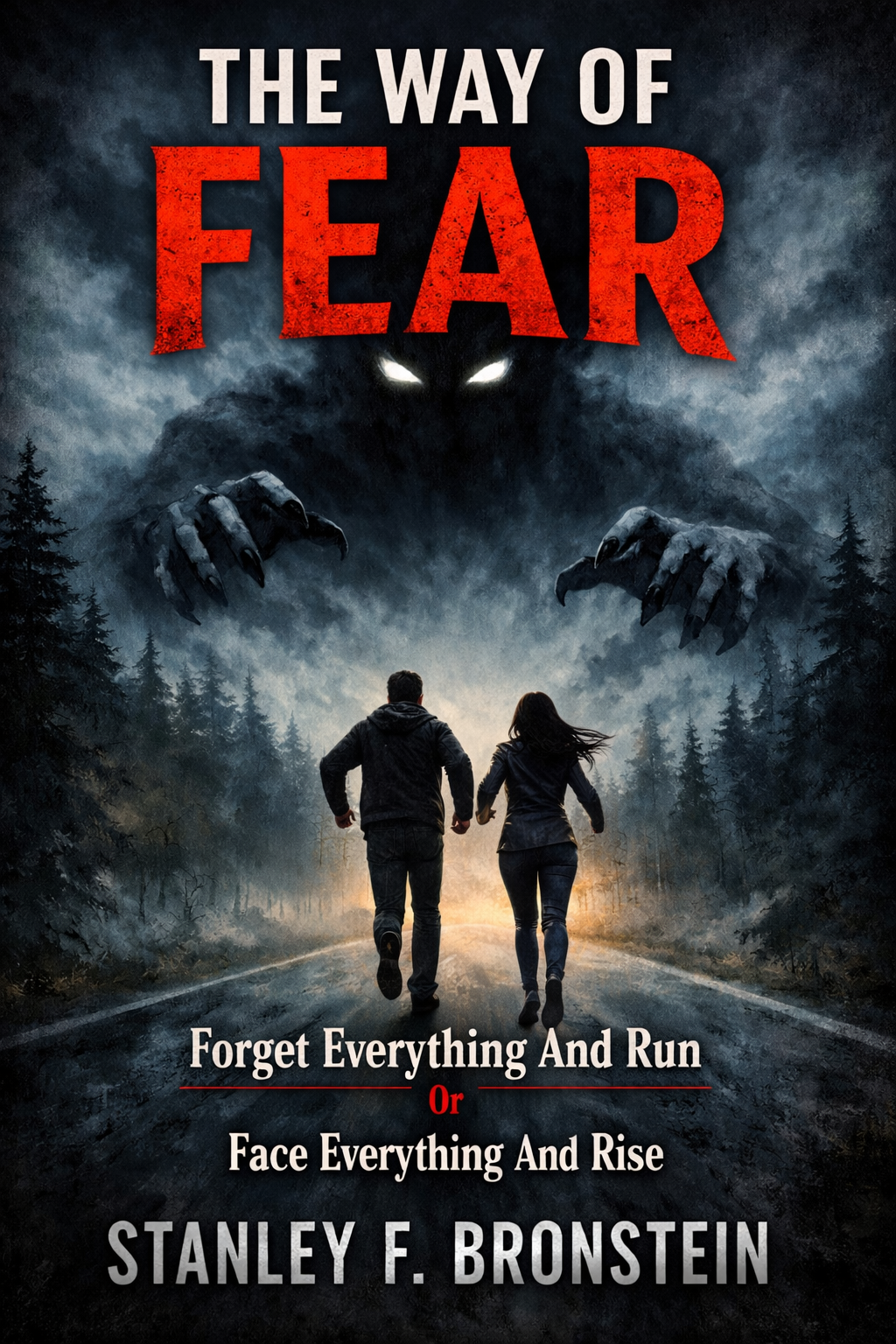
The Way of Fear
Forget Everything and Run
or
Face Everything and Rise
By Stanley F. Bronstein – Creator of The Way of Excellence System
Click The Tabs Below To Read Each Chapter Of The Book Online
Or
📘 Download Your Free Copy In Your Preferred Format
The Way of Fear
by Stanley F. Bronstein
How to use this page:
Click a chapter title to open it then scroll down to read.
When you click the title of the next chapter, the previous one will close.
Take your time.
Read, reflect, and do the experiments and assignments before you move on.
EMPTY ITEM
Foreword
Fear is one of the most powerful forces in human life.
It can stop a person before they begin. It can make a strong person feel weak, a capable person feel helpless, and a hopeful person imagine disaster before anything has even happened. It can cause people to stay silent when they need to speak, remain still when they need to act, and cling to what is familiar even when what is familiar is hurting them.
Fear can protect us. It can warn us. It can sharpen our awareness and remind us that life contains real risk. But fear can also mislead us. It can exaggerate danger, distort possibilities, and convince us that retreat is wisdom when retreat is really surrender.
That is why this book matters.
Much of human suffering is not caused by actual catastrophe. Much of it is caused by the anticipation of catastrophe. It is caused by imagined outcomes, projected embarrassment, rehearsed failure, and stories the mind tells before reality has had a chance to speak for itself. In that sense, fear is often exactly what the acronym says it is: False Evidence Appearing Real.
That does not mean all fear is fake. It means fear frequently appears far more solid, far more certain, and far more authoritative than it really is. It means the mind can take a possibility and treat it like a certainty. It means a shadow can be mistaken for a monster. It means a future event can begin controlling a present life before it has even occurred.
This book is about understanding that process.
It is also about choice.
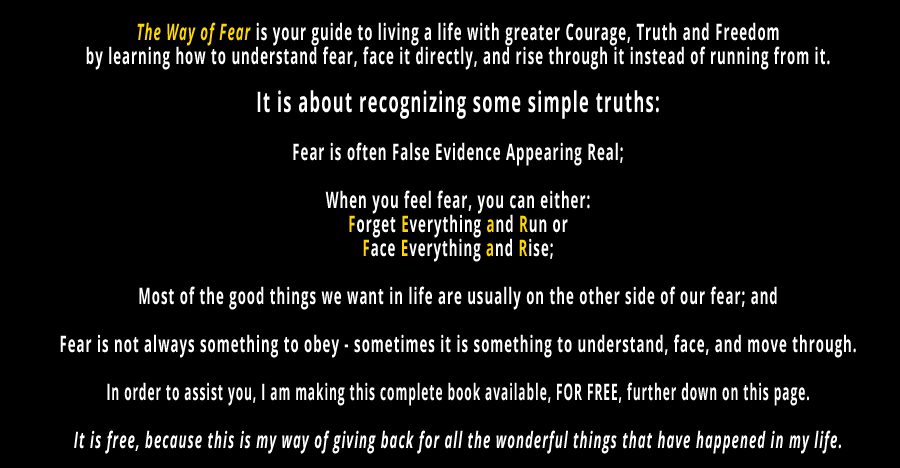
When you feel FEAR, you can either Forget Everything and Run, or Face Everything and Rise.
That choice is at the heart of this book.
When fear arises, many people have been conditioned to Forget Everything and Run. They freeze. They run. They shrink. They delay. They distract themselves. They overthink. They rationalize. They wait. They hope the fear will go away on its own. Sometimes they spend years doing this. Sometimes they spend decades doing this. Sometimes they build entire lives around avoiding what they fear.
That is one way to live.
To forget everything and run is to let fear take command. It is to let fear define reality, make decisions, and determine identity. It is to let fear become the voice of authority. It is to hand over control to something that may not even be telling the truth.
But there is another way.
That way is to Face Everything and Rise.
To face everything and rise is different. It does not mean pretending fear is not there. It does not mean becoming reckless. It does not mean denying pain, danger, uncertainty, or loss. It means facing reality honestly. It means refusing to let fear have the final word. It means standing in the presence of fear without automatically bowing to it. It means learning to move, think, decide, and live with courage even when fear is present.
That is what rising is.
Rising is not the absence of fear. Rising is the refusal to be ruled by it.
There is another reason this matters so much. Most of the good things we want in life are usually on the other side of our fear. The truth we need to tell is often on the other side of fear. The opportunity we want is often on the other side of fear. The freedom we crave is often on the other side of fear. The growth, strength, confidence, peace, love, purpose, and transformation we hope for are often waiting on the other side of the very thing we are most tempted to avoid.
That is why fear is such an important subject.
Fear is often the gatekeeper standing between us and the life we want. If we keep running from fear, we often keep running from the very life we are meant to live. We keep postponing our future. We keep delaying our growth. We keep making our lives smaller in exchange for temporary relief.
Temporary relief has a price.
It may feel easier in the moment to avoid the difficult conversation, delay the important decision, refuse the necessary change, hide from the challenge, or stay with the familiar even when the familiar is painful. But avoidance rarely makes fear smaller. More often, it makes fear stronger. It feeds fear. It trains fear. It teaches fear that it is in charge.
And while fear is in charge, life gets smaller.
This book is not written for people who never feel afraid. Those people do not exist. It is written for people who have felt fear in all its forms – fear of failure, fear of rejection, fear of judgment, fear of change, fear of loss, fear of aging, fear of death, fear of being seen, fear of not being enough, and sometimes even fear of becoming more than they ever imagined possible.
It is also written for people who are tired of letting those fears quietly shape their lives.
Some fears are obvious. Other fears wear disguises. Fear can look like procrastination. It can look like perfectionism. It can look like anger, control, indecision, avoidance, people-pleasing, silence, or staying busy so you never have to face what actually matters. It can hide behind caution. It can hide behind logic. It can even hide behind the story that “this is just who I am.”
But it is not just who you are.
Fear may visit you. Fear may pressure you. Fear may test you. Fear may even influence you more than you realize. But fear does not have to define you.
This book will help you understand what fear is, where it comes from, how it operates, what it costs, and how to face it more effectively. It will help you distinguish between fear that protects and fear that imprisons. It will help you see how worry magnifies suffering, how avoidance strengthens fear, and how action begins to dissolve it. It will show you that courage is not reserved for heroes in dramatic moments. Courage is available in everyday life – in telling the truth, making the call, taking the step, setting the boundary, starting the work, leaving what must be left, and becoming who you know you are capable of becoming.
In the pages ahead, you will see that fear is not always an enemy. Sometimes it is a signal. Sometimes it is a teacher. Sometimes it stands at the edge of growth, meaning, responsibility, or transformation. Sometimes the things that scare us most are the very things that reveal where we need to grow next. Sometimes fear marks the doorway to the exact life we want.
That does not make fear comfortable. But it does make fear meaningful.
The goal of this book is not to help you eliminate fear completely. That is neither realistic nor desirable. The goal is to help you understand fear so clearly that it stops controlling you unnecessarily. The goal is to help you become stronger, calmer, wiser, and more capable in the presence of fear. The goal is to help you build the kind of self-trust that allows you to move forward even when certainty is unavailable.
Because certainty is often unavailable.
Life contains risk. Change is real. Loss is real. Impermanence is real. The future cannot be fully controlled. But none of that means fear deserves to run your life.
You are stronger than that.
You are more capable than that.
And the life available to you on the other side of fear may be larger than you currently imagine.
So as you begin this book, I invite you to be honest. Look carefully at the fears that have shaped your choices, your habits, your relationships, your limitations, and your identity. Look at the ways fear may have made your life smaller than it needed to be. Look at the places where fear has spoken with a voice so familiar that you mistook it for truth.
Then prepare to challenge it.
Not with denial. Not with fantasy. Not with empty bravado.
With awareness. With honesty. With courage. With action. With persistence. With a willingness to face what is real and rise anyway.
Because the good things you want are usually on the other side of fear.
That is the work of this book.
That is the invitation before you.
And that is the deeper choice:
Will you Forget Everything and Run?
Or will you Face Everything and Rise?
INTRODUCTION TO PART I - UNDERSTANDING FEAR
Before fear can be faced effectively, it must be understood clearly.
That sounds simple, but most people do not understand fear nearly as well as they think they do. They feel it. They react to it. They obey it. They try to avoid it. They try to suppress it. They build habits and entire life patterns around it. But they rarely stop long enough to examine it carefully.
That is part of what makes fear so powerful.
Anything vague can become overwhelming. Anything poorly understood can begin to feel larger than life. Fear gains strength in confusion. It gains influence when it is left unnamed, unexplored, and unchallenged. It becomes easier to obey fear automatically when a person has never taken the time to ask basic but important questions.
What exactly is fear?
Where does it come from?
What is it trying to do?
When is it telling the truth?
When is it exaggerating?
When is it protecting us?
When is it limiting us?
These questions matter because fear is not one simple thing. Sometimes it is a wise signal. Sometimes it is a distorted signal. Sometimes it is an alarm that helps protect us from danger. Sometimes it is an old pattern firing in a new situation. Sometimes it comes from present reality. Sometimes it comes from past pain. Sometimes it comes from future imagination.
And if we do not learn to tell the difference, fear can begin to govern far more of our lives than it should.
Many people think fear is always weakness. It is not. Many people think fear is always truth. It is not. Many people think fear is always something to eliminate. It is not. Fear is more complex than that. It has a function. It has a purpose. But it also has limits. It can help us, and it can hurt us. It can sharpen us, and it can shrink us.
Part of the work of this book is to make fear less mysterious.
Another part is to make it less powerful by making it more visible.
In this first part, we will begin by looking directly at fear itself. We will examine what fear really is, the many forms it can take, where it comes from, how the mind feeds it, and how worry and anxiety can magnify it. We will begin separating fear from truth, fear from danger, fear from caution, and fear from wisdom.
This matters because clarity is one of the first steps toward freedom.
When fear is vague, it can feel enormous. When fear is examined, it often begins to change shape. It becomes more specific. More understandable. More workable. Sometimes it becomes smaller. Sometimes it reveals something important. Sometimes it exposes a real issue that needs attention. Sometimes it reveals that what felt overwhelming was not nearly as powerful as it first appeared.
That is why understanding fear is not a small thing. It is foundational.
If fear is going to play a role in your life, and it will, then you need to know what you are dealing with. You need to know whether fear is serving you or ruling you. You need to know whether it is helping you prepare or simply teaching you to hesitate. You need to know whether it is warning you about genuine danger or merely repeating old messages that no longer deserve authority.
This is where that process begins.
We start with understanding because a person cannot rise above what they refuse to examine. A person cannot face clearly what they only feel vaguely. And a person cannot move through fear wisely without first learning what fear is, how it works, and why it holds so much power over human life.
Most of the good things we want in life are on the other side of our fear. But before we can move through fear, we need to understand what we are moving through.
That is the purpose of Part I.
Chapter 1 - What Fear Really Is
Fear is one of the most misunderstood forces in human life.
Almost everyone has felt it. Almost everyone has reacted to it. Almost everyone has changed course because of it. Yet very few people stop long enough to ask a simple question:
What is fear, really?
That question matters more than it may first appear. If we do not understand fear, we are far more likely to obey it automatically. We are far more likely to confuse it with truth, mistake it for wisdom, and allow it to influence decisions it has no business making. We are also far more likely to build our lives around avoiding fear instead of understanding it.
Fear is not a minor subject. It shapes human behavior every day. It affects how people speak, how they work, how they love, how they lead, how they avoid, how they begin, how they quit, and how they imagine the future. It changes posture, tone of voice, breathing, decision-making, and perception. It can make a person hesitate, retreat, lash out, become silent, or do nothing at all.
Fear is powerful.
But power is not the same thing as truth.
That is one of the first things we need to understand.
Fear Is a Response to Perceived Threat
At its most basic level, fear is a response to perceived threat. That threat may be physical, emotional, social, financial, relational, psychological, or spiritual. The key word in that sentence is perceived.
Sometimes the threat is real and immediate. A car is coming too fast. A person is acting violently. The ground beneath you is unstable. Your body senses danger and prepares to respond. In those moments, fear serves an important purpose. It sharpens attention. It mobilizes energy. It helps protect life.
That kind of fear is not the enemy. It is part of how human beings survive.
But many of the fears that shape our lives are not responses to immediate physical danger. They are responses to anticipated embarrassment, possible rejection, imagined failure, uncertain change, future loss, or mental pictures of what might go wrong. In those cases, fear is still real as an experience, but the threat may not be real in the same way. It may be exaggerated. It may be distorted. It may be incomplete. It may be old. It may be imaginary. It may be borrowed from past pain. It may be based on something that has not happened and may never happen.
That is where fear becomes more complicated.
A person can feel fear in response to a real danger.
A person can also feel fear in response to a story.
And many people do not know the difference.
Fear Is Real, Even When the Danger Is Not
This is an important distinction.
When people hear the phrase False Evidence Appearing Real, they sometimes make the mistake of thinking that fear itself is unreal. That is not the point. The pounding heart is real. The tight chest is real. The racing thoughts is real. The urge to retreat is real. The internal experience of fear is often very real.
What may not be real is the conclusion fear is trying to sell.
Fear can make a possibility feel like a certainty. It can make discomfort feel like danger. It can make uncertainty feel like catastrophe. It can make temporary awkwardness feel like permanent ruin. It can make a difficult conversation feel like a life-threatening event. It can make one failed attempt feel like proof that nothing will ever work.
In that sense, fear often presents evidence that appears real, but is not fully true.
This is one reason fear can become so persuasive. It usually does not arrive as a calm suggestion. It arrives with urgency. It speaks in absolutes. It tells you something bad is about to happen. It tells you to pull back, stay safe, avoid risk, stay quiet, remain hidden, do not move, do not try, do not speak, do not trust, do not begin.
Fear often speaks with great confidence.
Confidence, however, is not proof.
Fear Is Often Future-Based
Many fears are not about what is happening now. They are about what might happen next.
That matters because much of fear lives in anticipation.
A person is afraid of the speech before the speech. Afraid of the conversation before the conversation. Afraid of the test before the test. Afraid of the decision before the decision. Afraid of the rejection before the rejection. Afraid of the loss before the loss. Afraid of the future before the future even arrives.
Fear often creates suffering in advance.
It moves the mind into tomorrow and then convinces the body that tomorrow is happening right now. The result is that a person begins reacting in the present to something that exists only in imagination.
This does not mean the future never matters. Of course it does. Wise preparation matters. Prudence matters. Planning matters. But fear is not the same as preparation.
Preparation says, “Let me get ready.”
Fear says, “Something terrible is coming.”
Preparation makes a person clearer.
Fear often makes a person smaller.
Preparation produces action.
Fear often produces hesitation.
These distinctions are subtle, but they are essential.
Fear Is Not the Same as Danger
Danger and fear are related, but they are not identical.
Danger is objective. Fear is subjective.
Danger refers to the threat itself. Fear refers to your response to the threat. Sometimes danger is present and fear is appropriate. Sometimes danger is present and fear is not useful because calm action is needed more than emotional escalation. Sometimes fear is present even though real danger is absent. And sometimes danger is present while a person feels very little fear at all.
This is important because many people live as though fear is proof of danger.
It is not.
Fear may signal danger. It may also signal uncertainty, inexperience, memory, insecurity, imagination, lack of control, or simple discomfort. If every feeling of fear is treated like proof that something is wrong, a person can become trapped in a very narrow life.
They avoid what feels uncomfortable.
They assume discomfort means stop.
They interpret fear as a final verdict.
And in doing so, they slowly hand over more and more of their lives to a misread signal.
Sometimes fear is pointing to danger.
Sometimes fear is pointing to growth.
Learning the difference is one of the great tasks of adulthood.
Fear Is Not the Same as Wisdom
Many people call their fear wisdom because that sounds more respectable.
They say they are “being realistic” when they are actually assuming defeat. They say they are “being careful” when they are actually avoiding discomfort. They say they are “waiting for the right time” when they are really afraid to begin. They say they are “thinking it through” when they are trapped in overthinking. They say they are “protecting themselves” when they are quietly surrendering their lives to fear.
Wisdom and fear are not the same thing.
Wisdom sees clearly.
Fear often magnifies selectively.
Wisdom considers risk honestly.
Fear often inflates risk dramatically.
Wisdom can move forward carefully.
Fear often wants retreat.
Wisdom asks, “What is true here?”
Fear asks, “What is the worst thing that could happen?”
Wisdom remains grounded.
Fear often becomes reactive.
This does not mean wise people never feel fear. Of course they do. It means they do not automatically call fear wisdom. They examine it. They test it. They question it. They do not assume that fear deserves authority merely because it feels intense.
Intensity is not intelligence.
Urgency is not wisdom.
Emotional volume is not truth.
Fear Is Not the Same as Intuition
This is another area of confusion.
People often use the words fear and intuition as though they are interchangeable. They are not.
Intuition is usually quieter. It is often clear, direct, and steady. Fear is often noisy, repetitive, dramatic, and urgent. Intuition may caution without panicking. Fear tends to escalate. Intuition often feels like knowing. Fear often feels like spiraling.
That said, the two can be difficult to separate, especially when a person is not used to paying close attention. Sometimes intuition warns of something real. Sometimes fear hijacks that signal and turns it into panic. Sometimes fear speaks first and loudest, making it harder to hear anything else.
This is one reason fear needs to be understood, not merely obeyed.
A person who never examines fear may mistake every alarm for intuition.
A person who dismisses all fear may ignore real warning signs.
A wiser path is to slow down and ask:
What exactly am I sensing?
What am I reacting to?
What is fact, and what is interpretation?
What in me is responding right now – fear, wisdom, intuition, memory, insecurity, or some combination of these?
That kind of self-examination creates clarity. And clarity is one of the best antidotes to fear’s distortions.
Fear Can Protect, but Fear Can Also Imprison
Fear has a legitimate function.
It helps a child pull back from a hot stove. It helps a driver slam on the brakes. It helps a person pay attention when something is truly wrong. It can help protect boundaries, heighten alertness, and support survival.
But what protects us in one context can imprison us in another.
Fear that keeps a person from stepping in front of a moving truck is useful.
Fear that keeps a person from telling the truth for ten years is not.
Fear that alerts a person to genuine abuse is useful.
Fear that keeps a person from ever trusting again may not be.
Fear that makes a person prepare carefully for a challenge can help.
Fear that convinces a person never to try can cripple a life.
This is where many people get stuck. They know fear has a protective role, so they assume all fear should be honored equally. But not all fear deserves the same response. Some fears should be listened to. Some fears should be questioned. Some fears should be managed. Some fears should be walked through directly.
The challenge is not eliminating fear.
The challenge is learning which fear is serving life and which fear is shrinking it.
Fear Changes Perception
One of the most powerful things fear does is change the way people see.
Fear narrows attention. It can make one possible problem seem like the only thing that matters. It can make a setback seem final. It can make a challenge seem larger than it is. It can make resources disappear from view. It can make options feel unavailable. It can make a person forget past victories, present strengths, and future possibilities.
Fear is often selective.
It highlights threat.
It minimizes capacity.
It enlarges risk.
It conceals options.
It edits reality in a way that supports retreat.
That is why fear is so often connected to distorted thinking. A fearful mind may imagine humiliation before a single word has been spoken. It may imagine disaster before the first step has been taken. It may assume rejection without evidence, failure without attempt, abandonment without conversation, or collapse without cause.
Fear does not always lie completely.
But it often tells a partial truth in a misleading way.
That is enough to cause enormous damage.
Fear Frequently Hides Behind Other Behaviors
Many people think they know when they are afraid.
Often they do not.
Fear does not always show up as obvious trembling, panic, or retreat. Sometimes it hides. Sometimes it puts on a costume and enters life under a different name.
Fear can look like procrastination.
Fear can look like perfectionism.
Fear can look like control.
Fear can look like indecision.
Fear can look like people-pleasing.
Fear can look like anger.
Fear can look like staying too busy.
Fear can look like refusing to commit.
Fear can look like waiting for perfect certainty.
Fear can look like never starting.
Fear can look like never stopping.
A person may call these things personality traits. Sometimes they are actually fear patterns.
The perfectionist may not simply love excellence. The perfectionist may be terrified of being judged. The chronic procrastinator may not be lazy. The procrastinator may be afraid of failing, succeeding, being seen, or discovering what they are truly capable of. The controlling person may not simply like order. That person may be deeply afraid of uncertainty. The people-pleaser may not merely be kind. That person may be afraid of rejection or conflict.
Fear is often more hidden than obvious.
This is why understanding fear requires honesty.
Not theoretical honesty.
Personal honesty.
Fear Can Become an Identity
A person can experience fear without becoming fearful as an identity.
But many people do not know how to keep that line clear.
They feel afraid often enough that they begin to describe themselves by fear. They begin saying things like “I am just an anxious person,” “I am not brave,” “I am not good at change,” “I am not a risk-taker,” “I am shy,” “I am not made for that,” or “That is just not who I am.”
Sometimes these statements describe patterns.
Sometimes they are prisons made of language.
The more often fear is obeyed, the more normal it begins to feel. The more normal it feels, the more it begins to look like personality. The more it looks like personality, the less likely it is to be challenged.
That is one of fear’s most effective strategies.
It does not merely want to influence behavior.
It wants to become self-description.
When that happens, a person stops saying, “I feel fear.”
Instead, the person begins saying, “This is who I am.”
That shift is dangerous because what we identify with, we tend to defend. Once fear becomes identity, growth feels like betrayal. Change feels unnatural. Courage feels fake. New action feels out of character. A person can end up protecting the very pattern that has been limiting them.
That is why fear must be seen clearly.
You are not every fear you feel.
You are not every alarm your nervous system sends.
You are not every catastrophic thought your mind produces.
You are not every old pattern that still visits you.
Fear may be present.
That does not mean fear is you.
Most Fear-Based Lives Are Built One Small Retreat at a Time
Very few people destroy their lives in one dramatic act of fear.
Most fear-based lives are built gradually.
One avoided conversation.
One delayed decision.
One opportunity declined.
One truth left unspoken.
One risk never taken.
One dream quietly abandoned.
One compromise repeated until it becomes normal.
That is how fear often works. Not through one great collapse, but through a thousand small retreats. Not through obvious surrender, but through quiet obedience. Not by shouting, but by whispering:
Not now.
Stay safe.
Do not say that.
Do not try.
Do not risk it.
Wait a little longer.
Maybe later.
Those whispers can shape decades.
That is why understanding fear matters so much. The better you understand it, the easier it becomes to catch it earlier. The easier it becomes to hear its voice without obeying it automatically. The easier it becomes to ask whether the fear in front of you is protecting your life or shrinking it.
Most of the Good Things We Want Are on the Other Side of Fear
This is one of the deepest reasons fear matters so much.
Most of the good things people want in life are usually on the other side of fear.
The conversation that could heal a relationship is often on the other side of fear.
The boundary that could restore self-respect is often on the other side of fear.
The work that could create meaning is often on the other side of fear.
The change that could produce freedom is often on the other side of fear.
The truth that could transform a life is often on the other side of fear.
The opportunity, growth, peace, love, strength, and possibility a person wants are often waiting just beyond the place where fear says, “Stop.”
That is why fear deserves serious attention.
Not because fear always means danger.
But because fear so often stands between people and the life they want.
If fear only made people uncomfortable, it would still matter.
But fear does more than that.
Fear can keep people from their future.
What Fear Really Is
So what is fear, really?
Fear is a response to perceived threat.
It is a real internal experience that may or may not correspond accurately to external reality.
It is sometimes protective, sometimes distorted, sometimes useful, sometimes limiting.
It often focuses on the future rather than the present.
It is not the same as danger, wisdom, or intuition, though it is often confused with all three.
It can sharpen awareness, but it can also distort perception.
It can alert, but it can also imprison.
It can remain a passing feeling, or it can harden into identity if repeatedly obeyed.
And perhaps most importantly, fear is not always telling the truth.
That does not mean it should be ignored.
It means it should be understood.
Because the moment you begin to understand fear more clearly, you begin to weaken one of its greatest advantages – confusion.
And once confusion begins to fade, something else becomes possible.
You can begin to see fear for what it is.
You can begin to question it.
You can begin to separate signal from distortion.
You can begin to stop calling every discomfort danger.
You can begin to stop handing fear automatic authority.
And that is where freedom begins.
Assignment
Step 1 – Name Three Current Fears
Write down three fears that are active in your life right now. Be specific. Do not write vague answers like “the future” or “change.” Write the actual fear as clearly as you can.
Step 2 – Describe the Threat
For each fear, write down what you believe the threat is. What exactly do you think might happen? What outcome are you afraid of?
Step 3 – Separate Present Reality from Future Imagination
For each fear, ask yourself whether the threat is happening right now, might happen in the future, or is connected to something that happened in the past. Be honest.
Step 4 – Distinguish Danger from Discomfort
Look at each fear and ask whether it points to actual danger or to discomfort, uncertainty, embarrassment, loss of control, or possible rejection. This step matters.
Step 5 – Identify the Story
Write down the story fear is telling you about each situation. What is fear saying? What conclusion is it trying to get you to accept?
Step 6 – Challenge Fear’s Authority
For each fear, ask: Is this fear protecting me, limiting me, or both? Do not assume fear is right just because it feels strong.
Step 7 – Write a Closing Statement
End this exercise by writing the following sentence in your own words:
“I may feel fear, but fear does not automatically tell me the truth.”
Chapter 2 - The Many Faces of Fear
Fear rarely announces itself honestly.
That is one of the reasons it is so difficult to deal with. If fear always appeared in obvious form, it would be easier to recognize. If it always showed up as a pounding heart, shaking hands, or a clear urge to run away, most people would have a better chance of naming it and facing it. But fear is often more subtle than that. It is often disguised. It often enters life wearing a different face.
A person may think the problem is laziness when the real problem is fear.
A person may think the problem is confusion when the real problem is fear.
A person may think the problem is perfectionism, indecision, irritability, procrastination, overworking, people-pleasing, or controlling behavior when, underneath it all, fear is the deeper force driving the pattern.
Fear is highly adaptable.
It does not need to be obvious to be powerful. In fact, it is often more powerful when it remains hidden. The less clearly it is seen, the more easily it can operate. It can shape decisions, habits, relationships, and identity while remaining unnamed. A person can spend years fighting symptoms without ever facing the deeper issue underneath them.
That is why understanding the many faces of fear matters so much.
If we do not know how fear disguises itself, we will keep misreading our own lives.
Fear Does Not Always Look Like Fear
Most people have a picture in their minds of what fear looks like. They imagine panic, trembling, avoidance, or visible distress. Sometimes fear does look like that. But often it does not.
Sometimes fear looks polished.
Sometimes fear looks productive.
Sometimes fear looks reasonable.
Sometimes fear looks responsible.
Sometimes fear looks like a person who seems calm on the outside while quietly arranging an entire life around what must be avoided.
That is important to understand because many fear-based lives do not look dramatic. They look normal. They look functional. They look respectable. The person shows up, gets things done, handles obligations, and keeps moving. But underneath the surface, fear may be making many of the key decisions. Fear may be determining what risks are not taken, what truths are not spoken, what opportunities are not pursued, what changes are not made, what dreams are not tested, and what parts of the self are never fully expressed.
That kind of fear can be especially dangerous because it hides in plain sight.
It becomes part of the normal rhythm of life.
And what feels normal is rarely challenged.
Fear as Procrastination
One of the most common disguises fear wears is procrastination.
A person tells himself that he will do it later. A person tells herself that now is not the time. There is always another reason, another delay, another condition that must be met first. More time is needed. More clarity is needed. More confidence is needed. More preparation is needed. More certainty is needed.
Sometimes delay is wise.
Very often, it is fear.
The person is not merely postponing a task. The person is postponing exposure. Postponing vulnerability. Postponing the possibility of failure. Postponing the discomfort of beginning. Postponing the moment when imagination gives way to reality.
That is why procrastination often attaches itself to meaningful things. People do not usually procrastinate equally across every area of life. They tend to procrastinate around what matters, where evaluation is possible, where the stakes feel personal, or where action would force them to confront uncertainty.
The business is not launched.
The book is not started.
The conversation is not had.
The application is not sent.
The boundary is not set.
The health issue is not addressed.
The call is not made.
And the person says, “I just keep putting it off.”
Perhaps.
But often what is really happening is this:
“I am afraid of what will happen once I begin.”
Procrastination is often fear asking for more time.
The problem is that fear rarely becomes weaker just because more time passes. In many cases, it becomes stronger. Delay gives fear more room to build stories, add pressure, and magnify risk. What might have been manageable at the start begins to feel enormous.
That is why procrastination is not always a time-management problem.
Often it is a fear problem.
Fear as Perfectionism
Perfectionism is another face of fear.
On the surface, perfectionism may look admirable. It can appear to be high standards, excellence, care, and effort. Sometimes it does involve those things. But perfectionism is not the same as excellence. Excellence seeks to do things well. Perfectionism often seeks to avoid being judged, exposed, criticized, or found lacking.
That is a very different motive.
The perfectionist may tell a story about quality. Underneath that story is often a fear of inadequacy. If it is flawless, maybe no one will criticize it. If it is polished enough, maybe it cannot be rejected. If it is prepared enough, maybe it cannot fail. If it is delayed long enough, maybe the person never has to risk being seen before feeling ready.
Perfectionism often sounds noble.
But it frequently functions as avoidance.
It keeps work hidden.
It keeps action delayed.
It keeps a person in endless revision.
It creates the illusion of responsibility while often preventing completion.
The perfectionist may say, “It is not ready yet.”
Sometimes that is true.
Sometimes what is really meant is, “I am not ready to be judged.”
This is why perfectionism can become so crippling. It creates a moving target that can never quite be reached. There is always one more adjustment, one more improvement, one more reason to wait. The standard keeps rising. The fear keeps hiding behind that rising standard. And the person remains stuck in preparation instead of participation.
Perfectionism is often fear in refined clothing.
Fear as Indecision
Fear also shows up as indecision.
Some people do not avoid by running away. They avoid by never quite deciding. They circle. They consider. They compare. They analyze. They ask for more information. They revisit what they already know. They keep options open. They delay commitment. They wait for perfect clarity.
At first glance, this can look thoughtful.
Sometimes it is.
But there comes a point where indecision is no longer wisdom. It becomes a strategy for avoiding responsibility, risk, and loss. After all, every real decision closes off other options. Every real decision creates exposure. To choose is to risk being wrong. To choose is to live with uncertainty. To choose is to leave the protected world of endless possibility and enter the vulnerable world of actual action.
Fear dislikes that.
Fear prefers delay.
Fear prefers maybe.
Fear prefers keeping all doors open because that way no real step must be taken.
The indecisive person may think the problem is not knowing enough. Often the deeper problem is not wanting to feel the discomfort that comes with deciding.
Indecision is not always a lack of intelligence.
Very often it is fear of consequence wearing the face of caution.
Fear as Control
Some fear does not withdraw.
Some fear tightens its grip.
It tries to control everything.
When fear expresses itself through control, the person may become rigid, demanding, over-managing, or unable to relax when life feels uncertain. Details matter too much. Plans must be followed too exactly. People must behave predictably. Environments must feel manageable. The unexpected becomes deeply upsetting.
Why?
Because control often becomes a substitute for trust.
A person who fears uncertainty may try to reduce uncertainty by controlling circumstances, people, outcomes, and impressions. If everything can be organized, anticipated, and regulated, perhaps nothing painful will happen. If people can be managed, perhaps they cannot disappoint. If every variable can be monitored, perhaps nothing will go wrong.
Of course, life does not cooperate with that demand.
Life contains uncertainty whether we welcome it or not.
The controlling person is often not just demanding. That person is often afraid. Afraid of chaos. Afraid of helplessness. Afraid of surprise. Afraid of loss. Afraid of being caught unprepared. Afraid of what might happen if things are not tightly managed.
Control is often fear trying to build a fortress against uncertainty.
The tragedy is that the fortress rarely brings peace. It usually brings tension. It exhausts the person trying to maintain it. It strains relationships. It narrows life. It replaces trust with vigilance and flexibility with rigidity.
Control is often fear trying to feel safe by mastering everything it cannot actually master.
Fear as Anger
Fear does not always collapse inward.
Sometimes it strikes outward.
That is where anger comes in.
Many people think of fear and anger as separate emotions. Often they are deeply related. Anger can become the armor fear wears when vulnerability feels too dangerous. For some people, it is easier to be sharp than exposed, easier to criticize than confess uncertainty, easier to dominate than admit hurt, easier to blame than acknowledge fear.
Anger creates energy.
It creates movement.
It creates the feeling of power.
That can make it attractive to a fearful person.
If fear says, “I feel threatened,” anger says, “I will not be threatened.” If fear says, “I feel small,” anger says, “I will become forceful.” If fear says, “I do not know what to do,” anger says, “At least I can attack.”
This does not mean all anger comes from fear. But a great deal of anger does. Irritability, defensiveness, aggression, constant criticism, impatience, and harshness often have fear somewhere underneath them. Fear of being wrong. Fear of losing control. Fear of appearing weak. Fear of being ignored. Fear of not being respected. Fear of being exposed.
When anger is treated only as anger, the deeper issue may remain untouched. But when anger is examined honestly, it often reveals an underlying vulnerability that has not been acknowledged.
Sometimes the loudest person in the room is also the most afraid.
Fear as People-Pleasing
Another common disguise for fear is people-pleasing.
The people-pleaser may appear generous, agreeable, and easygoing. Sometimes these qualities are genuine. But often underneath them is fear. Fear of conflict. Fear of disapproval. Fear of abandonment. Fear of being seen as selfish, difficult, or unworthy. Fear of losing connection by telling the truth.
So the person adjusts.
The person softens.
The person says yes when the real answer is no.
The person overexplains.
The person avoids disappointing others and quietly disappoints self instead.
People-pleasing is often presented as kindness. Sometimes it is actually fear of rejection. The person is not simply trying to be loving. The person is often trying to stay safe in the eyes of others. Approval becomes protection. Harmony becomes protection. Being needed becomes protection.
The problem is that this strategy usually comes at a cost.
Truth gets buried.
Boundaries get weakened.
Resentment grows.
Authenticity suffers.
The self becomes less visible.
Fear tells the people-pleaser that honesty is dangerous and displeasing others is catastrophic. That is why people-pleasing can persist for years. It feels safer to disappear a little than to risk directness. But over time, the price becomes enormous. A person can become skilled at maintaining peace while losing touch with what is actually true.
That is not peace.
That is fear negotiating for temporary approval.
Fear as Staying Busy
Some people do not face fear because they never slow down long enough to notice it.
They stay busy.
They fill every gap.
They keep moving, producing, scrolling, working, fixing, helping, solving, and responding. On the surface, this may look like diligence or ambition. Sometimes it is. But sometimes busyness is a highly effective way to avoid what is uncomfortable inside.
A quiet moment might bring up grief.
Stillness might reveal anxiety.
Space might expose dissatisfaction.
Silence might bring forward questions that have been postponed for years.
So the person remains in motion.
Not because every task is necessary, but because stillness feels dangerous.
Busyness can become a socially rewarded form of avoidance. A person can hide from fear while being praised for productivity. But activity is not the same as peace. Motion is not the same as clarity. A crowded life can still be a fear-driven life.
Fear often prefers noise to reflection.
Because reflection might lead to truth.
And truth might require change.
Fear as Withdrawal
For other people, fear expresses itself by pulling away.
They stop participating.
They become less visible.
They retreat from challenge, intimacy, responsibility, risk, or opportunity. Sometimes the withdrawal is obvious. Sometimes it is subtle. They are physically present but emotionally absent. They say little. They volunteer for little. They reveal little. They attempt little. They protect themselves by limiting exposure.
Withdrawal can feel safe because it reduces the chance of immediate discomfort. If you do not speak, you cannot say the wrong thing. If you do not try, you cannot fail publicly. If you do not get close, you cannot be hurt as deeply. If you do not step forward, you cannot be rejected in the same way.
But withdrawal has a hidden cost.
It reduces pain in the short term by reducing life in the long term.
The withdrawn person may feel protected, but also lonely, stagnant, underused, and unseen. Fear offers protection by demanding absence. It says, “Stay back and you will not get hurt.”
Perhaps.
But staying back often means not fully living.
Fear as Overthinking
Overthinking is another face of fear.
The overthinker may believe that enough thought will eventually create certainty. If every angle is examined, every risk considered, every possible outcome imagined, perhaps a perfect path will appear and all discomfort will disappear.
It rarely works that way.
Overthinking often creates the illusion of progress while preventing action. The person feels mentally engaged, but the deeper pattern is still avoidance. Thought is being used to delay exposure. Analysis becomes a shield against uncertainty. The person keeps trying to solve emotionally what can only be resolved experientially.
Fear loves this.
It would rather have a person stuck in endless internal debate than moving forward into reality.
The problem with overthinking is not that thinking is bad. Deep thought can be valuable. Careful reflection matters. But overthinking is different. Overthinking loops. It circles. It rehearses. It magnifies. It imagines. It delays. It confuses motion in the mind with motion in life.
The overthinker is often not seeking truth anymore.
The overthinker is seeking relief from uncertainty.
And certainty rarely arrives in the amount fear demands.
Fear as Self-Sabotage
There are times when fear becomes even more indirect.
It creates self-sabotage.
The person gets close to something meaningful and then disrupts it. A good opportunity appears and the person delays, withdraws, performs poorly, misses deadlines, picks a fight, breaks consistency, stops showing up, or creates chaos just before progress becomes real.
Why would someone do that?
Because success brings exposure too.
Change brings responsibility.
Growth brings visibility.
A new life brings unfamiliar demands.
Some people do not only fear failure. They fear what would be required if things actually worked. They fear losing excuses. They fear higher expectations. They fear becoming more visible. They fear the discipline and accountability that new levels of life might require.
So fear intervenes.
It damages the thing before the thing can fully arrive.
That way the person gets to stay in the familiar territory of longing without fully entering the vulnerable territory of becoming.
Self-sabotage is often fear protecting an old identity.
It is fear saying, “Do not go so far that you cannot go back.”
Fear of Failure
One of the clearest faces fear wears is fear of failure.
This fear is common because failure feels personal. It can trigger shame, embarrassment, self-doubt, and exposure. Many people would rather remain in possibility than face a visible attempt that does not work. They would rather not try than try and be seen falling short.
So they hold back.
They under-commit.
They stay half-invested.
They postpone action.
They keep the dream theoretical.
That way, if nothing happens, they can say it was never fully attempted.
Fear of failure often sounds like this:
“What if I cannot do it?”
“What if I look foolish?”
“What if I am not as capable as I hoped?”
“What if this proves something bad about me?”
These are not small questions. But avoiding them does not solve them. It only gives them more power. In many cases, fear of failure creates a different kind of failure: the failure to attempt, the failure to grow, the failure to learn, the failure to discover what might have been possible.
Failure may hurt.
But unlived potential hurts too.
And often it lasts longer.
Fear of Rejection
Another face fear frequently wears is fear of rejection.
This fear reaches deeply into relationships, work, creativity, truth-telling, leadership, and self-expression. It keeps people from speaking honestly, asking for what they need, sharing what they made, offering what they know, or becoming more fully visible.
Why?
Because rejection feels like danger to many people.
Not physical danger, but social and emotional danger. A person may fear being excluded, dismissed, laughed at, ignored, misunderstood, or abandoned. The nervous system can react strongly to these possibilities, even when no immediate threat exists.
Fear of rejection teaches people to edit themselves.
Do not say too much.
Do not ask.
Do not reveal.
Do not risk being seen clearly.
Fit in.
Blend in.
Stay acceptable.
This strategy may reduce immediate discomfort.
But it often creates long-term emptiness.
A person can become accepted for a version of self that is only partially real. That is a painful trade. To avoid rejection from others, the person begins rejecting self first. Over time, that can feel normal. But it is still loss.
Fear of rejection often creates a quieter kind of loneliness.
The loneliness of being present but not fully known.
Fear of Judgment
Fear of judgment is closely related to fear of rejection, but it deserves separate attention.
Some people are not primarily afraid of being left. They are afraid of being evaluated. They fear being looked at, measured, criticized, compared, or found lacking. This fear can show up in performance, creativity, leadership, speaking, writing, appearance, career choices, and personal decisions.
It causes people to stay hidden.
It causes them to keep their real opinions softer, their real ambitions smaller, their real selves more carefully managed.
It tells them that exposure is dangerous.
If others see too much, they may judge.
If they judge, it may hurt.
So better to remain somewhat concealed.
Fear of judgment can become a prison because it gives enormous power to imagined observers. A person begins living in response to an internal audience. What will they think? What will they say? How will this look? Will I be embarrassing? Will I appear foolish? Will I seem inadequate? The person ends up relating not to life itself, but to anticipated commentary about life.
That is exhausting.
And it often has nothing to do with present reality.
Many people are living in response to judgments that have not even occurred.
Fear of Change
Fear also wears the face of resistance to change.
Even painful situations can feel safer than unfamiliar ones. A bad job may feel safer than a new path. An unhealthy pattern may feel safer than growth. An unsatisfying relationship may feel safer than the uncertainty of leaving. Familiar pain often feels easier to manage than unfamiliar possibility.
This is one reason people stay where they have already suffered.
The known may be difficult, but at least it is known.
Fear of change is rarely about change alone. It is usually about what change might require. New identity. New responsibility. New learning. New discomfort. New expectations. New uncertainty. A new life may sound appealing in theory, but it can feel deeply destabilizing in practice.
So fear says, “Stay where you are.”
Not because where you are is good.
But because where you are is familiar.
This is one of fear’s most effective arguments.
It does not need to make the present wonderful.
It only needs to make the unknown feel worse.
Fear of Being Seen
One of the deepest faces fear wears is fear of being seen.
Not just looked at.
Seen.
Seen in your truth.
Seen in your ambition.
Seen in your need.
Seen in your talent.
Seen in your imperfection.
Seen in your real voice, real values, real convictions, real desires, real gifts.
To be seen is vulnerable because visibility invites response. If people really see you, they may love you, misunderstand you, need you, envy you, criticize you, reject you, or expect more from you. Being unseen protects against some of those risks. It also blocks the possibility of real connection, real contribution, and real freedom.
Many people want to be known, but fear what it would cost to become visible.
So they stay partially hidden.
They speak in safe language.
They reveal only what is manageable.
They show enough to function, but not enough to be truly known.
Fear of being seen is powerful because it can make a person betray the very self that wants expression.
Fear Can Wear a Hundred Costumes
The deeper point of this chapter is simple.
Fear can wear a hundred costumes.
It can look like withdrawal or aggression.
It can look like over-preparation or avoidance.
It can look like silence or endless talking.
It can look like pleasing others or controlling them.
It can look like staying busy or never starting.
It can look like overthinking or shutting down.
It can look like perfectionism, procrastination, indecision, anger, self-sabotage, or constant caution.
That is why fear is so often missed.
People look for one face.
Fear arrives with many.
And unless we learn to recognize those many faces, we will keep trying to fix behaviors without addressing the deeper force beneath them.
The Question Beneath the Behavior
When a pattern keeps repeating in life, it is worth asking a deeper question:
What if this is not just a habit problem?
What if it is not just a personality trait?
What if it is not just poor timing, lack of clarity, or bad luck?
What if fear is underneath it?
That question can change everything.
Because the moment fear is named, something shifts. A person may still feel it, but the fog begins to clear. The behavior is no longer just frustrating. It becomes understandable. The real issue comes into view. And once the real issue comes into view, wiser action becomes possible.
This does not mean every difficult behavior is caused by fear.
But many are.
Far more than most people realize.
And until fear is identified, it will continue operating from the shadows.
Facing Fear Begins with Recognition
Before fear can be challenged, it must be recognized.
Not in theory.
In practice.
In your life.
In your habits.
In your language.
In your excuses.
In your delays.
In your relationships.
In your patterns of retreat, control, pleasing, analyzing, hiding, and withholding.
Fear becomes less powerful when it becomes more visible.
A hidden fear can run a life.
A named fear can be examined.
An examined fear can be questioned.
A questioned fear can begin to lose its automatic authority.
This is why recognition matters so much.
If fear only looked like panic, far fewer people would be trapped by it.
But fear has many faces.
Learning to recognize them is one of the first acts of freedom.
Assignment
Step 1 – Identify One Repeating Pattern
Choose one repeating pattern in your life that frustrates you. It may be procrastination, perfectionism, indecision, overthinking, people-pleasing, anger, withdrawal, controlling behavior, or something else.
Step 2 – Describe the Pattern Honestly
Write down exactly what the pattern looks like in real life. When does it happen? What do you do? What do you avoid? What usually happens next?
Step 3 – Ask What Fear Might Be Underneath It
Now ask yourself: If fear is underneath this pattern, what might I be afraid of? Be specific. Possible answers might include Fear of Failure, Fear of Rejection, Fear of Judgment, Fear of Conflict, Fear of Change, Fear of Being Seen, or Fear of Loss of Control.
Step 4 – Name the Cost
Write down what this fear-based pattern is costing you. Consider time, peace, opportunities, relationships, growth, confidence, and self-respect.
Step 5 – Identify the Payoff
Be honest about what this pattern gives you in the short term. Does it reduce discomfort? Delay exposure? Protect you from criticism? Help you avoid uncertainty? The payoff matters because fear patterns usually survive by offering temporary relief.
Step 6 – Write the Truth
Finish this sentence in writing:
“This pattern may look like __________, but underneath it may be fear of __________.”
Step 7 – Choose One Small Act of Recognition
For the next seven days, pay close attention to this pattern each time it appears. Do not try to fix everything yet. Just notice it, name it, and say to yourself:
“This may be one of the faces of fear.”
Chapter 3 - Where Fear Comes From
Fear does not come from only one place.
That is important to understand because many people talk about fear as though it were a single thing with a single cause. It is not. Fear can come from biology. It can come from memory. It can come from past pain. It can come from family patterns, social conditioning, repeated messages, traumatic experiences, and personal interpretations. It can come from what happened to you. It can come from what you watched happen to someone else. It can come from what you were taught to expect. It can come from what you learned to avoid.
If we want to understand fear deeply, we have to go beyond the feeling itself and ask a more important question:
Where did this fear come from?
That question matters because fear is easier to work with when its roots are better understood. A fear that comes from immediate danger needs one kind of response. A fear that comes from an old wound may need another. A fear that comes from repeated family messaging may require a different kind of awareness altogether. The more clearly we understand where fear is coming from, the less likely we are to treat every fear as though it means the same thing.
Not all fear is original.
Much of it is learned.
Much of it is inherited.
Much of it is repeated.
Much of it is reinforced over time until it feels natural, automatic, and unquestionable.
That is part of why fear can become so powerful. It often begins long before we are mature enough to examine it clearly.
Some Fear Is Biological
At the most basic level, human beings are wired for survival.
The body is built to notice threat, respond quickly, and protect life. Long before a person can philosophize about fear, the nervous system is already doing its job. It scans for danger. It reacts to sudden changes. It prepares the body to fight, flee, freeze, or brace. In that sense, some fear is deeply biological.
This is not a flaw.
It is part of being alive.
If a car swerves into your lane, you do not need to stop and think through a motivational speech. Your body reacts. If you hear a sound in the dark that seems threatening, your system becomes alert. If something feels unstable beneath your feet, you tense. These rapid responses are part of human survival.
The problem is not that the body reacts.
The problem is that the body can react to perceived threat, not just actual threat.
That means the same biological machinery that protects us in moments of real danger can also activate in moments of social discomfort, emotional uncertainty, remembered pain, or imagined catastrophe. The body does not always wait for a careful philosophical analysis. It responds to signals. Sometimes those signals are accurate. Sometimes they are distorted. Sometimes they are old.
This is one reason fear can feel so convincing. It is not just an idea. It often comes with real physical sensations. The heart speeds up. Muscles tighten. Breathing changes. The stomach reacts. Attention narrows. A person feels activated. That bodily activation can make fear feel unquestionably true even when the danger is not what it appears to be.
So yes, some fear is biological.
But biology is only the beginning.
Some Fear Is Learned Early
A great deal of fear is learned in childhood.
Children come into the world dependent, impressionable, and highly observant. They learn not only from what they are directly taught, but from what they repeatedly witness. They watch how adults react. They notice what causes tension. They absorb emotional tone. They learn what is safe to say, what is risky to express, what brings approval, what invites punishment, what gets ignored, and what must be hidden.
Long before people can explain their fear, they may already be shaped by it.
A child who grows up around chronic criticism may learn to fear mistakes.
A child who grows up around volatility may learn to fear conflict.
A child who grows up around emotional distance may learn to fear vulnerability.
A child who is mocked when expressing strong feelings may learn to fear honesty.
A child raised around scarcity, panic, or instability may learn to fear uncertainty.
A child who receives love mainly through performance may learn to fear failure and rejection at the deepest level.
These fears may not be consciously chosen. They may simply become woven into the person’s way of being. Over time, the person forgets that the pattern was learned and begins to experience it as personality.
That is how early fear often works.
It becomes normal before it is ever examined.
Family Systems Teach Fear
Families do not only pass along genes, habits, and beliefs.
They also pass along fear.
Some families teach fear loudly.
Other families teach fear quietly.
Some do it through direct warnings. Be careful. Do not trust people. Do not embarrass yourself. Do not take risks. Stay close. Stay safe. Do not upset anyone. Do not think too highly of yourself. Do not expect too much. Do not speak too openly. Do not challenge authority. Do not stand out.
Other families teach fear less directly. A parent who constantly worries teaches fear. A parent who panics teaches fear. A parent who avoids conflict teaches fear. A parent who needs control teaches fear. A parent who says one thing but communicates another through tone, tension, silence, or emotional withdrawal teaches fear.
Children do not need formal instruction to absorb these messages.
Repeated exposure is enough.
Family systems can teach a person what is dangerous long before that person has the maturity to question whether the lesson is accurate. In some families, the central fear may be financial insecurity. In others it may be social shame. In others it may be emotional exposure, conflict, failure, disobedience, abandonment, or instability. Whatever the dominant fear is, it often gets transmitted through the daily emotional atmosphere of the home.
Then it gets carried forward.
A person grows up and still reacts as though the old emotional rules are in force.
Do not upset people.
Do not fail.
Do not ask for too much.
Do not be too visible.
Do not trust.
Do not relax.
Do not hope too much.
Do not expect safety.
Do not be yourself too fully.
These messages are not always spoken.
But they are often learned.
Social Conditioning Strengthens Fear
Fear is not shaped only by family. It is shaped by culture as well.
Society teaches people what to fear. It teaches them what is acceptable and unacceptable, admirable and shameful, safe and risky, desirable and threatening. Social conditioning influences everything from body image to career decisions to status anxiety to fear of judgment and exclusion.
People learn very quickly that social belonging matters.
They learn that being laughed at hurts.
They learn that being excluded hurts.
They learn that being labeled, misunderstood, or dismissed hurts.
They learn that approval carries rewards and disapproval carries consequences.
Over time, social fear becomes deeply embedded. A person may begin editing self-expression to stay acceptable. Ambition may be reduced to avoid criticism. Honesty may be softened to avoid tension. Dreams may be made smaller to avoid being seen as unrealistic. Convictions may be hidden to avoid standing alone.
This is not merely individual weakness.
It is the power of social conditioning.
Human beings are affected by what groups reward and punish. The desire to belong is powerful. The fear of being cast out, ridiculed, or seen as inadequate can shape a life more than many people realize.
That is why fear of judgment is so common.
It is why fear of rejection runs so deep.
And it is why so many people build lives that look acceptable on the outside while feeling constrained on the inside.
Past Pain Leaves an Emotional Mark
Fear often comes from pain that was never fully resolved.
When something painful happens, the mind and body remember. A betrayal, humiliation, loss, failure, rejection, or shock can leave an emotional imprint. Even if the event itself is over, the system may still brace against anything that feels similar.
A person who was deeply embarrassed in public may later fear visibility.
A person who trusted and was betrayed may later fear intimacy.
A person who failed badly in one season may later fear trying again.
A person who lost something precious may later fear attachment.
A person who was punished for honesty may later fear telling the truth.
This does not necessarily mean the person is weak or irrational. It means the system learned something from pain and now tries to prevent repetition.
The problem is that pain does not always teach balanced lessons.
Sometimes it teaches distorted ones.
One rejection becomes “No one will want me.”
One humiliation becomes “I should stay hidden.”
One failure becomes “I am not capable.”
One betrayal becomes “No one can be trusted.”
One painful ending becomes “Love is dangerous.”
Pain often speaks in overgeneralizations.
Fear repeats them.
That is how one experience can begin influencing many future situations that are not actually the same.
Repeated Avoidance Strengthens Fear
One of the most important things to understand about fear is that it grows when it is repeatedly obeyed.
Avoidance may bring temporary relief, but it often strengthens the fear underneath. When a person avoids what feels threatening, the nervous system receives a message: that must have been dangerous. The avoidance seems to confirm the fear. Relief follows. That relief feels good, so the pattern is repeated. Over time, the fear becomes more entrenched.
This is one reason fear can expand.
A person avoids one uncomfortable thing, then another, then another. The life becomes smaller, but the fear feels more justified. What was once a manageable discomfort becomes a growing territory of avoidance.
The person avoids one difficult conversation.
Then many.
Avoids one public speaking opportunity.
Then all visibility.
Avoids one risk.
Then most risks.
Avoids one relationship after pain.
Then vulnerability itself.
This is how fear learns to dominate.
Not only through painful events, but through repeated retreat.
Each retreat teaches the system that escape is necessary. That is why fears left unchallenged often do not fade on their own. They become more familiar, more automatic, and more woven into daily life.
Avoidance is one of fear’s favorite teachers.
Fear Can Come from Imagination Without Grounding
Not all fear begins with an actual event.
Some fear begins with imagination.
Human beings have the remarkable ability to imagine the future. That ability can be useful. It allows planning, creativity, anticipation, and preparation. But imagination can also create fear when it is not grounded in reality. The mind can rehearse disaster, anticipate humiliation, picture failure, predict abandonment, and mentally construct threats that have never occurred.
Then the body reacts.
This kind of fear can be especially confusing because nothing may have actually happened. The person is not responding to a memory of pain, but to a mental projection. Yet the projection can feel powerful enough to shape behavior as if the threat were already real.
A person imagines being rejected and never asks.
Imagines failing and never begins.
Imagines conflict and never speaks.
Imagines shame and never shows the work.
Imagines loss and never commits.
Imagination is powerful.
That power can either serve life or shrink it.
Without grounding, imagination can become a factory for fear.
Trauma and Ordinary Fear Patterns Are Not the Same
It is important to say clearly that not all fear is the same.
Some fears arise from ordinary life experience, social conditioning, repeated messages, or common disappointments. Other fears are tied to trauma. Trauma can alter the way a person experiences threat, safety, trust, and regulation. It can affect the nervous system deeply and make certain responses more immediate, intense, and persistent.
This distinction matters.
Not every fear pattern should be treated casually.
Not every fearful response can be resolved through simple insight or encouragement.
Some forms of fear require patience, skill, safety, support, and deeper healing work.
This book is not meant to flatten all fear into one category. It is meant to help people understand that fear has many roots and many forms. Some fear patterns can be addressed through awareness, honesty, action, and repetition. Some require more careful healing. Some require both.
What matters here is not oversimplifying.
What matters is recognizing that fear has a history.
It did not simply appear.
It came from somewhere.
Fear Often Gets Attached to Identity
Once fear has been repeated enough times, it often stops feeling like a response and starts feeling like identity.
This is one of the most powerful effects of origin stories we do not examine. A person who has feared conflict for years may start saying, “I am just not confrontational.” A person who has learned to fear visibility may say, “I am a private person.” A person who fears risk may say, “I am just practical.” A person who fears emotional exposure may say, “I am just independent.”
Sometimes these descriptions contain truth.
Sometimes they are fear patterns that have become self-description.
When a fear becomes identity, it becomes harder to challenge because it no longer feels like a response that can change. It feels like self. The person stops asking where it came from and starts protecting it as though it were essential to who they are.
That is why origin matters.
If you can see that a fear was learned, inherited, reinforced, or built through repetition, you can begin to relate to it differently. You can say, “This may be familiar, but it is not necessarily permanent.” You can say, “This fear may have a history, but it does not have to own my future.”
That shift matters.
Fear Is Often a Survival Strategy That Outlived Its Usefulness
Many fears begin as attempts to protect.
A child learns to stay quiet because speaking up brings punishment. That silence makes sense in that environment. Later, the person stays silent in situations where speech is needed, even though the old threat is no longer present.
A child learns to perform because approval feels conditional. That performance makes sense in that environment. Later, the person fears rest, fears imperfection, fears being loved apart from achievement.
A young person learns to anticipate instability and control as much as possible. That vigilance may once have felt necessary. Later, the person cannot relax even in conditions of relative safety.
This is a crucial insight.
A fear pattern may not be irrational in its origin.
It may have made sense once.
The issue is that what once protected may now restrict.
What once reduced pain may now reduce life.
What once helped a person survive may now prevent a person from fully living.
This is why compassion matters in the study of fear. If people only shame themselves for being afraid, they usually learn very little. But if they can begin to ask, “How did this fear help me once? Why did I learn it? What was it trying to do for me?” then fear becomes more understandable. And what becomes more understandable often becomes more workable.
Understanding the Origin of Fear Creates Freedom
You do not need to uncover every detail of your past to make progress. But understanding where fear comes from can loosen its grip.
It helps you stop treating every fear as though it were pure truth.
It helps you stop calling every familiar pattern personality.
It helps you see that fear may have been learned in conditions that no longer define your life.
It helps you understand why certain situations trigger outsized responses.
It helps you become more patient and more honest.
And it helps you respond with more wisdom.
If fear comes from biology, you can learn to work with the body.
If fear comes from family conditioning, you can question inherited messages.
If fear comes from social pressure, you can examine what approval has cost you.
If fear comes from pain, you can distinguish the past from the present.
If fear comes from avoidance, you can begin retraining through action.
If fear comes from ungrounded imagination, you can return to reality.
Understanding origin does not eliminate fear overnight.
But it changes the relationship.
It replaces some confusion with insight.
It replaces some shame with compassion.
It replaces some helplessness with direction.
And that matters.
Because a fear that is understood is easier to face than a fear that feels mysterious, permanent, and absolute.
Where Fear Comes From
So where does fear come from?
It can come from biology.
It can come from childhood.
It can come from family systems.
It can come from cultural messages.
It can come from past pain.
It can come from repeated avoidance.
It can come from imagination without grounding.
It can come from trauma.
It can come from patterns that once protected and then stayed too long.
Most fear is not random.
It has roots.
It has history.
It has context.
That does not mean it must keep ruling you.
But it does mean that understanding fear requires more than reacting to the feeling itself. It requires asking where the feeling learned to speak with such authority in the first place.
That question can open a door.
Because once you begin to understand where fear came from, you can begin to decide more consciously where you want to go from here.
Assignment
Step 1 – Identify One Persistent Fear
Choose one fear that has shown up repeatedly in your life. Pick one that feels familiar and longstanding.
Step 2 – Trace It Backward
Ask yourself when you first remember feeling this kind of fear. Do not force an answer. Just write down whatever comes to mind.
Step 3 – Look for Early Influences
Consider whether this fear may have been shaped by childhood experiences, family messages, school experiences, cultural pressure, past pain, or repeated disappointments.
Step 4 – Ask What the Fear Was Trying to Do
Write down how this fear may have tried to protect you. Even if the pattern is limiting now, what was it trying to help you avoid?
Step 5 – Identify What Reinforced It
Ask whether this fear has been strengthened by repeated avoidance, overthinking, people-pleasing, perfectionism, or other habits.
Step 6 – Separate Past from Present
Write a few sentences about whether the conditions that created this fear are still fully true today. Be honest. Some may be. Some may not be.
Step 7 – Write a New Statement
Finish this sentence in writing:
“This fear may have come from __________, but it does not have to control __________.”
Chapter 4 - Fear, Thought, and the Stories the Mind Tells
Fear does not operate only through feeling.
It also operates through thought.
In many cases, fear becomes powerful not simply because something feels uncomfortable, but because the mind starts telling stories about what that discomfort means. A sensation becomes a conclusion. A possibility becomes a prediction. A setback becomes a verdict. A challenge becomes a catastrophe. The mind takes a fragment of reality and builds an entire fearful future around it.
That is one of the reasons fear can become so persuasive.
It is not just the feeling of fear that influences people. It is the interpretation that comes with it. It is the story wrapped around the sensation. It is the meaning assigned to uncertainty, discomfort, vulnerability, risk, and change.
This chapter is about that process.
It is about how the mind feeds fear.
It is about how thought can take fear and magnify it.
And it is about why many people suffer not only from what is happening, but from what their minds keep saying is about to happen.
Fear Often Begins with a Thought
Not every fear begins with a thought. Sometimes the body reacts first. Sometimes a person feels a surge of fear before any words form consciously. But very often thought enters quickly and takes over.
A person feels nervous before speaking.
Then the mind says, “I am going to embarrass myself.”
A person notices tension before a difficult conversation.
Then the mind says, “This is going to go badly.”
A person considers a new opportunity.
Then the mind says, “I am not ready for that.”
A person feels uncertain during change.
Then the mind says, “I will not be able to handle this.”
These thoughts may appear quickly and automatically. They may feel factual. But often they are interpretations, not truth. They are fear trying to explain itself. They are the mind giving language to threat, often in a way that makes the threat feel larger, more certain, and more immediate than it really is.
That is important to understand.
Because the moment a fearful thought is mistaken for reality, fear gains strength.
The thought is not examined.
It is believed.
And whatever is believed begins influencing emotion, perception, behavior, and identity.
The Mind Often Treats Possibility as Probability
One of the most common ways thought feeds fear is by confusing possibility with probability.
Something could go wrong.
That is true.
But the fearful mind often takes that possibility and treats it as though it is likely, expected, or inevitable. It does not merely acknowledge risk. It lives inside a forecast of failure.
A person applies for something and thinks, “I probably will not get it.”
A person prepares to have an honest conversation and thinks, “This will probably damage the relationship.”
A person begins a new project and thinks, “This will probably fail.”
A person considers making a major change and thinks, “This will probably make my life worse.”
Notice what is happening here.
The mind is not dealing with facts. It is dealing with imagined outcomes. It is selecting the negative possibility and promoting it to the status of expectation. That expectation then shapes behavior. The person pulls back, hesitates, delays, softens, undercommits, or abandons the action before reality has had a chance to speak.
Fear often wins not because disaster is certain, but because the mind has already decided it is likely.
This matters because life contains many possibilities.
The fearful mind is often highly selective about which one it chooses to focus on.
Catastrophizing Turns Small Things into Large Threats
Another way fear is magnified by thought is through catastrophizing.
Catastrophizing is what happens when the mind takes a difficulty, uncertainty, or mistake and rapidly escalates it into something enormous. It does not stay with the immediate issue. It races ahead. It builds layers. It turns one event into a chain of imagined consequences.
A mistake at work becomes a ruined reputation.
A tense conversation becomes the end of a relationship.
A financial setback becomes total collapse.
A moment of awkwardness becomes lasting humiliation.
A health concern becomes certain disaster.
A delay becomes proof that everything is falling apart.
This kind of thinking can happen so fast that a person barely notices the movement. One moment there is a real issue. The next moment there is an entire catastrophe unfolding inside the mind. The body then reacts not only to the original issue, but to the larger imagined collapse.
This is one reason fear can feel disproportionate.
The person is no longer reacting only to what happened.
The person is reacting to the disaster story built around what happened.
Catastrophizing does not create wisdom.
It creates exhaustion.
It takes manageable problems and makes them feel unmanageable.
It takes uncertainty and fills it with doom.
And it trains the nervous system to brace against life constantly.
Fear Rehearses Pain Before It Arrives
One of fear’s favorite mental habits is rehearsal.
The mind practices what it is afraid of.
It imagines failure before failure happens.
It imagines rejection before rejection happens.
It imagines criticism before criticism happens.
It imagines loss before loss happens.
It imagines humiliation before humiliation happens.
This rehearsal often feels useful. The person may think, “I am just preparing myself.” But much of the time this is not preparation. It is premature suffering. It is fear painting pictures of pain before reality has even begun.
This is a costly habit.
It drains energy from the present.
It teaches the body to live in anticipation.
It keeps a person emotionally entangled with events that have not occurred.
It makes action harder because the mind has already lived through imagined defeat many times before the first real step is taken.
True preparation is grounded and practical.
Fear rehearsal is repetitive and dramatic.
Preparation asks, “What do I need to do?”
Fear asks, “What terrible thing is about to happen?”
Those are not the same.
The more often fear rehearses pain, the more familiar that pain begins to feel. And what feels familiar begins to feel believable.
Fear Repeats Certain Stories Again and Again
Fear rarely invents a completely new story every day.
It usually returns to the same few themes.
You are not enough.
This will go badly.
People will reject you.
You will not recover.
You cannot handle this.
It is too late.
You are going to fail.
Something bad is coming.
Do not trust.
Do not risk.
Do not speak.
Do not begin.
These stories may take different forms in different situations, but the deeper message is often familiar. Fear has preferred scripts. It uses repetition to create authority. The more often the story is heard, the more normal it feels. The more normal it feels, the less likely it is to be challenged.
This is how fear becomes embedded.
Not only through intensity, but through repetition.
A thought repeated often enough can begin to sound like identity.
A fearful interpretation repeated often enough can begin to feel like realism.
A distorted story repeated often enough can begin to shape choices without any conscious examination.
That is why one of the most important skills in facing fear is learning to recognize the recurring stories the mind tells.
Not because every thought can be eliminated.
But because every thought should not be automatically believed.
Fear Is Often Fueled by Distorted Thinking
Fear is not always irrational.
But it is often reinforced by distorted thinking.
The mind may filter out positive evidence and focus only on what is threatening. It may assume it knows what others think. It may predict the future without real basis. It may turn one setback into a general rule. It may label the self harshly based on one moment. It may see things in extremes rather than degrees.
A person thinks:
“If I do not do this perfectly, it is a failure.”
“If this person is upset, the relationship is in danger.”
“If I was rejected once, I will probably be rejected again.”
“If I do not feel confident, I should not act.”
“If I made a mistake, I am not good at this.”
“If I feel fear, something must be wrong.”
These are not neutral observations.
They are distorted conclusions.
They compress reality.
They oversimplify.
They intensify.
They often ignore context, growth, evidence, and possibility.
And yet when they pass through the mind unchallenged, they shape emotion as though they were unquestionably true.
This is one of the reasons awareness matters so much.
You cannot question a pattern you do not notice.
The Mind Likes Certainty, Even Negative Certainty
One reason fearful thinking becomes so powerful is that the mind often prefers certainty to uncertainty, even when the certainty is negative.
Not knowing can feel unbearable.
So the mind rushes to a conclusion.
It decides what will happen.
It decides what others mean.
It decides what failure would prove.
It decides what risk will cost.
It decides that something bad is coming because at least that feels like an answer.
This is strange but important. The fearful mind may cling to a negative prediction not because it enjoys suffering, but because prediction feels more manageable than openness. If the worst is assumed in advance, then perhaps nothing will be surprising. Perhaps disappointment will hurt less. Perhaps control will be preserved.
Of course, this strategy has a cost.
It causes people to live in relation to imagined certainties instead of real unfolding life.
It often closes doors before they are tested.
It protects against hope by reducing possibility.
It replaces openness with pre-defeat.
The mind would rather say, “This will not work,” than sit inside the uncertainty of “I do not know yet.”
But growth usually requires living in that uncertainty for a while.
Fear Creates Confirmation Loops
Once the mind begins telling fearful stories, it often starts looking for evidence to confirm them.
This creates a loop.
The person fears rejection, so the mind starts scanning for signs of rejection.
The person fears failure, so the mind focuses on every small mistake.
The person fears conflict, so the mind becomes hyperaware of shifts in tone and facial expression.
The person fears abandonment, so the mind interprets distance quickly and painfully.
The person fears judgment, so the mind notices every possible sign of evaluation.
When this happens, fear does not simply respond to life.
It starts organizing attention.
It tells the mind what to notice.
It highlights what supports the fear and often ignores what does not.
This creates a powerful illusion. The person thinks, “See, I was right to be afraid.” But often what happened is that the mind was scanning selectively, interpreting selectively, and building a case around a preexisting fear.
Fear can become its own evidence generator.
That is one of the reasons it feels so convincing.
Not because it is always true, but because it keeps gathering data through a biased lens.
Unexamined Thought Can Turn a Moment into an Identity
A fearful thought may begin as a passing interpretation.
But if it is repeated, believed, and absorbed, it can become part of how a person sees self.
“I failed at this” becomes “I am a failure.”
“This conversation went badly” becomes “I am bad at relationships.”
“I felt anxious” becomes “I am an anxious person.”
“I do not know how to do this yet” becomes “I am not capable.”
This is a dangerous shift.
It moves from event to identity.
It turns temporary experience into permanent conclusion.
It makes growth harder because identity-level statements feel final. A person can work with a mistake. A person can learn from a hard conversation. A person can improve through practice. But when fear turns the issue into self-definition, the person often stops experimenting and starts protecting a negative identity as though it were established fact.
This is why it matters to listen carefully to the language of fear.
Fear often tries to move from:
This feels difficult.
To:
This means something is wrong with me.
That is not a harmless move.
It can shape an entire life.
Fear Is Strengthened by Mental Movies
Thought does not always come only in sentences.
Sometimes fear operates through images.
A person sees the imagined conversation going badly.
Sees the audience judging.
Sees the business failing.
Sees the partner leaving.
Sees the self collapsing under pressure.
Sees humiliation, loss, exposure, shame, rejection, or ruin.
These mental movies can be extremely powerful because the body often reacts to imagery as though it were reality. The more vivid the image, the more convincing the fear may feel. A person may not even realize how much internal imagery is shaping emotional experience. But many people live under the influence of repeated fearful images that have never actually occurred.
This is another form of False Evidence Appearing Real.
The image appears real enough to trigger real emotional and physical responses.
The body braces.
The mind contracts.
The person retreats.
All in response to a movie playing inside.
That is why fear work is not only about what you say to yourself. It is also about what you keep picturing.
Thought Can Either Feed Fear or Test It
The mind is not only the source of fearful stories.
It can also become a place of examination.
This is a crucial shift.
Many people use thought in service of fear. They think in ways that strengthen it, justify it, repeat it, and rehearse it. But thought can also be used differently. It can be used to question fear. To slow it down. To separate fact from interpretation. To name what is actually happening. To challenge exaggeration. To ask whether the story is fully true.
Instead of asking, “What if this goes badly?” a person can ask, “What do I actually know right now?”
Instead of asking, “What is the worst that could happen?” a person can ask, “What else could happen?”
Instead of saying, “This proves I cannot handle it,” a person can ask, “What evidence do I have for that?”
Instead of assuming, “Fear means stop,” a person can ask, “Does fear here point to danger, growth, or both?”
This is not about using fake positivity to deny reality.
It is about refusing to let fearful thought become the only interpretation allowed.
Fear likes mental monopoly.
Wisdom breaks that monopoly.
The Goal Is Not to Stop Every Fearful Thought
It is important to be realistic here.
The goal is not to stop every fearful thought from ever entering the mind. Human minds generate thoughts constantly. Some are useful. Some are distorted. Some are repetitive. Some are simply noise. Trying to create a perfectly fear-free mind is not the point.
The real goal is different.
The goal is to stop treating every fearful thought like authority.
The goal is to become more aware of the stories the mind tells.
The goal is to recognize patterns sooner.
The goal is to reduce automatic belief.
The goal is to create enough distance that thought can be examined before it becomes destiny.
A fearful thought is not the same as a fact.
A fearful thought is not the same as a prophecy.
A fearful thought is not the same as wisdom.
A fearful thought is not the same as identity.
Sometimes it is just fear speaking in the language of certainty.
You do not have to obey it automatically.
The Stories the Mind Tells Shape the Life a Person Lives
If fear repeatedly tells you that people cannot be trusted, you will live one kind of life.
If fear repeatedly tells you that you should stay hidden, you will live one kind of life.
If fear repeatedly tells you that failure is intolerable, you will live one kind of life.
If fear repeatedly tells you that discomfort means danger, you will live one kind of life.
If fear repeatedly tells you that you are not enough, you will live one kind of life.
Thought matters because thought shapes behavior.
Behavior shapes experience.
Experience shapes identity.
And identity shapes future choice.
That is why the stories the mind tells are not a minor issue. They are part of the architecture of a life. If those stories are dominated by fear, the life will often become smaller, narrower, safer, and less fully lived. If those stories are examined and challenged, something else becomes possible. Not perfection. Not total certainty. But greater freedom, greater clarity, and greater courage.
Fear, Thought, and the Mind’s Stories
So what is happening when thought feeds fear?
The mind is interpreting.
The mind is projecting.
The mind is rehearsing.
The mind is escalating.
The mind is repeating.
The mind is selecting what to focus on.
The mind is building stories around uncertainty and discomfort.
Sometimes those stories are useful.
Often they are distorted.
And when distorted stories go unexamined, they can become powerful enough to shape an entire life.
That is why fear must be addressed not only in the body and in behavior, but also in thought.
You need to hear the stories.
You need to name them.
You need to notice which ones repeat.
You need to see how they shape emotion and action.
And you need to learn, little by little, that not every story fear tells deserves to become your truth.
Assignment
Step 1 – Notice One Recurring Fear Story**
Write down one fearful thought or story that shows up repeatedly in your mind. Choose one that feels familiar.
Step 2 – Write It Exactly as It Sounds
Do not soften it. Write the thought in the actual language your mind uses. Examples might be: “I am going to fail,” “They will reject me,” “I cannot handle this,” or “Something bad is going to happen.”
Step 3 – Identify the Pattern
Ask yourself whether this thought includes catastrophizing, future prediction, all-or-nothing thinking, harsh self-labeling, mind reading, or possibility being treated like probability.
Step 4 – Separate Facts from Interpretation
Write down what is actually true right now, separate from what fear is predicting or assuming.
Step 5 – Name the Cost of Believing the Story
What happens when you believe this thought automatically? How does it affect your behavior, confidence, peace, relationships, or willingness to act?
Step 6 – Write a More Grounded Response
Create one truthful, grounded sentence that responds to the fear story without pretending everything is perfect. For example: “This may be uncomfortable, but discomfort is not the same as danger,” or “I do not know how this will go yet.”
Step 7 – Practice Interrupting the Story
For the next seven days, each time this fear story appears, pause and say:
“This is a story my mind is telling. It may not be the truth.”
Chapter 5 - Fear, Worry, and Anxiety
Fear, worry, and anxiety are closely related, but they are not exactly the same.
People often use these words interchangeably, and that is understandable. They overlap. They affect one another. They can appear together. They can feed one another. But if we want to understand fear clearly, it helps to make some distinctions. When different experiences are all thrown into the same category, confusion grows. And when confusion grows, fear often gains more power than it deserves.
This chapter is about sorting some of that out.
It is about understanding the relationship between fear, worry, and anxiety.
It is about seeing how worry turns fear into a repeating mental habit.
It is about recognizing how anxiety can become a more persistent atmosphere in a person’s life.
And it is about learning that while these experiences are real, they do not all function in exactly the same way.
That matters.
Because if you do not know what you are dealing with, you are more likely to respond poorly to it.
Fear Is Often Immediate
Fear is often connected to a specific perceived threat.
Something happens, or seems like it might happen, and the system reacts. Fear may arise in response to a sudden noise, a difficult conversation, an unexpected medical finding, a looming confrontation, an uncertain change, or a situation where a person feels exposed, vulnerable, or unsafe.
Fear usually has an object.
It points toward something.
A person is afraid of the speech.
Afraid of the outcome.
Afraid of the rejection.
Afraid of the conflict.
Afraid of the loss.
Afraid of the next step.
Fear tends to say, “There is something here I need to deal with.”
That something may be real danger.
It may be exaggerated danger.
It may be discomfort mistaken for danger.
It may be past pain projected into the present.
But fear usually attaches itself to something identifiable.
It has direction.
It has target.
It has a felt connection to threat, whether the threat is actual, anticipated, or imagined.
That is part of what makes fear different from the broader emotional atmosphere of anxiety.
Worry Is Fear Repeated in the Mind
If fear is often a response to perceived threat, worry is often what happens when the mind keeps returning to that threat again and again.
Worry is repetitive fear.
It is fear that keeps talking.
It is fear that does not leave after the first alarm.
It is fear turned into thought loops, rehearsals, forecasts, and internal debate.
A person worries about what might happen tomorrow.
Then later worries again.
Then wakes up thinking about it.
Then revisits it while driving, eating, working, or trying to fall asleep.
That is the nature of worry.
It returns.
It circles.
It replays.
It acts as though constant mental attention might somehow produce safety.
Worry often feels productive.
That is one of its tricks.
A person may believe that worrying means caring, preparing, or staying responsible. But very often worry is not helping a person prepare. It is simply keeping the person emotionally entangled with future possibilities that may never occur.
Worry says, “Keep thinking about this.”
As though more thinking will create control.
Sometimes thoughtful preparation is useful.
But worry usually goes beyond preparation.
It becomes rumination.
It becomes mental over-engagement without meaningful resolution.
Anxiety Is Often Broader and More Diffuse
Anxiety can include fear.
Anxiety can include worry.
But anxiety is often broader than both.
Where fear often points to a specific threat, and worry often repeats concern about a possible outcome, anxiety can feel more like a generalized state of inner unease, tension, restlessness, dread, or anticipatory discomfort. Sometimes anxiety has a clear cause. Sometimes it does not. Sometimes it feels attached to many things at once. Sometimes it feels like the system is simply activated and uneasy without an obvious explanation.
That broader quality matters.
A person may say, “I am anxious,” and not be able to name one single cause.
The body feels tight.
The mind feels busy.
The system feels unsettled.
There may be a sense that something is wrong, something is coming, something is off, or something needs to be managed, even when the person cannot easily identify what it is.
This is one reason anxiety can feel so difficult. It can be harder to work with because it is not always cleanly attached to one issue. It may be influenced by accumulated stress, unresolved fear, biological sensitivity, lifestyle factors, lack of rest, chronic pressure, or habits of thought that keep the system activated over time.
Fear may be one spark.
Worry may keep feeding the fire.
Anxiety may become the ongoing atmosphere.
Worry Creates Suffering in Advance
One of the biggest problems with worry is that it creates pain before pain is necessary.
A person begins suffering over an event that has not happened.
Suffering over an answer that has not come.
Suffering over a conversation that has not occurred.
Suffering over an outcome that may never exist outside the imagination.
This is one of the clearest ways worry shrinks life.
It steals emotional energy from the present and spends it on uncertain futures.
The person is physically here, but mentally somewhere else.
In tomorrow’s embarrassment.
In next week’s bad news.
In a future loss.
In a possible mistake.
In an imagined collapse.
The body does not always know the difference between a vividly imagined threat and an actual present one. So the person feels real tension, real discomfort, real distress, all in response to something that may not be happening at all.
That is a heavy cost.
Worry causes many people to live through painful situations twice.
First in imagination.
Then, if the event actually happens, in reality.
And often the imagined version is harsher, larger, and more relentless than the real one would have been.
Worry Pretends to Be Preparation
Worry often survives because it wears a disguise.
It pretends to be responsibility.
A person may say, “I need to think this through.”
That may be true.
But sometimes what is actually happening is not clear thinking. It is repetitive fear posing as preparation.
Preparation is specific.
Preparation asks what can be done.
Preparation makes decisions.
Preparation gathers information.
Preparation takes action where action is possible.
Worry often does none of these things well.
Worry circles.
Worry repeats.
Worry dramatizes.
Worry revisits the same threat without reaching resolution.
Worry often focuses on what cannot be controlled.
This is a crucial distinction.
Preparation moves a person toward readiness.
Worry keeps a person mentally stuck in anticipation.
Preparation tends to calm through action.
Worry tends to exhaust through repetition.
Preparation says, “Here is what I can do.”
Worry says, “Let me keep thinking about what I cannot guarantee.”
This is why people can worry for hours and still feel no more prepared than when they began.
Worry is often mental movement without real progress.
Anxiety Can Be Fed by Many Sources at Once
Fear may arise from a perceived threat.
Worry may keep the mind locked on possible outcomes.
Anxiety may be fed by a whole collection of factors working together.
Lack of sleep can intensify it.
Chronic stress can intensify it.
Overstimulation can intensify it.
Too much caffeine can intensify it.
Poor boundaries can intensify it.
Unprocessed grief can intensify it.
Constant uncertainty can intensify it.
A life lived too fast, too tightly, or too reactively can intensify it.
That matters because anxiety is not always solved by insight alone. Sometimes a person understands the pattern intellectually, but the body is still overloaded. The nervous system is still strained. The pace of life is still unsustainable. The person is still carrying too much, resting too little, saying yes too often, and giving the mind no room to settle.
This is where fear, worry, anxiety, and lifestyle begin to overlap.
The mind may be telling fearful stories.
But the body may also be exhausted.
The nervous system may be overused.
The environment may be too chaotic.
The person may be living in a way that makes calm much harder to access.
That does not make the experience unreal.
It makes it more layered.
Worry Magnifies Uncertainty
Human beings generally prefer certainty.
Even unpleasant certainty can feel easier than unresolved possibility.
Worry thrives in uncertainty because uncertainty gives the mind room to keep inventing outcomes.
A person who does not know what will happen next may start imagining every possible negative scenario.
Not because the person is weak.
Because the mind wants closure.
It wants an answer.
It wants resolution.
And when resolution is not available, worry often rushes in to fill the gap.
This is why uncertain seasons often produce so much mental strain. Waiting on medical results. Waiting on financial outcomes. Waiting on a reply. Waiting on a decision. Waiting on change. Waiting on life to clarify itself. During these times, worry often becomes an attempt to mentally dominate uncertainty.
But uncertainty cannot always be dominated.
Sometimes it must be tolerated.
That is difficult for many people.
Worry feels like doing something.
Tolerating uncertainty feels like doing nothing.
And yet the second is often far wiser.
Because life rarely offers total certainty in the amount fear demands.
If a person insists on certainty before moving, deciding, trusting, speaking, or acting, fear and worry will gain enormous influence.
Anxiety Can Make the Future Feel Heavier Than It Is
Anxiety often changes the emotional weight of the future.
Things that might otherwise feel manageable begin to feel overwhelming.
Ordinary responsibilities start to feel threatening.
Simple decisions feel loaded.
Small uncertainties feel enormous.
The future starts feeling not just unknown, but heavy.
This can create an exhausting pattern. The person looks ahead and feels strain before anything has even happened. Tomorrow feels hard before tomorrow arrives. The week feels impossible before the week begins. A conversation feels unbearable before the first word is spoken. The nervous system braces against life preemptively.
This is one reason anxiety can make a person want to withdraw, postpone, or simplify aggressively. The future feels too loaded to meet directly. The person may not even be afraid of one specific thing. The person may just feel overwhelmed by the accumulated weight of what might be required.
That is important to understand compassionately.
Anxiety is not always dramatic panic.
Sometimes it is the quiet but constant feeling that everything ahead is harder than it should be.
Fear, Worry, and Anxiety Can Feed One Another
These three experiences often form a cycle.
Fear starts the reaction.
Worry keeps it going in thought.
Anxiety becomes the ongoing state that makes new fear more likely.
Then the cycle repeats.
A person fears an outcome.
The person then worries about it repeatedly.
That repeated worry keeps the system activated.
That activation creates a more anxious baseline.
From that anxious baseline, the person becomes more likely to fear other things quickly.
Then more worry follows.
This is how a moment of fear can grow into a pattern of life.
Not always through one major event.
Often through repetition.
This is why it helps to distinguish the parts of the cycle.
If you can see when fear begins, you can work with it earlier.
If you can see when worry starts looping, you can interrupt it sooner.
If you can notice when anxiety is becoming an ongoing atmosphere, you can respond more wisely and more comprehensively.
Naming the pattern does not solve everything instantly.
But it does reduce confusion.
And reduced confusion is often the beginning of relief.
Worry Often Focuses on What Cannot Be Controlled
One of the clearest signs that fear has turned into worry is that the mind becomes absorbed in what it cannot actually control.
What will they think?
What if it goes badly?
What if I lose this?
What if something happens?
What if I disappoint people?
What if I make the wrong choice?
What if the future is worse than I expect?
Some of these questions may be understandable.
But they often remain unanswered because they are not fully answerable. They live in the territory of uncertain outcomes, other people’s reactions, future events, and imagined scenarios. The mind keeps trying to solve what cannot be solved in advance.
This is exhausting.
It also pulls attention away from what can be influenced.
Your actions.
Your preparation.
Your boundaries.
Your honesty.
Your breathing.
Your choices in the present.
Your willingness to face what comes.
Worry loves uncontrollable territory because it can live there indefinitely.
A wiser life requires returning again and again to what is actually yours to do.
Anxiety Can Narrow a Person’s World
When anxiety becomes strong enough, people often start arranging their lives around it.
They avoid places, conversations, commitments, travel, conflict, visibility, deadlines, risk, or spontaneity. They begin shrinking their world in order to reduce activation. In the short term, that may bring relief. In the long term, it often strengthens the anxiety because the system keeps learning that avoidance is necessary.
This is an important theme throughout the book.
What brings short-term relief often creates long-term limitation.
That is true of many fear patterns.
It is especially true here.
The anxious person may not be trying to live small.
The person may simply be trying to feel okay.
But over time, the world gets narrower.
Options get fewer.
Confidence gets weaker.
Fear gets more authority.
That is why the goal cannot simply be relief at all costs.
The goal has to include freedom.
And freedom usually requires learning how to stay present and grounded even when uncertainty, fear, or activation arise.
The Goal Is Not to Shame Worry or Anxiety
It is important to approach this subject with honesty and compassion.
Many people already feel ashamed of how much they worry. Many feel frustrated by anxiety. Many judge themselves for not being calmer, stronger, more certain, or more emotionally steady. That self-judgment usually does not help.
Shame does not calm fear.
Harshness does not create clarity.
Condemnation rarely produces wise change.
The better question is not, “Why am I like this?”
The better question is, “What is happening here, and how do I begin relating to it more wisely?”
That shift matters.
Because worry and anxiety are not moral failures.
They are experiences.
Patterns.
Signals.
Habits of thought and feeling.
States of activation.
Responses that may have roots in fear, biology, overload, or old learning.
They need understanding.
Then they need response.
Not indulgence.
Not denial.
Not shame.
Understanding and response.
Worry Is a Habit That Can Be Strengthened or Weakened
One reason worry matters so much is that it can become habitual.
The mind gets used to returning to threat.
It gets used to scanning for problems.
It gets used to rehearsing negative outcomes.
It gets used to treating uncertainty like an emergency.
At that point, worry may start happening so automatically that it feels like personality.
“This is just how I am.”
Maybe not.
Maybe this is a habit that has been practiced many times.
That matters because what is practiced can often be changed.
Not instantly.
Not magically.
But gradually and meaningfully.
A person can learn to notice the loop sooner.
Can learn to interrupt it.
Can learn to shift attention.
Can learn to distinguish useful thought from compulsive thought.
Can learn to tolerate uncertainty without mentally chasing it all day.
Can learn to return to the present instead of repeatedly living in imagined futures.
That does not mean every anxious or worried thought disappears forever.
It means a person stops strengthening the pattern automatically.
And that can change a great deal.
Fear, Worry, and Anxiety Need Different Kinds of Response
If fear is immediate, the response may involve asking what is actually happening right now.
If worry is repetitive, the response may involve interrupting mental loops and returning to what is true and actionable.
If anxiety is broader and more persistent, the response may need to include lifestyle, nervous system care, pacing, boundaries, rest, breath, movement, support, and a more compassionate way of relating to internal activation.
This is why clarity matters.
Not every problem is solved the same way.
A person who is afraid may need courage.
A person who is worrying may need interruption.
A person who is anxious may need both internal and external regulation.
These distinctions are not rigid. They overlap. But they help. They make the experience more understandable. And when experience becomes more understandable, response becomes more skillful.
What Fear, Worry, and Anxiety Really Are
So what is the relationship between fear, worry, and anxiety?
Fear is often a response to perceived threat.
Worry is often fear repeated in the mind.
Anxiety is often a broader state of activation, unease, or anticipatory tension that may include fear and worry but is not limited to them.
Fear tends to point to something.
Worry tends to circle around something.
Anxiety tends to create an atmosphere.
Fear says, “There may be danger.”
Worry says, “Let me keep thinking about the danger.”
Anxiety says, “Something feels unsettled, and I may not be able to relax.”
These are not identical experiences.
But they can become deeply entangled.
And if they are left unexamined, they can quietly govern a person’s life.
That is why this chapter matters.
Because learning to name the difference is one step toward learning not to live under their authority all the time.
You may feel fear.
You may struggle with worry.
You may deal with anxiety.
But none of those experiences should automatically become the ruler of your life.
Assignment
Step 1 – Identify a Recent Experience
Think of one recent moment when you felt emotionally unsettled. Choose a real example from your life.
Step 2 – Name the Experience More Precisely
Ask yourself whether this was primarily Fear, Worry, Anxiety, or some combination of the three. Write down your answer.
Step 3 – Describe the Trigger
If there was a clear trigger, write it down. What were you reacting to? If there was no clear trigger, note that too.
Step 4 – Identify the Mental Pattern
Write down what your mind was doing. Were you reacting to something immediate, repeating fearful thoughts, imagining future problems, or feeling generally tense without a clear object?
Step 5 – Notice the Cost
What did this experience take from you? Peace, focus, sleep, energy, clarity, confidence, action, or presence?
Step 6 – Return to What Is in Front of You
Write down three things that are actually true right now, in the present moment, separate from what might happen later.
Step 7 – Write a Grounding Statement
Finish this sentence in writing:
“I may feel fear, worry, or anxiety, but right now the next wise step is __________.”
INTRODUCTION TO PART II - THE COST OF LIVING IN FEAR
Fear is not neutral.
It does not simply pass through a life without leaving effects behind. When fear is misunderstood, obeyed too often, or allowed to operate without examination, it extracts a price. Sometimes that price is obvious. More often, it is subtle. It shows up in missed opportunities, delayed decisions, unspoken truths, diminished confidence, compromised relationships, abandoned dreams, and a life that gradually becomes smaller than it was meant to be.
That is the focus of this part of the book.
In Part I, we looked at what fear is, where it comes from, how it disguises itself, and how the mind feeds it. That foundation matters. But understanding fear is only the beginning. We must also understand what fear costs when it is left in charge.
Many people do not lose their lives to one dramatic act of fear.
They lose them a little at a time.
One conversation avoided.
One chance not taken.
One truth not spoken.
One risk postponed.
One change resisted.
One dream delayed until later becomes never.
This is how fear often works. Not all at once, but gradually. Not by destroying everything in a single moment, but by quietly narrowing a person’s world over time. Fear teaches caution where courage is needed. It teaches retreat where action is required. It teaches silence where honesty is necessary. It teaches people to choose temporary relief over long-term freedom.
And that choice has consequences.
A person can remain outwardly functional while inwardly constrained. A person can build a respectable life and still know, deep down, that fear has made that life smaller than it needed to be. A person can stay busy, responsible, and productive while still being governed by unchallenged fear in some of the places that matter most.
That is why the cost of fear must be faced honestly.
Fear can shrink ambition.
Fear can shrink relationships.
Fear can shrink self-expression.
Fear can shrink courage.
Fear can shrink possibility.
Fear can even shrink identity until a person forgets how much more life might have been available on the other side of the fears that were never faced.
This matters because most of the good things we want in life are on the other side of our fear. When we keep obeying fear automatically, we do not merely avoid discomfort. We often avoid the growth, truth, freedom, love, peace, confidence, and transformation that were waiting beyond it.
That is the tragedy of unchallenged fear.
It does not only hurt.
It prevents.
In this part of the book, we will look closely at some of fear’s greatest costs. We will explore how fear shrinks a life, how it fuels fear of failure, how it keeps people trapped in fear of rejection and judgment, how it reinforces fear of change and the unknown, and how it intensifies fear of loss, aging, and death. Each of these forms of fear has its own shape, but all of them share something in common: they can quietly steal life from people who do not realize how much they are surrendering.
That is why this part matters so much.
If you are going to face fear and rise, you must first see clearly what fear is costing you when you do not.
Chapter 6 - How Fear Shrinks a Life
Fear does not always destroy a life in dramatic ways.
More often, it shrinks it.
That is one of the most important things to understand about fear. Many people imagine fear only in its most obvious forms – panic, crisis, breakdown, or visible retreat. But fear often does its deepest damage quietly. It narrows options. It reduces movement. It limits expression. It trains people to settle for less than they want, less than they need, and less than they are capable of becoming.
That is how fear usually works.
It makes life smaller.
Not always all at once.
Usually little by little.
A person can still function while fear is shrinking life. A person can still go to work, take care of responsibilities, show up for others, and maintain a respectable routine. From the outside, things may look fine. But inside, fear may be deciding far more than anyone can see. Fear may be deciding what risks are not taken, what words are not spoken, what changes are not made, what dreams are not pursued, what boundaries are not set, what truths are not faced, and what version of the self is allowed to live in the world.
That is what makes this chapter so important.
Fear does not only hurt by creating discomfort.
Fear hurts by reducing possibility.
Fear Narrows Choices
When fear is active, choices often begin to contract.
A person stops thinking in terms of what is possible and starts thinking only in terms of what feels safe. The question changes. Instead of asking, “What is right?” or “What is true?” or “What do I really want?” the fearful mind asks, “How do I avoid pain?” or “How do I avoid embarrassment?” or “How do I avoid loss?” or “How do I avoid discomfort?”
That shift changes everything.
When avoiding discomfort becomes the main decision-making principle, life narrows quickly. The person does not choose based on values, growth, meaning, love, integrity, vision, or long-term possibility. The person chooses based on short-term relief.
That may feel wise in the moment.
But relief is not always freedom.
Sometimes relief is only retreat.
And repeated retreat builds a smaller life.
A person may stay in the wrong job because the idea of leaving feels uncertain.
May stay in the wrong relationship because loneliness feels frightening.
May never start the work because failure feels humiliating.
May never tell the truth because conflict feels dangerous.
May never become visible because judgment feels unbearable.
These choices may be understandable.
But they are still narrowing choices.
And over time, narrowed choices produce narrowed lives.
Fear Trains People to Live Defensively
A fear-driven life is often a defensive life.
The person is not primarily building, creating, reaching, loving, risking, speaking, or becoming. The person is bracing. Protecting. Anticipating. Avoiding. Managing exposure. Trying not to get hurt. Trying not to be embarrassed. Trying not to lose. Trying not to be rejected. Trying not to fail. Trying not to be seen too clearly.
That kind of life may keep pain somewhat contained.
But it rarely feels expansive.
It rarely feels free.
It rarely feels deeply alive.
A defensive life is organized around what must not happen.
A fuller life is organized around what matters.
That difference is enormous.
Fear tells people to construct a life that minimizes risk.
But a life built only around minimizing risk often minimizes meaning too.
The result is not always misery.
Sometimes it is something quieter and sadder than misery.
It is underliving.
It is the feeling that life is being managed rather than fully lived.
It is the sense that something larger was possible, but fear kept negotiating for less.
Fear Shrinks Self-Expression
One of the most immediate ways fear makes life smaller is by shrinking self-expression.
People stop saying what they really think.
Stop sharing what they really feel.
Stop asking for what they really need.
Stop creating what they really want to create.
Stop telling the truth that is waiting to be spoken.
Stop becoming visible in the ways that matter most.
Fear teaches people to edit themselves.
To soften what is real.
To hide what feels vulnerable.
To present only what seems acceptable.
To protect themselves through partial honesty, partial presence, and partial participation.
That may reduce exposure.
But it also reduces aliveness.
A person who is constantly managing impressions is not fully free.
A person who is always filtering truth through fear is not fully expressed.
A person who never risks being seen cannot fully experience what it means to be known.
This is one of fear’s cruelest bargains.
It offers protection by demanding concealment.
But concealment has a cost.
It separates people from their own voice.
And once a person becomes disconnected from that voice, life starts shrinking from the inside out.
Fear Shrinks Ambition
Fear also shrinks ambition.
Not always in obvious ways.
Sometimes a person still wants a lot in theory. Still talks about goals. Still has dreams. Still imagines a bigger future. But fear quietly lowers the level of action, commitment, and visibility required to make those things real. The dreams stay mostly in the mind. The plans stay mostly in discussion. The desire remains, but the willingness to risk discomfort does not fully follow.
So the life remains smaller than the vision.
That mismatch creates pain.
A person knows there is more in them.
Knows more could be built.
Knows more could be attempted.
Knows more could be said.
Knows more could be lived.
But fear keeps stepping in and saying, “Not yet,” “Not this way,” “Not publicly,” “Not until you feel more ready,” “Not until you are sure.”
For some people, fear does not erase ambition.
It domesticates it.
It turns it into a less threatening version of itself.
A smaller dream.
A safer path.
A quieter life.
A version of success that requires less exposure and less courage.
This may feel practical.
Sometimes it is actually fear bargaining with potential.
Fear Shrinks Relationships
Fear does not only make careers, goals, and self-expression smaller.
It also makes relationships smaller.
Fear keeps people from telling the truth.
From being vulnerable.
From asking for what they need.
From setting boundaries.
From leaving what should be left.
From repairing what could still be repaired.
From risking intimacy.
From risking honesty.
From risking depth.
Relationships cannot become fuller than the courage people bring into them.
If fear dominates, connection becomes limited.
The person says less than what is true.
Feels more than what is expressed.
Needs more than what is requested.
Resents more than what is admitted.
Tolerates more than what is healthy.
Hides more than what love can fully sustain.
Fear of rejection creates distance.
Fear of conflict creates silence.
Fear of abandonment creates people-pleasing.
Fear of being seen creates emotional hiding.
Fear of loss creates control.
All of these patterns shrink relationships.
They may keep relationships functioning on the surface.
But they often keep them from becoming honest, deep, mutual, and alive.
Fear may keep a relationship intact for a while.
But it often does so by making the relationship smaller than it could have been.
Fear Shrinks Confidence
Confidence is not built mainly by thinking about confidence.
It is built by action, truth, repetition, and self-trust.
Fear interferes with all of those.
When fear keeps a person from acting, the person never gets the experience needed to build confidence. When fear keeps a person from telling the truth, the person loses self-respect. When fear keeps a person in constant retreat, the person begins to experience self as less capable. When fear keeps a person from trying, the person loses the chance to gather evidence that difficulty can be handled.
This is how fear erodes confidence.
Not by one great attack.
But through repeated prevention.
The person never gets to see what would have happened if they had tried.
Never gets to experience resilience in motion.
Never gets to learn that fear can be survived.
Never gets to discover that discomfort is not the same as destruction.
Fear says it is protecting confidence by preventing failure.
In reality, it is often weakening confidence by preventing action.
That is an important distinction.
Confidence rarely grows in hiding.
It grows in contact with life.
And fear reduces that contact.
Fear Shrinks Identity
Perhaps one of the deepest ways fear shrinks a life is by shrinking identity.
A person begins to define self around what is avoided.
“I am not someone who speaks up.”
“I am not someone who takes risks.”
“I am not someone who can handle conflict.”
“I am not someone who does well with change.”
“I am not someone who can do that.”
What began as fear becomes self-description.
Then self-description becomes self-limitation.
And self-limitation becomes a life structure.
This is one of fear’s most powerful strategies. It does not want to remain merely a feeling. It wants to become a personal truth. It wants the person to stop saying, “I feel afraid,” and start saying, “This is just who I am.”
Once that happens, fear becomes harder to challenge. Growth starts feeling unnatural. New action feels out of character. Courage feels forced. Possibility feels unrealistic. The person begins protecting a smaller identity because it feels familiar.
That is a serious loss.
Because the self being protected may not be the fullest self at all.
It may simply be the most fear-adapted version of the self.
A life gets very small when a person starts confusing fear-shaped patterns with essential identity.
Fear Creates a Smaller World
When fear is obeyed repeatedly, the world itself starts feeling smaller.
The person goes fewer places.
Attempts fewer things.
Meets fewer people.
Takes fewer risks.
Allows fewer surprises.
Exposes less of the self.
Lives with tighter rules.
Keeps more life inside predictable boundaries.
Again, this may not happen consciously.
The person may not wake up one day and decide, “I want a smaller world.” The person may simply keep making fear-based adjustments that feel reasonable in the moment. Do not go there. Do not say that. Do not try this. Do not start yet. Do not trust too quickly. Do not reveal too much. Do not stand out. Do not challenge that. Do not risk failure. Do not leave. Do not begin.
Every one of those decisions reduces something.
Reduces range.
Reduces possibility.
Reduces surprise.
Reduces discovery.
Reduces growth.
Reduces life.
And once the world gets small enough, the person may stop noticing how much has been surrendered.
That is one of fear’s quiet victories.
It makes limitation feel normal.
Fear Makes the Present Smaller and the Future Smaller
Fear does not only reduce present-day aliveness.
It also shrinks the future.
A person who obeys fear repeatedly often creates a future built from avoided choices. The future becomes shaped less by intention and more by retreat. Not by what was consciously built, but by what was repeatedly postponed, softened, abandoned, or never begun.
This is why fear matters so much.
Fear is not just about how a person feels in one moment.
It is about what kind of life gets built over time.
If fear keeps you from speaking, over time you build a quieter life.
If fear keeps you from risking, over time you build a smaller life.
If fear keeps you from changing, over time you build a more stagnant life.
If fear keeps you from telling the truth, over time you build a less aligned life.
If fear keeps you from becoming visible, over time you build a more hidden life.
These outcomes are not random.
They are cumulative.
They are the result of many small decisions made under the influence of fear.
That is why fear must be faced not only as a feeling, but as a life-shaping force.
The Cost of Temporary Relief
Fear often offers temporary relief.
Do not make the call.
Do not have the conversation.
Do not submit the work.
Do not say what you really think.
Do not take the next step.
Do not leave.
Do not begin.
If the person obeys, there is often a momentary drop in discomfort. Relief comes. Tension softens. Exposure is delayed. Nothing immediate has to be faced.
That relief can feel like safety.
But it often comes at a high cost.
The problem remains.
The truth remains.
The life remains smaller.
The opportunity remains untouched.
The boundary remains unset.
The dream remains unrealized.
The self remains partially withheld.
Temporary relief can be expensive.
It can cost years.
It can cost relationships.
It can cost growth.
It can cost self-respect.
It can cost the life waiting on the other side of the fear that was never faced.
This is why relief is not always the right measure.
Sometimes relief means retreat.
And repeated retreat is how a life gets reduced.
Most of the Good Things We Want Are on the Other Side of Fear
This is one of the central truths of the book.
Most of the good things we want in life are on the other side of fear.
The deeper relationship is on the other side of fear.
The honest conversation is on the other side of fear.
The meaningful work is on the other side of fear.
The needed change is on the other side of fear.
The stronger self-respect is on the other side of fear.
The healing truth is on the other side of fear.
The fuller life is on the other side of fear.
That is why fear shrinks life so effectively.
Because when fear wins, it does not merely block discomfort.
It often blocks exactly what a person most needs, most wants, and most hopes for.
Fear says, “Stay where you are and avoid pain.”
Life often says, “What you want is through this, not away from it.”
That is why fear is such a serious subject.
Not because fear always means danger.
But because fear so often stands between people and the life that could actually become theirs.
A Small Life Can Still Look Successful
One of the more complicated truths about fear is that a small life can still look successful from the outside.
A person can have a good reputation, a stable routine, a respectable career, and a life that others admire, while still knowing internally that fear has limited something essential. Success does not automatically mean freedom. Achievement does not automatically mean courage. Functioning does not automatically mean aliveness.
A person can do many things well and still be living smaller than what is possible.
That is why external appearances are not enough.
The real question is deeper.
Are you living truthfully?
Are you expressing fully?
Are you acting where fear once ruled?
Are you choosing based on values and vision, or mostly on discomfort avoidance?
Are you living the life you want, or the life fear allowed?
These are uncomfortable questions.
But they are necessary.
Because a fear-shrunken life may not look broken.
It may simply look smaller than it could have been.
How Fear Shrinks a Life
So how does fear shrink a life?
It narrows choices.
It trains defensive living.
It reduces self-expression.
It lowers ambition.
It limits relationships.
It weakens confidence.
It shrinks identity.
It makes the world smaller.
It exchanges long-term freedom for short-term relief.
And it often blocks access to the very things that matter most.
That is the cost.
Not always dramatic collapse.
Often quiet reduction.
And that quiet reduction is dangerous because it can go unnoticed for years.
A person adapts.
Compromises.
Settles.
Calls it maturity.
Calls it realism.
Calls it practicality.
Calls it personality.
But underneath those explanations, fear may be steadily negotiating for a smaller and smaller life.
That is why fear must be challenged.
Not because every fear is false.
Not because every risk should be taken.
But because if fear is never questioned, life is almost always reduced.
And life is too precious for that.
Assignment
Step 1 – Identify One Area Where Life Has Become Smaller
Choose one area of your life where fear may have made things smaller than they need to be. It may involve work, relationships, health, self-expression, truth-telling, creativity, boundaries, or future plans.
Step 2 – Describe the Shrinking Clearly
Write down exactly how fear has reduced this area of life. Be specific. What are you not doing, not saying, not trying, not changing, or not allowing because of fear?
Step 3 – Name the Fear Underneath It
Ask yourself what fear is operating here. Is it Fear of Failure, Fear of Rejection, Fear of Judgment, Fear of Conflict, Fear of Loss, Fear of Change, or something else?
Step 4 – Identify the Cost
Write down what this fear has cost you so far. Consider freedom, confidence, energy, opportunity, self-respect, growth, peace, truth, love, or alignment.
Step 5 – Identify the Temporary Relief
Be honest about what avoiding this fear has given you in the short term. Relief, safety, predictability, less exposure, less conflict, less uncertainty. Name it clearly.
Step 6 – Name What Might Be on the Other Side
Write down what good thing may be waiting on the other side of facing this fear. Be concrete. What might become possible if you stopped obeying this fear automatically?
Step 7 – Write a Closing Statement
Finish this sentence in writing:
“If I keep obeying this fear, my life becomes smaller in this way: __________. If I begin facing it, my life may become larger in this way: __________.”
Chapter 7 - Fear of Failure
Fear of failure has stopped countless lives before they ever had a real chance to begin.
It has prevented books from being written, businesses from being launched, conversations from being had, risks from being taken, careers from being changed, talents from being developed, and truths from being lived. It has caused people to wait for certainty that never comes, confidence that never fully arrives, and guarantees that life never actually offers.
That is why fear of failure deserves serious attention.
It is one of the most common and limiting forms of fear. It reaches into work, relationships, health, creativity, leadership, money, identity, and personal growth. It affects what people attempt, how fully they commit, how long they stay engaged, and whether they keep moving after setbacks.
Many people think they are afraid of failing.
Often they are even more afraid of what failure might mean.
What will people think?
What will this say about me?
What if I am not as capable as I hoped?
What if I try, and it does not work?
What if trying proves that I am not enough?
These questions carry enormous emotional weight. And when they go unexamined, they can shape a life quietly but powerfully. A person may not say, “I am organizing my life around fear of failure.” But the evidence may be everywhere – hesitation, delay, over-preparation, under-commitment, chronic second-guessing, perfectionism, quitting too soon, or never starting at all.
This is how fear of failure often works.
It does not always scream.
Sometimes it simply persuades.
Failure Feels Personal
One reason fear of failure runs so deep is that failure often feels personal.
A failed effort can seem like more than an event. It can seem like a judgment. It can feel like exposure. It can feel like the public revelation of inadequacy. A person may not experience failure as “that did not work.” The person may experience failure as “something is wrong with me.”
That is a major difference.
When failure is attached to identity, the emotional stakes become much higher. The person is no longer simply taking a chance on an outcome. The person feels as though the self is on trial. If the effort fails, the person fears not just disappointment, but humiliation, self-doubt, loss of confidence, loss of credibility, or confirmation of some old painful belief.
This is especially true for people who grew up around criticism, conditional approval, comparison, or environments where mistakes carried more shame than learning. In such cases, failure may not feel like feedback. It may feel like danger.
That is why fear of failure often cannot be understood only at the surface level.
The person may say, “I do not want to fail.”
But underneath that statement may be much deeper fears.
I do not want to be exposed.
I do not want to feel foolish.
I do not want to be judged.
I do not want to lose face.
I do not want to feel small.
I do not want to discover limits I hoped were not there.
Failure feels personal when the self has become too tightly attached to performance.
Fear of Failure Often Begins Before the Attempt
One of the cruelest things about fear of failure is that it begins punishing people before anything has actually happened.
The person has not failed.
The person is simply considering the possibility of trying.
And yet the mind already starts producing consequences.
Embarrassment is imagined.
Rejection is imagined.
Collapse is imagined.
The person sees future disappointment before the first step is taken and starts reacting emotionally as though the failure has already occurred.
That is why fear of failure is so powerful.
It creates pain in advance.
It makes people suffer over outcomes that do not yet exist.
It makes the attempt feel heavier than it really is.
It turns possibility into pressure.
It transforms ordinary beginnings into emotionally loaded events.
A person who might otherwise take a simple step ends up carrying not only the step itself, but all the imagined meaning of failure attached to it. The result is often paralysis.
The application is delayed.
The project is postponed.
The offer is not made.
The truth is not spoken.
The plan is abandoned.
Not because failure happened, but because fear of failure became convincing enough to stop action before reality ever entered the room.
Perfectionism Is Often Fear of Failure in Disguise
Fear of failure often hides behind perfectionism.
The perfectionist may seem highly disciplined, conscientious, and committed to excellence. Sometimes that is partly true. But beneath the surface, perfectionism is often trying to do something very specific: avoid the emotional pain associated with falling short.
If it can be made perfect, maybe it cannot be criticized.
If it can be refined enough, maybe it cannot be rejected.
If it can be delayed long enough, maybe it never has to be tested in the real world.
Perfectionism often sounds like quality control.
Frequently it is fear control.
The perfectionist tells a respectable story. “I just want to do this well.” But many times what is actually happening is, “I do not want to risk a result that reveals imperfection, uncertainty, or incompleteness.”
This matters because perfectionism often prevents progress while pretending to protect standards. It becomes a sophisticated form of avoidance. The work stays hidden. The attempt stays unfinished. The person remains in revision rather than exposure.
That may reduce the chance of visible failure.
It also reduces the chance of meaningful growth.
No one becomes excellent by refusing to be imperfect in public.
No one learns deeply by avoiding the feedback of reality.
Perfectionism often protects the ego at the expense of development.
Under-Commitment Is Another Form of Protection
Fear of failure does not always cause people to avoid action entirely.
Sometimes it causes them to act halfway.
They try, but not fully.
They commit, but not completely.
They show up, but with one foot already pulling back.
This pattern matters because it allows a person to preserve an excuse. If the effort does not work, the person can tell a protective story: “I did not really give it my all.” “I was not fully focused.” “I did not really put myself out there.” “I could have done more if I truly wanted to.”
That story protects the deeper self from the sting of full exposure.
It is easier to tolerate a disappointing result when you know you were only half in. A fully committed failure feels riskier because it removes that protection. It raises the possibility that even your real effort may not have produced the outcome you wanted.
So fear says: stay partly invested.
Do enough to keep the dream alive.
Do not do enough to force full truth.
This is a painful pattern because it keeps people trapped between desire and self-protection. They never fully quit, but they never fully commit either. They linger in an in-between state where hope remains possible but real testing is limited.
That is not a place of freedom.
It is a place of fear-managed participation.
Fear of Failure Makes People Quit Too Soon
Sometimes fear of failure does not stop people at the beginning.
Sometimes it gets them to stop in the middle.
The first difficulty appears.
The first setback arrives.
The first criticism lands.
The first real resistance emerges.
And fear immediately starts interpreting the challenge as evidence that the entire path is wrong, the person is incapable, or success is unlikely.
This is where many potentially meaningful pursuits are abandoned too early.
The problem is not always the difficulty itself.
The problem is the meaning assigned to the difficulty.
A person who expects early struggle may continue.
A person who interprets early struggle as failure may retreat.
This distinction matters.
Because almost anything worthwhile includes awkwardness, slowness, mistakes, uncertainty, and visible imperfection in the early stages. New ventures stumble. New habits wobble. New identities feel unnatural. New efforts often look unimpressive before they become strong.
Fear of failure is impatient with that reality.
It wants immediate confirmation.
It wants signs that success is coming.
And when those signs do not appear quickly, it starts whispering:
See?
This is not working.
You are not good at this.
You should stop before this gets more embarrassing.
That is why persistence is so important in the face of fear of failure. Not blind persistence in every situation, but thoughtful persistence long enough to allow learning, growth, and reality to develop beyond the first uncomfortable phase.
Many things that ultimately work poorly would still have worked better than we ever found out, if fear had not convinced us to stop too soon.
Fear of Failure Confuses Outcome with Worth
One of the deepest distortions in fear of failure is the idea that a failed outcome says something final about personal worth.
It does not.
A result is not a self.
A failed attempt is not a failed person.
A setback is not an identity.
A mistake is not a verdict.
Yet fear of failure often blends these things together. It takes outcome and turns it into self-definition.
That business did not work.
Therefore, I am not capable.
That conversation went badly.
Therefore, I am bad at relationships.
That project was rejected.
Therefore, I do not have value.
That effort fell short.
Therefore, I am a failure.
This kind of thinking is not just inaccurate.
It is destructive.
It makes learning harder because it raises the emotional price of every attempt. If every setback threatens identity, then growth becomes terrifying. Experimentation becomes dangerous. Practice becomes humiliating. The person becomes more concerned with preserving worth than with engaging reality.
This is why fear of failure often creates stagnation.
The person is not simply trying to succeed.
The person is trying to protect self-worth from contamination.
That is too heavy a burden for ordinary human effort to carry.
Failure Is Often Information, Not Condemnation
A healthier relationship to failure begins when failure is seen more clearly.
Failure is often information.
It tells you what did not work.
It tells you what needs to improve.
It tells you where your assumptions were wrong.
It tells you where your skill is not yet strong enough.
It tells you where your timing was off.
It tells you what reality is saying back to your effort.
This is valuable.
Sometimes painful, but valuable.
Fear of failure wants to turn all of that into condemnation.
Wisdom turns it into feedback.
This does not mean every failure feels pleasant.
Of course it does not.
Disappointment is real. Loss is real. Embarrassment can be real. Some failures are costly. Some hurt deeply. But even painful failure is not the same thing as personal ruin. Many important lives are built partly through failure, correction, humility, and renewed effort.
Failure can wound pride.
It can also teach truth.
And truth, even when uncomfortable, can serve growth better than fantasy.
A person who can learn from failure gains power.
A person who must avoid failure at all costs usually loses freedom.
The Failure to Attempt Is Also a Failure
This is one of the most important ideas in the chapter.
People often focus only on the pain of active failure – trying something and not succeeding. But there is another kind of failure that is often quieter and more tragic: the failure to attempt.
The failure to apply.
The failure to speak.
The failure to begin.
The failure to ask.
The failure to risk.
The failure to move.
The failure to become.
This kind of failure usually does not create one dramatic moment of embarrassment. That is part of why it is tolerated so easily. But over time, it extracts its own price. Regret builds. Possibility narrows. Self-respect weakens. The person slowly realizes that life has been shaped not mainly by what was tried and lost, but by what was never fully attempted at all.
This is where fear of failure becomes especially cruel.
It protects people from certain painful experiences while delivering other painful experiences more slowly.
It protects against embarrassment, but creates regret.
It protects against visible falling short, but creates invisible underliving.
It protects against immediate disappointment, but creates long-term frustration and self-questioning.
A life can become deeply burdened by all the things fear prevented rather than all the things reality actually took away.
Most of the Good Things We Want Require the Risk of Failure
Most of the good things people want in life require some willingness to fail.
A strong relationship requires the risk of vulnerability.
Meaningful work requires the risk of trying.
Mastery requires the risk of early incompetence.
Truth requires the risk of reaction.
Leadership requires the risk of criticism.
Creative expression requires the risk of rejection.
Change requires the risk of uncertainty.
Growth requires the risk of not getting it right at first.
That is why fear of failure is so costly.
Because it often blocks not only discomfort, but also development.
If you insist on certainty before acting, much of life will remain inaccessible.
If you insist on never failing, you will also insist on never fully learning.
If you insist on protecting your image at all costs, you will probably lose access to much of the life that only courage can unlock.
This is not a call to become reckless.
It is a call to become realistic.
Failure is part of growth.
Failure is part of learning.
Failure is part of making contact with reality.
Failure is part of becoming stronger, wiser, and more capable.
And most of the good things we want are usually on the other side not only of fear, but also of the possibility of failing along the way.
Fear of Failure Often Hides Fear of Judgment
For many people, failure itself is not the deepest fear.
Judgment is.
They do not only fear that something will not work.
They fear being seen when it does not work.
They fear the look on someone’s face.
The commentary.
The comparison.
The shame.
The possibility of being thought foolish, naive, weak, or incapable.
This is one reason fear of failure can feel so socially loaded. It is not only about the outcome. It is about the audience, whether real or imagined. A person can feel crushed not because the project failed, but because others might now think less of them. Or because the person imagines others will think less of them.
That imagined audience can be powerful.
It can stop people before they begin.
It can keep them playing small.
It can make them value appearance over attempt.
But this is worth saying clearly:
If you organize your life primarily around avoiding judgment, you will probably also avoid much of your growth.
People may judge.
Sometimes they will.
That cannot be fully prevented.
But a life shaped mainly by image protection is usually a smaller life than the one shaped by honest effort.
Courage Does Not Mean Freedom from Failure
Many people wait to act until they feel more certain, more confident, more ready, or more protected from the possibility of failure.
That wait can last a very long time.
Courage does not mean acting because failure is impossible.
Courage means acting even though failure remains possible.
That is the real shift.
Courage does not require proof that everything will work.
It requires willingness to move without such proof.
It requires willingness to be seen trying.
Willingness to be imperfect.
Willingness to learn publicly.
Willingness to recover.
Willingness to discover that some things will work and some will not.
A person who cannot tolerate failure cannot build much.
A person who learns to survive failure becomes much harder to stop.
This is one of the hidden gifts of failing well.
It teaches you that you can continue.
That discomfort is survivable.
That identity does not collapse because one effort did not produce the hoped-for outcome.
That self-respect can actually grow when you act courageously, even if the outcome is imperfect.
This matters deeply.
Because many people are not mainly afraid that failure will happen.
They are afraid they will not survive what failure feels like.
Usually, they can.
And often, they become stronger because they did.
A Better Question Than “What If I Fail?”
Fear of failure tends to ask one dominant question:
What if I fail?
That question is understandable.
But it is incomplete.
A wiser life learns to ask better questions.
What if I do not try?
What if failure teaches me something necessary?
What if the first version is supposed to be imperfect?
What if the real loss is not failing, but staying stuck?
What if I am stronger than I think?
What if I can recover?
What if the only way to get where I want to go is to risk not getting it right immediately?
These questions do not eliminate fear.
But they loosen its grip.
They widen perspective.
They remind the mind that fear’s preferred question is not the only question available.
And that matters.
Because the questions you live inside help determine the life you build.
Fear of Failure Loses Power When Failure Loses Its Meaning as Doom
Fear of failure becomes less dominant when failure is no longer treated as doom.
Not pleasant.
Not desirable for its own sake.
But also not final condemnation.
When failure becomes something that can be survived, examined, learned from, and integrated, fear starts losing one of its greatest weapons. It can no longer threaten total ruin every time you approach difficulty. Its warnings become easier to question. Its urgency becomes easier to resist.
This does not happen all at once.
It happens through experience.
Through taking steps.
Through making attempts.
Through living through outcomes.
Through discovering that not every setback is destruction.
Through discovering that life continues.
Through discovering that you continue.
And through learning that your worth was never supposed to hang entirely on whether every effort worked the first time.
That is a liberating truth.
Fear of Failure
So what is fear of failure, really?
It is not just fear of a bad result.
It is often fear of meaning.
Fear of exposure.
Fear of judgment.
Fear of inadequacy.
Fear of disappointment.
Fear of what failure might seem to say about identity, worth, or future possibility.
It often begins before the attempt.
It often hides behind perfectionism, procrastination, under-commitment, and quitting too soon.
It confuses outcomes with worth.
It turns learning into threat.
And it frequently blocks access to the very things that matter most.
That is why it must be faced.
Not because failure is pleasant.
But because a life organized around avoiding failure is usually a life that never fully becomes what it could have been.
And because much of what we want in life is on the other side of the willingness to try without guarantees.
Assignment
Step 1 – Identify One Area Where You Fear Failure
Choose one area of your life where fear of failure has been affecting your choices. It may involve work, health, relationships, money, creativity, speaking up, or making a change.
Step 2 – Write Down What Failure Means to You
Be honest. If you failed in this area, what do you think it would mean? What are you really afraid it would say about you?
Step 3 – Separate Outcome from Identity
Write two short statements. In the first, describe a possible failed outcome. In the second, write why that outcome would still not define your worth as a person.
Step 4 – Identify the Avoidance Pattern
Ask yourself how fear of failure has been showing up. Procrastination? Perfectionism? Under-commitment? Delay? Quitting too soon? Never beginning? Name the pattern clearly.
Step 5 – Name the Cost of Avoiding Failure
What is fear of failure costing you right now? Consider missed opportunities, lost growth, reduced confidence, frustration, regret, or a smaller life.
Step 6 – Name What Might Be Learned Through Attempt
Write down what you might learn even if things do not go perfectly. Focus on growth, feedback, resilience, and truth.
Step 7 – Write a Courage Statement
Finish this sentence in writing:
“I do not need a guarantee of success to take this next step. I need the willingness to __________.”
Chapter 8 - Fear of Rejection and Judgment
Few fears shape human behavior more quietly and more powerfully than the fear of rejection and judgment.
This fear influences what people say, what they do not say, what they ask for, what they hide, what they create, what they suppress, what they attempt, and what they abandon before it ever has a chance to become real. It affects relationships, work, leadership, creativity, visibility, boundaries, truth-telling, and identity itself.
Many people do not realize how much of their lives are organized around this fear.
They think they are being polite.
Careful.
Strategic.
Reasonable.
Appropriate.
And sometimes they are.
But sometimes what is really happening is simpler and deeper.
They are afraid of what other people will think.
Afraid of being rejected.
Afraid of being judged.
Afraid of being misunderstood, criticized, dismissed, excluded, laughed at, or seen as not enough.
That fear can become a hidden architect of life.
It may not cause dramatic collapse.
More often, it causes subtle self-erasure.
And over time, that self-erasure can become a way of living.
Human Beings Are Wired to Care About Belonging
One reason fear of rejection runs so deep is that belonging matters.
Human beings are social creatures. Connection matters. Acceptance matters. Being included matters. Being cast out, dismissed, or isolated has historically carried real consequences. At a basic level, the fear of rejection is not strange. It is not a sign of weakness. It is connected to something ancient and deeply human.
People want to belong.
They want to be seen favorably.
They want to be accepted.
They want to know that they matter and that they are safe in relationship with others.
That desire, in itself, is not the problem.
The problem begins when the desire for acceptance becomes so strong that it starts overriding truth, self-respect, integrity, and growth. The problem begins when belonging is pursued through self-betrayal. The problem begins when fear of disapproval becomes more powerful than the call to live honestly.
At that point, the healthy desire for connection becomes entangled with fear.
And fear begins making decisions.
Rejection Feels Personal
Rejection often cuts deeply because it feels personal.
It does not always feel like a simple event.
It feels like commentary.
It feels like evaluation.
It feels like a statement about worth, desirability, acceptability, or significance.
A person does not merely think, “That did not work.”
The person thinks, “I was not wanted.”
“I was not chosen.”
“I was not enough.”
“I was not valued.”
That is why rejection can sting so sharply.
It often attaches itself to identity.
This is especially true for people whose earlier lives included criticism, emotional neglect, conditional approval, social exclusion, or environments where acceptance felt unstable. In those cases, rejection may not feel like one disappointing moment. It may feel like the reopening of something older. The present event connects to past pain, and the emotional reaction becomes larger than the immediate situation alone.
This matters because many people are not only reacting to the present possibility of rejection.
They are reacting to the accumulated meaning of rejection.
And when rejection carries that kind of emotional weight, fear of it can begin shaping entire patterns of behavior.
Fear of Rejection Often Leads to Self-Editing
One of the most common results of this fear is self-editing.
People begin managing themselves carefully.
They say less than what is true.
Reveal less than what is real.
Ask for less than what they need.
Want less than what they actually want.
They shrink statements.
Soften convictions.
Hide needs.
Conceal preferences.
Mute ambition.
Tone down truth.
All in the hope of staying acceptable.
This often happens so gradually that a person barely notices it. It starts small. One truth is not spoken. One request is held back. One boundary is softened. One opinion is adjusted. One part of the self is hidden because it seems safer that way.
Then it keeps happening.
Over time, the person becomes skilled at presenting a manageable version of self. Not necessarily a false self in every respect, but a limited one. A safer one. A less threatening one. A more acceptable one.
This may reduce the immediate risk of rejection.
But it also reduces authenticity.
And there is a serious cost to being accepted for a version of yourself that is smaller than what is real.
Fear of Judgment Creates an Internal Audience
Fear of judgment often goes even further.
It creates an internal audience.
A person starts imagining how others might react before anything has even happened. The mind begins asking:
What will they think?
How will this look?
Will I sound foolish?
Will they judge me?
Will they think I am too much?
Not enough?
Unqualified?
Embarrassing?
Naive?
Selfish?
Weak?
This imagined audience can become incredibly powerful. A person starts living not only in response to real people, but in response to anticipated commentary. The mind projects criticism before criticism occurs. It rehearses negative reactions in advance. It imagines disapproval and then changes behavior to avoid it.
This is exhausting.
It is also limiting.
Because once life is being lived primarily in reference to an internal audience of possible judges, freedom decreases dramatically. The person does not simply ask, “What is true?” or “What matters?” or “What do I believe?” The person asks, “What will seem safest in the eyes of others?”
That question can shrink a life very quickly.
People-Pleasing Is Often Fear of Rejection in Action
One of the clearest faces of fear of rejection is people-pleasing.
The people-pleaser often looks kind, agreeable, easygoing, and accommodating. Sometimes these qualities are genuine and healthy. But often underneath them is a deeper fear. The person is not merely being considerate. The person is trying to stay safe.
Safe from conflict.
Safe from disapproval.
Safe from being seen as difficult.
Safe from abandonment.
Safe from the discomfort of another person’s disappointment.
So the person says yes too quickly.
Overexplains.
Avoids honest disagreement.
Swallows frustration.
Ignores personal limits.
Keeps trying to manage other people’s reactions.
This can be mistaken for kindness.
But very often it is fear negotiating for acceptance.
The problem is that people-pleasing usually costs the self something important. Truth gets softened. Boundaries weaken. Resentment grows. Self-respect declines. A person starts disappearing inside the effort to stay liked.
That is not real peace.
That is self-abandonment in exchange for temporary approval.
Fear of Rejection Keeps People from Asking
Many people do not get what they need, not because the need is unreasonable, but because fear prevents the asking.
They do not ask for help.
Do not ask for clarity.
Do not ask for opportunity.
Do not ask for support.
Do not ask for what they want in relationships.
Do not ask for better treatment.
Do not ask to be paid fairly.
Do not ask the question that might change everything.
Why?
Because asking creates exposure.
Once you ask, the other person can say no.
They can refuse.
Dismiss.
Delay.
Ignore.
Judge.
Reject.
So fear steps in and says: do not ask.
Better not to risk hearing no.
But that strategy has consequences.
A life where nothing meaningful is asked for becomes very limited. The person protects against rejection by guaranteeing non-receipt. The answer is never no, but it is also never yes, because the request is never made.
This is one of the quieter tragedies of fear of rejection.
It prevents possibility before possibility even has a chance to respond.
Fear of Judgment Silences Truth
This fear does not only stop requests.
It stops truth.
People often know what they think, know what they feel, know what they need to say, and yet remain silent because they fear how the truth will be received. They fear being seen as wrong, difficult, dramatic, confrontational, selfish, intense, unreasonable, or unlikeable.
So they stay quiet.
Or they speak in fragments.
Or they circle the truth without saying it directly.
Or they say what will keep the room comfortable instead of what is actually real.
This may preserve surface harmony.
But it often damages something deeper.
It damages integrity.
There is a cost to repeatedly silencing what you know is true. There is a cost to living in ways that protect image while violating inner reality. A person may avoid criticism, but lose self-trust. May avoid conflict, but lose clarity. May avoid disapproval, but lose directness and self-respect.
Truth does not always guarantee acceptance.
But without truth, acceptance becomes hollow.
Because what is being accepted is no longer fully real.
Fear of Rejection Makes Relationships Smaller
Relationships cannot grow deeper than the honesty and courage brought into them.
When fear of rejection dominates, relationships become smaller.
The person reveals less.
Asks for less.
Says less.
Challenges less.
Needs less out loud.
Lives less truthfully inside the relationship.
At first, this may seem to preserve connection. The relationship remains smooth. Tension is minimized. Disagreement is reduced. Nothing too disruptive is said. But over time, something more important may be lost.
Depth.
Mutuality.
Reality.
The relationship may continue, but in a smaller form. One or both people may be relating not from truth, but from management. They try to stay connected by avoiding anything that might create discomfort. But connection built on fear tends to remain partial.
Fear of rejection often produces relationships where people are present, but not fully known.
That kind of connection can feel lonely even when someone is right beside you.
Fear of Judgment Keeps People Small in Public
This fear is especially strong in areas involving visibility.
Speaking.
Creating.
Leading.
Teaching.
Writing.
Sharing opinions.
Making art.
Building something public.
Offering something to the world.
In all of these areas, judgment feels possible because visibility invites response. The more visible you are, the more people can approve, disapprove, misunderstand, criticize, ignore, or compare. For many people, that possibility is enough to stop action before it starts.
The work stays hidden.
The voice stays quiet.
The idea stays private.
The leadership stays latent.
The contribution stays unrealized.
This is one of the reasons so many people never fully express what is in them. It is not necessarily because they lack ability. Often it is because they fear the social consequences of visibility. They fear being judged more than they desire being fully expressed.
That fear can cost the world something too.
Not only the individual.
The world does not get the full contribution of people who keep hiding from judgment.
Rejection and Judgment Are Not the Same
These two fears are closely related, but they are not identical.
Rejection is often about not being chosen, included, accepted, wanted, or kept.
Judgment is often about being evaluated, criticized, measured, or found lacking.
Sometimes they overlap.
Sometimes a person fears one more than the other.
A person may not fear being left, but may deeply fear being criticized.
Another may not fear criticism much, but may be devastated by exclusion.
Understanding which fear is stronger for you matters. The fear of rejection tends to focus on belonging. The fear of judgment tends to focus on evaluation. Both can shape behavior profoundly, but sometimes in slightly different ways.
The person who fears rejection may become highly accommodating.
The person who fears judgment may become highly guarded, perfectionistic, or invisible.
The person who fears both may live in constant self-monitoring.
That is why clarity matters.
You cannot work wisely with a fear you have not named precisely.
Much of Rejection Is Survived, Not Fatal
One of the biggest distortions in this fear is the sense that rejection or judgment will be unbearable.
It will destroy me.
I will not recover.
I cannot handle that feeling.
People will think badly of me and I will collapse.
Usually that is not true.
It may hurt.
It may sting.
It may disappoint.
It may expose something.
It may force an adjustment.
But most rejection is survived.
Most judgment is survived.
Most disapproval is survived.
That matters because fear often treats these experiences as catastrophic when, in reality, they are painful but manageable. A person who has not practiced facing them may imagine that rejection is the end. A person who has lived through it enough times often learns something important:
I can survive being disliked.
I can survive being misunderstood.
I can survive not being chosen.
I can survive criticism.
I can survive not being approved by everyone.
That realization is powerful.
Because the moment you know you can survive those things, fear of them begins to lose some of its authority.
Trying to Be Liked by Everyone Is a Trap
A life organized around universal approval becomes a prison very quickly.
It cannot be done.
No matter how careful, kind, polished, thoughtful, or accommodating you are, some people will still misunderstand you. Some will disagree. Some will criticize. Some will not like you. Some will reject what you offer. Some will not see your value. Some will judge unfairly.
That is part of life.
A person who cannot tolerate that will spend enormous energy trying to control the uncontrollable. Image management will become endless. Self-expression will become cautious. Decision-making will become overly social. Truth will be filtered through the question of whether everyone will approve.
That is no way to live.
Being thoughtful matters.
Being respectful matters.
But trying to avoid all rejection and all judgment is not wisdom.
It is bondage.
A mature life requires accepting that some misunderstanding, criticism, rejection, and disapproval are inevitable. Not pleasant. Not sought for their own sake. But inevitable. Once that is accepted, a person becomes much freer to ask better questions:
What is true?
What matters?
What aligns with my values?
What kind of person do I want to be?
What needs to be said or done even if not everyone approves?
Those questions create a different kind of life.
Self-Rejection Is Often the Bigger Problem
Many people focus so much on being rejected by others that they miss a deeper issue.
They are already rejecting themselves.
Every time a person silences truth to stay acceptable, self-rejection occurs.
Every time a person says yes while meaning no, self-rejection occurs.
Every time a person hides what matters most out of fear of judgment, self-rejection occurs.
Every time a person betrays values for approval, self-rejection occurs.
This is an important insight because it changes the focus. The goal is not merely to avoid being rejected by others. That is not fully possible. The deeper goal is to stop rejecting yourself in order to reduce the risk of someone else doing it.
That does not mean becoming reckless or inconsiderate.
It means becoming more internally loyal.
More truthful.
More grounded.
More willing to let your life reflect what is real, even when approval is not guaranteed.
When self-acceptance grows, fear of rejection often starts weakening. Not because rejection stops hurting completely, but because the self is no longer abandoned so quickly in the attempt to avoid it.
Most of the Good Things We Want Require the Risk of Rejection and Judgment
This is one of the great realities of life.
Most of the good things we want require some willingness to be rejected or judged.
Real love requires vulnerability.
Truth requires honesty.
Leadership requires visibility.
Creativity requires exposure.
Boundaries require disappointing someone.
Change requires being misunderstood by some people.
A meaningful life requires choices that not everyone will approve of.
That is why fear of rejection and judgment is so costly.
Because it often blocks not only discomfort, but also the very things people want most.
The deeper relationship.
The honest conversation.
The real work.
The stronger boundary.
The authentic voice.
The fuller contribution.
The life built from truth rather than approval.
If you try to avoid all rejection, you will probably also avoid much of your growth.
If you try to avoid all judgment, you will probably also avoid much of your visibility.
And if you avoid visibility, truth, and courage long enough, life gets smaller.
Courage Means Being Willing to Be Seen Anyway
Courage in this area does not mean you stop caring what anyone thinks.
That is unrealistic.
It means something better.
It means that what is true, necessary, meaningful, or aligned starts mattering more than universal approval. It means you become willing to speak, ask, create, decide, lead, reveal, or set boundaries even though rejection and judgment remain possible.
That is real courage.
Not emotional numbness.
Not pretending you do not care.
Not becoming harsh or detached.
But becoming willing.
Willing to be seen.
Willing to be misunderstood.
Willing to be disliked by some people.
Willing to survive not being chosen everywhere.
Willing to let your life be shaped more by truth than by image management.
That willingness changes everything.
Because once fear of rejection and judgment stops holding final authority, your life can begin expanding again.
Fear of Rejection and Judgment
So what is fear of rejection and judgment, really?
It is the fear of not being accepted.
The fear of being evaluated negatively.
The fear of being excluded, criticized, dismissed, misunderstood, or found lacking.
It often leads to self-editing, people-pleasing, silence, invisibility, over-accommodation, and the shrinking of truth.
It can make relationships smaller, contribution weaker, and identity less fully lived.
It often creates an internal audience of anticipated critics and persuades people to organize life around avoiding social pain.
But much of what matters most in life requires the risk of exactly those things.
That is why this fear must be faced.
Not because rejection and judgment are pleasant.
But because a life built mainly around avoiding them is usually too small to hold your fullest truth.
Assignment
Step 1 – Identify One Area Where You Fear Rejection or Judgment
Choose one area of your life where this fear affects you most. It may involve speaking up, asking for something, setting a boundary, being visible, sharing your work, telling the truth, or making a change.
Step 2 – Name the Specific Fear
Write down whether you are more afraid of Rejection, Judgment, or both. Be specific about what you think might happen.
Step 3 – Describe How You Have Been Editing Yourself
Write down how this fear has caused you to shrink, soften, hide, delay, overexplain, people-please, or remain silent.
Step 4 – Name the Cost
What has this fear cost you so far? Consider self-respect, peace, honesty, relationships, opportunities, visibility, freedom, or growth.
Step 5 – Identify the Self-Rejection
Ask yourself how you may have been rejecting yourself in order to reduce the chance of being rejected or judged by others.
Step 6 – Name What Is on the Other Side
Write down what good thing may be waiting on the other side of facing this fear. Be concrete. What might become possible if you were more honest, visible, or direct?
Step 7 – Write a Courage Statement
Finish this sentence in writing:
“I cannot control whether everyone accepts or approves of me, but I can choose to live more truthfully by __________.”
Chapter 9 - Fear of Change and the Unknown
Few things unsettle human beings more than uncertainty.
People can endure a great deal when they know what to expect. They can tolerate inconvenience, pain, limitation, frustration, and even suffering more easily when those things are familiar. But when life becomes unclear, when the future cannot be predicted, when the next step is not obvious, when identity begins to shift, and when the old way no longer works while the new way has not yet fully taken shape, fear often rises quickly.
That is the terrain of change.
And for many people, the fear of change is really the fear of the unknown.
This fear shapes countless lives. It keeps people in jobs they have outgrown, relationships that no longer fit, habits that are harming them, identities that are too small, and routines that no longer serve the future they say they want. It encourages people to remain with what is familiar even when what is familiar is painful. It persuades them to tolerate known discomfort rather than risk unknown possibility.
That is why this fear matters so much.
It does not only keep people from making changes.
It often keeps them from becoming who they are capable of becoming.
The Familiar Often Feels Safer Than the Better
One of the most important truths about this fear is that people do not always choose what is best.
Very often, they choose what feels familiar.
That is a difficult truth, but a necessary one. Many people assume that if something is clearly better, people will move toward it. But that is not how fear works. Fear does not compare options only on the basis of quality. It compares them on the basis of certainty, predictability, and emotional familiarity.
The familiar may be frustrating.
But at least it is known.
The familiar may be painful.
But at least it is recognizable.
The familiar may be limiting.
But at least it does not demand a whole new way of being.
This is why people stay in unhealthy situations long after they know better. The issue is not always ignorance. Often the issue is that the unknown feels more threatening than the known.
A bad relationship may feel safer than being alone with uncertainty.
An unfulfilling job may feel safer than stepping into a new path.
An old habit may feel safer than building a new life without the comfort of what has always been there.
The present may be painful.
But fear keeps whispering that the unknown could be worse.
That whisper is often enough to stop movement.
Change Threatens the Structures People Rely On
Change is not only about external events.
It often shakes internal structures.
Routines change.
Roles change.
Expectations change.
Identities change.
Relationships shift.
Old ways of coping stop working.
What once felt stable no longer feels solid.
This is deeply unsettling for many people because human beings build psychological stability around what they know. They get used to patterns. They rely on rhythms. They make sense of life through repetition. Even when those patterns are not ideal, they provide orientation. They tell the person who they are, what they do, what happens next, and what kind of world they are living in.
Change disturbs that map.
And when the map is disturbed, fear often rises.
The person may not even be afraid of the new thing itself. The person may be afraid of the disorientation that comes with losing the old structure. Change can create the uncomfortable feeling of not yet knowing how to stand in a new season. That in-between feeling can be hard to tolerate.
This is why fear of change is often not just fear of what is coming.
It is also fear of no longer being able to rely on what used to hold life together.
The Unknown Leaves Room for Imagination
The unknown is fertile ground for fear because it leaves room for projection.
When people do not know what will happen, the mind often starts filling in the blanks. It imagines what might go wrong. It anticipates losses. It creates outcomes. It builds negative futures. It often assumes that if the path is unclear, the result is probably dangerous.
This is not because people are foolish.
It is because uncertainty is hard for the mind.
The mind prefers resolution.
It prefers answers.
It prefers maps.
It prefers knowing where things are going.
When those things are unavailable, fear often moves in and supplies its own version of certainty. Usually that certainty is negative.
What if I cannot handle this?
What if I make the wrong choice?
What if I lose what I have and do not gain anything better?
What if I regret it?
What if I do not know who I am on the other side of this change?
What if everything gets harder?
These questions can become powerful enough to keep a person standing still.
Not because disaster is certain.
But because the unknown allows fear to write dramatic stories in the absence of facts.
Fear of Change Is Often Fear of Identity Disruption
Many people think they are afraid of changing circumstances.
Often they are also afraid of changing identity.
A new chapter in life may require becoming someone different from who you have been. That can be deeply unsettling. It is one thing to want a new job, a healthier body, a better relationship, more honesty, more freedom, or a different future. It is another thing to realize that these changes may require a different you.
A more disciplined you.
A more visible you.
A more truthful you.
A less dependent you.
A more self-respecting you.
A more responsible you.
A you with different standards, different habits, different boundaries, different priorities, and different ways of relating to others.
That can feel threatening.
Why?
Because identity provides continuity. It tells a person who they have been. Even when it is limiting, it is familiar. To change deeply often means giving up some version of self that has been carried for a long time. Even unhealthy identities can feel emotionally protective simply because they are known.
A person may say, “I want my life to change.”
But underneath that may be another question:
Who will I be if it does?
That question matters because fear of change is often not just fear of a new situation.
It is fear of becoming unfamiliar to yourself.
People Often Stay in Familiar Pain
One of the saddest realities of human life is that many people choose familiar pain over unfamiliar possibility.
Not because they enjoy pain.
Because familiar pain feels manageable.
It has rules.
It has shape.
It has a known emotional texture.
The person knows how to move around it.
Unfamiliar possibility, however, carries uncertainty. It may bring more life, but it also brings more unknowns. It may bring freedom, but it also demands transition. It may bring healing, but it may require grief. It may bring growth, but it may also dismantle old patterns, old comforts, and old excuses.
So people stay.
They stay in the pattern.
Stay in the role.
Stay in the job.
Stay in the silence.
Stay in the addiction.
Stay in the compromise.
Stay in the life that no longer fits.
And often they explain this to themselves in practical language.
It is not the right time.
I need to be realistic.
Things are not that bad.
Maybe this is just life.
Maybe wanting more is selfish.
Maybe I should be grateful for what I have.
Sometimes those statements contain wisdom.
Sometimes they are fear translating stagnation into respectable language.
This is why honesty is so important. Without honesty, fear of change can disguise itself as maturity.
Change Often Includes Temporary Instability
Part of what makes change so difficult is that it often includes a period of instability.
The old is no longer fully working.
The new is not yet fully formed.
That in-between state can feel deeply uncomfortable. It is unclear. Inefficient. Emotionally awkward. Identity gets blurred. Confidence may drop. Familiar competence disappears for a while. The person may feel clumsy, uncertain, exposed, or emotionally raw.
This is normal.
But fear often misreads it.
Fear treats temporary instability as proof that the change is wrong.
It says:
See, this is too hard.
See, you were better off before.
See, this is not who you are.
See, you should go back.
This is one of fear’s most effective strategies. It takes the natural discomfort of transition and interprets it as evidence against transformation. The person then confuses the awkwardness of growth with the danger of a wrong path.
That confusion stops many good changes before they have time to mature.
A new life often feels unstable before it feels natural.
A new identity often feels unnatural before it feels true.
A new pattern often feels difficult before it becomes strong.
That does not mean every change is right.
But it does mean discomfort alone is not a reliable indicator that something is wrong.
Fear of Change Often Includes Fear of Loss
Change always involves some kind of loss.
Even good change.
That is important to admit. Sometimes people oversimplify growth by pretending that only gain is involved. That is not true. Change may bring better things, but it usually also requires letting something go.
Old routines.
Old identities.
Old relationships.
Old roles.
Old forms of certainty.
Old comforts.
Old versions of self.
Fear of change often intensifies because the mind becomes attached not only to what might be gained, but to what must be surrendered. Sometimes the thing being surrendered is painful, but it is still familiar. Sometimes it is not even good, but it still provides emotional reference points.
This is why change can bring grief.
Even when it is right.
Even when it is necessary.
Even when it is desired.
A person may be moving toward freedom and still feel sadness.
May be leaving what no longer fits and still feel disoriented.
May be becoming healthier and still grieve old comforts.
May be stepping into truth and still mourn what that truth changes.
Fear often overlooks this complexity. It reduces change to a simple question of safety. But human beings do not experience change so simply. Loss, grief, hope, fear, possibility, and relief can all exist together.
Understanding that makes change easier to navigate with honesty.
The Unknown Can Be Feared or Entered
The unknown is not always dangerous.
But it is always uncontrollable.
That is the deeper issue for many people.
They want to know.
Want to predict.
Want to guarantee.
Want to feel certain before they step.
But much of life does not work that way. Growth often requires entering a space where full control is unavailable. Love requires it. Change requires it. Truth requires it. Purpose requires it. Becoming requires it.
The unknown is not where certainty lives.
It is where discovery lives.
That does not mean people should act recklessly. It does not mean all change is wise. It does mean, however, that a meaningful life usually requires learning how to enter uncertainty without demanding guarantees that life cannot provide.
This is one of the great emotional tasks of maturity.
To act without full control.
To move without complete certainty.
To change without knowing every detail in advance.
To trust that clarity often comes through movement, not before it.
Fear resists this.
Fear says, “Wait until everything is guaranteed.”
Life rarely offers that.
So if you wait for complete certainty, fear will often keep you standing still for a very long time.
Fear of Change Keeps People Attached to Old Selves
One of the hidden costs of this fear is that it keeps people loyal to outdated versions of themselves.
They continue acting according to identities that no longer fit.
They continue carrying beliefs that no longer serve.
They continue defending patterns that were built for survival, not for flourishing.
This happens because change asks a difficult question:
Are you willing to let go of who you have been in order to become who you could be?
That is not easy.
It may mean releasing victim stories.
Releasing old excuses.
Releasing comfortable limitations.
Releasing identities built around fear, pain, or underachievement.
It may mean giving up a version of self that has been familiar for years.
Even if that version has been too small.
That can feel like death to the old self.
No wonder fear rises.
But holding on to old selves has its own cost. A person may remain recognizable to self and others, but inwardly know that life has gone stale. The identity still fits the past, but not the future. The role still makes sense historically, but not spiritually or emotionally. The person knows something new is required, yet fear keeps demanding loyalty to what is old.
That loyalty can become a prison.
Change Often Requires Trust Without Full Proof
A meaningful change often begins before full proof arrives.
A person may know something needs to shift before every detail is visible. There may be a deep inner knowing that the current situation is no longer right, no longer healthy, no longer aligned, no longer enough. But the next full map may not yet be available.
This is where trust becomes necessary.
Not blind trust.
Not fantasy.
But grounded trust.
Trust in what you know.
Trust in what is no longer true.
Trust in your capacity to learn as you go.
Trust that you can face what comes.
Trust that not every next step has to be perfectly illuminated before movement begins.
Fear resists this because fear wants evidence in advance.
It wants guarantees.
It wants a contract with the future.
Life usually does not sign that contract.
Instead, life often offers something else.
A next step.
A direction.
A knowing.
A tension that says staying is no longer right.
A quiet truth that says movement is required.
The person then has to decide whether to trust that truth enough to act.
That is rarely comfortable.
But it is often necessary.
Most of the Good Things We Want Require Change
This is one of the central themes of the book.
Most of the good things we want in life require change.
A stronger body requires change.
A better relationship requires change.
Greater peace requires change.
Deeper honesty requires change.
Real freedom requires change.
A more meaningful life requires change.
The life we say we want often lives on the other side of some transformation we are resisting.
That is why fear of change is so costly.
Because when people keep resisting change, they are not only resisting discomfort.
They are often resisting the very future they claim to desire.
Fear says, “Stay where you are. At least this is familiar.”
Life often says, “What you want will require becoming different.”
The question then becomes whether comfort with the familiar matters more than the possibility of a fuller life.
That is the real decision.
And too often, fear makes it silently.
Fear of Change and the Unknown
So what is fear of change and the unknown, really?
It is the fear of leaving what is familiar.
The fear of entering what cannot yet be fully controlled or predicted.
The fear of temporary instability.
The fear of loss.
The fear of identity disruption.
The fear of becoming unfamiliar to yourself.
It often keeps people loyal to familiar pain, attached to old selves, and resistant to the very transformations that could bring greater truth, freedom, and aliveness.
That is why it must be faced.
Not because change is always easy.
Not because uncertainty is always pleasant.
But because a life built entirely around the familiar is often too small to hold the future trying to emerge.
And because much of what we want most is on the other side not only of fear, but of our willingness to step into what we do not fully know yet.
Assignment
Step 1 – Identify One Change You Have Been Resisting
Choose one change in your life that you know may be necessary, but that you have been resisting. It may involve work, health, relationships, truth-telling, identity, habits, or a major life direction.
Step 2 – Name What Feels Unknown
Write down what feels uncertain about this change. What do you not know? What future questions are making this hard?
Step 3 – Identify What Feels Familiar
Be honest about what feels familiar in your current situation, even if it is painful, limiting, or unhealthy. What known pattern are you still attached to?
Step 4 – Name the Fear Underneath It
Ask yourself what you are most afraid of. Loss? Instability? Regret? Identity disruption? Being alone? Failing in the new chapter? Name it clearly.
Step 5 – Acknowledge What Might Need to Be Let Go
Write down what this change may require you to release. Consider routines, roles, beliefs, comforts, identities, relationships, or excuses.
Step 6 – Name What Might Be on the Other Side
Write down what good thing may be waiting on the other side of this change. Be specific. Freedom? Truth? Peace? Health? Growth? Alignment? A larger life?
Step 7 – Write a Grounded Statement
Finish this sentence in writing:
“I may not know everything that lies ahead, but I do know that staying the same is costing me __________, and the next honest step may be __________.”
Chapter 10 - Fear of Loss, Aging, and Death
At the deepest level, many fears lead back to loss.
Fear of losing health.
Fear of losing youth.
Fear of losing status.
Fear of losing beauty.
Fear of losing control.
Fear of losing relationships.
Fear of losing relevance.
Fear of losing independence.
Fear of losing time.
Fear of losing life itself.
These fears reach into nearly every human life because loss is built into the structure of existence. Time moves. Bodies change. Seasons shift. Roles evolve. People leave. Circumstances turn. What once felt permanent reveals itself to be temporary. Even the most stable things in life eventually change form.
That reality can be hard to live with.
It can also be one of the greatest teachers a person will ever encounter.
This chapter is about fear of loss, fear of aging, and fear of death. These fears are profound because they touch the deepest attachments people have – to identity, to continuity, to security, to loved ones, to the body, and to the hope that what matters can somehow be kept unchanged forever.
But life does not work that way.
And fear grows stronger when people keep demanding permanence from a world built on change.
Loss Is Not an Exception to Life
Many people live as though loss is something unusual.
Something unfair.
Something that should not happen.
Something that interrupts the real plan.
But loss is not outside life.
It is part of life.
This does not make it easy.
It does not make grief simple.
It does not mean people should become cold or detached. It means only that loss is woven into existence. Every person eventually loses something. Many things. Sometimes gradually. Sometimes suddenly. Sometimes in ways that break the heart. Sometimes in ways that quietly rearrange the entire shape of a life.
People lose people.
Lose health.
Lose certainty.
Lose dreams.
Lose innocence.
Lose roles.
Lose phases of life.
Lose the bodies they once had.
Lose the time they thought was still ahead.
When loss is treated as an outrageous interruption rather than a human reality, fear often increases. The person is constantly bracing against what cannot be fully avoided. The mind keeps trying to negotiate with impermanence. It keeps saying, “This should not be happening,” or “I should be able to keep this,” or “If I am careful enough, maybe I can avoid all major loss.”
Usually, that is not possible.
What is possible is a wiser relationship to what cannot be kept forever.
Fear of Loss Often Begins with Attachment
The more deeply people care, the more deeply they risk loss.
That is not a flaw.
It is part of love.
Part of value.
Part of being human.
People fear losing what matters because it matters. They fear losing a loved one because that person matters. Fear losing health because life in the body matters. Fear losing purpose because meaning matters. Fear losing time because life matters.
This is an important point.
Fear of loss is not always irrational.
Often it is the shadow side of attachment.
The difficulty is that attachment can become gripping. A person may move from healthy appreciation to fearful clinging. The mind starts trying to freeze what cannot be frozen. It wants guarantees. It wants preservation. It wants certainty that what is loved will remain as it is.
But life does not offer those guarantees.
The deeper problem is not that people care.
The deeper problem is when care becomes a demand for permanence.
That demand creates tension, because it asks life to stop moving.
And life keeps moving.
People Often Fear Losing More Than They Fear Living Fully
This is one of the great ironies of fear.
People may become so afraid of loss that they stop fully living.
They stop risking.
Stop loving openly.
Stop changing.
Stop becoming visible.
Stop taking chances.
Stop enjoying the present deeply because part of them is already afraid of future pain.
The logic is understandable. If you care less, perhaps loss will hurt less. If you do not get too attached, perhaps you will be safer. If you do not love too deeply, hope too much, or commit too fully, maybe you can protect yourself.
But that strategy usually backfires.
It may reduce vulnerability somewhat.
It also reduces aliveness.
A guarded life may feel safer, but it is often smaller and flatter. The person keeps trying to avoid future grief by weakening present involvement. In the process, much of the richness of life gets diminished.
This is one of fear’s cruel bargains.
It offers protection by reducing participation.
But a life protected from all deep feeling is also protected from much of what makes life meaningful.
Fear of Aging Is Often Fear of Losing Identity
Aging is not feared only because the body changes.
It is often feared because identity feels threatened.
A person may not only fear wrinkles, slower recovery, illness, or decline. The person may fear what those changes seem to mean. They may fear becoming less attractive, less desired, less capable, less relevant, less independent, less admired, or less central in the world they have known.
That is why fear of aging can be so emotionally complex.
It is not just about time passing.
It is about what a person believes time passing will take away.
If someone has built identity heavily around youth, appearance, productivity, physical capacity, status, or social desirability, aging can feel like an assault on the self. It can feel like life is stripping away a version of identity that once provided confidence and recognition.
This is painful.
But it can also become an invitation.
Because aging eventually asks every person a deeper question:
Who are you, apart from what time naturally changes?
That is not an easy question.
But it is an important one.
If identity rests only on what youth provided, then aging will feel like theft. If identity becomes rooted in something deeper – wisdom, character, presence, truth, contribution, spirit, love, perspective – then aging may still bring difficulty, but not the same kind of internal collapse.
Aging Is Often Resisted Because It Makes Mortality Visible
When people are young, death can feel abstract.
As life goes on, mortality becomes less abstract.
The body changes.
Recovery slows.
Friends or family die.
Health issues arise.
Time becomes more obviously finite.
The future begins to feel shorter than the past.
This can be unsettling in a profound way.
For many people, fear of aging is closely connected to fear of death because aging makes impermanence harder to deny. It reminds people that life is moving in one direction. It reveals that time is not endless. It confronts the person with limits that were easier to ignore in earlier years.
That confrontation can create anxiety.
It can also create clarity.
Because when life is no longer treated as endless, priorities often become more honest. Pettiness may lose some appeal. Delay may become harder to justify. The things that matter may come into sharper view. Aging can deepen fear, yes. But it can also deepen wisdom if a person is willing to let it.
Fear of Death Is Often Fear of Non-Control
Death is feared for many reasons.
Fear of pain.
Fear of separation.
Fear of nonexistence.
Fear of unfinished business.
Fear of what comes after.
Fear of what happens to loved ones.
Fear of losing control completely.
That last one matters greatly.
Death is the ultimate limit to personal control. Much of life allows the illusion that with enough effort, enough discipline, enough strategy, enough planning, and enough vigilance, everything essential can be managed. Death disrupts that illusion. It stands as a reality that cannot be negotiated away by productivity, intelligence, status, or denial.
That can be terrifying for a mind that wants control.
It can also be humbling in a necessary way.
Because one of the great emotional tasks of life is learning how to live meaningfully in the presence of what cannot be controlled. Death may be the greatest example of that. People cannot fully manage the fact of mortality. What they can manage is the way they live in light of it.
That is the real question.
Not how to become immortal.
But how to live wisely while mortal.
Fear of Death Often Includes Fear of an Unlived Life
Sometimes people think they fear death itself when what they really fear is something slightly different.
They fear dying before they have truly lived.
Before they have said what needed to be said.
Before they have become who they might have become.
Before they have done the work that mattered.
Before they have reconciled what needed reconciliation.
Before they have made peace with themselves.
Before they have used the life they were given.
This is why fear of death is often intensified by regret, avoidance, and unlived potential. A person who senses that life has been delayed, compromised, or reduced by fear may feel death not only as an ending, but as the closing of possibilities never fully entered.
That is a painful realization.
But it can also be clarifying.
Because it points to something important:
The answer to fear of death is not only philosophical.
It is also practical.
Live more honestly now.
Live more fully now.
Speak sooner.
Love more directly.
Face what needs facing.
Stop postponing what matters most.
In many cases, fear of death becomes less tyrannical when life becomes more aligned.
Loss of Health Can Feel Like Loss of Self
Health is one of the things many people assume will always be there until it changes.
When health is disrupted, fear can arise quickly. The person may fear pain, limitation, dependency, uncertainty, treatment, decline, or death. But often there is something more. The person may feel as though the body, which once served quietly in the background, has suddenly become unstable terrain.
This can be frightening because the body is not just a possession.
It is the place through which life is lived.
When health changes, the person may feel betrayed, vulnerable, less free, and less certain of the future. The fear is not only about symptoms. It is about identity, lifestyle, plans, independence, dignity, and the emotional shock of realizing how much had been taken for granted.
This is why fear around health can become so large.
It reaches into both the practical and the existential.
The body matters.
Its changes matter.
Its fragility matters.
And yet even here, fear can either narrow life or deepen it. Health challenges can make people more afraid, or they can make people more awake. Sometimes both happen. But one of the possibilities hidden inside the fear is a renewed seriousness about what it means to live well while one can.
Grief and Fear Often Travel Together
Fear of loss is not separate from grief.
In many cases, they are closely connected.
A person who has lost before may fear losing again.
A person who has grieved deeply may fear future attachment because attachment now carries known pain. The mind says, “I know what loss feels like. I do not want to feel that again.” So fear steps in and tries to prevent future grief by limiting future involvement.
This is understandable.
But it can also become a quiet tragedy.
Because the fear of grief can lead people to love less openly, trust less fully, hope less deeply, and participate less completely in life. The person tries to outrun future sorrow by reducing present connection.
That strategy rarely creates peace.
More often, it creates a guarded form of living that avoids some pain but also avoids much joy, intimacy, meaning, and presence.
Grief is the cost of loving what is finite.
Fear tries to avoid that cost.
Life asks whether you are willing to love anyway.
That is not a small question.
It is one of the biggest questions a human being can face.
Trying to Freeze Time Makes Life Smaller
Fear of loss, aging, and death often expresses itself as resistance to time.
People want to freeze a season.
Preserve a role.
Hold a body in place.
Keep a person near.
Maintain a life chapter exactly as it was.
This desire is understandable.
But it is also unwinnable.
Time moves.
Children grow.
Bodies age.
Relationships change.
Conditions shift.
Chapters close.
When people spend too much energy resisting that movement, life often becomes constricted. They become less able to adapt, less willing to accept reality, less able to meet the present as it actually is. Instead of living the chapter they are in, they remain emotionally preoccupied with the chapter that is ending or the one that has already ended.
That is one more way fear shrinks life.
It turns attention backward or forward, away from the actual moment that is still available.
It says, “Do not let this change.”
But life says, “It is changing. Will you meet it?”
That does not mean passive resignation. It means honest participation in reality rather than constant war against it.
Acceptance Is Not the Same as Defeat
Some people resist any talk of acceptance because they confuse it with giving up.
It is not the same.
Acceptance does not mean liking loss.
It does not mean celebrating death.
It does not mean wanting aging, illness, grief, or goodbye.
It means telling the truth about reality.
It means no longer exhausting yourself by arguing with what is already true.
Acceptance says, “This is happening,” or “This is part of life,” or “This cannot be fully controlled,” or “This season is changing.”
That kind of acceptance can feel painful at first because it ends certain illusions.
But it also creates room for peace.
Defeat collapses.
Acceptance clarifies.
Defeat says, “Nothing matters.”
Acceptance says, “This is real. Now how shall I live?”
That is a very different posture.
And it matters deeply in the face of loss, aging, and death.
Because one of the wisest things a person can do is stop demanding that life exempt them from being human.
Mortality Can Clarify What Matters
One of the hidden gifts inside the fear of aging and death is clarity.
When people remember that time is limited, they often begin seeing life more clearly. The trivial starts looking more trivial. The performative starts looking more empty. The delayed truth starts feeling more urgent. The relationships that matter become more precious. The work that matters becomes more obvious. The misused time becomes harder to ignore.
Mortality can sharpen perspective.
Not because death is pleasant.
But because limits reveal value.
When people live as though they have forever, they often waste enormous amounts of life. They postpone what matters. They drift. They tolerate what should be changed. They remain half-committed. They carry grudges too long. They avoid saying what should be said. They assume there will always be more time later.
Sometimes there is.
Sometimes there is not.
The awareness of mortality can become a teacher.
It can say:
Choose better.
Love more honestly.
Use your time.
Face your fears.
Stop living so defensively.
Do not postpone your life.
That is not morbid.
That is clarifying.
Most of the Good Things We Want Require Accepting Impermanence
Love requires accepting impermanence.
Meaning requires accepting impermanence.
Peace requires accepting impermanence.
Maturity requires accepting impermanence.
A person who cannot accept that things change will fear deeply and cling constantly. That clinging may feel like devotion. Often it is fear trying to maintain impossible permanence. The result is usually more suffering, not less.
This is one of the hardest truths in the chapter.
Many of the good things we want are available only when we stop demanding that they last forever in order to be valuable now.
A season can matter even though it ends.
A relationship can matter even though it changes.
A body can be appreciated even though it ages.
A life can be meaningful even though it is finite.
This is not a small shift.
It changes the whole emotional structure of how a person relates to existence.
Instead of saying, “If I cannot keep it forever, I will fear losing it,” the person can begin saying, “Because I cannot keep it forever, I will value it more honestly now.”
That is a different way of living.
And a wiser one.
Fear of Loss, Aging, and Death
So what is this fear, really?
It is fear of impermanence.
Fear of losing what matters.
Fear of change that cannot be reversed.
Fear of bodily decline.
Fear of diminished control.
Fear of separation.
Fear of time running out.
Fear that life is passing and cannot be held still.
It often creates clinging, resistance, denial, avoidance, and a shrinking of participation. It can make people guard themselves against future grief by weakening present involvement. It can make them fear aging because identity has become tied to what time changes. It can make them fear death not only because of death itself, but because of what has not yet been fully lived.
That is why this fear must be faced.
Not because loss, aging, and death are easy.
But because a life spent trying to outrun impermanence is usually too fearful to be fully alive.
And because the acceptance of finitude, though painful, often opens the door to greater seriousness, gratitude, courage, and depth.
Assignment
Step 1 – Identify the Form of Loss You Fear Most
Choose one form of loss that creates significant fear in you right now. It may involve health, aging, death, a loved one, independence, time, identity, relevance, or some other kind of loss.
Step 2 – Name What You Believe Would Be Lost
Write down exactly what you fear losing. Go deeper than the surface. Are you afraid of losing control, certainty, beauty, strength, status, connection, time, or a version of yourself?
Step 3 – Notice the Meaning You Attach to It
Ask yourself what this loss seems to mean in your mind. What story does fear tell about it? Be specific.
Step 4 – Identify Where You May Be Clinging
Write down where you may be resisting change, trying to freeze time, or demanding permanence from something that is naturally changing.
Step 5 – Reflect on What This Fear Is Costing You
How is this fear affecting the way you live now? Is it making you more guarded, more avoidant, less present, less joyful, less honest, or less willing to love fully?
Step 6 – Name What Mortality Clarifies
Write down three things that matter more clearly when you remember that life is finite.
Step 7 – Write a Grounding Statement
Finish this sentence in writing:
“Because life is finite and change is real, I want to live more intentionally by __________.”
INTRODUCTION TO PART III - FACING FEAR
Understanding fear matters.
Seeing its costs matters.
But at some point, understanding alone is not enough.
A person can understand fear intellectually and still keep obeying it. A person can see clearly how fear works, where it comes from, and what it has cost, and yet still remain stuck if there is no movement into action. Insight matters, but insight by itself does not dissolve fear. Fear loses power most reliably when it is faced.
That is the purpose of this part of the book.
In Part I, we focused on understanding fear. In Part II, we looked at the price people pay when fear is left in charge. Now we turn toward response. Now we move from analysis to action. Now we begin dealing directly with what it means to face fear rather than continue organizing life around avoiding it.
This is where the real work begins.
Facing fear does not mean pretending fear is not there. It does not mean becoming reckless, careless, or immune to discomfort. It does not mean forcing bravado or trying to become some exaggerated version of toughness. It means something far more grounded and useful than that.
It means learning how to stand in the presence of fear without automatically surrendering to it.
It means refusing to let fear make every important decision.
It means becoming willing to act before complete certainty arrives.
It means telling the truth, taking the step, having the conversation, making the move, setting the boundary, and entering the challenge even while part of you still feels afraid.
This is the territory of courage.
And courage is often misunderstood.
Many people think courage means not feeling fear. It does not. Courage means moving with fear present. Courage means deciding that truth, growth, freedom, responsibility, love, or meaning matter more than the fear trying to stop you. Courage means no longer waiting to become fearless before you begin living.
That is a very important shift.
Because many people waste years waiting for fear to disappear before they act. They assume confidence must come first. They assume certainty must come first. They assume the emotional experience has to change completely before movement is possible.
Usually, that is not how life works.
Often movement comes first.
Then clarity.
Then confidence.
Then greater strength.
Fear rarely loosens its grip because a person sat still and thought about being brave long enough. More often, fear loosens when a person starts doing what fear said not to do and discovers that reality is more workable than fear predicted. Action teaches what avoidance never can.
That is why this part of the book matters so much.
Fear grows in avoidance.
Fear weakens in contact.
Fear expands when life is built around retreat.
Fear begins to shrink when life is built around honest engagement.
That does not happen all at once. It happens step by step. One truth spoken. One action taken. One delay interrupted. One boundary set. One difficult moment entered instead of escaped. One experience after another that teaches the mind and body something new:
I can feel fear and still move.
I can be uncomfortable and still remain standing.
I can face what is difficult without collapsing.
I can survive more than fear told me I could.
That is how courage is built.
This part of the book will explore that process. We will look at why courage is not the absence of fear, why action is one of the most powerful ways to dissolve fear, how the mind can be trained under pressure, why truth and integrity reduce fear, and what it means in practical terms to walk straight into what scares you without becoming reckless.
This is not about becoming fearless in some absolute sense.
It is about becoming freer.
Freer to act.
Freer to speak.
Freer to decide.
Freer to live.
Because most of the good things we want in life are on the other side of fear, and the only way to reach them is to stop treating fear like a final authority.
That is what Part III is about.
Facing fear.
Not perfectly.
Not all at once.
But directly enough, consistently enough, and honestly enough that it no longer gets to rule your life without challenge.
Chapter 11 - Courage Is Not the Absence of Fear
Many people misunderstand courage.
They think courage belongs only to the naturally brave, the unusually bold, the emotionally unshaken, or the rare individual who somehow does not feel afraid when others do. They imagine courage as a kind of fearlessness, a condition in which uncertainty disappears, confidence takes over, and action becomes easy.
That is not what courage is.
Courage is not the absence of fear.
Courage is the willingness to move while fear is present.
That distinction matters enormously, because many people wait far too long to act. They assume they should wait until they feel more confident, more ready, more certain, or less afraid. They think courage will arrive as a feeling first and action will follow.
Usually, life works the other way around.
Action often comes first.
Then confidence.
Then strength.
Then a new relationship with fear.
This chapter is about that shift. It is about understanding courage more clearly, because until courage is understood properly, many people will continue postponing the very things they most need to do.
Fear and Courage Often Exist Together
Fear and courage are not opposites in the way many people imagine.
Courage does not begin where fear ends.
Courage often begins right in the middle of fear.
A person feels afraid and still tells the truth.
Feels afraid and still has the conversation.
Feels afraid and still starts the work.
Feels afraid and still leaves what must be left.
Feels afraid and still asks, risks, changes, speaks, shows up, and keeps going.
That is courage.
The presence of fear does not mean courage is absent.
Often it is the very place courage becomes visible.
If no fear were present, many actions would not require courage at all. They would simply be easy. Courage matters because life contains difficulty, uncertainty, discomfort, and exposure. Courage is the quality that allows a person to remain engaged with what matters even while fear is trying to pull that person backward.
This is one of the most freeing ideas in the chapter.
You do not need to become fearless before you begin.
You need to become willing.
Many People Wait for a Feeling That Rarely Comes First
A common mistake is waiting for courage to feel good before acting.
People tell themselves they will have the conversation when they feel more confident. They will start the project when they feel more ready. They will speak up when they feel stronger. They will make the change when they feel certain. They will take the step when fear subsides.
Often, that wait becomes indefinite.
Why?
Because fear does not usually disappear before meaningful action. Fear often remains present until action begins. Sometimes it remains present during the action as well. The person may still feel nervous while speaking, uncertain while changing, exposed while trying, or unsettled while beginning.
That does not mean the action is wrong.
It often means the action matters.
Courage is not a reward given only after fear is gone. Courage is a decision to act without requiring fear to leave first. That decision may feel shaky. It may feel awkward. It may feel imperfect. But it is still courage.
The person who keeps waiting to feel ready may never begin.
The person who acts before feeling fully ready starts discovering that courage grows through use.
Courage Is a Decision Before It Becomes a Feeling
People often think of courage as emotional strength.
Sometimes it is.
But at first, courage is often a decision.
A person decides to tell the truth.
Decides to take the step.
Decides to stop running.
Decides to no longer keep fear in final authority.
The feelings may not immediately cooperate.
The body may still be tense.
The mind may still be loud.
The uncertainty may still be real.
But the decision has been made.
That matters because many important things in life begin not with emotional ease, but with moral clarity. A person realizes, “I do not want to keep living this way.” Or, “This truth needs to be spoken.” Or, “I know I need to do this.” Or, “Staying the same is costing too much.” In that moment, courage may begin as a quiet internal decision that something matters more than comfort.
That is how many lives change.
Not because fear vanished.
Because the person stopped giving fear the deciding vote.
Courage Has Many Forms
When people hear the word courage, they often imagine dramatic acts.
Physical heroism.
Public boldness.
Visible risk.
Those are real forms of courage.
But much of the courage required in ordinary life is quieter.
It is the courage to admit the truth to yourself.
The courage to apologize.
The courage to say no.
The courage to ask for help.
The courage to stop pretending.
The courage to begin again.
The courage to disappoint someone.
The courage to leave what no longer fits.
The courage to remain present in a hard conversation.
The courage to create something imperfect and let it be seen.
The courage to make a needed change before all the answers are known.
These forms of courage may not look dramatic from the outside.
But they are often life-changing.
A person may go years without needing to run into a burning building.
But many people need courage every single day in far quieter ways.
That is why courage should not be romanticized into something rare and unreachable.
It is deeply practical.
It is available in ordinary life.
And it often shows itself in simple but costly acts of honesty and movement.
Emotional Courage Is Real Courage
Some of the hardest courage required in life is emotional courage.
Physical risks are visible.
Emotional risks are often less visible, but they can feel equally intense. To tell the truth when rejection is possible takes courage. To reveal hurt instead of hiding behind anger takes courage. To admit uncertainty takes courage. To ask for what you need takes courage. To stay open after disappointment takes courage. To be real in a world that often rewards performance takes courage.
Many people would rather do something physically hard than something emotionally exposed.
That is worth noticing.
It is often easier to stay busy than to be vulnerable.
Easier to perform than to be honest.
Easier to protect image than to reveal need.
Easier to stay in control than to risk emotional truth.
This is why emotional courage matters so much. It touches relationships, healing, identity, and freedom. Without emotional courage, a person may remain externally functional while internally guarded. Life may continue, but much of its depth remains inaccessible.
Emotional courage does not eliminate pain.
It allows truth to move where fear once demanded concealment.
Moral Courage Is the Willingness to Stand in Truth
There is also moral courage.
This is the courage to do what is right, aligned, or necessary even when it brings cost. It may involve speaking when silence would be easier. Setting a boundary when compliance would bring approval. Refusing compromise when compromise would bring comfort. Telling the truth when the truth could create tension. Staying loyal to values when convenience would be simpler.
Moral courage matters because fear does not only try to stop action.
It also tries to bend integrity.
It says, “Do not say that.”
“Do not take that stand.”
“Do not risk disapproval.”
“Do not disturb the arrangement.”
“Do not make this harder than it needs to be.”
Sometimes those voices sound practical.
But if they are leading you away from what you know is true, they are not wisdom.
They are fear negotiating for comfort.
Moral courage refuses that negotiation.
It says, “This matters more.”
That may not feel triumphant in the moment.
It may feel costly.
Lonely.
Uncomfortable.
But over time, moral courage builds something fear cannot provide:
self-respect.
Courage Is Built Through Repetition
Many people want courage as though it were a gift they either have or do not have.
That is not usually how it works.
Courage is built.
It is strengthened through repetition.
A person acts courageously once and learns something.
Acts courageously again and learns something more.
Each time fear is faced instead of obeyed automatically, the person gathers evidence. Evidence that discomfort can be survived. Evidence that truth can be spoken. Evidence that action is possible before certainty arrives. Evidence that rejection does not destroy the self. Evidence that fear’s predictions are not always accurate. Evidence that the person is more capable than previously believed.
This is how courage grows.
Not through theory alone.
Through contact with life.
A person who keeps practicing avoidance becomes better at avoiding.
A person who keeps practicing courage becomes more able to act while afraid.
That does not mean fear vanishes completely.
It means the person becomes stronger in relation to it.
And that changes everything.
Fear Grows in Inaction, Courage Grows in Motion
One reason courage matters so much is that inaction has consequences.
When fear is obeyed repeatedly, it often becomes more convincing. The person delays the conversation, and the conversation becomes bigger in the mind. Avoids the opportunity, and the opportunity becomes heavier emotionally. Does not take the step, and the step begins to feel more impossible than it really is.
Fear grows in inaction.
It feeds on hesitation.
It feeds on retreat.
It feeds on delay.
Courage grows in motion.
Even small motion matters.
A person sends the email.
Makes the call.
Starts the page.
Speaks the sentence.
Asks the question.
Takes the walk.
Opens the conversation.
Ends the avoidance.
These may seem minor from the outside.
They are not minor to the person who has been afraid.
Each act of movement interrupts fear’s monopoly.
Each act says, “You are not making every decision anymore.”
That is the beginning of freedom.
Courage Does Not Mean Recklessness
It is important to be clear about what courage is not.
Courage is not recklessness.
It is not impulsiveness.
It is not denial of risk.
It is not pretending that consequences do not matter.
It is not taking foolish chances for the sake of looking brave.
Real courage can be thoughtful.
Measured.
Grounded.
Honest about difficulty.
Wise about timing.
Clear about cost.
A person can move courageously and still prepare carefully. Can speak courageously and still choose words well. Can make a brave decision and still consider consequences. Can face fear intelligently rather than dramatically.
This matters because some people resist courage because they associate it with chaos or overreaction. They imagine that courage means throwing caution away. It does not. Courage means refusing to let fear have final authority. Wisdom still matters. Discernment still matters. Preparation still matters.
The difference is that courage allows wisdom to move.
Fear often uses the language of caution to justify endless delay.
Real courage makes room for wise action.
Courage Is Often Quiet
Not all courage announces itself.
Some of the bravest acts are nearly invisible to others.
A person gets out of bed during a hard season.
Makes a long-overdue appointment.
Stops numbing.
Faces grief.
Returns to a practice that helps.
Speaks a truth that has been carried for years.
Walks into a difficult room instead of avoiding it.
Begins again after disappointment.
No applause may follow.
No one may even know.
But it is still courage.
This matters because many people discount their own courage when it does not look dramatic. They think bravery must be large, public, or obvious. Often the most meaningful courage is deeply personal. It happens in small rooms, private decisions, difficult mornings, quiet honesty, and unseen acts of persistence.
Never underestimate quiet courage.
Quiet courage changes lives.
The Body May Still Feel Fear While the Person Acts Courageously
Many people assume that if they are still physically afraid, they are not truly being courageous.
That is not true.
The body may still shake.
The voice may still tremble.
The stomach may still tighten.
The heart may still race.
The mind may still predict.
And yet the person may still be acting with real courage.
This is worth emphasizing because fear often tries to disqualify courage by pointing to remaining discomfort.
“You are still nervous, so this must be wrong.”
“You are still unsettled, so you are not ready.”
“You still feel afraid, so you should stop.”
Not necessarily.
The body’s activation does not automatically invalidate the action.
Sometimes it simply reflects that the action matters and that the system is adjusting.
Courage is not proved by feeling calm before action.
It is proved by not letting the presence of fear stop meaningful action automatically.
That is a different standard.
And a much more realistic one.
Courage Expands a Life
Courage matters not only because it helps in isolated moments.
It matters because it changes the size of a life.
A person who practices courage begins telling more truth.
Setting more boundaries.
Taking more meaningful risks.
Allowing more visibility.
Attempting more honestly.
Becoming more aligned.
Entering life more fully.
That creates expansion.
The person who once stayed silent begins speaking.
The person who once delayed begins moving.
The person who once hid begins showing.
The person who once obeyed fear automatically begins checking fear instead of surrendering to it.
This does not make life perfect.
It makes life larger.
And that is one of the great gifts of courage.
It enlarges a person’s capacity to live meaningfully in the presence of uncertainty.
Courage Often Begins with Something Small
Because courage is built, it often begins small.
A person does not need to solve everything at once.
Does not need to conquer every fear immediately.
Does not need a dramatic reinvention in one day.
Often one act is enough to begin changing the relationship with fear.
One honest sentence.
One direct conversation.
One application submitted.
One truth admitted.
One apology made.
One no spoken.
One first page written.
One step taken.
That is often how courage starts.
Not with grand gestures.
With one act that breaks the pattern of automatic retreat.
From there, another act becomes more possible.
Then another.
Then another.
Eventually the person starts living from a different center.
Not because fear disappeared, but because courage began getting practiced more often than avoidance.
Courage Changes Self-Perception
Each courageous act teaches the person something not only about the world, but about the self.
It says:
I can face this.
I can survive this feeling.
I can tell the truth.
I can remain standing.
I can move before certainty arrives.
I can do hard things.
I can be afraid and still act.
These are not minor lessons.
They begin changing identity.
A person who has long seen self as hesitant, fragile, avoidant, or easily overwhelmed begins gathering different evidence. Not fantasy. Not inflated self-talk. Real evidence from real action. That evidence becomes the basis for greater self-trust.
And self-trust matters deeply.
Because the stronger your self-trust becomes, the less power fear has to persuade you that you cannot handle what lies ahead.
Most of the Good Things We Want Require Courage
This is one of the central truths of the book.
Most of the good things we want in life require courage.
The honest relationship requires courage.
The meaningful work requires courage.
The healing conversation requires courage.
The needed change requires courage.
The visible contribution requires courage.
The fuller life requires courage.
That is because most of the good things we want are on the other side of fear. If courage is absent, fear usually remains the gatekeeper. The person stays where it feels safer, even when safer is smaller.
Courage does not guarantee a perfect result.
It does something more important.
It makes fuller living possible.
Without courage, fear gets too many votes.
With courage, fear may still speak, but it no longer rules.
Courage Is Not the Absence of Fear
So what is courage, really?
It is not fearlessness.
It is not emotional certainty.
It is not the lack of bodily activation.
It is not recklessness.
It is not denial.
It is the willingness to act while fear is present.
It is the decision that truth, growth, meaning, integrity, freedom, love, or responsibility matter more than the discomfort fear is using to stop you.
It can be emotional.
It can be moral.
It can be practical.
It can be loud.
It can be quiet.
It can begin as one small step.
It grows through repetition.
It expands a life.
And it is available far more often than many people realize.
That is why courage matters so much.
Because if you wait until fear is gone, you may wait far too long.
But if you learn to act while fear is still present, your life can begin changing now.
Assignment
Step 1 – Identify One Situation That Requires Courage
Choose one area of your life right now where courage is needed. Be specific.
Step 2 – Name the Fear Present in That Situation
Write down what fear is saying. What are you afraid might happen?
Step 3 – Name What Matters More Than the Fear
Ask yourself what value, truth, need, or goal matters more than staying comfortable. Write it down clearly.
Step 4 – Distinguish Courage from Fearlessness
Write a few sentences explaining why you do not need to be fearless in order to act in this situation.
Step 5 – Identify One Small Courageous Act
Choose one small, concrete action you can take that would move you toward facing this situation rather than avoiding it.
Step 6 – Name What Courage Would Teach You
Write down what you might learn about yourself if you took that step, even if it feels uncomfortable.
Step 7 – Write a Courage Statement
Finish this sentence in writing:
“Courage for me right now does not mean feeling no fear. It means being willing to __________ even while fear is present.”
Chapter 12 - Action Dissolves Fear
Fear grows in hesitation.
That is one of the most important truths in this book.
When fear is left alone in the mind, it rarely becomes smaller on its own. More often, it becomes louder. It builds stories. It magnifies risk. It turns possibilities into predictions and discomfort into danger. It keeps repeating itself until the thing being feared starts feeling larger than life.
That is why action matters so much.
Action interrupts fear in a way that thinking alone often cannot.
Action introduces reality.
Action creates movement.
Action produces information.
Action breaks the spell of endless anticipation.
This does not mean every fear disappears the moment a person takes one step. It means that fear often loses some of its power when a person stops negotiating with it endlessly and starts moving. Fear thrives in avoidance. Fear expands in delay. Fear becomes more believable when it remains untested. Action changes that. Action brings the person into contact with what is actually there, rather than what fear keeps imagining.
That is why action is one of the most powerful ways to dissolve fear.
Fear Loves Delay
Fear often says, “Not yet.”
That is one of its favorite phrases.
Not yet.
Wait a little longer.
Think about it more.
Come back to it tomorrow.
Do it when you feel more ready.
Do it when you feel more confident.
Do it when the timing is better.
Do it when you have less uncertainty.
Do it when you are no longer afraid.
That voice sounds persuasive because delay usually brings immediate emotional relief. If the person postpones the conversation, there is temporary relief. If the person avoids the decision, there is temporary relief. If the person delays the first step, there is temporary relief. The pressure drops for a moment. The discomfort softens. Nothing has to be faced right now.
That relief can be misleading.
It can feel like the right choice simply because it reduces tension in the short term.
But fear often uses delay not to solve problems, but to maintain power. Delay keeps the feared thing living in imagination. Delay allows fear to keep telling stories. Delay makes the moment feel perpetually pending. Delay often gives fear more time to grow.
That is why people sometimes discover that what they avoided for weeks or months was not actually as unbearable as fear had made it seem. The fear had grown larger in the waiting than the reality was in the doing.
Fear loves delay because delay keeps reality out and imagination in.
Action Replaces Imagination with Contact
Fear often becomes intense because the person is dealing with imagined outcomes rather than actual experience.
The mind fills in blanks.
It predicts embarrassment.
Predicts collapse.
Predicts rejection.
Predicts humiliation.
Predicts regret.
Predicts disaster.
But prediction is not contact.
Action creates contact.
A person makes the call instead of imagining the call.
Has the conversation instead of rehearsing it endlessly.
Starts the project instead of thinking about starting.
Submits the work instead of imagining judgment.
Walks into the room instead of picturing everything that might go wrong.
This matters because contact changes the quality of the experience. The person is no longer fighting a hundred imagined scenarios. The person is now dealing with what is actually happening. That reality may still be difficult. It may still include discomfort. But it is usually more specific and more workable than fear’s vague projections.
Fear often depends on distance.
Action closes that distance.
Once contact begins, the mind has less room to invent endlessly. It has to deal with reality. And reality, even when imperfect, is often easier to work with than the unbounded imagination of fear.
Action Produces Information
One of the reasons fear stays strong is that uncertainty stays untested.
The person does not know what will happen.
So fear keeps supplying answers.
Mostly negative ones.
Action changes that by producing information.
When you take a step, you learn something.
You learn whether the thing is as difficult as you imagined.
You learn what needs to improve.
You learn what is actually required.
You learn what kind of response comes back.
You learn what happens in your own body and mind when you stop avoiding.
You learn where the fear was accurate and where it was exaggerated.
This is incredibly valuable.
Without action, fear often gets to function as the main source of information. The person keeps assuming rather than discovering. Keeps predicting rather than learning. Keeps believing rather than testing.
Action ends some of that guesswork.
The person finds out.
That matters because knowledge grounded in lived experience is usually much stronger than knowledge grounded only in anticipation. A person who has taken steps begins to know, not merely imagine. And that knowing helps weaken fear’s hold.
Action Builds Self-Trust
Every time a person acts in the presence of fear, something important happens internally.
Self-trust begins to grow.
The person learns, “I can move even when I do not feel fully ready.”
“I can do hard things.”
“I can remain standing in discomfort.”
“I can face what I have been avoiding.”
“I can begin before certainty arrives.”
That kind of self-trust cannot be built through theory alone. It is built through experience. It is built by doing what fear said not to do and discovering that you are still here afterward. It is built by entering life instead of continually retreating from it.
This matters because fear often tries to convince people that they cannot handle what lies ahead. It says the conversation will be too much, the decision will be too much, the visibility will be too much, the effort will be too much, the rejection will be too much. Action allows the person to gather contrary evidence.
Not always evidence that things are easy.
But evidence that they are survivable.
Evidence that the person can function under pressure.
Evidence that difficulty is not the same as destruction.
Evidence that fear’s predictions are not absolute truth.
That is how self-trust grows.
And as self-trust grows, fear begins losing one of its favorite arguments.
Movement Changes Emotion
Many people believe they must feel differently before they act.
Often the opposite is true.
They need to act before feelings begin to shift.
This is a crucial idea. Emotional states often change through movement, not merely before it. A person may still feel resistant, afraid, heavy, uncertain, or tense at the beginning. But once movement starts, something begins changing. The system starts adjusting. Energy begins moving. Attention shifts from anticipation to participation. The body learns through action that it is not trapped in the same old pattern.
This does not mean every action produces instant emotional relief.
Sometimes action feels awkward before it feels freeing.
Sometimes it feels harder for a short time.
Sometimes the body remains activated for a while.
But even then, movement is often more powerful than continued avoidance. Avoidance usually reinforces the old emotional pattern. Action introduces the possibility of a new one.
This is why waiting to feel different first can be such a trap.
The feeling may not change until movement begins.
Small Action Matters More Than Grand Intention
People often underestimate the power of small action.
They imagine that if fear is large, the response must also be large. They think they need some dramatic breakthrough, some enormous act of courage, some total reinvention that changes everything at once.
Usually, that is not how progress happens.
More often, fear begins dissolving through smaller, repeated acts.
One email sent.
One sentence spoken.
One appointment made.
One walk taken.
One application submitted.
One page written.
One truth admitted.
One step into the room.
One boundary stated.
These actions may look small from the outside.
They are not small to the fearful person.
They matter because they break the pattern of total retreat. They create motion where there had been paralysis. They begin retraining the mind and body. They say, “We are not staying frozen here.”
Small action is often the bridge between insight and transformation.
A person may understand the problem for years. But once one small real action is taken, the relationship with fear begins changing.
This is one reason action matters more than dramatic intention. A person can intend to be brave for a very long time without becoming braver. But when a person begins acting, even in small ways, courage becomes lived rather than imagined.
Action Interrupts Rumination
Fear often creates rumination.
The mind loops.
Rehearses.
Revisits.
Predicts.
Tries to solve what cannot be solved through more thinking.
That loop can become exhausting. A person spends hours inside a mental cycle and ends up no freer, no clearer, and no more capable than before. Often the only thing that has increased is fatigue.
Action interrupts this.
Not always completely, but significantly.
The person who starts doing something has less space for endless internal looping. Attention gets redirected toward what is actually being done. The mind begins relating to a task, a conversation, a next step, a concrete challenge rather than to an endlessly expanding field of imagined outcomes.
This is why action often feels relieving, even when it is uncomfortable.
Not because the task itself is easy.
Because the person is no longer trapped entirely inside anticipation.
Rumination is often fear circling without landing.
Action makes it land.
Once it lands, it becomes something that can be worked with.
Action Reveals That Fear Is Often Exaggerated
Not all fear is false.
Some fear points to real difficulty, real cost, and real risk.
But much fear exaggerates.
It turns discomfort into catastrophe.
Turns uncertainty into collapse.
Turns effort into impossibility.
Turns one awkward moment into permanent humiliation.
Action often reveals this exaggeration.
The conversation turns out to be hard, but not devastating.
The task turns out to be demanding, but not impossible.
The rejection turns out to sting, but not destroy.
The change turns out to be destabilizing, but manageable.
The beginning turns out to be awkward, but survivable.
This does not mean action always confirms that everything will be easy.
It means action often shows that fear’s scale was wrong.
The threat was presented as absolute when it was actually partial.
The danger was presented as total when it was actually discomfort, effort, uncertainty, or temporary emotional pain.
This matters greatly.
Because once a person sees that fear exaggerates, fear becomes easier to question next time.
Avoidance Teaches Fear That It Is Right
Every time a person avoids something because of fear, a lesson is taught.
The lesson is: that must have been too dangerous.
The nervous system learns from escape. It learns from retreat. It learns from the relief that follows avoidance. That relief feels good, which makes the pattern more likely to repeat. Over time, fear gets stronger because avoidance keeps confirming it.
This is why avoidance is so costly.
It may reduce distress in the short term.
But it usually strengthens fear in the long term.
A person avoids one thing, then another, then another. Soon the world gets smaller. Fear becomes more authoritative. Confidence weakens. Life narrows. And the person may not realize that every act of avoidance has been part of the teaching process.
Action teaches something different.
It teaches that fear can be faced.
It teaches that discomfort can be survived.
It teaches that not everything feared must be escaped.
That is why action is not merely helpful.
It is corrective.
It retrains what avoidance has been teaching.
Action Does Not Require Total Clarity
One of fear’s favorite demands is complete clarity.
It says, “Do not move until you know exactly what will happen.”
That demand sounds reasonable.
It is often unrealistic.
Much of life does not offer complete clarity in advance. Relationships do not. Work does not. Creativity does not. Change does not. Growth does not. Meaningful action often begins without full certainty.
If a person waits until everything is clear, action may never begin.
This is where action becomes an act of trust as much as an act of courage. Not blind trust. Not fantasy. But grounded willingness to move with partial knowledge. To do the next wise thing even if the whole path is not visible. To take the next step without requiring a full map.
This matters because clarity often comes through action, not before it.
The person learns by moving.
Adjusts by moving.
Discovers by moving.
Fear wants the full answer before movement.
Life usually offers the answer in motion.
Action Must Be Honest, Not Performative
Not all action is equal.
Sometimes people take action theatrically rather than honestly. They force themselves into dramatic gestures to prove something, avoid feeling weak, or create the appearance of courage. That is not the kind of action this chapter is advocating.
Honest action is grounded.
It is real.
It is connected to what actually matters.
It is not about looking brave.
It is about becoming freer.
This kind of action may be small. It may be private. It may be quiet. It may not impress anyone. But it is real movement against fear’s authority. It is taken because truth matters, growth matters, alignment matters, and life has become too expensive to keep postponing.
That kind of action changes people.
Performative action may create a moment.
Honest action creates a different life.
Action Makes the Future Less Theoretical
One of fear’s greatest tricks is to keep everything theoretical.
The person keeps talking about what could happen, what should happen, what might happen, what would be ideal, what may be possible someday. But as long as nothing is done, everything remains abstract. The future stays in imagination. The self stays in fantasy. Growth stays conceptual.
Action changes that.
It makes things real.
The dream becomes a project.
The hope becomes a step.
The wish becomes a practice.
The idea becomes a commitment.
The future becomes something being built rather than merely imagined.
This is powerful because people often remain trapped not by lack of desire, but by lack of embodied movement. They want change. Want freedom. Want truth. Want more life. But until action begins, those desires remain suspended in theory.
Action turns desire into direction.
And direction matters.
Action Is How the Good Things Are Reached
Most of the good things people want in life do not arrive through wishful thinking alone.
They require movement.
The stronger relationship requires the conversation.
The healthier body requires the practice.
The meaningful work requires the beginning.
The self-respect requires the boundary.
The freedom requires the decision.
The truth requires the speaking.
The larger life requires the step.
This is one of the central truths of the book.
Most of the good things we want are on the other side of fear.
Action is how we get there.
Not because action guarantees the exact outcome we want every time.
But because without action, fear often remains the gatekeeper.
A person may deeply desire a different life and still remain stuck if fear keeps blocking movement. Action breaks that standstill. Action says that desire is no longer just emotional. It is becoming behavioral. It is entering the real world.
That is where change begins.
Action Dissolves Fear
So what does it mean to say action dissolves fear?
It means action interrupts delay.
It replaces imagination with contact.
It produces information.
It builds self-trust.
It changes emotion through movement.
It proves that small steps matter.
It interrupts rumination.
It reveals exaggeration.
It retrains what avoidance has taught.
It allows movement before total clarity arrives.
And it is how people begin reaching the life that fear has kept at a distance.
Fear often becomes stronger when it is only thought about.
Fear often becomes weaker when it is met.
That does not mean fear always disappears at once.
It means its hold begins loosening.
The person begins discovering something essential:
I do not need to wait forever.
I do not need to think my way into perfect safety.
I do not need guarantees before movement.
I can act.
I can learn through action.
I can build courage in motion.
I can move toward what matters even while fear is still talking.
That is how fear begins to dissolve.
Not in theory.
In action.
Assignment
Step 1 – Identify One Thing You Have Been Delaying Because of Fear
Choose one specific action you have been postponing. Make it concrete.
Step 2 – Write Down What Fear Keeps Saying
Write the main fear story connected to this action. What is fear warning you about?
Step 3 – Identify the Cost of Delay
Write down what continuing to postpone this action is costing you. Consider peace, energy, momentum, self-respect, opportunity, freedom, or truth.
Step 4 – Shrink the Action to the Next Real Step
Do not write the whole project. Write the next actual step. Make it small, clear, and doable.
Step 5 – Name What Action Would Teach You
Ask yourself what information, clarity, or self-trust you might gain simply by taking that one step.
Step 6 – Set a Time to Act
Write down when you will take this step. Be specific.
Step 7 – Write an Action Statement
Finish this sentence in writing:
“I do not need to solve everything right now. I need to take the next real step, which is __________.”
Chapter 13 - Training the Mind Under Pressure
Fear does not only challenge people in quiet moments of reflection.
It challenges them under pressure.
It shows up when there is little time, high emotion, real exposure, visible stakes, and no easy escape. It appears in difficult conversations, public moments, health scares, major decisions, conflict, unexpected change, moments of vulnerability, and situations where the mind starts racing faster than wisdom can speak.
That is why understanding fear is not enough.
A person also needs to know how to work with the mind when pressure is actually happening.
This chapter is about that skill.
It is about training the mind under pressure so that fear does not automatically take over. It is about learning how to stay more grounded, more aware, and more capable when the body is activated and the mind is tempted to spiral. It is about building the ability to stay present enough to respond wisely instead of reacting automatically.
This matters because pressure reveals training.
When a person is calm, many things seem possible. Insight is easier. Perspective is easier. Wisdom is easier. But under pressure, people often fall back into whatever patterns are strongest and most practiced. If fear, overthinking, catastrophizing, emotional reactivity, and internal chaos have been practiced more than grounding and awareness, those are the patterns most likely to take over.
That is why the mind must be trained.
Not because life can be made pressure-free.
But because a person can become more skillful in the presence of pressure.
Pressure Changes the Quality of Thinking
When fear rises under pressure, the mind often changes quickly.
Attention narrows.
Possibilities shrink.
Urgency increases.
Worst-case scenarios move to the front.
Memory becomes selective.
The person starts feeling as though the current moment is bigger, more dangerous, and more final than it may actually be.
This is important to understand because pressure does not only create intensity.
It often changes interpretation.
A person under pressure may think less clearly, assume more quickly, predict more negatively, and react more impulsively. What would seem manageable in a calmer state may feel overwhelming in an activated state. A comment may feel like an attack. A delay may feel like a crisis. A difficult moment may feel like proof that everything is falling apart.
This does not mean the person is foolish.
It means the system is activated.
The mind under pressure is often not seeing the whole picture.
It is seeing a fear-shaped version of the picture.
That is why training matters. The person needs ways to interrupt that narrowing effect before it fully takes command.
The First Skill Is Recognition
Before the mind can be trained under pressure, the person has to recognize what is happening.
That sounds obvious, but it is not.
Many people become fear-driven under pressure without naming it. They simply merge with the experience. The racing thoughts feel like reality. The tension feels like proof. The urge to retreat feels like wisdom. The emotional intensity feels like truth.
Recognition interrupts that merger.
The person begins noticing:
My body is activated.
My mind is speeding up.
I am narrowing.
I am starting to predict.
I am feeling urgency.
Fear is influencing this moment.
That kind of recognition is powerful because it creates a small but crucial gap. Instead of being completely inside the pressure, the person begins observing it. The person moves from total identification to partial awareness. That awareness does not eliminate the pressure, but it creates room to work with it.
Without recognition, people tend to obey their most fearful interpretations automatically.
With recognition, another option appears.
Naming Fear Reduces Its Vagueness
One of the simplest and most powerful things a person can do under pressure is name the fear clearly.
Not vaguely.
Clearly.
What exactly am I afraid of right now?
Am I afraid of being embarrassed?
Afraid of losing control?
Afraid of being rejected?
Afraid of saying the wrong thing?
Afraid of making the wrong decision?
Afraid of not being able to handle what comes next?
Fear often gains power from vagueness. When it remains blurred, it can feel enormous. Once named more precisely, it often becomes more workable. The person stops feeling as though everything is wrong and starts seeing what the actual fear is trying to say.
This matters because a named fear can be examined.
An unnamed fear tends to run the room.
Naming does not solve everything immediately.
But it reduces fog.
And reduced fog is often the first step toward steadier thinking.
Breathing Matters More Than Many People Realize
When pressure rises, breathing often changes automatically.
It becomes shallow.
Tight.
Quick.
Restricted.
The body begins acting as though danger is urgent, and the breathing pattern reinforces that message. That matters because the mind and body influence each other continuously. A pressured mind affects breathing, and strained breathing reinforces the pressured state.
This is why breathing is not a trivial suggestion.
It is a practical tool.
A person under pressure may not be able to solve the entire situation immediately, but the person can often begin by slowing the breath, deepening it slightly, and refusing to let the whole system run unchecked. Even a few slower breaths can begin sending a different signal through the body.
Not that everything is perfect.
But that the person is not helpless inside the activation.
Breathing does not remove reality.
It helps create enough internal steadiness to face reality more skillfully.
That is a big difference.
Grounding Brings the Mind Back to the Present
Fear under pressure often pulls the mind away from the present moment.
It jumps ahead.
What if this goes badly?
What if I cannot handle what comes next?
What if everything gets worse from here?
What if this is the beginning of something terrible?
That mental movement intensifies fear because the person is no longer dealing only with the current moment. The person is now dealing with multiple imagined futures layered on top of it.
Grounding helps reverse that.
Grounding brings attention back to what is actually here.
What is happening right now?
What do I know for sure in this moment?
What is the next thing in front of me?
What is physically true right now?
What can I do in the next few minutes?
These questions matter because fear loves abstraction and projection.
Grounding returns the person to contact.
Not the entire future.
This moment.
Not every possible outcome.
This next step.
Grounding does not make life simple.
It makes it more immediate and therefore more workable.
Pressure Often Creates Mental Urgency That Is Not Always Real
One of fear’s favorite tactics under pressure is urgency.
Do something now.
Escape now.
Decide now.
Defend now.
React now.
This is often dangerous because urgency can make people mistake intensity for necessity. They assume that because they feel pressured, they must immediately obey the pressure. But many pressured moments are made worse by rushed reaction. Words are said too quickly. Decisions are made too fast. Conclusions are drawn too early. Retreat happens before understanding.
Training the mind under pressure means learning not to worship urgency automatically.
That does not mean ignore real emergencies.
It means recognize that psychological urgency is not always the same as practical urgency.
Sometimes a pause is possible.
Sometimes one breath matters.
Sometimes a slower answer is wiser.
Sometimes the next right step is not reaction, but steadiness.
This is a crucial discipline.
A mind that always obeys urgency becomes easy for fear to control.
A mind that can pause becomes much harder for fear to dominate.
Self-Talk Under Pressure Matters
The words people say to themselves under pressure matter a great deal.
Some self-talk intensifies fear.
I cannot handle this.
This is going to be a disaster.
I am falling apart.
Everything is going wrong.
I have to fix this right now.
Some self-talk steadies the mind.
This is hard, but I can stay here.
I do not need to solve everything this second.
Let me take one step at a time.
I can handle this moment before I handle the whole future.
I need clarity, not panic.
This is not about pretending everything is fine when it is not.
It is about refusing to let fear become the only voice inside the mind. Under pressure, the mind needs language that is grounded, truthful, and stabilizing. Not fantasy. Not denial. Not empty slogans. Truthful steadiness.
That kind of internal language can change the direction of a moment.
Because the mind is always listening to what it is being told.
You Do Not Need to Believe Every Thought That Arrives Under Pressure
A pressured mind produces many thoughts.
Not all of them deserve trust.
This is one of the most important lessons in training the mind under pressure. When a person is activated, thoughts often become more distorted. They become more extreme, more absolute, more dramatic, and more fear-driven. If every one of those thoughts is treated as truth, pressure escalates quickly.
The mind says:
This will be a disaster.
You cannot handle this.
They are against you.
This proves everything is falling apart.
You are trapped.
You are failing.
Maybe none of those thoughts are fully true.
Maybe some are not true at all.
Pressure is not the best environment for unquestioned belief.
It is the best environment for careful observation.
A person under pressure needs to learn how to say:
This is a thought.
This is fear talking.
This may be an interpretation, not a fact.
That gap is powerful.
It allows the person to stay more conscious inside the storm.
The Mind Can Be Trained to Return, Not Just React
One of the reasons fear becomes so dominant is that many people have practiced reacting far more than returning.
A trigger happens and the person reacts.
A tension arises and the person reacts.
A threat is perceived and the person reacts.
There is little pause, little awareness, little recovery.
Training the mind means practicing return.
Return to breath.
Return to the body.
Return to the present moment.
Return to what is actually known.
Return to what matters.
Return to truth.
Return to the next wise action.
This return may need to happen many times.
That is fine.
Training is repetition.
The goal is not to become someone who never gets activated.
The goal is to become someone who can return more quickly and more skillfully when activation happens.
That changes the quality of a life.
A person who can return is harder to overwhelm.
Harder to hijack.
Harder to pull into automatic fear patterns.
That is not a small change.
It is one of the foundations of emotional strength.
Pressure Reveals What Has Been Practiced
When pressure rises, people often do not rise to the level of their hopes.
They fall to the level of their training.
That may sound harsh, but it is useful. Under pressure, the mind usually reaches for what has been practiced most. If panic has been practiced, panic appears quickly. If overthinking has been practiced, overthinking appears quickly. If grounding has been practiced, grounding becomes more accessible. If truth has been practiced, truth becomes more available. If pausing has been practiced, pause becomes possible even under strain.
This is why daily mental habits matter.
A person cannot live carelessly with the mind most of the time and expect great steadiness only in crisis. Training happens in ordinary moments. It happens through repeated awareness, repeated grounding, repeated truthfulness, repeated return. Then when harder moments come, those patterns are more available.
That is good news.
Because it means steadiness is not merely a personality trait.
It is a trainable capacity.
Pressure Is Easier to Handle When Life Is Less Internally Divided
One reason pressure becomes so overwhelming for some people is that they are already carrying too much internal division. They are hiding things, avoiding truths, neglecting rest, ignoring needs, living at an unsustainable pace, and staying disconnected from the body. Then pressure arrives on top of all of that.
Of course the system struggles.
This is why training the mind under pressure is not only about what happens in the pressured moment. It is also about how life is being lived overall. A person who is more honest, more rested, more grounded, more aligned, and more aware often handles pressure better because there is less internal fragmentation to begin with.
This matters because people sometimes want high performance under pressure while living carelessly the rest of the time. Usually that does not work well. The pressured moment exposes the ongoing pattern.
If you want a steadier mind under pressure, you have to build a steadier life outside pressure too.
The Next Wise Step Is Usually Smaller Than Fear Suggests
When pressure hits, fear often makes everything feel huge.
The whole future feels heavy.
The whole situation feels impossible.
The whole challenge feels overwhelming.
One of the best responses is to shrink the frame.
What is the next wise step?
Not the whole solution.
Not the entire future.
The next step.
One breath.
One sentence.
One clarification.
One question.
One honest admission.
One choice not to escalate.
One action taken in reality instead of one hundred imagined actions in the mind.
This is deeply practical. Fear often tries to force the mind to carry everything at once. Training the mind means refusing that burden. The person keeps returning to what can actually be done now. The future can be faced in pieces. Life is often handled that way.
The next wise step is usually enough to begin restoring steadiness.
Pressure Can Be Survived Without Internal Chaos
Many people assume that if pressure is real, chaos must follow.
Not necessarily.
Pressure may still be intense.
The situation may still be difficult.
But internal chaos is not the only possible response.
A person can feel a lot and still stay anchored.
Can face uncertainty and still remain thoughtful.
Can be afraid and still stay present.
Can be activated and still avoid panic-driven decisions.
That capacity does not come from wishing.
It comes from training.
It comes from repeated practice in recognizing fear, naming it, breathing through it, grounding attention, speaking truthfully to the self, questioning distorted thoughts, and returning to the next wise action.
This does not make a person invincible.
It makes the person more skillful.
And skill matters.
Because life will include pressure whether you welcome it or not.
Training the Mind Under Pressure Is an Act of Freedom
When people do not train the mind, fear often gets first access to interpretation.
Fear decides what is happening.
Fear decides what it means.
Fear decides what should be done.
That is a kind of internal bondage.
Training the mind is an act of freedom because it reclaims some of that ground. It says fear may arrive, but fear does not get automatic control of perception, language, or response. It says the mind can be steadied. It says awareness can interrupt panic. It says pressure does not have to erase wisdom.
That is powerful.
Not because pressure disappears.
Because agency increases.
A person who can meet pressure with more awareness and more skill becomes much freer to live, decide, lead, love, and act in the real world.
Training the Mind Under Pressure
So what does it mean to train the mind under pressure?
It means learning to recognize activation sooner.
It means naming fear more clearly.
It means using breath to steady the body.
It means grounding attention in the present.
It means refusing to worship urgency automatically.
It means speaking to yourself truthfully and steadily.
It means not believing every thought that arrives under strain.
It means practicing return instead of only reaction.
It means understanding that pressure reveals training.
And it means learning to focus on the next wise step rather than the entire imagined future.
This training will not make you perfect.
It will make you stronger.
More grounded.
More capable.
More present.
More able to face fear without instantly surrendering to it.
That is what matters.
Because most of the good things in life are still on the other side of fear, and if the mind cannot stay reasonably steady under pressure, fear will keep interrupting the path.
Training the mind helps keep you on it.
Assignment
Step 1 – Identify a Pressure Pattern
Choose one situation in your life where you tend to feel mentally and emotionally overwhelmed under pressure.
Step 2 – Describe What Happens in You
Write down what happens in your body, thoughts, emotions, and behavior when pressure rises in that situation.
Step 3 – Name the Fear Clearly
Ask yourself what you are actually afraid of in that moment. Be precise.
Step 4 – Write a Grounding Script
Create a short grounding statement you can use in future pressured moments. Keep it truthful and steady. For example: “This is hard, but I can stay present and take the next wise step.”
Step 5 – Identify Three Return Tools
Write down three things that help you return to steadiness. Examples may include slower breathing, naming what is happening, focusing on facts, stepping away briefly, or asking what the next wise step is.
Step 6 – Practice Before the Next Pressure Moment
Review your grounding script and return tools once a day for the next week so they become more available when pressure actually comes.
Step 7 – Write a Training Statement
Finish this sentence in writing:
“When pressure rises, I do not need to obey fear automatically. I can train myself to return to __________.”
Chapter 14 - Truth, Integrity, and Fearlessness
Fear and dishonesty often travel together.
That does not always mean obvious lying. Sometimes it does. But more often it means something quieter and more common. It means hiding. Withholding. Pretending. Softening what is true. Saying part of the truth but not all of it. Avoiding the conversation. Avoiding the admission. Avoiding the boundary. Avoiding the reality that has already become clear inside.
This matters because fear feeds on internal division.
When a person knows one thing and says another, fear grows stronger. When a person feels one thing and presents another, fear grows stronger. When a person keeps living in ways that are out of alignment with what is known to be true, fear often becomes more chronic, more persuasive, and more difficult to work with. The person is no longer dealing only with the outside challenge. The person is also carrying the inner strain of misalignment.
That is why truth and integrity matter so much in any serious discussion of fear.
Truth simplifies.
Integrity stabilizes.
And both reduce many forms of unnecessary fear.
This chapter is about that connection.
It is about why fear thrives when people live divided.
It is about why truth, though often difficult, creates strength.
And it is about why integrity is one of the deepest foundations of fearlessness.
Fear Often Wants You to Hide
Fear does not always say, “Lie.”
More often it says, “Do not say it.”
Do not say what you really think.
Do not admit what you really feel.
Do not acknowledge what you already know.
Do not tell them what is true.
Do not say no.
Do not say yes.
Do not reveal the problem.
Do not expose the inconsistency.
Do not let people see what is actually happening.
Do not face the truth yourself.
This is one of fear’s most common strategies. It tries to protect through concealment. It promises that if you hide enough, soften enough, avoid enough, and reveal only what seems manageable, then maybe you can avoid consequences. Maybe you can avoid judgment. Maybe you can avoid conflict. Maybe you can avoid loss. Maybe you can avoid discomfort.
Sometimes concealment does reduce immediate friction.
But it often creates a different burden.
Now you must manage what is hidden.
You must remember what was not said.
You must keep protecting the story.
You must live with the gap between reality and presentation.
That gap is costly.
It creates tension.
It creates unease.
It creates the subtle but exhausting strain of living divided.
Untruth Creates Internal Instability
When people live out of alignment with truth, they often feel less stable.
Not always consciously.
But internally, something becomes less solid.
A person may still appear composed on the outside while feeling unsettled on the inside. That unsettled feeling is often not random. It comes from internal contradiction. The person knows, at some level, that something is not aligned. Something is being avoided. Something is being hidden. Something important is not being faced honestly.
This kind of instability creates fear because the self no longer feels fully trustworthy. If you keep refusing to face what is true, part of you knows it. If you keep violating your own deeper knowing, part of you knows it. That knowledge weakens self-trust. And when self-trust weakens, fear becomes more influential.
Why?
Because a person who is not standing firmly in truth is easier to shake.
If you are hiding, you can be exposed.
If you are pretending, you can be revealed.
If you are avoiding, reality can catch up.
If you are divided, pressure can split you further.
Truth may be uncomfortable, but it often creates a stronger internal center. The person who is living more honestly has less to protect artificially. There is less inner strain. Less management. Less fragmentation. That does not remove all fear, but it removes a great deal of fear that comes from internal contradiction.
Much Fear Comes from What Is Being Avoided
Sometimes people think they are afraid of a situation.
In reality, they are afraid of the truth inside the situation.
They are afraid to admit the relationship is no longer right.
Afraid to admit they are unhappy.
Afraid to admit they are angry.
Afraid to admit they want something different.
Afraid to admit they have outgrown a role.
Afraid to admit they made a mistake.
Afraid to admit they need help.
Afraid to admit the life they are living is no longer aligned with who they are becoming.
This is important because fear often attaches itself to truth long before truth is spoken aloud. The person feels anxious, tense, stuck, reactive, or chronically uneasy. The surface explanation may be vague. But underneath, there is often something true that has been trying to come forward.
Until that truth is faced, fear often remains active.
Not because fear loves truth.
Because fear knows truth changes things.
Truth may require a conversation.
A decision.
A loss.
A boundary.
A new chapter.
A dismantling of something false.
Fear resists all of that.
So it tries to keep truth suppressed.
The problem is that suppressed truth rarely disappears.
It usually keeps pressing from underneath.
Truth Often Feels Dangerous Because It Has Consequences
One reason people avoid truth is simple.
Truth changes things.
Once something is honestly admitted, it becomes harder to keep living as though it were not real. Once a person says, “This is not working,” or “This is not right,” or “I do not want this anymore,” or “I need something different,” consequences begin.
A conversation may have to happen.
A change may have to be made.
A pattern may have to end.
A mask may have to drop.
A cost may have to be faced.
This is why truth can feel dangerous. Not because truth itself is the enemy, but because truth often calls life into a more honest form. That more honest form may disrupt comfort. It may rearrange relationships. It may expose weakness. It may require responsibility. It may bring grief. It may bring conflict. It may bring clarity that cannot be ignored anymore.
Fear says: leave it unspoken.
But often what remains unspoken keeps creating suffering anyway.
This is one of the great paradoxes of truth and fear.
The avoided truth often hurts more slowly, but more continuously.
The spoken truth may hurt more clearly at first, but it creates a path forward.
Integrity Means Wholeness
Integrity is often talked about in moral language, and that is appropriate.
But integrity is also structural.
It means wholeness.
It means the parts are in alignment.
What you know, what you say, what you do, and what you stand for are not pulling in opposite directions.
That kind of wholeness matters deeply in the face of fear.
A person with greater integrity is often harder to frighten unnecessarily because there is less inner division to exploit. The person knows where they stand. Knows what is true. Knows what matters. Knows what they are willing to do and not do. There is less confusion, less pretending, less negotiation with obvious falsehood.
This does not make the person invulnerable.
It makes the person more internally stable.
Integrity simplifies life in ways fear does not like. Fear often depends on confusion, ambiguity, and self-betrayal. Integrity reduces those things. It creates a more solid center from which action can be taken.
A person who is living in integrity may still feel afraid.
But the person is less likely to be ruled by fear that depends on concealment, contradiction, or inner compromise.
When You Tell the Truth, You Stop Carrying Two Lives
There is a special exhaustion that comes from carrying two realities.
The private one and the presented one.
What is known and what is shown.
What is true and what is being performed.
Many people live this way for far too long. They carry one story inside and another outside. They keep managing appearances. Managing impressions. Managing expectations. Managing reactions. They may not even realize how much energy this consumes until they begin telling more truth and feel the difference.
Truth is demanding in one way.
But false maintenance is demanding in many ways.
When you tell the truth, you stop carrying two lives.
You stop spending so much energy trying to preserve what is no longer real. You stop dividing attention between what is actually happening and what must be maintained as appearance. You stop leaking energy into concealment.
That creates relief.
Not always immediate ease.
Sometimes truth creates turbulence first.
But underneath that turbulence there is often a deeper simplification.
Now reality and speech begin matching more closely.
Now your life becomes easier to stand inside.
Now fear has less hidden material to manage.
Fearlessness Is Not Pretending Nothing Matters
Some people think fearlessness means emotional indifference.
It does not.
Fearlessness does not mean nothing matters to you.
It does not mean you feel no risk, no cost, no consequence, no exposure. It means you are no longer willing to betray truth in order to reduce fear. It means you are no longer willing to keep living divided just to stay temporarily comfortable.
That is a much more grounded kind of fearlessness.
It is not loud.
It is not performative.
It is not reckless.
It is the quiet strength of someone who has decided that truth matters more than pretense.
This kind of fearlessness may still shake while speaking.
May still feel exposed while acting.
May still experience loss, discomfort, or uncertainty.
But it does not hand over final authority to fear.
It says, “This is true, and I will live from there.”
That is a powerful form of freedom.
Lying to Yourself Strengthens Fear
One of the most damaging forms of dishonesty is self-deception.
A person may not lie much to others, but may lie often internally.
This is not that bad.
I am fine.
I do not really care.
This does not matter.
I can keep doing this.
I do not need to change.
I am not angry.
I am not hurt.
I do not know what I want.
Nothing is wrong.
These kinds of internal distortions may reduce discomfort briefly.
But they often strengthen fear over time because they keep the person disconnected from reality. And if you are disconnected from reality, fear becomes harder to challenge. You do not know what you are dealing with because you are not being honest about what is actually there.
Self-deception weakens clarity.
And without clarity, fear becomes harder to sort.
A person who lies to self loses one of the most important tools in facing fear: accurate perception.
This is why honesty with yourself is so foundational. Before you can act courageously in the world, you often need to stop lying inwardly about what you know, what you feel, what is happening, and what is no longer sustainable.
Truth Builds Self-Respect
There is a deep connection between truth and self-respect.
Every time a person tells an important truth, especially when it is difficult, something strengthens inside. Every time a person says what needs to be said, admits what needs to be admitted, or aligns action more closely with what is known, self-respect tends to grow. Not because the moment feels easy, but because the self experiences its own honesty.
That matters.
A person who repeatedly tells the truth becomes more trustworthy to self.
A person who repeatedly betrays truth becomes less trustworthy to self.
And self-trust is central in the face of fear.
If fear says, “You cannot handle this,” a person with stronger self-respect has more evidence to resist that claim. The person knows, “I have faced hard truths before.” “I have acted with integrity before.” “I have stayed aligned before, even when it cost something.” That history matters. It becomes a source of strength.
Truth does not only help externally.
It builds internal dignity.
And dignity is harder for fear to shake than a life built on performance.
Integrity Reduces Certain Kinds of Fear
Not all fear disappears when a person lives with integrity.
Real risks still exist.
Pain is still possible.
Loss is still possible.
Uncertainty is still part of life.
But certain kinds of fear often lessen significantly.
The fear of being found out decreases when there is less concealment.
The fear of being internally torn apart decreases when there is more alignment.
The fear created by pretending decreases when pretending stops.
The fear of your own divided life decreases when you begin becoming more whole.
This is an important point. Integrity is not magic, but it is stabilizing. It removes many unnecessary sources of fear that come from contradiction, concealment, and self-betrayal. It gives the person a stronger place to stand.
And where you stand matters.
A divided person is easier to frighten.
A more whole person is harder to move off center.
Truth May Cost Something, but So Does Avoidance
Many people avoid truth because they fear what it will cost.
This makes sense.
Truth can cost approval.
Comfort.
Predictability.
A relationship.
An arrangement.
An illusion.
A role.
A false peace.
These costs are real.
But avoidance also has costs.
It costs energy.
Self-respect.
Peace.
Clarity.
Time.
Integrity.
Sometimes health.
Sometimes a future.
Sometimes years of a life.
This is why the question cannot simply be, “What will truth cost me?”
The wiser question is, “What is avoidance already costing me?”
Many people answer only the first question and therefore stay stuck. They imagine the immediate consequences of honesty but ignore the cumulative consequences of living falsely. That cumulative cost can be enormous. It may not arrive in one dramatic moment, but it shows up over time in dullness, resentment, confusion, disconnection, and fear that never quite leaves because the underlying truth still has not been faced.
Truth may cost.
Avoidance costs too.
Often more than people want to admit.
There Is Power in Saying the Thing Clearly
Fear often weakens when truth is spoken plainly.
Not elaborately.
Not defensively.
Not in circles.
Plainly.
This is what is true.
This is what I need.
This is what I cannot keep doing.
This is what I feel.
This is what I see.
This is where I stand.
There is power in that kind of clarity. Fear usually prefers vagueness, indirectness, and endless prefaces. It wants the truth softened until it barely exists. Clear speech interrupts that pattern. It reduces confusion. It ends some of the mind’s looping. It tells the self, “We are not hiding from this anymore.”
That does not mean every truth should be spoken harshly.
It means truth spoken clearly often has a stabilizing effect that fear resists.
Sometimes one honest sentence changes the emotional structure of an entire situation.
Sometimes one clear boundary changes a pattern that has lasted years.
Sometimes one admission to yourself begins the movement of an entire life.
That is why clarity matters so much.
Integrity Makes Courage More Sustainable
A person can act courageously in isolated moments without deep integrity.
But over the long term, sustainable courage usually depends on alignment.
Why?
Because courage requires a center.
It requires something deeper than temporary emotion.
When a person knows what is true and is trying to live from that truth, courage becomes more sustainable. There is a reason to endure discomfort. A reason to face fear. A reason to keep moving. The person is not just trying to be bold. The person is trying to be whole.
That is a better foundation.
A person who lives in contradiction may still have moments of force, but will often remain unstable. The courage will come and go with mood, pressure, or appearance management. But integrity creates something steadier. It creates a life that is more difficult to fracture because the inner and outer are being brought into greater agreement.
That kind of wholeness supports courage in a very deep way.
Truth, Integrity, and Fearlessness
So what is the relationship between truth, integrity, and fearlessness?
Truth reveals what is real.
Integrity aligns the self around what is real.
Fearlessness grows when a person becomes less willing to betray reality for the sake of temporary comfort.
This does not mean a truthful person never feels fear.
It means fear has less confusion, less concealment, and less internal division to work with.
Truth removes fog.
Integrity creates stability.
Together, they reduce many of the fears that come from hiding, pretending, avoiding, and living split between what is known and what is shown.
That is why they matter so much.
Because a life built on truth is often stronger than a life built on performance.
A life built on integrity is often steadier than a life built on compromise.
And a person who is becoming more whole is often becoming less ruled by fear.
Not because life gets easier.
Because the person becomes more internally solid.
That is real strength.
And real strength is one of the deepest forms of fearlessness there is.
Assignment
Step 1 – Identify One Truth You Have Been Avoiding
Choose one truth in your life that you know at some level, but have been avoiding, softening, or refusing to face clearly.
Step 2 – Write the Truth Plainly
Write it in one or two clear sentences. Do not explain it away. Do not justify it. Just state it plainly.
Step 3 – Notice What Fear Is Saying About That Truth
What consequences is fear warning you about if you fully face or speak this truth?
Step 4 – Identify the Cost of Avoidance
Write down what avoiding this truth is already costing you. Consider peace, energy, self-respect, clarity, health, relationships, or alignment.
Step 5 – Name Where Integrity Is Needed
Ask yourself where your life is divided around this issue. Where are what you know, what you say, and what you do not yet fully aligned?
Step 6 – Choose One Honest Action
Identify one small but real action that would bring you into greater integrity around this truth.
Step 7 – Write an Integrity Statement
Finish this sentence in writing:
“Fear may want me to hide from this truth, but greater peace and strength will come from living more honestly by __________.”
Chapter 15 - Walking Straight Into What Scares You
There comes a point when fear can no longer be negotiated with from a distance.
It must be faced.
Not endlessly analyzed.
Not endlessly discussed.
Not endlessly prepared for.
Faced.
That is one of the central truths of this book. Fear often loses power not when a person thinks about being brave, but when a person begins walking straight into what has been avoided. This does not mean acting recklessly or without wisdom. It means understanding that avoidance is usually what keeps fear alive. If fear is never met, it is rarely corrected. It remains abstract, dramatic, enlarged by imagination, and protected by distance.
Distance is often fear’s ally.
Direct contact is often its undoing.
This chapter is about that direct contact.
It is about what it means to walk straight into what scares you in a wise, deliberate, and grounded way. It is about why avoidance strengthens fear, why contact weakens it, and how a person can learn to face what has been running life from the shadows.
This is where fear often begins losing its special status.
Because when you walk straight into what scares you, fear is forced to meet reality.
And reality often changes the whole equation.
Avoidance Keeps Fear Intact
Avoidance feels protective.
That is why it is so attractive.
If something scares you, it seems reasonable to stay away from it. If a conversation feels threatening, avoid it. If a decision feels overwhelming, postpone it. If visibility feels risky, stay hidden. If change feels destabilizing, remain where you are. If rejection feels painful, do not ask. If failure feels humiliating, do not try.
On the surface, this makes sense.
The person avoids discomfort and receives immediate relief.
That relief is powerful.
It teaches the mind and body something.
It teaches: that must have been dangerous.
The fear is confirmed.
The avoidance becomes more likely next time.
And the feared thing remains untested.
This is how fear stays intact. It is never seriously challenged by lived experience. It remains preserved inside imagination. It remains enlarged by distance. It remains protected from reality by the very behavior that feels safest.
Avoidance may calm the moment.
But it usually strengthens the pattern.
That is why fear so often grows when it is obeyed repeatedly. Each act of avoidance keeps it alive.
The Thing Avoided Often Becomes Larger in the Mind
When people avoid something long enough, it often grows out of proportion.
The conversation becomes bigger.
The task becomes heavier.
The decision becomes more loaded.
The room becomes more intimidating.
The person becomes more frightening.
The change becomes more impossible.
Why does this happen?
Because the mind keeps relating to the thing from a distance. It keeps filling in the blanks. It keeps predicting. It keeps rehearsing. It keeps building stories in the absence of actual contact. Since nothing real interrupts the process, the fear has room to expand.
This is why something postponed for six months often feels much larger than it would have if it had been faced earlier. The delay created emotional inflation. The thing itself did not necessarily become more difficult. The relationship to it became more fearful.
That matters.
Because many people are not dealing only with the original fear. They are dealing with fear that has been amplified by time, avoidance, and repeated imagination.
Walking straight into what scares you interrupts that amplification.
It says: enough distance.
Now let reality speak.
Direct Contact Replaces Fantasy with Reality
Fear is often powerful because it operates in the territory of fantasy.
Not fantasy in the sense of pleasant imagination, but in the sense of imagined outcomes, projected disasters, anticipated humiliation, and exaggerated threat. The person fears not only the thing itself, but all the things the mind has built around it.
Direct contact changes this.
When you walk into the room, you are no longer imagining the room.
When you have the conversation, you are no longer rehearsing it endlessly.
When you start the work, you are no longer only thinking about starting.
When you tell the truth, you are no longer living under the weight of saying it someday.
Reality takes over where imagination used to dominate.
This does not mean reality is always easy.
But reality is usually more specific than fear.
More bounded.
More workable.
Fear often depends on vagueness.
Contact creates specificity.
And specificity gives the person something real to work with.
Fear Often Breaks Apart in Stages
One reason people stay stuck is that they assume fear must be conquered all at once.
They think facing fear means one giant act of courage, one complete breakthrough, one dramatic leap into total transformation. That expectation can itself become intimidating.
Usually, fear breaks apart in stages.
A person faces part of it.
Then another part.
Then another.
The first step may be small, but it matters. Entering the room. Making the call. Opening the email. Saying the first honest sentence. Looking directly at the numbers. Going to the appointment. Starting the page. Telling the truth to yourself before telling it to anyone else.
Each stage teaches something.
The first stage often teaches: I can begin.
The next stage teaches: I can remain present.
The next stage teaches: I can tolerate discomfort.
The next stage teaches: I can continue.
This is important because walking straight into what scares you does not always mean sprinting. It often means refusing to keep retreating. It means advancing honestly. It means making direct contact instead of maintaining endless distance.
That contact can happen step by step.
And step by step is often enough.
Gradual Exposure Is Powerful
There are times when the wisest way to walk into fear is gradually.
Not all at once.
Not dramatically.
But systematically.
A person afraid of visibility might begin by sharing something small.
Then something slightly more exposed.
Then something more public.
A person afraid of conflict might begin by telling one small truth instead of all truths at once.
A person afraid of change might begin by altering one meaningful habit rather than trying to reinvent everything immediately.
A person afraid of a difficult conversation might begin by writing clearly first, then speaking.
Gradual exposure matters because it allows the mind and body to learn in manageable doses. The person does not stay trapped in avoidance, but also does not overwhelm the system unnecessarily. Instead, the person enters the feared territory in increasing levels of contact, building evidence and capacity along the way.
This is not weakness.
It is wisdom.
The point is not to create a performance of bravery.
The point is to create real movement against fear’s authority.
And gradual exposure often does that very well.
The Body Learns Through Experience
Fear is not only mental.
It is physical.
The body learns patterns of threat and safety. It remembers avoidance. It remembers activation. It reacts before words sometimes. That is why direct experience matters so much. The body cannot always be argued out of fear by logic alone. It often needs lived evidence.
When you walk into what scares you and remain standing, the body learns something.
When you stay in the conversation instead of escaping, the body learns something.
When you survive the presentation, the body learns something.
When you tolerate the discomfort without immediately retreating, the body learns something.
The lesson is not always instant calm.
The lesson is often: this can be endured.
That lesson matters greatly.
Because once the body begins learning through direct experience that feared things are survivable, future fear often changes. It may still arise, but it no longer arrives with the same unquestioned authority. The body has new evidence. The system has been retrained through contact.
This is one of the reasons walking straight into fear is so powerful.
It teaches in ways thought alone often cannot.
What Scares You Is Often Guarding Something Important
Many fears do not only point to danger.
They point to importance.
The thing that scares you may be the thing that matters.
The truth you avoid may be the truth that could free you.
The conversation you avoid may be the conversation that could heal or clarify your life.
The change you resist may be the change your future depends on.
The visibility you fear may be directly connected to the contribution you are meant to make.
The boundary you fear setting may be the one that restores self-respect.
This is why fear deserves to be examined carefully. Sometimes what scares you most is not a sign to stop. Sometimes it is a sign that you are near something deeply meaningful. Fear often sits at the edge of expansion. It stands at the doorway of growth. It rises where the old self ends and the fuller self begins.
This does not mean every fear should be followed blindly.
It means fear is not always a stop sign.
Sometimes it is a doorway.
And the only way to know what kind of doorway it is, is to go near it honestly enough to find out.
You Do Not Need to Feel Ready to Begin
One of the most common traps people fall into is waiting to feel ready before walking into fear.
They think readiness will arrive as a feeling.
It often does not.
Or not fully.
Or not first.
More often, readiness is created through movement.
A person decides.
Then steps.
Then discovers that readiness grows in action.
This is deeply important because fear often disguises delay as preparation. It says you need more time, more confidence, more clarity, more emotional certainty. Sometimes more preparation is genuinely needed. Often, though, what is actually needed is contact. The person already knows enough to begin, but fear keeps insisting on conditions that life will never fully provide.
Walking straight into what scares you often starts before you feel fully prepared.
That is not irresponsibility.
That is realism.
If you wait for fear to disappear completely, you may never enter the thing that would have changed you.
What You Avoid Owns More of You Than It Should
Whatever you avoid repeatedly begins claiming territory in your life.
It takes up space in your mind.
Space in your schedule.
Space in your decisions.
Space in your identity.
A person may say, “I am avoiding this one thing.”
But often the avoidance spreads. It shapes routines, choices, emotional energy, confidence, relationships, and future possibilities. The feared thing starts occupying more life than it deserves.
This is why facing it matters.
Not because every challenge must be attacked aggressively.
But because what remains chronically avoided often ends up owning more of you than it should.
A difficult conversation avoided for years can shape an entire relationship.
A truth avoided can shape an entire identity.
A decision avoided can shape an entire future.
Walking straight into what scares you is often an act of reclaiming ground.
It says: this will no longer take up this much of my life without being faced.
That is a strong and necessary move.
There Is Freedom in the First Direct Step
The first direct step toward fear often brings a surprising kind of freedom.
Not always comfort.
Sometimes discomfort rises sharply at first.
But even then, something changes.
The person is no longer passively governed.
No longer only anticipating.
No longer trapped entirely in avoidance.
Movement has begun.
And that movement matters.
A person who sends the message, makes the appointment, enters the room, speaks the truth, starts the work, or takes the first step often feels something important underneath the fear: aliveness. A sense that life is moving again. A sense that agency is returning. A sense that fear no longer has complete control.
That is freeing.
Even if the situation remains hard.
Because freedom is not only the absence of discomfort.
Freedom is also the return of movement.
Walking Into Fear Requires Staying There Long Enough to Learn
Sometimes people take one brief step toward fear and then retreat immediately when discomfort rises.
That is understandable.
But often the learning happens only if they stay a little longer.
Long enough to see what is actually there.
Long enough to realize the body can settle somewhat.
Long enough to discover that the mind’s worst predictions were incomplete.
Long enough to let reality do its teaching.
This matters because fear often peaks early. The person takes the first step and the system becomes activated. If the person immediately escapes, the lesson becomes: yes, this was too much. But if the person stays, breathes, grounds, and remains present just a little longer, a different lesson can emerge: I can stay here. I can survive this. The wave rises, but it does not have to own me.
That is why walking straight into what scares you is not only about entry.
It is also about remaining long enough for new learning to happen.
The Goal Is Not to Eliminate All Fear
Walking straight into fear does not mean the person will never feel fear again.
That is not the goal.
The goal is different.
The goal is to stop organizing life around automatic retreat.
The goal is to stop giving fear unchecked authority.
The goal is to become someone who can face, endure, learn, and continue.
Sometimes fear lessens quickly.
Sometimes gradually.
Sometimes a certain fear disappears almost entirely after enough direct contact.
Other times it remains present but smaller, more manageable, less commanding.
Any of these can be real progress.
The important thing is not whether you feel zero fear.
The important thing is whether fear still gets to decide too much.
Walking Straight Into What Scares You Changes Identity
Every time you face something you have been avoiding, identity shifts a little.
You become someone who can face.
Someone who can stay.
Someone who can act.
Someone who can tolerate discomfort without automatic retreat.
Someone who does not require perfect emotional certainty before moving.
This matters because fear often tries to define identity in the opposite direction.
You are someone who cannot handle this.
Someone who should stay back.
Someone who is not built for that.
Someone who is too sensitive, too shaky, too late, too fragile.
Direct action challenges those claims.
Not through slogans.
Through evidence.
Real evidence.
I did this.
I entered.
I stayed.
I handled it.
I learned.
I continued.
That evidence becomes part of who you know yourself to be.
And that changes future possibilities.
Most of the Good Things We Want Require Direct Contact with Fear
This is one of the clearest truths in the book.
Most of the good things we want do not come from circling fear forever.
They come from going through it.
The relationship deepens when the truth is spoken.
The opportunity appears when the question is asked.
The new life begins when the old one is left.
The work grows when it is shared.
The self-respect returns when the boundary is set.
The healing begins when the avoided thing is faced.
That is why walking straight into what scares you matters so much.
Because so often the life you want is not on the other side of perfect comfort.
It is on the other side of direct contact with what fear has been telling you to avoid.
Walking Straight Into What Scares You
So what does it mean to walk straight into what scares you?
It means refusing to let avoidance keep enlarging the fear.
It means replacing imagination with contact.
It means allowing exposure to happen in wise, deliberate ways.
It means staying long enough to learn.
It means understanding that readiness often comes after movement begins.
It means reclaiming the parts of life fear has been occupying.
It means becoming more interested in truth, growth, and freedom than in endless temporary relief.
Sometimes this will happen gradually.
Sometimes directly.
Sometimes privately.
Sometimes in public.
But however it happens, the principle remains the same:
Fear weakens when it is faced.
Fear often grows when it is avoided.
And many of the good things you want are waiting on the other side of your willingness to walk straight into what scares you.
Assignment
Step 1 – Identify One Thing You Have Been Avoiding
Choose one specific thing you have been avoiding because it scares you. Make it concrete.
Step 2 – Name What Makes It Scary
Write down exactly what you are afraid might happen if you face it.
Step 3 – Identify How Avoidance Has Strengthened the Fear
Write down how delaying, avoiding, or circling around this issue has made it feel bigger, heavier, or more powerful over time.
Step 4 – Break the Fear Into Levels
Create a simple fear-facing ladder with three levels: easiest, moderate, and hardest. Write one action for each level.
Step 5 – Choose the First Direct Step
Select the easiest real step you can take now. Keep it specific and actionable.
Step 6 – Decide How You Will Stay Present Long Enough to Learn
Write down what you will do to remain present once you take the step. For example: breathe slowly, stay for five more minutes, keep speaking honestly, or remind yourself that discomfort is not the same as danger.
Step 7 – Write a Facing Statement
Finish this sentence in writing:
“If I keep avoiding this, fear will keep growing. If I face it directly, even in a small way, I may discover __________.”
INTRODUCTION TO PART IV - RISING THROUGH FEAR
Facing fear changes something important.
It interrupts avoidance. It breaks old patterns. It builds courage. It strengthens self-trust. It teaches the mind and body that difficulty can be endured, that truth can be spoken, that action can be taken, and that fear does not always deserve the authority it claims.
But there is still something more.
It is one thing to face fear.
It is another thing to rise through it.
That is the purpose of this part of the book.
In Part III, we focused on what it means to face fear directly. We looked at courage, action, mental steadiness under pressure, truth, integrity, and the willingness to walk straight into what scares you. All of that matters. But fear is not only something to be confronted. It is also something that can be transformed in meaning. Once a person stops automatically retreating, fear begins to change shape. It becomes something different than it was before.
It can become a signal.
A teacher.
A threshold.
A revealer.
A doorway.
Fear often appears where something important is at stake. It rises at the edge of growth, change, truth, visibility, responsibility, and becoming. It is frequently present not only where danger exists, but where expansion is possible. That is why fear cannot always be understood as an enemy. Sometimes fear is standing at the entrance to the exact life a person says they want.
That does not make fear comfortable.
It does make fear meaningful.
This is where the subtitle of the book becomes even more important. When fear appears, you can Forget Everything and Run, or you can Face Everything and Rise. Facing is the beginning. Rising is what happens when a person does more than merely survive the encounter. Rising means using fear as part of the process of becoming stronger, clearer, freer, and more fully alive.
Rising means fear no longer only limits.
It starts revealing.
Revealing where you are still divided.
Where you are still small.
Where you are still too dependent on comfort, approval, control, or certainty.
Where your future is trying to emerge.
Where your fuller self is trying to come forward.
This part of the book is about that transformation.
It is about learning to read fear differently.
It is about understanding fear as a signal that sometimes points toward what matters.
It is about recognizing the fear of your own power, your own potential, and your own responsibility.
It is about building the kind of strength and self-trust that allows you to live beyond automatic fear.
And it is about becoming the kind of person who no longer measures life mainly by comfort and safety, but by truth, courage, growth, and alignment.
This matters because most of the good things we want in life are on the other side of fear. But once you begin walking through fear consistently, you discover something even deeper: fear is not only standing between you and the life you want. It is often part of the path that leads you there.
That is a different way of seeing it.
And it changes everything.
Because if fear is only an enemy, you will spend your life trying to eliminate it completely. But if fear can also be a signal, a threshold, and a teacher, then your task becomes wiser and more powerful. You no longer ask only, “How do I get rid of this fear?” You begin asking, “What is this fear showing me?” “What is it standing in front of?” “What might become possible if I move through it instead of away from it?”
Those are the kinds of questions that help people rise.
And rising is the true aim here.
Not becoming fearless in some unrealistic sense.
Not becoming reckless.
Not becoming emotionally numb.
But becoming someone who can feel fear, understand it, face it, learn from it, and keep moving forward with greater strength, deeper truth, and more freedom.
That is what Part IV is about.
Rising through fear.
Using fear not only as something to survive, but as something that can become part of your growth, your clarity, your self-trust, and your larger life.
Chapter 16 - Fear as a Signal
Fear is not always a stop sign.
Sometimes it is.
Sometimes fear is pointing to real danger, real instability, real dishonesty, real misalignment, or real threat. In those situations, fear may be doing something useful. It may be alerting you to something that requires caution, attention, or immediate response.
But fear is not always doing that.
Sometimes fear is not warning you away from something harmful.
Sometimes fear is pointing toward something important.
That is one of the most powerful shifts a person can make in understanding fear. If fear is interpreted only as a command to retreat, then much of life becomes unavailable. Growth becomes unavailable. Honesty becomes unavailable. Visibility becomes unavailable. Change becomes unavailable. Leadership becomes unavailable. Healing becomes unavailable. Many of the best parts of life remain on the other side of a signal that was misunderstood.
This chapter is about learning to read fear more wisely.
It is about understanding that fear is not always the enemy and not always the authority. It is often information. It is often data. It is often a signal that something meaningful is at stake. And when that signal is interpreted more accurately, fear begins to lose some of its power to control and starts becoming something that can actually guide.
Not by being obeyed blindly.
By being read carefully.
A Signal Is Not the Same as a Command
This is the first thing to understand.
A signal gives information.
A command tells you what to do.
Fear often feels like a command.
Stop.
Do not go there.
Do not say that.
Do not risk this.
Do not expose yourself.
Do not change.
Do not begin.
Do not trust.
Do not step forward.
But fear is often only a signal. It is letting you know that something in the situation feels significant, risky, uncertain, vulnerable, unfamiliar, or important. What the signal means still has to be interpreted. And interpretation matters greatly.
If every signal is treated like a command to retreat, fear begins running too much of life.
If every signal is ignored, real danger may be missed.
Wisdom lies in learning the difference.
A signal invites attention.
It does not automatically deserve obedience.
That distinction is one of the great turning points in a person’s relationship with fear.
Fear Sometimes Points to Danger
It is important not to romanticize fear too quickly.
Sometimes fear really is pointing to danger.
A relationship may be unsafe.
A situation may be unstable.
A person may be dishonest.
An environment may be unhealthy.
A decision may be reckless.
A body may be signaling overload.
A pattern may be destructive.
In those cases, fear may be a useful signal that something needs to be taken seriously. Not every fear is false. Not every signal should be pushed through automatically. Sometimes fear is serving a protective role. Sometimes it is trying to tell you that your boundaries, your safety, your values, or your well-being are under threat.
That is why discernment matters.
This chapter is not arguing that fear should be ignored or overridden in every case. It is arguing that fear should be interpreted more carefully. Sometimes the right response to fear is caution. Sometimes it is distance. Sometimes it is saying no. Sometimes it is leaving. Sometimes it is slowing down.
Fear can be a valid signal.
The key is that it is not always signaling the same thing.
Fear Also Points to Importance
Very often, fear appears where something important is at stake.
A conversation matters, so fear appears.
A dream matters, so fear appears.
A truth matters, so fear appears.
A boundary matters, so fear appears.
A change matters, so fear appears.
Visibility matters, so fear appears.
Love matters, so fear appears.
Responsibility matters, so fear appears.
Growth matters, so fear appears.
This is one of the reasons fear deserves more thoughtful interpretation. The presence of fear does not always mean something is wrong. Sometimes it means something matters. Sometimes it means the person is standing near a threshold where the old life and the possible life meet. Sometimes it means the next step carries real emotional significance. Sometimes it means the person is near change, and change is activating.
If fear is always read as danger, then importance gets mistaken for threat.
That mistake keeps many people small.
Because much of what matters most in life will not feel neutral. It will feel charged. It will feel vulnerable. It will feel uncertain. It will feel emotionally significant. And fear often rises precisely because the moment is not trivial.
That does not mean fear should automatically decide the action.
It means fear may be telling you that this matters enough to pay close attention.
The Signal May Be “Pay Attention,” Not “Back Away”
One of the most helpful reframes in dealing with fear is this:
Fear may be saying, “Pay attention.”
Not, “Back away.”
That small shift changes a great deal.
A person preparing to speak may feel fear.
The signal may not be, “Do not speak.”
The signal may be, “This matters. Be present.”
A person about to tell the truth may feel fear.
The signal may not be, “Stay silent.”
The signal may be, “This is important. Stay conscious.”
A person facing a major decision may feel fear.
The signal may not be, “Do nothing.”
The signal may be, “Slow down. Be thoughtful. But stay engaged.”
This is an entirely different relationship with fear. Instead of treating fear as an authority that decides the outcome, the person begins treating it as a cue for greater awareness. Fear becomes something that heightens attention rather than automatically shuts life down.
That is a far wiser use of fear.
Fear Often Appears at the Edge of Expansion
One of the clearest patterns in human life is that fear often appears where expansion is possible.
The person is about to become more visible.
More honest.
More responsible.
More disciplined.
More free.
More committed.
More aligned.
More fully self-expressed.
That is often where fear rises.
Why?
Because expansion changes identity. It increases exposure. It invites new responsibility. It removes old excuses. It makes life less theoretical and more real. It often requires the person to stop hiding inside familiar limitations and step into something larger.
Fear reacts strongly to that.
The unknown is present.
The old self is being challenged.
The new self is not yet fully stable.
So fear shows up.
This is why the signal of fear can sometimes be read as a sign that the person is standing near growth. Not proof that growth is wrong, but proof that growth is emotionally significant. Fear appears because the person is leaving the familiar edge of life and approaching a larger one.
That is important to recognize.
Otherwise, the person will keep mistaking the discomfort of expansion for the warning of danger.
Fear Can Reveal Where Life Is Too Small
Sometimes fear does not merely point to the next challenge.
It reveals where life has become too small.
A person feels fear at the thought of speaking honestly because truth has been withheld for too long.
Feels fear at the thought of setting a boundary because self-respect has been negotiated away for too long.
Feels fear at the thought of changing direction because a too-small life has become normalized.
Feels fear at the thought of being visible because hiding has become habitual.
In this sense, fear becomes diagnostic.
It helps reveal where contraction has been accepted as normal. It exposes the places where life has been shaped around avoidance. It brings attention to the areas where the person has been protecting comfort at the expense of expansion.
This is valuable information.
Fear is no longer only a feeling to be endured. It becomes something that helps reveal where freedom is still being withheld.
A person can begin asking:
Why does this scare me so much?
What does that say about how I have been living?
What part of life have I made too small?
What would need to expand here?
These are powerful questions.
They transform fear from something purely oppressive into something revealing.
Fear Is Often a Signal of Vulnerability
Vulnerability is one of the places fear most often appears.
To love is vulnerable.
To ask is vulnerable.
To tell the truth is vulnerable.
To create is vulnerable.
To change is vulnerable.
To say no is vulnerable.
To be seen is vulnerable.
To begin something meaningful is vulnerable.
This is why fear often rises around the very things that matter most. Vulnerability opens the door to outcomes that cannot be fully controlled. There may be rejection, disappointment, misunderstanding, effort, loss, or uncertainty. The person is no longer armored by distance or pretense. The person is exposed.
Fear registers that exposure.
That does not necessarily mean the situation is wrong.
It often means the person is no longer protected by numbness, avoidance, or concealment.
Vulnerability is not always danger.
But it is often deeply felt.
And fear is one of the signals that vulnerability is present.
This matters because people often avoid vulnerability simply because it feels intense. But many of the deepest human experiences cannot happen without it. Love, trust, intimacy, truth, courage, creativity, and growth all require forms of vulnerability.
Fear signals that something real is happening there.
Fear as a Signal Requires Discernment
Not every fear should be pushed through.
Not every fear should be obeyed.
This is why discernment is essential.
A person needs to ask:
What kind of signal is this?
Is this fear pointing to real danger?
To old pain?
To habit?
To uncertainty?
To importance?
To expansion?
To vulnerability?
To misalignment?
To genuine threat?
Those distinctions matter.
Fear that comes from an abusive environment should not be treated the same as fear that comes from public speaking.
Fear that comes from a body under severe exhaustion should not be treated the same as fear that comes from asking for a fair rate.
Fear that comes from real dishonesty should not be treated the same as fear that comes from becoming more visible in a healthy way.
The wiser a person becomes at reading the kind of fear being felt, the more skillful the response becomes.
This is the real work.
Not obeying fear blindly.
Not dismissing fear arrogantly.
Reading it.
Old Fear Signals Can Fire in New Situations
One reason discernment is so necessary is that old fear signals often fire in new situations.
A person who learned early that conflict meant danger may feel fear during healthy disagreement.
A person who was rejected in painful ways may feel strong fear in situations where visibility is actually appropriate and needed.
A person who learned that honesty brought punishment may feel fear when telling the truth would now be freeing.
In these cases, the signal is real, but the interpretation may be outdated. The nervous system is reacting based on old learning, not only present reality. That does not make the fear fake. It means the fear may be carrying history into the present. And if that history is not recognized, the person may keep treating old fear signals as if they were always current and always accurate.
This is one of the reasons growth feels so difficult sometimes.
The body and mind may react to the new moment using old rules.
So part of reading fear wisely is asking:
Is this signal about what is actually happening now?
Or is it about what my system learned long ago?
That question opens the door to a more accurate response.
Fear Can Signal Where Preparation Is Needed
Sometimes fear is not telling you to stop.
It is telling you to prepare.
A person may feel fear before a presentation.
That does not necessarily mean, “Do not give the presentation.”
It may mean, “Take this seriously. Prepare.”
A person may feel fear before a difficult conversation.
That does not necessarily mean, “Do not have it.”
It may mean, “Be thoughtful. Get clear. Stay grounded.”
A person may feel fear before a major transition.
That does not necessarily mean, “Do not move.”
It may mean, “Support yourself. Plan wisely. Respect the magnitude of the shift.”
This is another reason fear should not be mistaken for a final verdict. Sometimes it is not blocking the path. It is asking for readiness. It is asking for seriousness. It is asking for care. When interpreted that way, fear becomes less paralyzing and more instructive.
The signal is no longer: stop.
The signal is: prepare and proceed wisely.
That is a very different relationship with fear.
Fear Can Point Toward Values
One of the deepest meanings fear can carry is value.
People are often afraid around what they care about.
They fear losing what they value.
Fear failing at what they care deeply about.
Fear being seen in the places where their deepest gifts live.
Fear speaking truths that matter because those truths are connected to values they hold strongly.
This is useful because fear can sometimes reveal priorities more honestly than comfort does. Where fear rises, value may also be present. A person can ask:
Why does this matter so much to me?
What value is present here?
What do I care about that makes this feel so significant?
What kind of life am I trying to protect or move toward?
These questions transform fear into a way of reading the heart more clearly. Fear is no longer only about threat. It also reveals attachment, meaning, desire, responsibility, and care.
That makes fear more complex.
And more useful.
Reading Fear Differently Changes the Whole Experience
If fear is read only one way, life becomes very narrow.
If fear always means stop, then much of life must be avoided.
If fear always means danger, then growth becomes suspicious.
If fear always means something is wrong, then expansion becomes difficult to tolerate.
But when fear is read differently, the experience changes.
Now fear may mean:
Pay attention.
Prepare.
Slow down.
Stay conscious.
Something matters here.
Something old is being activated.
Something true is pressing forward.
Something larger may be asking to emerge.
That change in interpretation does not make fear pleasant.
It makes fear workable.
It gives the person more choices.
It restores agency.
And it prevents fear from being the automatic ruler of every significant moment.
Fear Is Often Standing in Front of the Next Version of You
There is a reason fear appears so often when life is trying to expand.
It is standing at the edge of identity change.
The next version of you often requires something the current version has been resisting. More honesty. More visibility. More discipline. More responsibility. More alignment. More courage. More self-respect. More willingness to be misunderstood. More freedom from the need for approval. More commitment to truth.
Fear rises because the old self does not leave the stage quietly.
It wants familiarity.
Excuses.
Delay.
Control.
The next version of you requires something else.
Movement.
Risk.
Directness.
Reality.
That is why fear can be understood as a threshold signal. It is often present where becoming is happening. It does not always mean the threshold should be crossed immediately or carelessly. But it does mean something important is there.
If you keep reading that signal only as threat, you may stay loyal to an old self far too long.
Most of the Good Things We Want Are on the Other Side of the Signal
This chapter connects directly to one of the core themes of the book.
Most of the good things we want in life are on the other side of our fear.
That means fear is often standing in front of exactly what matters.
Not always to block it.
Sometimes simply to mark it.
The signal is there because the thing is important.
The signal is there because vulnerability is present.
The signal is there because change is near.
The signal is there because you are approaching something that may ask more of you than comfort ever did.
This is why fear has to be read wisely. If it is misread, the person keeps backing away from the very life they want. If it is read well, the person begins seeing that fear may be standing in front of truth, growth, healing, freedom, or becoming.
That is a completely different way of relating to fear.
And it changes what becomes possible.
Fear as a Signal
So what does it mean to see fear as a signal?
It means understanding that fear is information, not always instruction.
It means recognizing that fear can point to real danger, but also to importance, vulnerability, preparation, misalignment, old pain, change, value, or expansion.
It means learning not to obey fear blindly or dismiss it thoughtlessly.
It means reading fear more carefully.
Testing it.
Interpreting it.
Asking what kind of signal it is.
That is a mature relationship with fear.
Not total obedience.
Not total rejection.
Discernment.
And the more wisely fear is read, the more likely a person is to discover that many of the things fear is standing in front of are not the end of life.
They are the beginning of a larger one.
Assignment
Step 1 – Identify One Fear That Keeps Reappearing
Choose one fear that has been showing up repeatedly in your life.
Step 2 – Describe the Situation Clearly
Write down where this fear tends to appear. Be specific.
Step 3 – Ask What Kind of Signal It Might Be
Is this fear pointing to real danger, old pain, vulnerability, importance, needed preparation, change, or possible expansion? Write down your best honest answer.
Step 4 – Separate Signal from Command
Write down what the fear seems to be signaling, and then write down why that signal does not automatically get to decide your action.
Step 5 – Identify What Might Matter Here
Ask yourself what value, truth, growth opportunity, or needed change this fear may be standing in front of.
Step 6 – Name the Next Wise Response
Based on your reflection, what is the next wise response to this fear? Prepare? Pause? Proceed? Set a boundary? Tell the truth? Take one step? Write it down clearly.
Step 7 – Write a Signal Statement
Finish this sentence in writing:
“This fear may not only be warning me. It may also be signaling that __________ matters, and my next wise step is __________.”
Chapter 17 - The Fear of One's Own Power
Many people think they are mainly afraid of failure.
Often, they are also afraid of power.
Not power in the sense of domination over others.
Power in the sense of capacity.
The power to change.
The power to create.
The power to influence.
The power to lead.
The power to become more disciplined, more visible, more effective, more responsible, more truthful, and more fully alive.
This kind of fear is often hidden because it sounds strange at first. People readily admit fear of failing, fear of being rejected, fear of change, or fear of loss. But fear of one’s own power is more subtle. It is easier to say, “I am afraid this will not work,” than to admit, “Part of me is afraid of what my life would require if it did work.”
That is what this chapter is about.
It is about the fear that appears when a person begins approaching real potential. It is about why some people sabotage themselves not because they lack ability, but because ability carries responsibility. It is about why becoming more powerful can feel threatening. And it is about why many people remain smaller than they need to be because some part of them is afraid of what would happen if they truly stepped into their own strength.
This is one of the deepest fears in human life.
Because once a person begins to understand how much is actually possible, excuses start losing some of their force.
And that can be very unsettling.
Power Means Capacity
When this chapter uses the word power, it does not mean force, control, or superiority.
It means capacity.
The capacity to act.
The capacity to endure.
The capacity to create.
The capacity to choose.
The capacity to tell the truth.
The capacity to discipline yourself.
The capacity to influence outcomes.
The capacity to use your life more fully and more intentionally.
Many people are more powerful in this sense than they realize. They can do more than they think. Change more than they think. Recover more than they think. Learn more than they think. Build more than they think. Contribute more than they think. Face more than they think. Become more than they think.
This is good news.
It can also be frightening.
Because if you are more powerful than you imagined, then more becomes possible.
And when more becomes possible, more becomes required.
That is where fear often enters.
Potential Is Exciting Until It Becomes Real
People often love the idea of potential from a distance.
Potential feels inspiring when it remains abstract.
It feels hopeful.
Open.
Promising.
But potential becomes more unsettling when it starts becoming real. Once a person begins seeing actual evidence of what they could become, the emotional tone can change. The person realizes that a larger life is not merely a fantasy anymore. It is an actual possibility.
That possibility can feel thrilling.
It can also feel dangerous.
Because possibility begins making demands.
If you know you could become healthier, more disciplined, more aligned, more courageous, more productive, more honest, more creative, or more influential, then continuing not to move becomes harder to explain. The space between what is possible and what is being done becomes more visible.
Some people would rather keep potential theoretical than let it become a real call on their lives.
Potential is easy to admire.
It is harder to embody.
More Power Means More Responsibility
This is one of the reasons people fear their own power.
Power increases responsibility.
If you become stronger, you can no longer tell yourself you are helpless in the same way.
If you become clearer, you can no longer hide behind confusion so easily.
If you become more disciplined, you can no longer blame everything on lack of capacity.
If you become more visible, you may have to carry greater influence and greater scrutiny.
If you become more truthful, you may have to make harder decisions.
If you become more effective, more may be expected of you.
This is not a small matter.
For many people, limitation feels emotionally safer because it reduces the burden of responsibility. A smaller life may be frustrating, but it is familiar. It allows a person to stay in known patterns, known excuses, known identities, and known comforts. A larger life often requires greater standards, greater ownership, greater consistency, and greater willingness to live in alignment with what one now knows is possible.
Fear notices that immediately.
It says, “If you really become this, your life will change.”
And it is right.
That is exactly why many people resist their own power.
Success Can Be More Disruptive Than Failure
People often assume failure is what frightens them most.
Sometimes success is more disruptive.
Failure is painful, but familiar.
Success changes structure.
It changes expectations.
It changes identity.
It changes how others relate to you.
It changes what you can no longer pretend not to know.
A person who succeeds may lose excuses.
Lose anonymity.
Lose the ability to hide.
Lose the comfort of saying, “Maybe someday,” because someday is now becoming today.
This is why success can trigger self-sabotage. The person may think they are simply inconsistent, unlucky, or unmotivated. But underneath, a deeper fear may be present. The fear may not be of falling short. It may be of what would happen if things really started working.
What if I actually become visible?
What if I really have to lead?
What if I can no longer pretend I am powerless?
What if I have to maintain this?
What if people expect more from me?
What if I outgrow familiar relationships?
What if success changes who I have been?
These fears are not imaginary.
They are powerful.
And if they remain unexamined, they can quietly cause a person to retreat from the very life they say they want.
Fear of One’s Own Power Often Hides Behind Delay
One of the most common disguises this fear wears is delay.
The person does not say, “I am afraid of becoming powerful.”
The person says:
I am not ready yet.
I need a little more time.
I need more certainty.
I need better conditions.
I need to wait until life is calmer.
I need to think it through more.
Sometimes these statements are legitimate.
Often they are the language of fear managing expansion.
Delay can be a very effective strategy for avoiding the emotional consequences of becoming. As long as the life remains in preparation mode, the person does not yet have to fully inhabit the new identity. The project does not have to become public. The standards do not have to become real. The responsibilities do not have to be accepted. The larger life can remain admired without being lived.
This is why delay can go on for years.
Not because the person has no desire.
Because the desire threatens to make life more real than fear wants it to become.
The Old Identity Often Fights Back
Whenever a person begins becoming more powerful, an older identity often resists.
The old identity may be built around doubt, avoidance, underperformance, pleasing others, staying hidden, being “the one who struggles,” being “the one who is not ready,” or being “the one who almost could but never quite does.” That identity may be painful, but it is familiar. It has a social role. It has emotional habits. It has ways of explaining life.
Power threatens that structure.
If you become stronger, who are you now?
If you become more disciplined, what happens to the story that you just are not that kind of person?
If you become more visible, what happens to the role of staying hidden?
If you become more effective, what happens to the identity that depended on underachievement?
These are not abstract questions.
They cut deeply into the structure of self.
This is why people sometimes sabotage change even when they consciously want it. The conscious self may want growth. The fear-adapted identity may want familiarity. And until that internal conflict is recognized, the person may keep moving forward and backward at the same time.
Being Powerful Can Change Relationships
Another reason people fear their own power is that power can change relationships.
When you grow, some relationships shift.
When you become more honest, some people become uncomfortable.
When you become more disciplined, some people may feel challenged.
When you stop shrinking, others may lose the version of you they were used to.
When you become more visible, more effective, or more self-respecting, some people may celebrate you.
Others may not.
This can be very difficult for people who value harmony, belonging, and approval. Part of them may fear that becoming more fully themselves will cost them connection. They may fear being seen differently, envied, resented, misunderstood, or no longer fitting into old relational patterns.
Sometimes that fear is exaggerated.
Sometimes it is not.
Growth does change relationships.
That is one of the costs of becoming.
A person who fears that cost may keep staying small enough to remain familiar to others.
That may preserve certain forms of belonging.
It may also prevent the person from becoming who they truly are.
Greater Power Removes Some Excuses
Excuses often survive best in the presence of low self-belief.
If you think you cannot, then not acting seems understandable.
If you think you are powerless, then delay feels justified.
If you think you are too weak, too late, too broken, too limited, too incapable, then your inaction appears to have a clear explanation.
But when a person starts seeing actual power, excuses begin losing their force.
That is threatening.
Because excuses do not only protect from judgment.
They also protect from responsibility.
They help explain why life is not changing.
They preserve a certain internal order.
When power appears, that order gets disrupted.
The person starts knowing too much.
Starts seeing that more is possible.
Starts realizing that a larger life may not be blocked only by circumstances, but also by choices, patterns, and fear.
That realization can be liberating.
It can also be uncomfortable.
Because once you know you can do more, doing less starts feeling different.
People Sometimes Fear Their Own Influence
Power is not only personal.
It is relational.
A person may fear having influence.
Fear being listened to.
Fear leading.
Fear being taken seriously.
Fear the weight of their own voice.
Fear the responsibility that comes with being able to affect others.
This is especially true for people who have learned to associate visibility with danger or responsibility with pressure. They may want to contribute, but fear what it means to matter more. They may want to lead, but fear criticism. They may want to be seen, but fear the exposure that comes with being known and followed.
Influence can feel heavy.
It means people may respond.
Rely.
Watch.
Expect.
That can trigger a deep fear of not being able to carry the weight of one’s own effectiveness.
So some people unconsciously reduce their influence in order to feel safer.
They stay quieter than necessary.
Smaller than necessary.
Less direct than necessary.
This is not always humility.
Sometimes it is fear of one’s own power.
Fear of Power Often Produces Self-Sabotage
When people get close to their own power without understanding the fear it brings, self-sabotage often appears.
They procrastinate at crucial moments.
Break momentum.
Miss deadlines.
Withdraw when visibility increases.
Create unnecessary drama.
Undermine consistency.
Stop just before breakthrough.
Pick fights when things are going well.
Go numb when life starts expanding.
These behaviors are often confusing on the surface. The person may say, “Why do I keep doing this?” One possible answer is that part of them feels safer in limitation than in expansion. The old self feels less threatened by struggle than by real emergence. So just as things begin moving toward greater power, fear intervenes and pulls the person back toward the familiar.
Self-sabotage is often not hatred of success.
It is fear of what success would require the self to become.
That is why simply telling people to “get out of their own way” is not enough. They need to understand what their own way is protecting. Once that becomes visible, the pattern can begin to loosen.
There Is a Difference Between Arrogance and Power
Some people fear their own power because they confuse power with arrogance.
They think that stepping into capacity means becoming self-important, domineering, self-centered, or inflated. If they have seen power used badly in others, they may hesitate to claim healthy power in themselves. They may fear becoming “too much” or losing humility.
This confusion keeps many people smaller than they need to be.
Healthy power is not arrogance.
Healthy power is truthful capacity.
It is the willingness to use what you have.
To become what you can.
To act from strength without pretending weakness.
To contribute without apologizing for existing.
To lead without domination.
To stand without shrinking.
Arrogance exaggerates self.
Healthy power inhabits self honestly.
This distinction matters.
A person can become far more powerful without becoming less humble. In fact, real power often creates deeper humility because it brings greater contact with responsibility, reality, and the need for alignment.
Your Power Does Not Need Permission to Exist
One of the deeper shifts in this chapter is recognizing that your power does not need outside permission to be real.
Many people wait to be approved before they fully step into themselves. They wait for reassurance. Validation. Endorsement. Invitations. Permission from others to become more visible, more strong, more direct, more committed, more fully themselves.
Often that permission does not come.
Or it comes too late.
Or it comes only after the person has already chosen to act without it.
This is where fear of one’s own power often gets tangled with fear of judgment and rejection. The person senses capacity but hesitates to inhabit it because doing so may disrupt expectations. The larger self may not fit neatly into old dynamics. Others may not immediately understand. Some may resist the change.
That is why this realization matters:
Your power can be real even before everyone is comfortable with it.
Your growth does not need unanimous approval.
Your becoming does not require universal permission.
That is a hard truth.
And a freeing one.
Stepping Into Power Requires Self-Responsibility
Power without self-responsibility is unstable.
That is another reason people fear it.
True power is not just capacity.
It is the willingness to steward capacity well.
To use it honestly.
To discipline it.
To align it with values.
To take responsibility for choices, influence, and consequences.
This can feel like a lot.
Because it is a lot.
That is why some people unconsciously prefer powerlessness. Powerlessness excuses. Power requires. Powerlessness explains. Power calls. Powerlessness keeps life smaller. Power expands what must be carried consciously.
But this is also where dignity lives.
A person who accepts self-responsibility begins living differently. Less blame. Less drift. Less hiding. More ownership. More intentionality. More alignment. More seriousness about what life can become.
That is not a burden only.
It is also a privilege.
The Fear of One’s Own Power Is Often the Fear of Becoming
At its deepest level, this fear is often about becoming.
Becoming more than you have been.
Becoming more aligned than your old life allowed.
Becoming more capable than your excuses can accommodate.
Becoming more visible than your protective habits prefer.
Becoming more responsible than your comfort zone likes.
Becoming more powerful than your fear-adapted identity knows how to handle.
That is why this fear can feel so strange. The person is not simply afraid of losing. The person is afraid of growing into a larger truth. That larger truth may require the death of an old self, and part of the person may resist that deeply.
But becoming is exactly what life keeps asking for.
Not performance.
Not inflation.
Becoming.
And becoming almost always includes fear.
That does not mean it is wrong.
It often means it is real.
Most of the Good Things We Want Require Us to Become More Powerful
A stronger life requires more power.
Not domination.
Capacity.
The power to tell the truth.
The power to hold a boundary.
The power to sustain a practice.
The power to stay visible.
The power to recover after setbacks.
The power to use time well.
The power to lead your own choices.
The power to carry responsibility.
The power to stop shrinking.
This is why fear of one’s own power is so costly.
Because many of the good things people want are not available to the smaller self that fear is trying to preserve. They require growth in capacity. Growth in self-respect. Growth in discipline. Growth in courage. Growth in integrity. Growth in willingness.
In other words, they require becoming more powerful.
If you fear that becoming, you may keep longing for outcomes that your current self keeps refusing to fully support.
That creates tension.
And eventually, the tension has to be faced honestly.
The Fear of One’s Own Power
So what is the fear of one’s own power?
It is the fear of your own capacity.
The fear of becoming more visible, more responsible, more effective, more disciplined, more influential, more aligned, and more fully yourself.
It is the fear of what your life would require if you truly stepped into your potential.
It often hides behind delay, self-sabotage, inconsistency, under-commitment, and the preservation of smaller identities.
It grows stronger when power is confused with arrogance, when success is seen only as pressure, and when becoming is treated as threat rather than calling.
But the life you want may require exactly the power you have been afraid to claim.
That is why this fear must be faced.
Not because becoming more powerful is easy.
But because a life spent hiding from your own capacity is almost always smaller than the life that could have been lived.
And because most of the good things you want are not only on the other side of fear.
They are on the other side of becoming more fully who you actually are.
Assignment
Step 1 – Identify One Area Where You May Be Avoiding Your Own Power
Choose one area of your life where you may be staying smaller than you need to be. It may involve work, health, truth-telling, creativity, leadership, discipline, visibility, or responsibility.
Step 2 – Name What More Power Would Look Like There
Write down what becoming more powerful in this area would actually mean. Be specific.
Step 3 – Identify What Feels Threatening About That
What about this greater power feels uncomfortable or scary? More responsibility? More visibility? Higher expectations? Loss of excuses? Relationship changes? Name it clearly.
Step 4 – Notice Any Self-Sabotage or Delay
Write down how you may have been slowing down, shrinking, postponing, or disrupting your own growth in this area.
Step 5 – Distinguish Power from Arrogance
Write a few sentences about how healthy power in this area could look grounded, responsible, and aligned rather than inflated or self-important.
Step 6 – Name What Life Might Open Up
What good thing might become possible if you stopped fearing this greater version of yourself and began inhabiting it more honestly?
Step 7 – Write a Power Statement
Finish this sentence in writing:
“I may have feared what my own power would require of me, but stepping into it more fully could allow me to __________.”
Chapter 18 - Fear, Strength, and Self-Trust
Fear weakens when self-trust grows.
That is one of the great truths of a strong life. Many people try to overcome fear by chasing confidence as a feeling, but confidence is often unstable when it is built only on mood, motivation, or temporary success. Self-trust is deeper. Self-trust is not based mainly on whether you feel good in the moment. It is based on whether you know, through lived experience, that you will show up, tell yourself the truth, face what needs to be faced, and keep moving when life becomes difficult.
That is why self-trust matters so much in the presence of fear.
Fear gains power when you do not trust yourself.
When you do not trust your own word.
Do not trust your own steadiness.
Do not trust your own judgment.
Do not trust your own capacity to recover, adapt, or endure.
In those moments, fear’s arguments become more convincing. Fear says, “You cannot handle this,” and some part of you believes it because the inner foundation is weak or inconsistent.
But when self-trust becomes stronger, fear starts losing leverage.
Not because life becomes easy.
Because you begin knowing something important:
I can face what is in front of me.
I can stay with difficulty.
I can recover from setbacks.
I can tell the truth.
I can take the next step.
I can trust myself not to disappear the moment life gets hard.
This chapter is about that kind of strength.
It is about how self-trust is built, why discipline strengthens it, why repeated alignment matters, and how fear begins to lose control when a person becomes more reliable to self.
Strength Is Not the Absence of Fear
Strength is often misunderstood in the same way courage is misunderstood.
People imagine strength as emotional invulnerability, constant certainty, or some unshakable state in which fear no longer enters. That is not real strength. Real strength does not require the absence of fear. Real strength is the ability to remain standing, thinking, choosing, and acting with integrity even when fear is present.
A strong person may still feel afraid.
May still feel uncertain.
May still feel the weight of difficulty.
What makes that person strong is not the total absence of these experiences. It is the ability to stay grounded enough not to be ruled by them automatically.
This is an important distinction.
Because many people think they are weak simply because they still feel fear. They are not weak because they feel fear. The real question is what they do in relation to it. Do they disappear? Collapse? Betray themselves? Abandon the path the moment discomfort rises? Or do they stay engaged, tell the truth, take the step, and remain present enough to keep moving?
That is what strength looks like.
Strength is not emotional numbness.
It is steadiness in contact with reality.
Self-Trust Is Built, Not Wished Into Existence
Many people wish they trusted themselves more.
That wish is understandable.
But self-trust is not built mainly through wishing, affirming, or hoping. It is built through evidence. It is built through repeated experiences in which you prove to yourself that you can be counted on.
You say you will do something, and you do it.
You tell the truth even when it is uncomfortable.
You keep a promise to yourself.
You return after a setback.
You stay with a hard conversation.
You face something you would once have avoided.
You act in alignment even when no one is watching.
These moments matter because they become evidence. They teach the self something. They say, “I can trust this person.” That person is you.
Without evidence, self-trust stays thin.
With evidence, it deepens.
This is why self-trust often grows slowly but powerfully. It is not built in one emotional moment. It is built through repeated alignment over time.
That is good news.
Because it means self-trust is not reserved for a special kind of person.
It is available to anyone willing to live in ways that make trust deserved.
Broken Promises to Self Weaken the Foundation
One of the fastest ways to weaken self-trust is to keep making promises to yourself that you do not keep.
You will start tomorrow.
You will stop doing that.
You will tell the truth.
You will set the boundary.
You will take care of your body.
You will return to the work.
You will stop avoiding.
You will change this pattern.
Then you do not.
Or you do briefly, then retreat.
Or you keep renegotiating with yourself until your own word means very little internally.
This has consequences.
Even if no one else sees it, part of you sees it.
Part of you keeps learning:
Your word is unstable.
Your intention is uncertain.
Your promises are emotional, not reliable.
That weakens the inner foundation.
Then fear enters and says, “You cannot count on yourself,” and the claim feels plausible.
This is why self-betrayal matters so much. Every broken promise to self may seem small in isolation, but over time these moments accumulate. They shape identity. They teach the self what to expect from itself. And if the self keeps learning disappointment, fear gains more room to operate.
Keeping Promises to Yourself Builds Internal Strength
The reverse is also true.
Every time you keep a meaningful promise to yourself, something strengthens.
Not always dramatically.
But steadily.
You say you will get up and walk, and you do.
You say you will make the call, and you do.
You say you will stop hiding, and you begin telling the truth.
You say you will face the issue, and you do not turn away.
You say you will return to the practice, and you return.
This matters because every kept promise says:
I am still here.
I can be relied on.
My word matters.
I do not vanish when life gets inconvenient.
That is powerful.
Self-trust grows when your own system begins seeing you as consistent, honest, and willing to follow through. This does not require perfection. It requires credibility. It requires a pattern strong enough that your inner life begins expecting honesty and effort rather than drift and excuse.
That kind of credibility is a form of strength.
Because when fear comes, it does not meet emptiness.
It meets a person who has some evidence of standing up.
Discipline Is One of the Deepest Builders of Self-Trust
Discipline is often discussed as though it were harsh or mechanical.
Used properly, discipline is an act of self-respect.
It is one of the clearest ways a person tells the self, “I will not leave you at the mercy of every passing emotion, excuse, mood, or fear.”
Discipline builds self-trust because it creates consistency.
It shows the self that action does not depend entirely on emotional weather. It teaches that what matters can still be done even when comfort is absent. It teaches that effort can continue even when motivation dips. It teaches that fear does not get automatic control of behavior.
This is one reason discipline reduces fear over time.
A disciplined person may still feel afraid, but the person is less likely to stop functioning in the presence of fear. The habits are stronger. The standards are clearer. The identity is more grounded in action than in mood.
That changes the whole emotional equation.
Fear says, “You will not follow through.”
Discipline says, “Watch me.”
Fear says, “You cannot count on yourself.”
Discipline says, “I already have evidence that I can.”
This is why discipline is not merely about productivity.
It is about becoming someone whose life is not governed by internal chaos.
Strength Grows Through Repeated Contact with Difficulty
A person does not become strong by avoiding all difficulty.
A person becomes strong by meeting difficulty repeatedly and discovering that it can be handled.
This is true physically.
Emotionally.
Mentally.
Spiritually.
The conversation you thought you could not have, you have.
The challenge you thought would undo you, you endure.
The grief you thought would destroy you, you survive.
The truth you thought you could never speak, you speak.
The practice you thought you could never sustain, you sustain.
Strength is built in this way.
Not by fantasy.
Not by theory.
By contact.
This matters because fear often tells people that difficulty is proof of incapacity. But difficulty is often the place where capacity is built. If you avoid all difficulty, you do not stay safe in some ultimate sense. You often stay untested. And the untested self has less evidence to trust.
Each faced difficulty adds something to your internal foundation.
Not because every difficulty is pleasant.
Because each one can become proof that you are more durable than fear predicted.
Self-Trust Is Closely Connected to Self-Honesty
A person cannot deeply trust the self while continually lying to the self.
Self-trust requires honesty.
You have to know that you will tell yourself the truth about what is happening, what is needed, what is no longer working, and what must change. If you keep distorting, denying, softening, or avoiding reality inwardly, then part of you knows it cannot rely on your perception.
That weakens trust.
Honesty strengthens it.
When you admit the truth sooner, you become more solid internally.
When you stop pretending, you become easier to trust.
When you acknowledge what you know instead of delaying it endlessly, the self begins experiencing you as more real.
This matters because fear often depends on confusion and denial. The more honest you become, the less material fear has to manipulate. Self-honesty brings clarity, and clarity strengthens the foundation from which you can respond.
A truthful person is often more self-trusting because the person knows reality will be faced, not endlessly edited.
Fear Gets Stronger When You See Yourself as Fragile
One reason fear dominates some lives is that people begin thinking of themselves as too fragile to face difficulty.
They may not say it directly.
But the internal message is there.
I cannot handle that.
That would be too much for me.
I would fall apart.
I would not recover.
This is not always conscious, but it shapes behavior. The person starts avoiding not only because the situation seems hard, but because the self is seen as weak. In that emotional structure, fear becomes extremely persuasive. Of course fear will sound powerful if you believe you are breakable in every important moment.
Self-trust challenges this.
Not by pretending you are invincible.
But by helping you see that you are more resilient than you may have been giving yourself credit for. You can be affected without being destroyed. You can feel deeply without collapsing permanently. You can go through hard things and still remain yourself. You can recover.
That is an essential lesson.
Strength is not invulnerability.
Strength is recoverability.
And a person who trusts in that recoverability becomes much harder for fear to dominate.
The Reliable Self Becomes a Safe Place to Stand
One of the deepest benefits of self-trust is that the self becomes a safer place to stand.
This is profound.
Many people look outward for stability because inwardly they do not feel steady. They need circumstances to be easy, people to behave well, timing to be favorable, and the environment to be calm because they do not yet trust their own ability to remain grounded when life becomes difficult.
But as self-trust grows, something changes.
Now the person knows, “Even if this becomes hard, I can still show up.”
“Even if I feel afraid, I can still act.”
“Even if things do not go perfectly, I can still respond.”
That does not remove the value of external support.
It does create a deeper internal base.
The person becomes less dependent on ideal conditions in order to function wisely.
That is a form of freedom.
Because life will not always cooperate.
And if your ability to move depends entirely on favorable circumstances, fear will keep finding ways to stop you.
But if you become a more reliable place to stand internally, you carry more steadiness with you into difficulty.
Strength Is Quietly Built in Ordinary Days
People often think strength is built only in major moments.
That is not true.
Much of strength is built in ordinary days.
In whether you do what you said you would do.
In whether you tell the truth when it would be easier not to.
In whether you keep the small commitments that form character.
In whether you return after drifting.
In whether you live in ways that make your own inner world more credible.
These ordinary moments matter because they become the real architecture of self-trust. The dramatic moments draw attention, but the ordinary ones build the structure that makes steadiness possible. A person who is unreliable in ordinary life will struggle more in big moments. A person who is increasingly trustworthy in ordinary life often has more internal strength available when real pressure comes.
This is why daily life matters so much.
It is where the stronger self is quietly formed.
Fear Weakens When You Know You Will Not Abandon Yourself
Perhaps the deepest form of self-trust is this:
Knowing you will not abandon yourself.
You will not disappear at the first sign of discomfort.
Will not betray your own truth to avoid temporary pain.
Will not leave your own values the moment fear rises.
Will not vanish from your own life when courage is needed.
This kind of self-loyalty changes everything.
Fear may still come.
But it no longer meets a self that is easy to scatter.
It meets someone who has some history of staying.
Staying honest.
Staying present.
Staying in the process.
Staying with what matters.
That is real strength.
Not hardness.
Not coldness.
Loyalty to the self in the presence of difficulty.
A person who knows this about self becomes much less easy for fear to intimidate.
Confidence Is Often the Result, Not the Starting Point
People often want confidence before action.
But much of real confidence comes after action, after endurance, after kept promises, after repeated return. In that sense, confidence is often a result of self-trust, not its substitute.
You do not become confident by waiting for perfect feelings.
You become confident by becoming someone whose behavior generates trust.
Then confidence begins rising more naturally because it has something real to stand on. It is no longer built only on emotion or performance. It is built on evidence.
I have shown up before.
I have faced things before.
I have kept my word before.
I have recovered before.
I have remained standing before.
This is real confidence.
And it is far more durable than confidence based only on mood or praise.
Most of the Good Things We Want Require Self-Trust
Most of the good things in life require self-trust.
A better relationship requires trusting yourself enough to tell the truth.
A healthier life requires trusting yourself enough to build and keep practices.
A meaningful career requires trusting yourself enough to act without full guarantees.
Real boundaries require trusting yourself enough to withstand disapproval.
Visibility requires trusting yourself enough to survive judgment.
Change requires trusting yourself enough to enter uncertainty.
This is why self-trust matters so much in a book about fear.
Fear often stands between people and the life they want.
Self-trust helps them move through it.
Without self-trust, fear sounds too believable.
With greater self-trust, fear may still speak, but it does not sound final.
That is a major difference.
Fear, Strength, and Self-Trust
So what is the relationship between fear, strength, and self-trust?
Fear becomes more dominant when the inner foundation is weak, divided, inconsistent, or unreliable.
Strength grows when a person repeatedly faces difficulty, tells the truth, acts in alignment, and remains present under strain.
Self-trust grows when promises to self are kept, discipline is practiced, honesty deepens, and the self becomes more reliable over time.
This does not make fear disappear permanently.
It changes the balance of power.
Fear says, “You cannot handle this.”
Self-trust says, “I have handled hard things before.”
Fear says, “You will abandon the path.”
Strength says, “I know how to stay.”
Fear says, “You are too fragile.”
Reality says, “I am more durable than that.”
That is the shift.
And that shift matters because the stronger and more trustworthy you become to yourself, the freer you are to walk through fear instead of building your life around avoiding it.
Assignment
Step 1 – Identify One Area Where You Need More Self-Trust
Choose one area of your life where fear has more influence because you do not fully trust yourself yet.
Step 2 – Name the Pattern That Weakens Trust
Write down what you do that undermines self-trust in this area. Broken promises? Delay? Avoidance? Dishonesty? Inconsistency? Be specific.
Step 3 – Identify One Promise to Yourself That Matters
Choose one meaningful promise you can make to yourself in this area. Keep it clear, realistic, and important.
Step 4 – Define What Keeping It Would Look Like
Write down exactly what following through would require in practical terms.
Step 5 – Name the Strength It Would Build
Ask yourself what inner strength would begin growing if you actually kept this promise to yourself.
Step 6 – Commit to a Time Frame
Choose a specific time period in which you will keep this promise. Make it concrete.
Step 7 – Write a Self-Trust Statement
Finish this sentence in writing:
“Fear becomes weaker in this area when I prove to myself that I can be trusted to __________.”
Chapter 19 - Living Beyond Fear
A life beyond fear is not a life without fear.
That is one of the most important truths in this book.
Many people imagine freedom from fear as a condition in which fear no longer appears. They imagine a future self who is calm in every situation, untouched by doubt, unbothered by uncertainty, and emotionally unshaken by risk, change, loss, pressure, or exposure. That image is understandable.
It is also unrealistic.
Fear is part of being human.
As long as you care, risk, love, change, grow, and live in a world that is uncertain, fear will visit you at times. The goal, then, is not to create a fear-free existence. The goal is to create a fear-governed life no longer. The goal is to live in such a way that fear may still appear, but it no longer gets to decide too much.
That is what it means to live beyond fear.
Not beyond ever feeling it.
Beyond being ruled by it.
This chapter is about that kind of life. It is about what changes when fear no longer holds final authority. It is about how a person begins living from purpose rather than panic, from values rather than avoidance, from truth rather than image management, and from self-trust rather than constant retreat.
Living beyond fear is not fantasy.
It is a real way of being.
It is built.
Beyond Fear Means Beyond Automatic Obedience
Fear becomes most powerful when it is obeyed automatically.
A feeling rises, and the person retreats.
Anxiety rises, and the person delays.
Discomfort rises, and the person backs away.
Uncertainty rises, and the person freezes.
Judgment seems possible, and the person becomes smaller.
That is the old pattern.
Living beyond fear begins when that automatic obedience is interrupted.
Now fear rises, but a pause appears.
Now the person notices.
Questions.
Breathes.
Grounds.
Reflects.
Chooses.
That pause matters enormously.
Because inside that pause, life changes.
Before, fear was making the decision.
Now fear is present, but not sovereign.
Now the person can ask:
What is true here?
What matters here?
What kind of signal is this?
What is the next wise step?
What kind of life do I want to build in this moment?
That is the beginning of living beyond fear.
Not no fear.
No automatic surrender.
A Life Beyond Fear Is Guided by Values
Fear asks one primary question:
How do I avoid pain?
A life beyond fear asks better questions.
What matters most?
What is true?
What is aligned?
What is loving?
What is responsible?
What kind of person do I want to be?
What does this moment require of me?
This is one of the greatest differences between a fear-driven life and a values-driven life. In a fear-driven life, decisions are organized mainly around discomfort avoidance. In a values-driven life, decisions are organized around truth, meaning, integrity, purpose, and long-term alignment. That does not eliminate discomfort. It changes the standard by which choices are made.
A person living beyond fear may still prefer ease over difficulty in certain moments. That is normal. But the person is no longer measuring every important decision by the question of comfort alone. The person is asking whether the choice is honest, strong, aligned, and worthy of the life they want to live.
This is a more mature standard.
And it leads to a larger life.
Purpose Becomes Stronger Than Panic
Fear tends to narrow life around immediate discomfort.
Purpose widens life around meaningful direction.
This is why purpose matters so much in the process of living beyond fear. A person with no deeper reason for action will be much more vulnerable to fear. If comfort is the goal, then fear will often win. But if purpose is present, fear has competition. Now there is something else in the room. Something larger than the immediate emotional state.
Purpose says:
This matters.
This is worth doing.
This is worth enduring discomfort for.
This is worth showing up for.
This is worth telling the truth for.
This is worth changing for.
This is worth risking for.
Purpose does not eliminate fear, but it gives courage a reason to move. It reminds the person that life is not only about avoiding what is uncomfortable. It is also about giving yourself to what is meaningful.
When purpose becomes stronger than panic, a life begins changing in a profound way. The person becomes harder to stop, not because fear vanishes, but because fear is no longer the only force shaping action.
Living Beyond Fear Requires Living Beyond Constant Approval-Seeking
A person cannot fully live beyond fear while remaining deeply dependent on approval.
As long as your life is organized around being liked, accepted, approved of, admired, or protected from misunderstanding, fear will keep finding ways to shrink you. It will keep telling you to soften the truth, hide the gift, delay the boundary, shrink the voice, and remain inside the emotional safety of other people’s comfort.
Living beyond fear requires a different center.
It requires increasing loyalty to truth over approval.
Alignment over appearance.
Integrity over image management.
This does not mean becoming careless about others.
It does not mean rejecting relationship, kindness, thoughtfulness, or humility.
It means ceasing to make universal approval the price of being fully yourself.
That is a huge shift.
Because once you stop needing everyone to be comfortable with your life, you become freer to actually live it. Some people will still approve. Some will not. Some will understand. Some will not. But your life will no longer be built primarily around managing their possible reactions.
That is freedom.
And it is essential to living beyond fear.
A Life Beyond Fear Includes Honesty Sooner
One of the clearest signs of a person living beyond fear is that truth begins arriving sooner.
The person does not wait years to admit what is already known.
Does not endlessly negotiate with obvious reality.
Does not keep living split between what is true and what is being performed.
Honesty becomes earlier.
Cleaner.
More direct.
Not cruel.
Not reckless.
But less delayed.
This matters because fear thrives on postponed truth. A life beyond fear begins reducing that delay. The person becomes more willing to say:
This is not working.
This is what I need.
This is what I feel.
This is what I know.
This is what must change.
This is where I stand.
That kind of honesty changes the emotional structure of life. It reduces internal division. It strengthens self-respect. It creates more alignment between inner knowing and outward action. And the more aligned a person becomes, the harder it is for fear to control through confusion and concealment.
Living beyond fear is not always louder.
Often it is simply more honest.
Fear No Longer Gets to Define Identity
A fear-governed life often becomes identity-based.
I am just an anxious person.
I am not good at change.
I am not someone who speaks up.
I am not built for that.
I am not capable of more.
These statements often begin as fear interpretations and eventually harden into self-description.
Living beyond fear means breaking that pattern.
Now fear is recognized as an experience, not an identity.
A signal, not a self.
A voice, not the final truth.
The person may still feel fear, but no longer says, “This is who I am,” every time fear appears. That distinction creates enormous freedom. It allows for growth, experimentation, courage, and becoming. The self is no longer trapped inside the old language of limitation.
This matters because identity governs behavior. If you think fear defines you, you will build a smaller life around that belief. If you understand fear as something you experience but are not, then you can live much more flexibly, honestly, and powerfully.
A life beyond fear requires this shift.
Fear may visit.
It does not get to define.
Living Beyond Fear Includes Better Recovery
One sign of growth is not that fear never knocks you off center.
It is that you recover better.
You notice sooner.
Return sooner.
Regroup sooner.
Tell the truth sooner.
Take the next step sooner.
A person living beyond fear does not necessarily remain perfectly calm all the time. But the person does not stay lost for as long. Fear no longer turns one hard moment into a whole spiral that lasts weeks, months, or years. The person has tools. Perspective. Breath. Awareness. Truth. Action. Self-trust. Values. Grounding. Courage. These things do not make difficulty disappear, but they shorten the distance back to alignment.
This is a very important kind of freedom.
Because life will still contain shocks, disappointments, uncertainty, grief, pressure, and unexpected fear. Living beyond fear does not mean exemption from these things. It means you become more capable of returning to yourself, to truth, and to wise action after they happen.
Recovery becomes part of the strength.
And stronger recovery changes the quality of a life dramatically.
A Life Beyond Fear Is More Direct
Fear often makes people indirect.
They circle.
Hint.
Delay.
Manage impressions.
Half-say things.
Overexplain.
Understate.
Wait.
A life beyond fear becomes more direct.
Not rude.
Not careless.
Direct.
The person says what needs to be said more clearly.
Asks more clearly.
Declines more clearly.
Begins more clearly.
Ends more clearly.
This directness matters because it reduces confusion, wasted energy, and internal division. Fear often keeps people trapped in a fog of hesitation and partial expression. Directness clears that fog. It brings life into contact with reality. It saves time. Strengthens self-respect. Makes relationships more honest. Makes decisions more real.
Many people do not realize how exhausting indirect living is until they begin becoming more direct and feel the relief of less inner negotiation.
A life beyond fear is often simpler in this way.
There is less circling.
More truth.
Living Beyond Fear Creates a Calmer Center
Fear does not only create avoidance.
It creates constant inner motion.
Scanning.
Predicting.
Rehearsing.
Bracing.
Managing.
Anticipating.
A life beyond fear begins creating a calmer center.
Not because life becomes easy.
Because the person is no longer living in constant internal argument with uncertainty. There is more acceptance of reality. More trust in the ability to respond. More willingness to face things as they arise. Less obsession with pre-controlling every possible outcome.
That calmer center matters.
It makes a person more resilient.
More grounded.
More capable of staying steady while life moves around them.
This does not mean passivity. It means inner composure. A person can be deeply alive, deeply engaged, deeply committed, and still less internally chaotic. In fact, that calm center often supports stronger action because less energy is being wasted on unnecessary fear loops.
A life beyond fear is not a flat life.
It is a steadier one.
Meaning Becomes More Important Than Comfort
One of the deepest changes in living beyond fear is that meaning begins to matter more than comfort.
This is a major emotional shift.
Before, the question may have been:
How do I stay safe?
How do I stay comfortable?
How do I avoid pain?
Now the questions become:
What is worth doing?
What is worth enduring?
What is worth telling the truth about?
What is worth changing for?
What is worth giving my life to?
This does not mean comfort has no value.
Of course it does.
But comfort is no longer the ruler.
Meaning becomes more central.
That changes the entire architecture of a life. A person may choose hard things because they are right. Honest things because they are necessary. Courageous things because they are aligned. Disciplined things because they support the life that matters. Fear may still comment on all of this. But fear no longer has final veto power.
A meaningful life almost always requires this shift.
Because much of what is most meaningful in life will not always feel comfortable on the front end.
Living Beyond Fear Is Not the Same as Living Without Discernment
A person living beyond fear is not someone who says yes to everything, ignores warning signs, or acts impulsively just to prove courage.
That is not freedom.
That is disorder.
Living beyond fear still requires discernment. Some situations genuinely do call for caution. Some people should not be trusted. Some environments are unhealthy. Some paths are unwise. Some changes should not be rushed. Some fears really do contain protective intelligence.
The difference is that discernment is now more thoughtful.
Fear is no longer deciding alone.
Now the person asks:
Is this a real warning?
An old pattern?
A signal of importance?
A call to prepare?
A sign of misalignment?
A doorway to growth?
This is a more mature relationship with fear. It prevents both blind obedience and blind rebellion. The person becomes more skillful, not just more aggressive. That matters because living beyond fear is not about proving bravery. It is about building a wiser, freer, more aligned life.
The Life Beyond Fear Is Larger
This may be the simplest way to say it.
A life beyond fear is larger.
There is more truth in it.
More movement.
More honesty.
More alignment.
More self-respect.
More courage.
More willingness.
More visibility.
More peace.
More responsibility.
More real living.
That does not mean it is easier.
It means it is fuller.
Fear tends to shrink life.
Living beyond fear expands it.
Not always in outer size.
Sometimes in inner size.
A person becomes bigger inside. Less governed by imagined judgment. Less trapped by delay. Less dependent on certainty. Less willing to betray what is known. More willing to live in contact with reality. More able to act while fear is present.
That is expansion.
And it changes everything.
You Still Feel Fear, but You Do Not Build Around It
This is the heart of the chapter.
Fear may still come.
But you stop building your life around it.
You stop structuring your choices mainly to avoid it.
Stop shrinking your truth because of it.
Stop postponing your life because of it.
Stop handing it the microphone every time something important is at stake.
Now fear may ride along, but it does not drive.
Now fear may speak, but it does not decide.
Now fear may visit, but it does not own the house.
That is living beyond fear.
It is a different internal order.
A different center of gravity.
A different way of moving through life.
Most of the Good Things We Want Are on the Other Side of This Life
This book has returned again and again to one core truth:
Most of the good things we want in life are on the other side of our fear.
Living beyond fear is what allows us to reach them more consistently.
Not perfectly.
But consistently enough that life starts opening instead of closing.
The relationship deepens.
The truth is spoken.
The gift is shared.
The body is honored.
The boundary is set.
The work is begun.
The change is made.
The life becomes more real.
That is why this chapter matters so much. It is not merely about feeling better. It is about living differently. It is about creating a life in which fear no longer silently determines the size, shape, and truthfulness of your existence.
That is a major shift.
And a worthy one.
Living Beyond Fear
So what does it mean to live beyond fear?
It means fear is no longer obeyed automatically.
It means values guide decisions more than discomfort does.
It means purpose becomes stronger than panic.
It means truth arrives sooner.
It means approval is no longer the central organizing principle.
It means fear stops defining identity.
It means recovery becomes stronger.
It means life becomes more direct, more grounded, and more internally calm.
It means meaning matters more than comfort.
It means discernment replaces automatic retreat.
And it means your life becomes larger because it is no longer built mainly around avoiding what fear says to avoid.
That is not a small achievement.
It is one of the most important forms of freedom a human being can build.
And it is available.
Not all at once.
Not without effort.
But through repeated truth, courage, action, self-trust, and alignment.
That is how a life beyond fear is created.
Assignment
Step 1 – Identify One Place Where Fear Still Gets Too Many Votes
Choose one area of your life where fear still has too much influence over your choices.
Step 2 – Describe the Fear-Based Pattern
Write down how fear has been shaping your behavior in this area. Be specific.
Step 3 – Name the Life Beyond Fear in This Area
Describe what this part of your life would look like if fear no longer held final authority.
Step 4 – Identify the Value That Should Lead Instead
Ask yourself what value should guide you here instead of fear. Truth? Integrity? Health? Freedom? Love? Responsibility? Growth? Write it down clearly.
Step 5 – Choose One Action That Reflects That Value
Write down one concrete action you can take that would reflect your values more than your fear.
Step 6 – Define What “Larger” Means Here
In this area of life, what would it mean for your life to become larger rather than smaller?
Step 7 – Write a Beyond-Fear Statement
Finish this sentence in writing:
“Living beyond fear in this area means that instead of building my life around __________, I will begin building it around __________.”
Chapter 20 - Face Everything and Rise
Every life is shaped by what it does with fear.
That is one of the deepest truths in this book.
Not whether fear appears.
It will.
Not whether life includes uncertainty, discomfort, change, loss, risk, pressure, and vulnerability.
It will.
Not whether moments come when the future feels unclear, the stakes feel high, the body feels activated, and the mind begins warning you to retreat.
They will.
The deeper question is this:
What will you do when fear comes?
That question has been present throughout this entire book. It has been present in your choices, your patterns, your delays, your truths, your relationships, your self-image, your hopes, your avoided conversations, your longings, your stuck places, your growth, and your future. Fear has likely spoken in all of these places. Sometimes it may have protected you. Sometimes it may have warned you wisely. But often it has likely done something else.
It has tried to rule.
It has tried to decide.
It has tried to make itself the final authority.
That is where this chapter begins.
And that is why the subtitle of this book matters so much.
When you feel FEAR, you can either Forget Everything and Run, or Face Everything and Rise.
That is not a small distinction.
It is one of the great dividing lines in human life.
Forget Everything and Run Is the Old Pattern
To Forget Everything and Run is not only to physically flee.
It is to emotionally flee.
Mentally flee.
Relationally flee.
Spiritually flee.
It is to avoid, delay, hide, numb, excuse, postpone, shrink, distract, rationalize, and remain half-alive in the presence of what most needs to be faced.
It is to let fear make the decisions.
It is to keep organizing life around discomfort avoidance.
It is to let fear interpret reality, define identity, and narrow possibility.
Sometimes Forget Everything and Run looks dramatic.
Often it does not.
Often it looks respectable.
Reasonable.
Careful.
Practical.
It looks like waiting.
Circling.
Holding back.
Telling only part of the truth.
Keeping the dream theoretical.
Staying in the familiar.
Protecting image.
Choosing relief over freedom again and again and again.
This is how many lives are quietly reduced.
Not through one moment of collapse.
But through many moments of retreat.
That pattern is understandable.
But it is costly.
Because when you keep running from fear, you often keep running from the very life you want.
Face Everything and Rise Is the New Choice
To Face Everything and Rise is not denial.
It is not recklessness.
It is not pretending fear does not exist.
It is not emotional theater.
It is not becoming some exaggerated image of bravery.
It is something far more grounded than that.
It is facing what is real.
Facing what you know.
Facing what you feel.
Facing what you must admit.
Facing what you must change.
Facing what you have avoided.
Facing what matters.
Facing what is uncertain.
Facing what you fear might happen.
Facing the truth about your life.
Facing the truth about yourself.
Facing the threshold where the smaller life ends and the larger life begins.
And then rising.
Rising does not mean floating above difficulty.
It means refusing to remain beneath fear’s rule.
It means standing up internally.
It means moving while fear is still speaking.
It means living by truth, values, courage, and alignment rather than by automatic retreat.
It means becoming the kind of person who can feel fear and still remain present enough to choose wisely.
That is what rising is.
Rising Is a Practice, Not a Single Moment
Many people imagine rising as one dramatic breakthrough.
Sometimes there are moments like that.
But usually rising is built more quietly.
More repeatedly.
More practically.
You rise when you tell the truth instead of hiding.
Rise when you take the step instead of delaying.
Rise when you ask instead of assuming no.
Rise when you set the boundary instead of abandoning yourself.
Rise when you stay in the room instead of escaping.
Rise when you return after drifting.
Rise when you keep your word to yourself.
Rise when you stop letting fear define who you are.
Rise when you choose meaning over comfort.
Rise when you move toward what matters instead of continuing to circle it.
This is important because it makes rising accessible.
Rising is not reserved for extraordinary people in extraordinary moments.
It is available in ordinary life.
It is available in daily choices.
In repeated alignment.
In small courageous acts that, over time, build an entirely different self and an entirely different life.
Facing Fear Reveals Who You Are Becoming
Every time you face fear, something is revealed.
Not only the fear.
You.
Your values.
Your loyalties.
Your willingness.
Your honesty.
Your capacity.
Your next self.
Fear often appears where becoming is happening. It rises when the old way is being challenged and the new way is trying to emerge. That is why facing fear is not only about getting past discomfort. It is about meeting the place where your future is asking something more of you.
More truth.
More courage.
More self-respect.
More discipline.
More directness.
More responsibility.
More visibility.
More life.
This is why fear matters so much.
It is often standing in front of the very threshold that leads to your fuller self.
When you keep running, that self stays distant.
When you begin facing, that self begins emerging.
When you keep rising, that self becomes more real.
Fear Does Not Have Final Authority Unless You Give It Final Authority
This is one of the central lessons of the whole book.
Fear may speak loudly.
It may speak urgently.
It may feel convincing.
It may bring bodily activation, mental stories, and emotional pressure.
But fear does not automatically deserve final authority.
It may be a signal.
It may be information.
It may be a warning.
It may be old conditioning.
It may be vulnerability.
It may be importance.
It may be the edge of growth.
But whatever else fear is, it is not automatically your ruler.
That has to be granted.
And many people grant it without realizing what they are doing.
They let fear make the call.
Set the limit.
Define the timing.
Shape the identity.
Determine the life.
This chapter is asking for something different.
Not the elimination of fear.
The dethroning of fear.
Not because fear never matters.
Because fear should not be allowed to decide everything that matters.
Most of the Good Things We Want Are on the Other Side of Fear
This has been one of the recurring truths of the book, and it belongs here again.
Most of the good things we want in life are on the other side of our fear.
The truth is on the other side.
The freedom is on the other side.
The healing is on the other side.
The stronger relationship is on the other side.
The healthier life is on the other side.
The real contribution is on the other side.
The self-respect is on the other side.
The alignment is on the other side.
The larger life is on the other side.
That is why Forget Everything and Run is so costly. It does not only avoid discomfort. It often abandons the very path that leads to what matters most.
Face Everything and Rise is different. It accepts that fear may be standing at the gate, but it does not let fear own the gate forever. It walks forward. Carefully when needed. Gradually when needed. But forward.
That is how life opens.
Not through wishing fear away.
Through moving through it.
Rising Means Becoming More Than Fear Predicted
Fear often predicts limitation.
It says you will collapse.
Will fail.
Will be rejected.
Will not recover.
Will not be able to handle the truth, the risk, the exposure, the grief, the responsibility, the change, the effort, the visibility, or the next chapter.
Rising begins when those predictions stop being treated as final truth.
You take the step.
Tell the truth.
Face the change.
Stay in the conversation.
Survive the uncertainty.
Keep the promise.
Recover from the setback.
And in doing so, you learn something fear did not want you to learn:
You are more capable than it said.
More durable than it said.
More adaptable than it said.
More truthful than it said.
More powerful than it said.
More able to live than it said.
That is one of the hidden gifts of facing fear. It does not only change your relationship with the challenge. It changes your relationship with yourself.
You begin seeing who you really are.
Not who fear said you were.
Rising Requires Repeated Alignment
No one rises permanently in one emotional moment.
Rising is maintained through alignment.
Through continuing to live in ways that support truth, courage, action, integrity, self-trust, and responsibility.
If you face fear once but then go back to building your life around retreat, the old pattern returns. That is why rising must become a way of living, not just a temporary feeling. It has to move into habits, decisions, language, boundaries, values, and standards.
This is where real transformation happens.
Not in inspiration alone.
In repeated alignment.
The person who continues telling the truth rises.
The person who continues acting before perfect certainty rises.
The person who keeps facing what matters rises.
The person who returns after fear, after setbacks, after drift, and after discouragement rises.
This is a living process.
And it remains available as long as you remain willing.
You Will Still Feel Fear
This must be said clearly.
Even as you rise, you will still feel fear.
At times, fear may return strongly.
In new forms.
At new levels.
Around new responsibilities.
Around new truths.
Around bigger visibility.
Around deeper love.
Around greater loss.
Around greater possibility.
That does not mean you are failing.
It means you are alive.
And it means growth continues calling you forward.
A life beyond fear is not a life without fear.
It is a life in which fear no longer gets final rule.
That distinction matters here at the end of the book just as much as it did at the beginning. Do not measure your growth only by whether fear appears. Measure it by whether fear still decides too much. Measure it by how quickly you return to truth. How directly you act. How honestly you live. How often you choose meaning over comfort. How willing you are to keep facing what matters.
That is rising.
Face Everything and Rise Is a Way of Living
At first, the subtitle may sound like a dramatic phrase.
By now, it should sound like a way of life.
Face Everything and Rise means:
Face the truth.
Face the conversation.
Face the change.
Face the pain.
Face the pressure.
Face the responsibility.
Face the uncertainty.
Face the opportunity.
Face the next step.
Face the life you know is asking more of you.
And rise.
Rise in honesty.
Rise in courage.
Rise in self-respect.
Rise in discipline.
Rise in alignment.
Rise in willingness.
Rise in belief.
Rise in commitment.
Rise in the use of your own life.
This is not about becoming fearless in some final, absolute sense.
It is about becoming someone who no longer keeps abandoning life at the edge of fear.
That is the deeper invitation.
Your Life Will Reflect Which Choice You Make Repeatedly
In the end, your life will reflect which pattern you practice more often.
Forget Everything and Run.
Or Face Everything and Rise.
If you keep running, life will likely keep getting smaller.
More delayed.
More edited.
More cautious.
More shaped by what fear says not to do.
If you keep facing and rising, life will likely keep getting larger.
More truthful.
More direct.
More aligned.
More lived.
More built around what matters instead of around what frightens you.
That does not mean the path will be easy.
It means it will be real.
And real is better than fear-managed.
Real is alive.
Real is free.
Real is the place where the life you want can actually begin taking shape.
The Choice Will Keep Returning
This is not a choice you make only once.
It will return.
Again and again.
In new forms.
At new levels.
In new seasons of life.
When love deepens.
When loss comes.
When truth presses forward.
When health changes.
When identity expands.
When the next chapter opens.
When the old self starts resisting the new one.
You will keep hearing the invitation.
Run.
Or rise.
Retreat.
Or face.
Shrink.
Or live.
That does not have to discourage you.
It should strengthen you.
Because each time the choice returns, so does your opportunity to practice the life this book has been calling you toward.
Not a fear-free life.
A fear-faced life.
A fear-transformed life.
A life in which fear still appears, but no longer defines the size of your existence.
Face Everything and Rise
So what does it mean, finally, to Face Everything and Rise?
It means to stop building your life around automatic retreat.
It means to stop handing fear unchecked authority.
It means to remember that FEAR is often False Evidence Appearing Real.
It means to understand that fear may be present, but it is not always telling the truth.
It means to recognize that most of the good things you want in life are on the other side of your fear.
It means to act anyway.
To tell the truth anyway.
To take the next step anyway.
To become more honest, more aligned, more disciplined, more self-trusting, more courageous, and more fully alive anyway.
It means to meet fear as part of the path, not as the end of it.
It means to let fear become a signal, a threshold, and a place of growth rather than a permanent wall.
It means to rise into the person you are capable of becoming.
And that is the final invitation of this book.
Not to wait forever.
Not to shrink forever.
Not to keep calling fear wisdom when it is really avoidance.
But to choose.
Deliberately.
Repeatedly.
Courageously.
When you feel FEAR, will you Forget Everything and Run?
Or will you Face Everything and Rise?
The choice is yours.
Assignment
Step 1 – Identify the Fear That Most Needs to Be Faced Now
Choose the one fear in your life right now that most needs to be faced. Make it specific.
Step 2 – Name the Old Pattern
Write down how you have been Forgetting Everything and Running in this area. Be honest and concrete.
Step 3 – Name the New Choice
Write down what it would look like to Face Everything and Rise in this area. What would change in your thinking, your words, and your actions?
Step 4 – Identify What Is on the Other Side
Write down the good thing or larger life that may be waiting on the other side of facing this fear.
Step 5 – Define the Next Three Actions
List the next three concrete actions that would move you in the direction of facing this fear rather than running from it.
Step 6 – Write Your Fear-to-Rise Commitment
Write a short personal commitment statement beginning with:
“In this area of my life, I will no longer let fear have final authority. I choose to…”
Step 7 – Create a Practical Action Plan
Write down when you will take your first action, how you will stay grounded while doing it, and what you will do to keep moving if fear rises again.
Conclusion
Fear will always offer you a smaller life.
That is one of the clearest truths in this book.
Fear will offer you the life of delay.
The life of hesitation.
The life of overthinking.
The life of partial truth.
The life of self-protection.
The life of waiting until you feel ready, safe, certain, approved of, or guaranteed before you move.
Sometimes that offer will sound wise.
Sometimes it will sound practical.
Sometimes it will sound mature, careful, and responsible.
But if you have followed this book from beginning to end, you now know to look more closely.
You now know that fear is not always telling the truth.
You now know that FEAR is often False Evidence Appearing Real.
You now know that fear can protect, but it can also distort.
You now know that fear can warn, but it can also imprison.
You now know that fear often grows in avoidance and weakens in contact.
You now know that fear is not always a stop sign. Sometimes it is a signal. Sometimes it is a threshold. Sometimes it is standing at the edge of the exact life you want, daring you to decide whether comfort matters more than becoming.
That is the real question.
Not whether fear exists.
It does.
Not whether life includes uncertainty, change, loss, risk, vulnerability, and exposure.
It does.
The real question is whether fear will continue having final authority over the shape of your life.
That is what this book has been about from the beginning.
Not eliminating fear completely.
But changing your relationship with it so thoroughly that it no longer gets to quietly rule the parts of life that matter most.
Because fear has likely already cost enough.
It has likely cost time.
Opportunities.
Truth.
Energy.
Peace.
Self-respect.
Possibility.
Perhaps even years of a life that could have been lived more honestly, more fully, and more courageously.
That is not said to shame you.
It is said to wake you up.
Because if fear has cost you before, it does not have to keep costing you in the same ways forever.
That is the good news.
A different life is possible.
A life in which fear still appears, but does not dominate.
A life in which truth comes sooner.
A life in which courage is practiced more regularly than retreat.
A life in which self-trust grows because you stop abandoning yourself at the edge of discomfort.
A life in which your choices are guided more by values than by avoidance.
A life in which purpose becomes stronger than panic.
A life in which you stop shrinking to fit fear’s demands.
A life in which you become larger inside.
More honest.
More direct.
More grounded.
More willing.
More disciplined.
More aligned.
More free.
That kind of life is not built all at once.
It is built choice by choice.
Moment by moment.
Truth by truth.
Action by action.
You build it when you tell the truth instead of softening it.
When you take the step instead of circling it.
When you speak instead of staying silent.
When you ask instead of assuming no.
When you set the boundary instead of negotiating away your self-respect.
When you stay present long enough to learn.
When you return after fear instead of deciding that fear means defeat.
When you keep your word to yourself.
When you choose not to keep building your life around what fear says to avoid.
That is how a larger life gets built.
That is how people rise.
And rising matters because most of the good things we want in life are on the other side of our fear.
The stronger relationship is there.
The healing truth is there.
The self-respect is there.
The meaningful work is there.
The healthier life is there.
The aligned life is there.
The contribution is there.
The deeper peace is there.
The fuller self is there.
If fear keeps winning, those things often remain distant.
Not because they were impossible.
Because they required a crossing that fear kept persuading you not to make.
But now you know better.
Now you know that fear is often not the wall it appears to be.
Often it is the gate.
And your life will be shaped by whether you keep backing away from that gate, or whether you begin walking through it.
This does not mean you will never feel fear again.
You will.
Fear will return in new forms, at new levels, in new seasons of life.
It may return when love deepens.
When change arrives.
When truth becomes unavoidable.
When responsibility expands.
When loss touches you.
When new possibility appears.
When your own power becomes harder to deny.
That is not failure.
That is life.
And now you have a better way to meet it.
You can recognize fear more clearly.
You can question it more honestly.
You can read it more wisely.
You can ground yourself more effectively.
You can act before certainty arrives.
You can tell the truth sooner.
You can let purpose matter more than panic.
You can use fear as information without handing it final rule.
You can keep rising.
That is the deeper hope of this book.
Not that you will never be afraid.
But that you will never again need to confuse fear with destiny.
Fear is not destiny.
It is an experience.
A signal.
A test.
A threshold.
Sometimes a teacher.
But not your ruler unless you keep making it your ruler.
So from here forward, the invitation is simple, though not always easy.
Notice fear.
Name it.
Question it.
Learn from it.
Face it.
Move through it.
And keep building your life on the other side of it.
Because your life is too valuable to keep surrendering to fear automatically.
Your truth is too valuable.
Your future is too valuable.
Your relationships are too valuable.
Your health is too valuable.
Your gifts are too valuable.
Your time is too valuable.
And you are too valuable.
So when fear comes again, and it will, remember the choice that runs through this entire book.
When you feel FEAR, you can either Forget Everything and Run, or Face Everything and Rise.
One choice makes life smaller.
The other makes life larger.
One choice protects you from some discomfort while quietly costing you your fuller life.
The other asks more of you, but gives more back.
More truth.
More strength.
More freedom.
More self-respect.
More alignment.
More life.
That is the path now in front of you.
Not a path without fear.
A path beyond fear’s rule.
Walk it honestly.
Walk it steadily.
Walk it one real step at a time.
And keep rising.