
The Way of Discipline

START HERE BY READING
The Way of Discipline
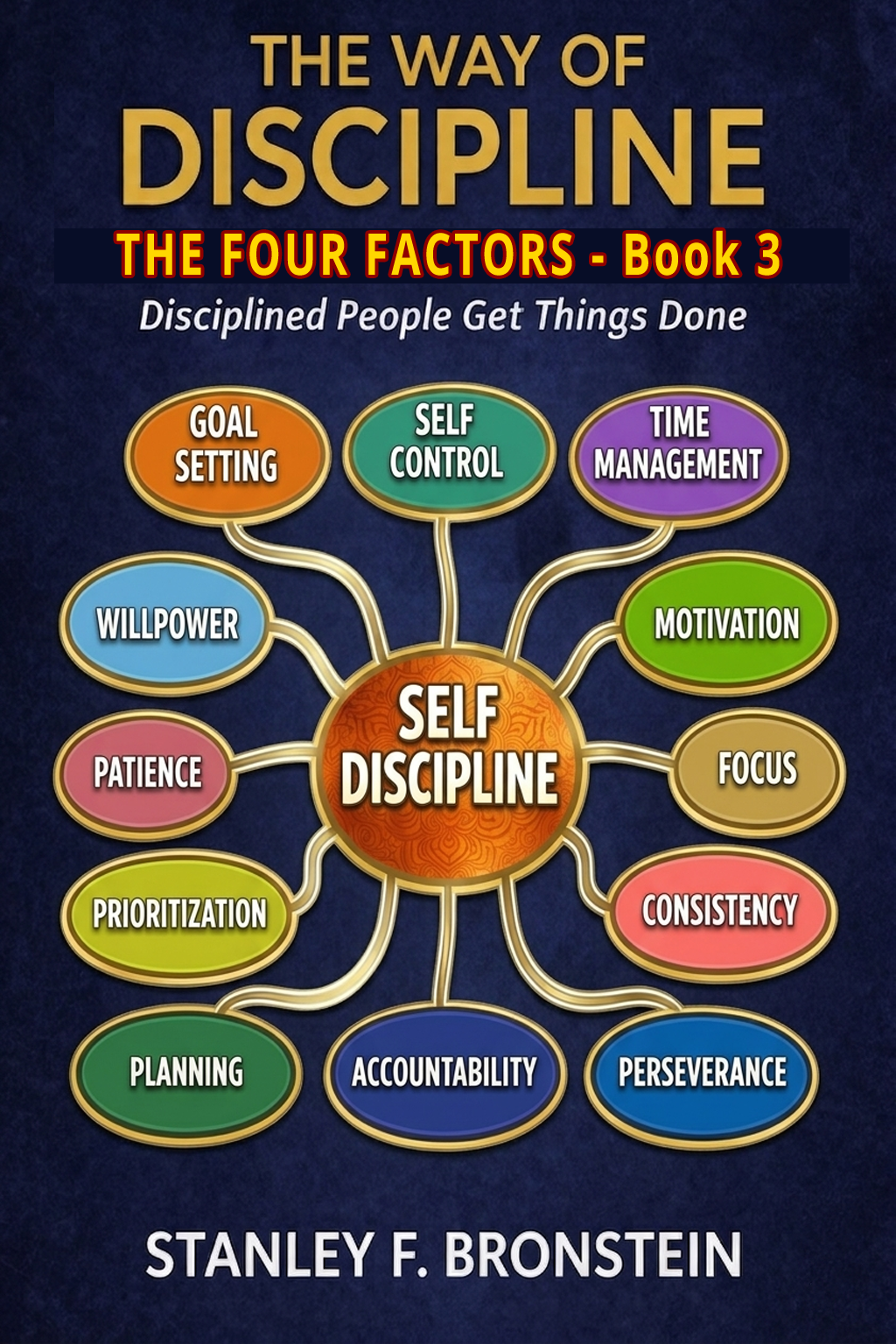
The Four Factors – Book 3
Disciplined People Get Things Done
By Stanley F. Bronstein – Creator of The Way of Excellence System
Click The Tabs Below To Read Each Chapter Of The Book Online
Or
📘 Download Your Free Copy In Your Preferred Format
The Way of Discipline
by Stanley F. Bronstein
How to use this page:
Click a chapter title to open it then scroll down to read.
When you click the title of the next chapter, the previous one will close.
Take your time.
Read, reflect, and do the experiments and assignments before you move on.
EMPTY ITEM
Foreword
Discipline is one of the most important forces in human life, and one of the most misunderstood.
Many people hear the word and immediately think of restriction, pressure, deprivation, harshness, or control. They imagine discipline as something cold and joyless. They see it as the enemy of freedom rather than one of the surest paths to freedom. They think of it as punishment rather than power, as burden rather than blessing, as something that takes from them rather than something that gives to them.
That misunderstanding has cost many people dearly.
It has caused people to avoid the very thing that could strengthen them. It has caused people to delay action, break promises to themselves, drift from what matters most, and repeatedly trade long-term benefit for short-term comfort. It has caused people to live reactively rather than intentionally. It has caused them to settle for less order, less peace, less progress, less self-respect, and less excellence than they were capable of creating.
This book was written to correct that misunderstanding.
The central message of this book is simple: discipline is not something to resent. It is something to value, develop, and use wisely. Discipline is not the destruction of freedom. It is one of the ways freedom is built. Discipline is not the denial of life. It is one of the ways life becomes stronger, clearer, more stable, and more meaningful. Discipline is not a prison. Properly understood, it is a structure that supports growth.
That matters because most good things in life do not happen by accident.
Health does not usually happen by accident. Financial stability does not usually happen by accident. Trustworthiness does not usually happen by accident. Strong habits do not usually happen by accident. Peace of mind does not usually happen by accident. Meaningful progress does not usually happen by accident. A well-lived life is usually built, and one of the great builders of that life is discipline.
Discipline helps a person do what matters, even when doing so is not easy, convenient, or emotionally appealing. It helps a person follow through. It helps a person stay aligned with worthy aims. It helps a person choose what is important over what is merely immediate. It helps a person act with intention instead of reacting to every passing mood, impulse, distraction, appetite, or excuse.
That alone would make discipline valuable.
But there is something even more important to understand, and it is one of the major themes of this book: the benefits of discipline are not merely additive. They are compounding. Discipline builds upon itself.
One disciplined decision makes the next one easier. One kept promise strengthens the likelihood of another kept promise. One act of self-control reinforces future self-control. One day of consistency makes it easier to remain consistent tomorrow. One wise use of time improves the chances of using time wisely again. One honest act of accountability creates the possibility of faster correction, stronger growth, and greater self-trust.
In other words, discipline does not simply produce isolated results. It produces layered results. It builds momentum. It reduces friction. It strengthens identity. It increases self-respect. It turns effort into pattern, pattern into character, and character into destiny.
That is one of the reasons discipline is so powerful.
It does not merely help a person in one moment. It changes the kind of person they are becoming through many moments. It creates cumulative benefits that spread across a life. A disciplined person often becomes more reliable because discipline reinforces reliability. They often become more focused because discipline reinforces focus. They often become more confident because discipline builds evidence. They often become more peaceful because discipline reduces self-created chaos. They often become freer because discipline protects them from consequences that a lack of discipline keeps producing.
That is worth pausing over.
A person who lives without discipline may believe they are preserving freedom by avoiding structure. In the short term, that can feel true. They may eat whatever they want, spend however they want, delay whatever they want, and follow every passing desire. But over time, that kind of freedom often turns into something else: weaker health, diminished focus, financial strain, damaged self-trust, broken commitments, preventable stress, mounting disorder, and growing regret.
That is not freedom. That is drift with consequences.
Discipline often feels harder in the moment, but easier in the long run. A lack of discipline often feels easier in the moment, but harder in the long run. That is one of the great hidden truths of life. Discipline asks more from a person today so that tomorrow can become stronger. A lack of discipline asks less today and then sends the bill later.
And that bill can become very expensive.
That is because a lack of discipline compounds too.
Delay compounds. Disorder compounds. Avoidance compounds. Excuse-making compounds. Inconsistency compounds. Neglect compounds. Small acts of self-betrayal build upon one another just as surely as small acts of self-respect do. One unhealthy habit makes the next easier. One broken promise weakens the weight of the next promise. One irresponsible decision often makes future irresponsibility more likely. A person is always building something through repeated action. The question is what direction that building is going.
This book is about building in the right direction.
It is about helping a person understand discipline clearly, embrace it willingly, and practice it steadily enough for its benefits to multiply. It is about showing that discipline is not a single act of heroic effort. It is a way of living. It is a pattern of intelligent self-direction. It is the repeated choice to align behavior with what matters most.
That alignment produces extraordinary benefits.
Discipline helps a person become more dependable. It strengthens self-control. It improves time management. It increases the likelihood of following through on goals. It supports focus. It sharpens prioritization. It makes planning more useful. It helps consistency become normal. It strengthens accountability. It supports perseverance. It helps a person endure process instead of demanding instant reward. It helps turn motivation from something a person waits for into something that is often renewed by progress itself.
That is one reason discipline deserves such respect. Its benefits do not stay in one compartment.
Discipline in one area often improves other areas.
A person who becomes more disciplined with time often becomes more disciplined with work. A person who becomes more disciplined with health often becomes more disciplined with energy, mood, and confidence. A person who becomes more disciplined in speech often improves relationships. A person who becomes more disciplined in thought often improves decision-making. A person who becomes more disciplined in daily habits often begins to experience a more disciplined identity. Growth in one area can strengthen growth in another.
This is especially important in the larger pursuit of excellence.
Excellence is not built on random effort. It is not built on occasional enthusiasm. It is not built on talent alone, or good intentions alone, or desire alone. Excellence requires a regimen. It requires repeated action. It requires steadiness. It requires structure. It requires a person to develop and maintain patterns that strengthen mind, body, and spirit over time.
That is why discipline matters so deeply.
Without discipline, a person may have goals but not follow-through. They may have values but not alignment. They may have ideas but not execution. They may have dreams but not progress. They may want change but remain trapped in repetition of the wrong kind. Discipline helps bridge that gap. It turns aspiration into application. It turns possibility into practice. It turns scattered effort into directed growth.
This book will explore discipline from many angles.
We will examine what discipline really is and why so many people resist it. We will look at the cost of living without discipline and the relationship between discipline, freedom, and self-respect. We will explore the inner side of discipline through goal setting, self-control, willpower, motivation, and patience. We will explore the outer side of discipline through focus, prioritization, time management, planning, and consistency. We will examine the sustaining side of discipline through accountability and perseverance. We will also consider the integration of mind, body, and spirit, because real discipline cannot remain fragmented if a person wants lasting excellence.
Throughout all of this, one truth will remain constant: the benefits of incorporating discipline into one’s life are immense.
Discipline creates order where there was disorder.
It creates movement where there was delay.
It creates stability where there was drift.
It creates clarity where there was confusion.
It creates trust where there was unreliability.
It creates strength where there was weakness.
It creates self-respect where there was repeated self-betrayal.
It creates peace where there was needless chaos.
It creates progress where there was excuse-making.
It creates freedom where there was hidden bondage.
And because discipline compounds, these benefits do not remain small. They grow. They reinforce one another. They deepen over time. They spread across a person’s health, work, finances, relationships, habits, environment, commitments, and identity. They do not simply improve a day. They can help reshape a life.
That is why discipline is not merely a topic for people who want to become more productive. It is a subject for anyone who wants to become more intentional, more reliable, more grounded, more effective, more peaceful, and more excellent. It is for people who are tired of drifting. It is for people who are tired of starting and stopping. It is for people who are ready to stop negotiating endlessly with what they know matters. It is for people who want to become stronger from the inside out.
Discipline is not perfection.
It is not flawless performance.
It is not never struggling, never slipping, or never needing to begin again.
Discipline is the willingness to return. It is the willingness to continue. It is the willingness to choose what matters, repeatedly, even when repetition is not glamorous. It is the willingness to build a life through steady practice rather than fantasy.
That kind of life becomes powerful.
My hope is that by the end of this book, you will no longer see discipline as something cold, grim, or restrictive. My hope is that you will see it for what it truly is: one of the greatest tools available for building freedom, stability, self-respect, effectiveness, and excellence. My hope is that you will not merely admire discipline from a distance. My hope is that you will begin to welcome it, practice it, and benefit from it.
Because discipline gives a great deal.
It gives direction.
It gives order.
It gives momentum.
It gives strength.
It gives trust.
It gives progress.
It gives peace.
It gives dignity.
It gives a person a greater ability to live on purpose.
And because it builds upon itself, its gifts do not stop where they start.
That is what this book is about.
Let us begin.
INTRODUCTION TO PART I - SEEING DISCIPLINE CLEARLY
Before a person can build discipline successfully, they must first see it clearly.
That is the purpose of this Part.
Many people resist discipline not because discipline has failed them, but because they have misunderstood it. They have been taught to think of discipline as harshness, restriction, deprivation, pressure, or punishment. They see it as something cold and limiting rather than something constructive and empowering. They imagine it makes life smaller, when in truth it often helps make life stronger, clearer, more stable, and more free.
That misunderstanding matters because no one is likely to embrace what they do not understand properly.
If a person sees discipline as the enemy, they will avoid it. If they see discipline as a path to freedom, strength, order, and self-respect, they will begin to value it differently. If they think discipline exists to take something from them, they will resent it. If they understand that discipline helps them build something better, they will begin to appreciate its role in their life.
This Part lays the foundation for that shift.
In these opening chapters, we will look closely at what discipline really is, why so many people resist it, what living without discipline actually costs, and why discipline is so closely connected to freedom and self-respect. We will also begin examining one of the major truths that runs throughout this book: the benefits of discipline are not merely additive – they are compounding. Discipline builds upon itself.
That is one of the most important ideas in this manuscript.
A single disciplined choice can help create the conditions for another disciplined choice. One act of follow-through can strengthen self-trust. One act of self-control can make future self-control more likely. One day of consistency can make consistency feel more natural tomorrow. In this way, discipline does not merely produce isolated benefits. It produces cumulative benefits. It builds momentum. It reduces friction. It strengthens identity. It helps a person become more capable of doing again what they have already proven they can do.
This Part also makes clear that the opposite pattern is true as well.
A lack of discipline builds upon itself too. Delay tends to create more delay. Disorder tends to create more disorder. Excuse-making tends to create more excuse-making. Broken promises weaken self-trust. Repeated avoidance often makes future avoidance easier. Small acts of neglect can grow into larger forms of loss. A person is always building something through repeated action. The question is whether they are building toward greater strength and freedom or toward greater frustration and limitation.
That is why seeing discipline clearly is so important.
When a person misunderstands discipline, they often focus only on what discipline requires and overlook what discipline gives. They notice the effort, but not the reward. They notice the discomfort, but not the long-term gain. They notice the restraint, but not the freedom it helps create. They notice the structure, but not the peace and progress that structure makes possible. One of the goals of this Part is to correct that imbalance.
Throughout these chapters, the benefits of incorporating discipline into one’s life should become increasingly clear. Discipline helps reduce chaos. It helps improve decision-making. It helps protect time, energy, attention, and opportunity. It helps a person keep their word to themselves. It strengthens self-respect because it closes the gap between what a person says matters and what they actually do. It increases reliability. It improves focus. It creates stability. It supports progress. It helps transform vague intentions into lived reality.
That is why discipline belongs at the center of serious personal growth.
In The Way of Excellence (TWOE), discipline is not treated as a minor trait or optional extra. It is treated as a vital factor in the achievement of excellence, because excellence is not built through random effort, temporary enthusiasm, or occasional bursts of action. Excellence requires structure. It requires repeated action. It requires a regimen. It requires a person to act in a way that supports growth in mind, body, and spirit over time.
This Part prepares the reader to understand that truth.
It clears away confusion. It confronts resistance. It exposes cost. It begins reframing discipline as one of the great builders of a strong life. It helps the reader move from seeing discipline as restriction to seeing it as intelligent self-direction. It helps them move from fear of discipline to respect for it. It helps them move from vague admiration of discipline to a clearer understanding of why discipline matters so deeply.
Everything that follows in this book depends on this foundation.
Before a person can strengthen goal setting, self-control, willpower, motivation, patience, focus, prioritization, time management, planning, consistency, accountability, and perseverance, they must first understand the larger force that gives all of those things their structure and staying power. That force is discipline.
So this Part begins where it should begin – with clarity.
Because when a person begins to see discipline clearly, they also begin to see more clearly what their life can become with it.
Chapter 1 - What Discipline Really Is
Many people use the word discipline without ever defining it clearly.
They know they need more of it. They know they admire it in others. They know their lives would probably improve if they practiced it more consistently. Yet when they think about discipline, the image that comes to mind is often distorted. They think of pressure. They think of restriction. They think of harshness, deprivation, and constant self-denial. They think of being forced to do things they do not want to do. In some cases, they think of punishment.
That misunderstanding matters.
A person cannot develop a healthy relationship with discipline if they do not understand what discipline really is. If they see it as an enemy, they will resist it. If they see it clearly, they can begin to value it, build it, and benefit from it.
This chapter begins with clarity.
Discipline is not merely about saying no. It is not merely about forcing action. It is not merely about rigid control. Discipline is a far richer and more life-giving force than that. Properly understood, discipline is one of the great builders of strength, order, progress, freedom, and self-respect.
It is also one of the central forces through which a person creates a better life over time.
That matters because one of the major truths running throughout this book is that the benefits of discipline are not merely additive – they are compounding. Discipline builds upon itself. It does not simply help a person once. It helps shape what becomes easier, more natural, and more likely in the future.
Before we explore how that works, we must first answer a foundational question.
What is discipline, really?
Discipline Is Chosen Structure
At its core, discipline is chosen structure.
It is the decision to bring order, direction, and consistency to areas of life that would otherwise be left to mood, impulse, convenience, or drift. It is not random effort. It is not occasional intensity. It is structure chosen on purpose.
That word chosen matters.
Discipline is strongest when it is embraced, not merely imposed. A person may be pressured from the outside by deadlines, obligations, expectations, or consequences, but lasting discipline grows strongest when a person chooses a better way to live. They choose a standard. They choose a pattern. They choose to act in a way that supports what matters rather than acting only according to what feels easiest in the moment.
This immediately makes discipline more positive than many people assume.
Discipline is not the destruction of freedom. It is the intelligent use of freedom. It is the decision to use one’s ability to choose in a way that builds something worthwhile. That is one of the first benefits of incorporating discipline into one’s life: it helps transform freedom from mere permission into purposeful direction.
Discipline Is Intelligent Self-Direction
Discipline is intelligent self-direction.
It is the ability to direct yourself toward what matters most, even when doing so is inconvenient, uncomfortable, or not immediately rewarding. It is the ability to govern your actions rather than being governed by appetite, distraction, laziness, fear, or mood.
That does not mean disciplined people never feel resistance.
They do.
They feel tired. They feel tempted. They feel distracted. They feel discouraged. They feel the pull of comfort and the pressure of difficulty just like everyone else. The difference is that discipline helps them respond to those forces rather than simply surrendering to them.
That difference is powerful.
A person without discipline is often pulled from one thing to another by whatever feels strongest in the moment. A disciplined person is more likely to ask a better question: What matters most right now? That question creates better decisions. Better decisions create better patterns. Better patterns create better outcomes.
This is one of the major benefits of discipline. It improves the quality of a person’s direction. It reduces drift. It reduces reaction. It reduces chaos. It helps a person participate more consciously in the shaping of their own life.
Discipline Is Alignment
Discipline is alignment between what a person says matters and what they actually do.
Many people say they want better health, but their daily actions do not support health. Many say they want peace, but keep feeding disorder. Many say they want financial stability, but repeatedly undermine it. Many say they want excellence, but continue practicing inconsistency. Many say they value growth, but keep choosing comfort over progress.
Discipline closes that gap.
It helps bring thought, intention, value, and behavior into closer relationship with one another. It helps a person stop living in contradiction. It helps them become more internally honest.
That is one of the quiet but profound benefits of discipline. It reduces internal conflict.
There is a subtle strain that comes from constantly knowing what you should be doing while repeatedly failing to do it. There is a private erosion of confidence that takes place when you make promises to yourself and then keep breaking them. There is a loss of self-respect that occurs when your words and your actions remain far apart.
Discipline begins to repair that damage.
Every act of follow-through strengthens alignment. Every repeated act of follow-through strengthens it further. This is where the compounding nature of discipline begins to become visible. One kept promise makes the next promise more believable. One act of alignment makes the next act more natural. Over time, discipline helps a person trust themselves more deeply because they have built evidence.
Discipline Is Repeated Right Action
Discipline is not one dramatic moment.
It is repeated right action.
Many people want major change through one powerful decision, one inspired weekend, one surge of motivation, or one emotional breakthrough. Sometimes those moments help. Sometimes they matter a great deal. But real transformation is usually built through repetition.
Discipline is what allows that repetition to happen.
It helps a person do the right thing again, and again, and again, until the thing that once felt difficult begins to feel more normal. It helps turn occasional effort into consistent behavior. It helps convert good intentions into lived patterns.
That is one reason discipline is so effective. It works through accumulation.
A person usually does not become healthier because of one healthy meal. They become healthier because of repeated healthy choices. A person does not become trustworthy because of one isolated act of follow-through. They become trustworthy because follow-through becomes a pattern. A person does not build a strong life through occasional good moments. They build it through repeated actions that reinforce one another over time.
This is exactly why the benefits of discipline are compounding. Repetition builds familiarity. Familiarity reduces resistance. Reduced resistance increases consistency. Increased consistency produces stronger results. Stronger results reinforce belief. Reinforced belief makes future discipline more likely. Discipline builds upon itself.
This is one of the most important truths in the chapter.
Discipline is not valuable only because it helps a person do one good thing. It is valuable because each good thing can help strengthen the conditions for the next one.
Discipline Is Not Punishment
One of the most harmful misunderstandings about discipline is the belief that it is essentially punitive.
Many people hear the word and think of correction, shame, pain, severity, or deprivation. They associate discipline with being controlled, restricted, or treated harshly. That association makes discipline feel negative before it even begins.
But healthy discipline is not punishment.
Punishment focuses on what went wrong. Discipline focuses on what is being built.
Punishment looks backward. Discipline looks forward.
Punishment may simply inflict a consequence. Discipline trains, guides, structures, and strengthens.
This distinction matters because it changes the emotional meaning of effort. When a person sees discipline as punishment, they will tend to fear it, resent it, or avoid it. When they see discipline as intelligent training, they begin to relate to it differently. They begin to see that the effort required by discipline is not meaningless suffering. It is investment.
That shift is one of the benefits of understanding discipline clearly. It helps a person move from resentment to respect. It helps them see that discipline is not trying to take life away from them. It is trying to help them build a better life.
Discipline Is Not the Enemy of Freedom
Another major misunderstanding is the belief that discipline and freedom are opposites.
They are not.
A lack of discipline often feels like freedom in the short term. A person eats whatever they want, spends whatever they want, delays whatever they want, says whatever they want, and follows whatever desire feels strongest. In the moment, that may feel liberating. But over time, it often produces weaker health, more stress, less stability, less peace, and more regret.
That is not freedom. That is ungoverned living with consequences.
Discipline, by contrast, may require more effort in the moment because it asks a person to choose wisely rather than impulsively. But over time, discipline often creates more freedom, not less. The person who disciplines their spending usually has more financial freedom. The person who disciplines their time usually has more control over their life. The person who disciplines their body usually has more energy and mobility. The person who disciplines their attention usually experiences more clarity and less fragmentation.
This is one of the great benefits of incorporating discipline into one’s life. Discipline helps preserve freedom by preventing forms of preventable loss.
And once again, the benefit compounds.
Better use of time creates more available time.
Better use of money creates more options.
Better care of health creates more capacity.
Better control of speech creates stronger relationships.
Better management of attention creates better decisions.
One disciplined choice often strengthens future freedom. That is why discipline is not the enemy of freedom. In many cases, it is one of the ways freedom is built.
Discipline Is Self-Respect in Action
Discipline is a form of self-respect.
It is the practical expression of the belief that your future matters, your word matters, your goals matter, your responsibilities matter, and your life is worth governing well.
When a person acts with discipline, they are saying something through behavior. They are saying that what matters is worth protecting. They are saying that their health is worth effort, that their commitments are worth keeping, that their time is worth using well, and that their life is worth organizing.
This gives discipline a different emotional tone.
Instead of seeing discipline as deprivation, a person can begin to see it as dignity in action. Instead of seeing it as harshness, they can begin to see it as stewardship. Instead of seeing it as pressure, they can begin to see it as care expressed through structure.
That understanding strengthens one of the deepest benefits of discipline: self-respect.
A person who repeatedly acts against what they know matters tends to lose respect for themselves. A person who repeatedly acts in alignment with what matters tends to gain respect for themselves. And because repeated action reinforces identity, this benefit compounds too. Small acts of self-respect build larger self-respect over time.
Discipline Is a Builder
Discipline builds.
It builds habits.
It builds trust.
It builds momentum.
It builds endurance.
It builds reliability.
It builds order.
It builds progress.
It builds capability.
It builds self-respect.
Most of all, it builds a stronger person.
This is perhaps the simplest way to understand it. Discipline is a builder of good things over time. It creates conditions in which better outcomes become more likely. It does not guarantee that life will always be easy, but it greatly improves the odds that a person will be ready, steady, and effective when life becomes difficult.
Because discipline builds, its absence builds too, just in the wrong direction.
Repeated avoidance builds weakness.
Repeated delay builds stress.
Repeated disorder builds chaos.
Repeated excuse-making builds stagnation.
Repeated broken promises build distrust.
A person is always building something through repeated action. The question is whether they are building toward strength, clarity, peace, and freedom, or toward frustration, disorder, and limitation.
This is why the compounding nature of discipline matters so much. Small acts are not small forever. They stack. They reinforce one another. They gradually shape character, capability, and outcome.
Discipline in The Way of Excellence
In The Way of Excellence (TWOE), discipline is central to the achievement of excellence.
That makes sense.
Excellence is not built through random effort. It is not built through occasional enthusiasm. It is not built through talent alone, desire alone, or intention alone. Excellence requires regimen. It requires repeated action. It requires a person to return, continue, correct, and build over time.
Discipline is one of the forces that makes that possible.
Without discipline, a person may have goals but not follow-through. They may have values but not alignment. They may have ideas but not execution. They may want change but keep repeating the same patterns. Discipline helps close that gap. It turns aspiration into practice. It turns possibility into pattern. It helps a person act in a way that supports growth in mind, body, and spirit over time.
And the benefits of that kind of life do not remain isolated.
A disciplined mind helps create better decisions.
Better decisions help create better habits.
Better habits help create better health, better work, better use of time, and better follow-through.
Better follow-through builds self-trust.
Self-trust strengthens identity.
Identity makes future discipline more natural.
Again, discipline builds upon itself.
What Discipline Really Is
So what is discipline really?
It is chosen structure.
It is intelligent self-direction.
It is alignment between values and behavior.
It is repeated right action.
It is training, not punishment.
It is a path to freedom, not the enemy of it.
It is self-respect in practice.
It is a builder of order, strength, trust, and progress.
It is also one of the great compounding forces in human life.
That last point matters deeply.
Discipline does not simply help a person do one good thing. It helps make the next good thing more likely. It strengthens patterns. It reduces friction. It reinforces identity. It creates momentum. It builds evidence. It gradually changes what feels normal. Over time, discipline can help a person become more reliable, more focused, more grounded, more effective, more peaceful, and more free.
The benefits of incorporating discipline into one’s life are not abstract. They are practical, lived, and cumulative. Discipline helps a person build a life they can respect.
That is what discipline really is.
And that is why it is worth developing.
Assignment
Step 1 – Write Your Current Definition of Discipline
In a journal or notebook, write down how you have traditionally thought about discipline. Be honest. Have you seen it as restriction, pressure, punishment, structure, self-respect, or something else? Write until you have captured your current view clearly.
Step 2 – Identify the Misunderstandings
Review what you wrote and identify any false or incomplete ideas you have been carrying. Write down at least three ways your understanding of discipline may have been distorted.
Step 3 – List the Benefits You Can Already See
Make a list of at least ten benefits that discipline could bring to your life right now. Include practical benefits such as improved time use, stronger health habits, greater peace of mind, stronger self-respect, better follow-through, and reduced chaos.
Step 4 – Identify the Compounding Effect
Choose one area of your life where discipline would not only help immediately but would also build future strength. Explain how one disciplined action in that area could make future disciplined actions easier and more natural.
Step 5 – Identify One Area That Needs Discipline Most
Choose one area of your life where a lack of discipline is costing you the most. It may involve health, work, money, time, focus, commitments, or something else. Describe clearly what that lack of discipline is costing you now and what it may continue to cost you if nothing changes.
Step 6 – Write a New Definition
Now write a new personal definition of discipline based on what you have learned in this chapter. Make it practical, empowering, and truthful. Include the idea that discipline builds upon itself.
Step 7 – Commit to Seeing Discipline Differently
End this assignment by writing one clear sentence of commitment. State that you are willing to stop seeing discipline as punishment and begin seeing it as a path to strength, freedom, progress, self-respect, and long-term growth.
Chapter 2 - Why People Resist Discipline
If discipline is so beneficial, why do so many people resist it?
That is one of the most important questions in this book.
Most people already know, at least in a general way, that greater discipline would improve their lives. They know discipline would likely help them with their health, their work, their finances, their use of time, their focus, their follow-through, and their peace of mind. They know discipline would probably help them become more reliable, more productive, more self-respecting, and more effective. They know discipline could reduce chaos, delay, waste, confusion, and regret.
Yet even with all of that being true, many still resist it.
Why?
Because knowing something is good for you is not the same as wanting to embrace it.
Resistance to discipline is rarely caused by ignorance alone. More often, it is caused by the way discipline feels, the way it is perceived, the way it has been experienced, or the way it competes with other desires. People resist discipline for emotional reasons, practical reasons, habitual reasons, and psychological reasons. They resist it because discipline challenges comfort. They resist it because discipline exposes contradiction. They resist it because discipline requires structure, honesty, effort, and patience. They resist it because, in the short term, the alternative often feels easier.
This chapter is about understanding that resistance.
That matters because resistance that is not understood is difficult to overcome. If a person cannot see why they keep pushing away the very thing they need, they are more likely to keep repeating the pattern. But when resistance is named and examined clearly, it begins to lose some of its power.
That is one of the first benefits of disciplined thinking. It helps a person stop living on autopilot and start seeing what is really happening.
People Resist What Feels Uncomfortable
One of the most obvious reasons people resist discipline is that discipline often requires discomfort.
It asks a person to do what is beneficial instead of what is merely pleasant. It asks them to get up when they would rather stay in bed, to stop when they would rather keep indulging, to focus when they would rather drift, to plan when they would rather react, and to continue when they would rather quit. It asks them to tolerate boredom, delay gratification, interrupt unhealthy habits, and endure the ordinary discomfort of responsible action.
That can feel difficult, especially in the beginning.
Comfort pulls in one direction. Discipline often pulls in another.
This is one reason so many people resist discipline. They mistake discomfort for danger. They assume that if something feels inconvenient, unnatural, or demanding, it must not be right for them. But discomfort does not necessarily mean something is wrong. Often it means something is changing. It means an old pattern is being challenged. It means growth is being asked for.
One of the benefits of incorporating discipline into one’s life is that it strengthens the ability to endure useful discomfort. That is no small gain. A person who can tolerate temporary discomfort in service of a better outcome becomes stronger, steadier, and freer than a person who remains trapped by the need for immediate ease.
And that benefit compounds.
Each time a person endures discomfort wisely, they build evidence that they can do it again. One act of tolerated discomfort makes the next one more manageable. Discipline builds upon itself.
People Prefer Immediate Relief Over Long-Term Reward
Many people resist discipline because they are strongly drawn to what provides immediate relief.
Immediate relief is powerful. It can look like putting something off, eating the extra food, buying the unnecessary item, avoiding the difficult conversation, scrolling instead of focusing, quitting instead of persevering, or giving in instead of holding the line.
In the moment, these choices often feel easier.
That is the problem.
Discipline usually serves the long term. A lack of discipline usually serves the moment. The easier choice now often becomes the harder consequence later. The harder choice now often becomes the easier life later.
Many people understand this in theory, but when the moment arrives, the short-term temptation still wins. Why? Because the future can feel abstract while the present feels urgent. The immediate craving feels real. The long-term reward can feel distant.
This is one reason people resist discipline. They keep trading what they want most for what they want now.
That trade is expensive.
One of the major benefits of discipline is that it helps a person stop making that trade so often. It helps them value the future more highly. It helps them protect tomorrow from today’s impulses. It helps them preserve health, money, energy, credibility, and peace of mind. Over time, disciplined living replaces short-term relief with long-term reward, and that improves nearly every area of life.
And because discipline compounds, these gains do not remain isolated. A person who learns to choose long-term reward once becomes more capable of choosing it again. One wise decision strengthens the likelihood of another wise decision.
People Misunderstand Discipline
Some resistance to discipline is rooted in misunderstanding.
Many people have never been taught what discipline actually is. They think discipline means becoming rigid, joyless, obsessive, severe, mechanical, or humorless. They think it means losing spontaneity, losing freedom, or becoming someone they do not want to become. They imagine a life of constant pressure and constant self-denial. As a result, they instinctively recoil.
But discipline is not that.
Discipline is not about becoming less human. It is about becoming more directed.
It is not about squeezing joy out of life. It is about building a life strong enough to support deeper and more lasting joy.
It is not about punishment. It is about structure, training, order, and intelligent self-direction.
If a person fundamentally misunderstands discipline, they will almost certainly resist it. Why would they welcome something they believe will make life worse?
This is why clarity matters so much. One of the benefits of seeing discipline clearly is that it removes unnecessary fear. Once a person begins to understand that discipline can create peace, order, confidence, momentum, freedom, and self-respect, they begin to relate to it differently. It stops looking like an enemy and starts looking like an ally.
That change in understanding matters because it opens the door to a chain of future benefits. A person who stops fearing discipline becomes more willing to practice it. A person who practices it begins to experience its rewards. Those rewards reinforce belief. That reinforced belief makes future discipline easier to embrace.
Again, discipline builds upon itself.
People Do Not Want Their Contradictions Exposed
Discipline has a way of revealing reality.
It exposes the gap between what a person says matters and what they actually do.
That can be uncomfortable.
Many people say they want change, but their habits say they want familiarity. Many say they want progress, but their daily choices say they want comfort. Many say they want excellence, but their routines say they are settling for convenience. Many say they value health, focus, responsibility, or integrity, but their actual patterns tell a different story.
Discipline shines a light on those contradictions.
That is one reason people resist it. Discipline makes it harder to hide from the truth. It makes it harder to keep pretending that intention alone is enough. It makes it harder to keep telling a flattering story about oneself when behavior is telling a different story.
Some people would rather preserve illusion than face actuality.
But illusion is costly.
One of the benefits of incorporating discipline into one’s life is that it strengthens honesty. It helps a person stop lying to themselves through delay, excuse-making, rationalization, and avoidance. It helps them see where they truly are. That can feel uncomfortable at first, but it is also liberating. A person cannot improve a life they refuse to see clearly.
And once honesty begins, progress can begin. One honest look often leads to one honest change. One honest change can lead to another. The truth, once faced, can become a foundation for compounding growth.
People Wait Until They Feel Like It
Another major reason people resist discipline is that they are overly dependent on mood.
They want action to feel easy before they take it. They want motivation to arrive first. They want emotional readiness, inner excitement, ideal timing, or a clear surge of desire before they begin. If those things are present, they move. If those things are absent, they delay.
That creates a fragile life.
A person who only acts when they feel like it will struggle to sustain anything important. Health will be inconsistent. Work will be inconsistent. Focus will be inconsistent. Growth will be inconsistent. Because feelings rise and fall, the results of a feeling-driven life rise and fall with them.
Discipline challenges this pattern. It teaches a person to act because something matters, not merely because it feels easy. It teaches a person to move with intention instead of waiting endlessly for a better mood.
That is one of the great benefits of discipline. It frees a person from emotional dependency. It helps them become more stable than their feelings, more dependable than their moods, and more effective than their passing levels of enthusiasm. It does not eliminate emotion. It simply refuses to let emotion be the sole authority.
And again, the effect compounds. Every time a person acts without waiting for the perfect feeling, they weaken the habit of emotional dependence and strengthen the habit of intentional action.
People Associate Discipline With Past Pain
Sometimes resistance to discipline is deeply emotional.
A person may have grown up in an environment where discipline was confused with control, shame, criticism, fear, or harshness. They may have been pushed, judged, or punished in ways that left scars. As a result, the very word discipline may trigger an old emotional reaction.
This matters.
Not all resistance is laziness. Not all resistance is immaturity. Sometimes it is wounded association. Sometimes the person is not resisting structure itself. They are resisting what structure once meant in their life. They are reacting not only to the present, but also to the past.
That kind of resistance needs to be understood with compassion.
Still, it must also be healed.
Because if a person permanently rejects discipline due to earlier pain, they may deprive themselves of one of the very things that could now help them most. Healthy discipline is not abuse. Healthy discipline is not domination. Healthy discipline is not humiliation. Healthy discipline is not cruelty. Healthy discipline is chosen structure in service of growth, strength, freedom, and self-respect.
One of the benefits of disciplined living is that it can help redeem the meaning of structure. It can help a person experience discipline not as something done against them, but as something developed for them and by them. That change can be profound. It can turn an old source of pain into a new source of strength.
People Do Not Want To Give Up Familiar Pleasures
Discipline often threatens familiar pleasures.
Some of those pleasures are obviously harmful. Others are not necessarily wrong in themselves, but they have become excessive, poorly timed, or overly dominant. The issue is not always that the pleasure is evil. The issue is that it has been given too much authority.
People resist discipline because discipline requires limits.
It requires a person to say, “Enough.”
Enough food.
Enough delay.
Enough spending.
Enough distraction.
Enough excuse-making.
Enough emotional indulgence.
Enough drift.
Enough compromise.
For many people, that is difficult because these pleasures soothe them, distract them, entertain them, numb them, or reward them. Reducing them can feel like loss, even when keeping them is clearly causing harm.
That is why discipline can feel threatening. It interrupts the comfort system.
But the benefits of discipline far outweigh the temporary discomfort of those interruptions. Discipline helps a person exchange lower pleasures for higher rewards. It helps exchange temporary indulgence for lasting strength, temporary escape for greater peace, and short-lived satisfaction for more substantial forms of well-being.
And that exchange compounds too. One reduced indulgence can create more clarity. More clarity can support better decisions. Better decisions can strengthen health, finances, focus, and self-respect. One limit can protect many future benefits.
People Fear Failure
Some people resist discipline because they are afraid they will fail at it.
This fear is more common than many realize.
A person may have tried to become more disciplined before and fallen short. They may have started routines, made promises, created plans, and then abandoned them. They may have disappointed themselves many times. After enough repetition, they begin to assume that future attempts will end the same way.
So they stop trying.
Or they avoid trying seriously.
Or they keep everything vague so that nothing can really be measured.
This protects them from immediate disappointment, but it also protects them from progress.
When fear of failure is driving resistance, discipline itself is not the real enemy. The real enemy is the anticipated pain of falling short again.
This is why it is so important to understand that discipline is not perfection. Discipline is not flawless performance. Discipline is not never missing, never slipping, or never needing to begin again. Discipline is the willingness to return. It is the refusal to let one mistake become a permanent collapse. It is the decision to keep building, even imperfectly.
One of the benefits of incorporating discipline into one’s life is that it changes a person’s relationship to failure. Instead of seeing failure as proof of incapacity, the disciplined person can learn to see it as information, correction, and continuation. That creates resilience. It keeps progress alive.
And resilience compounds. Every return after failure makes future return more likely.
People Live in Environments That Reward a Lack of Discipline
Resistance to discipline is not only internal. It is also cultural.
Many environments reward distraction, overconsumption, impulsiveness, speed, excess, and ease. Many systems are built to capture attention, stimulate appetite, encourage comparison, sell convenience, and reduce reflection. In such a setting, discipline does not merely require personal effort. It often requires active resistance to the surrounding culture.
That is not easy.
If everyone around a person normalizes delay, excuse-making, disorganization, indulgence, and reactive living, disciplined behavior can begin to look extreme even when it is simply healthy. The disciplined person may seem unusual, overly serious, or out of step merely because they are willing to live with intention.
This cultural pressure helps explain why people resist discipline. They are not resisting in isolation. They are resisting against a background that constantly reinforces the opposite.
That makes discipline even more valuable.
One of the benefits of discipline is that it protects a person from being swept along by every cultural current. It helps preserve independence of action. It helps a person choose standards instead of merely absorbing norms. It helps them live from conviction rather than imitation.
And once standards are chosen and practiced, they begin to strengthen identity. Identity strengthens future action. Again, discipline builds upon itself.
People Underestimate the Cost of Living Without Discipline
Many people resist discipline because they do not yet fully appreciate the cost of its absence.
A lack of discipline often appears harmless in small doses.
A little procrastination.
A little overspending.
A little avoidance.
A little inconsistency.
A little excuse-making.
A little distraction.
A little neglect.
Each act seems small. Each seems manageable. Each seems forgivable. And perhaps, taken alone, it is.
But repeated behavior rarely remains isolated.
It accumulates.
What feels minor in a moment becomes major over time. Delayed work turns into pressure. Small spending leaks turn into financial strain. Repeated unhealthy choices turn into physical decline. Broken promises to oneself turn into damaged self-trust. Scattered attention turns into wasted months or wasted years.
Because the cost often develops gradually, many people resist discipline simply because they have not yet connected today’s patterns with tomorrow’s outcomes.
That blindness is expensive.
One of the benefits of disciplined living is that it prevents many forms of preventable suffering. It protects against consequences that do not need to exist. It reduces chaos, regret, waste, and disorder before those things grow larger. Prevention is one of discipline’s greatest gifts.
This is also where the compounding nature of discipline becomes especially important. A lack of discipline does not merely create one problem. It often creates a chain of problems. In the same way, discipline does not merely solve one problem. It often creates a chain of benefits.
People Do Not Believe They Are Capable of Change
At a deeper level, some resistance to discipline is rooted in belief.
A person may not consciously say, “I am incapable of discipline,” but their behavior may reflect that assumption. They may have come to think of themselves as disorganized, weak-willed, inconsistent, impulsive, lazy, or incapable of follow-through. These identity beliefs can become self-reinforcing.
If a person sees discipline as belonging to someone else, they will struggle to develop it in themselves.
This is why belief matters so much. A person who does not believe meaningful change is possible will often resist the very practices that could produce that change. Why commit to a path you secretly believe will not work for you?
This is tragic, because discipline is not reserved for a special class of people. It is built. It is practiced. It is strengthened. It develops over time.
One of the benefits of incorporating discipline into one’s life is that it helps rewrite identity. A person begins to gather evidence that they can follow through. They can endure discomfort. They can plan. They can focus. They can return after mistakes. They can become more than they previously believed.
That is one of the deepest compounding benefits of discipline. Small acts of follow-through build evidence. Evidence builds belief. Belief strengthens future follow-through.
People Do Not Want Accountability
Discipline creates standards, and standards create accountability.
Not everyone welcomes that.
A person without standards has many ways to escape. They can stay vague. They can remain undefined. They can measure nothing. They can promise loosely and evaluate loosely. They can avoid the discomfort of clarity by keeping life blurry.
Discipline does not permit that for long.
Discipline asks questions.
What are you doing?
Why are you doing it?
Is it working?
What needs to change?
What are you avoiding?
What matters most?
What are you willing to do consistently?
Those questions can feel threatening to someone who wants freedom without responsibility. Accountability requires a person to confront facts, not fantasies. It requires them to own outcomes, not merely explain them.
That is one reason people resist discipline. It requires ownership.
Yet that same accountability produces significant benefits. It improves decision-making. It strengthens self-respect. It reduces self-deception. It helps a person make corrections earlier. It creates a stronger, clearer, more stable life.
And because accountability allows earlier correction, it also protects future growth. It keeps small problems from becoming larger ones. It keeps small mistakes from compounding negatively.
People Mistake Discipline for a One-Time Decision
Some resistance to discipline comes from unrealistic expectations.
A person may think discipline means making one big decision and then being done. They may expect instant change, immediate ease, and rapid transformation. When discipline turns out to require repetition, patience, practice, and maintenance, they become discouraged.
This misunderstanding leads many people to resist the ongoing nature of discipline.
They were willing to do something dramatic once.
They were not ready to do something meaningful repeatedly.
But repetition is where the real power lies.
Discipline is not proven in a single burst of effort. It is proven through return, continuation, and consistency. That can feel less exciting, but it is far more effective.
One of the benefits of incorporating discipline into one’s life is that it teaches the value of repeated action. It teaches a person that slow, steady progress is still progress. It teaches them that ordinary consistency can produce extraordinary results over time. It helps replace addiction to drama with appreciation for process.
And process is where compounding happens. One repeated action becomes a pattern. One pattern becomes a habit. One habit begins shaping identity. Discipline builds upon itself.
Resistance Is Real, but It Is Not Final
All of these reasons help explain why people resist discipline.
They resist discomfort.
They prefer immediate relief.
They misunderstand discipline.
They do not want contradiction exposed.
They wait for motivation.
They associate discipline with old pain.
They do not want to give up certain pleasures.
They fear failure.
They live in environments that reward a lack of discipline.
They underestimate the cost of living without discipline.
They do not believe they can change.
They do not want accountability.
They expect instant transformation.
These forms of resistance are real.
But they are not final.
A person is not doomed to remain in resistance. Understanding resistance is the beginning of weakening it. Once a person can name what is happening, they are better able to respond intelligently. They can stop treating resistance as mystery and begin treating it as something to be examined, challenged, and overcome.
That is one of the first great benefits of this chapter. It helps a person see that resistance is not proof that discipline is wrong. It is often proof that discipline is needed.
The question is not whether resistance exists.
It does.
The real question is whether resistance will rule.
A person who continues yielding to resistance will likely continue experiencing the costs of living without discipline – frustration, delay, disorder, weak follow-through, damaged self-trust, unnecessary stress, and preventable regret. A person who begins pushing through resistance, even imperfectly, opens the door to very different outcomes – greater strength, greater clarity, greater confidence, greater peace, greater self-respect, and greater freedom.
And because discipline compounds, overcoming resistance once can begin changing what becomes possible next. That is why resistance blocks more than one benefit. It blocks a chain of benefits. It blocks momentum. It blocks self-trust. It blocks stronger habits. It blocks clearer thinking. It blocks future ease that present discipline could help create.
That is why discipline is worth pursuing.
Not because it is always easy.
Not because resistance vanishes overnight.
But because the benefits of incorporating discipline into one’s life are greater than the comfort of continuing without it.
Discipline helps a person become less reactive, less divided, and less ruled by whatever feels strongest in the moment. It helps them become more intentional, more reliable, more grounded, and more effective. It helps them stop drifting and start directing. It helps them build a life with greater order, greater self-respect, and greater possibility.
Resistance may explain the problem.
Discipline helps solve it.
Assignment
Step 1 – Identify Your Primary Forms of Resistance
Review this chapter and identify the three biggest reasons you personally resist discipline. Write them down clearly. Be specific. Do not write vague answers like “I get off track.” Name the actual force, such as Discomfort, Delay, Fear of Failure, Waiting for Motivation, Love of Immediate Relief, Avoidance of Accountability, or Lack of Belief.
Step 2 – Describe How Each One Shows Up
For each of the three forms of resistance you identified, describe how it shows up in your daily life. What do you do? What do you avoid? What do you tell yourself? What patterns keep repeating?
Step 3 – Calculate the Cost
For each form of resistance, write down what it is costing you. Consider costs in time, energy, money, health, peace of mind, self-respect, momentum, trustworthiness, relationships, and opportunity. Be honest and concrete.
Step 4 – Identify the False Reward
Every form of resistance offers some kind of short-term reward. It may be comfort, relief, escape, pleasure, numbness, or temporary convenience. Write down the false reward each pattern gives you in the moment.
Step 5 – Identify the Better Benefit
Now write down the greater benefit that discipline would provide in each of those same areas. Replace each false reward with a true long-term benefit. For example, replace Temporary Comfort with Better Health, replace Delay with Peace of Mind, or replace Avoidance with Greater Self-Respect.
Step 6 – Identify the Chain of Future Benefits
Choose one area where resistance is currently holding you back. Write down how one disciplined action in that area could begin creating additional benefits over time. Trace the chain. Show how one act of discipline could lead to another, and how the benefits could build upon themselves.
Step 7 – Write a Resistance Statement
Write one sentence that tells the truth about your resistance. Begin with the words: “The main way I resist discipline is…” Complete the sentence honestly and directly.
Step 8 – Write a Discipline Response
Write one sentence that answers your resistance with intention. Begin with the words: “Even when I feel resistance, I will…” Complete the sentence in a practical way that reflects the kind of person you want to become.
Chapter 3 - The Cost of Living Without Discipline
Many people think about discipline mainly in terms of what it requires.
It requires effort.
It requires restraint.
It requires follow-through.
It requires planning.
It requires repetition.
It requires saying no to some things in order to say yes to better things.
Because of that, many people focus on the immediate demands of discipline and overlook something even more important: the cost of living without it.
That cost is often far greater than people realize.
A lack of discipline rarely destroys a life all at once. It usually works more quietly than that. It shows up in delay, drift, disorder, weak follow-through, carelessness, excuse-making, and small repeated acts of neglect. Each act may seem minor. Each may seem understandable. Each may seem easy to justify. That is part of what makes the problem so dangerous.
The cost of living without discipline is usually paid gradually.
It is paid in lost time.
It is paid in missed opportunities.
It is paid in damaged self-trust.
It is paid in weakened health.
It is paid in unnecessary stress.
It is paid in reduced freedom.
It is paid in the growing gap between the life a person wants and the life a person is actually creating.
That is why this chapter matters.
Before many people truly embrace discipline, they must come to see what the absence of discipline is costing them. They must see that the issue is not merely whether discipline feels difficult today. The deeper issue is whether the price of avoiding discipline is even greater tomorrow.
In many cases, it is.
This is also where one of the major themes of this book becomes especially important: the benefits of discipline are not merely additive – they are compounding. Discipline builds upon itself. But the opposite pattern is true as well. A lack of discipline builds upon itself too. One careless choice can make the next careless choice easier. One delayed task can create conditions for more delay. One broken promise can weaken the force of the next promise. One act of neglect can set the stage for more neglect.
A person is always building something through repeated action.
The question is what.
The Cost Is Often Hidden at First
One of the reasons living without discipline is so dangerous is that the early cost is often hidden.
If a person puts something off once, nothing dramatic may happen.
If they overspend a little one day, skip one workout, waste one evening, speak carelessly once, or fail to follow through one time, the damage may not appear severe. In fact, it may not appear at all. That can create a false sense of safety. A person begins to assume that because a choice did not create an immediate crisis, it did not really matter.
But repeated choices matter enormously.
One delayed task may seem manageable. Repeated delay creates backlog, pressure, and stress.
One careless purchase may feel minor. Repeated careless spending creates financial instability.
One unhealthy decision may seem harmless. Repeated unhealthy decisions reshape health, strength, and energy.
One broken promise may seem small. Repeated broken promises weaken self-trust.
This is why the cost of living without discipline is so often underestimated. The problem is not merely the single act. The problem is the direction created by repeated acts.
That direction matters.
A person is either moving toward greater order or greater disorder, greater strength or greater weakness, greater freedom or greater limitation, greater self-respect or greater self-betrayal. The movement may be slow, but slow movement in the wrong direction is still costly.
One of the benefits of incorporating discipline into one’s life is that it helps interrupt loss while loss is still small. It helps a person take seemingly minor choices more seriously because they begin to understand that small repeated choices become larger realities.
The Cost to Health
One of the clearest places the cost of living without discipline shows up is in health.
A lack of discipline in eating, movement, sleep, recovery, and self-care rarely destroys health overnight. More often, it weakens health little by little. That gradual weakening can be deceptive because it is easy to normalize. A person may say they are just tired, just busy, just getting older, just under stress, or just too occupied to do better right now.
But the body responds to patterns.
Too much excess.
Too little movement.
Too much neglect.
Too little recovery.
Too much convenience.
Too little intention.
These things add up.
Over time, a lack of discipline in health can lead to lower energy, reduced mobility, diminished strength, preventable illness, emotional frustration, physical discomfort, and a lower quality of life. A person may slowly create burdens they did not need to create.
The same is true mentally and emotionally. A lack of discipline in thought life, focus, emotional regulation, and boundaries can create scattered thinking, increased stress, reduced peace, and a mind that feels harder and harder to govern. A person who cannot guide habits often struggles to guide attention, and that affects far more than the body alone.
The benefits of discipline in this area are immense. Discipline supports better health, greater energy, stronger habits, clearer thinking, greater resilience, and a deeper sense of physical and mental self-respect. It helps protect the body and mind rather than constantly burdening them.
And these benefits compound.
A healthier body supports better thinking.
Better thinking supports better choices.
Better choices strengthen better habits.
Better habits support better health.
Discipline builds upon itself in health, just as a lack of discipline does.
The Cost to Time
A lack of discipline is also extremely costly in the use of time.
Many people feel they are losing time because life is demanding. Sometimes that is true. But often, a great deal of time is not lost to necessity. It is lost to drift.
It is lost to delay.
It is lost to distraction.
It is lost to disorganization.
It is lost to failure to prioritize.
It is lost to failure to begin.
It is lost to failure to finish.
A person who lacks discipline with time often pays for that repeatedly. They experience rushed mornings, unfinished work, unnecessary pressure, missed opportunities, chronic catch-up, forgotten details, and the exhausting feeling that life is always slightly out of control.
This creates more than inconvenience. It creates wear.
There is a real cost to constantly living behind. There is a burden that comes from always knowing something should already have been handled. There is an emotional tax that comes from carrying unfinished business in the background of the mind.
One of the great benefits of discipline is that it helps a person reclaim time. It helps them reduce waste, reduce pressure, reduce confusion, and increase meaningful progress. It helps them move from reaction to intention.
And that benefit compounds too.
Better use of time creates more space.
More space creates more peace.
More peace improves focus.
Better focus improves execution.
Better execution builds confidence and self-trust.
Discipline with time does not merely save minutes. It can change the quality of a person’s days and, over time, the direction of a person’s life.
The Cost to Finances
A lack of discipline with money can be deeply damaging, not only financially, but emotionally.
Many financial problems are not caused by complete ignorance. They are caused by repeated lapses in discipline. Impulsive spending. Failure to plan. Failure to save. Failure to distinguish wants from needs. Failure to delay gratification. Failure to align financial choices with long-term priorities.
Again, the danger is that the early costs may seem small.
A little overspending here.
A little carelessness there.
A little rationalization.
A little avoidance of reality.
But money patterns compound quickly.
Repeated financial carelessness does not merely reduce numbers in an account. It reduces freedom. It reduces options. It increases pressure. It increases vulnerability. It increases stress. It can damage relationships and create a persistent sense of instability.
That is one of the sobering costs of living without discipline. It can quietly reduce freedom while pretending to increase it.
A purchase may feel liberating in the moment.
Repeated lack of control often produces the opposite.
The benefits of discipline in this area are powerful. Financial discipline supports stability, preparedness, peace of mind, margin, independence, and greater long-term choice. It helps a person use money intentionally rather than emotionally.
And here again, discipline compounds.
One wise choice creates more room for the next one.
One act of restraint strengthens future restraint.
Future restraint builds stability.
Stability creates freedom.
Freedom creates more peace and better decision-making.
Discipline builds upon itself financially.
The Cost to Self-Trust
One of the deepest costs of living without discipline is damage to self-trust.
This cost may be invisible to others, but it is deeply felt within.
Every time a person makes a promise to themselves and then breaks it, something happens inside. The failure may seem small. The person may rationalize it. They may tell themselves it does not matter. But repeated failure to follow through weakens the credibility of one’s own word.
That matters greatly.
A person who does not trust themselves may still have goals, dreams, ideas, and intentions. But they struggle to believe their own commitments. They begin to doubt whether they will really do what they say. They become cautious about aiming too high because part of them no longer expects follow-through.
That split is costly.
It weakens confidence.
It weakens seriousness.
It weakens hope.
It weakens initiative.
It weakens the willingness to begin again because deep down the person is not sure they can count on themselves.
This is one of the greatest reasons discipline matters. Discipline rebuilds self-trust.
Each act of follow-through says, “My word matters.”
Each repeated act strengthens that message.
Over time, discipline helps a person become believable to themselves again.
That is one of the most valuable benefits of incorporating discipline into one’s life. It repairs the relationship between intention and action. It strengthens the foundation on which confidence, reliability, and meaningful progress are built.
And this benefit compounds beautifully.
One kept promise builds trust.
Trust strengthens willingness.
Willingness increases action.
Action produces evidence.
Evidence reinforces trust.
Discipline builds upon itself internally.
The Cost to Relationships
A lack of discipline affects relationships more than many people realize.
Relationships are shaped by patterns. Reliability matters. Emotional control matters. Follow-through matters. Wise use of words matters. The ability to manage time, energy, priorities, and impulses all affects how a person shows up in relation to others.
When discipline is absent, relationships often pay the price.
A person may speak carelessly and damage trust.
They may fail to show up consistently and damage dependability.
They may live in constant distraction and make others feel unimportant.
They may avoid needed conversations until problems grow larger.
They may mismanage money, time, or responsibilities in ways that create strain for everyone around them.
They may repeatedly promise change without delivering it.
That creates disappointment, frustration, instability, and hurt.
This is one of the reasons the cost of living without discipline is never merely personal. It often reaches outward.
The benefits of discipline in relationships are substantial. Discipline helps a person speak more thoughtfully, listen more attentively, manage reactions more wisely, keep commitments more consistently, and become safer to trust. It helps build dependability. It reduces avoidable conflict. It strengthens connection.
And these benefits compound too.
One reliable act strengthens trust.
Trust strengthens openness.
Openness strengthens connection.
Connection strengthens the relationship.
Discipline does not merely help a person manage themselves better. It often helps them care for others better too.
The Cost to Peace of Mind
A lack of discipline creates noise.
It creates mental clutter, unfinished business, emotional pressure, and the exhausting burden of things left undone. Many people long for peace while continuing patterns that make peace very difficult to experience. They want calm without order. They want relief without correction. They want quiet without reducing the sources of self-created chaos.
That does not work.
Peace of mind is not built by wishful thinking alone. It is often supported by disciplined living.
When a person keeps postponing what needs attention, avoiding what needs resolution, overindulging what needs restraint, and scattering attention in too many directions, they often create inner turbulence. Their life begins to feel crowded, heavy, and noisy. They carry mental tabs everywhere. They feel behind, fragmented, and unsettled.
That is costly.
It drains emotional energy.
It weakens focus.
It increases irritability.
It reduces clarity.
It makes rest less restorative because the mind is rarely settled.
One of the great benefits of incorporating discipline into one’s life is that it helps create conditions for peace. Discipline reduces avoidable chaos. It reduces background stress. It reduces the tension created by constant postponement. It helps a person experience the relief that comes from order, follow-through, and cleaner boundaries.
And this benefit compounds too.
Better order creates more peace.
More peace improves thinking.
Better thinking improves choices.
Better choices reduce future chaos.
Discipline builds upon itself in the realm of peace of mind.
The Cost to Opportunity
A lack of discipline also costs opportunity.
Many opportunities do not disappear because a person lacked talent. They disappear because the person lacked consistency, focus, preparation, follow-through, patience, or control. They disappear because the person delayed too long, drifted too much, failed to build, failed to prepare, or failed to stay with the process long enough.
This is painful because opportunity often does not announce what was lost.
The person simply never becomes what they might have become.
The work is never built.
The health is never regained.
The savings are never accumulated.
The trust is never strengthened.
The calling is never pursued seriously enough.
The life remains smaller than it needed to be.
That is one of the deepest costs of living without discipline. It does not merely create visible problems. It can quietly prevent invisible possibilities from ever becoming real.
The benefits of discipline in this area are profound. Discipline helps a person become ready. It helps them build capacity before the moment arrives. It helps them stick with worthy goals long enough for real progress to occur. It helps them become someone who can recognize, prepare for, and step into opportunity.
And readiness compounds.
The more prepared a person becomes, the more capable they are of making use of future opportunities. One season of discipline can open doors that would otherwise remain closed.
The Cost to Freedom
Many people think a lack of discipline preserves freedom.
At first, it may feel that way.
A person eats whatever they want, spends whatever they want, says whatever they want, delays whatever they want, and follows whatever desire feels strongest. In the short term, that can seem like liberty. But over time, the result is often reduced choice, not increased choice.
Poor health reduces freedom.
Financial instability reduces freedom.
Lack of self-control reduces freedom.
Weak follow-through reduces freedom.
Damaged trust reduces freedom.
Chronic disorder reduces freedom.
This is one of the great illusions of life. A lack of discipline often feels freer in the moment but becomes more restrictive over time. Discipline may feel harder in the moment, but it often creates more freedom in the long run.
That is one of the great benefits of discipline. It helps preserve capacity, options, strength, and margin. It helps a person protect future freedom through present action.
And once again, the effect compounds.
Better health creates more capacity.
Better finances create more options.
Better time use creates more room.
Better self-control creates more stability.
More stability creates more freedom.
Discipline builds freedom over time.
The Cost to Excellence
In The Way of Excellence (TWOE), excellence is not the product of random effort, temporary enthusiasm, or occasional bursts of action. Excellence requires repeated action, alignment, structure, and a disciplined regimen.
Without discipline, excellence remains mostly theoretical.
A person may have talent without discipline.
They may have insight without discipline.
They may have desire without discipline.
They may have good intentions without discipline.
But without discipline, those things rarely become lasting results.
This is one of the greatest costs of living without discipline. It leaves much of a person’s potential unused. It keeps possibility from becoming pattern and pattern from becoming character. It allows life to be ruled by appetite, mood, distraction, and convenience rather than by principle, purpose, and steady growth.
The benefits of discipline in relation to excellence are enormous. Discipline helps a person keep returning. It helps them correct, continue, and strengthen. It helps them build a life that is increasingly aligned with what matters most. It helps them develop mind, body, and spirit over time instead of in scattered and inconsistent bursts.
And because discipline compounds, excellence becomes more attainable as the person becomes more disciplined. Better habits strengthen better outcomes. Better outcomes reinforce belief. Stronger belief supports better habits. Discipline builds upon itself in the pursuit of excellence.
The Cost of Living Without Discipline Is Greater Than It Looks
The cost of living without discipline is rarely limited to one area.
It reaches into health.
It reaches into time.
It reaches into finances.
It reaches into self-trust.
It reaches into relationships.
It reaches into peace of mind.
It reaches into opportunity.
It reaches into freedom.
It reaches into excellence.
That is why it is so important to see the cost clearly.
A lack of discipline does not merely create one problem. It often creates a chain of problems. Delay leads to pressure. Pressure leads to stress. Stress weakens judgment. Weak judgment creates worse choices. Worse choices create more loss. The pattern feeds itself.
But the good news is that discipline can create the opposite chain.
One act of follow-through creates relief.
Relief creates peace.
Peace improves thinking.
Better thinking improves future choices.
Better choices strengthen self-trust.
Self-trust supports consistency.
Consistency creates progress.
Progress reinforces belief.
Discipline builds upon itself.
This is one of the most hopeful truths in the entire book.
A person does not need to fix everything at once. They do need to understand that repeated choices matter. Small disciplined actions are not small forever. They accumulate. They create direction. They produce consequences. And over time, they can help build a stronger, clearer, healthier, more peaceful, and more excellent life.
That is why discipline is worth embracing.
Not because it asks nothing.
But because it gives so much.
It reduces avoidable pain.
It reduces preventable loss.
It protects what matters.
It strengthens what matters.
It helps a person stop drifting and start building.
When a person sees clearly what life without discipline is costing them, discipline begins to look less like a burden and more like a gift.
Assignment
Step 1 – Identify the Area of Greatest Cost
Choose the one area of your life where a lack of discipline is costing you the most right now. It may involve health, time, money, focus, relationships, peace of mind, or something else. Name that area clearly.
Step 2 – Describe the Pattern
Write down the specific pattern that is creating the cost. Be honest and concrete. Do not write vague phrases like “I need to do better.” Describe the repeated behavior that is causing the problem.
Step 3 – List the Present Costs
Make a list of the costs you are already experiencing because of that pattern. Include practical costs, emotional costs, relational costs, and long-term costs.
Step 4 – Trace the Compounding Effect
Write down how this pattern could continue building upon itself if nothing changes. Show the likely chain of consequences over time. Be specific.
Step 5 – Identify the Opposite Chain
Now write down what one disciplined action in that same area could begin to change. Trace the positive chain. Show how one disciplined choice could create additional benefits over time.
Step 6 – Name the Benefit You Want Most
From everything you wrote, identify the one benefit of discipline you want most in that area. It may be peace, strength, freedom, order, stability, self-respect, or something else. Write it clearly.
Step 7 – Make One Immediate Correction
Take one concrete action today that begins interrupting the cost of living without discipline in that area. Make it specific, practical, and real.
Step 8 – Write a Closing Statement
End this assignment by writing one sentence that begins with these words: “The cost of living without discipline is too high for me because…” Complete the sentence honestly.
Chapter 4 - Discipline, Freedom, and Self-Respect
Many people assume that discipline and freedom are opposites.
They believe that if they become more disciplined, they will become less free. They imagine discipline as limitation, constraint, pressure, and denial. They picture a life with fewer choices, less enjoyment, less flexibility, and less room to breathe. They assume that freedom means doing what they want, when they want, however they want.
That idea is common.
It is also deeply misleading.
Discipline is not the enemy of freedom. In many cases, it is one of the main ways freedom is built, protected, and expanded. And discipline is not the enemy of self-respect either. In many cases, it is one of the main ways self-respect is earned, strengthened, and sustained.
That is the purpose of this chapter.
This chapter is about correcting the mistaken belief that discipline reduces life. Properly understood, discipline often enlarges life. It helps create greater order, greater stability, greater trustworthiness, greater control, greater peace, and greater access to what matters most. It helps a person become less ruled by impulse, appetite, distraction, confusion, and avoidable consequences. It helps a person become more capable of directing life instead of merely reacting to it.
That is freedom of a very high order.
And because one of the major truths of this book is that discipline builds upon itself, this chapter must go one step further. Freedom created through discipline is not usually a one-time result. It is often cumulative. Self-respect created through discipline is not usually a one-time feeling. It is often cumulative too. One disciplined choice can strengthen future freedom. One act of follow-through can strengthen future self-respect. One wise boundary can protect future peace. Discipline compounds, and so do the benefits it creates.
What Freedom Really Is
Before we can understand the relationship between discipline and freedom, we need to define freedom more carefully.
Many people define freedom as the absence of restraint. They think freedom means having no limits, no rules, no obligations, no structure, and no need to govern oneself. They equate freedom with spontaneity, indulgence, and unrestricted choice. They assume that the freer person is the one who can simply do whatever feels right in the moment.
But that definition is shallow.
A person who cannot control spending is not free financially.
A person who cannot control appetite is not free physically.
A person who cannot control speech is not free relationally.
A person who cannot control attention is not free mentally.
A person who cannot control emotion is not free inwardly.
A person who cannot control impulse is not free in any deep and lasting sense.
They may feel free in a moment, but they are often being ruled by forces they have not learned to govern. They are reacting, not directing. They are following urges, not choosing wisely. They are surrendering control while calling it freedom.
That is not real freedom.
Real freedom includes the ability to choose well.
It includes the ability to say no, not just yes.
It includes the ability to act according to what matters most rather than merely according to what feels strongest.
It includes the ability to direct thought, speech, appetite, attention, time, and energy in a meaningful way.
In other words, real freedom requires discipline.
That is one of the first major benefits of incorporating discipline into one’s life. Discipline helps transform freedom from mere permission into actual capacity. It helps a person become more capable of living well.
The Illusion of Undisciplined Freedom
One of the most dangerous illusions in life is the idea that a lack of discipline preserves freedom.
At first, it may seem to.
A person eats whatever they want.
Spends whatever they want.
Sleeps whenever they want.
Avoids whatever they want.
Says whatever they want.
Delays whatever they want.
Follows every passing desire.
In the short term, that can feel liberating. There may be pleasure. There may be relief. There may be an emotional sense of looseness and independence.
But over time, the cost begins to appear.
Poor eating often reduces energy and health.
Poor financial choices often reduce stability and options.
Poor time choices often reduce margin and peace.
Poor speech often reduces trust.
Poor emotional control often reduces relational safety.
Poor focus often reduces effectiveness.
Repeated surrender to appetite, distraction, and impulse does not usually create more freedom. It usually creates more limitation.
This is the tragic irony.
What feels like freedom in the moment often becomes bondage over time.
A person who refuses the discipline to govern spending may lose financial freedom.
A person who refuses the discipline to care for the body may lose physical freedom.
A person who refuses the discipline to control speech may lose relational freedom.
A person who refuses the discipline to use time wisely may lose practical freedom.
A person who refuses the discipline to focus may lose occupational freedom.
That is why discipline is so valuable. It protects against forms of loss that a lack of discipline quietly creates.
And because discipline compounds, the protection grows over time.
One disciplined financial choice can create margin.
Margin can create stability.
Stability can create options.
Options can create greater freedom.
The same pattern applies in health, relationships, work, and inner life. Discipline does not merely help a person once. It helps create the conditions for wider freedom later.
Discipline Protects Freedom
Discipline protects freedom by protecting the foundations on which freedom depends.
Health is one of those foundations.
So is time.
So is money.
So is trust.
So is attention.
So is self-control.
So is peace of mind.
A person who disciplines these areas does not become less free. They often become more free because they are preserving the very capacities that make wise living possible.
This is why discipline is so often misunderstood. People notice the immediate effort but fail to notice the future protection. They see the restraint, but not the freedom it preserves. They see the short-term cost, but not the long-term return.
That blindness is expensive.
One of the great benefits of discipline is that it helps a person think beyond the moment. It helps them make choices that do not merely feel good now, but that preserve what matters later. It helps them act as a steward of future freedom.
And that stewardship compounds.
Better stewardship of the body creates more capacity.
Better stewardship of money creates more flexibility.
Better stewardship of time creates more room.
Better stewardship of attention creates more clarity.
Better stewardship of commitments creates more trust.
Over time, discipline strengthens the infrastructure of freedom.
Discipline Creates Self-Government
Another way to understand the relationship between discipline and freedom is through the idea of self-government.
A person who cannot govern themselves will be governed by something else.
They may be governed by appetite.
They may be governed by distraction.
They may be governed by fear.
They may be governed by comfort.
They may be governed by habit.
They may be governed by the opinions of others.
They may be governed by emotional volatility.
They may be governed by avoidable consequences created through earlier choices.
Discipline helps a person move from being ruled to becoming more capable of ruling themselves.
That does not mean becoming harsh or rigid. It means becoming able to make wiser choices more consistently. It means becoming less at the mercy of whatever feels strongest in the moment. It means becoming more able to direct life from principle rather than from impulse.
That is real power.
And that power supports real freedom.
A person with self-government can act with more integrity.
They can keep better boundaries.
They can say no more effectively.
They can stay with a worthy course of action longer.
They can resist self-sabotage more consistently.
They can protect what matters more intelligently.
This is one of the deepest benefits of discipline. It helps a person become a better governor of their own life.
And once again, this benefit compounds.
One act of self-government makes the next one easier.
One wise choice strengthens the ability to make another wise choice.
One clear boundary strengthens future boundaries.
Discipline builds internal authority over time.
Freedom Without Discipline Usually Collapses
Many people want the rewards of freedom without the requirements that sustain it.
They want health without governing appetite.
They want peace without governing thought.
They want trust without governing speech.
They want financial stability without governing spending.
They want progress without governing time.
They want excellence without governing habit.
That does not work well.
Freedom without discipline tends to collapse because it lacks the structure required to sustain itself. It becomes unstable. It becomes inconsistent. It becomes increasingly vulnerable to whatever force is strongest in the moment.
This is true in nearly every area of life.
A person may want the freedom of a strong body, but without the discipline of wise eating and movement, that freedom weakens.
A person may want the freedom of financial peace, but without the discipline of restraint and planning, that freedom becomes fragile.
A person may want the freedom of a clear mind, but without the discipline of focus and boundaries, that clarity erodes.
A person may want the freedom of healthy relationships, but without the discipline of truthfulness, emotional control, and follow-through, those relationships weaken.
This is one of the central benefits of discipline. Discipline helps stabilize good things so they can last.
And when good things last, they become stronger.
That is another example of the compounding nature of discipline. It does not merely create benefits. It helps preserve them long enough for them to deepen.
Self-Respect Is Earned Through Discipline
Just as discipline supports freedom, it also supports self-respect.
This is an important point because many people want to feel better about themselves without changing the patterns that are damaging self-respect. They want confidence without follow-through. They want self-esteem without self-honesty. They want dignity without discipline.
But self-respect is not built mainly through flattery.
It is built through conduct.
A person respects themselves more when they begin living in a way that merits respect. They begin respecting themselves more when their actions become more truthful, more responsible, more consistent, more aligned, and more deliberate. They begin respecting themselves more when they stop constantly abandoning what they know matters.
That is where discipline becomes so important.
Discipline helps close the gap between intention and action.
It helps a person keep promises.
It helps a person show up.
It helps a person follow through.
It helps a person act in accordance with what they claim to value.
That creates internal dignity.
There is something powerful about becoming believable to yourself again. There is something deeply stabilizing about knowing that your word carries more weight than it once did. There is something strengthening about becoming the kind of person who can count on themselves.
That is self-respect.
And discipline is one of the main ways it is built.
Self-Betrayal Erodes Self-Respect
If discipline helps build self-respect, then the opposite is also true.
Repeated self-betrayal erodes it.
Every time a person says, “I will,” and then repeatedly does not, something weakens internally.
Every time a person avoids what they know matters, rationalizes what needs correction, or keeps choosing what is easy over what is right, the internal cost grows.
This does not always show on the surface immediately. A person may appear confident outwardly while feeling less and less solid inwardly. But eventually the effects begin to show. They hesitate. They doubt themselves. They lower expectations. They stop believing their own commitments. They become more fragmented.
That is costly.
One of the reasons living without discipline is so damaging is that it can quietly teach a person that their own word does not matter. And once that lesson is internalized, it weakens motivation, willingness, seriousness, and hope.
Discipline reverses that process.
Each act of follow-through says, “My word matters.”
Each act of restraint says, “What matters is worth protecting.”
Each act of order says, “My life is worth governing.”
Each act of honesty says, “Truth matters more than comfort.”
This is one of the great benefits of incorporating discipline into one’s life. It helps a person stop practicing self-betrayal and start practicing self-respect.
And this too compounds.
One act of follow-through strengthens self-belief.
Self-belief strengthens action.
Action strengthens identity.
Identity strengthens future follow-through.
Discipline builds self-respect over time.
Freedom and Self-Respect Strengthen Each Other
Freedom and self-respect are not separate ideas in this chapter. They reinforce one another.
A person with greater self-respect is often more willing to practice discipline because they begin to believe their life is worth governing well.
A person who practices more discipline often creates more freedom because they reduce avoidable forms of loss and chaos.
More freedom can strengthen self-respect because the person sees the fruits of better choices.
Greater self-respect can strengthen discipline because the person becomes less willing to betray what matters.
In this way, discipline, freedom, and self-respect can begin forming an upward cycle.
Discipline creates more order.
More order creates more peace.
More peace improves thinking.
Better thinking improves choices.
Better choices strengthen self-respect.
Stronger self-respect supports more discipline.
More discipline protects more freedom.
This is one of the most hopeful things about disciplined living. Growth does not have to remain isolated. It can become reinforcing. The right pattern can start strengthening itself.
That is why the benefits of discipline are so significant. They are not merely scattered improvements. They can become an integrated strengthening of life.
Freedom Is Not the Same as Ease
Part of the confusion around discipline and freedom comes from confusing freedom with ease.
Ease is doing what feels comfortable now.
Freedom is having the capacity to live well later.
Those are not always the same thing.
In fact, they often conflict.
It may feel easier to overspend now, but that can reduce freedom later.
It may feel easier to overeat now, but that can reduce freedom later.
It may feel easier to delay now, but that can reduce freedom later.
It may feel easier to avoid now, but that can reduce freedom later.
Discipline teaches a person to stop worshiping ease.
That is important because a life devoted mainly to ease often becomes smaller, weaker, and more fragile over time. The person may experience repeated temporary relief, but they often do so at the cost of deeper strength and wider freedom.
One of the benefits of discipline is that it teaches a person to distinguish between what feels easy now and what will actually support a better life. It strengthens long-term thinking. It helps a person protect what matters rather than constantly spending it down.
And this kind of wisdom compounds as well. The more a person sees the difference between ease and freedom, the more capable they become of choosing wisely.
Discipline Creates Reliable Freedom
The best kind of freedom is not impulsive freedom.
It is reliable freedom.
It is the kind of freedom that can be counted on because it rests on stable foundations.
Reliable freedom comes from a body cared for well enough to support life.
It comes from finances governed well enough to reduce panic and dependence.
It comes from relationships tended well enough to support trust.
It comes from habits shaped well enough to support function.
It comes from attention governed well enough to support clarity.
It comes from self-respect strong enough to support follow-through.
Discipline helps build all of that.
This is why discipline belongs near the center of any serious conversation about a good life. A person cannot usually live well for long without some form of discipline because the quality of life depends so much on governed capacities.
And because discipline compounds, reliable freedom tends to expand as disciplined living expands.
More discipline creates more reliability.
More reliability creates more trust.
More trust creates more confidence.
More confidence creates more stability.
More stability creates more freedom.
That is a powerful pattern.
The Way of Excellence and the Discipline of Freedom
In The Way of Excellence (TWOE), excellence requires more than desire. It requires a disciplined regimen. That idea fits naturally here because freedom and self-respect are not accidents. They too require a disciplined regimen.
A person may long for a freer life.
They may long for a life with more dignity, more peace, more order, more strength, and more consistency.
But if they are unwilling to discipline thought, appetite, speech, time, attention, and behavior, they will struggle to create those outcomes in lasting form.
This is why discipline is not something separate from a good life. It is part of the construction of a good life.
The person who disciplines body, mind, and spirit does not become less alive. They become more integrated. More aligned. More capable. More stable. More free in the deepest sense.
And as discipline continues, these benefits can begin strengthening one another.
That is the compounding power of discipline at work.
Discipline Is a Daily Vote
One helpful way to think about discipline is to see it as a daily vote.
Each disciplined choice is a vote for greater freedom.
Each disciplined choice is a vote for greater self-respect.
Each disciplined choice is a vote for a stronger future.
Each disciplined choice is a vote for the kind of person you are becoming.
That does not mean every choice is dramatic.
Most are not.
Most are small.
A wise meal.
A truthful sentence.
A kept commitment.
A focused hour.
A delayed purchase.
A completed task.
A calmer response.
A better boundary.
A timely correction.
These small acts matter because they are rarely isolated. They begin shaping direction. They begin shaping identity. They begin shaping outcome.
That is why discipline is so valuable. It lets a person vote for a better life repeatedly.
And over time, those votes accumulate.
Discipline, Freedom, and Self-Respect Belong Together
Discipline, freedom, and self-respect belong together.
Discipline without freedom can feel mechanical.
Freedom without discipline becomes unstable.
Self-respect without disciplined behavior becomes shallow.
But when discipline is understood properly, it supports both freedom and self-respect in practical and powerful ways.
It helps a person protect what matters.
It helps a person govern what needs governing.
It helps a person strengthen what needs strengthening.
It helps a person stop confusing indulgence with liberty and stop confusing ease with peace.
It helps a person become more capable of living in a way that is deliberate, truthful, and worthy of respect.
That is why discipline deserves to be seen in a new light.
It is not mainly about restriction.
It is about construction.
It is about building a life with wider freedom and deeper self-respect.
And because discipline builds upon itself, this construction does not remain small. It can expand over time. One better choice can help make another better choice more likely. One act of self-government can support another act of self-government. One kept promise can make future promises more believable. One day of order can make future order easier to create.
This is the hope inside discipline.
It means that even if a person has been living with chaos, drift, weak follow-through, damaged self-trust, or reduced freedom, change is still possible. A different chain can begin. A stronger pattern can be built. A more disciplined life can create more freedom and more self-respect than a person once thought possible.
That is what makes discipline worth embracing.
Not because it makes life smaller.
But because it can help make life stronger, steadier, freer, and more honorable.
Assignment
Step 1 – Define Freedom More Carefully
Write your current definition of freedom. Then revise it based on this chapter. Ask yourself whether you have been confusing freedom with ease, indulgence, or the absence of restraint.
Step 2 – Identify Areas of False Freedom
List three areas of your life where what has felt like freedom may actually be reducing your freedom. These may involve eating, spending, time use, speech, attention, emotional reactions, or something else.
Step 3 – Identify the Cost
For each area you listed, write down the real cost. Be specific. Explain how the lack of discipline in that area may be reducing health, peace, trust, stability, options, self-respect, or long-term freedom.
Step 4 – Identify the Freedom Discipline Could Create
Now write down how greater discipline in each of those same areas could create more freedom. Trace the chain. Show how one disciplined choice could begin protecting future capacity, options, stability, or peace.
Step 5 – Evaluate Your Self-Respect
Ask yourself this question: In what areas do my actions currently strengthen my self-respect, and in what areas do they weaken it? Write your answer honestly.
Step 6 – Identify One Promise To Keep
Choose one small promise you can make to yourself today and keep today. Make it practical, specific, and measurable. Use it as an act of self-respect.
Step 7 – Trace the Compounding Benefit
Write down how keeping that one promise could begin building something larger. Show how one act of follow-through could strengthen future freedom, future trust, and future self-respect.
Step 8 – Write a Closing Statement
End this assignment by writing one sentence that begins with these words: “Discipline increases my freedom and self-respect because…” Complete the sentence with clarity and conviction.
Chapter 5 - The Discipline Factor
By this point, one truth should already be becoming clear: discipline is not a side issue.
It is not a minor trait.
It is not an optional enhancement.
It is not something that matters only to elite performers, highly driven people, or unusually serious people.
Discipline matters to anyone who wants to build a better life.
It matters to the person who wants better health.
It matters to the person who wants greater peace.
It matters to the person who wants stronger habits.
It matters to the person who wants greater freedom.
It matters to the person who wants to become more reliable, more focused, more effective, and more self-respecting.
It matters to the person who wants excellence.
That is why this chapter is so important.
This chapter serves as a bridge. It brings together the ideas we have already explored and connects them more directly to the larger framework of The Way of Excellence (TWOE). In TWOE, Concept #18 – The Discipline Factor is not placed near the end by accident. It appears there because discipline is one of the great forces that helps a person convert aspiration into action, action into pattern, and pattern into a way of living.
Many people want the rewards of excellence.
Far fewer are willing to live the regimen excellence requires.
That is where discipline becomes decisive.
A person may have vision without discipline.
They may have belief without discipline.
They may have willingness without discipline.
They may have talent without discipline.
They may have good intentions without discipline.
But without discipline, these things often remain unstable, incomplete, or unrealized. Discipline is one of the great factors that makes growth repeatable, dependable, and sustainable.
And because one of the major truths of this book is that discipline builds upon itself, this chapter must go further still. Discipline is not merely something a person uses to get through one hard day or one difficult task. It is a compounding force. It builds capacity. It builds structure. It builds identity. It builds reliability. It builds strength in mind, body, and spirit. Over time, discipline does not merely help a person perform better. It helps a person become better.
That is The Discipline Factor.
Discipline Is Required for the Task at Hand
Every meaningful task requires something.
A person cannot build health without doing what health requires.
A person cannot build financial stability without doing what financial stability requires.
A person cannot build peace without doing what peace requires.
A person cannot build trust without doing what trust requires.
A person cannot build excellence without doing what excellence requires.
This sounds simple, but many people spend years trying to escape it.
They want the result without the regimen.
They want the outcome without the order.
They want the reward without the repetition.
They want the freedom without the follow-through.
They want the gain without the governance.
That rarely works.
Reality does not bend itself around wishful thinking. A person must eventually face what the task at hand actually requires. If the task is improving health, then discipline must appear in eating, movement, rest, and recovery. If the task is improving finances, then discipline must appear in spending, planning, restraint, and stewardship. If the task is improving peace of mind, then discipline must appear in thought, attention, boundaries, and honest correction.
This is one of the greatest benefits of discipline. It helps a person stop negotiating endlessly with reality. It helps them move from vague desire to actual requirement. It helps them stop asking only what they want and start asking what the task calls for.
That shift is powerful.
A person who lives by desire alone remains inconsistent. A person who learns to live by requirement begins to build. They become more serious. More grounded. More effective. More aligned with what the task truly needs from them.
And that benefit compounds.
The more often a person asks what the task requires, the less often they are ruled by what they happen to feel in the moment. That strengthens maturity. It strengthens follow-through. It strengthens self-respect. Discipline builds upon itself by teaching a person to keep returning to what matters rather than to what merely feels convenient.
Excellence Requires a Regimen
One of the major ideas that runs through TWOE is that excellence does not happen through random effort.
Excellence requires a regimen.
That word matters.
A regimen is not a burst.
It is not a mood.
It is not a temporary stretch of good behavior.
It is not an occasional heroic effort followed by collapse.
A regimen is an organized pattern of action. It is a chosen structure. It is a system of repeated behaviors that supports growth over time.
This is where many people go wrong.
They try to build excellence through intensity instead of regimen.
They push hard for a short time.
They get motivated for a few days.
They become determined for a week.
They make dramatic promises.
They create elaborate plans.
Then the pressure fades, the emotion fades, the novelty fades, and the pattern collapses.
That is not a regimen.
A regimen is what remains when emotion weakens.
A regimen is what carries action when mood becomes unstable.
A regimen is what allows progress to continue when the work is no longer exciting.
This is one of the great benefits of discipline. Discipline helps a person build a regimen strong enough to survive the loss of novelty. It helps create patterns that do not depend entirely on motivation. It helps make growth more stable and more real.
And because discipline compounds, regimen compounds too.
One day of structure makes the next day easier to structure.
One week of follow-through strengthens the next week of follow-through.
One repeated pattern begins to feel more normal.
The friction decreases.
The resistance softens.
The path becomes clearer.
That is why regimen matters so much. It gives discipline somewhere to live.
Discipline Is What Makes Improvement Continuous
Many people improve once.
Far fewer improve continuously.
A single improvement can happen through inspiration.
Continuous improvement requires discipline.
This is one of the reasons The Discipline Factor is so central. A person who lacks discipline may experience moments of progress, but they often struggle to sustain and deepen those moments. Their growth becomes inconsistent. Their improvement becomes fragile. Their gains are easily lost because there is not enough structure supporting them.
Discipline changes that.
Discipline helps turn isolated improvement into ongoing improvement. It helps a person return, refine, adjust, and continue. It helps a person stop seeing growth as a dramatic event and start seeing it as a lived process.
That process is where real transformation occurs.
A person who disciplines eating does not merely improve one meal. They begin improving a pattern.
A person who disciplines time does not merely improve one day. They begin improving a pattern.
A person who disciplines thinking does not merely improve one moment. They begin improving a pattern.
A person who disciplines speech does not merely improve one conversation. They begin improving a pattern.
Patterns matter because patterns shape lives.
This is one of the great benefits of incorporating discipline into one’s life. It helps make improvement continuous enough to become visible, meaningful, and durable.
And again, the benefits compound.
One improvement supports another.
One better pattern reduces resistance to another better pattern.
One corrected area of life often creates energy, hope, and clarity that spills into other areas.
Discipline builds upon itself because improvement builds upon itself.
Discipline Strengthens Mind, Body, and Spirit
In TWOE, excellence is not fragmented.
It does not concern only the body.
It does not concern only the mind.
It does not concern only the spirit.
It concerns the whole person.
That is why discipline must be understood broadly.
A person may be disciplined in one area and careless in another.
They may discipline the body while neglecting the mind.
They may discipline the mind while neglecting the spirit.
They may appear organized outwardly while remaining inwardly chaotic.
That kind of imbalance can produce limited results, but it rarely produces integrated excellence.
Real discipline must eventually widen.
It must reach into thought.
It must reach into appetite.
It must reach into attention.
It must reach into speech.
It must reach into priorities.
It must reach into emotion.
It must reach into habits.
It must reach into integrity.
It must reach into what a person repeatedly does with body, mind, and spirit.
This is one of the reasons The Discipline Factor matters so much. It reminds a person that excellence is not created by improving only one visible surface. It requires a more complete regimen. It requires a pattern of life that develops the whole person.
The benefits of this are profound.
Discipline of the body can increase energy and endurance.
Discipline of the mind can increase clarity and focus.
Discipline of the spirit can increase steadiness and alignment.
And these benefits can strengthen one another.
A more disciplined body can support a clearer mind.
A clearer mind can support wiser choices.
Wiser choices can support deeper inner peace.
Deeper inner peace can support stronger discipline.
This is the compounding nature of discipline at work across the whole person. Growth in one area can reinforce growth in another. Discipline builds upon itself not only within one category, but across categories.
Discipline Reduces Reliance on Mood
One of the most practical benefits of discipline is that it reduces how much a person depends on unstable emotion.
Without discipline, mood becomes too powerful.
A person works when they feel like it.
They rest when they feel like it.
They speak carefully when they feel like it.
They show restraint when they feel like it.
They follow through when they feel like it.
That is not a strong foundation.
Mood changes.
Energy shifts.
Motivation rises and falls.
Emotion is real, but it is not stable enough to carry the weight of a good life by itself.
Discipline provides another source of strength.
It helps a person act from commitment rather than from mood alone. It helps a person keep going when emotion is weak, when novelty is gone, when boredom appears, and when resistance grows louder. It helps a person say, in effect, “This still matters, so I will continue.”
That is maturity.
That is strength.
That is one of the great benefits of discipline.
And because discipline compounds, each act of moving forward without waiting for the perfect feeling weakens the old habit of emotional dependence and strengthens the new habit of chosen action. Over time, a person becomes less controlled by mood and more governed by principle.
That is a major gain in freedom.
Discipline Creates Credibility
Discipline creates credibility in at least three important directions.
It creates credibility with oneself.
It creates credibility with other people.
It creates credibility with reality.
Credibility with oneself grows when a person repeatedly follows through. They begin to trust their own word more. Their commitments start feeling more real. Their goals start feeling more believable. They stop living with such a sharp gap between what they intend and what they do.
Credibility with others grows when a person becomes more dependable. People begin to see consistency. They begin to see follow-through. They begin to believe what the person says because the person’s conduct is increasingly aligned with their words.
Credibility with reality grows when a person stops trying to bypass requirement. They stop pretending that wanting a result is the same as building a result. They begin cooperating with what life actually demands.
This is one of the great benefits of discipline. It helps a person become more believable in every important direction.
And credibility compounds.
One act of follow-through increases trust.
Increased trust makes future commitments weightier.
Weightier commitments strengthen seriousness.
Seriousness strengthens consistency.
Consistency deepens credibility.
Discipline builds upon itself by strengthening the weight of a person’s own conduct.
Discipline Is a Daily Builder of Identity
Many people think of discipline mainly in terms of behavior.
That is understandable, but incomplete.
Discipline does shape behavior. But over time, it shapes something deeper than behavior. It shapes identity.
A person who repeatedly disciplines time begins to think of themselves differently.
A person who repeatedly disciplines appetite begins to think of themselves differently.
A person who repeatedly disciplines follow-through begins to think of themselves differently.
A person who repeatedly disciplines focus, speech, planning, or emotional response begins to think of themselves differently.
Why?
Because repeated action produces evidence.
And evidence influences identity.
A person who keeps quitting starts to gather evidence that quitting is normal for them.
A person who keeps returning starts to gather evidence that perseverance is possible for them.
A person who keeps breaking promises starts to gather evidence that their own word is weak.
A person who keeps following through starts to gather evidence that their word matters.
That is why discipline matters so much. It is constantly voting for a particular identity.
This is one of the deepest benefits of discipline. It helps a person become someone different from the inside out. It does not merely change what they do. It changes what they come to expect from themselves.
And this is one of the clearest examples of compounding growth.
Action builds evidence.
Evidence strengthens belief.
Belief strengthens identity.
Identity supports future action.
Discipline builds upon itself at the level of who a person believes they are.
Discipline Is Not Harshness – It Is Stewardship
Some people still resist discipline because they associate it with severity.
They think discipline means becoming hard, rigid, grim, inflexible, or joyless.
But healthy discipline is not harshness.
It is stewardship.
It is the wise governing of life.
It is the refusal to waste what matters.
It is the decision to protect what matters.
It is the willingness to structure life in a way that supports growth rather than quietly undermining it.
A disciplined person is not necessarily a severe person.
A disciplined person is often someone who has become more serious about care.
They care enough about health to govern eating and movement.
They care enough about peace to govern thought and attention.
They care enough about relationships to govern speech and reaction.
They care enough about purpose to govern time and effort.
This makes discipline more human, not less.
It makes discipline more generous, not less.
Because stewardship is not mainly about control for its own sake. It is about protecting value. It is about honoring responsibility. It is about treating life as something worth building well.
That is one of the major benefits of discipline. It helps a person express care through conduct.
And when that kind of stewardship becomes consistent, it creates a life that is more stable, more intentional, and more worthy of trust.
The Discipline Factor Is a Privilege
One of the most important mindset shifts a person can make is to stop seeing discipline as something they merely have to do and start seeing it as something they get to do.
That shift matters.
A person who sees discipline only as burden will resist it.
A person who sees discipline as privilege will begin approaching it differently.
They will see that discipline is one of the ways they participate in shaping their own life.
They will see that discipline allows them to protect what matters.
They will see that discipline is a tool for building freedom, strength, peace, and excellence.
They will see that discipline gives them a chance to move from passivity to intention, from reaction to direction, from drift to design.
That is a gift.
It is not always an easy gift.
But it is still a gift.
This is one of the most important benefits of understanding The Discipline Factor clearly. It changes the emotional tone of effort. Effort stops feeling like meaningless suffering and begins feeling like meaningful investment. Repetition stops feeling like punishment and begins feeling like construction. A regimen stops feeling like confinement and begins feeling like support.
And that perspective can compound too.
The more a person sees discipline as privilege, the more willingly they practice it.
The more willingly they practice it, the more they experience its benefits.
The more benefits they experience, the more they value it.
Again, discipline builds upon itself.
The Discipline Factor and the Twelve Themes of This Book
The Discipline Factor also helps unify the major themes of this book.
Goal Setting needs discipline, because goals without disciplined action remain ideas.
Self Control needs discipline, because self-control is strengthened through repeated governed choices.
Time Management needs discipline, because time is not managed well by accident.
Willpower needs discipline, because willpower without structure burns out quickly.
Motivation needs discipline, because motivation rises and falls.
Patience needs discipline, because worthwhile things often take time.
Focus needs discipline, because attention is easily scattered.
Prioritization needs discipline, because not everything deserves equal weight.
Consistency needs discipline, because repetition is what turns effort into pattern.
Planning needs discipline, because preparation reduces avoidable chaos.
Accountability needs discipline, because honest correction requires willingness and action.
Perseverance needs discipline, because continuing through difficulty is one of its clearest expressions.
In this sense, The Discipline Factor does not sit beside the rest of the book. It runs through the rest of the book. It strengthens every major area. It helps explain why discipline is not just one virtue among many. It is one of the forces that gives the other virtues traction.
That is why this chapter belongs exactly here.
By now the reader should be seeing that discipline is not merely about effort. It is about structure, continuity, and compounded strength. It is about building a regimen that can support excellence over time.
The Discipline Factor Changes the Future
The real power of discipline is not limited to what it does today.
Its real power includes what it makes more possible tomorrow.
One disciplined choice today can make another disciplined choice tomorrow more likely.
One act of follow-through today can make self-trust tomorrow more available.
One act of honest correction today can make future improvement faster.
One act of order today can reduce future chaos.
One act of patience today can protect a larger outcome tomorrow.
This is one of the most hopeful truths in the entire book.
A person does not need one perfect heroic act.
They need repeated disciplined acts that build in the right direction.
They need a regimen.
They need a pattern.
They need a life increasingly aligned with what the task at hand truly requires.
That is what The Discipline Factor makes possible.
It helps a person stop living only in moments and start building across time.
It helps a person stop depending on intensity and start depending on structure.
It helps a person stop admiring excellence from a distance and start participating in it directly.
That is why discipline matters so much.
It is one of the great builders of excellence because it is one of the great builders of continuity.
And continuity is where transformation takes root.
The Discipline Factor
So what is The Discipline Factor?
It is the recognition that excellence requires more than desire.
It requires regimen.
It requires repeated action.
It requires chosen structure.
It requires intelligent self-direction.
It requires a person to do what the task at hand actually requires.
It requires a person to return, continue, correct, and build.
It requires a person to develop patterns that strengthen mind, body, and spirit over time.
And because discipline compounds, it requires a person to understand that each disciplined act is not merely helping in the moment. It is helping shape what becomes stronger, more natural, and more possible in the future.
That is why discipline is such a powerful force.
It strengthens growth.
It strengthens follow-through.
It strengthens alignment.
It strengthens identity.
It strengthens freedom.
It strengthens self-respect.
It strengthens excellence.
Most of all, it helps a person build a life that is not dependent on passing emotion, scattered effort, or accidental progress. It helps a person build a life supported by deliberate pattern.
That is The Discipline Factor.
And that is why it belongs near the center of any serious pursuit of excellence.
Assignment
Step 1 – Identify the Task at Hand
Choose one important area of your life right now where progress matters most. It may involve health, work, finances, peace of mind, relationships, or something else. Name the task clearly.
Step 2 – Ask What the Task Requires
Write down what that task actually requires from you. Be specific. Do not write what you wish were enough. Write what is truly required in terms of action, structure, follow-through, patience, planning, or restraint.
Step 3 – Identify the Missing Regimen
Look at your current pattern in that area and identify what is missing. Where are you relying too much on mood, motivation, intensity, or hope instead of a real regimen?
Step 4 – Build a Basic Regimen
Write down a simple disciplined regimen for that area. Make it practical and sustainable. Focus on repeated actions you can actually carry out, not on dramatic promises.
Step 5 – Connect It to Mind, Body, and Spirit
Ask yourself how this area affects your mind, your body, and your spirit. Write down how a stronger regimen here could support greater overall integration and strength.
Step 6 – Trace the Compounding Benefit
Write down how one week of following your regimen could begin creating future benefits. Trace the chain. Show how discipline in this one area could create momentum, confidence, self-trust, or better choices in other areas.
Step 7 – Identify the Identity Shift
Complete this sentence in writing: “If I follow this regimen consistently, I will begin to see myself as someone who…” Finish the thought honestly and specifically.
Step 8 – Make Your First Vote
Take one concrete action today that begins your regimen. Make it real. Make it measurable. Make it an act of discipline that points your life in the direction of excellence.
INTRODUCTION TO PART II - BUILDING INNER DISCIPLINE
Before discipline becomes visible in behavior, it must begin taking shape within.
That is the purpose of this Part.
Many people try to change their lives mainly by managing outer behavior. They focus on schedules, routines, rules, systems, and visible actions. Those things matter, and we will examine them in the next Part. But outer discipline is rarely strong or lasting unless it is supported by something deeper. It must be supported by inner discipline.
Inner discipline is what helps a person hold a course before results appear. It helps a person govern impulse before action occurs. It helps a person stay directed before the day begins pulling in multiple directions. It helps a person keep moving when mood fades, when progress feels slow, and when comfort starts arguing more loudly than purpose.
This Part turns inward to examine the capacities that make disciplined living possible.
Here we will explore goal setting, self-control, willpower, motivation, and patience. These are not separate from discipline. They are some of the major inner forces through which discipline becomes real. They help determine whether a person can choose wisely, stay steady, delay gratification, continue through difficulty, and keep acting in alignment with what matters most.
That matters because discipline is not sustained by intention alone.
A person may want change.
They may admire discipline.
They may speak sincerely about what they hope to build.
But if inner discipline is weak, outer discipline will usually become unstable. The person may begin well and then drift. They may feel strong for a while and then collapse. They may make good decisions in easy moments and then lose control in harder ones. They may create plans but fail to support those plans with the inward strength required to carry them out.
This is one of the reasons inner discipline deserves such serious attention.
It strengthens the source, not just the surface.
It helps a person become more governed before the test arrives.
It helps a person become more intentional before pressure rises.
It helps a person become more capable of choosing what matters instead of merely reacting to what feels strongest in the moment.
This Part also makes clear that inner discipline is not fixed.
It can be strengthened.
It can be exercised.
It can be developed.
It can become more natural over time.
That is one of the most hopeful truths in this book. A person is not limited to whatever level of self-control, focus, patience, or inner steadiness they happen to possess today. These inner capacities can be trained. And as they are trained, they begin to support one another.
That is where the compounding nature of discipline becomes especially important.
A clearer goal can strengthen motivation.
Stronger motivation can support better self-control.
Better self-control can protect time and attention.
Protected time and attention can improve patience and follow-through.
Improved follow-through can build self-trust.
Greater self-trust can make future discipline more likely.
Inner discipline builds upon itself.
This Part also helps correct another common mistake. Many people think inner discipline is mainly about force. They think it means gritting their teeth, overpowering themselves, and trying harder. Sometimes effort is needed, but inner discipline is more than strain. It is also clarity. It is direction. It is emotional maturity. It is the ability to govern appetite, attention, and desire in a way that supports long-term good. It is the willingness to keep choosing what matters even when there is no applause, no immediate reward, and no dramatic feeling attached to the effort.
That kind of strength changes a person.
It makes goals more meaningful because they are supported by action.
It makes restraint more possible because impulses are no longer automatically obeyed.
It makes motivation more useful because motivation is no longer expected to carry the whole burden.
It makes patience more realistic because the person understands that worthwhile outcomes often take time.
It makes discipline more stable because it is no longer resting only on mood or external pressure.
The benefits of incorporating discipline into one’s life become especially powerful at this level. Inner discipline increases seriousness. It increases steadiness. It increases reliability. It strengthens self-respect because a person becomes more capable of keeping promises, resisting self-sabotage, and continuing through discomfort. It reduces emotional dependence. It reduces reactivity. It reduces the constant waste created by inner conflict and weak follow-through.
In other words, inner discipline does not merely help a person do better things. It helps a person become stronger within.
That matters because what is strong within tends to show itself without.
If goal setting becomes clearer, action becomes more directed.
If self-control becomes stronger, choices become wiser.
If willpower is used more intelligently, effort becomes more sustainable.
If motivation is understood more properly, progress becomes less fragile.
If patience deepens, results become more attainable.
This Part lays the inward foundation for everything that follows.
Before a person can consistently manage time well, plan well, focus well, prioritize well, and live with visible consistency, something inside must strengthen first. That is what we begin building here.
Because the stronger the inner life becomes, the stronger the outer life can become as well.
Chapter 6 - Goal Setting
A disciplined life needs direction.
Without direction, energy scatters.
Effort becomes inconsistent.
Time gets wasted.
Attention gets pulled in too many directions.
A person may stay busy, but busyness is not the same as progress. Motion is not the same as direction. Activity is not the same as advancement. A person can work hard, feel tired, stay occupied, and still fail to move meaningfully toward what matters most.
That is why goal setting matters so much.
Goal setting gives discipline somewhere to go.
It gives effort a target.
It gives time a purpose.
It gives decisions a frame of reference.
It gives sacrifice a reason.
It gives persistence a point.
Without goals, discipline can become vague. A person may know they need more structure, more self-control, or more follow-through, but if they do not know what they are building toward, their discipline will often weaken. The mind drifts more easily when it has no clear destination. Motivation fades faster when it is not connected to a meaningful aim. Action becomes easier to postpone when there is no specific target demanding attention.
Goal setting helps correct that.
This chapter is about understanding why discipline needs direction, why worthy goals matter, and how clear goals help disciplined effort accumulate rather than disperse. It is also about understanding one of the major truths running through this book: the benefits of discipline are not merely additive – they are compounding. Goal setting plays a major role in that process because clear goals help repeated disciplined action build upon itself in a coherent direction.
A person with no clear goal may still put forth effort.
A person with a clear goal can make effort count.
That difference is enormous.
A Goal Is More Than a Wish
Many people talk about goals when what they really have are wishes.
They say they want better health.
They say they want more peace.
They say they want stronger finances.
They say they want a better relationship.
They say they want a better life.
But wanting something is not the same as setting a goal.
A wish is vague.
A goal is defined.
A wish hopes.
A goal aims.
A wish feels.
A goal directs.
This distinction matters because vague desire rarely produces disciplined action for long. A person may feel inspired by a general hope for a little while, but when effort is required, discomfort appears, and competing desires start pulling in other directions, vague wishes usually lose power quickly.
A goal is different.
A real goal creates a point of focus. It allows a person to say, “This is what I am working toward.” That clarity changes the way time is used, the way choices are made, and the way discipline is applied.
One of the major benefits of incorporating discipline into one’s life is that it helps a person treat goals more seriously. But the reverse is also true. One of the major benefits of setting a clear goal is that it helps a person discipline life more effectively. Goal setting and discipline strengthen one another.
And they do so in a compounding way.
A clearer goal supports better choices.
Better choices support better habits.
Better habits support greater progress.
Greater progress strengthens belief.
Stronger belief makes disciplined action easier to continue.
Goal setting helps discipline build upon itself.
Discipline Needs Direction
Discipline without direction can become exhausting.
A person may try to become more disciplined in general, but if they do not know what that discipline is meant to support, they can begin to feel like they are working hard without a clear purpose. They may create routines, impose restrictions, and demand effort from themselves, but without a worthy target, the whole thing can start feeling mechanical or arbitrary.
That is not sustainable.
People are far more likely to endure effort when effort is connected to meaning.
They are far more likely to stay with a process when they know what the process is for.
They are far more likely to govern appetite, time, energy, and attention when those acts of governance are tied to something they genuinely care about.
That is why goal setting is so important. It brings meaning into the structure of discipline.
A person trying to improve health needs a clear goal related to health.
A person trying to improve finances needs a clear goal related to finances.
A person trying to strengthen peace of mind needs a clear goal related to inner order, attention, or emotional stability.
A person trying to build a body of work needs a clear goal related to creation, completion, or contribution.
When the goal is clear, discipline becomes more intelligent. It becomes more focused. It becomes more relevant. It becomes easier to say no to what does not matter because the person has a stronger sense of what does matter.
This is one of the great benefits of goal setting. It reduces unnecessary scattering. It helps a person stop spending life in ten directions at once. It helps effort accumulate in a way that can actually produce results.
Not All Goals Are Equal
It is not enough merely to have goals.
The goals matter.
Some goals are shallow.
Some goals are borrowed.
Some goals are reactive.
Some goals are driven by ego, comparison, fear, or external pressure.
Some goals may produce movement, but not meaningful movement.
That is why worthy goals matter.
A worthy goal is connected to something that genuinely improves life, strengthens character, deepens alignment, or supports what matters most. A worthy goal is not merely about appearance. It is about substance. It is not merely about momentary excitement. It is about meaningful direction. It is not merely about impressing others. It is about building something real.
This matters because discipline becomes much more powerful when it is attached to a worthy aim.
A person may sustain effort for a while for a shallow goal, but shallow goals often lose force when discomfort rises. A worthy goal, by contrast, can hold its weight more effectively because it reaches deeper. It connects to values. It connects to identity. It connects to the kind of life a person wants to build.
This is one of the great benefits of careful goal setting. It helps a person distinguish between what merely attracts them and what truly deserves their disciplined effort.
And once that distinction becomes clearer, life improves.
Time is used better.
Energy is invested better.
Priorities become clearer.
Unnecessary conflict decreases.
A person stops chasing quite so many things that do not matter enough.
That reduction in waste is a major gain.
A Goal Must Be Clear Enough To Guide Action
A goal does not need to be perfect to be useful, but it does need to be clear enough to guide action.
Many people struggle because their goals are too fuzzy. They say they want to get in better shape, do better financially, become more focused, or improve their life in general. Those desires are understandable, but unless they become clearer, they often do not guide behavior very effectively.
A clear goal answers important questions.
What exactly am I trying to build?
What does progress look like?
What actions support this goal?
What actions undermine it?
What am I saying yes to?
What am I saying no to?
The clearer the goal, the easier it becomes to evaluate choices. A person can look at a decision and ask, “Does this move me toward the goal or away from it?” That question is one of the most practical tools in disciplined living.
Without that kind of clarity, many decisions remain too negotiable.
A person with no clear goal may talk themselves into almost anything.
A person with a clear goal has a standard against which choices can be measured.
That is one of the major benefits of goal setting. It improves decision-making. It helps a person make more of their life intentional. It reduces confusion. It reduces drift. It creates a reference point for discipline.
And when decisions improve repeatedly, progress compounds.
One better decision supports the next.
The next better decision creates greater consistency.
Greater consistency creates stronger results.
Stronger results reinforce the value of the goal.
Goal setting helps turn disciplined effort into disciplined momentum.
Goals Create a Reason To Endure Discomfort
Discipline often requires discomfort.
It requires restraint.
It requires patience.
It requires repetition.
It requires saying no to what feels easier now in order to build something better later.
Without a meaningful goal, that discomfort can feel pointless.
With a meaningful goal, discomfort becomes easier to bear because it is connected to purpose.
This is a vital truth.
People endure much more when they know why they are enduring it.
A person trying to improve health will tolerate certain inconveniences more willingly if they are connected to a real goal.
A person trying to get out of debt will make sacrifices more willingly if those sacrifices are clearly tied to freedom.
A person trying to write a book will protect focused time more willingly if they know what they are building and why it matters.
Goals do not remove discomfort.
They make discomfort more meaningful.
That is one of the great benefits of goal setting. It gives effort a reason. It helps a person keep discomfort in context. Instead of feeling only what they are giving up, they become more aware of what they are building toward.
And again, that benefit compounds.
The more often a person endures discomfort in service of a clear goal, the more capable they become of doing it again. They gather evidence that meaningful effort is possible. They strengthen patience. They strengthen self-control. They strengthen belief.
A worthy goal helps discipline build inner strength over time.
Goal Setting Helps Prioritize Life
One of the great challenges in life is that not everything can be treated as equally important.
Time is limited.
Energy is limited.
Attention is limited.
Resources are limited.
A person who tries to treat everything as equally urgent or equally worthy of effort will usually end up tired, scattered, and ineffective.
Goal setting helps solve this problem by creating hierarchy.
It helps a person identify what matters most.
It helps separate the essential from the optional.
It helps distinguish true priorities from mere noise.
This is one of the major benefits of goal setting. It helps a person stop living so reactively. Instead of always responding to whatever is loudest, newest, or closest, the person begins responding more intentionally based on what aligns with their goals.
That changes a great deal.
It changes how mornings are used.
It changes how evenings are used.
It changes how money is spent.
It changes what gets protected.
It changes what gets postponed.
It changes what gets eliminated.
When goals are clear, priorities become clearer. When priorities become clearer, discipline becomes more effective because a person is no longer trying to discipline everything at once. They begin focusing effort where it counts most.
And that focused effort compounds.
Effort that is concentrated has more power than effort that is constantly scattered.
A person who knows what matters most can build more in a year than a person who keeps dividing their energy among too many competing aims.
Goal Setting Strengthens Motivation Properly
Motivation is not enough to carry a disciplined life by itself, but it still matters.
The question is how to use it wisely.
One of the best ways to strengthen motivation properly is through meaningful goal setting. A clear and worthy goal gives the mind something to work toward. It creates anticipation. It creates direction. It creates a sense that daily effort matters.
This is especially important because motivation often weakens when life feels aimless.
It is hard to stay energized when effort feels disconnected from purpose.
It is hard to stay engaged when there is no clear target.
It is hard to stay steady when a person does not know what they are building.
A real goal helps renew motivation because it gives effort context. It helps a person remember why they started. It helps them reconnect to what matters. It helps them see that daily discipline is not random strain. It is progress toward something meaningful.
That is one of the major benefits of goal setting. It helps use motivation intelligently without depending on motivation completely.
And again, the effect compounds.
Progress toward a goal can renew motivation.
Renewed motivation can strengthen action.
Action creates more progress.
More progress reinforces commitment.
This is one more way discipline builds upon itself when guided by a clear goal.
Goals Help Measure Progress
One of the reasons people lose heart is that they often do not know whether they are progressing.
They work.
They try.
They struggle.
They put forth effort.
But because the goal is unclear, progress remains hard to see.
That can be discouraging.
A clear goal helps solve that by making progress more visible. It creates something against which current reality can be measured. It helps a person see movement, not just effort. It helps them identify what is working, what needs correction, and where more discipline is required.
This is one of the most practical benefits of goal setting. It makes improvement easier to evaluate.
That matters because evaluation supports correction.
Correction supports progress.
Progress supports belief.
Belief supports continued discipline.
Again, the effect compounds.
A person who can see progress is often more willing to continue. A person who continues more consistently often makes more progress. A person who makes more progress strengthens belief that the goal is possible. That strengthened belief increases future willingness.
Goal setting helps keep discipline from becoming blind. It gives disciplined action feedback.
Goals Should Support Alignment, Not Division
Some people set goals that divide them inwardly.
They choose goals that do not truly fit their values, their season of life, or what matters most. They chase what impresses others. They absorb goals from culture, peers, family pressure, or comparison. They commit to aims that look attractive on the surface but do not fit deeply enough within.
This creates internal conflict.
A divided person can still make progress for a time, but divided effort is harder to sustain. Part of the person is pulling forward while another part resists. The goal may appear clear on paper, but it is not rooted deeply enough in truth to carry the person well through discomfort and time.
That is why aligned goals matter.
An aligned goal fits the deeper direction of a person’s life. It supports rather than fractures integrity. It strengthens rather than weakens inner coherence. It allows discipline to feel more integrated and less forced.
This is one of the benefits of careful goal setting. It helps reduce unnecessary inner conflict. It helps make discipline more natural because the person is no longer spending so much energy fighting themselves over goals that do not truly belong to them.
And once alignment improves, discipline often becomes more sustainable.
A more aligned goal creates more willingness.
More willingness creates better follow-through.
Better follow-through strengthens trust and clarity.
Trust and clarity make future disciplined action easier.
Discipline builds upon itself more effectively when the goal itself is sound.
Large Goals Are Built Through Smaller Goals
A major goal can inspire a person, but it can also overwhelm them if it remains too large and abstract.
This is another reason goal setting matters. Good goal setting does not merely identify a destination. It also helps break that destination into manageable parts.
A large goal needs smaller steps.
A large goal needs structure.
A large goal needs milestones.
A large goal needs repeated actions that can actually be carried out.
Otherwise the goal may remain emotionally impressive but practically weak.
A person may say they want better health, but unless that larger goal becomes daily discipline in eating, movement, rest, and self-control, the goal remains too abstract.
A person may say they want financial freedom, but unless that larger goal becomes disciplined saving, planning, spending, and restraint, the goal remains too abstract.
A person may say they want to write a book, but unless that larger goal becomes repeated time protected for writing, the goal remains too abstract.
This is one of the greatest benefits of goal setting done well. It helps connect vision to behavior. It helps bring big aims down into daily practice.
And when that happens, the compounding nature of discipline becomes even clearer.
One small completed step strengthens momentum.
Momentum strengthens confidence.
Confidence strengthens consistency.
Consistency strengthens progress.
Progress makes the larger goal more believable.
A large goal becomes attainable when disciplined smaller actions are repeated long enough.
Goal Setting Protects a Person From Drift
Drift is one of the great enemies of a disciplined life.
A person may not choose collapse.
They may not choose waste.
They may not choose mediocrity.
They may not choose stagnation.
They simply drift into them by failing to choose clearly enough.
This is why goal setting matters so much. It helps protect a person from passive living. It forces choice. It creates intentionality. It calls a person to stop merely reacting to circumstances and start building life more deliberately.
Without goals, many people live mostly by default.
They respond to obligations.
They respond to moods.
They respond to interruptions.
They respond to pressure.
They respond to whatever appears most urgent.
But response is not the same as direction.
A disciplined life requires more than response. It requires chosen direction.
Goal setting helps create that direction.
That is one of its greatest benefits. It helps a person stop drifting so much. It helps life become more deliberate, more structured, and more meaningful.
And over time, protection from drift compounds.
A person who keeps choosing direction loses fewer days to confusion.
Fewer lost days create more progress.
More progress creates greater hope.
Greater hope strengthens continued effort.
This is one more way that clear goals help discipline build upon itself.
Goal Setting in The Way of Excellence
In The Way of Excellence (TWOE), excellence is not accidental. It is built through repeated right action, guided by principle, structure, and steady growth. Goal setting fits naturally within that framework because a person cannot pursue excellence meaningfully if they do not know what they are aiming toward.
Excellence needs direction.
It needs clarity.
It needs chosen aims.
It needs goals that are worthy of disciplined effort.
Without that, a person may admire excellence while living too vaguely to build it. They may talk about becoming better, but not define what better means in a way that can guide daily action. They may want a stronger life, but not identify the actual goals required to create it.
Goal setting helps correct that gap.
It helps convert aspiration into direction.
It helps convert direction into action.
It helps convert action into pattern.
And because discipline compounds, those patterns can strengthen over time in mind, body, and spirit.
That is one of the great benefits of disciplined goal setting. It helps make growth more concrete, more trackable, and more real.
Goal Setting Is an Act of Respect
A clear goal is also an act of respect.
It is respect for your future.
It is respect for your time.
It is respect for your effort.
It is respect for your potential.
It is respect for your life.
When a person sets a clear and worthy goal, they are saying that life is too important to be lived only by accident. They are saying that drift is not good enough. They are saying that what matters deserves intention.
That changes the emotional tone of goal setting.
It is not merely an exercise in ambition.
It is an exercise in seriousness.
It is a way of treating life with greater care.
That is one of the reasons goal setting pairs so naturally with discipline. Both are forms of respect expressed through structure. Both help move a person away from passivity and toward intentional living. Both help close the gap between vague desire and deliberate construction.
And when respect becomes action repeatedly, it compounds.
One serious choice strengthens the next.
One act of respect reinforces identity.
A more serious identity supports clearer goals.
Clearer goals support better discipline.
Again, discipline builds upon itself.
Goal Setting Helps Build a Future Rather Than Merely Endure a Present
Many people live mainly in reaction to the present.
They manage today’s demands.
They cope with today’s stress.
They respond to today’s interruptions.
They recover from today’s problems.
Sometimes that is necessary. But if a person lives only that way for too long, they can begin losing their future.
Goal setting pushes against that tendency.
It asks a person to think beyond the immediate.
It asks what they are building.
It asks what they are moving toward.
It asks what kind of person they are becoming through repeated action.
This is one of the most important benefits of goal setting. It helps a person lift their eyes. It helps them stop living only in response to the present and start living in construction of the future. That changes the quality of discipline because discipline becomes more than survival. It becomes participation in building a better life.
And because future-oriented discipline compounds, even small repeated acts can begin reshaping what tomorrow looks like.
A person does not need to complete the whole future today.
They do need to take disciplined steps in the right direction.
That is how a future gets built.
Goal Setting
So what is the role of goal setting in a disciplined life?
It gives direction to effort.
It gives meaning to sacrifice.
It gives structure to choices.
It gives focus to time.
It gives discipline a target.
It helps reduce drift.
It helps strengthen priorities.
It helps connect daily action to long-term purpose.
Most of all, it helps disciplined effort accumulate rather than disperse.
That last point matters deeply.
A person without clear goals may still work hard, but much of their effort gets scattered.
A person with clear and worthy goals can make effort count.
They can build in a direction.
They can evaluate decisions more wisely.
They can endure discomfort more meaningfully.
They can see progress more clearly.
They can strengthen motivation more intelligently.
They can reduce drift and increase construction.
And because discipline builds upon itself, the benefits of clear goal setting do not remain small. One clear goal can strengthen discipline. Stronger discipline can strengthen progress. Progress can strengthen belief. Belief can strengthen identity. Identity can support even stronger and more consistent disciplined action in the future.
That is why goal setting matters so much.
Discipline needs direction.
And a worthy goal gives it one.
Assignment
Step 1 – Identify One Major Goal
Choose one important goal for this season of your life. Make sure it is real, meaningful, and worthy of disciplined effort. Do not choose ten goals. Choose one major goal that matters enough to deserve focus.
Step 2 – Make the Goal Clearer
Write the goal in a way that is specific enough to guide action. Ask yourself: What exactly am I trying to build? What will progress look like? How will I know whether I am moving in the right direction?
Step 3 – Examine Why It Matters
Write down why this goal matters to you. Go deeper than convenience or appearance. Identify how this goal connects to your values, your life, your freedom, your peace, your self-respect, or your long-term well-being.
Step 4 – Test for Alignment
Ask yourself whether this goal truly fits you or whether it is being borrowed from comparison, pressure, ego, or expectation. Write down whether the goal feels aligned with what matters most in your life right now.
Step 5 – Identify the Daily Supports
List the daily or weekly disciplined actions that would support this goal. Be practical. What repeated behaviors would help move you toward it? What repeated behaviors would move you away from it?
Step 6 – Break It Into Smaller Steps
Take the larger goal and divide it into smaller, manageable steps. Identify the next step, not just the distant destination. Make the path more usable.
Step 7 – Trace the Compounding Benefit
Write down how disciplined action toward this goal could build upon itself. Show the chain. Explain how one week of good follow-through could strengthen confidence, clarity, consistency, self-trust, or momentum for the week after that.
Step 8 – Write a Goal Statement
End this assignment by writing one clear statement that begins with these words: “My disciplined goal right now is…” Complete the sentence in a way that is specific, meaningful, and action-guiding.
Chapter 7 - Self Control
Self-control is one of the clearest expressions of discipline.
A person may have goals, values, good intentions, and worthy desires, but if they cannot govern themselves in the moment of decision, those things often remain weak, inconsistent, or unrealized. They may know what matters. They may even sincerely want what matters. But wanting what matters and choosing what matters are not always the same thing.
That is where self-control becomes so important.
Self-control is the ability to govern impulse, appetite, emotion, reaction, and desire in a way that serves what matters most. It is the ability to pause instead of automatically giving in. It is the ability to choose a better course even when an easier course is immediately available. It is the ability to say no when no is required, to stop when stopping is wise, to wait when waiting is necessary, and to continue when quitting would be easier.
That makes self-control deeply practical.
It matters in eating.
It matters in spending.
It matters in speaking.
It matters in reacting.
It matters in time use.
It matters in focus.
It matters in relationships.
It matters in thought.
It matters anywhere a person must choose between what feels strongest in the moment and what serves the larger good.
This chapter is about understanding self-control more clearly, seeing why it matters so much, and learning to treat it as a strength rather than a burden. It is also about understanding one of the major truths running throughout this book: the benefits of discipline are not merely additive – they are compounding. That is especially true with self-control. Every act of self-control strengthens future self-control. Every act of self-governance makes future self-governance more available. Self-control builds upon itself.
That is one of the great hopes within this chapter.
A person is not doomed to remain at the mercy of every impulse they feel today. Self-control can be strengthened. It can be practiced. It can become more natural. And as it becomes stronger, the benefits spread outward into nearly every part of life.
Self-Control Is Not Repression
One reason some people resist the idea of self-control is that they misunderstand it.
They think self-control means becoming rigid, joyless, emotionally shut down, or harsh toward themselves. They imagine it as a kind of inner strangling. They think it means denying every desire, suppressing every feeling, and trying to live like a machine.
That is not healthy self-control.
Self-control is not the denial of being human.
It is the wise governance of being human.
It does not mean that desires do not exist.
It means desires are not automatically obeyed.
It does not mean emotions are not real.
It means emotions are not allowed to become the sole authority.
It does not mean appetite disappears.
It means appetite is placed in proper order.
This distinction matters because healthy self-control is not about flattening the self. It is about guiding the self. It is not about becoming less alive. It is about becoming less ruled by whatever force happens to be strongest in a given moment.
That is one of the major benefits of incorporating discipline into one’s life. It helps a person become more governed without becoming less human. It helps them become more capable of living wisely rather than merely reacting automatically.
Self-Control Is Choice Under Pressure
Self-control matters most when pressure appears.
It is easy to talk about wise choices when temptation is weak, when emotions are calm, and when the better option costs little. The real test of self-control comes when appetite rises, when irritation grows, when convenience pulls, when emotion intensifies, when distraction becomes seductive, and when giving in appears easier than holding the line.
In those moments, self-control is choice under pressure.
It is the ability to remain aligned with what matters even when another force is pressing hard in the opposite direction.
That makes self-control a form of strength.
Not loud strength.
Not performative strength.
Not dramatic strength.
Quiet strength.
Steady strength.
Inner strength.
The kind of strength that helps a person say, “This desire is real, but it will not govern me.”
That is powerful.
And it carries enormous benefits. A person with stronger self-control often makes better decisions under stress. They reduce avoidable damage. They protect relationships better. They protect health better. They protect time better. They protect peace of mind better. They are less likely to create larger problems through momentary surrender.
And because self-control compounds, one strong choice under pressure strengthens the ability to make another strong choice later.
Self-Control Protects What Matters
Another way to understand self-control is to see it as protection.
Self-control protects goals from appetite.
It protects peace from overreaction.
It protects trust from careless speech.
It protects health from repeated overindulgence.
It protects finances from impulsive spending.
It protects focus from distraction.
It protects relationships from unnecessary damage.
It protects self-respect from repeated self-betrayal.
This is one of the reasons self-control matters so deeply. It is not merely about restraint for its own sake. It is about guarding what matters from forces that would quietly weaken it.
A person who lacks self-control often lives in a pattern of preventable loss. They say too much, eat too much, spend too much, delay too much, react too quickly, and give in too easily. Then they pay the price later in regret, weakened trust, reduced freedom, diminished peace, or damaged momentum.
Self-control interrupts that pattern.
It helps a person pause long enough to ask a better question: What needs protecting here?
That question can change a life.
When a person starts viewing self-control as a form of protection, it becomes less about deprivation and more about stewardship. It becomes less about what they are denying themselves and more about what they are preserving.
That shift matters.
Because a person is more likely to practice self-control when they understand what it is helping them keep.
Self-Control Strengthens Freedom
At first glance, self-control can feel limiting.
A person says no to a purchase.
No to a second helping.
No to a careless reaction.
No to wasted time.
No to unnecessary indulgence.
In the moment, that can feel like restriction.
But over time, self-control often increases freedom.
A person who can govern appetite usually has more physical freedom.
A person who can govern spending usually has more financial freedom.
A person who can govern attention usually has more mental freedom.
A person who can govern speech usually has more relational freedom.
A person who can govern emotion usually has more inward freedom.
That is one of the great truths of disciplined living. Self-control may feel smaller in a moment, but it usually builds something larger over time.
This is because freedom without self-control tends to collapse. A person may think they are preserving liberty by obeying every urge, but repeated surrender often creates the opposite of freedom. It creates dependency, pressure, disorder, regret, and preventable consequence.
Self-control protects against those losses.
And because self-control compounds, the freedom it creates often compounds too. One act of restraint may preserve one opportunity. Repeated acts of restraint may preserve a whole future.
Self-Control Begins With Awareness
A person cannot govern what they do not notice.
That is why self-control begins with awareness.
A person must begin to notice what tends to pull them away from what matters. They must notice patterns of appetite, irritation, impatience, delay, excuse-making, emotional impulsiveness, distraction, and rationalization. They must notice not only what they do, but what tends to happen just before they do it.
What am I feeling?
What am I wanting?
What am I about to justify?
What pattern is trying to repeat itself here?
These are important questions.
Many people lack self-control partly because they live too automatically. The impulse comes, and they follow it. The urge rises, and they obey it. The irritation appears, and they express it. The craving arrives, and they negotiate with it badly. Everything happens so quickly that there seems to be no space between desire and action.
Awareness creates that space.
And that space is precious.
Because even a small pause can be enough to let wisdom re-enter the room. A person may still feel the same pull, but they are no longer entirely fused with it. They become capable of seeing it, naming it, and responding more intelligently.
This is one of the major benefits of disciplined self-awareness. It weakens automatic living. It helps a person become more conscious at the point of decision.
And once awareness improves, self-control can improve more effectively. Awareness supports better pauses. Better pauses support better choices. Better choices strengthen future awareness and future control. Again, self-control builds upon itself.
Self-Control Requires a Stronger Yes
Many people think self-control is mainly about saying no.
That is true, but incomplete.
Self-control becomes much stronger when it is connected to a stronger yes.
A person says no to unnecessary spending because they are saying yes to stability, peace, and freedom.
A person says no to careless eating because they are saying yes to health, energy, and self-respect.
A person says no to distraction because they are saying yes to focus, progress, and meaningful work.
A person says no to a reckless reaction because they are saying yes to peace, dignity, and wiser relationships.
This matters because a no without a stronger yes can begin to feel hollow. A person may know what they are trying to resist, but if they lose sight of what they are trying to protect or build, self-control weakens.
A stronger yes gives restraint meaning.
It helps a person remember why control matters.
It helps them see that they are not merely withholding from themselves. They are choosing on behalf of something better.
That is one of the great benefits of clear inner direction. It makes self-control more purposeful and more sustainable.
And when a person’s yes becomes clearer, their no often becomes stronger.
Self-Control Is Strengthened by Repetition
No one becomes strong in self-control through one good decision.
Strength grows through repetition.
One act of restraint matters.
But repeated acts of restraint matter much more.
One wise response matters.
But repeated wise responses matter much more.
One good boundary matters.
But repeated boundaries matter much more.
This is where the compounding nature of discipline becomes especially important. Self-control is not just a momentary victory. It is a pattern that can become stronger through use. Each time a person chooses wisely under pressure, they strengthen something within. They build evidence. They build seriousness. They build confidence that better choice is possible.
That matters because many people feel weak in self-control partly because they have so much evidence of giving in. Their past becomes part of their expectation. They begin assuming they will surrender because surrender is what they have repeatedly practiced.
But practice works both ways.
Repeated surrender strengthens surrender.
Repeated self-control strengthens self-control.
That is one of the most hopeful truths in this chapter. A person can begin building new evidence. They can begin teaching themselves, through repeated action, that a different pattern is possible.
And once that evidence grows, it supports future strength.
Self-Control Reduces Regret
One of the practical benefits of self-control is that it reduces regret.
Many regrets are born in moments of poor control.
A person says what should not have been said.
Eats what should not have been eaten.
Buys what should not have been bought.
Delays what should not have been delayed.
Reacts in a way that damages trust.
Indulges something that weakens what matters.
Then comes the aftermath.
The regret.
The frustration.
The self-reproach.
The repair work.
The sense that the moment was too expensive.
Self-control does not remove all mistakes, but it does reduce many preventable ones. It helps a person stop creating unnecessary damage through avoidable surrender. It helps protect them from the repeated burden of cleaning up what wiser restraint could have prevented.
That is one of the major benefits of self-control. It creates a cleaner life.
Less mess to repair.
Less chaos to untangle.
Less self-inflicted consequence.
Less emotional tax.
And that cleaner life becomes a gift. Reduced regret supports more peace. More peace supports better thinking. Better thinking supports better future choices. Again, self-control builds upon itself.
Self-Control Supports Self-Respect
There is a direct relationship between self-control and self-respect.
A person who repeatedly gives away control often begins losing respect for themselves. They feel less solid. Less trustworthy. Less governed. They know what they keep doing, and they know what it is costing them. That knowledge creates strain.
By contrast, a person who begins strengthening self-control often begins strengthening self-respect. They become more believable to themselves. Their word starts carrying more weight. Their promises start feeling more real. Their actions begin matching their values more closely.
That is powerful.
A person does not need perfection to build self-respect. They need enough repeated self-government to begin experiencing themselves differently. They need to gather evidence that they can pause, choose, and hold a line. That evidence matters.
This is one of the deepest benefits of self-control. It helps heal the relationship a person has with themselves.
And that healing compounds.
One act of self-control strengthens self-trust.
Self-trust strengthens willingness.
Willingness strengthens follow-through.
Follow-through strengthens identity.
Identity supports future self-control.
This is why self-control belongs near the center of a disciplined life. It is not merely a skill. It is one of the builders of internal dignity.
Self-Control Is Not Meant To Stand Alone
Self-control matters greatly, but it is not meant to stand alone.
It is strengthened by clear goals.
It is strengthened by wise boundaries.
It is strengthened by better planning.
It is strengthened by reduced exposure to unnecessary temptation.
It is strengthened by good routines.
It is strengthened by greater awareness.
It is strengthened by patience.
It is strengthened by better environments.
This matters because some people try to treat self-control as raw force alone. They keep placing themselves in the same situations, keeping the same temptations close, making the same poor preparations, and then expecting sheer inner strain to carry the entire load.
That is not wise.
Self-control is strongest when it is supported.
A person who wants better eating habits should not structure life carelessly and then expect appetite to lose every battle.
A person who wants better focus should not live in constant interruption and then expect attention to remain strong automatically.
A person who wants better financial discipline should not keep spending blindly and then hope restraint appears at the point of crisis every time.
This is one of the major benefits of disciplined living as a whole. The other elements of discipline support self-control. Planning helps. Prioritization helps. Clear goals help. Better routines help. In that sense, self-control both strengthens and is strengthened by the other disciplines in this book.
Again, discipline builds upon itself.
Self-Control in Mind, Body, and Spirit
Self-control is not limited to one part of life.
It matters in mind.
It matters in body.
It matters in spirit.
In the mind, self-control helps govern attention, thought, imagination, resentment, anxiety, and mental drift. It helps a person interrupt unhelpful mental patterns before those patterns gain too much force.
In the body, self-control helps govern appetite, movement, sleep, sexual conduct, rest, consumption, and physical habits. It helps align the body more fully with what supports life rather than what weakens it.
In the spirit, self-control helps govern motives, integrity, truthfulness, humility, inward steadiness, and deeper alignment. It helps a person live with greater coherence rather than inner fragmentation.
This is important because a person may be controlled in one area and careless in another. They may be disciplined outwardly but disordered inwardly. They may appear calm externally while being ruled by irritation internally. They may govern money but not speech, or govern appetite but not attention.
Real self-control must eventually widen.
It must help bring the whole person into better order.
And when that begins to happen, the benefits spread. A calmer mind can support a healthier body. A healthier body can support a steadier mind. Greater inner steadiness can support better choices everywhere. This is one more way self-control compounds across life.
Self-Control Makes Consistency Possible
Many people do the right thing occasionally.
Self-control helps them do it more consistently.
That is one of its greatest strengths.
Consistency is rarely built on inspiration alone. It is built on repeated governance. It is built on the ability to hold a course even when temptation changes shape, when mood weakens, and when discomfort grows louder.
Without self-control, consistency breaks easily.
A person starts well and stops quickly.
Begins strongly and fades early.
Builds momentum and then surrenders it.
Self-control helps prevent that pattern by strengthening the ability to stay with what matters. It helps a person keep doing what supports the goal instead of constantly changing direction based on appetite, comfort, fear, or emotional fluctuation.
This is one of the great benefits of self-control. It helps turn sincerity into steadiness.
And because consistency itself produces powerful results, self-control becomes one of the major gateways to progress. Better control supports greater consistency. Greater consistency supports better results. Better results strengthen belief. Belief supports future control. The whole pattern becomes reinforcing.
Self-Control Is a Form of Care
Some people treat self-control as if it were cold.
In reality, healthy self-control is often an expression of care.
It is care for the future.
It is care for health.
It is care for peace.
It is care for relationships.
It is care for purpose.
It is care for integrity.
It is care for the self in the highest and wisest sense.
A person who exercises self-control with food is not necessarily being harsh. They may be protecting health.
A person who exercises self-control with money is not necessarily being restrictive. They may be protecting freedom.
A person who exercises self-control in speech is not necessarily being inhibited. They may be protecting trust.
A person who exercises self-control with attention is not necessarily being rigid. They may be protecting what matters from being constantly scattered.
This understanding changes the emotional tone of self-control. It becomes less about punishment and more about intelligent care. It becomes less about denial and more about protection. It becomes less about inner harshness and more about wise stewardship.
That is one of the reasons self-control belongs in a disciplined life. It helps a person care for what matters in a practical way.
Self-Control
So what is self-control?
It is not repression.
It is not self-hatred.
It is not emotional numbness.
It is not harshness for its own sake.
Self-control is the ability to govern desire, appetite, impulse, reaction, and emotion in a way that serves what matters most. It is a practical form of inner strength. It is a way of protecting goals, preserving peace, guarding relationships, supporting freedom, and strengthening self-respect.
It helps a person pause.
It helps a person choose.
It helps a person hold a line.
It helps a person stay aligned.
Most of all, it helps a person stop living as if every impulse deserves obedience.
That matters deeply.
Because a life without self-control is often a life repeatedly weakened by avoidable surrender. A life with growing self-control is often a life increasingly strengthened by wiser choice.
And because discipline builds upon itself, self-control does too.
Every act of self-control strengthens future self-control.
Every act of restraint builds evidence.
Every act of evidence strengthens belief.
Every act of belief strengthens identity.
Over time, self-control can help a person become more governed, more peaceful, more trustworthy, more stable, more free, and more self-respecting.
That is why self-control matters so much.
It is one of the great inner builders of a disciplined life.
Assignment
Step 1 – Identify Your Primary Area of Weakest Control
Choose the one area of your life where your self-control is currently weakest. It may involve eating, spending, speech, emotional reactions, time use, distraction, or something else. Name it clearly.
Step 2 – Describe the Pattern
Write down what usually happens in that area. What triggers the loss of control? What do you tend to feel, think, justify, or do? Be honest and specific.
Step 3 – Identify What Needs Protecting
Ask yourself what this area is costing you and what needs protecting. It may be health, peace, trust, money, focus, dignity, or something else. Write it down clearly.
Step 4 – Name the Stronger Yes
Complete this sentence in writing: “I want stronger self-control here because I am saying yes to…” Finish the sentence with what matters most.
Step 5 – Identify One Pause Point
Write down one practical way you can create a pause before giving in next time. It may be a breath, a short walk, a written reminder, delaying ten minutes, leaving the room, putting something away, or asking one better question.
Step 6 – Practice One Act of Control Today
Choose one concrete act of self-control you can practice today in that area. Make it specific, measurable, and real.
Step 7 – Trace the Compounding Benefit
Write down how one act of self-control today could begin building something larger tomorrow. Show the chain. Explain how one better choice could strengthen future choices, future peace, future freedom, or future self-respect.
Step 8 – Write a Closing Statement
End this assignment by writing one sentence that begins with these words: “Self-control strengthens my life because…” Complete the sentence with clarity and conviction.
Chapter 8 - Willpower
Willpower matters.
It matters more than some people admit, and less than some people assume.
Many people think of willpower as the great engine of change. They believe that if they could only become strong enough, determined enough, or stubborn enough, they could force themselves into a better life. They imagine that success belongs mainly to the person with the strongest inner push. They see willpower as the answer to nearly every struggle.
Others go too far in the opposite direction. Because they have tried to rely on willpower and fallen short, they conclude that willpower is almost useless. They dismiss it as unreliable, temporary, or overrated. They begin speaking as if determination has no real value at all.
Neither extreme is accurate.
Willpower is important.
But it is not enough by itself.
That is the central truth of this chapter.
Willpower can help a person begin.
Willpower can help a person resist.
Willpower can help a person push through difficult moments.
Willpower can help a person interrupt a destructive pattern.
Willpower can help a person choose better under pressure.
But willpower is not a complete system. It is not a substitute for structure. It is not a substitute for clear goals, wise planning, healthy routines, better environments, and disciplined patterns of living. Willpower has real value, but it has limits. A wise person learns both how to use it and how not to misuse it.
This matters because many people keep wearing themselves out by trying to build a disciplined life through willpower alone. They keep fighting the same battles at the same point of temptation. They keep relying on raw force instead of wiser structure. Then, when they get tired, distracted, discouraged, or overwhelmed, they give in and assume they are weak.
Often, the problem is not weakness alone.
Often, the problem is poor design.
One of the major benefits of incorporating discipline into one’s life is that it helps reduce the constant need to rely on raw willpower. Disciplined structure makes better behavior easier to repeat. It reduces avoidable friction. It reduces unnecessary decision fatigue. It reduces how often a person must win the same battle at the exact point of temptation.
That is one of the great compounding benefits of discipline.
The more wisely a person structures life, the less often they must depend on raw force alone.
And that matters greatly.
What Willpower Really Is
Willpower is the ability to direct yourself through choice when desire, comfort, fear, distraction, or pressure are pulling in another direction.
It is the capacity to say, “I will do what matters,” even when part of you would prefer something easier, quicker, or more pleasurable in the moment.
It is a form of inner push.
A form of inner command.
A form of exertion.
A form of mental and emotional strength brought to bear at the point of decision.
That is why willpower matters most when resistance appears.
It matters when a person wants to keep sleeping instead of getting up.
It matters when a person wants to indulge instead of restrain.
It matters when a person wants to avoid instead of act.
It matters when a person wants to drift instead of focus.
It matters when a person wants to react instead of remain governed.
Willpower helps a person move against the pull of the easier option.
That is valuable.
Very valuable.
A life without any willpower is easily pushed around by appetite, distraction, fear, mood, and habit. A person without willpower becomes highly vulnerable to whatever force is strongest in the moment. They do not merely have preferences. They are often ruled by them.
Willpower interrupts that pattern.
It helps a person say no when no is needed.
It helps a person continue when continuing matters.
It helps a person begin when beginning feels difficult.
It helps a person hold a line.
That is why willpower deserves respect.
Willpower Is Strongest at the Point of Decision
One of the most important things to understand about willpower is that it often shows up most clearly at the point of decision.
Not in theory.
Not in intention.
Not in general aspiration.
At the point of decision.
That is where the struggle becomes real.
A person may sincerely want better health in the abstract. Willpower matters when the food is in front of them.
A person may sincerely want greater focus in the abstract. Willpower matters when distraction is one click away.
A person may sincerely want stronger finances in the abstract. Willpower matters when the purchase is available.
A person may sincerely want peace in the abstract. Willpower matters when irritation rises and the sharp response is ready.
This is important because many people misunderstand themselves. They imagine that because they want something in a general sense, they are prepared to choose it in the decisive moment. But the decisive moment is where desire meets opposition. It is where goals meet appetite. It is where values meet convenience. It is where intention meets pressure.
That is where willpower can be extremely useful.
It helps a person hold to what matters when another force is pressing hard in a different direction.
That is one of the benefits of willpower. It creates a fighting chance in moments that would otherwise be lost automatically. It helps a person interrupt surrender long enough for better judgment to speak.
And even one interrupted surrender matters. It can begin changing expectation. It can begin building evidence. It can begin weakening the assumption that giving in is inevitable.
Willpower Is Real, but It Is Not Limitless
Because willpower is valuable, some people make the mistake of treating it as if it were limitless.
It is not.
Willpower is real, but it is not endless. It can be worn down by fatigue, stress, emotional strain, overload, constant decision-making, poor planning, repeated exposure to temptation, and environments that keep forcing the same battle over and over again. A person can be sincere and still become depleted. They can be determined and still become vulnerable. They can be strong and still get tired.
This is one reason so many people become discouraged.
They assume that if they were truly serious, willpower would never weaken.
That is not realistic.
Human beings are not meant to win every battle through sheer strain alone. A person who keeps placing themselves in the same difficult position again and again, and then expecting raw force to rescue them every time, is usually building an exhausting life.
That is why disciplined structure matters so much.
Structure helps protect willpower.
Structure helps conserve willpower.
Structure helps direct willpower more wisely.
One of the major benefits of discipline is that it helps a person stop wasting willpower on battles that could have been reduced, softened, or avoided through better preparation.
That is a major gain.
A person who uses willpower wisely becomes stronger.
A person who wastes willpower carelessly often becomes tired and discouraged.
Willpower Is Helpful as a Spark
One of the best ways to think about willpower is to see it as a spark.
A spark matters.
A spark can start movement.
A spark can interrupt inertia.
A spark can help a person stop tolerating what needs to change.
A spark can help a person take the first step.
A spark can help a person get through a moment that would otherwise defeat them.
That makes willpower extremely useful.
Sometimes what a person needs most is a spark.
They need enough inner force to start cleaning up the mess.
Enough inner force to stop making excuses.
Enough inner force to get up, begin, decline, resist, correct, or continue.
Willpower can do that.
But a spark is not the same as a sustaining fire.
A spark can begin the process.
It cannot carry the entire process by itself.
That is why a person who relies on willpower alone often starts well but fades badly. They begin with force, but they have not built structure. They push hard, but they have not created patterns. They rely on desire to overpower poor systems rather than building better systems.
This is one of the great benefits of disciplined living. It helps convert sparks into patterns. It helps a person move from emotionally fueled beginnings to more stable forms of progress. It allows what started through willpower to continue through regimen, planning, repetition, and order.
That is where real change becomes more likely.
Willpower Cannot Replace Structure
This is one of the most important truths in the chapter: willpower cannot replace structure.
A person cannot usually out-will a poorly ordered life forever.
If eating is undisciplined, planning is absent, tempting patterns remain unchallenged, and environments are careless, willpower will be asked to carry too much.
If time is unmanaged, attention is unprotected, priorities are unclear, and distractions are everywhere, willpower will be asked to carry too much.
If spending is reactive, boundaries are weak, and decision-making happens only at the point of temptation, willpower will be asked to carry too much.
That is a losing strategy over time.
Structure matters because structure changes the conditions under which decisions are made. It brings order where there was randomness. It creates protection where there was repeated exposure. It reduces chaos. It reduces unnecessary vulnerability. It helps good behavior become easier to repeat.
That is one of the most practical benefits of discipline. Discipline creates conditions that support better choices. It does not leave the whole burden to raw internal force.
And because discipline compounds, this benefit becomes more significant over time.
A better structure reduces wasted effort.
Reduced wasted effort preserves energy.
Preserved energy supports better decisions.
Better decisions strengthen discipline.
Stronger discipline makes wise structure even easier to maintain.
This is one of the reasons disciplined living becomes more powerful over time. It gradually reduces the number of battles that must be fought the hard way.
Willpower Often Fails Where Planning Was Neglected
Many moments of supposed weakness are actually moments of poor planning.
That does not mean personal responsibility disappears.
It does mean the analysis should become more honest.
A person says they lacked willpower with food, but they had not planned meals well.
A person says they lacked willpower with spending, but they had not created a clear financial boundary.
A person says they lacked willpower with focus, but they had left distractions everywhere.
A person says they lacked willpower with sleep, but they had ignored patterns that make better sleep more likely.
A person says they lacked willpower with emotional reactions, but they had never built a habit of pausing before speaking.
In many of these cases, willpower is being blamed for a structural failure.
This is important because it changes how progress is built.
Instead of merely saying, “I need more willpower,” a person can begin asking better questions.
What could I plan better?
What could I remove?
What could I decide earlier?
What could I make easier?
What recurring battle am I waiting too long to address?
These are disciplined questions.
And they are useful questions.
One of the major benefits of incorporating discipline into one’s life is that it teaches a person not to wait until the hardest moment to begin making wise choices. It teaches earlier intervention. It teaches foresight. It teaches preparation. That reduces the need for heroic willpower later.
That is a great relief.
And it is one more example of how discipline builds upon itself.
Willpower Works Better When Goals Are Clear
Willpower weakens when purpose becomes foggy.
A person is far more likely to endure discomfort when they know what the discomfort is for. They are more likely to resist temptation when the larger goal is clear. They are more likely to push through resistance when purpose is alive in the mind.
That is why willpower works better when goals are clear.
A person trying to improve health will often use willpower more effectively if they remember the real goal – greater strength, greater freedom, greater vitality, greater self-respect.
A person trying to improve finances will often use willpower more effectively if they remember the real goal – stability, peace, margin, independence, freedom.
A person trying to build meaningful work will often use willpower more effectively if they remember the real goal – contribution, completion, responsibility, purpose.
Willpower is not strengthened merely by gritting harder. It is often strengthened by seeing more clearly.
That is one of the benefits of goal setting. It gives willpower direction. It gives force a reason. It gives the person something worth enduring for.
And when the goal is worthy, willpower often feels less like random strain and more like chosen investment. That emotional shift matters. It changes the feel of effort. It changes the quality of endurance. It makes self-government more meaningful.
Willpower Is Strengthened by Smaller Wins
Many people try to use willpower only in large battles.
That is a mistake.
Willpower is often strengthened through smaller wins.
A person who repeatedly keeps one small promise begins strengthening the ability to keep larger promises.
A person who repeatedly pauses before reacting begins strengthening the ability to govern bigger emotional moments.
A person who repeatedly declines smaller temptations begins strengthening the ability to face harder temptations.
A person who repeatedly follows through in modest ways begins strengthening seriousness and self-belief.
This matters because repeated smaller wins create evidence.
Evidence changes expectation.
A person who has built a trail of smaller disciplined acts often enters larger moments differently. They no longer feel like someone who always collapses. They feel like someone who has practiced restraint, practiced follow-through, and practiced self-government.
That identity shift is powerful.
One of the great benefits of disciplined living is that it allows willpower to be strengthened through repeated success rather than tested only in rare crisis. Life becomes a training ground, not merely an emergency room.
And because discipline compounds, those smaller wins do not stay small. They strengthen future willingness, future belief, future stability, and future control.
Willpower and Environment
A wise person does not think only about inner force. They think about environment.
Environment matters greatly because environment either supports willpower or drains it.
An environment full of distraction will pressure focus.
An environment full of temptation will pressure restraint.
An environment full of disorder will pressure follow-through.
An environment full of noise will pressure peace.
An environment full of excess will pressure moderation.
This does not mean a person becomes powerless because of surroundings. It does mean surroundings should be taken seriously. A person who keeps placing themselves in avoidable difficulty and then demanding constant heroic willpower is usually making the path harder than it needs to be.
This is one of the reasons discipline is so practical. Discipline does not merely strengthen the person inwardly. It also helps the person shape the world around them more wisely. It leads them to remove what weakens, organize what matters, protect what deserves protection, and reduce avoidable exposure to what repeatedly causes trouble.
That is one of the major benefits of disciplined structure. It supports willpower by creating a better setting for choice.
And again, this compounds.
A better environment supports better decisions.
Better decisions support stronger habits.
Stronger habits support clearer identity.
Clearer identity supports wiser environmental choices.
The pattern begins reinforcing itself.
Willpower Is Stronger When Decision-Making Happens Earlier
One of the best ways to respect willpower is to stop waiting until the last possible moment to make important decisions.
Earlier decisions are often stronger decisions.
A person who decides in advance how they will eat, spend, work, speak, protect time, or manage certain temptations is often in a better position than a person who waits until appetite, fatigue, or emotion has already taken over the room.
This matters because late decisions often happen under pressure.
Early decisions often happen under clearer thinking.
That is why planning is such a gift. Planning does not eliminate the need for willpower, but it helps place willpower in a better position. It lets a person decide with more wisdom before the heat of the moment is at its highest.
One of the benefits of disciplined living is that it helps move more decisions upstream. It encourages earlier clarity. It reduces improvisation where improvisation is dangerous. It reduces unnecessary vulnerability.
And this makes life more manageable.
A person who decides earlier often struggles less later.
A person who struggles less later often preserves more energy.
Preserved energy supports stronger follow-through.
Stronger follow-through builds self-trust.
Again, discipline builds upon itself.
Willpower and Identity
Willpower is not only about force.
It is also about identity.
A person who sees themselves as powerless, impulsive, inconsistent, or unable to follow through often enters difficult moments with weakened expectation. Part of the battle has already been lost inside the story they are telling themselves.
By contrast, a person who has begun seeing themselves as someone capable of returning, resisting, and continuing often enters the same moment differently. They do not assume surrender. They do not assume collapse. They may still struggle, but they struggle from a different place.
This is one of the reasons disciplined action matters so much. Repeated action produces evidence. Evidence reshapes identity. Identity influences future willpower.
A person who keeps giving in gathers evidence of giving in.
A person who keeps returning gathers evidence of returning.
A person who keeps resisting gathers evidence of resistance.
That evidence changes what feels believable.
This is one of the deepest benefits of discipline. It helps strengthen the person’s sense of who they are becoming. And as identity strengthens, willpower is often accessed more effectively because the person is no longer trying to act against their entire self-concept.
Instead, they are acting in agreement with a new one.
That is powerful.
And it compounds over time.
Willpower Is Not Meant To Carry Every Day the Same Way
A disciplined life is not supposed to feel like daily combat at every turn.
If everything requires maximum willpower all the time, something in the structure is probably wrong.
That is worth saying clearly.
A person should not aim to build a life that requires constant emergency-level force to function. They should aim to build a life where important things are supported by regimen, routine, clarity, environment, planning, and healthier defaults. Willpower will still be needed. There will still be temptation, fatigue, stress, and moments of choice. But the whole life should not depend on one inner muscle being asked to carry everything every day.
This is one of the most practical benefits of discipline. It helps a person move from constant battle to wiser order. It helps reduce the frequency of needless struggle. It helps make better living more normal.
And that normality matters.
What becomes normal is easier to continue.
What is easier to continue is easier to build upon.
What is built upon becomes part of life.
This is one more way the compounding nature of discipline becomes visible. Good structure helps preserve willpower, and preserved willpower helps support good structure.
Willpower Can Help a Person Begin Again
Even with all its limits, willpower remains important because it often plays a special role at moments of return.
A person has drifted.
They have slipped.
They have delayed.
They have weakened a pattern.
They have lost momentum.
Now they need to begin again.
That moment often requires willpower.
It takes willpower to stop rationalizing.
It takes willpower to stop postponing correction.
It takes willpower to interrupt the spiral and say, “This ends here. I begin again now.”
That matters.
A disciplined life is not built by never slipping. It is built by returning. And willpower often plays an important role in that return. It helps a person break the spell of passivity. It helps them move from regret to action. It helps them re-enter the path instead of staying outside it.
That is one of the beautiful benefits of willpower. It can help rescue a person from surrender in moments where structure has weakened and action still needs to begin somewhere.
Then, once the return begins, discipline must take over more fully. Structure must be rebuilt. Patterns must be restored. Support must be strengthened. But often, the first move back requires willpower.
And even that can compound.
The more often a person learns to return, the less catastrophic temporary failure becomes. They begin to trust that even if they slip, they are capable of beginning again. That is a major gain in strength.
Willpower
So what is willpower?
Willpower is the ability to direct yourself through a difficult choice when another force is pulling in a different direction.
It is the inner strength to begin, resist, continue, interrupt, or return.
It matters.
It is valuable.
It deserves respect.
But it is not a complete system.
It is not enough by itself to build a stable life.
It is most useful as a spark, a force at the point of decision, and a strength that helps a person move against inertia, temptation, passivity, or pressure. It becomes much more powerful when it is supported by clear goals, wise planning, healthier environments, better routines, and disciplined structure.
That is one of the most important benefits of disciplined living: it reduces the need to depend on raw willpower alone.
It creates order where there was repeated battle.
It creates support where there was repeated strain.
It creates pattern where there was repeated improvisation.
It creates protection where there was repeated exposure.
And because discipline builds upon itself, life can gradually become less dependent on constant force and more dependent on wiser design. That is a great blessing. It means a person does not need to win every battle the hard way forever. They can build a life that increasingly supports what matters.
Willpower still matters in that life.
It matters in beginning.
It matters in resisting.
It matters in correcting.
It matters in returning.
But it works best when it is part of a larger disciplined pattern.
That is why willpower should be honored, but not worshiped.
Used wisely, it can help start change.
Supported wisely, it can help sustain change.
Integrated wisely, it becomes one of the important servants of a disciplined life rather than the overburdened master of it.
Assignment
Step 1 – Identify a Battle You Keep Fighting With Raw Willpower
Choose one area of your life where you keep relying mainly on force. It may involve eating, spending, focus, emotional reactions, procrastination, or something else. Name the battle clearly.
Step 2 – Describe the Pattern
Write down what usually happens. When does the struggle show up? What tends to weaken you? What do you keep trying to overcome only by pushing harder in the moment?
Step 3 – Identify the Structural Problem
Ask yourself what may be missing besides willpower. Is the problem lack of planning, lack of boundaries, poor routines, unclear goals, careless environment, weak preparation, or something else? Write it down honestly.
Step 4 – Name the Better Support
Write down two or three changes you could make that would support better choices in this area. Focus on structure, not just determination.
Step 5 – Identify One Earlier Decision
Ask yourself what important decision you could make earlier instead of waiting until the point of temptation or pressure. Write down one earlier decision you will begin making.
Step 6 – Practice One Act of Willpower Today
Choose one concrete act today that will require willpower and do it. Make it real and specific. Use it as a spark, not as your whole system.
Step 7 – Trace the Compounding Benefit
Write down how combining that one act of willpower with better structure could begin changing the pattern over time. Show how one better choice, supported wisely, could lead to more peace, more consistency, more self-trust, or less struggle in the future.
Step 8 – Write a Closing Statement
End this assignment by writing one sentence that begins with these words: “Willpower helps me most when…” Complete the sentence with clarity and honesty.
Chapter 9 - Motivation
Motivation matters.
It matters because it can energize action, awaken desire, strengthen resolve, and help a person begin. A motivated person often feels more alive, more focused, more hopeful, and more ready to move. The goal feels meaningful. The effort feels worthwhile. The future feels possible. In those moments, discipline can feel easier because the heart is more fully engaged.
That is real.
And it is valuable.
But motivation is not enough.
Motivation gets you started. Discipline keeps you going.
Many people learn that lesson the hard way.
At the beginning of a change effort, motivation can feel strong. A person sees what needs to change, feels the pain of remaining where they are, or becomes inspired by what is possible. They make a decision. They feel ready. They begin. For a while, it may seem as though the strength of feeling itself will be enough to carry them.
It usually is not.
Motivation inevitably fades.
That does not mean the person was insincere. It does not mean the goal was false. It does not mean the effort was meaningless. It simply means that motivation, by its nature, rises and falls. It is powerful, but it is often unstable. If disciplined habits are not established while motivation is strong, a person is likely to fail once that motivation wears off. Discipline reduces the likelihood of that happening.
A wise person learns to use motivation well while refusing to make it the master of progress. They welcome motivation when it is present. They use it to begin, to correct, to recommit, and to move. But they also understand that continued action must rest on something more stable than emotion alone.
That is where discipline becomes essential.
Discipline keeps progress from collapsing every time feeling changes. It gives a person a way to continue when enthusiasm weakens. It helps a person build habits strong enough to survive ordinary human fluctuation. And because discipline builds upon itself, one act of continued effort can create progress, and progress can help renew motivation. In that sense, discipline does not merely carry a person beyond motivation. It often helps restore it.
What Motivation Really Is
Motivation is the inner sense of desire, energy, or willingness that moves a person toward action.
It is the feeling that says, “I want this.”
It is the emotional push that says, “This matters.”
It is the internal spark that says, “Now is the time.”
Motivation can come from many places.
It can come from pain.
It can come from possibility.
It can come from fear.
It can come from hope.
It can come from inspiration.
It can come from clarity.
It can come from urgency.
It can come from seeing what is at stake.
Sometimes motivation comes from being fed up.
Sometimes it comes from feeling called forward.
Sometimes it comes from remembering who you want to become.
Wherever it comes from, motivation often helps a person begin.
That is one of its great strengths.
A motivated person is often easier to move. They are more willing to make changes. More willing to put in effort. More willing to interrupt old patterns. More willing to imagine a better future. Motivation can break inertia. It can help a person stop tolerating what needs to change. It can bring emotional force to a decision that has been delayed too long.
That is no small gift.
But motivation must still be understood honestly.
It is a force.
It is not a foundation.
Why People Overvalue Motivation
Many people overvalue motivation because motivation feels good.
It feels powerful.
It feels alive.
It feels like progress has already begun.
When motivation is high, the work seems more possible. The person feels ready. The goal looks attractive. The path feels clearer. Because of that, many people begin assuming that motivation is the thing they need most.
So they wait for it.
They wait until they feel ready.
They wait until they feel inspired.
They wait until the mood is right.
They wait until the desire is strong enough.
They wait until effort feels easier.
That waiting becomes costly.
A person who depends too heavily on motivation will often live inconsistently. They move when emotion is high and stall when emotion is low. They begin with strength and then fade with the fading of feeling. They confuse the emotional urge to act with the disciplined pattern of continued action.
This creates a fragile life.
Health becomes fragile.
Focus becomes fragile.
Time use becomes fragile.
Follow-through becomes fragile.
Peace becomes fragile.
Because if the whole structure depends on motivation, then every shift in emotion threatens the whole structure.
Discipline changes that. Discipline creates continuity where motivation alone often creates only bursts. One of the great benefits of discipline is that it allows a person to keep building after the first emotional wave has passed.
Motivation Is Often Temporary
One of the most important truths about motivation is that it is often temporary.
That is not a flaw in motivation. It is simply part of its nature.
People feel motivated after hearing something powerful.
After reaching a point of pain.
After seeing an inspiring example.
After making an important decision.
After getting clear about what they want.
After feeling hope.
After feeling fear.
After feeling urgency.
But feelings shift.
Energy changes.
Attention gets divided.
Difficulty appears.
Progress slows.
Life becomes ordinary again.
The excitement that helped begin the journey is often not strong enough to carry the whole journey.
This is where many people get discouraged.
They assume that because motivation faded, something must be wrong. They think their commitment was not real enough, their goal was not meaningful enough, or they themselves are weaker than they hoped. Sometimes none of that is true. Sometimes motivation simply did what motivation often does – it rose, did its work, and then weakened.
That is normal.
The real danger appears when a person has built nothing underneath that early emotion. If motivation fades and disciplined habits have not been established, the person is likely to slip back into inconsistency, delay, drift, or old patterns. That is why motivation is not enough by itself. It can help start change, but it cannot be trusted to carry change indefinitely.
Discipline is what keeps movement alive after the emotional lift begins to fade.
Motivation Can Help a Person Begin
Even though motivation is often temporary, it still has real value.
It can help a person begin.
That matters because beginning is often one of the hardest parts.
It can be hard to admit something needs to change.
Hard to interrupt a long pattern.
Hard to face the truth.
Hard to start doing what should have been done sooner.
Motivation can help break that resistance.
It can create movement where there was delay.
It can create willingness where there was avoidance.
It can create courage where there was hesitation.
A motivated person often becomes more open to discipline because the goal feels alive enough to justify the effort. They become more willing to plan, more willing to restrain themselves, more willing to change routines, and more willing to make sacrifices because motivation has made the desired outcome feel emotionally real.
That is one of the beautiful things about motivation. It can awaken the heart to what matters.
A person who feels nothing may not move at all.
A person who feels deeply may become willing to begin.
That is why motivation should not be dismissed. It is useful. It can create momentum. It can help a person say yes to a better path.
But once the path has begun, disciplined habits must begin taking shape. Otherwise the person is building only on emotion, and emotion alone will not hold.
Discipline Keeps a Person Moving When Motivation Fades
This is where discipline becomes decisive.
Discipline keeps a person moving when motivation fades.
A disciplined person does not despise motivation, but they also do not depend on it completely. They understand that the goal still matters when the feeling changes. They understand that what should be done still deserves action even when the emotional charge is lower. They understand that progress cannot be handed over entirely to mood.
That understanding creates strength.
A person who can continue without high motivation becomes far more difficult for delay, drift, and excuse-making to defeat. They are no longer waiting passively for emotional weather to improve. They are no longer assuming that low motivation means low responsibility. They are no longer requiring inspiration before action.
That is maturity.
That is one of the great benefits of discipline.
Discipline helps a person keep the promise after the excitement is gone.
It helps a person continue the regimen when it feels ordinary.
It helps a person stay with the work when it no longer feels dramatic.
It helps a person build a life on something steadier than passing emotion.
Every time a person continues without waiting for motivation, they strengthen the habit of continued action. They teach themselves that feelings can change without the mission changing. They reduce the likelihood that a temporary emotional dip will become a permanent collapse.
That matters immensely.
Because the person who keeps going has a chance to build.
Motivation Is Stronger When It Is Connected to Meaning
While motivation should not be overtrusted, it can be strengthened wisely.
One of the best ways to strengthen it is through meaning.
People are far more likely to feel motivated when they know why something matters.
A person trying to improve health will often feel more motivated when they connect the effort to freedom, energy, longevity, dignity, or the ability to live more fully.
A person trying to improve finances will often feel more motivated when they connect the effort to peace, stability, preparedness, and independence.
A person trying to strengthen discipline in time and work will often feel more motivated when they connect the effort to purpose, contribution, responsibility, and completion.
Meaning matters because it feeds the emotional life of action.
It helps a person remember that the task is not random.
It helps discomfort feel less pointless.
It helps repetition feel less empty.
It helps effort feel connected to something larger than inconvenience.
This is one of the reasons goal setting matters so much. Clear and worthy goals strengthen motivation because they give desire a target and effort a reason. A vague goal usually produces weak motivation. A clear and meaningful goal often produces stronger motivation.
That is one of the benefits of disciplined goal setting. It strengthens the emotional life of effort without making effort dependent only on emotion.
Progress Can Renew Motivation
One of the most hopeful truths about motivation is that progress can renew it.
Many people assume motivation must come first.
Sometimes it does.
But often motivation grows after action begins.
This is extremely important.
A person may not feel like exercising, but after a week of showing up, something begins to change. They feel stronger. More serious. More hopeful. More encouraged.
A person may not feel like organizing life, but after a few days of cleaner action, clearer thinking, and better order, motivation begins to rise.
A person may not feel like writing, but once pages begin to accumulate, the work starts feeling more real and more alive.
A person may not feel like correcting finances, but after a few wise decisions and a little regained control, motivation often increases.
Why?
Because progress changes emotion.
Progress creates evidence.
Progress creates movement.
Progress creates hope.
Progress helps a person believe the effort is working.
This is one of the great benefits of discipline. Discipline can carry a person far enough for progress to become visible. Once progress becomes visible, motivation often returns in stronger and healthier form. In that sense, discipline is not the enemy of motivation. It is often the bridge back to it.
And because discipline builds upon itself, one act of follow-through can lead to a small gain. A small gain can create encouragement. Encouragement can increase motivation. Increased motivation can support further effort. Discipline builds upon itself, and renewed motivation often becomes part of that reinforcing pattern.
Motivation Grows When a Person Sees That Actions Matter
People lose motivation when effort feels pointless.
They lose motivation when they cannot see connection between what they are doing and what they are building.
They lose motivation when action feels disconnected from result.
That is why feedback matters.
A person who can see that wiser eating improves energy is often more motivated to continue.
A person who can see that better planning reduces chaos is often more motivated to continue.
A person who can see that stronger focus produces real work is often more motivated to continue.
A person who can see that better self-control reduces regret is often more motivated to continue.
Visible connection strengthens emotional willingness.
This is another reason why discipline is so powerful. Discipline creates the repeated action necessary for results to become visible. And once results become visible, the mind and heart often become more willing to stay engaged.
That does not mean motivation becomes permanent.
It does mean motivation becomes more renewable.
Renewable motivation is extremely valuable.
It helps reduce despair.
It helps reduce aimlessness.
It helps reduce the sense of dragging oneself endlessly without reward.
A person who sees that disciplined action actually changes things becomes more encouraged. Encouragement matters.
Motivation Weakens When the Goal Becomes Fuzzy
Motivation is difficult to sustain when the goal becomes unclear.
People often begin with emotion and then drift into confusion. They know they want change, but they stop seeing clearly what they are building toward. The effort becomes disconnected from the destination. The routines remain, but the purpose gets blurry.
That weakens motivation.
A person needs to revisit the goal.
They need to remember what matters.
They need to reconnect effort with purpose.
They need to look again at why the discipline is worth it.
This is not manipulation. It is clarity.
A person who keeps purpose alive will often find that motivation stays healthier than it would otherwise. They may still have low days, but they are less likely to forget why they are doing what they are doing.
That is one of the benefits of living with greater intention. It helps motivation remain connected to truth rather than to momentary emotion alone.
And when clarity is renewed, motivation often rises again.
Motivation Is Weakened by Disorder
Motivation is not only emotional. It is also practical.
A disordered life can weaken motivation quickly.
Too much clutter.
Too much confusion.
Too many open loops.
Too many unnecessary decisions.
Too much chaos.
Too little structure.
These things wear people down.
They increase mental friction.
They create emotional heaviness.
They make action feel harder than it needs to feel.
A person may assume they have a motivation problem when part of the problem is actually disorder. Their environment is draining them. Their schedule is draining them. Their unfinished business is draining them. Their lack of planning is draining them.
That is why discipline is so helpful. It reduces unnecessary friction. It creates cleaner conditions for action. It makes life more navigable. It helps motivation breathe.
This is one of the practical benefits of discipline that people often miss. Discipline does not merely force action. It often makes action less burdensome by reducing what is needlessly in the way.
And because that order compounds, better order creates more peace, more peace improves focus, better focus improves execution, and execution creates progress that can renew motivation. Once again, discipline builds upon itself.
Motivation Should Be Welcomed, Not Worshiped
A healthy relationship with motivation involves balance.
When motivation is present, welcome it.
Use it.
Honor it.
Let it help you begin, correct, recommit, and move.
But do not worship it.
Do not make it the ruler of your action.
Do not hand it total authority over whether you will do what matters.
A person who worships motivation becomes vulnerable to inconsistency. They are always asking how they feel before they ask what needs to be done. They let emotional weather decide too much. They give passing states too much power over enduring responsibilities.
A wiser person welcomes motivation as a friend, but not as a master.
They say yes to its help without becoming dependent on its presence.
They understand that low motivation does not erase the value of discipline.
They understand that some of the most important gains in life are made precisely when action continues without emotional applause.
This perspective is freeing.
It means a person does not need to panic every time motivation feels low. They can keep going. They can return to structure. They can act on principle. They can trust that disciplined action may help motivation return in time.
That is a much stronger way to live.
Motivation in Mind, Body, and Spirit
Motivation touches the whole person.
It can affect mind, body, and spirit.
In the mind, motivation influences focus, interest, willingness, and mental engagement. A motivated mind pays better attention. It sees possibilities more easily. It feels more energized toward effort.
In the body, motivation often affects movement, energy, action, and follow-through. A motivated body is easier to mobilize. The person gets up more readily, begins more readily, and carries effort more willingly.
In the spirit, motivation can affect meaning, alignment, hope, and deeper willingness. It can help a person reconnect with what matters and why.
That is why motivation is not trivial. It influences a great deal.
But it also means motivation can weaken when the person becomes fragmented.
If the mind is overloaded, motivation often suffers.
If the body is exhausted, motivation often suffers.
If the spirit feels disconnected from meaning, motivation often suffers.
This is one more reason disciplined living matters. Greater order, better rest, clearer goals, healthier routines, stronger boundaries, and deeper alignment often help support healthier motivation because they support the whole person more wisely.
A person who is less fragmented often has easier access to better motivation.
And again, this can compound.
Motivation Is Often Renewed by Keeping Small Promises
Large goals can inspire, but small promises often sustain.
A person may feel deeply motivated by a major vision, but motivation often becomes steadier when it is reinforced by smaller acts of follow-through. Keeping one promise strengthens seriousness. Completing one meaningful task strengthens self-trust. Showing up one more day strengthens the sense that progress is real.
These smaller acts matter because they create evidence.
And evidence is deeply motivating.
A person who keeps proving to themselves that they can act begins to feel differently about what is possible. They become less discouraged. Less divided. Less likely to assume failure. Their motivation becomes less dependent on fantasy and more supported by lived experience.
This is one of the beautiful benefits of discipline. It helps build the kind of evidence that healthy motivation feeds on. A person does not have to imagine they are becoming more reliable. They can see it. They can feel it. They can point to it.
That matters.
Because evidence-based motivation is often stronger than emotion-based motivation alone.
Motivation Needs Protection
If motivation matters, then it should be protected wisely.
That does not mean coddling yourself.
It does mean avoiding unnecessary discouragement.
A person can weaken motivation by living carelessly.
By setting too many goals at once.
By expecting dramatic results too quickly.
By comparing constantly.
By remaining disorganized.
By overloading life.
By ignoring progress.
By speaking to themselves in ways that drain resolve instead of strengthening it.
By repeatedly creating avoidable chaos.
Discipline helps here too.
It helps a person simplify.
It helps a person focus on what matters most.
It helps create better conditions for sustained effort.
It helps prevent the emotional drain caused by needless disorder and overcomplication.
This is one of the practical benefits of discipline that should not be overlooked. Discipline protects not only results. It also helps protect emotional willingness by reducing many of the conditions that repeatedly crush it.
Motivation Is Not Proof of Character
Some people feel ashamed when motivation is low.
They assume low motivation means weak character, lack of seriousness, or moral failure.
That is often not true.
Low motivation may mean fatigue.
It may mean discouragement.
It may mean confusion.
It may mean overload.
It may mean the person has lost sight of the goal.
It may mean the person needs rest, correction, clarity, or renewed direction.
That does not mean the person should surrender to low motivation. It does mean they should interpret it more wisely.
A person of strong character may still have low-motivation days.
The difference is not that they always feel ready.
The difference is that they continue relating to what matters with seriousness.
They may need to re-center.
They may need to simplify.
They may need to rest.
They may need to reconnect to purpose.
But they do not automatically hand control to emotion.
That is one of the great benefits of discipline. It gives a person a way to act with integrity even when feeling fluctuates. It creates a steadier form of character than motivation alone can provide.
Motivation
So what is motivation?
It is the inner desire, energy, and willingness that moves a person toward action.
It matters.
It is valuable.
It can help a person begin.
It can strengthen resolve.
It can awaken purpose.
It can energize effort.
It can interrupt stagnation.
But motivation is often unstable.
It rises and falls.
It responds to circumstances, clarity, progress, emotion, and meaning.
That is why it should be welcomed, but not worshiped.
Motivation gets you started.
Discipline keeps you going.
If disciplined habits are not established while motivation is strong, a person is likely to fail once motivation wears off. Discipline reduces the likelihood of that happening. Discipline gives structure to what motivation begins. It helps continued action survive the loss of emotional intensity. It keeps effort from depending entirely on whether the person feels inspired today.
A wise person learns to use motivation when it is present and continue with discipline when it is weak. They learn not to treat low motivation as a command to stop. They learn to stay connected to worthy goals, meaningful reasons, cleaner structure, and repeated action. They learn that progress can often renew motivation, and that disciplined effort is frequently the bridge back to emotional willingness.
This is one of the great benefits of incorporating discipline into one’s life. Discipline keeps growth alive long enough for motivation to return in healthier form. It turns progress into something less fragile. It helps a person build a life that is not constantly at the mercy of emotional weather.
And because discipline builds upon itself, one day of continued action can create progress. Progress can create encouragement. Encouragement can renew motivation. Renewed motivation can support further action. In that way, discipline and motivation can begin strengthening one another, but discipline must remain the steadier partner.
That is the proper place of motivation in a disciplined life.
Not as the ruler.
Not as the enemy.
But as a valuable force that is best used within a larger structure of purpose, order, and continued action.
Assignment
Step 1 – Describe Your Current Relationship With Motivation
Write honestly about how you currently relate to motivation. Do you wait for it too often? Do you depend on it too heavily? Do you ignore it completely? Describe the pattern clearly.
Step 2 – Identify Where Motivation Is Weakest
Choose one area of your life where motivation tends to fade quickly. It may involve health, work, focus, finances, follow-through, or something else. Name the area and describe what usually happens.
Step 3 – Identify What Weakens It
Write down the main things that weaken your motivation in that area. Consider fatigue, confusion, disorder, lack of progress, lack of meaning, unrealistic expectations, comparison, overload, or anything else that applies.
Step 4 – Reconnect to Meaning
Write down why this area matters. Go deeper than convenience or appearance. Identify what this effort is really for and why it deserves continued action.
Step 5 – Identify the Disciplined Habits That Must Be Established
Write down the specific disciplined habits that would help keep you going after motivation fades. Be practical. Focus on repeated actions, not vague intentions.
Step 6 – Identify One Disciplined Action You Can Take Without Waiting To Feel Like It
Choose one practical step you can take in that area even if your motivation is low. Make it specific and real.
Step 7 – Identify One Way Progress Could Renew Motivation
Write down how even modest progress in this area could encourage you. Be specific. Show how one disciplined action could create visible movement that might strengthen future motivation.
Step 8 – Protect Motivation More Wisely
List two or three things you can do to support healthier motivation in this area. Focus on clarity, order, rest, simplification, better goals, or better structure.
Step 9 – Write a Closing Statement
End this assignment by writing one sentence that begins with these words: “When motivation fades, I will…” Complete the sentence with a practical commitment to continued disciplined action.
Chapter 10 - Patience
Patience is one of the least glamorous and most necessary forms of discipline.
Many people want change.
Many people want progress.
Many people want better health, better habits, better finances, stronger relationships, greater peace, sharper focus, and a more excellent life.
What they often do not want is the time those things require.
They want the result, but not the process.
They want the reward, but not the waiting.
They want the transformation, but not the repeated days of ordinary effort through which transformation is usually built.
That is why patience matters so much.
Patience is the disciplined ability to remain steady in process without demanding immediate payoff. It is the ability to continue acting wisely while results are still developing. It is the ability to tolerate delay without collapsing into frustration, impulsiveness, despair, or surrender. It is the ability to let worthwhile things take the time they require.
That makes patience deeply practical.
Patience matters in health, because the body usually changes gradually.
It matters in finances, because stability is usually built over time.
It matters in relationships, because trust is usually strengthened through repeated conduct, not instant declaration.
It matters in work, because meaningful accomplishment often takes sustained effort.
It matters in personal growth, because character is usually formed through repetition, not sudden intensity.
It matters in nearly every serious pursuit because most worthwhile things are not immediate.
A person without patience often keeps sabotaging their own progress. They begin, but they want visible results too soon. They work, but they become restless when the reward is delayed. They improve a little, but because the improvement is not yet dramatic, they become discouraged. They mistake slow progress for no progress. They confuse delay with denial. They start forcing, rushing, abandoning, or overcorrecting. In doing so, they often damage the very thing they were trying to build.
Patience protects against that.
Patience keeps a person from tearing up the seeds because fruit has not yet appeared.
Patience keeps a person from quitting a worthy path simply because it is still in its earlier stages.
Patience keeps a person from demanding instant evidence from processes that can only reveal themselves over time.
This is one of the great benefits of incorporating discipline into one’s life. Discipline helps a person stay in process long enough for process to work. And because discipline builds upon itself, patience builds upon itself too. The more often a person remains steady through delay, the stronger their ability becomes to remain steady through future delay. Patience reduces impulsive collapse. It protects momentum. It strengthens trust in repeated right action.
That is a major gain in freedom, peace, and self-respect.
Patience Is Not Passivity
One reason some people misunderstand patience is that they confuse it with passivity.
They assume patience means doing nothing.
They assume patience means waiting lazily.
They assume patience means being weak, inactive, or resigned.
That is not disciplined patience.
Patience is not passivity.
Patience is active steadiness.
It does not mean a person stops acting.
It means they keep acting without demanding instant reward.
It does not mean they surrender responsibility.
It means they continue taking responsibility while results are still unfolding.
It does not mean they become indifferent.
It means they remain faithful to what matters without insisting that everything happen on their preferred timetable.
This distinction matters because active patience is powerful.
A patient person still works.
Still plans.
Still corrects.
Still follows through.
Still keeps commitments.
Still makes good choices.
Still protects what matters.
But they do so with greater steadiness and less panic. They do not need immediate proof every day that the process is working. They understand that many of the best things in life must be built before they can be seen in full.
That understanding creates strength.
It helps a person remain grounded when progress feels slow.
It helps a person avoid dramatic overreaction.
It helps a person continue investing in what is worthy.
This is one of the practical benefits of patience. It allows a person to remain productive without becoming frantic. It helps them keep going without constantly being thrown off course by the emotional discomfort of delay.
Patience Respects Reality
Reality has timing.
Bodies adapt over time.
Trust grows over time.
Skill develops over time.
Savings accumulate over time.
Character deepens over time.
Healing often takes time.
Growth almost always takes time.
A person may dislike that.
They may wish otherwise.
They may try to force speed into a process that naturally unfolds more slowly.
But reality does not usually cooperate with impatience.
This is where patience becomes an act of respect.
Patience respects the pace of reality.
It recognizes that some things cannot be rushed without being weakened.
It recognizes that speed is not always strength.
It recognizes that forcing process can damage outcome.
This is especially important in a world that often worships speed. People are trained to expect fast results, quick fixes, instant access, immediate responses, and visible proof. That conditioning can make patience feel unnatural. It can make slow progress feel inadequate. It can make mature process feel like failure.
But many of the most valuable things in life do not respond well to hurry.
A relationship rushed too aggressively can be damaged.
A body pushed too carelessly can be injured.
A decision made too quickly can be regretted.
A goal pursued with frantic impatience can become distorted.
Patience protects against that kind of damage.
It gives room for wiser timing, better judgment, and more sustainable action.
One of the great benefits of patience is that it helps a person cooperate with reality instead of continually fighting it. That reduces frustration. It reduces avoidable mistakes. It reduces the waste created by trying to force what must instead be cultivated.
Patience Protects Process
Every worthwhile process has vulnerable stages.
Early progress is often small.
Early evidence is often incomplete.
Early gains may be hard to see.
This is where impatience becomes dangerous.
A person starts eating better for a week and becomes discouraged because they do not yet look radically different.
A person begins saving money and becomes frustrated because financial freedom has not appeared in a month.
A person starts writing, organizing, exercising, healing, or rebuilding trust and becomes restless because the results still seem modest.
That restlessness can become destructive.
It can lead to quitting.
It can lead to self-sabotage.
It can lead to overcorrection.
It can lead to chasing shortcuts.
It can lead to abandoning what was beginning to work simply because the payoff had not yet become dramatic enough.
Patience protects process from those impulses.
It reminds a person that early stages often look ordinary.
It reminds a person that roots develop before fruit appears.
It reminds a person that repetition is doing important work even when the work is not yet visually impressive.
This is one of the major benefits of patience. It keeps a person from interfering with their own growth. It helps them stay with what matters long enough for that mattering to become visible in larger form.
And because discipline builds upon itself, patience helps protect compounding progress. A person who stays with a worthwhile process long enough begins receiving the benefits that impatience would have caused them to lose.
Patience Helps a Person Endure Delayed Gratification
One of the clearest expressions of patience is delayed gratification.
Delayed gratification is the willingness to accept less immediate pleasure in order to protect a greater long-term good.
That is discipline in action.
It is saying no now in order to say yes later.
It is choosing what matters most over what feels best in the moment.
It is tolerating temporary discomfort, lack, restraint, or inconvenience because a more valuable reward is being protected or built.
This matters everywhere.
In health, patience may mean not expecting a body built through years of neglect to be restored in days or weeks.
In finances, patience may mean saying no to unnecessary spending in order to build greater stability and freedom.
In work, patience may mean staying with repeated effort rather than expecting instant recognition or reward.
In relationships, patience may mean continuing honest, respectful behavior while trust is still being rebuilt.
A person without patience often struggles here. They want the long-term benefit, but they want immediate gratification too. When the short-term temptation becomes vivid, they surrender because the future feels too distant and the present feels too urgent.
Patience changes that equation.
Patience helps keep the future emotionally present enough to influence current choice.
It helps a person say, “This small moment is connected to something larger.”
That is one of the great benefits of patience. It helps align present action with future good. It protects tomorrow from the tyranny of right now.
And again, this compounds.
Every act of delayed gratification strengthens future delayed gratification.
Every protected future benefit makes patience more believable.
Every result gained through waiting gives the person more reason to wait wisely again.
Patience builds upon itself.
Patience Lowers Emotional Volatility
Impatient people often suffer more than necessary.
They suffer not only because delay exists, but because they keep reacting poorly to delay.
They become irritated quickly.
Discouraged quickly.
Restless quickly.
Dramatic quickly.
They interpret slow progress as failure, ordinary difficulty as catastrophe, and delayed payoff as proof that the process is not working.
That emotional volatility is expensive.
It clouds judgment.
It weakens consistency.
It makes relationships harder.
It makes discipline more fragile.
It drains peace of mind.
Patience reduces that volatility.
A patient person is not emotionless, but they are steadier. They do not need every stage of the process to feel satisfying in order to remain committed. They do not panic as quickly when results are gradual. They do not interpret every delay as a personal offense. They develop greater emotional room. They become less controlled by the discomfort of not having what they want right away.
That is a major gain in peace.
One of the benefits of incorporating discipline into one’s life is that it helps stabilize emotional life. Patience is part of that stabilization. It helps a person become calmer in process, clearer in judgment, and less likely to create extra suffering through reactive frustration.
That is not a small benefit.
More patience often means less self-created misery.
Less self-created misery often means more mental energy for what actually matters.
Patience Strengthens Perseverance
Patience and perseverance are closely related, but they are not identical.
Perseverance is the willingness to continue.
Patience is the willingness to continue without demanding immediate reward.
Perseverance says, “I will keep going.”
Patience says, “I will keep going even though the payoff is still unfolding.”
That difference matters.
A person may persevere for a while, but if they remain impatient, they may continue in a resentful, frantic, or unstable way. They may keep working while internally fighting the timing of the process. Over time, that tension can wear them down.
Patience strengthens perseverance by making continuation more sustainable.
It helps the person stop arguing so much with the calendar.
It helps them stop demanding proof too early.
It helps them accept that repetition is part of the path, not evidence of failure.
This is one of the reasons patience is such an important form of discipline. It makes long-term effort more livable. It helps a person stay the course without constantly poisoning the journey with frustration that things are not moving fast enough.
And because perseverance is so important in every worthwhile pursuit, patience becomes one of the quiet protectors of progress. It helps ensure that a person remains in motion long enough for the deeper benefits of discipline to emerge.
Patience Makes Better Decisions Possible
Impatience often leads to poor decisions.
It pushes people to do too much, too soon, for the wrong reasons.
It pushes them to force outcomes.
It pushes them to abandon strategy for relief.
It pushes them toward shortcuts, overreactions, unnecessary changes, and premature conclusions.
A person becomes impatient with slow weight loss and turns to unsustainable extremes.
A person becomes impatient with slow financial progress and makes a reckless move.
A person becomes impatient with healing and returns to old patterns too quickly.
A person becomes impatient with another person and says what should not have been said.
Impatience narrows vision.
It makes the present discomfort feel too large.
It makes long-term thinking harder.
Patience makes better decisions possible because it widens the frame. It helps a person think in longer stretches. It helps them evaluate a process fairly. It gives them enough emotional room to avoid being stampeded by urgency that is more emotional than real.
This is one of the practical benefits of patience. It improves judgment.
And improved judgment strengthens nearly everything.
Better judgment protects goals.
Better judgment protects relationships.
Better judgment protects peace.
Better judgment protects freedom.
A patient person often makes fewer expensive mistakes simply because they are less reactive to the discomfort of delay.
Patience Works Best With Clear Goals
Patience is easier when the goal is clear.
A person can endure slow progress more wisely when they know what they are building and why it matters. They can tolerate repetition more effectively when the repetition is connected to a meaningful destination. They can stay steadier in process when they remember that the process is not random.
This is why goal setting and patience belong together.
A clear goal gives patience context.
It reminds the person that the waiting is not empty.
It reminds them that the repeated small actions are tied to something real.
It reminds them that the current stage is part of the larger build.
Without a clear goal, patience becomes much harder. A person begins wondering why they are enduring discomfort at all. The process starts feeling abstract, endless, and emotionally draining because it has been disconnected from purpose.
This is one of the benefits of disciplined goal setting. It helps patience feel meaningful instead of merely restrictive. It helps a person remain willing to endure the right kind of delay because they know what that delay is serving.
Patience Helps a Person Stay With Ordinary Days
Many people are willing to work hard on dramatic days.
The real test comes on ordinary days.
The day when nothing feels special.
The day when progress is not obvious.
The day when no one is applauding.
The day when the task feels repetitive.
The day when results still seem far away.
The day when the path feels less exciting than it did at the beginning.
That is where patience becomes extremely valuable.
Patience helps a person stop demanding that every day feel rewarding.
It helps them accept that ordinary days are often where the real building happens.
It helps them respect repetition.
It helps them stay faithful to process even when process feels quiet.
This is one of the reasons patience deserves such respect. It allows a person to keep investing on days that do not feel emotionally dramatic. It helps them treat ordinary discipline as meaningful rather than disappointing.
And that is one of the great benefits of patience. It makes consistency possible in real life, not just in inspiring moments.
The person who can respect ordinary days can build extraordinary things over time.
Patience Builds Self-Trust
Every time a person remains steady in process instead of panicking, quitting, or forcing, something strengthens internally.
They begin to see themselves differently.
They begin to gather evidence that they can stay with what matters.
They begin to trust their ability to keep building even when reward is delayed.
That matters greatly.
A person who always abandons process quickly will eventually stop trusting themselves in longer efforts. They may still want change, but they will approach difficult paths with a weakened sense of inner credibility. Part of them will expect collapse because collapse has been rehearsed.
Patience helps repair that.
A patient person learns, through repeated action, that they can continue wisely without immediate gratification. That evidence builds self-trust.
One week of steadiness matters.
One month matters more.
Repeated months matter even more.
This is one of the great compounding benefits of patience. It does not just help preserve the outer goal. It helps reshape the person’s inner relationship with themselves. They become more believable to themselves. Their commitment carries more weight. Their future efforts stand on stronger ground.
Patience Is Not the Same as Delay
Some people use the language of patience to excuse procrastination.
That is a mistake.
Patience is not delaying what should be done.
Patience is continuing what should be done while allowing results to take time.
Delay says, “I will start later.”
Patience says, “I will keep going now, even though the result is not immediate.”
Delay avoids action.
Patience sustains action.
Delay weakens progress.
Patience protects progress.
This is an important distinction because disciplined patience is active. It is not passive postponement. It is not an excuse to remain vague, inactive, or complacent. It is a strength that appears while a person is already engaged in the process.
A patient person still acts.
Still works.
Still plans.
Still corrects.
Still follows through.
They simply stop demanding that reality obey their preferred pace.
That makes patience much more powerful than mere waiting. It turns patience into a stabilizing force inside continued action.
Patience in Mind, Body, and Spirit
Patience matters in the whole person.
In the mind, patience helps govern anxious thoughts, restless expectations, and the tendency to draw conclusions too quickly. It creates mental steadiness.
In the body, patience helps a person stay with healthy practices long enough for those practices to work. It creates physical realism and protects against extremes.
In the spirit, patience helps a person remain aligned with deeper truths even when the visible evidence is incomplete. It helps sustain hope, humility, and faithfulness in process.
This matters because impatience in one area often spills into others. A restless mind can pressure the body. A frustrated body can agitate the mind. Inner hurry can distort decisions, reactions, and self-talk across the whole person.
Patience helps restore integration.
It helps quiet internal panic.
It helps slow unnecessary force.
It helps a person live in a more grounded and balanced way.
That balance is one of the great benefits of discipline. A disciplined life is not merely a forceful life. It is a more wisely governed life. Patience plays a major role in that wise governance.
Patience and the Compounding Nature of Discipline
Many of discipline’s greatest rewards come through accumulation rather than immediacy.
That is why patience is so essential.
A person who cannot remain steady long enough will often miss the compounding benefits of discipline. They will quit too early. Overreact too early. Change course too early. They will keep interrupting the very processes that were beginning to help them.
A patient person is more likely to receive those benefits because they remain in process long enough for the compounding effect to become visible.
One disciplined choice may seem small.
Repeated disciplined choices can become life-changing.
One week of wiser action may seem modest.
Repeated weeks can reshape identity, health, peace, finances, relationships, and self-respect.
Patience protects this compounding process.
It helps a person keep laying one brick at a time without despising the fact that a building is not finished yet. It helps them remain faithful to small repeated actions long enough for those actions to become a structure.
This is one of the most important benefits of patience. It allows discipline to do its deeper work.
Patience
So what is patience?
Patience is not passivity.
It is not laziness.
It is not weakness.
It is not postponement.
Patience is disciplined steadiness in process.
It is the ability to act wisely while results are still developing.
It is the willingness to continue without demanding immediate reward.
It is the maturity to let worthwhile things take the time they require.
Patience protects process.
Patience strengthens perseverance.
Patience improves judgment.
Patience lowers emotional volatility.
Patience deepens self-trust.
Patience makes consistency more sustainable.
Most of all, patience helps a person remain in the right kind of repeated action long enough for the compounding benefits of discipline to emerge.
That is why patience matters so much.
A patient person is less likely to destroy their own progress through hurry.
Less likely to panic when reward is delayed.
Less likely to abandon a worthy path because it still looks ordinary.
More likely to keep building.
More likely to receive deeper rewards.
More likely to live with greater peace, greater realism, greater steadiness, and greater self-respect.
Patience does not make the process shorter.
It makes the person stronger within the process.
That is a powerful gift.
Assignment
Step 1 – Identify an Area Where You Are Most Impatient
Choose one area of your life where you most often struggle with impatience. It may involve health, finances, work, relationships, healing, focus, or something else. Name the area clearly.
Step 2 – Describe How Impatience Shows Up
Write down what impatience looks like in that area. Do you quit too soon, overreact, force results, become discouraged quickly, chase shortcuts, or lose heart when progress is slow? Be honest and specific.
Step 3 – Identify the Cost
List the ways impatience has cost you in that area. Consider peace of mind, consistency, relationships, decision-making, self-trust, progress, or opportunity.
Step 4 – Describe the Process Honestly
Write down what this area probably requires in real life. How much time, repetition, correction, or steady effort is likely needed? Replace fantasy timing with more realistic timing.
Step 5 – Name the Benefit of Patience
Identify the main benefit patience could bring to this area right now. It may be peace, stability, better judgment, greater consistency, stronger self-trust, or protection of progress.
Step 6 – Identify One Way To Practice Active Patience
Choose one specific action you can continue taking in this area without demanding immediate payoff. Make it practical and repeatable.
Step 7 – Trace the Compounding Benefit
Write down how patient discipline in this area could build upon itself over time. Show how repeated right action, protected by patience, could create larger rewards later.
Step 8 – Write a Closing Statement
End this assignment by writing one sentence that begins with these words: “Patience strengthens my discipline because…” Complete the sentence with clarity and conviction.
INTRODUCTION TO PART III - BUILDING OUTER DISCIPLINE
Inner discipline matters greatly.
Without it, outer discipline rarely lasts.
But inner discipline alone is not enough.
A person may have worthy goals, growing self-control, stronger willpower, clearer understanding of motivation, and greater patience, yet still struggle if life itself remains poorly ordered. Good intentions can still be wasted in disorder. Inner strength can still be drained by poor structure. A person may sincerely want to live with discipline and still find themselves losing ground because their daily systems do not support what they say matters most.
That is why this Part matters.
This Part moves from the inner life to visible daily practice. It focuses on how discipline becomes operational. It shows how disciplined living takes shape through structure, attention, planning, decision-making, and repeated action in the ordinary flow of life.
This is where discipline becomes more tangible.
It begins showing up in how a person protects focus.
In how they decide what matters most.
In how they use time.
In how they plan ahead.
In how they repeat the right actions often enough for those actions to become a way of living.
In other words, this Part is about building outer discipline.
Outer discipline is the visible framework that supports inner discipline. It is the external pattern of living that helps a person act in alignment with what they already know, value, and intend. It is the bridge between inward desire and outward reality. Without that bridge, many people keep living in frustration. They know what they should do, but their days are not structured in a way that helps them do it.
That frustration is common.
A person may genuinely care about health but have no disciplined system for meals, movement, or rest.
A person may genuinely care about meaningful work but have no disciplined system for protecting focus.
A person may genuinely care about peace of mind but have no disciplined system for reducing clutter, confusion, and avoidable friction.
A person may genuinely care about progress but have no disciplined system for deciding priorities, planning time, or sustaining consistency.
In those situations, the problem is not always lack of sincerity.
Often, it is lack of outer discipline.
That is one of the reasons this Part is so practical. It helps answer a difficult but important question: How does discipline become easier to repeat in real life?
The answer is not magic.
The answer is structure.
The answer is wiser use of attention.
The answer is better prioritization.
The answer is more intentional use of time.
The answer is thoughtful planning.
The answer is repeated action, carried out consistently enough for the right patterns to take root.
This is also where the compounding nature of discipline becomes especially visible. Outer systems help disciplined action repeat consistently enough to compound. A person who protects focus repeatedly gets more meaningful work done. A person who prioritizes wisely repeatedly wastes less energy. A person who uses time well repeatedly creates more margin. A person who plans ahead repeatedly reduces avoidable chaos. A person who practices consistency repeatedly turns effort into momentum, momentum into pattern, and pattern into identity.
That is one of the great benefits of outer discipline.
It helps effort stop leaking.
It helps action start stacking.
It helps progress become more dependable.
A single focused hour can help.
Repeated focused hours can change a life.
One wisely protected priority can help.
Repeated wisely protected priorities can reshape a year.
One good plan can help.
Repeated good planning can dramatically reduce confusion, waste, and self-created stress.
This is why outer discipline matters so much. It helps a person stop relying only on heroic effort in isolated moments. It helps create a life that better supports what matters day after day. It reduces the need to keep reinventing the wheel. It reduces the burden of constant improvisation. It helps transform discipline from something a person keeps trying to do into something their life is increasingly designed to support.
That is a major gain in freedom.
It is also a major gain in peace.
Because a poorly structured life creates unnecessary friction. It creates more decisions than necessary, more opportunities for drift, more exposure to distraction, more room for delay, and more pressure from unfinished business. Outer discipline helps reduce that burden. It simplifies. It clarifies. It supports.
This Part will focus on five major expressions of outer discipline: focus, prioritization, time management, planning, and consistency.
These themes belong together.
Focus governs attention.
Prioritization governs importance.
Time management governs allocation.
Planning governs preparation.
Consistency governs repetition.
Together, they form much of the visible architecture of a disciplined life.
This architecture matters because even the strongest inner intentions can be weakened by poor outer structure. A person may want to do the right thing, but if attention is constantly scattered, if priorities are constantly blurred, if time is constantly wasted, if planning is constantly neglected, and if good actions are never repeated long enough to become stable, progress will remain fragile.
Outer discipline strengthens that fragility.
It helps make better action more normal.
It helps make better action more likely.
It helps make better action more sustainable.
That is what this Part is meant to build.
Because when a person begins strengthening the outer structure of life, discipline becomes more visible, more practical, and more powerful. The day itself begins to change. Choices become clearer. Time becomes more purposeful. Effort becomes more concentrated. Progress becomes more believable. And because these changes build upon one another, the benefits grow.
That is how outer discipline begins doing its work.
Chapter 11 - Focus
Focus is disciplined attention.
It is the ability to direct your mind toward what matters and keep it there long enough for meaningful work, meaningful thought, meaningful growth, or meaningful correction to occur. It is the ability to stay with the task at hand instead of constantly surrendering to distraction, interruption, impulse, novelty, noise, or mental drift.
That makes focus one of the most practical forms of discipline in daily life.
A person may have clear goals, strong intentions, decent plans, and sincere desire, but if attention keeps scattering, progress keeps weakening. Energy gets divided. Time gets wasted. effort gets diluted. Work gets started and abandoned. Important things remain unfinished. The mind becomes busy without becoming productive, stimulated without becoming clear, active without becoming effective.
This is one of the hidden costs of a life without focus.
A person can spend hours doing many things and still fail to move meaningfully toward what matters most. They can feel exhausted without feeling accomplished. They can stay occupied without actually building very much. They can confuse motion with progress and noise with effectiveness.
Focus corrects that.
Focus gathers energy.
It gathers thought.
It gathers effort.
It gathers time.
It gathers intention.
And when these things are gathered instead of scattered, they become much more powerful.
That is why focus matters so much.
It is not merely about concentrating harder. It is about refusing to keep leaking life in too many directions at once. It is about learning to give proper attention to what deserves it. It is about protecting the task at hand from whatever keeps trying to pull you away from it. It is about treating attention as one of your most valuable resources and using it with greater seriousness.
This chapter is about understanding focus more clearly, seeing how distraction weakens disciplined living, and learning why focused effort compounds while scattered effort dissipates. That last point matters deeply. One of the major themes in this book is that discipline builds upon itself. Focus is one of the clearest examples of that truth. Repeated focused effort creates stronger work, clearer thinking, deeper progress, greater confidence, and more disciplined habits. Repeated distraction does the opposite. It weakens continuity, drains energy, fragments thought, and makes meaningful progress harder to sustain.
A focused life builds.
A distracted life leaks.
That is why this chapter matters.
Focus Is More Than Concentration
Many people think focus simply means concentration.
Concentration is part of it, but focus is broader than that.
Focus is not only the ability to pay attention.
It is also the disciplined refusal to keep giving attention away carelessly.
It is not only the ability to look at one thing.
It is also the ability to stop constantly turning away from that one thing.
It is not only mental intensity.
It is mental direction.
This distinction matters.
A person may be capable of concentrating for short bursts, yet still live in a way that constantly scatters attention. They may sit down to work, but keep checking other things. They may begin an important task, but remain available to every interruption. They may read, think, write, listen, plan, or create for a few minutes at a time, but never stay with anything long enough for the work to deepen.
That is not strong focus.
Strong focus has staying power.
It involves continuity.
It involves willingness to remain with what matters even when distraction offers something easier, quicker, or more stimulating.
This is one of the major benefits of incorporating discipline into one’s life. Discipline strengthens the ability to remain with the right thing longer. It helps a person stop reflexively obeying every urge to shift attention. It increases the ability to hold a line mentally. That creates enormous practical benefits in work, learning, decision-making, relationships, and peace of mind.
Attention Is a Limited Resource
Focus becomes easier to value when a person realizes that attention is limited.
You do not have unlimited mental energy.
You do not have unlimited clarity.
You do not have unlimited depth of attention for every part of every day.
That is why careless use of attention is so costly.
Every unnecessary distraction takes something.
Every mental detour takes something.
Every moment of divided attention takes something.
The cost may not feel dramatic in a single instance, but repeated fragmentation adds up. It reduces depth. It reduces efficiency. It reduces continuity. It reduces the quality of thought. It reduces the quality of work. It reduces the quality of listening. It reduces the quality of presence.
A person who constantly gives attention away may not realize how much they are losing because the loss is spread across the day in small repeated fragments. But the effect can become enormous. The mind feels more cluttered. Tasks take longer. Work becomes more tiring. Important things keep getting interrupted before they mature. Decisions become weaker because there has not been enough sustained thought.
This is why focus is such a major discipline. It protects one of the most valuable resources a person has.
A disciplined person begins to treat attention with more respect. They begin asking better questions.
What deserves my attention right now?
What is stealing it?
What am I allowing to interrupt what matters?
What am I strengthening every time I shift away too quickly?
These are wise questions.
They help a person move from accidental attention to intentional attention. That shift alone can improve a life significantly.
Distraction Dissipates Energy
One of the great enemies of focus is distraction.
Distraction is not always dramatic. Often it is ordinary. A glance here. A check there. A shift in thought. A little scrolling. A little multitasking. A little wandering. A little internal drift. A little temptation to move on before the current task has been handled well.
Each instance may seem small.
The problem is accumulation.
Distraction dissipates energy.
It breaks continuity.
It interrupts rhythm.
It forces the mind to re-enter what it had already begun.
It leaves parts of attention everywhere.
That makes work harder.
It also makes life feel heavier.
A distracted person often feels mentally tired not only because they are doing too much, but because they are doing too much in fragments. The mind is always switching, recovering, reloading, reorienting, and losing traction. This creates friction. Over time, that friction can become exhausting.
This is one of the practical benefits of focus. Focus reduces that waste. It allows attention to settle. It allows effort to gather. It allows a person to move through important work with more continuity and less leakage.
And because focused effort compounds, the benefits increase over time. One protected block of attention helps. Repeated protected blocks of attention can transform output, clarity, and confidence.
Focused Effort Compounds
This is one of the most important truths in the chapter: focused effort compounds.
A person who gives sustained attention to the right things keeps building on prior work. Thought deepens. Skill improves. Understanding increases. Momentum strengthens. What was done yesterday supports what can be done today. What is done today supports what can be done tomorrow.
That is the power of continuity.
A person who writes with focus builds upon prior pages.
A person who studies with focus builds upon prior learning.
A person who trains with focus builds upon prior effort.
A person who listens with focus builds upon prior understanding.
A person who plans with focus builds upon prior insight.
A person who works with focus builds upon prior progress.
This is why focused effort is so powerful. It does not merely create isolated results. It creates layered results. It helps one disciplined session strengthen the next one. It helps one stretch of attention produce gains that remain available for future use.
By contrast, scattered effort dissipates. A person keeps starting, stopping, shifting, forgetting, and restarting. There is less depth, less continuity, less carryover, and less accumulation. The result is often frustration. The person may feel like they are working, but the work is not stacking well enough to create strong momentum.
One of the great benefits of focus is that it helps effort stack instead of scatter. That is a major form of compounding progress.
Focus Creates Depth
Distraction keeps many people near the surface of life.
They touch things, but do not stay with them.
They sample, but do not deepen.
They begin, but do not enter fully.
They respond, but do not reflect enough.
They notice, but do not really study.
Focus creates depth.
It gives the mind time to settle below the surface. It allows a person to think more clearly, understand more thoroughly, create more carefully, and respond more intelligently. It improves the quality of work because it improves the quality of engagement.
This matters in practical tasks, but it also matters in human life more broadly.
A focused person can listen more deeply.
Think more deeply.
Pray more deeply.
Study more deeply.
Reflect more deeply.
Create more deeply.
Build more deeply.
In that sense, focus is not only a productivity skill. It is also a quality of presence. It affects how fully a person shows up to what matters.
That is one of the reasons discipline and focus belong together. Discipline helps a person remain present long enough for depth to emerge. Without that, life can become a pattern of constant surface contact.
Divided Attention Weakens Performance
Many people try to live with divided attention.
They do one thing while thinking about three others.
They listen while preparing their response.
They work while checking for interruption.
They plan while reacting to noise.
They attempt to stay available to everything and then wonder why the quality of their attention has weakened.
Divided attention creates divided results.
It weakens thought.
It weakens listening.
It weakens work.
It weakens memory.
It weakens decision-making.
It weakens presence.
This is especially costly because many important things require whole attention, not leftover attention. A difficult decision deserves whole attention. A meaningful conversation deserves whole attention. Important work deserves whole attention. Reflection deserves whole attention. Correction deserves whole attention. Planning deserves whole attention.
When these things receive only fragments, the result is usually inferior.
This is one of the practical benefits of focus. Focus improves the quality of what a person does by improving the quality of the attention they bring to it. Better attention often leads to better output, better understanding, better relationships, and better judgment.
That is a major gain.
Focus Requires Refusal
Focus is not built only by choosing what to attend to.
It is also built by refusing what does not deserve attention right now.
This is why focus is a discipline.
It requires refusal.
Refusal of interruption.
Refusal of novelty.
Refusal of constant checking.
Refusal of mental wandering when wandering is not helpful.
Refusal of the belief that every impulse deserves to be followed.
Refusal of the lie that every incoming thing is equally urgent.
A person cannot build strong focus while remaining endlessly available to distraction. At some point, something must be protected. Something must be defended. Something must be given room.
This is one of the reasons focus strengthens freedom. A person who can refuse distraction is less ruled by it. A person who can protect attention is more able to direct life according to what matters. That is real power.
And every wise refusal strengthens future refusal. This is another way focus compounds. The more often a person refuses unnecessary mental scattering, the more normal protected attention begins to feel.
Focus Makes Better Decisions Possible
Important decisions need clear attention.
A distracted mind often rushes.
A fragmented mind often reacts.
A divided mind often settles too quickly or overlooks what matters.
Focus improves decision-making because it gives thought enough room to become more complete. It helps a person slow down enough to notice what is relevant, think through consequences, distinguish the important from the merely urgent, and choose more wisely.
This is especially important because poor decisions often create more problems, and more problems then demand more attention later. In that sense, weak focus can create future chaos. Stronger focus can prevent it.
One of the great benefits of focus is that it helps reduce avoidable mistakes. It helps a person bring more of themselves to the decision in front of them. That often leads to better judgment, better timing, better response, and better long-term outcomes.
And better decisions compound too. One wise decision can reduce future friction. Reduced future friction can preserve attention. Preserved attention can support more wise decisions. Focus helps strengthen this beneficial cycle.
Focus Improves Peace of Mind
A scattered mind is often a troubled mind.
Not always, but often.
When attention is constantly being pulled apart, peace becomes harder to sustain. The person feels mentally crowded. Thoughts remain open. Tasks feel unfinished. The mind starts too many things and settles too few. This creates background strain.
Focus helps create another condition.
It helps simplify the mental field.
It helps reduce inner noise.
It helps a person stay with one thing rather than carrying ten partially active things at once.
This does not eliminate complexity from life, but it can reduce a great deal of self-created agitation. It helps the mind experience more order. That alone can bring real relief.
This is one of the important benefits of incorporating discipline into one’s life. Disciplined focus creates cleaner attention, and cleaner attention often creates more peace. A person who is better able to stay present with the task at hand is often less mentally torn apart by constant fragmentation.
That peace matters.
Because a calmer mind can often think better, work better, relate better, and rest better.
Focus Strengthens Respect for Time
A person who focuses well usually uses time better.
That is because focus increases the value of time. A focused hour often produces far more than a distracted hour. It is not only about duration. It is about quality. Two people can spend the same amount of time, yet the person with stronger focus will often build much more because their attention remained gathered.
This is one of the major benefits of focus. It helps a person get more from the time already available. It helps reduce waste. It helps protect meaningful work from being stretched out unnecessarily by repeated interruption and divided attention.
Over time, this creates a major advantage.
A person who gives focused effort repeatedly will often create more than a person who gives scattered effort for much longer. This is one of the reasons focused effort compounds while scattered effort dissipates. Focus lets time stack. Distraction keeps time leaking away.
That is why focus belongs at the center of a disciplined life. It protects both attention and time, and those two things are among a person’s most valuable resources.
Focus Is Strengthened by Clear Priorities
Attention goes where importance is recognized.
If everything seems equally important, focus weakens.
If nothing has been chosen clearly, attention keeps drifting.
If a person has not decided what matters most, distraction becomes much easier because the mind has no strong reason to stay with one thing instead of another.
This is why focus is strengthened by clear priorities.
A person who knows what matters most is better able to give attention to it. They are also better able to say no to lesser things. Clarity of priority strengthens discipline of attention.
This is one more reason the outer disciplines support one another. Focus is not isolated from prioritization, planning, or time management. Clear priorities help focus. Good planning helps focus. Wise use of time helps focus. And strong focus then improves all of those areas in return.
Again, discipline builds upon itself.
That is one of the hopeful realities of disciplined living. Growth in one area often supports growth in another. Focus is a strong example of that reinforcing pattern.
Focus Needs Protection From Overstimulation
Modern life often conditions people toward overstimulation.
Too many inputs.
Too many alerts.
Too many screens.
Too many open loops.
Too many interruptions.
Too much novelty.
Too much noise.
This makes focus harder because the mind becomes used to quick shifts and constant stimulation. The person may then find ordinary focused work unusually difficult, not because they are incapable of focus, but because their attention has been repeatedly trained toward fragmentation.
That can be changed.
But it must be taken seriously.
A person who wants stronger focus needs to understand that overstimulation weakens it. If the mind is constantly fed rapid change and constant interruption, sustained attention becomes less natural. That is why disciplined environments and disciplined habits matter so much.
One of the major benefits of disciplined living is that it can begin retraining attention. It can create calmer conditions. It can reduce unnecessary input. It can give the mind room to relearn steadiness.
And with repetition, this becomes easier. One quieter period supports another. One protected session supports another. One successful act of focus strengthens belief that focus is possible. This is how discipline builds attention over time.
Focus Strengthens Identity
A person who repeatedly focuses begins to see themselves differently.
They no longer think only of themselves as someone easily pulled away, easily distracted, easily fragmented, or constantly interrupted. They begin gathering different evidence. They begin seeing that they can stay. They can attend. They can protect. They can finish. They can think. They can build.
That matters.
Because identity influences future action.
A person who believes they are hopelessly distracted often enters work with weakened seriousness. A person who has begun proving to themselves that they can focus enters differently. Their expectations strengthen. Their self-trust strengthens. Their willingness strengthens.
This is one of the deepest benefits of discipline. Repeated focused action does not only improve external output. It also reshapes internal belief. It helps a person become more credible to themselves.
And because evidence compounds, identity compounds too. One session of real focus helps. Repeated sessions begin changing the person’s sense of what is normal and what is possible.
Focus in Mind, Body, and Spirit
Focus matters in the whole person.
In the mind, focus helps guide thought, learning, study, problem-solving, and reflection. It protects clarity.
In the body, focus helps direct physical effort, movement, training, and action. It helps the body act with more purpose instead of scattered impulse.
In the spirit, focus helps direct devotion, reflection, prayer, values, and inward alignment. It helps a person remain present to what is deepest rather than constantly being pulled toward what is loudest.
This matters because a fragmented person often struggles in all three areas. The mind wanders. The body drifts. The inner life weakens. Attention gets claimed by whatever is nearest, newest, or most stimulating. Focus helps restore direction.
That is one of the reasons focus is more than a work skill. It is a way of living more intentionally. It helps bring greater unity to life. It helps a person stop living so divided.
And that is a major benefit of discipline. Discipline does not merely force output. It helps create integration.
Focus
So what is focus?
Focus is disciplined attention.
It is the ability to direct the mind toward what matters and keep it there long enough for meaningful progress to occur.
It is not merely concentration.
It is also refusal.
Refusal to keep scattering energy.
Refusal to keep surrendering attention.
Refusal to keep treating every interruption as worthy of entry.
Focus protects thought.
Focus protects time.
Focus protects work.
Focus protects presence.
Focus protects peace.
Most of all, focus helps effort gather instead of leak.
That is why it is so powerful.
Focused effort compounds.
Scattered effort dissipates.
A person who focuses repeatedly builds depth, continuity, clarity, and momentum. A person who lives in repeated distraction keeps losing those things. That is why focus matters so much in a disciplined life. It helps one right effort support the next one. It helps one good hour build on the previous one. It helps one season of attention create stronger work, stronger habits, stronger self-trust, and stronger identity.
The benefits of incorporating discipline into one’s life are very visible here. Discipline helps protect attention, and protected attention helps build a stronger life. It makes progress more likely. It makes good work more likely. It makes wiser decisions more likely. It makes peace of mind more likely. It makes a person less ruled by constant interruption and more capable of living by intention.
That is a major gain in freedom.
And it is one of the great practical gifts of focus.
Assignment
Step 1 – Identify Your Greatest Source of Distraction
Choose the one source of distraction that most often weakens your focus right now. It may be internal, external, digital, emotional, environmental, or relational. Name it clearly.
Step 2 – Describe the Pattern
Write down how distraction usually happens. What are you trying to do when attention gets pulled away? What do you tend to do next? What keeps repeating?
Step 3 – Identify the Cost
List the real costs of this pattern. Consider time, energy, peace of mind, unfinished work, weakened progress, lowered quality, or reduced self-respect.
Step 4 – Identify What Deserves Protection
Ask yourself what in your life most deserves stronger focus right now. It may be health, writing, work, study, planning, prayer, listening, relationships, or something else. Write it down clearly.
Step 5 – Create One Practical Protection
Choose one specific way to protect your attention in that area. Make it practical and real. Remove one distraction, create one boundary, or structure one period of protected focus.
Step 6 – Practice One Session of Focus
Set aside one defined period today for focused attention on what matters most. During that period, refuse unnecessary distraction. Treat it as a disciplined act.
Step 7 – Trace the Compounding Benefit
Write down how repeated focused effort in this area could build upon itself over time. Show how one protected session could support another, and how those sessions could create stronger progress, stronger confidence, and stronger habits.
Step 8 – Write a Closing Statement
End this assignment by writing one sentence that begins with these words: “Focus strengthens my discipline because…” Complete the sentence with clarity and conviction.
Chapter 12 - Prioritization
A disciplined life is not built by doing everything.
It is built by doing what matters most.
That distinction is critical.
Many people assume that discipline means being busy, constantly active, always occupied, always pushing, always saying yes to more tasks, more demands, more obligations, and more noise. They imagine the disciplined person as someone who is endlessly in motion, endlessly available, and endlessly productive in every direction at once.
That is not disciplined living.
That is often scattered living with better effort.
A person can work very hard and still live poorly if their effort is misdirected. They can spend enormous time and energy on things that are secondary, trivial, reactive, or unnecessary. They can remain exhausted without remaining effective. They can feel responsible without being truly aligned. They can confuse quantity of effort with quality of direction.
This is why prioritization matters so much.
Prioritization is the discipline of deciding what deserves primary attention and what does not. It is the ability to distinguish the important from the merely urgent, the essential from the merely available, the meaningful from the merely noisy. It is the refusal to treat everything as equal. It is the wisdom to recognize that some things matter more than others and therefore deserve more of one’s attention, time, energy, and protection.
That makes prioritization one of the great practical disciplines of life.
Without it, a person becomes vulnerable to the loudest thing, the newest thing, the easiest thing, the nearest thing, or the thing that simply happens to appear in front of them. They keep reacting. They keep shifting. They keep attending to what pulls hardest instead of what matters most. Over time, that creates confusion, waste, frustration, and a life that feels full but not well-built.
Prioritization corrects that.
It brings order to importance.
It gives structure to attention.
It gives direction to effort.
It helps a person stop living as if everything deserves the same weight.
That is one of the great benefits of incorporating discipline into one’s life. Discipline helps a person stop scattering effort across too many lesser things and start giving stronger attention to what truly deserves it. And because discipline builds upon itself, prioritization builds upon itself too. A person who repeatedly chooses what matters most begins producing stronger results, clearer thinking, better momentum, and greater peace. Effort starts stacking instead of dissipating. Life becomes more coherent.
That is why this chapter matters.
Not Everything Matters Equally
This truth is simple, but many people resist it.
Not everything matters equally.
Not every request deserves the same response.
Not every task deserves the same urgency.
Not every opportunity deserves the same investment.
Not every desire deserves the same obedience.
Not every interruption deserves the same entry.
This can be difficult to accept because many people are uncomfortable making distinctions. They want to be open to everything, available to everything, responsive to everything, interested in everything, or fair to everything. But life does not work well that way. Time is limited. Energy is limited. Attention is limited. Resources are limited. Because of that, a person must make choices. And those choices must reflect differences in value, urgency, responsibility, and consequence.
A person who refuses to make those distinctions will often live in constant overload.
They will treat minor tasks and major responsibilities as though they deserve equal attention.
They will handle what is easy before what is important.
They will spend energy on what is available instead of what is essential.
They will stay busy while neglecting what matters most.
That is costly.
One of the first benefits of prioritization is that it brings honesty into the structure of life. It forces a person to stop pretending that everything deserves equal effort. It helps them admit that some things are central and others are secondary. That honesty is liberating because it allows better choices to begin.
The Important Is Not Always the Urgent
One of the great failures in human living is the tendency to confuse urgency with importance.
Urgency feels pressing.
It demands quick attention.
It creates emotional pressure.
It makes itself hard to ignore.
Because of that, many people assume that whatever feels most urgent must also be most important.
That is not always true.
Some urgent things matter very much.
Others merely shout.
Some things are important because they build health, preserve peace, strengthen relationships, improve finances, deepen character, or support meaningful work. Yet many of these important things do not always scream. They often require steady attention before crisis appears. They ask for care before they become emergencies.
Health is often like this.
Relationships are often like this.
Planning is often like this.
Rest is often like this.
Meaningful work is often like this.
Self-correction is often like this.
These things may not always feel urgent in a given moment, but neglecting them can create far more serious problems later.
This is why prioritization matters so much. It helps a person give proper attention to what is important before its neglect becomes urgent. That is one of its great gifts. It protects life from the consequences of always waiting until pressure forces action.
A person who lives only by urgency often lives reactively.
A person who learns to prioritize importance becomes more intentional.
That creates real benefits.
It reduces avoidable crisis.
It reduces emotional pressure.
It reduces the burden of constant catch-up.
It helps a person build rather than merely repair.
And because discipline compounds, repeated attention to what is important often prevents many future problems from arising at all.
The Essential Is Not the Same as the Available
Another reason people struggle with prioritization is that they often respond to what is available rather than what is essential.
The available thing is whatever is in front of them.
Whatever is easy to begin.
Whatever is familiar.
Whatever is already open.
Whatever offers quick completion.
Whatever gives the feeling of being productive without necessarily producing what matters most.
This is extremely common.
A person avoids important work by handling easier tasks.
A person avoids difficult conversations by doing minor administrative things.
A person avoids meaningful planning by staying busy with random activity.
A person avoids deeper correction by organizing the edges of life instead of addressing the center.
This creates a false sense of progress.
The person is doing something.
But they may not be doing what most needs doing.
This is one of the practical benefits of prioritization. It helps a person stop mistaking availability for importance. It helps them ask better questions.
What is essential here?
What carries the most weight?
What supports the larger goal?
What would matter most if it were done well?
What am I avoiding by giving attention to easier things?
These questions expose a great deal.
They help a person stop living by convenience and start living by considered importance. That shift can transform a day, a season, or an entire life.
Prioritization Requires Decision
Some people struggle with prioritization because prioritization requires decision, and decision creates discomfort.
To prioritize one thing is often to delay, reduce, or refuse something else.
That can feel difficult.
A person may fear disappointing others.
Fear missing out.
Fear making the wrong choice.
Fear leaving good options behind.
Fear the tension that comes from narrowing attention.
As a result, they try to keep everything open.
They try to give everything some space.
They try to keep every door cracked.
But that often weakens everything.
A life where nothing is clearly prioritized becomes fragmented. Energy gets divided too many ways. Important efforts remain undernourished. Meaningful work does not get enough protected time. Relationships get partial presence. Goals get diluted effort. The person feels stretched and unsatisfied.
This is why prioritization requires courage.
It requires the willingness to choose.
It requires the willingness to say, “This matters most right now.”
It requires the willingness to let other things wait.
That is not cruelty.
It is not selfishness.
It is not carelessness.
It is disciplined clarity.
One of the benefits of prioritization is that it turns vague values into actual decisions. It makes life more truthful. It asks whether what a person claims matters most is actually receiving the strongest share of their energy. That kind of truth can be uncomfortable, but it is deeply useful.
Prioritization Protects What Matters Most
Anything unprotected is easier to neglect.
This is why prioritization is so powerful.
Prioritization protects what matters most by giving it place, weight, and space. It makes the important more visible. It keeps it from being endlessly crowded out by noise, urgency, convenience, and lesser demands.
A person who prioritizes health is more likely to protect time for movement, rest, preparation, and wiser choices.
A person who prioritizes meaningful work is more likely to protect focused time for thinking, creating, and producing.
A person who prioritizes peace is more likely to protect boundaries, quiet, and simpler structure.
A person who prioritizes relationships is more likely to protect presence, truthfulness, time, and emotional steadiness.
Without prioritization, these things often lose to whatever is loudest.
That is one of the great benefits of disciplined living. It helps a person act like what matters actually matters. It helps turn value into structure. It helps prevent the most important things from becoming the most neglected things.
And that benefit compounds.
A protected priority receives more consistent attention.
Consistent attention creates stronger progress.
Stronger progress reinforces the value of that priority.
That reinforced value makes future protection easier.
Prioritization builds upon itself.
Prioritization Reduces Overload
Many people feel overwhelmed not only because they have too much to do, but because they are trying to give equal mental weight to too many things at once.
They are carrying everything.
Considering everything.
Worrying about everything.
Reacting to everything.
They have not yet decided what deserves the center and what belongs at the edge.
That makes life feel heavy.
Prioritization reduces overload by simplifying importance.
It does not eliminate all responsibility.
It does not make difficult choices disappear.
But it helps a person stop carrying everything at the same level.
That is a major relief.
When priorities become clearer, the mind can settle more effectively. The person does not need to keep negotiating every task as though it holds equal significance. Some things are central. Some are secondary. Some can wait. Some should be delegated. Some should be reduced. Some should be refused altogether.
This creates more peace.
It also creates more efficiency.
One of the practical benefits of prioritization is that it lowers the internal noise created by too many unranked demands. It helps a person feel less pulled apart. It helps them concentrate more fully on what deserves present attention. That makes action cleaner and less emotionally costly.
Prioritization Improves the Quality of Yes
A person who does not prioritize well often says yes too cheaply.
Yes to the immediate.
Yes to the easy.
Yes to the familiar.
Yes to the distracting.
Yes to the urgent but lesser.
Yes to things that consume energy without building much.
This weakens the quality of yes.
Not every yes is strong simply because it is generous or enthusiastic. A yes becomes stronger when it is guided by wiser prioritization. It becomes stronger when it is aligned with what matters most. It becomes stronger when it is not secretly stealing from something more important.
That is one of the hidden gifts of prioritization. It improves the quality of commitment.
When a person has decided clearly what deserves first attention, the yes they give to that thing becomes more wholehearted. They can show up more fully. They can invest more sincerely. They can act with more integrity because their commitment is not being constantly diluted by competing lesser claims.
This strengthens trust.
It strengthens effectiveness.
It strengthens self-respect.
It also reduces resentment, because the person is less likely to keep saying yes to lesser things while inwardly knowing they are neglecting what matters more.
Prioritization Supports Focus
Focus and prioritization belong together.
A person cannot focus well if they have not decided what deserves focus.
If everything feels equally important, attention becomes unstable.
If nothing has been ranked, distraction becomes easier.
If the person has not chosen what matters most, the mind keeps remaining vulnerable to whatever presents itself next.
Prioritization gives focus direction.
It tells attention where to stay.
It gives the mind permission to let some things go for now.
It strengthens refusal because the person knows what they are protecting.
This is one of the reasons prioritization is such a powerful outer discipline. It does not merely organize tasks. It strengthens attention itself. It makes focus more realistic by clarifying what deserves focused effort.
And when focus improves, work improves.
Thinking improves.
Progress improves.
Peace improves.
Again, discipline builds upon itself. Clearer priorities create stronger focus. Stronger focus creates better progress. Better progress reinforces the value of prioritization. The pattern becomes reinforcing.
Prioritization Requires Saying No
This is unavoidable.
A disciplined life requires no.
No to lesser distractions.
No to every impulse.
No to every invitation.
No to every demand for immediate access.
No to every opportunity that does not fit the deeper direction of life.
No to the belief that being good means being endlessly available.
Many people resist prioritization because they resist no. They want to avoid discomfort, avoid tension, avoid disappointing others, avoid seeming rigid, avoid closing off options. So they keep too many things alive. They say yes too broadly. They keep too many claims active against their time and energy.
That creates a weak life.
Prioritization strengthens life by giving shape to no.
Not a bitter no.
Not a careless no.
A wise no.
A no that protects a better yes.
This is one of the benefits of disciplined prioritization. It helps a person refuse without guilt what would weaken what matters most. It teaches that no is not always rejection. Sometimes it is protection. Sometimes it is stewardship. Sometimes it is the necessary cost of keeping first things first.
And every wise no strengthens future wise no. A person who protects important priorities enough times begins trusting that refusal is not always loss. It is often the doorway to stronger construction.
Prioritization Makes Time More Valuable
Time is always passing.
The question is whether it is being allocated wisely.
Prioritization improves the use of time because it assigns greater time to greater importance. It helps a person stop spending prime energy on lesser things while leaving what matters most for leftovers. It helps a person stop giving the best part of the day to noise and the weakest part of the day to what is essential.
That is a common mistake.
Many people say their priorities are clear, but their calendars tell another story. Their time reveals what is actually being treated as important. This is why prioritization is not merely mental. It must become visible in allocation. What matters most should eventually show up in how a person spends time, protects time, and refuses demands upon time.
This creates stronger living.
A person who gives real time to what matters builds more.
A person who keeps giving prime time to lesser matters often remains frustrated.
One of the great benefits of prioritization is that it helps turn time into an instrument of deliberate construction rather than a field of endless reaction.
And because disciplined use of time compounds, this matters immensely. Small repeated allocations toward what matters most can produce enormous long-term gains.
Prioritization Protects Peace of Mind
When too many things are competing at once, peace suffers.
The mind becomes noisy.
Attention keeps shifting.
The person feels pulled apart.
Everything seems unfinished because everything is partially active.
Prioritization helps reduce that internal strain.
It tells the mind, in effect, “This matters most right now. Let the rest wait their turn.”
That clarity creates peace.
Not because all demands disappear, but because they are no longer all being carried equally in the foreground. The person gains emotional room. The pressure to do everything at once weakens. The next right thing becomes clearer.
This is one of the practical benefits of prioritization that should not be underestimated. It reduces self-created stress by simplifying the field of responsibility. It makes action more manageable because it makes importance more visible.
A person with clearer priorities often experiences greater calm because the mind is not constantly trying to obey every claim equally. That matters for work, relationships, decision-making, and overall well-being.
Prioritization in Mind, Body, and Spirit
Prioritization matters across the whole person.
In the mind, it helps distinguish what deserves thought from what deserves dismissal, what deserves study from what deserves silence, what deserves reflection from what is merely noise.
In the body, it helps distinguish what deserves care from what merely offers comfort, what supports health from what only satisfies appetite, what strengthens from what weakens.
In the spirit, it helps distinguish what is deep from what is superficial, what aligns with truth from what distracts from it, what supports integrity from what quietly erodes it.
This matters because a disordered life is often a misprioritized life. The person may be sincere, hardworking, and active, but if important things are continually outranked by lesser things, the whole person suffers. Mind becomes cluttered. Body becomes neglected. Spirit becomes diluted. Life loses coherence.
Prioritization helps restore order.
It helps a person live with greater alignment.
It helps them stop treating what is trivial as though it were central.
That is one of the reasons prioritization is so essential in a disciplined life. It is not only a matter of productivity. It is a matter of integrity.
Prioritization Strengthens Identity
Repeated priorities shape identity.
A person becomes, in part, what they repeatedly give first place to.
If they repeatedly prioritize distraction, they strengthen a distracted life.
If they repeatedly prioritize comfort over growth, they strengthen a softer and weaker pattern.
If they repeatedly prioritize appearances over substance, they strengthen shallowness.
If they repeatedly prioritize what matters most, they strengthen seriousness, integrity, and steadiness.
That is powerful.
One of the deepest benefits of prioritization is that it helps a person become more aligned with the life they say they want to live. It turns values into repeated decisions. Those repeated decisions create evidence. That evidence influences identity.
A person who repeatedly protects what matters most begins seeing themselves differently. They become more credible to themselves. Their commitments carry more weight. Their sense of direction becomes stronger.
This is another example of how discipline builds upon itself. Prioritization shapes action. Action shapes evidence. Evidence shapes identity. Identity strengthens future prioritization.
Prioritization
So what is prioritization?
It is the discipline of deciding what matters most and treating it accordingly.
It is the ability to distinguish the important from the merely urgent, the essential from the merely available, and the meaningful from the merely noisy.
It is the refusal to treat everything as equal.
It is the wisdom to rank.
It is the courage to choose.
It is the discipline to protect what deserves first place.
Prioritization reduces overload.
It strengthens focus.
It improves decision-making.
It increases the value of time.
It protects peace of mind.
It strengthens the quality of yes.
It gives shape to no.
Most of all, it helps effort build upon itself rather than being wasted.
That is why prioritization matters so much in a disciplined life.
A person who knows what matters most can give stronger attention to it.
Stronger attention creates stronger progress.
Stronger progress reinforces stronger priorities.
And stronger priorities support stronger identity.
That is how discipline builds upon itself here.
A person who prioritizes wisely stops spending so much of life in reaction to what is nearest, loudest, or easiest. They begin living with more intention, more coherence, more truthfulness, and more peace.
That is a major gain in freedom.
And it is one of the great practical gifts of prioritization.
Assignment
Step 1 – Identify Your Highest Priority Right Now
Choose the one area of your life that most deserves first attention in this season. Be honest. Do not choose what sounds impressive. Choose what actually matters most right now.
Step 2 – Identify What Is Competing With It
List the main things that keep competing with that priority. Include distractions, lesser obligations, habits, comforts, or patterns that keep stealing time, attention, or energy from what matters most.
Step 3 – Distinguish the Important From the Urgent
Write down one or two things that feel urgent in your life but are not as important as your true priority. Then write down one thing that is deeply important but does not always feel urgent enough to get proper attention.
Step 4 – Identify the Essential Action
Ask yourself what repeated action would most strongly support your true priority right now. Name it clearly and specifically.
Step 5 – Identify One Necessary No
Write down one thing you need to say no to, reduce, delay, or remove in order to protect what matters most. Be direct.
Step 6 – Put the Priority Into Time
Choose one specific block of time in the next day or two that you will protect for your highest priority. Make it real. Put it where it can actually happen.
Step 7 – Trace the Compounding Benefit
Write down how repeated prioritization of this one important area could build upon itself over time. Show how wiser attention today could create stronger focus, stronger progress, stronger peace, and stronger self-respect later.
Step 8 – Write a Closing Statement
End this assignment by writing one sentence that begins with these words: “Prioritization strengthens my discipline because…” Complete the sentence with clarity and conviction.
Chapter 13 - Time Management
Time management is really life management.
That truth is easy to say and easy to overlook.
When people talk about time management, they often imagine schedules, calendars, appointments, reminders, lists, and productivity systems. Those things matter. They can be useful. They can help bring order to a day. But the deeper issue is not merely how a person organizes hours. The deeper issue is how a person governs life through the use of time.
Because time is life in measured form.
A person cannot waste time without wasting part of life.
They cannot invest time wisely without investing part of life wisely.
They cannot drift with time without drifting with life.
That is why this chapter matters so much.
Time is one of the few resources that is always being spent, whether a person is spending it intentionally or not. Money can be saved. Energy can sometimes be restored. Opportunities can occasionally return. But time moves in one direction. Once an hour has been spent, it is gone. Once a day has passed, it cannot be reclaimed. Once a year has been lived, it becomes part of the permanent record of a life.
That makes time management one of the most practical and sobering forms of discipline.
A disciplined person begins to understand that every use of time is also a use of life. They begin to see that time is not merely something to fill. It is something to steward. It is something to direct. It is something to protect from waste, drift, confusion, and careless spending.
This chapter is about understanding that truth more clearly. It is about seeing the finite nature of time, the cost of false busyness, the damage caused by drift and delay, and the difference between spending time and investing it. It is also about understanding one of the major truths running throughout this book: wise use of time produces compounding returns, while careless use of time produces compounding losses.
That point cannot be overstated.
One hour used wisely may seem small.
Repeated hours used wisely can reshape a life.
One hour wasted may seem small.
Repeated hours wasted can quietly hollow out years.
That is why time management deserves serious attention.
Time Is Finite
Everything about time management begins here.
Time is finite.
No person gets unlimited days.
No person gets unlimited energy within those days.
No person gets unlimited seasons for every important task.
This reality should create seriousness, not panic.
It should create respect.
Many people live as though time will keep stretching to accommodate whatever they postpone. They assume there will always be another week, another month, another year, another season, another opportunity to begin, another chance to clean things up later. Sometimes there is. Sometimes there is not. And even when there is, the later beginning often costs more than the earlier beginning would have cost.
This is why disciplined people learn to take time more seriously.
They understand that delay is not neutral.
They understand that postponement has a price.
They understand that neglected days become neglected seasons.
They understand that a life is not built only by major moments. It is built by the repeated use of ordinary time.
That is one of the great benefits of incorporating discipline into one’s life. Discipline helps a person stop treating time casually. It helps them remember that their hours matter because their life matters. It helps them move away from passive consumption of time and toward active stewardship of it.
That is a major gain in clarity and in dignity.
A Person Does Not Manage Time Well by Accident
No one drifts into strong time management.
A person may occasionally have a good day by chance. A person may stumble into a productive afternoon. But a well-managed life is not built by accident. It is built by repeated decisions.
It is built by deciding what matters.
By deciding what to do first.
By deciding what must wait.
By deciding what deserves focus.
By deciding what needs structure.
By deciding when to begin.
By deciding when to stop.
By deciding what should not be allowed to keep stealing hours.
This matters because many people talk as though they merely “have” time problems, when in reality they have discipline problems expressing themselves through time. They delay. They drift. They overcommit. They fail to prioritize. They let distractions multiply. They refuse to make hard choices about what matters most. Then they call the result a time problem.
Often, it is a decision problem.
Or a boundary problem.
Or a focus problem.
Or a prioritization problem.
Or a planning problem.
Time management sits at the intersection of many disciplines because time reveals what is truly being governed and what is not.
That is why this chapter belongs here. Time management is not isolated from the rest of disciplined living. It reflects the state of much of the rest of life.
Time Management Is More Than Staying Busy
Many people confuse time management with busyness.
If they are always active, always occupied, always answering, always moving, always handling something, they assume they must be managing time well.
That is not necessarily true.
Busyness can be highly inefficient.
Busyness can be avoidant.
Busyness can be reactive.
Busyness can be a way of doing many things while neglecting what matters most.
A person can be busy and still be mismanaging life badly.
They can answer messages all day and still avoid meaningful work.
They can clear minor tasks all day and still neglect the central task.
They can stay in motion and still remain directionless.
They can feel tired and still fail to make meaningful progress.
This is one of the great deceptions of false busyness. It creates the feeling of effort without always creating the fruit of effort. It offers the emotional comfort of activity while sometimes hiding the truth that important things remain untouched.
That is why disciplined time management must go deeper than keeping full days.
It must ask whether the day was spent on what mattered.
It must ask whether the most important work received the best attention.
It must ask whether busyness was supporting purpose or replacing it.
This is one of the benefits of disciplined thinking about time. It helps a person stop admiring activity for its own sake and start asking whether activity is aligned with importance.
Drift Is Expensive
Very few people wake up and consciously choose to waste a life.
What often happens instead is drift.
They drift through mornings.
Drift through afternoons.
Drift through evenings.
Drift through weeks.
Drift through years.
There is no dramatic decision to fail.
There is simply no clear enough decision to build.
Drift is dangerous because it often feels harmless in the moment. A little delay. A little distraction. A little vagueness. A little indulgence. A little carelessness with the day. A little failure to decide. A little willingness to let the day be claimed by whatever happens to appear.
None of it feels catastrophic in isolation.
But drift compounds.
That is one of the major truths of this chapter.
A day of drift can become a week of drift.
A week can become a pattern.
A pattern can become a life direction.
This is why time management matters so much. It helps interrupt drift before drift becomes structure. It helps a person move from passive use of time to active direction of time. It helps prevent the quiet erosion of purpose through repeated small acts of aimlessness.
One of the major benefits of disciplined use of time is that it protects a person from becoming the product of default settings. It calls them back into authorship. It asks them to decide what the day is for before the day gets claimed by lesser things.
That is a very practical form of freedom.
Delay Has Consequences
Delay is rarely free.
Sometimes waiting is wise. Sometimes timing matters. Sometimes a person should slow down, think longer, or act later. That is not the kind of delay this section is addressing.
This section is addressing needless delay.
The kind that comes from avoidance.
From discomfort.
From fear.
From lack of priority.
From weak decision-making.
From hoping that if something is ignored long enough, it will become easier.
It usually does not.
Delay often makes things heavier.
A task delayed becomes a burden carried in the background.
A conversation delayed often becomes more awkward.
A correction delayed often becomes more expensive.
A responsibility delayed often becomes more urgent.
A decision delayed often drains energy long before the decision is finally made.
This is one of the reasons time management is really about life management. The issue is not only whether something gets done later. The issue is what the delay is doing to the person and to the rest of life while it remains undone.
Delay creates mental clutter.
It creates emotional pressure.
It creates self-distrust.
It creates an ongoing tax on attention.
That is expensive.
One of the great benefits of discipline is that it helps a person stop paying so much unnecessary interest on postponement. It helps them move sooner on what should no longer wait. It reduces the burden of carrying too many unresolved things through the day.
And when a person reduces repeated delay, the benefits compound. More completed tasks create more space. More space creates more peace. More peace supports clearer thinking. Clearer thinking supports better use of time. Again, discipline builds upon itself.
Spending Time and Investing Time Are Not the Same
Everyone spends time.
Not everyone invests it.
That distinction matters deeply.
Spent time is simply gone.
Invested time produces something beyond the moment itself.
An hour can be spent in distraction, reaction, and mindless drift.
Or that same hour can be invested in health, learning, meaningful work, planning, rest, a needed relationship, or the building of something that carries value beyond the present moment.
This does not mean every minute must be optimized.
It does not mean there is no room for rest, leisure, or simple enjoyment.
Rest can be an investment.
Meaningful enjoyment can be an investment.
Recovery can be an investment.
The real issue is whether time is being used in ways that align with what matters and create value in life rather than merely disappearing into repeated waste.
A disciplined person begins asking better questions.
Is this use of time helping build anything worthwhile?
Is this restoring me in a healthy way?
Is this supporting what matters most?
Or am I simply spending life without much awareness?
These are not easy questions, but they are important questions.
They help a person move from passive consumption of time to more thoughtful stewardship of time. That shift can transform everything from work to health to peace of mind.
Wise Use of Time Produces Compounding Returns
This is one of the most important truths in the chapter: wise use of time produces compounding returns.
One hour of exercise helps.
Repeated hours of exercise can radically change health.
One hour of planning helps.
Repeated hours of planning can reduce years of confusion, waste, and preventable stress.
One hour of focused work helps.
Repeated hours of focused work can build books, businesses, solutions, mastery, and credibility.
One hour of careful financial review helps.
Repeated hours of careful financial stewardship can build stability, margin, and freedom.
One honest conversation helps.
Repeated honest conversations can strengthen trust and transform relationships.
This is the power of wisely invested time.
It stacks.
It builds.
It carries forward.
It turns repeated small uses of time into major long-term outcomes.
That is why time management should never be treated as a minor skill. It is one of the great builders of compounded life results. A person who repeatedly directs time well is not merely having better days. They are building a stronger future.
This is one of the great benefits of discipline. It helps good hours stop remaining isolated. It helps them become part of a larger pattern. Over time, that pattern becomes a life structure.
Careless Use of Time Produces Compounding Losses
Just as wise time use compounds, careless time use compounds too.
This is sobering, but necessary.
One evening of drift may not look like much.
Repeated evenings of drift can become years of weakened progress.
One week of avoidance may not look catastrophic.
Repeated weeks of avoidance can quietly drain opportunity, peace, and self-respect.
One month of reactive time use may seem manageable.
Repeated months of reactive living can create a life constantly ruled by urgency, clutter, unfinished business, and pressure.
This is why careless time use is so serious. It does not merely create isolated inefficiency. It creates compounded loss.
Lost progress.
Lost momentum.
Lost clarity.
Lost opportunity.
Lost self-trust.
Lost peace.
These losses may not all be visible at once, which is why people often underestimate them. But over time, the consequences become very real.
One of the practical benefits of disciplined time management is that it helps a person see these losses earlier and interrupt them sooner. It helps them realize that the issue is not only today’s wasted time. It is what repeated wasted time becomes if left unchallenged.
That awareness creates urgency of the right kind.
Not panic.
Not frenzy.
Seriousness.
Time Reveals Priorities
People often say they do not know what their priorities really are.
One of the clearest ways to find out is to look at how time is actually being used.
Time reveals much.
It reveals what is protected.
What is postponed.
What is repeatedly chosen.
What keeps getting the best energy.
What keeps getting leftovers.
What keeps getting crowded out.
This can be uncomfortable.
A person may sincerely claim that health matters, but give almost no time to movement, preparation, recovery, or wiser choices.
A person may sincerely claim that meaningful work matters, but give prime hours to distraction and residue hours to creation.
A person may sincerely claim that peace matters, but give little time to order, planning, boundaries, or reflection.
This is why time management is morally and practically revealing. It exposes whether stated values are becoming lived structure. It helps a person see whether their life is aligned or divided.
One of the great benefits of disciplined time management is that it can begin closing the gap between what a person says matters and what their calendar proves matters. That is a major gain in integrity.
Time Management Requires Boundaries
A person cannot manage time well if everything is allowed access to it.
This is where boundaries become essential.
Without boundaries, time is constantly invaded.
By distraction.
By interruption.
By poor planning.
By the demands of others.
By internal vagueness.
By weak refusal.
By the assumption that every incoming thing deserves immediate attention.
That assumption is destructive.
A disciplined person learns that not everything gets access to their best hours. Not everything gets immediate entry. Not everything gets to outrank what matters most. This does not mean becoming harsh or careless. It means becoming a better steward.
Boundaries protect the important from the merely available.
They protect focus from fragmentation.
They protect health from neglect.
They protect peace from chaos.
They protect meaningful work from being endlessly pushed to the edges of life.
This is one of the practical benefits of discipline. It gives shape to refusal. It helps a person stop giving time away so cheaply. That is often the beginning of wiser time use.
And once boundaries become more normal, the benefits compound. Better boundaries protect better use of time. Better use of time creates more progress. More progress reinforces the value of boundaries. Again, discipline builds upon itself.
Planning Helps Time Management
A person who does not think ahead often ends up reacting behind.
This is why planning matters so much in the management of time.
Planning does not remove all difficulty, but it reduces preventable confusion. It helps a person decide earlier what should not be left to the chaos of the moment. It creates structure before pressure intensifies. It makes wise action easier because it gives the day more shape.
Without planning, people often default to whatever feels most urgent, easiest, nearest, or emotionally manageable. That creates reactive living.
Planning helps a person move from reaction to intention.
It helps answer important questions ahead of time.
What matters most tomorrow?
What needs to be protected?
What should be done first?
What should not be allowed to steal attention?
What needs to be prepared before the day begins pulling in multiple directions?
These are practical questions, and they matter greatly.
One of the benefits of disciplined planning is that it makes better time use more likely before the day has a chance to unravel. It reduces the need to improvise everything under pressure. That lowers stress and improves execution.
This is why time management and planning belong together. A person does not use time well simply by hoping they will make good choices in the moment. They use time better when they have thought ahead about what deserves protection.
Time Management Strengthens Peace of Mind
A poorly managed life often feels heavy.
Too many loose ends.
Too many unfinished tasks.
Too many avoidable emergencies.
Too much catching up.
Too many important things always being deferred.
This creates strain.
It creates background pressure that follows a person through the day and often into the night. Even when they are not actively working on something, the weight of what remains undone can remain mentally active.
Time management helps reduce that burden.
Not because it makes life perfect.
But because it reduces a great deal of unnecessary chaos.
It helps a person handle things earlier instead of carrying them longer.
It helps a person create order before disorder becomes crisis.
It helps a person live with less internal backlog.
That is one of the great benefits of disciplined time management. It supports peace of mind by reducing the amount of avoidable stress a person keeps generating through delay, drift, and reactive living.
A better-governed schedule often leads to a better-governed mind.
That is a major gift.
Time Management in Mind, Body, and Spirit
Time management affects the whole person.
In the mind, it affects focus, decision-making, clarity, and peace. A poorly managed life creates mental clutter. A better-managed life often creates mental room.
In the body, it affects rest, movement, eating, recovery, and physical rhythm. A poorly managed life often weakens health through neglect, hurry, and disorder. A better-managed life supports greater consistency in bodily care.
In the spirit, it affects reflection, prayer, meaning, and inner alignment. A poorly managed life can become so crowded and reactive that deeper things are continually postponed. A better-managed life creates room for what is important but not always urgent.
This matters because time management is not only about output. It is about integration. It is about whether the person is living in a way that supports the whole of life or keeps sacrificing the deeper things to the immediate things.
That is one of the reasons disciplined time use is so powerful. It helps restore order to the whole person.
Time Management and The Way of Excellence
In The Way of Excellence (TWOE), excellence requires more than desire. It requires repeated right action, governed by structure and sustained over time. Time management fits naturally within that truth because a person cannot build excellence while consistently misusing the hours in which excellence must be built.
A person may admire excellence and still waste the time required to pursue it.
They may want a stronger life and still keep giving their best hours to lesser things.
They may claim to value growth and still keep postponing the patterns that growth requires.
This is why time management is so revealing. It asks whether a person’s use of life is aligned with what they claim they are building. It makes aspiration answer to calendar and conduct.
That is a useful pressure.
It helps move life from wishful intention to lived pattern.
And because disciplined patterns compound, the person who begins managing time more wisely begins laying stronger foundations for excellence over time.
Time Management
So what is time management?
It is not merely keeping a full schedule.
It is not merely staying busy.
It is not merely checking things off.
Time management is the disciplined stewardship of life through the use of time.
It is the ability to direct hours in a way that supports what matters most.
It is the ability to distinguish between spending time and investing it.
It is the ability to protect important things from drift, delay, distraction, and reactive living.
It is the ability to let priorities become visible in allocation.
It is the ability to make time serve life rather than letting life be quietly consumed by careless use of time.
Wise use of time produces compounding returns.
Careless use of time produces compounding losses.
That is why this discipline matters so much.
A person who learns to manage time better is not merely having more organized days. They are building a stronger life. They are reducing avoidable pressure. They are protecting peace. They are strengthening integrity. They are increasing the likelihood that what matters most will actually receive the time it deserves.
That is one of the great practical gifts of discipline.
And over time, it changes much more than a calendar.
It changes direction.
Assignment
Step 1 – Identify Your Biggest Time Leak**
Choose the one pattern that most often wastes your time right now. It may be distraction, delay, poor planning, overcommitment, reactive living, lack of boundaries, or something else. Name it clearly.
Step 2 – Describe the Pattern Honestly
Write down how this time leak usually happens. When does it happen? What tends to trigger it? What does it keep costing you?
Step 3 – Distinguish Spending From Investing
Think about the last several days. Write down two ways you have been spending time and two ways you have been investing time. Be honest and specific.
Step 4 – Identify What Deserves Better Time
Choose one important area of your life that deserves more intentional time right now. It may involve health, focused work, planning, finances, relationships, rest, or something else. Write it down clearly.
Step 5 – Create One Boundary
Write down one clear boundary that would help protect your time in that area. Make it practical. Focus on something you can actually implement.
Step 6 – Protect One Block of Time
Choose one specific block of time in the next day or two that you will deliberately invest in what matters most. Name when it will happen and what it will be used for.
Step 7 – Trace the Compounding Effect
Write down how wiser use of time in this one area could build upon itself over the next week, month, and year. Show how one protected block could lead to more progress, more peace, more clarity, or more freedom.
Step 8 – Write a Closing Statement
End this assignment by writing one sentence that begins with these words: “Time management strengthens my life because…” Complete the sentence with clarity and conviction.
Chapter 14 - Planning
Planning is one of the great quiet strengths of a disciplined life.
It is quiet because it often happens before anything visible occurs. Before the task is done. Before the meeting happens. Before the deadline arrives. Before the problem grows. Before the pressure rises. Before the day begins pulling in multiple directions. Planning does much of its best work in advance, often without drama, applause, or immediate visible reward.
That is one reason many people neglect it.
They value action more than preparation.
They value movement more than forethought.
They value urgency more than readiness.
They assume that planning slows them down, makes life too rigid, or keeps them from simply getting on with things. Sometimes planning can be overdone, but far more often the real problem is not too much planning. It is too little.
A person who neglects planning often pays for that neglect later.
They pay in confusion.
They pay in avoidable stress.
They pay in wasted time.
They pay in poorer decisions.
They pay in unnecessary friction.
They pay in reactivity.
They pay in the exhausting experience of constantly trying to recover from what better preparation could have prevented.
That is why planning matters so much.
Planning is the discipline of preparation, foresight, and sequencing. It is the ability to think ahead, decide ahead, and arrange ahead in ways that make wise action more likely. It is the refusal to leave everything to the pressure of the moment. It is the willingness to reduce avoidable chaos before that chaos begins making demands.
This makes planning deeply practical.
Planning helps a person prepare meals before poor choices become easier.
Planning helps a person protect time before the day gets crowded.
Planning helps a person think through priorities before everything starts feeling urgent.
Planning helps a person anticipate obstacles before those obstacles create surprise.
Planning helps a person reduce unnecessary decisions before decision fatigue begins draining strength.
That is one of the great benefits of incorporating discipline into one’s life. Discipline helps a person stop relying on last-minute strain and start building earlier support. It teaches that many struggles are not won mainly at the point of crisis. They are often won much earlier, in the quieter moments of preparation.
And because discipline builds upon itself, planning builds upon itself too. Good planning allows disciplined action to stack, reinforce itself, and build momentum. Poor planning forces a person to keep solving the same preventable problems again and again. Planning reduces that waste. It helps create continuity.
That is why this chapter matters.
Planning Is Preparation for Better Action
Planning is not an alternative to action.
It is preparation for better action.
This distinction matters because some people hear the word planning and immediately imagine hesitation, delay, overthinking, or endless theory. They picture someone making lists instead of moving, talking instead of doing, organizing instead of building.
That can happen.
But healthy planning is not avoidance.
Healthy planning is support.
It exists to make action clearer, wiser, and more effective.
A person who plans well is not necessarily doing less. They are often doing better. They are making it easier for action to happen in a more organized, thoughtful, and sustainable way. They are reducing the number of things that must be improvised under pressure. They are creating conditions in which wise choices become more likely.
That is a major gain.
A person may still have to work hard.
They may still face difficulty.
They may still need willpower, patience, and persistence.
But planning helps ensure that effort is not made harder than it needs to be through preventable disorder.
This is one of the most practical benefits of planning. It does not eliminate effort. It makes effort better placed.
Planning Is Foresight in Action
Planning is foresight made practical.
It is the ability to look ahead and ask useful questions before the moment becomes demanding.
What needs to happen?
What could go wrong?
What matters most?
What needs protection?
What should be done first?
What decisions can be made earlier?
What obstacles are likely to appear?
What can I prepare now so that I do not have to fight the same battle later under worse conditions?
These are disciplined questions.
They reflect seriousness.
They reflect stewardship.
They reflect the understanding that life becomes more manageable when some thought is given before pressure intensifies.
A person without foresight often becomes repeatedly surprised by predictable things.
Predictable hunger.
Predictable fatigue.
Predictable scheduling conflicts.
Predictable distractions.
Predictable delays.
Predictable emotional weak points.
Predictable financial pressures.
Predictable losses of focus.
Then they call the result bad luck or assume they simply need more willpower. Sometimes the real problem is that they kept walking into foreseeable trouble unprepared.
Planning helps interrupt that cycle.
It helps a person stop being repeatedly defeated by what could have been anticipated.
That is one of its great gifts.
Planning Reduces Avoidable Friction
Many people think life is hard only because life is hard.
Sometimes that is true.
But sometimes life feels much harder than necessary because avoidable friction has been left everywhere.
No plan for meals.
No preparation for important work.
No clear sequence for the day.
No protected time.
No thought given to likely distractions.
No arrangement for the tasks that matter most.
No readiness for obvious points of weakness.
This creates friction.
It makes wise action harder to begin.
Harder to continue.
Harder to repeat.
Harder to protect.
A person then has to fight not only the real challenge in front of them, but also the preventable disorder surrounding that challenge.
That is exhausting.
One of the great benefits of planning is that it reduces avoidable friction. It helps smooth the path enough for better choices to become more realistic. It helps a person stop making the good harder and the bad easier through carelessness in preparation.
This is especially important because many people keep blaming themselves morally for struggles that are being strengthened practically by poor setup. They think they are weak, when in truth they have simply made the path more difficult than it needed to be.
Planning corrects that.
It does not remove responsibility.
It helps responsibility become more workable.
Planning Helps the Important Happen Before the Urgent Takes Over
Without planning, the important often loses to the urgent.
Not because the important stopped mattering, but because the urgent arrived first, louder, and more emotionally demanding. A person who has not thought ahead is much more likely to be ruled by whatever becomes pressing in the moment.
That is how many people lose days.
And weeks.
And years.
They do not usually reject the important consciously. They simply fail to protect it early enough. They do not plan time for what matters, so what matters keeps getting crowded out by what merely demands attention.
Planning helps prevent that.
It gives important things a place before the rest of life begins competing for the same space. It helps a person decide earlier what deserves first attention instead of hoping they will still choose well once the day becomes noisy.
This is one of the strongest benefits of planning. It protects importance in advance.
A person who plans time for exercise is more likely to exercise.
A person who plans time for focused work is more likely to produce.
A person who plans time for reflection, prayer, study, or rest is more likely to honor those things.
A person who leaves all of this to chance is usually more vulnerable to neglecting them.
Planning is one of the ways a disciplined person makes it more likely that what matters most will actually happen.
Planning Reduces Decision Fatigue
Decisions cost energy.
Not all decisions cost the same amount, but repeated decision-making throughout the day can wear a person down. A life with too many unnecessary decisions often becomes a weaker life because so much mental energy keeps getting spent on things that could have been settled earlier.
What am I eating?
When am I doing this?
What should I work on first?
How am I handling this?
When will I fit that in?
Should I do this now or later?
What am I forgetting?
When nothing has been thought through ahead of time, the day keeps demanding decisions that could have been reduced, simplified, or made earlier.
That is draining.
Planning reduces decision fatigue by making some decisions before the heat of the moment. It gives the day more structure. It removes certain questions from constant renegotiation. It allows attention to be directed more fully toward what still genuinely needs thought.
This is one of the practical benefits of disciplined planning. It preserves energy for better use. It helps a person stop spending strength on the same unresolved issues again and again.
And preserved strength matters.
Because preserved strength can be used for focus.
For patience.
For better responses.
For better work.
For wiser restraint.
Planning helps keep life from wasting mental energy unnecessarily.
Planning Strengthens Consistency
Consistency is difficult when everything is left to improvisation.
A person may still succeed sometimes through willpower, urgency, or pressure, but repeated follow-through becomes much harder when there is no stable pattern supporting it.
Planning strengthens consistency because it creates repeatability.
It helps make good action easier to begin again.
Easier to remember.
Easier to fit into life.
Easier to protect.
A planned workout is more likely to happen than a vague hope to exercise at some point.
A planned writing block is more likely to happen than a wish to write if the day allows.
A planned financial review is more likely to happen than a promise to deal with it eventually.
A planned boundary is more likely to hold than a vague intention to be better next time.
This is why planning is not merely about efficiency. It is also about sustainability. It helps a person repeat what matters often enough for it to become more normal.
That is a major benefit.
And because consistency compounds, good planning becomes one of the ways discipline compounds. Planning helps repeated right action become more likely. Repeated right action creates stronger patterns. Stronger patterns create stronger identity. Stronger identity supports more disciplined planning in the future. The cycle reinforces itself.
Planning Is Not Rigidity
Some people resist planning because they think planning means losing flexibility.
They imagine that if they plan, they must control everything perfectly, follow every detail exactly, and leave no room for adjustment. That assumption makes planning feel suffocating.
But wise planning is not rigidity.
Wise planning is guidance.
It gives structure without pretending that life will never shift.
It creates direction without demanding mechanical perfection.
It helps a person become more prepared, not more brittle.
This is important because real life includes interruption, surprise, changing circumstances, and the need for adjustment. Good planning understands that. It is not offended by reality. It is not shocked when something has to change. It simply makes changes from a stronger starting point.
A person who has planned at least has a structure to adjust.
A person who has not planned often has only reaction.
That is one of the reasons planning remains useful even when things do not go exactly as expected. The process of thinking ahead still strengthens clarity. It still improves awareness. It still reduces preventable confusion. It still gives the person a better basis from which to respond.
That is a major strength.
Planning Requires Honesty About Reality
Good planning begins with honesty.
Honesty about time.
Honesty about energy.
Honesty about habits.
Honesty about limits.
Honesty about what is likely to happen if nothing is arranged beforehand.
Many people plan poorly because they plan fantasy lives instead of real lives. They imagine ideal conditions, ideal energy, ideal motivation, ideal timing, and ideal follow-through. Then when real life appears, the plan collapses because it was never built on reality.
That is not helpful.
Wise planning respects reality.
It accounts for fatigue.
It accounts for limited time.
It accounts for human weakness.
It accounts for the fact that certain times of day work better than others.
It accounts for the fact that some temptations are more predictable than we like to admit.
It accounts for the fact that good intentions need support.
This is one of the practical benefits of planning. It invites realism. It asks a person to stop pretending and start preparing based on what is actually true. That kind of honesty makes plans more durable and more useful.
A realistic plan may not look heroic.
It is often far more effective.
Planning and Readiness
Planning creates readiness.
That is one of its greatest gifts.
A person who plans does not need to invent everything at the moment of action. They have already thought through some of what matters. They have already made certain decisions. They have already prepared some of the ground. That makes response cleaner and steadier.
Readiness matters everywhere.
A prepared meal plan supports better eating.
A prepared work plan supports better focus.
A prepared schedule supports better time use.
A prepared budget supports better restraint.
A prepared pause strategy supports better emotional control.
A prepared conversation supports better speech.
This is why planning is such a practical discipline. It helps a person become ready before readiness is needed.
And readiness compounds.
A prepared day often leads to better execution.
Better execution leads to more peace.
More peace leads to better thinking.
Better thinking supports better planning tomorrow.
Again, discipline builds upon itself.
Planning Helps Protect Focus
Focus is easier when the mind is not constantly asking what it should be doing.
One of the hidden benefits of planning is that it protects attention by reducing ambiguity. It gives the mind clearer direction. It helps prevent the repeated mental drift that comes from too many unmade decisions.
A person who sits down to work without a plan may lose a great deal of time just deciding where to begin. They may drift toward easier tasks. They may get distracted by uncertainty. They may keep switching because nothing was clearly arranged beforehand.
Planning helps reduce that.
It tells the mind what deserves attention.
It gives work a sequence.
It creates a path into the task instead of leaving the person outside it in indecision.
This is one of the reasons planning is such a valuable outer discipline. It supports focus by reducing friction at the point of beginning. That can make a major difference in productivity, peace, and quality of work.
Planning Strengthens Peace of Mind
A great deal of stress comes from preventable uncertainty.
Not all uncertainty can be removed, but much of the stress in daily life comes from things that have simply not been thought through. Too many unresolved details. Too many unmade decisions. Too many tasks floating around with no clear place. Too much mental carrying of what could have been clarified earlier.
Planning helps reduce that burden.
It does not make life perfect.
It does make life clearer.
A planned day may still contain difficulty, but it usually contains less needless confusion.
A planned response may still require courage, but it usually contains less internal chaos.
A planned sequence may still require effort, but it usually contains less emotional drag from uncertainty.
This is one of the important benefits of planning. It lowers preventable stress. It helps the mind settle because more has been thought through. It gives a person greater confidence that life is not being left entirely to chance.
That peace matters.
Because a calmer person often thinks better, works better, responds better, and rests better.
Planning in Mind, Body, and Spirit
Planning matters across the whole person.
In the mind, planning supports clarity, focus, sequencing, and reduced mental clutter. It helps the mind carry less unnecessary ambiguity.
In the body, planning supports wiser eating, better movement, better rest, and healthier physical rhythms. It helps bodily care become more realistic and more consistent.
In the spirit, planning supports intentional reflection, prayer, stillness, inner correction, and deeper alignment. It helps protect what is important but not always urgent enough to happen accidentally.
This matters because a life without planning often becomes fragmented in all three areas. The mind becomes crowded, the body becomes neglected, and the spirit becomes postponed. Planning helps restore order by creating protected place for what truly matters.
That is one of the reasons planning belongs inside a disciplined life. It helps the whole person become more governable.
Planning Helps Small Actions Stack
One of the major themes of this book is that discipline compounds.
Planning is one of the disciplines that makes that compounding easier.
A single good plan can help.
But repeated good planning helps small disciplined actions stack instead of scatter.
One planned work block leads to another.
One planned meal supports the next wise choice.
One planned week reduces repeated confusion.
One planned conversation prevents repeated delay.
One planned boundary reduces repeated leakage of time and energy.
Planning helps one good choice strengthen the next choice rather than leaving each decision isolated and vulnerable.
That is why planning is so powerful. It creates sequence. It creates reinforcement. It creates momentum. It helps a person move from random acts of effort to a more coherent pattern of living.
This is one of the great benefits of disciplined planning. It makes progress more buildable.
Planning
So what is planning?
Planning is the discipline of preparation, foresight, and sequencing.
It is the willingness to think ahead.
To decide ahead.
To arrange ahead.
To reduce avoidable friction before it steals strength.
To protect what matters before it gets crowded out.
To make wise action easier to repeat.
Planning is not passivity.
It is not rigidity.
It is not fantasy.
It is not avoidance.
Planning is practical readiness.
It is one of the quiet builders of consistency, focus, peace, and progress.
It reduces needless decisions.
It reduces preventable chaos.
It reduces repeated surprise by predictable problems.
It supports better execution.
Most of all, it allows disciplined action to stack, reinforce itself, and build momentum.
That is why planning matters so much in a disciplined life.
A person who plans wisely is not merely organizing tasks. They are creating better conditions for growth. They are helping future action become clearer, stronger, and more sustainable. They are reducing the number of times life has to be fought the hard way because preventable disorder was left unchallenged.
That is a major gift.
And because discipline builds upon itself, the benefits of planning do not remain small. One good plan can help one day. Repeated good planning can change the quality of months, years, and results.
That is the power of preparation.
Assignment
Step 1 – Identify One Area Where Lack of Planning Keeps Hurting You
Choose one area of your life where poor planning keeps creating avoidable problems. It may involve health, work, finances, focus, time, relationships, or something else. Name it clearly.
Step 2 – Describe the Pattern
Write down what keeps happening. What predictable problem keeps returning because you are not planning well enough? Be honest and specific.
Step 3 – Identify the Friction
List the avoidable friction this lack of planning creates. Consider wasted time, stress, poor choices, confusion, delayed progress, weaker discipline, or unnecessary emotional pressure.
Step 4 – Ask Better Planning Questions
Write down the questions you should be asking earlier in this area. For example: What needs to happen? What could go wrong? What deserves protection? What decision could be made sooner?
Step 5 – Create One Realistic Plan
Write out one simple, realistic plan for this area. Make it practical. Do not build a fantasy plan. Build something you can actually carry out.
Step 6 – Prepare One Step in Advance
Take one specific action today that prepares the way for better action tomorrow. Make it concrete and visible.
Step 7 – Trace the Compounding Benefit
Write down how repeated planning in this area could build upon itself over time. Show how less friction could lead to better choices, more consistency, stronger peace, and greater progress.
Step 8 – Write a Closing Statement
End this assignment by writing one sentence that begins with these words: “Planning strengthens my discipline because…” Complete the sentence with clarity and conviction.
Chapter 15 - Consistency
Consistency is where discipline becomes powerful.
Many people admire intensity.
They admire the dramatic beginning.
The burst of effort.
The surge of determination.
The emotional decision.
The big promise.
The strong start.
There is something exciting about intensity. It feels serious. It feels alive. It feels like change is happening quickly and forcefully. A person who is highly motivated for a short time may look impressive. They may work hard, move fast, and feel deeply committed.
But intensity, by itself, rarely changes a life.
Consistency does.
Consistency is repeated right action over time.
It is the willingness to keep doing what matters after the excitement fades, after the novelty wears off, after the emotional charge weakens, and after the process becomes ordinary. It is the discipline of continuing. It is the refusal to make progress depend entirely on mood, urgency, or dramatic effort.
That is why consistency matters so much.
A person can have powerful intentions and still fail if those intentions do not become repeated action.
A person can have a meaningful goal and still fail if they keep approaching it only in bursts.
A person can know what to do and still fail if they do not do it often enough for the right pattern to take root.
This chapter matters because consistency is one of the clearest places where the compounding nature of discipline becomes visible. The benefits of discipline are not merely additive. They are compounding. Discipline builds upon itself. Consistency is one of the main ways that building happens.
One good choice matters.
Repeated good choices matter far more.
One honest conversation matters.
Repeated honest conversations can transform a relationship.
One wise meal matters.
Repeated wise meals can transform health.
One focused hour matters.
Repeated focused hours can produce books, solutions, progress, order, clarity, and credibility.
One act of self-control matters.
Repeated acts of self-control can reshape identity.
This is the power of consistency.
It lets discipline stop being occasional and start becoming structural.
It lets progress stop depending on emotional weather and start depending on pattern.
It lets a person build a life that is stronger, steadier, more peaceful, more trustworthy, and more effective.
That is why consistency belongs near the center of disciplined living.
Consistency Is More Powerful Than Occasional Intensity
Many people try to build a better life through occasional intensity.
They work very hard for a few days.
They become strict for a week.
They make a dramatic correction.
They feel highly committed for a short season.
Then they drift.
Then they relax too far.
Then they lose the pattern.
Then they need another dramatic restart.
This cycle is common.
It feels serious because the bursts are real. The effort is real. The desire is often real too. But the pattern remains weak because the effort keeps coming in spikes instead of in sustained form.
A person can live this way for years.
Starting.
Stopping.
Recommitting.
Fading.
Restarting.
Repeating.
That is exhausting.
It is also discouraging because it creates the feeling of trying hard without building deeply.
Consistency is different.
Consistency does not usually look dramatic.
It often looks ordinary.
Modest.
Steady.
Repeated.
It may not feel as emotionally impressive as a dramatic burst, but it is much more powerful over time because it keeps building instead of constantly starting over.
This is one of the great benefits of consistency. It turns effort into accumulation. It helps a person stop wasting so much energy on repeated restarts. It gives progress continuity.
That is a major gain in peace and effectiveness.
Consistency Creates Pattern
A single act can be meaningful.
A pattern is life-shaping.
That is why consistency matters so much. It creates pattern.
Pattern in eating.
Pattern in thought.
Pattern in work.
Pattern in speech.
Pattern in exercise.
Pattern in spending.
Pattern in focus.
Pattern in follow-through.
Pattern in honesty.
Pattern in self-control.
These patterns matter because life is not shaped mainly by isolated moments. It is shaped by what a person does repeatedly. A repeated choice gradually stops being random and starts becoming structural. It begins influencing identity, expectation, confidence, and outcome.
A person who occasionally makes a wise choice is helped.
A person who repeatedly makes wise choices is changed.
That is one of the great benefits of consistency. It helps move good behavior from exception to expectation. It helps what is right become more normal. And what becomes more normal becomes easier to continue.
This is one of the clearest examples of how discipline builds upon itself. Repetition creates familiarity. Familiarity reduces resistance. Reduced resistance supports more repetition. More repetition strengthens pattern. Stronger pattern creates stronger identity. Consistency makes this possible.
Consistency Builds Trust
Trust is built through repetition.
This is true in many directions.
Trust from other people is built through repeated reliability.
Trust in systems is built through repeated usefulness.
Trust in a process is built through repeated evidence.
Trust in yourself is built through repeated follow-through.
That last point is especially important.
A person begins trusting themselves more when they repeatedly do what they said they would do. Not perfectly. Not without struggle. But with enough regularity that their own word begins carrying more weight inside them. They stop experiencing themselves as random, unstable, or constantly collapsing. They begin experiencing themselves as someone who can return, continue, and build.
That is powerful.
One of the deepest benefits of consistency is that it strengthens self-trust. A person no longer has to keep wondering whether every promise will dissolve. Repeated follow-through begins answering that question. It builds evidence. And evidence matters.
One kept promise helps.
Repeated kept promises can transform a person’s relationship with themselves.
That is one of the reasons consistency supports self-respect so strongly. It helps close the gap between intention and action. It helps make the inner life more believable. It reduces the damage caused by constant self-betrayal.
And because trust compounds, this matters enormously. Stronger trust supports greater willingness. Greater willingness supports stronger action. Stronger action supports deeper trust. Consistency feeds that cycle.
Consistency Reduces the Need for Constant Recommitment
A life built on inconsistency requires endless recommitment.
The person keeps needing a new speech.
A new promise.
A new emotional turning point.
A new crisis.
A new motivational spark.
A new dramatic beginning.
That is tiring.
It is also unstable.
Consistency reduces the need for constant recommitment because it creates a steadier pattern. It makes the person less dependent on emotional resets. The work begins existing in a more ordinary and sustainable way. It becomes less about constantly beginning again and more about continuing well.
That is one of the practical benefits of consistency. It lowers emotional volatility. It reduces the chaos of repeated collapse and repeated restart. It makes progress less fragile.
This matters because many people are not lacking sincerity. They are lacking stability. They mean what they say in the moment, but the moment is not enough. What they need is a pattern strong enough to carry sincerity beyond the initial emotional surge.
Consistency creates that pattern.
And when it does, life becomes less dramatic in the wrong ways and more productive in the right ways.
Consistency Makes Small Actions Powerful
Small actions often look weak when viewed in isolation.
A short walk.
A modest savings deposit.
A focused hour.
A single page.
A calm response.
A wisely chosen meal.
A planned day.
A kept boundary.
A small correction.
None of these may look extraordinary by themselves.
But consistency changes their meaning.
Repeated small actions become strong through accumulation.
This is one of the most hopeful truths in disciplined living. A person does not need to perform some heroic act every day. They need repeated right action. They need enough steadiness for the right small things to keep happening.
That is where the compounding power of discipline becomes obvious.
A few dollars saved consistently can become real financial stability.
A few pages written consistently can become a manuscript.
A little daily movement can become major health improvement.
A repeated pause before reacting can transform emotional life.
A repeated boundary can protect years of attention, peace, and energy.
This is one of the greatest benefits of consistency. It makes modest actions matter more because it lets them accumulate. It turns what looks small into what becomes strong.
Consistency Protects Progress
Progress is easier to lose than many people realize.
One of the reasons progress gets lost is inconsistency.
A person makes gains, then stops the behavior that produced the gains.
They improve, then abandon the structure that supported the improvement.
They experience benefits, then gradually drift away from the repeated actions that created those benefits.
That is common.
Consistency protects progress by keeping the right causes in place. It helps a person stop treating results as if they can be preserved without the patterns that produced them. It reminds them that improvement often needs maintenance, not just initial effort.
This matters in health.
In finances.
In relationships.
In work.
In peace of mind.
In personal growth.
A person cannot usually keep strong results while repeatedly abandoning the habits that built them.
One of the great benefits of consistency is that it protects what has already been gained. It helps a person stay connected to the behaviors that created progress in the first place. That can prevent a great deal of needless loss and repeated rebuilding.
That is one more way discipline compounds. It not only creates gains. It helps preserve gains long enough for them to deepen.
Consistency Strengthens Identity
Every repeated action casts a vote for identity.
A person who repeatedly follows through begins seeing themselves as someone who follows through.
A person who repeatedly returns after mistakes begins seeing themselves as someone who returns.
A person who repeatedly focuses begins seeing themselves as someone capable of focus.
A person who repeatedly keeps promises begins seeing themselves as someone whose word matters.
This is one of the deepest benefits of consistency. It helps discipline move from behavior into identity. The person is no longer only doing disciplined things from time to time. They are beginning to become a more disciplined person.
That change matters because identity influences future behavior.
A person who thinks of themselves as inconsistent often enters important efforts with weaker expectation.
A person who has begun gathering evidence of consistency enters differently. Their self-trust is stronger. Their seriousness is stronger. Their willingness is stronger. They are less likely to assume collapse because collapse is no longer the only pattern they have practiced.
This is one of the clearest examples of compounding growth.
Repeated action builds evidence.
Evidence shapes identity.
Identity supports future repeated action.
Consistency strengthens the whole cycle.
Consistency Makes Discipline Feel More Natural
At first, discipline can feel awkward.
A person is interrupting older patterns.
Choosing differently.
Working against habit.
Resisting what has been normal.
That takes effort.
But one of the great benefits of consistency is that it gradually changes what feels normal. The person begins becoming more familiar with the right pattern. What once felt unnatural begins feeling more familiar. What once required constant strain may still require effort, but it begins requiring less confusion and less internal negotiation.
This does not mean discipline becomes effortless.
It means it becomes more natural.
That matters greatly.
A person who keeps repeating the right actions is not only building results. They are also reducing the friction of future repetition. The path becomes more practiced. The person becomes more practiced. The whole process becomes less foreign.
This is a major benefit of consistency. It helps discipline feel more livable. It helps reduce the number of times a person must fight the exact same battle from the very beginning. It helps create rhythm.
And rhythm is powerful.
Rhythm supports continuation.
Continuation supports progress.
Progress supports belief.
Belief supports continuation.
Consistency helps build that rhythm into a life.
Consistency Is Not Perfection
Some people resist consistency because they confuse it with perfection.
They assume that if they miss once, the whole thing is ruined.
If they break the pattern, they tell themselves they have failed.
If they slip, they act as though consistency has been lost forever.
That is not wise.
Consistency does not require perfection.
It requires return.
A consistent person may still have weak days.
They may still make mistakes.
They may still need correction.
What distinguishes them is not flawlessness. It is that they come back. They do not let one imperfect day become a permanent collapse. They do not use one mistake as an excuse to abandon the whole pattern. They return quickly enough that the pattern remains alive.
This is one of the most important benefits of understanding consistency properly. It protects a person from the all-or-nothing mindset that destroys so much progress. It helps them see that missing once is not the same as giving up. It helps them understand that the goal is not perfect continuity. The goal is stable repetition over time.
That is a much stronger and healthier way to live.
It reduces shame.
Reduces drama.
Reduces unnecessary collapse.
And because returning itself is a disciplined act, even the return strengthens the pattern. A person who learns to return consistently becomes more resilient and less fragile.
Consistency Requires Simplicity
A person is more likely to remain consistent with what is clear, doable, and repeatable.
This is why simplicity matters.
Many people break consistency not because they lacked desire, but because they built something too complicated to sustain. Too many steps. Too many goals. Too much intensity. Too much structure all at once. Too much dependence on ideal conditions.
That is not usually sustainable.
Consistency tends to grow better in simpler forms. A few repeated right actions, done steadily, often create more than a highly elaborate plan that cannot be maintained.
This matters because disciplined living is not supposed to be a constant performance. It is supposed to become livable. That requires repeatability.
One of the practical benefits of consistency is that it teaches respect for what can actually be maintained. It encourages a person to build patterns they can carry, not fantasies they can admire briefly before dropping.
That is wisdom.
And it supports long-term growth much better than overcomplication does.
Consistency Protects Peace of Mind
There is peace in knowing that the right things are being done regularly.
Not perfectly.
Not dramatically.
But regularly.
That peace matters.
A person who lives inconsistently often carries more internal noise. They keep wondering when they will get back on track, whether they will follow through, whether they will collapse again, whether the pattern will hold this time. There is instability in that. The mind does not settle well when trust in repetition is weak.
Consistency creates another condition.
It creates steadiness.
It creates a sense of order.
It creates less internal negotiation.
It creates more quiet confidence that the right things are continuing.
This is one of the benefits of consistency that should not be overlooked. It supports peace of mind. It reduces the emotional strain of repeated uncertainty about whether what matters will keep happening.
That peace can spill into many areas. Better peace can support better focus. Better focus can support stronger work. Stronger work can support greater self-respect. Consistency supports much more than output. It supports emotional steadiness.
Consistency in Mind, Body, and Spirit
Consistency matters across the whole person.
In the mind, consistency strengthens thought patterns, focus, study, learning, and emotional steadiness.
In the body, consistency strengthens health, movement, rest, nourishment, and physical resilience.
In the spirit, consistency strengthens reflection, alignment, truthfulness, deeper values, and inward seriousness.
This matters because inconsistency in one area often weakens others. A chaotic mind can weaken bodily discipline. Bodily neglect can weaken mental steadiness. Inner fragmentation can weaken both. Consistency helps bring order and continuity to the whole person.
This is one of the reasons it is so powerful in a disciplined life. It supports integration. It helps what matters in one area begin supporting what matters in another. Growth becomes more connected. Progress becomes more cumulative.
That is one of the clearest expressions of compounding discipline. Repeated right action in one area can strengthen repeated right action in another. Consistency helps make the whole life stronger.
Consistency and The Way of Excellence
Excellence cannot be built through occasional effort alone.
It requires repetition.
It requires continuation.
It requires a regimen.
This is why consistency belongs so naturally within The Way of Excellence (TWOE). A person may want excellence sincerely, but unless the actions that support excellence are repeated, the desire remains largely unrealized. Excellence is not usually the product of isolated good moments. It is the product of repeated right action carried long enough for a stronger pattern to emerge.
Consistency makes that possible.
It helps a person keep building when things feel ordinary.
It helps a person keep showing up when there is no emotional surge to carry them.
It helps them stop relying on rare bursts and start building through rhythm, pattern, and return.
That is one of the reasons consistency deserves such respect. It turns discipline into something that can actually shape a life rather than merely inspire a moment.
Consistency
So what is consistency?
It is repeated right action over time.
It is the willingness to keep doing what matters after the novelty fades.
It is the discipline of continuation.
It is the refusal to let progress depend entirely on emotional intensity.
It is the strength to return.
The maturity to repeat.
The seriousness to keep building.
Consistency is powerful because it lets discipline compound.
It lets small actions accumulate.
It lets trust deepen.
It lets self-respect strengthen.
It lets identity change.
It lets progress become more durable.
It protects gains and creates new ones.
It reduces the need for constant dramatic recommitment.
It makes discipline more natural and more livable.
Most of all, it helps a person build a life that is not constantly beginning over.
That is one of the great benefits of incorporating discipline into one’s life. Consistency turns effort into structure. It turns good intentions into repeated conduct. It turns repeated conduct into a way of living.
That is how discipline becomes powerful.
Not mainly through occasional intensity.
Through consistency.
Assignment
Step 1 – Identify One Area Where You Are Too Inconsistent
Choose one important area of your life where inconsistency is weakening your progress right now. It may involve health, work, focus, finances, planning, relationships, or something else. Name it clearly.
Step 2 – Describe the Pattern Honestly
Write down what the inconsistency looks like. Do you start strong and fade? Do you rely on bursts? Do you keep restarting? Do you wait for the right mood? Be specific.
Step 3 – Identify the Cost
List the real costs of inconsistency in this area. Consider lost progress, weakened self-trust, repeated frustration, wasted time, reduced peace, or missed opportunity.
Step 4 – Identify the Smaller Repeatable Action
Choose one simple action in this area that you could repeat more consistently. Make it practical and sustainable. Do not choose something dramatic. Choose something you can actually carry.
Step 5 – Identify What Interrupts the Pattern
Write down the main things that usually break your consistency. Consider mood, fatigue, overcomplication, distraction, poor planning, unrealistic expectations, or anything else that applies.
Step 6 – Protect the Pattern for the Next Seven Days
Decide how you will protect this one repeated action for the next seven days. Make the plan clear and realistic.
Step 7 – Trace the Compounding Benefit
Write down how repeating this one action consistently could build upon itself over time. Show how it could strengthen trust, momentum, results, identity, peace, or freedom.
Step 8 – Write a Closing Statement
End this assignment by writing one sentence that begins with these words: “Consistency strengthens my discipline because…” Complete the sentence with clarity and conviction.
INTRODUCTION TO PART IV - LIVING A DISCIPLINED LIFE
By this point, discipline should no longer appear as a scattered collection of separate ideas.
It should be starting to appear as a way of living.
That is the purpose of this Part.
In the earlier Parts of this book, we explored discipline first by seeing it clearly, then by building it inwardly, and then by expressing it outwardly through structure, focus, prioritization, time management, planning, and consistency. Those things matter greatly. But if discipline remains only a set of techniques, it will remain fragile. If it remains only a collection of isolated actions, it will remain vulnerable to drift, fatigue, discouragement, and changing circumstances.
For discipline to become truly powerful, it must become more deeply embodied.
It must become more integrated.
It must become more personal.
It must begin moving from something a person occasionally does into something a person increasingly lives.
That is where this Part begins.
This Part is about sustainability, embodiment, and identity. It asks what happens when discipline stops being a temporary effort and starts becoming part of character. It asks what happens when disciplined actions are repeated long enough, honestly enough, and steadily enough that they begin reshaping the person from within. It asks what happens when discipline is no longer treated as an interruption to life, but as part of the way life is governed.
That is a very important shift.
A person can practice discipline occasionally and still remain mostly unstable.
A person can understand discipline intellectually and still fail to embody it consistently.
A person can build some outer structure and still keep living in a way that repeatedly breaks that structure down.
At some point, the deeper question becomes this: What kind of person am I becoming through my repeated choices?
That question matters because identity matters.
A person who still sees themselves as fundamentally undisciplined will often keep returning to patterns that confirm that view. A person who begins to see themselves as someone who tells the truth, takes ownership, returns after mistakes, keeps going through difficulty, and lives with greater integration will often begin acting from a stronger place. Their discipline becomes less performative and more natural. It becomes less borrowed and more embodied. It becomes less dependent on constant emotional effort and more supported by a growing sense of who they are.
That is one of the deepest benefits of incorporating discipline into one’s life.
Discipline strengthens identity.
And once identity begins strengthening discipline in return, the whole pattern becomes more powerful.
That is one of the major themes of this Part.
The benefits of discipline do not remain fixed. They deepen. They multiply. They spread. A disciplined habit can strengthen a disciplined mind. A disciplined mind can strengthen a disciplined response. A disciplined response can strengthen a relationship. A strengthened relationship can create more peace. More peace can support better thought, better health, better work, and better follow-through. The right patterns begin reinforcing one another.
This is the compounding nature of discipline at a deeper level.
Discipline does not merely produce isolated improvements. It begins reshaping the whole life.
That is why this Part matters so much.
It focuses on accountability, perseverance, the integration of mind, body, and spirit, the practice of discipline in daily life, and the deeper movement from disciplined behavior to disciplined personhood. These themes belong together because they help answer one of the most important questions in the entire book: How does discipline become strong enough to last?
The answer is not found in intensity alone.
It is not found in inspiration alone.
It is not found in occasional bursts of effort.
It is found in ownership.
In return.
In repetition.
In integration.
In the willingness to keep building until discipline is no longer merely a task, but part of the architecture of the self.
This Part also helps correct a common misunderstanding. Many people think discipline is proven in dramatic moments. Sometimes it is. But more often, real discipline is proven in ordinary life. It is proven in how a person responds when no one is watching, when progress is slow, when excuses are available, when discouragement appears, when fatigue sets in, when mistakes have been made, and when the person must decide whether to return again.
That is where discipline becomes real.
Not merely in the beginning.
In the continuing.
Not merely in the visible win.
In the repeated faithful act.
Not merely in the ideal moment.
In the ordinary day.
This Part is meant to help discipline become more livable, more sustainable, and more deeply rooted. It is meant to help the reader see that discipline is not only about controlling isolated behaviors. It is about building a life that can hold together under pressure, continue through delay, recover from mistakes, and remain aligned with what matters most.
That is a strong life.
It is also a freer life.
And it is a life with greater self-respect, greater peace, greater reliability, and greater potential for excellence.
Because when discipline becomes part of identity, its benefits do not merely continue.
They deepen.
They multiply.
They become part of the person.
Chapter 16 - Accountability
Accountability is one of the clearest signs that discipline is becoming real.
A person can talk about discipline.
Admire discipline.
Study discipline.
Intend discipline.
Even practice pieces of discipline for a while.
But until they are willing to take honest ownership of their choices, their results, their patterns, and their responsibilities, discipline remains weak at a very important level.
Accountability changes that.
Accountability is the willingness to tell the truth about what is happening, accept ownership of what is yours to own, measure what needs to be measured, and make the corrections that truth requires. It is not self-condemnation. It is not self-hatred. It is not humiliation. It is not the constant rehearsal of failure. It is disciplined honesty followed by responsible action.
That makes accountability one of the most practical forms of self-respect in a disciplined life.
A person without accountability often lives in explanation, excuse, avoidance, and vagueness. They blur facts. They minimize patterns. They delay correction. They protect self-image at the expense of growth. They keep hoping things will improve while refusing to look clearly enough at what keeps preventing improvement.
That is costly.
Because what is not owned is rarely corrected.
And what is not corrected tends to continue.
This is one of the great reasons accountability matters so much. It accelerates growth because timely correction prevents small problems from compounding negatively. A person who tells the truth sooner can change course sooner. A person who changes course sooner avoids much of the damage that delay would have created. Accountability does not merely expose problems. It helps keep problems from becoming larger than they needed to become.
That is a major gift.
And because discipline builds upon itself, accountability builds upon itself too. One honest assessment can lead to one wise correction. One wise correction can improve a pattern. An improved pattern can build trust. Greater trust can make future honesty easier. Accountability can begin forming an upward cycle of truth, correction, and strengthened self-respect.
That is why this chapter matters.
Accountability Begins With Truth
No disciplined life can be built on lies.
Not lies to other people.
Not lies to yourself.
A person who refuses the truth may preserve comfort for a little while, but they weaken the foundation on which change must rest. They may say the right things, make the right promises, and express the right intentions, but if they will not name what is actually happening, progress remains shallow.
Truth is where accountability begins.
What am I actually doing?
What am I repeatedly avoiding?
What keeps happening?
What is this costing me?
What part of this is mine to own?
These are not always comfortable questions.
But they are necessary questions.
A person cannot correct what they refuse to name. They cannot address what they keep explaining away. They cannot build a disciplined life while demanding that reality flatter them. Accountability begins when the person stops trying to protect illusion and starts choosing truth instead.
That is one of the first great benefits of accountability. It replaces fog with clarity. It helps a person stop living in generalities and start seeing specifics. That shift alone can change everything, because specific truth is much easier to work with than vague dissatisfaction.
A person may say, “My life feels off.”
Accountability says, “Here is the pattern. Here is the cost. Here is what needs to change.”
That is real help.
Accountability Is Ownership
Truth by itself is not enough.
A person may tell the truth and still remain passive.
They may describe the problem accurately and still avoid ownership.
They may say, “Yes, this is happening,” while quietly positioning themselves as mostly powerless in relation to it.
Accountability goes further.
It asks, What part of this is mine?
That question matters.
Not everything in life is a person’s fault.
Not every difficulty is self-created.
Not every burden was chosen.
But in nearly every area of life there is still some question of response-ability. Some question of ownership. Some question of what belongs to the person to face, decide, correct, protect, or improve.
That is where discipline becomes personal.
A person who keeps locating responsibility only outside themselves will often remain stuck. They may be right about what others did, what circumstances were unfair, what conditions were difficult, or what pressures were real. But if they stop there, progress weakens. Accountability asks what can still be owned in the midst of all that.
My choices.
My habits.
My responses.
My preparation.
My follow-through.
My honesty.
My boundaries.
My willingness to correct.
This is one of the reasons accountability is so empowering. It helps a person stop waiting for total external change before beginning internal change. It helps them locate the part of reality where disciplined action is still possible. That is not blame. It is power rightly understood.
Accountability Is Not Self-Condemnation
Some people resist accountability because they associate it with shame.
They hear the word and imagine criticism, punishment, exposure, embarrassment, or failure. They think accountability means beating themselves up, dwelling on mistakes, or living under constant pressure to prove their worth.
That is not healthy accountability.
Accountability is not self-condemnation.
It is disciplined honesty followed by correction.
This distinction matters greatly.
Self-condemnation often weakens growth because it keeps attention trapped in identity-level defeat. It says, in effect, “I failed, therefore I am failure.” It produces heaviness, discouragement, and self-absorption. It may look serious, but it rarely helps much.
Accountability is different.
It says, “This is the truth. This needs correction. I will own it, learn from it, and change what I can.”
That is far stronger.
Accountability keeps dignity intact while still requiring honesty. It allows a person to face what is wrong without collapsing their entire sense of self into what is wrong. It makes room for truth and responsibility without requiring humiliation as the price of growth.
This is one of the great benefits of disciplined accountability. It creates a healthier emotional environment for correction. A person becomes more willing to tell the truth because the truth no longer feels like a death sentence. It becomes the doorway to wiser action.
Accountability Makes Measurement Possible
What is not measured often remains too vague to improve well.
This is one reason accountability matters so much. It helps a person move from feelings to facts. Not away from feelings completely, but beyond them. A person may feel frustrated, disappointed, discouraged, or stuck, but accountability asks what the evidence shows.
What actually happened?
How often?
For how long?
What result did it produce?
Where did the pattern break down?
Where did the pattern hold?
This kind of measurement is very useful.
It reduces guesswork.
It reduces distortion.
It reduces the temptation to exaggerate or minimize.
It helps a person see what is really there instead of what they are merely afraid is there or wish were there.
That clarity is a major gain.
A person may think, “I never follow through.”
Measurement may reveal that they follow through sometimes, but inconsistently, and that the real problem lies in certain specific conditions.
A person may think, “I have no discipline.”
Measurement may reveal that discipline exists in some areas and not in others, which means growth can be built more intelligently.
This is one of the practical benefits of accountability. It gives correction something solid to work with. It turns emotional fog into usable information.
Accountability Prevents Small Problems From Growing
Uncorrected patterns grow.
That is one of the most important truths in this chapter.
A small delay becomes a larger burden.
A small lie becomes a larger division.
A small spending pattern becomes a larger financial strain.
A small compromise becomes a larger weakening of standards.
A small avoidance becomes a larger habit of avoidance.
A small breakdown in follow-through becomes a larger damage to self-trust.
This is why accountability matters so much. It helps a person intervene early. It helps them catch what is weakening before it becomes more deeply rooted. It helps them make timely corrections.
Timely correction is one of the great protective powers of discipline.
A person who notices early can respond early.
A person who responds early often suffers much less.
That is one of the major benefits of accountability. It accelerates growth because it prevents the compounding of negative patterns. It helps keep small issues from becoming larger structures of dysfunction. It protects energy, time, trust, peace, and opportunity by reducing the cost of delay in correction.
And because discipline builds upon itself, so does timely correction. The sooner a person becomes willing to face and fix what is wrong, the more they strengthen a life pattern of honesty, responsiveness, and steady improvement.
Accountability Strengthens Integrity
Integrity means wholeness.
Alignment.
The closing of the gap between what a person says and what a person lives.
Accountability supports integrity because it refuses to let contradiction remain comfortably hidden. It does not allow a person to keep speaking one way while living another without at least being called back into awareness. It helps expose the places where words and conduct are misaligned.
That exposure is useful.
Painful sometimes, but useful.
A person may say they value health.
Accountability asks what their repeated actions say.
A person may say they value peace.
Accountability asks what they keep feeding.
A person may say they value meaningful work.
Accountability asks how their time is actually being used.
A person may say they value honesty.
Accountability asks whether they are being honest first with themselves.
This is one of the deep benefits of accountability. It strengthens integrity by forcing clearer alignment. It helps a person stop being satisfied with claimed values and start moving toward lived values. That is one of the great dignities of disciplined living. It calls a person toward wholeness.
Accountability Improves Self-Trust
At first glance, accountability can feel uncomfortable because it exposes weakness.
But over time, it actually strengthens self-trust.
That may seem surprising, but it makes sense.
A person trusts themselves more when they know they will tell themselves the truth. They trust themselves more when they know they will not endlessly rationalize failure, excuse poor patterns, or hide from necessary correction. They trust themselves more when they experience themselves as someone willing to look honestly, respond seriously, and change course when needed.
That creates internal safety.
A person no longer has to fear that their own mind will keep deceiving them.
They no longer have to fear that they will always look away.
They begin to know, “If something is wrong, I can face it. If correction is needed, I can make it.”
That matters greatly.
This is one of the deeper benefits of accountability. It does not only correct behavior. It strengthens the relationship a person has with themselves. It teaches them that truth will be faced, not avoided. That makes future promises more believable because the person knows that even if they falter, they will not simply disappear into denial. They will return to truth and correct.
That is a powerful builder of self-respect.
Accountability Makes Progress More Real
Some people want progress emotionally more than they want it actually.
They want the feeling of progress.
The language of progress.
The image of progress.
The story of progress.
But they do not want the examination that real progress requires.
Accountability changes that.
It makes progress more real because it asks for evidence. It asks whether the right things are actually being done, whether the patterns are actually changing, whether the results are actually improving, whether the corrections are actually taking hold.
This makes progress more solid.
Not because it becomes perfect, but because it becomes less imaginary.
A disciplined life cannot be built on self-congratulation detached from reality. It must be built on actual movement. Accountability protects that. It keeps growth from becoming mostly verbal. It keeps a person from living too long in hopeful description instead of honest measurement.
That is one of its practical strengths.
It helps turn aspiration into demonstrable pattern.
And because demonstrated progress strengthens belief, accountability can actually become motivating. A person can see what is improving. They can see where discipline is taking root. They can see where correction has mattered. That evidence encourages continuation.
Accountability Requires Humility
A proud person struggles with accountability.
Not because they never fail.
Because they do not want to admit failure clearly enough to learn from it.
Pride resists exposure.
Resists correction.
Resists being measured.
Resists owning weakness.
Resists any truth that threatens a flattering self-image.
That resistance is expensive.
It keeps growth shallow.
It keeps patterns alive longer than necessary.
It makes a person more fragile because they are protecting image instead of strengthening reality.
Humility is much stronger.
Humility says, “Tell the truth.”
Humility says, “Own what is yours.”
Humility says, “Correct early.”
Humility says, “Being wrong does not destroy me. Refusing correction weakens me.”
That is a mature way to live.
This is one of the reasons accountability strengthens a disciplined life so much. It trains humility. It helps a person stop defending what should be corrected. It helps them become more teachable, more accurate, more responsive, and more grounded in reality.
That kind of humility is not weakness.
It is strength under truth.
Accountability Helps a Person Return Faster
Everyone makes mistakes.
Everyone drifts sometimes.
Everyone weakens somewhere.
The question is not whether a person will ever need correction.
The question is how long they will wait before accepting it.
Accountability helps a person return faster.
Instead of spending weeks rationalizing, they correct sooner.
Instead of spending days defending, they own sooner.
Instead of allowing one mistake to become a longer collapse, they turn sooner.
That matters because the speed of return affects the cost of the mistake. A person who returns quickly protects much more than a person who delays correction. Delay makes cleanup harder. Delay lets damage spread. Delay makes the wrong pattern deeper. Accountability interrupts that process.
This is one of the major benefits of accountability. It reduces the cost of human imperfection by making return more immediate. It helps a person become less fragile, less dramatic, and less prone to extended collapse after a misstep. That is a very practical form of resilience.
And because repeated return builds confidence in future return, accountability strengthens resilience over time. A person learns that they do not need to be perfect in order to remain on the path. They do need to be honest enough to return when needed.
Accountability in Relationships
Accountability is not only personal.
It matters deeply in relationships.
A person who cannot own mistakes strains trust.
A person who always explains, minimizes, blames, or evades makes honest relationship difficult. Other people begin feeling unsafe, unheard, or burdened because truth keeps being resisted. Repair becomes harder. Trust weakens.
By contrast, an accountable person is easier to trust.
They admit when they were wrong.
They correct when correction is needed.
They do not make other people carry the whole burden of their denial.
They do not require endless argument to acknowledge what is obvious.
This creates relational safety.
It strengthens trust because other people learn that reality will be faced rather than endlessly defended against. That matters enormously in friendships, families, work relationships, partnerships, and leadership.
One of the great benefits of accountability is that it makes repair more possible. Honest ownership can stop cycles of resentment, confusion, and repeated damage. It gives relationships a chance to heal because truth has finally been allowed into the room.
Accountability Is Stronger When It Is Specific
Vague accountability is weak accountability.
“I need to do better” is not enough.
“I need to be more disciplined” is not enough.
“I know I need to change” is not enough.
These statements may be sincere, but they are too broad to create strong correction.
Specific accountability is much more powerful.
I keep wasting my first hour of the day on what does not matter.
I keep avoiding this conversation.
I keep spending emotionally.
I keep promising more than I am following through on.
I keep letting fatigue become an excuse for neglecting what matters.
I keep leaving this area vague so I do not have to confront it honestly.
Specific truth creates specific correction.
That is one of the practical benefits of accountability. It forces precision. It makes a person stop hiding inside broad language. It gives growth something real to work with. It makes the next right step easier to identify because the actual problem has finally been named clearly enough.
Accountability Supports Freedom
Some people hear accountability and think only of restriction.
In reality, accountability often supports freedom.
A person who is accountable with money protects financial freedom.
A person who is accountable with health protects physical freedom.
A person who is accountable with speech protects relational freedom.
A person who is accountable with time protects practical freedom.
A person who is accountable with thought protects mental freedom.
Why?
Because accountability helps correct what would otherwise quietly erode those freedoms. It is one of the ways a person keeps small forms of disorder from becoming larger forms of limitation.
That is one of the great benefits of disciplined accountability. It helps a person preserve what matters by refusing to leave deterioration unchallenged. It supports freedom through truthful stewardship.
Accountability in Mind, Body, and Spirit
Accountability matters across the whole person.
In the mind, it means telling the truth about thought patterns, attention, excuses, rationalizations, and where clarity is being avoided.
In the body, it means telling the truth about eating, movement, sleep, energy, physical care, and the repeated behaviors shaping health.
In the spirit, it means telling the truth about motives, values, integrity, deeper alignment, and whether a person is living in a way that honors what they claim matters most.
This matters because compartmentalized dishonesty weakens the whole person. A person may be truthful in one area and evasive in another. They may appear disciplined publicly while privately excusing what keeps weakening them. Accountability helps close that division. It calls for fuller honesty across life.
That kind of honesty strengthens integration.
And integration strengthens peace.
A person becomes less divided when truth is allowed to travel more freely through the whole of life.
Accountability
So what is accountability?
It is disciplined honesty followed by responsible action.
It is telling the truth.
Owning what is yours.
Measuring what needs to be measured.
Correcting what needs correction.
Returning sooner instead of later.
It is not self-condemnation.
It is not humiliation.
It is not endless self-criticism.
It is not living under a cloud of shame.
Accountability is strength under truth.
It protects progress by making correction more timely.
It protects integrity by exposing contradiction.
It protects self-trust by refusing self-deception.
It protects relationships by making repair more possible.
It protects freedom by addressing what would otherwise weaken it.
Most of all, accountability accelerates growth because it prevents small problems from compounding negatively. It helps a person catch things earlier, correct them sooner, and return more quickly to what matters.
That is why accountability matters so much in a disciplined life.
A person who is willing to be accountable becomes much harder for drift, denial, and repeated error to rule. They become more accurate, more responsive, more honest, more grounded, and more free.
And because discipline builds upon itself, accountability does too. One honest correction strengthens future honesty. One responsible response strengthens future responsibility. One truthful return strengthens future returns.
That is a very powerful way to live.
Assignment
Step 1 – Identify One Area Where You Need More Accountability
Choose one area of your life where you most need clearer accountability right now. It may involve health, time, money, focus, speech, work, relationships, or something else. Name it clearly.
Step 2 – Tell the Truth Specifically
Write down the exact pattern that needs to be faced. Be precise. Avoid vague phrases like “I need to do better.” Name what is actually happening.
Step 3 – Identify What Is Yours To Own
Ask yourself what part of this situation is truly yours. Write it down honestly. Do not write what others should do first. Write what belongs to you.
Step 4 – Measure the Cost
List the real costs of continuing this pattern. Include practical, emotional, relational, and long-term costs.
Step 5 – Identify the Needed Correction
Write down the specific correction that truth is calling for. Make it clear, realistic, and actionable.
Step 6 – Decide How You Will Measure Progress
Choose one practical way to measure whether correction is actually happening. Keep it simple and specific.
Step 7 – Trace the Compounding Benefit
Write down how timely accountability in this area could prevent larger problems and create better results over time. Show how one honest correction could strengthen future peace, trust, freedom, or self-respect.
Step 8 – Write a Closing Statement
End this assignment by writing one sentence that begins with these words: “Accountability strengthens my discipline because…” Complete the sentence with clarity and conviction.
Chapter 17 - Perseverance
Perseverance is discipline over time.
It is what happens when a person keeps going after the beginning is over.
After the excitement fades.
After the novelty weakens.
After progress slows.
After resistance rises.
After boredom appears.
After setbacks happen.
After the easier path starts calling more loudly than the better path.
That is why perseverance matters so much.
Many people can begin.
Far fewer can continue.
Many people can make a decision.
Far fewer can stay with that decision long enough for it to reshape a life.
Many people can feel strongly for a while.
Far fewer can keep acting wisely when the feelings are no longer carrying them.
This is where perseverance becomes decisive.
Perseverance is the disciplined willingness to continue despite difficulty, delay, boredom, frustration, setback, and imperfect progress. It is not loud. It is not glamorous. It is not always dramatic. Often it looks ordinary. Often it looks like one more right action on one more difficult day. Often it looks like refusing to quit when quitting would be easier. Often it looks like returning again and again to what matters even when the process feels slow, repetitive, or emotionally unsatisfying.
That kind of strength changes everything.
A person without perseverance may still have talent, insight, goals, and even discipline in shorter bursts. But if they cannot keep going through the middle of the process, much of what they begin will remain unfinished, underdeveloped, or abandoned. They will keep living in the early stages of change without reaching the deeper stages where real transformation takes root.
That is costly.
Because many of the greatest rewards in life do not appear at the beginning. They appear later. They appear after repetition. After waiting. After correction. After steadiness. After enough continued action has accumulated for larger benefits to emerge.
This is one of the major truths of this chapter: perseverance protects compounding progress long enough for larger results to appear.
That matters greatly.
Without perseverance, a person may do enough to start the process but not enough to receive the deeper rewards of the process. They may plant but not stay. Build but not finish. Improve but not stabilize. Begin but not become.
Perseverance protects against that loss.
It helps a person remain in the right kind of repeated action long enough for discipline to do its deeper work.
That is one of the great benefits of incorporating discipline into one’s life. Discipline makes perseverance more possible, and perseverance makes discipline more fruitful. Together they help a person keep going long enough for small gains to become larger gains, for patterns to become stronger, and for effort to become outcome.
Perseverance Is Not the Same as Intensity
Many people mistake intensity for perseverance.
They see a strong beginning and assume endurance will follow.
They see passion and assume staying power.
They see determination in the first few days and assume the person has what it takes to carry the whole process.
That is not always so.
Intensity can create a powerful start.
Perseverance creates a durable continuation.
Intensity can make a person look strong early.
Perseverance reveals whether strength can remain when the process becomes ordinary.
This distinction matters because many people live in cycles of repeated intensity without building the steadier strength of perseverance. They begin hard. Push hard. Promise much. Then fade. Then restart later with another burst. Over time, that becomes discouraging. The person keeps proving that they can begin, but not yet that they can continue.
Perseverance changes that pattern.
It helps a person stay present when the process is no longer exciting. It helps them keep working when the work feels repetitive. It helps them move beyond admiration of effort and into the deeper discipline of sustained effort.
That is a major gain.
Because intensity may get attention.
Perseverance gets results.
Perseverance Is Usually Tested in the Middle
The beginning often carries energy of its own.
There is freshness in the beginning.
Hope.
Clarity.
A sense of possibility.
Sometimes even relief from having finally begun.
The end can carry energy too.
There is motivation in nearing completion.
A sense of closing in.
A clearer view of the reward.
The middle is where many people struggle most.
The middle is where the work has become real but the reward is not yet full.
The middle is where repetition is required.
Where patience is required.
Where the person must continue with less emotional help than they had at the beginning.
Where boredom, frustration, uncertainty, and doubt often begin speaking more loudly.
This is why perseverance is tested in the middle.
The middle is where a person finds out whether they will keep showing up when the path is no longer new and the finish is not yet near.
That is a critical point in disciplined living.
Because much of life is lived in the middle.
Health is built in the middle.
Trust is rebuilt in the middle.
Skill is developed in the middle.
Financial stability is built in the middle.
Books are written in the middle.
Peace is built in the middle.
Character is strengthened in the middle.
A person who cannot live well in the middle will keep losing what only the middle can produce.
Perseverance protects the middle.
It helps a person stop requiring constant emotional reinforcement in order to continue. It helps them keep investing on days that feel ordinary, uncertain, or slow. That is one of its greatest strengths.
Perseverance Keeps a Person From Quitting Too Soon
Many failures are not failures of ability.
They are failures of duration.
The person stopped too soon.
Not because the goal was impossible.
Not because the process was worthless.
Not because no progress was happening.
But because the process became harder, slower, or less emotionally rewarding than they expected.
This is common.
A person improves eating for a while, then quits before the benefits deepen.
A person starts organizing finances, then stops before stability becomes noticeable.
A person begins building a meaningful body of work, then stops before momentum compounds.
A person tries to rebuild trust, then becomes discouraged before trust has had time to recover.
A person starts strengthening discipline, then gives up because discipline still feels effortful.
Perseverance protects against premature quitting.
It helps a person stay long enough for the truth of the process to emerge. It helps them distinguish between a path that is genuinely wrong and a path that is simply requiring more time. It helps them avoid sabotaging long-term good because short-term discomfort became louder than expected.
This is one of the great benefits of perseverance. It gives worthwhile effort enough time to produce worthwhile results.
And because discipline builds upon itself, that time matters immensely. Perseverance keeps progress alive long enough for compounding benefits to become visible.
Perseverance Is Strength Under Delay
Delay is one of the great testing grounds of perseverance.
A person may be willing to work hard when reward is immediate.
They may be willing to sacrifice when results show up quickly.
They may be willing to endure when progress is obvious.
But when the reward is delayed, something deeper is required.
Perseverance is that deeper strength.
It is the willingness to keep acting wisely while visible results are still developing. It is the refusal to conclude too quickly that slow means pointless. It is the maturity to understand that many of the best outcomes in life come through accumulation rather than immediacy.
That is why perseverance is so closely tied to patience.
Patience helps a person tolerate delay.
Perseverance helps a person keep going through delay.
Together, they form a very strong combination.
A patient person may understand that time is required.
A persevering person continues to act while time is passing.
This matters because delay often creates emotional pressure. It tempts a person to quit, overreact, chase shortcuts, or lower standards just to relieve the discomfort of waiting. Perseverance resists that pressure. It keeps the person from tearing up the process simply because the fruit is not yet visible enough.
That is a major gain in wisdom.
Perseverance Protects Compounding Growth
This is one of the most important truths in the chapter.
Perseverance protects compounding growth.
Discipline builds upon itself.
But it can only build if the person remains in the process long enough.
One good choice helps.
Repeated good choices help much more.
One week of stronger discipline helps.
Repeated weeks can create a new pattern.
One month of wiser action helps.
Repeated months can reshape identity, trust, health, finances, peace, and capability.
The deeper benefits often live beyond the early stages.
Perseverance is what keeps the person on the path long enough to reach them.
Without perseverance, compounding growth keeps getting interrupted.
The person keeps resetting the clock.
Keeps breaking the pattern.
Keeps stepping away before the stronger returns emerge.
That is expensive.
Perseverance reduces that expense.
It protects momentum.
It protects continuity.
It protects the sequence of repeated right actions through which larger change becomes possible.
This is one of the great benefits of perseverance. It helps make discipline more fruitful by helping it last longer. It is one of the great guards of long-term results.
Perseverance Is Not Stubbornness for Its Own Sake
Some people hear perseverance and think only of pushing no matter what.
That is not wise perseverance.
Perseverance is not stubbornness for its own sake.
It is not blind force.
It is not the refusal to adjust.
It is not clinging to a poor method merely because effort has already been invested.
Healthy perseverance is committed, but not foolish.
It keeps going in what matters.
It corrects when correction is needed.
It adapts when adaptation is wise.
It learns while continuing.
This distinction matters because disciplined perseverance is not mindless repetition. It is faithful continuation in a worthy direction. A person may need to change tactics, improve structure, refine habits, or correct mistakes. Perseverance does not oppose that. In fact, wise correction often strengthens perseverance because it makes continued progress more realistic.
A persevering person is not merely saying, “I will never change.”
They are saying, “I will not abandon what matters simply because the process is difficult. I will learn, adjust, and continue.”
That is much stronger than stubbornness.
Perseverance Helps a Person Continue After Setbacks
Setbacks happen.
Mistakes happen.
Weak days happen.
Disappointment happens.
Unexpected difficulty happens.
No disciplined life is built without some of these things appearing.
The question is not whether setbacks will occur.
The question is what the person will do when they do.
Perseverance matters here because it keeps a setback from becoming a surrender.
It helps a person return instead of disappear.
Correct instead of collapse.
Learn instead of simply lament.
This is a major gain in resilience.
A person without perseverance often interprets setbacks too broadly. One mistake becomes proof of failure. One weak day becomes evidence that they are not built for the work. One discouraging result becomes a reason to quit. That kind of thinking turns ordinary imperfection into unnecessary defeat.
Perseverance refuses that exaggeration.
It says, “This happened. I will face it. I will learn from it. I will continue.”
That is a powerful way to live.
One of the great benefits of perseverance is that it keeps mistakes from being given more authority than they deserve. It helps a person remain on the path even when the path includes human imperfection. That creates steadiness. It also builds self-trust, because the person begins learning that they can return after weakness instead of always being ruled by it.
Perseverance Reduces the Cost of Difficulty
Difficulty is part of any serious effort.
The issue is not whether difficulty exists.
It does.
The issue is whether difficulty will be wasted.
A person without perseverance often experiences difficulty without harvesting much benefit from it. They suffer the discomfort of beginning, the strain of early effort, and the challenge of breaking old patterns, but then they quit before the deeper rewards arrive. In that sense, they pay some of the cost without receiving much of the gain.
Perseverance changes that.
It helps a person stay long enough to make the difficulty count.
It helps the hard parts become part of a larger build rather than just isolated suffering.
This matters greatly.
If a person must endure discomfort anyway, better that the discomfort serve something meaningful. Better that it become part of construction rather than part of repeated collapse. Better that the difficulty strengthen something.
One of the practical benefits of perseverance is that it increases the likelihood that effort, inconvenience, and sacrifice will actually produce worthwhile fruit. It helps a person get more return from the hardship they are already paying.
That is a serious advantage.
Perseverance Builds Confidence Slowly but Deeply
There is a kind of confidence that comes from excitement.
It feels strong, but it can be shallow.
There is another kind of confidence that comes from perseverance.
It is slower.
Quieter.
Deeper.
It is built when a person keeps showing up.
Keeps returning.
Keeps continuing.
Keeps proving over time that they do not disappear the moment life becomes difficult, boring, or slow.
That kind of confidence matters greatly.
It does not depend mainly on how the person feels today. It depends on evidence. And evidence is powerful.
A person who has persevered through discouragement begins trusting themselves differently.
A person who has persevered through delay begins trusting their capacity differently.
A person who has persevered through imperfect progress begins seeing themselves as less fragile and more capable.
This is one of the major benefits of perseverance. It builds a confidence rooted in lived proof rather than momentary emotion. That confidence supports future discipline because the person is no longer entering hard things with only hope. They are entering with some history of having continued before.
That makes future continuation more believable.
And that is one more way discipline builds upon itself.
Perseverance Strengthens Self-Respect
A person respects themselves more when they keep going in what matters.
Not because they become perfect.
Because they become faithful.
There is a dignity in staying.
In continuing.
In not abandoning a worthy course simply because it got difficult, slow, repetitive, or uncomfortable.
Perseverance strengthens self-respect because it helps a person stop practicing repeated self-abandonment. They stop quitting on themselves so quickly. They stop letting temporary emotion erase deeper commitments so easily. They stop turning every hard patch into proof that the path should be abandoned.
That matters.
A person who keeps leaving what matters weakens their own inner credibility.
A person who keeps staying with what matters strengthens it.
This is one of the deeper benefits of perseverance. It helps a person become more believable to themselves. Their word carries more weight. Their commitments feel less fragile. Their standards become more trustworthy because they are being lived through time, not merely declared in strong moments.
That is a major gain in self-respect.
Perseverance Makes Ordinary Days Count
Life is not built mainly on extraordinary days.
It is built on ordinary days repeated.
That is why perseverance is so important.
It helps a person respect the ordinary day.
The day with no big win.
The day with no visible breakthrough.
The day with no emotional surge.
The day with only the next right action still asking to be done.
Many people can act on extraordinary days.
Perseverance helps a person act on ordinary days.
That is where much of life is either built or lost.
A person who can keep doing what matters in ordinary conditions can build extraordinary results over time. A person who requires constant excitement, pressure, novelty, or urgency will usually struggle to build very deeply because much of the needed work will be left undone when life feels plain.
This is one of the great benefits of perseverance. It teaches a person to value the ordinary day as part of the larger construction. It helps them stop despising repetition. It helps them stop expecting every step to feel important in the moment. It lets them understand that quiet days can still be building days.
That understanding is powerful.
Because it helps a person continue when the work is real but not dramatic.
Perseverance in Mind, Body, and Spirit
Perseverance matters in the whole person.
In the mind, perseverance helps a person keep thinking clearly, keep learning, keep returning attention to what matters, and keep interrupting destructive thought patterns over time.
In the body, perseverance helps a person keep nourishing, moving, resting, and caring for the body through repetition rather than in bursts. It protects health from the constant instability of starting and stopping.
In the spirit, perseverance helps a person stay aligned with deeper truths, deeper values, and deeper purpose even when visible reward is delayed. It helps sustain seriousness, honesty, humility, and inward steadiness through longer stretches of life.
This matters because a person may try to persevere in one area while abandoning another. They may push the body while neglecting the mind. Push the mind while neglecting the spirit. Keep going outwardly while collapsing inwardly. That kind of fragmentation weakens long-term strength.
Healthy perseverance helps create greater integration. It asks the whole person to remain in right process, not just one visible part of life. That makes disciplined living deeper and more sustainable.
Perseverance and The Way of Excellence
Excellence cannot be built without perseverance.
A person may begin the pursuit of excellence with sincerity, but without perseverance the pursuit remains incomplete. Excellence requires more than good starts. It requires continued action through difficulty, delay, and the long middle where much of the real shaping takes place.
This is why perseverance belongs so naturally within The Way of Excellence (TWOE). A person may want excellence deeply, but if they leave the path every time the process becomes ordinary, demanding, or slow, then excellence remains mostly admired rather than embodied.
Perseverance changes that.
It helps a person keep building the regimen that excellence requires.
It helps them continue the disciplines that strengthen mind, body, and spirit.
It helps them remain in the process long enough for excellence to become more than aspiration.
That is one of the reasons perseverance deserves such respect. It helps protect the whole pursuit from collapse during the inevitable times when the path becomes difficult.
Perseverance
So what is perseverance?
It is the disciplined willingness to continue through difficulty, delay, boredom, frustration, setback, and imperfect progress.
It is not blind force.
It is not pride.
It is not refusal to learn.
It is not stubbornness for its own sake.
Perseverance is faithful continuation in what matters.
It protects compounding progress long enough for larger results to emerge.
It keeps a person from quitting too soon.
It reduces the cost of setbacks.
It makes ordinary days count.
It strengthens confidence, self-trust, and self-respect.
It helps discipline stop remaining fragile.
Most of all, perseverance helps a person stay in the right kind of repeated action long enough for deeper change to take root.
That is why it matters so much.
A person who perseveres is not merely continuing.
They are building.
They are protecting the process from premature abandonment.
They are giving small repeated actions time to become stronger patterns.
They are giving discipline time to do its deeper work.
And because discipline builds upon itself, perseverance becomes one of the great protectors of that building. It helps ensure that what begins well has a better chance of becoming something lasting, powerful, and real.
That is a very strong way to live.
Assignment
Step 1 – Identify One Area Where You Are Most Tempted To Quit
Choose one important area of your life where you are most likely to give up too soon. It may involve health, work, finances, relationships, healing, focus, or something else. Name it clearly.
Step 2 – Describe the Middle
Write down what the middle of the process looks like in this area. What makes it hard to stay? Is it boredom, slow progress, discouragement, discomfort, uncertainty, repetition, or something else? Be specific.
Step 3 – Identify the Pattern of Premature Quitting
Have you begun and abandoned this kind of effort before? If so, describe the pattern honestly. What tends to happen? What usually causes you to stop?
Step 4 – Identify What Perseverance Would Protect
Write down what would be protected if you persevered in this area. Consider progress, peace, trust, health, freedom, self-respect, or future opportunity.
Step 5 – Identify One Way To Keep Going This Week
Choose one specific action you can take this week that represents perseverance in this area. Make it practical, realistic, and repeatable.
Step 6 – Prepare for the Hard Moment
Write down what you will tell yourself when the urge to quit, drift, or back away appears. Keep it clear and truthful.
Step 7 – Trace the Compounding Benefit
Write down how perseverance in this one area could protect and strengthen compounding progress over time. Show how staying with the process could allow larger results to emerge later.
Step 8 – Write a Closing Statement
End this assignment by writing one sentence that begins with these words: “Perseverance strengthens my discipline because…” Complete the sentence with clarity and conviction.
Chapter 18 - The Integration of Mind, Body, and Spirit
A disciplined life cannot remain fragmented for very long.
A person may discipline one part of life while neglecting another.
They may sharpen the mind while neglecting the body.
They may strengthen the body while neglecting the inner life.
They may become outwardly productive while remaining inwardly disordered.
They may become mentally sharp while spiritually shallow.
They may become physically strong while emotionally unstable.
For a while, some of this can still produce visible results.
But it rarely produces wholeness.
And it rarely produces excellence in the deeper sense.
A person can become highly developed in one direction and still remain weak, unstable, or divided in another. That kind of imbalance creates strain. It limits peace. It limits freedom. It limits the long-term power of discipline. It also weakens the quality of life because the person keeps succeeding in one compartment while suffering in another.
That is why the integration of mind, body, and spirit matters so much.
Discipline is strongest when it is not merely applied to one isolated area, but woven through the whole person. A disciplined mind is valuable. A disciplined body is valuable. A disciplined inner life is valuable. But when these three begin working together, discipline becomes more powerful, more stable, more peaceful, and more life-giving.
That is where deeper strength begins to emerge.
The Way of Excellence (TWOE) does not treat human development as merely mental, merely physical, or merely outer. It recognizes that a person is more than one compartment, and that a stronger life requires more than a partial regimen. A person must eventually ask not only, “Am I becoming more disciplined?” but also, “Am I becoming more integrated?”
That question matters.
Because integration multiplies strength.
When mind, body, and spirit support one another, life becomes less divided. Energy becomes more unified. Choices become more coherent. Effort becomes more meaningful. Peace becomes more possible. A person stops constantly pulling against themselves from three different directions and begins living with greater alignment.
That is one of the great benefits of incorporating discipline into one’s life. Discipline can help a person not only improve separate habits, but become more whole.
And because discipline builds upon itself, integration builds upon itself too. Growth in one area can strengthen growth in another. A clearer mind can support better bodily choices. Better bodily choices can support clearer thinking. Deeper inner alignment can support stronger self-control, wiser priorities, greater peace, and more consistent action. The whole person begins reinforcing itself in a healthier direction.
That is a powerful way to live.
Fragmentation Weakens Strength
A fragmented life is a divided life.
One part of the person wants one thing.
Another part wants something else.
The mind knows.
The body resists.
The spirit grows quiet.
The person becomes split between what they understand, what they do, and what they deeply know to be right.
That division is exhausting.
It creates internal friction.
It weakens follow-through.
It increases confusion.
It reduces peace of mind.
It makes discipline feel heavier because the person is not moving with unified energy. They are moving with conflict. One part keeps trying to build while another part keeps undermining the build.
This happens in many ways.
A person may understand excellent health intellectually, yet repeatedly neglect the body.
A person may care deeply about integrity, yet allow speech or behavior to drift away from that deeper standard.
A person may cultivate the mind while ignoring rest, movement, nourishment, and physical stewardship.
A person may pursue physical improvement while neglecting reflection, honesty, and the deeper why behind the effort.
A person may become outwardly effective while inwardly empty.
These forms of fragmentation are costly.
They make success less satisfying.
They make peace less stable.
They make discipline less sustainable.
A divided person may still accomplish things, but they often do so with more strain than necessary and less joy than possible. They may look strong externally while feeling less and less coherent within.
This is one reason integration matters so much. It helps reduce self-created division. It helps a person stop building one part of life while quietly eroding another. It helps discipline become more complete.
That is a major gain in freedom and in peace.
The Mind Needs Discipline
The mind is one of the great governing centers of life.
It shapes attention.
Interpretation.
Judgment.
Belief.
Perspective.
Decision-making.
Self-talk.
Focus.
Response.
A disciplined mind matters because the mind directs so much of the rest of life. A scattered mind weakens action. A dishonest mind weakens integrity. A distracted mind weakens progress. A negative or undisciplined thought life can quietly sabotage health, relationships, work, peace, and purpose.
This is why discipline of mind is so important.
Mental discipline includes attention.
It includes focus.
It includes the refusal to constantly surrender thought to distraction.
It includes the willingness to examine assumptions.
It includes the willingness to tell the truth.
It includes the refusal to let every passing feeling become a final conclusion.
It includes the discipline to think long-term, to prioritize well, to reflect honestly, and to keep returning attention to what matters most.
These things are not minor.
A disciplined mind can reduce chaos.
It can improve decisions.
It can strengthen patience.
It can support wiser boundaries.
It can preserve peace of mind.
It can increase effectiveness in nearly every area of life.
That is one of the great benefits of mental discipline. It improves the quality of a person’s inner leadership.
But the mind cannot be asked to carry everything alone.
A disciplined mind in an undisciplined life will eventually face strain. It may know better while still living in conditions that repeatedly weaken follow-through. It may set high standards while the body is neglected and the spirit is undernourished. That kind of imbalance can create frustration and fatigue.
Mental discipline matters greatly.
It just cannot remain alone.
The Body Needs Discipline
The body is not a side issue.
It is not a mere vehicle to be ignored until it starts protesting.
It is not an inconvenience to deeper work.
It is part of the person.
And because it is part of the person, discipline must eventually reach it.
Bodily discipline includes nourishment.
Movement.
Rest.
Sleep.
Recovery.
Rhythm.
Moderation.
Stewardship.
It includes the refusal to keep treating the body as something that can be neglected without consequence.
This matters because the body affects energy, mood, resilience, clarity, endurance, stress tolerance, and the practical ability to carry out what the mind values and what the spirit knows.
A person may have strong intentions, but if the body is continually weakened, those intentions often become harder to carry. Fatigue can distort judgment. Poor nourishment can weaken stability. Neglect of movement can reduce energy and confidence. Lack of rest can intensify reactivity and make self-control harder. What happens in the body does not stay only in the body. It spills outward and upward.
That is why disciplined care of the body is so important.
One of the great benefits of bodily discipline is that it increases capacity. It gives a person more energy to think clearly, act consistently, respond wisely, and remain strong in longer efforts. It helps preserve mobility, vitality, steadiness, and presence. It supports freedom in a very practical sense.
But bodily discipline alone is not enough either.
A person can become physically strong while remaining inwardly restless.
They can become outwardly fit while remaining mentally distracted.
They can become highly controlled with food, exercise, or routine while still lacking deeper peace, integrity, and inner coherence.
That is why discipline of the body must be joined to discipline of mind and spirit. Otherwise the person may become strong in one direction while remaining underdeveloped in another.
The Spirit Needs Discipline
The spirit is easy to neglect because it is not always as loud as the body’s appetites or the mind’s constant activity.
Yet the spirit matters deeply.
It touches meaning.
Purpose.
Integrity.
Reverence.
Stillness.
Alignment.
Humility.
Inner truth.
The deeper sense of what life is for.
A disciplined spirit does not mean a person becomes detached from life. It means they stop living only at the surface of life. They begin making room for what is deepest. They begin listening more carefully to what is true, what is right, what is life-giving, and what deserves devotion. They begin refusing the endless noise that keeps pulling them away from deeper grounding.
This kind of discipline matters because a person can be mentally sharp and physically organized while still living with spiritual confusion, emptiness, or disconnection. They may know how to produce and how to perform, yet still feel internally divided. They may achieve visible things while losing inward clarity. They may become highly efficient without becoming deeply aligned.
That is not a whole life.
A disciplined spirit helps protect against that outcome.
It helps a person remain connected to meaning, not just motion.
To truth, not just activity.
To depth, not just performance.
It supports humility because it reminds a person that life is not only about control, image, and visible success. It supports integrity because it calls the person back to what is deepest and most real. It supports peace because it invites quiet, reflection, and deeper orientation.
This is one of the great benefits of spiritual discipline. It keeps life from becoming hollow while it is becoming productive.
And that matters greatly.
Because what does it profit a person to become effective outwardly while inwardly growing more fragmented, more restless, and less grounded in what truly matters?
Mind, Body, and Spirit Affect One Another
These three are not isolated compartments.
They affect one another constantly.
A neglected body can cloud the mind and weaken emotional stability.
A disordered mind can mistreat the body and drown out the spirit.
A neglected spirit can leave the mind overactive and the body misused.
A healthier body can support clearer thought.
Clearer thought can support wiser choices.
Wiser choices can support deeper peace.
Deeper peace can support stronger discipline.
This is one of the most important truths in the chapter.
Mind, body, and spirit are not merely separate areas to be improved one at a time. They are interacting dimensions of one life. That means growth in one area can strengthen growth in another, and neglect in one area can weaken another.
This is one reason the integration of mind, body, and spirit is such a powerful form of disciplined living. Integration allows the strengths of one area to reinforce the others. It helps the whole person move in a more unified direction.
That is a major gain.
A person who thinks more clearly may make better bodily decisions.
A person who cares for the body more wisely may have greater strength to govern thought and attention.
A person who deepens inner alignment may find it easier to live with integrity across the rest of life.
The more these areas begin supporting one another, the less discipline feels like a scattered fight and the more it begins feeling like a coherent build.
This is where the compounding nature of discipline becomes especially powerful. The person is no longer merely collecting isolated improvements. They are building an integrated life.
Integration Reduces Inner Conflict
One of the quiet pains of life is inner conflict.
A person knows one thing, does another, and feels a third.
They think in one direction, live in another, and long for another still.
That kind of division produces strain.
It creates self-betrayal.
It weakens peace.
It reduces confidence.
It makes discipline harder because the person is never fully gathered.
Integration helps reduce that conflict.
It does not remove all struggle. Human beings still face desire, limitation, emotion, uncertainty, and weakness. But integration helps bring the parts of life into closer agreement. The mind, body, and spirit begin speaking more closely to one another instead of constantly pulling apart.
That is liberating.
A person becomes less divided in action.
Less divided in desire.
Less divided in self-understanding.
Less divided in values and conduct.
This is one of the great benefits of an integrated disciplined life. It creates more harmony within the person. That harmony supports peace of mind, clearer decisions, better habits, stronger relationships, and a greater sense of inner solidity.
A divided life leaks energy.
An integrated life gathers it.
That is one reason integration strengthens discipline so deeply.
Integration Makes Discipline More Sustainable
A fragmented discipline often breaks down more easily.
If the mind is pushing but the body is depleted, strain increases.
If the body is being trained but the spirit is neglected, meaning weakens.
If the spirit reaches toward what matters but the mind remains chaotic and unfocused, steadiness becomes difficult.
This is why integration makes discipline more sustainable. It helps create support instead of contradiction. It allows the whole person to participate more fully in what is being built.
A person who respects the body is more likely to have the energy needed for focus, patience, and perseverance.
A person who disciplines the mind is more likely to make better choices with the body and more truthful choices with the spirit.
A person who disciplines the spirit is more likely to stay connected to why the effort matters at all.
Together these strengths make continuation easier.
Not easy in the sense of effortless.
Easier in the sense of better supported.
That is one of the great benefits of integration. It reduces the number of times a person has to force one area of life against the neglect of another. It helps create a more livable form of discipline.
And because livable discipline is repeatable discipline, integration supports compounding progress. The person is more able to keep going because more of life is working together.
Integration Improves the Quality of Goals
A person with no integration can pursue goals in distorted ways.
They may chase physical goals while neglecting peace, joy, and inner honesty.
They may chase mental goals while abusing the body and ignoring relationships.
They may chase spiritual language while avoiding practical discipline in time, money, habits, and responsibility.
Integration improves the quality of goals because it asks better questions.
Does this goal support the whole person?
Does it strengthen alignment?
Does it respect the body, clarify the mind, and deepen the spirit?
Or does it merely glorify one area while draining the others?
These are wise questions.
They help a person avoid shallow success. They help protect against achievement that comes at too high a cost to the rest of life. They help build goals that are more humane, more sustainable, and more deeply consistent with excellence.
That is one of the major benefits of integration. It strengthens not only what a person does, but also what a person decides is worth doing.
Integration Supports Better Daily Living
This chapter is not only about large philosophy.
It is about daily life.
Integration matters in what a person eats.
In how they move.
In what they watch.
In what they read.
In what they say.
In how they think.
In how they pray.
In how they rest.
In how they work.
In how they spend.
In how they respond.
Daily living reveals whether mind, body, and spirit are being treated as parts of one life or as disconnected compartments.
A person may speak of excellence while eating carelessly, sleeping poorly, thinking reactively, and neglecting stillness.
A person may speak of peace while feeding clutter, hurry, distraction, and unresolved inner noise.
A person may speak of discipline while living in ways that constantly weaken energy, clarity, and alignment.
Integration calls that into question.
It asks whether daily choices are supporting the whole person.
This is one of the great practical benefits of disciplined integration. It helps the person live more coherently in the ordinary day. It reduces hypocrisy. It strengthens follow-through. It makes life feel less split.
And because ordinary days are where life is mostly built, this matters immensely.
Integration Strengthens Self-Respect
A person respects themselves more when life begins coming together.
Not perfectly.
But honestly.
When the mind is being governed more wisely.
When the body is being treated more responsibly.
When the spirit is being listened to more carefully.
When action and values are moving closer together.
That strengthens dignity.
It strengthens self-trust.
It strengthens seriousness.
A person no longer feels like they are constantly neglecting some important part of themselves. They begin experiencing themselves as more whole. That does not mean every part of life is easy or complete. It means there is greater integrity in how life is being lived.
This is one of the deep benefits of integration. It supports self-respect because it reduces fragmentation and self-betrayal. A person who is steadily working toward wholeness often feels more solid inside. They become more believable to themselves. Their standards feel more real because those standards are no longer being applied only in selective compartments.
That is a major gain in inner strength.
Integration Strengthens Peace
A person may accomplish a great deal and still feel unsettled if their life remains deeply divided.
Peace is not only the absence of noise.
It is also the presence of alignment.
A person experiences greater peace when the inner and outer life are moving in closer agreement. When what they know, what they do, and what they deeply value are not constantly fighting one another. When the body is not being abused, the mind is not being scattered, and the spirit is not being ignored. When the whole person is receiving more honest care.
This is one of the practical benefits of an integrated disciplined life. It helps create a deeper peace than productivity alone can create. It reduces the strain of internal contradiction. It helps the person stop winning in one compartment while quietly losing in another.
That peace supports much else.
It supports better thought.
Better sleep.
Better responses.
Better relationships.
Better perseverance.
Again, discipline builds upon itself. Integration strengthens peace, and peace strengthens further discipline in return.
Integration Is Not Achieved in One Leap
No one becomes integrated all at once.
Wholeness is built.
One honest decision at a time.
One corrected pattern at a time.
One better habit at a time.
One act of bodily stewardship at a time.
One stronger thought pattern at a time.
One deeper act of spiritual seriousness at a time.
This matters because some people hear a chapter like this and imagine they must suddenly perfect every dimension of life. That is not the goal. The goal is not instant perfection. The goal is deeper alignment through repeated discipline.
A person begins noticing where life is divided.
Where the mind says one thing and the body does another.
Where the spirit reaches for one direction while the daily life runs another.
Then they begin making corrections.
Small corrections.
Honest corrections.
Repeatable corrections.
Those corrections matter.
Because repeated right action is how integration grows. And because discipline compounds, even modest steps toward wholeness can begin strengthening future steps. The person begins feeling the benefits of less division, more coherence, and stronger support among the parts of life. That encourages further growth.
This is a hopeful process.
It does not require a giant leap.
It requires repeated truthfulness.
Repeated willingness.
Repeated disciplined response.
Integration in The Way of Excellence
The pursuit of excellence is weakened when it becomes partial.
A person cannot claim excellence while ignoring the condition of the whole person.
They may achieve.
They may produce.
They may impress.
But excellence in the deeper sense asks more.
It asks whether the person is becoming more whole.
More aligned.
More governed.
More truthful.
More capable of living with integrity across mind, body, and spirit.
That is why integration belongs so naturally in a disciplined life. It keeps excellence from becoming superficial. It protects against the temptation to build a life that looks strong from one angle while remaining unstable from another.
This matters greatly.
Because real strength is not merely performance.
It is coherence.
It is wholeness under discipline.
It is the gathering together of the person into a more unified life.
That is a higher and stronger form of success.
The Integration of Mind, Body, and Spirit
So what is the integration of mind, body, and spirit?
It is the disciplined movement toward wholeness.
It is the refusal to let one part of life become highly developed while other parts remain carelessly neglected.
It is the commitment to govern thought, steward the body, and deepen inner alignment in ways that support one another.
It is the recognition that a person is not a collection of unrelated compartments, but one life that becomes stronger when its parts begin working together.
Integration reduces inner conflict.
It strengthens sustainability.
It improves the quality of goals.
It supports better daily living.
It deepens self-respect.
It strengthens peace.
It makes discipline more powerful because it gives discipline more of the person to work with.
Most of all, integration allows growth in one area to strengthen growth in another. A stronger mind can support a stronger body. A stronger body can support a steadier mind. A steadier inner life can support both. This is one of the clearest examples of the compounding nature of discipline. The right patterns begin reinforcing one another until the whole person becomes more capable, more aligned, more peaceful, and more free.
That is a very strong way to live.
It is also a very human way to live.
Not fragmented.
Integrated.
Not merely improved in one direction.
Strengthened as a whole.
Assignment
Step 1 – Identify the Area of Greatest Imbalance
Choose the one area where your life currently feels most fragmented. Is the mind outrunning the body? Is the body being neglected? Is the spirit being ignored? Name the area of greatest imbalance clearly.
Step 2 – Describe the Division Honestly
Write down how this imbalance is showing up in your daily life. Be specific. What does each part of you seem to be doing or wanting, and where is the conflict?
Step 3 – Identify the Cost
List the real costs of this fragmentation. Consider peace of mind, energy, health, focus, self-respect, relationships, clarity, or progress.
Step 4 – Identify One Supporting Strength in Another Area
Ask yourself whether one stronger area of your life could help strengthen the weaker one. For example, could better bodily discipline support mental clarity? Could deeper spiritual steadiness support wiser physical choices? Write down what support is possible.
Step 5 – Choose One Integrating Practice
Choose one practical daily or weekly practice that would help bring mind, body, and spirit into greater alignment. Make it simple, honest, and repeatable.
Step 6 – Identify What Needs To Be Reduced
Write down one thing you need to reduce, remove, or stop doing because it is contributing to fragmentation.
Step 7 – Trace the Compounding Benefit
Write down how greater integration in this one area could build upon itself over time. Show how one small act of wholeness could strengthen future peace, future discipline, future clarity, or future strength in other areas.
Step 8 – Write a Closing Statement
End this assignment by writing one sentence that begins with these words: “The integration of mind, body, and spirit strengthens my discipline because…” Complete the sentence with clarity and conviction.
Chapter 19 - Discipline in Daily Life
Discipline is not proven mainly in rare moments.
It is proven in daily life.
It is proven in how a person eats when no one is watching.
In how they move when no one is applauding.
In how they rest when there is always one more thing to do.
In how they work when distraction is available.
In how they spend when desire is louder than restraint.
In how they speak when irritation rises.
In how they keep commitments when the emotion of making the promise has long since faded.
This is where discipline becomes unmistakably real.
A person may understand discipline intellectually.
Admire it.
Talk about it.
Even value it sincerely.
But daily life reveals whether discipline has actually taken root. The ordinary day tells the truth. It shows what standards are being lived, what habits are being repeated, what priorities are being protected, and what parts of life are still being left to appetite, mood, convenience, or drift.
That is why daily life matters so much.
It is where health is either being built or weakened.
Where peace is either being protected or disrupted.
Where money is either being governed or leaked away.
Where relationships are either being strengthened or strained.
Where the body is either being cared for or neglected.
Where the mind is either being directed or scattered.
Where the spirit is either being nourished or postponed.
This is one of the great truths of disciplined living: life is mostly built in ordinary moments.
Not dramatic moments.
Not breakthrough moments.
Not occasional high points.
Ordinary moments, repeated.
That is why discipline in daily life is so powerful. It allows the small actions of a day to stop remaining small. It lets them build upon one another. One wise meal. One protected hour. One honest word. One kept boundary. One followed-through commitment. None of these may look extraordinary in isolation, but repeated often enough they become a structure. They become a way of living. They become part of identity.
That is the compounding nature of discipline at work in daily life.
Daily discipline does not merely create isolated improvements. It creates patterns. Patterns create momentum. Momentum creates stronger habits. Stronger habits create stronger identity. Stronger identity makes future discipline more natural.
That is a powerful cycle.
And it is one of the major reasons daily discipline matters so much.
Daily Life Is Where Discipline Becomes Visible
Discipline can remain abstract for a long time unless it becomes visible in the actual conduct of a life.
Daily life forces that visibility.
What time did you rise?
What did you feed your body?
How did you use your attention?
What did you do with your money?
How did you respond when frustrated?
Did you keep your word?
Did you do what mattered most or merely what felt easiest?
These are daily questions, whether a person asks them consciously or not.
And daily answers matter.
That is because a life is not built mainly by broad philosophy. It is built by repeated embodied choices. Beliefs matter. Values matter. Goals matter. Vision matters. But if those things do not show up in daily conduct, the life itself remains divided.
This is one of the great benefits of daily discipline. It closes that gap. It helps turn values into visible behavior. It helps a person stop admiring a stronger life from a distance and start living one in practical form.
This is where discipline becomes concrete.
Not in the speech about health, but in the meal.
Not in the speech about focus, but in the protected hour.
Not in the speech about peace, but in the governed response.
Not in the speech about integrity, but in the kept commitment.
That is why daily life matters so much. It is where discipline becomes believable.
Discipline in Eating
What a person eats is never the whole story of a life, but it is often part of the story.
Eating is one of the most repeated acts in daily living. Because it is repeated so often, it becomes one of the clearest places where discipline either builds quietly or weakens quietly. Appetite is involved. Emotion is involved. convenience is involved. Habit is involved. Planning is involved. Self-control is involved. Patience is involved. The whole discipline conversation often shows up at the table.
This is why eating matters.
A person may say they want health, strength, clarity, energy, or longevity, but daily eating patterns often reveal whether those desires are being supported or contradicted. A person can weaken the body repeatedly through indulgence, mindlessness, emotional eating, poor planning, or surrender to immediate desire. Or a person can strengthen the body repeatedly through wiser nourishment, restraint, preparation, and more thoughtful choices.
This does not mean eating must become obsession.
It does mean eating must eventually become honest.
A disciplined approach to eating helps a person stop using food only as reward, escape, numbing, convenience, or entertainment. It helps them begin asking wiser questions.
What supports the body?
What weakens it?
What pattern am I repeating?
What am I feeding besides hunger?
These are useful questions.
One of the great benefits of discipline in eating is that it can improve energy, clarity, confidence, health, and self-respect. And because eating is repeated so often, these benefits compound. A wiser meal helps. Repeated wiser meals can reshape a body, a mind, and a future.
Discipline in Movement
The body is meant to move.
A life without movement often becomes a life of reduced energy, reduced capacity, reduced resilience, and reduced freedom. Yet movement is one of the first things many people postpone. They wait until conditions are ideal. They wait until motivation is high. They wait until they have extra time. They wait until the need becomes urgent.
That is a common mistake.
Movement in daily life is not merely about appearance or performance. It is about stewardship. It is about keeping the body engaged enough to support life well. It is about preserving strength, mobility, circulation, stability, and capacity. It is about refusing to let unnecessary stagnation quietly take over.
This is one of the reasons daily discipline matters so much in movement. The body responds to repeated use. It also responds to repeated neglect. A person does not usually lose capacity all at once. They lose it gradually through repeated inaction. In the same way, a person often does not build greater capacity all at once. They build it through repeated movement.
One walk matters.
Repeated walks matter much more.
One session matters.
Repeated sessions matter much more.
This is one of the great practical benefits of discipline in daily movement. It helps preserve freedom. It helps strengthen the body enough to support the rest of life. And because discipline compounds, movement compounds too. Repeated movement builds strength, endurance, energy, and self-trust over time.
Discipline in Rest
Some people are careless with effort.
Others are careless with rest.
Both can become forms of indiscipline.
A person may think discipline means constant pushing, constant doing, constant producing, constant availability. They may imagine that stopping is weakness and recovery is unnecessary. Over time, that assumption weakens the person. Fatigue builds. Clarity declines. Irritability rises. Motivation weakens. Self-control becomes harder. The body starts carrying costs the mind may have ignored.
This is why discipline in rest matters.
Rest is not laziness when it is rightly understood.
Rest is stewardship.
It is part of a governed life.
It is one of the ways a person protects the capacity to think clearly, respond wisely, work effectively, and remain emotionally steady. A person who will not rest well is often not being disciplined. They are being careless with one of the foundations of disciplined living.
This does not mean indulgent idleness.
It means wise recovery.
It means understanding that rest can support focus, patience, self-control, clarity, and perseverance. It means refusing to glorify exhaustion. It means learning that a well-governed life includes rhythms of renewal, not only rhythms of output.
That is one of the great benefits of discipline in rest. It helps protect the whole system. And because better rest supports better choices, better rest compounds too. A better-rested person often thinks better, eats better, works better, speaks better, and perseveres better.
Discipline in Work
Work is one of the clearest places where daily discipline becomes visible.
Not merely employment.
Work in the broader sense.
Meaningful effort.
Responsibility.
Follow-through.
Contribution.
A person may have gifts, ideas, ambitions, and intentions, but disciplined work asks whether those things are becoming embodied through repeated effort. It asks whether focus is being protected, whether time is being used well, whether the task at hand is being faced honestly, whether work is being done steadily enough to matter.
This is important because a person can remain very busy while still avoiding meaningful work. They can stay occupied with minor tasks, small reactions, scattered efforts, and endless interruptions. That is not disciplined work. Disciplined work requires prioritization, focus, time management, planning, and consistency. It requires staying with what matters, not merely what is available.
One of the great benefits of discipline in work is that it turns effort into progress. It helps meaningful tasks move from idea to reality. It builds credibility. It builds trustworthiness. It builds confidence. It creates the kind of repeated action through which books get written, businesses get built, problems get solved, and responsibilities get handled well.
And because daily work compounds, disciplined work produces increasing returns over time. One focused day helps. Repeated focused days can transform output, opportunity, and identity.
Discipline in Money
Money is another daily-life mirror.
It reveals appetite, fear, planning, restraint, priorities, patience, and self-control. A person can speak wisely about long-term stability and still spend repeatedly in ways that contradict it. They can claim to want freedom and still keep purchasing pressure, clutter, and regret. They can say money is not the center of life and still allow emotional spending or careless stewardship to keep weakening peace.
This is why discipline in money matters.
Daily financial discipline is rarely glamorous. It usually looks like restraint. Awareness. Simplicity. Delayed gratification. Planning. Measured decisions. Saying no to what does not matter enough in order to protect what matters more.
These are deeply practical habits.
A person who disciplines spending protects freedom.
A person who disciplines planning protects peace.
A person who disciplines financial choices protects margin and reduces needless pressure.
That matters greatly because money touches stress, options, stability, relationships, and the quality of a person’s future choices. Repeated carelessness creates repeated strain. Repeated discipline creates greater order.
And once again, this compounds.
One wise decision helps.
Repeated wise decisions can create stability, preparedness, greater peace of mind, and greater freedom over time.
Discipline in Environment
A person’s environment is not neutral.
It affects thinking.
Action.
Mood.
Focus.
Rest.
Motivation.
Order.
The environment can support discipline or quietly weaken it. A cluttered environment can create friction. A chaotic environment can weaken peace. A distracting environment can fragment attention. An environment filled with easy access to indulgence can make restraint harder. An environment with no place for stillness can weaken reflection. An environment with no structure can keep good intentions from taking root.
That is why discipline in environment matters.
It is not about perfection.
It is about stewardship.
What kind of space am I living in?
What does this space support?
What does it weaken?
What am I making easier every day?
What am I making harder every day?
These are wise questions.
One of the great benefits of discipline in environment is that it reduces unnecessary friction. It helps the right choices become easier to repeat. It supports peace. It supports focus. It supports better rhythms. It makes daily living more governable.
And because environment affects repeated behavior, disciplined attention to environment compounds strongly. A clearer environment can support clearer thought. Clearer thought can support better decisions. Better decisions can support better habits. Better habits can support a stronger environment. The pattern reinforces itself.
Discipline in Relationships
Daily discipline shows up clearly in relationships.
In how a person listens.
In how they show up.
In how they keep promises.
In how they respond under stress.
In how they tell the truth.
In how they protect trust.
A relationship rarely strengthens only through feeling. It strengthens through repeated conduct. Repeated honesty. Repeated attention. Repeated respect. Repeated reliability. Repeated willingness to correct what needs correcting. This is where discipline matters so much relationally.
A person without daily discipline in relationships may become careless with tone, careless with time, careless with follow-through, careless with the small repeated acts that make trust possible. They may still care deeply, but care without disciplined expression often leaves the relationship weaker than it could be.
This is why discipline in relationships matters. It helps a person make love, respect, and responsibility visible. It protects the bond from the erosion caused by neglect, impulsiveness, avoidance, and repeated unreliability.
One of the great benefits of disciplined relationship conduct is that it builds safety. A person becomes easier to trust. Easier to rely on. Easier to feel secure with. That is a very practical form of love.
And because trust compounds, this matters enormously. One thoughtful act helps. Repeated thoughtful acts can transform the quality of connection over time.
Discipline in Speech
Speech is one of the quickest and most powerful daily forces in life.
A few words can heal or wound.
Clarify or confuse.
Build trust or damage it.
Bring peace or create unnecessary conflict.
That is why discipline in speech matters so much.
A person may have strong values, but undisciplined speech can keep injuring what those values are meant to protect. Sharp words, careless honesty, needless exaggeration, constant complaint, impulsive response, gossip, and verbal defensiveness can all do tremendous damage. Often the damage is not from one catastrophic moment, but from repeated smaller moments of careless speaking.
Discipline in speech means pausing.
Choosing.
Measuring.
Speaking truthfully, but not recklessly.
Speaking clearly, but not cruelly.
Speaking honestly, but not as a slave to every passing feeling.
This is one of the major benefits of discipline in daily life. It helps a person make speech more aligned with wisdom, peace, and integrity. It reduces preventable damage. It protects relationships. It protects self-respect. It protects peace of mind.
And because words are repeated every day, disciplined speech compounds. Repeated wise speech builds trust. Repeated careless speech damages it. A person is always building something with the tongue.
Discipline in Commitments
Daily life reveals whether a person’s commitments are real.
Not in the emotional moment when the commitment is made.
In the days that follow.
In whether the appointment is kept.
Whether the standard is upheld.
Whether the promise still matters when it is no longer fresh.
Whether the person returns after weakness instead of quietly abandoning the commitment.
This is where discipline becomes deeply moral.
A commitment without repeated action weakens into sentiment. A disciplined person learns that commitments must be lived, not merely spoken. They must be protected against drift, inconvenience, mood, and forgetfulness. They must be honored in the ordinary day.
That matters because commitments shape identity. A person becomes more believable to themselves and to others when their commitments carry real weight. Their word begins meaning something. Their choices start reflecting seriousness. Their standards become stronger because they are being repeatedly reinforced.
This is one of the great benefits of discipline in commitments. It builds trust, credibility, and self-respect. And because repeated kept commitments strengthen future kept commitments, this benefit compounds strongly. Discipline builds reliability one followed-through promise at a time.
Discipline in the Ordinary Decision
A great deal of daily discipline comes down to ordinary decisions.
Not dramatic moral crossroads.
Ordinary decisions.
What to eat.
When to begin.
Whether to continue.
Whether to react.
Whether to plan.
Whether to spend.
Whether to rest wisely.
Whether to tell the truth now.
Whether to protect focus.
Whether to keep the commitment.
This is where the real life of discipline happens.
A person is constantly becoming someone through these ordinary decisions. They are not neutral. They are cumulative. They are training. They are shaping what becomes easier, more natural, and more likely later.
That is why daily discipline matters so much. It keeps the person from treating the ordinary as though it were insignificant. It teaches respect for the repeated moment. It teaches that small choices are not small forever. They build. They stack. They reinforce. They shape identity and outcome over time.
This is one of the clearest places where the compounding nature of discipline becomes visible. Daily choices are not merely passing events. They are bricks. A life is being built from them.
Discipline in Daily Life Reduces Fragmentation
One of the greatest pains in life is fragmentation.
The person thinks one way, acts another, and longs for another still.
They value one thing, but practice another.
They speak of peace, but feed chaos.
Speak of health, but feed neglect.
Speak of integrity, but feed compromise.
Daily discipline helps reduce that fragmentation.
It helps bring conduct into closer alignment with what the person says matters. It helps mind, body, and spirit stop working at cross-purposes so often. It helps what is important gain actual place in the day. It helps values stop remaining abstract and start becoming embodied.
That is one of the major benefits of discipline in daily life. It creates greater coherence. The person becomes less divided. Less scattered. Less contradictory. More whole. More stable. More believable to themselves.
That is a very powerful gift.
Because a coherent life is easier to live, easier to trust, and easier to continue building.
Discipline in Daily Life Strengthens Freedom
Some people imagine daily discipline reduces freedom because it introduces standards, boundaries, repetition, and restraint.
In reality, daily discipline often protects freedom.
Disciplined eating protects bodily freedom.
Disciplined spending protects financial freedom.
Disciplined time use protects practical freedom.
Disciplined speech protects relational freedom.
Disciplined rest protects capacity.
Disciplined work protects opportunity.
Disciplined focus protects meaningful output.
Disciplined commitments protect credibility.
This is one of the great truths of the disciplined life: repeated wise action often creates wider freedom over time, while repeated careless action often narrows it.
And because daily life is where these repeated actions live, daily discipline becomes one of the main builders of future freedom. It may ask something now, but it preserves much later.
That is worth remembering.
Discipline in Daily Life Builds Identity
A person does not become disciplined mainly by deciding they are disciplined.
They become disciplined by living that way repeatedly.
Daily life is where this happens.
One disciplined meal.
One protected hour.
One wise no.
One honest response.
One kept promise.
One patient continuation.
One corrected pattern.
These daily acts create evidence.
Evidence shapes identity.
Identity strengthens future action.
This is one of the deepest benefits of daily discipline. It helps a person stop seeing discipline as a costume they put on for special moments and begin experiencing it as part of who they are becoming. The daily act becomes the vote. The repeated vote becomes the pattern. The pattern becomes the person.
That is a powerful progression.
And it is one of the strongest expressions of how discipline builds upon itself.
Discipline in Daily Life
So what is discipline in daily life?
It is the repeated application of wise standards in the ordinary day.
It is eating with stewardship.
Moving with seriousness.
Resting with wisdom.
Working with focus.
Spending with restraint.
Shaping environment with intention.
Relating with care.
Speaking with discipline.
Keeping commitments with integrity.
It is not occasional intensity.
It is not impressive performance.
It is not rare heroic effort.
It is ordinary faithfulness.
It is the practice of making daily life support what matters most.
That is why it is so powerful.
Daily discipline reduces fragmentation.
Strengthens freedom.
Builds self-respect.
Protects peace.
Improves health.
Supports meaningful work.
Deepens trust.
Strengthens identity.
And because discipline builds upon itself, daily discipline lets small repeated acts become major long-term benefits. It is one of the great builders of a strong life because it operates where life is mostly lived.
Not in theory.
In the day.
That is where discipline becomes real.
Assignment
Step 1 – Identify the Daily Area That Most Needs Discipline
Choose the one area of your daily life that most needs stronger discipline right now. It may involve eating, movement, rest, work, spending, environment, relationships, speech, or commitments. Name it clearly.
Step 2 – Describe the Current Daily Pattern
Write down what is currently happening in that area on an average day. Be honest and specific. What repeated behavior is strengthening the problem?
Step 3 – Identify the Cost
List the real costs of this daily pattern. Consider health, peace, self-respect, time, money, relationships, freedom, or opportunity.
Step 4 – Name the Daily Standard
Write one clear standard for this area. Keep it practical and livable. What does disciplined daily conduct look like here?
Step 5 – Choose One Repeatable Daily Action
Identify one small daily action that would begin bringing this area into better order. Make it specific, realistic, and repeatable.
Step 6 – Identify What Needs Protection
Ask yourself what this daily discipline would protect. Write down what matters most here and why it deserves repeated care.
Step 7 – Trace the Compounding Benefit
Write down how one week, one month, and one year of stronger daily discipline in this area could build upon itself. Show how repeated right action could create larger long-term benefits.
Step 8 – Write a Closing Statement
End this assignment by writing one sentence that begins with these words: “Daily discipline strengthens my life because…” Complete the sentence with clarity and conviction.
Chapter 20 - Becoming a Disciplined Person
At some point, discipline must become more than something a person does.
It must begin becoming part of who that person is.
That is what this chapter is about.
By now, we have explored discipline from many angles. We have looked at what it is, why people resist it, what life without it costs, and how it relates to freedom and self-respect. We have examined the inner disciplines of goal setting, self-control, willpower, motivation, and patience. We have examined the outer disciplines of focus, prioritization, time management, planning, and consistency. We have looked at accountability, perseverance, and the integration of mind, body, and spirit.
All of that matters.
But if discipline remains only a collection of techniques, it can still remain fragile.
A person may use disciplined tools without yet becoming a disciplined person. They may follow structure when conditions are good, but collapse when conditions become harder. They may act with discipline in one area while still seeing themselves inwardly as someone unstable, inconsistent, or always on the verge of drifting. They may perform discipline without yet embodying it.
That distinction matters.
Because lasting change usually becomes stronger when it moves from isolated action into identity.
A person who sees discipline only as something external may keep feeling as though they are forcing themselves to behave against their true nature. A person who begins seeing themselves as someone who is becoming disciplined begins relating to discipline differently. It feels less like a costume and more like a character trait. Less like an interruption and more like a direction. Less like something being imposed and more like something being built.
That is a powerful shift.
And because one of the major truths running throughout this book is that discipline builds upon itself, identity-level change becomes one of the clearest expressions of that truth. Repeated disciplined choices create evidence. Evidence shapes belief. Belief strengthens identity. Identity makes future disciplined choices more natural. Discipline compounds until it begins becoming part of the person.
That is how a disciplined life deepens.
That is how a disciplined person begins to emerge.
A Person Is Becoming Someone Through Repeated Choice
No one lives neutrally.
No one makes repeated choices without those choices shaping something.
A person is always becoming someone.
Through repeated actions.
Repeated habits.
Repeated responses.
Repeated standards.
Repeated compromises.
Repeated returns.
Repeated surrender.
Repeated faithfulness.
The question is not whether becoming is happening.
It is.
The question is what kind of person is being formed through what is repeatedly done.
This matters because many people think about discipline only in terms of immediate effect.
Did I do the workout?
Did I keep the promise?
Did I stay focused today?
Did I eat wisely?
Did I tell the truth?
Those questions matter.
But there is another question beneath them all.
What kind of person am I becoming through these repeated acts?
That question changes the feel of discipline.
It makes discipline bigger than task completion.
It makes discipline an identity issue.
A person who repeatedly follows through is not only completing tasks. They are becoming more trustworthy.
A person who repeatedly governs appetite is not only making wiser bodily choices. They are becoming more self-governed.
A person who repeatedly speaks with care is not only avoiding damage. They are becoming more reliable in speech.
A person who repeatedly returns after mistakes is not only correcting isolated failures. They are becoming more resilient.
This is one of the great benefits of incorporating discipline into one’s life. It helps a person become someone stronger, steadier, wiser, and more aligned. The benefits do not stay outside the person. They move inward. They begin shaping identity.
That is one of the great powers of repeated action.
Discipline Begins as Effort and Grows Into Character
In the early stages, discipline often feels effortful.
A person must interrupt old patterns.
Say no to familiar impulses.
Create structure where there was none.
Do what feels less natural.
Continue when emotions fluctuate.
That takes work.
It often takes a great deal of work.
This is one reason some people never stay with discipline long enough. They assume that because it feels effortful now, it will always feel foreign. They assume that because it is not yet natural, it must not truly fit them.
That is a mistake.
Many right things feel effortful before they become more natural.
That does not make them false.
It often means they are still new.
Discipline often begins as effort, but it can grow into character.
A person who keeps choosing wisely under pressure gradually becomes more capable of wise choice.
A person who keeps practicing self-control gradually becomes more self-controlled.
A person who keeps telling the truth gradually becomes more truthful as a matter of character.
A person who keeps returning after weakness gradually becomes more resilient as a matter of identity.
This is one of the most hopeful truths in the entire book.
The disciplined person is not always born that way.
They are often built that way.
One repeated act at a time.
One corrected pattern at a time.
One kept promise at a time.
One protected priority at a time.
One day at a time.
That is how character is formed.
Not through fantasy.
Not through self-description alone.
Through repeated embodied choice.
The Difference Between Doing Discipline and Becoming Disciplined
A person can do disciplined things without yet becoming a disciplined person.
That may sound discouraging, but it is actually very helpful to understand.
A person may follow a schedule for a week.
Control spending for a month.
Exercise consistently for a season.
Focus strongly for a project.
Still, if inwardly they continue seeing themselves as fundamentally careless, unstable, easily defeated, or only temporarily behaving well, then the old identity may keep pulling hard against the new pattern.
This is why becoming disciplined matters so much.
Becoming disciplined means the person is no longer merely visiting disciplined behavior.
They are beginning to inhabit it.
They are beginning to relate to themselves differently.
They are beginning to expect more from themselves in healthy ways.
They are beginning to see follow-through as part of who they are, not merely part of a temporary plan.
They are beginning to feel that discipline belongs in their life, not as an awkward foreign object, but as a rightful structure.
That is a major shift.
It does not happen all at once.
It happens through evidence.
Through repetition.
Through the slow strengthening of trust, seriousness, and alignment.
This is one reason consistency matters so much. Consistency helps a person stop treating discipline as a rare event and start experiencing it as a pattern. Patterns become more believable than isolated moments. What becomes believable begins influencing identity. Identity influences future action.
This is one more way discipline builds upon itself.
Identity Shapes Future Behavior
People do not act only from desire.
They also act from identity.
A person who sees themselves as someone who always quits is more vulnerable to quitting.
A person who sees themselves as someone who can return is more likely to return.
A person who sees themselves as careless with time will often keep leaking time.
A person who sees themselves as someone who protects what matters will often become more willing to protect it.
A person who sees themselves as fundamentally powerless around appetite, distraction, emotion, or delay often enters those battles at a disadvantage before the battle even begins.
This is why becoming a disciplined person matters so much.
Identity quietly influences what a person finds believable, possible, expected, and normal. It shapes internal assumptions. It shapes emotional posture. It shapes what kind of effort feels realistic.
That is one of the great benefits of disciplined living. It gives a person new evidence with which to build a stronger identity.
I kept the promise.
I returned after the mistake.
I protected the hour.
I told the truth.
I stayed with the process.
I did not disappear when the work became ordinary.
These things matter.
They are not merely completed tasks.
They are identity-building evidence.
That evidence begins telling a different story.
Not the old story of collapse, drift, and inconsistency.
A new story.
A truer story.
A stronger story.
The story of a person who is becoming more disciplined.
That kind of story can change a life because it changes what future discipline stands on.
A Disciplined Person Still Needs Discipline
Becoming a disciplined person does not mean the work is finished.
It does not mean temptation disappears.
It does not mean structure is no longer needed.
It does not mean the person has reached some untouchable state where drift, weakness, or failure are no longer possible.
That is not reality.
A disciplined person still needs discipline.
Still needs honesty.
Still needs correction.
Still needs boundaries.
Still needs planning.
Still needs accountability.
Still needs perseverance.
This matters because some people think identity-level growth means they will no longer need deliberate effort. Then, when effort is still required, they feel disappointed or fraudulent.
That is unnecessary.
A disciplined person is not a person who no longer needs disciplined living.
A disciplined person is someone who has increasingly learned to live in disciplined ways and to return to them more quickly when they weaken.
That is a much healthier understanding.
It preserves humility.
It preserves realism.
It protects against pride.
It also protects against discouragement.
Because a person no longer thinks, “If I were truly disciplined, I would never struggle.”
Instead, they begin to think, “Because I am becoming more disciplined, I know how to respond better when struggle comes.”
That is a stronger position.
A more realistic one.
And a much more sustainable one.
Becoming Disciplined Means Returning More Quickly
One of the clearest signs that a person is becoming more disciplined is not that they never slip.
It is that they return more quickly.
They notice sooner.
Own sooner.
Correct sooner.
Recover sooner.
Re-center sooner.
They do not let one weak moment become an entire lost season. They do not let one poor choice rewrite the whole identity. They do not use one failure as permission to collapse the structure. They return.
That return matters enormously.
Because returning is one of the strongest signs that discipline is becoming part of character rather than part of a temporary emotional effort. A person who can return has developed something valuable. They are no longer depending on perfect continuity. They are depending on a more resilient kind of continuity, one that includes correction.
This is one of the great benefits of becoming more disciplined. Life becomes less fragile. A person is less likely to disappear into long periods of drift because they have become more practiced at catching themselves and coming back.
That is a major gain in freedom, peace, and self-respect.
It is also one of the great protectors of compounding growth. Quick return helps keep small mistakes from becoming large regressions. It keeps the pattern alive.
And keeping the pattern alive matters greatly.
A Disciplined Person Learns To Trust the Process
At the beginning, many people need emotional proof to keep going.
They want visible reward quickly.
They want reassurance quickly.
They want to feel the value of the process right away.
That is understandable.
But as a person becomes more disciplined, something deeper begins developing.
They begin trusting the process more.
Not blindly.
Not foolishly.
But with growing seriousness.
They begin understanding that repeated right action matters even when the reward is not immediate. They begin accepting that many worthwhile results are built before they become visible. They begin respecting accumulation. They begin staying with the process because they know that the process, carried faithfully enough, tends to work.
That is a major shift.
A person who does not trust process often keeps interrupting it. Quitting too early. Overreacting too early. Demanding visible proof too early. Changing directions too quickly.
A person who has grown in discipline learns greater steadiness. They become more willing to keep laying bricks without despising the fact that the building is not yet complete.
This is one of the great benefits of becoming disciplined. It creates stronger process-loyalty. Not loyalty to foolishness, but loyalty to the repeated right action through which deeper change comes.
That strengthens patience.
Strengthens perseverance.
Strengthens peace.
Strengthens long-term thinking.
And all of that supports a stronger life.
A Disciplined Person Treats Daily Life Differently
Becoming a disciplined person changes how daily life is treated.
The person begins respecting the ordinary more.
They stop waiting for dramatic days to prove seriousness.
They stop treating the daily act as beneath them.
They stop acting as though only visible breakthroughs count.
Instead, they begin understanding that life is mostly built in ordinary moments.
The meal.
The hour.
The conversation.
The response.
The decision.
The bedtime.
The boundary.
The follow-through.
The planning.
The correction.
The repeated small act.
This is one of the strongest signs that discipline is becoming identity. The person stops seeing daily discipline as an interruption to real life and starts seeing it as the construction of real life. They begin recognizing that the ordinary act matters because the ordinary act is the repeated act, and the repeated act becomes the pattern.
That is a very important change.
A disciplined person respects the day more.
Not because every day is dramatic.
Because every day is formative.
That respect changes behavior. It strengthens seriousness. It reduces drift. It supports consistency. It helps the person stop wasting so much of life waiting for a future version of themselves to become responsible.
They begin taking responsibility now.
That is strong living.
A Disciplined Person Becomes More Reliable
Reliability is one of the most visible fruits of becoming disciplined.
A reliable person does not need perfect conditions in order to act responsibly.
They do not need constant oversight in order to follow through.
They do not need every day to feel inspiring in order to keep building.
They become more dependable.
More trustworthy.
More stable.
More believable.
This matters in every part of life.
In relationships.
In work.
In self-trust.
In leadership.
In stewardship.
In integrity.
A person who is becoming disciplined becomes easier to rely on because the structure of their life is no longer quite so dependent on mood, chaos, impulse, and drift. That does not mean they become mechanical. It means they become steadier.
That steadiness is valuable.
It reduces stress for others.
It increases credibility.
It supports stronger work.
It deepens trust.
It makes the person more peaceful internally because they know they are not constantly at war with their own instability.
This is one of the practical benefits of becoming a disciplined person. It improves the quality of a person’s presence in the world. They become less fragile and more solid.
That is a powerful gift to themselves and to others.
A Disciplined Person Is More Free
Some people still fear that becoming disciplined will make them smaller, tighter, more restricted, or less alive.
The opposite is often closer to the truth.
A disciplined person is often more free.
More free from appetite.
More free from delay.
More free from chaos.
More free from emotional instability.
More free from self-created pressure.
More free from repeated regret.
More free from the endless need to begin again from scratch.
That is one of the great benefits of becoming disciplined. Freedom becomes less theoretical and more embodied. A person gains practical control over more of life. They become more able to live by choice rather than by reaction. They become more able to protect what matters rather than constantly watching it be weakened by preventable disorder.
And because discipline compounds, this freedom can deepen over time.
Better habits support more order.
More order supports more peace.
More peace supports better decisions.
Better decisions support greater capacity.
Greater capacity supports wider freedom.
This is one of the reasons becoming a disciplined person is so important. The change does not stay in the realm of self-image. It affects the lived quality of life.
That matters.
A Disciplined Person Is More Integrated
As discipline deepens, the person often becomes less divided.
The mind, body, and spirit begin working together more often instead of pulling apart so constantly.
The person begins living in a more gathered way.
What they say matters starts showing up more fully in what they do.
What they do starts supporting what they deeply value.
How they use time starts reflecting what they truly want to build.
How they care for the body starts supporting how they think and how they live inwardly.
That integration matters deeply.
Because fragmentation drains strength.
Integration gathers it.
A disciplined person becomes more integrated not by wishing to be whole, but by repeatedly living in ways that reduce inner contradiction. That creates peace. It creates honesty. It creates a stronger sense of coherence. The person begins feeling less like a divided collection of competing impulses and more like someone whose life is moving in a more unified direction.
That is one of the deep benefits of becoming disciplined. It helps a person become more whole.
And that wholeness supports further discipline in return.
Again, discipline builds upon itself.
Becoming a Disciplined Person Is a Long-Term Process
No one becomes deeply disciplined overnight.
Identity-level change usually takes time.
Repeated time.
Honest time.
Corrective time.
Patient time.
Persevering time.
That is important to remember.
A person may be tempted to think in extremes. Either “I am disciplined now,” or “I am not.” But becoming a disciplined person is usually a process of increasing strength, not an instant crossing into perfection. A person becomes more disciplined. More stable. More honest. More consistent. More reliable. More integrated. More able to return. More able to continue.
That is a hopeful way to think about growth.
It allows room for progress without demanding fantasy.
It allows room for correction without demanding self-condemnation.
It allows room for patience without permitting passivity.
It invites seriousness, but also realism.
That is one of the reasons this chapter matters. It helps a person think about discipline in longer and healthier ways. They stop asking only, “Did I do well today?” and begin asking also, “Who am I becoming through these repeated days?”
That is a better question.
A stronger question.
And a more life-shaping one.
Becoming a Disciplined Person in The Way of Excellence
In The Way of Excellence (TWOE), excellence is not mainly a performance. It is a way of living. It requires repeated right action, a disciplined regimen, honesty, correction, and the development of the whole person through time.
That understanding fits naturally here.
A person cannot pursue excellence seriously while remaining content with a life of randomness, repeated drift, weak follow-through, and shallow self-governance. Excellence asks more. It asks for the kind of person who can sustain what excellence requires.
That is why becoming a disciplined person matters so much in the larger pursuit of excellence.
Excellence needs continuity.
Excellence needs structure.
Excellence needs return.
Excellence needs a person whose habits, values, and conduct are increasingly aligned.
In that sense, discipline is not only one more useful trait among many. It becomes part of the inner architecture of excellence itself. It helps a person become someone who can carry what they claim to want.
That is a very important truth.
Because there are many people who want more than they are prepared to carry. Becoming disciplined helps close that gap.
Becoming a Disciplined Person
So what does it mean to become a disciplined person?
It means discipline is moving from isolated act to lived identity.
It means repeated right action is becoming part of character.
It means a person is becoming more self-governed, more reliable, more truthful, more steady, more willing to return, and more able to continue.
It means they are no longer only doing disciplined things from time to time. They are beginning to become the kind of person who lives more that way.
A disciplined person still needs discipline.
Still needs honesty.
Still needs correction.
Still needs humility.
But their relationship to discipline has changed.
Discipline no longer feels only like an external demand.
It increasingly becomes part of the architecture of the self.
That is powerful.
Because identity shapes future action.
And because discipline builds upon itself, repeated disciplined choices begin creating the kind of person for whom further disciplined choices become more natural, more believable, and more sustainable.
That is one of the deepest benefits of incorporating discipline into one’s life.
It does not merely help a person get more done.
It helps a person become more.
More trustworthy.
More peaceful.
More free.
More coherent.
More capable of living on purpose.
That is what becoming a disciplined person means.
And that is why this matters so much.
Assignment
Step 1 – Describe the Person You Are Becoming
Write honestly about the kind of person your repeated choices are currently shaping you into. Do not write only what you hope is true. Write what your recent patterns suggest is becoming more normal in your life.
Step 2 – Identify the Old Identity Pattern
Write down one old identity story that still weakens your discipline. It may sound like: “I always quit,” “I am inconsistent,” “I am bad with time,” “I never follow through,” or something similar. Name it clearly.
Step 3 – Identify the New Identity You Want To Build
Now write down the stronger identity you want to build instead. Keep it grounded and truthful. Focus on the kind of disciplined person you are becoming.
Step 4 – Identify the Evidence That Supports the New Identity
List at least five real examples from your life, even small ones, that show disciplined growth is already happening. These examples are evidence. Gather them seriously.
Step 5 – Identify One Daily Vote
Choose one small repeated act that will serve as a daily vote for the disciplined person you are becoming. Make it practical, specific, and repeatable.
Step 6 – Identify How You Will Return After a Slip
Write down how you will respond the next time you weaken, drift, or make a poor choice. Do not leave this vague. Decide now how you will return quickly and honestly.
Step 7 – Trace the Compounding Identity Shift
Write down how one month, six months, and one year of repeated disciplined action in this area could reshape not only your habits, but your identity, self-trust, freedom, and peace.
Step 8 – Write a Closing Statement
End this assignment by writing one sentence that begins with these words: “I am becoming a more disciplined person when I…” Complete the sentence with clarity, truthfulness, and conviction.
Conclusion
Discipline is one of the great builders of a strong life.
That is the central truth of this book.
It builds order where there was disorder.
It builds movement where there was delay.
It builds strength where there was weakness.
It builds peace where there was chaos.
It builds trust where there was inconsistency.
It builds self-respect where there was self-betrayal.
It builds freedom where there was hidden bondage.
It builds excellence where there was only potential.
That is why discipline matters so much.
Not because it is fashionable.
Not because it is impressive.
Not because it makes a person look serious.
But because it helps a person live better.
It helps a person become better.
It helps a person build a life that is more intentional, more grounded, more reliable, more honest, and more free.
Throughout this book, we have seen discipline from many angles.
We have seen that discipline is not punishment.
It is not harshness.
It is not the enemy of freedom.
It is not a joyless burden to be resented.
Discipline is chosen structure.
It is intelligent self-direction.
It is alignment between what matters and what is actually lived.
It is repeated right action.
It is the willingness to do what needs to be done, not merely what feels easiest in the moment.
It is one of the clearest pathways to freedom, peace, self-respect, and excellence.
We have also seen why discipline is resisted.
It challenges comfort.
It exposes contradiction.
It asks for effort, honesty, restraint, planning, and patience.
It requires a person to stop living mainly by mood, appetite, distraction, and excuse. It asks a person to choose what matters most over what merely feels best now.
That is not always easy.
But the cost of living without discipline is often far greater.
A lack of discipline costs health.
It costs time.
It costs money.
It costs trust.
It costs peace of mind.
It costs opportunity.
It costs freedom.
It costs self-respect.
And often, it costs these things quietly, gradually, and repeatedly until the losses become too large to ignore.
This is why discipline is not a side issue.
It is not a small improvement for people who already have everything else working. It is one of the central forces that helps a person stop drifting and start building.
That is why discipline reaches so many areas of life.
It reaches goal setting because discipline needs direction.
It reaches self-control because the person must govern appetite, impulse, and reaction.
It reaches willpower because moments of decision require strength.
It reaches motivation because motivation may begin the journey, but discipline must keep it going.
It reaches patience because worthwhile things often require time.
It reaches focus because attention must be protected.
It reaches prioritization because not everything matters equally.
It reaches time management because time is life in measured form.
It reaches planning because avoidable chaos weakens effort.
It reaches consistency because repeated right action is what makes discipline powerful.
It reaches accountability because truth and correction are necessary.
It reaches perseverance because the middle of the process must be endured.
It reaches the integration of mind, body, and spirit because a fragmented life cannot fully sustain excellence.
And it reaches daily life because that is where discipline either becomes real or remains only admired.
All of these themes matter.
But one of the deepest truths running through this book matters especially.
The benefits of discipline are not merely additive.
They are compounding.
Discipline builds upon itself.
That is one of the great hopes of disciplined living.
One disciplined choice makes the next one easier.
One kept promise strengthens the weight of future promises.
One act of self-control strengthens future self-control.
One wise use of time strengthens future use of time.
One protected priority strengthens future prioritization.
One focused hour strengthens future focus.
One honest act of accountability strengthens future honesty.
One act of perseverance protects future progress.
This is how discipline grows.
Not only by adding isolated improvements, but by creating reinforcing patterns. Discipline builds momentum. It builds self-trust. It builds confidence. It builds stability. It builds identity. Over time, it reduces friction and increases strength. It helps what once felt foreign begin to feel more natural. It helps what once required great strain begin to feel more livable.
This is one of the great gifts of discipline.
It does not merely help a person once.
It changes what becomes possible later.
That is why small disciplined actions should never be dismissed as small.
A single wise meal may seem small.
A single walk may seem small.
A single protected hour may seem small.
A single truthful response may seem small.
A single planned day may seem small.
A single kept commitment may seem small.
A single early correction may seem small.
But repeated over time, these things are not small at all. They become patterns. Patterns become habits. Habits begin shaping identity. Identity strengthens future action. This is how a life changes. This is how discipline does its deeper work.
Discipline also changes how a person understands freedom.
At first, many people think discipline restricts freedom.
Over time, they often discover the opposite.
Discipline protects freedom.
It protects health.
It protects money.
It protects time.
It protects focus.
It protects trust.
It protects peace.
It protects opportunity.
It protects the future from repeated unnecessary damage.
That is one of the reasons discipline is so valuable. It helps a person stop trading long-term good for short-term relief. It helps protect what matters from what would quietly weaken it. In that sense, discipline is not the destruction of freedom. It is one of the great builders of freedom.
Discipline also changes self-respect.
A person who repeatedly abandons what they know matters often weakens their own inner credibility. Their promises begin carrying less weight. Their standards begin feeling more theoretical than real. Their life begins dividing between what they say and what they actually live.
Discipline begins repairing that division.
It helps a person keep their word.
Follow through.
Return after mistakes.
Stay with what matters.
Tell the truth.
Correct what needs correction.
This builds dignity.
It builds self-trust.
It builds a stronger inner relationship with the self.
A disciplined person does not become someone who never struggles. They become someone who increasingly knows how to respond well when struggle comes.
That matters.
Because no one is perfect.
No one carries discipline flawlessly.
Everyone weakens somewhere.
Everyone drifts sometimes.
Everyone needs correction.
That is why discipline should never be confused with perfection.
Perfection is brittle.
Discipline is workable.
Perfection often collapses under human reality.
Discipline learns to tell the truth, correct, and continue.
Perfection demands never missing.
Discipline teaches return.
That is a much stronger way to live.
It is more honest.
More sustainable.
More humane.
More powerful.
Because a disciplined life is not built by never slipping.
It is built by repeatedly returning to what matters.
This is where so much hope lives.
A person does not need to change everything in one day.
They do not need a heroic act big enough to erase all past weakness.
They do not need to become perfect all at once.
They need repeated right action.
Repeated honesty.
Repeated correction.
Repeated protection of what matters.
Repeated refusal to let the easier path quietly dominate the better one.
That is enough to begin changing direction.
And once direction changes, much else can begin changing too.
That is the beauty of disciplined living.
It allows a person to stop waiting for total transformation before acting. It allows them to begin with what can be done now. A better meal. A better use of time. A better response. A better boundary. A better plan. A better priority. A better hour. A better return.
These things matter.
They matter because they are not merely moments.
They are building materials.
A life is being built from them.
That is also why discipline must eventually become more than technique.
It must become more than isolated behavior.
It must begin becoming identity.
A person becomes more disciplined by living in disciplined ways repeatedly enough that those ways begin shaping who they are. They become someone who follows through more often. Someone who protects what matters more seriously. Someone who returns more quickly. Someone who is more aligned, more reliable, more integrated, more free.
That is one of the deepest benefits of discipline.
It does not merely improve certain parts of life.
It helps change the person living that life.
This matters greatly in the pursuit of excellence.
Excellence is not built mainly by intense moments.
It is built by disciplined patterns.
It is built by regimen.
By repetition.
By continued action.
By thoughtful correction.
By perseverance.
By integration of mind, body, and spirit.
A person may want excellence deeply, but without discipline that desire often remains mostly admired rather than embodied. Discipline helps make excellence more livable. It gives aspiration a structure. It gives values a pattern. It gives purpose a daily form.
That is why discipline belongs at the center of a serious life.
Not because life should become rigid.
But because life should become more governed.
More honest.
More intentional.
More aligned with what matters most.
That is the invitation of this book.
Not merely to admire discipline.
Not merely to agree with it.
Not merely to speak well of it.
But to live it.
To let it shape the day.
Shape the habits.
Shape the responses.
Shape the standards.
Shape the person.
Because the person who lives with greater discipline is often the person who gains greater peace, greater trust, greater effectiveness, greater freedom, and greater self-respect. They do not become less human. They become more capable of living well.
That is a powerful thing.
And it is available.
Not all at once.
But through repeated right action.
Through repeated truthfulness.
Through repeated willingness.
Through repeated disciplined living.
If there is one final truth worth carrying from this book, it is this:
Discipline is not something that merely asks more from you.
It is something that gives more to you.
It gives direction.
It gives order.
It gives strength.
It gives peace.
It gives freedom.
It gives self-respect.
It gives reliability.
It gives continuity.
It gives a person a greater ability to build a life they can respect and live on purpose.
And because discipline builds upon itself, its gifts do not stop where they start.
That is why discipline matters.
That is why it is worth embracing.
That is why it is worth practicing.
And that is why a disciplined life, lived honestly and steadily, can become one of the great pathways to excellence.