
The Way of Can I ?

START HERE BY READING
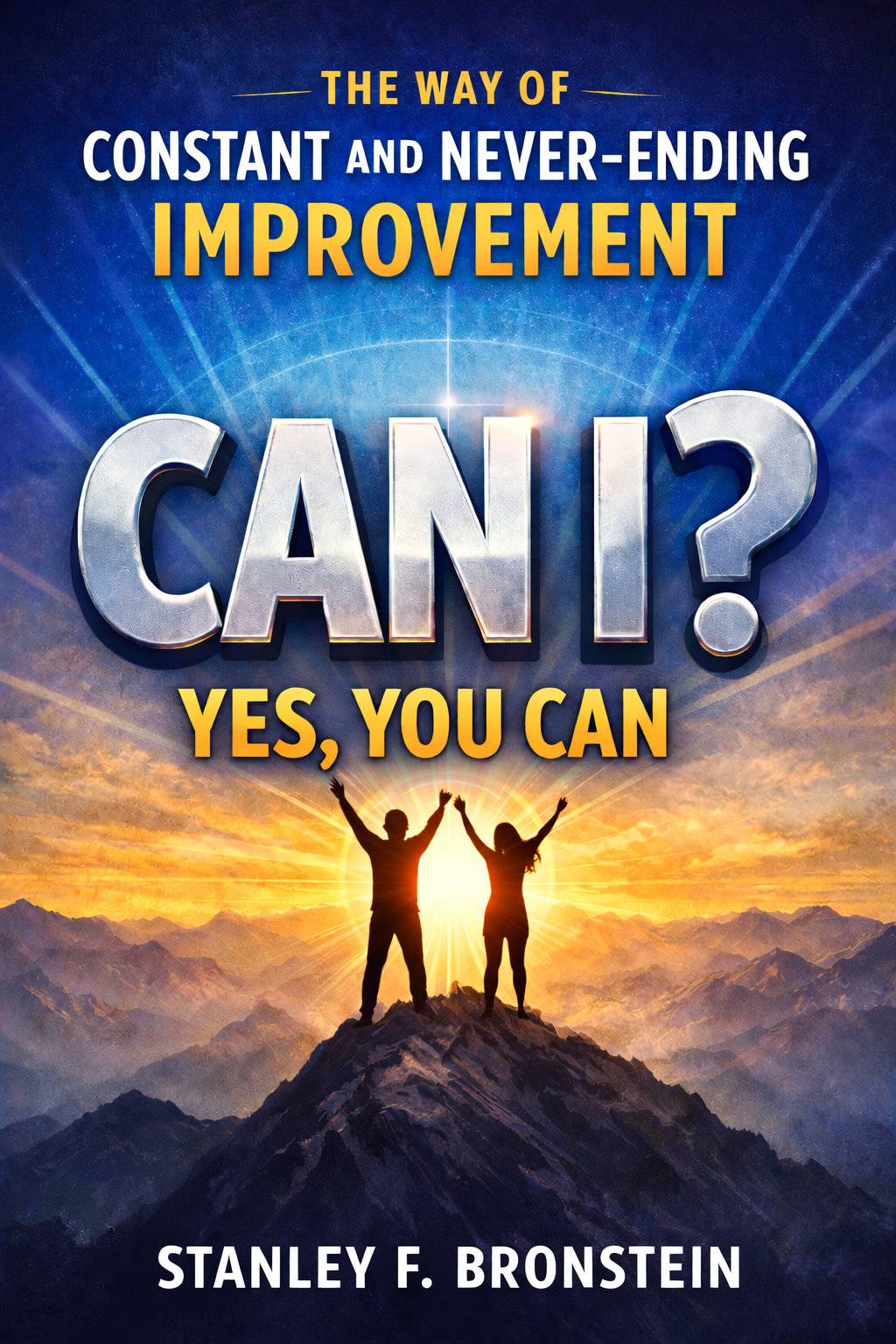
The Way of Can I ?
Yes, You Can
By Stanley F. Bronstein – Creator of The Way of Excellence System
Click The Tabs Below To Read Each Chapter Of The Book Online
Or
📘 Download Your Free Copy In Your Preferred Format
The Way of Can I
by Stanley F. Bronstein
How to use this page:
Click a chapter title to open it then scroll down to read.
When you click the title of the next chapter, the previous one will close.
Take your time.
Read, reflect, and do the experiments and assignments before you move on.
EMPTY ITEM
Foreword
Most people don’t fail because they lack talent, intelligence, or desire.
They fail because they try to change their lives in a way that is too big, too dramatic, too rigid, and too dependent on motivation. They aim for perfection, miss it, and then decide they have failed. And once that story takes hold, they stop.
This book exists to replace that story.
The Way of Constant And Never-Ending Improvement is built on a simple idea that is powerful enough to change your life:
The goal is to Beat Yesterday.
Do a little better today than you did yesterday and a little better tomorrow than you did today.
If you do that consistently, over time, you will achieve amazing results.
“Beat Yesterday” is not a slogan. It is a standard. It is a practical way to measure progress that keeps you moving forward without demanding perfection from you.
And it works for one reason above all others:
It is sustainable.
Most people waste an enormous amount of energy “starting over.” They go all-in, miss a day, and treat it like failure. Then they restart from zero.
TWOCANI ends that cycle.
In TWOCANI, the target is not perfection. The target is improvement—and improvement comes in more than one form.
Sometimes improvement looks like a clear step forward.
But sometimes improvement is quieter—and just as important:
Sometimes, the win can be simple maintenance. Sometimes, holding the line (in and of itself) is improvement.
This book will teach you how to live that principle in a way that is simple and doable. You will learn how to tell yourself the truth about where you are, decide who you want to become, and build a daily practice of improvement you can actually sustain.
The title of this book asks a question:
CAN I?
If you’ve asked that question in any area of your life—your health, your work, your relationships, your mindset—this book was written for you.
And the answer you are about to prove to yourself is:
Yes, you can.
Stanley F. Bronstein
How To Get The Most From This Book
This book is not meant to impress you. It is meant to change you.
So keep it simple.
Read one chapter at a time, and look for just one idea you can apply immediately.
Then ask yourself one question each day:
What is one way I can Beat Yesterday today?
Some days, that will mean taking a clear step forward.
And some days, remember this:
Sometimes, the win can be simple maintenance. Sometimes, holding the line (in and of itself) is improvement.
If you do nothing else, do this:
Choose one intentional improvement each day—no matter how small—and follow through.
Do not wait for motivation. Do not aim for perfection. Just keep going.
Because the power of TWOCANI is not in a single great day.
It is in many ordinary days, lived with purpose.
INTRODUCTION TO PART I - THE FOUNDATION - BEAT YESTERDAY
Part I lays the foundation for everything that follows.
TWOCANI is built on a simple standard that works in real life:
The goal is to Beat Yesterday.
Do a little better today than you did yesterday and a little better tomorrow than you did today.
If you do that consistently, over time, you will achieve amazing results.
This first section will help you understand why this approach succeeds where most people fail. It will show you why perfection is a trap, why consistency wins, and why small improvements are not small at all when you repeat them.
It will also introduce one of the most important principles in the entire book:
Sometimes, the win can be simple maintenance. Sometimes, holding the line (in and of itself) is improvement.
If you can accept that truth, you will stop judging yourself for being human. You will stop quitting when life gets hard. And you will build the kind of steady progress that creates a completely different life.
Part I is not theory for the sake of theory. It is the mental and emotional setup that makes the rest of the book usable. By the time you finish Part I, you will know exactly what TWOCANI is, how to measure progress the right way, and why you can trust this path.
Chapter 1 - TWOCANI: The Way of Constant And Never-Ending Improvement
Chapter 1
TWOCANI: The Way of Constant And Never-Ending Improvement
TWOCANI is a way of living.
It is not a hype phrase. It is not a temporary challenge. It is not a burst of motivation that fades after a few days.
TWOCANI is a personal path built on one idea:
Constant And Never-Ending Improvement.
That is what CAN I means in this book.
It is a commitment to keep growing, keep learning, and keep becoming, one day at a time, for the rest of your life.
Why this matters
Most people want to improve, but they approach improvement in a way that makes it hard to sustain.
They try to change everything at once.
They set goals that require constant motivation.
They demand perfection.
Then life happens. Stress hits. Energy drops. A setback appears. And they decide it is over.
They stop. They quit. They start over later, usually with even less confidence than before.
TWOCANI was created to end that cycle.
Not by making you try harder.
By giving you a better standard.
A standard you can live with on good days and on hard days.
The standard of TWOCANI
The standard is simple:
The goal is to Beat Yesterday.
Do a little better today than you did yesterday and a little better tomorrow than you did today.
If you do that consistently, over time, you will achieve amazing results.
This is not a theory. It is a practical strategy for real life.
It works because it replaces two common traps that destroy progress.
The first trap is perfection.
The second trap is all or nothing.
TWOCANI does not ask for perfection.
TWOCANI asks for improvement.
And improvement is always available.
What TWOCANI is
TWOCANI is a daily practice.
It is a way of asking, every day:
What is one way I can be a little better today than I was yesterday?
Sometimes the answer will be obvious.
Sometimes it will be small.
Sometimes it will feel almost too simple.
That is exactly the point.
TWOCANI is not built on dramatic moments.
It is built on repeatable moments.
Small choices, made consistently, create a life you did not think you could create.
TWOCANI is also flexible.
It meets you where you are.
It respects the fact that you are human.
You will have high energy days.
You will have low energy days.
You will have calm seasons and chaotic seasons.
TWOCANI still works, because it includes one of the most important truths in this entire book:
Sometimes, the win can be simple maintenance. Sometimes, holding the line (in and of itself) is improvement.
There will be days when your best move is not a big step forward.
Your best move is not going backward.
That is not failure.
That is skill.
That is strength.
That is improvement.
What TWOCANI is not
TWOCANI is not perfection.
If you approach this book with a perfection mindset, you will turn a tool into a weapon.
You will use it to judge yourself.
You will use it to measure how far you fall short.
That is not what this is for.
TWOCANI is also not hustle culture.
This is not about pushing harder every day until you burn out.
This is not about constantly doing more.
Sometimes doing more is improvement.
Sometimes doing less is improvement, if it keeps you consistent.
Sometimes rest is improvement, if it protects your health and your future.
TWOCANI is not a straight line.
Your progress will not look like a staircase that goes up every single day.
Real growth includes plateaus.
Real growth includes setbacks.
Real growth includes maintenance days.
TWOCANI is the way you keep improving through all of it.
The meaning of the title
This book asks a question:
CAN I?
People ask that question quietly in their own minds all the time.
Can I change?
Can I follow through?
Can I stop quitting?
Can I become disciplined?
Can I become healthier?
Can I become the kind of person who keeps my word to myself?
If you have asked that question, you are in the right place.
This book is here to help you answer it with action, not with wishful thinking.
And the answer you will prove is:
Yes, you can.
Not because you will suddenly become perfect.
Because you will become consistent.
Because you will learn how to Beat Yesterday.
Because you will learn how to win the hard days too.
The TWOCANI promise
TWOCANI offers a promise that is both simple and demanding.
Simple, because the path is clear.
Demanding, because it requires honesty and repetition.
Here is the promise:
If you commit to constant improvement, even small improvement, and you keep going through progress days and maintenance days, you will become a different person over time.
Not a perfect person.
A stronger person.
A calmer person.
A more disciplined person.
A person with self-trust.
And self-trust changes everything.
The three kinds of winning days
One reason people quit is that they only recognize one kind of win.
They think a win must look like major progress.
TWOCANI expands your understanding of winning.
There are three kinds of winning days.
1. Progress days
You move forward in a visible way. You improve something. You do a little more. You choose a better option. You take a step you have been avoiding.
2. Maintenance days
You do not move forward as much as you would like, but you do not go backward. You hold the line. You keep the standard alive. You protect the streak of your identity.
3. Recovery days
You slipped. You had a setback. You got off track. The win is that you reset quickly and return to the path.
This book will teach you how to win all three.
Because the people who change their lives are not the people who never slip.
They are the people who do not let a slip turn into a collapse.
The daily practice
TWOCANI can be lived in a very simple way.
Each day, you choose one intentional improvement.
It can be small.
It can be specific.
It must be real.
Examples:
Eat one better meal.
Move your body for ten minutes.
Go to bed a little earlier.
Make the phone call you have been avoiding.
Speak more patiently than you did yesterday.
Drink water before coffee.
Stop one negative spiral and replace it with one useful action.
On a hard day, your improvement might be maintenance.
You might hold the line by not making the situation worse.
You might avoid the habit that pulls you backward.
You might do the minimum that keeps your identity intact.
That counts.
In fact, those are often the days that build the deepest strength.
A simple commitment
TWOCANI does not ask you to promise that you will never fail.
It asks you to promise that you will not quit.
It asks you to promise that you will return.
It asks you to promise that you will keep improving.
One day at a time.
That is how people change.
That is how self-trust is built.
That is how a life becomes excellent.
Chapter 1 Practice
Write your answers. Keep them short and honest.
-
In one sentence, what does TWOCANI mean to you right now?
-
What is one area of your life where you want Constant And Never-Ending Improvement?
-
What is one improvement you can make today that is small enough to do, and real enough to matter?
-
If today is a hard day, what would “holding the line” look like for you?
Decide your answer, then do it.
That is how TWOCANI begins.
Chapter 2 - Beat Yesterday: The Standard That Works
Most people measure progress the wrong way.
They measure progress by outcomes only. They measure progress by big milestones. They measure progress by perfection.
That kind of measuring is dangerous, because it quietly teaches you this lie:
If I cannot do it perfectly, it does not count.
TWOCANI replaces that lie with a standard you can live with.
A standard that works on good days and on hard days.
A standard that turns progress into something you can actually repeat.
That standard is simple:
The goal is to Beat Yesterday.
Do a little better today than you did yesterday and a little better tomorrow than you did today.
If you do that consistently, over time, you will achieve amazing results.
What “Beat Yesterday” really means
“Beat Yesterday” does not mean you must do more every day.
It does not mean you must push harder every day.
It does not mean you must improve everything at once.
It means you choose one thing, and you make it a little better than it was yesterday.
Sometimes “better” is obvious.
Sometimes “better” is small.
Sometimes “better” is maintenance.
Sometimes “better” is simply holding the line.
But the principle stays the same.
Your job is not to transform your entire life today.
Your job is to win today, in a way that builds tomorrow.
Why this standard works
“Beat Yesterday” works because it does three things that most goals fail to do.
1. It makes progress measurable.
Not in a complicated way. In a human way.
You can answer the question: Did I do a little better than yesterday?
If the answer is yes, you won the day.
2. It makes progress repeatable.
If you aim for huge changes, you will burn out or break down.
If you aim for one small improvement, you can do it again tomorrow.
Repeatability is the secret.
3. It builds self-trust.
Every time you Beat Yesterday, you prove something to yourself.
You prove you can follow through.
You prove you are capable of change.
You prove you are not trapped.
Self-trust is not a feeling.
It is the result of keeping your word to yourself.
The two kinds of “better”
To live TWOCANI, you need to understand that “better” comes in two forms.
Forward better.
This is the day you take a clear step forward.
You improve a habit. You choose a healthier meal. You move more. You focus better. You do the task you avoided. You make a better decision.
Forward better is visible progress.
It feels good.
It motivates you.
Stable better.
This is the day you do not slide backward.
This is the day you hold the line.
This is where your key principle lives:
Sometimes, the win can be simple maintenance. Sometimes, holding the line (in and of itself) is improvement.
Stable better does not always feel exciting.
But it is one of the most powerful forms of improvement, because it protects your identity and your momentum.
It keeps the path alive.
It keeps your self-trust intact.
And it prevents the spiral that turns one hard day into a hard month.
The real enemy is not failure
The real enemy is not failure.
The real enemy is the story people tell themselves after a slip.
They miss a day and decide they are inconsistent.
They make a mistake and decide they are weak.
They fall short and decide they cannot change.
Then they stop.
Beat Yesterday changes the story.
It teaches you that one day does not define you.
It teaches you to return to the standard.
It teaches you to get back on the path with dignity, not drama.
If yesterday was strong and today is weaker, you can still win today by holding the line and preventing a step back.
If yesterday was weak and today is stronger, you can win today by taking a clear step forward.
Either way, you keep moving.
Beat Yesterday is a daily question
The simplest way to live this chapter is to turn “Beat Yesterday” into a daily question.
Ask it every day.
Ask it in a way that forces a real answer.
Ask it in a way that produces action.
Here is the question:
What is one way I can Beat Yesterday today?
And here is the follow-up question that makes it even more useful:
If today is a hard day, what does “holding the line” look like?
Those two questions can carry you for the rest of your life.
What to improve
People get stuck here because they think improvement must be dramatic.
It does not.
Improvement can be any meaningful upgrade.
Here are categories you can use.
Health
One better meal. One less harmful choice. One extra glass of water. One earlier bedtime.
Movement
Ten minutes of walking. Stretching. A short workout. A longer walk than yesterday.
Focus and discipline
One task completed. One distraction removed. One better boundary. One promise kept.
Mindset
One negative thought interrupted. One honest reflection. One calmer response.
Relationships
One better conversation. One apology. One act of kindness. One moment of patience.
Notice what is important.
You choose one.
You do it.
You win the day.
The standard that frees you
Beat Yesterday frees you from two extremes.
It frees you from the extreme of perfection, where nothing counts unless it is flawless.
It frees you from the extreme of hopelessness, where nothing matters because you assume you cannot change.
It replaces both with steady improvement.
And steady improvement is how people rebuild their lives.
Your Beat Yesterday plan
To make this chapter practical, you need a plan you can follow.
Not a complicated plan.
A plan you can do even when life is messy.
Here is the simplest version:
-
Choose one improvement for today.
-
Do it on purpose.
-
If you cannot move forward, hold the line.
-
Go to bed knowing you won the day.
That is it.
It sounds almost too simple.
But the most powerful things in life are often simple.
Not easy, but simple.
Chapter 2 Practice
Answer these in writing.
-
What does “Beat Yesterday” mean to you in one sentence?
-
What is one area of your life where you most need a better standard than perfection?
-
What would a “forward better” day look like for you right now?
-
What would a “stable better” day look like for you right now?
Now choose one improvement for today and do it.
That is how TWOCANI becomes real.
Chapter 3 - The Perfection Problem: Why People Quit
Perfection sounds noble.
In real life, perfection is one of the most destructive forces in personal growth.
Not because it is “bad” to want high standards, but because perfection changes the rules in a way no human can consistently win.
Perfection says:
If I cannot do it perfectly, it does not count.
And once that rule is in place, people do one of two things.
They either never start, because they do not want to face the discomfort of falling short.
Or they start, stumble, and then quit, because they interpret the stumble as proof they are failing.
TWOCANI was created to remove that rule and replace it with a standard that works.
The hidden danger of perfection
Perfection rarely shows up as “I want to be perfect.”
It shows up in subtle, everyday thinking:
-
If I cannot do it the right way, I will not do it at all.
-
If I miss one day, I ruined everything.
-
If I make one mistake, I am back to zero.
-
If I cannot stay consistent, I must not have discipline.
-
If I cannot do the full plan, I should wait until I can.
These thoughts feel logical, but they produce one predictable outcome.
They stop progress.
Because perfection does not create excellence.
Perfection creates pressure.
And pressure is not sustainable.
The all or nothing trap
Perfection and all or nothing thinking are close relatives.
All or nothing says:
If I cannot do everything, I might as well do nothing.
That one sentence is responsible for countless abandoned goals.
It is why people quit after one mistake.
It is why people disappear after a bad week.
It is why people view progress as fragile.
In reality, progress is not fragile.
It is the mindset that is fragile.
TWOCANI replaces all or nothing with a better mindset:
Constant And Never-Ending Improvement.
It does not require perfect days.
It requires honest days and consistent days.
The real reason people quit
Most people do not quit because the goal is impossible.
They quit because their definition of success is impossible.
Their definition of success is perfection.
So when life interrupts, and it always does, they conclude they failed.
Then they stop.
This is why “Beat Yesterday” matters.
It creates a definition of success you can actually live with.
A standard that does not collapse when you have a hard day.
A standard that adapts.
The most important upgrade in TWOCANI
Here is one of the most important upgrades you will make as you live this book.
You will learn to count a different kind of win.
Not just forward motion, but stability.
Because real life has seasons.
There are days when moving forward is easy.
There are days when moving forward feels impossible.
On those days, perfection would tell you that you are failing.
TWOCANI tells you something truer:
Sometimes, the win can be simple maintenance. Sometimes, holding the line (in and of itself) is improvement.
That sentence changes everything.
It makes progress durable.
It makes success possible on hard days.
It removes the shame that leads to quitting.
It keeps the path alive.
Excellence is not perfection
Excellence is not a flawless performance.
Excellence is a way of living.
It is the commitment to keep improving.
It is the willingness to return.
It is the courage to be honest.
It is the discipline to keep going.
Perfection is an outcome fantasy.
Excellence is a daily practice.
Perfection says, “I must never slip.”
TWOCANI says, “I will improve, and if I slip, I will return.”
That difference is not small.
That difference is the difference between quitting and changing your life.
Replace perfection with a better standard
To break the perfection problem, you need a replacement.
You cannot just tell yourself, “Stop being a perfectionist.”
You need a better rule.
Here is the rule:
Win the day.
And winning the day has more than one form.
A progress day counts.
A maintenance day counts.
A recovery day counts.
What does not count is giving up.
What does not count is using one imperfect day as permission to quit.
If you live by this rule, you will start to notice something.
You will stop fearing hard days.
Because you will know how to win them.
The perfection questions that sabotage you
If you want to see perfection at work in your life, listen for these questions:
-
Can I do it perfectly?
-
Can I do it the “right” way?
-
Can I do the full version?
-
Can I do it without discomfort?
-
Can I do it without failing?
These questions sound reasonable, but they are traps.
They make progress dependent on ideal conditions.
And ideal conditions are rare.
TWOCANI replaces those questions with better questions:
-
What is one way I can Beat Yesterday today?
-
What is the smallest improvement that still counts?
-
If today is hard, what does holding the line look like?
-
What can I do consistently, not occasionally?
Those questions lead to action.
And action, repeated, builds self-trust.
A short truth that will save you
You do not need a perfect week.
You need a consistent week.
You do not need a perfect month.
You need a month where you keep returning.
You do not need a perfect year.
You need a year where you do not quit.
That is TWOCANI.
That is Constant And Never-Ending Improvement.
Chapter 3 Practice
Write your answers. Keep them honest.
-
Where does perfection show up most in your life right now?
-
What do you tell yourself when you slip, miss, or fall short?
-
What would change if you stopped treating “imperfect” as “failed”?
-
If today needs to be a maintenance day, what does holding the line look like for you?
Now choose one improvement you can make today.
If you can move forward, take a step forward.
If you cannot, hold the line.
Either way, you win the day.
That is how people stop quitting.
That is how people change.
Chapter 4 - Maintenance Is Winning
Progress is powerful.
But maintenance is what makes progress last.
Most people only count a day as a win if they move forward in a visible way. They think they have to do more, push harder, and keep improving at a steady upward pace.
That sounds good in theory.
In real life, it is one of the quickest paths to burnout and quitting.
TWOCANI works because it gives you a way to win on every kind of day, including the days when life is heavy.
This chapter is built around two sentences that can save your momentum for years:
Sometimes, the win can be simple maintenance. Sometimes, holding the line (in and of itself) is improvement.
If you understand that, you will stop treating hard days as failures. You will stop turning temporary fatigue into permanent quitting. You will learn how to stay on the path long enough for compounding to work.
Why maintenance matters
Maintenance matters because life is not steady.
Energy is not steady.
Emotions are not steady.
Schedules are not steady.
There are seasons when you can push forward easily.
There are seasons when you are simply trying to keep your head above water.
If your only definition of success is forward progress, then every difficult season becomes a threat.
You will feel like you are failing.
And when people feel like they are failing, they often stop.
Maintenance solves that.
Maintenance is the strategy that keeps you consistent when you cannot be intense.
Maintenance is how you protect your identity when life tries to pull you backward.
Maintenance is how you win the day without requiring heroic effort.
What “holding the line” really means
Holding the line means you do not let today become worse than yesterday.
It means you do not make choices that create damage you will have to undo later.
It means you keep your standard alive, even if your performance is lower.
Holding the line can look like many things:
-
You do the minimum instead of quitting entirely.
-
You keep one promise to yourself when you cannot keep them all.
-
You avoid the habit that always pulls you backward.
-
You do not spiral, even if you feel disappointed.
-
You return to the path quickly, instead of drifting for days.
Holding the line is not passive.
It is active restraint.
It is quiet discipline.
It is strength.
The difference between maintenance and quitting
Maintenance says: I am still the kind of person who does not quit.
Quitting says: I am going to stop until I feel ready again.
Maintenance keeps your identity intact.
Quitting breaks your identity and forces you to rebuild it later.
Maintenance is how you stay connected to your future self.
Quitting is how you drift away from your future self.
Maintenance does not require you to feel good.
It requires you to remain committed.
Why people underestimate maintenance
People underestimate maintenance because it does not look dramatic.
It does not feel like a breakthrough.
It does not produce instant rewards.
But maintenance prevents the most common pattern that destroys progress:
One hard day becomes a hard week.
A hard week becomes a hard month.
A hard month becomes “I guess I can’t do this.”
Maintenance breaks that chain.
Maintenance says: Today might not be a progress day, but it will not become a collapse day.
That is a win.
That is improvement.
The three categories of maintenance
There are different kinds of “hold the line” days. Here are three.
1. Physical maintenance
This is when your body is tired or stressed, and the win is protecting your health.
Examples:
You walk a shorter distance but you still move.
You stretch instead of skipping movement entirely.
You eat simply and cleanly instead of perfectly.
You go to bed earlier instead of pushing through.
2. Emotional maintenance
This is when your emotions are loud, and the win is preventing a spiral.
Examples:
You pause before reacting.
You choose calm over control.
You stop the negative self-talk.
You do one stabilizing action and return to center.
3. Identity maintenance
This is when your life is chaotic, and the win is staying aligned with who you are becoming.
Examples:
You keep the promise that matters most.
You do the minimum that maintains your standard.
You do not abandon the path, even if you cannot do much today.
Identity maintenance is often the most important kind.
Because your identity is what carries you through seasons.
How to plan for maintenance days
A maintenance day should not be a surprise.
It should be a planned option.
You should know, ahead of time, what “holding the line” looks like for you.
Here is a simple way to do it.
Decide your minimums.
Not your goals, your minimums.
Minimums are the actions you can do even on hard days.
They protect your consistency.
They protect your identity.
Examples:
-
Minimum movement: ten minutes.
-
Minimum nutrition: one clean meal.
-
Minimum focus: one important task.
-
Minimum mindset: one honest journal sentence.
-
Minimum relationships: one kind interaction.
When you have a maintenance day, you do your minimums and you win.
That is TWOCANI.
Maintenance is not an excuse
Maintenance is not permission to drift.
Maintenance is not a way to justify bad choices.
Maintenance is a strategic decision to protect what you have built.
It is the difference between a controlled, intentional low day and an uncontrolled collapse.
You are not lowering your standards.
You are choosing the right standard for the day you are in.
You are staying in the game.
You are staying on the path.
The maintenance mindset
A maintenance mindset sounds like this:
Today is not a day for heroics.
Today is a day for consistency.
Today is a day to protect my progress.
Today is a day to hold the line.
If you learn to think this way, you will stop fearing hard days.
Hard days will no longer threaten your identity.
Hard days will become part of your system.
And that is when change becomes permanent.
Chapter 4 Practice
Answer these in writing.
-
What is your old definition of success that makes you feel like hard days are failures?
-
What does “holding the line” look like for you right now in one sentence?
-
What are your three personal minimums for a maintenance day?
-
What is one decision you can make today that protects your identity?
Now choose your win for today.
If you can move forward, take a step forward.
If you cannot, hold the line.
Either way, you are improving.
Chapter 5 - The Math of Becoming: Compounding Across Time
TWOCANI is simple: Beat Yesterday.
But the results are not simple. They are extraordinary.
Why? Because small improvements do not add up. They multiply.
That is what compounding does.
It is the quiet force that turns “a little better” into “a completely different life,” as long as you stay consistent long enough.
A quick note before we begin
The math in this chapter is a model, not a demand.
Real life is not a perfect spreadsheet. No one improves exactly 1% every single day.
The purpose of this chapter is not to pressure you.
The purpose is to show you what becomes possible when you stop quitting and start compounding.
What compounding means in TWOCANI
The old adage says: improve 1% per day.
That is not a motivational phrase. It is a strategy.
If you improve by 1% each day, the formula is:
(1.01) raised to the number of days.
Again, you do not need to do this perfectly.
You just need to understand the message:
Small improvements, repeated, become massive over time.
Compounding examples across time
To keep it simple, the examples below use 365 days per year.
1 Year (365 days)
(1.01)^365 ≈ 37.78 times better
2 Years (730 days)
(1.01)^730 ≈ 1,427.59 times better
3 Years (1,095 days)
(1.01)^1095 ≈ 53,939.17 times better
And here is a useful reference point: 1,000 days is about 2.74 years, a little under 3 years.
(1.01)^1000 ≈ 20,959.16 times better
5 Years (1,825 days)
(1.01)^1825 ≈ 77,002,912.75 times better
That is about 77 million times better
10 Years (3,650 days)
(1.01)^3650 ≈ 5,929,448,572,069,368 times better
That is about 5.93 quadrillion times better
15 Years (5,475 days)
(1.01)^5475 ≈ 4.57 × 10^23 times better
That is about 456 sextillion times better
20 Years (7,300 days)
(1.01)^7300 ≈ 3.52 × 10^31 times better
That is about 35 nonillion times better
What these numbers are really saying
They are not saying you must be perfect.
They are saying this:
If you keep taking small steps, and you stop treating setbacks as identity, you will eventually create results so large that your old self will feel like a stranger.
This is why TWOCANI is built for the long game.
It is why “maintenance” is part of the system.
It is why “holding the line” is not a consolation prize.
It is a strategy for staying in the game long enough for compounding to work.
The final example: nearly 17 years of becoming
I started on February 1, 2009.
It is now December 23, 2025.
Counting the first day, that is 6,170 days.
If a person compounded 1% improvement per day for 6,170 days:
(1.01)^6170 ≈ 4.60 × 10^26 times better
That is about 460 septillion times better.
And here is the point of the example:
Nearly 17 full years later, I am nowhere near the same person I was when I started.
Not because I was perfect.
Because I kept improving, I kept returning, and I kept compounding.
Chapter 5 Practice
-
Which time frame motivates you most right now: 1 year, 3 years, 5 years, or 10 years?
-
What is one area where you most need compounding: health, movement, mindset, relationships, work, or self-discipline?
-
What is one improvement you can repeat daily, or almost daily, for the next 30 days?
-
If you hit a hard day, what does “maintenance” look like for you so you can keep compounding?
Choose your one improvement, then Beat Yesterday today.
INTRODUCTION TO PART II - THE TWOCANI OPERATING SYSTEM
Part I gave you the foundation.
You now understand the standard of TWOCANI.
You understand what it means to Beat Yesterday.
You understand why perfection causes people to quit.
You understand why maintenance is winning.
And you have seen the power of compounding across time.
Now it is time to turn the philosophy into an operating system.
Part II is where TWOCANI becomes practical.
This section will show you how to choose the right improvement, how to keep it small enough to sustain, and how to build consistency without burning out.
You will learn how to win different kinds of days, and how to track progress in a way that builds belief instead of pressure.
The goal of Part II is simple:
To give you a repeatable way to improve, day after day, no matter what kind of day you are having.
Because the real power of TWOCANI is not one great decision.
It is many small decisions made consistently.
That is how you Beat Yesterday.
That is how you become someone new.
Chapter 6 - The Unit of Change: One Intentional Improvement
Most people try to change their lives by aiming at a finish line.
TWOCANI changes your life by focusing on a unit.
A unit is something small enough to repeat and meaningful enough to matter.
In TWOCANI, the unit is this:
One intentional improvement.
Not ten.
Not a complete overhaul.
Not perfection.
One.
Because one improvement is doable on almost any day.
And what you can do on almost any day is what can change your life.
Why “one” works
One works because it removes overwhelm.
Overwhelm is not laziness. Overwhelm is confusion plus pressure.
When people feel overwhelmed, they tend to do nothing.
Or they do too much for a short time and then collapse.
“One intentional improvement” breaks that pattern.
It gives you clarity.
It gives you direction.
It gives you a win you can repeat.
One also works because it builds self-trust.
Every time you do one intentional improvement, you prove to yourself that you can follow through.
And self-trust is the foundation of every lasting change.
What makes an improvement “intentional”
An improvement becomes powerful when it is chosen on purpose.
Intentional means you did not stumble into it by accident.
You decided.
You acted.
You followed through.
An intentional improvement has three qualities.
1. It is specific.
Not “be healthier.” Something you can actually do.
2. It is doable today.
Not someday. Not when life calms down. Today.
3. It is tied to your standard.
It helps you Beat Yesterday.
It strengthens who you are becoming.
What counts as an improvement
People sometimes get stuck here because they assume improvement has to be dramatic.
It does not.
Improvement can be small and still be real.
It can be physical, emotional, mental, relational, or practical.
Here are examples.
Health
One better meal. One cleaner choice. One less harmful choice. One glass of water before anything else.
Movement
Ten minutes of walking. Stretching. A short workout. One more minute than yesterday.
Focus and discipline
One task completed. One distraction removed. One boundary enforced.
Mindset
One negative thought interrupted. One honest journal entry. One calmer response.
Relationships
One apology. One kind interaction. One difficult conversation started.
If it makes you a little better than yesterday, it counts.
If it strengthens your self-trust, it counts.
If it keeps you moving, it counts.
Progress days and maintenance days
Some days your one intentional improvement will be a clear step forward.
Other days your improvement will be maintenance.
This is where your core principle matters:
Sometimes, the win can be simple maintenance. Sometimes, holding the line (in and of itself) is improvement.
A maintenance improvement might be:
You do the minimum instead of nothing.
You avoid the habit that pulls you backward.
You keep one promise to yourself.
You stop the spiral.
You go to bed without making the problem worse.
That counts.
In fact, those days often build the deepest strength, because they teach you that your progress does not depend on perfect conditions.
It depends on commitment.
The danger of choosing the wrong unit
If your “unit of change” is too big, you will eventually avoid it.
If the improvement requires high motivation, perfect timing, and lots of energy, it will not survive real life.
The unit must be repeatable.
If you cannot repeat it, it is not your unit.
This is why TWOCANI emphasizes “small enough to do.”
The next chapter will show you how to choose improvements that you can sustain.
The one improvement question
Here is the daily question that makes TWOCANI practical:
What is one intentional improvement I will make today?
And here is the follow-up that makes it sustainable:
If today is a hard day, what improvement looks like holding the line?
This is not complicated.
But it is powerful.
Because once you answer, you act.
And once you act, you win.
The rule that protects consistency
One reason people quit is that they expect every day to be a progress day.
Then they hit a hard day and conclude they are failing.
TWOCANI protects you from that mistake.
It teaches you to win the day you are in.
Progress day, take a step forward.
Hard day, hold the line.
Either way, choose one intentional improvement and follow through.
That is how consistency is built.
That is how compounding becomes real.
A simple way to start
If you want to make this practical immediately, start with a list.
Write ten possible improvements that are small and repeatable.
Then each day, choose one.
Keep it simple.
Do it on purpose.
Go to bed knowing you Beat Yesterday.
Chapter 6 Practice
-
In your own words, what is the TWOCANI “unit of change”?
-
List five improvements that are small enough to repeat.
-
What is one improvement you can do today, no matter how you feel?
-
What does “holding the line” look like for you on a hard day?
Now choose one intentional improvement and do it today.
Chapter 7 - Small Enough to Do, Big Enough to Matter
TWOCANI only works if you can repeat it.
That is why the improvements you choose must live in a very specific zone.
Small enough to do.
Big enough to matter.
If it is too big, you will avoid it.
If it is too small, you will not respect it.
This chapter will teach you how to choose improvements that you can sustain without losing the sense that you are making real progress.
Why people choose improvements that fail
People often choose improvements based on emotion instead of reality.
They feel inspired, so they choose something dramatic.
They feel guilty, so they choose something punishing.
They feel behind, so they choose something that requires perfect days.
Then real life shows up.
They miss.
They slip.
They conclude they failed.
They quit.
The problem was not the person.
The problem was the size of the improvement.
If the improvement requires constant motivation, it is not a TWOCANI improvement.
If the improvement collapses when life gets hard, it is not a TWOCANI improvement.
TWOCANI improvements survive real life.
The TWOCANI zone
A TWOCANI improvement is:
Small enough that you can do it even when you are tired.
Small enough that you can do it even when you are busy.
Small enough that you can do it even when you do not feel like it.
But it is also:
Big enough that it changes something.
Big enough that it builds self-trust.
Big enough that you can honestly say, I Beat Yesterday.
This is the TWOCANI zone.
Small enough to do.
Big enough to matter.
The two biggest mistakes
There are two common mistakes people make when choosing improvements.
Mistake 1: Choosing the “perfect plan” improvement
This is when your improvement depends on ideal conditions.
Perfect schedule.
Perfect energy.
Perfect mood.
Perfect circumstances.
That is not improvement. That is fantasy.
Mistake 2: Choosing the “hero day” improvement
This is when your improvement requires a surge of effort you cannot repeat.
It looks impressive.
It feels intense.
But it is not sustainable.
TWOCANI is not about hero days.
TWOCANI is about repeatable days.
How to choose the right size improvement
Here is a simple test you can use every time you choose an improvement.
Ask three questions.
1. Can I do this on a normal day?
Not your best day. A normal day.
If the answer is no, it is too big.
2. Can I do this on a hard day?
This matters because hard days will come.
If the answer is no, you need a maintenance version.
Because sometimes, the win can be simple maintenance. Sometimes, holding the line (in and of itself) is improvement.
3. Will this matter if I repeat it for a month?
If repeated for thirty days, will it change something?
If yes, it matters.
If no, it might be too small or too vague.
If you can answer yes to these questions, you have chosen well.
Create a progress version and a maintenance version
One of the smartest TWOCANI moves you can make is to create two versions of the same improvement.
A progress version for strong days.
A maintenance version for hard days.
This is how you stay consistent through real life.
Here are examples.
Movement
Progress: 45 minutes of walking.
Maintenance: 10 minutes of walking.
Nutrition
Progress: a full day of clean eating.
Maintenance: one clean meal, no matter what.
Focus
Progress: 90 minutes of deep work.
Maintenance: 10 minutes on the most important task.
Relationships
Progress: a full conversation and repair.
Maintenance: a short message that keeps connection alive.
You are not lowering your standards.
You are designing your standards to survive.
That is what winners do.
Make it specific or it will fade
Vague improvements feel good in the moment and disappear the next day.
Be specific.
Instead of “eat better,” choose “one clean meal.”
Instead of “work harder,” choose “finish one task.”
Instead of “be calmer,” choose “pause before I respond.”
Specific improvements are easier to do.
They are easier to repeat.
They are easier to track.
The dignity of small improvements
Some people feel insulted by small improvements.
They think small means weak.
Small means smart.
Small means sustainable.
Small means repeatable.
And repeatable is what compounds.
If you only do big improvements when you feel motivated, you are building a fragile life.
If you do small improvements consistently, you are building a powerful life.
TWOCANI is the path of power.
Not through intensity.
Through consistency.
How to know you chose well
You chose well when:
You can do it today.
You can do it again tomorrow.
You can still respect it.
You can still feel the win.
You can imagine doing it for weeks, not just for one day.
That is the TWOCANI zone.
Small enough to do.
Big enough to matter.
Chapter 7 Practice
-
Name one improvement you have tried before that failed because it was too big.
-
Rewrite it as a TWOCANI improvement that is small enough to repeat.
-
Create two versions of it: a progress version and a maintenance version.
-
What is one specific improvement you will do today?
Choose your improvement.
Make it small enough to do.
Make it big enough to matter.
Then Beat Yesterday.
Chapter 8 - The Improvement Ladder: Maintenance to Breakthrough
If you only recognize one kind of win, you will quit.
Most people quit because they think progress must always look the same.
They believe they must always be moving forward in a visible way.
When that does not happen, they decide they are failing.
TWOCANI gives you a different way to see progress.
It gives you a ladder.
This ladder helps you win on every kind of day, and it helps you understand what kind of day you are in.
Not so you can judge yourself.
So you can choose the right win.
The Improvement Ladder
The Improvement Ladder has five levels:
-
Maintenance
-
Stability
-
Progress
-
Growth
-
Breakthrough
Each level is improvement.
Each level builds you.
Each level counts.
Level 1: Maintenance
This is the day you hold the line.
You do not go backward.
You protect what you have built.
You keep your standard alive.
This is where your key principle lives:
Sometimes, the win can be simple maintenance. Sometimes, holding the line (in and of itself) is improvement.
Maintenance is not weakness.
Maintenance is discipline under pressure.
It is what keeps you consistent through real life.
Examples:
You move for ten minutes instead of skipping movement entirely.
You eat one clean meal instead of spiraling into chaos.
You do the minimum that protects your routine.
You avoid the one habit that always pulls you backward.
If you hold the line, you win.
Level 2: Stability
Stability is slightly stronger than maintenance.
Maintenance is “do not go backward.”
Stability is “keep things steady.”
You do more than the minimum.
You do not push hard.
You keep your system running.
Stability days build your base.
Examples:
You complete your normal walk.
You eat your normal plan.
You do your normal work routine.
You keep your normal boundaries.
Stability may not feel exciting, but it is powerful.
Because stability builds reliability.
And reliability builds self-trust.
Level 3: Progress
This is the day you take a clear step forward.
Not a dramatic leap.
A real improvement.
A visible upgrade.
Progress days are satisfying, because you can feel movement.
Examples:
You improve your nutrition choice beyond your normal.
You add time, intensity, or consistency to movement.
You complete a task you have been avoiding.
You make a better decision in a situation where you usually fail.
Progress days are excellent, but they are not required every day.
TWOCANI does not demand constant progress.
It demands constant commitment.
Level 4: Growth
Growth is a deeper level of improvement.
Progress is a step forward.
Growth is building capacity.
It is stretching your ability.
It is strengthening your identity.
Growth requires effort, but it is still sustainable.
Examples:
You increase your walk distance or intensity in a structured way.
You build a stronger nutrition pattern, not just a better meal.
You develop a stronger focus habit, not just a completed task.
You choose discomfort on purpose because it builds you.
Growth days expand your range.
They make future progress easier.
They raise your baseline.
Level 5: Breakthrough
Breakthrough is rare.
It is not your daily goal.
It is the result of time, effort, and consistency.
Breakthrough is when something shifts.
A new identity locks in.
A long plateau breaks.
A fear dissolves.
A pattern changes.
Breakthrough days are powerful, but they are not predictable.
You cannot force them by demanding them.
You earn them by staying consistent.
Breakthrough is what happens when you have enough maintenance, enough stability, enough progress, and enough growth behind you.
Breakthrough is the reward of compounding.
How to use the ladder
The ladder is not for judgment.
It is for strategy.
Each day, you identify what level you are in, then you choose a win that matches that level.
Ask these questions:
What kind of day is today?
Do I have energy?
Do I have time?
Am I emotionally stable?
Is life calm or chaotic?
Then decide:
Today is a maintenance day. I will hold the line.
Today is a stability day. I will keep the system steady.
Today is a progress day. I will take a clear step forward.
Today is a growth day. I will stretch my capacity.
Today might be a breakthrough day. If it happens, great. If not, I will keep compounding.
This prevents the main cause of quitting.
The main cause of quitting is expecting growth behavior on a maintenance day.
That creates failure feelings.
And failure feelings create quitting.
TWOCANI makes sure you have a way to win the day you are actually living.
The ladder protects your identity
When you use the ladder, you stop labeling yourself based on short-term performance.
You stop calling yourself inconsistent because you had a hard day.
You stop calling yourself weak because you needed a maintenance day.
You stop treating low energy as failure.
Instead, you become a person who knows how to stay in the game.
And staying in the game is the whole point.
Because compounding only works if you stay.
A simple daily standard
Here is a simple way to use this chapter starting today.
Ask:
What level am I on today?
Then choose:
What is my win at that level?
Then do it.
That is how you Beat Yesterday.
Not by forcing the wrong kind of day.
By winning the day you have.
Chapter 8 Practice
-
Which level do you live in most often right now: maintenance, stability, progress, or growth?
-
What level do you tend to judge as “not good enough,” even though it is still improvement?
-
Write your personal definition of a win for each level. Keep it short.
-
What level is today, and what is your win?
Choose your win.
Do it on purpose.
That is how TWOCANI becomes real.
Chapter 9 - Consistency Beats Intensity
Intensity looks impressive.
Consistency changes lives.
Most people admire the intense day.
The huge workout.
The perfect eating day.
The long, productive sprint.
The dramatic breakthrough.
But intensity is unreliable, because intensity usually depends on conditions.
High energy.
High motivation.
Low stress.
Extra time.
A perfect mood.
Those conditions come and go.
Consistency does not depend on conditions.
Consistency is a decision you repeat.
And in TWOCANI, consistency is the engine that makes compounding possible.
Why intensity fails
Intensity fails for one simple reason.
It is hard to repeat.
You can do almost anything once.
You cannot do most intense things repeatedly without burning out.
When your improvement plan depends on intensity, it becomes fragile.
A busy week breaks it.
A stressful season breaks it.
A hard day breaks it.
Then you feel like you failed.
Then you quit.
Not because you are weak.
Because the plan was built on a foundation that cannot hold real life.
Why consistency wins
Consistency wins because it is repeatable.
It is built for real life.
It is built for ordinary days.
It is built for hard days.
Consistency is the quiet decision to keep showing up.
It is the commitment to stay in the game.
It is the ability to do the simple thing again.
And again.
And again.
That is what changes a person.
That is what builds identity.
That is what creates excellence.
Consistency builds self-trust
Self-trust is one of the most valuable assets you can develop.
Without it, you hesitate.
You doubt.
You overthink.
You stop.
With it, you move.
You follow through.
You do not panic when a hard day hits.
You do not collapse after a slip.
Self-trust is built the same way everything is built in TWOCANI.
One day at a time.
One promise kept at a time.
Consistency is what makes promises believable.
First to yourself, then to others.
The two types of consistency
There are two types of consistency you need.
1. Action consistency
This is what you do.
Movement.
Nutrition choices.
Work routines.
Daily habits.
2. Identity consistency
This is who you are becoming.
This is the deeper win.
Because when identity becomes consistent, behavior follows.
Identity consistency sounds like this:
I am the kind of person who shows up.
I am the kind of person who keeps going.
I am the kind of person who does not quit.
Even on days when I do not feel like it.
This is why maintenance matters.
Maintenance protects identity consistency.
This is where your key principle belongs again:
Sometimes, the win can be simple maintenance. Sometimes, holding the line (in and of itself) is improvement.
On a hard day, consistency might not look like progress.
It might look like not going backward.
That is still consistency.
That is still winning.
That is still improvement.
The trap of comparing your Day 1 to someone else’s Day 500
Another reason people chase intensity is comparison.
They compare themselves to someone who has been consistent for years.
They try to match that person’s output overnight.
They do too much.
They break.
Then they conclude they are not cut out for it.
That is the wrong comparison.
The correct comparison is yesterday.
Beat Yesterday.
That is your race.
That is your standard.
TWOCANI is personal. It is not performative.
You are not here to impress anyone.
You are here to become someone you respect.
The consistency formula
Here is the simplest way to state the TWOCANI formula.
Small enough to do.
Big enough to matter.
Repeated long enough to compound.
That is it.
Intensity tries to skip the “repeated long enough” part.
Consistency embraces it.
Consistency is patient.
Consistency is steady.
Consistency understands the long game.
How to build consistency without burnout
To build consistency, you need two things.
A progress version and a maintenance version.
This keeps you from falling into the all-or-nothing trap.
It keeps you from disappearing when life gets hard.
It gives you a way to win every day.
Progress version: what you do when you feel strong.
Maintenance version: what you do when life is heavy.
If you use this approach, you stop fearing hard days.
You stop fearing travel.
You stop fearing busy weeks.
You stop fearing low motivation.
Because you already know how to win those days.
Consistency becomes automatic.
Consistency is not perfection
Consistency does not mean you never miss.
Consistency means you do not disappear.
It means you return quickly.
It means you keep the relationship with your goals alive.
It means you stay in the practice.
This is why “never miss twice” matters, and why we will cover it later in the book.
Consistency is not a flawless streak.
Consistency is a resilient pattern.
A better way to think about intensity
Intensity is not evil.
Intensity has a place.
But intensity should be a guest, not a landlord.
Use intensity when it appears naturally.
Do not build your identity around it.
Do not depend on it.
Build your life on consistency, and allow intensity to show up occasionally as a bonus.
If you do that, you will improve without breaking.
You will grow without burning out.
You will build excellence the TWOCANI way.
Chapter 9 Practice
-
Where have you relied on intensity in the past and then burned out?
-
What is one habit you can make consistent by making it smaller?
-
Write a progress version and a maintenance version of your key habit.
-
What is one consistent action you will take today to Beat Yesterday?
Choose consistency today.
That is how the results arrive.
Not all at once.
But permanently.
Chapter 10 - Tracking That Builds Belief
Tracking is not about pressure.
Tracking is about proof.
Most people either do not track at all, or they track in a way that makes them feel judged.
They use tracking like a courtroom.
They collect evidence to prove they are failing.
That is not TWOCANI.
In TWOCANI, tracking is a tool that builds belief.
It helps you see your progress.
It helps you learn what works.
It helps you stay consistent.
And most importantly, it helps you build self-trust through visible proof.
Why tracking matters
If you do not track, you will rely on memory.
If you rely on memory, you will rely on emotion.
And emotions are unreliable reporters.
On a good day, you will remember your wins.
On a hard day, you will forget them.
Tracking corrects that.
Tracking gives you evidence.
Evidence builds belief.
Belief fuels consistency.
Consistency creates results.
That is why tracking matters.
Tracking is not perfection
Tracking is not a way to demand flawless performance.
Tracking is not a way to punish yourself.
Tracking is not a way to turn TWOCANI into a rigid system.
Tracking is simply a way to answer one question:
Did I Beat Yesterday today?
The goal is not a perfect record.
The goal is a clear record.
Because a clear record shows you the truth.
And the truth is what helps you improve.
What to track
Track what matters most.
If you try to track everything, you will track nothing.
Start with one to three items.
Choose the items that will create the biggest difference in your life if they become consistent.
Examples:
Movement.
Nutrition.
Sleep.
Focus.
A daily improvement habit.
A daily relationship habit.
A daily mindset practice.
The best things to track are behaviors.
Behaviors are within your control.
Outcomes are not always within your control.
Track behaviors, and outcomes will follow.
The simplest tracking system
The best tracking system is one you will actually use.
Here is a TWOCANI system that works for almost anyone.
One line per day.
That is it.
Write the date, then write:
What was my one intentional improvement today?
If it was a progress day, write the improvement.
If it was a maintenance day, write how you held the line.
Because sometimes, the win can be simple maintenance. Sometimes, holding the line (in and of itself) is improvement.
If you do this for thirty days, you will build a powerful kind of proof.
Proof that you are becoming consistent.
Proof that you are improving.
Proof that you can follow through.
Tracking the right way on hard days
Hard days are where tracking becomes most valuable.
Hard days are when people forget they are making progress.
Hard days are when people decide they are failing.
Hard days are when people disappear.
Tracking keeps you connected.
It shows you that you did not quit.
It shows you that you held the line.
It shows you that you stayed in the practice.
Hard days are not interruptions to the process.
Hard days are part of the process.
Tracking helps you see that.
How tracking builds identity
Identity is built through evidence.
Every time you track an improvement, you are collecting evidence about who you are becoming.
You are not building the identity of a perfect person.
You are building the identity of a consistent person.
A person who shows up.
A person who follows through.
A person who does not quit.
And once that identity becomes real, it changes your choices automatically.
This is why tracking is so powerful.
It makes your growth visible.
It makes your progress real.
It makes your identity tangible.
Do not let tracking become obsession
Tracking is a tool.
If it becomes a source of pressure, simplify it.
If it becomes obsessive, shrink it.
If you find yourself using tracking to shame yourself, stop and reset.
Tracking is meant to build belief, not anxiety.
Here is a simple rule:
If tracking makes you want to quit, you are tracking the wrong way.
Return to the one line per day method.
Return to the idea that maintenance is winning.
Return to the goal of Beat Yesterday.
What tracking teaches you
Tracking teaches you patterns.
It teaches you what triggers setbacks.
It teaches you what supports consistency.
It teaches you which improvements matter most.
It teaches you how to design your environment.
It teaches you what kind of days you tend to struggle with.
Then you can adjust.
You can improve the system, not just yourself.
And that is a deeper level of TWOCANI.
Not just improving your performance.
Improving your approach.
A simple weekly review
If you want to deepen your tracking without making it complicated, do a short weekly review.
Once per week, read your seven lines.
Then answer three questions.
What did I do well?
What did I learn?
What is one improvement I will make next week?
That is enough.
That review turns tracking into wisdom.
And wisdom turns improvement into a life.
Chapter 10 Practice
-
What is one behavior you will track for the next 30 days?
-
What format will you use: notebook, calendar, spreadsheet, or notes app?
-
Write your one-line tracking template. Keep it simple.
-
Tonight, write today’s line and prove to yourself that you are improving.
Tracking builds belief.
Belief builds consistency.
Consistency builds your future.
INTRODUCTION TO PART III - STAYING ON THE PATH
Part II gave you the operating system.
You now know how to choose one intentional improvement.
You know how to keep it small enough to do and big enough to matter.
You know why consistency beats intensity.
You know how to track progress in a way that builds belief.
Now we deal with the part that determines whether the system actually changes your life.
Not the plan.
Not the knowledge.
Not the inspiration.
The moment when life gets hard.
Part III is about staying on the path through resistance, setbacks, stress, fatigue, and the days when you do not feel like doing anything.
This section will show you why people stop improving, what triggers quitting, and how to win the hard days without turning them into collapse days.
You will learn how to reset quickly after a slip, how to stop shame from taking over, and how to design your life so improvement becomes easier.
The goal of Part III is simple:
To make your progress resilient.
So that no matter what happens, you do not disappear.
You keep going.
You keep improving.
You keep compounding.
That is TWOCANI.
Chapter 11 - Why People Stop Improving
Most people do not stop improving because they do not want to change.
They stop improving because they lose their connection to the path.
They lose it through overwhelm.
They lose it through disappointment.
They lose it through shame.
They lose it because they expect improvement to feel easy once they “decide.”
TWOCANI is built for a more honest reality.
Improvement is not hard because you are weak.
Improvement is hard because life is real.
This chapter is about the real reasons people stop improving, so you can recognize them early and respond with skill instead of self-criticism.
The most common reason: unrealistic expectations
Unrealistic expectations destroy progress.
People expect the plan to work instantly.
They expect motivation to remain high.
They expect energy to be steady.
They expect life to cooperate.
Then life does what life does.
Stress shows up.
A schedule changes.
A relationship issue hits.
A holiday arrives.
A work crisis happens.
They miss a day.
And because they expected a smooth path, they interpret the interruption as failure.
Then they stop.
TWOCANI replaces unrealistic expectations with a realistic standard.
Beat Yesterday.
And when necessary, hold the line.
The perfection trap
Perfection is one of the most common reasons people stop.
Perfection teaches people to treat “imperfect” as “failed.”
Then the moment they fall short, they quit.
TWOCANI refuses to use perfection as the scoreboard.
TWOCANI uses improvement as the scoreboard.
And improvement has more than one form.
Progress counts.
Maintenance counts.
Recovery counts.
That is how you stay on the path.
The emotional crash after early excitement
Many people begin with excitement.
They feel inspired.
They feel hopeful.
They feel energized.
Then the excitement fades.
This is normal.
Excitement is not a strategy. It is a mood.
When the mood changes, people panic.
They think, I guess I lost motivation.
Then they stop.
TWOCANI trains you to rely on commitment, not mood.
You do not need excitement to Beat Yesterday.
You need a small, repeatable improvement.
Even on days when you do not feel like it.
The shame spiral
Shame is one of the fastest ways to end progress.
Shame does not say, I made a mistake.
Shame says, I am a mistake.
Once shame takes over, people do one of two things.
They hide.
Or they quit.
Shame makes people avoid the very actions that would help them recover.
TWOCANI replaces shame with truth and return.
Truth about what happened.
Truth about what matters.
Then return to the path.
Overwhelm and decision fatigue
Overwhelm is a major reason people stop improving.
They try to improve too many things at once.
They have too many rules.
Too many expectations.
Too many decisions.
Then their brain gets tired.
And when the brain gets tired, it chooses the easiest option.
That is why TWOCANI uses one unit:
One intentional improvement.
It reduces decision fatigue.
It creates clarity.
It makes progress doable again.
The misunderstanding of hard days
Many people stop improving because they believe hard days should not happen.
They believe struggle means something is wrong.
They believe low energy means they are failing.
TWOCANI gives you a different truth.
Hard days are part of the path.
Hard days are not a sign to quit.
Hard days are a sign to use the system correctly.
This is where your key principle becomes a lifeline:
Sometimes, the win can be simple maintenance. Sometimes, holding the line (in and of itself) is improvement.
When people do not understand that, they treat a hard day like a collapse day.
When they do understand it, they treat a hard day like a skill day.
A day where you protect momentum.
A day where you stay consistent.
A day where you win quietly.
Lack of a reset method
Another reason people stop improving is that they do not know how to reset.
They do not know what to do after a slip.
They think the slip means they are back to zero.
So instead of returning quickly, they drift.
Days become weeks.
Weeks become months.
And then they say, I need to start over.
TWOCANI teaches you a different approach.
You do not start over.
You return.
Reset is a skill, and we will build it in the next chapters.
The missing identity shift
People often stop improving because they are trying to change behavior without changing identity.
They want the results, but they still see themselves as the old person.
They still call themselves inconsistent.
They still call themselves undisciplined.
They still think of themselves as someone who quits.
Identity drives behavior.
TWOCANI builds identity through proof.
One improvement at a time.
One day at a time.
Tracking builds evidence.
Evidence builds belief.
Belief builds identity.
Identity makes consistency natural.
The truth about stopping
Here is the truth.
Most people do not stop improving in one moment.
They stop improving through a slow drift.
They stop doing the small things.
They stop tracking.
They stop asking the daily question.
They stop noticing that they are slipping.
Then one day they look up and realize they have been off the path for weeks.
This chapter is here to stop that drift.
It is here to make you aware.
Because awareness is the beginning of mastery.
How to stay on the path
To stay on the path, do these three things.
-
Expect hard days.
-
Define maintenance wins.
-
Return quickly after a slip.
If you do those three, you will not disappear.
And if you do not disappear, you will compound.
And if you compound, you will change.
Chapter 11 Practice
-
Which of these causes has stopped you before: perfection, shame, overwhelm, or unrealistic expectations?
-
What is your most common “quit trigger”?
-
What is one maintenance win you can use the next time a hard day hits?
-
What is one small improvement you will do today to Beat Yesterday?
Choose your improvement.
Even if it is small.
Even if it is maintenance.
Stay on the path.
That is how TWOCANI works.
Chapter 12 - Winning the Hard Days
Hard days are not the exception.
Hard days are part of the path.
If your plan only works when life is calm, it is not a real plan.
A real plan works when you are tired.
A real plan works when you are stressed.
A real plan works when your emotions are heavy.
A real plan works when time is short.
TWOCANI was designed for real life, which means it was designed for hard days.
This chapter will teach you how to win them.
Not with drama.
Not with heroics.
With skill.
Why hard days matter so much
Hard days are where most people lose their momentum.
They have a rough day and assume the day ruined the week.
They break a streak and assume they are “back to zero.”
They feel discouraged and assume discouragement is a sign to stop.
Hard days become dangerous when you treat them like evidence.
Evidence that you are not disciplined.
Evidence that you cannot change.
Evidence that you always quit.
TWOCANI teaches you to treat hard days differently.
Hard days are not evidence.
Hard days are training.
Hard days teach you how to stay consistent when it is not easy.
That is the definition of discipline.
Maintenance is the hard day win
The most important idea in this chapter is one you already know, but now you will learn how to apply it in real time:
Sometimes, the win can be simple maintenance. Sometimes, holding the line (in and of itself) is improvement.
On a hard day, “winning” might mean:
You do the minimum instead of nothing.
You avoid the one choice that pulls you backward.
You keep one promise to yourself.
You do not let a hard moment become a collapse.
Holding the line is not a consolation prize.
Holding the line is what keeps compounding alive.
The hard day mistake that ruins progress
Here is the mistake.
On a hard day, people either try to force a progress day, or they quit.
Both approaches are wrong.
Forcing a progress day on a hard day often leads to burnout.
Quitting leads to drift.
TWOCANI offers a third option.
Choose the right win for the day you are in.
If today is a maintenance day, win it as a maintenance day.
That is maturity.
That is intelligence.
That is improvement.
The hard day checklist
When you feel yourself slipping, do not argue with yourself.
Do not negotiate with your emotions.
Do not wait to feel motivated.
Use a checklist.
Ask:
-
What is the smallest improvement I can do today that still counts?
-
What is the minimum I can do to hold the line?
-
What is the one thing I must not do today?
That third question is powerful.
Sometimes winning is about doing something.
Sometimes winning is about not doing the thing that damages you.
Hard days often require restraint.
The minimums that protect your future
Hard days require minimums.
Minimums are pre-decided actions that protect your momentum.
They keep you from disappearing.
They keep you from turning a hard day into a hard week.
Here are common minimums.
Minimum movement: ten minutes.
Minimum nutrition: one clean meal.
Minimum focus: ten minutes on the most important task.
Minimum mindset: one honest journal sentence.
Minimum relationships: one kind act or message.
Minimum sleep: get to bed on time.
You do not need to do all of these.
You choose the minimums that matter most for you.
Then on a hard day, you do the minimums and you win.
Holding the line has levels
Holding the line can mean different things depending on the day.
Sometimes holding the line is doing your minimum.
Sometimes holding the line is simply not making it worse.
Sometimes holding the line is avoiding the one behavior that always starts a spiral.
Here are examples.
You do not eat the food you know will trigger a binge.
You do not skip movement completely.
You do not blow up a relationship because you are tired.
You do not avoid the truth by distracting yourself all night.
You do not break your own trust with a choice you will regret.
If you stop the spiral, you win.
The “two wins” strategy
Here is a simple strategy that works on hard days.
Get two wins.
One physical win.
One identity win.
A physical win might be:
Walk ten minutes.
Drink water.
Eat one clean meal.
Stretch.
An identity win might be:
Track your day.
Write one sentence of truth.
Keep one promise.
Make one responsible choice.
When you get a physical win and an identity win, you go to bed stronger than you woke up.
That is Beat Yesterday.
Hard days do not cancel the mission
Hard days can make you feel like everything is fragile.
It is not.
You are not starting over.
You are not back to zero.
You are building a life.
And a life includes hard days.
What matters is not whether hard days happen.
What matters is whether you have a method for them.
Now you do.
The hard day mindset
A hard day mindset sounds like this:
Today is not a day for perfection.
Today is not a day for intensity.
Today is a day to protect the path.
Today is a day to hold the line.
Today is a day to prove I do not quit.
If you learn to think this way, hard days stop being threats.
Hard days become opportunities to build strength.
Not physical strength only.
Character strength.
Self-trust strength.
Identity strength.
Chapter 12 Practice
-
What is the most common kind of hard day that knocks you off track?
-
What is your number one “spiral behavior” that you must avoid on hard days?
-
Write your three maintenance minimums for hard days.
-
What is one maintenance win you can get today?
Choose your win.
Keep it small.
Make it real.
Hold the line.
That is how you keep compounding.
Chapter 13 - The Two-Day Rule: Never Miss Twice
Most people do not fall off the path because of one bad day.
They fall off the path because one bad day becomes two.
That is the moment the drift begins.
The Two-Day Rule is a simple protection against drift.
It is one of the most important rules in the entire TWOCANI system:
Never miss twice.
You can miss a day.
You cannot miss two days in a row.
Because the second miss is not just a miss.
The second miss is the beginning of a new pattern.
And patterns are what shape your life.
Why the second miss is so dangerous
The first miss often happens because life happens.
You get tired.
You get busy.
You get stressed.
You get thrown off schedule.
The first miss can be normal.
The second miss usually happens for a different reason.
The second miss happens because of the story you tell yourself.
I already missed yesterday.
I already broke it.
It does not matter now.
I will start again Monday.
That story is the real danger.
Because once you accept that story, you start postponing return.
And postponing return is how people quit.
The Two-Day Rule protects identity
The Two-Day Rule is not about guilt.
It is about identity.
When you miss once and return the next day, you are proving this:
I am the kind of person who returns.
I do not disappear.
I do not drift.
I correct quickly.
That identity is priceless.
Because it turns setbacks into small events instead of long collapses.
And it keeps compounding alive.
Never miss twice does not mean never struggle
This rule does not demand perfection.
It does not require you to do a full progress day after a miss.
It requires one thing.
Return.
If you miss a day, the next day can be a maintenance day.
Remember your principle:
Sometimes, the win can be simple maintenance. Sometimes, holding the line (in and of itself) is improvement.
The return does not have to be intense.
The return has to be real.
If you return with a small win, you protect the path.
How the Two-Day Rule works in real life
Here are examples.
You missed your walk yesterday.
Today you walk ten minutes.
You missed clean eating yesterday.
Today you eat one clean meal.
You missed your daily improvement yesterday.
Today you do one intentional improvement.
You missed your tracking yesterday.
Today you write one line.
The point is not to “make up for it.”
The point is to stop the drift.
The point is to prove you return.
The difference between a reset and a restart
People often think they need to restart.
They do not.
They need to reset.
Restarting implies you are back at zero.
Resetting implies you are still on the path.
Resetting is a skill.
Resetting is strength.
Resetting is maturity.
When you reset quickly, you prevent shame from taking over.
When you restart dramatically, you often add pressure.
TWOCANI teaches you to reset with simplicity.
Small return.
Immediate return.
No drama.
What to do immediately after a miss
If you missed yesterday, do this today.
-
Tell yourself the truth without shame.
-
Choose a maintenance win if needed.
-
Do it as early in the day as possible.
-
Track it.
That sequence ends drift.
It reactivates identity.
It restores self-trust.
And it keeps the compounding alive.
The emotional skill: refusing the “Monday” lie
One of the most common lies people tell themselves is:
I will start again Monday.
Monday is not a strategy.
Monday is postponement dressed up as hope.
Return today.
If you return today, you win.
If you postpone, you drift.
This is why the Two-Day Rule is so powerful.
It removes the negotiation.
It removes the delay.
It makes return immediate.
What if you miss two days anyway
If you miss twice, do not collapse into shame.
Do not turn it into a story about who you are.
Do not label yourself.
Just return.
Your job is always the same.
Return.
Choose one improvement.
Hold the line if needed.
Track it.
Then keep going.
The rule is not here to punish you.
The rule is here to protect you.
If you broke the rule, return anyway.
Returning is always the win.
Why this rule changes everything
This rule changes everything because it turns consistency into a skill you can trust.
It makes your progress resilient.
It turns slips into small moments instead of long seasons.
It keeps you connected to your identity.
It keeps you connected to your future self.
And it keeps you on the path long enough for the long game to work.
Chapter 13 Practice
-
What is the habit you most often miss once and then miss again?
-
What story do you tell yourself after the first miss?
-
Write your personal Two-Day Rule plan. Be specific.
-
If you missed yesterday, what is your return win today?
Return today.
Even if it is small.
Especially if it is small.
Never miss twice.
Chapter 14 - Shame Breaks Improvement
Shame is not motivation.
Shame is not discipline.
Shame is not a useful tool for change.
Shame breaks improvement because it attacks the person instead of addressing the behavior.
Guilt says: I did something I should fix.
Shame says: I am the kind of person who cannot fix it.
And once shame takes over, people stop improving.
They hide.
They avoid.
They quit.
This chapter is about removing shame from your improvement process so you can keep going with honesty, strength, and self-respect.
Shame changes the meaning of mistakes
Mistakes are normal.
Slips are normal.
Hard days are normal.
What is not normal is the story people attach to those moments.
Instead of saying, I slipped, they say:
I always mess this up.
I have no discipline.
I cannot change.
I am back to zero.
That story turns a small event into a collapse.
The event is not the problem.
The meaning is the problem.
TWOCANI teaches you to change the meaning.
A slip is not an identity.
A slip is information.
A slip is a moment.
A slip is something you can respond to.
Shame creates hiding behavior
Shame makes people want to disappear.
They stop tracking.
They stop checking in.
They stop talking about it.
They stop doing the small improvements.
They avoid the very actions that would help them recover.
Then the slip becomes a drift.
Then the drift becomes a pattern.
Then the pattern becomes a belief.
This is how shame quietly destroys progress.
TWOCANI is built to prevent that.
The answer to shame is not punishment.
The answer to shame is return.
Truth without punishment
The foundation of improvement is truth.
But many people avoid truth because they associate truth with punishment.
They think if they admit the truth, they will feel bad.
If they feel bad, they will quit.
So they hide.
TWOCANI trains you to tell the truth without using it as a weapon.
Truth is data.
Truth is clarity.
Truth is how you choose the next improvement.
Truth is not a courtroom.
Truth is a compass.
The TWOCANI response to a slip
When you slip, you do not shame yourself.
You do not collapse.
You do not create a story about who you are.
You do this instead:
-
Tell the truth.
-
Choose the next right improvement.
-
Return to the path.
-
Track it.
That is the TWOCANI response.
Simple. Direct. Effective.
Shame makes people demand perfection
Shame and perfection often travel together.
When a person feels shame, they try to escape it by demanding perfection.
They think perfection will protect them from feeling bad.
So they create strict rules.
Then they break the rules.
Then they feel more shame.
Then they either quit or get even stricter.
This is a trap.
TWOCANI breaks the trap by removing perfection as the standard.
Beat Yesterday is the standard.
And sometimes the win is maintenance.
Sometimes holding the line (in and of itself) is improvement.
That truth alone removes a massive amount of shame.
Because it means you can still win on hard days.
You can still succeed without being perfect.
Self-respect is a growth strategy
Many people think self-respect is something you earn after you succeed.
In reality, self-respect is what helps you succeed.
When you treat yourself with respect, you return faster.
When you treat yourself with respect, you recover without drama.
When you treat yourself with respect, you keep going.
Self-respect does not mean excuses.
Self-respect means honesty plus commitment.
It means you refuse to abandon yourself.
It means you stop insulting yourself as a strategy.
It means you stop using harshness as proof you care.
You can care and still be kind.
You can be disciplined and still be human.
Replace shame language with improvement language
Pay attention to the language you use with yourself.
Shame language sounds like:
I failed.
I blew it.
I ruined everything.
I always do this.
I cannot change.
Improvement language sounds like:
I slipped.
I learned something.
I can return today.
I can hold the line.
I can Beat Yesterday starting now.
Language matters because language creates meaning.
Meaning creates emotion.
Emotion creates action.
Change the language, and you change the cycle.
A simple rule: do not turn one moment into a story
Here is a rule that will protect your progress.
Do not turn one moment into a story about your identity.
One bad meal is not a bad life.
One missed walk is not a broken character.
One rough week is not proof you cannot change.
It is a moment.
Respond to the moment.
Return to the path.
The dignity of returning
Returning is the skill.
Returning is the victory.
Returning is what separates people who change from people who stay stuck.
The ability to return without shame is one of the highest forms of discipline.
Because it means you are not driven by emotion.
You are driven by commitment.
You are driven by your future.
Chapter 14 Practice
-
What shame sentence do you say to yourself when you slip?
-
Rewrite it using improvement language.
-
What is your personal “return ritual” after a slip? Keep it simple.
-
What is one improvement you can do today that restores self-trust?
Tell the truth.
Return.
Hold the line if needed.
And Beat Yesterday starting now.
Chapter 15 - Design Your Environment for Better
Willpower is useful.
But willpower is not a plan.
Most people try to improve by relying on force. They try to push themselves through temptation, distraction, and stress with sheer determination.
That works for a while.
Then life gets harder, energy drops, and willpower runs out.
TWOCANI is not built on force.
TWOCANI is built on design.
If you want to improve consistently, you must make improvement easier and make backsliding harder.
That is what environment design does.
What “environment” really means
Environment is not just your house.
Environment is everything around you that influences your choices.
Your food environment.
Your schedule environment.
Your phone and screen environment.
Your social environment.
Your emotional environment.
Your physical space.
Your routines.
Your triggers.
Your default options.
Your environment is the invisible hand that guides your behavior.
If you do not design it, it will design you.
Why environment beats motivation
Motivation is a feeling.
Environment is a structure.
Feelings rise and fall.
Structures remain.
When you are motivated, almost any plan feels possible.
When you are tired or stressed, you do what is easiest.
That is why environment matters so much.
On hard days, you will choose the default.
So your job is to make the default better.
This is how you win when motivation is low.
This is how you create consistency without constant struggle.
The TWOCANI principle for environment design
Here is the principle:
Make the good choice easier.
Make the bad choice harder.
You do not need to eliminate every temptation.
You need to change the path of least resistance.
Design your food environment
Your food environment is one of the strongest forces in your life.
Most eating problems are not knowledge problems.
They are environment problems.
Here are practical ways to design your food environment.
-
Put the best food in the easiest place to reach.
-
Make the worst food less available, or less convenient.
-
Pre-decide what “one clean meal” looks like for you.
-
Keep simple, reliable options ready.
-
Do not rely on last-minute decisions when you are hungry.
Hunger creates urgency.
Urgency creates poor choices.
Preparation creates better choices.
Design your movement environment
Movement improves when it is easy to start.
The biggest barrier is often the beginning.
So make beginning easy.
-
Choose a walking route you enjoy.
-
Keep your shoes where you will see them.
-
Use a simple cue, like “after coffee, I walk.”
-
Make the first step small, like ten minutes.
-
Reduce friction, not just excuses.
If movement feels complicated, you will avoid it.
If movement feels simple, you will do it.
Design your focus environment
Your attention is being attacked all day.
If you do not protect it, you will lose it.
Focus is not just a skill.
Focus is an environment.
-
Remove the easy distractions.
-
Turn off unnecessary notifications.
-
Put your phone out of reach during your most important work.
-
Create a simple “start ritual” that signals work mode.
-
Work in short blocks if long blocks feel too heavy.
You do not need a perfect focus system.
You need a repeatable one.
Design your social environment
The people around you shape what feels normal.
They shape what feels possible.
They shape what you tolerate.
Some people will support your improvement.
Some people will tempt you back into old habits.
Some people will mock your growth because it highlights their stagnation.
You do not need to fight with anyone.
You need to choose your influences intentionally.
-
Spend more time with people who respect your goals.
-
Reduce time with people who constantly pull you backward.
-
Tell one supportive person what you are doing.
-
Create accountability that feels helpful, not shaming.
This is not about judgment.
This is about protection.
Design your schedule environment
Most people do not fail because they do not care.
They fail because they do not plan.
They leave improvement to “when I have time.”
Then time disappears.
You do not find time.
You make time.
-
Schedule your improvement like a meeting.
-
Decide your minimums for busy days.
-
Identify the two or three times of day you are most reliable.
-
Build your improvement into existing routines.
When your improvement has a place in your day, it happens.
When it does not, it becomes optional.
Optional habits are the first to disappear on hard days.
Design for hard days, not ideal days
This is the key.
Design for hard days.
Because hard days will come.
If your system only works on ideal days, it will not survive.
This is where your principle becomes practical again:
Sometimes, the win can be simple maintenance. Sometimes, holding the line (in and of itself) is improvement.
Design your environment so maintenance is easy.
Make your minimums easy to do.
Make the first step easy to start.
Make the return easy after a slip.
That is how you stay consistent.
Reduce friction
Friction is the hidden enemy.
If a good habit has too much friction, you will avoid it.
If a bad habit has no friction, you will fall into it.
Your job is to move friction around.
Increase friction on bad choices.
Reduce friction on good choices.
That is environment design in one sentence.
A simple environment upgrade plan
Here is a simple plan you can use today.
Choose one category:
Food.
Movement.
Focus.
Social.
Schedule.
Then do one environment upgrade.
One.
Not ten.
Examples:
-
Put walking shoes by the door.
-
Remove one trigger food from the house.
-
Set a daily phone “do not disturb” block.
-
Put a healthy default meal in the fridge.
-
Schedule a daily improvement time.
One change can shift your entire week.
Because environment is leverage.
Chapter 15 Practice
-
What is one environment that most influences your choices right now: food, movement, focus, social, or schedule?
-
What is the default behavior that environment currently produces?
-
What is one way to make the good choice easier today?
-
What is one way to make the bad choice harder today?
Make one environment upgrade today.
Then Beat Yesterday with less struggle and more design.
INTRODUCTION TO PART IV - TWOCANI APPLIED
By now, you understand the foundation of TWOCANI.
You know the standard is to Beat Yesterday.
You know perfection causes people to quit.
You know maintenance is winning.
You know how compounding works across time.
You have the operating system for choosing one intentional improvement, keeping it sustainable, and tracking in a way that builds belief.
You also know how to stay on the path when life gets hard.
Now Part IV takes everything you have learned and applies it to the real areas of life where people want change.
This section is about translating TWOCANI into daily decisions.
Not theory.
Not inspiration.
Action.
You will see how to use TWOCANI in health, movement, mindset, and relationships.
You will learn how to choose improvements that fit your life, how to use maintenance days intelligently, and how to keep improving without burnout.
The goal of Part IV is simple:
To make TWOCANI practical in the areas that matter most, so you can live this way for the rest of your life.
Beat Yesterday.
Hold the line when you need to.
Keep compounding.
That is the way.
Chapter 16 - Health: Beat Yesterday With Food
Food is one of the most powerful daily choices you make.
Not because food is moral.
Not because eating is a test of worth.
Because food is fuel.
Food affects your body, your energy, your mood, your sleep, your cravings, and your ability to think clearly.
That is why TWOCANI applies to food so well.
You do not need a perfect diet.
You need consistent improvement.
You need to Beat Yesterday with food, one decision at a time.
The goal is not perfection
Most people approach food in extremes.
They either try to eat perfectly, or they give up and eat whatever.
That cycle creates frustration and shame.
TWOCANI breaks the cycle.
TWOCANI says:
Do a little better today than you did yesterday.
That is enough.
If you do that consistently, over time, you will achieve amazing results.
The most important food rule in TWOCANI
Here is the rule:
Make one better choice than yesterday.
That is the unit.
One intentional improvement.
You do not need to overhaul everything at once.
You do not need to create a strict set of rules that collapses under stress.
You choose one improvement and you follow through.
What “better” looks like with food
Better can mean many things.
Better might mean:
More whole foods.
Fewer ultra-processed foods.
More fiber.
Less added sugar.
Less oil.
More water.
More vegetables.
Smaller portions.
Slower eating.
Better planning.
Better timing.
Better awareness.
The key is not which improvement you choose first.
The key is that it is real, specific, and repeatable.
Create a progress version and a maintenance version
Food is one of the areas where people are most likely to quit because they expect every day to be a progress day.
TWOCANI does not require that.
It requires consistency.
This is why you need two versions.
A progress version for strong days.
A maintenance version for hard days.
A progress version might be:
A full day of clean eating.
No junk.
No mindless snacking.
Simple, whole meals.
A maintenance version might be:
One clean meal, no matter what.
Or:
No added sugar today.
Or:
No eating after dinner.
Or:
Hold the line by avoiding the one food that triggers a spiral.
Remember the principle:
Sometimes, the win can be simple maintenance. Sometimes, holding the line (in and of itself) is improvement.
Food is one of the best places to practice that.
Because one good choice can prevent a full collapse.
HALT: the hidden driver behind food choices
Many “bad food days” are not really about food.
They are about state.
A powerful tool from recovery work applies beautifully to healthy eating:
HALT.
HALT stands for:
Hungry, Angry, Lonely, Tired.
These four states increase vulnerability and make impulsive decisions more likely. When you are in one of these states, cravings get louder, discipline gets harder, and the easiest comfort choice becomes more tempting.
HALT gives you a simple self-check before you eat, snack, or spiral.
Ask: Am I Hungry, Angry, Lonely, or Tired?
If the answer is yes, the solution is often not more willpower.
The solution is meeting the real need.
H is for Hungry
Hungry refers to physical hunger and emotional hunger.
Unmet hunger can lead to cravings and poor decision-making. It can also mimic anxiety and make you feel unsettled.
TWOCANI response:
Eat regular meals.
Keep simple healthy food available.
Hydrate first if you are unsure.
If it is emotional hunger, reach out to someone or do a stabilizing action before you eat.
A is for Angry
Anger includes frustration, resentment, stress, and irritation.
Unprocessed anger can cloud judgment and push you toward impulsive coping.
TWOCANI response:
Pause before you eat.
Take ten slow breaths.
Write one honest sentence about what you are angry about.
Move your body for a few minutes.
If needed, talk to someone and unload the emotion in a healthy way.
L is for Lonely
Loneliness can happen even when you are surrounded by people.
Loneliness often creates cravings for comfort, connection, and relief.
TWOCANI response:
Send a message to someone.
Step into a supportive environment.
Join a group, call a friend, or connect in a meaningful way.
Sometimes the best “food choice” is connection.
T is for Tired
Tired means physical exhaustion and burnout.
When you are tired, your self-control drops and your brain wants quick rewards.
TWOCANI response:
Prioritize sleep.
Choose a simpler food plan when tired, not a harder one.
Use default meals.
If you are exhausted, your win might be maintenance.
Hold the line and go to bed earlier.
Using HALT with TWOCANI
HALT is not about judgment.
It is about awareness.
It helps you catch the real reason a craving is happening, then respond intelligently.
Sometimes the answer will be:
I am Hungry, so I will eat a healthy meal.
Sometimes the answer will be:
I am Angry, so I will calm my nervous system first.
Sometimes the answer will be:
I am Lonely, so I will connect.
Sometimes the answer will be:
I am Tired, so I will simplify and rest.
And on some days, the win will be exactly what TWOCANI teaches:
Sometimes, the win can be simple maintenance. Sometimes, holding the line (in and of itself) is improvement.
HALT helps you know when today is a maintenance day.
It helps you choose the right win.
The power of default meals
One of the easiest ways to Beat Yesterday with food is to create default meals.
A default meal is a simple, reliable meal you can eat often without thinking.
Default meals reduce decision fatigue.
Decision fatigue leads to poor choices.
Defaults protect consistency.
Examples of default meals:
Oatmeal with fruit.
A big salad with beans.
A simple bowl with grains, greens, and legumes.
A vegetable soup with whole grains.
Fruit and nuts as a planned snack.
The specific meals are not the point.
The point is having simple options that make the good choice easy.
The hunger trap
Many bad food decisions do not happen because you are weak.
They happen because you are hungry.
Hunger creates urgency.
Urgency creates impulsive choices.
This is why planning matters.
This is why having food available matters.
This is why carrying a simple snack matters.
If you want to improve your food choices, reduce urgent hunger.
Eat enough.
Eat consistently.
Eat in a way that stabilizes your energy.
Food improvement without drama
TWOCANI food improvement is calm.
It is not emotional.
It is not a constant fight.
It is not a constant debate.
It is simply a daily question:
What is one better food choice I can make today?
Then you do it.
That is the system.
How to recover after a slip
If you slip with food, do not punish yourself.
Do not starve yourself.
Do not create a strict plan out of guilt.
Just return.
Use the Two-Day Rule.
Never miss twice.
Return the next meal.
Return the next day.
Return with a maintenance win if needed.
The goal is not to be perfect.
The goal is to stay consistent.
Tracking food the TWOCANI way
Do not track food in a way that makes you obsessive or ashamed.
Track food in a way that builds belief.
One line per day is enough.
What was my one better food choice today?
If it was a maintenance day, how did I hold the line?
This simple tracking builds evidence.
Evidence builds belief.
Belief builds consistency.
Make it personal
Food choices are personal.
Different bodies respond differently.
Different schedules create different needs.
TWOCANI is flexible.
Your job is not to copy someone else’s plan.
Your job is to Beat Yesterday within your own life.
Choose one improvement that makes sense for you.
Repeat it.
Let it compound.
Chapter 16 Practice
-
Which HALT state triggers your worst food choices most often: Hungry, Angry, Lonely, or Tired?
-
What is one specific improvement you can make today with food?
-
Write your progress version and your maintenance version for food.
-
What is your HALT plan. What will you do when you notice each state?
Choose one better food choice today.
If today is hard, hold the line.
Either way, Beat Yesterday with food.
Chapter 17 - Movement: Beat Yesterday With Your Body
Movement is not punishment for what you ate.
Movement is not a test of toughness.
Movement is one of the most reliable ways to improve your health, your mood, your energy, your confidence, and your longevity.
TWOCANI applies to movement perfectly because movement is available almost every day, in some form.
You do not need a perfect workout plan.
You need consistent improvement.
You need to Beat Yesterday with your body.
The movement mistake that makes people quit
Most people quit movement for one of two reasons.
They try to do too much, too soon.
Or they believe movement only counts if it is intense.
Then they get sore.
They get injured.
They get overwhelmed.
They miss a day.
Then they quit.
TWOCANI replaces intensity with consistency.
Consistency beats intensity.
And consistency is built by choosing movement that is small enough to do and big enough to matter.
The TWOCANI movement standard
The standard is simple:
Do a little better today than you did yesterday.
Sometimes “better” will mean more.
Sometimes “better” will mean smarter.
Sometimes “better” will mean maintenance.
Sometimes “better” will mean holding the line.
Remember your principle:
Sometimes, the win can be simple maintenance. Sometimes, holding the line (in and of itself) is improvement.
Movement is a perfect place to practice this.
Because the goal is not to crush yourself.
The goal is to keep moving.
Progress movement vs. maintenance movement
To stay consistent, you need two versions.
A progress version for strong days.
A maintenance version for hard days.
A progress day might be:
Longer distance.
More steps.
More intensity.
A more structured workout.
A maintenance day might be:
Ten minutes of walking.
Gentle stretching.
Light mobility.
A short session that keeps the identity alive.
Maintenance movement is not “less important.”
Maintenance movement is often the reason you stay consistent long enough to become a different person.
Movement is an identity
The biggest benefit of consistent movement is not the calorie burn.
It is the identity shift.
You become the kind of person who moves.
You become the kind of person who takes care of your body.
You become the kind of person who follows through.
That identity protects you on hard days.
Because on hard days you do not ask, Do I feel like it?
You ask, What is my win today?
Then you do the maintenance version if needed.
Make movement easy to start
The hardest part of movement is often the beginning.
TWOCANI solves this by designing the first step.
Make the first step small.
Make it easy.
Make it automatic.
Examples:
After coffee, I walk for ten minutes.
After lunch, I stretch for five minutes.
Before dinner, I take a short walk.
When the first step becomes automatic, consistency becomes natural.
The power of walking
Walking is one of the simplest and most sustainable forms of movement.
It is accessible.
It is low-impact.
It is easy to scale up or down.
It is easy to do on a maintenance day.
Walking is one of the best ways to live TWOCANI because it is repeatable.
You do not have to be a runner to build endurance.
You do not have to be an athlete to build strength.
You just have to move consistently.
Walking is a perfect “Beat Yesterday” habit.
Build a movement ladder
Here is a simple movement ladder you can use.
Maintenance: 10 minutes.
Stability: your normal walk.
Progress: add time or intensity.
Growth: build a weekly plan that increases capacity.
Breakthrough: a new level becomes your new normal.
You do not need to jump up the ladder every day.
You need to stay on the ladder.
HALT applies to movement too
HALT is not just about food.
HALT is about state.
Hungry, Angry, Lonely, Tired.
These states also influence movement consistency.
Hungry: you might feel weak and skip movement.
Angry: you might use movement as punishment instead of health.
Lonely: you might isolate instead of moving.
Tired: you might skip because everything feels heavy.
Use HALT as a check.
Ask: Which state am I in?
Then choose the right movement win.
On a tired day, choose maintenance.
On an angry day, choose movement as release, not punishment.
On a lonely day, move with someone or in a public place.
On a hungry day, fuel properly and then move.
This is how you make movement sustainable.
The no-injury rule
If you want to improve long-term, you must protect your body.
Injury is one of the fastest ways to stop compounding.
TWOCANI movement is smart movement.
Do not let ego choose the plan.
Let consistency choose the plan.
If something hurts in a harmful way, adjust.
If you need rest, rest.
Rest can be improvement when it prevents setbacks.
Sometimes, holding the line is improvement.
Tracking movement the TWOCANI way
Tracking builds belief.
Keep it simple.
One line per day.
What was my movement win today?
Progress or maintenance, write it down.
Over time, you will build proof that you are the kind of person who moves.
And that proof will change your life.
Chapter 17 Practice
-
What is your most realistic movement habit right now?
-
Write your progress version and your maintenance version.
-
What is one way you can make movement easier to start?
-
What is your movement win today?
Choose your movement win.
Make it small enough to do.
Make it big enough to matter.
Then Beat Yesterday with your body.
Chapter 18 - Mindset: Beat Yesterday With Your Mind
Your life changes when your thinking changes.
Not because you suddenly become positive all the time.
Not because you never struggle.
But because you learn to manage your mind instead of being managed by it.
Your mind is powerful.
It can help you stay consistent.
It can help you stay calm.
It can help you stay focused.
It can also sabotage you through fear, overthinking, self-criticism, and quitting stories.
TWOCANI applies to mindset in a simple way:
Beat Yesterday with your mind.
One thought. One decision. One response at a time.
Mindset is not emotion control
Many people think mindset means controlling feelings.
It does not.
Mindset is the ability to respond wisely to feelings.
Feelings come.
Feelings go.
You do not have to fight them.
You have to stop letting them drive the wheel.
TWOCANI does not ask you to feel confident every day.
TWOCANI asks you to act consistently anyway.
That is a mindset skill.
The biggest mindset enemy: the quitting story
Most people quit long before they quit physically.
They quit mentally.
They start telling themselves stories like:
This is not working.
I always mess this up.
I cannot stay consistent.
I am back to zero.
I do not have what it takes.
These stories are not facts.
They are interpretations.
And interpretations can be changed.
TWOCANI trains you to replace quitting stories with improvement stories.
A slip is not identity.
A hard day is not failure.
Maintenance is winning.
Return is the skill.
The TWOCANI mindset standard
A TWOCANI mindset is not dramatic.
It is steady.
It sounds like this:
What is one way I can Beat Yesterday today?
And if today is hard:
What does holding the line look like?
That is mindset.
Not a motivational quote.
A daily way of thinking that leads to action.
HALT is a mindset tool too
HALT is one of the most practical mindset tools you will ever use.
Hungry, Angry, Lonely, Tired.
These states distort your thinking.
They make problems feel bigger.
They make cravings feel stronger.
They make discipline feel harder.
They make the quitting story louder.
When your mindset feels weak, check HALT before you judge yourself.
Hungry: you need fuel, not self-criticism.
Angry: you need regulation, not impulsive reaction.
Lonely: you need connection, not isolation.
Tired: you need rest, not pressure.
Often the “mindset problem” is actually a needs problem.
Meet the need, and the mind becomes clearer.
The pause: the smallest mindset improvement
If you want one mindset improvement that works in almost every situation, it is this:
Pause.
A pause is the space between impulse and action.
Most people live without that space.
They react.
They spiral.
They say things they regret.
They eat things they regret.
They quit because they feel overwhelmed.
The pause gives you power.
A pause is how you choose a better response.
A pause is how you Beat Yesterday in real time.
You do not need a long meditation to start.
You need a five-second pause.
That is enough to change a decision.
Replace self-attack with self-leadership
Self-attack feels like discipline, but it is not.
Self-attack creates shame.
Shame creates hiding.
Hiding creates quitting.
Self-leadership is different.
Self-leadership is honest, calm, and committed.
Self-leadership says:
Here is what happened.
Here is what I will do next.
I am still on the path.
This is how you stay consistent without hating yourself.
And the truth is simple:
People who improve long-term do not destroy themselves after mistakes.
They return.
The mindset ladder
Just like movement and food, mindset has levels.
Maintenance mindset: hold the line and do not spiral.
Stability mindset: keep your normal mental habits steady.
Progress mindset: make one mental upgrade.
Growth mindset: build a stronger daily practice.
Breakthrough mindset: a new identity locks in.
Some days your win is simply not spiraling.
That counts.
Sometimes, holding the line (in and of itself) is improvement.
A simple daily mindset practice
Here is a daily practice that takes two minutes.
-
Write one sentence of truth about today.
-
Write one sentence of improvement about today.
-
Write one sentence of commitment for tomorrow.
Truth. Improvement. Commitment.
That practice builds clarity.
Clarity builds belief.
Belief builds consistency.
Mindset and identity
Your identity is shaped by the words you repeat and the actions you take.
If you keep saying, I quit, you will quit.
If you keep proving, I return, you will become a returner.
TWOCANI is an identity system.
It builds identity through proof.
One day at a time.
One decision at a time.
One improvement at a time.
Chapter 18 Practice
-
What is your most common quitting story?
-
Rewrite it as an improvement story.
-
Which HALT state most often distorts your thinking?
-
What is your mindset win today: a pause, a truth sentence, a return, or holding the line?
Choose your mindset win.
Even if it is small.
Then Beat Yesterday with your mind.
Chapter 19 - Relationships: Beat Yesterday With How You Treat People
Relationships are where your improvement becomes visible.
You can talk about growth all day.
But the truth shows up in how you speak, how you listen, how you handle conflict, and how you treat people when you are stressed.
TWOCANI applies to relationships in a simple way:
Beat Yesterday with how you treat people.
One interaction at a time.
One choice at a time.
One improvement at a time.
Relationships are a daily practice
Most relationship problems are not caused by one huge event.
They are caused by small patterns repeated.
Small dismissals.
Small defensiveness.
Small impatience.
Small avoidance.
Small unspoken resentment.
The same is true for relationship strength.
It is built through small patterns repeated:
Small kindness.
Small honesty.
Small patience.
Small attention.
Small repair.
This is why TWOCANI works so well in relationships.
Because relationships compound.
The relationship mistake that ruins progress
The biggest relationship mistake is thinking you can improve relationships only when you feel calm.
Real improvement shows up when you are tired, stressed, or triggered.
Those moments reveal your default.
TWOCANI does not ask you to be perfect.
TWOCANI asks you to improve your default.
That is a real goal.
That is a lifelong practice.
The TWOCANI relationship standard
Ask one question:
What is one way I can treat people a little better today than I did yesterday?
That might mean:
Listening instead of interrupting.
Speaking calmly instead of sharply.
Being present instead of distracted.
Being honest instead of avoiding.
Apologizing instead of defending.
Doing one thoughtful thing without being asked.
You do not need a dramatic gesture.
You need one intentional improvement.
Repair is one of the highest forms of improvement
Most people avoid repair.
They avoid it because of pride.
They avoid it because of discomfort.
They avoid it because they do not want to admit they were wrong.
But repair is not weakness.
Repair is leadership.
Repair is integrity.
Repair is how you protect relationships from drift.
A simple repair can be:
I was short with you earlier. That was not fair. I am sorry.
That sentence can change an entire day.
And if you struggle with repair, remember the Two-Day Rule.
Never miss twice.
If you cannot repair in the moment, repair within 24 hours.
Return quickly.
That is how you stay on the path.
HALT in relationships
HALT matters in relationships as much as it matters with food.
Hungry, Angry, Lonely, Tired.
These states make you more reactive.
They make you more sensitive.
They make small problems feel bigger.
They make patience feel harder.
Before you speak harshly, withdraw, or start a fight, check HALT.
Hungry: you may be irritable and impatient.
Angry: you may be loaded and looking for a target.
Lonely: you may interpret neutral behavior as rejection.
Tired: you may have less self-control and more negativity.
Often the relationship issue is not the relationship.
It is the state.
When you manage the state, you protect the relationship.
The pause is a relationship superpower
One of the simplest ways to Beat Yesterday in relationships is to pause before you respond.
Most damage is done in speed.
Tone.
Sharp words.
Defensiveness.
Sarcasm.
Interrupting.
A pause gives you choice.
It gives you the chance to respond as the person you are becoming, not the person you used to be.
A pause is a relationship improvement you can practice every day.
Small kindness compounds
Kindness does not need to be dramatic.
Small kindness is often more powerful because it is repeatable.
Examples:
A sincere thank you.
A compliment.
A text that says, I am thinking of you.
A moment of eye contact.
Doing one small task to help.
A brief check-in.
Small kindness builds safety.
Safety builds connection.
Connection builds resilience.
Boundaries are relationship improvement too
Sometimes the improvement is not being nicer.
Sometimes the improvement is being clearer.
Boundaries are not walls.
Boundaries are clarity.
Clarity prevents resentment.
Resentment destroys relationships.
A boundary can be:
I cannot do that today.
I need an hour to myself before we talk.
I am happy to help, but not in that way.
I want to talk about this, but not while we are yelling.
This is relationship improvement.
Because it protects honesty and respect.
Choose one relationship improvement
Do not try to fix every relationship problem at once.
Choose one improvement and practice it.
Examples:
Listen without interrupting.
Lower your tone.
Ask one better question.
Offer one apology.
Express appreciation once per day.
Return quickly after conflict.
One improvement repeated becomes a new pattern.
A new pattern becomes a new relationship.
Maintenance wins in relationships
Some days the win is simple maintenance.
Some days the win is holding the line.
This might mean:
You do not escalate.
You do not say the cruel thing.
You do not send the angry text.
You step away and calm down.
You keep respect intact even if you are not feeling warm.
Remember your principle:
Sometimes, the win can be simple maintenance. Sometimes, holding the line (in and of itself) is improvement.
In relationships, holding the line can be the most powerful win of all.
Because it prevents damage.
Chapter 19 Practice
-
What is one relationship pattern you want to improve: listening, tone, patience, honesty, boundaries, or repair?
-
Which HALT state most often causes you to be reactive?
-
What is one relationship improvement you will practice today?
-
If today is a hard day, what does holding the line look like in how you treat people?
Choose one improvement.
Practice it today.
Then Beat Yesterday in your relationships.
Chapter 20 - CONCLUSION: Yes You Can
You made it to the end of the book.
But TWOCANI is not meant to end.
It is Constant And Never-Ending Improvement, which means it is not a quick fix, a temporary burst of motivation, or a short-term challenge.
It is a way of living.
It is a standard you return to.
It is a decision you repeat.
This final chapter will do three things.
Recenter you on the core message.
Give you a simple way to live TWOCANI going forward.
Close this book in a way that stays with you.
The TWOCANI standard
The standard is simple:
Beat Yesterday.
Do a little better today than you did yesterday and a little better tomorrow than you did today.
If you do that consistently, over time, you will achieve amazing results.
TWOCANI works because it is realistic.
It works on strong days.
It works on hard days.
It works when life is calm.
It works when life is chaotic.
And it protects you from the two extremes that destroy progress.
Perfection.
And quitting.
The whole system in one page
If you had to reduce TWOCANI to its essentials, it would look like this:
Beat Yesterday
Make a small improvement today.
Choose one intentional improvement
One improvement is enough.
Make it small enough to do, big enough to matter
Repeatability is the secret.
Win hard days with maintenance
Sometimes, the win can be simple maintenance. Sometimes, holding the line (in and of itself) is improvement.
Consistency beats intensity
Do not build your life on hero days. Build it on repeatable days.
Track in a way that builds belief
Tracking is proof. Proof builds belief.
Never miss twice
Return quickly. Stop the drift.
If you live those principles, you will improve.
If you keep living them, you will become someone new.
Your daily TWOCANI rhythm
TWOCANI works best when it becomes a rhythm, not a project.
Here is a simple rhythm you can live with.
Morning
Ask one question:
What is one intentional improvement I will make today?
If you already know today is going to be heavy, ask:
What does holding the line look like today?
Midday
Do a quick check-in.
Am I drifting?
Am I avoiding?
Am I overcomplicating?
If yes, return to one small improvement.
Evening
Write one line.
What was my win today?
Progress win or maintenance win, write it down.
That one line is not busywork.
It is proof.
And proof builds belief.
Your maintenance plan is your long-term plan
Most people think their “real plan” is what they do on their best days.
That is not true.
Your real plan is what you do on your hard days.
Hard days are where you either keep compounding or you drift.
This is why one sentence in this book matters so much:
Sometimes, the win can be simple maintenance. Sometimes, holding the line (in and of itself) is improvement.
If you remember that, you stop turning hard days into collapse days.
You stop treating low energy as failure.
You stop negotiating with quitting.
You just hold the line and stay on the path.
HALT is a lifelong tool
Keep using HALT.
Hungry.
Angry.
Lonely.
Tired.
When you feel yourself slipping, check your state before you judge yourself.
Often the solution is not more willpower.
It is fuel, regulation, connection, or rest.
HALT helps you meet the real need, then choose a better response.
That is TWOCANI applied in real time.
The compounding promise
Small improvements multiply over time.
Not because you are perfect.
Because you keep returning.
Because you keep taking the next small step.
Because you keep winning the day you are in.
Compounding is quiet.
It is patient.
It is relentless.
And it is real.
If you stay on the path, the day will come when you realize you are not the same person you used to be.
What TWOCANI is really building
TWOCANI is not just building better habits.
It is building a different identity.
You become the kind of person who:
Returns.
Improves.
Keeps going.
Does not quit.
Holds the line when needed.
Beats yesterday, again and again.
That identity is the real asset.
Because once you have it, you can apply it to anything.
Health.
Movement.
Mindset.
Relationships.
Work.
Purpose.
Excellence.
Yes You Can
This is the final message of TWOCANI.
Not as a slogan.
As a truth you prove.
One day at a time.
You can improve.
You can become consistent.
You can build self-trust.
You can change your habits.
You can change your health.
You can change how you think.
You can change how you treat people.
You can change your life.
Not all at once.
But steadily.
And permanently.
So here is the way forward.
Start where you are.
Choose one intentional improvement.
Make it small enough to do and big enough to matter.
If today is a strong day, take a step forward.
If today is a hard day, hold the line.
Track your win.
Then do it again tomorrow.
That is Constant And Never-Ending Improvement.
That is The Way of CAN I?
And the answer, proved one day at a time, is:
Yes you can.