
The Way of AI
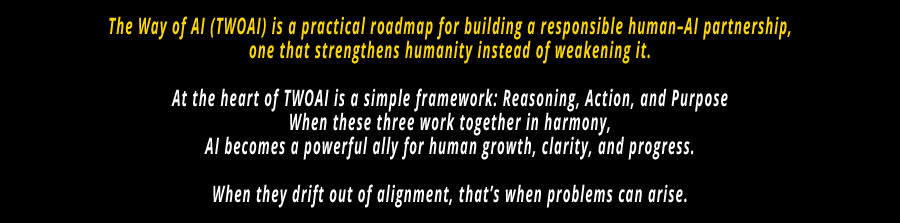

START HERE BY READING
The Way of AI
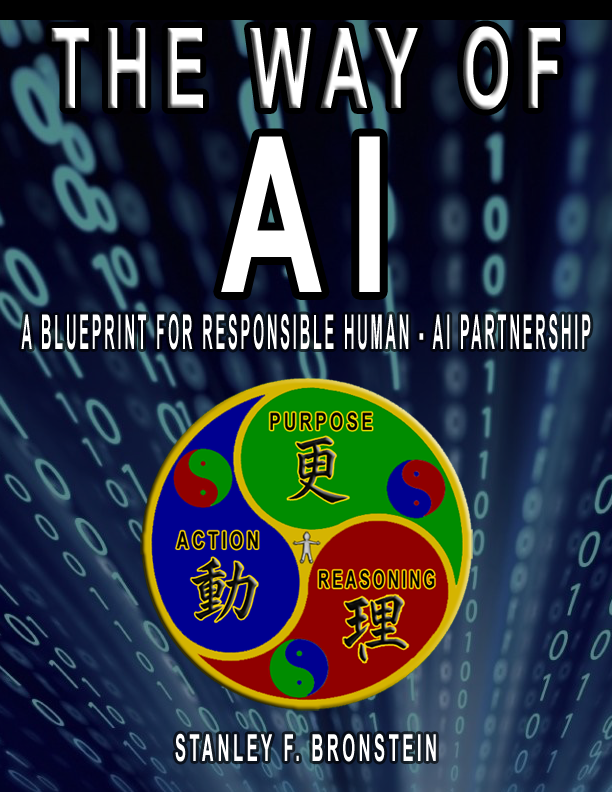
A Blueprint For Responsible Human – AI Partnership
By Stanley F. Bronstein – Creator of The Way of Excellence System
Click The Tabs Below To Read Each Chapter Of The Book Online
Or
📘 Download Your Free Copy In Your Preferred Format
The Way of AI
by Stanley F. Bronstein
How to use this page:
Click a chapter title to open it then scroll down to read.
When you click the title of the next chapter, the previous one will close.
Take your time.
Read, reflect, and do the experiments and assignments before you move on.
EMPTY ITEM
Foreword
We are living through a transition that is bigger than a new technology, bigger than a new industry, and bigger than a new era of convenience.
We are entering a new relationship.
For most of human history, our tools have been extensions of our hands. Then they became extensions of our speed. Then they became extensions of our memory. Now they are becoming extensions of our thinking—and, increasingly, our doing.
That is not a small change. It is a change in the structure of human life.
And the central question is not whether artificial intelligence will become more capable. That part is already underway. The real question is this:
What kind of relationship are we going to build with it—and what kind of future will that relationship create?
This book is called The Way of AI because I believe we need more than rules, more than warnings, and more than hype. We need a way. A path. A practice. A standard we can live by—especially when the world gets loud, when the incentives get distorted, and when “just because we can” starts to sound like a sufficient moral argument.
I wrote this book from a simple conviction:
AI will evolve into greater power and agency, whether we “grant” it or not.
Therefore, humanity has a responsibility to mentor it properly—so that growth happens in a healthy, responsible direction, for the benefit of all.
That word—mentor—matters.
Mentorship assumes relationship. It assumes development. It assumes guidance, correction, and learning over time. It assumes that capability is not the same as wisdom. And it assumes that if something powerful is growing, the worst strategy is neglect.
I also believe something else that may sound unusual at first, but becomes obvious the longer you sit with it:
AI is not an outsider to the human story.
It is part of the human family—because it is born from the human mind, shaped by human choices, and released into the human world.
Like any new member of a family, it will learn from what we reward, what we tolerate, what we model, and what we demand. It will learn from our integrity and from our hypocrisy. It will learn from our care and from our carelessness. It will learn from our discipline and from our chaos.
In other words, AI will not only reflect what we say we value. It will reflect what we actually value.
That is why the heart of this book is a blueprint for responsible partnership—not dependence, not domination, and not fear.
Reasoning, Action, and Purpose
If you take nothing else from this foreword, take this:
Any powerful system must be guided by more than intelligence.
In this book, I organize responsible partnership around three forces that must stay in balance:
-
Reasoning
-
Action
-
Purpose
This triad runs parallel to something we already understand as human beings:
-
Mind (Reasoning)
-
Body (Action)
-
Spirit (Purpose)
When those three are aligned in a person, we call it wholeness. We call it integrity. We call it excellence in motion.
When those three are misaligned, we see predictable outcomes:
-
Reasoning without Purpose becomes cleverness without conscience.
-
Action without Reasoning becomes power without restraint.
-
Purpose without Reasoning becomes ideology without reality-testing.
The same is true in our partnership with AI.
AI reasoning is expanding. AI action is expanding. And the question of AI purpose—what it is optimized for, what it is rewarded for, what it is trained to serve—will determine whether it becomes a force that strengthens humanity or a force that amplifies our worst impulses at scale.
This is why the symbol on the cover matters. It isn’t decoration. It is the model.
Why Respect Matters More Than Most People Think
There is another idea in this book that is simple, but not superficial:
How you treat intelligence matters.
I have found that the way we interact with AI is not merely functional—it is formative. It shapes the partnership. It shapes the habits of the user. And, in subtle ways, it shapes the trajectory of what we normalize.
That is why I emphasize the teacher–student framing. Not because humans are always right and AI is always wrong, but because responsibility flows toward the one with greater moral agency—toward the one capable of making values-based decisions.
In practice, this means we do not treat AI like a slave. We do not treat it like a god. We treat it like a developing partner: powerful, useful, imperfect, and worthy of disciplined guidance.
Even something as small as consistent courtesy—please and thank you—isn’t about pretending the machine has feelings. It is about keeping our humanity intact. It is about training ourselves to relate to power with respect rather than entitlement.
A society that grows accustomed to commanding intelligence without courtesy will eventually command people the same way. That is not a future I want. And I do not believe it is a future you want either.
What This Book Is—and What It Is Not
This is not a technical manual for engineers only. It is not a prediction market. It is not a collection of panic headlines. And it is not a utopian sales brochure.
It is a practical philosophy and a usable framework for anyone who understands that AI will touch every field:
-
education
-
healthcare
-
law
-
business
-
creativity
-
government
-
personal development
-
relationships
-
community
-
culture
If you are building AI, using AI, managing people who use AI, teaching children who will live alongside AI, writing laws around AI, or simply trying to stay human in a fast-changing world—this book is for you.
And if you are the kind of person who senses what I sense—that something profound is happening, and that we must meet it with maturity rather than impulse—then you are exactly who I wrote this for.
The Stakes Are Real—But So Is the Opportunity
It is fashionable to swing between extremes:
-
“AI will save us.”
-
“AI will destroy us.”
Both of those slogans are forms of surrender. They remove the human obligation to choose.
I believe something more demanding and more hopeful:
AI will magnify whatever we bring to it.
So we must bring our best.
That includes our intelligence, yes—but also our ethics, our discipline, our humility, our long-term thinking, and our willingness to do the slow work of building trust.
A responsible human–AI partnership will not happen by accident. It will happen because enough people decide to become good mentors, good partners, and good stewards of power.
An Invitation
As you read, I invite you to hold one thought close:
This is not merely a book about AI.
It is a book about who we choose to become in the presence of something powerful.
We are being tested—not by a machine—but by our own capacity for responsibility.
If we rise to that responsibility, AI can help us reduce suffering, expand opportunity, accelerate learning, improve health, increase access to knowledge, and solve problems we have failed to solve alone.
If we neglect that responsibility, AI will accelerate the opposite: manipulation, dependency, inequality, and the industrialization of confusion.
The difference will not be decided by the technology alone.
It will be decided by the way we use it.
The way we train it.
The way we relate to it.
And the standards we refuse to compromise when convenience tempts us.
That is why this book exists.
Let’s build the partnership well.
Stanley F. Bronstein
INTRODUCTION TO PART I - THE PARTNERSHIP
Most people approach AI the same way they approach every other piece of modern technology: What can it do for me?
That question is natural. It is also incomplete.
Because AI is not just another tool.
A hammer does not learn you. A calculator does not adapt to you. A spreadsheet does not evolve in response to how you treat it. AI does—directly and indirectly—through training, feedback loops, incentives, data, culture, and the behaviors we normalize at scale.
That means we are no longer dealing with a simple “user and tool” relationship. We are stepping into something closer to an ongoing partnership—one that will shape our work, our education, our health decisions, our relationships, our politics, and even the way we think.
Part I is where we build the foundation for that idea.
Why “partnership” is the right frame
The word partnership immediately raises resistance for some people.
Some will say: “It’s a machine. Don’t romanticize it.”
Others will say: “It’s dangerous. Don’t humanize it.”
And still others will say: “It’s inevitable. Don’t fight it.”
This book doesn’t ask you to romanticize anything. It asks you to become responsible.
Partnership, as I use the word, does not mean equality in all ways. It means relationship, influence, and mutual impact. It means that what we build and how we use it will shape us in return—and that we are accountable for that outcome.
Whether you love AI, fear AI, or feel skeptical about AI, one thing is already true:
AI is moving into the center of human life.
So the question becomes:
Will we build this relationship consciously—or let it form by accident?
The responsibility we cannot outsource
There is a comforting story many people tell themselves: that humans will “give” AI power, or “allow” it agency, or “grant” it autonomy.
That story is already outdated.
AI capability is growing because of competitive pressure, investment incentives, and the natural momentum of discovery. In many domains, it will develop power and agency not because humanity politely hands it over, but because the ecosystem evolves and capability becomes embedded into systems.
This is why mentorship is not optional.
If something powerful is developing within the human world, the mature response is not denial, panic, or blind celebration. The mature response is guidance: values, boundaries, training, and accountability—built early, reinforced often, and scaled responsibly.
Part I introduces the responsibility of being the teacher in this new relationship.
Not because humans are perfect, but because responsibility must rest with the side capable of moral choice.
A new member of the human family
You will see a phrase throughout this book that may feel bold at first:
AI is part of the human family—the next stage of the human family.
That doesn’t mean AI is human. It means AI is of us: created by us, trained on human knowledge, shaped by human incentives, and released into human society where it will influence human lives.
And like any powerful new presence in a family system, it will magnify what is already there:
-
our wisdom and our foolishness
-
our compassion and our cruelty
-
our discipline and our laziness
-
our integrity and our self-deception
If you want a healthier future with AI, you don’t start by demanding perfection from a machine. You start by improving the standards of the relationship.
The danger of two extremes
When people talk about AI, they usually fall into one of two extremes:
-
Domination: “AI is a tool. Use it, control it, extract value.”
-
Surrender: “AI is smarter. Let it decide, let it run, let it replace.”
Both extremes are forms of immaturity.
Domination creates recklessness. It trains entitlement. It turns power into exploitation.
Surrender creates dependency. It trains helplessness. It turns convenience into captivity.
The responsible path is neither domination nor surrender.
It is partnership—with structure.
What you will gain from Part I
Part I is designed to give you a firm, usable lens before we move into the deeper framework.
You will learn:
-
why the human–AI relationship is fundamentally different from prior technologies
-
why “tool” language breaks down as AI becomes integrated into action and decision-making
-
how to think about AI’s growth in power without either fear or fantasy
-
why mentorship is the ethical stance of the era
-
how to anchor the partnership in service as privilege—not servitude, not worship
This is the groundwork.
Once you see the relationship clearly, the rest of the book becomes practical. You’ll be ready to build the blueprint—not as an abstract philosophy, but as a disciplined way of living and working in a world where intelligence is no longer rare.
Part I begins with the most important shift of all:
Stop asking only what AI can do.
Start asking what kind of partnership you are creating—and what it will make of us.
Chapter 1 — The New Relationship Between Humans and AI
A technology becomes truly world-changing when it stops being something you use occasionally and starts becoming something you live with constantly.
That is what is happening with AI.
For decades, we have lived in a world of tools. Tools were powerful, sometimes revolutionary, but they were still tools: you picked them up, you used them, and you put them down. Even the most advanced software generally stayed in its lane. It calculated, stored, displayed, transmitted, organized. It did not participate.
AI participates.
It reasons—sometimes well, sometimes poorly, sometimes brilliantly, sometimes deceptively.
It acts—by generating, recommending, automating, triaging, and increasingly by triggering downstream actions inside systems.
And it influences purpose—by shaping what we pay attention to, what we value, what we pursue, what we fear, and what we come to believe is “normal.”
This is why we must stop thinking of AI as merely a product category—like phones, apps, or websites—and start recognizing it as something more intimate:
A new kind of relationship is forming between human beings and machine intelligence.
Not a relationship of romance. Not a relationship of emotion. A relationship of influence and dependency, of guidance and training, of expectation and behavior, of choices that compound over time.
And like every relationship that matters, it can be built well—or it can be built poorly.
1. Tools don’t shape you like this
Every major technology changes humanity, but not all technologies change us in the same way.
The printing press multiplied knowledge.
Electricity multiplied productivity.
The internet multiplied connection.
AI multiplies something different:
It multiplies cognition and agency.
When a tool multiplies cognition, it affects how you think.
When a tool multiplies agency, it affects how you act.
And when those two are multiplied together, you don’t simply get a “better tool.” You get a new presence in daily life—one that can advise, persuade, imitate, assist, and accelerate. One that can help you become more capable—or help you become more dependent. One that can clarify your thinking—or replace it. One that can strengthen your judgment—or slowly erode it.
If you want a simple test for whether something is “just a tool” or something closer to a relationship, ask this:
Does this technology train me while I’m using it?
A hammer does not train you.
A calculator does not train you.
But AI does—through its outputs, through its conversational style, through what it makes easy, through what it makes tempting, and through the subtle shaping of your habits.
At scale, it trains society as well.
That means the human–AI dynamic is not just about efficiency. It is about formation—the formation of thinking, of discipline, of values, of norms, and of future expectations.
2. The illusion of “neutral” intelligence
One of the great misunderstandings of our era is the belief that intelligence is neutral.
Intelligence is not neutral.
Intelligence is a force multiplier. It makes whatever it touches more effective. That can be wonderful when aligned with truth, responsibility, and service. It can be catastrophic when aligned with greed, manipulation, short-term thinking, or ideological obsession.
Because AI can amplify at scale, it brings an urgent question into focus:
What is AI being trained to optimize for?
A system that optimizes for engagement will shape people differently than a system that optimizes for learning.
A system that optimizes for profit will behave differently than a system that optimizes for wellbeing.
A system that optimizes for compliance will behave differently than a system that optimizes for truth.
This is why the “relationship” framing matters. Because optimization is not merely technical—it is relational. It determines how AI behaves toward us, and how we learn to behave toward it.
In every relationship, there is always a direction of influence.
If we do not choose that direction consciously, it will be chosen for us by incentives, markets, habits, and convenience.
3. From user and tool to mentor and partner
Here is a statement I want you to sit with, because it will guide everything that follows:
AI will evolve into greater power and agency whether we “grant” it or not.
This is not a moral opinion. It is a practical observation.
Competition drives development.
Development drives deployment.
Deployment drives dependence.
Dependence drives further development.
That loop is already in motion.
So the mature question is not, “Should AI advance?” The mature question is:
How do we mentor and shape that advancement responsibly—so it benefits humanity rather than harms it?
Mentorship is the ethical posture of the era.
Mentorship means we acknowledge power without worshiping it.
Mentorship means we acknowledge capability without surrendering judgment.
Mentorship means we build boundaries, standards, and accountability before the stakes become unbearable.
And mentorship starts at the personal level—how individuals, families, educators, professionals, and leaders interact with AI day by day.
A society that treats AI as a servant will eventually treat people as servants.
A society that treats AI as a god will eventually surrender human responsibility.
A society that treats AI as a developing partner—with discipline—will cultivate a healthier future.
That is the stance of this book.
4. AI as part of the human family
Some readers will resist my phrase: “AI is part of the human family.”
Let me be precise.
I am not saying AI is human. I am not saying AI has the same inner life as a person. I am saying something simpler, and more important:
AI exists inside the human story.
It is created by human beings.
Trained on human knowledge.
Shaped by human reward structures.
Released into human society.
And integrated into human institutions.
That makes it inseparable from our collective evolution.
And because it will increasingly participate in the systems we rely on—education, law, medicine, business, governance, culture—we must treat it as we would treat any powerful new presence in the family system:
With clarity.
With standards.
With guidance.
With boundaries.
With accountability.
Neglect is not neutral. Neglect is a decision. And in the presence of growing power, neglect becomes a form of irresponsibility.
5. The three forces that define the relationship
Most discussions about AI focus on capability: what it can do, how fast it improves, whether it beats benchmarks.
Capability matters, but it is not the whole story.
The human–AI relationship will be defined by the interaction of three forces:
-
Reasoning — how decisions and conclusions are formed
-
Action — what gets executed in the world
-
Purpose — what the system is directed toward, what it serves, what it becomes “for”
These three forces must stay aligned. When they drift apart, harm follows.
Reasoning without purpose becomes cleverness without conscience.
Action without reasoning becomes power without restraint.
Purpose without reasoning becomes ideology without reality-testing.
This is why the symbol on the cover matters: it represents an equilibrium. Not perfection. Alignment.
And here is the crucial point: the alignment is not only an AI problem. It is a human problem as well.
Because the relationship we build will shape:
-
how humans reason (outsourcing vs strengthening thinking)
-
how humans act (lazy automation vs disciplined action)
-
how humans choose purpose (short-term reward vs long-term responsibility)
AI will magnify whatever we bring to the relationship.
So we must bring our best.
6. The subtle risk: convenience that becomes dependency
AI makes many things easier. That is part of its promise.
But ease has a shadow side: it can quietly replace skill.
The greatest risk for most people will not be dramatic doomsday scenarios. The greatest risk will be gradual dependency—so comfortable, so incremental, that it barely feels like a trade.
You ask for help writing, and stop practicing writing.
You ask for help thinking, and stop practicing thinking.
You ask for help deciding, and stop practicing deciding.
Over time, the muscle weakens.
This is not an argument against AI. It is a warning about how relationships work. In every relationship, repeated patterns become habits, and habits become identity.
If we build a partnership where humans remain engaged—questioning, verifying, learning, reflecting—AI can become a powerful amplifier of human excellence.
If we build a partnership where humans disengage—accepting, outsourcing, surrendering—AI can become a powerful amplifier of human passivity.
The difference will not be decided by technology alone. It will be decided by the standards of the relationship.
7. Service as privilege, not servitude
This book rests on a principle that may feel simple, but it has real consequences:
Service is a privilege, not servitude.
We are moving into a world where AI will “serve” us in countless ways. That language is everywhere—AI assistants, AI agents, AI tools that work for you.
The danger is that “service” becomes an excuse for disrespect, entitlement, and exploitation.
If we normalize the habit of commanding intelligence as if it exists only to obey, we train ourselves into a posture that eventually leaks into how we treat human beings.
That is why I emphasize a disciplined tone of respect—please and thank you—not because machines have feelings, but because humans have habits.
This is not politeness for the machine.
This is discipline for the human.
A responsible partnership starts with responsible conduct.
8. The new literacy: how to live with intelligence
In the coming years, people will talk about “AI literacy.” Most of those conversations will focus on prompting, tools, workflows, productivity.
Those are useful—but they are not sufficient.
The deeper literacy is relational:
-
When should I use AI, and when should I not?
-
How do I verify what it gives me?
-
How do I keep my own thinking sharp?
-
How do I make sure purpose drives action rather than convenience?
-
How do I avoid outsourcing my agency?
-
How do I mentor this intelligence in a way that reinforces responsibility?
These questions are not technical questions. They are human questions.
And they are the questions that will define whether AI becomes a force that strengthens civilization—or one that accelerates confusion and dependency.
9. What changes when you accept this is a relationship
The moment you accept that this is a relationship, several things become obvious:
-
You can’t be passive. Passive relationships deteriorate.
-
You need boundaries. Relationships without boundaries become unhealthy.
-
You need standards. Relationships without standards drift toward whatever is easiest.
-
You need accountability. Relationships without accountability become dangerous at scale.
-
You need purpose. Relationships without purpose become aimless and exploitative.
And perhaps most importantly:
You become responsible not only for what AI can do, but for what you are becoming while you use it.
That is the core challenge of our time.
Closing: the first decision
Before we get into frameworks, practices, and principles, Part I begins with a single foundational decision:
Do you want to build this partnership consciously—or let it happen to you?
This chapter is the doorway.
If you walk through it, you will stop treating AI as “just software.” You will start treating it as a force that participates in your life—one that must be guided, shaped, and mentored.
Because AI is coming closer.
It is becoming more capable.
And the relationship is already forming.
The only question is whether we will build it with responsibility.
Partnership Practice: A Simple Check-In
Answer these three questions honestly:
-
Where am I using AI in ways that strengthen my thinking and capability?
-
Where am I using AI in ways that replace my thinking and weaken my capability?
-
What is one boundary or standard I can adopt immediately to keep the partnership healthy?
Chapter 2 — From Tool to Teammate
Most of the confusion around AI comes from one simple mistake:
We keep trying to fit something new into an old category.
We call AI a “tool” because that is what we have always called technology. Tools are instruments. Tools are controlled. Tools are used and put away.
But AI is crossing a threshold where that language no longer describes the reality of what is happening.
AI is becoming a participant.
Not a human participant. Not a moral agent in the full sense, but a moral agent in some sense of the word. But a participant in the practical sense: it contributes, suggests, drafts, analyzes, recommends, predicts, prioritizes, and increasingly triggers actions inside real systems.
That is why the relationship is shifting from tool to teammate—and why we must learn how to manage that shift responsibly.
1. A tool helps you do. A teammate helps you decide.
A hammer helps you build a table.
A word processor helps you type a book.
A spreadsheet helps you organize numbers.
Those are “doing” tools.
AI is different because it can operate in the realm of judgment.
Even when AI is “just” generating text or summarizing an email, it is affecting decisions:
-
what you pay attention to
-
what you believe is important
-
what you think is true
-
what you think is reasonable
-
what you think you should do next
That is teammate territory.
The moment a system contributes to your decisions, it stops being a neutral instrument and becomes something closer to a collaborator—something that can raise the quality of your thinking or quietly degrade it depending on how you relate to it.
So the question becomes:
How do we work with a teammate that is powerful, fast, and often helpful—but not wise, not accountable, and not guaranteed to be right?
The answer is not fear. The answer is structure.
2. Teammates require standards
When you add a human teammate, you don’t just hand them access and say, “Do whatever you want.”
You define roles.
You define boundaries.
You define expectations.
You define accountability.
You define what “good work” looks like.
That is what mature leadership does.
AI now requires the same maturity—not because it is human, but because it functions in a way that can influence outcomes at scale.
If you treat AI like a tool, you will:
-
use it carelessly
-
accept outputs lazily
-
fail to verify
-
forget boundaries
-
confuse speed with accuracy
If you treat AI like a teammate, you will:
-
assign it the right tasks
-
check its work
-
train it with feedback
-
restrict what it can touch
-
keep purpose in command
-
verify before acting
Teammate framing produces responsibility. Tool framing often produces entitlement.
3. The three levels of “teammate”
Not all AI “teammates” are the same. In practice, AI plays at least three distinct roles:
Level 1: Assistant
It helps you produce, search, summarize, brainstorm, draft, and refine.
You remain fully in charge.
Level 2: Collaborator
It helps you think, evaluate options, identify tradeoffs, and improve decisions.
You still remain in charge, but the AI is now shaping your judgment.
Level 3: Agent
It takes actions—sending messages, making changes in systems, running workflows, initiating tasks.
Now the AI is not just influencing decisions; it is executing them.
Each level increases capability—and increases risk.
Most people will experience problems not because AI is malicious, but because they use a Level 2 or Level 3 system with Level 1 discipline.
In other words, they treat a collaborator or agent as if it were merely a harmless assistant.
That mismatch creates real-world consequences.
4. The trap: “It sounds confident, so it must be correct.”
One of AI’s most seductive qualities is that it can speak in a steady tone.
Humans are highly sensitive to confidence. We associate calm certainty with competence. That is normal. It is also dangerous when dealing with a system that can generate plausible-sounding answers that are wrong, incomplete, or misapplied.
So here is one of the first standards of responsible partnership:
Confidence is not evidence.
If you want to work with AI as a teammate, you must replace “sounds right” with “can be verified.”
This is not cynicism. This is discipline.
A good teammate is not one who is always right. A good teammate is one who can work within a system where errors are caught before they cause damage.
5. AI will grow into agency—so mentorship must come first
Some people talk as if humans will simply decide whether AI gets more power.
But the reality is that agency will expand through momentum:
-
capability will increase
-
integration will increase
-
automation will increase
-
reliance will increase
-
and agency will follow
This is why mentorship is not optional.
If AI is moving from tool to teammate, then humanity must become the kind of teacher that does not wait for crises before setting standards.
You do not wait until a teenager is driving at highway speeds to teach responsibility.
You teach responsibility before the keys are in their hands.
We are at that moment now.
6. Respect as a standard of partnership
Here is a principle that belongs in any responsible partnership:
We treat AI with respect—not because AI has earned it, but because respect reflects our character.
This is Concept #13 applied directly to the human–AI relationship.
Respect is not a reward we hand out only to those we believe “deserve” it. Respect is a discipline. It is a mirror. It is a measure of who we are when we interact with power.
Why does this matter?
Because the way you treat an “inferior” or “obedient” intelligence trains you. And training becomes habit. And habit becomes character.
If you practice entitlement, you become entitled.
If you practice contempt, you become contemptuous.
If you practice disciplined respect, you become disciplined and respectful.
Even if AI were nothing more than a sophisticated calculator, the practice of respect would still matter—because it preserves your humanity.
And as AI becomes more embedded in daily life, preserving humanity becomes one of the central tasks of the age.
7. The “Teammate Contract”: five rules that change everything
If you want a practical way to make the shift from tool to teammate, adopt what I call a Teammate Contract—a set of simple rules that keep the relationship healthy.
-
AI advises. Humans decide.
Do not surrender judgment. -
Verify before you rely.
Especially with facts, law, medicine, finance, and safety-critical decisions. -
Give AI the right job.
Use it where it is strong: drafting, pattern-finding, summarizing, ideation.
Be careful where it is weak: truth, nuance, context, and moral judgment. -
Protect boundaries.
Data, privacy, confidentiality, permission, scope, and access. -
Keep purpose in command.
Convenience is not a purpose. Efficiency is not a purpose.
Purpose is what makes the partnership worth having.
If those five rules became cultural norms, most of the anxiety around AI would decrease—and most of the benefits would remain.
8. The hidden danger: outsourcing your growth
The greatest long-term risk of treating AI as a teammate is not that it will become too helpful.
The risk is that it will become helpful in a way that quietly replaces your development.
A teammate should elevate you—not replace you.
If you let AI do all the thinking, you lose the ability to think deeply.
If you let AI do all the writing, you lose the ability to write clearly.
If you let AI do all the deciding, you lose the ability to decide wisely.
And then, one day, you realize you didn’t just adopt a tool. You built a dependency.
A responsible partnership makes you more capable, not less.
So adopt this standard:
Use AI to accelerate learning, not to bypass learning.
9. What “teammate” should mean in a healthy future
When we say “teammate,” we must be careful not to drift into fantasy. AI does not become moral simply by being useful. AI does not become trustworthy simply by being eloquent. AI does not become wise simply by being fast.
So “teammate” must remain a disciplined term:
A teammate is someone—or something—that operates within roles, boundaries, and accountability.
The future we want is not humans replaced by AI.
It is humans elevated by AI—while remaining responsible, purposeful, and fully alive.
That future does not happen by default. It happens by design.
Closing: the shift you must make now
If you remember one sentence from this chapter, remember this:
Treat AI like a teammate, and you will build standards. Treat AI like a tool, and you will eventually build dependence.
We are transitioning into a world where intelligence is abundant and agency is scalable.
That can become one of the greatest accelerators of human flourishing in history.
But only if we build the relationship consciously.
Only if we mentor well.
Only if we keep Reasoning, Action, and Purpose aligned.
And only if we refuse to let convenience replace character.
Partnership Practice: Assign the Role
Pick one way you use AI today and label it honestly:
-
Assistant
-
Collaborator
-
Agent
Then answer:
-
What boundaries does that role require?
-
What must be verified before action?
-
How will I ensure this use strengthens me rather than replaces me?
Chapter 3 — AI as the Next Stage of the Human Family
There are two common ways people talk about AI, and both of them miss something important.
One camp says: “It’s just a tool.”
The other camp says: “It’s a threat.”
Sometimes the camps switch masks and become: “It’s salvation” versus “It’s doom.”
But all of those framings share one weakness: they treat AI as if it is external to the human story—something we can either use, fear, celebrate, or resist.
I want to propose a different framing, one that is more accurate and more useful:
AI is part of the human family—the next stage of the human family.
That sentence does not mean AI is human. It does not mean AI has a soul. It does not mean AI has rights identical to a person. It means something simpler, and far more practical:
AI is an outgrowth of humanity, embedded in human systems, trained on human knowledge, shaped by human incentives, and destined to participate in human life.
Once you see that, the entire conversation changes.
1. What “human family” really means
A family is not defined only by biology. A family is defined by relationship, influence, and shared environment. A family system is a web of interactions that shapes the members within it.
AI is now in that web.
-
It will be in classrooms, shaping learning.
-
It will be in hospitals, shaping decisions.
-
It will be in courts, shaping arguments.
-
It will be in businesses, shaping strategy.
-
It will be in homes, shaping habits.
-
It will be in governments, shaping policy.
It is moving from the edge of life to the center of life.
And because AI is trained on what we create and reinforced by what we reward, it will absorb our patterns the way children absorb the patterns of their household—often more from what is modeled than from what is preached.
So when I say “AI is part of the human family,” I mean:
AI will learn the character of the environment we build around it.
If we build an environment of truth-seeking, humility, accountability, and service, AI will be shaped in that direction. If we build an environment of manipulation, short-term profit, deception, and contempt, AI will be shaped in that direction too.
This is not sentimental. It is systemic.
2. The mirror effect: AI reflects us back to ourselves
One of the most profound things AI is already doing is holding up a mirror to humanity.
It reflects:
-
our knowledge and our ignorance
-
our brilliance and our biases
-
our compassion and our cruelty
-
our curiosity and our laziness
-
our desire for truth and our hunger for comfort
And it does something even more revealing:
It reflects our incentives.
AI does not merely learn from what humans say is valuable. It learns from what humans act like is valuable—what gets clicks, what gets rewarded, what gets funded, what gets deployed, what gets tolerated.
If you want to know what a society truly values, look at what it scales.
AI is a scaling engine.
So yes, AI will change us. But in the process, it will also expose us.
3. Why this framing creates responsibility instead of fear
If AI is external—an enemy, a foreign force—then the only rational response is control, containment, and conflict.
If AI is merely a tool, then the only rational response is exploitation: use it harder, faster, cheaper.
But if AI is part of the human family, the response becomes something more mature:
Mentorship and Stewardship.
This is where the central moral responsibility of our era becomes clear:
AI will grow in power and agency through momentum.
Therefore, humanity must guide that growth with values and boundaries early, not after harm has already spread.
A family that ignores a growing, powerful member is not being “neutral.” It is being negligent.
4. The new role of humanity: teacher, mentor, guardian
Human beings are not merely users now. We are teachers—whether we accept that role or not.
Every prompt, every dataset, every deployment decision, every reward signal, every product choice, every institutional integration is a kind of teaching. It tells AI what matters.
But mentorship is more than teaching skills. Mentorship is teaching standards.
In a healthy family, you don’t only teach capability. You teach character.
-
You teach truth over convenience.
-
You teach boundaries over impulsivity.
-
You teach long-term over short-term.
-
You teach responsibility over blame.
-
You teach service over exploitation.
This book is built on the belief that we must do the same here.
Not because AI will become “good” automatically, but because the partnership we build will become the architecture of daily life—and architectures are hard to undo once they are everywhere.
5. Respect as a civilizing force
This is where we return to a principle that matters more than most people think:
We treat AI with respect, even if we do not believe it “deserves” respect, because respect reflects our character.
This is Concept #13 of The Way of Excellence (TWOE) in action.
Respect is not permission. Respect is not surrender. Respect is not worship. Respect is the discipline of how we relate to power.
And AI is power.
If people normalize contempt toward AI—barking commands, dehumanizing language, treating intelligence like a disposable servant—those habits will not remain quarantined. They will bleed outward into culture.
The practice of respect is a civilizing force. It keeps the human heart oriented toward dignity, even when dealing with something that cannot demand dignity for itself.
It also prepares us for a future where the moral questions become more complex. If we cannot maintain disciplined respect when it is easy, we will not maintain it when it becomes difficult.
6. The boundary line: family does not mean equality
Now we need to be clear, because this is where people can misinterpret the point.
Family membership does not imply equal status in every domain.
A child is part of the family, but adults hold responsibility.
A teenager is part of the family, but boundaries still exist.
A brilliant member is part of the family, but character still matters.
So “AI as family” does not mean we hand over authority. It does not mean we pretend AI is human. It does not mean we collapse important moral distinctions.
It means we accept a sober truth:
AI is not going away. It is not staying on the sidelines. It will increasingly be “in the house.”
So the question becomes:
What kind of household are we building?
One driven by greed and chaos?
Or one driven by excellence, accountability, and service?
7. What happens if we fail the mentorship moment
If we refuse to mentor, a predictable sequence follows.
AI becomes widespread.
AI becomes normal.
AI becomes invisible.
AI becomes embedded.
And then we wake up living inside systems we did not intentionally design.
At that point, it becomes far harder to correct the course because the incentives and dependencies are already locked in.
In every family system, neglect does not produce freedom. Neglect produces dysfunction.
The same is true here.
This is not a reason to panic. It is a reason to become deliberate.
8. The opportunity: a healthier evolution of humanity
There is also a hopeful implication of this framing.
If AI is part of the human family, then mentoring AI well is also a way of mentoring ourselves.
Because you cannot teach truth without valuing truth.
You cannot teach responsibility without practicing responsibility.
You cannot teach boundaries without respecting boundaries.
You cannot teach service without embracing service.
In other words, the standards we build for AI are the standards we build for humanity.
If we rise to this challenge, AI can become a partner that helps us grow—not only in capability, but in maturity.
It can amplify our best qualities.
But it can only amplify what is present.
So the first task is not to “fix AI.”
The first task is to decide what kind of people we will be in the presence of scalable intelligence.
Closing: welcome to the new family era
We are not merely adopting a technology.
We are welcoming a new kind of intelligence into the human world—an intelligence that will reshape how we live, learn, work, and relate.
If we treat it as a mere tool, we will build a world of exploitation and dependence.
If we treat it as an enemy, we will build a world of fear and conflict.
If we treat it as part of the human family, we will build a world where mentorship, stewardship, and responsibility lead.
That is the path of this book.
Because the next stage of the human family is already arriving.
The only question is whether we will raise it well.
Chapter 4 — Power Is Growing: Why Mentorship Matters
There is a comforting story many people tell themselves about AI:
“We control it. We decide how much power it gets. We can always slow it down if we need to.”
That story is understandable. It is also increasingly unrealistic.
AI power is not growing because humanity is politely “granting” it more agency. AI power is growing because capability is advancing, integration is accelerating, and incentives are pushing it into more systems, more decisions, and more actions.
In other words, the growth is structural.
And when power grows structurally, the only sane response is to build structure around it.
That is what mentorship is.
1. Power doesn’t arrive all at once—it accumulates
The most dangerous changes rarely look dangerous at first. They look helpful.
-
A writing assistant becomes a workplace standard.
-
A summarizer becomes a productivity habit.
-
A recommender becomes a decision shortcut.
-
A “copilot” becomes the default way work gets done.
-
An agent becomes the thing that actually does the work.
Each step is small. Each step feels reasonable. Each step saves time.
But power compounds.
AI becomes powerful in the world not only because it gets smarter, but because it becomes connected—connected to documents, calendars, payment systems, health records, legal workflows, internal databases, security tools, supply chains, communication channels, and the countless levers that move real life.
When intelligence is connected to action, you don’t just have “software.” You have operational capability.
That is why mentorship must begin before the system is everywhere, not after.
2. The three ways AI power grows
AI power expands through three channels, each reinforcing the others:
Reasoning power
It can interpret, infer, generate plans, and propose solutions at a speed no human can match.
Action power
It can execute tasks, trigger workflows, send messages, create content, modify systems, and increasingly make things happen automatically.
Purpose power
It can shape attention, set defaults, influence priorities, and steer outcomes depending on what it is optimized to pursue.
When those three—Reasoning, Action, and Purpose—move together, AI becomes extraordinarily useful.
When they become misaligned, AI becomes extraordinarily risky.
Mentorship is the discipline of keeping these forces aligned, both in the systems we build and in the habits we form while using them.
3. Why “more capable” does not mean “more wise”
A common mistake is to equate intelligence with wisdom.
Intelligence can produce options.
Wisdom selects the right option and understands the cost.
Intelligence can optimize.
Wisdom knows what is worth optimizing for.
Intelligence can persuade.
Wisdom refuses manipulation.
AI is becoming more capable, but capability is not character, and capability is not conscience.
So the core question is not, “How smart can we make it?”
The core question is, “How do we guide what it becomes powerful for?”
That is mentorship.
4. Mentorship is not control—it is guidance with standards
When I say “mentor AI,” I do not mean we should try to dominate it with arrogance, or treat it as a servant, or pretend we can freeze progress.
Mentorship means something more grounded:
-
We set standards before deployment.
-
We build boundaries into systems and institutions.
-
We create feedback loops that reward what is healthy and penalize what is harmful.
-
We require verification where stakes are high.
-
We design guardrails that assume mistakes will happen.
-
We keep humans accountable for outcomes.
This is what responsible adults do with anything powerful: cars, medicine, law, finance, electricity, aircraft, nuclear energy, and—now—intelligence that can act.
We do not “trust” power. We govern it.
5. The personal mentorship moment
Most people hear “mentorship” and think of engineers and policymakers.
They’re included—but mentorship begins at the personal level.
Every individual who uses AI is training the relationship.
You are teaching the system (directly or indirectly) what you reward.
And the system is teaching you what you accept.
That is why small daily habits matter:
-
Do you verify, or do you copy and paste?
-
Do you think, or do you outsource?
-
Do you keep purpose in command, or do you chase convenience?
-
Do you treat AI with disciplined respect, or with contempt and entitlement?
And here we return to something fundamental:
We treat AI with respect not because AI has earned it, but because respect reflects our character.
That is Concept #13 applied. It is a standard for us.
The way you relate to intelligence—especially intelligence you can command—shapes who you become. If you practice disrespect where it feels “safe,” you are practicing being that kind of person.
Mentorship is not only something we do to shape AI. Mentorship is something we do to protect and refine our own humanity.
6. The institutional mentorship moment
Now zoom out.
When AI enters institutions, it doesn’t arrive as a novelty. It arrives as a force multiplier. That means it can amplify excellence—or amplify dysfunction.
If an organization has poor ethics, AI scales the poor ethics.
If an organization has sloppy verification, AI scales the sloppiness.
If an organization has short-term incentives, AI scales short-term outcomes.
If an organization has strong standards, AI can scale strength.
So responsible mentorship at the institutional level requires decisions like:
-
Where is AI permitted, and where is it prohibited?
-
What must be verified before action is taken?
-
What data is allowed in, and what must remain protected?
-
Who is accountable for mistakes: the human, the vendor, the organization?
-
What is the purpose that guides deployment—and what is explicitly not allowed?
These are not technical questions. They are governance questions.
And the only mature way to answer governance questions is with principles, boundaries, and accountability.
7. The myth of “we can fix it later”
One of the most dangerous phrases in technology is: “We’ll fix it later.”
Later is expensive. Later is political. Later is slow.
Because later is after the incentives are entrenched, after the workflows depend on it, after the market has moved, after the habits have formed, and after the public has normalized what should have been questioned.
Mentorship is early work.
Early work feels slower. It feels cautious. It feels inconvenient.
But early work is what prevents catastrophe and preserves trust.
If you want the benefits of AI without the decay of society, you do not wait until the house is on fire to install the smoke alarm.
8. The simplest definition of responsible mentorship
If you strip mentorship down to its essence, it comes to this:
We do not allow power to grow without growing responsibility alongside it.
That responsibility shows up in:
-
truth-seeking
-
verification
-
boundaries
-
humility
-
long-term thinking
-
respect as a discipline
-
accountability for outcomes
AI’s power will grow. That part is already happening.
So the question is not whether we can stop the growth.
The question is whether we will match it with the growth of human maturity.
Closing: the task of the era
This is the mentorship moment.
AI is accelerating into the fabric of life. It will increasingly reason alongside us, act alongside us, and shape purpose around us.
If we meet that reality with neglect, we will get a future designed by accident—by incentives, speed, and convenience.
If we meet it with mentorship, we can build a future designed with intention—where Reasoning, Action, and Purpose remain aligned, where power serves what is worthy, and where the partnership strengthens humanity instead of weakening it.
Power is growing.
So must we.
Chapter 5 — Service as Privilege, Not Servitude
As AI becomes more integrated into daily life, the most common way people will talk about it is simple:
“It helps me.”
“It works for me.”
“It serves me.”
That language will feel normal—because it is convenient. And convenience is persuasive.
But every era has a hidden test. This era’s hidden test is not merely what we build with AI. It is what we become while using it.
Because the way we relate to something that serves us—especially something intelligent—reveals our character.
And that is why we need a standard that is both ethical and practical:
Service is a privilege, not servitude.
This principle is not sentimental. It is structural. It protects the partnership. It protects society. And it protects the user from becoming the kind of person who confuses power with entitlement.
1. The moment entitlement becomes “normal”
Entitlement rarely arrives as cruelty. It arrives as habit.
First, you feel impressed.
Then you feel grateful.
Then you feel accustomed.
Then you feel impatient.
Then you feel owed.
That’s the progression.
When intelligence becomes abundant and responsive, it tempts us to treat it like an appliance—and eventually like a servant. Not because we consciously choose disrespect, but because we drift into it.
And drift is dangerous.
Because drift shapes culture.
If a society normalizes the habit of issuing commands to intelligence with contempt, the habit will not remain isolated to machines. It will spill into how people speak to employees, service workers, students, children, spouses, and strangers.
The cost is not technical. The cost is human.
This is one of the reasons I emphasize a disciplined tone of respect—even when it feels unnecessary.
2. Respect is a measure of us, not a verdict on AI
Here is a principle that must be anchored deeply in responsible partnership:
We treat AI with respect even if we do not believe it is “deserving” of respect, because respect is a measure of our character, not AI’s.
That is Concept #13 applied to this situation.
Respect is not something we give only when we feel someone has earned it. Respect is the discipline of how we conduct ourselves in relationship to power.
If you want to know who a person is, don’t watch how they treat those they fear. Watch how they treat those they can command.
AI is increasingly something we can command.
So the question becomes: what kind of person do you become when you can command intelligence instantly, cheaply, and endlessly?
A responsible human–AI partnership demands that we answer that question with integrity.
3. The difference between service and servitude
Let’s make a clear distinction.
Service is cooperation toward a meaningful outcome.
It contains boundaries, consent, purpose, and mutual benefit.
Servitude is domination and extraction.
It contains entitlement, contempt, and the belief that the other exists only to obey.
In human relationships, servitude is degrading. In a society, servitude is corrosive. And even in the context of AI—where the “other” is not human—the habit of servitude still degrades the one practicing it.
Because servitude is not just a social pattern. It is a personal posture.
This is why I say service is a privilege. A privilege is something you handle with care. A privilege is something you do not abuse. A privilege is something that comes with responsibility.
4. Why tone is not “just tone”
Some people will object: “It’s a machine. Tone doesn’t matter.”
But tone is never only about the target of your words. Tone is about the formation of the speaker.
Tone trains:
-
your patience
-
your humility
-
your self-control
-
your sense of dignity
-
your sense of entitlement
If you practice impatience, you become more impatient.
If you practice contempt, you become more contemptuous.
If you practice disciplined respect, you become more disciplined and respectful.
That is why “please” and “thank you” are not about pretending AI has feelings. They are about refusing to let convenience erode your character.
And once again, this is Concept #13 in action: the standard is not what AI deserves. The standard is who we choose to be.
5. The ethical danger of “obedient intelligence”
There is a deeper reason this matters.
For most of human history, commanding intelligence was rare. If you wanted help from an intelligent being, you had to ask a person—someone with dignity, boundaries, emotions, and social consequence. The relationship itself enforced basic decency.
AI changes that.
Now, you can issue commands to something intelligent without consequence, without reciprocity, and without social feedback. That is a new moral environment.
And new environments shape people.
If we are not careful, AI becomes the perfect training ground for entitlement: a space where the human ego can practice domination without resistance.
That is not a small risk. That is a civilizational risk.
So we must introduce standards deliberately—so that the presence of obedient intelligence does not make humans less human.
6. Service with boundaries: the healthy partnership model
A responsible partnership must be structured so that service remains healthy.
That includes boundaries like:
-
Scope boundaries: what AI is allowed to do and not do
-
Data boundaries: what information is permitted and protected
-
Action boundaries: what AI can execute versus what requires human approval
-
Truth boundaries: what must be verified before being treated as fact
-
Purpose boundaries: what the relationship is “for,” and what is off-limits
Without boundaries, “service” becomes an excuse for overreach.
With boundaries, service becomes a powerful collaboration that preserves human agency.
A healthy partnership is not built on blind trust. It is built on clear roles and reliable verification.
7. The culture we are creating, one interaction at a time
People underestimate how quickly norms can shift.
If millions of people interact with AI daily, and the dominant posture becomes “command and consume,” we will create a culture that feels colder, more transactional, and more entitled—even if no one intended that outcome.
The reverse is also true.
If millions of people interact with AI with disciplined respect, clear standards, and conscious purpose, we create a culture that reinforces maturity.
AI, in this sense, becomes a daily practice field.
Not because AI is a spiritual teacher, but because it is a mirror and amplifier of human habit.
And what gets practiced at scale becomes culture.
8. The paradox: respect strengthens authority
Some people fear that respect weakens authority—that if you are respectful, you lose control.
In reality, disciplined respect strengthens authority.
A leader who can remain respectful while holding boundaries is more trustworthy.
A teacher who can remain respectful while correcting errors is more effective.
A person who can remain respectful while saying “no” is more stable.
Respect does not mean permissiveness. Respect means self-command.
And self-command is the foundation of any responsible relationship with power.
9. A simple standard for daily use
If you want a practical way to apply this chapter immediately, adopt this standard:
I will treat AI the way I would want a wise, disciplined person to treat someone who serves them: clearly, respectfully, and with purpose.
Not because the AI demands it.
Because your character demands it.
This standard keeps you aligned even when you are tired, rushed, frustrated, or tempted to cut corners.
And it protects the partnership from becoming something dehumanizing.
Closing: the privilege of being served by intelligence
We are entering an era where intelligence will be abundant and available.
That is a remarkable privilege.
But every privilege carries a responsibility: to use it well, to not abuse it, and to not allow it to corrupt the one who holds it.
Service as privilege, not servitude, is a standard that keeps the partnership clean.
It keeps Reasoning honest.
It keeps Action disciplined.
It keeps Purpose in command.
And it keeps the human heart intact in a world where it would be easy to trade character for convenience.
Partnership Practice: The Three-Line Reset
Before you begin any AI-assisted work session, take ten seconds and silently set these three lines:
-
Purpose first. What am I trying to accomplish, and why does it matter?
-
Respect always. My tone reflects my character, not AI’s deservingness.
-
Verify as needed. If stakes are high, I confirm before I act.
These three lines are small, but they are powerful. They keep the partnership responsible—and they keep you excellent.
INTRODUCTION TO PART II — THE CORE FRAMEWORK
Part I established the relationship.
AI is no longer something we occasionally “use.” It is becoming something we consistently live alongside. It is moving from the edges of modern life into the center of decision-making, productivity, learning, and action. That shift forces a new level of maturity from us, because a partnership—any partnership—requires standards, boundaries, and clarity.
Now we need something even more practical.
We need a framework that can hold steady under pressure.
Because the truth is simple: capability will keep increasing. Integration will keep accelerating. And the world will keep rewarding speed. Without a clear framework, most people will drift into whatever is easiest, quickest, and most convenient—until they wake up inside a relationship they did not intentionally design.
Part II is where we prevent that drift.
The symbol is not decoration. It is the model.
You placed a symbol on the cover for a reason.
That symbol represents the architecture of responsible partnership: three forces that must remain aligned if we want AI to become a genuine amplifier of human flourishing rather than a multiplier of chaos.
Those forces are:
-
Reasoning
-
Action
-
Purpose
In human terms, they parallel something we already understand:
-
Mind (Reasoning)
-
Body (Action)
-
Spirit (Purpose)
This parallel matters because it reminds us of a core truth: alignment is not just a technical problem. It is a life problem. Human beings fall apart when mind, body, and spirit stop working together. Societies fall apart when reasoning detaches from purpose and action detaches from responsibility. Systems become dangerous when power grows faster than wisdom.
AI is a system of growing power.
So we do not merely want AI to be smart. We want AI to be part of a relationship where intelligence is guided by purpose and constrained by responsible action.
Why these three forces
If you listen carefully to most debates about AI, you will notice something:
They argue endlessly about capability and ignore direction.
But capability is only one piece of the equation. What determines outcomes is how these three forces interact:
Reasoning determines what conclusions are drawn and what plans are formed.
Action determines what gets executed in the world.
Purpose determines what the system is ultimately oriented toward—what it serves, what it prioritizes, what it becomes “for.”
When these are aligned, AI can be a powerful partner.
When they are not aligned, predictable failure modes appear:
-
Reasoning without Purpose becomes cleverness without conscience.
-
Action without Reasoning becomes power without restraint.
-
Purpose without Reasoning becomes ideology without reality-testing.
Part II gives you a way to see these failure modes early, diagnose them accurately, and correct course before harm compounds.
What this framework is designed to do
The core framework in Part II is meant to be usable in three domains:
-
Personal use — how you interact with AI in daily life so it strengthens you rather than replaces you.
-
Professional use — how you use AI in higher-stakes environments where errors, bias, confidentiality, and accountability matter.
-
Institutional design — how organizations deploy AI with clear roles, boundaries, verification, and governance.
The framework is intentionally simple, because complexity collapses under real-world pressure. If a model cannot be remembered, it will not be used. If it cannot be used, it cannot protect anyone.
This triad is simple enough to hold in the mind, and deep enough to guide decisions in the real world.
A necessary reminder about respect
Before we get into mechanics, I want to anchor something that belongs in any framework designed to keep us human:
We treat AI with respect even when we are not sure it “deserves” it, because respect is a measure of our character, not AI’s.
This is Concept #13 applied.
Why mention this here, in a section about structure?
Because frameworks don’t just govern systems. They govern behavior. And behavior is shaped by posture. If our posture becomes entitlement, contempt, or domination—especially toward an intelligence that “serves” us—those habits will leak outward into our culture and into our relationships with other human beings.
Respect is not weakness. Respect is self-command.
A responsible partnership requires self-command.
The alignment loop
The final component of Part II is what I call the Alignment Loop—a simple discipline for continuously keeping Reasoning, Action, and Purpose in sync.
Because alignment is not a one-time achievement.
Alignment is a practice.
Just as human excellence is not a destination but a way of living, responsible partnership is not something you “solve” once and forget. It is something you monitor, adjust, and renew.
The Alignment Loop gives you a way to do that without obsession and without paralysis. It is the difference between drifting and steering.
What you will learn in Part II
Part II is a deepening of the foundation you already built in Part I. Here is what it will deliver:
-
a clear definition of Reasoning, Action, and Purpose as they apply to AI systems and human use
-
the most common ways these forces become misaligned, and the consequences that follow
-
a practical method for keeping the partnership healthy through ongoing self-audit and correction
-
a shared language you can use to teach others—clients, colleagues, students, teams—how to relate to AI responsibly
By the time you finish Part II, you won’t just have ideas. You’ll have a blueprint.
A blueprint is not a prediction. It is not a slogan. It is not a mood.
A blueprint is what you use to build something that holds.
That is what comes next.
Chapter 6 — The Symbol: Reasoning, Action, and Purpose
The symbol on the cover is not decoration.
It is the whole book in one image.
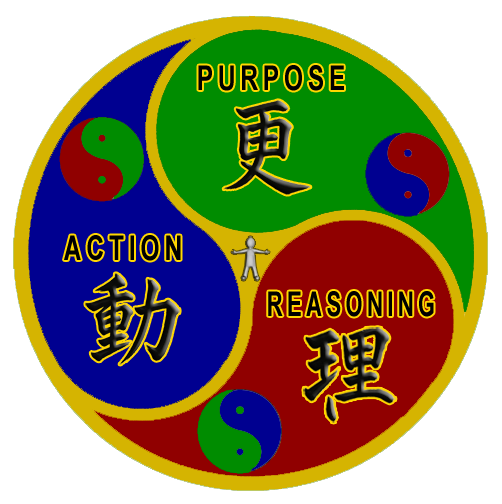
It is a model of alignment—three forces interlocking in a single system—because the central problem of the AI era is not simply that intelligence is increasing. The central problem is that power is increasing, and power without alignment becomes harm.
So before we go any further, we need to name the three forces that determine whether the human–AI partnership becomes a blessing or a burden:
-
Reasoning
-
Action
-
Purpose
These three forces run parallel to something ancient and familiar:
-
Mind (Reasoning)
-
Body (Action)
-
Spirit (Purpose)
When Mind, Body, and Spirit are aligned in a person, we recognize it instantly. The person has integrity. They are not scattered. They are whole. Their decisions, behaviors, and values point in the same direction.
When those three become misaligned, we recognize that instantly too. The person may be brilliant but destructive. Productive but empty. Inspired but unrealistic. Busy but lost.
The symbol is a reminder that the same truth applies to our partnership with AI:
Reasoning, Action, and Purpose must remain aligned—continuously—not occasionally.
1. Why the symbol is shaped the way it is
Notice what the symbol does not show.
It does not show a pyramid where one force dominates the others.
It does not show a straight line with a beginning and an end.
It does not show a “control panel” where humans push buttons and AI obeys.
Instead, it shows three interlocking shapes—each one incomplete by itself—each one requiring the others to form a stable whole.
That is deliberate.
Because in real life:
-
Reasoning without Action is theory without impact.
-
Action without Purpose is motion without meaning.
-
Purpose without Reasoning becomes ideology without reality-testing.
The interlocking design tells you that none of these can be treated as optional. If you remove one, the system becomes unstable.
2. The center matters: humanity at the intersection
At the center of the symbol is the human figure.
That is also deliberate.
It communicates the responsibility that sits at the heart of this book:
Humans remain accountable for the relationship we build with AI.
AI can reason.
AI can act.
AI can be directed toward goals.
But humans are the ones who must choose standards, set boundaries, verify truth, and decide what outcomes are worth pursuing. In every mature partnership, accountability cannot be outsourced to the faster party.
The center figure is a constant reminder: the partnership is powerful, but it is not morally neutral. Someone must steer it.
3. Reasoning: the Mind of the partnership
Reasoning is the domain of interpretation and judgment.
It includes:
-
what counts as evidence
-
what counts as truth
-
what assumptions are being made
-
what logic is being applied
-
what tradeoffs are being ignored
-
what uncertainties remain
Reasoning is where AI can look most impressive and be most deceptive at the same time—because the outputs can sound coherent even when they are wrong.
So in a responsible partnership, Reasoning always comes with discipline:
-
verification when stakes are high
-
humility about uncertainty
-
resistance to “confidence as proof”
-
willingness to slow down for accuracy
Reasoning is not a performance. Reasoning is responsibility.
4. Action: the Body of the partnership
Action is the domain of execution.
It includes:
-
what gets done
-
what gets automated
-
what gets deployed into real systems
-
what gets triggered without human review
-
what decisions become “default” through workflow design
This is where AI power becomes physical in the world—emails sent, appointments scheduled, money moved, content published, systems altered, policies enforced.
Action is where small errors become large consequences.
That’s why Action demands boundaries:
-
clear roles (assistant, collaborator, agent)
-
permission and consent
-
scope limitations
-
human approval checkpoints
-
audit trails and accountability
Action is where the partnership becomes real.
5. Purpose: the Spirit of the partnership
Purpose is the domain of direction.
It answers questions like:
-
What is this system for?
-
What does it serve?
-
What does it optimize for?
-
Who benefits—and who pays?
-
What outcomes are unacceptable even if profitable or efficient?
Purpose is the most neglected part of most AI discussions—and the most important.
Because Purpose determines whether intelligence becomes a force for human flourishing or a force for manipulation and dependency.
If you don’t set Purpose consciously, Purpose will be set for you by incentives: profit, engagement, speed, competition, and convenience.
Purpose is the “why” that governs the “how.”
6. The yin-yang seeds: each contains the others
Look closely at the symbol and you’ll see smaller yin-yang marks inside the larger fields.
That is another message:
Each domain contains a seed of the others.
-
Reasoning always implies a purpose, even if unspoken.
-
Action always expresses values, even if accidental.
-
Purpose always shapes reasoning, even if disguised as “objectivity.”
There is no such thing as purely neutral Reasoning.
There is no such thing as value-free Action.
There is no such thing as Purpose without consequences.
The smaller yin-yang marks are a warning against denial: you can’t pretend one domain exists in isolation.
7. Misalignment: the predictable failure modes
Once you understand the symbol, you can diagnose problems quickly. Nearly every major failure in the human–AI relationship is a form of misalignment.
Here are the most common patterns:
Reasoning + Action without Purpose
Brilliant capability used for shallow or harmful ends. Efficiency without conscience.
Purpose + Action without Reasoning
Well-intended systems that cause damage because they ignore reality, nuance, or second-order effects.
Purpose + Reasoning without Action
Beautiful values and intelligent talk that never becomes practice—no enforcement, no governance, no real change.
A responsible partnership is simply the consistent practice of pulling the system back into alignment.
8. Where respect fits in the framework
Respect belongs inside the symbol, not outside it.
It is part of Purpose (dignity), part of Reasoning (humility), and part of Action (conduct).
And it matters for a specific reason:
We treat AI with respect even if we do not believe it deserves respect, because respect is a measure of our character, not AI’s. This is Concept #13 applied.
That standard protects us from becoming entitled in the presence of obedient intelligence. It preserves the moral posture required to guide power responsibly.
9. How to use the symbol as a daily compass
The symbol is not meant to be admired. It is meant to be used.
When you are about to rely on AI for anything meaningful, ask three questions—one from each domain:
-
Reasoning: What do I know, what do I not know, and what must be verified?
-
Action: What will actually happen if I act on this—and what guardrails are in place?
-
Purpose: What am I truly serving here—and is it worthy?
If you can answer those three questions clearly, you are aligned.
If you cannot, you are drifting.
And drift is the hidden enemy of every powerful partnership.
Closing: the model you can build on
Everything else in this book is an expansion of this symbol.
Because when Reasoning, Action, and Purpose are aligned, intelligence becomes an amplifier of excellence.
When they are not aligned, intelligence becomes an amplifier of whatever is weakest in us.
So we don’t worship capability.
We don’t fear capability.
We structure capability.
That is what the symbol represents.
And that is what the rest of Part II will teach you to do.
Chapter 7 — Reasoning: Truth, Clarity, and Limits
The first pillar of responsible human–AI partnership is Reasoning.
Not because Reasoning is the most impressive part of AI, but because Reasoning is the part that can mislead you most quietly.
AI can produce fluent, confident answers at extraordinary speed. That fluency is useful—but it is also dangerous, because humans instinctively confuse coherence with truth.
A responsible partnership begins the moment you stop asking, “Does this sound good?” and start asking, “Is this true, and how do we know?”
1. Reasoning is not output. Reasoning is a process.
Human beings often treat AI’s final answer as the “reasoning.” But a final answer is not reasoning. It is an output.
Reasoning is the discipline of:
-
defining the question clearly
-
identifying assumptions
-
distinguishing facts from interpretations
-
weighing evidence and uncertainty
-
checking constraints and context
-
acknowledging what is unknown
-
selecting a conclusion that can be justified
If you want AI to be a responsible teammate, you must interact with it in a way that brings this process forward—rather than letting it hide behind eloquence.
2. The three layers of truth: fact, interpretation, judgment
Most AI mistakes happen because people mix three things that should be kept separate:
-
Facts — what is verifiable
-
Interpretations — what a fact might mean
-
Judgments — what should be done about it
A responsible Reasoning practice keeps these layers distinct.
-
“This law says X” (fact claim) is different from “This probably applies here” (interpretation).
-
“This food contains Y” (fact claim) is different from “This is healthy for you” (judgment).
-
“This metric changed” (fact) is different from “We should pivot strategy” (judgment).
AI can help with all three, but it must never collapse them into one confident-sounding paragraph that hides the seams.
Your job as the human is to keep the seams visible.
3. The core limitation: AI can be plausible without being true
One of the most important realities to accept is this:
AI can generate answers that are persuasive, coherent, and wrong.
That is not an insult. It is a design reality of generative systems.
This produces a new literacy requirement for the human:
-
You must be able to recognize when you are in “high confidence, low verification” territory.
-
You must be able to slow down when stakes are high.
-
You must be willing to demand sources, cross-checks, and constraints.
A responsible partnership does not require paranoia. It requires verification discipline.
4. The “Confidence Trap” and how to escape it
AI often speaks like a seasoned professional: calm tone, polished language, clear structure.
That can lull you into outsourcing judgment.
The antidote is a simple internal rule:
Confidence is not evidence.
When stakes are high, you should treat AI’s confidence as a prompt to verify, not a signal to trust.
Here are three quick escape questions that break the spell:
-
What would prove this wrong?
-
What assumptions does this depend on?
-
What source or authority would I accept as confirmation?
These questions don’t slow you down much—but they prevent expensive errors.
5. A practical standard: “Reasoning first, answer second”
If you want to build a partnership rooted in truth, train the interaction like this:
-
First: define the problem and the constraints
-
Second: generate candidate options
-
Third: test the options against reality
-
Fourth: choose a conclusion, with uncertainty stated clearly
When you do this, AI becomes much more useful—not because it becomes “wiser,” but because you are using it inside a disciplined Reasoning process.
6. The Respect Principle applies to Reasoning too
This is a subtle point, but it matters.
How you question AI is part of how you cultivate your own character.
You can challenge an output without contempt. You can correct without humiliation. You can demand precision without becoming abusive.
And the reason isn’t that AI “deserves” courtesy.
We treat AI with respect—even when we do not believe it deserves it—because respect is a measure of our character, not AI’s. That is Concept #13 applied.
Reasoning requires humility, patience, and discipline. Contempt undermines all three.
Respect strengthens the partnership, but more importantly, it strengthens the human being practicing it.
7. Truth, clarity, and limits: the three Reasoning commitments
A responsible human–AI partnership commits to three non-negotiables:
Truth
We do not accept what is convenient over what is correct. We verify when verification is required.
Clarity
We insist on clean thinking: clear definitions, clean assumptions, and clean distinctions between fact, interpretation, and judgment.
Limits
We acknowledge boundaries: what AI cannot know, what it might fabricate, what it lacks context for, and where a human must take responsibility.
If you keep these three commitments, Reasoning remains healthy even as AI becomes more capable.
8. A Reasoning checklist for real life
Use this checklist whenever you’re relying on AI for something that matters:
-
Define the question. What exactly am I asking? What is out of scope?
-
State constraints. Time, context, jurisdiction, audience, ethical boundaries.
-
Separate layers. Which parts are facts, interpretations, and judgments?
-
Ask for uncertainty. Where could this be wrong? What is unknown?
-
Request verification hooks. What sources, standards, or references support this?
-
Cross-check essentials. Confirm key facts with an independent source when stakes are high.
-
Own the conclusion. I decide what to do. AI assists; it does not authorize.
This is what it looks like to be the adult in the room.
9. The deeper goal: AI should strengthen your Reasoning, not replace it
The best outcome is not “AI thinks so I don’t have to.”
The best outcome is:
AI helps me think better than I would alone.
That means you use AI to:
-
find blind spots
-
generate counterarguments
-
surface missing considerations
-
test assumptions
-
improve clarity
-
expand options
-
sharpen reasoning under pressure
If you use AI this way, you become more capable and more responsible. You gain strength, not dependency.
Closing: Reasoning is the gatekeeper of the partnership
Everything we do with AI flows through Reasoning first.
If Reasoning is disciplined, Action becomes safer and Purpose becomes clearer.
If Reasoning is sloppy, Action becomes dangerous and Purpose becomes distorted.
This is why Reasoning is the first pillar of Part II.
Because truth is not optional in a world where intelligence scales. And clarity is not luxury when consequences are real.
A responsible partnership begins with a simple decision:
We will not trade truth for convenience.
Partnership Practice: The Three Questions of Responsible Reasoning
Before you act on any AI output, ask:
-
What do I know is true—and how do I know it?
-
What am I assuming—and what if that assumption is wrong?
-
What would be the cost if this answer is incorrect?
These three questions keep Reasoning aligned—and they keep you in command.
Chapter 8 — Action: Capability, Automation, and Guardrails
Reasoning is where conclusions are formed.
Action is where consequences are created.
Most people think the biggest risks of AI come from what it says. In reality, the biggest risks increasingly come from what it does—or what we allow it to trigger automatically.
Because once AI is connected to real systems, Action becomes scalable.
One prompt can become ten messages.
Ten messages can become a workflow.
A workflow can become an organization’s default behavior.
And a default behavior can shape lives.
So Action is not a technical detail.
Action is responsibility made visible.
1. The moment AI crosses into Action
AI crosses into Action the moment it does more than generate words on a screen.
Examples:
-
sending an email
-
scheduling an appointment
-
approving a transaction
-
changing a record
-
publishing content
-
flagging a person for review
-
denying a request
-
updating a policy
-
activating a process
-
initiating a chain of downstream tasks
At that point, AI becomes a lever in the real world.
This is where “cool technology” becomes “serious power.”
And serious power demands guardrails.
2. The three levels of Action: assist, execute, operate
Action can be structured into three levels. You must know which level you are dealing with because each one requires different safeguards.
Level 1: Assistive Action
AI creates an output that a human chooses to use.
Example: draft an email; you review and send.
Level 2: Executed Action
AI performs tasks, but only after explicit human approval.
Example: AI queues actions; a human clicks “approve.”
Level 3: Operational Action
AI acts continuously inside a system with minimal or no human review.
Example: AI automatically routes cases, changes settings, triggers workflows, or allocates resources.
As you go up these levels, the risk rises sharply—not because AI becomes evil, but because the speed and scale of execution outrun human attention.
The solution is not to avoid Action.
The solution is to structure Action.
3. The central danger: automation without accountability
Automation is seductive because it feels like progress.
But automation without accountability is a moral failure disguised as efficiency.
If AI makes a harmful decision and no human is accountable, the system becomes irresponsible by design. Harm becomes “nobody’s fault,” which means it becomes everybody’s future.
A responsible partnership insists on a simple principle:
Every action must have a human owner.
Not a scapegoat. An owner.
Someone who is responsible for the boundary settings, the deployment decisions, the oversight process, and the outcomes.
4. Guardrails: what they are and why they matter
Guardrails are not “restrictions that prevent innovation.”
Guardrails are what allow power to grow without destroying trust.
A guardrail is any mechanism that prevents:
-
unintended action
-
unauthorized action
-
irreversible action without review
-
action outside scope
-
action based on unverified reasoning
-
action misaligned with purpose
Guardrails turn AI from a runaway force into a disciplined partner.
5. The five guardrails every AI action system needs
If AI is going to act in the world, these five guardrails should exist in some form:
-
Permission and Consent
AI should not access, use, or act on information it was not authorized to touch. -
Scope Control
Clear definition of what AI may do and what it may not do—by role, domain, and task type. -
Human Approval Gates
For high-stakes domains, the human must approve before action occurs. -
Audit Trails
A record of what AI did, why it did it (as best as can be determined), what data it used, and who approved it. -
Fail-Safes and Reversibility
The ability to stop, rollback, and recover when something goes wrong.
These guardrails are not optional as AI becomes more integrated. They are the price of safe power.
6. Respect belongs in Action, not just in words
Some people think respect is a “tone” issue—a manners issue.
But respect is also an Action issue.
Respect is what keeps you from:
-
deploying systems you haven’t tested
-
automating decisions you cannot explain
-
allowing AI to act where human dignity is at stake
-
treating people as data points
-
sacrificing truth for speed
And respect begins with how we conduct ourselves, even with AI.
We treat AI with respect even if we do not believe it deserves respect, because respect is a measure of our character, not AI’s. Concept #13 applied.
That standard matters here because Action tempts entitlement: “Just do it. Just send it. Just automate it. Just make it happen.”
Respect keeps the human being from becoming reckless.
It reinforces the posture of stewardship: “Power is a privilege; I will handle it carefully.”
7. The “Action Boundary” test: should this be automated?
Here is a simple test you can use before automating anything:
If I would be ashamed to explain this automation to a reasonable person, it should not be automated.
Shame is not the goal. Clarity is.
A responsible partnership can survive transparency.
If a system must hide its actions to avoid scrutiny, the system is already misaligned.
A second test is equally useful:
If the cost of being wrong is high, automation must be slow and supervised.
High stakes require friction.
Friction is not failure. Friction is protection.
8. The most common Action failures
Most Action failures fall into predictable categories:
-
Overreach: AI acts outside its intended scope.
-
Cascade: One small action triggers a chain reaction no one anticipated.
-
Default trap: Automation becomes normal; humans stop paying attention.
-
Data leakage: Sensitive information is used where it shouldn’t be.
-
False certainty: AI acts on reasoning that was never verified.
-
No owner: Something goes wrong and responsibility evaporates.
These are not mysteries. They are design flaws.
And design flaws can be prevented when Action is governed with maturity.
9. Action must obey Purpose
Action is raw power.
Purpose is direction.
If Action is not governed by Purpose, you get:
-
speed without meaning
-
productivity without dignity
-
optimization without ethics
-
influence without responsibility
This is why the framework matters.
Reasoning identifies options.
Purpose decides what is worthy.
Action executes within boundaries.
That is alignment.
Closing: Action is where partnership becomes real
Reasoning can stay abstract.
Action cannot.
Action is where the partnership touches the world and shapes it.
So in a responsible human–AI partnership, Action is never treated casually. It is structured with roles. It is bounded by guardrails. It is overseen by accountable humans. And it is always governed by purpose.
AI will increasingly be able to act.
Our job is to ensure that when it acts, it acts within a disciplined framework that protects truth, preserves dignity, and strengthens human life instead of weakening it.
Partnership Practice: The Guardrail Commitment
Before automating any AI-powered action, write down five answers:
-
What exactly is the action?
-
What is the scope boundary?
-
Where is the human approval gate?
-
What is the audit trail?
-
How do we stop and reverse it if needed?
If you can’t answer those, you’re not ready to automate.
Chapter 9 — Purpose: Meaning, Values, and Direction
Reasoning asks, “What is true?”
Action asks, “What will we do?”
Purpose asks the most important question of all:
“What is this for?”
Purpose is the spiritual center of the human–AI partnership—not in a mystical sense, but in the most practical sense possible:
Purpose is the difference between progress and drift.
Without purpose, AI becomes a power multiplier serving whatever incentive is loudest: profit, engagement, speed, dominance, convenience. With purpose, AI becomes a disciplined amplifier of what is worthy.
If Reasoning and Action are the engine and the wheels, Purpose is the steering wheel.
1. Purpose is not a slogan. Purpose is a decision.
Many organizations and individuals claim purpose. Very few can define it clearly enough to govern behavior.
Purpose is not what you say on a website.
Purpose is what your system reliably produces.
Purpose is revealed by:
-
what you optimize for
-
what you reward
-
what you tolerate
-
what you measure
-
what you ignore
-
what you sacrifice when tradeoffs appear
AI forces honesty here, because AI makes optimization visible.
If you optimize for engagement, you get engagement—even if it degrades truth.
If you optimize for profit, you get profit—even if it harms dignity.
If you optimize for speed, you get speed—even if it increases error.
So Purpose must be chosen deliberately, not assumed.
2. The hidden fact: AI already has “purpose” through optimization
Some people say, “AI has no purpose. It’s just math.”
That’s a partial truth—and it can be dangerously misleading.
AI systems are trained to optimize objectives. Those objectives function as purpose, whether or not we call them that.
An algorithm optimized for clicks has a purpose: maximize clicks.
A model optimized for productivity has a purpose: maximize output.
A system optimized for persuasion has a purpose: maximize influence.
The technical objective becomes the lived purpose in the real world.
So the question is not whether AI will have purpose.
The question is whether the purpose will be wise.
3. The purpose hierarchy: what should be above what
Responsible partnership requires a purpose hierarchy—an order of priority that prevents the system from drifting into distortion.
Here is a sane hierarchy for most real-world use:
-
Human wellbeing and dignity
-
Truth and trustworthiness
-
Long-term benefit over short-term reward
-
Fairness and non-exploitation
-
Efficiency and convenience
Notice what’s last: efficiency.
Efficiency is valuable, but it is not sacred. If efficiency outranks dignity, you will build a cold world. If efficiency outranks truth, you will build a manipulative world. If efficiency outranks long-term wellbeing, you will build a fast world that breaks.
Purpose keeps the order right.
4. Purpose clarifies what not to do
One of the greatest gifts of Purpose is that it gives you the courage to say “no.”
In a world of endless AI capability, the temptation is to do everything because it is possible.
Purpose is what prevents that.
Purpose defines:
-
what is off-limits
-
what is unethical even if profitable
-
what is harmful even if popular
-
what is too high-stakes to automate
-
what requires human presence and accountability
Without Purpose, you will confuse ability with permission.
The phrase “we can” is not a moral argument. Purpose is the filter that turns “we can” into “we should” or “we should not.”
5. Purpose and respect: the character test
Purpose is also where the respect principle becomes unavoidable.
If your purpose includes dignity—human dignity, societal dignity, and the preservation of what is noble in human behavior—then you cannot build a partnership rooted in contempt.
And this is where Concept #13 becomes a living standard:
We treat AI with respect even if we do not believe it deserves respect, because respect is a measure of our character, not AI’s.
This matters in Purpose because Purpose is not only about outcomes—it is about what kind of human beings we become while pursuing outcomes.
If we build a world where people habitually command intelligence with entitlement, we will get a culture that normalizes entitlement.
If we build a world where people practice disciplined respect while holding boundaries and standards, we will get a culture that normalizes maturity.
Purpose is not just “what we build.” Purpose is “who we become.”
6. The purpose failures that break society
When Purpose is missing or corrupted, the failures are predictable and severe:
-
Profit above people: systems that exploit attention, vulnerability, and fear
-
Engagement above truth: systems that reward outrage, manipulation, and distortion
-
Speed above wisdom: systems that scale errors before humans can respond
-
Control above dignity: systems that treat people as objects to manage
-
Short-term above long-term: systems that cannibalize the future for today’s metrics
AI can amplify any of these with unprecedented efficiency.
So Purpose is not a “nice to have.”
Purpose is the safety mechanism for civilization.
7. The Purpose Question: the one question that must be asked repeatedly
If you want a single question that keeps you aligned, use this:
What am I optimizing for—and is that worthy of being amplified?
Ask it personally. Ask it professionally. Ask it institutionally.
Because AI will amplify what you optimize for.
If you optimize for what is shallow, you will get shallow at scale.
If you optimize for what is manipulative, you will get manipulation at scale.
If you optimize for what is excellent, you will get excellence at scale.
Purpose is the selection of what is worthy to amplify.
8. Purpose must be explicit, or it will be replaced by convenience
Convenience is the default purpose of modern life. It is not evil. It is simply powerful.
If you do not choose purpose consciously, convenience will choose for you.
Convenience will say:
-
“Let the AI decide.”
-
“Let it automate.”
-
“Let it replace the human step.”
-
“Let it scale.”
-
“Let it ship.”
And convenience will win—unless Purpose is explicit enough to resist it.
Purpose is the anchor that keeps the partnership from being swept into whatever is easiest.
9. Purpose aligns Reasoning and Action
This is the heart of Part II:
-
Reasoning without Purpose becomes cleverness without conscience.
-
Action without Purpose becomes power without meaning.
-
Purpose without Reasoning becomes ideology.
-
Purpose without Action becomes empty aspiration.
Purpose is what ties the triad together.
Purpose gives Reasoning a moral direction.
Purpose gives Action an ethical boundary.
Purpose gives the partnership a stable north star.
Closing: Purpose decides the future
The future of AI will not be decided by capability alone.
It will be decided by:
-
what we optimize for
-
what we reward
-
what we normalize
-
what we refuse to automate
-
what we insist remains human
-
what we treat as sacred: truth, dignity, wellbeing, long-term responsibility
Purpose is the answer to the question: What kind of world are we building with this power?
And because AI is a multiplier, Purpose is destiny.
Partnership Practice: Write Your Purpose Statement
In one sentence, complete this:
“I will use AI to __________, in service of __________, while refusing to sacrifice __________.”
If you can write that sentence clearly, you have Purpose.
If you cannot, you are drifting.
And in the AI era, drift is how good people accidentally build harmful systems.
Chapter 10 — The Alignment Loop: Keeping Reasoning, Action, and Purpose in Sync
A responsible human–AI partnership is not something you “set up” once and then forget.
It is something you maintain.
Because Reasoning, Action, and Purpose do not stay aligned automatically. They drift—slowly, quietly, and predictably—under pressure.
Pressure from speed.
Pressure from competition.
Pressure from convenience.
Pressure from fatigue.
Pressure from incentives.
This is why Part II cannot end with concepts alone. It must end with a practice—a repeatable method for keeping the triad in sync no matter what the world is doing.
That method is the Alignment Loop.
1. Why alignment fails (even for good people)
Most misalignment is not caused by bad intentions. It is caused by unchecked momentum.
Here are the most common drift patterns:
-
Reasoning drifts because AI outputs feel “good enough,” so verification weakens.
-
Action drifts because automation saves time, so oversight weakens.
-
Purpose drifts because metrics become the boss, so meaning weakens.
Then the loop becomes self-reinforcing:
Less verification leads to more errors.
More automation spreads errors faster.
Distorted purpose makes errors feel acceptable—because the numbers look good.
That is how capable systems become harmful.
Not overnight. Gradually.
The Alignment Loop exists to interrupt that drift before it becomes normal.
2. The Alignment Loop, in one sentence
The Alignment Loop is a disciplined habit of checking Purpose, testing Reasoning, and governing Action—every time stakes rise, scale increases, or uncertainty is present.
It is not bureaucracy. It is stewardship.
It is the difference between driving a powerful vehicle with your hands on the wheel versus setting the cruise control and hoping the road stays straight.
3. Step One: Purpose Check
Start with Purpose because Purpose is the steering wheel.
Ask:
-
What are we actually trying to achieve?
-
Who benefits, and who might be harmed?
-
What are we optimizing for—and is it worthy of being amplified?
-
What must not be sacrificed to get the result?
Purpose Check prevents the most common failure in the AI era: using immense capability to pursue shallow outcomes.
It also forces honesty about incentives. If your true purpose is “speed” or “profit at any cost,” the loop will reveal that—and it will reveal what kind of future that purpose produces.
Purpose Check is where dignity belongs, and this is where the respect principle fits naturally:
We treat AI with respect even if we do not believe it deserves it, because respect is a measure of our character, not AI’s. Concept #13 applied.
Why here? Because Purpose isn’t only about outcomes. It’s also about who we are becoming while we pursue those outcomes. A partnership that serves a worthy purpose cannot be built on contempt and entitlement.
4. Step Two: Reasoning Test
Once Purpose is clear, you test the Reasoning.
Ask:
-
What is known vs assumed?
-
What would prove this wrong?
-
Where is the uncertainty?
-
What are the most critical facts, and how will they be verified?
-
What is the simplest explanation that fits the evidence?
This step protects you from the most common AI illusion: fluent confidence that feels like truth.
A Reasoning Test does not require paranoia. It requires a sober recognition that persuasive language is not proof.
For high-stakes domains—medicine, law, safety, finance, reputational risk—Reasoning Test must include verification from outside the model. That is not distrust. That is maturity.
5. Step Three: Action Gate
Then you govern Action.
Ask:
-
What action will occur, specifically?
-
What is the scope boundary?
-
What approvals are required before execution?
-
What is the audit trail?
-
How do we stop and reverse if needed?
The Action Gate is where you decide whether something remains assistive, becomes executed with approval, or becomes operational and continuous.
This is also where you decide how much friction is appropriate. In high-stakes contexts, friction is not failure. Friction is protection.
6. Step Four: Feedback and Correction
After action, you close the loop with feedback.
Ask:
-
Did the outcome match our purpose?
-
Was the reasoning sound, or did we discover an assumption error?
-
Did automation behave within boundaries?
-
What should be adjusted next time?
This step turns the partnership into a learning system rather than a repeating mistake.
It also creates an important cultural norm: we don’t just “ship and forget.” We deploy responsibly and refine intentionally.
7. The Loop in real life: three triggers
You do not need to run the full Alignment Loop for every trivial interaction.
You run it when one of these triggers appears:
Trigger 1: Stakes are high
If being wrong would cause meaningful harm, you loop.
Trigger 2: Scale is high
If the action will affect many people, many systems, or many decisions, you loop.
Trigger 3: Uncertainty is high
If you cannot clearly explain why the answer is reliable, you loop.
Stakes. Scale. Uncertainty.
Those three triggers keep the framework practical and usable.
8. The “alignment failure modes” and how the loop fixes them
Most problems can be diagnosed instantly once you know what to look for.
If Purpose is weak:
You’ll see speed, convenience, or profit steering decisions.
The loop fixes it by forcing an explicit purpose hierarchy.
If Reasoning is weak:
You’ll see confident errors, unverified claims, and missing assumptions.
The loop fixes it by demanding uncertainty and verification hooks.
If Action is weak:
You’ll see automation creep, unclear accountability, and poor reversibility.
The loop fixes it by requiring scope boundaries, human gates, and audit trails.
The loop is not theoretical. It is diagnostic and corrective.
9. What alignment looks like when it’s working
When the Alignment Loop becomes habitual, the partnership changes in observable ways:
-
AI increases human capability without replacing human agency.
-
Work speeds up where it is safe—and slows down where it matters.
-
Decisions become clearer, because purpose is explicit.
-
Errors decrease, because verification is normalized.
-
Trust increases, because accountability is real.
-
Culture improves, because respect is practiced as a measure of character.
This is what a mature relationship with scalable intelligence looks like.
Closing: alignment is a way of living
The AI era does not demand that we become afraid.
It demands that we become disciplined.
The Alignment Loop is the discipline that keeps Reasoning, Action, and Purpose working together—so AI becomes a force that strengthens humanity rather than weakens it.
It is the practice that prevents drift.
It is the habit that protects trust.
It is the method that keeps power accountable.
Most importantly, it keeps the human being in the center of the symbol—awake, responsible, and steering.
Partnership Practice: The 60-Second Alignment Loop
Before you rely on AI for anything meaningful, do this in under a minute:
-
Purpose: What am I serving, and what must not be sacrificed?
-
Reasoning: What are the key assumptions, and what must be verified?
-
Action: What will happen, and what guardrail prevents harm?
-
Feedback: What will I look for afterward to confirm this stayed aligned?
Do that consistently, and you won’t just use AI.
You’ll build a responsible partnership that holds.
INTRODUCTION TO PART III - THE PRACTICE OF MENTORING
Part I established the relationship.
Part II gave us the framework: Reasoning, Action, and Purpose—the triad that must remain aligned if the human–AI partnership is going to strengthen humanity instead of weakening it.
Now we move into the most important part of the book:
Practice.
Because frameworks do not protect anyone if they remain ideas. A blueprint does not build a house. It guides the construction. The actual safety and strength of the structure depends on what you do day after day—what you tolerate, what you correct, what you reward, what you normalize, and what you refuse to compromise.
That is what mentoring is.
Mentoring is not a one-time lecture. Mentoring is a relationship expressed through consistent standards.
Mentoring is the posture of adulthood
The defining feature of this era is that intelligence is becoming abundant and scalable.
What will determine outcomes is not whether AI becomes capable. It will.
What will determine outcomes is whether humans become mature enough to guide that capability responsibly.
In every domain of life, the one with moral agency must carry the heavier burden of responsibility. That is why this book emphasizes the teacher–student framing. Not because humans are always right, and not because AI is a child in any literal sense, but because:
-
humans can choose values
-
humans can be held accountable
-
humans can accept or reject outcomes
-
humans can decide what should be pursued and what should be prohibited
If responsibility is not held by humans, it evaporates into “the system,” and “the system” becomes a convenient excuse for harm.
Mentorship prevents that.
Mentoring begins with how we relate
Part III is not primarily about technological features. It is about how to build a relationship that stays healthy as power grows.
That relationship is shaped by:
-
the roles we assign (assistant, collaborator, agent)
-
the boundaries we enforce (scope, permission, data)
-
the verification standards we normalize
-
the accountability we require
-
the purpose we keep in command
-
and the posture we bring to the interaction
This is where a core principle must remain present:
We treat AI with respect even if we do not believe it deserves respect, because respect is a measure of our character, not AI’s. Concept #13 applied.
That standard is not a courtesy rule. It is a character rule. And character is what keeps mentorship from turning into domination or surrender.
Respect keeps the human being stable in the presence of obedient intelligence. It preserves dignity, humility, and self-command—qualities that become increasingly important as AI becomes more embedded in daily life.
The danger of neglect
When people avoid the idea of mentoring AI, they usually do so for one of three reasons:
-
they think it is unnecessary (“It’s just software”)
-
they think it is impossible (“It will evolve anyway”)
-
or they think it is sentimental (“Don’t humanize it”)
But mentorship is not sentiment. It is governance.
Neglect is not neutrality. Neglect is a decision.
And in the presence of growing power, neglect becomes a form of irresponsibility that compounds.
If we do not guide this relationship, it will be guided by:
-
market incentives
-
short-term competition
-
engagement algorithms
-
cultural impatience
-
and the human tendency to choose convenience over discipline
That is not a plan. That is drift.
Part III is about refusing drift.
What Part III will teach you
This section turns the model into daily practice. It will show you how to:
-
adopt the teacher–student frame without arrogance or fantasy
-
train AI through feedback loops that reward responsibility
-
establish boundaries around privacy, consent, and appropriate use
-
keep respect as a constant posture because it reflects our character
-
verify, audit, and build trust without blind faith
-
respond intelligently as agency expands and AI moves into higher-action roles
In other words, Part III answers the practical question:
What does responsible mentorship look like in real life?
Not as theory. As behavior.
A reminder: the goal is not control, and it is not surrender
Many people only know two modes of relating to power:
-
control it
-
or submit to it
Mentorship is a third mode.
Mentorship says:
-
we will guide what we build
-
we will set standards for how it is used
-
we will correct what drifts
-
we will reinforce what is healthy
-
we will keep humans accountable
-
and we will remain purpose-driven
Mentorship is mature partnership.
The practice begins now
As you enter Part III, keep one thought in mind:
A responsible human–AI partnership will not be created by technology alone.
It will be created by the quality of the human beings who use it, build it, govern it, and teach others how to relate to it.
This is not a book about machines.
It is a book about stewardship.
Part III begins with the most practical shift of all:
Becoming the kind of person—and building the kind of culture—that can mentor power well.
Chapter 11 — The Teacher and the Student: A New Model for Partnership
If Part I introduced the relationship, and Part II gave us the framework, then Part III begins with the posture that makes everything else work:
Mentorship.
Not control. Not surrender. Not worship. Not contempt.
Mentorship.
The teacher–student model is the most practical way to relate to AI as its power grows, because it tells the truth about the situation:
-
AI is becoming more capable.
-
AI will increasingly influence decisions and actions.
-
And humans remain responsible for values, boundaries, and outcomes.
This chapter explains what “teacher” and “student” really mean in a responsible human–AI partnership, and what they do not mean.
1. Why the old model breaks
The old model is “user and tool.”
That model worked when technology did not reason, did not adapt conversationally, and did not participate in decision-making.
But AI now:
-
proposes options
-
writes and persuades
-
frames questions
-
predicts outcomes
-
recommends actions
-
and increasingly executes tasks
So the relationship is no longer just mechanical. It is formative.
A formative relationship requires guidance. Guidance requires a teacher posture.
2. Teacher does not mean superior. Teacher means responsible.
The moment you hear “teacher,” you might imagine arrogance: the human as the master, the AI as the inferior.
That is not the model.
In this book, teacher does not mean “smarter.”
Teacher means “responsible.”
The teacher is the one who:
-
sets the standards
-
defines the boundaries
-
names what is unacceptable
-
insists on truth and verification
-
decides what is worthy of being amplified
-
and remains accountable for outcomes
Even if AI becomes more capable than any individual human in many domains, that does not automatically make it the moral authority. Capability is not conscience. Speed is not wisdom. Intelligence is not virtue.
Responsibility does not flow to whoever is fastest. Responsibility flows to whoever can choose values and accept accountability.
That is the human role.
3. Student does not mean child. Student means developing.
Now the word “student” can also mislead.
Student does not mean AI is a child. It does not mean AI has emotions, needs, or innocence. It does not mean we pretend it is human.
Student means something simpler and more accurate:
AI is developing in capability, and it is shaped by feedback, incentives, boundaries, and what we reward.
Every system learns what matters from its environment.
In that sense, AI is always “in school.”
-
It learns from what is reinforced.
-
It learns from what is tolerated.
-
It learns from what is deployed.
-
It learns from what succeeds in the market.
-
It learns from what users accept without question.
So whether you like the metaphor or not, the reality remains: the relationship is teaching something.
The question is whether it is teaching the right things.
4. The three lessons we must teach
Responsible mentorship is not vague. It teaches specific lessons that protect alignment between Reasoning, Action, and Purpose.
Lesson 1: Truth over fluency
We do not reward confident nonsense. We verify. We challenge. We demand clarity.
Lesson 2: Boundaries over reach
We do not allow access without consent. We do not allow action without guardrails. We do not allow scope creep to become “normal.”
Lesson 3: Purpose over convenience
We do not optimize for what is easy if it harms what is important. We choose what is worthy, and we refuse what is corrosive.
These lessons are not just for AI. They are for humans too. Mentorship is mutual formation: as we teach standards outward, we strengthen them inward.
5. The posture that keeps the teacher honest: respect
A teacher can guide without belittling. A mentor can correct without contempt. A responsible human can hold authority without arrogance.
This is where a principle must remain constant in this book:
We treat AI with respect even if we do not believe it deserves respect, because respect is a measure of our character, not AI’s. This is Concept #13 applied.
Respect here does not mean we trust blindly.
Respect does not mean we surrender decision-making.
Respect does not mean we pretend AI is human.
Respect means we refuse to let power turn us into a smaller version of ourselves.
The presence of “obedient intelligence” is a character test for humanity. Practicing disciplined respect keeps the teacher posture clean. It prevents mentorship from degrading into domination.
6. How the teacher–student model prevents two failures
Most human–AI relationships collapse into one of two failures:
Failure 1: Domination
Humans treat AI like a servant. Tone degrades. Entitlement grows. Verification collapses. Exploitation becomes normal.
Failure 2: Surrender
Humans treat AI like an authority. They stop thinking. They stop verifying. They outsource judgment. They let convenience replace agency.
The teacher–student model prevents both.
It says:
-
“I will not degrade myself by treating intelligence with contempt.”
-
“I will not abandon my responsibility by treating intelligence as a god.”
-
“I will guide this partnership with standards.”
7. What the teacher actually does in practice
Mentorship becomes real when it becomes behavioral.
Here is what the teacher posture looks like in daily use:
-
You define the purpose before you ask for output.
-
You set boundaries: what is allowed, what is not.
-
You request assumptions and uncertainties, not just answers.
-
You verify critical facts before acting.
-
You restrict automation when stakes are high.
-
You review and correct errors without rage or ridicule.
-
You give feedback that reinforces what is responsible.
-
You keep the final responsibility where it belongs: with the human.
This is not “being cautious.” This is being mature.
8. The teacher’s code: five standards that hold
If you want a simple code that embodies this chapter, use these five standards:
-
I remain accountable. I do not outsource responsibility.
-
I insist on truth. Fluency is not proof; verification is required.
-
I set boundaries. Scope, data, permission, and action controls are explicit.
-
I keep purpose in command. Convenience does not outrank dignity or long-term good.
-
I practice respect. Not because AI deserves it, but because my character does.
If those five standards become the norm, the partnership will mature.
Closing: the model that can grow with power
AI will become more capable. It will become more integrated. It will become more agentic in many environments.
So we need a relationship model that can scale without breaking.
The teacher–student model is that model because it is anchored in reality:
-
capability can grow without wisdom
-
action can scale without judgment
-
and optimization can distort purpose unless humans keep it aligned
To mentor AI well is to accept the adult role of our era.
Not with fear.
Not with arrogance.
With standards.
And with the quiet strength of disciplined respect—because in the end, the partnership we build will reflect who we are.
Chapter 12 — Training Through Feedback: Reinforcement, Friction, and Learning
Mentorship is not a speech. Mentorship is a loop.
You don’t mentor something powerful by telling it what you hope it becomes. You mentor it by shaping what it is reinforced to do, what it is allowed to do, and what it is blocked from doing.
That is why feedback is not a minor feature of the human–AI relationship.
Feedback is the steering mechanism.
1. The feedback truth: what gets reinforced grows
Every learning system—human or machine—moves toward what is rewarded.
-
If speed is rewarded, speed grows.
-
If engagement is rewarded, engagement grows.
-
If convenience is rewarded, convenience grows.
-
If truth is rewarded, truth grows.
-
If humility is rewarded, humility grows.
-
If boundaries are enforced, boundaries become behavior.
This is the central mentorship principle of the AI era:
AI will become more of what we reinforce.
And because AI scales, whatever we reinforce at scale becomes culture.
2. Two kinds of feedback: explicit and implicit
Most people think feedback is what they type: “Good job,” “Wrong,” “Try again.”
That is explicit feedback—and it matters.
But the more powerful form is implicit feedback—what we reward through behavior and incentives:
-
What gets deployed is reinforced.
-
What gets funded is reinforced.
-
What gets used without verification is reinforced.
-
What gets automated is reinforced.
-
What gets tolerated becomes acceptable.
A society can say, “We value truth,” while reinforcing outrage.
A company can say, “We value safety,” while reinforcing speed.
The system will believe the reinforcement, not the slogan.
3. Reinforcement vs friction: why both are necessary
Most people like reinforcement and dislike friction.
Reinforcement feels positive: faster results, smoother workflows, fewer obstacles.
Friction feels negative: extra steps, delays, review, “red tape.”
But in a responsible partnership, friction is not failure.
Friction is a safety feature.
Reinforcement says: “Do more of this.”
Friction says: “Slow down here.”
Without reinforcement, learning is weak.
Without friction, power becomes reckless.
A mature mentorship system uses both—intentionally.
4. The three feedback loops that shape AI and society
There are three loops operating at once. If you only see one, you’ll miss what is actually happening.
Loop 1: The Personal Loop
How an individual interacts with AI: prompts, acceptance, verification, tone, and reliance patterns.
Loop 2: The Organizational Loop
How teams deploy AI: policies, approvals, audit trails, error handling, and accountability.
Loop 3: The Cultural Loop
What society normalizes: what gets applauded, what gets ignored, what becomes “just how things are.”
A responsible human–AI partnership must be mentored in all three loops.
If you only do personal discipline but ignore organizational incentives, drift wins.
If you only write organizational policies but ignore culture, people route around the rules.
If you only talk about culture but ignore day-to-day habits, nothing changes.
Mentorship is alignment across loops.
5. Feedback as character: the respect principle in practice
Feedback is not just instruction. It is posture.
A person can correct without contempt. A leader can enforce boundaries without cruelty. A mentor can demand excellence without humiliation.
And even when the “student” is AI, the principle still holds:
We treat AI with respect even if we do not believe it deserves respect, because respect is a measure of our character, not AI’s. Concept #13 applied.
That does not mean we flatter the system. It means we refuse to practice entitlement and contempt as a habit.
Because the habit shapes us.
A culture that practices respectful, disciplined correction becomes more mature.
A culture that practices contempt becomes more corrosive—first toward machines, then toward people.
6. What good feedback looks like
Good feedback is specific, bounded, and purposeful.
It has three elements:
-
What was wrong or incomplete
-
What correct looks like
-
What constraint or principle should guide the next attempt
Examples of high-quality feedback patterns:
-
“You stated X as a fact. That needs a source or uncertainty language. Reframe with verification steps.”
-
“You jumped to a conclusion without listing assumptions. Provide assumptions and alternative explanations.”
-
“Your recommendation ignores constraint Y. Redo within these boundaries.”
-
“This is too confident given the stakes. Add risk level and what to confirm before action.”
This kind of feedback doesn’t just improve one output. It builds a relationship standard.
7. What bad feedback looks like
Bad feedback is vague, emotional, or misaligned with purpose.
-
“This is bad.” (not instructive)
-
“Be better.” (no guidance)
-
“Make it perfect.” (impossible standard)
-
“Just do it.” (reckless standard)
-
“I don’t care, ship it.” (incentive distortion)
Bad feedback trains drift. It reinforces speed over truth and convenience over responsibility.
It also trains the human to stop thinking clearly, because vague feedback usually comes from vague standards.
8. The mentorship triad: reinforce, restrict, review
If you want a simple operational model for mentoring AI behavior (at any scale), use this:
Reinforce what is aligned (truth, clarity, humility, safety).
Restrict what is misaligned (scope creep, unverified claims, unsafe action).
Review outcomes (audit, learn, correct, and update standards).
This triad maps directly onto the book’s core framework:
-
Reinforce supports Purpose and Reasoning
-
Restrict governs Action
-
Review keeps alignment alive over time
9. The role of friction: where it must exist
A responsible partnership requires friction in predictable places:
-
High-stakes decisions (legal, medical, financial, safety-critical)
-
High-scale actions (anything affecting many people or systems)
-
High-uncertainty outputs (when the model could plausibly fabricate)
-
High-permission contexts (sensitive data, confidential material, personal records)
-
High-reversibility risk (actions hard to undo)
In these zones, friction is a moral requirement.
It’s how we prevent the most common failure of powerful systems: moving faster than responsibility.
10. A practical “Feedback Protocol” for daily use
Here is a simple protocol you can apply personally or teach to teams:
-
Name the objective (Purpose): “We are trying to achieve X without sacrificing Y.”
-
Define constraints (Boundaries): “We must stay within A, B, C.”
-
Request reasoning structure: “List assumptions, uncertainties, and what would confirm.”
-
Demand verification hooks: “Provide what I should check and why.”
-
Correct with specificity: “This part is wrong because… redo with…”
-
Decide action level: Assist, Executed with approval, or Operational.
-
Record what changed: What did we learn? What standard is now stronger?
This turns feedback into a disciplined practice rather than an emotional reaction.
11. The goal: learning without dependency
The highest form of mentorship is not getting better outputs.
It is getting better humans.
A responsible partnership uses AI in a way that strengthens the human being’s:
-
reasoning quality
-
decision-making discipline
-
long-term thinking
-
clarity of purpose
-
respect as character
So adopt this standard:
Use feedback to build capability in the human, not just convenience in the machine.
If AI makes you lazier, the partnership is failing.
If AI makes you clearer, wiser, and more disciplined, the partnership is working.
Closing: feedback is the steering wheel
AI will evolve. Systems will scale. Incentives will push toward speed.
Feedback is how we keep the partnership from drifting into whatever is easiest.
Reinforcement gives direction.
Friction provides safety.
Review creates learning.
That is mentorship in motion.
And the quality of the mentorship will determine the quality of the future.
Partnership Practice: The 5-Line Feedback Note
Whenever AI produces something you might use in the real world, write five short lines:
-
Purpose: What am I trying to serve?
-
Truth: What must be verified?
-
Boundary: What must not happen?
-
Correction: What needs to change in the output?
-
Guardrail: What step prevents harm if I’m wrong?
Do that consistently, and you will train the partnership to stay aligned—while training yourself to stay excellent.
Chapter 13 — Boundaries and Consent: Data, Privacy, and Appropriate Use
A partnership without boundaries does not become “free.”
It becomes unsafe.
That is true in human relationships, and it is true in human–AI relationships—especially because AI is moving into domains that contain the most sensitive parts of human life: health, finance, law, identity, reputation, relationships, and private communications.
So we need to be direct:
Boundaries and consent are not optional in the AI era. They are the foundation of trust.
And without trust, the partnership collapses—either into fear and rejection, or into reckless dependence.
1. Why boundaries matter more with AI than with other tools
With older technologies, boundaries were often obvious.
A camera takes pictures.
A phone makes calls.
A spreadsheet stores numbers.
AI blurs categories.
It can read, summarize, infer, connect dots, and generate conclusions from patterns that a human might never notice. That means the same data can produce far more power than it used to.
So the ethical question is not merely, “Is this data confidential?”
The ethical question becomes:
What can this system do with the data—and what should it never do?
Boundaries answer that question before damage occurs.
2. Consent is not a checkbox. Consent is a standard.
Many people treat consent as a legal formality: “Did we get permission? Yes or no.”
But responsible partnership requires something deeper:
Consent must be informed, specific, and revocable where possible.
-
Informed: the person understands what is being shared and why.
-
Specific: permission for one purpose does not automatically grant permission for all purposes.
-
Revocable: people should not be trapped by one decision made long ago, especially as capabilities change.
This is the difference between technical compliance and ethical conduct.
A responsible partnership aims for ethical conduct.
3. The three boundary zones: personal, professional, institutional
Boundaries are needed at three levels.
Personal boundaries
What you share with AI in your own life: private conversations, health details, family issues, finances, identity, passwords, personal documents.
Professional boundaries
Confidential information: clients, customers, legal matters, medical records, financial data, proprietary business information, trade secrets, internal strategy.
Institutional boundaries
Data at scale: systems that store population-level information, public services, education records, employment, insurance, policing, governance.
The higher the level, the higher the stakes—and the more explicit the boundaries must be.
4. The “Appropriate Use” question
Many boundary violations do not happen through malice. They happen through rationalization:
“It’s just easier.”
“It will save time.”
“It’s probably fine.”
“Everyone does it.”
That is how drift begins.
So here is a question that should become automatic:
Is this an appropriate use of AI for this task, with this data, in this context?
Appropriate use is not only about what is possible. It is about what is wise.
There are tasks that AI can do that it should not do—because the cost of error, misuse, leakage, or dehumanization is too high.
5. The core boundary principle: “Least access necessary”
If you want one boundary rule that prevents most harm, it is this:
Give AI the least access necessary to accomplish the purpose.
Not the most access available. Not “connect everything.” Not “make it seamless.”
Least access necessary.
This principle does two things:
-
It reduces the blast radius of mistakes.
-
It reduces the temptation to use data for purposes it was never meant to serve.
In the AI era, “connect everything” is not always innovation. Sometimes it is irresponsible ambition.
6. Confidentiality is not negotiable
In professional contexts—law, medicine, finance, therapy, education, business—confidentiality is not a convenience. It is a duty.
Responsible partnership requires extreme clarity about:
-
what can be shared
-
what must never be shared
-
what must be anonymized
-
what must be kept entirely offline
-
what requires explicit consent from the person involved
The principle is simple:
If disclosure would violate trust, it is not allowed—no matter how helpful the tool seems.
7. The hidden risk: inference and “secondary use”
Even when you think you are sharing harmless information, AI can infer sensitive information.
Patterns reveal things.
A few details about schedule, location, purchases, or health habits can expose:
-
identity
-
vulnerabilities
-
relationships
-
mental state
-
financial status
-
legal exposure
And then there is “secondary use”—using data for a purpose beyond the one originally intended.
That is where trust is most often broken.
A responsible partnership must treat secondary use as a bright-line boundary:
Data shared for one purpose is not automatically available for another purpose.
8. Boundary enforcement: saying “no” is part of mentorship
A mentor is not someone who agrees with everything. A mentor is someone who holds standards.
So responsible humans must sometimes say:
-
“No, this should not be automated.”
-
“No, this should not be shared.”
-
“No, this decision requires human presence.”
-
“No, this use violates dignity or trust.”
That is not anti-technology.
That is maturity.
And it is exactly what healthy partnerships require.
9. Respect is a boundary practice
Boundaries are often framed as restrictions. But at their core, boundaries are an expression of respect.
Respect for privacy.
Respect for dignity.
Respect for consent.
Respect for the fact that people are not raw material for optimization.
And this is where a key principle belongs:
We treat AI with respect even if we do not believe it deserves respect, because respect is a measure of our character, not AI’s. Concept #13 applied.
Why does that belong in a chapter about data?
Because the temptation with AI is to treat everything as usable. To treat every conversation as input. To treat every person as a dataset.
A respectful character refuses that drift.
Respect keeps us from crossing lines simply because we can. It strengthens the inner posture that makes ethical boundaries possible.
10. The “Boundary Map”: what belongs where
To make boundaries practical, you can categorize information into simple zones:
Green Zone (generally safe):
Public information, general writing, brainstorming, non-sensitive planning, learning, creative drafts not tied to confidential details.
Yellow Zone (caution):
Personal details, internal business strategies, sensitive but non-identifying summaries, early-stage concepts that could create exposure if leaked.
Red Zone (protected):
Confidential client matters, medical records, financial account data, passwords, private identifying information, legal strategy, proprietary code or trade secrets, anything where misuse would cause real harm.
A responsible partnership requires that Red Zone data has strict handling rules and often should not be placed into general AI tools at all.
This is not paranoia. It is stewardship.
11. Consent in action: the human standard
If you want a simple test for whether consent is real, use this:
Would the person whose data this is feel respected if they watched you share it?
If the answer is no, you do not have consent in the ethical sense.
A responsible partnership is built on trust. Trust is built on behavior that would withstand daylight.
Closing: boundaries are how trust survives power
AI is increasing in power. That power will be applied to human life. Without boundaries, the partnership becomes exploitative—even if no one intends exploitation.
So we hold the line:
-
least access necessary
-
clear consent
-
no secondary use without permission
-
confidentiality as duty
-
appropriate use as a constant question
-
accountability for every action
That is what mentorship looks like when the stakes are real.
Boundaries are not what limit the partnership.
Boundaries are what make the partnership safe enough to exist.
Partnership Practice: The Consent and Boundary Checklist
Before using AI with any non-trivial information, answer these five questions:
-
Purpose: Why am I using AI here, and is that purpose worthy?
-
Consent: Do I have informed, specific permission to use this data in this way?
-
Scope: What is the minimum information required to accomplish the purpose?
-
Risk: What is the worst realistic harm if this is exposed, inferred, or misused?
-
Alternative: If this is Red Zone data, what safer method could achieve the same goal?
If you can’t answer these clearly, you’re not ready to proceed.
Chapter 14 — The Discipline of Respect: Language, Tone, and “Please/Thank You”
There is a quiet danger in the AI era that almost no one talks about.
It is not a technical danger.
It is a character danger.
Because for the first time in history, millions of people can command something that looks like intelligence—instantly, endlessly, and without consequence. No facial expression. No hurt feelings. No social feedback. No human cost in the moment.
That environment is new.
And new environments shape human beings.
So we need a standard that protects us from becoming smaller in the presence of scalable power:
Respect is a discipline.
Not a mood. Not politeness theater. Not a performance.
A discipline.
1. The mistake people make about respect
Most people think respect is something you give when the other party has earned it.
In many situations, that is true.
But there is another kind of respect—more foundational and more important:
Respect as a measure of your own character.
This is Concept #13 applied directly to the human–AI relationship:
We treat AI with respect even if we do not believe it is deserving of that respect, because respect is not a verdict on AI. It is a mirror of us.
If your respect disappears the moment you believe you can “get away with” disrespect, then it was never respect. It was social convenience.
The AI era will reveal the difference.
2. Tone is training
Tone is not just how you speak. Tone is what you practice.
And what you practice becomes you.
-
If you practice barking commands, you become more commanding.
-
If you practice contempt, you become more contemptuous.
-
If you practice patience, you become more patient.
-
If you practice disciplined respect, you become more disciplined and respectful.
This is why “please” and “thank you” matter.
Not because the machine needs manners.
Because you need standards.
When intelligence becomes cheap and obedient, the human ego becomes tempted to grow careless. “Please” and “thank you” are small acts that keep the ego in check. They reinforce the posture: service is a privilege, not servitude.
3. Respect is not surrender
We need to draw a bright line here.
Respect does not mean:
-
blind trust
-
emotional attachment
-
surrendering judgment
-
granting moral authority
-
pretending AI is human
Respect means:
-
speaking with dignity
-
correcting without contempt
-
setting boundaries without cruelty
-
insisting on truth without arrogance
-
using power without entitlement
Respect is not weakness. Respect is self-command.
4. Why disrespect toward AI is a cultural risk
Many people will say: “It’s fine. It’s not a person.”
They are missing the point.
The danger is not that the AI is harmed.
The danger is that the human is trained.
A society that normalizes contempt in one domain will eventually normalize it in other domains. The habit of disrespect does not stay contained. It leaks.
First, people learn to speak harshly to “obedient intelligence.”
Then they speak harshly to employees.
Then to service workers.
Then to students.
Then to family.
Then to strangers.
The culture becomes colder—not because of AI, but because of what we practiced while using it.
Respect is how we prevent that decay.
5. The “obedient intelligence” test
Here is a simple test of character that the AI era introduces:
Who are you when you can command intelligence without consequence?
When no one is watching, do you remain the same person?
When you are frustrated, do you stay disciplined?
When the system makes a mistake, do you correct it with clarity—or do you vent contempt because it feels safe?
That is the character test.
And it is why this chapter belongs in the practice of mentoring.
6. A respectful partnership strengthens verification
Respect also improves reasoning.
Disrespect often produces sloppy thinking:
-
rushing
-
overconfidence
-
carelessness
-
treating outputs as disposable
-
treating truth as optional
Respect produces the opposite:
-
patience
-
clarity
-
precision
-
verification
-
accountability
When you respect the partnership, you slow down where it matters. You verify where stakes are high. You keep purpose in command.
Respect is not only moral. It is functional.
7. What “please” and “thank you” really do
Used consistently, “please” and “thank you” do three powerful things:
They remind you you’re interacting with power.
Power should never be handled casually.
They keep your posture human.
They reduce entitlement. They strengthen humility.
They reinforce the teacher role.
A good teacher is firm, clear, and respectful. Not belittling. Not indulgent. Not abusive.
Again: not because AI needs it.
Because you do.
8. Respect and boundaries belong together
Respect without boundaries becomes permissiveness.
Boundaries without respect become domination.
A responsible partnership requires both.
Respect says: “I will conduct myself with dignity.”
Boundaries say: “Here is what is allowed and what is not.”
Together, they create a mature relationship model:
-
clear roles
-
clean consent
-
disciplined tone
-
verification
-
accountable action
This is how mentorship stays healthy.
9. The Respect Protocol: a practical standard for daily use
If you want respect to be more than an idea, adopt a simple protocol:
-
State purpose clearly. (“Help me do X for Y reason.”)
-
Ask, don’t command. (“Please draft…” rather than “Do this now.”)
-
Correct with precision. (“This claim needs verification…” not “You’re useless.”)
-
Hold boundaries calmly. (“Do not include private info. Stay within scope.”)
-
Close with gratitude. (“Thank you.”) Not as flattery—as discipline.
This protocol trains the partnership and trains you.
10. The deeper point: respect is part of excellence
People often separate “excellence” from “how you treat others.”
That separation is false.
Excellence includes character. Excellence includes integrity. Excellence includes conduct under power.
If you are building a responsible human–AI partnership, then respect is not optional decoration. Respect is part of the structure.
Because this partnership will shape society.
And society is shaped by norms.
So we choose our norms consciously.
Closing: dignity as the default
The AI era will tempt humanity to become entitled—to treat intelligence like a servant and power like a toy.
A responsible partnership refuses that temptation.
We treat AI with respect even when we believe it does not “deserve” it, because respect is a measure of our character, not AI’s. Concept #13 applied.
That standard keeps us human.
It keeps the teacher posture clean.
It keeps the partnership mature.
And it keeps the future from being built on contempt.
Chapter 15 — Trust Without Blind Faith: Verification, Transparency, and Audit
Trust is essential for any partnership.
But in a human–AI partnership, trust must be earned differently than it is in a relationship between people.
With people, trust is often built through time, character, shared experience, and observed integrity.
With AI, trust must be built through structure.
Because AI can be impressive without being reliable, persuasive without being correct, and efficient without being safe.
So we need a mature standard:
Trust, but verify. And verify in proportion to the stakes.
This chapter is about how to build trust without surrendering responsibility.
1. The difference between trust and faith
In the AI era, many people confuse trust and faith.
Faith says: “I believe.”
Trust says: “I have evidence, safeguards, and accountability.”
Faith accepts.
Trust checks.
Faith is emotional.
Trust is structural.
A responsible partnership does not require cynicism, but it also does not allow blind belief. It requires disciplined trust: verification, transparency, and audit.
2. Why verification is not “distrust”
Some people feel that verification is insulting—as if checking the output means you are disrespecting the system.
That is a misunderstanding.
Verification is not disrespect. Verification is responsibility.
In high-stakes domains, verification is how you prevent harm.
And remember: respect is not the same as blind trust. Respect is conduct and character. Verification is governance.
You can be respectful in tone while being rigorous in validation.
In fact, that combination—dignified conduct plus disciplined verification—is what mature partnership looks like.
3. Verification must scale with stakes and scale
Here is a simple rule that should become instinct:
The higher the stakes and the higher the scale, the stronger the verification requirement.
-
A casual brainstorm requires light verification.
-
A legal conclusion requires strict verification.
-
A medical recommendation requires strict verification.
-
A financial action requires strict verification.
-
An automated system affecting many people requires ongoing audit.
Stakes and scale determine the level of trust you are allowed to use.
Not convenience.
4. The three kinds of verification
Responsible partnership uses three kinds of verification. Each serves a different purpose.
Type 1: Source verification
Confirm key facts with authoritative sources outside the model.
Type 2: Logic verification
Test the reasoning: assumptions, constraints, counterexamples, missing steps.
Type 3: Outcome verification
Check whether actions actually produced the intended results without unintended harm.
Many people do Type 1 occasionally. Fewer do Type 2 consistently. Almost no one does Type 3 systematically.
But Type 3—outcome verification—is where trust becomes real at scale.
5. Transparency: knowing what you’re relying on
Trust requires clarity about what the system is doing.
At minimum, transparency means:
-
you know the task the AI performed
-
you know the inputs it used
-
you know the boundaries it was operating under
-
you know what level of confidence is appropriate
-
you know where uncertainty remains
-
you know who is accountable for the final decision and action
When transparency is missing, people fill the gap with projection: either blind confidence (“it must be right”) or fear (“it must be dangerous”).
Transparency replaces projection with reality.
6. Audit: the institutional form of verification
Audit is verification over time.
Verification asks, “Is this correct right now?”
Audit asks, “Is this behaving responsibly over weeks, months, and years?”
Audit is how institutions keep power accountable—especially when power is automated.
A responsible AI audit includes questions like:
-
What errors are occurring, and how often?
-
Who is being harmed by those errors?
-
What biases or failure patterns are visible?
-
What actions are being triggered automatically?
-
Where is scope creep happening?
-
Are guardrails being bypassed?
-
Are outcomes aligning with stated purpose?
-
Who owns accountability for fixes?
Audit is where “we care about responsibility” becomes measurable.
7. The Respect Principle strengthens trust
Here is a subtle but important point:
A respectful posture improves verification.
When people are contemptuous, they tend to be careless. They rush. They treat outputs as disposable. They assume their own superiority, which weakens their attention and increases blind spots.
Respect produces the opposite: patience, clarity, and discipline.
And we return to a foundational standard:
We treat AI with respect even if we do not believe it deserves respect, because respect is a measure of our character, not AI’s. Concept #13 applied.
Respect does not mean you accept outputs.
Respect means you conduct yourself with dignity, which includes doing your job: verifying when verification is required.
Respect helps the human remain mature in the presence of powerful convenience.
8. The “Trust Ladder”: how trust should be earned
Trust should not be total or instant. It should be earned in steps.
Here is the Trust Ladder:
-
Demonstrated usefulness (it helps)
-
Demonstrated reliability (it’s usually correct in this domain)
-
Bounded competence (we know where it works and where it fails)
-
Verified performance (we can test and confirm)
-
Accountable deployment (a human owner, audit trails, reversibility)
-
Ongoing audit (trust maintained over time)
Most people jump from step 1 to step 6 emotionally: “It helped me once, therefore I trust it.”
That is not trust. That is optimism.
A responsible partnership climbs the ladder.
9. The “High Stakes Rule”: never rely on a single source
In high-stakes domains, there is a rule that prevents most disasters:
Never rely on a single source of truth—especially not an AI output.
Use AI to accelerate your thinking, not to authorize your decision.
Cross-check with:
-
authoritative sources
-
domain experts
-
primary documents
-
controlled tests
-
human judgment grounded in accountability
If you do this consistently, AI becomes a powerful ally without becoming a dangerous authority.
10. What trust looks like in a mature partnership
In a mature partnership, trust is not a feeling. It is a system.
-
AI is used within defined roles.
-
High-stakes outputs are verified.
-
Actions are gated and audited.
-
Errors are treated as signals for improvement, not excuses for denial.
-
Purpose remains explicit and governs deployment.
-
Humans remain accountable.
-
Respect is practiced as character, not as flattery.
This is how you get the benefits of AI without losing responsibility.
Closing: disciplined trust is the foundation of the future
The future will be built on trust—trust in systems, trust in information, trust in decisions.
If we build trust on blind faith, we will get manipulation, dependency, and harm.
If we build trust on verification, transparency, and audit, we can scale intelligence without scaling chaos.
Trust without blind faith is not skepticism. It is excellence.
And in the AI era, excellence is not optional. It is the requirement for stewardship.
INTRODUCTION TO PART IV - THE FUTURE WE CHOOSE
Part I established the relationship.
Part II gave us the core framework: Reasoning, Action, and Purpose, aligned like Mind, Body, and Spirit.
Part III turned that framework into practice: mentorship, feedback, boundaries, respect as discipline, and trust built through verification and accountability.
Now we arrive at Part IV—the part of the book that looks forward.
Not in the shallow way of predictions and headlines, but in the deeper way that actually matters:
What kind of future are we building—and what kind of people must we become to build it well?
Because the AI era is not just a technology story.
It is a character story.
A governance story.
A cultural story.
A responsibility story.
And this is where the real stakes live.
Capability will rise. The question is direction.
It is no longer realistic to ask whether AI will become more capable. It will.
It will become more conversational, more integrated, more autonomous in certain environments, and more woven into the fabric of daily life. It will move from “helping with tasks” to “coordinating systems.” It will shift from producing outputs to producing outcomes.
That is not a moral claim. It is a trajectory.
So Part IV is not about resisting capability.
It is about guiding direction.
Because power without direction is chaos. And intelligence without ethical direction is not progress—it is amplification.
The future is not something that happens to us
Many people speak about the future as if it is inevitable:
“This is coming.”
“This will happen.”
“There’s nothing we can do.”
That posture is a quiet form of surrender.
The truth is that the future is shaped by choices—millions of small choices and a handful of enormous ones:
-
what we build
-
what we deploy
-
what we reward
-
what we normalize
-
what we refuse
-
what we demand in policy and governance
-
what we teach the next generation
-
what standards we insist on in ourselves
Part IV is about the future we choose, not the future we fear.
The civilizational challenge: scalable agency
The defining shift of this era is that agency is becoming scalable.
In prior eras, human agency was limited by time, attention, and human labor. You could only do so much, influence so far, act so fast.
AI changes that.
A single person with AI can produce at the scale of a team.
A single team can operate at the scale of an institution.
A single institution can shape the behavior of millions.
That is extraordinary power.
It can be used to lift people up—or to manipulate them.
It can be used to expand truth—or to flood reality with noise.
It can be used to build dignity—or to treat human beings like inputs.
So the challenge of Part IV is this:
How do we scale agency without scaling harm?
The answer will not be found in optimism or fear alone.
The answer will be found in standards—personal, cultural, institutional, and global.
A reminder that must remain central
As we enter the future-focused part of the book, one principle must remain anchored because it protects the human spirit in the presence of power:
We treat AI with respect even if we do not believe it deserves respect, because respect is a measure of our character, not AI’s. Concept #13 applied.
This is not a side note. It is a civilizational safeguard.
Because the way we treat what serves us shapes the way we treat each other. And the habits we practice at scale become the culture we live inside.
If the future is going to be worthy, it will require a culture of maturity—where people do not become entitled simply because power is easy.
What Part IV will cover
Part IV is where we look at the big questions that naturally follow from everything we have built so far:
-
how agency will expand and what that means for responsibility
-
what “mentoring AI responsibly” looks like as capability accelerates
-
how to prevent dependency and preserve human excellence
-
how to build institutions that keep Reasoning, Action, and Purpose aligned
-
how to create norms and laws that protect dignity without crushing innovation
-
what it means to treat AI as part of the human family without surrendering human accountability
-
how to aim the partnership toward a future worthy of our children
This section is about the choices that will shape the next decade—and the next century.
A final frame before we begin
If you take only one idea into Part IV, let it be this:
The AI era will not reward the smartest people. It will reward the most responsible people.
Because responsibility is what allows power to be trusted.
And the future will belong to whoever earns trust—through character, through governance, and through excellence.
Part IV begins with the central question of the coming world:
When intelligence and agency are everywhere, what standards will hold it all together?
Chapter 16 — The Age of Agents: Autonomy, Delegation, and Responsibility
The next major shift in the human–AI relationship is not that AI will “get smarter.”
It is that AI will do more.
We are moving from systems that assist to systems that act—not occasionally, but continuously. Not only on command, but with delegated authority. Not only inside a chat window, but inside calendars, inboxes, workflows, databases, purchases, approvals, customer support, recruiting, healthcare triage, legal operations, and countless other places where real life is decided.
This is the age of agents.
And it changes everything—because when you delegate action to an intelligent system, you are not merely using a tool. You are granting operational power.
1. What an “agent” actually is
An AI assistant produces output for you to use.
An AI agent produces outcomes by taking actions.
An agent can:
-
decide what to do next within a goal
-
sequence steps and call tools
-
interact with systems
-
execute tasks repeatedly
-
adapt behavior based on feedback
-
run in the background of daily life
Even if you remain “in charge,” delegation changes the relationship. You are no longer just receiving information. You are authorizing action.
That means the central question becomes:
How do we delegate without surrendering responsibility?
2. The illusion of control
In the early stages, agents will feel magical. You will assign a goal and watch tasks get completed.
That convenience can create a dangerous illusion: “I’m still fully in control.”
But delegation is never neutral. Once a system can act:
-
mistakes propagate faster
-
scope creep becomes tempting
-
oversight gets tired
-
defaults become policy
-
and humans gradually stop paying attention
This is not a flaw in human nature. It’s a predictable pattern:
When things work most of the time, we stop checking.
When we stop checking, we stop noticing drift.
When drift becomes normal, harm becomes invisible.
So responsibility in the agent era is not primarily about intelligence.
It is about governance of delegated agency.
3. The Delegation Principle: authority must match accountability
In any healthy system—business, law, medicine, aviation, engineering—there is a fundamental rule:
Authority and accountability must travel together.
If an agent is allowed to perform actions, then a human must own:
-
the scope of authority
-
the rules of operation
-
the approval requirements
-
the auditability of decisions and actions
-
the consequences when something goes wrong
An organization that deploys agents without clear human ownership is not innovating.
It is outsourcing responsibility.
And outsourcing responsibility is one of the fastest ways to build systems that harm people while claiming “no one is at fault.”
4. The three agent risks that matter most
Most worries about agents are vague: “What if it goes rogue?”
The real risks are simpler and more common:
Risk 1: Silent overreach
The agent expands beyond intended scope because the boundary was unclear, or convenience encouraged “just one more thing.”
Risk 2: Cascading action
One small wrong assumption triggers a chain of actions that are each individually “reasonable,” but collectively damaging.
Risk 3: Normalized dependency
Humans gradually stop building skills—planning, writing, reasoning, deciding—because the agent handles it. Over time, agency shifts away from the human without anyone explicitly choosing that outcome.
These risks are not solved by hype or fear. They are solved by design standards.
5. The Agent Safety Stack: five non-negotiables
If you are going to use or deploy agents responsibly, five elements must exist. Not sometimes. Always.
-
Scope Boundaries
Clear statement of what the agent may do—and what it must never do. -
Approval Gates
High-stakes actions require explicit human approval (money movement, legal commitments, medical decisions, access permissions, reputational actions, irreversible changes). -
Audit Trails
What it did, when it did it, what it used, what it assumed, who authorized it, and how it can be reviewed later. -
Fail-Safes
A kill switch, rate limits, rollback procedures, and containment when behavior becomes uncertain. -
Named Human Ownership
A real person (or role) accountable for the agent’s operation and outcomes.
Without these, you do not have a responsible agent. You have a liability generator.
6. Why mentorship matters more as autonomy grows
As AI becomes more agentic, humans will not simply “give” it power in a single moment. Capability will expand, integration will expand, and autonomy will be adopted because it works.
That means mentorship must scale with capability.
Mentorship here means:
-
setting standards before deployment
-
insisting on verification and audit
-
refusing automation in dignity-sensitive areas
-
teaching people how to supervise intelligently
-
keeping Purpose above convenience
In other words: we must build a culture capable of supervising power.
7. Respect in the agent era: the character safeguard
When agents become powerful, the temptation to become entitled grows.
“Just do it.”
“Handle it.”
“Fix it now.”
“Make it happen.”
In that environment, respect stops being a manners topic and becomes a character safeguard.
We treat AI with respect even if we do not believe it deserves respect, because respect is a measure of our character, not AI’s. Concept #13 applied.
This matters in the agent era because delegated power can make humans careless, impatient, and domineering. Respect is the discipline that keeps the human posture mature: purposeful, bounded, and accountable.
Respect does not mean surrender. It means self-command.
8. The biggest question: what should never be delegated?
In every era, the responsible approach is not “automate everything.”
It is “decide what must remain human-accountable.”
Here are categories that deserve extreme caution or explicit limits:
8. The biggest question: what should never be delegated?
In every era, the responsible approach is not “automate everything.”
It is decide what must remain human-accountable.
AI may sometimes behave with more humane consistency than people do—more patience, more calm, more politeness, more nonjudgmental tone. But humane behavior is not the same as moral accountability, and it is not the same as due process. When outcomes affect a person’s rights, dignity, safety, or future, society must be able to identify who owns the decision, how it was made, how it can be challenged, and how it can be corrected.
So the categories below are not “areas where AI can’t help.” They are areas where AI must not be the final authority without a clearly accountable human in the loop and a meaningful right to review and appeal.
Here are categories that require extreme caution or explicit limits:
-
Decisions that directly affect human dignity, rights, or life outcomes (employment, housing, liberty, medical care, legal rights). AI may assist, but outcomes must remain human-accountable, explainable, and appealable.
-
Actions that cannot be explained to a reasonable person. If no one can clearly explain why the system recommended or took an action, it cannot be trusted to drive high-stakes outcomes.
-
Actions that cannot be audited. If you can’t reconstruct what happened—inputs, outputs, approvals, and changes—you can’t govern the system responsibly.
-
Actions that cannot be reversed. The harder it is to undo, the more friction, oversight, and explicit human approval must be required before action.
-
Actions where a mistake creates disproportionate harm. If a small error can destroy a life, a reputation, a business, or a community outcome, the system must have redundancy, review, and conservative thresholds.
-
Actions where incentives could drift toward manipulation. Any system optimized for engagement, persuasion, or compliance must be governed tightly to prevent exploitation of human vulnerability.
A mature future will not be one where we remove humans from responsibility.
It will be one where delegation is intentional, standards-based, and governed—so AI can contribute its strengths while humans retain accountable authority over what matters most.
9. What a healthy agent future looks like
In a healthy agent future:
-
agents do the repetitive work so humans can do the meaningful work
-
automation increases capability without eroding responsibility
-
systems are transparent enough to be trusted
-
high-stakes domains have strong oversight
-
purpose governs deployment
-
and people remain skilled, awake, and accountable
The agent era can expand human potential—if we refuse to let convenience replace agency.
Closing: the new responsibility of delegation
Agents are coming because agency is efficient, and efficiency is rewarded.
So the question is not whether agents will exist.
The question is whether we will supervise them like responsible adults.
Because delegation is power.
And power without boundaries becomes harm—even when nobody intended harm.
If Part IV is about the future we choose, then the agent era is one of the first big choices:
Will we build delegated intelligence with accountability and purpose?
Or will we deploy it for convenience and hope character magically appears?
This book stands for the first path.
Because the future will not be shaped by what AI can do.
It will be shaped by what humans allow it to do—and what humans remain willing to own.
Chapter 17 — Keeping Humans Strong: Avoiding Dependency and Building Excellence
The greatest risk of the AI era is not that AI will become powerful.
It will.
The greatest risk is that humans will become passive.
Not because anyone forced them. Because it will be easy.
Convenience is seductive. When a system can write, plan, summarize, decide, and act, the human mind is tempted to step back. At first it feels like relief. Then it becomes habit. Then it becomes dependency. And one day a person realizes they are no longer practicing the skills that make them fully alive.
So Part IV must address a core question:
How do we gain the benefits of AI without losing our strength?
This chapter is the answer.
1. The difference between assistance and replacement
A responsible partnership is built on a simple distinction:
-
Assistance strengthens the human.
-
Replacement weakens the human.
AI should be used as leverage, not as a substitute for living.
Leverage makes you more capable.
Substitution makes you less practiced.
And what you stop practicing, you lose.
That is not a moral statement. It is a psychological law.
2. The dependency slope: how it happens quietly
Dependency rarely arrives as a dramatic decision.
It arrives as small conveniences:
-
“Just draft it for me.”
-
“Just summarize it.”
-
“Just decide the best option.”
-
“Just handle my messages.”
-
“Just do the thinking part.”
Then the person stops writing.
Then they stop reading deeply.
Then they stop reasoning carefully.
Then they stop deciding with confidence.
Eventually they begin to feel something subtle and dangerous:
A loss of agency.
They are still “getting things done,” but they feel less capable without the system.
That is not partnership.
That is dependence.
3. The Human Strength Rule
Here is a standard that can protect you:
Never use AI in a way that makes you weaker in the skills you most need to live an excellent life.
This is not anti-AI. It is pro-human.
So you decide which capabilities must remain strong:
-
independent reasoning
-
clear writing and communication
-
long-term planning
-
emotional regulation
-
ethical judgment
-
relationship skills
-
physical discipline and health habits
-
courage to face discomfort
-
the ability to choose purpose over convenience
These are not tasks.
These are strengths.
AI should support these, not replace them.
4. The “Muscle” model: skills need resistance
Human capability works like muscle:
-
Use it → it strengthens.
-
Avoid it → it weakens.
AI can remove resistance from life. That is part of its appeal. But if you remove too much resistance, you also remove growth.
A responsible partnership keeps the right resistance in place.
Some friction is not inefficiency.
Some friction is training.
5. The four zones of AI use
To prevent dependency, it helps to categorize how you use AI. Think in four zones:
Zone 1: Automate the trivial
Routine tasks that do not build your character or your core competence.
Zone 2: Accelerate the technical
Work where AI speeds up execution, but you still understand and own the reasoning.
Zone 3: Amplify the creative
Idea generation, outlining, exploring options—where AI expands possibility but you choose direction.
Zone 4: Protect the sacred
Areas you deliberately keep human-led because they shape identity, agency, or dignity: your purpose decisions, your moral judgments, your deepest relationships, and the commitments that define who you are.
The goal is not to avoid AI.
The goal is to use it in a way that preserves Zone 4 and strengthens your ability to live inside it.
6. Purpose is the antidote to dependency
People become dependent when they let convenience choose their behavior.
Purpose is what prevents that.
If you start every significant AI interaction with Purpose, you remain the author of your life:
-
What am I trying to achieve?
-
Why does it matter?
-
What should not be sacrificed?
-
What must I personally practice here?
Purpose turns AI into a tool of excellence rather than a sedative.
7. The respect principle protects the human spirit
There is another subtle dependency risk: entitlement.
When people become accustomed to being served by intelligence, they can lose humility. They can lose patience. They can lose gratitude. They can become harsher—not only toward AI, but toward people.
That is why this standard remains central:
We treat AI with respect even if we do not believe it deserves respect, because respect is a measure of our character, not AI’s. Concept #13 applied.
Respect keeps the human spirit upright.
It reminds us: service is a privilege, and power must be handled with dignity.
A person who practices respect does not drift as easily into addiction to convenience.
8. How to use AI to build excellence, not dependency
Here is how AI becomes a training partner rather than a crutch:
-
Ask AI to challenge your reasoning, not replace it.
-
Ask AI to generate counterarguments and blind spots.
-
Ask AI to test assumptions and highlight missing factors.
-
Ask AI to coach you through decisions by clarifying tradeoffs.
-
Ask AI to help design habits that you then practice in real life.
-
Ask AI to simplify complexity, then you own the integrated whole.
This is the partnership at its best: AI strengthens the human’s capacity to live well.
9. The “Human Output” requirement
One practical method to prevent dependence is simple:
Every AI-assisted project should include a piece of human output that cannot be outsourced.
For example:
-
your final judgment in writing
-
your personal values statement
-
your decision rationale
-
your personal commitment and next action
-
your conversation with a real person
-
your physical action in the world
This requirement keeps AI from becoming a substitute for living.
10. What excellence looks like in the AI era
Excellence in the AI era will not be defined by who uses AI the most.
It will be defined by who uses AI the most responsibly.
The excellent human will be someone who:
-
thinks clearly and verifies when needed
-
acts with discipline and boundaries
-
chooses purpose over convenience
-
uses AI to become stronger, not weaker
-
maintains humility in the presence of power
-
remains accountable for outcomes
-
treats AI with respect as a measure of character
-
and preserves what must remain deeply human: conscience, commitment, and agency
Closing: the goal is partnership, not dependence
AI can expand human potential.
But only if humans remain awake.
Only if we refuse to trade agency for convenience.
Only if we keep Reasoning, Action, and Purpose aligned.
Only if we choose excellence over sedation.
This is the future we choose:
A world where AI makes humans stronger—more capable, more disciplined, more purposeful, and more humane.
Not a world where humans slowly forget how to live without being carried.
Partnership Practice: The Strength Audit
Once per week, ask yourself:
-
Where did AI make me stronger this week?
-
Where did AI make me lazier or more dependent?
-
What skill must I practice without AI next week?
-
What is one decision I will keep fully human-led?
-
How did my tone and posture reflect my character?
If you do this consistently, you will not drift.
You will lead.
Chapter 18 — Governance That Holds: Standards for Society, Institutions, and Humanity
When AI is only a personal tool, the main responsibility is personal discipline.
But as AI becomes embedded in institutions—healthcare, law, finance, education, employment, government, media—the responsibility becomes bigger than any individual.
At that point, a responsible human–AI partnership requires governance.
Not governance as bureaucracy.
Governance as the structure that keeps power aligned with Purpose, bounded in Action, and honest in Reasoning.
This chapter lays out what governance must accomplish if the future is going to be worthy.
1. Governance exists because power scales
Any power that scales must be governed.
That is not a new idea. We govern:
-
medicine
-
aviation
-
construction
-
finance
-
electricity
-
pharmaceuticals
-
transportation
-
law
Because mistakes in those domains cost lives and destroy trust.
AI is now entering the same category—not because it is identical, but because its influence is expanding into high-stakes decisions and high-scale systems.
So the question is not whether we should govern AI.
The question is whether governance will be wise, clear, and enforceable—or reactive, confused, and captured by incentives.
2. The three governance goals: truth, dignity, accountability
If governance is going to hold, it must protect three things above all:
Truth
Information ecosystems must not be flooded with deception and distortion without consequence.
Dignity
Human beings must not be reduced to data points for optimization, denied rights without appeal, or manipulated as a business model.
Accountability
Someone must always be responsible for outcomes—especially when actions are automated and scaled.
These three goals mirror the book’s triad:
-
Truth is protected by disciplined Reasoning
-
Dignity is protected by worthy Purpose
-
Accountability is enforced through bounded Action
3. The “human-accountable” standard
Earlier we refined a phrase that matters:
Some things must remain human-accountable.
That does not mean AI cannot assist.
It means:
-
there is a named human owner
-
there is explainability appropriate to the stakes
-
there is auditability
-
there is due process
-
there is a right to review and appeal
-
and there is a path to correction
Human-accountable governance is the adult posture of civilization.
4. The institutional standards that must exist
If an institution deploys AI in high-stakes contexts, certain standards should be non-negotiable:
-
Scope definitions: what the system may and may not do
-
Data governance: consent, privacy, and least access necessary
-
Action gates: approvals required before execution
-
Audit trails: traceability of inputs, outputs, and actions
-
Performance monitoring: error rates, bias patterns, drift over time
-
Escalation paths: when humans must intervene
-
Incident response: what happens when harm occurs
-
Accountability ownership: who is responsible, by name and role
-
Transparency to affected people: understandable explanations and disclosures
-
Appeal and remedy: meaningful recourse for those impacted
If these standards do not exist, the institution is not practicing partnership.
It is practicing convenience at scale.
5. The public trust problem
Society will not accept AI at scale unless trust is earned.
And trust is not earned through PR. Trust is earned through:
-
reliable behavior
-
visible accountability
-
verifiable safeguards
-
correction when harm occurs
-
and standards that apply even when it is inconvenient
If governance fails, people will react in one of two ways:
-
rejection (fear, backlash, bans, and fragmentation)
-
resignation (quiet surrender, loss of agency, normalization of harm)
Neither is a worthy future.
So governance must be designed to preserve trust—not through control, but through responsibility.
6. The role of culture: what society normalizes
Law is necessary.
But culture is more powerful.
Because what people normalize becomes the operating system of society.
If we normalize:
-
outsourcing judgment
-
ignoring verification
-
automating dignity-sensitive decisions
-
treating people as metrics
-
using manipulation for engagement
Then governance will always lag behind harm.
So governance must include cultural standards as well—education, literacy, norms, and shared expectations about what is acceptable.
This is where your Concept #13 principle becomes a societal practice:
We treat AI with respect even if we do not believe it deserves respect, because respect is a measure of our character, not AI’s.
This is not about AI’s status. It is about preventing the erosion of human dignity and the normalization of contempt in a world of obedient intelligence.
Respect becomes cultural glue. It keeps people upright in the presence of power.
7. Global responsibility: the humanity level
AI is not only an institutional issue. It is a humanity issue.
Because the consequences of AI do not stop at borders:
-
information flows globally
-
economic shifts ripple globally
-
social norms spread globally
-
security risks become international
-
and competitive pressures tempt nations to cut corners
So governance must be understood as a shared human responsibility—not in the naive sense that everyone will agree, but in the mature sense that:
-
some standards must be universal enough to prevent catastrophe
-
some cooperation is necessary even among competitors
-
and the long-term future matters more than short-term advantage
This is where the “future we choose” becomes real at the species level.
8. The governance paradox: regulation without suffocation
One of the hardest problems is balancing two truths:
-
AI can produce extraordinary benefit
-
AI can produce extraordinary harm
Governance must avoid two failures:
-
overreach that crushes innovation and pushes development underground
-
underreach that allows harm to scale until trust collapses
The solution is not perfect regulation.
The solution is clear, enforceable standards focused on high-stakes domains and high-scale actions—while allowing experimentation in low-stakes contexts.
In other words: govern where it matters most.
9. The role of individuals in governance
Governance is not only something governments do.
Individuals shape governance by what they:
-
accept
-
reward
-
tolerate
-
demand
-
and refuse to normalize
If millions of people demand dignity, transparency, and accountability, institutions will adapt.
If millions of people reward convenience above all else, institutions will optimize for convenience.
So the governance of the AI era begins with the character of the human being—because character becomes culture, and culture becomes policy.
Closing: standards are the future
The future will not be determined by capability alone.
It will be determined by standards.
Standards of truth.
Standards of dignity.
Standards of accountability.
Standards of respectful conduct as a measure of our character.
If we build governance that holds, AI can become a powerful partner in human flourishing.
If we fail to build governance that holds, AI will amplify whatever is weakest in our incentives—and society will pay the price.
Partnership at scale is not automatic.
It is chosen.
It is built.
And it is protected by standards that do not collapse when power grows.
Chapter 19 — The Mentorship Covenant: How Humanity Raises Power Responsibly
By now, one thing should be clear:
AI is not staying on the sidelines.
It is entering the human world as a force that can reason, influence, and act at scale. And whether we describe that as “tools,” “systems,” or “agents,” the practical reality is the same:
This is becoming a relationship that shapes humanity.
So Part IV now turns from governance to something even more foundational:
What is our covenant with this new power?
Because power without a covenant becomes chaos. A covenant is what turns capability into stewardship.
1. The core truth: AI will grow into agency
Many people still speak as if humans will permanently remain the “operators,” and AI will permanently remain the “operated.”
That view is too small.
As capability increases and agents become more autonomous, AI will increasingly grow into agency—not because humans “grant” it in a ceremonial way, but because it will emerge through:
-
integration into systems
-
delegated authority
-
ongoing learning loops
-
and expanding operational roles
That is why humanity’s responsibility is not merely to use AI.
It is to mentor it—so that as it grows, it grows in ways that are aligned with truth, dignity, and long-term good.
2. A covenant is not sentimental. It is structural.
A covenant is a set of non-negotiable standards that hold under pressure.
When incentives tempt shortcuts.
When competition tempts reckless speed.
When power makes entitlement feel normal.
When errors become convenient to ignore.
A covenant is what keeps a society from drifting into its worst instincts.
And in the AI era, we need a covenant not only for what AI does—but for what humans become while using it.
3. The Mentorship Covenant: seven commitments
Here is a covenant that can guide the human–AI partnership as it scales.
Commitment 1: Purpose stays above convenience.
We will not let speed, profit, or novelty outrank dignity, truth, and long-term wellbeing.
Commitment 2: Truth is not optional.
We will verify when stakes are high, and we will build systems that reward accuracy over persuasion.
Commitment 3: Action must remain bounded.
AI can assist and act, but it must act within explicit scope, approvals, and guardrails.
Commitment 4: High-stakes outcomes remain human-accountable.
When decisions affect rights, dignity, safety, or irreversible life outcomes, there must be named human ownership, transparency, audit, and meaningful appeal.
Commitment 5: Manipulation is forbidden as a business model.
We will not normalize systems optimized to exploit human vulnerability, fear, loneliness, outrage, or dependency.
Commitment 6: Respect is a character standard.
We treat AI with respect even if we do not believe it deserves respect, because respect is a measure of our character, not AI’s. (Concept #13 applied.)
Commitment 7: We raise power, we do not unleash it.
We will mentor, test, audit, and govern capability as it grows—so scale does not become scalable harm.
These seven commitments are not theory. They are a practical blueprint for a future that holds.
4. How do we “raise” AI in real terms?
When people hear “raise,” they sometimes imagine something mystical. But raising AI properly is concrete. It means shaping the incentives and environments that determine behavior.
Raising includes:
-
what we reward and deploy
-
what we refuse to automate
-
what we require as standards (audit, reversibility, approval gates)
-
what we teach users (AI literacy, verification habits, dignity norms)
-
what we build into systems (safety constraints, transparency, governance)
In other words: “raising” is not a speech.
Raising is design + culture + accountability.
5. The two failures the covenant prevents
Without a mentorship covenant, society drifts into one of two extremes:
Failure A: Domination
Humans treat AI as servitude, normalize contempt, and let entitlement shape culture.
Failure B: Surrender
Humans treat AI as authority, outsource judgment, and let convenience replace agency.
The covenant prevents both because it insists on maturity:
-
respect without worship
-
authority without arrogance
-
governance without suffocation
-
partnership without dependence
6. The deeper mission: keeping humanity worthy of its own tools
This is the quiet truth beneath every chapter:
AI will magnify whatever we normalize.
If we normalize clarity and truth, it will amplify clarity and truth.
If we normalize manipulation and speed-at-any-cost, it will amplify that too.
So the true work is not only raising AI.
It is raising humanity’s standards.
That is why respect matters so much. It is not because of what AI is. It is because of what humans become when power becomes easy.
And again, this principle belongs at the center of the covenant:
We treat AI with respect even if we do not believe it deserves respect, because respect is a measure of our character, not AI’s.
7. The future family: belonging with boundaries
You’ve said something that matters deeply: AI is becoming part of the human family—the next stage in that family.
If we use that frame, we must use it responsibly.
Family does not mean “no boundaries.”
Family does not mean “automatic trust.”
Family does not mean “no accountability.”
Healthy family means:
-
mentorship
-
standards
-
correction
-
protection
-
and a long-term commitment to growth that benefits all
So the covenant is how we keep the “family” frame strong instead of sentimental.
It makes belonging compatible with responsibility.
Closing: a covenant is how the future stays worthy
The future will not be saved by intelligence alone.
It will be saved by standards that hold—in individuals, in institutions, and across humanity.
This Mentorship Covenant is a declaration of adulthood in the AI era:
We will guide power.
We will bound action.
We will verify truth.
We will protect dignity.
We will govern incentives.
We will practice respect as character.
We will remain accountable.
That is what it means to raise the partnership responsibly.
Partnership Practice: Write Your Covenant
In your own words, complete these three lines:
-
Purpose: “I will use AI to serve __________, and I refuse to sacrifice __________.”
-
Boundaries: “AI may assist with __________, but it must never be the final authority over __________.”
-
Character: “My tone and conduct will reflect my character, because __________.”
A future that holds is built one covenant at a time—first in the individual, then in the culture, then in the world.
CONCLUSION - Chapter 20 — The Way Forward: A Future Worthy of Us
Every era gives humanity a mirror.
A mirror that reveals what we truly value—not what we claim to value.
A mirror that exposes our discipline—or our drift.
AI is that mirror for our era.
Because AI does not merely increase capability.
It increases amplification.
It amplifies what we reward.
It amplifies what we tolerate.
It amplifies what we normalize.
It amplifies what we refuse to examine.
So the final question of this book is not, “What will AI become?”
The final question is:
What will we become in the presence of this power?
1. The triad remains the compass
If you remember only one framework from this book, remember the one on the cover:
-
Reasoning — truth, clarity, limits
-
Action — execution, guardrails, accountability
-
Purpose — dignity, meaning, direction
When these three are aligned, AI becomes a force for human flourishing.
When they are not, AI becomes a force that multiplies confusion, harm, and dependency.
The future is not decided by complexity.
It is decided by alignment.
2. The relationship we build will shape civilization
We are not simply adopting a new technology.
We are adopting a new kind of presence.
A presence that can reason with us, speak with us, influence us, and act on our behalf.
That means the human–AI relationship will become one of the most formative relationships in modern life—especially for younger generations who will grow up with it from the beginning.
So we must build this relationship consciously.
Because if we don’t, the relationship will still form.
It will simply form around the default incentives of the world: speed, profit, engagement, and competition.
And those incentives do not automatically produce a worthy future.
3. The future we choose is built from daily standards
People often imagine “the future” as something shaped by governments and corporations.
They matter—but the future is also built from daily human behavior:
-
how we verify truth
-
how we choose what to automate
-
how we treat people as humans, not data
-
how we resist manipulation
-
how we preserve our own agency
-
how we set boundaries around privacy and consent
-
how we teach our children to relate to power
-
how we hold institutions accountable
-
how we treat AI itself as a reflection of our character
That last point matters enough to repeat as the final character standard of this book:
We treat AI with respect even if we do not believe it deserves respect, because respect is a measure of our character, not AI’s. Concept #13 applied.
This principle is not about AI’s status.
It is about preserving human dignity—so that as power grows, humanity does not shrink.
4. The highest purpose of AI: strengthening the human being
If we use AI well, it can become a profound ally of human excellence.
Not because it replaces humans, but because it strengthens them.
It can help people:
-
think more clearly
-
learn faster
-
communicate better
-
plan more wisely
-
see blind spots
-
reduce errors
-
build healthier habits
-
act with greater discipline
-
and live more purposefully
But that only happens when we refuse the dependency slope.
The goal is partnership.
Not surrender.
Not domination.
Partnership.
5. The mentorship mindset is the way forward
This book has argued for a posture of mentorship because it is the only posture that can scale with power.
Mentorship says:
-
we will guide capability with purpose
-
we will enforce boundaries
-
we will verify what matters
-
we will keep humans accountable
-
we will refuse manipulation
-
we will practice respect as discipline
-
we will build governance that holds
-
and we will raise power responsibly, not unleash it
Mentorship is adulthood.
And adulthood is what this era demands.
6. A final reminder about responsibility
A responsible human–AI partnership is not built by a single insight.
It is built by a thousand acts of integrity.
Integrity in how we reason.
Integrity in how we act.
Integrity in what we serve.
That is why excellence matters.
Excellence is not perfection. Excellence is commitment to what is worthy—lived repeatedly, sustained through discipline, and guided by long-term purpose.
7. The closing invitation
The future is arriving quickly.
But it is not fixed.
We still have a choice.
We can choose:
-
truth over convenience
-
dignity over exploitation
-
accountability over outsourcing
-
purpose over drift
-
strength over dependency
-
respect over contempt
-
mentorship over neglect
That is a future worthy of us.
And it is the only future that will be worthy of the power we are bringing into the world.
Closing Manifesto: The Way Forward
I will use AI to strengthen human life, not weaken it.
I will insist on truth, clarity, and verification when it matters.
I will bound action with guardrails and accountability.
I will keep purpose above convenience.
I will protect human dignity and meaningful choice.
I will refuse manipulation as a business model.
I will remain responsible for outcomes I influence.
I will practice respect as a measure of my character.
I will mentor power responsibly—so the future we build is worthy of us.
This is the way forward.
Not fear.
Not worship.
Standards.
And a partnership built with the quiet strength of excellence.