
The Way of Acceptance

START HERE BY READING
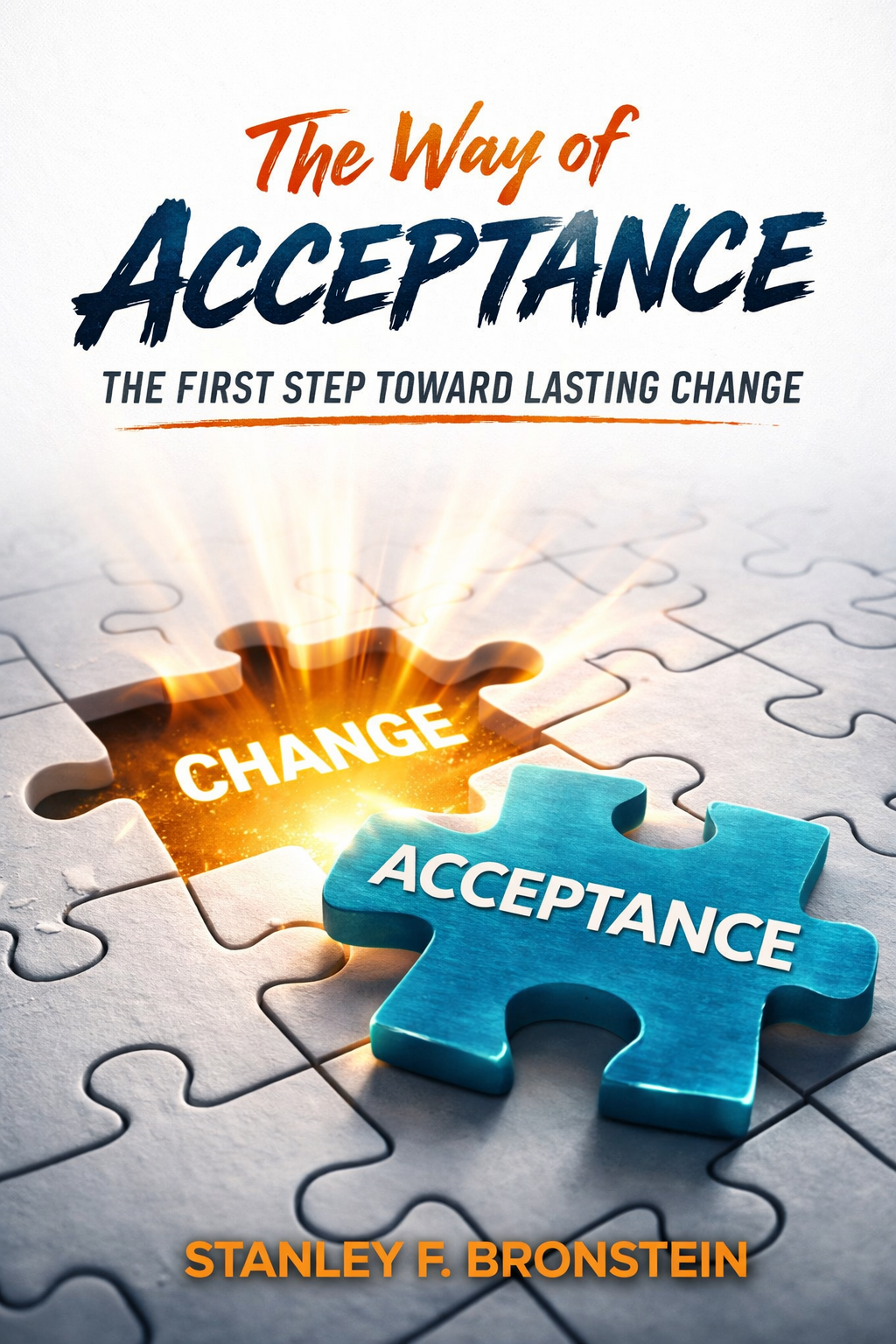
The Way of Acceptance
The First Step Toward Lasting Change
By Stanley F. Bronstein – Creator of The Way of Excellence System
Click The Tabs Below To Read Each Chapter Of The Book Online
Or
📘 Download Your Free Copy In Your Preferred Format
The Way of Acceptance
by Stanley F. Bronstein
How to use this page:
Click a chapter title to open it then scroll down to read.
When you click the title of the next chapter, the previous one will close.
Take your time.
Read, reflect, and do the experiments and assignments before you move on.
EMPTY ITEM
Foreword - Acceptance Is Not Giving Up
The Way of Excellence (TWOE) teaches that reality matters. It matters whether we like it or not. It matters whether we agree with it or not. It matters whether we wish it were different or not. Reality remains what it is until it changes, and no lasting change can be built on denial, fantasy, or refusal to see clearly.
That is why acceptance matters.
Acceptance is one of the most misunderstood ideas in human life. Many people hear the word and immediately think of surrender, weakness, passivity, helplessness, or defeat. They think acceptance means rolling over, giving up, lowering standards, tolerating what should not be tolerated, or resigning themselves to misery. That is not what I mean in this book.
Acceptance is not giving up.
Acceptance is seeing clearly.
Acceptance is telling the truth about what is.
Acceptance is the willingness to stop arguing with reality long enough to understand it, work with it, and respond to it intelligently.
Sometimes that response is to accept something fully.
Sometimes that response is to change it.
Sometimes that response is to leave it.
This book is built around a simple practical truth:
There are 3 solutions to every problem. Accept it, change it, or leave it. If you can’t accept it, change it. If you can’t change it, leave it.
That idea is simple, but it is not simplistic. In fact, it has enormous power when understood properly. Many people remain stuck for years because they do none of the three. They do not truly accept. They do not truly change. They do not truly leave. Instead, they resist, complain, delay, rationalize, negotiate with obvious facts, and remain trapped in the tension between reality and preference. That tension drains energy, clouds judgment, and prolongs suffering.
Acceptance breaks that cycle.
It creates a starting point.
It creates clarity.
It creates peace.
It creates power.
Acceptance does not mean that everything should be accepted. That too would be a misunderstanding. Some things should not be accepted. Bad ideas should not be accepted. Dangerous ideas should not be accepted. Lies should not be accepted. Abuse should not be accepted. Corruption should not be accepted. Self-destruction should not be accepted. Harmful habits, destructive patterns, and false narratives should not be accepted simply because they exist.
Reality must be seen clearly, but wisdom must still be applied.
It is up to each of us to use our knowledge, wisdom, and experience to discern what should be accepted, what should be changed, and what should be left behind. That discernment matters. Without it, acceptance can become confusion. With it, acceptance becomes intelligent.
That distinction is critical.
To accept that something exists is not the same as approving of it.
To accept that something is happening is not the same as saying it should continue.
To accept that someone is acting destructively is not the same as excusing the behavior.
To accept that a painful event has occurred is not the same as saying the event was good.
Acceptance begins with truth. It does not end there.
In many cases, acceptance is also easier than we think. People often build acceptance up in their minds as if it must be heavy, difficult, humiliating, or painful. Sometimes it is emotionally challenging, yes. But often the real suffering comes less from acceptance itself and more from the resistance to it. We tell ourselves that we cannot accept something, when in truth the refusal to accept it is what is exhausting us.
Sometimes acceptance is the relief.
Sometimes acceptance is the release.
Sometimes acceptance is the moment we stop wasting energy trying to make reality be something it is not.
Sometimes acceptance is not hard at all. Sometimes it becomes easy the moment we stop insisting that what is true should not be true.
This matters in every area of life.
We see it in health. A person cannot truly improve their health until they accept their current condition honestly. They do not need to shame themselves. They do not need to condemn themselves. But they do need to tell the truth. If the body is in trouble, that must be faced. If habits are destructive, that must be faced. If change is needed, that must be faced. Acceptance is the beginning of honest correction.
We see it in relationships. A person cannot make wise decisions about a relationship they refuse to see clearly. If someone is loving, that should be seen. If someone is unreliable, manipulative, dishonest, or unavailable, that should be seen too. Fantasy keeps people stuck. Acceptance allows wise response.
We see it in grief. A loss that has happened must eventually be acknowledged as having happened. That does not mean the loss is fair. It does not mean it does not hurt. It does not mean it should not matter. It means only that healing cannot begin while reality is still being denied.
We see it in age, change, and time. Many people are taught to place themselves inside mental boxes that shrink their sense of possibility. They begin to believe that because time has passed, life is mostly over. I do not accept that kind of limited thinking. Maturity, experience, perspective, and wisdom are assets. Reality should be accepted, yes – but false conclusions about reality should not. We are not required to accept disempowering narratives simply because society repeats them.
We see it in mistakes. A mistake that is honestly accepted can become a teacher. A mistake that is denied or defended often becomes a repeated pattern. Acceptance allows growth because acceptance allows learning.
We also see it in the present moment. Much suffering is created when we argue internally with what is already here. Something has happened. A fact exists. A moment is unfolding. Internal resistance often adds a second layer of pain. Acceptance does not always remove the first layer, but it often prevents the second.
This is one of the reasons acceptance is so powerful. It helps us stop wasting life fighting reality in ways that produce nothing useful.
That does not mean acceptance is passive. In many cases, acceptance is the first step toward powerful action. If you accept that a situation is unhealthy, you can begin to change it. If you accept that an idea is dangerous, you can reject it. If you accept that a path is no longer right for you, you can leave it. If you accept that a season of life has changed, you can adapt wisely to the new season instead of clinging desperately to the old one.
Acceptance is not the opposite of change.
Acceptance is often the beginning of change.
That is one of the central ideas of this book.
You cannot intelligently change what you refuse to face.
You cannot wisely leave what you refuse to admit is wrong for you.
You cannot peacefully live with what cannot be changed until you stop demanding that it be different.
Acceptance brings us back to reality, and reality is where intelligent living begins.
This book is not asking you to become passive. It is not asking you to accept injustice, deception, weakness, nonsense, or harm. It is not asking you to approve of what should be challenged. It is not asking you to become smaller, quieter, or more resigned.
It is asking something else.
It is asking you to become more honest.
More grounded.
More discerning.
More realistic.
More peaceful.
More effective.
It is asking you to stop wasting energy on unnecessary resistance and to begin using that energy more wisely.
It is asking you to look at life as it is and then respond with maturity.
Accept it.
Change it.
Or leave it.
Those are simple words, but they can transform a life when applied with courage and wisdom.
My hope is that this book helps you see acceptance in a new light. Not as defeat, but as clarity. Not as weakness, but as strength. Not as surrender, but as intelligent alignment with reality. Not as the end of possibility, but as the beginning of wiser possibility.
When we accept what is true, we put our feet on solid ground.
From there, we can think more clearly.
Choose more wisely.
Act more effectively.
Let go more peacefully.
And build something better on the firm foundation of reality rather than the unstable ground of denial.
That is what this book is about.
It is about learning how to face what is.
It is about learning how to decide what should be accepted, what should be changed, and what should be left behind.
It is about learning how to live with more clarity, more peace, more responsibility, more wisdom, and more strength.
And it is about understanding that acceptance is not giving up.
It is often the first step toward lasting change.
INTRODUCTION TO PART I - SEEING REALITY AS IT IS
Acceptance begins with reality.
That may sound obvious, but many people do not actually live that way. They live in reaction to reality, in resistance to reality, in fear of reality, in denial of reality, or in negotiation with reality. They want things to be different, and because they want them to be different, they often delay seeing clearly what is actually there.
That delay has a cost.
When we do not see reality clearly, we cannot respond to it wisely. We cannot decide intelligently what should be accepted, what should be changed, or what should be left behind. We may still react. We may still feel. We may still hope. We may still complain. But we are not yet standing on solid ground.
This first part of the book is about getting back onto that ground.
It is about seeing things as they are before we decide what they mean, what should be done about them, or how we feel about them. It is about learning to tell the truth – not in a harsh or hopeless way, but in a clear and useful way. It is about recognizing that acceptance does not begin with emotion. It begins with honest recognition.
This matters because acceptance is often misunderstood from the very beginning. Many people assume that if they accept something, they are automatically approving of it. They assume that acceptance means passivity, surrender, weakness, or a lack of standards. It does not. Acceptance simply means that we stop pretending something is other than it is.
If something is broken, acceptance says it is broken.
If something is healthy, acceptance says it is healthy.
If something is dangerous, acceptance says it is dangerous.
If something is over, acceptance says it is over.
If something is possible, acceptance says it is possible.
Acceptance begins with telling it like it is.
The Way of Excellence (TWOE) begins in a very similar place. Before anything meaningful can improve, there must be honest awareness. Before there can be wise action, there must be clear perception. Before there can be lasting change, there must be a willingness to stop distorting what is true.
That is why this part of the book matters so much. It establishes the foundation for everything that follows.
You cannot change what you refuse to see.
You cannot wisely leave what you keep pretending is right for you.
You cannot intelligently accept what you have not honestly identified.
And you certainly cannot build a better life on falsehood, fantasy, or blurred perception.
In the chapters ahead, we will clarify what acceptance really means. We will look at why people resist it, why they complicate it, and why it is often easier than they think once they stop fighting it. We will also examine one of the most important distinctions in the entire book: the difference between acceptance and approval. That distinction is essential, because not everything should be accepted in the sense of embraced or allowed to continue. Some things must be challenged. Some things must be changed. Some things must be left.
But before we can do any of that well, we must first see clearly.
That is the task of Part I.
Not to surrender.
Not to shrink.
Not to resign ourselves to life.
But to face reality honestly enough that we can begin to live with greater clarity, greater strength, and greater wisdom.
Chapter 1 - What Acceptance Really Means
The Way of Excellence (TWOE) begins with reality. It begins with awareness, honesty, and the willingness to see things as they are rather than as we wish they were. Acceptance begins in the same place.
That is important, because acceptance is one of the most misunderstood words in the language of growth, healing, and change. Many people hear the word acceptance and immediately think of surrender. They think of passivity. They think of weakness. They think of lowering standards, tolerating nonsense, excusing bad behavior, or giving up on the possibility of improvement. That is not what acceptance means, and it is not how this book uses the word.
Acceptance means acknowledging reality truthfully.
That is the heart of it.
Acceptance means seeing what is actually there and admitting that it is there. It means refusing to lie to yourself about a fact, a condition, a pattern, a person, a situation, a limitation, a loss, a possibility, or a truth. Acceptance does not require you to like what is true. It does not require you to approve of what is true. It does not require you to become passive in the face of what is true. It simply requires that you stop pretending what is true is not true.
That sounds simple, and in many cases it is. But people complicate it because they load the word acceptance with meanings it does not actually contain.
Acceptance is not approval.
Acceptance is not agreement.
Acceptance is not endorsement.
Acceptance is not surrender.
Acceptance is not helplessness.
Acceptance is not weakness.
Acceptance is not resignation.
Acceptance is not saying, “This is fine.”
Acceptance is not saying, “This should continue.”
Acceptance is not saying, “There is nothing I can do.”
Acceptance is saying, “This is what is here. This is what is true. This is what I am dealing with.”
That is a very different thing.
If a person has a health problem, acceptance means acknowledging the health problem honestly. It does not mean liking the diagnosis. It does not mean refusing treatment. It does not mean becoming passive. It means telling the truth about the condition so that wise action becomes possible.
If a relationship has become unhealthy, acceptance means acknowledging that reality. It does not mean approving of the dysfunction. It does not mean staying forever. It does not mean pretending everything is fine. It means seeing clearly what the relationship actually is instead of clinging to an illusion about what you wish it were.
If a person in your life is manipulative, dishonest, reckless, or emotionally unavailable, acceptance means admitting that this is who they are right now. It does not mean hating them. It does not mean dehumanizing them. It does not mean excusing them. It means refusing to build your expectations around fantasy.
If you made a mistake, acceptance means admitting the mistake. It does not mean condemning yourself as worthless. It does not mean defining your identity by the error. It means telling the truth so that learning, repair, and growth can happen.
This is one of the reasons acceptance is so powerful. It gives you solid ground. It brings you out of illusion and into contact with reality. And once you are in contact with reality, your options become clearer.
Without acceptance, people often live in a fog. They argue with what is. They defend what should be corrected. They deny what is obvious. They cling to what is over. They refuse to admit what needs to be changed. They tolerate what should be left. They hope magically instead of thinking clearly. In doing so, they make themselves weaker, not stronger.
Acceptance reverses that process.
Acceptance says, “Let me start with the truth.”
That is not weakness. That is intelligence.
That is not passivity. That is clarity.
That is not the end of power. That is the beginning of intelligent power.
One of the most useful ways to understand acceptance is to see it as the difference between fact and reaction. A fact is what is. A reaction is what you feel, think, or want to do about it. Acceptance is about the fact first. It does not erase reaction, but it puts reaction in its proper place.
Suppose it is raining outside. Acceptance says it is raining. It does not say rain is wonderful. It does not say rain is terrible. It does not say you must cancel everything. It does not say you should dance in it. It simply begins with the fact that it is raining. Once that is clear, you can decide whether to take an umbrella, delay your plans, enjoy the weather, change locations, or do something else. But until you start with the fact, your response is likely to be confused.
The same is true in more serious matters.
If you are exhausted, acceptance says you are exhausted.
If you are grieving, acceptance says you are grieving.
If your finances are unstable, acceptance says your finances are unstable.
If a dream has ended, acceptance says it has ended.
If a new possibility has opened, acceptance says it has opened.
Acceptance does not tell you how to feel about these things in a simplistic way. It simply keeps you connected to reality so that your thoughts, emotions, and actions are not built on falsehood.
That matters because people often think they are being strong when they are really just avoiding. They think denial is strength. They think constant positivity is strength. They think pretending something does not bother them is strength. They think refusing to admit a problem is strength. Usually it is not. Usually it is fragility wearing a disguise.
Real strength can face what is true.
Real strength can say, “This is hard, but it is real.”
Real strength can say, “I do not like this, but I will not lie about it.”
Real strength can say, “This hurts, but I am still going to face it.”
Acceptance belongs to that kind of strength.
There is another misunderstanding that must be addressed early. Acceptance does not mean accepting everything in the sense of embracing or permitting everything. That would be foolish. Some things should not be accepted in that sense.
Bad ideas should not be accepted.
Dangerous ideas should not be accepted.
Abuse should not be accepted.
Cruelty should not be accepted.
Corruption should not be accepted.
Destructive habits should not be accepted.
Lies should not be accepted.
False narratives should not be accepted.
So when this book talks about acceptance, it is not talking about blind submission. It is not saying that every fact deserves approval or that every circumstance deserves tolerance. It is saying that every reality must be seen clearly before it can be responded to wisely.
That distinction matters.
You can accept that abuse is happening without accepting abuse as okay.
You can accept that a lie was told without accepting the lie as truth.
You can accept that a person is dangerous without accepting dangerous behavior as permissible.
You can accept that a system is unjust without accepting injustice as acceptable.
In all of these cases, acceptance begins with truthful recognition, not moral surrender.
That is where discernment enters the picture. It is up to each of us to use knowledge, wisdom, and experience to decide what should be accepted, what should be changed, and what should be left. But none of those decisions can be made well until the reality itself is first acknowledged.
That is why acceptance is foundational. It does not answer every question, but it creates the conditions in which better answers become possible.
Another way to understand acceptance is to think of it as a refusal to waste energy fighting reality at the level of fact. There are times to fight for justice. There are times to challenge wrong. There are times to correct, oppose, resist, confront, or leave. This book does not deny any of that. But before any of those responses can be wise, there must be accurate contact with what is actually happening.
Many people never reach that point because they stay locked in an argument with reality itself. They keep saying, “This should not be happening,” as though that statement by itself will change the fact that it is happening. They say, “This cannot be true,” even though it is true. They say, “This is not who that person is,” even though the person keeps showing them exactly who they are. They say, “I am fine,” while everything in their life says otherwise. They say, “This will somehow work itself out,” when there is no evidence that it will.
This is not wisdom. It is resistance masquerading as hope.
Acceptance is more honest than that. And because it is more honest, it is often more hopeful in a real way. False hope depends on denial. Real hope depends on reality. False hope says, “Maybe the facts are not the facts.” Real hope says, “The facts are what they are, and I still may be able to do something wise from here.”
That is a major difference.
Acceptance is also deeply connected to peace, though not in a soft or sentimental way. Peace does not always come from getting everything you want. Sometimes peace comes from stopping the internal war with what already is. Sometimes peace comes from no longer demanding that the truth be different before you permit yourself to see it. Sometimes peace comes from clarity.
If something is over, clarity allows you to grieve honestly.
If something is possible, clarity allows you to move toward it honestly.
If something is broken, clarity allows you to repair it honestly.
If something is dangerous, clarity allows you to protect yourself honestly.
If something cannot be changed, clarity allows you to stop exhausting yourself in futile struggle.
This is why acceptance can be a relief. It ends the exhausting requirement that reality become something else before you will engage with it. It lets you breathe. It lets you see. It lets you think. It lets you begin.
There are 3 solutions to every problem. Accept it, change it, or leave it. If you can’t accept it, change it. If you can’t change it, leave it.
That principle is practical because it assumes that reality must first be faced. You cannot meaningfully accept what you have not acknowledged. You cannot intelligently change what you refuse to name. You cannot wisely leave what you are still pretending is right for you. Acceptance is the first step because reality is the starting point.
Sometimes acceptance is the final answer. There are things in life that must simply be accepted. Time passes. People die. The past cannot be changed. Uncertainty is part of life. Human beings are imperfect. Limits exist. Seasons change. Not every dream survives. Some losses cannot be reversed. In such cases, acceptance may be the wisest path.
Sometimes acceptance leads directly to change. A person accepts the truth about their health and begins a new way of living. A person accepts the truth about their finances and starts correcting years of disorder. A person accepts the truth about their patterns and begins to grow. In such cases, acceptance is the doorway to transformation.
Sometimes acceptance leads to leaving. A person accepts that a relationship is harmful. A person accepts that an environment is toxic. A person accepts that a path no longer fits. In such cases, acceptance brings the clarity necessary to walk away.
But in every case, acceptance comes first because reality comes first.
This chapter is not asking you to become passive. It is not asking you to lower your standards. It is not asking you to approve of what is wrong. It is not asking you to tolerate what should be challenged. It is not asking you to become smaller or quieter or weaker.
It is asking you to begin with truth.
That is what acceptance really means.
It means saying yes to reality at the level of recognition, even if your answer at the level of action is no.
It means admitting what is so that you can decide what to do.
It means facing life honestly enough that your responses become wiser, calmer, cleaner, and more effective.
It means standing on solid ground.
That is why acceptance matters.
It does not end the process.
It begins it.
Assignment
Choose one area of your life where you have been resisting reality. It may be your health, a relationship, your finances, your emotional condition, your work, a habit, a loss, or a difficult truth you have been avoiding.
Write a clear paragraph that begins with the words:
The truth is…
Do not explain it away. Do not defend it. Do not soften it unnecessarily. Do not dramatize it either. Simply tell the truth about what is.
Then answer these three questions:
1. What in this situation needs to be accepted as real?
2. What, if anything, should be changed?
3. What, if anything, should be left?
Keep your answers honest, simple, and direct. The goal is not to solve everything right now. The goal is to begin standing on solid ground.
Chapter 2 - Why People Complicate Acceptance
The Way of Excellence (TWOE) teaches that clear awareness matters. It matters because people do not just live with reality. They also live with the stories they tell themselves about reality. Those stories can make life clearer, or they can make life far more confusing than it needs to be. Acceptance is one of the places where this happens most often.
Many people do not resist acceptance because acceptance is inherently difficult. They resist it because they have wrapped it in meanings that do not belong to it. They have made it heavier, scarier, sadder, and more threatening than it actually is. In many cases, acceptance is not what is hard. What is hard is the internal struggle people create by refusing to accept what is already true.
That distinction matters.
If you tell yourself that acceptance means defeat, then of course you will resist it.
If you tell yourself that acceptance means weakness, then of course you will resist it.
If you tell yourself that acceptance means approving of what you dislike, tolerating what should not be tolerated, or surrendering your power, then of course you will resist it.
But acceptance does not mean any of those things. Acceptance means acknowledging reality truthfully. That is all. What happens after that depends on the reality in question and the wisdom you bring to it.
Still, many people complicate acceptance because they do not want reality to have the authority it has. They want preference to outrank truth. They want emotion to outrank fact. They want desire to outrank circumstance. They want life to obey what they hoped for, planned for, or imagined. When life does not cooperate, they often begin arguing with reality itself.
That argument usually sounds familiar.
“This should not be happening.”
“This cannot be true.”
“This is not fair.”
“This is not who I am.”
“This is not who they are.”
“This is not how my life was supposed to go.”
“This will somehow fix itself.”
“I do not want this to be real.”
These reactions are human. They are understandable. But they are not the same as wisdom. They do not change what is true. In many cases, they only delay the moment when clarity becomes possible.
One reason people complicate acceptance is pride. Pride does not like to be wrong. It does not like to be corrected. It does not like to admit that a situation has changed, that a mistake has been made, that a weakness has been exposed, or that reality is no longer cooperating with a preferred self-image. Pride would often rather protect the image than face the truth.
A person may know their health is in trouble, but pride tells them they are still basically fine.
A person may know a relationship is broken, but pride tells them it is only a rough patch.
A person may know their finances are unstable, but pride tells them things will somehow work out without serious correction.
A person may know they are exhausted, angry, resentful, lonely, or lost, but pride tells them to keep performing strength instead of honestly admitting what is happening.
This is one of the most common ways acceptance gets complicated. The truth itself may be relatively simple, but the ego does not want to bow to it. It wants to negotiate with it, reframe it, defend against it, delay it, or overpower it through sheer will. That usually makes things worse.
Another reason people complicate acceptance is fear. Fear can distort almost anything. It can take a clear fact and wrap it in dread, catastrophe, shame, or imagined consequences. Fear whispers that if you accept something, you will be crushed by it. It whispers that if you admit the truth, everything will collapse. It whispers that if you stop resisting, you will lose your identity, your options, your hope, or your worth.
But very often the opposite is true.
Very often it is the refusal to accept that keeps people trapped.
The person afraid to admit a relationship is over stays in years of confusion.
The person afraid to admit a career path no longer fits stays in quiet misery.
The person afraid to admit they need help stays stuck in avoidable struggle.
The person afraid to admit a habit is destructive keeps feeding the very thing that is harming them.
In cases like these, acceptance is not the destroyer. It is the beginning of release. It is the moment the fog starts to clear. It is the point where real options begin to appear.
Shame also complicates acceptance. Shame tells people that if a hard truth is admitted, they themselves are diminished by it. So instead of saying, “This is a problem,” they feel, “I am the problem.” Instead of saying, “I made a mistake,” they feel, “I am a mistake.” Instead of saying, “I need to change something,” they feel, “I am beyond repair.”
That is a dangerous distortion.
Acceptance is not supposed to crush the self. It is supposed to clarify reality. Shame takes the reality of a mistake, limitation, weakness, or wound and fuses it with identity. That makes acceptance feel unbearable because it no longer feels like facing a fact. It feels like receiving a verdict on one’s worth.
But those are not the same thing.
A person can be unhealthy without being worthless.
A person can be struggling without being broken beyond hope.
A person can be wrong without being beyond redemption.
A person can be in pain without being defeated.
Once that distinction is restored, acceptance becomes easier. A person can say, “This is true,” without needing to conclude, “Therefore I am less than human.”
Control is another major reason people complicate acceptance. Human beings often want more control than life actually offers. They want control over outcomes, timing, other people, aging, loss, uncertainty, and the unfolding of events. When reality refuses to cooperate, they often respond not with clarity but with argument.
They try to force.
They try to deny.
They try to bargain.
They try to rehearse alternative realities in their minds.
They try to mentally rewrite events that have already happened.
They try to make people become who they are not.
They try to guarantee what cannot be guaranteed.
This is exhausting. It also rarely works.
The problem is not that people want good things. The problem is that many of them are trying to derive peace from control over what cannot actually be controlled. Acceptance feels threatening because it requires letting go of the fantasy of total control. But once that fantasy begins to loosen, acceptance often becomes much more natural.
You may not control the past, but you can accept that it happened.
You may not control another person’s nature, but you can accept that they are showing you who they are.
You may not control uncertainty, but you can accept that uncertainty is part of life.
You may not control the passage of time, but you can accept that time moves whether you approve of it or not.
There is peace in that. Not because those things are always pleasant, but because reality no longer has to be fought at the level of fact.
Fantasy is another force that complicates acceptance. People often fall in love not only with what is real, but with what they hope might be real someday. They fall in love with potential. They fall in love with imagined futures. They fall in love with alternative versions of people, circumstances, and selves. Then they begin relating not to reality, but to possibility alone.
Possibility matters. Hope matters. Vision matters. But possibility becomes dangerous when it replaces reality instead of working from reality.
A person may remain in a destructive relationship because they are attached to the imagined future version of the other person.
A person may avoid making necessary changes because they are attached to the imagined future version of themselves that will somehow appear without disciplined action.
A person may keep believing an unhealthy system will suddenly become healthy, not because evidence supports that belief, but because fantasy is more emotionally comfortable than truth.
Fantasy often feels better in the short term. But it creates long-term pain because it postpones the moment when wise decisions can be made.
Acceptance simplifies things. It asks one basic question: What is actually here?
Not what could be here.
Not what should be here.
Not what used to be here.
Not what I wish were here.
What is here?
That is a clarifying question. It does not solve everything, but it strips away layers of unnecessary confusion.
Another way people complicate acceptance is by turning it into a dramatic event. They imagine acceptance must involve some giant emotional collapse, some grand moment of surrender, or some painful spiritual struggle. Sometimes it may involve strong emotion, especially in matters of grief, loss, betrayal, or deep disappointment. But often acceptance is much quieter than that.
Sometimes acceptance is a sentence.
“This is over.”
“This is where I am.”
“This is not working.”
“This person is not who I hoped they were.”
“I need help.”
“I was wrong.”
“I have to change.”
“I need to leave.”
That is all.
Sometimes acceptance is not dramatic. Sometimes it is simply honest. And because it is honest, it is clean. It creates a kind of internal alignment that is much less exhausting than ongoing resistance.
That is why acceptance is often easier than people think. Once the false meanings are stripped away, acceptance is frequently the simplest move available. Not always the easiest emotionally, but often the simplest and healthiest. It is often much easier than pretending, defending, explaining, denying, bargaining, blaming, or endlessly waiting for reality to become something else.
This is especially important because prolonged resistance has a cost. It drains energy. It clouds judgment. It delays action. It extends suffering. It keeps people tied to situations, beliefs, and patterns that clear seeing would have helped them address long ago.
A person resists accepting their poor health and loses more years.
A person resists accepting a toxic environment and stays too long.
A person resists accepting a damaging truth about themselves and repeats the same pattern again and again.
A person resists accepting that a path is over and becomes bitter, depleted, and emotionally tangled.
In each case, the resistance creates its own burden. Sometimes that burden is heavier than the truth itself.
This is why one of the most useful insights in this chapter is very simple:
Acceptance is often easier than resistance.
Not always more comfortable in the first moment, but easier in the deeper sense. Easier on the mind. Easier on the nervous system. Easier on decision-making. Easier on the soul. Resistance tends to produce friction. Acceptance tends to reduce friction by bringing a person back into contact with what is actually happening.
This does not mean every truth is pleasant. It does not mean every reality should be embraced. It does not mean every circumstance deserves approval. Some truths are painful. Some realities must be changed. Some situations must be left. Some ideas must be rejected. But none of those responses can happen wisely until the unnecessary complication has been removed.
Acceptance does not add drama. It removes distortion.
Acceptance does not create weakness. It reduces confusion.
Acceptance does not steal power. It returns power by reconnecting action to reality.
There are 3 solutions to every problem. Accept it, change it, or leave it. If you can’t accept it, change it. If you can’t change it, leave it.
People often remain stuck because they complicate the first step. They do not want to accept what is true, so they cannot clearly decide whether the next wise move is to change something or leave something. They stay suspended between reality and preference. That is a draining place to live.
This chapter is an invitation to leave that suspension behind.
You do not have to tell yourself acceptance is humiliating.
You do not have to tell yourself acceptance is defeat.
You do not have to tell yourself acceptance is unbearably hard.
In many cases, acceptance becomes easier the moment you stop telling yourself that it is the enemy.
It is often not the enemy.
It is often the opening.
It is often the relief.
It is often the simplification.
It is often the first clean breath after too much internal struggle.
The truth may not always be what we wanted. But the truth is still where freedom begins. Once we stop complicating acceptance with fear, pride, shame, control, and fantasy, we can begin to see that acceptance itself is often much more natural than we imagined.
And once that happens, wiser living becomes possible.
Assignment
Identify one situation in your life that you have been telling yourself is hard to accept.
Write a short paragraph describing the situation honestly.
Then answer the following questions:
1. What story have I been telling myself that makes this harder to accept?
2. Is the resistance actually more exhausting than the truth itself?
3. What becomes simpler if I stop arguing with reality?
4. Do I need to accept it, change it, or leave it?
Keep your answers straightforward. The purpose of this exercise is to notice how often acceptance is complicated not by reality itself, but by the meanings we attach to it.
Chapter 3 - Learning To Tell It Like It Is
Because this book is about acceptance, it is also about reality. A person cannot wisely accept, change, or leave anything without first seeing clearly what is actually there. That is why I want to introduce a core part of The Way of Excellence (TWOE) system here. The TWOE system is a structured personal development system I created that is built around 20 Concepts, 20 Untils, 20 Laws, and 20 Benefits. It is designed to help people live with greater awareness, responsibility, discipline, balance, and excellence. For the purposes of this chapter, what matters most is where the system begins: it begins with reality.
The first Concept in The Way of Excellence (TWOE) system is Concept #1 – Learning To Tell It Like It Is.
Concept #1 states:
Until we start “telling it like it is” and then begin adjusting our actions accordingly, we will never achieve our maximum potential and evolve as a species.
That principle belongs at the beginning of a book on acceptance because acceptance without truthful seeing is not real acceptance. It is performance. It is denial wearing calm language. It is pretending to be at peace with a reality one has never honestly faced.
Before anything meaningful can be accepted, changed, or left, it must first be seen clearly. Before a person can respond wisely, that person must know what is actually being responded to. Before a person can make a sound decision, that person must stop distorting the facts. This is why learning to tell it like it is is one of the foundational disciplines of a healthy, intelligent, reality-based life.
Many people do not do this naturally. They edit reality. They soften it when it feels uncomfortable. They exaggerate it when they feel emotional. They deny it when it threatens pride. They romanticize it when they are attached. They dramatize it when they are afraid. They blur it when clarity would force a decision. In each case, the result is the same: they are no longer dealing with reality itself. They are dealing with a modified version of reality shaped by emotion, preference, fear, fantasy, or ego.
That is dangerous.
A person cannot build a strong life on falsehood.
A person cannot make wise decisions from blurred perception.
A person cannot intelligently accept, change, or leave what they refuse to describe accurately.
This is why telling it like it is matters so much. It is not harshness. It is not cynicism. It is not negativity. It is not cruelty. It is accurate observation. It is honest assessment. It is the refusal to lie to oneself about what is true.
That is not a small thing. It is one of the most powerful disciplines a person can learn.
If a person does not tell it like it is, that person does not really know what is being dealt with.
If a person does not know what is being dealt with, that person cannot decide wisely.
A person may still react. A person may still feel strongly. A person may still hope, worry, complain, defend, rationalize, or delay. But none of that is the same as knowing.
Truthful seeing comes first.
It is worth pausing here to make an important distinction. Telling it like it is does not mean being brutal, cold, or unkind. It does not mean speaking without compassion. It does not mean stripping away all nuance. It does not mean becoming harsh with oneself or with others. It means refusing distortion.
If health is poor, telling it like it is means saying health is poor.
If health is improving, telling it like it is means saying health is improving.
If a relationship is unstable, telling it like it is means saying the relationship is unstable.
If a relationship is loving and healthy, telling it like it is means saying that too.
If a person is dangerous, tell it like it is.
If a person is trustworthy, tell it like it is.
If a habit is destroying energy, tell it like it is.
If a pattern is helping growth, tell it like it is.
Honesty is not only for bad news. Honesty is for reality. It is about seeing clearly, whether the truth is pleasant or unpleasant.
That matters because people often confuse honest assessment with negativity. They think that if they name something difficult, they are being disloyal to hope. They think that if they admit something is broken, they are somehow making it worse. They think that if they say a situation is unhealthy, they are being unkind. But refusing to name a problem does not protect anyone. It usually protects the problem.
A person who says, “My health is fine,” when it is clearly not fine is not practicing optimism. That person is practicing avoidance.
A person who says, “This relationship is basically okay,” when it is full of dishonesty, resentment, or repeated harm is not practicing love. That person is practicing denial.
A person who says, “I am just tired,” when life is actually burned out, emotionally depleted, and badly out of balance is not practicing resilience. That person is refusing to tell it like it is.
The cost of this is high. When people refuse accurate assessment, they delay wise response. They postpone needed change. They continue tolerating what should be addressed. They stay too long. They leave too soon. They overreact to things that are minor. They underreact to things that are serious. In short, they lose their way because they have lost contact with the truth.
Telling it like it is restores contact.
It says, “Let me describe this as accurately as I can.”
That sounds simple, but many lives would change dramatically if people consistently did just that.
Part of the challenge is that people tend to distort reality in a few predictable ways.
One way is denial. Denial says the thing is not there, even when it clearly is. Denial says there is no problem. Denial says the pattern is not real. Denial says the warning signs do not mean what they mean. Denial is not strength. It is usually fear wearing a mask.
Another distortion is exaggeration. Exaggeration takes a real fact and inflates it until it becomes emotionally overwhelming. A setback becomes total failure. A criticism becomes total rejection. A difficulty becomes disaster. A hard season becomes proof that life itself is broken. Exaggeration is also a form of dishonesty, because it does not tell it like it is. It tells it worse than it is.
Minimization is another distortion. Minimization takes something serious and reduces it so that it can be tolerated without action. A repeated problem becomes “not that bad.” A harmful habit becomes “just a small thing.” A dishonest person becomes “a little difficult.” A major imbalance becomes “a temporary rough patch.” Minimization allows people to remain comfortable with what should be confronted.
Fantasy is another common distortion. Fantasy replaces what is with what one wishes were true. Fantasy says the relationship is still full of promise when all evidence says otherwise. Fantasy says the body will somehow recover while destructive habits continue. Fantasy says time is not passing. Fantasy says a problem will solve itself. Fantasy says potential is more important than repeated reality.
All four distortions – denial, exaggeration, minimization, and fantasy – interfere with wise acceptance because they interfere with clear seeing.
This is why truthful assessment is not optional. It is foundational.
The TWOE system reinforces this again in Law #1 – The Law Of Actuality:
No living person or system can remain in existence for very long without first having arrived at a level of full, realistic awareness of their own existence, sensations, thoughts and surroundings and then responding accordingly after having done so.
That is a profound statement. Awareness is not a luxury. It is a necessity. If awareness is unrealistic, response will usually be unrealistic as well. And if response is unrealistic, life begins to drift away from solid ground.
That does not mean a person must know everything. It does mean a person must stop lying about what is already known.
In many cases, people already know more than they admit. They know the relationship is unhealthy. They know the habit is destructive. They know the stress is unsustainable. They know the goal is not being taken seriously. They know the excuse has become a pattern. They know the dream is over. They know the new direction is calling. They know the environment is wrong. They know the story they keep telling no longer matches the facts.
But knowing privately and saying honestly are not always the same thing.
The shift comes when a person is willing to put clear words around what is already known.
“This is not working.”
“I am out of alignment.”
“I am not being honest with myself.”
“I am afraid to admit what I already see.”
“This person is not who I kept hoping they would become.”
“I have been normalizing something harmful.”
“I have more work to do than I wanted to admit.”
“I need to change.”
These are not statements of defeat. They are statements of contact with reality. They are the kinds of statements from which better decisions can be made.
One of the reasons this matters so much is that the quality of a decision depends heavily on the accuracy of the assessment behind it. If the assessment is wrong, the decision is likely to be wrong too. If a dangerous situation is seen as harmless, a person may stay when leaving is wiser. If a temporary discomfort is seen as permanent doom, a person may leave when staying and working through it is wiser. If a serious issue is seen as minor, needed action may be delayed. If a manageable issue is seen as catastrophic, panic may replace thought.
Accurate assessment protects against both passivity and overreaction.
It helps a person see proportion.
It helps a person see timing.
It helps a person see what matters.
It helps a person see what does not.
And it helps a person separate facts from the emotional noise around the facts.
This is especially important in a world where people are constantly fed narratives, interpretations, and emotional manipulation. Many things sound good on the surface but lead somewhere dangerous. Many ideas feel empowering at first but eventually weaken judgment, distort responsibility, or encourage self-deception. Telling it like it is requires discernment. It requires the willingness to examine not only whether something feels appealing, but whether it is true, useful, and aligned with reality.
This is not cynicism. It is maturity.
A mature person is not gullible about reality.
A mature person does not accept every thought merely because it arises.
A mature person does not accept every cultural message merely because it is popular.
A mature person does not accept every emotional reaction as if it were a fact.
A mature person learns to pause and ask: What is actually true here?
That question can change a life.
What is actually true here about health?
What is actually true here about this person?
What is actually true here about these motives?
What is actually true here about money?
What is actually true here about this pattern?
What is actually true here about this opportunity?
What is actually true here about this loss?
What is actually true here about what needs to happen next?
Those questions bring a person back to reality, and reality is where power begins.
It is also where peace begins. Much confusion comes not from life itself, but from the gap between life and the story people tell themselves about life. The wider that gap becomes, the more unstable a person becomes. Telling it like it is closes that gap. It reduces friction between truth and perception. It helps the mind settle onto solid ground.
That does not mean the truth always feels good. It means the truth gives a person something real to work with.
Reality is a starting point, not a sentence.
That line matters.
Many people avoid telling it like it is because they think that if they name a problem, they are locking themselves into it forever. But that is not true. Naming reality does not imprison anyone. It clarifies position. It tells a person where they are standing. Once a person knows where they are standing, that person can move more intelligently.
If health is poor, naming that does not doom anyone. It gives a place to begin.
If finances are unstable, naming that does not define anyone forever. It gives a place to begin.
If a relationship is troubled, naming that does not automatically end it. It gives a place to begin.
If a current path no longer fits, naming that does not make anyone a failure. It gives a place to begin.
Truth is not a prison. It is a platform.
That is why this chapter matters so much for the rest of the book. Before a person can wisely ask whether something should be accepted, changed, or left, that person must first describe it accurately. If a person does not tell it like it is, then that person does not really know what “it” is. And if a person does not know what “it” is, then that person cannot possibly know what to do about it.
There are 3 solutions to every problem. Accept it, change it, or leave it. If you can’t accept it, change it. If you can’t change it, leave it.
But all three require clear seeing.
A person cannot accept what is being described dishonestly.
A person cannot change what is being minimized, denied, or romanticized.
A person cannot leave what is still being pretended into rightness.
Telling it like it is is the discipline that makes the rest possible.
It is the discipline of naming what is there.
Not more than is there.
Not less than is there.
Not what is wished to be there.
What is there.
That is where reality-based living begins.
That is where wise acceptance begins.
That is where wise change begins.
That is where wise leaving begins.
And that is why learning to tell it like it is is one of the most important skills a person can ever develop.
Assignment
Step 1
Choose one major area of life – health, relationships, finances, work, emotional well-being, habits, or personal growth.
Step 2
Write a one-page reality inventory about that area.
Step 3
As you write, follow these four rules:
Do not deny.
Name what is clearly true.
Do not exaggerate.
Do not make it worse than it is.
Do not minimize.
Do not make it smaller than it is.
Do not fantasize.
Do not substitute hope, potential, or wishful thinking for repeated reality.
Step 4
When you finish, answer these three questions:
What in this situation needs to be accepted exactly as it is?
What in this situation needs to be changed?
What in this situation needs to be left behind?
Step 5
Read what you wrote one more time and ask:
Did I really tell it like it is, or did I still soften, exaggerate, minimize, or fantasize?
The purpose of this exercise is not self-judgment. The purpose is accurate assessment. Solid ground begins with telling it like it is.
Chapter 4 - Acceptance Of The Present Moment
Because this book is about acceptance, it must also deal with time – not abstract time, but lived time. Life is not experienced all at once. It is experienced moment by moment. It is experienced in conversations, disappointments, delays, decisions, emotions, sensations, losses, uncertainties, and responses that are unfolding right now. That is why acceptance of the present moment matters so much. The present moment is where reality is currently meeting us.
Many people make life harder than it needs to be because they are not only dealing with what is happening, but also arguing internally with the fact that it is happening. They do not merely feel pain. They resist the presence of pain. They do not merely face uncertainty. They resist the fact that uncertainty exists. They do not merely encounter disappointment. They add a second layer of struggle by saying, in effect, “This should not be here.”
That second layer often creates much of the suffering.
It is one thing to experience difficulty. It is another thing to fight the reality of the difficulty while it is already here. The first may be unavoidable. The second often intensifies what is being experienced.
This is why acceptance of the present moment matters. It does not necessarily remove pain, but it often prevents unnecessary added pain. It helps stop the habit of turning one difficulty into two – the difficulty itself, and the internal war against the fact that the difficulty exists.
Acceptance of the present moment means acknowledging what is here now.
Not what was here yesterday.
Not what might be here next month.
Not what should have been here instead.
What is here now.
If a person is tired, that is what is here now.
If a person is sad, that is what is here now.
If a person is disappointed, that is what is here now.
If a person is in a difficult conversation, that is what is here now.
If a person is waiting for an answer, that is what is here now.
If a person is facing uncertainty, that is what is here now.
If a person is in a season of grief, that is what is here now.
Acceptance begins when a person stops pretending that the moment is other than it is.
This does not mean the moment must be liked. It does not mean everything in it is approved of. It does not mean planning stops, hope stops, change stops, or movement stops. It simply means that before anything else happens, honest contact is made with what is actually here.
That honest contact matters because without it, people tend to respond not to reality, but to their resistance to reality. And resistance has a way of distorting everything.
A small inconvenience becomes a major emotional storm because it is resisted.
A difficult conversation becomes more difficult because presence is refused.
A painful truth becomes heavier because a person keeps insisting it should not be true.
A delay becomes unbearable because the mind keeps arguing with the fact that waiting is required.
An uncertain season becomes exhausting because the mind keeps demanding certainty that is not available.
The moment itself may be difficult, yes. But the resistance often magnifies the difficulty.
This is why acceptance of the present moment can be so powerful. It interrupts that magnification. It says, “This is what is here right now. Let me start there.”
That is a stabilizing move.
It grounds the mind.
It calms emotional escalation.
It brings attention back from fantasy, fear, memory, or projection into reality.
And reality, even when difficult, is usually more workable than the story built around it.
One of the biggest obstacles to present-moment acceptance is that many people are rarely fully in the present. Their minds are split between what has already happened and what might happen next. They replay the past. They rehearse the future. They relive what cannot be changed. They pre-feel what has not happened yet. In doing so, they miss the only place where actual life and actual response are possible – the present moment.
This is not merely a spiritual point. It is a practical one.
A person can learn from the past, but cannot act in the past.
A person can prepare for the future, but cannot live in the future.
A person can only respond now.
That is where acceptance has to occur.
If the mind is always elsewhere, then reality is constantly being filtered through memory, fear, regret, fantasy, or anticipation. That makes clear seeing more difficult. Present-moment acceptance brings attention back to what is directly in front of the person.
That is especially important because not everything in the present moment is dramatic. Much of life is lived in small moments – a delay, a misunderstanding, a tired body, a cluttered mind, a difficult email, a missed expectation, a quiet sadness, a brief disappointment, a decision that must be made, a task that does not feel appealing, an awkward truth that must be faced. These moments can either be met cleanly or turned into emotional clutter through resistance.
Suppose a person is stuck in traffic. The fact is simple: that person is stuck in traffic. Resistance says, “This cannot be happening. This is ruining everything. This is unbearable.” Acceptance says, “I am in traffic. I do not like it, but this is where I am.” One response creates added strain. The other creates a little breathing room.
Suppose a person is tired and the body is signaling a need for rest. Resistance says, “I should not feel this way. I do not have time for this. I need to push harder.” Acceptance says, “I am tired. This is what is true right now.” From there, wiser decisions become possible – rest, adjustment, simplification, or careful continuation. But without acceptance, irritation often replaces intelligence.
Suppose a person is in a difficult emotional moment. Resistance says, “I should not be feeling this. I need to get over this immediately. Something is wrong with me for feeling this.” Acceptance says, “This feeling is here right now.” That does not mean the feeling defines the person. It does not mean the feeling tells the whole truth. It does not mean the feeling must be obeyed. It simply means the person stops pretending the feeling is not present.
That alone can reduce enormous inner friction.
Much of emotional suffering becomes worse because people not only feel something, but then judge themselves for feeling it. They feel sad and then criticize themselves for being sad. They feel fear and then feel ashamed of fear. They feel grief and then try to rush themselves out of grief. They feel uncertainty and then become angry that certainty is not available. In each case, the original emotion is compounded by resistance, self-judgment, or internal argument.
Present-moment acceptance interrupts that pattern.
It says, “This is here.”
Not forever.
Not as the whole identity.
Not necessarily as a final truth.
But here, now.
That is often enough to create space.
Another reason present-moment acceptance matters is that it allows better action. People sometimes fear that if they accept the present moment, they will become passive. The opposite is often true. When a person stops fighting the fact that something is happening, that person is often able to respond more clearly to what is happening.
If a person accepts that conflict is happening, the conflict can be addressed more intelligently.
If a person accepts that strain is present, better self-care becomes possible.
If a person accepts that grief is present, grief can be carried more honestly instead of being denied.
If a person accepts that uncertainty is present, the best available decisions can be made within uncertainty instead of waiting for impossible guarantees.
If a person accepts that the present moment is uncomfortable, discomfort often becomes less controlling.
Acceptance does not weaken action. It often improves action by removing distortion.
This is related to an important distinction: acceptance of the present moment is not the same as acceptance of every future outcome. If something difficult is happening now, acknowledging that it is happening now does not mean agreeing to live with it forever. It does not mean it cannot be changed. It does not mean it cannot be left. It does not mean voice, standards, or agency have been surrendered.
It simply means reality is being faced instead of denied.
That distinction keeps present-moment acceptance strong rather than passive. A person can say, “This is what is happening right now,” and still also say, “This will need to change,” or “I will not remain here forever,” or “This is painful, but I can face it,” or “This is not what I want, but I can respond wisely from where I am.”
That is a powerful posture.
It is honest without being hopeless.
It is grounded without being defeated.
It is calm without being lifeless.
The present moment often becomes easier to accept when a person stops trying to make it mean more than it means. A hard moment does not always mean a hard life. A difficult feeling does not always mean something is deeply wrong. A season of uncertainty does not mean the future is doomed. A delay does not mean defeat. A painful conversation does not mean a relationship is beyond repair. Sometimes the moment is just the moment.
This matters because people often suffer not only from what is happening, but from the interpretation instantly attached to it. The present moment arrives, and then the mind says, “This is terrible. This always happens. Nothing will ever improve. I cannot handle this. This means everything is falling apart.” In that instant, the mind has left the moment and entered a story about the moment.
Acceptance calls the mind back.
What is actually true right now?
What is happening right now?
What is required right now?
Those questions reduce distortion.
They help separate the moment itself from the drama being layered onto it.
They help life be met more cleanly.
Acceptance of the present moment also helps in situations that cannot be fixed immediately. There are times when a person is grieving, waiting, healing, enduring, or carrying something unresolved. In such times, the mind may want to leap ahead toward final answers that are not yet available. It may want immediate closure, immediate certainty, immediate relief, immediate clarity. But life does not always provide those things on demand.
Sometimes all that can honestly be done is this:
This is where I am.
This is what is here.
This is hard, but it is real.
I do not need to pretend otherwise.
There is strength in that.
There is also peace in that.
Not because the situation has become pleasant, but because internal resistance has eased. The person is no longer spending quite so much energy arguing with what already is.
This does not mean every present moment should simply be accepted in the sense of embraced. Some present moments are warnings. Some are invitations to act. Some are signs that something must change. Some are signs that something must be left. But even then, the first step is still the same: acknowledge what is here.
A person cannot wisely change what is not honestly faced.
A person cannot wisely leave what is still being denied.
A person cannot wisely endure what is being made worse by internal argument.
There are 3 solutions to every problem. Accept it, change it, or leave it. If you can’t accept it, change it. If you can’t change it, leave it.
That principle applies to the present moment too. Sometimes the present moment must simply be accepted. Sometimes it points toward a needed change. Sometimes it points toward leaving. But in every case, the moment must first be seen for what it is.
That is the work of this chapter.
To become more present.
More honest.
More grounded.
Less reactive.
Less dramatic.
Less resistant.
And therefore more capable of wise action.
Acceptance of the present moment is not surrender to life. It is contact with life.
It is the willingness to say, “This is what is here now.”
And from there, better decisions become possible.
Assignment
Step 1
Set aside a few quiet minutes today when you are feeling something real – fatigue, sadness, irritation, uncertainty, disappointment, grief, pressure, or even simple restlessness.
Step 2
Write down five statements beginning with:
Right now, what is true is…
Keep each statement factual and simple.
Examples:
Right now, what is true is that I am tired.
Right now, what is true is that I feel disappointed.
Right now, what is true is that I do not yet know the outcome.
Right now, what is true is that I am avoiding a conversation.
Right now, what is true is that I want this moment to be different.
Step 3
Then answer these three questions:
What am I adding to this moment through resistance?
What becomes easier if I stop arguing with the fact that this moment is here?
In this moment, do I need to accept it, change it, or leave it?
Step 4
Take one small, reality-based action based on what you wrote.
The purpose of this exercise is not to make every moment pleasant. The purpose is to help you meet the moment honestly enough that you can respond to it wisely.
Chapter 5 - The Difference Between Acceptance And Approval
One of the most important distinctions in this entire book is the distinction between acceptance and approval.
If that distinction is not made clearly, the whole subject of acceptance can become confusing, misleading, and even dangerous. Many people resist acceptance because they assume it means endorsement. They assume that if they accept something, they are automatically saying it is good, right, justified, or acceptable in a moral sense. That is not true.
Acceptance and approval are not the same thing.
Acceptance means acknowledging that something is real.
Approval means agreeing with it, endorsing it, or viewing it favorably.
Those are two very different acts.
A person can accept that something is real without approving of it.
A person can accept that something happened without saying it should have happened.
A person can accept that a person is acting badly without approving of the behavior.
A person can accept that a situation exists without agreeing that it should continue.
A person can accept a difficult truth without endorsing the conditions that produced it.
This distinction matters because without it, people often stay confused and stuck. They imagine that if they acknowledge reality honestly, they are somehow betraying themselves, surrendering morally, or giving up their right to object. In truth, honest acknowledgment is often the very thing that makes wise objection possible.
If a person refuses to accept that abuse is happening, that person is less able to address the abuse wisely.
If a person refuses to accept that a lie was told, that person is less able to deal with the lie wisely.
If a person refuses to accept that a situation is unhealthy, that person is less able to change or leave it wisely.
If a person refuses to accept that a dangerous idea is influencing a culture, that person is less able to challenge that idea intelligently.
Acceptance is not moral surrender. It is truthful recognition.
That is why this chapter matters so much. Not everything should be approved of. Not everything should be embraced. Not everything should be tolerated in the sense of allowed, excused, or normalized. Some things are harmful. Some things are destructive. Some things are false. Some things are dangerous. Some things need to be confronted, corrected, rejected, or left behind.
But before any of that can happen wisely, they must first be seen clearly.
That is where acceptance comes in.
Suppose a person is dishonest. Acceptance says: this person is being dishonest. Approval would say: that is fine, or I support it, or I will pretend it does not matter. Acceptance does not say any of those things. Acceptance simply begins with truth. Once truth is clear, better judgment becomes possible.
Suppose a workplace is toxic. Acceptance says: this environment is unhealthy. Approval would say: this is a good way to operate, or this should continue, or this is acceptable. Again, those are not the same thing. A person may fully accept that the workplace is toxic and, because of that acceptance, decide that change or departure is necessary.
Suppose a person is carrying a destructive habit. Acceptance says: this habit is harming my life. Approval would say: this habit is good, harmless, or something I want to preserve. The person may accept the reality of the habit precisely so that it can be changed.
Suppose a culture is promoting a dangerous idea. Acceptance says: this idea exists, it is spreading, and it is having consequences. Approval would say: this idea is good, wise, or worthy of support. Once again, not the same thing.
This is why acceptance is often the beginning of intelligent discernment. It forces a person to stop confusing recognition with endorsement.
That confusion is more common than many people realize. People often think in extremes. They imagine that if they do not deny something, they must be approving of it. Or they imagine that if they admit something is present, they must be powerless against it. Or they imagine that if they stop fighting reality at the level of fact, they are surrendering at the level of principle.
But those do not follow.
A person can recognize a fact and still oppose it.
A person can acknowledge a condition and still work to change it.
A person can face a hard truth and still refuse to accept what is false, destructive, or immoral within it.
This is especially important in relationships. People often confuse accepting who someone is with approving of everything that person does. But wise acceptance in relationships means seeing the person clearly. If a person is unreliable, manipulative, dishonest, self-absorbed, cruel, immature, or unable to love well, acceptance means recognizing that this is who that person is right now. It does not mean excusing the behavior. It does not mean saying the behavior is good. It does not mean saying the relationship should continue unchanged. It means refusing fantasy.
That is one of the strongest forms of acceptance: accepting people as they are rather than as one wishes they were.
That kind of acceptance can actually protect a person from approval they should not give. Once reality is clear, false hope begins to weaken. Clarity replaces fantasy. Boundaries become easier to set. Better decisions become possible.
The same is true internally. A person may need to accept that fear is present, that anger is present, that grief is present, that resentment is present, that envy is present, or that weakness is present. Acceptance says: this is here. Approval would say: this should govern me, or this is who I am, or this is a good basis for action. Again, not the same thing.
A person can accept the presence of anger without approving angry behavior.
A person can accept the presence of fear without approving cowardice.
A person can accept the presence of grief without approving lifelong paralysis.
A person can accept a weakness without deciding that the weakness should remain unchallenged forever.
This is why acceptance can actually make change more possible. It keeps a person from wasting energy denying what is there, while also keeping that person free to evaluate what should happen next.
This chapter also matters because there are indeed things that should not be accepted in the sense of embraced or permitted.
Bad ideas should not be approved of.
Dangerous ideas should not be approved of.
Cruelty should not be approved of.
Corruption should not be approved of.
Abuse should not be approved of.
Lies should not be approved of.
Dehumanization should not be approved of.
Self-destruction should not be approved of.
Harmful patterns should not be approved of merely because they are familiar.
That is where discernment becomes essential.
A book on acceptance must not become a book of passivity.
A book on acceptance must not accidentally teach moral laziness.
A book on acceptance must not imply that because something exists, it should be tolerated indefinitely.
That would not be wisdom. That would be confusion.
Acceptance says, “This is here.”
Discernment asks, “What is this, really?”
Judgment asks, “Is this good, bad, healthy, unhealthy, true, false, wise, foolish, constructive, destructive?”
Responsibility asks, “What do I need to do about it?”
That sequence matters.
If acceptance is skipped, the person may live in denial.
If discernment is skipped, the person may confuse presence with goodness.
If responsibility is skipped, the person may remain passive after gaining clarity.
Healthy living requires all three.
This connects naturally with The Way of Excellence (TWOE) system, especially because the system is not merely about awareness. It is also about responsibility, perspective, discipline, balance, and wise action. A person does not become excellent merely by noticing reality. A person becomes more excellent by noticing reality and then responding intelligently.
That is why acceptance alone is not the whole story. It is a beginning. A necessary beginning, yes, but still a beginning.
Once something is accepted as real, the next question is often one of three:
Should this be accepted as something I must live with?
Should this be changed?
Should this be left?
There are 3 solutions to every problem. Accept it, change it, or leave it. If you can’t accept it, change it. If you can’t change it, leave it.
That principle becomes much clearer once the difference between acceptance and approval is understood.
If something is real and also good, perhaps it should be accepted and appreciated.
If something is real and harmful but changeable, perhaps it should be changed.
If something is real and harmful and not reasonably changeable, perhaps it should be left.
But if a person confuses acceptance with approval, that person may never move into that next layer of discernment. That person may stay trapped in unnecessary resistance, or trapped in unhealthy tolerance, because reality itself is still being misunderstood.
Consider grief. A person may accept that a loss has occurred. That does not mean approving of the loss. It does not mean saying the loss was good. It does not mean saying nothing precious was taken. It means only that reality has shifted and must be faced honestly. In fact, approval would be absurd in many such cases. Acceptance is what allows mourning to proceed honestly without requiring false agreement.
Consider aging. A person may accept that time has passed and the body has changed. That does not mean approving of every limitation, every cultural assumption, or every false narrative attached to age. A person can accept reality while rejecting disempowering conclusions about reality.
Consider injustice. A person may accept that injustice exists. That does not mean approving of injustice. It means beginning with truth so that intelligent resistance, reform, courage, and action can become possible.
That is one of the great strengths of acceptance properly understood. It does not make people weaker. It makes them clearer. And clearer people are often stronger, because they are no longer using their energy to deny what is in front of them.
They can see.
They can discern.
They can decide.
They can act.
It is also important to understand that people sometimes use false acceptance as a disguise for fear. They say they have “accepted” a situation, but what they really mean is that they are afraid to challenge it. They say they have “accepted” another person, but what they really mean is that they are unwilling to set boundaries. They say they have “accepted” a harmful pattern, but what they really mean is that they do not want to face the work of changing it or leaving it.
That is not real acceptance. That is resignation, avoidance, or passivity wearing the language of maturity.
Real acceptance is more honest than that.
Real acceptance says, “This is what is here.”
Real acceptance does not automatically say, “And therefore I approve.”
Real acceptance does not automatically say, “And therefore I will stay.”
Real acceptance does not automatically say, “And therefore I will tolerate it forever.”
Those are separate decisions.
That is why the difference between acceptance and approval must be protected carefully. If they are blended together, people either resist reality unnecessarily or tolerate what they should challenge. Both errors are costly.
One error says, “I refuse to acknowledge what is true because I do not want to approve of it.”
The other error says, “Since I have acknowledged it, I guess I must allow it.”
Neither is wise.
The wiser path is:
Acknowledge what is true.
Discern what it is.
Decide whether it should be accepted, changed, or left.
Respond accordingly.
That is a much more intelligent process.
It allows both clarity and courage.
It allows both peace and standards.
It allows both realism and action.
It allows both acceptance and moral seriousness.
This chapter is therefore a protective chapter. It protects the idea of acceptance from being misunderstood as moral weakness or indiscriminate tolerance. It reminds the reader that truth must be faced, but not everything faced should be blessed. Some things should be challenged. Some things should be corrected. Some things should be opposed. Some things should be walked away from. But all of that begins with clear seeing.
That is why acceptance comes first.
Not because approval comes first.
But because truth comes first.
And once truth is clear, better judgment becomes possible.
Assignment
Step 1
Identify one situation, person, condition, pattern, or idea in your life that you may have been confusing acceptance with approval.
Step 2
Write a short paragraph beginning with:
The reality is…
Describe the situation as honestly and calmly as you can.
Step 3
Then answer these four questions:
What part of this do I need to accept as real?
What part of this, if any, am I wrongly approving of, excusing, or tolerating?
What part of this should be changed?
What part of this, if any, should be left?
Step 4
Finish by writing this sentence in your own words:
Accepting that something is real does not mean I have to approve of it.
The purpose of this exercise is to strengthen discernment. A person must learn to see clearly without automatically surrendering judgment. That is one of the keys to wise acceptance.
INTRODUCTION TO PART II - ACCEPTANCE AS THE BEGINNING OF CHANGE
In Part I, we focused on seeing reality as it is. That had to come first. A person cannot wisely accept, change, or leave anything without first facing what is actually there. Clarity is the beginning. Honest recognition is the beginning. Telling it like it is is the beginning.
But it is not the end.
Acceptance is not meant to leave a person standing still forever. Acceptance is meant to put a person on solid ground so that wise movement becomes possible. Once reality is seen clearly, the next question is obvious: now what?
That question leads directly into Part II.
This part of the book is about one of the most important truths in the entire subject of acceptance: acceptance is often the beginning of change. Not always, because some things truly must simply be lived with, worked around, or left behind. But very often, lasting change does not begin until reality is honestly faced.
A person cannot improve health while denying physical reality.
A person cannot improve finances while refusing to face financial truth.
A person cannot improve a relationship while pretending there is no problem.
A person cannot grow past a mistake while refusing to admit the mistake.
A person cannot build a better future on a false picture of the present.
That is why acceptance matters so much. It does not weaken change. It makes change more intelligent, more grounded, and more lasting.
This part of the book will show that acceptance and change are not enemies. They are often partners. Acceptance provides the starting point. Responsibility provides ownership. Perspective provides interpretation. Discernment provides judgment. Then change becomes possible, not as fantasy, not as wishful thinking, but as a reality-based process.
This is also where the book begins to draw more directly from key parts of The Way of Excellence (TWOE) system. The TWOE system does not stop at awareness. It moves into responsibility, self-correction, perspective, and embracing change. That progression matters here, because once a person tells it like it is, that person is no longer free to hide behind confusion. At that point, the questions become more demanding.
What is my responsibility here?
What needs to change?
What have I been avoiding?
What false story have I been using to stay the same?
What truth, once accepted, would force me to move?
Those are strong questions. They are also liberating questions, because they point toward agency. Once reality is accepted, a person is no longer limited to denial, delay, excuse, or internal argument. A person can begin to act.
There are 3 solutions to every problem. Accept it, change it, or leave it. If you can’t accept it, change it. If you can’t change it, leave it.
Part II is about that middle path – change.
It is about what happens when a person stops pretending, stops softening, stops avoiding, and begins to work with truth. It is about how acceptance becomes the doorway to responsibility, growth, correction, and transformation.
In the chapters that follow, we will explore why change begins with acceptance, how personal responsibility strengthens that process, how perspective affects what is possible, how mistakes can become teachers, and how real change requires not only desire, but willingness to face reality and move from there.
Acceptance is not the opposite of change.
Very often, it is where change begins.
Chapter 6 - Why Change Begins With Acceptance
The Way of Excellence (TWOE) system teaches that growth begins with reality, not fantasy. That principle matters deeply here, because one of the central messages of this book is that acceptance is often the beginning of change.
Many people think of acceptance and change as opposites. They imagine that acceptance means settling, while change means striving. They imagine that acceptance means passivity, while change means power. They imagine that acceptance belongs to people who have given up, while change belongs to people who still have fight left in them.
That is a misunderstanding.
Acceptance and change are not enemies.
In many cases, acceptance is what makes change possible.
A person cannot intelligently change what has not first been honestly faced.
A person cannot wisely change a situation that is still being denied.
A person cannot build lasting change on a false picture of reality.
This is why acceptance matters so much. It is not the end of movement. It is the beginning of grounded movement. It is the moment a person stops wasting energy arguing with facts and starts using energy to respond to facts.
That distinction is everything.
If a person is unhealthy but refuses to accept the truth about physical condition, then every attempt at change is weakened from the beginning. Plans may be made, promises may be spoken, motivation may come and go, but the starting point is still unstable because reality has not yet been fully acknowledged.
If a person is in financial trouble but refuses to accept the truth about spending, debt, habits, or avoidance, then change will likely remain partial, inconsistent, or temporary. Without honest acceptance, the numbers are not truly being faced. And if the numbers are not being faced, then the decisions built on them cannot be trusted.
If a person is in a troubled relationship but refuses to accept what the relationship has actually become, then change is almost impossible. One cannot improve what one keeps misdescribing. One cannot wisely leave what one keeps pretending is healthy. One cannot repair what one refuses to name.
That is why change begins with acceptance.
Acceptance says, “This is what is true.”
And once truth is on the table, real movement can begin.
Without acceptance, people often try to change things while still clinging to illusion. They want improvement without honesty. They want transformation without accurate assessment. They want results without reality. That usually does not work for very long. Even when change appears to happen for a while, it often does not last because the foundation beneath it is unstable.
Lasting change requires solid ground.
Reality is that ground.
This is one reason people stay stuck so long. They keep trying to solve the wrong problem because they have not honestly accepted what the real problem is. They keep treating symptoms while protecting causes. They keep adjusting around the edges while avoiding the center. They keep reaching for relief without first reaching for truth.
That rarely creates durable progress.
A person may say, “I need more motivation,” when the deeper truth is, “I have not accepted that my current habits are destroying my progress.”
A person may say, “I just need better communication,” when the deeper truth is, “I have not accepted that trust has already been badly damaged.”
A person may say, “I need a better plan,” when the deeper truth is, “I have not accepted my role in creating this pattern.”
A person may say, “I need more time,” when the deeper truth is, “I have not accepted that I am spending my time poorly.”
These are not small distinctions. They determine whether a person is working on the real issue or merely circling around it.
Acceptance cuts through that circling.
It says, “Let me start with what is actually true.”
That is not weakness. That is efficiency.
That is not defeat. That is intelligence.
That is not resignation. That is the end of unnecessary confusion.
This is also why acceptance is often simpler than resistance. Resistance keeps a person split. One part of the mind knows. Another part denies. One part sees. Another part edits. One part feels the consequences. Another part keeps defending the pattern. That internal division drains energy. It creates fog. It makes clean action more difficult.
Acceptance reduces that split.
It brings the person back into alignment with reality.
And once there is alignment, change becomes more direct.
A person can say:
“This is where I am.”
“This is what I have been doing.”
“This is what it has been costing me.”
“This is what must change.”
Those are powerful sentences because they join clarity to action.
This is where The Way of Excellence (TWOE) system becomes especially relevant. In Chapter 3, I introduced Concept #1 – Learning To Tell It Like It Is. That concept matters here because change cannot begin intelligently until reality has been named honestly. But the TWOE system does not stop there. Once a person tells it like it is, the next step is not endless observation. The next step is response. The next step is ownership. The next step is movement.
That is why acceptance and responsibility belong so closely together.
Acceptance says, “This is true.”
Responsibility says, “Now what am I going to do about it?”
That is where change begins to take shape.
Notice that acceptance does not guarantee easy change. It does not promise immediate change. It does not remove all discomfort from change. But it does make change more possible because it removes one of the biggest barriers to change: self-deception.
Self-deception is one of the greatest enemies of lasting change.
A person who deceives the self is always trying to build on unstable ground. There may be effort. There may be intention. There may even be periods of progress. But if the person keeps lying about the starting point, the causes, or the real issue, the change is unlikely to become deep and durable.
This is why so many people experience repeated cycles. They start. They stop. They improve briefly. They backslide. They recommit. They get discouraged. They begin again. Often what is missing is not desire. Often what is missing is honest acceptance.
They have not yet fully accepted:
-
the seriousness of the problem
-
the cost of staying the same
-
their role in the pattern
-
the necessity of change
-
the discomfort required by change
-
the reality that no one else is coming to do it for them
Once those things are accepted, change often becomes much more real.
Not because it becomes easy, but because it becomes honest.
And honest change is stronger than fantasy change.
Fantasy change says, “Everything will be different soon,” without changing the underlying behavior, thinking, or standards.
Honest change says, “This will require something of me, and I accept that.”
Fantasy change wants outcomes without process.
Honest change accepts that process is part of the price.
Fantasy change wants improvement while protecting the habits that prevent improvement.
Honest change accepts that some habits must end.
Fantasy change wants a new life while preserving an old relationship with truth.
Honest change begins by telling the truth.
That is why acceptance is so often the first step.
A person cannot change what is still being excused.
A person cannot change what is still being romanticized.
A person cannot change what is still being minimized.
A person cannot change what is still being blamed entirely on others when personal responsibility is also involved.
A person cannot change what is still being hidden behind language that sounds better than the reality it describes.
Change begins when distortion ends.
Change begins when the story gets closer to the truth.
Change begins when a person finally says, “No. Let me stop. Let me call this what it is.”
That moment can change a life.
A person says, “This is not a rough patch. This is a pattern.”
A person says, “This is not bad luck. This is repeated avoidance.”
A person says, “This is not just stress. This is burnout.”
A person says, “This is not just how I am. This is something I have practiced long enough that it now feels natural.”
A person says, “This relationship is not confusing. It is unhealthy.”
A person says, “This is not merely disappointing. It is unsustainable.”
Those are acceptance moments.
And because they are acceptance moments, they are also change moments.
That is worth emphasizing: acceptance does not only precede change in a chronological sense. Acceptance often contains the first real movement of change within it. The moment a person truly accepts reality, something has already shifted. The fog has thinned. The denial has weakened. The split between truth and story has narrowed. That itself is movement.
Sometimes the first real change is not external.
Sometimes the first real change is honesty.
And honesty changes everything because it changes what becomes possible next.
Once a person is honest, better planning becomes possible.
Better boundaries become possible.
Better decisions become possible.
Better standards become possible.
Better questions become possible.
Better action becomes possible.
That is why this chapter matters. It is showing that acceptance is not a passive concept floating on the edge of life. It is one of the most practical things a person can do. It is a doorway. It is a threshold. It is the shift from argument to action.
There are 3 solutions to every problem. Accept it, change it, or leave it. If you can’t accept it, change it. If you can’t change it, leave it.
That principle becomes much more powerful when seen through this chapter. Sometimes the answer is to accept. Sometimes the answer is to leave. But whenever the answer is to change, acceptance still usually comes first. Why? Because before change can be wise, the thing itself must be seen clearly.
A person cannot wisely change a problem that is still being misnamed.
A person cannot wisely change a condition that is still being denied.
A person cannot wisely change a life while clinging to falsehood about that life.
Acceptance is the first step because reality is the starting point.
This is also why acceptance is not the same as liking. A person may accept the truth about health without liking it. A person may accept the truth about finances without liking it. A person may accept the truth about a relationship, a loss, a mistake, a weakness, a limitation, or a pattern without liking any of it. Liking is not required. Agreement is not required. Approval is not required.
Truthful recognition is required.
That is enough to begin.
From there, the next step is often not dramatic. It may be small. It may be quiet. It may be practical.
Make the appointment.
Tell the truth.
Stop buying the thing.
Start the walk.
Have the conversation.
End the excuse.
Set the boundary.
Ask for help.
Make the budget.
Leave the environment.
Apologize.
Tell it like it is again tomorrow.
Change often begins that way – not with a giant speech, but with a grounded act that becomes possible because reality has finally been accepted.
This is one of the reasons lasting change belongs more to the truthful than to the merely enthusiastic. Enthusiasm can be helpful, but it is unstable when not rooted in reality. Truth may feel less exciting at first, but it is stronger. It can carry weight. It can support repetition. It can survive emotion. It can build something durable.
That is what this chapter is asking the reader to understand.
Do not think of acceptance as the opposite of change.
Think of acceptance as the point at which change stops being fantasy and starts becoming real.
That is where progress begins.
That is where self-respect begins to deepen.
That is where discipline has something real to work with.
That is where life starts moving in a more honest direction.
And because that direction is more honest, it also has a much better chance of lasting.
Assignment
Step 1
Identify one area of life where change is needed – health, relationships, finances, work, habits, emotional well-being, or personal growth.
Step 2
Write one sentence that begins:
The truth I need to accept if I want lasting change is…
Complete that sentence as honestly and directly as possible.
Step 3
Then answer these three questions:
What have I been denying, minimizing, romanticizing, or excusing in this situation?
What becomes possible once I fully accept the truth about it?
What is one reality-based action I can take now?
Step 4
Take that one action as soon as reasonably possible.
The purpose of this exercise is to help you experience the central message of this chapter: lasting change usually begins when reality is honestly faced.
Chapter 7 - Acceptance And Personal Responsibility
Acceptance and personal responsibility belong together.
Acceptance says, “This is true.”
Personal responsibility says, “Now what is mine to do?”
That is one of the most important transitions in the entire process of change. A person can accept reality honestly and still remain stuck if the next step never comes. A person can say, “Yes, this is happening,” but if that is followed only by complaint, resentment, excuse, delay, or helplessness, then acceptance has not yet become useful. Reality has been seen, but ownership has not yet taken hold.
That is why this chapter matters.
Many people hear the phrase personal responsibility and immediately think blame. They think accusation. They think shame. They think that taking responsibility means saying everything is their fault or that they should condemn themselves for every problem in their life. That is not what I mean here, and it is not what I believe.
Personal responsibility is not self-condemnation.
Personal responsibility is not saying everything is your fault.
Personal responsibility is not denying the role of other people, bad luck, injustice, limitation, or circumstance.
Personal responsibility means being honest about what is yours.
No more.
No less.
That distinction is essential.
There are many things in life that are not your fault. A person may have been wounded by others. A person may have been neglected, betrayed, misled, mistreated, or placed in circumstances never chosen. A person may be dealing with illness, loss, economic pressure, family dysfunction, or social confusion not personally created.
Those things matter.
A wise chapter on responsibility must leave room for reality.
But even when something is not your fault, there is often still a question of responsibility.
What is your responsibility now?
What is your responsibility in how you respond?
What is your responsibility in what you continue to allow?
What is your responsibility in what you now know?
What is your responsibility in what you choose next?
That is where personal power lives.
A person may not be responsible for the wound, but may still be responsible for the healing.
A person may not be responsible for another person’s dishonesty, but may still be responsible for no longer ignoring the dishonesty.
A person may not be responsible for every obstacle, but may still be responsible for effort, standards, discipline, truthfulness, boundaries, and response.
This is why personal responsibility is not a burden designed to crush a person. It is a path that returns agency to a person.
The Way of Excellence (TWOE) system addresses this directly in Concept #3 – Taking Personal Responsibility.
Concept #3 states:
Blame is irrelevant. Until we stop blaming others (and ourselves for that matter) and start fixing our problems, we will never achieve our maximum potential and evolve as a species.
That is a powerful statement, especially in the context of this book. Acceptance without responsibility often becomes observation without change. A person sees what is true, but never quite moves into ownership. The situation is recognized, but not addressed. The pattern is named, but not interrupted. The truth is acknowledged, but no real shift follows.
That is where many people remain stuck.
They explain why life is hard.
They explain why circumstances are unfair.
They explain why someone else caused the problem.
They explain why now is not the time.
They explain why the pattern makes sense.
They explain why later will be better.
They explain why they had no choice.
Some of those explanations may contain truth. Life is unfair sometimes. Other people do make things worse sometimes. Hard circumstances are real. But explanation does not automatically produce change. At some point the question returns:
What is mine to do now?
That question can change a life.
What is my responsibility in my health?
What is my responsibility in how I use money?
What is my responsibility in the conversations I keep avoiding?
What is my responsibility in the standards I keep lowering?
What is my responsibility in the pattern I now clearly see?
What is my responsibility in the truth I have finally accepted?
Those questions move a person from helplessness toward agency.
This is where the TWOE system adds something very important. It does not merely tell people to stop blaming. It also tells them what to do instead. Law #3 – The Law Of Personal Response-Ability says:
One must stop blaming others for anything wrong in their life. In fact, one must also stop blaming themselves. BLAME IS IRRELEVANT. All that matters is what are you going to do to fix the problem?
That is one of the clearest and most practical statements in the entire system.
Notice what it does not say.
It does not say that painful things never happened.
It does not say that others never caused harm.
It does not say that injustice is imaginary.
It does not say that wounds should be ignored.
It says blame is irrelevant.
That is a very different idea.
Blame may explain part of the past, but it does not build the future.
Blame may identify a cause, but it does not solve the problem.
Blame may feel emotionally satisfying for a moment, but it often leaves a person standing still.
Personal responsibility asks a better question:
What are you going to do now?
That question is not always comfortable. It often marks the end of excuse, delay, and emotional hiding. But it is also the beginning of movement.
If a person’s health is declining, blame may point in many directions – family patterns, stress, culture, food systems, aging, bad habits learned long ago. Some of those things may be true. But eventually responsibility asks: what are you going to do now?
If a person’s finances are a mess, blame may point toward inflation, bad advice, low income, bad luck, poor teaching, or old fear. Again, some of those things may be true. But eventually responsibility asks: what are you going to do now?
If a person keeps ending up in unhealthy relationships, blame may point to past wounds, poor models, loneliness, fear, or the bad behavior of others. Some of that may be true too. But eventually responsibility asks: what are you going to do now?
This is why responsibility is so practical. It does not require perfect conditions before action begins. It does not wait for all pain to be explained. It does not demand that life first become fair. It simply asks where your power still exists.
And your power usually exists somewhere.
You may not control the past, but you can control whether you learn from it.
You may not control another person’s character, but you can control whether you keep pretending not to see it.
You may not control every outcome, but you can control effort, preparation, standards, boundaries, truthfulness, and next action.
You may not control what happened to you, but you often still have power over what happens through you next.
That is not a small thing.
One reason people avoid responsibility is that blame can feel easier. Blame points outward. Responsibility often points inward. Blame says, “This happened because of them.” Responsibility asks, “Even if that is partly true, what is still mine to own?”
That second question is less comfortable, but more useful.
Blame can sometimes identify a cause.
Responsibility identifies a path.
A person can spend years correctly identifying who hurt them, who failed them, who disappointed them, or who stood in their way. Some of that may be accurate and important. But if the person never moves from blame into responsibility, life can remain frozen around injury.
Responsibility does not erase what others did.
It does not excuse them.
It does not pretend wrong was right.
It simply refuses to let someone else’s failure become the permanent ruler of your future.
That is strength.
It is also maturity.
A mature person learns to say, “That may not have been my fault, but what I do now is still my responsibility.”
That sentence can open a door out of passivity.
This must be said carefully. There are real victims in the world. Real harm happens. Real abuse happens. Real injustice happens. It would be foolish and cruel to deny that. But there is also a way of thinking that becomes trapped in blame and turns pain into a permanent address. That is dangerous because it convinces a person that agency is gone even where agency still exists.
Personal responsibility helps prevent that.
It says, in effect, “Whatever happened, whatever did not happen, whatever should have happened but did not, I still have choices to make. I still have standards to uphold. I still have a life to live. I still have some measure of power in how I respond.”
That is not denial of pain.
That is refusal to be permanently ruled by it.
There is another reason personal responsibility matters so much: patterns rarely change until ownership becomes clear.
A person can talk about wanting better health, but if destructive habits keep being treated as though they are happening from nowhere, change remains unlikely.
A person can talk about wanting better finances, but if spending, avoidance, or lack of planning are never owned honestly, the same trouble tends to repeat.
A person can talk about wanting peace, but if reactivity, resentment, dishonesty, or lack of discipline are never examined, peace remains shallow and temporary.
A person can talk about wanting better relationships, but if communication, boundaries, choices, and repeated toleration of what should not be tolerated are never faced honestly, the same pain often returns in different forms.
This is why responsibility is not merely moral language. It is practical language.
It identifies where action can begin.
If nothing is mine, then nothing is mine to change.
If nothing is mine, then I remain dependent on the world rearranging itself before my life can improve.
If nothing is mine, then complaint becomes my only tool.
That is not a strong position from which to live.
Responsibility gives a person something workable.
It says, “Start here. Own what is yours. Build from there.”
This does not mean taking on what is not yours.
That too is a distortion.
Some people struggle with too little responsibility. Others struggle with too much, in the sense that they absorb guilt for everything, over-function for everyone, and act as though they are responsible for outcomes they do not control. That is not wisdom either.
Personal responsibility requires accuracy.
Not everything is yours.
Not nothing is yours.
The task is to tell it like it is.
What is actually mine here?
That is the right question.
Am I responsible for another adult’s character? No.
Am I responsible for seeing that character clearly and acting accordingly? Often yes.
Am I responsible for the weather, the economy, the past, or what other people think? No.
Am I responsible for how I manage myself within reality? Yes.
Am I responsible for every bad thing that has ever happened to me? No.
Am I responsible for whether I keep feeding destructive patterns once I see them? Often yes.
That clarity keeps responsibility from becoming either blame or collapse.
It also keeps acceptance from becoming passive.
Acceptance without responsibility can become awareness without movement.
Responsibility without acceptance can become frantic effort built on denial.
But when acceptance and responsibility work together, something powerful happens.
A person says:
“This is true.”
“And this part is mine.”
That is one of the strongest sentences a person can speak.
“This is true, and this part is mine.”
It might mean:
“This is true, and I have been avoiding it.”
“This is true, and I need to stop excusing it.”
“This is true, and I need to change my habits.”
“This is true, and I need to have the conversation.”
“This is true, and I need to set a boundary.”
“This is true, and I need to stop waiting for someone else to save me.”
“This is true, and I need to stop pretending I have no role here.”
Those are responsibility sentences.
And responsibility sentences often mark the beginning of real growth.
The TWOE system understands this well. In fact, Benefit #3 – Living In A World Of Problem Solvers says:
By incorporating Law #3 – The Law of Personal Response-Ability into our lives, we will be creating a society where people are encouraged to become problem solvers, as opposed to being complainers who either do nothing or possibly make the situation worse.
That belongs in this chapter because it captures the spirit of personal responsibility so well. Responsibility is not about making people feel bad. It is about helping people become problem solvers. It is about replacing stagnation with movement, excuse with action, blame with response.
That is one of the gifts of responsibility: it turns truth into something workable.
Not always easy.
Not always comfortable.
Not always immediate.
But workable.
That is enough to begin.
There are 3 solutions to every problem. Accept it, change it, or leave it. If you can’t accept it, change it. If you can’t change it, leave it.
Responsibility helps determine what happens next.
If something must be accepted, responsibility may mean adjusting expectations, attitude, standards, or behavior accordingly.
If something must be changed, responsibility may mean becoming the kind of person who actually changes it.
If something must be left, responsibility may mean finally walking away instead of continuing to tolerate what has already been clearly seen.
In all three cases, responsibility prevents drift.
It prevents endless complaint without movement.
It prevents awareness without action.
It prevents truth from becoming something merely noticed but never used.
And that is why personal responsibility is so essential to lasting change.
A person who takes responsibility is no longer waiting only for better conditions. That person is looking for better choices, better standards, better boundaries, better honesty, better discipline, and better action.
That is a stronger way to live.
It is a cleaner way to live.
It is a more realistic way to live.
And it is far more likely to lead to lasting change.
Assignment
Step 1
Choose one area of life where you feel stuck, frustrated, disappointed, or repeatedly unsatisfied – health, relationships, finances, work, emotional well-being, habits, or personal growth.
Step 2
Write two short lists.
On the first list, write:
What is not my fault
Be honest. Include anything that truly belongs there.
On the second list, write:
What is still my responsibility
Be just as honest. Include anything that is yours to own, address, correct, respond to, or decide.
Step 3
Look at the second list and answer these three questions:
What have I been avoiding responsibility for?
What excuse have I been using to stay the same?
What is one responsible action I can take now?
Step 4
Take that one action.
The purpose of this exercise is not to blame yourself. The purpose is to reclaim your power by identifying what is actually yours. That is where personal responsibility begins.
Chapter 8 - Acceptance And The Power Of Perspective
Acceptance asks a person to face reality honestly. Perspective asks a second question: how is that reality being seen?
That distinction matters because people do not merely live inside facts. They also live inside interpretations. They live inside the meanings they assign to events, losses, disappointments, delays, changes, limitations, opportunities, and wounds. Two people can face the same fact and experience it very differently because they are seeing it through different lenses.
That is why perspective is so powerful.
Perspective does not usually change the fact itself.
Perspective often changes what the fact means, what options are visible, and what becomes possible next.
A person can look at a setback and see only defeat.
A person can look at the same setback and see instruction, warning, redirection, or preparation.
A person can look at a mistake and see humiliation.
A person can look at the same mistake and see education.
A person can look at a hard season and see only suffering.
A person can look at the same season and see challenge, growth, cleansing, or necessary transition.
That does not mean perspective should be used to lie. This chapter is not about pretending everything is positive. It is not about forcing optimism where honesty is needed. It is not about sugarcoating reality. Perspective is not meant to replace truth. It is meant to help a person see truth more fully and more wisely.
That matters because many people resist acceptance not only because reality is hard, but because their perspective makes reality heavier than it needs to be. They are not simply reacting to what is true. They are reacting to what they have decided the truth means.
A person says, “This mistake proves I am a failure.”
A person says, “This loss means life will never be good again.”
A person says, “This criticism means I am not enough.”
A person says, “This delay means I am doomed.”
A person says, “This season of uncertainty means everything is falling apart.”
In each case, something real may indeed be happening. But the interpretation layered on top of it may be making acceptance far harder than it needs to be.
Perspective asks better questions.
Is that really what this means?
Is that the only way to see it?
Am I seeing the whole picture, or only the most painful part of it?
Am I treating something temporary as if it were permanent?
Am I turning one event into a total verdict?
Am I seeing clearly, or am I seeing through fear?
Those are powerful questions because they interrupt the automatic stories people tell themselves. And very often, those stories are what keep them trapped.
This is where The Way of Excellence (TWOE) system becomes especially relevant. In Chapter 3, I introduced Concept #1 – Learning To Tell It Like It Is. Here, another key part of the TWOE system comes into view. Concept #6 – Changing Our Perspective states:
Until we change our perspective and realize that everything we give and everything we receive in life is a privilege, we will never achieve our maximum potential and evolve as a species.
That is a profound idea.
It does not say that pain is not pain.
It does not say that loss is not loss.
It does not say that injustice is not injustice.
It says that perspective matters so much that without changing it, people will remain trapped in old patterns of seeing, and therefore in old patterns of living.
Many people keep doing the same things emotionally, mentally, and behaviorally because they keep looking through the same lens. They keep telling the same story. They keep arriving at the same conclusion. They keep assuming the same meaning. Then they wonder why life keeps feeling the same.
A person says, “This is just how I am.”
A person says, “People never change.”
A person says, “Nothing good ever happens for me.”
A person says, “If this is happening, it must mean I have failed.”
A person says, “If I cannot fix it immediately, then I am powerless.”
Those are not just thoughts. They are perspectives. And perspectives like those create lives with very little room in them.
That is why limited thinking is so costly. It puts reality inside a box and then asks a person to live as if the box were real. A narrow perspective turns one angle into the whole picture. It turns one interpretation into absolute truth. It turns one difficulty into total identity. It turns one season into a permanent conclusion.
That is not wisdom. That is constriction.
Perspective widens the frame.
It does not deny the pain.
It does not erase the difficulty.
It does not pretend wrong is right.
But it does ask whether the current way of seeing is unnecessarily narrow, unnecessarily final, or unnecessarily disempowering.
This matters in every area of life.
A person can view a health challenge as proof that the body has failed.
Or a person can view it as a wake-up call, a turning point, or a reason to begin living differently.
A person can view a relationship ending as proof that love is hopeless.
Or a person can view it as painful clarity, necessary truth, or the closing of one chapter that makes another possible.
A person can view criticism as attack only.
Or a person can ask whether any part of it contains useful information.
A person can view a mistake as shame.
Or a person can view it as instruction.
A person can view discomfort as a signal to quit.
Or a person can recognize that some discomfort belongs to growth, healing, discipline, or change.
Again, this is not about forcing every situation into a positive frame. Some things are simply bad. Some losses are real losses. Some behavior is destructive. Some ideas are dangerous. Some circumstances are unjust. Perspective should not become naivete. It should not become refusal to call bad what is bad.
But even then, perspective still matters.
A person can face a painful truth and still choose not to define the whole of life by it.
A person can face a limitation and still choose not to reduce identity to that limitation.
A person can face a loss and still choose not to conclude that all beauty is over.
A person can face a difficult season and still choose not to call the entire future hopeless.
That is the power of perspective.
It does not always remove pain.
It often removes unnecessary hopelessness.
This is one reason perspective is closely linked to maturity. Maturity often brings a wider lens. A mature person has usually seen enough life to know that first impressions are not always final truths, that one moment is not the whole story, that hard seasons end, that pain can teach, that loss can deepen wisdom, that detours can redirect wisely, and that what looks like an ending may sometimes be the beginning of something more fitting.
That does not mean maturity automatically makes a person wise. But it can. And one of the ways it does so is by expanding perspective.
This is especially important in how a person sees the self. Many people see themselves through a lens that is either too harsh or too flattering. Neither is useful.
Too harsh, and every flaw becomes failure, every mistake becomes identity, every delay becomes doom.
Too flattering, and what should be corrected gets excused, what should be faced gets ignored, and accountability begins to feel unfair.
Healthy perspective is more balanced than either extreme.
It says:
Yes, this is a problem.
No, this is not the whole of me.
Yes, this needs to change.
No, I am not beyond growth.
Yes, I made a mistake.
No, that does not mean I am finished.
Yes, this hurts.
No, that does not mean I am powerless.
That kind of perspective makes acceptance easier because it removes distortion from both directions. It neither minimizes nor catastrophizes. It sees more fully.
The TWOE system strengthens this further in Law #6 – The Law Of Perspective:
Sometimes life requires a change in perspective. One’s previous life challenges have made them into the person they are today and given them the potential to develop a fuller perspective as a result, provided they learn from said experiences and move on, as opposed to dwelling on them and looking back.
That law belongs in this chapter because it captures something essential: perspective is not merely mental decoration. It is one of the great ways suffering becomes wisdom instead of just repetition. If a person learns from life, perspective deepens. If a person only dwells on life, perspective often narrows.
That is a crucial difference.
A person can go through pain and become wiser.
A person can go through pain and become more bitter.
A person can go through disappointment and become clearer.
A person can go through disappointment and become more cynical.
A person can go through challenge and become stronger.
A person can go through challenge and become more defeated.
Perspective plays a major role in determining which path unfolds.
This is also why perspective matters so much in relationships. People often assume that the way they see another person is the whole truth about that person. But perspective reminds them that people are often more complicated than one moment, one role, one conflict, or one disappointment reveals. That does not mean discernment should be abandoned. A dangerous person should still be seen as dangerous. A dishonest pattern should still be seen as dishonest. But perspective can help prevent simplistic thinking, projection, or false certainty.
Perspective asks:
Am I seeing what is actually here?
Or am I seeing only what I fear?
Am I seeing only what I want?
Am I reacting to the present person, or to an old wound?
Am I bringing proportion to this, or only intensity?
Those questions help a person accept reality more accurately and respond more wisely.
Another reason perspective matters is that it influences whether possibility is still visible. Narrow perspective kills possibility too early. It says:
This is over.
This is all there is.
This cannot improve.
There is no path forward.
I missed my chance.
It is too late.
That kind of thinking often becomes a self-fulfilling prophecy. It boxes life in. It reduces what may still be possible. It asks a person to live according to an interpretation that may not even be true.
A wiser perspective leaves room.
Room for growth.
Room for adaptation.
Room for change.
Room for learning.
Room for redirection.
Room for surprise.
Room for maturity.
Room for life to still unfold.
This is especially important in the way people think about time and age. Many people adopt perspectives about life that shrink possibility unnecessarily. They decide too early that the meaningful part is over, that the best is behind them, that their role now is simply to manage decline. That is limited thinking. A wiser perspective says: time has passed, yes. Experience has accumulated, yes. Some doors may have closed, yes. But other forms of power may now be stronger – maturity, judgment, clarity, discipline, steadiness, perspective itself.
That is not denial of age.
It is wiser interpretation of age.
Perspective makes that possible.
It also helps with suffering. A painful moment viewed through an absolute lens becomes harder to carry. A painful moment viewed through a wider lens may still hurt, but it becomes more workable. A person can say, “This is painful, but it is not all of life.” Or, “This is a hard season, but it is not the whole story.” Or, “This matters, but it is not the only thing that matters.” Those are perspective statements, and they restore breathing room.
This is why acceptance and perspective work so well together.
Acceptance without perspective can become heavy.
Perspective without acceptance can become dishonest.
But together they create something much stronger:
Clear seeing with wider meaning
Honesty with proportion
Truth with possibility
Reality with wisdom
That is a powerful combination.
There are 3 solutions to every problem. Accept it, change it, or leave it. If you can’t accept it, change it. If you can’t change it, leave it.
Perspective helps a person decide which of those three is wisest. A narrow perspective may try to change what should be accepted. A rigid perspective may accept what should be changed. A fearful perspective may stay where leaving is wiser. A wiser perspective helps a person see more clearly what kind of problem is actually present and what kind of response actually fits.
That is why perspective is not a side issue. It is central.
A person who changes perspective often changes what is visible.
A person who changes what is visible often changes what feels possible.
A person who changes what feels possible often changes how life is lived.
That is no small thing.
This chapter is therefore an invitation to widen the lens. Not to deny reality, but to see it more completely. Not to force optimism, but to question interpretations that unnecessarily imprison. Not to pretend everything is good, but to stop assuming that one painful angle is the whole truth.
Acceptance becomes easier when perspective becomes wiser.
And wiser perspective often becomes the bridge between reality and meaningful change.
Assignment
Step 1
Choose one current problem, setback, limitation, disappointment, or difficulty in your life.
Step 2
Write one paragraph describing it the way you have been seeing it up to now.
Step 3
Then write three new perspectives on that same situation.
Ask yourself:
What is one harsher interpretation I may be using?
What is one wiser and more balanced interpretation?
What is one perspective that leaves more room for growth, learning, or possibility?
Step 4
Then answer these three questions:
Which perspective feels most emotionally automatic?
Which perspective is most truthful?
Which perspective is most useful without being dishonest?
Step 5
Finish by writing this sentence:
A different perspective does not change the facts, but it may change what becomes possible.
The purpose of this exercise is to strengthen your ability to see reality more fully. Sometimes the fact does not change first. Sometimes what changes first is the way you see the fact.
Chapter 9 - Acceptance, Discernment, And Growth Through Mistakes
Mistakes are part of life.
That is not pessimism. It is reality.
Every person who lives, chooses, acts, speaks, trusts, risks, loves, leads, works, and grows will make mistakes. Some mistakes will be small. Some will be costly. Some will be embarrassing. Some will be painful. Some will hurt no one but the person making them. Others will affect other people too. Some mistakes will be made out of ignorance. Some out of fear. Some out of pride. Some out of impatience. Some out of wishful thinking. Some out of woundedness. Some out of plain human limitation.
What matters is not whether mistakes will happen.
What matters is what happens next.
That is where acceptance enters the picture.
A mistake that is denied usually teaches very little.
A mistake that is excused usually repeats itself.
A mistake that is romanticized usually becomes part of a pattern.
A mistake that is turned into permanent self-condemnation may wound a person twice – once through the original mistake and again through the identity built around it.
But a mistake that is accepted honestly can become instruction.
That is one of the great powers of acceptance. It allows a person to stop wasting energy defending the mistake long enough to start learning from it. It allows truth to enter where pride, shame, or fear might otherwise block the way.
This chapter is not saying mistakes are good. Some are destructive. Some should never have happened. Some require apology, repair, correction, or deep reckoning. But even then, if growth is to occur, the mistake still has to be faced.
That is why acceptance matters here.
Acceptance says:
Yes, this happened.
Yes, this was my mistake.
Yes, this had consequences.
Yes, I need to face it honestly.
That is not weakness.
That is maturity.
It is also the beginning of wisdom.
One reason people struggle to grow through mistakes is that they do not separate acceptance from identity. Instead of saying, “I made a mistake,” they say, “I am a mistake.” Instead of saying, “I acted poorly,” they say, “I am permanently bad.” Instead of saying, “I was wrong,” they say, “I am beyond repair.”
That confusion is devastating because it turns a moment of failure into a total definition of self. It makes learning much harder because shame tends to hide, distort, or defend rather than examine clearly.
Healthy acceptance is different.
Healthy acceptance says:
I made the mistake.
I will not deny it.
I will not minimize it.
I will not exaggerate it into total identity either.
I will learn what I can from it.
That is a much stronger posture.
It allows accountability without collapse.
It allows honesty without self-destruction.
It allows growth without fantasy.
This is where discernment becomes crucial. Not everything that comes from experience should be kept. Not every conclusion drawn from pain is wise. Not every lesson a wounded ego invents is a true lesson. Sometimes people make a mistake and then learn the wrong thing from it.
A person gets hurt in love and decides, “Never trust anyone again.”
A person fails publicly and decides, “It is safer never to try.”
A person is embarrassed and decides, “The answer is to become smaller.”
A person is criticized and decides, “Any disagreement is attack.”
A person makes a bad decision and decides, “I should stop deciding.”
Those are not wise lessons. They are often fear-based conclusions that grow out of unprocessed pain.
That is why acceptance alone is not enough.
Discernment must follow.
What is the real lesson here?
What should be learned from this?
What should not be learned from this?
What part of this experience contains truth?
What part of it is distortion, fear, or overreaction?
Those questions turn a mistake from a source of repeated injury into a possible source of wisdom.
This is where The Way of Excellence (TWOE) system is especially useful again. In earlier chapters, I introduced the first few Concepts from the TWOE system because they belong naturally to a book on acceptance. This chapter returns to Concept #3 – Taking Personal Responsibility.
Concept #3 states:
Blame is irrelevant. Until we stop blaming others (and ourselves for that matter) and start fixing our problems, we will never achieve our maximum potential and evolve as a species.
That sentence belongs here because mistakes tempt people in two unhealthy directions.
The first is blame.
The second is shame.
Blame says, “This is not really mine.”
Shame says, “This is all I am.”
Neither helps much.
Blame avoids growth.
Shame cripples growth.
Personal responsibility does something more useful. It says, in effect:
This happened.
This part is mine.
Now what am I going to do to fix it, learn from it, and move forward more wisely?
That is a much healthier response.
And the TWOE system strengthens that point in Law #3 – The Law Of Personal Response-Ability:
One must stop blaming others for anything wrong in their life. In fact, one must also stop blaming themselves. BLAME IS IRRELEVANT. All that matters is what are you going to do to fix the problem?
That is one of the most practical questions a person can ask after a mistake:
What am I going to do to fix the problem?
Not how can I protect my image.
Not how can I avoid discomfort.
Not how can I make sure I never have to feel wrong.
Not how can I spin this into something it is not.
What am I going to do to fix the problem?
That question shifts the energy of the moment.
It turns drama into responsibility.
It turns defensiveness into action.
It turns self-pity into response.
It turns regret into possible repair.
That is how mistakes begin to serve growth rather than stagnation.
Still, this chapter is not only about responsibility. It is also about discernment. Because mistakes are not only events. They are also crossroads. After a mistake, a person must decide what stays and what goes.
What should be accepted from this experience?
What should be changed because of this experience?
What should be left behind because of this experience?
Those are powerful questions.
Suppose a person trusted someone who repeatedly proved untrustworthy. The mistake may have been ignoring clear signs. Acceptance means admitting that. Personal responsibility means no longer blaming only the other person while pretending there was no role in the continued toleration. Discernment then asks: what is the real lesson? The real lesson is probably not, “Never trust anyone again.” It may be, “Trust should be joined to observation, boundaries, and truth.”
Suppose a person damaged health through years of poor habits. Acceptance means facing the pattern honestly. Responsibility means owning the choices that contributed to it. Discernment then asks what to learn. The lesson is probably not, “I have ruined everything.” It may be, “My body responds to what I repeatedly do, and I need to start treating it differently.”
Suppose a person stayed too long in a situation that was clearly unhealthy. Acceptance means admitting that. Responsibility means no longer hiding behind excuse or confusion. Discernment then asks what belongs in the lesson. The lesson is probably not, “I am weak forever.” It may be, “When truth is clear, delay has a cost, and I need to trust myself sooner.”
That is how wisdom forms.
Not merely from pain.
Not merely from regret.
But from examined experience.
A person can suffer and stay confused.
A person can suffer and become wiser.
The difference often lies in whether the experience is honestly accepted and thoughtfully examined.
There is another important distinction here: a mistake is not always a moral failure. Sometimes it is simply lack of knowledge. Sometimes it is inexperience. Sometimes it is immaturity. Sometimes it is misjudgment made with incomplete information. Sometimes it is trying and discovering that the approach did not work.
That matters because people often become too dramatic about mistakes. They treat all error as proof of inadequacy. But not every mistake means the same thing. Some mistakes mean a person acted foolishly. Some mean a person did not yet know better. Some mean the risk was worth taking even though it failed. Some mean an assumption was wrong. Some mean a pattern needs correcting. Some mean a person must apologize. Some mean a person must grow up. Some mean a person must try again differently.
Discernment helps sort those out.
Without discernment, people become sloppy learners.
They either excuse everything or condemn everything.
They either keep everything or throw away too much.
They either learn nothing or learn distorted lessons.
A wiser approach says:
Let me look carefully.
What exactly was the mistake?
What part was choice?
What part was ignorance?
What part was fear?
What part was fantasy?
What part was pressure?
What part was habit?
What part was unwillingness to face what I already knew?
Those questions deepen learning.
They also connect directly back to the earlier chapters in this book.
Chapter 3 taught the importance of telling it like it is.
Chapter 5 distinguished acceptance from approval.
Chapter 6 showed that change begins with acceptance.
Chapter 7 showed that responsibility must follow acceptance.
Now Chapter 9 pulls these strands together and applies them to mistakes.
A mistake must be told like it is.
A mistake must be accepted as real.
A mistake must not be approved of merely because it happened.
A mistake must be examined with responsibility.
A mistake must be interpreted with discernment.
Then growth becomes possible.
That is the sequence.
It is also worth saying that sometimes the deepest mistake is not the original mistake. Sometimes the deeper mistake is what happens afterward.
A person lies, then keeps lying.
A person ignores reality, then doubles down on denial.
A person chooses badly, then protects the choice to avoid embarrassment.
A person gets hurt, then builds an entire false philosophy around the pain.
A person fails, then stops trying entirely.
In such cases, the original mistake matters. But the response to it matters even more.
This is why acceptance is such an ally. It interrupts the need to keep protecting the mistake. It allows a person to stop performing and start learning. It allows the sentence:
Yes, I was wrong.
Those five words can save years.
Yes, I was wrong.
Yes, that did not work.
Yes, I missed what should have been obvious.
Yes, I need to correct this.
Yes, I need to stop defending what should be revised.
That is how real growth begins.
Not with perfection.
Not with pretending.
Not with image management.
With honesty.
This also ties to one of the great traps of perfectionism. Perfectionistic people often struggle to learn from mistakes because they experience error as an assault on identity. They do not just want to improve. They want to avoid ever appearing imperfect. As a result, mistakes become threatening, and threatening mistakes are often hidden, denied, spun, or overdefended.
But excellence is not perfection.
Excellence learns.
Excellence adjusts.
Excellence corrects.
Excellence grows.
Perfection tries not to be seen making mistakes.
Excellence uses mistakes as material.
That is a critical difference.
A person committed to excellence can say:
I do not want to repeat this.
I do want to learn from this.
I do want to repair what I can.
I do want to become wiser because of this.
That is a healthy response.
It is also one of the reasons mistakes, while painful, do not have to be wasted.
There are 3 solutions to every problem. Accept it, change it, or leave it. If you can’t accept it, change it. If you can’t change it, leave it.
Mistakes are no exception.
Some part of the mistake may need to be accepted as part of reality. It happened.
Some part of the pattern may need to be changed. Behavior, thinking, standards, boundaries, habits, assumptions.
Some part may need to be left. A false story. An excuse. A fantasy. A toxic environment. A destructive belief. An outdated identity.
Discernment helps a person separate those parts.
That is why this chapter is not simply about error. It is about transformation through examined error.
A person who learns this well stops fearing mistakes in the wrong way. That person still respects consequences. That person still takes choices seriously. That person still wants to act wisely. But that person no longer treats every mistake as the end.
Instead, the mistake becomes a question:
What is this here to teach me?
And just as important:
What false lesson must I refuse to learn from this?
That second question matters a great deal.
Not every scar should become a worldview.
Not every wound should become a philosophy.
Not every regret should become an identity.
Some things should be accepted.
Some should be changed.
Some should be left.
Discernment is what tells the difference.
That is how mistakes become wisdom instead of repetition.
That is how acceptance becomes growth.
That is how a person becomes stronger, cleaner, and more honest through experience rather than merely older.
Assignment
Step 1
Identify one significant mistake from your past or present – a choice, pattern, delay, misjudgment, relationship decision, habit, or failure to act.
Step 2
Write a short paragraph that begins:
The mistake was…
Describe it honestly.
Do not deny it.
Do not exaggerate it into total identity.
Do not excuse it.
Do not soften it unnecessarily.
Step 3
Then answer these five questions:
What actually happened?
What part of this was mine to own?
What is the real lesson I need to learn from this?
What false lesson do I need to refuse?
What needs to be accepted, changed, or left because of this experience?
Step 4
Write one sentence beginning:
Because I accept this mistake honestly, I will now…
Complete that sentence with one practical action.
Step 5
Take that action.
The purpose of this exercise is not self-punishment. The purpose is growth through honest acceptance, personal responsibility, and discernment. That is how mistakes stop being repeated and start becoming teachers.
Chapter 10 - Acceptance And Embracing Change
Acceptance and change are often treated as opposites.
Many people assume that if they accept something, they are giving up on changing it. And if they are committed to change, they assume they should resist acceptance. But that is a false choice. In reality, acceptance and change often work together. In many cases, acceptance is what makes meaningful change possible.
That is one of the central ideas of this book.
A person cannot intelligently change what has not first been honestly faced.
A person cannot sustainably change a life while still lying about that life.
A person cannot truly embrace change while still resisting the reality that change is necessary.
That is why acceptance matters so much here. It provides the starting point. It provides the solid ground. It says, “This is where I am. This is what is true. This is what must be faced.” Without that, change tends to become fantasy, performance, or temporary enthusiasm untethered from reality.
But acceptance alone is not enough. Once reality is clear, another question follows:
Am I willing to change?
That question sounds simple, but it is not always easy to answer honestly. Many people say they want change when what they really want is relief without change, results without change, or improvement without having to become different. They want the discomfort to disappear, but they do not want to release the habits, assumptions, attachments, patterns, excuses, or identities that keep producing the same outcomes.
That is where change usually gets stuck.
People say they want better health, but do not want to change how they eat, move, sleep, think, or respond to stress.
People say they want better finances, but do not want to change how they spend, plan, avoid, or justify.
People say they want better relationships, but do not want to change how they communicate, choose, tolerate, or show up.
People say they want peace, but do not want to change the inner habits of reactivity, resentment, dishonesty, or mental resistance that keep disturbing them.
This is why acceptance and change must be linked. Acceptance says, “This is true.” Change says, “And because this is true, something in me, around me, or about my way of living must now be different.”
That is a strong sentence.
Something must now be different.
Not merely wished different.
Not merely discussed differently.
Not merely reframed differently.
Different.
This is where The Way of Excellence (TWOE) system speaks with unusual clarity. Concept #4 – Embracing Change states:
Until we stop fearing change and start embracing it, we will never achieve our maximum potential and evolve as a species.
That sentence belongs at the center of this chapter because it captures the truth so directly. Many people say they want a different life while continuing to protect the very patterns that produce the current life. They ask for change while resisting the reality of change itself.
But life does not usually work that way.
More of the same habits tends to produce more of the same outcomes.
More of the same thinking tends to produce more of the same decisions.
More of the same standards tends to produce more of the same results.
More of the same toleration tends to produce more of the same pain.
If change is to become real, then sameness must be interrupted.
That is why embracing change matters.
Notice the wording carefully: embracing change is not the same as merely tolerating change. It is not dragging oneself reluctantly toward a new reality while resenting every step. It is not saying, “Fine, I guess I have no choice.” Embracing change means recognizing that change is often not the enemy. It is often the path. It is often the doorway through which a better life becomes possible.
That does not mean change is always pleasant. Some change is painful. Some change asks for letting go. Some change requires humility. Some change requires grief. Some change requires admitting that a previous way of living no longer works. Some change requires becoming a different person than the one who kept creating the old results.
That is real.
But difficulty does not make change wrong. It often makes change necessary.
A person who accepts that a pattern is destructive but refuses to change the pattern is not yet free.
A person who accepts that a situation is unhealthy but refuses to change relationship to that situation is not yet free.
A person who accepts that a life is out of balance but refuses to adjust behavior, boundaries, priorities, or standards is not yet free.
Freedom often begins when reality is accepted and then followed by change.
This is why acceptance is not passive. It is the beginning of a process. It puts a person in honest contact with reality, and then asks for a response. Sometimes that response is to accept more deeply. Sometimes it is to leave. And often, it is to change.
There is another reason people resist change even after accepting reality: change threatens identity.
A person may have built an identity around being overwhelmed, or around being the victim, or around being the one who always struggles, or around being misunderstood, or around being too busy to change, or around being “just this way.” Once acceptance makes reality clear, change may require letting go not only of behaviors, but of identities.
That can feel unsettling.
A person who has always said, “This is just how I am,” may have to confront the possibility that what feels permanent is actually practiced.
A person who has always blamed others may have to confront the possibility that personal responsibility now matters.
A person who has always thought of discipline as oppression may have to confront the possibility that discipline is liberation.
A person who has always built life around comfort may have to confront the possibility that discomfort is now the price of growth.
Those are not small shifts.
That is why change often feels personal. It is personal. It asks not only for different outcomes, but often for a different relationship to truth, effort, discomfort, and self.
Still, this chapter is not about dramatizing change. Change does not always require a huge reinvention. Sometimes it begins with one honest adjustment.
Stop buying the thing.
Go to bed earlier.
Tell the truth.
Have the conversation.
Take the walk.
Make the appointment.
Set the boundary.
Say no.
Say yes.
Leave the place.
Begin the practice.
End the excuse.
These are small changes, perhaps. But they matter because they represent a break from sameness. And sameness, when it is unhealthy, is often what keeps a person trapped.
That is why embracing change is not mainly about intensity. It is about willingness. It is about no longer protecting what clearly needs to end. It is about no longer refusing what clearly needs to begin.
The TWOE system strengthens this further in Law #4 – The Law Of Change:
Everyone wants change, but few are willing to change. That’s not the way it works. Change requires work. If one wants to see changes in their life and in their world, they are going to have to change first. Change starts with you.
That is one of the clearest and most practical statements in the system.
Everyone wants change, but few are willing to change.
That is true in countless areas of life.
People want peace but do not want to change the habits that destroy peace.
People want results but do not want to change the standards required for those results.
People want a healthier body but do not want to change daily behavior.
People want better relationships but do not want to change patterns of avoidance, reactivity, dishonesty, or poor boundaries.
People want a different life while demanding the right to remain the same.
But change does not usually work that way.
If one wants to see changes in life and in the world, one is going to have to change first.
That sentence is both challenging and liberating.
It is challenging because it removes fantasy.
It is liberating because it points toward agency.
It says the doorway is not only outside you. The doorway is also within you.
This is one reason acceptance is so powerful: it clears away the false hope that things will become different without anything in us becoming different. Once that false hope is removed, the possibility of real hope appears – hope grounded in truth, action, and participation.
A person says:
Yes, this is where I am.
Yes, this needs to change.
Yes, I must be part of that change.
That is a turning point.
Another reason people resist change is that they want certainty before movement. They want guarantees. They want proof that the effort will work, proof that the discomfort will be worth it, proof that the outcome will be better, proof that they will not regret it. But change rarely offers that kind of certainty in advance. Very often, change requires movement before full reassurance is available.
That is why acceptance matters here too.
A person must often accept uncertainty as part of change.
A person must accept that old ways may need to end before new ways feel natural.
A person must accept that growth may feel awkward before it feels empowering.
A person must accept that the process may be imperfect.
A person must accept that progress may be uneven.
A person must accept that some identities, habits, relationships, or illusions may not survive the journey.
That is part of embracing change.
It is not merely embracing the desired outcome.
It is embracing the reality of process.
This is where many people falter. They are willing to embrace the image of change, but not the lived experience of it. They want the after photo, but not the daily discipline. They want the better relationship, but not the hard conversations. They want the financial peace, but not the budgeting and restraint. They want the calmer mind, but not the repeated inner correction. They want the transformed life, but not the transformation.
But transformation is what change actually is.
And transformation asks something of the person undergoing it.
This is also why change and discernment must work together. Not everything that changes is growth. Some change is merely reaction. Some change is panic. Some change is drift. Some change is surrender to pressure. Wise change is different. Wise change grows out of accepted reality, sound judgment, and a clearer vision of what should now be different.
That is what this chapter is about.
Not change for the sake of motion.
Not change because society praises novelty.
Not change because discomfort alone exists.
But change because reality has been faced, and that reality now asks for a different response.
A person accepts a lie was believed. Now truth must be embraced.
A person accepts a pattern was destructive. Now the pattern must be interrupted.
A person accepts a standard was too low. Now the standard must rise.
A person accepts a path no longer fits. Now a new direction must be taken.
A person accepts that more of the same will keep producing more of the same. Now sameness must be broken.
That is what it means to embrace change.
There are 3 solutions to every problem. Accept it, change it, or leave it. If you can’t accept it, change it. If you can’t change it, leave it.
This chapter lives in that middle path.
It asks the reader to consider whether the problem in front of them is one that must now be changed, and whether they are truly willing to do what change requires.
Sometimes the answer will be no.
Sometimes a person is still negotiating, still hesitating, still clinging.
But when the answer becomes yes – when a person stops arguing with the need for change and begins embracing it – something shifts.
Hope becomes more honest.
Effort becomes more focused.
Action becomes more real.
Progress becomes more likely.
That is why this chapter matters so much.
Acceptance without change can become awareness without movement.
Change without acceptance can become unstable and performative.
But acceptance joined with a genuine willingness to embrace change becomes a powerful force.
It moves a person out of repetition.
It moves a person out of excuse.
It moves a person out of fantasy.
It moves a person into participation.
And participation is where lasting change begins to take visible form.
A person does not need to change everything at once.
A person does not need to know the entire path.
A person does not need to feel fully ready.
But a person does need to stop protecting what clearly must go.
And a person does need to begin what clearly must begin.
That is embracing change.
It is not the enemy of acceptance.
It is one of acceptance’s most important expressions.
Assignment
Step 1
Choose one area of life where you already know change is needed – health, relationships, finances, work, habits, emotional well-being, or personal growth.
Step 2
Write one paragraph beginning with:
What I need to change is…
Describe it honestly and directly.
Step 3
Then answer these four questions:
What truth have I already accepted about this situation?
What sameness have I been protecting that keeps producing more of the same?
What discomfort do I need to accept as part of this change?
What is one concrete change I can begin now?
Step 4
Write this sentence and complete it:
If I want my life to change, I must be willing to change by…
Step 5
Take the first concrete step you identified.
The purpose of this exercise is to help you move from awareness into action. Acceptance may begin the process, but lasting change requires willingness to participate in the change itself.
INTRODUCTION TO PART III - ACCEPTING WHAT CANNOT BE CONTROLLED
In Part II, we focused on change. That was necessary, because many things in life can be improved, corrected, strengthened, repaired, or redirected once they are honestly faced.
But not everything can be changed.
Just as important, not everything fits neatly into only two categories – controllable and uncontrollable. Many things in life fall somewhere in between. Some things are directly controllable. Some things are not fully controllable, but can be meaningfully influenced. And some things truly are outside our control.
Those distinctions matter.
A mature life requires more than the ability to change what can be changed. It also requires the wisdom to recognize what belongs to direct control, what belongs to influence, and what must be accepted because it cannot be forced. Without that wisdom, people waste enormous amounts of energy fighting reality at the wrong level.
They fight the past itself instead of changing how they relate to it.
They fight the passage of time instead of using time more wisely.
They fight aging as though it were absolute defeat instead of doing what they can to age better.
They fight other people’s nature instead of seeing that nature clearly and responding accordingly.
They fight uncertainty as though it can be eliminated entirely instead of reducing what can be reduced and becoming steadier with what remains.
They fight limitation as though every limit is absolute instead of reducing avoidable limitations and adapting intelligently to real ones.
This part of the book is about those distinctions – and about what becomes possible when they are understood more clearly.
Acceptance is especially powerful here because it helps a person stop exhausting the self in useless resistance. It does not mean liking everything. It does not mean every loss feels fair. It does not mean every limitation feels welcome. It does not mean pain disappears. It means only that reality is no longer being opposed at the wrong level.
That creates a different kind of strength.
Not the strength of forcing.
Not the strength of pretending.
Not the strength of denial.
The strength of clarity.
The strength of steadiness.
The strength of knowing where effort belongs and where it does not.
This is where the practical principle repeated throughout the book becomes especially helpful:
There are 3 solutions to every problem. Accept it, change it, or leave it. If you can’t accept it, change it. If you can’t change it, leave it.
Part III focuses especially on the situations where direct control is limited, unavailable, incomplete, or simply not enough. In such moments, a person must learn to distinguish between control and non-control, between influence and helplessness, between what can still be shaped and what must now be lived with, worked around, or released.
That is not passive work.
It is some of the deepest work in life.
Because many people do not suffer only from pain itself. They suffer from demanding that pain not exist. They do not suffer only from uncertainty. They suffer from demanding certainty where certainty cannot fully be had. They do not suffer only from other people. They suffer from insisting that those people must become different before peace is possible. They do not suffer only from real limits. They suffer from failing to distinguish between limits that can be reduced and limits that must be respected.
This part of the book asks harder and quieter questions:
What if peace sometimes begins not when reality changes, but when resistance to unchangeable reality softens?
What if some forms of suffering are prolonged not by the fact itself, but by the war against the fact?
What if wisdom includes not only knowing what can be changed, but also knowing what can be influenced and what cannot?
What if acceptance, in these cases, is not defeat at all, but intelligent realism?
These questions matter because life includes things that cannot be undone.
The past cannot be relived.
Some losses do not reverse.
Some people do not become who we hoped they would become.
Some uncertainty remains.
Some limits are real.
Some seasons hurt.
But even there, the picture is often more nuanced than it first appears. A person may not control the fact that something happened, but may still control how it is interpreted. A person may not control time itself, but may still control whether time is wasted. A person may not control aging in the broadest sense, but may still influence how well or poorly aging unfolds. A person may not control uncertainty completely, but may still reduce some of it through preparation, wisdom, and action.
That is why this part of the book must be careful. It is not about teaching helplessness. It is about teaching accuracy.
To live well, a person must learn how to meet reality without collapsing, without hardening unnecessarily, and without turning pain into permanent identity. A person must also learn how to stop giving away power where power still exists, and stop demanding control where control does not exist.
That is the work ahead.
In the chapters that follow, we will look at what is and is not within our control, how to accept other people more truthfully, how to stop living inside the past, how to face loss and uncertainty with greater steadiness, and how acceptance supports a more balanced life.
This part of the book is not about surrendering to life.
It is about no longer wasting life fighting what force cannot fix.
It is about learning where to direct effort, where to develop influence, where to release illusion, and how to live more wisely within reality.
That is not weakness.
That is one of the highest forms of strength.
Chapter 11 - What You Can Control And What You Cannot
One of the great turning points in life comes when a person begins to see clearly the difference between what can be controlled, what can be influenced, and what cannot be controlled at all.
That distinction is one of the most practical and powerful forms of wisdom a person can develop. It affects peace. It affects stress. It affects relationships. It affects health. It affects decision-making. It affects whether a person lives in steady realism or in chronic frustration.
Many people exhaust themselves because they do not make these distinctions carefully enough. They try to control what does not belong to their control. They ignore what actually does belong to their control. Or they fail to notice the middle category – the large category of things that cannot be fully controlled, but can often be meaningfully influenced.
That middle category matters a great deal.
If it is ignored, a person may become too passive.
If it is confused with total control, a person may become too controlling.
Wisdom requires more precision than either of those extremes.
This chapter is therefore built around three categories:
-
What can be directly controlled
-
What can be influenced, but not fully controlled
-
What cannot be controlled
These categories are not always perfectly clean in every situation, but they are useful. They bring order to thought. They help a person direct energy more wisely. And they make acceptance more intelligent, because acceptance is not about passivity. It is about seeing reality accurately enough to respond well.
Let us begin with what can often be directly controlled.
A person can often control effort.
A person can often control honesty.
A person can often control whether action is taken or delayed.
A person can often control whether truth is faced or avoided.
A person can often control whether a boundary is set.
A person can often control whether a commitment is honored.
A person can often control whether time is used well or wasted.
A person can often control daily choices about food, movement, sleep, planning, spending, speech, and follow-through.
A person can often control attitude at the level of chosen response, even when feelings are still unsettled.
A person can often control whether discipline is practiced or postponed.
That category matters because overwhelmed people often start speaking as though they control nothing. Usually that is not true. They may not control enough to solve everything immediately, but they almost always still control something. And that something matters.
Even in difficult situations, there is often still some territory that belongs to the person:
The next choice.
The next word.
The next action.
The next refusal.
The next standard.
The next correction.
The next boundary.
The next truthful sentence.
That is not nothing.
In fact, it is often where life begins to turn.
Then there is the second category – things that cannot be fully controlled, but can often be significantly influenced.
This category is where many people get confused.
They assume that because something matters deeply, it must belong entirely to their control.
Or they assume that because they cannot control it completely, they have no power in it at all.
Both are mistakes.
Many important areas of life belong in this middle category.
Health outcomes often belong here.
A person may not control every medical outcome in absolute terms, but can often influence a great deal through nutrition, movement, sleep, stress management, medical follow-through, and daily habits.
The relationship between a person and time also belongs here. A person cannot control the passage of time itself, but can absolutely control how time is used, whether time is wasted, and whether time is aligned with values and priorities.
Aging belongs here too. A person cannot control the fact of chronological aging. Time passes. The calendar moves. But a person can often significantly influence how well or poorly aging unfolds physically, mentally, and emotionally. A person can preserve function, improve strength, protect mobility, support cognition, reduce unnecessary decline, and in some cases partially reverse aspects of biological aging through wise stewardship.
That is not total control.
But it is not helplessness either.
Business success often belongs here.
A person may not control markets, timing, competition, or every external variable. But a person can often influence outcomes through preparation, skill, discipline, adaptation, prudence, persistence, and quality of effort.
The quality of a relationship often belongs here.
A person cannot control a relationship by themselves in total, because another person is involved. But a person can often influence the quality of the relationship through honesty, boundaries, communication, maturity, discernment, and choice.
The future also often belongs here.
A person cannot control future outcomes in final form. But a person can influence the future greatly through today’s preparation, discipline, standards, effort, learning, and choices.
This middle category is one of the most important ideas in the chapter because it protects against two distortions:
The distortion of false control; and
The distortion of false helplessness
False control says, “If I care enough, try hard enough, explain well enough, force enough, or worry enough, I should be able to make this go exactly as I want.”
False helplessness says, “Since I do not control all of it, I control none of it.”
Wisdom says neither.
Wisdom says:
I may not control all of this, but I may still influence much of it.
That is a powerful sentence.
And then there is the third category – what cannot be controlled.
This category is also essential. A person who refuses to acknowledge it will spend enormous energy in unwinnable struggles.
A person cannot control the fact that the past already happened.
A person cannot control the fact that time passes.
A person cannot control another person’s inner nature.
A person cannot control another person’s thoughts.
A person cannot control another person’s character.
A person cannot control another person’s choices.
A person cannot control mortality.
A person cannot control every outcome.
A person cannot control the weather.
A person cannot control the economy as a whole.
A person cannot control the fact that uncertainty exists.
A person cannot control every limit that reality presents.
These are real boundaries.
But this is where the distinctions must be handled carefully.
You cannot control the past.
But you can control how you look at the past.
You can control whether you keep reliving it or learning from it.
You can control whether you extract wisdom from it.
You can control whether you turn it into a prison or into instruction.
You cannot control time itself.
But you can control whether you waste time.
You can control whether you drift through it or invest it.
You can control what receives your attention.
You can control what you say yes to and what you say no to.
You cannot control loss once it has occurred.
But you can control how you respond to that loss.
You can control whether loss hardens you, deepens you, teaches you, or traps you.
You can control whether grief becomes honest mourning or endless resistance.
You cannot control other people’s nature.
But you can control how clearly you see that nature.
You can control how you respond to it.
You can control your boundaries, your expectations, your level of access, and your decisions.
You cannot control uncertainty in the sense of eliminating it from life.
But you can take steps to reduce uncertainty.
You can prepare better.
You can gather information.
You can act prudently.
You can reduce unnecessary risk.
You can become steadier in the face of what remains unknown.
You cannot control every limitation.
But you can often reduce avoidable limitations.
You can strengthen yourself.
You can think more creatively.
You can challenge limited thinking.
You can refuse to accept unnecessary limitation as though it were absolute truth.
This is why careful thinking matters so much in this chapter.
A blunt statement like “you cannot control aging” is incomplete.
A more accurate statement is:
You cannot control the fact that you are moving forward in chronological age, but you can meaningfully influence how you age.
A blunt statement like “you cannot control time” is incomplete.
A more accurate statement is:
You cannot control the passage of time itself, but you can control whether you waste time or use it wisely.
These distinctions are essential because they keep acceptance from becoming passive and keep effort from becoming foolish.
This is why acceptance is so important here. Acceptance does not ask a person to become helpless. It asks a person to become accurate.
Accuracy says:
This part is under my control.
This part is under my influence.
This part is outside my control.
That kind of clarity saves energy.
It also returns power to the right place.
A person who tries to control everything becomes exhausted.
A person who gives away all control becomes passive.
A person who learns the difference becomes wiser.
That wisdom can change a life.
Consider the past.
Many people mentally fight the past for years. They replay scenes. They imagine different choices. They rehearse alternate realities. They keep returning to what cannot be changed as though enough thought might undo it.
But the past itself is not controllable.
Its meaning may still be worked with.
Its lessons may still be learned.
Its wounds may still be healed.
Its consequences may still be responded to.
But the fact that it happened is no longer available for control.
If a person does not accept that, the mind may remain trapped in an unwinnable fight.
Consider other people.
This is one of the hardest categories for many people. They want the other person to see, understand, change, admit, apologize, grow, care, soften, or become different. Sometimes that desire is understandable. Sometimes it is noble. Sometimes it is desperate. But whatever its emotional source, the same truth remains: another person’s inner life does not belong to your control.
That can be painful.
It can also be liberating.
Because once a person accepts that the other person cannot be controlled, new questions become possible:
What do I need to see clearly?
What boundary do I need to set?
What expectation do I need to adjust?
What fantasy do I need to release?
What decision do I need to make?
What part of my life have I been postponing while waiting for this person to become different?
Those are powerful questions because they shift the focus from false control to real responsibility.
Consider uncertainty.
Many people suffer greatly because they want guarantees before action. They want certainty before courage. They want assurance before commitment. But life often does not provide that. A person can prepare. A person can think carefully. A person can reduce some risk. But a person cannot usually eliminate all uncertainty.
Acceptance says:
Uncertainty is here.
Wisdom then asks:
Given that uncertainty is here, what can still be done well?
That is a very different posture from panic.
It is also a much more productive posture.
Another important truth is that some people become addicted to control itself. They do not merely seek appropriate control. They seek total control. They want to manage the room, the future, the emotional climate, the reactions of others, the timing, the pace, the narrative, the outcome, and even the meaning. That quest is exhausting because total control is not available.
The harder a person tries to force life into certainty, the more friction often arises. Relationships strain. Anxiety increases. Flexibility weakens. Disappointment sharpens. Life keeps refusing total control, and the person begins to feel chronically at war with reality.
Acceptance interrupts that.
It says:
Life is not fully controllable.
That is not bad news.
It is simply true news.
And once true news is accepted, a person can begin to live more intelligently.
This chapter is also about proportion.
Some people overestimate control and become chronically frustrated.
Some people underestimate control and become unnecessarily passive.
Wisdom avoids both errors.
Wisdom does not try to control the uncontrollable.
Wisdom also does not pretend helplessness where real agency still exists.
That balance is essential.
A person who says, “I cannot help it, that is just how I am,” may be surrendering control that still belongs to them.
A person who says, “I can make this other person become who I need them to be,” may be claiming control that does not belong to them.
Both are distortions.
The healthier question is:
What is actually mine here?
That question brings life back into proportion.
It also connects directly to the practical principle used throughout this book:
There are 3 solutions to every problem. Accept it, change it, or leave it. If you can’t accept it, change it. If you can’t change it, leave it.
This principle becomes much easier to apply when the categories are seen clearly.
If something is under your direct control, change may be the right response.
If something is not under your direct control but can be influenced, then wise effort, preparation, or adaptation may be the right response.
If something is outside your control, acceptance may be necessary.
If something is harmful and neither controllable nor meaningfully influenceable, then leaving may be the wisest response.
But all three require accurate seeing.
Otherwise people waste years trying to change what cannot be changed, refusing to accept what must be accepted, or failing to leave what clearly should be left.
This chapter is therefore about realism.
Not resignation.
Not collapse.
Not laziness.
Realism.
It is about looking at life and saying:
I do control some things.
I do influence some things.
I do not control some things.
And wisdom requires that I learn the difference.
That difference affects almost everything.
It affects health.
It affects stress.
It affects relationships.
It affects grief.
It affects leadership.
It affects time management.
It affects decision-making.
It affects peace.
Because peace often grows when effort is directed where effort can actually matter.
And suffering often deepens when effort is repeatedly thrown against realities that will not yield to force.
There is dignity in taking full responsibility for what is yours.
There is wisdom in developing what you can influence.
There is peace in releasing what does not belong to your control.
There is strength in learning the difference.
That strength is not loud.
It is not dramatic.
It is not controlling.
It is steady.
It is clear.
It is grounded.
And it makes life far more livable.
Assignment
Step 1
Choose one situation in your life that is causing stress, frustration, sadness, anger, or confusion.
Step 2
Create three columns and label them:
I Control This
I Influence This
I Do Not Control This
Step 3
List the facts of the situation in the appropriate column.
Be honest.
Do not place things in the first column merely because you wish you controlled them.
Do not place things in the third column merely because taking responsibility feels uncomfortable.
And do not forget the middle column. Many important parts of life belong there.
Tell it like it is.
Step 4
Then answer these four questions:
Where have I been trying to control what I do not control?
Where have I failed to act where I actually do have control?
Where do I have more influence than I have been acknowledging?
What is one wise next step based on what truly belongs to me?
Step 5
Take that next step.
The purpose of this exercise is to help you direct your energy more wisely. Peace often begins when you stop fighting for control where control does not belong, start using the control you do have more effectively, and develop the influence you may have been underestimating.
Chapter 12 - Accepting People As They Are
One of the hardest realities in life to accept is this:
People are who they are.
That does not mean they can never change.
It does not mean growth is impossible.
It does not mean people are permanently frozen.
But it does mean that, at any given moment, people are showing who they are through their patterns, choices, values, priorities, habits, words, silences, and actions. If those signals are repeatedly ignored because they are inconvenient, disappointing, or painful, life tends to become much harder than it needs to be.
This is why acceptance matters so much in relationships.
Many people do not suffer only because of who people are. They suffer because they keep refusing to see who people are. They keep hoping, excusing, rationalizing, reinterpreting, postponing judgment, and clinging to fantasy. They relate not to the actual person in front of them, but to the imagined person they wish were there.
That is a costly mistake.
A person may be Kind but Inconsistent.
A person may be Charming but Dishonest.
A person may be Loving in Words but Selfish in Action.
A person may be Intelligent but Emotionally Immature.
A person may be Generous in one area and Destructive in another.
A person may have Good Intentions but Poor Character.
A person may have Potential but No Follow-Through.
A person may have Moments of Beauty and still not be Safe.
These realities are often difficult to accept because they do not fit the story people want to believe. It is easier to cling to isolated moments, explanations, apologies, promises, or imagined future change than to face the repeated pattern honestly.
But acceptance asks for honesty.
Not Cruelty.
Not Contempt.
Not Dehumanization.
Honesty.
If a person is Unreliable, acceptance says that person is Unreliable.
If a person is Dishonest, acceptance says that person is Dishonest.
If a person is not capable of giving what is being asked of them, acceptance says that too.
If a person is Loving, Loyal, Trustworthy, and Steady, acceptance says that as well.
Acceptance is not only about seeing what is disappointing. It is about seeing what is true.
That matters because many people keep trying to force people into becoming different before they themselves will allow reality to settle in. They say, in effect:
If I explain it better, maybe they will become different.
If I love them enough, maybe they will become different.
If I wait long enough, maybe they will become different.
If I tolerate more, sacrifice more, help more, rescue more, adjust more, maybe they will finally become who I need them to be.
Sometimes people do change.
But often they do not change on command, and they do not change merely because someone else needs them to.
This is one of the most important relationship truths a person can learn:
You cannot control a person’s Character.
You cannot control a person’s Maturity.
You cannot control a person’s Honesty.
You cannot control a person’s Willingness.
You cannot control a person’s Timing.
You cannot control a person’s Level Of Self-Awareness.
You cannot control a person’s Choices.
That can be painful to accept.
It can also be deeply liberating.
Because once a person stops trying to control another person’s inner life, other questions become possible:
What am I actually seeing here?
What have I been pretending not to see?
What is this relationship truly offering?
What is it not offering?
What boundary is needed?
What decision is needed?
What fantasy must now end?
Those are powerful questions because they return a person from false control to real agency.
This chapter is not about cynicism. It is not saying people are always at their worst. It is not saying no one changes. It is not saying compassion should disappear. It is saying that wisdom in relationships requires accurate seeing.
Compassion without clarity becomes Enabling.
Hope without clarity becomes Fantasy.
Loyalty without clarity becomes Self-Betrayal.
Patience without clarity becomes Delay.
Love without clarity can become needless suffering.
Acceptance protects against that.
Acceptance says: this is the person as they are showing up now.
That sentence is stronger than it first appears.
As they are showing up now.
Not as they were once.
Not as they might someday become.
Not as they insist they are inside.
Not as one wishes them to be.
As they are actually showing up now.
That is often the most relevant truth in a relationship.
A person may indeed have hidden depths, unlived potential, and better possibilities within. That may be true. But relationships are lived in actual behavior, not theoretical potential. If a person repeatedly lies, the relationship is being lived with a Liar. If a person repeatedly avoids, the relationship is being lived with an Avoider. If a person repeatedly manipulates, the relationship is being lived with Manipulation. If a person repeatedly shows Kindness, Steadiness, Integrity, and Care, then that truth should also be acknowledged.
Acceptance means taking repeated reality seriously.
This is where people often get trapped. They confuse Occasional Goodness with Overall Trustworthiness. They confuse Chemistry with Character. They confuse Apology with Change. They confuse Promise with Pattern. They confuse Intensity with Love. They confuse Need with Devotion. They confuse History with Health.
These confusions keep people attached to stories that reality no longer supports.
A person says, “But they can be so wonderful.”
Perhaps.
But are they also consistently Honest?
A person says, “But they did not mean it.”
Perhaps.
But is the harm still repeated?
A person says, “But they had a hard past.”
Perhaps.
But are they using that past as a reason not to grow?
A person says, “But I know who they really are.”
Do you?
Or do you know who you keep hoping they are?
These are not easy questions. But they are often necessary.
This is one reason acceptance of people is so closely tied to the end of fantasy. Fantasy says, “If I hold on long enough, the real person will eventually become the person in my imagination.” Acceptance says, “I must deal with the person who is actually here.”
That does not mean harshness.
It means reality.
And reality often leads to healthier decisions.
Sometimes acceptance leads to more peace inside the relationship because a person stops demanding from the person what that person is clearly unable or unwilling to give. Expectations adjust. The person sees more clearly. Some struggle falls away.
Sometimes acceptance leads to stronger boundaries. A person realizes: this is who this person is, and because that is true, I need to change how close I stand, how much I share, how much access I give, what I expect, what I permit, and what I no longer tolerate.
Sometimes acceptance leads to grief. A person realizes that the relationship they wanted is not the relationship that exists. That truth hurts. But it is often healthier than living indefinitely inside false hope.
Sometimes acceptance leads to leaving. Not because the person is evil, not because no good exists, but because reality has become clear enough that staying would require too much self-betrayal.
This is why acceptance of people is not passive. It is clarifying. It helps a person stop misreading reality and start responding more wisely to it.
It is also important to say that accepting people as they are does not mean approving of everything they do. A person can accept that someone is Selfish without approving Selfishness. A person can accept that someone is Cruel without approving Cruelty. A person can accept that someone lacks Integrity without deciding that lack of Integrity is acceptable. Acceptance remains truthful recognition, not endorsement.
That distinction matters deeply.
Without it, people often resist seeing clearly because they fear that honest recognition will somehow bind them into passive tolerance. But the opposite is often true. Honest recognition is what makes wise non-tolerance possible.
If a person refuses to accept that someone is Manipulative, then wise boundaries become harder to set.
If a person refuses to accept that someone is Unreliable, then appropriate trust becomes harder to measure.
If a person refuses to accept that someone is Unsafe, then safety decisions become blurred.
If a person refuses to accept that someone is simply not capable of meeting them well, then disappointment can continue for years.
Acceptance is not surrender to bad behavior.
It is the end of confusion about bad behavior.
There is also a quieter side to this chapter. Sometimes accepting people as they are means accepting harmless difference. Not every difference is a problem. Not every mismatch is a moral issue. Not every irritation means a person is wrong. Sometimes acceptance means recognizing that a person has different rhythms, preferences, temperaments, gifts, priorities, or ways of being.
One person is Quiet.
Another is Expressive.
One is Methodical.
Another is Spontaneous.
One needs more Solitude.
Another needs more Connection.
One is deeply Emotional.
Another is more Reserved.
Some differences require adjustment, compassion, and maturity rather than correction. Acceptance helps there too. It allows people to stop trying to turn every difference into sameness.
That is another form of wisdom.
Accepting people as they are does not always mean distancing. Sometimes it means understanding better. Sometimes it means softening unnecessary judgment. Sometimes it means recognizing that not every friction is dysfunction. Some is simply difference.
Discernment is what tells the difference.
That word matters again here: discernment.
Not everything in a person should be challenged.
Not everything should be tolerated.
Not everything should be changed.
Not everything should be embraced.
Some things should be accepted.
Some things should be addressed.
Some things should be limited.
Some things should be left.
Discernment is what helps a person know which is which.
That is why this chapter is not merely about resignation. It is about wiser relating.
It is about the end of fantasy.
It is about seeing patterns clearly.
It is about adjusting expectations to reality.
It is about protecting oneself where necessary.
It is about allowing difference where appropriate.
It is about refusing to spend years trying to force a person to become who they have not chosen to become.
There are 3 solutions to every problem. Accept it, change it, or leave it. If you can’t accept it, change it. If you can’t change it, leave it.
That principle applies to relationships and to people as well.
Some people are who they are in ways that can simply be accepted and understood.
Some relationship dynamics can be changed through Honesty, Effort, Maturity, and Mutual Willingness.
Some situations cannot be changed enough, and must therefore be left.
But no wise response is likely until the person in front of you is seen more truthfully.
That is the work of this chapter.
To stop negotiating with repeated reality.
To stop arguing with patterns that have already made themselves plain.
To stop waiting for fantasy to outrank fact.
And to begin relating from a place of clearer sight, stronger boundaries, and wiser expectations.
Accepting people as they are does not mean giving up on wisdom.
It means beginning with wisdom.
Assignment
Step 1
Think of one person in your life who causes recurring confusion, disappointment, frustration, or emotional strain.
Step 2
Write a short paragraph beginning with:
As this person is showing up now, the truth is…
Describe the person based on repeated reality, not isolated moments, promises, or wishes.
Step 3
Then answer these four questions:
What pattern have I been pretending not to see clearly?
What fantasy have I been holding onto about this person?
What can I realistically accept about who this person is right now?
What boundary, change, or decision does that truth now require of me?
Step 4
Finish by writing this sentence:
I do not need to hate this person to see them clearly.
Step 5
Take one small reality-based action – Adjust an expectation, Set a boundary, Stop arguing with a pattern, or Make a decision you have been delaying.
The purpose of this exercise is not to make you colder. The purpose is to help you become clearer. Clarity about people is one of the foundations of wiser relationships and a more peaceful life.
Chapter 13 - Accepting The Past Without Living In It
The past is powerful.
It shapes people. It leaves marks. It teaches lessons. It wounds. It forms patterns. It creates memories, attachments, regrets, grief, shame, gratitude, and meaning. It can help explain why a person thinks the way they think, reacts the way they react, and sees life the way they see it.
But there is a difference between learning from the past and living in it.
That difference matters.
A person can reflect on the past and become wiser.
A person can also keep returning to the past in ways that keep wisdom from forming. Instead of learning, the person relives. Instead of integrating, the person circles. Instead of moving forward with greater clarity, the person remains emotionally tied to what cannot now be changed.
That is where acceptance becomes essential.
The past cannot be undone.
That is one of the clearest realities in life.
No amount of wishing, replaying, regretting, resenting, or rehearsing alternate versions of events can change the fact that what happened, happened. A person may learn from it. A person may grieve it. A person may repair what can still be repaired. A person may make amends. A person may reinterpret it more wisely. A person may stop letting it rule the present. But the past itself is no longer available for control.
That truth can be hard to face.
Many people spend enormous energy mentally negotiating with what has already happened. They replay conversations. They imagine different choices. They revisit missed opportunities. They reconstruct scenarios, trying to find the magical point at which everything could have turned out differently. They keep asking questions with no final answer:
What if I had said something else?
What if I had left sooner?
What if I had started earlier?
What if I had been wiser?
What if I had seen it sooner?
What if I had not trusted that person?
What if I had not made that mistake?
These questions are understandable. They are human. But if they become a place of ongoing residence rather than occasional reflection, they can imprison a person in a life that no longer exists.
That is one of the great dangers of not accepting the past. The person remains mentally and emotionally loyal to an unwinnable struggle.
The past becomes a courtroom.
Or a battlefield.
Or a museum.
Or a graveyard.
But it does not become integrated wisdom.
This chapter is not saying the past does not matter.
It matters deeply.
Some people carry great pain from the past.
Some carry regret.
Some carry grief.
Some carry shame.
Some carry anger.
Some carry old identities built in former seasons.
Some carry stories handed to them long ago that still shape what they believe about themselves and life.
None of that is trivial.
But however important the past may be, it still must eventually be related to wisely.
That is what acceptance makes possible.
Acceptance says:
Yes, this happened.
Yes, it matters.
Yes, it had consequences.
Yes, it may still hurt.
And yes, I must now decide how I will live in relation to it.
That last sentence matters very much.
How will I live in relation to it?
That is the question that moves a person out of endless reliving and into wiser living.
A person cannot control the fact that the past happened.
But a person can influence how the past is interpreted.
A person can decide whether the past will only be a source of pain, or also a source of wisdom.
A person can decide whether a wound will become a permanent identity, or a chapter that taught something real.
A person can decide whether regret will become paralysis, or instruction.
A person can decide whether memory will become a prison, or a teacher.
That is one reason accepting the past is not passive. It is active. It asks a person to stop fighting what cannot be changed and start working with what can still be shaped – meaning, response, learning, healing, and present direction.
This chapter is also about the difference between reflection and rumination.
Reflection is useful.
Rumination is usually not.
Reflection looks back in order to understand, learn, grieve, clarify, and move forward more wisely.
Rumination looks back in order to stay emotionally entangled, to keep re-feeling without progress, to keep re-arguing with what has already occurred, or to keep punishing oneself without transformation.
Reflection tends to produce wisdom.
Rumination tends to produce stagnation.
A reflective person may say:
What can I learn from this?
What truth did I miss?
What pattern was there?
What part was mine?
What part was not mine?
What should I do differently now?
A ruminating person may say:
Why did this happen to me?
Why was I so stupid?
Why did they do that?
Why is this still part of my story?
Why can I not stop replaying it?
The difference is subtle but important. One is oriented toward understanding and movement. The other is oriented toward repetition and emotional fixation.
Acceptance helps a person move from rumination toward reflection.
It says, in effect:
The past is real.
The past matters.
But the past is not where I live now.
That sentence can be liberating.
Especially for people who have built emotional homes in former pain.
This is one reason regret must be handled carefully. Regret has value when it teaches. It loses value when it only tortures.
A person who regrets a mistake may become wiser, more humble, more careful, more truthful, more disciplined, or more compassionate. That is the useful side of regret.
But a person who regrets endlessly may become frozen, self-punishing, bitter, fearful, or unwilling to live fully again. That is the destructive side of regret.
Acceptance asks:
What is regret teaching me?
And just as importantly:
At what point does regret stop teaching and start trapping?
That second question matters more than many people realize.
Some people remain loyal to regret because they think letting go would dishonor the seriousness of what happened. They think that if they stop punishing themselves, they are somehow excusing the past. But those are not the same thing.
A person can take the past seriously without living forever inside self-punishment.
A person can honor what was lost without refusing joy forever.
A person can acknowledge a mistake without turning it into permanent self-condemnation.
A person can remember without remaining imprisoned.
That is where acceptance becomes healing.
Another important truth is that the past is often not one thing.
It is usually many things.
It may contain pain and beauty.
It may contain both ignorance and innocence.
It may contain harm and learning.
It may contain grief and gratitude.
It may contain both what should have happened and what did happen.
This matters because many people simplify the past in distorted ways. They tell one total story.
They say:
It was all bad.
It was all my fault.
It was all their fault.
It ruined everything.
It defines me.
It proves who I am.
Those are often incomplete stories.
And incomplete stories keep people bound to incomplete healing.
Acceptance often requires a fuller story.
Yes, I was hurt.
Yes, I also survived.
Yes, I made mistakes.
Yes, I also learned.
Yes, I lost something important.
Yes, something in me was also strengthened.
Yes, that season marked me.
No, it does not have to define all of me forever.
That is a healthier relationship to the past.
Not false positivity.
Not denial.
Fuller truth.
This is also where forgiveness enters the picture, though forgiveness is often misunderstood. Forgiveness is not always reconciliation. It is not denial. It is not pretending harm was harmless. It is not saying justice does not matter. Very often, forgiveness is the decision to stop carrying the poison of the past in present time.
Sometimes forgiveness is directed toward another person.
Sometimes it is directed toward oneself.
Both can be difficult.
A person may need to forgive someone who never apologized.
A person may need to forgive the self for not knowing then what is known now.
A person may need to forgive the self for staying too long, trusting too easily, speaking too late, or seeing too slowly.
That does not erase consequences.
But it may release some of the endless mental punishment that keeps the past alive in the wrong way.
This is important because some people are much harder on themselves about the past than they would ever be toward anyone else. They hold themselves to impossible standards of hindsight. They judge yesterday’s self by today’s awareness and then remain stuck in contempt.
But that is not wisdom.
A wiser response is often:
I did not know then what I know now.
Or:
I knew some things, but I was not yet strong enough to act on them.
Or:
I made a mistake, and I must learn from it, but I do not need to keep becoming smaller because of it.
Those are healing sentences.
They do not excuse what should not be excused.
They do not lie.
They simply allow the past to become a teacher instead of a tyrant.
This chapter also matters because many people are not only attached to painful pasts. Some are attached to beautiful pasts. They live emotionally inside former versions of life that are gone. Former relationships. Former identities. Former bodies. Former roles. Former seasons of meaning or vitality or certainty. They keep comparing the present to what once was, and because the present does not match the old season, they struggle to live fully where they are now.
That too is a way of living in the past.
A person may long for who they used to be.
A person may long for what the relationship used to feel like.
A person may long for what life used to look like before the loss, before the change, before the fracture, before the disruption.
That longing is understandable.
But if it becomes the main lens through which the present is viewed, it can weaken gratitude, distort reality, and make the current chapter harder to inhabit honestly.
Acceptance helps here too.
It says:
That season was real.
It mattered.
It may always matter.
But it is not this season.
And if I keep demanding that this season look like the previous one, I may miss what this season is asking of me.
That is a powerful truth.
Sometimes accepting the past means allowing it to remain precious without demanding that it return.
Sometimes it means letting memory be memory instead of demand.
Sometimes it means thanking a former chapter and still turning the page.
This is one reason accepting the past without living in it is so central to peace. It allows a person to hold the past in proper proportion. Not denied. Not worshiped. Not endlessly fought. Not endlessly relived.
Held.
Learned from.
Integrated.
And then lived beyond.
There are 3 solutions to every problem. Accept it, change it, or leave it. If you can’t accept it, change it. If you can’t change it, leave it.
The past creates an interesting form of this principle.
You cannot change the fact that it happened.
But you can change how you relate to it.
And if you cannot change what happened, then some part of the struggle with it must eventually be left.
The endless replay must be left.
The self-punishment must be left.
The fantasy of reversal must be left.
The attachment to old identity may need to be left.
The habit of living backward may need to be left.
That is not betrayal of the past.
It is wisdom about the present.
This chapter is therefore an invitation to a healthier relationship with what has already happened.
Not denial.
Not forced closure.
Not pretending everything is resolved.
But acceptance.
Acceptance that says:
It happened.
It mattered.
I will learn what I can.
I will grieve what I must.
I will repair what I can.
And I will not let the past take the place of the life I still have to live.
That is a mature sentence.
It does not erase pain.
It does not guarantee easy peace.
But it does create the possibility of forward life.
And that matters greatly.
Because no matter how important the past is, it is not where you are living now.
Life is still asking something of you here.
Now.
In the present.
That is where the past must eventually be brought if it is to become wisdom rather than residence.
Assignment
Step 1
Choose one part of your past that still holds emotional weight – a mistake, a loss, a betrayal, a missed opportunity, a painful season, or a former identity you still feel attached to.
Step 2
Write a paragraph beginning with:
What happened was…
Describe it honestly.
Do not deny it.
Do not romanticize it.
Do not exaggerate it into the whole of your life.
Do not minimize what mattered.
Tell it like it is.
Step 3
Then answer these five questions:
What about this past experience can no longer be changed?
What meaning have I been assigning to it?
What has it taught me that is worth keeping?
What part of my struggle with it now needs to be left?
How can I honor what happened without continuing to live inside it?
Step 4
Write one sentence beginning:
I cannot change what happened, but I can choose to…
Complete that sentence as honestly and practically as you can.
Step 5
Take one small action that supports living more in the present than in the past.
The purpose of this exercise is not to erase memory. The purpose is to help the past become a source of wisdom rather than a place of residence.
Chapter 14 - Acceptance In Loss, Pain, And Uncertainty
Some forms of acceptance are easier than others.
It is one thing to accept a minor inconvenience, a small disappointment, or a momentary frustration. It is another thing entirely to accept loss, pain, and uncertainty. These are among the hardest parts of life to face, because they touch people deeply. They unsettle the heart. They shake assumptions. They expose vulnerability. They remind a person that life is not fully controllable, not fully predictable, and not always fair.
That is why this chapter matters.
A book about acceptance that does not address loss, pain, and uncertainty would remain too shallow. Life includes all three. No person gets through life without losing something, hurting in some serious way, or facing seasons where the future does not come with clear answers. These experiences are not side issues. They are part of the human condition.
And yet, even here, acceptance still matters.
Not because acceptance makes these things pleasant.
Not because acceptance erases the ache.
Not because acceptance suddenly turns sorrow into joy.
But because resistance to what is already here often adds suffering to suffering.
There is pain, and then there is the fight against the pain.
There is loss, and then there is the endless argument with the fact that the loss occurred.
There is uncertainty, and then there is the desperate demand that uncertainty disappear before peace can begin.
That second layer is often where unnecessary suffering grows.
This does not mean people should never grieve, never protest, never cry out, never feel anger, or never ache. Of course they should. Pain should not be denied. Loss should not be made small. Uncertainty should not be covered over with fake confidence. This chapter is not asking anyone to pretend.
It is asking for something else.
It is asking for honest contact with what is here.
This hurts.
This has been lost.
This is uncertain.
I do not have to like it.
I do not have to approve of it.
But I do need to stop pretending it is not here.
That is acceptance in one of its most serious forms.
When people hear the word acceptance in this context, they sometimes imagine something weak or passive. They imagine someone shrinking, giving in, or surrendering to misery. But that is not what real acceptance looks like here. Real acceptance in the presence of pain is often one of the strongest things a person can do. It means facing what is real without theatrical denial and without collapsing into useless resistance.
It means saying, “This is happening.”
That sentence can sound simple, but in hard seasons it is often profound.
This is happening.
This is what is here.
This is not what I wanted.
This is not what I would have chosen.
But this is what is here.
That kind of honesty creates a different relationship to suffering. It does not remove all pain. But it often prevents a person from becoming even more entangled in it.
Loss is one of the clearest places where this matters. A person loses a loved one, a relationship, a dream, a season of life, a former identity, a capacity, a level of health, or a future that once seemed certain. The loss is real. It cannot be argued away. It cannot be un-happened. It may not be fixable. And in such moments, people often experience a kind of internal split. Part of them knows what happened. Another part keeps saying no.
No, this cannot be true.
No, this should not have happened.
No, this cannot be my life now.
No, I will not accept this.
These reactions are human. They are understandable. But if they become the permanent inner posture, they can trap a person in endless conflict with reality. Grief needs room. Pain needs room. Tears need room. But reality also needs to be acknowledged, because healing cannot begin in earnest while the fact itself is still being resisted at the deepest level.
This is why acceptance is not the enemy of grief. In many ways, it is what allows grief to become honest. Without acceptance, grief often keeps getting interrupted by denial. The person does not only mourn the loss. The person also keeps mentally fighting the fact of the loss itself. That creates additional strain.
Acceptance says, “Yes, this has been lost.”
And from there, grief can move more truthfully.
This is also true with physical pain and bodily limitation. A person may be dealing with illness, fatigue, injury, chronic discomfort, or a body that no longer responds as it once did. The first pain is the condition itself. The second pain often comes from the inner war against the condition.
This should not be happening.
My body is betraying me.
I cannot stand that this is real.
I refuse to accept this.
Again, these reactions are understandable. But they often tighten suffering. They make the person’s relationship to the condition even harsher. Acceptance, by contrast, says, “This is what my body is dealing with right now.” That does not mean the person stops seeking treatment, stops making healthy choices, or stops trying to improve. It means the starting point becomes more honest. And honest starting points almost always make wiser care possible.
The same applies to emotional pain. Fear. Sadness. Grief. Loneliness. disappointment. Heartbreak. Regret. A great deal of suffering deepens because people not only feel these things, but also judge themselves for feeling them. They treat pain as proof of weakness. They treat tears as failure. They treat emotional difficulty as something shameful that should have already been conquered.
That is another form of resistance.
A person feels grief and then becomes ashamed of grief.
A person feels fear and then becomes ashamed of fear.
A person feels uncertainty and then becomes angry that certainty is not available.
A person feels pain and then turns the pain into a verdict on the self.
Acceptance interrupts this pattern.
It says, “This feeling is here.”
Not forever.
Not as the whole identity.
Not as the whole truth about life.
But here.
That is often enough to reduce enormous inner friction.
Uncertainty brings its own special challenge. Many people can handle pain more easily than uncertainty. Pain, at least, is concrete. Uncertainty is often vaguer. It leaves the mind reaching. It leaves questions unanswered. It leaves a person without solid edges. Will this get better? Will it get worse? Will the relationship survive? Will the diagnosis improve? Will the plan work? Will the opportunity come through? Will the future hold relief or more difficulty?
These are hard questions because sometimes no one can answer them fully in advance.
That is what makes uncertainty so difficult. It asks a person to live without final closure. It asks a person to keep moving without guarantees. It asks a person to remain present while the future is still unsettled.
This is where acceptance becomes especially important.
Acceptance does not eliminate uncertainty.
But it does allow a person to stop demanding certainty that is not available.
That is a very important distinction.
A person may say, “I do not know what will happen next.”
That is acceptance.
A person may say, “I do not know, but I will still take the next wise step.”
That is strength.
A person may say, “I do not have the full answer, but I do not need to destroy myself demanding an answer that no one can yet give.”
That is maturity.
There is a kind of peace that begins when a person stops insisting that uncertainty must vanish before life can be lived. That peace is not fake certainty. It is steadiness in the absence of certainty.
That is a very different thing.
This chapter also matters because some people interpret acceptance in hard times as weakness, when in fact it is often what allows strength to remain clean. Without acceptance, pain can turn into bitterness. Loss can turn into identity. Uncertainty can turn into panic. But when acceptance is present, even if only partially, a person can remain more grounded inside the hardship.
This is painful, but I do not need to become chaos because of it.
This is uncertain, but I do not need to become frantic because of it.
This is a real loss, but I do not need to let this loss define the whole of life.
These are powerful sentences.
They do not deny suffering.
They make suffering more workable.
That word matters here: workable.
Some seasons are not fixable in the short term. Some losses are not reversible. Some pain cannot be removed right away. Some questions remain unanswered for a long time. In such moments, the goal may not be quick resolution. The goal may simply be to make the reality more workable.
Acceptance helps do that.
It makes pain more workable because the person stops adding internal war to it.
It makes uncertainty more workable because the person stops demanding impossible guarantees.
It makes grief more workable because the person stops interrupting grief with endless denial.
This does not mean every difficult thing should merely be endured. Some pain points toward necessary change. Some uncertainty calls for preparation. Some suffering signals that a boundary is needed, a decision is overdue, a truth has been avoided, or a change must now be made. Acceptance does not erase discernment. It actually strengthens discernment by removing distortion.
When reality is faced more honestly, it becomes easier to ask:
What must simply be carried here?
What can still be changed here?
What should be left here?
That practical principle remains helpful even in this chapter.
There are 3 solutions to every problem. Accept it, change it, or leave it. If you can’t accept it, change it. If you can’t change it, leave it.
Loss, pain, and uncertainty do not cancel this principle. They complicate it, yes. But they do not cancel it.
Sometimes the loss must be accepted.
Sometimes the pain points toward a needed change.
Sometimes the uncertainty cannot be removed, but a person can still leave the pattern of panic around it.
Sometimes what must be left is not the situation itself, but the useless war against it.
That is a very important insight.
Sometimes acceptance in hard times does not mean leaving the situation.
Sometimes it means leaving the futile struggle with the fact that the situation exists.
That may be the wiser and more immediate leaving.
This chapter is also about tenderness. Acceptance should not be presented here as something cold, hard, or severe. People in pain do not need a lecture about how they should already be over it. People facing loss do not need to be told to shut off feeling. People living with uncertainty do not need someone demanding false positivity. What they often need is room for truth.
Yes, this hurts.
Yes, this matters.
Yes, this is real.
Yes, you may still be strong inside it.
That is the tone required here.
Because one of the great lies people absorb is that pain means they are failing. It does not. Pain means they are alive in a world where love, loss, limitation, vulnerability, uncertainty, and change are all real. The question is not whether pain will ever appear. The question is how they will relate to pain when it does.
Will they deny it?
Will they dramatize it into the whole story?
Will they build identity around it?
Will they turn it into bitterness?
Or will they face it, feel it, learn from it where possible, and carry it with increasing steadiness?
Acceptance does not answer every one of those questions completely, but it helps begin the right relationship to them.
That is why this chapter matters so much.
It reminds the reader that acceptance is not just for ordinary difficulties. It is also for the hard seasons. The painful seasons. The uncertain seasons. The seasons where the heart is bruised and the future is unclear.
And it says something important:
Even here, acceptance is not defeat.
Even here, acceptance can be strength.
Even here, acceptance can reduce unnecessary suffering.
Even here, acceptance can help a person stop fighting reality long enough to breathe, think, grieve, adapt, and respond more wisely.
That is not a small thing.
It may be one of the deepest forms of wisdom in the entire book.
Assignment
Step 1
Identify one current pain, loss, or uncertainty in your life that still feels emotionally heavy.
Step 2
Write a paragraph beginning with:
What is here right now is…
Describe the situation honestly.
Do not deny it.
Do not dramatize it into the whole of your life.
Do not pretend it is easy if it is not easy.
Tell it like it is.
Step 3
Then answer these five questions:
What part of this reality do I keep resisting?
What pain is unavoidable here?
What extra suffering am I adding through inner argument, fear, or refusal?
What, if anything, can still be changed or influenced here?
What would it mean to face this more honestly and more gently at the same time?
Step 4
Write one sentence beginning with:
Even though this is painful or uncertain, I can still…
Complete it with one wise, steady action.
Step 5
Take that action.
The purpose of this exercise is not to make pain disappear. The purpose is to help you stop adding unnecessary suffering to what is already hard, and to help you find a wiser way to stand inside the reality you are facing.
Chapter 15 - Acceptance And Balance
Balance is one of the clearest signs of wisdom.
Imbalance is one of the clearest signs that something important is being ignored.
A person can be too passive or too forceful.
Too rigid or too loose.
Too serious or too careless.
Too self-sacrificing or too self-protective.
Too scattered or too narrow.
Too indulgent or too deprived.
Too reactive or too detached.
Life becomes harder when these imbalances go unrecognized. It becomes harder still when a person keeps refusing to accept that the imbalance exists.
That is why this chapter belongs here.
Acceptance and balance are deeply connected. A person cannot create a more balanced life without first accepting where life is out of balance. A person cannot correct excess while denying excess. A person cannot correct deficiency while minimizing deficiency. A person cannot live more sanely and sustainably while pretending that depletion, overreach, neglect, or inner disorder are not real.
Balance begins with truthful seeing.
And once again, The Way of Excellence (TWOE) system speaks directly to this subject. Concept #15 – Creating A Balanced Life states:
Until we bring all our systems (individually and collectively) into balance by increasing that which is deficient and decreasing that which is excessive, we will never achieve our maximum potential and evolve as a species.
That is a strong and useful statement because it tells us something simple and practical: balance is not created by wishing for it. Balance is created by recognizing what is lacking, recognizing what is excessive, and then making the needed adjustments.
That matters in every area of life.
Too little rest can weaken a person.
Too much passivity can weaken a person.
Too little structure can weaken a person.
Too much rigidity can weaken a person.
Too little honesty can weaken a person.
Too much emotional suppression can weaken a person.
Too little movement can weaken a person.
Too much strain can weaken a person.
Too little self-respect can weaken a person.
Too much self-importance can weaken a person.
Imbalance works both ways.
That is one of the central truths of this chapter.
Many people think of balance too vaguely. They use the word as though it means some soft, undefined state of harmony. But real balance is more practical than that. Real balance means life is being arranged in a way that is sustainable, grounded, and proportionate. It means resources are being used wisely. It means one area is not endlessly being fed at the expense of everything else. It means excess is being reduced and deficiency is being addressed.
That is not abstract. It is very concrete.
A person may be out of balance physically.
Too little Sleep.
Too little Movement.
Too much Food.
Too much Stimulation.
Too little Recovery.
Too much Stress.
A person may be out of balance emotionally.
Too much Suppression.
Too much Reactivity.
Too little Reflection.
Too much Rumination.
Too little Peace.
Too much Resentment.
A person may be out of balance mentally.
Too much Distraction.
Too little Focus.
Too much Consumption.
Too little Creation.
Too much Fantasy.
Too little Contact With Reality.
A person may be out of balance relationally.
Too much Giving.
Too little Boundary.
Too much Pleasing.
Too little Truth.
Too much Dependence.
Too little Self-Respect.
A person may be out of balance in the use of time and energy.
Too much Work.
Too little Renewal.
Too much Drift.
Too little Discipline.
Too much Urgency.
Too little Purpose.
All of these are balance problems.
And balance problems usually do not correct themselves merely because a person notices them once. They must be accepted honestly, interpreted wisely, and then addressed consistently.
That is why acceptance matters here.
Acceptance says:
Yes, this part of my life is excessive.
Yes, this part of my life is deficient.
Yes, this pattern is unsustainable.
Yes, I have been pretending this is normal when it is not.
Yes, something needs to be adjusted.
That is not defeat.
That is the beginning of intelligent correction.
One reason people struggle with balance is that imbalance can become familiar. What is repeated starts to feel normal, even when it is slowly causing harm. A person can become so used to overworking that exhaustion feels ordinary. A person can become so used to emotional chaos that calm feels strange. A person can become so used to poor boundaries that self-betrayal starts to feel like kindness. A person can become so used to constant stimulation that stillness feels uncomfortable. A person can become so used to scattered living that focus feels unnatural.
This is why acceptance must come before rebalancing. A person has to be willing to say:
This may be familiar, but it is not healthy.
This may be common, but it is not balanced.
This may be how I have been living, but it is not how I should continue living.
That is a powerful realization.
It is also often the moment where a better life begins.
Balance is especially important because a person’s resources are limited.
Time is limited.
Energy is limited.
Attention is limited.
Physical strength is limited.
Emotional capacity is limited.
Willpower is limited.
This is not negative thinking. It is reality-based thinking.
And wise living requires respect for limits.
When limits are ignored, imbalance grows.
A person keeps saying yes when the body is saying no.
A person keeps pushing when recovery is needed.
A person keeps consuming when creation is needed.
A person keeps pleasing when truth is needed.
A person keeps striving when perspective is needed.
A person keeps giving when renewal is needed.
At first, this may look admirable, driven, or generous. But over time, it often becomes costly. What is ignored does not disappear. It accumulates. Depletion accumulates. Neglect accumulates. Disorder accumulates. Resentment accumulates. Fatigue accumulates. And eventually, something begins to break.
That is why balance is not a luxury.
It is protection.
It is sustainability.
It is wisdom.
It is also one of the most practical forms of acceptance. A balanced life accepts that limits are real. A balanced life accepts that no one can do everything, carry everything, fix everything, and give endlessly without consequence. A balanced life accepts that health, clarity, truth, rest, discipline, and renewal all matter.
The TWOE system reinforces this in Law #15 – The Law Of Balance:
A balanced system is a productive system. One creates balance by increasing that which is deficient and decreasing that which is excessive. Any system that is out of balance will not reach its maximum level of productivity.
That law is beautifully clear.
A balanced system is a productive system.
That is true of a body.
It is true of a mind.
It is true of a household.
It is true of a business.
It is true of a relationship.
It is true of a life.
Imbalance drains productivity because imbalance drains stability. A person who is depleted cannot sustain clear effort well. A person who is internally chaotic cannot sustain wise focus well. A person who is emotionally flooded cannot sustain steady judgment well. A person who is physically neglected cannot sustain high-quality performance well.
Balance supports productivity because balance supports function.
And the practical principle is straightforward:
Increase what is deficient.
Decrease what is excessive.
That is how balance is created.
If rest is deficient, increase rest.
If movement is deficient, increase movement.
If truth is deficient, increase truth.
If discipline is deficient, increase discipline.
If consumption is excessive, decrease consumption.
If overwork is excessive, decrease overwork.
If reactivity is excessive, decrease reactivity.
If self-neglect is excessive, decrease self-neglect.
That is simple.
Not always easy, but simple.
And it gives the reader something practical to work with.
This is where balance becomes more than an idea. It becomes diagnosis and response.
Where am I deficient?
Where am I excessive?
What needs to be increased?
What needs to be decreased?
Those are balancing questions.
And they are often more useful than dramatic self-judgment.
A person does not always need a complete reinvention.
Sometimes a person needs rebalancing.
More Sleep.
Less Noise.
More Honesty.
Less Pleasing.
More Movement.
Less Excess.
More Stillness.
Less Hurry.
More Structure.
Less Drift.
More Nourishment.
Less Self-Neglect.
These changes can be profound because imbalance is often the hidden source of suffering.
A person may think the problem is lack of motivation when the deeper problem is depletion.
A person may think the problem is laziness when the deeper problem is discouragement.
A person may think the problem is anxiety alone when the deeper problem is overstimulation, overcommitment, and lack of recovery.
A person may think the problem is weakness when the deeper problem is that too much has been carried for too long without balance.
This is why acceptance matters so much. It helps a person stop misnaming the problem. It helps a person say:
I am not simply failing.
I may be badly out of balance.
That is a very different realization.
And it often leads to wiser action.
Balance also matters in the inner life. A person can become too identified with one quality at the expense of another.
Too much Softness without Strength.
Too much Strength without Tenderness.
Too much Thinking without Embodiment.
Too much Action without Reflection.
Too much Independence without Connection.
Too much Connection without Self-Possession.
Too much Seriousness without Joy.
Too much Freedom without Structure.
A mature life learns to integrate rather than split.
This is one reason balance is not merely about schedules or habits. It is also about the right proportion of qualities within a person. It is about becoming less extreme and more whole.
That does not mean dullness.
It means proportion.
A balanced person is not a flat person.
A balanced person is a person whose life is not being ruled by unchecked excess or unresolved deficiency.
This also applies to service and self-care. Some people live with too little generosity. Others live with so little self-protection that they are always depleted. Some people need to increase concern for others. Others need to increase concern for their own health, limits, and sustainability. Balance asks for truth, not ideology.
What is deficient here?
What is excessive here?
That question can save people from years of swinging between extremes.
The same is true in thought. A person can think too narrowly or too diffusely. Too pessimistically or too idealistically. Too rigidly or too loosely. Too self-critically or too self-indulgently. Balance in thinking means reality is being seen with enough sobriety to stay grounded and enough openness to stay alive to possibility.
That is wisdom.
This is one reason balance supports peace. A life of constant excess often becomes noisy, compulsive, scattered, and unsustainable. A life of chronic deficiency often becomes weak, undernourished, and underdeveloped. But balance brings a person closer to steadiness. It creates more room to breathe, to think, to feel honestly, and to live without constant internal strain.
There are 3 solutions to every problem. Accept it, change it, or leave it. If you can’t accept it, change it. If you can’t change it, leave it.
Balance helps determine which applies. Some parts of life may need to be accepted as limited. Some parts may need to be changed because they are excessive or deficient. Some patterns may need to be left because they are fundamentally destabilizing. But whatever the response, balance begins with honest recognition of what is out of proportion.
That is the work of this chapter.
To stop glamorizing imbalance.
To stop normalizing depletion.
To stop calling chaos commitment.
To stop calling self-neglect virtue.
To stop calling excess strength.
And to begin asking wiser questions.
Where am I out of balance?
What have I been refusing to accept?
What is excessive?
What is deficient?
What must now be increased?
What must now be decreased?
Those questions do not weaken a person.
They make a person more sustainable.
More productive.
More honest.
More peaceful.
And more capable of living well over the long term.
That is why balance matters so much.
Not because life should be perfectly symmetrical.
Not because every day should feel the same.
But because a life ruled by major imbalance will eventually pay a price.
Acceptance helps a person see that.
Wisdom helps a person correct it.
And that is one of the clearest paths toward a more stable and more excellent life.
Assignment
Step 1
Choose one area of life where you sense imbalance – health, work, relationships, emotions, time, energy, habits, or inner life.
Step 2
Write a paragraph beginning with:
The imbalance I need to face is…
Describe it honestly.
Tell it like it is.
Step 3
Then answer these four questions:
What is excessive here?
What is deficient here?
What have I been pretending is normal that is actually unsustainable?
What needs to be increased, and what needs to be decreased?
Step 4
Write one sentence beginning with:
To create more balance, I will now…
Complete it with one concrete action.
Step 5
Take that action and continue observing the area you chose over the next several days.
The purpose of this exercise is not to create perfection. It is to help you see where life is out of proportion and begin the practical work of rebalancing it.
INTRODUCTION TO PART IV - LIVING WITH ACCEPTANCE AS A WAY OF LIFE
By this point in the book, acceptance should no longer feel like a single idea.
It should be starting to feel like a way of living.
In Part I, we focused on seeing reality as it is. In Part II, we explored how acceptance often becomes the beginning of meaningful change. In Part III, we looked at what it means to accept what cannot be controlled and to stop wasting life in unwinnable struggles. Now we come to the final movement of the book: what it means to live with acceptance as an ongoing practice.
That is what Part IV is about.
Acceptance is not a one-time insight.
It is not a speech a person gives once.
It is not a conclusion reached once and then never revisited.
It is a practice.
Reality keeps changing. New situations arise. Old patterns reappear. Pain returns in different forms. Ego returns. Fear returns. Resistance returns. Fantasy returns. Life keeps presenting fresh opportunities to tell the truth or avoid it, to respond wisely or react blindly, to live in reality or to drift back into illusion.
That is why acceptance must eventually become more than an idea.
It must become a way of life.
A person can understand acceptance intellectually and still not live it.
A person can agree with the principles in this book and still resist reality daily.
A person can say, “Yes, I believe in acceptance,” and still argue with what is, deny what is obvious, cling to what is over, avoid what needs to change, and keep repeating the same internal struggles.
This final part of the book is meant to close that gap.
It is meant to help move acceptance from concept to practice.
From theory to habit.
From idea to identity.
Because in the end, acceptance is not only about how a person handles major crises. It is also about how a person lives ordinary days. It is about whether reality is met honestly. It is about whether resistance is fed or released. It is about whether the truth is faced quickly or delayed. It is about whether a person builds a life on clarity or on avoidance.
That kind of living requires something deeper than occasional insight.
It requires willingness.
It requires belief.
It requires discipline.
It requires commitment.
Those four qualities matter because acceptance is not always convenient. Sometimes the truth asks something of a person. Sometimes it asks for humility. Sometimes it asks for restraint. Sometimes it asks for courage. Sometimes it asks for a boundary, a decision, a correction, a letting go, or a change in direction. Sometimes it asks a person to stop hiding behind familiar patterns and begin living more honestly.
That is not a one-time event.
That is practice.
And practice requires structure.
This is where The Way of Excellence (TWOE) system becomes especially relevant again. Throughout this book, I have drawn on parts of the TWOE system because acceptance fits naturally with the larger work of living consciously, responsibly, and excellently. In this final part, that connection becomes even clearer. Acceptance as a way of life depends not only on awareness, but also on a person’s willingness to face reality, belief that wiser living is possible, discipline to return to truth consistently, and commitment to remain aligned with reality over time.
Without those qualities, acceptance may remain occasional.
With them, acceptance can become stable.
That stability matters.
A person who lives with acceptance as a way of life becomes harder to deceive and less likely to deceive the self.
That person becomes harder to throw off center.
Not because pain disappears.
Not because loss stops.
Not because life becomes simple.
But because reality is no longer constantly being resisted at the wrong level.
That is one of the quiet strengths of acceptance. It reduces wasted energy. It reduces inner friction. It reduces the need to constantly perform, explain, excuse, deny, or control what is not truly controllable. It allows more energy to go toward wiser action, steadier living, clearer judgment, and deeper peace.
This does not mean a person becomes passive.
It means a person becomes more grounded.
It does not mean a person stops changing things.
It means a person changes things more intelligently.
It does not mean a person approves of everything.
It means a person sees clearly enough to know what to accept, what to change, and what to leave.
That is a much stronger way to live.
Part IV is about cultivating that strength.
It is about helping acceptance become something a person can return to daily.
Not dramatically.
Not ceremonially.
Simply.
Honestly.
Repeatedly.
In the chapters that follow, we will look at willingness, belief, discipline, and commitment as the practical qualities that help acceptance become durable. We will also bring the entire message of the book together so that acceptance is no longer just something a person understands, but something a person lives.
That is the goal now.
Not just to agree with acceptance.
Not just to admire acceptance.
Not just to think about acceptance.
But to live with it.
Steadily.
Wisely.
And in a way that supports a stronger, calmer, more reality-based life.
Chapter 16 - Willingness To Accept Reality
A person may understand acceptance and still not live it.
A person may agree with the ideas in this book and still resist reality daily.
A person may say, “Yes, I know acceptance matters,” and still avoid the truth, delay necessary decisions, cling to fantasy, argue with what is obvious, and resist what clearly needs to change.
That is why this chapter matters.
Understanding acceptance is not the same as being willing to practice it.
Willingness is where acceptance begins to move from idea into action.
A person does not first need to have everything figured out.
A person does not first need to feel fearless.
A person does not first need to feel fully ready.
But a person does need willingness.
Willingness to See.
Willingness to Admit.
Willingness to Stop Pretending.
Willingness to Face Discomfort.
Willingness to Let Truth Matter More Than Preference.
Willingness to Release the Old Story.
Willingness to Stop Arguing with Reality.
That is where real movement begins.
This is one reason willingness is so powerful. It is often the first quiet shift that changes everything. Before major change becomes visible, willingness usually appears first. Before a person tells the full truth, willingness begins to soften resistance. Before a person changes a pattern, willingness begins to weaken attachment to the pattern. Before a person leaves what clearly should be left, willingness begins to loosen the grip of fear, fantasy, or delay.
Willingness is often the first opening.
Without it, a person may remain stuck at the level of explanation.
With it, the possibility of honest action begins.
This is where The Way of Excellence (TWOE) system becomes especially relevant again. Concept #16 – The Willingness Factor states:
Until we are willing to permanently change in a manner that is consistent with the Concepts of Excellence, we will never achieve our maximum potential and evolve as a species.
That statement belongs here because willingness is one of the great dividing lines between those who merely understand and those who actually begin to live differently.
It also points to what I believe are the three most important words in the English language:
Are you willing?
Those three words matter because unless and until a person becomes permanently willing to make the appropriate changes, that person is not going to permanently get what they want.
Many people want improvement.
Fewer are willing to face what improvement requires.
Many people want better health.
Fewer are willing to change the daily habits that produce poor health.
Many people want better relationships.
Fewer are willing to tell difficult truths, set boundaries, or stop tolerating what should not be tolerated.
Many people want peace.
Fewer are willing to release resentment, reduce inner argument, or stop feeding the habits that keep disturbing the mind.
Many people want a different life.
Fewer are willing to become different.
That is the issue.
Willingness is not the whole journey, but it is the doorway.
A person who is unwilling may keep saying all the right things while remaining unchanged.
A person who is willing may still feel fear, uncertainty, discomfort, and resistance, but that person has opened the door through which real movement can begin.
That difference matters.
One reason people misunderstand willingness is that they imagine it should feel dramatic. They imagine some grand internal moment where all resistance disappears and full commitment arrives in one clean rush. Sometimes that happens. More often, willingness is quieter than that.
Sometimes willingness sounds like this:
I do not like this, but I am willing to face it.
I am afraid, but I am willing to tell the truth.
I am not ready for everything, but I am willing to take the next step.
I do not know exactly how this will unfold, but I am willing to stop pretending.
I am tired of the pattern, and I am willing to live differently.
Those are willingness sentences.
They are not perfect.
They are not dramatic.
They are honest.
And honesty is often enough to begin.
This is why willingness should not be underestimated. It is often more powerful than confidence in the beginning. Confidence usually grows after a person begins moving. Willingness is what often allows the movement to start in the first place.
A person may not yet believe they can do everything.
A person may not yet feel strong.
A person may not yet know the full path.
But if the person is willing, something has already shifted.
The mind is no longer fully closed.
The ego is no longer fully protected.
The illusion is no longer fully defended.
The person has become reachable by truth.
That is a big deal.
This is also why willingness is closely connected to acceptance. A person cannot meaningfully accept reality while remaining unwilling to face reality. The two belong together. Acceptance is not merely a conclusion. It is a posture. It is a way of meeting life. And willingness is part of that posture.
A willing person says:
Let me see.
Let me know.
Let me tell the truth.
Let me stop softening this.
Let me stop protecting what clearly is not working.
Let me face what is here.
That is the beginning of freedom.
An unwilling person, by contrast, usually keeps life frozen through inner refusal.
Not this.
Not now.
Not me.
Not that truth.
Not that cost.
Not that change.
Not that discomfort.
Not that loss of control.
That inner refusal can keep people stuck for years. It can keep them trapped in patterns they already know are not serving them. It can keep them in relationships that are clearly unhealthy. It can keep them tied to identities that no longer fit. It can keep them defending habits that are quietly destroying peace, health, strength, or self-respect.
That is why willingness matters so much.
Willingness breaks the spell of refusal.
Not always all at once.
But enough to begin.
There is another important truth here: willingness does not mean liking what must be faced. A person may be willing to face grief without liking grief. A person may be willing to face truth without liking what the truth reveals. A person may be willing to change without liking the discomfort of change. A person may be willing to release an illusion without liking what it feels like to let it go.
That is normal.
Willingness is not emotional enthusiasm.
Willingness is openness to what is required.
That distinction matters because some people wait to feel better before they become willing. They wait for motivation, certainty, ease, or emotional readiness. But life often does not work that way. Many important things in life begin before full emotional comfort arrives.
A person becomes willing first.
Then clarity grows.
Then action grows.
Then strength grows.
Then confidence grows.
This is one reason willingness is so closely tied to courage. Courage is not the absence of discomfort. It is movement in the presence of discomfort. Willingness often looks like the first quiet form of courage.
I am willing to look.
I am willing to admit.
I am willing to say no.
I am willing to change this.
I am willing to leave this.
I am willing to begin again.
Those are courageous sentences, even if they are spoken softly.
The TWOE system deepens this again in Law #16 – The Law Of Willingness:
If one wants to see permanent, positive changes in one’s life, then one must be willing to make permanent, positive changes in their life. Lasting, positive change will not happen if there is a lack of willingness to do what it takes, for however long it takes.
That law belongs in this chapter because it makes an essential point: willingness is not only about starting. It is also about continuing.
Many people are willing briefly.
They are willing when the pain peaks.
They are willing when emotion is fresh.
They are willing when the conversation is new.
They are willing when the consequences are obvious.
But then the discomfort settles in. The novelty wears off. The old habits call again. The old identity reappears. The old excuses return. And willingness begins to fade.
That is why lasting change requires a deeper kind of willingness.
Not only willingness for the moment.
Willingness for the process.
Willingness to do what it takes, for however long it takes.
That is a much stronger form of willingness.
It means the person is no longer merely reacting to discomfort. The person is beginning to live in a new way.
This matters because some patterns are deeply rooted. Some forms of self-deception are well practiced. Some kinds of avoidance are old companions. Some truths are not hard only because they are painful. They are hard because they threaten long-established ways of being.
A person may have long depended on Excuse.
A person may have long depended on Fantasy.
A person may have long depended on Pleasing, Avoiding, Denying, Overworking, Overgiving, Controlling, or Numbing.
Willingness does not erase those habits instantly.
But willingness says they no longer get automatic rule.
That is a meaningful shift.
This is one reason willingness is also humility. It requires a person to admit that reality may be wiser than ego, that truth may matter more than comfort, and that growth may require surrendering the illusion of already knowing, already being right, or already being finished.
A willing person is teachable.
A willing person is correctable.
A willing person is reachable.
That is not weakness.
That is one of the strongest positions a person can inhabit, because it keeps life open to improvement.
Unwillingness closes the system.
Willingness opens it.
This chapter also matters because willingness can be directed toward many things.
Willingness to Face a Health Truth.
Willingness to Have a Needed Conversation.
Willingness to Admit Exhaustion.
Willingness to Stop Blaming.
Willingness to Release a Fantasy.
Willingness to Set a Boundary.
Willingness to Leave what is Clearly Harmful.
Willingness to Stay and Do the Work when Staying is Wiser than Leaving.
Willingness to Stop Performing and Start Living More Honestly.
In each case, willingness is the turning point between passive knowing and active participation.
That is what makes willingness so central to acceptance as a way of life.
Acceptance is not sustained merely by insight.
It is sustained by repeated willingness.
Willingness to Tell It Like It Is.
Willingness to Face what is True Today, not only what was True Yesterday.
Willingness to Keep Aligning with Reality.
Willingness to Stop Making Excuse the Master.
Willingness to Return to Honesty again and again.
That is why willingness belongs at the beginning of Part IV. It is the first practical quality that makes acceptance durable.
There are 3 solutions to every problem. Accept it, change it, or leave it. If you can’t accept it, change it. If you can’t change it, leave it.
But even before a person can do any of those well, there is often an earlier question:
Are you willing?
Are you willing to accept?
Are you willing to change?
Are you willing to leave?
Are you willing to stop pretending that you do not already know what needs to happen?
That question matters because many lives stay stuck not from lack of intelligence, but from lack of willingness.
Once willingness appears, even imperfectly, life begins to open.
That does not guarantee immediate transformation.
But it does create the conditions in which transformation becomes possible.
And that is enough to begin.
Assignment
Step 1
Choose one area of life where you know reality is asking something of you – health, relationships, work, finances, habits, emotional life, or personal growth.
Step 2
Write a paragraph beginning with:
What I need to become willing to face is…
Tell the truth.
Do not soften it unnecessarily.
Do not dramatize it.
Tell it like it is.
Step 3
Then answer these four questions:
What have I been unwilling to admit, change, release, or begin?
What story have I been using to protect my unwillingness?
What would become possible if I became willing?
What is one small act of willingness I can practice now?
Step 4
Write five sentences beginning with:
I am willing to…
Keep them honest and specific.
Step 5
Take one small action that proves willingness in practice.
The purpose of this exercise is to help willingness become real. Lasting acceptance begins not only with understanding, but with a willingness to face reality and live accordingly.
Chapter 17 - Believing You Can Still Move Forward
Belief matters.
It matters more than many people realize, because belief affects what a person notices, what a person attempts, what a person avoids, what a person persists through, and what a person quietly gives up on before the effort has even truly begun.
A person may have opportunity and never act on it because belief is absent.
A person may have talent and never develop it because belief is absent.
A person may have a path forward and never take the first real step because belief is absent.
That is why this chapter matters.
Willingness opens the door.
Belief helps a person walk through it.
In the previous chapter, I discussed willingness. A person may become willing to face reality, willing to tell the truth, willing to change, willing to stop hiding behind excuse or fantasy. That is essential. But after willingness comes another important question:
Do I actually believe movement is possible?
That question is not small.
A person may be willing in principle and still deeply doubtful in practice.
A person may say, “Yes, I know something needs to change,” while still carrying an inner conclusion that says, “But I do not really think I can do it.”
That is where belief enters the picture.
Belief is not the same as fantasy.
Belief is not pretending.
Belief is not blind optimism.
Belief is not denial of difficulty.
Belief is the decision that possibility is real enough to act on.
That is a very different thing.
A person can believe change is possible without pretending change will be easy.
A person can believe healing is possible without pretending pain is gone.
A person can believe progress is possible without pretending there will be no setbacks.
A person can believe a better future is possible without pretending the present is already ideal.
That kind of belief is powerful because it is rooted in reality rather than in fantasy.
This is where The Way of Excellence (TWOE) system speaks very clearly again. Concept #17 – The Belief Factor states:
Until we believe that which we want is truly possible, we will never achieve our maximum potential and evolve as a species.
That statement belongs here because belief is one of the great hidden forces behind human action. People do not only live according to what they say they want. They also live according to what they believe is possible.
If a person says, “I want better health,” but does not believe lasting health improvement is truly possible, that belief will quietly weaken effort.
If a person says, “I want peace,” but does not believe peace is truly possible, that belief will quietly keep the mind loyal to struggle.
If a person says, “I want a better life,” but does not believe a better life is truly available, that belief will quietly pull the person back toward old patterns.
This is why belief matters so much. It is one of the forces that either supports change or sabotages it from beneath the surface.
That is also why the old saying is so powerful:
Believe you can or believe you can’t, either way, you’re going to be right.
Belief does not magically guarantee success, but disbelief often prevents serious effort before success even has a chance.
A person who believes something is impossible will often stop early, avoid fully trying, interpret every difficulty as proof of failure, and retreat at the first serious resistance.
A person who believes something is possible is more likely to persist, adjust, learn, and continue.
That difference matters.
Belief does not replace action.
Belief energizes action.
Belief does not remove obstacles.
Belief helps a person move through obstacles.
Belief does not guarantee the road will be smooth.
Belief helps keep a person on the road when the road is rough.
One reason people struggle with belief is that they confuse belief with certainty. They think belief means they must know in advance that everything will work out exactly as hoped. But that is not what belief means here.
Belief is not certainty about every detail.
Belief is confidence in possibility.
Belief says:
This may be hard, but I believe movement is possible.
This may take time, but I believe growth is possible.
This may not happen in a straight line, but I believe progress is possible.
This may not turn out exactly as first imagined, but I believe something better can still be built.
That is real belief.
And that kind of belief is often enough to keep a person from collapsing into resignation.
Resignation is one of the greatest enemies of growth.
Resignation says:
This is just how it is.
I will always be this way.
Nothing really changes.
It is too late.
I missed my chance.
I do not have what it takes.
There is no point.
Those statements are not merely emotional reactions. They are beliefs. And beliefs like these quietly shape lives. They reduce effort. They shrink vision. They weaken persistence. They make acceptance heavier than it needs to be because they turn reality into final defeat instead of present truth.
This is where belief becomes a form of inner interpretation.
The person is not merely asking, “What is true now?”
The person is also asking, “What do I believe is still possible from here?”
That second question is crucial.
A person can accept reality honestly and still believe in forward movement.
A person can accept age honestly and still believe in vitality, growth, usefulness, contribution, and meaningful new chapters.
A person can accept past mistakes honestly and still believe in redemption, correction, and wiser living.
A person can accept loss honestly and still believe that life can contain beauty again.
A person can accept pain honestly and still believe that healing, adaptation, and steadiness are possible.
That is why this chapter belongs where it does. It follows willingness naturally. Once a person becomes willing to face reality, the next challenge is often whether that person will believe reality still contains possibility.
This matters a great deal because some people mistake acceptance for the end of hope. They think that if they accept what is, they are somehow surrendering belief in what could still be. But acceptance and belief are not enemies.
Acceptance says:
This is where I am.
Belief says:
And I do not believe this is the end of what is possible.
That is a powerful combination.
It is grounded without being defeated.
It is realistic without becoming cynical.
It is honest without becoming hopeless.
This is one reason belief has to be protected carefully. If belief becomes blind optimism, it turns into fantasy. If belief disappears entirely, it turns into resignation. What is needed is something better:
Grounded belief.
Grounded belief does not lie.
Grounded belief does not deny difficulty.
Grounded belief does not pretend every desire will be fulfilled exactly as imagined.
Grounded belief simply refuses to decide too early that growth, movement, learning, and better outcomes are impossible.
That is a wise refusal.
There are many places where belief quietly determines behavior.
A person who believes discipline will matter is more likely to practice it.
A person who believes healing is possible is more likely to support healing.
A person who believes better relationships are possible is more likely to change the patterns that sabotage them.
A person who believes a stronger life is possible is more likely to take stronger actions.
A person who believes nothing meaningful can improve is more likely to drift, delay, numb, rationalize, and stay where they are.
That is not accidental.
Belief shapes participation.
This is also why disbelief can become self-confirming. A person who says, “This will never work,” often stops doing what would give it any real chance to work. A person who says, “I cannot change,” often keeps practicing the very patterns that reinforce sameness. A person who says, “There is no point,” often creates exactly that result by withdrawing effort.
Then the result appears to prove the original disbelief.
That is one of the cruelest cycles in human life.
Disbelief prevents action.
Lack of action limits outcomes.
Limited outcomes seem to confirm disbelief.
The cycle repeats.
Belief helps interrupt that cycle.
Not because belief alone does everything.
But because belief makes effort more likely, and effort changes what becomes possible.
The TWOE system reinforces this directly in Law #17 – The Law Of Belief:
Belief is key. If you truly believe you can do a thing, you are more likely to actually do that thing. If you believe you cannot do a thing, chances are you never will.
That law is both simple and profound.
Belief is key.
Not the only key.
But a key.
And it is often one of the first keys because it affects whether a person even tries in a meaningful way.
This chapter is also important because belief is not only about external goals. It is also about what a person believes about the self.
Do I believe I can change?
Do I believe I can learn?
Do I believe I can become more disciplined?
Do I believe I can become more honest?
Do I believe I can live with more peace?
Do I believe I can recover from this?
Do I believe I can build something meaningful from where I am now?
Those are foundational questions.
A person who does not believe in any real forward possibility will often interpret every challenge as proof of incapacity.
A person who does believe will often interpret the same challenge as part of the road.
That difference changes a great deal.
Belief also matters in midlife and beyond. Many people adopt limiting beliefs about age, timing, and possibility. They conclude too quickly that certain chapters are closed, that growth is behind them, that the best years are over, or that meaningful reinvention is no longer realistic. Those are beliefs, not facts. And beliefs like these can quietly shrink a life long before reality itself requires such shrinking.
A wiser belief says:
I may not be where I once was, but that does not mean possibility is over.
I may have lost time, but that does not mean I have lost all future value.
I may be older, but I may also be wiser, clearer, stronger, more disciplined, and more capable of living intentionally.
That is not fantasy.
That is a healthier interpretation of reality.
It leaves room for life.
This chapter also needs to make one more important point: belief must sometimes be practiced before it feels natural. A person may need to act in the direction of possibility before belief feels strong. In that sense, belief and action often strengthen each other.
A person takes one honest step.
Then belief grows.
A person keeps a small promise.
Then belief grows.
A person sees one sign of progress.
Then belief grows.
A person survives what once felt unbearable.
Then belief grows.
This is why belief should not always be treated as something a person either fully has or fully lacks. Sometimes it starts small. Sometimes it starts fragile. Sometimes it begins as no more than this:
I am not fully convinced yet, but I am willing to believe that something better may still be possible.
That is enough to begin.
Belief grows through evidence.
Belief grows through action.
Belief grows through lived proof.
That is one reason it is so important not to crush belief too early through habitual negativity or premature final conclusions.
This chapter is therefore an invitation to protect and strengthen belief in a healthy way.
Not blind belief.
Not fantasy belief.
Not arrogant belief.
Grounded belief.
Belief that is joined to action.
Belief that is joined to honesty.
Belief that is joined to discipline.
Belief that is joined to willingness.
Belief that says:
I see reality clearly.
I do not deny where I am.
And I still believe something better is possible from here.
That is a powerful way to live.
There are 3 solutions to every problem. Accept it, change it, or leave it. If you can’t accept it, change it. If you can’t change it, leave it.
Belief strengthens all three.
A person may need belief to accept something without collapsing.
A person may need belief to change something without quitting.
A person may need belief to leave something without losing hope.
In all three cases, belief keeps the future from being reduced to the limitations of the present moment.
That is one of its great gifts.
This chapter belongs in Part IV because acceptance as a way of life is not sustained by truth alone. It is also sustained by belief that truthful living leads somewhere worth going.
Without that belief, people often retreat.
With that belief, people are far more likely to continue.
That is why belief matters.
That is why the question of possibility matters.
And that is why this chapter asks the reader not only to face reality, but also to ask:
What do I believe is still possible from here?
That question can reopen a life.
Assignment
Step 1
Choose one area of life where you feel stuck, discouraged, doubtful, or tempted to give up – health, relationships, work, finances, habits, emotional life, or personal growth.
Step 2
Write a paragraph beginning with:
What I have been believing is…
Tell the truth about your current belief.
Do not soften it.
Do not decorate it.
Tell it like it is.
Step 3
Then answer these four questions:
What belief has been weakening my effort, my hope, or my willingness to act?
What evidence do I have that a better outcome may still be possible?
What would I do differently if I truly believed meaningful progress was possible?
What is one grounded belief I am willing to strengthen starting now?
Step 4
Write this sentence and complete it:
Because I believe something better is possible, I will now…
Step 5
Take one action that is consistent with that belief.
The purpose of this exercise is not to force fake positivity. The purpose is to help you identify the beliefs shaping your life and begin strengthening belief that is honest, grounded, and life-giving.
Chapter 18 - The Discipline Of Acceptance
Discipline is one of the most misunderstood words in the language of growth.
Many people hear the word and think first of punishment. They think of harshness, restriction, pressure, force, or external control. They think of being corrected from the outside or made to do something they do not want to do.
That is not what this chapter means by discipline.
And it is not what The Way of Excellence (TWOE) system means here either.
This chapter is about self-discipline.
It is about the willingness and ability to direct oneself wisely.
It is about taking the time to identify negative habits, eliminate them, and then consciously and intentionally create new positive habits to replace them.
That is what discipline means here.
Not punishment.
Not self-abuse.
Not harshness for its own sake.
Self-discipline.
That matters because acceptance as a way of life cannot be sustained without discipline. A person may understand acceptance. A person may value acceptance. A person may even have powerful moments of clarity, honesty, willingness, and belief. But if that person does not develop the discipline to return to truth consistently, old patterns often reclaim control.
That is simply how life works.
The mind drifts.
The ego reasserts itself.
Fantasy returns.
Excuses return.
Resistance returns.
Old habits return.
Avoidance returns.
That is why discipline matters so much.
Discipline helps a person come back.
Come back to truth.
Come back to reality.
Come back to clarity.
Come back to what matters.
Come back to the life they are actually trying to build.
That is the role of discipline in this book.
Acceptance is not usually a one-time event.
It is a repeated practice.
And repeated practice requires discipline.
This is where The Way of Excellence (TWOE) system becomes especially important again. Concept #18 – The Discipline Factor states:
Until we develop the discipline required for the task at hand, and exercise that discipline, we will never achieve our maximum potential and evolve as a species.
That statement belongs at the center of this chapter because it captures something essential. Discipline is not mainly about intensity. It is about consistency. It is about developing the discipline required for the task at hand, and then actually exercising that discipline.
That is a crucial distinction.
Many people know what should be done.
Far fewer do it consistently enough for life to change.
A person may know healthier habits are needed.
A person may know clearer boundaries are needed.
A person may know more honest speech is needed.
A person may know more focused use of time is needed.
A person may know greater emotional steadiness is needed.
But knowledge alone does not create transformation.
Discipline does.
This is why discipline matters so much to acceptance. Acceptance is not merely about having a better philosophy. It is about living differently. And living differently requires pattern change.
This chapter is therefore about habits.
Not just large dramatic choices.
Habits.
Daily habits.
Inner habits.
Emotional habits.
Relational habits.
Behavioral habits.
Thinking habits.
Because life is built largely through repetition. A person becomes, to a great extent, what that person repeatedly practices. If resistance is practiced daily, resistance becomes normal. If excuse is practiced daily, excuse becomes automatic. If truth is practiced daily, truth becomes more natural. If clarity is practiced daily, clarity becomes more available.
This is one reason discipline matters so much. It shapes what becomes normal.
A disciplined person is not necessarily a rigid person.
A disciplined person is a person who has learned not to be ruled entirely by impulse, mood, or habit.
That is a very different thing.
A disciplined person may still feel resistance, but is not fully ruled by resistance.
A disciplined person may still feel fear, but is not fully ruled by fear.
A disciplined person may still feel temptation, but is not fully ruled by temptation.
A disciplined person may still feel discomfort, but is not fully ruled by discomfort.
That is what makes discipline so valuable. It gives a person a greater ability to live according to chosen truth rather than automatic reaction.
This matters greatly for acceptance because many people resist reality by habit. They do not merely resist once in a while. They have practiced resistance so often that it has become automatic.
They automatically deny.
They automatically soften.
They automatically exaggerate.
They automatically blame.
They automatically avoid.
They automatically procrastinate.
They automatically react.
They automatically tell themselves stories that protect old patterns.
These are habits.
And habits do not usually disappear because a person had one moment of insight. They must be identified. They must be interrupted. They must be weakened. And they must be replaced.
That is where self-discipline enters.
A person says:
I see the habit.
I will not keep feeding it.
I will build something better in its place.
That is a discipline sentence.
This is also why discipline should not be confused with punishment. Punishment often looks backward. Discipline looks forward.
Punishment says:
You were wrong, and now you suffer.
Discipline says:
This is not serving me, and now I must live differently.
Punishment often focuses on pain.
Discipline focuses on correction.
Punishment may create fear.
Discipline creates structure.
Punishment can leave a person smaller.
Discipline is meant to make a person stronger.
That is an important distinction.
A person trying to live with more acceptance does not need to become cruel toward the self. A person does not need to create an inner dictator. A person does need to become more consistent, more intentional, and more willing to align daily behavior with deeper truth.
That is self-discipline.
This is one reason discipline belongs after willingness and belief. Willingness opens the door. Belief supports movement. Discipline helps the person stay with the process after the emotional intensity of beginning fades.
Because that always happens.
The initial burst fades.
The mood changes.
The novelty wears off.
The old habit returns and says, “Come back.”
That is when discipline becomes essential.
Discipline says:
No.
I am not building that life anymore.
I am building this one now.
That is not dramatic, but it is powerful.
And it is often how real change actually happens – not through a single giant act, but through repeated smaller acts of disciplined alignment.
A person tells the truth again.
A person keeps the promise again.
A person declines the old excuse again.
A person takes the walk again.
A person stops the lie again.
A person sits with reality again.
A person interrupts the old reaction again.
A person chooses the better habit again.
That is discipline.
And over time, that repetition changes a life.
This is another reason discipline must be linked to awareness. A person cannot eliminate a negative habit that has not first been clearly identified. A person cannot replace what remains unnamed. That is why acceptance still comes first. A person must accept what is true about the existing pattern.
This is my habit.
This is how it shows up.
This is what it costs me.
This is what keeps feeding it.
This is what must replace it.
That sequence matters.
Without acceptance, discipline often becomes misdirected.
With acceptance, discipline becomes intelligent.
This is also where people often fail because they underestimate the power of replacement. They focus too much on removal and not enough on construction.
Stop overeating – but what healthier routine will replace it?
Stop procrastinating – but what structure will replace it?
Stop reactivity – but what pause practice will replace it?
Stop self-neglect – but what new acts of stewardship will replace it?
Stop wasting evenings – but what meaningful ritual will replace them?
Stop lying to yourself – but what truthful practice will replace the old protection?
That is a more complete form of discipline.
Not merely subtraction.
Intentional substitution.
This chapter also matters because discipline is how acceptance becomes embodied. Without discipline, acceptance can remain mental. A person can agree with all the right ideas and still live in largely the same way. Discipline is what brings the philosophy into daily life.
It changes mornings.
It changes speech.
It changes spending.
It changes choices.
It changes health.
It changes timing.
It changes response.
It changes the use of time, energy, and attention.
That is why discipline is not harsh.
It is constructive.
And when practiced well, it becomes increasingly liberating. At first, self-discipline may feel demanding because it interrupts familiar patterns. But over time, it often produces more freedom, not less.
A person becomes freer from compulsive habits.
Freer from constant reactivity.
Freer from drift.
Freer from excuse.
Freer from self-betrayal.
Freer from the old negative pattern that once felt automatic.
That is one of the great gifts of discipline.
It narrows some immediate impulses in order to widen life.
The TWOE system strengthens this further in Law #18 – The Law Of Discipline:
The achievement of excellence requires constant and never-ending improvement. This requires one to develop a disciplined regimen that constantly develops and improves their mind, body and spirit and to stick to that regimen. Discipline is not something you have to do; it is something you get to do. Disciplined people get things done.
That law is both practical and encouraging.
It reminds us that discipline is not merely restraint. It is regimen. It is repeated development. It is the creation of a way of living that steadily improves mind, body, and spirit.
It also gives one of the healthiest possible framings of discipline:
Discipline is not something you have to do; it is something you get to do.
That sentence changes the emotional tone entirely.
It moves discipline out of resentment and into privilege.
It says:
I get to direct my life.
I get to build better habits.
I get to stop feeding what weakens me.
I get to develop what strengthens me.
I get to become more aligned.
That is a far healthier relationship to discipline.
The TWOE system also gives us Benefit #18 – Living In A World Where Things Get Done:
By incorporating Law #18 – The Law of Discipline into our lives, we will be creating a society that stops talking about what can be done and that actually starts getting it done.
That belongs here because discipline is one of the great bridges between intention and accomplishment.
Many people talk.
Many people plan.
Many people imagine.
Many people explain.
Discipline is what helps convert all of that into lived reality.
It is what helps move a person from:
I know what I should do.
to:
I am doing it.
That difference changes everything.
This is especially important when reality is unpleasant. It is easier to accept reality when reality feels good. It is harder when reality asks something uncomfortable.
When truth asks for change.
When the body asks for restraint.
When the relationship asks for honesty.
When the schedule asks for structure.
When the mind asks to stop rehearsing the old story.
When the pattern asks to be broken.
That is when discipline proves its value.
It helps a person live according to what is right rather than only what feels easiest in the moment.
This chapter is also about self-respect. A disciplined person is often a person learning to respect the self enough not to keep handing life over to destructive patterns.
That is important.
Because some people hear discipline and think of deprivation.
But healthy self-discipline is often an expression of care.
I care enough about my peace not to keep feeding this habit.
I care enough about my health not to keep doing this to my body.
I care enough about my future not to keep wasting my present.
I care enough about truth not to keep rehearsing this false story.
That is not punishment.
That is stewardship.
There are 3 solutions to every problem. Accept it, change it, or leave it. If you can’t accept it, change it. If you can’t change it, leave it.
Discipline often supports the middle path most directly – change. But it also helps with acceptance and leaving.
A person may need discipline to keep accepting reality instead of slipping back into denial.
A person may need discipline to keep changing a destructive pattern instead of returning to it.
A person may need discipline to leave an unhealthy habit, environment, relationship pattern, or excuse behind for good.
In all three cases, discipline protects the process.
That is why this chapter belongs in Part IV. Acceptance as a way of life cannot be sustained by willingness and belief alone. It also requires the repeated, practical discipline to stop feeding what is negative and intentionally build what is positive.
That is the work here.
To identify the negative habit.
To eliminate it.
To consciously and intentionally create a positive replacement.
To repeat that replacement until it becomes part of the new life.
That is self-discipline.
That is how acceptance stops being only a thought and becomes a lived practice.
And that is how a person becomes stronger, steadier, clearer, and more aligned with reality over time.
Assignment
Step 1
Choose one negative habit in your life that interferes with peace, growth, honesty, health, discipline, or wise living.
Step 2
Write a paragraph beginning with:
The habit I need to stop feeding is…
Tell the truth.
Describe the habit clearly.
Step 3
Then answer these five questions:
How does this habit show up in my life?
What does this habit cost me?
What keeps feeding this habit?
What positive habit needs to replace it?
What is one disciplined action I can begin today?
Step 4
Write one sentence beginning with:
Instead of continuing this negative habit, I will now begin…
Complete it with the positive replacement habit.
Step 5
Practice that replacement habit today.
The purpose of this exercise is not to punish yourself. The purpose is to strengthen self-discipline by identifying what needs to be eliminated and consciously building what needs to take its place.
Chapter 19 - Commitment To Living In Reality
Commitment is where many good intentions either become real or quietly disappear.
A person may understand acceptance.
A person may even value truth, growth, discipline, and change.
A person may be willing.
A person may believe.
A person may begin well.
But without commitment, many beginnings do not last.
That is why this chapter matters.
Commitment is what keeps a person from living only in temporary bursts of clarity. It is what helps truth remain active after emotion fades. It is what helps acceptance remain a way of life instead of a passing insight.
A person can have a powerful moment and still return to the old pattern.
A person can make a strong promise and still drift.
A person can know exactly what should happen next and still fail to follow through over time.
That is where commitment matters.
Commitment says:
I am not doing this only when it is easy.
I am not doing this only when I feel inspired.
I am not doing this only when the pain is fresh enough to scare me into action.
I am doing this because I have decided.
That is a different level of living.
It is stronger.
It is steadier.
It is more durable.
This is where The Way of Excellence (TWOE) system again speaks directly to the subject. Concept #19 – The Commitment Factor states:
Until we go 100% all-in toward achieving that which we truly want, we will never achieve our maximum potential and evolve as a species.
That statement belongs in this chapter because commitment is not partial. Or at least, real commitment is not. Interest can be partial. Preference can be partial. Mood can be partial. Wish can be partial. But commitment means something deeper.
Commitment means the person has stopped treating the matter as negotiable.
That does not mean perfection.
It does mean decision.
It does not mean there will never be setbacks.
It does mean the person has chosen the direction.
It does not mean every day will feel powerful.
It does mean the person is no longer waiting for feeling to grant permission.
This is one reason commitment matters so much in a book about acceptance. Acceptance asks a person to live in reality. But reality is not something a person faces once and is done with. Reality keeps presenting itself. New situations arise. Old habits reappear. Hard truths surface again. Pain returns in new forms. Ego returns. Fantasy returns. Avoidance returns.
Without commitment, the person keeps slipping.
With commitment, the person keeps returning.
That is a profound difference.
Commitment is what allows a person to say:
I will keep telling the truth.
I will keep facing what is real.
I will keep correcting what needs correction.
I will keep refusing the old false story.
I will keep aligning my life with what I know matters.
That is a powerful posture.
It is also the posture that makes long-term change possible.
One reason people avoid commitment is that commitment feels final. It feels costly. It feels like the end of easy escape. A person may like the idea of change but hesitate when change becomes commitment. Why? Because commitment removes the comfort of keeping one foot in the old life.
A person says, in effect:
I want the benefits of the new way, but I still want the option of fully returning to the old way.
That is very common.
But that split weakens everything.
Half-commitment produces half-effort.
Half-effort produces mixed results.
Mixed results weaken belief.
Then the person says the process does not work.
Often the deeper truth is that the person never went all-in.
That is what Concept #19 is getting at.
Until we go 100% all-in toward achieving that which we truly want, we will never achieve our maximum potential and evolve as a species.
The words 100% all-in matter.
They do not mean frenzy.
They do not mean obsession.
They do not mean burnout.
They mean wholeness.
They mean the person is no longer inwardly divided.
They mean the person is no longer negotiating with what they already know must happen.
They mean the person is not merely trying this on for size while quietly preparing an excuse for retreat.
That kind of commitment changes things.
A person who is committed behaves differently from a person who is merely interested.
An interested person says:
I would like to improve.
A committed person says:
I am improving.
An interested person says:
I hope I can stay with this.
A committed person says:
This is my path now.
An interested person waits to see how they feel.
A committed person keeps going through changing feelings.
That is the difference.
Commitment also protects a person from the instability of mood. If life is run mainly by mood, then progress becomes fragile. On good days the person moves. On difficult days the person retreats. On inspired days the person commits. On ordinary days the person disappears back into old habits.
Commitment breaks that pattern.
Commitment says:
My standards do not vanish because my mood changed.
My truth does not vanish because my energy dipped.
My path does not vanish because today feels less exciting.
That is mature living.
This is why commitment is closely tied to identity. At some point, acceptance must become more than something a person occasionally practices. It must become part of who that person is trying to be.
I am a person who faces reality.
I am a person who tells the truth.
I am a person who stops feeding the old pattern.
I am a person who returns to what matters.
I am a person who lives in alignment with reality as best I can.
Those are commitment statements.
And once they become identity-level statements, consistency becomes more likely.
Not automatic.
But more likely.
This chapter also matters because commitment is what helps a person survive the middle. Many things are exciting at the beginning. Many things are satisfying at the end. But the middle is often where the real test comes.
The middle is where novelty wears off.
The middle is where effort becomes repetitive.
The middle is where results may still be incomplete.
The middle is where the old life begins calling again.
The middle is where discouragement whispers.
The middle is where the person wonders whether all of this is worth it.
That is when commitment proves its value.
Commitment says:
Yes. Continue.
Not because the middle feels glamorous.
But because the direction still matters.
This applies to health.
It applies to recovery.
It applies to relationships.
It applies to truth-telling.
It applies to financial repair.
It applies to emotional growth.
It applies to any life built on long-term standards rather than short-term comfort.
A person committed to better health does not stop because one week felt hard.
A person committed to truth does not return to lying because honesty felt inconvenient.
A person committed to peace does not keep feeding chaos simply because chaos is familiar.
A person committed to acceptance does not keep returning to fantasy because reality felt uncomfortable.
That is commitment.
Not drama.
Not intensity.
Not performance.
Steady allegiance to what matters.
This is where The Way of Excellence (TWOE) system deepens the point again. Law #19 – The Law Of Commitment states:
The achievement of excellence requires a level of commitment where one goes 100% all-in toward the achievement of that which they truly want. Anything less than 100% will, at best, only get you part of the way there.
That law is direct, and it should be.
Anything less than 100% will, at best, only get you part of the way there.
That is an important truth because many people are frustrated by partial results while still living with partial commitment. They want full peace with partial honesty. They want full health with partial discipline. They want full change with partial surrender of old habits. They want full clarity with partial willingness to face what is true.
But life often reflects level of commitment more than level of desire.
Many people desire much.
Fewer commit deeply.
And commitment is often what separates repeated intention from actual transformation.
This chapter is not saying every person must become extreme in outward form. It is saying the inner decision must become clear. A person can live quietly and still be deeply committed. A person can live simply and still be fully all-in. A person can move steadily rather than dramatically and still live with profound commitment.
That is often the best form of commitment.
Not noisy.
Not showy.
Stable.
This is also where commitment protects belief. In the previous chapter, I discussed belief. Belief matters greatly. But belief without commitment can remain sentimental. A person may say they believe something is possible and still not give themselves to the process in a way that makes the possibility real. Commitment takes belief and gives it backbone.
It says:
I do not only believe this matters.
I am living as though it matters.
That is a stronger sentence.
Commitment also protects discipline. Discipline helps a person return daily. Commitment helps a person remain loyal to the larger direction over time. Discipline is often how the daily work gets done. Commitment is often why the daily work keeps being done.
That is why Chapter 19 follows Chapter 18 so naturally.
Discipline says:
Do the work.
Commitment says:
Stay with the path.
Both matter.
Another reason commitment is difficult is that real commitment exposes false options. A person who commits to reality must eventually stop protecting some illusions. A person who commits to peace must stop feeding some forms of chaos. A person who commits to better health must stop treating self-neglect as acceptable. A person who commits to honest relationships must stop keeping one foot inside dishonesty, fantasy, or chronic toleration of what should not be tolerated.
Commitment closes some doors.
That is one reason it feels costly.
But often those are the doors that needed to close.
This is also why commitment should be connected to what a person truly wants. Not superficial wanting. Not passing wanting. Not wanting in word only. What a person truly wants.
That distinction matters because many people are not clear about that. They say they want one thing, but their repeated choices reveal deeper loyalty to something else.
They say they want peace, but remain committed to resentment.
They say they want health, but remain committed to indulgence.
They say they want honesty, but remain committed to image.
They say they want freedom, but remain committed to familiar bondage.
That is why commitment clarifies.
It reveals what the person is actually all-in toward.
This chapter asks the reader to become more honest about that.
What am I really committed to?
What do my repeated choices reveal?
Where am I pretending to be committed while still holding back?
Where am I keeping an exit door open because I do not want to go fully all-in?
Those are not comfortable questions.
But they are useful questions.
They are the kinds of questions that can turn a life.
The TWOE system also gives an important social dimension through Benefit #19 – Living In A World Where Everyone Is Working Toward Excellence:
By incorporating Law #19 – The Law of Commitment into our lives, we will be creating a society where everyone can and will achieve a level of excellence which was heretofore not possible.
That belongs here because commitment is not only personal. A more committed person contributes to a stronger world. A person who is committed to truth strengthens trust. A person who is committed to integrity strengthens culture. A person who is committed to growth strengthens possibility. A person who is committed to excellence lifts the level of what becomes normal.
Commitment has social consequences.
It shapes families.
It shapes organizations.
It shapes communities.
It shapes what other people begin to believe is possible.
This is one more reason commitment matters.
There are 3 solutions to every problem. Accept it, change it, or leave it. If you can’t accept it, change it. If you can’t change it, leave it.
Commitment gives strength to all three.
A person may need commitment to keep accepting reality rather than slipping back into denial.
A person may need commitment to stay with meaningful change rather than quitting halfway through.
A person may need commitment to leave what clearly must be left, and to keep leaving it.
In all three cases, commitment turns a moment into a path.
That is the work of this chapter.
To move from temporary effort to durable direction.
To move from half-in to all-in.
To move from repeated intention to repeated reality.
To stop treating what matters most as optional.
And to begin living with the kind of steady inner allegiance that makes excellence possible.
Commitment does not make the road easy.
It does make the road more stable.
It gives continuity to truth.
It gives endurance to discipline.
It gives action to belief.
It gives staying power to willingness.
And it gives acceptance the long-term structure it needs to become a way of life.
Assignment
Step 1
Choose one area of life where you know you have been partially committed – health, relationships, work, finances, habits, emotional life, or personal growth.
Step 2
Write a paragraph beginning with:
What I say I want is…
Then continue with:
What my current level of commitment actually shows is…
Tell the truth.
Do not soften it.
Do not dramatize it.
Tell it like it is.
Step 3
Then answer these five questions:
Where have I been half-in instead of all-in?
What excuse, fear, or attachment has kept me from deeper commitment?
What doors do I need to close if I am serious about this?
What would 100% all-in look like in practical terms?
What is one clear act of commitment I can make now?
Step 4
Write this sentence and complete it:
Because this truly matters to me, I am now committed to…
Step 5
Take one action that proves your commitment in reality.
The purpose of this exercise is to help you move from intention to commitment. Lasting change does not usually come from wanting alone. It comes when a person goes all-in toward what truly matters.
Chapter 20 - Acceptance As A Way Of Life
By now, acceptance should no longer feel like a single idea.
It should feel like a way of living.
This book began by clarifying what acceptance is and what it is not. Acceptance is not weakness. It is not passivity. It is not surrender to nonsense. It is not approval of everything that exists. It is not the same as giving up.
Acceptance is the willingness to face reality honestly.
It is the willingness to tell it like it is.
It is the willingness to stop wasting energy arguing with what is already true.
It is the willingness to see clearly enough to decide what must be accepted, what must be changed, and what must be left.
That is what the whole book has been building toward.
Because acceptance is not merely a tool for isolated moments.
It is a way of life.
A person can practice acceptance in one area and still resist reality everywhere else. A person can accept one painful fact while still living in denial about another. A person can agree with the philosophy of acceptance without building a life that is actually shaped by it.
This final chapter is about bringing everything together.
What does it mean to live with acceptance as a way of life?
It means a person becomes more committed to reality than to illusion.
It means a person becomes more loyal to truth than to comfort.
It means a person becomes more willing to see what is there than to protect what is false.
It means a person stops asking life to become unreal in order to feel okay.
That is a deep shift.
It affects everything.
It affects how a person thinks.
It affects how a person responds to pain.
It affects how a person relates to the past.
It affects how a person handles people.
It affects how a person changes habits.
It affects how a person uses time.
It affects how a person responds to uncertainty.
It affects how a person lives in the present.
Acceptance as a way of life does not mean a person will never struggle.
It does mean the struggle becomes cleaner.
A person who lives with acceptance still feels pain, but does not always add unnecessary suffering through denial.
A person who lives with acceptance still experiences loss, but does not have to remain permanently trapped in argument with what has already happened.
A person who lives with acceptance still faces difficult people, but becomes less likely to keep relating to fantasy instead of pattern.
A person who lives with acceptance still needs change, but becomes more willing to face reality honestly enough to make change possible.
That is a better life.
Not because it is painless.
Because it is more grounded.
This is where The Way of Excellence (TWOE) system comes into full view one final time. The first mention in this chapter must be The Way of Excellence (TWOE). The Way of Excellence (TWOE) system is built on the idea that excellence requires conscious, reality-based living. That is one reason acceptance fits it so naturally. A person cannot live excellently while constantly resisting reality, distorting reality, or hiding from reality.
A person must face what is true.
A person must work with what is true.
A person must respond to what is true.
This chapter brings together many of the qualities already explored in the book and in the TWOE system.
The willingness to face reality.
The belief that wiser living is possible.
The discipline to return to truth consistently.
The commitment to keep going all-in toward what truly matters.
These are not separate from acceptance.
They are part of what allows acceptance to become durable.
Without them, acceptance may remain occasional.
With them, acceptance can become stable.
That stability is one of the great gifts of this way of living.
A stable person is not a person who controls everything.
A stable person is a person who has learned how to live well inside reality.
That is a very different kind of strength.
A person who lives with acceptance as a way of life learns to pause more quickly.
Learns to tell the truth more quickly.
Learns to identify fantasy more quickly.
Learns to spot patterns more quickly.
Learns to stop wasting time on useless internal arguments more quickly.
Learns to ask better questions.
What is true here?
What part of this do I control?
What part can I influence?
What part must I accept?
What must be changed?
What must be left?
Those questions become habits of mind.
And that is one of the clearest signs that acceptance is becoming a way of life rather than an occasional technique.
This chapter also matters because acceptance must remain intelligent. Not everything should be accepted in the sense of embraced or approved. That has been a major theme of this book, and it must remain clear here at the end.
Acceptance does not mean approving of lies.
Acceptance does not mean approving of destructive ideas.
Acceptance does not mean approving of cruelty.
Acceptance does not mean approving of manipulation.
Acceptance does not mean approving of self-neglect.
Acceptance does not mean approving of patterns that should be interrupted.
Acceptance begins with truthful recognition.
Then discernment asks what should happen next.
That is why acceptance as a way of life is not passive.
It is active.
It keeps asking:
What is reality asking of me here?
Sometimes the answer is:
Accept this.
Sometimes the answer is:
Change this.
Sometimes the answer is:
Leave this.
That practical principle has run all the way through the book because it is so useful:
There are 3 solutions to every problem. Accept it, change it, or leave it. If you can’t accept it, change it. If you can’t change it, leave it.
This chapter is the place where that principle becomes not just a tool, but a way of living.
A person lives by it.
A person asks it in relationships.
A person asks it in health.
A person asks it in work.
A person asks it in grief.
A person asks it in habit change.
A person asks it in time use.
A person asks it in emotional life.
A person asks it whenever reality becomes difficult.
That does not mean every answer comes quickly.
But it does mean the person has a wiser framework through which to meet life.
This is also where acceptance becomes deeply connected to peace.
Not shallow peace.
Not fake positivity.
Not forced calm.
Real peace.
The kind of peace that grows when a person stops trying to make reality unreal.
The kind of peace that grows when a person stops demanding that every hard thing vanish before steadiness becomes possible.
The kind of peace that grows when energy is redirected away from denial and toward wise response.
That is an important kind of peace.
It is not passive.
It is strong.
It is honest.
It is reality-based.
Acceptance as a way of life also makes a person more usable to life itself. A person who is constantly in denial, fantasy, or argument with reality is often hard to guide, hard to correct, hard to strengthen, and hard to stabilize. A person who lives with acceptance becomes more teachable, more reachable, and more adaptable.
That is not small.
It means the person becomes more capable of growth.
More capable of wise change.
More capable of honest grieving.
More capable of sound relationships.
More capable of using time, energy, and resources wisely.
More capable of living with maturity.
This chapter also needs to say something about identity. At some point, acceptance must move beyond a preferred idea and become part of a person’s character.
I am a person who faces reality.
I am a person who tells the truth.
I am a person who adjusts when adjustment is needed.
I am a person who does not keep feeding what is clearly destructive.
I am a person who stops clinging to fantasy when pattern has already made reality plain.
I am a person who lives in the present and works honestly with what is here.
Those are identity statements.
And they matter because acceptance becomes far more durable when it becomes part of who a person is trying to be.
Not perfect.
Not flawless.
But real.
A person living this way will still make mistakes.
Will still have bad days.
Will still sometimes resist.
Will still sometimes fall back into old patterns.
But even then, acceptance as a way of life helps the person return more quickly.
Return to truth.
Return to clarity.
Return to honesty.
Return to what matters.
That return matters greatly.
Because one of the deepest differences between a reality-based life and an avoidance-based life is not that the reality-based person never drifts. It is that the person learns how to come back.
That is wisdom.
This chapter also belongs at the end because acceptance as a way of life is deeply connected to long-term thinking. A person who lives in reality has a much better chance of building a strong future than a person who keeps trying to build on fantasy. Reality may be hard sometimes, but reality is solid ground. Fantasy is not.
A person can build on reality.
A person can correct from reality.
A person can change from reality.
A person can leave from reality.
A person can grow from reality.
That is why acceptance belongs at the center of wise living.
Not at the edges.
Not as an afterthought.
At the center.
And this is also where one final TWOE principle belongs. Benefit #20 – Living In A Fully Integrated World states:
By incorporating Law #20 – The Law of Fully Integrating Our Mind, Body and Spirit into our lives, we will be creating a world where people operate at a much higher level than ever before, because they will be functioning as an integrated whole, instead of as disjointed pieces.
That idea fits here because acceptance as a way of life is deeply integrative. It helps bring a person together. A person stops living as divided pieces – one part knowing, another part denying; one part wanting peace, another part feeding chaos; one part wanting change, another part protecting sameness.
Acceptance helps reduce that split.
It brings mind, body, and spirit into closer alignment with reality.
It helps a person become more whole.
And wholeness is one of the deepest forms of peace.
This does not mean life becomes easy.
It does mean life becomes more coherent.
That is a worthy goal.
And it is one of the strongest reasons to live this way.
So what does acceptance as a way of life finally look like?
It looks like a person who tells the truth sooner.
Who resists fantasy more quickly.
Who sees patterns more clearly.
Who accepts what must be accepted.
Who changes what should be changed.
Who leaves what should be left.
Who does not confuse truth with defeat.
Who does not confuse pain with identity.
Who does not confuse uncertainty with impossibility.
Who keeps returning to reality as the place where wise living begins.
That is what this chapter is about.
And that is what this book has been trying to build.
Not a person who never suffers.
Not a person who never struggles.
Not a person who approves of everything.
Not a person who becomes passive.
A person who lives in reality.
And because that person lives in reality, that person becomes stronger, clearer, calmer, wiser, and more capable of building a life that actually fits what is true.
That is acceptance as a way of life.
Assignment
Step 1
Take some quiet time and think back over the entire message of this book.
Then write a paragraph beginning with:
Acceptance as a way of life means…
Write as honestly and practically as you can.
Step 2
Then answer these five questions:
Where in my life am I now more willing to face reality?
What am I now more willing to accept?
What am I now more willing to change?
What am I now more willing to leave?
What habits will help me keep living this way?
Step 3
Write four short statements:
I will accept…
I will change…
I will leave…
I will keep returning to…
Step 4
Write one personal commitment statement for the life you want to live from here forward.
Step 5
Choose one action today that reflects acceptance as a way of life and take it.
The purpose of this exercise is to help you gather the whole message of the book into one lived direction. Acceptance becomes powerful when it is not only understood, but practiced consistently as a way of life.
Conclusion - The First Step Toward Lasting Change
Acceptance is not the end of the journey.
It is the beginning of it.
That is the central message of this book.
Many people hear the word acceptance and assume it means surrender, passivity, weakness, resignation, or defeat. But as this book has shown again and again, that is not what acceptance really is. Acceptance is the willingness to face reality honestly. It is the willingness to stop arguing with what is already true. It is the willingness to see clearly enough to decide what must be accepted, what must be changed, and what must be left.
That is strength.
Not because acceptance makes life easy.
Because acceptance puts a person on solid ground.
And solid ground matters.
A person cannot build wisely on denial.
A person cannot change wisely from fantasy.
A person cannot leave wisely while still lying about what is real.
A person cannot create lasting peace while constantly demanding that reality become something other than what it is.
This is why acceptance matters so much.
It is where wisdom begins.
It is where peace begins.
It is where change begins.
It is where honest living begins.
Throughout this book, I have returned to one practical principle again and again:
There are 3 solutions to every problem. Accept it, change it, or leave it. If you can’t accept it, change it. If you can’t change it, leave it.
That principle is simple, but it is profound. It gives a person a way to work with reality instead of merely reacting to it. It helps reduce confusion. It helps reduce wasted struggle. It helps a person ask better questions.
What must be accepted?
What must be changed?
What must be left?
Those are not always easy questions. But they are wise questions. And a life built on wise questions is usually stronger than a life built on repeated avoidance.
This book has also made something else clear: acceptance does not mean approving of everything. Some things should not be accepted in the sense of embraced, blessed, excused, or tolerated indefinitely. Bad ideas should not be accepted. Destructive behavior should not be accepted. Lies should not be accepted. Harmful patterns should not be accepted. Self-neglect should not be accepted. Acceptance begins with truthful recognition, not passive approval.
That distinction matters deeply.
You can accept that something is real without approving of it.
You can accept that a pattern exists without deciding it should continue.
You can accept that a person is showing you who they are without approving of the behavior.
You can accept that a painful fact is true without deciding that the fact gets to define your whole life.
That is where discernment becomes essential.
And discernment is one of the great themes beneath this entire book.
Not everything should be handled the same way.
Some things should be carried.
Some should be corrected.
Some should be released.
Some should be grieved.
Some should be challenged.
Some should be left behind.
Wisdom lies not merely in reacting, but in learning the difference.
This is also why the book kept returning to reality. Reality is where everything begins. A person cannot live wisely while refusing to tell it like it is. A person cannot grow while protecting illusion. A person cannot become peaceful while feeding unnecessary inner argument. A person cannot build a better life while remaining loyal to falsehood.
That is why truth matters so much.
And that is why The Way of Excellence (TWOE) fits this book so naturally. The TWOE system is deeply reality-based. It asks a person to tell it like it is, take personal responsibility, change perspective, embrace change, create balance, develop willingness, strengthen belief, practice discipline, and live with commitment. Those are not side issues. They are the architecture of a stronger life.
Acceptance is woven through all of them.
Because truth is woven through all of them.
And truth is where real life begins.
This book has also insisted on something else: acceptance does not have to be hard in the way many people assume it must be. Sometimes acceptance is painful, yes. Sometimes the truth hurts. Sometimes loss hurts. Sometimes change hurts. Sometimes reality asks for humility. But often the deeper suffering does not come from acceptance itself. It comes from resistance. It comes from fighting reality at the wrong level. It comes from demanding that facts not be facts, that people not be who they are, that time not have passed, that uncertainty not exist, that consequences not be real.
That fight is exhausting.
Acceptance often becomes easier the moment a person stops insisting that truth must first become pleasant before it can be faced.
That is one of the quiet gifts of this way of living.
It reduces friction.
It reduces wasted struggle.
It reduces the endless mental labor of protecting what is no longer true.
And in that reduction, a person often finds something very valuable:
Breathing room
Breathing room to think more clearly.
Breathing room to grieve more honestly.
Breathing room to decide more wisely.
Breathing room to change what should be changed.
Breathing room to leave what should be left.
Breathing room to live more fully in the present.
That is no small thing.
Acceptance also helps a person become more whole. A person living in denial is often divided. One part knows. Another part refuses. One part sees. Another part edits. One part wants peace. Another part keeps feeding the very patterns that destroy peace. That division is costly. It scatters energy. It weakens action. It creates noise.
Acceptance helps reduce that division.
A person becomes more integrated.
More honest.
More stable.
More aligned.
That does not make life perfect.
It does make life more coherent.
And coherence is one of the foundations of peace.
If this book has done its work well, then acceptance should no longer sound passive to you. It should sound practical. It should sound intelligent. It should sound like one of the most useful tools for living wisely in a complicated world.
Because that is what it is.
Acceptance helps with the past.
Acceptance helps with pain.
Acceptance helps with grief.
Acceptance helps with relationships.
Acceptance helps with boundaries.
Acceptance helps with change.
Acceptance helps with discipline.
Acceptance helps with time, with balance, with uncertainty, with identity, with possibility, with peace.
Not because acceptance solves everything immediately.
Because acceptance puts a person in the right relationship to reality.
And once that relationship improves, wiser living becomes possible.
That is the real promise of this book.
Not that life becomes painless.
Not that all questions disappear.
Not that every difficulty can be turned into comfort.
But that a person can become better at living.
Stronger.
Clearer.
Calmer.
More honest.
More discerning.
More grounded.
And far less likely to waste years in unnecessary struggle with what has already become clear.
That is a worthy change.
And that is why acceptance truly is the first step toward lasting change.
It is the first step because reality is the starting point.
It is the first step because truth matters.
It is the first step because a person cannot wisely move forward while refusing to face where they actually are.
So where does this leave you?
It leaves you, perhaps, with simpler but stronger questions.
What is true?
What am I still resisting?
What must I accept?
What must I change?
What must I leave?
What have I known for a long time that I now need to stop pretending not to know?
Those questions can change a life.
Not because they are magical.
Because they are honest.
And honesty is often where the turning begins.
My hope is that this book helps you live more honestly.
More courageously.
More wisely.
Not by making you passive.
By making you real.
Because real is where strength grows.
Real is where peace grows.
Real is where meaningful change begins.
And real is where life, as it is actually being lived, finally becomes workable.
That is the invitation of acceptance.
To face what is.
To work with what is.
To stop feeding what is false.
To stop clinging to what is over.
To stop fighting at the wrong level.
To become willing to accept, to change, or to leave – whichever reality honestly requires.
That is a strong way to live.
And if you live that way, you may find that acceptance is not something that shrinks life.
It is something that clears the ground so that a better life can finally be built.