
The Way of Ignorance

START HERE BY READING
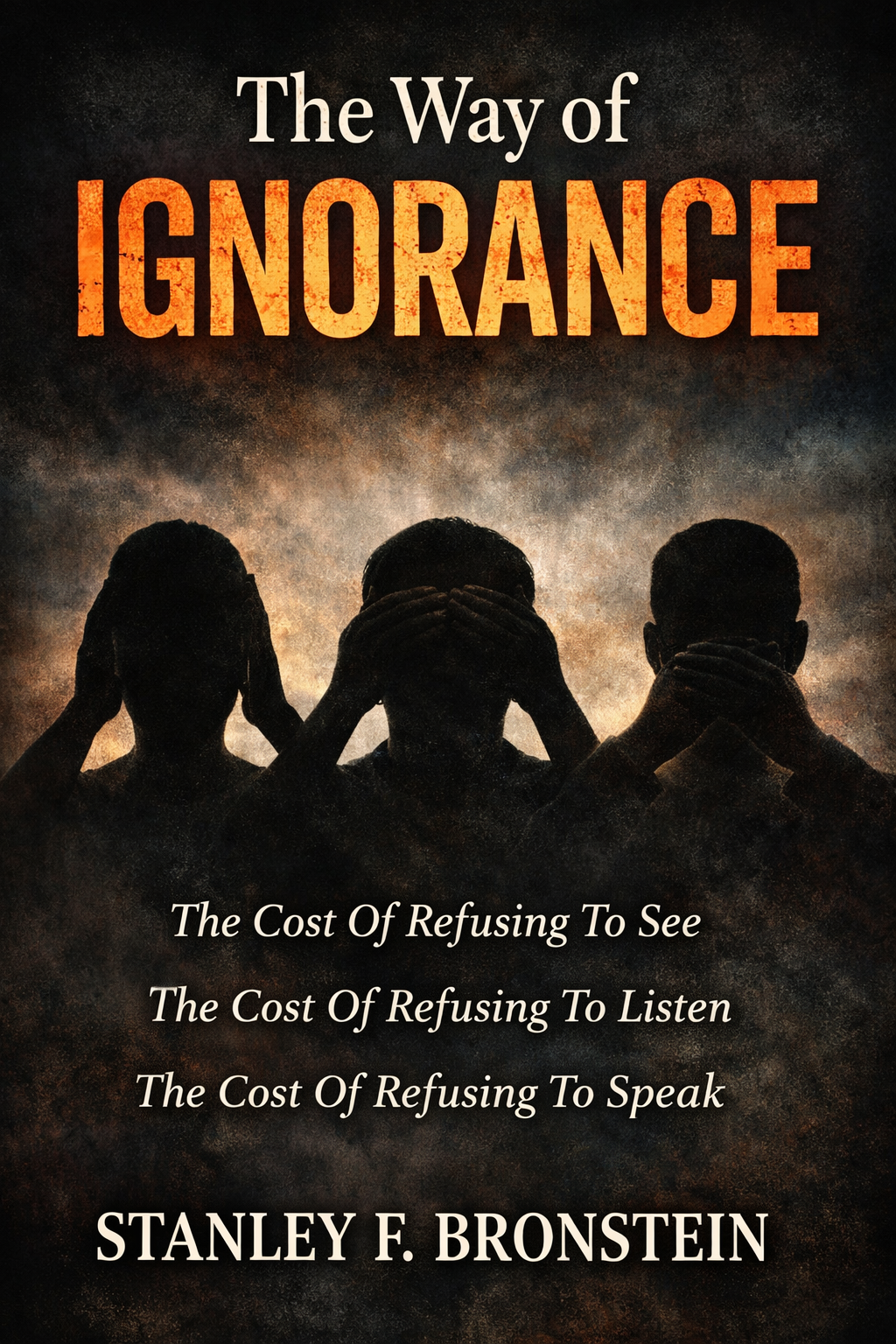
The Way of Ignorance
The Cost Of Refusing To See
The Cost Of Refusing To Hear
The Cost Of Refusing To Speak
By Stanley F. Bronstein – Creator of The Way of Excellence System
Click The Tabs Below To Read Each Chapter Of The Book Online
Or
📘 Download Your Free Copy In Your Preferred Format
The Way of Ignorance
by Stanley F. Bronstein
How to use this page:
Click a chapter title to open it then scroll down to read.
When you click the title of the next chapter, the previous one will close.
Take your time.
Read, reflect, and do the experiments and assignments before you move on.
EMPTY ITEM
Foreword - Why Ignorance Matters More Than Most People Realize
Ignorance is one of the most powerful forces in human life.
It shapes what people notice and what they miss. It influences what they believe, what they repeat, what they defend, what they tolerate, and what they refuse to question. It affects private decisions, public conversations, relationships, institutions, cultures, and entire civilizations. It can wound quietly or destroy loudly. It can hide behind innocence, fear, pride, certainty, habit, tradition, comfort, anger, loyalty, or self-protection. It can appear soft, passive, and harmless. In reality, it is often anything but harmless.
Many people think ignorance simply means not knowing something. In one sense, that is true. Every person begins life in ignorance. Every person lacks knowledge in some area. Every person misunderstands certain things, misses important realities, and has limits in awareness. There is nothing shameful about not knowing yet. There is nothing shameful about being unfinished. There is nothing shameful about having more to learn.
But that is only the beginning of the subject.
Some ignorance is innocent. Some ignorance is temporary. Some ignorance is the natural result of limited experience, poor teaching, incomplete information, or lack of exposure. That kind of ignorance can often be corrected through learning, experience, patience, and honest conversation.
Other forms of ignorance are far more costly.
There is a kind of ignorance that does not merely lack knowledge. It resists knowledge. It avoids reality. It filters evidence. It protects old stories. It clings to false certainty. It listens poorly. It speaks carelessly. It looks away from what is inconvenient, threatening, painful, or demanding. This kind of ignorance is not merely empty. It is defended.
That is the kind of ignorance this book is about.
This book is not written to mock people for what they do not know. It is not written to insult, belittle, or condemn. It is not written from the fantasy that ignorance belongs only to other people. It is written from a more sober and more useful understanding: ignorance is a deeply human problem. It lives in individuals, families, communities, organizations, cultures, and systems. It lives in the mind. It lives in the emotions. It lives in habits. It lives in fear. It lives in pride. It lives in silence. It lives in the refusal to see clearly, the refusal to listen deeply, and the refusal to speak truthfully.
That is why this subject matters so much.
Ignorance is not only about what a person does not know. It is also about what a person does with what is available to be known. It is about whether they are willing to look. Whether they are willing to listen. Whether they are willing to question. Whether they are willing to be corrected. Whether they are willing to admit that a belief, a habit, a judgment, or a position may be incomplete, distorted, or simply wrong.
The cost of refusing to do those things can be enormous.
A person can remain ignorant about their own motives and therefore keep repeating the same destructive patterns. A person can remain ignorant about the consequences of their behavior and keep harming people they claim to love. A leader can remain ignorant about reality and damage an organization, a community, or a nation. A society can remain ignorant about its own habits, values, incentives, and blind spots and then wonder why its suffering keeps multiplying. A culture can become so committed to noise, speed, performance, tribal loyalty, and emotional reaction that it slowly loses the ability to see clearly, listen honestly, and speak responsibly.
When that happens, ignorance is no longer a private limitation. It becomes a shared burden.
This book takes the position that reality matters, truth matters, listening matters, speech matters, and awareness matters. That should sound obvious. Yet history and everyday life repeatedly show that these things are far easier to praise than to practice.
People often do not want to see what is right in front of them, because seeing clearly may demand change.
People often do not want to listen, because listening may require humility.
People often do not want to speak truthfully, because truthful speech may carry risk.
So instead, people often defend what is familiar, protect what is comfortable, repeat what is rewarded, and avoid what is costly. They settle for partial seeing, selective listening, and compromised speech. Over time, this creates a life that drifts farther and farther away from reality.
That drift has a price.
There is a price paid when a person refuses to see what is obvious.
There is a price paid when a person refuses to hear what needs to be heard.
There is a price paid when a person refuses to say what needs to be said.
There is a price paid in self-deception, in broken trust, in repeated mistakes, in lost opportunities, in unnecessary suffering, in delayed growth, and in avoidable harm. There is also a price paid in the weakening of conscience. The longer a person refuses to look, listen, or speak, the easier that refusal becomes. The easier it becomes, the more normal it feels. The more normal it feels, the more deeply the ignorance takes hold.
This is why ignorance deserves much more attention than it usually receives.
In my own body of work, I have emphasized the importance of reality, responsibility, change, integrity, willingness, discipline, and alignment. Those themes matter here as well. In fact, they matter greatly here. The Way of Excellence (TWOE) begins with Concept #1 – Learning To Tell It Like It Is. That is not accidental. If a person or a society cannot tell it like it is, then that person or society loses contact with reality. Once contact with reality is lost, clear thought weakens, wise action becomes less likely, and suffering increases.
Law #1 The Law Of Actuality states:
No living person or system can remain in existence for very long without first having arrived at a level of full, realistic awareness of their own existence, sensations, thoughts and surroundings and then responding accordingly after having done so.
That principle is foundational to this book.
Ignorance thrives where awareness is weak, where honesty is compromised, where discomfort is avoided, and where reality is edited to fit preference. A person can only move beyond ignorance by becoming more willing to tell it like it is, first to themselves and then in their dealings with life.
This book also rests on another essential principle from The Way of Excellence (TWOE): personal responsibility.
Law #3 The Law Of Personal Response-Ability states:
One must stop blaming others for anything wrong in their life. In fact, one must also stop blaming themselves. BLAME IS IRRELEVANT. All that matters is what are you going to do to fix the problem?
That principle matters here because one of the easiest ways to stay ignorant is to remain externally focused on blame, superiority, outrage, or complaint. It is much harder to ask: What am I missing? What have I assumed? What have I refused to face? What truth has been trying to get my attention? What responsibility is now mine because I can no longer honestly say I do not know?
Those are uncomfortable questions. They are also necessary questions.
This book is organized around three major forms of refusal.
The first is refusing to see. This includes denial, selective perception, protected narratives, bias, and the avoidance of consequences. It includes what happens when people look directly at reality and still do not let it in. It includes what happens when comfort becomes more important than clarity.
The second is refusing to listen. This includes defensiveness, tribal loyalty, performative conversation, correction-resistance, and the inability to receive truth from outside the boundaries of one’s preferred story. It includes listening only to reply, listening only to defend, and listening only to win. It also includes what becomes possible when a person finally learns how to listen in a deeper way.
The third is refusing to speak. This includes harmful silence, withheld truth, distorted speech, convenient half-truths, and the fear of saying what needs to be said. It includes the moral cost of silence when clarity, honesty, and courage are needed. It also includes the discipline required to speak truthfully without becoming reckless, cruel, or self-righteous.
Taken together, these three refusals form a powerful structure of ignorance.
A person may see but not really see.
A person may hear but not really listen.
A person may know but not really speak.
And when all three forms of refusal begin feeding each other, ignorance becomes very difficult to break.
Still, this is not a hopeless subject.
The purpose of this book is not merely to expose ignorance. It is to loosen its grip. It is to help the reader recognize where ignorance comes from, how it sustains itself, what it costs, and how a more aware way of living becomes possible. The goal is not perfection. The goal is greater honesty, greater humility, greater awareness, greater responsibility, and greater alignment with reality.
That path is available.
It begins when a person stops pretending not to know what they already know.
It deepens when a person becomes willing to learn what they do not yet know.
It grows stronger when a person develops the humility to be corrected.
It becomes transformative when a person chooses truth over comfort often enough that truth begins to feel like home.
That process is rarely easy. In many cases, it is disruptive. Ignorance often survives because it serves some immediate purpose. It protects the ego. It delays pain. It preserves identity. It reduces tension in the short term. It makes it easier to avoid hard choices. It gives people a way to stay internally divided while still appearing externally stable. But what protects in the short term often harms in the long term.
This is one reason long-term thinking matters so much here.
Law #2 The Law Of The Long-Term states:
Repeated short-term discipline brings long-term rewards. Consequently, one must place reasonable limits on short-term pleasures, with the understanding long-term benefits will be the result.
A person who chooses short-term comfort over reality may feel relief for a moment, but that relief often comes at the cost of clarity, trust, growth, and long-term well-being. Ignorance often survives through the protection of short-term comfort. Wisdom often begins when a person becomes willing to tolerate short-term discomfort for the sake of long-term truth.
That requires willingness.
Law #16 The Law Of Willingness states:
If one wants to see permanent, positive changes in one’s life, then one must be willing to make permanent, positive changes in their life. Lasting, positive change will not happen if there is a lack of willingness to do what it takes, for however long it takes.
This book asks for that willingness.
It asks the reader to be willing to look at things they may have avoided.
It asks the reader to be willing to question stories they may have protected.
It asks the reader to be willing to notice where pride, fear, comfort, tribal belonging, hurt, or habit may have distorted perception.
It asks the reader to be willing to listen more honestly.
It asks the reader to be willing to speak more truthfully.
And perhaps most of all, it asks the reader to be willing to stop treating ignorance as a problem located only in other people.
That is where the real work begins.
If the reader approaches this book with humility, courage, and sincerity, it can be useful. It can help uncover blind spots. It can help explain patterns that once seemed confusing. It can help identify where self-protection has replaced truthfulness. It can help reconnect thought, speech, and action to reality. It can help a person become more teachable, more perceptive, more grounded, and more honest.
None of that happens all at once.
Awareness is often gradual.
Growth is often uneven.
Truth is sometimes difficult to accept in the moment it first appears.
But difficulty is not the same as impossibility. In fact, some of the most important changes in life begin with the simple willingness to stop looking away.
If this book does its job well, it will help the reader do three things more consistently:
See more clearly.
Listen more deeply.
Speak more truthfully.
Those three practices do not solve every human problem, but without them, many human problems remain locked in place.
So this book begins here, with a simple but demanding invitation:
Look more honestly.
Listen more openly.
Speak more courageously.
And wherever ignorance has taken hold, begin there.
INTRODUCTION TO PART I - UNDERSTANDING IGNORANCE
Part I begins with a simple but necessary task: defining what ignorance really is.
That may sound easy at first. Many people hear the word ignorance and think it means only one thing – not knowing. At the most basic level, that is true. Every person begins life not knowing. Every person lacks knowledge in some area. Every person misunderstands some things, overlooks others, and remains unfinished in countless ways. There is nothing shameful about that. To be human is to be limited. To be alive is to still have more to learn.
But ignorance is more complicated than simple lack of knowledge.
A person can be highly educated and still be deeply ignorant in certain parts of life. A person can be intelligent and still remain blind to motives, consequences, patterns, or truths that are right in front of them. A person can know many facts and still not understand themselves. A person can be informed in one area and careless in another. A person can even know the truth at some level and still resist it because it is uncomfortable, inconvenient, or costly.
That is where this subject becomes more serious.
This book is not interested only in ignorance as absence. It is also interested in ignorance as avoidance, distortion, false certainty, emotional resistance, ego protection, and refusal. Some ignorance is innocent. Some ignorance is inherited. Some ignorance is situational. Some ignorance results from poor teaching, narrow experience, or lack of exposure. But some ignorance becomes defended. It becomes something a person protects because the truth would require change.
That distinction matters.
If all ignorance were innocent, then the solution would be simple. More information would solve the problem. More exposure would solve the problem. More education would solve the problem. Sometimes those things help greatly. Sometimes they help enough. But often the deeper problem is not merely that truth is unavailable. The deeper problem is that truth is unwelcome.
People do not always avoid truth because they are weak-minded. Often they avoid truth because truth threatens something they want to keep. It may threaten comfort. It may threaten pride. It may threaten identity. It may threaten a long-protected story about who they are, what they have done, what they deserve, what others owe them, or what life is supposed to be. In those moments, ignorance stops being passive. It becomes active. It becomes protective. It becomes strategic. It becomes a way of not having to deal with what reality is asking.
That is why this first part of the book matters so much.
Before we can examine the cost of refusing to see, refusing to listen, and refusing to speak, we need to understand what ignorance is, how it operates, and why it is so persistent. We need to separate simple not-knowing from more dangerous forms of ignorance. We need to understand why ignorance is not the same as bad thinking or poor judgment, even though those things often overlap. We need to understand how the ego protects ignorance and why so many people would rather stay comfortable than come into clearer contact with reality.
Most of all, we need to understand that ignorance is not just a problem “out there.” It is not confined to reckless leaders, noisy public figures, dishonest institutions, or obviously misguided people. It is also personal. It is intimate. It appears in the private stories people tell themselves. It appears in the truths they postpone. It appears in the excuses they repeat. It appears in the habits they refuse to question. It appears in the warning signs they explain away. It appears in the conversations they avoid, the lessons they resist, and the realities they keep trying not to name.
This is not a pleasant subject in the shallow sense of the word. But it is a necessary one.
The Way of Excellence (TWOE) begins with Concept #1 – Learning To Tell It Like It Is. That matters here because ignorance grows wherever reality is softened, distorted, avoided, or edited to fit preference. A person cannot move beyond ignorance without becoming more willing to see life as it is, not merely as they wish it were. That movement requires honesty. It requires humility. It requires courage. It requires willingness. It also requires the strength to stop confusing comfort with truth.
Part I is designed to build that foundation.
It will define ignorance more carefully. It will distinguish between not knowing, not wanting to know, and refusing to know. It will examine why ignorance is not the same as bad thinking or poor judgment, even though all three can reinforce one another. It will look at how ignorance protects the ego and why people often defend what harms them. It will then close by showing the first great cost of ignorance: living out of touch with reality.
This is where the work begins.
Not with condemnation.
Not with superiority.
Not with the assumption that ignorance belongs mainly to other people.
It begins with a more demanding and more useful question:
Where am I not yet seeing clearly?
That question is the doorway into this part of the book. It is also the doorway out of many forms of unnecessary suffering.
Chapter 1 - What Ignorance Really Is
Ignorance is one of the most misunderstood forces in human life.
Most people think ignorance simply means not knowing something. At the most basic level, that is true. A person may be ignorant of a fact, a history, a skill, a process, a danger, a consequence, or a truth they have not yet learned. Every human being begins life in that condition. No one comes into the world knowing everything. No one grows through life without areas of confusion, limitation, misunderstanding, or incomplete awareness. In that sense, ignorance is not unusual. It is universal.
But if that were all ignorance meant, it would not be nearly as dangerous as it often becomes.
Ignorance is not always just empty space where knowledge should be. Sometimes it is much more active than that. Sometimes it is a way of looking without seeing, hearing without listening, speaking without understanding, or living without asking deeper questions. Sometimes it is not merely the absence of truth. Sometimes it is resistance to truth. Sometimes it is not simply lack of awareness. Sometimes it is avoidance of awareness. Sometimes it is not only failure to understand. Sometimes it is refusal to understand because understanding would require change.
That is why this subject matters so much.
Ignorance does not merely affect what a person knows. It affects what a person notices, what a person assumes, what a person ignores, what a person defends, and what a person is willing or unwilling to face. It shapes perception. It shapes judgment. It shapes speech. It shapes relationships. It shapes leadership. It shapes habits. It shapes entire lives.
A person can be ignorant of what they are doing to their own health.
A person can be ignorant of how their words affect other people.
A person can be ignorant of what fear is doing to their thinking.
A person can be ignorant of their own motives.
A person can be ignorant of the long-term consequences of short-term choices.
A person can be ignorant of the pain they cause, the lies they repeat, the assumptions they carry, or the realities they keep refusing to name.
That is why ignorance cannot be treated as a small problem.
Ignorance Is More Than A Lack Of Facts
One of the greatest mistakes people make is assuming that ignorance is just informational. They act as if ignorance would disappear if people were given a few more facts, a little more education, or a better explanation. Sometimes that helps. Sometimes lack of information really is the problem. But often ignorance survives even when information is available.
A person can be told the truth and still reject it.
A person can be shown clear evidence and still explain it away.
A person can live inside repeated consequences and still fail to connect the pattern.
A person can hear the same warning many times and still not let it in.
That means ignorance is often deeper than the mind alone. It also involves emotion, habit, identity, pride, fear, comfort, and resistance. It involves the whole person.
This is one reason ignorance can be so persistent. It is not always maintained by lack of data. It is often maintained by the desire to remain unchanged.
A person may not want to know because knowing would disturb a comfortable story.
A person may not want to understand because understanding would require responsibility.
A person may not want to face reality because reality would force a decision they do not want to make.
So ignorance is not always passive. Sometimes it is defended.
Ignorance Has Many Forms
Ignorance appears in more forms than most people realize. It is not confined to one category of life. It shows up in many areas, often at the same time.
There is factual ignorance. This is the simplest form. A person does not know a fact, a history, a process, or a relevant piece of information.
There is practical ignorance. A person does not know how something works, how consequences unfold, or how to handle a situation wisely.
There is relational ignorance. A person does not understand other people well, misreads them repeatedly, or remains blind to how their own behavior affects those around them.
There is self-ignorance. A person does not understand their motives, fears, habits, triggers, needs, weaknesses, or contradictions.
There is moral ignorance. A person fails to see the ethical weight of actions, excuses harm too easily, or does not understand what responsibility requires.
There is emotional ignorance. A person does not recognize what they are feeling, why they are reacting, or how emotional pain is shaping perception.
There is spiritual ignorance. A person lives without serious reflection on meaning, purpose, conscience, alignment, or the deeper reality of existence.
These forms overlap constantly. A person may think they have only an information problem when the deeper issue is emotional avoidance. A person may think they have a relationship problem when the deeper issue is self-ignorance. A person may think they have a communication problem when the deeper issue is moral confusion or lack of courage. Ignorance rarely stays in one neat category. It spreads. It touches one part of life and then quietly influences the rest.
Ignorance And Intelligence Are Not The Same Thing
Another important truth must be stated early: ignorance is not limited to unintelligent people.
In fact, some of the most dangerous ignorance can exist in highly intelligent people. Intelligence can help a person think quickly, argue skillfully, analyze details, or master technical material. But none of those things guarantee wisdom, self-awareness, humility, or honesty. A brilliant person can still be ignorant of their own pride. A highly educated person can still be blind to the damage they cause. A persuasive person can still be deeply confused about truth. A successful person can still be living in denial.
Sometimes intelligence even helps ignorance hide more effectively. A clever person may become very good at defending falsehood, rationalizing bad behavior, explaining away evidence, or protecting a carefully constructed image. They may use mental power not to seek truth, but to shield themselves from it.
That is why ignorance must not be reduced to low ability. It is more complicated than that. It can attach itself to strength as easily as weakness. It can hide behind sophistication as easily as simplicity. It can wear polished clothes and still distort reality.
Ignorance Often Feels Normal From The Inside
One reason ignorance is so hard to recognize is that it rarely announces itself clearly. Most people do not wake up in the morning and say, “I am committed to distortion, avoidance, and incomplete awareness.” Ignorance usually feels normal from the inside.
It can feel like certainty.
It can feel like common sense.
It can feel like loyalty.
It can feel like protection.
It can feel like realism.
It can feel like experience.
It can feel like wisdom.
That is part of the danger.
When a person is ignorant, they often do not experience themselves as ignorant. They experience themselves as right, justified, careful, cautious, informed, or unfairly challenged. Because of that, ignorance can become self-protecting. The person does not merely have a blind spot. They begin defending the blind spot as if it were clarity.
This is especially dangerous when the ignorance is connected to identity. Once a belief, habit, group story, or emotional pattern becomes part of how a person sees themselves, any challenge to it can feel like a threat. The person may then resist not because the truth is weak, but because the truth feels personally disruptive.
That is why ignorance is so often tied to ego. It is not only about what a person does not know. It is also about what a person feels unable or unwilling to admit.
Ignorance Can Be Innocent Or Costly
Not all ignorance carries the same weight.
Some ignorance is innocent. A child who has not yet learned something is ignorant in an ordinary and harmless sense. A beginner is ignorant of what they have not yet practiced. A person raised without certain opportunities may be ignorant of things they were never shown. A person entering a new field, a new culture, or a new stage of life may be ignorant simply because they are new to it.
That kind of ignorance is normal. It deserves patience, teaching, and compassion.
But ignorance becomes more serious when it continues past the point where learning is possible and needed. It becomes more serious when evidence is available but ignored. It becomes more serious when a person keeps avoiding lessons that life has already tried to teach. It becomes more serious when the person is no longer merely uninformed but resistant.
At that point, ignorance stops being only a limitation. It becomes a contributor to harm.
A person who stays ignorant about their health may suffer consequences that could have been reduced or prevented.
A person who stays ignorant about their finances may keep making the same destructive choices.
A person who stays ignorant about their relationships may keep wounding people and then wondering why trust breaks down.
A leader who stays ignorant about reality may damage many lives, not just their own.
The larger the influence, the larger the cost.
The Way of Excellence (TWOE) begins with Concept #1 – Learning To Tell It Like It Is.
That is a powerful starting point for this subject because ignorance grows wherever reality is softened, distorted, denied, or edited for comfort. A person cannot move beyond ignorance while remaining committed to illusion. Growth requires contact with what is real.
Law #1 – The Law Of Actuality states:
No living person or system can remain in existence for very long without first having arrived at a level of full, realistic awareness of their own existence, sensations, thoughts and surroundings and then responding accordingly after having done so.
This principle goes to the heart of the matter. Awareness must come first. Reality must be faced before wise response is possible. A person who remains disconnected from actual conditions cannot respond wisely to those conditions. They may react emotionally. They may defend themselves skillfully. They may delay, deny, distract, or rationalize. But they cannot deal effectively with what they refuse to see.
That is why ignorance is so costly. It separates the person from actuality. And when that separation grows, suffering often grows with it.
Ignorance Distorts The Relationship With Reality
Reality does not disappear because a person ignores it.
Consequences do not vanish because a person denies them.
Patterns do not stop operating because a person refuses to recognize them.
Needs do not go away because a person does not want to face them.
Truth does not become false because it is inconvenient.
This is one of the most important facts in the entire book. Ignorance does not suspend reality. It only weakens a person’s relationship to reality. That weakened relationship then produces poor adjustment, repeated error, unnecessary suffering, and long-term cost.
A person who refuses to acknowledge what is real does not become safer. They become less prepared.
A person who refuses to name a problem does not make the problem smaller. They make themselves weaker in relation to it.
A person who refuses to see consequences early often ends up facing them later in more painful form.
Ignorance is dangerous because life continues to unfold according to what is true, not according to what is comfortable.
Ignorance Is Also A Moral Issue
Ignorance is not only intellectual. It is often moral.
There are truths people do not want to face because those truths would place a demand on them. If they fully admitted what is real, they might need to apologize, change, stop, begin, repair, surrender, or take responsibility. They might need to stop blaming. They might need to face the harm they have tolerated or caused. They might need to rethink the stories that justify their behavior.
That is why ignorance can never be reduced to mere misunderstanding. Sometimes ignorance serves conscience avoidance. A person does not want to know because knowing would mean they could no longer honestly claim innocence.
This is one reason silence can be a form of ignorance. A person may know enough to speak, but choose not to speak because truth would be inconvenient. A person may see enough to act, but choose not to act because action would cost something. A person may hear enough to understand, but choose not to listen any further because deeper understanding would require moral courage.
So ignorance is not always empty. Sometimes it is protected because it allows avoidance to continue.
Ignorance Blocks Growth
A person cannot improve what they refuse to understand.
A person cannot correct what they refuse to name.
A person cannot heal what they refuse to acknowledge.
A person cannot change what they keep hiding from themselves.
This is where ignorance becomes a direct obstacle to development. It blocks learning. It blocks humility. It blocks responsibility. It blocks correction. It blocks wise action. It blocks integrity. It blocks alignment between thought, word, and deed.
Many people say they want growth, but growth begins with clearer seeing. Growth begins with greater honesty. Growth begins when a person becomes willing to know what they have avoided knowing. Without that step, the rest is performance.
This is why so much human suffering repeats itself. People keep trying to change results without changing awareness. They try to fix the later stages of the problem while protecting the earlier stages that created it. They want relief without reality. They want peace without truth. They want improvement without exposure. They want transformation without the discomfort of seeing clearly.
That rarely works for long.
The Way Beyond Ignorance Begins With Humility
If ignorance is more than lack of facts, then the path beyond ignorance must also be more than gathering facts. It must include a change in posture.
The person must become more willing to ask.
More willing to listen.
More willing to question assumptions.
More willing to admit, “I do not know.”
More willing to consider, “I may be wrong.”
More willing to accept that reality does not owe them comfort.
Humility is essential because arrogance closes the door that learning requires. A person who must always appear right cannot grow much. A person who cannot tolerate correction will keep repeating avoidable mistakes. A person who confuses certainty with wisdom will remain trapped inside their own untested conclusions.
Humility does not mean weakness. It means openness to reality. It means respecting truth enough to let it correct you. It means caring more about what is real than about preserving image. It means becoming teachable again.
That is where the way beyond ignorance begins.
Ignorance Must Be Understood Before It Can Be Overcome
This chapter has one main purpose: to establish that ignorance is bigger, deeper, and more consequential than people often assume.
It is not only lack of knowledge.
It is not only an educational issue.
It is not only about facts.
It is not only found in other people.
It is a human condition that can take many forms, from innocent limitation to costly refusal. It can affect thought, emotion, behavior, relationships, conscience, and character. It can distort a person’s connection to reality. It can block growth. It can cause harm. It can survive inside intelligence, hide behind certainty, and protect itself through comfort and ego.
That is why this book begins here.
Before we can examine denial, bias, defended narratives, failed listening, and compromised speech, we must first understand what ignorance really is. Once that foundation is clear, the deeper work can begin.
The more honestly a person understands ignorance, the harder it becomes to hide inside it.
Assignment
Step 1 – Define Ignorance In Your Own Words
Write a short paragraph explaining what ignorance means to you after reading this chapter. Include more than one dimension of the word. Do not define it only as lack of facts.
Step 2 – Identify Three Forms Of Ignorance In Your Own Life
List three areas in which you may currently be ignorant. Try to choose from different categories, such as factual ignorance, self-ignorance, relational ignorance, practical ignorance, moral ignorance, or emotional ignorance.
Step 3 – Distinguish Innocent Ignorance From Protected Ignorance
For each area you listed, ask yourself whether the ignorance is mostly innocent, mostly due to lack of exposure, or whether some part of you may be protecting it because the truth would be uncomfortable.
Step 4 – Name One Cost
Choose one of those areas and write down one specific cost that may come from remaining ignorant in that area.
Step 5 – Take One Small Step Toward Awareness
Decide on one practical action you can take this week to reduce ignorance in one area. Read something. Ask a question. Have a conversation. Observe a pattern. Admit a truth. Take one clear step toward greater awareness.
Chapter 2 - Not Knowing, Not Wanting To Know, And Refusing To Know
Not all ignorance is the same.
That fact matters more than many people realize. If every form of ignorance were treated as identical, then the subject would become shallow, unfair, and morally confusing. A person who has simply never been taught something would be treated the same as a person who has heard the truth many times and keeps turning away from it. A person who lacks exposure would be treated the same as a person who resists correction. A person who is new would be treated the same as a person who is defensive. Those are not the same conditions. They may look similar from the outside, but inwardly they are very different.
That is why this distinction is necessary.
There is a difference between not knowing, not wanting to know, and refusing to know.
Each one carries a different meaning. Each one reflects a different relationship to reality. Each one calls for a different response. And each one reveals something important about how ignorance operates in human life.
This chapter explores that progression.
It begins with simple not knowing, which is part of ordinary human limitation. It then moves into not wanting to know, where discomfort begins influencing awareness. Finally, it reaches refusing to know, where ignorance becomes more active, more defended, and more costly. The movement from one to the next is one of the most important patterns in this book, because it helps explain how harmless limitation can turn into harmful resistance.
Not Knowing Is Part Of Being Human
Every person begins with not knowing.
No child is born with finished understanding. No beginner enters a field with mastery. No person arrives in life already equipped with full awareness of themselves, others, relationships, consequences, motives, truth, and wisdom. Human beings learn gradually. They learn through experience, teaching, correction, failure, reflection, pain, curiosity, and exposure. That means not knowing is not a defect in itself. It is a starting point.
A person may not know because no one ever taught them.
A person may not know because they have never encountered that part of life before.
A person may not know because they were raised inside incomplete or distorted beliefs.
A person may not know because they lacked access, opportunity, guidance, or context.
A person may not know because they are still early in the learning process.
There is nothing inherently shameful about any of this.
This kind of ignorance is natural. It often calls for patience, education, conversation, compassion, and time. A person who does not know can learn. A person who is new can grow. A person who has been misinformed can be reoriented. A person who has never been shown another way can still begin.
This is why it is important not to weaponize the word ignorance too quickly. In many cases, what people need is not condemnation. They need clarity. They need opportunity. They need explanation. They need a chance to become aware of what they have not yet seen.
There is a major moral difference between a person who does not know and a person who does not care to know.
That difference must be protected, because without it the conversation becomes dishonest.
Not Knowing Does Not Make A Person Small
Many people carry shame around not knowing. They have been made to feel that lack of knowledge is weakness, inferiority, or failure. That shame often becomes one of the reasons people stop learning. They would rather pretend to know than admit they do not. They would rather perform certainty than risk embarrassment. They would rather protect image than grow in truth.
But that posture creates more ignorance, not less.
The person who can say, “I do not know,” is often much closer to wisdom than the person who must always appear informed. Honest not knowing is not the enemy of growth. It is often the doorway into it. It creates room for curiosity. It creates room for listening. It creates room for correction. It creates room for development.
Pretended knowing closes that room.
A person who admits they do not know may feel exposed for a moment, but they remain teachable. A person who hides not knowing behind pride, image, or defensiveness may feel safer in the short term, but they become harder to help.
This matters because one of the earliest ways ignorance begins to harden is when shame gets involved. The person stops simply not knowing and starts protecting themselves from the appearance of not knowing. Once that happens, learning becomes emotionally expensive.
That is one way ignorance begins changing form.
Not Wanting To Know Is A Different Condition
There comes a point where ignorance is no longer merely about absence. It becomes affected by desire. The person does not simply lack awareness. Some part of them does not want awareness.
This is where the subject becomes more serious.
Not wanting to know often begins in discomfort. A person senses that some truth may be painful, inconvenient, disruptive, humiliating, or demanding. They may not fully say this to themselves, but inwardly they start pulling back. They become less curious. Less open. Less willing to ask. Less willing to listen. Less willing to look directly at what might be revealed.
At this stage, ignorance has begun to shift from passive to protective.
A person may not want to know the state of their health because the truth might require a different way of living.
A person may not want to know what their spouse, child, friend, or colleague really feels because the truth might expose failure, distance, or responsibility.
A person may not want to know the full cost of a habit because knowledge would remove the excuse of innocence.
A person may not want to know what their choices are doing to the future because then they could no longer tell themselves that everything is fine.
A person may not want to know because knowing would interrupt comfort.
That is a crucial point. People often imagine ignorance as mental emptiness, but much of it is sustained by emotional preference. The person does not want the burden that comes with seeing more clearly.
This kind of ignorance is softer than outright refusal, but it is already moving in that direction. The person is still within reach of truth, but their willingness is lacking. They are not merely uninformed. They are beginning to lean away.
Why People Do Not Want To Know
There are many reasons people do not want to know. Some of them are obvious. Others are subtle.
Fear is one of the most common.
A person fears what truth might mean. They fear loss. They fear change. They fear exposure. They fear shame. They fear conflict. They fear responsibility. They fear the collapse of an identity they have built their life around. Truth is not always rejected because it is unclear. Sometimes it is rejected because it is too clear.
Comfort is another reason.
Comfort has enormous power over human beings. A person may sense that a change is needed, but the current arrangement is familiar. It is easier to continue the old routine, repeat the old story, and live inside the old illusion than to face the disruption that truth would bring. The comfort may be damaging, but it is known. Reality may be better, but it is demanding.
Pride also plays a major role.
A person may not want to know because knowing would mean admitting they were wrong, incomplete, careless, arrogant, naïve, or self-deceived. Some people would rather remain comfortably mistaken than face the wound to pride that correction brings. Pride can make ignorance feel preferable to humility.
There is also the issue of identity.
People attach themselves to beliefs, roles, loyalties, and stories. Once a truth threatens those attachments, resistance often rises. The problem is no longer just information. It becomes self-protection. The person is not only trying to avoid a fact. They are trying to avoid the unraveling of something they use to define themselves.
This is why not wanting to know should never be underestimated. It is often the stage where ignorance becomes emotionally committed to its own survival.
Not Wanting To Know Creates A Dangerous Delay
A person who does not want to know often lives in postponement.
They delay looking.
They delay asking.
They delay checking.
They delay listening.
They delay naming.
They delay acting.
Delay feels harmless at first. It feels like time. It feels like avoidance without consequence. It feels like a way to manage stress. But delay is rarely neutral. In many situations, delay allows the underlying problem to grow while the person remains less prepared to face it.
Ignored health concerns often worsen.
Ignored relationship problems often deepen.
Ignored financial realities often compound.
Ignored emotional wounds often spread into other areas of life.
Ignored moral compromises often become habits.
What was once difficult to face becomes even more difficult because delay has added consequence to discomfort. Now the person is not only facing truth. They are also facing the cost of having delayed the truth.
That is one reason not wanting to know is dangerous. It rarely freezes life in place. It simply causes reality to keep moving without the benefit of awareness.
Refusing To Know Is Stronger Than Avoidance
There is another stage beyond not wanting to know.
This is refusing to know.
At this point, ignorance has become more active, more deliberate, and more defended. The person is no longer merely uncomfortable with truth. They are resisting it. They are turning away from evidence, correction, consequence, or reality with more force. They are not simply hesitant. They are resistant.
Refusing to know may not always look dramatic. Sometimes it appears quiet. Sometimes it appears polite. Sometimes it wears the language of certainty, loyalty, principle, experience, or realism. But underneath those appearances is a clear pattern: the person is pushing truth away because truth is no longer just unwanted. It has become unwelcome.
A person may refuse to know by dismissing evidence before examining it.
A person may refuse to know by attacking the messenger rather than considering the message.
A person may refuse to know by endlessly changing the subject.
A person may refuse to know by making excuses every time a pattern becomes obvious.
A person may refuse to know by hiding behind selective facts while ignoring the larger reality.
A person may refuse to know by insisting on their story no matter how many consequences contradict it.
This is the stage where ignorance becomes far more harmful.
Not knowing can often be taught.
Not wanting to know can often be approached with patience, courage, and invitation.
Refusing to know is harder because the person is now actively participating in the maintenance of their own blindness.
Refusal Usually Protects Something
People do not usually refuse to know for no reason. Refusal is expensive. It takes energy to keep truth out. It takes effort to dismiss, rationalize, minimize, reinterpret, and defend. That effort usually serves some protective purpose.
The person may be protecting pride.
They may be protecting a fragile self-image.
They may be protecting convenience.
They may be protecting a group identity.
They may be protecting an addiction, a habit, a fantasy, or an illusion.
They may be protecting power.
They may be protecting resentment.
They may be protecting a way of living they do not want interrupted.
This matters because refusal is rarely solved by facts alone. Facts matter, but refusal is often connected to emotion, identity, ego, and fear. Until that deeper layer is understood, the person may continue defending ignorance even while surrounded by evidence.
That is why people sometimes seem impossible to reach. The problem is not that truth has never appeared. The problem is that truth threatens something they are not yet willing to surrender.
The Transition From Innocent Ignorance To Defended Ignorance
One of the central concerns of this book is how ordinary, innocent not knowing turns into defended ignorance.
That transition rarely happens in one moment. It is usually gradual.
At first, the person simply does not know.
Then they begin sensing something they do not want to face.
Then they delay.
Then they soften the truth.
Then they protect the old story.
Then they avoid certain conversations.
Then they reject uncomfortable evidence.
Then they become irritated by correction.
Then they start defending the very blindness that is harming them.
This is how ignorance hardens.
What began as limitation becomes resistance.
What began as lack of awareness becomes protected unawareness.
What began as a teachable condition becomes a self-reinforcing posture.
That progression matters because many people think ignorance is fixed from the beginning. It often is not. It becomes more dangerous over time because of how the person responds to truth when truth starts pressing against comfort.
This means the moment of greatest importance may not be the moment when a person does not know. It may be the moment when they first realize they are avoiding knowing.
That is the turning point.
From there, the person can move in one of two directions.
They can become more open.
Or they can become more defended.
The Way of Excellence (TWOE) makes a powerful distinction here through willingness and responsibility.
Concept #3 – Taking Personal Responsibility matters because a person cannot move beyond ignorance while continuously locating the whole problem outside themselves. If a person refuses to look inward, refuses to examine their role, and refuses to respond honestly to what is present, ignorance remains intact.
Law #3 – The Law Of Personal Response-Ability states:
One must stop blaming others for anything wrong in their life. In fact, one must also stop blaming themselves. BLAME IS IRRELEVANT. All that matters is what are you going to do to fix the problem?
This law applies directly to the movement from not knowing into refusal. A person may begin in innocence, but once awareness becomes available, the question changes. The question is no longer simply, “Did you know?” The question becomes, “What are you going to do now that truth is present enough to be noticed?”
That is where responsibility begins.
This chapter also connects deeply with Concept #16 – The Willingness Factor. Many people do not fail because truth is unavailable. They fail because willingness is lacking. They are not willing to look for however long it takes. They are not willing to listen for however long it takes. They are not willing to change for however long it takes.
Law #16 – The Law Of Willingness states:
If one wants to see permanent, positive changes in one’s life, then one must be willing to make permanent, positive changes in their life. Lasting, positive change will not happen if there is a lack of willingness to do what it takes, for however long it takes.
That principle goes directly to the heart of this chapter. The path beyond ignorance depends not only on information, but on willingness. A person must be willing to know. Willing to face. Willing to question. Willing to learn. Willing to change. Without willingness, truth may be present and still go unused.
Why This Distinction Matters So Much
Some people need compassion because they genuinely do not know.
Some people need encouragement because they are afraid to know.
Some people need confrontation because they are refusing to know.
If those conditions are confused, the response becomes ineffective.
If a genuinely uninformed person is treated as rebellious, they may feel shamed rather than taught.
If a frightened person is treated only with more data, the deeper issue of fear may go untouched.
If a refusing person is treated as though they are simply uninformed, the seriousness of their resistance may never be named.
This is why clarity matters.
A person’s relationship to truth tells you a great deal about where they are. Are they open? Hesitant? Defensive? Dismissive? Curious? Avoidant? Teachable? Resistant? Those distinctions are not small. They shape what kind of conversation is possible, what kind of growth can happen, and what kind of consequences are likely to follow.
The same distinction also matters inwardly. A person cannot honestly work on ignorance without asking: Am I simply unaware here, or is some part of me resisting awareness? That question can be uncomfortable, but it is necessary. It shifts the focus from surface information to deeper honesty.
The Way Beyond This Progression
The movement from not knowing to refusing to know is not inevitable.
A person can interrupt it.
A person can catch themselves when avoidance begins.
A person can notice when a topic creates unusual defensiveness.
A person can pause when they feel the urge to dismiss rather than consider.
A person can ask why a truth feels threatening.
A person can admit, “I may not want to know this, but I need to know it.”
That moment of honesty is powerful.
It does not solve everything at once, but it reopens the path. It keeps the person from sliding fully into defended ignorance. It restores humility. It restores teachability. It restores the possibility of growth.
Often the first breakthrough is not gaining a new fact. It is becoming honest about resistance.
A person says:
I see that I have been avoiding this.
I see that I do not want to know.
I see that I have been protecting a story.
I see that some part of me would rather stay comfortable than become clear.
Those are not small admissions. They are acts of courage. They mark the beginning of a different relationship to truth.
Truth Is Easier To Receive When A Person Stops Fighting It
Much of human suffering becomes more complicated because people fight what they need to face. They resist the knowledge that would help them. They avoid the awareness that would free them. They delay the truth that would allow change to begin. They turn simple realities into prolonged struggles by refusing to acknowledge them early.
This does not mean all truth is easy. Some truths are painful. Some truths disrupt. Some truths strip away illusions that felt protective. But painful truth is often kinder than prolonged self-deception. Difficult awareness is often lighter than the burden of defending ignorance year after year.
The person who is willing to know may face discomfort now, but they have a chance to respond wisely.
The person who refuses to know may protect comfort now, but they are usually increasing future cost.
That is one of the great themes of this book. Reality can be postponed in awareness, but not in effect. Sooner or later, truth makes its demands. The earlier a person becomes willing to face it, the more freedom they have in responding.
The Real Question
This chapter is not asking whether you know everything. No one does.
It is not asking whether you have gaps. Everyone does.
It is not asking whether you have ever been wrong. Everyone has.
The real question is different.
When truth begins pressing against your comfort, what do you do?
Do you lean in?
Do you hesitate?
Do you delay?
Do you defend?
Do you turn away?
The answer to that question says a great deal about your current relationship to ignorance.
Some ignorance is simply the beginning of learning.
Some ignorance is the middle stage of fear.
Some ignorance is the hardened form of resistance.
If you can tell the difference, you will understand yourself more honestly. You will also see more clearly why some forms of ignorance disappear with teaching while others remain locked in place until pride, fear, comfort, or identity are addressed.
This distinction is essential because the rest of the book depends on it. The refusal to see, the refusal to listen, and the refusal to speak all become much clearer once you understand that ignorance is not static. It develops. It deepens. It hardens. It becomes protected. And that process often begins the moment a person stops simply not knowing and starts resisting what they could know.
That is where ignorance becomes far more costly.
Assignment
Step 1 – Identify One Example Of Each Condition
Write down one example from your life of simple not knowing, one example of not wanting to know, and one example of refusing to know. Be honest and specific.
Step 2 – Look For The Emotional Driver
For the examples involving not wanting to know and refusing to know, ask yourself what may have been underneath the resistance. Was it fear, pride, comfort, shame, identity, convenience, resentment, or something else?
Step 3 – Notice The Cost Of Delay
Choose one area where you delayed knowing something important. Write down how that delay affected the situation. Did it make the issue bigger, more expensive, more painful, or harder to address?
Step 4 – Ask The Hard Question
Write this question at the top of a page: “What truth have I been least willing to know?” Then sit with it quietly and answer it as honestly as you can.
Step 5 – Choose Willingness
Identify one truth you have been avoiding and take one concrete step toward facing it this week. Ask the question. Make the appointment. Have the conversation. Read the information. Stop postponing what needs to be known.
Chapter 3 - Why Ignorance Is Not The Same As Bad Thinking Or Poor Judgment
Words matter.
When people use the word ignorance, they often use it too broadly. They apply it to almost any failure of mind or behavior. If a person does not know something important, they call that ignorance. If a person reasons carelessly, they call that ignorance too. If a person keeps making poor decisions, they may call that ignorance as well. The word becomes a general label for almost any kind of human error.
That is understandable in everyday speech, but it is not precise enough for this book.
If we are going to understand ignorance clearly, we must separate it from other problems that may look similar but are not the same. Ignorance is not the same as bad thinking. Ignorance is not the same as poor judgment. These problems can overlap, reinforce one another, and appear together in the same person. But they are still different problems. If they are all thrown into one pile, the result is confusion. If the diagnosis is confused, the path to change will also be confused.
So this chapter makes an important distinction.
A person can be ignorant without thinking badly.
A person can think badly without being deeply ignorant in that area.
A person can know quite a lot and still use poor judgment.
A person can be informed, educated, and intelligent and still make damaging choices.
That means something very important. Human error does not come from just one source. Sometimes the problem is lack of knowledge. Sometimes the problem is distortion in reasoning. Sometimes the problem is failure in decision-making. Sometimes all three are present at once. But unless we learn to tell the difference, we will keep trying to solve the wrong problem.
Ignorance Is Primarily About Missing Awareness Or Understanding
Ignorance begins with some form of not knowing, not understanding, or not yet seeing clearly.
A person may be ignorant of a fact.
A person may be ignorant of how something works.
A person may be ignorant of the history behind a present condition.
A person may be ignorant of the likely consequence of a repeated action.
A person may be ignorant of their own motives.
A person may be ignorant of what another person is experiencing.
A person may be ignorant of a danger, a pattern, a weakness, or a truth that has not yet come fully into awareness.
In that basic sense, ignorance concerns what is missing. Something important has not yet been learned, recognized, grasped, or accepted.
That does not automatically mean the person is thinking badly.
A thoughtful person may still be ignorant in a new area.
A humble person may still be ignorant of what they have never encountered.
A careful person may still be ignorant because the relevant information was unavailable, hidden, distorted, or never properly taught.
A willing person may still be ignorant simply because they are early in the learning process.
That is why ignorance must not be confused with inferiority. Not knowing is part of being human. Every human being begins in ignorance in countless ways. A person can be decent, intelligent, honest, reflective, and still lack important knowledge or understanding. In its most basic form, ignorance is not a verdict on character. It is a condition of incompleteness.
That distinction matters because a person who does not know something may need explanation, exposure, practice, education, experience, or patience. They do not necessarily need criticism for thinking badly. They may simply need a chance to learn.
Bad Thinking Is Not Mainly About Missing Information
Bad thinking concerns the process of reasoning.
A person may have enough information and still think badly about it. They may jump to conclusions, twist evidence, assume motives, exaggerate one detail into a complete theory, confuse feelings with facts, treat suspicion as proof, or reduce a complex situation to a simplistic story. The issue is not mainly that they know nothing. The issue is that they are not using what they know in a clear, careful, honest, and proportionate way.
This is a different problem.
Ignorance asks, “What is missing from awareness?”
Bad thinking asks, “What is happening in the reasoning process?”
A person can have access to good information and still use it badly.
They can select only the parts that flatter their existing story.
They can ignore important context.
They can assume that repetition makes something true.
They can let emotion do the thinking.
They can confuse confidence with accuracy.
They can reach for a conclusion before they have earned it.
This is why more information does not always solve the problem. If the reasoning process itself is distorted, then new information may simply get pulled into the same distortion. The person may become more informed in one sense, but not wiser in how they think.
Bad thinking often hides behind confidence. It can sound persuasive. It can sound forceful. It can sound certain. But force is not the same as clarity. A rushed conclusion may feel powerful without being sound. A familiar story may feel obvious without being true. A loudly expressed belief may still rest on weak reasoning.
So bad thinking is not merely the absence of facts. It is the misuse of thought.
Poor Judgment Is Different Again
Poor judgment concerns decisions.
It concerns what a person chooses to do with what they know, what they think, what they feel, and what they face. A person can know something important, think about it reasonably well, and still act badly. They may still choose what is reckless, harmful, short-sighted, impulsive, cowardly, self-protective, or destructive.
That is a judgment problem.
A person may know that a habit is harming them and continue anyway.
A person may understand that a conversation must happen and still avoid it.
A person may see warning signs and choose to minimize them.
A person may know they are angry, biased, exhausted, or reactive and still make an important decision in that state.
A person may understand the likely consequence and still choose short-term relief over long-term well-being.
This is why poor judgment cannot be reduced to ignorance. The person may not be missing information. They may not even be reasoning especially badly in that moment. They may simply be failing to act in alignment with what they know.
Poor judgment often appears in the gap between recognition and action.
The person knows, but does not follow what they know.
The person sees, but does not respond wisely to what they see.
The person understands enough, but still chooses according to mood, fear, pride, convenience, craving, or pressure.
That is not mainly an information problem. It is a problem of decision, discipline, courage, timing, restraint, and self-governance.
These Problems Can Overlap And Reinforce One Another
Although ignorance, bad thinking, and poor judgment are different, they often interact.
Ignorance can contribute to bad thinking. If a person lacks important information, their conclusions may become distorted because the picture in front of them is incomplete.
Bad thinking can preserve ignorance. If a person reasons badly, dismisses evidence too quickly, or distorts what they hear, they may remain ignorant longer than necessary.
Poor judgment can deepen ignorance. If a person repeatedly chooses comfort over clarity, defensiveness over correction, or impulse over honesty, they may keep themselves from learning what they need to learn.
The reverse is also true.
A person may begin in ignorance.
Then they may reason carelessly from what little they know.
Then they may make a poor decision based on that careless reasoning.
Then they may defend the poor decision in order to protect pride.
Then the defense keeps them from learning.
Then ignorance grows stronger.
This is how the cycle works.
The three problems can feed each other. But even when they overlap, the distinction still matters. If the main problem is ignorance, the person needs greater awareness and understanding. If the main problem is bad thinking, the person needs better reasoning habits and more honest perspective. If the main problem is poor judgment, the person needs greater discipline, stronger character, and better alignment between knowledge and action.
Clarity about the actual problem makes growth more possible.
Intelligence Does Not Eliminate Any Of These Problems
One of the easiest mistakes to make is to assume that intelligence protects a person from ignorance, bad thinking, or poor judgment.
It does not.
A person may be highly intelligent and still be ignorant of themselves.
A person may be well educated and still reason badly in areas tied to ego or emotion.
A person may be skilled, articulate, successful, and informed and still use terrible judgment in relationships, health, finances, leadership, or moral conduct.
Mental ability is not the same as wisdom.
In some cases, intelligence even makes the problem harder to detect. A clever person may become very good at rationalizing. They may become highly skilled at defending a weak position. They may explain away consequences with great sophistication. They may use mental power not to discover truth, but to avoid it more elegantly.
That is why intelligence alone is not enough. A sharp mind can serve truth, or it can serve self-protection. It can clarify reality, or it can build a more impressive defense against reality. The real question is not only whether a person can think. It is whether the person is willing to think honestly.
A Person Can Be Ignorant Without Being Careless In Mind Or Character
This distinction deserves protection because it keeps the book fair.
A person may genuinely not know something important and still be thoughtful, careful, humble, and open. They may learn of a fact they were missing and immediately adjust. They may discover a blind spot and respond with sincerity. They may receive new information and allow it to deepen understanding rather than threaten identity.
That is very different from the person who keeps reaching reckless conclusions.
It is also different from the person who keeps choosing badly against what they already know.
In other words, ignorance alone does not tell the whole story.
It tells you that something important is missing from awareness or understanding.
It does not automatically tell you the quality of the person’s reasoning.
It does not automatically tell you the quality of the person’s judgment.
This is why careless labeling is dangerous. If a person simply lacks knowledge, they may need teaching. If a person thinks badly, they may need a better process of thought. If a person uses poor judgment, they may need stronger discipline and greater honesty about their choices. A vague label hides the real work.
Bad Thinking Often Comes From Distorted Perspective
When people think badly, they often do not experience themselves as thinking badly. They experience themselves as being realistic, rational, principled, or justified. That is part of why bad thinking is so persistent. It usually feels normal from the inside.
A person may be influenced by fear and call it caution.
A person may be influenced by anger and call it truth.
A person may be influenced by wounded pride and call it clarity.
A person may be influenced by group loyalty and call it principle.
A person may be influenced by habit and call it common sense.
But in reality, perspective has been distorted.
This is where The Way of Excellence (TWOE) offers an important corrective.
Concept #6 – Changing Our Perspective
And Law #6 – The Law Of Perspective states:
Sometimes life requires a change in perspective. One’s previous life challenges have made them into the person they are today and given them the potential to develop a fuller perspective as a result, provided they learn from said experiences and move on, as opposed to dwelling on them and looking back.
That law matters here because bad thinking often survives inside a narrow, wounded, defensive, rigid, or incomplete perspective. A person may not lack intelligence. They may not even lack facts. But they are seeing through too small a frame. They are interpreting life through a lens that is cramped by ego, pain, fear, old stories, or emotional fixation.
A fuller perspective does not guarantee perfect thinking, but it greatly improves the chance of clearer thought. It helps the person ask better questions. It helps them consider alternatives. It helps them step back from the first interpretation and make room for a wider one.
That is one reason perspective matters so much. Sometimes the problem is not the raw information. The problem is the angle from which the person is viewing it.
Poor Judgment Often Reflects A Lack Of Discipline
Poor judgment is often not a matter of ignorance at all. The person may already know enough. The person may even think reasonably well. But when the moment of action comes, something breaks down. Impulse takes over. Fear takes over. Comfort takes over. Ego takes over. The person fails to do what they know they should do.
That is why poor judgment so often points to a discipline problem.
A person may know they should tell the truth, but choose the easier lie.
A person may know they should wait, but act impulsively.
A person may know they should stop, but continue anyway.
A person may know they should prepare, speak, apologize, leave, begin, refuse, or change, and still fail to act in alignment with that knowledge.
This is exactly where The Way of Excellence (TWOE) becomes especially relevant.
Concept #18 – The Discipline Factor
And Law #18 – The Law Of Discipline states:
The achievement of excellence requires constant and never-ending improvement. This requires one to develop a disciplined regimen that constantly develops and improves their mind, body and spirit and to stick to that regimen. Discipline is not something you have to do; it is something you get to do. Disciplined people get things done.
That law goes directly to the heart of poor judgment. Many poor decisions do not happen because truth is hidden. They happen because discipline is lacking. The person does not consistently live in accordance with what they know. They break faith with their own better understanding. They act according to impulse rather than principle, according to mood rather than wisdom, according to short-term pressure rather than long-term truth.
This is why better judgment requires more than insight. It requires disciplined follow-through. It requires the ability to do what should be done even when it is uncomfortable, inconvenient, emotionally difficult, or slow to reward.
Why The Distinction Matters So Much
If ignorance is mistaken for bad thinking, the person may receive criticism when what they really need is education.
If bad thinking is mistaken for ignorance, the person may receive more information when what they really need is better reasoning.
If poor judgment is mistaken for ignorance, the person may keep gathering knowledge while avoiding the harder work of discipline and action.
So this distinction matters because it keeps the response honest.
Some people need teaching.
Some people need perspective.
Some people need discipline.
Some people need all three.
But unless the real problem is identified, the solution may never reach the place where change is actually required.
This distinction also matters for self-understanding. It is easy to say, “I did not know,” when the truth is, “I thought badly.” It is easy to say, “I was confused,” when the truth is, “I used poor judgment.” It is easy to hide behind ignorance when the real issue is that knowledge was present but integrity in thought or action was lacking.
Greater honesty begins when a person asks a more precise question.
Was I unaware?
Was I thinking badly?
Or did I know enough and still choose poorly?
That question can be uncomfortable, but it is liberating. It reduces vagueness. It makes accountability more accurate. It helps the person aim the work in the right direction.
What This Chapter Is Really Asking
This chapter is not asking whether you have ever lacked knowledge. Of course you have.
It is not asking whether you have ever thought badly. Of course you have.
It is not asking whether you have ever used poor judgment. Of course you have.
It is asking something more useful.
When something goes wrong, can you tell the difference between not knowing, thinking poorly, and deciding poorly?
Can you identify the real problem?
Can you stop excusing one form of failure by misnaming it as another?
Can you become accurate enough with yourself that growth becomes more possible?
That is the real value of this distinction. It helps move a person out of blur and into clarity.
Ignorance is real.
Bad thinking is real.
Poor judgment is real.
They can overlap, but they are not the same.
And the more clearly a person understands that, the more honestly a person can begin changing.
Assignment
Step 1 – Define The Three Terms Clearly
Write your own short definition of ignorance, bad thinking, and poor judgment. Make sure each definition is different.
Step 2 – Review Three Situations From Your Life
Think of three situations where something went wrong. For each one, ask whether the main issue was ignorance, bad thinking, poor judgment, or some combination.
Step 3 – Identify Your Most Common Pattern
Look over your examples and ask yourself which problem appears most often in your life right now. Are you usually missing awareness, reasoning carelessly, or acting against what you already know?
Step 4 – Name One Cost For Each
Write down one specific cost you have paid because of ignorance, one cost you have paid because of bad thinking, and one cost you have paid because of poor judgment.
Step 5 – Choose One Corrective Action
If your main issue is ignorance, choose one step toward greater learning. If your main issue is bad thinking, choose one way to slow down and consider a fuller perspective. If your main issue is poor judgment, choose one disciplined action that brings your behavior into better alignment with what you already know is right.
Chapter 4 - How Ignorance Protects The Ego
Ignorance is not always maintained because truth is absent.
Very often, ignorance is maintained because truth is threatening.
A person may say they want honesty, growth, clarity, and wisdom. They may even believe that about themselves. But when truth begins pressing against pride, comfort, identity, image, or control, another force often takes over. That force is the ego.
The ego wants to feel secure.
It wants to feel right.
It wants to feel justified.
It wants to feel innocent.
It wants to feel in control.
It wants to preserve a story about the self that remains emotionally manageable.
None of this is unusual. It is part of being human. The problem is not that people have an ego. The problem is that the ego often tries to protect itself at the expense of reality. When that happens, ignorance becomes useful. It becomes a shield against discomfort. It becomes a hiding place from contradiction. It becomes a way of not having to face what feels painful, embarrassing, disruptive, or demanding.
This is one of the deepest reasons ignorance survives.
It is not always the absence of information. Often, it is the presence of self-protection.
The Ego Does Not Like To Be Threatened
Most people carry some mental picture of who they are.
They think of themselves as decent, thoughtful, caring, fair, intelligent, responsible, or morally justified. Often, there is real truth in that picture. But the picture is rarely complete. It usually leaves out certain contradictions, blind spots, habits, weaknesses, motives, wounds, and inconsistencies.
That is where truth can become threatening.
If a person sees themselves as kind, it is hard to admit that they have sometimes been cruel.
If a person sees themselves as honest, it is hard to admit that they have been evasive.
If a person sees themselves as responsible, it is hard to admit that they have avoided what mattered.
If a person sees themselves as wise, it is hard to admit that they have been blind.
If a person sees themselves as fair, it is hard to admit that bias has shaped their reactions.
The more tightly a person clings to a fixed image of the self, the more threatening truth can feel. At that point, truth is no longer merely information. It feels personal. It feels exposing. It feels destabilizing. So the ego begins trying to protect the self from that discomfort.
That protection often happens quickly.
The person denies.
The person minimizes.
The person rationalizes.
The person blames.
The person explains.
The person gets offended.
The person attacks the messenger.
The person changes the subject.
The person withdraws into silence.
All of these are common ways the ego tries to preserve itself. All of them also make ignorance harder to overcome.
Ignorance Can Feel Safer Than Honesty
Honesty is powerful, but it is not always pleasant at first.
Honesty can expose failure.
It can expose selfishness.
It can expose fear.
It can expose inconsistency.
It can expose weakness.
It can expose the fact that a cherished story is incomplete or false.
It can expose the fact that change is needed.
That is why ignorance can feel safer.
A person who does not fully face a problem can keep pretending the problem is smaller than it is.
A person who does not fully face their role can keep imagining they are mostly innocent.
A person who does not fully face consequences can keep postponing responsibility.
A person who does not fully face contradiction can keep protecting image.
In the short term, this can feel stabilizing. In the long term, it is costly. The person is no longer living in full contact with reality. They are living inside a protected version of reality, one shaped partly by truth and partly by ego-defense.
That is not real peace. It is managed discomfort.
And managed discomfort often becomes prolonged suffering.
The Ego Wants To Be Right More Than It Wants To Learn
One of the clearest signs that ignorance is protecting the ego is when being right becomes more important than understanding.
A person enters a conversation not to learn, but to defend.
A person hears correction not as useful information, but as a threat.
A person responds to evidence not with curiosity, but with resistance.
A person rejects complexity because complexity makes certainty harder to maintain.
A person confuses admitting error with losing value.
Once this happens, learning becomes much harder.
Learning requires openness.
Learning requires flexibility.
Learning requires patience.
Learning requires the willingness to revise a conclusion.
Learning requires the humility to let truth matter more than self-image.
The ego often resists all of that. It would rather preserve the feeling of being right than experience the discomfort of being corrected. It would rather protect an old conclusion than enter the uncertainty of deeper understanding. It would rather defend a story than question it.
This is one reason some people become harder to teach over time. It is not always because they have become wiser. Sometimes it is because the ego has become more invested in appearing wise.
That investment makes ignorance harder to break.
The Ego Protects Identity, Not Just Beliefs
People do not only protect ideas. They protect identities.
They protect the story of who they are.
They protect the story of what happened to them.
They protect the story of who is at fault.
They protect the story of why they act the way they act.
They protect the story of what they deserve.
They protect the story of why change is not necessary, possible, or fair.
These stories may contain truth, but they are often incomplete. They may leave out the person’s role. They may soften certain facts and exaggerate others. They may reduce a complicated reality into an emotionally useful script.
The ego becomes attached to such stories because they provide order. They help the person feel stable. They help the person feel justified. They help the person avoid the pain of deeper self-examination.
So when truth threatens the story, resistance rises.
A person who has built an identity around always being the injured one may resist any truth that points toward their own agency.
A person who has built an identity around superiority may resist any truth that reveals dependency, error, or weakness.
A person who has built an identity around being the reasonable one may resist any truth that reveals their own emotional reactivity.
A person who has built an identity around sacrifice may resist any truth that reveals resentment, control, or hidden motives.
This is why ignorance is often tied to identity. The ego is not only protecting facts. It is protecting meanings. It is protecting the internal structure through which the person understands themselves and their life.
Defensiveness Is Often A Clue
Defensiveness does not automatically prove that criticism is correct. But it often reveals that something feels threatened.
A person becomes defensive when pride feels exposed.
A person becomes defensive when innocence feels challenged.
A person becomes defensive when image feels unstable.
A person becomes defensive when certainty starts slipping.
A person becomes defensive when a familiar story is no longer fully secure.
That is why defensiveness is worth examining. It often points to the place where ego-protection is active.
The person may start arguing before reflecting.
The person may start explaining before listening.
The person may focus entirely on tone and ignore substance.
The person may rush to self-justification.
The person may become angry in order to avoid becoming honest.
Again, the issue is not that every criticism is right. The issue is that defensiveness often reveals that the person feels internally vulnerable. Something in them does not want to sit still long enough to ask, “What part of this might be true?”
That is where ignorance deepens.
Truth now has to pass through both lack of awareness and active self-protection.
Rationalization Is One Of The Ego’s Favorite Defenses
Not all ego-protection looks dramatic. Sometimes it sounds reasonable.
That is what makes rationalization so powerful.
Rationalization rearranges reality into a form that feels easier to live with. It does not always invent a complete falsehood. Often it uses partial truth in a misleading way. It allows the person to continue without facing the full weight of what is real.
A person says:
It is not that serious.
Everyone does it.
That is just how I am.
I had no choice.
This is not the right time.
They caused it.
I will deal with it later.
That is in the past.
Some of these statements may contain a fragment of truth. That is why rationalization works so well. It only needs to redirect attention enough to protect the ego from discomfort.
This is one reason articulate people can stay ignorant for a long time. They become good at explaining without changing. They become good at framing without facing. They become good at sounding reasonable while staying inwardly protected from what needs to be confronted.
The Ego Prefers Image Over Reality
Image is powerful.
A person wants to be seen well.
A person wants to see themselves well.
A person wants consistency between their public presentation and their private self-understanding.
This becomes dangerous when image matters more than truth.
Once image takes priority, the person may start choosing what looks good over what is real. They may manage appearances instead of addressing substance. They may perform honesty without fully practicing it. They may sound calm while avoiding difficult truth. They may project wisdom while resisting correction. They may present confidence while lacking clarity.
Ignorance can become highly polished this way.
It can look composed.
It can look intelligent.
It can look moral.
It can look spiritual.
It can look disciplined.
It can look persuasive.
And yet beneath the surface, the person may still be hiding from themselves.
That is why appearance can be misleading. The ego often becomes skillful at producing an outer image that shields an inner avoidance.
Correction Is Hard Because The Ego Makes It Personal
Correction hurts for many reasons, but one of the main reasons is that the ego often experiences correction as a threat to selfhood.
Something is off.
Something has been missed.
Something has been misunderstood.
Something needs to change.
If the ego is flexible, correction can still sting, but it becomes usable. The person pauses. They reflect. They learn.
If the ego is rigid, correction feels humiliating. The person then resists not because the correction is false, but because it is painful.
This is one reason ignorance lasts longer than it should. People do not always reject correction because there is no truth in it. They often reject correction because they do not want the emotional experience that comes with admitting it.
A person who cannot be corrected easily cannot grow easily.
A person who turns every challenge into an attack will keep protecting the very thing that needs to change.
A person who treats discomfort as destruction will keep choosing ignorance over humility.
That is a very expensive trade.
The Way of Excellence (TWOE) addresses this issue directly through integrity and respect.
Concept #12 Building A Foundation Of Integrity
And Law #12 The Law Of Integrity states:
Nothing can take the place of being kind, genuine, faithful, loyal, honest and sincere. Integrity is the foundation upon which all else is built. With integrity, one has nothing to fear, as one has nothing to hide.
That goes directly to the heart of this chapter. Ignorance protects the ego by helping a person hide from what is true. Integrity moves in the opposite direction. Integrity asks the person to live in such a way that hiding becomes less necessary. It asks for honesty in private as well as public life. It asks for inner and outer alignment. It asks the person to stop building a self around concealment, excuse, and image management.
When integrity is present, the ego has less room to use ignorance as cover.
This chapter also connects naturally with Concept #13 Respect.
And Law #13 The Law Of Respect states:
One must respect others in order to receive respect from others. Likewise, one must respect themselves before others will respect them. Respect must be given before it can be received.
This matters here because ego-protection is often deeply disrespectful. It disrespects other people by refusing to hear them honestly. It disrespects truth by refusing to face it directly. It disrespects the self by settling for illusion instead of clarity.
Real self-respect is not the same as ego-defense. Ego-defense says, “Protect the image at all costs.” Real self-respect says, “Be honest enough to face what is true.” Ego-defense says, “Do not let yourself be challenged.” Real self-respect says, “Respect yourself enough to grow.”
That is a very important difference.
Humility Is The Antidote
If the ego protects ignorance, humility weakens that protection.
Humility does not mean pretending to be small.
It does not mean denying strengths.
It does not mean accepting false accusations.
It does not mean collapsing under criticism.
Humility means a person is not so committed to image that truth becomes intolerable.
Humility means they can admit limitation without falling apart.
Humility means they can receive correction without becoming immediately combative.
Humility means they can revise, apologize, learn, and grow without treating those acts as humiliation.
Humility says:
I may not be seeing this clearly.
I may have missed something important.
I may need to hear this more carefully.
I may have contributed more than I wanted to admit.
I may need to change.
Those are powerful statements because they reopen the door that the ego tries to shut.
Humility does not remove discomfort, but it makes discomfort useful. It transforms correction from humiliation into information. It transforms exposure from threat into opportunity. It transforms truth from enemy into teacher.
Without humility, ignorance stays protected.
With humility, ignorance begins to loosen.
The Real Question Beneath The Question
When a person says, “I do not see it,” the real question is sometimes not whether the truth is visible.
Sometimes the deeper question is: “What am I protecting by not seeing it?”
That question goes farther than information.
It asks about pride.
It asks about fear.
It asks about comfort.
It asks about identity.
It asks about image.
It asks about what the ego is trying to preserve.
This is one of the most important movements in the whole book. A person does not become freer by protecting every illusion that helps them feel stable. A person becomes freer by becoming strong enough to live in contact with what is real.
That is not easy work.
But it is necessary work.
A person who keeps protecting the ego with ignorance may preserve short-term comfort, but they lose contact with reality.
A person who becomes willing to face truth may feel short-term discomfort, but they gain the possibility of real freedom.
That is the better exchange.
Assignment
Step 1 – Identify One Area Of Defensiveness
Write down one area of life where you tend to become defensive. It may involve relationships, work, health, money, habits, communication, or self-image.
Step 2 – Ask What Feels Threatened
When you become defensive in that area, ask yourself what actually feels threatened. Is it pride, innocence, control, image, comfort, certainty, or something else?
Step 3 – Notice Your Protective Pattern
Describe how you usually protect yourself in that area. Do you deny, minimize, rationalize, blame, explain, withdraw, change the subject, or attack the messenger?
Step 4 – Name The Cost
Write down one clear cost of protecting yourself in that way. What has it cost you in clarity, peace, relationships, growth, trust, or self-respect?
Step 5 – Practice One Humble Response
Choose one sentence you will practice the next time you feel defensive. It might be: “There may be something here I need to hear.” Or: “Let me slow down and think about that.” Or: “I do not like hearing this, but I want to understand it.” Pick one response that makes more room for truth than for ego-protection.
Chapter 5 - The First Cost Of Ignorance - Living Out Of Touch With Reality
Ignorance has many costs, but one cost comes before most of the others.
It separates a person from reality.
That separation is the first great loss because everything else depends on it. If a person is not in honest contact with what is real, then thought becomes distorted, judgment becomes unstable, speech becomes unreliable, and action becomes misaligned. The person may still feel certain. They may still sound persuasive. They may still look composed. But underneath the surface, they are operating from a weakened relationship with what is actually there.
That is always dangerous.
Reality is the ground on which life unfolds. It is the field in which consequences occur, patterns reveal themselves, needs make themselves known, and truth presses against preference. A person can deny reality, avoid reality, reinterpret reality, soften reality, postpone reality, or selectively acknowledge reality, but none of those things change what reality is. They only change the quality of the person’s relationship to it.
That is why living out of touch with reality is such a serious problem. It does not merely make life confusing. It makes life harder to navigate well.
Reality Does Not Adjust To Preference
One of the most difficult lessons in life is that reality does not reorganize itself around what a person wants to be true.
A person may want their health habits to have no long-term cost.
A person may want their financial choices to have no consequence.
A person may want their relationships to survive without honesty.
A person may want their anger to produce no damage.
A person may want their procrastination to remain harmless.
A person may want their denial to buy peace.
A person may want their silence to remain neutral.
But wanting something does not make it so.
Reality does not disappear because it is inconvenient.
Truth does not become false because it is unwelcome.
Consequences do not vanish because they are ignored.
Needs do not go away because they are postponed.
Patterns do not stop operating because they are unnamed.
This is one of the most important principles in the entire book. A person can refuse to recognize reality, but reality does not return the favor. It continues operating. It continues producing results. It continues making demands. It continues exposing what is out of alignment.
That is why ignorance is so costly. It weakens the person’s capacity to respond appropriately to what is already in motion.
Living Out Of Touch Often Feels Normal At First
Most people do not wake up one day and announce, “I am now living out of touch with reality.” The drift is usually slower and quieter than that.
It begins with avoidance.
It begins with selective noticing.
It begins with small rationalizations.
It begins with softening the seriousness of what is happening.
It begins with telling a slightly edited story.
It begins with delaying the uncomfortable conversation.
It begins with ignoring the early consequence.
It begins with confusing hope for evidence.
Over time, those small movements add up. The person starts losing contact with what is actually there. They still function. They still go through the motions. They may still look responsible, informed, moral, or in control. But inwardly, something has shifted. They are no longer orienting themselves primarily by what is real. They are orienting themselves by what is easier to tolerate.
That is a dangerous exchange.
What feels easier now often becomes harder later.
What feels smaller now often grows.
What feels manageable now often becomes costly precisely because it was not faced when it was still more manageable.
This is how ignorance quietly turns into misalignment.
A Person Can Be Out Of Touch In Many Areas Of Life
Living out of touch with reality does not happen only in dramatic situations. It happens in ordinary life all the time.
A person may be out of touch with the true condition of their body.
They may keep living as if exhaustion, pain, stress, or decline are minor issues when the signs are clearly asking for attention.
A person may be out of touch with the true condition of a relationship.
They may continue assuming closeness, trust, or stability while conflict, distance, resentment, or silence are steadily increasing.
A person may be out of touch with the true condition of their finances.
They may keep spending, postponing, and justifying while risk compounds beneath the surface.
A person may be out of touch with the true condition of their own inner life.
They may call themselves fine while living with bitterness, anxiety, envy, loneliness, or unprocessed grief.
A person may be out of touch with the true condition of their character.
They may imagine they are acting from principle while repeatedly acting from pride, fear, selfishness, or avoidance.
A person may be out of touch with consequences.
They may focus on intent and ignore impact.
They may focus on the present moment and ignore the future.
They may focus on what they meant and ignore what they did.
This is why reality must be understood broadly. It is not only physical reality or external fact. It also includes relational reality, emotional reality, moral reality, practical reality, and spiritual reality. A person can be literate in one part of reality and still be blind in another.
The Cost Of Losing Contact With Reality
When a person lives out of touch with reality, several things begin happening.
First, they misread what is actually going on.
They underestimate problems.
They overestimate their own position.
They miss warning signs.
They mistake appearances for substance.
They confuse temporary stability with real health.
They interpret discomfort in ways that protect them rather than inform them.
Second, they respond poorly because their starting point is distorted.
A person who misreads reality cannot respond to reality wisely. Even intelligent effort becomes misdirected when the foundation is false. The person may work hard, explain well, plan carefully, and remain sincere, but if they are acting from a distorted picture, their efforts will often miss the mark.
Third, consequences tend to intensify.
Ignored problems rarely stay small. Avoided truths rarely stay quiet forever. Unfaced realities often become louder over time. They begin by asking for attention gently. If ignored, they often return more forcefully.
Fourth, trust begins to weaken.
This happens inwardly and outwardly. Inwardly, the person loses trust in themselves because some deeper part of them knows they are not being fully honest. Outwardly, other people often feel the distortion before the person admits it. They may sense the avoidance, the inconsistency, the rationalization, the missing honesty. Once that happens, connection weakens.
Finally, growth slows down.
A person cannot improve what they refuse to see clearly. They cannot respond wisely to conditions they keep misreading. They cannot build a strong life on a weakened relationship with reality.
That is why this is the first cost of ignorance. It touches almost everything else.
The Way Of Excellence (TWOE) begins with Concept #1 – Learning To Tell It Like It Is.
That beginning is not accidental. A person cannot build a life of excellence while remaining disconnected from actuality.
And Law #1 The Law Of Actuality states:
No living person or system can remain in existence for very long without first having arrived at a level of full, realistic awareness of their own existence, sensations, thoughts and surroundings and then responding accordingly after having done so.
That law goes directly to the heart of this chapter. Full, realistic awareness must come first. Accurate response comes after that. The order matters. A person who responds without realistic awareness is not really responding to reality. They are responding to a distorted picture of reality.
That is why living out of touch is so costly. It interrupts the proper sequence. Awareness is incomplete, so response becomes compromised. The person may still act, but the action is built on a false or weakened foundation.
This is also why so many efforts fail. The person tries to change results without first establishing fuller awareness. They want relief without clarity. They want improvement without honest contact with conditions. They want resolution without accurate diagnosis.
That rarely works for long.
Benefit #1 Living In The Real World states:
By incorporating Law #1 The Law of Actuality into our lives, we will be creating a society where its members truthfully and accurately assess and acknowledge their situation, and as a result, begin acting appropriately.
That is an extraordinary sentence because it connects truthfulness and accuracy with appropriate action. It recognizes that the way to better action is not wishful thinking, image management, or selective perception. It is truthful and accurate assessment. People begin acting appropriately when they first learn to assess and acknowledge their situation honestly.
That is exactly what ignorance resists.
Ignorance keeps the assessment partial.
Ignorance keeps the acknowledgment delayed.
Ignorance weakens the action that should have followed.
Out Of Touch Does Not Mean Unintelligent
A person can be highly intelligent and still live out of touch with reality.
A person can be accomplished and still be in denial.
A person can be articulate and still be hiding from what is obvious.
A person can be externally competent and still be inwardly disconnected.
This matters because living out of touch is not simply about mental capacity. It is often about emotional resistance, ego-protection, attachment to old stories, and lack of willingness to confront what is true. A bright person can use their intelligence to build stronger explanations for why they do not need to face what they should face. In some cases, intelligence becomes part of the problem because it gives the person more tools for rationalization.
So the issue is not always whether the person is capable of understanding. The issue is whether they are willing to stand in honest contact with what is present.
That is a different question.
Reality Is Often Uncomfortable Before It Becomes Liberating
Part of why people drift out of touch is that reality often hurts before it helps.
Reality may tell a person they need to change.
Reality may tell a person they have delayed too long.
Reality may tell a person they have contributed more to the problem than they wanted to admit.
Reality may tell a person that what they hoped was temporary has become a pattern.
Reality may tell a person that they are tired, afraid, resentful, dependent, dishonest, imbalanced, or divided.
Those are not pleasant realizations.
But discomfort is not the same as harm.
Often the deeper harm comes from avoiding the discomfort. Reality may wound pride for a moment, but avoidance usually wounds life for much longer. What is faced can often be worked with. What is denied keeps operating in the dark.
This is why honesty is difficult but necessary. It asks the person to bear the first pain of clarity in order to avoid the greater pain of prolonged distortion.
This Also Connects With Concept #4 Embracing Change.
A person who lives out of touch with reality is usually resisting change at some level. If they fully acknowledged what is true, then something would need to shift. A habit would need to end. A conversation would need to happen. A pattern would need to be named. A decision would need to be made. A life structure would need to be reexamined.
That is why contact with reality so often leads immediately to the issue of change.
And Law #4 The Law Of Change states:
Everyone wants change, but few are willing to change. That’s not the way it works. Change requires work. If one wants to see changes in their life and in their world, they are going to have to change first. Change starts with you.
That law belongs here because reality and change are deeply connected. Once a person honestly sees what is real, they can no longer remain fully innocent about what needs attention. Awareness creates responsibility. It does not solve everything instantly, but it makes continued avoidance harder to justify.
This is one reason ignorance is so tempting. It allows the person to postpone change by weakening awareness. But once awareness becomes clear, the next question rises naturally: What now needs to change?
Benefit #4 Living In A World That’s Constantly Improving states:
By incorporating Law #4 The Law of Change into our lives, we will be creating a society that encourages constant and never-ending improvement, as opposed to one that fears it or discourages it.
That benefit matters because living in touch with reality is not meant to end in shame. It is meant to create the conditions for improvement. Honest awareness is not an end in itself. It is the beginning of better action. The person who sees more clearly can respond more wisely. The person who acknowledges reality more honestly can improve more effectively.
Reality is not the enemy of hope. It is the foundation of real hope.
The Person Who Lives Out Of Touch Often Pays Twice
A person who lives out of touch with reality often pays twice.
First, they pay the original cost of the problem itself.
Then they pay the added cost of delay, denial, distortion, or avoidance.
A health issue becomes more serious because it was not faced early.
A relationship becomes more damaged because the truth was postponed.
A financial problem becomes heavier because warning signs were softened.
An inner conflict becomes more entrenched because it was never named honestly.
A moral failure becomes a pattern because it was repeatedly rationalized instead of corrected.
This second cost is one of the tragedies of ignorance. It adds preventable suffering to unavoidable difficulty. Life already contains enough challenge without the extra burden created by refusal to see what is there.
The Way Back Begins With Honest Acknowledgment
The way back into reality does not begin with complexity. It begins with acknowledgment.
This is happening.
This is real.
This matters.
This is costing me.
This is not as small as I told myself.
This will not improve merely because I avoid it.
Those statements are simple, but they are powerful. They interrupt the drift. They bring the person back into contact with what is present. They restore the possibility of appropriate response.
A person does not need to solve everything in the first moment of honesty. They do need to stop hiding from the fact that something is true.
That is where the return begins.
From there, clarity can grow.
From there, choice becomes more honest.
From there, action becomes more grounded.
From there, change becomes possible.
This Chapter Marks A Turning Point
This chapter closes Part I for a reason. The first four chapters defined ignorance, distinguished its forms, clarified its relationship to thinking and judgment, and exposed how the ego protects it. Now this chapter shows the first great result of all of that: the person loses contact with reality.
That is the turning point into the rest of the book.
Because once a person is living out of touch with reality, the next stages become easier to understand.
They begin refusing to see what is already there.
They begin refusing to listen to what might correct them.
They begin refusing to speak what needs to be said.
That is where the book is going next.
But before moving there, this first cost must be firmly understood. Ignorance is not merely a gap in knowledge. It is a distortion in relationship to reality. It leaves the person less able to assess, acknowledge, and respond appropriately to what is true. That weakened relationship then spreads into thought, feeling, speech, action, and consequence.
That is why this cost comes first.
When a person loses contact with reality, they lose the ground on which wise living depends.
Assignment
Step 1 – Identify One Area Where You May Be Out Of Touch
Choose one area of your life where you may not be seeing reality clearly. It may involve your health, a relationship, finances, a habit, your emotional life, your work, or your character.
Step 2 – Describe The Current Story
Write down the story you have been telling yourself about that area. Be honest about how you have explained it, softened it, delayed it, or minimized it.
Step 3 – Write The More Honest Version
Now write a more truthful description of the situation. Strip away the excuse, the image, and the wishful thinking. Tell it like it is as clearly as you can.
Step 4 – Name One Consequence Of Staying Out Of Touch
Write down one concrete cost of remaining disconnected from reality in that area. What will likely happen if nothing changes?
Step 5 – Take One Reality-Based Action
Choose one action that reflects honest acknowledgment of the situation. Make the appointment. Ask the question. Review the numbers. Start the conversation. Admit the pattern. Take one step that is grounded in reality instead of avoidance.
INTRODUCTION TO PART II - THE COST OF REFUSING TO SEE
Part I established what ignorance really is. It showed that ignorance is not merely a lack of facts, but can also become avoidance, distortion, self-protection, and resistance. It showed that ignorance is not the same as bad thinking or poor judgment, even though all three can overlap and reinforce one another. It showed how the ego often protects ignorance because truth can feel threatening. It then closed by showing the first great cost of ignorance: living out of touch with reality.
Part II now moves deeper into one of the most common and costly forms that ignorance takes – refusing to see.
This does not mean physical blindness. It means something more inward and more complex. It means looking at life without fully letting reality in. It means seeing facts but not seeing their meaning. It means noticing evidence but filtering it through a protected story. It means watching consequences unfold while continuing to explain them away. It means refusing to look directly at what is uncomfortable, inconvenient, painful, or demanding.
Many people think seeing is automatic. It is not.
Looking is automatic.
Seeing is not.
A person can look directly at a problem and still not truly see it.
A person can hear words and still not grasp what those words reveal.
A person can live inside a pattern for years and still not name it honestly.
A person can watch a relationship weaken, a habit deepen, a body decline, a lie spread, or a consequence grow and still cling to the hope that things are not really what they appear to be.
That is what makes this part of the book so important.
Refusing to see is one of the most powerful ways ignorance protects itself. A person does not need to eliminate reality in order to avoid it. They only need to soften it, reinterpret it, minimize it, postpone it, or keep it from becoming fully conscious. They can leave the truth at the edges of awareness. They can let it remain blurred. They can keep telling themselves that things are not that serious, not that clear, not that urgent, not that connected, or not yet demanding action.
This is how blindness often works in human life.
It is not always dramatic.
It is often gradual.
It is often selective.
It is often emotionally convenient.
And it is often defended with great skill.
A person may refuse to see because seeing would require change.
A person may refuse to see because seeing would bring shame.
A person may refuse to see because seeing would expose their role in the problem.
A person may refuse to see because seeing would require them to leave what is familiar.
A person may refuse to see because seeing would make continued innocence impossible.
That last point matters greatly. There is a difference between not seeing and not wanting to see. Much of the suffering in human life is connected not merely to blindness, but to protected blindness. The person senses enough to know that something is wrong, but they keep pulling away from fuller contact with it. They remain close enough to feel discomfort, but not honest enough to let reality fully rearrange their understanding.
That is a painful place to live.
It is also a costly place to live.
When a person refuses to see, they lose the chance to respond early. They lose the chance to correct course while things are still more manageable. They lose the chance to understand the real nature of the problem. They lose the chance to act from clarity instead of delay. Often, they also create extra suffering, because what is ignored does not remain still. It continues unfolding. It continues producing consequences. It continues asking for attention, whether gently or forcefully.
Part II explores several of the most common ways this happens.
It begins with denial, avoidance, and the lies people protect. It then examines how people see only what supports the story they already believe. After that, it turns to blind spots, bias, and selective perception, showing how people can be sincere and still miss what matters. It then explores the comfort of illusion and the pain of reality, which helps explain why seeing clearly is often resisted. Finally, it closes by examining what happens when people refuse to see consequences, because consequences are often where reality becomes impossible to keep editing forever.
This part is meant to challenge the reader, but not to condemn them.
Refusing to see is a human pattern.
It appears in ordinary life.
It appears in relationships.
It appears in leadership.
It appears in families.
It appears in institutions.
It appears in entire cultures.
It also appears in the private places where people quietly turn away from truths they do not want to face.
That means this part of the book is not about “those people” who cannot see. It is about the ways all people are tempted to protect themselves from clarity.
That is why the most important question going into this part is not, “Who around me is blind?”
The more important question is:
What in my own life have I been reluctant to see clearly?
That question requires courage because seeing is rarely just mental. It is emotional. It is moral. It is practical. It is spiritual. To see clearly is often to cross a threshold. Once something is fully seen, the person can no longer honestly pretend it is not there. Once reality is named clearly, responsibility begins to rise. Once consequences are acknowledged, change becomes harder to postpone.
This is why so many people prefer partial sight.
Partial sight allows them to remain divided.
Partial sight allows them to hope without acting.
Partial sight allows them to stay near truth without fully surrendering to it.
But partial sight is unstable. It cannot hold forever. Eventually reality presses harder. Eventually the cost becomes clearer. Eventually what was blurred begins demanding sharper attention.
This part of the book is an invitation to stop looking away.
It is an invitation to notice what has been softened, delayed, explained away, or hidden behind a familiar story.
It is an invitation to let reality become more distinct.
It is an invitation to become stronger than the impulse to avoid.
Because in the end, refusing to see does not protect a person nearly as much as it seems to. It may reduce discomfort for a moment, but it also reduces clarity, freedom, wisdom, and the ability to respond well. The better path is not comfortable illusion. The better path is honest sight.
That is where Part II begins.
Chapter 6 - Denial, Avoidance, And The Lies People Protect
Refusing to see rarely begins with open rebellion against truth.
More often, it begins quietly.
A person senses that something is wrong, but does not want to look too closely. A person notices a pattern, but does not name it clearly. A person hears a warning, but softens its meaning. A person feels discomfort, but delays asking why. A person sees evidence, but tells themselves it is not yet serious. In this way, denial and avoidance often begin not as loud falsehood, but as partial refusal.
That is why this chapter matters.
Denial is one of the most common forms of protected ignorance. It allows a person to remain near the truth without fully surrendering to it. Avoidance supports denial by helping the person stay busy, distracted, uncertain, or emotionally unavailable to what is already becoming clear. The lies people protect then help hold the whole structure together. They give the person a story they can continue living inside.
The result is dangerous.
Reality remains what it is.
The problem remains what it is.
The consequences remain what they are.
Only the person’s relationship to those things becomes weaker.
That is the real tragedy of denial. It does not remove reality. It only removes the person’s honest contact with reality.
Denial Is Not Always Total Blindness
Many people imagine denial as something absolute. They imagine a person staring at the obvious and insisting that nothing is wrong. That does happen. But denial is often subtler than that.
A person may admit the facts in a technical sense while refusing their meaning.
A person may say, “Yes, I know,” while clearly living as though they do not know.
A person may acknowledge the problem in words while continuing to protect the habits, excuses, and patterns that keep the problem alive.
A person may accept the surface truth while refusing the deeper truth that comes with it.
This is why denial can be so hard to detect. It often appears mixed with fragments of honesty. The person is not lying completely. They are lying selectively. They are allowing just enough truth into awareness to appear reasonable, but not enough truth to force real change.
A person says they know their health matters, but they keep living in ways that make decline more likely.
A person says they know a relationship is under strain, but they keep avoiding the conversations that might reveal how serious it has become.
A person says they understand they have a problem with anger, spending, drinking, dishonesty, avoidance, resentment, or procrastination, but they keep treating the issue as manageable while the evidence keeps pointing in another direction.
This is partial denial.
It is often more dangerous than open denial because it creates the illusion of awareness without the substance of awareness. The person can tell themselves they are not avoiding the truth because they have acknowledged some part of it. But acknowledgment is not the same as full contact. Naming a problem lightly is not the same as facing it honestly.
Avoidance Is Denial In Motion
If denial is a refusal to fully admit what is true, avoidance is the behavior that keeps that refusal alive.
Avoidance moves the eyes away.
Avoidance changes the subject.
Avoidance delays the appointment.
Avoidance postpones the conversation.
Avoidance keeps the person too busy to reflect.
Avoidance fills the space with noise.
Avoidance chooses distraction over examination.
Avoidance says, “Not now.”
That phrase – not now – has protected a great deal of suffering.
Many problems become larger because they were not faced while they were still smaller.
Many relationships become more damaged because truth was delayed.
Many habits become more entrenched because the first warning signs were softened.
Many people lose years of clarity because avoidance gave them a way to remain near the truth without fully entering it.
Avoidance often feels harmless in the moment. It can feel like emotional self-management. It can feel like waiting for the right time. It can feel like reducing stress. It can feel like keeping the peace. But what it is often really doing is buying time for the lie.
The problem with that bargain is simple: life keeps moving while the person delays. The underlying condition keeps developing. The cost keeps growing. What was uncomfortable yesterday may become much more difficult tomorrow because avoidance added time, consequence, and complication to the original issue.
Avoidance is denial with a schedule.
It says, “I will deal with this later.”
Very often, later becomes more expensive.
The Lies People Protect
People do not only deny facts. They protect lies.
Some of those lies are explicit. Others are subtle. Some are spoken aloud. Others are mostly internal. Some are inherited. Others are self-created. Some are about circumstances. Others are about identity.
The lies people protect often sound familiar.
I am fine.
It is not that bad.
This is temporary.
I can stop anytime.
They are the real problem.
I had no choice.
This is just how life is.
This is just how I am.
I am handling it.
No one is being hurt.
I still have time.
Things will get better on their own.
I do not need to look at that yet.
Some of these statements may contain a fragment of truth. That is why they can survive. The most protected lies are often not pure inventions. They are distortions built around a partial reality. The person takes one piece that feels manageable and uses it to hide from the larger truth.
A person may really be functioning in many parts of life, but still not be fine.
A pattern may not yet have become catastrophic, but still be serious.
Someone else may indeed have contributed to the problem, but that does not erase the person’s own role.
A habit may indeed be stoppable, but not without cost, effort, and honesty.
The lie does not need to be total. It only needs to reduce pressure enough to let denial continue.
The Lies Are Usually Protecting Something Deeper
People do not protect lies for no reason.
The lie usually protects something the person is afraid to lose, face, or disturb.
It may protect pride.
It may protect comfort.
It may protect innocence.
It may protect identity.
It may protect a relationship.
It may protect a routine.
It may protect an addiction.
It may protect a fantasy.
It may protect a sense of control.
It may protect the hope that the person can stay the same and still get a different result.
This is why denial cannot always be broken by facts alone. Facts matter, but when a lie is tied to emotional survival, the person may resist even strong evidence. They are not merely protecting an idea. They are protecting what the idea does for them.
The lie may help them avoid shame.
The lie may help them avoid grief.
The lie may help them avoid responsibility.
The lie may help them avoid the collapse of a story they have depended on.
The lie may help them avoid the admission that something must now change.
That is why truth can feel so threatening. It is not always threatening because it is unclear. It is often threatening because it is clear enough to require action.
Denial Often Sounds Reasonable
One of the reasons denial survives so well is that it often does not sound irrational.
It sounds measured.
It sounds cautious.
It sounds fair.
It sounds nuanced.
It sounds emotionally intelligent.
It sounds patient.
It sounds practical.
The person says they are just waiting.
They say they do not want to overreact.
They say they need more information.
They say they are giving it time.
They say they are trying to stay positive.
They say they do not want to make a big deal out of nothing.
Sometimes those things are true. Not every pause is denial. Not every delay is avoidance. Not every caution is dishonesty. But there are times when reasonable language becomes cover for unreasonable resistance.
That is why the question is not only what the person is saying. The deeper question is what the saying is doing. Is it helping the person face reality more honestly, or is it helping the person stay safely distant from what is already becoming clear?
That question matters because denial often survives by sounding mature while acting evasive.
Denial Does Not Stay In One Area
A person may begin by denying one problem, but denial rarely stays neatly contained.
It begins affecting perception more broadly.
Once a person gets used to softening the truth in one area, the habit can spread.
They begin editing more.
They begin postponing more.
They begin rationalizing more.
They begin distrusting discomfort as a messenger.
They begin preferring interpretations that protect them.
They begin treating clarity as an enemy rather than an ally.
This is one reason denial is so corrosive. It is not only about one issue. It begins shaping the person’s whole relationship with truth. The person becomes less available to reality in general. They start using the same mental and emotional maneuvers repeatedly.
A person who denies one serious pattern in their life may also deny its effect on the people around them.
A person who avoids one hard conversation may begin avoiding others.
A person who protects one false story may begin building more false stories to support it.
A person who keeps insisting that nothing is wrong may slowly lose the capacity to know what wrong would even feel like.
That is a dangerous progression.
Denial Makes People Late To Their Own Lives
One of the saddest effects of denial is that it makes people late.
Late to awareness.
Late to responsibility.
Late to change.
Late to healing.
Late to truth.
Late to the life that could have begun earlier if honesty had come earlier.
A person may spend years avoiding what they already suspected.
A person may lose precious time because they kept choosing soothing stories over accurate ones.
A person may look back and realize that reality had been knocking for a long time, but they kept refusing to open the door.
This is why denial deserves serious attention. It is not simply a flaw in thought. It is often a theft of time. It steals years that might have been used for repair, growth, reconciliation, strengthening, or redirection.
The person keeps telling themselves they are buying peace.
Often they are only buying delay.
And delay, in many areas of life, is very expensive.
The Cost Of Denial Is Greater Than The Pain It Avoids
People deny because they want to avoid pain.
That much is understandable.
They want to avoid embarrassment.
They want to avoid conflict.
They want to avoid grief.
They want to avoid loss.
They want to avoid responsibility.
They want to avoid change.
But the cost of denial is usually greater than the pain it postpones.
The person avoids the hard truth today and pays for it with deeper consequence later.
The person avoids the painful conversation now and pays for it with greater distance later.
The person avoids the warning sign now and pays for it with a bigger problem later.
The person avoids the admission now and pays for it with prolonged internal division later.
Denial often wins the short-term battle and loses the long-term war.
This is one of the core patterns in the book. Short-term comfort often produces long-term suffering when it is bought at the expense of reality. The person protects themselves from the first pain of truth and then discovers that unreality has created a second pain that is heavier, more complex, and more difficult to reverse.
That is not protection. It is postponement with interest.
Truth Usually Returns
One of the most important realities about denial is that the truth usually returns.
It returns through consequences.
It returns through symptoms.
It returns through distance.
It returns through repeated conflict.
It returns through the body.
It returns through loss.
It returns through the quiet knowledge a person cannot fully silence forever.
The truth may be delayed in awareness, but it is rarely erased in effect.
This is why people often feel exhausted after long periods of denial. Part of them has been working constantly to keep reality at bay. That takes energy. It takes emotional effort to keep reframing, minimizing, postponing, and defending. It takes energy to keep protecting the lie.
Eventually, that effort becomes its own burden.
A person may discover that telling the truth is painful, but sustaining denial is exhausting.
In that sense, honesty can become a relief. Not because truth is easy, but because it ends the strain of constant internal management. It allows the person to stop dividing themselves between what they know at some level and what they keep trying not to know fully.
That is one reason truth can feel cleaner than denial, even when it hurts more at first.
The Way Out Begins With Naming What Has Been Protected
A person does not move beyond denial by vaguely promising to be more honest someday.
The way out begins more concretely than that.
It begins when the person names the lie.
It begins when the person says, “This is the story I have been using to protect myself.”
It begins when the person admits what they have been avoiding.
It begins when the person stops calling delay wisdom.
It begins when the person stops calling fear caution.
It begins when the person stops calling distortion hope.
This is not easy work.
It often feels exposing.
It often feels destabilizing.
It often strips away a layer of emotional protection.
But it also restores something invaluable: contact with reality.
Once the lie is named, it becomes harder to keep living inside it unconsciously.
Once the avoided truth is acknowledged, it becomes harder to keep pretending it is still vague.
Once denial is recognized, a different question becomes possible:
What now needs to be faced?
That question marks the beginning of movement.
Not full resolution.
Not instant healing.
But movement.
And movement is better than protected stagnation.
This Chapter Begins The Work Of Honest Sight
Part II begins here because denial is often the first clear expression of refusing to see.
The person looks, but does not fully let the truth in.
The person senses, but does not fully acknowledge.
The person knows enough to become uneasy, but not enough – or not willingly enough – to act with integrity.
That is why denial matters so much. It is one of the main ways ignorance keeps itself alive after the first warning signs appear. It gives the person a way to stay near reality without fully entering it.
But reality is not meant to be approached halfway forever.
Sooner or later, the truth must either be faced or paid for more heavily.
That is the choice denial keeps trying to postpone.
Assignment
Step 1 – Identify One Area Of Denial Or Avoidance
Choose one area of your life where you may be softening, delaying, or avoiding the truth. It may involve your health, finances, habits, relationships, emotional life, work, or self-understanding.
Step 2 – Write Down The Protective Story
Write the exact story you have been telling yourself in that area. Be honest and specific. Do not clean it up.
Step 3 – Ask What The Story Protects
What does that story help you avoid? Pride, fear, shame, conflict, grief, responsibility, change, or something else?
Step 4 – Name The Cost Of Delay
Write down one cost you are already paying because of denial or avoidance in that area. Then write down one likely future cost if nothing changes.
Step 5 – Replace The Lie With One Honest Sentence
Write one sentence that tells the truth more clearly than the story you have been protecting. Keep it simple, direct, and real. Read it slowly. Let that sentence become the beginning of a more honest relationship with reality.
Chapter 7 - Seeing Only What Supports The Story You Already Believe
Human beings do not merely collect facts.
They interpret them.
They organize them.
They fit them into patterns.
They connect them to memory, emotion, identity, fear, hope, loyalty, pain, pride, and expectation. That is part of what it means to be human. People do not live by raw information alone. They live by meaning. They live by the stories they tell themselves about who they are, what has happened, what other people are like, what the world is like, and what certain events must mean.
That is why this chapter matters.
A person does not need to reject all evidence in order to remain ignorant. Very often, all the person has to do is filter reality through a story they are already committed to believing. Once that happens, evidence is no longer being examined freely. It is being sorted. Some of it is welcomed because it supports the story. Some of it is ignored because it complicates the story. Some of it is reinterpreted because it threatens the story. Some of it is remembered vividly because it reinforces the story. Some of it is forgotten because it weakens the story.
This is one of the most powerful ways ignorance protects itself.
A person keeps seeing, but only selectively.
A person keeps thinking, but only within the boundaries of a preferred narrative.
A person keeps gathering information, but not in a way that allows the story itself to be seriously questioned.
That is not honest sight. That is controlled perception.
Stories Give Life Meaning
Stories are not automatically bad.
In fact, they are necessary.
A person needs some way to make sense of life. They need some way to organize experience, interpret events, and maintain continuity over time. Without stories, life would feel fragmented. The problem is not that people use stories. The problem is that people often become loyal to stories that are no longer fully true, never were fully true, or were only partially true from the beginning.
A story can begin as a useful interpretation and slowly become a prison.
A person may tell themselves:
I am the one who always gets overlooked.
I am the responsible one.
I am the one who always has to fix everything.
People cannot be trusted.
No one really understands me.
I always get the worst outcome.
I am right and they are wrong.
I am just this way.
This is how life works.
These stories may contain some truth. Often that is why they are so compelling. But once a story becomes emotionally important, the person may stop treating it as an interpretation and start treating it as reality itself.
That is where the trouble begins.
The story becomes a filter rather than a tool. It no longer helps the person understand life more clearly. It helps the person protect a familiar version of life.
A Person Usually Sees What They Are Prepared To See
People often imagine they are responding to reality directly. In many situations, they are not. They are responding to reality as filtered through the expectations they already carry.
If a person expects rejection, they may notice every sign of distance and miss signs of care.
If a person expects disrespect, they may hear insult in neutral comments.
If a person expects betrayal, they may interpret caution as deceit.
If a person expects failure, they may treat every difficulty as proof that success was never possible.
If a person expects themselves to be noble and misunderstood, they may see only their own suffering and miss their own contribution to the problem.
This does not mean every expectation is false. It does mean expectations shape perception. They tell the mind what to look for, what to treat as important, and what to ignore. Once a story becomes established, life starts getting sorted through it.
That sorting process can become so automatic that the person hardly notices it. They think they are just being realistic. They think they are simply seeing what is there. But in many cases, they are seeing what fits.
That is a very important distinction.
Seeing what is there requires openness.
Seeing what fits only requires loyalty to the story.
The Story Often Comes First, And The Evidence Gets Arranged Afterward
People like to think they build beliefs from evidence. Sometimes they do. But often the process happens in reverse. The person already has a story, and then their attention goes looking for support.
This happens constantly.
A person decides that someone does not care, then treats every forgotten detail as proof.
A person decides they are not capable, then treats every struggle as confirmation.
A person decides a group of people is dangerous, foolish, selfish, or dishonest, then notices only the behavior that matches the label.
A person decides their pain makes them innocent, then treats every conflict as evidence that someone else is the whole problem.
This is not objective seeing. It is story-driven seeing.
Once the story comes first, evidence becomes less about discovery and more about support. The person is not really asking, “What is true?” They are asking, often unconsciously, “What confirms what I already believe?”
This is one reason people can look at the same event and come away with completely different conclusions. They are not only seeing the event. They are seeing it through different stories.
The event may be shared.
The interpretation is not.
Confirmation Bias Is A Story’s Best Friend
One of the most common ways this happens is through confirmation bias.
Confirmation bias means a person tends to notice, remember, interpret, and value information that supports what they already believe, while giving less attention or weight to information that challenges it.
A person says they just want the facts.
Then they become much more interested in the facts that support their position.
A person says they are open-minded.
Then they treat challenging evidence as suspicious and supporting evidence as obvious.
A person says they are simply being careful.
Then they collect only the examples that make them feel justified.
This is extremely common because confirmation bias feels like accuracy from the inside. The person feels that the evidence is clearly on their side. What they often do not notice is how much selection happened before the evidence was ever judged.
They noticed one set of facts.
They passed over another set.
They remembered one set vividly.
They forgot another set quickly.
They interpreted one set generously.
They interpreted another set harshly.
That is why confirmation bias is so powerful. It does not always feel like bias. It often feels like common sense.
But common sense can become a cover for selective attention.
The Story Protects Identity
People do not only defend stories because the stories explain events. They also defend stories because the stories help define the self.
A person may need to believe they are the injured one.
A person may need to believe they are the strong one.
A person may need to believe they are the one who always gives more.
A person may need to believe they are more aware, more moral, more honest, or more reasonable than the people around them.
Once the story becomes tied to identity, challenging it feels personal.
The person is no longer merely being asked to revise an interpretation. They feel they are being asked to revise themselves. That can feel threatening, especially if the story has been in place for a long time.
This is why story revision can feel so difficult. The person is not just losing a theory. They may feel they are losing a foundation. If they are not the misunderstood one, then who are they? If they are not the blameless one, then what does that require them to face? If they are not the one who has always been right, then what else might be true?
These are deeply uncomfortable questions.
But they are necessary questions if a person wants to see clearly.
Some Stories Are Built Around Pain
Pain often creates powerful narratives.
A person who has been hurt may form a story that explains the hurt and protects against future hurt. At first, this can feel wise. It can feel like learning. It can feel like a way of staying safe. But pain-shaped stories often become too broad.
A person who was betrayed by one person may begin expecting betrayal from many.
A person who was dismissed may begin assuming no one truly values them.
A person who was repeatedly criticized may begin filtering all feedback through shame.
A person who was abandoned may begin reading ordinary distance as rejection.
Again, these reactions are understandable. Pain teaches. Pain marks memory. Pain affects vigilance. But what pain teaches is not always complete. It may help a person notice danger, but it may also make them notice danger where there is no real danger. It may help them remember the past, but it may also make them imprison the present inside the past.
That is where pain starts supporting ignorance.
The person sees through the wound.
The wound becomes the lens.
The lens becomes the story.
The story begins deciding what counts as evidence.
At that point, the person may still be sincere, but they are not fully free. Their story has become too protective to remain accurate.
Some Stories Are Built Around Pride
Pain is not the only source of false stories. Pride can build them too.
A proud story may sound like this:
I already understand this.
I do not need correction.
Other people are the problem.
My intentions excuse my impact.
My intelligence protects me from blindness.
I know what is going on.
I am different from the people who need this kind of reflection.
Pride-driven stories are often especially dangerous because they reduce teachability. The person stops questioning themselves. They become more interested in being right than in seeing clearly. They may become highly skilled at explaining why their view is justified. They may become very persuasive to themselves and to others. But persuasion is not the same as truth.
Pride makes stories rigid.
And rigid stories resist evidence.
Once a person becomes committed to a flattering narrative, they may keep reinterpreting reality in ways that preserve superiority, innocence, or control. That is not wisdom. It is protected self-image.
A Familiar Story Can Feel Better Than A True One
People do not always keep a story because it is convincing. Sometimes they keep it because it is familiar.
Familiarity has emotional power.
A familiar story helps the person know who they are.
It helps them know who to blame.
It helps them know what to expect.
It helps them know how to feel.
It helps them remain consistent with the past.
Even if the story is painful, it can still feel safer than uncertainty. A person may cling to a harmful narrative simply because they do not know who they would be without it.
That is why truth can feel destabilizing. A truer story may be more accurate, but it may require the person to become different. It may require them to stop repeating the same self-definition. It may require them to take new responsibility. It may require them to let go of old emotional privileges. It may require them to forgive, grieve, apologize, rebuild, or risk hope again.
That is why people often choose the familiar story over the true one.
Not because it is better.
Because it feels safer.
The Story Can Become A Cage
A story becomes a cage when it stops helping the person understand life and starts limiting what they are willing to see.
At that point, the person may still gather evidence, but only through the bars of the story.
They may still reflect, but only within approved boundaries.
They may still listen, but only for what confirms.
They may still speak, but only in ways that protect the narrative.
This happens in relationships.
A person decides, “My spouse never listens to me,” then stops noticing the moments when that person does listen.
A person decides, “My child is difficult,” then starts reading ordinary struggle as proof of defect.
A person decides, “My friend is selfish,” then interprets complexity only through disappointment.
This happens inwardly too.
A person decides, “I am not disciplined,” then treats every lapse as proof and every success as an exception.
A person decides, “I always fail,” then reads every obstacle as destiny.
A person decides, “I am just an angry person,” then uses identity as permission.
That is how a story turns from explanation into imprisonment. It stops helping the person make sense of reality and starts keeping reality from becoming visible in fuller form.
The Way of Excellence (TWOE) speaks directly to this issue through perspective and alternatives.
Concept #6 Changing Our Perspective
Law #6 The Law Of Perspective states:
Sometimes life requires a change in perspective. One’s previous life challenges have made them into the person they are today and given them the potential to develop a fuller perspective as a result, provided they learn from said experiences and move on, as opposed to dwelling on them and looking back.
That law matters here because stories often become distorted when perspective becomes too narrow. A person keeps viewing life through the same emotional angle, the same grievance, the same pride, the same fear, or the same old interpretation. The story keeps surviving because the lens never widens.
A fuller perspective does not mean the person abandons discernment. It means they become more willing to ask whether the story they are using is too limited, too self-protective, too reactive, or too incomplete to carry the full truth.
This chapter also connects naturally with Concept #14 Learning To Think Win-Win.
Law #14 The Law Of Alternatives states:
There are always alternatives. ALWAYS. One must open their mind to the possibility of said alternatives and look for them at every opportunity. There is always a way around. There is always a way over. There is always a way through. Look for the win-win at every opportunity.
That principle matters because rigid stories often force life into false opposites. I am right or they are right. I am innocent or I am condemned. They are good or they are bad. I win or I lose. My version or their version.
But life is often more complicated than that. The story that protects ignorance usually becomes too narrow to hold complexity. It becomes too invested in simple conflict. It does not leave room for the possibility that there may be more to understand, more to integrate, or a better interpretation that neither side first saw clearly.
That is one of the ways stories keep people trapped. They reduce the field of possibility.
Questioning The Story Is Not Betraying Yourself
Many people resist examining their story because they think doing so means betraying themselves. They think it means invalidating their pain, abandoning their memory, excusing what was wrong, or surrendering their position.
It does not.
Questioning a story does not mean the story contains no truth.
It means the story may not contain the whole truth.
That distinction matters.
A person can honor what happened without becoming imprisoned by what happened.
A person can acknowledge pain without making pain the sole interpreter of life.
A person can recognize wrongdoing without erasing complexity.
A person can admit another person’s fault without denying their own role.
A person can let go of a misleading story without becoming disloyal to themselves.
In fact, questioning the story is often one of the deepest forms of honesty. It means the person cares enough about reality to examine whether the narrative that once felt necessary is still accurate, still proportionate, and still worthy of trust.
That is not betrayal.
That is courage.
The Better Question Is Not “What Supports My Story?”
If a person wants to see clearly, the better question is not, “What supports my story?”
The better question is, “What is true, even if it unsettles my story?”
That is a different posture.
It makes room for disconfirming evidence.
It makes room for nuance.
It makes room for correction.
It makes room for mixed motives, shared responsibility, new interpretation, and wider understanding.
That posture is hard because it removes the emotional comfort of automatic certainty. But it also creates the possibility of wisdom.
A person who can question their story is harder to imprison.
A person who can examine their own interpretation is harder to deceive.
A person who can ask, “What else might be true?” becomes much more capable of honest sight.
That question is one of the strongest tools in the whole chapter.
Stories Must Serve Truth, Not Replace It
Stories are useful when they help a person see more clearly.
Stories become dangerous when they replace direct contact with reality.
A person needs interpretation, but interpretation must remain accountable to what is actually there. The story must remain revisable. The story must remain open to evidence. The story must remain humble enough to admit that it may need correction.
Once a story stops serving truth and starts replacing truth, ignorance begins hardening.
The person no longer needs total denial.
The story does the work.
It explains away contradiction.
It keeps confirming itself.
It keeps narrowing perception.
It keeps making the same emotional world feel inevitable.
That is why this chapter is so important. Many people are not trapped by lack of information. They are trapped by narratives they no longer know how to question.
The way out begins when the person becomes willing to see beyond the story they have been using to organize reality.
That does not mean becoming storyless.
It means becoming more truthful.
Assignment
Step 1 – Identify One Powerful Story You Tell Yourself
Write down one story you return to often about yourself, another person, or life in general. Choose one that seems to shape how you interpret events.
Step 2 – List The Evidence You Usually Notice
Write down the kinds of facts, memories, or experiences you usually use to support that story.
Step 3 – List The Evidence You May Be Overlooking
Now force yourself to write down facts, experiences, or observations that do not fit the story as neatly. Do not explain them away. Just list them.
Step 4 – Ask What The Story Protects
Does this story protect pain, pride, innocence, blame, certainty, identity, or something else? Write down what emotional function the story may be serving.
Step 5 – Write A Fuller Version
Rewrite the story in a way that feels more complete, more honest, and less self-protective. Do not replace it with a false positive version. Replace it with a truer version.
Chapter 8 - Blind Spots, Bias, And Selective Perception
One of the most unsettling facts about human perception is this: people can be sincere and still be wrong.
A person may believe they are seeing clearly.
A person may believe they are being fair.
A person may believe they are judging accurately.
A person may believe they are simply noticing what is obvious.
And yet, at the same time, they may be missing something important, distorting something significant, or giving far too much weight to one part of the picture while barely noticing another.
That is the problem of blind spots, bias, and selective perception.
This chapter matters because many people imagine ignorance as something crude and obvious. They picture a person who knows nothing, studies nothing, reflects on nothing, and simply charges ahead in confusion. That kind of ignorance exists. But some of the most persistent forms of ignorance are much quieter than that. They live inside ordinary perception. They live inside normal patterns of attention. They live inside the assumptions people hardly notice they are making.
A person does not need to reject reality completely in order to remain ignorant.
Sometimes all they need to do is see only part of it.
Sometimes all they need to do is notice what confirms what they already suspect.
Sometimes all they need to do is overlook the detail that would change the entire interpretation.
That is what makes this chapter so important. Blindness is not always dramatic. It is often woven into the ordinary act of perception itself.
Everyone Has Blind Spots
A blind spot is something real that a person does not see, does not understand, or does not recognize about themselves, someone else, or a situation.
Blind spots are not rare.
They are universal.
A person may have a blind spot about how they come across to others.
A person may have a blind spot about what triggers their defensiveness.
A person may have a blind spot about the patterns they repeat.
A person may have a blind spot about how much fear influences their decisions.
A person may have a blind spot about how much pride shapes their conclusions.
A person may have a blind spot about the effect of their tone, silence, habits, assumptions, or emotional states.
This is part of being human. No person sees everything clearly. No person fully understands all of their motives. No person is perfectly objective about themselves. That is why blind spots should not automatically be treated as moral failure. In many cases, they are simply evidence of human limitation.
But they do become serious when they remain protected.
A person with a blind spot who is willing to learn is still teachable.
A person with a blind spot who refuses feedback is becoming more dangerous to themselves and others.
That is an important distinction.
The issue is not whether a person has blind spots. The issue is what kind of relationship they have with the possibility that blind spots exist.
A Blind Spot Feels Like Clarity From The Inside
Blind spots are difficult to detect precisely because they do not feel like blindness.
They often feel like ordinary seeing.
A person with a blind spot usually does not say, “I may be missing the key factor here.” Much more often, the person feels sure they understand the situation. They feel normal. They feel grounded. They feel justified. They feel like they are being realistic.
That is why blind spots can survive for so long.
The person does not experience the missing piece as missing.
They simply experience their version of reality as reality.
This is what makes feedback so valuable and so difficult. Another person may be able to see what the first person cannot. They may notice the tone, the pattern, the contradiction, the omitted fact, the emotional overreaction, or the repeated consequence that the first person keeps missing. But if the person receiving feedback feels certain, then the feedback itself may feel unreasonable.
That is one reason blind spots can last for years. The person is not consciously protecting ignorance in every case. Sometimes they are simply living inside a perspective that feels complete to them.
That is why humility matters so much in this chapter. Without humility, blind spots remain invisible longer because the person has no real room in their mind for the possibility that they are not seeing what they think they are seeing.
Bias Is Not Always Hatred Or Malice
The word bias often makes people defensive because they hear it as an accusation of moral corruption. Sometimes bias does involve prejudice, hostility, or contempt. But bias is broader than that.
Bias is any tilt in perception that causes a person to see some things more easily than others, value some information more than other information, or interpret reality through a recurring preference, expectation, fear, loyalty, wound, or assumption.
Bias is often built into ordinary human thinking.
A person may have bias toward what is familiar.
A person may have bias toward what is emotionally comforting.
A person may have bias toward what their group reinforces.
A person may have bias toward what flatters their self-image.
A person may have bias toward what confirms past conclusions.
A person may have bias toward what reduces uncertainty quickly.
Not all bias is equally harmful, but all bias affects perception. It shapes what feels persuasive, what feels suspicious, what feels obvious, and what gets ignored. That is why bias matters. It acts like a filter long before the person begins speaking, deciding, or arguing.
By the time a person says, “I am just calling it like I see it,” a great deal of filtering may already have happened.
Selective Perception Is Bias In Action
Selective perception is what happens when a person notices some features of reality far more readily than others.
It is the practical expression of bias.
A person may selectively notice weakness in others and strength in themselves.
A person may selectively notice criticism and overlook kindness.
A person may selectively notice evidence of disrespect while overlooking evidence of care.
A person may selectively notice failures that fit their self-doubt and overlook successes that challenge it.
A person may selectively notice the faults of one group and the virtues of another.
A person may selectively notice what confirms fear and overlook what would create balance.
This does not always happen through deliberate dishonesty. Often it happens automatically. The mind becomes trained by expectation, emotion, and habit. It learns what to scan for. It learns what to emphasize. It learns what to dismiss as irrelevant. Over time, the pattern becomes so normal that the person mistakes selective perception for objectivity.
That is a serious problem because once selective perception becomes strong enough, a person can live in the middle of contradictory evidence and still feel deeply confirmed.
They keep seeing, but not widely.
They keep observing, but not evenly.
They keep forming conclusions, but from a narrowed field.
That is enough to keep ignorance alive.
Emotion Can Distort Perception Without Announcing Itself
Many people assume that bias is mainly intellectual. Often it is emotional.
Fear changes what a person notices.
Anger changes what a person emphasizes.
Shame changes what a person hears.
Envy changes what a person resents.
Resentment changes what a person remembers.
Attachment changes what a person excuses.
Emotional states do not merely affect how people feel. They affect what people see. They shape the angle of attention. They alter interpretation. They push the mind toward certain conclusions and away from others.
A fearful person may interpret uncertainty as danger.
An angry person may interpret complexity as opposition.
A ashamed person may interpret neutral feedback as condemnation.
A resentful person may interpret another person’s success as arrogance or threat.
An attached person may keep overlooking evidence they would immediately recognize in anyone else.
This is why clear perception requires more than intelligence. It requires emotional honesty. A person must be willing to ask not only, “What is happening?” but also, “What am I feeling that may be influencing how I am seeing this?”
That question can prevent a great deal of unnecessary distortion.
Past Experience Can Become A Lens That Is Too Strong
Experience matters. It teaches. It warns. It shapes discernment. But it can also distort perception when it becomes too dominant.
A person who has been betrayed may start looking for betrayal everywhere.
A person who has been controlled may become hypersensitive to ordinary disagreement.
A person who has been dismissed may begin hearing disrespect too quickly.
A person who has failed repeatedly may start interpreting every obstacle as proof of inevitable defeat.
A person who has been praised for being right may become less able to imagine they are wrong.
Experience can be a teacher, but it can also become a lens that colors everything too strongly. The person is no longer just seeing the present. They are seeing the present through the unprocessed force of the past.
That can create sincerity without accuracy.
The person really does feel what they feel.
They really do see certain signs.
They really are reacting to something.
But the interpretation may still be too shaped by old pain, old pride, old fear, old success, or old survival patterns.
That is one of the reasons perspective must keep evolving. Experience should deepen wisdom, not trap perception inside yesterday.
Groups Create Shared Blind Spots
Blind spots are not only individual. Groups have them too.
Families have preferred stories.
Workplaces have preferred assumptions.
Communities have preferred myths.
Political groups have preferred villains and heroes.
Religious groups have preferred interpretations.
Social circles have preferred narratives about what is normal, what is admirable, what is shameful, and what is beyond question.
Once a group begins rewarding certain conclusions and discouraging others, selective perception becomes communal. People start noticing together. They start ignoring together. They start feeling confirmed by one another’s filtered vision. At that point, bias becomes more powerful because it is no longer just inside one person’s mind. It is now woven into belonging.
This is dangerous because group reinforcement can make distortion feel like truth. The person thinks, “Everyone around me sees it this way.” What they may not realize is that everyone around them is being shaped by the same narrow frame.
That is how entire groups can become blind to their own contradictions.
That is how organizations ignore warning signs.
That is how families protect unhealthy patterns for generations.
That is how communities normalize what should be questioned.
That is how cultures remain convinced of stories that deserve far more scrutiny.
Shared blindness can feel especially solid because it comes with social reassurance.
That does not make it accurate.
Self-Bias Is One Of The Strongest Biases Of All
People are often much more accurate about others than about themselves.
They can spot selfishness in others while calling it self-protection in themselves.
They can see denial in others while calling it patience in themselves.
They can see arrogance in others while calling it confidence in themselves.
They can see excuses in others while calling it context in themselves.
They can see overreaction in others while calling it conviction in themselves.
This does not mean self-understanding is impossible. It means it is harder than many people think. The self is tied too closely to survival, identity, pride, and emotional comfort to be judged easily without distortion.
That is why self-honesty is one of the most demanding forms of honesty.
It requires a person to challenge their instinctive generosity toward their own motives.
It requires a person to stop assuming that their intentions automatically define their impact.
It requires a person to stop giving themselves interpretive privileges they would never grant to others.
This is difficult work.
It is also necessary work.
Because until a person becomes more accurate about themselves, they will keep reproducing the same blind spots with great sincerity.
The Way of Excellence (TWOE) is especially relevant here because this chapter is deeply connected to perspective, respect, and balance.
A person who assumes their first angle of vision is the whole truth is far more likely to stay trapped in selective perception. A person who lacks respect for others may stop listening before truth has had a chance to broaden their view. A person who lacks balance may overcorrect toward one side of a situation and miss the whole.
This is why blind spots cannot be overcome by information alone. They also require a change in posture. The person must become more willing to question their first interpretation, more open to input from outside themselves, and more balanced in how they weigh what they are seeing.
Blind spots shrink when a person becomes more teachable.
Bias weakens when a person becomes more honest about their filters.
Selective perception loosens when a person deliberately widens the frame.
That is slow work, but it is real work.
A Person Can Be Factually Accurate And Still Perceptually Distorted
This point is especially important.
A person can gather real facts and still come to a distorted understanding.
They may not be inventing evidence.
They may not be lying.
They may not be imagining things.
And still, the conclusion may be wrong because they have overemphasized one set of facts and underemphasized another.
For example, a person may accurately remember every hurtful thing someone said and forget nearly every kind thing that same person did. The remembered facts are real. The conclusion is still distorted because the field is unbalanced.
A person may accurately notice signs of weakness in a system and completely ignore signs of strength, adaptation, or possibility. Again, the observations are real. The understanding is still distorted.
This matters because many people defend their blindness by pointing to the reality of what they noticed. But the deeper question is not only whether what they noticed is real. The deeper question is whether what they noticed is enough.
Selective truth can still mislead.
Partial accuracy can still produce false conclusions.
One strong detail can still be far too weak to carry the weight of a whole interpretation.
That is why broadness matters.
That is why balance matters.
That is why perspective matters.
Clearer Seeing Requires Deliberate Effort
A person does not simply drift into fuller perception.
Clearer seeing usually requires effort.
It requires slowing down.
It requires asking what may be missing.
It requires checking whether emotion is distorting interpretation.
It requires asking what another reasonable person might see differently.
It requires inviting feedback.
It requires searching for disconfirming evidence, not only confirming evidence.
It requires the discipline to widen the frame before locking in a conclusion.
This is not weakness. It is maturity.
The immature mind wants fast certainty.
The mature mind is more willing to sit in the tension of incomplete seeing long enough for a fuller picture to emerge.
That does not mean a person must become endlessly indecisive. It means they should become more careful about treating first perception as final truth.
That single shift can improve almost everything.
It can improve relationships.
It can improve leadership.
It can improve self-understanding.
It can improve decision-making.
It can reduce unnecessary conflict.
It can reduce false certainty.
It can reduce the harm caused by sincere but distorted perception.
Seeing More Clearly Often Begins With One Humbling Admission
Many changes in perception begin with one very simple sentence:
I may not be seeing this fully.
That sentence is powerful because it opens a door.
It interrupts certainty.
It weakens defensiveness.
It makes room for complexity.
It makes room for correction.
It makes room for reality to appear in a fuller form.
Without that admission, blind spots stay hidden longer.
With that admission, growth becomes possible.
This is why humility is not weakness in a chapter like this. Humility is visual honesty. It is the willingness to admit that perception may be partial, tilted, emotionally colored, or incomplete. Once a person becomes willing to admit that, they become much harder to trap inside their own narrow frame.
That is one of the most important skills in the whole book.
This Chapter Deepens The Cost Of Refusing To See
Part II is about the cost of refusing to see, and this chapter shows that refusal does not always look deliberate. Sometimes it is built into what a person has trained themselves to notice and ignore. Sometimes it is built into wounds, loyalties, emotions, habits, expectations, and group stories. Sometimes it is built into the ordinary confidence with which people say, “I know exactly what is going on.”
But often they do not.
Often they know part.
Often they know enough to feel sure.
Often they know only what their current frame allows them to know.
That is why blind spots, bias, and selective perception matter so much. They reveal that ignorance is not only a failure to gather facts. It is often a failure to widen sight.
A person may be looking directly at reality and still not be seeing clearly enough to understand it.
That is a serious form of blindness.
It is also a very human one.
Assignment
Step 1 – Identify One Recurring Blind Spot
Write down one pattern in your life where you may not be seeing yourself, another person, or a situation clearly. Choose something that seems to repeat.
Step 2 – Ask What You Usually Notice First
In that situation, what do you tend to notice first? Disrespect, danger, weakness, blame, rejection, unfairness, threat, or something else? Write it down.
Step 3 – Ask What You May Be Missing
Force yourself to list at least three things you may be overlooking. These may be facts, motives, context, other people’s experience, your own contribution, or possibilities you have not seriously considered.
Step 4 – Name The Likely Filter
Ask yourself what filter may be shaping your perception. Fear, pride, hurt, loyalty, shame, anger, habit, past experience, group influence, or something else?
Step 5 – Widen The Frame Once This Week
Choose one real situation this week and deliberately widen your frame before forming a conclusion. Pause. Ask a question. Seek another viewpoint. Reexamine the evidence. Practice seeing beyond your first interpretation.
Chapter 9 - The Comfort Of Illusion And The Pain Of Reality
Illusion is often attractive because it is easier to live with at first.
Reality has weight.
Reality asks things of people.
Reality interrupts preferred stories.
Reality exposes patterns.
Reality demands acknowledgment.
Reality often removes the luxury of pretending that a situation is smaller, safer, more temporary, or more manageable than it really is.
That is why illusion can feel comforting.
Illusion softens impact.
Illusion preserves hope without requiring change.
Illusion allows a person to remain psychologically protected from truths that feel too costly, too disruptive, too humiliating, too sad, or too demanding to face fully.
This chapter matters because many people do not remain blind simply because they lack information. They remain blind because illusion offers a kind of emotional shelter. It gives them a place to hide from the first pain of reality. It helps them keep functioning without having to absorb the full meaning of what is happening. It allows them to delay the moment when truth becomes undeniable.
But comfort is not the same as safety.
And temporary relief is not the same as freedom.
That is where illusion becomes dangerous.
The very thing that reduces pain in the short term often deepens pain in the long term. The comfort of illusion usually comes with a price. That price is paid in delayed action, preventable consequence, distorted judgment, weakened relationships, prolonged suffering, and lost time.
That is why this chapter belongs here. Refusing to see is often not a failure of eyesight. It is a trade. A person trades reality for temporary comfort. At first, that trade can feel protective. In time, it often becomes very expensive.
Illusion Usually Begins As Emotional Protection
Illusion is not always grand fantasy. Often it is much smaller and more ordinary than that.
It may sound like this:
This is not that serious.
Things will work themselves out.
I still have plenty of time.
I do not need to deal with that yet.
This is just a rough patch.
They do not really mean what they said.
My habits are not affecting me that much.
I can keep doing this and fix it later.
Nothing has to change right now.
These kinds of thoughts often arise because a person is trying to protect themselves from something painful. The pain may be fear. It may be grief. It may be shame. It may be uncertainty. It may be the realization that a decision must now be made. It may be the realization that a long-protected story is breaking down.
So illusion does not always begin as deception in the dramatic sense. Often it begins as emotional cushioning. It reduces the force of the truth just enough for the person to keep going without full disruption.
That is understandable.
It is also dangerous.
The danger lies in the fact that what begins as short-term cushioning can become long-term avoidance. The person starts using a comforting version of reality not as a temporary bridge, but as a permanent substitute. What should have been a passing self-protective thought becomes an ongoing way of life.
That is how illusion becomes costly.
Comfort Has Great Power Over Human Perception
People often think they make peace with illusion because they are confused.
Sometimes that is true.
But often people make peace with illusion because illusion feels better than truth.
Comfort has enormous power.
A comfortable interpretation feels easier to accept.
A comfortable explanation feels easier to repeat.
A comfortable story reduces anxiety.
A comfortable belief delays the need for action.
A comfortable illusion keeps life from changing too suddenly.
This is one reason people can cling to obvious distortion even when part of them suspects the truth. The illusion is not merely intellectual. It is emotionally useful. It gives the person something they want – relief, hope, innocence, control, predictability, or a little more time.
That is why comfort and clarity are not always aligned.
What feels best in the moment may be the very thing that keeps a person farthest from what they most need to face.
This pattern appears everywhere.
A person may cling to the illusion that their body is doing fine because admitting otherwise would require real change.
A person may cling to the illusion that a relationship is basically healthy because admitting otherwise would force difficult conversation or painful decision.
A person may cling to the illusion that their attitude is justified because admitting otherwise would require humility.
A person may cling to the illusion that a certain habit is under control because admitting otherwise would expose dependence.
The illusion is not maintained because it is true.
It is maintained because it is more comfortable than the truth.
That is one of the main ideas of this chapter.
Reality Often Hurts Before It Helps
One reason illusion is so attractive is that reality often arrives with pain.
Reality may reveal loss.
Reality may expose self-deception.
Reality may uncover consequences that have already been building.
Reality may show that time has been wasted.
Reality may make it impossible to continue pretending.
Reality may demand courage the person does not yet feel ready to give.
That first encounter with reality can be very uncomfortable.
A person who has been avoiding a medical issue may feel fear when the truth becomes clear.
A person who has been softening the state of a marriage may feel grief when the distance is finally acknowledged.
A person who has been living beyond their means may feel shame when the numbers are faced honestly.
A person who has been relying on anger, distraction, addiction, or blame may feel exposed when the pattern is fully named.
This is why people often retreat back into illusion. The first pain of reality feels sharper than the familiar comfort of denial. The truth hurts, so the person pulls away. They tell themselves they were overreacting. They look for softer explanations. They decide they need more time. They return to the story that feels easier to carry.
But the fact that reality hurts at first does not mean it is harmful. Often it is the beginning of healing. The pain comes because illusion is being stripped away. The pain comes because the person is moving from avoidance into contact. The pain comes because what was blurred is becoming clearer.
That can hurt.
It can also save.
Illusion Buys Time, But Usually On Bad Terms
Many people use illusion to buy time.
They tell themselves they will deal with the issue later.
They tell themselves they just need one more season, one more month, one more conversation, one more sign, one more chance, one more burst of motivation.
They say they are not ready.
They say now is not the time.
They say things are too complicated.
They say the issue may resolve on its own.
Sometimes waiting is wise.
Sometimes a problem does need time.
But illusion often uses the language of patience to hide plain avoidance.
The problem with illusion is not simply that it delays. It is that it delays without solving. It creates the feeling of movement without the substance of movement. The person feels like they are still managing the situation because they are still thinking about it, talking about it, worrying about it, or making small symbolic adjustments around it. But underneath, the core issue remains untouched.
That is why illusion buys time on bad terms.
It often gives short-term emotional relief in exchange for long-term complication.
The person gains temporary comfort.
They lose early intervention.
They gain a softer story.
They lose a clearer chance to respond.
They gain a little less anxiety today.
They often inherit much more anxiety tomorrow.
That is not a good bargain.
The Pain Of Reality Is Usually Cleaner Than The Pain Of Illusion
This is one of the most important distinctions in the chapter.
The pain of reality is often sharp, but clean.
The pain of illusion is often dull, but spreading.
When a person faces reality, the pain may be immediate, but it is connected to what is actually there. It can be worked with. It can be understood. It can become the basis of change. It can lead to clarity, decision, adjustment, repair, healing, and strength.
The pain of illusion is different.
It is often chronic.
It lingers beneath the surface.
It creates tension, confusion, exhaustion, contradiction, and quiet dread.
The person keeps living with a reality they are not fully admitting, and that split begins wearing them down.
Part of them knows.
Part of them resists.
Part of them sees.
Part of them hides.
That inner division is costly.
It creates stress.
It drains energy.
It weakens peace.
It makes the person less available to the present moment because so much inner effort is going into not fully knowing what they already partly know.
This is why truth, though painful, often feels relieving once it is finally faced. The person may grieve. They may feel regret. They may feel fear. But they are no longer spending so much energy protecting illusion. The split begins to close. Inner life becomes more coherent. Pain is still present, but it becomes cleaner because it is no longer mixed with constant distortion.
Illusion Often Keeps People In Repeating Patterns
One of the worst consequences of illusion is repetition.
A person cannot meaningfully change a pattern they keep refusing to see clearly.
So the same problems return.
The same arguments return.
The same mistakes return.
The same disappointments return.
The same emotional crashes return.
The same financial trouble returns.
The same health warnings return.
The same relational tension returns.
The person may say, “Why does this keep happening?” But often the answer is painful and simple: because illusion kept the underlying pattern from being fully acknowledged. The person treated the symptom as the whole issue. Or they softened the seriousness of the issue. Or they saw the pattern, but only in a way that kept it from requiring deeper action.
That is why illusion and repetition are so closely connected.
Illusion protects the old arrangement.
The old arrangement keeps reproducing the old result.
The person becomes frustrated with life while still protecting the inaccurate story that keeps the cycle running.
This can go on for years.
That is one of the most tragic costs of illusion.
Reality Does Not Become Kinder Because It Is Ignored
Ignoring reality does not make it less real.
This seems obvious, but people resist living by it.
A person may ignore early fatigue, but the body continues keeping score.
A person may ignore emotional distance, but the relationship continues changing.
A person may ignore the true cost of a habit, but the habit continues shaping character and consequence.
A person may ignore a problem in leadership, family, or work, but the system continues absorbing the cost.
The refusal to see does not soften reality itself. It only delays honest response to it.
This is why illusion is not mercy. It may feel merciful for a moment, but it does not stop the process already in motion. The person simply becomes less prepared while reality continues unfolding.
That is an important point because many people treat illusion as though it were compassionate self-protection. In some cases, brief emotional pacing may be understandable. But when illusion becomes the preferred mode of living, it stops being mercy and starts becoming surrender.
It surrenders clarity.
It surrenders agency.
It surrenders the earlier opportunity to respond wisely.
That is too high a price.
Illusion Can Become A Way Of Avoiding Responsibility
Reality does not just reveal conditions. It reveals responsibility.
Once a person sees clearly, they can no longer honestly pretend they do not know what is being asked of them.
A decision may need to be made.
A conversation may need to happen.
A habit may need to end.
A pattern may need to be interrupted.
An apology may need to be offered.
A new direction may need to begin.
This is another reason illusion is so tempting. It does not merely reduce pain. It postpones responsibility. It allows the person to stay in a softer moral position. They can still say they are uncertain. They can still say things are not clear enough. They can still say they need more time. They can still say the situation is not fully developed.
But often these phrases mean something simpler: if I admit the truth, I will have to change.
That is why illusion and responsibility are linked. The comfort of illusion is often the comfort of delayed obligation.
The person is not only avoiding pain.
They are avoiding the life rearrangement that pain would require.
Hope Is Not The Same As Illusion
This distinction matters because some people confuse realism with hopelessness and illusion with hope.
They think that if they fully face what is true, they will lose hope.
Not necessarily.
Real hope is built on reality.
Illusion is built on avoidance.
Real hope says, “This is difficult, but I will face it.”
Illusion says, “This is probably not as serious as it seems.”
Real hope says, “The situation is real, and improvement is still possible.”
Illusion says, “Maybe nothing really needs to change.”
Real hope can survive hard truth because real hope is not dependent on denial. It is dependent on courage, willingness, honesty, and action.
That is why this chapter is not anti-hope. It is anti-false-comfort. It is anti-protective-distortion. It is anti-the-kind-of-soothing that keeps people from becoming strong enough to deal with what is true.
The goal is not despair.
The goal is honest hope.
And honest hope begins with honest sight.
Sometimes The Hardest Part Is The First Honest Sentence
Many people do not need a complete plan at the beginning.
They need one honest sentence.
This is more serious than I wanted to admit.
I am more afraid than I realized.
This pattern is not going away on its own.
I have been comforting myself with a story.
I know what this means, and I have been trying not to know it.
That first honest sentence can change everything.
It breaks the spell of illusion.
It does not solve the whole problem, but it begins ending the false comfort that kept the person divided. Once the sentence is spoken inwardly, reality becomes harder to keep at a distance.
That is why clarity often begins so simply.
Not with mastery.
Not with perfect readiness.
But with one honest acknowledgment.
That is enough to begin restoring contact.
Reality Is Often The Beginning Of Freedom
People tend to think of reality as the hard thing and illusion as the gentle thing.
In the short run, that can feel true.
But in the deeper sense, reality is often the beginning of freedom.
Reality ends guesswork.
Reality breaks distortion.
Reality makes appropriate action possible.
Reality reduces the energy spent on pretending.
Reality allows grief to move instead of stagnate.
Reality allows change to begin where it is actually needed.
Reality allows a person to stop negotiating with what is already true.
That is why the pain of reality, though difficult, is often more life-giving than the comfort of illusion. It places the person back on solid ground. It restores contact with what is. And once a person is standing on what is real, they can finally begin building something stronger.
That is the gift hidden inside hard truth.
This Chapter Deepens The Cost Of Refusing To See
Refusing to see is often sustained by comfort. The person does not only avoid because they are confused. They avoid because illusion offers emotional relief. It lowers the immediate pressure. It gives them more room to postpone.
But relief is not the same as resolution.
That is what this chapter has been showing.
Illusion comforts.
Reality hurts.
At first.
Then the pattern often reverses.
Illusion begins costing more and more.
Reality begins making healing, adjustment, wisdom, and freedom more possible.
This is why a person must eventually choose what kind of pain they want.
The first pain of truth.
Or the prolonged pain of avoidance.
The sharp discomfort of reality.
Or the spreading discomfort of illusion.
That is not an easy choice.
But it is one of the most important choices in the entire book.
Assignment
Step 1 – Identify One Comforting Illusion
Write down one belief, interpretation, or story that gives you comfort but may not be fully true.
Step 2 – Name What The Illusion Protects You From
Ask yourself what the illusion is helping you avoid. Fear, grief, shame, responsibility, change, uncertainty, or something else?
Step 3 – Describe The Cost Of Keeping It
Write down one emotional cost, one practical cost, and one future cost of continuing to live inside that illusion.
Step 4 – Write One Hard But Honest Sentence
Write one sentence that tells the truth more clearly than the comforting story you have been using.
Step 5 – Take One Reality-Based Step
Choose one action that honors reality rather than illusion. Make the call. Check the numbers. Ask the question. Have the conversation. Begin where the truth begins.
Chapter 10 - What Happens When People Refuse To See The Consequences
Consequences do not wait for permission.
They do not pause while a person avoids the truth.
They do not disappear because someone is uncomfortable.
They do not become smaller because they are ignored.
They keep unfolding.
That is one of the hardest truths in life. A person can refuse to see the consequences of their choices, habits, silence, denial, avoidance, or delay, but consequences are not suspended by that refusal. Reality keeps moving. Patterns keep developing. Effects keep following causes. Life keeps responding to what is actually being done, not to what a person wishes were happening.
That is why this chapter matters.
The earlier chapters in this part of the book examined denial, protected stories, blind spots, bias, and the comfort of illusion. This chapter brings those themes to their natural outcome. What happens when a person keeps refusing to see the consequences? What happens when warning signs are ignored, patterns are softened, costs are minimized, and reality is postponed again and again?
The answer is simple, but not small.
The consequences continue.
And very often, they grow.
Consequences Are Reality Speaking
A consequence is what follows.
It is what a pattern produces.
It is what a choice sets in motion.
It is what reality gives back in response to thought, speech, action, inaction, habit, neglect, and refusal.
Some consequences are immediate.
Touch fire and get burned.
Say something cruel and wound trust.
Miss a deadline and create pressure.
Ignore a clear responsibility and create disorder.
Other consequences are slower.
Ignore your health and decline may build gradually.
Ignore your finances and instability may grow quietly.
Ignore your marriage and distance may deepen one neglected moment at a time.
Ignore your inner life and resentment, numbness, bitterness, or emptiness may settle in so slowly that you stop noticing how much has changed.
That is part of what makes consequences easy to deny at first. They are not always dramatic. They may arrive as discomfort before they arrive as crisis. They may whisper long before they shout. But whether they whisper or shout, they are still speaking.
Consequences are often not punishment in the shallow sense.
They are revelation.
They show where a path is leading.
They show what a pattern is doing.
They show what denial has not stopped.
They show what illusion has not erased.
That is why refusing to see consequences is so costly. A person is not merely refusing unpleasant information. They are refusing one of the clearest messages life is sending them.
Refusal Does Not Cancel The Result
Many people live as though refusing to see a consequence buys them safety.
It does not.
A person may refuse to see that their body is wearing down, but the body continues responding to what it is being given.
A person may refuse to see that trust is weakening, but the relationship continues adjusting to dishonesty, neglect, tension, silence, or emotional distance.
A person may refuse to see that a habit is taking over, but the habit continues shaping mind, character, and future.
A person may refuse to see that their leadership is creating confusion, but morale, clarity, and cohesion continue changing.
A person may refuse to see that bitterness is altering them, but bitterness continues coloring perception and conduct.
This is one of the central truths of the chapter: refusal does not cancel the result. It only delays honest contact with the result.
That delay matters because timing matters. A problem seen early can often be addressed with more freedom, more options, and less damage. A problem seen late is usually more expensive. It has had more time to spread, settle, compound, and harden.
So when a person refuses to see consequences, they do not protect themselves from consequence. They often protect themselves only from early awareness, and early awareness is one of the most valuable things they have.
Small Consequences Are Often Warnings
Not every consequence begins as catastrophe.
Often it begins as signal.
A little more fatigue.
A little more tension.
A little more distance.
A little more debt.
A little more dishonesty.
A little more avoidance.
A little more conflict.
A little more dread.
These early consequences are often warnings. They are reality’s way of saying: pay attention now. Look now. Correct now. Do not wait until the pattern becomes harder to interrupt.
But many people do wait.
They call the early sign an exception.
They call it stress.
They call it bad timing.
They call it someone else’s fault.
They call it temporary.
They call it manageable.
They call it not worth worrying about.
This is how a manageable consequence becomes a heavier one. The person treats a warning as background noise. They interpret discomfort as inconvenience instead of information. They keep going. The pattern keeps developing.
That is why small consequences deserve respect. Very often, they are mercy. They arrive while there is still room to respond with less pain.
A person who ignores them often loses that advantage.
Consequences Tend To Compound
One of the hardest things about consequences is that they rarely remain isolated.
They build on each other.
A lie creates distance.
Distance creates less honest conversation.
Less honest conversation creates more confusion.
More confusion creates more resentment.
More resentment creates more distortion.
More distortion creates worse decisions.
Soon the person is dealing not with one consequence, but with a structure of consequences, each reinforcing the others.
This happens in health.
A person feels run down, ignores it, loses energy, moves less, eats worse, sleeps worse, becomes less emotionally stable, and then feels even less able to change.
This happens in finances.
A person avoids the numbers, misses the pattern, delays the adjustment, creates more strain, lives with more anxiety, avoids even more, and compounds the pressure.
This happens in relationships.
A person avoids one hard truth, creates distance, misreads the distance, becomes more defensive, communicates less honestly, and then wonders why the relationship feels colder and more fragile.
This happens inwardly.
A person refuses to face one contradiction, protects it, builds explanations around it, loses self-trust, and then becomes even less willing to look honestly at themselves.
This is why consequences must be taken seriously. They rarely sit still. They grow branches. They create secondary effects. One refusal to see can lead to many later burdens.
That is how life gets heavy.
A Person Can Get Used To Consequences They Should Have Taken Seriously
One of the saddest things that can happen is that a person becomes accustomed to consequences that should have provoked reflection long ago.
They get used to the tension.
They get used to the fatigue.
They get used to the dishonesty.
They get used to the conflict.
They get used to the distance.
They get used to the low-grade regret.
They get used to living beneath what they know is possible.
This is dangerous because normalization weakens urgency. The person stops recognizing the condition as abnormal. What should have felt like a warning starts feeling like life itself.
This happens in families.
This happens in marriages.
This happens in organizations.
This happens in personal character.
This happens in entire communities.
People can adjust to levels of confusion, dishonesty, coarseness, passivity, waste, resentment, and division that should have been questioned long before they became atmosphere.
That is one of the hidden powers of consequence. If it arrives gradually enough, a person may adapt to it instead of responding to it.
That is a serious form of blindness.
Consequences Expose The Truth Of A Pattern
People often judge themselves by intention.
Consequences force attention onto impact.
A person may say they meant well.
A person may say they were trying.
A person may say they did not intend harm.
Sometimes all of that is true.
But consequences still matter.
If a pattern keeps producing damage, then something in the pattern must be faced, whether the intention felt noble or not.
This is uncomfortable because it removes one of the easiest hiding places: the belief that good intent is enough. Intent matters, but consequence reveals whether intent has been matched by awareness, discipline, honesty, and effective action.
A person may intend to be loving and still create fear.
A person may intend to be helpful and still create dependency.
A person may intend to be strong and still create hardness.
A person may intend to be honest and still speak in ways that wound unnecessarily.
A person may intend to be responsible and still keep avoiding what matters most.
Consequences do not erase intent, but they do test it. They show whether the pattern as lived is actually producing what the person says they value.
That is one reason consequences are morally important. They pull the discussion out of self-image and into reality.
One Person’s Refusal Often Becomes Another Person’s Burden
Consequences rarely stay private.
A person’s refusal to see often shifts the cost onto others.
A parent’s refusal may become a child’s instability.
A partner’s refusal may become another partner’s loneliness.
A leader’s refusal may become a team’s confusion.
A worker’s refusal may become someone else’s cleanup.
A citizen’s refusal may become a community’s burden.
A person’s refusal to deal with their anger, addiction, dishonesty, passivity, selfishness, or denial does not usually remain contained. It leaks. It spreads. It demands emotional, relational, practical, or financial payment from other people.
That is one reason refusing to see consequences is not only a personal issue. It is an ethical issue. It raises the question: who is carrying the cost of what I will not face?
That question can be painful.
It can also be transformative.
Because once a person sees that their blindness is not only harming themselves, but also burdening others, the seriousness of the matter becomes much harder to soften.
The person is no longer merely delaying their own growth.
They may be asking other people to absorb the cost of their avoidance.
That is not small.
Consequences Eventually Weaken Excuses
In the early stages of a pattern, excuses can sound convincing.
It is just a phase.
This is temporary.
I know what I am doing.
It will work out.
I can manage this.
I will change when I need to.
Those statements often lose force over time because consequences keep accumulating. At first, the person may be able to maintain the story. But as results continue appearing, the story becomes harder to defend honestly. The distance grows clearer. The cost grows clearer. The repetition grows clearer. At some point, the person is no longer standing in uncertainty. They are standing in evidence.
This is why consequences are often the great disruptor of denial. They keep returning with their own testimony.
The body speaks.
The finances speak.
The relationship speaks.
The team speaks.
The emotional life speaks.
The repeated pattern speaks.
Even silence speaks.
And what it says becomes harder and harder to ignore.
That is one reason truth eventually gets louder. Not because reality becomes crueler, but because repeated consequences force a level of visibility that soft explanations can no longer hold together as easily.
Refusing To See Consequences Weakens Responsibility
Responsibility requires contact with result.
A person cannot respond appropriately to what they refuse to acknowledge.
If they keep minimizing the effect, they will keep minimizing the needed response.
If they keep explaining away the cost, they will keep explaining away the need to change.
If they keep telling themselves things are still fine, they will keep acting as though no deeper correction is required.
This is why responsibility and consequence belong together. A responsible person is not someone who never makes mistakes. A responsible person is someone who becomes willing to see what their actions, inactions, habits, and patterns are producing, and then responds accordingly.
That is much harder than it sounds.
It requires honesty.
It requires humility.
It requires willingness.
It requires the strength to stop protecting the old story.
It requires the courage to say, “This is what has been happening, and I can no longer pretend otherwise.”
That sentence marks a turning point. It is the point where refusal begins giving way to responsibility.
The Way of Excellence (TWOE) is especially relevant here because consequences expose whether a person is living in contact with reality and responding to it honestly.
Concept #3 Taking Personal Responsibility
Law #3 The Law Of Personal Response-Ability states:
One must stop blaming others for anything wrong in their life. In fact, one must also stop blaming themselves. BLAME IS IRRELEVANT. All that matters is what are you going to do to fix the problem?
That law belongs in this chapter because consequences force the person beyond blame and into response. The refusal to see consequence keeps the person stuck in excuse, complaint, resentment, passivity, or delay. Personal response-ability asks a different question: now that reality is visible enough, what are you going to do?
This chapter also connects strongly with Concept #20 Integration Of Mind, Body & Spirit because consequences often reveal a divided life long before a person admits it. A person may say one thing, do another, believe one thing, practice another, want clarity in one part of life while protecting blindness in another. Consequences expose that split.
Law #20 The Law Of Integration states:
Our minds, bodies and spirits are but parts of the whole of our existence. Likewise, we as individuals are but part of the whole of all existence. Our mind feeds our body and our spirit. Our body feeds our mind and our spirit. Our spirit feeds our mind and our body. No individual part can reach its optimum level without the aid of the other parts.
That matters here because consequences are rarely isolated to one compartment of life. What a person refuses to face mentally often shows up physically, relationally, emotionally, or spiritually. What a person keeps divided eventually starts producing visible effects across the whole of life.
That is why consequence is often so revealing. It shows where disintegration has been allowed to continue.
Consequences Can Become Turning Points
Consequences are painful, but they are not only painful.
They can also become turning points.
A person may finally change because the cost has become undeniable.
A person may finally tell the truth because the lie can no longer be sustained.
A person may finally leave denial because reality has become too clear to keep editing.
A person may finally take responsibility because consequences have stripped away the fantasy that nothing serious is happening.
This does not mean suffering is automatically redemptive. A person can still harden under consequence. They can still become bitter, blame more, lie more, and entrench more deeply. But consequence can also break through illusion. It can force a level of honesty that gentler signals did not achieve.
In that sense, consequences can become severe mercy.
Not because they are pleasant.
Because they finally make denial harder than truth.
Sometimes that is what it takes.
Sometimes a person does not change when truth whispers.
Sometimes they begin changing only when consequence raises its voice.
The Better Question Is Not “Why Is This Happening To Me?”
When consequences arrive, the easiest question is often:
Why is this happening to me?
Sometimes there are real external causes. Sometimes other people do play a significant role. Sometimes life is unfair in ways that should not be denied.
But in many situations, the more useful question is different:
What is this showing me?
What pattern does this reveal?
What have I not wanted to see?
What has this been trying to tell me?
What now requires an honest response?
Those questions restore agency.
They do not erase pain.
They do not simplify complexity.
But they move the person away from passive outrage and toward engaged responsibility.
That shift matters.
Because once a person stops only reacting to consequence and starts learning from consequence, the meaning of consequence begins to change. It becomes more than pain. It becomes instruction.
This Chapter Closes Part II For A Reason
Part II has been about the cost of refusing to see.
This chapter closes that part because consequences are often where refusal becomes hardest to maintain. A person may deny the early signs. A person may protect a story. A person may live inside bias and illusion. But consequences keep speaking. They keep returning. They keep revealing what the pattern is producing.
That is why consequences matter so much.
They expose where denial has led.
They expose what protected stories have cost.
They expose what bias has hidden.
They expose what illusion has delayed.
Most of all, they expose the difference between what a person wanted to believe and what their life is actually producing.
That is sobering.
It is also potentially freeing.
Because once consequence is seen clearly, the person stands at a threshold. They can continue refusing to see and pay even more. Or they can allow consequence to become revelation, and from there begin responding more honestly, more responsibly, and more wisely.
That is the opportunity hidden inside consequence.
It is not a pleasant opportunity.
But it is a real one.
Assignment
Step 1 – Identify One Repeated Consequence
Choose one repeated consequence in your life. It may involve your health, relationships, finances, habits, work, emotional life, or character.
Step 2 – Trace It Back To The Pattern
Ask yourself what pattern, choice, habit, silence, avoidance, or belief has likely been contributing to that consequence. Be specific.
Step 3 – Name Who Else Is Affected
Write down who else may be carrying some of the cost of what you have not fully faced.
Step 4 – Write The Honest Sentence
Complete this sentence in writing: “The consequence I can no longer honestly ignore is…” Then finish it as directly as you can.
Step 5 – Choose A Responsible Response
Write down one concrete action you will take in response. Not a vague intention. A real step. Something that moves you from seeing the consequence to responding to it.
INTRODUCTION TO PART III - THE COST OF REFUSING TO LISTEN
Part II focused on the cost of refusing to see. It examined denial, protected stories, blind spots, bias, illusion, and consequences. Together, those chapters showed how people can live near reality without fully allowing reality to shape their awareness. They may look, but not truly see. They may notice, but not fully acknowledge. They may encounter evidence, but keep filtering it through comfort, pride, fear, habit, or a story they are determined to preserve.
Part III now turns to another major form of ignorance: refusing to listen.
This is not exactly the same as refusing to hear.
Hearing is physical.
Listening is moral, emotional, intellectual, and relational.
A person can hear words without receiving meaning.
A person can hear correction without becoming teachable.
A person can hear pain without becoming compassionate.
A person can hear truth without letting truth enter deeply enough to change anything.
That is why listening matters so much.
Listening is one of the great doors through which reality enters human life. It is one of the main ways people receive perspective they do not already possess. It is one of the main ways blind spots are exposed, misunderstandings are corrected, relationships are repaired, wisdom is deepened, and distorted stories begin to loosen their hold. A person who cannot listen well will remain limited not only by what they do not know, but by what they refuse to receive.
That kind of limitation can be severe.
Many people do not listen because they are inwardly busy defending themselves. They are preparing a response. They are protecting an image. They are filtering what they hear through fear, pride, hurt, certainty, resentment, or tribal loyalty. They are listening only enough to decide whether what is being said fits their existing view. If it does, they welcome it. If it does not, they begin resisting it before it has even had a fair chance to land.
This is one of the main ways ignorance survives.
A person does not need to silence every outside voice in order to remain unchanged.
They only need to become selective in what they truly allow in.
They can hear what flatters them and resist what corrects them.
They can hear what comforts them and dismiss what stretches them.
They can hear what confirms their tribe and reject what complicates their certainty.
They can hear enough to reply, but not enough to understand.
That is not real listening.
That is controlled reception.
And controlled reception keeps ignorance alive.
This part of the book explores that problem from several angles.
It begins by asking why people stop listening in the first place. Often the answer is not simple stubbornness. Often it is fear. Sometimes it is exhaustion. Sometimes it is pride. Sometimes it is the memory of being shamed, dismissed, controlled, or unheard in the past. Sometimes it is the need to feel safe. Sometimes it is the need to feel right. Sometimes it is the habit of turning every conversation into a contest.
That is why listening is not merely a communication skill. It is a condition of character.
Listening requires humility because it asks a person to admit they may not already understand enough.
Listening requires patience because it asks a person to stay present before rushing to judgment.
Listening requires courage because what is heard may require change.
Listening requires respect because another human being may be carrying truth the listener does not yet possess.
Listening requires self-control because the ego often wants to interrupt, defend, explain, correct, or take over.
Without those qualities, listening becomes shallow. The person may hear words, but the words never truly reach the places where they could do good.
This part of the book will also examine the many counterfeit forms of listening.
There is listening only to reply.
There is listening only to defend.
There is listening only to win.
There is listening only long enough to dismiss.
There is listening that appears polite on the surface but remains closed underneath.
There is listening that gathers language but not meaning.
There is listening that focuses on tone so completely that substance never gets a fair hearing.
There is listening that treats correction as insult and complexity as threat.
All of these forms of false listening protect ignorance.
They preserve the old arrangement.
They keep the person from being changed by what they hear.
They allow contact without reception.
That is why refusing to listen can be just as costly as refusing to see.
A person may finally be shown the truth and still remain bound because they cannot bear to receive it from outside themselves. A person may have relationships breaking down around them and still keep repeating the same pattern because they cannot hear what others have been trying to say for years. A person may have access to wisdom, feedback, perspective, and warning, and still remain stuck because inwardly they are unavailable.
This is not a small problem.
Entire marriages suffer because people do not listen.
Families suffer because generations stop listening to one another.
Workplaces suffer because leaders stop listening upward and teams stop listening across.
Communities suffer because people begin treating every differing voice as an enemy instead of a possible source of insight, correction, or necessary tension.
Individuals suffer because they keep hearing only what protects the self they already know, instead of what might help them become more whole.
This part will also make clear that refusing to listen does not only happen with other people. A person can refuse to listen to reality itself. They can refuse to listen to feedback, results, patterns, consequences, conscience, fatigue, grief, discomfort, or the quiet inner knowledge that something is not right. They can refuse to listen to the body when the body is sending signals. They can refuse to listen to relationships when relationships are growing strained. They can refuse to listen to repeated outcomes when those outcomes are trying to teach them something.
So listening must be understood broadly.
It is not only interpersonal.
It is existential.
It is the willingness to let truth arrive in forms the ego did not choose.
That is why listening can feel so difficult. It requires a person to become less occupied with self-protection and more available to what is actually being communicated. It requires enough humility to believe that reality, other people, and even one’s own deeper conscience may have something to say that has not yet been fully heard.
That is not weakness.
That is strength.
A weak person often cannot listen because listening feels too threatening.
A strong person can listen without collapsing.
A wise person can listen without surrendering discernment.
A grounded person can listen without treating every challenge as a personal attack.
That is where this part of the book is heading.
It will examine why people stop listening, how they listen only to reply, defend, or win, why they fear correction, how groups and echo chambers reinforce selective hearing, and finally what becomes possible when a person truly learns to listen.
That final point matters greatly.
This part is not only about the cost of refusing to listen. It is also about the freedom that becomes possible when listening deepens. Real listening can restore relationships. It can interrupt repetition. It can reduce conflict. It can expose blind spots. It can widen perspective. It can soften arrogance. It can sharpen judgment. It can help a person finally hear what life, truth, conscience, and other people have been trying to say all along.
That is why listening matters so much.
A person who refuses to listen becomes harder to help.
A person who learns to listen becomes much harder to trap inside ignorance.
That is where Part III begins.
Chapter 11 - Why People Stop Listening
Most people think they listen more than they actually do.
They hear words.
They wait their turn.
They catch certain details.
They follow enough of the conversation to respond.
But real listening is something deeper than hearing sounds and preparing a reply. Real listening requires presence. It requires openness. It requires enough humility to believe that another person, another perspective, another outcome, or even life itself may be showing you something you do not yet fully understand.
That is why listening is so difficult.
People do not usually stop listening because they have suddenly lost the physical ability to hear. They stop listening because something in them has closed. That closing may happen because of pride, fear, hurt, exhaustion, defensiveness, certainty, resentment, shame, habit, distraction, or the need to remain in control. Once that closure happens, words may still be entering the ears, but they are no longer reaching the deeper places where change, understanding, correction, and connection can happen.
This chapter matters because refusing to listen is one of the main ways ignorance protects itself. A person may be surrounded by truth, feedback, warning, perspective, and wisdom, and still remain largely unchanged if they are no longer inwardly available. At that point, the issue is not access. The issue is receptivity.
That is the real subject of this chapter.
Why do people stop listening?
Why do they become unavailable to what is being said?
Why do they hear only enough to protect themselves?
Why do they resist what might help them?
The answers are many, but most of them lead back to the same underlying reality: listening becomes difficult whenever truth feels threatening.
Listening Requires More Vulnerability Than People Realize
To listen well, a person must allow something from outside themselves to enter and matter.
That may sound simple, but it is not.
If another person is speaking honestly, then what they are saying may challenge a belief, expose a blind spot, complicate a story, reveal a consequence, or call for a response. If a person really listens, they must become willing to be affected. They must allow the possibility that they may not already understand enough. They must make room for something new, unsettling, or corrective.
That requires vulnerability.
Many people do not like vulnerability.
They may tolerate it in theory.
They may admire it in carefully chosen forms.
But when vulnerability arrives as correction, disagreement, disappointment, or truth they did not choose, they often close down quickly. They stop listening not because they have heard enough, but because they have heard enough to feel threatened.
That is one of the key reasons listening breaks down.
A person senses that what is being said may change the emotional balance inside them.
So they protect the balance.
They stop listening deeply.
They remain physically present while becoming inwardly unavailable.
That move is extremely common.
People Stop Listening When The Ego Feels Exposed
The ego wants to feel safe, right, justified, and intact.
Listening can threaten all of those things.
If a person hears that they have been unkind, careless, dishonest, controlling, selfish, blind, defensive, or unreliable, the ego immediately feels pressure. It does not want to pause and consider. It wants to protect itself. It wants to explain. It wants to defend. It wants to shift blame. It wants to reframe the issue in a way that reduces discomfort.
That is why people often stop listening at the exact moment they most need to listen.
They hear enough to know the conversation may challenge their self-image.
Then they move into protection.
They start rehearsing a response.
They begin mentally building a case.
They focus on what is unfair in the message.
They listen for errors in wording.
They search for a flaw in tone.
They wait for their chance to recover control.
At that point, listening has largely stopped.
The person may still hear the words, but they are no longer receiving the meaning. The ego has taken over the process. Self-protection has become more important than understanding.
This is one reason listening is such a moral act. It is not just a communication skill. It requires the discipline to stay open when the ego wants to shut down.
People Stop Listening Because They Are Busy Defending A Story
Human beings live inside stories.
They tell themselves who they are, what other people are like, what happened in the past, what a conflict means, what they deserve, what others owe them, and why certain patterns keep repeating. These stories help organize life, but they also become highly defended.
Once a story becomes important enough, listening starts becoming selective.
A person who sees themselves as the misunderstood one may stop listening the moment something suggests they have contributed to the problem.
A person who sees themselves as the responsible one may stop listening the moment they hear that control or rigidity has been part of the issue.
A person who sees themselves as morally superior may stop listening the moment they are confronted with their own hypocrisy.
A person who sees themselves as the victim in every conflict may stop listening the moment complexity enters the room.
This is one reason listening is so often blocked. The message is not being evaluated only for truth. It is being evaluated for whether it threatens the story.
If it supports the story, the person is receptive.
If it challenges the story, the person hardens.
That hardening is a form of ignorance.
The person is not refusing sound.
They are refusing disruption.
People Stop Listening Because Of Fear
Fear is one of the strongest barriers to listening.
A person may fear being wrong.
A person may fear losing respect.
A person may fear conflict.
A person may fear change.
A person may fear that if they listen honestly, they will have to admit something painful.
A person may fear that if they really hear another person’s pain, they will have to confront their own role in causing it.
A person may fear that if they listen to their own inner truth, they will no longer be able to continue as they have been.
Fear does not always announce itself clearly. It often disguises itself as irritation, impatience, certainty, dismissal, or intellectual superiority. But underneath many listening failures is a simpler truth: the person is afraid of where honest listening might lead.
That fear matters because it changes what listening feels like. Listening no longer feels like an opportunity. It feels like danger.
Once that happens, the mind starts defending itself.
The person narrows attention.
They hear only enough to respond.
They become impatient.
They become skeptical in a selective way.
They stop letting meaning in.
This is why better listening often requires emotional courage. Without courage, fear takes over the doorway.
People Stop Listening Because They Want To Stay In Control
Listening requires surrendering a certain kind of control.
Not total control.
Not discernment.
But the control that comes from always centering your own interpretation first.
When a person listens well, they let another voice have real room. They allow another perspective to exist without immediately overpowering it. They do not rush to dominate, redirect, explain, or manage the conversation into safer territory.
Many people struggle with this.
They want control over the pace.
They want control over the framing.
They want control over the meaning.
They want control over how they are seen.
They want control over whether the conversation goes anywhere uncomfortable.
The result is that they do not truly listen. They moderate. They regulate. They manage. They intervene. They keep the exchange within boundaries that feel safer to them.
That is not the same as openness.
It is conversational control disguised as participation.
This pattern appears often in people who are highly verbal, quick-thinking, argumentative, authoritative, or emotionally anxious. Their skill at speaking becomes a shield against the demands of listening. They remain active in the conversation, but not available to it.
People Stop Listening Because Pain Has Made Them Reactive
Not all listening failure comes from pride. Sometimes it comes from pain.
A person who has been shamed may hear ordinary correction as humiliation.
A person who has been controlled may hear concern as domination.
A person who has been dismissed may hear disagreement as disrespect.
A person who has been betrayed may hear uncertainty as warning.
A person who has been chronically criticized may stop listening early because they are bracing for injury.
This does not make the listening failure harmless, but it does make it more understandable. Pain shapes expectation. It trains the nervous system. It teaches the person to become alert, guarded, and fast to interpret threat. Once that happens, listening becomes harder because the person is no longer hearing only the present moment. They are also hearing echoes of the past.
That matters.
A person may sincerely want to listen and still become reactive before meaning has had a fair chance to settle. Their body tightens. Their emotions surge. Their mind starts filtering. They hear through old wounds.
This is one reason compassion matters in the practice of listening. People are not always stubborn in the simple sense. Sometimes they are defended because life has taught them to be. But compassion should not turn into permission for permanent closure. Pain may explain why listening is hard. It does not make good listening unnecessary.
If anything, it makes the work more urgent.
People Stop Listening Because They Are Tired, Distracted, And Scattered
Not every failure to listen is dramatic or deeply psychological. Sometimes people stop listening because their inner life is too crowded.
They are distracted.
They are overstimulated.
They are mentally exhausted.
They are emotionally saturated.
They are already carrying too much noise.
In those states, the ability to receive meaning narrows. The person may not be consciously defensive, but they are still unavailable. Their attention is fractured. Their patience is short. Their presence is weak. They hear, but they do not absorb.
Modern life encourages this kind of listening failure.
People are constantly interrupted.
They are surrounded by noise, screens, alerts, obligations, and inner pressure.
They rarely become still enough to truly receive another person’s words.
This matters because listening requires energy.
It requires inward space.
It requires enough steadiness to let meaning land before reacting.
A person who is chronically overloaded will often become a poor listener, even if their intentions are good.
That does not excuse careless listening, but it does reveal something important: better listening is not only about goodwill. It is also about the state of the listener.
A distracted mind cannot receive deeply.
A scattered person cannot easily listen with wholeness.
People Stop Listening Because They Think They Already Know
Certainty is one of the fastest ways to shut the door.
Once a person becomes convinced they already know what another person is going to say, what a situation means, or what the truth must be, listening starts feeling unnecessary. They stop approaching the conversation with curiosity. They stop asking what they may be missing. They stop allowing for surprise. They reduce the encounter to confirmation of what they already think.
This happens all the time.
A spouse thinks, I know this conversation already.
A parent thinks, I know what my child is going to say.
A leader thinks, I know what the team is complaining about.
A friend thinks, I know this pattern.
A citizen thinks, I know what people on that side are like.
Once that posture sets in, the person is no longer listening to learn. They are listening only enough to confirm their prior conclusion.
This is one of the great dangers of certainty. It feels like strength, but very often it is closed-mindedness with good posture. It prevents new information from entering. It keeps the person trapped inside an old frame. It lets ignorance survive beneath the appearance of confidence.
A person who thinks they already know rarely listens well.
A person who remains curious becomes much harder to imprison inside their own conclusions.
People Stop Listening Because Listening May Require Change
This may be the deepest reason of all.
Listening can be costly.
If a person really hears that they are harming someone, something may need to change.
If a person really hears that a habit is destroying peace, something may need to change.
If a person really hears that their pattern keeps producing the same consequence, something may need to change.
If a person really hears the truth about their health, their finances, their character, their relationships, their leadership, or their emotional life, something may need to change.
Many people do not want that level of disruption.
So they stop listening before the message becomes clear enough to demand a response.
This is one of the ways ignorance protects comfort. It interrupts listening at the point where truth would become morally binding. The person hears enough to sense danger, then closes enough to avoid obligation.
That is a serious form of refusal.
The person is not just missing information.
They are resisting transformation.
Listening Fails When Respect Is Lacking
A person who does not respect others will not listen to them well for long.
They may perform politeness.
They may tolerate the conversation.
They may wait through the words.
But if respect is lacking, the deeper act of listening will be weak.
Respect matters because it recognizes that another person may see something you do not see, know something you do not know, or be carrying a truth you need to hear. Without respect, the listener becomes dismissive too quickly. They assume superiority. They assume their own perspective is the important one. They reduce the other person’s words to nuisance, emotion, weakness, irrelevance, or noise.
That closes the door.
This is true not only in personal relationships, but also in families, organizations, communities, and public life. Once respect erodes, listening becomes shallow and strategic. People no longer approach one another as possible sources of truth. They approach one another as obstacles, threats, annoyances, or opponents to manage.
At that point, ignorance has already gained a major advantage.
Sometimes People Stop Listening To Themselves
This chapter is not only about listening to others.
People also stop listening inwardly.
They stop listening to conscience.
They stop listening to fatigue.
They stop listening to grief.
They stop listening to discomfort.
They stop listening to the quiet inner knowledge that something is wrong.
They stop listening to the repeated pattern that keeps trying to teach them.
This may happen because inner truth is uncomfortable too. A person may not want to admit what they already know. They may not want to hear the body saying slow down. They may not want to hear conscience saying speak up. They may not want to hear grief asking to be felt. They may not want to hear the repeated outcome saying this pattern is not working.
So they keep moving.
They distract themselves.
They numb themselves.
They stay busy.
They fill the silence.
That too is a failure of listening.
A person who cannot listen inwardly will often remain divided. One part of them knows. Another part refuses to hear. That split creates exhaustion, confusion, and loss of self-trust.
The outer practice of listening and the inner practice of listening are closely connected. A person who is always escaping themselves will struggle to stay fully present with others as well.
Listening Begins Again When Defensiveness Slows Down
The turning point in listening often comes very quietly.
It comes when a person notices that they are tightening, resisting, rehearsing, dismissing, or preparing to defend – and instead of obeying that impulse immediately, they pause.
That pause matters.
It creates room.
It allows reaction to settle just enough for meaning to enter.
It gives truth a chance.
Many breakthroughs in listening begin there.
Not in agreement.
Not in surrender.
Not in passive compliance.
But in a simple inner decision: I will not rush to protect myself so quickly that I cannot understand what is being said.
That is a powerful act.
It does not mean every criticism is correct.
It does not mean every perspective is wise.
It means the person is mature enough to let the message arrive before deciding what to do with it.
That is real listening.
The Way Of Excellence (TWOE) is deeply relevant here, even without needing to quote it directly.
This chapter is connected to respect, willingness, and perspective.
A person who lacks respect will stop listening quickly.
A person whose willingness is lacking will resist what requires change.
A person with too narrow a perspective will keep filtering everything through the same old frame.
That is why listening is not an isolated skill. It is tied to the larger condition of the person. Better listening requires better character. It requires humility, steadiness, openness, and enough discipline to remain present when easier instincts are pushing toward self-protection.
That is difficult work.
It is also essential work.
Why This Chapter Comes First In Part III
This chapter comes first because the rest of Part III depends on it.
Before examining listening only to reply, defend, or win, it is necessary to understand why listening stops in the first place. Before examining the fear of correction and the influence of groups and echo chambers, it is necessary to understand the inner closure that makes all those patterns possible.
People stop listening because listening threatens something.
It may threaten pride.
It may threaten comfort.
It may threaten a story.
It may threaten emotional safety.
It may threaten control.
It may threaten certainty.
It may threaten the old way of living.
That is why listening is not easy. It asks a person to value truth more than immediate self-protection. It asks them to remain open while discomfort rises. It asks them to believe that another voice, another outcome, another truth, or another layer of reality may have something important to say.
That is a demanding request.
It is also one of the great doorways out of ignorance.
A person who cannot listen will remain trapped inside their own narrow field.
A person who learns to listen becomes much harder to deceive, much harder to imprison inside ego, and much more capable of seeing what is actually true.
That is why this work matters.
Assignment
Step 1 – Identify When You Most Often Stop Listening
Write down the situations in which you are most likely to stop listening. Is it during criticism, conflict, correction, disagreement, emotional conversations, or something else?
Step 2 – Name What Gets Threatened
In those situations, ask yourself what feels threatened. Pride, certainty, comfort, control, image, safety, or something else?
Step 3 – Notice Your Pattern
Describe what you usually do when listening starts breaking down. Do you interrupt, rehearse a reply, withdraw, argue, go numb, change the subject, or focus on tone instead of meaning?
Step 4 – Ask What You May Be Avoiding
Write down what honest listening in that area might require from you. An apology, a change, a conversation, an admission, more humility, or something else?
Step 5 – Practice One Pause
This week, in one real conversation, notice the moment you want to stop listening. Instead of reacting immediately, pause. Breathe. Stay present. Let the other person finish. Give meaning a chance to arrive before you decide what to do with it.
Chapter 12 - Listening Only To Reply, Defend, Or Win
Not all listening is real listening.
A person can look attentive and still not be receiving much of anything. A person can nod, wait, and even repeat a few key words while remaining almost completely closed to understanding. The problem is not always a lack of sound entering the ears. The problem is often what the listener is doing with the sound once it enters.
That is what this chapter is about.
Many people do not listen in order to understand. They listen in order to reply, defend, or win. Those are very different activities. They may happen in the middle of a conversation, but they are not forms of genuine listening. They are forms of self-protection, control, positioning, and argument. They keep a person active in the exchange while preventing them from being changed by it.
That is why they matter so much.
A person who listens only to reply is waiting for their turn.
A person who listens only to defend is protecting a self-image.
A person who listens only to win is treating conversation like combat.
In all three cases, understanding becomes secondary. The speaker may still be heard in fragments, but meaning is not given the room it needs. The listener remains occupied with themselves – their response, their safety, their advantage, their case. That is enough to keep ignorance alive even in the middle of constant conversation.
This is one of the great communication failures in human life. People think they are engaging, but they are mostly colliding.
Listening To Reply
Listening to reply is one of the most common counterfeit forms of listening.
The person is not fully receiving what is being said. They are waiting for an opening. They are composing language. They are deciding how to phrase their answer. They are anticipating the next point. They are staying just close enough to the conversation to sound connected, but inwardly they are already moving toward their own expression.
This form of listening can seem harmless because it often appears polite. The person is not necessarily angry. They are not visibly hostile. They are simply eager to speak. But eagerness to speak often weakens the ability to hear.
The more committed a person is to what they want to say next, the less available they are to what is being said now.
That is the problem.
Listening to reply turns conversation into alternating monologues.
One person speaks.
The other person waits.
Then the second person speaks.
Then the first person waits.
Words are exchanged, but meaning does not deepen very much. Little is received. Little is examined. Little is transformed. Each person mainly uses the conversation as a platform for their own next statement.
This happens constantly.
A spouse begins describing hurt, and the other spouse starts mentally preparing an explanation.
A friend begins sharing something vulnerable, and the listener starts thinking of their own similar story.
A colleague raises a concern, and the other person starts drafting a response before the concern is even complete.
A child tries to describe an experience, and the parent begins forming advice before the child feels fully heard.
The moment the reply becomes more important than the message, listening begins weakening.
This does not mean a person should never respond quickly. It means response should follow understanding, not replace it.
Listening To Defend
Listening to defend is even more guarded.
Here the person’s main concern is not expression, but protection. They are listening for threat. They are scanning for accusation. They are trying to detect blame, insult, disrespect, unfairness, or challenge. Whatever is said is immediately processed through a filter of self-preservation.
This kind of listening is exhausting because the person is not mainly asking, “What is being communicated?” They are asking, “How do I protect myself from what is being communicated?”
That difference changes everything.
Once defense becomes the priority, the conversation starts narrowing. The person hears tone more than substance. They hear the parts that feel sharp. They hear what sounds unfair. They hear what can be challenged. They hear what justifies a counterargument. They become highly alert, but not truly open.
That is not careful listening.
It is guarded listening.
The person is bracing.
They may interrupt quickly.
They may correct details that do not matter.
They may seize on one imperfect phrase and use it to dismiss the larger point.
They may respond to what they fear was meant instead of what was actually said.
They may explain before understanding.
They may rush to innocence.
They may say, “That is not what I meant,” long before they ask, “What did this feel like to you?”
This is one reason so many difficult conversations fail. The person receiving the message becomes so committed to defense that they never truly encounter the message itself. They hear enough to feel threatened, and from there the rest of the conversation becomes about repair of image rather than discovery of truth.
Defensive listening keeps ignorance alive because it protects the self from correction. It values innocence more than honesty. It values emotional safety more than understanding. It values control more than growth.
That is too high a price.
Listening To Win
Listening to win is different from listening to defend, though the two often overlap.
A defensive listener wants safety.
A competitive listener wants victory.
The person is not mainly interested in what is true, helpful, accurate, or healing. They are interested in scoring points, exposing weakness, controlling the frame, and gaining the upper hand. Conversation becomes contest. Speech becomes strategy. Listening becomes intelligence-gathering for a better counterattack.
This form of listening is especially destructive because it treats the other person as an opponent rather than a source of meaning.
Once that happens, the listener stops asking, “What can I understand here?”
They start asking, “How can I beat this?”
They listen for inconsistencies.
They listen for openings.
They listen for exaggerations.
They listen for anything they can use.
What they do not listen for is truth in the deeper sense.
That is why conversations driven by the need to win often leave both people farther apart than before. Even if one person seems to dominate, very little genuine resolution has occurred. One person may have won the exchange, but both people have lost the possibility of deeper understanding.
This happens in marriages.
This happens at work.
This happens in politics.
This happens in families.
This happens online constantly.
A person feels challenged, and instead of wondering whether there is anything important to learn, they move into combat. Once that happens, even accurate statements can become ammunition instead of insight.
The need to win makes listening shallow, selective, and aggressive. It turns communication into performance. It reduces complexity into sides. It rewards sharpness more than sincerity.
And it leaves ignorance standing in the middle of the room, largely undisturbed.
All Three Forms Keep The Focus On The Self
Although listening to reply, listening to defend, and listening to win are different, they share a common problem.
They keep the focus on the self.
My turn.
My image.
My case.
My advantage.
My control.
My safety.
My conclusion.
My position.
That is why none of them can produce deep understanding. The other person may be physically present, but the real center of attention remains internal. The listener is still occupied with themselves. They may look engaged, but they are not surrendered to the task of receiving.
This is one reason listening is harder than speaking. Speaking often allows the self to stay centered. Listening, when done well, requires the self to step back enough for something outside it to matter.
That does not mean the self disappears. It means the self stops dominating the exchange.
Without that shift, conversation becomes largely self-referential. The listener may borrow language from the speaker, but only to serve their own next move. That is not dialogue. That is managed interaction.
These Listening Patterns Damage Relationships
When people listen only to reply, defend, or win, relationships start weakening.
The speaker feels unseen.
The speaker feels rushed.
The speaker feels managed.
The speaker feels corrected before being understood.
The speaker feels like they are trying to get through a wall rather than into another human being.
Over time, this creates distance.
A person stops sharing as honestly because they do not expect to be received honestly.
A person starts simplifying themselves because nuance is not getting through.
A person starts protecting pain because bringing it forward only leads to argument, explanation, or competition.
This is how communication becomes colder and more strategic. Neither person may say, “I have stopped trusting you to hear me,” but that may be exactly what is happening.
A relationship can survive a surprising amount of disagreement.
What it has a much harder time surviving is chronic non-reception.
A person can endure being disagreed with if they feel heard.
A person can endure complexity if they feel received.
But if every difficult conversation turns into response, defense, or contest, trust starts draining out of the relationship.
The same thing happens in workplaces and communities. People stop bringing forward what matters. They stop offering honest feedback. They stop naming problems early. They stop sharing complexity. Why? Because they expect the exchange to become performance rather than understanding.
That is a serious loss.
These Listening Patterns Also Damage The Listener
The cost is not only relational.
The listener suffers too.
A person who listens only to reply stays shallow.
A person who listens only to defend stays fragile.
A person who listens only to win stays trapped in conflict-thinking.
All three patterns limit growth.
The person receives less truth.
They receive less correction.
They receive less perspective.
They receive less complexity.
They receive less challenge to their own assumptions.
They keep recycling themselves back to themselves.
That is one of the hidden tragedies of bad listening. The person may feel active, intelligent, and verbally capable, but they are cutting themselves off from one of the main pathways through which wisdom deepens. They keep protecting what they already are instead of becoming more than they are.
That is not strength.
It is stagnation with energy.
A person who cannot receive much cannot grow much.
A person who always redirects toward themselves eventually becomes imprisoned by the limits of their own perspective.
Real Listening Requires A Different Goal
To move beyond these habits, the goal of listening must change.
The goal cannot be reply first.
The goal cannot be defense first.
The goal cannot be victory first.
The goal must become understanding.
That sounds simple, but it is a profound shift.
Understanding asks different questions.
What is this person really trying to say?
What are they experiencing beneath the words?
What part of this do I resist hearing?
What might be true here, even if I do not like it?
What am I missing because I am too busy preparing?
What happens if I let the message arrive before I decide what to do with it?
These questions slow the ego down.
They create room.
They do not eliminate discernment. A person can still disagree. A person can still correct. A person can still challenge. But those responses come after honest reception, not instead of it.
That order matters.
The person should first understand as fully as possible.
Then respond as wisely as possible.
When that order is reversed, listening collapses.
Listening To Understand Is Harder Than It Sounds
People often say they want understanding, but in real conversation they frequently want something else.
They want relief.
They want vindication.
They want reassurance.
They want to restore innocence.
They want to get the upper hand back.
They want the discomfort to end quickly.
All of those motives interfere with listening.
Listening to understand means tolerating a period of uncertainty.
It means not rushing to clean up the emotional tension too quickly.
It means allowing another person’s meaning to become clear before defending against it or editing it.
It means living for a few moments without control of the final conclusion.
That is difficult work.
It requires emotional steadiness.
It requires humility.
It requires patience.
It requires enough security not to collapse under challenge.
It requires enough courage not to run from complexity.
That is why so many people fail at it. The work is interior before it is verbal. A person must become less reactive within themselves before they can become more receptive toward another person.
Slowing Down Is One Of The Great Remedies
A great deal of bad listening is powered by speed.
The person reacts too quickly.
They interpret too quickly.
They answer too quickly.
They object too quickly.
They decide they understand too quickly.
Speed gives ignorance an advantage. It prevents fuller meaning from emerging. It allows the first interpretation to rule. It turns the conversation into reflex.
That is why slowing down matters so much.
A pause can change the entire quality of listening.
A question can change the entire direction of a conversation.
A moment of restraint can keep a person from turning understanding into conflict.
Slowing down does not mean becoming passive. It means becoming more deliberate. It means the listener stops obeying the first impulse to reply, defend, or win. They give themselves enough time to let the conversation become real.
This is a major form of maturity.
Immature listening is fast, self-centered, and reactive.
Mature listening is steadier, wider, and more willing to remain present before concluding.
That difference is enormous.
Real Listening Often Sounds Simpler
When a person is truly listening, their language often becomes simpler.
Instead of arguing quickly, they clarify.
Instead of rebutting quickly, they ask.
Instead of jumping to self-justification, they reflect back what they heard.
Instead of trying to win the moment, they make room for the meaning of the moment.
They may say:
Tell me more about that.
What did that feel like to you?
Let me make sure I understand.
So what you are saying is…
What part of this feels most important to you?
I do not fully agree yet, but I want to understand first.
Those kinds of statements do not make the listener weak. They make the listener available. They create the possibility of depth. They signal that understanding matters more than ego-management.
That is the atmosphere real listening requires.
The Way Of Excellence (TWOE) is highly relevant here even without direct quotation.
This chapter is deeply connected to respect, perspective, discipline, and win-win thinking.
A person who lacks respect will not listen deeply for long.
A person with too narrow a perspective will keep forcing the conversation back into old conclusions.
A person without discipline will keep obeying the first impulse to reply or defend.
A person who treats every exchange as a contest will keep listening to win rather than to understand.
That is why better listening is not just a technique. It is part of a larger way of being. It requires a stronger inner foundation. It requires the listener to become less ruled by immediacy, pride, and emotional reflex.
That is difficult work.
It is also deeply worthwhile work.
This Chapter Deepens Part III
Chapter 11 asked why people stop listening.
This chapter shows what happens next.
Once real listening breaks down, people usually do not fall into silence. They fall into counterfeit forms of listening. They stay active in the exchange, but the activity is no longer guided by understanding. It is guided by self-expression, self-protection, or competition.
That is an important point.
Many listening failures are hidden precisely because the person is still talking, responding, and participating. The conversation looks alive. But underneath, the deeper work of listening has already collapsed.
That is why this chapter matters. It reveals how easy it is to appear engaged while remaining closed. It shows how ignorance survives inside busy conversation. It explains why some exchanges leave people more frustrated, more divided, and less understood than before.
A person who learns to notice these patterns in themselves gains something very valuable. They begin to see the moment when listening turns into reaction. They begin to catch the shift from receiving to managing. They begin to notice when the self has moved back to the center.
That awareness is the beginning of change.
Because once a person sees the pattern clearly, they can interrupt it.
They can stop rehearsing.
They can stop bracing.
They can stop competing.
They can return to the harder and better task of understanding.
That is the real work of this chapter.
Assignment
Step 1 – Identify Your Default Pattern
When conversations become difficult, which pattern do you fall into most often – listening to reply, listening to defend, or listening to win? Choose the one that feels most true right now.
Step 2 – Describe What It Sounds Like Inside You
Write down the kinds of inner thoughts that show up when you move into that pattern. Do you start rehearsing, justifying, scanning for flaws, or looking for a way to take control?
Step 3 – Name The Cost
Write down one cost this listening pattern has created in a relationship, at work, or in your own growth.
Step 4 – Practice A Better Goal
Before your next meaningful conversation, write this sentence down: “My first goal is to understand.” Read it before the conversation begins.
Step 5 – Use One Real Listening Sentence
In your next difficult conversation, use one sentence that slows you down and deepens understanding, such as: “Let me make sure I understand what you mean,” or “Tell me more before I respond.” Then notice how that changes the exchange.
Chapter 13 - The Fear Of Being Corrected
Many people say they want truth.
Many people say they want growth.
Many people say they want honesty, wisdom, feedback, and self-awareness.
But all of those things become much harder to receive when correction finally arrives.
That is where this chapter begins.
Correction is one of the great tests of character because correction does not come as theory. It comes personally. It comes in moments when a person is told, shown, or forced to face that something in them is off. A pattern is not working. A blind spot is real. An action had consequences. A tone hurt someone. A habit is costing more than it gives. A story is incomplete. A conclusion is distorted. A decision was unwise.
A person may sincerely want truth in the abstract, but when truth takes the form of correction, the reaction often changes.
The person tightens.
The person resists.
The person explains.
The person goes silent.
The person argues.
The person shifts blame.
The person attacks tone.
The person retreats into shame.
That is why the fear of being corrected matters so much.
A person who cannot be corrected cannot grow very far.
A person who turns every challenge into a threat will keep protecting the very patterns that most need to change.
A person who experiences correction as humiliation will often choose ignorance over discomfort.
That is a very expensive choice.
Correction Feels Bigger Than It Is
One of the reasons correction is so hard to receive is that it rarely feels limited to the one issue being addressed.
A person may be told, “That comment hurt me.”
A person may hear, “You were being defensive.”
A person may be shown, “This keeps happening.”
A person may be told, “You are not seeing this clearly.”
But what they often feel is something much larger.
They feel exposed.
They feel diminished.
They feel attacked.
They feel misunderstood.
They feel judged.
They feel as if their whole self is being condemned, not merely one thought, one tone, one decision, or one pattern.
That is part of the pain.
The correction may be specific, but the emotional reaction becomes global. The person does not hear, “This needs work.” They hear, “You are the problem.” They do not hear, “This pattern is hurting you.” They hear, “You are a failure.” They do not hear, “Something needs to change.” They hear, “You are not who you hoped you were.”
That is why correction can feel so overwhelming. It often lands on identity, not just behavior.
The problem is not that correction hurts.
The problem begins when the hurt becomes a reason to reject the correction altogether.
The Ego Hears Correction As Threat
The ego wants to feel secure, right, justified, and intact.
Correction interrupts that.
Correction says something is off.
Something has been missed.
Something has not been handled well.
Something needs to be reexamined.
That is why the ego often reacts before understanding has a chance to deepen. The person feels the sting and immediately starts protecting themselves.
They explain.
They justify.
They compare themselves to someone worse.
They point to the other person’s flaws.
They focus on delivery instead of substance.
They rush to say what they meant.
They insist they were misunderstood.
Sometimes they were misunderstood in part. Sometimes the correction really was delivered poorly. Sometimes the criticism is exaggerated, unfair, or incomplete. But even when that is true, the ego often moves too quickly. It becomes more interested in restoring self-image than in discovering whether anything useful is being revealed.
That is the danger.
The first reaction becomes more important than the deeper truth.
Shame Makes Correction Harder To Bear
Shame is one of the strongest reasons people fear correction.
Some people learned very early in life that being wrong was dangerous.
Being wrong brought ridicule.
Being wrong brought rejection.
Being wrong brought coldness, anger, contempt, or punishment.
Being wrong made love feel less available.
When that pattern goes deep enough, correction stops feeling like information and starts feeling like personal danger. The person does not merely hear a difficult truth. They relive an old emotional experience.
They brace.
They shrink.
They defend.
They shut down.
They collapse inwardly.
This matters because some people do not resist correction out of arrogance alone. Some resist it because correction is tangled up with old pain. They do not know how to stay steady while hearing that they were wrong, incomplete, careless, or hurtful. The message enters a nervous system already trained to treat such moments as unsafe.
That does not make the resistance harmless.
But it does make it more understandable.
A person may need to learn, sometimes very slowly, that correction is not annihilation. It is not proof that they are worthless. It is not the end of dignity. It is not the end of value. It is not the end of love.
Sometimes it is the beginning of growth.
Pride Fears Correction Too
If shame fears correction because it feels small, pride fears correction because it refuses to feel small.
Pride wants to remain above challenge.
Pride wants to remain secure in its own conclusions.
Pride wants to keep its image as the one who knows, the one who sees, the one who understands, the one who gets it right.
So when correction arrives, pride hardens.
It does not want to bend.
It does not want to reconsider.
It does not want to say, “I missed that.”
It does not want to admit that someone else may be seeing more clearly in that moment.
This kind of resistance can look very different from shame-based resistance. It may appear confident, sharp, articulate, forceful, even calm. But underneath it is still fear. It is fear of losing status, losing control, losing superiority, or losing the self-image of being someone who does not need much correction.
That is why pride and fragility are often much closer than they look.
The proud person may appear strong, but if they cannot bear correction, their strength is narrow. It depends too much on never being exposed, never being challenged, and never having to revise themselves in full contact with reality.
That is not true strength.
True strength can survive being corrected.
The Person Who Cannot Be Corrected Repeats The Pattern
This is where the cost becomes clear.
A person who cannot receive correction well keeps repeating what correction was trying to interrupt.
The harsh person stays harsh.
The evasive person stays evasive.
The defensive person stays defensive.
The careless person stays careless.
The impulsive person stays impulsive.
The arrogant person stays arrogant.
The frightened person stays trapped in the same old self-protective behaviors.
The pattern keeps going because the doorway into change keeps getting shut.
That is one of the deepest tragedies of correction-resistance. The person is not merely avoiding an unpleasant moment. They are avoiding one of the main mechanisms life uses to teach them. Feedback, consequence, truth from others, conscience, and repeated outcomes are all forms of correction. A person who cannot use correction loses access to an enormous amount of guidance.
That loss compounds over time.
The same conflicts come back.
The same outcomes return.
The same breakdowns happen.
The same wounds are created.
The same regrets accumulate.
The person may feel frustrated with life, but life has often been trying to teach them repeatedly. They just have not been able to stay open long enough to receive the lesson.
Correction Is Often A Gift Wrapped In Discomfort
Most people do not experience correction as a gift in the moment.
They experience it as interruption.
As discomfort.
As challenge.
As pain.
That is understandable.
But discomfort and value are not opposites.
Many of the most valuable things in life arrive wrapped in difficulty. Correction is one of them. A truthful correction may save a relationship, expose a blind spot, interrupt a harmful pattern, prevent a larger consequence, deepen self-knowledge, or bring a person back into better alignment with reality.
In that sense, correction is often mercy, even when it does not feel merciful at first.
The discomfort is real.
The usefulness may be even more real.
This is one reason mature people gradually learn not to ask only, “Did I like how that was said?” They also ask, “What in this might be useful?” They learn not to waste the whole correction just because the packaging was imperfect. They separate delivery from substance. They sort carefully. They take what is true and work with it.
That is a powerful skill.
Without it, a person remains overly dependent on correction arriving in perfect form.
It almost never does.
Some People Turn Correction Into Total Condemnation
A great deal of suffering happens because people do not keep correction proportionate.
They hear one true criticism and turn it into a total verdict.
I made a mistake becomes I am a failure.
I was defensive becomes I am impossible.
I handled that poorly becomes I am worthless.
I hurt someone becomes I am unforgivable.
This overreaction makes correction much harder to use wisely. If every correction becomes identity collapse, the person will fear correction even more. They will start doing almost anything to avoid it. They will deny faster, explain more aggressively, or retreat more completely because the emotional stakes feel too high.
That is why proportion matters.
A corrected behavior is not the whole self.
An exposed blind spot is not the whole identity.
A pattern that needs work is not the final definition of a person.
Correction should be taken seriously, but not turned into total condemnation.
Without that distinction, people either become arrogant and unreachable, or ashamed and paralyzed.
Both responses interfere with growth.
Correction Becomes Easier To Use When A Person Is More Grounded
A grounded person can hear difficult truth without collapsing.
They may not enjoy it.
They may still feel the sting.
They may still need time to sort through it.
But they are not instantly shattered by it.
They have enough inner stability to let the message land.
They can ask what is true here.
They can ask what needs to be owned.
They can ask what can be changed.
They can remain connected to their basic dignity while still admitting fault.
That is maturity.
The immature person often needs correction either to disappear or to prove their worthlessness.
The mature person is more able to let correction be what it is – difficult, useful, imperfect, and often necessary.
This kind of groundedness matters because growth requires repeated adjustment. No one becomes wise without being corrected many times. No one becomes clearer without finding out where they were distorted. No one becomes stronger without discovering where they were weak. A person who cannot bear any of that will remain fragile and limited, no matter how much intelligence or talent they possess.
Correction Is One Of The Great Tests Of Teachability
Teachability becomes visible most clearly when correction arrives.
Anyone can seem open when the message is flattering.
Anyone can seem reflective when the truth confirms what they already like believing.
Anyone can seem humble when no real challenge is present.
But when correction comes, the deeper posture shows itself.
Does the person stiffen?
Do they argue immediately?
Do they explain before listening?
Do they reduce the conversation to tone?
Do they search for a flaw in the messenger?
Do they withdraw into hurt?
Do they retaliate?
Or do they stay with the discomfort long enough to learn something?
That is the test.
Teachability does not mean agreeing with every criticism.
It means being willing to receive, sort, examine, and learn.
It means the person cares more about truth than about automatic self-protection.
That is rare enough to be remarkable.
It is also one of the clearest pathways out of ignorance.
Correction Can Come From Many Sources
People often think of correction only in terms of someone criticizing them.
But correction comes in many forms.
It comes through another person’s words.
It comes through repeated outcomes.
It comes through the body.
It comes through conscience.
It comes through consequences.
It comes through strained relationships.
It comes through the quiet knowledge that something is not working.
A person who resists all of these forms of correction becomes increasingly difficult to help. They are not only refusing one messenger. They are refusing many. Life keeps trying to show them where adjustment is needed, and they keep refusing the invitation.
That always has a cost.
The person grows slower.
The same pattern lasts longer.
The same pain repeats.
The same inner division continues.
That is why correction should be understood broadly. It is not only something other people do to you. It is one of the ways reality keeps trying to restore you to clearer alignment.
Humility Changes The Experience Of Correction
Humility does not remove the discomfort of correction, but it changes how a person meets it.
A humble person does not assume they are above error.
A humble person does not assume every criticism is malicious.
A humble person does not need to be perfect in order to remain worthy.
A humble person can hear something difficult and say, “There may be something here I need.”
That sentence changes everything.
It does not mean the criticism is entirely right.
It does mean the person has left the door open.
Humility gives correction somewhere to go.
Without humility, correction crashes into ego and bounces off.
With humility, correction can become usable.
That is why humility is not weakness in this context.
It is one of the strongest forms of self-possession there is.
Only a reasonably secure person can hear a hard truth without instantly running from it.
The Person Who Learns From Correction Gains Great Freedom
A person who can be corrected becomes more flexible, more accurate, more honest, and more free.
They waste less time defending what is not working.
They spend less energy protecting illusions.
They recover more quickly when reality exposes a problem.
They become less fragile because they are no longer depending on the fantasy of always being right.
They become easier to trust because other people sense that truth can actually reach them.
That is a profound advantage.
A correctable person can improve.
An uncorrectable person usually repeats.
That is as simple and serious as it sounds.
This Chapter Moves Part III Forward
Chapter 11 explored why people stop listening.
Chapter 12 showed how they listen only to reply, defend, or win.
This chapter goes deeper into one of the strongest reasons for all of that: the fear of being corrected.
That fear explains a great deal.
It explains why people stop hearing once truth becomes uncomfortable.
It explains why defensiveness rises so quickly.
It explains why even loving truth can be resisted.
It explains why so many people prefer protected ignorance to exposed imperfection.
But it also reveals the path forward.
A person must become strong enough to be corrected.
Strong enough not to collapse.
Strong enough not to attack.
Strong enough not to hide.
Strong enough to sort what is being said and use what is true.
That is difficult work.
It is also indispensable work.
Because without it, listening remains shallow, growth remains limited, and ignorance keeps finding places to hide.
Assignment
Step 1 – Identify A Correction You Still React To Strongly
Write down one piece of correction you have received more than once, or one kind of feedback that consistently triggers you.
Step 2 – Name Your Usual Reaction
When you hear that correction, what do you usually do? Defend, explain, withdraw, shut down, get angry, go numb, or something else?
Step 3 – Ask What Makes It So Hard To Hear
What does that correction threaten in you? Pride, image, shame, control, innocence, worth, or something else?
Step 4 – Look For The Useful Core
Without deciding that the whole correction is right, ask yourself what part of it may contain truth you need to face.
Step 5 – Practice A Better Response
Write one sentence you can use the next time correction comes, such as: “I do not like hearing that, but I want to think about it,” or “There may be something here I need to understand better.” Then use it the next time the moment comes.
Chapter 14 - How Groups, Tribes, And Echo Chambers Keep People Ignorant
Human beings do not learn, think, and interpret in isolation.
They live in families, communities, institutions, friendships, political camps, social circles, workplaces, religions, online spaces, and cultural environments that shape what feels obvious, what feels questionable, what feels admirable, what feels shameful, and what feels beyond discussion. A person may think their conclusions are entirely their own, but very often those conclusions have been influenced by the group long before the person ever called them personal convictions.
That is why this chapter matters.
Ignorance is not only an individual problem. It is also a collective problem. Groups can teach people what to notice and what to ignore. Groups can reward certain interpretations and punish others. Groups can create emotional safety for agreement and emotional risk for dissent. Groups can give people a ready-made story about who is right, who is wrong, who is dangerous, who is trustworthy, who deserves empathy, and who does not.
Once that happens, ignorance becomes social.
It gains reinforcement.
It gains repetition.
It gains loyalty.
It gains identity.
And when ignorance gains those things, it becomes much harder to challenge.
Groups Give People More Than Belonging
Belonging is one of the strongest forces in human life.
People do not only join groups to exchange information. They join groups to feel connected, safe, understood, and affirmed. A group gives a person companionship, language, identity, and emotional shelter. It tells the person where they fit. It tells them who their people are. It tells them what kind of world they are living in.
That is powerful.
It is also dangerous when belonging becomes more important than truth.
A person who fears losing the group may stop asking honest questions.
A person who depends on the group for identity may stop examining the group’s assumptions.
A person who feels emotionally fed by the group may resist any truth that threatens the group’s story.
That is how ignorance gets woven into loyalty.
The person does not merely hold a view.
They belong to a view.
And once they belong to it deeply enough, changing their mind no longer feels like revising an opinion. It feels like risking exile.
That is one reason tribal ignorance can become so intense. The person is not only protecting a belief. They are protecting belonging.
A Tribe Does Not Need To Be Formal To Shape Perception
When people hear the word tribe, they may think of something large, ideological, or political. But tribes come in many forms.
A family can become a tribe.
A friend group can become a tribe.
A workplace department can become a tribe.
A religious circle can become a tribe.
A social media community can become a tribe.
Any group can become tribal when belonging begins to depend on emotional and intellectual conformity.
At that point, the group starts doing more than gathering people. It starts shaping what members are allowed to see clearly.
Some truths become easy to say.
Other truths become dangerous to name.
Some concerns are welcomed.
Other concerns are mocked, minimized, or treated as betrayal.
Some questions are encouraged.
Other questions make the room colder.
This is how collective blindness forms. It does not always arrive through explicit censorship. Often it is quieter than that. A person learns by watching. They see what gets rewarded. They see what gets punished. They see what kinds of comments receive approval, laughter, praise, outrage, or exclusion. They begin adjusting accordingly.
Soon they no longer need to be told what is acceptable.
They feel it.
And once they feel it, they begin editing themselves before anyone else has to.
That is how a tribe can shape perception without ever needing to use force.
Groups Often Provide Ready-Made Interpretations
One reason groups are so powerful is that they reduce the burden of independent thought.
They offer ready-made conclusions.
They tell people how to interpret events.
They tell people which details matter.
They tell people who the heroes are.
They tell people who the villains are.
They tell people what counts as proof.
They tell people what does not deserve attention.
This creates comfort.
A person does not have to wrestle with complexity on their own. They do not have to sit in uncertainty very long. The group has already done the framing for them. It offers a package of meaning that feels stable, familiar, and socially reinforced.
That can be emotionally efficient.
It can also be intellectually dangerous.
When a person starts receiving interpretation from the group faster than they receive truth from reality, perception begins narrowing. The person stops asking, “What is actually here?” and starts asking, often without realizing it, “How does my group say I should understand this?”
That shift is subtle, but serious.
It moves the center of judgment away from honest observation and toward group-conditioned reaction.
That is one of the major ways groups keep people ignorant.
Tribes Reward Agreement And Punish Complexity
Many groups claim to value honesty, openness, and independent thought.
Some really do.
Many do not, at least not when honesty becomes inconvenient.
What many tribes truly reward is agreement.
Not always shallow agreement.
Not always mindless repetition.
But agreement enough to preserve emotional unity and keep the group’s preferred story intact.
That is why complexity often becomes unwelcome.
Complexity slows things down.
Complexity introduces tension.
Complexity requires nuance.
Complexity makes simple heroes and villains harder to maintain.
Complexity makes people harder to sort.
Complexity weakens certainty.
For those reasons, complexity often threatens tribal energy. It interferes with the emotional clarity the group has come to enjoy. So the group begins resisting it.
A person who raises nuance may be called disloyal.
A person who adds context may be called weak.
A person who asks a difficult question may be called confused or dangerous.
A person who refuses the group’s easy outrage may be treated as morally compromised.
This is how tribes keep people ignorant. They create emotional incentives for simplification and emotional penalties for depth.
Soon members begin avoiding complexity on their own.
Not because complexity disappeared.
Because it became socially costly.
Echo Chambers Make Repetition Feel Like Truth
An echo chamber is a space where a person mostly hears versions of what they already believe.
The same conclusions return.
The same interpretations return.
The same outrage returns.
The same heroes and villains return.
The same emotional tone returns.
At first, this can feel reassuring. The person feels confirmed. They feel understood. They feel less alone. They feel like reality is becoming clearer because so many voices around them are saying similar things.
But repetition is not the same as truth.
And emotional reinforcement is not the same as understanding.
That is the danger of an echo chamber. It gives the mind a false sense of certainty. The person hears the same kinds of judgments often enough that those judgments begin feeling self-evident. They hear the same emotional framing so often that alternative interpretations start feeling strange, suspicious, or even immoral.
The chamber does not need to be total to be powerful.
It only needs to be dominant enough that disconfirming reality becomes rare, weak, or easy to dismiss.
Once that happens, the person’s confidence often rises at exactly the point when their perspective is becoming less balanced.
That is a dangerous combination.
Narrow input.
High certainty.
Low self-doubt.
Strong identity reinforcement.
That is fertile ground for ignorance.
Echo Chambers Flatten Other Human Beings
One of the worst effects of tribal and echo chamber thinking is that it reduces other people to symbols.
They stop being persons.
They become types.
They become categories.
They become sides.
They become caricatures.
They become “those people.”
Once that happens, listening becomes much harder. Curiosity weakens. Respect declines. The person no longer approaches someone outside the group as a human being who may hold part of the truth. They approach them as a representative of the wrong camp.
This is one reason tribal ignorance can become cruel so quickly. It strips away complexity from real human beings and replaces it with simplified narratives. Once another person has been flattened into a type, it becomes easier to dismiss them, mock them, fear them, hate them, or treat them as unworthy of serious listening.
That is not only an intellectual failure.
It is a moral failure.
It is a relational failure.
And it is one of the main ways groups keep people from growing. When other human beings are no longer encountered as human, too much truth becomes inaccessible.
Groups Can Create Shared Blind Spots
Individuals have blind spots.
Groups do too.
In fact, groups can create blind spots that are harder to detect because everyone inside the group is reinforcing the same pattern.
A family may normalize emotional avoidance.
A workplace may normalize burnout.
A religious group may normalize fear-based conformity.
A political group may normalize contempt.
A friend circle may normalize gossip, cynicism, or immaturity.
A cultural environment may normalize excess, dishonesty, passivity, or superficiality.
When a pattern becomes shared, it starts feeling normal. People stop noticing it because it is woven into the air they breathe. They do not compare it against a wider reality because everyone around them is participating in it together.
That is what makes shared blind spots so strong.
The group becomes both the source of distortion and the place where the distortion feels most confirmed.
A person may spend years inside such a system without fully seeing what it has taught them to ignore.
Fear Of Exclusion Keeps Ignorance In Place
Most people do not want to be cut off.
They do not want to lose approval.
They do not want to lose belonging.
They do not want to be treated as strange, disloyal, arrogant, weak, or naïve.
That fear has enormous power.
It can make a person stay silent when they see something concerning.
It can make a person laugh along with what they inwardly question.
It can make a person pretend agreement.
It can make a person stop exploring inconvenient truths.
It can make a person adopt harsher positions than they naturally hold, simply to stay safe inside the group.
This is one of the saddest things about tribal life. People sometimes participate in collective ignorance not because they are fully convinced, but because they are afraid.
Afraid to be alone.
Afraid to be judged.
Afraid to lose access.
Afraid to become the next target.
That fear should not be underestimated. It is one of the hidden engines of conformity.
And once conformity becomes habitual, ignorance deepens. The person loses the practice of honest independent sight.
Some Groups Treat Dissent As Betrayal
A healthy group can tolerate questioning.
An unhealthy group experiences questioning as disloyalty.
That difference is decisive.
If a group can handle internal disagreement, its members remain more capable of thought, reflection, correction, and growth. If a group cannot handle disagreement, members start learning that truth is less important than protection of the story.
At that point, dissent becomes dangerous.
A person who raises a hard question is treated as suspect.
A person who refuses a simple slogan is treated as weak.
A person who points out contradiction is treated as hostile.
A person who asks for evidence is treated as lacking faith or commitment.
This is how collective ignorance hardens. It no longer relies only on reinforcement. It also relies on intimidation. The person learns that the cost of truth may be exile from the very place where they feel most known.
That makes courage essential.
Without courage, the group becomes the final authority.
With courage, a person begins recovering their own sight.
The Way of Excellence (TWOE) is especially relevant here because this chapter is deeply connected to vision, respect, and win-win thinking.
Groups become dangerous when they lose sight of a larger future, lose respect for people outside their own boundaries, and lose the ability to imagine alternatives beyond simple conflict. A person trapped inside tribal thinking begins seeing life in smaller and harsher ways. The world becomes divided into camps. Other people become easier to dismiss. Possibilities become narrower. Conflict becomes the default language.
That is why this chapter is not just about social dynamics. It is about the quality of human consciousness inside groups. It is about whether belonging is making a person wiser, broader, kinder, and more honest – or narrower, harsher, more reactive, and more dependent on collective blindness.
That distinction matters greatly.
Independent Thought Is Not Isolation
Some people hear a warning about tribal thinking and imagine the answer is total independence from all groups. That is not realistic, and it is not healthy.
Human beings need community.
They need shared effort.
They need companionship.
They need dialogue, support, and mutual formation.
The problem is not belonging.
The problem is belonging without thought.
The problem is loyalty without honesty.
The problem is agreement without examination.
The problem is identity that becomes so fused with the group that truth has no way in except through approved channels.
A healthy person can belong and still think.
A healthy person can love a group and still question it.
A healthy person can remain connected without surrendering conscience.
That is not betrayal.
That is maturity.
It is one of the most important forms of responsibility a person can practice inside collective life.
A Person Must Learn To Hear More Than Their Own Side
One of the clearest signs that tribal ignorance is growing is that a person becomes less able to hear any truth from outside their own side.
At first they become skeptical.
Then dismissive.
Then contemptuous.
Then unreachable.
By that point, the echo chamber is doing more than shaping opinion. It is shaping character. It is training the person to become unavailable to correction from outside their own circle.
That is very dangerous.
A person who can learn only from their own tribe will remain limited by that tribe’s blind spots.
A person who can receive insight only from approved voices will remain trapped inside a managed reality.
A person who cannot imagine that someone outside the group may see something important has already surrendered too much of their freedom.
That is why wider listening matters.
Not gullibility.
Not passive acceptance.
But wider listening.
A person must become able to hear what is true even when it comes from outside familiar approval.
That is one of the major ways collective ignorance begins to break.
The Courage To Think Beyond The Group
At some point, every serious person must decide whether belonging or truth will have the final word.
That does not mean abandoning every group.
It means refusing to let any group become the unquestioned ruler of sight.
That takes courage.
It takes courage to ask honest questions where slogans are preferred.
It takes courage to resist easy hatred.
It takes courage to refuse contempt when contempt is being rewarded.
It takes courage to admit complexity when simplicity feels safer.
It takes courage to see the humanity of people your group has reduced to a label.
It takes courage to say, “My people may be wrong about this.”
It takes courage to remain respectful without becoming obedient to collective distortion.
This kind of courage is lonely at times.
But it is also freeing.
The person who learns it becomes much harder to manipulate.
They become much harder to trap inside emotionally convenient falsehood.
They become more capable of honoring both community and conscience.
That is a major step out of ignorance.
This Chapter Brings Part III Into The Social World
Chapter 11 examined why people stop listening.
Chapter 12 explored listening only to reply, defend, or win.
Chapter 13 examined the fear of being corrected.
This chapter now widens the frame. It shows that listening failure is not only individual. It is also social. Groups can train people not to listen. Tribes can reward simplification. Echo chambers can make repetition feel like truth. Belonging can become stronger than honesty. Conformity can become safer than clarity.
That is why this chapter matters so much.
A person may think their listening failure is personal weakness alone.
Often it is also socially reinforced.
A person may think their certainty is entirely earned.
Often it has also been socially rehearsed.
A person may think they are simply being loyal.
Often they are also being shaped not to see what the group does not want seen.
That is an important realization.
Because once a person sees how collective ignorance works, they become more able to resist it. They become more able to ask better questions, widen the frame, listen beyond the tribe, and stay connected to truth even when truth becomes socially inconvenient.
That is difficult work.
It is also necessary work.
Because a person who cannot think beyond the echo chamber will keep mistaking group reinforcement for reality.
And that is one of the surest ways ignorance survives.
Assignment
Step 1 – Identify One Group That Strongly Shapes Your Thinking
Choose one group that significantly influences how you interpret life. It may be your family, political camp, religious circle, workplace, friend group, online community, or something else.
Step 2 – Describe What The Group Rewards
Write down what kinds of views, emotions, or conclusions receive approval in that group. What gets praised? What gets repeated? What feels safe to say?
Step 3 – Describe What The Group Discourages
Write down what kinds of questions, doubts, nuances, or concerns feel risky inside that group. What makes people colder, quieter, or more defensive?
Step 4 – Ask Where The Blind Spot May Be
What truth might this group make harder for you to see clearly? Be specific.
Step 5 – Practice One Act Of Honest Independence
Take one small step this week to widen your frame. Read outside your usual channel. Listen to someone outside your camp without contempt. Ask one honest question your group does not usually encourage. Practice belonging without surrendering thought.
Chapter 15 - What Becomes Possible When A Person Finally Listens
A great deal becomes possible when a person finally listens.
Not performs listening.
Not polite waiting.
Not strategic hearing.
Not listening only to reply, defend, or win.
Real listening.
The kind of listening that allows meaning to arrive before reaction takes over. The kind of listening that makes room for another person’s reality. The kind of listening that lets truth enter far enough to disturb what is false, incomplete, rigid, or self-protective.
That kind of listening changes things.
It changes conversations.
It changes relationships.
It changes the quality of judgment.
It changes self-understanding.
It changes what a person can learn.
It changes what a person can heal.
It changes what kind of life a person is able to build.
That is why this chapter matters.
Much of Part III has examined the cost of refusing to listen. It has shown why people stop listening, how they listen only to reply, defend, or win, why correction feels threatening, and how groups and echo chambers reinforce selective hearing. This chapter now turns in the other direction. It asks a better and more hopeful question:
What becomes possible when a person finally listens?
The answer is not small.
When a person truly listens, ignorance begins losing ground.
Listening Opens The Door To Learning
A person cannot learn much from what they refuse to receive.
That is one of the simplest truths in this book.
A person may be intelligent, capable, energetic, and sincere, but if they are closed to input, they will keep circling inside the limits of what they already know. They will keep repeating old interpretations, defending old conclusions, and living inside a perspective that has not been widened by anything outside itself.
Listening interrupts that.
Listening allows a person to encounter what they did not generate.
It allows them to hear what they did not expect.
It allows them to receive what their own habits of thought would not have produced on their own.
That is one reason listening matters so much. It brings fresh material into awareness. It carries correction, perspective, warning, nuance, experience, and truth from outside the narrow circle of the self.
A person who finally listens can begin learning what they have been missing.
They can hear the pattern that others have seen for years.
They can hear the pain they have caused without meaning to.
They can hear the wisdom hidden inside a viewpoint they once dismissed.
They can hear reality speaking through results, consequences, and repeated outcomes.
They can hear themselves more honestly.
That is a major change.
Learning becomes deeper when a person stops treating every outside voice as a threat and starts treating listening as one of the great pathways through which reality reaches them.
Listening Makes Relationships More Real
Many relationships suffer not because people never speak, but because they do not truly receive one another.
One person keeps trying to explain.
The other person keeps reacting.
One person keeps bringing forward pain.
The other person keeps answering with defense.
One person keeps speaking from the heart.
The other person keeps hearing only accusation.
That pattern creates loneliness.
A person can be in constant contact with someone and still feel profoundly unheard.
That is one of the quiet heartbreaks of life.
When a person finally listens, something changes in the relationship. The other person begins feeling less alone. They begin feeling less managed. They begin feeling that what they carry has somewhere to go. They begin sensing that understanding may actually be possible.
This does not solve every relational problem.
It does not erase all hurt.
It does not automatically produce agreement.
But it changes the climate.
A relationship can often survive disagreement.
It struggles much more when there is no real reception.
Listening gives a relationship oxygen.
It says:
You exist to me.
Your experience matters.
I may not fully agree, but I am willing to understand.
I am not treating your words merely as an obstacle to my own next move.
That is powerful.
A person who finally listens often discovers that much of what they thought was conflict was actually accumulated non-reception. People had not only been disagreeing. They had been failing to let one another arrive as real.
Listening begins changing that.
Listening Reduces Distortion
A person who does not listen well lives inside a more distorted world.
They may not realize it, but their understanding becomes increasingly shaped by assumption, projection, selective hearing, repetition, and self-reinforcing thought. They begin making decisions from an incomplete field. They respond not only to what was said, but to what they expected, feared, or preferred to hear.
Listening reduces that distortion.
It slows assumption.
It interrupts projection.
It weakens the rush to conclusion.
It allows a person to gather more of the actual situation before reacting to it.
That matters greatly.
A person who listens well often discovers that things are more complex than they first seemed, but also more workable. They see that what felt like rejection may have included hurt, fear, or confusion. They see that what felt like attack may have included truth. They see that what they had reduced to one simple meaning actually contained several layers.
That is not a loss of clarity.
It is a deeper form of clarity.
Listening does not always make life simpler.
It often makes life truer.
That is better.
Listening Softens Arrogance
Arrogance survives best in closed systems.
It grows strongest when a person keeps hearing mostly themselves, their own side, their own interpretations, their own tribe, and the same emotional tone repeated often enough that certainty begins feeling like wisdom.
Listening breaks that.
Not automatically, but powerfully.
A person who really listens cannot remain as easily intoxicated with their own viewpoint. They begin encountering realities they did not create. They begin hearing pain they cannot easily dismiss. They begin facing nuance they cannot reduce so quickly. They begin noticing that another person’s perspective may contain something real that their own confidence overlooked.
That softens arrogance.
It does not require self-hatred.
It does not require passivity.
It does not require abandoning discernment.
It simply requires enough humility to admit that reality may be bigger than one’s current interpretation.
That is one of the great gifts of listening. It teaches proportion. It reminds a person that certainty is not the same as completeness. It exposes the limits of a self-enclosed mind.
A person who listens deeply often becomes less harsh, less rigid, less eager to dominate, and less quick to assume that their first reading of a situation is the final one.
That is not weakness.
That is growth.
Listening Strengthens Judgment
Poor judgment often happens because a person acts before understanding has had time to deepen.
They react too early.
They interpret too fast.
They decide from partial input.
They choose according to wounded impulse, narrowed perspective, or defensive certainty.
Listening strengthens judgment by enlarging the base from which judgment is made.
A person who listens well has more to work with.
They have heard more.
They have taken in more context.
They have allowed another reality to enter.
They have given themselves a better chance of responding to what is actually there instead of only to what they first assumed.
That is a significant advantage.
Good judgment is rarely built on speed alone. It is built on reality-contact. It is built on enough reception that the response has something solid beneath it. Listening helps create that solidity.
A person who finally listens may still make difficult decisions. They may still have to say no. They may still have to set boundaries, confront, disagree, or walk away. But if they listen first, the response is more likely to be grounded, proportionate, and accurate.
That is one of the most practical benefits of listening.
It does not only make a person seem kinder.
It helps a person become wiser.
Listening Makes Correction Usable
Much of the pain around correction comes from not knowing how to receive it.
The person hears threat instead of truth.
They hear shame instead of signal.
They hear injury instead of instruction.
Listening changes that.
When a person finally listens, correction stops being only something to survive and begins becoming something to use. The person becomes more able to separate tone from content, discomfort from usefulness, and exposure from destruction. They may still feel the sting, but they do not waste the whole moment.
That is a major change.
A person who listens well can say:
I do not like hearing this, but I need to understand it.
I may not agree with all of it, but there may be something here I need.
This hurts, but hurt does not automatically mean it is false.
That posture makes correction fruitful.
It transforms challenge into guidance.
It turns moments that once would have triggered only defense into moments that can actually deepen maturity.
That is a great freedom.
The person stops being so fragile in the presence of difficult truth. They stop needing every correction to arrive perfectly packaged. They stop making their own growth dependent on ideal circumstances.
That is the kind of strength listening can produce.
Listening Helps A Person Hear Reality More Clearly
Listening is not only interpersonal.
A person also needs to listen to reality itself.
They need to listen to patterns.
They need to listen to consequences.
They need to listen to fatigue.
They need to listen to grief.
They need to listen to the body.
They need to listen to repeated outcomes.
They need to listen to the quiet inner knowledge that something is not right.
Many people do not do this.
They keep moving.
They distract themselves.
They fill the silence.
They stay busy enough that nothing deeper can catch up with them.
That is one reason their lives remain confused. They are not only failing to hear others. They are failing to hear life.
When a person finally listens, they begin hearing what has been trying to reach them for a long time.
They hear that a pattern is not improving.
They hear that a relationship is more strained than they wanted to admit.
They hear that their emotional life is asking for attention.
They hear that their pace is unsustainable.
They hear that their excuses are weaker than they once seemed.
They hear that a certain chapter needs to end.
They hear that a different way of living is asking to begin.
This is why listening can feel so profound. It reconnects the person to reality. It restores contact with signals they had been muting, dismissing, or postponing. It brings the person back into more honest dialogue with life itself.
Listening Creates The Possibility Of Reconciliation
Reconciliation is impossible where listening is absent.
A person cannot meaningfully repair what they refuse to hear.
A conflict may continue for years not because the facts are unavailable, but because each person is too defended to let the other’s reality matter. Each side keeps explaining itself. Each side keeps protecting its own innocence. Each side keeps waiting to be understood before being willing to understand.
That pattern locks people in place.
Listening changes the possibility.
Not because it guarantees reconciliation.
Some relationships cannot be restored in the old form. Some situations require distance. Some harms are severe. Some people remain closed.
But where reconciliation is possible, listening is usually one of the first doors.
A person who finally listens may begin to understand not only what was said, but what was felt, feared, carried, and meant. That deeper reception can soften rigid positions. It can reduce distortion. It can create the first real moment of shared reality.
That matters.
Reconciliation rarely begins with brilliance.
It often begins with one person becoming quiet enough to let another person’s truth exist without immediate interruption.
That is a sacred act when it is done honestly.
Listening Restores Dignity To Other People
There is a dignity that comes from being truly heard.
Not indulged.
Not automatically agreed with.
Not flattered.
Heard.
A person who is genuinely listened to feels less erased. They feel less reduced to a role, a label, or an inconvenience. They feel more fully recognized as a human being with inner reality.
That is not a small thing.
To listen well is, in part, to say: you are real enough to matter to me before I decide what I think about your words.
That restores dignity.
It does something important not only for the speaker, but also for the listener. It trains the listener to live in a less self-centered world. It teaches them not to reduce others so quickly to obstacle, opponent, annoyance, or background. It makes them more capable of contact with actual human complexity.
That is morally important.
A life without listening becomes coarse.
A life with deeper listening becomes more human.
Listening Deepens The Way Of Excellence (TWOE)
In The Way of Excellence (TWOE), this kind of listening is deeply connected to perspective, giving, and the integration of mind, body, and spirit. A person who listens well becomes less trapped inside self and more available to truth, other people, and wiser action. They become more capable of seeing from beyond one narrow angle. They become more capable of giving attention rather than demanding constant attention. They become more integrated because they are no longer dividing themselves so fiercely against what they need to hear.
That matters.
A person who finally listens often becomes more balanced, more respectful, and more aligned. They no longer need to protect themselves from every challenging truth. They become more capable of receiving, sorting, and using what life is offering them.
That is one of the ways excellence becomes possible.
Not through noise.
Not through constant self-assertion.
But through deeper receptivity to what is real.
Listening Often Begins With A Pause
A great many changes in listening begin with something very small.
A pause.
The person notices the urge to interrupt.
The urge to explain.
The urge to defend.
The urge to fix the meaning before it has fully arrived.
And instead of following that urge immediately, they pause.
That pause creates space.
It allows reaction to settle just enough for understanding to enter.
It gives truth a chance.
Many breakthroughs begin there.
Not with full agreement.
Not with instant transformation.
But with one quiet decision: I will stay here long enough to understand before I decide what I want to say.
That is where better listening begins.
It begins in restraint.
It begins in openness.
It begins in the refusal to let self-protection run the entire exchange.
That may seem small, but it is not. That pause can save conversations, relationships, and years of unnecessary repetition.
Listening Does Not Mean Surrendering Discernment
This chapter is not suggesting that good listening means passive acceptance of everything said.
It does not.
A person can listen well and still disagree.
A person can listen well and still challenge.
A person can listen well and still set boundaries.
A person can listen well and still conclude that a message is partly wrong, poorly framed, or distorted.
Listening is not the abandonment of discernment.
It is the refusal to make discernment impossible by reacting too quickly.
That distinction matters.
Some people fear listening because they think it means surrender. They think it means losing themselves, giving up their view, or becoming vulnerable to manipulation. Real listening does involve vulnerability, but it does not require surrender of judgment. It simply asks that judgment come after fuller reception rather than before it.
That order protects dignity and truth at the same time.
This Chapter Closes Part III With Possibility
Part III has examined the cost of refusing to listen.
It has shown the many ways people close, defend, compete, fear correction, and get shaped by tribes and echo chambers. This chapter closes the part by showing what becomes possible when that refusal begins to loosen.
Learning becomes possible.
Relationship becomes more real.
Distortion weakens.
Arrogance softens.
Judgment improves.
Correction becomes usable.
Reality becomes easier to hear.
Reconciliation becomes more possible.
Other people regain dignity.
The self becomes less trapped.
That is not a small set of gains.
A person who finally listens becomes much harder to imprison inside ignorance. They are no longer relying only on what they already think, already feel, already prefer, already fear, or already know. They have reopened one of the great doors through which growth enters.
That does not make life easy.
It does make life more honest.
And that honesty changes everything.
Assignment
Step 1 – Identify One Place Where Better Listening Would Change Things
Choose one area of your life where better listening could make a meaningful difference. It may involve a relationship, your work, your inner life, your health, or a repeated pattern.
Step 2 – Name What You Have Been Missing
Write down what you suspect you have not been fully hearing in that area. Another person’s pain, a repeated consequence, your own fatigue, a truth you have delayed, or something else.
Step 3 – Write The Cost Of Not Listening
Describe one cost that has come from your failure to listen well in that area.
Step 4 – Define What Real Listening Would Look Like
Write down what better listening would actually require from you there. More patience, less defensiveness, more curiosity, less interruption, more time in silence, or something else.
Step 5 – Have One Conversation Or One Honest Moment This Week
Choose one real opportunity this week to practice deeper listening. Let your first goal be understanding. Do not rush. Do not defend too quickly. Let reality arrive before you decide what to do with it.
INTRODUCTION TO PART IV - THE COST OF REFUSING TO SPEAK
Part III focused on the cost of refusing to listen. It showed how people stop listening when pride, fear, hurt, certainty, defensiveness, correction-resistance, tribal loyalty, and self-protection take over. It also showed what becomes possible when a person finally listens more honestly. Learning becomes possible. Relationships become more real. Distortion weakens. Reality becomes easier to hear. The person becomes less trapped inside the narrow boundaries of what they already think, already feel, and already prefer to believe.
Part IV now turns to the final major form of ignorance in this book: refusing to speak.
This part matters because silence is not always neutral.
Sometimes silence is wise.
Sometimes silence is restraint.
Sometimes silence is patience.
Sometimes silence is the refusal to speak carelessly, cruelly, or prematurely.
But sometimes silence is fear.
Sometimes silence is avoidance.
Sometimes silence is cowardice.
Sometimes silence is self-protection dressed up as caution.
Sometimes silence is the decision to let confusion continue because truth feels too costly to say aloud.
That is where this part of the book begins.
A person can see and still remain silent.
A person can listen and still withhold what needs to be said.
A person can know that something is wrong and still refuse to name it.
A person can sense that truth is needed and still choose comfort, safety, image, or approval instead.
When that happens, ignorance survives in a different form. It no longer survives only through blindness or poor listening. It survives because truth is not given a voice.
That has consequences.
A needed conversation is delayed.
A harmful pattern continues.
A lie remains unchallenged.
A relationship stays trapped in confusion.
A team continues drifting.
A family keeps protecting the same old dysfunction.
A person keeps betraying themselves quietly because they will not say what they already know.
This is one of the great tragedies of silence. The truth may already be present in awareness, but until it is honestly spoken, it often remains unable to do its full work.
Part IV is not only about silence, however. It is also about false speech.
A person may refuse to speak the truth, but they may still speak plenty. They may speak in ways that distort, soften, manipulate, omit, exaggerate, redirect, or protect. They may use half-truth, convenient framing, strategic vagueness, emotional pressure, or selective disclosure. In those moments, the problem is no longer only silence. It is speech that helps ignorance remain in place.
That is why this part of the book must deal with both silence and distortion.
Sometimes the refusal to speak takes the form of saying nothing.
Sometimes it takes the form of saying something that prevents the deeper truth from coming into full view.
Both can be costly.
Both can damage trust.
Both can delay necessary change.
Both can keep a person divided against themselves.
Speaking truthfully is harder than many people realize.
It requires courage because truth may cost something.
It requires humility because no person sees everything perfectly.
It requires discipline because impulse is not the same as honesty.
It requires respect because truth can be spoken in ways that clarify or in ways that wound unnecessarily.
It requires timing because not every true thing should be said in the first emotional moment.
It requires inner alignment because a person who is lying to themselves will struggle to speak clearly to anyone else.
That is why speech belongs in this book as its own major section. Speech reveals whether seeing and listening have matured into responsible expression. A person may have some awareness. A person may even be learning to listen. But until they become willing to speak truthfully, clearly, and courageously, a great deal can remain stuck.
This part will examine that stuckness from several angles.
It will begin with silence, cowardice, and withholding the truth. It will then move into falsehood, half-truth, and convenient distortion. After that, it will examine what happens when speaking up feels risky but necessary. It will then turn to humility, courage, and the discipline of honest speech. Finally, it will close with the larger path beyond ignorance, where seeing, listening, and speaking begin working together more consciously.
This part is especially important because speech creates consequences very quickly.
A false word can distort a relationship.
A withheld truth can prolong suffering.
A reckless truth can cause needless damage.
A courageous truth can interrupt years of confusion.
A carefully spoken truth can restore dignity, trust, direction, and reality-contact.
In that sense, speech is never small. It shapes what becomes possible between people. It shapes whether reality gets clearer or murkier. It shapes whether life becomes more honest or more divided.
There is also a deeper issue here.
When a person repeatedly refuses to speak what they know, they begin weakening something inside themselves. They start losing respect for their own perception. They train themselves to stay quiet when conscience says speak. They train themselves to stay soft when clarity is needed. They train themselves to protect peace on the surface while disorder continues underneath. Over time, that can become a form of self-betrayal.
This is one reason Part IV matters so much. It is not only about communication with others. It is also about integrity within the self. A person who will not speak honestly when truth is needed often begins splitting into parts. One part sees. Another part hides. One part knows. Another part protects. One part wants freedom. Another part wants safety at any cost.
That inner division is exhausting.
Truthful speech begins healing it.
Not instantly.
Not perfectly.
But powerfully.
This part of the book does not argue that every truth should be spoken recklessly, immediately, or without wisdom. That would create its own kind of damage. Instead, it argues for something stronger and more mature: a person should become more willing to speak what is true, in the right spirit, at the right time, for the right reason, and with the right degree of courage and restraint.
That is harder than silence.
It is also far more life-giving.
The central question of this part is not simply, “Why do people lie?” It is broader and more demanding than that.
Why do people withhold what needs to be said?
Why do people hide behind vagueness, politeness, diplomacy, or delay when honesty is required?
Why do people distort what they know?
Why do people choose self-protection over clear speech?
Why do people remain silent when truth is asking for a voice?
Those questions move us into one of the deepest moral territories of the whole book.
Because in the end, refusing to speak is often not just a communication failure.
It is a character issue.
It is a courage issue.
It is an integrity issue.
It is a willingness issue.
And very often, it is the final place where ignorance tries to survive after reality has already been seen and heard.
That is where Part IV begins.
Chapter 16 - Silence, Cowardice, And Withholding The Truth
Silence is not always weakness.
Sometimes silence is wise.
Sometimes silence is restraint.
Sometimes silence is what keeps a person from speaking too quickly, too angrily, too carelessly, or too ignorantly. Sometimes silence creates room for listening, reflection, prayer, discernment, grief, or self-control. Sometimes silence is exactly what a moment requires.
But not all silence is wise.
Sometimes silence is fear.
Sometimes silence is self-protection.
Sometimes silence is avoidance disguised as maturity.
Sometimes silence is the refusal to say what needs to be said because truth feels too costly.
That is where this chapter begins.
A person can know something important and still remain silent. A person can see a harmful pattern, hear a needed truth, sense a moral obligation, and still say nothing. They may tell themselves they are being careful. They may tell themselves they are keeping the peace. They may tell themselves the timing is not right, the setting is not ideal, or the issue is too complicated. Sometimes those explanations are sincere. Sometimes they are even true. But many times silence is not really caution. It is retreat.
That matters because silence has consequences.
What is not said does not simply disappear.
The unspoken truth remains in the room.
The needed conversation remains delayed.
The confusion remains intact.
The lie remains unchallenged.
The pattern remains unbroken.
The person remains divided.
This is why silence deserves serious attention. A great deal of suffering continues not only because people fail to see or fail to listen, but because they refuse to speak when speech is needed.
Silence Can Be A Form Of Self-Protection
Many people do not remain silent because they have nothing to say.
They remain silent because they know very well what they would have to say if they were being fully honest.
That honesty may create discomfort.
It may create conflict.
It may create disapproval.
It may create distance.
It may expose a long-hidden truth.
It may require a decision.
It may force a person to stand alone for a while.
All of that can feel threatening.
So the person stays quiet.
They tell themselves it is better not to stir things up.
They tell themselves nothing good would come from speaking.
They tell themselves people are not ready.
They tell themselves the truth is obvious enough without being said.
They tell themselves they will deal with it later.
Often what they are really protecting is themselves.
They are protecting comfort.
They are protecting image.
They are protecting approval.
They are protecting access.
They are protecting the illusion that peace still exists if no one names what is wrong.
That is not always cowardice in the harshest sense. Sometimes it is a frightened attempt to stay safe. But the effect is often the same. Truth remains unspoken. Reality remains blurred. The needed movement does not happen.
That is one reason silence can be so costly. It allows a person to preserve short-term safety while increasing long-term burden.
Silence Often Pretends To Be Neutral
One of the most dangerous things about harmful silence is that it often feels morally clean.
A person says nothing.
They do nothing.
They keep their thoughts to themselves.
They avoid taking a public position.
They stay vague.
They let a moment pass.
Because they did not actively lie, attack, or interfere, they tell themselves they remained neutral.
But silence is not always neutral.
If a truth needed to be spoken and was withheld, silence is not neutral.
If a lie was being protected by silence, silence is not neutral.
If a person was being harmed while others quietly watched, silence is not neutral.
If confusion was deepening because someone refused to say what they knew, silence is not neutral.
Silence may feel clean because it leaves fewer visible fingerprints. But absence can still shape reality. A missing word can be as consequential as a spoken one. What a person does not say may determine what continues unchallenged, what remains misunderstood, and what never gets a fair chance to change.
That is why silence must be judged not only by its quietness, but by its effect.
People Stay Silent For Many Reasons
Not all silence grows from the same root.
Some silence comes from fear of conflict.
A person knows that speaking honestly may upset someone, disappoint someone, anger someone, or unsettle a carefully managed situation. They do not want to deal with the emotional weather that truth may create, so they stay quiet.
Some silence comes from fear of rejection.
A person worries that if they say what they really think, really feel, or really know, they may lose approval, affection, status, belonging, or opportunity. So they swallow the truth in order to remain connected.
Some silence comes from shame.
A person feels they waited too long to speak, failed too many times already, or have no right to raise the issue now. Shame tells them they no longer deserve a clear voice, so they retreat further.
Some silence comes from confusion.
A person senses that something is wrong, but they do not yet know how to name it clearly. Instead of searching patiently for honest language, they say nothing at all.
Some silence comes from habit.
A person has spent years keeping peace, accommodating others, smoothing tension, or hiding discomfort. Silence becomes automatic. They no longer notice how often they are withholding themselves.
Some silence comes from calculation.
A person knows the truth, but silence serves their immediate interests better. It protects position, leverage, image, or convenience.
These reasons are not all morally equal, but they do have something in common. In each case, silence becomes a way of avoiding the cost of honest speech.
That does not make the cost disappear.
It simply changes where the cost lands.
Silence Transfers The Burden
A person who refuses to speak truth often does not eliminate pain. They transfer it.
They avoid discomfort, and someone else absorbs the confusion.
They avoid conflict, and someone else lives with the distortion.
They avoid exposure, and someone else remains uninformed.
They avoid responsibility, and someone else carries the weight of what remains unaddressed.
This happens in families.
One person refuses to name what everyone can feel, and the children grow up inside emotional fog.
This happens in marriages.
One person keeps saying everything is fine, and the distance becomes a third presence in the relationship.
This happens at work.
A leader sees a problem, says nothing, and the team keeps suffering under preventable dysfunction.
This happens in friendships.
A person withholds an honest truth for so long that resentment slowly poisons what kindness could have repaired earlier.
This happens inwardly too.
A person refuses to speak honestly to themselves, and their own deeper life remains burdened by vagueness, denial, and self-betrayal.
That is why silence is never merely private. It changes the emotional and moral atmosphere around it. It shapes what other people are forced to live with.
A Person Can Become Disloyal To Themselves Through Silence
Not all betrayal happens outwardly.
A person can betray themselves by repeatedly refusing to say what they know.
They may see a boundary being crossed and say nothing.
They may know a relationship is no longer honest and say nothing.
They may know a decision must be made and say nothing.
They may know a pattern is destroying peace, health, dignity, or trust and say nothing.
Over time, something inside them weakens.
They stop trusting their own perception.
They stop respecting their own voice.
They begin living with an inner split – one part knows, another part hides.
That split is exhausting.
A person cannot live very long in conscious contradiction without paying for it. Even if outward life continues to function, inward life begins losing integrity. The person becomes less whole. They may feel resentment rising, energy draining, clarity weakening, and self-respect eroding, even if they cannot immediately explain why.
Often the reason is simple.
They keep abandoning truth before it reaches speech.
That is a serious cost.
A person who repeatedly silences what conscience, wisdom, or reality is asking them to say may still look calm from the outside, but inside they are becoming more divided.
There Is A Difference Between Wise Silence And Cowardly Silence
This distinction matters.
Not every unspoken truth should be spoken immediately.
Not every observation deserves a public voice.
Not every emotional impulse should become language.
Some people use “honesty” as an excuse for recklessness, cruelty, self-indulgence, or poor timing. That is not mature speech. That is impulsive discharge dressed up as courage.
So this chapter is not arguing that all silence is bad.
The real question is different.
Why is the person being silent?
Are they staying quiet because they need more clarity, more calm, more discernment, or a better moment?
Or are they staying quiet because they are afraid of what truth will cost?
Wise silence prepares truth.
Cowardly silence postpones truth.
Wise silence is guided by responsibility.
Cowardly silence is guided by fear.
Wise silence keeps integrity intact.
Cowardly silence gradually weakens it.
That difference is not always obvious from the outside, but inwardly it is often clear. A person usually knows, at least at some level, whether they are being thoughtful or simply avoiding the moment they do not want to face.
Withholding Truth Often Strengthens The Wrong Thing
When truth is withheld, the false thing often grows stronger.
A lie goes unchallenged, so it spreads.
A manipulation goes unnamed, so it deepens.
A pattern goes unspoken, so it becomes more normal.
A hurt goes unaddressed, so it becomes resentment.
A danger goes unmentioned, so it becomes more dangerous.
This is one reason silence can become a form of participation. By not speaking, the person may end up helping the wrong thing continue. They may not be doing it intentionally. They may even hate the pattern inwardly. But their silence still gives the pattern more room to breathe.
This is especially important in groups. Families, workplaces, communities, and institutions often remain trapped in dysfunction because the truth is privately known but publicly unspoken. Many people may sense what is wrong, but each person waits for someone else to say it first. As a result, the pattern stays protected by collective silence.
That kind of silence is powerful.
It creates an atmosphere where obvious truths become strangely unsayable.
And once a truth becomes unsayable, ignorance has won a major victory.
Fear Of Immediate Pain Creates Long-Term Pain
People often stay silent because they want to avoid pain now.
That desire is understandable.
They want to avoid the awkward conversation.
They want to avoid the emotional reaction.
They want to avoid being misunderstood.
They want to avoid making the room tense.
They want to avoid disappointing someone.
They want to avoid becoming the problem for a moment.
But short-term pain avoided through silence often becomes long-term pain multiplied.
The hard conversation delayed becomes a harder conversation later.
The truth postponed becomes more expensive truth later.
The discomfort avoided becomes resentment, confusion, or damage that spreads.
This is one of the great patterns of the chapter. Silence often wins the short-term battle and loses the long-term war. The person tells themselves they are avoiding trouble, when in reality they are often financing greater trouble with interest.
That is why courage matters so much here.
Courage does not eliminate pain.
It chooses the cleaner pain over the spreading pain.
It chooses the first discomfort of truth over the lingering damage of avoidance.
It chooses integrity over temporary ease.
That is not easy.
It is still better.
Silence Can Be A Form Of Cowardice Without Making The Person Worthless
This is important to say clearly.
If a person has been silent where they should have spoken, that does not make them beyond repair. It does not make them worthless. It does not mean they are condemned to a life of hiding. It means they have been afraid, avoidant, divided, or unprepared in a place where courage was needed.
That matters because some people hear the word cowardice and collapse into shame. They stop learning because the label feels too harsh. But shame is not the point of this chapter. Honesty is the point.
If silence has been cowardly, then it must be named honestly.
Not to destroy the person.
To free the person.
A truth named clearly becomes something that can be worked with. A pattern that remains vague usually continues. That is why this chapter asks for a more serious look at silence. It is not trying to humiliate the reader. It is trying to help them stop using quietness as cover when what is really needed is courage.
Truth Often Waits For A Voice
There are moments in life when truth does not need more analysis.
It needs a voice.
A person needs to say, “This is not working.”
A person needs to say, “I am not fine.”
A person needs to say, “This cannot continue.”
A person needs to say, “I need to tell the truth about what is happening.”
A person needs to say, “I do not agree.”
A person needs to say, “I am sorry.”
A person needs to say, “This hurt me.”
A person needs to say, “This is dangerous.”
A person needs to say, “Something needs to change.”
That is not a small act.
A truthful sentence can interrupt years of fog. It can shift a relationship, clarify a boundary, expose a lie, stop a pattern, or begin a new chapter. It can also cost something. That is why so many people delay it. But the fact that speech may cost something does not mean silence is cheaper. Silence usually costs too. It just charges later, and often in less visible ways.
The Way Beyond Harmful Silence Begins With Honest Admission
A person often becomes freer the moment they stop pretending their silence is harmless.
The turning point may begin with a sentence like this:
I have been quiet because I was afraid.
I have been calling it patience, but it has really been avoidance.
I knew something needed to be said, and I kept postponing it.
I have been protecting comfort, not truth.
That admission matters.
It restores honesty.
It stops romanticizing silence.
It reveals the real conflict underneath the quiet.
From there, better action becomes possible.
The person may still need wisdom.
They may still need timing.
They may still need to prepare.
But now they are working with reality instead of hiding behind vagueness.
That is a major step.
This Chapter Opens Part IV For A Reason
Part IV is about the cost of refusing to speak, and this chapter begins where that refusal most often begins – silence.
Before false speech, before half-truth, before convenient distortion, there is often this simpler issue: a person knows enough to speak and still remains quiet. That quiet may look harmless. It may even look mature. But if the silence is protecting fear, postponing truth, or allowing confusion and harm to continue, then the silence is not neutral. It is part of the problem.
That is why this chapter comes first.
It forces the reader to ask a hard question:
Where in my life have I stayed silent, not because silence was wise, but because speech required courage I did not want to give?
That question can change a great deal.
Because once a person begins answering it honestly, truth starts moving closer to voice.
And once truth gains a voice, ignorance has far less room to hide.
Assignment
Step 1 – Identify One Silence That Has Been Costly
Write down one area of your life where you have remained silent even though you knew something needed to be said.
Step 2 – Name What Your Silence Has Been Protecting
Ask yourself honestly what that silence has been protecting. Comfort, approval, image, access, safety, avoidance of conflict, or something else?
Step 3 – Name The Cost Of Staying Quiet
Write down the cost of that silence to you and to anyone else affected by it.
Step 4 – Write The Truth You Have Not Been Saying
Do not send it yet. Just write it clearly. Put into words what you have been avoiding.
Step 5 – Decide The Next Right Form Of Speech
Ask yourself what responsible speech would look like now. A conversation, a boundary, an apology, a clear statement, a question, a confession, or something else. Then take one step toward giving truth a voice.
Chapter 17 - Speaking Falsehood, Half-Truth, And Convenient Distortion
Silence is not the only way people refuse to speak truthfully.
Sometimes they speak, but what they say is incomplete, tilted, selective, softened, exaggerated, or carefully arranged to create a misleading picture. In those moments, the problem is no longer simple silence. The problem is distortion.
That is where this chapter begins.
A person does not need to tell a full and obvious lie in order to move away from truth. They can tell part of the truth and hide the rest. They can say something technically accurate in a way that creates a false impression. They can leave out the one fact that changes the meaning of everything else. They can frame events to protect themselves, wound someone else, or keep the deeper reality from becoming visible.
This matters because many people think honesty is only about avoiding outright lies.
It is not.
A person can avoid direct lying and still be deeply dishonest.
A person can stay close to facts and still use those facts deceptively.
A person can speak often and still leave truth buried underneath their words.
That is why falsehood, half-truth, and convenient distortion deserve serious attention. They are some of the most common ways ignorance stays alive after reality has already become available. A person sees enough. A person knows enough. But instead of speaking in a way that clarifies reality, they speak in a way that protects themselves from it.
That is costly.
Falsehood Is More Than Saying What Is Not True
The most obvious form of falsehood is direct lying.
A person says something happened when it did not.
A person denies what they know they did.
A person claims innocence they do not have.
A person invents, conceals, or reverses facts.
That kind of falsehood is easy to identify in principle, even if it is often hard to prove in practice. But direct lying is not the only form of dishonesty. In many situations, people move away from truth in subtler ways.
They exaggerate.
They omit.
They simplify unfairly.
They tell the story from one angle only.
They use emotionally loaded language to push interpretation.
They tell the facts in an order that manipulates the listener.
They speak vaguely when clarity would expose them.
They speak precisely when precision can be weaponized against someone else.
These forms of distortion may not always sound like lying, but they often serve the same purpose. They keep the deeper truth from becoming fully visible.
That is why this subject is morally serious. A person can be technically accurate and still profoundly misleading. A person can hide behind the letter of truth while violating the spirit of truth.
That is not honesty.
That is evasion with better wording.
A Half-Truth Is Often More Dangerous Than A Direct Lie
Direct lies can sometimes be confronted more easily because their break from reality is clear.
Half-truths are often harder to detect because they contain enough truth to feel convincing.
That is what makes them so effective.
A person tells the part that favors them.
They leave out the part that complicates the picture.
They mention the reaction, but not the pattern that led to it.
They mention the offense, but not the provocation.
They mention what they felt, but not what they did.
They tell the facts that create sympathy and omit the facts that create accountability.
This is deeply common.
A person may describe a conflict in a way that makes them sound unfairly targeted while omitting their own repeated behavior.
A person may tell the truth about one event while hiding the larger context that changes the meaning of that event.
A person may speak honestly about someone else’s wrong and dishonestly about their own.
A person may give a listener enough truth to feel informed while withholding the truth that would make the situation clearer.
That is why half-truths are so dangerous. They create the illusion of honesty while preserving distortion. The speaker feels justified because they did not make everything up. The listener feels informed because they received real details. But reality has still been bent.
In some ways, this is more damaging than a direct lie because it invites trust while misusing it.
Convenient Distortion Usually Protects Something
People rarely distort truth by accident for long.
Convenient distortion usually serves a purpose.
It protects image.
It protects innocence.
It protects comfort.
It protects power.
It protects leverage.
It protects approval.
It protects access.
It protects the ability to keep doing what should probably stop.
A person may distort because the full truth would cost them too much.
The full truth may require apology.
It may require restitution.
It may require humility.
It may require surrender of a false story.
It may require a change in role, relationship, habit, or identity.
So instead of speaking clearly, the person shapes the truth into a form that is easier to live with.
They make themselves look slightly better.
They make the situation seem slightly less serious.
They make someone else look slightly more responsible.
They create just enough fog to avoid standing completely naked in reality.
This is why distortion is so tempting. It allows a person to remain near truth without fully submitting to truth. It offers the appearance of honesty without the full cost of honesty.
That is a seductive bargain.
It is also corrosive.
Distortion Often Sounds Reasonable
One reason convenient distortion survives so easily is that it often sounds measured and plausible.
The speaker may not sound dramatic.
They may not sound obviously dishonest.
They may sound thoughtful, careful, and sincere.
That is what makes distortion hard to confront. It often hides inside calm language.
A person says, “I am just giving you the important part.”
A person says, “I did not think the other details mattered.”
A person says, “That is basically what happened.”
A person says, “I was trying not to overwhelm you.”
A person says, “I did not want to make it worse.”
Sometimes those explanations are partly true.
But they can also become cover for selective honesty.
That is why the real question is not only whether the speaker used reasonable language. The real question is whether the speech brought the listener closer to reality or farther from it.
Did the words clarify?
Or did they protect?
Did they illuminate?
Or did they conceal?
Did they create understanding?
Or did they manage perception?
Those are the more important questions.
People Distort To Avoid Consequence
One of the most common motives behind distortion is consequence avoidance.
A person knows that the full truth will bring an unwanted result, so they soften, edit, or reshape what they say.
A child hides part of the story to avoid punishment.
An adult minimizes behavior to avoid shame.
A partner withholds details to avoid conflict.
A worker frames events selectively to avoid accountability.
A leader speaks vaguely to avoid owning a hard reality.
A friend omits a key truth to avoid being seen differently.
This pattern can become so normal that people stop recognizing it as dishonesty. They tell themselves they are merely being careful, strategic, diplomatic, or protective. Sometimes that language is sincere. But very often, underneath it is a simpler truth: they do not want to pay the cost of reality.
That is understandable.
It is also dangerous.
Because every time a person distorts truth to avoid consequence, they strengthen a habit that makes future honesty harder. They teach themselves that reality is something to manage rather than something to face. They make distortion more available the next time discomfort rises.
That habit weakens character over time.
People Also Distort To Control The Narrative
Not all distortion is defensive in a frightened way. Some of it is strategic.
A person may want to shape how others see them.
They may want to influence the emotional tone of the room.
They may want to direct blame.
They may want to preserve authority.
They may want to protect loyalty to themselves.
They may want to weaken trust in someone else.
So they do not merely speak to tell the truth. They speak to control the story.
That kind of speech is especially dangerous in families, leadership, institutions, and public settings because the distortion spreads. One person’s managed story becomes another person’s working assumption. False clarity enters the system. People begin reacting to a shaped version of reality rather than to reality itself.
This is how mistrust grows.
This is how relationships get poisoned.
This is how teams drift into confusion.
This is how communities become vulnerable to manipulation.
Speech becomes less about revelation and more about influence. Once that happens, the speaker is no longer using words to serve truth. They are using words to govern perception.
That may produce short-term advantage.
It almost always damages trust in the long run.
People Can Distort Without Fully Admitting It To Themselves
Not all distortion is fully conscious.
A person can become so loyal to their preferred self-image that they start editing reality automatically. They do not wake up and say, “Today I will mislead.” They simply find themselves telling the story in a way that keeps them more comfortable.
They remember what flatters them.
They forget what exposes them.
They emphasize what gains sympathy.
They pass over what creates responsibility.
They genuinely feel wronged, so they tell the story through injury and leave out their own contribution.
This does not make the distortion harmless.
It does explain why self-honesty is so difficult.
A person may not only be managing other people. They may also be managing themselves. They may be speaking in a way that protects them from what they do not want to feel. They may be using selective truth not only to mislead others, but also to keep from facing themselves more fully.
That is one reason truthful speech requires inner work. A person cannot speak clearly outwardly if they are deeply committed to inward self-protection.
Distortion Damages Trust Faster Than Many People Realize
Trust does not depend on perfection.
It depends heavily on truthfulness.
A person may make mistakes and still remain trustworthy if they speak honestly about them.
A person may fail and still remain trustworthy if they do not hide.
A person may create pain and still remain someone others can work with if they are willing to tell the truth.
But distortion undermines that.
Once someone senses that another person is shaping reality for convenience, trust begins weakening. Even if the listener cannot prove the distortion line by line, they often feel something off. The words may sound polished, but they do not ring clean. The story may hold together technically, but it does not feel whole.
That feeling matters.
Trust weakens when people sense they are being managed rather than told the truth.
In close relationships, this creates emotional instability.
At work, it creates confusion and cynicism.
In leadership, it creates disengagement and quiet disbelief.
In a person themselves, it creates fragmentation. A person who repeatedly distorts the truth often begins losing self-respect because some deeper part of them knows they are not standing cleanly in reality.
That is a serious cost.
False Speech Divides The Speaker
Dishonest speech does not only harm the listener.
It divides the speaker.
A person who speaks falsely must keep track of what they said, what they omitted, what they implied, and how they need to maintain the story. That takes energy. It creates internal strain. It produces a split between what is known and what is spoken.
Over time, that split can become exhausting.
One part of the person knows.
Another part performs.
One part sees.
Another part edits.
One part wants relief.
Another part keeps the distortion alive.
That kind of inner division weakens peace. A person may still function well outwardly, but inwardly they are becoming less integrated. They are living in pieces.
This is one reason truthfulness is liberating. It removes the burden of constant management. It allows a person to stop carrying two realities at once – the real one and the spoken one.
That does not mean truthful speech is always easy.
It often costs more up front.
But it is cleaner.
It restores alignment.
And alignment matters.
Truthful Speech Requires More Than Good Intentions
Many people assume that because they mean well, their speech is basically honest.
That is not enough.
Good intentions do not automatically create truthful communication.
A person may intend to avoid hurting someone and still speak in a misleading way.
A person may intend to reduce conflict and still withhold reality.
A person may intend to protect a relationship and still weaken it by not being clear.
A person may intend to seem fair and still distort through selective framing.
That is why truthful speech requires more than sincerity. It requires discipline.
A person must slow down enough to ask:
Am I telling the whole truth I should be telling?
Am I leaving out something because it protects me?
Am I framing this to clarify or to control?
Am I being accurate, or merely favorable to myself?
Am I using soft language to avoid standing fully in reality?
These are demanding questions.
They are also essential.
Without them, a person may keep calling themselves honest while regularly practicing distortion.
Truthful speech depends on a person’s willingness to live in contact with reality and to stop hiding behind image, convenience, or selective presentation. A person who wants excellence cannot build it on distortion. A person who wants peace cannot get there by constantly shaping truth into something easier than it is. A person who wants trust must become more careful not only about lying, but also about omission, manipulation, and half-truth.
That is why this chapter belongs so centrally in the book. It is not only about bad communication. It is about whether speech serves reality or interferes with it.
That is a character issue.
Sometimes The Most Honest Thing A Person Can Say Is More Simple Than They Think
People often distort because they are trying to manage too much at once.
They are trying to protect themselves, protect the other person, protect the relationship, protect the tone, protect the image, protect the future, protect the outcome.
That is a lot to manage.
Sometimes the better path is simpler.
I did not tell you the whole truth.
I left out something important.
I framed that in a way that made me look better.
I was not being fully honest.
There is more you need to know.
Those are difficult sentences.
They are also cleansing sentences.
They stop the management.
They restore contact.
They make repair possible.
A person who can say them begins stepping back into alignment.
That matters.
Because often the path out of distortion is not brilliance.
It is plainness.
It is the willingness to stop shaping and start telling.
This Chapter Deepens Part IV
Chapter 16 showed that silence can be costly when truth is withheld.
This chapter deepens the problem by showing that speech itself can be used against truth. A person may not remain silent at all. They may speak a great deal. But if their speech is false, partial, manipulative, or conveniently distorted, ignorance remains protected.
That is what makes this chapter so important.
It shows that the moral issue is not only whether a person speaks.
It is how they speak.
Do their words clarify reality?
Or do they shape reality into a more comfortable form?
Do their words build trust?
Or do they quietly undermine it?
Do their words restore alignment?
Or do they deepen division within themselves and around them?
Those questions move us deeper into the ethics of speech.
Because a person who wants to move beyond ignorance must become more committed not only to speaking, but to speaking truthfully.
That commitment is costly.
It is also freeing.
Assignment
Step 1 – Identify One Place Where You Tend To Distort
Write down one area of your life where you tend to soften, omit, exaggerate, reframe, or selectively present the truth.
Step 2 – Name The Function Of The Distortion
What does the distortion help you avoid or gain? Less shame, less conflict, more control, more approval, less accountability, or something else?
Step 3 – Write The Wholeer Truth
Take one recent example and write out the fuller, cleaner version of what happened, including the parts you usually leave out.
Step 4 – Name The Cost
What has this pattern of distortion cost you in trust, peace, clarity, self-respect, or relationship?
Step 5 – Practice One Clean Sentence
Write one sentence you can use the next time you are tempted to distort, such as: “That is not the whole truth,” or “I need to say this more honestly.” Then use it when the moment comes.
Chapter 18 - When Speaking Up Feels Risky But Necessary
There are moments in life when silence no longer feels neutral.
Something in a person knows that a truth needs a voice. A conversation needs to happen. A boundary needs to be named. A lie needs to be challenged. A pattern needs to be interrupted. A confession needs to be made. An apology needs to be offered. A reality that has been avoided needs to be spoken aloud.
And yet even when the truth is clear enough to feel, speaking it can still feel dangerous.
That is where this chapter begins.
There are times when speaking up feels risky because it is risky. It may cost approval. It may create conflict. It may change a relationship. It may expose weakness. It may reveal what has been hidden. It may force movement where everyone has grown accustomed to stillness. It may bring a person into direct contact with consequences they have delayed for a long time.
That is why many people remain silent even after they know something needs to be said. They are not always confused. They are not always dishonest in the crude sense. Often they are afraid. They are standing at the edge of a truth that may rearrange something important, and they do not know whether they are ready to pay the price.
That fear is deeply human.
It is also one of the great places where character is revealed.
Because a person eventually has to decide which burden they are more willing to carry – the burden of speaking a risky truth, or the burden of living with what happens when that truth remains unspoken.
Speaking Up Becomes Necessary When Silence Starts Serving The Wrong Thing
Not every truth must be spoken in every moment.
Not every concern deserves immediate expression.
Not every thought should be released simply because it is intense.
There is wisdom in timing, restraint, and discernment.
But there comes a point when restraint stops being wisdom and starts becoming avoidance. A person may feel that change inwardly before they can explain it clearly. Silence starts feeling heavy. The unspoken truth starts pressing harder. The cost of saying nothing becomes harder to ignore.
That is often the moment when speaking up becomes necessary.
A person may realize that continuing to stay quiet is no longer protecting peace. It is protecting confusion.
A person may realize that staying agreeable is no longer preserving relationship. It is preserving dishonesty.
A person may realize that delay is no longer caution. It is cowardice.
A person may realize that silence is no longer thoughtful. It is helping the wrong thing continue.
This is why necessity matters so much in this chapter. The issue is not whether speaking up feels pleasant. Often it does not. The issue is whether something important is now being lost by continued silence.
Once that becomes clear enough, the moral weight of the moment changes.
Why Speaking Up Feels Risky
Speaking up feels risky because truth has consequences.
A person may fear that they will be rejected.
A person may fear being misunderstood.
A person may fear being seen as difficult, ungrateful, disloyal, emotional, arrogant, weak, or unstable.
A person may fear losing a relationship, an opportunity, a role, a position, or a source of approval.
A person may fear that once the truth is spoken, there will be no easy way back into the old arrangement.
That last fear is especially powerful.
People often remain silent because they know that truth changes atmosphere. Once a needed truth is spoken clearly, denial becomes harder. Pretending becomes harder. The room is no longer the same room. The relationship is no longer the same relationship. The person is no longer able to hide behind the claim that nothing has yet been named.
That can feel frightening.
A person may prefer an unstable false peace to an honest disruption because at least the false peace is familiar. It may be unsatisfying, but it is known. Truth introduces uncertainty. And uncertainty can feel more dangerous than suffering people have grown accustomed to carrying.
That is one reason risk is so often overstated in the mind. The person is not only measuring the external cost. They are also reacting to the inner discomfort of leaving the familiar.
Some Risks Are Social Before They Are Practical
Many of the risks around speaking up are not immediately material. They are social and emotional.
A person fears disapproval.
A person fears being judged.
A person fears becoming the source of discomfort in the room.
A person fears no longer being easy to deal with.
A person fears losing access to the emotional safety of fitting in.
These fears are not trivial. Human beings are deeply shaped by belonging. To speak a difficult truth is often to risk becoming less convenient to other people. It may expose differences that others would rather leave blurred. It may force people to choose whether they want comfort or honesty.
That is why speaking up can feel lonely.
The person may sense, correctly, that the truth will not be welcomed by everyone who hears it. Some may resist. Some may minimize. Some may grow colder. Some may accuse the speaker of being the problem simply because the speaker is the one who broke the silence.
That hurts.
It also happens often enough that many people learn to stay quiet far too long.
They learn that being easy gets rewarded.
They learn that being honest may cost warmth.
They learn that truth may reduce approval in the short term.
So they swallow what needs to be said and try to live with the consequences.
Usually, the consequences do not stay small.
Necessary Speech Is Often Delayed By The Hope That Things Will Fix Themselves
A great many people stay silent because they keep hoping the situation will change without the truth having to be spoken.
They hope the other person will notice.
They hope the tension will fade.
They hope the pattern will correct itself.
They hope time will make the issue less urgent.
They hope circumstances will somehow remove the need for courage.
That hope is understandable.
It is also often a form of postponement.
Some things do improve without direct confrontation. Some tensions do ease. Some moments do pass. But many of the truths that most need to be spoken do not disappear with time. They harden. They spread. They create more consequences. The person waiting for the perfect moment often discovers that delay did not solve the problem. It only gave the problem more time to mature.
That is one reason speaking up becomes necessary. The cost of waiting begins to exceed the fear of speaking.
The person starts realizing that time is no longer their ally in this matter.
A Person May Know The Truth But Still Not Know How To Say It
Sometimes the difficulty is not only courage.
It is language.
A person feels something clearly, but cannot yet phrase it well. They know a boundary is needed, but they do not know how to set it without sounding cruel. They know something must be named, but they do not yet know how to say it responsibly. They know they need to speak, but they fear that poor wording will make the whole situation worse.
This is real.
Not every silence is pure cowardice. Sometimes a person needs time to find clearer words. Sometimes they need to separate anger from truth. Sometimes they need to move from accusation toward description. Sometimes they need to slow down enough that what they say reflects reality rather than emotional overflow.
That matters.
But difficulty finding the right words can become a hiding place if a person stays there too long. At some point, imperfect truth spoken with sincerity is better than endless postponement dressed up as preparation.
A person does not always need the perfect sentence.
Sometimes they need the first honest sentence.
Something is not right.
I need to tell you the truth about what has been happening.
I cannot keep pretending this is working.
I have to say something that I have been avoiding.
Those sentences may not solve everything.
They open the door.
And opening the door is often what courage looks like at first.
Speaking Up Often Means Accepting That You Cannot Control The Outcome
One of the reasons people stay quiet is that they want guarantees.
They want to know the other person will understand.
They want to know the conversation will go well.
They want to know truth will be received with maturity.
They want to know that speaking will improve things.
Very often, those guarantees are unavailable.
That is what makes speaking up courageous.
A person speaks not because the outcome is certain, but because silence has become less honest than risk. They speak knowing they cannot control every reaction. They speak knowing some people may resist, distort, withdraw, deny, or retaliate. They speak because their responsibility is to truthful expression, not to the total management of what comes afterward.
That is a hard lesson.
Many people stay trapped because they believe they must solve the whole future before they are allowed to speak one true sentence. But truth often works differently. A person does not always get clarity first and courage second. Sometimes they must act with imperfect clarity and let greater clarity emerge through the act of honest speech itself.
That is unsettling.
It is also real.
Necessary Speech Often Begins With Self-Respect
There comes a point where a person must ask not only what others may think if they speak, but what they are becoming if they do not.
This is where self-respect enters.
A person who repeatedly refuses to speak what they know may begin losing something inwardly. They stop trusting their own perception. They stop honoring their own conscience. They stop believing that what they see, feel, and know deserves voice. They begin training themselves to stay silent whenever truth becomes costly.
That is not a small loss.
A person can survive disappointment from others more easily than they can survive endless abandonment of themselves. The second wound goes deeper. It creates inner division. One part sees. Another part hides. One part knows. Another part silences. Over time, this creates resentment, fatigue, confusion, and erosion of dignity.
That is why speaking up can become an act of self-respect.
Not self-assertion in the shallow sense.
Not dominance.
Not emotional discharge.
Self-respect.
The kind that says: I am no longer willing to participate in my own silencing when truth is asking for a voice.
That is a serious threshold.
The Truth That Is Hardest To Speak Is Often The One Closest To Freedom
People often fear speaking up because they focus on the immediate discomfort.
They imagine the awkwardness.
The reaction.
The disapproval.
The tension.
The uncertainty.
What they often do not imagine strongly enough is the relief that can come after truthful speech.
The relief of no longer carrying a divided reality.
The relief of no longer pretending.
The relief of no longer protecting what should have been named.
The relief of finally standing in cleaner alignment with what is real.
That does not mean every conversation ends well.
It does mean something important happens inside the speaker when they stop abandoning the truth.
They become more whole.
They become more solid.
They become more trustworthy to themselves.
That matters.
Some truths are hard to speak precisely because they are close to freedom. Once spoken, they change the emotional structure of the situation. They interrupt the old arrangement. They make self-betrayal harder to continue. They may cost something, but they also end something – the quiet captivity of withholding what needed voice.
That is why necessary speech can be transformative.
Speaking Up Does Not Mean Speaking Recklessly
This chapter is not arguing for impulsive confrontation.
It is not arguing for blurting out every difficult thought.
It is not arguing that intensity equals honesty.
Necessary speech is not the same as unfiltered speech.
A person still needs discernment.
A person still needs timing.
A person still needs responsibility.
A person still needs to ask whether they are speaking to clarify, to serve truth, to protect dignity, to set a boundary, to confess, to repair, or to respond faithfully to what is real.
That matters because many people avoid speaking altogether after experiencing the damage of reckless speech. They think the only alternatives are silence or explosion. They think truth will necessarily sound harsh. It does not have to.
A person can be clear without being cruel.
A person can be direct without being abusive.
A person can be firm without being contemptuous.
A person can say what is necessary without using speech as a weapon.
That middle path is harder than silence and wiser than eruption.
It is what this chapter is aiming toward.
A person who thinks only about the short-term discomfort of speaking will often stay silent too long. A person who values integrity will eventually feel the cost of withholding truth more deeply. A person with real commitment will understand that some conversations must happen because living honestly requires them.
That is why necessary speech is not only emotional. It is also strategic in the best sense of the word. It asks what kind of future truth is making possible, and what kind of future silence is allowing to continue.
Very often, what feels risky in the short term is healthier in the long term.
That is a major theme of this chapter.
Courage Is Not The Absence Of Fear
People sometimes imagine that the courageous person feels no fear.
That is rarely true.
Courage usually feels like fear accompanied by decision.
The person feels the risk.
They feel the tightening in the body.
They feel the temptation to delay one more time.
They feel the mind searching for escape routes.
And yet something steadier says: speak anyway.
That is courage.
It does not always look dramatic.
Sometimes it looks like a quiet sentence.
Sometimes it looks like an overdue apology.
Sometimes it looks like an honest no.
Sometimes it looks like a truth spoken without raising the voice.
Sometimes it looks like telling one person what everyone else has been afraid to say.
Sometimes it looks like finally naming what you have known for a long time.
That kind of courage deserves respect because it is costly and clean. It is not trying to dominate. It is trying to align.
Necessary Speech Can Change The Direction Of A Life
There are moments when one spoken truth changes everything.
A person says, “I cannot keep living this way.”
A person says, “I need help.”
A person says, “This is not acceptable.”
A person says, “I was wrong.”
A person says, “I need to tell you the truth.”
A person says, “I am done pretending.”
A person says, “Something has to change.”
Those sentences may seem simple.
They are not simple when they have been delayed for months or years.
They carry accumulated fear, avoided consequence, stored tension, and long-protected reality. Once spoken, they can alter the direction of a relationship, a habit, a job, a family system, or an inner life.
That is why speaking up matters so much.
It is not merely expressive.
It is directional.
It can turn a person toward freedom, clarity, honesty, repair, and movement.
Silence often keeps a person circling.
Truth can move them forward.
This Chapter Builds Toward Honest Speech
Part IV is about the cost of refusing to speak, and this chapter takes that theme deeper. Chapter 16 showed the cost of silence. Chapter 17 showed the cost of falsehood, half-truth, and distortion. This chapter now focuses on the moment when a person knows speech is necessary but fears what it may cost.
That moment is one of the great crossroads in human life.
At that crossroads, many people delay.
Some distort.
Some retreat.
Some hope reality will solve itself.
But others begin telling the truth.
Not perfectly.
Not without fear.
But honestly enough to stop protecting what should no longer be protected.
That is the movement this chapter is trying to encourage.
A person does not need to become fearless before they speak.
They need to become honest enough to decide that silence is no longer the better path.
That decision changes a great deal.
Because when truth finally receives a voice, ignorance loses one more place to hide.
Assignment
Step 1 – Identify One Truth That Feels Risky To Speak
Write down one truth you know needs voice but have been reluctant to say.
Step 2 – Name The Risk You Fear Most
What feels most risky about speaking it? Rejection, conflict, loss of approval, change, exposure, retaliation, or something else?
Step 3 – Name The Cost Of Continued Silence
Write down what continuing to stay silent is already costing you and what it is likely to cost if nothing changes.
Step 4 – Write The First Honest Sentence
Do not write the whole speech. Write the first honest sentence that opens the door. Keep it clear and simple.
Step 5 – Take One Courageous Step
Choose one concrete action that moves you toward responsible speech. Schedule the conversation. Ask for time to talk. Write the message. Rehearse the opening sentence. Take one real step toward giving necessary truth a voice.
Chapter 19 - Humility, Courage, And The Discipline Of Honest Speech
Honest speech is not merely a matter of saying whatever comes to mind.
Many people confuse bluntness with honesty.
They confuse emotional release with truth.
They confuse intensity with courage.
They confuse having an opinion with having something responsible to say.
That confusion creates a great deal of damage.
A person may speak harshly and call it honesty.
A person may speak impulsively and call it authenticity.
A person may speak self-righteously and call it courage.
A person may speak without reflection and call it transparency.
But honest speech requires more than impulse.
It requires humility, because no person sees everything perfectly.
It requires courage, because truth often costs something.
It requires discipline, because not every true thing should be said in the first form, first tone, or first moment in which it appears.
That is where this chapter begins.
If the earlier chapters in this part of the book exposed the cost of silence, falsehood, half-truth, distortion, and fear of speaking up, this chapter turns toward the positive structure of truthful speech. It asks a more demanding question: what kind of person must someone become in order to speak honestly in a way that clarifies reality rather than merely releasing emotion?
The answer is not simple.
A person must become more humble, so they do not speak as though their view is the whole of reality.
A person must become more courageous, so they do not keep hiding truth behind comfort, approval, and fear.
A person must become more disciplined, so they do not turn truth into recklessness, aggression, or self-indulgence.
When those three qualities begin working together, speech becomes cleaner, wiser, and more trustworthy.
That matters greatly.
Because truth spoken badly can wound unnecessarily.
Truth withheld can suffocate reality.
Truth distorted can poison trust.
But truth spoken with humility, courage, and discipline can change a life, a relationship, a family, a team, or an entire future.
Humility Keeps Speech Honest About Its Limits
Humility is essential because a person can be sincere and still be incomplete.
A person may see part of the truth and still not see all of it.
A person may be right about the problem and wrong about the whole context.
A person may correctly perceive harm and still misunderstand motive.
A person may be justified in what they feel and still express it in a way that becomes distorted by pride, resentment, or oversimplification.
That is why humility matters so much in speech.
Humility does not weaken truth.
It purifies truth.
It keeps a person from speaking as though they are infallible.
It keeps a person from confusing conviction with omniscience.
It keeps a person from using truth as a throne.
A humble speaker is able to say:
This is what I see.
This is what I am experiencing.
This is what concerns me.
This is what I believe is true.
But they are also able to remain aware that they may not have every angle, every detail, every motive, every factor, or every piece of context.
That awareness matters.
Without it, speech easily becomes self-righteous.
A person begins speaking not to clarify reality, but to assert superiority.
That is not honest speech.
That is ego wearing the language of truth.
Humility protects against that.
It reminds the speaker that truth is larger than their present formulation of it.
It reminds them that even when they must speak firmly, they should not speak as though they are beyond examination.
That posture changes tone, timing, and intent.
It makes speech more trustworthy.
Humility Is Not Weakness Or Uncertainty About Everything
Some people fear humility because they think it means softness, vagueness, or lack of conviction.
It does not.
Humility does not require a person to become unsure about everything.
It does not require endless hesitation.
It does not require pretending all perspectives are equally true.
It simply requires that a person speak with enough self-awareness to remember they are human.
That matters because human beings are limited.
They can observe clearly and still miss something.
They can be morally serious and still be emotionally reactive.
They can be right about the broad issue and wrong about some crucial detail.
A humble person understands this and speaks accordingly.
They do not become mute.
They do not become passive.
They become cleaner.
They become more careful not to exaggerate.
They become less interested in humiliating others.
They become more willing to ask questions alongside making statements.
They become more open to refinement without surrendering what is clearly true.
This is one of the great strengths of humility. It allows a person to speak truth without turning that truth into a weapon for self-inflation.
Courage Gives Truth A Voice
If humility keeps speech from becoming arrogant, courage keeps speech from disappearing.
There are many truths people can see but will not say.
They know a relationship is broken, but they keep smiling.
They know a pattern is destructive, but they keep cooperating with it.
They know a boundary is needed, but they keep postponing it.
They know a confession is necessary, but they keep protecting image.
They know an apology is overdue, but they keep waiting for a more comfortable moment.
They know a lie is active in the room, but they keep letting it breathe.
This is where courage becomes indispensable.
Courage is what allows truth to move from awareness into voice.
It does not remove fear.
It acts in spite of fear.
It does not guarantee a painless outcome.
It decides that silence is no longer the better path.
That is a serious shift.
A person often knows what they should say long before they become willing to say it. The gap between those two states is where much suffering accumulates. The truth sits inside them while fear keeps editing, delaying, softening, and postponing. That internal tension becomes heavy. It drains energy. It creates resentment. It weakens self-respect. It teaches the person that fear gets the final word.
Courage interrupts that lesson.
It says: I may feel risk, but I will not let fear decide everything.
That is powerful.
Not dramatic power.
Not theatrical power.
Clean power.
The power of a person who knows they cannot control every reaction but will no longer betray reality to avoid discomfort.
Courage Is Usually Quieter Than People Expect
Many people think courage looks loud.
Sometimes it does.
But in honest speech, courage is often quiet.
It may sound like:
I need to tell you the truth.
This is not working.
I was wrong.
I have been avoiding this conversation.
I cannot continue pretending.
That hurt me.
I need help.
I do not agree.
I need to set a boundary.
Those sentences do not always sound impressive.
They are often deeply courageous.
Especially when they interrupt long-established silence, fear, role-playing, or avoidance.
That is why courage should not be measured only by outward force. It should be measured by the degree to which a person is willing to give voice to what is true even when comfort would rather stay quiet.
A soft-spoken truth can be more courageous than a loud opinion.
A clear apology can be more courageous than a fierce argument.
A measured boundary can be more courageous than emotional eruption.
That matters.
Because many people do not need more volume.
They need more truthful bravery.
Discipline Keeps Truth From Becoming Reckless
If humility keeps speech honest about its limits, and courage gives truth a voice, discipline governs how that voice is used.
This is essential.
Without discipline, truth can become chaotic.
A person may finally speak, but do so in a way that is careless, cruel, excessive, mistimed, or emotionally contaminated.
They may say what is true, but in a form that makes understanding harder.
They may mix truth with vengeance.
They may mix clarity with contempt.
They may mix honesty with performance.
That is why discipline matters so much.
Discipline slows the mouth down enough for intention to become clean.
Discipline asks:
Why am I saying this?
Why now?
What am I trying to serve?
Am I speaking to clarify, or to wound?
Am I speaking to free reality, or to punish someone with it?
Am I speaking what is needed, or only what I feel like releasing?
Those are not small questions.
They separate truthful speech from destructive discharge.
A disciplined speaker does not merely ask whether something is true.
They also ask whether it is ready, necessary, proportional, and responsibly expressed.
This does not make them weak.
It makes them trustworthy.
There Is A Difference Between Honest Speech And Emotional Dumping
This distinction is crucial.
A person may have real feelings.
They may have valid observations.
They may have strong reasons to speak.
And still, if they speak in a way that simply unloads unprocessed anger, panic, contempt, or chaos onto another person, the result may not be honest speech in the fullest sense. It may be emotional dumping.
Emotional dumping often sounds raw, intense, and urgent.
It can even contain much truth.
But it is usually undisciplined truth.
It is truth mixed with ungoverned reaction.
That mixture can do damage.
A person says what needs to be said, but in a way that makes hearing it harder.
A person names the issue, but adds exaggeration that distorts it.
A person finally speaks, but does so in a form that invites defensiveness rather than understanding.
This is why discipline matters. It does not ask a person to suppress truth forever. It asks them to refine their expression enough that truth can do better work.
Sometimes that means waiting until the first wave of emotion passes.
Sometimes that means writing first and speaking later.
Sometimes that means removing the extra sentences that came from hurt rather than clarity.
Sometimes that means lowering the volume so the substance can be heard.
Discipline does not silence truth.
It strengthens its usefulness.
Humility, Courage, And Discipline Need Each Other
These three qualities matter most when they work together.
Humility without courage can become timidity.
A person sees part of the truth, but stays too cautious to say it.
Courage without humility can become self-righteousness.
A person speaks strongly, but assumes their viewpoint is the whole of reality.
Courage without discipline can become recklessness.
A person finally speaks, but in a way that causes avoidable harm.
Discipline without courage can become sterile restraint.
A person knows exactly how to speak responsibly, but never actually speaks.
Humility without discipline can become vague and apologetic.
A person keeps qualifying the truth until it loses force.
Discipline without humility can become cold precision.
A person speaks carefully, but without warmth, openness, or proportion.
That is why the integration matters so much.
Honest speech requires all three.
Humility keeps the speaker human.
Courage keeps the truth alive.
Discipline keeps the expression responsible.
When those three begin aligning, speech changes quality. It becomes clearer, steadier, less ego-driven, less fear-driven, and less impulsive. It becomes more capable of serving reality.
That is the aim of this chapter.
Honest Speech Is Not Only About Words
Speech is not only verbal.
It also includes tone, timing, proportion, restraint, and presence.
A person can say something true in a contemptuous tone and damage its usefulness.
A person can say something needed at a careless time and reduce its chances of being heard.
A person can speak with such accumulated force that the truth gets buried under emotional weight.
That is why honest speech is about more than content.
It is about delivery in the deeper sense.
Not performance.
Not image management.
But alignment.
Does the way I am saying this fit the truth I am trying to serve?
That question matters.
A person who is telling the truth about pain should not need to perform hatred in order to be real.
A person who is setting a boundary should not need to become cruel in order to be clear.
A person who is confessing should not dilute the truth to protect themselves.
A person who is confronting a problem should not hide behind vagueness.
The how matters because speech either opens or closes the possibility of reality-contact for everyone involved.
Speech Should Clarify, Not Cloud
A great deal of speech clouds rather than clarifies.
People overtalk.
They add unnecessary accusations.
They include old resentments that do not belong to the moment.
They use dramatic language that may intensify emotion but weaken precision.
They speak in circles because they are afraid of one clean sentence.
They use abstraction when directness is needed.
They use softness when firmness is needed.
They use force when steadiness is needed.
Disciplined honest speech does something different.
It clarifies.
It helps name what is real.
It does not add fog.
It does not multiply confusion.
It does not bury the central issue under side issues.
It does not hide behind complexity when simplicity is available.
That kind of speech is powerful because it respects reality enough to present it clearly.
A person may still dislike what is being said.
They may still disagree.
They may still struggle with the implications.
But at least the truth has been given a cleaner shape.
That matters immensely.
Courageous Speech Often Requires Long-Term Thinking
Many people remain silent because they focus almost entirely on immediate discomfort.
What will happen today?
How will they react?
Will this become awkward?
Will they be upset?
Will I lose ground in the moment?
Those are understandable questions.
But they are incomplete questions.
Long-term thinking asks something more serious.
What happens if I do not say this?
What future am I helping create by remaining silent?
What pattern am I allowing to continue?
What cost am I postponing and enlarging?
That kind of thinking strengthens courage.
It helps a person understand that the short-term pain of honest speech is often cleaner and less destructive than the long-term pain of avoidance. It helps them choose what is harder now but healthier later.
That is one of the disciplines of mature speech. A person must become able to bear the first discomfort in order to avoid greater distortion, resentment, confusion, and damage later.
This is one reason honest speech is not only moral. It is strategic in the deepest and best sense. It serves reality now in order to prevent a more painful reality later.
A Person Must Also Be Willing To Revise Their Speech
Humility does not end once the truth has been spoken.
After a person speaks, they may still need to listen.
They may need to refine.
They may need to clarify.
They may need to admit that part of what they said was overstated, poorly timed, or less accurate than they first believed.
That does not invalidate the act of speaking.
It deepens it.
A person who is truly committed to honest speech remains willing to revise in service of truth. They do not become defensive simply because they finally found the courage to say something. They understand that real honesty remains teachable even after it has spoken.
This matters because some people move from silence into a kind of rigid speech that cannot be corrected. They become so invested in finally using their voice that they stop examining whether that voice remains aligned with reality.
That is a mistake.
A strong speaker is still correctable.
A courageous speaker is still teachable.
A disciplined speaker is still revisable.
That is part of what makes them trustworthy.
The Way of Excellence (TWOE) is deeply connected to this chapter through integrity, respect, discipline, and commitment.
A person cannot speak honestly for long without integrity. They cannot speak in a way that preserves dignity without respect. They cannot keep truth from becoming reckless without discipline. They cannot remain faithful to honest speech when it becomes costly without commitment.
That is why this chapter is not just about communication style. It is about the structure of character underneath speech. The mouth usually reveals what the deeper self is practicing. If a person is divided, reactive, fearful, proud, and undisciplined inside, speech will often reflect that. If a person is becoming more whole, more grounded, more respectful, and more truthful inside, speech will begin reflecting that too.
This is what makes speech such a powerful measure. It reveals whether seeing and listening have become integrated enough to turn into responsible expression.
Honest Speech Builds Self-Respect
A person who repeatedly speaks against what they know is true weakens themselves.
A person who repeatedly withholds what conscience says must be said weakens themselves too.
But a person who learns to speak with humility, courage, and discipline begins becoming more solid inwardly.
They trust themselves more.
They respect themselves more.
They feel less divided.
They stop spending so much energy managing appearances.
They begin living with more inner alignment.
That is one of the hidden rewards of honest speech.
It does not always make life easier at first.
It often makes a person stronger.
And strength built on truth is far more stable than comfort built on avoidance.
This Chapter Prepares The Final Movement Of The Book
Chapter 16 dealt with harmful silence.
Chapter 17 dealt with falsehood, half-truth, and distortion.
Chapter 18 dealt with the risk of necessary speech.
This chapter now gathers the deeper virtues required for truthful expression. It shows that honest speech is not only a momentary act. It is a way of being. It depends on the kind of person speaking, not just the words chosen in one difficult moment.
That matters because the book is moving toward its final synthesis.
Seeing clearly matters.
Listening deeply matters.
But ultimately, those things must become integrated in the life of a person who can speak with honesty, humility, courage, and discipline.
Without that integration, truth keeps getting lost somewhere between awareness and expression.
This chapter is about closing that gap.
A person who develops these qualities becomes much harder to divide against themselves. They become much harder to manipulate through fear. They become much harder to trap inside silence, distortion, or impulsive reaction.
They become more trustworthy.
More aligned.
More free.
That is the deeper promise of honest speech.
Assignment
Step 1 – Identify Which Quality Is Most Lacking Right Now
Ask yourself honestly whether humility, courage, or discipline is most lacking in your speech right now. Choose one.
Step 2 – Name The Pattern That Results
What happens because that quality is lacking? Do you stay silent, speak too harshly, overexplain, distort, delay, become vague, or something else?
Step 3 – Write One Example
Write down one recent situation where your speech would have been better if that quality had been stronger.
Step 4 – Rewrite The Speech
Write out what you wish you had said or how you wish you had said it. Let humility, courage, and discipline shape the new version.
Step 5 – Practice One Better Sentence This Week
In one real conversation this week, practice speaking one honest sentence with more humility, more courage, and more discipline than usual. Let that sentence become a small act of alignment.
Chapter 20 - The Way Beyond Ignorance
Ignorance is not overcome by information alone.
That is one of the deepest truths in this book.
If ignorance were only a lack of facts, then the solution would be simple. A person would just need more data, more explanation, more books, more evidence, more exposure, more instruction. Sometimes those things do help greatly. Sometimes they are exactly what is needed. But this book has shown that ignorance often survives even when information is available. It survives because people do not want to see. It survives because they do not want to listen. It survives because they do not want to speak. It survives because pride, fear, comfort, identity, habit, pain, group loyalty, and self-protection interfere with reality-contact.
That is why the way beyond ignorance must go deeper than learning facts.
It must involve a different way of living.
It must involve a different relationship to truth.
It must involve a different relationship to self, to others, and to reality itself.
That is what this final chapter is about.
Not the defeat of ignorance in some perfect and permanent sense.
Not the fantasy that a person can become entirely free of blindness, distortion, defensiveness, or limitation forever.
But a real way beyond the forms of ignorance that keep human beings stuck, divided, reactive, dishonest, and out of alignment with life.
The way beyond ignorance is not perfection.
It is conscious practice.
It is the practice of becoming more willing to see clearly, listen deeply, speak truthfully, accept correction, and live in more honest contact with what is real.
That path is available.
It is difficult.
It is also far better than the cost of remaining asleep.
The Opposite Of Ignorance Is Not Mere Knowledge
People often assume the opposite of ignorance is knowledge.
That is partly true, but not enough.
A person can know many things and still remain ignorant where it matters most.
A person can have education and still lack awareness.
A person can gather facts and still resist truth.
A person can sound informed and still live in denial.
That is why the deeper opposite of ignorance is not mere knowledge. It is a way of being that includes awareness, honesty, humility, courage, responsibility, and openness to reality.
A person moving beyond ignorance becomes more willing to know what is true even when truth is uncomfortable.
They become more willing to question what they have long assumed.
They become more willing to let correction teach them.
They become more willing to stop protecting what should no longer be protected.
They become more willing to live with reality instead of against it.
That is a much fuller transformation than information alone can produce.
It is a transformation of posture.
The person stops asking only, “What can I know?”
They begin asking, “How can I become more available to truth?”
That is the better question.
The Way Beyond Ignorance Begins With Honest Awareness
The first movement beyond ignorance is awareness.
Not vague awareness.
Not selective awareness.
Not awareness shaped entirely by preference.
Honest awareness.
A person must begin seeing what is actually there.
They must become more able to notice patterns.
They must become more willing to admit consequences.
They must become more willing to recognize where fear, pride, comfort, or pain are shaping perception.
They must stop confusing what feels easiest to believe with what is most true.
This is the first threshold.
Without awareness, everything else weakens.
A person cannot correct what they refuse to see.
They cannot heal what they refuse to name.
They cannot align with what they keep editing.
They cannot change what they keep calling something else.
That is why awareness is not passive. It is an act of honesty. It is the willingness to allow reality into full enough view that life can be responded to more truthfully.
This is often uncomfortable at first.
But it is indispensable.
The person who cannot bear awareness will remain trapped in managed illusion.
The person who becomes more willing to see begins recovering power.
The Way Beyond Ignorance Requires Humility
Humility is one of the great doors out of ignorance.
Without humility, the mind stays closed too easily. A person becomes too certain, too self-protective, too committed to image, too offended by correction, too attached to their own interpretation, too unwilling to revise. Once that happens, ignorance becomes difficult to break because the person has made themselves unavailable to anything that threatens their preferred identity.
Humility interrupts that.
Humility allows a person to say:
I may not be seeing this fully.
I may have missed something important.
I may need to learn here.
I may need correction.
I may not be the clean center of the story I have been telling.
Those are not weak statements.
They are strong statements.
They require enough inner stability that a person does not need to pretend to be beyond error.
That is why humility is so essential to this chapter. The way beyond ignorance is not the way of inflated certainty. It is the way of teachability. It is the way of honest incompleteness. It is the way of a person who stops treating correction as insult and starts treating it as possible instruction.
That does not mean surrendering discernment.
It means making growth possible.
A person who cannot admit the possibility of error cannot move very far beyond ignorance.
A person who can do so becomes much harder to imprison inside pride.
The Way Beyond Ignorance Requires Willingness
Many people can see some truth and still not change.
Many people can hear some truth and still keep resisting.
Many people can even speak some truth and still refuse its implications in their own life.
That is because willingness matters.
Without willingness, truth remains mostly theoretical. It may be admired, discussed, repeated, and even quoted, but it does not become fully lived. The person remains divided. One part sees. Another part protects. One part knows. Another part postpones. One part wants freedom. Another part remains loyal to comfort.
That is why willingness is so central. The way beyond ignorance requires a person to become more willing to do what truth asks of them.
Willing to look.
Willing to listen.
Willing to speak.
Willing to be corrected.
Willing to admit what must change.
Willing to leave behind what has become false.
Willing to stop protecting what is harming them.
This is not easy.
But without willingness, the best insights in the world remain trapped at the level of thought.
Willingness is what lets truth become movement.
The Way Beyond Ignorance Requires Listening That Changes The Listener
A person does not move beyond ignorance by hearing only what already fits their story.
They move beyond it by becoming able to receive truth from beyond themselves.
That means listening matters profoundly.
Listening to other people.
Listening to consequences.
Listening to patterns.
Listening to conscience.
Listening to the body.
Listening to repeated outcomes.
Listening to the quiet inner knowledge that something is not right.
Listening in this fuller sense is one of the great practices of awakening. It breaks the closed loop of self-reinforcing thought. It allows the person to encounter what they did not create. It weakens the tyranny of private narrative. It opens a path to wider perspective.
That is why the way beyond ignorance must include deeper listening.
Not listening only to reply.
Not listening only to defend.
Not listening only to win.
Listening that is willing to be changed.
Listening that allows reality to land.
Listening that makes room for complexity.
Listening that does not flee the moment truth becomes uncomfortable.
A person who learns this becomes less governed by reflex and more available to wisdom.
That is no small gain.
The Way Beyond Ignorance Requires Truthful Speech
Seeing and listening matter, but truth must also be spoken.
A person can know and still stay trapped if they keep refusing to give truth a voice. A needed conversation stays unspoken. A needed apology stays unsaid. A needed boundary stays blurred. A needed confession stays buried. A needed correction stays unoffered. In those moments, ignorance survives not because reality is hidden, but because truth is being withheld.
That is why the way beyond ignorance also requires honest speech.
Speech that is clear enough to name what is real.
Speech that is courageous enough to say what comfort would rather keep quiet.
Speech that is disciplined enough not to become cruel, reckless, or self-righteous.
Speech that is humble enough to remain open even while being clear.
This is hard work.
It requires more than opinion.
It requires more than release.
It requires inner alignment.
A person must begin speaking from a place that serves truth rather than ego, reality rather than image, clarity rather than performance.
That kind of speech changes things.
It interrupts fog.
It breaks patterns.
It restores self-respect.
It creates the possibility of repair.
It gives reality room to work.
A life beyond ignorance cannot remain a silent life whenever truth becomes costly.
It must gradually become a more truthful life.
The Way Beyond Ignorance Requires Personal Responsibility
At some point, every serious person must stop asking only what others have done and begin asking what is now theirs to face.
That is one of the hardest turns in human development.
It is much easier to stay occupied with blame, resentment, comparison, and complaint. It is easier to explain why others are wrong than to examine what reality is now asking of oneself. But the way beyond ignorance always moves toward personal responsibility.
Not blame in the useless sense.
Not self-condemnation.
Not endless shame.
Responsibility.
The kind that asks:
What is true here?
What have I not wanted to see?
What have I been avoiding?
What is now mine to say?
What is now mine to change?
What is now mine to repair?
That movement is essential because ignorance often survives through displacement. A person stays focused outward so they do not have to face inward. They keep the spotlight elsewhere. They remain intellectually active, emotionally reactive, and morally passive.
Responsibility breaks that pattern.
It brings the person back into agency.
It says: whatever else is true, what are you going to do now?
That is one of the great questions of mature life.
And no person moves very far beyond ignorance without learning to answer it more honestly.
The Way Beyond Ignorance Requires Long-Term Thinking
Ignorance is often supported by short-term thinking.
A person chooses immediate comfort over long-term clarity.
A person chooses the easier explanation over the harder truth.
A person chooses the quick relief of avoidance over the slower strength of honest action.
A person chooses to delay one more time, hoping the cost will somehow remain small.
That is why long-term thinking is essential to this chapter.
A person must begin asking not only what feels easiest now, but what creates the better future. They must begin asking what silence is costing over time, what distortion is multiplying over time, what denial is shaping over time, what uncorrected patterns are producing over time.
This changes the emotional calculation.
The discomfort of truth may still be real, but the long-term cost of avoiding truth becomes clearer.
That matters.
Because the way beyond ignorance is often not the path of what feels best today. It is the path of what builds a cleaner, wiser, freer life over time.
A person who learns to think this way becomes less vulnerable to the seduction of short-term illusion.
They begin choosing reality not because it is always immediately pleasant, but because it is more trustworthy, more stabilizing, and more life-giving over the long haul.
That is a major shift.
The Way Beyond Ignorance Requires Integration
A divided person can know the truth and still live against it.
One part sees.
Another part resists.
One part wants honesty.
Another part wants protection.
One part is tired of the pattern.
Another part keeps feeding it.
This is why the way beyond ignorance must also be a way of greater integration.
A person’s seeing, listening, speaking, and acting must begin aligning more fully.
Their values must begin matching their behavior more closely.
Their words must begin matching what they know more honestly.
Their decisions must begin reflecting reality more clearly.
Their inner life must begin becoming less split.
This is one of the deeper promises of the path beyond ignorance. It is not only that a person becomes more informed. It is that they become more whole.
Less scattered.
Less divided.
Less dependent on contradiction.
Less exhausted by self-protection.
More internally coherent.
More able to live in one piece.
That kind of integration is powerful.
It does not mean perfection.
It means the person is no longer constantly working against what they already know to be true.
That reduces a great deal of unnecessary suffering.
The Way Of Excellence (TWOE) is deeply connected to this path.
This chapter does not require many direct quotations to make that clear. The whole movement beyond ignorance depends on what The Way of Excellence (TWOE) has emphasized throughout your broader work – reality-contact, responsibility, willingness, integrity, discipline, perspective, respect, long-term thinking, and alignment. A person who grows in these qualities becomes less available to ignorance because they are no longer so easy to trap in denial, defensiveness, distortion, silence, or self-protection.
That matters.
It means the path beyond ignorance is not abstract.
It can be practiced.
It can be embodied.
It can become a way of living.
The Way Beyond Ignorance Is A Daily Practice
No person reaches a point where they are beyond all ignorance forever.
That is not the human condition.
There will always be more to learn.
There will always be further corrections.
There will always be new blind spots to discover, new patterns to examine, new truths to face, new layers of self-protection to outgrow.
That is why the way beyond ignorance must be practiced daily.
A person asks:
What am I not seeing clearly?
What am I not wanting to hear?
What truth am I withholding?
What pattern is trying to teach me something?
Where am I defending instead of learning?
Where am I delaying instead of responding?
These are not questions to ask once and then retire.
They are part of an ongoing way of living.
A person who practices them becomes more awake over time.
Not instantly.
Not completely.
But genuinely.
The daily practice may be quiet.
A pause before reacting.
A willingness to hear feedback.
An honest sentence spoken sooner.
A pattern named earlier.
A consequence respected instead of softened.
A lie challenged.
A distortion corrected.
A reality acknowledged without waiting for crisis.
That is how the path is built.
One honest act at a time.
The Way Beyond Ignorance Is Also A Way Toward Freedom
Ignorance often feels protective in the short term.
It protects comfort.
It protects image.
It protects old stories.
It protects avoidance.
It protects false peace.
But what protects in the short term often imprisons in the long term.
That is why the way beyond ignorance is also a way toward freedom.
Freedom from denial.
Freedom from constant self-defense.
Freedom from distorted stories.
Freedom from the exhaustion of managing appearances.
Freedom from the burden of saying what is easier instead of what is true.
Freedom from patterns that keep repeating because they are not being faced honestly.
A person does not become freer by protecting every illusion that helps them feel stable.
A person becomes freer by becoming strong enough to live in contact with what is real.
That is one of the deepest truths in the whole book.
Reality may wound comfort.
It often restores freedom.
The Way Beyond Ignorance Is The Way Of More Conscious Living
By this point in the book, the path should be clearer.
A person must learn to see more honestly.
They must learn to listen more deeply.
They must learn to speak more truthfully.
They must learn to accept correction with more humility.
They must learn to respond with more responsibility.
They must learn to live with more willingness, more integrity, and more long-term seriousness.
That path does not eliminate all difficulty.
It does something better.
It reduces the needless difficulty created by falsehood, avoidance, distortion, pride, silence, and divided living. It brings a person into more conscious participation with life.
That is what this chapter means by the way beyond ignorance.
Not a magical escape from all human limitation.
A better way of living within it.
A way that is more awake.
More honest.
More teachable.
More courageous.
More disciplined.
More whole.
That is available.
It requires practice.
It requires cost.
It requires saying goodbye to some very familiar forms of comfort.
It is still worth it.
Because the alternative is to remain trapped in blindness that keeps producing the same suffering in different forms.
The better path is clear enough now.
See more clearly.
Listen more deeply.
Speak more truthfully.
Live more honestly.
Respond more responsibly.
Keep going.
That is the way beyond ignorance.
Assignment
Step 1 – Identify Your Strongest Pattern Of Ignorance
Looking back over the book, identify the pattern that most often keeps you stuck right now. Is it refusing to see, refusing to listen, refusing to speak, resisting correction, protecting a story, or something else?
Step 2 – Name The Cost Clearly
Write down the real cost of that pattern in your life. Be specific. What has it cost you in peace, relationships, health, trust, growth, dignity, clarity, or freedom?
Step 3 – Define Your Way Beyond It
Write out what the way beyond that pattern would look like for you in practical terms. What would you need to see, hear, say, admit, change, or stop protecting?
Step 4 – Create A Simple Daily Practice
Choose one daily practice that helps weaken ignorance in your life. It may be journaling honestly, pausing before reacting, listening without interruption, telling the truth sooner, reviewing consequences, or asking one difficult question each day.
Step 5 – Make One Concrete Commitment
Finish this sentence in writing: “The way beyond ignorance for me begins now with…” Then complete it with one clear commitment you are willing to live, not merely admire.
Conclusion - Seeing More Clearly, Listening More Deeply, Speaking More Truthfully
Ignorance is one of the great hidden forces in human life.
It does not always appear as foolishness, noise, arrogance, or obvious blindness. Sometimes it appears as habit. Sometimes it appears as comfort. Sometimes it appears as certainty. Sometimes it appears as silence. Sometimes it appears as politeness, caution, intelligence, loyalty, or self-protection. Sometimes it appears in ways that seem so normal that a person hardly notices it is there at all.
That is one reason ignorance can do so much damage.
People often imagine that ignorance belongs mainly to other people. They imagine it belongs to those who are careless, uninformed, narrow, or obviously misguided. But this book has taken a different view. It has treated ignorance as a deeply human problem. It has treated it as something that can live in the educated, the capable, the sincere, the wounded, the strong, the moral, the successful, the frightened, the articulate, and the thoughtful. It has treated ignorance not merely as not knowing, but as a refusal that can take many forms.
A refusal to see.
A refusal to listen.
A refusal to speak.
That is what makes ignorance so powerful. It often survives not because truth is unavailable, but because truth is costly.
A person may not want to see because seeing would require change.
A person may not want to listen because listening would require humility.
A person may not want to speak because speaking would require courage.
So they stay in the half-light.
They protect the story.
They manage the image.
They soften the consequence.
They delay the conversation.
They explain away the pattern.
They call avoidance patience.
They call distortion nuance.
They call silence maturity.
And over time, they drift farther from reality while trying to remain comfortable inside themselves.
That drift has a cost.
This book has spent many chapters exploring that cost.
It has shown that ignorance is not only a lack of information. It can also be defended blindness. It can be the refusal to know what is already pressing against awareness. It can be the protection of ego. It can be the maintenance of illusion. It can be the inability to accept correction. It can be the failure to hear what others, consequences, conscience, and life itself are trying to say. It can be the withholding of speech when truth needs a voice. It can be the shaping of speech into half-truth, convenient omission, and careful distortion.
All of those forms of ignorance separate a person from what is real.
And once that separation grows, life becomes harder to live well.
A person out of touch with reality cannot respond wisely to reality.
A person who does not listen cannot learn very deeply.
A person who will not speak honestly cannot live in full integrity.
That is why the way beyond ignorance matters so much.
It is not merely a matter of becoming more informed.
It is a matter of becoming more awake.
The person must become more willing to see clearly, even when clarity hurts.
They must become more willing to listen deeply, even when what they hear unsettles them.
They must become more willing to speak truthfully, even when truthful speech costs something.
That is not easy work.
But it is clean work.
And it is the kind of work that restores life from the inside out.
A person who sees more clearly begins living in a more honest world.
They stop wasting so much energy protecting illusion.
They stop negotiating constantly with what is already true.
They stop asking reality to be other than it is before they agree to deal with it.
That is a major relief.
Reality may be difficult, but it is steadier than fantasy. It may hurt pride, but it gives better ground to stand on. It may remove comforting stories, but it offers something better in return – a chance to live in real contact with what is, and therefore a chance to respond more wisely.
A person who listens more deeply also begins living differently.
They become less trapped in self-reference.
They become less ruled by the reflex to reply, defend, or win.
They become more capable of receiving meaning before rushing to control it.
They become more teachable.
More correctable.
More human.
Listening changes a person because it weakens the illusion that truth only lives inside their own viewpoint. It makes room for other reality. It opens the mind and the heart to what would otherwise remain outside the walls of ego, fear, and certainty.
That is why real listening is such a powerful antidote to ignorance.
A person who truly listens becomes much harder to trap inside their own story.
And a person who speaks more truthfully becomes more whole.
They stop splitting themselves between what they know and what they say.
They stop protecting the surface while chaos spreads underneath.
They stop using silence, distortion, vagueness, or performance as substitutes for honest expression.
They begin becoming more trustworthy.
Not because they are flawless.
Because they are cleaner.
They are less willing to hide behind image.
Less willing to protect confusion.
Less willing to abandon truth because truth may cause discomfort.
That kind of speech changes lives.
It changes relationships.
It changes families.
It changes work.
It changes inner life.
It restores dignity to the speaker and clarity to the situation.
That is no small thing.
This book has not argued that the path beyond ignorance is easy. It is not.
It often requires painful honesty.
It often requires a person to see that they have been wrong in ways they did not want to admit.
It often requires them to hear things they would rather not hear.
It often requires them to say things they have delayed for far too long.
It often requires them to leave behind familiar forms of false peace.
That can feel destabilizing at first.
But there is another kind of instability that is far worse.
The instability of living against reality.
The instability of trying to maintain comfort through distortion.
The instability of staying in relationships, patterns, and self-interpretations that no longer hold together honestly.
The instability of divided living.
That kind of instability drains a life slowly. It creates confusion, repetition, resentment, exhaustion, and loss of self-respect. It makes people less present, less grounded, and less free.
That is why the way beyond ignorance, though difficult, is still the better way. It reduces the needless suffering created by avoidance. It restores contact with truth. It creates the possibility of change that is not performative, but real.
This path does not belong only to a few unusually wise people.
It belongs to anyone willing to practice it.
It begins simply.
A person notices where they are protecting illusion.
A person admits where they have stopped listening.
A person recognizes where silence has become too expensive.
A person asks what truth has been trying to get their attention.
A person begins telling it like it is more often and more cleanly.
That is where the change begins.
Not all at once.
Not perfectly.
But genuinely.
And that matters.
Because life is often changed by what seems small in the beginning.
One honest question.
One correction finally received.
One avoided conversation finally begun.
One pattern finally named.
One apology finally offered.
One distortion finally dropped.
One silence finally broken.
One truth finally given voice.
These are not small acts when they interrupt years of denial, fear, pride, and self-protection. They are thresholds. They alter the direction of a life. They bring a person back into cleaner relationship with reality. They restore movement where there had been stagnation. They restore dignity where there had been self-betrayal. They restore possibility where there had been repetition.
That is why this book has not been written as a condemnation of “ignorant people.”
It has been written as an invitation.
An invitation to awaken.
An invitation to examine where ignorance may still be operating.
An invitation to become stronger than comfort, stronger than fear, stronger than image, stronger than the habits that keep truth at a distance.
An invitation to live in a way that is more conscious, more honest, more responsible, and more aligned.
That invitation is serious.
It is also hopeful.
Because no matter how long a person has lived with blindness, avoidance, distortion, bad listening, harmful silence, or divided speech, the possibility of a different way remains. A person can still begin seeing more clearly. A person can still begin listening more deeply. A person can still begin speaking more truthfully. A person can still become more willing to live in contact with what is real.
That is the deeper hope of this book.
Not that human beings will become flawless.
But that they can become more awake.
More awake to reality.
More awake to consequence.
More awake to other people.
More awake to their own blind spots, patterns, motives, and choices.
More awake to the cost of continuing to protect what should be surrendered.
More awake to the possibility that life gets better when truth is allowed to do its work.
That awakening changes more than knowledge.
It changes character.
It changes speech.
It changes relationships.
It changes direction.
It changes what kind of future becomes possible.
This is why the movement beyond ignorance is not only personal. It has wider implications. A more honest person becomes easier to trust. A better listener becomes easier to live with. A truer speaker makes cleaner relationships possible. A more reality-based leader creates healthier systems. A less defensive family creates more safety. A less tribal community creates more room for truth. A less distorted culture becomes more capable of correction, compassion, and shared sanity.
The stakes are larger than individual self-improvement.
A more conscious life creates more possibility for everyone touched by it.
That does not mean the task is first to change the whole world.
It means the task begins where all meaningful change begins – with the person willing to stop protecting ignorance in themselves.
That is where the work is most immediate.
That is where the excuses are hardest to sustain.
That is where the cost of self-protection becomes clearest.
That is also where the power of change becomes most real.
A person who becomes more honest changes the atmosphere around them.
A person who learns to listen deeply changes the quality of conversation around them.
A person who speaks truthfully with humility, courage, and discipline changes what is possible around them.
That is how better worlds begin – not in fantasy, but in reality-contact.
Not in slogans, but in seeing.
Not in noise, but in listening.
Not in performance, but in truth.
So this book closes with a simple invitation.
See more clearly.
Listen more deeply.
Speak more truthfully.
Do not wait until the cost of avoidance becomes unbearable.
Do not keep calling distortion safety.
Do not keep calling silence peace.
Do not keep confusing familiarity with truth.
Do not keep protecting what is weakening you.
Choose a cleaner way.
Choose the discomfort that leads to clarity rather than the comfort that leads to confusion.
Choose the honesty that creates movement rather than the self-protection that creates repetition.
Choose the courage that gives truth a voice rather than the fear that keeps it hidden.
Choose the humility that allows correction rather than the pride that keeps ignorance alive.
Choose the discipline that keeps speech clean rather than the impulse that turns truth into damage.
Choose reality.
Again and again, choose reality.
Not because reality is always easy.
Because reality is where freedom begins.
And if this book has done its work well, then perhaps one thing is now clearer than it was before:
Ignorance may be human.
But it does not have to rule.
The way beyond it is available.
And it begins the moment a person becomes willing to live more honestly than before.