
The Way of the Mind

START HERE BY READING
The Way of the Mind
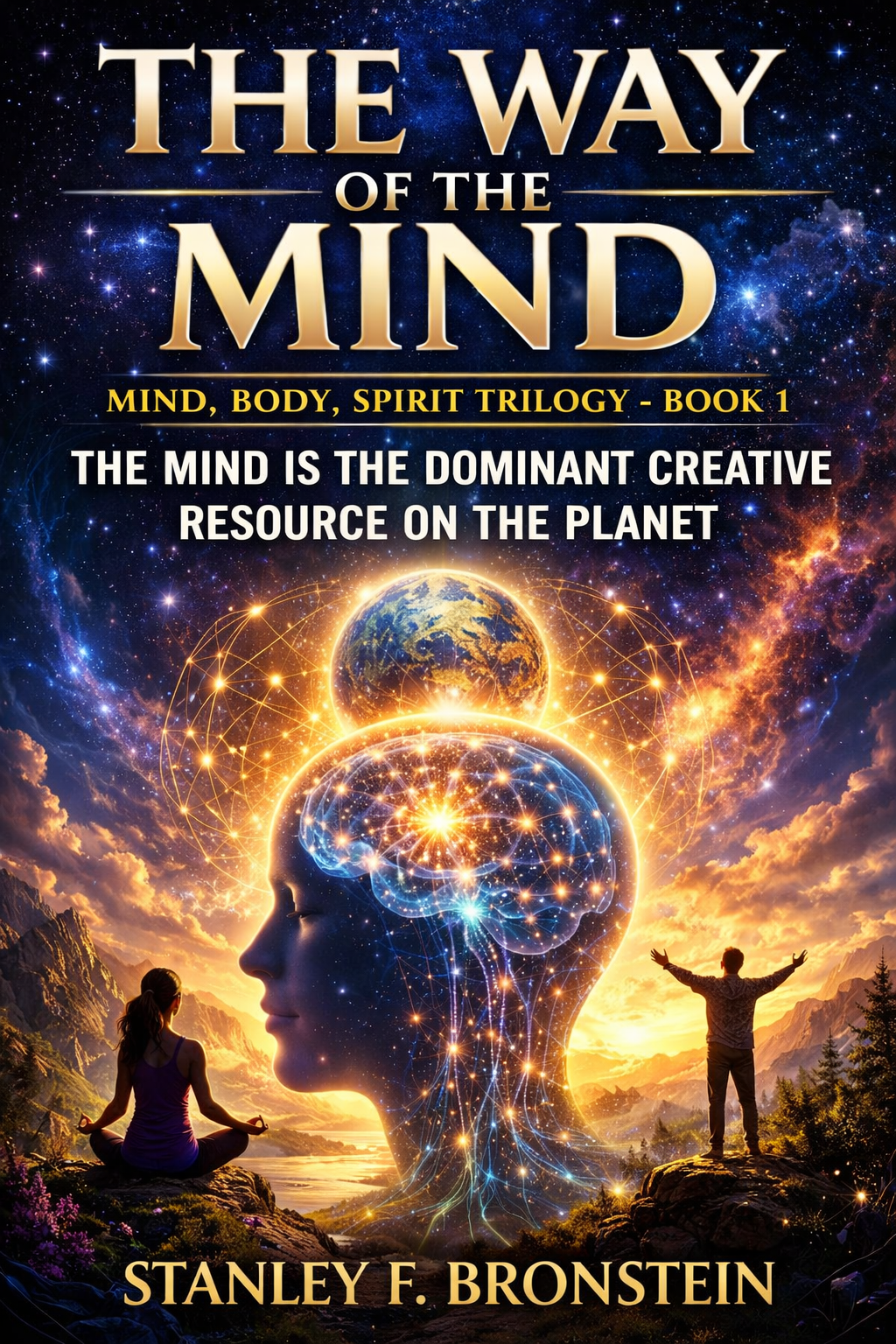
Mind, Body, Spirit Trilogy – Book 1
The Mind Is The Dominant
Creative Resource On The Planet
By Stanley F. Bronstein – Creator of The Way of Excellence System
Click The Tabs Below To Read Each Chapter Of The Book Online
Or
📘 Download Your Free Copy In Your Preferred Format
The Way of The Mind
by Stanley F. Bronstein
How to use this page:
Click a chapter title to open it then scroll down to read.
When you click the title of the next chapter, the previous one will close.
Take your time.
Read, reflect, and do the experiments and assignments before you move on.
EMPTY ITEM
Foreword - Why the Mind Matters
The life a person lives is shaped not only by what happens to them, but by how they think about what happens, what meaning they assign to it, what they focus on, what they believe, what they repeat to themselves, and what they choose to do next.
That is why the mind matters so much.
The mind is not merely a place where thoughts appear and disappear. It is not just a storage unit for memory, a filing cabinet for facts, or a passive screen upon which life is projected. The mind is active. It is interpretive. It is generative. It helps create mood, shape character, direct behavior, filter reality, and influence the future. It is involved in nearly everything a person becomes.
Yet many people move through life without ever being taught how to understand their own mind, much less how to govern it.
They are taught subjects. They are taught skills. They are taught facts. But they are rarely taught how their inner life is being shaped from day to day. They are rarely taught that attention is a form of power. They are rarely taught that belief can become architecture. They are rarely taught that repeated thoughts become patterns, repeated patterns become tendencies, repeated tendencies become habits, and repeated habits help shape destiny. They are rarely taught that the quality of what they allow into the mind influences the quality of what the mind is able to produce.
So they drift.
They absorb without examining. They react without pausing. They accept internal narratives without questioning them. They give their attention away carelessly. They allow noise to masquerade as substance. They confuse stimulation with direction. They feed the mind whatever is nearest, loudest, easiest, or most convenient, then wonder why clarity feels so rare, peace so fragile, and discipline so difficult.
This book was written to interrupt that drift.
The Way of Excellence (TWOE) teaches that excellence is not a fixed point one reaches and then keeps forever. Excellence is not something a person achieves once and then stores on a shelf as proof that the work is finished. Excellence is a way of living. It is an ongoing process. It is a continuous unfolding of potential through repeated right thought, repeated right action, and repeated return to what matters most.
That unfolding must be grounded somewhere.
It must be grounded in structure, in awareness, in honesty, in discipline, and in direction. It must be grounded in a person who is willing to look inward, tell the truth, and assume responsibility for the quality of their inner life. It must be grounded in a mind that is not allowed to run wild, collapse into confusion, or live permanently under the influence of whatever happens to be loudest in the moment.
That is where this book begins.
The Way of the Mind is not a book about perfection. It is not a book about pretending to be calm, wise, or above struggle. It is not a book about denying reality, ignoring pain, or speaking in vague slogans about positivity. It is a book about stewardship. It is a book about responsibility. It is a book about learning how the mind works, how it is shaped, how it can be strengthened, and how it can be directed toward a life of greater clarity, integrity, resilience, and purpose.
Stewardship is one of the central ideas of this book because the mind is not merely something a person has. It is something a person must care for.
A neglected mind does not remain neutral. It fills with whatever enters unchallenged. It repeats what it is fed. It adapts to the quality of its environment. It becomes shaped by the company a person keeps, the media they consume, the words they repeatedly hear, the words they repeatedly speak to themselves, and the stories they continue to believe. Over time, that shaping becomes visible in mood, behavior, standards, relationships, and direction.
A disciplined mind is different.
A disciplined mind does not accept every thought as truth. It does not grant every outside voice equal authority. It does not treat every emotional reaction as wisdom. It does not confuse familiarity with correctness. It does not surrender the governance of the day to random inputs, scattered focus, or outdated narratives. It learns to pause. It learns to notice. It learns to question. It learns to choose. It learns to return to principle. It learns to direct itself.
That does not happen by accident.
It happens through attention. It happens through repeated practice. It happens when a person begins to understand that the mind is always creating something, even when they are not creating consciously. It happens when a person stops living as a passive consumer of mental content and becomes an active gatekeeper of what is allowed to remain, repeat, and rule.
This matters because the mind touches everything.
The way a person sees their past affects what they believe is possible in the present. The way they interpret setbacks affects whether they continue or quit. The way they speak to themselves affects whether they become stronger or smaller under pressure. The way they focus affects what grows. The way they think about responsibility affects how much power they are willing to claim. The way they understand themselves affects the quality of every choice that follows.
Even more than that, the mind influences not only how a person feels, but how they function. It affects the quality of their relationships, the steadiness of their emotions, the consistency of their actions, the sharpness of their decisions, and the nature of their contribution to others. A disordered mind spills disorder into life. A directed mind gives direction to life.
This book is designed to help the reader move from confusion toward clarity, from reactivity toward responsibility, from drift toward direction, and from passive mental habit toward active mental stewardship.
It begins with architecture because before something can be governed well, it must be understood well. A person must understand the stories they live inside, the filters through which they perceive, the primitive impulses that tug at them, and the inputs that quietly shape their thought life.
It then moves into governance because understanding alone is not enough. A person must learn to direct attention, examine belief, strengthen inner language, cultivate silence, and build mental integrity.
From there it moves into direction because a well-governed mind still needs somewhere to go. It needs awareness, responsibility, mission, and practical movement. It needs to know what it is serving.
Finally, it moves into mastery, not in the sense of final arrival, but in the sense of deeper application. It explores how the mind creates reality, how it remains steady under stress, how it can observe itself, and how it is nourished not only by the body, but by the spirit as well.
That final point matters deeply.
The mind does not live in isolation. It is affected by the body and the spirit, just as it affects them. A person cannot abuse the body and expect the mind to remain clear forever. A person cannot neglect meaning, purpose, conscience, gratitude, or inner peace and expect the mind to remain strong forever. The mind is powerful, but it is not independent of the larger whole. It functions best when the whole person is being cared for with honesty and intention.
Still, the mind remains central because it is the place where so much of life is interpreted, directed, and decided.
If the mind is ruled by fear, life contracts.
If the mind is ruled by resentment, life corrodes.
If the mind is ruled by noise, life fragments.
If the mind is ruled by old stories, life repeats itself.
But if the mind is trained in awareness, strengthened by truth, directed by purpose, and steadied by discipline, life changes.
Not all at once.
Not magically.
Not without effort.
But genuinely.
The changes may begin quietly. A person notices one thought before obeying it. They question one assumption that had long gone unchallenged. They refuse one old story that no longer deserves loyalty. They protect one portion of attention that would once have been wasted. They choose one stronger response where they would once have reacted automatically. They take one meaningful step in the direction of what matters most.
Then another.
Then another.
That is how a mind is strengthened.
That is how a life is redirected.
That is how excellence begins to move from an idea to a way of living.
If this book does its job well, it will help the reader see that the mind is not an enemy to be feared, nor a mystery to be endured, nor a machine to be admired from a distance. It is a force to be understood, a responsibility to be accepted, and a power to be directed.
The work is ongoing. The process is living. The growth is never fully finished.
That is not a flaw in the process. That is the process.
You are not a finished product. You are not required to remain who you were. You are not trapped inside every thought you think, every feeling you feel, or every story you once believed. You are still being shaped, and you are still shaping. You are always, in some sense, both being and becoming.
That is why the mind matters.
Because the quality of your mind helps shape the quality of your life.
And because when the mind becomes clearer, steadier, truer, and better directed, the person living within it can do the same.
INTRODUCTION TO PART I - THE ARCHITECTURE OF THE MIND
Before a person can direct the mind well, they must first understand what they are working with.
Most people spend years trying to change results without first studying the inner machinery that helped create those results. They try to improve behavior without understanding the thoughts beneath it. They try to strengthen discipline without examining the stories that weaken it. They try to create a different future while still looking at life through the same old filters that shaped the past.
That approach rarely works for long.
A person cannot reliably govern what they do not understand. They cannot consistently correct what they have never clearly examined. They cannot build excellence on top of confusion and expect the structure to hold.
That is why this first part matters so much.
Part I is about architecture. It is about the inner framework of the mind – the structure beneath thought, perception, reaction, and interpretation. It is about the unseen patterns that quietly influence how a person experiences life before they ever make a conscious decision about what to do next.
The mind is not random. It has tendencies. It has habits. It has favored pathways. It creates narratives. It filters information. It reacts to threat. It seeks familiarity. It absorbs influence. It organizes meaning. It makes assumptions. It fills gaps. It repeats what it has rehearsed. It protects what it thinks is necessary, even when what it is protecting is no longer useful.
All of that happens long before many people realize it is happening.
That is one of the reasons life can feel confusing. A person may think they are simply responding to reality, when in fact they are responding to a version of reality already filtered through memory, fear, conditioning, desire, environment, and old conclusions. They may think they are making an objective decision, when in fact they are obeying a story that has been living inside them for years. They may think they are seeing clearly, when in fact they are seeing through a lens they never chose consciously and have never taken the time to examine.
This part of the book slows that process down.
It invites the reader to stop assuming that everything happening in the mind is accurate, useful, current, or worthy of trust. It asks the reader to look beneath thoughts and reactions and begin studying the architecture beneath them. Not with shame. Not with fear. Not with harshness. But with honesty, curiosity, and responsibility.
That matters because real change begins long before outward action.
It begins with seeing.
A person begins to change when they notice the stories they have been telling themselves. They begin to change when they recognize the filters that have been shaping what they see. They begin to change when they identify the old fears that still influence present choices. They begin to change when they finally admit that what enters the mind does not simply pass through harmlessly. It leaves impressions. It forms tendencies. It shapes the quality of future thought.
This is why stewardship is so important.
If the mind is a generative engine, then what enters that engine matters. If the mind is always constructing some version of reality, then the materials it is using matter. If the mind is helping shape mood, behavior, identity, and direction, then it cannot be treated carelessly.
Stewardship begins with understanding the structure.
In the chapters ahead, we will examine the mind as a generative engine, explore the stories that live inside a person, study the filters through which experience is interpreted, distinguish between primitive and executive patterns of thought, and confront the powerful role of inputs in shaping mental life.
These are not minor topics. They are foundational ones.
If a person misunderstands the structure of the mind, they will often misdiagnose their own struggles. They may think they lack strength when the real issue is confusion. They may think they need more motivation when the real issue is poor mental input. They may think they are facing reality clearly when they are really living inside an inherited narrative that no longer deserves authority. They may think the problem is entirely outside them when much of the difficulty is taking shape inside their own mental framework.
That does not mean outside circumstances do not matter. They do. It does mean, however, that a person’s inner architecture plays a profound role in how those circumstances are experienced, interpreted, and answered.
The good news is that what can be examined can be changed.
Not instantly. Not effortlessly. But deliberately.
The purpose of this first part is not merely to hand the reader information. The purpose is to help the reader see the mind with new honesty. To begin recognizing where the structure is strong, where it is weak, where it is clear, where it is distorted, and where it may need renovation. That kind of seeing is not the end of the work, but it is the beginning of responsible work.
Excellence begins there.
Not in pretending.
Not in forcing.
Not in reciting slogans while ignoring structure.
It begins when a person becomes willing to understand the inner framework that is shaping daily life. It begins when they stop treating the mind as a mystery and start treating it as something that can be studied, strengthened, and directed. It begins when they become honest enough to admit that some of what they have been calling reality may actually be interpretation, some of what they have been calling instinct may actually be conditioning, and some of what they have been calling identity may actually be repetition.
That kind of honesty is not weakness. It is strength.
It is the strength to look within without flinching.
It is the strength to examine what has been operating beneath the surface.
It is the strength to stop drifting through one’s own mind and begin learning how it actually works.
That is the work of Part I.
We begin with architecture because architecture determines what a structure can hold.
If the architecture is weak, pressure exposes it.
If the architecture is distorted, everything built on top of it begins to lean.
If the architecture is sound, growth becomes possible.
So before we speak about governing the mind, directing the mind, or mastering the mind, we must first understand the architecture of the mind.
That is where all meaningful stewardship begins.
Chapter 1 - The Mind as a Generative Engine
Most people think of the mind as a container.
They think of it as a place where information is stored, memories are kept, and thoughts come and go. They think of it as something like a file cabinet, a warehouse, or a screen. In that view, the mind is important, but mostly passive. It receives. It remembers. It reacts.
That view is incomplete.
The mind does not merely store information. It does something with that information. It arranges it, interprets it, emphasizes some parts of it, ignores other parts, and then uses it to help create mood, perspective, behavior, identity, and direction. The mind is not just a container. It is a generative engine.
That distinction matters.
A container holds. An engine produces.
A container can remain neutral. An engine cannot. It is always generating something. It is producing a response, shaping a perception, reinforcing a tendency, or strengthening a pattern. Even when a person feels stuck, the mind is still at work. Even when a person is drifting, the mind is still producing. Even when a person believes they are doing nothing, the mind is still building something.
That is why the mind matters so much.
It is involved in nearly every area of life.
It helps shape what a person notices. It influences how they interpret events. It affects how they speak to themselves, what they expect, what they fear, what they pursue, what they avoid, and how they recover after difficulty. It helps create the quality of their focus, the quality of their emotional life, the quality of their discipline, and the quality of their future decisions.
The mind is not the whole person. But it is one of the most powerful forces operating within the person.
That power can help build a better life.
It can also quietly undermine one.
The difference often comes down to stewardship.
The Mind Is Always Producing
A person does not have to intend to shape their mind in order for their mind to be shaped.
That shaping happens anyway.
Every repeated thought leaves some trace. Every repeated emotional pattern strengthens some pathway. Every repeated interpretation becomes a little easier to reach the next time. Every repeated self-description begins to feel more familiar, and familiarity often disguises itself as truth.
This is one of the great dangers of an undirected mind.
An undirected mind does not stop generating. It simply generates by default. It builds from whatever is repeatedly fed into it. It uses whatever material is most available. It absorbs tone from the environment, language from the people nearby, assumptions from earlier experiences, and identity from repeated internal dialogue. Then it begins producing outputs from those materials.
That process is happening whether a person is paying attention to it or not.
If a person repeatedly feeds the mind fear, outrage, confusion, distraction, and self-doubt, the mind will work with those materials. It will become more practiced at producing anxiety, irritability, impatience, fragmentation, and limitation.
If a person repeatedly feeds the mind clarity, discipline, gratitude, purpose, reflection, and truth, the mind will work with those materials as well. It will become more practiced at producing steadiness, focus, perspective, resilience, and direction.
The mind takes what enters and does something with it.
It does not simply record. It transforms.
That is why cleaner inputs lead to cleaner outputs.
The mind is generative by nature. The question is not whether it will generate, but what it will generate from.
The Difference Between Storage and Construction
Information alone does not determine a life.
Many people know things they do not do. Many people can explain principles they do not embody. Many people can repeat useful ideas they have never truly integrated. This happens because the mind does not merely store facts. It converts stored material into lived structure only when those facts become part of belief, perception, habit, attention, and action.
A person can know that gratitude is good and still live in complaint.
A person can know that discipline matters and still live in inconsistency.
A person can know that their past does not define them and still let old stories control present choices.
What is missing in those moments is not information. It is construction.
The mind has not yet taken the idea deeply enough into itself to make it part of how the person actually lives.
That is why growth is not merely the accumulation of knowledge. It is also the formation of inner structure.
A stronger mind is not simply a mind with more information in it. It is a mind with better-ordered information, more honest interpretations, more disciplined attention, more constructive beliefs, and more useful internal habits.
In other words, it is a mind that has learned to generate differently.
Mood, Meaning, and Mental Production
Many people assume their mood is simply the result of what happens around them.
Sometimes outside conditions do matter greatly. Pain is real. Loss is real. Disappointment is real. Stress is real. But even when those things are real, the mind remains an active participant in what follows. It is still assigning meaning. It is still selecting what to emphasize. It is still deciding what to rehearse and what to release.
That does not mean a person can instantly think their way out of every painful experience.
It does mean that the mind is not just receiving experience. It is helping shape the experience of experience.
A person loses an opportunity. The mind says, “This proves I am not good enough.”
Another person loses an opportunity. The mind says, “This hurts, but I can learn from it.”
The event may be the same. The meaning is not.
A person faces criticism. The mind says, “I am being exposed.”
Another person faces criticism. The mind says, “I need to separate what is useful from what is noise.”
Again, the event may be similar. The inner production is not.
The mind is helping create the emotional atmosphere in which a person lives.
That does not give a person total control over feeling. But it does give a person meaningful influence over the patterns that shape feeling over time.
The mind is always taking raw material and turning it into meaning. That meaning then affects mood, energy, reaction, and next action.
This is one reason why the mind must be treated seriously.
It is not a trivial force. It is not background. It is not something that can be neglected indefinitely without consequences.
The Responsibility of Stewardship
When people hear the word stewardship, they often think about money, land, property, or time. But one of the most important things a person will ever steward is their mind.
Stewardship means care joined with responsibility.
It means recognizing that something valuable has been placed in one’s care and that neglect is not a neutral act. It means accepting that what is not guarded may be invaded, what is not directed may drift, and what is not maintained may weaken.
The mind requires this kind of stewardship.
It must be guarded from needless mental pollution.
It must be protected from repeated useless inputs.
It must be directed away from paths that lead to fragmentation, bitterness, chaos, and confusion.
It must be strengthened through better thought, better focus, better language, better habits, and better environments.
It must also be given truth, stillness, challenge, and purpose.
A person who does not steward the mind well often becomes vulnerable to outside forces that are more than willing to do the shaping for them.
The loudest voice gets in.
The nearest distraction gets in.
The strongest mood gets in.
The oldest wound gets in.
The most repeated fear gets in.
The most familiar excuse gets in.
Then, over time, those things begin to feel like identity.
This is one of the most dangerous things that can happen in a life. A person begins to confuse what has been repeated with what is true. They begin to confuse what is familiar with what is right. They begin to confuse what has shaped them with what must define them.
Stewardship interrupts that confusion.
It says: this mind matters too much to be left unguarded.
From Passive Consumer to Active Gatekeeper
A passive consumer takes in whatever arrives.
An active gatekeeper evaluates what is entering.
That is one of the most important shifts a person can make in life.
Many people live as passive consumers of mental content. They do not think carefully about what they are reading, listening to, watching, rehearsing, tolerating, or repeating. They let almost anything in, then wonder why the mind feels crowded, tired, noisy, reactive, or weak.
But the mind is too important for that kind of carelessness.
A gatekeeper asks questions.
Does this belong here?
Will this strengthen me or weaken me?
Will this clarify my thinking or cloud it?
Will this help build the kind of life I am trying to live?
Does this support peace, truth, discipline, and purpose, or does it feed confusion, distraction, agitation, and drift?
Those questions matter because the mind does not work with nothing. It works with what it is given.
To become a gatekeeper is not to become rigid, fearful, or closed. It is to become responsible. It is to stop acting as though every input deserves equal access. It is to recognize that what enters the mind may eventually influence what the mind produces.
That includes more than obvious things like books, media, and conversation.
It also includes pace.
It includes environment.
It includes unresolved resentment.
It includes self-talk.
It includes what a person keeps rehearsing when nobody else is around.
It includes the small repeated phrases that become internal architecture over time.
A gatekeeper begins to understand this. They begin to realize that mental life is shaped not only by dramatic events, but also by repeated small permissions.
The Mind and Identity
Because the mind is a generative engine, it does not just produce thoughts. It also helps produce identity.
A person becomes, in part, what they repeatedly think, rehearse, reinforce, and obey.
This does not mean a single thought defines a person. It does not mean a passing emotion tells the whole truth about who they are. It does mean that repeated inner patterns become increasingly influential. Over time, a person often becomes loyal to the mind they have practiced.
If they practice fear, fear becomes easier.
If they practice resentment, resentment becomes easier.
If they practice scattered attention, scattered attention becomes easier.
If they practice gratitude, gratitude becomes easier.
If they practice clear response, clear response becomes easier.
If they practice telling themselves the truth, truth becomes easier to live inside.
The mind learns by repetition.
Identity is shaped by repetition too.
This is one reason why internal language matters so much. A person who repeatedly tells themselves, “I can’t handle this,” is feeding a particular identity. A person who repeatedly tells themselves, “One step at a time,” is feeding a different one.
A person who constantly rehearses powerlessness begins to feel powerless.
A person who rehearses responsibility begins to become more responsible.
A person who rehearses possibility begins to widen their field of action.
The mind takes repeated language and begins to build self-concept around it.
That is why this book places such importance on the words a person says to themselves every day. Those words do not merely describe identity. Over time, they help construct it.
The Mind and the Future
The future does not arise out of nowhere.
It grows, in large part, from the patterns a person is building now.
A person’s future is affected by present attention, present beliefs, present disciplines, present interpretations, present habits, and present choices. The mind is involved in all of those things. It helps create what a person notices now, what they practice now, and what they are becoming now.
That means the mind is not only producing present mood and present thought. It is also helping produce future life.
This is why people sometimes feel trapped when, in truth, they are often embedded in a pattern.
Patterns can feel like fate when they have been repeated long enough.
A person says, “This is just how I am.”
But often what they are really describing is what they have practiced.
A person says, “This is just how my life goes.”
But often what they are really describing is what their repeated mental and behavioral patterns have been helping create.
This should not be heard as blame. It should be heard as possibility.
If the mind helps shape the future, then mental stewardship matters even more than many people realize. It means a person is not merely enduring life. They are participating in its construction.
Sometimes that participation is conscious.
Sometimes it is unconscious.
Either way, it is happening.
That is why awareness matters.
That is why belief matters.
That is why focus matters.
That is why internal language matters.
That is why this book begins here.
Excellence and the Mind
The Way of Excellence (TWOE) teaches that excellence is a way of living, not a prize a person wins once and then permanently possesses.
That is especially true of the mind.
A person does not organize the mind once and then never need to revisit it.
A person does not learn one useful idea and then permanently escape confusion.
A person does not establish one good habit and then become immune to drift.
Mental excellence is a living practice.
It requires ongoing stewardship.
It requires repeated returns to truth.
It requires repeated examination of what is entering, what is growing, and what is being reinforced.
It requires attention to inputs.
It requires discipline in focus.
It requires honesty in self-talk.
It requires courage to challenge old stories.
It requires willingness to keep becoming.
That is what makes the mind so important and so demanding at the same time. It is never fully finished. It must be tended.
This is not a weakness in the process.
It is the process.
A garden that is not tended does not remain neutral. It overgrows.
A home that is not maintained does not remain neutral. It decays.
A mind that is not stewarded does not remain neutral. It drifts toward whatever is repeatedly allowed to shape it.
Excellence requires something different.
It requires attention.
It requires intention.
It requires the willingness to become a better steward of one’s own inner life.
The Work Begins Here
This chapter has one main purpose: to change how the reader thinks about the mind.
Not as a container.
Not as a passive recorder.
Not as a mystery to be feared.
But as a generative engine whose condition matters.
The mind is producing something right now.
It is producing patterns, meanings, reactions, expectations, assumptions, habits, and identity.
It is helping shape what kind of person a person becomes under pressure, in solitude, in difficulty, in discipline, in love, in disappointment, and in service.
That is why the mind matters.
And that is why it must be stewarded.
If a person learns nothing else from this chapter, they should learn this: what enters the mind matters because the mind does something with what it receives.
It builds from it.
It speaks from it.
It reacts from it.
It lives from it.
That is why stewardship is not optional for anyone who wants to live deliberately.
The mind will generate.
The only question is whether it will generate by drift or by design.
Assignment
Step 1
Write down your current understanding of the mind in one paragraph.
Do not worry about making it elegant. Just be honest. Describe how you have tended to think about your mind up to this point. Have you seen it mostly as a place where thoughts happen, or as a force that helps shape your life?
Step 2
Make two lists.
In the first list, write down five things you regularly allow into your mind.
These may include media, conversations, environments, forms of self-talk, routines, or repeated emotional patterns.
In the second list, write down what those things tend to produce in you.
Do they strengthen clarity, peace, discipline, gratitude, and focus? Or do they produce confusion, agitation, distraction, doubt, and drift?
Step 3
Identify one area where you have been living more like a passive consumer than an active gatekeeper.
Be specific. Name the stream of input. Name the cost. Name what it has been producing.
Step 4
Choose one small gatekeeping action to take immediately.
It might be changing the first thing you read in the morning, reducing one repeated mental pollutant, replacing one piece of negative self-talk, cleaning one physical space, or limiting one source of noise.
Keep it simple, concrete, and doable.
Step 5
Complete this sentence in writing:
“The mind is a generative engine, which means if I want better outputs in my life, I must become more deliberate about __________________________.”
Write your answer slowly. Then read it aloud.
That sentence is not merely an observation. It is a beginning.
Chapter 2 - The Stories That Live Inside You
Human beings are meaning-making creatures.
When something happens, the mind does not merely record the event and move on. It tries to explain it. It arranges details into a pattern. It connects one moment to another. It creates a story.
That process begins early and often happens automatically.
A child feels left out and the mind begins forming a story about belonging.
A student struggles with a task and the mind begins forming a story about intelligence.
A person is criticized and the mind begins forming a story about worth.
A dream is delayed and the mind begins forming a story about possibility.
Over time, these stories do not remain isolated observations. They begin to shape identity. They begin to influence behavior. They begin to determine what feels natural, what feels risky, what feels deserved, and what feels possible.
This is one of the great powers of the mind.
It is also one of its great dangers.
The stories that live inside a person can either strengthen them or confine them. They can clarify life or distort it. They can help a person interpret experience wisely, or they can keep that person loyal to conclusions that are no longer true, useful, or fair.
That is why these stories must be examined.
A person cannot build a clear mind on top of false internal narratives and expect that structure to hold.
The Mind Needs a Story
The mind does not like randomness for very long.
When events are confusing, painful, sudden, or incomplete, the mind starts trying to close the gap. It wants explanation. It wants coherence. It wants to know what happened, why it happened, and what it means.
So it begins building a story.
Sometimes those stories are reasonable and useful.
Sometimes they are incomplete.
Sometimes they are wildly inaccurate.
Yet once a story is formed and repeated often enough, it starts to feel less like a story and more like truth.
That is where the danger begins.
A person experiences repeated disappointment and the mind says, “Nothing ever works out for me.”
A person is rejected and the mind says, “I am not wanted.”
A person makes mistakes and the mind says, “I am the kind of person who always messes things up.”
A person is underestimated and the mind says, “No one sees my value.”
A person is overwhelmed and the mind says, “I can’t handle life.”
These are stories.
They may arise from real experiences. They may be fed by real pain. They may even contain some fragment of truth. But they are still stories. They are interpretations. They are conclusions. They are not automatically the whole truth.
The mind, however, often treats repeated interpretation as fact.
That is why so many people live inside a narrative they did not consciously choose.
Stories Become Structures
A story is not just a sentence in the mind. It is a structure.
Once a story is accepted, it begins influencing perception, attention, memory, emotion, and action.
A person who lives inside the story “I always get overlooked” begins noticing evidence that supports it. They may ignore or minimize evidence that challenges it. They may become more sensitive to exclusion, more doubtful in groups, more hesitant to speak, and more likely to interpret neutral situations negatively.
A person who lives inside the story “I am strong and I can adapt” begins noticing different evidence. They are not immune to difficulty, but they are more likely to interpret hardship as something that can be handled. They may still feel pain, fear, and uncertainty, but the structure they live inside gives them more room to act with steadiness.
Stories do not merely describe life. They help shape the life being lived.
This does not mean a person can invent any story and instantly make it real. It does mean that the story a person lives inside influences what they notice, what they attempt, how they recover, and what they keep reinforcing.
That influence is powerful.
A story repeated often enough becomes a lens.
A lens repeated often enough becomes a filter.
A filter repeated often enough becomes a way of life.
The Origin of Many Inner Stories
Many of the stories that live inside a person were formed during moments when they had limited power, limited perspective, or limited understanding.
That matters.
A child may experience criticism and conclude, “I am not good enough.”
A young person may feel different and conclude, “I do not belong.”
A person may go through loss and conclude, “Love always ends in pain.”
A person may be ignored and conclude, “My voice does not matter.”
A person may be betrayed and conclude, “Trust is dangerous.”
These conclusions may make emotional sense in the moment they are formed. They may even help the person survive the moment. But survival stories are not always life-giving stories. What protects a person in one season may confine them in another.
A story that once helped a person avoid pain may later prevent them from building intimacy.
A story that once helped a person stay cautious may later make courage difficult.
A story that once helped a person brace for disappointment may later make joy harder to receive.
This is why old stories must be revisited.
Not all of them are still telling the truth.
Not all of them ever were.
The Loyalty People Show to Old Narratives
People can become deeply loyal to stories that hurt them.
That loyalty is often invisible.
A person may say they want change, but still protect the story that keeps change difficult.
A person may say they want confidence, but still rehearse the narrative of inadequacy.
A person may say they want peace, but still feed a story built on grievance.
A person may say they want a new life, but still tell themselves an old version of who they are.
Why does this happen?
Because familiar stories, even painful ones, can feel safer than unknown possibilities.
A false story that has been lived in for years can begin to feel like home. It may be a cramped home. It may be a painful home. It may be a limiting home. But it is still familiar.
The unknown asks more of a person than the familiar. It requires courage. It requires loosened attachment. It requires a willingness to stop introducing oneself through old wounds.
That is not easy.
Some people would rather live inside a painful certainty than step into an uncertain freedom.
That is why change often begins with story work.
If a person keeps telling themselves the same old story, they will keep feeling pressure to remain the same old person.
The Story Is Not the Self
One of the most important truths in this chapter is simple:
The story is not the self.
A person may have lived inside a story for years and still not be defined by it.
A person may have rehearsed a narrative of weakness and still possess strength.
A person may have repeated a narrative of failure and still be capable of excellence.
A person may have carried a story of rejection and still be deeply worthy of love, connection, and belonging.
Stories can influence identity, but they are not identity itself.
That distinction matters because many people do not merely say, “I have been telling myself this story.” They say, “This is who I am.”
That move from story to identity is where much harm is done.
It takes an interpretation and turns it into a prison.
It takes a painful experience and turns it into a permanent definition.
It takes a moment, or a series of moments, and turns them into a false conclusion about the whole person.
That must be challenged.
A person is more than what happened to them.
A person is more than the worst thing someone said to them.
A person is more than the fears they learned early.
A person is more than the mistakes they made while still learning.
A person is more than the story they have been repeating.
This does not mean the story had no effect. It means the story does not deserve final authority.
Stories Shape What You Notice
Once the mind adopts a story, it begins scanning for supporting evidence.
This is one reason why stories become so persuasive. They are not just repeated internally. They are reinforced by selective attention.
A person with the story “People cannot be trusted” will notice betrayal quickly, sometimes even where there is only imperfection or misunderstanding.
A person with the story “I am always behind” will notice other people’s progress and may overlook their own.
A person with the story “I never do enough” will minimize effort and magnify unfinished tasks.
A person with the story “My opinion does not matter” may hesitate to speak, then interpret the silence of others as confirmation that their voice was never worth hearing.
This is not always conscious.
The story shapes the search.
The search shapes what is found.
What is found strengthens the story.
This creates a loop.
That loop is one of the reasons outdated narratives can survive long after reality has changed.
The person is not seeing all that is present. They are seeing what the story has trained them to notice.
That is why awareness matters so much.
A person must begin asking not only, “What am I seeing?” but also, “What story is teaching me how to see?”
Painful Stories Often Pretend to Be Protective
Not every limiting story looks negative at first glance.
Some appear wise.
Some appear realistic.
Some appear cautious, mature, or emotionally intelligent.
But beneath the surface, they may be fear wearing the clothing of wisdom.
A person says, “I do not expect much anymore.”
That may sound calm, but it may really be a story of disappointment trying to avoid further hurt.
A person says, “I keep my distance.”
That may sound strong, but it may really be a story of distrust trying to stay safe.
A person says, “I am just being realistic.”
That may sound grounded, but it may really be a story of self-protection trying to disguise resignation.
A person says, “I do not want to get my hopes up.”
That may sound sensible, but it may also reveal a narrative that has made hope feel dangerous.
Some stories are built not to help a person thrive, but to help them avoid pain. The problem is that avoiding pain is not the same thing as living well.
A story that protects a person from disappointment may also protect them from joy.
A story that protects a person from rejection may also protect them from connection.
A story that protects a person from embarrassment may also protect them from growth.
That is why stories must be judged not only by whether they feel safe, but by whether they tell the truth and support life.
Outdated Narratives and Current Reality
One of the clearest signs that a story needs examination is when it no longer fits current reality but still controls present behavior.
A person who is now capable may still be living inside a story of helplessness.
A person who is now respected may still be living inside a story of invisibility.
A person who has grown significantly may still be living inside a story of inadequacy.
A person who has survived many hard things may still be living inside a story of fragility.
This happens all the time.
Growth can occur in reality long before it is acknowledged in narrative.
A person’s life may have changed, but the mind may still be loyal to the old script.
That loyalty can create strange suffering.
A person may continue to brace for what is no longer happening.
They may continue apologizing for a version of themselves that no longer exists.
They may continue shrinking in rooms they have already outgrown.
They may continue asking permission from an old identity that has long since ceased to tell the truth.
This is why part of mental stewardship involves reviewing the stories that govern the mind.
Not all narratives deserve continued residence.
Some must be refined.
Some must be rewritten.
Some must be released altogether.
Rewriting Does Not Mean Denying
To rewrite a story is not to lie.
It is not to erase pain. It is not to pretend something never happened. It is not to whitewash difficulty or force a cheerful interpretation onto every wound.
It is to tell the truth more fully.
A person once rejected does not need to pretend rejection did not hurt. But they may need to stop turning rejection into a permanent statement about worth.
A person who made mistakes does not need to deny them. But they may need to stop using them as proof that growth is impossible.
A person who suffered loss does not need to speak as though loss is easy. But they may need to stop concluding that all future joy is therefore unsafe.
A rewritten story is not necessarily brighter. It is truer.
It may sound like this:
“I was hurt, but I am not only hurt.”
“I struggled, but I am not only struggle.”
“I failed, but I am not a permanent failure.”
“I was rejected, but I am not rejectable.”
“I have been afraid, but I am not made only of fear.”
“I am still becoming.”
That last statement matters greatly.
A person who is still becoming should not allow an old chapter to act as the title of the whole book.
The Story and the Future
Stories do not just shape how a person interprets the past. They also shape what future they are willing to pursue.
A person living inside the story “It is too late for me” will act differently than a person living inside the story “I still have time to grow.”
A person living inside the story “People like me never change” will make different decisions than a person living inside the story “Change is difficult, but possible.”
A person living inside the story “My role is to stay small” will not step into the same opportunities as a person living inside the story “I am allowed to develop.”
The future is often influenced long before it arrives.
It is influenced by the narrative already operating in the present.
That is why changing behavior without changing story often fails.
The old story pulls the person back.
A person may try a new habit, but the old narrative whispers, “This is not who you are.”
A person may try to speak with more confidence, but the old narrative says, “Do not get too visible.”
A person may try to accept something good, but the old narrative says, “This will not last.”
Until the story is examined, the future keeps getting negotiated by the past.
That is why this chapter belongs so early in the book.
Before a person can direct the mind well, they must begin identifying the narratives already living inside it.
Stories Can Be Chosen More Deliberately
Many people inherit stories unconsciously.
Few learn early that stories can also be chosen more deliberately.
This does not mean a person invents a fantasy and calls it truth. It means they learn to ask better questions about the narratives they carry.
Is this story accurate?
Is it current?
Is it fair?
Is it useful?
Is it life-giving?
Does it make me more honest, more responsible, more disciplined, more open to growth?
Or does it keep me trapped in fear, resentment, blame, resignation, or smallness?
Those questions matter because a story should not be trusted merely because it is familiar.
It should be examined.
A more deliberate story is often not grand. It is grounded.
It sounds less like performance and more like truth with direction.
It sounds like:
“I can learn.”
“I can recover.”
“I can respond differently.”
“My past influenced me, but it does not own me.”
“I am responsible for what I reinforce.”
“I do not need to keep living under the authority of every old conclusion.”
“I am not finished.”
Those are not empty slogans. They are narrative corrections. They make room for growth.
A strong mind is not a mind without stories. It is a mind that has learned to examine them, refine them, and stop surrendering to the ones that no longer deserve authority.
From Story to Stewardship
To steward the mind, a person must become more conscious of the stories shaping inner life.
That means listening more carefully.
It means noticing repeated phrases.
It means paying attention to what appears under pressure.
It means identifying the sentences that quietly explain the world from within.
It means hearing the difference between an honest observation and a hardened identity statement.
It means catching the moment when the mind says, “This always happens,” “I never do that well,” “People cannot be trusted,” “I do not belong here,” “I will probably mess this up,” or “It is just who I am.”
Those statements matter because they are rarely neutral. They are usually chapters from a larger story.
Once identified, they can be challenged.
Once challenged, they can be softened.
Once softened, they can be replaced by something truer.
This does not happen once. It happens repeatedly.
The stories that live inside a person are often persistent. Some have been rehearsed for years. Some were shaped in pain. Some were reinforced by others. Some were built slowly through repeated disappointment or repeated doubt.
That is why patience matters.
A person does not always rewrite a deep story in a day.
But they can begin.
They can notice.
They can stop feeding what no longer deserves authority.
They can begin telling the truth in a stronger voice.
They can remember that the story is not the self.
And they can choose, little by little, to live inside a narrative that is more honest, more current, more responsible, and more aligned with who they are becoming.
Assignment
Step 1
Write down three repeated stories that have been living inside you.
These may be stories about your worth, your ability, your past, your future, your relationships, your voice, your intelligence, your strength, your belonging, or your capacity to change.
Do not edit them for appearance. Write them honestly.
Step 2
For each story, answer these questions in writing:
Is this story fully true?
When did I begin believing it?
What experiences seem to have fed it?
How has this story shaped my choices, reactions, or expectations?
Step 3
Choose one story that no longer deserves authority in your life.
Write down the cost of continuing to live inside it.
Be specific. Name what it has stolen, limited, distorted, or delayed.
Step 4
Rewrite that story in a form that is more honest and more life-giving.
Do not write fantasy. Write truth with direction.
For example:
-
“I have struggled, but I am learning.”
-
“I have been hurt, but I am not destroyed.”
-
“I made mistakes, but I am still becoming.”
-
“My past influenced me, but it does not define me.”
Create one version that feels real enough to believe and strong enough to guide you.
Step 5
Read your rewritten story aloud once each day for the next seven days.
Pay attention to what resists it.
Pay attention to what within you argues against it.
That resistance is not proof the new story is false. It is often proof that the old one has been living there for a long time.
Keep going.
The stories that live inside you help shape the life that lives outside you.
Chapter 3 - The Filter of Perception
The Way of Excellence (TWOE) depends upon clear seeing.
That sounds simple, but it is not.
Most people assume they are seeing reality directly. They assume they are taking in facts, understanding them accurately, and responding accordingly. In truth, very few people experience life in such a clean and unfiltered way. What most people call reality is often reality as processed through memory, emotion, expectation, fear, identity, habit, and prior conclusion.
That is the filter of perception.
The filter of perception is the mental lens through which a person interprets what happens. It is not the event itself. It is the set of influences that shape how the event is understood. It is the hidden layer between life as it occurs and life as it is experienced.
That filter matters more than many people realize.
It influences what a person notices.
It influences what a person ignores.
It influences what feels threatening, what feels hopeful, what feels familiar, what feels offensive, and what feels possible.
It influences the stories people tell themselves and the choices they later make because of those stories.
A person may think they are reacting to reality, when in fact they are reacting to a filtered interpretation of reality.
That distinction is one of the great turning points in the development of the mind.
The moment a person realizes that perception is filtered, they gain the possibility of examining the filter.
And the moment they begin examining the filter, they begin reclaiming power.
Perception Is Not Neutral
Perception feels immediate, and because it feels immediate, it often feels objective.
A person walks into a room and instantly feels accepted, rejected, inspired, threatened, overlooked, welcomed, or judged. The feeling appears quickly, and because it appears quickly, it is easy to assume it is the natural result of what is happening.
Sometimes it is.
Often it is not entirely.
What is happening may be simple. The mind may be making it complicated.
A person receives short feedback from a colleague. One mind reads efficiency. Another reads disrespect.
A person is not called back quickly. One mind reads busyness. Another reads rejection.
A person is given a challenge. One mind reads opportunity. Another reads exposure.
The outer event may be similar, but the inner interpretation differs.
That difference is not random.
It is shaped by the filter.
Perception is not merely the act of seeing. It is the act of seeing through something.
That “something” is often composed of prior experience, emotional residue, identity, assumptions, and repetitive mental patterns.
This does not mean perception is false. It means perception is influenced.
That is an important difference.
A person does not need to become suspicious of every thought and every impression. But they do need to become humble enough to realize that what feels obvious may still be filtered.
Humility is important here.
Without humility, a person will assume their interpretation is reality itself.
With humility, a person begins asking better questions.
What else might be true here?
What am I bringing into this moment?
What part of my reaction belongs to the present, and what part belongs to something older?
Am I seeing what is happening, or am I seeing what I expect to happen?
Those questions do not weaken perception. They refine it.
The Filter Is Built Over Time
The filter of perception is not created in a single day.
It is built slowly.
It is shaped by family environment, emotional memory, repeated messages, social conditioning, disappointments, achievements, culture, fear, trauma, habit, and identity. It is also shaped by what a person repeatedly allows into the mind over time.
The filter begins forming early.
A child who grows up in criticism may begin scanning for disapproval.
A child who grows up in instability may begin scanning for danger.
A child who grows up unseen may begin scanning for exclusion.
A child who grows up in encouragement may begin scanning for possibility.
None of this is absolute. People are not machines, and no past determines the future completely. But early experiences often teach the mind what to look for, what to expect, and what to guard against.
Then those expectations become reinforced.
A person who expects criticism notices criticism quickly.
A person who expects disappointment notices signs of disappointment quickly.
A person who expects opportunity notices openings more quickly than obstacles.
The filter becomes a teacher.
It tells the mind what matters.
It tells the mind what is likely.
It tells the mind what kind of world this is and what kind of person the individual believes they are inside that world.
That is why the filter must be examined.
If it remains unconscious, it continues shaping reality from behind the scenes.
History Colors the Present
One of the strongest influences on perception is history.
The past does not merely live behind a person. It often reaches forward.
An old wound can shape present interpretation.
An old embarrassment can shape present hesitation.
An old betrayal can shape present trust.
An old failure can shape present expectation.
A person may say, “This situation feels dangerous.”
Sometimes it is dangerous.
Sometimes it only resembles something that was dangerous once before.
That is the power of history inside perception.
The mind often does not distinguish carefully between what is happening now and what feels familiar from before. It notices similarity and reacts. That reaction may be fast, emotional, and intense. It may feel completely justified in the moment. Yet the strength of the reaction may have less to do with the present event than with the accumulated weight of the past attached to it.
This is one reason people can overreact to small things.
The small thing is not really small to the mind. It has been connected to a larger pattern. It has been linked to older pain, older fear, or older meanings. What appears to be a response to this moment may actually be a response to many moments layered together.
That does not make the reaction foolish. It makes it important to understand.
A person who wants a stronger mind must learn to ask:
Is this reaction about this moment only?
Or is this moment touching something older in me?
That question opens the door to clarity.
Without it, the past keeps pretending to be the present.
Environment Trains the Eye
Environment is not background. It is influence.
The spaces a person lives in, works in, rests in, and moves through each day quietly shape mental life. A chaotic environment can teach the mind to feel scattered. A noisy environment can teach the mind to remain restless. A harsh environment can teach the mind to stay guarded. A calm and intentional environment can support order, presence, and steadiness.
This matters because perception is affected by atmosphere.
A cluttered room does not merely sit there. It communicates.
It tells the mind there is unfinished business.
It tells the mind there is excess.
It tells the mind there is disorder.
The same is true of emotional environment.
If a person spends significant time around cynicism, complaint, volatility, superficiality, gossip, or constant negativity, those tones begin to shape what feels normal. The mind starts adjusting to them. It may become more defensive, more reactive, more suspicious, or more drained without fully realizing why.
If a person spends time around discipline, gratitude, honesty, calm, excellence, and purpose, those tones shape perception as well. The mind begins adjusting upward. It may become more orderly, more hopeful, more demanding of itself, and more willing to see possibility.
Environment does not control perception completely.
But it influences it constantly.
That is why mental stewardship includes environmental stewardship.
A person cannot fill life with disorder and expect the mind to remain unaffected.
A person cannot repeatedly place the mind in shallow or corrosive environments and expect deep or steady perception to emerge naturally.
What surrounds a person begins instructing them.
The environment trains the eye.
Identity and Perception
People often see not only what they expect from the world, but also what fits the identity they carry.
A person who sees themselves as invisible may notice every slight more quickly than every welcome.
A person who sees themselves as capable may notice challenge more quickly than threat.
A person who sees themselves as fragile may interpret stress as proof that they are breaking.
A person who sees themselves as resilient may interpret stress as something difficult but workable.
Identity does not simply shape confidence. It shapes interpretation.
The mind tends to protect a familiar identity, even when that identity is limiting.
That means perception can become loyal to an old self-concept.
If a person has spent years telling themselves that they are behind, weak, overlooked, unworthy, awkward, or late to everything, the filter may continue scanning for evidence that supports those labels. Not because the labels are true, but because the mind has practiced seeing through them.
This is one reason change feels strange at first.
A person may begin growing, but the old identity filter still interprets life through an earlier version of who they were. Success can feel unfamiliar. Peace can feel suspicious. Opportunity can feel threatening. Praise can feel undeserved. The mind is not always resisting growth because growth is wrong. Sometimes it is resisting growth because growth does not fit the old internal picture.
That is why the filter of perception must be challenged alongside the story of identity.
If a person changes habits without examining identity, the old filter may keep dragging new life back toward old meaning.
Emotion and the Distortion of Seeing
Emotion affects perception in powerful ways.
A person who is exhausted may see difficulty everywhere.
A person who is anxious may see threat everywhere.
A person who is angry may see insult everywhere.
A person who is ashamed may see judgment everywhere.
A person who is hopeful may see possibility where another sees only limitation.
Emotion is not the enemy. Emotion is information. But emotion is not always clear interpretation.
This matters because many people mistake intensity for accuracy.
They think, “Because I feel this strongly, it must be true.”
Not necessarily.
Strong feeling often means something important is happening inside. It does not automatically mean the current interpretation is correct.
A person can feel intensely rejected and still be misreading the situation.
A person can feel intensely hopeless and still be overlooking options.
A person can feel intensely threatened and still be reacting more to memory than to reality.
That is why emotional awareness must be paired with mental discipline.
A stronger mind learns to ask:
What am I feeling?
What is this feeling trying to tell me?
And what might this feeling be distorting?
Those questions do not dishonor emotion. They help keep emotion from becoming the only interpreter in the room.
Perception Creates Different Worlds
Two people can live in the same city, work in the same building, experience the same economy, hear the same words, and still inhabit very different mental worlds.
One sees possibility.
One sees futility.
One sees challenge.
One sees unfairness.
One sees feedback.
One sees insult.
One sees the next step.
One sees only the size of the mountain.
That difference is not because reality itself has split in two. It is because perception has.
The world a person lives in is shaped not only by circumstances, but by the meaning their mind attaches to those circumstances.
This is not an argument for denial.
It is an argument for responsibility.
A person is not responsible for inventing a fantasy world and pretending that everything is fine. They are responsible for examining how their perception is shaping their lived experience and whether that perception is helping them see clearly or live blindly.
This is where the idea of creating reality begins to enter in a practical way.
A person does not create every event that happens to them.
But a person does participate in shaping the world they experience by the way they see, interpret, reinforce, and respond.
Perception is one of the places where inner life begins influencing outer life.
That is why this chapter matters.
Awareness Is the Beginning of Freedom
A person cannot change a filter they do not know exists.
That is why awareness is so powerful.
The first step is not to fix everything.
The first step is to notice.
Notice what triggers a strong interpretation.
Notice where the mind makes quick assumptions.
Notice what kinds of situations pull a predictable emotional meaning out of you.
Notice which patterns feel automatic.
Notice what you tend to read into silence, criticism, delay, conflict, praise, uncertainty, and challenge.
Notice your defaults.
Do you tend to assume rejection?
Do you tend to assume criticism?
Do you tend to assume danger?
Do you tend to assume failure?
Do you tend to assume you are behind, misunderstood, or not enough?
Or do you tend to assume growth is possible, challenge can be met, and clarity can be found?
Awareness begins by noticing without defensiveness.
It says, “This is how I tend to see.”
That is not a confession of weakness. It is a beginning of strength.
What is noticed can be questioned.
What is questioned can be refined.
What is refined can become clearer.
Without awareness, a person lives inside the filter.
With awareness, a person begins examining the filter itself.
That is a major shift.
It is the shift from unconscious seeing to deliberate seeing.
The Difference Between Fact and Interpretation
One of the most useful disciplines in mental development is learning to distinguish fact from interpretation.
Facts matter.
Interpretations matter too.
But they are not the same thing.
A fact might be:
The message was brief.
The invitation did not come.
The plan changed.
The person did not smile.
The meeting ended quickly.
The project was criticized.
The interpretation might be:
They are upset with me.
I am being excluded.
I am not important.
I did something wrong.
This always happens.
I am failing.
Sometimes the interpretation is correct.
Sometimes it is not.
The point is not to eliminate interpretation. That is impossible. The point is to stop confusing interpretation with fact so quickly.
A disciplined mind learns to separate them.
Here is what happened.
Here is what I am making it mean.
That simple distinction can prevent a great deal of unnecessary suffering.
It can also create room for better judgment.
Many people are not reacting to what happened. They are reacting to what they decided it meant.
That decision often happens so quickly they never even notice it as a decision.
They experience it as reality.
This is why slowing down matters.
A slower mind often sees more clearly than a faster one.
Not because speed is always bad, but because speed can allow hidden interpretation to pass as obvious truth.
A Distorted Filter Produces Distorted Choices
Perception does not stop at seeing. It continues into choice.
A person who sees threat everywhere will choose differently than a person who sees challenge accurately.
A person who sees themself as weak will choose differently than a person who sees themself as growing.
A person who interprets every delay as defeat will act differently than a person who interprets delay as part of process.
This matters because distorted seeing leads to distorted living.
If the filter says, “You are always behind,” the person may rush badly or give up too early.
If the filter says, “People cannot be trusted,” the person may withhold closeness even where trust has been earned.
If the filter says, “You are not capable,” the person may not attempt what they could in fact learn.
In this way, perception becomes self-reinforcing.
The distorted filter leads to distorted choice.
The distorted choice leads to poorer results.
The poorer results then appear to confirm the original filter.
This is how people get trapped.
They do not merely live with a filter. They begin building a life that keeps validating it.
That is why perception is not a minor subject. It sits near the center of mental architecture.
Refining the Filter
The goal is not to become someone with no filter at all. That is impossible. The goal is to refine the filter so that it becomes less distorted, less reactive, less ruled by old pain, and more aligned with truth.
That refining process requires several things.
First, honesty.
A person must be willing to admit how they tend to see.
Second, humility.
A person must be willing to admit that their first interpretation is not always the fullest or best interpretation.
Third, reflection.
A person must create enough inner space to examine patterns rather than merely repeat them.
Fourth, courage.
A person must be willing to challenge long-held assumptions, even the ones that feel deeply personal.
Fifth, better input.
A stronger filter is built in part through cleaner inputs – better environments, better relationships, better ideas, better internal dialogue, and better daily practices.
Over time, the filter can change.
A person can become less suspicious and more discerning.
Less defensive and more steady.
Less chaotic and more clear.
Less ruled by projection and more anchored in truth.
That change will not happen through wishful thinking alone.
It happens through repeated examination and repeated correction.
Perception and Excellence
Excellence requires accurate seeing.
Not perfect seeing, but increasingly accurate seeing.
A person cannot pursue excellence while remaining permanently loyal to distorted perception. They cannot govern the mind well if they do not examine the lens through which the mind is interpreting life. They cannot build a strong life on top of a filter that keeps turning challenge into doom, feedback into condemnation, and old memory into present destiny.
This is one reason why mental stewardship matters so much.
A person must ask not only, “What am I thinking?” but also, “What is shaping how I see?”
That question belongs near the center of a disciplined life.
Because if a person does not examine the filter, the filter will continue shaping everything else.
It will shape the story.
It will shape the response.
It will shape the belief.
It will shape the choices.
It will shape the future.
But if the filter is refined, the whole system begins to improve.
The person begins seeing more clearly.
And clearer seeing leads to better judgment.
Better judgment leads to better action.
Better action leads to better results.
Better results strengthen better beliefs.
That is one of the upward spirals available to a person who becomes serious about the mind.
The Work of This Chapter
This chapter is not asking you to distrust yourself completely.
It is asking you to become more conscious.
It is asking you to stop assuming that your first interpretation is always final.
It is asking you to remember that what feels immediate may still be filtered, what feels obvious may still be shaped by history, and what feels true may still deserve examination.
That awareness is not weakness.
It is maturity.
A strong mind does not insist that every impression is perfect.
A strong mind learns to examine itself while still remaining capable of action.
That kind of mind sees more clearly because it is less trapped inside its own hidden assumptions.
And that is the beginning of wisdom.
Assignment
Step 1
Write down three situations from the past two weeks in which you had a strong reaction to something.
Choose ordinary situations if possible. A delayed response, a piece of feedback, a change in plans, a conversation, a silence, or a moment of tension.
Step 2
For each situation, separate the fact from the interpretation.
Write:
What happened.
What I made it mean.
Be honest and specific.
Step 3
Ask yourself what filter may have been active in each situation.
Was it fear?
Old rejection?
A need for approval?
Impatience?
Distrust?
Exhaustion?
A long-standing identity story?
Write down what may have been shaping the way you saw the event.
Step 4
Choose one recurring filter you want to begin refining.
Write a new guiding question to use when that filter appears.
Examples:
-
What else might be true here?
-
Am I responding to the present or to the past?
-
Is this fact, or is this my interpretation?
-
Does this perspective expand possibility or reduce it?
Choose the question that best interrupts your pattern.
Step 5
For the next seven days, pause once each day and ask:
What lens am I using right now?
Write down the answer in one sentence.
Do not try to fix everything immediately. Just practice noticing.
Clear seeing begins when the filter is no longer invisible.
Chapter 4 - The Two Minds Within
The Way of Excellence (TWOE) asks a great deal of a person.
It asks them to be honest when dishonesty would be easier. It asks them to remain disciplined when comfort would be easier. It asks them to move toward excellence instead of settling for drift, distraction, or avoidance. It asks them to think clearly, act deliberately, and live in a way that reflects higher standards.
Yet anyone who has ever tried to do that for more than a few days knows something important.
There is often a struggle inside.
Part of the person wants growth, clarity, discipline, and direction.
Another part wants ease, safety, relief, predictability, and escape from discomfort.
Part of the person wants the long-term reward.
Another part wants the short-term comfort.
Part wants truth.
Another wants protection.
Part wants purpose.
Another wants security.
This inner tension is not imaginary. It is one of the most important realities a person must understand if they want to master the mind. Much of what people describe as inconsistency, procrastination, overreaction, self-sabotage, indecision, or inner conflict is not simply laziness or lack of character. Often, it is the result of two different operating tendencies within the mind pulling in different directions.
For the sake of clarity, this chapter will describe those tendencies as the primitive mind and the executive mind.
These are not two separate brains. They are two different patterns of operation within the same person. One is focused mainly on survival, safety, certainty, comfort, and immediate relief. The other is capable of judgment, discipline, long-term thinking, principle, and chosen direction.
Both matter.
Both have a role.
But they do not lead equally well.
A strong life does not come from pretending the primitive mind does not exist. It comes from understanding it clearly enough that the executive mind can lead without being overruled by fear, impulse, or habit.
The Primitive Mind
The primitive mind is ancient in its priorities.
It is concerned first with survival. It wants to avoid pain, reduce uncertainty, seek familiarity, conserve energy, escape threat, and move toward what feels immediately rewarding. It is not primarily asking, “What is excellent?” It is asking, “What is safe?” It is not primarily asking, “What is right?” It is asking, “What reduces discomfort right now?”
This does not make it evil. It makes it primitive.
The primitive mind is useful.
It helps a person react quickly in danger. It helps them notice threat. It helps them move away from what may injure them. It helps them conserve energy when necessary. It helps them remember pain so they can avoid unnecessary repetition of harm.
These are not small things.
A person who had no primitive mind would not last long. They would fail to notice danger, fail to respect limits, and fail to respond quickly when speed mattered.
So the goal is not to destroy or shame this part of the mind.
The goal is to understand its tendencies and stop allowing those tendencies to dominate areas of life where they are no longer the best guide.
The primitive mind often speaks in very familiar language.
This is too much.
This is dangerous.
Stay where you are.
Do not risk embarrassment.
Do not risk rejection.
Do not try something unfamiliar.
Find relief now.
Get away from discomfort now.
Do not wait.
Do not stretch.
Do not endure.
Return to what is familiar.
There are times when this voice is wise.
There are many times when it is merely loud.
The primitive mind does not always distinguish carefully between discomfort and danger. It can treat challenge as threat. It can treat uncertainty as catastrophe. It can treat temporary stress as a reason to retreat from long-term growth. It can treat emotional exposure as if it were physical harm.
That confusion creates many problems.
A person may avoid a difficult but necessary conversation because the primitive mind interprets tension as danger.
A person may abandon a meaningful goal because the primitive mind experiences uncertainty as intolerable.
A person may cling to unhealthy habits because familiar dysfunction feels safer than unfamiliar growth.
A person may continue choosing immediate relief over long-term benefit because the primitive mind is deeply impressed by what can be felt right now.
This is why the primitive mind must be understood.
If it is not understood, it will often be obeyed.
The Executive Mind
The executive mind is different.
It is capable of stepping back, assessing reality more carefully, weighing consequences, comparing short-term comfort with long-term cost, and choosing based on principle rather than impulse. It can tolerate discomfort for the sake of something better. It can delay gratification. It can hold multiple factors in view at once. It can ask not only what feels good now, but what will matter later.
The executive mind is where discipline becomes possible.
It is where standards can be chosen rather than inherited.
It is where a person can say, “This is difficult, but still necessary.”
It is where a person can say, “I do not have to obey the first reaction I feel.”
It is where a person can choose to act in alignment with mission, values, and long-term direction.
This mind is capable of leadership.
It does not panic as quickly. It does not need every discomfort removed immediately. It does not assume that fear means stop. It does not treat every emotional signal as a final command. It can take in information, examine it, and choose.
That ability is priceless.
It is one of the great foundations of self-government.
When a person says:
-
I will think before I react.
-
I will tell the truth even when it is uncomfortable.
-
I will continue this work even though I do not feel like it.
-
I will not let fear make this decision for me.
-
I will choose what is right over what is easy.
They are operating from the executive mind.
That does not mean the primitive mind has gone silent. It usually has not. It means the executive mind is leading anyway.
This leadership is essential for excellence.
No one builds a disciplined, meaningful, or aligned life by following every impulse toward ease, safety, and relief. That path may feel attractive in the moment, but over time it produces drift, weakness, regret, confusion, and self-mistrust.
The executive mind is the part that can interrupt that pattern.
It can remember what matters.
It can protect the long-term from the demands of the immediate.
It can keep the person from trading a future they want for a momentary relief they will soon forget.
Why the Primitive Mind Often Wins
If the executive mind is so useful, why does the primitive mind so often take over?
There are several reasons.
First, the primitive mind is fast.
It reacts immediately. It does not wait for reflection. It sees something that feels threatening, uncomfortable, uncertain, or painful, and it pushes hard toward retreat, defense, escape, or relief. The executive mind often arrives later. It has to think. It has to assess. It has to gather itself.
Speed gives the primitive mind an early advantage.
Second, the primitive mind is emotional.
It comes with intensity. It often floods the person with urgency. That urgency makes its signals feel convincing. The message is not merely, “I would prefer to avoid this.” The message often feels more like, “You must avoid this now.”
Intensity can be persuasive even when it is not wise.
Third, the primitive mind is practiced.
Many people have spent years obeying it without realizing that is what they were doing. They have practiced seeking immediate relief, avoiding discomfort, backing away from uncertainty, numbing difficult emotions, and choosing what feels easiest in the short term. Repeated obedience strengthens the pattern.
What is practiced becomes easier.
Fourth, the executive mind is expensive.
It requires energy. It requires pause. It requires awareness. It requires the ability to tolerate some internal friction without surrendering to it. When a person is exhausted, overstimulated, depleted, unfocused, malnourished, sleep-deprived, emotionally flooded, or scattered, the executive mind often weakens. Under those conditions, the primitive mind becomes louder and more persuasive.
This helps explain why many bad decisions are not made in moments of high clarity, but in moments of fatigue, isolation, emotional flooding, or overstimulation.
Fifth, the primitive mind often disguises itself as wisdom.
It says:
Be realistic.
Protect yourself.
Do not get your hopes up.
Why take the risk?
What if this goes badly?
Stay where you are.
Be careful.
Sometimes caution is true wisdom.
Sometimes it is fear pretending to be wisdom.
The difference matters.
The Primitive Mind and Modern Life
The primitive mind developed for a world full of immediate physical threats, scarce resources, and urgent survival needs.
Modern life is different.
Many of the greatest dangers people now face are not tigers, storms, or sudden physical attacks. They are distraction, confusion, shallow living, emotional reactivity, chronic stress, bad habits, fractured attention, misdirected energy, and long-term self-neglect.
The primitive mind is not always well-suited for those threats.
It still pushes toward what feels good now.
It still seeks relief now.
It still treats uncertainty like danger.
It still prefers familiar discomfort over unfamiliar growth.
That creates strange distortions in modern life.
A person knows they should rest, but the primitive mind pushes them toward endless stimulation because silence feels uncomfortable.
A person knows they should speak honestly, but the primitive mind pushes them toward avoidance because tension feels dangerous.
A person knows they should nourish the body, but the primitive mind reaches for short-term comfort instead.
A person knows they should focus deeply, but the primitive mind chases novelty because novelty offers immediate reward.
A person knows they should continue the disciplined path, but the primitive mind whispers that today would be a fine day to stop.
This is why many people feel divided.
They do know what matters.
They do understand what is needed.
Yet another part of them keeps pushing in a different direction.
That does not mean they are broken.
It means the primitive mind is doing what it has always done, whether or not it is being wise in the current situation.
The problem is not that the primitive mind exists.
The problem is when it becomes the default leader in a world that demands higher judgment.
Comfort and Calling
One of the clearest ways to understand the difference between these two minds is through the tension between comfort and calling.
Comfort is not always wrong.
Rest matters. Safety matters. Recovery matters. Wise caution matters. The problem begins when comfort becomes the ruling standard. A person begins asking of every situation, every decision, every opportunity, and every demand:
Will this feel easy?
Will this protect me from discomfort?
Will this let me avoid uncertainty?
If comfort becomes the highest value, calling is usually sacrificed.
Calling asks different questions.
What matters here?
What is right here?
What am I being asked to become?
What standard do I want to live by?
What would integrity choose?
What would courage choose?
What does my mission require?
Those are executive-mind questions.
Comfort may still be considered, but it is not given final authority.
This matters because many people want the results of calling while continuing to live under the authority of comfort.
They want growth without stretch.
They want clarity without silence.
They want discipline without friction.
They want excellence without repeated right action.
They want a different future while continuing to obey the same immediate preferences.
That rarely works.
Calling often requires discomfort.
Truth can be uncomfortable.
Change can be uncomfortable.
Learning can be uncomfortable.
Honesty can be uncomfortable.
Silence can be uncomfortable.
Starting over can be uncomfortable.
Consistency can be uncomfortable.
The primitive mind often treats that discomfort as a reason to stop.
The executive mind learns to interpret it differently.
It learns to ask:
Is this actual danger?
Or is this simply the feeling of growth?
That question can change a life.
Fear, Safety, and Misinterpretation
Fear is one of the strongest languages of the primitive mind.
Fear is not always wrong. Sometimes fear alerts a person to genuine danger. But fear often overreaches. It can enlarge risk, reduce perspective, and make retreat look wiser than it really is.
The primitive mind tends to prefer the certainty of a known limitation over the uncertainty of a meaningful possibility.
That is why people often stay too long in jobs that no longer fit, relationships that no longer nourish, habits that no longer serve, and identities that no longer tell the truth. It is not always because they consciously want to remain there. It is often because the primitive mind prefers a familiar burden to an unfamiliar freedom.
Safety can be misunderstood in the same way.
The primitive mind often defines safety narrowly. It defines safety as:
What feels familiar.
What avoids exposure.
What avoids risk.
What avoids effort.
What avoids emotional vulnerability.
What avoids immediate discomfort.
But real safety is sometimes different.
Sometimes real safety comes from telling the truth before the lie grows larger.
Sometimes real safety comes from strengthening the body before illness takes hold.
Sometimes real safety comes from building skill before crisis arrives.
Sometimes real safety comes from ending denial.
Sometimes real safety comes from changing the life that is quietly destroying peace.
In these moments, the primitive mind may scream for retreat while the executive mind quietly sees that movement is the wiser form of protection.
This is why leadership within the self matters.
Without it, fear becomes an unreliable ruler.
Why Understanding Reduces Shame
Many people feel ashamed of their own inconsistency.
They wonder why they keep avoiding what matters, repeating what hurts them, or choosing what they already know leads in the wrong direction. They treat the whole struggle as proof of weakness, stupidity, or some kind of personal defect.
Understanding the two minds can reduce some of that shame.
The struggle is real.
The inner pull is real.
The attraction of immediate relief is real.
The resistance to uncertainty is real.
The desire to stay with what feels familiar is real.
This does not excuse bad choices, but it explains part of the mechanism behind them.
Explanation is useful because it gives a person something to work with.
Shame usually says:
There is something wrong with me.
Understanding says:
There is something happening in me that I need to learn how to govern.
That is a very different posture.
A person who understands the struggle can become more skillful in dealing with it. They can stop moralizing every moment of hesitation and start noticing patterns instead.
When does the primitive mind get loudest?
When I am tired?
When I am emotionally flooded?
When I feel exposed?
When I am uncertain?
When I am lonely?
When I am overstimulated?
When the path forward requires patience?
Those questions matter because they move the person from vague self-criticism toward intelligent self-observation.
That is one of the first forms of self-mastery.
Training the Executive Mind
The executive mind does not become strong by accident.
It is strengthened through repeated use.
Every time a person pauses before reacting, the executive mind grows stronger.
Every time they choose long-term benefit over short-term relief, the executive mind grows stronger.
Every time they tell the truth instead of protecting a false comfort, the executive mind grows stronger.
Every time they return to principle instead of surrendering to mood, the executive mind grows stronger.
Every time they keep a commitment after the feeling that started it has faded, the executive mind grows stronger.
This is important.
The executive mind is not strengthened by admiration. It is strengthened by practice.
A person does not become mentally strong by merely agreeing with strong ideas. They become mentally strong by repeatedly acting on them when an easier alternative is available.
This is one reason why small daily disciplines matter so much.
Getting up when it is time to get up.
Protecting the first input of the day.
Telling the truth quickly.
Returning to focus.
Taking the next step instead of waiting for perfect feeling.
Doing what must be done even when no one is watching.
These acts may appear small, but they are training sessions for the executive mind.
They teach leadership.
They teach self-government.
They teach the person that not every internal demand deserves obedience.
Over time, this changes the inner balance of power.
The primitive mind may still speak, but it no longer rules automatically.
The Goal Is Leadership, Not Erasure
A person does not need to become emotionless, rigid, or harsh in order to lead the mind well.
The goal is not to erase the primitive mind.
The goal is leadership.
A wise person still notices fear.
They still notice fatigue.
They still notice discomfort.
They still notice resistance.
But they do not automatically surrender to them.
They listen, assess, and then decide.
Sometimes the primitive mind is correct.
Sometimes rest is needed.
Sometimes caution is wise.
Sometimes a person really should stop, retreat, recover, or say no.
The executive mind is not a machine that ignores limits. It is the part that can distinguish between limit and excuse, between danger and discomfort, between wisdom and avoidance.
That distinction is essential.
A person who always obeys the primitive mind remains trapped.
A person who always ignores it may become reckless.
A person who leads wisely learns when to heed its signal and when to refuse its authority.
That is balance.
That is maturity.
That is a major part of mental excellence.
The Two Minds and Personal Responsibility
Understanding the two minds also deepens personal responsibility.
A person can no longer say, “I just felt it, so I did it,” as though that settles the matter. Feeling is real, but feeling is not final authority.
A person can no longer say, “That is just how I am,” when much of what they are describing may be a pattern of obedience to the primitive mind.
A person can no longer assume that the first impulse should be the chosen action.
Responsibility begins to sound different.
I felt fear, but I still had a choice.
I felt resistance, but I still had a choice.
I felt the pull of comfort, but I still had a choice.
I felt the need to react, but I still had a choice.
That does not make every choice easy.
It does make choice real.
And choice is where change lives.
The executive mind is the part that remembers that there is still a choice, even when the primitive mind is insisting that there is not.
That remembrance is one of the great powers of a trained mind.
The Life That Follows the Leader
Whichever mind leads more often will shape the kind of life a person lives.
If the primitive mind leads, life tends to become smaller, safer, more repetitive, more reactive, and more ruled by immediate circumstances. The person may stay busy, but the movement often lacks deeper direction. They may feel relief in the short term, but they often accumulate frustration, self-mistrust, and long-term regret.
If the executive mind leads, life tends to become steadier, clearer, more intentional, and more aligned. The person still feels fear, discomfort, and resistance, but they are not ruled by them. They become more trustworthy to themselves. Their standards become more visible in action. Their future begins to reflect repeated conscious choice rather than repeated automatic retreat.
This is not a one-time decision.
It is a repeated practice.
Every day presents moments where one mind or the other can lead.
The direction of a life is often determined in those ordinary moments.
Not always in dramatic crises.
Often in quiet decisions.
Will I return to distraction or return to focus?
Will I choose ease or choose the next right action?
Will I rehearse fear or act with principle?
Will I let discomfort make this choice, or will I make this choice deliberately?
That is where the two minds meet.
That is where character is shaped.
That is where the architecture of excellence becomes daily life.
Assignment
Step 1
Write down three recent situations in which you felt a strong inner conflict.
Choose situations where one part of you wanted what was right, necessary, or growth-producing, while another part wanted what was easy, familiar, or immediately relieving.
Briefly describe each situation.
Step 2
For each situation, identify the voice of the primitive mind and the voice of the executive mind.
Write them out clearly.
For example:
Primitive mind: Avoid this. It will be uncomfortable.
Executive mind: Do it anyway. It matters.
Be honest. The clearer you write these voices, the easier they will be to recognize in real time.
Step 3
Look for patterns.
When does your primitive mind tend to get loudest?
Under fatigue?
Stress?
Loneliness?
Conflict?
Uncertainty?
Embarrassment?
Temptation?
Write down the three conditions that most often weaken your executive leadership.
Step 4
Choose one daily practice that will strengthen the executive mind this week.
Keep it specific and measurable.
Examples:
-
Pause for thirty seconds before responding to anything emotionally charged.
-
Do one necessary task each day before doing anything easy.
-
Protect the first fifteen minutes of the morning from noise and distraction.
-
Keep one small promise to yourself each day, no matter what.
Choose one and commit to it.
Step 5
Complete this sentence in writing:
“When the primitive mind speaks, I will listen for information. When the executive mind leads, I will choose __________________________.”
Read your answer aloud.
That sentence is not just an observation. It is a leadership decision.
Chapter 5 - Your Inputs
The mind does not create out of nothing.
It creates out of what it is given.
That truth is easy to miss because people often focus more on outputs than on inputs. They focus on their moods, reactions, habits, discouragement, inconsistency, confusion, and lack of clarity. They focus on what is coming out of them. They focus on the visible result. They focus on the frustration of not thinking, feeling, or functioning the way they want.
What they often fail to examine with enough seriousness is what they have been allowing in.
This chapter is about that.
It is about the reality that the mind is constantly being fed. It is receiving signals, impressions, language, tone, emotion, examples, assumptions, stimulation, and noise all day long. Some of those inputs strengthen clarity. Some weaken it. Some build order. Some build agitation. Some support discipline. Some support distraction. Some feed peace. Some feed fragmentation.
Every input matters because the mind is not passive. It takes what enters and works with it. It interprets from it. It reacts from it. It forms expectations from it. It builds patterns from it. Over time, it begins producing a life shaped by what it has repeatedly consumed.
This is why cleaner inputs lead to cleaner outputs.
That statement applies far beyond food. A person can eat well and still fill the mind with junk. A person can avoid obvious toxic influences and still allow constant mental clutter, emotional noise, shallow stimulation, and self-defeating internal dialogue. A person can claim they want excellence while continuing to feed the mind with what weakens excellence every day.
That contradiction always has consequences.
The mind does not care what a person says they want nearly as much as it is shaped by what the person repeatedly allows in.
If the inputs are chaotic, the mind will struggle for order.
If the inputs are shallow, the mind will struggle for depth.
If the inputs are negative, the mind will struggle for steadiness.
If the inputs are scattered, the mind will struggle for focus.
If the inputs are disciplined, thoughtful, strengthening, and clean, the mind has better material to work with.
That is what this chapter is about.
It is about becoming more intentional about what is feeding the mind.
The Mind Is Always Eating
Most people understand that the body is affected by what enters it. That idea is obvious. What a person eats influences energy, weight, strength, recovery, inflammation, and health. Few people argue seriously with that.
Yet many of those same people act as though the mind can consume almost anything without consequence.
They think the mind can absorb outrage all day, distraction all day, triviality all day, emotional chaos all day, and low-grade noise all day, then somehow remain sharp, clear, disciplined, peaceful, and strong.
It does not work that way.
The mind is always eating.
It eats through the eyes.
It eats through the ears.
It eats through conversation.
It eats through atmosphere.
It eats through repetition.
It eats through imagination.
It eats through memory.
It eats through self-talk.
The mind consumes what a person watches, what they hear repeatedly, what they read, what they rehearse, what they tolerate, what they obsess over, what they scroll through, what they allow into the first part of the morning, what they revisit late at night, what they let other people deposit into them, and what they keep telling themselves in private.
All of that becomes part of the mind’s working material.
That is why a healthy mental life cannot be built merely by trying harder on the output side. It requires stewardship on the input side.
A person can try to be calmer, but if they are feeding the mind stimulation and tension from the moment they wake up until the moment they fall asleep, calm will remain difficult.
A person can try to focus, but if they are training the mind to jump constantly from one thing to another, focus will remain weak.
A person can try to feel more hopeful, but if they are feeding the mind negativity, cynicism, fear, and helplessness every day, hope will feel unnatural.
This is not mysterious.
The mind builds with what it is fed.
The Architecture of Influence
The inner life is shaped far more by influence than many people admit.
People often like to imagine that their thoughts are entirely their own, that their perspective is self-created, and that their daily state is mostly an internal matter. In reality, the mind is constantly interacting with forces outside itself. It is being trained all the time, whether intentionally or not.
For the sake of clarity, this chapter will focus on four primary streams of influence:
Environmental Exposure
The Social Echo
The Informational Diet
Internal Dialogue
These four streams are not the only inputs that matter, but they are among the most powerful and most consistent. Together, they shape much of the atmosphere in which the mind lives.
A person who wants to strengthen the mind must learn to examine these four areas honestly.
Not abstractly.
Not occasionally.
Honestly.
The goal is not paranoia. The goal is stewardship.
Environmental Exposure
The spaces a person occupies are never neutral.
A room teaches something.
A home teaches something.
A workspace teaches something.
A car teaches something.
A digital environment teaches something.
The physical world a person lives inside communicates with the mind continuously. Sometimes the communication is subtle. Sometimes it is loud. But it is always happening.
A cluttered space tells the mind that disorder is normal.
A neglected space tells the mind that care can wait.
A frantic space tells the mind to remain on alert.
A distracted space tells the mind to scatter.
A peaceful, orderly, intentional space tells the mind something different. It tells the mind that clarity matters, that what is around a person should support rather than sabotage, and that order is not cosmetic. It is functional.
This matters because many people underestimate how draining disorder can be.
A person may think they are simply living in clutter, but mentally they are also living in unfinished signals. Their eyes keep receiving reminders of excess, incompletion, neglect, or randomness. The mind must keep navigating that field. Even if it becomes accustomed to it, it is still being shaped by it.
This does not mean a person needs a perfect environment. It does mean that environment influences mental quality.
The state of a room can affect the state of the mind inside it.
The rhythm of a home can affect the rhythm of the thought life formed there.
The atmosphere a person repeatedly enters becomes part of their mental training.
That means environment is not a superficial issue.
It is a mental issue.
A person who wants a more disciplined mind should ask whether the spaces around them support discipline or quietly work against it.
A person who wants more peace should ask whether their environment is feeding peace or feeding low-grade agitation.
A person who wants more clarity should ask whether their surroundings are strengthening clarity or multiplying noise.
The mind is not separate from place.
It is shaped by place.
The Social Echo
Human beings are deeply imitative creatures.
They absorb tone.
They absorb vocabulary.
They absorb standards.
They absorb pace.
They absorb emotional patterns.
They absorb what is normal in the company they keep.
This is one reason relationships matter so much to the development of the mind.
The people around a person do not merely occupy space. They echo inside the person. Their attitudes, assumptions, fears, disciplines, habits, complaints, ambitions, integrity, emotional steadiness, and standards leave impressions.
Spend enough time around cynical people, and cynicism begins to sound reasonable.
Spend enough time around fearful people, and fear begins to sound wise.
Spend enough time around scattered people, and scatter begins to feel normal.
Spend enough time around disciplined people, and discipline begins to feel possible.
Spend enough time around people who tell the truth, keep their word, stay grounded, and move with purpose, and the mind begins to rise toward that standard.
This is not because other people have magical control over the mind. It is because repeated exposure shapes internal norm.
People sync.
They adapt.
They calibrate.
They begin measuring what is acceptable based on what surrounds them most often.
That is why a person must be careful about the company they keep.
This does not mean every relationship must be cut off the moment it becomes imperfect. It does mean that repeated closeness has influence, and influence always shapes.
A person should ask:
Who leaves my mind clearer?
Who leaves it more chaotic?
Who raises my standard?
Who lowers it?
Who calls me upward?
Who subtly trains me toward excuse, bitterness, passivity, or confusion?
Who speaks in a way that strengthens truth, responsibility, gratitude, and clarity?
Who speaks in a way that normalizes blame, complaint, drama, and drift?
These are not small questions.
The people in a person’s life become part of that person’s inner climate.
The social echo is powerful because it does not always arrive as direct instruction. It often arrives through atmosphere. A person begins thinking in tones that are not originally their own. They begin repeating assumptions that entered quietly through repeated exposure. They begin feeling emotionally shaped by company long before they realize it.
This is why the social world requires stewardship.
A person cannot spend their life in corrosive emotional climates and expect the mind to remain untouched.
The Informational Diet
The mind builds its worldview from material.
That material includes ideas, arguments, narratives, headlines, entertainment, books, short-form content, long-form content, digital chatter, and everything else a person repeatedly consumes.
This is the informational diet.
And just like a physical diet, it shapes the quality of what the system can produce.
A person who consumes constant outrage should not be surprised when the mind becomes agitated.
A person who consumes constant triviality should not be surprised when the mind becomes restless and shallow.
A person who consumes constant speed should not be surprised when depth becomes harder.
A person who consumes constant distraction should not be surprised when sustained attention weakens.
A person who consumes thoughtful, challenging, nourishing material gives the mind something different to build from.
This is where many people damage their mental life without realizing it. They assume that because something is common, available, or entertaining, it must be harmless. But the mind is always being trained by what it repeatedly consumes.
Short, restless, shallow input trains short, restless, shallow attention.
Dense, thoughtful, demanding input trains a different kind of mind. It strengthens patience. It strengthens attention span. It strengthens the ability to remain with an idea long enough for insight to form.
This matters because mental quality depends heavily on what kinds of ideas are being repeated, rewarded, and reinforced.
The informational diet does not have to be severe. It does have to be deliberate.
A person should ask:
What does this content train me to become?
Does it leave me clearer or more agitated?
Does it strengthen depth or erode it?
Does it nourish my standards or weaken them?
Does it help me live more deliberately, or does it just keep me mentally busy?
Does it sharpen thought, or does it fill the mind with mental junk that passes for stimulation?
These questions are not extreme. They are intelligent.
If a person cares about the quality of their mind, they must care about the quality of the material from which that mind is being built.
Internal Dialogue
Of all the inputs a person receives, internal dialogue may be the most influential.
The environment matters.
Relationships matter.
Information matters.
But the voice that never fully leaves is the voice within.
The mind is continuously speaking to itself. It is interpreting, predicting, labeling, evaluating, remembering, rehearsing, exaggerating, minimizing, encouraging, condemning, fearing, hoping, and explaining.
That private language becomes one of the most powerful training systems in a person’s life.
If the mind keeps hearing:
I cannot handle this.
I always do this wrong.
Nothing ever changes.
I am behind.
I am not enough.
This is too much.
Why bother?
Then over time, the mind begins to adapt to that language. It begins to expect limitation. It begins to produce reactions consistent with the story it hears most often.
If the mind keeps hearing:
One step at a time.
I can handle this.
My past does not define me.
I choose my focus.
I am still becoming.
I control my responses.
I am in control of my mind.
Then over time, the mind begins adapting to that language too.
This is why internal dialogue deserves such careful attention.
Self-talk is not merely commentary. It is input.
It is instruction.
It is rehearsal.
It becomes architecture.
Many people would never allow another person to speak to them the way they speak to themselves. Yet because the voice is internal, repeated, and familiar, they treat it as if it were simply reality.
It is not.
It is often a mixture of memory, fear, habit, criticism absorbed from others, and old narratives that have been left unchallenged for too long.
That voice must be audited.
Not every thought deserves belief.
Not every sentence deserves repetition.
Not every inner message deserves authority.
The mind is shaped deeply by what it hears most often from within.
That is why inner language is one of the most important inputs to govern.
The Power of the Median
One of the most useful ways to think about mental inputs is through what might be called the power of the median.
A single bad input will not usually determine a life.
One negative conversation will not ruin the mind.
One cluttered day will not destroy clarity.
One distracted afternoon will not permanently shatter discipline.
One fearful thought will not define identity.
But the median matters.
The dominant pattern matters.
What the mind receives most often matters.
If the median of a person’s inputs is scattered, their mind will tend toward scatter.
If the median is shallow, their mind will tend toward shallowness.
If the median is angry, their mind will tend toward agitation.
If the median is thoughtful, strengthening, disciplined, and ordered, their mind will tend in that direction instead.
This truth is important because it keeps a person from thinking in extremes. The goal is not purity. The goal is pattern.
A person does not need every input to be perfect. They do need the dominant pattern of their inputs to support the kind of mind they are trying to build.
This is where many people get confused.
They do a few strong things and then wonder why the mind still feels weak. But occasional excellence does not overcome a dominant pattern of poor input. A few positive choices cannot fully counterbalance a steady current of noise, distraction, cynicism, clutter, weak boundaries, and negative self-talk.
The median wins over time.
The mind tends toward what it is fed most often.
That is why consistency matters more than occasional intensity.
The Habit of Discernment
Not all input is equal.
Some things are true, but not useful.
Some things are useful, but not urgent.
Some things are stimulating, but not strengthening.
Some things are interesting, but not nourishing.
Some things are factual, but not worth giving repeated mental space.
Discernment is the ability to distinguish among these things.
A mature mind does not merely ask, Is this available? It asks, Is this worth my attention?
It does not merely ask, Is this true? It also asks, Is this useful? Is this timely? Is this strengthening? Is this helping me live more clearly, more honestly, more deliberately?
This is important because modern life provides far more input than the mind can process wisely. Without discernment, a person becomes a collector of noise. They become informed about many things that do not improve their life, deepen their mind, strengthen their mission, or increase their peace. They become mentally overfed and mentally undernourished at the same time.
Discernment is not ignorance.
It is intelligent selectivity.
It is the refusal to give equal access to everything.
It is the recognition that the mind is too valuable to be treated like an open landfill.
A discerning person learns to say:
This may be true, but it is not mine to carry.
This may be real, but it does not deserve repeated attention.
This may be interesting, but it is not strengthening.
This may be available, but it is not necessary.
That is not narrowness. It is stewardship.
The Necessity of the Gap
For inputs to become wisdom, there must be space.
This is one of the most neglected truths in modern mental life.
People are surrounded by content, opinions, alerts, messages, stimulation, and noise from morning until night. Even good material can become mentally destructive if it is consumed without pause, reflection, or integration. The problem is not always bad input. Sometimes the problem is continuous input.
The mind needs gaps.
It needs silence between signals.
It needs room to digest.
It needs stillness in which ideas can settle, connect, and become understanding.
Without the gap, everything stays crowded near the surface.
A person may consume many good things and still remain mentally fragmented because nothing is being integrated. The mind becomes like a desk buried under papers. Valuable material may be present, but it is stacked so chaotically that nothing can be used properly.
The gap is where synthesis happens.
The gap is where a person begins to think their own thoughts again.
The gap is where reaction slows down and observation sharpens.
The gap is where the mind can shift from consumption to comprehension.
This is why silence matters so much.
This is why solitude matters.
This is why rest from constant stimulation matters.
The person who never creates space often remains mentally full but inwardly thin.
The person who builds in the gap gives the mind a chance to convert input into wisdom.
The Morning Threshold
One of the most important input moments in the day is the beginning.
The first thing a person allows into the mind each morning often has disproportionate influence. It sets tone. It sets pace. It sets atmosphere. It shapes what kind of mental government is established before the day gains momentum.
If the first input is noise, urgency, outrage, or other people’s agendas, the mind begins the day already occupied.
If the first input is distraction, the mind begins the day already fragmented.
If the first input is fear, the mind begins the day already narrowed.
If the first input is intention, clarity, reflection, truth, gratitude, or quiet, the mind begins the day from a different position.
This matters because mornings are thresholds.
A threshold is not just a beginning. It is an entry point.
To surrender that threshold carelessly is to begin the day under outside governance.
A person who reaches immediately for notifications, headlines, messages, and noise is often allowing the world to claim the mind before the person has even claimed it for themselves.
That is not a small choice.
The first input of the day often becomes a lens for the next several hours.
This does not mean every morning must be ceremonial or rigid. It does mean the threshold should be treated with more respect than most people give it.
A stronger mind often begins with a stronger opening.
Protecting the Inner Workspace
The mind is a workspace.
It is where a person thinks, interprets, decides, plans, imagines, remembers, focuses, and creates. It is where standards are either reinforced or weakened. It is where identity is either strengthened or eroded. It is where peace is either protected or surrendered.
That workspace must be protected.
A person who wants better outputs must stop acting as though anything and everything can be allowed inside without consequence.
Protecting the inner workspace includes:
-
Curating for depth rather than constant stimulation
-
Auditing the circle of influence around oneself
-
Reducing low-value mental clutter
-
Becoming more intentional about media and information
-
Cleaning the physical environment where thought happens
-
Examining and correcting destructive internal dialogue
-
Protecting the first moments of the day
-
Building spaces in which silence and integration are possible
None of these actions are dramatic by themselves.
Together, they change the climate of the mind.
That is often how real transformation works. Not through a single breakthrough, but through a more intelligent pattern of repeated inputs.
Inputs and Excellence
Excellence is not built only through effort.
It is also built through environment, association, attention, and what is repeatedly fed into the system. A person may sincerely want a clearer, stronger, more disciplined mind, but if their inputs are constantly undermining that goal, desire alone will not be enough.
The mind eventually reflects the quality of what it has been fed.
If a person wants better thinking, they must give the mind better material.
If a person wants more focus, they must reduce what trains distraction.
If a person wants more peace, they must reduce what repeatedly stirs unnecessary agitation.
If a person wants greater discipline, they must stop allowing inputs that normalize weakness, excuse, drift, and fragmentation.
This is not about becoming severe.
It is about becoming intentional.
A person does not rise above the quality of their inputs by accident. They rise by becoming a gatekeeper.
That means noticing what is feeding the mind, deciding what belongs there, removing what weakens, strengthening what nourishes, and refusing to live as though the inner life can be fed carelessly without consequence.
Cleaner inputs lead to cleaner outputs.
That is not a slogan.
It is a governing principle.
And the person who truly understands that begins changing their life at the source rather than merely wrestling with the symptoms.
Assignment
Step 1
Audit your four primary streams of input.
Write down what is currently feeding your mind in each of these categories:
Environmental Exposure
The Social Echo
The Informational Diet
Internal Dialogue
Be specific. Name actual rooms, people, content, routines, and repeated thought patterns.
Step 2
For each category, answer this question:
What does this input tend to produce in me?
Do not answer in vague language. Name the actual outputs.
Does it produce calm or agitation?
Focus or scatter?
Hope or cynicism?
Strength or passivity?
Depth or restlessness?
Clarity or confusion?
Step 3
Identify the weakest stream.
Which of the four categories is currently doing the most damage to the quality of your mind?
Choose one only.
Then write down the price you are paying for continuing to leave it unguarded.
Step 4
Choose one specific upgrade for that category.
Make it concrete and measurable.
Examples:
-
Remove one recurring source of digital noise
-
Clean one physical space where you do most of your thinking
-
Reduce time around one draining influence
-
Replace one repeated sentence of negative self-talk
-
Protect the first fifteen minutes of the morning from outside noise
-
Begin reading one strengthening source daily instead of consuming shallow content
Pick one.
Step 5
For the next seven days, complete this sentence each evening:
Today, the strongest input into my mind was ________________________, and it produced ________________________.
At the end of the week, review your answers.
You will begin to see a pattern.
That pattern is not just describing your inputs.
It is describing the climate in which your mind is being trained.
INTRODUCTION TO PART II - THE GOVERNANCE OF THE MIND
Understanding the architecture of the mind is necessary, but it is not enough.
A person may come to see how the mind generates stories, filters perception, reacts from old patterns, and absorbs influence from its inputs, yet still continue living in much the same way as before. Insight alone does not govern the mind. Awareness alone does not direct it. Recognition is essential, but recognition is only the beginning.
After a person begins to understand the inner framework, the next question becomes unavoidable:
Who, or what, is governing the mind?
That question matters because the mind does not remain ungoverned for long. If a person does not govern it deliberately, something else will. Habit will govern it. Mood will govern it. Distraction will govern it. Fear will govern it. Old stories will govern it. Outside voices will govern it. Urgency will govern it. The loudest input of the day will govern it. The strongest feeling in the moment will govern it.
The mind is always moving in some direction. It is always being shaped by some ruling influence. The issue is not whether it is being governed. The issue is whether it is being governed well.
That is the purpose of this part of the book.
Part II is about governance. It is about moving from passive mental experience to active mental leadership. It is about learning how to direct attention, examine belief, shape internal language, create the necessary gap between input and reaction, and bring the mind into greater integrity. It is about refusing to let the mind live as an open territory where anything can enter, settle, and rule.
This is where stewardship becomes more deliberate.
In Part I, the focus was on seeing the mind more clearly. In Part II, the focus shifts to managing it more intentionally. That shift is critical. Many people spend years trying to improve their life without ever taking meaningful responsibility for the governance of their own thought life. They want better moods, better choices, better habits, better clarity, better peace, and better results, but they continue allowing the same old patterns to rule the inner world that produces those outcomes.
That is like wanting a different destination while refusing to take hold of the wheel.
The Way of Excellence (TWOE) teaches that excellence is not an isolated performance. It is a way of living built through repeated right thought and repeated right action. That kind of life cannot be built with a mind that is left to drift. It requires governance. It requires inner order. It requires a person to become more selective, more disciplined, more aware, and more willing to decide what belongs in the mind and what does not.
That begins with attention.
Attention is not a small matter. It is one of the central governing powers of the mind. What a person repeatedly focuses on becomes more influential in that person’s inner world. Attention feeds things. It strengthens things. It gives energy to things. A distracted mind is often not merely busy. It is under poor governance. A scattered life is often built on a scattered field of attention.
That governance also involves belief.
Beliefs are not just ideas floating in the background. They act more like governing assumptions. They shape what a person attempts, what they avoid, what they think is possible, what they think they deserve, what they think growth will require, and what they think reality means. Some beliefs support life. Others quietly limit it. A person who wants to govern the mind well must become willing to examine belief rather than simply obey it.
Then there is the matter of internal language.
The mind is deeply influenced by what it hears repeatedly, and one of the most repeated voices in any life is the voice within. A person is always saying something to themselves. The question is whether that language is strengthening or weakening, clarifying or distorting, stabilizing or fragmenting. Governance requires a person to become more conscious of that internal dialogue and more responsible for what they allow it to become.
Silence also becomes important here.
A mind under constant stimulation is difficult to govern well. The person who never stops taking in input, never creates gaps, never reflects, and never steps back from noise rarely develops much precision. Governance requires space. It requires moments in which thought can settle, truth can surface, and the person can begin hearing more clearly what is actually happening within. Without silence, the mind becomes crowded. Without the gap, information rarely matures into wisdom.
And finally, governance requires integrity.
A person cannot govern the mind well while allowing constant conflict between thought, word, emotion, and action. Inner disorder eventually produces outer disorder. Repeated self-betrayal weakens self-trust. Repeated contradiction between what a person says they value and how they actually live creates friction within the mind. Governance is not merely about control. It is also about alignment.
This part of the book addresses all of these things because a governed mind does not emerge by accident.
It is built.
It is trained.
It is strengthened through repeated acts of choice.
A person learns to reclaim attention from distraction.
A person learns to challenge beliefs that no longer deserve authority.
A person learns to speak to themselves in ways that reinforce truth rather than weakness.
A person learns to create silence where noise once ruled.
A person learns to live in greater agreement with what they know to be right.
This process is not rigid. It is not mechanical. It is not about becoming harsh, emotionless, or obsessively controlled. It is about becoming trustworthy to oneself. It is about becoming less ruled by what is random, loud, shallow, fearful, or immediate. It is about becoming better able to hold a line, return to center, and direct the mind toward what actually matters.
The chapters that follow are meant to help with that work.
They will explore the power of attention, the role of belief, the force of repeated inner language, the necessity of silence and discernment, and the stabilizing strength of mental integrity. Together, they form a progression from mental passivity toward mental self-government.
That progression matters because no one drifts into excellence.
A person may drift into distraction.
A person may drift into confusion.
A person may drift into inconsistency.
A person may drift into reacting rather than choosing.
But excellence requires something else.
It requires governance.
It requires the courage to lead the mind rather than merely live at the mercy of it.
That is the work of Part II.
Chapter 6 - Attention Is Creative Power
The Way of Excellence (TWOE) requires more than good intentions.
It requires directed energy.
It requires a person to learn how to give sustained attention to what matters most instead of scattering that attention across every interruption, distraction, emotion, demand, and passing impulse. That is one reason the governance of the mind matters so much. A mind may contain intelligence, potential, creativity, discipline, and purpose, yet still produce weak results if attention is constantly broken, misdirected, or surrendered.
Attention is one of the most valuable resources a person possesses because attention is not merely awareness. It is investment. It is direction. It is energy in usable form. What a person repeatedly gives attention to becomes stronger in their life. What they repeatedly withdraw attention from loses influence. Attention feeds things.
It feeds thought.
It feeds emotion.
It feeds habit.
It feeds identity.
It feeds fear.
It feeds purpose.
It feeds resentment.
It feeds gratitude.
It feeds clarity.
It feeds confusion.
That is why attention is creative power.
A person does not create only through dramatic action. They also create through repeated focus. They create by what they return to, what they dwell on, what they magnify, what they rehearse, what they study, what they tolerate, and what they keep emotionally alive through repeated mental investment.
This means attention is never trivial.
A person may think they are “just thinking about something,” but repeated thought is often reinforcement. A person may think they are “just checking something quickly,” but repeated interruption is often training. A person may think they are “just reacting to what is happening,” but repeated reactive attention shapes the inner world and influences the outer one.
What receives attention begins to organize the mind around itself.
That is why attention must be governed.
Attention Is a Form of Selection
At any given moment, there are more things available to notice than the mind can consciously hold.
There are sounds, memories, possibilities, fears, duties, bodily sensations, outside demands, emotional currents, visual signals, unfinished tasks, and internal narratives all competing for room. Attention determines what rises into the foreground. It selects. It prioritizes. It says, in effect, This is what matters now.
That selecting function is enormously important.
A person may not be able to control everything happening around them, but they often retain meaningful influence over what they are mentally centering. They can choose whether to return again and again to irritation or to purpose, to offense or to responsibility, to noise or to substance, to fear or to the next right action.
This does not mean a person can pretend unwanted realities do not exist. It does mean they do not have to grant every reality equal psychological control.
That distinction matters.
Attention does not require denial in order to be powerful. It requires choice.
A person can acknowledge pain without making pain their whole focus.
A person can recognize difficulty without devoting their entire mind to difficulty.
A person can be aware of risk without becoming mentally ruled by risk.
A person can notice criticism without building their day around criticism.
Attention is selection.
Selection is direction.
Direction shapes destiny.
Whatever You Feed, You Strengthen
This principle operates everywhere in mental life.
If a person repeatedly feeds discouragement, discouragement tends to deepen.
If they repeatedly feed comparison, comparison tends to grow sharper.
If they repeatedly feed outrage, outrage becomes quicker to activate.
If they repeatedly feed purpose, purpose becomes more central.
If they repeatedly feed gratitude, gratitude becomes more available.
If they repeatedly feed focus, focus becomes stronger.
This is why attention is not passive. It is participatory. It does not merely witness mental states. It often stabilizes and strengthens them.
A person who keeps returning mentally to the same grievance may believe they are simply “processing” it, when in truth they may be feeding it. A person who constantly revisits fear-filled scenarios may believe they are “preparing,” when in truth they may be reinforcing fear. A person who keeps turning back toward what matters most, even in small ways, is strengthening a different inner structure.
The mind learns from repetition.
Attention is one of the chief vehicles of that repetition.
This is one reason so many people feel trapped inside mental patterns they say they do not want. They may sincerely dislike the pattern, but they continue feeding it with attention. They keep rehearsing it, reviewing it, returning to it, talking about it, reliving it, and giving it center stage in the theater of the mind.
Then they wonder why it stays strong.
What is fed is strengthened.
That is not punishment. It is process.
Attention and Identity
Attention shapes not only thought, but identity.
A person becomes, in part, what they repeatedly center.
If someone spends years focusing on inadequacy, they begin to experience themselves through that lens. If they spend years focusing on resentment, they begin to experience themselves through that lens. If they spend years focusing on higher standards, meaningful contribution, growing strength, deeper clarity, and deliberate living, they begin to experience themselves through those lenses instead.
This matters because identity does not emerge only from major declarations. It is also formed in quiet repetitions.
What do you think about most?
What do you return to most easily?
What do you make central when the mind has room to roam?
What receives your attention when nobody is forcing your focus?
Those questions are not small. They help reveal what is being built.
A person who says, “I choose my focus,” is making an identity-level statement. They are saying the mind will not be left entirely to impulse, cultural noise, emotional reactivity, or outside claims. They are saying attention will become governed rather than merely spent.
That is an important threshold in the development of the mind.
The person stops saying, “My attention just goes wherever it goes.”
They begin saying, “My attention is valuable, and I must become more deliberate with it.”
That shift changes things.
It changes what grows.
It changes what weakens.
It changes how the day feels.
It changes how the self is built.
The Modern War Against Focus
Modern life is not neutral about attention.
Much of modern life is designed to capture it, fragment it, monetize it, and keep it in a state of restless motion. Alerts, feeds, headlines, sound bites, constant updates, algorithmic stimulation, endless novelty, and emotional hooks all compete for the same mental resource. The result is not merely busyness. The result is training.
A person who constantly interrupts their own attention begins training shallowness.
A person who repeatedly shifts focus every few minutes begins training restlessness.
A person who lives in an environment of perpetual stimulation begins training impatience with silence, depth, and sustained thought.
This is one reason so many people feel mentally tired but inwardly unfulfilled. Their attention has been spent all day, yet very little of it has been invested deeply.
There is a difference between attention being used and attention being used well.
Someone can spend an entire day mentally occupied and still produce very little clarity, wisdom, or meaningful progress because their attention was divided into tiny fragments and scattered across too many low-value demands.
Scattered attention produces scattered living.
Fragmented attention produces fragmented thought.
Shallow attention produces shallow engagement.
This does not mean every distraction is catastrophic. It does mean that repeated distraction changes the condition of the mind over time.
A person who wants a stronger mind must become more protective of attention than the average person is willing to be.
The Cost of Divided Attention
Divided attention feels normal to many people because it is so common.
Yet the cost is enormous.
A divided mind takes longer to settle.
A divided mind loses depth.
A divided mind struggles to synthesize.
A divided mind becomes more vulnerable to emotional reactivity.
A divided mind has difficulty remaining present.
A divided mind often confuses motion with progress.
This is one reason a person can end a long day feeling exhausted without feeling that anything essential was truly advanced. The mind may have been active all day, but not directed. It may have been stimulated all day, but not focused. It may have responded all day, but not created much of enduring value.
There is also a subtler cost.
Divided attention weakens self-trust.
When a person repeatedly fails to stay with what they intended to focus on, they begin to experience themselves as less steady. They may still be intelligent, ambitious, and sincere, but internally they start feeling less governed. The mind begins to seem slippery. It becomes harder to trust it to remain where it is needed.
That matters because excellence requires steadiness.
A person does not build a meaningful life by giving their best attention only to whatever interrupts them most aggressively.
They build it by learning how to hold attention on what is worthy of it.
Attention and Emotional Governance
Attention affects emotion far more than many people realize.
This is not because attention alone controls feeling. It is because attention often amplifies feeling. The more a person mentally circles an irritation, the larger it tends to become. The more they revisit an insult, the more energy it keeps gathering. The more they rehearse a fear, the more real and powerful it often begins to feel.
Attention works like a spotlight.
What it illuminates becomes brighter in the inner world.
If that spotlight remains fixed on resentment, resentment grows vivid.
If it remains fixed on scarcity, scarcity feels more dominant.
If it remains fixed on purpose, purpose becomes more energizing.
If it remains fixed on what can be done next, helplessness often weakens.
This is why emotional governance cannot be separated from attentional governance.
A person who says, “I cannot stop feeling this,” may sometimes be telling the truth. But they should still ask, “What am I repeatedly feeding with attention?” That question often reveals part of what is happening.
Many emotions do need to be felt honestly.
They do not all need to be fed endlessly.
There is a difference between feeling something and building a mental shrine to it.
A governed mind learns that difference.
It learns to notice emotion without surrendering all of attention to it. It learns to honor pain without enthroning pain. It learns to process difficulty without making difficulty the permanent center of mental life.
That skill is precious.
It keeps the mind from becoming ruled by whatever feeling happens to be loudest in the moment.
Attention and the Future
Attention is one of the most practical ways the present shapes the future.
What a person consistently focuses on influences what they notice, what they practice, what they strengthen, and what they become prepared to do. That means future life is often being built in advance by present attention.
A person who repeatedly attends to solutions becomes more solution-oriented.
A person who repeatedly attends to what matters most becomes better able to recognize meaningful opportunities.
A person who repeatedly attends to growth becomes more likely to take growth-producing action.
A person who repeatedly attends only to obstacles begins to live inside them.
This does not mean a person should ignore difficulty. It means difficulty should not become the organizing center of the mind.
Attention is a directional force.
If it is given mainly to excuses, fear, grievance, low-value stimulation, and endless reaction, the future built from that pattern will tend to reflect those investments.
If it is given mainly to discipline, truth, mission, service, growth, gratitude, and the next right action, the future built from that pattern will tend to reflect those investments instead.
Again, this is not magic.
It is practice.
The mind moves more easily in the directions it has been trained to travel.
Attention is one of the chief trainers.
Reclaiming Attention
A person does not reclaim attention through wishful thinking.
They reclaim it through structure, awareness, and repeated acts of refusal and return.
First, there must be recognition.
A person must admit where attention is being lost. Is it going to digital distraction? To repeated mental argument? To fear loops? To comparison? To the opinions of people whose opinions do not deserve such authority? To low-value stimulation that leaves the mind restless? To multitasking that never truly concentrates on anything?
That recognition matters because vague frustration rarely changes anything. Clear identification does.
Second, there must be reduction.
It is difficult to strengthen focus while leaving every source of fragmentation untouched. If a person says they want stronger attention but keeps every interruption, every unnecessary alert, every low-value habit of checking, and every self-created distraction in place, they are making the work much harder than it needs to be.
Reduction is not deprivation. It is strategy.
Third, there must be deliberate return.
Attention wanders. Even strong minds wander. The point is not to achieve perfect concentration forever. The point is to notice the wandering sooner and return more deliberately. Every return is training. Every deliberate re-centering strengthens the mind.
Fourth, there must be value-based focus.
The mind becomes stronger when it is repeatedly directed toward what matters. The person must know what deserves their best attention. Otherwise, the day gets spent reacting to whatever happens to arrive.
Attention cannot be governed well in the absence of priority.
Deep Attention Builds Depth of Life
There is a profound difference between glancing at life and engaging it deeply.
Deep attention allows understanding to mature.
Deep attention allows insight to form.
Deep attention allows discipline to strengthen.
Deep attention allows relationships to deepen.
Deep attention allows work to become more thoughtful.
Deep attention allows a person to see what is not immediately obvious.
A life built on shallow attention tends to feel hurried, reactive, scattered, and thinner than it could have been.
A life built on deeper attention tends to become more grounded, more substantial, more peaceful, and more effective.
This is one reason attention is such a moral and practical issue.
What a person gives their life to is often revealed by what they give their attention to.
If a person says something matters but never grants it sustained attention, that claim deserves examination.
If a person says their peace matters, but feeds noise constantly, something is misaligned.
If a person says growth matters, but rarely attends deeply enough to anything that would produce growth, something is misaligned.
If a person says their mission matters, but gives their best attention to endless reaction, something is misaligned.
Attention reveals allegiance.
That can be uncomfortable to admit.
It can also be liberating.
Because once the truth is visible, correction becomes possible.
Attention and Excellence
The Way of Excellence (TWOE) cannot be lived with scattered attention.
Excellence requires sustained regard for what matters. It requires the ability to return, again and again, to principle, purpose, truth, and the next right action. It requires the person to resist being mentally owned by whatever is loudest, newest, easiest, or most emotionally charged.
This does not mean attention will always be perfect. It does mean it must become more intentional.
A person moving toward excellence learns that attention is not free.
Every misplaced investment has a cost.
Every repeated return to what weakens has a cost.
Every surrender to needless distraction has a cost.
At the same time, every act of protecting attention has a benefit.
Every return to purpose strengthens purpose.
Every refusal to feed confusion weakens confusion.
Every act of concentration strengthens the ability to concentrate again.
Every choice to center what matters makes the mind more trustworthy.
This is why attention is creative power.
It helps create the emotional climate of life.
It helps create the quality of work.
It helps create the texture of daily experience.
It helps create identity.
It helps create the future.
The person who learns to govern attention learns to govern much more than attention.
They begin governing the direction of their life.
One Focus at a Time
There is a practical humility that belongs here.
The mind does not need to do everything at once.
Many people weaken attention by constantly trying to hold too much simultaneously. They want to solve the whole future at once, carry every problem at once, think through every scenario at once, manage every emotion at once, and improve every area of life at once.
That is rarely wise.
Attention strengthens when it is allowed to work within clear boundaries.
What matters now?
What is the next right move?
What deserves my full attention in this hour?
What am I giving energy to that does not deserve it?
What would improve if I stopped scattering and started centering?
The governed mind does not need to know everything at once. It needs to know what matters most now and then stay with it long enough for something meaningful to happen.
This is one reason “one step at a time” is not a weak principle. It is a highly practical attentional principle. It protects the mind from overwhelm. It narrows the field enough for action to become possible. It converts vague pressure into directed movement.
A mind trained to stay with the next right thing becomes much stronger than a mind constantly fractured by everything at once.
Attention Is a Daily Choice
No one makes one decision about attention and finishes the work forever.
This is a daily practice.
Every day offers new chances to spend attention poorly or invest it wisely.
Every day offers fresh opportunities to feed what matters or feed what weakens.
Every day requires the person to decide whether outside forces will govern the mind, or whether the mind will be reclaimed and directed with greater intention.
That is not always dramatic.
Often it looks small.
Turning away from needless noise.
Returning to the task.
Protecting the morning.
Refusing a mental argument that leads nowhere.
Choosing gratitude over rehearsal of irritation.
Staying present in conversation.
Giving deep attention to meaningful work.
Returning again after wandering.
These are not tiny things.
They are acts of authorship.
They are acts of governance.
They are acts of creation.
Because wherever attention goes, energy follows.
And wherever energy repeatedly goes, life begins to take shape around it.
Assignment
Step 1
For one full day, keep a simple attention log.
At least five times during the day, pause and write down:
What has my attention right now?
Do not judge it yet. Just name it honestly.
Step 2
At the end of the day, review your attention log and sort each item into one of two categories:
Strengthening
Weakening
Ask whether each focus point tended to produce clarity, purpose, discipline, peace, and useful progress – or agitation, distraction, fragmentation, fear, and drift.
Step 3
Identify the three biggest thieves of your attention right now.
Be specific.
Do not write vague answers like “life” or “stress.”
Name the actual thieves:
-
Notifications
-
Worry loops
-
Checking habits
-
Resentment
-
Clutter
-
Comparison
-
Shallow content
-
Indecision
-
Unresolved tension
-
Other people’s priorities
Write down the cost each thief is currently exacting from your life.
Step 4
Choose one attention-protection practice to implement for the next seven days.
Examples:
-
No outside input for the first fifteen minutes of the morning
-
One uninterrupted focus block each day
-
Turn off one unnecessary stream of alerts
-
Write down distracting thoughts instead of chasing them
-
When attention drifts, return to one phrase: “I choose my focus.”
Choose one and commit to it.
Step 5
Complete this sentence in writing:
“If attention is creative power, then I must stop feeding ________________________ and start feeding ________________________.”
Read that sentence aloud once each morning for the next seven days.
Let it become a daily act of governance.
Chapter 7 - Belief Is the Architect
The Way of Excellence (TWOE) teaches that excellence is not a single achievement preserved in memory. It is a way of living, a continuous unfolding of potential through repeated right thought and repeated right action. That unfolding does not happen in a vacuum. It happens inside a person whose mind is always interpreting, selecting, building, and becoming.
Belief sits near the center of that process.
Belief is one of the great architects of human life because belief helps determine what a person notices, what they attempt, what they avoid, what they tolerate, what they expect, and what they think is possible. A person may possess talent, opportunity, intelligence, and even strong desire, yet still live inside a narrow life if their beliefs quietly confine them. Another person may face real difficulty and real limitation, yet keep moving forward because their beliefs allow for growth, learning, adaptation, and possibility.
Belief does not do the work for a person.
Belief does shape what kind of work the person is willing to do.
That is why belief matters so much.
People often speak about action as though action exists by itself. It does not. Action is usually preceded by interpretation, permission, expectation, and internal agreement. Before a person takes action, something inside has already suggested either “This is possible,” “This is dangerous,” “This is beyond me,” “This is worth trying,” “This will probably fail,” or “This is mine to do.” Those inner messages do not arise from nowhere. They arise from belief.
Belief builds the architecture of the inner world, and the inner world helps shape the outer one.
That is why belief must be examined.
Belief Is More Than Opinion
Many people treat belief as if it were merely preference or opinion.
It is more than that.
An opinion is often light. A belief is often structural.
An opinion may influence a conversation. A belief may influence a life.
A person can hold an opinion loosely and change it with little inner disturbance. A belief is different. Belief often forms part of the framework through which a person interprets reality. It influences not only what they think, but how they think. It influences not only what they conclude, but what kinds of conclusions even feel available.
A person may say, “I do not think I can do that.”
That may sound like a passing thought, but sometimes it is the surface expression of a much deeper structure. Underneath it may live beliefs such as:
I am not capable.
People like me do not do things like that.
It is too late for me.
If I try and fail, I will not recover.
I am safer staying where I am.
Change belongs to other people, not to me.
Those beliefs are not just comments. They are architecture. They help determine the shape and size of the life a person lives within.
That is why belief deserves careful treatment.
A person who wants to direct the mind well must learn to ask not only, “What do I think?” but also, “What do I believe?” and then, “What are those beliefs building?”
Belief Defines the Outer Edge of Experience
What a person believes does not automatically become reality in every sense. But belief does help define the outer edge of what their mind permits them to notice, pursue, endure, or become.
If a person believes growth is possible, they will often approach struggle differently than someone who believes people do not really change.
If a person believes they can learn, they will usually remain in difficult processes longer than someone who believes difficulty proves inadequacy.
If a person believes they are powerless, they will interpret many situations differently than someone who believes they have influence over their responses, focus, and choices.
Belief sets boundaries.
Sometimes those boundaries are healthy. Sometimes they are necessary. Sometimes they protect. But many beliefs do not protect. They confine.
A person may live for years inside a belief they never consciously chose.
I am behind.
I am not the kind of person who succeeds.
I always mess things up.
My voice does not matter.
Nothing ever changes for me.
This is just how I am.
Such beliefs become invisible walls. The person begins living within them so naturally that they forget the walls are there. They call the walls reality. They call the walls personality. They call the walls maturity, practicality, realism, or self-knowledge.
But often the walls are simply belief hardened into habit.
A person cannot outgrow those walls until they first see them.
That is why awareness matters here too.
To change a life, one often must first identify the hidden architecture holding that life in its current form.
Adaptive Beliefs and Limiting Beliefs
Not all beliefs serve equally.
Some beliefs are adaptive. They strengthen life. They create room for responsibility, resilience, learning, growth, patience, effort, and recovery. They help a person function with greater honesty and power.
Other beliefs are limiting. They narrow life. They create fear, rigidity, learned helplessness, resignation, self-protection, and unnecessary inner restriction.
An adaptive belief might sound like this:
I can learn what I do not yet know.
Hard does not mean impossible.
One step at a time is enough.
My past has influenced me, but it does not define me.
I am responsible for my choices.
Discomfort is not always danger.
Feedback can help me improve.
I am still becoming.
A limiting belief might sound like this:
If it is hard, it is probably not for me.
If I do not do it well immediately, I should stop.
If I have struggled before, I will always struggle.
Other people determine my worth.
It is too late to change.
My mistakes prove I am not capable.
If I feel fear, I should not move forward.
The difference between these belief sets is not small. It affects how a person lives, how they interpret difficulty, and whether they are willing to persist.
Adaptive beliefs do not make life easy.
They make growth possible.
Limiting beliefs do not always sound dramatic.
Often they sound ordinary, familiar, and reasonable. That is part of what makes them dangerous. They pass for common sense while quietly restricting the mind.
This chapter is not asking the reader to believe whatever feels good. It is asking the reader to examine whether the beliefs they carry are helping them live more truthfully, responsibly, courageously, and effectively.
A useful question here is simple:
Does this belief strengthen life or shrink it?
Rigid Dogma and Mental Captivity
There is another category that deserves special attention: rigid dogma.
A rigid dogma is not just a limiting belief. It is a belief that has become hardened against examination. It no longer functions as a lens the person uses. It functions as a prison the person defends.
Rigid dogma resists questions.
It resists evidence.
It resists nuance.
It resists growth.
It resists contradiction.
It says, “This is just the truth,” when in fact it may be only a deeply rehearsed interpretation.
Rigid dogma is dangerous because it gives the illusion of certainty while reducing adaptability. It makes the person feel settled even as it quietly weakens their ability to perceive clearly.
A person with rigid dogma often does not merely believe something. They begin to fuse with it. The belief becomes identity. To question it feels like self-betrayal. To revise it feels like collapse. To examine it feels like threat.
This can happen in many areas of life.
A person may form rigid dogma around their capabilities.
I am not a disciplined person.
I am not creative.
I do not lead.
I do not do well under pressure.
I am too damaged.
I am too late.
I am too set in my ways.
Or the dogma may form around the world.
People cannot be trusted.
Nothing good lasts.
Success always has a hidden cost.
Peace is for other people.
Life is always a fight.
These beliefs may contain pieces of real experience, but when they harden into unquestionable law, they stop serving wisdom. They begin serving captivity.
A governed mind must remain capable of examination.
That does not mean a person should become unstable, gullible, or endlessly doubtful. It does mean they must remain open enough to allow truth to challenge what fear has called certainty.
Belief and Self-Talk
Belief is reinforced by language.
What a person says repeatedly to themselves eventually starts sounding less like speech and more like fact. That is why internal dialogue is so powerful. It does not merely express belief. It also feeds belief, rehearses belief, and strengthens belief.
A person who keeps saying, “I cannot do this,” is not just describing the moment. They are constructing an internal environment in which inability feels increasingly normal.
A person who keeps saying, “Nothing ever changes,” is not just expressing frustration. They are helping hopelessness take deeper root.
A person who keeps saying, “I always do this wrong,” is not just reacting. They are reinforcing a belief structure.
This is why one of the most practical ways to begin changing belief is to begin changing repeated language.
That does not mean replacing truth with fantasy.
It means moving from closed statements to developmental statements.
From “I can’t” to “I’m learning how.”
From “I always fail” to “I am still developing.”
From “This is impossible” to “This is difficult.”
From “I am stuck” to “I need a different approach.”
From “I am just like this” to “This is a pattern I have practiced.”
These shifts matter because they create movement.
A closed statement ends thought.
An open statement invites effort.
A rigid statement narrows identity.
A developmental statement expands possibility.
Belief is not changed only through positive wording, but language is often one of the most immediate tools available for interrupting an old architecture and beginning to build a new one.
Belief and Evidence
People often say they will believe something when they see enough evidence.
There is truth in that. Evidence matters.
But in human development, the relationship between belief and evidence is often interactive. Belief influences where a person looks, what they notice, how long they persist, and what kind of evidence they are even willing to gather.
A person who believes they cannot learn something may stop too soon to ever collect contrary evidence.
A person who believes change is possible may stay with the process long enough to see proof that would have remained invisible otherwise.
This is important.
Belief does not replace evidence.
Belief often affects whether evidence is allowed to accumulate.
That is why one of the most practical ways to strengthen adaptive belief is to start gathering supporting evidence deliberately.
If a person wants to weaken the belief “I cannot handle difficulty,” they should begin noticing the difficulties they have already handled.
If a person wants to weaken the belief “I never follow through,” they should start collecting examples of places where they have followed through, even imperfectly.
If a person wants to weaken the belief “I do not grow,” they should begin listing real changes already made.
Small evidence matters.
Repeated evidence matters even more.
The goal is not self-deception. The goal is truth. Many limiting beliefs survive not because they are fully true, but because the mind has become highly efficient at collecting confirming evidence while ignoring everything that challenges them.
This process must be reversed.
A stronger mind learns to gather evidence for possibility with the same seriousness it once gathered evidence for limitation.
Belief and Effort
Belief affects the willingness to endure.
A person who believes there is a meaningful destination ahead will usually tolerate more difficulty on the road than a person who believes the road goes nowhere. A person who believes their effort matters will often stay in the process longer than a person who believes nothing they do can make much difference.
This matters because many people misdiagnose their own inconsistency.
They think they lack discipline when, in part, they may be living inside beliefs that quietly make disciplined effort feel pointless.
Why stay with it if nothing changes?
Why try again if failure is inevitable?
Why build if collapse is certain?
Why speak if the voice does not matter?
Why lead if the effort will not be respected?
Beliefs like these weaken effort long before action even begins.
That is why belief cannot be treated as a side issue.
A person may say they want stronger action, but if their internal architecture tells them action is futile, their motivation will continue collapsing under pressure.
A stronger life requires stronger beliefs.
Not necessarily louder beliefs.
Not necessarily more dramatic beliefs.
Stronger beliefs in the sense of more truthful, more adaptive, more grounded, and more capable of supporting sustained action.
Beliefs such as:
My effort matters.
I can learn what I do not yet know.
I can become more than I have been.
Difficulty is not disqualification.
What I repeat, I reinforce.
What I practice, I strengthen.
One step at a time is still movement.
These beliefs create staying power.
Belief and Reality Creation
This book later includes a chapter called Creating Your Own Reality. That chapter will treat the subject directly. But belief belongs here because belief is one of the primary ways inner reality begins shaping outer life.
What a person believes influences where they direct attention.
What they attend to influences what they feed.
What they feed influences what grows.
What grows influences action.
What action is repeated influences outcomes.
Over time, belief helps shape lived reality.
This does not mean a person can wish away every difficulty or declare every desire into existence. It does mean the outer world is often deeply affected by the inner architecture through which the person is living.
A person who believes they are powerless tends to make different choices than a person who believes they have agency.
A person who believes they are still becoming tends to interpret setbacks differently than a person who believes every setback is final.
A person who believes there is meaning in discipline tends to stay with daily practices differently than a person who sees discipline only as deprivation.
Belief influences the life that gets built.
That is why the statement “Belief is the architect” is so important.
The architect does not do all the labor alone. But the architect does influence the design.
Belief influences design.
It shapes what gets imagined, attempted, strengthened, defended, and abandoned.
Beliefs Inherited From Others
Many of the beliefs people carry did not originate entirely within them.
Some were absorbed from parents, teachers, peers, culture, authority figures, past relationships, old failures, and repeated emotional atmospheres. A person may carry beliefs for years without ever asking whether those beliefs truly belong to them.
This is especially common when a belief was absorbed early.
A child may hear spoken or unspoken messages such as:
Do not get too big.
Stay safe.
Do not stand out.
Do not trust.
Do not expect much.
Do not fail publicly.
Do not take up too much space.
Over time, those messages become internalized. The person no longer experiences them as inherited instruction. They experience them as self-knowledge.
That is why part of mental stewardship requires tracing belief back to source.
Where did this come from?
Who taught me this?
Was it taught directly or absorbed indirectly?
Was it ever true?
Is it still true now?
Is this really my belief, or is this a message that took up residence in me?
These are liberating questions.
A person does not have to remain loyal to every belief they inherited.
Some beliefs deserve gratitude.
Some deserve revision.
Some deserve release.
The Courage to Question
There is courage in examining belief.
It takes courage to challenge what feels familiar.
It takes courage to admit that a long-held belief may have been shaping life badly.
It takes courage to loosen the grip of what once felt like certainty.
But that courage is necessary.
A person who never questions limiting belief remains governed by it.
A person who questions everything endlessly may never build anything stable.
The goal is not permanent suspicion. The goal is mature examination.
A strong mind learns to ask:
Is this belief true?
Is it fully true?
Is it useful?
Does it align with who I am becoming?
What does it build in my life?
What does it prevent?
What happens if I keep obeying it for five more years?
What becomes possible if I release it?
These questions are not decorative. They are tools of freedom.
They help loosen the architecture of what no longer deserves authority.
Building Better Beliefs
Replacing a limiting belief is not accomplished by denial.
A person cannot simply slap an inspiring phrase over deep internal resistance and expect lasting change. Better beliefs must feel both truer and more usable. They must create room for honest growth.
That is why the best belief shifts are often not grandiose. They are directional.
Not “I have already mastered everything.”
But “I can learn.”
Not “Nothing will ever be difficult again.”
But “Difficulty does not define my limits.”
Not “I am never afraid.”
But “Fear does not have final authority.”
Not “I am already perfect.”
But “I am still becoming.”
These are believable because they are grounded.
They do not demand that the person pretend. They invite the person to move.
A better belief should do at least three things.
It should tell more truth than the old belief.
It should create more life than the old belief.
It should make better action more likely than the old belief.
That is a useful standard.
A person is not just looking for what sounds uplifting. They are looking for what is both honest and strengthening.
Belief and Excellence
Excellence cannot be built on beliefs that keep shrinking life.
A person cannot continually tell themselves they are incapable, powerless, too late, beyond growth, or defined by old failure and still expect to build a life of deliberate excellence. At some point, the architecture must be challenged.
That is where responsibility comes in.
A person may not be responsible for every belief that first entered their mind.
They are responsible for what they continue to feed, defend, and obey.
That responsibility is not meant to create shame. It is meant to create agency.
It says:
You can examine this.
You can question this.
You can interrupt this.
You can gather new evidence.
You can strengthen new language.
You can build differently.
You can stop calling a wall the horizon.
That is what makes belief such an important subject in this book.
The governed mind must be able to identify the beliefs shaping it.
The directed mind must be able to choose beliefs that support growth.
The mastered mind must be able to revise beliefs that no longer deserve residence.
Belief is the architect.
The question is whether the architecture of your inner world is helping you build a stronger life or quietly confining the one you are capable of living.
Assignment
Step 1
Write down five beliefs you currently carry about yourself.
Do not edit them for appearance. Write what is actually there.
Complete the sentence five times:
I believe that I am ________________________.
Then complete this sentence five times:
I believe that life is ________________________.
Step 2
Review your list and mark each belief as one of the following:
Adaptive
Limiting
Rigid
Be honest. Ask whether each belief creates room for responsibility, growth, and action, or whether it narrows possibility and reinforces fear, avoidance, or resignation.
Step 3
Choose one limiting belief that has been shaping your life.
Write answers to these questions:
Where did this belief come from?
What has it cost me?
What has it prevented?
What does it keep building in my life?
Step 4
Rewrite that belief into a stronger one that is both honest and directional.
Examples:
From “I can’t do this” to “I’m learning how.”
From “I always fail” to “I can improve through practice.”
From “It is too late for me” to “I still have time to grow.”
From “This is just who I am” to “This is a pattern I can change.”
Choose one that feels truthful enough to believe and strong enough to support action.
Step 5
Gather three pieces of evidence this week that support your stronger belief.
Write them down as they happen.
The purpose is not to force optimism. The purpose is to train the mind to notice that possibility has evidence too.
Step 6
Complete this sentence in writing:
“The beliefs I keep will build the life I live, so from this day forward I choose to strengthen the belief that ________________________.”
Read that sentence aloud once each morning for the next seven days.
Chapter 8 - The Words You Say to Yourself Every Day
The Way of Excellence (TWOE) teaches that excellence is not a single event. It is a way of living. It is built through repeated right thought and repeated right action. Because of that, what a person says to themselves every day matters far more than many people realize.
A person is always in conversation with themselves.
Even when they are silent, the mind is speaking. It is interpreting, evaluating, predicting, remembering, encouraging, condemning, comparing, fearing, hoping, and explaining. That inner voice does not merely comment on life. It helps shape life. It affects mood, behavior, resilience, confidence, focus, and identity. Over time, it becomes part of the architecture of the mind.
This is why daily self-talk is not trivial.
It is not background noise.
It is not just language.
It is instruction.
It is reinforcement.
It is rehearsal.
It is one of the ways a person trains the mind either toward strength or toward weakness.
If a person repeatedly tells themselves that they are behind, incapable, powerless, broken, unlucky, or defined by the opinions of others, those statements do not remain harmless. Even if they begin as passing reactions, repetition gives them weight. The mind starts building around them. A person begins to experience life through them.
If, on the other hand, a person repeatedly speaks to themselves with truth, direction, steadiness, and responsibility, those words begin shaping the mind differently. The person becomes more centered. More governed. More resilient. More deliberate. More able to return to what matters when pressure rises.
This chapter is about the words a person should tell themselves every day.
Not because repetition is magical.
Not because saying something automatically makes it true.
But because the repeated language of the inner life helps determine what kind of inner life a person is building.
Daily inner language should not be shallow, fake, or inflated. It should be usable. It should be grounded. It should be true enough to hold, strong enough to guide, and practical enough to apply when life becomes difficult.
The statements in this chapter are meant to function that way. They are not decorative. They are meant to become mental anchors.
A person who learns to return to them repeatedly begins building a stronger inner structure.
Why Daily Inner Language Matters
What a person says once may have little effect.
What a person says repeatedly becomes training.
The mind learns through repetition. The body learns through repetition. Character is formed through repetition. Habits are built through repetition. The same is true of inner language. The statements repeated most often begin shaping what feels normal, what feels possible, and what feels true.
That is why careless self-talk is so costly.
A person may think, “I am just venting.”
But if that venting becomes daily language, it starts becoming daily instruction.
A person may think, “I do not really mean it.”
But if they keep saying it, the mind begins taking it seriously anyway.
A person may think, “This is just how I talk.”
But the mind adapts to the language it hears most often, especially when that language comes from within.
This matters because many people are trying to build a stronger life while speaking to themselves in a way that weakens that life every day.
They say they want clarity, but repeat confusion.
They say they want confidence, but repeat doubt.
They say they want discipline, but repeat helplessness.
They say they want peace, but repeat agitation.
They say they want growth, but repeat finality.
Those contradictions matter.
A person cannot expect the mind to remain strong if the inner voice keeps undermining the structure.
That is why daily self-statements matter. They help create inner consistency. They help shape the tone of the mind. They help the person return to truth when fear, distraction, comparison, or old narrative starts pulling them away.
The goal is not to memorize slogans.
The goal is to build inner governance.
I Am in Control of My Mind
This is one of the most important statements in the chapter because it establishes authority.
A person who does not believe they can govern the mind will struggle to govern it. They may feel at the mercy of every thought, every mood, every outside event, every distraction, every emotional surge, and every internal storm. Life begins to feel like something happening inside them rather than something they can participate in directing.
This statement interrupts that pattern.
I am in control of my mind.
That does not mean a person controls every thought that arises. Thoughts can appear quickly. Feelings can surge quickly. Old memories can surface unexpectedly. Fear can speak loudly. Distraction can pull hard. The statement does not deny that reality. It asserts something more important.
A person still has authority over what they do next.
They can examine rather than obey.
They can pause rather than react.
They can redirect rather than drift.
They can question rather than automatically believe.
They can return rather than surrender.
That is what control means in a mature sense. It is not absolute command over every internal event. It is the ability to govern response, direction, and attention even when the inner world becomes noisy.
This statement matters because many people live as if outside events govern the mind completely. They behave as though circumstance owns them. Someone else’s opinion owns them. A bad morning owns them. An inconvenience owns them. A disappointment owns them. A moment of fear owns them.
No.
Outside events are real, and sometimes they are difficult, but they are not automatically sovereign over the mind unless a person gives them that authority.
That is why it is useful to say:
I have power over my mind, not outside events.
This statement creates immediate clarity. It reminds the person what belongs to them and what does not. It reminds them that life becomes stronger when energy is placed where agency still exists.
The mature mind does not waste itself demanding control over everything outside. It grows stronger by taking responsibility for what remains inside its reach.
I Can Handle Anything That Comes My Way
This statement is not a claim that everything will be easy.
It is a claim that the person is not fragile beyond repair.
That matters.
Many people live with an unspoken assumption that if something difficult happens, they will collapse. They may not say those exact words, but the fear lives inside them. It shapes their decisions. It makes them avoid growth, avoid risk, avoid challenge, avoid honest confrontation, and avoid the next step that might stretch them.
This statement weakens that fear.
I can handle anything that comes my way.
Not perfectly.
Not without feeling.
Not without effort.
But handle it, yes.
The person may need time. They may need thought. They may need help. They may need patience. They may need recovery. They may need to breathe, regroup, and step forward again. But they are not required to assume in advance that difficulty means destruction.
This matters because the mind often magnifies what has not even happened yet.
It imagines pressure and tells the person they will fail under it.
It imagines discomfort and tells the person they will not survive it.
It imagines uncertainty and tells the person they should retreat before they are tested.
That pattern weakens life before life even unfolds.
A stronger inner statement says something different.
Whatever comes, I can meet it.
Whatever comes, I can respond.
Whatever comes, I can work with reality instead of collapsing beneath imagination.
This statement gives the mind stability. It reminds the person that resilience is not the absence of challenge. It is the willingness to meet challenge without surrendering identity, clarity, or self-respect.
My Past Does Not Define Me
Few statements are more important than this one.
Many people live under the weight of old identity. They continue introducing themselves to the present through pain, mistakes, failures, labels, embarrassments, betrayals, and older versions of who they once were. They do not simply remember the past. They continue to live beneath its authority.
This statement breaks that authority.
My past does not define me.
The past matters. It influences. It teaches. It wounds. It shapes. It leaves marks. It leaves memories. It can leave patterns that require serious work. This statement does not deny any of that.
It refuses something else.
It refuses the idea that history has final say over destiny.
A person is not required to remain the same because they once struggled.
They are not required to stay small because they once failed.
They are not required to carry old shame into every new room.
They are not required to keep obeying a story that may have been formed in pain, repeated in fear, and preserved by habit.
The statement can also be expressed this way:
Your history does not dictate what your future will be.
That wording matters because it takes the focus off shame and places it on possibility. It reminds the person that the future is not a mechanical extension of the past. It is influenced by the past, yes, but not owned by it.
This statement should be repeated often because old narratives are persistent. The mind frequently tries to use the past as evidence that change is unlikely. It says, “You have always been this way.” It says, “This is what always happens.” It says, “You know how this ends.”
That is when the person must answer back.
My past does not define me.
I am not trapped in repetition.
I am not a permanent product of my worst moments.
I am still becoming.
I Control My Reactions, Not Other People
This is one of the clearest lines of mental responsibility in the entire chapter.
A person does not control other people’s thoughts, moods, manners, actions, immaturity, selfishness, inconsistency, or noise. That truth can be frustrating, but it is also freeing. The person who keeps trying to control other people’s internal life usually loses energy, peace, and perspective. They hand over power to forces they do not actually govern.
This statement pulls power back.
I control my reactions, not other people.
That is a mature and disciplined truth.
It means a person can stop making emotional weather reports about the whole world and start directing their own response instead. It means they can stop waiting for perfect external conditions before choosing steadiness, honesty, restraint, or clarity.
This does not mean passivity.
It does not mean never confronting, never speaking, never setting boundaries, never refusing, never correcting, and never acting. It means those actions should come from chosen response rather than blind reactivity.
That difference is enormous.
A reaction is often fast, emotional, impulsive, and governed from outside in.
A response is more deliberate. It may still be strong, but it is chosen. It comes from principle, not from surrender to the first surge.
This statement helps a person stop living at the mercy of other people’s behavior. It reminds them that dignity begins where reactivity ends. It reminds them that self-government matters more than emotional obedience to every irritating event.
A strong mind says:
I do not need to control the world in order to govern myself well.
I Deserve Good Things
This statement requires care because it can be misunderstood.
It is not entitlement.
It is not self-indulgence.
It is not the childish belief that life owes comfort at all times.
What it affirms is worthiness.
Many people carry hidden beliefs that they do not deserve peace, growth, health, love, respect, healing, meaningful work, joy, or a better future. They may not say this openly, but they often reveal it in what they tolerate, how they speak to themselves, and how quickly they disqualify themselves from receiving what is good.
This statement challenges that.
I deserve good things.
A person who believes this in a grounded way does not become arrogant. They become less willing to cooperate with unnecessary misery. They become less willing to keep reenacting old punishment. They become less willing to assume that suffering is the only thing familiar enough to trust.
This statement matters because some people sabotage what is good simply because it feels unfamiliar. Peace can feel suspicious. Health can feel unstable. Respect can feel undeserved. Progress can feel unreal. The mind may try to return to what it knows, even if what it knows is painful.
That is why this statement should be repeated.
Not because life is always easy.
But because the person must stop positioning themselves as someone permanently outside the reach of what is good, healthy, honorable, meaningful, or healing.
To believe that one deserves good things is not weakness.
It is an act of mental honesty against the old lie of unworthiness.
One Step at a Time
This is one of the most practical daily statements in the entire chapter.
Many people are not defeated by life itself. They are defeated by how large they make life feel in their own mind. They take on the entire future emotionally all at once. They carry every unfinished task at once. They think they must solve the whole problem now, fix the whole life now, understand the whole journey now, and guarantee the whole outcome now.
That mental habit creates overwhelm.
Overwhelm weakens action.
This statement interrupts that pattern.
One step at a time.
That is not a small idea. It is a governing principle.
Break things down into small steps and then take them.
Development is made one step at a time.
No great thing is created suddenly.
This statement restores proportion. It returns the mind from abstraction to movement. It reminds the person that a life is not changed in one dramatic instant nearly as often as it is changed through repeated next steps.
A disciplined mind asks:
What is the next right move?
Not the whole staircase.
Not the whole decade.
Not the whole solved future.
The next right move.
That question is powerful because it makes action possible again. It narrows attention to something workable. It protects the person from the mental distortion of all-at-once thinking.
This statement should recur throughout the book because it belongs almost everywhere.
In change.
In healing.
In discipline.
In clarity.
In mission.
In resilience.
One step at a time is how the mind returns from fantasy to process.
One step at a time is how a scattered person becomes steady.
One step at a time is how something big is actually built.
Not Everyone’s Opinion Matters
Many minds are far more crowded than they should be because they are occupied by voices that were never meant to hold such authority.
A person hears criticism, disapproval, casual judgment, dismissive opinion, shallow comparison, and random commentary, then carries those voices inside as though each one deserves equal weight. Over time, the mind becomes crowded with the thoughts of others.
That is costly.
Not everyone’s opinion matters.
This statement restores hierarchy.
It does not mean no outside opinion matters. Some do. Wise counsel matters. Honest feedback matters. Trusted relationships matter. Truth matters. Correction matters. Guidance from those who have earned respect matters.
But random approval does not deserve the same place as truth.
Immature judgment does not deserve the same place as wisdom.
The person who has not carried your life does not deserve final authority over your identity.
This statement should be repeated because many people are quietly shaped by opinions that should have been filtered out long ago.
You are not defined by the thoughts of others.
Your opinion of yourself is the one that matters most, provided it is being shaped by honesty, responsibility, and truth rather than vanity or denial.
This is not a call to isolation.
It is a call to discernment.
A person with a stronger mind learns to ask:
Who has earned the right to influence me?
Whose words carry wisdom?
Whose words carry only noise?
What feedback helps me grow?
What opinion should simply pass by without residence?
Without this discernment, the mind becomes too easy to disturb. The person becomes highly governable by praise, criticism, reaction, and comparison. That is not freedom. That is instability.
A stronger mind says:
Not every voice belongs in my inner world.
I Choose My Focus
This statement connects directly to Chapter 6, but here it becomes more personal and immediate.
I choose my focus.
That means I am not merely dragged from one thing to another. I am not merely the victim of every noise, every irritation, every temptation, every mental loop, every outside claim, and every emotional pull. I retain the power of direction.
This statement matters because attention is creative power. What a person focuses on gathers strength. If they keep focusing on offense, offense grows. If they keep focusing on lack, lack grows. If they keep focusing on what matters, what matters grows in influence.
To say “I choose my focus” is to reclaim mental governance.
It is to say:
I do not have to feed everything.
I do not have to center what weakens me.
I do not have to rehearse every injury.
I do not have to grant endless attention to what is not helping me live more clearly.
That does not mean avoidance of reality.
It means intentionality inside reality.
This statement is especially useful when the mind begins wandering toward fear, resentment, comparison, triviality, or noise. The person can interrupt the drift and say:
I choose my focus.
That phrase works like a return signal. It helps the mind come back to center. It reminds the person that attention can be redirected. It reminds them that they are not powerless against drift.
A strong life requires this. Without chosen focus, the mind becomes easy to steal.
I Am Grateful for Today
Gratitude changes the atmosphere of the mind.
It does not erase difficulty. It does not deny pain. It does not require pretending that every circumstance is pleasant. But it does alter orientation. It turns the mind toward what is present, what is real, what is still available, what is still meaningful, and what is still worth honoring.
That matters because the ungoverned mind often moves toward lack, complaint, comparison, and dissatisfaction by default. It notices what is missing faster than what is present. It notices irritation faster than gift. It notices burden faster than blessing.
Gratitude retrains that tendency.
I am grateful for today.
That statement brings the mind back into contact with reality in a healthier way. It reminds the person that this day, this moment, this life, this chance to think, act, breathe, choose, work, love, and become is not small.
Gratitude also creates psychological strength. It stabilizes attention. It softens resentment. It clears some of the fog created by endless internal complaint. It restores perspective.
A person can be grateful and still ambitious.
Grateful and still disciplined.
Grateful and still growing.
In fact, gratitude often strengthens those things because it removes some of the agitation that weakens judgment.
This statement should be repeated daily because gratitude is not just a feeling. It is also a practice of attention. It is one way the mind learns to stop living only in deficiency and begin recognizing substance.
Today is not guaranteed.
That alone is enough reason for gratitude to become daily language.
I Am Still Becoming
This may be the most important closing statement in the whole chapter because it protects the mind from finality.
Many people suffer because they keep trying to become finished too soon.
They treat every struggle like a verdict.
Every delay like a definition.
Every failure like a final sentence.
Every weakness like a permanent identity.
That is not how growth works.
I am still becoming.
This statement changes everything.
It says the person is in process.
It says development is alive.
It says unfinished does not mean doomed.
It says the present state is not the final state.
It says there is room for growth, refinement, deepening, correction, healing, learning, and transformation.
The statement also helps soften perfectionism. A person who remembers they are still becoming can stop demanding instant completion from a living process. They can become more patient with discipline, more patient with learning, more patient with recovery, and more patient with the honest work of change.
Life is about the journey, not the goal.
That sentence should not be used as an excuse for aimlessness. It should be used as a reminder that becoming is continuous. A person does not arrive once and then never need to grow again. They keep becoming. Their mind keeps becoming. Their life keeps becoming.
This statement matters because it protects hope.
It says:
I am not done.
I am not trapped.
I am not limited to what I have already been.
I am not required to make a final identity out of a temporary condition.
I am still becoming.
That is one of the healthiest things a person can tell themselves every day.
Daily Language as Mental Practice
These statements matter most when they become lived language rather than admired language.
A person should not read them once and move on.
They should rehearse them.
Return to them.
Apply them.
Use them when the mind becomes noisy.
Use them when fear rises.
Use them when old narrative reappears.
Use them when distraction pulls.
Use them when comparison starts speaking.
Use them when the past tries to act as destiny.
Daily language becomes mental practice when it is used at the point of need.
That is where its real value appears.
The point is not to sound encouraging in a quiet moment and then forget everything when life becomes difficult. The point is to establish enough internal repetition that when the difficult moment comes, stronger language is already available.
That is how mental architecture changes.
Not merely through insight.
Through repetition joined with use.
The Tone of Inner Authority
One final point matters here.
These statements should not be used as a way to bully the self.
They should not be shouted inwardly in a spirit of denial or harshness.
They should be spoken with steadiness.
With honesty.
With authority.
With maturity.
The strongest inner voice is often not the loudest one. It is the clearest one.
It does not scream.
It governs.
That is the tone these statements should carry. They are not frantic attempts to override pain. They are calm acts of leadership. They are reminders of truth. They are ways of helping the executive mind keep hold of the wheel.
Over time, a person who speaks this way to themselves becomes more trustworthy to themselves.
That may be one of the great gifts of daily inner language.
The person begins feeling that there is someone stable inside to return to.
Someone clear.
Someone disciplined.
Someone truthful.
Someone capable of directing the mind when the weather changes.
That is a very powerful form of self-respect.
Assignment
Step 1
Write out the ten daily statements from this chapter in your own hand:
I am in control of my mind.
I can handle anything that comes my way.
My past does not define me.
I control my reactions, not other people.
I deserve good things.
One step at a time.
Not everyone’s opinion matters.
I choose my focus.
I am grateful for today.
I am still becoming.
Write them slowly. Treat the act of writing as the beginning of rehearsal.
Step 2
Next to each statement, write one sentence explaining why you need that statement in your life right now.
Be specific. Tie it to your actual patterns, pressures, or struggles.
Step 3
Choose the three statements you need most at this stage of your life.
Circle them.
These will become your primary daily anchors for the next two weeks.
Step 4
At the beginning of each day for the next fourteen days, read your three primary statements aloud.
After each one, pause and complete this sentence:
Today, this statement will matter when ________________________.
This connects the statement to real life rather than leaving it abstract.
Step 5
At the end of each day for the next fourteen days, write down one moment when you either used one of the statements well or needed it and forgot to use it.
Do not judge yourself harshly. Just observe.
This is how awareness becomes practice.
Step 6
At the end of the fourteen days, write a one-page reflection answering these questions:
Which statement changed the atmosphere of my mind the most?
Which one felt most natural?
Which one felt hardest to believe?
Which one do I need to keep repeating?
The words you say to yourself every day are helping build the mind you live inside. Choose them carefully.
Chapter 9 - Silence, Discernment, and the Necessary Gap
The modern mind is often not weak because it lacks information.
It is weak because it lacks space.
A person can read more, hear more, watch more, scroll more, respond more, and consume more than ever before, yet still remain mentally thin, emotionally scattered, and spiritually restless. That is because accumulation is not the same thing as integration. Input is not the same thing as wisdom. Mental movement is not the same thing as mental depth.
The mind requires something many people now resist, avoid, or no longer know how to create.
It requires silence.
Not permanent silence.
Not theatrical silence.
Not silence as withdrawal from all living.
But silence as mental stillness.
Silence as room.
Silence as the absence of unnecessary noise.
Silence as the condition in which what has entered the mind can finally settle enough to be understood.
This chapter matters because many people are trying to build a stronger mind while living in a constant storm of input. They keep taking things in but rarely stop long enough to let those things become clear. They keep consuming but rarely digesting. They keep gathering material but rarely turning that material into judgment, direction, or wisdom.
That is not a small problem.
It means the mind is often overfed and undernourished at the same time.
Silence helps correct that.
So does discernment.
And so does the necessary gap.
These three things belong together.
Silence creates room.
Discernment decides what belongs in that room.
The gap allows what is worthy to settle, connect, and become part of the person rather than just passing through them as one more layer of mental traffic.
A governed mind needs all three.
The Cluttered Mind
Many people have never learned to distinguish between a full mind and a cluttered mind.
A full mind may be carrying meaningful things. It may be thinking deeply, considering carefully, solving honestly, reflecting seriously, or holding substance. A cluttered mind is different. A cluttered mind is crowded with fragments. It is full of unfinished impressions, half-processed emotions, repeated irritations, mental leftovers, borrowed opinions, low-grade stimulation, and thoughts that keep circling because they have never been dealt with properly.
The cluttered mind often feels busy.
It does not feel clear.
It may feel productive because something is always happening in it. But activity and clarity are not the same thing. A cluttered mind can generate constant internal motion while producing very little wisdom, very little direction, and very little peace.
This is one of the quiet costs of constant stimulation.
When a person moves from one input to another without pause, the mind accumulates residue. Conversations leave traces. Headlines leave traces. messages leave traces. Images leave traces. worries leave traces. Irritations leave traces. Even useful material leaves traces. If there is no pause, no settling, no sorting, and no conscious return to center, the traces begin to pile up.
That pile-up becomes clutter.
Then the person starts wondering why focus feels harder, why patience feels shorter, why their reactions are quicker, why their thoughts are more fractured, and why it seems so difficult to stay with anything that requires depth.
The answer is often not a lack of intelligence.
It is a lack of space.
A cluttered mind struggles to govern itself because too many things are competing at once. The person may want to think clearly, but the inner environment no longer supports clear thought. It supports interruption, fragmentation, emotional spillover, and surface-level movement.
This is why silence matters.
It is not an indulgence.
It is maintenance.
Silence Is Not Emptiness
When many people hear the word silence, they imagine emptiness, inactivity, or withdrawal. They think silence is what happens when nothing important is going on. They think it is passive. They think it is merely the absence of sound.
That is not how silence functions in the development of the mind.
Silence is not emptiness.
It is availability.
It is the condition in which the mind is no longer being constantly claimed from the outside. It is the condition in which thought can slow down enough to be seen. It is the condition in which deeper things can surface because the usual noise is no longer covering them.
Silence allows a person to hear what was already there.
Often, the mind is so crowded that the person cannot even tell what they truly think. They are reacting to too many competing signals. They are influenced by too many recent inputs. They are carrying too much noise from outside voices, outside demands, and internal agitation. Silence begins separating what is truly theirs from what merely passed through them.
That is one reason silence can feel uncomfortable at first.
Noise distracts.
Silence reveals.
A person may discover restlessness in silence.
They may discover fear in silence.
They may discover how scattered they have become.
They may discover that much of what they called thought was actually just reaction.
That discomfort does not mean silence is wrong.
It often means silence is beginning to tell the truth.
A strong mind must become willing to enter that truth.
Because only what is faced can be refined.
The Mind Needs Room to Settle
When water is stirred constantly, it stays cloudy.
When it is allowed to rest, what is suspended begins to settle.
The mind works similarly.
A person who never stops mentally stirring the water lives in perpetual cloudiness. There is always something entering, always something reacting, always something competing, always something keeping the surface in motion. In that condition, it becomes difficult to see what is actually there.
The issue is not merely that the mind has many thoughts.
The issue is that the mind has no room to let those thoughts sort themselves.
A settled mind is not necessarily a silent mind in the literal sense. It is a mind no longer being whipped into constant reaction. It has enough room for observation. Enough room for connection. Enough room for depth. Enough room to distinguish between what matters and what does not.
This matters because wisdom rarely arrives in mental chaos.
Insight may flash in a moment, but deep understanding usually requires some settling. It requires the mind to remain with something long enough for it to become more than a passing impression. It requires stillness. It requires attention without interruption. It requires the person to stop feeding new mental material into the system long enough for the existing material to become coherent.
That is why silence is not merely helpful.
It is necessary.
Not all the time.
But regularly.
Without it, the mind becomes a hallway with too much traffic and no rooms.
Discernment Is the Guard at the Gate
Silence by itself is not enough.
A person can create quiet and still continue filling the mind with poor material the rest of the day. They can become briefly calm and then immediately reopen the gates to what weakens them.
This is why discernment matters.
Discernment is the ability to distinguish what is true from what is false, what is useful from what is merely interesting, what is strengthening from what is weakening, and what deserves continued attention from what should simply pass by.
A person without discernment becomes mentally crowded not only because too much enters, but because too much is treated as equally important.
Not everything deserves residence.
Not everything deserves rehearsal.
Not everything deserves repeated emotional investment.
Some things should be noticed and released.
Some things should be noted and acted on.
Some things should be remembered and learned from.
Some things should be refused entirely.
Discernment makes those distinctions.
A person with poor discernment lets almost everything in.
Every opinion gets space.
Every irritation gets oxygen.
Every headline gets authority.
Every offense gets replayed.
Every impulse gets a hearing.
Every fear gets attention.
Every trivial curiosity gets time.
Every outside demand gets treated as urgent.
That is not openness.
That is mental mismanagement.
A person with discernment lives differently.
They ask:
Is this true?
Is this useful?
Is this mine to carry?
Does this deserve continued attention?
Will keeping this in my mind strengthen me, clarify me, deepen me, or help me serve what matters?
Or is this only noise?
This is one of the most important skills in the governance of the mind.
Because much of what weakens the mind is not dramatic evil. It is low-value clutter.
It is excess.
It is mental junk food.
It is unimportant things given repeated importance.
It is shallow things given deep attention.
It is passing things treated as central things.
Discernment corrects that.
Truth and Usefulness Are Not Always the Same
One of the more subtle forms of discernment is recognizing that something can be factually true and still not be useful to keep feeding the mind with repeated attention.
This is important.
A person may encounter information that is real, yet mentally corrosive if revisited obsessively.
They may notice flaws in the world that are valid, yet not useful to dwell upon constantly.
They may become aware of problems that matter, yet still need to ask how much of their inner life should be occupied by those problems at any given moment.
This is not an argument for ignorance.
It is an argument for proportion.
A mature mind asks not only, Is this true? but also, What is the right relationship to this truth? Does it require action? Reflection? Caution? Release? Boundaries? Gratitude? Deeper study? Or does it simply require acknowledgment without repeated occupation?
This is a high form of mental governance.
It prevents a person from becoming owned by every true but unnecessary thing. It protects the mind from turning every reality into a permanent internal burden.
Some truths need to be acted upon.
Some need to be accepted.
Some need to be learned from.
Some need to be put in their proper place and not enthroned in the center of mental life.
Discernment helps establish that place.
The Necessary Gap
There must be a gap between input and integration.
That gap is often missing.
A person reads one thing, hears another, jumps to a third, reacts to a fourth, checks a fifth, answers a sixth, then wonders why nothing seems to go deep. It does not go deep because it never had time to. The mind was never given the gap.
The gap is where information becomes understanding.
It is where reaction becomes reflection.
It is where impression becomes insight.
It is where the mind stops merely collecting and starts connecting.
This is one of the most neglected realities of modern thinking.
People want depth without pause.
They want wisdom without stillness.
They want clarity without silence.
They want transformation while remaining in uninterrupted consumption.
That is not how growth usually works.
Growth needs the gap.
A person reads something meaningful and then needs quiet for it to settle.
A person has a hard conversation and then needs room to reflect before the next ten inputs bury it.
A person feels something difficult and then needs stillness to understand what the feeling is trying to say before drowning it in noise.
A person finishes meaningful work and then needs space to let the mind recalibrate before filling it again.
Without the gap, the mind lives at the surface.
Everything remains half-processed.
Everything remains crowded.
Everything remains mentally expensive.
That is one reason people can consume enormous quantities of good material and still remain inwardly unchanged. They never created the space in which the material could become part of them.
The gap is not wasted time.
It is conversion time.
Silence Reveals What Noise Conceals
Noise can keep a person from facing many things.
It can keep them from noticing what they are actually carrying.
It can keep them from confronting misalignment.
It can keep them from hearing the quality of their own internal dialogue.
It can keep them from admitting what they are avoiding.
It can keep them from realizing how exhausted the mind has become.
Silence begins revealing these things.
That is one reason so many people avoid it.
Silence removes one of the easiest hiding places.
When the noise drops, the person begins hearing themselves more clearly.
They begin noticing what they keep rehearsing.
They begin noticing what they fear.
They begin noticing how quickly the mind reaches for distraction.
They begin noticing what hurts.
They begin noticing how hungry the mind is for order, truth, and rest.
This can feel intense at first.
But clarity often begins there.
A person who never enters silence may continue living under patterns they have never clearly heard.
A person who regularly enters silence begins learning the texture of their own mind.
They begin hearing the difference between passing thought and governing thought.
They begin hearing the difference between truth and panic.
They begin hearing the difference between what is merely loud and what is actually important.
That is a major turning point in the development of judgment.
Why the Gap Feels Uncomfortable
Many people say they want peace, but when silence comes they become restless.
That contradiction reveals something important.
Restlessness often means the mind has been trained to depend on constant occupation.
A mind used to endless input can begin craving interruption the way a poorly nourished body craves quick sugar. The still moment feels unnatural. The gap feels empty. The person begins reaching for something to fill it. Anything.
A message.
A screen.
A headline.
A task.
A thought loop.
A low-level worry.
A song.
A distraction.
The content is often less important than the interruption itself.
That is a sign of dependency.
The mind has become so accustomed to being externally managed that self-governed stillness feels strange.
This should not be a cause for shame.
It should be a cause for training.
The person does not need to condemn themselves for restlessness. They need to understand what the restlessness reveals. It reveals that the mind has become unpracticed at being with itself without immediately reaching outward or downward for occupation.
That can change.
But it changes through repetition.
A person learns silence the same way they learn focus, discipline, and steadiness – by practicing them until what once felt foreign becomes more natural.
Silence and Precision
A busy, cluttered mind cannot be a precise one.
That is one of the recurring pillars of this book.
Precision requires enough quiet to distinguish one thing from another. It requires the ability to hear the actual issue beneath the noise surrounding it. It requires the discipline to slow down enough to ask better questions, see clearer patterns, and avoid being driven by the first emotional surge.
A mind without silence often lacks precision because everything starts running together.
Urgent and important get confused.
True and loud get confused.
Needful and interesting get confused.
Danger and discomfort get confused.
A stronger mind learns to separate these things.
That separation requires stillness.
When the mind is crowded, it tends to think in blunt categories.
Everything feels too much.
Everything feels immediate.
Everything feels loaded.
But when silence begins clearing space, the person can think more finely. They can distinguish between:
-
what requires action and what requires acceptance
-
what is theirs to solve and what is not
-
what deserves deep attention and what should simply pass through
-
what is principle and what is preference
-
what is signal and what is noise
That is precision.
And precision changes outcomes.
It changes the quality of decisions, conversations, boundaries, work, and emotional response. It makes the mind a sharper instrument.
Silence helps produce that sharpness.
Discernment Protects the Mission
A person without mission can afford more noise than a person with one.
That is not because noise is good for anyone. It is because mission gives attention direction, and anything that scatters that direction becomes more costly.
If a person knows what they are trying to build, become, contribute, and protect, discernment becomes more urgent. They can no longer treat every interruption as equally important. They can no longer give away long stretches of mental life to things that do not support their deeper purpose.
This is one reason mission and discernment belong together.
Mission answers, What matters most?
Discernment answers, What belongs in the mental life of someone trying to live for that?
The person must begin asking:
Does this input support the life I am trying to build?
Does this conversation strengthen my direction or scatter it?
Does this content deepen my mind or merely stimulate it?
Does this mental habit align with who I say I want to become?
A missionless mind can drift in many directions and call that freedom.
A directed mind must become more selective.
That selectivity is not narrowness.
It is fidelity.
It is the refusal to let the important be ruled by the unimportant.
The Emotional Gap
The necessary gap also belongs between stimulus and response.
Silence is not only for study, reading, or reflection. It also matters in moments of emotion. An ungoverned mind reacts immediately. A governed mind learns to create even a small gap before surrendering to the first impulse.
That gap matters because emotion often arrives faster than wisdom.
The person feels offended and wants to strike.
They feel afraid and want to retreat.
They feel ashamed and want to hide.
They feel pressured and want to escape.
They feel hurt and want to defend.
If there is no gap, the first impulse becomes the chosen action.
If there is even a brief gap, something different becomes possible.
A breath.
A pause.
A question.
A return to principle.
A reminder that reaction is not the same thing as response.
This gap may last seconds.
It may last hours.
In some cases, it may require days before the mind is clear enough to act well.
The exact length is not the point.
The point is that without the gap, emotional force often becomes functional authority.
The gap weakens that authority.
It gives the executive mind a chance to enter.
This is one reason silence is such an important factor in the development of character. It trains a person to tolerate inner space without immediately filling it with reaction.
That is a form of strength.
Integration Happens in the Gaps
People often assume they grow during the moment of input.
Sometimes they do.
More often, growth is completed later.
It happens while walking.
While sitting quietly.
While reflecting.
While praying.
While journaling.
While resting.
While thinking without interference.
While allowing what was heard, read, felt, or realized to settle into structure.
That is integration.
Integration is what happens when something good stops being merely external and starts becoming internal.
A person may hear a wise idea and admire it immediately, but until it is integrated it remains outside them.
A person may read a powerful paragraph and feel moved, but until it is integrated it remains temporary stimulation.
A person may recognize a truth about themselves, but until it is integrated it does not reliably govern behavior.
The gap is where integration begins.
That is why silence is not an interruption of growth.
It is often the completion of growth.
The person who races constantly from one meaningful thing to another without pause may actually be weakening the very depth they think they are pursuing.
Meaning needs room to root.
Truth needs room to sink in.
Insight needs room to connect to action.
Without the gap, much of what could have become wisdom remains only content.
The Necessary Refusal
To live with more silence and discernment, a person must learn refusal.
They must refuse some inputs.
Refuse some noise.
Refuse some conversations.
Refuse some compulsive checking.
Refuse some unnecessary argument.
Refuse some mental rehearsals that never lead anywhere good.
Refuse the constant invitation to fill every gap immediately.
This can feel difficult because modern life trains acceptance more than refusal. It teaches a person to be reachable at all times, interested in everything, available to every signal, responsive to every prompt, and mentally occupied almost without pause.
But a serious life cannot be built that way.
A person who wants a stronger mind must sometimes say:
No, this does not belong in me.
No, this does not deserve my attention right now.
No, I will not fill this moment immediately.
No, I will not let this noise own the inner room needed for something better.
That refusal is not always dramatic.
Sometimes it is as small as not checking immediately.
Not speaking immediately.
Not reacting immediately.
Not opening another stream of input.
Not keeping the television, phone, or background chatter running all the time.
Small refusals create large openings.
And large openings allow for depth.
Silence, Discernment, and Excellence
Excellence requires more than effort.
It requires refinement.
It requires the ability to tell the difference between what helps and what hinders, what deserves investment and what deserves release, what deepens life and what merely fills it.
Without silence, the mind cannot hear clearly enough to refine itself.
Without discernment, the mind cannot protect itself from being crowded by what weakens it.
Without the gap, the mind cannot integrate what it most needs.
That is why these themes belong at the center of the governance of the mind.
A stronger mind is not simply one that can think harder.
It is one that can become still enough to think clearly.
It is one that can choose what to admit and what to refuse.
It is one that can create the conditions in which truth becomes usable.
It is one that can remain unoccupied long enough to let wisdom form.
Silence does not weaken excellence.
It sharpens it.
Discernment does not shrink life.
It protects what matters in life.
The gap does not delay growth.
It often makes growth possible.
A person who learns this stops fearing stillness.
They begin using it.
They stop treating every open moment as a problem.
They begin recognizing open moments as places where the mind can return to itself, sort what matters, and become more capable of living deliberately.
That is one of the great powers of a governed mind.
It does not merely collect.
It knows how to clear.
It knows how to sort.
It knows how to settle.
And in that settling, it becomes stronger.
Assignment
Step 1
For the next three days, notice how often you instinctively fill open moments.
Pay attention to small spaces:
waiting
walking
waking up
sitting down
finishing one task before beginning another
driving
standing in line
pausing after a conversation
Each time you notice the impulse to immediately fill the space with input, write down what you reached for or wanted to reach for.
Step 2
At the end of each day, review what you wrote and answer this question:
What does my mind seem unwilling to sit with in silence?
Do not force a clever answer. Write what you honestly notice.
Step 3
Create one intentional gap in your day for the next seven days.
Keep it simple and repeatable.
It might be:
ten minutes in silence before checking anything in the morning
five quiet minutes after finishing a meaningful task
a walk without audio
sitting with a journal before bed
a pause before responding to emotionally charged communication
Choose one and practice it every day for seven days.
Step 4
During your daily gap, ask yourself these three questions:
What in my mind right now is signal?
What in my mind right now is noise?
What needs to be carried forward, and what needs to be released?
Write down your answers in a few lines each day.
Step 5
Choose one recurring source of unnecessary mental noise and reduce it this week.
Be concrete.
Do not choose a vague idea like “less distraction.”
Choose something specific:
one repeated news source
one checking habit
one draining conversation pattern
one form of low-value content
one unnecessary background noise
one repeated mental rehearsal that never leads to action
Reduce it deliberately and notice what changes.
Step 6
Complete this sentence in writing:
“If I want wisdom instead of noise, then I must create more ________________________ and protect it with ________________________.”
Read that sentence aloud once each day for the next seven days.
Let it become a daily reminder that silence is not emptiness, discernment is not harshness, and the gap is not wasted time. It is where the mind becomes capable of depth.
Chapter 10 - Mental Integrity
A strong mind requires more than intelligence.
It requires alignment.
A person may be bright, informed, insightful, ambitious, and even emotionally aware, yet still live with a mind that feels unstable, noisy, divided, or untrustworthy. That instability often does not come from a lack of knowledge. It comes from a lack of integrity within the inner system.
Mental integrity is the alignment of thought, emotion, word, and action.
It is not perfection.
It is not rigidity.
It is not the impossible condition of never feeling conflict, never making mistakes, or never falling short of one’s own standard.
It is something both more practical and more demanding.
It is the ongoing effort to bring the inner life into greater agreement with what a person knows, values, says, and chooses.
When mental integrity is present, the mind becomes steadier. Clearer. More reliable. A person begins to feel less divided within themselves. They become better able to trust their own intentions, their own commitments, and their own direction.
When mental integrity is absent, the mind begins to fracture. The person says one thing and does another. Wants one thing and feeds another. Values one thing and repeatedly acts against it. The result is friction.
That friction is costly.
It weakens self-trust.
It multiplies noise.
It drains energy.
It creates confusion.
It makes a person feel as though they are living in conflict with themselves.
This chapter is about that conflict and how to reduce it.
Because mental integrity is not a decorative virtue. It is one of the stabilizing forces of a well-governed mind.
What Integrity Means in the Inner Life
Many people think of integrity mainly in outward terms.
They think of honesty.
Keeping promises.
Telling the truth.
Not stealing.
Not deceiving.
All of that matters. But inner integrity goes deeper than public behavior. It reaches into the structure of the mind itself.
A person has mental integrity when their inner life is becoming more congruent.
What they say they value and what they actually reinforce begin moving closer together.
What they tell themselves and what they live out begin moving closer together.
What they know is right and what they repeatedly choose begin moving closer together.
What they claim to want and what they habitually feed begin moving closer together.
This does not happen all at once.
It is built.
It is practiced.
It is corrected.
It is refined.
Mental integrity is not the absence of inner tension. It is the willingness to stop pretending that the tension is not there and then to work honestly toward greater alignment.
That honesty matters because many people live with persistent inner contradiction while trying to appear orderly on the surface. They may be externally functional, but internally divided. They know what they should be doing, but keep cooperating with what weakens them. They say they want peace, but keep feeding agitation. They say they want strength, but keep rehearsing helplessness. They say they want clarity, but keep allowing clutter into every open corner of the mind.
This is not a small issue.
A divided inner life eventually produces divided living.
The Cost of Inner Contradiction
A person can only live against themselves for so long before the strain begins to show.
That strain may show up as restlessness.
As irritability.
As self-criticism.
As hesitation.
As emotional fatigue.
As scattered attention.
As inconsistency.
As a vague but persistent sense that something is off.
Often, what is off is integrity.
There is an internal contradiction that has not been faced clearly.
The person is saying yes with their words while saying no with their habits.
Or saying no with their words while saying yes with their fears.
Or claiming one mission while practicing another.
Or declaring one identity while repeatedly feeding an older one.
This kind of contradiction creates friction because the mind is trying to hold two opposing directions at once.
A person says, “I want to grow,” but keeps obeying comfort.
A person says, “I want peace,” but keeps feeding conflict.
A person says, “I want discipline,” but keeps making agreements with excuse.
A person says, “I want truth,” but keeps protecting a false story.
The issue is not that they said the wrong thing. The issue is that the inner system is being pulled in opposing directions.
That pull is exhausting.
It consumes mental energy because the person is not only dealing with the challenge of life. They are also dealing with the cost of self-contradiction.
This is one reason people can feel tired even when they have not done anything especially demanding that day. Internal conflict is work. Misalignment is work. Self-division is work. Pretending not to know what one knows is work.
Mental integrity reduces that burden.
It brings the person back into greater internal agreement.
Self-Trust Is Built Through Integrity
One of the most valuable byproducts of mental integrity is self-trust.
A person begins trusting themselves when they experience themselves as more consistent, more honest, and more aligned.
This is important because many people want more confidence when what they really need is more self-trust. Confidence may rise and fall with circumstance. Self-trust is deeper. It is the quiet knowledge that one’s inner and outer life are not constantly at war.
A person with self-trust can say:
If I make a promise to myself, I am more likely to keep it.
If I say I value something, I am willing to act like it.
If I tell myself the truth, I do not immediately abandon that truth when it becomes inconvenient.
If I choose a direction, I do not instantly betray it for the nearest comfort.
That kind of self-trust is not built by motivation speeches delivered inwardly.
It is built by repeated integrity.
A person weakens self-trust every time they casually violate their own known standard and then pretend it does not matter.
A person strengthens self-trust every time they return to alignment, even in small things.
Doing what was said.
Correcting what was misaligned.
Admitting what is true.
Returning to the next right move.
These acts may seem small from the outside, but inwardly they matter. They teach the mind that it is living inside a person who can be trusted.
That changes the whole atmosphere of mental life.
The Internal Feedback Loop
The mind does not remain silent when integrity is broken.
It sends signals.
Sometimes those signals are subtle.
Sometimes they are loud.
This is the internal feedback loop.
A person says one thing and does another, and something inside tightens.
A person avoids what they know must be faced, and something inside becomes heavier.
A person keeps feeding what weakens them while pretending to want what strengthens them, and something inside becomes noisier.
That noise is feedback.
That tension is feedback.
That loss of steadiness is feedback.
This is not punishment. It is information.
Reality on the outside gives feedback, and so does reality on the inside.
The mind notices contradiction.
The body notices contradiction.
The spirit notices contradiction.
The whole person begins sending signals when life is moving out of alignment with truth.
A person may interpret those signals as guilt, anxiety, irritation, resentment, discouragement, or low-grade self-disgust. Sometimes those interpretations are partly right. But beneath many of them lies something simpler.
The inner system is protesting a breach in integrity.
The person knows one thing and is doing another.
The person says one thing and feeds another.
The person has crossed their own line often enough that the mind is no longer at ease.
That feedback is useful if it is heard correctly.
Instead of responding with shame, the person can respond with inquiry.
What is this tension trying to tell me?
Where am I out of alignment?
What am I saying that I am not backing with action?
What am I doing that contradicts what I claim to value?
What truth am I trying not to hear?
These questions convert discomfort into direction.
That is one of the major purposes of feedback.
Misalignment Creates Mental Noise
A great deal of mental noise is not caused by complexity. It is caused by contradiction.
A person may think they need a better system, a clearer plan, or more information, when what they actually need is greater internal honesty.
Because when misalignment is present, the mind keeps circling.
It revisits the issue.
It argues inwardly.
It tries to justify.
It tries to numb.
It tries to distract.
It tries to look away.
All of that activity creates noise.
The mind becomes crowded not only because too much is entering, but because too much unresolved contradiction is being carried.
A person knows they need to have a conversation but keeps delaying it.
Noise increases.
A person knows they must make a change but keeps pretending there is nothing to decide.
Noise increases.
A person knows they are feeding something that weakens them but keeps making excuses.
Noise increases.
A person knows their current pace, environment, habit, or internal language is not sustainable but continues anyway.
Noise increases.
This is why clarity is not always found by adding more insight. Sometimes it is found by removing contradiction.
Do the thing that needs to be done.
Tell the truth that needs to be told.
Stop feeding what is weakening the system.
Return to what is known.
Once integrity is restored, much of the noise begins to quiet on its own.
Not because life suddenly became simple, but because the person is no longer spending so much energy living against themselves.
Integrity and Emotional Life
Mental integrity does not require emotional flatness.
A person can feel conflicted and still be in integrity.
A person can feel fear and still be in integrity.
A person can feel grief, anger, discouragement, uncertainty, or frustration and still be in integrity.
Integrity is not the denial of emotion.
It is the refusal to let emotion override truth and chosen direction automatically.
A person in integrity says:
I feel fear, but fear will not make this decision for me.
I feel resistance, but resistance is not final authority.
I feel hurt, but I do not want to speak falsely from hurt.
I feel tired, but I still want to honor what matters.
I feel anger, but I do not want anger to become my governing voice.
This matters because many people confuse integrity with emotional perfection. Then, when difficult emotion appears, they assume integrity has been lost.
Not necessarily.
The deeper question is whether the person remains aligned in the presence of emotion.
Do they tell the truth?
Do they stay responsible?
Do they return to what matters?
Do they refuse to let emotion become an excuse for self-betrayal?
That is integrity.
Emotion can be honored without being enthroned.
That is one of the marks of a stronger mind.
The Small Betrayals Matter
Most breaches of integrity are not dramatic.
They are small.
A person says they will begin, then delays again.
A person says they value health, then repeatedly acts as if their body does not matter.
A person says they want peace, then keeps feeding outrage.
A person says they want depth, then fills every silence.
A person says they value honesty, then keeps softening the truth to avoid discomfort.
None of these may appear catastrophic in isolation.
But repeated small betrayals create a powerful message in the mind.
That message is:
My words do not mean much.
My standards are negotiable.
My promises to myself are optional.
My values are secondary to my moods.
This is devastating to self-trust.
It is also why excellence is not built through occasional intensity. It is built through repeated integrity in ordinary moments.
The small moments reveal whether a person is becoming someone they can trust.
Do they follow through?
Do they correct quickly?
Do they stop lying to themselves?
Do they return?
Do they make the same excuse again and again, or do they finally grow tired of hearing it?
These small moments matter because they shape identity.
A person becomes more aligned not through one heroic act, but through repeated daily refusals to betray what they already know.
Truth Is Stabilizing
Truth stabilizes the mind.
Not always immediately.
Sometimes truth first disrupts.
Sometimes it exposes.
Sometimes it removes illusion.
Sometimes it forces a decision.
But in the long run, truth stabilizes because it removes the need for ongoing internal compensation.
A person who is lying, pretending, evading, or rationalizing must keep managing that falsehood. They must remember it, defend it, adjust around it, and protect it from contradiction. That consumes energy. It produces noise. It creates instability.
Truth is simpler.
Truth may be difficult, but it is cleaner.
This is true in conversation with others.
It is also true in conversation with oneself.
A person who tells themselves the truth becomes easier to govern.
They know where they actually are.
They know what the real issue is.
They know what is being avoided.
They know what needs correction.
That knowledge is painful sometimes, but it is also usable.
One can work with truth.
One cannot govern a life wisely while continually making decisions inside falsehood.
That is why mental integrity requires truthfulness at the deepest level.
Not merely factual truthfulness, though that matters.
Also interpretive truthfulness.
Am I telling the truth about what this habit is doing?
Am I telling the truth about why I keep delaying?
Am I telling the truth about what I actually want?
Am I telling the truth about what this relationship, pattern, environment, or mental habit is producing in me?
Am I telling the truth about the gap between my stated values and my lived priorities?
These are integrity questions.
And they are stabilizing questions, because they remove some of the fog in which contradiction likes to survive.
Alignment Does Not Mean Ease
Sometimes people assume that if they are in integrity, everything should feel smooth.
That is not true.
A person can be deeply aligned and still feel strain.
They can be in integrity and still need courage.
In integrity and still feel grief.
In integrity and still face loss.
In integrity and still have to do difficult work.
Alignment does not eliminate challenge.
It reduces unnecessary self-created conflict.
That is a major difference.
A person facing a hard truth may still suffer.
But if they are in integrity, they are no longer also fighting themselves.
A person making a difficult change may still feel fear.
But if they are in integrity, they are no longer also burdened by the extra weight of self-betrayal.
A person choosing discipline may still feel friction.
But if they are in integrity, that friction becomes cleaner. It is the honest difficulty of growth, not the muddy difficulty of contradiction.
This distinction matters.
Integrity does not promise ease.
It promises coherence.
And coherence makes difficulty more bearable.
Repairing a Breach in Integrity
Everyone breaks integrity at times.
Everyone says what they do not follow.
Everyone delays what they know.
Everyone slips into excuse, rationalization, avoidance, distraction, or self-contradiction.
The issue is not whether breaches happen.
The issue is what happens next.
A person can respond in two broad ways.
They can defend the breach.
Or they can repair it.
Defending the breach makes things worse.
It requires more story, more explanation, more self-deception, more noise.
Repair begins with honesty.
I broke agreement with myself here.
I moved out of alignment here.
I said one thing and lived another here.
I knew better here and did not act accordingly.
This honesty is not meant to crush a person. It is meant to reopen the path.
After honesty comes correction.
What needs to be acknowledged?
What needs to be stopped?
What needs to be spoken?
What needs to be repaired?
What small act would begin restoring alignment right now?
The sooner correction begins, the less corrosion spreads through the mind.
A person does not rebuild integrity by hating themselves.
They rebuild it by returning.
Quickly.
Clearly.
Without performance.
Without drama.
Without endless delay.
This is one reason why prompt correction is so powerful. It tells the mind:
Yes, I moved out of alignment.
No, I am not going to remain there on purpose.
That return matters.
The mind begins trusting again when it sees that even failure is not final if correction follows.
Consistency, Not Convenience
A mind becomes trustworthy through consistency.
Not through occasional noble feeling.
Not through rare insight.
Not through saying the right things at the right moments.
Through consistency.
Consistency means that what a person values is reflected often enough in how they live that the mind begins to treat those values as real rather than rhetorical.
This matters because convenience is always trying to replace consistency.
Convenience says:
Not today.
Later.
This once.
Under the circumstances, it does not really count.
You can still say you care about it without living it right now.
Convenience is persuasive because it usually does not sound evil. It sounds reasonable. It sounds flexible. It sounds temporary.
Sometimes it is.
Often it becomes pattern.
This is where integrity becomes a deciding force. A person must ask:
Will convenience rule here, or will consistency?
They do not need to be perfect. They do need to stop making convenience the default judge of what matters.
Because once convenience becomes sovereign, mental integrity weakens quickly. The mind starts learning that standards are soft, values are negotiable, and words are flexible.
That is not how excellence is built.
Excellence is built when consistency becomes more important than convenience often enough to reshape identity.
Mental Integrity and Peace
There is a particular kind of peace that comes only from greater alignment.
It is not the peace of easy circumstances.
It is not the peace of getting everything one wants.
It is the peace of not living in constant self-contradiction.
A person in integrity may still have hard days.
They may still have deep struggles.
They may still face uncertainty.
But there is often more inner steadiness because they are no longer carrying as much hidden division.
They know where they stand.
They know what they are trying to live by.
They know they are not perfectly there yet, but they are not pretending otherwise.
That honesty creates calm.
Not always emotional softness.
But structural calm.
The kind that comes from knowing the inner system is not being stretched daily by avoidable contradiction.
This is one of the deepest reasons mental integrity matters.
It produces a mind that can rest more honestly within itself.
And that kind of mind is far more capable of clear thought, durable discipline, and meaningful contribution.
The Way of Excellence (TWOE) and Mental Integrity
The Way of Excellence (TWOE) cannot be lived without mental integrity.
Because excellence is not simply doing impressive things. It is living in a way that reflects increasing alignment between what is known, what is valued, what is chosen, and what is done.
A person cannot say they are committed to excellence while remaining permanently casual about contradiction.
At some point, they must become serious about alignment.
That does not mean severe.
It means honest.
It means responsible.
It means willing to stop feeding the gap between declared values and lived priorities.
Mental integrity is not the whole of excellence.
But without it, excellence becomes unstable.
A person may look strong in public and still feel divided in private.
They may achieve outward results while inwardly knowing they are not standing on truth.
That kind of success is fragile.
The stronger life is built differently.
It is built by reducing contradiction.
By telling the truth.
By correcting quickly.
By keeping promises more consistently.
By returning when one has drifted.
By letting values become lived structure.
That is how the mind becomes more stable.
That is how the person becomes more trustworthy to themselves.
That is how excellence begins taking root inwardly rather than merely appearing outwardly.
Assignment
Step 1
Make a list of five areas in your life where you say something matters.
Examples might include:
health
truth
discipline
peace
focus
relationships
growth
mission
service
time
Write down the five areas that matter most to you right now.
Step 2
Next to each area, write two short answers:
What do I say I value here?
What do my current choices suggest I actually value here?
Be honest. This is not for performance. It is for clarity.
Step 3
Circle the one area where the gap between your stated value and your lived reality is widest.
This is the area where mental friction is probably costing you the most.
Step 4
Answer these questions in writing:
What is the contradiction here?
What feedback has my mind already been giving me about it?
How have I been defending, excusing, or avoiding this misalignment?
What one corrective action would begin restoring integrity immediately?
Choose one action only.
Make it specific.
Step 5
Take that corrective action within the next twenty-four hours.
Do not wait for the perfect mood.
Integrity grows when action follows truth quickly.
Step 6
Complete this sentence in writing:
“Mental integrity means bringing my thoughts, emotions, words, and actions into greater alignment, so today I will stop pretending that ________________________ and start acting like ________________________.”
Read that sentence aloud.
Then keep it where you can see it for the next seven days.
Let it become a daily reminder that peace grows where contradiction shrinks.
INTRODUCTION TO PART III - THE DIRECTED MIND
Choosing Direction Instead of Drift
The Way of Excellence (TWOE) is not merely about understanding the mind or governing the mind. It is also about directing the mind. That distinction matters because a mind can become more aware, more disciplined, and even more orderly, yet still remain aimless if it is not pointed toward something worthy.
A well-governed mind is a tremendous asset.
But governance alone is not enough.
A person may learn to reduce distraction, examine belief, improve self-talk, create silence, and strengthen mental integrity, yet still find that something essential is missing. The mind may become clearer, but the life may still feel uncertain. The inner system may become more stable, but the path ahead may still feel undefined. The person may become less reactive, less scattered, and less divided, but still not know what to do with that growing strength.
That is where direction enters.
Direction gives purpose to governance.
Direction tells the mind what it is serving.
Direction answers the question, “Toward what?”
Without direction, even a stronger mind can become restless. It can become efficient without becoming meaningful. It can become disciplined without becoming deeply aligned. It can become capable without becoming purposeful. The person may end up with a sharper instrument but no clear understanding of what they are trying to build with it.
This part of the book addresses that problem.
Part III is about moving from inner order to chosen direction. It is about the shift from simply managing the mind to guiding it into a more deliberate life. It is about becoming less accidental in how one lives, chooses, responds, grows, and defines the self.
That shift changes everything.
A drifting mind is often governed by mood, habit, fear, and outside influence.
A directed mind is anchored by awareness, choice, responsibility, mission, and becoming.
Drift is passive.
Direction is active.
Drift reacts.
Direction decides.
Drift follows the path of least resistance.
Direction chooses the path of greatest meaning.
This does not mean direction must always feel dramatic. In most lives, direction is not established through one grand gesture. It is established through repeated acts of clarity. A person notices where they are, accepts responsibility for the next step, refuses to let the past act as a permanent identity, learns to move one step at a time, and gradually builds a life around what matters most.
That process is quieter than fantasy often suggests.
It is also far more reliable.
One of the great mistakes people make in personal development is waiting for direction to arrive as a feeling. They wait to feel certain. They wait to feel fearless. They wait to feel completely ready. They wait to feel that the whole future has become obvious. While they wait, life keeps moving.
Direction rarely works that way.
More often, direction becomes visible through awareness, strengthened through choice, clarified through responsibility, stabilized through repeated action, and refined through mission. A person does not always find direction first and then begin moving. Often they begin moving honestly, and direction becomes clearer because they moved.
That is one reason this part begins with awareness.
A person cannot direct life well if they are not paying attention to how they are living it now. Awareness is the starting point because drift thrives in unconsciousness. The person who does not pause, notice, examine, and tell the truth about their current patterns will often continue reenacting them while calling it fate or personality.
But awareness alone is still not enough.
A person may become aware and then do nothing.
That is why choice and responsibility matter so much. They turn awareness into movement. They turn recognition into authorship. They remind the person that even in a complicated life, there are still decisions to be made. There are still responses to be chosen. There are still patterns to reinforce or interrupt. There are still directions that can be taken, avoided, corrected, or renewed.
This is one of the deepest themes in Part III.
A person may not control everything that happens, but they remain profoundly responsible for how they participate in what happens next.
That is not a burden meant to crush them. It is a truth meant to free them.
It means they are not trapped inside reaction.
It means they are not permanently owned by old identity.
It means they are not required to let history write every future chapter.
It means they can choose.
That is why this part also addresses the past.
Many people struggle with direction because they are still trying to move forward while carrying an outdated understanding of who they are. They continue introducing themselves through old mistakes, old injuries, old labels, old fears, and old limitations. They may speak of change, but inwardly they still remain loyal to an earlier identity. As long as that remains true, direction will keep becoming muddy. The future will keep being negotiated by a past that no longer deserves final authority.
Part III challenges that.
It insists that history matters, but it does not define.
It insists that a person is influenced, but not imprisoned.
It insists that becoming is real.
That word matters greatly here.
Becoming.
A directed life is not a finished life. It is not a life in which every answer has already been settled. It is a life in process, a life under construction, a life increasingly shaped by conscious choice rather than unconscious repetition. To direct the mind well, a person must become comfortable with becoming. They must stop demanding finality too soon. They must learn to live as someone who is still growing, still clarifying, still refining, and still capable of change.
That is one reason the chapter “One Step at a Time” belongs in this part of the book.
Direction is often lost when people try to carry too much at once. They become overwhelmed by scale. They try to solve the entire life in a single emotional effort. But direction does not usually require the whole map at once. It requires the next right move. It requires the discipline to reduce vague pressure into actionable steps. It requires the humility to accept that serious lives are built incrementally.
One step at a time is not a lesser principle.
It is one of the great principles of directed living.
And eventually, all of this gathers into mission.
Mission is where direction becomes more explicit. It is where the mind stops merely trying to be less chaotic and starts becoming organized around a deeper purpose. It is where values, contribution, identity, and action begin converging. A personal mission statement does not create purpose out of nothing, but it helps distill what matters most so the person can live with greater coherence and intentionality.
That is why mission belongs in this part of the book rather than earlier.
A person must first understand the architecture of the mind.
Then they must learn to govern it.
Then they become more ready to direct it.
This progression matters.
Architecture reveals what is happening.
Governance establishes order.
Direction provides aim.
That is the logic of this book, and it is the logic of this part.
The chapters ahead are meant to move the reader from passive living toward conscious participation in the shaping of their own life. They are meant to help the reader become more aware, more deliberate, more responsible, less ruled by the past, less overwhelmed by scale, and more anchored in mission.
This is not about control in the shallow sense.
It is about authorship.
It is about no longer treating life as something that is merely happening to the self, but as something in which the self is actively participating.
That participation may be imperfect.
It may be gradual.
It may require repeated correction.
But it is still real.
And once a person begins to live with that awareness, drift loses some of its power.
That is the work of Part III.
It is the work of turning a better-governed mind into a more directed life.
It is the work of choosing direction instead of drift.
Chapter 11 - Awareness Is the Starting Point
The Way of Excellence (TWOE) begins with seeing.
Not pretending.
Not rehearsing slogans.
Not forcing movement before understanding.
Seeing.
That matters because many people spend years trying to improve results without first becoming aware of what is actually happening inside them. They try to change habits without noticing the thoughts driving those habits. They try to improve relationships without noticing the interpretations they keep bringing into those relationships. They try to become calmer without noticing what they keep feeding with attention. They try to become more disciplined without noticing where they are still negotiating with comfort, excuse, or fear.
In all of those cases, the missing element is awareness.
Awareness is the starting point because a person cannot direct what they are unwilling to notice. They cannot govern what they refuse to see. They cannot build a stronger life while remaining largely unconscious of the patterns, reactions, assumptions, and inner habits already shaping that life.
That is why awareness comes first.
It does not come first because it solves everything instantly. It does not. It comes first because without it, meaningful change remains unreliable. Without awareness, a person keeps repeating what they call accidental but what is often simply unobserved. Without awareness, the mind keeps operating through old grooves while the person keeps wondering why the same emotional states, the same reactions, the same conflicts, and the same disappointments continue appearing.
Awareness interrupts that cycle.
It creates a space between what is happening and what is usually done automatically in response. That space may be brief, but it is powerful. Inside it, the person begins recovering authorship.
Awareness Is More Than Consciousness
A person can be awake all day and still not be aware in the way this chapter means awareness.
They can move through meetings, tasks, responsibilities, obligations, conversations, and routines while remaining largely unaware of what is governing them inwardly. They can function effectively on the outside while inwardly being driven by old stories, repeated assumptions, emotional momentum, scattered attention, or unexamined fear.
That is not real awareness.
Real awareness is not merely being conscious in the biological sense. It is the ability to notice what is happening within and around the self with enough honesty and steadiness that choice becomes possible.
A person becomes aware when they notice:
-
the thought before they automatically obey it
-
the story before it hardens into interpretation
-
the emotional surge before it becomes speech
-
the lens through which they are seeing the situation
-
the pattern they are about to repeat
-
the drift before it becomes another lost day
-
the contradiction between what they say they want and what they keep feeding
That kind of awareness changes things.
It changes the speed of life.
It changes the relationship a person has with thought.
It changes the amount of authority old patterns are allowed to keep.
It changes how often a person feels trapped inside what they later claim they never really wanted to do.
Awareness is not passive noticing. It is active noticing. It is a form of authorship.
The Difference Between Drift and Awareness
Much of human life is lived in drift.
Not because people are foolish.
Not because they do not care.
But because drift is easy, and awareness requires intention.
Drift lets the day take over.
Drift lets the strongest mood speak first.
Drift lets the nearest distraction claim attention.
Drift lets the past interpret the present.
Drift lets the old story take the wheel.
Drift lets emotional weather determine direction.
Drift says:
This is just how I feel.
This is just how life is.
This is just how I am.
This is just what happened.
Awareness says something different.
Awareness says:
What is happening here?
What am I telling myself about this?
What lens am I using right now?
What pattern is trying to repeat?
What part of this belongs to the present, and what part belongs to something older?
What choice is still available to me here?
Those questions are not ornamental. They are the difference between drift and participation.
A drifting person often experiences life as though it is mostly happening to them.
An aware person begins recognizing how often they are participating in what happens next.
That does not mean the aware person controls everything. It means they are less unconscious inside what they do not control.
That is a tremendous advantage.
Awareness Makes the Invisible Visible
The mind contains many forces that remain powerful largely because they remain unobserved.
A person may be repeatedly driven by approval-seeking without calling it that.
They may be repeatedly governed by fear without naming it clearly.
They may be living under a story of inadequacy, scarcity, rejection, or lateness without realizing that the story is interpreting half their day for them.
They may be surrounded by inputs that keep weakening them while continuing to think of those inputs as harmless.
They may be lying to themselves in small ways so often that the dishonesty has started feeling normal.
As long as these things remain invisible, they remain highly influential.
Awareness changes that.
It turns hidden influence into visible pattern.
And once a pattern becomes visible, it can be examined.
Once it can be examined, it can be challenged.
Once it can be challenged, it can begin to lose some of its power.
This is why awareness is so often the true beginning of freedom.
The person finally sees:
This is not simply who I am. This is something I have been repeating.
This is not just reality. This is also the lens through which I keep reading reality.
This is not just how I feel. This is what I have been feeding.
This is not a fixed identity. This is a pattern that has been left unexamined for too long.
That moment matters.
It does not complete the work.
But it opens the door to real work.
The Observer and the Author
One of the most important shifts in the development of the mind happens when a person learns to become both observer and author.
The observer notices.
The author chooses.
If a person only becomes the observer, they may grow more reflective, but still remain passive. They may begin noticing all kinds of patterns without ever changing direction. They may become highly self-aware yet still leave the deeper authorship of life untouched.
If a person tries to become the author without first becoming the observer, they often build on top of confusion. They start making declarations without understanding the existing structure beneath them. They try to force change without enough clarity about what they are changing.
Both are needed.
A person must observe enough to see clearly.
Then they must author enough to choose differently.
The observer says:
I notice fear rising.
I notice the old story returning.
I notice that I am becoming reactive.
I notice that I am searching for approval.
I notice that I am losing focus.
I notice that I am beginning to speak to myself in a way that weakens me.
The author says:
Then I will pause.
Then I will not hand this thought final authority.
Then I will return to what matters.
Then I will choose a stronger response.
Then I will direct my attention differently.
Then I will take the next right step.
This dual role is powerful because it prevents two common errors.
The first error is total identification with what is happening in the mind.
I am the fear.
I am the anger.
I am the confusion.
I am the discouragement.
I am the old story.
The second error is trying to control everything harshly without first understanding it.
The observer and the author together create a healthier model.
I can notice what is happening without becoming it.
And I can respond to what is happening without being ruled by it.
That is a major step toward mind mastery.
Awareness and the Lens
A key part of awareness is learning to notice the lens.
Every person sees through something.
Through memory.
Through mood.
Through identity.
Through expectation.
Through fear.
Through hope.
Through old hurt.
Through ambition.
Through defensiveness.
Through fatigue.
Through belief.
This is why two people can look at the same situation and walk away with entirely different meanings. The situation may be the same. The lens is not.
Awareness begins when a person stops assuming the lens is invisible truth and starts asking:
What lens am I using right now?
That question is transformational.
Am I seeing through fear?
Through old disappointment?
Through resentment?
Through urgency?
Through exhaustion?
Through comparison?
Through a need for approval?
Through an old conclusion that no longer deserves such authority?
This question slows the mind just enough to make examination possible.
That slowing matters because without it, the lens remains hidden and continues doing its work unchecked. A person may think they are merely reacting to what happened, when in fact they are reacting to what the lens has made of what happened.
That is why awareness creates leverage.
It allows the person to distinguish between event and interpretation before the interpretation becomes fate.
Pause Before Reaction
One of the most practical expressions of awareness is pausing before reaction.
This sounds simple.
It is not.
The ungoverned mind reacts quickly. It speaks quickly. It assumes quickly. It feels quickly and then behaves as though the first surge must be obeyed. Reaction feels efficient, but it often comes at the cost of clarity.
A pause changes the whole structure of the moment.
A pause says:
Something is happening here, but I do not need to become its servant immediately.
A pause gives the observer time to arrive.
A pause gives the executive mind time to enter.
A pause gives awareness time to ask:
What is really going on here?
What am I about to make this mean?
Is this present reality or old pattern?
What response will I respect later?
That pause may last only a breath.
Sometimes one breath is enough to prevent a great deal of unnecessary damage.
A person who learns to pause before reacting becomes less easy to control. Outside circumstances lose some of their power to provoke automatic obedience. Other people’s immaturity loses some of its power to dictate mood. Old wounds lose some of their power to hijack present choices.
This is not because the person no longer feels.
It is because awareness has inserted itself into the space between feeling and action.
That space is one of the most valuable spaces in life.
Awareness Is Not Self-Condemnation
Some people resist awareness because they think it will only make them more self-critical.
That does happen sometimes, especially if awareness is approached without compassion or wisdom. A person begins noticing more and then uses the noticing to attack themselves. They become aware only in the sense that they become more verbally abusive inwardly.
That is not the awareness being called for here.
Real awareness is honest, but it is not cruel.
It tells the truth without turning truth into a weapon.
It notices contradiction without collapsing into shame.
It sees the pattern clearly, but it sees the person as still capable of growth.
This matters because shame tends to shut down learning.
Awareness should increase learning.
A person who notices, “I am repeating the same pattern again,” should not conclude, “Therefore I am hopeless.”
They should conclude, “Now I can no longer pretend not to see it.”
That is different.
The second statement contains possibility.
It leaves the door open to authorship.
Awareness should sound more like:
There it is again.
I see it.
This matters.
Now I have a choice.
That tone allows growth.
The harsh inner critic often says:
There you go again.
You never change.
You should be past this by now.
That tone may sound intense, but it usually weakens the mind rather than strengthening it.
Awareness is strongest when it is clear, calm, and unflinching.
It sees accurately without becoming abusive.
Awareness Does Not Instantly Solve Everything
It is important to say this plainly.
Awareness does not instantly fix the pattern.
A person may notice that they are approval-seeking and still struggle with approval-seeking.
They may notice that they keep telling themselves a limiting story and still hear that story tomorrow.
They may notice that they are reactive under stress and still feel the pull of reactivity the next time pressure rises.
Awareness is not magic.
It is beginning.
That beginning matters enormously, but it is still a beginning.
Some people become discouraged here. They think, “I noticed it, but it still happened.” They conclude awareness is not working.
That is not correct.
What awareness does first is not necessarily eliminate the pattern. What it does first is remove some of the pattern’s invisibility. The person begins catching it sooner. Seeing it more clearly. Naming it more accurately. Interrupting it more often. Understanding its triggers more precisely.
That is progress.
And often, that is exactly how lasting change begins.
A person does not always go from unconscious pattern to total mastery in one leap.
More often they move like this:
First, they act unconsciously and only understand later.
Then, they act and understand during.
Then, they notice just before acting.
Then, increasingly, they choose differently.
That sequence matters because it is realistic.
Awareness makes change possible by shortening the distance between pattern and noticing.
Eventually, that shorter distance becomes room for new action.
Awareness and Responsibility
Awareness creates responsibility.
Once a person sees more clearly, they cannot honestly claim the same degree of innocence toward their own patterns. This is not a punishment. It is simply the natural consequence of clearer sight.
A person who has become aware that certain inputs weaken them now has a responsibility to govern those inputs more carefully.
A person who has become aware that they use the past to excuse the present now has a responsibility to stop cooperating with that excuse.
A person who has become aware that they are repeatedly surrendering attention to what weakens them now has a responsibility to direct attention more deliberately.
This is one reason some people avoid awareness.
Because once truth becomes visible, responsibility becomes harder to avoid.
But that responsibility is not the enemy of freedom.
It is one of the conditions of freedom.
A person becomes freer as they become more aware because they become less governable by what used to operate in darkness.
That is why awareness should not be feared.
It may increase responsibility, but it also increases power.
Awareness and the Present Moment
Awareness is always local.
It happens now.
A person can reflect on the past and plan for the future, but awareness itself lives in the present. It belongs to this breath, this reaction, this moment of attention, this choice that has not yet fully hardened into action.
That is why awareness is so often lost when the mind is living too far away from the present.
If the mind is obsessing over the past, awareness weakens.
If the mind is catastrophizing about the future, awareness weakens.
If the mind is fragmenting itself across ten unfinished things at once, awareness weakens.
Awareness asks the person to come back.
Back to what is happening right now.
Back to what they are telling themselves right now.
Back to what they are feeding right now.
Back to what choice is available right now.
This is one reason awareness feels stabilizing. It returns the mind from abstraction to contact. It reorients the person toward reality as it is actually being lived rather than reality as it is being endlessly imagined.
A person may not be able to solve the whole future today.
They can become aware now.
A person may not be able to rewrite the whole past today.
They can become aware now.
A person may not be able to remove every bad pattern immediately.
They can become aware now.
That is enough to begin.
Awareness and Becoming
A person who is still becoming must become aware repeatedly.
Not once.
Not occasionally.
Repeatedly.
This is because becoming is a living process. New layers surface. New pressures reveal old patterns in different forms. New stages of life expose fresh forms of self-deception, new blind spots, new opportunities for clarity, and new places where the mind still needs governance.
Awareness must stay alive because growth stays alive.
That is not bad news.
It is the shape of the work.
A person who says, “I already know myself,” often stops growing. They stop noticing. They stop questioning. They stop listening. They stop examining the lens through which they are seeing and the stories through which they are interpreting.
Awareness keeps becoming honest.
It keeps the person from turning current identity into final identity.
It keeps the person open to correction, refinement, and deeper truth.
This is why awareness belongs at the beginning of directed living. Without it, direction is mostly guesswork and repetition. With it, the person begins choosing from clearer ground.
Awareness as Daily Practice
Awareness becomes powerful when it becomes regular.
It cannot remain only a concept.
It must become a lived practice.
That practice may look like:
-
pausing before response
-
noticing the first story the mind begins telling
-
naming the emotional tone currently present
-
asking what lens is active
-
observing what is being fed with attention
-
identifying what old pattern is trying to repeat
-
asking what response would align with truth, mission, and self-respect
These are not complicated practices.
But they are demanding ones because they require presence.
They require a person to be in the room of their own life rather than merely rushing through it on internal autopilot.
This is why awareness is one of the most profound forms of respect a person can offer themselves.
It says:
My life matters enough for me to notice how I am living it.
My mind matters enough for me to observe what is shaping it.
My future matters enough for me to stop drifting unconsciously toward it.
That is not vanity.
It is stewardship.
And stewardship always begins with seeing.
Assignment
Step 1
For the next three days, pause three times each day and write down what is happening in your mind at that exact moment.
Use this simple format:
What am I thinking?
What am I feeling?
What am I focusing on?
Do not try to change anything yet. Just observe honestly.
Step 2
At least once each day during those three days, ask yourself:
What lens am I using right now?
Then write your answer in one sentence.
Examples:
I am seeing this through fear.
I am seeing this through urgency.
I am seeing this through old hurt.
I am seeing this through defensiveness.
I am seeing this through gratitude.
I am seeing this through purpose.
Step 3
Notice one recurring pattern that keeps showing up.
It may be:
a repeated thought
a repeated emotion
a repeated fear
a repeated reaction
a repeated interpretation
a repeated drift of attention
Write down the pattern and answer this question:
What usually happens right before this pattern appears?
This will help you identify the opening point where awareness can begin arriving sooner.
Step 4
Choose one phrase to use as an awareness interrupt for the next seven days.
Examples:
Pause.
Notice.
What is happening here?
What lens am I using?
I am the observer and the author.
I still have a choice.
Pick the one that feels strongest and most usable to you.
Step 5
For the next seven days, use that phrase every time you feel yourself becoming reactive, scattered, or emotionally pulled.
Then ask:
What response will I respect later?
Write down at least one moment each day when this question changed, slowed, or clarified your response.
Step 6
Complete this sentence in writing:
“Awareness is the starting point because when I notice ________________________, I gain the power to ________________________.”
Read that sentence aloud once each morning for the next seven days.
Chapter 12 - Your Responses, Your Choices, and Personal Responsibility
The Way of Excellence (TWOE) places a great deal of emphasis on personal responsibility because without responsibility, growth remains mostly theoretical.
A person can understand their mental architecture, govern attention more carefully, examine belief more honestly, speak to themselves more deliberately, and even become more aware of what is happening inside them, yet still fail to change in any lasting way if they do not take responsibility for what happens next. Awareness may reveal the pattern. Responsibility is what begins redirecting it.
That is why this chapter matters.
A person does not control everything that happens.
They do not control the behavior of other people.
They do not control the timing of life.
They do not control every emotion that rises, every thought that appears, every disappointment that occurs, every obstacle that emerges, or every circumstance that interrupts the day.
But they are not therefore powerless.
They still control their responses.
They still make choices.
They still participate in shaping what follows.
That truth is one of the dividing lines between a drifting life and a directed one.
The drifting life tends to interpret experience mainly in terms of what happened.
The directed life asks a second and more powerful question:
What am I going to do with what happened?
That question changes everything.
Because while a person may not control the event, they remain deeply involved in the meaning, response, and pattern that emerge afterward. Their response becomes part of their character. Their repeated choices become part of their identity. Their willingness or unwillingness to take responsibility becomes part of the structure of their future.
That is why personal responsibility is not a burden meant to crush the self.
It is one of the great sources of human dignity.
It reminds a person that even when much lies outside their control, something meaningful still lies within it.
Response Is a Form of Creation
A response is never just a reaction to life.
It is also a contribution to life.
What a person does after the event becomes part of the next event. What they think, say, reinforce, resist, avoid, or pursue after something happens begins shaping the world they will later experience.
This is why responses matter so much.
A person experiences difficulty and responds with clarity, discipline, and patience. That response strengthens one kind of future.
Another person experiences difficulty and responds with panic, blame, avoidance, or excuse. That response strengthens a different kind of future.
The original difficulty may have been similar.
The life built after it will not be.
This is not because one person had an easier reality. It is because response is creative.
Response becomes part of what is being made.
A person who keeps choosing resentment helps build a resentful inner world.
A person who keeps choosing responsibility helps build a stronger one.
A person who keeps choosing delay helps build a life in which delay becomes a default pattern.
A person who keeps choosing the next right action helps build momentum.
That is why responses are not small.
They become material.
They become pattern.
They become structure.
They become destiny, one choice at a time.
This does not mean every response must be perfect. It means every response matters. Even small responses matter, because repeated small responses become established ways of being.
A person does not become patient only in dramatic moments. They become patient in repeated ordinary moments where they choose not to surrender to agitation.
A person does not become responsible only in major crises. They become responsible in repeated daily moments where they stop making excuse their first language.
A person does not become free only through one grand act of courage. They become freer every time they choose something truer than the old automatic response.
That is the work of this chapter.
The Space Between Event and Choice
Much of mental strength lives in the space between what happens and what is chosen next.
That space is often small.
Sometimes it feels almost nonexistent.
An event occurs. A word is spoken. A message arrives. A delay happens. A plan changes. An irritation rises. A criticism lands. A memory is triggered. A fear surges. A body becomes tense. A thought appears.
Then comes the most important moment:
Will there be choice, or only reaction?
The ungoverned mind often behaves as though the event itself contains the response. It acts as though because something happened, a certain reaction became inevitable. Someone was rude, so anger followed. Someone disappointed, so withdrawal followed. Something felt uncertain, so avoidance followed. Something felt threatening, so excuse followed.
But that is not fully true.
Between event and action there is still a space, however brief, in which authorship remains possible.
This is why awareness was the starting point of the last chapter. Awareness creates visibility. Visibility creates room. Room makes choice possible.
Without awareness, the event seems to carry the response with it.
With awareness, the person can begin saying:
Yes, this happened.
Yes, I feel something in response to it.
But what I do next is not automatically determined.
That sentence contains power.
It returns responsibility to the place where responsibility actually lives.
A person is not merely what happens to them.
They are also what they repeatedly choose in relation to what happens to them.
That is one of the deepest truths of directed living.
Reaction Is Fast. Response Is Chosen
Reaction and response are not the same thing.
Reaction is usually fast, emotionally immediate, and heavily influenced by old pattern, current mood, bodily state, and prior interpretation. Reaction can contain truth, but it often arrives too quickly to be fully trustworthy on its own.
Response is different.
Response may still be strong. It may still be emotional. It may still include firmness, boundary, correction, confrontation, or decisive action. But response includes a layer reaction does not necessarily include.
Choice.
Response is shaped not only by what the person feels, but by what the person decides to do with what they feel.
This distinction matters because many people excuse bad responses by treating them as though they were inevitable reactions.
I was upset, so I said it.
I was angry, so I did it.
I was scared, so I backed away.
I was stressed, so I stopped caring.
Those statements describe feeling.
They do not remove choice.
The more mature question is not, What did I feel?
That question matters, but it is not enough.
The more mature question is, What did I choose to do with what I felt?
That is where personal responsibility begins.
A person may not always be able to stop the first emotional surge.
They can learn to stop giving that surge total authority.
That is what makes response such a powerful concept. It allows feeling to exist without becoming ruler. It allows emotion to speak without becoming final decision-maker.
A person with a stronger mind still feels deeply.
They simply become more capable of responding rather than merely reacting.
Choice Happens More Often Than People Admit
Many people talk about choice as though it exists only in major turning points.
A career decision.
A relationship decision.
A move.
A major commitment.
A crisis.
A defining moment.
Those choices do matter. But most of life is not shaped only by dramatic choices. It is shaped by repeated small ones.
Will I tell myself the truth here, or soften it?
Will I return to focus, or feed distraction?
Will I speak carefully, or vent carelessly?
Will I act now, or delay again?
Will I center principle, or surrender to pressure?
Will I keep the promise, or negotiate with convenience?
Will I give my attention to what strengthens me, or to what weakens me?
Will I feed the old story, or interrupt it?
Will I keep cooperating with this pattern, or finally challenge it?
These are choices too.
In fact, they may be the more important choices because they happen so often.
A life is not only shaped by a few great decisions. It is shaped by the repeated direction of countless small ones.
This is why the statement “Your responses, your choices, and personal responsibility” belongs in this part of the book. Direction is not something established once and then forgotten. It is built, reinforced, and corrected through recurring choice.
A person who does not honor small choices often loses the power of larger ones. They keep waiting for some future moment to become disciplined, clear, purposeful, or responsible while ignoring the repeated smaller moments that are quietly training the future self right now.
Choice is not rare.
It is constant.
That is both humbling and empowering.
Humbling because excuse becomes harder to defend.
Empowering because change becomes more available than many people imagined.
Personal Responsibility Is Not Self-Blame
This distinction is important.
Many people hear the language of responsibility and immediately translate it into blame. They assume responsibility means harshness, self-condemnation, emotional punishment, or refusal to acknowledge the complexity of life.
That is not what is meant here.
Personal responsibility is not the claim that a person caused every difficulty they face.
It is not the denial of injury, injustice, grief, hardship, or limitation.
It is not the refusal to acknowledge outside forces.
It is something more precise.
It is the willingness to own one’s participation in what happens next.
That is very different.
A person may not have chosen the disappointment.
They still choose the response to disappointment.
A person may not have chosen the loss.
They still choose whether loss becomes total identity.
A person may not have chosen the delay.
They still choose whether the delay becomes an excuse for drift.
A person may not have chosen the painful history.
They still choose whether that history continues governing the present unchecked.
Responsibility begins there.
It begins where the person stops asking only, Why did this happen?
And begins asking, What is mine to do now?
That question is not cruel.
It is clarifying.
It does not demand the impossible.
It restores agency where agency still exists.
That restoration matters because many people stay stuck not only because life has been difficult, but because they continue locating all power outside themselves. They keep placing the future in the hands of the past, other people, circumstances, timing, or mood. Over time, this weakens the mind. It trains passivity.
Personal responsibility interrupts that.
It says:
There is still something here that belongs to me.
There is still something I am reinforcing, allowing, choosing, avoiding, or shaping.
There is still a next step within my reach.
That is not blame.
That is dignity.
Excuse and Explanation Are Not the Same
A person can explain their pattern without excusing it.
This is one of the most important disciplines in personal responsibility.
Explanation helps understanding.
Excuse helps avoidance.
A person may say:
I react quickly because criticism was dangerous in my earlier life.
That may be a true explanation.
But if they stop there, the explanation may quietly become an excuse.
Now I understand it. Therefore I need not change it.
That is not growth.
A stronger response would be:
I understand why this pattern formed. That gives me compassion and clarity. But now that I see it, I must become more responsible for how I continue it.
That is different.
That is mature responsibility.
A person may explain that they avoid hard tasks because they fear failure. That matters. Understanding the fear is useful. But eventually the person must move beyond explanation and ask:
Will I keep obeying this fear now that I recognize it?
A person may explain that they keep feeding distraction because deep work feels uncomfortable. Again, that matters. But eventually explanation must give way to decision.
Will I continue cooperating with this?
Or will I start changing my response to the discomfort?
Explanation is valuable when it helps the person see clearly.
It becomes harmful when it becomes a polished way of continuing the same self-betrayal.
A directed life requires more than understanding why the pattern exists.
It requires the courage to stop treating understanding as a substitute for change.
The Pull of Pressure
Pressure reveals a great deal about a person’s relationship to response and responsibility.
When life becomes intense, the mind often narrows. Under pressure, people tend to move toward what is practiced, familiar, or easiest. That is why pressure can reveal both strength and weakness. It does not invent character from nothing. It often exposes what has already been rehearsed.
A person under pressure may become reactive because reactivity has been practiced.
A person under pressure may become blaming because blame has been practiced.
A person under pressure may become calm because calm has been practiced.
A person under pressure may become focused because focus has been practiced.
Pressure matters because it reduces the distance between pattern and expression.
This is why repeated small choices matter so much. They become training for moments of pressure.
A person who repeatedly practices pause becomes more likely to pause under stress.
A person who repeatedly practices self-truth becomes more likely to remain honest under strain.
A person who repeatedly chooses the next right action becomes more likely to do so when circumstances become more demanding.
A person who repeatedly hands responsibility away becomes more likely to do that too.
Pressure reveals training.
That is why personal responsibility cannot be postponed until the crisis arrives. By then, the mind often falls back on whatever has been most deeply rehearsed. Responsibility must become a daily discipline so that under strain the person is not starting from zero.
Your Choices Teach You Who You Are
A person’s choices are not only producing outcomes.
They are also teaching the mind what kind of person they are.
If a person repeatedly chooses avoidance, the mind begins concluding:
This is what we do.
This is who we are.
If a person repeatedly chooses truth, effort, correction, and return, the mind begins concluding:
This is what we do.
This is who we are.
That is why each choice matters twice.
It matters for the immediate result.
And it matters for the identity it reinforces.
This is especially important when a person is trying to become someone different.
They may want to see themselves as disciplined, clear, reliable, courageous, focused, responsible, grounded, or becoming. Those identities do not become stable merely because they are admired. They become stable because choices begin teaching the mind that those things are now true often enough to be trusted.
This is good news.
It means identity is not formed only by past history. It is also formed by present choice.
A person may have been inconsistent for years and still begin building an identity of consistency through repeated follow-through now.
A person may have been reactive for years and still begin building an identity of steadiness through repeated chosen response now.
A person may have lived in excuse and drift and still begin building an identity of responsibility through repeated ownership now.
Choices teach.
The mind is listening.
The Next Right Move
Many people avoid responsibility because they imagine responsibility requires solving everything at once.
That is too heavy.
Responsibility usually begins in something smaller.
The next right move.
That phrase matters because it turns vague obligation into actionable direction.
A person may not know how to fix the whole life today.
They can still ask:
What is the next right move?
A person may not be able to clean up every consequence of past choices immediately.
They can still ask:
What is the next right move?
A person may not be able to guarantee the future.
They can still ask:
What is the next right move?
This question protects the mind from overwhelm. It also prevents responsibility from becoming abstract guilt. It makes responsibility practical.
The next right move may be:
Tell the truth
Apologize
Stop negotiating with the habit
Clean the room
Take the walk
Make the call
Set the boundary
Admit the pattern
Write the mission
Say no
Begin the task
Put the phone down
Rest honestly
Return to focus
Stop feeding the old story
The next right move is not always dramatic. Often it is obvious once a person stops trying to carry the whole future at once.
This is one reason responsibility belongs with choice. A responsible person does not always know everything. But they learn how to ask what belongs to them now and then act on it.
That kind of living accumulates power.
Other People Are Not Your Steering Wheel
One of the great tests of maturity is whether a person continues allowing other people’s behavior to determine the quality of their own inner life.
This is where the earlier daily statement becomes essential:
I control my reactions, not other people.
A person who forgets this becomes highly governable by the outside world. Another person’s selfishness can ruin the day. Another person’s mood can hijack their peace. Another person’s criticism can collapse their confidence. Another person’s approval can become a drug. Another person’s inconsistency can dictate their own stability.
That is too much power to hand away.
Personal responsibility requires drawing this line clearly.
Other people are real.
Their actions matter.
Their behavior has effects.
But they do not have to become the steering wheel of your mind.
A person with growing responsibility says:
I will acknowledge what happened.
I will respond appropriately.
I will set boundaries where necessary.
I will speak truth where needed.
I will not pretend bad behavior is good behavior.
But I will not hand over the government of my inner life to someone else’s immaturity.
That line is crucial.
Without it, a person remains emotionally overexposed to the instability of others.
With it, they begin becoming steadier, clearer, and more self-governing.
Responsibility Strengthens Freedom
Some people hear responsibility as a loss of freedom.
In truth, the opposite is usually closer to reality.
Irresponsibility often feels free in the short term because it avoids weight, discomfort, accountability, and decision. But over time, irresponsibility creates more bondage. It creates consequences, chaos, weakness, self-distrust, delay, and dependence on forces outside the self.
Responsibility works differently.
It may feel heavier in the moment because it asks the person to own something.
But over time, it increases freedom.
A responsible person becomes freer because they are less ruled by denial.
Freer because they are less ruled by old pattern.
Freer because they are less ruled by excuse.
Freer because their choices begin creating a life that is more aligned, more stable, and more trustworthy.
This is why responsibility belongs so deeply to excellence.
Excellence is not merely high performance. It is self-government.
And self-government always involves responsibility.
The person who keeps choosing ownership becomes stronger.
The person who keeps handing ownership away becomes weaker.
That is not moral theater.
That is structure.
Your Life Is Participating in Your Choices
A person’s life is always being shaped by participation.
Even inaction is participation.
Even delay is participation.
Even silence can be participation.
Even refusal to decide is a decision.
This means a person is contributing to the direction of life constantly, whether consciously or not.
That truth can feel uncomfortable at first.
But it is also deeply empowering.
It means life is not merely arriving from outside. Life is also being shaped from within through response, choice, reinforcement, and repeated direction.
This is why personal responsibility is such a central concept in the directed mind.
Without it, the person remains mostly interpretive. They keep explaining life.
With it, the person becomes participatory. They begin shaping life.
Again, not everything.
But enough to matter deeply.
Enough to change direction.
Enough to change atmosphere.
Enough to change identity.
Enough to stop cooperating blindly with what weakens them.
Enough to start building deliberately with what strengthens them.
That is more than enough to begin.
The Work of This Chapter
This chapter is not asking for harshness.
It is not asking the reader to become cold, self-punishing, or incapable of understanding complexity.
It is asking for something better.
Ownership.
It is asking the reader to become more honest about the role response, choice, and personal responsibility play in shaping the next chapter of life. It is asking the reader to stop confusing feeling with destiny, explanation with excuse, and reaction with response. It is asking the reader to become someone who notices what is happening and then still asks:
What will I choose now?
That question is powerful because it keeps authorship alive.
A person may not control the whole page.
They still write some of the lines.
They still choose the tone.
They still determine what gets reinforced.
They still decide what they are going to do with what has arrived.
That is what gives dignity to the human position.
That is what gives direction to the directed mind.
And that is why this chapter belongs here.
Because a life becomes more deliberate one responsible response at a time.
Assignment
Step 1
Write down three situations from the past week where you reacted quickly or automatically.
Be specific.
Describe what happened, how you reacted, and what you now see more clearly about that moment.
Step 2
For each situation, answer these three questions:
What did I feel?
What did I choose?
What other choice was still available to me?
Do not use this exercise to shame yourself. Use it to increase authorship.
Step 3
Identify one area of life where you have been leaning more on explanation than on responsibility.
Write down the explanation you have been using.
Then write down the responsibility that still remains yours.
Step 4
Choose one phrase to use this week whenever you feel the pull of automatic reaction.
Examples:
My response is still my choice.
I still have authorship here.
What is the next right move?
Feeling is real. Choice is still real.
Other people are not my steering wheel.
Choose one phrase and repeat it whenever pressure rises.
Step 5
For the next seven days, at the end of each day, write one sentence beginning with:
Today I strengthened my future by choosing ________________________.
Let the sentence be concrete, not vague.
Step 6
Complete this sentence in writing:
“My responses shape my character, my choices shape my direction, and personal responsibility means that from this day forward I will stop blaming ________________________ and start choosing ________________________.”
Read that sentence aloud once each morning for the next seven days.
Chapter 13 - Your Past Does Not Define You
The Way of Excellence (TWOE) does not deny the past.
It does not ask a person to pretend that nothing happened, that pain left no mark, that mistakes had no consequences, or that earlier seasons of life did not shape what followed. The past matters. It influences. It teaches. It wounds. It warns. It conditions. It leaves impressions on the mind, the body, and the spirit.
But it does not have final authority.
That truth must be stated clearly because many people live as though the past is not merely influential, but sovereign. They let old events continue issuing current verdicts. They let earlier failures continue dictating present limits. They let outdated labels continue defining who they are allowed to become. They let old pain keep interpreting every new opportunity. They let history keep acting like destiny.
That is too much power to give to what has already happened.
Your past matters.
Your past shaped you.
Your past may explain much.
But your past does not define you.
This chapter is about reclaiming that distinction.
Because no person can move forward well while continuing to bow to every old conclusion. No person can direct the mind with strength while still letting former versions of themselves decide what is possible now. No person can live as someone still becoming if they keep acting as though the most important thing about them has already been decided.
That is why this chapter matters.
It is not about forgetting.
It is not about minimizing.
It is not about refusing to learn.
It is about refusing to remain imprisoned by what should have become instruction rather than permanent identity.
The Difference Between Influence and Definition
One of the most important distinctions in this chapter is the difference between being influenced by the past and being defined by it.
Influence is real.
Definition is absolute.
Influence acknowledges that earlier experiences have shaped thought patterns, emotional reflexes, beliefs, expectations, and habits. It recognizes that childhood, family, failure, success, loss, trauma, embarrassment, betrayal, and all sorts of repeated experiences can leave deep impressions. To deny that would be shallow.
Definition goes further.
Definition says:
This is what happened, therefore this is what I am.
This is what I did, therefore this is who I will always be.
This is what was said about me, therefore this is the truth about me.
This is what I have struggled with, therefore this is my permanent identity.
This is what I failed at, therefore this sets the outer edge of my future.
That move from influence to definition is where much unnecessary suffering begins.
A person may have been influenced by rejection.
That does not mean they are rejectable.
A person may have been influenced by failure.
That does not mean they are a failure.
A person may have been influenced by fear.
That does not mean fear is their deepest truth.
A person may have been influenced by chaos.
That does not mean they are condemned to remain chaotic.
A person may have been influenced by earlier weakness.
That does not mean strength is closed to them.
The distinction matters because many people are not merely remembering the past. They are continuing to define themselves through it.
That must be challenged.
Old Verdicts and Lingering Identity
The mind is quick to turn events into verdicts.
That is one reason Chapter 2 dealt so deeply with the stories that live inside a person. The mind experiences something painful and then begins narrating what that pain means. Over time, the narrative hardens. Then the narrative becomes a verdict.
I was rejected, so I must not be enough.
I failed, so I must not be capable.
I was overlooked, so I must not matter.
I struggled, so I must not be strong.
I started late, so I must always be behind.
I have been inconsistent, so I must not be disciplined.
These verdicts are rarely as true as they feel.
They are often old emotional conclusions spoken with more certainty than they deserve.
Yet once they take hold, they begin shaping identity.
A person starts introducing themselves inwardly through those verdicts. They stop saying, “I experienced failure,” and start saying, “I am a failure.” They stop saying, “I have been afraid,” and start saying, “I am just fearful by nature.” They stop saying, “I was deeply hurt,” and start saying, “I am broken.”
This is what makes the past so powerful when left unexamined. It does not only remain a memory. It becomes identity material.
That identity then affects everything else.
What opportunities feel possible.
What relationships feel safe.
What standards feel realistic.
What efforts seem worth attempting.
What healing seems believable.
What future seems available.
That is why a person must learn to separate event from essence.
Something happened.
That does not mean it revealed the whole truth of who you are.
The Mind Keeps Rehearsing What It Has Not Released
The past often remains powerful because it is not merely remembered. It is rehearsed.
A person goes back to it.
Explains life through it.
Measures new experiences against it.
Uses it to predict what is likely.
Uses it to excuse what is not changing.
Uses it to interpret what other people mean.
Uses it to limit what they will attempt.
This repeated mental return gives the past continued force in the present.
It is not that the past is physically still happening.
It is that it is being psychologically reactivated.
The same old scene keeps being played.
The same old conclusion keeps being honored.
The same old identity keeps being protected.
This is one reason awareness matters so much. A person must begin noticing when the past is not simply being remembered, but obeyed.
That distinction is critical.
Remembering can be honest.
Obeying can be limiting.
A person may say:
I am just being realistic.
But often what they mean is:
I am still allowing an old experience to govern what I believe today.
A person may say:
I know myself.
But often what they mean is:
I have accepted an older version of myself as final.
A person may say:
This is just how I am.
But often what they mean is:
I have repeated this pattern so long that I now confuse repetition with identity.
The mind will keep rehearsing what it has not learned to place in its proper role.
That is why this chapter is not merely about encouragement. It is about repositioning. The past must be placed where it belongs.
As part of your story.
Not as the ruler of your future.
Pain Is Real, But It Is Not the Whole Story
There are people whose past contains genuine suffering.
Serious suffering.
Loss.
Abandonment.
Shame.
Failure.
Abuse.
Neglect.
Humiliation.
Deep regret.
This chapter is not asking such a person to smile at pain and call it growth before it has been honestly faced. It is not asking them to deny what mattered deeply. The point is not to erase pain from the story.
The point is to refuse to let pain become the title of the entire story.
Pain is real.
But it is not the whole truth about a person.
A wound may be part of the history.
It is not the whole identity.
A person may have chapters marked by fear, collapse, confusion, addiction, disappointment, or isolation. Those chapters matter. They may require serious work, grief, repair, and healing. But they are still chapters.
They are not the whole book.
Many people suffer not only because they were wounded, but because somewhere along the way they began to treat the wound as the deepest thing about them.
This weakens life.
It trains the mind to keep orbiting injury as though injury were identity.
That must be interrupted.
A person may say:
I have been hurt.
Good. That is honest.
But they should stop short of saying:
Therefore hurt is who I am.
A person may say:
I made serious mistakes.
Good. That is honest.
But they should stop short of saying:
Therefore mistake is my name.
The goal is not to become shallow about pain.
The goal is to become fuller than pain.
History Explains. It Does Not Excuse Permanence
One of the benefits of understanding the past is explanation.
A person sees where a pattern formed.
Where fear began.
Why trust became difficult.
Why self-protection became strong.
Why inconsistency took root.
Why certain triggers still have power.
This explanation is valuable. It creates compassion. It creates understanding. It reduces confusion. It allows the person to stop moralizing every difficulty and start seeing more clearly.
But explanation has a shadow side.
It can become excuse.
A person learns where the pattern came from and then quietly begins acting as though this origin story settles the matter forever.
This happened because of my past.
Therefore I remain this way.
That is not growth.
That is explanation turned into surrender.
The healthier posture sounds different.
This pattern makes more sense now.
Now that I see it more clearly, I can stop acting as though it is inevitable.
That is a powerful shift.
The past can help explain why the mind developed certain reflexes.
It cannot be allowed to excuse permanent loyalty to them.
A person is not dishonoring their history by changing.
They are honoring truth more fully.
They are refusing to worship an earlier wound as though it had final say over what they are still capable of becoming.
The Past as Teacher, Not Tyrant
The past has great value when it is treated as a teacher.
It teaches what hurt.
What mattered.
What was ignored.
What was misunderstood.
What must not be repeated.
What weakens life.
What strengthens it.
What kind of environments nourish the self.
What kind of environments damage it.
What kinds of choices carry predictable cost.
What kinds of truths should have been faced sooner.
All of that is valuable.
But a teacher is not the same as a tyrant.
A teacher instructs.
A tyrant controls.
Many people allow the past to act as tyrant. They keep returning to it, not to learn, but to submit. They keep asking it what is possible. They keep asking it who they are. They keep asking it whether change should be attempted. They keep asking it whether growth is safe.
The past is not qualified to answer those questions with final authority.
It can offer warning.
It can offer insight.
It can offer memory.
It cannot decide what your future must be.
That distinction matters because a person who learns from the past becomes wiser.
A person who lives under the past becomes smaller.
This is why mental stewardship requires that the past be given a role, but not a throne.
It belongs in the life.
It does not belong at the wheel.
Shame Loves the Past
Shame is one of the most powerful ways the past keeps extending its influence.
Shame does not merely say, “You did something wrong.”
Shame says, “You are wrong.”
Guilt can sometimes be useful. It can point toward needed correction. Shame is different. Shame wraps the whole self in the language of failure, defect, dirtiness, inadequacy, or disqualification.
Once shame enters, the past becomes harder to place wisely.
A person no longer says:
That happened.
They begin saying:
That proves what I am.
This is why shame is so crippling to becoming. It tries to freeze identity around one painful set of facts, or one painful interpretation of those facts, and then call that freezing truth.
A person who lives under shame often has difficulty receiving good things, taking healthy risks, speaking with confidence, stepping into new roles, or forgiving themselves enough to move forward cleanly. Shame keeps pulling them back toward old verdicts.
This chapter is not minimizing the reality of shame. It is opposing its authority.
Shame may speak.
It does not deserve to rule.
A person may need to face what they did.
Face what happened.
Face what they regret.
Make repair where possible.
Tell the truth thoroughly.
But after truth and responsibility have done their work, shame should not keep pretending it is necessary for growth.
Often, it is only obstructing growth.
The person who wants a directed life must stop letting shame use the past as a permanent courtroom.
Regret Can Either Clarify or Chain You
Regret is another powerful tie to the past.
Handled well, regret can produce humility, learning, and correction.
Handled poorly, regret becomes a form of bondage.
The difference often lies in whether regret leads to truth and action or to repetition and self-punishment.
Unhealthy regret keeps replaying what cannot be changed as though replay itself were noble. It says:
If I revisit this enough, perhaps I can undo it.
If I condemn myself enough, perhaps I will become worthy again.
If I keep hurting over it, perhaps that proves I have learned.
Not necessarily.
Sometimes the deeper sign of learning is not continued punishment, but changed life.
A person honors regret best when they use it well.
Tell the truth.
Make amends where possible.
Draw wiser conclusions.
Build better structure.
Stop repeating what requires correction.
Then move.
Not because what happened did not matter.
But because living chained to regret does not redeem the past. It only weakens the present.
There is a kind of false morality in endless self-punishment. It feels serious. It feels noble. It feels like accountability. But much of the time it is just paralysis wearing a sincere face.
A stronger life asks:
What has regret taught me?
What am I doing now that shows I learned?
What would it look like to honor the lesson without remaining imprisoned by the moment?
Those are freeing questions.
The Past and the Fear of New Identity
Sometimes the greatest reason people remain defined by the past is not that they do not want change. It is that new identity feels strange.
Old suffering, old labels, old patterns, and old self-descriptions become familiar. Even when they hurt, they feel known. A person builds mental furniture around them. Life becomes organized around what has long been true, or long felt true.
Then growth begins calling them forward.
Toward discipline.
Toward health.
Toward peace.
Toward leadership.
Toward honesty.
Toward mission.
Toward a larger self.
And something inside hesitates.
Not always because the new direction is wrong.
Often because it is unfamiliar.
A person who has long introduced themselves through struggle may feel oddly disoriented by steadiness.
A person long shaped by chaos may feel unsettled by order.
A person long ruled by self-doubt may feel exposed by confidence.
A person long defined by waiting may feel unsure what to do with momentum.
This is one reason change is not merely behavioral. It is identity-level work.
The person must become willing to stop belonging to the older version of themselves.
That can feel like a loss at first.
It is actually a release.
A directed life often requires letting go not only of old habits, but of the old self-understanding that kept those habits feeling appropriate.
You Are Not Required to Stay Loyal to an Earlier Version of Yourself
This may be one of the most important truths in the chapter.
You are not required to remain loyal to every previous version of yourself.
You are not required to keep introducing yourself through your weakest season.
You are not required to keep repeating what once defined your days.
You are not required to preserve every old defense mechanism just because it once helped you survive.
You are not required to treat your old identity as a lifelong contract.
This matters because many people behave as though changing deeply would somehow be dishonest.
As though moving beyond the old pattern would mean betraying who they really are.
As though becoming healthier, stronger, clearer, more disciplined, more peaceful, or more alive would somehow be fake because they were not always that way.
That is backward.
Growth is not betrayal.
Refusal to grow is closer to betrayal.
When a person sees more clearly and still clings to an outdated identity out of fear, they betray what is possible in them.
The stronger path is to say:
That was me.
That influenced me.
That chapter mattered.
But that chapter is not the whole of me.
And I do not have to stay loyal to it beyond its season.
That is how becoming remains possible.
The Mind Needs New Evidence
If the past has been defining the present for a long time, the mind will often need more than a new idea. It will need new evidence.
It will need lived proof that the old definition is incomplete.
A person who has long believed “I always quit” needs to gather evidence of follow-through.
A person who has long believed “I am too late” needs to gather evidence of present movement.
A person who has long believed “I cannot handle much” needs to gather evidence of resilience.
A person who has long believed “I am ruled by my history” needs to gather evidence of chosen response.
This is important because the mind often does not release old definitions simply because a better sentence was written in a journal. It begins releasing them when action starts proving that the old identity is no longer the only available one.
That is one reason this chapter belongs in Part III, the part on direction.
The way out of past-defined identity is not merely emotional insight.
It is direction.
It is chosen movement.
It is the next right action taken in alignment with who the person is becoming rather than who they have been.
Every such action says:
The past is not the only author here.
I am writing now too.
That message must be repeated often enough to become believable in the bones.
Your Future Does Not Need Permission From Your Past
This sentence should be remembered.
Your future does not need permission from your past.
Many people keep trying to negotiate with old identity before they move. They keep asking the past whether they are allowed to become stronger, clearer, more honest, more disciplined, more purposeful, more joyful, more at peace, more capable, more alive.
They wait for old fear to relax.
They wait for old shame to approve.
They wait for old definitions to step aside politely.
Often, they wait forever.
Because the past is not in the habit of giving permission to outgrow it.
That permission must be claimed.
Not arrogantly.
Not blindly.
But deliberately.
A person eventually says:
I understand where this came from.
I understand why this pattern formed.
I understand why this fear feels familiar.
But I am not waiting any longer for the old life to bless the new one.
That is a strong statement.
It is not reckless. It is mature.
It recognizes that healing, growth, direction, and becoming do not always feel natural to the old self. They become more natural because the person keeps choosing them anyway.
The future is built that way.
Not by asking the past to sign off.
But by directing the present in a way that slowly weakens the old authority.
Still Becoming
The reason the past does not define a person is simple.
The person is not finished.
This book keeps returning to the language of becoming because it is so important. A finished identity would make sense if growth had ended. But growth has not ended. Learning has not ended. Responsibility has not ended. Refinement has not ended. Possibility has not ended.
A person is still becoming.
That means no honest description of them can be fully final yet.
It can describe patterns.
It can describe history.
It can describe tendencies.
It can describe scars.
It can describe strengths.
It can describe weaknesses.
But it cannot rightfully freeze the person into a final verdict while life remains in motion.
This is one of the great sources of hope.
It is also one of the great sources of responsibility.
Because if a person is still becoming, then today matters.
Today’s thoughts matter.
Today’s responses matter.
Today’s actions matter.
Today’s inputs matter.
Today’s courage matters.
Today’s truth matters.
Today’s next step matters.
A person is not rescued from the past by wishing it away. They are released from its false finality by becoming differently in the present.
That is the path.
Not denial.
Not despair.
Becoming.
Assignment
Step 1
Write down three statements about yourself that may have come more from your past than from present truth.
Examples:
I always struggle.
I am not disciplined.
I am too late.
I do not handle pressure well.
I always go back to old habits.
I am not the kind of person who changes.
Write your actual statements honestly.
Step 2
For each statement, answer these questions in writing:
What past experiences helped form this belief?
How has this statement influenced my present choices?
What has it cost me to keep honoring it?
Step 3
Choose one old verdict that no longer deserves authority.
Write a paragraph explaining why it is influence, but not definition.
Be specific. Tell the truth about how it shaped you, then tell the truth about why it does not get to define you now.
Step 4
Rewrite the old verdict into a stronger and more accurate statement.
Examples:
My past influenced me, but it does not define me.
I have struggled with discipline, but I am becoming more disciplined.
I have known fear, but I am not ruled by fear.
I started later than I wanted, but I am moving now.
I made mistakes, but I am not a mistake.
Choose one statement that feels truthful and directional.
Step 5
Take one concrete action within the next twenty-four hours that supports the stronger statement.
Keep it specific and visible.
This action should function as evidence that your present is no longer submitting to your past in the same way.
Step 6
Complete this sentence in writing:
“My past has influenced me, but it does not define me, because today I am choosing to become ________________________.”
Read that sentence aloud once each morning for the next seven days.
Let it remind you that history matters, but it does not get final authorship over your future.
Chapter 14 - One Step at a Time
The Way of Excellence (TWOE) is not built in a burst.
It is not built through one emotional day, one inspired decision, one dramatic promise, or one temporary surge of motivation. It is built through repeated right thought and repeated right action over time. That means it is built step by step.
This truth sounds simple, but many people do not live as though it were true.
They want change, but they want it all at once.
They want clarity, discipline, peace, healing, strength, focus, and transformation, but they often want all of it quickly enough to satisfy emotion rather than deeply enough to reshape life. They do not always say this out loud, but the mind often reveals it in how it approaches growth. It grows impatient with process. It resents gradualness. It becomes discouraged by the fact that important things take time. It wants the staircase instantly visible, the destination instantly near, and the results instantly measurable.
That impatience creates suffering.
It also weakens action.
A person who keeps demanding total transformation immediately often loses contact with what actually produces transformation. The mind becomes preoccupied with the size of the goal instead of the reality of the next step. It becomes emotionally impressed by how far there is to go and therefore less willing to take the one action that would actually begin closing the distance.
This is why “one step at a time” is not a weak statement.
It is a disciplined statement.
It is a sane statement.
It is a practical statement.
It is one of the most powerful mental principles a person can live by.
Because large things are almost always built through smaller things done well enough, long enough, and consistently enough that the smaller things begin compounding into something much larger.
No great thing is created suddenly.
That sentence should be remembered.
Not because sudden moments never matter. Sometimes they do. A person can have a powerful realization in a moment. A life can change direction in a moment. A decision can be made in a moment. But even then, the life built after that decision still unfolds step by step. The realization is not the finished structure. It is the opening move.
The structure is built afterward.
One step at a time.
The Mind’s Problem With Process
The mind often struggles with process because process is slower than imagination.
Imagination can leap ahead instantly. It can picture the finished book, the stronger body, the calmer life, the clarified mission, the restored relationship, the reorganized mind, the healed spirit, the disciplined pattern, the fully transformed future. It can picture all of this in minutes.
Then reality enters.
Reality says the work must be done one conversation at a time, one habit at a time, one walk at a time, one refusal at a time, one honest decision at a time, one corrected thought at a time, one focused hour at a time, one day at a time.
That contrast can feel frustrating.
The mind says, I see where I want to be. Why am I not there yet?
Because seeing is not the same as building.
A plan can be envisioned quickly.
A life must be constructed more slowly.
This is where many people lose heart. They confuse the speed of mental projection with the speed of real development. Then they become discouraged when life does not move at the same pace as fantasy.
This discouragement often produces one of three reactions.
The first is quitting.
The person decides the process is too long and gives up.
The second is constant restarting.
The person keeps beginning dramatically, then collapsing when the emotional lift fades.
The third is paralysis.
The person becomes so impressed by the scale of the goal that they stop taking meaningful action altogether.
All three reactions come from the same mistake.
The person is emotionally relating to the whole mountain instead of functionally relating to the next step.
That is why the principle of one step at a time is so important. It returns the mind from emotional overload to disciplined movement.
Development Happens in Sequence
Life has sequence.
The mind does not always like sequence, but reality depends upon it.
A house is built in sequence.
A body is strengthened in sequence.
Trust is built in sequence.
Skill is built in sequence.
Healing is built in sequence.
A mission is lived in sequence.
The same is true of mental growth.
A person usually does not become more focused all at once. They become more focused when they begin protecting attention more often.
A person usually does not become more disciplined all at once. They become more disciplined when they start keeping more of the promises they make to themselves.
A person usually does not become more peaceful all at once. They become more peaceful when they stop feeding so much unnecessary agitation and return more often to steadier thought and cleaner inputs.
The sequence matters.
What is repeated becomes stronger.
What is strengthened becomes easier to repeat.
What becomes easier to repeat begins affecting identity.
That identity then shapes future action.
This is one reason so many people overlook the power of small correct steps. They underestimate them because they are comparing them to the size of the final vision instead of understanding them as the actual units from which the final vision will be built.
A person wants a different life.
Then they must begin respecting the sequence by which different lives are created.
Step by step.
Not because life is trying to deny them progress.
Because this is how lasting things are actually built.
The Tyranny of All at Once
One of the most damaging habits of the mind is all-at-once thinking.
All-at-once thinking tries to carry everything simultaneously. It tries to solve the whole future in one emotional effort. It looks at the whole problem, the whole journey, the whole standard, the whole distance, and the whole unfinished life and says, in effect, Deal with all of this now.
That is rarely wise.
It creates pressure without proportion.
It turns direction into burden.
It turns process into panic.
It turns change into something so large that the person begins pulling away from it psychologically before they ever really begin.
A person wants to write a book and immediately starts thinking about every chapter, every idea, every decision, every sentence, every uncertainty, and every demand. The book now feels crushing.
A person wants to improve their health and immediately starts thinking about every meal, every year of damage, every habit to change, every possible failure, and every future challenge. The path now feels impossible.
A person wants to bring order to their mind and immediately starts thinking about every belief, every past wound, every bad input, every distraction, and every unfinished area of life. The project now feels too large to touch.
This is not usually because the goal is wrong.
It is because the mind is relating to it wrongly.
All-at-once thinking is often disguised as seriousness. It feels like the person is really confronting reality. In truth, they are often overwhelming themselves unnecessarily.
The better question is not, How do I solve everything right now?
The better question is, What is the next right move?
That question restores proportion.
It gives the mind something honest and actionable to do.
It prevents the whole from crushing the part.
The Next Right Move
The phrase “the next right move” belongs near the center of a directed life.
It is simple.
It is practical.
It is humbling.
It is freeing.
The next right move does not demand perfect foresight. It does not require total certainty. It does not ask the person to know the whole future. It asks the person to identify what honesty, responsibility, discipline, and clarity require now.
Now is where action lives.
A person may not know every step after this one.
That is not a reason to stand still.
A person may not yet feel emotionally ready.
That is not always a reason to delay.
A person may still have fear, uncertainty, resistance, or incompleteness.
That does not erase the existence of the next right move.
Sometimes that move is obvious.
Tell the truth.
Make the call.
Take the walk.
Put the phone down.
Write the paragraph.
Clean the room.
Say no.
Apologize.
Start the task.
Return to the plan.
Protect the morning.
Refuse the excuse.
Go to bed.
Stop feeding the old story.
Other times, the next right move is less dramatic.
Pause.
Breathe.
Wait before reacting.
Ask a better question.
Clarify the mission.
Reduce the goal to the next step.
Sit in silence instead of reaching immediately for noise.
Whatever form it takes, the next right move matters because it converts abstraction into authorship. It moves the person from vague desire into concrete participation.
A life is built that way.
Not by admiring change, but by taking the next right step again and again.
Why Small Steps Matter So Much
Many people dismiss small steps because the step does not yet look like the life they want.
That is a mistake.
The small step is often far more important than it appears because it does at least four things at once.
First, it creates movement.
Stagnation weakens the mind. Movement strengthens it. Even a small correct step begins breaking the paralysis that all-at-once thinking creates.
Second, it creates evidence.
A person who takes one right step begins proving to themselves that they are not trapped in pure intention. They are acting. That evidence matters. The mind starts learning that change is not merely imagined. It is occurring.
Third, it creates momentum.
One completed step lowers the resistance to the next. Not always dramatically, but meaningfully. Action reduces some of the friction that inaction preserves.
Fourth, it shapes identity.
A person who repeatedly takes the next right step begins seeing themselves differently. They begin becoming someone who acts, returns, follows through, and keeps moving even when the whole path is not yet visible.
This is why small steps must be respected.
Not glorified beyond proportion, but respected.
A person does not become healthier by one perfect month followed by collapse. They become healthier by repeated better choices over time.
A person does not become focused by one heroic day. They become focused by learning to return to attention again and again.
A person does not become mentally stronger through one beautiful insight. They become mentally stronger by repeatedly applying insight in daily life.
Small steps are not the opposite of big change.
They are usually the building blocks of it.
The Compounding Power of Repetition
The mind is shaped by repetition.
So is behavior.
So is character.
So is destiny.
This means one step at a time is not merely a strategy for surviving overwhelm. It is also a strategy for building compounding strength.
One right thought repeated often begins becoming a stronger internal pattern.
One right habit repeated often begins becoming a trustworthy routine.
One right refusal repeated often begins becoming a boundary.
One right response repeated often begins becoming a new emotional pattern.
One right focus repeated often begins becoming a new attentional standard.
The power is not only in the individual step.
It is in the accumulation of steps.
A person who writes one thoughtful page each day eventually has a manuscript.
A person who walks consistently eventually has a very different body and mind than the one they started with.
A person who protects the first part of the morning from noise begins changing the whole atmosphere of the day.
A person who repeatedly tells themselves the truth begins building a more stable identity.
These things compound.
That is why the impatient mind misreads reality. It keeps looking for one large proof of change while ignoring the accumulating effect of repeated smaller proofs.
Compounding is quiet at first.
Then it becomes obvious.
A stronger life often works exactly that way.
One Step at a Time Is Not Passivity
Some people hear this principle and wrongly assume it means lowering standards, moving lazily, or avoiding boldness.
Not at all.
One step at a time does not mean thinking small in the sense of settling. It means acting wisely in the face of scale. It means understanding that seriousness about the future is best expressed through disciplined next steps rather than emotional fantasy.
A person can have very large aims and still live one step at a time.
In fact, large aims usually demand it.
The bigger the mission, the more necessary sequence becomes.
The person who tries to leap constantly beyond process often becomes erratic.
The person who respects sequence becomes durable.
One step at a time is not the mentality of someone who lacks vision.
It is the mentality of someone who respects construction.
They understand that a strong future is not produced by grand declarations alone.
It is produced by what is repeated.
By what is honored.
By what is returned to.
By what is done on ordinary days.
That is a high standard, not a low one.
Impatience Is Often Distrust of Process
Impatience usually sounds like urgency, but underneath it is often distrust.
Distrust that the process will work.
Distrust that small actions matter.
Distrust that consistency will pay off.
Distrust that today’s step is enough for today.
So the mind starts craving larger emotional experiences to reassure itself.
Big breakthroughs.
Big feelings.
Big results.
Big proofs.
But process is usually quieter than that.
A person who distrusts process often keeps trying to skip stages. They want the confidence before the repeated action that produces confidence. They want the peace before the repeated refusals that protect peace. They want the clarity before the repeated silence that allows clarity. They want the identity before the repeated choices that shape identity.
This is why impatience can be so destructive. It keeps asking life to deliver outcomes divorced from the disciplines that create them.
The healthier response is trust.
Not blind trust.
Earned trust.
Trust built through seeing what sequence actually does over time.
Today’s step matters.
Today’s return matters.
Today’s correction matters.
Today’s focus matters.
Today’s truth matters.
A person who trusts process becomes more stable. They stop demanding that every day contain dramatic visible proof. They begin respecting the fact that some of the deepest changes are being built invisibly long before they become outwardly obvious.
Overwhelm Shrinks Under Proper Scale
One of the great advantages of this chapter’s principle is that overwhelm often loses power when life is reduced to proper scale.
Overwhelm usually thrives in vagueness and excess scale.
I have too much to do.
My whole life is a mess.
I will never figure this out.
There is so much wrong.
I do not know where to begin.
These statements may feel emotionally honest, but they are often operationally unhelpful. They enlarge the field so much that action becomes difficult to locate.
Proper scale does something different.
It asks:
What exactly is mine to do now?
What is one thing I can complete?
What is one correction I can make?
What is one next step that would move this forward?
What belongs to today, and what does not?
These questions do not deny scale. They govern it.
And governed scale becomes actionable.
A person rarely changes everything in one day.
They can usually do one honest thing today.
Then another tomorrow.
Then another after that.
That is enough to create a different future.
Progress Is Usually Uneven
One reason people become discouraged is that they expect progress to feel linear.
It rarely does.
There are forward days.
Slow days.
Messy days.
Clear days.
Strong days.
Days that feel like return.
Days that feel like drift.
Days that seem to prove everything.
Days that seem to call everything into question.
This does not mean progress is false.
It means progress is living.
A person committed to one step at a time learns not to worship the good day or despair over the imperfect one. They keep coming back to the process. They keep returning to the next right move. They stop making each day carry the burden of proving the entire future.
This matters because the impatient mind often turns temporary struggle into final judgment.
I missed the step, so everything is failing.
I lost focus, so I must not be changing.
I had a hard day, so I must not be built for this.
No.
A hard day is a hard day.
An imperfect step is an imperfect step.
The question remains:
What is the next right move now?
A stronger mind learns to keep asking that question without dramatizing every fluctuation into destiny.
That steady return is part of what eventually builds trust, discipline, and durability.
The Relationship Between One Step at a Time and Mission
Mission can feel overwhelming if held badly.
A person may know what matters deeply to them and yet feel crushed by the size of it. They may care so much about their work, calling, growth, family, healing, service, or contribution that the magnitude of what they want to do begins frightening them.
This is where one step at a time protects mission.
Mission tells the person what matters.
One step at a time tells them how to live it.
Without mission, one step at a time can become aimless busyness.
Without one step at a time, mission can become emotional overload.
Together, they create direction with durability.
A person says:
This is what matters to me.
Now what is the next right step in service of that?
That is a powerful way to live.
It transforms mission from something merely admired into something increasingly embodied.
The Daily Practice of Returning
One of the deepest truths of this chapter is that one step at a time is really a chapter about returning.
Returning to focus.
Returning to truth.
Returning to the next right move.
Returning after distraction.
Returning after discouragement.
Returning after a misstep.
Returning after delay.
Returning after emotion has tried to take over.
Returning after an old pattern has tried to reclaim authority.
Returning matters because no one stays perfectly aligned all the time.
The stronger person is not the one who never drifts.
It is often the one who has learned how to return without unnecessary drama.
The person who says:
Yes, I drifted.
Now I return.
Yes, I delayed.
Now I begin.
Yes, I lost perspective.
Now I reduce this to the next right move.
That mindset protects the mind from the perfectionism that ruins process. It allows development to continue without requiring fantasy.
One step at a time is how the mind returns to reality.
And reality is where actual lives are built.
One Step at a Time and Excellence
The Way of Excellence (TWOE) cannot be lived in fantasy.
It must be lived in sequence.
It must be lived in repeated choices, repeated corrections, repeated right actions, and repeated returns to what matters. That is why this chapter is so important. Without this principle, excellence remains emotionally appealing but practically unstable. A person keeps admiring the destination while refusing the construction process that actually leads there.
Excellence is not a leap.
It is a way.
And every way is walked step by step.
A person becomes more excellent when they respect that structure. They stop despising gradualness. They stop demanding that every day justify the whole future. They stop collapsing under the size of what they want. They stop waiting for an easier mood or a more dramatic signal.
They begin moving.
One step at a time.
That is not less serious than some larger-sounding philosophy.
It is often more serious because it can actually be lived.
And once it is lived long enough, the person looks back and realizes that what once seemed impossibly large was built the only way such things are ever built.
One honest step.
Then another.
Then another.
Assignment
Step 1
Write down one area of your life that currently feels too large, too heavy, or too overwhelming.
Be specific.
Do not write “everything.” Name one area only.
Step 2
Underneath it, write answers to these questions:
What am I trying to carry all at once here?
What part of this belongs to the future and not to today?
What is the actual next right move?
Do not make the step dramatic. Make it real.
Step 3
Take that next right move within the next twenty-four hours.
Not after the perfect mood.
Not after complete certainty.
Within the next twenty-four hours.
Step 4
For the next seven days, begin each morning by asking:
What is my next right move today?
Write the answer in one sentence.
Then do your best to complete that move before the day ends.
Step 5
At the end of each day for the next seven days, write down one sentence beginning with:
Today I built my future by taking this step:
Keep the sentence concrete.
Let the repetition itself become evidence.
Step 6
Complete this sentence in writing:
“No great thing is created suddenly, so instead of trying to do everything at once, I will honor the process by ________________________.”
Read that sentence aloud once each morning for the next seven days.
Chapter 15 - Crafting a Personal Mission Statement
The Way of Excellence (TWOE) does not ask a person merely to improve the mechanics of life. It asks them to live with greater intention. That intention must be anchored somewhere.
A person can learn to govern attention, question belief, change internal language, and take one step at a time, yet still remain strangely unfocused if they do not know what their life is meant to be moving toward. They may become less reactive and more disciplined, but still feel scattered in a deeper sense. They may be functioning better, but not living more deliberately. They may be doing many things, yet not know whether those things truly belong to them.
That is why personal mission matters.
Mission gives direction to the mind.
Mission gives hierarchy to choice.
Mission helps a person decide what belongs and what does not.
Mission protects life from being governed by noise, impulse, comparison, and the endless demands of the unimportant.
Without mission, the mind is more vulnerable to drift. It may become strong in fragments while remaining weak in direction. It may have effort without coherence, movement without meaning, and activity without clear authorship.
A personal mission statement addresses that problem.
It does not solve every question in life, and it does not turn uncertainty into certainty overnight. But it does something deeply valuable. It distills what matters most. It forces a person to move from vague aspiration to clearer intention. It gives the mind a North Star. It becomes a point of reference when life grows crowded, emotionally noisy, or morally complicated.
This chapter is about how to craft such a statement.
Not a slogan.
Not a decorative sentence.
Not a piece of self-promotional branding.
A real mission statement.
One that is honest enough to trust, practical enough to use, and strong enough to help guide actual decisions.
That kind of statement is worth the work it requires.
Because when a person knows what their life is meant to stand for, the mind begins organizing itself differently. Attention becomes easier to direct. Certain distractions lose some of their appeal. Some choices become clearer. Some forms of confusion begin to weaken because the person is no longer asking every day from scratch, What am I doing here?
Mission does not eliminate the need for thought. It reduces unnecessary drift.
And that is one of the great gifts a directed mind can receive.
Why Mission Matters
Most people are busy.
Far fewer are truly directed.
Busyness creates motion.
Mission creates meaning.
Busyness can fill a schedule.
Mission can shape a life.
A person without mission often becomes highly available to the demands of the moment. They react to urgency, to requests, to fear, to comfort, to opportunity, to pressure, to comparison, to outside expectations, and to whatever currently feels most emotionally charged. Even if they are sincere, even if they are hardworking, even if they are well-intentioned, they remain vulnerable to fragmentation because they have not clarified what their life is fundamentally trying to express.
That fragmentation carries a cost.
It shows up in overcommitment.
In hesitation.
In scattered effort.
In difficulty saying no.
In feeling productive without feeling deeply aligned.
In being influenced too heavily by the opinions of others.
In spending energy on what is available rather than what is essential.
Mission helps restore order.
It does so by clarifying what matters enough to deserve repeated loyalty.
A mission statement is not meant to make life smaller. It is meant to make life clearer.
It does not answer every question, but it helps answer an important one:
What is the deeper purpose that should shape my decisions?
Once that question is answered more honestly, a person can begin living with more coherence. They can measure opportunities differently. They can filter demands differently. They can recognize when a yes would be misalignment and when a no would actually protect something important.
This is why mission belongs in a book about the mind.
The mind needs direction.
And mission provides it.
Distillation, Not Decoration
Crafting a mission statement is an act of distillation.
It is the process of stripping away noise, role confusion, social pressure, vague ambition, and surface-level goals until something more central becomes visible. It asks the person to move beneath the daily traffic of obligation and ask what deeper purpose should govern the life underneath all of it.
That is not easy work.
It is much easier to describe tasks than purpose.
Much easier to list responsibilities than meaning.
Much easier to say what one is busy doing than what one is fundamentally here to contribute.
But that deeper level is where mission lives.
This is why a mission statement should not be rushed.
It should not sound like a corporate brochure.
It should not read like an inflated set of personal marketing claims.
It should not be a pile of admirable words arranged to impress rather than guide.
It must be more distilled than that.
The purpose of a mission statement is not performance.
It is clarity.
It should reveal something central enough that the person can use it in actual life.
When confusion rises.
When an opportunity appears.
When temptation pulls.
When fatigue clouds judgment.
When competing goods require choice.
When life asks, What are you really trying to build here?
A decorative sentence cannot answer that.
A distilled sentence can.
That is why the process matters.
Mission must be discovered honestly enough that the final sentence can carry weight.
Mission Is Not a Goal List
One reason people struggle to write a personal mission statement is that they confuse mission with goals.
Goals matter.
They provide targets, milestones, measurements, and timing. A person may have goals related to health, writing, family, service, finances, work, learning, contribution, or spiritual life. Goals are useful because they help convert direction into action.
But goals are not mission.
Goals can change.
Mission is deeper.
Goals answer, What am I trying to accomplish?
Mission answers, What kind of contribution or purpose is meant to govern how I live?
A person may have a goal to write a book.
But the mission underneath may be to clarify truth, strengthen others, challenge false limits, or help people live with greater integrity.
A person may have a goal to build a business.
But the mission underneath may be to serve people well, create lasting value, simplify what is complex, elevate standards, or provide trustworthy leadership.
A person may have a goal to improve health.
But the mission underneath may be to steward life with greater respect, build strength for service, or become an example of disciplined living.
The distinction matters because goals without mission can become hollow. A person reaches them and still feels strangely unanchored because they never identified the deeper purpose the goal was meant to serve.
Mission gives goals meaning.
Goals give mission structure.
But they are not the same thing.
A mission statement should therefore not become a list of everything a person wants to achieve. That makes it too crowded, too unstable, and too dependent on changing seasons of life. The mission must be deeper than the current project list.
It must express what the person is fundamentally trying to give, build, embody, or bring forward through the life they are living.
The Foundational Guidelines
Before drafting a mission statement, a person should establish certain rules of engagement. These rules matter because they keep the statement honest, useful, and alive. Without them, the mission statement often becomes either fantasy or fluff.
Integrity Over Aspiration
A mission statement must reflect who a person truly is while pointing toward who they are becoming.
This is a delicate balance.
If the statement only describes the current self narrowly, it may lack reach. It may become too small, too safe, too descriptive of present limitation.
If the statement only describes an idealized future self in exaggerated terms, it may feel false. It may sound inspiring on paper but ring hollow in actual life. The person will feel the gap. They will sense that the statement is more costume than truth.
That is why integrity comes first.
A mission statement should stretch the person, but it should not require them to become a stranger to themselves in order to repeat it.
It should feel rooted.
Alive.
Serious.
It should sound like an honest expression of the person’s deeper direction, not like a performance for an imaginary audience.
A useful question here is:
Does this statement feel like truth in motion, or like theater?
Truth in motion can be lived.
Theater usually collapses under pressure.
Contribution, Not Accumulation
A strong mission statement should be framed through contribution rather than accumulation.
This is one of the most important principles in the entire chapter.
A person can build a life around status, wealth, recognition, admiration, power, and image, but those things rarely create the kind of durable inner coherence that mission is supposed to provide. They can become goals. They can become rewards. They can become side effects. They should not become the heart of the mission.
Mission asks a different question.
What am I here to give?
What value am I here to create?
What kind of service, leadership, stewardship, creativity, truth, healing, clarity, excellence, or strength am I meant to bring forward?
This does not mean a person must live small, poor, invisible, or self-erasing. It does mean the center of the mission should not be personal accumulation. The center should be contribution.
Because contribution carries meaning more deeply than accumulation ever does.
A life organized around contribution becomes harder to trivialize. It gains moral weight. It becomes easier to endure hardship in service of something that matters when the mission is about what is being brought into the world rather than merely what is being extracted from it.
A person who knows what they are meant to contribute can often withstand more confusion, more delay, and more challenge than a person whose deeper purpose remains tied mainly to gain.
That is why this principle belongs near the center of mission work.
Actionable Verbs
A mission statement should use active language.
This matters because vague aspiration rarely governs behavior very well. A person who writes that their mission is “to be happy” or “to be successful” has not really clarified much. Those phrases are too abstract. They do not reveal enough about what kind of action, contribution, or direction should shape the life.
A stronger mission statement uses verbs.
To build.
To simplify.
To strengthen.
To illuminate.
To challenge.
To nurture.
To teach.
To serve.
To create.
To restore.
To lead.
To elevate.
To clarify.
To heal.
Actionable verbs do something important. They imply movement. They suggest a role the person can actually play. They convert vague values into direction that can be embodied.
The right verb often reveals a great deal about the person.
Some people are builders.
Some are restorers.
Some are truth-tellers.
Some are cultivators.
Some are clarifiers.
Some are protectors.
Some are encouragers.
Some are simplifiers.
Some are challengers.
Some are guides.
The verb matters because mission must move.
A person should read their mission statement and sense not only what they care about, but what kind of active contribution they are here to make.
The North Star Test
A mission statement must be usable in moments of decision.
This is the North Star test.
If a person faces a dilemma and the mission statement gives no help in deciding between yes and no, more and less, stay and leave, speak and remain silent, accept and decline, then the statement is probably too vague.
A real mission statement should help clarify direction.
It should not answer every question automatically, but it should help.
A person should be able to ask:
Does this opportunity align with my mission?
Does this commitment support what I am here to contribute?
Does this conversation reflect the kind of life I say I am here to live?
Does this yes pull me toward my mission or away from it?
Does this habit fit the statement I have claimed as central?
If the mission statement is too broad, too abstract, or too ornamental, it will fail this test.
A North Star does not remove all uncertainty.
It provides orientation.
That is what a mission statement should do.
Phase One – The Inventory of Core Values
A mission statement should not be drafted before values are examined.
Values are the non-negotiables. They are the principles a person would still want to defend even if doing so cost them approval, convenience, popularity, comfort, or professional ease. Values reveal what kind of life the person believes is worth living, even under pressure.
This is where the process should begin.
A person should ask:
What do I care about deeply enough that I do not want to build my life against it?
Honesty?
Integrity?
Freedom?
Service?
Stewardship?
Excellence?
Compassion?
Truth?
Discipline?
Courage?
Responsibility?
Love?
Growth?
Justice?
Peace?
Contribution?
Some values will stand out quickly.
Others will require more honest thought.
The key is not to gather a beautiful list. The key is to identify what is central.
That means values must be prioritized.
This is where a useful and difficult question enters:
If I had to choose between two of these, which one would I sacrifice?
That question forces hierarchy.
Without hierarchy, values remain sentimental. A person says they care about many things, but in practice they do not know which value should govern when values seem to compete.
For example, a person may value comfort and growth.
Which governs when growth becomes uncomfortable?
A person may value approval and truth.
Which governs when truth creates disapproval?
A person may value achievement and integrity.
Which governs when achievement invites compromise?
This is why the inventory of values matters so much. It reveals not only what the person admires, but what they are willing to live by when life creates tension.
A mission statement built without this work often sounds polished but weak. A mission statement built on clear values has spine.
What Values Reveal About Direction
Values are not mission themselves, but they point toward mission.
A person who values truth, simplification, and service may be moving toward a mission of clarifying and simplifying what is complex so that others can live more wisely.
A person who values courage, compassion, and restoration may be moving toward a mission of helping hurting people heal and rise.
A person who values discipline, stewardship, and excellence may be moving toward a mission of building systems, standards, and structures that help life become stronger.
Values reveal the kind of contribution that will feel aligned rather than performative.
This matters because some people attempt to write mission statements disconnected from their deeper values. The result feels impressive but not true. They are trying to wear someone else’s mission. The language may be good, but the center is wrong.
Values help prevent that mistake.
They pull the person back toward what is most fundamental.
And what is fundamental usually belongs somewhere in the mission.
Phase Two – The Contribution Audit
Once core values are clearer, the next question becomes outward.
Not only, What matters to me?
But, What do I seem uniquely equipped to contribute?
This is where many people need to think more honestly than they are used to thinking. Some people minimize what they naturally bring. Others inflate it. The goal here is neither self-erasure nor self-exaggeration. The goal is accurate observation.
A useful starting place is memory.
When have I felt most alive in meaningful work?
When have I felt most in flow?
When have I felt that what I was doing genuinely mattered?
When have I most sensed that I was bringing something worthwhile into the room?
These questions matter because mission is often hiding in repeated patterns of contribution.
A person may repeatedly find themselves clarifying things for others.
Or strengthening others.
Or organizing complexity.
Or creating order.
Or challenging limitation.
Or cultivating beauty.
Or leading with steadiness.
Or protecting what matters.
Or helping people see possibility they had forgotten.
Or telling truth that others avoid.
Or making complicated things simple.
These repeated themes are clues.
Another useful question is:
What specific problems do I feel uniquely equipped to help solve?
This question is stronger than asking, What do I want to be admired for?
It moves the person toward service.
It asks them to consider where their gifts, strengths, wounds, wisdom, character, and lived experience converge into something usable.
Some people are equipped to help solve confusion.
Some to help solve disorder.
Some to help solve discouragement.
Some to help solve complexity.
Some to help solve disconnection.
Some to help solve passivity.
Some to help solve fear.
Some to help solve meaninglessness.
A mission often begins clarifying when the person sees the recurring intersection between what they care about and what they are naturally or deliberately equipped to contribute.
Flow, Friction, and Honest Clues
It is useful to notice both flow and friction.
Flow points toward areas where the person tends to come alive in contribution.
Friction points toward areas where life has demanded something costly enough that meaning may have been forged there too.
Sometimes mission is revealed through joy.
Sometimes through struggle.
Sometimes through both.
A person who has suffered deeply and then learned how to bring order, healing, truth, or usefulness out of that suffering may discover that their mission is tied not to the wound itself, but to what they can now contribute because they passed through it consciously.
A person who repeatedly finds themselves energized by simplifying complex matters may discover a mission of clarification.
A person who repeatedly finds themselves moved by the needless suffering of others may discover a mission of strengthening, restoration, or service.
A person who repeatedly sees what is disordered and feels compelled to bring structure may discover a mission rooted in order, stewardship, or disciplined creation.
The contribution audit is not about finding flattering language. It is about observing recurring reality.
What do I keep being drawn toward?
What kind of good do I keep wanting to bring?
What kind of work leaves me feeling more aligned rather than more emptied by meaninglessness?
What kind of contribution feels like mine in a deeper sense?
Mission usually leaves clues.
This phase is about gathering them honestly.
Phase Three – Draft and Refinement
Once values and contribution are clearer, the person can begin drafting.
The mistake many people make is trying to write the perfect mission statement immediately. That creates pressure and often produces weak language. A better approach is to start with a simple structure and refine.
One highly useful formula is this:
My mission is to [active verb] [the work or impact] in order to [the desired outcome or value].
This formula matters because it forces clarity.
It requires a verb.
It requires contribution.
It requires a reason.
For example:
My mission is to clarify truth and simplify complexity in order to help people live with greater strength, direction, and integrity.
Or:
My mission is to strengthen and encourage others in order to help them live with greater courage, purpose, and self-respect.
Or:
My mission is to build disciplined systems and honest standards in order to create lives and environments marked by order, excellence, and service.
These are only examples.
The point is not to copy a sentence. The point is to use the structure to force distillation.
The first draft should be short.
Under thirty words is a useful discipline.
If the statement grows too long too quickly, it often becomes a goals list or an identity collage rather than a mission. Shortness forces selection. Selection reveals clarity.
A mission statement may later be expanded in explanatory notes, but the core statement should remain concentrated enough to remember and strong enough to use.
That is why brevity matters.
Not because shorter is always superior, but because unnecessary length often hides uncertainty.
The Read-Aloud Test
Once a draft exists, it should be read aloud.
This matters more than many people realize.
Some statements look strong on paper but feel false in the mouth. When spoken aloud, they sound inflated, generic, corporate, sentimental, or borrowed. The body often knows before the intellect admits it. Something in the person resists the language.
That resistance should be taken seriously.
If the statement feels like a brochure, it is not ready.
If it feels like theater, it is not ready.
If it sounds as though it could belong to almost anyone, it is not ready.
A strong mission statement usually produces one of two reactions when spoken aloud.
Either a sense of weight.
Or a quiet nod of recognition.
Not necessarily emotion in a dramatic sense.
But gravity.
Resonance.
A feeling that something true has been touched.
The person may not yet be living it fully. That is fine. They should still feel that the statement names something real enough to guide their life.
This is where refinement becomes necessary.
A person should ask:
Which words feel alive?
Which feel generic?
Which feel too grand?
Which feel too small?
Where does the sentence become cloudy?
What part sounds impressive but not true?
What part sounds true but not yet clear enough?
Refinement is not failure. It is part of the work.
A mission statement worthy of trust often emerges through multiple drafts.
Phase Four – Integration
A mission statement is useless if it lives only in a notebook.
Mission must move from sentence to structure.
That is where integration begins.
A person should place the statement where it can actually govern life.
On a desk.
Near a calendar.
On a wall.
Inside a journal.
Near the workspace where important decisions are made.
At the start of a planning system.
As part of a morning review.
Wherever it will be encountered often enough to remain active.
This matters because mission fades when it is not revisited. Not because it becomes false, but because daily noise is strong. Life crowds the mind. Urgencies multiply. Other people’s needs press in. Familiar drift returns. If mission is not consciously reintroduced, it can become buried under immediate demands.
Integration protects against that.
A person should review the mission statement regularly, especially in moments of decision.
Does this current direction reflect my mission?
Does this commitment belong under my mission?
Does this use of time support what I say I am here to contribute?
Am I building around my mission, or merely admiring it?
A mission statement should also be revisited periodically in a more reflective way, perhaps once a year. This does not mean it must be rewritten constantly. It means the person should ask whether the statement still resonates at the current stage of life, whether it still names the center accurately, and whether refinement is needed.
Mission is a living document.
Not because truth changes constantly, but because articulation may deepen as the person deepens.
Why People Struggle With Mission
There are several common stumbling blocks in this process.
One is self-idealization.
The person writes who they wish to sound like rather than who they are called to become honestly.
Another is vagueness.
The person uses admirable but empty language that could mean almost anything.
Another is fear of commitment.
Mission clarifies. Clarification creates consequence. Once a person says what they are really about, other things must lose status. Some yeses become noes. Some distractions become more obviously misaligned. Some comforts become harder to defend. Not everyone wants that clarity, even if they say they do.
Another stumbling block is hidden unworthiness.
Some people hesitate to write a strong mission statement because they still do not fully believe they are allowed to live with such direction. They fear sounding arrogant. They fear disappointment. They fear naming something meaningful and then failing to live it well. So they stay vague.
This is a serious problem because vagueness often feels safer than purpose.
But safety is not the same thing as alignment.
A person must eventually decide whether they would rather remain undefined or become more accountable to what is true.
Mission requires courage.
It requires the courage to name something central.
It requires the courage to stop pretending the life has no organizing purpose.
It requires the courage to let that purpose begin governing choice.
Mission as a Mental Filter
Once the mission statement is clear enough, it becomes a mental filter.
This is one of its greatest practical strengths.
A person can use it to evaluate opportunities.
Does this align?
They can use it to evaluate habits.
Does this support the life I say I am here to live?
They can use it to evaluate relationships, projects, collaborations, obligations, and even self-talk.
Does this thought pattern belong in the mind of someone living under this mission?
This filtering function is one reason mission reduces noise.
It does not make life simple, but it makes many decisions less random.
A person living without mission may treat every invitation as equally plausible.
A person living with mission begins seeing distinctions.
Some opportunities are aligned.
Some are distractions.
Some are good, but not theirs.
Some are urgent, but not important.
Some are flattering, but misaligned.
Some are difficult, but necessary.
The mission statement helps clarify those distinctions.
That is why it must be more than a sentence to admire. It must become a sentence against which life is measured.
Mission and Daily Self-Talk
Mission should also affect internal language.
A person who knows their mission begins speaking to themselves differently.
They stop saying yes so easily to smallness.
They stop giving endless authority to the opinions of those who do not understand what they are trying to build.
They stop acting as though every emotional wave should determine direction.
They begin returning to phrases such as:
This does not align.
This matters too much to neglect.
I know what I am here to contribute.
I will not trade mission for immediate comfort.
This yes supports what matters.
This no protects what matters.
Mission gives the mind a higher standard for self-talk.
It helps a person remember that they are not merely trying to get through the day. They are trying to live a particular kind of life.
That remembrance strengthens discipline.
It also strengthens peace, because not every demand will continue looking equally important once mission has clarified hierarchy.
Mission and Becoming
A personal mission statement should not make a person feel trapped.
It should make them feel directed.
That distinction matters because mission is not a prison. It is not a rigid script that eliminates growth, surprise, complexity, or evolving understanding. It is a central line of meaning. It gives the person something coherent enough to build around while still leaving room for development.
A person may understand their mission more deeply at sixty than they did at thirty.
That does not mean the mission was false earlier. It means becoming has continued.
A person may find better words later.
That does not mean earlier words were useless. It means articulation has matured.
Mission should therefore be held with seriousness, but not brittleness.
It should remain strong enough to govern and alive enough to deepen.
The person is still becoming.
Their mission statement should reflect that truth.
It should be honest enough for today and strong enough to keep calling them upward tomorrow.
Examples of Better and Weaker Mission Language
It may help to distinguish between weaker and stronger forms of mission language.
A weaker statement might say:
My mission is to be successful and happy.
This is not useless, but it is too vague. It lacks contribution. It lacks a clear verb that governs action. It does not help much with difficult decisions.
A stronger statement might say:
My mission is to build a life of disciplined excellence and meaningful service in order to strengthen both myself and others.
This has more structure. It reveals action. It reveals value. It suggests what kind of life the person is trying to live.
A weaker statement might say:
My mission is to inspire people.
Again, not useless, but too broad.
A stronger statement might say:
My mission is to tell the truth with courage and clarity in order to help people see possibility, responsibility, and direction more clearly.
This begins to carry more weight. It suggests what kind of contribution is central.
The point is not to mimic specific phrases. The point is to notice the difference between sentiment and direction.
Mission should guide.
That is the standard.
When the Mission Statement Is Working
A mission statement is working when it begins doing more than sounding good.
It begins helping.
It helps when the person is tempted to overcommit.
It helps when fear suggests backing away from what matters.
It helps when a flattering distraction appears.
It helps when a difficult yes is required.
It helps when a necessary no must be spoken.
It helps when the mind begins drifting into triviality.
It helps when the person needs to remember what the life is fundamentally meant to be oriented around.
A working mission statement creates alignment pressure.
That is good.
It should create pressure.
Not oppressive pressure.
Clarifying pressure.
The kind that helps the person notice the growing distance between what they say matters and what they are currently choosing.
This is one of the reasons mission belongs here in Part III. The directed mind needs something worthy of direction. Otherwise discipline becomes disconnected from purpose.
Mission reunites them.
Mission and Excellence
The Way of Excellence (TWOE) is not satisfied with motion alone.
It seeks coherence.
A personal mission statement supports that coherence by helping the mind live under a more deliberate organizing principle. It gives shape to becoming. It helps attention become more selective. It helps responses become more aligned. It helps choices become more meaningful. It helps the person move from mere activity toward principled authorship.
Mission does not remove the need for discipline.
It strengthens the reason for it.
Mission does not remove the need for courage.
It clarifies why courage is worth it.
Mission does not remove difficulty.
It helps keep difficulty from becoming meaningless.
This is one of the great gifts of mission. It turns effort into service of something larger than immediate mood.
A person living with mission is less likely to abandon what matters every time comfort pulls in another direction. They remember more often why the life is being built the way it is being built.
That memory matters.
Because what the mind remembers regularly, it is more capable of honoring consistently.
A clear mission statement helps the mind remember.
And a remembering mind is much harder to scatter.
Assignment
Step 1
List your top five values.
Do not try to sound admirable. Be honest.
Then rank them in order.
After ranking them, ask yourself this question for each pair of values that feels close:
If I had to choose, which one would I sacrifice?
Use that question to force clarity of hierarchy.
Step 2
Write a one-page response to the following questions:
When have I felt most alive in meaningful work?
When have I felt most in flow?
What specific value do I naturally add to a room, a team, a relationship, or a problem?
What kinds of problems do I feel especially drawn or equipped to help address?
Look for repeated themes.
Step 3
Using the formula below, draft three possible mission statements:
My mission is to [active verb] [the work or impact] in order to [the desired outcome or value].
Keep each draft under thirty words.
Do not try to make them perfect yet.
Step 4
Read each draft aloud slowly.
Notice what happens inside you.
Which statement feels heavy in the right way?
Which feels false?
Which sounds too vague?
Which sounds like a brochure?
Which sounds like truth in motion?
Revise until one statement begins to feel clear, honest, and usable.
Step 5
Test your mission statement against three real decisions you are currently facing.
Ask:
Does this statement help me decide what belongs and what does not?
Does it help clarify a yes or a no?
Does it feel like a North Star?
If not, refine it further.
Step 6
Place your mission statement somewhere visible and review it daily for the next fourteen days.
At the end of each day, write one sentence beginning with:
Today I lived my mission when I ________________________.
Or, if you did not live it well that day:
Today I drifted from my mission when I ________________________.
Let the statement become a mirror.
Step 7
Complete this sentence in writing:
“My mission is not a slogan. It is the purpose that should guide my decisions, so from this day forward I will use it to ________________________.”
Read that sentence aloud once each morning for the next fourteen days.
INTRODUCTION TO PART IV - MIND MASTERY
From Self-Mastery to Contribution
The Way of Excellence (TWOE) does not point toward control for its own sake.
It points toward mastery in service of something meaningful.
That distinction matters because many people hear the language of mental mastery and immediately imagine domination, rigidity, emotional suppression, or some unrealistic state in which nothing difficult is ever felt again. That is not what this book means by mastery.
Mind mastery is not perfection.
It is not the absence of struggle.
It is not the end of growth.
It is not the condition of never feeling fear, never facing uncertainty, never being tested, and never needing correction.
It is something more grounded and more alive than that.
It is the growing ability to live with greater clarity, greater steadiness, greater authorship, and greater alignment. It is the ability to observe the mind without being ruled by every movement within it. It is the ability to recover more quickly, choose more deliberately, and remain oriented toward what matters even when life becomes demanding.
A mastered mind is not a frozen mind.
It is a trained mind.
It is a mind that has become more trustworthy.
More honest.
More resilient.
More capable of carrying weight without collapsing into confusion.
More able to remain clear when life becomes emotionally noisy.
More able to create rather than merely react.
That is why this final part of the book matters so much.
The earlier sections laid the foundation.
Part I explored the architecture of the mind – the stories, filters, patterns, and inputs that shape inner life.
Part II focused on governance – attention, belief, self-talk, silence, discernment, and integrity.
Part III moved into direction – awareness, response, personal responsibility, freedom from the false authority of the past, step-by-step growth, and the clarifying power of personal mission.
Now the book moves into a deeper stage.
Not because the earlier stages are left behind.
But because they begin converging here.
Mind mastery is what starts becoming possible when architecture is understood, governance is practiced, and direction is chosen. It is what happens when the person begins living with enough awareness, honesty, discipline, and mission that the mind no longer feels merely like a place of conflict, but increasingly like a place of strength.
This matters because a person can learn a great deal about the mind and still never fully bring that knowledge into lived form.
They can understand the concepts but not embody them.
They can admire the principles but not yet build from them.
They can know what is true and still live as though the truth were only theoretical.
Mind mastery asks for more than understanding.
It asks for integration.
It asks the person to begin living from what they know.
That is where the chapters ahead are headed.
They move into advanced applications of the mind, but not in a way that leaves ordinary life behind. Quite the opposite. The purpose of this section is to show how a trained mind functions in real life – in creation, in pressure, in observation, in embodiment, and in spiritual alignment.
This part begins with the theme of creating reality because the mind is not merely interpretive. It is also creative. It does not just respond to the world. It helps shape the world a person experiences through awareness, belief, choice, attention, integrity, feedback, harmony, and becoming. That does not mean the mind controls every event. It does mean the mind participates deeply in shaping what life becomes.
From there, the book moves into cognitive resilience.
This is necessary because clarity that only works when life is easy is not much of a mastery. A stronger mind must be able to remain functional in difficulty. It must be able to hold steadiness under stress, recover under pressure, and continue thinking clearly when chaos tries to take over. Resilience is not just toughness. It is recoverability joined to usable strength.
Then comes the observing mind.
This may be one of the deepest movements in the entire book. It is the shift from being lost inside every thought to becoming able to observe thought. It is the growing ability to notice what the mind is doing without immediately becoming identical with it. This is one of the great thresholds of freedom. A person begins realizing that having a thought is not the same thing as being that thought, and feeling something is not the same thing as being ruled by it.
The final two chapters of this part complete the larger structure of the book by returning to a truth that has been present from the beginning.
The mind does not live alone.
Your body feeds your mind.
Your spirit feeds your mind.
That means mind mastery cannot be fully understood in isolation from the rest of the self. A person cannot chronically neglect the body and expect the mind to remain clear indefinitely. A person cannot starve themselves of meaning, peace, gratitude, purpose, conscience, and spiritual grounding and expect the mind to remain deep and steady indefinitely. The mind may feel central, but it is still part of a larger whole.
That is why this final section is also a section about integration.
Not integration as a slogan.
Integration as a lived reality.
The mind is influenced by the body.
The mind is influenced by the spirit.
And as those relationships become more fully understood, the mind begins functioning with greater depth, greater steadiness, and greater coherence.
This is one reason mind mastery should never become vanity.
The goal is not to become mentally impressive.
The goal is to become mentally useful.
Useful to truth.
Useful to growth.
Useful to peace.
Useful to service.
Useful to the fulfillment of mission.
Useful to the building of a stronger life.
A trained mind that serves nothing larger than itself can become sharp without becoming wise. It can become clever without becoming good. It can become efficient without becoming meaningful. That is not the kind of mastery this book seeks.
The kind of mastery sought here is deeply connected to contribution.
It is self-mastery that makes a person more capable of living honestly, serving others wisely, carrying responsibility well, and building in the direction of excellence. It is the kind of mastery that makes a person less governed by noise, less manipulated by impulse, less fragmented by distraction, and less likely to betray what they know matters most.
This matters because the ultimate aim of mental development is not self-obsession.
It is better living.
Better thinking.
Better action.
Better service.
Better authorship.
A mind that is increasingly mastered becomes more available for what is right, useful, meaningful, and true. It becomes a better instrument. It becomes less costly to carry. It becomes more able to support a life of depth rather than merely survive a life of motion.
That is the movement of this final part.
From self-mastery to contribution.
From internal strength to outward usefulness.
From private governance to broader alignment.
From scattered living to increasingly integrated living.
A person who reaches this stage is not finished.
They are still becoming.
That truth remains.
But they are becoming from stronger ground.
They are beginning to understand that mastery is not a final destination where struggle disappears. It is a more mature way of participating in life. It is the repeated practice of bringing the mind back into clarity, back into responsibility, back into alignment, and back into service of what matters most.
That is the work ahead.
And it is some of the most important work in the entire book.
Because the mind becomes most powerful not when it is admired, but when it is mastered well enough to build, endure, observe, integrate, and contribute.
Chapter 16 - Creating Your Own Reality
The Way of Excellence (TWOE) teaches that excellence is not a static condition. It is a way of living, a way of thinking, a way of choosing, and a way of becoming. That truth matters greatly in this chapter because creating one’s reality is not about fantasy, denial, or pretending that life contains no difficulty. It is about recognizing that the outer world a person experiences is shaped in profound ways by the inner world from which that person sees, believes, focuses, chooses, responds, and lives.
This must be stated carefully.
A person does not control every event.
A person does not command all circumstances.
A person does not eliminate pain, delay, loss, limitation, or the actions of others simply by thinking differently.
But none of that changes the deeper truth that the outer world often follows the inner one.
A person’s reality is not made only of events. It is made of what those events mean to them, what they notice in them, what they believe is possible within them, how they respond to them, what they reinforce afterward, and what kind of person they keep becoming through them. That means reality is not only received. It is also shaped.
This shaping is happening all the time.
A person shapes reality by the lens they use.
By the beliefs they keep.
By the choices they repeat.
By the focus they sustain.
By the standards they honor.
By the meaning they assign.
By the integrity they maintain or neglect.
By the feedback they are willing or unwilling to hear.
By whether they live in conflict with life or learn how to move with it wisely.
This is why creating one’s reality is not a mystical side issue. It is a practical matter of how inner life becomes outer experience over time.
A person who keeps feeding fear creates a different reality than a person who keeps feeding clarity.
A person who keeps rehearsing helplessness creates a different reality than a person who keeps practicing responsibility.
A person who keeps focusing on lack creates a different reality than a person who keeps directing attention toward meaningful action.
A person who keeps violating their own standards creates a different reality than a person who keeps building on integrity.
The life built from within will, in time, show itself without.
That is why this chapter matters.
Because if a person wants to participate more consciously in the shaping of reality, they must learn how that shaping actually happens.
It happens through awareness.
Through belief.
Through choice.
Through attention.
Through integrity.
Through feedback.
Through harmony.
And through continual becoming.
These eight themes form the structure of this chapter.
Awareness Is the Starting Point
A person cannot create consciously while living unconsciously.
That is why awareness must come first.
Reality begins with perception. Before a person chooses, acts, builds, speaks, or changes direction, they are already seeing through a lens. They are already interpreting. They are already assigning meaning. They are already deciding, often quickly and quietly, what something is and what it implies.
This means that awareness is not a luxury. It is the starting point of authorship.
When a person is unaware, they drift. They move through life inside old patterns without realizing that those patterns are helping create what they later call reality. They assume they are just responding to life, when in truth they are often responding to a version of life that has already been filtered through fear, memory, identity, fatigue, insecurity, old pain, or expectation.
Awareness interrupts that.
Awareness allows the person to pause and ask:
What am I seeing here?
What am I telling myself about this?
What lens am I using?
Does this point of view expand what is possible, or does it reduce everything to what I have already believed before?
These are powerful questions because they stop the person from treating interpretation as unquestionable fact. They begin restoring authorship.
A person who is aware becomes both observer and author.
They observe what is happening inside.
Then they decide what to do with what they observe.
That is where conscious creation begins.
Not in pretending circumstances do not matter, but in realizing that circumstances are not the whole story. The meaning assigned to them matters too. The focus brought to them matters. The response built from them matters.
A person who becomes more aware begins taking hold of reality at the point where it first starts forming inwardly.
That is a powerful place to live from.
Belief Is the Architect
What a person holds to be true determines, in large part, what exists for them.
Belief shapes the edge of possibility.
Belief defines what the mind is willing to attempt, endure, imagine, and build.
That is why belief is one of the chief architects of reality.
A person who believes they are powerless will build differently than one who believes they have agency.
A person who believes that growth is possible will endure differently than one who believes change is mostly for other people.
A person who believes that life is something to be met with courage will experience reality differently than one who believes life is mainly something to be feared.
This does not mean belief alone is enough.
A person can believe and still refuse to act.
A person can believe and still need discipline.
A person can believe and still require time, effort, correction, humility, and patience.
But belief affects whether a person enters that process at all.
A limiting belief narrows reality before action even begins.
An adaptive belief opens room for movement.
This is why a person must become suspicious of any thought that begins with final language.
I cannot.
I always fail.
I never change.
It is too late.
This is just how I am.
Nothing ever works.
These are not merely passing sentences. They are structural statements. They help build the inner architecture from which life will later be lived.
A stronger mind learns to answer them.
Not with fantasy.
Not with artificial cheerfulness.
But with directional truth.
I am learning how.
I can improve.
I am still becoming.
My past does not define me.
One step at a time.
These statements matter because belief builds. It forms pathways. It opens or closes rooms. It determines whether the mind sees possibility, responsibility, movement, and growth, or whether it keeps circling limitation.
A person creates reality in part by what they continue to believe long enough for those beliefs to become structure.
Choice Is Creation in Motion
Potential becomes reality through choice.
That is one reason choice matters so much.
A person may become aware. They may begin seeing more clearly. They may refine beliefs. They may understand what matters. But none of that becomes lived reality until it begins taking form through choice.
Choice is where thought enters action.
Choice is where direction stops being theoretical.
Choice is where authorship becomes visible.
Every day, a person is making choices that shape reality.
What to feed.
What to ignore.
What to say.
What to stop saying.
What to begin.
What to delay.
What to face.
What to avoid.
What to strengthen.
What to excuse.
What to return to.
These choices may seem small, but they are not. They are the brushstrokes from which reality is painted.
A person who keeps choosing alignment over fear is creating a different reality than one who keeps choosing avoidance.
A person who keeps choosing principle over pressure is creating a different reality than one who keeps choosing approval.
A person who keeps choosing the next right move is creating a different reality than one who keeps waiting for the perfect emotional state.
This is why choice is so closely connected to responsibility.
Reality does not only reflect what a person wants.
It reflects what a person keeps choosing.
Over time, choices become patterns.
Patterns become structure.
Structure becomes lived reality.
This is not always dramatic.
Often it is quiet.
A sentence not spoken.
A boundary finally kept.
A distraction refused.
A truth admitted.
A call made.
A promise kept.
A walk taken.
A task begun.
A better thought chosen.
A harmful interpretation interrupted.
These things may not look large in isolation. But the reality built from them is real.
A person creates reality by the choices through which they repeatedly translate inner life into outer life.
Attention Directs Energy
Attention is creative power because whatever receives repeated attention begins gaining strength.
This has already been explored earlier in the book, but here it must be seen in its full creative significance.
Attention directs energy.
Energy feeds growth.
What is fed tends to grow.
That is why the mind’s focus matters so deeply.
A person who keeps giving their attention to offense keeps strengthening offense.
A person who keeps giving their attention to fear keeps strengthening fear.
A person who keeps giving their attention to distraction keeps training fragmentation.
A person who keeps giving their attention to mission, clarity, and the next right action keeps strengthening those things instead.
This does not mean all negative realities must be ignored.
It does mean they should not be fed endlessly.
A person can acknowledge pain without devoting the whole mind to pain.
A person can see difficulty without making difficulty the center of the day.
A person can confront challenge without building an altar to it in the mind.
Attention is one of the great shaping forces of reality because it decides what is being kept alive inwardly.
Some people keep saying they want a different life, but their attention remains fixed on the same old fears, same old conflicts, same old complaints, same old comparisons, and same old stories. Then they wonder why their lived reality changes so slowly.
The answer is often simple.
They are still feeding the wrong things.
That is why the phrase matters:
Energy flows where attention goes.
A person who learns to protect attention begins shaping reality differently. They stop feeding what is draining them. They begin nourishing what is strengthening them. They stop granting endless mental authority to what does not deserve it. They become more selective, more deliberate, and more powerful in how they direct inner life.
That power is real.
Not because it controls everything.
But because it changes what grows.
Integrity Grounds Creation
Creation without integrity collapses.
A person can have goals, ideas, visions, and strong emotions, but if thought, emotion, speech, and action are not moving toward greater alignment, reality becomes unstable. The person may be imagining one thing while building another. They may be saying one thing while feeding another. They may be wanting clarity while living in contradiction.
That does not create strength.
It creates inner division.
And inner division produces unstable reality.
Integrity is the stabilizing force.
It brings thought, word, and deed into greater agreement.
It says: I will stop speaking in one direction and living in another.
That is powerful because the mind becomes more trustworthy when it is no longer constantly dealing with self-contradiction.
A person who speaks only what they intend to make real lives differently than one who speaks carelessly.
A person who does what they say they will do builds differently than one who keeps negotiating with convenience.
A person who allows consistency rather than mood to determine direction builds on stronger ground.
This matters because reality reflects alignment.
The mind knows when the person is divided.
The body knows.
The spirit knows.
And the results often show it.
A person who wants to create reality consciously must therefore become serious about integrity.
Not as moral performance.
But as structural necessity.
A life built on contradiction rarely remains peaceful.
A life built on increasing integrity becomes more stable because it is built on truth.
That is why reality created from integrity stands longer than reality created from impulse.
Feedback Is Refinement
Reality gives feedback.
Always.
That feedback may come through results, consequences, emotional friction, patterns, repeated obstacles, inner unease, outer conflict, missed opportunities, recurring struggle, or unexpected success. Whatever its form, feedback is not the enemy. It is information.
A person who wants to create reality consciously must learn how to receive feedback without immediately becoming defensive, discouraged, or blind.
This is difficult because many people want reality to reward them without reflecting them.
They want their intentions to count more than their patterns.
They want desire to count more than structure.
They want hope to count more than habit.
But reality often reflects what is most consistently being built, not merely what is being wished for.
That is why feedback matters.
If something keeps failing, that failure may be showing where alignment is missing.
If the same conflict keeps repeating, that repetition may be showing where a pattern remains uncorrected.
If peace remains absent, that absence may be showing what is still being fed.
If progress begins appearing, that progress may be confirming that a better structure is taking root.
Reality does not always punish or reward in a crude sense.
Often it reflects.
It reveals.
It shows.
This is useful if the person is willing to learn.
A stronger mind asks:
What is this result showing me?
What is my reality reflecting back to me right now?
What is this pattern teaching me about how I have been seeing, believing, choosing, focusing, or living?
These are refining questions.
They turn disappointment into data.
They turn friction into instruction.
They turn life into teacher rather than merely judge.
That is how conscious creation improves. It improves through feedback honestly received and wisely used.
Harmony Outperforms Control
Many people approach life as though the whole project is control.
Control every variable.
Control every outcome.
Control every feeling.
Control every person.
Control every timeline.
Control every uncertainty.
That is not mastery.
That is tension.
A person who tries to force everything usually creates more fragmentation than strength.
Force tightens.
Force narrows.
Force often arises from fear disguised as determination.
Harmony is different.
Harmony does not mean passivity.
It does not mean drifting with whatever happens.
It means learning how to move with reality wisely rather than constantly fighting reality foolishly.
A person in harmony does not give up direction.
They simply stop turning direction into struggle unnecessarily.
They stop fighting every delay as though delay were destruction.
They stop treating all uncertainty as threat.
They stop trying to overpower life where alignment would be wiser.
This matters because conscious creation is not best expressed through constant strain.
It is best expressed through clear direction joined to right relationship with reality.
Sometimes the strongest move is not to push harder.
It is to recenter.
To breathe.
To return to alignment.
To adjust.
To let the current be used rather than fought.
There is wisdom here.
A person can push themselves into exhaustion and call it strength.
Or they can learn how to move with greater harmony and create from a more integrated place.
Harmony outperforms control because harmony keeps the whole system working together. It prevents needless fragmentation between thought, body, emotion, spirit, and action. It lets the person build with life instead of constantly acting as though life is their enemy.
This is one of the most mature ways to create reality.
Not through domination.
Through alignment.
Becoming Is the Point
A person is never only creating external outcomes.
They are also creating themselves.
That is why becoming must be included here.
Every thought, every belief, every choice, every repeated focus, every response to feedback, every act of integrity, and every effort toward harmony is also shaping the self.
A person is always becoming someone through what they create.
That is one reason the process matters as much as the result.
A person may achieve something outwardly and still dislike what they had to become inwardly in order to achieve it.
That is not success in the deepest sense.
The better question is not only:
What am I building?
It is also:
Who am I becoming while I build it?
This is where the whole chapter gathers into something deeper.
Creating reality is not about controlling appearances.
It is about consciously participating in the development of a life and a self that are increasingly aligned with truth, purpose, strength, and excellence.
That means becoming matters more than perfection.
Progress matters more than performance.
Growth matters more than image.
The person is not a finished product.
They are a living act of creation.
That truth should be freeing.
It means difficulty does not disqualify them.
It means delay does not define them.
It means correction is still part of the path.
It means today remains usable.
A person who remembers that they are still becoming can create with more patience, more honesty, and more steadiness. They stop demanding finality from a living process. They begin respecting the fact that the self is being shaped while reality is being shaped.
The outer world follows the inner one.
And the inner one is still under construction.
The Essence of Conscious Creation
The essence of this chapter can be stated simply.
A person creates their reality through awareness, belief, choice, attention, integrity, feedback, harmony, and continual becoming.
The outer world often follows the inner one.
This does not mean every event is chosen.
It means every event enters a creative process already at work in the mind.
The person sees through something.
Believes something.
Focuses on something.
Chooses something.
Builds from something.
If they do this unconsciously, reality will still be shaped.
If they do this consciously, reality will begin to change more deliberately.
That is the opportunity this chapter offers.
Not fantasy.
Not denial.
Not magical thinking.
But conscious participation.
A person who lives this way begins asking better questions.
What reality am I helping create through my current patterns?
What am I repeatedly building from within?
What must change inwardly if I want something to change outwardly?
What truth am I ready to live by more fully?
What deserves my attention?
What deserves my correction?
What deserves my loyalty?
These are practical questions.
They are also powerful ones.
Because they bring reality creation down from abstraction into daily life.
And that is where lasting change is always built.
One thought at a time.
One belief at a time.
One choice at a time.
One return at a time.
One act of alignment at a time.
One day of becoming at a time.
Assignment
Step 1
Write down one area of your life where your current reality does not match your deeper intention.
Be specific.
Then answer this question in writing:
What has my current reality been reflecting back to me in this area?
Step 2
Use the eight-part framework from this chapter to evaluate that area.
Write a few sentences under each heading:
Awareness – What am I seeing clearly now that I was not seeing clearly before?
Belief – What belief may be shaping this reality?
Choice – What choices have been reinforcing it?
Attention – What have I been feeding with focus?
Integrity – Where is there misalignment between what I say I want and what I am actually building?
Feedback – What has reality been showing me?
Harmony – Where am I forcing, resisting, or fighting instead of aligning?
Becoming – Who am I becoming through my current pattern?
Step 3
Choose one inner shift that would begin changing the outer pattern.
Make it specific.
Not everything.
One thing.
A belief to challenge.
A focus to redirect.
A choice to make.
A standard to honor.
A truth to face.
Step 4
Take one concrete action within the next twenty-four hours that supports that inner shift.
The action should be visible, specific, and real.
It should function as proof that you are no longer only thinking about change. You are participating in it.
Step 5
For the next seven days, begin each morning by completing this sentence in writing:
Today I will help create my reality by giving my awareness, belief, choice, and attention to ________________________.
At the end of each day, complete this sentence:
Today my reality reflected back to me ________________________.
Step 6
Complete this statement in writing and read it aloud once each day for the next seven days:
I create my reality through awareness, belief, choice, attention, integrity, feedback, harmony, and continual becoming. The outer world follows the inner one, so today I will build from within with greater truth, greater alignment, and greater excellence.
Chapter 17 - Cognitive Resilience
The Way of Excellence (TWOE) is not tested only when life is calm.
It is tested when life is noisy.
It is tested when plans change, pressure rises, uncertainty appears, disappointment lands, energy drops, and the mind is tempted to lose clarity. Anyone can think more clearly when conditions are easy. The deeper question is what happens when conditions are not easy. What happens when the mind is under strain? What happens when life becomes emotionally expensive? What happens when fear, frustration, fatigue, or confusion begin pressing against inner order?
That is where cognitive resilience matters.
Cognitive resilience is the ability to remain mentally functional under pressure. It is the ability to recover clarity after disruption. It is the ability to continue thinking, choosing, and responding in a way that remains usable when life becomes difficult. It is not perfection under stress. It is not emotionlessness. It is not pretending not to feel what is being felt. It is the capacity to stay mentally available when strain would otherwise shut the system down.
This matters because many people do not fail only because life is hard.
They fail because when life becomes hard, the mind becomes unusable.
It narrows too fast.
It magnifies too quickly.
It catastrophizes too easily.
It abandons perspective too soon.
It gives fear the wheel.
It loses proportion.
It loses sequence.
It loses the next right move.
Then the person begins making decisions from a mind that is flooded rather than grounded. They say things they do not respect later. They stop things that should have been continued. They feed patterns they had worked hard to weaken. They confuse the intensity of the moment with the total truth of reality.
That is why resilience is not a luxury.
It is a governing strength.
A person with cognitive resilience still feels stress. They still face pressure. They still have hard moments. The difference is that they are less likely to let the hard moment become the whole mental world. They are less likely to surrender all judgment to the first emotional wave. They are less likely to turn temporary disruption into permanent collapse.
That is a major difference.
And it can be developed.
Resilience Is Not Toughness Alone
Many people misunderstand resilience.
They think resilience means never feeling shaken, never needing rest, never being discouraged, never struggling, and never showing strain. They treat resilience as though it were some kind of permanent hardness.
That is not a healthy understanding.
Hardness is not the same as resilience.
Hardness can be brittle.
Hardness can crack.
Hardness can refuse to admit fatigue, fear, sadness, or need, then suddenly collapse when the pressure becomes too much.
Resilience is different.
Resilience includes recoverability.
It includes flexibility.
It includes the ability to bend without breaking, pause without quitting, feel without dissolving, and adjust without abandoning what matters.
A resilient mind is not one that never gets hit.
It is one that can take the hit, regain orientation, and return to useful function.
That return matters.
Some people think the goal is to avoid ever being knocked off center. That is unrealistic. Life will knock a person off center at times. The better goal is to become someone who knows how to return.
Return to breath.
Return to truth.
Return to proportion.
Return to the next right move.
Return to the mission.
Return to what is still within one’s control.
That is resilience.
It is not a permanent state of intensity.
It is a practiced ability to recover.
Pressure Reveals the Condition of the Mind
Pressure is revealing.
It exposes the current condition of the mind more honestly than many calm moments do.
When life becomes demanding, whatever has been practiced tends to surface. If the person has practiced panic, panic surfaces more easily. If the person has practiced blame, blame surfaces more easily. If the person has practiced pause, perspective, and return, those begin surfacing more easily too.
Pressure does not always invent the pattern.
It often reveals it.
This is why resilience cannot be built only in crisis. Crisis reveals the training that has already been occurring.
A person who has been rehearsing helplessness will often find helplessness more available under strain.
A person who has been rehearsing one step at a time will often find that principle more available under strain.
A person who has been protecting attention, telling themselves the truth, and practicing chosen response will often have more usable structure when difficulty comes.
This is important because it means resilience is not mostly a gift. It is not mostly something some people naturally have and others do not. It is, in large part, a result of preparation, pattern, and repeated practice.
That should be encouraging.
It means a person can build it.
Not overnight.
Not with slogans alone.
But through repeated strengthening of the mind’s ability to stay functional when pressure rises.
The First Battle Is Often Proportion
One of the first things stress attacks is proportion.
When the mind is under pressure, things can start appearing larger, darker, more urgent, and more final than they really are. A problem becomes a catastrophe. A setback becomes a verdict. A delay becomes proof that nothing is working. A difficult conversation becomes a total threat. A temporary season becomes the whole future.
This is why stress so often distorts thinking.
It narrows the field.
It reduces perspective.
It pushes the mind toward all-or-nothing interpretation.
This will never change.
Everything is going wrong.
I cannot handle this.
This ruins everything.
I am failing.
It is all too much.
These are not always accurate assessments. They are often stress statements.
That distinction matters.
A resilient mind learns to question the scale stress is assigning to reality.
Not dismissive questions.
Clarifying questions.
Is this as final as it feels?
Is this the whole picture, or only the loudest part of it?
Is this a hard moment, or am I making it the whole story?
What is true right now, and what is only fear speaking with intensity?
What part of this is real, and what part of this is magnified?
These questions do not eliminate difficulty.
They restore proportion.
And proportion is one of the first forms of clarity a resilient mind protects.
A person does not need to deny pressure in order to see it rightly. They do need to stop letting pressure speak as though it were the full and unquestionable truth.
Stress Narrows. Resilience Reopens
Stress tends to narrow attention.
It pulls the mind toward the immediate threat, the strongest discomfort, the sharpest fear, or the most emotionally loaded possibility. In survival terms, this can be useful. In complex modern life, it can become damaging if it is allowed to dominate too long.
A narrowed mind sees fewer options.
Fewer nuances.
Fewer resources.
Fewer next steps.
Fewer reasons for hope.
That is why resilience must include reopening.
A resilient mind learns how to widen again.
It widens by breathing before reacting.
It widens by naming what is actually happening instead of only what is being feared.
It widens by returning to sequence.
It widens by remembering what remains true.
It widens by refusing to let one moment act as the whole horizon.
This does not require endless positivity.
It requires cognitive discipline.
The person asks:
What remains possible here?
What still belongs to me here?
What is one thing I can do now?
What resource, perspective, or truth am I forgetting because stress has narrowed my view?
These questions reopen mental room.
That room is often enough to keep the person from making the difficulty worse through unnecessary reaction.
Sometimes resilience is not about solving the whole problem.
It is about reopening enough inner space so the mind can stop making the problem larger than it is.
The Mind Must Stay Usable
A resilient mind is a usable mind.
That idea matters.
There are moments when a person does not need their mind to be brilliant. They need it to stay usable.
Usable enough to think.
Usable enough to pause.
Usable enough to refuse the worst interpretation.
Usable enough to avoid speaking from the first surge.
Usable enough to identify the next right move.
Usable enough to keep from abandoning what matters.
Under pressure, this is often the real goal.
Not genius.
Usability.
Can I still think clearly enough to avoid making this harder?
Can I still speak carefully enough to avoid unnecessary damage?
Can I still choose one truthful action?
Can I still remember what matters most here?
Can I still stay in relationship with reality rather than disappearing into panic, blame, or collapse?
These are resilience questions.
They are humble questions.
But they are powerful because they protect function.
Many bad outcomes are not caused only by the original difficulty. They are made much worse by the fact that the mind became unusable in response to the difficulty.
A resilient person protects usability.
They know that when emotions surge, they do not need to solve everything immediately. They need to preserve enough clarity to keep from handing the situation over to chaos.
That alone can change outcomes.
Recovery Is a Core Skill
Resilience is not only about enduring in the moment.
It is also about how a person recovers after the moment.
Some people experience stress and stay internally caught in it long after the original event has ended. The body remains tense. The mind keeps replaying. The emotions keep circling. The inner language stays dark. Even after the circumstance has passed, the system is still acting as though the alarm is ongoing.
This is one reason recoverability matters so much.
A resilient mind knows how to come down from activation more effectively. It knows how to return from emotional intensity instead of staying trapped in it. It knows how to reestablish contact with truth, breath, body, and sequence after disruption.
This matters because life will keep bringing pressure. A person who cannot recover well will accumulate stress until the mind begins functioning under constant burden. Then even minor difficulties start feeling enormous because the system never fully reset from the last ones.
Recovery is therefore not laziness.
It is maintenance.
It is one of the ways the mind stays available for future responsibility.
Recovery may involve silence.
Rest.
Walking.
Writing.
Prayer.
Breathing.
Returning to simple routines.
Reducing input.
Telling the truth.
Stepping away from what is adding unnecessary stimulation.
Getting the body back into a calmer state.
Each person’s pattern may differ, but the principle remains.
A stronger life requires a stronger return.
A person must know how to come back.
Not just how to push through.
Uncertainty Is One of the Great Tests
Many minds do not primarily collapse under pain.
They collapse under uncertainty.
Pain is difficult, but uncertainty often feels harder because the mind cannot see the edges. It does not know what will happen, how long this will last, what this means, or whether effort will pay off. That ambiguity creates mental strain.
The untrained mind often reacts to uncertainty by trying to close it too quickly.
It rushes to worst-case conclusions.
It invents false certainty.
It demands guarantees no one can provide.
It treats not knowing as danger.
That creates unnecessary suffering.
A resilient mind learns a different skill.
It learns how to remain mentally functional without total clarity.
This is not easy.
It requires patience.
It requires the ability to live with incomplete information while continuing to act responsibly.
It requires trust in process.
It requires the refusal to let not knowing become total paralysis.
A person under uncertainty may not know the full answer.
They may still know the next right move.
They may not know how the whole season will end.
They may still know how to live this day well.
They may not know what others will do.
They may still know what honesty, discipline, and integrity require of them.
This is how resilience handles uncertainty.
Not by eliminating it.
By refusing to surrender all function to it.
That is a major form of strength.
The Body Influences Resilience
A mind under pressure does not float above the body.
It is influenced by it constantly.
Fatigue weakens clarity.
Sleep deprivation weakens judgment.
Poor nourishment weakens steadiness.
Lack of movement weakens emotional regulation.
A stressed body makes the mind more vulnerable to narrowing, irritability, catastrophic thinking, and impulsive reaction.
This matters because many people try to solve resilience as though it were only a mental issue. It is not.
The body feeds the mind.
That theme has already appeared in this book, and it matters here too. A person who wants greater cognitive resilience must stop acting as though resilience can be built while consistently draining the body of what it needs.
This does not mean every stress response is caused by poor physical stewardship.
It does mean poor physical stewardship makes resilience harder.
A person who is chronically tired, overstimulated, under-rested, and physically depleted is asking the executive mind to do difficult work under poor conditions. Sometimes the most mentally resilient choice is to care for the body honestly enough that the mind has something stable to work with again.
This includes respecting sleep.
Movement.
Hydration.
Food quality.
Recovery.
Breathing.
Physical space.
Nervous system quiet.
These things are not secondary to resilience.
They are part of it.
A resilient mind is helped by a body that is not constantly shouting distress signals into the system.
Inner Language Under Pressure
The words a person says to themselves during stress matter tremendously.
Pressure often reveals the real quality of self-talk.
When something goes wrong, what does the inner voice say?
This is too much.
You are falling apart.
You always ruin things.
Nothing is working.
You cannot handle this.
Or does it say something different?
Pause.
Breathe.
One step at a time.
This is hard, but not final.
What is true right now?
What is the next right move?
You can handle this moment.
That inner language matters because stress amplifies what is already practiced. The mind often reaches for familiar phrases. If familiar phrases are weak, panicked, condemning, or catastrophic, stress becomes harder to bear. If familiar phrases are grounded, truthful, steady, and directional, the person regains function more quickly.
This is why the daily statements from Chapter 8 belong here too. They are not merely for calm mornings. They are for pressure.
I am in control of my mind.
I can handle anything that comes my way.
One step at a time.
I choose my focus.
I am still becoming.
These statements help preserve inner structure when the mind is tempted to scatter.
A resilient person is not always someone with fewer difficult emotions.
Often they are someone with better language available when those emotions rise.
Resilience Requires Truth
False reassurance is not resilience.
Denial is not resilience.
Pretending does not strengthen the mind.
Truth does.
A resilient mind tells the truth about the situation without surrendering to the most hopeless interpretation of it.
This is hard.
Many people swing between extremes.
Either they collapse into despair.
Or they try to speak in a way that sounds positive but feels false.
Neither is strong.
The stronger path sounds more like this:
This is difficult.
This hurts.
This is not what I wanted.
I do not fully know how this will unfold.
But I am here.
I am still responsible for my response.
There is still something I can do.
There is still a next step.
This moment is not the whole story.
That kind of truth is resilient because it neither denies nor surrenders.
It acknowledges pain without kneeling to hopelessness.
It acknowledges uncertainty without giving uncertainty all authority.
It keeps the mind honest enough to stay grounded and strong enough to keep moving.
That is resilience.
Resilience and Meaning
One reason some people endure more than others is not merely that they are stronger by temperament.
It is that they have stronger meaning.
Meaning changes what strain feels like.
A person carrying difficulty without meaning often experiences it as only burden.
A person carrying difficulty in service of something that matters may still suffer, but the suffering no longer feels entirely empty.
Meaning does not erase pain.
It gives pain context.
This is why mission matters so much to resilience.
A person who knows what they are here to contribute can often endure more uncertainty, more delay, more inconvenience, and more effort than a person whose life remains scattered around surfaces.
Meaning helps the mind keep going when comfort fades.
It reminds the person why this matters.
Why this season matters.
Why this discipline matters.
Why this return matters.
Why this effort is worth making.
Without meaning, the mind becomes highly vulnerable to the question, Why bother?
With meaning, a different answer becomes available.
Because this belongs to what matters.
Because this serves what is true.
Because this is part of who I am becoming.
Because this is in service of my mission.
That is not a small difference.
Meaning adds resilience to the system.
Resilience Is Built Before It Is Needed
A person does not wait for a fire to think seriously about exits.
A person does not wait for collapse to think seriously about structure.
The same is true of cognitive resilience.
It is best built before the hardest moment arrives.
That means the ordinary days matter.
The way attention is handled matters.
The way self-talk is practiced matters.
The way the body is cared for matters.
The way silence is honored matters.
The way truth is told matters.
The way small stress is handled matters.
These ordinary things become resilience training.
A person who protects small forms of order becomes better able to return to order under larger stress.
A person who practices pause in ordinary irritation becomes better able to pause in greater conflict.
A person who returns to the next right move in daily life becomes more likely to find the next right move when larger uncertainty arrives.
This is why resilience is not a separate skill added onto life.
It is woven into how life is already being lived.
Every ordinary day is practice for harder days.
That should not create fear.
It should create seriousness.
It should make the person more willing to strengthen the system while calm still remains available.
Resilience Is Often Quiet
The strongest form of resilience is not always dramatic.
Sometimes it looks like not answering too quickly.
Not exaggerating.
Not abandoning the day because the morning went badly.
Not using stress as a permission slip to betray one’s standards.
Not letting fear make all the decisions.
Not filling the mind with extra noise when life is already loud enough.
Not turning a setback into an identity statement.
Not forgetting to breathe.
Not forgetting the next right move.
These are quiet acts.
But they are profound ones because they keep the system functional.
A resilient person may not always look impressive.
They often look steady.
They keep returning.
They do not dramatize every disruption into a total crisis.
They do not turn every hard feeling into a final truth.
They do not pretend everything is easy.
They simply keep choosing what keeps the mind usable, aligned, and moving.
That is a high form of strength.
Resilience and Becoming
A person is not born once into resilience and finished.
They become more resilient.
Through correction.
Through practice.
Through truth.
Through repeated returns.
Through pressure that is used rather than wasted.
Through stress that becomes teacher rather than only tormentor.
This matters because some people judge themselves harshly for not yet being as resilient as they want to be. They experience a hard season, feel shaken, and then conclude they must be weak.
Not necessarily.
They may simply be in training.
They may be learning how to widen the mind under stress.
How to tell better truth under strain.
How to recover faster.
How to take pressure without surrendering structure.
How to remain connected to meaning when comfort disappears.
How to keep becoming under difficult conditions.
This chapter is not here to demand that the person never struggle again.
It is here to help them struggle better.
To remain more functional.
More truthful.
More deliberate.
More recoverable.
That is what resilience is for.
Not to remove humanity.
To strengthen it.
Assignment
Step 1
Write down three situations from the past month in which stress, uncertainty, or pressure made your thinking worse.
For each one, answer these questions:
What happened?
How did my mind respond?
What did stress make me believe that may not have been fully true?
Step 2
Identify your most common pressure pattern.
Do you tend to:
Catastrophize
Shut down
Rush
Avoid
Blame
Overthink
Seek immediate relief
Become harsh with yourself
Lose focus
Become emotionally reactive
Choose the pattern that shows up most often.
Then write down what usually triggers it.
Step 3
Create a personal resilience sequence of three to five steps you can use when pressure rises.
Keep it simple and usable.
For example:
Pause.
Breathe.
Name what is true.
Ask for the next right move.
Protect my attention.
Write your own sequence in order.
Step 4
Choose one daily practice that will strengthen resilience before it is needed.
Examples:
Protecting sleep
Taking a daily walk
Five minutes of morning silence
Ending each day with written reflection
Turning down one recurring source of stimulation
Using a steadying self-statement when stress rises
Choose one and practice it for the next seven days.
Step 5
For the next seven days, at the end of each day, complete these two sentences:
Today pressure tried to pull me toward ________________________.
Today I practiced resilience by ________________________.
Keep the answers concrete.
Step 6
Complete this sentence in writing:
“Cognitive resilience means I can stay mentally usable under pressure, so when life becomes difficult, I will remember to ________________________.”
Read that sentence aloud once each morning for the next seven days.
Chapter 18 - The Observing Mind
The Way of Excellence (TWOE) asks a person to become more than a passive participant in their own inner life.
It asks them to stop drifting through thoughts, moods, fears, impulses, and narratives as though those things were absolute rulers. It asks them to become more aware, more deliberate, more responsible, and more aligned. By the time a person reaches this point in the book, they have already seen that the mind is generative, that stories live inside it, that perception is filtered, that inputs matter, that attention is creative power, that beliefs build structure, that self-talk becomes architecture, that silence is necessary, that integrity stabilizes, that awareness begins freedom, that responses shape character, that the past does not define, that progress is built one step at a time, that mission gives direction, and that reality is shaped from within.
Now the book moves into one of the deepest thresholds in the mastery of the mind.
The observing mind.
This is the shift from being inside every thought to observing thought.
From identifying with every feeling to noticing feeling.
From becoming fused with every fear, every impulse, every old story, and every reaction, to developing the ability to witness what is happening in the mind without immediately surrendering to it.
That shift changes everything.
Because one of the great reasons people remain trapped in mental suffering is that they do not know the difference between having a thought and becoming that thought. They do not know the difference between feeling fear and being ruled by fear. They do not know the difference between noticing anger and handing anger total authority. They do not know the difference between the story appearing and the story being true.
The observing mind begins restoring that difference.
It creates space.
And in that space, freedom begins growing.
Most People Live Too Close to Their Thoughts
For many people, the mind is not something they observe.
It is something they drown in.
A thought appears, and they are instantly inside it.
A fear arises, and they are instantly organized around it.
A memory surfaces, and they are instantly back in it emotionally.
A criticism is heard, and it becomes identity.
A worry appears, and it becomes prophecy.
A self-condemning sentence enters, and it becomes reality.
This is what it means to live too close to the mind.
There is no room.
No distance.
No witnessing.
No pause.
The person is not relating to thought. They are merged with it.
That merger is costly.
Because once merged, the person loses choice more easily.
If the thought says, “You are failing,” they feel failure rather than examining the claim.
If the thought says, “This is hopeless,” they experience hopelessness as though the mind has spoken final truth.
If the thought says, “You cannot handle this,” they become smaller inside the sentence instead of stepping back and asking whether the sentence deserves belief.
This is why people can become imprisoned by thoughts that were never worthy of such authority.
The thought entered.
The person fused with it.
And because they fused with it, they began living from it.
The observing mind breaks that fusion.
It says:
A thought is here.
That does not mean it is the truth.
A fear is here.
That does not mean it should lead.
An old story is here.
That does not mean it deserves another season of rule.
An impulse is here.
That does not mean it gets the final vote.
That is a profound shift.
It is one of the deepest movements from mental captivity toward mental freedom.
The Difference Between Experience and Identity
One of the greatest confusions in mental life is the confusion between experience and identity.
A person feels anxious and concludes, “I am an anxious person.”
A person feels discouraged and concludes, “I am broken.”
A person struggles with consistency and concludes, “I am undisciplined by nature.”
A person feels overwhelmed and concludes, “I cannot handle life.”
These conclusions often happen quickly and quietly. They do not feel like conclusions. They feel like self-knowledge.
But often they are not self-knowledge.
They are identity statements formed from immediate experience.
That is dangerous because experiences come and go. States rise and fall. Thoughts pass through. Emotions shift. Pressure changes. Energy fluctuates. But when a passing or recurring experience gets turned into identity, the mind becomes far more trapped than it needs to be.
The observing mind interrupts that process.
It teaches a person to say:
I am experiencing anxiety.
That is different from saying I am anxiety.
I am noticing discouragement.
That is different from saying discouragement is my nature.
I am having the thought that I cannot do this.
That is different from saying I cannot do this.
This distinction matters because identity is powerful. Once a person treats an experience as identity, the mind starts organizing around it more deeply. The old pattern becomes easier to preserve. The person begins defending what should have been questioned.
The observing mind weakens this unnecessary identification.
It helps the person stop building permanent identity from temporary weather.
Observation Creates Space
Space is one of the greatest gifts the mind can receive.
A cluttered mind lacks space.
A reactive mind lacks space.
A fused mind lacks space.
A pressured mind often lacks space.
The observing mind creates it.
It does so not by removing reality, but by inserting room between the person and what is happening inside them.
That room may be very small at first.
Just enough to notice.
Just enough to name.
Just enough to say, “I see what is happening.”
But even that small gap matters greatly.
Because inside that gap the person can begin choosing.
Without it, the first thought often becomes the story.
The first feeling becomes the decision.
The first fear becomes the forecast.
The first impulse becomes the action.
With the gap, something better becomes possible.
A person can say:
This is fear speaking.
This is the old story returning.
This is shame trying to become identity again.
This is anger asking for the wheel.
This is exhaustion coloring how everything looks.
This is comparison distorting value.
This is a pressure-thought, not necessarily a truth-thought.
That kind of noticing is not weak.
It is the beginning of mastery.
Because a person who can observe is no longer fully trapped.
They are beginning to stand in a different relationship to the mind.
Observation Is Not Suppression
This must be said clearly.
The observing mind is not the suppressing mind.
To observe is not to deny.
To witness is not to numb.
To step back from a thought is not to pretend it did not appear.
To notice an emotion is not to insult the emotion or force it underground.
The goal is not to become emotionally absent.
It is to become mentally free enough to relate to experience without immediately being consumed by it.
That means the observing mind can notice fear honestly.
Notice sadness honestly.
Notice anger honestly.
Notice craving honestly.
Notice shame honestly.
Notice envy honestly.
Notice confusion honestly.
It simply refuses to let the first arising of those things become unquestioned authority.
A suppressing person says:
I should not feel this.
This has no place here.
I will crush this down.
I will pretend this is not happening.
An observing person says:
This is here.
I do not need to become it.
I do not need to deny it.
I do not need to obey it.
I can stay present, notice clearly, and choose wisely.
That is healthier.
It protects honesty without handing away leadership.
Suppression often pushes experience deeper while leaving it powerful.
Observation brings experience into the light while weakening its grip.
That is why observation belongs to mastery more than suppression ever could.
The Mind Produces Content Constantly
One reason the observing mind is so important is that the mind produces content continuously.
Thoughts appear.
Images appear.
Memories appear.
Predictions appear.
Interpretations appear.
Judgments appear.
Some are useful.
Some are distorted.
Some are wise.
Some are noise.
Some are rooted in truth.
Some are rooted in fear, repetition, fatigue, old identity, or emotional residue.
If a person treats all mental content as equally valid, they will be pushed around constantly.
They will become the servant of whatever thought happens to be loudest.
That is no way to live.
A stronger mind learns to distinguish between mental production and mental truth.
This thought appeared.
That does not automatically make it wise.
This sentence came into my mind.
That does not automatically mean it deserves loyalty.
This image of worst-case future rose up.
That does not automatically make it prophecy.
This old criticism replayed.
That does not automatically make it identity.
The mind produces constantly.
The observing mind evaluates.
That evaluation is one of the ways the executive mind keeps leadership.
Without it, the person is always reacting to internal weather.
With it, they begin discerning signal from noise.
That is a major shift from captivity toward freedom.
The Thought Is Not the Command
Many thoughts arrive in the form of commands.
Quit.
Escape.
Hide.
Attack.
Withdraw.
Numb this.
Check this.
Delay this.
Defend yourself now.
Give up.
You cannot handle it.
Do not risk that.
Stay small.
Do not speak.
Many people do not realize how often they obey thoughts simply because the thought arrived with force or familiarity.
The observing mind weakens this obedience.
It teaches the person to say:
A thought has issued a command.
I do not have to carry it out.
That sentence contains tremendous freedom.
Because thought does not equal command.
Impulse does not equal duty.
Emotion does not equal instruction.
Fear does not equal wisdom.
The person can notice the impulse to check, react, lash out, explain, defend, withdraw, overeat, avoid, or surrender. They can notice it fully. But then they can ask a better question:
Does this deserve obedience?
This is where the observing mind becomes practical. It does not only create philosophical distance. It creates behavioral leverage.
A person who can observe a thought as thought is more capable of refusing the wrong commands.
That changes outcomes.
It changes relationships.
It changes discipline.
It changes emotional life.
It changes identity.
Because repeated non-obedience to destructive thought patterns begins building a very different self.
The Observing Mind and Old Stories
Old stories lose power when they are observed.
Not always instantly.
Not completely at first.
But noticeably.
A person who has long lived inside a story such as “I am behind” or “I always fail” or “No one really sees me” often experiences that story as reality whenever it activates. They do not say, “The story is back.” They say, “This is how life is.”
The observing mind changes the sentence.
It says:
The story is back.
That is a major shift.
Because once the person says, “The story is back,” they are no longer completely inside it. They are looking at it. They are recognizing it as pattern, as narrative, as recurring structure, not as unquestioned truth.
This matters because old stories survive through invisibility and repetition. They keep ruling because they arrive and are immediately believed.
Observation breaks the automatic belief cycle.
The person notices:
This is the old rejection lens.
This is the old scarcity voice.
This is the old shame script.
This is the old fear pattern trying to become present authority again.
The observing mind does not erase the story at once. But it stops kneeling so quickly.
That is often the beginning of real change.
Because what is observed repeatedly can be challenged repeatedly.
And what is challenged repeatedly often weakens over time.
Observation Helps Emotion Move Instead of Reign
Emotion is powerful.
That is not the problem.
The problem comes when emotion is allowed to reign without observation.
An observed emotion often moves differently than an unobserved one.
An observed emotion can be felt, named, respected, understood, and then allowed to pass or settle into better proportion.
An unobserved emotion tends to dominate. It becomes action too quickly. It becomes speech too quickly. It becomes conclusion too quickly. It becomes the atmosphere of the whole day too quickly.
This is why naming is so important.
I notice anger.
I notice sadness.
I notice fear.
I notice shame.
I notice defensiveness.
I notice the urge to withdraw.
These statements are small, but powerful.
Because naming slows fusion.
Naming tells the nervous system and the mind that something is happening, but the person is still present enough to witness it.
That witnessing often reduces unnecessary chaos.
It does not always erase pain.
It does make pain more workable.
A person can sit with emotion more wisely when they are not fully swallowed by it.
They begin asking:
What is this feeling trying to show me?
What triggered it?
What part of this belongs to the present?
What part belongs to older pattern?
What response will I respect later?
These are observing questions.
They do not suppress emotion.
They keep emotion from becoming tyrant.
Observation and Stillness
The observing mind grows stronger in stillness.
This is one reason silence has been such a recurring theme in this book.
A constantly stimulated mind struggles to observe itself because it is rarely still enough to hear itself clearly. It keeps moving from one input to another, one reaction to another, one piece of content to another, never settling long enough to witness what is actually happening inside.
Stillness changes that.
In stillness, patterns become more audible.
The pace of thought becomes more visible.
The emotional tone of the system becomes easier to detect.
The person begins hearing not only what the mind is saying, but how it tends to say it.
What it circles.
What it fears.
What it avoids.
What it magnifies.
What it reaches for when not externally occupied.
This is one reason stillness can feel uncomfortable. It exposes what noise had been hiding.
But that discomfort often means the work is real.
A person who wants the observing mind must build some relationship with stillness. Not because stillness is the only place observation happens, but because stillness trains the ability to notice without instant reaction.
That training matters.
Because once the ability is strengthened in still moments, it becomes more available in pressured ones.
The Observing Mind in Real Time
The observing mind is not only for quiet reflection.
It matters in real time.
In conversation.
In conflict.
In temptation.
In pressure.
In fatigue.
In praise.
In disappointment.
In boredom.
In fear.
A person in the middle of a hard conversation notices the impulse to defend too quickly.
A person under stress notices the temptation to catastrophize.
A person in temptation notices the old bargaining voice beginning again.
A person in hurt notices the mind trying to turn pain into identity.
A person in success notices the ego trying to take over.
A person in discouragement notices the pressure to quit before truth has actually justified quitting.
This is what real-time observation looks like.
Not perfect calm.
Not total detachment.
But enough awareness to witness what is happening as it happens.
That skill changes everything.
Because the earlier the person notices, the more authorship remains available.
If awareness arrives only after the damage, there is still learning.
If awareness arrives during the pattern, there is more power.
If awareness arrives before full obedience, there is often enough room for a better response.
That is why the observing mind is such a major threshold in maturity.
It increases the odds that truth will arrive before automatic behavior has fully taken over.
Observation Makes Better Questions Possible
A fused mind does not ask many useful questions.
It assumes.
It reacts.
It concludes.
It obeys.
An observing mind asks more.
What am I believing right now?
What story is active?
What emotion is trying to lead?
What does this thought want me to do?
What is true, and what is just loud?
What lens is active here?
Is this the whole story, or only the mind’s first version of it?
What response would align with my mission, my integrity, and my future self?
These questions matter because good questions slow unconsciousness.
They reopen the mind.
They keep the person from confusing immediacy with certainty.
The observing mind becomes wiser in part because it has learned how to question what the fused mind obeys automatically.
That is one of the deepest practical differences between the two.
The Observer Is Not Cold
It is important not to misunderstand this chapter.
The observing mind is not cold detachment from humanity.
It is not the elimination of tenderness, passion, grief, desire, love, or struggle.
It is not becoming a spectator to life in the sense of disengagement.
It is becoming more able to remain present within life without being mentally owned by every wave that passes through.
In fact, a good observer can often feel more honestly because they are less busy defending, suppressing, dramatizing, or collapsing. They can notice sorrow without turning it into an identity sentence. They can notice joy without trying to control it. They can notice love without immediately flooding it with fear. They can notice anger without needing to weaponize it.
This is not less human.
It is often more human.
Because the person becomes more available for real relationship with experience instead of constant reflex.
The observer is not detached from life.
The observer is more skillfully present to it.
Observation and Freedom
Freedom begins growing wherever observation becomes strong enough to weaken automatic obedience.
That is one of the great truths of this chapter.
A person becomes freer when they can see a thought without kneeling to it.
Freer when they can see an emotion without letting it decide everything.
Freer when they can notice fear without treating fear as destiny.
Freer when they can observe the old story instead of immediately becoming it.
Freer when they can pause before the familiar pattern fully takes over.
This freedom is not abstract.
It shows up in real places.
In not sending the reactive message.
In not quitting because the hard moment arrived.
In not abandoning the standard because discomfort spoke loudly.
In not treating a passing dark thought as identity.
In not feeding comparison once it is noticed.
In not letting shame become the final voice.
These are acts of freedom.
And they become more possible as the observing mind grows stronger.
The Observing Mind and Becoming
A person who is still becoming must keep observing.
Because becoming produces new levels of challenge.
New success can expose new ego.
New relationships can expose new fears.
New mission can expose new forms of pressure.
New clarity can expose subtler forms of self-deception.
The work is ongoing.
The goal is not to observe once and then graduate from the need.
The goal is to keep becoming someone who can notice, question, and choose more wisely as life deepens.
This is part of why the observing mind is so important in a book like this.
It is not merely another tool.
It is one of the great protectors of all the other work.
It protects awareness.
It protects integrity.
It protects mission.
It protects self-talk.
It protects the person from being dragged backward into every old pattern the moment it reappears.
It creates the room in which the rest of the book can be lived.
That is why this chapter belongs here in Part IV.
Because mind mastery is not only about having better thoughts.
It is also about developing the ability to stand in wiser relationship to thought itself.
That is a deeper freedom.
And it is one of the clearest marks that the mind is becoming less of a prison and more of a well-governed instrument.
The Practice of the Observing Mind
This chapter must end practically.
The observing mind grows through practice.
Not through admiration.
Not through theory alone.
It grows when a person repeatedly does the following:
Notices the thought.
Names the emotion.
Pauses before obedience.
Separates experience from identity.
Questions the story.
Returns to breath.
Returns to mission.
Returns to the next right move.
Over time, this changes the whole texture of mental life.
The person no longer feels completely at the mercy of whatever appears inwardly.
They begin experiencing themselves as someone who can witness, discern, and choose.
That is an enormous gift.
Because the mind will continue producing content.
Life will continue testing the system.
Old patterns will continue trying to revisit the mind.
But the person is no longer defenseless.
They are learning how to observe.
And observation is one of the deepest beginnings of freedom.
Assignment
Step 1
For the next three days, several times each day, write down one thought you notice strongly.
Do not analyze it immediately.
Simply write:
I am noticing the thought that ________________________.
This wording matters. It helps create distance between you and the thought.
Step 2
For each thought you write down, answer these two questions:
Is this thought a fact, a fear, a story, a memory, an impulse, or a judgment?
Does this thought deserve belief, observation, correction, or release?
Be honest and specific.
Step 3
Choose one recurring thought pattern that often pulls you in.
Examples:
self-condemnation
comparison
catastrophizing
approval-seeking
old shame
helplessness
resentment
fear of failure
Write a one-page reflection on how this pattern usually appears and what changes when you notice it sooner.
Step 4
For the next seven days, practice this simple sequence whenever you feel emotionally triggered:
Pause.
Breathe once slowly.
Name what is happening.
Ask: What response will I respect later?
Then choose the next right move.
Use this in at least one real-time moment each day.
Step 5
Create one observing statement to use daily.
Examples:
I am not every thought I think.
I can notice without obeying.
A feeling is here, but it does not have to lead.
The story is back, but I do not have to live inside it.
I can observe, discern, and choose.
Pick the one that feels strongest for you and repeat it each morning for the next seven days.
Step 6
Complete this sentence in writing:
“The observing mind gives me freedom because when I notice ________________________, I no longer have to automatically become or obey ________________________.”
Read that sentence aloud once each morning for the next seven days.
Chapter 19 - Your Body Feeds Your Mind
The Way of Excellence (TWOE) teaches that a person cannot be understood in fragments forever.
The mind matters deeply. This book has made that clear from the beginning. The mind interprets, chooses, focuses, believes, creates, and directs. But the mind does not operate in a sealed chamber. It does not float above the body as though the body were only a transport system for a more important inner life. The mind lives in relationship with the body every hour of every day, and that relationship is far more powerful than many people realize.
That is why this chapter matters.
A person can study thought, attention, belief, self-talk, silence, integrity, mission, and resilience all day long, but if they ignore the body, their mental life will eventually pay the price. They may try to think clearly with poor energy. They may try to stay emotionally steady while chronically exhausted. They may try to remain focused while overstimulated, undernourished, physically tense, dehydrated, sedentary, inflamed, or sleep-deprived. They may try to produce a calm and disciplined mind while living in a body that is constantly signaling distress.
That mismatch does not usually end well.
Your body feeds your mind.
It feeds your mood.
It feeds your focus.
It feeds your patience.
It feeds your resilience.
It feeds your emotional range.
It feeds your ability to recover from stress.
It feeds your ability to sit still, think clearly, choose wisely, and remain steady under strain.
This does not mean the body is everything. It does mean the body is never nothing.
A person who wants to master the mind must stop treating the body as though it were separate from mental life. The body is one of the primary conditions through which mental life is lived. If those conditions are neglected, mental clarity becomes harder. If those conditions are strengthened, mental function often improves.
That is not fantasy.
That is structure.
The mind is shaped not only by what it thinks, but by what the body is experiencing while those thoughts are being thought.
That is where this chapter begins.
The False Separation
Many people have been trained to separate mind from body in unhelpful ways.
They speak as though the mind is the serious part and the body is the supporting actor. They treat the body like a machine that should simply cooperate with whatever demands the mind places on it. If the body becomes exhausted, tense, inflamed, restless, or depleted, they often treat that as an inconvenience rather than an important signal.
This is a costly mistake.
The body is not merely carrying the mind around.
It is feeding it constantly.
A tense body feeds a different mind than a relaxed one.
A malnourished body feeds a different mind than a nourished one.
A sedentary body feeds a different mind than an active one.
A sleep-deprived body feeds a different mind than a rested one.
A body constantly flooded with stimulation feeds a different mind than a body given rhythm, rest, and recovery.
This is why the false separation must end.
A person cannot keep living as though their bodily state has little to do with their thoughts, reactions, focus, emotional steadiness, and mental endurance. It has much to do with them.
This does not mean every mental struggle is caused by the body.
It does mean the body is often either helping or hindering the mind.
A wise person learns to ask not only, “What am I thinking?” but also, “What condition is my body creating for thought?”
That question belongs near the center of real stewardship.
Because the mind may be brilliant in principle and still impaired in practice if the body supporting it is neglected.
Energy Is Not a Small Matter
Many people underestimate the role of energy in mental life.
They talk about clarity as though clarity were merely a matter of intelligence. They talk about discipline as though discipline were merely a matter of moral effort. They talk about emotional steadiness as though it should be available on demand regardless of bodily condition.
But energy matters.
When energy is low, the mind often becomes less patient.
Less precise.
Less creative.
Less resilient.
Less able to regulate emotion.
Less willing to tolerate frustration.
Less capable of sustained focus.
More reactive.
More easily discouraged.
More likely to seek quick relief.
That makes sense.
A depleted system is not as available for higher functioning.
This is why low energy is not just a physical complaint. It is often a mental issue as well. A person who is constantly tired may interpret life differently than they would with greater vitality. Small problems feel heavier. Basic responsibilities feel more threatening. Discomfort feels harder to tolerate. Irritation rises faster. Attention wanders more easily. Stress becomes more expensive.
This does not mean every tired person is weak. It means depletion changes the terms under which the mind is operating.
That matters because many people judge themselves harshly for mental struggles that are being intensified by physical depletion. They say they lack willpower when part of the problem is exhaustion. They say they lack discipline when part of the problem is that their bodily system has been poorly supported for too long. They say they are mentally weak when, in part, they are physically drained.
This is why bodily stewardship matters so much.
A stronger body often gives the mind more usable fuel.
And a mind with more usable fuel becomes more capable of doing the work this book keeps calling it to do.
Nutrition Is Mental Material
Food is not just body fuel.
It is mind fuel too.
This is one of the most practical truths in the chapter.
A person’s nutritional pattern affects energy, mood, inflammation, steadiness, clarity, and the quality of daily functioning. It affects whether the mind feels stable or erratic, clear or foggy, durable or fragile, nourished or constantly reaching for the next quick lift.
This means a person cannot talk seriously about the mind without talking seriously about what is regularly entering the body.
Food does not only become tissue.
It becomes chemistry.
It becomes energy.
It becomes blood sugar patterns.
It becomes inflammation or support.
It becomes steadiness or instability.
It becomes one of the conditions through which thinking happens.
That is why nutritional neglect eventually becomes mental cost.
If a person keeps feeding the body in ways that produce volatility, sluggishness, heaviness, artificial stimulation, or repeated energy collapse, the mind will often reflect that burden. Focus becomes harder. Patience becomes harder. emotional regulation becomes harder. Clear thinking becomes harder. Consistent discipline becomes harder.
This is not because the mind has become morally defective.
It is because the system is being fed poorly.
A disciplined mind is helped by disciplined nourishment.
That does not mean perfection.
It means awareness.
It means recognizing that every bite is not just a body choice. It is also, in some measure, a mind choice. It is part of the larger input pattern that will influence how the person thinks, feels, and functions.
That is why bodily stewardship belongs to mental stewardship.
A person who wants a cleaner mind should take seriously the possibility that cleaner bodily input may help support it.
Movement Changes the Mind
A moving body feeds the mind differently than a stagnant one.
This is not merely about fitness in the narrow sense. It is about function. Movement affects mood, circulation, stress regulation, energy, tension, emotional processing, and the nervous system itself. It often changes the quality of the mind within minutes.
Many people know this from experience even if they do not state it clearly.
They go for a walk and return thinking differently.
They move their body and feel the pressure loosen.
They shift from still frustration into motion and find that what felt emotionally locked begins opening.
They exercise and realize their thoughts are steadier afterward.
This is not incidental.
The body in motion often communicates something important to the mind. It says: we are not trapped. We are not frozen. We are not powerless in the way the earlier thought suggested. There is movement available. There is circulation available. There is energy available.
Movement often interrupts mental heaviness because it interrupts bodily heaviness.
It helps discharge tension.
It helps regulate stress.
It helps shift the person out of excessive mental looping and back into lived reality.
This is one reason a person under pressure should not always remain seated in thought as though more thought were the only answer. Sometimes the mind needs help from the body. Sometimes a walk is not avoidance. It is restoration. Sometimes moving first allows thinking to improve afterward.
That does not mean movement solves everything.
It does mean movement belongs in the mental toolkit far more centrally than many people allow.
A person who neglects movement often pays for that neglect mentally as well as physically.
Restlessness increases.
Mood can darken.
Stress accumulates.
Energy grows stagnant.
The mind becomes easier to cloud.
A person who honors movement gives the mind one more source of support.
Sleep Is a Mental Issue
There are few faster ways to weaken the mind than to weaken sleep.
A person who is under-rested is not merely tired. They are functioning from altered conditions. Patience drops. Attention narrows. irritability rises. Perspective weakens. Emotional response becomes more volatile. Temptation toward short-term comfort becomes stronger. Judgment becomes less dependable. Small things feel bigger. Recovery becomes harder.
In other words, the mind becomes easier to disturb and harder to govern.
This matters because many people attempt to build discipline, resilience, and emotional steadiness while treating sleep as negotiable. They continue running the system under poor recovery and then are surprised that the mind struggles to stay clear, calm, and disciplined.
That surprise should end.
Sleep is not a minor luxury appended to serious life.
It is one of the foundations of serious life.
A mind that is repeatedly deprived of rest often becomes more primitive. It leans more quickly toward quick relief, emotional reactivity, mental narrowing, and exaggerated interpretation. The executive functions weaken. The slower, wiser, more deliberate capacities become harder to access.
That is a huge issue for anyone who wants to live with excellence.
A person who wants a better mind should stop speaking about sleep as though it were an optional indulgence. In many cases, it is one of the most direct ways to improve clarity, response quality, resilience, and emotional range.
Good sleep will not solve every problem.
Poor sleep will often make many problems worse.
That truth deserves respect.
Rest and Recovery Are Not Weakness
Many people are willing to work hard.
Fewer are willing to recover honestly.
They rest only after collapse.
They slow down only after damage.
They keep pushing long after the body and mind are asking for wiser stewardship. Then they treat the resulting emotional instability, loss of focus, irritability, and low-grade confusion as though these were purely mental or moral failures.
Not always.
Sometimes the system is simply under-recovered.
Recovery is not laziness.
It is maintenance.
It is the wise recognition that the body cannot feed the mind well if the body is never allowed to repair, settle, and reset. A person who respects recovery gives the mind a better chance to return with usable strength instead of trying to drag itself through life in a depleted state.
Recovery can take many forms.
Sleep.
Walking.
Stillness.
Hydration.
Time away from stimulation.
Restorative routines.
Breathing.
Time in better environments.
Time outside.
Time without constant demand.
These things matter because the body absorbs stress even when the person is trying to speak positively. The nervous system carries load even when the outward schedule remains full. If recovery never happens, the mind begins living under accumulated pressure.
Then everything becomes harder than it should be.
This is why a serious life is not built only on exertion.
It is built on rhythm.
Exertion and recovery.
Output and replenishment.
Challenge and restoration.
A person who wants the body to feed the mind well must become more honest about the need for recovery as part of excellence rather than as a departure from it.
Pain, Tension, and Mental Tone
The state of the body influences the tone of the mind.
A body carrying pain often feeds the mind a different atmosphere than a comfortable one. A body carrying chronic tension often feeds the mind a different tone than a relaxed one. A body living in constant tightness may produce more irritability, more guardedness, more emotional fatigue, and less mental spaciousness than the person fully realizes.
This matters because many people normalize tension.
They carry it in the jaw.
In the shoulders.
In the chest.
In the gut.
In the pace of breathing.
In the posture.
In the way they sit at the desk.
In the way they move through the day.
The tension becomes so familiar that they stop noticing it, yet the mind is still living inside it. The mind is being fed the message that the system is braced. That message affects thought. It affects reaction. It affects how quickly offense, urgency, or fear can rise.
A body continually braced often feeds a mind continually braced.
That is one reason bodily awareness matters. A person should not only ask what they are thinking. They should ask:
What is my body doing right now?
Am I breathing shallowly?
Am I clenched?
Am I carrying unnecessary tension?
Am I feeding my mind a state of readiness for conflict when conflict is not actually present?
These are important questions.
Because bodily tension can create a kind of mental tone that distorts interpretation and weakens peace. A person may think life is uniquely agitating when, in fact, part of the agitation is being generated by a body that has forgotten how to come out of bracing.
A calmer body often feeds a clearer mind.
A more open body often feeds a less threatened mind.
That relationship deserves attention.
Environment Shapes Both Body and Mind
The body does not live nowhere.
It lives in environments.
Temperature.
Clutter.
Noise.
Light.
Air.
Posture demands.
Rhythm.
Pace.
Crowding.
Isolation.
The physical environment affects the body, and because the body feeds the mind, the environment ends up influencing the mind as well.
This means mental clarity is not only a matter of internal effort. It is also shaped by the conditions in which the body is regularly operating.
A chaotic workspace can create bodily tension that feeds mental fragmentation.
An overstimulating environment can keep the nervous system activated and make attention harder to sustain.
A dull and stagnant environment can drain energy and make the mind feel flat.
A better environment can help the body feel safer, steadier, and more supported, which in turn helps the mind think more clearly.
This is not superficial.
It is structural.
A person should take seriously the possibility that some of the mental state they keep trying to fix inwardly is being reinforced outwardly through the environment their body lives in each day.
A stronger life asks better questions.
Does this space help my body settle or brace?
Does this rhythm help my body support steadiness or constant agitation?
Does this environment nourish focus or weaken it?
Does what surrounds me help my body feed my mind well?
These are not secondary questions.
They are part of stewardship.
The Nervous System and Mental Function
The body has its own way of telling the mind what kind of world it thinks it is in.
If the nervous system is repeatedly overloaded, the mind often becomes more reactive.
More narrowed.
More defensive.
More eager for quick relief.
More vulnerable to catastrophic thinking.
More prone to treating ordinary stress like existential danger.
This is one reason bodily regulation matters so much. A person who wants a more resilient mind should become more interested in whether the body is living in constant activation. If it is, then the mind is likely having to think through a system that feels under threat much of the time.
That changes everything.
A person may say they want more peace, but if the body remains constantly overstimulated, peace will be harder to access.
A person may say they want more patience, but if the nervous system is frayed, patience will cost more.
A person may say they want more focus, but if the body is living in a state of continual low-grade alarm, attention will be easier to scatter.
This is why practices that calm the body help the mind.
Breathing more deeply.
Walking.
Reducing overstimulation.
Improving sleep.
Creating pauses.
Lowering unnecessary sensory overload.
Improving physical rhythms.
These things are not just body practices. They are mind practices as well.
A calmer nervous system feeds a mind that is more capable of observing, choosing, and staying with what matters.
The Body’s Signals Must Be Heard Honestly
The body often speaks before the mind has fully admitted what is happening.
The body may signal fatigue before the person admits they are overextended.
It may signal heaviness before the person admits the nutritional pattern is weakening them.
It may signal tension before the person admits they are living in too much pressure.
It may signal restlessness before the person admits their life has too little movement.
It may signal depletion before the person admits their recovery has been poor.
These signals matter.
They are not always the whole story, but they are rarely meaningless.
A person who wants greater mental mastery should stop treating bodily signals as interruptions to the important work. Often they are part of the important work. They are feedback. They are information. They are the body showing the mind what conditions it is actually being asked to operate under.
This is why honesty matters here.
A person may tell themselves they are managing well while the body is saying otherwise.
A person may praise their own endurance while the body is revealing unsustainable strain.
A person may keep insisting they just need to think better while the body is quietly saying that the system also needs better support.
If this feedback is ignored too long, mental life often suffers.
So does discipline.
So does peace.
So does clarity.
A wise person listens sooner.
Not with panic.
With stewardship.
Physical Stewardship Strengthens Mental Stewardship
A person who takes bodily stewardship seriously often finds that certain mental battles become easier.
Not effortless.
Easier.
They have more stable energy.
More usable focus.
More emotional range.
More patience.
More recovery.
More resilience.
More capacity to hold a line when temptation, distraction, or discouragement appear.
This does not happen because the body replaces the mind.
It happens because the body feeds the mind conditions in which the mind can function better.
That is a major gift.
A person who wants to think clearly should care about the body.
A person who wants to remain emotionally steady should care about the body.
A person who wants a stronger inner life should care about the body.
Not because bodily stewardship is vanity.
Because it is support.
The body is part of the larger system of excellence.
If the person feeds the body wisely, the body becomes a better ally of the mind.
If the person neglects the body consistently, the mind often spends more of its energy managing what better stewardship could have reduced.
That is why this chapter belongs in a book about the mind.
The mind is central here, but not isolated.
Your body feeds your mind.
That is not an optional side truth.
It is one of the major realities of the whole system.
The Body and Self-Respect
There is also a deeper layer to this chapter.
How a person treats the body often influences how they experience themselves.
Repeated bodily neglect can weaken self-respect.
Repeated bodily care can strengthen it.
This is not merely because appearance changes, though sometimes it does. It is because care communicates something inwardly. It tells the system that the person is worth supporting. It tells the mind that the body is not an afterthought. It tells identity that stewardship matters.
A person who repeatedly honors the body through better rhythms, better movement, better nourishment, better rest, and better recovery is often doing more than improving health. They are reinforcing a stronger relationship with themselves. They are saying:
I matter enough to care for what carries me.
That message feeds the mind.
A person who repeatedly neglects the body may begin feeling the opposite message, whether consciously or not.
My body is something to drag.
Something to ignore.
Something to use up.
Something secondary.
That message feeds the mind too.
This is why bodily care can become a quiet but powerful form of integrity. It aligns inner values with outward treatment. It closes the gap between saying life matters and actually supporting life where it is lived most directly.
The Body as an Ally, Not an Obstacle
Some people live in conflict with the body.
They resent its limits.
They resent its needs.
They resent the fact that it requires sleep, food, rest, movement, rhythm, and recovery. They treat those realities as inconveniences standing in the way of more important things.
That mindset usually creates more conflict than strength.
The healthier path is partnership.
The body is not the enemy of a strong mind.
The body is one of its allies.
It is not beneath the work of excellence.
It is part of it.
A wise person learns how to work with the body instead of continually trying to override it. They do not surrender all leadership to comfort, but they do stop treating bodily wisdom as irrelevant. They become more interested in what helps the system function as a whole.
This is maturity.
The mind leads best when it is not constantly fighting the body through neglect, abuse, or indifference.
The body supports best when it is treated with respect, rhythm, and disciplined care.
When the two begin working together more honestly, the whole person becomes stronger.
The Way of Excellence (TWOE) and Whole-Person Stewardship
TWOE does not ask for excellence in fragments.
It asks for increasing alignment.
Increasing integration.
Increasing stewardship across the whole person.
That means the mind cannot be mastered fully while the body is treated carelessly. A person who wants to live with more clarity, peace, resilience, and direction must take seriously the bodily conditions through which those things are being pursued.
This is not a call to obsession.
It is a call to honesty.
A person does not need to become perfect in bodily care.
They do need to stop pretending it does not matter.
Because it does.
Your body feeds your mind.
That means how you sleep matters.
How you move matters.
How you eat matters.
How you recover matters.
How you breathe matters.
How your environment affects your body matters.
How much tension you carry matters.
How honestly you listen to bodily feedback matters.
All of this belongs to the larger work of excellence.
The person who understands this stops trying to build a powerful mind while neglecting one of the main systems that supports it.
They begin building more intelligently.
More wholly.
More in harmony with reality.
And that kind of building lasts.
Assignment
Step 1
Write down three ways your body has been feeding your mind well lately.
Then write down three ways your body has been making mental life harder lately.
Be honest and specific.
Think about energy, movement, sleep, food, tension, environment, recovery, and daily rhythm.
Step 2
Choose the one bodily factor that is currently affecting your mind the most.
Write a paragraph answering these questions:
How is this affecting my focus?
How is this affecting my mood?
How is this affecting my patience, resilience, or clarity?
What has it cost me to keep ignoring it?
Step 3
Identify one upgrade in bodily stewardship that would most improve the conditions in which your mind operates.
Make it concrete and measurable.
Examples:
Go to bed earlier.
Take a daily walk.
Improve the first meal of the day.
Reduce one source of overstimulation.
Create a better evening wind-down.
Drink more water.
Stretch and release tension each afternoon.
Choose one only.
Step 4
Practice that one upgrade every day for the next seven days.
Do not make it dramatic.
Make it consistent.
Step 5
At the end of each of those seven days, write one sentence beginning with:
Today my body fed my mind by ________________________.
Then write a second sentence beginning with:
As a result, my mind felt more ________________________.
Step 6
Complete this sentence in writing:
“If I want a stronger mind, I must support the body that feeds it, so beginning now I will treat my body less like ________________________ and more like ________________________.”
Read that sentence aloud once each morning for the next seven days.
Chapter 20 - Your Spirit Feeds Your Mind
The Way of Excellence (TWOE) is not merely concerned with making the mind sharper.
It is concerned with making the whole person stronger, truer, steadier, and more aligned. That is why this final chapter belongs where it does. The mind matters deeply, and this book has treated it with the seriousness it deserves. But the mind does not thrive on thought alone. It is fed by what is deeper than thought.
Your spirit feeds your mind.
That statement carries enormous weight.
It means the mind is shaped not only by ideas, attention, discipline, input, and bodily condition, but also by purpose, meaning, gratitude, peace, conscience, values, alignment, reverence, love, service, and stillness. When these are neglected, the mind suffers. It may remain active. It may remain clever. It may remain busy. But it often becomes shallower, more restless, more agitated, more easily discouraged, more vulnerable to fragmentation, and more likely to lose sight of what really matters.
A person can have a well-trained mind in certain technical ways and still feel inwardly starved.
They can think clearly about tasks and still feel purposeless.
They can stay productive and still feel hollow.
They can remain disciplined in narrow areas and still lack inner peace.
They can be mentally fast and spiritually empty.
That is not the kind of mastery this book seeks.
A stronger mind is fed by a stronger spirit.
That does not mean the spirit replaces the mind.
It means the spirit gives the mind depth, orientation, steadiness, and nourishment the mind cannot generate by itself.
This matters because many of the deepest struggles of the mind are not simply problems of thought. They are often problems of disconnection. Disconnection from meaning. Disconnection from values. Disconnection from gratitude. Disconnection from conscience. Disconnection from the larger reasons a life is worth living with excellence in the first place.
When that disconnection grows, the mind often begins wandering, grasping, spinning, and tiring. It loses center. It loses perspective. It loses some of its ability to remain calm under pressure because it no longer feels rooted in anything deeper than circumstance.
This chapter is about restoring that root.
It is about how the spirit feeds the mind through meaning, purpose, gratitude, conscience, peace, values, alignment, service, and stillness. It is about how a person becomes mentally stronger not only by thinking better, but by living from a deeper center.
That center matters.
Because the mind often becomes most stable when it is no longer trying to be the deepest thing about the person.
The Spirit Gives the Mind Meaning
One of the greatest gifts the spirit gives the mind is meaning.
Meaning changes the whole atmosphere in which the mind operates.
A person without meaning may still function. They may still work, produce, respond, and achieve. But the mind often becomes more vulnerable to discouragement when it does not know why it is doing what it is doing. Effort feels heavier when it is disconnected from meaning. Difficulty feels more pointless. Delay feels more irritating. Discipline feels more like deprivation. Sacrifice feels less bearable. The mind begins asking, Why bother?
That question becomes very powerful when the spirit is underfed.
Meaning answers it.
Meaning reminds the mind that life is not only about getting through the day, collecting comfort, avoiding pain, or managing appearances. It reminds the mind that there is something larger at work. Something worth building toward. Something worth enduring for. Something that makes today’s discipline, honesty, focus, patience, and effort part of a greater whole.
This is why a person with strong meaning can often endure more than a person with weak meaning.
Not because they feel less.
Not because life is easier.
But because the mind is being fed by purpose. The burden is still heavy at times, but it is no longer empty.
This matters enormously.
A person may ask why their mind keeps drifting, numbing itself, or collapsing into triviality. Sometimes the answer is not merely poor attention. Sometimes the deeper issue is that the mind has lost contact with meaning.
When meaning weakens, the mind often becomes easier to distract.
Easier to seduce.
Easier to discourage.
Easier to fragment.
Meaning gives the mind a reason to remain organized around what matters.
And a mind with a reason becomes much harder to scatter.
Purpose Steadies Thought
Purpose is one of the strongest spiritual feeds the mind can receive.
A person with purpose does not necessarily have every answer. They do not necessarily know every step ahead. But they know enough about what matters that their mind gains a kind of directional steadiness. Thoughts become less random. Choices become less arbitrary. Sacrifice becomes more understandable. Hard days become more survivable. Discipline becomes more coherent.
Purpose tells the mind what it is serving.
That matters because the mind is always serving something. If it does not serve purpose, it will usually end up serving impulse, fear, image, appetite, comfort, confusion, resentment, or distraction.
A person may look productive while serving the wrong master.
Purpose corrects this.
It says:
This is what matters.
This is why I am here.
This is what my life is trying to embody.
This is what should have greater authority than my passing mood.
That kind of inner orientation feeds the mind deeply. It helps thought become ordered around what is essential rather than around whatever is currently loudest. It reduces some of the aimlessness that weakens attention. It reduces some of the emotional chaos created by trying to make every day meaningful through stimulation instead of through alignment.
Purpose does not remove difficulty.
It gives difficulty context.
That context matters because the mind interprets better when it understands what the life is trying to serve.
A person with purpose may still feel fatigue, fear, delay, and pressure, but they are less likely to conclude that those things mean the whole effort is meaningless. The spirit keeps feeding the mind a larger horizon.
That horizon helps preserve sanity.
Values Protect the Mind From Drift
Values are spiritual anchors.
They tell the mind what is non-negotiable.
They establish what matters even when convenience, fear, temptation, or pressure would prefer something easier.
A person without clear values often becomes mentally unstable in subtle ways. They become too available to passing influences. Too susceptible to outside opinions. Too easy to flatter. Too easy to pressure. Too easy to redirect away from what they know is right.
This happens because the mind has not been firmly fed by values.
When values are clear, the mind becomes stronger.
Not because all decisions become easy.
But because not every decision must be invented from nothing each time.
A person who knows that truth matters, integrity matters, stewardship matters, excellence matters, service matters, courage matters, compassion matters, and discipline matters begins living with a different kind of mental structure. The spirit feeds the mind a hierarchy. It gives the mind standards against which thoughts, choices, impulses, and invitations can be measured.
That is profoundly stabilizing.
Without values, the mind becomes more vulnerable to drift.
With values, it becomes more selective.
More ordered.
More principled.
More capable of resisting what does not belong.
This is why values are not abstract. They are mental support systems. They feed the mind by reducing internal confusion. They help the person say:
This may be attractive, but it is not aligned.
This may be convenient, but it is not worthy.
This may be available, but it does not belong to the life I am trying to live.
Those kinds of inner statements make the mind more durable. They reduce needless debate. They give direction to thought and force to decision.
A person whose spirit is fed by living values usually has a steadier mind than a person governed only by appetite and reaction.
Conscience Clarifies the Mind
Conscience is one of the most important ways the spirit feeds the mind.
Conscience does not always speak loudly. Often it speaks quietly. It tells the truth before the rationalizations have finished forming. It indicates misalignment before the person has fully explained the misalignment away. It warns when something may be legal, strategic, efficient, or emotionally satisfying, yet still not right.
This matters because a mind cut off from conscience can become clever without becoming wise.
It can justify almost anything.
It can rationalize contradiction.
It can defend falsehood.
It can make compromise sound mature.
It can talk itself into patterns that gradually weaken the whole person.
Conscience resists that.
Conscience feeds the mind a deeper form of clarity. It says:
This is off.
This is not right.
This is beneath you.
This is not the path.
This may be easier, but it is not clean.
This may be available, but it does not align with who you are trying to become.
That voice matters.
Without it, the mind becomes easier to corrupt.
With it, the mind retains a deeper relationship to truth.
Conscience often protects the mind from the slow erosion that comes through repeated compromise. It keeps the person from living in a way that creates chronic inner contradiction. It helps preserve integrity.
That preservation matters because the mind cannot remain peaceful while repeatedly betraying what conscience already knows.
A person may silence conscience for a while.
They may out-argue it.
They may cover it with speed, noise, and justification.
But if they live against it long enough, the mind often becomes noisier, heavier, and less stable. Something deep begins protesting.
That protest is not the enemy.
It is the spirit feeding the mind truth.
A wiser person learns to hear it sooner.
Gratitude Softens and Strengthens the Mind
Gratitude is often underestimated because it sounds gentle.
In reality, gratitude is a powerful force in mental life.
It softens what becomes hard unnecessarily.
It strengthens what becomes weak through complaint.
It restores proportion.
It reminds the mind of gift, of presence, of enoughness, of what remains real and worthy when frustration is trying to dominate perception.
This matters because the mind left to itself often drifts toward lack.
Toward complaint.
Toward comparison.
Toward irritation.
Toward what is missing, delayed, imperfect, or inconvenient.
That tendency creates inner heaviness. It clouds perspective. It feeds agitation. It weakens joy. It makes the mind narrower and more brittle.
Gratitude does something different.
It feeds the mind with recognition.
This day is still a gift.
This breath is still a gift.
This chance to act, think, love, build, repair, and become is still a gift.
This lesson is still a gift, even if it arrived through difficulty.
This person, this relationship, this body, this opportunity, this season of growth, this possibility of change – all of it can become material for gratitude.
That does not erase pain.
It changes the mental climate in which pain is carried.
A grateful mind is often harder to poison.
Harder to reduce.
Harder to control through envy and endless deficiency.
A grateful mind is fed by the spirit in a way that makes it steadier, fuller, and less likely to become enslaved to complaint.
This is why gratitude is not sentimental. It is structural. It changes what the mind rehearses. It changes what the mind notices. It changes what the mind allows to become central.
And what becomes central changes everything.
Peace Gives the Mind Room
Peace feeds the mind in a unique way.
It gives room.
A mind without peace often becomes crowded. It keeps reaching, circling, bracing, defending, and interpreting everything through urgency or threat. It becomes expensive to live inside. Small things become larger than they should. Rest becomes difficult. Reflection becomes difficult. Precision becomes difficult.
Peace changes that.
Peace is not always the absence of trouble.
Often it is the presence of center.
A person can have difficulty and still possess peace.
A person can be in process and still possess peace.
A person can face uncertainty and still possess peace.
This is because peace does not come only from outside arrangement. It also comes from spiritual alignment. It comes from being inwardly rooted in something deeper than current noise.
This kind of peace feeds the mind with spaciousness.
It keeps everything from becoming equally urgent.
It allows thoughts to settle.
It allows perspective to return.
It makes wiser response more available.
Without peace, the mind often lives too close to every disturbance.
With peace, the mind can see more clearly because it is no longer trying to think through constant internal turbulence.
This is why a spiritually grounded life often supports a mentally stronger life.
The mind is being fed by peace, not merely by stimulation and reaction.
That feeding matters in every area:
Decision-making.
Relationships.
Discipline.
Creativity.
Resilience.
Clarity.
Recovery.
Service.
A mind that lives nearer peace usually becomes more useful.
Not passive.
Not indifferent.
Useful.
Because it can think without being owned by chaos.
Stillness Feeds Depth
Stillness is one of the great spiritual gifts to the mind.
Not just silence as the absence of sound, but stillness as inward quiet. Stillness as the refusal to keep generating needless motion. Stillness as the discipline of not having to fill every space. Stillness as the willingness to rest in what is deeper than stimulation.
This matters because the mind can become highly active and still remain shallow.
It can move constantly and understand very little.
It can process enormous amounts of input and still have almost no wisdom.
Stillness helps convert movement into depth.
It allows what matters to settle.
It allows truth to surface.
It allows the person to hear what is deeper than the loudest thought.
That is why stillness feeds the mind so well. It gives the mind access to a different quality of knowing. Not hurried knowing. Not frantic knowing. Not reactive knowing. Deeper knowing.
A person who never enters stillness may become mentally crowded but spiritually undernourished. They keep hearing many things, but they do not hear the deepest thing. They keep taking in content, but they do not always remain quiet enough to recognize what deserves real loyalty.
Stillness protects against that.
Stillness reminds the mind that not every answer is found through more force, more speed, or more input. Some answers are found by quieting enough to hear what was already trying to emerge.
This is one reason stillness belongs not only to spiritual life, but to mental life as well.
A mind fed by stillness becomes different.
More spacious.
More precise.
More honest.
More rooted.
More capable of receiving rather than only generating.
That is a profound strength.
Service Lifts the Mind Beyond Itself
A mind turned only inward can become distorted.
It can become overly self-preoccupied, overly self-protective, overly analytical, overly wounded, overly image-conscious, or overly concerned with preserving its own comfort. Even personal growth can become unhealthy if it remains trapped inside endless self-reference.
Service corrects that.
Service feeds the mind by lifting it beyond the self.
It reminds the person that their life is not only about self-management, self-protection, self-optimization, and self-concern. It reminds them that their strength is meant to become useful. Their clarity is meant to become useful. Their peace is meant to become useful. Their discipline is meant to become useful.
This changes the mind.
A person serving something larger than themselves often becomes less fragile. Not because they stop being human, but because the center of the inner world shifts. They are no longer measuring every moment only by how it affects them. They begin asking what they can give, what they can build, what they can contribute, what they can strengthen, what they can restore.
That shift often brings mental health with it.
Not because service solves all inner struggle, but because it changes proportion. It rescues the mind from some of the distortion that comes through excessive self-focus. It helps the person stop circling endlessly around themselves.
This is why service is spiritual food for the mind.
It gives meaning to strength.
It gives direction to growth.
It gives love somewhere to go.
It gives knowledge somewhere to serve.
A mind engaged in service often becomes deeper, steadier, and more generous than a mind consumed only with itself.
That is not accidental.
It is what happens when the spirit feeds the mind outward as well as inward.
Love Expands the Mind
Fear contracts.
Love expands.
This is not sentimental language. It is practical mental truth.
A mind governed primarily by fear becomes smaller. It narrows. It protects. It braces. It anticipates threat. It monitors loss. It tries to preserve itself. All of that creates a certain kind of inner life. Useful sometimes, but too constricted to sustain a full and excellent life.
Love works differently.
Love opens.
It softens what fear hardens unnecessarily.
It enlarges what fear keeps reducing.
It reconnects the person to others, to service, to reverence, to care, to truth, to generosity, to what matters beyond self-preservation.
This matters because the mind fed only by fear becomes exhausting. It has little room for grace, wonder, patience, forgiveness, or trust. It may remain vigilant, but it does not remain very alive.
Love feeds the mind with a different chemistry of life.
The love of truth.
The love of people.
The love of what is good.
The love of excellence.
The love of life itself.
The love that says this matters enough to treat carefully.
The love that says I will not let fear reduce me to what is smallest.
A person who keeps feeding love in these ways often develops a different kind of mind:
Less brittle.
Less cynical.
Less cramped.
More open.
More courageous.
More patient.
More able to remain human under stress.
That is a great gift.
Because the strongest mind is not always the hardest one.
Often it is the one still capable of love.
Reverence and Wonder Restore Mental Health
A mind cut off from wonder often becomes flat.
It begins living only at the level of function, management, utility, and immediate demand. Everything becomes task, pressure, problem, output, and performance. Even success can feel strangely lifeless there.
Reverence restores something essential.
So does wonder.
The spirit feeds the mind when a person remains able to recognize that life contains mystery, beauty, gift, and depth beyond the narrow field of immediate concerns. This does not require abandoning practicality. It requires refusing to let practicality become the whole world.
A person needs beauty.
Need not only in the decorative sense, but in the soul-level sense. They need moments that remind them that life is more than pressure, more than schedules, more than conflict, more than proving, more than problem-solving. They need reminders that something sacred lives inside ordinary reality.
That reminder feeds the mind.
It interrupts reduction.
It interrupts cynicism.
It interrupts the deadening effect of living only at the surface.
Wonder can come through nature.
Silence.
Music.
Prayer.
Beauty.
Truth deeply felt.
A moment of gratitude.
A moment of humility.
A moment when the person remembers they are part of something larger than their private stress.
This matters because a mind with no wonder becomes easier to harden.
A mind that still knows reverence often stays more alive.
That aliveness is not childish.
It is one of the marks of deep spiritual nourishment.
Spiritual Emptiness Weakens Thought
It is important to say the negative side plainly.
When the spirit is neglected, the mind suffers.
It may not suffer immediately in obvious ways. A person can keep going for a while on momentum, pressure, stimulants, achievement, and sheer force. But eventually something begins thinning out.
Purpose weakens.
Patience weakens.
Perspective weakens.
Joy weakens.
Gratitude weakens.
Moral clarity weakens.
The ability to carry difficulty cleanly weakens.
The person may still think quickly, but not deeply.
Still work, but not from peace.
Still achieve, but not from alignment.
Still push, but not from inner fullness.
This is spiritual emptiness showing itself in mental life.
A person may interpret it as burnout, confusion, irritability, pointlessness, cynicism, or emotional deadness. Sometimes those descriptions fit. But underneath them there is often another truth:
The mind is not being fed by the spirit well.
This is why no amount of technique can fully substitute for spiritual nourishment. Better scheduling helps. Better habits help. Better inputs help. Better sleep helps. Better movement helps. But if meaning, gratitude, peace, conscience, stillness, love, wonder, and service are all starving, the mind often remains hungrier than technique can solve.
That must be understood.
Because the solution to some mental struggles is not merely sharper strategy.
It is deeper nourishment.
Spiritual Alignment Makes the Mind More Coherent
A person whose spirit is fed tends to become more coherent.
Not perfect.
Not free from challenge.
Coherent.
Their values, thoughts, choices, and deeper sense of life begin working together more honestly. They become less divided internally because what they are building outwardly is not constantly fighting what they know inwardly. That coherence matters. It reduces friction. It preserves energy. It gives the mind a sense of center.
This is one reason spiritually grounded people often appear steadier. Not because they never hurt, never fear, or never struggle, but because the whole system is less fragmented. Their mind is being fed by peace, meaning, values, conscience, gratitude, and purpose. The inner life is not trying to survive on thought alone.
That kind of alignment is powerful.
It changes how a person carries pressure.
How they interpret setbacks.
How they use success.
How they respond to others.
How they endure waiting.
How they hold responsibility.
How they return from failure.
Everything becomes more integrated.
That is not a minor improvement.
It is one of the strongest forms of nourishment the mind can receive.
Your Spirit Feeds Your Mind
This chapter can be brought back to its central truth plainly.
Your spirit feeds your mind.
It feeds your mind through:
Meaning.
Purpose.
Values.
Conscience.
Gratitude.
Peace.
Stillness.
Service.
Love.
Wonder.
Alignment.
When these are present, the mind is often stronger.
Not because life becomes easy.
Because the mind is no longer trying to build from emptiness.
When these are absent, the mind often weakens in ways that cannot be explained only by poor attention, bad habits, or stress. Something deeper is missing. Something deeper needs care.
This is why mind mastery can never be reduced to mental technique alone.
A truly stronger mind is usually one that is being fed from below by the spirit and supported from beside by the body. The whole person matters. The mind cannot remain healthy for long if the deeper roots of life are dry.
That is the larger lesson of these final chapters.
Your body feeds your mind.
Your spirit feeds your mind.
The mind matters greatly, but it is healthiest when it is no longer pretending to stand alone.
The Way of Excellence (TWOE) and the Whole Person
The Way of Excellence (TWOE) points toward integration.
Not fragments fighting each other.
Not a sharp mind living in a neglected body and a starved spirit.
Not outward achievement hiding inner emptiness.
Not discipline in one area and disorder in deeper ones.
Integration.
A mind that is increasingly clear.
A body that increasingly supports that clarity.
A spirit that increasingly gives that clarity depth, meaning, and direction.
That is the larger standard.
It is not perfection.
It is harmony.
It is a life in which the person stops trying to master one dimension while neglecting the others. It is a life in which stewardship becomes whole-person stewardship.
When the spirit feeds the mind well, the person often becomes more alive, more centered, more compassionate, more truthful, more peaceful, more resilient, and more able to contribute something meaningful to the world.
That is not secondary to excellence.
It is part of excellence.
Because true excellence is not merely doing impressive things.
It is living from a deeper center.
And the mind, however important it is, reaches its fuller strength when it is fed by the spirit that gives it meaning.
Assignment
Step 1
Write down three ways your spirit has been feeding your mind well lately.
Then write down three ways your spirit may have been underfed lately.
Think in terms of:
Meaning.
Purpose.
Values.
Gratitude.
Peace.
Stillness.
Service.
Love.
Wonder.
Alignment.
Be honest and specific.
Step 2
Choose the one spiritual factor that most affects the quality of your mind right now.
Write a paragraph answering these questions:
How is this affecting my clarity?
How is this affecting my mood?
How is this affecting my resilience or peace?
What has it cost me to neglect this area?
Step 3
Identify one spiritual practice or alignment you need to strengthen this week.
Keep it concrete and measurable.
Examples:
Spend ten minutes each morning in stillness.
Write down three things I am grateful for each day.
Review my mission daily.
Take a walk without noise and reflect on what truly matters.
Set aside time for prayer, reflection, or meditation.
Take one act of service each day.
Revisit my core values and ask whether I am living them.
Choose one only.
Step 4
Practice that one strengthening action every day for the next seven days.
Do not make it dramatic.
Make it faithful.
Step 5
At the end of each of those seven days, write one sentence beginning with:
Today my spirit fed my mind by ________________________.
Then write a second sentence beginning with:
As a result, my mind felt more ________________________.
Step 6
Complete this sentence in writing:
“If I want a stronger mind, I must nourish the spirit that gives it depth and direction, so beginning now I will feed my spirit with more ________________________ and less ________________________.”
Read that sentence aloud once each morning for the next seven days.
Conclusion - Always Being, Always Becoming
The Way of Excellence (TWOE) is not a destination a person reaches once and then permanently possesses.
It is a way of living.
It is a way of thinking.
It is a way of choosing.
It is a way of returning.
It is a way of building a life through repeated right thought and repeated right action until excellence becomes less of an event and more of a pattern.
That has been the purpose of this book.
Not merely to describe the mind.
Not merely to admire the mind.
Not merely to speak about discipline, focus, belief, awareness, or mission in abstract terms.
This book was written to help a person understand the mind, govern the mind, direct the mind, and increasingly master the mind in a way that produces a stronger life.
That work matters because the mind matters.
The mind helps shape perception.
The mind helps shape meaning.
The mind helps shape response.
The mind helps shape mood, direction, identity, and future.
A person may not control every circumstance, but they are always participating in what happens next through the quality of their thinking, the quality of their focus, the quality of their responses, and the quality of the inner structure from which they live.
That is why the mind cannot be left unattended.
It cannot be left entirely to drift, to old stories, to outside noise, to unexamined belief, to shallow input, to constant distraction, or to the emotional weather of the moment.
It must be stewarded.
That word has appeared throughout this book because it belongs near the center of the entire project.
To steward the mind is to recognize that it is valuable enough to guard, train, feed, correct, and direct.
It is to recognize that what enters the mind matters because the mind does something with what it receives.
It builds from it.
It reacts from it.
It speaks from it.
It lives from it.
That truth alone can change a life.
A person begins seeing that they are not merely suffering outputs. They are often feeding inputs.
They are not merely experiencing random thoughts. They are often rehearsing patterns.
They are not merely reacting to reality. They are often reacting to filtered interpretation.
They are not merely stuck in identity. They are often repeating what has been left unexamined for too long.
That awareness is powerful.
It is not the whole journey, but it is the beginning of a real one.
This book began with architecture because before a mind can be governed, it must be understood. A person must see that the mind is a generative engine. They must see the stories that live inside them, the filters through which they perceive, the tensions between primitive impulse and executive leadership, and the role their inputs play in shaping mental life.
That beginning matters because a person who does not understand the architecture of the mind will often misread their own struggles.
They will think they lack strength when they really lack structure.
They will think they need more motivation when what they need is better input.
They will think their current reality is the whole truth when, in part, they are living through an old lens.
They will think they are trapped in identity when they are often trapped in repetition.
To understand the architecture of the mind is to stop treating inner life as mysterious chaos and begin seeing pattern, influence, cause, and structure.
That kind of seeing is the beginning of responsible living.
Then came governance.
Because understanding alone is not enough.
A person may see clearly and still continue living carelessly unless governance begins. That is why this book turned to attention, belief, self-talk, silence, discernment, and integrity. The mind must not only be understood. It must be led.
Attention matters because what is fed grows.
Belief matters because it helps determine what the mind will even permit itself to attempt, imagine, endure, or become.
Self-talk matters because repeated words become internal architecture.
Silence matters because a cluttered mind cannot become a precise one.
Discernment matters because not everything deserves entry, residence, or repeated attention.
Integrity matters because contradiction weakens the mind while alignment strengthens it.
These are not side issues.
They are central issues.
A person who cannot govern attention will struggle to govern much else.
A person who continues believing what weakens them will keep building a smaller life than they are capable of living.
A person who speaks to themselves carelessly will keep feeding unnecessary weakness.
A person who never creates silence will often remain mentally full but inwardly thin.
A person who keeps living in contradiction will keep paying for that contradiction in mental noise, emotional friction, and loss of self-trust.
Governance changes this.
Not all at once.
But genuinely.
It turns the mind from an open territory into a better-governed one.
And that is a major step toward freedom.
But governance alone is still not enough.
A well-governed mind still needs direction.
That is why this book then turned toward awareness, response, choice, responsibility, freedom from the false authority of the past, one-step-at-a-time progress, and mission.
A person can become less chaotic and still remain uncertain.
They can become less reactive and still remain scattered in a deeper sense.
That is why direction matters so much.
Direction tells the mind what it is serving.
It tells the person that life is not merely something to be managed, but something to be authored.
Awareness is the starting point because drift thrives in unconsciousness.
Response matters because reaction is not the same thing as authorship.
Responsibility matters because even when many things lie outside a person’s control, something important still lies within it.
Freedom from the false authority of the past matters because no person can build a stronger future while continuing to kneel to every old verdict.
One step at a time matters because no great thing is created suddenly.
Mission matters because the mind needs something worthy of its strength.
These truths belong together.
A person who becomes more aware, more responsible, less defined by history, more willing to honor process, and more anchored in mission becomes harder to scatter. Their life begins gaining coherence. Their days begin carrying more intention. Their choices begin serving a center instead of merely responding to pressure.
That is not a small shift.
It is one of the great shifts in a serious life.
Then came mind mastery.
Not as fantasy.
Not as perfection.
Not as emotional invulnerability.
But as the growing ability to live with greater clarity, greater steadiness, greater authorship, and greater alignment.
Creating reality matters because a person is always shaping life from within through awareness, belief, choice, attention, integrity, feedback, harmony, and becoming.
Cognitive resilience matters because a mind that only functions well when life is easy is not yet very strong.
The observing mind matters because one of the deepest freedoms in life is learning that a thought is not automatically truth, an emotion is not automatically command, and an old story does not deserve unquestioned authority every time it returns.
Then the book widened further.
Your body feeds your mind.
Your spirit feeds your mind.
Those final truths complete the larger vision of the book.
The mind does not stand alone.
The mind is fed by the body through energy, movement, nutrition, sleep, recovery, and nervous system condition.
The mind is fed by the spirit through meaning, purpose, gratitude, values, conscience, peace, stillness, service, love, wonder, and alignment.
A person who neglects the body often makes mental clarity harder than it needs to be.
A person who neglects the spirit often makes mental depth harder than it needs to be.
That is why the strongest mind is usually not the mind living in isolation from the rest of the self.
It is the mind being supported by the whole person.
This brings us to the title of this conclusion.
Always Being, Always Becoming.
Those two realities belong together.
A person is always being.
Always living in a current reality.
Always carrying a current set of habits, thoughts, patterns, and conditions.
Always inhabiting a present self with present strengths, present weaknesses, present responsibilities, and present opportunities.
That being matters.
It must be faced honestly.
A person must tell the truth about what is.
What they are feeding.
What they are avoiding.
What they are believing.
What they are repeating.
What they are building.
What they are tolerating.
What they are becoming easier to obey.
What they are becoming more capable of doing.
What they are no longer willing to leave ungoverned.
But the person is also always becoming.
That matters just as much.
They are not static.
They are not finished.
They are not permanently reducible to their current condition.
They are not merely the sum of their past.
They are not trapped inside today’s exact level of discipline, clarity, peace, confidence, or maturity.
They are living in process.
Becoming through repeated thought.
Becoming through repeated action.
Becoming through repeated correction.
Becoming through what they choose to feed and what they choose to starve.
Becoming through what they continue rehearsing and what they finally refuse.
Becoming through the standards they accept and the standards they begin to embody.
This is one of the great sources of hope in a life committed to excellence.
A person does not need to be finished in order to be serious.
They do not need to have mastered everything in order to begin living differently.
They do not need to eliminate every weakness before they can become stronger.
They do not need to answer every question before they can take the next right step.
They are allowed to be in process.
More than that, process is where the real work happens.
The person who forgets this often suffers unnecessarily.
They demand finality too soon.
They turn delay into doom.
They turn imperfection into failure.
They turn one hard day into a verdict about the whole journey.
They turn one return to old pattern into a claim that no real change is happening.
This is a mistake.
A person serious about The Way of Excellence (TWOE) must learn how to live inside process with honesty and steadiness.
They must learn how to say:
Yes, I am here.
And:
Yes, I am still becoming.
Yes, I have more work to do.
And:
Yes, that work is worth doing.
Yes, I have known weakness.
And:
Yes, I can build strength.
Yes, I have known distraction.
And:
Yes, I can return to focus.
Yes, I have known old stories, old fear, old patterns, and old limits.
And:
Yes, I can stop letting them carry unquestioned authority.
That way of living changes everything.
Because it protects the person from two opposite errors.
The first error is resignation.
This is just who I am.
This is just how life is.
Nothing ever changes.
It is too late.
The past has already decided enough.
The second error is fantasy.
I should already be done.
I should already have mastered this.
If I were stronger, I would not still struggle.
If the process were real, it would already look complete.
Neither error tells the truth.
The truth is more demanding and more hopeful.
You are here.
And you are still becoming.
The work, then, is to keep becoming on purpose.
To keep becoming with greater honesty.
To keep becoming with greater discipline.
To keep becoming with greater awareness.
To keep becoming with greater care about what enters, what grows, what is repeated, what is believed, and what is obeyed.
To keep becoming through cleaner inputs and cleaner outputs.
Through better thought and better action.
Through more truthful self-talk.
Through more silence.
Through more chosen focus.
Through more personal responsibility.
Through more respect for process.
Through greater loyalty to mission.
Through better care of the body.
Through deeper nourishment of the spirit.
Through repeated return.
That word belongs near the end of this book.
Return.
Because a strong life is not built only by beginning well.
It is built by returning well.
Returning after distraction.
Returning after discouragement.
Returning after mistake.
Returning after emotional weather.
Returning after drift.
Returning after noise.
Returning after old patterns try to reclaim the mind.
Returning to truth.
Returning to the next right move.
Returning to what matters.
Returning to the person one most wants to become.
This is part of why excellence is a way of living rather than a single event. It is not only what a person does at their best. It is also how they return when they have not been at their best.
That kind of return builds trust.
It builds steadiness.
It builds humility.
It builds durability.
It teaches the mind that even when drift happens, drift does not have to become destiny.
That is a powerful lesson.
So where does this leave the reader?
Ideally, not with the feeling that they have now completed a mental project and can put the subject away.
Ideally, it leaves them with something better.
A clearer understanding of the mind.
A deeper respect for its power.
A stronger sense of responsibility for what it is being fed.
A more serious appreciation for attention, belief, self-talk, silence, integrity, and response.
A more grounded relationship with the past.
A more practical trust in process.
A clearer sense of mission.
A more realistic understanding of resilience.
A deeper ability to observe thought instead of automatically becoming it.
A stronger willingness to let the body and spirit support the mind instead of neglecting both and then wondering why clarity remains difficult.
Most of all, it should leave the reader with a better relationship to authorship.
Not total authorship over all events.
That was never the claim.
But meaningful authorship over how the inner life is being built and how that inner life is then shaping the outer one.
That is enough to change a life.
A person does not need total control in order to live with excellence.
They need honesty.
Stewardship.
Direction.
Return.
And the willingness to keep becoming.
That willingness matters more than many people realize.
Because much of life opens only for the person willing to stay in process long enough for deeper change to occur.
Willing to tell the truth.
Willing to stop feeding what weakens them.
Willing to stop confusing thought with destiny.
Willing to stop allowing the past to define the whole future.
Willing to take one step at a time.
Willing to keep going when the emotional rush of beginning has faded.
Willing to build from within.
Willing to care for the whole person.
Willing to keep becoming.
This book has argued, in many forms, that the quality of the mind helps shape the quality of the life.
That remains true here at the end.
A clearer mind makes better seeing possible.
A better-governed mind makes better choices possible.
A more directed mind makes better living possible.
A more resilient mind makes better endurance possible.
A more observing mind makes deeper freedom possible.
A mind better fed by body and spirit makes fuller integration possible.
And all of that together makes a stronger life possible.
Not perfect.
Not easy.
Not immune to hardship.
But stronger.
Truer.
Steadier.
More deliberate.
More aligned.
More capable of living in a way that reflects excellence instead of merely admiring it from a distance.
That is the invitation of this book.
Not simply to think about the mind.
But to take better care of it.
Not simply to notice patterns.
But to change the relationship to those patterns.
Not simply to desire a stronger life.
But to build one.
Not all at once.
One thought at a time.
One truth at a time.
One response at a time.
One correction at a time.
One act of stewardship at a time.
One return at a time.
One day of becoming at a time.
That is enough.
It has always been enough.
Because no great thing is created suddenly.
And no excellent life is built anywhere except in the real, daily, repeated choices through which a person keeps becoming what they are willing to live for.
Always being.
Always becoming.
That is not a flaw in the process.
That is the process.
And it is a worthy one.