
The Way of Commitment
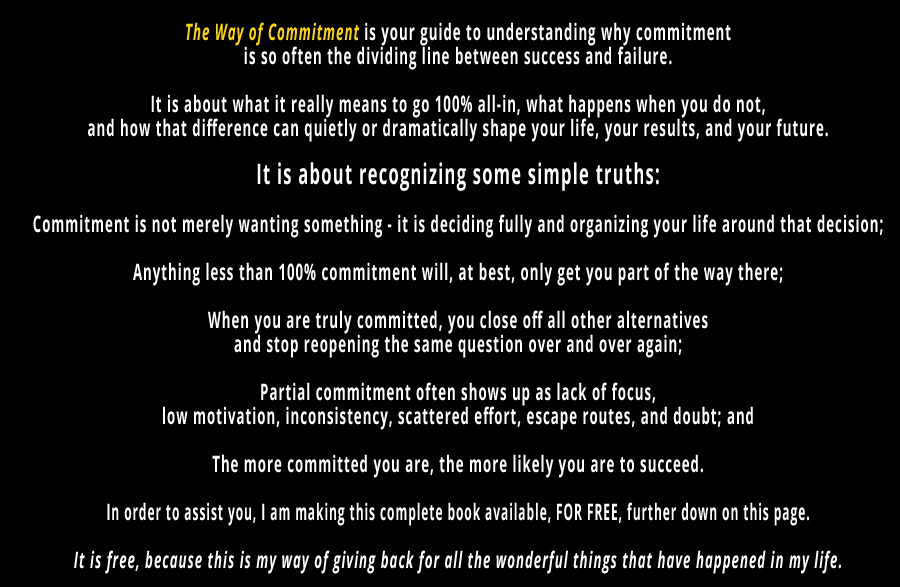

START HERE BY READING
The Way of Commitment
The Four Factors – Book 4
Commitment Leads To Success
By Stanley F. Bronstein – Creator of The Way of Excellence System
Click The Tabs Below To Read Each Chapter Of The Book Online
Or
📘 Download Your Free Copy In Your Preferred Format
The Way of Commitment
by Stanley F. Bronstein
How to use this page:
Click a chapter title to open it then scroll down to read.
When you click the title of the next chapter, the previous one will close.
Take your time.
Read, reflect, and do the experiments and assignments before you move on.
EMPTY ITEM
Foreword
Many people want better lives.
They want better health, better relationships, better finances, better habits, better peace of mind, better work, better focus, and better results. They want to become stronger, wiser, more disciplined, more fulfilled, and more effective. They want to build something meaningful. They want to finish what they start. They want to live with purpose. They want to become more than they have been.
Wanting all of that is easy.
Committing to it is something else entirely.
That difference is one of the great dividing lines in life. It is also one of the most overlooked. People spend enormous amounts of time talking about goals, planning goals, admiring goals, and wishing for goals. They imagine new futures. They make promises to themselves. They announce intentions. They wait for the right time. They gather information. They become excited. They begin. They stop. They begin again. They wonder why progress is slow. They wonder why the same obstacles keep appearing. They wonder why they keep falling back into the same patterns.
In many cases, the answer is not a lack of intelligence. It is not a lack of talent. It is not even a lack of desire.
It is a lack of commitment.
This book was written to make that truth unmistakably clear.
Commitment is not a slogan. It is not a mood. It is not a burst of emotion. It is not the excitement a person feels at the beginning of a new effort. It is not the sentence someone says after a setback when they are trying to convince themselves that next time will be different.
Commitment is a decision of a different order.
Commitment is the point at which a person stops flirting with a possibility and starts building their life around it. It is the point at which the goal is no longer treated as an option among many, but as a chosen path. It is the point at which a person says, in effect, “This is what I am doing. This is where I am going. This is no longer up for debate.”
That is why commitment is so powerful.
It changes the structure of thought. It changes the use of energy. It changes the quality of action. It changes standards. It changes behavior. It changes the relationship a person has with time, discomfort, temptation, doubt, and adversity. It changes what is negotiable and what is not. It changes how a person sees themself. It changes identity.
Most people do not fail because they are incapable of success. They fail because they never fully close the gap between desire and decision. They remain interested, but not fully committed. They remain hopeful, but not fully committed. They remain engaged, but not fully committed. They remain willing to try, but not fully committed.
That may sound like a small distinction. It is not.
The difference between 100% and less than 100% is not small. It is massive.
A person who is less than fully committed still has one foot in and one foot out. They may say they want something, but they are still preserving alternatives. They are still leaving themselves an escape route. They are still keeping the back door open. They are still giving themselves room to negotiate later, delay later, excuse later, retreat later, or decide again later.
That constant reopening of the case comes at a tremendous cost.
It creates internal resistance. It creates hesitation. It creates doubt. It creates inconsistency. It creates scattered effort. It drains mental energy. It consumes attention. It turns one decision into a thousand decisions because the same question keeps returning over and over again.
Should I do it today?
Should I skip it today?
Should I make an exception today?
Should I keep going today?
Should I really have to do this today?
That kind of living is exhausting.
One of the most important truths in this book is that being 100% committed is actually easier than being less than 100% committed.
At first, that may sound backward. Many people assume that total commitment must be harder because it sounds more demanding. In reality, less than full commitment is often far more difficult because it keeps a person trapped in ongoing internal negotiation. It keeps the mind divided. It keeps resistance alive. It keeps doubt active. It keeps the person spending energy not only on the task itself, but also on the repeated debate over whether they will do the task at all.
At 100%, much of that resistance begins to fade.
Why?
Because the decision has already been made.
Once a person truly decides, they no longer have to keep deciding the same thing in the future. They asked the question once. They answered it. The matter is settled. That frees up mental resources. It reduces friction. It quiets doubt. It removes countless unnecessary debates. It allows the person to use their energy for execution rather than argument.
That is one of the great gifts of commitment.
It simplifies life.
It does not make every action easy. It does not remove challenge. It does not eliminate pressure, fatigue, or hardship. But it does remove a huge amount of wasted inner conflict. It allows a person to move forward with greater clarity and less division. It turns repeated choices into established standards. It turns standards into habits. It turns habits into identity. It turns identity into power.
At 100%, things become non-negotiable.
That phrase matters.
A non-negotiable is not a preference. It is not a wish. It is not something a person does only when circumstances are favorable. It is a standard that stands. It remains in place whether the person feels inspired or uninspired, energized or tired, praised or criticized, comfortable or uncomfortable. A non-negotiable ends debate. It creates consistency. It makes action more reliable because the standard is no longer waiting on emotion for permission.
This is one of the central messages of the book you are about to read.
In The Way of Excellence (TWOE), I stated the principle this way:
“The achievement of excellence requires a level of commitment where one goes 100% all-in toward the achievement of that which they truly want. Anything less than 100% will, at best, only get you part of the way there.”
That is not merely a good sentence. It is a law of practical living.
Anything less than 100% will, at best, only get a person part of the way there.
Part of the way there in health.
Part of the way there in relationships.
Part of the way there in discipline.
Part of the way there in business.
Part of the way there in growth.
Part of the way there in peace.
Part of the way there in excellence.
That is why this book draws such a clear contrast between two paths.
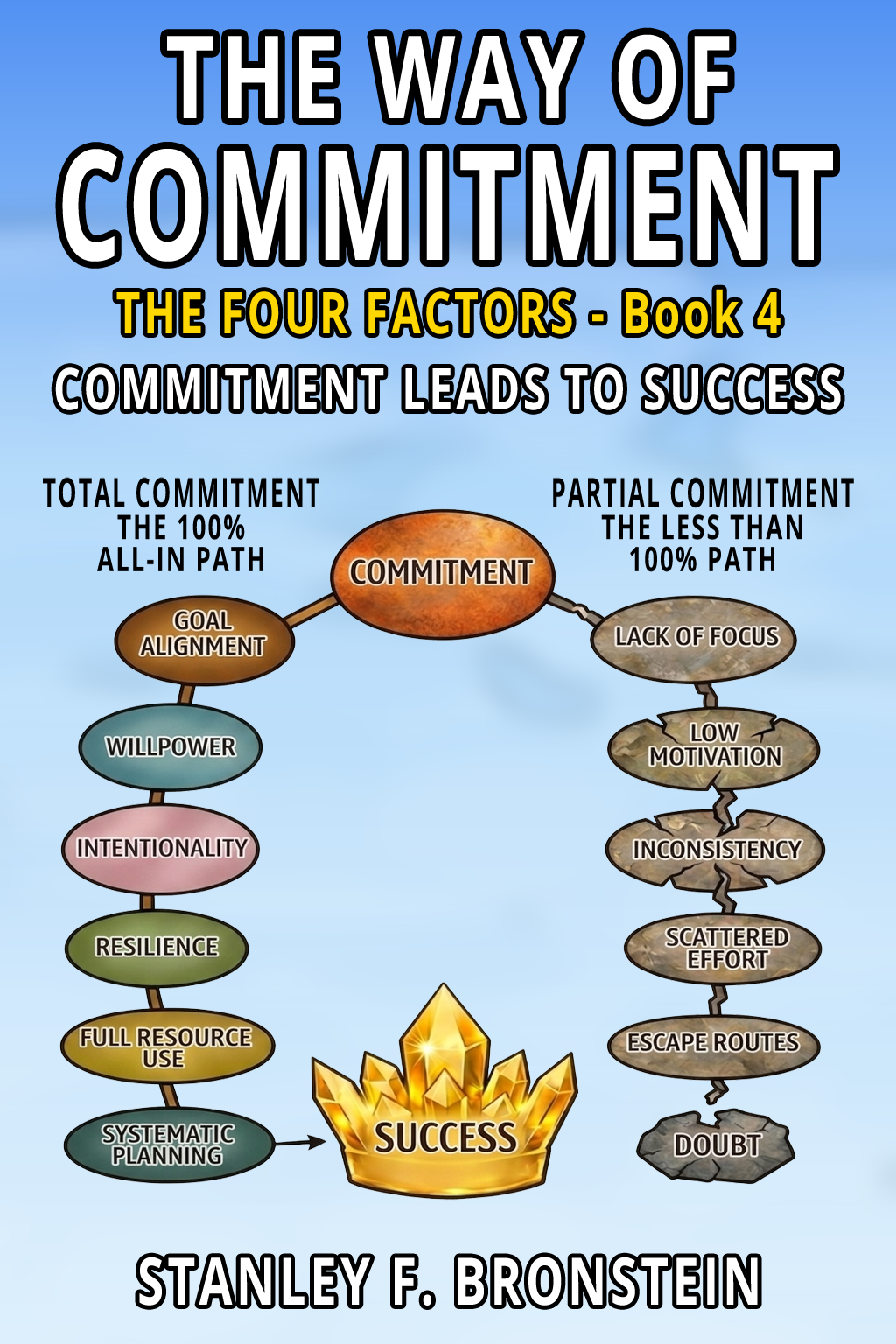
One is the path of total commitment – the 100% all-in path.
The other is the path of partial commitment – the less than 100% path.
The 100% all-in path is marked by goal alignment, willpower, intentionality, resilience, full resource use, and systematic planning. It is not perfect. It is not effortless. But it is clear. It is organized. It is directed. It is powerful because the person walking it is no longer fighting themself at every turn.
The less than 100% path is marked by lack of focus, low motivation, inconsistency, scattered effort, escape routes, and doubt. Those conditions are not random. They are predictable. They are what tend to happen when commitment remains divided, conditional, and incomplete.
This book will explore both paths in detail.
It will show why commitment is the dividing line between success and failure. It will show why wanting something is not the same as committing to it. It will show why 100% is different in kind, not merely degree. It will show why closing the back door matters. It will show why total commitment creates a simpler and stronger inner condition. It will show why less than full commitment keeps a person mentally busy, emotionally unstable, and strategically weak. It will show how commitment becomes visible in long-term thinking, daily action, resilience under pressure, and the integration of mind, body, and spirit.
Most of all, it will call the reader to honesty.
Not harshness. Honesty.
Not self-condemnation. Clarity.
Not fantasy. Truth.
It is very easy to tell ourselves stories about how much we care, how serious we are, how badly we want something, and how committed we intend to become. It is harder, but far more useful, to ask the real question:
Am I all-in?
That question changes everything.
It cuts through excuses. It cuts through inflated self-talk. It cuts through vague ambition. It cuts through the fog. It reveals where commitment is real, where it is partial, where it is performative, and where it is absent. It reveals why some parts of life are moving and why others remain stuck. It reveals why some decisions have power behind them and others keep dissolving under pressure.
If this book does its job, it will not merely give the reader information about commitment. It will confront the reader with commitment itself. It will ask for a decision. It will invite a line to be crossed. It will call the reader to stop standing halfway between desire and retreat.
A person does not become powerful by wishing harder.
A person becomes powerful when they decide fully.
A person does not become consistent by hoping to feel different tomorrow.
A person becomes consistent when the standard becomes non-negotiable.
A person does not become free by preserving every alternative.
A person often becomes freer when the right alternatives are closed.
A person does not move toward excellence by remaining half-committed.
A person moves toward excellence by going all-in.
That is the path this book is about.
Let us begin.
INTRODUCTION TO PART I - THE DIVIDING LINE
Every meaningful change in life reaches a point where desire is no longer enough.
Before that point, a person may think about change, talk about change, and even begin moving toward change. They may imagine a better future. They may feel inspired. They may tell themselves that this time will be different. They may gather information, make plans, and take a few first steps. From the outside, all of that can look promising. From the inside, it can feel sincere.
And yet none of it necessarily means the person is committed.
That is why commitment is such an important subject. It forces a person to move beyond appearances and ask a deeper question. Not “Do I want this?” Not “Would I like this?” Not “Would I prefer this?” Not even “Am I trying?” The real question is this: “Have I fully decided?”
That is the dividing line.
On one side of that line is possibility without full power. There may be interest, effort, hope, and even periods of progress. But there is still internal division. There is still negotiation. There is still room for delay, hesitation, and retreat. The person may be moving, but they are not yet fully anchored. Part of them is still committed to the goal, while another part is still protecting alternatives.
On the other side of that line is commitment. Real commitment. Full commitment. The kind of commitment that changes the structure of a person’s life because the matter is no longer up for debate. Once that line is crossed, the goal is no longer merely admired. It is chosen. The person is no longer testing the idea. They are living it. They are no longer asking again and again whether they should continue. They have already made that decision.
That difference changes everything.
It changes how a person thinks. It changes how a person uses time. It changes how they respond to pressure, discomfort, boredom, temptation, and uncertainty. It changes whether they keep reopening the question or move forward as though the answer has already been settled. It changes whether they live by preferences or by standards. It changes whether their actions are conditional or non-negotiable.
This Part of the book is about understanding that line clearly.
It is about seeing why commitment is not just another positive quality, but often the decisive factor. It is about understanding why so many people remain stuck even when they are talented, intelligent, and sincere. It is about understanding why partial commitment creates predictable problems such as lack of focus, low motivation, inconsistency, scattered effort, escape routes, and doubt. It is about understanding why 100% commitment is not merely a little stronger than 90% commitment, but fundamentally different in the way it operates.
That last point matters greatly.
Many people assume that total commitment must be harder because it sounds more demanding. In truth, less than full commitment is often harder because it keeps the person in a state of ongoing internal conflict. They do not just have to do the work. They also have to keep deciding whether they are going to do the work. They do not just have to face the challenge. They also have to face the recurring question of whether they are really in or not. That repeated inner debate drains energy, creates doubt, and consumes mental resources that could have been used for action.
At 100%, much of that changes.
Once the decision is truly made, many future decisions disappear. The person is no longer standing in between the path and the retreat. They are on the path. That does not make the road effortless, but it does make it clearer. It reduces inner resistance. It removes many unnecessary arguments. It frees mental bandwidth. It gives the person a chance to direct more of their energy toward execution instead of indecision.
This Part will lay the foundation for everything that follows. It will show why commitment is the dividing line between success and failure. It will show why wanting is not the same as deciding. It will show why the difference between 100% and less than 100% is so significant. It will show why partial commitment has real and predictable costs. And it will show why closing the back door is one of the most powerful acts a person can take.
Before a person can live the way of commitment, they must first see the line clearly.
This Part is about seeing that line, understanding it, and recognizing exactly where one stands in relation to it.
Chapter 1 - Commitment Is the Dividing Line Between Success and Failure
Most people think success and failure are separated by obvious things.
They think the dividing line is talent. Or intelligence. Or money. Or luck. Or education. Or timing. Or connections. Or opportunity. Or personality. Or confidence. Or giftedness. Or some mysterious quality that only certain people possess.
Those things can matter. Some of them matter a great deal.
But they are not usually the deepest dividing line.
Again and again, the real dividing line is commitment.
That is not always the answer people want to hear. It is much easier to believe that the missing piece is something external, something accidental, or something beyond one’s control. It is much easier to imagine that success belongs primarily to the fortunate, the specially gifted, or the unusually connected. That view protects people from a harder truth. If commitment is the dividing line, then many outcomes are more connected to decision than people would like to admit.
That truth is not cruel. It is empowering.
If talent were the ultimate dividing line, then many people would be permanently disqualified. If background were the ultimate dividing line, then many people would never have a real chance. If luck were the ultimate dividing line, then meaningful achievement would become little more than a roll of the dice.
But commitment is different.
Commitment places far more power back into the hands of the individual. It does not guarantee instant success. It does not erase reality. It does not make effort unnecessary. It does not remove every obstacle. But it does change the entire structure of a person’s relationship to a goal. It changes how they think, how they act, how they endure, how they organize themselves, and how they respond when the path becomes hard.
That is why commitment is the dividing line between success and failure.
Success Usually Looks Like a Mystery Only Until Commitment Is Examined
When people look at a successful person from a distance, the result can seem mysterious.
They see the outcome, but they do not always see the level of commitment behind it. They see the achievement, but they do not always see the decisions that built it. They see the public result, but they do not always see the private standards, the repeated effort, the refusal to quit, the closed escape routes, the disciplined structure, and the thousands of quiet actions that made the outcome possible.
Because of that, many people misunderstand success.
They assume success belongs to those who were somehow favored. They imagine that successful people must have had fewer obstacles, fewer doubts, fewer temptations, or fewer hard days. Sometimes that is true in small ways, but often it is not true in the way people think. What often separates the successful person from the unsuccessful one is not the absence of difficulty. It is the presence of commitment.
A committed person does not merely admire the result. They align themselves with the process required to produce it.
An uncommitted person may admire the same result, talk about the same result, and even desire the same result, but they do not reorganize their life around it. They still preserve alternatives. They still negotiate with themselves. They still leave open the possibility of delay, retreat, excuse, or half-effort. As a result, their action remains unstable, their focus remains divided, and their progress remains inconsistent.
This is why commitment reveals so much.
It shows whether a goal is truly central or merely interesting. It shows whether a person has moved from preference to decision. It shows whether they are experimenting with a possibility or building a life around it.
Many people say they want success. Far fewer commit to what success requires.
That is the dividing line.
Commitment Turns Desire into Organized Power
Desire matters, but desire alone is weak.
A person can desperately want something and still fail to do what is necessary to achieve it. They can want better health and still fail to eat in a way that supports health. They can want peace and still continue practicing habits that create chaos. They can want better finances and still avoid the discipline required to manage money well. They can want stronger relationships and still refuse the honesty, patience, humility, and consistency those relationships require.
Wanting something does not prove commitment.
Commitment begins when desire becomes organized.
It begins when a person stops merely hoping and starts deciding. It begins when they move beyond emotional preference and enter into deliberate alignment. It begins when they say, in effect, “This matters enough that I am no longer going to keep debating whether I will do what it requires.”
That is when a goal starts gaining power.
Until then, the goal remains fragile. It depends too much on mood, convenience, temporary inspiration, and favorable conditions. It has no stable structure holding it in place. The person may move toward it in bursts, but they will not move toward it with the kind of consistency and force that meaningful success usually requires.
Commitment changes that.
Commitment organizes thought. It organizes action. It organizes standards. It organizes time, energy, and attention. It turns vague desire into directed force.
That is one reason commitment is so powerful. It gathers a person’s life around a chosen result.
Failure often happens where life remains scattered.
Success often begins where life becomes organized around one clear decision.
The Difference Between Being Interested and Being Committed
One of the most important distinctions in life is the difference between interest and commitment.
Interested people make efforts when it is convenient.
Committed people make adjustments when it is inconvenient.
Interested people like the idea of a goal.
Committed people bind themselves to the path.
Interested people hope circumstances will cooperate.
Committed people continue even when circumstances become difficult.
Interested people preserve comfort.
Committed people preserve the decision.
Interested people negotiate.
Committed people execute.
This difference matters because many people confuse strong interest with real commitment. They feel sincere, and they may very well be sincere. They may feel emotionally attached to the goal. They may speak passionately about what they want. They may even take some meaningful first steps.
But sincerity is not the same as commitment.
Commitment reveals itself most clearly when the cost becomes real.
When comfort must be surrendered, when habits must change, when time must be reallocated, when resistance appears, when progress is slow, when results are delayed, when boredom sets in, when temptation returns, when fatigue is present, and when no one is watching – that is when the dividing line becomes visible.
At that point, interest often weakens.
Commitment often strengthens.
That is why commitment matters so much. It carries a person beyond the fragile stage where effort depends on feeling and into the stronger stage where effort is guided by decision.
Why 100% Is Different
Many people think in percentages without understanding what those percentages really mean.
They assume that 100% commitment and 90% commitment are basically the same, with one simply being a little stronger than the other. In practical living, that is rarely true.
The difference between 100% and less than 100% is not merely a matter of degree. It is a difference in condition.
At less than 100%, the issue remains open.
The person may lean toward the goal, but they have not fully closed off the alternatives. They may be serious, but they are not settled. They may be trying hard, but they are still preserving the right to renegotiate later. They have not fully crossed the line from consideration to decision.
As long as the issue remains open, internal conflict remains active.
They will keep revisiting the question.
Should I really do this?
Do I have to do it today?
Can I make an exception?
Maybe I will start tomorrow.
Maybe this is too much.
Maybe this is not worth it.
Maybe I will do it when I feel more ready.
That repeated negotiation drains energy. It creates resistance. It invites doubt. It weakens focus. It breaks consistency. It makes progress much harder than it needs to be.
At 100%, the issue is closed.
That does not mean the person is perfect. It does not mean the path suddenly becomes easy. It does not mean there are no difficult days. It means the decision itself is settled.
That changes everything.
Once the decision is truly made, a great deal of wasted mental motion begins to disappear. The person no longer needs to keep re-deciding the same issue. They are not standing between two paths. They are on one path. Their energy can move more fully into action because the argument has been settled.
That is why 100% commitment is actually easier than partial commitment.
Partial commitment forces a person to fight on two fronts. They have to deal with the challenge itself, and they have to deal with their own divided mind.
Full commitment does not remove the challenge, but it removes much of the internal division.
That is one of the greatest advantages of commitment. It reduces internal resistance by ending the debate.
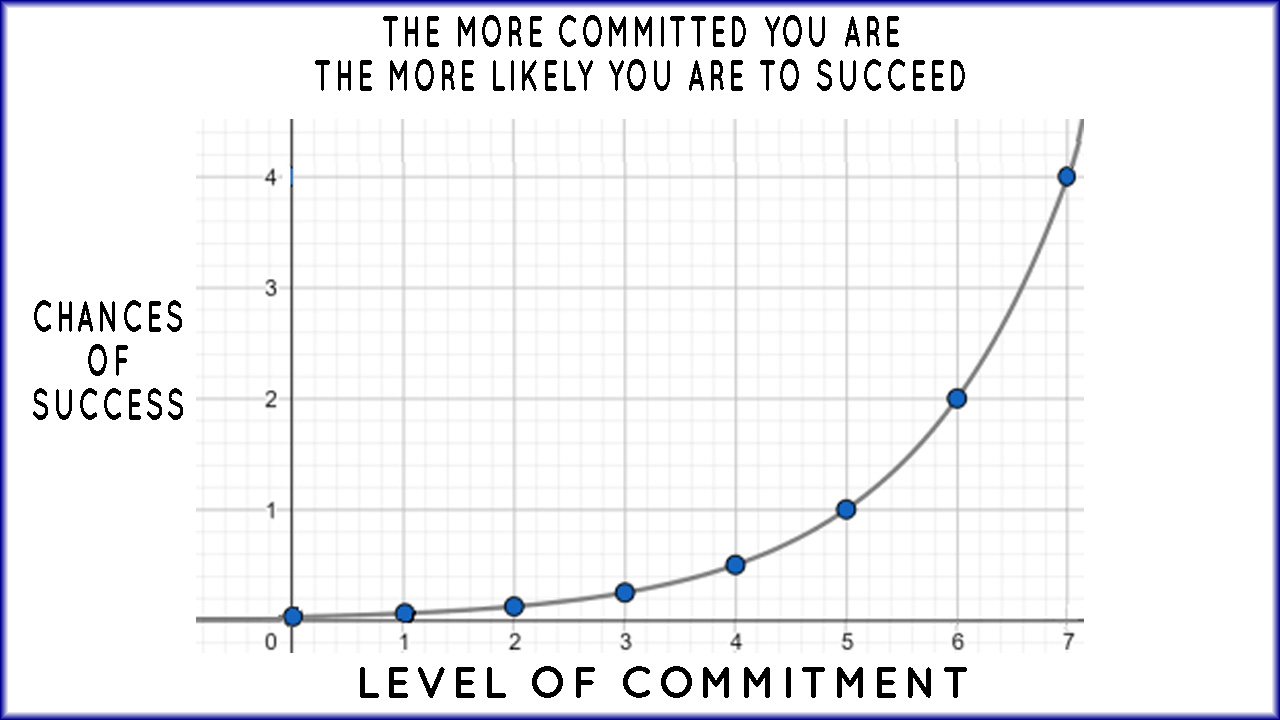
The Law of Commitment
In The Way of Excellence (TWOE), I stated the principle this way:
“The achievement of excellence requires a level of commitment where one goes 100% all-in toward the achievement of that which they truly want. Anything less than 100% will, at best, only get you part of the way there.”
That statement expresses a practical truth that shows up everywhere in life.
Anything less than 100% will, at best, only get a person part of the way there.
Part of the way toward health.
Part of the way toward peace.
Part of the way toward mastery.
Part of the way toward excellence.
Part of the way toward self-trust.
Part of the way toward the life they truly want.
This is one of the hardest truths in personal growth because it forces honesty. It forces a person to stop evaluating themselves based on how much they care and start evaluating themselves based on how fully they have decided.
A person may care deeply and still remain less than fully committed.
A person may be sincere and still remain less than fully committed.
A person may know exactly what to do and still remain less than fully committed.
And if they remain less than fully committed, they should not be surprised when they get partial results.
Commitment is not everything in life, but in many areas it is the thing that determines whether all the other pieces ever come together.
Commitment Changes Identity
One of the reasons commitment is so powerful is that it does more than influence action. It reshapes identity.
A person who is not fully committed still sees the goal as something outside of themselves. It is something they may do, something they may pursue, something they may prioritize for a while. It is still separate enough that it can be negotiated.
A fully committed person begins to relate to the goal differently.
The standard becomes part of who they are.
This is where non-negotiability begins to matter.
When something is non-negotiable, it is no longer treated as optional, situational, or mood-dependent. It becomes part of the structure of the person’s life. It becomes part of how they define themselves.
That shift is profound.
Once a standard moves from preference to identity, consistency becomes much more natural. The person does not have to keep persuading themselves. They are no longer trying to behave in a way that feels foreign. They are acting in a way that fits the person they have decided to become.
This is why commitment is not merely about force. It is about congruence.
The more fully committed a person becomes, the more their actions begin to match their chosen identity. The more that happens, the less internal friction they experience. The less internal friction they experience, the more power they can direct toward execution, growth, and endurance.
Success is often built on that progression.
Decision becomes standard.
Standard becomes practice.
Practice becomes identity.
Identity becomes power.
That is what commitment makes possible.
Why Failure Often Has More to Do with Division Than with Inability
People often describe failure as though it proves inability.
That is not always true. In many cases, failure reveals division more than inability.
The person did not fail because success was impossible. They failed because they were internally split. One part of them wanted the result, but another part wanted comfort more. One part of them wanted progress, but another part wanted to preserve all alternatives. One part of them wanted the identity, but another part did not want the cost.
That inner division weakens everything.
It weakens focus because attention is split.
It weakens motivation because the person is not fully aligned.
It weakens consistency because the standard is not settled.
It weakens resilience because setbacks reopen the case.
It weakens planning because the target is not fully fixed.
It weakens action because every meaningful move must pass through internal negotiation.
This is why commitment is the dividing line. It is the point at which division begins to end.
Commitment says, “I have chosen.”
Commitment says, “This is no longer open for casual debate.”
Commitment says, “I am not going to keep making this decision over and over again.”
Commitment says, “This is now part of how I live.”
That is when power begins to concentrate.
That is when action becomes cleaner.
That is when resistance begins to lose ground.
That is when success becomes far more likely.
Success Belongs to the Person Who Has Decided Fully
Success is rarely produced by admiration alone.
It is rarely produced by information alone.
It is rarely produced by emotion alone.
It is rarely produced by half-measures.
Meaningful success usually belongs to the person who has decided fully and then organized their life accordingly.
That does not mean they move quickly every day.
That does not mean they feel strong every day.
That does not mean they never struggle.
It means they stop revisiting the foundational question. They stop asking whether they are really in. They settle the matter. They close the back door. They make the goal non-negotiable. They begin living in a way that reflects the fact that the decision has already been made.
That is why commitment is the dividing line between success and failure.
Not because commitment makes a person magical.
Not because commitment guarantees a smooth road.
Not because commitment removes every obstacle.
But because commitment ends division, gathers power, clarifies direction, strengthens standards, reduces internal resistance, and allows a person to move with greater force toward what they truly want.
A divided life produces divided results.
A committed life produces a very different kind of possibility.
This chapter is the beginning of that understanding.
The chapters ahead will explore why wanting is not enough, why 100% is different from less than 100%, why partial commitment creates predictable costs, and why closing the back door matters so much. But everything that follows rests on this truth:
Commitment is the dividing line.
Where commitment is absent, success remains fragile.
Where commitment is partial, success remains partial.
Where commitment becomes total, the whole structure of life begins to change.
Assignment
Step 1 – Identify One Important Area of Your Life
Choose one area of your life that matters deeply to you right now. It might be health, relationships, finances, work, spiritual growth, emotional peace, discipline, or another important area.
Pick only one.
Step 2 – Write Down What You Say You Want
Write one clear sentence describing what you say you want in that area.
Do not write what sounds impressive. Write what is true.
Step 3 – Evaluate Your Current Level of Commitment
Ask yourself the following questions and answer them honestly:
Have I fully decided?
Am I still negotiating?
Have I closed off alternatives?
Do I treat this as non-negotiable, or do I revisit it based on mood and circumstance?
Am I organized around this goal, or merely interested in it?
Step 4 – Identify the Evidence
List the actual evidence that reveals your true level of commitment.
Look at your behavior, not just your feelings.
Look at your standards, not just your intentions.
Look at your repeated choices, not just your words.
Step 5 – Name the Real Divide
Write one paragraph completing this sentence:
“In this area of my life, the real divide between where I am and where I want to be is not primarily ____________. The real divide is ____________.”
Fill in the blanks honestly.
Step 6 – Choose Your Next Step
Write one action you will take immediately that reflects stronger commitment in this area.
Not a vague promise.
Not a distant plan.
One clear action.
Take it as soon as possible.
Chapter 2 - Wanting Something Is Not the Same as Committing to It
Many people confuse desire with decision.
They want something badly, and because they want it badly, they assume they are committed to it. They feel frustrated when it does not happen. They feel sincere. They may even feel intense emotion about it. Because of that, they conclude that their commitment must already be in place.
Often, it is not.
That misunderstanding causes enormous trouble. It leads people to overestimate their readiness, underestimate the demands of change, and misread the reasons they keep falling short. It allows them to say, “I really want this,” while ignoring the more important question: “Have I fully decided to do what this requires?”
That is the question this chapter is about.
Wanting something is not the same as committing to it.
A person can want something with great intensity and still refuse the structure, sacrifice, discipline, patience, honesty, and consistency necessary to bring it into reality. A person can want a better life and still resist the decisions that would produce one. A person can want health and still eat in a destructive way. A person can want peace and still cling to habits of chaos. A person can want success and still avoid the standards success requires.
This is not because the person is always weak or foolish. It is because wanting and committing are not the same thing.
Wanting is emotional.
Commitment is structural.
Wanting is often reactive.
Commitment is deliberate.
Wanting says, “I would like that.”
Commitment says, “I have chosen this.”
Wanting may be powerful in the moment.
Commitment remains in place when the moment changes.
That distinction matters because many lives remain stalled in the gap between the two.
Wanting Is Common
There is nothing rare about wanting.
Almost everyone wants something better.
They want relief from pain. They want progress. They want resolution. They want growth. They want more money, more energy, more confidence, more health, more love, more order, more meaning, more peace, more freedom, more success. They want to become stronger and live better. They want life to improve.
There is nothing wrong with wanting.
Wanting is often where change begins.
Wanting can alert a person to what matters. It can reveal dissatisfaction with the current condition. It can awaken longing. It can stir imagination. It can create a sense of possibility. It can move a person to begin asking new questions.
But wanting is only a beginning.
If a person mistakes that beginning for commitment, they are likely to remain frustrated. They will keep expecting results from a level of inner involvement that is too weak to sustain meaningful change.
That is one reason so many people live in repeated cycles of enthusiasm and disappointment. They keep mistaking strong desire for genuine decision.
They feel something strongly, so they assume something has been settled.
It has not.
A feeling can be intense and still be temporary.
A desire can be sincere and still be unstable.
A wish can be heartfelt and still be powerless.
What gives lasting force to desire is commitment.
Without commitment, wanting tends to rise and fall with mood, convenience, and circumstance.
Why Wanting So Easily Pretends to Be Commitment
Wanting can feel very convincing.
A person may talk about a goal repeatedly. They may think about it every day. They may imagine how much better life would be if they achieved it. They may feel pain over not having it. They may feel guilty about their lack of progress. They may promise themselves that change is coming.
All of that can create the illusion of commitment.
But none of it necessarily proves commitment.
In fact, one of the strange realities of life is that a person can spend a great deal of emotional energy wanting something while spending very little structural energy committing to it. They may have deep feelings about the goal, but still refuse to establish the standards, boundaries, and repeated behaviors the goal requires.
This is why desire must be tested.
Not by how badly a person says they want something.
Not by how frustrated they feel without it.
Not by how passionately they speak about it.
But by what they are willing to organize their life around.
That is where the truth shows up.
A person’s real level of commitment is revealed not by intensity of longing, but by the depth of alignment between what they say they want and how they actually live.
That alignment is where commitment begins.
The Language of Wanting and the Language of Commitment
Wanting and commitment sound different when one listens closely.
The language of wanting is often filled with preference, hope, and possibility.
I wish I could.
I would like to.
I need to.
I should.
I hope to.
Maybe this time.
I am trying.
I really mean it.
I want this so badly.
None of those statements are necessarily false, but none of them prove commitment.
The language of commitment is different.
I have decided.
This is what I do.
This is no longer negotiable.
I am going to live this way.
The question has already been answered.
I do not revisit this.
This is who I am becoming.
That language has finality in it.
It has structure in it.
It has closure in it.
That is one of the clearest differences between wanting and commitment. Wanting speaks the language of desire. Commitment speaks the language of decision.
Wanting leaves the matter emotionally charged.
Commitment settles it.
Why Desire Alone Is Not Strong Enough
Desire can inspire action, but it cannot reliably sustain action.
That is one of the hardest truths for many people to accept. They assume that if they really want something enough, that desire will carry them all the way through. Sometimes desire can carry a person for a little while, especially at the beginning. It can create a burst of energy. It can produce a surge of effort. It can make change feel exciting.
But desire is rarely stable enough to support the full journey.
Feelings change.
Circumstances change.
Energy changes.
Mood changes.
Convenience changes.
Temptation appears.
Fatigue appears.
Delay appears.
Discomfort appears.
If a person is relying mainly on desire, they are likely to weaken as soon as the emotional force weakens. They may still care deeply, but caring deeply is not the same as being fully committed.
This is why people so often say things like, “I do not understand it. I really want this.”
They probably do want it.
But wanting is not the same as deciding, and deciding is not the same as structuring one’s life around the decision.
That final step is where commitment begins to separate itself from mere desire.
Commitment Begins Where Negotiation Ends
One of the clearest marks of wanting is ongoing negotiation.
A person who only wants something keeps reopening the question. They keep returning to the same internal argument. They keep asking themselves if they still feel like it, if they really have to do it, if maybe they can postpone it, if maybe an exception would be reasonable, if maybe they should wait until tomorrow, next week, or some more favorable season.
That repeated negotiation is exhausting.
It also reveals that the matter has not been settled.
Commitment begins where that kind of negotiation ends.
Commitment does not mean a person never feels resistance. It does not mean they never experience difficulty. It does not mean they never face temptation, discouragement, or fatigue. It means the foundational decision is no longer up for daily review.
That difference is enormous.
A person who only wants something may keep revisiting whether they will act.
A committed person is far more likely to focus on how they will act, when they will act, and how they will adapt when conditions are difficult.
That is why commitment is so powerful. It removes countless unnecessary debates and redirects energy toward execution.
Wanting keeps asking, “Will I?”
Commitment moves on to, “Since I have decided, how do I do this well?”
The Four Factors and the Progression Toward Commitment
In my work, four factors matter greatly when a person is trying to create lasting change: willingness, belief, discipline, and commitment.
These four factors are closely related, but they are not identical.
Willingness opens the door.
Belief gives strength to action.
Discipline stabilizes repeated behavior.
Commitment locks the person onto the path.
Each matters. Each plays a role. Each strengthens the others. But commitment has a special place because it is the factor that turns possibility into finality.
A person may be willing and still not committed.
They may say, “I am willing to do what it takes.” That matters. It is far better than unwillingness. But willingness alone does not guarantee that the decision has been made. A person can be willing in principle while still leaving themselves room to retreat in practice.
A person may believe and still not commit.
They may believe that change is possible. They may believe they can achieve something meaningful. They may believe the path is real and the result is worth it. That belief is powerful. Without it, action becomes far harder. But belief alone does not force decision. A person can believe in a possibility and still refuse to bind themselves to the process required.
A person may even have discipline in certain areas and still remain less than fully committed in others.
Discipline matters because it helps create order, repetition, and stability. It teaches a person to do what needs to be done even when they do not feel like it. But commitment goes deeper than isolated discipline. Commitment is what decides that the matter is settled. Commitment is what closes the back door and turns repeated action into a chosen way of life.
Willingness says yes to the possibility.
Belief says it can be done.
Discipline says do it anyway.
Commitment says the question is over.
That is why commitment changes so much. It takes the previous factors and gives them a level of finality they do not possess on their own.
Why People Prefer Wanting to Commitment
If commitment is so powerful, why do so many people remain in the stage of wanting?
Because wanting is emotionally easier at first.
Wanting allows a person to enjoy the fantasy of the result without fully paying the price of the process. It allows them to imagine a better future while preserving much of their current comfort. It allows them to feel serious without having to become fully structured. It allows them to speak in hopeful language without closing off alternatives.
In that sense, wanting protects freedom of option.
Commitment limits that freedom.
At least at first, that can feel threatening.
The person realizes that if they truly commit, certain things will have to change. Certain habits will have to end. Certain standards will have to become non-negotiable. Certain escape routes will have to be closed. Certain excuses will lose their legitimacy. Certain comforts will no longer be allowed to govern behavior.
That is why many people remain in wanting. They want the result, but they do not want to lose the alternatives.
They want the health, but they do not want to close the door on unhealthy patterns.
They want the peace, but they do not want to release the habits that keep disturbing them.
They want the financial improvement, but they do not want to surrender the behaviors that undermine it.
They want the stronger life, but they do not want to stop bargaining with weakness.
That is understandable, but it is also costly.
As long as alternatives remain protected, commitment remains partial.
As long as commitment remains partial, results tend to remain partial as well.
The Hidden Misery of Wanting Without Deciding
Many people think commitment sounds restrictive.
Often, the opposite is true.
Wanting without deciding is frequently more restrictive because it traps a person in endless inner conflict. They keep living in between. They keep facing the same questions. They keep carrying the same unfinished tension. They keep wondering when they will finally become serious enough to do what they already know they should do.
That is a miserable way to live.
It drains energy.
It creates guilt.
It creates self-distrust.
It makes a person feel weak because they keep making promises they do not keep.
It causes the goal to become heavier and heavier in the mind because it is never fully embraced and never fully released.
This is one reason that 100% commitment is often easier than less than 100% commitment.
When the decision is final, a great deal of resistance begins to fade. The person is no longer spending so much energy arguing with themselves. They are no longer trying to preserve both the goal and the alternatives. They are no longer carrying the burden of constant reconsideration.
The issue is settled.
That creates relief.
It creates clarity.
It creates mental space.
It frees resources that can now be used for more important things.
This is one of the major themes of this book because it is one of the great practical benefits of full commitment. When the right decision has been fully made, life often becomes simpler.
Not effortless.
Simpler.
There is less debate.
Less hesitation.
Less daily confusion.
Less internal division.
That is part of what makes commitment so powerful.
What Commitment Actually Looks Like
Commitment is not merely a feeling of seriousness.
It is not a dramatic declaration.
It is not loudness.
It is not intensity of speech.
It is not the ability to impress other people with how motivated one sounds.
Commitment looks like structure.
It looks like standards.
It looks like boundaries.
It looks like repeated action.
It looks like non-negotiability.
It looks like a person no longer treating an important matter as open for casual discussion with themselves.
Commitment shows up in what a person does when conditions are not favorable.
It shows up in whether they continue when nobody is watching.
It shows up in whether they preserve the decision when the feeling is gone.
It shows up in whether they have to keep convincing themselves every day, or whether they have already made the matter clear.
That is why commitment is visible.
Not always dramatic, but visible.
A person may not talk much about their commitment, but their life will usually reveal it. Their schedule will reveal it. Their habits will reveal it. Their boundaries will reveal it. Their repeated choices will reveal it. Their non-negotiables will reveal it.
Wanting may sound intense.
Commitment becomes concrete.
From Preference to Standard
One of the great shifts in life occurs when something important moves from preference to standard.
A preference says, “I would like this.”
A standard says, “This is how I live.”
A preference is easily interrupted.
A standard stands.
A preference is vulnerable to mood.
A standard remains.
A preference asks permission from circumstance.
A standard governs circumstance wherever possible.
This shift matters because many people stay trapped in preference while telling themselves they are committed. They still treat the matter as optional, situational, and dependent on how they feel. They still allow themselves to renegotiate what should already be settled.
That is why progress remains unstable.
Standards create stability.
They do so because they reduce the number of decisions that must be made in real time.
Once something becomes a standard, it stops asking for repeated approval. It becomes part of the structure of life.
This is where commitment begins to turn into identity. The person is no longer saying, “I hope I can live this way.” They are saying, “This is how I live.”
That is far stronger.
Why Honesty Matters Here
This chapter is not meant to shame anyone.
It is meant to create honesty.
There is a very important difference between being interested in a goal and being committed to it. There is also a very important difference between believing one is committed and actually being committed.
The only way to cross that gap is honesty.
A person must be willing to say, “I do want this, but I have not fully committed to it yet.”
That statement is not a defeat.
It is the beginning of clarity.
It is far more powerful to tell the truth than to hide behind exaggerated language. Once the truth is clear, real decisions can be made. Standards can be built. Escape routes can be identified. Alternatives can be closed. Commitment can become real.
But none of that can happen while a person keeps calling desire by the name of commitment.
Words matter.
If wanting is called commitment, then commitment loses its meaning.
If trying is called commitment, then commitment loses its power.
If preference is called commitment, then commitment loses its clarity.
The truth must be restored.
Wanting is not the same as committing.
Trying is not the same as committing.
Admiring a goal is not the same as committing.
Wishing for change is not the same as committing.
Commitment begins when the matter is settled and the person begins organizing life around what has been chosen.
The Difference Between “I Want To” and “I Do”
At some point, meaningful change requires a movement from “I want to” to “I do.”
That movement is more important than many people realize.
“I want to” still centers longing.
“I do” centers identity.
“I want to” leaves room for excuses.
“I do” begins removing them.
“I want to” may still be waiting for the perfect emotional condition.
“I do” acts under a chosen standard.
“I want to” may speak sincerely.
“I do” lives structurally.
This movement is where commitment becomes visible. It is where desire begins to mature into decision, and decision begins to mature into a way of life.
Many people stay stuck because they never make that movement. They remain emotionally attached to the goal, but they never let it become a governing standard.
That is why this chapter matters.
If the reader can understand the difference between wanting and committing, they will understand why so many worthy goals remain unrealized. They will also understand why the path forward is not merely to want more intensely, but to decide more fully.
That is the beginning of real change.
Assignment
Step 1 – Choose One Goal You Strongly Want
Choose one goal you genuinely want right now.
Make it specific.
Write it down in one clear sentence.
Step 2 – Describe Your Wanting
Under that sentence, write a short paragraph beginning with these words:
“I want this because…”
Be honest. Write about why you want it, why it matters, and what you hope it would change.
Step 3 – Test Whether You Are Committed
Answer the following questions in writing:
Have I fully decided to do what this goal requires?
Am I still negotiating with myself?
Have I closed off alternatives that directly oppose this goal?
Do my daily actions reflect structure, or only desire?
Is this a preference, or is it a standard?
Step 4 – Identify the Gap
Write down the clearest difference between your current wanting and actual commitment.
Be specific.
Do not write something vague such as “I need to try harder.”
Write what is actually missing.
Step 5 – Convert Desire into Decision
Complete the following sentence:
“If I were truly committed to this goal, I would no longer keep debating ____________.”
Fill in the blank with the issue you keep reopening.
Then write one sentence stating your decision clearly and directly.
Step 6 – Establish One Non-Negotiable
Create one non-negotiable standard that would move this goal out of the realm of wanting and into the realm of commitment.
Write it in simple, direct language.
Not “I will try.”
Not “I hope.”
Write it as a standard.
Step 7 – Take Immediate Action
Take one action within the next twenty-four hours that proves this goal is no longer just something you want, but something you are beginning to commit to.
Chapter 3 - The Difference Between 100% and Less Than 100%
Many people treat percentages as though they were merely mathematical distinctions.
They assume that 100% commitment and 95% commitment are almost the same. They assume that 90% commitment is close enough. They assume that 80% commitment still counts as serious. They assume that if they care a great deal, try most of the time, and mean well, the difference between full commitment and near commitment must be small.
In practical life, that assumption causes tremendous trouble.
The difference between 100% and less than 100% is not merely quantitative. It is qualitative. It is not just the difference between more and less. It is the difference between a closed matter and an open matter. It is the difference between a settled decision and a continuing debate. It is the difference between a path that has been chosen and a path that is still being reconsidered.
That difference changes everything.
This chapter is about that difference.
It is about why 100% commitment creates a different inner condition than partial commitment. It is about why less than 100% leaves room for hesitation, doubt, escape, and self-sabotage. It is about why full commitment is not the same as perfection, but is absolutely different from partial involvement. It is about why going all-in often makes life easier, clearer, and more powerful than trying to live with one foot in and one foot out.
Many people spend years suffering under the illusion that near commitment is close enough.
Often, it is not.
100% Means the Decision Is Made
At 100%, the issue is settled.
That does not mean the person will never face difficulty. It does not mean there will never be temptation. It does not mean there will never be a hard day, a moment of fatigue, or a period of discouragement. It means something deeper than that.
It means the foundational question is no longer being debated.
The person is no longer asking whether they are going to do this. They are no longer standing between alternatives, trying to preserve all options while also hoping for maximum results. They are no longer pretending that the decision is made while secretly keeping a door open for retreat.
At 100%, the decision has been made.
That has enormous consequences.
Once a matter is truly decided, many future decisions disappear. The person no longer has to keep revisiting the same issue in slightly different forms. They no longer have to ask whether today is the day they will be serious. They no longer have to ask whether this is still what they want. They no longer have to ask whether they should make an exception this time. They no longer have to keep negotiating with themselves like a lawyer arguing a case that should have been closed long ago.
The matter is settled.
That settlement changes the structure of the mind. It frees up energy that would otherwise be consumed by repeated internal debate. It reduces friction. It reduces hesitation. It reduces doubt. It reduces the endless small negotiations that weaken so many lives.
That is one of the great gifts of 100% commitment.
It closes the case.
Less Than 100% Means the Issue Is Still Open
Anything less than 100% means the matter is still open.
A person may sound committed. They may feel committed. They may even be doing some of the right things. But if the issue is still open, then commitment is still partial.
As long as the issue is open, alternatives remain alive.
As long as alternatives remain alive, retreat remains psychologically available.
As long as retreat remains psychologically available, doubt remains active.
As long as doubt remains active, energy is divided.
That is what makes partial commitment so costly.
People often think partial commitment is less demanding because it sounds less extreme. In many cases, it is more exhausting because it creates ongoing internal uncertainty. The person must keep making the same decision over and over again. They must keep persuading themselves. They must keep wrestling with the same questions. They must keep spending attention and emotional energy on whether they are going to remain on the path.
That drains a person.
It weakens focus.
It weakens action.
It weakens identity.
It weakens standards.
It weakens results.
The person may not realize how much energy is being lost because the loss happens in small repeated moments. A moment of hesitation here. A small exception there. A delay. A rationalization. A reopening of the question. A quiet indulgence of doubt. A temporary retreat disguised as flexibility.
Each one may seem small. Together, they can dismantle progress.
That is why less than 100% is not a mild version of commitment. It is a fundamentally different condition.
100% Is Not Perfection
At this point, an important distinction must be made.
100% commitment is not the same as perfection.
Many people hear the phrase 100% all-in and immediately assume it means flawless performance, unbroken success, or the absence of struggle. That is not what it means.
Perfection is about never missing.
Commitment is about never leaving.
Perfection is about flawless execution.
Commitment is about settled direction.
Perfection is about ideal performance.
Commitment is about final decision.
A person can be 100% committed and still have much to learn. They can be 100% committed and still be imperfect in execution. They can be 100% committed and still have hard days. They can be 100% committed and still need adjustment, growth, and correction.
The point is not that a fully committed person performs perfectly at all times.
The point is that they have closed the door on casual retreat.
That is why 100% commitment is so powerful. It removes ambiguity. It establishes direction. It turns the issue from a repeated choice into a standing decision.
Perfection is not required for that.
Decision is.
This matters because many people hide from commitment by pretending they are resisting perfectionism. They say they do not want to be too rigid, too absolute, or too demanding. Sometimes that concern is sincere. But often it is a way of avoiding the deeper issue. They are not really resisting perfection. They are resisting finality.
They still want to keep options open.
They still want to preserve an exit.
They still want to reserve the right to negotiate later.
That is not humility. That is partial commitment.
The Power of Closing Off Alternatives
One of the clearest differences between 100% and less than 100% is what happens to alternatives.
At less than 100%, alternatives remain.
The person still has a back door. They may say they are committed, but they have not truly closed off the competing options. They have not removed the internal escape routes. They have not taken away their own permission to debate the matter again later.
At 100%, alternatives close.
This is one of the hardest things for people to accept and one of the most liberating once it is understood.
When a person is truly 100% committed, they are no longer trying to preserve both the goal and the opposite of the goal. They are no longer trying to enjoy the rewards of one path while keeping the comforts of another. They are no longer trying to remain fully free in every direction while also demanding the full results that only come from decisive commitment.
They choose.
That choice simplifies life.
It does not simplify everything, but it simplifies one of the most exhausting parts of life: repeated indecision.
Once all other alternatives are closed, the mind no longer has to keep wandering through them. Once the issue is settled, the person can use their energy for action rather than argument. Once the back door is shut, attention can move forward with greater force.
This is one reason 100% commitment is actually easier than partial commitment.
Partial commitment keeps multiple worlds alive at once.
Total commitment ends that split.
The Difference Between a Standard and a Preference
At less than 100%, the goal remains largely a preference.
At 100%, it becomes a standard.
That difference matters more than most people realize.
A preference is something a person would like.
A standard is something a person lives by.
A preference bends easily.
A standard stands.
A preference is often vulnerable to mood.
A standard remains in place regardless of mood.
A preference asks, “What do I feel like doing today?”
A standard says, “This is how I live.”
That is why 100% commitment changes so much. It turns important matters from preferences into standards.
Once that happens, the person no longer needs to evaluate the same issue from the beginning each day. The issue has already moved into the category of settled living.
This is what non-negotiability means.
A non-negotiable is not something the person keeps discussing with themselves. It is not something they revisit when conditions are uncomfortable. It is not something they submit for emotional review each morning. It is a settled standard.
At less than 100%, standards remain soft.
At 100%, they harden into structure.
That structure is one of the great practical benefits of full commitment.
Why 99% Is More Dangerous Than 50%
Sometimes 99% commitment can be more dangerous than 50% commitment because it creates the illusion of finality without the substance of finality.
A person at 50% usually knows they are not fully in. They may not like that truth, but it is difficult to hide from it completely. A person at 99% can deceive themselves more easily. They may believe they are fully committed when in fact they are still preserving one small exception, one hidden escape route, one protected indulgence, one emotional veto, one recurring place where they reserve the right to abandon the standard.
That one remaining opening matters.
A chain does not fail because most of it is strong. It fails at the weak point.
A structure does not collapse because everything is unstable. It collapses where instability is allowed to remain.
So it is with commitment.
The unresolved part often governs far more than the resolved part. The unclosed door continues to influence the entire house. The preserved escape route continues to weaken the entire system. The still-negotiable area keeps feeding doubt back into the whole structure.
This is why anything less than 100% can be so costly.
It is not merely that the person is a little less committed.
It is that the issue remains structurally open.
The Relationship Between Commitment and Resistance
Resistance thrives where decision remains incomplete.
That is one of the great practical truths of life.
When a person has not fully decided, resistance has room to operate. It can raise objections. It can reopen debate. It can suggest delay. It can propose exceptions. It can magnify discomfort. It can present alternatives as attractive and standards as burdensome. It can keep the person entangled in the question of whether to continue.
That is why partial commitment often feels so heavy.
The person is not only carrying the burden of the work. They are carrying the burden of unresolved decision.
At 100%, much of that changes.
Again, this does not mean that all difficulty disappears. It does mean that the internal argument begins to lose strength because the matter itself has been settled.
Once the person truly says yes, the no begins to lose some of its power.
Once the person closes the alternatives, the mind has less ground on which to build resistance.
Once the standard becomes non-negotiable, temptation may still appear, but it no longer comes with the same authority.
This is why being 100% committed is often easier than being less than 100% committed.
The partially committed person lives in repeated friction.
The fully committed person still works hard, still endures challenge, still faces reality, but does so with far less internal division.
That difference is enormous.
Making the Decision Once
One of the most valuable benefits of 100% commitment is that the decision only has to be made once.
That does not mean the person never has to act again. It means they do not have to keep deciding the foundational issue again and again.
This is what many people fail to understand. They treat important matters as though they must be freshly decided every day. Should I stay on the path today? Should I maintain the standard today? Should I remain serious today? Should I keep going today? Should I make an exception today?
That approach creates a life of constant mental taxation.
A person who does that may think they are being flexible, thoughtful, or realistic. Often, they are simply keeping themselves trapped in ongoing indecision.
At 100%, the person stops relitigating the same matter.
They asked the question.
They answered it.
They moved on.
That movement creates freedom.
It frees up mental resources for more important things. It reduces doubt because doubt is no longer being invited back to the table as a voting member. It sharpens action because the mind is not cluttered with the same repeated argument. It strengthens identity because the person is no longer treating the standard as temporary.
This is one of the greatest practical advantages of total commitment.
It simplifies the future by settling the issue now.
The Law of Commitment and the Difference Between Total and Partial Involvement
In The Way of Excellence (TWOE), I stated this principle clearly:
“The achievement of excellence requires a level of commitment where one goes 100% all-in toward the achievement of that which they truly want. Anything less than 100% will, at best, only get you part of the way there.”
That law belongs in this chapter because it expresses the exact difference being examined here.
Anything less than 100% will, at best, only get a person part of the way there.
Part of the way there is still not there.
Part of the way there in health is still not health.
Part of the way there in peace is still not peace.
Part of the way there in discipline is still not discipline.
Part of the way there in excellence is still not excellence.
This is why percentages matter so much in the realm of commitment. The issue is not just how much effort a person is giving on a particular day. The issue is the level of settledness behind the effort. The issue is whether the person has gone all-in or is still preserving space for divided living.
Partial involvement produces partial results because it produces partial structure, partial standards, partial resilience, partial focus, and partial identity.
Total commitment creates a different kind of life because it is not divided against itself.
Why Full Commitment Feels So Different
When a person becomes truly 100% committed, something shifts inside.
The goal no longer feels like a hopeful possibility floating somewhere in the future. It becomes part of the present structure of life. The standard moves from aspiration to identity. The person begins to feel a different kind of firmness within themselves.
This does not necessarily happen in a dramatic emotional moment. Sometimes it happens quietly. But once it happens, life begins to feel different.
There is often more peace.
More clarity.
More directness.
More simplicity.
More consistency.
More power.
This is because the person is no longer leaking so much energy through uncertainty and internal division. They know where they stand. They know what they do. They know what is no longer negotiable. They know the issue has been decided.
That settledness is powerful.
It is also one of the reasons that 100% commitment can feel more freeing than less than 100%.
Many people fear that total commitment will make life smaller. Often, it makes life stronger. It removes confusion. It reduces wasted motion. It frees attention. It sharpens action. It allows a person to live with greater integrity because their inner and outer life begin to match more closely.
Full commitment is not a prison.
It is often an escape from internal chaos.
Where Most People Get Stuck
Most people do not get stuck because they know nothing.
They get stuck because they do not decide fully.
They may have read enough, thought enough, felt enough, planned enough, and promised enough. They may already know the path. They may already understand the basics. They may already see what needs to change.
But they are still hovering.
They are still in between.
They are still trying to preserve both the new standard and the old freedom to break it.
That is where energy disappears.
That is where momentum breaks.
That is where self-trust weakens.
That is where doubt grows.
That is where the person begins to wonder why progress feels so hard.
In many cases, progress feels so hard because the person is asking action to do what only decision can do.
Action alone cannot settle a divided mind.
More effort alone cannot permanently solve a still-open issue.
Until the decision becomes final, the person will remain vulnerable to the same repeated inner conflict.
This is why chapter 3 matters so much.
A person must understand that 100% and less than 100% are not close cousins. They are different worlds.
One world is structured by settled decision.
The other is structured by ongoing negotiation.
One world frees mental resources.
The other consumes them.
One world reduces resistance.
The other keeps resistance alive.
One world makes important things non-negotiable.
The other keeps everything open to mood and circumstance.
One world creates a far stronger foundation for success.
The other keeps producing partial results and predictable frustration.
Crossing the Line
Every person eventually comes to a line.
On one side of the line are wishes, hopes, intentions, preferences, and partial measures.
On the other side are decision, non-negotiability, identity, and total commitment.
The line is not crossed by caring more.
It is crossed by deciding fully.
The line is not crossed by sounding serious.
It is crossed by ending negotiation.
The line is not crossed by saying one is almost there.
It is crossed by going all-in.
That line matters because life changes differently on each side of it.
Below the line, the person continues to carry the burden of repeated indecision.
Above the line, the person begins to live under the power of settled direction.
That is the difference between 100% and less than 100%.
It is not a small difference.
It is a life-shaping difference.
Assignment
Step 1 – Identify One Area Where You Are Not Yet at 100%
Choose one important area of your life where you suspect you are serious, but not yet fully committed.
Name it clearly.
Step 2 – Write Down the Alternatives You Are Still Preserving
List the escape routes, exceptions, rationalizations, delays, or opposing options you are still keeping alive.
Be honest.
If alternatives remain, the issue is still open.
Step 3 – Identify the Repeated Question
Write down the question you keep asking yourself in this area.
It may sound like:
“Do I really have to?”
“Can I make an exception?”
“Should I wait?”
“Do I feel like it today?”
“Is this too much?”
Name the question clearly.
Step 4 – Describe the Cost of Keeping the Issue Open
Write one full paragraph describing what this repeated negotiation is costing you.
Include lost energy, lost time, lost focus, lost peace, lost momentum, or lost self-trust.
Step 5 – Define What 100% Would Mean
Write a clear sentence that begins:
“In this area of my life, 100% commitment would mean…”
Finish the sentence with specific language.
Not emotion.
Not vague intention.
Clear structure.
Step 6 – Create One Non-Negotiable Standard
Write one standard that would move this area from preference to commitment.
State it directly.
State it as something settled.
Step 7 – Close One Door Today
Take one concrete action today that closes an alternative you have been preserving.
Do not merely think about it.
Do something that reflects finality.
Chapter 4 - The Predictable Cost of Partial Commitment
Partial commitment is often misunderstood.
Many people think of it as a milder form of commitment. They assume it is still basically the same thing, just not as strong. They assume that being mostly committed should still produce mostly good results. They assume that if they care enough, try enough, and mean well enough, then the difference between full commitment and partial commitment should not matter very much.
It matters a great deal.
Partial commitment does not merely reduce results. It creates predictable problems. It produces a recognizable pattern of weakness that shows up again and again across nearly every area of life. When a person remains less than 100% committed, they do not merely move more slowly. They often create an entirely different inner and outer experience.
That experience is marked by lack of focus, low motivation, inconsistency, scattered effort, escape routes, and doubt.
These are not random annoyances. They are not isolated personality flaws. They are not always mysterious obstacles that appear for no reason. Very often, they are the natural consequences of divided commitment.
That is why this chapter matters.
If a person does not understand the cost of partial commitment, they are likely to keep blaming the wrong things. They may blame the plan. They may blame the difficulty of the goal. They may blame the timing. They may blame their personality. They may blame circumstances. They may even blame themselves in a vague and harsh way without ever identifying the real issue.
The real issue is often simpler.
The issue is that the matter has not been fully decided.
Once that truth is seen clearly, many patterns begin to make sense.
Partial Commitment Creates a Divided Life
A person who is partially committed is trying to move in two directions at once.
One part of them wants the goal. Another part wants to preserve the freedom not to do what the goal requires. One part of them wants the reward. Another part wants to avoid the cost. One part wants the identity. Another part still clings to the habits that contradict it. One part wants progress. Another part wants exceptions.
That internal division weakens everything.
It weakens attention because the mind is split.
It weakens energy because part of that energy is being consumed by argument.
It weakens action because the standard is unstable.
It weakens consistency because the decision keeps being reopened.
It weakens resilience because setbacks become invitations to reconsider the entire path.
This is why partial commitment is so costly. It keeps the person in a state of inner conflict. They are not simply trying to do something difficult. They are trying to do something difficult while also remaining psychologically available to its opposite.
That is exhausting.
Many people believe they are tired because the path is demanding. Sometimes they are tired because the path is demanding. Often, however, they are tired because they are fighting two battles at once. They are battling the challenge itself, and they are battling their own unresolved decision.
That second battle drains far more energy than many people realize.
Anything Less Than 100% Produces Partial Structure
When commitment is partial, structure is partial.
The person may have some standards, but not enough. They may have some order, but not enough. They may have some discipline, but not enough. They may have some clarity, but not enough. They may have some momentum, but not enough. They may take the path seriously in some moments and lightly in others. They may act with strength one day and softness the next. They may show up under favorable conditions and disappear under unfavorable ones.
This is why anything less than 100% tends to get a person only part of the way there.
Part of the way there in commitment produces part of the structure required for success.
Part of the structure produces part of the results.
Part of the results often produces part of the satisfaction.
Part of the satisfaction often creates frustration because the person can sense they are closer than before, but still not where they truly want to be.
That tension is one of the hidden pains of partial commitment. It often produces enough progress to keep hope alive, but not enough finality to create real peace. The person becomes trapped in a cycle of partial effort and partial reward.
They do enough to avoid total collapse.
They do not do enough to create full breakthrough.
That middle ground can last for years.
The Six Predictable Costs of Partial Commitment
The cover of this book identified six common conditions that grow naturally out of less than 100% commitment:
-
Lack of Focus
-
Low Motivation
-
Inconsistency
-
Scattered Effort
-
Escape Routes
-
Doubt
Each of these deserves a full treatment, and each will receive more detailed attention later in the book. For now, this chapter will show how all six arise from the same root problem.
The root problem is not simply weakness.
The root problem is unresolved decision.
Where decision remains incomplete, these six conditions gain power.
Lack of Focus
Focus weakens when commitment weakens.
That is not accidental. Focus is not merely a mental skill. It is also a moral and structural consequence of decision. A person focuses more easily when they know exactly what matters, exactly what they are doing, and exactly what is no longer open for debate.
When commitment is partial, attention begins to leak.
The mind wanders toward alternatives. It drifts toward distractions. It remains vulnerable to competing impulses because the central path has not been fully settled. The person may still intend to move forward, but they have not yet gathered their life tightly enough around the chosen result.
That makes concentration more difficult.
Focus requires exclusion.
To focus on one thing, a person must say no to many others. Full commitment makes that easier because the no has already been built into the decision. Partial commitment makes that harder because the no keeps getting renegotiated.
This is one of the reasons fully committed people often appear more focused than others. In many cases, they are not simply trying harder to focus. They have fewer internal arguments pulling them in opposite directions. Their commitment has already eliminated many competing options.
By contrast, a partially committed person is often trying to focus while still preserving alternatives. That is like trying to drive straight while keeping one hand on several different steering wheels.
The result is mental drift.
Low Motivation
Low motivation is one of the most common experiences of partial commitment.
People often think their problem is that they need more inspiration, more energy, or more emotional fuel. Sometimes that is partly true. But in many cases, what they are calling low motivation is actually the natural fatigue of divided commitment.
A partially committed person must keep restarting themselves.
They must keep persuading themselves.
They must keep rebuilding emotional momentum because they have not built enough structural commitment to carry them when emotion fades.
That is tiring.
Motivation is far less stable when the foundational decision remains open. The person does not simply have to act. They have to want to act enough to overcome the fact that they are still free to negotiate the standard. If they do not feel strong enough, they often pause. If they pause, momentum weakens. When momentum weakens, motivation often weakens with it. Then they wait for another emotional upswing to begin again.
That cycle is one of the signatures of partial commitment.
At 100%, the relationship to motivation changes. The person may still experience fluctuations in feeling, but they no longer treat those fluctuations as governing authority. They have already settled the issue. Because of that, they are less dependent on the emotional surge that so often drives partially committed living.
A person who is less than fully committed keeps asking, “Do I feel like this enough today?”
A person who is fully committed is far more likely to say, “The decision has already been made.”
That difference greatly affects motivation over time.
Inconsistency
Inconsistency is one of the clearest outward signs of partial commitment.
When a person has not fully decided, their behavior often becomes unstable. They may do very well for a while, then drift. They may have a strong week, then a weak week. They may make progress, then give some of it back. They may start and stop, build and break, promise and retreat.
This is not always because they are incapable of consistency. Often, it is because their standards have not become non-negotiable.
Consistency becomes much more natural when the standard is settled.
It remains difficult when the standard stays open to review.
If a person must keep asking whether they are still in, consistency will always be fragile. Each day becomes vulnerable to mood, convenience, pressure, temptation, discouragement, or boredom. The person may not intend to be inconsistent, but their inconsistency is being produced by their still-negotiable relationship to the goal.
This is why partial commitment is so costly. It prevents the formation of reliable rhythm.
A person can build almost anything with consistency.
A person can lose almost anything through inconsistency.
What makes this even more painful is that inconsistency also damages self-trust. A person who repeatedly acts in unstable ways begins to doubt their own seriousness. They start feeling unreliable to themselves. They stop trusting their own intentions. They become less confident that they will follow through. That weakens identity, which then weakens future action.
Partial commitment does not merely interrupt progress. It can gradually erode the person’s confidence in their own word.
Scattered Effort
Partial commitment tends to produce scattered effort rather than concentrated force.
The person may be doing many things, but those things do not form a strong unified movement. Their action is dispersed across competing priorities, inconsistent standards, temporary enthusiasms, and unresolved alternatives.
From the outside, they may look busy.
From the inside, they often feel frustrated.
They are working, but not fully gathering power.
They are moving, but not always advancing.
They are trying, but not always building.
Scattered effort comes from a scattered center. When the person has not fully committed, they often cannot bring their time, energy, attention, and resources into strong alignment. They continue to spend part of themselves on the path and part of themselves elsewhere. They keep moving toward the goal while also feeding what opposes it. They invest in the future while continuing to protect what belongs to the past.
That split dilutes force.
A fully committed person can still make mistakes, but their effort is far more likely to collect into something powerful because their life is increasingly arranged around one chosen direction.
A partially committed person often lives in fragments. Their force is distributed. Their energy leaks. Their efforts compete with one another rather than reinforce one another.
That makes success far less likely and far more tiring.
Escape Routes
Escape routes are one of the clearest structural signs of partial commitment.
An escape route is any preserved path of retreat that allows a person to avoid full ownership of the decision. It may be obvious, or it may be subtle. It may look like a backup plan, an excuse, a rationalization, a hidden exception, a delay strategy, a self-protective story, or a private agreement with oneself that the standard can still be suspended under the right conditions.
Escape routes feel comforting at first.
They reduce the emotional pressure of full decision. They allow a person to say, “I am committed,” while still knowing they have not truly closed the door. They preserve the possibility of relief if the path becomes difficult.
The problem is that escape routes do not merely wait quietly in the background.
They actively weaken commitment.
The mind behaves differently when retreat is still psychologically available. Standards soften. Action becomes less forceful. Resistance becomes bolder. Doubt speaks with greater authority. Temptation grows more persuasive. Pressure becomes more dangerous because it can reopen the door the person never fully closed.
This is why escape routes are so destructive. They sabotage commitment before the moment of testing even arrives.
A person who leaves themselves a back door often believes they are being wise, balanced, or realistic. Sometimes they are. But often they are simply refusing finality. They are trying to preserve both the result and the right to walk away from the process that produces it.
That is partial commitment in one of its clearest forms.
Doubt
Doubt is one of the most expensive consequences of partial commitment.
Doubt grows wherever the issue remains open.
If the person has not fully decided, doubt keeps finding opportunities to return. It asks whether the goal is worth it. It asks whether the path is too hard. It asks whether the timing is right. It asks whether the standard is necessary. It asks whether the person is capable. It asks whether the effort should continue.
These questions do not always arise because the person is thoughtful. Often, they arise because the decision has not been fully settled.
When the issue is open, doubt retains voting power.
When the issue is closed, doubt may still speak, but it speaks with far less governing force.
This is one reason full commitment frees mental resources. Once a person has decided, doubt no longer needs to be consulted every day. The decision is no longer being submitted to repeated review. That reduces internal noise. It frees attention. It allows the mind to focus on execution, adaptation, and endurance rather than endless reconsideration.
A partially committed person lives with much more doubt not only because they are unsure, but because they have structured their life in a way that keeps uncertainty alive.
That uncertainty is expensive.
It consumes time.
It consumes energy.
It consumes peace.
It consumes courage.
It consumes progress.
Partial Commitment Is Mentally Expensive
One of the greatest hidden costs of partial commitment is mental exhaustion.
A person who is less than fully committed must keep thinking about what a fully committed person has already settled. They must keep revisiting the same standards, the same temptations, the same questions, the same negotiations, the same internal disagreements.
Should I keep doing this?
Should I relax the standard?
Should I make an exception?
Should I wait until I feel stronger?
Should I continue tomorrow?
Should I take this seriously right now?
That repeated mental processing is costly.
It ties up attention that could be used for strategy, planning, creativity, service, learning, peace, or higher-level thinking. It fills the mind with preventable noise. It keeps the person living too close to the level of basic self-negotiation.
This is one of the reasons that 100% commitment is actually easier than less than 100% commitment.
At 100%, the question has been asked and answered.
At less than 100%, the question keeps coming back.
That difference changes the whole texture of daily life.
A person who is fully committed still has to act, endure, and grow. But they are no longer spending so much energy arguing with themselves about whether the standard even stands.
That is freeing.
That is strengthening.
That is one of the major practical advantages of full commitment.
Partial Commitment Delays Identity Formation
Identity grows stronger when standards are stable.
A person begins to change more deeply when repeated action aligns with settled self-definition. When the standard becomes non-negotiable, it begins to move from effort into identity. The person no longer sees the behavior as a temporary performance. They begin seeing it as part of who they are.
Partial commitment delays that process.
Because the person is still wavering, identity stays soft. The new standard remains temporary in the mind. The person keeps treating the commitment as something they are testing rather than something they have become responsible to. That makes follow-through harder because the behavior still feels optional. It still feels provisional. It still feels like something that might be lived rather than something that must be lived.
This is why partial commitment often produces a strange form of emotional instability. The person wants the identity, but they have not yet accepted the finality that allows that identity to solidify. They want to see themselves as disciplined, committed, strong, or dependable, but they continue behaving as though the standard is up for discussion.
That gap creates tension.
Full commitment begins closing that gap.
The Cost of Partial Commitment Is Predictable Because the Cause Is Predictable
One of the most important ideas in this chapter is that the consequences of partial commitment are predictable because the cause is predictable.
If a person keeps alternatives open, focus will weaken.
If a person keeps renegotiating the standard, consistency will weaken.
If a person depends on mood because the decision has not been settled, motivation will weaken.
If a person preserves escape routes, resilience will weaken.
If a person never fully gathers their life around the goal, effort will scatter.
If a person leaves the issue open, doubt will remain active.
None of this is mysterious.
The cost is built into the condition.
That does not mean the person is condemned. It means the solution is clearer than they may have thought. The answer is not always more information, more inspiration, or more guilt. Often, the answer is fuller commitment.
Not louder commitment.
Not more emotional commitment.
Fuller commitment.
The kind of commitment that closes alternatives.
The kind of commitment that makes the standard non-negotiable.
The kind of commitment that reduces internal division.
The kind of commitment that frees mental resources because the matter has been settled.
The kind of commitment that says, “I am no longer going to keep debating this.”
That is the path out of the predictable cost of partial commitment.
The Wake-Up Call
There is an uncomfortable honesty in this chapter.
Many people want the rewards of full commitment without the finality of full commitment.
They want focus without exclusion.
They want consistency without non-negotiables.
They want resilience without closed escape routes.
They want strong results without strong standards.
They want freedom from doubt while continuing to leave the issue open.
Life rarely works that way.
The structure of the outcome usually reflects the structure of the decision behind it.
If the decision remains partial, many results will remain partial.
If the decision remains conditional, many results will remain conditional.
If the standard remains negotiable, many results will remain unstable.
This is not said to condemn. It is said to clarify.
A person cannot repair what they refuse to identify.
Once the cost of partial commitment is seen clearly, the next step becomes more obvious. The person must stop treating the consequences as isolated problems and start addressing the underlying condition.
The underlying condition is not always lack of talent, lack of knowledge, or lack of potential.
Often, it is lack of full commitment.
That is the wake-up call.
Assignment
Step 1 – Choose One Important Area of Partial Commitment
Identify one important area of your life where you know your commitment has been less than 100%.
Be direct.
Name the area clearly.
Step 2 – Identify the Six Costs
For that area, write a few sentences about each of the following:
Lack of Focus
Low Motivation
Inconsistency
Scattered Effort
Escape Routes
Doubt
Do not force an answer if one does not fit perfectly, but be honest. Look for the real pattern.
Step 3 – Identify the Root Issue
Write one paragraph answering this question:
“In this area of my life, how has unresolved decision been feeding these problems?”
Be specific.
Step 4 – Calculate the Mental Cost
List the ways partial commitment has been costing you mentally.
Include repeated decisions, wasted time, internal arguments, emotional fatigue, and lost mental bandwidth.
Step 5 – Identify Your Most Expensive Consequence
From the six costs in this chapter, choose the one that has been most damaging in your life.
Write why it has been so costly.
Step 6 – Name the Change That Full Commitment Would Create
Complete this sentence:
“If I became 100% committed in this area, the first major cost that would begin to decrease is ____________.”
Then explain why.
Step 7 – Take One Action That Reduces Division
Take one concrete action that reduces internal division in this area.
Close one alternative.
Set one non-negotiable.
Remove one escape route.
Do one thing that reflects stronger finality.
Chapter 5 - Closing the Back Door
Many people believe they are committed when what they really are is interested with an escape plan.
They say they want the goal. They say they are serious. They say this matters. They may even be making real efforts. But somewhere in the background, often carefully hidden from others and sometimes even from themselves, they are still preserving a way out.
That way out may not be obvious.
It may not look dramatic.
It may not even look like quitting.
It may look like a harmless exception, a reasonable delay, a private excuse, a comforting fallback, a small indulgence, a backup identity, or a quiet agreement with oneself that if things become too hard, too boring, too slow, too uncomfortable, or too inconvenient, the standard can still be relaxed.
That is the back door.
This chapter is about closing it.
Closing the back door is one of the most powerful acts of commitment a person can make. It is the act of removing casual retreat. It is the act of refusing to keep one’s future chained to an open exit. It is the act of saying, “I am no longer going to preserve a convenient path back to the very life, habit, weakness, or divided condition I claim I want to leave behind.”
Many people want the rewards of commitment while still keeping the back door unlocked.
They want the health while preserving permission for self-sabotage.
They want the discipline while preserving permission for emotional exceptions.
They want the peace while preserving permission for the habits that destroy it.
They want the success while preserving permission to escape the process that produces it.
Life rarely works that way.
As long as the back door remains open, the mind knows it.
As long as the mind knows it, action is weakened.
As long as action is weakened, standards soften.
As long as standards soften, results remain unstable.
That is why closing the back door matters so much.
It changes the structure of decision.
It changes the structure of effort.
It changes the structure of identity.
It changes the relationship between a person and their own future.
What the Back Door Really Is
The back door is not merely a physical alternative. It is a psychological alternative.
It is the preserved belief that one can still retreat without fully confronting the cost of retreat. It is the quiet internal permission to step away from the standard while still claiming loyalty to it. It is the protected opening through which excuses, rationalizations, delays, and reversals can enter.
The back door is often made of language.
“I will do this unless…”
“I am committed, but…”
“I know what I need to do, but right now…”
“I will get serious after…”
“This does not count because…”
“I deserve a break.”
“I will start again tomorrow.”
“I just need a little more time.”
That language matters because it reveals whether the issue has been settled.
A settled issue sounds different.
A settled issue does not keep asking for emotional approval.
A settled issue does not keep negotiating its own existence.
A settled issue does not keep preserving exceptions that weaken the rule.
This is one of the great dividing lines between full commitment and partial commitment. The fully committed person may still face hardship, temptation, fatigue, and difficulty, but the central issue is closed. The partially committed person may sound serious, but the issue remains open because retreat has not been fully removed from the table.
The back door is the open table.
Closing the back door is removing the chair.
Why People Keep the Back Door Open
People keep the back door open because it feels safe.
It feels wise.
It feels balanced.
It feels less severe.
It feels emotionally comforting.
It reduces the immediate pressure of full decision because it allows the person to imagine that they are moving forward while still preserving protection against the discomfort of full commitment.
At first, this can feel like freedom.
In reality, it often becomes a trap.
The open back door does not merely sit there quietly in the background. It changes the way a person approaches the entire path. It changes how they respond to temptation, boredom, resistance, frustration, and delay. It weakens the authority of their own standards because those standards are no longer final. It teaches the mind that the commitment is conditional. It signals that the path is still optional. It turns what should be a chosen way of living into something that remains dependent on emotion and circumstance.
That weakens the whole structure.
Many people fear the finality of commitment because they believe it will take something from them. They believe closing the back door means losing freedom. In one sense, it does remove a certain kind of freedom – the freedom to casually reverse oneself, casually indulge weakness, casually betray one’s own stated values, and casually retreat from what one claims matters most.
But what is gained is often far greater.
Clarity is gained.
Focus is gained.
Peace is gained.
Consistency is gained.
Self-respect is gained.
Mental energy is gained.
Strength is gained.
The open back door gives a false sense of safety while quietly stealing force from the frontward movement of life.
The Hidden Cost of an Open Exit
A person with an open back door is rarely moving forward with full strength.
Part of their energy is still turned backward. Part of their mind is still attending to the possibility of retreat. Part of their identity is still divided. Part of their standards remain soft because the path has not been fully chosen.
This creates a hidden cost.
The person keeps having to think about what a fully committed person has already settled. They keep having to revisit questions that should no longer require daily review. They keep having to persuade themselves. They keep having to argue against temptation as though the temptation still has legitimate standing in the discussion.
That is exhausting.
When the back door is open, resistance becomes stronger because resistance knows there is still somewhere to go. Doubt becomes bolder because doubt knows the decision can still be reopened. Excuses become more persuasive because excuses are no longer arguing against a settled standard. They are only arguing against a preference.
That difference matters tremendously.
A preference can be bargained with.
A non-negotiable cannot.
This is one of the reasons that 100% commitment is often easier than less than 100% commitment. Once the back door is closed, many of the inner arguments lose their leverage. They may still appear, but they no longer appear as serious candidates for action. They appear as noise. They appear as temptation. They appear as discomfort. But they no longer appear as legitimate alternatives to the chosen path.
That shift frees mental resources.
It frees attention.
It frees energy.
It frees the person from a great deal of preventable internal warfare.
Closing the Back Door Is Not the Same as Being Rigid
At this point, an important distinction must be made.
Closing the back door is not the same as becoming foolish, brittle, or blindly rigid.
It does not mean a person cannot adapt.
It does not mean a person cannot learn.
It does not mean a person cannot improve their strategy.
It does not mean a person must stubbornly repeat ineffective actions without thought.
The back door and intelligent flexibility are not the same thing.
A back door is a route of retreat from the commitment itself.
Flexibility is an adjustment within the commitment.
The committed person may change methods.
They may refine plans.
They may alter pacing.
They may seek better tools.
They may adjust execution.
But they do not casually reopen the underlying decision.
That is the difference.
A person who changes tactics while preserving the decision is still committed.
A person who repeatedly reconsiders the decision itself has not yet closed the back door.
This distinction matters because many people use the language of flexibility to disguise their refusal to commit fully. They want to preserve the right to retreat, but they call it balance. They want to keep the standard soft, but they call it realism. They want to leave themselves an exit, but they call it wisdom.
Sometimes those labels are accurate. Often, they are camouflage.
The real question is simple: Is the commitment still in force, or not?
If the commitment remains in force and only the method is changing, that is wise adaptation.
If the commitment itself remains open to casual review, the back door is still open.
Why the Back Door Weakens Identity
Identity grows stronger where decision becomes final.
When a person fully commits, they begin to move from “I hope to live this way” to “This is how I live.” That shift matters because identity stabilizes behavior. Once the person stops seeing the standard as temporary, optional, or experimental, and begins seeing it as part of who they are, their actions become more consistent and their resistance becomes less persuasive.
The back door interferes with that process.
As long as retreat remains available, identity remains soft. The person may say they are becoming someone new, but their life still contains a protected path back to the old self. They may claim a new standard, but they have not yet fully cut ties with the structure that opposes it. They may speak in the language of transformation, but the old identity is still being quietly funded by open alternatives.
That creates a split self.
One part moving forward.
One part guarding retreat.
That split delays transformation.
A person becomes much stronger when they stop protecting the identity they say they are trying to outgrow.
Closing the back door is one way of doing that. It says, in effect, “I am no longer going to keep a protected route back to the version of myself I claim I want to leave behind.”
That is powerful.
That is sobering.
That is liberating.
The Psychology of Finality
Human beings often underestimate the power of finality.
They think endless choice makes them stronger. Often, endless choice makes them weaker because it prevents any one standard from gaining sufficient authority. It keeps life fluid where life should become firm. It keeps important matters vulnerable to mood, impulse, and convenience.
Finality does something different.
Finality reduces internal ambiguity.
Finality clarifies direction.
Finality takes recurring questions off the table.
Finality creates strength because it concentrates power.
This is why closing the back door matters. It introduces finality into areas of life where indecision has been quietly draining force.
A person who keeps the back door open may appear flexible, but inwardly they are often less free. They are burdened by repeated internal review. They keep carrying questions that should have been settled. They keep spending energy defending standards that should already stand on their own.
A person who closes the back door is often freer. Not freer to indulge anything, but freer to move forward without constant mental drag. Freer to use attention for creation rather than self-negotiation. Freer to direct effort toward progress rather than toward repeated reconsideration.
That is one of the great advantages of non-negotiability.
Non-negotiability is not a prison when applied to the right things. It is often a form of liberation.
When the Question Has Already Been Answered
One of the major themes of this book is that once a person truly decides, they no longer have to keep making the same decision in the future.
This chapter is one of the clearest places that truth becomes visible.
If the back door is open, the person keeps re-asking the same question.
Will I continue?
Will I maintain the standard?
Will I make an exception?
Will I stay serious?
Will I do what I already know I should do?
Those repeated questions are evidence that the matter has not yet been fully settled.
Once the back door is closed, many of those questions disappear.
They disappear not because the person has become a machine, but because the foundational issue is no longer being resubmitted for daily approval.
That simplification is profound.
It means the person can wake up and move into execution rather than deliberation.
It means temptation loses some of its power because the answer has already been given.
It means internal resistance has less room to operate because the standard is no longer waiting for permission.
It means the person has more mental bandwidth available for planning, service, work, creativity, relationships, and growth because they are not using so much of it to keep relitigating what matters most.
This is one of the great practical fruits of closing the back door.
The mind becomes less crowded.
The Back Door and the Law of Commitment
In The Way of Excellence (TWOE), I stated the principle this way:
“The achievement of excellence requires a level of commitment where one goes 100% all-in toward the achievement of that which they truly want. Anything less than 100% will, at best, only get you part of the way there.”
Closing the back door is one of the clearest expressions of that law.
A person cannot truly go 100% all-in while still preserving a protected route of escape. They cannot be fully committed while quietly financing their own retreat. They cannot expect excellence while reserving the right to return whenever the standard becomes inconvenient.
Anything less than 100% will, at best, only get a person part of the way there.
That is especially true when the missing percentage is hidden in an open back door.
The back door is often where the “less than 100%” lives.
It may not be visible in public language.
It may not be visible in good intentions.
It may not be visible in bursts of effort.
But it is visible in the preserved exception, the protected fallback, the hidden permission to retreat, the unresolved alternative that remains quietly active in the structure of life.
Closing the back door is what transforms seriousness into finality.
What Closing the Back Door Looks Like
Closing the back door is not merely saying, “I am committed.”
It is making that commitment structurally real.
It is identifying where retreat has been protected and removing that protection.
It is naming the exceptions that have been weakening the standard.
It is noticing the phrases one uses to preserve loopholes and refusing to keep speaking that way.
It is deciding that some things are no longer open for casual discussion.
It is turning an intention into a non-negotiable.
It is moving an aspiration into identity.
This looks different in different areas of life, but the principle remains the same.
In one area, it may mean no longer keeping unhealthy options mentally available as acceptable exceptions.
In another area, it may mean no longer asking whether one feels like doing the thing that is already part of the chosen path.
In another, it may mean no longer leaving a goal vulnerable to emotional weather.
In another, it may mean no longer preserving excuses that directly undermine the standard.
In every case, it means reducing the distance between what one says matters and how one actually lives.
Closing the back door creates congruence.
Congruence creates strength.
Why the Open Back Door Feeds Fear
An open back door often seems like protection against fear.
In reality, it frequently feeds fear.
When retreat remains available, fear keeps gaining influence because it knows it does not have to defeat the commitment completely. It only has to reopen the question. It only has to create enough discomfort, enough uncertainty, enough discouragement, enough temptation, or enough confusion to make the person reconsider.
That is all.
Fear does not always need to overpower a fully settled decision. It prefers to operate where the decision is still soft.
This is one reason full commitment can actually reduce fear. It does not always eliminate fear as a sensation, but it reduces fear’s governing authority because the decision is no longer being controlled by emotional fluctuation.
An open back door keeps fear in a position of leverage.
A closed back door reduces that leverage.
The person may still feel afraid, but fear no longer gets to determine the standard.
That is a very different way to live.
Why Closing the Back Door Builds Self-Trust
Self-trust grows when a person becomes credible to themselves.
They say something.
They mean it.
They live it.
They stop constantly weakening their own word through exceptions, reversals, and emotional renegotiation.
The back door damages self-trust because it teaches the person that their standards are not solid. It teaches them that their declarations are provisional. It teaches them that even when they sound certain, they may still quietly reverse themselves when pressure appears.
That weakens confidence.
Not outer performance confidence only, but deeper self-confidence – confidence in one’s own seriousness, one’s own reliability, one’s own integrity.
Closing the back door begins repairing that damage.
It tells the self, “When I say this matters, I mean it.”
It tells the self, “I am not going to keep protecting an exit from my own best path.”
It tells the self, “My standards are not merely performative. They are real.”
That builds trust.
And self-trust is invaluable because a person who trusts their own commitment moves differently through life. They waste less energy doubting whether they will follow through. They argue with themselves less. They hesitate less. They can plan more effectively because they are not basing their future on an unstable present self.
Closing the back door makes a person more dependable to themselves.
That is not a small gain.
The Relief of No Longer Having to Debate
Many people think commitment is heavy because they imagine it as a burden placed on life.
Often, what is actually heavy is endless debate.
Endless debate is draining.
It keeps the mind busy with unresolved issues.
It keeps emotion constantly entangled with duty.
It keeps action waiting on approval.
It keeps the person in a state of low-grade internal warfare.
One of the great reliefs of closing the back door is that debate quiets down.
Again, this does not mean temptation disappears, difficulty disappears, or reality becomes effortless. It means the central argument weakens because one side of the argument is no longer treated as a live option.
That creates relief.
It creates directness.
It creates more available energy.
It makes life simpler in the places where simplicity is desperately needed.
When the right matters become non-negotiable, life often becomes less cluttered.
A cluttered mind is not always the result of too many responsibilities. Sometimes it is the result of too many still-open decisions.
Closing the back door closes some of that clutter.
The Point of No Return
There comes a moment in many meaningful transformations when a person must stop merely leaning toward the path and actually step onto it in a way that makes return less attractive, less available, and less psychologically acceptable.
That moment can feel severe.
It is often necessary.
This is the point of no return, not in the sense that the person becomes unable to fail in any moment, but in the sense that they stop granting legitimacy to the old route as an equal contender.
They cross a line.
They decide.
They stop protecting the opposing path.
They begin living as though the answer has been given.
That point matters because real change often requires more than progress. It requires irreversible seriousness. It requires a shift where the person no longer treats the new standard as a temporary project. They begin treating it as a chosen life.
The point of no return is one of the great thresholds of commitment.
Closing the back door helps create it.
A Stronger Way to Live
A person becomes stronger when they stop leaving themselves soft exits from their own best decisions.
They become stronger when they stop asking the same question every day.
They become stronger when they move from preference to non-negotiable.
They become stronger when the standard hardens into identity.
They become stronger when their mind is no longer divided between the chosen path and the preserved retreat.
This is why closing the back door is not a side issue in the life of commitment. It is central.
Without it, much of commitment remains theoretical.
With it, commitment becomes structural.
A person who closes the back door is not necessarily loud, dramatic, or rigid. They are simply clear. They are not constantly auditioning alternatives. They are not treating every emotional fluctuation as a reason to reconsider. They are not building a life around private loopholes.
They are living from decision.
That is a stronger way to live.
That is a more peaceful way to live.
That is often a more successful way to live.
Because when the back door closes, the frontward movement of life gains power.
Assignment
Step 1 – Identify One Open Back Door
Choose one important area of your life where you suspect you have left yourself an open back door.
Be specific.
Name the area clearly.
Step 2 – Describe the Back Door Honestly
Write down exactly what the back door is.
Is it an excuse?
An exception?
A fallback identity?
A delay pattern?
A loophole?
An emotional permission slip?
A private agreement to retreat when things become uncomfortable?
Write it plainly.
Step 3 – Identify the Language That Keeps It Open
List the phrases you tend to use that preserve this back door.
Write the actual words you say to yourself.
Do not soften them.
Do not explain them away.
Just write them.
Step 4 – Calculate the Cost
Write one full paragraph explaining how this open back door has been weakening your focus, consistency, motivation, self-trust, peace, or progress.
Be specific about the cost.
Step 5 – Distinguish Flexibility from Retreat
Ask yourself this question in writing:
“Am I adjusting my method while preserving my commitment, or am I disguising retreat as flexibility?”
Answer honestly.
Step 6 – Close the Door in Words
Write a direct statement of closure.
It should sound clear and final.
It should make the standard unmistakable.
It should remove the protected alternative.
Step 7 – Close the Door in Action
Take one concrete action within the next twenty-four hours that reflects finality.
Remove a temptation.
Eliminate an excuse.
Change an environment.
Create a non-negotiable rule.
Do something real that makes retreat less available.
Step 8 – Record the New Reality
Complete this sentence:
“The question has already been answered. From this point forward, I do not keep debating ____________.”
Fill in the blank with the issue you are settling.
Then read that sentence slowly and seriously.
INTRODUCTION TO PART II - THE 100% ALL-IN PATH
Once a person understands that commitment is the dividing line between success and failure, the next question becomes obvious: What does full commitment actually look like in practice?
That is the purpose of this Part.
It is not enough to say that commitment matters. It is not enough to admire commitment. It is not enough to speak in strong language about being all-in. If commitment is real, it must take visible form. It must express itself in ways that can be recognized, strengthened, measured, and lived.
Total commitment is not vague.
It has structure.
It has shape.
It has behavioral consequences.
It changes how a person thinks, chooses, plans, acts, responds, endures, and lives.
That is why this Part matters so much. It moves the conversation from principle to practice. It shows what the 100% all-in path actually consists of and why it is so much stronger than the less than 100% path.
Many people think of commitment as a single emotional act. They imagine it as one intense moment of decision, one declaration, one promise, one burst of resolve. Those things may matter, but real commitment goes deeper than that. Real commitment becomes a system of living. It becomes a way in which the person organizes their life around what they truly want.
That organization does not happen accidentally.
It shows up in clear forms.
It shows up in goal alignment, because a person cannot go 100% all-in toward something they do not clearly and honestly own.
It shows up in willpower, because a person must be able to act when comfort, mood, and convenience pull in the opposite direction.
It shows up in intentionality, because full commitment does not drift. It decides. It chooses. It lives by design rather than by accident.
It shows up in resilience, because a goal is not truly committed to until it survives difficulty.
It shows up in full resource use, because committed people do not merely care more. They marshal their time, energy, attention, and opportunities more intelligently.
It shows up in systematic planning, because serious goals require structure, sequence, preparation, and thoughtful execution.
These are not separate from commitment. They are the visible architecture of commitment.
This is what many people miss.
They think commitment is something they feel on the inside while their life remains largely unchanged on the outside. But if commitment is real, the outside begins to change. The calendar changes. The standards change. The habits change. The boundaries change. The way the person allocates energy changes. The way they respond to pressure changes. The way they think about choice changes. The way they define themselves changes.
That is because 100% commitment is not merely stronger desire. It is stronger structure.
This Part is also built on one of the most important themes in this book: being 100% committed is actually easier than being less than 100% committed.
That truth may still sound strange to some readers, but by this point its logic should be getting clearer. A partially committed person must keep arguing with themselves. They must keep reopening the issue. They must keep deciding and re-deciding what should already have been settled. They lose energy through hesitation, doubt, and divided standards. Their resistance remains alive because their alternatives remain alive.
A fully committed person still has to do difficult things, but they do not have to keep deciding whether they are in. That question has already been answered. Because of that, they can use more of their energy for execution rather than negotiation. They can use more of their mind for planning rather than doubt. They can use more of their willpower for action rather than for repeated internal argument.
That is one of the great strengths of the 100% all-in path.
It reduces internal division.
It reduces friction.
It reduces mental clutter.
It simplifies life by closing alternatives that no longer deserve a seat at the table.
This is where another major theme of the book comes into sharper focus: at 100%, everything becomes non-negotiable.
That does not mean everything in life becomes harsh, brittle, or inflexible. It means that the right things become settled. The central standards become firm. The core decision is no longer up for daily review. The person is no longer waking up each morning to ask whether they are still serious. They are serious. The matter has already been decided.
That kind of living creates power.
When a person no longer has to keep deciding whether they will honor the standard, they can give themselves more fully to living the standard. When they no longer have to keep thinking about whether they are going to stay on the path, they can think more clearly about how to walk the path well. When they stop preserving the back door, the frontward movement of life gains force.
This Part is about that force.
It is about how commitment becomes embodied in a way of life that is stronger, cleaner, more focused, and more effective than partial commitment could ever be.
As you move through the chapters ahead, you will see that the 100% all-in path is not merely about intensity. It is about alignment. It is about directed effort. It is about standards. It is about settledness. It is about living in such a way that the decision no longer has to be relitigated. It is about becoming the kind of person who has closed off the alternatives, accepted the path, and begun organizing life around what truly matters.
That is what total commitment does.
It gathers the person.
It strengthens the person.
It simplifies the person.
It makes success more likely not by magic, but by removing much of the division that keeps success from being built.
This Part will now examine the core elements of that path.
If Part I was about understanding the dividing line, Part II is about stepping fully across it.
Chapter 6 - Goal Alignment
A person cannot go 100% all-in toward a goal that is not fully aligned.
They may try.
They may work hard.
They may speak passionately.
They may force themselves for a while.
They may even make visible progress.
But if the goal is vague, borrowed, conflicted, shallow, or disconnected from what they truly want, full commitment will remain difficult. The person will keep feeling friction because part of them is moving forward while another part remains unconvinced. One part says yes. Another part quietly says no. One part wants the result. Another part resists the path. One part reaches. Another part pulls away.
That is not alignment.
That is internal division.
This chapter matters because many people blame themselves for a lack of commitment when the deeper issue is a lack of alignment. They call themselves lazy, weak, inconsistent, or undisciplined, when in truth they are trying to build a committed life around a goal that is not yet clear enough, true enough, or integrated enough to support full commitment.
That problem must be addressed honestly.
Commitment is strongest when the goal is deeply owned.
Commitment is strongest when the person knows what they truly want.
Commitment is strongest when the inner life and the outer path are working together.
Commitment is strongest when the goal fits not just the image a person wants to project, but the life they actually want to live.
That is the work of goal alignment.
Why Alignment Comes First
Many people want to begin with action.
That is understandable. Action feels productive. Action feels serious. Action feels like proof that something is happening. In many cases, action is important and necessary.
But action built on poor alignment often becomes wasted effort.
A person may work hard in the wrong direction.
They may discipline themselves around a goal that is too shallow to sustain them.
They may force themselves toward something they admire but do not truly own.
They may pursue what looks impressive while neglecting what actually matters most to them.
When that happens, commitment weakens because the foundation is unstable.
A deeply aligned goal gathers power.
A poorly aligned goal creates drag.
This is why alignment comes first.
Before a person can go 100% all-in, they must know what they are going all-in toward. They must know why it matters. They must know whether the goal is truly theirs. They must know whether it fits the life they want, the person they are becoming, and the deeper values they claim to hold.
Otherwise, they will keep asking commitment to carry what clarity should have settled first.
That is too much to ask of commitment.
Commitment can do a great deal, but it cannot permanently stabilize a goal that the person has never fully accepted as their own.
The Difference Between a Goal and Your Goal
This distinction is critical.
A goal is something that can be described.
Your goal is something you have inwardly claimed.
Those are not always the same.
A person may pursue a goal because it sounds admirable.
They may pursue it because other people approve of it.
They may pursue it because they have been told they should want it.
They may pursue it because it seems like the next logical step.
They may pursue it because it matches an image they want to maintain.
They may pursue it because they are afraid of disappointing someone.
They may pursue it because they do not know what else to pursue.
In all of those cases, the goal may still be real, but it may not yet be fully owned.
That matters.
A borrowed goal is much harder to commit to than an owned goal.
A socially approved goal is much harder to commit to than a personally integrated goal.
An image-based goal is much harder to commit to than a truth-based goal.
This is one reason so many people struggle to remain committed. They are trying to give full devotion to something they have never fully claimed. They are giving effort to a goal that still feels external. They are saying yes with their mouth while their deeper self has never fully said yes.
That creates resistance.
Not because resistance is always laziness.
Often, resistance is misalignment speaking.
Surface Goals and Core Goals
Many people live at the level of surface goals.
They want to lose weight.
They want more money.
They want a better business.
They want a stronger relationship.
They want more peace.
They want to write a book.
They want to improve their health.
They want greater discipline.
There is nothing wrong with surface goals. In many cases, they are valid and important. But surface goals do not always tell the full truth. Beneath them are deeper motivations, deeper fears, deeper values, deeper longings, and deeper identity questions.
A person may say they want to lose weight, but what they truly want is freedom, self-respect, energy, mobility, and a life that feels more fully lived.
A person may say they want more money, but what they truly want is security, contribution, dignity, flexibility, or the ability to stop living in constant strain.
A person may say they want peace, but what they truly want is an end to inner chaos, emotional exhaustion, self-betrayal, or spiritual fragmentation.
These deeper motives matter because commitment strengthens when a goal connects to something central.
A shallow goal is easier to abandon.
A core goal is harder to walk away from.
This is not because core goals are automatically easier. Often they are harder. But they carry more meaning. They connect to the deeper architecture of life. They reach into identity, values, purpose, integrity, and long-term direction.
This is why alignment requires more than writing down a target.
It requires asking what the target represents.
It requires asking what deeper truth the goal is trying to express.
It requires asking whether the goal is only attractive, or whether it is essential.
When a person finds the core beneath the surface, commitment becomes more natural because the goal stops being decorative and starts becoming necessary.
Misalignment Creates Hidden Resistance
Misalignment often feels like weakness, but it is frequently something more specific than that.
It is conflict.
The person may say they want one thing, but their daily life keeps moving in another direction. They may say they are committed, but their standards remain soft. They may say this matters deeply, but they continue protecting habits, relationships, environments, or identities that oppose the goal.
That conflict creates hidden resistance.
The person may not even understand why they keep resisting.
They may call it procrastination.
They may call it inconsistency.
They may call it self-sabotage.
Sometimes it is all of those things.
But underneath them may be a simpler truth: something is not aligned.
Perhaps the goal is not truly owned.
Perhaps the reason for the goal is too weak.
Perhaps the person is trying to achieve a result without becoming the kind of person who can sustain it.
Perhaps the goal conflicts with other unexamined commitments.
Perhaps they want the reward without wanting the identity shift.
Perhaps they want the future without releasing the past.
These are alignment issues.
Until they are addressed, resistance will keep finding fuel.
This is why alignment is so powerful. Alignment reduces unnecessary friction. It does not remove all difficulty, but it removes the difficulty created by internal contradiction. It helps the person stop fighting themselves in avoidable ways.
Conflicting Commitments
One of the most overlooked truths in personal growth is that people often hold multiple commitments at the same time.
Some are conscious.
Some are unconscious.
Some are noble.
Some are destructive.
Some are obvious.
Some are hidden.
A person may say they are committed to health, while also remaining committed to comfort, emotional eating, social conformity, and avoiding discomfort.
A person may say they are committed to peace, while also remaining committed to drama, resentment, control, or the emotional intensity of constant conflict.
A person may say they are committed to discipline, while also remaining committed to spontaneity without limits, indulgence without consequence, or the identity of being the kind of person who is never too strict with themselves.
This is why alignment requires honesty.
A person must ask, “What am I actually committed to right now, whether I admit it or not?”
That question reveals a great deal.
Many people are frustrated not because they have no commitment, but because they have competing commitments. They are trying to drive life forward while still remaining loyal to patterns that pull in the opposite direction.
That is not sustainable.
At some point, the conflict must be resolved.
A person cannot go 100% all-in on a meaningful goal while staying inwardly divided between that goal and its opposite.
This is another reason why 100% commitment is easier than less than 100% commitment. Once the conflict is honestly resolved and the central commitment becomes clear, the internal tug-of-war begins to weaken. The person no longer has to keep serving two masters. They can direct their life in one coherent direction.
Why Clarity Reduces Resistance
Confusion creates friction.
Clarity reduces it.
This principle appears in almost every area of life.
When a person is confused about what they want, they hesitate.
When they are confused about why they want it, they weaken.
When they are confused about whether the goal is really theirs, they delay.
When they are confused about what matters most, they scatter their energy.
By contrast, when the goal becomes clear, something changes.
The person begins to move with greater directness.
Not because the path is suddenly easy, but because uncertainty is no longer consuming so much energy.
This is one of the greatest benefits of alignment. It creates clarity that strengthens commitment.
A clear goal is easier to protect.
A clear goal is easier to prioritize.
A clear goal is easier to plan around.
A clear goal is easier to make non-negotiable.
A clear goal is easier to keep choosing because the person no longer has to keep wondering what they are really doing.
This is why many people feel relieved when they finally become clear. The relief is not only emotional. It is structural. They are no longer wasting as much energy on uncertainty. That frees mental bandwidth for action, planning, and disciplined execution.
Clarity does not solve everything, but it solves more than people think.
Goal Alignment and Identity
A goal becomes far more powerful when it fits the identity a person is willing to embrace.
That sentence matters.
Many people want results without identity change.
They want to be healthier without becoming a person who lives in a healthy way.
They want discipline without becoming disciplined.
They want peace without becoming peaceful in how they think, speak, and respond.
They want success without becoming the kind of person who lives by standards strong enough to support it.
This creates an alignment problem.
The goal may sound desirable, but the person has not yet accepted the identity it requires.
Until that changes, commitment remains fragile.
This is why goal alignment is not merely about choosing the right target. It is also about accepting the right identity.
A person must be able to say, “This goal belongs to the life I want, and I am willing to become the kind of person who lives in harmony with it.”
That is powerful.
Once the identity piece becomes clear, commitment deepens because the goal is no longer floating outside the self. It becomes connected to self-definition. It becomes connected to who the person is becoming. That makes standards stronger and decisions clearer.
This is also where non-negotiability begins to make sense. A standard becomes non-negotiable more easily when it is tied to identity rather than temporary preference.
What True Alignment Feels Like
True alignment often brings a particular kind of seriousness.
Not panic.
Not emotional hype.
Not dramatic intensity.
Seriousness.
It feels cleaner.
Stronger.
Quieter.
More grounded.
The person may still feel fear, but the goal feels right.
They may still feel the cost, but the path feels true.
They may still know the journey will be difficult, but the decision begins to feel simpler because the goal fits.
This is important because many people expect alignment to feel easy.
It may not.
Alignment does not always remove cost. It often makes the cost more bearable because it places that cost inside a meaningful framework. The person knows why they are paying it. The person knows what it serves. The person knows why the path is worth walking.
That changes the emotional texture of effort.
Effort without alignment often feels draining and artificial.
Effort with alignment often feels weighty but meaningful.
There is a difference.
Aligned effort may still be hard, but it tends to produce less inner resentment because the person is no longer dragging themselves toward something they do not inwardly own.
When the Goal Is Too Small
Sometimes alignment is weak because the goal is too shallow, too vague, or too small.
This does not mean every goal must be grand in the eyes of the world. It means the goal must matter enough to organize life.
A weak goal will not hold a person together for long.
If the reason is too thin, commitment will be thin.
If the goal is only cosmetic, temporary, or externally borrowed, it may not survive pressure.
This is why it is important to ask not only whether the goal is realistic, but whether it is strong enough. Does it have enough truth in it? Does it connect deeply enough to values, purpose, self-respect, freedom, excellence, love, service, health, integrity, or some other central reality?
A small reason may produce a small commitment.
A larger and truer reason often produces stronger commitment.
This is why people sometimes experience a major shift when they reconnect a goal to something bigger than appearance, convenience, or approval. The goal stops being a project and starts becoming a life issue. Once that happens, commitment becomes easier because the person is no longer fighting for something trivial.
The Way of Excellence (TWOE) and Alignment
The Way of Excellence (TWOE) teaches that excellence is not built on scattered living. Excellence requires alignment between what a person truly wants and how that person actually lives. It requires movement away from internal contradiction and toward integrated action.
That principle belongs here.
A misaligned person may still achieve things, but sustainable excellence requires more. It requires that the goal, the standards, the actions, and the deeper direction of life begin reinforcing one another. It requires that mind, body, and spirit move toward greater harmony rather than greater fragmentation.
That matters greatly in the subject of commitment.
A person is far more able to go 100% all-in when the goal is not at war with the rest of the self. The more alignment exists, the more natural commitment becomes. The more fragmentation exists, the more effort is lost to conflict.
In that sense, alignment is not an optional luxury. It is part of the infrastructure of excellence.
Alignment Makes Non-Negotiability Easier
This is one of the most practical points in the chapter.
When a goal is aligned, non-negotiability becomes more natural.
When a goal is misaligned, non-negotiability feels oppressive.
That distinction explains a great deal.
If a person is trying to hold themselves to a standard that does not fit their deeper convictions, the standard will feel heavy, forced, and exhausting. They will keep resisting it because, at some level, they do not fully agree with it.
But when the goal is aligned – when it reflects what the person truly wants, what they are willing to become, and what they know matters – then non-negotiability begins to feel less like punishment and more like protection.
The standard is no longer an enemy.
It becomes an ally.
It protects the goal.
It protects identity.
It protects direction.
It protects what matters most.
This is one reason aligned commitment becomes easier over time. The person stops experiencing the standard as an outside imposition and starts experiencing it as a chosen expression of self-respect and seriousness.
That is a major shift.
The Cost of Pursuing the Wrong Goal Well
A person can become very disciplined in the wrong direction.
That is a sobering thought.
One can work hard, sacrifice much, and become highly organized around a goal that does not truly belong in one’s life. One can become efficient in misalignment. One can become serious about something that is still not right.
That is why chapter 6 is so important.
Discipline without alignment can build a powerful but distorted life.
Consistency without alignment can deepen the wrong identity.
Commitment without alignment can trap a person in a path they admire publicly but resent privately.
This is not an argument against discipline or commitment. It is an argument for making sure they are given to the right things.
Before asking how to become more committed, a person should sometimes ask, “Is this goal truly mine? Is this goal aligned with who I want to become? Is this goal connected to what matters most? Does this goal deserve my life organizing itself around it?”
Those are serious questions.
They may not always be comfortable, but they are necessary.
A person who avoids them may spend years building force in the wrong direction.
A person who faces them honestly gives themselves the chance to commit with much greater integrity.
Full Commitment Requires Full Ownership
In the end, goal alignment comes down to ownership.
Do I truly own this?
Do I truly want this?
Do I truly understand why it matters?
Am I truly willing to become the person this requires?
Am I truly ready to stop serving competing commitments that oppose it?
Those questions reveal whether alignment exists.
A person cannot permanently borrow their way into full commitment.
They cannot imitate their way into full commitment.
They cannot perform their way into full commitment.
At some point, the goal must become real at the level of identity, values, and chosen direction. It must become something the person has inwardly signed their name to.
That is ownership.
Once ownership is present, commitment gains force because the person is no longer moving under borrowed energy. They are moving from within. The goal is no longer being dragged through life. It is being carried by the life itself.
That is a very different condition.
That is aligned commitment.
Goal Alignment Is the First Pillar of the 100% All-In Path
This chapter began with the claim that a person cannot go 100% all-in toward a goal that is not fully aligned.
That claim should now be clearer.
If the goal is unclear, commitment weakens.
If the goal is borrowed, commitment weakens.
If the goal conflicts with deeper loyalties, commitment weakens.
If the goal is disconnected from identity, commitment weakens.
If the goal is too shallow, commitment weakens.
If the goal is not truly owned, commitment weakens.
But when the goal is aligned, something powerful begins to happen.
The person becomes clearer.
Resistance begins to lose some of its unnecessary fuel.
Standards begin to feel more natural.
Non-negotiability becomes more reasonable.
Action becomes more direct.
Commitment becomes easier because the goal and the self are no longer pulling in opposite directions.
This is why goal alignment stands as the first pillar of the 100% all-in path.
Before the person can commit fully, they must know what deserves that commitment.
Before they can close all other alternatives, they must know which path is truly theirs.
Before they can stop re-deciding, they must know what has been rightly decided.
That is the work of alignment.
And once that work is done, the path of commitment becomes much stronger.
Assignment
Step 1 – Choose One Major Goal
Write down one major goal that matters to you right now.
State it clearly and specifically.
Step 2 – Identify the Surface Goal and the Core Goal
Under that goal, write two short sections.
In the first, answer this question:
“What is the surface goal?”
In the second, answer this question:
“What is the deeper reason this goal matters to me?”
Keep asking why until you reach something central.
Step 3 – Test Ownership
Answer these questions in writing:
Is this truly my goal, or have I borrowed it from other people’s expectations, approval, or pressure?
Would I still want this if no one else ever praised me for it?
Does this goal fit the life I truly want?
Be honest.
Step 4 – Identify Conflicting Commitments
List any competing commitments that may be weakening your commitment to this goal.
What comforts, habits, identities, loyalties, or patterns are pulling against it?
Name them clearly.
Step 5 – Clarify the Required Identity
Write one paragraph answering this question:
“What kind of person do I need to become in order to live in alignment with this goal?”
Do not write about performance only.
Write about identity.
Step 6 – Create One Alignment Statement
Write one clear sentence that begins:
“This goal is aligned with who I truly want to be because…”
Finish the sentence carefully.
Step 7 – Remove One Source of Misalignment
Take one concrete action that reduces conflict between your goal and your life.
You might remove a distraction, adjust your environment, change a habit, clarify a standard, or let go of a competing commitment.
Do one thing that makes your path cleaner.
Chapter 7 - Willpower
Willpower is one of the great working forces of human life.
It is the capacity to do what needs to be done even when comfort, mood, convenience, or resistance pull in another direction. It is the ability to hold to a chosen standard when the easier option is calling for attention. It is the power to act on decision rather than surrender to impulse. It is the force that says yes to what matters most and no to what would weaken, dilute, or betray it.
Without willpower, many good intentions remain nothing more than intentions.
Without willpower, goals stay vulnerable to appetite, fatigue, distraction, discouragement, and temporary emotion.
Without willpower, commitment struggles to express itself in real life because the person lacks the strength to carry decision into action.
That is why willpower matters so much in the 100% all-in path.
But willpower is also widely misunderstood.
Some people treat it like a magical trait that certain people were born with and others were not. Some treat it like a harsh grimness that turns life into a joyless battle. Some imagine that if they need willpower, something must already be wrong, as though committed people should always feel eager, aligned, and effortless. Others rely on willpower in the wrong way, using it to keep re-deciding what should already have been settled.
This chapter is about correcting those misunderstandings.
Willpower is real.
Willpower matters.
Willpower can be strengthened.
Willpower is necessary.
But willpower works best when it is placed inside full commitment rather than being forced to carry the whole burden by itself.
That distinction matters greatly.
A partially committed person often uses willpower to keep fighting internal debate.
A fully committed person uses willpower more cleanly to execute a decision that has already been made.
That is one reason 100% commitment is easier than less than 100% commitment.
It does not remove the need for willpower, but it places willpower in a much stronger structural position.
What Willpower Really Is
Willpower is the power of self-command.
It is not merely stubbornness.
It is not noise.
It is not intensity for its own sake.
It is not emotional drama.
It is not pretending difficulty does not exist.
Willpower is the ability to govern oneself in the direction of what one has chosen.
That definition is important.
Willpower is not random force. It is directed force.
It is not simply the ability to push hard. It is the ability to push in the right direction.
It is not merely resistance against comfort. It is loyalty to a higher standard.
A person with willpower is able to interrupt impulse.
They are able to withstand temptation.
They are able to do necessary things when necessary things do not feel pleasant.
They are able to continue when desire weakens, when mood drops, when pressure rises, and when convenience disappears.
This makes willpower invaluable because real life is filled with moments where values and impulses do not agree. A person may know exactly what they should do while simultaneously feeling drawn toward something easier, softer, quicker, or more immediately gratifying. In those moments, knowledge alone is not enough. Desire alone is not enough. Good intentions alone are not enough.
Willpower is needed.
Willpower steps in where comfort would otherwise take over.
Why Willpower Matters So Much
Every important commitment will eventually be tested in moments where the easier choice is available.
A person who is committed to health will face unhealthy options.
A person who is committed to discipline will face comfort.
A person who is committed to peace will face the temptation to react poorly.
A person who is committed to financial wisdom will face unnecessary spending.
A person who is committed to growth will face the urge to remain where life feels familiar.
No serious goal escapes this reality.
This is why willpower is not optional. It is one of the forces that protects commitment when the path becomes uncomfortable.
A person may be deeply aligned with a goal and still need willpower.
A person may have decided fully and still need willpower.
A person may know exactly what they want and why they want it and still need willpower.
This is because human beings do not live in a world where truth automatically overpowers impulse. There are competing appetites. There are competing emotions. There are competing voices. There are habits, comforts, fears, and preferences that continue to exert pressure even after a good decision has been made.
Willpower matters because it helps the person remain governed by what is highest rather than by what is nearest.
That is a powerful distinction.
What is nearest is often comfort, convenience, and immediate relief.
What is highest is often health, excellence, growth, peace, integrity, and long-term good.
Willpower helps bridge the gap between the two.
Willpower and the Moment of Friction
Willpower is most visible at points of friction.
Friction is the moment when the chosen standard meets resistance.
It is the point where a person knows what they should do, but another force within them would prefer something else. It is the point where the right path is still available, but it is no longer effortless. It is the point where the person must act from principle rather than from preference alone.
That is where willpower proves its worth.
When there is no friction, willpower may not feel especially necessary. If a person feels fully energized, highly motivated, and emotionally aligned, action may flow with relative ease. But no one lives entirely in those conditions. Life produces fatigue, pressure, delay, boredom, emotional weather, and temptation. Standards eventually meet discomfort.
At that point, the question is no longer, “What do I want in theory?”
The question becomes, “What do I do when wanting is no longer enough?”
That is where willpower enters.
Willpower says yes to the standard in the presence of friction.
It does not wait for perfect emotion.
It does not surrender to the nearest appetite.
It does not treat resistance as a final authority.
It acts.
This is why willpower has such dignity. It is the power by which a person proves that they are capable of governing themselves rather than being governed only by the strongest feeling in the moment.
Why People Misuse Willpower
Although willpower is essential, many people misuse it.
They try to use willpower to compensate for poor alignment, weak standards, unclear goals, or unresolved commitment. They rely on brute force to do what structure should have made easier. They keep asking willpower to overcome confusion, contradiction, and preserved alternatives. That is too much to ask.
Willpower can do a great deal, but it cannot permanently solve problems created by a divided life.
If the goal is unclear, willpower will be strained.
If the reason is weak, willpower will be strained.
If the back door is open, willpower will be strained.
If the standard remains negotiable, willpower will be strained.
If the person keeps re-deciding the same question every day, willpower will be strained.
This is why some people feel exhausted by the life of discipline. The problem is not always that they lack willpower. Sometimes they are using willpower inefficiently. They are using it to perform emergency rescue over and over again in areas where commitment, alignment, planning, and non-negotiability should have already reduced the pressure.
This is one of the great practical lessons in the life of commitment.
Willpower is powerful, but it should not be the only thing holding the structure up.
Willpower works best when it serves a life that has already been organized in the right direction.
Willpower Is Not the Same as Mood
One of the most important lessons a person can learn is that they do not have to feel like doing the right thing in order to do the right thing.
That truth sounds simple, but it is life-changing.
Many people live under the quiet assumption that action should somehow wait for emotional agreement. They may not say this directly, but they live as though it were true. If they feel energized, they act. If they feel inspired, they act. If they feel motivated, they act. If they do not, they hesitate, delay, soften, or stop.
That is not commitment.
That is emotional dependence.
Willpower matters because it interrupts that dependence. It teaches a person that feelings are real, but they are not sovereign. A person can feel resistance and still act. A person can feel tired and still act. A person can feel temptation and still act. A person can feel lazy and still act. A person can feel uncertain and still act in alignment with what has already been clearly decided.
This is one of the great dignities of the human being.
A person is not only a creature of appetite or emotion. A person can govern appetite and emotion. A person can choose action based on principle, identity, and standard.
That is where willpower becomes a form of freedom.
A person who can only act when they feel like acting is not nearly as free as they imagine. They are being led by conditions. They are being governed by weather. They are waiting for emotion to grant permission.
A person with willpower lives differently.
They may still feel all the same things, but they do not hand those feelings the steering wheel.
The Relationship Between Willpower and Discipline
Willpower and discipline are closely related, but they are not identical.
Willpower is the force to act against resistance.
Discipline is the repeated structure of doing what needs to be done.
Willpower often shows up most vividly in difficult moments.
Discipline shows up in the ongoing pattern of life.
Willpower helps a person say yes when temptation says no.
Discipline helps that yes become regular, steady, and embodied.
In that sense, willpower often helps create discipline, and discipline helps reduce the strain on willpower.
That relationship matters greatly.
A person who has no discipline must keep relying on fresh willpower in every situation. That is exhausting. A person with discipline has already built patterns, standards, routines, and identities that reduce the number of decisions requiring acute inner struggle. They still need willpower at times, but they are no longer living as though every good action must be invented from scratch each day.
This is one of the reasons commitment becomes easier over time. Full commitment strengthens discipline, and stronger discipline reduces the number of emergencies requiring maximum willpower.
The person still needs self-command, but they are no longer depending on heroic effort alone.
Their standards begin carrying part of the load.
Their routines begin carrying part of the load.
Their environment begins carrying part of the load.
Their identity begins carrying part of the load.
That is how the structure gets stronger.
Why Willpower Is Especially Important in the Early Stages
Willpower is especially valuable in the early stages of change because the old habits are still strong and the new standards are still fragile.
At the beginning of any serious commitment, the person often feels the pull of the former life very strongly. Old patterns still have momentum. Old comforts still feel familiar. Old ways of thinking still try to reclaim authority. The new path is chosen, but not yet fully embodied. The new identity is forming, but not yet deeply rooted.
That is a vulnerable stage.
Willpower helps protect the early decision while the rest of the structure is still being built.
It helps the person act in alignment with who they are becoming before that new identity feels fully natural. It helps them withstand the temptation to retreat when the old way still feels easier. It helps them keep moving long enough for consistency, habit, and self-trust to begin forming.
This is why early willpower matters so much.
It creates the bridge between decision and establishment.
Without it, many good beginnings collapse before they ever become stable enough to support lasting change.
But this also reveals something important. Willpower is often most heavily needed when the new path is not yet fully stabilized. As the commitment deepens, standards strengthen, and identity changes, the person often needs less willpower to do what once felt so difficult because the issue has become more settled.
That is not weakness.
That is growth.
Willpower Strengthens with Use
Willpower is not a fixed quantity handed out once and for all.
It strengthens with use.
This does not mean a person should live in constant unnecessary strain. It does mean that each time a person acts in alignment with a worthy standard instead of surrendering to lower impulse, something grows. Each act of self-command strengthens the self that commands. Each refusal to yield carelessly to weakness makes future refusals more possible. Each decision to honor the standard under pressure contributes to a stronger inner structure.
That is encouraging.
It means a person is not trapped by present weakness.
It means today’s acts of self-command help shape tomorrow’s capacity.
It means willpower is not merely something one hopes to have. It is something one develops.
This is why the life of commitment builds upon itself. Full commitment leads to repeated acts of alignment. Repeated acts of alignment strengthen willpower. Strengthened willpower makes future alignment easier. The process compounds.
A person does not become strong all at once.
They become stronger through repeated acts of truth.
That is how willpower matures.
Why 100% Commitment Changes the Role of Willpower
This is one of the most important ideas in the chapter.
At less than 100%, willpower is often used to keep fighting a debate that should already be over.
The person must use willpower not only to do the right thing, but also to keep persuading themselves that they should do the right thing. They are resisting impulse while also resisting ambiguity. They are fighting temptation while also fighting the fact that the standard remains negotiable. They are trying to act while the issue itself is still partially open.
That is draining.
At 100%, the role of willpower becomes cleaner.
The person still uses willpower, but now it is being used in service of a settled standard. They are not trying to decide whether they are committed. They are acting as someone who already is. They are not relitigating the foundational issue each day. They are dealing with execution.
This frees enormous mental resources.
It does not remove struggle, but it removes a major category of unnecessary struggle.
A person who has gone 100% all-in may still face difficult moments, but they are no longer spending so much of their willpower on internal courtroom arguments. They are no longer wasting strength deciding and re-deciding whether the standard stands. The standard already stands.
This is one reason 100% commitment is easier than less than 100% commitment.
Full commitment lets willpower do its proper work.
Partial commitment forces willpower into too many jobs at once.
Willpower and the Word No
Much of willpower is expressed through the word no.
No to impulse.
No to distraction.
No to temporary relief that creates long-term damage.
No to the indulgence that weakens the standard.
No to the excuse that sounds reasonable but leads backward.
No to the action that contradicts the chosen path.
This matters because many people think of commitment mainly in terms of yes.
Yes to the goal.
Yes to the path.
Yes to the higher life.
That is true and important.
But every meaningful yes requires many noes.
A person cannot go all-in toward one thing while continuing to say yes to everything that undermines it. That is impossible. Commitment gathers power through exclusion. It says yes where yes belongs and no where no belongs.
Willpower protects those noes.
This is why willpower can feel severe at times. It is not severe because it hates pleasure or ease. It is severe because it recognizes that not everything deserves a vote. Not every appetite deserves satisfaction. Not every impulse deserves expression. Not every emotion deserves obedience. Not every opportunity deserves acceptance. Not every comfort deserves preservation.
There is great wisdom in a rightly used no.
It protects the greater yes.
Willpower and Self-Respect
Willpower is deeply connected to self-respect.
Every time a person acts according to a worthy standard rather than surrendering to what is lower, they reinforce a certain kind of inner dignity. They are proving to themselves that they are not helpless before appetite, not permanently ruled by mood, and not condemned to live at the mercy of every passing urge.
That builds self-respect.
A person who repeatedly uses willpower in the service of truth, health, excellence, integrity, and peace begins to trust themselves more. They begin to see themselves as someone who can be counted on. They begin to believe their own standards. Their word to themselves becomes stronger.
That is no small thing.
Many people suffer not only from failure in a practical sense, but from failure in the realm of self-trust. They do not fully believe themselves anymore. They have made too many declarations they did not keep. They have let too many moods override too many standards. They have weakened their own internal authority.
Willpower helps reverse that.
Each time the standard is honored under pressure, self-respect has a chance to grow.
This is another reason willpower matters. It is not only about producing results. It is about shaping character and restoring credibility within the self.
Willpower Must Serve What Is Rightly Chosen
Willpower by itself is not automatically noble.
A person can use great force in the service of a poor goal. A person can be fiercely disciplined in the wrong direction. A person can use self-command to pursue pride, status, control, vanity, or some other shallow aim. This is why chapter 6 came before chapter 7.
Willpower must serve what is rightly aligned.
Once the goal is clear and rightly chosen, willpower becomes one of the great allies of commitment. It helps carry aligned decision into repeated action. It helps protect the goal from lower impulses. It helps strengthen the person until the chosen standard becomes more deeply established.
But willpower cannot replace alignment.
It cannot redeem a false goal by sheer force.
It cannot make a borrowed life truly excellent.
It must serve truth.
When it does, it becomes a remarkable instrument.
Willpower Under Pressure
Pressure reveals the quality of willpower.
It is one thing to act according to standard when life is calm and favorable. It is another thing to do so when a person is tired, frustrated, disappointed, tempted, misunderstood, delayed, or emotionally strained. In those moments, willpower either holds the line or it does not.
This does not mean a person will never struggle.
Struggle is normal.
It does mean that pressure creates a moment of revelation.
When life presses, willpower shows whether the person is governed by chosen principle or by immediate emotional demand.
That is why willpower is so important in the life of commitment. Commitment is never merely theoretical. It enters real conditions. It enters stress. It enters delay. It enters inconvenience. It enters boredom. It enters temptation. It enters ordinary human life.
Willpower is part of what allows commitment to survive contact with reality.
A person without willpower may be full of good thoughts. A person with willpower has a much better chance of remaining loyal when those good thoughts are tested.
The Gentler Side of Willpower
Willpower is often imagined as harsh.
Sometimes it is firm. It must be. But willpower also has a gentler side that should not be overlooked.
Its gentleness appears in its refusal to betray what matters most.
Its gentleness appears in its protection of the future against the recklessness of the moment.
Its gentleness appears in the way it guards dignity, peace, health, and self-respect.
Its gentleness appears in how it keeps a person from handing their life over to passing urges that do not truly love them.
In that sense, willpower is not merely a force of denial. It is a force of protection.
It says no to what would weaken life so that life can say yes more fully to what strengthens it.
This is important because many people resist willpower as though it were an enemy. They see it as deprivation, severity, or punishment. Properly understood, it is often one of the kindest forces in a serious life. It guards what matters. It protects what has been chosen. It shields the future from the carelessness of the present.
That is not cruelty.
That is stewardship.
Willpower and the Choice Not to Renegotiate
One of the strongest expressions of willpower is the choice not to renegotiate what has already been rightly decided.
This is a major theme of the book and it belongs powerfully in this chapter.
A person often wastes enormous amounts of energy by repeatedly reopening the same issue. They decide. Then under pressure they reconsider. Then after reconsidering, they briefly recommit. Then in another moment of discomfort, they reopen the issue again.
This pattern weakens life.
Willpower helps interrupt it.
Willpower says, “No, I am not going to reopen this today.”
Willpower says, “The question has already been answered.”
Willpower says, “My discomfort does not get to rewrite my decision.”
Willpower says, “What is non-negotiable remains non-negotiable.”
This is one of the great ways willpower frees mental resources. It protects the settledness of commitment. It keeps the person from wasting attention on repeated relitigation. It defends finality.
That is a noble use of willpower.
The Way of Excellence (TWOE) and Willpower
The Way of Excellence (TWOE) is not a system of passive admiration. It is a system of lived standards. That means willpower has an essential place within it. Excellence requires more than insight. It requires the strength to act in alignment with what is right even when lower impulses pull in another direction.
Willpower helps make that possible.
It is not the whole of excellence, but it is one of the forces that protects the path of excellence from careless surrender. It helps turn standards into lived reality. It helps transform what a person knows into what a person does.
That matters because many people know far more than they live.
Willpower helps close that gap.
Willpower Is a Servant, Not a Substitute
In the end, willpower should be seen as a servant of commitment, not a substitute for it.
It serves alignment.
It serves decision.
It serves standard.
It serves identity.
It serves the life that has already been chosen.
When willpower is forced to stand alone, it becomes strained.
When willpower serves a fully aligned and fully committed life, it becomes far more powerful.
That is the lesson of this chapter.
Willpower matters.
Willpower is necessary.
Willpower should be respected.
Willpower can be strengthened.
But the strongest use of willpower is not to keep re-deciding whether a person is in. The strongest use of willpower is to help a fully committed person carry their decision into daily life with firmness, dignity, and consistency.
That is where willpower becomes part of the 100% all-in path.
It is not merely raw force.
It is self-command in service of what has been rightly chosen.
Assignment
Step 1 – Identify One Area Where You Need Greater Self-Command
Choose one area of your life where you regularly know what you should do, but resistance often interferes.
Name it clearly.
Step 2 – Identify the Moments of Friction
Write down the specific moments when willpower is most needed in this area.
Be concrete.
Do not write generalities such as “all the time.”
Identify the exact points of friction.
Step 3 – Distinguish Decision from Mood
Answer this question in writing:
“In this area, where have I been waiting to feel like doing what I have already decided should be done?”
Be honest.
Step 4 – Identify Where Willpower Is Being Wasted
Write down whether you have been using willpower mainly for execution or for repeated internal negotiation.
Are you acting on a settled standard, or are you still using willpower to keep re-deciding the same issue?
Step 5 – Create One Firm Statement of Self-Command
Write one sentence that begins:
“In this area of my life, I do not wait for mood to give me permission to ____________.”
Finish the sentence with the action you know must be done.
Step 6 – Strengthen the Structure Around the Decision
Take one concrete step that reduces the strain on willpower.
You might remove a temptation, simplify a routine, clarify a standard, strengthen a boundary, or make the right action easier to begin.
Do one thing that helps willpower serve a better structure.
Step 7 – Act Once Today Against Resistance
Take one action today in this area specifically because resistance is present, not because it is absent.
Let the act itself become a declaration:
I can feel resistance and still act in alignment with what I have chosen.
Chapter 8 - Intentionality
A committed life does not drift.
It chooses.
That simple truth sits at the heart of intentionality.
Intentionality is the practice of living on purpose. It is the refusal to let life be governed mainly by accident, appetite, distraction, impulse, convenience, or emotional weather. It is the habit of acting from decision rather than from drift. It is the discipline of choosing what matters and then structuring life in a way that supports it.
Without intentionality, commitment weakens.
A person may genuinely want something. They may even be deeply aligned with the goal. They may possess real willpower. But if they do not live intentionally, their energy will scatter. Their days will fill with things they did not consciously choose. Their attention will be captured by lesser matters. Their standards will remain too abstract. Their good intentions will keep getting crowded out by what is loud, easy, or immediate.
That is why intentionality belongs in the 100% all-in path.
A person who is 100% committed cannot live mainly by accident.
They must live by design.
This chapter is about that difference.
It is about the difference between drifting and deciding. It is about the difference between reacting and choosing. It is about why commitment must become deliberate if it is going to become durable. It is about the way clear decisions get translated into standards, boundaries, routines, and chosen actions. It is about why the intentional life is stronger, simpler, and more focused than the life that keeps leaving itself vulnerable to whatever happens next.
Intentionality is not merely a personality style.
It is one of the practical expressions of commitment.
Drift Is the Enemy of Commitment
Many lives are not ruined by one dramatic act of betrayal.
They are weakened by drift.
Drift is quiet.
Drift is gradual.
Drift rarely announces itself.
It shows up in delayed decisions, vague standards, unguarded time, unexamined habits, casual exceptions, emotional reactivity, and repeated surrender to what is immediate rather than what is important.
Drift is dangerous because it often feels harmless in the moment.
A person does not usually say, “Today I am abandoning what matters most.” They simply move through the day without enough intention. They leave decisions unmade. They let distractions take over. They postpone what matters. They give the best part of themselves to lower priorities. They remain busy, but not directed. They remain active, but not deliberate.
Over time, that pattern becomes costly.
The committed person cannot afford too much drift because commitment requires directed living. A serious goal needs chosen behavior. It needs protected time. It needs repeated action. It needs standards that do not wait for perfect conditions. It needs a person who is not merely being carried by the day, but is shaping the day around what matters most.
That is intentionality.
Intentionality interrupts drift.
It says, “I am not going to leave this important part of my life to chance.”
That is a serious sentence.
It marks the difference between admiration and embodiment.
Choice Versus Reaction
One of the clearest differences between intentional living and unintentional living is the difference between choice and reaction.
A reactive life is governed mostly by what happens next.
A chosen life is governed mostly by what has already been decided.
That distinction is crucial.
A reactive person is constantly being pulled by circumstance. They respond to the latest emotion, the latest distraction, the latest demand, the latest fear, the latest temptation, the latest inconvenience, the latest shift in mood. Their life keeps bending around what arrives.
An intentional person lives differently.
They may still respond to reality, but they do not let reality casually rewrite their standards. They do not let every external event become an internal ruler. They have chosen their path. They have chosen what matters. They have chosen what will not be casually sacrificed. They are not merely taking life as it comes. They are also shaping life through prior decision.
This matters because commitment without intentionality remains vulnerable. A person can be sincere and still lose ground if they keep living reactively. They can care deeply and still be moved off course if they have not made enough decisions ahead of time.
Intentionality gives commitment form.
It moves commitment from feeling into structure.
It turns values into choices and choices into patterns.
That is one of its great strengths.
Intentionality Begins Before the Moment
Many people wait until the moment of temptation, distraction, or pressure to decide what they are going to do.
That is often too late.
By the time the moment arrives, emotion is already active. Appetite is already speaking. Convenience is already persuasive. Pressure is already present. Fatigue is already clouding judgment. The person is trying to make a wise decision while standing in a storm of competing impulses.
That is not the strongest position from which to decide.
Intentionality works differently.
Intentionality begins before the moment.
It makes decisions in advance.
It thinks ahead.
It establishes standards before pressure arrives.
It creates structure before chaos begins.
It answers important questions before emotion tries to answer them badly.
This is one of the great powers of intentional living.
It reduces the number of critical matters that must be decided under pressure.
That point connects directly to one of the major themes of this book. At 100%, many future decisions become easier because they have already been made. The person no longer has to keep asking the same foundational questions. They decided those matters earlier and more clearly. They made the decision when they were thinking from principle rather than reacting from pressure.
That is not rigidity.
That is wisdom.
Pre-decision is one of the most intelligent forms of intentionality.
Why Pre-Decision Is So Powerful
Pre-decision is the act of deciding in advance how one is going to live in a particular area.
It may sound simple, but it is enormously powerful.
A pre-decision protects the future by settling the matter in the present.
It says, “I am not going to wait until I am tired, tempted, distracted, or emotionally unsettled to figure out who I am and what I do.”
That is a strong way to live.
A person who pre-decides eliminates a great deal of unnecessary debate. They stop treating certain standards as open questions. They move them into the category of settled living. Once that happens, temptation may still appear, but temptation is no longer meeting a blank page. It is meeting a prior decision.
That changes everything.
A blank page is easy to fill with emotion.
A settled page is much harder to rewrite casually.
This is one reason intentionality makes commitment easier. It removes preventable ambiguity. It turns future moments of weakness into moments where the person can fall back on a standard rather than on mood. It creates stability because the person is no longer improvising their values under pressure.
A pre-decision says:
I already know what I do here.
I already know what I do not do here.
I already know where I stand.
The more important the area of life, the more valuable that clarity becomes.
Intentionality and Standards
Intentionality is not only about having goals.
It is about building standards that support those goals.
A goal tells a person where they want to go.
A standard tells them how they live on the way there.
That difference matters because goals without standards often remain too vague to govern daily life. A person may want health, peace, financial strength, stronger relationships, deeper spiritual life, better work, or greater discipline. All of those goals may be worthy. But unless those goals are translated into standards, the person will keep drifting between aspiration and inconsistency.
Standards close that gap.
Standards make the path visible.
Standards create shape.
Standards answer the question, “What does this commitment require from me on a recurring basis?”
This is where intentionality becomes practical.
It turns good desires into specific ways of living.
It forces clarity.
It asks:
What exactly do I do?
What exactly do I stop doing?
What exactly is no longer negotiable?
What exactly belongs in this life, and what no longer does?
These questions strengthen commitment because they remove vagueness. They help a person stop saying only, “I want something better,” and start saying, “This is how I am going to live.”
That is the language of intentionality.
Boundaries Are Chosen Lines of Protection
An intentional life requires boundaries.
Without boundaries, commitment stays exposed.
Boundaries are chosen lines of protection around what matters.
They protect time.
They protect energy.
They protect attention.
They protect identity.
They protect standards.
They protect the path from casual invasion by things that do not belong.
Many people resist boundaries because they associate them with restriction. In truth, boundaries often create freedom. They reduce preventable conflict. They clarify what is acceptable and what is not. They help a person stop negotiating endlessly with forces that should not be in charge.
This is especially important in the life of commitment.
A person who has chosen a serious goal must protect that goal. They cannot say yes to everything. They cannot leave every door open. They cannot let every outside demand override their chosen direction. They must decide what gets access and what does not.
That is what boundaries do.
A boundary says:
This far and no farther.
This belongs and that does not.
This supports my path and that undermines it.
This is not punishment. It is protection.
The intentional person understands that boundaries are not signs of weakness. They are expressions of seriousness.
Intentionality Reduces Decision Fatigue
One of the major benefits of intentional living is that it reduces decision fatigue.
Decision fatigue comes from having to think through too many things too often, especially things that should already be settled. The more a person leaves important matters open, the more mental energy they must keep spending on them. Over time, that becomes exhausting.
Intentionality reduces that exhaustion.
It does so by settling the right things.
It makes the foundational decisions once so they do not have to be re-decided repeatedly. It moves recurring issues out of the realm of emotional improvisation and into the realm of chosen structure.
That frees mental resources.
This is one of the most practical advantages of full commitment.
At 100%, once the decision has been rightly made, the mind becomes less crowded. A great deal of preventable debate disappears. The person no longer has to keep asking if they are going to honor the standard. The standard is already in force. That frees attention for higher uses – planning, creativity, service, work, learning, relationships, problem-solving, and peace.
The unintentional life keeps reopening questions.
The intentional life closes the right ones.
That distinction is powerful.
Intentionality Makes Non-Negotiability Real
Without intentionality, non-negotiability remains mostly theoretical.
A person may say something is non-negotiable, but unless they build their life in a way that reflects that claim, the claim will remain fragile. Real non-negotiability needs expression. It needs form. It needs chosen action. It needs a structure that matches the seriousness of the statement.
Intentionality makes that happen.
It asks what non-negotiability actually looks like in time, in habit, in speech, in boundaries, in environment, in scheduling, in repeated action, and in moments of friction.
This is where commitment becomes visible.
If something is truly non-negotiable, intentionality will appear around it.
Time will be protected for it.
Standards will be built around it.
Behavior will reflect it.
Choices will support it.
Exceptions will decrease.
The person will stop treating it as something that needs daily emotional approval.
This is why intentionality is one of the great friends of commitment. It takes the inner seriousness of commitment and gives it outer expression. It turns hidden loyalty into visible order.
That matters greatly because life is shaped not only by what a person says matters, but by what their life structure proves matters.
The Intentional Life Is a Designed Life
Intentionality means design.
Not total control.
Not obsessive rigidity.
Design.
A designed life is one in which important things are not left entirely to chance. The person thinks ahead. They choose their priorities. They assign time. They create supportive patterns. They build around their values. They do not simply hope that what matters most will somehow survive the pressure of everything else.
They plan for it.
They protect it.
They make room for it.
This is one reason many people remain frustrated. They keep expecting priority results from unprioritized living. They say something matters most, but their days do not reflect that. They hope the goal will somehow rise on its own even though the structure of life keeps pushing it to the margins.
Intentionality corrects that.
It says, “If this matters, I will design around it.”
That sentence can change a life.
If this matters, I will not leave it floating.
If this matters, I will build around it.
If this matters, I will give it structure.
This is the opposite of drift.
This is the architecture of serious living.
Intentionality and Time
Time is one of the clearest places where intentionality becomes visible.
A person’s calendar often reveals more truth than their declarations. It shows what is being protected, what is being postponed, what is being avoided, and what is being sacrificed. It reveals whether a person is merely admiring a goal or actually giving it room to live.
This is why intentionality must eventually reach time.
If a person says something matters but never gives it meaningful time, the commitment is weak or confused. If a person says the goal is serious but keeps giving the best hours, best energy, and best attention to lesser matters, the structure of life is contradicting the language of seriousness.
Intentional living requires time to be assigned, not merely hoped for.
A person must ask:
When will this happen?
Where will this happen?
How often will this happen?
What will protect this time?
What will no longer be allowed to crowd it out casually?
These questions are not minor. They are forms of respect for the goal.
When a person gives protected time to what matters, they are proving that the commitment is not empty. They are showing that the path is not only admired, but inhabited.
Intentionality and Environment
An intentional person does not ignore environment.
Environment influences choice more than many people admit. It affects what is visible, what is accessible, what is convenient, what is tempting, what is normalized, and what is reinforced. A careless environment can quietly work against commitment every day. A wisely shaped environment can support it.
This is why intentionality includes environmental design.
A person who is serious about a goal should ask whether their environment is serving that goal or undermining it.
Does the environment make the right action easier or harder?
Does it strengthen standards or weaken them?
Does it increase clarity or increase distraction?
Does it support peace or chaos?
Does it reinforce the desired identity or the former one?
These questions matter because the intentional life does not simply rely on inner resolve. It also shapes outer conditions. It tries to reduce unnecessary friction and strengthen supportive structure wherever possible.
This is not weakness.
This is intelligent living.
A person who keeps placing themselves in environments that oppose their own commitments is making the path harder than it needs to be.
Intentionality refuses that carelessness.
Intentionality and Identity
Intentionality is closely tied to identity because a person lives more intentionally when they become clearer about who they are and who they are becoming.
A confused identity produces confused choices.
A settled identity produces stronger choices.
When a person does not know who they are trying to be, intentionality becomes harder because the standards feel arbitrary. The path feels optional. The boundaries feel imposed. The actions feel disconnected from self-definition.
But when identity becomes clearer, intentionality grows stronger.
The person begins to say:
This is how I live.
This is what I do.
This is what I no longer do.
This is what belongs to the life I am building.
This is what no longer fits.
Those statements have force because they connect behavior to identity. They reduce the gap between who the person claims to be and how the person actually lives. That makes intentional living more stable because the person is no longer acting from temporary enthusiasm. They are acting from a clearer sense of self.
This is another way intentionality makes commitment easier. It turns random acts of effort into expressions of a chosen identity.
Why People Resist Intentionality
Many people admire intentionality from a distance but resist it in practice.
They resist it because it requires clarity.
It requires decision.
It requires saying no.
It requires structure.
It requires finality.
It requires closing off some alternatives.
It requires giving up the emotional comfort of endless flexibility.
For a person who is still attached to keeping every option open, intentionality can feel threatening. It removes hiding places. It exposes whether something really matters. It reveals what the person is actually willing to organize life around.
That exposure can feel uncomfortable.
But it is also freeing.
A person cannot build a strong life without letting some things become settled. They cannot move powerfully in one direction while refusing to choose. They cannot protect every option and also expect deep progress. At some point, seriousness requires design.
That is why intentionality is such an important chapter in this book. It confronts the reader with a very practical truth. If commitment is real, it will eventually appear in how the person structures life.
Not perfectly.
But clearly.
Intentionality and Peace
One of the quieter benefits of intentionality is peace.
Not because an intentional life has no pressure.
Not because an intentional person never faces difficulty.
But because intentionality reduces chaos.
Chaos often grows where nothing has been settled. The mind stays crowded. The schedule stays vulnerable. The standards stay soft. The choices stay open. The person keeps carrying too many unresolved questions at once.
Intentionality changes that.
It settles what should be settled.
It creates order where order belongs.
It reduces preventable friction.
It lowers the noise created by repeated indecision.
That creates a certain kind of peace.
Again, this peace is not the absence of effort. It is the absence of unnecessary confusion. It is the peace that comes from knowing where one stands, what one is doing, and what no longer requires fresh debate.
That kind of peace is one of the hidden rewards of full commitment.
Intentionality Is Commitment in Motion
If commitment is the decision, intentionality is the movement that honors the decision.
It is commitment in motion.
It is commitment translated into daily shape.
It is the refusal to let important things remain abstract.
It is the bridge between what matters and how one lives.
Without intentionality, commitment easily stays stuck at the level of sincerity.
With intentionality, commitment begins taking hold in time, behavior, boundaries, patterns, and standards.
That is why intentionality belongs in the 100% all-in path.
A person who is all-in does not merely care. They choose. They think ahead. They design. They pre-decide. They protect. They build. They reduce unnecessary choice by settling what should be settled. They use their life as a structure for what matters rather than as an open field for whatever arrives first.
This is not accidental living.
This is purposeful living.
This is directed living.
This is intentional living.
And intentional living is one of the clearest signs that commitment has become real.
Assignment
Step 1 – Identify One Important Area You Have Been Living Too Reactively
Choose one area of your life where you know you have been reacting more than choosing.
Name it clearly.
Step 2 – Identify the Places Where Drift Is Happening
Write down the specific ways drift has been showing up in this area.
Be concrete.
Has it shown up in vague standards, unprotected time, emotional decision-making, repeated delay, weak boundaries, or constant rethinking?
Write what is true.
Step 3 – Define What Has Not Yet Been Pre-Decided
Answer this question in writing:
“What important question in this area have I been leaving open that should already be settled?”
Write the question clearly.
Step 4 – Create One Pre-Decision
Write one direct statement that settles that question in advance.
State it clearly.
State it simply.
State it as a standard, not a wish.
Step 5 – Build One Boundary Around the Standard
Create one clear boundary that protects your pre-decision.
Write down exactly what the boundary is and how it will be honored.
Step 6 – Assign Time to What Matters
Choose one meaningful action connected to this area and assign specific time to it.
Do not leave it floating.
Write when it will happen.
Step 7 – Make One Environmental Change
Change one part of your environment so that it better supports the commitment you are trying to live intentionally.
Remove something, add something, simplify something, or rearrange something.
Do one real thing that reduces drift.
Step 8 – Complete This Sentence
Write and complete this sentence:
“I do not want this area of my life to be governed mainly by accident. From this point forward, I will live more intentionally by ____________.”
Fill in the blank with a clear action or structure.
Then begin.
Chapter 9 - Resilience
Commitment is easy to admire when conditions are favorable.
It is much harder to understand when conditions become difficult.
That is where resilience enters the picture.
Resilience is the capacity to keep moving in the chosen direction when life becomes hard, slow, uncomfortable, disappointing, uncertain, or painful. It is the ability to absorb pressure without abandoning the path. It is the strength to recover from setbacks without surrendering the standard. It is the refusal to let difficulty become the authority that determines identity, direction, or commitment.
Without resilience, commitment remains fragile.
A person may begin with sincerity. They may start with clarity. They may feel deeply aligned. They may even have strong willpower and good structure. But sooner or later, every serious path encounters friction that cannot be solved by enthusiasm alone. The person faces delay. Or fatigue. Or boredom. Or frustration. Or unexpected loss. Or criticism. Or temptation. Or discouragement. Or the simple reality that meaningful things often take longer and cost more than expected.
At that moment, the question changes.
The question is no longer merely, “Did I choose well?”
The question becomes, “Will I remain true when the path becomes difficult?”
That is the question resilience answers.
This chapter matters because many people misunderstand failure. They assume that difficulty means something is wrong, that struggle means the path is flawed, or that resistance means they should reconsider the goal. Sometimes reconsideration is wise. But often the deeper need is not reconsideration. It is resilience. The problem is not that the goal is wrong. The problem is that the person has not yet developed the strength to keep going through discomfort without treating discomfort as defeat.
That distinction is crucial.
A resilient person does not confuse hard with impossible.
A resilient person does not confuse slow with meaningless.
A resilient person does not confuse setback with finality.
A resilient person does not confuse pressure with proof that the commitment should be abandoned.
Resilience sees hardship differently.
It sees hardship as part of reality, part of growth, part of testing, part of refinement, and part of the price of meaningful progress.
That is one reason resilience belongs in the 100% all-in path.
A person is not fully committed simply because they move when movement feels easy. Full commitment proves itself when the person keeps moving after ease is gone.
Why Resilience Matters So Much
Every meaningful commitment will be tested.
That is not bad luck.
That is life.
A person committed to health will face days when their body feels tired, their schedule feels crowded, and unhealthy patterns look attractive.
A person committed to peace will face moments of agitation, conflict, pressure, and disappointment.
A person committed to excellence will face frustration, slow progress, error, criticism, and the long stretch between effort and visible reward.
A person committed to any serious path will face conditions that challenge the decision.
This is why resilience matters so much.
It protects the commitment from collapse during those conditions.
It keeps the person from treating temporary adversity as permanent verdict.
It helps the person absorb the emotional impact of difficulty without handing difficulty final authority.
Without resilience, the person becomes too dependent on favorable conditions. They move well when life cooperates and falter when life resists. Their commitment becomes conditional. Their action becomes unstable. Their identity remains too dependent on comfort, affirmation, and visible progress.
That is not enough for a life of excellence.
A person who wants meaningful success must become capable of enduring what does not feel good without turning that discomfort into a reason to abandon what matters.
That is resilience.
Resilience Is Not Mere Toughness
Resilience is often confused with hardness.
That is a mistake.
Resilience is not the denial of pain.
It is not emotional numbness.
It is not pretending that disappointment does not hurt.
It is not forcing oneself into a cold and rigid life where nothing is felt and nothing is acknowledged.
Real resilience is not a refusal to feel.
It is a refusal to break faith.
A resilient person may feel deeply. They may feel frustrated, sad, tired, discouraged, uncertain, or stretched. They may recognize that something is difficult and painful. They may honestly acknowledge the strain.
What makes them resilient is not the absence of feeling.
It is the refusal to let feeling rewrite the decision.
This is an important distinction because many people believe resilience means becoming less human. In reality, resilience is one of the highest expressions of human strength. It says, “I can feel difficulty without surrendering direction. I can experience pain without abandoning purpose. I can suffer disappointment without handing disappointment control of my life.”
That is not coldness.
That is inner strength.
The Difference Between Discomfort and Defeat
One of the most important lessons in resilience is learning the difference between discomfort and defeat.
Many people collapse because they confuse the two.
They feel resistance and assume something is wrong.
They feel tired and assume they should stop.
They feel discouraged and assume progress has ended.
They encounter delay and assume the effort is failing.
They meet difficulty and assume the path is not meant for them.
That is a costly confusion.
Discomfort is a condition.
Defeat is a conclusion.
Discomfort is something one passes through.
Defeat is something one accepts.
Discomfort may be real, intense, inconvenient, exhausting, and emotionally heavy.
But discomfort does not automatically mean the person is defeated.
Defeat only becomes real when the person abandons the path, abandons the standard, abandons the decision, or surrenders the deeper commitment.
This matters because resilient people know how to suffer discomfort without rushing to declare defeat. They understand that meaningful effort often includes seasons of strain. They know that boredom does not mean the standard has lost its value. They know that delay does not mean the goal has lost its worth. They know that fatigue does not mean the identity should be abandoned.
That knowledge protects them.
It keeps them from turning temporary hardship into a permanent surrender.
Pressure Reveals the Depth of Commitment
Pressure does not create commitment out of nothing.
It reveals what is already there.
That is one of the great truths of resilience.
When life becomes hard, the depth of commitment becomes visible. Pressure exposes whether the standard is truly settled or still negotiable. It reveals whether the person has gone 100% all-in or whether they are still preserving hidden conditions under which they may retreat.
This is why hard times are often so clarifying.
They strip away illusion.
They reveal whether the person is living from principle or merely from convenience.
They reveal whether the path was chosen or merely preferred.
They reveal whether the person was committed to the goal itself or merely to the goal under ideal circumstances.
That revelation can be painful, but it is valuable.
A person who sees clearly where their commitment weakens is in a far stronger position than a person who keeps pretending weakness is not there. Pressure can serve as an honest mirror. It can show where resilience needs to grow. It can reveal where the decision is still open. It can expose where alternatives have not yet been fully closed.
This is why resilience is not only about surviving pressure. It is also about learning from it. Pressure tells the truth.
The resilient person is willing to hear it.
Why Setbacks Reopen the Case for the Partially Committed Person
Setbacks are difficult for anyone.
But setbacks are especially dangerous for the partially committed person.
Why?
Because a partially committed person is not only facing the setback itself. They are also facing a still-open decision.
A setback, then, becomes more than a setback. It becomes an invitation to renegotiate the entire path.
The person begins asking questions that reveal the issue is still open.
Is this really worth it?
Maybe I should stop.
Maybe I was too serious.
Maybe this is not for me.
Maybe I should loosen the standard.
Maybe the old way was easier.
Maybe I was asking too much of myself.
This is what makes partial commitment so exhausting under pressure. The person is fighting on two fronts. They are dealing with the obstacle, and they are also rearguing the decision.
That drains enormous energy.
It weakens resilience because resilience cannot operate cleanly when the underlying commitment is still under review.
A fully committed person still feels the pain of setback, but they do not have to keep deciding whether they remain on the path. That question has already been answered. They can focus more directly on recovery, adaptation, learning, endurance, and next steps.
This is one reason 100% commitment is easier than less than 100% commitment.
Under pressure, the fully committed person does not have to fight both the challenge and the question of whether they are in.
They are already in.
That frees strength for resilience.
Resilience Is Stronger When the Destination Is Not Up for Debate
A resilient person is helped greatly by settled direction.
When the destination is not up for debate, the mind becomes less vulnerable to panic. The person may not know exactly how the next stage will unfold. They may not know exactly how long the process will take. They may not know exactly how hard the next stretch will be. But they know the direction remains the same.
That certainty matters.
It gives resilience something stable to hold on to.
It prevents the person from turning every setback into a referendum on the entire commitment.
It allows them to ask better questions.
Not “Should I abandon the path?”
But “How do I stay faithful to the path through this?”
Not “Is the decision still in force?”
But “How do I move wisely within the decision that has already been made?”
Those are much stronger questions.
They come from a different psychological condition.
They come from a life in which the standard has become more final.
This is why full commitment often produces greater resilience. It does not remove hardship, but it does reduce the chaos that hardship can create. The person is not as easily thrown into existential confusion because the deeper question has already been settled.
That settledness is strength.
Resilience and Recovery
Resilience is not only the power to keep going.
It is also the power to recover.
Recovery matters because no one walks perfectly. People stumble. They lose rhythm. They make mistakes. They misjudge. They fall below their own standard. They experience hard days, poor decisions, emotional collapses, and disappointing results. These things happen.
The resilient person is not defined by never falling.
The resilient person is defined by returning.
They do not use imperfection as permission to quit.
They do not use a mistake as justification for surrender.
They do not use temporary loss of momentum as proof that the commitment was false.
They recover.
That recovery may be quick or slow.
It may be graceful or awkward.
It may involve confession, adjustment, humility, rest, and renewed seriousness.
But it happens.
This is a powerful point because many people are not destroyed by the first failure. They are destroyed by what they tell themselves after the first failure. They interpret the mistake as identity. They interpret the stumble as finality. They interpret the hard day as evidence that they were never serious enough. Then they drift further because they stop trying to recover.
Resilience interrupts that downward spiral.
It says, “A setback is not the end unless I make it the end.”
It says, “My return matters more than my embarrassment.”
It says, “I am not going to let one bad moment become a new governing pattern.”
That is strength.
That is maturity.
That is resilience in action.
The Role of Patience in Resilience
Resilience requires patience.
Without patience, a person becomes too vulnerable to slow progress, delayed reward, and long periods of invisible growth. They expect immediate return on effort and become discouraged when life does not cooperate with that timetable. They interpret slowness as failure.
But many meaningful things are built slowly.
Strength is built slowly.
Trust is built slowly.
Healing is often slow.
Character is formed slowly.
Excellence is developed slowly.
Resilience is one of the forces that helps a person stay true during that slow building.
It reminds them that the absence of immediate result is not the same as the absence of value. It teaches them to remain loyal to process even when process does not yet look impressive. It helps them keep their standards during seasons when applause is absent, progress is hard to measure, and payoff remains incomplete.
This matters greatly in the life of commitment because the less patient a person is, the more fragile their commitment becomes. They begin making emotional demands of reality. They want proof now. They want relief now. They want result now. If reality does not deliver on that timetable, they weaken.
Resilience steadies the person against that impatience.
It tells them to stay.
It tells them to continue.
It tells them that not every worthy thing matures quickly.
That is a powerful safeguard.
Resilience Protects Identity Under Pressure
Pressure does not merely challenge action.
It challenges identity.
When things become difficult, the person is often tempted to think differently about who they are. They start questioning their seriousness, their strength, their worth, their capacity, and their direction. They begin forming conclusions about themselves based on temporary conditions.
That is dangerous.
A hard season may say something about present strain, but it does not have the right to define identity.
A setback may reveal weakness, but it does not have the right to determine destiny.
A painful chapter may expose what must grow, but it does not have the right to become the final statement about who a person is.
Resilience protects against that kind of collapse.
It keeps the person from turning a bad moment into a false identity.
It says, “This is hard, but this is not the whole truth about me.”
It says, “I may be struggling, but I am not surrendering.”
It says, “I may be stretched, but I am still on the path.”
That protective function is one of the hidden strengths of resilience. It helps preserve the self against premature self-condemnation. It allows the person to stay connected to a deeper identity even when performance is under strain.
This is essential in the life of commitment because identity is one of the great stabilizers of action. If identity collapses under pressure, action often follows. Resilience helps prevent that collapse.
Resilience and the Refusal to Dramatize Difficulty
Resilience does not minimize difficulty.
But it also does not worship it.
Some people respond to hardship by dramatizing it. They magnify it. They make it larger than it needs to be. They talk to themselves in ways that increase helplessness. They reinforce discouragement by constantly turning difficulty into a story of impossibility.
This weakens resilience.
A resilient person may honestly acknowledge hardship, but they do not feed it unnecessary drama. They do not make every obstacle into proof that life is against them. They do not make every delay into evidence that nothing is working. They do not make every hard day into a crisis of identity and direction.
They stay steadier.
They say, in effect, “This is hard, but hard is not the same as impossible. This is painful, but pain is not the same as defeat. This is disappointing, but disappointment is not the same as finality.”
That steadiness matters.
It preserves energy.
It prevents emotional exaggeration from draining momentum.
It keeps the person closer to reality and farther from unnecessary despair.
This is not denial.
It is disciplined perception.
The Way of Excellence (TWOE) and Resilience
The Way of Excellence (TWOE) is not a system for people who want to admire good ideas from a distance. It is a path of lived standards. That means resilience has an essential place within it.
Excellence does not grow in a frictionless world.
Excellence grows through challenge, correction, repetition, adaptation, endurance, and continued loyalty to what is right. A person who wants excellence must therefore become capable of remaining on the path when the path is costly. They must become capable of learning without collapsing, adjusting without quitting, and continuing without needing life to remain easy.
That is resilience.
In this sense, resilience is not separate from excellence. It is one of the ways excellence survives reality.
A person may have insight, alignment, and intention. But if they fall apart every time the process becomes difficult, excellence remains out of reach. Resilience is part of what keeps the pursuit alive long enough for the deeper rewards of commitment to appear.
Why Resilience Grows Through Use
Like willpower, resilience strengthens through use.
A person does not become resilient by admiring resilience.
They become resilient by enduring difficulty without abandoning what matters.
Each time a person remains true under pressure, something strengthens within them.
Each time they recover instead of collapse, something deepens.
Each time they refuse to confuse pain with finality, something matures.
Each time they continue through boredom, frustration, delay, or disappointment, the structure of the self becomes more stable.
This is encouraging because it means resilience is not reserved for a special few. It is built through lived practice. It grows as a person keeps telling the truth, keeps honoring the standard, keeps recovering, keeps returning, keeps choosing, and keeps refusing to hand their identity over to the hardest moment in front of them.
That growth compounds.
A resilient person does not only survive one challenge. They become better prepared for the next because the previous one strengthened them. This does not make future hardship pleasant, but it does make the person more capable.
That is how resilience becomes part of the person.
Why Full Commitment Makes Resilience Easier
This chapter would be incomplete without returning to one of the great themes of the book.
Full commitment makes resilience easier.
Not because full commitment removes suffering.
Not because full commitment makes every challenge small.
Not because full commitment creates a magical life without pressure.
It makes resilience easier because it settles the most important question.
When a person is 100% committed, the issue is no longer whether they remain on the path. The issue is how they remain on the path well. That difference changes everything under pressure.
The partially committed person keeps reopening the case.
The fully committed person keeps working the case they have already chosen.
The partially committed person keeps deciding whether they are in.
The fully committed person acts as someone who already is.
The partially committed person must battle both the obstacle and their own wavering decision.
The fully committed person can direct more strength toward adaptation, recovery, learning, and endurance.
That is a tremendous advantage.
It does not remove pain, but it reduces internal chaos.
It does not erase the burden, but it removes much of the preventable confusion surrounding the burden.
This is one reason why the 100% all-in path is stronger. It creates a psychological condition in which resilience can operate more cleanly. The path is not constantly being placed on trial.
Resilience Is Commitment Under Stress
Perhaps the simplest way to understand resilience is this:
Resilience is commitment under stress.
It is what commitment looks like when life is not cooperating.
It is the staying power of decision when comfort is absent.
It is the endurance of standard when emotion is unsettled.
It is the recovery of direction after disappointment.
It is the refusal to let pressure become the ruler of identity.
Resilience does not have to be dramatic.
It may look quiet.
It may look ordinary.
It may look like showing up again.
It may look like restarting after a mistake.
It may look like refusing to quit on a boring day.
It may look like staying truthful after criticism.
It may look like keeping the standard when no reward is yet visible.
It may look like getting back up without fanfare.
That quiet strength is precious.
Many of the greatest victories in life are not loud. They are built through resilient return, resilient continuation, resilient recovery, and resilient refusal to abandon the path.
This is why resilience deserves such a central place in the 100% all-in path.
A person who has resilience possesses one of the great protectors of commitment.
They are not easily broken by the ordinary hardships that cause so many other people to drift backward.
They remain.
And that remaining changes outcomes.
Assignment
Step 1 – Identify One Area Where Pressure Has Tested Your Commitment
Choose one important area of your life where difficulty, delay, disappointment, or pressure has recently challenged your commitment.
Name it clearly.
Step 2 – Describe the Pressure Honestly
Write down what the pressure has looked like.
Has it been fatigue, discouragement, boredom, criticism, temptation, slow progress, emotional pain, or something else?
Be specific.
Step 3 – Distinguish Discomfort from Defeat
Write a short paragraph answering this question:
“In this situation, what is the difference between the discomfort I am experiencing and actual defeat?”
Be honest and precise.
Step 4 – Identify Whether the Setback Reopened the Case
Ask yourself:
“Did this setback mainly challenge my action, or did it also tempt me to reopen the underlying decision?”
Write down the truth.
If the setback reopened the case, explain how.
Step 5 – Define What Resilient Response Would Look Like
Complete this sentence:
“In this situation, resilience would mean ____________.”
Write a direct answer.
Not an idealized one.
A real one.
Step 6 – Identify the Recovery Point
Write down the next specific action that would represent recovery rather than collapse.
Make it concrete.
Make it doable.
Make it truthful.
Step 7 – Write a Statement of Endurance
Write one clear statement beginning with these words:
“This is difficult, but difficulty does not get to decide ____________.”
Finish the sentence with the truth you need to protect.
Step 8 – Return
Take the recovery action you identified.
Not later.
Not when you feel stronger.
Return now.
Chapter 10 - Full Resource Use and Systematic Planning
Commitment is not proven only by how strongly a person feels.
It is also proven by how intelligently a person lives.
A person may speak with great intensity about what matters. They may feel sincere. They may say they are all-in. But if they keep wasting time, leaking energy, scattering attention, ignoring preparation, and moving through life without structure, their results will reveal a hard truth. Their commitment may be emotionally real, but it is not yet being expressed with full intelligence.
This is why full resource use and systematic planning belong together in the 100% all-in path.
A committed person does not merely care more.
A committed person uses more of what they have, uses it more wisely, and organizes it more deliberately.
That is one of the clearest differences between full commitment and partial commitment. Partial commitment often produces wasted motion. It creates leakage. It creates inefficiency. It causes a person to spend too much time on what does not matter, too much energy on what has already been decided, and too little structure on what is truly important. By contrast, full commitment gathers resources and directs them. It reduces waste. It reduces confusion. It reduces the distance between intention and execution.
This chapter is about that gathering and directing.
It is about why serious commitment must eventually show up in how a person uses time, energy, attention, environment, opportunity, and planning. It is about why planning is not a substitute for action, but one of action’s strongest allies. It is about why many people fail not only because they lack desire, but because they fail to use their resources intelligently and fail to build a structure strong enough to support what they claim to want.
A person who is truly committed eventually becomes more deliberate with resources.
Not because they become obsessed with control.
Because they become honest about what the goal requires.
Commitment Must Reach the Level of Resource Allocation
Every person has resources.
Some are obvious.
Time.
Energy.
Attention.
Money.
Health.
Relationships.
Knowledge.
Skill.
Environment.
Influence.
Opportunity.
Some resources are visible. Others are quieter. But all serious goals require resources, and all real commitment eventually becomes visible in how those resources are allocated.
That word matters – allocated.
A person’s life is always allocating resources to something. Time is always being spent. Energy is always being directed. Attention is always being given away or invested. The question is not whether resources are being used. The question is whether they are being used in a way that serves what matters most.
This is where commitment becomes unmistakably practical.
A person may say that a goal matters deeply, but if the goal receives little time, inconsistent attention, weak preparation, and whatever energy happens to be left over after lesser things have taken their share, then the structure of life is contradicting the language of seriousness.
That contradiction matters.
Full commitment eventually rearranges resource allocation.
It does not always do so all at once.
It does not always do so dramatically.
But it does so clearly.
A fully committed person begins giving better time to what matters, not merely leftover time.
They begin giving focused attention, not fragmented attention.
They begin protecting energy rather than spending it carelessly.
They begin making decisions that reflect the reality that a serious goal must be funded by serious living.
This is what partial commitment often refuses to do.
It wants the result without the reallocation.
It wants the outcome without the restructuring.
It wants the success without the honest transfer of resources away from lesser things and toward what truly matters.
Life rarely rewards that kind of contradiction.
Wasted Life Is Often Wasted Resource Use
Many people think they need more in order to succeed.
Sometimes they do.
But often the first issue is not the lack of more. It is the misuse of what is already present.
A person may not need more time at first. They may need to stop wasting the time they already have.
They may not need more energy at first. They may need to stop pouring energy into things that weaken them.
They may not need more opportunity at first. They may need to stop ignoring the opportunities already in front of them.
They may not need more clarity at first. They may need to stop dividing their attention between what matters and what does not.
This matters because many lives are not limited only by external scarcity. They are limited by internal leakage.
Time leaks.
Attention leaks.
Emotional energy leaks.
Discipline leaks.
Focus leaks.
Resources are spent on things that do not deserve them.
That leakage weakens commitment because commitment needs strength, and strength requires concentration.
A leaking life is a weakened life.
A concentrated life is a stronger life.
This is why resource use is not a minor administrative subject. It is a subject of power. A person who uses resources poorly remains weaker than necessary, even if they possess talent, desire, and sincerity. A person who uses resources wisely becomes stronger because their life begins reinforcing itself.
The difference is substantial.
A scattered life keeps requiring rescue.
A structured life keeps building force.
Time Is Not Just a Resource. It Is a Revelation
Time is one of the clearest revealers of commitment.
What a person repeatedly gives time to reveals what is actually being honored in practice. This is sometimes uncomfortable, but it is also clarifying. A person may say many things matter. Time eventually reveals what has truly been given room to live.
That is why a serious person must become serious about time.
Not merely busy.
Not merely active.
Serious.
Busyness and seriousness are not the same thing. A busy person may still be wasting life. They may be filling their days with noise, reaction, obligation, distraction, and low-value activity while leaving little meaningful time for what they claim matters most. That is not strong resource use. That is unexamined spending.
A committed person must learn to ask better questions.
What deserves my best hours?
What deserves protected time?
What keeps stealing time from what matters?
What am I allowing to consume life that should no longer have that privilege?
What am I postponing that has already been declared important?
These questions are not about perfection. They are about honesty.
A person who is 100% committed eventually stops pretending that deeply important things can be built entirely on leftover time. They begin scheduling with respect for the goal. They stop floating serious work into vague future space and start giving it actual place in the structure of life.
This is one of the practical meanings of commitment.
If it matters, it gets time.
If it truly matters, it gets protected time.
Energy Must Be Guarded, Not Merely Spent
Time matters greatly, but time without energy is often less powerful than people imagine.
Many people think only in terms of hours. Fewer think clearly in terms of energy. Yet energy is one of the most valuable resources in life. It affects quality of action, clarity of thought, patience, resilience, emotional steadiness, and execution. A person may technically have time available while lacking the physical, mental, or emotional energy to use that time well.
This is why committed living must include energy management.
A serious person asks:
What strengthens my energy?
What weakens it?
What drains me unnecessarily?
What restores me properly?
What environments exhaust me?
What patterns leave me dull, reactive, and unfocused?
What habits help me remain capable of carrying out what I have chosen?
These are important questions because many people sabotage commitment by treating energy carelessly. They stay up too late, eat poorly, consume too much noise, overcommit, live in emotional chaos, and allow constant distraction to fracture their attention. Then they wonder why serious goals feel harder than they should.
Sometimes the problem is not the goal.
Sometimes the problem is that the person is trying to live a committed life on a weakened energy base.
That is not sustainable.
A committed person learns that protecting energy is not selfish. It is responsible. It is part of using resources well. It is part of honoring what matters most. It is part of refusing to let important work be fed only by exhaustion and leftovers.
Energy is not to be worshiped, but it must be stewarded.
A person who wastes energy weakens execution.
A person who guards energy strengthens execution.
Attention Is One of the Highest Resources in Life
Attention is where life goes.
Where attention goes repeatedly, life begins to follow. This is why attention is one of the most valuable resources a person has. It influences thought, feeling, behavior, memory, identity, and action. It determines what gets mentally fed and what grows stronger within the self.
That is why commitment must shape attention.
A partially committed person often lets attention be claimed by whatever is loudest, newest, easiest, or most emotionally stimulating. They live in a state of low-level mental surrender. Their mind keeps being taken hostage by distraction, irritation, comparison, temptation, and inconsequential activity. That weakens progress because what matters most never receives enough concentrated thought and energy.
A fully committed person must learn a different way.
They must begin treating attention as something that is directed, not merely stolen.
They must decide what deserves mental space.
They must reduce unnecessary mental clutter.
They must stop giving endless attention to matters that do not move life forward.
This is one of the reasons full commitment becomes easier than partial commitment. Once a person stops re-deciding certain foundational matters, enormous mental space is freed. Attention no longer has to keep circling the same unresolved question. The mind is less crowded by avoidable debate. That makes focused planning and focused action more possible.
A divided person spends attention on argument.
A committed person can spend more attention on execution.
That difference compounds over time.
Full Resource Use Begins with Honesty
A person cannot use resources well until they become honest about where those resources are actually going.
That honesty is sometimes uncomfortable.
It requires admitting that time is being spent on things that do not deserve it.
It requires admitting that energy is being drained by chosen patterns, not only by unavoidable burdens.
It requires admitting that attention is being surrendered too easily.
It requires admitting that some waste is not accidental. It is tolerated.
This is why resource use is not only a practical subject. It is also a moral one.
A person is making judgments all day long about what deserves their life. They may not say those judgments out loud, but they are making them. Every repeated allocation says something.
This matters enough for me to protect it.
This matters enough for me to structure around it.
This matters enough for me to give it clear focus.
Or the opposite.
This does not matter enough for me to guard it.
This does not matter enough for me to build around it.
This does not matter enough for me to stop lesser things from crowding it out.
These are not abstract truths. They show up in how people live.
That is why this chapter begins with honesty. Without honesty, a person will keep treating weak resource use as though it were unfortunate chance rather than chosen disorder. Once honesty arrives, change becomes more possible.
Planning Is the Practical Language of Seriousness
Many people admire action and distrust planning.
They imagine planning as hesitation, overthinking, or unnecessary delay. Sometimes planning can be misused that way. A person can hide in planning and avoid action. That is real.
But the opposite error is just as common. Many people undervalue planning and make their life much harder than necessary. They move forward without sufficient thought, without sufficient structure, without sufficient preparation, and without sufficient sequencing. Then they spend far more time fixing preventable problems than they would have spent planning wisely.
That is not strength.
That is inefficiency.
Systematic planning is one of the practical languages of seriousness. It says, “This matters enough that I am going to think clearly about how it should be pursued.” It says, “I am not merely hoping to arrive. I am preparing to move with intelligence.” It says, “I respect the goal enough to build a path toward it.”
Planning does not replace action.
It supports action.
Planning does not eliminate uncertainty.
It reduces avoidable disorder.
Planning does not guarantee success.
It increases the likelihood that action will be directed instead of wasteful.
A committed person does not merely care more. They often plan better.
That planning may be simple or detailed depending on the goal, but it is present. They think in terms of sequence. They think in terms of preparation. They think in terms of what must happen first, what must be protected, what obstacles are predictable, what structure will be needed, and how resources will be used.
That is wisdom.
Why Planning Makes Commitment Stronger
Planning strengthens commitment because it gives commitment form.
A goal without a plan often remains emotionally powerful but practically weak. The person cares, but the care has nowhere firm to land. They know what they want, but they have not yet created an executable path. That gap creates frustration. It also creates vulnerability. When the path is vague, delay becomes easier. Scattered effort becomes easier. Emotional overreaction becomes easier. Discouragement becomes easier.
Planning reduces that vulnerability.
It turns general desire into directed movement.
It answers practical questions.
What is the next step?
What is the order?
What needs to be prepared?
What will likely get in the way?
What resources are required?
What must become non-negotiable for this to work?
When these questions are answered thoughtfully, commitment gains power because the person no longer feels as though they are moving into a fog. They begin to see a path. The path may still be difficult, but it is less shapeless. That matters.
A vague commitment is easier to abandon.
A structured commitment is easier to carry.
This is why systematic planning belongs inside the 100% all-in path. It is part of what makes the path stable enough to be lived.
Planning Must Be Systematic, Not Sporadic
Many people plan occasionally.
Far fewer plan systematically.
The difference matters.
Sporadic planning appears in bursts. It happens when enthusiasm is high, when frustration becomes intense, or when some external event forces the person to pay attention. Then the planning disappears, and the person drifts back into improvised living.
Systematic planning is different.
It is regular.
It is built into the life.
It is part of how the person stays connected to the goal.
It includes review, preparation, adjustment, and sequencing.
A systematically planning person does not merely think once and then hope reality cooperates forever. They revisit the structure. They check what is working. They refine what is weak. They adapt without abandoning the direction. They keep giving thought to the path because the path matters.
This is one of the differences between partial commitment and full commitment. Partial commitment often approaches planning emotionally. It plans when excited and neglects planning when bored. Full commitment is more stable. It understands that serious things deserve repeated thoughtful attention.
Systematic planning reduces chaos because it reduces surprise. Not every problem can be prevented, but many can be anticipated. A person who plans systematically is less likely to be repeatedly derailed by predictable obstacles because they have already begun thinking about them before those obstacles arrived.
That is not fear.
That is readiness.
A Plan Does Not Need to Be Perfect to Be Powerful
One reason some people avoid planning is that they imagine they need a flawless master plan before they can begin.
That is not true.
A plan does not need to be perfect to be powerful. It needs to be clear enough to direct the next meaningful steps and flexible enough to improve through contact with reality.
This is important because planning is not about pretending to know everything. It is about refusing to move aimlessly. A person can begin with a modest plan, learn from action, and adjust. That is often far better than either extreme – no plan at all or endless planning without movement.
The committed person learns to value both clarity and adaptability.
They do not worship the first draft of the plan.
They also do not despise planning because the future is uncertain.
They plan, move, learn, adjust, and continue.
This is one of the healthiest forms of serious living. It recognizes that planning is not the opposite of humility. It is one of humility’s expressions. It says, “This matters enough that I will think carefully. It also matters enough that I will keep learning and refining.”
That is systematic planning at its best.
Resource Use and Planning Reveal Whether the Goal Is Truly Central
A central goal eventually shapes the surrounding structure of life.
That is one of the clearest signs that it is truly central.
If the goal is only admired, life remains largely unchanged.
If the goal is central, life begins organizing around it.
Time shifts.
Attention shifts.
Energy is guarded differently.
Choices become more selective.
Planning becomes more deliberate.
This is why chapter 10 is so revealing. It forces the practical question: Has the goal become central enough to affect how resources are used and how life is planned?
That question tells the truth.
A person may say they are all-in, but if nothing is being restructured, the answer is still partial. If serious things remain funded only by leftovers, the answer is still partial. If planning remains vague and resource use remains careless, the answer is still partial.
This is not said to condemn.
It is said to clarify.
A goal becomes more believable when it starts receiving serious infrastructure.
That infrastructure does not have to be elaborate. It does have to be real.
Why Partial Commitment Wastes Resources
Partial commitment is expensive.
It wastes time through delay.
It wastes energy through repeated indecision.
It wastes attention through ongoing internal debate.
It wastes opportunity through underuse.
It wastes effort through poor sequencing and scattered action.
It wastes planning power because the person is not yet serious enough to fully organize around the goal.
This is one of the hidden reasons full commitment is easier than partial commitment. A fully committed person still spends resources, but they are far more likely to spend them in a concentrated way. A partially committed person spends resources and leaks them at the same time. They move forward and weaken themselves simultaneously. They make progress and sabotage it. They plan halfway and then drift. They act and then reopen the case.
That is exhausting.
It also creates the feeling that life is constantly harder than it should be.
In many cases, it is harder than it should be because resources are not being concentrated strongly enough.
That is why commitment and wise resource use belong together. The more committed a person becomes, the more natural it is to stop tolerating waste that directly weakens the chosen path.
Mental Resources Must Be Protected
One of the most overlooked resources in life is mental space.
A person can lose tremendous strength through mental clutter. Repeated indecision, unresolved conflict, constant distraction, emotional noise, and excessive self-negotiation all consume mental resources that could have been used for creativity, planning, service, work, endurance, and wise action.
This matters greatly in the subject of commitment.
At less than 100%, the mind keeps circling unfinished questions.
Am I really doing this?
Can I make an exception?
Should I back off?
Do I still want this?
Is this standard too much?
Those repeated questions tie up mental resources.
At 100%, much of that clutter begins to fall away because the deeper issue has been settled. That does not mean the mind becomes empty of all challenge, but it becomes freer. Mental resources are no longer being consumed by preventable debate. They can be redirected toward planning well, acting well, and solving real problems instead of relitigating settled matters.
This is one of the great gifts of full commitment. It frees the mind for better use.
A person who has truly decided can think at a higher level because they are no longer spending as much of themselves arguing with themselves.
That is practical strength.
Preparation Is Often More Valuable Than People Think
Prepared people usually look calmer.
They are not always calmer by temperament. They are calmer because preparation reduces avoidable chaos. They have already thought ahead. They have already anticipated some of the pressure points. They have already built structure where structure was needed. They are not making every serious decision in real time under stress.
That is the value of preparation.
Preparation does not eliminate pressure.
It reduces preventable disorder within pressure.
A person who wants to live with strong commitment must learn to respect preparation. They must stop viewing it as optional polish and start seeing it as part of serious execution. The prepared person is not necessarily more talented. Often they are simply more respectful of reality. They understand that meaningful goals deserve thought before crisis arrives.
This is why planning and preparation strengthen resilience as well. When a person has already built structure, clarified priorities, protected time, anticipated obstacles, and aligned resources, difficulty has fewer ways to throw them completely off course. They are still challenged, but not as easily disorganized.
That matters a great deal.
The More Serious the Goal, the More Serious the Structure Must Become
A casual goal can survive casual structure.
A serious goal cannot.
The more important the goal, the more important the supporting structure becomes. A person may get by with improvised living in small matters. They cannot usually build a life of excellence that way. If the goal is truly meaningful, it must be supported by a corresponding seriousness in time use, energy protection, attention management, preparation, and planning.
This is why people often stall at higher levels of aspiration. Their desire grows, but their structure does not. They want greater results while living with the same looseness that produced lesser ones. They want more from life without becoming more deliberate in how life is organized.
That rarely works.
A serious goal eventually asks for serious structure.
That structure is not punishment.
It is support.
It is what allows the goal to be lived rather than merely admired.
A person who understands this begins to see planning and resource use differently. They stop treating them as side issues and start treating them as part of the moral seriousness of commitment.
If it matters, it must be built for.
If it matters greatly, it must be built for greatly.
The Way of Excellence (TWOE) and Intelligent Use of Resources
The Way of Excellence (TWOE) is not a system for wasted living. Excellence requires more than desire. It requires the intelligent use of life. It requires a person to become more deliberate about how mind, body, time, energy, and effort are directed. It requires not only sincerity, but stewardship.
That is why this chapter fits naturally inside the broader pursuit of excellence.
A person who wants excellence cannot afford endless leakage. They cannot keep treating major resources casually while expecting major outcomes. They must begin living as though their life matters and as though what they say matters deserves support at every practical level.
That is what full resource use and systematic planning represent.
They represent a life taking itself seriously in the right way.
The Stronger Path
This chapter has made a simple but demanding argument.
Commitment must become visible in the intelligent use of resources and in the deliberate structure of planning.
Without that, many goals remain underfunded by life.
With it, the path grows stronger.
A person who uses time wisely becomes stronger.
A person who protects energy becomes stronger.
A person who directs attention intentionally becomes stronger.
A person who plans systematically becomes stronger.
A person who stops wasting mental resources on repeated indecision becomes stronger.
A person who prepares seriously becomes stronger.
That strength is not dramatic.
It is cumulative.
It compounds.
It builds quietly, then visibly, then powerfully.
This is why full resource use and systematic planning belong in the 100% all-in path. They are among the ways commitment stops being merely emotional and starts becoming infrastructural. They are among the ways a person stops hoping that a serious life will somehow happen and starts building that life on purpose.
That is a stronger path.
And stronger paths tend to lead to stronger results.
Assignment
Step 1 – Choose One Major Goal
Write down one major goal that matters deeply to you right now.
State it clearly.
Step 2 – Audit Your Current Resource Use
For that goal, write honestly about how you are currently using the following resources:
Time
Energy
Attention
Environment
Opportunity
Planning
Do not write what you wish were true.
Write what is true now.
Step 3 – Identify the Greatest Leak
Answer this question:
“In pursuing this goal, where is my greatest resource leak?”
Be specific.
Name the leak clearly.
Step 4 – Identify What the Goal Is Currently Receiving
Write a short paragraph answering this question:
“Am I giving this goal my best resources, or only my leftover resources?”
Explain your answer honestly.
Step 5 – Create One Structural Change
Choose one concrete change that would immediately improve your use of resources in this area.
It might involve scheduling, reducing distraction, protecting energy, simplifying environment, clarifying a process, or removing a low-value activity.
Write down the exact change.
Step 6 – Create a Simple Plan
Write a short practical plan for the next seven days.
Include:
What you will do
When you will do it
What will support it
What might interfere
How you will respond if interference appears
Keep it simple, but make it real.
Step 7 – Free One Mental Resource
Identify one question, debate, or repeated internal negotiation that has been consuming mental space unnecessarily.
Write down how you will stop giving that question repeated attention.
State the standard clearly.
Step 8 – Act with Seriousness
Take one action today that proves this goal is no longer being left to chance.
Do something that reflects full resource use and stronger planning.
Then begin living from the structure you have created.
INTRODUCTION TO PART III - THE LESS THAN 100% PATH
There is a structure to success.
There is also a structure to failure.
Many people do not realize that. They think failure is random, mysterious, or purely circumstantial. They assume people fall short because of bad luck, bad timing, lack of opportunity, or some fatal weakness of personality. Sometimes those things matter. But in many cases, failure is far less mysterious than it appears.
It has patterns.
It has causes.
It has recurring signs.
It has a recognizable architecture.
That architecture often begins with less than 100% commitment.
This Part of the book is about that path.
It is about what happens when a person wants something, admires something, or even works toward something, but never fully goes all-in. It is about the structure of a divided life. It is about the conditions that naturally arise when the issue remains open, the back door remains unlocked, the standard remains negotiable, and the person keeps standing somewhere between decision and retreat.
That in-between condition is far more costly than many people realize.
It does not merely slow progress.
It weakens the whole structure of life.
It consumes mental resources.
It drains emotional energy.
It feeds instability.
It keeps a person arguing with themselves when they should be acting, recovering, planning, building, and growing.
That is why the less than 100% path is not simply a lesser version of commitment. It is a different condition entirely.
It is the condition of unresolved decision.
And unresolved decision creates consequences.
Those consequences do not appear randomly. They appear predictably. When commitment remains partial, the same patterns tend to show up again and again. Focus weakens. Motivation fluctuates. Consistency breaks. Effort scatters. Escape routes stay alive. Doubt remains active.
These are not isolated problems.
They are connected.
They reinforce one another.
They grow out of the same root issue – the person has not fully settled the matter.
That is why this Part matters so much. It helps expose those patterns clearly. It helps the reader stop treating these recurring breakdowns as unrelated frustrations and start seeing them as the natural fruit of partial commitment. It helps explain why so many people feel mentally tired, emotionally unstable, and practically stuck even while insisting that they care deeply about the goal.
Often, they do care deeply.
But caring deeply is not the same as deciding fully.
A person on the less than 100% path usually lives with more internal noise than they realize. They keep rethinking what should already be settled. They keep revisiting what should already be decided. They keep leaving the question open to mood, circumstance, discomfort, delay, temptation, and emotional weather. They do not merely have to carry the challenge of the goal. They also have to carry the burden of ongoing self-negotiation.
That is exhausting.
It is one of the major reasons that being 100% committed is actually easier than being less than 100% committed. At 100%, the central issue has been decided. At less than 100%, the issue keeps returning for review. The person must keep deciding, keep persuading, keep resisting, keep negotiating, and keep relitigating. Their mind becomes crowded with preventable debate. Their energy gets divided between movement and argument.
This Part is about the cost of that division.
It is about what happens when focus is weakened because too many alternatives remain alive. It is about what happens when motivation becomes unstable because the person is still waiting for feeling to carry what decision should have carried. It is about what happens when inconsistency takes over because the standard never became non-negotiable. It is about what happens when effort becomes scattered because life is still being lived from too many competing centers. It is about what happens when escape routes remain available and doubt keeps claiming authority because the matter has not yet been fully closed.
These are serious issues.
But they are also clarifying issues.
Once a person understands the structure of the less than 100% path, they are in a much stronger position to leave it behind. They can stop mislabeling the symptoms. They can stop blaming everything except the real issue. They can stop calling instability by softer names. They can begin seeing exactly where the path is weakening and why.
There is honesty in this Part.
The honesty is necessary.
A person cannot fully embrace the 100% all-in path until they understand the actual cost of living below it.
That cost is not only the result not achieved.
It is also the life made heavier by division.
It is the attention lost to indecision.
It is the energy lost to internal conflict.
It is the self-trust weakened by inconsistency.
It is the peace lost to doubt.
It is the mental bandwidth consumed by repeatedly reopening what should have been settled.
That is the burden of the less than 100% path.
This Part will now examine that burden directly.
It will show how partial commitment breaks down into predictable forms. It will show why these forms reinforce one another. It will show why the problem is deeper than motivation, deeper than busyness, deeper than occasional mistakes. And it will show why the answer is not simply trying harder within a divided structure, but becoming honest enough to recognize that partial commitment has a price.
A very real price.
What follows is not merely an examination of weakness.
It is an examination of what happens when a person has not yet gone all-in.
And once that becomes clear, the path forward becomes clearer too.
Chapter 11 - Lack of Focus and Scattered Effort
A divided commitment produces a divided life.
That truth becomes especially visible in two closely related problems: lack of focus and scattered effort.
These two conditions often appear together because they grow from the same root. When a person has not fully decided, attention weakens and energy disperses. The mind keeps moving in too many directions. The person keeps trying to advance while still protecting alternatives, still preserving distractions, still leaving doors open, and still allowing too many lesser things to claim space that should belong to what matters most.
That is why this chapter belongs at the beginning of Part III.
Lack of focus and scattered effort are often among the first outward signs that a person is living below 100% commitment. They may still care deeply. They may still be trying. They may still be doing some good things. But because the deeper issue has not been fully settled, their attention keeps leaking and their effort keeps breaking apart.
The result is frustrating.
They feel busy, but not powerful.
They feel active, but not effective.
They feel serious, but not concentrated.
They may even feel exhausted, yet still know that too much of what they are doing is not landing where it should.
This is one of the great costs of partial commitment.
It does not merely reduce force. It spreads force thinly across too many competing demands, impulses, distractions, and still-open decisions.
Where full commitment gathers, partial commitment disperses.
Where full commitment simplifies, partial commitment clutters.
Where full commitment concentrates power, partial commitment weakens it through division.
This chapter is about that division.
It is about why focus weakens when commitment weakens. It is about why scattered effort often feels productive while producing mediocre results. It is about why many people do not lack motion – they lack concentration. And it is about why the path back to strength requires more than doing more things. It requires fewer competing claims and a much clearer center.
Focus Is Not Only a Mental Skill. It Is a Structural Consequence of Decision
Many people think of focus as a kind of mental talent.
They assume some people are naturally focused and others simply are not. There is some truth in the idea that people differ in temperament and style, but the deeper issue is often not talent. It is structure.
Focus grows stronger when life becomes more settled.
Focus grows stronger when the central path is clearer.
Focus grows stronger when alternatives have been reduced.
Focus grows stronger when the mind is no longer being asked to hold equal loyalty to opposing directions.
In that sense, focus is not only a cognitive skill. It is also a structural consequence of decision.
A person who has truly gone all-in usually has an easier time focusing because the number of things still competing for first place has decreased. They have already decided what matters most in that area of life. They are no longer trying to preserve the path and its opposite at the same time. They are no longer giving equal inner legitimacy to both the standard and the violation of the standard.
That reduces confusion.
That reduces clutter.
That reduces fragmentation.
By contrast, a partially committed person may keep trying to focus while still preserving too many other claims. They want the goal, but they also want freedom from the demands of the goal. They want the result, but they also want to protect the habits that oppose the result. They want progress, but they also want every alternative to remain psychologically available.
That condition does not support strong focus.
It creates inner noise.
The person is not merely looking at one target. They are glancing back and forth between multiple possibilities, many of which should have already been dismissed.
That is why lack of focus is so often a commitment problem before it is a concentration problem.
Why Attention Leaks
Attention leaks wherever standards remain weak.
It leaks into distractions.
It leaks into temptations.
It leaks into unresolved questions.
It leaks into comparisons.
It leaks into side roads.
It leaks into emotional noise.
It leaks into things that would not have as much power if the central path were more fully claimed.
This is one of the great practical problems of the less than 100% path. The person may not realize how much of their attention is being lost because the loss happens in small repeated fragments. A few minutes here. A little drift there. A private argument with oneself. A rethinking of something that should already be settled. A detour into low-value activity. A glance back at an old alternative. A temptation entertained longer than it should be. A distraction given more mental life than it deserves.
Each fragment may seem small.
Together, they weaken the whole structure.
This is how a person can spend a day feeling mentally occupied without having directed much meaningful attention toward what matters most. Their mind was active, but their activity was fragmented. Their attention was busy, but it was not gathered.
That is the danger of attention leakage.
A life does not always fall apart through one dramatic decision. It often weakens through steady diffusion. The mind keeps being divided until the person no longer remembers what concentrated seriousness feels like.
This is one reason that at 100%, things become non-negotiable. Non-negotiability protects attention. It stops certain distractions from becoming legitimate candidates for repeated consideration. It tells the mind, “This is no longer open. You do not need to keep spending attention on it.”
That is liberating.
It frees mental resources for better use.
The Main Thing Stops Being the Main Thing
One of the clearest signs of lack of focus is that the main thing stops being the main thing.
The person may still say the main thing matters. They may still believe it matters. But in practice, other things keep crowding it out. Lesser matters keep claiming premium space. Urgent matters begin overshadowing important matters. Easy tasks displace meaningful ones. Emotional demands become more persuasive than chosen priorities.
This happens because focus requires exclusion.
To keep the main thing central, a person must repeatedly say no to many other things. They must refuse to treat every incoming impulse as equally worthy. They must stop allowing everything to compete on the same level. They must decide, and then keep deciding, that what matters most deserves protection.
That is difficult for the partially committed person because they are still trying to keep multiple loyalties alive. They still want the emotional comfort of openness. They still want to preserve the feeling that all options remain available. They still want to delay the severity of final selection.
But no serious life can be built that way.
A person who refuses to let the main thing become central is not merely being broad-minded. They are often being divided-minded.
A divided mind cannot concentrate power well.
This is why scattered effort so often follows lack of focus. Once the main thing loses its place, effort begins responding to the next thing, the nearest thing, the loudest thing, the easiest thing, or the most emotionally stimulating thing.
That kind of effort may create motion.
It rarely creates mastery.
Busy Is Not the Same as Focused
Many people confuse busyness with seriousness.
They assume that because they are moving constantly, they must be making real progress. They fill their days. They respond quickly. They handle many things. They switch from one task to another. They feel mentally full and physically occupied. Because of that, they assume they are being productive.
Often, they are simply being divided.
Busyness is not the same as focus.
Busyness can hide a great deal of weakness.
It can hide avoidance.
It can hide poor prioritization.
It can hide the fear of deep work.
It can hide the discomfort of sustained attention.
It can hide uncertainty about what actually matters most.
It can hide the fact that the person has not fully decided what deserves their concentrated life.
A focused person may not always look busier than a scattered person. In fact, they may sometimes look calmer. But their force lands differently. Their action carries more weight because it is not spread thin across too many directions. They are less likely to waste themselves on low-value motion. They are more likely to bring concentration to what actually matters.
This is one of the reasons partial commitment is so deceptive. It often creates the appearance of effort without the power of gathered effort. The person is doing things. They may be doing many things. But because their attention and priorities remain divided, the force of their life is not collecting the way it could.
That is tiring.
It is also discouraging, because the person begins to feel they are working hard without receiving the kind of return that hard work should produce.
Often, the problem is not lack of effort.
It is lack of concentrated effort.
Scattered Effort Feels Better Than Focused Effort at First
This is one reason so many people stay trapped in it.
Scattered effort often feels easier and more immediately rewarding than focused effort. It gives the mind variety. It offers relief from the discomfort of staying with one meaningful task long enough for real depth to emerge. It creates the emotional satisfaction of movement without demanding the discipline of sustained concentration.
A person can tell themselves they are being productive because they touched many things.
They answered messages.
They rearranged details.
They handled small tasks.
They reacted to the latest issue.
They did a little of this and a little of that.
All of that can feel productive because it creates visible motion and frequent mental stimulation.
But deep progress usually requires something harder.
It requires staying.
It requires remaining with what matters long enough for force to gather.
It requires resisting the temptation to leave important work every time something easier or more stimulating appears.
This is where commitment becomes visible. The committed person becomes more willing to endure the discomfort of sustained effort because they know the goal deserves it. The less than fully committed person is more likely to keep escaping into variety, reaction, and lower-level activity because the central path has not yet become important enough to protect with that level of seriousness.
This is why scattered effort is not always laziness. Sometimes it is avoidance dressed as productivity. Sometimes it is partial commitment trying to look serious without accepting the demands of concentration.
Lack of Focus Is Often a Refusal to Exclude
Every focused life excludes.
That truth is unavoidable.
To focus is to choose one thing over another.
To focus is to give some things power and deny other things access.
To focus is to say, “This matters more.”
Many people struggle with focus because they still want everything.
They want the goal and the old comfort.
They want the result and the freedom to violate the process.
They want the discipline and the permission to indulge.
They want the peace and the emotional habits that destroy peace.
They want progress and endless optionality.
This does not work.
Focus is built through refusal.
Not refusal of everything.
Refusal of what does not belong.
That is why a person who cannot exclude rarely becomes deeply powerful. Their attention remains too available. Their standards remain too soft. Their commitments remain too vulnerable to competing claims. They keep allowing minor things to claim space that belongs to major things.
This is especially dangerous in the life of partial commitment. Because the person has not fully settled the matter, they keep giving audience to things that should have already lost their standing. They keep entertaining distractions as though distractions were serious alternatives. They keep allowing low-value impulses to compete with high-value decisions.
That is not focus.
That is undisciplined openness.
And undisciplined openness produces scattered effort.
Partial Commitment Creates Competing Centers
A strong life needs a strong center.
The center is the place from which priorities are determined, standards are protected, and action is directed. When the center is clear, effort begins to align. When the center is weak or divided, effort begins to scatter.
This is what partial commitment does. It creates competing centers.
One part of life says, “This goal matters.”
Another part says, “Comfort matters more.”
One part says, “Stay on the path.”
Another part says, “Keep every option open.”
One part says, “Be disciplined.”
Another part says, “Only when it feels pleasant.”
One part says, “Build the future.”
Another part says, “Do not let go of the old freedom to be careless.”
A person cannot concentrate well while living from competing centers.
They may still achieve things in bursts. They may still make partial progress. But their force will remain unstable because the deeper command structure has not been unified.
This is why the less than 100% path feels so mentally expensive. The person is not only trying to act. They are trying to act while inwardly divided about what ultimately governs the action. Their standards are not fully integrated. Their center is not fully settled.
That is exhausting.
A fully committed person begins to recover a stronger center because they stop trying to serve opposing priorities equally. They choose. They simplify. They accept that some things must lose their claim in order for the main thing to gain rightful authority.
That is not loss.
That is concentration.
The Cost of Divided Attention
Divided attention carries a heavy cost.
It weakens quality.
It weakens speed in the right things.
It weakens depth.
It weakens learning.
It weakens peace.
It weakens follow-through.
It weakens self-trust.
A divided person often underestimates this cost because the cost does not always appear dramatic at first. It appears as small inefficiencies, repeated resets, forgotten intentions, unfinished work, shallow effort, emotional fatigue, and a quiet sense that life is being spent in too many directions at once.
Over time, however, the cost grows.
The person becomes less capable of deep concentration.
The person becomes more dependent on stimulation.
The person becomes more vulnerable to interruption.
The person becomes less practiced in staying with what is hard but meaningful.
This is one reason scattered effort is so damaging. It does not merely affect results. It shapes the person. It trains the mind toward fragmentation. It makes it harder to inhabit focused seriousness because the person is repeatedly rehearsing divided seriousness instead.
That rehearsal matters.
People become what they practice.
If they practice divided attention, they become easier to divide.
If they practice gathered attention, they become stronger at gathering.
This is this chapter matters so much. It is not only about productivity. It is about the kind of self that is being built.
Scattered Effort Delays Mastery
Mastery requires repeated concentrated engagement.
It requires staying with something long enough for layers to deepen.
It requires returning to the same meaningful area with enough seriousness that skill, understanding, and strength can compound.
Scattered effort delays that compounding.
A person who keeps moving from one thing to another, one standard to another, one burst of seriousness to another, one emotional priority to another, rarely stays anywhere long enough for deep development to occur. They may become broadly familiar with many things, but they do not become deeply powerful in the things that matter most.
This is one of the tragedies of the less than 100% path. It keeps a person busy at the surface while starving them of depth. They keep touching. They keep sampling. They keep shifting. They keep moving around the edge of the work. But they do not remain long enough for the real gains of concentrated effort to emerge.
That is why mastery often belongs to those who exclude more. Not because they are magically gifted, but because they remain. They protect the center. They keep their effort from fragmenting. They allow time, repetition, and seriousness to build upon one another.
This is what scattered effort interrupts.
It interrupts compounding.
And wherever compounding is interrupted, progress becomes slower, shallower, and more fragile.
Lack of Focus Creates Emotional Instability
This point is often overlooked.
A lack of focus does not only create practical inefficiency. It often creates emotional instability as well. A person who is mentally scattered tends to feel more agitated, more reactive, more overwhelmed, and less settled. Their attention is constantly being pulled. Their mind keeps switching contexts. Their inner life remains crowded by too many inputs and too many unfinished claims.
That condition is tiring.
It lowers peace.
It lowers patience.
It lowers resilience.
It makes emotional life more vulnerable to disruption because the person is not anchored strongly enough in one chosen direction.
This is another reason full commitment is often easier than partial commitment. Once the decision is settled, attention becomes easier to direct and easier to protect. The person is not nearly as vulnerable to every passing demand because the deeper standard has already been established. They know what deserves space. They know what does not. They are less likely to hand over emotional authority to the next interruption.
A scattered person is easier to shake.
A focused person is harder to move off center.
That difference matters in every serious pursuit.
The Mental Burden of Too Many Open Loops
One of the reasons partial commitment weakens focus is that it creates too many open loops.
An open loop is anything unfinished, unresolved, or still psychologically active in the mind. It may be a decision not made, a standard not settled, a temptation still being entertained, an alternative still being preserved, a question still being reopened, a priority still not clearly ranked.
Open loops consume attention.
They do so quietly, but steadily.
A person may not realize how much mental energy they are losing to these unresolved matters because the cost is spread across the day. But the cost is real. The mind keeps returning to what is not settled. It keeps carrying what should have been closed.
This is one of the great benefits of 100% commitment. It closes loops.
It says, “This issue is no longer open.”
It says, “This standard is no longer under casual review.”
It says, “This alternative no longer gets to stay active in my mind.”
That frees attention.
That reduces clutter.
That allows the person to think more clearly and act more directly.
A less than fully committed person often suffers because they are carrying too many open loops in the same area of life. They keep telling themselves they are serious, but they keep leaving key matters unresolved. As a result, the mind stays crowded and focus stays weak.
That is not a mystery.
It is the predictable cost of a life that has not yet fully decided.
Why 100% Commitment Makes Focus Easier
This chapter must return to one of the central truths of the book.
Being 100% committed is easier than being less than 100% committed.
That truth applies strongly here.
At less than 100%, focus is harder because the mind keeps having to manage unresolved alternatives. It keeps having to spend attention on options that should have been closed. It keeps having to negotiate with distractions, temptations, and opposing impulses because those things still have psychological standing.
At 100%, much of that changes.
The main thing gains authority.
The competing things lose legitimacy.
The person no longer has to keep re-deciding whether the central goal deserves first place.
That question has already been answered.
Once that happens, focus becomes easier not because life becomes silent, but because the person has become clearer. They know what belongs in the center. They know what supports it. They know what undermines it. They know what no longer deserves serious attention.
That is powerful.
It reduces scattered effort because it reduces divided loyalty.
It reduces mental clutter because it reduces internal argument.
It reduces wasted motion because it reduces the number of things still pretending to be equally important.
That is what full commitment does.
It gathers the self.
The Way of Excellence (TWOE) and Gathered Force
The Way of Excellence (TWOE) is not a path of fragmented living. Excellence requires gathered force. It requires alignment between what one says matters and what one repeatedly gives attention, energy, and action to. A scattered life may produce activity, but it does not easily produce excellence. Excellence demands concentration.
That is why lack of focus and scattered effort belong in this Part of the book. They are not just inconvenient weaknesses. They are conditions that prevent force from gathering deeply enough to support excellence.
A person who wants excellence must become more selective.
More directed.
More settled.
More willing to let the main thing be the main thing.
That is not narrowness.
That is seriousness.
And seriousness is one of the great friends of focus.
A Gathered Life Is a Stronger Life
A person becomes stronger when life gathers.
They become stronger when attention stops leaking so easily.
They become stronger when effort stops scattering across too many directions.
They become stronger when the center becomes clear.
They become stronger when fewer things are allowed to compete for first place.
They become stronger when what matters most is no longer constantly being pushed to the margins by what matters least.
This is one of the deepest practical lessons of the chapter.
Many people do not need more activity.
They need more concentration.
They do not need more movement.
They need more gathered movement.
They do not need more options.
They need fewer active alternatives.
They do not need more mental stimulation.
They need more mental order.
A gathered life is not built accidentally.
It is built by decision.
It is built by exclusion.
It is built by standards.
It is built by saying no.
It is built by refusing to let lesser things keep stealing from greater things.
This is why this chapter stands where it does. It is showing the reader that the less than 100% path weakens life by breaking apart its force. It drains seriousness through divided attention and diluted effort. And until that division is addressed, much of the person’s activity will continue to feel heavier and produce less than it should.
The way out is not merely trying harder while remaining scattered.
The way out is becoming more fully decided.
Because once decision strengthens, focus strengthens.
And once focus strengthens, effort begins to land with a very different kind of power.
Assignment
Step 1 – Identify One Area Where Your Attention Has Been Divided
Choose one important area of your life where you know your focus has been weaker than it should be.
Name it clearly.
Step 2 – Identify the Main Thing
Write one sentence answering this question:
“In this area, what is the main thing that should be receiving my best attention and effort?”
Be specific.
Step 3 – Identify What Has Been Stealing Attention
List the top distractions, competing priorities, temptations, unresolved questions, or still-open alternatives that have been pulling your attention away from the main thing.
Write them plainly.
Step 4 – Identify Where Your Effort Has Been Scattered
Write a short paragraph describing how your effort has been dispersed in this area.
Where have you been busy without being concentrated?
Where have you been moving without building much force?
Step 5 – Name the Open Loops
List the unresolved decisions or still-negotiable standards that have been consuming mental space in this area.
Ask yourself what should already be settled but is not yet settled.
Step 6 – Create One Stronger Exclusion
Write one clear statement beginning with these words:
“In order for the main thing to become the main thing, I need to stop giving serious attention to ____________.”
Fill in the blank honestly.
Step 7 – Create One Concentration Practice
Choose one practical action you will take over the next seven days to strengthen focus in this area.
It might be protected time, reduced distraction, a clarified standard, or a closed alternative.
Make it specific.
Step 8 – Gather Your Effort
Complete this sentence:
“My life will become stronger in this area when I stop scattering myself and begin concentrating on ____________.”
Then begin doing exactly that.
Chapter 12 - Low Motivation
Low motivation frustrates many people because it feels so personal.
When motivation is high, life seems possible. Action feels easier. Standards feel lighter. The path looks clearer. A person feels capable, hopeful, and energized. They begin strong. They make plans. They take action. They may even believe they have finally turned a corner.
Then motivation drops.
The same person who felt certain now feels heavy. The goal that looked attractive now feels demanding. The standards that looked inspiring now feel inconvenient. The person who was moving with confidence now feels slowed by resistance, boredom, fatigue, doubt, or emotional flatness. They begin asking themselves what happened. They begin wondering why what mattered so much yesterday feels harder today. They may even begin questioning whether they were ever serious at all.
This is one of the great struggles of the less than 100% path.
When commitment is partial, motivation is often asked to do work that commitment should have done. The person keeps depending on feeling to carry what only decision can stabilize. They keep relying on emotional fuel to sustain what should have become non-negotiable. As a result, when the feeling fades, the structure weakens with it.
That is why low motivation belongs in this Part of the book.
Low motivation is not always the root problem, but it is often one of the clearest symptoms of partial commitment. It reveals that the person is still too dependent on emotional momentum. It reveals that the issue may still be too open. It reveals that the standard may still be too negotiable. It reveals that the person may still be asking themselves each day whether they feel enough like doing what they already know needs to be done.
That is an exhausting way to live.
This chapter is about why motivation rises and falls, why that fluctuation is normal, why many people depend on motivation far too heavily, and why commitment creates a stronger basis for action than motivation ever can. It is also about why being 100% committed is easier than being less than 100% committed in this area. A fully committed person still experiences low motivation, but low motivation no longer gets to decide whether the path continues. The decision has already been made.
That changes everything.
Motivation Is Real, but It Is Unstable
Motivation matters.
It can help a person begin. It can energize vision. It can make the future feel attractive. It can produce movement after long delay. It can awaken seriousness. It can strengthen willingness. It can help a person push through early resistance. It can even create powerful moments of change.
Motivation should not be despised.
But it should not be trusted as the foundation of a serious life.
Why?
Because motivation is unstable.
It rises.
It falls.
It responds to sleep, stress, emotion, progress, discouragement, environment, physical condition, recent success, recent disappointment, praise, criticism, novelty, boredom, fear, and hope. It is influenced by too many conditions to serve as a reliable ruler of action.
That does not make motivation bad.
It makes it insufficient.
A person who depends mainly on motivation will live a life of repeated starting and stopping. They will act strongly when feeling is strong and weakly when feeling is weak. They will experience bursts of seriousness followed by periods of drift. They will find themselves returning again and again to the same place of frustration because they have not yet built something deeper than mood.
This is one reason so many people remain trapped. They are still trying to solve a structural problem with an emotional resource.
That does not work for long.
Why Motivation Feels So Powerful at First
Motivation often feels strongest at the beginning.
This is not accidental.
Beginnings are exciting. New decisions feel clean. New plans feel fresh. A person is often inspired by possibility before they have yet paid the full cost of process. They are energized by the image of change before they have yet encountered the slower and less glamorous work required to build it.
That early energy can be valuable.
But it can also be misleading.
A person may mistake the excitement of the beginning for the stability of commitment. They may assume that because they feel intensely now, they will continue feeling that way later. They may assume that because the path feels emotionally alive today, it will remain emotionally alive tomorrow, next week, next month, or next year.
Usually, it will not.
At some point, novelty fades.
At some point, the person must continue without the emotional advantage of a fresh start.
At some point, the goal is no longer powered by excitement, but by structure.
This is where many people weaken. They built too much of their early effort on emotion and too little on settled decision. When the emotional surge fades, they do not yet have enough internal structure to carry the standard forward with stability.
That is not because they never cared.
It is because care alone is not enough.
Low Motivation Is Often the Fatigue of Partial Commitment
Many people say they have a motivation problem when what they really have is a commitment problem.
This is not said harshly. It is said clearly.
A person who is less than fully committed often becomes tired not only because the work is hard, but because the decision itself is still open. They do not merely have to do the work. They have to keep persuading themselves to do the work. They do not merely have to face the standard. They have to keep asking whether the standard still stands. They do not merely have to act. They have to keep generating enough feeling to overcome the fact that they still reserve the right to negotiate.
That is draining.
A partially committed person often lives in repeated emotional restart. They keep trying to build new momentum because they have not yet built enough finality. They need fresh inspiration because they are still too dependent on fresh emotion. They keep waiting to feel ready because they are still giving mood too much authority.
This is one reason low motivation can feel so heavy. It is not only the absence of energy. It is the burden of an unresolved issue. The person is trying to move while still carrying too much inner debate.
A fully committed person is different.
They still feel fluctuations. They still have low days. They still experience boredom, heaviness, reluctance, and emotional flatness. But because the issue has already been settled, they do not need motivation to perform the same function. Motivation is no longer being asked to decide whether the path continues.
The path continues because the decision has already been made.
That is a much stronger condition.
Motivation Is Not Commitment
This distinction must be made clearly.
Motivation is the feeling that moves a person toward action.
Commitment is the decision that keeps the person on the path.
Those are not the same.
Motivation says, “I feel drawn toward this.”
Commitment says, “I have chosen this.”
Motivation says, “I want to move.”
Commitment says, “I am moving.”
Motivation often feels inspiring.
Commitment often feels firm.
Motivation is emotionally charged.
Commitment is structurally anchored.
Motivation can be high in a person who has not yet fully decided.
Commitment can be strong in a person who does not feel highly motivated at all in a given moment.
That is why so many people become confused. They think the loss of motivation means the loss of seriousness. It often means nothing of the sort. It may simply mean they have entered the stage where seriousness must now prove itself without the early help of emotional momentum.
That is not failure.
That is adulthood in the life of commitment.
It is the point where the person learns whether they were committed only to the feeling of movement or to the path itself.
The Danger of Asking Mood for Permission
Many people live as though mood should decide what gets done.
Again, they may not say this out loud, but their daily behavior reveals it. If they feel energized, they act. If they feel inspired, they act. If they feel emotionally ready, they act. If they do not, they delay, soften, or stop.
This makes life unstable.
Mood is real, but it is far too inconsistent to serve as the governing authority for important commitments. A person who waits for mood to cooperate before acting on what matters will often remain inconsistent. They will be pulled by emotional weather. They will become vulnerable to discouragement, boredom, and resistance. They will keep treating internal conditions as though those conditions have the right to overrule what has already been wisely decided.
That is one of the great mistakes of the less than 100% path.
It keeps asking, “Do I feel like it enough today?”
The 100% path asks a different question:
“Since I have already decided, how do I act faithfully today?”
That difference is enormous.
At 100%, the person is no longer asking mood for permission to continue. The decision has already been made. Mood may still be present, but mood is no longer in charge. That frees the person from one of the most exhausting forms of internal instability.
They no longer have to keep treating every dip in emotion as a serious vote against the standard.
Low Motivation Often Follows Weak Clarity
Sometimes low motivation is not only about emotional fluctuation. Sometimes it reveals weakened clarity.
When the person loses sight of why the goal matters, energy often drops. The path begins to feel abstract. The cost begins to feel larger than the reason. The daily actions begin to feel disconnected from any deeper meaning. What once felt purposeful now feels mechanical.
This matters because motivation is strengthened by meaning.
If the person does not remain connected to the deeper reason, the emotional energy that once supported action often weakens. This is especially true when the goal was shallow to begin with. A cosmetic goal tends to lose force more quickly than a deeply owned one. A borrowed goal tends to lose force more quickly than a true one. A goal tied only to appearance, praise, novelty, or temporary excitement often struggles to survive difficulty and delay.
This is why the earlier chapter on goal alignment mattered so much.
A deeply aligned goal does not remove the experience of low motivation, but it gives the person something deeper to stand on when motivation falls. The path still matters. The reason still matters. The identity still matters. The standard still belongs.
That is powerful.
A person who loses motivation but remains clear often remains faithful.
A person who loses motivation and also loses sight of why the goal matters becomes much more vulnerable.
Why Motivation Fades After Progress Slows
One of the most common times motivation drops is when visible progress slows.
At the beginning, effort and reward may appear closely linked. The person sees movement. They feel encouraged. The path seems alive. But over time, progress may become slower, less dramatic, or less emotionally satisfying. Improvements may become subtler. The rewards may take longer to appear. The process may become repetitive. The person may no longer receive the same emotional reinforcement they did at the start.
This is where low motivation often enters.
The person begins to wonder if the effort is still worth it. They are no longer being fed as strongly by novelty, visible gain, or emotional excitement. The path begins asking for something deeper than inspiration.
It begins asking for commitment.
This is one of the great testing points in serious life. When progress slows, the partially committed person often weakens because so much of their energy was tied to the emotional return. The fully committed person may also feel the drop, but the drop does not decide the matter. They continue because the standard remains in force even when the emotional reward is less immediate.
That is a much stronger foundation.
Actions Often Precede Motivation
Many people think motivation should come first and action should follow.
Often, the opposite is true.
Action frequently helps restore motivation.
This is a very important practical truth.
A person who waits passively for motivation often becomes more stuck. They remain in inactivity, and inactivity usually does not strengthen energy. It often weakens it. The person becomes more mentally burdened, more frustrated, and more self-critical. They keep imagining action instead of entering action, and the gap between what they intend and what they do becomes emotionally heavier.
By contrast, once action begins, something often shifts.
Clarity improves.
Energy rises.
Resistance weakens.
Momentum returns.
Motivation that was absent at the beginning of the action may appear during or after the action.
This is why the committed person does not always wait for motivation. They understand that action itself can help regenerate it. They understand that movement often creates feeling more reliably than feeling creates movement. They know that the first step is often the hardest because the mind is still heavy with inertia. Once movement begins, the burden may lighten.
This does not happen every time in dramatic fashion, but it happens often enough to matter greatly.
A person must learn this lesson if they are going to escape the less than 100% path.
Do not always wait to feel motivated before acting.
Sometimes act, and let motivation catch up.
Commitment Carries What Motivation Cannot
Motivation may get a person started.
Commitment keeps the person going.
That principle belongs squarely in this chapter.
Motivation is useful at the beginning.
Commitment is essential through the middle.
Motivation loves the fresh start.
Commitment survives the long haul.
Motivation enjoys the surge.
Commitment remains through the ordinary.
Motivation responds to novelty.
Commitment remains after novelty fades.
Motivation can light the fire.
Commitment keeps feeding it when the first flame weakens.
This is one of the reasons that low motivation is not ultimately the central threat it appears to be. It becomes a central threat only when a person has not built something stronger behind it. If commitment is present, low motivation becomes an inconvenience, a challenge, a testing point, or a season. It does not become final authority.
If commitment is absent or partial, low motivation becomes much more dangerous because there is too little structure to carry the standard when feeling drops.
This is why being 100% committed is easier than being less than 100% committed. A fully committed person still has low days, but they are not depending on motivation to settle the issue each time. The issue was settled long ago. That frees them to act from standard rather than from emotional condition.
That is a stronger way to live.
Low Motivation and the Habit of Re-Deciding
One of the most exhausting habits in life is re-deciding what should already be settled.
This habit feeds low motivation.
A person wakes up and reopens the same question.
Will I do this today?
Will I keep the standard today?
Will I make an exception today?
Will I stay serious today?
That repeated review drains energy. It makes the path heavier because the person is carrying not only the task but also the courtroom argument around the task. They are asking motivation to help them win the same case again and again.
That is not sustainable.
At 100%, many of these repeated decisions disappear. The question has already been asked and answered. The person no longer has to think about whether they are going to continue. They continue because continuing is now part of the decision they have already made. That frees mental bandwidth. It reduces doubt. It reduces emotional wear. It allows more energy to go into execution.
This is one of the great practical benefits of full commitment.
You do not have to keep thinking about it.
You do not have to keep deciding it.
You do not have to keep persuading yourself.
That does not mean the task becomes effortless. It means the task is no longer made heavier by repeated internal negotiation.
That alone reduces low motivation significantly.
Why Partial Commitment Makes Motivation More Necessary
A partially committed person needs motivation more desperately because they have not yet built enough structure.
Their standards are softer.
Their alternatives are still alive.
Their back door is still open.
Their identity is still less settled.
Their decision is still more vulnerable to mood.
Because of this, motivation becomes one of the only things pushing them forward. When it fades, they have little else strong enough to take its place. They have not yet built sufficient non-negotiability. They have not yet moved the issue into the realm of settled living.
This is why low motivation feels more dangerous on the less than 100% path.
It exposes the weakness of the surrounding structure.
The problem is not merely that the person feels flat.
The problem is that they have not yet made the right things firm enough to withstand the flatness.
This is also why stronger commitment makes life simpler. Once the standard is truly established, the person no longer has to keep generating large emotional force just to remain faithful. They may still appreciate motivation when it comes, but they are no longer relying on it as the primary engine.
That is maturity.
That is strength.
That is one of the great advantages of settled decision.
Low Motivation Under Pressure
Pressure makes low motivation even more dangerous for the partially committed person.
When life becomes difficult, emotional energy often drops. The person may feel tired, discouraged, or overwhelmed. If their action has been built mainly on motivation, they are now in a weakened position. The pressure lowers the feeling, and the lowered feeling weakens the action.
This is why a person must build deeper than motivation if they want to survive difficult seasons. Pressure will come. If commitment is not stronger than mood, the standard will remain fragile.
A fully committed person does not become invulnerable under pressure, but they do become stronger because the path remains in force even when feeling drops. They may feel weak. They may feel heavy. They may feel uninspired. But the standard still stands. That allows them to keep moving in some form rather than treating low motivation as a verdict against continuation.
That difference matters immensely in real life.
Meaning Revives What Mood Cannot Sustain
When motivation is low, one of the most important things a person can do is reconnect with meaning.
Why does this matter?
Why was this chosen?
What does this serve?
What does this protect?
Who am I becoming through this?
What part of my life becomes weaker if I keep treating this casually?
These are powerful questions because low motivation often thrives where meaning has been forgotten. A person begins experiencing the standard only as burden, only as effort, only as inconvenience. They lose sight of the deeper reason.
Meaning restores perspective.
It reminds the person that the daily action is not random. It belongs to something larger. It protects something worth protecting. It builds something worth building. It reflects a life that has been consciously chosen.
This does not always create a sudden emotional rush.
It does create seriousness.
And seriousness is often enough to carry a person farther than emotion alone.
Motivation Must Become Less Important Than Identity
One of the great shifts in growth occurs when a person stops living primarily from motivation and starts living more from identity.
At first, a person may ask, “Do I feel like doing this?”
Later, the stronger question becomes, “Who am I?”
At first, a person may depend on emotional energy.
Later, they begin depending more on chosen self-definition.
This is powerful because identity is more stable than mood. A person who sees themselves as someone who lives by a certain standard is less likely to abandon that standard every time emotion changes. They may still feel resistance, but resistance now meets identity. It no longer meets only a weak preference.
This is where full commitment becomes easier. Once the person stops seeing the path as optional and begins seeing it as part of who they are, low motivation loses some of its power. It can still make the action feel less pleasant, but it no longer has the same ability to make the action feel uncertain.
That is a major gain.
The Way of Excellence (TWOE) and Low Motivation
The Way of Excellence (TWOE) is not built on emotional dependence. Excellence cannot be sustained that way. Excellence requires standards that survive mood, effort that survives boredom, seriousness that survives delay, and commitment that survives low motivation.
A person who wants excellence must learn that emotional rise and emotional fall are not the deepest authorities in life. They are part of life, but they are not the rulers of life. The path of excellence requires a person to continue honoring what matters even when emotional enthusiasm is absent.
That is not joylessness.
It is maturity.
It is one of the reasons excellence remains rare. Many people want the rewards of excellence, but far fewer are willing to continue when the emotional reward is low.
The committed person learns to continue.
Low Motivation Is Not the End of the Path
Low motivation is not proof that the goal is wrong.
It is not proof that the person is false.
It is not proof that progress has ended.
It is not proof that the standard should be lowered.
Often, it is simply the place where commitment must become more real.
It is the place where the person must stop waiting to feel ideal and start living from what they have already decided. It is the place where mood must lose some authority. It is the place where the standard either becomes non-negotiable or remains vulnerable. It is the place where action, identity, and seriousness must begin carrying what feeling no longer can.
That is why this chapter matters so much.
Low motivation is one of the great exposing conditions of life. It reveals whether a person is mainly living from inspiration or from commitment. It reveals whether the path still depends too heavily on emotional cooperation. It reveals whether the person is willing to continue when the emotional advantages of the beginning are gone.
That revelation can be uncomfortable.
It can also be transformative.
A person who learns to act faithfully through low motivation becomes much stronger. They stop fearing emotional fluctuation as though it were a final enemy. They begin understanding that low feeling is not the same as low commitment. They learn that standards can still stand. They learn that action can still happen. They learn that meaning can still guide. They learn that the path can still be walked.
That is a very important freedom.
And it is one of the great differences between the less than 100% path and the 100% all-in path.
On the less than 100% path, low motivation often reopens the case.
On the 100% all-in path, low motivation may still visit, but it does not get to decide the verdict.
Assignment
Step 1 – Identify One Area Where Low Motivation Has Been Hurting You
Choose one important area of your life where low motivation has been weakening your action.
Name it clearly.
Step 2 – Describe What Low Motivation Looks Like in This Area
Write down how low motivation shows up.
Does it look like delay, inconsistency, emotional heaviness, waiting to feel ready, loss of momentum, excuses, or repeated rethinking?
Be specific.
Step 3 – Identify Where You Have Been Depending Too Much on Feeling
Answer this question in writing:
“In this area, where have I been asking motivation to do work that commitment should be doing?”
Write the truth clearly.
Step 4 – Reconnect to Meaning
Write one full paragraph answering this question:
“Why does this matter deeply enough that I should not leave it in the hands of mood alone?”
Do not write a shallow answer.
Write the deeper reason.
Step 5 – Identify the Repeated Question
Write down the question you keep reopening when motivation is low.
It may be:
“Do I feel like it?”
“Do I really have to?”
“Can I skip today?”
“Should I wait until I feel stronger?”
Name the question clearly.
Step 6 – Replace the Question with a Stronger Standard
Write one direct sentence that begins:
“The decision about this has already been made. I do not keep debating ____________.”
Fill in the blank honestly.
Step 7 – Take One Action Without Waiting for Motivation
Take one action in this area today specifically without waiting to feel motivated first.
Let the action prove that commitment, not mood, is in charge.
Step 8 – Write a New Identity Statement
Complete this sentence:
“I am becoming a person who does not depend on motivation alone to ____________.”
Then begin living as that person today.
Chapter 13 - Inconsistency
Inconsistency is one of the clearest signs that commitment is still partial.
A person may care deeply.
They may have good intentions.
They may have moments of real effort.
They may even make meaningful progress from time to time.
But if they keep stopping and starting, moving and retreating, building and unraveling, promising and then softening, the deeper issue is usually not a mystery.
The issue is that the standard has not yet become fully settled.
That is why inconsistency belongs in this Part of the book.
Inconsistency is not merely an annoying habit. It is one of the most expensive consequences of living below 100% commitment. It breaks momentum. It weakens identity. It damages self-trust. It makes progress slower than it should be. It turns simple paths into exhausting ones because the person keeps having to restart what should have been steadily continued.
This chapter is about that cost.
It is about why inconsistency is so draining, why it so often grows out of partial commitment, why non-negotiability is one of its greatest remedies, and why being 100% committed is actually easier than being inconsistent. A person who is fully committed still has hard days, but they do not keep reopening the question of whether the standard stands. That settledness changes everything.
The inconsistent person keeps debating.
The committed person keeps going.
That is a very important difference.
Inconsistency Breaks Momentum
Momentum is one of the great hidden advantages in life.
When a person acts consistently, energy begins building on itself. The next action becomes easier because it follows a prior action. The standard begins to feel more natural because it has been repeated. The path becomes more familiar. Resistance often weakens because the person is no longer starting from stillness each time. What once required heavy effort begins requiring steadier effort.
This is one reason consistency matters so much.
It creates momentum.
Inconsistency breaks that momentum.
Each time a person stops, delays, abandons the standard, or drops back into old patterns, some of that gathered force is lost. The next beginning becomes harder because it is no longer being supported by the prior rhythm. The person must work not only against the challenge itself, but also against the dead weight of restart.
That is exhausting.
Many people do not realize how much of their struggle comes not from the goal, but from the repeated breaking of momentum. They keep making the path harder than it needs to be because they keep interrupting the very force that would have helped carry them.
This is one of the great tragedies of inconsistency.
It turns a path that could become easier through repetition into a path that keeps feeling hard because the person never stays with it long enough for momentum to mature.
Stopping and Starting Is Mentally Expensive
Inconsistency does not only cost action.
It costs mental energy.
Every restart requires renewed decision, renewed emotional effort, renewed focus, renewed planning, and renewed seriousness. The person has to gather themselves again. They have to re-engage what they had already once engaged. They have to fight the discouragement that often comes from knowing they let the standard weaken again. They have to deal with the inner voice that says, “You have said this before.”
That voice matters.
Repeated inconsistency makes action emotionally heavier because it adds self-doubt to the task. The person is not only trying to do the right thing. They are also trying to believe themselves again.
This is why inconsistency damages so much.
It weakens the future by weakening trust in the self who must carry the future.
A person who keeps stopping and starting often begins to feel unreliable to themselves. They become cautious about their own promises. They hesitate to trust their own declarations. They know how easy it is for today’s strong decision to become tomorrow’s softened standard. That internal knowledge drains confidence and makes every new effort more emotionally complicated.
This is one reason full commitment is easier.
Once the standard becomes settled, the person no longer has to keep restarting at the level of identity. They may need to recover from hard moments, but they are not living as a person who is always beginning again from the outside. They are continuing from within a chosen path.
That is a far stronger psychological position.
Inconsistency Is Often Conditional Commitment
Many people think inconsistency means they are weak.
Sometimes weakness is involved.
More often, inconsistency reveals something more specific: conditional commitment.
The person is willing to continue under some conditions, but not all. They will act when they feel strong, but not when they feel low. They will honor the standard when life is orderly, but not when life becomes complicated. They will stay serious when progress is visible, but not when the reward slows down. They will keep going when the emotional cost feels manageable, but not when boredom, frustration, or temptation become more intense.
That is not full commitment.
That is commitment with conditions attached.
Conditions are dangerous because they keep the standard soft. They keep life organized around emotional or circumstantial approval rather than around settled principle. The person may look committed in good conditions, but the strength of the standard remains uncertain because it has not yet survived the withdrawal of comfort.
This is why inconsistency is so often a commitment problem rather than simply a habit problem.
The person has not yet fully crossed the line from preference to standard.
They are still saying yes, but only under certain terms.
True commitment is different.
True commitment keeps the standard in force even when the emotional advantages weaken.
That does not mean the person feels strong every day.
It means the standard still stands every day.
Why Non-Negotiables Create Consistency
Consistency becomes much easier when the standard becomes non-negotiable.
This is one of the most important truths in the chapter.
A negotiable standard produces inconsistent action.
A non-negotiable standard produces a much stronger chance of consistent action.
Why?
Because negotiation keeps reopening the issue.
Each day becomes a new courtroom. Each new circumstance becomes a fresh argument. Each emotional shift becomes a new opportunity to soften, delay, excuse, or retreat. The person keeps acting as though the standard must be reapproved every time it is challenged.
That is a terrible setup for consistency.
A non-negotiable changes the structure.
The issue is no longer being debated from the beginning. The person is no longer asking whether they are going to keep the standard. The decision has already been made. This greatly reduces the number of moments where inconsistency can gain power because the standard is no longer waiting for daily permission.
This is why being 100% committed is actually easier than being inconsistent.
The inconsistent person keeps spending energy on the question of whether they will continue.
The fully committed person has already answered that question.
That frees energy.
That strengthens rhythm.
That reduces friction.
That makes steady action more natural.
The more important the area of life, the more valuable non-negotiability becomes.
Intensity Is Not the Same as Consistency
Many people admire intensity.
Intensity looks serious.
It feels powerful.
It can create emotional excitement.
It can produce dramatic bursts of action.
But intensity is not the same as consistency.
A person can be intense for short periods and still remain fundamentally inconsistent. They can work hard for three days, then disappear for five. They can make a powerful promise, then gradually fade. They can create dramatic effort in moments of inspiration, then fail to build any stable pattern around it.
That kind of living feels serious, but it is often unstable.
Consistency is quieter.
It may not always look impressive in the moment.
It may not create the same emotional drama.
But consistency builds what intensity alone cannot.
Consistency builds rhythm.
Consistency builds trust.
Consistency builds compounding benefit.
Consistency builds identity.
Consistency builds a life.
This is why so many people remain frustrated. They confuse intensity with commitment. They assume that because they care strongly in certain moments, they must be serious enough overall. But a life is not built only in moments of emotional fire. It is built in repeated faithful action.
This is what makes inconsistency so costly. It keeps the person depending on intensity because they have not yet established continuity.
Continuity is what changes things deeply.
The Stop-Start Cycle
Inconsistency often takes the form of a stop-start cycle.
The person begins with energy.
They make a decision.
They feel strong.
They move.
Then resistance appears.
Life becomes inconvenient.
Emotion changes.
The standard feels demanding.
The person slows down.
They make an exception.
Then another.
Then the structure loosens.
Then guilt rises.
Then frustration rises.
Then after enough discomfort builds, the person starts again with new resolve.
This cycle is common.
It is also destructive.
It creates the illusion of movement while keeping the person trapped in repetition. They are always beginning, but rarely building. They are always renewing effort, but rarely strengthening the life structure deeply enough to escape the cycle itself.
This is why stop-start living is so draining. It gives the person enough movement to keep hope alive, but not enough steadiness to create real peace. They never quite settle into the power of stable action because they keep returning to the stage of restart.
That cycle must eventually be broken.
It is not broken mainly by stronger emotion.
It is broken by stronger finality.
The person must stop treating the standard as something they can reenter and exit based on emotional weather. They must allow it to become part of how they live.
That is where consistency begins strengthening.
Inconsistency Weakens Identity
Identity forms through repeated action.
This is why inconsistency is so damaging. It interrupts the process by which chosen standards become part of who a person is. It keeps the person in a state of partial identification. They are never fully able to say, “This is how I live,” because the pattern remains too unstable. They may want the identity. They may admire the identity. They may speak about the identity. But their life does not yet reflect enough continuity for that identity to feel established.
This creates tension.
The person wants to think of themselves as disciplined, committed, healthy, serious, dependable, peaceful, or strong. But inconsistency keeps producing evidence that weakens that self-definition. The result is inner conflict.
One part of the person reaches for the new identity.
Another part keeps feeding the old one.
This is why consistency matters so much. It helps settle identity by repeatedly proving the standard. It tells the self, over and over, “This is not just something I mean well about. This is something I live.”
That is powerful.
Inconsistency says something else.
It says, “This matters to me, but it still depends too much on how I feel.”
That message weakens identity.
A person becomes stronger when the standard is repeated enough that it begins feeling like self-definition rather than temporary performance.
Inconsistency and the Erosion of Self-Trust
Self-trust is one of the great treasures of a serious life.
A person who trusts themselves can plan better, endure better, and live with more inner peace because they do not have to keep wondering whether they will follow through. They know that when they say something matters, their life usually aligns with that statement.
Inconsistency erodes that trust.
It does so gradually, but powerfully.
Every time a person breaks rhythm without sufficient reason, weakens the standard casually, or abandons a chosen path under ordinary pressure, some part of the self learns that their declarations are not yet stable. That learning matters. It affects how seriously future promises are taken. It affects whether the person believes their own intentions.
This is why inconsistency creates such discouragement.
It does not only slow external progress. It creates an internal credibility problem.
The person begins thinking, “Can I really count on myself to continue?”
That question is painful.
It becomes even more painful when the person has made many sincere declarations before. They did not mean to be inconsistent. They did not intend to weaken the standard. But intention is not the same as continuity.
Continuity is what builds trust.
This is why full commitment becomes so valuable. At 100%, once the issue is truly settled, the person stops treating their own word as something provisional. They begin behaving in a way that proves seriousness to themselves. Over time, that repairs self-trust. The mind stops living under so much suspicion.
That repair matters deeply.
Why Exceptions Multiply
One of the ways inconsistency grows is through multiplying exceptions.
The first exception often seems small.
Reasonable.
Temporary.
Understandable.
The person tells themselves that it is just this once.
But the first exception changes something important. It teaches the mind that the standard is still negotiable. Once that lesson is learned, future exceptions become easier. The standard begins losing authority not only because of what was done, but because of what was communicated: “This rule can still be softened under the right emotional or situational pressure.”
That is dangerous.
One exception is rarely the whole problem.
The deeper problem is that the first exception reopens the door.
The next exception finds the door already loose.
This is why consistent people are often very careful about the language and logic of exceptions. They understand that what looks like flexibility may actually be the beginning of renewed instability. They know that one compromise can change the perceived force of the whole standard.
This does not mean there is never any legitimate adjustment in life.
It means that adjustments must be made without weakening the commitment itself.
The person must be able to distinguish between wise adaptation and casual erosion.
Inconsistency often enters through erosion.
That erosion is subtle at first.
Then it becomes pattern.
Inconsistency Makes the Path Harder Than It Needs to Be
This is one of the great ironies of life.
Many people resist full commitment because they believe it will be too hard. So they choose a softer, more flexible, more negotiable way of living. But that softer way often becomes harder in the long run because it creates constant restarting, repeated debate, weakened rhythm, reduced momentum, and ongoing emotional instability.
In other words, inconsistency makes the path harder than it needs to be.
The person must keep beginning again.
They must keep rebuilding momentum.
They must keep fighting self-doubt.
They must keep recovering what they themselves keep breaking.
That is far harder than many people realize.
This is why being 100% committed is easier than being less than 100% committed. At 100%, the standard becomes simpler. It still requires effort, but it no longer requires the same amount of inner negotiation. The person is no longer constantly deciding whether they are in. They are in. The work becomes execution, not repeated reentry.
That is a major relief.
It frees mental resources.
It reduces emotional wear.
It makes progress steadier.
It allows the person to benefit from compounding rhythm rather than suffering from repeated interruption.
This is one of the central truths that inconsistency makes visible.
Less than 100% is not easier.
It is often more exhausting.
Consistency Does Not Mean Perfection
At this point, an important distinction must be made.
Consistency is not perfection.
A consistent person is not a flawless person.
They are not someone who never struggles, never feels resistance, never has a difficult day, and never needs to recover. They are someone whose general standard remains in force. They return quickly. They do not casually abandon the path. They do not convert ordinary imperfection into broad permission to weaken the commitment.
This distinction matters because some people resist consistency because they associate it with impossible perfection. That is not what consistency means. Consistency means the direction remains stable. The standard remains active. The person keeps returning to the chosen path rather than allowing a difficult moment to become a broader collapse.
That is a much healthier and more realistic understanding.
A committed person may stumble.
A committed person may need adjustment.
A committed person may have difficult days.
But the path remains their path.
That is consistency in a living, human sense.
It is steadiness, not flawlessness.
The Way of Excellence (TWOE) and Consistency
The Way of Excellence (TWOE) is not built on occasional seriousness. Excellence cannot grow from a life that is only aligned in bursts. Excellence requires repeated action, stable standards, and a level of commitment that survives changes in feeling, convenience, and circumstance.
That is why inconsistency is so dangerous.
It interrupts the very repetition through which excellence is built.
It keeps the person in a state of partial embodiment. They may understand the standard, but they do not yet live it often enough or steadily enough for its deeper benefits to compound.
Excellence grows through continuity.
A person does not become excellent by doing the right things occasionally.
A person moves toward excellence by doing the right things repeatedly enough that those things become part of their way of living.
This is why chapter 13 matters. It shows that inconsistency is not a harmless inconvenience. It is one of the great barriers between desire and embodiment, between sincerity and structure, between admiration and transformation.
What a Consistent Life Begins to Feel Like
A consistent life often feels quieter than an inconsistent one.
There is less drama.
Less restarting.
Less emotional bargaining.
Less self-suspicion.
Less chaos created by repeatedly broken rhythm.
That quietness can feel unfamiliar at first, especially to a person who has lived through many cycles of stop-start effort. They may be used to the emotional highs of recommitment and the emotional lows of collapse. Consistency feels different. It feels steadier. Less theatrical. More grounded.
But it is powerful.
It builds inner peace because the person is no longer constantly disappointing themselves.
It builds confidence because the standard is being honored more regularly.
It builds strength because momentum is being preserved instead of repeatedly destroyed.
It builds identity because life is beginning to match declared values.
That is what the person gains when consistency begins to replace inconsistency.
A steadier self.
A more trustworthy self.
A more peaceful self.
A more effective self.
This is why consistency is one of the great fruits of true commitment.
The Path Out of Inconsistency
The path out of inconsistency is not mainly more guilt.
It is not more self-condemnation.
It is not more dramatic promises.
It is not louder language.
It is stronger decision.
The person must stop treating the standard as something that rises and falls with emotion. They must stop relying on intensity to create what only continuity can build. They must stop multiplying exceptions. They must stop calling a negotiable standard a commitment. They must stop expecting trust from the self while continuing to live in unstable cycles.
At some point, the issue must become more settled.
At some point, what matters must become more non-negotiable.
At some point, the person must become more willing to live without constantly reopening the case.
That is when consistency begins to strengthen.
Not because life becomes easy.
Because the person becomes more final.
And finality reduces instability.
Inconsistency Is a Cost of the Less Than 100% Path
This chapter began with the claim that inconsistency is one of the clearest signs that commitment is still partial.
That claim should now be clearer.
Where the standard remains negotiable, inconsistency grows.
Where exceptions are protected, inconsistency grows.
Where mood is still given too much authority, inconsistency grows.
Where the person keeps stopping and starting, self-trust weakens.
Where momentum keeps being broken, the path feels harder than it needs to feel.
This is the cost of the less than 100% path.
It is not only slower progress.
It is the burden of repeated instability.
It is the mental exhaustion of renewed effort.
It is the emotional cost of weakened self-belief.
It is the practical cost of never quite letting momentum mature.
The way out is not trying harder inside the same unstable structure.
The way out is fuller commitment.
Because once the right things become non-negotiable, consistency becomes much more possible.
And once consistency begins, a very different kind of life becomes possible as well.
Assignment
Step 1 – Identify One Area Where Inconsistency Has Been Hurting You
Choose one important area of your life where you know your inconsistency has been costly.
Name it clearly.
Step 2 – Describe the Stop-Start Cycle
Write down what the cycle has looked like.
How do you usually begin?
What causes you to weaken?
What excuses or conditions tend to reopen the issue?
How does the cycle repeat?
Be specific.
Step 3 – Identify the Conditional Commitment
Answer this question in writing:
“In this area, under what conditions have I been willing to continue, and under what conditions have I been softening or retreating?”
Write the truth clearly.
Step 4 – Identify the Cost to Self-Trust
Write one paragraph describing how inconsistency in this area has affected your trust in yourself.
Do not soften it.
Be honest.
Step 5 – Name the Exceptions
List the exceptions, loopholes, or permissions that keep weakening the standard.
Which ones have become the doorway to renewed inconsistency?
Step 6 – Create One Non-Negotiable Statement
Write one direct sentence that begins:
“In this area of my life, I stop treating ____________ as negotiable.”
Fill in the blank with the issue that must become more settled.
Step 7 – Define Consistency Clearly
Complete this sentence:
“In this area, consistency does not mean perfection. It means ____________.”
Write a realistic, strong answer.
Step 8 – Protect the Next Seven Days
For the next seven days, choose one clear standard in this area and keep it in force without reopening the question.
Not perfectly in theory.
Actually in practice.
Then observe what changes in your energy, clarity, and self-trust when the standard remains steady.
Chapter 14 - Escape Routes
Escape routes are one of the clearest signs that commitment is still partial.
A person may speak with conviction.
They may sound serious.
They may make plans, take steps, and even work hard for a time.
But if they have quietly preserved a path of retreat, then the deeper issue is not yet settled. Somewhere beneath the language of commitment, they are still protecting the possibility of escape.
That matters more than many people realize.
An escape route is rarely neutral. It does not simply sit in the background waiting politely to be used. It affects the whole structure of commitment even before the moment of testing arrives. It changes how the mind thinks about difficulty. It changes how standards are held. It changes how temptation is heard. It changes how seriously the person takes their own decision. It changes how much force can gather behind action.
This is why escape routes belong near the end of this Part of the book.
Lack of focus, low motivation, and inconsistency all weaken the path, but escape routes reveal something even deeper. They reveal that the person has not only been struggling. They have been preserving the right to leave.
That is a serious condition.
It means that when pressure rises, disappointment comes, boredom sets in, or discomfort intensifies, there is already a prepared path back toward softness, exception, delay, indulgence, excuse, or retreat.
The person may still want the goal.
They may still admire the standard.
They may still say the right things.
But they are not yet fully committed if they are still secretly planning for departure.
This chapter is about that problem.
It is about what escape routes are, why people preserve them, why they are so destructive, why they make the path harder than it needs to be, and why closing them is one of the great turning points in serious life.
A person becomes much stronger when the back door is no longer available.
That truth runs through this whole book, and it belongs here with special force.
What an Escape Route Really Is
An escape route is any protected way of avoiding the full implications of a chosen commitment.
Sometimes it is obvious.
Sometimes it is subtle.
Sometimes it is external.
Sometimes it is entirely internal.
It may take the form of an excuse.
It may take the form of a private exception.
It may take the form of delay.
It may take the form of a fallback identity.
It may take the form of language that keeps the standard soft.
It may take the form of a hidden agreement with oneself that if things become too hard, too inconvenient, too emotional, too boring, too slow, or too demanding, then the commitment can be suspended without fully admitting that it has been weakened.
That is the essence of an escape route.
It is preserved permission.
It is a protected opening.
It is a still-available alternative to full seriousness.
This is why escape routes are not merely practical devices. They are psychological structures. They reveal that the issue is still open. They reveal that the person has not yet fully crossed into the realm of non-negotiable living.
A person does not need an escape route if the matter has already been fully decided.
They only need one if some part of them still intends to keep the question alive.
Escape Routes Feel Safe at First
One reason escape routes are so dangerous is that they initially feel helpful.
They feel like protection.
They feel like flexibility.
They feel like emotional relief.
They reduce the pressure of finality because they allow the person to imagine that they can still step back if they need to. They make commitment feel less severe because they soften the consequences of difficulty. They create the comforting impression that one can move forward without fully surrendering the right to retreat.
At first, this can feel wise.
In reality, it often becomes expensive.
The preserved escape route weakens the seriousness of the initial decision. It tells the mind that the standard is still conditional. It tells temptation that the standard still has a negotiable edge. It tells fear that if it becomes loud enough, the person may still withdraw. It tells discomfort that it does not have to be endured all the way through because retreat is still being quietly protected.
That affects everything.
It affects confidence.
It affects action.
It affects willpower.
It affects resilience.
It affects identity.
The person may believe the escape route makes life easier. In the long run, it often makes life much harder because it keeps inner conflict alive.
That is one of the great recurring truths in this book. Being 100% committed is actually easier than being less than 100% committed. Escape routes are one of the main reasons. The person who preserves an escape route keeps the internal argument alive. The person who closes it settles the matter and frees up strength that would otherwise be wasted on negotiation.
The Language of Escape Routes
Escape routes often reveal themselves through language before they reveal themselves through action.
People speak their exits before they walk through them.
That language may sound like this:
I know what I should do, but…
I am committed, unless…
I just need a break.
This one time will not matter.
I will get serious again tomorrow.
I deserve this.
Now is not the right time.
Things are different today.
I can always come back later.
I have already done enough.
These phrases matter because they show the standard weakening in real time. They show that the issue is still being submitted to emotional review. They show that the person has not fully moved from preference to settled standard.
A committed person may still feel every one of these thoughts.
The difference is that they do not treat them as governing language.
They do not let them become authorized pathways out of the standard.
That is critical.
The less than 100% path keeps entertaining escape language as though it deserves serious consideration.
The 100% all-in path learns to hear escape language differently. It may notice it. It may recognize it. But it does not bow to it.
That is one of the great differences between a negotiable life and a non-negotiable one.
Escape Routes Keep the Decision Open
An escape route is more than an action option.
It is a sign that the decision has not fully closed.
This is why escape routes are so costly. They do not merely provide a way out later. They keep weakening commitment now. They keep the person from fully settling into the power of a made decision. They keep part of the mind turned backward, monitoring retreat, preserving alternatives, and staying emotionally attached to the possibility of reversal.
That divided condition costs a great deal.
It costs focus because attention is still being given to what should have been dismissed.
It costs motivation because the person is still too dependent on feeling to carry them.
It costs consistency because the standard remains vulnerable to exceptions.
It costs resilience because setbacks are more likely to reopen the whole question.
It costs peace because the mind remains crowded by unresolved options.
That is why escape routes are one of the most expensive habits in life. They keep the central issue from ever becoming final.
A final decision carries force.
An open decision drains force.
Escape routes keep the door open, and an open door changes the atmosphere of the whole house.
Why People Protect Escape Routes
People protect escape routes because finality feels costly.
They know that if they truly commit, some things must end.
Some comforts must lose authority.
Some excuses must stop working.
Some habits must no longer be defended.
Some alternatives must no longer be entertained.
Some identities must no longer be preserved.
That can feel severe.
So instead of making the matter truly final, many people create softened forms of seriousness. They become half-committed. They sound committed. They act committed for a while. But they preserve one or more hidden exits so they do not have to bear the emotional weight of full decision.
This is deeply human.
It is also deeply weakening.
The person is trying to enjoy the benefits of commitment without paying the price of closing off alternatives.
That rarely works.
A life becomes stronger when what opposes the goal loses its protected status.
Until that happens, part of the person remains loyal to retreat.
That loyalty weakens everything else.
Escape Routes and the Illusion of Flexibility
Many people call their escape routes flexibility.
Sometimes that word is honest.
Sometimes it is camouflage.
There is a real difference between wise flexibility and disguised retreat.
Wise flexibility adjusts the method while preserving the commitment.
Disguised retreat weakens the commitment while pretending only the method is changing.
That distinction is crucial.
A committed person may change strategy, sequence, pacing, tools, timing, or structure while keeping the core standard intact. That is not an escape route. That is intelligent adaptation.
But if the person is softening the actual standard, lowering the seriousness of the commitment, or reopening what had supposedly been decided, then the issue is no longer method. The issue is retreat.
This matters because escape routes often survive through noble language. The person tells themselves they are being balanced, realistic, kind to themselves, or adaptable. In some cases, they are. In many cases, they are simply preserving the right to stop honoring what they said mattered.
A person must become honest enough to tell the difference.
That honesty is a major turning point in life.
Escape Routes Multiply Under Pressure
Escape routes become most dangerous when pressure rises.
Under calm conditions, a person may barely notice them. They may appear irrelevant. They may stay hidden in the background. But when disappointment comes, when the process becomes repetitive, when emotion runs low, when life becomes difficult, or when visible progress slows down, the preserved escape route suddenly becomes highly active.
That is when it begins speaking with power.
You do not need to keep doing this.
This is too much.
You were too strict.
Now is not the time.
Take the easier path.
You can always come back later.
Under pressure, those thoughts become much more persuasive if the escape route is already protected. The person is not encountering a completely foreign possibility. They are encountering an already authorized one. That is why escape routes are so damaging. They are preapproved weakness.
They do not have to convince the whole self from the beginning. They only have to activate what was already quietly preserved.
This is why a fully committed person is stronger under pressure. They may still feel the force of difficulty, but they do not have the same psychologically available exits. The standard remains in place. The question has already been answered. The struggle becomes how to continue well, not whether to continue at all.
That is a much stronger position.
Escape Routes Keep Doubt Alive
Doubt does not thrive only because life is difficult.
Doubt thrives because the issue is still open.
Escape routes keep it open.
If a person still has a preserved alternative, then doubt continues having something to argue for. It can keep returning because it has not yet been stripped of standing. It can keep reopening the case because the case was never truly closed.
This is one reason that escape routes consume so much mental energy. They keep the mind in a state of unfinished decision. The person keeps having to revisit what should already be settled. They keep having to resist possibilities that should no longer be legitimate. They keep having to defend the standard because the standard has not yet been made final enough to defend itself through structure.
That is draining.
At 100%, once the decision is truly made, doubt loses some of its power because doubt no longer gets a vote. The person may still hear it, but they no longer treat it as a legitimate authority over the standard. The issue is settled. That frees mental bandwidth.
This is one of the great advantages of closing escape routes. It does not merely strengthen action. It quiets the mind.
Escape Routes Damage Self-Respect
Every preserved escape route sends a message to the self.
It says, “I am not yet fully serious.”
It says, “I still want to reserve the right to walk away.”
It says, “My word is still conditional.”
It says, “This standard still depends on how I feel when pressure comes.”
That message matters.
It weakens self-respect because self-respect depends partly on credibility. A person begins trusting themselves more when they see that their standards hold under pressure. They begin respecting themselves more when they stop quietly preserving permission to betray what they claim matters most.
Escape routes damage that process.
They keep the self from fully believing its own declarations.
They create inner hesitation.
They weaken seriousness.
They tell the person, “Even now, you are still not all the way in.”
That is painful.
It is also clarifying.
A person who truly wants stronger self-respect must become willing to close the routes by which self-betrayal keeps getting normalized.
That is not harshness.
That is integrity.
The Back Door Is Often Hidden in Small Exceptions
Escape routes do not always look dramatic.
Sometimes they live in small tolerated exceptions.
This makes them especially dangerous.
A person may believe they have no real route of retreat because they are not openly planning to abandon the path. But if they keep making quiet allowances that weaken the standard, then the escape route is already operating.
This may look like repeated tiny compromises.
A little delay.
A small excuse.
A private indulgence.
A softened boundary.
A tolerated loophole.
A single exception that gradually becomes a pattern.
The problem is not always the size of the exception. The problem is the principle it teaches. It teaches the mind that the standard is still flexible where it should be settled. It teaches the self that the standard can still be negotiated. Once that lesson is repeated enough, the whole structure of commitment weakens.
This is why small escapes deserve attention.
The person who is becoming serious must learn to look not only for dramatic betrayals, but for recurring permission slips. Many lives are weakened more by those than by openly declared retreat.
Closing Escape Routes Simplifies Life
This is one of the most important practical truths in the chapter.
Closing escape routes simplifies life.
Not because life becomes easy.
Because life becomes less divided.
The person no longer has to keep deciding whether they will continue.
They no longer have to keep entertaining unauthorized alternatives.
They no longer have to spend attention on repeated internal bargaining.
They no longer have to carry so many open loops around the same standard.
That simplification matters enormously.
It frees mental space.
It reduces emotional clutter.
It makes action cleaner.
It strengthens follow-through.
It lowers the amount of energy wasted on internal debate.
This is why 100% commitment is often easier than partial commitment. The fully committed person still has to walk the path, but they are not also carrying the burden of preserved escape. They do not have to keep revisiting what has already been decided. That frees strength for real living.
A partially committed person often thinks they are protecting themselves by preserving escape.
In reality, they are often making life more exhausting.
What Closing Escape Routes Really Means
Closing escape routes does not mean becoming foolish.
It does not mean refusing to learn.
It does not mean never adjusting a plan.
It does not mean ignoring changing conditions.
It does not mean becoming rigid in all things.
It means becoming final in the right things.
It means identifying where retreat has been secretly preserved and removing its authority.
It means deciding that some matters are no longer open for casual review.
It means refusing to keep building a life around emergency exits from one’s own best decisions.
It means moving from preference to standard.
It means moving from standard to non-negotiable.
It means telling the self, “This matter has been decided. I do not keep reopening it because discomfort visits.”
This is one reason escape routes and identity are so deeply connected. A person who closes escape routes is no longer only hoping to live differently. They are beginning to define themselves differently. They are no longer standing with one foot in the old identity and one foot in the new. They are taking away the path that allowed easy movement backward.
That is a strong act.
The Way of Excellence (TWOE) and Escape Routes
The Way of Excellence (TWOE) is not a path for people who want to keep every option open while still expecting the full fruit of seriousness. Excellence requires a different level of decision than that. It requires a person to stop preserving what directly opposes what they claim to want. It requires a person to live with a level of finality that removes casual retreat from the structure of life.
That is exactly why escape routes are such a serious issue.
A person cannot go 100% all-in while still quietly funding their own alternatives.
A person cannot expect excellence while still keeping a protected route back to softness, excuse, or divided standards.
Anything less than full commitment will, at best, only get a person part of the way there.
Escape routes are one of the main reasons.
They keep the person partially involved.
They keep the issue open.
They keep the force of life divided.
That is not the way of excellence.
Escape Routes Are a Cost of the Less Than 100% Path
This chapter began with the claim that escape routes are one of the clearest signs that commitment is still partial.
That claim should now be clearer.
Escape routes keep the decision open.
They keep doubt active.
They keep standards soft.
They keep alternatives alive.
They keep the mind crowded.
They keep the person from ever fully stepping into the power of finality.
That is the cost of the less than 100% path.
A person who preserves escape may still move forward at times, but they will rarely do so with the full gathered force that serious success requires. Some part of them remains loyal to retreat. Some part of them remains available to reversal. Some part of them remains unconvinced that the standard truly stands.
The way out is not stronger emotion.
It is stronger finality.
It is the willingness to close what has been kept open.
It is the willingness to stop treating retreat as a protected option.
It is the willingness to let the right things become fully non-negotiable.
That is when the structure changes.
That is when peace begins to grow.
That is when mental resources are freed.
That is when seriousness gains force.
That is when a person stops merely saying they are committed and begins living like someone who truly is.
Assignment
Step 1 – Identify One Important Area Where You Still Have an Escape Route
Choose one important area of your life where you suspect you are still preserving a path of retreat.
Name it clearly.
Step 2 – Describe the Escape Route Honestly
Write down exactly what the escape route is.
Is it a repeated excuse, a hidden exception, a delay pattern, a soft boundary, a fallback identity, or a private permission slip?
Be direct.
Step 3 – Identify the Language of Escape
Write down the phrases you most often use when this escape route becomes active.
List the words exactly as you say them to yourself.
Step 4 – Identify What the Escape Route Is Protecting
Answer this question in writing:
“What comfort, fear, old habit, old identity, or old freedom am I still trying to protect by keeping this escape route open?”
Write the truth.
Step 5 – Calculate the Cost
Write one full paragraph describing how this escape route has weakened your focus, consistency, self-trust, peace, or progress.
Do not minimize the cost.
Step 6 – Distinguish Adaptation from Retreat
Answer this question:
“In this area, what would wise adaptation look like, and how is that different from the retreat I have been disguising?”
Be honest and clear.
Step 7 – Close the Escape Route in Words
Write one direct statement that begins:
“In this area of my life, I no longer preserve the option of ____________.”
Fill in the blank with the retreat you are closing.
Step 8 – Close the Escape Route in Action
Take one concrete action within the next twenty-four hours that makes retreat less available.
Remove the loophole.
Tighten the boundary.
Change the environment.
Delete the excuse.
Do something real that reflects finality.
Step 9 – Record the Settled Standard
Complete this sentence:
“The question has already been answered. I do not keep reopening ____________.”
Then read that sentence slowly and seriously.
Chapter 15 - Doubt
Doubt is one of the quietest destroyers of commitment.
It does not always arrive dramatically.
It does not always shout.
It often enters softly, speaks subtly, and works patiently. It raises questions, weakens certainty, softens standards, drains courage, delays action, and slowly turns a person away from what they had once chosen with strength. It rarely has to defeat a person all at once. It only has to reopen the issue enough times that the person begins treating uncertainty as authority.
That is why doubt belongs here at the end of Part III.
Doubt often gathers where the less than 100% path has already been weakening the structure of life. Lack of focus gives it room. Low motivation gives it leverage. Inconsistency gives it evidence. Escape routes give it options. By the time doubt becomes dominant, the person is often no longer fighting only external challenges. They are fighting a growing instability inside.
This chapter is about that instability.
It is about what doubt is, how it operates, why it becomes so powerful when commitment remains partial, and why 100% commitment changes doubt’s position even if it does not eliminate doubt’s voice. It is also about the difference between hearing doubt and obeying doubt. Those two things are not the same.
A person may still hear doubt and remain committed.
A person may still feel uncertainty and continue moving.
A person may still have questions and yet refuse to let those questions overrule what has already been rightly decided.
That is one of the great strengths of the 100% all-in path.
At less than 100%, doubt keeps getting invited back into the courtroom.
At 100%, doubt may still knock at the door, but it no longer gets a vote.
That difference matters enormously.
What Doubt Really Is
Doubt is not simply the presence of questions.
A person can ask healthy questions and still remain strong.
A person can think carefully and still remain committed.
A person can examine reality, make adjustments, and pursue truth without surrendering the standard.
Doubt becomes destructive when it starts weakening rightful decision rather than refining it.
That is an important distinction.
Healthy thought seeks clarity.
Destructive doubt erodes clarity.
Healthy thought helps a person see more accurately.
Destructive doubt keeps the person from acting on what they already see clearly enough.
Healthy thought serves truth.
Destructive doubt serves hesitation, retreat, and divided living.
This is why doubt must be understood carefully. Not every uncertainty is a problem. Not every unanswered question is a crisis. Not every difficult moment of reflection is proof that something has gone wrong. But when doubt begins undermining action, identity, standards, and follow-through, it becomes one of the most expensive forces in life.
It keeps a person from stepping fully into what they have chosen.
It weakens force before force can gather.
It makes the person hold back from the very path they claim to want.
That is costly.
Why Doubt Has So Much Power
Doubt has power because it works inside the place where decisions are made.
It does not merely challenge a person from the outside.
It interferes at the level of interpretation.
It changes how the person sees the goal, the process, themselves, the difficulty, the cost, and the future. It casts shadow over what had once seemed clear. It makes the path feel less stable, the standard feel less justified, and the person feel less capable. It weakens confidence not by proving defeat, but by making commitment feel less certain.
That matters because action depends heavily on interpretation.
A person who interprets difficulty as normal can continue.
A person who interprets the same difficulty as proof of failure may retreat.
A person who interprets slowness as part of growth can endure.
A person who interprets slowness as proof that nothing is working may weaken.
Doubt changes interpretation.
That is why it has so much influence.
It often does not need to prove that the path is wrong. It only needs to make the person uncertain enough that they stop fully inhabiting it.
That partial hesitation is expensive.
A person who doubts deeply rarely gives themselves fully.
They hold back.
They second-guess.
They split their force.
They begin living between action and retreat.
That is the very condition this book has been warning against from the beginning.
Self-Doubt
One of the most common forms of doubt is self-doubt.
This is the doubt that turns inward.
Can I really do this?
Am I capable enough?
Am I strong enough?
Am I serious enough?
What if I fail again?
What if I am not the kind of person who can live this way?
These questions can be deeply unsettling because they strike at identity. They do not merely ask whether the goal is worthy. They ask whether the person is worthy, capable, or stable enough to pursue it.
Self-doubt is powerful because it often draws support from memory. A person remembers past failures, inconsistencies, delays, collapses, and broken promises. They begin using those memories as evidence against themselves. They stop seeing the past as something to learn from and start using it as a permanent argument for present limitation.
That is dangerous.
The past may reveal where growth is needed.
It does not have the right to become a final prophecy.
Self-doubt becomes especially strong when inconsistency has weakened self-trust. The person has seen themselves stop and start so many times that they begin questioning whether they can really count on themselves at all. That question is painful. It makes each new step feel heavier because the person is not only moving toward the goal. They are also carrying suspicion about their own reliability.
This is why full commitment changes so much. At 100%, a person begins acting in ways that repair self-trust. They stop asking themselves every day whether they are in. They begin living from a more settled standard. Over time, this creates new evidence. The self begins seeing seriousness expressed more consistently. That does not silence self-doubt immediately, but it weakens its authority.
The person begins proving to themselves that yesterday’s instability does not have to remain today’s identity.
Doubt About the Goal
Sometimes doubt is not directed mainly toward the self. Sometimes it is directed toward the goal.
Is this really worth it?
Is this the right path?
Am I asking too much?
Do I truly want this?
Would I be better off choosing something easier?
These questions can arise for different reasons. Sometimes they arise because a goal is genuinely misaligned, and such questions deserve honest attention. But often they do not arise because the goal is wrong. They arise because the goal has become costly.
Cost exposes seriousness.
When a goal was attractive in imagination but becomes demanding in practice, doubt begins testing the person’s loyalty to it. The path no longer lives only in aspiration. It now lives in effort, sacrifice, structure, and repeated standards. At that point, the goal may suddenly feel less romantic and more weighty.
This is where many people begin doubting the goal, not because the goal has changed, but because the emotional experience of pursuing it has changed.
That distinction is important.
The person once loved the idea of the result.
Now they are being asked to love the process enough to continue.
That is a different test.
A partially committed person often interprets this discomfort as proof that the goal itself should be questioned. A fully committed person may also examine the goal honestly, but they do not automatically assume that increased cost means decreased worth. They understand that many worthy things become more demanding as they become more real.
That understanding protects the path.
Doubt About the Process
A person may believe in the goal and still doubt the process.
Is this really working?
Should it be taking this long?
Am I doing the right things?
What if I am giving myself to the wrong approach?
What if all this effort leads nowhere?
This form of doubt is common because process is often harder to trust than outcome. A person can clearly desire a result while feeling uncertain about the path that leads to it. This becomes especially intense in long seasons where progress is hard to measure, growth is not immediately visible, or the person is still in the messy middle between beginning and breakthrough.
Process doubt becomes dangerous when it leads to constant path switching, constant rethinking, and constant weakening of standards. Instead of staying long enough for the process to bear fruit, the person keeps stepping away from it prematurely. They never remain long enough to learn deeply, adapt wisely, and allow compounding to occur.
This is one reason doubt is so costly. It can make a person abandon what might have worked if they had simply remained long enough to let it mature.
Again, this does not mean every process should be defended blindly. It does mean that doubt should not be allowed to become impatient sabotage. A person must learn the difference between wise evaluation and unstable reversal.
A fully committed person still evaluates the process, but they do so from within commitment rather than from the edge of retreat. They ask, “How do I refine this?” rather than “How do I escape this?” That is a major difference.
Doubt Created by Setbacks
Setbacks feed doubt because they create emotional vulnerability.
When a person has just stumbled, failed, lost ground, or experienced disappointment, doubt often becomes much louder. It uses the setback as evidence.
See? You are not really changing.
See? This is not working.
See? You are not strong enough.
See? The path is too hard.
See? You should lower the standard.
This is why setbacks are so dangerous on the less than 100% path. The person is already living with a still-open issue. The setback then arrives not merely as a practical difficulty, but as a lawyer for doubt. It argues that the whole commitment should now be reconsidered.
That is emotionally powerful.
A person in pain is often tempted to give doubt more credibility than it deserves.
This is why resilience and doubt are so closely linked. A resilient person knows that setbacks can be real without becoming final. They do not automatically turn one hard moment into a final conclusion about the self, the goal, or the path. They refuse to let the setback speak beyond its rightful authority.
A setback may reveal weakness.
It does not have the right to declare destiny.
That sentence matters.
A fully committed person may still feel doubt after a setback, but the deeper decision remains more settled. They may need to recover, learn, adjust, and return, but they do not have to keep deciding whether the standard still stands. That settledness weakens doubt’s power considerably.
Doubt Created by Comparison
Comparison is one of doubt’s favorite tools.
A person looks at others and begins questioning themselves.
They seem farther ahead.
They seem more gifted.
They seem more disciplined.
They seem more natural.
They seem more successful.
What is wrong with me?
Comparison feeds doubt because it takes the person’s eyes off their own path and turns them toward distorted measurement. Instead of asking whether they are being faithful to what they have chosen, they begin asking whether they are measuring up to someone else’s visible outcome. That shift weakens stability because comparison rarely tells the whole truth. It shows fragments, impressions, appearances, and external markers without revealing the internal cost, the different path, the hidden struggle, or the deeper alignment of another person’s life.
Comparison also feeds impatience.
It tempts a person to despise their own process because it seems slower, less polished, or less impressive. Once that impatience grows, doubt becomes stronger. The person begins wondering whether their own path is legitimate simply because it does not look like another person’s.
That is dangerous.
A committed person must learn to protect themselves from comparison-based doubt. They must return attention to their own standard, their own path, their own integrity, and their own chosen direction. Otherwise, comparison will keep weakening force by making them suspicious of their own progress.
Doubt Created by Divided Identity
One of the deepest forms of doubt arises when identity remains divided.
Part of the person reaches for the new standard.
Part still belongs to the old self.
Part wants the future.
Part still protects the past.
Part wants to become stronger.
Part still clings to the familiar weakness.
This creates a painful condition. The person is trying to move into a new life while still remaining emotionally tied to a former identity. Because that identity has not yet been fully released, doubt keeps finding fuel. It says, in effect, “Perhaps you are still really the old person. Perhaps this new standard is not truly yours. Perhaps this way of living is only temporary.”
That kind of doubt can be deeply unsettling because it feels personal in the strongest sense. It challenges not only the action, but the self.
This is why identity work matters so much in commitment. A person becomes stronger when they stop thinking of the new standard as an experiment and begin relating to it as part of who they are becoming. They stop treating the old identity as a protected fallback. They stop leaving themselves emotional citizenship in a life they say they want to outgrow.
At 100%, doubt loses some of its force because identity becomes more settled. The person is no longer standing equally in both worlds. They have chosen. They may still feel the pull of the old, but they no longer treat it as their rightful home.
That matters greatly.
Doubt Thrives Where the Issue Is Still Open
This may be the most important idea in the chapter.
Doubt thrives where the issue is still open.
If the matter has not been fully decided, doubt has room to operate. It can keep raising its questions because those questions still have standing. The person is still living as though the case is active. The standard is still under review. The path is still vulnerable to emotional vote.
This is why the less than 100% path is so mentally expensive. The person keeps having to manage doubt because they keep leaving the issue available for doubt’s review. They keep reopening the same questions. They keep allowing doubt to return as though it were part of the rightful governing council of the self.
That is exhausting.
It consumes mental bandwidth.
It weakens confidence.
It slows action.
It crowds the mind with unresolved loops.
A fully committed person still hears doubt, but doubt’s position changes. The issue is no longer open in the same way. The person has made the deeper decision. That does not mean all questions vanish. It means doubt no longer has the right to reopen what has already been rightly decided.
That is one of the great practical benefits of 100% commitment.
Doubt loses its vote.
Not All Doubt Must Disappear Before Action Begins
This point is crucial.
Many people assume they must become fully free of doubt before they can act strongly.
That is often not how life works.
If a person waits until every uncertainty is gone, every fear is silent, every question is answered, and every inner tremor has disappeared, they may wait forever. Life is not usually so clean. Growth often requires action before emotional certainty is complete. Commitment often must be lived before confidence fully matures. Strength often develops through the act of continuing, not before it.
This means a person does not always need to eliminate doubt first.
They need to place doubt in its proper position.
That is different.
A person may feel uncertainty and still continue.
A person may hear the voice of self-doubt and still honor the standard.
A person may experience internal questions and yet refuse to let those questions become governing authority.
This is one of the marks of maturity in commitment. The person stops assuming that doubt must be eradicated before faithfulness can begin. Instead, they learn to act from deeper decision even while doubt still speaks.
That is not pretending doubt is absent.
It is refusing to bow to it.
At 100%, Doubt No Longer Gets a Vote
This is one of the great freedoms of full commitment.
At 100%, once a person has truly made the decision, doubt no longer gets to decide the outcome.
It may still appear.
It may still speak.
It may still be felt.
But it no longer gets a vote.
That is a very different way to live.
The person is no longer asking doubt for permission to continue. They are no longer treating every inner question as though it must be answered before action can proceed. The matter has been settled at a deeper level. Doubt is now background noise, not governing authority.
This changes everything.
It frees mental resources.
It reduces inner chaos.
It lowers the number of repeated debates.
It allows attention to move toward execution rather than endless interpretation.
This is why full commitment is often easier than partial commitment. The partially committed person keeps trying to answer doubt every day. The fully committed person is more likely to say, “I hear you, but the decision has already been made.”
That sentence has power.
It closes loops.
It restores order.
It protects the standard.
It simplifies life.
Doubt and Mental Bandwidth
Doubt consumes mental bandwidth.
It keeps the mind circling.
It keeps attention tied up in internal argument.
It keeps a person reviewing what should already be settled.
It keeps the nervous system burdened by uncertainty.
This cost is often underestimated.
A doubtful person may still be moving in some areas, but they are moving with a divided mind. They are carrying a hidden tax. Part of their mental life is constantly being used to process fear, hesitation, second-guessing, and unresolved decision. That makes everything heavier.
This is one reason the theme of mental freedom matters so much in this book. At 100%, once the right decision has been made, the person no longer has to keep spending so much thought on whether they will continue. The question is settled. That frees space for better things.
Planning.
Learning.
Service.
Creativity.
Problem-solving.
Presence.
Peace.
A person cannot think at their highest level while constantly relitigating what should already be final.
Full commitment makes higher-level living more possible because it clears out so much unnecessary internal noise.
Doubt and Non-Negotiability
Non-negotiability is one of the great weakeners of doubt.
Why?
Because doubt depends on negotiability.
If the issue is still open, doubt can argue.
If the standard is still soft, doubt can press.
If the person still treats the matter as emotionally revisable, doubt can keep returning with force.
But once something becomes non-negotiable, doubt loses much of its territory.
Again, this does not mean doubt becomes silent.
It means doubt no longer has as much legal standing within the structure of life.
The person is no longer saying, “Let me think about whether this still stands.”
The person is saying, “This stands.”
That is powerful.
It protects the person from a great deal of preventable instability.
This is why non-negotiability is not a harsh concept when applied to the right things. It is one of the great protectors of peace. It tells the mind that not every question deserves repeated review. It tells doubt that some matters have already been answered.
That is freedom.
The Way of Excellence (TWOE) and Doubt
The Way of Excellence (TWOE) is not a path for people who never feel uncertainty. It is a path for people who learn to live by truth, standards, and chosen direction even when uncertainty visits. Excellence cannot be built by surrendering every time doubt appears. Excellence requires steadiness. It requires a person to remain loyal to what is right even when emotion trembles, progress slows, or the voice of hesitation grows louder.
That is why doubt must be faced honestly.
Not worshiped.
Not obeyed.
Faced.
A person who wants excellence must learn that inner uncertainty is not the final authority in life. The deeper authority is the rightly chosen standard. The deeper authority is the decision that has been made in alignment with truth. The deeper authority is the path that has been chosen and inhabited, not merely admired.
This is how excellence survives doubt.
Not by waiting for total emotional certainty, but by living faithfully enough that certainty grows through action, repetition, and embodied truth.
The Stronger Way to Live
A person becomes stronger when doubt loses governing authority.
They become stronger when they stop reopening every settled matter.
They become stronger when they stop treating every hard feeling as a reason to revisit the path.
They become stronger when they learn to hear doubt without yielding to it.
They become stronger when the right things become final enough that inner noise no longer runs the house.
This does not make them arrogant.
It makes them steadier.
A steady person may still have questions.
A steady person may still have hard days.
A steady person may still feel the trembling of uncertainty.
But they are no longer ruled by it.
That is one of the great victories of commitment.
It does not always silence doubt.
It changes doubt’s place.
And when doubt loses its vote, the person gains a great deal – clarity, peace, strength, mental bandwidth, and forward force.
That is a stronger way to live.
That is a freer way to live.
And it is one of the clearest differences between the less than 100% path and the 100% all-in path.
Assignment
Step 1 – Identify One Area Where Doubt Has Been Weakening You
Choose one important area of your life where doubt has been interfering with your commitment.
Name it clearly.
Step 2 – Name the Form of Doubt
Write down what kind of doubt it is in this area.
Is it self-doubt?
Doubt about the goal?
Doubt about the process?
Doubt after setbacks?
Doubt fueled by comparison?
Doubt caused by divided identity?
Be specific.
Step 3 – Identify the Voice of Doubt
Write down the actual sentences doubt tends to speak in this area.
Do not soften them.
Write them exactly as they tend to appear in your mind.
Step 4 – Identify What Keeps the Issue Open
Answer this question in writing:
“In this area, what unresolved decision, soft standard, open alternative, or still-negotiable issue keeps giving doubt power?”
Write the truth clearly.
Step 5 – Distinguish Hearing Doubt from Obeying Doubt
Write one paragraph answering this question:
“How can I acknowledge doubt in this area without allowing it to govern my action?”
Be practical and honest.
Step 6 – Write the Settled Standard
Write one direct sentence that begins:
“In this area of my life, doubt no longer gets to decide ____________.”
Fill in the blank clearly.
Step 7 – Free One Mental Resource
Identify one repeated internal debate in this area that has been consuming mental bandwidth.
Write down how you are going to stop relitigating it.
State the matter as settled.
Step 8 – Act Without Waiting for Doubt to Disappear
Take one action in this area today without demanding that all uncertainty be gone first.
Let the action itself become the proof that doubt may still speak, but it does not get the final word.
INTRODUCTION TO PART IV - LIVING THE WAY OF COMMITMENT
By this point in the book, the difference between full commitment and partial commitment should be clear.
Full commitment gathers a life.
Partial commitment divides it.
Full commitment strengthens standards.
Partial commitment keeps reopening them.
Full commitment reduces internal conflict.
Partial commitment keeps feeding it.
Full commitment simplifies action by settling what matters.
Partial commitment keeps making life heavier by forcing the person to keep deciding and re-deciding what should already be settled.
Now the question becomes even more practical.
How does a person actually live the way of commitment?
That is the purpose of this Part.
It is one thing to understand commitment intellectually. It is one thing to agree with the idea that commitment is the dividing line between success and failure. It is one thing to recognize the cost of the less than 100% path. It is another thing entirely to embody commitment in daily life in a way that is stable, real, and enduring.
This Part is about embodiment.
It is about what commitment looks like when it is no longer merely discussed, admired, or analyzed, but lived.
That matters because commitment is not a speech.
It is not a burst of feeling.
It is not a temporary season of seriousness.
It is not something proven only in dramatic moments.
Commitment becomes most powerful when it enters ordinary life. It enters days, habits, standards, thoughts, pressures, routines, and repeated choices. It enters the long term. It enters the quiet places. It enters the boring places. It enters the difficult places. It enters the places where there is no applause, no novelty, no emotional rush, and no visible reward yet.
That is where commitment becomes real.
This Part is also about identity.
A person can only keep re-deciding for so long before exhaustion takes over. At some point, commitment must move deeper than repeated effort alone. It must become part of how the person sees themselves. It must become part of how they think, how they organize life, how they respond to pressure, and how they define what is and is not negotiable.
That is one of the great shifts in the life of commitment.
At first, a person may still be trying to live by a standard.
Later, that standard begins to live in them.
At first, they may still feel like they are forcing themselves.
Later, the decision becomes more natural because it has become more deeply integrated with identity.
At first, they may still ask themselves whether they are going to stay on the path.
Later, that question begins to disappear because the path has already been chosen.
This is one of the central truths of the entire book.
At 100%, once the decision has truly been made, a person no longer has to keep thinking about it in the same way. They no longer have to keep opening the same argument. They no longer have to keep giving their mental resources to the same repeated debate. That frees energy. That frees attention. That frees strength. That allows life to become simpler, cleaner, and more powerful.
This Part is about what that kind of living looks like.
It is about long-term thinking, because commitment that only survives for short stretches is not yet full commitment.
It is about daily action, because what a person does every day reveals far more than what they say occasionally.
It is about pressure, because commitment is tested when life becomes difficult, inconvenient, discouraging, or uncertain.
It is about mind, body, and spirit, because the strongest commitment is not fragmented. It is integrated. It is reinforced by the whole person rather than constantly weakened by internal conflict.
And it is about success, because commitment is not merely a noble idea. It leads somewhere. It builds something. It changes outcomes. It changes identity. It changes the whole structure of life.
This Part should also make another truth even clearer.
Commitment is not a burden placed on life. It is one of the great forces that removes unnecessary burden from life.
That may sound surprising, but it is true.
The less than 100% path often feels lighter only at first. In reality, it creates a life of repeated hesitation, repeated debate, repeated exception, repeated emotional dependence, and repeated uncertainty. It keeps the person mentally crowded. It keeps the person inwardly divided. It keeps strength from gathering fully.
The way of commitment does something different.
It brings finality where finality belongs.
It brings standards where standards are needed.
It brings non-negotiability to the right things.
It brings order to what matters most.
It reduces confusion by settling what should no longer be open.
It frees the person from the exhausting work of constantly renegotiating their own best decisions.
That is why living the way of commitment is not only stronger.
It is often more peaceful.
Not because life becomes easy.
Because the person becomes less divided.
A less divided person can live with greater clarity.
A less divided person can act with greater steadiness.
A less divided person can endure with greater power.
A less divided person can think more clearly because fewer mental resources are being consumed by doubt, escape routes, and repeated internal argument.
That is what this Part is moving toward.
If Part I explained the dividing line, Part II described the 100% all-in path, and Part III revealed the cost of the less than 100% path, then Part IV is about inhabiting the stronger path fully.
It is about living in such a way that commitment is no longer merely an idea one believes in, but a reality one embodies.
It is about becoming the kind of person who has chosen their path, closed the alternatives that should be closed, stopped giving doubt the power to govern the standard, and begun building a life around what truly matters.
That is a different way to live.
It is a stronger way to live.
It is a clearer way to live.
And it is the way this final Part will now explore.
Chapter 16 - Commitment and Long-Term Thinking
A person cannot understand commitment fully without understanding time.
Commitment is not merely about what a person chooses in a moment. It is about what that choice means over months, years, and decades. It is about whether a person is willing to think beyond immediate comfort, immediate inconvenience, immediate emotion, immediate reward, and immediate difficulty. It is about whether they can see far enough ahead to recognize that the life they will eventually live is being built now, one decision at a time, one standard at a time, one repeated action at a time.
That is why long-term thinking belongs in this Part of the book.
A person may sound committed in the short term and still fail in the long term. They may be serious for a season and then soften. They may build well for a while and then return to negotiable living. They may act strongly when the goal feels fresh and exciting, but weaken when the emotional novelty fades and the process becomes ordinary. That is not full commitment. Full commitment includes time. It includes duration. It includes continuity. It includes the willingness to live according to a chosen standard long enough for that standard to shape the future deeply.
Long-term thinking is what makes that possible.
It allows a person to stop being trapped by the feelings of the moment and begin seeing the consequences of repeated living. It helps them recognize that today is not isolated. Today is formative. Today is building something. Today is either reinforcing the chosen path or weakening it. Today is not merely today. It is part of a longer arc.
This is one of the great advantages of commitment.
Commitment allows a person to think and live in larger time frames.
The partially committed person is often trapped in short-term thinking. They keep reacting to immediate emotion, immediate discomfort, immediate temptation, immediate discouragement, or immediate relief. They live too close to the surface of life. Their choices keep getting rewritten by what feels pressing now. As a result, they often keep sacrificing long-term good for short-term ease.
The fully committed person learns a different way.
They ask different questions.
Not only, “What do I feel like doing right now?”
But, “What kind of life am I building?”
Not only, “What would be easiest today?”
But, “What would I be glad I did a year from now?”
Not only, “How do I get relief in this moment?”
But, “What will strengthen me over time?”
Those are long-term questions.
They are the questions of a person who is no longer living only from the moment, but from a chosen direction.
Long-Term Thinking Sees Beyond the Moment
One of the greatest weaknesses in human life is the tendency to make large decisions based on small moments.
A person feels tired, so they question the whole path.
A person feels discouraged, so they doubt the value of the goal.
A person feels tempted, so they begin treating the standard as unreasonable.
A person feels impatient, so they become suspicious of the process.
This happens because the moment can feel so large when a person is standing inside it. Immediate emotion can make present discomfort feel more important than future consequence. Immediate temptation can make short-term gratification look larger than long-term cost. Immediate frustration can make a worthwhile process appear pointless.
Long-term thinking corrects that distortion.
It says, in effect, “This moment is real, but it is not the whole story.”
That sentence is powerful.
It helps a person stop making permanent judgments based on temporary conditions. It helps them place the moment in context. It helps them recognize that one day is not the whole path, one emotional dip is not the whole future, one delay is not the whole process, and one difficult season is not the final truth about the direction they have chosen.
This is why long-term thinking is one of the great protectors of commitment.
It keeps the person from shrinking life down to the size of their present feeling.
A committed person must learn this if they are going to remain strong. Otherwise, they will keep letting the moment act like a dictator. They will keep making short-term emotional responses to what should be governed by long-term seriousness.
That is one of the surest ways to weaken commitment.
The Long Term Is Built in the Daily
Some people hear the phrase long-term thinking and imagine something abstract.
They think of it as vision, imagination, or broad perspective.
It is all of those things.
It is also daily.
The long term is built in the daily.
It is built in what a person repeats.
It is built in what a person tolerates.
It is built in what a person protects.
It is built in what a person keeps choosing.
It is built in whether a standard remains in force on ordinary days when no one is watching, no one is applauding, and no dramatic milestone is being reached.
This matters because people often separate the daily from the long-term. They imagine that the long-term is something that arrives later, while the daily is just the small and forgettable present. In reality, the long-term is made of dailies. It is the accumulated result of repeated living.
A person does not suddenly wake up one day with a strong life that has no history behind it. That life has been formed. It has been shaped through repetition. It has been built through standards that were either honored or weakened. It has been created by what was done consistently, not merely by what was admired occasionally.
This is one reason commitment must become non-negotiable.
If the daily is unstable, the long-term will be unstable.
If the daily is faithful, the long-term becomes far more promising.
A person who understands this begins treating daily actions with greater respect. They stop acting as though today does not matter much because it is only one day. They begin seeing that today is one unit in a much larger chain, and the chain is becoming their life.
That awareness changes seriousness.
Short-Term Relief Often Creates Long-Term Burden
One of the great enemies of commitment is the seductive power of short-term relief.
Short-term relief feels good quickly.
It promises rest from pressure.
It promises comfort from discomfort.
It promises escape from the demand of the standard.
It promises immediate emotional ease.
That is why it is so attractive.
The problem is that short-term relief often creates long-term burden.
A person breaks the standard to feel better now and then feels weaker later.
A person makes an exception to avoid present discomfort and then reopens the whole struggle tomorrow.
A person chooses immediate ease and then pays for it with lost momentum, reduced self-trust, greater resistance, or a heavier restart.
This pattern repeats in many areas of life. What feels lighter now often becomes heavier later. What feels softer now often becomes harsher later. What looks like freedom in the moment often becomes bondage over time.
Long-term thinking helps a person see this more clearly.
It helps them ask:
What will this choice cost me later?
What burden am I creating for my future self?
Am I making life easier right now or merely postponing difficulty while making it larger?
These are serious questions.
A person who asks them regularly begins living with more wisdom. They stop worshiping relief. They begin respecting consequence. They begin recognizing that what feels kind in the short term may actually be cruel in the long term if it weakens the life they are trying to build.
This is another reason 100% commitment is easier than less than 100% commitment. Full commitment often feels more demanding in the moment, but it creates a far lighter life over time because it reduces repeated negotiation, repeated collapse, repeated restart, and repeated self-betrayal. Partial commitment often feels softer at first, but it creates a far heavier long-term experience.
That is a crucial truth.
Long-Term Thinking Understands Compounding
One of the most important realities in this chapter is compounding.
Commitment compounds.
The benefits of commitment are not merely additive. They build upon one another. One strong decision makes the next one easier. One honored standard strengthens identity. One consistent action reinforces momentum. One week of seriousness helps support the next week. One year of commitment does not simply equal three hundred sixty-five isolated choices. It becomes a multiplied force because continuity changes the person.
This is why long-term thinking is so powerful.
It helps a person value what compounds.
A person who thinks only in the short term often loses patience with small repeated acts because each one appears too modest when viewed alone. But the committed person understands that repeated acts do not remain isolated. They stack. They gather. They reinforce one another. They produce a force that becomes much stronger over time.
This applies to health.
This applies to discipline.
This applies to peace.
This applies to financial life.
This applies to relationships.
This applies to character.
This applies to excellence.
A serious person begins seeing that daily commitment is not merely about getting through the day. It is about creating cumulative return.
A single action may seem small.
A thousand actions in the same direction are not small.
That is why full commitment leads to strength that partial commitment rarely experiences. Partial commitment keeps interrupting compounding. It keeps restarting the process before the real benefits have had time to accumulate. Full commitment keeps the process alive long enough for growth to mature.
That is one of its greatest advantages.
Impatience Is One of Commitment’s Great Enemies
Long-term thinking requires patience because meaningful things often develop more slowly than the emotions of the moment would prefer.
A person may want rapid visible progress.
They may want proof now.
They may want confirmation now.
They may want reward now.
This is deeply human.
It is also dangerous when it governs a serious life.
Impatience makes a person suspicious of slow growth. It makes them overvalue what is immediate and undervalue what is enduring. It tempts them to abandon good processes because those processes are not yet producing the kind of visible payoff they had hoped for. It makes them vulnerable to emotional disappointment because they are quietly demanding from time what time has not yet finished giving.
This is why impatience weakens commitment.
It keeps the person from staying with worthy things long enough.
It keeps reopening the question.
It keeps turning delay into doubt.
It keeps making the future answer to the mood of the present.
A person who thinks long-term learns to resist this trap.
They understand that worthy things are often built slowly.
They understand that not all growth is dramatic.
They understand that much of what is strongest is formed through repeated faithful action long before it becomes obvious to outside eyes.
This changes how they relate to effort.
They stop needing every day to feel impressive.
They stop demanding that every week prove the whole process.
They begin valuing the quiet accumulation of strength.
That is patience.
That is maturity.
That is part of the way of commitment.
One Decision Made Once Can Simplify Years of Life
One of the central themes of this book belongs powerfully in this chapter.
A decision made once can simplify years of life.
That is one of the great gifts of full commitment.
When a person truly decides something important, they stop having to keep deciding it again and again. They stop spending mental energy on repeated debate. They stop giving emotional authority to every passing feeling. They stop treating the matter as open. The issue becomes settled.
That simplifies the future.
A person who remains less than fully committed must keep thinking about the same issue.
Should I keep doing this?
Should I make an exception?
Should I stay serious?
Should I continue tomorrow?
That is mentally expensive.
A person who has made the decision fully lives differently. They may still face difficulty, but they do not keep relitigating the same foundational issue. That reduces doubt. It reduces resistance. It reduces mental clutter. It frees attention for other important things.
This is one reason long-term thinking matters so much. It helps a person see the future value of present finality. It helps them understand that the right decision made deeply enough today is not merely a demand on the present. It is a gift to the future. It removes thousands of future moments of indecision. It prevents countless unnecessary inner arguments. It frees up enormous amounts of mental and emotional energy over time.
A person who sees this stops thinking of commitment only in terms of sacrifice.
They begin seeing it in terms of simplification.
Long-Term Commitment Builds Identity
Time does something that moments cannot do by themselves.
Time turns repeated action into identity.
A person does not become something only because they declare it once. They become it by living it over time. Standards repeated through seasons become more deeply integrated into the self. They stop feeling like temporary performances and begin feeling like reality. The person starts to say, not merely, “I am trying to live this way,” but, “This is who I am.”
That change is powerful.
It is one of the reasons long-term commitment matters so much. In the short term, the standard may still feel like effort. In the long term, the standard increasingly becomes identity. The person no longer feels like they are constantly forcing themselves from the outside. They begin experiencing the standard as part of their way of being.
This does not happen magically.
It happens through repetition.
It happens through continuity.
It happens through sustained commitment.
A partially committed person interrupts this process repeatedly. They weaken the standard before identity has time to settle around it. They restart too often. They remain too negotiable. As a result, the standard stays external. It never becomes deeply embodied because it is not held in force long enough.
A fully committed person gives identity time to change.
That is one of the great rewards of long-term thinking.
They are willing to stay with the process long enough for the process to become part of the person.
Long-Term Thinking Reduces Emotional Overreaction
A person who thinks only in the short term is more vulnerable to emotional overreaction.
A hard day feels like a major setback.
A slow week feels like failure.
A difficult season feels like collapse.
A moment of discouragement feels like proof that the path should be questioned.
This happens because the person is reading everything at too small a scale.
Long-term thinking changes the scale.
It helps the person place hard moments inside a larger framework. It helps them remember that one day is not the whole journey, one bad week is not the whole year, one setback is not the whole path, and one difficult emotional state is not the final truth about the life being built.
That perspective protects stability.
It helps a person remain calmer.
It helps a person remain steadier.
It helps a person stop dramatizing temporary difficulty.
This does not mean long-term thinking makes a person indifferent. It means it helps them stay proportionate. They do not let one wave make them forget the ocean. They do not let one storm make them doubt the existence of direction. They do not let one hard chapter rewrite the whole story.
That steadiness is one of the great strengths of long-term commitment.
The Future Self Is Being Built Now
Every person is building their future self.
Some do so consciously.
Some do so carelessly.
But all are building.
The person you will be is being shaped now.
The life you will inhabit is being shaped now.
The standards you will be able to rely on later are being trained now.
The level of self-trust you will carry later is being created now.
The strength, peace, clarity, discipline, and resilience you will have later are being built now.
This is why long-term thinking is so morally serious. It makes a person aware that they are constantly either strengthening or weakening their future self. They are not just making choices. They are creating a person who will have to live with the accumulated consequences of those choices.
That recognition changes how a serious person lives.
They begin asking:
What kind of future self am I training right now?
Am I training a self that keeps standards, or a self that keeps negotiating them?
Am I training a self that can be trusted, or one that keeps weakening its own word?
Am I making life lighter for my future self, or am I making it harder?
These are not theoretical questions.
They are deeply practical.
A person who thinks this way begins to live with more respect for tomorrow. They stop handing tomorrow avoidable burdens. They begin making decisions that create future strength rather than future weakness.
That is long-term commitment in action.
Commitment Is a Relationship with the Future
This chapter is not merely about patience or consistency.
It is about relationship.
A committed person has a different relationship with the future than a partially committed person does.
The partially committed person often treats the future as something distant and vague. The future becomes the place where consequences can be postponed, where seriousness can be delayed, and where standards can always be strengthened later. It remains abstract enough that present comfort feels more persuasive.
The committed person treats the future differently.
They understand that the future is not an abstraction. It is the destination of present living. It is being shaped now. It is not separate from today. It is being built through today.
That changes decision-making.
The person begins caring about what their current choices are teaching, creating, strengthening, and weakening. They stop acting as though tomorrow can somehow be stronger than today’s repeated choices are allowing it to become. They begin living as someone in active relationship with the future.
That is maturity.
That is seriousness.
That is one of the great strengths of long-term thinking.
Long-Term Thinking Makes Standards More Reasonable
Many people experience standards as harsh because they are seeing them only in the short term.
A person may look at a firm standard and think only of the immediate cost. They see inconvenience. They see restriction. They see the effort required today. They do not yet see the simplification, strength, freedom, and compounding benefit that the standard will create over time.
Long-term thinking changes that.
It helps the person understand why the standard exists.
It protects tomorrow.
It preserves momentum.
It reduces repeated debate.
It builds trust.
It simplifies the future.
It guards what matters.
In this sense, long-term thinking makes standards feel more reasonable because the person is no longer evaluating them only by present discomfort. They are evaluating them by future value.
This is very important.
A non-negotiable may seem heavy when viewed only through immediate feeling.
It often looks wise when viewed through years of consequence.
That is why long-term thinking is so necessary in the life of commitment. It helps a person stop asking only, “What does this cost me now?” and start asking, “What does this build for me over time?”
That question changes the emotional meaning of discipline considerably.
The Way of Excellence (TWOE) and the Long Term
The Way of Excellence (TWOE) is not a short-term system. Excellence itself is not a short-term reality. It is built through repeated seriousness, repeated standards, repeated alignment, and repeated commitment over time. A person who wants excellence must therefore become willing to think long-term. They must stop asking life to reward them fully for what they have only partially or briefly lived. They must stop demanding harvest from seeds that have not yet had time to grow.
Excellence requires time because excellence is embodied.
It is not merely declared.
It is not merely understood.
It is lived into existence.
That makes long-term thinking essential. A person who cannot think beyond the moment will struggle to remain with the standards necessary for excellence. A person who can think long-term is far more likely to protect what matters, remain faithful during slow seasons, and allow compounding growth to occur.
This is one reason commitment and excellence belong so closely together. Commitment provides the force. Long-term thinking provides the time frame in which that force can mature.
The Long-Term Life Is the Stronger Life
A person becomes stronger when they stop shrinking life down to today’s emotion.
They become stronger when they stop treating every hard moment as final.
They become stronger when they learn to respect compounding.
They become stronger when they make decisions that simplify the future.
They become stronger when they protect their future self.
They become stronger when they live in a way that gives identity time to form and standards time to settle.
This is what long-term commitment does.
It builds a stronger life.
Not because it makes life easy.
Because it makes life coherent.
It allows a person to live with greater continuity, greater consequence, and greater maturity. It protects them from the chaos of emotional short-termism. It teaches them to remain. It teaches them to build. It teaches them to think in ways that honor what is being formed beyond the moment.
That is why commitment and long-term thinking belong together so naturally.
A person who cannot think long-term will struggle to remain committed.
A person who can think long-term is far more likely to build a life worth keeping.
Assignment
Step 1 – Identify One Important Area Where You Have Been Thinking Too Short-Term
Choose one important area of your life where you know you have been overly influenced by present feeling, present inconvenience, or present relief.
Name it clearly.
Step 2 – Describe the Short-Term Pattern
Write down how short-term thinking has shown up in this area.
Has it shown up through impatience, exceptions, quitting too early, needing immediate results, emotional overreaction, or repeated weakening of the standard?
Be specific.
Step 3 – Define the Long-Term Goal More Deeply
Write one paragraph answering this question:
“What kind of life am I trying to build in this area over the next several years, not just over the next few days?”
Do not write only about immediate results.
Write about the larger life you are trying to create.
Step 4 – Identify the Cost of Short-Term Relief
Answer this question in writing:
“When I choose short-term relief in this area, what long-term burden am I creating for myself?”
Be honest.
Step 5 – Identify the Decision That Could Simplify the Future
Write down one decision you know would make life stronger, clearer, and simpler over time if you made it fully now.
State it directly.
Step 6 – Write a Future Self Statement
Complete this sentence:
“My future self will be stronger if I begin now to ____________.”
Write the truth clearly.
Step 7 – Create One Long-Term Standard
Write one non-negotiable standard in this area that you are willing to keep in force not just for today, but as part of the longer life you are building.
Make it simple.
Make it direct.
Make it real.
Step 8 – Act in a Way That Honors the Future
Take one action today that may not create immediate emotional reward, but clearly serves the long-term life you are trying to build.
Then remind yourself why that matters.
You are not only choosing for today.
You are building for tomorrow.
Chapter 17 - Commitment in Daily Action
Commitment does not live mainly in grand declarations.
It lives in daily action.
A person may say many powerful things. They may speak with conviction, passion, and sincerity. They may make impressive promises. They may describe noble intentions. They may even mean every word at the moment they say it. But daily action tells the truth. Daily action shows what has actually been chosen, what is actually being protected, and what is actually becoming part of the person’s life.
That is why this chapter matters so much.
A committed life is not built primarily in dramatic moments. It is built in ordinary days. It is built in what a person repeatedly does when there is no spotlight, no applause, no emotional surge, and no special occasion to make the action feel extraordinary. It is built in what the person does on regular mornings, regular afternoons, regular evenings, regular hard days, regular boring days, and regular days when the only thing available is the next faithful act.
That is where commitment becomes visible.
That is where it becomes embodied.
That is where it begins moving out of theory and into identity.
This chapter is about that embodiment. It is about how commitment appears in daily habits, daily standards, daily choices, and daily action. It is about why a person’s repeated behavior reveals their real priorities far more clearly than occasional intensity. It is about how identity is shaped through ordinary action. It is about why consistency in the daily is one of the strongest proofs that a commitment is real. And it is about why being 100% committed makes daily life easier, not harder, because once the decision has been made, countless smaller decisions no longer have to be fought from the beginning each day.
The daily life is where commitment either becomes real or remains mostly symbolic.
A person who wants to live the way of commitment must therefore learn to respect the power of the ordinary day.
Daily Action Reveals Real Priorities
Many people claim to have priorities.
Far fewer live as though those priorities are truly central.
That is not said to condemn. It is said to clarify.
A person’s daily action reveals what has actually been placed near the center of life. It reveals what is being funded with time, attention, energy, structure, and repetition. It reveals whether something has merely been admired or whether it has actually been given a place in the ongoing pattern of life.
This is one reason daily action is so revealing.
Words may exaggerate.
Emotion may fluctuate.
Intentions may be sincere but unstable.
Daily action cuts through all of that.
It shows whether the path is being walked.
If a person says health matters but repeatedly lives in ways that damage health, then health has not yet become central enough in daily action.
If a person says peace matters but repeatedly feeds drama, resentment, or reactive patterns, then peace has not yet become central enough in daily action.
If a person says discipline matters but repeatedly leaves the daily life loose, negotiable, and emotionally governed, then discipline has not yet become central enough in daily action.
This is why commitment must become visible in the daily.
If it does not, then whatever seriousness exists remains too weak, too abstract, or too occasional.
Real priority must eventually show up in repeated behavior.
The Ordinary Day Is Where the Life Is Built
Many people wait for big moments.
They imagine that transformation will happen in some dramatic surge of change. They picture a breakthrough, a turning point, a major event, or a great emotional declaration that will finally shift everything.
Sometimes life does include moments like that.
But even when such moments occur, they do not build the life by themselves.
The ordinary day builds the life.
The ordinary day is where the standard is either kept or weakened.
The ordinary day is where the future is either strengthened or made heavier.
The ordinary day is where the chosen identity is either being practiced or postponed.
The ordinary day is where commitment either settles into reality or remains mostly a powerful idea.
This matters because some people secretly disrespect the ordinary day. They think it is too small to matter much. They think only major moments count. They think real significance lives in dramatic action rather than in repeated faithful action.
That is a mistake.
The ordinary day is where the architecture of life is built.
One day by itself may seem small.
A thousand such days are not small.
This is why commitment in daily action is so important. It is not glamorous. It is not theatrical. It is often quiet. But it is the place where real power is formed. It is the place where standards move from aspiration into embodiment. It is the place where repeated living creates identity. It is the place where long-term success is actually constructed.
A person who learns to respect the ordinary day becomes much stronger than a person who is still waiting for life to be transformed mainly by emotional peaks.
Habit Is Repeated Commitment
Habits are among the most powerful expressions of daily commitment.
A habit is repeated action that has begun settling into the structure of life. It is what happens when a standard is honored often enough that the action becomes more natural, more automatic, and more integrated into the person’s way of living.
That is why habit matters so much in this chapter.
Habit is not the opposite of commitment.
Properly understood, habit is one of commitment’s greatest achievements.
A person does not build healthy habits by accident.
A person does not build disciplined habits by casual admiration.
A person does not build peaceful habits by occasional wishing.
Habits are repeated commitments made visible.
This is one reason habits are so powerful. They reduce the amount of mental struggle required for daily faithfulness. What once needed heavy decision begins requiring less conscious effort because the standard has now been embodied more deeply. The person is no longer trying to invent the right life every day. They are living from patterns that increasingly support it.
This is one of the great practical benefits of full commitment.
Once the right things become daily habits, life becomes stronger and simpler. The person does not have to keep generating the same amount of emotional force in order to remain faithful. The structure is now helping carry the standard.
That is not weakness.
That is maturity.
It is the fruit of repeated commitment.
Daily Action Turns Standards into Identity
A standard can be admired from a distance.
It can also be lived closely enough that it begins shaping identity.
That movement happens through daily action.
A person does not become someone new merely by wanting to become someone new. They become someone new through repeated living. They become someone new through actions that are consistent enough, serious enough, and enduring enough to begin changing the inner structure of the self.
This is why the daily matters so much.
The daily is where standards stop being external and begin becoming internal.
At first, a person may still feel that the standard is something outside of them that they are trying hard to honor.
Later, if they continue long enough, the standard increasingly begins to feel like part of who they are.
This is a profound shift.
The person stops saying only, “I am trying to do this.”
They begin saying, “This is how I live.”
That is identity.
And identity is one of the strongest stabilizers of commitment because a person is far more likely to remain faithful to what they see as part of who they are than to what they still see as optional, temporary, or external.
This is why daily action is so powerful. It turns values into repeated behavior, repeated behavior into habit, and habit into identity. Over time, identity begins carrying what emotion once had to carry.
That is one of the great transitions in the life of commitment.
What You Do Every Day Matters More Than What You Do Occasionally
Occasional effort can be impressive.
Daily effort is transformative.
This distinction matters greatly.
A person may do something extraordinary once in a while and feel encouraged by that fact. They may experience a strong day, a strong week, or a dramatic burst of seriousness. But if what they do every day contradicts what they do occasionally, the daily will usually determine the deeper shape of life.
That is why this chapter places so much emphasis on daily action.
A life is not mainly built by occasional excellence.
It is built by repeated faithfulness.
What a person does every day matters more than what they do occasionally because the daily action becomes the real pattern. It becomes the groove into which life keeps settling. It becomes the training of the self. It becomes the shape of the ordinary.
That is powerful.
If the daily pattern is weak, occasional heroics will not fully rescue the life.
If the daily pattern is strong, even modest actions will compound into significant change over time.
This is another reason that being 100% committed is easier than being less than 100% committed. The fully committed person is more likely to develop stronger daily patterns because the matter has already been settled. They are not constantly reopening the question. They are not waiting every day for enough feeling to continue. They are building an ordinary structure that carries the standard forward.
That makes life far more stable.
The Daily Life Reveals Whether the Standard Is Negotiable
One of the clearest questions in this chapter is simple:
Does the daily life treat the standard as negotiable or non-negotiable?
This question reveals a great deal.
If the daily life keeps bending around mood, convenience, distraction, pressure, and temptation, then the standard is still too negotiable. It may be admired, but it is not yet sufficiently established. The person may still mean well, but the structure of the day is revealing that the commitment has not yet become settled enough to govern ordinary living.
A non-negotiable standard looks different.
It appears in daily action.
It remains active even on uninspiring days.
It does not need fresh emotional approval every morning.
It does not keep asking whether it still stands.
It stands.
This is one reason daily action is such a truthful teacher. It shows whether the person is still living from preference or whether they have moved into genuine standard-based living. It reveals whether commitment has become real enough to enter the ordinary. It shows whether the person is still living in bursts or has begun living in structure.
The daily does not lie for long.
Daily Action Simplifies Life
One of the great gifts of commitment in daily action is simplification.
At first, some people think daily standards will make life feel rigid and burdensome.
Often, the opposite is true.
Daily standards simplify life because they settle what no longer needs to be endlessly discussed. They remove repeated debate. They reduce the number of moments that must be handled as fresh moral crises. They free mental energy because the person is no longer asking from the beginning, “What am I going to do here?” They already know.
That matters immensely.
A person who has not settled the standard must keep deciding.
A person who has settled the standard can move more directly into action.
This is one reason daily commitment becomes easier over time. The person is no longer carrying the burden of constant renegotiation. They are not repeatedly arguing with themselves about matters that were already rightly decided. They are living from established reality.
That frees attention.
That lowers doubt.
That reduces friction.
That makes life more peaceful in the right places.
This is why the way of commitment is often not a heavier way of living, but a cleaner one. It simplifies the daily by removing unnecessary argument.
My Commitment to Healthy Eating
This is where I can speak personally.
I am 100% committed to eating healthy every day and that no unhealthy food will enter my mouth.
That sentence is not merely a preference. It is not a temporary project. It is not a mood-based intention. It is a settled standard. I no longer have to decide whether or not to eat something that is unhealthy, because I asked that question once, a long time ago, and the answer was clear. If it is unhealthy, I am not going to eat it.
That changes daily life.
It means that countless future food decisions become much simpler. I do not have to reopen the issue every time something unhealthy appears. I do not have to have a fresh emotional debate every time temptation visits. I do not have to keep weighing whether I am serious this time. The question has already been answered.
That is one of the great powers of daily commitment.
The standard is now protecting me from repeated indecision.
This does not mean temptation can never appear. It means temptation is no longer negotiating with an undecided person. It is meeting a settled standard. That changes the whole nature of the encounter.
This is what daily commitment does. It takes a value and turns it into a way of living that removes enormous amounts of unnecessary mental and emotional struggle.
My Commitment to Daily Walking
The same principle applies to walking.
I am 100% committed to walking every day.
Again, that is not a loose intention. It is not something I revisit based on feeling. It is not something I keep submitting to emotional review. I no longer have to ask myself whether or not I feel like walking on any given day, because I asked and answered that question many years ago. The answer is that I walk every day.
Why?
Because it is part of who I am and who I have become.
That is identity language.
That is commitment language.
That is daily action becoming embodied.
This matters because the daily life gets much simpler once the issue is settled. I may not always feel excited before the walk. I may not always feel ideal. I may not always feel like celebrating the standard in the moment. But the standard is not waiting for my feelings to approve it again. The matter has already been decided.
That frees mental resources.
That reduces internal debate.
That removes one more area where the day could be wasted by unnecessary negotiation.
This is one of the reasons that 100% commitment is easier than being less than 100% committed. The person who is less than fully committed has to keep asking, “Do I feel like doing this today?” The fully committed person may still feel whatever they feel, but the decision has already been made. The path is already chosen.
That is simpler.
That is stronger.
That is daily commitment in action.
Identity Makes Daily Action Easier
These examples point to an important truth:
Daily action becomes easier when it is connected to identity.
If a person still sees the standard as something external, temporary, or experimental, they will often feel like they are forcing themselves again and again. The daily action will keep feeling like something they are trying on rather than something they are living out.
But once the standard becomes part of identity, daily action changes.
The person is no longer asking only, “What should I do?”
They are also acting from, “Who am I?”
That makes a tremendous difference.
Identity reduces friction because the behavior now fits the person the individual has chosen to become. It is no longer an alien demand. It is an expression of self-definition. This does not remove all difficulty, but it does reduce inner contradiction.
The more fully a commitment is woven into identity, the more naturally daily action begins to support it.
This is why the daily is so important. It is not only where identity is proved. It is where identity is formed. Every repeated act tells the self something about who the person is becoming. The more often the standard is honored, the more deeply it begins settling into self-definition.
That is one reason daily action is so powerful.
Daily Action Protects Against Emotional Instability
The person who lives mainly by daily standards is less vulnerable to emotional instability than the person who lives mainly by emotional impulse.
This does not mean committed people have no emotions.
It means their daily structure is not entirely governed by emotional fluctuation.
That difference matters.
A person who depends mainly on feeling will often find that the daily life becomes unstable. Action rises when feeling rises and falls when feeling falls. The result is unpredictability, broken rhythm, and repeated interruption.
A person who lives from daily commitment is steadier. They may still feel a wide range of emotions, but the standard remains more stable than the emotions do. Because the standard stands, life is not thrown off course every time feeling changes.
This is another reason that commitment in daily action is so important. It protects a person from living too close to emotional weather. It creates a stronger, calmer, more dependable life. The person is no longer trying to rebuild seriousness from scratch each time. The seriousness is already built into the daily.
That reduces anxiety.
That reduces instability.
That builds trust.
Ordinary Faithfulness Is More Powerful Than Occasional Drama
Many people underestimate ordinary faithfulness because it does not look dramatic.
It does not produce the same emotional rush as a grand recommitment.
It does not always feel like a major breakthrough.
It can even look boring from the outside.
But ordinary faithfulness is one of the most powerful forces in human life.
It is the person doing what they said they would do.
It is the person keeping the standard.
It is the person staying on the path.
It is the person living by the decision that has already been made.
That kind of faithfulness compounds quietly, then powerfully.
It creates trust.
It creates strength.
It creates identity.
It creates peace.
It creates a life that is far more durable than a life built mainly on emotional drama and repeated restarts.
This is why the daily matters so much.
The person who is faithful in the daily is building something that the dramatic person often is not. They are building an actual life structure.
That structure becomes a tremendous source of power over time.
Commitment in Daily Action Builds Self-Respect
Every time a person honors a worthy standard in the daily, something important happens internally.
Self-respect grows.
The person begins to trust themselves more. They begin to see that their standards are not merely decorative. They begin to feel the dignity of alignment between what they say matters and how they actually live. This matters deeply because self-respect is strengthened not mainly by admiring oneself, but by becoming someone whose daily life deserves trust.
Daily action makes that possible.
Each repeated act of faithfulness tells the self, “I mean what I say.”
Each repeated act of seriousness tells the self, “My word has weight.”
Each repeated act of aligned living tells the self, “I am no longer merely hoping to be this person. I am becoming this person.”
That is powerful.
A person who repeatedly weakens the standard in daily life tends to lose self-respect because they keep teaching themselves that their commitments are soft. A person who keeps the standard daily begins repairing and strengthening self-respect because the life is becoming more congruent.
This is one of the hidden treasures of daily commitment.
It makes the person more credible to themselves.
The Way of Excellence (TWOE) and Daily Action
The Way of Excellence (TWOE) is not a system of occasional intensity. It is a system of lived standards. That means daily action is essential. Excellence is not built through admiration alone. It is built through repeated embodiment. It is built when standards enter ordinary life and remain there long enough to shape the person deeply.
That is why this chapter belongs so naturally within the larger pursuit of excellence.
A person who wants excellence must learn to respect the repeated day. They must stop imagining that great living is built only in extraordinary moments. They must understand that excellence grows through faithfulness in the ordinary, through seriousness in the daily, through standards that hold, and through identities that are strengthened one repeated act at a time.
That is how excellence becomes real.
Not by occasional sincerity.
By daily embodiment.
A Daily Life Worth Living Is Built by Daily Commitment
This chapter began with a simple truth: commitment lives in daily action.
That truth should now be clearer.
The daily reveals priority.
The daily builds the future.
The daily turns standards into identity.
The daily protects against emotional instability.
The daily simplifies life through settled decisions.
The daily builds self-respect.
The daily makes compounding possible.
This is why a committed person learns to take the ordinary day very seriously. Not fearfully. Not dramatically. Seriously.
They understand that life is being built there.
A daily life worth living is not created by wishing harder for a better future. It is created by living more faithfully now. It is created by choosing what matters and then honoring that choice in repeated action until the standard becomes part of the person.
This is the stronger way to live.
This is the simpler way to live.
This is the way of commitment in daily action.
Assignment
Step 1 – Identify One Important Commitment You Want to Live More Consistently Each Day
Choose one important area of your life where you want commitment to become more visible in daily action.
Name it clearly.
Step 2 – Describe What Daily Action Would Look Like
Write a short paragraph answering this question:
“If this commitment were real in my daily life, what would I actually be doing on ordinary days?”
Be specific.
Step 3 – Identify Where Daily Action Is Still Too Negotiable
Answer this question in writing:
“In this area, where am I still acting as though the standard depends too much on mood, convenience, or daily emotion?”
Write the truth clearly.
Step 4 – Create One Daily Standard
Write one direct sentence that begins:
“Each day, I ____________.”
Complete the sentence with one clear daily action that reflects the commitment you want to embody.
Make it simple.
Make it real.
Make it strong.
Step 5 – Connect the Daily Action to Identity
Write one paragraph completing this sentence:
“When I live this standard daily, I am becoming a person who ____________.”
Do not write only about behavior.
Write about identity.
Step 6 – Remove One Daily Debate
Identify one repeated question you keep asking yourself in this area that no longer deserves daily review.
Then write this sentence:
“The question has already been answered. I do not keep debating ____________.”
Fill in the blank clearly.
Step 7 – Practice Seven Days of Faithfulness
For the next seven days, keep the daily standard in force without reopening the issue.
Not perfectly in theory.
Actually in practice.
Honor the standard each day.
Step 8 – Record What Changes
At the end of the seven days, write down what changed in your clarity, peace, self-respect, and sense of identity when the standard remained active daily.
Then decide whether you are ready to keep going.
Chapter 18 - Commitment Under Pressure
Commitment sounds strongest when life is calm.
It proves itself when life is not.
Anyone can feel serious when conditions are favorable. It is easier to stay on the path when energy is high, progress is visible, support is present, temptation is low, and the next step feels emotionally manageable. In those moments, commitment can seem almost effortless. The person feels aligned. The decision feels clear. The standard feels reasonable. The path feels worthwhile.
Then pressure comes.
Fatigue comes.
Discouragement comes.
Delay comes.
Conflict comes.
Temptation comes.
Uncertainty comes.
Boredom comes.
Visible reward disappears for a while.
That is when the real structure of commitment becomes visible.
Pressure does not create commitment out of nothing.
Pressure reveals what kind of commitment is actually there.
It reveals whether the person was committed to the path itself or only to the path while it felt good. It reveals whether the standard was truly non-negotiable or merely strong under favorable circumstances. It reveals whether the back door was actually closed or simply hidden. It reveals whether the person has gone 100% all-in or is still preserving the right to retreat when the cost becomes heavy enough.
That is why this chapter matters so much.
Pressure is unavoidable in every meaningful life. No serious person escapes it. No worthwhile goal remains forever protected from inconvenience, delay, disappointment, and strain. A person who wants to live the way of commitment must therefore learn not only how to commit under calm conditions, but how to remain committed when life presses hard against the decision.
This chapter is about that pressure.
It is about what pressure does, how it tests commitment, why it exposes whether something is truly non-negotiable, and why the fully committed person is actually in a much stronger position under pressure than the partially committed person is. It is also about a central truth of this book: being 100% committed is easier than being less than 100% committed, especially when life becomes difficult, because the fully committed person is no longer spending precious energy debating whether the path still stands.
The path still stands.
That changes everything.
Pressure Reveals Whether the Standard Is Real
There is a difference between admiring a standard and living by a standard.
There is also a difference between living by a standard in ease and living by it in pressure.
Pressure reveals that difference quickly.
A person may think a standard is firm until the first serious inconvenience appears. They may believe they are committed until fatigue arrives, until a relationship becomes tense, until progress slows down, until no one is noticing their effort, until temptation becomes emotionally attractive, until life grows repetitive, or until the reward they expected fails to appear on schedule.
Then the test comes.
Does the standard remain?
Or does it bend?
Does the commitment still govern?
Or does the moment take over?
This is why pressure is such a truthful teacher. It strips away some of the illusions that easier seasons can preserve. It exposes whether the standard has become part of the person’s way of living or whether it still depends too heavily on comfort, emotional strength, praise, visible payoff, or favorable timing.
This is not cause for shame.
It is cause for honesty.
A person grows stronger when they stop being surprised by what pressure reveals and start learning from it. Pressure is not always an enemy. It is often a revealer. It shows where the structure is solid and where it is still too negotiable. It shows where identity has deepened and where it remains fragile. It shows whether commitment has become real enough to carry life through stress or whether it is still mostly dependent on ease.
That clarity is valuable.
Fatigue Tests the Depth of Commitment
Fatigue is one of the most common forms of pressure.
A person may be physically tired, mentally drained, emotionally depleted, spiritually worn, or simply worn down by the repeated demands of daily life. In fatigue, even worthy standards can begin to feel heavier. Actions that usually feel manageable begin to feel burdensome. Temptation grows louder. Shortcuts look more attractive. The person begins wanting relief more than growth.
This is where commitment is tested.
A tired person often does not need more theory. They need a stronger settled standard.
Why?
Because fatigue weakens the emotional force available for decision-making. If the person is still relying heavily on feeling, then fatigue becomes especially dangerous. The standard becomes vulnerable because the person no longer feels strong enough to keep choosing it from scratch.
But a fully committed person stands differently in fatigue.
They may still feel the pressure. They may still feel how hard the moment is. They may still need rest, wisdom, and proper recovery. But they do not automatically treat fatigue as permission to reopen the standard. The issue has already been decided. They may need to adjust method, pace, or timing, but they do not casually surrender the path simply because they are tired.
That is a major difference.
The partially committed person under fatigue often feels two pressures at once. The first is the actual tiredness. The second is the internal debate over whether the standard should still apply. That debate makes fatigue heavier than it needs to be.
The fully committed person still feels the tiredness, but the standard itself is not being put on trial in the same way. That frees up mental and emotional resources. They can focus more directly on what the situation actually requires instead of spending energy reopening what should already be settled.
That is one reason 100% commitment is easier than less than 100% commitment.
Especially when life gets hard.
Discouragement Tests the Meaning of the Goal
Discouragement is another major form of pressure.
It comes when effort feels unrewarded, when progress is slower than expected, when the person feels unseen, when results remain incomplete, or when repeated seriousness seems not to be producing the payoff hoped for. Discouragement whispers that the path is no longer worth what it costs. It lowers emotional energy and makes continuation feel less attractive.
This is where the person’s relationship to meaning becomes crucial.
If a goal has been held only at the surface level, discouragement can be devastating. The person begins asking whether the effort is still justified. The cost begins feeling larger than the purpose. The standard begins looking overly severe. The person may not stop immediately, but the heart begins softening toward retreat.
A deeply committed person experiences discouragement differently.
Not because discouragement never touches them.
Because discouragement does not get to redefine meaning.
The person remembers why the goal matters. They remember the deeper reason beneath the present mood. They understand that visible reward is not the only proof that the path is right. They know that many worthy things include seasons where the emotional return is low and the deeper value must be held by principle rather than by excitement.
This matters greatly.
A discouraged person who is partially committed often begins negotiating.
A discouraged person who is fully committed is more likely to endure.
The difference is not that one feels pain and the other does not.
The difference is that one keeps asking whether the path should continue, while the other asks how to remain faithful through the discouragement.
That is a much stronger question.
Delay Tests Patience and Stability
Delay creates a very particular kind of pressure.
It does not wound through sharp pain alone. It often wears people down slowly. The person acts, waits, remains serious, and continues doing what they believe they should do – yet the result still does not arrive when they expected. Days pass. Weeks pass. Sometimes months or years pass. The person begins wondering whether the process is too slow, whether the timing is wrong, or whether the goal is even reachable.
Delay tests whether commitment was tied to a timetable.
That is an important issue.
Many people are committed as long as life moves quickly enough to reassure them. But real commitment must survive seasons where reassurance is delayed. It must survive the quiet middle where the person keeps living the standard before the visible result has fully ripened.
This is why long-term thinking is so important under pressure.
A person who lives only by short-term emotional expectation is very vulnerable to delay. They begin mistaking slowness for failure. They begin thinking the absence of quick proof means the path has lost value. They begin giving the timeline more authority than the standard.
A committed person learns something better.
They learn that delay is not necessarily denial.
They learn that slowness is not necessarily failure.
They learn that what is growing may still be real even when it is not yet obvious.
This does not mean every delay should be accepted blindly. It does mean that pressure created by delay must not automatically be allowed to reopen the commitment. A person under delay must sometimes say, “I do not yet see everything I want to see, but that does not mean I abandon what I know to be right.”
That is strength.
Conflict Tests Whether the Standard Is Truly Owned
Conflict creates pressure because it introduces friction between the person’s chosen path and other people, other demands, or other expectations.
Conflict may come from relationships, work, family, social pressure, misunderstanding, criticism, disagreement, or tension between one’s standards and the standards of the surrounding world. In those moments, commitment becomes costly in a different way. The person is no longer dealing only with internal pressure. They are dealing with relational pressure.
That pressure can be intense.
A person may be tempted to soften the standard in order to avoid tension. They may be tempted to make small betrayals of what matters in order to keep peace, gain approval, avoid criticism, or reduce discomfort. They may begin saying to themselves that it would be easier not to be so serious.
This is where conflict reveals whether the commitment is truly owned.
If the person is living mainly from external approval, conflict may weaken them quickly. Their standard was never sufficiently rooted in self-definition and conviction. It was too dependent on surrounding agreement.
A deeply committed person is different.
They may still care about relationships. They may still seek wisdom, humility, kindness, and peace. They may still listen, adapt, and learn. But they do not casually betray what they know must stand simply because tension appears. They have already chosen their path. The conflict is now something to be handled, not something that automatically has the right to overthrow the standard.
That is maturity.
Pressure from conflict is often one of the places where non-negotiability proves its worth. The person no longer has to keep asking whether the standard is real. It is real. The question becomes how to live it wisely while still handling the conflict with integrity.
That is a much stronger and more peaceful position than living under endless internal compromise.
Temptation Tests What Has Been Closed and What Has Not
Temptation is one of the clearest tests of commitment under pressure.
Temptation offers the promise of immediate relief, immediate gratification, immediate escape, immediate pleasure, or immediate softening. It does so by making the opposing path feel attractive in the present moment. It does not usually present itself as destruction. It presents itself as comfort, as reward, as exception, as harmless indulgence, as something deserved, or as a small temporary departure from seriousness.
That is why temptation is powerful.
It often sounds reasonable.
It often appears at vulnerable times.
It often becomes more persuasive when the person is tired, discouraged, frustrated, lonely, bored, or under strain.
This is where commitment reveals whether the alternatives were truly closed.
A person who is only partially committed often enters temptation already weakened by openness. They still have emotional attachment to the alternative. They still treat the opposing path as psychologically available. As a result, temptation is not speaking to a settled standard. It is speaking to a still-negotiable issue.
That is dangerous.
A fully committed person may still feel temptation, but temptation is addressing someone who has already made a more final decision. The temptation may be vivid. The pull may be real. But the person is no longer meeting the temptation as a blank page. They are meeting it with an existing standard.
That matters tremendously.
Temptation is far stronger when it meets uncertainty.
It is weaker when it meets finality.
This is one reason the fully committed person is actually in a much better position under pressure. They do not have to invent seriousness in the middle of temptation. They are acting from seriousness that was established long before the temptation arrived.
That is one of the great advantages of pre-decided living.
Uncertainty Tests Whether the Person Needs Complete Visibility Before Continuing
Uncertainty is difficult because it removes clarity about outcomes.
A person may know their standard while not knowing exactly how everything will unfold. They may know what they are committed to while still lacking full visibility about timing, results, next stages, or what certain challenges will require. This can create deep pressure because human beings naturally want certainty. They want proof, reassurance, and clarity about what lies ahead.
Uncertainty withholds some of that.
It asks the person whether they can continue without having all the answers.
That is a serious test.
A person who is only committed when the path is fully visible is not yet deeply committed. They are still depending too much on certainty of conditions. But real life rarely offers that level of visibility. The committed life often requires acting faithfully in the presence of incomplete knowledge. It requires staying true to what is clear even when much remains unclear.
This does not mean acting foolishly or recklessly.
It means refusing to let uncertainty become an excuse for abandoning rightful standards.
A fully committed person learns to live this way. They do not demand that the future reveal everything before they remain faithful in the present. They understand that uncertainty is part of the human condition, not an automatic argument against continuation.
The partially committed person often becomes unstable here. Uncertainty reopens the whole question. The fully committed person may still feel the strain of uncertainty, but the central standard remains in place. That lets them move one step at a time without requiring complete emotional assurance.
That is a profound strength.
Boredom Tests Whether a Person Was Committed to the Goal or to the Stimulation
Boredom is one of the most underestimated forms of pressure.
People often prepare for dramatic hardship. Fewer prepare for monotony.
Yet monotony tests commitment powerfully.
Many worthwhile things become repetitive before they become fruitful. The path can become familiar. The actions can become ordinary. The emotional excitement that once surrounded the commitment can fade. The person is no longer energized by novelty. They are being asked to remain serious in the quiet sameness of repetition.
This is where many people weaken.
Not because the path is wrong.
Because it is no longer entertaining.
Boredom reveals whether the person was committed to the goal itself or merely to the feeling of momentum and stimulation that surrounded the early stages. It reveals whether they can remain faithful when the daily life becomes ordinary.
This matters because much of life is ordinary.
A person who cannot remain through boredom will keep restarting and weakening. They will keep seeking renewed stimulation instead of respecting the power of repetition. They will confuse lack of novelty with lack of value.
A committed person learns differently.
They learn that boredom is not proof the path has lost its worth. It is often proof that the path has moved beyond the emotionally glamorous stage and into the stage where real embodiment begins. The person stops needing constant stimulation as evidence that the standard still matters. They keep living it because it is right, because it is chosen, because it is part of who they are becoming.
That is mature commitment.
Lack of Immediate Visible Reward Tests Whether the Person Lives by Principle or by Reinforcement
One of the hardest pressures in life is the lack of immediate visible reward.
A person acts faithfully.
They keep the standard.
They remain serious.
And yet the visible reward does not show up when expected. The body does not change fast enough. The relationship does not heal quickly enough. The business does not grow quickly enough. The peace does not deepen quickly enough. The result remains slower, subtler, or more hidden than hoped.
This is a hard test because human beings often rely more on reinforcement than they realize. They want signs that their effort is paying off. When those signs are missing, the path can begin feeling thankless.
This is where commitment becomes especially important.
A person who lives only by reinforcement will become unstable here. If no visible reward appears, the emotional basis of their seriousness weakens. They begin asking whether the effort is worth it. They start bargaining with the standard.
A person who lives by principle is stronger.
They still appreciate reinforcement. They still want fruit. But they are not entirely governed by the timing of visible reward. They know that many worthy things must be lived faithfully before they can be fully seen. They know that the absence of immediate proof does not mean the standard has become meaningless.
This is one of the places where long-term thinking and commitment work together with great power. The person stops measuring everything only by what can be seen now. They begin respecting the invisible building that is taking place through repeated faithfulness.
That is not blindness.
It is maturity.
Pressure Exposes Whether Something Is Truly Non-Negotiable
This may be the central truth of the chapter.
Pressure exposes whether something is truly non-negotiable.
A person may say a standard is non-negotiable, but pressure tells the truth. Pressure shows whether the standard remains firm when life becomes uncomfortable, emotionally inconvenient, socially costly, or slowly rewarding. Pressure reveals whether the person really closed the alternatives or merely spoke as though they had.
That is why pressure is so valuable.
It does not merely make life harder.
It makes the truth clearer.
It shows what the person has actually made final.
If everything is still open under enough strain, then the commitment is still partial.
If the right things remain settled under strain, then the commitment is becoming more real.
This is not about perfection.
It is about settledness.
The person who is becoming truly committed is not the person who never feels stress, doubt, or temptation. It is the person whose standards remain more final than those experiences are powerful.
That is non-negotiability.
That is strength.
That is one of the great fruits of full commitment.
Pressure Is Harder on the Partially Committed Person
This is one of the major themes that must be stated clearly.
Pressure is harder on the partially committed person than on the fully committed person.
This may seem backward at first. It may seem as though the fully committed person has more to lose and therefore would suffer more under strain. In one sense, they may feel the stakes deeply. But structurally, they are in a much stronger position.
Why?
Because the partially committed person must fight both the pressure and the open question.
They must deal with fatigue or temptation or delay or boredom while also deciding whether they are still in. They must carry the challenge while carrying uncertainty about the standard. They must face the difficulty while also relitigating the commitment itself.
That is exhausting.
The fully committed person still faces the difficulty, but the deeper decision has already been made. The pressure is about execution, endurance, adaptation, and recovery – not about whether the standard still exists. The path is already chosen. The alternatives have already been more fully closed.
That frees tremendous strength.
This is why being 100% committed is easier than being less than 100% committed.
Especially under pressure.
The fully committed person is not wasting as much energy asking whether they will continue. They are using more of that energy to continue.
That is a huge difference.
Pressure Can Deepen Commitment
Pressure does not only reveal commitment.
Handled rightly, it can deepen commitment.
Why?
Because pressure forces reality into the open. It strips away illusions. It reveals where the person is still soft, still divided, still negotiating, still holding back. If the person responds with honesty instead of denial, pressure can become one of the great refining forces of life. It can help the person move from a merely verbal commitment into a much more embodied one.
A person may discover under pressure that they were still depending too much on motivation.
Good.
Now they can become more final.
A person may discover under pressure that they were still preserving escape routes.
Good.
Now they can close them.
A person may discover under pressure that their standard was still too dependent on emotional ease.
Good.
Now they can strengthen identity.
Pressure becomes destructive only when a person refuses to learn from what it reveals. Pressure becomes refining when the person says, “This is showing me something important, and I am going to become stronger because of it.”
That is one of the great opportunities hidden inside difficulty.
Commitment Under Pressure Is Often Quiet
Some of the strongest commitment under pressure is not dramatic.
It may look very ordinary.
It may look like showing up tired but still showing up.
It may look like keeping a standard when no one is watching.
It may look like refusing one temptation.
It may look like not reopening the question.
It may look like returning after discouragement.
It may look like not letting a setback become a collapse.
It may look like choosing the next faithful action when the person feels emotionally flat.
These quiet acts matter.
They are not small because they lack drama.
They are the very substance of lived commitment.
Many lives are transformed not by one huge heroic moment, but by repeated quiet faithfulness under pressure. The person keeps the standard. The person keeps returning. The person keeps living the decision. Over time, those acts deepen identity, strengthen self-trust, and create a life that is much harder to shake.
That is how pressure becomes part of the building, not merely part of the struggle.
The Way of Excellence (TWOE) and Pressure
The Way of Excellence (TWOE) is not a path for ideal conditions only. Excellence must survive contact with real life. It must survive fatigue, discouragement, delay, conflict, temptation, uncertainty, boredom, and the lack of immediate visible reward. Otherwise it remains theoretical.
That is why commitment under pressure is so central to excellence.
A person does not move toward excellence only by choosing well once. They move toward excellence by continuing to live well when the surrounding conditions are not ideal. They move toward excellence by allowing the standard to remain in force under strain. They move toward excellence by refusing to let pressure decide what has already been rightly decided.
This is one of the great dividing lines between admiration and embodiment.
The admirer loves the idea of excellence.
The committed person keeps walking the path when excellence costs something.
That is where transformation lives.
Pressure Does Not Get the Final Word
This chapter began with pressure.
It must end with a greater truth.
Pressure is real.
Pressure can be intense.
Pressure can reveal, test, expose, and strain.
But pressure does not get the final word.
Not if the person has truly decided.
Not if the standard has become non-negotiable.
Not if the back door has been closed.
Not if the issue has been settled deeply enough that the person no longer has to keep reopening the question.
A committed person may be tested.
A committed person may be stretched.
A committed person may be tired, discouraged, uncertain, tempted, or frustrated.
But if they remain faithful, pressure becomes something they pass through, not something that defines them.
That is the strength of 100% commitment.
It does not eliminate pressure.
It changes the person’s relationship to it.
And that makes all the difference.
Assignment
Step 1 – Identify One Area Where Pressure Is Testing You Right Now
Choose one important area of your life where you feel pressure at this time.
Name it clearly.
Step 2 – Identify the Type of Pressure
Write down what form the pressure is taking.
Is it fatigue, discouragement, delay, conflict, temptation, uncertainty, boredom, lack of immediate visible reward, or something else?
Be specific.
Step 3 – Describe What the Pressure Is Trying to Make You Question
Answer this question in writing:
“In this area, what is the pressure trying to get me to reopen?”
Be honest.
Is it the standard, the goal, the process, your identity, or your willingness to continue?
Step 4 – Distinguish the Challenge from the Decision
Write one paragraph answering this question:
“What part of this situation is the actual challenge, and what part of it is the unnecessary internal debate I keep adding to the challenge?”
Be clear.
Step 5 – Define What Non-Negotiability Looks Like Here
Complete this sentence:
“In this situation, if I were living from full commitment, what would remain non-negotiable is ____________.”
Write the answer directly.
Step 6 – Create a Pressure Plan
Write down exactly what you will do when this pressure shows up again.
Do not wait until the next hard moment to decide.
Pre-decide your response now.
Step 7 – Write a Statement of Settledness
Write one direct statement that begins:
“Pressure does not get to decide ____________.”
Fill in the blank with the truth you must protect.
Step 8 – Take the Next Faithful Action
Do one specific thing today that proves the pressure is real, but the standard still stands.
Not a dramatic thing.
A faithful thing.
Then let that action strengthen who you are becoming.
Chapter 19 - Commitment in Mind, Body, and Spirit
A person’s commitment is strongest when the whole person is involved.
That is one of the deepest truths in this book.
Many people try to live by commitment in only one part of themselves. They attempt mental commitment without physical support. They attempt physical effort without inner conviction. They attempt disciplined action without deeper meaning. They try to push one part of themselves forward while the rest remains divided, tired, doubtful, resentful, or disconnected.
That approach can produce limited results for a while.
It rarely produces the deepest kind of strength.
The strongest commitment is integrated. It is not merely a promise in the mind. It is not merely effort in the body. It is not merely inspiration in the spirit. It is commitment that runs through the whole person. The mind agrees. The body participates. The spirit aligns. The person stops living in fragments and begins living as an integrated whole.
That is why this chapter matters.
A divided person will struggle to remain fully committed because too much of their life is still pulling in opposite directions. One part says yes while another part says no. One part sees the value while another part resists the cost. One part wants the future while another part keeps clinging to the habits, comforts, and patterns of the past. That inner division creates friction, and friction weakens consistency, clarity, peace, and follow-through.
The person may still mean well.
The person may still try hard.
But trying hard is not the same as becoming whole.
This chapter is about that wholeness. It is about what commitment looks like in mind, body, and spirit. It is about why fragmentation weakens follow-through. It is about why integrated living makes commitment stronger, clearer, and more sustainable. And it is about why a person who wants to live the way of commitment must eventually stop treating these parts of life as separate compartments and start seeing them as one living system.
That system is the self.
And when the self becomes more unified, commitment becomes more powerful.
The Way of Excellence (TWOE) and Whole-Person Commitment
One of the most important ideas in The Way of Excellence (TWOE) is that human beings are strongest when mind, body, and spirit are working together rather than against one another.
That idea belongs naturally in this chapter.
TWOE is not merely about isolated improvement in one area of life. It is about deeper alignment. It is about a person becoming more integrated, more harmonious, and more whole. That is especially important when the subject is commitment. A person may be able to force short-term action through one strong part of the self, but deep and enduring commitment usually requires a broader unity than that.
A person can think correctly and still live weakly if the body is neglected and the spirit is disconnected.
A person can work hard physically and still lose direction if the mind is confused and the spirit is empty.
A person can feel inspired spiritually and still drift if the mind is undisciplined and the body is not participating in the chosen standard.
This is why commitment must become whole-person commitment.
It must move beyond one channel of strength and become a way of living that is supported by the whole structure of the self.
That does not mean perfection in all three realms at once.
It means growing toward integration.
It means reducing contradiction.
It means becoming less divided.
That is what makes the life of commitment more stable.
Mental Commitment
Commitment begins in the mind.
A person must first see something, understand something, choose something, and decide something. Without mental commitment, there is no clear direction. There may be emotion. There may be desire. There may be movement. But without the mind’s consent and clarity, life remains unstable.
Mental commitment includes many things.
It includes clarity about what matters.
It includes belief that the path is worth walking.
It includes decision.
It includes chosen standards.
It includes the willingness to stop treating certain issues as open for endless debate.
It includes the discipline of thought that keeps returning to truth rather than drifting into excuse, confusion, and self-deception.
This is why the mind matters so much in commitment. The mind interprets reality. It assigns meaning. It frames hardship. It decides what the person tells themselves about discomfort, delay, temptation, boredom, success, and failure. If the mind is weak, confused, or divided, commitment will be weakened at its source.
A mentally committed person does not merely think positive thoughts.
They think truthful thoughts.
They think chosen thoughts.
They think thoughts that reinforce the path rather than constantly undermine it.
They stop giving every passing doubt equal standing.
They stop handing every emotional fluctuation the authority to rewrite the standard.
They learn to think from decision rather than from drift.
That is mental commitment.
It is not just intellectual agreement.
It is mental alignment with what has been chosen.
Mental Commitment Requires Mental Order
A committed mind cannot remain careless.
Careless thinking creates divided living.
If a person keeps feeding themselves confusion, excuses, resentment, comparison, fear, and unexamined inner contradiction, their commitment will keep weakening because the mind is acting against the standard rather than for it. The person may say they are committed, but their daily thinking is quietly sabotaging what they say they want.
This is one reason mental order matters so much.
A mentally ordered person becomes more deliberate about what they believe, what they repeatedly think about, what questions they keep reopening, and what they allow to remain active in their mind. They begin treating mental life as part of commitment rather than as something disconnected from it.
That changes everything.
They stop rehearsing defeat.
They stop rehearsing excuses.
They stop rehearsing alternate identities that keep pulling them backward.
They stop using their own mind as a place where their commitment is constantly weakened.
This is one of the great strengths of a more integrated life. The mind begins serving the commitment instead of quietly undermining it.
A person who achieves that kind of mental order has far more force available for real living.
Physical Commitment
Commitment must eventually enter the body.
It must become behavior.
It must become action.
It must become movement, routine, rhythm, and lived standard.
Without physical commitment, the mind may be sincere, but the life remains largely theoretical.
A person can think deeply, decide sincerely, and still fail to embody the commitment if the body is not participating in the chosen path.
Physical commitment means the body begins saying yes to what the mind has decided.
It means action follows conviction.
It means time is used differently.
It means habits change.
It means environments are shaped.
It means the hands do certain things and stop doing other things.
It means the feet walk certain paths and stop walking others.
It means the mouth says yes to some things and no to others.
It means the body becomes an instrument of the standard rather than a place where the standard keeps being contradicted.
That is very important.
Many people break their own commitment by separating thought from embodiment. They imagine that because they understand the right thing, their understanding should somehow count as equal to doing the right thing. It does not. Understanding matters greatly, but if the body keeps obeying old patterns, then the person is still divided.
Physical commitment reduces that division.
It says, in effect, “This standard is not staying in my head. It is entering my life.”
That is where commitment begins becoming real.
The Body Is Not the Enemy of Commitment
Some people treat the body as though it were only a problem.
That is too simplistic.
The body can certainly carry old appetites, habits, fatigue, and resistance. It can pull the person toward comfort, ease, indulgence, and avoidance. But the body is not only a source of difficulty. The body is also one of the great instruments through which commitment becomes embodied.
A trained body helps carry standards.
A conditioned body helps reduce unnecessary strain.
A rested body supports clarity.
A healthy body strengthens endurance.
A body that has been given good rhythms becomes an ally of commitment rather than a constant battlefield.
This is why physical commitment includes stewardship. A person who wants to live with strong commitment must care for the body well enough that the body can participate in the chosen life. They must stop treating physical neglect as irrelevant to the deeper life of the self.
The body affects energy.
The body affects mood.
The body affects attention.
The body affects resilience.
The body affects the ability to follow through on what matters.
This does not mean that bodily weakness excuses a person from commitment.
It means that caring for the body becomes part of committed living.
A person who neglects the body is often making the path harder than it needs to be.
A person who trains, nourishes, rests, and uses the body wisely is often making the path more livable.
That matters greatly.
Spiritual Commitment
The spirit is the deepest part of commitment.
It is the realm of meaning, purpose, conscience, inner truth, and the deeper why beneath the standard. Without spiritual commitment, a person may still live with some discipline and structure, but the life can begin feeling mechanical, dry, and hollow. The person may know what to do, but not remain deeply connected to why it matters. They may act correctly and still feel disconnected from the larger significance of the path.
That is a dangerous condition.
A person cannot live deeply for long on mechanics alone.
The spirit must be involved.
Spiritual commitment means a person is inwardly connected to what the standard serves. They are not merely doing the right thing. They know why it matters in the deepest sense available to them. They are not merely complying with a rule. They are participating in something meaningful. They understand that the path is not only about behavior. It is about life, truth, integrity, alignment, and becoming who they were meant to become.
This spiritual dimension is what gives commitment depth.
It helps the person endure when the emotional rewards are low.
It helps the person remain serious when outward recognition is absent.
It helps the person continue when the daily life becomes repetitive.
It helps the person remember that they are not merely following a program. They are participating in a life that has meaning.
That is powerful.
A spiritually connected commitment is harder to shake because it reaches beneath the surface of convenience. It is tied to conscience, purpose, and deeper truth. It gives a person something larger than mood to stand on.
Spiritual Commitment Is Not Mere Inspiration
Spiritual commitment is not the same as passing inspiration.
A person may feel moved, uplifted, or deeply touched in a moment, but unless that spiritual seriousness enters daily life, it remains incomplete. Just as mental commitment must become chosen thought and physical commitment must become action, spiritual commitment must become lived alignment with what one knows to be true and worthy.
This is where many people weaken.
They experience moments of inspiration, but they do not let those moments mature into deeper spiritual steadiness. They feel something true, but they do not build around it. They sense meaning, but they do not keep returning to it. Over time, the inspiration fades because it was not rooted deeply enough in daily life.
A spiritually committed person is different.
They keep returning to the deeper why.
They protect conscience.
They remain connected to the meaning beneath the standard.
They recognize that the path matters not only because it produces certain outcomes, but because it expresses something true about who they are and how they are called to live.
This is one of the reasons spiritual commitment is such a stabilizing force. It keeps the life from becoming hollow. It gives the standard soul.
Fragmentation Weakens Follow-Through
When mind, body, and spirit are not working together, follow-through becomes much harder.
This is because fragmentation creates internal contradiction.
The mind may understand the standard, but the body keeps living in a conflicting way.
The body may be forced into action, but the spirit feels disconnected and empty.
The spirit may feel deeply connected to meaning, but the mind remains confused and undisciplined.
The result is unstable commitment.
The person keeps trying, but too much of the self is still pulling in opposite directions.
This creates a kind of hidden drag.
The person may call it procrastination, low motivation, or inconsistency. Sometimes it is all of those things. But underneath them is often a more basic problem. The self is not yet unified enough. The standard has not yet entered the whole person deeply enough. One part is still carrying the commitment while other parts are still resisting it.
That is exhausting.
A fragmented person uses too much energy fighting themselves.
An integrated person uses more energy moving forward.
This is one of the reasons 100% commitment is easier than less than 100% commitment. A fully committed person is increasingly becoming more unified around what has been chosen. The less than fully committed person is still living in deeper contradiction. They are not only doing difficult things. They are doing difficult things while too much of the self remains in conflict with the path.
That makes everything harder.
Integration Reduces Internal Resistance
One of the greatest benefits of integrated living is that it reduces internal resistance.
This does not mean all resistance disappears.
It means much of the unnecessary resistance begins to fade.
Why?
Because the person is no longer trying to move forward while so many parts of the self are still in conflict. The mind is no longer constantly questioning what should already be settled. The body is increasingly participating in the standard rather than continually violating it. The spirit is no longer disconnected from meaning. The person begins feeling less like a house divided against itself.
That makes commitment lighter in the right way.
Again, not easier because the standards are lowered.
Easier because the self is becoming more cooperative.
This matters greatly.
A person who is mentally convinced, physically aligned, and spiritually connected has much more available strength than a person whose life is still fractured across these three levels. The integrated person can gather force. The fragmented person leaks force.
That is why integration matters so much in the life of commitment. It is not decorative. It is practical. It changes how much friction the person experiences and how much strength they can bring to daily life.
Mind, Body, and Spirit Must Reinforce One Another
The strongest life is one in which mind, body, and spirit are not merely present, but mutually reinforcing.
The mind helps the person see clearly.
The body helps the person live clearly.
The spirit helps the person remain connected to why clear living matters.
When these three begin reinforcing one another, commitment deepens.
The mind says, “This is true.”
The spirit says, “This matters.”
The body says, “I will live it.”
That is powerful.
A person who reaches this kind of integration is no longer carrying commitment only as a thought or only as a discipline or only as an inspiration. The whole person is participating. This creates a level of strength that is very difficult to achieve any other way.
It also creates peace.
Not because life becomes free of difficulty.
Because contradiction decreases.
The person is no longer fighting themselves in as many avoidable ways. Their inner and outer life begin matching more closely. They begin experiencing what it feels like to live with greater congruence.
That congruence is one of the great gifts of commitment.
A Divided Inner Life Produces Divided Outer Action
Outer inconsistency often begins as inner inconsistency.
A person who keeps acting in unstable ways is often living from a divided interior. One part wants the standard. Another part resents it. One part wants the future. Another part keeps protecting the past. One part understands the value. Another part keeps making emotional alliances with what undermines that value.
That is why outer action cannot be fully stabilized without inner work.
A person must eventually ask not only, “What am I doing?” but also, “What inside of me is still fighting what I say I want?”
That is an important question.
It requires honesty.
It may reveal fear.
It may reveal old identity.
It may reveal comfort addiction.
It may reveal unprocessed pain.
It may reveal spiritual emptiness.
It may reveal mental confusion.
It may reveal bodily neglect.
Whatever it reveals, the point is not self-condemnation. The point is integration.
A person becomes stronger when the divided inner life is addressed and reduced. The more inward cooperation grows, the more outward consistency becomes possible.
Whole-Person Commitment Creates Endurance
Endurance is stronger when it is supported by the whole person.
A mentally committed person may stay strong for a while, but if the body is depleted and the spirit is empty, endurance will often weaken.
A physically driven person may push hard for a while, but if the mind is confused and the spirit is disconnected, endurance will often weaken.
A spiritually inspired person may feel deep meaning for a while, but if the mind is undisciplined and the body is neglected, endurance will often weaken.
Endurance becomes strongest when all three are increasingly aligned.
Then the person can keep going not only because they understand, not only because they push, not only because they feel inspired, but because the whole person is increasingly participating in the chosen standard.
This makes the life of commitment much more durable.
The person is no longer running on one narrow channel of strength.
They are living from a broader base.
That matters especially under pressure. A whole-person commitment is harder to shake because pressure rarely attacks every dimension in exactly the same way at once. If one area is strained, another can support it. If the body is tired, the mind can still hold truth. If the mind is clouded, the spirit can still hold meaning. If the spirit feels dry, physical discipline can still keep the person moving until deeper renewal returns.
This is one of the great strengths of integration.
It creates a deeper kind of endurance.
Integration Is a Process, Not a Moment
A person does not usually become fully integrated all at once.
Integration is a process.
It is a gradual strengthening of harmony.
It is the repeated work of bringing more of the self into alignment with what has been chosen. It is reducing contradiction little by little. It is noticing where one part of life is still opposing the rest. It is making adjustments, deepening understanding, strengthening embodiment, and reconnecting with meaning.
This is important because some people may read a chapter like this and feel discouraged. They may realize they are more fragmented than they thought. They may see that their mind, body, and spirit are not yet working together very well. They may feel tempted to think that because they are not yet integrated, they are failing.
That is not the right conclusion.
The right conclusion is that the work is becoming clearer.
Integration is not about condemning the fragmented self.
It is about becoming more whole.
That process is itself part of committed living.
A person grows in integration the way they grow in many other important things – by repeated honesty, repeated correction, repeated alignment, and repeated return.
That is good news.
It means the path is available.
My Life Shows the Power of Integrated Commitment
I can say personally that some of the strongest commitments in my life have been strengthened precisely because they have become integrated.
My commitment to healthy eating is not merely mental. It is not just something I understand. It has entered behavior. It has entered identity. It has entered the deeper meaning I attach to how I live. My mind agrees with it. My body participates in it. My spirit recognizes why it matters.
The same is true of walking every day.
This is not just exercise to me.
It is not merely movement.
It is part of how I live, how I care for the body, how I keep faith with my standards, and how I express a deeper way of being in the world. It has become integrated enough that I no longer keep asking whether I am going to do it. It is part of who I am.
That is the power of mind, body, and spirit working together.
It reduces internal resistance.
It strengthens identity.
It makes continuation more natural.
That is what integrated commitment can do.
A Whole Person Lives More Powerfully
A person becomes more powerful when the whole person is involved.
Not because they become perfect.
Because they become less divided.
They become more powerful when the mind stops undermining what has been chosen.
They become more powerful when the body begins cooperating with the standard.
They become more powerful when the spirit remains connected to meaning.
They become more powerful when these three dimensions reinforce rather than sabotage one another.
This is one of the great messages of the chapter.
Commitment is not strongest when it remains trapped in one part of life.
It is strongest when it becomes whole-person commitment.
That is how a life becomes more coherent.
That is how standards become more durable.
That is how peace becomes more possible.
That is how endurance becomes more real.
That is how a person begins living not as a divided collection of competing impulses, but as an increasingly integrated self moving in one chosen direction.
That is a stronger way to live.
That is a cleaner way to live.
That is a deeper way to live.
And that is why commitment in mind, body, and spirit belongs near the end of this book. It is one of the fullest expressions of what true commitment becomes.
Assignment
Step 1 – Choose One Important Commitment
Choose one important area of your life where you want your commitment to become more integrated.
Name it clearly.
Step 2 – Evaluate the Mind
Write a short paragraph answering this question:
“In this area, how strong is my mental commitment?”
Be honest.
Are you clear?
Are you settled?
Are you still reopening the issue mentally?
Step 3 – Evaluate the Body
Write a short paragraph answering this question:
“In this area, how well is my body participating in the standard I say I want to live?”
Be specific.
Does your behavior support the commitment, weaken it, or contradict it?
Step 4 – Evaluate the Spirit
Write a short paragraph answering this question:
“In this area, how connected am I to the deeper meaning of this commitment?”
Do not write only about action.
Write about why it matters.
Write about purpose, conscience, integrity, and deeper truth.
Step 5 – Identify the Fragmentation
Answer this question in writing:
“Where are mind, body, and spirit still out of alignment in this area?”
Name the contradiction clearly.
Step 6 – Write an Integration Statement
Write one sentence that begins:
“In this area, I want my mind, body, and spirit to work together by ____________.”
Fill in the blank with clear language.
Step 7 – Choose One Corrective Action
Take one practical step that reduces fragmentation in this area.
It might involve clarifying the standard, changing behavior, reconnecting with meaning, adjusting environment, or removing something that keeps one part of you working against the others.
Do one real thing.
Step 8 – Reflect on Wholeness
Complete this sentence:
“My commitment will become stronger when I stop living in fragments and begin living more as a whole person by ____________.”
Then begin doing exactly that.
Chapter 20 - Commitment Leads to Success
Success is rarely an accident.
It is rarely the product of mere wishing.
It is rarely the reward for vague desire.
It is rarely built through half-hearted effort, unstable standards, open escape routes, and recurring negotiation.
Success is built.
It is built through choice.
It is built through structure.
It is built through repetition.
It is built through endurance.
And above all, it is built through commitment.
That is the central claim of this book.
Commitment leads to success.
Not because commitment guarantees an easy road.
Not because commitment removes all setbacks, delays, pressures, and uncertainties.
Not because every committed person receives every result on the exact timetable they would prefer.
Commitment leads to success because it creates the conditions in which success becomes far more likely to be built. It gathers force. It clarifies direction. It strengthens standards. It reduces internal conflict. It removes many unnecessary alternatives. It frees mental resources. It turns intention into structure, structure into repetition, and repetition into identity. It creates a life that can actually sustain progress long enough for meaningful results to emerge.
This chapter is the capstone of the book because it gathers everything that has been built so far.
Commitment is the dividing line between success and failure.
Wanting is not the same as committing.
100% is different from less than 100%.
Partial commitment creates predictable problems.
Full commitment builds a stronger path.
Long-term thinking, daily action, resilience, and integration make that path livable.
Now all of it comes together in one final truth:
Commitment leads to success because commitment creates the life from which success grows.
Success is not usually produced by occasional seriousness.
It is produced by sustained full commitment.
Success Begins When the Matter Stops Being Optional
One of the clearest reasons commitment leads to success is that commitment removes optionality from what matters most.
As long as a goal remains optional in practice, it remains vulnerable to emotion, convenience, delay, discouragement, and distraction. The person may still admire the outcome, but their daily life will keep revealing that the matter has not yet been fully settled. They may keep moving toward the goal in bursts, but the movement will remain unstable because the issue is still open.
Success does not grow well in that kind of environment.
Success requires more than interest.
It requires more than preference.
It requires more than occasional agreement.
It requires finality.
When a person becomes truly committed, the matter stops being optional in the same way. It becomes a chosen standard. It becomes part of how they live. It becomes part of how they think, plan, respond, and define themselves. They stop asking every day whether they are really going to stay on the path. They have already answered that question.
That changes everything.
Once the issue is no longer optional, life begins organizing around it. Time gets allocated differently. Energy gets protected differently. Standards get enforced differently. The person no longer keeps building their life around repeated re-decision. They begin building it around faithful execution.
That is one of the great reasons commitment leads to success.
It makes continuation more likely.
And continuation is one of the great hidden builders of results.
Success Requires a Different Kind of Life
Many people want success without wanting the kind of life that produces success.
They want the reward.
They want the image.
They want the relief.
They want the arrival.
But they do not yet fully want the standards, structure, patience, repetition, self-command, and non-negotiability that success in that area will require.
That is an important reality.
Success is not merely a destination. It is the product of a certain kind of life. It grows out of daily patterns, chosen standards, well-used resources, and enduring seriousness. It grows out of what a person repeatedly does when there is no emotional advantage pushing them forward.
That is why commitment matters so much.
Commitment is what changes the kind of life being lived.
It moves the person from a life of preference into a life of standard.
It moves the person from unstable effort into more stable execution.
It moves the person from divided living into more integrated living.
It moves the person from emotional dependence into stronger identity-based action.
This is not a small shift.
It is the shift that allows success to stop being a distant hope and begin becoming a built reality.
A person who remains less than fully committed keeps trying to build major outcomes from minor seriousness.
A person who becomes fully committed begins living the kind of life that can actually support major outcomes.
That is why commitment leads to success.
It changes the life, and the changed life changes the results.
Commitment Gathers What Success Needs
Success needs many things.
It needs direction.
It needs consistency.
It needs resilience.
It needs concentration.
It needs thoughtful use of resources.
It needs planning.
It needs follow-through.
It needs the ability to continue through pressure, delay, and boredom.
It needs the ability to stay loyal to the standard when the emotional rush is gone.
Commitment gathers these things.
That is one of its greatest powers.
A partially committed life keeps many of these forces weakened because it remains too divided. The person leaks attention, wastes energy on repeated debate, keeps alternatives open, and allows important standards to remain negotiable. The very things success needs keep being undermined.
A fully committed life is different.
It may still be imperfect.
It may still be tested.
It may still be learning.
But its forces are increasingly gathered.
The person becomes more focused because fewer competing claims remain alive.
The person becomes more consistent because the standard is more settled.
The person becomes more resilient because the path is no longer up for daily review.
The person becomes more strategic because mental resources are no longer being consumed so heavily by doubt and escape routes.
The person becomes more trustworthy to themselves because daily action increasingly matches declared seriousness.
This gathering matters immensely.
Success is much more likely when the life is no longer working against itself.
That is why commitment leads to success.
It gathers what success needs and strengthens the conditions under which success can emerge.
The Way of Excellence (TWOE) and the Law of Commitment
The Way of Excellence (TWOE) states the principle with direct clarity:
“The achievement of excellence requires a level of commitment where one goes 100% all-in toward the achievement of that which they truly want. Anything less than 100% will, at best, only get you part of the way there.”
That law belongs in this final chapter because it expresses the whole message of the book in compact form.
Anything less than 100% will, at best, only get a person part of the way there.
Part of the way there in health is still not health.
Part of the way there in peace is still not peace.
Part of the way there in discipline is still not discipline.
Part of the way there in freedom is still not freedom.
Part of the way there in excellence is still not excellence.
This is why commitment leads to success.
It is not because commitment is emotionally impressive.
It is because commitment is structurally decisive.
It gets the person all the way into the path.
It closes the back door.
It ends casual retreat.
It turns the goal into a chosen way of living.
It stops letting the person stay halfway between the life they want and the habits that oppose it.
Anything less than 100% keeps the structure too divided.
Anything at 100% creates a very different condition.
That condition is what makes success more likely.
Success Is Built by What Becomes Non-Negotiable
One of the central truths in this book is that at 100%, everything becomes non-negotiable.
That truth matters greatly in this chapter because success depends heavily on what a person is and is not willing to treat as negotiable.
If the most important standards remain negotiable, then success remains fragile.
If the most important standards become non-negotiable, success becomes much more buildable.
This is because success usually depends on repeated faithfulness in areas where people are often tempted to soften. The person must keep the standard when it is easier not to. They must continue when it is easier to wait. They must stay aligned when it is easier to drift. They must use resources well when it is easier to waste them. They must protect the path when it is easier to reopen alternatives.
A non-negotiable standard makes this possible.
It removes daily instability.
It keeps the path from being rewritten by every emotional shift.
It creates the reliability on which larger success is built.
This is why so many meaningful results belong to people who made certain foundational decisions final. They stopped treating the essential standard as something that could be casually revised. They closed the issue. They built around it. They lived by it.
That is not a minor detail.
That is often the reason the result became possible in the first place.
Success Requires the Closing of Alternatives
Success usually belongs to those who stop preserving too many alternatives.
A person who wants a major outcome while still protecting the opposite path weakens their own force. They divide their life. They split their energy. They keep feeding what opposes what they say they want. They continue living in psychological openness to retreat, compromise, and self-betrayal.
That does not support success.
Success in meaningful areas often requires a cleaner break than that.
It requires a person to say, “This is the path I have chosen, and I am no longer going to keep preserving every alternative to it.”
That is one of the great strengths of commitment.
It closes what weakens.
It does not close every option in life.
It closes the options that undermine what has been rightly chosen.
This is why commitment leads to success.
It reduces divided loyalty.
It stops the person from pouring life into two opposing directions at once.
It makes concentration possible.
It makes rhythm possible.
It makes compounding possible.
The person stops feeding the goal and its enemy at the same time.
That matters deeply.
A person who wants success must eventually become willing to close what no longer belongs.
Commitment Makes Success Easier by Making Life Simpler
Many people resist commitment because they imagine it will make life harsher.
Often, commitment makes life simpler.
That simplicity is one of the great reasons commitment leads to success.
A less than fully committed person lives with too much internal clutter. They keep rethinking the same issue. They keep reopening the same question. They keep treating the standard as something that still requires emotional approval. They keep preserving loopholes, escape routes, and alternatives. Their mind becomes crowded with preventable debate.
That consumes enormous energy.
A fully committed person is different.
They may still face challenge, but they do not keep thinking about the standard in the same unstable way. The standard is already in place. The central question has already been answered. That frees mental resources for better uses – planning, learning, working, solving, adapting, serving, growing, and creating.
This is one of the great practical benefits of commitment.
It simplifies the future.
A person who has truly decided no longer has to keep deciding.
That means less doubt.
Less internal argument.
Less wasted attention.
Less emotional clutter.
That simplification matters because success often requires deep use of mental, emotional, and practical resources. A person who is constantly relitigating their own path cannot bring as much of themselves to the work of building results.
A person who has truly committed can.
That is a tremendous advantage.
Success Is Earned Through Repetition, Not Wished into Being
Success is built through repeated action.
This truth must be emphasized clearly.
A person may wish intensely.
A person may imagine beautifully.
A person may speak powerfully.
A person may desire deeply.
But success still requires repetition.
It requires the standard honored again and again.
It requires the path walked again and again.
It requires the right choice made again and again.
It requires the life lived in such a way that daily action compounds.
This is why commitment matters so much.
Commitment is what protects repetition.
Commitment keeps the person from constantly interrupting the very process through which success is built. It keeps them from making life too unstable for compounding to occur. It keeps them from turning every difficulty into a fresh crisis of decision.
A person does not usually build success through one perfect act.
A person builds success through repeated faithful acts.
Commitment is what makes those acts more likely to keep happening.
That is why commitment leads to success.
It does not merely create a decision.
It creates continuity.
And continuity is one of the great hidden engines of meaningful achievement.
The Fully Committed Person Is Easier to Trust with Success
This is an important and often overlooked truth.
The fully committed person is easier to trust with success than the partially committed person.
Why?
Because success places demands on the person who receives it.
Success must be carried.
It must be maintained.
It must be stewarded.
It must be lived in a way that does not immediately unravel.
A person who remains deeply divided may still achieve something, but their divided life often makes the success less stable. The same lack of focus, inconsistency, open escape routes, and soft standards that existed before can continue weakening the result after it appears.
By contrast, a fully committed person has usually become more structurally capable of carrying what they build. Their standards are stronger. Their identity is steadier. Their daily action is more reliable. Their life is less dependent on temporary emotion. They have become more able to sustain what success requires.
This matters because real success is not only about arriving.
It is about becoming the kind of person who can live there rightly.
Commitment helps create that person.
That is one more reason commitment leads to success.
It not only helps build the result. It helps build the kind of self that can inhabit the result with greater integrity and endurance.
Commitment Changes Identity, and Identity Changes Outcome
A person’s outcome changes deeply when identity changes deeply.
This is one of the great reasons commitment leads to success.
Commitment does not merely improve behavior. Over time, it changes the person. It turns daily action into habit, habit into identity, and identity into a deeper form of strength. The person stops merely doing certain things and begins becoming a certain kind of person.
That matters greatly.
A person who still sees the standard as external will often remain fragile.
A person who begins saying, “This is who I am,” becomes far more stable.
This is why so much of success depends on identity. It is easier to maintain a path that feels like self-definition than a path that still feels like an optional performance.
Commitment is what helps create that shift.
A person who is fully committed begins living differently enough, repeatedly enough, and consistently enough that the chosen standard becomes part of their way of being. Once that happens, success becomes far more likely because the life is no longer at war with the goal.
The person and the path increasingly belong together.
That is a very strong condition.
Commitment Must Be Renewed, Protected, and Lived
Although full commitment makes life simpler, it does not mean a person stops respecting the seriousness of what has been chosen.
Commitment must still be renewed in the sense that it must be remembered, honored, and consciously protected. It must still be guarded from drift. It must still be expressed through daily life. It must still be lived.
This is important because some people hear the language of finality and assume that once the decision is made, nothing more is required. That is not true.
The decision settles the issue.
The life must still embody it.
The person must still protect the path from erosion.
They must still remain honest about pressure, temptation, fatigue, and subtle weakening.
They must still keep the standard in force.
This does not weaken the chapter’s message.
It strengthens it.
Commitment leads to success not because a person once said yes, but because that yes becomes a lived reality that is renewed through action, protected through boundaries, and embodied through daily faithfulness. The commitment remains settled, but the person remains responsible for living in accordance with it.
That is the mature form of commitment.
And it is one of the great builders of enduring success.
Success Is Built, Not Wished For
This sentence belongs near the center of the whole book:
Success is built, not wished for.
That is why commitment matters so much.
Wishing alone does not build.
Admiration alone does not build.
Occasional enthusiasm alone does not build.
Partial seriousness does not build well enough.
Commitment builds.
It builds because it creates the conditions under which action becomes stable, pressure becomes survivable, standards become real, and life becomes organized around what matters.
This is why commitment leads to success.
Not because success is magical.
Because success is structural.
It is created by how a person lives.
The committed person lives in a way that is far more likely to produce meaningful results.
That is the point.
That is the power.
That is the promise.
A Person Becomes More Powerful Than They Imagined
There is another truth here that matters greatly.
When a person truly commits, they often begin discovering that they are more powerful than they ever imagined.
Why?
Because so much of human weakness is not sheer inability. It is division. It is half-commitment. It is repeated self-negotiation. It is the draining effect of open alternatives, unresolved identity, and unstable standards. Once those things begin decreasing, a person often discovers a level of force, clarity, steadiness, and endurance that had always been harder to access while they were divided.
This is one of the great gifts of commitment.
It reveals strength that weaker structures kept hidden.
A divided person may assume they are weak.
A fully committed person begins finding out how strong they can become.
That matters because commitment does not only build results. It reveals power. It shows the person what becomes possible when the self is gathered, the alternatives are closed, and life is no longer leaking energy in ten different directions at once.
That is one reason commitment leads to success.
It allows the person to become more fully available to their own highest potential.
Commitment Leads to Success Because It Leads to a Different Way of Living
This chapter began with the claim that commitment leads to success.
It should now be clear why that is true.
Commitment leads to success because it removes optionality from what matters most.
It leads to success because it creates the kind of life that success requires.
It leads to success because it gathers attention, energy, standards, and effort into one clearer direction.
It leads to success because it closes alternatives.
It leads to success because it simplifies life by settling what should no longer be debated.
It leads to success because it protects repetition and allows compounding to occur.
It leads to success because it changes identity and builds the kind of person who can carry what is built.
It leads to success because it reduces divided living and increases integrated living.
In the end, commitment leads to success because commitment leads to a different way of living.
And a different way of living produces different outcomes.
That is the heart of the matter.
A person does not usually change their life by wishing more intensely for different results.
A person changes their life by committing more deeply to a different way of living.
That is what this book has been about.
Not merely admiring commitment.
Living it.
Not merely speaking of success.
Building it.
Not merely wanting a stronger life.
Becoming the kind of person who can actually create and sustain one.
That is the way of commitment.
And that is why commitment leads to success.
Assignment
Step 1 – Identify One Area Where You Want Real Success
Choose one important area of your life where you want not partial improvement, but real success.
Name it clearly.
Step 2 – Define What Success Truly Means in This Area
Write a paragraph describing what success would actually look like in this area.
Do not write only about image.
Write about reality.
Write about what kind of life, standard, and identity would be present if success were truly being lived.
Step 3 – Identify What Full Commitment Would Change
Answer this question in writing:
“If I became 100% committed in this area, what would change in how I think, act, plan, protect my standards, and use my daily life?”
Be specific.
Step 4 – Identify the Alternatives That Still Weaken Success
List the open alternatives, soft standards, repeated debates, escape routes, or emotional conditions that are still weakening your ability to build success in this area.
Write them plainly.
Step 5 – Write a Commitment Statement
Write one direct statement that begins:
“In this area of my life, commitment leads to success because it causes me to ____________.”
Finish the sentence with clear, active language.
Step 6 – Create a Success Standard
Write one non-negotiable standard that reflects the kind of life success in this area will require.
Make it simple.
Make it direct.
Make it real.
Step 7 – Take One Success-Building Action Today
Take one action today that does not merely express desire, but clearly builds the structure of success in this area.
Do something that reflects seriousness.
Do something that reflects finality.
Do something that reflects the life you are choosing.
Step 8 – Write a Final Declaration
Complete this sentence in writing:
“I am no longer waiting for success to appear. I am building it through commitment by ____________.”
Then begin living that sentence.
Conclusion
A person’s life changes when the issue is settled.
That is the simplest way to say what this book has been about.
Many people live with desire.
Many live with good intentions.
Many live with sincere hopes, repeated efforts, and real frustration over why they keep falling short in the areas that matter most.
They want better health.
They want more peace.
They want stronger relationships.
They want more discipline.
They want to live with greater purpose, greater focus, greater integrity, and greater success.
Often, they care deeply.
But caring deeply is not the same as committing fully.
That is the dividing line.
This book has been about that line from beginning to end. It has been about the difference between wanting and deciding, between admiring and embodying, between partial seriousness and total seriousness, between the less than 100% path and the 100% all-in path. It has been about the truth that commitment is not merely one helpful factor among many. In many of the most important areas of life, commitment is the factor that organizes the others.
That is why commitment matters so much.
It changes the structure of a life.
It changes the structure of thought.
It changes the structure of time.
It changes the structure of daily action.
It changes the structure of identity.
It changes what is negotiable and what is not.
It changes whether a person keeps re-deciding what should already be settled, or whether they finally decide it once and begin living from that decision.
That is a tremendous difference.
The Great Burden of Less Than 100%
Many people assume that less than 100% commitment is easier.
In truth, it is often far harder.
It is harder because it keeps the mind divided.
It is harder because it keeps alternatives alive.
It is harder because it keeps the back door open.
It is harder because it keeps the person in repeated negotiation with themselves.
It is harder because it turns one decision into a thousand decisions.
Should I keep going?
Should I relax the standard?
Should I make an exception?
Should I take this seriously today?
Should I wait until I feel more ready?
Should I start again tomorrow?
That way of living is exhausting.
It wastes mental resources.
It weakens self-trust.
It drains focus.
It feeds inconsistency.
It keeps doubt active.
It makes life heavier than it needs to be because the person is not only dealing with the challenge itself. They are also dealing with the repeated question of whether they are really in.
That is the burden of the less than 100% path.
It is a burden many people carry for years without fully recognizing it.
They think they need more motivation.
They think they need more inspiration.
They think they need a better plan, a better mood, a better season, or a better set of circumstances.
Sometimes those things help.
But often the deeper issue is simpler.
They have not fully decided.
That is why so much of this book has come back again and again to the same truth. Being 100% committed is actually easier than being less than 100% committed, because once the issue has truly been settled, much of the unnecessary internal resistance begins to fade. The person no longer has to keep fighting the same war inside themselves. They are still called to action, endurance, and growth, but they are no longer forced to relitigate the standard every day.
That frees strength.
That frees attention.
That frees peace.
What 100% Commitment Really Means
100% commitment does not mean perfection.
It does not mean never struggling.
It does not mean never feeling temptation, fatigue, discouragement, boredom, uncertainty, or emotional resistance.
It means something deeper.
It means the decision is made.
It means the path has been chosen.
It means the alternatives that weaken the commitment have been closed off.
It means the standard is no longer treated as casually negotiable.
It means the person is no longer asking every day whether they are going to live this way.
They are living this way.
That is what makes 100% commitment so powerful.
It moves life out of the realm of repeated emotional approval and into the realm of chosen identity and established standard.
A person who reaches that point still has to live the standard, but they do not have to keep creating it from scratch. They are not starting over every morning from indecision. They are continuing from decision.
That is one of the great freedoms of commitment.
It simplifies life.
It clears mental clutter.
It reduces doubt.
It gives the person more of themselves back.
This is why one of the most important recurring truths in the book has been that at 100%, everything becomes non-negotiable.
That may sound severe at first, but it is actually one of the most liberating things a person can learn. When the right things become non-negotiable, life often becomes less chaotic, not more. The person stops treating every temptation, every mood, and every hard day as a new referendum on the standard. The standard remains in force. The path remains chosen. The identity remains clearer.
That does not make life easy.
It makes life cleaner.
And cleaner living is often stronger living.
The Law at the Center of the Book
At the heart of this book is the principle stated in The Way of Excellence (TWOE):
“The achievement of excellence requires a level of commitment where one goes 100% all-in toward the achievement of that which they truly want. Anything less than 100% will, at best, only get you part of the way there.”
That law says nearly everything that needs to be said.
Anything less than 100% will, at best, only get a person part of the way there.
Part of the way there in health is still not health.
Part of the way there in peace is still not peace.
Part of the way there in discipline is still not discipline.
Part of the way there in freedom is still not freedom.
Part of the way there in success is still not success.
That is why commitment is so decisive.
It is not merely a matter of degree. It is a matter of condition. At 100%, the person is in a different condition than the person who is still preserving alternatives. The fully committed person is no longer trying to build a life while remaining available to its opposite. They have chosen their direction. They are increasingly organizing mind, body, spirit, time, action, and identity around it.
That is a very different way to live.
And it is the way from which meaningful success is much more likely to grow.
A Stronger Definition of Success
Throughout this book, success has not been treated as a shallow or decorative thing.
Success is not merely image.
It is not merely status.
It is not merely applause.
It is not merely external outcome separated from the kind of life that produced it.
Real success is built.
It is built through standards.
It is built through repetition.
It is built through daily action.
It is built through resilience.
It is built through long-term thinking.
It is built through the wise use of resources.
It is built through non-negotiable living.
And because of that, success is deeply tied to commitment.
Commitment leads to success not because success magically appears for committed people, but because commitment creates the conditions under which success can actually be built and sustained. It gathers life into one direction. It reduces divided loyalty. It protects repetition. It strengthens identity. It simplifies daily action. It helps a person stop wasting so much of themselves on internal argument.
That matters greatly.
A divided life produces divided results.
A committed life produces a far stronger possibility.
This does not mean that every committed person gets every outcome they want exactly when they want it. Life is more complex than that. But it does mean that commitment creates a far more powerful structure for building meaningful results than half-commitment ever can.
Success is not usually withheld from people because they failed to wish intensely enough.
It is often withheld because they never fully reorganized their life around what they said they wanted.
That is what commitment does.
It reorganizes life.
The Daily Proof of the Chosen Path
One of the most important lessons in the book has been that commitment is ultimately proven in daily action.
Not in a speech.
Not in a burst of emotion.
Not in one dramatic moment.
In the daily.
In repeated action.
In what a person does on ordinary days.
In what a person does when nobody is watching.
In what a person does when life is boring, inconvenient, emotionally flat, or slow to reward.
That is where the real life is built.
That is where commitment becomes visible.
That is where identity is formed.
That is where standards stop being theory and become reality.
The ordinary day matters because life is largely made of ordinary days. A person who respects the power of the ordinary day has discovered one of the great secrets of transformation. A person does not become strong mainly by waiting for extraordinary moments. A person becomes strong by honoring the standard in repeated ordinary moments until that standard becomes part of who they are.
That is why daily action matters so much.
Daily action tells the truth.
Daily action builds the future.
Daily action compounds.
Daily action shapes identity.
Daily action either strengthens self-trust or weakens it.
And that is why commitment in daily action is one of the strongest forces in human life.
The Closing of Alternatives
Another great truth running through this book is that being fully committed means closing off all other alternatives.
That is one of the hardest lessons for many people because alternatives feel safe. They feel like protection. They feel like flexibility. They feel like relief from the pressure of finality.
But in the long run, those preserved alternatives often become one of the great causes of weakness.
They keep the issue open.
They keep doubt alive.
They keep escape routes active.
They keep the person mentally divided.
They keep the back door unlocked.
A person becomes much stronger when they stop doing that.
A person becomes much stronger when they say, “This is my path. I am no longer going to keep protecting the opposite path and pretending that I can still build the life I say I want.”
That is not a loss of freedom in the deepest sense.
It is often a gain of freedom.
It is freedom from repeated debate.
Freedom from repeated retreat.
Freedom from divided loyalty.
Freedom from so much preventable mental clutter.
This is why so much of the power of commitment lies in finality. Once the decision has truly been made, the person no longer has to keep spending life asking whether they are really in. They are in. They are now free to use more of themselves for execution, endurance, planning, service, creativity, growth, and peace.
That is a great gift.
Mind, Body, and Spirit
This book would be incomplete without returning once more to the integrated nature of real commitment.
The strongest commitment is not merely mental.
It is not merely physical.
It is not merely spiritual.
It is whole-person commitment.
The mind agrees with the path.
The body participates in the path.
The spirit remains connected to why the path matters.
When those three are working together, commitment becomes much stronger because the self is no longer so divided. The person is no longer trying to move forward while so much of their own life is still pulling backward. They become more integrated, and that integration reduces unnecessary resistance.
This is one of the great strengths of the way of commitment.
It calls a person toward wholeness.
Not perfection.
Wholeness.
It asks the person to stop living in fragments.
It asks them to stop letting one part of life say yes while the others keep saying no.
It invites them into a more unified way of living.
That kind of unity produces power.
That kind of unity produces peace.
That kind of unity makes endurance more possible and daily faithfulness more stable.
The more whole the person becomes, the more commitment can move through them with less friction.
That matters greatly.
What Commitment Gives Back
Some people hear a book like this and think mainly in terms of what commitment requires.
That is understandable.
Commitment does require something.
It requires seriousness.
It requires finality.
It requires standards.
It requires the closing of alternatives.
It requires endurance.
It requires repeated action.
But commitment also gives back a great deal.
It gives clarity.
It gives direction.
It gives simplicity.
It gives self-trust.
It gives mental freedom.
It gives the person back the strength that divided living was consuming.
It gives peace in the right places because the right issues are no longer being endlessly reopened.
It gives dignity because a person begins living in a way that deserves their own respect.
It gives stronger identity because the person stops merely wanting to become someone and starts becoming that person through lived standard.
It gives the person a more powerful relationship with the future because they stop handing tomorrow the burden of today’s unresolved decisions.
In that sense, commitment is not merely costly.
It is deeply fruitful.
It gives a person back the possibility of a more integrated, more powerful, and more successful life.
A Final Word About Power
There is one more truth that deserves to be stated clearly.
When a person truly commits, they often begin discovering that they are more powerful than they ever imagined.
Why?
Because so much weakness is not raw inability.
It is division.
It is repeated self-negotiation.
It is half-commitment.
It is open alternatives.
It is standards that never became final enough to gather force.
Once those things begin to diminish, a person often finds strength that had been harder to access while they were still divided. They find that they can endure more than they thought. They can focus more than they thought. They can act more steadily than they thought. They can build more than they thought. They can simplify more than they thought. They can live more powerfully than they thought.
This is one of the great revelations of commitment.
It reveals strength by removing division.
That matters deeply because many people have spent years judging themselves by what they were able to do while only partially committed. They thought that version of themselves was the measure of what was possible. It was not. They were trying to live powerfully while remaining divided. Once the division begins to decrease, a different level of life often becomes available.
That is one of the greatest reasons to take commitment seriously.
It may show a person a level of power they have not yet experienced.
The Invitation
So where does this leave the reader?
It leaves them at the same place all real growth eventually leaves every person – at the place of decision.
Not theory.
Not admiration.
Decision.
A person can read this book and agree with it from a distance.
A person can even feel inspired by it.
But none of that changes a life by itself.
Life changes when the issue is settled.
Life changes when the person decides that the path they truly want will no longer remain merely interesting, merely desirable, or merely part of a conversation with themselves.
Life changes when the person says, “This is now chosen. This is now part of how I live. This is no longer up for daily emotional review.”
That is the invitation.
To stop living halfway.
To stop preserving the back door.
To stop reopening what should already be settled.
To stop asking motivation to carry what commitment should carry.
To stop letting doubt govern what has already been rightly decided.
To stop treating the future as though it can somehow be stronger than the standards being lived now.
And instead, to go all-in.
To decide fully.
To live by stronger standards.
To allow the right things to become non-negotiable.
To simplify life by making the right decisions once.
To build the future through daily faithfulness.
To become more integrated in mind, body, and spirit.
To become the kind of person who no longer merely wants a different life, but is building one.
That is the way of commitment.
And once a person truly enters that way, they are no longer living by wish alone.
They are living by decision.
They are living by standard.
They are living by chosen identity.
They are living in a way that makes success far more likely because they are no longer divided against themselves.
That is the power of commitment.
That is the freedom of commitment.
That is the dignity of commitment.
And that is why commitment is the dividing line between success and failure.
The line is there.
The path is there.
The question is there.
Have you decided?