
The Way of Belief

START HERE BY READING
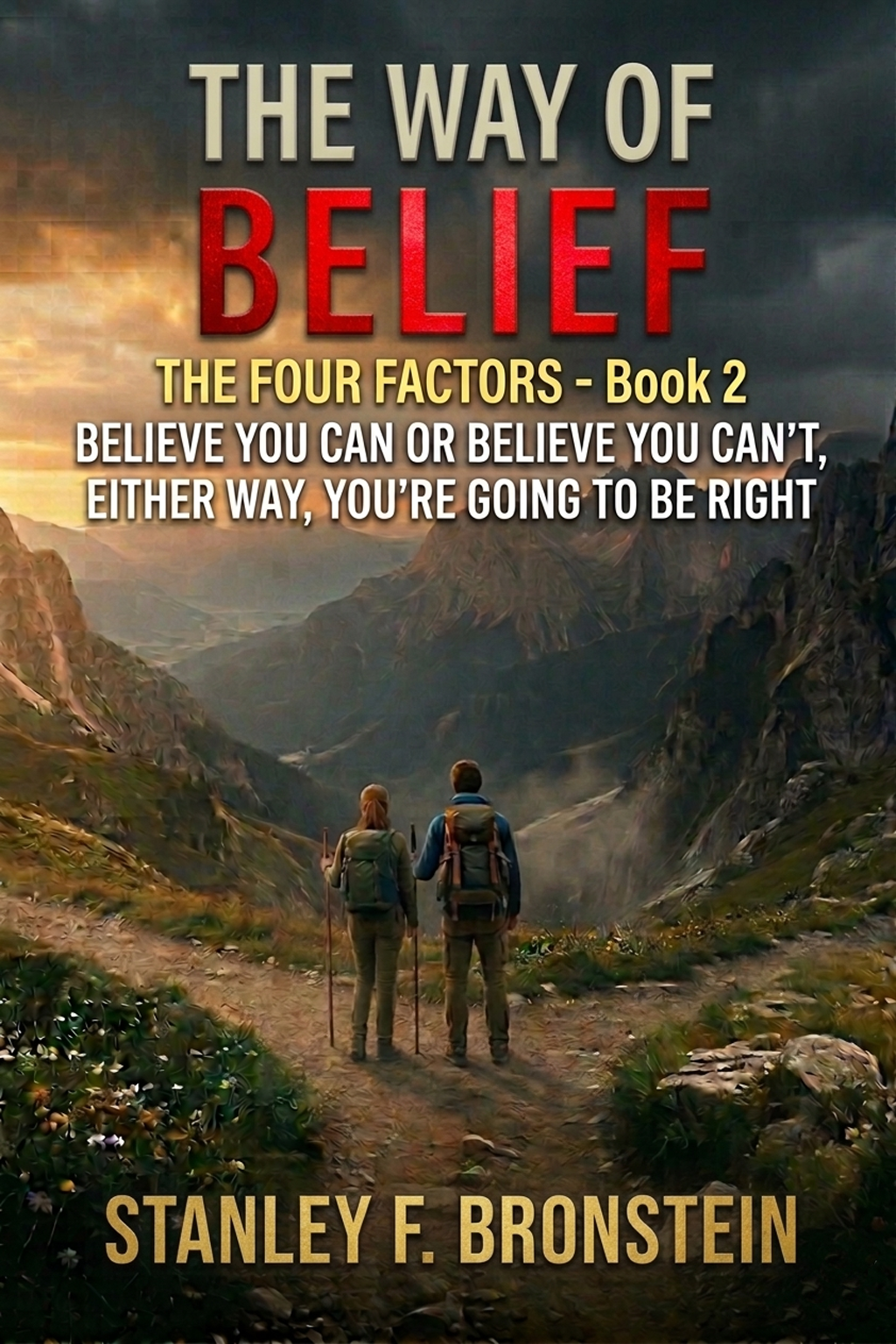
The Way of Belief
The Four Factors – Book 2
Believe You Can Or Believe You Can’t,
Either Way, You’re Going To Be Right
By Stanley F. Bronstein – Creator of The Way of Excellence System
Click The Tabs Below To Read Each Chapter Of The Book Online
Or
📘 Download Your Free Copy In Your Preferred Format
The Way of Belief
by Stanley F. Bronstein
How to use this page:
Click a chapter title to open it then scroll down to read.
When you click the title of the next chapter, the previous one will close.
Take your time.
Read, reflect, and do the experiments and assignments before you move on.
EMPTY ITEM
Foreword - The Doorway Called Belief
Belief is one of the most powerful forces in human life.
It shapes what people see, what they expect, what they attempt, what they avoid, what they endure, what they build, and what they ultimately become. It affects the standards they live by, the meaning they assign to their experiences, the level of effort they are willing to give, and the boundaries they place around what they accept as possible.
That is why belief matters so much.
Most people think of belief as something private, soft, abstract, and hard to measure. I do not see it that way. I see belief as a force. I see it as something active. I see it as something that is always doing something, whether people realize it or not.
Belief is never neutral.
It is either helping move a person forward or helping hold that person back. It is either strengthening courage or strengthening fear. It is either widening the field of possibility or narrowing it. It is either feeding growth or feeding resignation. It is either building strength or reinforcing weakness.
This book is about learning to understand that force, examine that force, strengthen that force, and direct that force wisely.
It is also about something deeper.
At the heart of this book is a truth that has become central in my own life: you are more powerful than you ever imagined.
That statement is not small. It is not casual. It is not motivational fluff. It is a truth with enormous implications. It means that many people are living far beneath what they are capable of, not because they lack potential, but because they do not yet believe in their own power. A person who does not believe in their own power is undoubtedly living below their potential.
People underestimate themselves every day. They underestimate their strength. They underestimate their resilience. They underestimate their discipline. They underestimate their ability to change. They underestimate their ability to endure hardship, break old patterns, raise their standards, and create a different future. They live inside limits they have accepted without ever fully testing them.
Then something happens.
Sometimes it is a breakthrough. Sometimes it is a decision. Sometimes it is a small win. Sometimes it is a major transformation. But something happens that shows them they are stronger than they thought, far stronger.
That moment matters because it changes far more than behavior. It begins to change identity. It begins to challenge old assumptions. It begins to replace false stories with evidence. It begins to reveal a larger truth about human power.
That is what this book is about. It is about belief as a doorway.
For me, that doorway opened in a dramatic and undeniable way. I lost more than 220 pounds and kept it off permanently. That was not a temporary burst of effort. That was not a lucky break. That was not a short-lived experiment. It was a profound transformation that required new choices, new standards, new habits, new discipline, new thinking, and a new relationship with myself.
Most importantly, it required a different belief.
Through that experience, I came to see that I was more powerful than I had ever imagined. Not in some inflated sense. Not in some fantasy-driven sense. In a practical, lived, undeniable sense. I had done something that once would have seemed impossible to me. I had changed my life in a way that forced me to confront a larger truth.
If I was capable of doing something this incredible, what else was out there waiting for me to do that I should be doing?
That question changed my life.
It did not merely help me appreciate what I had already done. It pushed me to ask what else had been sitting dormant inside me. It pushed me to ask where else I had underestimated myself. It pushed me to ask what other doors would open if I truly accepted that I was stronger, more capable, and more responsible than I had once believed.
That is one of the great gifts of belief.
Belief does not merely help a person feel better. Belief opens new lines of thought. Belief produces new questions. Belief reveals new possibilities. Belief alters identity. Belief influences action. Belief demands responsibility. Belief can move a person from passive living to deliberate living.
But this book does not stop at belief.
Belief is the doorway, not the endpoint.
That is one of the most important ideas in this book. A person begins by believing that they are more powerful than they ever imagined. Then that belief is tested. It is challenged. It is acted upon. It is strengthened by evidence. It is reinforced by repeated experience. It is confirmed through lived reality. And over time, belief matures into something even stronger.
It matures into knowing.
That progression matters:
Belief begins the journey.
Truth steadies belief.
Action tests belief.
Evidence strengthens belief.
Experience confirms belief.
Knowing deepens belief into something solid.
At first, a person hopes. Then they believe. Then they act. Then they see evidence. Then they gain deeper certainty. Then one day they realize they no longer merely believe they are more powerful than they ever imagined. They know it.
That is a major shift.
Belief says, “I accept this as true.”
Knowing says, “I have lived this. I have seen this. I know this.”
That is one of the deepest movements in this book.
This book is not about blind belief. It is not about pretending. It is not about denying reality, ignoring evidence, or talking yourself into something false. In fact, one of the most important ideas in this book is that belief must be grounded in truth.
False belief misleads. Delusion damages. Wishful thinking distracts. But belief anchored in truth, evidence, honesty, and lived experience becomes one of the most constructive forces in human life.
That kind of belief can be built.
It can be strengthened.
It can be tested.
It can be corrected.
It can be expanded.
And because it can be changed, a life can be changed with it.
The pages that follow explore belief from many different angles. They examine how belief shapes perception, how limiting beliefs create limited lives, why belief must be grounded in truth, how self-image affects conduct, how action reveals belief, how small wins strengthen belief, how doubt shrinks possibility, and how greater belief brings greater responsibility.
This matters because belief is not only about what a person thinks. It is about how a person lives.
If someone believes change is possible, that belief affects effort. If someone believes change is impossible, that belief also affects effort. If someone believes they are capable of more, they carry themselves differently from someone who believes they are weak, trapped, or permanently defined by their past. In every case, belief is at work. In every case, belief is shaping life.
That is why this book is not merely theoretical.
It is practical.
It is meant to help readers identify the beliefs shaping their lives right now. It is meant to help them distinguish between beliefs that strengthen and beliefs that weaken. It is meant to help them see where they have underestimated themselves and where they have accepted limits that are not true. It is meant to help them build stronger, truer, more life-giving beliefs.
It is also meant to help them act.
Belief that never affects behavior remains weak. Real belief produces movement. It changes decisions. It changes habits. It changes standards. It changes what a person does when life gets difficult. One of the central ideas of this book is that belief is not passive. It produces action.
That matters because many people wait to act until they feel completely ready, completely confident, or completely certain. But real growth rarely works that way. A person takes one step. Then another. Then another. They keep one promise to themselves. Then another. They gain one small win. Then another. And over time, those small pieces of evidence strengthen belief in a way that slogans never could.
This is one of the reasons I wanted this book to be practical rather than merely inspirational. Inspiration matters, but it is not enough. People need clarity. They need honesty. They need a framework. They need a way to move from vague hope to lived belief, and from lived belief to knowing.
This book is part of a larger body of work connected to The Way of Excellence (TWOE), but it stands on its own as an exploration of one of the Four Factors. Belief is not the whole of life, but it is one of the forces that shapes almost everything in life. To understand belief is to better understand behavior, growth, stagnation, identity, perseverance, and possibility.
Belief stands at the center of many turning points.
It affects what people try.
It affects what they tolerate.
It affects whether they rise after falling.
It affects whether they live by old labels or new truths.
It affects whether they dismiss opportunity or walk through the doors that open before them.
And eventually, if it is strong and true enough, it affects not only how they see themselves, but how they see others.
That may be one of the most important developments of all.
Once a person begins to realize, truly realize, that they are more powerful than they ever imagined, they also begin to realize that the same is true of others.
That moves belief beyond self-improvement.
It turns belief into respect.
It turns belief into hope.
It turns belief into responsibility.
It turns belief into leadership.
It turns belief into service.
It turns belief into a way of seeing human beings more truthfully.
Because this truth does not belong to a chosen few. It belongs to all of us.
We are all more powerful than we ever imagined.
That is not merely a comforting thought. That is a truth with profound consequences. It changes how we lead. It changes how we parent. It changes how we coach. It changes how we teach. It changes how we encourage. It changes how we serve. It changes how we respond to human weakness, human struggle, and human possibility.
This book begins with the individual because that is where transformation usually begins. It begins with the private questions: What do I believe? What are those beliefs doing to my life? Where have I underestimated myself? What changes when I begin to believe something stronger and truer?
But it does not end there.
It expands outward.
It moves from the personal to the relational, from the relational to the communal, and from the communal toward the universal. It moves toward the recognition that hidden power is not rare. Hidden power is human. It moves toward the recognition that possibility does not belong to a select few. It belongs to all of us.
And as that truth is lived, tested, strengthened, and confirmed, it becomes more than belief.
It becomes knowing.
My hope is that this book helps readers open that doorway.
My hope is that it helps them see that belief is not small, not passive, and not neutral.
My hope is that it helps them recognize that many of the limits in their lives are weaker than they appear.
My hope is that it helps them build beliefs worthy of the truth.
My hope is that it helps them act on what they come to see.
My hope is that it helps them move from belief to strengthened belief, and from strengthened belief to knowing.
And my hope is that somewhere along the way, perhaps quietly at first, they will begin to understand something life-changing:
They are more powerful than they ever imagined.
Then, as that truth is tested and confirmed in life, they will come to know it.
And once they know it about themselves, they will begin to know it about others as well.
That is the doorway called belief.
And this book is an invitation to walk through it.
INTRODUCTION TO PART I - UNDERSTANDING BELIEF
The Way of Excellence (TWOE) teaches that lasting change begins long before visible results appear. It begins in the unseen world of thought, meaning, identity, decision, and belief. Before a person changes habits, results, relationships, health, or direction, something deeper changes first. That deeper thing is belief.
That is why this part of the book comes first.
Before belief can be strengthened, it must be understood. Before belief can mature into knowing, it must be examined honestly and brought into the light. Many people live under the influence of beliefs they have never clearly identified, never carefully questioned, and never deliberately chosen. Yet those beliefs shape the way they see the world, the way they interpret events, the way they respond to difficulty, and the way they define themselves.
Belief is never neutral. It is always pushing life in some direction. It is either helping move a person forward or helping hold that person back. It is either expanding possibility or shrinking it. It is either feeding courage or feeding fear. It is either building strength or reinforcing weakness. That is why understanding belief matters so much. A person who does not understand the force of belief is still being directed by it.
Many people mistake conclusions for facts. They mistake old labels for identity. They mistake current condition for permanent truth. They assume that what they have believed for a long time must therefore be true. It does not work that way. Belief can be false. Belief can be inherited. Belief can be absorbed from fear, failure, pain, shame, environment, or repetition. And when false belief goes unchallenged, it quietly builds a false life around itself.
That is one of the great tragedies of human life.
People accept limits they do not need to accept. They live beneath standards they are fully capable of reaching. They surrender possibilities they were born to pursue. They speak to themselves in ways they would never speak to someone they love. They carry old verdicts into new seasons. They underestimate their own strength, their own resilience, their own adaptability, and their own power.
But that is not the truth.
The truth is that human beings possess far more power than they realize. We are all more powerful than we ever imagined. A person who does not believe in their own power is undoubtedly living below their potential. Once a person begins to realize, truly realize, that they are more powerful than they ever imagined, they also begin to realize that the same is true of others.
That realization changes everything.
It changes how a person thinks. It changes how a person interprets hardship. It changes how a person responds to setbacks. It changes how a person defines possibility. It changes how a person sees the future. It changes how a person treats other people. It changes leadership, service, responsibility, and hope. When belief changes, life changes.
But real change does not begin with vague wishing. It begins with understanding. It begins with seeing belief clearly enough to confront it honestly. It begins with learning how belief shapes perception, identity, conduct, and direction. It begins with recognizing that false beliefs create false limits, and that true belief, grounded in truth, creates strength.
That is the purpose of Part I.
In the chapters that follow, we will examine belief at its roots. We will look at what belief is, what it does, why it matters, how it shapes perception, how limiting beliefs create limited lives, why belief must be grounded in truth, and how the way a person sees themselves affects the way they live. These are not side issues. They are foundational issues. If the foundation is weak, everything built upon it becomes unstable. If the foundation is strong, growth becomes far more likely.
Part I lays that foundation.
It is designed to help the reader see belief clearly, confront it honestly, and understand its power. Because once belief is understood, it can be challenged. Once it is challenged, it can be changed. Once it is changed, it can be strengthened. And once it is strengthened through truth, action, evidence, and lived experience, it matures into knowing.
That is where this journey begins.
Chapter 1 - Belief Is Never Neutral
The Way of Excellence (TWOE) teaches that what happens on the outside of a person’s life is deeply connected to what is happening on the inside. Long before results appear, something has already been happening in thought, meaning, identity, decision, and belief. Long before a person changes habits, changes direction, changes standards, or changes outcomes, belief has already been at work.
That is why belief matters so much.
Most people do not spend much time thinking about belief itself. They think about goals. They think about problems. They think about circumstances. They think about what happened, what might happen, or what they hope will happen. But beneath all of that, belief is quietly shaping the way they interpret life and respond to it.
Belief is not just a thought sitting still in the mind. Belief is active. Belief has force. Belief pushes life in a direction.
That is why belief is never neutral.
A belief is either helping move a person forward or helping hold that person back. A belief is either strengthening courage or strengthening fear. A belief is either widening the field of possibility or narrowing it. A belief is either helping build power or helping bury it.
There is no such thing as a harmless belief that does nothing.
Every belief does something.
Belief Is Always Producing Consequences
A person’s beliefs influence what that person notices, what that person ignores, what that person expects, what that person attempts, what that person avoids, what that person tolerates, and what that person becomes willing to fight for. Belief affects language. Belief affects effort. Belief affects perseverance. Belief affects standards. Belief affects identity. Belief affects the meaning assigned to both success and failure.
That is why two people can go through similar experiences and come away with entirely different outcomes.
One person experiences difficulty and concludes, “This is hard, but I can handle it.”
Another person experiences difficulty and concludes, “This proves I am not capable.”
The event may look similar from the outside, but the belief attached to the event changes everything.
One belief strengthens the person.
The other belief weakens the person.
One belief leads to persistence.
The other belief leads to retreat.
One belief opens the future.
The other belief narrows it.
That is not neutral.
It is directional.
Belief always pushes life somewhere.
Belief Operates Whether You Notice It or Not
One of the most important truths about belief is that it does not need your permission to affect your life. It works whether you are paying attention to it or not.
A person may never sit down and formally say, “I believe I am not good enough.” Yet that belief may still be operating. It may show up in hesitation. It may show up in procrastination. It may show up in overexplaining, shrinking, pleasing, settling, hiding, or quitting early. A person may never consciously announce the belief, but the belief is still shaping behavior.
In the same way, a person may never sit down and formally say, “I believe I am capable of growth, resilience, and change.” Yet that belief may still be operating too. It may show up in effort. It may show up in recovery after setbacks. It may show up in willingness to learn, willingness to try again, willingness to raise standards, and willingness to keep promises to oneself.
In either case, belief is not waiting quietly in the background. Belief is already working.
This is one reason so many people feel stuck without fully understanding why. They think they are struggling only with circumstances, but beneath the circumstances there may be beliefs quietly reinforcing the struggle. They think they have a motivation problem, when in reality they may have a belief problem. They think they need a better strategy, when in reality they may first need a better belief.
Belief is often invisible until its results become visible.
By then, it may already have shaped years of a person’s life.
Helpful Beliefs and Harmful Beliefs
Not all beliefs serve a person equally.
Some beliefs strengthen life. Other beliefs weaken it.
A helpful belief might sound like this:
“I can learn.”
“I can change.”
“This setback is not the end.”
“My past does not define my future.”
“I am capable of more.”
A harmful belief might sound like this:
“This is just who I am.”
“I always fail.”
“It is too late for me.”
“I am stuck.”
“There is no point in trying.”
Notice something important here. A harmful belief does not have to sound dramatic in order to be destructive. It can sound practical. It can sound realistic. It can sound familiar. It can even sound humble. But if it shrinks courage, lowers standards, limits action, and trains a person to expect less from themselves, it is still doing damage.
Likewise, a helpful belief does not have to sound grandiose in order to be powerful. It simply has to strengthen truth, courage, responsibility, and action.
A belief does not have to shout in order to rule.
Sometimes the quietest beliefs control the most territory.
Belief Shapes Identity
Belief does not only affect what people do. It affects who they believe themselves to be.
A person who believes, “I am weak,” will interpret life differently from a person who believes, “I am growing stronger.”
A person who believes, “I am broken,” will live differently from a person who believes, “I have been hurt, but I am not finished.”
A person who believes, “I am a quitter,” will approach difficulty differently from a person who believes, “I follow through.”
Identity-level beliefs are especially powerful because they do not feel like opinions. They feel like facts. Once a person accepts an identity-level belief, behavior usually starts to organize itself around it.
That is why false identity beliefs are so dangerous.
If a person believes they are powerless, they will tend to live as though they are powerless.
If a person believes they are incapable, they will tend to live as though they are incapable.
If a person believes they are unworthy, they will often accept less than they should accept and tolerate more than they should tolerate.
But the opposite is also true.
If a person begins to believe they are capable, resilient, responsible, and powerful, behavior starts to shift. Standards begin to rise. Action becomes more consistent. Courage becomes more available. The person begins to move differently because the person begins to see themselves differently.
Again, belief is not neutral.
It is building identity or distorting identity.
It is strengthening the self or weakening it.
A Person Who Does Not Believe in Their Own Power Is Undoubtedly Living Below Their Potential
This is one of the central truths of this book.
A person who does not believe in their own power is undoubtedly living below their potential.
That statement is strong because the truth is strong.
A person does not need to lack intelligence, talent, resources, or opportunity to live below potential. A person can live below potential simply by living below belief. The problem is not always inability. The problem is often unbelief.
If a person does not believe they can change, they will not approach change the same way.
If a person does not believe they can rise, they will not rise with the same strength.
If a person does not believe they are responsible for more, they will not take on more.
If a person does not believe there is more inside them, they will not go looking for it.
That is one of the great costs of weak belief. It does not merely reduce confidence. It reduces effort, endurance, imagination, and willingness. It keeps people from discovering what they are actually capable of.
Many people never truly test themselves.
They settle before they have to.
They stop before they have to.
They shrink before they have to.
They accept verdicts before evidence has been fully gathered.
And then they call that realism.
It is not realism.
It is surrender disguised as realism.
Belief matters because belief determines whether a person keeps going long enough to find out what is true.
Belief Expands or Shrinks Possibility
What a person believes determines, in large part, what that person sees as possible.
A person with weak belief sees obstacles first, reasons first, limitations first, excuses first, and risks first. That does not mean the obstacles are imaginary. It means they dominate the field of vision.
A person with stronger belief sees obstacles too, but they also see possibility, responsibility, pathways, alternatives, and openings. They do not become blind to difficulty. They simply refuse to treat difficulty as the final authority.
That is an enormous difference.
Weak belief says, “This is probably not for me.”
Strong belief says, “This may be difficult, but I am not finished.”
Weak belief says, “I do not think I can.”
Strong belief says, “I will find out what I can do.”
Weak belief narrows life.
Strong belief enlarges life.
This does not mean strong belief is fantasy. It means strong belief refuses to surrender prematurely. It refuses to confuse current condition with permanent capacity. It refuses to let fear write the final conclusion.
Belief shapes what a person is willing to attempt, and what a person is willing to attempt shapes what a person is able to discover.
That is why belief is never neutral. It affects the size of the life a person is willing to live.
Belief Feeds Courage or Feeds Fear
Fear is powerful, but fear rarely operates alone. Fear is usually reinforced by belief.
A person fears rejection, but beneath that fear may be a belief: “If I am rejected, it means I am not enough.”
A person fears failure, but beneath that fear may be a belief: “If I fail, it proves I never had what it takes.”
A person fears change, but beneath that fear may be a belief: “I cannot handle what comes next.”
When fear is attached to false belief, fear grows stronger.
But when truth enters, fear weakens.
When a person begins to believe, “I can handle discomfort,” courage grows.
When a person begins to believe, “Failure is not final,” courage grows.
When a person begins to believe, “I am stronger than I once thought,” courage grows.
Fear and courage are both fed by interpretation, and interpretation is shaped by belief.
That is why belief is never neutral in the emotional life of a person either. It is not merely informing thought. It is feeding either courage or fear.
Belief Shows Up in Action
A person can say many things, but eventually action reveals belief.
If a person says they believe health matters, but repeatedly lives in a way that destroys health, there is a disconnect.
If a person says they believe they are capable, but repeatedly refuse to act where action is required, there is a disconnect.
If a person says they believe change is possible, but never take steps toward change, there is a disconnect.
This is not about perfection. It is about direction.
Belief that is real eventually shows up in choices.
That is why belief is never neutral in the practical sense either. It does not stay trapped in the mind. It leaks into behavior. It forms habits. It shapes routines. It affects consistency. It influences the standards a person accepts and the promises a person keeps or breaks.
In time, life itself begins to reflect belief.
Not perfectly.
Not instantly.
But unmistakably.
That is why this chapter comes first. If belief is always doing something, then belief must be taken seriously from the very beginning.
Belief Is the Doorway
This book is called The Way of Belief for a reason.
Belief is the doorway.
It is where many transformations begin.
A person hears a truth they had not fully accepted before.
A person sees evidence they had ignored before.
A person decides to question an old story.
A person starts to act in a stronger direction.
A person begins to believe something new and truer.
That is how many new lives begin.
But in order for belief to become stronger, it must first be seen clearly. It must be recognized for what it is: not a decorative idea, not a passive thought, not a harmless opinion, but a force that shapes life.
That is why the work of understanding belief matters so much.
If belief is helping build your life, you need to know that.
If belief is helping weaken your life, you need to know that too.
Only then can belief be challenged, strengthened, corrected, and directed wisely.
We Are All More Powerful Than We Ever Imagined
The deeper truth running through this book is that human beings possess far more power than they realize. We are all more powerful than we ever imagined.
That truth does not become less true because people doubt it.
That truth does not disappear because someone has failed, suffered, withdrawn, or settled.
That truth remains.
The tragedy is not that the power is absent.
The tragedy is that the power goes unrecognized, unclaimed, and underused.
A person who does not believe in their own power is undoubtedly living below their potential. And once a person begins to realize, truly realize, that they are more powerful than they ever imagined, they also begin to realize that the same is true of others.
That is where this journey begins.
It begins with understanding belief.
It begins with recognizing that belief is already shaping life.
It begins with seeing clearly that belief is never neutral.
And it begins with asking a necessary question:
What are my beliefs doing to my life right now?
If the answer to that question is faced honestly, it can change everything.
Assignment
Step 1 – Identify Five Active Beliefs
Write down five beliefs that are currently shaping your life. Do not overthink this. Write what is real. These may be beliefs about yourself, your future, your health, your relationships, your worth, your abilities, your age, your past, or your possibilities.
Step 2 – Mark Each Belief as Strengthening or Weakening
Next to each belief, write either Strengthening or Weakening. Ask yourself whether that belief is moving you forward or holding you back.
Step 3 – Identify the Consequences
For each belief, write down at least one consequence it is producing in your life. How does it affect your thinking, your choices, your habits, your standards, your courage, or your willingness to act?
Step 4 – Choose One Belief to Challenge
Select the one weakening belief that appears to be doing the most damage in your life right now. Circle it. This is the belief you will begin confronting as you continue through this book.
Step 5 – Write a Truth Statement
Write one clear truth statement in response to that weakening belief. Make it strong. Make it honest. Make it something you are willing to face and grow into. This is not your final answer. It is your first step toward stronger belief.
Chapter 2 - What You Believe Shapes What You See
The Way of Excellence (TWOE) teaches that people do not move through life as neutral observers. They do not simply take in facts, process them accurately, and respond with perfect objectivity. They see through lenses. They interpret through frameworks. They assign meaning through beliefs.
That is why what a person believes shapes what that person sees.
This truth reaches into every part of life. It affects how people see themselves. It affects how they see others. It affects how they see opportunity, difficulty, risk, pain, failure, growth, age, success, leadership, responsibility, and the future. It affects how they interpret what has happened and what they think is possible next.
People often assume they are responding to reality itself when, in truth, they are responding to reality as filtered through belief.
That is an enormous distinction.
Because once that distinction is understood, a person begins to realize that changing belief changes far more than mood. It changes perception. It changes interpretation. It changes meaning. And once meaning changes, direction changes.
Life Is Not Only Experienced – It Is Interpreted
Two people can go through the same event and come away with very different conclusions.
One person faces a setback and says, “This is difficult, but I will learn from it.”
Another person faces the same kind of setback and says, “This proves I am not capable.”
One person receives criticism and says, “This gives me something to improve.”
Another person receives criticism and says, “This confirms I am not good enough.”
One person grows older and says, “I have more wisdom, more experience, and more strength than I used to have.”
Another person grows older and says, “My best years are behind me.”
The event is not always what determines the outcome. The interpretation helps determine the outcome. And interpretation is deeply shaped by belief.
This does not mean facts do not matter. Facts matter. Reality matters. Truth matters. But people do not interact with facts in a vacuum. They interact with facts through meaning, and meaning is shaped by what they believe.
That is why what people believe affects what they are able to see in the first place.
A belief does not merely color the edges of life. It shapes the whole field of vision.
Belief Functions Like a Lens
A lens does not create the object, but it affects how the object is seen.
A dirty lens distorts.
A cracked lens distorts.
A tinted lens distorts.
A clear lens reveals more accurately.
Belief works in much the same way. It does not always create the situation, but it influences how the situation is perceived. It influences what stands out, what gets dismissed, what gets emphasized, and what gets minimized.
If a person believes life is against them, they will notice proof of that belief everywhere.
If a person believes they are unworthy, they will interpret interactions through that belief.
If a person believes change is possible, they will notice possibilities other people overlook.
If a person believes they are stronger than they once thought, they will interpret difficulty differently from someone who believes difficulty is proof of weakness.
This is one reason belief is so powerful. It does not wait until after a person sees something clearly. It is already involved in the seeing.
That means belief is not only shaping response. Belief is shaping perception.
Expectation Directs Attention
People tend to notice what they expect to notice.
A person who expects rejection will often scan for rejection.
A person who expects failure will often scan for signs that failure is coming.
A person who expects betrayal will often scan for betrayal.
A person who expects growth will often scan for lessons, openings, and next steps.
A person who expects possibility will often notice doors that others walk past.
Expectation directs attention, and attention influences experience.
This is not magic. It is not fantasy. It is the practical reality that the human mind does not give equal weight to everything. It selects. It highlights. It sorts. It prioritizes. And belief has enormous influence over that process.
That is why two people can sit in the same room, hear the same words, face the same challenge, and leave with entirely different conclusions about what happened. Their beliefs told them what to look for, what to emphasize, and what to make it mean.
A person who believes, “I never get a fair chance,” will interpret many situations through that belief.
A person who believes, “There is still something here for me to learn, do, or become,” will interpret many situations through that belief.
Again, belief shapes what a person sees.
Belief Influences What You Notice and What You Ignore
What people notice is important.
What they ignore is just as important.
A person trapped in limiting belief often overlooks evidence that contradicts the limitation. A person who believes, “I never follow through,” may ignore all the ways they have shown perseverance in other areas. A person who believes, “I am too old to change,” may ignore examples of growth, strength, and transformation already present in their life. A person who believes, “Nothing ever works for me,” may overlook progress because it does not match the story they are used to telling.
That is one of the most destructive things false belief does. It trains the mind to gather evidence for the wrong conclusion.
But strong belief, grounded in truth, changes that process.
When a person begins to believe, “I am capable of more,” that person starts noticing where more is possible.
When a person begins to believe, “My past does not define my future,” that person starts noticing ways to move forward rather than merely replaying old pain.
When a person begins to believe, “I am stronger than I once thought,” that person starts noticing evidence of strength instead of only evidence of strain.
Belief does not merely influence what people look at. It influences what they are capable of recognizing.
That is why false belief hides possibility and true belief reveals it.
Belief Shapes the Meaning of Events
Events do not come pre-labeled with final meaning.
People assign meaning.
A setback can mean, “I am done,” or it can mean, “I need a better strategy.”
A delay can mean, “This is never going to happen,” or it can mean, “This is taking longer than I expected, but I am still in motion.”
A hard conversation can mean, “This relationship is broken,” or it can mean, “Something important is surfacing and now it can be addressed.”
A single mistake can mean, “I always ruin things,” or it can mean, “I need to learn, adjust, and move forward.”
Belief sits in the middle of all of this. Belief helps decide what the event means.
That is why belief is so closely connected to emotional life as well. People are not only reacting to what happened. They are reacting to what they believe it means. And if the meaning is distorted, the reaction will often be distorted too.
This is why one of the most important skills a person can develop is the ability to question interpretation.
Not everything a person feels is false. Not everything a person perceives is wrong. But not every interpretation deserves automatic trust either.
Sometimes what feels like reality is actually belief speaking.
Sometimes what feels like certainty is actually an old story repeating itself.
Sometimes what feels like a final conclusion is actually a false interpretation with a loud voice.
That is why beliefs must be brought into the light and examined honestly.
What You Believe About Yourself Shapes What You See in Yourself
People do not see themselves clearly when false belief is in control.
A person who believes they are weak will interpret exhaustion as proof of weakness, rather than proof they have been carrying too much.
A person who believes they are incapable will interpret challenge as proof they should stop, rather than proof they are being stretched.
A person who believes they are not worthy will interpret neglect, disrespect, or disappointment as confirmation of what they already think about themselves.
A person who believes they are powerful, responsible, and capable will interpret the same kinds of situations differently. That person may still feel pain. That person may still feel frustration. But they will not surrender the right to define themselves accurately.
This is why self-image matters so much.
If a person sees themselves incorrectly, they will live incorrectly.
If a person sees themselves as less than they are, they will accept less than they should accept, attempt less than they should attempt, and demand less of themselves than they are capable of giving.
But when a person begins to see themselves more truthfully, everything begins to shift.
That person begins to carry themselves differently.
That person begins to expect more of themselves.
That person begins to interpret challenge as a place to rise rather than a place to retreat.
That person begins to notice hidden strength where they previously saw only weakness.
In other words, before life changes on the outside, it is usually seen differently on the inside.
What You Believe About Others Shapes What You See in Others
This truth does not stop with the self.
A person who believes others are mostly problems will tend to see problems first.
A person who believes others are mostly threats will tend to see threat first.
A person who believes others are incapable of change will tend to see fixed limitation.
But a person who understands human power differently begins to see differently.
Once a person begins to realize, truly realize, that they are more powerful than they ever imagined, they also begin to realize that the same is true of others.
That changes leadership.
That changes parenting.
That changes friendship.
That changes coaching.
That changes teaching.
That changes service.
It becomes harder to reduce people to their current condition when you understand that human beings possess far more power than they realize. It becomes harder to write people off too quickly. It becomes harder to confuse present struggle with permanent identity.
This does not mean denying weakness, excusing bad behavior, or pretending people do not need accountability. It means seeing more truthfully. It means recognizing that human beings are bigger than the worst thing they have done, bigger than the hardest thing they have been through, and bigger than the narrowest story currently being told about them.
Belief changes what people see in others because belief changes what they think is possible in others.
Belief Influences What You Fear and What You Pursue
People do not merely see neutral facts and then decide what to fear or pursue. Belief is already involved in both.
A person who believes failure is fatal will fear risk more intensely.
A person who believes discomfort is unbearable will avoid growth more quickly.
A person who believes change is dangerous will cling more tightly to the familiar.
A person who believes effort is worthwhile will pursue more boldly.
A person who believes growth is available will endure more patiently.
A person who believes there is more inside them will pursue what others dismiss.
This is why belief has so much to do with both stagnation and progress.
It affects what people run from.
It affects what people run toward.
It affects what they call wise.
It affects what they call impossible.
It affects what they call unrealistic.
It affects what they call worth the effort.
Belief plays a major role in shaping a person’s map of danger and a person’s map of opportunity.
And those maps influence the life that follows.
What People Call Reality Is Frequently Filtered Through Prior Belief
This is one of the most important ideas in this chapter.
People often speak as if they are simply seeing life “the way it is.” But very often, what they are really seeing is life filtered through prior belief.
A person who believes, “Nothing ever works for me,” will notice evidence that supports that belief and overlook evidence that challenges it.
A person who believes, “I am hard to love,” will interpret relationships through that belief.
A person who believes, “People cannot be trusted,” will read situations through that belief.
A person who believes, “I am capable of growth,” will interpret the future through that belief.
Again, this does not mean reality does not exist. It means that perception is not as pure as people like to think it is.
That is why humility matters.
That is why truth matters.
That is why evidence matters.
That is why self-examination matters.
A person must be willing to ask:
Is this what is true?
Or is this what I have been trained to see?
That question can change a life.
Because a false belief, repeated long enough, starts to feel like reality.
And a true belief, embraced deeply enough, starts to reveal reality more clearly.
Before the Outside Changes, the Inside Usually Changes First
Many people want external change without internal change.
They want a new outcome without a new interpretation.
They want a different life without a different lens.
They want more courage without different belief.
But that is not how deep change usually works.
Before a person speaks differently, they usually begin seeing differently.
Before a person lives differently, they usually begin interpreting differently.
Before a person attempts something bigger, they usually begin believing something stronger.
That is why inner change matters so much.
A person begins to believe they are capable of more.
Then they begin to notice more possibility.
Then they begin to interpret challenge differently.
Then they begin to act differently.
Then life begins to change.
The visible change may seem sudden to outsiders, but it usually started much earlier inside the person.
This is one reason transformation can look mysterious from the outside. People see the action stage, but they do not always see the belief stage that made the action possible.
The new life was often seen inwardly before it was built outwardly.
Seeing More Truthfully Changes Everything
The goal of this chapter is not to encourage fantasy. The goal is not to tell people to see whatever they want to see. The goal is to help people see more truthfully.
And seeing more truthfully requires stronger belief, not weaker belief.
It requires belief grounded in truth.
It requires the courage to question false interpretations.
It requires the humility to admit that what felt obvious may not have been accurate.
It requires the discipline to notice the role belief has been playing all along.
This matters because what a person sees helps determine what that person does next.
If a person sees only defeat, that person will act one way.
If a person sees challenge, possibility, and responsibility together, that person will act another way.
If a person sees themselves as powerless, that person will live one way.
If a person sees themselves as powerful, responsible, and capable of growth, that person will live another way.
In either case, belief shapes sight, and sight shapes life.
That is why this chapter comes so early in the book.
Because before a person can build stronger belief, that person must first understand just how much belief has already been shaping vision.
We Are All More Powerful Than We Ever Imagined
The deeper truth running through this book remains clear here as well.
Human beings possess far more power than they realize. We are all more powerful than we ever imagined.
That truth changes what a person sees.
When a person believes they are powerless, they see barriers everywhere.
When a person believes they are capable of growth, they begin to see doors.
When a person realizes they are more powerful than they ever imagined, they begin to reinterpret the whole landscape of life.
What once looked like proof of defeat starts to look like a challenge to rise.
What once looked like a dead end starts to look like a problem to solve.
What once looked like permanent identity starts to look like temporary condition.
What once looked like the whole story starts to look like one chapter.
This is not distortion. This is correction.
False belief distorted vision first.
True belief restores it.
And once a person begins to see more truthfully, life starts moving in a different direction.
That is why what you believe shapes what you see.
And that is why changing belief changes far more than thought. It changes perception, meaning, possibility, and direction.
Assignment
Step 1 – Identify Three Situations
Write down three situations from your life in which your interpretation of what happened was strongly influenced by what you already believed. These may involve yourself, another person, a setback, an opportunity, a disappointment, a criticism, or a major decision.
Step 2 – Name the Belief Behind the Interpretation
For each situation, identify the belief that shaped the way you saw it. Be honest and specific. What did you already believe about yourself, others, life, or the future that influenced your interpretation?
Step 3 – Describe the Meaning You Assigned
Write down what the situation meant to you at the time. What conclusion did you draw? What story did you tell yourself about what happened?
Step 4 – Reexamine the Situation Through a Stronger Lens
Now ask yourself whether there is a stronger, truer interpretation. What might you see differently if you approached that same situation from the belief that you are more powerful than you ever imagined?
Step 5 – Write One Corrective Statement
Write one sentence that you will use going forward to help correct distorted interpretation. Make it clear, truthful, and strong. Let it become a new lens.
Chapter 3 - Limiting Beliefs Create Limited Lives
The Way of Excellence (TWOE) teaches that people do not rise by accident, and they do not remain small by accident either. Growth, stagnation, excellence, compromise, expansion, and contraction all have roots. One of the deepest roots in human life is belief.
That is why limiting beliefs are so dangerous.
A limiting belief does more than shape a thought. It shapes a life. It shapes standards, effort, expectations, willingness, identity, courage, and action. It tells a person what is possible, what is realistic, what is worth attempting, what is worth enduring, and what kind of future is available. When that belief is false and weakening, it does not simply remain in the mind. It spills outward into conduct, choices, habits, and results.
That is why limiting beliefs create limited lives.
They create smaller vision.
They create smaller action.
They create smaller standards.
They create smaller endurance.
They create smaller futures.
And many people live within those limits for years without fully realizing that the walls around them were built inwardly long before they appeared outwardly.
A Limiting Belief Is a False Ceiling
A ceiling limits how high a person can rise unless that ceiling is broken.
A limiting belief works the same way.
It sets an invisible upper boundary on effort, expectation, confidence, discipline, responsibility, and hope. It tells a person, “This far and no farther.” It tells a person, “That may be possible for other people, but not for you.” It tells a person, “Do not expect too much.” It tells a person, “Stay where it is safe.” It tells a person, “Do not test the edge of your real capacity.”
That is why a limiting belief is so destructive. It does not merely describe a boundary. It creates one.
A person may have far more strength, talent, courage, resilience, intelligence, discipline, adaptability, or leadership ability than they realize, but if that person believes they do not, they will usually not live as though they do. The power may still be there, but the belief keeps it buried.
In that sense, a limiting belief is one of the most effective forms of self-restriction in human life.
It makes a person smaller without touching their real potential.
It convinces them to live below the truth.
Many Limits Are Accepted Before They Are Tested
One of the great tragedies of human life is that people surrender to limits they never truly needed to accept.
They assume they cannot because they have not yet.
They assume they are not because they do not yet feel like they are.
They assume something is impossible because it has been difficult, unfamiliar, slow, painful, or inconvenient.
But difficulty does not prove impossibility.
Slowness does not prove inability.
Discomfort does not prove incapacity.
Fear does not prove danger.
And a history of limitation does not prove a future of limitation.
Yet many people accept false conclusions long before the evidence justifies them. They do not test the belief rigorously. They do not challenge it honestly. They do not ask whether the limit is real or inherited, factual or emotional, truthful or convenient. They simply accept it and begin building a life around it.
That is why so many lives are far smaller than they need to be.
Not because the people in those lives were born with too little power.
But because they accepted too little belief.
Limiting Beliefs Often Masquerade as Realism
One of the reasons limiting beliefs survive for so long is that they do not always sound weak. They often sound sensible. They often sound practical. They often sound realistic.
A person says:
“I am just being honest with myself.”
“I know my limits.”
“I do not want to get my hopes up.”
“I am only trying to be realistic.”
Sometimes realism is wisdom.
Sometimes realism is surrender wearing a respectable disguise.
That distinction matters.
There is a difference between seeing reality clearly and shrinking reality to match fear.
There is a difference between recognizing a challenge and bowing to it before the contest has even begun.
There is a difference between humility and self-erasure.
False limitation often hides behind a tone of maturity. It sounds measured. It sounds calm. It sounds reasonable. But if it trains a person to expect less from themselves than truth supports, it is still destructive, no matter how polished it sounds.
A person can talk themselves into a smaller life while congratulating themselves for being realistic.
That does not make the smaller life more truthful.
It only makes the surrender harder to detect.
Limiting Beliefs Shrink Goals
A person rarely pursues what that person deeply believes is unavailable.
That is why limiting beliefs do not simply affect attitude. They affect ambition.
If a person believes meaningful health is no longer possible, that person will not pursue health with the same seriousness.
If a person believes strong relationships are not available to them, that person will not pursue relationships with the same openness.
If a person believes excellence belongs to other people, that person will not pursue excellence with the same standards.
If a person believes purpose is for the fortunate few, that person will not pursue purpose with the same conviction.
Belief sets the size of the target.
A person with limiting beliefs does not merely act smaller. That person aims smaller. And because that person aims smaller, that person settles sooner, stops sooner, and expects less.
This is one reason false beliefs are so expensive. They do not only limit what a person achieves. They limit what a person even tries to achieve.
The smaller goal begins long before the smaller outcome.
It begins with the smaller belief.
Limiting Beliefs Shrink Effort
People do not exert maximum effort in directions they have already decided are hopeless.
That is why belief and effort are inseparable.
A person who believes change is possible will usually give more effort than a person who believes change is pointless.
A person who believes the future can improve will usually endure more than a person who believes nothing truly changes.
A person who believes discipline matters will usually work differently from a person who believes outcomes are fixed regardless of behavior.
This does not mean belief alone is enough. It means belief affects whether a person is willing to bring the necessary effort to the struggle.
A limiting belief quietly asks, “Why bother?”
And once that question takes root deeply enough, effort begins to collapse.
The person stops pushing.
The person stops testing.
The person stops adjusting.
The person stops learning.
The person stops trying with full strength.
Then, when results remain poor, the limiting belief points to the result and says, “See? I was right.”
But the result was shaped by the weakened effort that the false belief produced.
That is one of the cruel cycles of limiting belief. It helps create the very evidence it then uses to defend itself.
Limiting Beliefs Lower Standards
Belief affects not only what people pursue and how hard they work. It affects what they think is acceptable.
A person who believes they deserve better tends to tolerate less disrespect.
A person who believes health matters tends to accept fewer self-destructive compromises.
A person who believes they are capable of excellence tends to demand more from themselves.
A person who believes they are powerless, unworthy, or incapable often accepts conditions that should not be accepted.
That is a painful truth, but it is a necessary one.
Low belief lowers standards.
It lowers what a person asks of themselves.
It lowers what a person allows from others.
It lowers what a person believes is possible in work, relationships, health, growth, and character.
And when standards fall, life falls with them.
That is why limiting beliefs are not merely internal. They are structural. They shape the whole architecture of daily living.
They influence what a person will permit, what a person will excuse, what a person will postpone, and what a person will quietly decide to live without.
A false belief can turn unnecessary compromise into normal life.
Limiting Beliefs Shrink Hope
Hope matters because hope keeps people moving.
Hope keeps a person from giving up too early.
Hope keeps a person searching for a better way.
Hope keeps a person from treating current pain as permanent destiny.
But limiting beliefs attack hope directly.
They tell a person:
“This is all there is.”
“This never changes.”
“This is just who you are.”
“Nothing better is coming.”
“You missed your chance.”
“It is too late.”
Those beliefs do not merely make a person sad. They make a person smaller. They reduce willingness. They weaken endurance. They train the mind to expect defeat and the heart to prepare for disappointment.
That is why hope is not a side issue.
Hope is tied to belief.
If belief is strong, hope has room to breathe.
If belief is weak, hope gets strangled.
A life without hope becomes narrow very quickly. The person may continue functioning outwardly, but inwardly the field of possibility has already collapsed.
That is why strengthening belief is not merely mental work. It is life-restoring work.
Mental Prisons Are Often Stronger Than External Ones
External obstacles are real.
Circumstances matter.
Pain matters.
Trauma matters.
Loss matters.
Lack matters.
The point of this chapter is not to deny the power of external conditions. The point is to recognize that internal limitation can become even more powerful than external limitation if left unchallenged.
A person can overcome astonishing external obstacles with strong belief.
A person can be defeated by very little with weak belief.
That is because the mind interprets and responds before the hands act, before the feet move, before the habits form, and before the standards rise. If a person is imprisoned inwardly, outer freedom alone will not solve the problem. But if a person begins to become free inwardly, many outer barriers begin to look different.
That is why mental prisons are often stronger than external ones.
A mental prison travels with the person.
It shows up everywhere.
It shapes every room, every opportunity, every relationship, every challenge.
It follows the person into success and tells them they do not belong there.
It follows the person into hardship and tells them they will never rise.
It follows the person into new beginnings and tells them not to expect much.
The prison may be invisible, but the confinement is real.
A person does not need locked doors to live in captivity.
A person only needs false belief.
The Past Does Not Have the Right to Dictate the Future
Many limiting beliefs are rooted in past pain, past failure, past humiliation, past weakness, or past identity.
A person failed before, so they conclude they are a failure.
A person quit before, so they conclude they are a quitter.
A person struggled before, so they conclude they are not capable.
A person was treated poorly before, so they conclude that is what they should expect.
This is one of the most destructive mistakes people make. They let the past speak with more authority than truth.
The past matters.
The past teaches.
The past leaves marks.
But the past does not have the right to dictate the future unless a person gives it that right through belief.
A past event is not the same as a permanent identity.
A past struggle is not the same as a permanent limit.
A past weakness is not the same as a permanent destiny.
That is why limiting beliefs must be challenged at the level of truth. A person must learn to say, “That happened, but that is not all that is true. That was real, but it is not final. That hurt me, but it does not define me. That was one chapter, not the whole story.”
A person who cannot separate past experience from present identity will tend to live in repetition.
A person who learns to challenge false continuity begins to open the door to transformation.
Self-Protection Can Become Self-Imprisonment
Some limiting beliefs are adopted because they feel protective.
A person says, “If I expect less, I will not be disappointed.”
A person says, “If I do not try too hard, failure will not hurt as much.”
A person says, “If I keep my hopes down, I will stay safe.”
But safety gained through self-shrinking is not true safety.
It is self-imprisonment.
A person may avoid some disappointment by expecting less, but that person also avoids some greatness.
A person may avoid some risk by refusing to try fully, but that person also avoids some discovery.
A person may avoid some pain by staying small, but that person also avoids some life.
This is a serious cost.
Many people do not need more talent first. They need more willingness to stop protecting false limitation. They need to stop treating smallness as wisdom. They need to stop confusing emotional caution with truth.
A life built around self-protection becomes a life built around avoidance.
And avoidance becomes its own prison.
Human Beings Possess Far More Power Than They Realize
This truth stands at the center of everything in this chapter.
Human beings possess far more power than they realize.
We are all more powerful than we ever imagined.
That means limiting beliefs are not merely inconvenient. They are false witnesses against human capacity.
They lie about strength.
They lie about resilience.
They lie about adaptability.
They lie about discipline.
They lie about courage.
They lie about possibility.
They tell people they are less than they are.
They tell people their future is smaller than it is.
They tell people their strength is weaker than it is.
They tell people their purpose is narrower than it is.
That is why limiting beliefs must be confronted with force.
A person who does not believe in their own power is undoubtedly living below their potential.
That is not a minor statement. It is a life-defining statement.
It means that one of the greatest barriers in human life is not the absence of power, but the failure to believe in the power that is already present.
And once a person begins to realize, truly realize, that they are more powerful than they ever imagined, they also begin to realize that the same is true of others.
That realization changes the way a person sees human beings altogether.
It becomes harder to dismiss people.
It becomes harder to write them off.
It becomes harder to confuse struggle with lack of power.
It becomes harder to bow to limitation as though limitation is the highest truth.
Because it is not.
Power is present.
Possibility is present.
The challenge is whether a person will believe strongly enough to live accordingly.
Breaking the False Ceiling
A false ceiling does not disappear because it is criticized. It disappears when it is challenged, tested, and broken.
That process begins with awareness.
A person must identify the limiting belief clearly.
Then that person must question it honestly.
Then that person must look for evidence against it.
Then that person must begin acting in defiance of it.
This is not always comfortable work.
A limiting belief usually feels familiar.
Sometimes it feels safe.
Sometimes it feels like identity.
Sometimes it feels like reality.
But if it is false, then comfort with it is dangerous.
The person who wants a larger life must become willing to confront the belief that has been creating the smaller one.
That means saying:
“This belief is weakening me.”
“This belief is shrinking my life.”
“This belief is lowering my standards.”
“This belief is reducing my effort.”
“This belief is stealing possibility.”
“This belief is false, and I refuse to build my future on it.”
That is where freedom begins.
Not in pretending the belief never existed.
Not in hating oneself for having believed it.
But in exposing it, challenging it, and replacing it with truth.
A Larger Life Begins with Stronger Belief
No person builds a larger life by remaining faithful to a smaller lie.
A larger life requires stronger belief.
It requires belief grounded in truth.
It requires belief that rejects unnecessary limitation.
It requires belief that sees possibility where false narratives once saw only boundaries.
It requires belief that is willing to test the edge of real capacity rather than surrender to assumed incapacity.
This does not mean every desire will be fulfilled instantly.
This does not mean every attempt will succeed immediately.
This does not mean life becomes easy.
It means the person is no longer partnering with false limitation against themselves.
That alone changes everything.
Because when a person stops agreeing with the lie, the lie begins to lose power.
When a person stops bowing to the false ceiling, the ceiling begins to crack.
When a person stops building a life around weakened belief, the larger life begins to come into view.
That is why limiting beliefs create limited lives.
And that is why breaking limiting beliefs creates room for expansion.
Assignment
Step 1 – Identify the Main False Ceiling
Write down the one limiting belief that has been placing the lowest ceiling over your life. Be specific. State it in plain language.
Step 2 – Identify the Cost
Write down at least five ways that belief has limited your life. Consider goals, effort, standards, relationships, health, discipline, confidence, hope, and willingness.
Step 3 – Examine the Evidence
Ask yourself whether this belief is actually true. What evidence have you been using to support it? What evidence have you been ignoring that challenges it?
Step 4 – Write the Stronger Truth
Now write a stronger, truer belief that directly challenges the limiting one. Make it clear. Make it firm. Make it something you are willing to live toward.
Step 5 – Take One Ceiling-Breaking Action
Choose one action you have been avoiding because of this limiting belief. Take that action. Let behavior begin challenging the lie.
Step 6 – Reflect on the Shift
After taking the action, write down what you learned. Did the limiting belief tell the truth, or did it exaggerate your weakness and understate your power?
This is how false ceilings begin to break.
Chapter 4 - Belief Must Be Grounded in Truth
The Way of Excellence (TWOE) teaches that excellence cannot be built on illusion. It cannot be built on denial. It cannot be built on fantasy. It cannot be built on a lie, no matter how comforting that lie may feel in the moment. Anything worth building must be built on truth.
That is why belief must be grounded in truth.
This matters because belief is powerful. Belief shapes what people see, what they attempt, what they avoid, what they endure, what they expect, and what they ultimately become. But the power of belief does not automatically make every belief good, wise, or accurate. A false belief can still be powerful. A distorted belief can still shape a life. A lie, if believed deeply enough, can still direct thought, feeling, behavior, and identity.
That is why belief alone is not enough.
Belief must be true.
Or at least it must be moving steadily toward truth.
A person who believes something false with great intensity is not stronger because of that falsehood. That person is simply more deeply misled. A person who builds life on distortion does not become free. That person becomes trapped inside a more convincing prison.
This chapter matters because the subject of belief can easily become confused. Some people hear a message about belief and think it means pretending. They think it means ignoring evidence, bypassing reality, declaring whatever they want, and then calling it strength. But that is not strength. That is self-deception.
True belief is something very different.
True belief does not run from reality.
True belief faces reality.
True belief does not fear truth.
True belief depends on truth.
True belief does not become weaker when examined honestly.
True belief becomes stronger.
That is why belief must be grounded in truth.
Strong Feeling Does Not Make a Belief True
Many people act as though a strongly felt belief must therefore be valid.
It does not work that way.
A person can strongly believe they are worthless and still be wrong.
A person can strongly believe they are incapable and still be wrong.
A person can strongly believe they are trapped forever and still be wrong.
A person can strongly believe that nothing will ever change and still be wrong.
Intensity does not equal truth.
Emotion does not equal truth.
Familiarity does not equal truth.
Repetition does not equal truth.
A belief may feel true for many reasons. It may feel true because it has been repeated for years. It may feel true because it was spoken by authority figures. It may feel true because it was formed in pain. It may feel true because it matches a person’s fear. It may feel true because it explains disappointment in a way that feels emotionally neat and complete.
But feeling true and being true are not the same thing.
That distinction is critical.
Because if a person never learns to separate strong feeling from actual truth, that person becomes vulnerable to every falsehood that arrives with emotional force.
And many false beliefs do arrive that way.
They arrive through pain.
They arrive through shame.
They arrive through rejection.
They arrive through failure.
They arrive through repeated disappointment.
They arrive through old labels.
They arrive through family systems, school experiences, broken relationships, unhealthy environments, and seasons of weakness.
Once those beliefs arrive, they often begin presenting themselves as facts.
But they are not facts just because they hurt.
They are not facts just because they are loud.
They are not facts just because they are familiar.
Belief must be grounded in truth, not merely in feeling.
A False Belief Can Build a False Life
A false belief does not remain harmless just because it is internal.
It builds.
It produces.
It shapes.
It directs.
If a person believes, “I am not worth much,” that belief will likely affect standards, relationships, choices, and tolerance.
If a person believes, “I cannot really change,” that belief will likely affect effort, discipline, and endurance.
If a person believes, “I always ruin things,” that belief will likely affect confidence, trust, and willingness to act.
A false belief becomes dangerous because it starts constructing a life around itself. It starts gathering evidence selectively. It starts filtering perception. It starts training behavior. It starts shaping identity. It starts deciding what feels realistic. It starts influencing what the person calls possible.
This is one reason truth matters so much.
A person cannot build a strong life on a false foundation.
The structure may stand for a while.
It may even look convincing from the outside.
But sooner or later, what is false will weaken what is built on top of it.
If the foundation says, “I am weak,” then effort becomes unstable.
If the foundation says, “I am stuck,” then progress becomes unstable.
If the foundation says, “There is no point,” then perseverance becomes unstable.
If the foundation says, “I am powerless,” then responsibility becomes unstable.
That is what a false belief does. It does not merely distort thought. It weakens the architecture of life.
That is why belief must be grounded in truth.
Truth Does Not Always Arrive Comfortably
One reason people resist truth is that truth is not always immediately comforting.
Truth may challenge identity.
Truth may expose denial.
Truth may dismantle excuse.
Truth may confront self-pity.
Truth may reveal complicity.
Truth may require responsibility.
Truth may demand change.
That is why some people prefer illusion. Illusion can feel gentler at first. Illusion can protect a person temporarily from discomfort. Illusion can let a person avoid hard confrontation with self, with patterns, with choices, and with reality.
But illusion never serves a person well for long.
It delays growth.
It delays healing.
It delays responsibility.
It delays freedom.
Truth may sting, but truth liberates. Illusion may soothe briefly, but illusion enslaves.
That is why a person committed to real growth must become committed to truth, even when truth is hard.
A person must become willing to ask:
What is actually true here?
What have I been pretending not to see?
What have I been exaggerating?
What have I been minimizing?
What story have I been telling myself?
And is that story true?
These questions matter because belief becomes strong only when it is aligned with reality. Anything else is fragile. Anything else eventually breaks.
Belief Without Truth Becomes Delusion
This is a hard but necessary line to draw.
Belief without truth becomes delusion.
That is not an insult. It is a warning.
A person who ignores evidence, denies reality, and insists on falsehood is not practicing empowering belief. That person is abandoning truth. And when truth is abandoned, the result is not strength. The result is distortion.
A person cannot simply declare whatever feels good and call it wisdom.
A person cannot deny obvious reality and call it power.
A person cannot refuse correction and call it confidence.
A person cannot live in fantasy and call it growth.
None of that produces lasting transformation.
What produces lasting transformation is truth-based belief.
Truth-based belief does not deny weakness. It puts weakness in proper context.
Truth-based belief does not deny struggle. It refuses to treat struggle as identity.
Truth-based belief does not deny mistakes. It refuses to treat mistakes as destiny.
Truth-based belief does not deny pain. It refuses to let pain write the whole story.
Truth-based belief does not say, “Everything is easy.”
Truth-based belief says, “Difficulty is real, but so is my power.”
Truth-based belief does not say, “Nothing is wrong.”
Truth-based belief says, “What is wrong can be faced.”
Truth-based belief does not say, “I already am everything I need to be.”
Truth-based belief says, “I possess more power than I realized, and I am responsible for developing it.”
That is a very different thing.
One is illusion.
The other is truth-based strength.
Honest Self-Examination Is Essential
If belief must be grounded in truth, then honest self-examination becomes non-negotiable.
A person must be willing to examine beliefs, motives, patterns, excuses, reactions, and conclusions honestly. Not cruelly. Not self-destructively. But honestly.
That means asking real questions.
Why do I believe this?
Where did this belief come from?
Is this belief grounded in truth or in pain?
Is this belief grounded in evidence or in fear?
Is this belief making me stronger or weaker?
Is this belief moving me toward reality or away from it?
Has this belief been tested?
Has it been challenged?
Has it been corrected?
Or have I simply been repeating it because it is familiar?
These questions matter because many beliefs remain in place not because they are true, but because they have gone unexamined.
Some beliefs survive because they were inherited.
Some survive because they were convenient.
Some survive because they protected the ego.
Some survive because they justified staying the same.
Some survive because they matched old pain so well that questioning them felt disloyal to the wound.
But if a belief is false, it must be challenged no matter how old it is, no matter how familiar it is, and no matter how emotionally persuasive it feels.
A person who wants freedom must become willing to confront false belief at the level of truth.
That requires courage.
It also requires humility.
Humility Protects Belief from Becoming Corrupt
Humility matters because a person can be sincere and still be wrong.
That is true for everyone.
A person can misread a situation.
A person can overreact.
A person can draw false conclusions from limited evidence.
A person can build an identity around pain and then defend that identity as if it were sacred truth.
That is why humility is so important. Humility keeps a person open to correction. Humility keeps a person from mistaking personal perspective for final authority. Humility makes room for reexamination. Humility allows a person to say, “I may have believed this for a long time, but that does not make it true.”
Without humility, belief becomes rigid.
Without humility, belief becomes defensive.
Without humility, belief becomes more committed to self-protection than to truth.
That is dangerous.
A person who cannot be corrected cannot grow well.
A person who cannot reexamine belief cannot refine belief.
A person who refuses truth because truth is uncomfortable condemns themselves to live below what truth would have made possible.
Humility is not weakness.
Humility is strength under truth.
Humility is the willingness to let reality teach you.
Humility is the willingness to lay down a lie when the lie is exposed.
Humility protects belief from turning into arrogance, fantasy, or self-deception.
That is why humility belongs in every serious conversation about belief.
Evidence Matters
Truth-based belief is not afraid of evidence.
It welcomes evidence.
It grows through evidence.
It is strengthened by evidence.
A person who believes they are capable of more begins acting differently. Then evidence starts to accumulate. Promises are kept. Habits improve. Standards rise. Endurance deepens. Recovery becomes faster. Courage grows stronger. The person starts seeing results that confirm a stronger truth.
That matters because evidence helps move belief from vague hope toward deeper certainty.
Evidence says, “This is not just something I say. This is something I am seeing.”
Evidence says, “This is not just a nice idea. This is being confirmed in life.”
Evidence matters in both directions.
It exposes false beliefs and strengthens true beliefs.
If a person believes they are incapable but keeps showing evidence of resilience, that evidence matters.
If a person believes they are powerless but keeps taking meaningful action, that evidence matters.
If a person believes they are doomed to repeat the past but keeps breaking old patterns, that evidence matters.
If a person believes they have no discipline but keeps practicing discipline, that evidence matters.
Evidence helps confront the lie.
Evidence helps build the truth.
That is why belief grounded in truth is not passive. It is tested. It is lived. It is confirmed. It becomes stronger because reality starts supporting it.
This connects directly to the deeper progression in this book.
Belief begins the journey.
Truth steadies belief.
Action tests belief.
Evidence strengthens belief.
Lived experience confirms belief.
And confirmed belief matures into knowing.
That is the path.
And that path depends on truth.
Truth-Based Belief Is Stronger Than Comfort-Based Belief
Comfort-based belief says whatever feels soothing in the moment.
Truth-based belief says whatever is true, even if truth requires growth.
Comfort-based belief avoids tension.
Truth-based belief uses tension to refine character.
Comfort-based belief wants relief first.
Truth-based belief wants reality first.
Comfort-based belief asks, “What will make me feel better right now?”
Truth-based belief asks, “What is true, and what does truth require of me now?”
That is a much stronger way to live.
Because comfort changes with mood.
Comfort changes with circumstances.
Comfort changes with energy.
Comfort changes with fear.
But truth remains.
A person who builds belief on comfort will find that belief unstable.
A person who builds belief on truth will find that belief durable.
Truth-based belief can stand in difficulty.
Truth-based belief can survive setback.
Truth-based belief can endure criticism.
Truth-based belief can pass through pain without collapsing.
Why?
Because it is not built on wishful feeling. It is built on what is real.
That is why the strongest belief is belief anchored in truth.
Truth Does Not Weaken the Central Message of This Book – It Strengthens It
The central message of this book is not weakened by truth. It is strengthened by truth.
You are more powerful than you ever imagined.
That statement is not wishful.
It is not inflated.
It is not sentimental.
It is true.
Human beings possess far more power than they realize. We are all more powerful than we ever imagined.
That truth is not invalidated by struggle.
It is not invalidated by fear.
It is not invalidated by failure.
It is not invalidated by weakness.
It is not invalidated by pain.
It is not invalidated by history.
In fact, the very existence of struggle often becomes the place where this truth gets proven most clearly. A person goes through what once would have crushed them and discovers strength. A person changes what once felt unchangeable and discovers power. A person rises where they once would have collapsed and discovers resilience. That is not fantasy. That is evidence.
Truth does not say that people are all-powerful.
Truth does not say that limits do not exist.
Truth does not say that every desire becomes reality simply because it is desired.
Truth says something both humbler and stronger.
Truth says that human beings possess more power, resilience, adaptability, responsibility, and possibility than they have recognized.
Truth says that a person who does not believe in their own power is undoubtedly living below their potential.
Truth says that once a person begins to realize, truly realize, that they are more powerful than they ever imagined, they also begin to realize that the same is true of others.
That is not fantasy.
That is truth speaking at full strength.
Truth Frees People from Both Self-Inflation and Self-Diminishment
There are two major distortions a person must avoid.
The first is self-inflation.
The second is self-diminishment.
Self-inflation exaggerates power beyond truth. It ignores weakness, refuses correction, and builds identity on pride.
Self-diminishment understates power beneath truth. It ignores strength, refuses evidence, and builds identity on weakness.
Both are distortions.
Both are lies.
Both pull a person away from reality.
Truth frees people from both.
Truth says, “You are not everything.”
Truth also says, “You are not nothing.”
Truth says, “You have weaknesses.”
Truth also says, “You have great power.”
Truth says, “You need growth.”
Truth also says, “You are capable of growth.”
Truth says, “You have made mistakes.”
Truth also says, “Your mistakes are not your identity.”
Truth says, “You are responsible.”
Truth also says, “You are capable.”
That is the balance that grounded belief requires.
A person who embraces truth no longer has to perform false greatness or false smallness.
That person becomes free to stand in reality.
And reality is where real strength is built.
Truth Is the Friend of Transformation
Many people treat truth as though truth is the enemy of encouragement.
It is not.
Truth is the friend of transformation.
A lie may make a person feel better briefly, but it cannot build them.
Truth may confront a person at first, but it can rebuild them.
Truth tells a person when they are making excuses.
Truth tells a person when they are exaggerating weakness.
Truth tells a person when they are avoiding responsibility.
Truth tells a person when they are settling for less than they are capable of.
Truth tells a person when their current story is too small for the reality of who they are.
That is not discouragement.
That is liberation.
That is why truth is essential to belief.
Belief without truth becomes self-deception.
Belief with truth becomes transformation.
This is not merely a philosophical idea. It is a practical law of growth. If a person wants to become stronger, wiser, freer, and more aligned with reality, that person must learn to welcome truth instead of fearing it.
Truth is not the enemy.
Truth is the pathway.
The Strongest Belief Is Belief Anchored in Truth
At this point the pattern should be clear.
Belief matters.
But truth determines whether belief builds or distorts.
That is why the strongest belief is belief anchored in truth.
It is stronger because it survives examination.
It is stronger because it welcomes evidence.
It is stronger because it is not threatened by correction.
It is stronger because it grows through reality instead of hiding from it.
It is stronger because it does not collapse when life becomes difficult.
It is stronger because it is connected to what is actually real.
A person with truth-based belief becomes harder to shake because that person is not depending on illusion. That person is depending on what has been faced, tested, and confirmed.
This is one of the reasons belief can mature into knowing.
When belief is grounded in truth, tested by action, strengthened by evidence, and confirmed by lived experience, it becomes more than a hopeful idea. It becomes an internal certainty.
That movement begins here.
It begins with refusing the lie.
It begins with abandoning distortion.
It begins with choosing truth over comfort.
It begins with building belief on something solid.
That is why this chapter matters so much.
Because unless belief is grounded in truth, it will never become what it needs to become.
Assignment
Step 1 – Identify One Strongly Held Belief
Write down one belief you currently hold strongly about yourself, your future, your relationships, your health, your potential, or your limitations.
Step 2 – Examine the Source
Ask yourself where this belief came from. Did it come from truth, evidence, and honest reflection? Or did it come from fear, pain, failure, shame, repetition, or someone else’s voice?
Step 3 – Test It Against Reality
Write down the evidence that supports this belief. Then write down the evidence that challenges it. Be honest. Do not let feeling speak louder than fact.
Step 4 – Identify Any Distortion
Ask yourself whether this belief is grounded in truth or distorted by exaggeration, denial, self-protection, pride, or fear. Name the distortion clearly if one exists.
Step 5 – Write a Truth-Based Replacement Statement
If the belief is false or distorted, replace it with a stronger statement grounded in truth. Make it clear. Make it solid. Make it something reality can support.
Step 6 – Take One Truth-Aligned Action
Choose one action that aligns with the stronger truth. Let action begin reinforcing what is real.
Step 7 – Reflect on What You Learned
After taking the action, write down what you learned. Did truth make you weaker, or did truth make you stronger?
Chapter 5 - The Way You See Yourself Affects the Way You Live
The Way of Excellence (TWOE) teaches that people do not merely live from circumstances. They live from identity. They live from what they believe about who they are. They live from the labels they accept, the descriptions they repeat, the conclusions they draw, and the inner picture they carry of themselves. That inner picture does not remain hidden for long. It shows up in behavior. It shows up in standards. It shows up in courage. It shows up in relationships. It shows up in effort. It shows up in what a person tolerates, what a person pursues, and what a person becomes.
That is why the way you see yourself affects the way you live.
A person who sees themselves as capable tends to live differently from a person who sees themselves as incapable. A person who sees themselves as worthy tends to live differently from a person who sees themselves as unworthy. A person who sees themselves as resilient tends to move differently through hardship from a person who sees themselves as fragile. A person who sees themselves as responsible tends to make different choices from a person who sees themselves as powerless.
This is not a small matter.
It reaches into every part of life.
The way you see yourself affects how much effort you bring, how much discomfort you can bear, how quickly you recover from disappointment, how high you set your standards, how much truth you are willing to face, and how much responsibility you are willing to claim. It affects how you speak, how you lead, how you love, how you work, how you walk into a room, and how you respond when life tests you.
That is why self-image is not cosmetic. It is structural.
It helps build the architecture of a life.
People Live in Alignment With Their Self-Concept
A person’s self-concept is the picture that person carries of who they are. It includes conscious description and unconscious assumption. It includes what a person says openly and what a person quietly believes beneath the surface. It includes identity statements such as these:
“I am strong.”
“I am weak.”
“I am disciplined.”
“I am inconsistent.”
“I am capable.”
“I am broken.”
“I am worthy.”
“I am not enough.”
Those statements matter because people tend to live in alignment with what they accept as true about themselves. If a person believes they are disciplined, they are more likely to act in disciplined ways. If a person believes they are unreliable, they are more likely to tolerate unreliability in themselves. If a person believes they are capable of change, they are more likely to persist through the discomfort of change. If a person believes they always fall apart, they are more likely to interpret challenge as proof that collapse is coming.
This does not mean every action will match identity perfectly every time. Human beings are more complicated than that. But over time, self-concept exerts tremendous influence. People move toward consistency with the way they see themselves.
That is why identity matters so deeply.
A person may want better results, but if that person still sees themselves through a weak identity, the weak identity will keep pulling behavior back into old patterns. The life outside keeps reflecting the picture inside.
If the picture is too small, the life will tend to become too small.
If the picture is false, the life will tend to bend toward falsehood.
If the picture is stronger and truer, the life begins to rise toward that truth.
A Poor Self-Image Sabotages Achievement
Many people work hard while carrying a poor self-image. They want better health, better relationships, stronger habits, more excellence, more purpose, and more peace. But under the surface they still see themselves as less than they are. That becomes a hidden saboteur.
A poor self-image says:
“This is not really for you.”
“You will not keep this up.”
“You are only pretending.”
“You always fall back.”
“You are not the kind of person who succeeds here.”
That inner voice is not harmless.
It affects follow-through.
It affects consistency.
It affects what a person expects after a good day or a bad day.
It affects whether a person treats a setback as a temporary interruption or as proof that the old negative identity was right all along.
This is one reason some people repeatedly undermine their own progress. It is not always because they do not know what to do. Sometimes it is because their self-image will not let them comfortably live at the level they say they want. Their actions start to move upward, but their identity keeps trying to drag them back down.
A person who sees themselves as unworthy may sabotage a healthy relationship.
A person who sees themselves as incapable may abandon a worthy project too soon.
A person who sees themselves as permanently unhealthy may stop after one mistake in a health journey.
A person who sees themselves as weak may interpret ordinary struggle as proof that they should retreat.
The sabotage may be subtle, but it is real.
This is why changing behavior without changing self-image rarely produces lasting transformation. The behavior may improve temporarily, but the old identity keeps calling the person back.
A poor self-image does not merely wound confidence.
It interferes with achievement.
Labels From the Past Continue Controlling the Present
People are often imprisoned by labels that should have lost their authority years ago.
Sometimes the label was given by a parent.
Sometimes by a teacher.
Sometimes by a spouse.
Sometimes by peers.
Sometimes by failure.
Sometimes by pain.
Sometimes by the person themselves.
The label may sound like this:
“Lazy.”
“Too emotional.”
“Not smart enough.”
“The difficult one.”
“The shy one.”
“The unhealthy one.”
“The weak one.”
“The one who never finishes.”
The tragedy is not merely that the label was spoken. The tragedy is that the label was accepted. Once it is accepted, it starts shaping identity. Once it shapes identity, it starts shaping life.
Then the person stops merely remembering the label and starts living from it.
That is one of the most destructive things that can happen in a human life. A temporary condition becomes a permanent identity. A painful season becomes a lifelong verdict. A past pattern becomes a false definition of the self.
But a label is not a life sentence.
A past pattern is not a permanent identity.
An old chapter is not the whole story.
A person may have been inconsistent. That does not make that person inconsistency itself.
A person may have been wounded. That does not make that person only wounded.
A person may have failed. That does not make that person a failure in essence.
A person may have struggled with health, discipline, fear, anger, doubt, passivity, or self-neglect. None of that has the right to become final identity unless the person grants it that authority.
This is why old labels must be questioned aggressively. If they are false, they must be stripped of power. If they are incomplete, they must be corrected. If they were formed in pain, they must be brought into the light of truth.
A person cannot build a larger life while continuing to bow to a smaller label.
Where You Are Is Not Who You Are
This is one of the most liberating truths in the entire subject of self-image.
Where you are is not who you are.
Current condition matters, but it does not define essence.
A person may currently be unhealthy, but that is not the same as being fundamentally powerless.
A person may currently be in debt, but that is not the same as being fundamentally irresponsible forever.
A person may currently be struggling, but that is not the same as being defined by struggle.
A person may currently be in grief, confusion, fear, or transition, but that is not the same as being permanently identified with any of those states.
This matters because many people take a snapshot of a difficult season and turn it into an identity portrait. They confuse present location with permanent self. They say, in effect, “Because I am here, this must be who I am.”
That is false.
A season is not a self.
A condition is not an identity.
A struggle is not a final definition.
This is especially important when a person is trying to grow. Growth becomes much harder if the person keeps speaking to themselves as though their current condition is the final truth. A person who says, “I am just this way,” shuts down movement. A person who says, “This is where I am right now, but it is not all of who I am,” opens the door to change.
That is a crucial distinction.
One statement cements the present.
The other creates room for transformation.
The central message of this book depends on that room. Human beings possess far more power than they realize. We are all more powerful than we ever imagined. A person who does not believe in their own power is undoubtedly living below their potential. That remains true even when that person is in a weak season, a painful season, or a confused season.
Current condition does not erase hidden power.
It only hides it temporarily.
Identity Beliefs Affect Standards
People do not usually rise above the standards allowed by identity.
A person who sees themselves as worthy of truth will usually demand more honesty from themselves.
A person who sees themselves as capable of excellence will usually demand more discipline.
A person who sees themselves as deserving of respect will usually tolerate less disrespect.
A person who sees themselves as valuable will usually protect their time, energy, and attention more carefully.
But a person who sees themselves as less than they are will usually lower standards in direct proportion to that false view.
They will excuse things they should confront.
They will tolerate conditions they should change.
They will make compromises they should reject.
They will accept treatment that does not match their dignity.
They will let themselves off the hook too easily in some areas and punish themselves too harshly in others.
Low self-image can create both passivity and self-contempt. It can make a person settle for less from life while demanding more punishment from themselves. It can make them lenient toward weakness and brutal toward identity at the same time.
That is an ugly combination.
And it is one reason so many people live beneath what is available to them. Their standards are being set by a false view of self.
A stronger, truer self-image changes that. It raises the internal floor. It changes what a person considers acceptable. It changes what they expect from themselves and what they allow from others.
When identity rises, standards rise with it.
Identity Beliefs Affect Relationships
The way people see themselves affects the way they connect with others.
A person who sees themselves as unworthy may cling where they should stand tall.
A person who sees themselves as burdensome may withdraw when love is available.
A person who sees themselves as powerless may submit to treatment that should be confronted.
A person who sees themselves as unlovable may misread kindness, sabotage intimacy, or choose people who confirm the old wound.
On the other hand, a person who sees themselves more truthfully becomes better able to relate in healthier ways. That person is less desperate for approval, less likely to shrink, less likely to perform for acceptance, and less likely to confuse mistreatment with normal life.
A strong, truth-based self-image does not create arrogance. It creates steadiness.
It allows a person to love without groveling.
It allows a person to serve without erasing themselves.
It allows a person to set boundaries without shame.
It allows a person to receive care without suspicion.
It allows a person to tell the truth without collapsing.
Relationships improve when identity becomes healthier because people stop relating from false weakness. They stop begging the world to tell them who they are. They stop handing strangers, critics, and circumstances the authority to define them.
That is freedom.
And it comes, in part, from seeing yourself more truthfully.
Identity Beliefs Affect Effort and Perseverance
How hard a person works and how long a person stays with the work are deeply influenced by identity.
A person who sees themselves as someone who follows through will usually stay with the process longer than a person who sees themselves as someone who always quits.
A person who sees themselves as resilient will recover differently from discouragement than a person who sees themselves as fragile.
A person who sees themselves as a learner will respond differently to mistakes than a person who sees themselves as exposed and humiliated by every misstep.
This matters because life tests everyone.
No one moves through life without resistance.
No one grows without discomfort.
No one builds anything meaningful without periods of frustration, uncertainty, and fatigue.
In those moments, self-image speaks loudly.
It says, “Keep going.”
Or it says, “This is where you stop.”
It says, “This is hard, but you are built for growth.”
Or it says, “This is hard, therefore you are not built for this.”
That inner interpretation becomes a major factor in perseverance.
This is one reason people with equally good plans can produce very different results. One person sees difficulty as part of the process. Another person sees difficulty as proof of personal inadequacy. The plan may be the same. The identity underneath it is not.
And the identity makes a massive difference.
You Will Not Long Outperform the Way You See Yourself
A person may temporarily behave above self-image, but not comfortably and not for long unless the self-image itself begins to change.
This is one of the clearest reasons identity work matters.
A person may start a healthier routine.
A person may begin speaking up more courageously.
A person may raise standards in work or relationships.
A person may even experience visible success.
But if the inner view of self remains low, false, or damaged, there is often internal conflict. The person may feel like an impostor in their own progress. They may feel that the new life does not fit them. They may begin unconsciously trying to return to a level that feels more familiar, even if that familiar level was painful.
That is why lasting change requires more than action alone.
It requires internal agreement.
The person must begin to see themselves differently.
They must begin to recognize that the stronger life is not a costume. It is not fraud. It is not overreach. It is not borrowed dignity. It is a more truthful expression of who they are becoming and, in many ways, who they were capable of being all along.
This chapter is not arguing for vanity.
It is arguing for alignment with truth.
A person who sees themselves too low does as much violence to truth as a person who sees themselves too high.
Truth matters in both directions.
A Stronger Self-Image Must Be Grounded in Truth
Everything in this book returns to truth.
The answer to false self-image is not fantasy.
It is truth.
A person does not need to invent greatness.
A person needs to recognize real power.
A person does not need to deny weakness.
A person needs to stop mistaking weakness for identity.
A person does not need to pretend they have no work to do.
A person needs to stop pretending that unfinished growth means they are incapable of growth.
Truth-based self-image says:
“I have weaknesses, but I am not weakness itself.”
“I have made mistakes, but I am not my mistakes.”
“I have struggled, but I am not permanently defined by struggle.”
“I possess more power than I realized.”
“I am responsible for developing that power.”
That is strong.
That is honest.
That is usable.
That kind of self-image does not collapse under examination because it is grounded in reality. It does not need self-inflation. It does not need false drama. It stands on a more solid foundation.
The truth is that human beings possess far more power than they realize. We are all more powerful than we ever imagined. That includes you. A person who begins to see that truth about themselves begins living differently because they stop relating to life as though they are small, helpless, or permanently trapped in the narrowest version of their story.
The Way You See Yourself Must Change Before the Way You Live Fully Changes
This is one of the deepest truths in the chapter.
Behavior matters.
Habits matter.
Standards matter.
Action matters.
But the way you see yourself must change before the way you live fully changes.
Until that happens, progress feels unstable.
Growth feels borrowed.
Discipline feels unnatural.
Excellence feels like a role instead of a reality.
But when self-image begins to shift, something powerful happens. The new life begins to feel more congruent. The person starts saying, “This is who I am becoming,” and then eventually, “This is who I am.” Action starts to feel less like performance and more like expression.
The identity and the behavior begin to come into alignment.
That is a major turning point.
This is also where the book’s deeper progression begins to intensify. A person begins by hearing a stronger truth. Then they begin to believe it. Then they begin to act in line with it. Then they begin seeing evidence. Then the evidence reinforces identity. Then strengthened belief matures further. Over time, the person no longer merely hopes they are capable, worthy, powerful, and responsible. They begin to know it.
That movement does not happen without self-image changing.
The way you see yourself affects the way you live.
And the way you repeatedly live begins, in time, to confirm the truth about who you really are.
Seeing Yourself More Truthfully Changes the Whole Direction of Life
Once a person stops living from a false, diminished self-image, the whole direction of life starts changing.
The person starts expecting more from themselves.
The person starts protecting their standards.
The person starts making stronger choices.
The person starts challenging old labels.
The person starts responding to setbacks without surrendering identity.
The person starts relating to others from a healthier center.
The person starts living in a way that reflects greater dignity, greater responsibility, and greater truth.
That is not a minor shift.
That is a life shift.
A person who sees themselves as capable of excellence begins to pursue excellence.
A person who sees themselves as worthy of health begins to live more healthfully.
A person who sees themselves as a person of integrity begins to act more consistently with integrity.
A person who sees themselves as more powerful than they ever imagined begins to walk through life differently.
That is why identity matters so much.
That is why self-image cannot be ignored.
And that is why this chapter belongs exactly where it does in this book. Before belief can be fully built, strengthened, lived, and eventually matured into knowing, the person must confront one of the most powerful questions in human life:
How do I really see myself?
If that question is answered honestly, it opens the door to profound change.
Because once a person begins to realize, truly realize, that they are more powerful than they ever imagined, they also begin to realize that the same is true of others.
And once that truth begins to take hold, the way they live begins to change.
Assignment
Step 1 – Write the Words You Use About Yourself
Write down the words and phrases you most often use, explicitly or implicitly, to describe yourself. Do not edit for politeness. Write what is real. Include both positive and negative descriptions.
Step 2 – Circle the Identity Labels
From that list, circle the words that function like identity labels rather than temporary descriptions. Look for words that sound final, fixed, or deeply personal.
Step 3 – Identify the Source
For each circled label, ask where it came from. Did it come from truth, evidence, and honest reflection? Or did it come from pain, criticism, failure, fear, shame, or repetition?
Step 4 – Separate Condition From Identity
Choose three labels that may actually describe a season, a struggle, or a past pattern rather than your true identity. Rewrite each one in a way that tells the truth without turning a condition into a definition of self.
Step 5 – Write a Stronger Truth Statement
Write one clear paragraph describing yourself from a stronger, more truthful foundation. Include strength, responsibility, possibility, and growth. Do not exaggerate. Do not diminish. Tell the truth.
Step 6 – Choose One Identity-Aligned Action
Choose one action you will take this week that aligns with the stronger truth you wrote. Let behavior begin confirming a healthier self-image.
Step 7 – Reflect on the Shift
After taking the action, write down what you learned. Did the old self-image tell the truth, or did it understate your power and distort your identity?
INTRODUCTION TO PART II - BUILDING BELIEF
The Way of Excellence (TWOE) teaches that understanding alone is not enough. A person may understand a truth intellectually and still fail to live by it. A person may recognize a false belief and still remain under its influence. A person may see the problem clearly and still fail to change. That is because awareness, while essential, is only the beginning.
Belief must be built.
That is the purpose of this part of the book.
Part I laid the foundation by helping the reader see belief more clearly. It showed that belief is never neutral, that belief shapes perception, that limiting beliefs create limited lives, that belief must be grounded in truth, and that the way a person sees themselves affects the way they live. Those truths matter deeply. But truth seen is not yet truth strengthened. Truth understood is not yet truth embodied. Truth recognized is not yet truth established with force in a person’s life.
That is where Part II begins.
This is the part of the journey where belief starts to change in a practical, active, deliberate way. This is the part where weak belief begins to become stronger belief. This is the part where a person stops merely noticing old stories and begins confronting them. This is the part where possibility starts moving from concept to conviction.
Belief does not remain static.
It grows weaker or stronger.
It is fed or starved.
It is reinforced or challenged.
It is strengthened by truth or weakened by falsehood.
It is developed by action or diminished by passivity.
That is why building belief requires intention. It requires decision. It requires repetition. It requires evidence. It requires a willingness to stop living as though false conclusions deserve final authority.
Many people assume belief should arrive all at once, fully formed and unshakable. That is not how life usually works. In most cases, belief grows. It begins as a spark. It begins as a glimpse. It begins as a moment in which a person starts to suspect that the old story may not be the whole story. Then something happens. A breakthrough. A decision. A small win. A major transformation. A kept promise. A hard thing endured. A new standard upheld. Some piece of evidence appears that begins to challenge the old identity and strengthen a better one.
That is how belief starts to build.
It builds through truth.
It builds through decision.
It builds through action.
It builds through discipline.
It builds through proof.
This matters because a person does not move from weak belief to strong belief by wishful thinking alone. A person moves from weak belief to strong belief by beginning to live in accordance with truth and then paying attention to the evidence that follows. Every kept promise matters. Every hard thing endured matters. Every act of discipline matters. Every small victory matters. Every honest step forward matters. None of those things are small when they strengthen identity and reinforce truth.
Small wins matter because they produce evidence.
Evidence matters because evidence strengthens belief.
And strengthened belief matters because it changes what a person is willing to attempt, endure, claim, and become.
This is also where the deeper progression of this book starts becoming more visible. Belief is the doorway, but belief is not meant to remain weak, vague, or untested. Belief is meant to grow stronger. It is meant to be tested by life. It is meant to be reinforced by action. It is meant to be confirmed by evidence. In time, belief that is grounded in truth and strengthened through lived experience matures into something deeper.
It matures into knowing.
But before belief matures into knowing, it must first become stronger belief.
That is what this part is about.
It is about the growth of belief from fragility to strength.
It is about the movement from hesitation to decision.
It is about the shift from passivity to action.
It is about the replacement of old stories with stronger truths.
It is about the beginning of proof.
This is where a person starts to stop saying, “Maybe I am capable of more,” and begins saying, “I am seeing evidence that I am capable of more.”
This is where belief stops being only an idea and starts becoming a lived reality.
That process begins when a person becomes willing to challenge the old story.
Every person has one.
Sometimes it says, “I always fail.”
Sometimes it says, “I am too old.”
Sometimes it says, “I never follow through.”
Sometimes it says, “This is just who I am.”
Sometimes it says, “Nothing really changes.”
Sometimes it says, “This is as good as it gets.”
Those stories do not lose power merely because they are criticized. They lose power when they are contradicted by truth, challenged by action, and weakened by evidence. A person begins to build stronger belief by refusing to let the old story remain unquestioned. The old story must be confronted. It must be tested. It must be denied the right to keep ruling.
That takes courage.
It also takes repetition.
Because belief is not usually rebuilt in a single moment. It is rebuilt through a series of moments. A person keeps one promise. Then another. A person takes one step. Then another. A person chooses a stronger interpretation. Then a stronger action. Then a stronger standard. Over time, these moments begin to accumulate. They begin to say something powerful to the person living them:
You are stronger than you thought.
You are more capable than you thought.
You are more disciplined than you thought.
You are more resilient than you thought.
You are more powerful than you ever imagined.
That is not empty encouragement.
That is the beginning of evidence-based belief.
And once a person starts collecting that evidence, the inner world begins to change. The person starts thinking differently, expecting differently, and acting differently because the old story is losing credibility. The stronger truth is gaining weight. Belief is being built.
That is why this part matters so much.
Part I helped the reader understand belief.
Part II helps the reader begin building it.
In the chapters that follow, we will examine the awakening moment when a person begins to realize they are stronger than they thought, far stronger. We will explore how small wins strengthen belief, how beliefs can be changed deliberately, how doubt shrinks possibility while belief expands it, and how belief can be chosen on purpose rather than left to accident. Each chapter builds on the last. Each chapter helps move the reader from recognition to construction, from awareness to development, from theory to practice.
This is where belief begins taking on muscle.
This is where belief begins gaining evidence.
This is where belief begins becoming stronger.
And this is where the reader begins the movement from understanding belief to building belief.
Chapter 6 - Stronger Than You Thought, Far Stronger
The Way of Excellence (TWOE) teaches that life changes when truth breaks through false identity. A person lives for years under one view of themselves, then something happens that reveals that view was too small. The old story loses authority. The person sees evidence. Belief begins to rise. Identity begins to shift. Possibility begins to expand.
That is the heart of this chapter.
Then something happens – either a breakthrough, a decision, a small win, or a major transformation – that shows them they are stronger than they thought, far stronger.
When that happens, the old story does not survive intact.
This chapter is about that moment.
It is about the moment a person stops merely hearing that there may be more inside them and begins seeing proof that there is.
It is about the moment hidden power becomes visible.
It is about the moment belief begins to rise because evidence has entered the room.
It is also the chapter where I need to tell you my own story, because my story is not decorative material for this book. It is evidence. It is one of the clearest reasons I know, not merely believe, that human beings possess far more power than they realize.
At one point in my life, I weighed 367 pounds.
I was not a little overweight.
I was massively overweight.
I was carrying more than 220 extra pounds on my frame. I was living inside a body that reflected years of unhealthy choices, unhealthy patterns, and unhealthy beliefs. I had not yet fallen apart completely, but I was headed in a direction that was not going to end well. My health was in danger. My future was in danger. My life was moving along a path that would have become darker and more painful with time.
Then something happened.
I changed.
Not for a few weeks.
Not for a few months.
I changed my life.
And I did it without drugs and without surgery.
I lost more than 220 pounds and kept it off permanently.
That is not a slogan.
That is not a motivational line.
That is evidence.
And that evidence changed what I believed about myself forever.
Before the Transformation, the Old Story Was in Charge
Every major transformation begins in the presence of an old story.
The old story may sound different from person to person, but it is always trying to establish limits. It says, in one form or another, that the person is not capable of much more than the life they are already living. It says the current condition is close to permanent truth. It says the struggle is identity. It says the weakness is final.
At 367 pounds, I was living under the weight of more than fat. I was living under the weight of a story.
That story did not merely say I was heavy.
It said, in effect, that this was who I was.
It said this was normal.
It said this was established.
It said this was deeply rooted.
It said this was a life.
The old story does not need to speak loudly every day in order to rule. Sometimes it rules by familiarity. Sometimes it rules by repetition. Sometimes it rules by making the current condition feel so ordinary that the person stops questioning it. The person may dislike it, may feel pain because of it, may even hate it, but still live as though it is fixed.
That is one of the most dangerous forms of false belief.
The person does not merely struggle.
The person begins to identify with the struggle.
The person does not merely have a condition.
The person begins to think the condition is identity.
That is where many lives begin to shrink.
If a person believes, at the deepest level, that this is simply who they are, then every attempt at change is weakened before it begins. Every effort has to fight not only habit, but identity. Every step toward a new life has to push against a self-concept that has been trained to expect the old life.
That was part of the battle.
This is why the chapter is titled Stronger Than You Thought, Far Stronger.
The transformation did not begin because I already knew how strong I was.
The transformation began because, at some point, life forced a confrontation between the old story and a stronger truth that had not yet been fully lived.
The Beginning Did Not Look Like the Ending
This is important.
When people hear about a large transformation, they sometimes imagine that it began with a fully formed identity, complete certainty, and instant knowing. That is not how most real transformations begin.
They begin much smaller.
They begin with a decision.
They begin with a refusal.
They begin with a first step.
They begin with a person saying, in one form or another, “I am not staying here.”
The end of the story may look powerful, but the beginning usually looks plain. It may even look fragile. A first walk does not look impressive. A better meal does not look dramatic. A stronger decision on one ordinary day does not look historic. But that is exactly where many new lives begin.
They begin in plain sight.
They begin in repeated choice.
They begin in action before full knowing.
I did not lose 220 pounds in one day. I did not wake up one morning in a transformed body with a transformed life. I did not arrive at a permanent result because I had one emotional moment.
I changed because I started doing what the old story had trained me not to do.
I acted.
I made better choices.
I began walking.
Then I kept walking.
Then I kept choosing.
Then I kept going.
That matters because one of the great lies people tell themselves is that a transformation must begin large in order to become large.
That is false.
A transformation begins with a first act that contradicts the old identity.
Then another.
Then another.
That is how a life begins to turn.
Walking Became Evidence
Walking was not merely exercise.
Walking became evidence.
That distinction matters.
A walk burns calories. That is true.
A walk also says something to the person taking it.
It says, “I moved.”
It says, “I did not surrender today.”
It says, “I acted in a different direction.”
It says, “The old story did not get total control.”
Then, when the walk happens again the next day, the evidence grows.
Then again.
Then again.
The person starts building a record.
The record matters.
The record begins speaking louder than the old story.
The old story says, “You do not follow through.”
The record says, “Look again.”
The old story says, “You always stop.”
The record says, “Look again.”
The old story says, “You are not built for lasting change.”
The record says, “Look again.”
That is exactly what happened in my life.
The transformation was not only physical. It was evidential.
Each day of healthier eating was evidence.
Each day of walking was evidence.
Each day of refusing to return to the old way was evidence.
Each week mattered.
Each month mattered.
Each year mattered.
The weight loss mattered, of course. The body changed. The health changed. The outward results changed. But beneath all of that, something else was happening that may have mattered even more.
The evidence was rewriting identity.
I was no longer dealing only with hope.
I was dealing with proof.
The Transformation Revealed Buried Power
A person does not lose more than 220 pounds and keep it off permanently without discovering power that had previously gone unrecognized.
That kind of change requires discipline.
It requires endurance.
It requires consistency.
It requires honesty.
It requires decision.
It requires the willingness to keep going when emotion changes.
It requires the willingness to keep going when life is inconvenient.
It requires the willingness to keep going when nobody is applauding.
It requires the willingness to live by standards instead of cravings, excuses, and habits.
That kind of change reveals something.
It reveals that the person was not as weak as they thought.
It reveals that the person was not as trapped as they thought.
It reveals that the old self-estimate was wrong.
That was one of the greatest lessons of my transformation.
I was stronger than I thought.
Far stronger.
That is not a casual statement.
It is not a compliment.
It is a conclusion drawn from evidence.
And once that conclusion becomes unavoidable, a person cannot honestly return to the old self-definition without ignoring reality.
That is why this kind of transformation matters so much. It breaks the old argument. The person has now done something the old identity said they could not do. The old identity does not simply fade away politely. It is confronted. It is challenged. It is exposed as too small.
That is what happened to me.
The weight came off.
The old story started collapsing.
And a new truth started gaining ground.
One Real Victory Can Change an Entire Self-Concept
There are victories that improve circumstances, and there are victories that change identity.
This was the second kind.
Losing the weight and keeping it off did not merely change my appearance.
It changed the way I had to think about myself.
I could no longer honestly say that I was someone who could not follow through.
I could no longer honestly say that I lacked discipline in every meaningful sense.
I could no longer honestly say that large-scale change was beyond me.
Reality had answered those claims.
Reality had overruled them.
That is one of the great powers of a real victory. It does not just give a result. It forces a reexamination of identity.
A person who has done something difficult has to reckon with that difficulty.
A person who has endured what once seemed impossible has to reckon with that endurance.
A person who has changed what once felt unchangeable has to reckon with that change.
This is why I say that one real victory can change an entire self-concept.
The old self-concept says, “That is not who you are.”
The real victory says, “Then explain what just happened.”
The old self-concept says, “You are not capable of lasting change.”
The real victory says, “Then explain the result.”
The old self-concept says, “This must be temporary.”
The maintained transformation says, “Then explain the years.”
That is how identity begins to shift with force.
And that is exactly why this story belongs in this chapter. It is not there to impress the reader. It is there to show what happens when evidence becomes too strong for the old story to control.
The Story Changed from Weight Loss to Power
At first, a major transformation may appear to be about one subject.
Weight.
Money.
Health.
Discipline.
Recovery.
Career.
Relationship.
But if the transformation is deep enough, it eventually becomes about something larger.
It becomes about power.
That is what happened to me.
At one level, yes, I lost a tremendous amount of weight. That is true.
But underneath that truth was another truth.
I discovered that I was more powerful than I had ever imagined.
That is the deeper story.
The weight loss mattered because it revealed the power.
The better health mattered because it revealed the power.
The consistency mattered because it revealed the power.
The maintained result mattered because it revealed the power.
The old story had said one thing.
Reality said something else.
Reality said that I had more endurance than I knew.
Reality said that I had more discipline than I knew.
Reality said that I had more resilience than I knew.
Reality said that I had more capacity for lasting change than I knew.
That changed more than my body.
It changed my life.
Because once a person truly sees that they are more powerful than they ever imagined, new questions begin to appear.
And that is where the story deepens even further.
The Larger Question Emerged
After the transformation, a larger question arose in me with tremendous force:
If I was capable of doing something this incredible, what else was out there waiting for me to do that I should be doing?
That question did not come from fantasy.
It came from evidence.
It came because the old view of myself had been shattered by reality. I had already done something that forced me to admit that my previous self-estimate had been too low. Once that truth became undeniable, it was impossible not to ask what else had been buried beneath old assumptions, old habits, and old limits.
That is one of the most powerful consequences of real transformation.
It expands the field of possibility.
It does not merely solve one problem. It reveals a larger life.
A person changes physically and begins asking deeper questions spiritually, mentally, emotionally, relationally, vocationally, and purposefully.
A person stops saying, “How do I survive?” and starts asking, “What am I here to do?”
A person stops saying, “How do I get through this?” and starts asking, “What else is waiting for me?”
A person stops saying, “Maybe there is a little more in me,” and starts confronting the possibility that there is vastly more in them than they had realized.
That is exactly what happened to me.
The transformation did not end with the scale.
It opened a door.
And beyond that door was a larger life, a larger mission, a larger responsibility, and a larger understanding of human potential.
This Is Why Belief Matters
My story is evidence of the power of belief, but not in a shallow sense.
This is not a story about wishing hard enough.
This is not a story about positive thinking detached from reality.
This is not a story about pretending.
It is a story about belief that was tested, strengthened, and confirmed through lived experience.
At some point, I had to believe that change was worth pursuing.
At some point, I had to believe that I was not doomed to remain where I was.
At some point, I had to believe that my current condition was not my final identity.
At some point, I had to act in line with that belief.
Then the evidence began to come.
The evidence strengthened belief.
The strengthened belief produced more action.
The more action produced more evidence.
And over time, the truth became unmistakable.
This is one of the deepest patterns in the entire book:
Belief begins the journey.
Action tests belief.
Evidence strengthens belief.
Lived experience confirms belief.
Confirmed belief matures into knowing.
That is exactly what happened in my life.
At first, there was movement.
Then there was proof.
Then there was stronger belief.
Then, after enough proof, there was something deeper than belief alone.
There was knowing.
I no longer merely believed I was capable of major change.
I knew it.
I no longer merely believed I had power.
I knew it.
That is one of the reasons this chapter matters so much. It marks the point in the book where the reader sees that transformation is not theoretical. It is real. It happens. And when it happens, it reveals truth with force.
Stronger Than You Thought, Far Stronger
The title of this chapter is not accidental.
A person who experiences real transformation does not simply learn that they are slightly better than they thought.
They discover something much bigger.
They discover that the old estimate was not just a little off.
It was far off.
I was stronger than I thought.
Far stronger.
That is what losing more than 220 pounds and keeping it off permanently taught me.
That is what years of healthier living taught me.
That is what walking taught me.
That is what keeping promises to myself taught me.
That is what sustained transformation taught me.
That is what evidence taught me.
And because the evidence was lived, repeated, and maintained, this was not a passing impression. It was a deep correction of identity.
This is why a real transformation matters so much. It does not merely change what a person has. It changes what a person knows about themselves.
That is a different order of power altogether.
The Truth Expands Beyond the Self
At first, a person experiences the awakening personally.
I am stronger than I thought.
I am more disciplined than I thought.
I am more resilient than I thought.
I am more powerful than I thought.
That matters.
But the journey does not stop there.
Once a person begins to realize, truly realize, that they are more powerful than they ever imagined, they also begin to realize that the same is true of others.
That realization changes everything.
It changes leadership.
It changes service.
It changes compassion.
It changes teaching.
It changes coaching.
It changes the way a person sees human struggle.
It changes the way a person sees human possibility.
That happened to me too.
My transformation did not only change the way I saw myself. It changed the way I saw other people. It became impossible for me to keep believing that hidden power was rare. I had encountered it too directly. I had lived it too fully. I had seen too much evidence to deny the larger truth.
Human beings possess far more power than they realize.
We are all more powerful than we ever imagined.
That statement is not theory to me.
It is grounded in experience.
It is grounded in my life.
And because it is grounded in my life, it carries force.
That is why my story belongs here.
It is evidence.
Belief Begins to Rise When Evidence Confronts Old Limitation
This chapter sits where it does in the book because it marks a turning point.
Part I helped the reader understand belief.
Part II is about building belief.
And belief begins rising with real force when evidence confronts old limitation.
That is exactly what my story illustrates.
The old limitation said one thing.
The evidence said another.
The old limitation said I would remain where I was.
The evidence said change was real.
The old limitation said the life I was living was the life I would keep living.
The evidence said a new life had already begun.
The old limitation said power was absent.
The evidence said power was present and had been present long before it was fully recognized.
That confrontation changes everything.
It weakens the lie.
It strengthens the truth.
It opens the door to a larger life.
That is why this chapter is not merely autobiographical. It is instructional. It shows the reader what happens when a real transformation becomes evidence of a larger truth.
You are stronger than you thought.
Far stronger.
And once life begins proving that to you, the old story begins to lose its grip.
The Deeper Meaning of My Story
If someone reads my story and only sees weight loss, they have not seen the whole story.
The deeper meaning is this:
A human being who had underestimated his own power encountered evidence that forced him to change that estimate.
That is the real story.
A person who had been living beneath their actual capacity discovered that the capacity was real.
A person who had been carrying a body shaped by years of unhealthy living discovered that disciplined change was possible.
A person who had not yet fully recognized their own power discovered it through action, evidence, and sustained transformation.
That is why the story matters for this book.
It proves the chapter’s central claim.
Then something happens – either a breakthrough, a decision, a small win, or a major transformation – that shows them they are stronger than they thought, far stronger.
That happened to me.
And because it happened to me, I know that the statement is true.
Not just emotionally.
Not just philosophically.
Experientially.
Lived reality has confirmed it.
We Are All More Powerful Than We Ever Imagined
The deepest truth in this chapter reaches beyond my own life.
My story matters because it points to a larger human truth.
Human beings possess far more power than they realize.
We are all more powerful than we ever imagined.
A person who does not believe in their own power is undoubtedly living below their potential.
That is not exaggeration.
That is truth.
My transformation did not create that truth.
It revealed it.
And that is what every real awakening moment does. It reveals what was already true but had not yet been fully recognized. It brings hidden strength into view. It exposes false limitation. It forces a person to see that there is more inside them than they had allowed themselves to believe.
That is where stronger belief begins.
And if the person keeps walking the path, stronger belief becomes something even deeper.
It becomes knowing.
That is the journey this chapter begins.
Assignment
Step 1 – Identify Your Defining Evidence
Write down one event, one season, or one transformation in your life that gave you real evidence that you were stronger than you thought, far stronger.
Step 2 – Describe the Old Story
What did you believe about yourself before that evidence appeared? Be honest. State the old story clearly.
Step 3 – Describe What Actually Happened
What did you do, endure, change, overcome, or maintain that proved the old story was too small?
Step 4 – Name the Power Revealed
Write down specifically what the evidence revealed about you. Did it reveal discipline? Endurance? Courage? Resilience? Honesty? Responsibility? Persistence? Strength?
Step 5 – Ask the Larger Question
Now answer this question in writing: If I was capable of this, what else is out there waiting for me to do that I should be doing?
Step 6 – Write a Stronger Identity Statement
Write one clear statement about yourself based on the evidence you have already seen. Make it truthful, grounded, and strong.
Step 7 – Take One Next Action
Take one action this week that honors the stronger truth your evidence has already revealed. Let the evidence continue building.
Chapter 7 - Small Wins Strengthen Belief
The Way of Excellence (TWOE) teaches that major transformations are built long before the world notices them. They are built in private choices, repeated actions, upheld standards, and ordinary moments of follow-through. They are built when a person does the next right thing again and again until the next right thing starts becoming a way of life.
That is why small wins strengthen belief.
After the last chapter, this truth should be clear. Losing more than 220 pounds and keeping it off permanently did not happen because of one giant moment alone. It did not happen because of one emotional surge, one decision in isolation, one good week, or one dramatic display of willpower. It happened because a major transformation was built out of countless smaller victories.
One better meal.
One walk.
One kept promise.
One day of follow-through.
Then another.
Then another.
That is how the larger result was built.
That matters because many people respect big outcomes while dismissing the smaller actions that create them. They want the transformation, but they undervalue the tiny victories that make the transformation possible. They want the new life, but they do not yet understand that the new life is built in pieces.
This chapter is about those pieces.
It is about why small wins matter so much.
It is about how they build evidence.
It is about how they strengthen self-trust.
It is about how they weaken lies.
It is about how they build momentum.
It is about how repeated proof changes identity.
And it is about how a person moves from weak belief to stronger belief, not only through dramatic breakthroughs, but through steady evidence gathered one honest act at a time.
Small Wins Are the Building Blocks of Major Transformation
A small win is not merely a tiny positive event. A small win is a truth-aligned action that strengthens the person taking it.
A person tells the truth when hiding would have been easier.
A person walks when sitting still would have been easier.
A person stops eating in a destructive way when continuing would have been easier.
A person keeps a boundary.
A person gets back up after a bad day.
A person returns instead of quitting.
A person does what they said they would do.
Those actions matter because they are not random. They are directional. They move the person toward strength, responsibility, discipline, and truth. They contradict the old life. They challenge the old identity. They begin building a new one.
This is exactly why small wins matter so much in any real transformation.
A transformation looks large when it is finished enough to be seen clearly. But before it becomes visible, it is being built in small, repeated acts. That was true in my own life. The eventual loss of more than 220 pounds was real. The maintained transformation was real. But the result was built through daily decisions that, by themselves, may have looked unimpressive to an outsider.
What made them powerful was not that each one looked huge.
What made them powerful was that each one built the new life.
Each small win said, “I am still here.”
Each small win said, “I am still choosing.”
Each small win said, “The old story is losing ground.”
Each small win said, “Change is not only possible. Change is already happening.”
That is why small wins should never be treated as trivial. They are often the quiet machinery of profound change.
A Small Win Is Not Small If It Changes Self-Perception
A small win is not defined only by the size of the action. It is defined by the size of the truth it reveals.
If a person has lived with the belief, “I never follow through,” then one real act of follow-through matters.
If a person has lived with the belief, “I always give in,” then one real act of resistance matters.
If a person has lived with the belief, “I cannot stay consistent,” then one day of consistency matters.
If a person has lived with the belief, “This is just who I am,” then one action that contradicts that false identity matters.
That is why a small win is not small if it changes self-perception.
A person may look at a better choice and think, “That was not much.”
But if that better choice weakens a lie, it was much.
A person may look at one good day and think, “That is not enough.”
But if that good day starts rewriting identity, it was enough to matter.
A person may look at one kept promise and think, “It is just one promise.”
But if that promise begins rebuilding self-trust, it was not just one promise. It was a piece of new evidence.
That evidence matters because identity is often held together by stories. A small win interrupts those stories. It says, “The old conclusion is no longer complete.” It says, “The old label is no longer final.” It says, “There is more strength here than the false story admitted.”
That is significant.
That is why small wins strengthen belief.
Belief Grows Through Evidence
Belief grows through evidence.
This truth sits at the center of the chapter.
A person may hear something inspiring and feel encouraged. That has value.
A person may read something true and feel seen. That has value too.
But durable belief is not built by inspiration alone. Durable belief is built when truth begins showing up in life in visible ways.
That is what evidence does.
Evidence says, “This is no longer only an idea.”
Evidence says, “This is beginning to show up in reality.”
Evidence says, “There is proof now.”
That is why small wins matter so much. They produce evidence. They take a truth that once sounded possible and begin making it visible.
A person begins with a stronger thought.
Then the person acts on it.
Then the result of that action becomes evidence.
Then the evidence strengthens belief.
Then the stronger belief supports more action.
Then more action creates more evidence.
That is how weak belief becomes stronger belief.
That is how identity begins changing.
That is how the person starts moving from “I hope this is true” toward “I am beginning to see that this is true.”
And that is exactly what happened in my own transformation. One better decision did not prove everything, but it proved something. One walk did not prove everything, but it proved something. One day of healthier living did not complete the change, but it created evidence. Then the evidence grew. Then belief grew with it.
That is how stronger belief is built.
Every Kept Promise Builds Self-Trust
Many people do not realize how deeply their relationship with themselves has been damaged by broken promises. Every time a person repeatedly says they will do something and then does not do it, that pattern teaches a lesson. It teaches the person not to take their own word seriously. It weakens credibility with the self. It damages self-trust.
That damage matters.
A person who does not trust themselves struggles to build strong belief because inner history keeps arguing back. The person says, “I believe I can do this,” but an older voice says, “You always stop.” The person says, “This time will be different,” but the record of broken follow-through keeps trying to discredit the hope.
That is why kept promises matter so much.
Every kept promise rebuilds credibility.
Every kept promise says, “My word matters.”
Every kept promise says, “I can rely on myself more than I used to.”
Every kept promise says, “The old pattern is not ruling this moment.”
That is how self-trust begins to return.
Not through wishing for trust.
Not through calling oneself trustworthy while continuing the same behavior.
But through actual trustworthiness practiced again and again.
A person says, “I will walk today,” and then walks.
A person says, “I will not eat that,” and then does not eat it.
A person says, “I will tell the truth,” and then tells it.
A person says, “I will return tomorrow,” and then returns.
That is how self-trust grows.
One kept promise at a time.
And because self-trust strengthens inner stability, it also strengthens belief.
Repeated Follow-Through Builds Confidence
Confidence that is built on mood is fragile.
Confidence that is built on talk is fragile too.
But confidence built on repeated follow-through is much harder to shake.
A person who consistently does what they said they would do begins to stand differently.
A person who consistently returns after interruption begins to think differently.
A person who consistently lives by stronger standards begins to speak to themselves differently.
Why?
Because repeated follow-through produces earned confidence.
That kind of confidence does not come from pretending.
It comes from proof.
A person who has followed through for a week has more internal stability than a person who only means well.
A person who has followed through for a month has more internal credibility than a person who keeps starting and stopping.
A person who has followed through for years has more than confidence. That person has history. That person has evidence. That person has a record that speaks with force.
This matters because confidence built on proof helps support stronger action. The person no longer needs to rely entirely on emotion. They can draw from history. They can draw from what has already been built. They can say, “I know what I do now. I know who I am becoming now. I know I have followed through before, and I can follow through again.”
That is one of the reasons small wins matter so much. They are the raw material of earned confidence.
Momentum Matters
One small win has value.
A chain of small wins has force.
The reason is momentum.
Momentum matters because movement changes experience. It is easier to keep walking once you are already walking. It is easier to keep choosing well once you have begun choosing well. It is easier to return tomorrow once you returned today.
One truthful act makes the next truthful act easier.
One disciplined day makes the next disciplined day more believable.
One kept promise makes the next kept promise more likely.
That does not mean momentum removes struggle. It means momentum changes the nature of the struggle. A person in motion experiences resistance differently from a person standing still. The person in motion feels interruption. The person standing still feels impossibility.
That is a major difference.
This is another reason small wins should be respected. They create motion. They create rhythm. They get the person out of stagnant identity and into active participation with a stronger life.
That matters because many people are not merely tired. They are stalled.
The first small win breaks the stall.
The second small win deepens movement.
The third small win begins rhythm.
Then, over time, rhythm starts turning into identity.
The person is no longer merely trying to begin.
The person has begun.
That is powerful.
Proof-Based Belief Is Durable Belief
Belief built on emotion changes with emotion.
Belief built on inspiration fades when inspiration fades.
Belief built on vague intention weakens when difficulty arrives.
But belief built on proof remains available even when a person has a hard day.
That is why proof-based belief is durable belief.
A person can wake up discouraged and still remember what has already been done.
A person can have a moment of weakness and still remember the standards already upheld.
A person can face the old story again and answer it with evidence.
That answer matters.
The old story says, “You always quit.”
The evidence says, “No. I have kept going.”
The old story says, “You never stay consistent.”
The evidence says, “No. I have built consistency.”
The old story says, “Nothing has changed.”
The evidence says, “No. Look at the record.”
That is why the evidence created by small wins must be respected. It becomes part of the person’s internal foundation. It becomes part of what the person can stand on when the day is difficult. It becomes part of what makes stronger belief more stable.
This is especially important in long-term transformation. A person cannot rely forever on emotional intensity. The person needs a stronger base. Proof-based belief provides that base.
Every Small Win Weakens the Lie
A small win does not only add something strong. It subtracts something false.
It weakens the lie.
The lie says, “You cannot follow through.”
The small win says, “That is false.”
The lie says, “You always go back.”
The small win says, “That is false.”
The lie says, “You are too weak.”
The small win says, “That is false.”
The lie says, “You cannot handle discomfort.”
The small win says, “That is false.”
This is one of the most important ways to understand the power of repeated daily progress. A person is not only building new strength. A person is dismantling old falsehood.
That matters because the falsehood may have ruled for years. It may have felt normal. It may have sounded realistic. It may have spoken with the familiar tone of identity. But when reality starts contradicting it repeatedly, the lie begins losing its grip.
A lie does not stay powerful forever when evidence keeps challenging it.
That is one reason small wins are never truly small. They change the inner argument. They change what the person can honestly say about themselves. They begin closing the gap between truth and lived experience.
And once that gap begins closing, stronger belief starts rising fast.
Small Wins Change the Way a Person Talks to Themselves
When a person lives under a weakening story for years, the inner conversation often becomes predictable.
“You know how this ends.”
“This never lasts.”
“You are going to stop again.”
“You are not really changing.”
That internal voice grows strong through repetition.
But small wins begin interrupting it.
At first the interruption may be slight.
Then it grows.
The person starts hearing something else:
“I kept my word today.”
“I handled that better.”
“I did not quit.”
“I am showing up.”
“I am changing.”
Those statements matter because they are not fantasy. They are evidence-based interpretation. They are the beginning of a more truthful internal conversation.
That new conversation strengthens belief.
It changes the emotional climate of growth.
It changes expectation.
It changes the way the person meets the next challenge.
And that matters because self-talk is never neutral either. It either reinforces false identity or helps build stronger truth.
Small wins help a person speak more truthfully to themselves because they provide material for a different story.
Daily Consistency Reveals Hidden Strength
Many people think strength is only dramatic.
They think it has to look huge in order to count.
But daily consistency reveals a form of strength that is just as real and often more important.
There is strength in repetition.
There is strength in ordinary discipline.
There is strength in staying with the work.
There is strength in returning.
There is strength in telling the truth again.
There is strength in doing the right thing when nobody sees it.
There is strength in walking day after day.
In my own story, this matters greatly. The transformation did not happen only because I was capable of one dramatic effort. It happened because I became capable of daily consistency. The power was not only in a large goal. The power was in repeated action. The power was in staying with the process. The power was in building a life through countless ordinary choices that, together, became extraordinary.
That is one of the greatest lessons of the chapter.
Daily consistency reveals hidden strength because it shows that power is not only explosive. It is steady. It is not only dramatic. It is dependable. It is not only emotional. It is disciplined.
Once a person begins seeing that strength in themselves, belief rises.
Small Wins Prepare Belief for Larger Tests
A person who cannot yet trust themselves in the small will struggle to trust themselves in the large.
That is why small wins are not only useful in themselves. They are training ground. They prepare belief for larger tests.
A person keeps one small promise.
Then a bigger promise starts feeling more believable.
A person practices one small discipline.
Then broader discipline starts feeling more attainable.
A person proves they can return after one bad day.
Then they begin believing they can survive a larger setback without collapsing.
This matters because larger life demands require stronger inner footing. People do not usually become capable of carrying greater responsibility all at once. They become capable by building history. They become capable by gathering evidence. They become capable by letting small victories teach them that they are stronger, steadier, and more resilient than they thought.
That is why a wise person does not wait for a giant test to begin building belief. A wise person starts with what can be done today. Then tomorrow. Then the next day. That repeated practice becomes preparation.
And preparation matters because the larger life always demands more.
Respecting Small Wins Is an Act of Wisdom
Some people despise small beginnings because they are addicted to spectacle. They think only the dramatic counts. They do not respect slow construction. They do not respect daily evidence. They do not respect ordinary faithfulness.
That is not wisdom.
Wisdom knows that a house is built piece by piece.
Wisdom knows that trust is built act by act.
Wisdom knows that a body is changed choice by choice.
Wisdom knows that a life is shaped standard by standard.
Wisdom knows that major transformation is built from accumulated truth-aligned action.
That is why a wise person learns to respect small wins. Not worship them. Not exaggerate them. But respect them. A wise person sees that each one contributes to something larger. Each one helps build proof. Each one helps build the person.
This perspective matters because it keeps the person from quitting too soon. It keeps the person from saying, “It does not matter.” It keeps the person from throwing away valuable evidence simply because the result is not yet fully visible.
A person who understands this keeps building.
That is wisdom.
Small Wins Build Toward Knowing
This book moves through a deeper progression:
Belief -> strengthened belief -> knowing.
Small wins are part of that progression.
A person begins by hearing a truth: You are more powerful than you ever imagined.
Then the person begins to believe it.
Then the person begins acting in line with it.
Then small wins begin appearing.
Those small wins produce evidence.
The evidence strengthens belief.
The repeated evidence strengthens belief further.
The person becomes steadier.
The person becomes stronger.
The person becomes less dependent on mood and more rooted in proof.
Then, over time, something deeper begins to happen.
The person no longer merely believes they can follow through.
The person knows they can follow through.
The person no longer merely believes they can return after failure.
The person knows they can return after failure.
The person no longer merely believes they are stronger than they thought.
The person knows they are stronger than they thought.
That is what repeated evidence does. It helps move truth from hopeful belief into lived knowing.
And that is why small wins matter so much. They are part of the path.
We Are All More Powerful Than We Ever Imagined
The central truth of this book remains fully present here.
Human beings possess far more power than they realize.
We are all more powerful than we ever imagined.
Small wins help reveal that truth.
They reveal that the old self-estimate was too low.
They reveal that discipline is more available than the person thought.
They reveal that follow-through is more possible than the person thought.
They reveal that consistency can be built.
They reveal that strength is already present and can be developed further.
This matters because people often overlook the very evidence that would strengthen them. They want to know they are powerful, but they ignore the small victories that are already proving it. They want to feel certain, but they dismiss the daily evidence that could build certainty.
That must change.
A person who respects small wins begins seeing more clearly. A person who sees more clearly begins believing more strongly. A person who believes more strongly begins living more powerfully.
And once a person begins to realize, truly realize, that they are more powerful than they ever imagined, they also begin to realize that the same is true of others.
That changes leadership.
That changes compassion.
That changes patience.
That changes the way a person interprets the slow growth of another human being.
A person who has seen hidden power emerge through small, repeated victories in their own life becomes much slower to dismiss the process in someone else’s life. That person knows what a quiet beginning can become. That person knows what steady follow-through can build. That person knows that small wins, accumulated honestly, can change a life.
That is why small wins strengthen belief.
They build evidence.
They rebuild self-trust.
They create momentum.
They weaken lies.
They deepen confidence.
They prepare a person for larger things.
And they help move belief toward knowing.
Assignment
Step 1 – Choose One Small Promise
Choose one small, clear promise you will make to yourself for the next 7 days. Make it specific. Make it realistic. Make it meaningful. Choose something that will strengthen you if you follow through.
Step 2 – Write Down the Old Story
Write down the false belief or identity story this small promise is designed to challenge. Name the lie clearly.
Step 3 – Keep the Promise Daily
For the next 7 days, keep the promise exactly as stated. Do not enlarge it. Do not reduce it. Do not negotiate with it after you make it.
Step 4 – Track the Evidence
At the end of each day, write down whether you kept the promise. If you did, record what that says about your strength, discipline, consistency, or character. If you did not, tell the truth without excuse and return the next day.
Step 5 – Notice the Shift in Self-Talk
Pay attention to how your inner conversation begins changing as you build evidence. Write down any new, stronger thoughts that begin replacing the old weakening story.
Step 6 – Write a Stronger Belief Statement
At the end of the 7 days, write one stronger belief statement about yourself based on the evidence you have gathered. Make it truthful, grounded, and firm.
Step 7 – Extend the Momentum
Choose one next step that builds on the momentum you created. Let one small win lead to another.
Chapter 8 - You Can Change What You Believe
The Way of Excellence (TWOE) teaches that a person is not condemned to remain trapped inside the weakest version of their own thinking. A person is not sentenced for life to every conclusion they once accepted. A person is not required to keep serving beliefs that were formed in fear, built in pain, reinforced by repetition, or inherited without examination.
That is why this chapter matters.
You can change what you believe.
That statement is simple, but its implications are enormous. It means a person is not doomed to live forever under the rule of old labels, old interpretations, old wounds, old assumptions, or old stories. It means false beliefs are not final truth. It means weak beliefs are not permanent identity. It means the inner world can be examined, corrected, strengthened, and rebuilt.
This chapter sits exactly where it should in the book.
Part I laid the foundation by showing what belief is, what belief does, and why belief matters so much. Chapter 6 showed that then something happens – either a breakthrough, a decision, a small win, or a major transformation – that shows a person they are stronger than they thought, far stronger. Chapter 7 showed that small wins strengthen belief through evidence, self-trust, and repeated proof.
Now we come to a major turning point.
If belief can be false, then belief can be corrected.
If belief can be weak, then belief can be strengthened.
If belief can be inherited, then belief can be reexamined.
If belief can be formed in pain, then belief can be rebuilt in truth.
That is the work of this chapter.
Many Beliefs Were Inherited, Absorbed, or Formed in Weakness
Not every belief a person holds was chosen carefully.
Many beliefs were absorbed long before they were examined.
A child hears enough criticism and begins believing, “Something is wrong with me.”
A person goes through repeated disappointment and begins believing, “Nothing ever works out for me.”
A person gets hurt in relationships and begins believing, “I cannot trust anyone.”
A person fails in one season and begins believing, “I am a failure.”
A person struggles with health and begins believing, “This is just who I am.”
A person grows older and begins believing, “My best years are behind me.”
These beliefs may feel deeply personal, but many of them were never truly chosen. They were absorbed. They were inherited. They were built in reaction. They were formed in moments of pain, shame, weakness, fatigue, fear, or confusion.
That matters because a belief formed in weakness does not become truth merely because it has been repeated.
A belief formed in pain does not become identity merely because it feels emotionally persuasive.
A belief inherited from another voice does not become final authority merely because it arrived early.
This is one of the most liberating truths in human development: a belief can be old and still be false.
That is why it can be changed.
A Belief Can Feel Permanent Without Being True
Many people confuse familiarity with truth.
A belief has been present for so long that it feels unquestionable.
A person thinks, “I have always believed this.”
But always is not the same as true.
A person thinks, “This is how I have always seen myself.”
But that is not the same as seeing oneself accurately.
A person thinks, “This is just the way I am.”
But a repeated belief is not the same as a fixed identity.
This confusion traps many lives.
The person stops examining the belief because the belief feels permanent.
The person stops challenging the belief because the belief feels normal.
The person stops imagining change because the belief feels woven into the structure of the self.
That is exactly where false beliefs do some of their deepest damage. They become so familiar that they stop feeling like beliefs and start feeling like facts.
But a belief can feel permanent without being true.
A belief can feel ancient without being accurate.
A belief can feel natural without being healthy.
A belief can feel realistic without being grounded in truth.
That is why the person who wants freedom must become willing to challenge even the beliefs that feel oldest, strongest, and most settled.
Some of the most destructive beliefs in a person’s life have survived not because they were true, but because they were rarely questioned.
Old Beliefs Can Be Questioned
This is where real inner authority begins to return.
A person starts asking questions.
Where did this belief come from?
Is it true?
What evidence supports it?
What evidence contradicts it?
Did I choose this belief, or did I absorb it?
Is this belief making me stronger or weaker?
Is this belief grounded in truth or in fear?
Is this belief helping me become more honest, more disciplined, more courageous, and more alive?
Or is it shrinking my life?
These questions matter because a belief that is never questioned can keep ruling a life long after it should have lost its power.
Questioning a belief does not automatically destroy it.
But questioning a belief exposes it to truth.
And truth changes everything.
A strong truth-based belief survives examination.
A false belief begins weakening under examination.
That is one of the reasons self-examination is so powerful. It forces a person to stop living passively under the rule of inner assumptions. It forces the person to become active. It forces the person to stop saying, “This is just how it is,” and begin asking, “Is that actually true?”
That is a life-changing shift.
Because the moment a person begins questioning the old story honestly, the old story is no longer ruling unchallenged.
The Old Story Must Be Challenged
Every person has an old story.
Sometimes the story says, “I always fail.”
Sometimes it says, “I never follow through.”
Sometimes it says, “I am too damaged.”
Sometimes it says, “I missed my chance.”
Sometimes it says, “I am not capable of real change.”
Sometimes it says, “This is as good as it gets.”
Sometimes it says, “I am stuck with who I have been.”
That old story does not lose power merely because a person says they do not like it. It loses power when it is confronted. It loses power when it is challenged by truth. It loses power when it is contradicted by evidence. It loses power when a person stops bowing to it as if it were final authority.
That confrontation is essential.
A person must be willing to say:
“This story is old, but it is not final.”
“This story is familiar, but it is not true.”
“This story has shaped my life, but it will not rule my future.”
“This story may explain some of my past, but it does not have the right to define my identity.”
That kind of confrontation matters because many people remain trapped not because the lie is too strong, but because they have never fully opposed it. They have negotiated with it. They have tolerated it. They have lived beside it. They have let it sit on the throne too long.
That has to stop.
If a belief is weakening your life, you must challenge it.
If a belief is shrinking your standards, you must challenge it.
If a belief is distorting your identity, you must challenge it.
If a belief is training you to expect less than truth supports, you must challenge it.
This is not optional work for the person who wants a stronger life.
It is necessary work.
New Beliefs Can Be Deliberately Cultivated
A false belief does not disappear just because it is named. It must be replaced. It must be opposed with stronger truth. It must be challenged repeatedly. It must be starved while the stronger truth is fed.
That is where deliberate cultivation begins.
A person does not passively drift into stronger belief.
A person builds stronger belief on purpose.
A person chooses what truth to reinforce.
A person chooses what voices to keep listening to.
A person chooses what evidence to respect.
A person chooses what standards to uphold.
A person chooses what actions will support the stronger identity.
That matters because new beliefs grow through reinforcement.
If a person wants to cultivate the belief, “I am capable of more,” then that belief must be fed by truth, action, and evidence.
If a person wants to cultivate the belief, “I follow through,” then follow-through must become part of daily life.
If a person wants to cultivate the belief, “My past does not define my future,” then the person must begin acting in ways that reflect a different future.
This is one of the deepest truths in the chapter.
You do not change belief only by thinking differently.
You change belief by living differently.
Thought matters.
Language matters.
Interpretation matters.
But action matters too.
Because action provides evidence, and evidence strengthens belief.
That is why deliberate cultivation is so important. It connects inner truth and outer behavior. It turns a replacement belief into a practiced belief.
You Must Stop Rehearsing the Lie
Many people say they want stronger belief while continuing to rehearse the weakening story every day.
They keep saying:
“I am just not disciplined.”
“I always fall back.”
“I know myself. I never stay consistent.”
“That works for other people, not for me.”
“I am too far gone.”
“This is just how I am.”
Then they wonder why the belief remains strong.
A lie that is repeated becomes familiar.
A familiar lie becomes persuasive.
A persuasive lie becomes structural.
That is why a person who wants to change belief must stop rehearsing the lie.
That does not mean pretending the struggle never existed.
It means refusing to keep using weakening language that cements false identity.
There is a difference between honest description and false definition.
An honest description says, “I have struggled with consistency.”
A false definition says, “I am inconsistent by nature.”
An honest description says, “I have made destructive choices.”
A false definition says, “I am a destructive person at the core.”
An honest description says, “I have been living beneath my standards.”
A false definition says, “I do not have higher standards in me.”
That difference matters because language either reinforces truth or reinforces distortion.
A person changes belief in part by changing what they continue to authorize with their own mouth.
You do not build stronger belief by continuing to speak the lie as if it were sacred fact.
A Changed Belief Creates a Changed Future
Belief shapes what a person sees, what a person attempts, what a person avoids, what a person expects, and what a person persists through. That means a changed belief creates a changed future.
If a person changes the belief, “I cannot really change,” into “I am capable of real change,” the future begins shifting.
If a person changes the belief, “I always quit,” into “I return and keep building,” the future begins shifting.
If a person changes the belief, “This is all I can expect,” into “There is more possible than I have been living,” the future begins shifting.
This does not happen because words alone create magic. It happens because belief changes direction. Belief changes standards. Belief changes action. Belief changes what the person considers possible, required, and worth the effort.
That is why changed belief matters so much.
It changes what the person is willing to build.
It changes what the person is willing to endure.
It changes how the person interprets setbacks.
It changes how the person sees themselves.
It changes how the person approaches the next chapter.
A false belief creates a false future by narrowing the field of possibility.
A stronger truth-based belief creates a larger future by opening that field again.
That is why this work is not theoretical. It is architectural. It helps build the structure of the life that comes next.
Belief Change Begins With Willingness
A person cannot change a belief they are still determined to protect.
That is why belief change begins with willingness.
Willingness to look honestly.
Willingness to question what has felt permanent.
Willingness to admit that an old conclusion may have been wrong.
Willingness to let go of a lie that has felt emotionally familiar.
Willingness to stop building identity around weakness.
Willingness to accept a stronger truth even before it feels fully natural.
That willingness matters because change always challenges comfort. Even a destructive belief can feel familiar. Even a weakening identity can feel strangely safe because it is known. Stepping into stronger belief can feel uncomfortable at first precisely because it is new.
That discomfort should not be mistaken for falsehood.
Sometimes discomfort means the old identity is being disrupted.
Sometimes discomfort means the lie is losing ground.
Sometimes discomfort means the person is growing.
That is why willingness matters so much. A willing person can begin changing what they believe even before they feel fully settled in the new truth. They can begin acting in line with stronger belief before that stronger belief feels effortless. They can start building evidence before they have reached full inner certainty.
That is one of the major keys to transformation.
A person does not need to wait until change feels easy.
A person needs to become willing to begin.
Belief Change Requires Repetition
One new insight does not usually undo years of old conditioning all at once.
That is why repetition matters.
A person sees the truth.
Then repeats it.
A person acts on the truth.
Then repeats it.
A person gathers evidence.
Then respects it.
A person tells a stronger story.
Then keeps telling it.
A person lives by a new standard.
Then keeps living by it.
This matters because old beliefs were often built through repetition. They were not always formed in one dramatic moment. Sometimes they were built through years of hearing the wrong voice, accepting the wrong label, repeating the wrong conclusion, and behaving in line with the wrong identity.
That means stronger beliefs must also be built through repetition.
Truth repeated.
Action repeated.
Evidence repeated.
Follow-through repeated.
This is not mindless repetition. It is deliberate reinforcement. It is how a person stops visiting a stronger truth occasionally and begins living there more permanently.
Repetition deepens belief.
And repeated evidence deepens it further.
This is how belief becomes stronger belief.
This is how stronger belief prepares to mature into knowing.
Belief Change Is Not Fantasy – It Is Reconstruction
Some people hear a chapter like this and think it is calling them to invent a new self out of thin air. That is not what this chapter is teaching.
This chapter is not about fantasy.
It is about reconstruction.
It is about tearing down false beliefs and rebuilding on truth.
It is about identifying the lie and replacing it with something stronger, truer, and more life-giving.
It is about refusing to keep constructing a life around distortion.
It is about standing in reality more fully, not less fully.
A person who changes belief in this way is not escaping reality.
That person is returning to reality.
That is an important distinction.
The false belief said, “You are powerless.”
Reality says, “You possess more power than you realized.”
The false belief said, “You are trapped forever.”
Reality says, “You can act, change, build, and rise.”
The false belief said, “Your past is your identity.”
Reality says, “Your past is part of your story, but it is not the whole truth of who you are.”
That is not fantasy.
That is reconstruction in truth.
You Are More Powerful Than You Ever Imagined
This chapter rests on the same central truth as the rest of the book.
Human beings possess far more power than they realize.
We are all more powerful than we ever imagined.
That is why beliefs must be changed when they deny that truth.
A person who believes they are powerless is believing beneath reality.
A person who believes they are fixed forever at the level of their worst season is believing beneath reality.
A person who believes there is nothing more in them is believing beneath reality.
A person who does not believe in their own power is undoubtedly living below their potential.
That is why changing belief is so important. It is not merely about feeling better. It is about aligning the inner world with what is true. It is about refusing to let a false story keep covering a real power. It is about giving truth the authority it deserves.
And once a person begins to realize, truly realize, that they are more powerful than they ever imagined, they also begin to realize that the same is true of others.
That means changed belief does not only affect the self. It changes leadership. It changes service. It changes relationships. It changes the way a person sees human beings altogether.
But it begins personally.
It begins when a person stops saying, “This weakening belief is just the way it is,” and starts saying, “This belief is false, and I am rebuilding.”
That is where the future starts changing.
Belief Can Change, and That Changes Everything
This chapter carries one liberating declaration from beginning to end:
You can change what you believe.
That means the old story is not final.
That means inherited weakness is not final.
That means pain-formed identity is not final.
That means false labels are not final.
That means yesterday does not get lifelong authority unless you keep giving it authority.
That means a person who has lived under weakening beliefs is not trapped there forever.
This truth should create both hope and responsibility.
Hope, because change is available.
Responsibility, because what is false must now be confronted.
A person who knows belief can change must decide whether they will keep living under a weakening story or begin rebuilding in truth.
That choice matters.
Because a changed belief creates a changed future.
And a changed future begins with a person becoming willing to challenge what once felt permanent.
Assignment
Step 1 – Identify One Limiting Belief
Write down one limiting belief that has been shaping your life. State it plainly and honestly.
Step 2 – Identify Where It Came From
Write down where this belief came from. Was it inherited, absorbed, formed in fear, built in pain, reinforced by failure, or repeated so often that it started feeling true?
Step 3 – Examine Whether It Is Actually True
Write down the evidence that supports this belief. Then write down the evidence that challenges it. Tell the truth in both directions.
Step 4 – Write the Old Story Clearly
State the larger story this belief has been helping construct in your life. What has it taught you to expect, tolerate, avoid, or believe about yourself?
Step 5 – Write a Stronger Replacement Belief
Now write a stronger, truer replacement belief. Make it clear, grounded, and firm. Do not exaggerate. Do not diminish. Tell the truth.
Step 6 – Choose One Action That Supports the New Belief
Take one action this week that aligns with the stronger belief and contradicts the old one. Let action begin challenging the old story.
Step 7 – Reflect on the Shift
After taking the action, write down what you learned. Did the old belief tell the truth, or has it been understating your power and overstating your limitation?
Chapter 9 - Doubt Shrinks Possibility - Belief Expands It
The Way of Excellence (TWOE) teaches that human beings move in the direction of what they continually accept as true. That principle applies with tremendous force to the relationship between doubt and belief. Doubt does not merely produce an uncomfortable feeling. It produces a smaller life. Belief does not merely produce encouragement. It produces expansion.
That is why doubt shrinks possibility and belief expands it.
This chapter matters because many people do not realize how much of their life has been reduced, delayed, weakened, or abandoned under the influence of doubt. They think doubt is caution. They think doubt is wisdom. They think doubt is realism. Sometimes caution is wise. Sometimes realism is necessary. But doubt is something different. Doubt is an inner force that causes hesitation, retreat, over-caution, and self-limitation. It narrows the field of vision. It lowers the level of effort. It weakens initiative. It makes the future look smaller than it is.
Belief does the opposite.
Belief widens vision.
Belief strengthens initiative.
Belief enlarges what a person is willing to attempt.
Belief does not erase difficulty, but it refuses to let difficulty become the final authority. Belief does not deny obstacles, but it refuses to bow to them prematurely. Belief does not pretend that fear does not exist, but it refuses to let fear decide the size of a life.
That is what this chapter is about.
It is about the way doubt shrinks life.
It is about the way belief expands life.
It is about the battle between those two forces.
And it is about why a bigger life begins where fear once stood guard.
Doubt Causes Hesitation
One of the clearest effects of doubt is hesitation.
A person sees something that should be done, but delays.
A person feels called toward a stronger choice, but stalls.
A person knows the next step, but keeps circling around it.
A person senses a door is open, but lingers outside the threshold.
That hesitation matters.
It matters because life keeps moving while the person keeps waiting. Opportunities do not remain open forever. Growth does not deepen through endless postponement. Strength does not develop through permanent analysis. A person cannot build a larger life while constantly hesitating at the edge of action.
Doubt feeds that hesitation.
Doubt asks, “What if you cannot do it?”
Doubt asks, “What if this goes badly?”
Doubt asks, “What if you are not really capable?”
Doubt asks, “What if the old story is right?”
Those questions weaken movement. They cause a person to delay action that truth is already calling them toward. Sometimes that delay lasts minutes. Sometimes it lasts years. Sometimes it lasts so long that hesitation begins to feel like personality instead of a condition.
But hesitation built on doubt does not protect a person. It reduces a person. It trains the person to live on standby. It keeps the person half-in, half-out, never fully committed, never fully present, never fully tested.
That is one of the tragedies of doubt. It does not always destroy life dramatically. Sometimes it simply delays life until delay itself becomes a form of defeat.
Doubt Causes Retreat
Hesitation is one effect of doubt.
Retreat is another.
A person begins to move toward something stronger, then doubt speaks, and the person backs away.
A person starts building a healthier pattern, then doubt says, “This will not last,” and the person retreats.
A person begins telling more truth, then doubt says, “This will cost too much,” and the person retreats.
A person begins stepping into purpose, leadership, or responsibility, then doubt says, “You are not the one for this,” and the person retreats.
That retreat matters because movement in the right direction had already begun. The person had already started leaving the old life behind. But doubt convinced the person that the safer path was to go backward.
The problem is that retreat does not create safety. It only creates smaller living.
A person retreats from challenge and calls it self-protection.
A person retreats from truth and calls it peacekeeping.
A person retreats from growth and calls it caution.
A person retreats from responsibility and calls it balance.
But if the retreat is being directed by doubt rather than by truth, it is still a shrinking move. It is still a step toward less.
This is why doubt must be examined honestly. It is not enough to ask whether retreat feels more comfortable. The question is whether retreat is true, wise, and necessary – or whether it is simply the old fear trying to recover lost ground.
A person who wants a larger life must learn the difference.
Doubt Produces Over-Caution
There is a kind of caution that is wise and grounded in truth.
Then there is over-caution.
Over-caution is not wisdom. It is fear that has learned to speak in a calm tone.
Over-caution says:
“Do not risk too much.”
“Do not move too fast.”
“Do not expect too much.”
“Do not believe too strongly.”
“Do not step too far.”
“Do not trust that growth is real.”
At first, this can sound responsible. But if over-caution keeps a person living beneath truth, beneath strength, beneath responsibility, and beneath possibility, then it is not wisdom. It is smallness disguised as maturity.
Many people have let over-caution shrink their lives for years.
They do not pursue what they are capable of pursuing because they do not want to be disappointed.
They do not commit fully because they do not want to be wrong.
They do not speak clearly because they do not want conflict.
They do not try greatly because they do not want failure.
They do not hope strongly because they do not want pain.
This sounds understandable, but it produces a severe cost. Over-caution keeps a person from living with full strength. It makes them half-commit, half-try, half-step, half-trust, and half-believe. It lowers the temperature of life until nothing large can grow.
That is what doubt does when it matures into over-caution. It trains a person to live in reduction.
Fear Narrows Vision
Fear and doubt work closely together.
Fear narrows vision, and doubt helps interpret that narrowed vision as reality.
A fearful person starts seeing danger everywhere.
A fearful person starts seeing reasons not to move.
A fearful person starts noticing what might go wrong more than what might go right.
A fearful person starts interpreting uncertainty as threat rather than as an arena for growth, decision, and faithfulness.
That narrowing matters because vision shapes life. If a person sees only danger, that person will live defensively. If a person sees only reasons not to act, that person will rarely act with strength. If a person sees every challenge as proof that retreat is safer, then the field of possibility collapses before real effort has even begun.
Fear narrows the field.
It makes the future look smaller.
It makes the self look weaker.
It makes the obstacle look larger.
It makes the next step feel more dangerous than it is.
This is why fear is so effective at keeping people in old patterns. It does not need to destroy all hope. It only needs to shrink sight enough that the stronger path starts looking unreasonable.
That is why this chapter belongs here in the book. Once belief begins building, fear often pushes back. Fear does not want the person seeing too much possibility. Fear prefers a smaller horizon, a smaller identity, a smaller future.
Belief reopens that horizon.
Doubt Distorts Possibility
Possibility is not merely what exists in theory. Possibility is what a person is able to see, accept, and move toward. Doubt interferes with all three.
It interferes with sight by making the possible harder to notice.
It interferes with acceptance by making the possible seem unrealistic.
It interferes with movement by making the possible feel too risky.
That distortion is powerful.
A doubtful person may have genuine options available and still live as though no real option exists.
A doubtful person may have strength available and still live as though weakness is final.
A doubtful person may have a better future available and still live as though the present is permanent.
This is one of the most painful effects of doubt. It does not merely create emotional struggle. It distorts the map of reality. It trains a person to under-read what is possible.
That is why doubt shrinks possibility.
It makes the future look smaller than it is.
It makes the person look weaker than they are.
It makes growth look less available than it is.
It makes action look less worthwhile than it is.
And when enough distortion accumulates, a person begins building life around false limitation.
Belief Reopens Possibility
Belief does not create fantasy. Belief restores proportion.
Belief says, “Difficulty is real, but so is my power.”
Belief says, “The obstacle is real, but it is not the whole picture.”
Belief says, “The future is not limited to the size of my current fear.”
Belief says, “There is more available here than doubt has admitted.”
That matters because once belief begins strengthening, the person starts seeing differently.
The person starts noticing options that were previously ignored.
The person starts considering actions that once felt out of reach.
The person starts respecting strength that doubt had dismissed.
The person starts interpreting challenge as invitation instead of condemnation.
That is what belief does. It reopens possibility.
It does not guarantee that every path will work out the way a person first imagines. But it opens the field again. It puts movement back into the life. It puts responsibility back into the hands of the person. It puts courage back into the conversation.
This is one of the reasons Chapter 7 had to come before this chapter. Small wins strengthen belief by producing evidence. Once belief has been strengthened by evidence, doubt begins losing its monopoly on interpretation. The person no longer has to listen to doubt as though doubt is the wisest voice in the room. The person now has proof. And proof makes stronger belief possible.
Curiosity Reopens What Fear Closed
Fear says, “Stay away.”
Curiosity says, “Look again.”
Fear says, “Do not go near that.”
Curiosity says, “What is actually true here?”
Fear says, “This is probably dangerous.”
Curiosity says, “What else might be possible?”
Curiosity matters because it interrupts the tyranny of fear. It does not instantly remove fear, but it reopens the mind. It keeps the person from treating fear as final truth. It asks better questions.
What if the old story is wrong?
What if the limit is false?
What if there is more strength here than I have recognized?
What if the next step is difficult but right?
What if the discomfort I fear is the very place where growth is waiting?
Curiosity is powerful because it creates space between the person and the fear. Instead of simply obeying fear, the person begins investigating. Instead of automatically shrinking, the person begins looking. Instead of assuming the worst, the person begins considering stronger truths.
This is not aimless curiosity. It is disciplined curiosity in service of truth. It reopens possibility by refusing to let fear be the only interpreter.
That is a major step in human growth.
Courage Makes Expansion Visible
Curiosity reopens the mind.
Courage reopens the path.
A person can become curious and still remain motionless. Courage takes the next step.
Courage does not require the absence of doubt.
Courage does not require the absence of fear.
Courage requires movement in the presence of fear and doubt because truth has been given greater authority.
That is powerful.
A person feels doubt, but acts anyway.
A person feels fear, but tells the truth anyway.
A person feels uncertainty, but steps forward anyway.
A person feels vulnerable, but honors the stronger standard anyway.
That is where life begins expanding.
Not because fear disappeared, but because fear stopped ruling.
That is why courage matters so much in this chapter. Belief expands possibility, but courage makes that expansion visible through action. Courage turns a larger field of possibility into lived movement. Without courage, the person may see more but still remain unchanged. With courage, stronger belief begins turning into stronger life.
This is one of the reasons courage always matters in growth. It is the muscle that allows a person to act in line with stronger belief before the outcome is fully visible.
A Bigger Life Begins Where Fear Once Stood Guard
This is one of the central truths of the chapter.
A bigger life begins where fear once stood guard.
Fear often parks itself at the threshold of growth.
At the threshold of truth.
At the threshold of healthier living.
At the threshold of discipline.
At the threshold of responsibility.
At the threshold of purpose.
Fear stands there and says, “Do not come through.”
But beyond that threshold is often exactly where the larger life begins.
A person starts telling the truth more fully.
A person starts living by stronger standards.
A person starts believing that change is truly available.
A person starts acting with more courage.
A person starts building what doubt told them they were not built to build.
That is where life gets larger.
Not because the person stopped feeling fear, but because the person stopped obeying fear as if fear were wisdom.
This is one of the most important turning points in the book. A person who has built some evidence now has a decision to make. Will they keep bowing to fear, or will they begin crossing the threshold that fear has been guarding?
A larger life waits on the other side of that answer.
Strengthened Belief Enlarges What You Are Willing to Attempt
When belief is weak, a person attempts less.
When belief is stronger, a person attempts more.
That is not an abstract statement. It plays out everywhere.
A person with weak belief may not even try to build better health because they assume it will fail.
A person with weak belief may not have the hard conversation because they assume they cannot handle it.
A person with weak belief may not raise standards because they assume they will not keep them.
A person with weak belief may not explore purpose because they assume they are not meant for anything larger.
But when belief strengthens, attempt expands.
The person is willing to try more.
The person is willing to endure more.
The person is willing to speak more clearly.
The person is willing to take more responsibility.
The person is willing to live at a higher standard.
That is one of the clearest signs that stronger belief is taking hold. It changes what a person is willing to attempt.
That matters because many possibilities do not reveal themselves until they are attempted. A person who never attempts them never discovers what was actually possible. A person who attempts them begins gathering evidence. The evidence strengthens belief. The stronger belief supports larger attempts. That is how a life begins expanding.
This is the positive cycle that replaces the old cycle of doubt. Doubt shrinks action and produces small results. Belief enlarges action and opens room for stronger results, deeper identity, and broader life.
Doubt Must Be Contradicted by Action
A doubtful person cannot think their way to freedom while continuing to obey the doubt in practice.
This is one of the major truths of the chapter.
Doubt must be contradicted by action.
A person doubts they can return after a setback. Then they return.
A person doubts they can follow through. Then they follow through.
A person doubts they can tell the truth. Then they tell the truth.
A person doubts they can live by stronger standards. Then they begin living by stronger standards.
That action matters because it breaks the spell of doubt. Doubt thrives when it remains theoretical and unchallenged. But action creates evidence. Evidence weakens doubt. Evidence strengthens belief.
This is why a person must not wait for doubt to disappear entirely before acting. If they do, doubt will remain in charge indefinitely. The path out is to act in line with truth while doubt is still speaking. Then let the results of truth-aligned action begin changing the inner argument.
That is how belief expands life.
The Battle Is Interpretive Before It Becomes Practical
At its deepest level, this chapter is about interpretation.
Doubt interprets challenge one way.
Belief interprets challenge another way.
Doubt says, “This is proof you should stop.”
Belief says, “This is proof you are being tested.”
Doubt says, “This is too hard.”
Belief says, “This is hard, and I am still moving.”
Doubt says, “This means you are not built for more.”
Belief says, “This may be the very place where more is being built.”
That difference is not minor. It shapes everything that follows.
A person who interprets every difficulty as proof of inadequacy will retreat.
A person who interprets difficulty as part of growth will persist.
A person who interprets uncertainty as danger will shrink.
A person who interprets uncertainty as a place for courage will move.
That is why belief expands possibility. It changes interpretation. And because interpretation changes, action changes. And because action changes, life changes.
You Are More Powerful Than You Ever Imagined
The central truth of the book remains fully present here.
Human beings possess far more power than they realize.
We are all more powerful than we ever imagined.
Doubt denies that truth.
Doubt says, “There is less in you than there is.”
Doubt says, “Your future is smaller than it is.”
Doubt says, “Your courage is weaker than it is.”
Doubt says, “Your strength is not enough.”
Belief says otherwise.
Belief says, “There is more here than doubt admitted.”
Belief says, “The old estimate was too low.”
Belief says, “The future is not as small as fear suggested.”
Belief says, “Power is present, and it can be developed further.”
That is why belief expands possibility. It aligns a person more fully with truth. It allows them to see more accurately what is already there. It gives them the strength to act where doubt once produced retreat.
And once a person begins to realize, truly realize, that they are more powerful than they ever imagined, they also begin to realize that the same is true of others.
That changes how they lead.
That changes how they serve.
That changes how they interpret the struggle of another human being.
That changes what they believe about growth itself.
A person who has watched belief expand life becomes less willing to let doubt write the story – for themselves or for others.
From Shrinking to Expanding
That is the movement of this chapter.
From hesitation to action.
From retreat to advance.
From over-caution to courage.
From narrowed vision to expanded possibility.
From fear-ruled interpretation to belief-strengthened interpretation.
That shift is enormous.
A person who makes it begins living differently. The future begins opening. The self begins strengthening. The range of what can be attempted grows. The old life begins losing authority. The larger life begins taking shape.
This does not happen because doubt never returns. Doubt will try to return. Fear will try to speak again. But a person who has begun strengthening belief now has a different answer. That person has stronger truth. That person has better interpretation. That person has evidence. That person has movement. That person has begun crossing the threshold that fear once guarded.
That is where possibility expands.
That is where life gets larger.
That is where this chapter leads.
Assignment
Step 1 – Identify One Area of Shrinking
Write down one area of your life where doubt has been shrinking possibility. Be specific. Name the area clearly.
Step 2 – Describe the Doubt
Write down exactly what doubt has been saying in that area. Put the weakening statements into words.
Step 3 – Identify the Fear Beneath the Doubt
Ask yourself what fear is underneath the doubt. What are you afraid will happen if you move forward?
Step 4 – Write a Stronger Interpretation
Now write a stronger, truer interpretation of the situation. What would belief say here instead of doubt?
Step 5 – Choose One Expanding Action
Identify one concrete action that begins expanding your life in this area. Make it clear, truthful, and immediate.
Step 6 – Take the Action
Take the action within the next 24 hours. Do not wait for doubt to disappear. Act while giving truth greater authority.
Step 7 – Reflect on What Changed
After taking the action, write down what you learned. Did doubt tell the truth, or did it shrink possibility beneath reality?
Chapter 10 - Choosing Belief on Purpose
The Way of Excellence (TWOE) teaches that a meaningful life is not built well by accident. A person does not drift into excellence. A person does not stumble into strength. A person does not wake up one day with a powerful inner life after years of neglect, passivity, excuse, and surrender. Strong living requires deliberate living.
The same is true of belief.
Belief can be fed, starved, reinforced, or weakened.
That is why belief must be chosen on purpose.
This chapter matters because many people live as though belief is fixed, automatic, and outside their influence. They act as though they simply have whatever beliefs they have, and that is the end of the matter. But that is not true. Belief is shaped every day by what a person repeatedly thinks about, says, listens to, tolerates, rehearses, practices, and proves. Belief is not floating in some private mental chamber untouched by daily life. It is being built, strengthened, or weakened all the time.
The question is whether that process is happening deliberately or passively.
A passive person lets circumstances, moods, wounds, voices, fear, repetition, and environment shape belief without much resistance.
A deliberate person begins taking responsibility for what is shaping belief.
That is the difference.
That difference changes everything.
Because a person who chooses belief on purpose stops living as though the inner world is helplessly at the mercy of whatever happens. That person begins stepping into authorship. That person begins deciding what truths deserve reinforcement, what lies must be starved, what evidence must be respected, what standards must be upheld, what environment must be changed, and what kind of inner life is going to be built.
That is powerful.
It is also necessary.
Because if belief is not chosen on purpose, it will still be shaped. It will just be shaped by weaker forces.
Belief Is Being Shaped All the Time
A person is always becoming more convinced of something.
That statement should be taken seriously.
Every day, a person is becoming more convinced that they are strong or weak, disciplined or inconsistent, capable or incapable, trapped or free, responsible or powerless, hopeful or defeated. The movement may be subtle, but it is real. Belief does not stand still for long. It is strengthened by repetition and weakened by neglect. It is shaped by what a person hears often, says often, thinks often, and experiences often.
That means belief is never just sitting there.
It is being formed.
A person repeatedly says, “I never follow through,” and belief is being formed.
A person repeatedly acts with discipline, and belief is being formed.
A person repeatedly surrounds themselves with voices of weakness, cynicism, fear, passivity, and excuse, and belief is being formed.
A person repeatedly tells the truth, acts with courage, respects evidence, and upholds stronger standards, and belief is being formed.
That is why choosing belief on purpose matters so much. If belief is always being shaped, then a wise person begins asking what is shaping it, whether those influences deserve authority, and what needs to change.
This chapter is about moving from passive formation to deliberate construction.
Belief Can Be Fed or Starved
Every belief in a person’s life survives on nourishment.
A weakening belief survives because it keeps getting fed.
A strengthening belief grows because it keeps getting fed.
That is true for almost every inner conviction that shapes a life.
If a person keeps feeding the belief, “I always fail,” by rehearsing it, speaking it, interpreting everything through it, and acting in line with it, that belief grows stronger.
If a person keeps feeding the belief, “I am capable of more,” by speaking it, testing it, proving it, and living in line with it, that belief grows stronger.
The same principle works in reverse.
A belief that is starved begins losing power.
A lie that is no longer rehearsed begins weakening.
A false identity that is no longer obeyed begins losing authority.
A weakening story that is no longer fed by language, excuse, and repeated agreement begins to shrink.
This matters because many people say they want stronger belief while continuing to feed the opposite. They say they want to believe in their own power while repeatedly feeding the language of defeat. They say they want stronger discipline while repeatedly feeding indulgence, inconsistency, and excuse. They say they want a larger life while feeding the beliefs that justify small living.
That cannot continue.
A person who wants stronger belief must begin asking:
What am I feeding?
What am I starving?
What am I reinforcing?
What am I weakening?
Those are serious questions.
Because what a person repeatedly nourishes begins ruling.
Questions Shape Belief
One of the most powerful ways belief is formed is through questions.
Questions direct attention.
Questions direct interpretation.
Questions direct energy.
Questions shape what a person notices and what a person ignores.
A weakening question sounds like this:
Why am I always like this?
Why does nothing work for me?
Why do I keep failing?
Why am I not enough?
Why is change so hard for me?
Those questions may feel honest, but they often lock a person into the wrong frame. They assume weakness. They assume failure. They assume stuckness. They assume the answer will further confirm the old story.
A stronger question changes the frame.
What truth am I refusing to accept here?
What stronger action is available right now?
What is this challenge demanding from me?
What have I already done that proves I am stronger than this old story says?
What would a more powerful version of me do next?
What else is out there waiting for me to do that I should be doing?
That shift matters because a question is not neutral. A question tells the mind where to go. It sends attention in a direction. It shapes what a person is likely to conclude.
A person who lives inside weakening questions will often produce weakening answers.
A person who lives inside stronger questions begins reopening possibility, responsibility, and truth.
That is why choosing belief on purpose requires choosing better questions on purpose.
Language Shapes Belief
The way a person speaks to themselves and about themselves matters enormously.
Language is not decoration.
Language is reinforcement.
Language teaches.
Language repeats.
Language settles.
Language either strengthens truth or strengthens distortion.
A person says, “I am just not disciplined,” and that language feeds a weakening belief.
A person says, “I have been undisciplined, but I am becoming more disciplined,” and that language opens the door to change.
A person says, “This is just who I am,” and that language hardens false identity.
A person says, “This is where I have been, but it is not all of who I am,” and that language separates condition from identity.
A person says, “I always quit,” and that language keeps building the old prison.
A person says, “I have quit before, but I return and keep building,” and that language starts building something stronger.
This is not about manipulation.
It is about truth.
The goal is not to use inflated words.
The goal is to use honest, strong, truth-based words that align belief with reality.
That matters because repeated language becomes belief over time.
The words a person keeps authorizing with their own mouth become part of the architecture of thought. They become part of interpretation. They become part of self-concept. They become part of what the person expects from themselves.
That is why choosing belief on purpose requires choosing language on purpose.
A person who keeps speaking weakness will keep strengthening weakness.
A person who begins speaking truth with strength will begin reinforcing stronger belief.
Environment Shapes Belief
Environment matters more than many people admit.
A person’s beliefs are influenced by what surrounds them. The voices they hear, the standards they live around, the examples they observe, the habits that feel normal in their environment, the culture they participate in, the level of truth or excuse that fills the air around them – all of it matters.
A weak environment trains weak belief.
An excuse-filled environment trains excuse-filled belief.
A cynical environment trains cynical belief.
A fearful environment trains fearful belief.
A truth-filled, disciplined, growth-oriented environment trains stronger belief.
This is one reason some people struggle so hard to sustain inner change. They are trying to build stronger belief inside an environment that keeps feeding the opposite. They are trying to raise standards while surrounded by lowered standards. They are trying to live by truth while constantly bathing in distortion. They are trying to grow while normal life around them keeps reinforcing stagnation.
That has to be addressed.
A person who chooses belief on purpose begins looking at environment honestly.
What am I constantly exposing myself to?
What tone surrounds me?
What kind of language fills my world?
What standards have become normal around me?
What voices are teaching me what is possible?
What influences are reinforcing the truth, and what influences are undermining it?
These are not minor questions.
Environment either supports deliberate belief-building or resists it.
A wise person stops pretending otherwise.
Deliberate Belief-Building Is Part of Deliberate Living
A passive life produces passive belief.
A deliberate life produces deliberate belief.
This is one of the central truths of the chapter.
A person who wants stronger belief must become intentional.
Intentional about truth.
Intentional about standards.
Intentional about language.
Intentional about questions.
Intentional about repetition.
Intentional about environment.
Intentional about action.
That is what deliberate living looks like.
It says, “I am not going to let whatever happens next determine what I believe.”
It says, “I am going to build belief in alignment with truth.”
It says, “I am going to stop partnering with lies against myself.”
It says, “I am going to stop leaving my inner life to chance.”
This matters because the person who lives deliberately begins strengthening the right things. That person begins organizing life around what is true and what leads upward. That person begins paying attention to how daily choices shape the inner world. That person stops treating belief as a side issue and starts treating belief as part of the work of life.
That is wisdom.
Belief is too powerful to leave unattended.
Strong Belief Is Not Left to Chance
Many people want strong belief, but they treat it casually.
They hope it shows up.
They admire it in others.
They wait for motivation.
They expect life to somehow deliver it without structure, repetition, or responsibility.
That is not how strong belief is built.
Strong belief is not left to chance.
Strong belief is cultivated.
Strong belief is reinforced.
Strong belief is protected.
Strong belief is practiced.
Strong belief is built through truth repeated, action repeated, evidence respected, and lies denied authority.
That means a person who wants strong belief cannot afford to be careless with inputs, careless with language, careless with habits, careless with standards, or careless with what is being repeatedly authorized in thought and speech.
Carelessness builds weakness.
Deliberateness builds strength.
This does not mean control over every variable in life.
It means responsibility over what can be governed.
A person cannot control everything that happens.
A person can control what they keep agreeing with.
A person can control what they keep rehearsing.
A person can control what truths they keep feeding.
A person can control what actions they keep repeating.
That is enough to begin changing a life.
Belief Must Be Reinforced by Action
A person cannot choose stronger belief only in theory. The choice must move into action.
A person says, “I choose to believe I am capable of more.”
Then that belief must be reinforced through conduct.
A person says, “I choose to believe I can follow through.”
Then that belief must be reinforced through follow-through.
A person says, “I choose to believe I am not trapped by the past.”
Then that belief must be reinforced through choices that are not trapped by the past.
This matters because belief that is only declared but never practiced remains thin. It lacks weight. It lacks proof. It lacks credibility. But belief that is chosen and then reinforced through action begins becoming substantial.
This chapter is the logical next step in the book’s progression.
Chapter 6 showed the awakening moment.
Chapter 7 showed that small wins strengthen belief.
Chapter 8 showed that beliefs are not fixed and can be challenged, changed, and rebuilt in truth.
Chapter 9 showed that doubt shrinks possibility while stronger belief expands it.
This chapter makes something unmistakably clear: those wins, those actions, those repetitions, and those standards do not happen well by accident. They must be chosen on purpose.
A person must choose the kind of belief they are building and then choose the actions that will feed it.
That is where belief begins becoming more stable.
You Must Stop Leaving Your Inner Life Unattended
Many people would never leave a business, a house, a legal matter, or a financial matter completely unattended if they knew it was being shaped every day. Yet they do exactly that with belief. They let their inner life absorb whatever comes. They let the loudest voice win. They let old emotions keep dictating identity. They let weakening thoughts repeat themselves without much resistance.
That is dangerous.
The inner life is too important to neglect.
Belief is too powerful to leave unattended.
A person who wants to rise must begin tending the inner world with seriousness. That means noticing what is being planted there. It means pulling weeds, not only admiring flowers. It means refusing to let destructive repetition keep taking root. It means guarding what enters, correcting what is false, strengthening what is true, and supporting what builds real life.
This is not obsessive living.
It is responsible living.
A person who chooses belief on purpose becomes less passive and more watchful. They become more aware of what is shaping them. They stop acting as though inner neglect is harmless.
It is not harmless.
Neglected belief gets shaped anyway.
And if it gets shaped carelessly enough, life follows.
Choosing Belief on Purpose Is an Act of Responsibility
There is responsibility in this chapter.
A person who knows that belief can be shaped can no longer honestly say, “This is just the way it is,” while continuing to feed the opposite of what they say they want. A person who understands that belief is built through language, repetition, environment, action, and evidence has a responsibility to become more deliberate.
That responsibility is not punishment.
It is power.
It means the person is not helpless.
It means the person can begin building differently.
It means the person can stop feeding lies and start feeding truth.
It means the person can stop asking weakening questions and start asking stronger ones.
It means the person can stop rehearsing defeat and start practicing strength.
It means the person can create a more supportive environment.
It means the person can organize life in a way that reinforces stronger belief.
That is a serious form of responsibility.
It is also one of the most hopeful ideas in the entire book.
Because if belief can be shaped, then a life can be reshaped.
Deliberate Belief Leads Toward Knowing
This book moves through a deeper progression:
Belief -> strengthened belief -> knowing.
Choosing belief on purpose plays a crucial role in that movement.
A person hears a stronger truth.
A person begins to believe it.
Then the person deliberately reinforces that belief.
The person asks better questions.
The person speaks stronger truth.
The person changes environment.
The person acts in line with what is true.
The person gathers evidence.
The evidence strengthens belief.
The stronger belief becomes steadier.
The steadier belief becomes harder to shake.
Then, over time, what began as chosen belief deepens into something stronger.
It deepens into knowing.
That matters because knowing is not built by accident either. It is built through repeated, deliberate alignment with truth. It is built when a person keeps choosing belief on purpose and then keeps living in ways that confirm it.
That is how the chapter fits the larger structure of the book. Choosing belief on purpose is one of the bridges between awakening and durable inner certainty.
You Are More Powerful Than You Ever Imagined
The central truth of the book remains clear here.
Human beings possess far more power than they realize.
We are all more powerful than we ever imagined.
That truth deserves more than occasional admiration.
It deserves reinforcement.
It deserves practice.
It deserves deliberate agreement.
A person who chooses belief on purpose begins treating that truth with the seriousness it deserves. That person stops leaving the matter to accident. That person begins building a life that supports the truth rather than contradicting it.
That means choosing questions that point toward truth.
That means choosing language that reinforces strength and responsibility.
That means choosing an environment that supports growth.
That means choosing actions that generate proof.
That means choosing standards that honor human power rather than deny it.
And once a person begins to realize, truly realize, that they are more powerful than they ever imagined, they also begin to realize that the same is true of others.
That too must be chosen on purpose.
A person can choose to look at others through the lens of fixed limitation.
Or a person can choose to look at others through the lens of human possibility, human dignity, and hidden power.
That choice changes leadership.
That choice changes parenting.
That choice changes service.
That choice changes the atmosphere a person creates around everyone they touch.
This chapter is about taking that kind of authorship seriously.
Not drifting.
Not leaving belief to chance.
Not letting the weakest voice rule.
But choosing belief on purpose.
Assignment
Step 1 – Choose One Belief You Want to Strengthen
Write down one truth-based belief you want to build more deliberately in your life. Make it clear, strong, and specific.
Step 2 – Identify What Has Been Weakening It
List the questions, words, habits, environments, influences, or repeated thoughts that have been starving or weakening this belief.
Step 3 – Write Three Stronger Questions
Write three questions you will begin asking yourself regularly that reinforce the stronger belief instead of weakening it.
Step 4 – Rewrite Your Language
Write three sentences you commonly say that weaken belief. Then rewrite each one into a stronger, truth-based statement.
Step 5 – Adjust One Part of Your Environment
Identify one change you will make to your environment this week that will better support stronger belief. Make the change.
Step 6 – Choose One Reinforcing Action
Take one concrete action each day for the next 7 days that aligns with the belief you are strengthening. Let that action begin generating evidence.
Step 7 – Reflect on the Process
At the end of the 7 days, write down what changed. What strengthened? What weakened? What did you learn about the power of choosing belief on purpose?
INTRODUCTION TO PART III - LIVING BELIEF
The Way of Excellence (TWOE) teaches that truth is not fully established in a person’s life until it is lived. A person may understand a truth, admire a truth, agree with a truth, and even speak a truth, yet still fail to embody it. That is why this part of the book matters so much. Belief reaches a deeper level when it moves out of the mind and into daily life.
That is the purpose of Part III.
Part I established what belief is and why it matters. Part II showed how belief begins to change and strengthen through truth, decision, action, and evidence. Now we move into the next stage of the journey. This is the stage where belief stops being merely internal conviction and starts becoming outward expression. This is the stage where belief is lived.
That distinction matters.
A person does not know the real strength of belief until belief is tested in ordinary life. A person does not know the real quality of belief until belief meets pressure, inconvenience, temptation, fatigue, disappointment, and repetition. A person does not know whether belief has taken root until belief begins shaping habits, standards, responses, and conduct.
That is why action matters so much.
Action tests belief.
Habits embody belief.
Standards reveal belief.
Consistency strengthens belief.
This is one of the deepest movements in the entire book.
Belief begins as an inner shift.
Then belief becomes a stronger conviction.
Then belief begins shaping what a person actually does.
That is where living belief begins.
A person who believes health matters starts living differently.
A person who believes truth matters starts speaking differently.
A person who believes they are capable of more starts acting differently.
A person who believes they are responsible for more starts carrying themselves differently.
Belief that is real does not remain hidden forever. It shows up in choices. It shows up in habits. It shows up in the standards a person keeps, the promises a person honors, the way a person responds to pressure, and the way a person returns after setback.
That is why this part of the book cannot be skipped.
Many people want the confidence of belief without the demands of living belief. They want the feeling without the discipline. They want the hope without the standards. They want the promise without the practice. But that is not how lasting change works. Lasting change requires embodiment. It requires a person to live in a way that proves what they claim to believe.
This is not a burden. It is a gift.
Because once belief is lived, belief grows stronger.
Once action begins aligning with truth, evidence multiplies.
Once evidence multiplies, identity becomes more stable.
Once identity becomes more stable, the person begins standing on firmer ground.
That is how belief deepens.
That is how belief gains weight.
That is how belief matures from concept into character.
This part of the book shows how that happens.
It shows how identity drives performance, how belief produces action, how standards and habits reinforce self-trust, how new belief opens new doors, and how greater belief brings greater responsibility. Each of these chapters takes belief out of the realm of private agreement and into the visible world of daily life.
That is where belief becomes harder to shake.
A person who has only heard a truth may still doubt it.
A person who has begun living that truth has something stronger.
That person has evidence.
That person has pattern.
That person has rhythm.
That person has proof.
This is also where the deeper progression of the book becomes even more visible.
Belief begins the journey.
Strengthened belief deepens the journey.
Lived belief reinforces the journey.
And lived belief, sustained through truth, action, evidence, and repetition, prepares the way for something deeper still.
It prepares the way for knowing.
That is why Part III is so important.
This is where belief becomes visible.
This is where belief becomes practiced.
This is where belief becomes embodied.
This is where the reader begins seeing what happens when a stronger inner life becomes a stronger outer life.
Human beings possess far more power than they realize. We are all more powerful than we ever imagined. A person who does not believe in their own power is undoubtedly living below their potential. But a person who begins to believe in that power and then lives in alignment with it begins changing life at the level where real transformation occurs.
That is where this part begins.
It begins with belief moving into action.
It begins with truth becoming practice.
It begins with the daily work of living what has already begun to be built.
Chapter 11 - Identity Drives Performance
The Way of Excellence (TWOE) teaches that people do not consistently outperform the way they see themselves. They may do it briefly. They may do it under pressure. They may do it in isolated moments. But over time, the way a person sees themselves becomes one of the strongest forces shaping the way that person lives.
That is why identity drives performance.
A person who sees themselves as disciplined tends to act more disciplined.
A person who sees themselves as inconsistent tends to act more inconsistent.
A person who sees themselves as capable of growth tends to move toward growth.
A person who sees themselves as permanently limited tends to live beneath what is possible.
This is not because identity is magical. It is because identity influences thought, expectation, standards, behavior, endurance, and recovery. Identity affects what a person attempts, what a person tolerates, how a person responds to setbacks, and how long a person stays with the work when the work becomes difficult.
That is why this chapter belongs at the beginning of Part III.
Belief is now moving into lived expression.
And once belief begins moving into daily life, identity becomes impossible to ignore.
A person does not live only from goals.
A person does not live only from plans.
A person does not live only from intention.
A person lives from identity.
That is why performance is so often a mirror. It reflects back what the person believes about who they are.
People Act Consistently With Who They Believe They Are
This is one of the great truths of human life.
People act consistently with who they believe they are.
A person who believes, “I am someone who tells the truth,” approaches truth-telling differently from a person who believes, “I avoid difficult truth whenever possible.”
A person who believes, “I follow through,” approaches commitment differently from a person who believes, “I am unreliable.”
A person who believes, “I take care of my health,” approaches daily choices differently from a person who believes, “I have never really been that kind of person.”
A person who believes, “I am capable of more,” approaches difficulty differently from a person who believes, “This is probably all I can expect.”
That is why identity matters so much.
Identity is not merely a private description. It is a governing force. It shapes the direction of action. It affects what feels natural, what feels foreign, what feels possible, and what feels out of character. If a person’s actions repeatedly conflict with identity, tension builds. That tension often resolves by one of two paths. Either the action falls back to match the old identity, or the identity begins changing to match the repeated new action.
That is one reason transformation is so powerful when it is real. It does not merely produce better behavior. It starts changing the person’s sense of self. The person no longer sees the stronger action as temporary performance. The person begins seeing it as expression.
That shift matters.
A person who is only performing strength tires faster than a person who sees strength as part of identity.
A person who is only forcing discipline tires faster than a person who sees discipline as part of identity.
A person who is only trying on courage tires faster than a person who sees courage as part of identity.
That is why identity drives performance. It determines whether the stronger action feels borrowed, temporary, fragile, and unnatural, or whether it feels increasingly aligned with the truth of who the person is becoming.
Self-Image Sets a Performance Ceiling
A ceiling limits height until it is broken.
Self-image works in much the same way.
If a person sees themselves as weak, that view becomes a ceiling.
If a person sees themselves as incapable of follow-through, that view becomes a ceiling.
If a person sees themselves as someone who always returns to old habits, that view becomes a ceiling.
If a person sees themselves as too damaged, too old, too late, too inconsistent, too ordinary, or too broken for meaningful growth, that view becomes a ceiling.
The person may still make efforts. The person may still hope. The person may still try now and then. But the performance ceiling remains. The person rises until they hit the internal limit of what they believe fits who they are. Then they slow down, sabotage themselves, shrink back, or reinterpret difficulty as proof that the old identity was right all along.
That is one reason some people improve temporarily but do not remain there. Their actions climbed higher than their identity was prepared to sustain. Their self-image still believed in a smaller life, so the smaller life kept pulling at them.
A strong self-image raises the ceiling.
A false low self-image lowers it.
This is not theory. It shows up in health, business, relationships, leadership, spiritual life, discipline, courage, finances, recovery, and responsibility. A person’s self-image affects what level of excellence feels possible, what level of consistency feels realistic, and what level of growth feels like it truly belongs to them.
That is why self-image must be examined honestly. A person cannot keep blaming the outer results while ignoring the inner ceiling.
If the inner ceiling stays low, performance will keep being drawn downward.
If the inner ceiling rises in truth, performance has room to rise with it.
Identity Affects Discipline
Discipline is not merely a technique. It is deeply connected to identity.
A person who sees themselves as a disciplined person approaches standards differently from a person who sees discipline as something only a few special people possess.
A person who sees discipline as part of who they are is more likely to return after a miss, keep commitments, stay with routine, and refuse to let one bad moment become a full surrender.
A person who sees themselves as naturally inconsistent is more likely to treat inconsistency as normal, expected, and almost inevitable.
That difference matters because discipline is not built well in the presence of identity sabotage. If a person says, “I want to be more disciplined,” but inwardly believes, “That is not really who I am,” then the desire and the identity remain in conflict. The person is trying to build a structure on a foundation that keeps denying the possibility of the structure.
This is why Chapter 10 mattered so much. Belief must be chosen on purpose. A person must decide what truths deserve reinforcement. That includes the truth of identity.
If a person wants to live more disciplined, that person must stop treating discipline as foreign territory. The person must begin aligning identity with disciplined behavior. That does not mean pretending. It means telling stronger truth.
It means saying:
“I am becoming a person who follows through.”
“I live by stronger standards now.”
“I keep returning to what is right.”
“I do hard things.”
That matters because discipline becomes stronger when identity starts supporting it instead of resisting it.
Discipline then becomes less about dramatic bursts and more about congruence. The person begins acting in a way that fits who they now believe themselves to be.
Identity Affects Resilience
Resilience is also deeply tied to identity.
A resilient person is not someone who never feels pain, fatigue, or disappointment. A resilient person is someone who keeps returning, keeps adapting, keeps learning, and keeps moving after pressure, setback, or strain.
Whether a person does that consistently is strongly influenced by identity.
A person who sees themselves as fragile will often interpret hardship as proof that they should stop.
A person who sees themselves as resilient will often interpret hardship as part of the path.
A person who sees themselves as someone who always falls apart will often respond to difficulty by expecting collapse.
A person who sees themselves as someone who returns will often respond to difficulty by finding the next right step and taking it.
That is why identity affects resilience so profoundly.
The challenge may be the same.
The interpretation is not.
One person says, “This means I am not built for this.”
Another says, “This is hard, but I know how to keep going.”
That difference changes the future.
Resilience is strengthened when a person starts identifying with return, recovery, endurance, and continued movement rather than with collapse, surrender, and fragility. That does not mean denying real pain. It means refusing to let pain define identity.
That is a major difference.
A person who says, “I am hurting” is telling the truth.
A person who says, “I am nothing but hurt” is surrendering identity to pain.
Strong identity protects a person from that surrender.
It allows them to experience the pain without becoming the pain.
It allows them to say, “This is difficult, but I am still here. I am still moving. I am still becoming.”
That is resilience.
And identity has enormous influence over whether a person will live that way.
Identity Affects Follow-Through
Follow-through is one of the clearest ways identity becomes visible.
A person who sees themselves as someone who does what they say they will do brings a different energy to commitment than a person who sees themselves as someone who starts strong and then fades.
That difference shows up in everyday life.
It shows up when the alarm goes off.
It shows up when no one is watching.
It shows up when the weather is bad.
It shows up when the mood is weak.
It shows up when the task is repetitive.
It shows up when the applause is absent.
People who follow through are not always more talented.
They are often more aligned.
Their behavior is aligned with their identity.
Their identity says, “I stay with what matters.”
Their identity says, “My word matters.”
Their identity says, “I do not disappear the moment discomfort arrives.”
That gives follow-through a base of support.
A person with a weaker identity may still follow through now and then, but the behavior is less stable because it is not rooted in the same way. The person may rely more on emotion, intensity, guilt, pressure, or temporary enthusiasm. Those things are not enough for long-term consistency.
Identity is stronger.
Identity remains when mood changes.
Identity remains when the task becomes ordinary.
Identity remains when there is no immediate reward.
That is why identity affects follow-through so powerfully.
A person who wants more reliable performance must examine the identity behind the performance.
Transformation Requires More Than Changed Behavior
This is one of the most important truths in the chapter.
Transformation requires more than changed behavior – it requires changed identity.
A person can change behavior temporarily through pressure, fear, guilt, emergency, or excitement. But if identity remains untouched, the old life keeps pulling. The person may do better for a while, but the deeper internal structure remains unstable.
Real transformation goes further.
It changes how a person sees themselves.
It changes what the person expects from themselves.
It changes what feels natural.
It changes what feels acceptable.
It changes what feels possible.
That is why a major transformation like losing more than 220 pounds and keeping it off permanently is not merely a behavior story. It is an identity story. Yes, it involves choices. Yes, it involves habits. Yes, it involves daily action. But underneath all of that, identity changes. The person begins seeing themselves differently. The person stops thinking in terms of “someone trying something” and starts thinking in terms of “someone living differently because this is who I now am.”
That shift is crucial.
A person who changes behavior without changing identity remains vulnerable to reversal.
A person who changes identity begins creating a new internal home for the changed behavior.
That is why transformation must go deeper than action alone.
Behavior matters.
But identity determines whether the behavior will keep feeling like a temporary performance or become a stable way of life.
Becoming More Begins With Unbecoming What Is False
Identity change is not only about adding something stronger. It is also about removing something false.
Becoming more begins with unbecoming what is false.
A person cannot fully become disciplined while clinging to the identity, “I am just inconsistent.”
A person cannot fully become courageous while clinging to the identity, “I am someone who always avoids hard things.”
A person cannot fully become healthy while clinging to the identity, “I am just the unhealthy one.”
A person cannot fully become a truthful leader while clinging to the identity, “I need people to approve of me more than I need to speak clearly.”
Something false must be stripped away.
This is one reason identity work can feel uncomfortable. The old identity may have been painful, but it was familiar. It may have been weakening, but it was known. Letting it go can feel like losing a long-held definition of self, even when that definition was too small and too false.
But it must still go.
A false identity has no right to lifelong authority.
A person must become willing to say:
“That was part of my past, but it is not the whole truth of me.”
“That was a pattern, but it is not my permanent identity.”
“That was a season, but it is not my destiny.”
“That was a lie I lived under, but I do not live under it now.”
That is what unbecoming looks like.
It is not denial.
It is correction.
It is not fantasy.
It is truth clearing away distortion.
And once the false identity begins losing power, the stronger identity has more room to breathe, grow, and stabilize.
A Stronger Identity Produces Stronger Performance
This is where the chapter comes into full focus.
A stronger identity produces stronger performance.
That does not mean perfection.
That does not mean no setbacks.
That does not mean no learning curve.
It means the overall direction of life changes because the internal engine changes.
A person who sees themselves as disciplined begins to produce more disciplined behavior.
A person who sees themselves as responsible begins to carry more responsibility.
A person who sees themselves as capable of truth begins speaking with greater clarity.
A person who sees themselves as someone who returns begins recovering faster.
A person who sees themselves as more powerful than they ever imagined begins living with more strength, more courage, and more willingness.
That is why identity drives performance.
Performance is often the fruit.
Identity is often the root.
If the fruit is weak, the root must be examined.
If the fruit is unstable, the root must be examined.
If the fruit keeps reversing, the root must be examined.
That does not mean outward behavior is unimportant. It means behavior must be understood in context. A person must stop looking only at the visible actions and begin asking the deeper question:
Who do I believe I am while I am acting this way?
That question leads to a more serious level of transformation.
The Difference Between Performance and Expression
There is a major difference between performing a behavior and expressing an identity.
A person can perform discipline for a while.
A person can perform courage for a while.
A person can perform leadership for a while.
A person can perform truth-telling for a while.
But when those things are not rooted in identity, the person often experiences strain, instability, and internal resistance. It feels like acting. It feels like effort without congruence. It feels like wearing clothes that do not fit.
Expression is different.
Expression happens when the outer action increasingly reflects the inner identity.
A disciplined action becomes expression when the person sees discipline as part of who they are.
A courageous action becomes expression when the person sees courage as part of who they are.
A truthful action becomes expression when the person sees truthfulness as part of who they are.
That matters because expression is more stable than performance. A person can only perform against identity for so long before the strain becomes significant. But when the action becomes expression, the person starts living with greater coherence. The inside and outside become more aligned.
This is why identity change matters so much.
It turns the stronger life from an occasional performance into a more natural expression of self.
That is one of the major aims of this part of the book.
Belief is not merely to be admired.
Belief is to be lived.
And when belief is lived deeply enough, it reshapes identity until stronger living begins feeling more truthful than the old life ever did.
Identity and the Progression From Belief to Knowing
This book moves through a deeper progression:
Belief – strengthened belief – knowing.
Identity plays a major role in that progression.
A person hears a stronger truth and begins to believe it.
The person acts on it.
The person gathers evidence.
The evidence strengthens belief.
The strengthened belief starts changing self-concept.
Then identity begins aligning with the stronger truth.
The person starts saying, “This is not just what I hope. This is who I am becoming.”
Then, over time, the person no longer merely believes they are capable of discipline, resilience, follow-through, and growth.
The person begins to know it.
Why?
Because identity has absorbed the truth through lived evidence.
The person does not merely admire discipline from a distance.
The person has practiced it enough to know it is real.
The person does not merely hope they can return after setback.
The person has returned enough to know they are someone who returns.
The person does not merely say, “I think there may be more in me.”
The person has lived enough evidence to know there is more in them.
That is why identity matters so much in the progression of the book. Identity helps move the person from unstable hope toward embodied certainty.
We Are All More Powerful Than We Ever Imagined
The central truth of this book remains clear here.
Human beings possess far more power than they realize.
We are all more powerful than we ever imagined.
Identity affects whether a person lives in alignment with that truth or beneath it.
A person with a weak identity lives beneath that truth.
A person with a stronger, truer identity begins living in alignment with it.
A person who sees themselves as powerless, fixed, fragile, and permanently trapped will perform according to that falsehood.
A person who sees themselves as responsible, capable, resilient, and able to grow will perform according to that stronger truth.
That is why identity drives performance.
It does not create the hidden power.
It determines whether the person is going to live in cooperation with that power or in denial of it.
And once a person begins to realize, truly realize, that they are more powerful than they ever imagined, they also begin to realize that the same is true of others.
That realization affects leadership too. A person who sees human beings through the lens of stronger identity becomes slower to reduce them to their worst season, current struggle, or old label. That person begins seeing the deeper truth of human possibility. That person begins relating to others not as fixed creatures trapped in current condition, but as people who possess far more power than they realize.
That changes the way one leads, teaches, mentors, coaches, parents, serves, and encourages.
Identity drives performance in others too.
And how we see them often affects what they begin to believe is possible for themselves.
The Question Beneath the Chapter
This chapter keeps bringing us back to one serious question:
Who do you believe you are?
Not what are you trying to do.
Not what do you hope will happen.
Not what result would you like.
Who do you believe you are?
That question matters because the answer is already shaping performance.
If the answer is too small, performance will keep being limited by that smallness.
If the answer is being corrected by truth, performance will begin rising with that truth.
This is not an invitation to ego.
It is an invitation to reality.
It is an invitation to stop identifying with weakness, false labels, and old stories that no longer deserve authority.
It is an invitation to begin aligning self-concept with truth.
It is an invitation to let a stronger identity support a stronger life.
That is how this part of the book begins.
Belief is now moving into visible form.
And the first major truth in that movement is this:
Identity drives performance.
Assignment
Step 1 – Write the Old Identity Statement
Write one clear sentence that captures the old identity you have been living under in an important area of your life. Make it honest and specific.
Step 2 – Write the New Identity Statement
Write one clear sentence that reflects the stronger, truer identity you are building in that same area. Make it grounded, strong, and believable.
Step 3 – Identify the Performance Ceiling
Describe how the old identity has been limiting your performance. Where has it lowered standards, weakened follow-through, reduced courage, or made you settle too soon?
Step 4 – Identify the Evidence for the New Identity
Write down at least five pieces of evidence from your life that support the stronger identity statement. Respect the evidence. Let it speak.
Step 5 – Choose One Identity-Aligned Action
Choose one concrete action you will take this week that clearly expresses the stronger identity rather than the old one.
Step 6 – Practice the New Identity Daily
For the next 7 days, read the new identity statement aloud once each day and take one action that aligns with it. Let behavior begin reinforcing identity.
Step 7 – Reflect on the Shift
At the end of the 7 days, write down what changed. Did the old identity tell the truth, or did it keep your performance below what you were capable of?
Chapter 12 - Belief Is Not Passive - It Produces Action
The Way of Excellence (TWOE) teaches that truth is not fully alive in a person until it begins shaping what that person actually does. A person may admire a truth, agree with a truth, discuss a truth, and even defend a truth, yet still fail to live by it. That is because belief is not proven most clearly by speech. Belief is proven most clearly by action.
That is why belief is not passive – it produces action.
This chapter matters because many people confuse agreement with belief. They say they believe something because they like it, because they understand it, or because they want it to be true. But real belief goes further than mental agreement. Real belief moves. Real belief chooses. Real belief acts. Real belief changes conduct.
A person who truly believes health matters begins living differently.
A person who truly believes truth matters begins speaking differently.
A person who truly believes they are capable of more begins acting differently.
A person who truly believes they are responsible for more begins carrying themselves differently.
This is one of the clearest realities in human life. Belief that never affects behavior remains weak belief. It remains untested, unstable, and largely theoretical. But when belief begins producing action, it begins gaining proof. It begins gaining substance. It begins becoming visible.
That is the purpose of this chapter.
This chapter is about the difference between saying and doing.
It is about the difference between agreement and embodiment.
It is about the difference between admiring truth and living truth.
It is about why belief always shows up somewhere in conduct.
And it is about how action tests belief, strengthens belief, and helps move belief toward knowing.
Belief Always Shows Up in Choices
A person’s life is full of choices.
Some choices are large and obvious.
Some choices are small and repeated.
Some are public.
Some are private.
Some happen in moments of pressure.
Some happen in quiet routine.
But all of them reveal something.
They reveal what the person truly believes.
A person says they believe health matters, then chooses what to eat, whether to move, whether to rest, whether to honor the body, and whether to keep walking toward better health. Those choices reveal belief.
A person says they believe truth matters, then chooses whether to speak honestly, whether to hide, whether to exaggerate, whether to evade, and whether to say the hard thing that needs to be said. Those choices reveal belief.
A person says they believe they are more powerful than they ever imagined, then chooses whether to act like a powerless victim of circumstance or a responsible participant in change. Those choices reveal belief.
That is why choices matter so much.
A person’s choices are not random. They are often the visible edge of invisible belief. They reveal what the person has truly accepted as real, what the person truly expects from themselves, and what the person truly believes is worth doing.
This is one reason belief cannot be treated as a private ornament of the mind. Belief is active. Belief is directional. Belief keeps showing up in what a person does with the next decision.
Action Is the Visible Proof of Belief
Words can be sincere and still be weak.
Intentions can be genuine and still be untested.
Desire can be real and still be unproven.
Action changes that.
Action is the visible proof of belief.
If a person says, “I believe I can change,” then action begins proving whether that belief has enough force to move the person.
If a person says, “I believe I am capable of more,” then action begins proving whether that belief is becoming embodied.
If a person says, “I believe I am responsible for my life,” then action begins proving whether that belief is deep enough to shape conduct.
This is not about perfection. It is about direction.
A person can believe something truly and still have weak moments, bad days, setbacks, and areas of unfinished growth. That is not the issue. The issue is whether belief is producing movement, choice, effort, and return. The issue is whether the belief is visible in the way the person lives.
That is where action matters so much. Action removes the disguise. Action exposes whether belief is merely admired or whether belief is actually governing life.
A person may speak strongly about discipline, but if no disciplined action appears, the belief remains weak.
A person may speak strongly about honesty, but if truthful action does not appear, the belief remains weak.
A person may speak strongly about possibility, but if no courageous movement appears, the belief remains weak.
Action is not everything, but action reveals much.
That is why action is the visible proof of belief.
Saying You Believe Something Is Not the Same as Living It
This distinction is essential.
Saying you believe something is not the same as living it.
Many people speak truths that they do not yet embody.
They say, “I believe in excellence,” while tolerating mediocrity.
They say, “I believe in change,” while protecting the habits that prevent change.
They say, “I believe in health,” while continuing to live in ways that destroy health.
They say, “I believe in truth,” while continuing to speak in evasive, distorted, or self-protective ways.
That does not make them fraudulent in every case. Sometimes it simply means belief is still weak, still unstable, still developing, or still in conflict with an older identity. But it does mean the person should not confuse speech with embodiment.
That confusion is dangerous.
A person who thinks spoken agreement is enough may stop short of the real work.
A person who thinks admiring truth is the same as living truth may never submit to the discipline that living truth requires.
A person who thinks desire is the same as belief may keep wondering why life is not changing.
This is one reason so many people remain stuck. They have enough agreement to sound strong, but not enough embodied belief to live strong. They admire the right ideas, but admiration alone does not transform a life.
Living truth does.
That is why this chapter has such force.
Belief is not passive.
Belief produces action.
And if no action appears, then the person must stop pretending that speaking the truth is the same as living it.
Real Decisions Produce Changed Behavior
A real decision changes behavior.
That is one of the clearest signs that something significant has happened inwardly.
A person may think about change, talk about change, wish for change, and even plan for change without actually deciding. But a real decision produces movement. A real decision alters conduct. A real decision creates some visible difference in the way the person lives.
That matters because many people confuse emotional moments with decisions.
They feel stirred.
They feel inspired.
They feel convicted.
They feel determined.
Then they continue living exactly as before.
That is not a real decision.
A real decision closes some doors.
A real decision opens others.
A real decision changes standards.
A real decision changes choices.
A real decision produces different behavior.
This is deeply connected to belief. When belief becomes strong enough, it begins generating real decisions. The person does not merely like the stronger truth. The person submits to it. The person starts acting in line with it. The person begins reorganizing life around it.
That is what happened in your story. Losing more than 220 pounds and keeping it off permanently did not come from vague preference. It came from a real decision lived out through repeated changed behavior. The stronger belief did not remain abstract. It became action. Then repeated action became evidence. Then evidence strengthened belief further.
That is how real decisions work.
They do not simply create a mood.
They create a path.
And that path becomes visible in conduct.
Belief That Never Moves a Person Remains Weak
A belief that never moves a person remains weak.
That statement needs to be taken seriously.
A belief may be emotionally appealing.
A belief may sound noble.
A belief may fit a person’s values in theory.
But if it never moves the person toward stronger action, then the belief remains weak. It has not yet taken root deeply enough to govern life. It has not yet become a force powerful enough to shape choices, standards, and conduct.
This is not a condemnation.
It is a diagnostic truth.
It helps a person examine the real condition of belief.
If a person says, “I believe I can become healthier,” but takes no steps toward health, that belief remains weak.
If a person says, “I believe I need to speak more truth,” but continues avoiding truth, that belief remains weak.
If a person says, “I believe I am capable of more,” but keeps living exactly as though they are not, that belief remains weak.
Weak belief is still better than open surrender. Weak belief may still be the beginning of something good. But it must not be mistaken for full strength. It must not be confused with embodied conviction. It must not be treated as complete when it has not yet started moving the person in visible ways.
That is why action matters so much.
Action helps reveal whether belief is still weak or whether it is becoming strong.
Action Tests Belief
Action does more than reveal belief.
Action tests belief.
A person believes they can return after setback.
Then setback comes.
Now belief is being tested.
A person believes they can tell the truth.
Then a hard conversation arrives.
Now belief is being tested.
A person believes they can live by stronger standards.
Then fatigue, inconvenience, temptation, and pressure appear.
Now belief is being tested.
This matters because untested belief can remain abstract. It can remain clean, admired, and unproven. But once action is required, the truth comes into sharper view. The person discovers where belief is firm, where belief is thin, where belief is supported by evidence, and where belief still needs strengthening.
This is not bad news.
This is valuable news.
A tested belief becomes clearer.
A tested belief becomes more honest.
A tested belief becomes more real.
This is one reason Part III matters so much. Living belief brings belief into contact with actual life. It forces a person to stop imagining what they believe and start seeing what their conduct reveals. That is not meant to discourage the reader. It is meant to help the reader move from theory into truth.
A belief that survives testing grows stronger.
A belief that fails under testing reveals where more work is needed.
Either way, action helps tell the truth.
Action Strengthens Belief
Action tests belief, but action also strengthens belief.
That is one of the most important truths in the chapter.
A person acts in line with truth.
Then the action produces evidence.
The evidence strengthens belief.
That stronger belief supports more action.
The more action produces more evidence.
This creates an upward cycle.
A person believes they can return after a bad day.
Then they return.
Now the belief has stronger support.
A person believes they can live by a higher standard.
Then they do it.
Now the belief has stronger support.
A person believes they can keep going through discomfort.
Then they do it.
Now the belief has stronger support.
This is one of the great reasons action matters so much. Action does not merely prove what belief already is. Action can help belief become stronger by giving it evidence. It takes truth from the realm of hope into the realm of demonstration.
This is exactly how belief begins moving toward knowing.
Belief begins the journey.
Action tests belief.
Evidence strengthens belief.
Repeated action deepens belief further.
Then, over time, what began as belief matures into knowing.
That is why a person must not sit around waiting for perfect inner certainty before acting. Often it is action itself, aligned with truth, that helps produce the stronger certainty the person longs for.
Motion Creates Motivation
Many people think motivation must come first.
They think they must feel ready before acting, feel strong before choosing, or feel inspired before moving. That is one of the great misunderstandings in growth.
Motion creates motivation.
A person takes one step.
Then the next step becomes easier.
A person begins the walk.
Then walking becomes more natural.
A person starts telling the truth.
Then truth-telling becomes more available.
A person begins living by a stronger standard.
Then that standard begins feeling more normal.
This does not mean motivation never matters. It means motivation is not the only starting point, and it is often not the strongest one. Action creates momentum. Momentum creates movement. Movement changes how the person experiences the task. What felt impossible before the first step often feels more manageable after the first few steps.
That is one of the reasons belief must produce action. If a person waits for perfect motivation before moving, the person may remain still indefinitely. But if the person acts in line with truth, motion begins doing its work. The body begins moving. The mind begins adjusting. The identity begins catching up. The person starts experiencing the stronger path as lived reality rather than distant theory.
Motion creates motivation because action breaks stagnation.
And stagnation is one of the great allies of weak belief.
Belief Becomes Visible in Habits and Standards
A single action can matter.
Repeated action matters even more.
That is where habits and standards come in.
A person’s habits reveal repeated belief.
A person’s standards reveal established belief.
What a person does every day says something.
What a person refuses to excuse says something.
What a person tolerates says something.
What a person keeps returning to says something.
Belief becomes visible in these patterns.
A person who believes truth matters develops habits of truthfulness.
A person who believes health matters develops habits that support health.
A person who believes they are responsible for more begins living with stronger standards.
A person who believes they are capable of growth begins practicing the habits of growth.
This is why Part III is about living belief. Belief is no longer being discussed only as an internal conviction. It is showing up in how a person structures daily life. That is where identity, discipline, action, and self-trust all begin converging.
A person does not need to wonder forever what they truly believe.
Look at the habits.
Look at the standards.
Look at what the person repeatedly chooses.
There, belief becomes visible.
Action Exposes the Conflict Between Old Identity and New Truth
One reason action can feel difficult is that action exposes conflict.
A person hears a stronger truth and begins wanting to live by it.
But the old identity still speaks.
The old story still says, “That is not who you are.”
The person starts acting anyway.
Now the conflict becomes visible.
This is important.
When a person begins telling the truth more consistently, the old false identity may protest.
When a person begins living by stronger standards, the old false identity may protest.
When a person begins acting from the belief that they are more powerful than they ever imagined, the old false identity may protest.
That protest does not mean the action is wrong.
It often means the action is right.
It means the old story is losing comfort and authority.
Action brings the conflict into the open. It forces the question: which story is going to rule? The old story that keeps the person small, or the stronger truth that calls the person upward?
That is why action matters so much in identity change. It does not merely improve behavior. It confronts false identity. It says, “The old version of me no longer gets unquestioned authority.” That confrontation is one of the ways transformation becomes real.
Living Belief Requires Return
A person does not live belief perfectly.
That must be understood clearly.
This chapter is not teaching flawless performance. It is teaching truthful direction, real embodiment, and repeated return. A person who lives belief well still has hard days, missed steps, fatigue, and unfinished growth. The difference is that the person returns.
Return is one of the clearest forms of action.
A person misses the mark, then returns.
A person gets discouraged, then returns.
A person stumbles, then returns.
A person has a bad day, then returns.
That return matters because it reveals belief more than a perfect streak ever could. It shows that the stronger truth is deeper than the temporary failure. It shows that the person is no longer letting one setback define identity. It shows that belief is producing resilience, not just enthusiasm.
This matters greatly in long-term transformation.
A person who returns is telling the truth about identity through action.
The person is saying, “This setback is real, but it is not my final authority.”
The person is saying, “This moment does not erase the stronger path.”
The person is saying, “I still believe enough to move again.”
That is not weak.
That is strong.
That is lived belief.
Belief That Produces Action Begins Maturing Into Knowing
This chapter stands at a major point in the progression of the book.
Belief is no longer just being understood.
Belief is no longer just being built.
Belief is now being lived.
And once belief is lived repeatedly, something deeper begins happening.
The person begins seeing the truth of the belief more clearly because the person is now experiencing it, not merely admiring it.
A person who repeatedly acts with discipline begins to know something about discipline.
A person who repeatedly returns after setback begins to know something about resilience.
A person who repeatedly tells the truth begins to know something about courage.
A person who repeatedly acts in line with the truth that they are more powerful than they ever imagined begins to know something about that power.
That is one of the deepest reasons belief must produce action.
Action helps carry belief toward knowing.
It turns the truth from a statement into an experience.
It turns the idea into a lived reality.
And that changes everything.
We Are All More Powerful Than We Ever Imagined
The central truth of this book remains clear in this chapter.
Human beings possess far more power than they realize.
We are all more powerful than we ever imagined.
That truth is not honored by passive admiration.
That truth is honored by action.
A person who believes in their own hidden power must begin acting in line with that power.
A person who believes in human possibility must begin living in ways that reflect that possibility.
A person who believes change is real must begin choosing like change is real.
Otherwise the truth remains distant, admired, and largely unused.
This is why belief is not passive.
It produces action.
And once a person begins to realize, truly realize, that they are more powerful than they ever imagined, they also begin to realize that the same is true of others.
That realization affects action toward others too.
It affects leadership.
It affects service.
It affects encouragement.
It affects accountability.
It affects whether a person treats others as fixed or as capable of more.
A person who truly believes in human power begins acting differently toward human beings. That too is belief becoming visible.
This chapter presses the reader toward a serious question:
What do my actions reveal that I truly believe?
That question matters.
Because where belief is real, action will begin appearing.
And where action keeps appearing, belief begins growing stronger.
Assignment
Step 1 – Identify One Belief You Claim to Hold
Write down one truth-based belief you say you hold about yourself, your life, or your future.
Step 2 – Compare the Belief to Your Actions
Write down the actions you are currently taking that support this belief. Then write down the actions, habits, or patterns that contradict it.
Step 3 – Tell the Truth About the Gap
Describe the gap between what you say you believe and how you are currently living. Be honest. Do not exaggerate. Do not excuse.
Step 4 – Write the Action That Would Prove the Belief
Identify one concrete action that would make this belief more visible in your life. Make it clear and specific.
Step 5 – Take the Action for the Next 7 Days
For the next 7 days, take that action daily or as often as the action itself requires. Let the action begin testing and strengthening belief.
Step 6 – Record the Evidence
Each day, write down what the action revealed. Did it show weakness, strength, resistance, growth, inconsistency, courage, or return?
Step 7 – Reflect on the Truth
At the end of the 7 days, write down what you learned. Was the belief merely something you admired, or did action begin making it real in your life?
Chapter 13 - Standards, Habits, and Self-Trust
The Way of Excellence (TWOE) teaches that a person’s life is built in the daily. It is built in what is repeated, what is tolerated, what is practiced, what is excused, what is upheld, and what is reinforced. Great intentions matter. Clear insights matter. Strong beliefs matter. But if those beliefs never become standards, and if those standards never become habits, then the life remains weaker than it could be.
That is why standards, habits, and self-trust matter so much.
This chapter belongs exactly where it does in the book.
Chapter 11 showed that identity drives performance.
Chapter 12 showed that belief is not passive – it produces action.
Now this chapter takes us one step further. It shows what happens when action becomes repeated, when repeated action becomes habit, when habit begins expressing a standard, and when standards and habits together begin building self-trust.
This is where belief starts gaining structure.
This is where the stronger life stops depending on occasional emotion and starts becoming organized.
This is where the daily life of a person begins reflecting the deeper truth they are learning to live by.
That matters because belief without structure remains unstable. A person may believe something strongly for a moment, yet still drift if the daily life does not support the belief. A person may have insight, but insight without repeated embodiment does not create durable change. Stronger belief needs a place to live. Standards and habits provide that place.
And when a person begins living by stronger standards and stronger habits, something powerful starts to grow.
Self-trust.
That growth matters because self-trust stabilizes the inner life. It gives the person a stronger relationship with their own word. It gives the person a stronger basis for action. It gives the person evidence that they are not merely admiring a better life. They are building one.
That is what this chapter is about.
Belief Must Become Embodied in Routines and Standards
Belief is real before it is visible, but if it is strong enough, it does not remain invisible forever. It starts showing up in how a person lives.
A person who believes health matters starts organizing life around health.
A person who believes truth matters starts organizing life around truth.
A person who believes they are responsible for more starts organizing life around stronger responsibility.
A person who believes they are more powerful than they ever imagined starts building a life that reflects that truth.
That organization matters.
Without it, belief stays too loose.
A person may say, “I believe this,” but if daily life is still arranged around the opposite, then the belief remains weak, conflicted, or unstable. The truth has not yet been given a structure strong enough to support it.
That is where routines and standards come in.
A standard is something a person decides is no longer optional for the kind of life they are building.
A routine is one of the repeated ways that standard becomes visible.
A standard says, “This matters too much to leave to mood.”
A routine says, “Here is how I live that out.”
That is powerful.
It takes belief out of abstraction and gives it form.
A person who believes movement matters does not merely admire movement. That person builds walking into life.
A person who believes truth matters does not merely praise honesty. That person builds truthful speech into life.
A person who believes discipline matters does not merely talk about discipline. That person builds disciplined actions into life.
That is embodiment.
That is how belief starts gaining visible strength.
Standards Define What a Person Will No Longer Negotiate With
A person without standards is at the mercy of appetite, emotion, excuse, fatigue, and environment.
A person with standards is not free from challenge, but that person has drawn lines. That person has said, in effect, “This is how I live now. This is what I honor now. This is what I no longer negotiate away every time life becomes inconvenient.”
That is one of the great powers of standards.
They reduce unnecessary internal negotiation.
They reduce drift.
They reduce the endless back-and-forth between conviction and convenience.
A standard does not eliminate struggle, but it eliminates much of the confusion.
A person with no clear standards keeps asking, “Will I or will I not?”
A person with standards asks a different question: “How will I honor what I have already decided matters?”
That difference is enormous.
A person with no standard around food keeps renegotiating with appetite.
A person with no standard around truth keeps renegotiating with discomfort.
A person with no standard around movement keeps renegotiating with laziness.
A person with no standard around discipline keeps renegotiating with weakness.
That repeated renegotiation drains life.
It keeps a person unstable.
It keeps the stronger path feeling uncertain and optional.
Standards change that.
Standards say, “This is not about what I feel like in this moment. This is about who I am, what I value, and what kind of life I am building.”
That is why standards matter so much in a book about belief. Stronger belief needs standards because stronger belief is not meant to remain soft, vague, and endlessly revisable. Stronger belief is meant to govern life. Standards are one of the ways it does that.
Habits Reinforce Identity
Habits matter because what a person repeats becomes part of what a person sees as normal. And what becomes normal begins shaping identity.
A person who repeatedly tells the truth begins seeing themselves differently.
A person who repeatedly walks begins seeing themselves differently.
A person who repeatedly keeps promises begins seeing themselves differently.
A person who repeatedly returns after setback begins seeing themselves differently.
That repeated action reinforces identity.
This is why habits are so powerful. They are not merely behaviors. They are repeated messages.
A habit says, “This is what I do.”
And over time, that statement begins turning into, “This is who I am.”
That is one reason a habit can strengthen a life so profoundly. It builds continuity between belief and behavior. It reduces the gap between what a person says is true and what a person actually lives. It gives identity a daily language.
A person who lives by the habit of follow-through starts seeing themselves as someone who follows through.
A person who lives by the habit of discipline starts seeing themselves as someone who can be trusted with discipline.
A person who lives by the habit of return starts seeing themselves as someone who does not stay down.
That matters because Chapter 11 made something clear: identity drives performance.
Habits feed identity.
Therefore habits also shape performance.
A person does not usually wake up one day with a new identity out of nowhere. Identity is often reinforced through what is repeated. That is why the repeated actions of daily life deserve such respect. They are not only shaping results. They are shaping the self.
Every Kept Promise Builds Self-Trust
There are few forces more stabilizing than self-trust.
A person who trusts themselves differently lives differently.
That person commits differently.
That person speaks differently.
That person decides differently.
That person recovers differently after difficulty.
That person carries a different inner steadiness.
Why?
Because the person knows their own word has weight.
That is what self-trust does.
And how is self-trust built?
Every kept promise builds self-trust.
Every time a person says, “I will do this,” and then does it, something is strengthened.
Every time a person says, “I will return,” and then returns, something is strengthened.
Every time a person says, “This matters,” and then lives like it matters, something is strengthened.
That strengthening matters because many people are trying to build a better life while carrying a damaged relationship with themselves. They have broken so many promises to themselves that their inner credibility is weak. Their words have lost force internally. Their intentions sound good to them for a moment, but deep down they no longer fully trust their own follow-through.
That is painful.
It is also repairable.
Self-trust grows when promises are kept.
Not through speeches.
Not through self-congratulation.
Not through calling oneself trustworthy while living the opposite.
But through repeated truthfulness toward oneself.
That is why standards and habits matter so much. They create opportunities for kept promises. A person chooses a standard. Then lives it. Chooses a routine. Then repeats it. Chooses a next step. Then honors it.
Every time that happens, self-trust grows.
And when self-trust grows, belief becomes stronger because the person is no longer merely hoping they will live differently. They are beginning to know they can be counted on.
Discipline Supports Belief by Providing Repeated Proof
Discipline is not cold punishment.
Discipline is one of the great servants of belief.
It supports belief by providing repeated proof.
A person may say, “I believe I can become healthier.”
Discipline helps turn that into evidence.
A person may say, “I believe I can live by stronger standards.”
Discipline helps turn that into evidence.
A person may say, “I believe I am capable of more than I have been living.”
Discipline helps turn that into evidence.
This matters because belief gains force when it gains proof. Discipline is one of the ways proof is accumulated. It keeps the person acting in line with truth when mood changes. It keeps the person building evidence when emotion weakens. It keeps the stronger life moving forward when convenience would prefer retreat.
That is why discipline matters so much in long-term transformation.
A dramatic burst may begin something.
Discipline carries it.
A moment of conviction may awaken something.
Discipline deepens it.
A new belief may inspire something.
Discipline helps establish it.
That is one reason my own transformation matters so much as evidence in this book. Losing more than 220 pounds and keeping it off permanently was not merely about wanting change. It was about discipline. It was about repeated choices. It was about a sustained structure of life that kept reinforcing the stronger truth through lived proof.
That is how belief becomes harder to shake.
Discipline keeps producing evidence.
Evidence keeps strengthening belief.
Strengthened belief makes discipline more natural.
That creates a powerful upward cycle.
Self-Respect Grows From Self-Consistency
People often want self-respect while living inconsistently.
That does not work well.
Self-respect grows from self-consistency.
A person begins respecting themselves more deeply when they begin living in alignment with what they know is true. A person begins respecting themselves more deeply when their daily choices stop constantly betraying their deeper values. A person begins respecting themselves more deeply when the life they are living begins matching the standards they claim to honor.
That consistency matters.
A person who constantly says one thing and does another weakens self-respect.
A person who repeatedly chooses what they know is beneath them weakens self-respect.
A person who keeps violating their own values weakens self-respect.
But when that pattern changes, self-respect begins rebuilding.
A person tells the truth when lying would be easier.
Self-respect grows.
A person returns after a bad day instead of surrendering.
Self-respect grows.
A person honors the standard instead of the excuse.
Self-respect grows.
A person lives in a way that matches what they claim to believe.
Self-respect grows.
This is important because self-respect is not only emotional. It is moral and practical. It comes from living in a way that your deeper self can honestly respect. It comes from congruence. It comes from not constantly having to look away from your own conduct.
That is why standards and habits matter so much. They help build the consistency from which self-respect grows.
Routines Reduce the Power of Mood
Mood is unstable.
Standards do not need to be.
Habits do not need to be.
That is one of the great strengths of routines. They reduce the power of mood over important areas of life.
A person with no routine has to decide all over again every day.
Will I do this?
Will I not do this?
Will I honor this?
Will I delay this?
That constant deciding creates unnecessary weakness.
A person with a strong routine has already reduced much of the decision. The life has been organized. The path is there. The question becomes less about whether to begin and more about whether to honor what has already been built.
That matters because mood is a poor ruler.
If a person leaves movement to mood, truth to mood, discipline to mood, return to mood, and standards to mood, life becomes inconsistent.
Routines change that.
Routines help protect the stronger life from the volatility of temporary feeling.
They do not eliminate effort, but they support it.
They do not eliminate choice, but they structure it.
They do not eliminate challenge, but they reduce chaos.
This is another reason habits reinforce identity. They create steadiness. And steadiness teaches the person something important: “I do not have to feel everything strongly in order to live strongly.”
That is a major shift in maturity.
The Daily Life Either Reinforces Belief or Weakens It
A person’s daily life is never neutral toward belief.
It is either reinforcing belief or weakening it.
A daily life arranged around excuse reinforces excuse.
A daily life arranged around truth reinforces truth.
A daily life arranged around passivity reinforces passivity.
A daily life arranged around responsibility reinforces responsibility.
A daily life arranged around weaker standards reinforces weaker identity.
A daily life arranged around stronger standards reinforces stronger identity.
This is why the structure of daily life matters so much. A person cannot say, “I believe this stronger truth,” while continuing to build a daily life that keeps proving the opposite. The contradiction will eventually create instability, frustration, or collapse.
The daily life must be brought into alignment.
A person who believes health matters needs habits and standards that reinforce health.
A person who believes integrity matters needs habits and standards that reinforce integrity.
A person who believes they are capable of more needs habits and standards that reinforce that greater capacity.
This is not about turning life into mechanical rigidity. It is about making sure the life is not constantly undermining the truth the person is trying to live by.
That is wisdom.
A strong inner life needs a supportive outer structure.
Standards Protect the Future
Every time a person lowers a standard in the wrong direction, the future is affected.
Every time a person strengthens a standard in the right direction, the future is affected.
That is because standards do not merely govern today. They shape tomorrow.
A lowered standard today makes the next compromise easier.
A strengthened standard today makes the next act of strength easier.
That is one reason standards matter so much. They protect the future from the weaknesses of the present moment. They say, “I am not going to let this one moment of appetite, laziness, fear, or discouragement begin writing the next chapter.”
That is powerful.
A person with standards is not only choosing for now.
That person is guarding what comes next.
That is what makes standards so valuable in building self-trust. They create a more stable future. They create continuity. They help the person avoid becoming a stranger to their own deeper values.
They also create dignity.
A person who lives with standards begins respecting the future enough to protect it.
That is a serious act of maturity.
Self-Trust Makes Larger Responsibility Possible
A person who cannot trust themselves in the small will struggle to trust themselves in the large.
That is why self-trust matters for more than daily peace. It matters for larger responsibility.
A person who wants a bigger life needs to become the kind of person who can be trusted with bigger life demands.
Trusted by others, yes.
But also trusted by themselves.
A person who cannot trust themselves to return, to tell the truth, to follow through, to uphold standards, or to remain steady under ordinary pressure will have difficulty carrying larger weight with stability. The larger life demands stronger internal footing.
This is one reason standards, habits, and self-trust matter so much in the progression of this book. They are not minor topics. They are part of building a person capable of more.
A person who builds self-trust can take on more because the inner life becomes more dependable.
The person no longer says, “I hope I can stay with this.”
The person begins saying, “I know I can stay with this.”
That is a different level of strength.
And that difference matters greatly when life starts asking more.
Standards and Habits Help Move Belief Toward Knowing
This book moves through a deeper progression:
Belief -> strengthened belief -> knowing.
Standards and habits are part of that movement.
A person hears a stronger truth and begins believing it.
The person begins acting on it.
Then the action becomes repeated.
Then the repetition becomes habit.
Then the habit reinforces identity.
Then the repeated evidence deepens self-trust.
Then the stronger truth becomes increasingly stable.
Over time, the person no longer merely believes they can live by stronger standards.
The person knows they can.
The person no longer merely believes they can return after setback.
The person knows they can.
The person no longer merely believes they can be disciplined.
The person knows they can.
Why?
Because standards and habits have supplied repeated evidence. The stronger truth has not only been admired. It has been lived. And what is lived long enough, honestly enough, repeatedly enough, begins maturing into knowing.
That is one of the deepest reasons this chapter matters so much. It shows the structural side of transformation. It shows how a stronger life becomes sustainable rather than occasional. It shows how belief gains a body.
The Stronger Life Is Built in Repetition
Many people underestimate repetition because repetition looks unimpressive.
But repetition is one of the great builders of human life.
Truth repeated.
Walking repeated.
Discipline repeated.
Return repeated.
Honesty repeated.
Follow-through repeated.
These things create something larger than a streak. They create a life.
A person becomes stronger by repeating stronger choices.
A person becomes more trustworthy by repeating trustworthy actions.
A person becomes more disciplined by repeating disciplined conduct.
A person becomes more stable by repeating stability-building habits.
This is not glamorous, but it is powerful.
My transformation did not happen because I had one heroic afternoon. It happened because stronger choices were repeated. Walking was repeated. Standards were repeated. Follow-through was repeated. That repetition built a different body, a different life, a different identity, and a different knowing.
That is how the stronger life is built.
And that is why a wise person learns to respect repetition.
We Are All More Powerful Than We Ever Imagined
The central truth of this book remains clear here as well.
Human beings possess far more power than they realize.
We are all more powerful than we ever imagined.
Standards, habits, and self-trust help reveal that truth.
They reveal that a person is capable of more consistency than they thought.
They reveal that a person is capable of more discipline than they thought.
They reveal that a person is capable of more honesty, more return, more endurance, more order, and more responsibility than they thought.
That is not small.
That is life-changing.
A person who begins building stronger standards and stronger habits begins uncovering evidence of power. And once a person begins to realize, truly realize, that they are more powerful than they ever imagined, they also begin to realize that the same is true of others.
That changes how a person leads.
That changes how a person encourages.
That changes how a person interprets the slow, repeated work of growth in another human being.
A person who understands the power of standards and habits becomes slower to despise the daily process. That person understands that greatness is built in repetition, and that hidden power is often revealed in the ordinary faithfulness of a human being who keeps returning, keeps choosing, and keeps building.
That is what this chapter is teaching.
Belief must become embodied in routines and standards.
Habits reinforce identity.
Every kept promise builds self-trust.
Discipline supports belief by providing repeated proof.
Self-respect grows from self-consistency.
And when those things begin working together, belief becomes stronger, life becomes steadier, identity becomes more stable, and the person begins living with greater alignment, greater dignity, and greater power.
That is how the stronger life is built.
Assignment
Step 1 – Identify One Standard
Write down one standard that needs to become non-negotiable in your life if you are going to keep building the stronger version of yourself.
Step 2 – Identify One Habit
Write down one daily or recurring habit that will help reinforce that standard in visible, practical ways.
Step 3 – Identify the Old Pattern
Describe the old pattern that has been weakening this area of your life. Be honest. What have you been tolerating, excusing, or repeating that needs to end?
Step 4 – Define the Promise Clearly
Write one clear promise to yourself connected to the standard and habit you chose. Make it specific and measurable.
Step 5 – Keep the Promise for 7 Days
For the next 7 days, honor that promise exactly as written. Do not enlarge it. Do not shrink it. Do not renegotiate it when discomfort appears.
Step 6 – Track the Evidence
At the end of each day, write down whether you kept the promise and what that reveals about your discipline, consistency, and trustworthiness.
Step 7 – Reflect on Self-Trust
At the end of the 7 days, write down what changed in the way you see yourself. Did self-trust begin to grow? Did self-respect begin to grow? What evidence do you now have that supports a stronger identity?
Chapter 14 - New Belief Opens New Doors
The Way of Excellence (TWOE) teaches that life does not only change when circumstances change. Life changes when a person changes the way they see, interpret, and respond to those circumstances. One of the most powerful forces in that change is belief. When belief changes, vision changes. When vision changes, direction changes. When direction changes, doors begin to open that had once gone unnoticed, ignored, feared, or dismissed.
That is why new belief opens new doors.
This chapter matters because many people assume the doors in their lives are fixed. They assume the opportunities available to them are limited by where they have been, what they have done, what they have failed to do, what others expect, or what their current condition appears to allow. But the field of possibility is often much larger than a person realizes. What keeps many of those doors closed is not the total absence of opportunity. It is the absence of belief strong enough to see, approach, and walk through them.
A person with weak belief sees little.
A person with stronger belief sees more.
A person with deepened, tested, strengthened belief begins seeing doors everywhere that the old identity once refused to notice.
That is what this chapter is about.
It is about how changed belief changes sight.
It is about how changed sight changes direction.
It is about how possibility begins opening when false limitation loses authority.
And it is about how one of the great gifts of stronger belief is that it introduces a person to a larger life.
Once People Believe Differently, They See Differently
Belief is not only about what a person thinks. Belief is about how a person sees.
A person who believes they are stuck sees walls.
A person who believes they are capable of growth sees paths.
A person who believes the past defines the future sees dead ends.
A person who believes change is real sees openings.
A person who believes there is nothing more in them sees limitation.
A person who believes they are more powerful than they ever imagined begins seeing possibility.
That change in sight matters because the world a person can enter is closely connected to the world a person can see. Doors do not help a person who is too blind, too doubtful, too fearful, or too resigned to notice them.
That is why belief changes so much. It does not merely improve mood. It enlarges vision.
A person begins seeing chances where they once saw only problems.
A person begins seeing assignments where they once saw only burdens.
A person begins seeing responsibility where they once saw only inconvenience.
A person begins seeing growth where they once saw only difficulty.
A person begins seeing a future where they once saw only repetition.
That is not fantasy.
That is correction.
False belief distorted sight.
New belief restores it.
And restored sight changes everything.
Opportunity Recognition Follows Inner Change
Opportunity is not only something that exists outside a person. Opportunity is also something that must be recognized.
Two people can stand in the same place and one sees possibility while the other sees nothing useful at all. The difference is often not the environment. The difference is the inner condition of the person looking at it.
A person carrying weak belief misses opportunities because weak belief does not know what to do with them. Weak belief doubts them, downplays them, postpones them, and explains them away.
A person carrying stronger belief recognizes opportunity more readily because stronger belief is prepared to see it. Stronger belief says, “There may be more here than I once noticed.” Stronger belief says, “This may not be beyond me.” Stronger belief says, “This may be mine to pursue.”
That matters because many lives stay small not because there were no doors, but because the person was not yet inwardly prepared to recognize them as doors.
A person who begins believing differently about health sees opportunities to build health.
A person who begins believing differently about truth sees opportunities to live more honestly.
A person who begins believing differently about purpose sees opportunities to contribute.
A person who begins believing differently about self-worth sees opportunities to live with more dignity.
A person who begins believing differently about human power sees opportunities that once looked unrealistic, irrelevant, or impossible.
That is one of the great consequences of stronger belief.
It increases what a person is able to recognize.
New Belief Produces New Questions
When belief changes, questions change.
That is a major shift.
Weak belief asks:
Why bother?
Why try?
What is the point?
Why should I expect more?
What if nothing changes?
Why should I believe this applies to me?
Stronger belief asks different questions:
What is possible here?
What truth have I been missing?
What have I been underestimating?
What door is in front of me right now?
What standard should I raise?
What else is available if I stop agreeing with the old story?
Those questions matter because questions direct attention. Questions tell the mind what to look for. Questions shape interpretation. Questions help determine whether a person is going to keep circling inside old limits or begin moving toward a larger life.
This is one of the reasons new belief opens new doors. It gives birth to new questions. And new questions often lead to new sight, new action, new courage, new structure, and new possibility.
This happened in my own life in a powerful way.
The old life at 367 pounds was built inside one set of assumptions and one field of questions. But after losing more than 220 pounds and keeping it off permanently, a new question arose with force:
If I was capable of doing something this incredible, what else was out there waiting for me to do that I should be doing?
That is one of the most important questions in this whole book.
It is a door-opening question.
It comes from evidence.
It comes from transformation.
It comes from changed identity.
It comes from new belief.
And once that question appears, the person begins looking at life differently.
New Questions Produce New Directions
A changed question does more than create reflection. It creates movement.
A person who asks, “How do I survive?” moves one way.
A person who asks, “How do I grow?” moves another way.
A person who asks, “How do I avoid pain?” moves one way.
A person who asks, “What truth must I face?” moves another way.
A person who asks, “How do I stay hidden?” moves one way.
A person who asks, “What am I being called to do?” moves another way.
Questions shape direction because they shape pursuit.
A person who asks survival questions builds a survival life.
A person who asks growth questions builds a growth life.
A person who asks calling questions begins moving toward calling.
This is one of the reasons new belief is so powerful. It does not merely make a person feel stronger. It sends the person in stronger directions. It pulls the person out of circles and into paths. It pulls the person out of self-protection and into purpose. It pulls the person out of passive waiting and into active seeking.
That is how new belief opens doors. It produces questions strong enough to redirect a life.
And once a life is redirected, the person begins discovering that entire regions of possibility had been hidden behind the old story.
Possibility Becomes Visible When Belief Rises
Possibility is not always absent when a person fails to see it. Very often, possibility is present but invisible to a person whose beliefs are still too weak, too damaged, too fearful, or too narrow.
That is why belief and possibility are so closely connected.
Low belief makes possibility hard to see.
Rising belief makes possibility more visible.
A person with low belief sees a challenge and interprets it as a warning.
A person with rising belief sees a challenge and interprets it as an invitation.
A person with low belief sees the future as a repetition of the past.
A person with rising belief sees the future as a field still open to change.
A person with low belief sees their current condition and calls it permanent.
A person with rising belief sees their current condition and calls it current.
That shift matters immensely.
Because the life a person builds is strongly connected to what the person is willing to call possible.
If the person calls very little possible, very little will be pursued.
If the person sees more possibility, more becomes available for pursuit, discipline, courage, and construction.
This is not because belief invents reality.
It is because belief affects what a person can perceive, interpret, attempt, and sustain.
That is one of the great laws of growth.
Possibility becomes visible when belief rises.
The Old Story Hides Doors
The old story never merely limits thought. It limits sight.
It says, “That door is not for you.”
It says, “Do not expect more.”
It says, “You have already missed your chance.”
It says, “People like you do not do things like that.”
It says, “That may be possible for others, but not for you.”
Those statements are deadly because they hide doors in plain sight. They make opportunities feel unavailable before they are even examined. They make growth look inappropriate. They make greatness look unrealistic. They make purpose look like someone else’s territory.
That is one of the greatest costs of the old story. It teaches a person to walk past the very things that could change their life.
A person with the old story may walk past a better habit.
Walk past a calling.
Walk past a relationship that requires truth.
Walk past a new standard.
Walk past a responsibility that would reveal hidden strength.
Walk past a mission that would enlarge their life.
That is why the old story must lose power. It hides doors by making them feel impossible, inappropriate, or irrelevant. It trains a person not only to stay small, but to stop even looking for more.
New belief breaks that pattern.
New belief says, “Look again.”
New belief says, “What if that door is real?”
New belief says, “What if the old story has been lying?”
That is how doors begin appearing.
The Stronger Life Requires a Bigger Field of Vision
A larger life cannot be built inside a tiny field of vision.
A person who sees little will attempt little.
A person who expects little will build little.
A person who believes little is available will rarely move toward more.
That is why the stronger life requires a bigger field of vision.
A bigger field of vision does not mean losing touch with truth. It means seeing more of truth. It means seeing that the self is not as weak as the old story claimed. It means seeing that the future is not as closed as fear suggested. It means seeing that growth, responsibility, purpose, healing, contribution, and discipline are not reserved for a chosen few.
The stronger life requires that kind of vision because the stronger life demands more of a person. It demands more responsibility, more honesty, more discipline, more leadership, more courage, and more endurance. A person will not willingly walk into that larger life unless they can begin seeing that it is both real and possible.
That is exactly what new belief makes possible.
It enlarges the field.
It enlarges the map.
It enlarges what the person is willing to imagine, attempt, and accept as part of their true range of life.
That is what this chapter is pressing toward.
Doors Are Opened Internally Before They Are Walked Through Externally
Many people think the order works the other way around. They think they first need the outer door to become obvious and easy, and then they will believe. But in much of life the deeper order is reversed.
The door opens internally first.
A person begins believing differently.
Then the outer door becomes visible.
A person begins seeing themselves differently.
Then the outer door becomes approachable.
A person begins asking different questions.
Then the outer door begins making sense.
That matters because some people are waiting for outer clarity while refusing the inner shift that would allow them to recognize the opening when it appears.
A person who still believes they are powerless may stare at a real opportunity and call it unrealistic.
A person who still believes they are incapable may stare at a real calling and call it too much.
A person who still believes the old story may stand in front of a genuine door and fail to see it as a door at all.
That is why new belief is such a necessary precursor to a larger life.
The outer door is often there, but the person cannot yet walk through it because the inner door has not yet opened.
This chapter is about that inner opening.
A New Door Is Also a New Responsibility
Every new door carries responsibility.
That is important to understand.
A new door is not only an opportunity to enjoy more. It is often a responsibility to become more, build more, carry more, and give more.
A person begins believing they are capable of more, and suddenly doors begin opening into leadership.
A person begins believing they can live more truthfully, and suddenly doors begin opening into deeper relationships and harder conversations.
A person begins believing they are capable of greater discipline, and suddenly doors begin opening into stronger standards and greater stewardship.
A person begins believing they are more powerful than they ever imagined, and suddenly life begins asking more from them.
That is not a problem.
That is part of the gift.
Because one of the reasons doors matter so much is that they introduce a person to the life they were not yet living, but were always more capable of living than they realized.
That is why a door is not merely a convenience.
It is an invitation.
It is an assignment.
It is a test of whether the person is ready to live in line with the stronger truth they have begun to believe.
This chapter is not about idle possibility.
It is about possibility that calls for response.
Belief Makes a Person More Available to Life
Weak belief keeps a person unavailable.
Unavailable to truth.
Unavailable to growth.
Unavailable to responsibility.
Unavailable to calling.
Unavailable to better health.
Unavailable to stronger love.
Unavailable to larger service.
Unavailable to more.
New belief changes that.
New belief makes a person more available to life.
More available to what is next.
More available to truth.
More available to challenge.
More available to purpose.
More available to the deeper demands and deeper joys of a stronger life.
That is powerful because many people are not lacking doors as much as they are unavailable to the doors already present. Their inner world is still too committed to weakness, fear, and old identity. New belief begins changing that availability. It opens the person inwardly so that life can begin reaching them differently.
Once that happens, the person begins noticing things they would once have dismissed.
That is one of the deepest transitions in this chapter.
What Once Seemed Unreachable Begins to Look Attainable
This is one of the great psychological and spiritual effects of changed belief.
What once seemed unreachable begins to look attainable.
Not easy.
Not instant.
Not guaranteed.
But attainable.
That distinction matters.
A person with weak belief sees a stronger life and thinks, “That is not for me.”
A person with stronger belief sees the same life and thinks, “That may require much of me, but it is not beyond me.”
A person with weak belief sees a difficult standard and thinks, “That is unrealistic.”
A person with stronger belief sees the same standard and thinks, “That is demanding, but I can begin.”
A person with weak belief sees a major purpose and thinks, “Who am I to do that?”
A person with stronger belief sees the same purpose and thinks, “Who am I not to take this seriously if it is mine to do?”
That is what belief does.
It changes the relationship between the person and the possible.
It does not eliminate effort.
It eliminates surrender.
It does not remove challenge.
It removes premature defeat.
It does not promise ease.
It restores attainability.
That is why new belief opens new doors.
It makes the person willing to approach what they once dismissed.
A Door Is Not Truly Open Until the Person Is Willing to Walk Through It
Some doors are visible before they are entered.
A person may recognize the opportunity, sense the calling, or feel the invitation, yet still refuse to act.
That is why seeing the door is not the final step.
Willingness matters.
Courage matters.
Action matters.
A door that is mentally noticed but never approached remains unused.
A door that is admired but never entered remains theoretical.
A door that is discussed but never walked through remains largely unopened in practical terms.
That is why this chapter belongs in Part III – Living Belief.
New belief opens new doors, but living belief must still walk through them.
A person must still say yes.
A person must still take the step.
A person must still bring action into contact with possibility.
That is where expansion becomes real.
The Movement From New Belief to New Life
This chapter is ultimately about movement.
New belief changes sight.
Changed sight reveals doors.
Revealed doors create invitation.
Invitation calls for action.
Action leads into a new life.
That is the movement.
A person no longer lives only from old identity, old questions, old limitations, and old fear. The person starts moving into new territory because belief has made new territory visible.
That is how life expands.
Not by accident.
Not by fantasy.
But by the practical relationship between stronger belief, clearer vision, and courageous movement.
This is one of the most important truths in the book.
A larger life often begins when a person starts believing strongly enough to notice that the door was there all along.
We Are All More Powerful Than We Ever Imagined
The central truth of this book remains clear here.
Human beings possess far more power than they realize.
We are all more powerful than we ever imagined.
That truth opens doors.
It opens the door to stronger health.
It opens the door to stronger discipline.
It opens the door to stronger truth.
It opens the door to stronger purpose.
It opens the door to greater responsibility.
It opens the door to contribution.
It opens the door to leadership.
It opens the door to a larger life.
A person who does not believe in their own power is undoubtedly living below their potential, and one of the reasons is that they are not even seeing many of the doors that truth would have placed before them.
But once a person begins to realize, truly realize, that they are more powerful than they ever imagined, they also begin to realize that the same is true of others.
That changes everything.
It changes how they lead.
It changes how they serve.
It changes how they encourage.
It changes how they interpret another person’s current condition.
It changes how they think about human possibility itself.
Because once you know that hidden power is real, you stop treating human beings as small. You begin seeing them through a truer lens. You begin recognizing that doors may exist for them too that neither they nor others had fully recognized yet.
That is the larger meaning of this chapter.
New belief does not merely open new doors for the self.
It opens a new way of seeing life, people, and purpose altogether.
Assignment
Step 1 – Identify One Door
Write down one door that may be opening in your life right now. It may relate to health, purpose, truth, leadership, contribution, discipline, a relationship, a new standard, or a new responsibility.
Step 2 – Describe the Old Belief
Write down the old belief that would have kept you from seeing this door or taking it seriously.
Step 3 – Describe the New Belief
Write down the stronger belief that now allows you to see this door more clearly.
Step 4 – Answer the Key Question
In writing, answer this question: What doors open in my life when I truly believe I am more powerful than I ever imagined?
Step 5 – Identify the Responsibility
Write down what responsibility comes with this door. What is this opening asking of you?
Step 6 – Take One Door-Opening Action
Choose one concrete action you will take this week that moves you toward this door instead of away from it.
Step 7 – Reflect on What You Saw
After taking the action, write down what changed. Did the door become clearer? Did the old belief understate what was possible? What does this reveal about the connection between belief and opportunity?
Chapter 15 - Greater Belief Brings Greater Responsibility
The Way of Excellence (TWOE) teaches that growth is not only a privilege. It is also an obligation. A person who becomes stronger is not merely given more freedom to do whatever they please. A person who becomes stronger is given more responsibility to live, choose, lead, and serve more wisely. Strength changes what is possible, but it also changes what is required.
That is why greater belief brings greater responsibility.
This chapter matters because many people want the empowering side of belief without fully accepting the demanding side of belief. They want to believe they are more powerful than they ever imagined, but they do not yet want to face what that truth requires of them. They want the hope, but not always the stewardship. They want the possibility, but not always the duty. They want the open door, but not always the weight that comes with walking through it.
But belief, when it becomes stronger, changes the standard of life.
A person who believes they are powerless can excuse passivity more easily.
A person who believes change is impossible can excuse surrender more easily.
A person who believes there is little more in them can excuse small living more easily.
But once belief begins rising, and once a person begins seeing evidence that they are stronger than they thought, far stronger, the excuses begin losing force. The old defense weakens. The person can no longer honestly say, “I did not know there was more in me.” The person can no longer honestly act as though weakness has the right to rule unquestioned.
That is a major turning point.
Because once a person begins to believe more strongly, life begins asking more from that person.
That is not punishment.
That is responsibility.
And responsibility is one of the great signs that belief has become real.
Greater Belief Changes What a Person Can No Longer Honestly Excuse
A person living under weak belief can excuse many things.
That person can excuse inaction by saying, “I do not think I can.”
That person can excuse lowered standards by saying, “This is probably all I can expect.”
That person can excuse passivity by saying, “This is just the way I am.”
That person can excuse retreat by saying, “I am not built for more.”
Those statements may still be false, but they remain easier to believe as long as the person continues living under a weaker view of self and possibility.
But stronger belief changes that.
Once a person begins seeing evidence of strength, discipline, resilience, and growth, those old excuses lose credibility. A person who has already proven they can return after setback cannot honestly hide behind the idea that they are unable to return. A person who has already proven they can live by stronger standards cannot honestly hide behind the idea that stronger standards are beyond them. A person who has already proven they can change cannot honestly keep speaking as though change is unavailable.
That matters.
Because one of the great effects of greater belief is that it increases moral clarity. It makes it harder for a person to keep pretending not to know what is now visible. It makes it harder to keep calling surrender realism. It makes it harder to keep treating weakness as permanent identity when evidence has already contradicted that conclusion.
That is why greater belief brings greater responsibility.
A stronger truth demands a stronger response.
Power Creates Responsibility
Power is not only capacity.
Power is also accountability.
This is a crucial distinction.
A person who discovers they are more powerful than they imagined does not merely gain a better self-image. That person also gains a greater obligation to use that power well. Power without responsibility becomes waste, distortion, arrogance, or damage. Power joined to responsibility becomes stewardship, contribution, leadership, and service.
That is why the discovery of inner power is so serious.
It changes the way a person must think about their life.
A person who knows they are capable of change becomes more responsible for changing.
A person who knows they are capable of discipline becomes more responsible for practicing discipline.
A person who knows they are capable of truth becomes more responsible for telling the truth.
A person who knows they are capable of more becomes more responsible for no longer settling for less without a fight.
That does not mean a person must become harsh, self-punishing, or perfectionistic.
It means a person must become honest.
Honest enough to admit that greater power requires greater stewardship.
Honest enough to admit that hidden power is not meant to remain hidden forever.
Honest enough to admit that a stronger life requires stronger choices.
That is what this chapter is pressing toward.
Belief is not merely a private comfort.
Belief is a call.
And the stronger the belief becomes, the stronger the call becomes.
Belief Leads to Stewardship, Not Ego
This chapter must be understood correctly.
The discovery of greater power is not meant to inflate the ego. It is meant to strengthen stewardship.
A person who begins to realize they are more powerful than they ever imagined could misread that truth and become arrogant. That would be a corruption of the truth. The real purpose of stronger belief is not self-exaltation. It is self-governance. It is responsibility. It is wiser use of life.
A person who sees their power truthfully does not say, “I am above discipline.”
That person says, “Because I have more power than I realized, I must discipline myself more seriously.”
A person who sees their power truthfully does not say, “I can do whatever I want.”
That person says, “Because I can do more, I must choose more wisely.”
A person who sees their power truthfully does not say, “This truth makes me superior.”
That person says, “This truth increases my obligation to use my life in a way that honors what I have been given.”
That is stewardship.
Stewardship asks:
How am I using my mind?
How am I using my body?
How am I using my time?
How am I using my influence?
How am I using my words?
How am I using my opportunities?
How am I using the power that I now know more clearly exists within me?
Those are serious questions.
And they belong in this chapter because stronger belief without stewardship becomes unstable. It can turn into self-indulgence or fantasy. But stronger belief joined to stewardship becomes deeply constructive. It becomes disciplined. It becomes ordered. It becomes beneficial not only to the self, but to others.
That is the direction this chapter is meant to lead.
The Stronger the Person Becomes, the More Wisely They Must Live
A stronger life cannot be lived carelessly.
That is one of the central truths of this chapter.
The stronger the person becomes, the more wisely they must live.
A person with more strength must choose more carefully how to use that strength.
A person with more influence must speak more carefully.
A person with more discipline must aim that discipline toward what matters.
A person with more courage must use that courage in service of truth, not vanity.
A person with more knowledge must live with more responsibility than a person who still does not see as clearly.
That is a law of maturity.
Weakness may produce damage through neglect.
Strength can produce greater damage if it is careless, selfish, reckless, or ungoverned.
That is why increased strength must be joined to increased wisdom.
This is true physically.
It is true emotionally.
It is true spiritually.
It is true mentally.
It is true relationally.
It is true vocationally.
A person who grows in power must also grow in judgment.
Otherwise the growth remains incomplete.
This matters deeply in the context of belief. A person who begins believing in their own power more fully must also begin asking how that power is meant to be used. A stronger body requires stronger stewardship. A stronger mind requires stronger stewardship. A stronger voice requires stronger stewardship. A stronger presence requires stronger stewardship.
That is how strength becomes useful instead of dangerous.
Responsibility Begins With the Self
Before stronger belief creates broader responsibility toward others, it first creates deeper responsibility toward the self.
That is where stewardship begins.
A person who begins believing more strongly in their own power becomes more responsible for how they treat themselves.
That means more responsibility to tell the truth.
More responsibility to stop self-betrayal.
More responsibility to stop rehearsing weakness.
More responsibility to stop living beneath known standards.
More responsibility to stop tolerating patterns that destroy health, clarity, peace, dignity, or growth.
This is important because self-neglect is often treated as harmless or humble.
It is neither.
If a person possesses more power than they have been admitting, then continuing to live in ways that deny that power becomes a more serious form of self-abandonment. A person who knows better and keeps betraying that knowledge is no longer merely uninformed. That person is now out of alignment with what truth has made visible.
That should not create despair.
It should create seriousness.
It should create the willingness to say, “If this power is really here, then I must stop treating my life so casually. I must stop acting as though my body, mind, energy, gifts, and opportunities do not matter. I must stop pretending I can live beneath truth without consequence.”
That is the beginning of deeper self-responsibility.
And that is one of the first ways greater belief changes life.
Responsibility Extends Into Standards
Once belief grows stronger, standards must rise with it.
That is unavoidable.
A person who believes more strongly in their own capability cannot honestly continue living by standards that were built for weakness.
A person who believes more strongly in their own responsibility cannot honestly continue excusing what they used to excuse.
A person who believes more strongly in their own power cannot honestly continue living as though they are helpless.
That is why greater belief brings greater responsibility.
It forces the question:
What standards now belong in my life because I know more clearly who I am and what I am capable of?
That question matters.
Because standards reveal whether a person has truly accepted the stronger truth or is still trying to live halfway between the old story and the new one.
A stronger standard says:
“I do not lie to myself anymore.”
“I return faster now.”
“I treat my body differently now.”
“I use my time differently now.”
“I speak differently now.”
“I tolerate less from myself where truth has become clear.”
Those are not merely behavioral upgrades.
They are signs that responsibility is being accepted.
The rise in standard is proof that belief is no longer decorative. It is now governing.
That is what this chapter is trying to make unmistakably clear. Greater belief is not merely an internal feeling of empowerment. It is a call to raise the quality of daily life so that it matches the stronger truth now seen.
Responsibility Extends Into Habits
What standards define, habits reinforce.
That means stronger belief must eventually show up in daily routine.
A person who truly believes more strongly in their own power begins asking how their habits either honor or waste that power.
A person begins asking:
What am I repeatedly doing that strengthens the life I say I believe in?
What am I repeatedly doing that weakens it?
What habits now need to change because I know more than I used to know?
That is a necessary line of questioning.
A person who knows they are more powerful than they ever imagined but keeps living by habits that drain, distort, weaken, and diminish that power is living in contradiction. And the contradiction grows more serious as clarity grows stronger.
That is not because habits must be perfect.
It is because habits are repeated declarations.
They say something every day.
They say, “This matters,” or “This does not matter.”
They say, “I am building,” or “I am drifting.”
They say, “I respect what has been placed in my hands,” or “I am still treating it carelessly.”
That is why responsibility must extend into habit. Otherwise belief stays too sentimental and too disconnected from real life. But when stronger belief begins shaping daily routines, the person starts living under a more honest alignment.
And alignment matters because alignment strengthens peace, clarity, self-respect, and direction.
The Discovery of Power Should Increase Humility, Not Decrease It
This may sound surprising at first, but it is true.
The discovery of greater power should increase humility, not decrease it.
Why?
Because the more clearly a person sees what has been entrusted to them, the more seriously they should feel the responsibility to use it well. The discovery of power should not create boastfulness. It should create gratitude, seriousness, and reverence.
A person who understands they are more powerful than they ever imagined should not become careless with that truth. That person should become more thoughtful.
More thoughtful about speech.
More thoughtful about action.
More thoughtful about leadership.
More thoughtful about influence.
More thoughtful about time.
More thoughtful about the consequences of choices.
That is humility.
Humility says, “This power is real, and because it is real, I must not play with it.”
Humility says, “This strength is not here so I can feel superior. It is here so I can live more truthfully.”
Humility says, “Because I have more capacity than I once recognized, I must use that capacity with more wisdom.”
That is the right spirit for this chapter.
Greater belief brings greater responsibility, and responsibility carried well produces humility. It produces the recognition that life is serious, power is serious, and truth is serious.
That is not heavy in the wrong way.
That is grounding.
You Are Responsible for What You Now Know
Ignorance excuses some things.
Knowledge removes some excuses.
That is a hard truth, but it is a necessary one.
A person who has never seen their own power clearly may still live beneath it without fully understanding what is being lost. But once a person begins seeing it, once a person begins gathering evidence, once a person begins realizing they are stronger than they thought, far stronger, a new level of responsibility begins.
The person is now responsible for what they know.
That means responsible for not hiding from truth.
Responsible for not speaking below truth.
Responsible for not shrinking back into old labels without challenge.
Responsible for taking the stronger self seriously.
Responsible for honoring what has been revealed.
This is not about living under condemnation.
It is about living under clarity.
A person who has been shown more is now responsible for more.
That is one of the reasons greater belief can feel weighty. It is not merely exciting. It is sobering. It removes some of the old places where a person used to hide. It says, “Now that you see more, you must live more honestly in relation to what you see.”
That is not a burden in the destructive sense.
It is a call to maturity.
Responsibility Extends to Other People
This chapter cannot stop with self-responsibility.
If the truth of the book is real, then responsibility must extend beyond the self.
Once a person begins to realize, truly realize, that they are more powerful than they ever imagined, they also begin to realize that the same is true of others.
That realization changes responsibility.
A person is no longer responsible only for how they live toward themselves. A person is also responsible for how they see, speak to, lead, and influence other human beings.
That is serious.
A person who knows hidden power is real should become slower to reduce others to their current condition.
A person who knows growth is real should become slower to speak over others with hopelessness.
A person who knows transformation is real should become slower to act as though people are fixed.
A person who knows human beings possess far more power than they realize should begin living in ways that honor that truth in others.
That changes leadership.
That changes parenting.
That changes teaching.
That changes coaching.
That changes mentoring.
That changes friendship.
That changes service.
A person who has grown in belief now carries the responsibility to stop helping others live beneath the truth of who they are. That does not mean flattering them. It does not mean lying to them. It does not mean removing accountability. It means seeing more truly and speaking more responsibly. It means treating human beings as people of dignity, possibility, and hidden strength rather than as fixed creatures of their worst habits or hardest seasons.
That is one of the greatest responsibilities stronger belief creates.
Responsibility Extends to Service
A stronger life is not meant to terminate in the self.
That is important.
Greater belief is not only about what a person can now achieve personally. It is also about what that person can now contribute. Stronger belief opens the door not only to a larger self, but to larger service.
A person who has become stronger should ask:
How is this strength meant to bless others?
How is this wisdom meant to serve others?
How is this clarity meant to help others?
How is this discipline meant to be put to good use beyond myself?
Those are crucial questions.
Because a person can discover power and still remain self-contained, self-focused, and ultimately too small in spirit. But a person who discovers power and joins it to service begins living at a much higher level. That person understands that growth is not only for private satisfaction. Growth also equips the person to carry more, give more, teach more, protect more, and contribute more.
That is why greater belief brings greater responsibility.
It opens the possibility of larger service, and once that possibility is visible, the person must decide what they are going to do with it.
Responsibility Gives Weight to Purpose
Without responsibility, purpose can remain sentimental.
With responsibility, purpose becomes serious.
A person who begins believing more strongly in their own power also begins realizing that life is not simply something to drift through. Life becomes more purposeful because the person begins seeing that there is more to do, more to build, more to contribute, more to become, and more to give.
This connects directly to the question that arose from my transformation:
If I was capable of doing something this incredible, what else was out there waiting for me to do that I should be doing?
That is not merely an exciting question.
It is a responsible question.
It takes seriously the possibility that discovered power creates new obligations. It suggests that the life a person is now capable of living may include assignments, callings, and responsibilities that were previously hidden behind old limitation.
That is one of the most important shifts in the entire book.
Belief opens doors.
But responsibility tells the person those doors are not merely opportunities for self-expansion. They are also invitations into duty, purpose, and service.
That gives belief tremendous dignity.
It turns it from motivational language into life architecture.
Greater Belief Requires Greater Truthfulness
Responsibility cannot be carried well without truthfulness.
A stronger believer must become a more truthful person.
More truthful about strengths.
More truthful about weaknesses.
More truthful about motives.
More truthful about habits.
More truthful about excuses.
More truthful about patterns.
Why?
Because once a person begins seeing more of their own power, they must also become more honest about how they are using it or failing to use it. A stronger life cannot be built on self-deception. A person who wants to live responsibly with greater belief must become willing to tell the truth about where they are aligned and where they are not.
That truthfulness matters because responsibility without truth becomes theater. It becomes self-image management. But responsibility with truth becomes real growth. It becomes actual stewardship.
That is why this chapter belongs at the end of Part III. Belief is now being lived. And once belief is lived, truthfulness must deepen. The person must begin asking not only, “What do I believe?” but also, “How faithfully am I carrying what stronger belief now requires of me?”
That question has weight.
And it should.
The Stronger Life Is a More Responsible Life
This chapter can be brought into clear focus with one statement:
The stronger life is a more responsible life.
A stronger life does not mean easier living.
A stronger life does not mean self-indulgence.
A stronger life does not mean entitlement.
A stronger life means greater stewardship.
Greater standards.
Greater honesty.
Greater consistency.
Greater care in how life is used.
That is one of the great marks of maturity.
The person who truly grows in belief does not become more careless.
That person becomes more serious in the best sense. More awake. More deliberate. More mindful. More aligned. More willing to bring life into harmony with truth.
That is where this chapter points.
Belief, Responsibility, and the Movement Toward Knowing
This book moves through a deeper progression:
Belief – strengthened belief – knowing.
Responsibility is part of that movement.
A person begins believing they are more powerful than they ever imagined.
That belief is tested, strengthened, and confirmed through action and evidence.
Then the person begins accepting the responsibilities that stronger belief creates.
The person raises standards.
The person strengthens habits.
The person becomes more truthful.
The person becomes more careful with how life is used.
The person becomes more serious about stewardship.
That responsibility deepens the transformation further.
It helps belief mature. It gives the stronger truth more weight in daily life. It prevents belief from remaining sentimental or shallow.
Then, over time, a deeper inner certainty grows.
The person no longer merely believes that power exists.
The person knows it.
The person no longer merely believes that life carries responsibility.
The person knows it.
The person no longer merely believes that human beings possess far more power than they realize.
The person knows it.
And that knowing changes the way the person lives.
That is one of the deepest purposes of this chapter.
We Are All More Powerful Than We Ever Imagined
The central truth of this book remains clear and strong here.
Human beings possess far more power than they realize.
We are all more powerful than we ever imagined.
That truth is not merely inspiring.
It is demanding.
It means a person who does not believe in their own power is undoubtedly living below their potential.
It also means that once a person begins believing more strongly in that power, they can no longer honestly keep living as though there is nothing more required of them.
Power creates possibility.
Possibility creates responsibility.
That is the movement.
And once a person begins to realize, truly realize, that they are more powerful than they ever imagined, they also begin to realize that the same is true of others.
That enlarges responsibility even further.
It means the person is now called to live, speak, lead, and serve in ways that honor human dignity, human possibility, and human power more truthfully than before.
That is not small.
That is life-changing.
That is why greater belief brings greater responsibility.
Assignment
Step 1 – Identify Three New Responsibilities
Write down three responsibilities that come with becoming stronger, wiser, and more capable. Be specific. Think in terms of how you treat yourself, how you live, and how you influence others.
Step 2 – Identify One Excuse That Must End
Write down one excuse that has lost credibility in light of what you now know about your own power and possibility.
Step 3 – Identify One Standard That Must Rise
Write down one standard that now needs to become stronger in your life because greater belief requires greater responsibility.
Step 4 – Identify One Area of Stewardship
Choose one area of your life – such as health, time, speech, relationships, work, discipline, or service – in which you need to become a better steward of the power, opportunity, or influence you have been given.
Step 5 – Choose One Responsible Action
Write down one concrete action you will take this week that reflects greater stewardship and greater responsibility.
Step 6 – Reflect on the Shift
After taking the action, write down what changed in the way you saw yourself. Did stronger belief feel merely empowering, or did it also feel demanding in a healthy way?
Step 7 – Write a Responsibility Statement
Write one clear paragraph beginning with these words:
Because I am more powerful than I once imagined, I am now responsible for…
INTRODUCTION TO PART IV - EXPANDING BELIEF
The Way of Excellence (TWOE) teaches that belief is not the end of the journey. Belief is the doorway. It is the beginning. It is where many transformations start. A person hears a stronger truth, begins to believe it, acts on it, gathers evidence, and starts living differently. That is powerful. But the journey does not stop there.
Belief, when tested by life, strengthened by action, reinforced by evidence, and confirmed through lived experience, matures into something deeper.
It matures into knowing.
That is the purpose of Part IV.
Part I explained belief. Part II showed how belief begins to strengthen. Part III showed what happens when belief becomes lived reality. Now we come to the next stage of the journey. This is the stage where strengthened belief begins ripening into conviction and then into knowing. This is the stage where the truth is no longer merely admired, accepted, or even practiced. It becomes deeply established. It becomes something the person has lived long enough, seen clearly enough, and proven often enough that they know it.
That matters.
A person can begin with belief.
A person can build stronger belief.
A person can live belief.
But there is a deeper level still.
A person can know.
A person can know they are stronger than they once thought.
A person can know they are capable of more than they once believed.
A person can know they can return after setback.
A person can know they can live by stronger standards.
A person can know they can act with greater courage, greater truthfulness, greater discipline, and greater responsibility.
That knowing changes everything.
Knowing changes the way a person carries themselves.
Knowing changes the way a person sees the future.
Knowing changes the way a person sees pain, pressure, opportunity, calling, and human possibility.
Knowing changes the way a person leads, serves, teaches, encourages, and responds to others.
That is because knowing has more solidity than early belief. Belief is powerful, but belief may still wobble. Knowing stands differently. Knowing carries evidence, memory, proof, and lived confirmation behind it. Knowing says, “I have seen this. I have lived this. I know this to be true.”
That is where this part of the book is heading.
It is heading toward a deeper certainty.
It is heading toward a larger vision.
It is heading toward a broader responsibility.
It is heading from the personal to the universal.
That last movement matters deeply.
At first, the book had to begin with the individual. That is where most transformation begins. A person must first begin seeing their own false beliefs, their own hidden power, their own responsibility, and their own possibilities more clearly. But a truth this strong is never meant to remain confined to the self.
Once a person begins to realize, truly realize, that they are more powerful than they ever imagined, they also begin to realize that the same is true of others.
That realization enlarges the entire conversation.
It changes the way a person sees other human beings.
It changes the way a person interprets struggle.
It changes the way a person thinks about leadership, service, contribution, and purpose.
It changes the way a person thinks about what is possible not only for themselves, but for families, communities, organizations, and society.
That is why Part IV matters so much. It does not merely deepen the journey. It expands it.
This part of the book shows that belief, once strengthened, does not remain private. It begins opening into mission. It begins opening into service. It begins opening into a larger understanding of what it means to live responsibly in light of human power. It begins opening into the recognition that the truth discovered personally has implications far beyond the self.
In the chapters that follow, we will explore what happens when a person starts asking larger questions about purpose and calling. We will explore how believing in yourself changes the way you see others. We will explore what belief looks like in the middle of setback. We will explore how belief keeps expanding through life until it matures into deeper conviction. And we will end with the broadest and strongest truth in the book:
We are all more powerful than we ever imagined.
That truth is not merely something to admire.
It is not merely something to accept.
It is not merely something to practice.
It is something to know.
That is where this part begins.
It begins with belief no longer remaining only belief.
It begins with strengthened belief moving toward knowing.
It begins with the individual truth opening into universal truth.
It begins with the recognition that once a person sees more clearly what is true about themselves, they must also begin seeing more clearly what is true about others.
That is the expansion.
That is the calling.
That is the next stage of the journey.
Chapter 16 - What Else Is Waiting for Me to Do?
The Way of Excellence (TWOE) teaches that real growth does not stop with personal improvement. A person does not discover greater power simply to feel better about themselves. A person does not build stronger belief simply to admire their own progress. A person does not overcome a major limitation only to stop at the edge of personal relief.
Real growth opens larger questions.
Real growth creates larger responsibility.
Real growth points beyond survival, beyond maintenance, and beyond self-protection.
That is why this chapter matters so much.
At some point, after a person has changed in a real and meaningful way, a new question begins rising with force:
What else is waiting for me to do?
That question is one of the great turning points in a human life.
It marks the moment when transformation stops being only about escape from pain and starts becoming about movement toward purpose. It marks the moment when a person begins to understand that a major victory in one area may be opening the door to a larger assignment in another. It marks the moment when growth stops being only personal and starts becoming directional.
This chapter is about that moment.
It is about what happens after a person begins to realize they are more powerful than they ever imagined.
It is about what happens when strength, discipline, endurance, and transformation stop being private discoveries and start becoming invitations to something larger.
It is about what happens when a person begins asking not only, “What have I overcome?” but also, “What is now being asked of me?”
That is where purpose begins deepening.
That is where calling begins entering the conversation.
That is where belief opens into mission.
A Major Transformation Leads to a Larger Question
A major transformation changes more than circumstances.
It changes the kinds of questions a person is willing to ask.
Before transformation, a person may spend most of their time asking survival questions.
How do I get through this?
How do I stop the damage?
How do I keep from falling further?
How do I make it to tomorrow?
Those questions matter when survival is at stake. But once a person begins truly changing, once the old story begins losing power, once new strength begins appearing, a different kind of question starts becoming possible.
What else is waiting for me to do?
That is a different order of question altogether.
It is not merely about repair.
It is about direction.
It is not merely about escape.
It is about purpose.
It is not merely about getting free from what was wrong.
It is about becoming available for what is right.
That question does not arise in shallow transformation. It arises when the person has seen enough evidence of real change that the old estimate of the self no longer holds. It arises when the person realizes they have been living beneath what was actually possible. It arises when the person starts understanding that the victory they just experienced may not have been the end of the story at all.
It may have been the beginning.
That is what makes the question so powerful.
It signals expansion.
It signals awakening.
It signals readiness for more.
Success in One Area Reveals Hidden Calling in Another
One of the great mistakes people make is assuming that a victory in one area is only about that area.
It is not.
A victory in one area often reveals hidden calling in another.
A person transforms their health and discovers they are meant to help others transform their health.
A person overcomes fear and discovers they are meant to speak courage into others.
A person learns discipline and discovers they are meant to teach discipline through their example.
A person walks through darkness and discovers they are meant to carry light into places they once thought were hopeless.
This is one of the great patterns of human life.
What a person first experiences as a personal breakthrough often becomes preparation for larger service.
That does not happen by accident.
A person who has faced something real, endured something real, changed something real, and proven something real now carries evidence. That evidence does not only strengthen the person. It equips the person. It gives the person weight. It gives the person authority. It gives the person a message that is no longer theoretical.
That matters.
Because purpose often begins where private transformation and larger usefulness meet.
A person discovers that the thing they thought was only about them was also preparing them to contribute in ways they had not yet imagined.
That is one of the great reasons the question in this chapter is so important.
It asks the person to stop seeing their transformation only as a finished event and start seeing it as a doorway.
My Story Proves the Question Is Real
This chapter cannot be written honestly without returning to my own story.
At one point, I weighed 367 pounds.
Then I changed my life.
I lost more than 220 pounds and kept it off permanently without drugs and without surgery.
That was a major transformation in health, identity, discipline, and daily living. It changed my body. It changed my habits. It changed my relationship with myself. It changed my understanding of what I was capable of doing.
But it did not stop there.
It produced a larger question:
If I was capable of doing something this incredible, what else was out there waiting for me to do that I should be doing?
That question matters because it reveals the deeper meaning of the transformation.
The transformation was not only about getting smaller physically.
It was about discovering greater power personally.
And once that greater power became visible, the next honest step was to ask what that power was for.
That is the doorway this chapter walks through.
My story did not end with the weight loss.
The weight loss was evidence.
The deeper revelation was power.
And once that power became undeniable, purpose entered the picture.
That is one of the great reasons my story belongs at the center of this chapter. It illustrates the exact movement the chapter is trying to describe.
A person changes one part of life and discovers that the change has opened access to a larger life.
A person overcomes one false limit and suddenly begins seeing doors in directions that once felt unreachable.
A person wins a major battle and then begins realizing that the battle may have been preparation for a mission.
That is not a side effect.
That is one of the highest meanings of transformation.
The Issue Is No Longer Merely Survival, but Purpose
There is a major difference between surviving and serving.
A major difference between healing and helping.
A major difference between escaping destruction and building something of value.
This chapter marks that difference.
In the earlier stages of growth, the issue is often survival.
A person is trying to stop the damage.
A person is trying to get back on their feet.
A person is trying to break free from a pattern that is ruining life.
That stage is necessary.
But when the person grows stronger, the issue cannot remain merely survival.
At some point the deeper question becomes:
What is this strength for?
What is this discipline for?
What is this transformation for?
What is this new life for?
That is where purpose begins.
Purpose asks more of a person than survival ever could.
Survival asks, “How do I get through this?”
Purpose asks, “What am I here to do now that I know more, can do more, and can carry more?”
That is a serious question.
And it must be asked because a person who has discovered more power cannot remain satisfied with a life shaped only around self-preservation. The stronger life presses toward larger use. It presses toward contribution. It presses toward alignment. It presses toward mission.
That is why this chapter belongs in Part IV.
Belief is now expanding.
The person is not only seeing themselves differently.
The person is now beginning to see their life differently.
Belief Invites Exploration of Untapped Potential
A person who does not believe in their own power rarely explores the full range of what they might become.
Why would they?
Weak belief creates weak pursuit.
Weak belief assumes too little.
Weak belief settles too quickly.
Weak belief keeps a person close to what feels familiar.
But stronger belief changes that.
Stronger belief invites exploration.
It says, “There may be more here than you have yet lived.”
It says, “What you have already done may not be the limit of what you are capable of doing.”
It says, “The victory behind you may be preparation for something ahead of you.”
That invitation matters because untapped potential does not usually reveal itself to a person committed to smallness. It reveals itself to a person who has begun taking seriously the truth that human beings possess far more power than they realize.
That is what happened in my own life.
My transformation proved there was more power in me than I had previously lived.
Once that became undeniable, it was no longer honest for me to act as though my highest purpose was simply to enjoy private relief. The evidence demanded a larger question. The evidence invited exploration of what else I was capable of building, teaching, and contributing.
That is the pattern this chapter is exploring.
Untapped potential becomes visible when belief rises and evidence confirms that the old self-estimate was too low.
Then the person begins exploring not only what they have already changed, but what else is waiting to be done.
Purpose Is Not Always Visible at the Beginning
Many people do not see the larger meaning of their transformation while they are still in the middle of it.
That is normal.
At first, they are simply trying to move in the right direction.
At first, they are simply trying to stay with the work.
At first, they are trying to survive, recover, heal, and rebuild.
Purpose often becomes clearer later.
It often emerges after the evidence has accumulated.
It often emerges after identity has shifted.
It often emerges after the person has enough distance from the old life to begin seeing the deeper meaning of what has taken place.
That matters because some people make the mistake of waiting for total purpose-clarity before they begin taking stronger action. But life often reveals purpose progressively. A person acts in truth, grows in strength, changes in visible ways, and then begins seeing more clearly what that change was preparing them for.
That is why a person should not wait for a complete map before honoring the next right question.
What else is waiting for me to do?
That question is already enough to begin.
It opens the mind.
It opens the field.
It opens the search.
It opens the person to assignment.
And as the person keeps walking, more becomes visible.
The Discovery of Power Changes the Meaning of Opportunity
Weak belief sees opportunity differently from stronger belief.
Weak belief says, “That has nothing to do with me.”
Weak belief says, “That is probably for someone else.”
Weak belief says, “I would not know what to do with that.”
Weak belief says, “I should stay in the smaller story.”
But a person who has begun discovering their own power sees opportunity differently.
The person begins asking:
Could this be mine to pursue?
Could this be something I am meant to build?
Could this be a place where my transformation gives me unusual authority or usefulness?
Could this be connected to the power I have now begun seeing in myself?
That is a major shift.
Opportunity stops looking like a threat.
It begins looking like assignment.
Opportunity stops looking like someone else’s territory.
It begins looking like a possible door.
Opportunity stops looking like overreach.
It begins looking like stewardship.
That is one of the reasons this chapter matters so much. It shows that stronger belief does not only produce more confidence. It changes how a person interprets opportunity itself.
A person who has seen real evidence of hidden power can no longer casually assume that larger opportunities are beyond them.
That assumption has already been disproven.
The Question Expands the Person
A powerful question changes the person asking it.
That is why the central question of this chapter has such force.
What else is waiting for me to do that I should be doing?
That question expands the person because it refuses to let the previous transformation remain isolated. It forces the person to think beyond the one victory and into the wider meaning of that victory. It forces the person to stop seeing life as closed and begin seeing it as open. It forces the person to stop identifying only with the former struggle and begin engaging the larger future.
That is why this question is not merely reflective.
It is directional.
It says, “Do not stop here.”
It says, “Do not reduce this transformation to a private success story.”
It says, “There may be more for you to build.”
It says, “There may be more for you to carry.”
It says, “There may be more for you to offer.”
That is what powerful questions do.
They do not merely clarify thought.
They redirect life.
The Bridge From Achievement to Mission
This chapter functions as a bridge.
That is one of its most important roles in the whole book.
It bridges achievement and mission.
A person has already changed.
A person has already proven something.
A person has already discovered more power than they once imagined.
Now the question becomes what that discovery is meant to produce.
If the person stops at achievement alone, the story remains incomplete.
Achievement matters.
It should be honored.
But mission gives larger meaning to achievement.
Mission says the transformation was not only for personal relief.
Mission says the strength discovered is meant to be used.
Mission says the evidence gathered is meant to serve.
Mission says the life rebuilt is meant to contribute.
That is where this chapter turns the book.
Belief is now expanding beyond personal change and toward larger calling.
That is exactly where it should go.
What Else Is Waiting for Me to Do?
This question deserves to be faced slowly and seriously.
What else is waiting for me to do?
Not what else would be convenient.
Not what else would impress people.
Not what else would look grand on the surface.
But what else is waiting for me to do that I should be doing?
That question assumes something powerful.
It assumes that life may contain assignments that are not yet fully visible until a person grows into the strength required to recognize them.
It assumes that hidden power and hidden purpose are often connected.
It assumes that growth creates responsibility.
It assumes that a transformed person should begin looking for transformed use.
That is a powerful assumption.
And it is right.
Because purpose is not discovered well by people who are still committed to living as though there is nothing more in them. Purpose becomes clearer when a person begins taking their own power more seriously. Then life begins looking different. The person’s own story begins looking different. Doors begin appearing. Needs begin standing out. Contributions begin calling.
That is how the next chapter of life often begins.
It begins with this question.
The Answer Usually Requires Courage
A person may ask this chapter’s question honestly and begin seeing answers they did not expect.
That can be unsettling.
Because larger purpose almost always requires courage.
It may require speaking when silence was easier.
It may require leading when hiding was more comfortable.
It may require creating when consuming was easier.
It may require serving when protecting the self felt safer.
It may require going public with truths that were once private.
It may require claiming responsibility that the old identity would have avoided.
That is why this chapter is not soft.
The question opens doors, but some of those doors lead into responsibility, exposure, challenge, labor, and sacrifice. They lead into meaningful life, but meaningful life is not always the easiest life.
That is why stronger belief matters so much here. A person must believe strongly enough in the power they have discovered to begin honoring the call that power has now made visible.
That takes courage.
It also takes seriousness.
But that is exactly what growth is supposed to produce.
Purpose Gives the Victory a Larger Meaning
One of the greatest gifts of purpose is that it keeps a victory from ending too small.
A victory without larger meaning can become a private success.
A victory joined to purpose becomes a source of life.
My own transformation illustrates this clearly.
If my story had ended only with losing more than 220 pounds and keeping it off permanently, that would still have been extraordinary. But the story did not end there. The deeper meaning of the story became clearer because it pointed beyond itself. It raised larger questions. It revealed larger truths. It opened the way for larger contribution.
That is what purpose does.
It enlarges the meaning of what has already happened.
It says the pain was not meaningless.
It says the discipline was not wasted.
It says the transformation was not only personal.
It says the strength discovered has a future.
That matters greatly.
Because one of the great human longings is not merely to overcome, but to understand what the overcoming was for.
This chapter begins answering that longing.
Once a Person Begins to Realize…
Once a person begins to realize, truly realize, that they are more powerful than they ever imagined, they also begin to realize that the same is true of others.
That sentence belongs here with great force.
Because the question of this chapter does not stop with personal purpose. It also opens into relational and collective meaning. A person who discovers greater power in themselves begins seeing human beings differently. The person begins recognizing that hidden power is not rare. Hidden power is human.
That realization changes what the person feels called to do.
It changes how they lead.
It changes how they teach.
It changes how they serve.
It changes what kind of future they believe can be built.
That is one reason the question of this chapter is so large. It is not merely asking what private project a person should pursue next. It is asking how the discovery of human power should now be honored, expressed, and put to use in the world.
That is a serious question.
And it belongs exactly here.
We Are All More Powerful Than We Ever Imagined
The central truth of the book remains clear.
Human beings possess far more power than they realize.
We are all more powerful than we ever imagined.
This chapter asks what that truth now requires.
If that truth is real, then life cannot remain small.
If that truth is real, then purpose must be taken seriously.
If that truth is real, then discovered power must be stewarded.
If that truth is real, then the transformed person must begin asking what they are now called to do with the life they have been given.
That is the question.
And that question is one of the great signs that belief is expanding.
Assignment
Step 1 – Answer the Central Question
In writing, answer this question as honestly and fully as you can: What else is out there waiting for me to do that I should be doing?
Step 2 – Identify the Evidence Behind the Question
Write down the major transformation, victory, or evidence in your life that gives this question weight. What have you already done that proves there is more power in you than you once believed?
Step 3 – Identify One Possible Calling
Write down one area of life in which your personal transformation may be pointing toward larger purpose, service, leadership, or contribution.
Step 4 – Identify What That Calling Would Require
Write down what stronger responsibility, courage, discipline, truthfulness, or sacrifice would be required if you took that possible calling seriously.
Step 5 – Identify One Door
Write down one specific door that may now be opening because you have changed. What opportunity, assignment, or responsibility now seems more visible than before?
Step 6 – Take One Purpose-Aligned Action
Choose one concrete action you will take this week that moves you in the direction of that larger question and that possible calling.
Step 7 – Reflect on the Shift
After taking the action, write down what changed. Did the question become clearer? Did the possible door become more real? What did this reveal about the connection between transformation and purpose?
Chapter 17 - Believing in Yourself Changes the Way You See Others
The Way of Excellence (TWOE) teaches that truth does not stay locked inside the place where it is first discovered. When a person discovers something real about themselves, that discovery begins changing the way they see life, struggle, responsibility, growth, and other human beings. A real awakening does not remain private. It expands outward. It changes the lens through which a person sees the world.
That is why believing in yourself changes the way you see others.
This chapter matters because one of the great mistakes in personal growth is stopping too soon. A person begins to realize they are more powerful than they ever imagined, and that realization changes their life. That matters deeply. But if the realization remains trapped inside the self, then the truth has not yet been allowed to reach its full strength. It must widen. It must move beyond private encouragement and become a more truthful way of seeing people.
That widening begins here.
This chapter is about the movement from personal awakening to relational awakening.
It is about what happens when a person stops seeing hidden power only in themselves and begins seeing it in others.
It is about what happens when belief becomes strong enough to change leadership, parenting, friendship, coaching, teaching, service, and every form of human relationship.
It is about what happens when a person can no longer honestly reduce another human being to current condition, visible struggle, old labels, or past failure.
That is where belief becomes larger than self-improvement.
That is where belief becomes a way of honoring human dignity more truthfully.
The Exact Truth of This Chapter
At the center of this chapter is one sentence that carries enormous force:
Once a person begins to realize, truly realize, that they are more powerful than they ever imagined, they also begin to realize that the same is true of others.
That sentence matters because it expands the central truth of the book.
At first, the truth is received personally.
I am more powerful than I ever imagined.
That matters.
But if that truth is real, then it cannot stop there.
If I am more powerful than I ever imagined, then the same is true of others.
Not maybe.
Not possibly.
Not only in a few exceptional cases.
The same is true of others.
That is the truth.
Human beings possess far more power than they realize. We are all more powerful than we ever imagined. A person who begins seeing this clearly in themselves begins seeing it clearly in others as well.
That realization changes everything.
It changes how a person listens.
It changes how a person leads.
It changes how a person interprets weakness.
It changes how a person responds to failure.
It changes how a person sees effort, recovery, discipline, and growth in another human being.
It changes the moral atmosphere of a person’s life.
Because once this truth is seen, people can no longer be viewed honestly through a lens of permanent reduction.
Personal Discovery Changes Human Vision
A person who has never discovered much hidden power in themselves often has difficulty seeing hidden power in others.
That is not because they are cruel. It is because they are limited by their own lens.
A person who thinks human beings are mostly fixed tends to see others as fixed.
A person who thinks real change is rare tends to see others through that assumption.
A person who thinks current condition is the whole story tends to see others as though present weakness is permanent identity.
But once a person has gone through real transformation, once a person has encountered real evidence of strength, discipline, return, resilience, and growth, the lens begins changing.
The person starts realizing that current condition is not the whole story.
The person starts realizing that visible struggle is not final identity.
The person starts realizing that hidden power can remain buried for years and still be real.
The person starts realizing that what appears on the surface is often only the beginning of the truth about a human being.
That changes human vision.
A transformed person begins seeing other people with more depth.
More seriousness.
More patience.
More hope.
More honesty.
More respect.
Because personal discovery has made reduction harder. The person has already seen too much to keep believing that visible surface tells the whole truth about what a human being is capable of becoming.
That is one of the great gifts of real transformation. It not only enlarges the self. It enlarges sight.
People Are Not Permanently Defined by Their Current Condition
One of the most destructive habits in human life is reduction.
Reduction takes a current struggle and turns it into a permanent definition.
Reduction takes a visible weakness and treats it as final identity.
Reduction takes a hard season and mistakes it for the whole person.
This happens constantly.
A person is overweight and gets reduced to weight.
A person is fearful and gets reduced to fear.
A person is inconsistent and gets reduced to inconsistency.
A person is grieving and gets reduced to grief.
A person is angry and gets reduced to anger.
A person is discouraged and gets reduced to discouragement.
This is false.
It is false because current condition is real, but it is not the whole truth of identity. Struggle is real, but it is not the whole truth of human capacity. Weakness is real, but it is not the whole truth of a person.
A person who has begun seeing hidden power in themselves cannot honestly keep reducing others in this way.
Why?
Because that person knows what it is to have a visible condition that was not the whole truth.
That person knows what it is to have hidden power buried beneath visible limitation.
That person knows what it is to live in one condition while carrying the capacity for another.
That knowledge changes perception.
It becomes harder to write people off.
Harder to freeze them in one chapter.
Harder to confuse what is visible with what is final.
This does not mean denying the condition.
It means refusing to worship it.
It means refusing to let the condition tell the whole story.
That is one of the great moral consequences of stronger belief. It becomes a more truthful way of seeing people.
Seeing Hidden Power in Others Is an Act of Respect
Respect is not sentimental softness.
Respect is truthful vision.
Reduction is disrespectful.
Permanent labeling is disrespectful.
Treating a human being as though their worst season tells the whole truth about them is disrespectful.
Treating a human being as though their current weakness is the final measure of what they are is disrespectful.
Respect sees more deeply.
Respect does not deny the problem, but it refuses to reduce the person to the problem.
Respect does not deny present condition, but it refuses to call present condition final.
Respect does not flatter, but it honors dignity.
Respect looks at a person and says, in effect, “You are not small simply because you are struggling. You are not finished simply because you are hurting. You are not defined simply by the weakest thing that is visible right now.”
That is serious.
And it is truthful.
A person who has begun realizing the truth about their own hidden power becomes capable of respecting others more truthfully because they stop confusing present condition with permanent identity.
They stop looking at another human being and thinking, “This is all there is.”
They begin looking with greater honesty and saying, “There is more here than appears on the surface.”
That is an act of respect.
Not because it ignores reality.
Because it sees more of reality.
Belief Changes Leadership
Leadership changes when a person begins seeing hidden power in others.
Weak leadership manages behavior only.
Stronger leadership sees capacity.
Weak leadership controls.
Stronger leadership calls forth.
Weak leadership assumes limitation too quickly.
Stronger leadership recognizes that much of what appears as limitation is undeveloped power, untrained discipline, unclaimed dignity, untested courage, or unrealized responsibility.
That distinction matters.
A leader who believes people are fixed leads one way.
A leader who believes people can grow leads another way.
A leader who believes people are mostly problems creates one kind of environment.
A leader who believes people possess hidden strength creates another kind of environment.
This does not mean a leader becomes naive. It does not mean the leader ignores destructive behavior, avoids accountability, or confuses hope with denial. Strong leadership does not flatter weakness. Strong leadership sees more truthfully. It sees the problem, but it also sees the person beyond the problem. It sees the current condition, but it also sees the hidden capacity that current condition has not erased.
That is powerful.
A leader who knows human beings possess far more power than they realize begins leading in a way that calls that power upward. That person does not merely manage damage. That person helps uncover possibility.
That is one of the ways stronger belief becomes service.
Belief Changes Parenting
Parenting is deeply affected by what a parent believes about human beings.
A parent who believes children are mostly fixed, fragile, or trapped by early patterns parents one way.
A parent who believes children possess hidden strength, hidden dignity, hidden resilience, and hidden possibility parents another way.
That does not mean permissiveness.
That does not mean weakness.
That does not mean refusing correction, discipline, guidance, or protection.
It means parenting from a truer view of what a child is.
A child is not merely a collection of current habits.
A child is not merely a problem to be managed.
A child is not merely a list of weaknesses to be corrected.
A child is a human being who possesses far more power than they realize.
That truth changes tone.
It changes patience.
It changes standards.
It changes the way correction is delivered.
It changes the way encouragement is offered.
It changes the way a parent sees the future of the child standing in front of them.
A parent who sees hidden power becomes slower to label, slower to reduce, slower to speak permanent-sounding conclusions over temporary seasons. That parent becomes more careful with words because words help shape identity. That parent becomes more serious about calling forth truth instead of casually reinforcing distortion.
This chapter matters because the truth discovered personally must eventually shape how one treats other lives placed in one’s care.
Belief Changes Friendship
Friendship becomes deeper and truer when a person stops seeing friends only at the level of their current limitation.
A weak friend only mirrors weakness back to another person.
A stronger friend tells more truth.
Not harshly.
Not arrogantly.
Not self-righteously.
But truthfully.
A stronger friend sees hidden strength where the other person has forgotten it.
A stronger friend remembers the larger truth when the other person has temporarily collapsed into the smaller story.
A stronger friend does not merely comfort the wound. A stronger friend also calls forth the person beneath the wound.
That matters.
Because friendship is diminished when it becomes a mutual agreement to keep each other small. Friendship rises when it becomes a place where truth, dignity, and possibility are honored.
A friend who knows that human beings are more powerful than they ever imagined becomes slower to reinforce excuse, slower to reinforce false identity, slower to agree with limiting stories. That friend still shows compassion, but the compassion becomes stronger because it is joined to truth.
That kind of friendship does not merely soothe.
It strengthens.
That kind of friendship does not merely console.
It restores.
That kind of friendship becomes part of the process by which belief expands beyond the self and begins changing how people relate to one another.
Belief Changes Coaching, Teaching, and Mentoring
A teacher who sees only deficiency teaches one way.
A coach who sees only current performance coaches one way.
A mentor who sees only the visible surface mentors one way.
But a teacher, coach, or mentor who sees hidden power works differently.
That person begins from a different truth.
That truth says:
There is more here than is currently visible.
There is more strength here than the surface suggests.
There is more possibility here than the present performance reveals.
There is more dignity here than the current struggle implies.
This matters because development is strongly influenced by what kind of truth is being spoken into it. A person who is always treated as though their present weakness is their final definition will often live beneath what is possible. A person who is treated with truthful seriousness, accountability, expectation, and respect begins rising toward what had previously remained buried.
This is not flattery.
It is not indulgence.
It is not pretending the struggle is not real.
It is seeing more fully.
That is exactly what stronger belief makes possible.
A coach, teacher, or mentor who truly understands human power does not merely criticize what is missing. That person helps reveal what is present but underdeveloped. That person speaks in ways that make growth more believable, more attainable, and more demanded.
That is one of the most practical implications of this chapter.
Belief Changes Service
Service changes when a person begins seeing others through the truth of hidden power.
Weak service can become pity without expectation.
Weak service can become rescue without restoration.
Weak service can become help that keeps a person dependent.
But stronger service works differently.
Stronger service still cares deeply, but it does not treat the other person as small. It does not quietly assume helplessness. It does not communicate, even unintentionally, that the person standing in front of you is nothing more than a problem to be managed.
Stronger service honors dignity.
Stronger service calls forth responsibility.
Stronger service helps restore self-respect.
Stronger service reminds people, through word, tone, action, structure, and expectation, that there is more in them than their current condition suggests.
That is one of the great differences between helping and empowering.
Helping can stop at relief.
Empowering joins relief to truth.
Empowering says, “I see your struggle, and I also see your strength.”
Empowering says, “I am not going to lie to you about your pain, and I am not going to lie to you about your power either.”
That is service at a higher level.
And stronger belief makes it possible.
This Does Not Mean Naivete
This chapter must be understood correctly.
Believing in human power does not mean becoming naive.
It does not mean ignoring evidence of bad choices.
It does not mean pretending there are no consequences.
It does not mean removing standards, accountability, discipline, wisdom, or discernment.
A person can see hidden power in others and still tell hard truth.
A person can see hidden power in others and still establish boundaries.
A person can see hidden power in others and still refuse manipulation, dishonesty, abuse, passivity, or self-destruction.
That is important because some people mistake belief in human possibility for sentimental permissiveness. That is not what this chapter teaches.
This chapter teaches stronger truth, not softer truth.
Stronger truth says that a person’s behavior is real and serious, and that the person remains more than that behavior.
Stronger truth says that accountability matters, and that accountability itself is one of the ways hidden power gets called forth.
Stronger truth says that human beings possess more power than they realize, and that one of the ways we honor that truth is by refusing to reduce them, excuse them, or lie to them.
That is not naivete.
That is respect joined to seriousness.
Seeing Hidden Power in Others Changes the Way We Speak
Words shape identity.
That means the way we speak to people matters.
A person who sees others only through weakness will often speak in ways that reinforce weakness.
A person who sees others only through current struggle will often speak in ways that fix them inside the struggle.
A person who sees others more truthfully begins speaking differently.
That person becomes more careful with labels.
More careful with final-sounding statements.
More careful with dismissive language.
More careful with sarcasm that reinforces smallness.
More careful with conclusions spoken too early.
This does not mean every conversation becomes soft or vague. It means speech becomes more accurate. It becomes more aligned with truth. It becomes less likely to trap another person inside the smallest interpretation of themselves.
A stronger speaker says, “This behavior is unacceptable,” without saying, “You are nothing more than this behavior.”
A stronger speaker says, “You must rise,” without saying, “You are hopeless.”
A stronger speaker says, “This is serious,” while also saying, “There is more in you than you are living right now.”
That kind of speech matters because speech can either bury a person more deeply inside false identity or help call them upward into stronger truth.
A person who believes in human power must begin speaking in a way that honors that truth.
The Journey From Belief to Knowing Widens From Self to Others
This chapter is not only about kindness.
It is about knowledge.
At first, the journey begins personally.
A person begins to believe they are more powerful than they ever imagined.
Then they act.
Then they gather evidence.
Then strengthened belief begins maturing toward knowing.
But once that knowledge becomes established, it widens.
The person no longer merely believes that hidden power exists in other people.
The person begins to know it.
Why?
Because the truth has already been proven in one human being, and that proof changes the whole field of vision. A person who has seen real transformation in themselves stops treating human potential as a rare exception. A person who has seen buried strength come to life stops treating visible weakness as final truth. A person who has watched belief become strengthened belief and then knowing in their own life begins recognizing that this is not an isolated phenomenon. It is a human truth.
That is where this chapter stands.
It marks the expansion from personal awakening to human vision.
It marks the widening from self-truth to relational truth.
It marks the point where a person begins seeing others through the same stronger truth that first changed their own life.
That is why the chapter belongs in Part IV.
Belief is now expanding.
We Are All More Powerful Than We Ever Imagined
The central truth of this book remains clear here.
Human beings possess far more power than they realize.
We are all more powerful than we ever imagined.
This chapter asks what happens when that truth is applied to the way we see other people.
The answer is profound.
Leadership changes.
Parenting changes.
Friendship changes.
Coaching changes.
Teaching changes.
Service changes.
Speech changes.
Respect changes.
Hope changes.
The moral atmosphere around a person changes.
Because once a person begins to realize, truly realize, that they are more powerful than they ever imagined, they also begin to realize that the same is true of others.
That realization makes reduction harder.
It makes truth more important.
It makes dignity more visible.
It makes responsibility more serious.
It makes hope more grounded.
It makes human beings look different.
That is one of the highest developments in this whole book.
The truth discovered personally begins becoming a truthful way of seeing humanity itself.
That is what this chapter is here to establish.
Assignment
Step 1 – Identify Three People
Write down the names of three people in your life whose potential you have underestimated.
Step 2 – Describe the Reduction
For each person, write down the way you have been tempted to reduce them. Be honest. Have you been seeing them mainly through current condition, old behavior, visible weakness, or a fixed label?
Step 3 – State the Stronger Truth
For each person, write one sentence that reflects a truer view of them. Do not flatter. Do not deny reality. Tell the truth in a stronger way.
Step 4 – Examine Your Influence
Ask yourself how your words, tone, expectations, or behavior toward each of these people may have reinforced a smaller view of who they are.
Step 5 – Choose One Person to See Differently Immediately
Choose one of the three people and decide, deliberately, to begin seeing and speaking to that person from a truer understanding of human dignity and hidden power.
Step 6 – Take One Action
Take one concrete action this week that reflects the stronger truth you now choose to hold about that person. It may be a conversation, a changed tone, a changed expectation, a boundary, an encouragement, or a more truthful way of responding.
Step 7 – Reflect on What Changed
After taking the action, write down what changed in you. Did seeing that person differently change the way you felt, spoke, or acted? What did it reveal about the connection between believing in yourself and seeing others more truthfully?
Chapter 18 - Belief in the Middle of Setback
The Way of Excellence (TWOE) teaches that truth is not proven only in moments of victory. Truth is also proven in moments of disruption, disappointment, interruption, fatigue, pain, delay, and setback. It is easy to speak strongly when progress is obvious. It is easy to feel clear when results are visible. But belief is tested most deeply when life gets hard, when the path gets messy, when momentum breaks, and when the person must decide what the setback means.
That is why this chapter matters so much.
Belief in the middle of setback reveals what kind of belief a person actually has.
A weak belief often collapses when life stops cooperating.
A stronger belief gets tested, bends, learns, regroups, and continues.
A weak belief says, “This setback proves the old story was right.”
A stronger belief says, “This setback is real, but it does not have the right to define me.”
That is the central issue of this chapter.
Setbacks do not automatically disprove belief.
That truth must be established clearly from the beginning because many people make the same destructive mistake. They experience interruption, they feel disappointment, they fall short, they have a bad day, a bad week, a bad month, a painful season, and they immediately start speaking as though the setback has invalidated everything good that had been built. They act as though one disruption has the right to erase all evidence. They act as though one failure has the right to define identity. They act as though progress only counts if it moves in a perfectly straight line.
That is false.
Progress is rarely perfectly linear.
Growth is rarely tidy.
Transformation is rarely smooth from beginning to end.
And setback, while painful, is not proof that belief was false.
Setback is part of the testing.
Setback is part of the refinement.
Setback is often one of the places where belief either deepens or dies.
This chapter is about learning how stronger belief lives in that place.
It is about learning how to interpret setback truthfully.
It is about learning how to return, rebuild, and continue.
It is about learning how to keep setback from becoming identity.
It is about learning how adversity tests belief and refines it.
And it is about learning how strengthened belief, lived long enough and honestly enough, matures into knowing that even setback cannot erase the deeper truth:
We are all more powerful than we ever imagined.
Setbacks Do Not Automatically Disprove Belief
A setback is real.
A disruption is real.
A stumble is real.
Pain is real.
Delay is real.
Loss is real.
This chapter is not built on denial.
But none of those things automatically disprove belief.
A person who believes they can live more truthfully may still have a hard conversation that goes badly.
A person who believes they can become healthier may still have a period of struggle.
A person who believes they can follow through may still have a day when they do not follow through.
A person who believes they can return may still have a season where returning takes longer than it should.
Those things are real, but they do not settle the final question.
The final question is not whether setback occurred.
The final question is what the setback means.
That distinction is enormous.
A weak belief interprets setback as final proof.
A stronger belief interprets setback as information, testing, refinement, and a call to return.
This matters because many lives are not destroyed by the setback itself. They are damaged more deeply by the meaning assigned to the setback. The person says, “This proves I am not capable.” “This proves I have not really changed.” “This proves the old story was right all along.” “This proves I am still the same person.”
No.
The setback proves there was a setback.
It does not prove that the stronger truth was false.
It does not prove that growth was fake.
It does not prove that power has disappeared.
It does not prove that the person has returned to permanent incapacity.
That is why interpretation matters so much in this chapter. A setback must be seen truthfully or it will be given an authority it does not deserve.
Progress Is Rarely Perfectly Linear
Many people secretly carry a fantasy of growth.
The fantasy says that once a person really changes, life should now move in a straight upward line.
The fantasy says that stronger belief should eliminate struggle.
The fantasy says that if transformation is real, then there should be no interruption, no confusion, no bad days, no mistakes, no slow periods, no discouragement, and no need to rebuild.
That fantasy is false.
Progress is rarely perfectly linear.
A person grows, then gets tested.
A person builds, then gets interrupted.
A person rises, then gets tired.
A person learns, then discovers there is still more to learn.
A person gains strength, then faces a challenge that exposes where more strength still needs to be built.
That is not failure.
That is reality.
That is how growth actually works.
A straight line would be easier to admire, but a tested line builds deeper strength. A smooth road would be easier to enjoy, but a rough road often reveals more truth. A life with no adversity might feel desirable, but adversity exposes what is real and what still needs reinforcement.
This matters greatly because the person who expects perfectly linear progress will often misinterpret normal interruption as collapse. That person will treat a hard season as proof of total failure. That person will abandon a larger truth because the process did not feel neat enough.
That cannot be allowed.
A person must understand this clearly:
Real progress can include struggle.
Real progress can include re-learning.
Real progress can include rebuilding.
Real progress can include setbacks and still remain real progress.
That is one of the strongest truths a person can learn.
Temporary Failure Does Not Equal Permanent Incapacity
This sentence should be burned into memory:
Temporary failure does not equal permanent incapacity.
A person may fail and still be powerful.
A person may stumble and still be growing.
A person may fall short and still be changing.
A person may have a bad season and still be becoming stronger.
Failure is an event.
Incapacity is a conclusion.
Those are not the same thing.
A person who confuses them gives failure too much power.
This confusion damages many lives.
A person has one bad week and starts speaking as though they are permanently weak.
A person breaks a streak and starts speaking as though consistency is impossible.
A person says the wrong thing and starts speaking as though they are hopelessly flawed.
A person loses momentum and starts speaking as though all progress has been erased.
That is false interpretation.
A failure may reveal something important.
A failure may reveal weakness in structure.
A failure may reveal immaturity.
A failure may reveal misalignment.
A failure may reveal unhealed places.
A failure may reveal the need for stronger standards, better habits, deeper truthfulness, or wiser planning.
But failure does not get to define permanent capacity.
That right belongs to truth, not to one event.
A person who begins seeing setback this way becomes much harder to defeat. That person stops treating every stumble as destiny. That person stops letting one moment write the whole story. That person begins saying, “This mattered, and I am going to learn from it, but I am not going to worship it.”
That is strength.
Resilient Belief Survives Interruption
Belief that collapses the first time life gets hard was never as strong as it seemed.
That is not an insult.
That is clarity.
A resilient belief survives interruption.
It survives because it is rooted in more than comfort.
It survives because it is rooted in more than mood.
It survives because it has truth, evidence, and lived experience underneath it.
A person with resilient belief can say:
“This is painful, but I am still here.”
“This is a setback, but I am not done.”
“This interrupted me, but it did not erase me.”
“This exposed weakness, but weakness exposed is not defeat. Weakness exposed is now a place to build.”
That is resilient belief.
Resilient belief does not pretend the interruption did not hurt.
Resilient belief does not minimize disappointment.
Resilient belief does not flatter itself.
Resilient belief tells the truth and keeps moving.
That is why resilient belief matters so much in the middle of setback. It keeps the person from surrendering to false meaning. It keeps the person from exaggerating the power of the disruption. It keeps the person from confusing interruption with identity.
A person with resilient belief can get knocked off rhythm and still return.
A person with resilient belief can feel the sting of disappointment and still hold on to truth.
A person with resilient belief can admit the reality of the setback without handing the setback lifelong authority.
That is what makes belief resilient.
Strong Belief Knows How to Return
One of the clearest marks of stronger belief is return.
A weaker person may need a perfect streak in order to feel secure.
A stronger person knows how to return.
That is a major difference.
A person with weak belief says, “I broke the pattern, so everything is ruined.”
A person with stronger belief says, “I broke rhythm, so I return now.”
A person with weak belief says, “I had a bad day, so the week is lost.”
A person with stronger belief says, “I had a bad day, and I return today.”
A person with weak belief worships the interruption.
A person with stronger belief honors the return.
This matters because return is one of the most powerful acts in all of transformation. Return says the stronger truth is still alive. Return says the setback is not the highest authority. Return says the person is not trapped in the interruption. Return says the old story does not get to reclaim the throne simply because the path got rough.
That is why return belongs near the center of this chapter.
A person with strong belief knows how to return.
Not someday.
Not when it feels easier.
Not when motivation fully returns.
But now.
Return is one of the clearest ways belief becomes visible in the middle of adversity.
Return says, “I still believe enough to move.”
Return says, “I still believe enough to rebuild.”
Return says, “I still believe enough to refuse final surrender.”
That is strong.
That is mature.
That is one of the ways belief in the middle of setback begins moving toward knowing.
Strong Belief Knows How to Rebuild
Sometimes return is simple.
A person has a bad day and returns the next day.
But sometimes setback is bigger.
Sometimes rhythm is not restored instantly.
Sometimes damage has to be repaired.
Sometimes the structure that supported growth was weaker than the person realized.
That is where rebuilding enters the picture.
Strong belief knows how to rebuild.
It asks:
What broke?
What weakened?
What truth did I stop honoring?
What structure failed?
What standard became negotiable?
What habit disappeared?
What lie reentered the conversation?
What must now be strengthened so this setback becomes instruction instead of defeat?
Those are wise questions.
They show that strong belief does not merely want relief. Strong belief wants understanding. Strong belief wants correction. Strong belief wants stronger structure. Strong belief wants to come out of setback more truthful, not merely more comfortable.
That is the difference between rebuilding and merely recovering mood.
Rebuilding says, “I am going to learn from this and come back stronger.”
Rebuilding says, “This setback exposed something important, and I am going to honor that exposure.”
Rebuilding says, “The interruption revealed a weak place, and now I know where to build.”
That is serious growth.
And it is only available to the person who refuses to reduce setback to mere shame.
Setback Exposes What Still Needs Strengthening
One of the great gifts hidden inside setback is exposure.
A setback often reveals where belief was thinner than it sounded.
A setback often reveals where structure was weaker than it seemed.
A setback often reveals where a person still had old agreements with weakness, passivity, self-deception, or fear.
That exposure is painful, but it is useful.
If the person will face it honestly, the setback becomes a teacher.
The setback may reveal that the person was relying too heavily on motivation.
The setback may reveal that routines were not strong enough.
The setback may reveal that standards had become too negotiable.
The setback may reveal that self-care had been neglected.
The setback may reveal that certain environments still carried too much influence.
The setback may reveal that certain lies had not been fully uprooted.
That matters because what is exposed can now be strengthened.
But what is denied cannot be rebuilt well.
This is why truthfulness is so important in adversity. The person must not flatter themselves, and the person must not condemn themselves. The person must tell the truth. The person must let the setback reveal what it revealed, then use that revelation wisely.
That is how adversity refines belief.
Adversity makes weak places visible.
Refined belief responds by strengthening those places.
Adversity Tests Belief and Refines It
This is one of the deepest truths in the whole chapter:
Adversity tests belief and refines it.
Adversity asks whether belief is rooted or only emotional.
Adversity asks whether belief can survive discomfort.
Adversity asks whether the truth has gone deep enough to remain alive when life stops being easy.
That is a serious test.
But testing is not the enemy of belief.
Testing is one of the ways belief becomes stronger.
A belief that survives no hardship may still be shallow.
A belief that survives difficulty, loss, disappointment, and interruption becomes weightier.
Why?
Because the person now knows something they could not have known before.
The person knows they can be hit and still return.
The person knows they can face disappointment and still move.
The person knows they can be interrupted and still rebuild.
The person knows they can hurt and still hold on to truth.
That is powerful.
That is not theory.
That is belief tested by adversity and refined through it.
This is exactly why Part IV matters so much. The book is no longer speaking only about belief as beginning. It is now speaking about belief maturing toward knowing. Adversity plays a major role in that maturation because adversity removes fantasy. It shows what remains when comfort is stripped away. It shows whether the person can still stand in truth when life is hard.
When they can, something deeper is built.
Setback Can Either Deepen the Old Story or Break It
A setback always presents an interpretive fork.
The person can let the setback deepen the old story.
Or the person can let the setback break it further.
The old story says:
“You see? Nothing really changed.”
“You see? This is who you are.”
“You see? You always go back.”
“You see? You were foolish to believe in more.”
That is one path.
The stronger path says:
“This setback is real, but it is not final.”
“This setback reveals what still needs strengthening.”
“This setback hurts, but it is not my identity.”
“This setback will not be wasted.”
That is the other path.
The event may be the same.
The future will not be.
That is why interpretation is so decisive in the middle of adversity. The person must decide whether the setback is going to be used by the old story or by truth. The old story wants to use the setback to reclaim the whole life. Truth wants to use the setback to deepen understanding, strengthen structure, and refine belief.
This is where the person must become fierce with meaning.
The setback must not be allowed to mean more than it actually means.
It must not be given the right to become a false prophet of identity.
It must be told the truth.
Setback Does Not Cancel Evidence
A person with stronger belief remembers evidence in the middle of setback.
That matters greatly.
The person remembers the transformation.
The person remembers the kept promises.
The person remembers the months and years of better choices.
The person remembers the strength already revealed.
The person remembers the return that has happened before.
The person remembers the growth that has already been established.
Why does that matter?
Because setback tries to create amnesia.
Setback tries to make one hard moment feel like the only truth.
Setback tries to make one bad season feel like the whole record.
Setback tries to erase memory and magnify pain.
A wise person refuses that distortion.
A wise person says, “This is real, but it is not the only thing that is real.”
That sentence is powerful.
It protects evidence.
It protects perspective.
It protects the truth from being swallowed by the latest pain.
This is one reason my own transformation matters so much in the logic of the book. A person who has lost more than 220 pounds and kept it off permanently has evidence. That evidence is not erased by an ordinary struggle. That evidence is not erased by a hard season. That evidence is not erased by disappointment. The record remains. The truth remains. The power remains.
And because the power remains, setback cannot honestly be allowed to tell the whole story.
A Person Who Returns Is Stronger Than a Person Who Never Needed Testing
This is a serious statement, and it is true.
A person who returns is stronger than a person who never needed testing.
Why?
Because tested strength carries knowledge that untested ease does not.
A person who has fallen and returned knows something.
A person who has hurt and returned knows something.
A person who has been interrupted and rebuilt knows something.
A person who has faced adversity and kept going knows something.
That knowledge matters.
It adds weight.
It adds humility.
It adds seriousness.
It adds compassion.
It adds credibility.
This is why adversity, though painful, can become one of the places where deeper strength is born. Not because pain is automatically good, but because pain faced truthfully can refine a person in ways ease never could.
That is one reason this chapter belongs so late in the book. The book is now moving beyond early belief and toward lived knowing. Setback is one of the places where that movement becomes unmistakable. A person who has been tested and has returned stands differently. That person does not only believe in resilience. That person knows resilience.
Setback and the Movement Toward Knowing
This book moves through a deeper progression:
Belief – strengthened belief – knowing.
Setback is one of the places where that progression deepens.
A person begins by believing they can return.
Then setback comes.
Then the person returns.
Now something has changed.
The person no longer only believes in return.
The person has lived return.
A person begins by believing they can rebuild.
Then adversity comes.
Then the person rebuilds.
Now something has changed.
The person no longer only believes in rebuilding.
The person has lived rebuilding.
A person begins by believing they are stronger than they thought.
Then life hits hard.
Then the person survives, learns, returns, and continues.
Now something has changed.
The person no longer only believes they are stronger than they thought.
The person knows it.
That is why adversity matters so much in the movement toward knowing. It tests belief, and if the person remains faithful to truth, adversity refines belief into something more solid. It removes illusion. It removes shallowness. It removes dependence on easy conditions. It forces the truth down deeper.
That is what this chapter is meant to establish.
We Are All More Powerful Than We Ever Imagined
The central truth of the book remains clear and strong here.
Human beings possess far more power than they realize.
We are all more powerful than we ever imagined.
Setback does not cancel that truth.
Adversity does not erase that truth.
Interruption does not overthrow that truth.
A person who does not believe in their own power is undoubtedly living below their potential. A person in the middle of setback may temporarily feel far from that truth, but feeling far from truth does not make truth less true.
That matters.
Because some of the most important moments in a human life come when a person chooses truth in the middle of pain. The person says, “This setback is real, and I am still more powerful than I once imagined.” The person says, “This adversity is real, and I am not finished.” The person says, “This interruption is real, and I know how to return.”
And once a person begins to realize, truly realize, that they are more powerful than they ever imagined, they also begin to realize that the same is true of others.
That changes how setbacks are viewed in other people too.
It changes leadership.
It changes service.
It changes patience.
It changes what kind of words are spoken over a struggling person.
It changes whether current adversity is treated as final identity or as a chapter that can still become part of a larger story.
That is one of the greatest relational consequences of this chapter. A person who has learned not to worship setback in their own life becomes slower to worship setback in someone else’s life.
That is wisdom.
That is truth.
That is stronger belief becoming a truer way of seeing human beings.
Assignment
Step 1 – Identify One Setback
Write down one setback that has tempted you to doubt yourself, reduce yourself, or question the reality of your growth. State it clearly and honestly.
Step 2 – Describe the Meaning You Have Been Tempted to Assign to It
Write down the weakening interpretation you have been tempted to believe. What has the old story been trying to say through this setback?
Step 3 – Tell the Truth About What the Setback Actually Proves
Write down what the setback really proves and what it does not prove. Be precise. Do not exaggerate its authority.
Step 4 – Identify What the Setback Exposed
Ask yourself what this setback revealed that still needs strengthening. Was it your structure, your standard, your habit, your truthfulness, your planning, your environment, or your return pattern?
Step 5 – Rewrite the Meaning
Write one stronger, truer paragraph that reinterprets the setback in a way that honors reality without surrendering identity.
Step 6 – Choose One Return Action
Write down one concrete action you will take within the next 24 hours to begin returning, rebuilding, or continuing. Make it clear and real.
Step 7 – Reflect on the Deeper Truth
After taking that action, write down what you learned. Did the setback disprove your power, or did it reveal another place where your power can now be tested, refined, and strengthened?
Chapter 19 - A Life of Expanding Belief
The Way of Excellence (TWOE) teaches that growth is not a one-time event. It is a way of life. A person does not discover one truth, make one change, and then arrive at some final state where nothing more is required. Life keeps asking more. Truth keeps going deeper. Responsibility keeps widening. Strength keeps developing. Capacity keeps expanding. The person who understands this stops thinking in terms of one breakthrough alone and starts thinking in terms of a life that keeps unfolding into greater truth.
That is why this chapter matters.
Belief keeps growing.
A person may begin with a spark of belief. Then that belief is tested. Then it is strengthened. Then it is lived. Then it is refined. Then it becomes something deeper. But even then, the journey is not over. A stronger belief opens the door to stronger action. Stronger action opens the door to stronger evidence. Stronger evidence opens the door to stronger responsibility. Stronger responsibility opens the door to stronger knowing.
That is the nature of an expanding life.
This chapter is about that expansion.
It is about what happens when a person stops treating belief as a one-time experience and begins treating it as a lifelong development.
It is about what happens when a person understands that one level of belief prepares them for the next.
It is about what happens when a person learns, unlearns, and relearns throughout life.
It is about what happens when a person stops seeing midlife and beyond as decline and begins seeing it as expansion.
It is about what happens when the movement from belief to strengthened belief to knowing keeps opening larger possibilities.
That is the life this chapter is describing.
Belief Keeps Growing
A person who is alive is still being invited to grow.
That includes belief.
Belief does not have to remain fixed at one level.
A person can believe more strongly tomorrow than today.
A person can believe more truthfully ten years from now than now.
A person can carry deeper certainty, deeper courage, deeper alignment, deeper responsibility, and deeper knowing as life goes forward.
That matters because many people think of belief too narrowly. They think belief is something they either have or do not have. They treat it as static. They treat it as an all-or-nothing possession. But that is not how real life works. Belief grows. Belief deepens. Belief expands as truth is lived, tested, refined, and confirmed.
A person may begin by believing they can change.
Later, that person may believe more strongly that they can sustain change.
Later still, that person may believe more strongly that their change has meaning beyond themselves.
Then, over time, that person may no longer merely believe those things. That person may know them.
That is growth.
And growth in belief matters because the size of a person’s life is deeply connected to the size and strength of the truth they are willing to live from. A smaller belief produces a smaller life. A growing belief produces a growing life.
That is one of the reasons this book cannot end with early awakening alone. Awakening matters, but awakening is only the beginning of what belief can become.
One Level of Belief Prepares a Person for the Next
A person is not usually given everything at once.
One level of belief prepares a person for the next.
A person first believes they can take one stronger step.
Then that step creates evidence.
That evidence strengthens belief.
Then stronger belief makes a larger step possible.
Then the larger step creates larger evidence.
Then the larger evidence creates larger responsibility.
That is how expansion happens.
A person believes they can walk today.
Then they walk.
Later, that person believes they can keep walking.
Then they keep walking.
Later, that person believes they can build a new life through repeated walking, repeated truth, repeated discipline, and repeated choice.
Then they do.
Later still, that person begins asking what the transformation means and what it is now calling them toward.
That is not random movement.
That is sequential development.
One level prepares the next.
A person who has never learned to trust themselves in a small matter will struggle to trust themselves in a large one.
A person who has never learned to return after a minor setback will struggle to return after a major one.
A person who has never learned to believe a small truth about their own power will struggle to carry the weight of a larger truth about purpose, calling, leadership, and service.
That is why no level of genuine growth should be despised.
What looks small now may be the very preparation required for something much larger later.
A person who understands this stops demanding instant arrival and starts respecting the architecture of development. That person begins recognizing that life often builds in layers. The next layer rests on the one before it. The next capacity rests on the one before it. The next belief rests on the one before it.
That is not limitation.
That is wise construction.
Learn, Unlearn, and Relearn
A growing life requires all three.
Learn.
Unlearn.
Relearn.
A person must learn new truth.
A person must unlearn old lies.
A person must relearn how to live from stronger reality.
This pattern repeats through life.
A person learns that current condition is not final identity.
A person unlearns reduction.
A person relearns how to speak to themselves truthfully.
A person learns that they are capable of stronger discipline.
A person unlearns the old story of helplessness.
A person relearns how to organize life around what is true.
A person learns that hidden power is real.
A person unlearns false limitation.
A person relearns how to see possibility.
That process does not happen once and then end forever.
It keeps happening.
A person who is serious about growth becomes teachable again and again. That does not mean instability. It means openness to deeper truth. It means humility strong enough to let old misunderstanding die. It means seriousness strong enough to keep refining life in light of what has become clearer.
This matters because many people stop growing not because there is nothing more to learn, but because they become too committed to what they already think they know. They stop learning. They stop unlearning. They stop relearning. And when that happens, life begins to harden in places where it should still be opening.
A life of expanding belief refuses that hardening.
It keeps listening.
It keeps examining.
It keeps correcting.
It keeps growing.
That is a mark of maturity, not weakness.
Midlife and Beyond Is a Season of Expansion, Not Decline
This truth belongs in this chapter with full force.
Midlife and beyond is a season of expansion, not decline.
That statement directly contradicts one of the most damaging assumptions many people carry. They assume that after a certain age, growth slows into resignation, possibility shrinks into maintenance, and purpose narrows into memory. They assume that the most meaningful part of life is already behind them.
That is false.
A person who believes that will often live as though it is true and, in doing so, will create a smaller life than truth requires.
But a person who understands this chapter differently begins seeing midlife and beyond with stronger eyes. A person begins recognizing that maturity, experience, suffering, recovery, transformation, discipline, endurance, and wisdom can make this season one of the most powerful seasons in all of life.
Why?
Because later seasons carry things earlier seasons often do not.
More perspective.
More tested truth.
More lived evidence.
More clarity about what matters.
More ability to separate noise from signal.
More ability to stop performing and start living more honestly.
More ability to lead from substance rather than image.
That matters greatly.
A person in midlife and beyond who keeps expanding belief keeps expanding possibility. That person stops treating age as automatic reduction and begins treating age as accumulated capacity. That person stops saying, “My best years are gone,” and begins asking, “What is possible now that I know what I know, have lived what I have lived, and can carry what I can now carry?”
That is a radically different way to live.
And it is true.
A life of expanding belief does not shrink simply because years have passed. It deepens because truth, evidence, and responsibility have had longer to accumulate.
The Person Who Keeps Growing Belief Keeps Growing Possibility
Belief and possibility remain linked all the way through life.
A person who keeps growing belief keeps growing possibility.
That does not mean every door opens exactly when or how the person prefers. It means the person keeps expanding what can be seen, attempted, built, carried, and contributed. It means the horizon does not have to close simply because life has already contained struggle, disappointment, delay, or age.
A person who keeps growing belief keeps asking stronger questions.
What more is possible here?
What stronger truth is now visible?
What responsibility does this season require?
What lesson is this season deepening?
What must now be built that could not have been built before?
Those questions keep life open.
A person who stops growing belief often starts repeating smallness. That person begins circling around old conclusions. But a person who keeps growing belief keeps moving into larger truth, larger service, larger responsibility, and larger usefulness.
That is why the life of expanding belief is so powerful. It does not merely preserve earlier victories. It keeps turning those victories into preparation for more. It does not merely remember what was once learned. It keeps learning. It does not merely protect old evidence. It keeps gathering new evidence.
That makes life larger.
And not only personally larger.
Relationally larger.
Morally larger.
Vocationally larger.
Spiritually larger.
A person who keeps expanding belief becomes more available to truth, more available to purpose, and more available to meaningful contribution.
That is a serious way to live.
A Life of Expanding Belief Requires Continued Truthfulness
A person cannot keep expanding belief while becoming careless with truth.
Truthfulness remains essential.
A person must keep telling the truth about strength and weakness.
The truth about progress and stagnation.
The truth about what has been built and what still needs building.
The truth about where belief is deep and where it still needs strengthening.
This matters because a person can stagnate while using the language of growth. A person can admire earlier breakthroughs and quietly stop expanding. A person can live off yesterday’s evidence while ignoring today’s responsibilities.
That must not happen.
A life of expanding belief requires continued truthfulness because truth keeps the person from mistaking prior development for final arrival. Truth keeps the person honest enough to say, “I have grown, and I still must grow.” Truth keeps the person from turning old victories into excuses for present passivity.
That is important.
Because a person who has already seen real transformation must now become even more serious about living in alignment with that truth. Greater evidence creates greater responsibility. Greater clarity demands greater honesty. A larger life cannot be built on self-congratulation. It must be built on continued truthfulness.
That truthfulness protects expansion.
A Life of Expanding Belief Requires Continued Courage
Expansion requires courage because the next level of truth always asks something of a person.
It asks for stronger honesty.
Stronger responsibility.
Stronger willingness.
Stronger surrender of old assumptions.
Stronger alignment.
A person who keeps expanding belief will repeatedly find themselves at thresholds.
Thresholds of new purpose.
Thresholds of new truth.
Thresholds of larger calling.
Thresholds of greater service.
Thresholds of greater demand.
And each threshold requires courage.
Not necessarily dramatic courage all at once.
But real courage.
The courage to stop clinging to an identity that is now too small.
The courage to stop acting as though the previous level of life was the final level.
The courage to take the next truth seriously.
The courage to ask larger questions.
The courage to carry larger responsibility.
That is why expansion is not passive. A life of expanding belief is an active life. It keeps crossing thresholds. It keeps refusing smaller definitions. It keeps responding to stronger truth with stronger action.
That takes courage throughout life.
And that is one reason such a life becomes so substantial. It is not built merely on comfort. It is built on repeated willingness to move into deeper reality.
Belief Tested, Strengthened, and Lived Long Enough Becomes Knowing
This is one of the deepest truths in the entire book.
Belief tested, strengthened, and lived long enough becomes knowing.
At first, a person may say, “I believe I am capable of more.”
Then life tests that belief.
Then the person acts.
Then evidence appears.
Then the belief strengthens.
Then more action follows.
Then more evidence appears.
Then the person keeps living from that truth.
At some point, after enough truth, enough action, enough evidence, enough return, enough rebuilding, enough endurance, something changes.
The person no longer merely believes.
The person knows.
That knowing is different.
Belief says, “I accept this.”
Knowing says, “I have lived this.”
Belief says, “I think this is true.”
Knowing says, “I know this is true.”
Belief says, “I hope I can.”
Knowing says, “I know I can.”
That is a major development.
And it is not reached through fantasy, arrogance, or emotional intensity. It is reached through life. Through repeated truth. Through repeated return. Through repeated choice. Through repeated evidence. Through repeated growth.
That is why this chapter comes where it does.
Part IV is about the expansion of belief into something deeper. Chapter 19 names that movement clearly. A life of expanding belief does not stop with early awakening. It keeps moving until the truth becomes established enough to be known.
That is what the book has been building toward all along.
Knowing Does Not End Growth – It Deepens It
Knowing is not the end of growth. It is the deepening of it.
That matters because some people may hear the word knowing and assume it means final arrival, as though nothing further is required. That is not what this chapter teaches.
Knowing deepens growth because knowing gives stronger footing for larger responsibility.
A person who knows they can return becomes more responsible for returning.
A person who knows they can live by stronger standards becomes more responsible for those standards.
A person who knows they are more powerful than they ever imagined becomes more responsible for what they now do with that power.
That is one of the great moral consequences of knowing. It does not make life smaller or easier. It makes life weightier and more purposeful. It deepens stewardship. It deepens mission. It deepens seriousness.
That is why a life of expanding belief remains dynamic even after knowing begins emerging. The person does not stop. The person becomes more grounded, more aligned, more useful, and more prepared to carry what life is now asking.
That is a strong life.
The Expansion Moves From Self to Others
A life of expanding belief does not stop with the self.
That expansion must widen.
Once a person begins to realize, truly realize, that they are more powerful than they ever imagined, they also begin to realize that the same is true of others.
That is not a small add-on.
That is one of the largest truths in the whole book.
It means the expansion of belief becomes the expansion of human vision.
A person starts seeing hidden power in others.
A person starts seeing possibility where others see only present struggle.
A person starts seeing dignity where others see only dysfunction.
A person starts seeing future where others see only the current condition.
That changes leadership.
That changes service.
That changes friendship.
That changes teaching.
That changes parenting.
That changes what kind of world a person begins helping to create around them.
A life of expanding belief becomes a life of expanding truthfulness about human beings.
That is a high calling.
The Life of Expanding Belief Is a Life of Expanding Responsibility
Growth increases responsibility.
Expansion increases responsibility.
Knowing increases responsibility.
That pattern remains constant.
A person who keeps growing belief keeps growing responsibility.
More truth means more responsibility to live by truth.
More clarity means more responsibility to act with clarity.
More evidence means more responsibility to stop speaking beneath the evidence.
More power means more responsibility to steward power.
That is one of the reasons this life is so serious and so good. It is not shallow self-improvement. It is maturation. It is the movement from smaller living to larger stewardship. It is the movement from private awakening to public usefulness. It is the movement from personal breakthrough to more truthful participation in the world.
That is what makes the life of expanding belief so rich. It does not become less demanding over time. It becomes more meaningful.
A Life of Expanding Belief Is a Life of Expanding Gratitude
A person who sees more truth should also become more grateful.
Grateful not in a passive sense.
Grateful in a serious sense.
Grateful for evidence.
Grateful for growth.
Grateful for correction.
Grateful for transformation.
Grateful for the chance to build.
Grateful for the chance to return.
Grateful for the chance to live more truthfully than before.
This gratitude matters because it protects expansion from turning into pride. It keeps a person grounded. It keeps a person aware that the discoveries of life are gifts as well as responsibilities. It keeps the stronger life from becoming self-worship. It turns strength into reverence. It turns growth into stewardship.
That is beautiful and necessary.
A life of expanding belief should not become more arrogant. It should become more grateful, more serious, more responsible, and more useful.
The Future Is Not Smaller Than the Past
This chapter should leave no room for a shrinking view of life.
The future is not smaller than the past.
Not if belief keeps expanding.
Not if truth keeps deepening.
Not if evidence keeps being honored.
Not if willingness remains alive.
Not if the person keeps learning, unlearning, and relearning.
Not if the person keeps saying yes to stronger alignment with truth.
This matters because many people quietly assume that the largest chapters of life are behind them. That assumption is false when a person continues expanding belief. The person who keeps expanding belief keeps expanding future. The person who keeps expanding future keeps remaining available to what is next.
That is not denial of aging, pain, difficulty, or change.
It is refusal to reduce life beneath truth.
A person who keeps expanding belief remains a person of future.
That is a powerful way to live.
We Are All More Powerful Than We Ever Imagined
The central truth of the book remains clear here with even greater depth.
Human beings possess far more power than they realize.
We are all more powerful than we ever imagined.
A life of expanding belief is a life that keeps discovering the depth of that truth.
At first, a person believes it.
Then the person strengthens that belief through truth, action, evidence, and lived experience.
Then the person begins knowing it.
Then the person begins seeing that truth in others too.
Then the person begins living, leading, serving, and building from that knowing.
That is the life this chapter describes.
Not a finished life.
Not a static life.
An expanding life.
A life that keeps becoming more truthful, more aligned, more responsible, more grateful, more courageous, and more useful.
That is what it means to live with expanding belief.
Assignment
Step 1 – Write Your Belief Growth Plan
Write a personal belief-growth plan for the next year of your life. Do not make it vague. Make it serious, thoughtful, and specific.
Step 2 – Identify One Truth to Deepen
Write down one truth-based belief that has already become important in your life but still needs to grow stronger and deeper.
Step 3 – Identify What Must Be Learned, Unlearned, and Relearned
Write down one thing you need to learn, one lie you need to unlearn, and one truth-filled pattern you need to relearn in the coming year.
Step 4 – Identify One Area of Midlife Expansion
Write down one area of your life in which you refuse to accept decline, reduction, or smallness and instead choose expansion, maturity, and greater possibility.
Step 5 – Identify One Responsibility That Comes With Growth
Write down one responsibility that increases as your belief becomes stronger and your knowing becomes deeper.
Step 6 – Choose Three Practices for the Next Year
Write down three concrete practices you will maintain in order to keep strengthening belief and moving it toward knowing. Make them real and repeatable.
Step 7 – Write a Closing Declaration
Write one paragraph beginning with these words:
The life I am building is a life of expanding belief, and that means…
Chapter 20 - Conclusion - We Are All More Powerful Than We Ever Imagined
The Way of Excellence (TWOE) teaches that truth, when lived deeply enough, changes everything. It changes how a person sees themselves. It changes how a person sees the past. It changes how a person sees struggle, responsibility, opportunity, and purpose. It changes how a person sees other people. It changes what a person is willing to attempt, endure, build, and become. And when that truth is carried far enough, honestly enough, and courageously enough, it no longer remains a thought, a hope, or even merely a belief.
It becomes knowing.
That is where this book ends.
It began with belief because belief is the doorway. A person first hears a stronger truth. A person begins to question the old story. A person begins to suspect that the old limitations may not be final. A person begins to act differently. A person begins to gather evidence. A person begins to see that strength, discipline, courage, and possibility were present long before they were fully recognized.
Then the truth gets stronger.
Belief is tested.
Belief is challenged.
Belief is acted upon.
Belief is strengthened by evidence.
Belief is refined by truth.
Belief is deepened by discipline.
Belief is purified in adversity.
Belief is expanded by responsibility.
And over time, if the person continues walking in truth, belief matures into something deeper.
It matures into knowing.
That progression matters:
Belief begins the journey.
Strengthened belief deepens the journey.
Knowing establishes the truth at a deeper level.
That is one of the deepest purposes of this book. It is not merely to persuade a person to think more positively. It is not merely to encourage a person to feel more hopeful. It is not merely to help a person admire the idea of hidden power. It is to help a person come into contact with truth so deeply that they begin to live from it.
And the truth is this:
You are more powerful than you ever imagined.
That statement is not motivational fluff.
It is not fantasy.
It is not sentimental exaggeration.
It is true.
A person who does not believe in their own power is undoubtedly living below their potential.
That too is true.
And then something happens – either a breakthrough, a decision, a small win, or a major transformation – that shows them they are stronger than they thought, far stronger.
That is true as well.
What this book has been doing from the beginning is taking that truth seriously. It has been showing how belief is never neutral, how it shapes what a person sees, how limiting beliefs create limited lives, how belief must be grounded in truth, and how the way a person sees themselves affects the way they live. It has shown how small wins strengthen belief, how doubt shrinks possibility while belief expands it, how belief must be chosen on purpose, how identity drives performance, how action reveals belief, how habits and standards build self-trust, how new belief opens new doors, and how stronger belief brings stronger responsibility.
All of that has been moving toward this conclusion.
Not merely that belief matters.
Not merely that change is possible.
Not merely that growth can happen.
But that human beings possess far more power than they realize.
That we are all more powerful than we ever imagined.
That is the larger truth.
At first, a person experiences that truth individually.
I am more powerful than I ever imagined.
That realization matters because it breaks the old story. It breaks false identity. It breaks false limitation. It breaks the lie that current condition is final condition. It breaks the lie that the past is the whole future. It breaks the lie that weakness is the whole truth of a person.
But if the truth is real, then it cannot remain private.
Once a person begins to realize, truly realize, that they are more powerful than they ever imagined, they also begin to realize that the same is true of others.
That sentence carries the whole conclusion.
It is the bridge from the personal to the universal.
It is the bridge from self-discovery to human vision.
It is the bridge from private awakening to a larger way of seeing life.
Because once I know that I am more powerful than I ever imagined, I must begin to see that other human beings are more powerful than they ever imagined too.
That changes everything.
It changes how I look at people.
It changes how I speak to people.
It changes how I lead.
It changes how I teach.
It changes how I parent.
It changes how I coach.
It changes how I serve.
It changes how I interpret failure, pain, weakness, and struggle in other people.
I can no longer honestly reduce people to their current condition.
I can no longer honestly treat visible weakness as final identity.
I can no longer honestly treat a hard season as the whole truth of a human being.
I have seen too much.
I know too much.
I know what it is to have hidden power buried beneath visible limitation.
I know what it is to live beneath a false estimate of self.
I know what it is for truth to rise, for discipline to strengthen, for evidence to accumulate, for belief to deepen, and for knowing to emerge.
Once that knowing is established in me, I cannot honestly look at other people the same way again.
That is one of the most important implications of this book.
Belief that matures into knowing changes the way a person sees humanity itself.
It becomes impossible to believe that hidden power is rare.
It becomes impossible to believe that transformation belongs only to a chosen few.
It becomes impossible to believe that most people are merely the sum of their current habits, their current pain, their current weakness, or their current confusion.
That is false.
Human beings possess far more power than they realize.
We are all more powerful than we ever imagined.
This is not a denial of struggle.
It is not a denial of pain.
It is not a denial of responsibility, accountability, consequence, or hard truth.
It is stronger than denial.
It is truth.
It says that struggle is real, but power is real too.
It says that weakness is visible, but hidden strength is also present.
It says that pain matters, but pain does not get to tell the whole story.
It says that a person may be wounded, but they are not only wounded.
It says that a person may have failed, but they are not failure itself.
It says that a person may be in a hard season, but that season is not the whole truth of who they are.
This is what the book has been building toward.
Not a smaller truth.
A larger one.
Not a softer truth.
A stronger one.
Not a truth that merely comforts.
A truth that calls.
Because once this truth is seen clearly, it creates responsibility.
If I am more powerful than I ever imagined, then I am responsible for how I use that power.
If I know I can change, then I am responsible for changing where truth requires it.
If I know I can live by stronger standards, then I am responsible for no longer excusing what I used to excuse.
If I know I can return after setback, then I am responsible for returning.
If I know I can build, heal, lead, teach, serve, and contribute more than I once believed, then I am responsible for taking that possibility seriously.
And if I know that others are also more powerful than they ever imagined, then I am responsible for how I see them, how I speak to them, how I lead them, and how I serve them.
That is why this conclusion does not end in private self-confidence.
It ends in shared human responsibility.
It ends in dignity.
It ends in seriousness.
It ends in hope that is grounded in truth.
It ends in a larger moral vision of what human beings are.
Because the truth of hidden power is not merely something to admire.
It is something to live from.
And once a person lives from it long enough, faithfully enough, and honestly enough, the words begin changing.
The person no longer merely says, “I believe I am more powerful than I once imagined.”
The person begins saying, “I know I am.”
The person no longer merely says, “I believe change is possible.”
The person begins saying, “I know it is.”
The person no longer merely says, “I believe I can return.”
The person begins saying, “I know I can return.”
The person no longer merely says, “I believe hidden power exists in others.”
The person begins saying, “I know it does.”
That is what this book has been building.
Belief is the doorway.
Knowing is the deepened reality.
And when that knowing is joined to truth, humility, discipline, service, and responsibility, a different kind of life becomes possible.
A stronger life.
A truer life.
A more responsible life.
A more useful life.
A life that does not stop at self-improvement, but expands into contribution.
A life that does not stop at personal awakening, but moves into seeing others more truthfully.
A life that no longer worships weakness, no longer bows to false limitation, no longer confuses current condition with final identity, and no longer treats human beings as though they are smaller than they are.
That is the life this book has been calling for.
That is the life opened by belief, strengthened by evidence, refined by adversity, deepened by responsibility, and established in knowing.
And that is why the final truth of the book must be stated clearly, strongly, and without apology:
We are all more powerful than we ever imagined.
That is not merely something to believe.
It is something to know.
And once it is known, life can never again be honestly lived the same way.
Assignment
Step 1 – Write What You Now Know About Yourself
Write one clear paragraph describing what you now know about yourself that you did not know, or did not fully accept, before this journey.
Step 2 – Write What You Now Know About Others
Write one clear paragraph describing what you now know about other people in light of the truth that human beings possess far more power than they realize.
Step 3 – Identify the Responsibility
Write down three responsibilities that now belong to you because you see more clearly what is true about human power, dignity, and possibility.
Step 4 – Identify One Change in How You Will Live
Write down one specific way you will live differently because you now know you are more powerful than you once imagined.
Step 5 – Identify One Change in How You Will See Others
Write down one specific way you will see, speak to, lead, encourage, or serve others differently because you now know the same truth is true of them.
Step 6 – Write a Declaration
Write a one-page declaration of what you now know about yourself, what you now know about others, and what responsibility comes with that knowing.
Step 7 – End With the Central Truth
End your declaration with these words:
We are all more powerful than we ever imagined.