
The Way of Healthy Thinking

START HERE BY READING
The Way of Healthy Thinking
Change Your Thoughts – Change Your Life
By Stanley F. Bronstein – Creator of The Way of Excellence System

Click The Tabs Below To Read Each Chapter Of The Book Online
Or
📘 Download Your Free Copy In Your Preferred Format
The Way of Healthy Thinking
by Stanley F. Bronstein
How to use this page:
Click a chapter title to open it then scroll down to read.
When you click the title of the next chapter, the previous one will close.
Take your time.
Read, reflect, and do the experiments and assignments before you move on.
EMPTY ITEM
Foreword - Healthy Thinking Changes Everything
Everything begins with thought.
Before a person changes their actions, they usually change their thinking. Before a person changes their direction, they usually change what they believe is possible. Before a person changes their life, they often begin by changing the words, pictures, assumptions, and expectations they repeatedly carry in their mind.
That is why healthy thinking matters so much.
Many people live under the influence of thoughts they did not consciously choose. They repeat discouraging messages to themselves. They dwell on fear, failure, disappointment, resentment, limitation, and negativity. They absorb unhealthy messages from the world around them and then wonder why they feel heavy, defeated, distracted, anxious, or hopeless. Over time, those repeated thoughts begin to shape identity, mood, action, expectation, and results.
This book is about choosing a better way.
The Way of Healthy Thinking is built on a simple but powerful truth: your brain is listening to everything you tell it. What you repeatedly say to yourself matters. What you repeatedly allow into your mind matters. What you choose to focus on matters. The people you spend time with matter. The information you consume matters. The activities to which you devote your time matter. All of these things work together to influence the quality of your thoughts and, ultimately, the quality of your life.
Healthy thinking does not mean pretending life is easy. It does not mean denying pain, ignoring facts, or refusing to acknowledge difficulty. It does not mean living in fantasy. Healthy thinking means learning to face life honestly while still choosing to focus on what is good, what is possible, what is useful, what is constructive, and what can be done next. It means seeing reality clearly without surrendering to negativity. It means refusing to let destructive thought patterns take control of the mind.
A healthy mind does not happen by accident.
It must be developed. It must be fed well. It must be protected. It must be directed. It must be disciplined.
Just as the body is affected by what a person eats, the mind is affected by what a person consumes mentally and emotionally. Thoughts have a diet. Beliefs have a diet. Perspective has a diet. Hope has a diet. Courage has a diet. If a person constantly feeds the mind fear, outrage, confusion, comparison, criticism, and defeat, that person should not be surprised when those things begin to dominate the inner life. On the other hand, if a person consistently feeds the mind truth, possibility, encouragement, wisdom, gratitude, purpose, and constructive action, healthier thinking begins to grow stronger over time.
This is one of the central messages of this book: your mind has a diet, and you are responsible for it.
That responsibility is not a burden. It is a source of power.
If your thoughts matter, then your choices matter. If your focus matters, then your power is greater than you may have realized. If what you repeatedly tell yourself matters, then you are not powerless in the shaping of your own mind. You may not control everything that happens around you, but you do have meaningful influence over what you dwell upon, what you rehearse internally, what you keep feeding, and what you decide to strengthen.
That is why this book places such a strong emphasis on positive thinking properly understood.
Positive thinking is often misunderstood. Some people dismiss it as shallow optimism, wishful thinking, or denial. But real positive thinking is something much deeper and more practical. It is the disciplined choice to focus on what helps rather than what harms, what builds rather than what destroys, what guides rather than what confuses, what strengthens rather than what weakens, and what is possible rather than what is hopeless. It is not a refusal to see problems. It is a refusal to become mentally enslaved by them.
In that sense, positive thinking is not weak. It is strong.
It takes strength to redirect the mind. It takes strength to interrupt unhealthy mental habits. It takes strength to reject negativity when negativity is easily available everywhere. It takes strength to guard the gates of the mind. It takes strength to think in a healthier way day after day, especially during difficult seasons of life. But that strength can be developed, and the rewards are enormous.
Healthy thinking changes the way a person sees.
It changes the way a person interprets experience. It changes the way a person responds to setbacks. It changes the way a person speaks to themselves. It changes the way a person plans for the future. It changes the way a person interacts with others. It changes emotional climate, energy, confidence, resilience, and direction. Healthy thinking may not solve every problem immediately, but it changes the person who is facing the problem – and that often changes much more than people realize.
This book also emphasizes that healthy thinking is closely connected to responsibility, long-term thinking, discipline, and focus.
You are personally responsible for what you allow to live in your mind. You are personally responsible for the filters you apply to outside influences. You are personally responsible for whether you continue feeding thoughts that weaken you or begin strengthening thoughts that serve you. You are personally responsible for the voices to which you keep giving access. That responsibility is not meant to condemn. It is meant to awaken.
Because when a person accepts responsibility for thought life, real change becomes possible.
Healthy thinking is also a long-term process. A healthier mind is usually not built in a day. Thought patterns become habits, and habits become direction. The good news is that this process works both ways. Just as repeated unhealthy thoughts can gradually damage a life, repeated healthy thoughts can gradually transform one. A person who consistently thinks better often begins to live better. A person who consistently feeds the mind better often begins to feel better, act better, choose better, and create better outcomes over time.
This is why focusing on the possible matters so much.
Whatever a person focuses on tends to grow in significance within that person’s inner life. Focus on fear, and fear expands. Focus on bitterness, and bitterness expands. Focus on hopelessness, and hopelessness expands. But focus on gratitude, possibility, improvement, service, progress, truth, and purpose, and those begin to expand as well. Attention is powerful. Focus is powerful. What you repeatedly magnify within your mind often begins to shape the life you experience.
That is one of the reasons this book was written.
It was written to help people become more conscious of what they think, what they allow into their minds, what they repeat to themselves, and what they choose to strengthen. It was written to encourage healthier self-talk, healthier focus, healthier filters, healthier relationships, healthier habits of attention, and healthier mental discipline. It was written to help people build a stronger inner world so they can build a stronger outer life.
If you read this book carefully and apply it consistently, you may begin to notice something important.
You may begin to notice that many of the thoughts that once seemed automatic were never worthy of your trust. You may begin to notice that many of the influences you accepted too casually were shaping you more than you realized. You may begin to notice that a healthier life often begins not with dramatic outer change, but with the steady retraining of the inner life. And you may begin to notice that when your thoughts become healthier, your choices often become healthier too.
That is when things begin to change.
The goal of this book is not perfection. The goal is progress. The goal is healthier thinking, practiced consistently enough to produce healthier living. The goal is to help you think in ways that are more truthful, more constructive, more disciplined, more positive, more protective, more purposeful, and more life-giving. The goal is to help you become more aware of what your mind is consuming and more intentional about what you allow to remain there.
Healthy thinking changes everything because thinking affects everything.
It affects what you notice. It affects what you expect. It affects what you feel. It affects what you attempt. It affects what you tolerate. It affects what you build. It affects how you speak, how you act, how you relate, how you persevere, and how you live.
Change your thoughts, and you begin changing your life.
That is the invitation of this book.
It is an invitation to take your inner life seriously. It is an invitation to feed your mind better. It is an invitation to think with greater wisdom, greater hope, greater discipline, and greater purpose. It is an invitation to stop casually allowing harmful thoughts and influences to dominate your mind. It is an invitation to focus on what helps, what heals, what strengthens, what uplifts, and what is possible.
Healthy thinking changes everything.
And it can begin now.
INTRODUCTION TO PART I - UNDERSTANDING HEALTHY THINKING
Healthy thinking is more than a technique. It is more than a slogan. It is more than trying to feel better for a few minutes after reading something inspiring. Healthy thinking is a way of relating to life, to oneself, to other people, and to the future.
Many people do not realize how much of their lives are being shaped by the quality of their thinking. They assume thoughts are just private mental activity. They do not always see that thoughts influence emotions, attitudes, expectations, decisions, habits, relationships, energy, resilience, and action. What a person repeatedly thinks about, dwells upon, and tells themselves rarely stays confined to the mind. It spills outward into the whole of life.
That is why this subject matters so much.
If a person thinks in unhealthy ways, that unhealthy thinking often affects everything else. It can poison confidence, weaken discipline, increase fear, strengthen negativity, distort perspective, magnify problems, and make progress seem less possible than it really is. On the other hand, when a person learns to think in healthier ways, that change can positively influence nearly every area of life. Healthier thinking can create greater peace, stronger purpose, clearer judgment, better choices, more resilience, and a much greater ability to move forward.
This first part of the book is designed to build that foundation.
Before a person can consistently think in healthier ways, they must understand what healthy thinking really is. They must understand that the brain listens closely to repeated internal messages. They must understand the true power of positive thinking, properly understood. They must understand why negative thinking can gain such a strong hold on the mind. And they must understand the importance of focusing on the possible.
That last idea is especially important.
Healthy thinking is not just about avoiding bad thoughts. It is also about learning where to place attention. Whatever a person repeatedly focuses on tends to grow in importance within their inner world. If they constantly focus on problems, weakness, limitation, fear, and defeat, those things often begin to dominate their experience. But if they learn to focus on truth, possibility, progress, gratitude, improvement, and constructive action, a different inner life begins to take shape.
This part of the book will help make that distinction clear.
It will also make clear that healthy thinking is not fake thinking. It is not pretending everything is fine when it is not. It is not ignoring pain, denying difficulty, or refusing to face reality. Real healthy thinking begins with honesty. A person must see life clearly. But once reality is seen clearly, that person still has a choice. They can mentally feed fear, bitterness, hopelessness, and defeat, or they can choose to direct their thinking toward what is better, stronger, wiser, and more useful.
That choice matters more than many people realize.
The chapters that follow are intended to help the reader better understand the nature of thought itself and the extraordinary power that thinking has in shaping life. Once that foundation is in place, the rest of the book will build on it by showing how to feed the mind better, protect it more carefully, and train it more intentionally over time.
Healthy thinking begins with understanding.
That is what this first part is about.
Chapter 1 - What Healthy Thinking Really Is
Healthy thinking is not the same as simply thinking pleasant thoughts.
It is not daydreaming. It is not pretending. It is not avoiding reality. It is not repeating empty slogans while ignoring what is actually happening in one’s life. Healthy thinking is something far deeper and far more practical than that. It is a disciplined way of thinking that supports a better life.
Healthy thinking helps a person see more clearly, choose more wisely, respond more constructively, and live more intentionally.
That is why it matters so much.
Many people think in ways that are unhealthy without even realizing it. They rehearse old hurts. They repeat fear-based assumptions. They magnify what is wrong. They give too much attention to criticism, discouragement, hopelessness, negativity, and limitation. They let outside voices enter their minds without much filtering. They talk to themselves in ways they would never speak to someone they loved. Then they wonder why they feel heavy, anxious, defeated, distracted, bitter, or stuck.
The answer is often found in the quality of their thinking.
Thoughts are not insignificant.
Thoughts influence feelings. Thoughts influence expectations. Thoughts influence energy. Thoughts influence focus. Thoughts influence action. Thoughts influence behavior. Thoughts influence relationships. Thoughts influence confidence. Thoughts influence resilience. Thoughts influence the way people interpret events and respond to difficulty. In time, thoughts help shape habits, and habits help shape lives.
That is why healthy thinking deserves serious attention.
Healthy thinking begins with truth.
A person cannot think in a healthy way if that person refuses to face reality. Real healthy thinking is not built on denial. It is built on honesty. A person must be willing to tell it like it is. They must be willing to acknowledge facts, difficulties, weaknesses, mistakes, pain, and problems. If they refuse to do that, they are not thinking in a healthy way. They are merely escaping.
But healthy thinking does not stop with truth.
It begins with truth and then moves toward what is constructive.
This is an important distinction. There is a difference between seeing a problem and mentally living inside it. There is a difference between acknowledging pain and feeding it constantly. There is a difference between admitting difficulty and building one’s identity around defeat. Healthy thinking tells the truth, but it does not camp forever in what is wrong. It asks better questions. It looks for wiser responses. It searches for what can be learned, what can be improved, what can be changed, what can be endured, and what can be done next.
That is one of the reasons healthy thinking is so powerful.
It helps a person move.
Unhealthy thinking often produces paralysis. Healthy thinking tends to produce direction.
A person who thinks in unhealthy ways may become overwhelmed by problems, trapped in fear, discouraged by setbacks, or distracted by negativity. A person who thinks in healthier ways is more likely to remain grounded, notice possibilities, maintain perspective, and take useful action even when life is difficult. Healthy thinking does not guarantee an easy life, but it does create a stronger person to meet life as it is.
Healthy thinking is also different from blind positivity.
This point matters because some people hear the phrase positive thinking and immediately assume it means pretending everything is wonderful all the time. That is not what this book means.
Blind positivity ignores warning signs. It dismisses pain too quickly. It avoids hard truths. It mistakes denial for strength. It may sound encouraging on the surface, but underneath it is often fragile because it is not anchored in reality.
Healthy thinking is different.
Healthy thinking can acknowledge sorrow without becoming hopeless. It can face problems without becoming consumed by them. It can admit uncertainty without surrendering to fear. It can accept that some things are hard while still believing that improvement is possible. It can say, “This is difficult,” without concluding, “Therefore nothing good can happen.” It can say, “This hurts,” without concluding, “Therefore life is ruined.” It can say, “I made a mistake,” without concluding, “Therefore I am a failure.”
Healthy thinking is realistic, but it is also constructive.
It does not merely ask, “What is wrong?”
It also asks, “What is possible?”
That question changes everything.
When people ask only what is wrong, they often become experts in discouragement. They notice every flaw, every threat, every disappointment, and every obstacle. Their minds become highly trained in seeing what is broken. Over time, they may begin to believe that negativity is maturity and discouragement is realism.
But that is not wisdom.
Wisdom sees what is wrong and still seeks what is right. Wisdom sees difficulty and still searches for a path forward. Wisdom does not deny reality, but neither does it worship it. It understands that attention is powerful and that a person’s life is influenced by what that person continually magnifies.
Healthy thinking therefore includes wise focus.
Focus is one of the great hidden powers in life.
Whatever a person repeatedly focuses upon tends to become larger in that person’s experience. Focus on fear, and fear grows. Focus on resentment, and resentment grows. Focus on discouragement, and discouragement grows. Focus on limitations, and limitations begin to feel absolute. But focus on gratitude, improvement, opportunity, service, learning, growth, discipline, and constructive action, and those things begin to grow in importance as well.
Healthy thinking does not happen by accident.
It requires intention.
A healthy body usually does not come from random eating. A healthy bank account usually does not come from random spending. A healthy house usually does not come from random maintenance. In the same way, a healthy mind usually does not come from random thought. It comes from mental stewardship. It comes from taking responsibility for what is allowed to stay in the mind, what is repeatedly rehearsed, what is believed, what is fed, and what is strengthened.
That responsibility belongs to each person.
No one else can do your thinking for you.
Other people can influence you. They can encourage you, discourage you, teach you, confuse you, inspire you, or disturb you. The world can fill your mind with noise. News can shape emotional climate. Conversations can affect outlook. Media can feed fear or hope. Memories can keep speaking. Wounds can keep echoing. But even with all of that, there comes a point where each person must accept responsibility for the care of the mind.
That is one of the central ideas of this book.
Healthy thinking is not merely something that happens to you. It is something you must actively cultivate.
This takes willingness.
Many people say they want a better life, but they are not yet willing to examine the thoughts they keep protecting. They hold on to resentment because it feels justified. They hold on to fear because it feels safe. They hold on to pessimism because it protects them from disappointment. They hold on to self-criticism because they mistake it for humility. They hold on to negativity because it has become familiar.
But familiar does not always mean healthy.
A person may become very comfortable living with unhealthy thought habits. Those habits may feel natural simply because they have been repeated so often. Yet repetition does not make something wise. It only makes it practiced.
The good news is that healthy thinking can also be practiced.
A person can learn to interrupt destructive thought patterns. A person can learn to challenge unhealthy assumptions. A person can learn to redirect attention. A person can learn to speak to themselves in a more constructive way. A person can learn to think with greater honesty, greater balance, greater perspective, and greater hope. A person can learn to stop feeding thoughts that produce weakness and start strengthening thoughts that support growth.
That process takes time.
Healthy thinking is not usually built in a single moment.
There may be moments of insight, of course. A person may suddenly realize that they have been living under the weight of unnecessary negativity. They may recognize that their inner dialogue has been harmful. They may see clearly that they have allowed too many unhealthy voices into their mind. Those moments matter. But lasting healthy thinking usually comes from repetition, correction, practice, and discipline over time.
It is long-term work.
That should encourage rather than discourage you.
Why? Because if unhealthy thinking can be built gradually, healthy thinking can be built gradually too. If years of fear, criticism, resentment, and negativity can shape a person’s mind, then years of truth, possibility, discipline, gratitude, responsibility, and encouragement can shape it in a better way. The same mind that has been trained poorly can be trained better.
That is hopeful.
Healthy thinking is also deeply connected to belief.
What people believe affects what they notice, what they attempt, what they expect, and what they tolerate. A person who believes change is impossible may stop trying before they begin. A person who believes they are hopeless may overlook opportunities for growth. A person who believes that nothing good is ahead may live with unnecessary heaviness. In contrast, a person who believes improvement is possible is much more likely to look for ways forward, take useful action, and persist through difficulty.
Belief does not replace action.
But belief strongly influences action.
Healthy thinking therefore helps people build stronger beliefs – not fantasy-based beliefs, but constructive beliefs rooted in possibility, responsibility, and growth. It helps people believe that they can change, that they can learn, that they can recover, that they can strengthen weak areas, that they can reframe experience, and that life can improve.
Healthy thinking also affects relationships.
The way people think influences the way they speak to others, interpret other people’s behavior, respond to mistakes, handle conflict, express encouragement, and offer patience. A person who lives in a negative thought world often brings that climate into relationships. A person who learns to think in healthier ways often becomes calmer, kinder, more encouraging, more balanced, and more constructive with other people as well.
In that sense, healthy thinking is not only personal. It is relational.
It touches every part of life.
It influences work. It influences home life. It influences health habits. It influences goals. It influences how people use time. It influences how they deal with fear, disappointment, boredom, temptation, discouragement, frustration, and success. It influences what they say yes to, what they say no to, and what they keep rehearsing in the privacy of their own minds.
So what, then, is healthy thinking?
Healthy thinking is truthful, constructive, disciplined, responsible, possibility-focused, and life-giving.
It is truthful because it refuses denial.
It is constructive because it looks for what helps.
It is disciplined because it does not let every passing thought take control.
It is responsible because it accepts that each person must help guard their own mind.
It is possibility-focused because it understands the power of attention.
It is life-giving because it supports peace, strength, growth, action, and hope.
Healthy thinking does not mean a person never struggles. It does not mean a person never feels fear, sorrow, anger, confusion, or disappointment. It does not mean that every thought is instantly perfect. It means that the person is increasingly committed to building a healthier relationship with thought itself. It means that they are becoming more aware of what enters the mind, more careful about what remains there, and more intentional about what they choose to strengthen.
That is a major shift.
Many people live as if thoughts are just random visitors and there is nothing to be done about them. Healthy thinking rejects that helplessness. It recognizes that while not every thought can be prevented from appearing, not every thought needs to be welcomed, believed, rehearsed, or obeyed. A thought may arrive uninvited, but it does not automatically deserve authority.
That understanding creates freedom.
It means that a person can begin separating themselves from thoughts that do not serve them. They can stop treating every fearful thought as prophecy. They can stop treating every negative thought as truth. They can stop treating every self-critical thought as wisdom. They can stop treating every discouraging thought as final. They can learn to evaluate thoughts instead of surrendering to them.
That evaluation is part of healthy thinking.
A healthy thinker asks:
Is this true?
Is this useful?
Is this constructive?
Is this helping me grow?
Is this helping me act wisely?
Is this making me stronger or weaker?
Is this aligned with the life I want to build?
Those are healthy questions.
They reveal that healthy thinking is active, not passive.
Healthy thinking does not sit helplessly under the flow of mental and emotional noise. It pays attention. It notices patterns. It questions assumptions. It directs focus. It chooses better inputs. It takes responsibility. It thinks long-term. It searches for what is possible. It nurtures belief. It practices discipline. It acts on what is good.
That is the kind of thinking this book is about.
As this book unfolds, we will explore in greater detail how thoughts shape the inner life, how the brain responds to repeated mental messages, how negative thinking gains power, how positive thinking works properly, how mental diet affects emotional and behavioral outcomes, how outside influences shape thought patterns, and how healthier thinking can be developed deliberately over time.
But everything begins here.
Healthy thinking is not fantasy. It is not denial. It is not weakness. It is not shallow optimism.
Healthy thinking is a disciplined commitment to truth, possibility, responsibility, perspective, and constructive focus.
It is one of the most powerful ways a person can begin changing a life.
Assignment
Step 1 – Define Healthy Thinking In Your Own Words
Write your own definition of healthy thinking after reading this chapter. Do not copy the words from this chapter exactly. Put the idea into your own language so it becomes personal and clear to you.
Step 2 – Identify Unhealthy Thought Patterns
List at least five unhealthy thought patterns that have shown up in your life. These may include fear, self-criticism, hopelessness, bitterness, comparison, negativity, or any other pattern that weakens you.
Step 3 – Identify Healthier Alternatives
For each unhealthy thought pattern you listed, write a healthier alternative. Make sure the healthier thought is truthful and constructive, not fake or exaggerated.
Step 4 – Reflect On Responsibility
Write a short paragraph answering this question: In what ways am I personally responsible for the quality of my thinking?
Step 5 – Begin Paying Attention
For the next twenty-four hours, pay close attention to your thoughts without judging yourself harshly. Simply notice what kinds of thoughts appear most often. Your goal is not perfection. Your goal is awareness.
Chapter 2 - Your Brain Is Listening To Everything You Tell It
Your brain is listening all the time.
It is listening to what you say out loud. It is listening to what you whisper silently to yourself. It is listening to your repeated fears, repeated doubts, repeated hopes, repeated complaints, repeated assumptions, repeated labels, repeated excuses, repeated expectations, and repeated beliefs. It is always taking in the messages you keep giving it, and it responds to those messages more than many people realize.
That truth has enormous consequences.
If you repeatedly tell your brain that life is hopeless, that you are weak, that nothing will change, that people cannot be trusted, that you always fail, that you are too old, too damaged, too late, too broken, too unlucky, too unworthy, or too limited, your brain does not simply ignore those messages. It starts treating them as important information. It begins organizing attention, emotion, and behavior around them.
In other words, your brain listens to what you keep telling it.
That is one of the reasons self-talk matters so much.
Many people think of self-talk as something minor, almost childish, as if it belongs only in motivational speaking or simplistic encouragement. But self-talk is not minor. It is one of the primary ways a person trains the mind. A person may not sit down with the intention of mentally conditioning themselves, but that conditioning happens anyway through repetition.
Whatever is repeated begins to sink in.
That is true of language. It is true of habits. It is true of emotional reactions. It is true of thought patterns. And it is true of identity.
If a child is told over and over that they are stupid, that message often leaves a mark. If a person is told over and over that they are capable, resilient, and valuable, that also leaves a mark. If a person repeats destructive messages to themselves for years, those messages often become woven into the structure of daily life. If a person begins repeating healthier, more truthful, more constructive messages, those also begin shaping the inner world.
This is not magic. It is mental formation.
The brain is constantly learning from repetition.
That learning can work for you or against you.
If you keep telling your brain that certain challenges are impossible, it becomes more likely that you will hesitate, withdraw, or give up when facing them. If you keep telling your brain that improvement is possible, that setbacks are temporary, that discipline matters, that growth can happen, that solutions may exist, and that you can keep moving forward, your brain begins to organize itself differently around those messages.
That does not mean every positive phrase instantly becomes reality.
It does mean that repeated internal language influences how you see, how you feel, how you interpret, and how you act.
That is why careless self-talk is so dangerous.
Some people speak to themselves in ways that would be considered cruel if spoken to another human being. They call themselves failures. They rehearse old mistakes. They magnify embarrassment. They assume rejection. They predict disappointment. They talk to themselves as if criticism is wisdom and discouragement is realism. Over time, they become so used to this style of inner speech that it no longer feels strange. It simply feels normal.
But normal and healthy are not the same thing.
A thought pattern may feel familiar and still be harming you.
One of the great problems in life is that people often become accustomed to unhealthy inner language. Because they have heard it so long, they no longer question it. Because they have repeated it so often, they no longer realize how much power it is carrying. Because it feels familiar, they assume it must be true.
That is a serious mistake.
Familiarity is not proof.
Repetition is not proof.
Intensity is not proof.
A thought can feel very convincing and still be false. A message can be deeply familiar and still be destructive. An inner voice can sound authoritative and still deserve to be challenged.
That is why healthy thinking requires awareness.
A person must begin noticing what they are telling the brain.
Not occasionally. Repeatedly.
What are you saying about your future?
What are you saying about your abilities?
What are you saying about other people?
What are you saying about your past?
What are you saying about your body, your age, your potential, your problems, your worth, your circumstances, your dreams, and your chances?
These questions matter because your brain is listening.
It listens especially closely to what is repeated with emotion.
Emotion adds force to mental messages.
A person may tell themselves once that something went badly and move on. But if they replay the event again and again with shame, fear, anger, humiliation, or regret, the message gets reinforced. The brain pays attention. The brain begins to tag the experience as highly important. The emotional charge strengthens the lesson, whether that lesson is healthy or unhealthy.
That is one of the reasons painful experiences can shape thinking so deeply.
The mind remembers not only what happened, but what a person kept telling themselves about what happened.
Did they tell themselves, “This hurt, but I can learn from it”?
Or did they tell themselves, “This proves I will never recover”?
Did they tell themselves, “I made a mistake”?
Or did they tell themselves, “I am a mistake”?
Did they tell themselves, “This is difficult”?
Or did they tell themselves, “This is impossible”?
Those distinctions matter.
The brain is not merely responding to events. It is also responding to interpretation.
That is why two people can go through similar experiences and emerge with very different inner worlds. The event matters, of course. But the meaning assigned to the event matters too. The ongoing internal message matters. The repeated conclusion matters.
What a person tells the brain becomes part of what the brain expects.
And what the brain expects influences what the person notices.
If you repeatedly tell your brain that the world is against you, your attention may become highly trained in spotting evidence that confirms that story. If you repeatedly tell your brain that growth is possible, your attention may become more skilled at noticing opportunity, learning, guidance, and progress. If you repeatedly tell your brain that you are always behind, it may start filtering life through scarcity and inadequacy. If you repeatedly tell your brain that improvement can happen one step at a time, it may become more able to notice small gains and practical next actions.
This is why attention and belief are so closely linked.
What you tell the brain influences what the brain looks for.
And what the brain looks for influences what kind of life you experience internally.
That is one of the reasons negative self-talk becomes so self-reinforcing. If a person continually tells themselves that they are not good enough, their brain may begin scanning the environment for proof. It may highlight criticism more than encouragement. It may remember failure more vividly than success. It may downplay progress while magnifying mistakes. It may interpret neutral situations negatively. It may keep producing mental evidence for the story that has been repeated so often.
That creates a painful cycle.
The person tells the brain something harmful.
The brain starts looking for confirmation.
The person sees more of what confirms the harmful belief.
The belief feels more true.
The person repeats it again.
And the cycle continues.
That is why changing self-talk is not shallow. It is foundational.
If you want to change the quality of your thinking, one of the first things you must change is the quality of the messages you keep feeding your brain.
This does not mean speaking nonsense to yourself.
It does not mean lying.
It does not mean standing in front of a mirror saying things you do not believe while ignoring serious problems in your life. Healthy inner language is not fantasy language. It is truthful, constructive language. It is language that acknowledges reality while refusing to surrender to hopelessness.
There is a big difference between saying, “I have no problems,” and saying, “I have problems, but I can deal with them more wisely.”
There is a big difference between saying, “I am perfect,” and saying, “I am growing.”
There is a big difference between saying, “Nothing hurts,” and saying, “This hurts, but I will not let pain define the whole of my life.”
Healthy thinking always comes back to truthful construction.
The brain responds best to messages that are believable and repeated.
That means the most powerful inner language is often not dramatic. It is steady.
“I can improve.”
“I can learn.”
“I can recover.”
“I can choose better.”
“I can stay calm.”
“I can be disciplined.”
“I can keep going.”
“This is hard, but not the end.”
“I do not need to believe every negative thought.”
“I can focus on what is possible.”
These kinds of messages are powerful because they are realistic and strengthening at the same time.
They train the brain toward possibility without abandoning truth.
That is exactly the kind of thinking this book encourages.
It is also important to understand that your brain listens not only to direct statements, but also to repeated questions.
If you keep asking yourself, “Why does everything go wrong for me?” your brain begins searching for answers. If you keep asking, “Why am I such a failure?” your brain begins searching for evidence. If you keep asking, “Why am I always stuck?” your brain begins organizing thought around stagnation and defeat.
But if you ask, “What can I do next?” that changes things.
If you ask, “What can I learn from this?” that changes things.
If you ask, “What is possible here?” that changes things.
If you ask, “How can I respond more wisely?” that changes things.
Your brain listens to your questions too.
Questions guide mental direction.
That means better questions often lead to better thinking.
In that sense, self-talk includes not only statements but also inquiries. It includes the entire style of conversation you carry on with yourself throughout the day. Some people carry on a deeply discouraging inner conversation without realizing it. Others carry on a more disciplined, constructive, forward-moving conversation. Over time, that difference matters greatly.
Another important point is this: your brain does not only listen to what you say in obvious moments of struggle. It also listens during ordinary daily life.
It listens when you wake up and think, “I am already behind.”
It listens when you make a mistake and think, “Of course I did.”
It listens when you see someone else succeed and think, “I will never be like that.”
It listens when you face effort and think, “This is too much.”
It listens when you see an opportunity and think, “That is probably not for me.”
These passing inner comments may seem small, but they add up.
A life is built not only by major declarations, but by repeated everyday messages.
That is why healthy thinking must become a daily practice.
A person cannot afford to ignore the constant drip of internal language.
This is where long-term thinking becomes very important.
One unhealthy thought may not ruin a life. One discouraging day may not define a future. One fearful moment may not shape destiny. But repeated over time, thoughts become patterns, patterns become tendencies, tendencies become habits, and habits become direction.
The same principle works in the positive direction.
One encouraging thought may not transform everything at once. But repeated constructive thoughts, repeated truthful encouragement, repeated focus on possibility, repeated mental discipline, repeated refusal to surrender to destructive inner language, all of these gradually train the brain in a healthier direction.
That is why patience matters.
Healthy inner speech is not usually built overnight.
A person may have spent years telling the brain harmful things. Those messages may be deeply familiar. They may feel automatic. They may come quickly and easily because they have been rehearsed so often. Replacing them takes time, attention, practice, and persistence.
But it can be done.
That is one of the most hopeful truths in this entire subject.
Your current inner language may be strong, but it is not necessarily permanent.
It can be interrupted.
It can be questioned.
It can be replaced.
It can be retrained.
This is especially important when it comes to identity.
What a person repeatedly tells the brain about who they are may become one of the strongest forces in that person’s life.
If a person repeatedly says, “I am lazy,” the brain may begin organizing behavior around that label.
If a person repeatedly says, “I am broken,” the brain may begin organizing experience around helplessness.
If a person repeatedly says, “I am not the kind of person who can change,” that message can become a silent prison.
But if a person begins saying, “I am becoming more disciplined,” “I am learning to think differently,” “I am capable of growth,” “I am responsible for my mental environment,” those messages begin creating a different inner direction.
Identity language matters enormously.
It is one thing to say, “I made a poor choice.”
It is another to say, “I am a poor-quality person.”
It is one thing to say, “I need to improve my habits.”
It is another to say, “I am hopeless.”
The first leaves room for growth.
The second shuts the door.
That is why healthy thinking does not attach permanent labels to temporary struggles.
It does not define the whole person by one failure, one weakness, one wound, one fear, or one difficult season. It speaks in a way that preserves responsibility while still allowing for hope.
Your brain needs that kind of language.
It needs honest signals, but not hopeless signals.
It needs corrective signals, but not destructive ones.
It needs guidance, but not constant abuse.
In fact, one of the saddest things in life is that many people are trying to grow while speaking to themselves in a way that makes growth harder. They are trying to become stronger while mentally weakening themselves. They are trying to move forward while internally repeating reasons they cannot. They are trying to heal while constantly reopening the wound through destructive self-talk.
That is not healthy thinking.
Healthy thinking helps the brain work with you instead of against you.
This is also where external input becomes important.
Your brain listens not only to what you say directly to it, but also to what you keep exposing it to. The voices around you influence the voice within you. The conversations you hear, the media you consume, the books you read, the headlines you absorb, the people you spend time with, and the ideas you repeatedly entertain all become part of the messages your brain is receiving.
That is why guarding your input matters.
If you constantly feed the brain fear, outrage, mockery, comparison, bitterness, and division, it should not be surprising when those tones begin showing up in your inner dialogue. If you constantly feed the brain wisdom, gratitude, perspective, possibility, truth, discipline, and hope, those messages are more likely to strengthen healthier thinking.
This will become even more important later in the book when we discuss mental diet and filtering.
For now, it is enough to understand this: the brain is always listening, and it is always learning.
That means you should become more intentional about what you tell it.
Tell it the truth.
Tell it what is constructive.
Tell it what helps you grow.
Tell it what directs you toward responsibility.
Tell it what strengthens belief.
Tell it what keeps possibility alive.
Tell it what reminds you that progress is still possible.
Tell it what helps you remain disciplined, balanced, and steady.
Tell it what aligns with the life you are trying to build.
This is not a call to be unrealistic.
It is a call to stop being careless.
Too many people are careless with inner language and then surprised by the condition of their minds. They allow fear to repeat unchecked. They allow criticism to keep speaking. They allow old labels to remain in place. They allow discouragement to become the default voice in the room. Then they wonder why strength feels so far away.
Your inner language matters.
Your brain is listening.
And because it is listening, you must become more deliberate.
That begins with awareness. It continues with correction. It grows through repetition. It strengthens through discipline. It becomes more powerful through long-term practice. And over time, it helps create a healthier mental environment from which better actions and better results can emerge.
What you tell your brain is shaping your life.
That is not a small matter.
It is one of the central forces in human growth.
You may not control every thought that passes through your mind, but you do have growing influence over what you repeat, what you reinforce, what you believe, what you magnify, and what kind of inner conversation you choose to practice. That influence is significant.
Use it wisely.
Use it truthfully.
Use it constructively.
Use it to strengthen a healthier life.
Because your brain is listening to everything you tell it.
Assignment
Step 1 – Observe Your Inner Language
For one full day, pay close attention to what you say to yourself internally. Write down at least ten examples of your actual self-talk. Do not edit them at first. Just capture them honestly.
Step 2 – Identify Harmful Messages
Review your list and underline any repeated messages that are discouraging, fear-based, self-critical, hopeless, or unnecessarily negative.
Step 3 – Rewrite The Message
Take each harmful message and rewrite it in a healthier way. Make sure the new version is truthful, constructive, and believable. Do not use exaggerated statements. Use language your mind can accept and build upon.
Step 4 – Create Five Healthy Statements
Write five short, strong statements you want your brain to hear more often. These should reflect truth, possibility, responsibility, growth, and discipline.
Step 5 – Practice Repetition
Read your five healthy statements aloud in the morning and again in the evening for the next seven days. Pay attention to how this affects your mood, focus, and mental direction over time.
Chapter 3 - The Power Of Positive Thinking Properly Understood
Positive thinking is one of the most misunderstood ideas in modern life.
Some people hear the phrase and immediately think of something shallow, unrealistic, or naive. They imagine forced smiles, empty slogans, and people pretending that serious problems do not exist. They think positive thinking means ignoring reality, denying pain, or trying to talk themselves into a fantasy world. Because of that misunderstanding, many people reject the idea before they have ever truly understood it.
That is unfortunate.
Because positive thinking, properly understood, is not childish, weak, or foolish. It is one of the most practical and powerful disciplines a person can develop.
To understand it properly, we must first understand what it is not.
Positive thinking is not pretending.
It is not lying to yourself.
It is not refusing to acknowledge pain.
It is not acting as if everything is fine when it is not.
It is not avoiding hard truths.
It is not a substitute for responsibility, effort, or action.
And it is not the same thing as magical thinking, wishful thinking, or fantasy.
Positive thinking properly understood is something far stronger than that.
It is the disciplined decision to think in ways that are truthful, constructive, hopeful, and possibility-focused rather than destructive, hopeless, fear-driven, and defeat-oriented. It is the practice of directing the mind toward what strengthens life instead of what weakens it. It is not the denial of problems. It is the refusal to mentally surrender to them.
That distinction matters greatly.
A person can admit that something is difficult and still think positively.
A person can face grief and still think positively.
A person can see danger and still think positively.
A person can acknowledge failure and still think positively.
A person can even say, “This is painful,” “This is unfair,” or “This is a serious challenge,” and still be practicing positive thinking, provided that the person does not stop there.
Positive thinking properly understood does not end with what is wrong. It moves toward what can be done.
That is one of its great strengths.
Negative thinking often gets trapped in description.
It describes the problem repeatedly.
It magnifies the obstacle.
It rehearses the disappointment.
It repeats the fear.
It keeps returning to the injury.
It builds a mental home inside what is painful, frustrating, or broken.
Positive thinking properly understood does something different.
It notices the problem, but it does not move into it permanently. It asks better questions. It seeks better responses. It looks for the next useful step. It searches for meaning, learning, opportunity, growth, responsibility, courage, adaptation, and possibility. It understands that what a person dwells upon tends to expand in that person’s inner life.
That is why positive thinking is not a luxury.
It is a form of mental leadership.
A person who thinks positively in the proper sense is leading the mind instead of allowing the mind to be dragged around by fear, bitterness, discouragement, and emotional chaos. That person is not saying that life is always easy. They are saying that the mind does not have to be handed over to negativity every time life becomes difficult.
That is strength.
It takes very little strength to react automatically.
It takes very little strength to complain endlessly.
It takes very little strength to expect the worst, feed discouragement, and surrender mentally before the situation has even fully unfolded.
But it takes strength to remain constructive in difficulty.
It takes strength to stay hopeful without becoming unrealistic.
It takes strength to direct focus toward what helps instead of what harms.
It takes strength to guard the inner life.
That is why positive thinking, properly understood, is not soft. It is disciplined.
This discipline begins with attention.
A person must begin noticing what the mind is doing.
Where is attention going?
What thoughts are being repeated?
What conclusions are being drawn?
What emotional stories are being fed?
What is being magnified?
These questions matter because positive thinking is largely about the wise use of focus.
Focus is one of the great hidden forces in human experience.
Whatever a person repeatedly focuses on tends to become larger in that person’s awareness. If a person continually focuses on insult, discouragement, delay, fear, criticism, or limitation, those things often begin to dominate the inner climate. If a person continually focuses on gratitude, progress, opportunity, resilience, learning, service, and possibility, those begin to grow in importance as well.
This does not mean focus creates reality in every sense.
It does mean focus shapes experience.
It shapes emotional tone.
It shapes inner narrative.
It shapes what the person notices.
It shapes what the person expects.
And in time, it shapes what the person does.
That is why positive thinking has such practical value. It changes not just how a person feels, but how that person interprets and responds.
A person who thinks negatively may see a setback and conclude that all progress is lost.
A person who thinks positively may see the same setback and conclude that a correction is needed.
A person who thinks negatively may face criticism and collapse internally.
A person who thinks positively may ask whether there is something useful to learn.
A person who thinks negatively may interpret a delay as proof that nothing will work.
A person who thinks positively may interpret the delay as part of the process.
The event may be the same.
The interpretation is different.
And that difference can alter the entire course of action.
This is why positive thinking must be tied to perspective.
Perspective determines meaning.
Two people can experience something very similar and walk away with very different thoughts because they framed the event differently. One sees only threat. The other sees challenge. One sees humiliation. The other sees instruction. One sees proof of limitation. The other sees a call to growth.
Positive thinking properly understood helps people adopt more useful interpretations.
It does not force a pleasant meaning onto every painful event. It does not say that every loss is good. It does not suggest that suffering should be celebrated. But it does insist that people have more power over interpretation than they often realize. Even when an event cannot be changed, the meaning attached to it can still be shaped.
That is a major source of power.
Another important feature of positive thinking properly understood is that it strengthens action.
One of the common criticisms of positive thinking is that it supposedly encourages passivity. Some people assume that if a person thinks positively, that person will sit around hoping for improvement without doing the work required. That is not true positive thinking. That is fantasy.
Real positive thinking energizes action.
Why?
Because it increases the likelihood that a person will believe action is worthwhile.
If a person is mentally convinced that nothing will help, that person is less likely to act.
If a person is mentally convinced that improvement is possible, that person is more likely to act.
Belief affects effort.
Expectation affects persistence.
Focus affects direction.
Positive thinking properly understood helps create the internal conditions that support constructive action.
That is one of the reasons it matters so much in real life.
People often act in alignment with what they repeatedly expect.
If they expect defeat, they may unconsciously prepare for it.
If they expect rejection, they may speak and act in ways shaped by defensiveness.
If they expect failure, they may quit too early or never begin.
If they expect some possibility of progress, they often become more open, more creative, more persistent, and more willing to keep moving.
This does not guarantee success in every situation.
But it greatly influences whether a person shows up with strength or weakness.
That is no small thing.
Positive thinking also matters because the brain listens closely to repeated mental messages.
As we saw in the previous chapter, your brain is listening to everything you tell it. That means repeated negative internal messages can train the mind toward fear, discouragement, and limitation. Repeated positive, truthful, constructive messages can train the mind toward possibility, steadiness, and resilience.
This is why positive thinking is not merely a mood. It is training.
It is mental conditioning.
It is repeated instruction.
A person who repeatedly tells the mind, “This is hard, but I can handle it better than I think,” is sending a very different signal from a person who repeatedly says, “This is too much for me.”
A person who repeatedly says, “I can learn,” is sending a different signal from a person who repeatedly says, “I will never get this right.”
A person who repeatedly says, “I can improve over time,” is sending a different signal from a person who repeatedly says, “I am stuck this way forever.”
These differences matter.
Not because words alone solve everything, but because repeated thought patterns shape emotional readiness, behavioral willingness, and inner direction.
Positive thinking properly understood is also closely connected to gratitude.
Gratitude does not deny hardship. It helps keep hardship from becoming the only thing a person sees. It broadens awareness. It reminds the mind that difficulty is not the whole story. It helps the person notice what remains good, what still matters, what is still working, and what can still be appreciated.
That makes the mind stronger.
Gratitude does not erase pain, but it changes proportion.
It keeps the person from mentally shrinking life down to only what is wrong.
That is one of the great gifts of positive thinking. It restores proportion.
Negative thinking often acts as if the current problem is the whole universe.
Positive thinking remembers that the current problem, however serious, still exists within a larger life that may contain beauty, support, wisdom, love, possibility, and future goodness.
That broader view is not fantasy. It is balance.
And balance is healthy.
Positive thinking is also often misunderstood because people assume it must always feel good.
That is not true.
Sometimes positive thinking feels difficult.
Sometimes it feels like work.
Sometimes it requires interrupting a very familiar mental habit.
Sometimes it means refusing to indulge a dramatic or self-pitying thought because you know that thought will weaken you.
Sometimes it means choosing a more disciplined interpretation when a more destructive one feels easier.
Sometimes it means speaking to yourself with steadiness when part of you wants to spiral.
Sometimes it means getting up and acting when your feelings are trying to talk you out of it.
That is positive thinking properly understood.
It is not always emotionally easy, but it is mentally healthy.
And over time, it strengthens a person.
This strengthening happens because positive thinking builds resilience.
Resilience is not merely the ability to survive difficulty. It is the ability to maintain enough clarity, steadiness, and internal strength to continue moving wisely through difficulty. Positive thinking supports resilience because it helps keep the mind from collapsing into total discouragement every time something painful happens.
It helps the person say:
This is hard, but it is not the end.
This hurts, but I can still respond wisely.
This setback matters, but it does not define everything.
This problem is real, but so is the possibility of growth.
These are resilient thoughts.
They do not deny struggle.
They resist mental defeat.
Positive thinking also helps protect a person from unnecessary suffering.
Some suffering is real and unavoidable. Loss hurts. Disappointment hurts. Illness hurts. Betrayal hurts. Grief hurts. Failure hurts. But people often add layers of unnecessary suffering through the way they think about what happened.
They tell themselves the pain means life is ruined.
They tell themselves one failure means permanent inadequacy.
They tell themselves one rejection means universal unworthiness.
They tell themselves one difficult season means nothing good remains.
That kind of thinking multiplies pain.
Positive thinking properly understood interrupts that multiplication.
It says: do not add hopelessness to difficulty if hopelessness is not required.
Do not add permanent defeat to temporary pain.
Do not add destructive interpretation when constructive interpretation is possible.
That is wise mental stewardship.
Positive thinking is not merely about feeling better. It is about thinking in a way that reduces unnecessary damage and increases the possibility of wise action.
This is one reason it belongs in a serious life.
It is not fluff.
It is not decoration.
It is part of how a person governs the inner world.
At this point, it is worth asking: what makes a thought truly positive in the healthy sense?
A thought is not positive merely because it sounds cheerful.
A thought is positively healthy when it is:
Truthful.
Constructive.
Life-giving.
Grounded.
Possibility-oriented.
Action-supporting.
Mentally strengthening.
A thought that ignores reality is not healthy.
A thought that removes responsibility is not healthy.
A thought that encourages passivity is not healthy.
A thought that flatters the ego while avoiding truth is not healthy.
But a thought that faces reality honestly and still directs the person toward wisdom, courage, gratitude, discipline, growth, patience, responsibility, and hope, that is the kind of positive thought that strengthens life.
This kind of thinking must be practiced.
It does not usually become automatic overnight.
Many people have spent years rehearsing negative interpretations, assuming the worst, criticizing themselves harshly, feeding fear, and focusing on limitation. Those habits do not disappear instantly. They must be replaced deliberately.
That is why positive thinking properly understood is a discipline.
It is the repeated practice of choosing better thoughts.
Choosing better interpretations.
Choosing better focus.
Choosing better questions.
Choosing better self-talk.
Choosing better mental direction.
This is not a one-time event. It is an ongoing way of living.
And because it is ongoing, it also requires long-term thinking.
One positive thought today matters.
A thousand positive, truthful, constructive thoughts practiced over time matter much more.
A person becomes stronger not by one encouraging sentence, but by repeatedly building a healthier inner climate. Positive thinking becomes powerful when it becomes consistent. It becomes transformative when it becomes a pattern. It becomes life-changing when it becomes part of identity and daily practice.
Then it is no longer occasional inspiration. It is the way the person lives.
This is why positive thinking properly understood belongs near the center of healthy thinking.
It aligns attention with what helps.
It strengthens belief.
It supports action.
It reduces unnecessary suffering.
It helps maintain perspective.
It disciplines the inner conversation.
It nourishes hope.
It protects the mind from unnecessary darkness.
And it keeps possibility alive.
That last point is especially important.
A person can endure a great deal if possibility remains alive.
But when the mind starts declaring that nothing can improve, strength begins to drain away. Positive thinking properly understood helps prevent that collapse. It reminds the person that while not everything can be controlled, much can still be influenced. It reminds the person that setbacks are not always endings, that pain is not always permanent, and that growth is often still available.
This is not fantasy.
It is wisdom.
And wisdom, in this case, is positive.
Not because it is pretending.
But because it chooses what is life-giving.
That is what positive thinking properly understood really is.
It is disciplined, truthful, constructive thought directed toward what helps, what strengthens, what can be done, and what remains possible.
It does not ignore darkness.
It refuses to hand darkness complete control of the mind.
That is power.
And used properly, it can help change a life.
Assignment
Step 1 – Examine Your View Of Positive Thinking
Write down what you have believed about positive thinking up to this point. Have you viewed it as powerful, weak, realistic, unrealistic, helpful, or superficial? Be honest.
Step 2 – Separate Truth From Fantasy
Make two lists. On one side, write examples of fake positivity or denial. On the other side, write examples of positive thinking properly understood – truthful, constructive, possibility-focused thinking.
Step 3 – Reframe Three Situations
Choose three current problems or frustrations in your life. For each one, write two descriptions:
First, describe it the way a negative thinker might describe it.
Then rewrite it the way a healthy positive thinker would describe it – honestly, but constructively.
Step 4 – Create A Positive Thinking Practice
Write five short statements or questions that help direct your mind toward healthy positive thinking. These should be realistic and useful, such as:
What is possible here?
What can I do next?
What can I learn from this?
How can I respond wisely?
What remains good and worth building?
Step 5 – Practice For Seven Days
For the next seven days, whenever you catch yourself moving into negativity, pause and deliberately replace that thought with a truthful, constructive, possibility-focused alternative. Keep notes on what you observe.
Chapter 4 - Why Negative Thinking Gains So Much Power
Negative thinking often feels stronger than positive thinking.
That is one of the reasons so many people struggle with it.
They may read something encouraging and feel uplifted for a few moments, yet one fear, one criticism, one painful memory, one disappointing event, or one discouraging thought can seem to outweigh all of it. A person may receive ten compliments and one insult, and the insult is what keeps echoing in the mind. A person may have a long season of progress, yet one setback suddenly feels larger than all the steps forward that came before it.
Why does this happen?
Why does negative thinking so often gain such power?
The answer is not because negativity is wiser.
It is not because discouragement is more intelligent.
It is not because fear is always more realistic.
And it is not because hope is weak.
Negative thinking gains power for several reasons, and if a person understands those reasons, that person is in a much better position to resist its influence.
One reason negative thinking gains power is that it often arrives with emotional intensity.
Fear is intense.
Shame is intense.
Anger is intense.
Humiliation is intense.
Regret is intense.
Pain is intense.
The mind pays attention to what feels emotionally charged. When something hurts, embarrasses, threatens, frustrates, or scares a person, the brain often treats it as highly important. The result is that negative experiences and negative interpretations can leave a stronger immediate impression than calm, constructive ones.
This helps explain why one painful comment can linger so long.
The mind often marks emotional pain as something that must be remembered.
It says, in effect, “Pay attention. This matters. Do not forget this.”
The problem is that the mind does not always distinguish between what should be remembered for wisdom and what is merely being replayed for suffering. Negative material may be highlighted not because it is useful, but because it feels urgent.
That feeling of urgency gives it power.
Another reason negative thinking gains power is repetition.
A painful event may happen once, but a person may mentally relive it a hundred times.
A discouraging comment may be spoken in one minute, but the person may keep repeating it internally for years.
A fear may be hypothetical, yet the mind rehearses it over and over until it begins to feel like reality.
This repetition matters greatly.
As we have already seen, the brain is listening to everything a person keeps telling it. When negative thoughts are repeated again and again, the brain begins to treat them as deeply familiar material. Familiarity increases mental influence. The thought starts arriving more quickly, more automatically, and with less resistance.
At that point, it can feel natural.
But natural and healthy are not the same thing.
Many unhealthy thoughts feel natural only because they have been practiced so often.
Repetition is one of the main ways negative thinking becomes powerful.
A third reason negative thinking gains power is that it often presents itself as protection.
This is one of the most deceptive aspects of it.
Negative thinking sometimes disguises itself as realism, caution, preparation, maturity, or wisdom. A person may believe that expecting the worst is a way of avoiding disappointment. They may believe that criticizing themselves harshly will keep them from becoming lazy or complacent. They may believe that staying mentally focused on danger will keep them safe. They may believe that pessimism is simply realism in adult form.
But often that is not wisdom.
It is fear wearing the clothing of intelligence.
There is, of course, a healthy place for caution, responsibility, and honest risk assessment. Healthy thinking is not reckless. Healthy thinking does not pretend danger does not exist. But there is a great difference between wise caution and chronic negativity.
Wise caution notices danger so a person can act wisely.
Negative thinking notices danger and then mentally lives inside it.
Wise caution helps a person prepare.
Negative thinking helps a person worry.
Wise caution is purposeful.
Negative thinking is often repetitive and draining.
That distinction matters.
A fourth reason negative thinking gains power is that it tends to narrow attention.
When the mind moves into negativity, it often loses proportion.
A problem becomes the whole picture.
A setback becomes the whole story.
A fear becomes the whole future.
A weakness becomes the whole identity.
A painful moment becomes the lens through which everything else is interpreted.
This narrowing effect is powerful because it distorts perspective. The person stops seeing balance. They stop noticing what is still good, what is still possible, what is still working, and what can still be done. The negative thought takes center stage and pushes everything else to the edges.
That makes it feel enormous.
And what feels enormous often feels decisive.
This is one reason negative thinking is so dangerous. It does not merely describe difficulty. It often enlarges it beyond its proper size.
A fifth reason negative thinking gains power is that it can become tied to identity.
This happens when a person moves from saying, “I had a bad result,” to saying, “I am a failure.”
Or from, “I made a poor choice,” to, “I am hopeless.”
Or from, “This season is painful,” to, “My life is broken.”
These identity-level conclusions are particularly powerful because they stop being about one event and start becoming about the whole self. Once negative thinking fuses with identity, it becomes much harder to challenge, because it no longer feels like a passing thought. It feels like a definition.
And definitions carry enormous weight.
That is why healthy thinking must be careful not to attach permanent labels to temporary struggles.
A person may be struggling without being defeated.
A person may be wounded without being worthless.
A person may be behind without being hopeless.
A person may have failed without being a failure in essence.
Negative thinking becomes very powerful when it persuades people to confuse an experience with an identity.
A sixth reason negative thinking gains power is outside reinforcement.
Many people are surrounded by negative inputs all day long.
They hear fearful headlines.
They absorb angry commentary.
They listen to cynical people.
They participate in draining conversations.
They scroll through content that creates comparison, resentment, envy, alarm, and emotional agitation.
They expose themselves repeatedly to words, images, and voices that feed the worst parts of the inner life.
Then they wonder why negativity feels strong.
The answer is often simple: it is being fed.
What is fed grows stronger.
A person who consumes negativity regularly should not be surprised when negative thinking begins to feel normal. The mind reflects what it is repeatedly exposed to. Just as the body is shaped by diet, the inner life is shaped by mental diet. If a person keeps feeding the mind discouragement, outrage, fear, and confusion, those influences will often strengthen negative thought patterns.
This is why filters matter so much.
Without filters, negative thinking receives constant reinforcement.
A seventh reason negative thinking gains power is unresolved pain.
Pain that is not faced wisely often keeps speaking.
Old wounds can become old messages.
A betrayal can become, “People cannot be trusted.”
A humiliation can become, “I should never risk being seen again.”
A failure can become, “There is no point in trying.”
A loss can become, “Nothing good lasts.”
These conclusions may not always be spoken out loud, but they can live quietly beneath the surface for years. They shape interpretation. They shape expectation. They shape self-talk. They shape what a person notices and avoids.
When pain remains unresolved, negative thinking can feed on it again and again.
This does not mean pain is a sign of weakness.
It means pain must be handled with care.
If pain is not processed in a healthy way, it often becomes a factory for destructive thoughts.
An eighth reason negative thinking gains power is habit.
This may be the simplest explanation of all.
A person can become good at negative thinking.
Not good in the sense of wise, of course, but practiced.
They can become skilled at assuming the worst.
Skilled at finding fault.
Skilled at magnifying flaws.
Skilled at criticizing themselves.
Skilled at dwelling on disappointment.
Skilled at predicting failure.
Skilled at seeing obstacles before opportunities.
Skilled at feeding fear before faith.
Any thought pattern repeated long enough begins to become easier to access.
The mind develops grooves.
It moves along familiar channels.
That is why some people fall into negativity so quickly. The route has been traveled many times before. The path is worn in. It does not require much effort anymore.
This is actually hopeful.
Why?
Because if negative thinking can become habitual, healthy thinking can become habitual too.
The same principle that strengthens destructive patterns can strengthen constructive ones. But first a person must understand why the negative pattern has become so strong.
A ninth reason negative thinking gains power is that it often goes unchallenged.
Many people treat negative thoughts as facts simply because the thoughts appeared in their minds.
They do not stop to ask whether the thought is true.
They do not ask whether it is useful.
They do not ask whether it is distorted.
They do not ask whether it is one-sided.
They do not ask whether it is helping or harming.
The thought appears, and they submit to it.
This gives negative thinking a kind of automatic authority.
But thoughts do not deserve authority merely because they exist.
A thought may be loud and still be wrong.
A thought may be familiar and still be unhealthy.
A thought may feel convincing and still be distorted.
A thought may be emotionally intense and still be deeply misleading.
Negative thinking gains power when it is accepted without examination.
That is why healthy thinking must become more active.
A healthy thinker learns to challenge thoughts.
They ask:
Is this true?
Is this the whole truth?
Is this useful?
Is this helping me respond wisely?
Is this fear talking?
Is this old pain talking?
Is this a distortion?
Is this a temporary feeling trying to become a permanent conclusion?
These questions weaken the automatic power of negativity.
A tenth reason negative thinking gains power is that it often produces a strange sense of certainty.
Negativity can feel definitive.
It can sound final.
It can say:
This will never work.
Nothing will change.
You always do this.
They never care.
It is too late.
You are not enough.
There is no point.
These statements sound absolute.
That is part of their power.
They leave no room for growth, nuance, surprise, grace, recovery, learning, or possibility. They try to close the case quickly. And because the human mind often longs for certainty, even painful certainty can sometimes feel strangely stabilizing.
But false certainty is not wisdom.
One of the marks of healthy thinking is that it refuses to let destructive absolute statements rule the mind. It recognizes that life is often more open than negativity claims. It understands that one moment is not all moments, one failure is not all future effort, one wound is not the whole story, and one painful interpretation is not the final truth.
Negative thinking thrives on absolutes.
Healthy thinking restores proportion.
There is another reason negativity gains power that must be mentioned: some people identify with it because it has become part of their emotional atmosphere for so long that they do not know who they would be without it.
This can happen quietly.
A person becomes the worrier.
The cynic.
The critic.
The pessimist.
The person who always expects trouble.
The person who always sees what is wrong.
The person who is always braced for disappointment.
At that point, negative thinking is no longer just a habit. It begins to feel like personality.
That can make change feel threatening.
If I stop thinking this way, who will I be?
If I stop expecting disappointment, will I become foolish?
If I stop criticizing myself, will I stop improving?
If I stop scanning for danger, will I become unsafe?
These fears can keep negativity in place.
But they are misleading.
A person does not lose wisdom by becoming healthier in thought.
A person does not lose intelligence by becoming more constructive.
A person does not lose realism by becoming more balanced.
A person does not lose depth by becoming more hopeful.
Healthy thinking is not shallowness.
It is strength with clarity.
So what should we do with this knowledge?
First, we should stop being surprised by the power of negative thinking.
It feels strong for real reasons.
It is often emotional, repeated, reinforced, habitual, identity-linked, pain-fed, and left unchallenged.
Understanding this helps remove some of the mystery.
Second, we should stop respecting negativity merely because it feels intense.
Intensity is not proof.
Fear can be intense.
Shame can be intense.
Anger can be intense.
Discouragement can be intense.
That does not make them wise.
Third, we should recognize that negative thinking gains power when it is fed and practiced.
That means it can lose power when it is interrupted, questioned, challenged, and replaced.
This is where responsibility becomes very important.
A person is not necessarily responsible for every thought that appears in the mind. Thoughts may arise quickly, unexpectedly, and involuntarily. But a person is increasingly responsible for what they keep rehearsing, what they keep feeding, what they keep believing, and what they allow to remain unchallenged.
That is where healthy thinking begins to reclaim ground.
It says:
I will not treat every negative thought as truth.
I will not let intensity decide authority.
I will not let pain define identity.
I will not keep feeding what weakens me.
I will not confuse discouragement with wisdom.
I will not allow a temporary emotion to become a permanent worldview.
Those are powerful decisions.
And they are necessary if a person wants to weaken the grip of negative thinking.
This is also where long-term thinking matters greatly.
Negative thinking often became powerful over time.
It usually must be weakened over time as well.
There may be moments of sudden clarity, but lasting change usually comes through repeated practice. A person learns to notice negative patterns earlier. They learn to question them more quickly. They learn to interrupt them more firmly. They learn to replace them more effectively. They learn to feed better thoughts more consistently. They learn to create a better mental environment. They learn to strengthen healthier habits.
In other words, they learn to stop training the mind in negativity.
And over time, that changes things.
Negative thinking may still appear, but it no longer rules so easily.
It no longer sounds automatically true.
It no longer gets unquestioned access.
It no longer receives constant reinforcement.
It no longer gets to define the whole person.
That is a major shift.
And it begins with understanding why negative thinking gained power in the first place.
Once a person understands that, they can begin taking that power back.
This chapter is not meant to leave the reader impressed by negativity.
It is meant to leave the reader prepared.
Prepared to notice.
Prepared to question.
Prepared to interrupt.
Prepared to stop feeding what weakens the mind.
Prepared to understand that negativity became powerful for reasons, but those reasons can be addressed.
Negative thinking is powerful.
But it is not invincible.
It can be weakened.
It can be challenged.
It can be replaced.
And that is exactly what healthier thinking begins to do.
Assignment
Step 1 – Identify The Source Of Your Negative Thinking
Review this chapter and identify which of the major reasons most often strengthens negative thinking in your life. Is it emotional intensity, repetition, fear disguised as realism, narrowed attention, identity labels, outside reinforcement, unresolved pain, habit, lack of challenge, false certainty, or something else?
Step 2 – List Your Most Common Negative Thought Patterns
Write down at least five negative thoughts or mental patterns that tend to show up repeatedly in your life.
Step 3 – Examine Their Power
For each thought pattern, answer these questions:
Why has this thought become powerful?
What feeds it?
What reinforces it?
What does it try to make me believe?
Step 4 – Challenge The Thought
Choose one especially strong negative thought and write out a response to it. Ask:
Is this true?
Is this the whole truth?
Is this useful?
Is this helping me grow?
What would a healthier, more balanced thought sound like?
Step 5 – Interrupt The Pattern For Seven Days
For the next seven days, each time one of your common negative thoughts appears, pause and label it. Then say to yourself:
This thought has power because it has been practiced, not because it is necessarily true.
Write down what happens when you begin interrupting the pattern in this way.
Chapter 5 - Focusing On The Possible
Where a person places attention matters.
It matters more than many people realize.
Attention is not just a mental spotlight. It is also a kind of inner vote. It tells the mind what to notice, what to magnify, what to revisit, what to strengthen, and what to keep alive. Over time, the things a person repeatedly focuses on begin to shape the quality of that person’s inner life.
This is why focusing on the possible is so powerful.
Many people do not intend to build a negative mental world, but they do so by repeatedly focusing on what is wrong, what is missing, what is unfair, what is frightening, what has already failed, what might go wrong, and what seems impossible. Their attention keeps returning to discouragement, limitation, frustration, and fear. Then they wonder why possibility feels far away.
The answer is often simple.
They are feeding the wrong things.
What a person focuses on tends to expand in that person’s experience.
This does not mean that focus magically creates every external event. It does not mean that a person can think away every difficulty or instantly turn every problem into a blessing. But it does mean that focus strongly shapes what is emphasized, what is emotionally strengthened, what is mentally rehearsed, and what becomes central in daily life.
If a person focuses primarily on obstacles, obstacles often begin to dominate the mind.
If a person focuses primarily on what can still be done, possibility begins to grow stronger.
That is one of the great differences between unhealthy thinking and healthy thinking.
Unhealthy thinking often becomes trapped in what is wrong.
Healthy thinking notices what is wrong, but it does not stop there.
It asks:
What is possible now?
What can still be done?
What can be learned?
What can be improved?
What can be built?
What can be strengthened?
What can be corrected?
What can be endured?
What is the next wise step?
Those are possibility-focused questions.
And questions like these change the emotional climate of the mind.
A person who never asks what is possible often becomes mentally trapped.
A person who asks it consistently often begins to move.
This matters because so much suffering is intensified by where people keep placing their attention. A painful event occurs, and they return to it again and again. A problem appears, and they mentally live inside it. A disappointment happens, and they let it become the organizing center of their thinking. Gradually, the problem becomes larger than life itself.
That is one of the dangers of unhealthy focus.
It shrinks the world down to the wound.
It reduces the future to fear.
It turns one difficulty into a whole identity.
Focusing on the possible helps reverse that process.
It reopens mental space.
It reminds the person that one problem is not the whole of life, one failure is not the whole of the future, one wound is not the whole of identity, and one discouraging season is not the whole story. It restores movement where the mind had become stuck.
This is one of the healthiest things a person can learn to do.
It is also one of the most practical.
Focusing on the possible is not abstract. It changes how a person approaches daily life.
When something goes wrong, the question becomes not only, “What is the problem?” but also, “What can I do now?”
When fear appears, the question becomes not only, “What if things go badly?” but also, “What if some good remains possible?”
When progress feels slow, the question becomes not only, “Why am I not where I want to be?” but also, “What step is still available to me today?”
When pain is present, the question becomes not only, “Why did this happen?” but also, “How can I respond in a way that protects my future?”
These shifts may sound small, but they are not small at all.
They redirect the mind.
And redirected minds often create redirected lives.
Many people assume that possibility is something they either feel or do not feel. But possibility is often something they must choose to look for. It may not announce itself loudly. It may not feel dramatic. It may not appear in the form of instant rescue. Sometimes possibility looks like one next step. One better thought. One changed response. One healthier habit. One wise conversation. One act of restraint. One act of courage. One act of discipline. One decision to keep moving.
That still matters.
In fact, one of the biggest mistakes people make is assuming that possibility must look grand in order to be real.
That is not true.
A possibility can be modest and still life-changing.
A person who has been living in discouragement may think the only meaningful change would be a total transformation overnight. But often the true beginning of change is much smaller. It may be the decision to stop rehearsing a harmful thought. It may be the decision to get out of bed and keep a promise. It may be the decision to speak more gently to oneself. It may be the decision to turn off a harmful input. It may be the decision to ask for help. It may be the decision to walk for twenty minutes. It may be the decision to stop saying “always” and “never.” It may be the decision to believe that improvement is still possible.
Small possibilities matter because they are still possibilities.
And small possibilities often become larger ones when acted upon.
This is one reason focusing on the possible is so closely tied to action.
A person who focuses on impossibility often becomes passive.
A person who focuses on possibility becomes more likely to act.
If the mind keeps saying, “There is no point,” action weakens.
If the mind says, “Something can still be done,” energy begins to gather.
Even if the possible action is small, it still breaks paralysis.
That is important.
Paralysis is one of the great hidden costs of negative thinking.
The person becomes so fixed on the size of the problem that they lose connection with the next useful move. They become mentally frozen by what they cannot do, and because of that, they fail to do what they still can do. Focusing on the possible helps break that freeze. It returns attention to what remains within reach.
That is a form of power.
Not total power over everything.
But meaningful power over something.
And something is often enough to begin.
It is also important to understand that focusing on the possible does not mean ignoring limitations. Healthy thinking is not foolish thinking. It does not deny real constraints. It does not pretend that every door is open at every moment. It does not say that every dream is immediately available or that every obstacle is imaginary. Instead, it says something much wiser.
It says: even within real limitations, there is often still something possible.
That is a very different way of living.
A person may not be able to do everything.
But they can often still do something.
A person may not be able to change the past.
But they can still shape the present.
A person may not be able to avoid all pain.
But they can often choose whether pain will become poison.
A person may not be able to control all outside influences.
But they can choose many of the inputs they keep feeding their minds.
A person may not be able to force instant results.
But they can still practice discipline today.
This is how focusing on the possible creates strength.
It keeps the mind in relationship with agency.
Agency matters.
When people lose touch with what they can influence, they often begin to feel helpless. Helplessness drains energy. It weakens initiative. It strengthens discouragement. It makes life feel closed in. But when people reconnect with what they can still influence, some strength returns. Not because everything is fixed, but because the mind is no longer living entirely in powerlessness.
That is why possibility and responsibility belong together.
Focusing on the possible is not merely about seeing hopeful things. It is also about taking responsibility for the portion of life that remains within your reach. It is about recognizing that while you may not control everything, you are not without influence. There is often something you can think differently about, something you can stop feeding, something you can start doing, something you can stop saying, something you can begin practicing, something you can build, something you can release, something you can strengthen, something you can repair.
That is possibility in action.
It is also worth noting that focusing on the possible affects emotional resilience.
When a person is consumed by what is impossible, discouragement grows rapidly.
When a person remains connected to what is possible, hope stays alive.
Hope is not the denial of difficulty.
Hope is the refusal to conclude that difficulty is the end of the story.
That distinction is essential.
A person may face serious hardship and still remain connected to possibility. They may say, “I do not know exactly how this will unfold, but I know I am not done.” They may say, “This is painful, but I believe there is still a way to respond wisely.” They may say, “I cannot solve everything today, but I can still take a meaningful step.” These are the thoughts of a person who is staying alive to possibility.
That kind of thinking protects the spirit.
Without possibility, the mind begins to collapse inward.
With possibility, even small possibility, the mind has room to breathe.
This is one reason healthy thinking must be taught carefully. Some people hear phrases about possibility and immediately assume they are being told to think unrealistically. But that is not what this chapter is saying. It is saying something much more grounded.
It is saying that healthy thinking directs attention toward the most constructive realities available.
Sometimes that means gratitude.
Sometimes that means responsibility.
Sometimes that means discipline.
Sometimes that means endurance.
Sometimes that means creativity.
Sometimes that means acceptance.
Sometimes that means courage.
Sometimes that means asking for help.
Sometimes that means simply refusing to keep rehearsing a thought that is weakening you.
All of these can be forms of possibility.
This chapter is also closely connected to long-term thinking.
Why?
Because focusing on the possible is often easier when a person learns to think beyond the moment.
In the short term, a setback may feel crushing.
In the long term, it may become instruction.
In the short term, a delay may feel unbearable.
In the long term, it may prove useful.
In the short term, a discipline may feel inconvenient.
In the long term, it may become life-changing.
In the short term, a healthier thought may seem small.
In the long term, repeated healthier thoughts may reshape a life.
Long-term thinking helps a person stay connected to possibilities that are not yet visible in full form.
That matters greatly.
Many people lose hope because they judge everything too quickly. They assume the current moment has already revealed the whole future. They interpret one hard season as permanent defeat. They assume one closed door means all doors are closed. But long-term thinking says, not so fast. Time has not finished speaking. Growth may still be unfolding. New understanding may still be developing. Strength may still be forming. Opportunity may still appear.
That is another form of focusing on the possible.
It is refusing to let the present moment act as if it has the final word on everything.
This focus also requires discipline.
The mind does not always drift naturally toward possibility.
In many people, it drifts more easily toward fear, criticism, resentment, comparison, and discouragement. That is why possibility-focused thinking must often be practiced deliberately. It may require interrupting familiar patterns. It may require asking better questions. It may require challenging old conclusions. It may require refusing certain inputs. It may require choosing different people, different environments, different routines, and different mental habits.
In other words, possibility is not always found by accident.
It is often strengthened by discipline.
This should encourage rather than discourage you.
Why?
Because it means possibility-focused thinking is learnable.
It is not reserved for a lucky few.
It is not a personality trait available only to naturally optimistic people.
It is a discipline of attention.
It is a way of using the mind.
It is a habit that can be developed.
A person can learn to look for the lesson instead of only the wound.
A person can learn to look for the next step instead of only the size of the problem.
A person can learn to look for what still works instead of only what has failed.
A person can learn to look for ways to serve, build, respond, improve, and persevere.
This learning changes life.
It changes conversations.
It changes relationships.
It changes work.
It changes recovery.
It changes emotional tone.
It changes resilience.
It changes daily decisions.
And over time, it changes identity.
The person begins to think of themselves differently.
Not as someone at the mercy of every negative current, but as someone capable of redirecting attention and taking meaningful action. Not as someone defined by what is broken, but as someone increasingly trained to see what can be built. Not as someone whose mind automatically kneels before difficulty, but as someone who can acknowledge difficulty and still search for a wiser response.
That is strength.
And that strength becomes especially important in difficult seasons.
When things are going well, almost anyone can talk about possibility.
But when life is painful, uncertain, frustrating, or slow, focusing on the possible becomes a far more meaningful discipline. It may be the difference between continuing and giving up, between growing and hardening, between moving and stalling, between protecting the future and poisoning it.
A person in such a season may not need grand inspiration.
They may need one true possible thought.
One clear next step.
One grounded reminder that the situation is not yet the whole story.
One disciplined refusal to let fear dictate the entire inner life.
That is often enough to begin shifting the mind.
In many cases, that is all that is needed at first.
Not certainty.
Not perfection.
Not complete clarity.
Just the willingness to keep asking, “What is possible now?”
This question is simple, but it is powerful.
It breaks the spell of all-or-nothing thinking.
It interrupts despair.
It challenges the false finality of negative conclusions.
It reopens movement.
It reconnects the person with agency, responsibility, and hope.
For that reason alone, it is one of the most valuable questions in a healthy life.
So when life becomes difficult, when fear grows loud, when frustration rises, when the mind starts rehearsing defeat, remember this:
You do not need to deny the problem.
You do not need to pretend the pain is not real.
You do not need to force false enthusiasm.
But you do need to guard your focus.
You do need to ask what remains possible.
You do need to refuse the lie that because something is difficult, nothing can be done.
You do need to remember that attention is powerful and that what you keep magnifying will influence the quality of your life.
This is one of the central lessons of healthy thinking.
Focus on what is possible.
Not because problems are unreal.
But because possibilities are real too.
And the life you build will be shaped in large part by which of those realities you keep strengthening in your mind.
Assignment
Step 1 – Identify Your Default Focus
Write down what you tend to focus on most when something goes wrong. Do you focus on blame, fear, frustration, loss, limitation, what other people did, or what might happen next? Be honest.
Step 2 – List What Is Still Possible
Choose one current problem in your life. Under that problem, list at least ten things that are still possible. These do not have to be dramatic. They can include small steps, wiser responses, healthier choices, different perspectives, or conversations that need to happen.
Step 3 – Ask Better Questions
Write down five possibility-focused questions you can ask yourself when you start feeling stuck. Examples might include:
What is possible now?
What can I still do?
What can I learn here?
What next step is available?
How can I respond wisely?
Step 4 – Replace One Defeating Thought
Identify one recurring thought that makes you feel powerless. Rewrite it into a truthful, possibility-focused thought that leaves room for action and growth.
Step 5 – Practice Daily For Seven Days
For the next seven days, whenever you catch yourself focusing only on what is wrong, pause and ask:
What is possible here?
Then write down your answer. Notice how this changes your mood, energy, and willingness to act.
INTRODUCTION TO PART II - FEEDING THE MIND WELL
A healthy mind does not develop on random input.
Just as the body is shaped by what a person repeatedly eats, the mind is shaped by what a person repeatedly consumes through thoughts, words, conversations, media, influences, environments, and habits of attention. That is why healthy thinking is not only about what happens inside the mind after thoughts appear. It is also about what is being fed into the mind in the first place.
This is where many people get into trouble.
They may genuinely want to think in healthier ways, yet they keep surrounding themselves with unhealthy inputs. They keep feeding the mind fear, anger, resentment, comparison, confusion, noise, negativity, and distraction. They keep allowing too many harmful voices to enter. They keep exposing themselves to influences that weaken peace, distort perspective, and strengthen unhealthy thought patterns. Then they wonder why healthy thinking feels difficult to maintain.
The answer is often very simple.
The mind is being fed poorly.
This part of the book is built around that reality.
It begins with a very important idea: the mind has a diet. That diet includes much more than formal education or obvious information. It includes what a person watches, reads, listens to, discusses, scrolls through, repeats internally, and allows other people to pour into their mind. It includes atmosphere, tone, emotional climate, and mental habit. It includes the quality of self-talk. It includes the kind of people with whom a person spends time. It includes what a person keeps giving attention to day after day.
All of this matters.
If a person keeps feeding the mind garbage, the inner life will usually reflect it.
If a person feeds the mind better material, healthier thoughts become much easier to cultivate.
That is one of the central ideas of this part of the book.
Another central idea is that healthy thinking requires protection.
Not everything deserves entry into the mind. Not every thought deserves belief. Not every voice deserves influence. Not every message deserves attention. Not every repeated cultural idea deserves acceptance. Healthy thinking requires more than encouragement. It requires discernment. It requires filters. It requires conscious decisions about what should be welcomed, questioned, reduced, or rejected.
That does not mean becoming fearful, rigid, or closed to reality.
It means becoming responsible.
A person who cares about physical health usually does not treat all food the same. In the same way, a person who cares about mental health should not treat all inputs the same. Some inputs nourish clarity, strength, hope, discipline, and wisdom. Other inputs increase agitation, fear, confusion, cynicism, temptation, resentment, and despair. If a person wants healthier thinking, that person must become more honest about what is helping and what is harming.
This part of the book will explore that in practical ways.
It will examine the power of self-talk and repeated words. It will explore the influence of what a person reads, watches, hears, and believes. It will examine the role of mental environment. And it will show that many thought problems are not just thought problems. They are also intake problems.
That is an important distinction.
Sometimes a person does not only need to argue with a bad thought after it appears. Sometimes that person needs to stop feeding the source that keeps producing it.
That is where this part of the book is headed.
Healthy thinking becomes much more possible when the mind is fed well, guarded carefully, and trained to reject what weakens it. That process does not happen automatically. It requires awareness, responsibility, discipline, and choice. But once a person begins taking mental intake seriously, real change often becomes much more achievable.
This part of the book is about learning to feed the mind in a healthier way so that healthier thinking has stronger ground in which to grow.
Chapter 6 - The Mind Has A Diet
Most people understand that the body has a diet.
What a person eats affects energy, strength, health, mood, performance, and long-term well-being. A person who constantly consumes unhealthy food should not be surprised when the body reflects it. A person who feeds the body better usually improves the body over time.
This idea is so obvious in the physical realm that few people argue with it.
But many people do not apply the same principle to the mind.
The mind has a diet too.
It is being fed every day.
It is fed by thoughts.
It is fed by words.
It is fed by conversations.
It is fed by music.
It is fed by media.
It is fed by books.
It is fed by news.
It is fed by social media.
It is fed by entertainment.
It is fed by emotional atmosphere.
It is fed by memory.
It is fed by self-talk.
It is fed by the people a person spends time with.
It is fed by repeated beliefs and repeated inputs.
All of these things become part of a person’s mental and emotional nutrition.
That is why healthy thinking cannot be understood only as a matter of what happens after a thought appears. It must also be understood as a matter of what has been going into the mind all along. In many cases, the quality of a person’s thinking is directly influenced by the quality of the material that person keeps feeding the mind.
This is one of the most important ideas in the entire book.
The mind is not strengthened by random intake.
If a person constantly fills the mind with fear, outrage, resentment, criticism, comparison, hopelessness, confusion, cynicism, temptation, and noise, that person should not be surprised when the inner life begins reflecting those qualities. If the mind is regularly fed garbage, unhealthy thinking will often follow. The diet may be invisible, but the effects are real.
In the same way, if a person feeds the mind truth, possibility, discipline, gratitude, wisdom, encouragement, constructive challenge, responsibility, purpose, and perspective, the mind often becomes healthier over time. It becomes easier to think in ways that are calmer, clearer, more balanced, more hopeful, and more constructive.
That is how mental diet works.
A person becomes shaped by what is repeatedly consumed.
This shaping usually happens gradually.
That is one reason people often miss it.
They may not notice the effect of one conversation, one movie, one article, one social media session, one anxious thought, one cynical joke, one negative habit of self-talk, or one emotionally toxic environment. But repeated over time, these things begin to form a pattern. They help create the atmosphere in which a person’s daily thoughts arise. They affect what feels normal, what feels believable, what feels emotionally familiar, and what kind of inner climate becomes the default.
That is why mental diet matters so much.
The mind often reflects what it repeatedly rehearses and receives.
If the inputs are poor, the inner life often becomes weaker.
If the inputs are healthier, the inner life often becomes stronger.
This does not mean every problem in thought can be solved merely by changing input. Human beings are more complex than that. Pain, memory, personality, trauma, physical health, relationships, and many other things can influence the mind. But even with all of that complexity, mental diet still matters enormously. It is one of the most practical areas of responsibility available to almost everyone.
And responsibility is the key word here.
You may not control every thought that enters your mind.
You may not control every person you meet.
You may not control every message that tries to reach you.
But you do have meaningful responsibility for what you repeatedly expose yourself to, what you continue consuming, what you keep returning to, what you keep magnifying, and what you permit to become part of your daily mental world.
That responsibility is not a burden only.
It is also a form of power.
It means that a person is not helpless in the care of the mind.
A person can choose better books.
A person can choose wiser conversations.
A person can choose healthier media habits.
A person can choose what voices receive repeated access.
A person can choose to reduce noise.
A person can choose to stop feeding certain fears.
A person can choose to stop rehearsing certain insults.
A person can choose to stop marinating in environments that continually poison thought.
A person can choose to invest more deeply in what strengthens life.
These are powerful choices.
They are often overlooked because people tend to focus only on dramatic events. But the quality of a life is often shaped less by dramatic moments than by repeated daily intake. What you hear repeatedly matters. What you say to yourself repeatedly matters. What you scroll through repeatedly matters. What emotional atmosphere surrounds you repeatedly matters.
Repetition becomes nutrition.
That is why some people struggle to think positively even when they sincerely want to do so. They may be trying to build healthy thoughts on top of an unhealthy diet. They may read something encouraging in the morning and then spend the rest of the day consuming negativity, fear, comparison, agitation, and noise. In that case, their difficulty is understandable. They are trying to create inner peace while feeding inner chaos.
The mind usually cannot thrive under those conditions.
It may survive.
It may function.
But it usually does not flourish.
If a person wants healthier thinking, one of the wisest questions they can ask is this:
What am I feeding my mind every day?
That question deserves a serious answer.
Because many people are feeding the mind material that makes healthy thinking harder without realizing it. They are consuming too much anger. Too much distraction. Too much envy. Too much outrage. Too much emotional stimulation. Too much division. Too much bad news with too little perspective. Too much self-criticism. Too much empty entertainment. Too much noise. Too much digital clutter. Too many voices. Too many shallow messages. Too many unhealthy conversations. Too much exposure to people who reinforce the worst parts of their mental life.
Then they wonder why the mind feels restless, fearful, cynical, weak, or confused.
The answer is often right in front of them.
The diet is poor.
In physical health, people often understand that junk food may taste good in the moment while weakening the body over time. The same is true mentally. Some inputs are mentally addictive while still being mentally unhealthy. They stimulate emotion. They create drama. They offer novelty. They feed outrage. They intensify comparison. They keep the mind engaged without actually nourishing it. In the moment, they may feel exciting. But over time, they often weaken peace, distort perspective, and crowd out deeper, healthier material.
That is mental junk food.
And many people consume it all day long.
Mental junk food includes anything that repeatedly feeds the mind without strengthening it.
It may come in the form of doom-scrolling.
It may come in the form of gossip.
It may come in the form of chronic complaining.
It may come in the form of cynical entertainment.
It may come in the form of constant comparison.
It may come in the form of thoughtless media consumption.
It may come in the form of repeatedly replaying old wounds without any movement toward healing.
It may come in the form of surrounding oneself with people who always pull attention downward.
None of this nourishes healthy thinking.
It simply fills space.
And what fills space often shapes the mind.
In contrast, a healthy mental diet includes material that nourishes clarity, steadiness, gratitude, truth, discipline, possibility, perspective, and purpose.
This does not mean a person must consume only cheerful or simplistic content. Healthy mental nutrition is not shallow. Sometimes healthy input is challenging. Sometimes it confronts a person. Sometimes it tells hard truths. Sometimes it calls for change, effort, patience, humility, or courage. But even when it is challenging, it still strengthens life rather than weakening it. It helps the mind become clearer rather than darker, stronger rather than more defeated, more responsible rather than more passive.
That is the difference.
Healthy mental food may not always be comfortable, but it is nourishing.
Unhealthy mental food may be stimulating, but it is often weakening.
This distinction can be applied to almost everything.
What conversations nourish you?
What conversations drain you?
What books strengthen you?
What books confuse you or waste your attention?
What music lifts your inner world?
What music feeds anger, despair, vanity, or agitation?
What media helps you become wiser?
What media leaves you more fearful, bitter, distracted, or exhausted?
What environments support your best thinking?
What environments seem to pull you toward your worst?
These are dietary questions.
They are not trivial.
They help determine the climate of the mind.
This is why long-term thinking is so important here.
The effects of mental diet are usually cumulative.
One negative headline may not destroy peace.
One foolish conversation may not ruin a life.
One unwise evening of input may not collapse a healthy mind.
But repeated over weeks, months, and years, poor input becomes a poor environment for thought. It shapes what feels normal. It changes what the brain expects. It alters emotional tone. It influences self-talk. It affects resilience. It helps create habits of attention that become increasingly automatic.
The same is true in the positive direction.
One wise conversation helps.
One good book helps.
One constructive message helps.
One day of healthier attention helps.
But repeated over time, these things begin to form a stronger mental environment. The person becomes more grounded. More focused. More balanced. More disciplined. More hopeful. More able to notice what is possible instead of only what is wrong.
That is the power of a healthier mental diet.
It builds a better inner life slowly and steadily.
This also connects directly to positive thinking.
Many people treat positive thinking as if it were only a matter of trying harder to say better things. But positive thinking is easier to sustain when the mind is being fed well. A person who is regularly consuming wisdom, gratitude, responsibility, possibility, and healthy challenge will often find it easier to think positively in the proper sense. A person who is constantly consuming fear, criticism, noise, and negativity will often find healthy positive thinking much harder to maintain.
This should not be surprising.
The mind cannot live on poison and then be expected to speak in peace.
It is also worth saying that mental diet is not only about what comes from outside. It is also about what is repeatedly produced inside.
Self-talk is part of diet.
Internal images are part of diet.
Repeated memories are part of diet.
Old stories that a person keeps retelling are part of diet.
A person can feed the mind unhealthy material without ever opening a screen. They can do it simply by replaying the same bitter, fearful, shame-filled, or defeat-oriented thoughts again and again. In that sense, the mind both receives food and sometimes prepares its own.
That is why responsibility matters so much.
A healthy mental diet does not happen automatically.
It must be chosen.
It must be protected.
It must be cultivated.
That cultivation takes honesty.
A person must become willing to admit when something they consume regularly is harming them. This may be difficult because people often form attachments to their mental junk food. They may enjoy the stimulation. They may feel informed by constant bad news even while it is poisoning their peace. They may feel bonded to certain conversations even while those conversations continually leave them more negative. They may feel entertained by certain inputs even while those inputs are feeding unhealthy desire, unhealthy comparison, or unhealthy emotional tone.
Honesty says: if it weakens my mind repeatedly, I need to reconsider my relationship with it.
That is a mature response.
It is not rigid.
It is responsible.
There is another important point here.
A healthy mental diet is not only about removing the bad. It is also about intentionally supplying the good.
Some people become very focused on avoiding harmful input, and that is necessary. But the mind also needs nourishment. It needs truth. It needs perspective. It needs encouragement. It needs wisdom. It needs purpose. It needs reminders of what matters. It needs beauty. It needs disciplined thought. It needs gratitude. It needs exposure to what is noble, useful, and strengthening.
This is one reason good people matter so much.
Healthy people often provide healthy input.
Not perfect input, but healthier input.
They speak differently.
They think differently.
They ask different questions.
They challenge in better ways.
They remind a person of responsibility without drowning them in shame.
They often make it easier to keep the mind pointed toward what is good and possible.
In that sense, relationships are part of mental diet too.
So is the use of time.
A person who devotes time to meaningful, constructive activity is often feeding the mind something very different from a person who spends the day in drift, noise, and mental junk. Purpose nourishes the mind. Useful effort nourishes the mind. Discipline nourishes the mind. Service nourishes the mind. Constructive action nourishes the mind.
This means mental diet includes more than content.
It includes lifestyle.
The way a person lives either supports or weakens healthy thinking.
That is why this subject is so much larger than simple motivation. It reaches into nearly every part of life. It asks what kind of person you are becoming through what you repeatedly consume, repeatedly rehearse, repeatedly tolerate, and repeatedly choose.
And that question matters.
Because the quality of your thinking will usually reflect the quality of your diet.
That does not mean every good thought comes from a perfect diet.
And it does not mean one bad input automatically ruins everything.
But it does mean that over time, mental intake matters greatly.
If you want a healthier mind, feed it better.
Feed it truth.
Feed it possibility.
Feed it discipline.
Feed it gratitude.
Feed it responsibility.
Feed it encouragement that does not deny reality.
Feed it wisdom.
Feed it constructive challenge.
Feed it good people.
Feed it meaningful work.
Feed it beauty.
Feed it better questions.
Feed it stronger self-talk.
Feed it what helps build the kind of life you actually want to live.
This does not happen by accident.
It requires awareness.
It requires choice.
It requires long-term thinking.
It requires personal responsibility.
It requires understanding that your inner life is not separate from what you keep allowing into it.
That is why the mind has a diet.
And if you want healthy thinking, you must take that diet seriously.
In the next chapter, we will go into this in greater detail by looking at the importance of protecting the mind from toxic input. It is one thing to understand that the mind has a diet. It is another to understand how to apply a filter so that harmful material does not keep gaining easy access to the mind. That is the next step.
Assignment
Step 1 – Review Your Mental Diet
Make a written list of the main things you feed your mind each day. Include media, conversations, books, music, social media, self-talk, news, entertainment, and the people with whom you spend the most time.
Step 2 – Identify Nourishing And Draining Inputs
Go through your list and mark each item as either nourishing, draining, or mixed. Be honest. Ask yourself whether each input makes healthy thinking easier or harder.
Step 3 – Remove One Source Of Mental Junk Food
Choose one repeated input that weakens your mind and reduce or eliminate it for the next seven days.
Step 4 – Add One Source Of Healthy Mental Nutrition
Choose one nourishing input to add to your daily life for the next seven days. This could be a wise book, a better conversation, a gratitude practice, a healthier form of self-talk, or time spent in a more constructive environment.
Step 5 – Prepare For The Next Step
Write a short paragraph answering this question: What harmful thoughts, voices, or outside influences most need to be filtered out of my mind right now?
Chapter 7 - Protecting Your Mind From Toxic Input
A healthy mind must be fed well.
But it must also be protected.
These two ideas belong together. It is not enough to simply add more good material to the mind while continuing to allow harmful material to pour in without resistance. Nourishment matters, but protection matters too. A healthy mental life requires both.
This is where many people lose ground.
They may read helpful books, listen to encouraging messages, and sincerely want to think in healthier ways, yet they continue giving repeated access to toxic inputs that poison the very thinking they are trying to improve. They allow certain voices, conversations, environments, habits, and messages to keep entering the mind as if they have an automatic right to be there. Then they wonder why peace, discipline, perspective, and positive focus remain fragile.
The answer is often simple.
The gates of the mind are not being guarded.
That phrase may sound dramatic, but it is accurate. The mind has gates, whether a person thinks of them that way or not. Thoughts, messages, images, voices, attitudes, beliefs, emotional tones, and repeated influences are constantly trying to gain entry. Some deserve access. Many do not. If everything is allowed in, the mind becomes crowded, noisy, agitated, weakened, and confused.
This is why protection matters so much.
Healthy thinking does not merely happen because a person wants it to happen. It is strengthened when the mind is guarded from what repeatedly harms it. A person must become more discerning about what enters, what stays, what gets repeated, and what gets believed.
That requires responsibility.
No one else can fully guard your mind for you.
Other people may help. Wise people may warn you. Good friends may encourage you. Teachers may give you useful guidance. Books may offer insight. But in the end, each person must assume personal responsibility for the protection of the inner life. Each person must decide what voices receive access, what influences are reduced, what environments are tolerated, what messages are believed, and what thoughts are allowed to remain.
That is a serious responsibility.
It is also a serious source of power.
Too many people live as if they are helpless against whatever reaches them. They assume that because something appears on a screen, enters a conversation, arrives in a thought, or echoes from a painful memory, it must simply be endured. But that is not healthy thinking. Healthy thinking recognizes that while not every message can be prevented from appearing, not every message has to be welcomed, accepted, rehearsed, or obeyed.
That is a major distinction.
A toxic input may arrive.
That does not mean it deserves authority.
A toxic voice may speak.
That does not mean it deserves belief.
A toxic thought may appear.
That does not mean it deserves repetition.
A toxic atmosphere may surround you.
That does not mean it deserves agreement.
The ability to make these distinctions is one of the great protections of a healthy mind.
So what is toxic input?
Toxic input is anything that repeatedly weakens, distorts, pollutes, destabilizes, or degrades the quality of your thinking. It may come from outside. It may come from inside. It may be obvious or subtle. It may sound aggressive or persuasive or even familiar. But if it repeatedly makes healthy thinking harder, it deserves serious examination.
Toxic input can take many forms.
It can be chronic negativity.
It can be fear-driven news consumption.
It can be constant outrage.
It can be conversations built on gossip, resentment, mockery, and complaint.
It can be social media that continually feeds comparison, envy, insecurity, and distraction.
It can be cynical humor that trains the mind to sneer rather than to think clearly.
It can be repeated exposure to people who speak hopelessly, irresponsibly, or destructively.
It can be entertainment that normalizes emotional chaos, moral confusion, or mental garbage.
It can be old self-talk patterns that keep feeding shame, fear, and defeat.
It can be internalized voices from the past that still speak as if they own the present.
It can be habits of thought that always move toward the worst conclusion.
All of these can become toxic if they repeatedly poison the mental environment.
One of the reasons toxic input is so dangerous is that it often works gradually.
It does not always announce itself dramatically.
It may simply become normal.
A person gets used to it.
They get used to the noise.
They get used to the anxiety.
They get used to the criticism.
They get used to the emotional drain.
They get used to the endless stimulation.
They get used to the distorted perspective.
Because it is familiar, they stop questioning it.
That is how much toxic input gains power.
It becomes ordinary.
But ordinary is not the same as healthy.
This is why discernment is essential.
A healthy thinker asks:
What is this doing to my mind?
What is this making easier?
What is this making harder?
Does this strengthen peace, clarity, gratitude, discipline, and constructive focus?
Or does it increase fear, confusion, agitation, bitterness, comparison, and negativity?
These questions expose the real effect of input.
And effect matters more than packaging.
Some toxic input does not look obviously dangerous at first. It may seem interesting, entertaining, socially normal, emotionally exciting, or intellectually stimulating. But if its repeated effect is harmful, then it is harmful. A person cannot afford to judge only by appearance. They must judge by fruit.
What is this producing in me?
That is one of the most important questions in healthy thinking.
If an input repeatedly produces confusion, agitation, discouragement, temptation, cynicism, emotional exhaustion, comparison, or inner heaviness, that input needs to be handled carefully.
This does not always mean total avoidance.
But it does mean greater consciousness.
It may mean limitation.
It may mean boundaries.
It may mean filtering.
It may mean reducing exposure.
It may mean refusing regular access.
And sometimes it does mean elimination.
These are not signs of weakness.
They are signs of stewardship.
A person who cares about physical health usually does not keep asking how much poison can be consumed safely. In the same way, a person who cares about mental health should stop asking how much toxicity can be tolerated without consequence. That is the wrong question.
The better question is:
What supports a healthy mind?
And closely related to that:
What repeatedly damages it?
This is the point at which filtering becomes essential.
A healthy mind needs a filter.
Not everything should get through.
Not every thought should be admitted.
Not every outside message should be trusted.
Not every emotional impulse should be obeyed.
Not every voice should be given space.
Not every influence should receive repeated access.
A filter is the mechanism of discernment.
It helps a person evaluate what deserves entry and what should be stopped before it becomes part of the inner life.
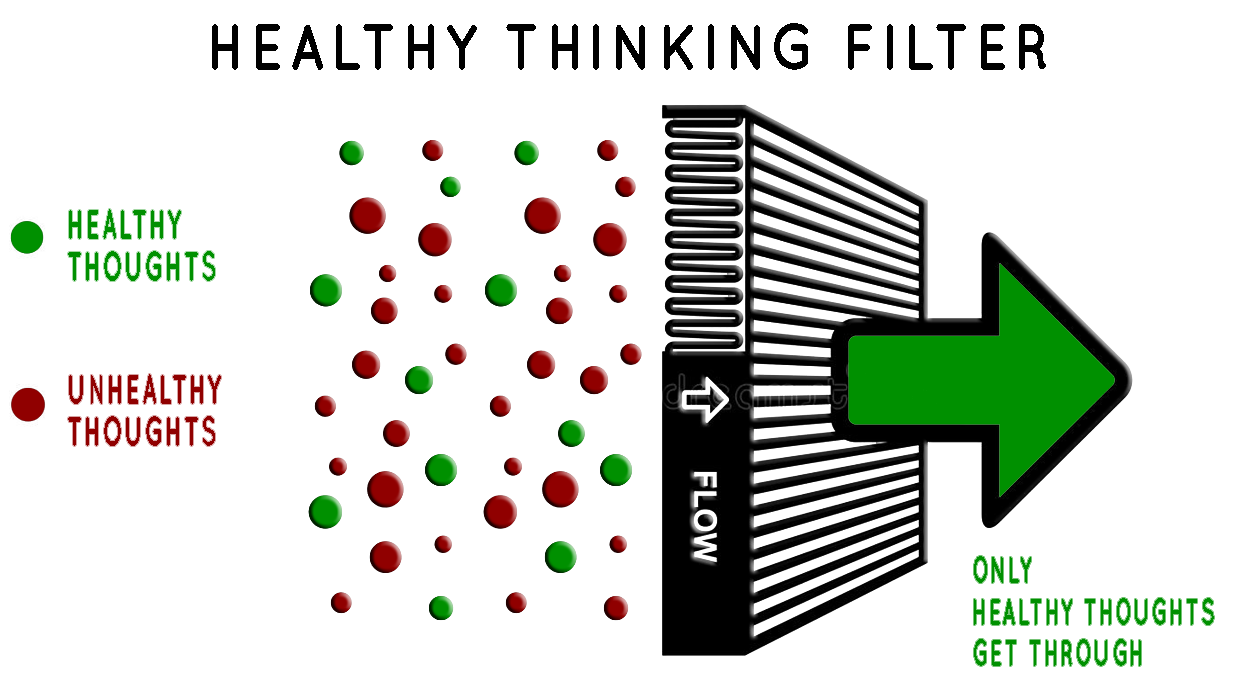
This is the practical meaning of the Healthy Thinking Filter.
Healthy thoughts should be allowed through.
Unhealthy thoughts should not be given easy access.
That sounds simple, but living it requires real intention.
Because the world does not automatically filter for your well-being.
In many cases, it does the opposite.
The world often rewards noise, stimulation, outrage, comparison, and emotional reactivity. Entire systems are built to capture attention, not to protect peace. Many influences grow stronger not because they are good for the mind, but because they are dramatic, addictive, provocative, or profitable.
That means the person who wants a healthy mind must become more deliberate than the surrounding culture.
This is one of the great acts of personal responsibility.
You must decide what gets in.
That decision happens in many small ways.
It happens when you decide what to watch.
It happens when you decide what to read.
It happens when you decide what to listen to.
It happens when you decide which conversations to join.
It happens when you decide whose opinions should matter.
It happens when you decide whether a passing thought deserves further attention.
It happens when you decide whether an old insult will be rehearsed again.
It happens when you decide whether a fearful prediction will be treated as truth.
It happens when you decide how much access a toxic environment will have to your inner life.
These are filtering decisions.
And filtering decisions shape mental outcomes.
One of the most important parts of filtering is learning to distinguish between information and intrusion.
Not everything that reaches your awareness deserves extended residence in your mind.
You may hear something.
That does not mean you must keep replaying it.
You may encounter negativity.
That does not mean you must adopt its tone.
You may notice a fearful possibility.
That does not mean you must build your future around it.
You may remember a painful event.
That does not mean you must keep using it as a lens for all of life.
Healthy thinking is not merely about exposure. It is about what is allowed to take root.
That is where filtering becomes deeply personal.
A person may be exposed to the same toxic message many times, but they can still learn to stop feeding it internally. They can say:
This does not belong in my mind.
This is not helping me think clearly.
This weakens me.
This is not aligned with the life I want to build.
This is not something I need to keep rehearsing.
These are strong statements.
They help reclaim authority.
Another important part of filtering is understanding that some inputs are not toxic because they are unpleasant. They are toxic because they are repeatedly destructive.
This distinction matters.
Healthy truth can be uncomfortable.
Wise correction can be uncomfortable.
Constructive criticism can be uncomfortable.
Necessary discipline can be uncomfortable.
Reality itself can be uncomfortable.
Healthy thinking does not reject something merely because it challenges comfort.
A filter is not designed to keep out everything difficult.
It is designed to keep out what poisons.
That means some hard truths should absolutely be allowed through.
Some wise corrections should absolutely be allowed through.
Some difficult conversations are necessary and deeply healthy.
So the question is not simply:
Do I like this?
The deeper question is:
Is this good for the formation of my mind and life?
That is a much wiser question.
Toxic input often has several recognizable traits.
It is often repetitive.
It is often emotionally agitating.
It is often mentally draining.
It is often one-sided.
It is often irresponsible.
It often feeds fear without wisdom.
It often feeds criticism without clarity.
It often feeds stimulation without nourishment.
It often leaves the person feeling weaker rather than stronger, darker rather than clearer, more scattered rather than more grounded.
These are warning signs.
When those signs are present repeatedly, the input should be questioned.
This becomes especially important in relationships.
Some people repeatedly pull the mind downward.
They may always speak in fear.
They may always rehearse resentment.
They may always criticize.
They may always intensify conflict.
They may always magnify what is wrong.
They may always dismiss possibility.
They may always reward discouragement and punish hope.
A person cannot spend large amounts of time in such an atmosphere without being affected by it.
Relationships are powerful mental inputs.
That does not mean a person should abandon everyone who is struggling. Healthy thinking includes compassion. It includes patience. It includes understanding. But it does mean a person should recognize when repeated exposure is becoming harmful and set appropriate boundaries.
Boundaries are filters too.
A boundary says:
You do not get unlimited access to my mind.
You do not get to pour poison into my inner life without resistance.
You do not get automatic authority just because you are loud, familiar, or emotionally intense.
That is not cruelty.
That is wisdom.
The same is true with media.
Some people are allowing screens to shape the mental climate of their lives far more than they realize. They begin the day with noise, continue the day with noise, and end the day with noise. They are always reacting, always consuming, always receiving, always scanning, always comparing, always stimulated. Under such conditions, calm thought becomes difficult.
This is why healthy thinking often requires reduction.
Less noise.
Less pointless input.
Less agitation.
Less reaction.
Less compulsive checking.
Less exposure to the voices that keep disturbing the mind without strengthening it.
Reduction creates space.
And space matters.
A crowded mind is often a vulnerable mind.
It has less room for reflection, gratitude, wisdom, and disciplined thought. Toxic input thrives in that kind of crowding because the person has little time to evaluate what is entering. Everything rushes in together. A filter cannot function well when there is no pause.
That is why silence can be protective.
Stillness can be protective.
Time away from screens can be protective.
Solitude can be protective.
A slower pace of input can be protective.
These things help restore mental authority.
They help the person notice what is actually happening within the mind instead of merely living in reaction to the latest stimulus.
There is also an inward side to filtering.
It is not enough to filter external inputs if a person continues internally replaying toxic material without restraint.
Many people have learned to step away from some harmful external influences, but they still keep feeding the mind unhealthy thoughts from within. They replay insults. They replay regrets. They replay embarrassing moments. They replay betrayal. They replay fear. They replay self-criticism. They replay defeat-oriented stories.
That too requires filtering.
Not every memory deserves constant rehearsal.
Not every fear deserves continued expansion.
Not every inner accusation deserves belief.
A healthy thinker learns to say:
This thought may have appeared, but it does not get to stay.
This memory may be real, but I do not need to keep feeding it in this way.
This fear may exist, but I do not need to build my day around it.
This old voice is not the voice I will keep obeying.
That is internal protection.
And it is just as important as external protection.
This does not mean suppression in the unhealthy sense. It means stewardship.
Stewardship asks:
What deserves room in my mind?
What deserves repetition?
What deserves attention?
What deserves strength?
These are filtering questions.
When asked consistently, they make the mind healthier.
Filtering also becomes easier when a person knows what they are for, not merely what they are against.
If you know you are for peace, for clarity, for discipline, for gratitude, for possibility, for constructive thought, for truth, for responsibility, then it becomes easier to recognize what does not belong. A strong positive vision strengthens the filter.
Without that vision, filtering can feel vague or arbitrary.
With it, filtering becomes purposeful.
You are not merely rejecting bad inputs.
You are protecting what is good.
That is an important distinction.
Protection is not only defensive. It is also preservative.
It protects peace.
It protects focus.
It protects emotional strength.
It protects perspective.
It protects the ability to think positively in the proper sense.
It protects the possibility-focused mind from being overrun by what is toxic.
This is why filtering should be seen as an act of respect toward oneself.
If you respect your mind, you will guard it more carefully.
If you respect your future, you will not casually feed the mind what can poison it.
If you respect your calling, your purpose, your relationships, your peace, and your growth, you will become more selective about what gets repeated access to your inner life.
Healthy thinking requires that kind of respect.
It is not perfection.
It is stewardship.
And stewardship grows over time.
A person may not become excellent at filtering in one day. They may only begin to notice certain toxic patterns. They may only begin to reduce some harmful inputs. They may only start learning where boundaries are needed. That is fine. Progress matters here. Each act of wiser filtering strengthens the mind a little more.
And over time, those small choices become major protection.
A person who protects the mind well is not escaping reality.
That person is preparing to meet reality more wisely.
They are less easily manipulated by noise.
Less easily dragged into fear.
Less easily weakened by comparison.
Less easily poisoned by resentment.
Less easily destabilized by chaos.
That is strength.
And it grows from one very practical truth:
Not everything deserves to get through.
Protecting your mind from toxic input is not optional if you want healthy thinking.
It is part of the work.
It is part of responsibility.
It is part of discipline.
It is part of long-term mental health.
It is part of the way you build a life that is calmer, stronger, clearer, and more possibility-focused.
The mind has a diet.
And the mind needs a filter.
Together, those truths can change a life.
Assignment
Step 1 – Identify Toxic Inputs
Make a list of the main toxic inputs currently affecting your mind. Include media, conversations, people, repeated thoughts, environments, habits, and any other influences that regularly weaken your thinking.
Step 2 – Name The Effect
For each toxic input, write down its effect on you. Does it increase fear, confusion, comparison, negativity, agitation, resentment, hopelessness, temptation, or distraction?
Step 3 – Strengthen Your Filter
For each toxic input, decide what kind of filter is needed. Should you reduce it, limit it, question it, challenge it, set a boundary around it, or eliminate it entirely?
Step 4 – Create Three Filter Statements
Write three short statements you can use when toxic material tries to gain entry into your mind. Examples:
This does not belong in my mind.
This is not helping me think clearly.
I do not need to keep feeding this.
This voice does not get authority here.
Step 5 – Practice For Seven Days
For the next seven days, choose one toxic input to reduce or block and one internal toxic thought pattern to interrupt. Record what changes in your mood, clarity, and mental strength when you apply the filter deliberately.
Chapter 8 - The Power Of Words, Self-Talk, And Repetition
Words are not small things.
They shape thought. They shape emotion. They shape interpretation. They shape expectation. They shape identity. They shape action. They shape relationships. They shape atmosphere. They shape memory. They shape what the mind notices and what the mind begins to believe.
That is why words matter so much.
Many people underestimate the power of words because words are so common. They hear them all day. They speak them all day. They think with them all day. Because words are everywhere, they often stop noticing how deeply words influence the inner life. But words are among the most powerful forces in human experience. They do not merely describe life. They often help shape the way life is experienced.
This is especially true when it comes to self-talk.
Self-talk is the ongoing conversation a person has with themselves.
Some of it is obvious.
Some of it is subtle.
Some of it is spoken internally in full sentences.
Some of it happens in quick impressions, labels, reactions, and conclusions.
But whether it is loud or quiet, direct or indirect, self-talk matters enormously because it is one of the primary ways a person trains the mind.
Every day, people are telling themselves things.
They are telling themselves what they think of life.
They are telling themselves what they think of other people.
They are telling themselves what they think of their future.
They are telling themselves what they think of their own worth, ability, strength, discipline, and potential.
They are telling themselves what things mean.
They are telling themselves what is possible.
They are telling themselves whether they should keep going.
This inner language becomes part of the structure of daily life.
And because it is repeated so often, it becomes especially powerful.
Repetition turns words into influence.
A word spoken once can matter.
A word spoken repeatedly can become a mental environment.
A person who hears encouragement once may feel helped for a moment.
A person who hears encouragement steadily may begin to grow stronger from the inside.
A person who experiences criticism once may feel hurt.
A person who experiences criticism repeatedly may begin to carry that criticism into identity.
A person who tells themselves one fearful thing once may feel a passing disturbance.
A person who tells themselves that same fearful thing again and again may begin building life around it.
This is the power of repetition.
Repetition gives words weight.
Repetition gives words familiarity.
Repetition gives words authority.
Repetition gives words a home in the mind.
That is why people must become more conscious not only of what they say, but of what they keep saying.
What do you keep telling yourself?
That question matters.
Do you keep telling yourself that you are behind?
Do you keep telling yourself that you never get things right?
Do you keep telling yourself that change is too hard?
Do you keep telling yourself that nothing good stays?
Do you keep telling yourself that people will always disappoint you?
Do you keep telling yourself that you are too old, too late, too wounded, too weak, too unworthy, too far gone?
If so, the issue is not only the content of the words. The issue is also the repetition of the words. Repeated often enough, even destructive language can begin to sound like truth.
That is why healthy thinking requires a serious examination of self-talk.
A person cannot keep speaking to themselves in unhealthy ways and expect the mind to remain strong.
The mind is always listening.
The brain is always learning.
And words are among its greatest teachers.
This is one reason words from other people can have such lasting influence. A sentence spoken by a parent, teacher, coach, friend, spouse, boss, or stranger can sometimes echo for years. If repeated often enough, or spoken at the right emotional moment, those words may become part of the person’s internal script. Long after the speaker is gone, the words remain. They continue to shape perception, confidence, fear, hope, and expectation.
That can happen in either direction.
Some people are still living from words that strengthened them.
Others are still living under words that wounded them.
Both prove the same truth.
Words matter.
This is why a person must become more discerning not only about what they hear from others, but also about what they decide to keep repeating inwardly. Not every word that entered your life deserves to remain there. Not every label you were given deserves to be carried forward. Not every criticism deserves permanent residence in your mind.
Healthy thinking requires reevaluation.
It requires asking:
Was that true?
Was that fair?
Was that useful?
Was that wise?
Does this still deserve a place in my mind?
Is this something I should keep repeating to myself?
These questions are essential because some words gain power simply because they were never questioned.
That is dangerous.
An unchallenged word can become an unhealthy belief.
An unhealthy belief can become an unhealthy pattern.
And an unhealthy pattern can shape a life.
This is especially true when words become identity statements.
Identity language is among the most powerful language a person can use.
“I am lazy.”
“I am broken.”
“I am hopeless.”
“I am always this way.”
“I am not the kind of person who succeeds.”
“I am bad with discipline.”
“I am too sensitive.”
“I am a failure.”
These are not harmless phrases.
They do not merely describe a moment. They attempt to define a person.
That is why they are so dangerous.
A person may be struggling and still not be lazy.
A person may be wounded and still not be broken in essence.
A person may have failed and still not be a failure as an identity.
A person may need growth in discipline and still not be permanently undisciplined.
Healthy thinking must be very careful with identity language.
It is far wiser to say, “I need to strengthen my habits,” than to say, “I am hopeless.”
It is far wiser to say, “I made a poor choice,” than to say, “I am a bad person.”
It is far wiser to say, “I am learning,” than to say, “I will never get this right.”
The difference between those statements matters greatly.
One leaves room for responsibility and growth.
The other shuts the door.
This is why self-talk must become more truthful and more constructive.
Notice that both qualities matter.
Truthful alone is not enough if the truth is spoken in a way that becomes destructive.
Constructive alone is not enough if it drifts into fantasy or denial.
Healthy self-talk must be both.
It must tell the truth.
And it must help the person move in a better direction.
For example:
“This is hard” may be true.
But “This is hard and I can still respond wisely” is both true and constructive.
“I made a mistake” may be true.
But “I made a mistake and I can learn from it” is both true and constructive.
“I feel discouraged” may be true.
But “I feel discouraged and I do not have to stay there” is both true and constructive.
This is the kind of self-talk that strengthens a healthy mind.
It does not lie.
It does not deny.
It does not collapse.
It speaks in a way that preserves agency.
That is one of the greatest gifts of healthy words.
They preserve agency.
They remind the person that while not everything is controllable, something can still be done. They keep responsibility alive. They keep possibility alive. They keep growth alive. They keep movement alive.
Destructive words often do the opposite.
They drain agency.
They make everything sound final.
They turn temporary struggles into permanent definitions.
They turn difficulties into identities.
They turn pain into prophecy.
They tell the person that because something is hard, nothing meaningful can happen.
That is why destructive self-talk must be interrupted.
Not because it is unpleasant only, but because it is weakening.
Weakening words repeated often enough can become the soundtrack of a person’s life.
That is far too much power to leave unexamined.
This is where repetition becomes especially important.
A person may understand healthy language intellectually and still keep repeating unhealthy language emotionally and habitually. That is why change in self-talk usually requires repetition in the other direction. It is not enough to think a better thought once. Healthier inner language must be practiced again and again until it begins to feel more natural and more available.
This takes time.
A person may have spent years saying harmful things to themselves.
Years.
Those patterns may feel automatic. They may arrive quickly. They may sound persuasive. They may even feel like common sense. Replacing them will likely require deliberate repetition of healthier alternatives. That is not weakness. That is retraining.
Retraining is exactly what is needed.
The mind learns through repetition.
If a person has repeated fear, fear becomes more familiar.
If a person has repeated self-criticism, self-criticism becomes more automatic.
If a person has repeated discouragement, discouragement becomes easier to access.
But if a person begins repeating healthier, more balanced, more truthful, more constructive language, the mind gradually starts forming new patterns.
This is one reason morning and evening routines can be so powerful.
The words with which a person starts and ends the day often leave a deeper mark than people realize. A person who begins each day by rehearsing pressure, fear, complaint, and defeat is training the mind one way. A person who begins each day by rehearsing truth, gratitude, possibility, discipline, and wise intention is training the mind in another.
The same is true at night.
A person who ends the day by replaying failure, embarrassment, insult, regret, and fear is giving the mind a certain kind of final message. A person who ends the day by reviewing lessons, expressing gratitude, correcting mistakes, and reinforcing healthier truths is doing something very different.
Words matter at both ends of the day.
And they matter all through the middle as well.
This also applies to spoken language.
What a person says out loud often reinforces what they believe internally.
If a person constantly speaks negatively, complains habitually, uses absolute phrases, predicts failure, or labels themselves harshly in public, they are not merely expressing a mindset. They are reinforcing it. Spoken words often deepen internal grooves.
That is why verbal discipline matters.
A person should become more aware of the words they use repeatedly in ordinary conversation.
Do they say “always” and “never” too often?
Do they label things hopeless too quickly?
Do they mock their own efforts?
Do they repeatedly say they cannot do something before they have really tried?
Do they describe themselves as permanently flawed in careless ways?
These verbal habits matter.
Language shapes reality from the inside.
It teaches the mind what to expect.
It teaches the mind what story it is living in.
If the story is full of defeat, fear, and limitation, that affects action.
If the story is full of truth, effort, growth, and possibility, that affects action too.
This does not mean a person should become artificial in speech.
Healthy words are not about sounding impressive.
They are about speaking in ways that support a stronger, wiser, healthier life.
That may sometimes mean saying less.
Some people weaken themselves through constant careless speech.
They say too much, complain too quickly, dramatize too easily, and react too impulsively. In many cases, one of the healthiest word practices is restraint. Silence can protect the mind from reinforcing what does not need to be fed.
Not every frustration needs full expression.
Not every fear needs full narration.
Not every emotional reaction needs spoken expansion.
Sometimes one of the wisest things a person can do is refuse to keep adding language to a thought that is already harming them.
This is especially true with recurring mental scripts.
Many people carry around the same script every day.
No one understands me.
I am not enough.
Nothing ever changes.
People always let me down.
I always ruin things.
It is too late for me.
I will never get ahead.
These scripts can become internal rituals.
That is why they must be identified clearly.
What you cannot name clearly, you will often continue feeding unconsciously.
Once a script is identified, it can be interrupted.
Then it can be challenged.
Then it can be replaced.
This is one of the most practical ways to improve self-talk.
Do not try to correct every word all at once.
Start by identifying the most repeated harmful phrases.
Then replace them with healthier ones.
For example:
Instead of “I always fail,” say, “I have failed at times, but I can learn and improve.”
Instead of “Nothing ever works,” say, “Some things have not worked, but that does not mean all possibility is gone.”
Instead of “I am hopeless with discipline,” say, “Discipline is an area I need to strengthen, and I can strengthen it with practice.”
Instead of “I am too far behind,” say, “I may be behind where I want to be, but I can still move forward from here.”
These alternatives are not soft.
They are strong because they preserve truth and agency at the same time.
That is the goal.
Another important truth is that words affect emotional climate.
A person who repeatedly speaks in fear often increases fear.
A person who repeatedly speaks in bitterness often strengthens bitterness.
A person who repeatedly speaks in gratitude often deepens gratitude.
A person who repeatedly speaks in peace often strengthens peace.
Words do not operate alone, of course. But they help create the atmosphere in which the mind lives.
This is why healthy thinking must care deeply about language.
Language is not decoration.
It is architecture.
It helps build the inner house.
If the house is built with words of despair, contempt, fear, self-hatred, cynicism, and defeat, the mind will have a harder place in which to live. If the house is built with words of truth, discipline, hope, responsibility, gratitude, resilience, and possibility, the mind will have a healthier structure.
That is one reason the words of other people matter so much too.
People can influence one another profoundly through language.
A healthy person often strengthens others through the words they use.
They correct without crushing.
They challenge without shaming.
They encourage without lying.
They tell the truth without destroying hope.
This is the kind of language healthy thinkers learn to value.
And it is the kind of language they should increasingly learn to use themselves.
Not only with others.
But with themselves first.
Because if a person’s self-talk is consistently destructive, it becomes much harder for even good outside words to take root. The inner voice keeps canceling them out.
Someone says, “You can do this.”
The inner voice says, “No, I cannot.”
Someone says, “You are growing.”
The inner voice says, “No, I am failing.”
Someone says, “This is possible.”
The inner voice says, “Not for me.”
That is why self-talk matters so much. It often has the final word unless it is retrained.
Retraining self-talk is not a one-time breakthrough.
It is a daily discipline.
It involves awareness.
It involves correction.
It involves repetition.
It involves better language.
It involves refusing to keep feeding inner scripts that weaken life.
It involves patience.
It involves practice.
And over time, it becomes one of the strongest supports of healthy thinking.
This process is closely connected to personal responsibility.
No one else can fully govern your self-talk for you.
Other people may influence it, but each person must increasingly accept responsibility for what they keep repeating inside. That responsibility is not condemnation. It is empowerment. It means you are not merely the victim of your own language. You can examine it. You can challenge it. You can revise it. You can strengthen it. You can align it with the kind of life you are trying to build.
That is powerful.
And it is one of the reasons words should never be treated casually.
Words teach.
Words train.
Words reinforce.
Words build.
Words weaken.
Words steady.
Words confuse.
Words nourish.
Words poison.
The question is not whether words have power.
They do.
The question is how that power is being used in your life.
Are your words strengthening healthy thinking?
Or are they weakening it?
Are your repeated phrases building a stronger identity?
Or are they trapping you in an old one?
Are your words keeping possibility alive?
Or are they repeatedly declaring defeat before the future has even arrived?
These are not small questions.
They reach into the core of how a person lives.
Healthy thinking requires healthy language.
Healthy language requires discipline.
And discipline applied with repetition creates change.
That is why the power of words, self-talk, and repetition cannot be overstated.
A life is often shaped, little by little, by the language a person keeps using.
Use that power wisely.
Assignment
Step 1 – Identify Your Repeated Words
Write down ten phrases you frequently say to yourself or out loud. Include both positive and negative language patterns.
Step 2 – Find The Harmful Scripts
Underline the phrases that weaken you, discourage you, limit you, or push you toward fear, shame, defeat, or hopelessness.
Step 3 – Rewrite The Script
Take each harmful phrase and rewrite it into language that is truthful, constructive, and growth-oriented. Make sure the new wording preserves responsibility and possibility.
Step 4 – Choose Five Daily Statements
Create five healthy statements you want to repeat daily for the next seven days. Keep them simple, believable, and strong.
Step 5 – Practice Repetition With Awareness
Repeat your five statements each morning and evening for seven days. Also pay attention to how you speak during the day. When you catch yourself using weakening language, pause and replace it with stronger language immediately.
Chapter 9 - What You Read, Watch, Hear, And Believe Matters
The mind is always being shaped.
It is shaped by what enters it repeatedly, what stays in it, and what is believed once it is there. That is why what a person reads, watches, hears, and believes matters so much. These are not neutral activities. They are not harmless background habits. They are among the main ways a person’s inner life is formed.
Every day, people are taking in messages.
Some come through books.
Some come through conversation.
Some come through news.
Some come through music.
Some come through television.
Some come through movies.
Some come through social media.
Some come through podcasts.
Some come through advertising.
Some come through authority figures.
Some come through memory.
Some come through repeated cultural ideas that become so common they stop being noticed.
All of it matters.
It matters because input becomes influence.
Influence affects thought.
Thought affects emotion.
Emotion affects action.
Action affects results.
That is why healthy thinking cannot be separated from what a person keeps exposing the mind to. If the mind is being trained every day by what it reads, watches, hears, and believes, then those areas deserve serious attention.
Many people do not give them that attention.
They consume almost automatically.
They read casually.
They watch casually.
They listen casually.
They believe casually.
They let ideas pass into the mind with very little examination.
Then they wonder why certain thought patterns feel so strong.
The answer is often simple.
They have been feeding and reinforcing those thought patterns through repeated input.
This is why discernment matters.
A healthy thinker does not treat all input as equal.
A healthy thinker understands that some things strengthen the mind and some things weaken it. Some things clarify thought and some things confuse it. Some things increase peace and some things increase agitation. Some things deepen gratitude and some things deepen comparison. Some things support courage and some things feed fear. Some things call a person upward and some things slowly pull the person downward.
The first area to consider is what a person reads.
Reading is powerful because it brings ideas into the mind in a concentrated form.
Books shape thought.
Articles shape thought.
Posts shape thought.
Messages shape thought.
The written word can deepen understanding, expand perspective, strengthen discipline, encourage hope, sharpen judgment, and build wisdom. It can also spread confusion, fear, manipulation, cynicism, and distortion.
That is why reading should not be treated casually.
What a person reads repeatedly becomes part of what that person thinks repeatedly.
If a person regularly reads material full of bitterness, outrage, gossip, comparison, hopelessness, and shallow distraction, those qualities may slowly begin affecting the inner life. If a person regularly reads material full of truth, wisdom, courage, growth, responsibility, perspective, and possibility, that too will begin shaping the mind.
The question is not simply, “Am I reading?”
The better question is, “What is my reading doing to me?”
That question should be asked honestly.
Does what I read make me stronger or weaker?
Does it make me wiser or more confused?
Does it improve my thinking or clutter it?
Does it help me become more disciplined, more grateful, more calm, more responsible, and more focused on what is possible?
Or does it leave me more fearful, more agitated, more distracted, more bitter, more cynical, and more mentally crowded?
Reading creates mental atmosphere.
That is why it matters.
The second area is what a person watches.
Watching can be even more powerful than reading because it often combines image, emotion, narrative, and repetition. Visual media can bypass careful reflection and go directly into emotion. It can intensify fear, desire, comparison, envy, and agitation very quickly. It can also uplift, educate, inspire, and strengthen.
That is why what a person watches deserves close attention.
Many people are feeding the mind through the eyes far more than they realize.
Hours of screens.
Hours of reaction.
Hours of entertainment.
Hours of comparison.
Hours of noise.
Hours of stimulation.
Hours of emotional content designed not to nourish the mind, but to keep attention captured.
This has consequences.
A person who repeatedly watches material that feeds chaos should not be surprised when calm becomes harder to maintain.
A person who repeatedly watches material that feeds comparison should not be surprised when contentment weakens.
A person who repeatedly watches material that feeds fear should not be surprised when the future begins to feel darker.
A person who repeatedly watches material that normalizes emotional instability, shallow thinking, contempt, vanity, or moral confusion should not be surprised when those qualities begin to feel more familiar.
The eyes are one of the major gates of the mind.
What enters there matters greatly.
This does not mean all entertainment is unhealthy.
It does mean that wise people pay attention to the effect of what they watch.
Again, that word matters.
Effect.
Not merely category.
Not merely popularity.
Not merely social acceptance.
Effect.
What does this leave behind in me?
That is the right question.
Does this strengthen peace?
Does this strengthen clarity?
Does this strengthen gratitude?
Does this strengthen discipline?
Does this strengthen perspective?
Or does it leave behind agitation, restlessness, envy, mental noise, temptation, numbness, comparison, or emotional confusion?
A healthy thinker learns to ask those questions.
The third area is what a person hears.
This includes far more than formal speech.
It includes the voices of other people.
It includes repeated conversation.
It includes tone.
It includes commentary.
It includes music.
It includes background noise.
It includes podcasts.
It includes the emotional atmosphere of the environments in which a person spends time.
All of these things enter through the ears and influence the inner life.
This is why the company a person keeps matters so much.
People often become part of one another’s mental environment.
If a person spends large amounts of time around chronic negativity, habitual complaint, fear-driven speech, mockery, cynicism, bitterness, gossip, and emotional instability, those tones often begin affecting thought. The person may resist them at first. But repeated exposure tends to normalize things. What once seemed extreme begins to feel ordinary. What once seemed draining begins to feel familiar. That is how unhealthy inputs often gain influence.
On the other hand, good people often strengthen healthy thinking.
Not because they are perfect, but because they speak differently.
They are more constructive.
More honest without being destructive.
More balanced.
More disciplined.
More respectful.
More hopeful in a grounded way.
More focused on solutions, responsibility, growth, and what is possible.
The voices a person hears repeatedly matter.
This includes music as well.
Music is powerful because it combines language, emotion, rhythm, memory, and repetition. A person may hear the same song many times without realizing how strongly it is shaping mood, emotional tone, and thought patterns. Some music can strengthen peace, beauty, gratitude, depth, and encouragement. Some can strengthen anger, despair, sensuality, vanity, rebellion, bitterness, or chaos.
I have some music I absolutely love that I now refuse to listen to. The music is great, but the message in the lyrics is negative. Very negative.
Again, the key question is effect.
What is this doing to me?
Healthy thinking requires that kind of awareness.
The fourth area is belief.
Belief matters because what a person accepts as true often becomes one of the strongest forces in life.
Beliefs shape interpretation.
Beliefs shape expectations.
Beliefs shape focus.
Beliefs shape identity.
Beliefs shape effort.
Beliefs shape resilience.
Beliefs help determine what a person attempts, avoids, magnifies, tolerates, and rehearses internally.
That is why beliefs must be examined carefully.
A person may be reading, watching, and hearing many things, but the deepest influence often comes from what the person comes to believe. Once an idea becomes a belief, it begins organizing life from within.
If a person believes change is impossible, effort often weakens.
If a person believes they are hopeless, self-talk often becomes more destructive.
If a person believes that no one can be trusted, relationships are affected.
If a person believes that problems are always bigger than possibilities, action begins to shrink.
If a person believes they are personally responsible for their mental diet and capable of growth, a very different life begins to emerge.
Belief is not a minor matter.
It is one of the great engines of thought.
That is why healthy thinking must include healthy belief.
Not fantasy-based belief.
Not denial-based belief.
Not inflated self-deception.
Healthy belief.
Belief rooted in truth, responsibility, possibility, growth, discipline, and long-term thinking.
A healthy thinker learns to ask:
What am I believing right now?
Where did this belief come from?
Has it been tested?
Is it true?
Is it fully true?
Is it helping me become stronger, wiser, calmer, and more constructive?
Or is it weakening my life?
These are necessary questions.
Many harmful beliefs were never consciously chosen. They were absorbed. They came from family messages, repeated criticism, painful experiences, cultural conditioning, peer influence, old wounds, fear-based environments, or unchallenged repetition. Because they arrived slowly, they often feel natural. But natural is not the same as true.
That is why beliefs must be examined.
A belief may be familiar and still be false.
A belief may feel intense and still be distorted.
A belief may sound realistic and still be rooted in fear.
A belief may have been given to you by others and still not deserve authority in your life.
This is especially important because beliefs tend to act like filters.
They influence what a person notices.
A person who believes people are always against them may notice every slight and overlook kindness.
A person who believes growth is possible may notice opportunities for learning and progress that others miss.
A person who believes failure defines them may interpret mistakes as proof of hopelessness.
A person who believes mistakes can instruct them may respond very differently.
This is why healthy beliefs are so important to healthy thinking. They shape the whole field of interpretation.
One of the great dangers in modern life is passive belief formation.
People are constantly being told what to believe.
By media.
By institutions.
By advertising.
By cultural trends.
By social pressure.
By group emotion.
By repeated online content.
By whatever receives the most attention.
If a person does not become intentional, beliefs may be formed by whatever voice happens to be loudest, most repeated, or most emotionally persuasive.
That is a dangerous way to live.
Healthy thinking requires active belief formation.
It requires reflection.
It requires testing.
It requires discernment.
It requires choosing not to hand over the inner life to whatever message happens to be trending, repeated, or emotionally intense.
This does not mean isolation from ideas.
It means responsibility in how ideas are received.
A person should neither believe everything nor reject everything.
A person should examine.
That examination is part of mental maturity.
There is another important point here.
Not everything that is unhealthy appears obviously harmful.
Some things weaken healthy thinking simply by filling the mind with triviality.
Not all bad input is toxic in a dramatic way. Some of it is just empty. Pointless. Shallow. Distracting. Constantly stimulating but not nourishing. A person can live in so much trivial input that the mind becomes too crowded for depth, gratitude, reflection, and wise attention.
That too affects thinking.
A mind full of triviality may not become obviously dark, but it may become weak, scattered, shallow, and undernourished. It may lose the ability to stay with important things. It may become trained in distraction instead of discipline.
This matters because what a person reads, watches, hears, and believes is not only shaping emotional climate. It is shaping mental capacity. It is shaping the ability to focus, reflect, discern, and think long-term.
That is why wise selection matters so much.
Not everything deserves the same space in your life.
Not everything deserves your attention.
Not everything deserves your trust.
Not everything deserves repeated exposure.
This is not about becoming fearful.
It is about becoming intentional.
A healthy thinker does not casually hand over the mind.
A healthy thinker understands that inner life is precious.
That peace is precious.
That clarity is precious.
That focus is precious.
That belief is precious.
That attention is precious.
And because these things are precious, they must be guarded carefully.
This is especially true in a noisy age.
Many people live in almost constant input.
Something is always playing.
Something is always speaking.
Something is always flashing.
Something is always scrolling.
Something is always demanding reaction.
This constant flow makes healthy thinking harder because it reduces space for examination. When there is no pause, there is little filtering. When there is little filtering, more harmful material gets through. When more harmful material gets through, the inner life becomes more vulnerable.
That is why reduction is sometimes as important as selection.
The mind needs less noise.
Less pointless content.
Less emotional clutter.
Less repeated fear.
Less constant commentary.
Less stimulation that adds nothing good.
This does not mean a person must know everything happening everywhere at all times.
In fact, one of the healthiest decisions many people can make is to consume less and think more.
Read less noise and more wisdom.
Watch less agitation and more truth.
Hear less complaint and more constructive speech.
Believe fewer distortions and more life-giving realities.
This is how a healthier mind is built.
Slowly.
Intentionally.
Responsibly.
And with long-term results.
A person does not become mentally strong merely by wanting strength.
A person becomes stronger in part by choosing stronger inputs.
That is why what you read, watch, hear, and believe matters so much.
These things are not passing details.
They are the daily builders of thought.
They are the architects of the inner climate.
They are the repeated influences from which habits of mind are formed.
Choose them carelessly, and you will likely weaken your thinking.
Choose them wisely, and you can strengthen your thinking over time.
That is a serious responsibility.
It is also a serious opportunity.
A healthier mind can often begin with a simple but powerful shift:
Read better.
Watch better.
Listen better.
Believe better.
And let those better choices begin forming a better life.
Assignment
Step 1 – Audit Your Inputs
Make four lists:
What I Read
What I Watch
What I Hear
What I Believe
Under each heading, write the most common inputs currently shaping your mind.
Step 2 – Evaluate The Effect
Next to each item, write its effect on your thinking. Does it strengthen peace, gratitude, focus, wisdom, discipline, and possibility? Or does it feed fear, distraction, comparison, confusion, negativity, or emotional noise?
Step 3 – Identify One Change In Each Area
Choose one improvement you can make in each area:
one reading change
one watching change
one listening change
one belief that needs to be challenged or replaced
Step 4 – Examine One Harmful Belief
Choose one belief that may be weakening your life. Write down where it came from, why it feels believable, and whether it is actually true. Then write a healthier, more truthful replacement belief.
Step 5 – Practice For Seven Days
For the next seven days, implement your four changes and observe what happens to your mental clarity, emotional tone, and quality of thought.
Chapter 10 - Changing Your Mental Environment
A person’s thinking does not happen in isolation.
Thoughts arise within an environment.
They arise within routines, relationships, habits, places, atmospheres, sounds, schedules, patterns of attention, and repeated forms of exposure. That is why healthy thinking is not merely a matter of trying harder inside the mind. It is also a matter of changing the environment in which the mind is trying to function.
This is one of the most practical truths in the whole subject.
Many people want healthier thinking, but they are trying to build it in an unhealthy mental environment. They keep surrounding themselves with noise, distraction, confusion, negativity, emotional clutter, and draining influences, then wonder why it is difficult to remain calm, clear, disciplined, and possibility-focused.
The answer is often very simple.
The environment is working against the goal.
This matters because environment shapes what feels normal.
If a person lives in constant noise, stillness may start to feel strange.
If a person lives in constant distraction, focus may start to feel difficult.
If a person lives in constant negativity, healthier thought may start to feel unnatural.
If a person lives in constant reaction, reflection may start to feel slow and unfamiliar.
The environment does not control everything, but it influences much more than people often admit.
That influence can be either helpful or harmful.
A healthy mental environment helps the mind think more clearly, feel more grounded, and stay more connected to truth, discipline, peace, gratitude, and possibility. An unhealthy mental environment makes the opposite more likely. It increases agitation, impulsiveness, confusion, comparison, emotional fatigue, negativity, and mental crowding.
That is why changing the mental environment is often one of the fastest ways to support healthier thinking.
Before going further, it is helpful to define what a mental environment actually is.
A mental environment is the total atmosphere in which your mind is living day after day.
It includes physical surroundings.
It includes noise level.
It includes digital habits.
It includes the pace of life.
It includes the people around you.
It includes the emotional tone of your home, your work, and your conversations.
It includes what is visible, what is heard, what is repeated, what is expected, what is rewarded, and what receives constant attention.
It includes not only what enters the mind, but also the conditions under which the mind is trying to operate.
This means environment is larger than content.
A person may read wise material and still live in a deeply unhealthy mental environment if everything else around them is chaotic. A person may know good principles and still struggle to think well because their days are full of constant interruption, emotional noise, unresolved clutter, toxic relationships, reactive technology habits, and environments that never allow the mind to settle.
That is not a small thing.
Many thought problems are environmental problems in disguise.
A person thinks they need only more motivation.
What they may really need is less chaos.
A person thinks they need a better attitude.
What they may really need is a quieter room, better boundaries, fewer toxic conversations, and more intentional use of time.
A person thinks they need more willpower.
What they may really need is a healthier rhythm of life.
This is why environment deserves serious attention.
It either supports healthy thinking or undermines it.
One major part of mental environment is physical space.
Physical space affects mental tone more than many people realize.
A cluttered, chaotic, neglected, noisy, overstimulating space often affects the mind. It may increase distraction, mental fatigue, irritability, avoidance, or a vague feeling of being burdened. By contrast, a cleaner, calmer, more ordered, more intentional space often supports clarity, steadiness, and better focus.
This does not mean a person must live in perfection.
It does mean that physical disorder can become part of mental disorder if left unexamined.
A desk can affect thought.
A room can affect thought.
A home can affect thought.
A workspace can affect thought.
Light can affect thought.
Noise can affect thought.
Visual clutter can affect thought.
The body and mind are not separate from surroundings.
That is why improving a space can sometimes improve thinking almost immediately.
Sometimes one of the healthiest things a person can do is create a more peaceful place in which the mind can breathe.
That may mean cleaning.
That may mean simplifying.
That may mean removing visual clutter.
That may mean creating a corner for reading, reflection, prayer, writing, or quiet thought.
That may mean turning off constant background noise.
That may mean making the physical environment more supportive of the kind of mind the person wants to build.
Another major part of mental environment is digital environment.
This is one of the most overlooked areas in modern life.
Many people live inside a digital atmosphere they never intentionally designed. Notifications interrupt them constantly. Social media keeps pulling attention outward. News feeds inject agitation. Videos, posts, messages, alerts, ads, and emotional signals keep demanding reaction. The mind never gets much silence. It never gets much stillness. It never gets much uninterrupted time to think deeply, calmly, or clearly.
This has consequences.
A constantly interrupted mind often becomes a fragmented mind.
A fragmented mind struggles to focus.
A fragmented mind struggles to reflect.
A fragmented mind struggles to discern.
A fragmented mind becomes more reactive and less deliberate.
That is why a healthy digital environment matters so much.
If you want healthier thinking, you cannot ignore what your devices are doing to your attention.
The question is not merely whether technology is useful.
Of course it can be.
The question is whether your current digital environment is helping your mind or hurting it.
Does it support clarity?
Or does it support constant distraction?
Does it strengthen focus?
Or does it train restlessness?
Does it nourish wisdom?
Or does it fill your mind with emotional clutter?
Does it deepen healthy thinking?
Or does it keep breaking it apart?
These are not dramatic questions.
They are practical ones.
Many people could significantly improve their mental environment by making simple digital changes.
Fewer notifications.
Less random scrolling.
Less constant checking.
Fewer emotionally manipulative inputs.
More intentional use.
More silence.
More time away from screens.
More control over what enters the mind.
These changes may seem small, but they often produce large results over time.
A third major part of mental environment is relational environment.
Who you spend time with affects how you think.
This does not need much argument because most people have already experienced it.
Spend time with calm, thoughtful, constructive, disciplined, grateful, responsible, wise people, and your thinking often becomes healthier. Spend time with chronically fearful, cynical, bitter, dramatic, irresponsible, reactive, or constantly negative people, and your thinking often begins to feel heavier.
Relationships are part of the environment in which the mind lives.
That is why company matters so much.
This does not mean every person around you must be easy, cheerful, or simple. Life does not work that way. People struggle. People hurt. People have difficult seasons. Compassion matters. Patience matters. Loyalty matters.
But repeated relational atmosphere still matters.
If a person is constantly immersed in discouragement, criticism, resentment, and emotional chaos, that atmosphere begins affecting the mind. It can slowly reshape what feels normal. It can weaken hope. It can strengthen irritation. It can make healthy thought harder to sustain.
That is why boundaries are environmental decisions.
A boundary is not only about one conversation or one behavior. It is often about what kind of atmosphere will be allowed repeated access to your mind. A healthy thinker becomes more intentional about this. Not harsh. Not cold. Not selfish in the unhealthy sense. But intentional.
What relational atmosphere is helping me think better?
What relational atmosphere is making it harder?
That is a wise question.
A fourth major part of mental environment is the pace of life.
A frantic life often produces frantic thinking.
A rushed life often produces shallow thinking.
A constantly overloaded life often produces reactive thinking.
A person may be consuming good material and still struggle to think well simply because they are always rushing, always behind, always tired, always mentally overextended, always squeezed for margin, and always trying to live at a speed the mind cannot process well.
That environment matters.
The mind needs some margin.
It needs room to reflect.
It needs room to recover.
It needs room to digest.
It needs room to examine.
It needs room to redirect.
Without margin, the mind becomes more vulnerable to unhealthy habits because it is operating under continuous pressure.
That is one reason long-term thinking is so important.
A person who thinks long-term may be more willing to slow certain things down, simplify certain commitments, reduce unnecessary demands, and create a pace of life that better supports mental health. A person who lives only in immediate pressure often keeps sacrificing mental environment for short-term urgency.
That choice has consequences.
A healthier mental environment often requires a healthier rhythm.
Not laziness.
Not irresponsibility.
Rhythm.
That means cycles of effort and recovery.
It means times of work and times of quiet.
It means not filling every open space with noise.
It means not treating stillness like wasted time.
It means understanding that good thinking often grows in a life that has enough margin to support it.
A fifth part of mental environment is what a person repeatedly does.
Action shapes atmosphere.
If a person continually engages in meaningless, scattered, reactive activity, that affects the mind.
If a person continually engages in purposeful, disciplined, constructive activity, that affects the mind too.
This is why meaningful work matters.
Useful effort matters.
Intentional routines matter.
Good habits matter.
Movement matters.
Service matters.
Constructive action matters.
They do more than produce results outside the person. They also help create a healthier mental environment inside the person.
Purpose is mentally stabilizing.
Drift is mentally weakening.
This does not mean a person must always be busy.
It means that the way time is used shapes mental tone.
Someone who spends day after day in drift, triviality, passivity, and scattered attention is often creating an environment in which healthy thinking struggles. Someone who spends time on what matters is usually building a stronger inner world as well.
This also helps explain why some people feel mentally better when they begin doing good things consistently. It is not only because the actions themselves are good. It is also because the actions change the environment of the mind.
A sixth part of mental environment is expectation.
What is expected in your life?
What is rewarded?
What is repeated?
What is normalized?
Some environments normalize complaint.
Some normalize gratitude.
Some normalize fear.
Some normalize courage.
Some normalize gossip.
Some normalize thoughtful speech.
Some normalize distraction.
Some normalize discipline.
Some normalize passivity.
Some normalize responsibility.
These norms shape thought more than people often realize. If an environment keeps rewarding unhealthy patterns, it becomes much harder to maintain healthy thinking within it. If an environment supports better patterns, healthy thinking becomes easier to sustain.
That is why sometimes a person must consciously create a new environment even before they fully feel ready for it.
They may need a new routine.
A new reading habit.
A new workspace.
A new digital rule.
A new friend group.
A new morning practice.
A new evening rhythm.
A new approach to noise.
A new set of boundaries.
A new place to think.
A new level of order.
A new standard for what gets allowed in.
These things matter because environment reinforces direction.
This chapter is not suggesting that changing the environment solves everything automatically.
It does not.
A person can still carry unhealthy thinking into a better environment.
Internal work is still necessary.
Discipline is still necessary.
Belief is still necessary.
Responsibility is still necessary.
But environment can either help or hinder that work. It can either support healthy thinking or constantly sabotage it.
That is why changing the environment is often a wise and necessary part of changing the mind.
Sometimes people keep trying to win a battle without noticing they are fighting on bad ground.
The ground matters.
You may need less noise.
You may need more order.
You may need better input.
You may need healthier relationships.
You may need stronger boundaries.
You may need a slower pace.
You may need more quiet.
You may need more beauty.
You may need more purpose.
You may need to change what surrounds your mind every day so that your mind has a better chance to become what you are trying to build.
That is not weakness.
That is wisdom.
It is also responsibility.
You may not control every aspect of your environment.
That is true.
Some people live with real limitations.
Some live with difficult work conditions.
Some live with financial constraints.
Some live with challenging family realities.
Some live with environments they cannot fully change right now.
But even within limitations, most people can still influence something.
They can change a routine.
They can change a habit.
They can change what enters their phone.
They can change what enters their ears.
They can clean a room.
They can set a boundary.
They can create ten minutes of stillness.
They can choose one nourishing relationship more intentionally.
They can remove one harmful influence.
They can make one part of life healthier.
That matters.
Healthy thinking does not require total control.
It requires meaningful stewardship.
What can you do to make your mental environment healthier?
That is the right question.
Not:
Why is everything around me imperfect?
But:
What can I improve now?
What can I simplify?
What can I reduce?
What can I add?
What can I guard?
What can I redesign?
What can I stop feeding?
What can I start supporting?
These are possibility-focused environmental questions.
They move the person from complaint to construction.
And construction matters.
A healthier mind is often built in a healthier environment.
Not because environment is everything.
But because it matters enough that it should no longer be ignored.
So if you want healthier thinking, do not only ask what needs to change in your thoughts.
Ask what needs to change around your thoughts.
Ask what atmosphere you are creating.
Ask what climate your mind is living in.
Ask whether your environment is helping the person you want to become.
Then begin changing what you can.
That is not a small step.
For some people, it is the beginning of a very different life.
Assignment
Step 1 – Evaluate Your Mental Environment
Write a description of your current mental environment. Include your physical surroundings, digital habits, relationships, pace of life, routines, and the emotional tone of your everyday atmosphere.
Step 2 – Identify What Helps And What Hurts
Make two lists:
What In My Environment Supports Healthy Thinking
What In My Environment Undermines Healthy Thinking
Be specific.
Step 3 – Choose Three Environmental Changes
Identify three changes you can make to improve your mental environment. These may involve your space, your phone, your schedule, your boundaries, your routines, or your relationships.
Step 4 – Create One Place Of Mental Strength
Choose one physical place in your life and improve it so it better supports healthy thinking. Clean it, simplify it, quiet it, or make it more intentional.
Step 5 – Practice For Seven Days
Apply your three environmental changes for the next seven days. At the end of that time, write down what changed in your mood, focus, clarity, peace, and quality of thought.
INTRODUCTION TO PART III - BUILDING A HEALTHY THINKING LIFE
Healthy thinking is not built by thought alone.
It is built through life.
A person may understand many good ideas about the mind and still struggle to live them out consistently. That is because healthy thinking does not exist in isolation from daily relationships, daily habits, daily choices, daily disciplines, and daily responses to difficulty. In the end, a healthy mind must be supported by a healthy way of living.
That is what this part of the book is about.
The earlier chapters have focused on understanding healthy thinking and feeding the mind well. Those foundations matter. A person needs to understand what healthy thinking is, why the brain listens to repeated internal messages, why positive thinking matters when properly understood, why negative thinking grows so strong, and why the mind must be fed and protected carefully. But eventually the question becomes even more practical.
How does a person build a life that supports healthy thinking day after day?
That question matters because a person’s thinking is affected by more than ideas. It is also affected by people, routines, responsibilities, disciplines, adversity, and the use of time. Healthy thinking becomes stronger when it is lived in a context that reinforces it.
For example, the people around you matter.
Some people strengthen healthy thinking. They encourage what is good. They support responsibility. They help restore perspective. They challenge without destroying. They make it easier to think in a healthier, more balanced, more constructive way.
Other people make healthy thinking harder.
They feed negativity, fear, resentment, discouragement, complaint, distraction, and emotional chaos. Their presence may not ruin a life by itself, but repeated exposure to unhealthy relational atmosphere often weakens the mind.
That is why this part of the book begins with the influence of other people.
Healthy thinking is personal, but it is not private in the sense of being untouched by human relationship. The company a person keeps becomes part of the climate in which that person thinks.
Time also matters.
A person’s thinking is affected by how that person spends the day. Good thinking grows stronger when life contains purposeful action, healthy direction, constructive use of time, and the discipline to keep doing what matters. Drift weakens the mind. Meaningful action strengthens it. Repetition in good things helps build mental steadiness.
This part of the book will also deal with difficulty.
That matters because healthy thinking is easy to praise when life is going smoothly. It is more meaningful when life is painful, frustrating, uncertain, disappointing, or slow. Healthy thinking must prove itself not only in comfort, but also in challenge. It must help a person remain constructive without becoming fake, hopeful without becoming foolish, disciplined without becoming rigid, and resilient without becoming numb.
In other words, healthy thinking must become part of the way a person lives.
It must show up in relationships.
It must show up in choices.
It must show up in habits.
It must show up in the use of time.
It must show up in discipline.
It must show up in adversity.
That is why this part of the book is so important.
A healthier mind does not come only from learning the right ideas. It also comes from building a life that keeps reinforcing those ideas through good company, meaningful action, daily discipline, and wise response to difficulty.
This is where healthy thinking begins moving from concept to way of life.
And that is when it becomes much stronger.
Chapter 11 - The Influence Of Other People On Your Thinking
No one thinks entirely alone.
Even when people are sitting quietly by themselves, their minds are often still being influenced by what others have said, modeled, rewarded, criticized, encouraged, or repeated. Human beings are relational creatures, and relationships shape thought far more than many people realize. The people around you help create the mental and emotional climate in which your thinking develops.
That is why other people matter so much.
They matter not only because of what they do, but because of what they reinforce. They influence what seems normal. They influence what seems possible. They influence what feels safe to believe, safe to say, safe to pursue, and safe to reject. They influence the stories you tell yourself, the expectations you carry, the tone you use with yourself, and the kind of life you begin to think is available or unavailable.
This can happen in helpful ways.
And it can happen in harmful ways.
Some people help strengthen healthy thinking.
Others help weaken it.
This is not always because they intend to do so. A person can strongly influence your thinking without ever consciously trying to shape it. Repetition does much of the work. Atmosphere does much of the work. Tone does much of the work. Modeling does much of the work. Over time, the influence becomes real whether anyone meant for it to become real or not.
This is why the company you keep deserves serious attention.
The influence of other people often begins early.
Many of the thoughts adults struggle with did not begin in adulthood. They began in childhood. They began in repeated family messages, repeated emotional tones, repeated responses to success and failure, repeated attitudes toward risk, discipline, conflict, possibility, fear, responsibility, self-worth, and the future.
Some people were raised in homes where healthy thinking was modeled.
Truth was valued.
Encouragement was present.
Discipline was practiced.
People were challenged without being crushed.
Problems were acknowledged without becoming the whole story.
The atmosphere may not have been perfect, but it offered enough health that the person learned some strong mental habits early.
Others were not raised in that kind of atmosphere.
Perhaps fear was normal.
Perhaps criticism was constant.
Perhaps anger controlled the emotional climate.
Perhaps blame was common.
Perhaps discouragement was the default tone.
Perhaps hope was mocked.
Perhaps mistakes were treated as identity rather than instruction.
Perhaps emotional chaos made calm thinking feel foreign.
These environments leave marks.
Even if a person later grows beyond them, they often have to do so deliberately because other people’s patterns became part of the inner world.
This is one reason healthy thinking requires awareness.
A person must begin noticing how much of their thinking has been shaped by relational influence.
Where did certain beliefs come from?
Where did certain fears come from?
Where did certain ways of speaking to yourself come from?
Where did certain assumptions about people, life, effort, failure, and possibility come from?
These questions matter because some thoughts feel personal when they are actually inherited.
A person may think, “This is just the way I am.”
In reality, it may be the way they were repeatedly influenced.
That does not remove responsibility.
But it can bring clarity.
Clarity matters because it helps people stop treating every familiar thought as if it were final truth.
The influence of other people does not end in childhood, of course.
It continues all through life.
Friends influence thought.
Spouses influence thought.
Coworkers influence thought.
Leaders influence thought.
Mentors influence thought.
Social groups influence thought.
Communities influence thought.
Even people you do not know personally can influence your thinking if you give them enough repeated access through media, books, videos, commentary, or public messaging.
Human influence is constant.
That is why healthy thinking cannot ignore relationships.
Relationships often shape the atmosphere of the mind.
A person who spends a great deal of time around encouraging, truthful, disciplined, thoughtful, constructive people often finds it easier to think in healthier ways. Not because those people do the inner work for them, but because they support better thought patterns. They normalize healthier standards. They ask better questions. They challenge unhealthy assumptions. They model steadiness. They speak in ways that do not feed constant fear, resentment, complaint, and confusion.
That matters.
It matters because repeated exposure builds familiarity.
If you spend enough time around people who speak with gratitude, you begin hearing gratitude more naturally.
If you spend enough time around people who focus on possibility, possibility becomes more visible.
If you spend enough time around people who take responsibility, responsibility begins to feel more normal.
If you spend enough time around people who remain constructive in difficulty, your own mind gains a stronger model for how that can look.
The opposite is also true.
If you spend enough time around people who are consistently negative, cynical, fearful, irresponsible, critical, chaotic, bitter, or hopeless, those patterns begin pressing on the mind. You may resist them at first. You may tell yourself that their atmosphere is not affecting you. But repeated exposure has a way of wearing down resistance. The mind starts treating what is common as normal. What is normal starts feeling natural. And what feels natural is often no longer questioned.
That is how unhealthy influence gains power.
Some people make it hard to think well.
They may always focus on what is wrong.
They may always rehearse grievances.
They may always expect the worst.
They may always dismiss growth, discipline, and responsibility.
They may always intensify fear.
They may always speak as if nothing will improve.
They may always drag conversations toward complaint, gossip, or emotional chaos.
They may not intend to damage your thinking.
But the effect may still be damaging.
Effect matters.
A healthy thinker must learn to pay attention not only to intentions, but also to repeated effect.
What happens to your mind after time with certain people?
Do you feel clearer or more confused?
Do you feel steadier or more agitated?
Do you feel more grateful or more bitter?
Do you feel more responsible or more passive?
Do you feel more possibility-focused or more defeated?
Do you feel more disciplined or more careless?
These are important questions.
Some relationships strengthen the mind.
Some relationships strain it.
Some relationships nourish healthy thinking.
Some relationships repeatedly poison it.
This does not mean a person should become harsh or self-righteous.
It does mean a person should become honest.
Honesty says: influence is real.
And because influence is real, company matters.
This is especially important because people often adapt themselves to the social atmosphere around them. They may begin using the same language. Adopting the same assumptions. Tolerating the same standards. Laughing at the same things. Dismissing the same concerns. Expecting the same outcomes. If the atmosphere is healthy, this can be beneficial. If the atmosphere is unhealthy, it can be dangerous.
That is why your relationships are not merely emotional attachments. They are also formative environments.
They are part of your mental diet.
They are part of your mental environment.
They are part of the repeated input that shapes the way you think.
This can be difficult to accept because people often want to believe they are unaffected by those around them. It sounds strong to say, “I am my own person.” In one sense, that is true. Personal responsibility matters. But personal responsibility does not cancel the reality of influence. In fact, mature personal responsibility includes admitting that influence exists and being intentional about how you respond to it.
A person who denies influence is often more vulnerable to it.
A person who acknowledges influence can begin managing it more wisely.
This is where boundaries become important again.
A boundary is not only a relational tool. It is a mental health tool.
A boundary protects thought life.
A boundary says:
You do not get unlimited access to my attention.
You do not get to repeatedly dump fear into my mind without resistance.
You do not get to keep reinforcing patterns that weaken my peace, my discipline, or my healthy thinking.
A boundary may take many forms.
It may mean less time with certain people.
It may mean changing the subject when conversation turns toxic.
It may mean refusing to participate in gossip.
It may mean not asking certain people for advice.
It may mean limiting exposure to chronic negativity.
It may mean learning not to internalize every criticism.
It may mean stepping back from relational environments that continually pull the mind downward.
These are not acts of cruelty.
They are acts of stewardship.
If your mind matters, then your relational boundaries matter too.
At the same time, healthy thinking requires balance here.
Not every difficult person is a toxic person.
Not every struggling person is a harmful influence.
Not every hard conversation should be avoided.
Some people are in pain and need compassion.
Some people are growing and need patience.
Some relationships carry real responsibility and cannot simply be escaped.
Healthy thinking is not simplistic.
It does not divide the world into easy categories and tell you to run from everyone who ever has a bad day. That would be foolish and immature.
The real issue is repeated atmosphere.
What is the repeated pattern?
What is the repeated effect?
What is the repeated direction?
One difficult conversation may be necessary and healthy.
A relationship built on chronic fear, criticism, and emotional poison is something else.
One season of struggle in another person may call for loyalty and care.
A long-term relational pattern that keeps weakening your mind may require stronger boundaries.
Healthy thinking requires the wisdom to know the difference.
Another important part of relational influence is approval.
People often think in ways that help them stay accepted by the people around them.
They adopt beliefs that fit the group.
They repeat language that fits the group.
They suppress convictions that might separate them from the group.
They shrink dreams that might be mocked by the group.
They limit growth because growth would challenge the expectations of the group.
This is a powerful force.
A person may know that a certain way of thinking is healthier, wiser, and more constructive, but still resist it because they do not want to stand apart from the relational atmosphere in which they live.
This is why courage matters.
Sometimes healthy thinking requires relational courage.
The courage to think differently.
The courage to stop participating in destructive conversations.
The courage to reject fear-based group habits.
The courage to become more disciplined than the people around you.
The courage to keep believing in growth when others have made peace with stagnation.
The courage to focus on what is possible when others remain committed to limitation.
The courage to create boundaries when certain atmospheres are clearly harming the mind.
This is not always comfortable.
But it is often necessary.
There is also a positive side to this.
Just as some people pull the mind downward, other people lift it upward.
Some people make healthier thinking easier.
They do this by the way they speak, the way they live, the way they respond, the way they challenge, and the way they carry themselves. They may not even realize how much good they are doing, but their presence strengthens the inner life of those around them.
They speak with calm rather than chaos.
They speak with truth rather than exaggeration.
They speak with responsibility rather than blame.
They speak with hope rather than fantasy.
They speak with courage rather than constant fear.
They speak with perspective rather than panic.
They remind people that growth is possible.
They normalize discipline.
They model balance.
They show that healthy thinking can exist in real life.
These people are gifts.
And they should be valued.
A wise person actively seeks healthy influence.
Not because they are weak, but because they are wise enough to understand that influence matters. They seek good company. Good books. Good mentors. Good examples. Good conversations. Good communities. They do not wait passively to be shaped by whatever happens to be nearby. They become more intentional about the kind of people and atmosphere they allow to shape their mind.
That intention matters.
You may not be able to choose every person in your life.
But you can usually choose some.
You can choose who gets your free time.
You can choose whose counsel carries weight.
You can choose which voices you repeatedly hear.
You can choose whether you keep returning to environments that consistently weaken your thinking.
You can choose whether to move toward healthier people and healthier relational atmospheres.
Those choices are powerful.
They often affect the future more than people realize.
Another important truth is this: you are also influencing other people’s thinking.
This chapter is not only about protecting yourself from bad influence and seeking good influence. It is also about becoming better influence.
Your words affect others.
Your tone affects others.
Your emotional atmosphere affects others.
Your habits of thought affect others.
The way you handle problems affects others.
The way you speak about the future affects others.
The way you carry fear, discipline, gratitude, responsibility, and hope affects others.
This matters because healthy thinking is contagious in its own way.
Not automatic, not magical, but influential.
A person who thinks in healthier ways often makes it easier for others to do the same.
A person who takes responsibility makes responsibility more visible.
A person who stays constructive in difficulty makes constructive response more imaginable.
A person who refuses to keep feeding negativity can help weaken negativity in the atmosphere of a room.
This should encourage you.
Because while other people influence your thinking, you also have the opportunity to become an influence that supports healthy thinking in the lives of others.
That begins with your own life.
It begins with taking your own thought life seriously.
It begins with noticing which people and atmospheres help you think better and which do not.
It begins with making wiser choices about access, boundaries, and company.
It begins with asking not only, “Do I like being around this person?” but also, “What effect does this repeated relationship have on my mind?”
It begins with recognizing that healthy thinking grows more easily in healthy relational environments.
It begins with becoming more intentional about whose voices you allow to shape your inner world.
This is not about superiority.
It is about stewardship.
And stewardship requires honesty.
Some people help you think better.
Some do not.
Some people make peace easier to protect.
Some make peace harder to maintain.
Some people strengthen gratitude, discipline, truth, perspective, and possibility.
Some repeatedly strengthen fear, bitterness, complaint, confusion, and defeat.
That does not mean you stop caring about people.
It means you stop pretending influence is not real.
Healthy thinking is not built in isolation from human relationship.
It is built partly through the people who surround you, speak to you, model life for you, and create the emotional atmosphere in which your thoughts develop.
Choose that atmosphere wisely whenever you can.
Because the people around you are helping shape the mind within you.
Assignment
Step 1 – Review Your Relational Influences
Make a list of the people with whom you spend the most time or whose voices influence you most strongly. Include family, friends, coworkers, mentors, and public voices if they significantly affect your thinking.
Step 2 – Identify The Effect
Next to each name, write the repeated effect that person tends to have on your mind. Do they strengthen peace, gratitude, discipline, responsibility, and possibility? Or do they strengthen fear, negativity, confusion, comparison, discouragement, and emotional chaos?
Step 3 – Recognize Inherited Thinking
Write down three beliefs, phrases, or thought patterns that may have come from other people in your life rather than from healthy truth. Identify where they may have originated.
Step 4 – Set One Healthy Boundary
Choose one relationship or relational pattern that needs a healthier boundary. Write down the specific change you need to make.
Step 5 – Seek Better Influence
Identify one healthy person or one healthier relational environment you want to move toward more intentionally this week. Take one practical step to increase that influence in your life.
Chapter 12 - Why Good Company Helps Create Good Thinking
Good company strengthens the mind.
That statement is simple, but its implications are far-reaching. The people with whom a person spends time do more than fill hours. They help shape atmosphere. They help shape language. They help shape expectations. They help shape emotional tone. They help shape standards. They help shape what feels normal, what feels possible, what feels worth pursuing, and what feels worth rejecting.
That is why good company matters so much.
It matters because healthy thinking rarely grows well in an unhealthy relational atmosphere.
A person may have strong intentions, good books, useful insights, and sincere desire for growth, but if that person is continually surrounded by fear, negativity, cynicism, irresponsibility, complaint, confusion, bitterness, gossip, and emotional disorder, healthy thinking becomes harder to sustain. The environment keeps pressing in the other direction.
Good company helps create good thinking because it creates a better atmosphere for the mind.
Atmosphere matters.
A peaceful atmosphere makes peace easier to protect.
A grateful atmosphere makes gratitude easier to remember.
A disciplined atmosphere makes discipline easier to practice.
A constructive atmosphere makes constructive thought easier to sustain.
A possibility-focused atmosphere makes possibility easier to see.
This does not mean that good company does your thinking for you.
It does not.
Each person remains responsible for the care of their own mind.
But good company supports that care. It helps create conditions in which healthier thinking can grow more naturally. It reduces some of the unnecessary resistance that unhealthy company creates.
That alone is significant.
One of the greatest benefits of good company is that it normalizes healthier patterns.
Many people live with unhealthy thought patterns simply because those patterns have become normal in their surroundings. Fear is normal. Complaint is normal. Criticism is normal. Emotional overreaction is normal. Discouragement is normal. Pessimism is normal. Irresponsibility is normal. Because these things are normal in the environment, they no longer seem unusual or dangerous.
Good company changes what feels normal.
When a person spends time around people who speak with greater wisdom, gratitude, self-control, responsibility, and hope, those patterns begin to feel more normal too. Healthy responses stop seeming strange. Disciplined thinking stops seeming extreme. Calm stops seeming weak. Constructive speech stops seeming unrealistic. Possibility stops seeming foolish.
That is a powerful shift.
Many people do not need only more information. They also need a healthier model of what normal can look like.
Good company provides that model.
It shows that healthy thinking is not merely a theory.
It can be lived.
It can be practiced.
It can be embodied.
It can shape the way a person speaks, responds, decides, works, rests, and endures.
This is one of the great gifts of good company. It makes the healthy visible.
Another reason good company helps create good thinking is that good people often ask better questions.
This matters more than many people realize.
Poor company often reinforces poor thinking by asking the wrong questions or by asking no questions at all. The atmosphere may constantly suggest:
Who is to blame?
Why is everything so bad?
What is there to complain about now?
Why even try?
Why bother changing?
Why not expect the worst?
These kinds of questions drag the mind downward.
Good company often changes the questions.
What is possible here?
What can be learned?
What is the wise response?
What can you do next?
How can you take responsibility?
What is still worth building?
How can this difficulty be handled in a better way?
These questions do not deny reality.
They direct the mind more constructively within reality.
That matters greatly.
The questions people around you regularly ask become part of the way your own mind begins to operate. If you are around people who ask stronger questions, your own thinking often becomes stronger. If you are around people who always frame life in defeat-oriented ways, your own thinking may begin to follow those same tracks.
Good company also helps create good thinking by strengthening courage.
It takes courage to think differently.
It takes courage to be constructive in a cynical environment.
It takes courage to be disciplined in a careless environment.
It takes courage to focus on what is possible in a fear-driven environment.
It takes courage to pursue growth when those around you have settled into stagnation.
Many people know better thoughts but do not live them consistently because they feel socially unsupported. They are afraid of seeming different. They are afraid of being mocked. They are afraid of standing apart from the emotional tone of the group. They are afraid of becoming more hopeful, more disciplined, more responsible, or more possibility-focused than the people around them.
Good company reduces that problem.
Good company provides relational reinforcement for what is healthy.
It reminds a person that healthier thinking is not foolish. It reminds a person that better standards are possible. It reminds a person that discipline is not punishment, that positivity properly understood is not weakness, and that responsibility is not something to be ashamed of.
That kind of company strengthens courage.
And courage helps protect the mind.
Another major reason good company helps create good thinking is that words are contagious.
People borrow one another’s language all the time.
They borrow tone.
They borrow phrasing.
They borrow emphasis.
They borrow assumptions.
They borrow emotional habits.
If you spend enough time around someone, the way they speak often begins affecting the way you speak. The way they describe life often begins affecting the way you describe life. The way they interpret problems often begins affecting the way you interpret problems.
This can be either wonderful or dangerous.
Good company often improves the language of the mind.
It introduces better ways of speaking about challenge, responsibility, growth, patience, and possibility. It does not necessarily make every conversation cheerful or simplistic. In fact, truly good company is often more truthful than shallow company. But it is also more constructive. It speaks in a way that helps rather than harms.
For example, good company often says things like:
This is hard, but not hopeless.
You can learn from this.
Take responsibility for your part.
Keep going.
There is still something you can do.
Do not let one setback define everything.
Be patient and stay disciplined.
Look at what is possible.
These are strengthening messages.
Heard repeatedly, they help shape healthier inner speech.
Poor company often repeats the opposite:
This always happens.
Nothing works.
People never change.
Why bother?
Everything is broken.
You cannot trust anyone.
It is too late.
There is no point.
These messages weaken the mind when heard often enough.
Good company matters because repeated language matters.
Good company also helps create good thinking by reducing unnecessary noise.
Some people make life louder than it needs to be.
They add drama to difficulty.
They add outrage to inconvenience.
They add emotional excess to ordinary problems.
They magnify conflict.
They intensify fear.
They overreact constantly.
When a person spends enough time in that atmosphere, the mind can become overstimulated, exhausted, and distorted. Calm thought becomes harder because the environment keeps training the nervous system toward overreaction.
Good company often has the opposite effect.
It may not eliminate life’s difficulty, but it often reduces unnecessary noise around difficulty. Good people tend to help restore proportion. They do not necessarily make problems disappear, but they help keep problems from becoming bigger than they need to become. They often remind the person that not everything deserves panic, that not every problem is the end of the story, and that steady action is usually wiser than emotional escalation.
That kind of influence is deeply valuable.
It supports better thought by creating more internal space.
Good company also tends to strengthen responsibility.
This matters because healthy thinking is not merely about feeling better. It is about thinking in ways that support better living. Truly good company does not just comfort people. It also calls them upward.
This is important.
There is a difference between company that feels pleasant and company that is truly good.
Pleasant company may make a person feel affirmed while leaving destructive patterns untouched.
Good company does more.
Good company may encourage, but it also challenges.
It may comfort, but it also corrects.
It may support, but it also calls for honesty.
It does not feed excuses.
It does not reward helplessness.
It does not turn denial into compassion.
It helps a person become stronger, wiser, more disciplined, and more truthful.
That is real goodness.
Good company supports healthy thinking because it does not merely make a person feel accepted. It helps a person become better.
This is one reason wisdom in relationships matters so much.
Some people are easy to be around but not good to be shaped by.
Some people are enjoyable in the moment but destructive over time.
Some relationships feel comfortable because they make no demands for growth, no call to responsibility, no challenge to negative thinking, no interruption of destructive habits.
That may feel easy.
But it is not always good.
Good company is often marked by a higher kind of kindness.
It is kind enough to tell the truth.
Kind enough to challenge self-deception.
Kind enough to encourage discipline.
Kind enough to question negative patterns.
Kind enough to support long-term well-being rather than short-term comfort alone.
That kind of company is precious.
It is also one of the greatest helps to healthy thinking.
Another reason good company helps create good thinking is that it supports long-term vision.
Poor company often lives moment to moment in reaction, appetite, emotion, grievance, or distraction. It does not think carefully about long-term consequences. It does not ask where current habits are leading. It does not often value delayed results, steady growth, or patient discipline.
Good company often thinks more long-term.
It values what a person is becoming.
It understands that repeated choices shape a life.
It understands that mental habits matter.
It understands that what is fed grows.
It understands that good thinking is not only about getting through today but about building a better future over time.
That long-term orientation helps the mind.
It encourages patience.
It encourages perseverance.
It encourages healthier standards.
It encourages the kind of thinking that can stay steady even when quick results are not yet visible.
That is one of the reasons good company is so valuable in difficult seasons.
When a person is discouraged, frustrated, grieving, confused, or tired, poor company often intensifies collapse. It may feed complaint, self-pity, bitterness, or hopelessness. Good company, by contrast, often helps the person remain connected to what matters most. It does not necessarily remove pain, but it helps keep pain from becoming the entire mental world.
This may happen through encouragement.
It may happen through wisdom.
It may happen through calm presence.
It may happen through perspective.
It may happen simply because the other person does not let unhealthy thinking take total control of the room.
That kind of company can be life-giving.
It protects the mind from unnecessary darkness.
This is especially true because healthy thinking is easier to maintain when it is shared.
Not in the sense that everyone must think identically, but in the sense that shared values strengthen consistency. When people around you also value truth, possibility, discipline, gratitude, responsibility, and growth, those values become easier to keep alive in your own thinking. They are reinforced. They are modeled. They are spoken. They are remembered. They are lived.
This does not remove personal responsibility.
But it certainly supports it.
A person in good company often finds that healthier thinking requires less strain.
Not no strain.
Less strain.
The environment is helping instead of constantly resisting.
There is also another side to this chapter that must be acknowledged.
If good company helps create good thinking, then you should also strive to become good company for others.
This is not only about choosing healthy influences. It is also about becoming one.
Your presence affects other people.
Your words affect other people.
Your tone affects other people.
Your habits of interpretation affect other people.
Your reactions affect other people.
Your steadiness, your discipline, your gratitude, your focus, your respect, your constructive speech, your responsibility, and your emotional climate all help create the atmosphere in which other people think.
That is a serious responsibility.
Are you the kind of company that helps other people think better?
Do people feel stronger, calmer, clearer, more responsible, more possibility-focused, and more encouraged after time with you?
Or do they more often leave agitated, discouraged, confused, drained, fearful, or emotionally crowded?
These questions matter.
Because healthy thinking does not stay private for long. It spreads through atmosphere. And so does unhealthy thinking.
This means that when you become a healthier thinker, you do more than help yourself. You begin helping shape a healthier relational environment for others too.
That is part of the beauty of this work.
Good company helps create good thinking because relationships are not neutral. They are formative. They shape what the mind repeatedly experiences, hears, imitates, resists, and absorbs. A person surrounded by good company is not guaranteed healthy thinking, but such a person is often being given meaningful support in building it. A person surrounded by poor company may still build healthy thinking, but it often requires more resistance, more boundary work, and more intentional counterweight.
That is why wise people value good company.
They do not treat it as optional.
They do not assume influence is small.
They do not casually hand over their inner life to any atmosphere that happens to be nearby.
They seek out people who help them become more truthful, more disciplined, more hopeful, more constructive, and more grounded.
They value people who help them think better.
And they work to become that kind of person themselves.
That is wisdom.
And over time, it can help build a much stronger life.
Assignment
Step 1 – Define Good Company In Your Own Words
Write your own definition of good company. Describe the qualities of the kind of people who help create healthy thinking in your life.
Step 2 – Identify Your Best Influences
List the people who most help you think in healthier ways. Be specific about what each person contributes. Do they bring calm, truth, gratitude, perspective, discipline, encouragement, responsibility, hope, or something else?
Step 3 – Compare The Atmosphere
Choose one example of good company and one example of poor company from your life. Write a short comparison of the mental and emotional atmosphere each one creates in you.
Step 4 – Move Toward Better Company
Identify one practical step you can take this week to spend more time with someone or something that represents good company. This may involve a person, group, mentor, book, or other healthy influence.
Step 5 – Become Better Company
Write down three ways you want to become better company for others. Focus on speech, tone, attitude, responsibility, and the kind of atmosphere you create when you are present.
Chapter 13 - Devoting Your Time To Good Things
Time is one of the great shaping forces of life.
It shapes what a person becomes.
It shapes what a person strengthens.
It shapes what a person notices.
It shapes what a person practices.
It shapes what a person believes.
It shapes what kind of thoughts grow naturally and what kind of thoughts weaken from neglect.
That is why the use of time matters so much in a book about healthy thinking.
A healthy mind is not built only by avoiding harmful thoughts and inputs. It is also built by giving time to what is good, constructive, meaningful, disciplined, and life-giving. What a person repeatedly does with time becomes part of that person’s mental environment. It helps form the atmosphere in which thought develops.
This is one reason drift is so dangerous.
Drift leaves the mind exposed.
When a person is not intentional with time, many unhealthy things quickly move in to occupy the space. Noise moves in. Distraction moves in. Fear moves in. Comparison moves in. Triviality moves in. Pointless stimulation moves in. The mind begins feeding on whatever is easiest, loudest, nearest, or most addictive. Over time, this weakens healthy thinking because the person is no longer directing life. Life is simply happening to them in scattered, unexamined pieces.
That is not a strong way to live.
It is also not a strong way to think.
Healthy thinking becomes easier when a person devotes time to good things.
That phrase deserves careful attention.
Good things are not only morally good in a general sense, although that matters. Good things are also things that strengthen life. Things that build. Things that nourish. Things that help a person become wiser, steadier, stronger, calmer, more disciplined, more grateful, more responsible, more constructive, and more aligned with what matters most.
Good things can include work.
Good things can include reading.
Good things can include exercise.
Good things can include prayer, reflection, meditation, or quiet thought.
Good things can include service.
Good things can include meaningful conversation.
Good things can include learning.
Good things can include time in nature.
Good things can include building something useful.
Good things can include creating order.
Good things can include solving problems.
Good things can include practicing discipline.
Good things can include caring for the body, caring for the home, and caring for relationships.
All of these things can support healthy thinking because they direct time toward what strengthens life.
This matters because time is never neutral for long.
If time is not being used for good things, it is often being used for lesser things, draining things, or destructive things. It may be used for endless reaction. Endless scrolling. Endless entertainment. Endless worry. Endless complaint. Endless avoidance. Endless emotional recycling. Endless drift. None of these create a strong inner life.
They may fill hours.
They do not necessarily build a life.
And that is a very important distinction.
A person can be occupied without being strengthened.
A person can be busy without becoming better.
A person can be stimulated without being nourished.
That is why the question is not merely:
How am I spending my time?
The deeper question is:
What is my use of time doing to my mind and my life?
That is the right question.
Does the way I spend time make healthy thinking easier or harder?
Does it make me more disciplined or more scattered?
Does it make me more grateful or more restless?
Does it make me more purposeful or more aimless?
Does it help me think clearly or does it clutter my inner life?
These questions matter because repeated uses of time become repeated forms of shaping.
Time given to good things often creates good thinking because action affects atmosphere.
A person who spends time in meaningful effort usually creates a different inner climate than a person who spends time in drift and passivity. Meaningful effort tends to support dignity, momentum, focus, and self-respect. It reminds the person that life is for something. It helps the mind stay connected to purpose.
Purpose matters enormously.
A mind without purpose often becomes vulnerable to unhealthy thoughts.
When a person has little to do that feels meaningful, the mind may begin feeding on itself. It may dwell too long on irritation. It may recycle regret. It may exaggerate small problems. It may become increasingly vulnerable to comparison, boredom, temptation, anxiety, and discouragement. This is not because the person is weak. It is because empty space without direction often becomes occupied by whatever has the strongest pull.
That is why purpose is protective.
It gives the mind somewhere better to go.
This does not mean a person must always be producing in a frantic way.
That would not be healthy either.
Healthy devotion of time is not frantic busyness. It is intentional use. It is time directed toward what matters. It is a life that contains enough meaningful, strengthening activity that the mind is not left to be shaped entirely by randomness and reaction.
This is one reason daily structure can be so helpful.
A person who has some healthy structure is often in a better position to think well. They know what the day is for. They know where attention should go. They know what is important. They know what must be done. They know what kind of actions support the life they want to build. This does not mean every minute must be scheduled. It means the day should not be handed over carelessly.
Structure protects the mind from drift.
It protects the mind from the lie that all time is equal and all uses of time are harmless.
They are not.
Some uses of time strengthen the mind.
Some weaken it.
Some build the future.
Some quietly erode it.
This is where long-term thinking becomes especially important.
A person may spend an hour in a way that feels harmless, but repeated over months and years, those hours become a life. What you repeatedly do with your evenings, your mornings, your weekends, your spare moments, and your energy will shape who you become. A person who repeatedly devotes time to what is trivial should not be surprised if life begins to feel shallow. A person who repeatedly devotes time to what is destructive should not be surprised if thinking begins to weaken. A person who repeatedly devotes time to what is good should expect good things to grow stronger over time.
That is how life works.
Repetition turns small choices into major direction.
This should be encouraging.
Why?
Because it means no matter how poor the environment of your past may have been, you are not without power now. You may have grown up in unhealthy relational atmosphere. You may have been surrounded by fear, criticism, negativity, emotional chaos, laziness, discouragement, or poor examples. You may have inherited weak patterns. You may have spent years feeding your mind and time in ways that did not serve you well.
That matters.
But it does not have to have the final word.
You can begin changing the atmosphere of your future by changing what you devote your time to now.
That is a major source of hope.
A person cannot always undo the past. But a person can begin creating a different present. A person can begin putting hours where healing, strength, clarity, gratitude, discipline, wisdom, and growth can happen. A person can begin devoting time to better habits, better input, better people, better practices, better work, better questions, and better uses of energy.
Over time, those choices help create a better inner life.
This is one of the strongest ways a person overcomes an unhealthy past environment.
They build a healthier present environment.
And one of the primary tools for building that healthier environment is the use of time.
This chapter is not merely about productivity.
It is about formation.
You are being formed by what you repeatedly do.
If you repeatedly devote time to fear, fear grows.
If you repeatedly devote time to complaint, complaint grows.
If you repeatedly devote time to comparison, comparison grows.
If you repeatedly devote time to distraction, distraction grows.
If you repeatedly devote time to bitterness, bitterness grows.
But if you repeatedly devote time to learning, learning grows.
If you repeatedly devote time to discipline, discipline grows.
If you repeatedly devote time to service, service grows.
If you repeatedly devote time to gratitude, gratitude grows.
If you repeatedly devote time to constructive work, constructive thinking grows.
This is one of the great practical laws of life.
What you feed with time gets stronger.
That is why time must be treated with respect.
Time is not only a resource.
It is also an investment.
And every investment is saying something about what kind of future is being built.
If you invest heavily in what weakens you, weakness gains ground.
If you invest heavily in what strengthens you, strength gains ground.
This does not happen instantly.
But it happens steadily.
There is also an emotional reason devoting time to good things matters so much. Good activity often helps restore mental proportion. When a person is doing something useful, meaningful, or life-giving, the mind is often less available for needless spiraling. This does not mean good activity eliminates all difficulty, but it often reduces unnecessary suffering by giving the mind a better place to dwell.
For example, a person who spends time helping someone else is often pulled out of excessive self-absorption.
A person who spends time exercising is often helping the body and mind work together more healthfully.
A person who spends time reading wise material is giving thought better substance.
A person who spends time in quiet reflection is creating room for examination rather than reaction.
A person who spends time cleaning, building, repairing, organizing, or preparing is often reinforcing order rather than chaos.
A person who spends time in meaningful work is often strengthening purpose rather than passivity.
These things matter not only because they produce external results, but because they help shape the inward life.
This is also where the phrase good things should be understood carefully.
Good things are not merely comfortable things.
Some good things are difficult.
Some require effort.
Some require discomfort.
Some require restraint.
Some require patience.
Some require discipline.
Some require doing what is right rather than what feels easiest.
That is important because many people use time according to comfort rather than according to value. They drift toward what is immediately easy, amusing, distracting, numbing, or emotionally convenient. But what is easy in the short term is not always good in the long term.
Healthy thinking requires a wiser standard.
The question should not be only:
What do I feel like doing right now?
The question should also be:
What would be good for me to do?
That is a much stronger question.
It brings responsibility into the use of time.
And responsibility changes everything.
A person who asks what would be good begins to make different decisions. They may choose a walk over another hour of anxious scrolling. They may choose reading over pointless stimulation. They may choose a real conversation over empty noise. They may choose to work on something meaningful rather than keep postponing it. They may choose silence instead of yet another distracting input. They may choose service over self-absorption. They may choose rest that restores instead of entertainment that drains.
These are not small choices.
They are shaping choices.
This is one reason that healthy thinking and right action belong together. Good thinking should lead to good use of time, and good use of time should support better thinking. The relationship is circular. A healthier mind helps a person make better time choices, and better time choices help the mind become healthier.
That cycle is powerful.
And it can begin at any point.
A person may not yet have perfect thinking, but they can still devote time to something good.
They can read.
They can walk.
They can write.
They can reflect.
They can clean.
They can learn.
They can serve.
They can build.
They can pray.
They can encourage.
They can organize.
They can repair.
They can create.
They can practice.
They can take one useful step.
That matters.
Because one useful step often leads to another.
This is especially true when a person is coming out of a poor past environment. Sometimes the strongest way to begin changing the mind is not to wait until everything inside feels different. It is to start devoting time to things that help create difference. Action often helps lead thought. Purposeful activity can begin building a new environment within which healthier thinking becomes more natural.
A person who has lived in chaos may need to devote time to creating order.
A person who has lived in negativity may need to devote time to better inputs.
A person who has lived in passivity may need to devote time to effort.
A person who has lived in discouragement may need to devote time to possibility-building actions.
A person who has lived in poor company may need to devote time to seeking healthier influences.
These are practical acts of change.
And they are deeply hopeful.
They say:
My past mattered, but it is not all that matters.
My old environment shaped me, but it does not have to keep shaping me forever.
My future can begin changing through what I choose to do with time now.
That is a strong and life-giving message.
Another important truth is that not all good things look dramatic. Sometimes people think devoting time to good things must mean large, impressive, or highly visible activities. That is not true. Some of the most important good things are small and quiet.
Fifteen minutes of reading something wise.
Twenty minutes of walking.
Ten minutes of silence.
A deliberate choice not to engage in a toxic conversation.
Writing down a few thoughts of gratitude.
Cleaning a room.
Going to bed at a better time.
Calling a good person.
Taking care of something that has been neglected.
Doing one thing you know needs doing.
These things may seem ordinary.
But ordinary repeated consistently becomes extraordinary over time.
This is how healthy lives are built.
This is how healthy minds are built.
Not merely by inspiration, but by repeated devotion of time to what is good.
That is why a person should examine not only their goals, but their calendar, their habits, their patterns, and their ordinary choices. Those ordinary choices are telling the truth about what life is actually being built around.
Is your time mostly going to what strengthens you?
Or mostly to what scatters and drains you?
Is your time aligned with the person you want to become?
Or mostly aligned with whatever is easiest in the moment?
These are serious questions.
And they deserve honest answers.
Healthy thinking becomes stronger when time is devoted to good things because good things help create a better internal climate. They build order where there was disorder. Purpose where there was drift. Discipline where there was passivity. Strength where there was weakness. Movement where there was paralysis. Hope where there was stagnation. A better future where the past once seemed too strong.
That is one of the great powers of intentional time.
It helps a person rebuild.
And rebuilding is possible.
No matter what atmosphere shaped you before, no matter what was modeled poorly, no matter what old patterns still echo in your mind, you can begin changing direction by changing devotion. You can begin giving time to what strengthens life. You can begin refusing to hand your hours to what weakens you. You can begin building a better environment, a better mind, and a better future.
That is not fantasy.
That is responsibility joined with possibility.
And when those two things come together, healthy thinking grows much stronger.
Assignment
Step 1 – Review How You Use Your Time
Write down how you have spent most of your time over the last seven days. Be honest. Include work, entertainment, scrolling, exercise, conversation, reflection, reading, errands, service, and any other significant use of time.
Step 2 – Identify What Is Good And What Is Draining
Go through your list and mark each activity as strengthening, neutral, or draining. Ask whether each use of time supports healthy thinking or makes it harder.
Step 3 – Choose Three Good Things
Choose three good things to which you want to devote more time this week. Make them practical and specific.
Step 4 – Replace One Draining Pattern
Identify one repeated use of time that weakens your mind. Replace it with one healthier activity for the next seven days.
Step 5 – Write A Rebuilding Statement
Write a short paragraph beginning with these words:
No matter what kind of environment shaped me in the past, I can begin changing my future by devoting my time to better things now.
Chapter 14 - Healthy Thinking And Daily Discipline
Healthy thinking is not maintained by inspiration alone.
Inspiration can help.
Insight can help.
A strong book, a powerful conversation, a meaningful realization, or a burst of motivation can all be useful. But none of these, by themselves, are enough to create a healthy mind over time. A healthy mind is built and protected through daily discipline.
That word matters.
Discipline is often misunderstood. Some people hear it and think immediately of harshness, rigidity, punishment, or joyless effort. But discipline properly understood is not cruelty toward oneself. It is stewardship. It is the willingness to do what supports life even when one does not feel like doing it. It is the repeated practice of choosing what is better over what is easier, what is wiser over what is weaker, and what is constructive over what is destructive.
That is exactly what healthy thinking requires.
A healthy thought life does not happen automatically.
The mind drifts.
It wanders.
It reacts.
It absorbs.
It repeats.
It follows familiar grooves.
If left entirely on its own, it often moves toward fear, distraction, self-criticism, emotional overreaction, discouragement, and whatever has been practiced most often in the past. This is especially true if a person has spent years in unhealthy environments, unhealthy relationships, unhealthy habits, or unhealthy mental routines. The mind tends to return to what is familiar.
That is why discipline matters so much.
Discipline interrupts drift.
It says:
I will not let my mind go wherever it wants without examination.
I will not feed every passing thought.
I will not keep rehearsing what weakens me.
I will not keep speaking to myself carelessly.
I will not keep surrendering to patterns I already know are harming me.
These are not small decisions.
They are the decisions by which a healthier mind is built.
Daily discipline matters because healthy thinking is not a single choice made once. It is a pattern reinforced again and again. It is what a person does today, and tomorrow, and the next day. It is what a person practices when the mood is good and when the mood is poor. It is what a person returns to when life is easy and when life is difficult. It is what a person chooses when no one is watching and when there is no applause for making the right mental choice.
That is discipline.
And it is powerful.
A person with daily discipline may still struggle, but that person is steadily building strength. A person without daily discipline may have good intentions, but those intentions often get scattered by mood, distraction, emotion, and old patterns. This is not because intention is unimportant. Intention is very important. But intention without discipline often remains fragile.
Discipline gives intention structure.
It gives it consistency.
It gives it momentum.
That is why healthy thinking and daily discipline belong together.
One of the clearest places this can be seen is in attention.
Attention must be disciplined.
If a person does not discipline attention, many other things will gladly seize it. Fear will seize it. Screens will seize it. Noise will seize it. Irritation will seize it. Comparison will seize it. Negative memories will seize it. Worry will seize it. Other people’s agendas will seize it. A person who never disciplines attention often ends up living in reaction rather than direction.
That is exhausting.
It is also weakening.
Healthy thinking requires a person to keep bringing attention back to what matters.
Back to truth.
Back to what is constructive.
Back to what is possible.
Back to what is useful.
Back to what should be done now.
Back to what supports a stronger life.
This returning is discipline.
It is not glamorous.
It is repetitive.
But repetition is exactly how change is built.
A second place daily discipline matters is in self-talk.
As we have already seen, the brain is listening to everything you tell it. But knowing that is not enough. A person must repeatedly practice better inner language. That means catching destructive scripts. Interrupting them. Replacing them. Doing it again. And again. And again.
That is discipline.
Without discipline, a person may notice bad self-talk and still keep speaking it. With discipline, the person begins changing the internal script. Not once. Repeatedly. Over time, that repetition becomes retraining.
This is hopeful because it means a person is not trapped by what was practiced before.
If unhealthy thoughts became strong through repetition, healthier thoughts can also become strong through repetition.
But that does not happen casually.
It happens through daily discipline.
A third place daily discipline matters is in mental diet.
A person may understand that the mind has a diet and still keep feeding it poorly. Why? Because appetite and wisdom are not always the same thing. Many people know what strengthens them, but still drift toward what is stimulating, easy, familiar, numbing, or addictive. They know the mind would be healthier with less noise, less fear, less emotional clutter, less pointless input, and more truth, more peace, more good company, more reflection, and more wise material. But knowing is not the same as doing.
Discipline bridges that gap.
It helps a person choose what nourishes rather than what merely stimulates.
It helps a person reduce what is toxic.
It helps a person keep boundaries around what enters the mind.
It helps a person stop making every decision based on mood.
That matters enormously.
A healthy mind is often built less by one dramatic breakthrough than by many disciplined ordinary choices.
Choosing not to keep scrolling.
Choosing to go to bed on time.
Choosing to take a walk.
Choosing to read something wise.
Choosing to spend time with a healthier person.
Choosing not to replay an insult.
Choosing not to indulge a fearful script.
Choosing not to participate in a draining conversation.
Choosing to pause before speaking.
Choosing to redirect attention.
Choosing to ask a better question.
These small disciplines matter.
In fact, much of life is shaped by small disciplines practiced long enough.
This connects directly to long-term thinking.
Daily discipline is how long-term change becomes real. Many people want a healthier future, but they do not want the repeated disciplines from which that future is built. They want peace without guarding the mind. They want confidence without changing self-talk. They want focus without reducing distraction. They want strength without practicing effort. They want a better life without repeated better choices.
But that is not how life usually works.
A stronger future is built through repeated present faithfulness.
That is why discipline is not the enemy of freedom.
It is often the path to it.
A person without discipline may feel free in the moment because they do whatever mood suggests. But that kind of life often creates weakness, drift, regret, confusion, and loss of control over the inner world. A person with healthy discipline may feel some immediate resistance, but over time they often gain a much deeper freedom – freedom from impulsive thinking, freedom from needless chaos, freedom from constant mental self-sabotage, freedom from some of the patterns that once seemed unbeatable.
That is real freedom.
And it is one of the gifts of discipline.
This is especially important for people who have come from poor past environments.
If a person grew up around negativity, fear, criticism, passivity, emotional chaos, poor habits, weak boundaries, or unhealthy models, it may be tempting to think:
This is just how I am.
This is just what I learned.
This is just what happens to people like me.
But discipline says something stronger.
It says:
My past environment mattered, but it does not have to control my future.
My old conditioning was real, but it is not the final authority.
What was practiced in me before can be replaced by what I practice now.
That is a powerful truth.
A person may not be responsible for everything that shaped them in the past. But they are increasingly responsible for what they reinforce now. And one of the main ways people overcome poor past environments is through daily discipline in the present.
Daily discipline creates a new environment within the self.
It creates a new rhythm.
A new standard.
A new pattern.
A new set of expectations.
A new way of using time.
A new way of talking to oneself.
A new way of responding to difficulty.
A new way of directing thought.
This is how a person gradually outgrows environments that once shaped them poorly.
Not by denying the past.
Not by pretending it did not matter.
But by practicing something stronger now.
That is why discipline is hopeful.
It means change is not reserved for those who were given a perfect beginning.
It is available to those willing to practice better patterns now.
This chapter is also important because many people confuse discipline with intensity.
They think discipline means going to extremes. Doing everything at once. Being harsh. Demanding perfection. Never failing. Never slipping. Never needing rest.
That is not healthy discipline.
Healthy discipline is steady.
It is sustainable.
It is honest.
It allows for recovery without abandoning direction.
It corrects without collapsing.
It keeps going.
A disciplined person may have a bad day and still return to the path.
A disciplined person may make a poor choice and still correct course.
A disciplined person may feel resistance and still do what matters.
That is why discipline should not be confused with perfectionism.
Perfectionism often becomes harsh, brittle, and self-punishing. Discipline is stronger and calmer than that. Discipline says:
Do the next right thing.
Return to what matters.
Do not turn one mistake into surrender.
Keep building.
That is a much healthier way to live.
It also makes discipline more realistic.
Because real life is not lived in perfect conditions.
People get tired.
They get discouraged.
They face setbacks.
They feel resistance.
They deal with old habits.
They deal with difficult environments and difficult emotions.
Discipline is what helps them keep moving anyway.
Not perfectly.
Faithfully.
That difference matters.
Healthy thinking grows through faithfulness.
A person may not feel positive every morning. They may not feel calm every afternoon. They may not feel grateful every evening. But they can still practice the disciplines that support a healthier mind. They can still redirect thought. They can still refuse to feed certain patterns. They can still choose stronger words. They can still maintain better inputs. They can still use time more wisely. They can still take responsibility. They can still ask better questions.
That is discipline in action.
And it is life-changing.
Another important truth is that discipline is easier when it becomes part of identity.
If a person sees discipline as something external, temporary, or imposed, they often resist it. But when they begin to see themselves as someone who is learning to live differently, discipline gains deeper roots.
I am becoming more intentional.
I am becoming more responsible with my mind.
I am becoming a person who guards what enters.
I am becoming a person who returns to what is good.
I am becoming a person who practices healthier thinking daily.
These kinds of identity statements matter because they help align discipline with the self the person is building. Discipline is no longer only a set of actions. It becomes part of the person’s way of being.
That is a powerful shift.
It helps explain why repeated discipline can eventually feel more natural. What was once effortful becomes more familiar. What was once awkward becomes more practiced. What was once resisted becomes more aligned with who the person is becoming.
This is one reason small consistent disciplines are so powerful.
They create evidence.
A person reads a few pages of something wise every day, and they begin to see themselves as someone who feeds the mind well.
A person takes a daily walk, and they begin to see themselves as someone who protects the mind and body.
A person interrupts negative self-talk regularly, and they begin to see themselves as someone who does not let destructive thoughts go unchecked.
A person creates better boundaries around inputs, and they begin to see themselves as someone who guards the gates of the mind.
These repeated actions build identity.
And identity strengthens discipline.
This chapter would not be complete without saying that discipline also includes rest.
A healthy mind is not built by strain alone.
It also needs recovery.
It needs quiet.
It needs sleep.
It needs moments of peace.
It needs space for reflection.
A person who never rests can become mentally weak in a different way. Exhaustion makes healthy thinking harder. Weariness lowers resistance. Fatigue magnifies negativity. A tired mind is often more vulnerable to distorted thought.
That is why rest is not laziness when rightly practiced.
Rest can be part of discipline.
The disciplined person knows when to work and when to recover.
The disciplined person does not treat burnout as virtue.
The disciplined person understands that a sustainable mind needs wise rhythm, not endless pressure.
This makes discipline more whole.
It is not merely effort.
It is wise and repeated alignment with what supports life.
So what does daily discipline in healthy thinking actually look like?
It looks like returning.
Returning to truth when fear begins to exaggerate.
Returning to possibility when the mind starts declaring defeat.
Returning to responsibility when blame becomes tempting.
Returning to gratitude when complaint begins to take over.
Returning to boundaries when toxic input tries to regain access.
Returning to useful action when passivity begins to settle in.
Returning to better self-talk when old scripts begin to speak again.
Returning to what matters when noise crowds the mind.
Returning to the life you are trying to build.
That is discipline.
Not dramatic.
Not flashy.
But deeply powerful.
And over time, it changes things.
It changes what thoughts feel normal.
It changes what inputs are tolerated.
It changes what actions are repeated.
It changes what identity is reinforced.
It changes what emotional patterns gain strength.
It changes what future is being built.
That is why healthy thinking and daily discipline belong together so naturally.
A healthy mind is not built by accident.
It is built by repeated faithful practice.
It is built by the daily choices a person makes when no one else can make them.
It is built by what a person returns to.
It is built by what a person refuses to keep feeding.
It is built by what a person keeps strengthening.
And because this is true, no one is disqualified from change just because their past was poor. A hard past may mean stronger resistance. It may mean deeper old grooves. It may mean certain disciplines feel less natural at first. But it does not mean growth is impossible. In many cases, daily discipline is exactly how people overcome what once shaped them most strongly.
One better day may help.
Many better days practiced with discipline can reshape a life.
That is the power of daily discipline.
And that is why it matters so much for healthy thinking.
Assignment
Step 1 – Identify Where Discipline Is Most Needed
Write down the three areas in your thought life where you most need more daily discipline. These may include self-talk, attention, mental diet, time use, emotional reactions, or boundaries around toxic input.
Step 2 – Choose One Daily Mental Discipline
Choose one simple daily practice that will strengthen healthy thinking. Make it realistic and specific. Examples include reading wise material for ten minutes, writing three gratitude statements, interrupting one recurring negative thought, or taking a daily walk without screens.
Step 3 – Write A Past-To-Future Statement
Write a paragraph beginning with these words:
My past environment shaped me, but it does not have to control me. I can practice better patterns now.
Step 4 – Define Discipline Properly
In your own words, write a short definition of discipline as it applies to healthy thinking. Focus on stewardship, consistency, and returning to what matters.
Step 5 – Practice For Seven Days
Commit to your chosen daily mental discipline for the next seven days. At the end of the week, write down what changed in your focus, inner speech, emotional steadiness, and sense of personal responsibility.
Chapter 15 - Healthy Thinking In Difficult Times
Healthy thinking is easy to admire when life is going well.
It is much harder to practice when life hurts.
When things are smooth, it is relatively easy to speak of gratitude, possibility, discipline, and peace. But when a person is grieving, frustrated, exhausted, disappointed, afraid, angry, overwhelmed, confused, or worn down by long difficulty, healthy thinking becomes something more serious. It becomes a test of what has really been built.
This is why difficult times matter so much in a book like this.
They reveal the strength or weakness of the inner life.
They expose what a person tends to believe under pressure.
They reveal what kind of self-talk rises when comfort is gone.
They reveal what the mind reaches for when pain, fear, or uncertainty increases.
And they reveal whether healthy thinking has become merely an interesting idea or a living practice.
This chapter is not about pretending difficult times are easy.
They are not.
Pain is real.
Loss is real.
Disappointment is real.
Confusion is real.
Exhaustion is real.
Fear is real.
There are seasons in life that shake a person deeply. There are events that wound, unsettle, discourage, and overwhelm. Healthy thinking must make room for that truth or it becomes fake.
So let us begin there.
Healthy thinking in difficult times does not mean denial.
It does not mean smiling when the heart is breaking.
It does not mean suppressing grief.
It does not mean pretending fear is not present.
It does not mean speaking cheerful nonsense over serious pain.
It does not mean forcing optimism when the situation is genuinely hard.
Healthy thinking in difficult times means something much wiser.
It means facing pain honestly without handing pain complete control of the mind.
That distinction is everything.
A person may be hurting deeply and still think in a healthy way.
A person may be scared and still think in a healthy way.
A person may be tired, confused, discouraged, or grieving and still think in a healthy way.
Healthy thinking does not require the absence of struggle.
It requires that struggle not become the final ruler of interpretation.
That is a very different standard.
Difficult times often intensify whatever thought patterns are already present.
If a person has been practicing fear, fear often gets louder.
If a person has been practicing gratitude, gratitude may become harder for a time, but it is still more available.
If a person has been practicing responsibility, that habit may help them stay grounded.
If a person has been practicing self-criticism, difficult times may awaken a flood of harsh inner language.
Pressure reveals patterns.
That is one reason difficult times can feel so destabilizing. They do not only bring pain from the outside. They often awaken old scripts from the inside. A setback may wake up old beliefs of failure. A rejection may wake up old beliefs of unworthiness. A disappointment may wake up old beliefs that nothing good lasts. A season of uncertainty may wake up old habits of fear.
This is why healthy thinking under pressure requires awareness.
A person must not only face the situation.
They must also watch what the mind is beginning to say about the situation.
That is a critical skill.
Many people suffer twice in difficult times.
They suffer from the event itself.
And they suffer from the mind’s interpretation of the event.
The first suffering may be unavoidable.
The second is often at least partly increased by unhealthy thinking.
For example, pain may be real, but the mind may add:
This proves nothing will ever improve.
Loss may be real, but the mind may add:
This means life is ruined.
Fear may be real, but the mind may add:
I will never be safe again.
Fatigue may be real, but the mind may add:
I cannot handle anything anymore.
Disappointment may be real, but the mind may add:
This always happens to me.
These added conclusions often intensify suffering far beyond what the event itself required.
That is why healthy thinking matters so much in difficult times.
It helps reduce unnecessary suffering.
Not all suffering.
But unnecessary suffering.
It helps a person feel pain without turning pain into a total worldview.
It helps a person acknowledge difficulty without letting difficulty define the future.
It helps a person say:
This is very hard.
But this is not the whole story.
That is one of the most important sentences a healthy thinker can learn.
This is very hard.
But this is not the whole story.
Difficult times often try to shrink life down to the immediate pain.
That is one of their great powers.
The current hurt starts feeling like the whole reality.
The current fear starts feeling like the whole future.
The current frustration starts feeling like the whole meaning of life.
Healthy thinking resists that shrinking.
It says:
This matters, but it is not all that matters.
This hurts, but it is not all that is true.
This is serious, but it does not have to become my whole identity.
This season is difficult, but it is still a season.
That does not minimize pain.
It restores proportion.
And proportion is one of the great gifts of healthy thinking.
Without proportion, a person easily spirals.
With proportion, the person has room to breathe.
One of the greatest dangers in difficult times is all-or-nothing thinking.
One bad result becomes total defeat.
One closed door becomes proof that all doors are closed.
One painful relationship becomes proof that no one can be trusted.
One failure becomes proof that the person is a failure.
One hard season becomes proof that the future is gone.
This kind of thinking is common when people are hurting, but common does not mean healthy.
Healthy thinking fights against false totality.
It refuses to let one part become the whole.
It refuses to let one moment become the entire future.
It refuses to let one event become the entire meaning of a life.
That refusal matters.
It protects the mind from collapsing into conclusions that pain wants to impose.
Difficult times also tempt people to abandon discipline.
This is understandable.
When a person is tired, discouraged, overwhelmed, or grieving, discipline can feel harder. The mind may want immediate comfort, immediate escape, immediate relief, immediate numbness. It may want to stop guarding inputs, stop watching self-talk, stop asking better questions, stop using time wisely, stop trying to maintain healthier patterns.
That temptation is real.
But it is exactly in difficult times that discipline becomes especially important.
Not perfection.
Discipline.
A grieving person may not be able to do everything they normally do.
A discouraged person may not feel emotionally strong.
A tired person may need more rest.
A wounded person may need gentleness.
All of that is true.
But even in difficult times, some disciplines remain life-giving:
guarding the mind from needless toxicity
speaking truthfully and constructively to oneself
seeking good company
maintaining some healthy structure
refusing to feed hopelessness
taking the next useful step
These disciplines may look smaller in hard seasons.
That is fine.
Smaller does not mean insignificant.
Sometimes healthy thinking in difficult times comes down to very small faithfulness.
Getting out of bed.
Taking a walk.
Calling one wise person.
Refusing one destructive thought.
Turning off one toxic source of noise.
Writing down one true statement.
Doing one necessary task.
Choosing one healthy meal.
Sitting in silence for ten minutes.
Reading one page of something wise.
Asking one better question.
These things may seem very small.
But in difficult times, small faithfulness often matters greatly.
It keeps the mind connected to life.
It keeps the person from surrendering completely to drift, fear, or despair.
It keeps the possibility of movement alive.
This is one reason healthy thinking must be deeply connected to the possible.
A person in difficult times may not be able to solve everything.
They may not have clarity about the whole future.
They may not know how the pain will end.
They may not feel strong.
But they can often still ask:
What is possible now?
That question is powerful in hard seasons.
Not:
How do I fix everything today?
But:
What is possible now?
Maybe what is possible now is rest.
Maybe what is possible now is honesty.
Maybe what is possible now is one good decision.
Maybe what is possible now is refusing to keep feeding a certain fear.
Maybe what is possible now is asking for help.
Maybe what is possible now is not giving up.
Maybe what is possible now is simply staying aligned with what is true for this day.
That matters.
Difficult times often become worse when a person demands impossible levels of immediate resolution. They want all pain gone now, all answers now, all healing now, all peace now, all clarity now. When that does not happen, discouragement deepens. Healthy thinking helps a person become more realistic and more patient.
It says:
You do not need to solve the whole future today.
You may only need to stay faithful in this part of the path.
That kind of thinking is stabilizing.
It also protects against another danger of difficult times: identity collapse.
Painful seasons often tempt people to define themselves by what they are going through.
I am broken.
I am ruined.
I am finished.
I am just a depressed person.
I am just an anxious person.
I am just a failure.
I am just someone bad things happen to.
These identity statements are dangerous.
They take a real experience and try to turn it into a permanent self-definition.
Healthy thinking resists this.
It says:
I am struggling, but I am not only my struggle.
I am hurting, but I am not only my pain.
I am tired, but I am not only my fatigue.
I am facing difficulty, but I am still more than this moment.
That kind of self-talk matters in hard seasons.
It preserves dignity.
It preserves identity.
It preserves the truth that a person’s life is larger than the chapter they are currently living.
Healthy thinking in difficult times also requires wise acceptance.
This is important because some people confuse healthy thinking with constant internal argument against reality.
They fight every fact.
They resist every feeling.
They refuse to admit weakness.
They keep trying to talk themselves out of the existence of pain.
That usually does not work.
A healthier path is often to accept what is true while refusing destructive conclusions about what is true.
For example:
This hurts.
I am tired.
I do not understand everything right now.
This season is hard.
I need help.
I need rest.
I need patience.
I need to slow down.
These are not unhealthy admissions.
They are wise ones.
Acceptance of truth is not defeat.
In many cases, it is the beginning of a healthier response.
A person cannot respond wisely to what they keep refusing to acknowledge.
This is why healthy thinking in difficult times must include both honesty and hope.
Honesty without hope becomes despair.
Hope without honesty becomes fantasy.
Healthy thinking holds both together.
It says:
This is hard, and I will not lie about that.
But I will also not conclude that because this is hard, nothing good remains possible.
That is a strong way to live.
Difficult times also reveal the importance of good company.
A hard season is not the time to surround yourself with voices that intensify fear, bitterness, cynicism, blame, or hopelessness. It is a time to seek people who can be present without feeding destruction. People who can tell the truth without crushing your spirit. People who can listen without deepening chaos. People who can remind you of what matters when your own mind is becoming cloudy.
This is one reason isolation can be dangerous in difficult times.
Sometimes solitude is necessary and good.
But total relational isolation can leave a hurting person alone with their worst interpretations. The mind can become a closed loop of fear, shame, anger, or grief. Good company can interrupt that. Good company can restore proportion. Good company can help carry perspective when your own feels weak.
That matters more than many people realize.
This chapter would not be complete without saying clearly that difficult times do not cancel your power to change the future.
They may weaken energy.
They may cloud emotion.
They may reduce your capacity for a while.
They may make certain things harder.
But they do not erase all agency.
That is very important.
No matter how poor your past environment has been, and no matter how difficult your present season may be, you still have the ability to begin changing the future by what you practice now. You may not be able to change everything at once. But you can still choose some thoughts, some boundaries, some inputs, some actions, some relationships, some uses of time, and some responses that begin building a different future.
This is one of the deepest hopes in the entire book.
Your environment may have shaped you.
Your pain may have affected you.
Your difficult season may be real.
But none of those things has to become your final identity or your permanent direction.
You can still rebuild.
You can still redirect.
You can still strengthen what is healthy.
You can still refuse what is poisoning the mind.
You can still protect what remains good.
You can still practice better patterns.
You can still keep possibility alive.
That does not mean the path will be easy.
It means the path is still there.
This is especially important because difficult times often whisper finality.
They say:
This is the end.
Nothing will change.
You will always feel this way.
You are too damaged now.
It is too late.
Healthy thinking answers:
No.
This is difficult, but it is not the final word.
I may not know the whole way forward, but I am not done.
I may need help, rest, patience, and time, but I am not without possibility.
I can still choose what I strengthen today.
These are powerful thoughts.
Not because they deny pain.
Because they refuse to surrender the future to pain.
That is healthy thinking in difficult times.
It does not make hardship disappear.
It helps keep hardship from taking everything.
It protects perspective.
It preserves identity.
It nourishes discipline.
It reduces unnecessary suffering.
It keeps possibility alive.
It helps a person remain human, truthful, constructive, and responsible under pressure.
And over time, it helps difficult seasons become seasons of deep formation rather than seasons of complete collapse.
That is a very important difference.
You do not have to think perfectly in difficult times.
You do not have to feel strong all the time.
You do not have to know all the answers.
But you do need to guard your mind.
You do need to speak truthfully and constructively to yourself.
You do need to resist destructive conclusions.
You do need to keep asking what is possible now.
You do need to remember that this season, however painful, is not all that you are and not all that your life can be.
That is the work.
And it is worthy work.
Because difficult times come to everyone.
The question is not whether they will come.
The question is whether, when they come, you will allow them to take complete control of your mind.
Healthy thinking helps you answer that question differently.
It helps you say:
This is hard.
But I will not let hard become hopeless.
This hurts.
But I will not let hurt become my whole identity.
This is uncertain.
But I will not let uncertainty erase every possibility.
This season matters.
But it is not the whole story.
That is strength.
And in difficult times, strength like that matters immensely.
Assignment
Step 1 – Tell The Truth About Your Current Difficulty
Write honestly about one difficult situation or season you are facing right now. Describe it clearly without minimizing it and without exaggerating it.
Step 2 – Identify The Added Suffering
Under what you wrote, list the unhealthy conclusions your mind has been adding to the difficulty. These might include hopelessness, self-condemnation, all-or-nothing thinking, fear of the future, or identity-level labels.
Step 3 – Write A Healthier Response
Rewrite your situation using healthy thinking. Tell the truth about what is hard, but also include what remains possible, what remains true, and what can still be done.
Step 4 – Choose One Small Faithful Action
Identify one small, healthy, constructive action you can take in the middle of your difficult season. Make it practical and realistic.
Step 5 – Write A Strength Statement
Write a short paragraph beginning with these words:
This season is difficult, but it is not the whole story.
INTRODUCTION TO PART IV - TRAINING THE MIND FOR A BETTER LIFE
Healthy thinking is not only something to understand.
It is something to train.
That is the purpose of this final part of the book.
The earlier parts have laid the foundation. We began by understanding what healthy thinking really is and why it matters so much. We then looked at what feeds the mind, what weakens it, what strengthens it, and how outside influences help shape the inner life. After that, we considered the role of people, time, discipline, and difficult seasons in building a healthy thinking life.
Now we come to the next stage.
A person must learn to actively train the mind for a better life.
This matters because healthy thinking does not fully develop by accident. It is not merely the result of hoping for improvement. It is not simply the result of avoiding bad inputs, although that matters greatly. It also requires intentional retraining. The mind must learn new ways of seeing, new ways of interpreting, new ways of responding, new ways of replacing old limiting thoughts, and new ways of helping create a better future.
That is what this part of the book is about.
It is about moving from protection to training.
It is about moving from awareness to active formation.
It is about helping a person not only stop feeding unhealthy patterns, but also build stronger and healthier ones in their place.
That process begins with perspective.
How a person sees something often shapes how that person experiences it. A change in perspective can change emotional tone, change interpretation, change action, and change what becomes possible next. This is why the first chapter in this section focuses on changing perspective.
From there, we move into replacing limiting thoughts with better ones.
This is especially important because many people are not only living with unhelpful thought patterns, but with thoughts that came from unhealthy past environments, poor models, discouraging voices, painful experiences, and repeated inner rehearsal. Those thoughts may feel old, familiar, and deeply rooted, but they are not always final. They can be challenged. They can be replaced. That is one of the great hopes of this book, and it will be emphasized clearly in the chapters ahead.
This part of the book will also connect healthy thinking to action and results.
That matters because better thinking should lead to better living. It should help a person act more wisely, more steadily, and more constructively. Healthy thinking is not meant to remain abstract. It is meant to shape the way a person lives and the future a person gradually creates.
That is why we will also explore the importance of creating a brighter future in the mind first.
Before many things change outwardly, they often begin changing inwardly. A person begins to see that a better future is possible. A person begins to believe that the past does not have to dictate everything that comes next. A person begins to think differently enough that better action becomes more available. That is not fantasy. It is a very practical part of change.
Finally, this part of the book moves toward integration.
It brings everything together into a way of life.
That is important because healthy thinking is not just a collection of techniques. It is a way of living, choosing, responding, focusing, filtering, speaking, acting, and building. It is the ongoing practice of aligning the mind with what is true, constructive, disciplined, responsible, and possible.
This final part of the book should also make one message very clear.
No matter how unhealthy, fearful, chaotic, discouraging, or limiting your past environment may have been, it does not have to own your future. It may have shaped you. It may have wounded you. It may have trained you poorly in some ways. But it does not have to have the final word. You can train your mind differently. You can strengthen healthier patterns. You can change what you rehearse, what you believe, what you practice, and what you build.
That truth matters deeply.
Because people need hope.
Not shallow hope.
Not denial.
Real hope.
The kind of hope that says change is possible through truth, responsibility, discipline, and repeated better choices.
That is the kind of hope this final part is meant to strengthen.
It is about training the mind not merely to survive, but to live better.
Not merely to avoid collapse, but to grow stronger.
Not merely to understand the principles, but to practice them until they help shape a better life.
That is where we are headed now.
Into active training.
Into stronger patterns.
Into better responses.
Into better action.
Into a brighter future.
And into a fuller way of living the way of healthy thinking.
Chapter 16 - Changing Your Perspective Changes Your Experience
Two people can look at the same situation and experience it very differently.
That happens every day.
One person sees only loss.
Another sees painful change, but also possibility.
One sees only insult.
Another sees misunderstanding, limitation, or an opportunity to respond more wisely.
One sees delay and feels defeated.
Another sees delay and adjusts the plan.
One sees failure and concludes that all is lost.
Another sees failure and asks what can be learned.
The event may be similar.
The experience is not.
Why?
Because perspective changes experience.
This does not mean perspective changes every external fact.
It does not mean a person can think away every difficulty, erase every wound, or turn every painful event into something pleasant. That would not be true. But perspective does change how a person interprets what is happening, what meaning is assigned to it, what emotional tone begins to grow around it, and what kind of response becomes possible.
That matters greatly.
In many cases, a person does not suffer only because of what happened.
A person also suffers because of the meaning the mind keeps attaching to what happened.
That meaning is often shaped by perspective.
Perspective is the lens through which a person sees.
It affects proportion.
It affects emphasis.
It affects emotional response.
It affects whether the mind notices only danger or also opportunity, only pain or also possibility, only what is gone or also what remains, only what failed or also what can still be done.
That is why changing perspective can change experience so powerfully.
Many people do not realize how fixed their perspective has become.
They think they are merely seeing reality as it is.
But often they are seeing reality through a familiar lens they no longer question. That lens may have been shaped by upbringing. It may have been shaped by repeated criticism, repeated fear, repeated disappointment, repeated emotional chaos, repeated discouragement, or repeated exposure to negative environments. Over time, a person may become so accustomed to seeing life through that lens that it simply feels like common sense.
But familiar is not the same as accurate.
And common is not the same as healthy.
This is one of the most hopeful truths in healthy thinking:
A person can change perspective.
A person can learn to see differently.
A person can reinterpret.
A person can widen the lens.
A person can stop looking only through fear, only through bitterness, only through shame, only through discouragement, only through old pain, only through limitation, and begin looking with greater truth, greater balance, and greater possibility.
That does not happen automatically.
But it can happen.
This matters because perspective often determines whether a person feels trapped or free.
For example, if a person sees a setback as proof of permanent failure, the experience becomes far heavier than it had to be.
If a person sees the setback as information, correction, or part of a longer process, the experience becomes different.
Still painful, perhaps.
Still inconvenient.
Still frustrating.
But different.
If a person sees criticism as proof of worthlessness, the experience becomes crushing.
If that same person sees criticism as either useful feedback or limited human opinion, the experience changes.
If a person sees a hard season as evidence that life is against them, despair grows.
If that person sees the hard season as part of being human, part of growth, or part of a larger story not yet finished, the experience changes.
Perspective changes experience because perspective changes meaning.
And meaning carries great power.
This is one reason old wounds can affect life so deeply.
It is not only that something painful happened.
It is also that the mind may have attached a powerful interpretation to what happened.
A betrayal may have become:
No one can be trusted.
A humiliation may have become:
I should never risk being seen again.
A disappointment may have become:
Nothing good lasts.
A failure may have become:
I am not the kind of person who succeeds.
These meanings are not always spoken aloud.
Sometimes they sit quietly under the surface.
But they still influence experience.
They shape reactions.
They shape expectations.
They shape what feels safe and what feels impossible.
That is why changing perspective is not superficial. It is often deep work. It asks a person to look again at what they have been telling themselves life means.
That can be challenging.
It can also be liberating.
Because many people have been suffering under interpretations that are not the only possible interpretations.
That is important.
Not every first interpretation is the best one.
Not every emotional conclusion is the truest one.
Not every familiar perspective deserves to remain in charge.
A person can ask:
Is there another way to see this?
Is there something I am not noticing?
Is my current perspective helping or harming me?
Am I viewing this through fear, through old pain, through pride, through bitterness, through fatigue, through shame?
What would a healthier perspective sound like?
These are powerful questions.
They interrupt automatic interpretation.
They create space.
And space is important because a crowded, reactive mind often jumps to the first conclusion available. A healthier mind learns to pause and reconsider.
This pause matters greatly.
Without it, the mind often locks into a narrow perspective.
With it, the mind may begin to widen.
And widened perspective often brings healthier experience.
One of the most common unhealthy perspectives is the perspective of false finality.
This is the perspective that turns temporary things into permanent conclusions.
This setback means I am done.
This pain means nothing good remains.
This fear means danger is certain.
This failure means I will always fail.
This closed door means every door is closed.
This difficult season means the future is gone.
These conclusions are common, especially in times of stress, but they are often false. They represent one of the mind’s most damaging habits – declaring the end too early.
Healthy perspective resists that.
It says:
This matters, but it may not be the final word.
This hurts, but it does not have to define all that comes next.
This is difficult, but difficulty is not the same as impossibility.
This is disappointing, but disappointment is not destiny.
That shift in perspective can change the whole emotional experience of a situation.
It restores space for patience.
Space for discipline.
Space for better choices.
Space for recovery.
Space for hope.
Another unhealthy perspective is the perspective of exaggeration.
This is when the mind enlarges one part of reality until it begins to dominate the whole field.
One mistake becomes everything.
One criticism becomes everything.
One fear becomes everything.
One weakness becomes everything.
One delay becomes everything.
The person stops seeing proportion.
The mind starts acting as though the whole world has shrunk down to the one painful thing.
That is exhausting.
It is also misleading.
Healthy perspective restores proportion.
It does not deny the painful thing.
It simply places it back into a larger truth.
Yes, this problem is real.
But it is not all that is real.
Yes, this failure matters.
But it is not all that matters.
Yes, this pain is significant.
But it is not the whole story of my life.
Those are perspective corrections.
And they matter because emotional experience often follows proportion. When the mind keeps exaggerating one painful thing until it seems like everything, suffering grows larger. When the mind restores balance, suffering often becomes more bearable and response becomes more thoughtful.
Another unhealthy perspective is the perspective of personalization.
This is when a person interprets too much through the lens of self-condemnation, self-reference, or self-blame.
Everything becomes about their inadequacy.
Every disappointment becomes proof of inferiority.
Every rejection becomes proof of worthlessness.
Every difficult interaction becomes evidence that they are the problem.
This can be especially common in people who were raised with a lot of criticism, unstable approval, or environments where shame was strong.
Healthy perspective corrects this too.
It says:
Not everything is about me.
Not every negative reaction from another person defines me.
Not every hard outcome proves something bad about my identity.
Some things are simply part of life.
Some things reflect the limitations of others.
Some things are mistakes, but not identity.
That kind of perspective reduces unnecessary suffering.
It also strengthens clearer judgment.
A related perspective problem is what might be called inherited perspective.
This happens when a person looks at life through a lens they did not consciously choose.
Perhaps they were taught to expect the worst.
Perhaps they were taught that life is mainly disappointment.
Perhaps they were taught that people cannot change.
Perhaps they were taught that trying is dangerous.
Perhaps they were taught that criticism equals truth.
Perhaps they were taught that rest is laziness, that boundaries are selfish, that discipline is punishment, or that hope is foolish.
These perspectives do not always announce themselves.
They often feel like reality itself.
But they are often inherited filters.
And inherited filters can be changed.
This is one of the places where this chapter becomes especially hopeful.
No matter how poor the environment of your past may have been, you do not have to keep seeing life only through the lens it gave you.
It may have influenced you deeply.
It may have trained your first reactions.
It may have made certain interpretations feel more automatic.
But it does not have to own your future experience.
You can learn a different lens.
You can build healthier perspective.
You can question what was handed to you.
You can stop assuming the environment that formed you must forever define you.
That is powerful.
And it matters because perspective affects not only how you see the past, but how you imagine the future.
If your perspective says, “People like me never change,” your future will feel smaller.
If your perspective says, “What was modeled for me is all that is available,” your future will feel closed.
If your perspective says, “Because my early environment was poor, my later life is doomed,” your thinking will become more hopeless than it needs to be.
Healthy perspective says something else.
It says:
My past mattered, but it is not all that matters.
My early environment influenced me, but it does not get the final word.
What I learned can be reexamined.
What was practiced in me can be replaced by what I now practice myself.
A different future is possible.
That is one of the most important perspective shifts in the entire book.
It changes experience because it reconnects the person to agency.
Agency matters.
A person who believes the lens cannot be changed often feels trapped.
A person who realizes the lens can be changed begins to regain power.
Not power over everything.
But power over interpretation, over attention, over questions, over repeated meanings, over what kind of perspective gets strengthened from now on.
That is meaningful power.
Perspective also affects relationships.
How you see other people shapes how you interact with them.
If your perspective is cynical, you may expect selfishness and miss kindness.
If your perspective is fearful, you may expect danger and miss trustworthiness.
If your perspective is overly idealized, you may expect perfection and be constantly disappointed.
If your perspective is healthier, you may become more balanced – neither naive nor hardened, neither blindly trusting nor permanently closed.
That balance improves experience.
It makes relationships more real and less distorted by extremes.
Perspective also affects how a person sees effort.
One person sees discipline as burden.
Another sees discipline as freedom.
One sees correction as shame.
Another sees correction as growth.
One sees slow progress as failure.
Another sees slow progress as process.
One sees repetition as boring.
Another sees repetition as how change is built.
These differences are not minor.
They determine whether the same activity feels deadening or meaningful, punishing or empowering, hopeless or worthwhile.
That is why changing perspective can change so much.
The activity may stay the same.
The experience may change completely.
This does not mean a person should try to force a positive interpretation onto everything.
That would not be healthy either.
Some events are painful.
Some losses are tragic.
Some wrongs are truly wrong.
Healthy perspective does not mean calling evil good or pain pleasant.
It means seeing with greater truth and greater wholeness.
It means neither denial nor distortion.
It means learning to interpret in ways that support wisdom, responsibility, constructive response, and emotional honesty.
That is what makes it healthy.
One practical way to begin changing perspective is to change the questions you ask.
Instead of asking only:
Why is this happening to me?
You might ask:
What is this making me think, and is that thought helping me?
Instead of asking:
Why does nothing ever work?
You might ask:
What part of this situation is still workable?
Instead of asking:
What does this say about my failure?
You might ask:
What can I learn, adjust, or strengthen here?
Instead of asking:
Why is my past ruining me?
You might ask:
What beliefs or habits from the past do I now have the power to change?
These are perspective-shaping questions.
They help the mind see differently.
Another practical way to change perspective is to speak more carefully about what things mean.
Not every setback means defeat.
Not every delay means denial.
Not every criticism means rejection.
Not every uncomfortable feeling means danger.
Not every hard season means you are lost.
Language matters because language expresses perspective. When you change how you speak about a situation, you often begin changing how you experience it.
This is especially important in hard times. A person who says, “This is the end,” is creating one experience. A person who says, “This is a very difficult chapter,” is creating another. The pain may still be real in both cases. But the second perspective leaves room for movement, for meaning, and for future.
That room matters.
There is also a spiritual dimension to perspective, whether a person describes it in spiritual language or not.
Perspective asks what kind of world you think you live in.
A dead, meaningless one?
A hostile one?
A broken but still redeemable one?
A world where only damage is real?
Or a world where goodness, responsibility, courage, service, learning, beauty, and healing are still available?
These broader perspectives shape countless smaller experiences. The person who sees no larger meaning anywhere often experiences life very differently from the person who believes that truth, growth, and purpose still matter deeply.
This is why perspective is never merely mental technique.
It is part of worldview.
It is part of how a person inhabits life.
And because that is true, changing perspective is profound work.
It changes not only passing moods, but the larger lens through which life is lived.
That is why this chapter is so important.
If you can change your perspective, you can often change your experience without changing all the external circumstances at once.
You can experience a challenge with more strength.
A delay with more patience.
A failure with more wisdom.
A wound with more dignity.
A hard season with more steadiness.
A future with more openness.
And perhaps most importantly, you can experience your own history differently.
You can stop viewing your past as a prison sentence and begin viewing it as part of the story from which a different future can still be built.
That is a profound shift.
And it is available.
It will not always be easy.
Old perspectives may feel deeply automatic.
Some may have been reinforced for years.
Some may have been handed to you by people and environments that shaped you strongly.
But they are not beyond challenge.
They are not above examination.
They are not the final authority.
You can see differently.
You can widen the lens.
You can restore proportion.
You can question old meanings.
You can reinterpret in healthier ways.
And when you do, your experience of life begins to change.
That is the power of perspective.
And rightly used, it can help create a much better life.
Assignment
Step 1 – Identify One Situation You Need To See Differently
Choose one current difficulty, memory, or repeating life pattern that may be shaped by an unhealthy perspective.
Step 2 – Name The Current Lens
Write down the perspective through which you have been viewing it. Is it fear, exaggeration, false finality, shame, bitterness, inherited negativity, or something else?
Step 3 – Challenge The Meaning
Ask yourself:
Is this the only possible interpretation?
What else might be true?
What am I not seeing?
What would a healthier, more balanced perspective sound like?
Step 4 – Write A New Perspective Statement
Write one paragraph that describes the same situation from a healthier perspective – truthful, balanced, constructive, and open to possibility.
Step 5 – Apply It For Seven Days
For the next seven days, whenever this situation comes to mind, deliberately repeat your healthier perspective statement. Pay attention to how this changes your emotional experience and your response.
Chapter 17 - Replacing Limiting Thoughts With Better Ones
Many people are not only living with unhealthy thoughts.
They are living with limiting thoughts.
That distinction matters.
An unhealthy thought may be negative, fearful, chaotic, bitter, discouraging, or distorted.
A limiting thought does something even more specific.
It draws a line around what a person thinks is possible.
It tells the person what they cannot become, cannot change, cannot try, cannot overcome, cannot heal from, cannot build, cannot handle, or cannot hope for. It reduces the future. It narrows identity. It shrinks action. It weakens courage. It tells the mind to stay inside walls that may no longer deserve to exist.
That is why limiting thoughts are so powerful.
They do not merely describe life.
They reduce it.
They act like mental ceilings.
And many people live beneath ceilings they did not consciously choose.
Some limiting thoughts come from painful experiences.
Some come from repeated criticism.
Some come from fear.
Some come from family atmosphere.
Some come from social pressure.
Some come from poor environments.
Some come from old failures.
Some come from humiliation.
Some come from disappointment.
Some come from years of hearing the same message over and over until the message began to feel like truth.
Over time, these thoughts become familiar.
And what is familiar often starts to feel final.
That is the danger.
A person may have heard for years that they are too sensitive, too weak, too old, too damaged, too late, too undisciplined, too unrealistic, too broken, too far behind, too much, or not enough. The thought may have started outside the person, but eventually it moved inside. After a while, the person no longer hears it as an outside message. They hear it as their own thinking.
That is how limiting thoughts gain authority.
They become internalized.
Once internalized, they often begin shaping action.
A person who thinks, “I am not the kind of person who changes,” will often stop trying sooner.
A person who thinks, “Nothing good lasts,” will often hold back trust or joy.
A person who thinks, “I always fail,” will often approach effort with dread and hesitation.
A person who thinks, “I cannot help the way I think,” will often stop taking responsibility for thought life.
A person who thinks, “My past has already determined everything,” will often shrink the future before it arrives.
This is why replacing limiting thoughts matters so much.
A healthier life usually requires healthier thought.
And healthier thought often requires replacing the internal messages that keep telling a person to remain small, stuck, and defeated.
That replacement process begins with one very important truth:
A limiting thought is not necessarily a true thought.
It may feel true.
It may sound familiar.
It may be emotionally intense.
It may have been repeated for years.
It may even be connected to real pain or real history.
But that does not make it fully true.
This is one of the most important lessons in healthy thinking.
Not every familiar thought is faithful to reality.
Not every repeated thought deserves authority.
Not every strong thought deserves obedience.
Some thoughts are simply old.
Some are inherited.
Some are fear speaking.
Some are pain speaking.
Some are shame speaking.
Some are habit speaking.
Some are outdated interpretations that have remained in place long after they stopped serving life.
That is why limiting thoughts must be examined.
A person must begin asking:
What am I repeatedly telling myself that may not be true?
What thoughts keep reducing what I believe is possible?
What thoughts keep cutting off action, growth, healing, trust, discipline, or hope?
What thoughts have I accepted simply because they have been with me for a long time?
These are powerful questions.
They help expose the mental ceilings under which a person has been living.
Some of the most common limiting thoughts sound like this:
I am just this way.
People like me do not change.
I always do this.
Nothing ever works out for me.
I will never be disciplined.
I am too damaged to recover.
I am too old to start over.
It is too late for me.
I cannot trust anyone.
I am not smart enough.
I am not strong enough.
I am not worthy enough.
I missed my chance.
My past ruined me.
This is as good as it gets.
These thoughts are limiting because they close doors.
They speak in absolutes.
They remove movement.
They treat temporary patterns as permanent identity.
They act as if the future has already been decided.
And many of them are simply not true.
They may contain some emotional truth about pain or fear.
They may reflect real struggle.
But they often go far beyond what reality actually requires.
That is why they must be replaced.
Notice the word replaced.
Not merely suppressed.
Not merely ignored.
Not merely argued with once.
Replaced.
A limiting thought cannot simply be removed and leave a healthy empty space behind. The mind needs something better to think in its place. It needs a stronger, truer, more constructive thought. It needs a healthier sentence. A wiser interpretation. A more balanced belief. A more life-giving direction.
This is the work of replacement.
And it is one of the most important disciplines in healthy thinking.
A person does not merely say, “I should not think that.”
A person learns to say, “That thought is limiting, and here is a better thought I will strengthen instead.”
For example:
Instead of:
I always fail.
A healthier replacement might be:
I have failed at times, but failure is not all I do, and I can learn, adjust, and improve.
Instead of:
I am too damaged to recover.
A healthier replacement might be:
I have been wounded, but wounded is not hopeless, and healing is still possible.
Instead of:
It is too late for me.
A healthier replacement might be:
I may not be where I hoped to be by now, but I still have time to move forward from where I am.
Instead of:
I will never be disciplined.
A healthier replacement might be:
Discipline is something I need to build, and I can build it through repeated practice.
Instead of:
My past ruined me.
A healthier replacement might be:
My past affected me deeply, but it does not have to own my future.
These replacement thoughts matter because they do two things at once.
They tell the truth.
And they keep possibility alive.
That balance is essential.
Healthy replacements are not fantasy thoughts.
They are not fake affirmations that ignore reality.
They are not empty positivity.
They are stronger because they are both believable and constructive.
They acknowledge real struggle while refusing false finality.
That is what makes them powerful.
There is another important truth here, and it may be one of the most freeing truths in this book:
A limiting thought may once have been true, or partly true, in the past. That does not mean it has to remain true in the future.
This distinction matters greatly.
A person may once have been undisciplined.
A person may once have failed repeatedly.
A person may once have been trapped in a negative environment.
A person may once have lacked confidence, wisdom, self-control, skill, or healthy models.
A person may once have been overwhelmed by fear.
A person may once have had a pattern of giving up.
Those things may have been true.
But past truth is not always future truth.
The past is where people learn from.
It does not necessarily have to dictate the future.
That means a thought like, “I always fail,” may feel true because it accurately describes repeated past experience. But if the person is now learning, practicing, changing, and acting differently, it may no longer be the best statement about who they are becoming. It may describe where they have been without having the right to define where they are going.
That is a very important distinction.
A limiting thought may once have described your past accurately.
That does not mean it has the right to dictate your future.
This is where many people get trapped. They take yesterday’s pattern, last year’s weakness, childhood conditioning, old habits, or repeated past failures and turn them into permanent identity. They assume that because something was true before, it must remain true now. They assume that because a pattern existed, it must continue. They assume that because they learned to live one way, they cannot learn to live another.
But that is not healthy thinking.
Healthy thinking says:
Yes, tell the truth about the past.
Yes, learn from the past.
Yes, acknowledge what really happened.
But do not turn the past into a prison.
Do not turn old patterns into permanent limits.
Do not assume yesterday’s truth must become tomorrow’s destiny.
That is hope grounded in responsibility.
This is especially important for people who grew up in poor environments.
Some readers may have come from homes filled with fear, criticism, instability, negativity, poor discipline, low expectations, emotional chaos, or harmful messages. They may have learned early to think in limiting ways because limiting thoughts were the atmosphere around them. They may have been told directly or indirectly that life is small, people do not change, hope is foolish, effort is pointless, or they themselves were not capable of much.
Those messages matter.
But they do not have to remain in charge.
That is one of the deepest hopes in this chapter.
No matter how poor your past environment may have been, no matter how much it shaped your early thinking, you still have the ability to replace limiting thoughts with better ones now. You may not control what was practiced in you before. But you can begin controlling what you practice now. You can challenge inherited limits. You can question old conclusions. You can stop strengthening thoughts that were shaped by unhealthy environments and begin strengthening thoughts that support a healthier future.
That is real power.
And it is available.
This replacement process requires awareness first.
You cannot replace what you do not clearly recognize.
That is why many people must begin by identifying their most repeated limiting thoughts. Not vague negativity, but specific phrases. Specific assumptions. Specific identity statements. Specific conclusions about what is possible and impossible.
What do you keep saying to yourself?
What thoughts always seem to appear when you think about growth, change, love, effort, discipline, healing, risk, or the future?
What thought shows up when you begin to hope?
What thought shows up when you begin to try?
What thought shows up when you begin to imagine something better?
These are the thoughts that often reveal the internal limits.
For some people, the limiting thought appears as fear.
Do not try. You will be embarrassed.
For others, it appears as shame.
You are the kind of person who ruins things.
For others, it appears as cynicism.
People do not really change.
For others, it appears as hopelessness.
Nothing ever gets better.
For others, it appears as comparison.
Other people can do this, but not you.
These thoughts must be named.
Once named, they can be challenged.
And once challenged, they can be replaced.
This does not happen only once.
It happens repeatedly.
That is because limiting thoughts often have deep roots. A person may have practiced them for years. They may feel automatic. They may return quickly. They may sound convincing. But repetition is how they were built, and repetition is often how they are replaced.
This is where discipline becomes very important.
A person may notice a limiting thought and replace it once.
That is good.
But the real change comes from doing it again and again until the better thought begins to grow stronger.
This is retraining.
It is patient work.
And patient work matters.
A person who has believed for twenty years that they are incapable of change may not feel transformed after one better sentence. But one better sentence repeated faithfully over time begins changing the inner climate. It begins creating a new path in the mind. It begins making the old limit less automatic and the new possibility more available.
This is why consistency matters more than intensity.
A person does not usually replace limiting thoughts by one dramatic emotional moment.
A person replaces limiting thoughts by repeated truthful correction.
That correction may feel simple.
It may feel small.
It may even feel unimpressive at first.
But small repeated truth is stronger than many people realize.
It slowly weakens old authority.
It slowly builds new direction.
It slowly reshapes what feels believable.
And that changes life.
Another key part of replacing limiting thoughts is evidence.
Some people have limiting thoughts because they have never given themselves enough contrary evidence. They keep repeating a limiting belief, then living in a way that reinforces it. For example, a person thinks, “I am not disciplined,” then acts without structure, then uses the results as proof that the thought was true. A person thinks, “I cannot change,” then never practices change, then treats the lack of change as evidence.
This creates a closed system.
The thought limits the action.
The limited action produces weak results.
The weak results seem to confirm the thought.
And the cycle continues.
One of the best ways to weaken a limiting thought is to begin creating evidence against it.
Not dramatic evidence.
Real evidence.
Small evidence.
Repeated evidence.
If a person thinks, “I cannot be disciplined,” then keeping one small daily promise begins weakening that thought.
If a person thinks, “I always quit,” then continuing one healthy practice for a week begins weakening that thought.
If a person thinks, “I am too damaged to build a better life,” then making one constructive choice each day begins weakening that thought.
If a person thinks, “My environment will always control me,” then changing one input, one habit, one conversation, one routine, or one boundary begins weakening that thought.
These actions matter because they teach the mind something new.
They create evidence.
And evidence supports replacement.
This is one reason right action and healthy thinking belong together.
The mind often changes more deeply when thought and action work together.
A better thought leads to a better action.
A better action creates new evidence.
The new evidence strengthens the better thought.
And the cycle begins reversing.
This is how ceilings come down.
Not always all at once.
Often one board at a time.
Another important point is that some limiting thoughts are socially reinforced.
A person may begin thinking better, but the people around them may still reflect the old limits back to them. Old family members may still speak to them according to who they used to be. Old friends may still expect the smaller version of them. The environment may keep repeating the old story.
That is why replacement requires courage.
Sometimes you must keep strengthening a better thought before the people around you understand it.
Sometimes you must believe in a different future for yourself before your surroundings catch up.
Sometimes you must stop agreeing with a mental limit that other people still consider normal.
This is hard.
But it is necessary.
Because if you wait until everyone around you supports your new thinking, you may wait a very long time.
At some point, you must decide:
I will no longer keep repeating what weakens me, even if it was handed to me by people I know.
I will no longer keep believing what keeps my life small.
I will no longer let old environments have unlimited say over my future.
That is a powerful decision.
And it is part of becoming free.
This does not mean replacing every limit with endless fantasy.
Healthy thinking is not about pretending every possible dream is instantly available in the same way to every person at every moment. It is not about denying reality, skill, age, effort, timing, or responsibility. It is about refusing false limits. Limits that fear invented. Limits that shame preserved. Limits that repetition normalized. Limits that old environments imposed. Limits that were never meant to be permanent.
That is a much wiser approach.
A healthier replacement thought does not say:
There are no limits anywhere.
A healthier replacement thought says:
Not every limit I carry is real.
Not every limit is permanent.
Not every limit deserves belief.
Some of the limits in my mind can be changed.
That is enough to begin transformation.
Another helpful practice is learning to replace limiting thoughts with process thoughts rather than outcome fantasies.
For example, instead of saying:
I will instantly become a totally different person.
A healthier replacement thought might be:
I can become a stronger, healthier version of myself by practicing better patterns consistently.
Instead of:
Everything will be perfect now.
A healthier replacement thought might be:
I can make meaningful progress, even if the process takes time.
Instead of:
I should already be there.
A healthier replacement thought might be:
I am in process, and process still matters.
Instead of:
I was like this before, so I will always be like this.
A healthier replacement thought might be:
That may have been true before, but I am training myself differently now.
Process thoughts are powerful because they respect long-term thinking. They remind the person that replacement is a path, not a trick. That change is built, not wished into existence. That a healthier future can be created by repeated healthier thinking and repeated healthier action.
This chapter also matters because limiting thoughts do not always sound negative on the surface. Sometimes they sound practical. Mature. Realistic. Cautious.
Be careful not to hope too much.
Do not expect too much.
Do not try too much.
Do not trust too much.
Do not want too much.
Stay where it is safe.
Stay where it is familiar.
Stay within the lines you were handed.
These thoughts may sound sensible.
But if they keep a person from growth, healing, courage, responsibility, and possibility, they are still limiting.
That is why limiting thoughts should be judged by what they produce.
Do they help you become stronger, wiser, and more alive?
Or do they keep shrinking the life you are able to imagine and build?
That is the right question.
At this point, it should be clear that replacing limiting thoughts with better ones is not a side issue. It is central to healthy thinking. A person cannot keep living under mental ceilings and expect the full benefits of a healthy mind. The ceilings must be challenged. The false limits must be questioned. The old scripts must be rewritten. The inherited reductions must be replaced.
And they can be.
That is the hope of this chapter.
No matter how poor your past environment was, no matter how often you heard limiting messages, no matter how deeply old patterns may feel embedded, you can begin changing what you tell yourself now. You can begin building a different inner world. You can begin creating a different future by replacing old limits with better thoughts, better beliefs, better questions, and better actions.
The past can teach you.
But it does not have to own you.
What was true about you before does not automatically have to remain true about you forever.
If you change what you think, what you feed your mind, what you practice, and how you live, you may also change what becomes true about your life.
This is not instant work.
It is important work.
And done patiently, faithfully, and repeatedly, it can change a life.
Because many people are not as trapped as they think.
They are not merely facing circumstances.
They are also facing thoughts.
And when better thoughts begin replacing limiting ones, new possibilities begin appearing where old walls once stood.
That is how a life begins to open.
Assignment
Step 1 – Identify Your Top Limiting Thoughts
Write down the five limiting thoughts that most often reduce your sense of possibility, growth, discipline, healing, or future.
Step 2 – Find The Source
Next to each thought, write where it may have come from. Was it shaped by family, fear, criticism, old failure, painful experience, poor environment, social pressure, or repeated self-talk?
Step 3 – Ask Whether It Was Past Truth Or Present Truth
For each limiting thought, ask:
Was this ever true in the past?
Is it fully true now?
Does it have to remain true in the future?
Write your answers honestly.
Step 4 – Write Better Replacements
For each limiting thought, write a healthier replacement thought that is truthful, constructive, and possibility-focused.
Step 5 – Create One Small Piece Of Evidence
Choose one limiting thought and take one practical action this week that creates evidence against it.
Step 6 – Practice Daily Replacement
For the next seven days, each time one of your limiting thoughts appears, say:
That thought may describe part of my past, but it does not have to dictate my future.
Then repeat your healthier replacement thought and act in alignment with it where possible.
Chapter 18 - Healthy Thinking, Right Action, And Better Results
Healthy thinking should lead somewhere.
It should not remain trapped inside the mind as a private theory, a comforting idea, or a set of interesting reflections that never become lived reality. Healthy thinking is meant to help a person act more wisely, more steadily, more responsibly, and more constructively. It is meant to improve the quality of action. And because action shapes outcomes, healthy thinking also plays an important role in producing better results over time.
This matters because many people separate thinking from doing.
They think about change.
They talk about change.
They admire change.
They even believe change is possible.
But they do not consistently act in ways that support it.
As a result, the life they are building does not match the thinking they claim to value.
That disconnect matters.
Because healthy thinking that never becomes right action remains incomplete.
In many cases, the real test of thought is not whether it sounds good in the mind, but whether it leads to wiser living.
That is why this chapter is so important.
A healthy mind should affect behavior.
It should affect choices.
It should affect routines.
It should affect speech.
It should affect effort.
It should affect relationships.
It should affect the use of time.
It should affect what a person starts, what a person stops, what a person continues, and what a person refuses to keep feeding.
If healthy thinking is real, it will eventually be seen in action.
This does not mean a person must act perfectly.
It does not mean every good thought immediately becomes flawless behavior.
People are still human.
They are still growing.
They still struggle.
But the direction should be clear.
Healthier thinking should lead to healthier action.
And healthier action usually leads to better results.
Not always instantly.
Not always dramatically.
But over time, often very significantly.
This relationship between thinking, action, and results is one of the most practical realities in life.
Thought influences action.
Action influences outcome.
Outcome influences future thought.
This means that the cycle can either become healthier or more destructive depending on what is being fed.
For example, a person may think, “Nothing I do matters.”
That thought weakens action.
Weak action produces poor results.
Poor results seem to confirm the thought.
Then the cycle continues.
On the other hand, a person may think, “What I do today matters, even if the result is not immediate.”
That thought supports action.
Action creates movement.
Movement begins to create evidence.
Evidence strengthens belief.
And a healthier cycle begins.
This is why healthy thinking is so powerful.
It does not only change mood.
It changes willingness.
And willingness changes action.
Many people fail to appreciate how much right action depends on inner thought.
If a person thinks hopelessly, action often weakens.
If a person thinks fearfully, action often shrinks.
If a person thinks irresponsibly, action becomes sloppy or avoidant.
If a person thinks in all-or-nothing ways, action often becomes inconsistent.
If a person thinks negatively about their identity, action often reflects that limited self-view.
That is why healthier results often require healthier thought first.
Not because thought alone is enough.
It is not.
But because right action is easier to sustain when the mind is aligned with it.
This is one reason positive thinking properly understood is so important. A person who thinks in a truthful, constructive, disciplined, possibility-focused way is more likely to take useful action than a person who is constantly feeding defeat, fear, and self-limitation. The healthy thought helps create the healthy move.
That move matters.
Because life often changes through movement more than through contemplation alone.
A better result usually requires some kind of action.
A healthier body usually requires action.
A stronger relationship usually requires action.
A better work life usually requires action.
A better mental environment usually requires action.
A different future usually requires action.
That is why healthy thinking must never become passive.
It must never become an excuse for waiting endlessly, hoping vaguely, or merely rehearsing better ideas without living them. True healthy thinking should move the person toward what is wise and good.
This is where responsibility becomes central.
A person may not control all results.
That is true.
Life includes uncertainty.
Other people matter.
Timing matters.
Circumstances matter.
But even though a person does not control every result, they are still deeply responsible for action. They are responsible for the choices they make, the effort they give, the habits they practice, the thoughts they reinforce, the inputs they allow, the words they use, and the standards they maintain.
That responsibility is where power lives.
Too many people wait for results to change before they change action.
They want to feel different before they live differently.
They want certainty before they move.
They want guarantees before they commit.
They want the future to become visible before they will take the next step.
But that is often backwards.
Many better results are not seen until after repeated right action begins.
The action often comes first.
Then the evidence begins to appear.
This is where discipline and faithfulness matter so much.
A person may need to keep acting rightly for a while before the results become obvious.
This is hard for many people because they want emotional reward quickly.
They want instant proof.
They want visible success fast.
But life often works more slowly than that.
A seed does not become a tree overnight.
A muscle does not become strong in a day.
A relationship does not become healthy from one conversation.
A disordered life does not become ordered from one good decision.
And a mind that has been trained poorly for years does not become fully healthy in a weekend.
Healthy thinking understands this.
It respects process.
And because it respects process, it is willing to keep acting rightly even before the full reward is visible.
That is maturity.
It is also one of the most important ways better results are built.
Right action is often very ordinary.
This is important to understand.
Many people imagine that better results come mainly from dramatic moments. Sometimes dramatic moments matter, of course. But much of life is shaped by ordinary action repeated over time.
Getting up when you said you would.
Taking the walk.
Reading the book.
Turning off the screen.
Making the call.
Doing the work.
Keeping the promise.
Guarding the input.
Speaking better words.
Refusing the toxic conversation.
Choosing the better use of time.
Pausing before reacting.
Telling the truth.
Showing up again.
Doing the next right thing.
These actions may not look impressive in isolation.
But repeated often enough, they create lives.
They create environments.
They create mental habits.
They create trust.
They create health.
They create strength.
They create momentum.
And momentum matters.
A person who begins taking right action consistently often experiences something very important: the mind starts receiving new evidence. This is one of the great turning points in change. Healthy thinking leads to right action, and right action begins producing proof that better outcomes are possible. The person starts seeing that they are not as helpless as they once believed.
That is a powerful moment.
Someone once thought, “I will never be disciplined.”
But then they keep one small promise daily for thirty days.
Now there is evidence.
Someone once thought, “I cannot change my environment.”
But then they change what they read, who they listen to, how they use evenings, and what enters the mind.
Now there is evidence.
Someone once thought, “My past has already determined everything.”
But then they begin building a different present through better thought and better action.
Now there is evidence.
This is where an important distinction must be made very clearly.
A limiting thought may once have been true, or partly true, in the past. But that does not mean it has to remain true in the future.
A person may once have been careless.
A person may once have lacked discipline.
A person may once have lived in confusion.
A person may once have repeated destructive habits.
A person may once have failed often.
A person may once have been overwhelmed by an unhealthy environment.
Those things may have been true.
But the past is where we learn from.
It does not necessarily have to dictate the future.
If a person changes what they think, what they practice, what they allow into their mind, and how they act, then what becomes true about their life may begin changing as well.
That is one of the most hopeful realities in this entire book.
Past truth is not always future truth.
A person may have once said, with complete honesty, “I am undisciplined.”
But if that person begins practicing daily discipline, then that statement may stop being the best description of reality.
A person may once have said, with real pain, “I always quit.”
But if that person begins staying with good action long enough to create new evidence, that old statement may no longer deserve authority.
A person may once have said, “I come from an unhealthy environment, so I do not know how to live differently.”
That may have been true as a description of the past.
But it does not have to remain true forever.
Healthy thinking joined with right action is one of the main ways people outgrow old truths that no longer need to remain in charge.
That is why action matters so much.
It creates evidence.
Evidence matters because it strengthens belief.
And belief strengthens further action.
This is how a new life begins to take shape.
It begins not only with thought, and not only with action, but with the powerful interaction between the two.
This is especially important for people who came from poor past environments.
Some people were not given good models.
They were not shown healthy discipline.
They were not surrounded by constructive thinking.
They were not raised around wise use of time, strong boundaries, healthy communication, or good daily habits. As a result, they may feel behind. They may feel damaged. They may feel like they are starting from far back.
That is real.
But it is not the end of the story.
Because no matter how poor the environment of the past may have been, better results can still be built through healthier thought and right action in the present. The person may not have chosen the early atmosphere that shaped them. But they can begin choosing the actions that shape them now. They can begin doing what their old environment did not teach them to do. They can begin becoming what their old environment did not show them to be.
That is one of the great hopes of this entire book.
Your past matters.
But it does not have to own your future.
And one of the main ways you begin proving that is through action.
Right action creates a new environment within the self.
It creates a new rhythm.
A new identity.
A new body of evidence.
A new way of experiencing life.
This does not happen all at once.
But it happens.
And that matters deeply.
There is another important truth here:
Better results do not always mean immediate comfort.
Sometimes right action creates better results only after discomfort.
A person begins exercising, and at first it feels hard.
A person begins setting boundaries, and at first relationships may resist.
A person begins telling the truth more consistently, and at first it may create tension.
A person begins guarding the mind from toxic input, and at first old habits may protest.
A person begins practicing discipline, and at first it may feel unnatural.
This is important because many people judge action too quickly.
They take one good step, feel temporary resistance, and conclude that the step must have been wrong.
But that is often a mistake.
Some right actions feel difficult before they feel fruitful.
Healthy thinking helps a person understand this.
It keeps them from abandoning good action just because the first emotional response is discomfort.
It reminds them that discomfort is not always a sign of error.
Sometimes it is simply the feeling of growth.
This is especially true when replacing long-practiced patterns. A person who has always drifted will likely feel some resistance when beginning disciplined action. A person who has lived under limiting thoughts may feel awkward acting against them. A person who has been surrounded by unhealthy influence may feel strange moving toward a better standard. That is normal.
What matters is not whether the first step feels easy.
What matters is whether the step is right.
This is where healthy thinking and right action support one another so well.
Healthy thinking helps a person interpret early discomfort wisely.
Right action helps prove that healthier thinking is not empty theory.
Together, they build a stronger life.
This also explains why excuses are so dangerous.
An excuse often sounds like thinking, but it usually protects inaction.
I will start later.
I need to feel ready first.
It would not matter anyway.
This is just how I am.
My past made this impossible.
No one around me supports me.
I have already failed too many times.
These thoughts may feel persuasive.
But if believed, they often prevent action.
And when action is prevented, better results remain far away.
Healthy thinking challenges excuses because healthy thinking wants life to move in a better direction. It understands that excuses may preserve comfort in the short term while preserving weakness in the long term.
That is not kindness.
That is self-sabotage.
Healthy thinking asks:
What can I do now?
What is the next right action?
What would align with the life I say I want?
What result am I building by what I keep doing?
What result could I begin building by doing something better?
Those are strengthening questions.
They return the person to responsibility.
They return the person to agency.
They return the person to construction rather than complaint.
Construction is a key word in this chapter.
Healthy thinking is constructive.
Right action is constructive.
Better results are constructed.
This means they are built.
Not wished for only.
Not admired from a distance only.
Built.
This is why repeated action matters so much. It is the actual building process.
Each right action may seem small.
But small right actions accumulate.
They shape habits.
They shape relationships.
They shape skill.
They shape self-respect.
They shape trustworthiness.
They shape mental strength.
They shape what the person increasingly experiences as normal.
That is why better results are often less mysterious than people think. They are often the product of better repeated action flowing from better repeated thought.
Of course, life will still include setbacks.
Results will not always be smooth.
Not every effort will succeed in the short term.
But even setbacks can become part of better results if a person responds wisely. A setback can provide instruction. A poor result can reveal what needs to change. A mistake can become information. A delay can build patience. A hard lesson can sharpen wisdom. In that sense, right action does not guarantee a painless path, but it often guarantees a more meaningful one.
This is one more reason healthy thinking matters.
It helps people interpret results in ways that keep them moving rather than collapsing.
If a result is good, healthy thinking encourages gratitude and continued discipline.
If a result is poor, healthy thinking encourages learning and adjustment rather than hopelessness.
In both cases, it keeps the person in a healthier cycle.
That is valuable.
Another important truth is that right action often improves thinking after the action is taken.
This may sound backward, but it is very real.
A person may not feel hopeful before taking the walk, but after the walk the mind is clearer.
A person may not feel disciplined before cleaning the room, but after creating order the mind feels stronger.
A person may not feel capable before having the honest conversation, but after the conversation they feel less burdened.
A person may not feel inspired before opening the good book, but after a few pages the mind has changed.
This matters because some people wait for the right feeling before taking the right action. Often the better feeling comes after the action, not before it.
Healthy thinking understands this.
It says:
Do not always wait until you feel fully ready.
Sometimes readiness grows through action.
That is wise.
It keeps the person from being ruled entirely by mood.
This chapter is also about alignment.
A good life is built when thought, action, and direction begin aligning with one another. The person thinks more healthfully. Then acts more wisely. Then experiences better results. Then grows in belief. Then strengthens the pattern. This alignment creates integrity within the self. The person’s inner world and outer behavior begin working together instead of against one another.
That kind of alignment is deeply stabilizing.
It reduces inner conflict.
It increases peace.
It increases self-respect.
It increases clarity.
It helps the person trust themselves more because they are beginning to live in a way that reflects what they know to be right.
That is powerful.
And it grows through repetition.
So if you want better results, do not think only about results.
Think about action.
And do not think about action alone.
Think about thought.
What are you believing that is supporting or weakening your action?
What are you repeatedly telling yourself?
What excuses are you feeding?
What possibilities are you ignoring?
What next right action are you postponing?
What better result might begin to emerge if you aligned healthier thinking with wiser action consistently over time?
These are serious questions.
They matter because your future is not only being imagined.
It is being built.
Built by thought.
Built by action.
Built by repetition.
Built by what you keep strengthening.
And this should be deeply encouraging.
Because it means the future is not fixed by the past.
Even if your past environment was poor, even if you were shaped by limitation, even if you have lived under unhealthy patterns for years, you can still begin building different results now. Through healthier thinking. Through right action. Through repeated better choices. Through discipline. Through patience. Through refusing to surrender to old limits.
The past can teach you.
But it does not have to own you.
What may once have been true about you does not necessarily have to remain true forever.
If you think differently, act differently, and practice differently long enough, you may also begin living differently.
That is real hope.
Not fantasy.
Not ease.
Hope grounded in construction.
And that is the kind of hope that changes lives.
Assignment
Step 1 – Identify One Area Where Thought And Action Are Not Aligned
Choose one part of your life where you say you want healthier results, but your daily actions are not yet aligned with that desire.
Step 2 – Identify The Thought Behind The Inaction
Write down the thoughts, beliefs, excuses, or fears that may be weakening your action in that area.
Step 3 – Ask The Past-And-Future Question
For the main limiting thought you identified, ask:
Was this true in the past?
Is it fully true now?
Does it have to remain true in the future?
Write your answers honestly.
Step 4 – Define The Right Action
Write down one specific right action you know would move that area in a better direction. Make it practical and realistic.
Step 5 – Link Thought To Action
Write a short statement connecting a healthier thought to that right action. For example:
Because change is possible, I will take this step.
Because my past does not own my future, I will act differently now.
Because what I do matters, I will keep this promise today.
Step 6 – Act For Seven Days
Practice that one right action every day for the next seven days. At the end of the week, write down what evidence you now have that healthier thinking joined with right action can create better results.
Chapter 19 - Creating A Brighter Future In Your Mind First
Before many lives change outwardly, they begin changing inwardly.
Before a person lives differently, that person often begins to think differently. Before a person builds a better future, that person often begins to imagine that a better future is possible. Before new action becomes steady, new direction often appears first in the mind.
That is why creating a brighter future in your mind first matters so much.
It is not fantasy.
It is preparation.
It is the work of giving the mind somewhere better to go than fear, repetition, regret, and limitation. It is the work of helping the inner life stop living only in reaction to the past and begin orienting itself toward a future worth building.
Many people never do this.
They keep looking backward.
They keep replaying old pain.
They keep rehearsing old disappointment.
They keep remembering old environments.
They keep repeating old labels.
They keep telling themselves the same stories about what has happened, what has gone wrong, and what has been lost. As a result, the future remains mentally small even before it arrives. The person may still be alive, still functioning, still moving through the days, but inwardly they are often living beneath an old ceiling.
That ceiling is not only about memory.
It is also about imagination.
A person who cannot imagine better often struggles to build better.
That is why this chapter is so important.
Healthy thinking is not only about correcting the negative.
It is also about strengthening the constructive.
It is not only about refusing toxic input.
It is also about feeding the mind with possibility, vision, direction, and hope. A person needs more than protection from darkness. A person also needs light to move toward.
This is where the mind’s picture of the future becomes very important.
What do you see when you think about the future?
Do you see more of the same?
Do you see decline only?
Do you see failure waiting?
Do you see disappointment already decided?
Do you see yourself forever trapped in the emotional atmosphere, habits, limitations, and influences of the past?
Or do you see room for growth?
Room for change?
Room for healing?
Room for discipline?
Room for better relationships, better use of time, better thought patterns, better action, and better results?
These questions matter.
Because what a person repeatedly imagines begins to influence what that person expects.
And expectation influences action.
A person who expects only failure often acts with hesitation, fear, and reduced effort. A person who begins to believe a brighter future is possible often acts with greater energy, greater willingness, greater patience, and greater courage. That does not guarantee instant success. But it changes the internal posture from which life is approached.
That posture matters.
This is why envisioning a brighter future is not weak or unrealistic.
It is wise.
It gives the mind direction.
Without direction, the mind often gets stuck in repetition.
It keeps circling the same wounds, the same fears, the same limiting conclusions, the same identity statements, the same closed possibilities. But when the mind begins to hold a better image of what life could become, something shifts. Attention begins to move. Desire begins to clarify. Action begins to find a target. The person begins to live not only away from what was harmful, but toward what is good.
That is a major shift.
And it is one of the great turning points in human growth.
Many people have been taught not to do this.
They may have been taught that hoping is foolish.
They may have been taught that expecting anything better only leads to disappointment.
They may have been taught to prepare for the worst and call that maturity.
They may have come from environments where imagination was trained downward rather than upward. Environments where no one talked about what could be built, only about what might go wrong. Environments where possibility was mocked, where discipline was weak, where people were expected to remain what they had always been.
If that has been part of your history, this chapter is especially important.
Because no matter how poor the environment of your past may have been, you still have the ability to begin creating a different future in your mind now.
This does not mean denying your history.
It does not mean pretending your past had no effect.
It means refusing to let the past be the only source material from which your future is imagined.
That is a very important distinction.
Many people create their future mentally by simply extending the past.
They assume:
What has been will keep being.
What has happened will keep happening.
What I have been will keep defining me.
What I was taught will remain my boundaries.
What I have failed at before will keep defeating me.
What was true about me then must remain true about me now.
But healthy thinking challenges that.
It says:
The past is where I learn from.
It does not necessarily have to dictate the future.
That idea belongs at the very center of this chapter.
A person may have once been weak in an area.
That does not mean weakness must define the future.
A person may have once lacked discipline.
That does not mean discipline can never be learned.
A person may have once been surrounded by negativity.
That does not mean positivity properly understood can never be built.
A person may have once failed repeatedly.
That does not mean better results can never emerge.
A person may have once lived under limiting thoughts that were true, or partly true, in a certain season.
That does not mean those thoughts have the right to remain in charge forever.
This is one of the deepest hopes in healthy thinking:
Past truth is not always future truth.
If a person changes what they think, what they feed the mind, what they practice, what they believe, and how they live, what becomes true in the future may begin to change as well.
This is why a brighter future must often be created in the mind first.
Not because the mind is all-powerful in some magical sense.
But because the mind is directional.
If the mind keeps seeing only darkness, the person often keeps moving as if darkness is all that exists. If the mind begins seeing light, possibility, growth, peace, better habits, better company, better choices, better boundaries, better thinking, and a more constructive future, then the person begins having something healthier to aim toward.
This is very practical.
A person who wants to become more disciplined should not only think, “I need to stop being undisciplined.”
That is too weak and too negative.
That person should also begin creating a picture of what a disciplined life actually looks like.
How does that person live?
How do they speak to themselves?
How do they use mornings?
How do they protect evenings?
How do they handle distraction?
How do they treat promises?
How do they respond when they feel resistance?
This is not fantasy.
It is internal construction.
It gives the mind a model.
The same is true in other areas.
If a person wants healthier relationships, they should begin imagining what healthier relationships would actually feel like.
What kind of conversation?
What kind of emotional atmosphere?
What kind of boundaries?
What kind of honesty?
What kind of mutual respect?
If a person wants a healthier mind, they should begin picturing what that mind would sound like.
How does it speak?
How does it respond to setbacks?
How does it handle fear?
How does it focus on what is possible?
How does it interpret difficulty?
How does it protect itself from toxicity?
These questions matter because they move the person from vague desire to clearer internal vision.
And clearer internal vision supports better action.
This is one reason hopelessness is so dangerous.
Hopelessness does not only feel painful. It makes the future mentally blank or dark. When the future is mentally dark, action weakens. Effort shrinks. Initiative drops. The person begins to live as if there is little point in building anything better. That is why hope is not a sentimental luxury. It is a practical necessity.
Hope keeps construction alive.
And hope often begins with the willingness to imagine that life does not have to stay exactly as it has been.
This does not mean the future must be imagined perfectly.
It does not mean a person must see every detail.
It does not mean there will be no uncertainty.
It means the person begins holding a brighter direction in mind.
They begin to see that a better future may include:
More peace
More discipline
Better health
Better boundaries
Better thought habits
Better words
Better relationships
Better use of time
Better emotional steadiness
Better self-respect
Better action
Better results
That matters.
Because what is mentally rehearsed begins influencing what is emotionally expected.
And what is emotionally expected often affects what is practically attempted.
This also connects deeply to long-term thinking.
A brighter future is rarely built in a day.
It is built over time.
That is why the picture in the mind must often be larger than one immediate result. A person must learn to see not only next week, but the kind of person they are becoming over the next year, the next five years, the next decade. They must begin to think:
If I keep practicing healthier thinking, healthier action, healthier boundaries, healthier input, and healthier use of time, what kind of life might that gradually build?
That is a powerful question.
It helps the person stop judging everything only by immediate results.
It helps the person stay faithful to process.
It helps the person remain steady when change is not yet fully visible.
This matters because many people destroy hope by demanding fast proof. They begin trying to build a brighter future, do not see immediate transformation, and conclude that nothing is happening. But healthy thinking understands that many of the best things in life grow quietly first. Roots often deepen before fruit appears.
A brighter future in the mind therefore needs to include patience.
Not passive waiting.
Constructive patience.
The kind of patience that says:
I may not be where I want to be yet, but I am moving.
I may not see all the results yet, but I am building something.
I may not feel different every day, but my repeated practice matters.
I may not know every detail of the future, but I know I do not have to keep living only from the patterns of the past.
That kind of patience is powerful.
It keeps a person from abandoning healthy thought just because full visible change takes time.
Another important part of creating a brighter future in the mind first is emotional permission.
Some people have never given themselves permission to imagine better. They may feel disloyal to their history. They may feel afraid of disappointment. They may feel guilty for wanting more peace, more beauty, more health, more discipline, more joy, or more possibility than they have known before. They may feel that their role is only to endure, not to build.
That inner prohibition must be challenged.
It is healthy to want better.
It is healthy to imagine healing.
It is healthy to imagine growth.
It is healthy to imagine peace.
It is healthy to imagine becoming stronger than you have been.
It is healthy to imagine that your life can become more aligned with truth, discipline, purpose, and constructive good.
This is not arrogance.
It is stewardship.
You are not dishonoring the past by refusing to be imprisoned by it.
You are honoring life by deciding to build more wisely from this point forward.
That is an important distinction.
A brighter future in the mind first also requires better language.
How you speak about the future matters.
If you keep saying:
Nothing will change.
It will probably go badly.
This is just my life.
I know how this ends.
People like me do not get better futures.
Then the mind is being trained toward darkness.
But if you begin saying:
Change is possible.
A better future can be built.
The past does not have to own me.
I can learn a better way to live.
I can become stronger over time.
I can practice healthier patterns until they become more natural.
My future does not have to be a copy of my past.
Then the mind begins receiving a different instruction.
That instruction matters.
Because the brain listens to repeated language.
And repeated language helps shape what kind of future feels imaginable.
This chapter would not be complete without saying clearly that imagining a brighter future does not mean every imagined future will happen exactly as planned.
Life remains uncertain.
People remain human.
Circumstances remain real.
Loss still happens.
Difficulty still comes.
This chapter is not teaching control over all outcomes.
It is teaching directional responsibility.
It is teaching that a person can choose to stop letting the darkest parts of the past monopolize the future in the mind. It is teaching that the future should be informed by lessons from the past, but not enslaved to them. It is teaching that better inner pictures often help create better outer lives because they influence thinking, effort, discipline, courage, and perseverance.
That is realistic.
It is also hopeful.
Another important truth is that the future you create in your mind should not only be about external success. It should also be about internal quality.
Some people imagine only achievement.
But a brighter future should include being, not only having.
It should include:
Becoming calmer
Becoming steadier
Becoming wiser
Becoming more disciplined
Becoming more peaceful
Becoming more responsible
Becoming more grateful
Becoming more grounded
Becoming more constructive
Becoming more free from old limits
These things matter greatly because a person can pursue external goals while still carrying a dark inner climate. The real goal is not merely to acquire more. It is to become healthier in the way life is lived from the inside.
That is the kind of brighter future worth creating in the mind first.
It is a future in which the person is not merely successful, but stronger.
Not merely admired, but healthier.
Not merely busy, but more aligned.
Not merely accomplished, but more at peace.
This is one reason the future in the mind must remain connected to healthy thinking itself.
It must not become fantasy.
It must remain truthful, constructive, responsible, disciplined, and possibility-focused.
That is what makes it healthy.
So what should a person do practically?
Begin imagining the kind of life that would grow from repeated healthy thinking.
Begin picturing the kind of atmosphere you want to live in.
The kind of words you want to speak.
The kind of habits you want to practice.
The kind of relationships you want to strengthen.
The kind of boundaries you want to keep.
The kind of inner tone you want to carry.
The kind of response you want to give when difficulty comes.
The kind of future that could emerge if you remain faithful to better patterns.
This is not empty visualization.
It is mental direction.
It gives action a place to go.
It gives discipline a reason to endure.
It gives hope something to attach itself to.
And most importantly, it helps free the future from unnecessary captivity to the past.
That freedom matters.
Because too many people are living inside futures designed by old fear, old pain, old criticism, old limits, and old environments.
They need a better future in mind before they can fully begin building one in life.
That is the invitation of this chapter.
Create a brighter future in your mind first.
Not by denying where you have been.
But by refusing to believe where you have been must forever define where you are going.
The past can teach you.
But it does not have to own you.
What may once have been true about your life does not necessarily have to remain true forever.
A better future can be built.
And one of the first places it often appears is in the mind of a person who finally begins to believe that different is possible.
That belief matters.
Because once the mind begins to live toward light, the life often begins moving in that direction too.
Assignment
Step 1 – Describe The Future You Have Been Expecting
Write honestly about the future picture you have been carrying in your mind. Is it hopeful, fearful, limited, vague, dark, disciplined, passive, possibility-focused, or shaped mainly by the past?
Step 2 – Identify The Past Messages Shaping It
Write down the old experiences, environments, fears, or beliefs that may be shaping your current picture of the future.
Step 3 – Ask The Past-And-Future Question
For each one, ask:
Was this true in the past?
Does it have to remain true in the future?
What could become true instead if I think, practice, and live differently?
Step 4 – Write A Brighter Future Statement
Write one full paragraph describing the kind of healthier future you want to begin building. Focus not only on outcomes, but on the kind of person you want to become.
Step 5 – Choose One Present Action That Matches That Future
Identify one specific action you can begin taking now that is aligned with the brighter future you described.
Step 6 – Rehearse It Daily For Seven Days
Read your brighter future statement each day for the next seven days. After reading it, take your one chosen action. Then observe how this affects your thinking, focus, and sense of direction.
Chapter 20 - Living The Way Of Healthy Thinking
A healthy thought is good.
A healthy day of thinking is better.
A healthy way of living is better still.
That is where this book has been leading all along.
Healthy thinking is not meant to remain a collection of ideas that a person admires from a distance. It is not meant to live only in a notebook, in a few highlighted passages, in a temporary burst of inspiration, or in a handful of moments when life feels especially clear. Healthy thinking is meant to become a way of living.
That is what this final chapter is about.
It is about integration.
It is about what happens when healthy thinking becomes part of the structure of a person’s life. Part of the way they see. Part of the way they speak. Part of the way they choose. Part of the way they filter. Part of the way they use time. Part of the way they respond to setbacks. Part of the way they build the future.
That is a much deeper thing than occasional positive thoughts.
It is a way.
And a way is made of repeated patterns.
This matters because many people want the benefits of healthy thinking without building the life that sustains it. They want peace without guarding the mind. They want confidence without changing self-talk. They want better relationships without changing the tone they bring into those relationships. They want better results without more disciplined action. They want hope without long-term thinking. They want a healthier mind without living in a healthier way.
But that is not how real change usually works.
A healthy life is built through alignment.
Thought aligns with truth.
Speech aligns with thought.
Action aligns with speech.
Environment aligns with action.
Direction aligns with what matters most.
This is what gives healthy thinking its real strength. It stops being something a person says they believe and becomes something that is actually shaping the life they are living.
That is when it becomes powerful.
By this point in the book, we have seen that healthy thinking involves many things.
It involves truth.
It involves positive thinking properly understood.
It involves focusing on the possible.
It involves long-term thinking.
It involves personal responsibility.
It involves better self-talk.
It involves healthier mental diet.
It involves filtering toxic input.
It involves good company.
It involves wise use of time.
It involves daily discipline.
It involves healthier perspective.
It involves replacing limiting thoughts.
It involves connecting thought with right action.
It involves creating a brighter future in the mind first.
All of these things matter.
But in the end, they are meant to come together.
That is what it means to live the way of healthy thinking.
It means a person no longer treats healthy thinking as a side project.
It becomes part of daily life.
When something goes wrong, the person does not merely react. The person notices what the mind is doing. The person watches interpretation. The person guards against exaggeration. The person asks what is true. The person asks what is possible. The person chooses a more constructive response.
When fear appears, the person does not automatically surrender to it. The person recognizes fear, but also filters it. The person asks whether fear is telling the truth, the whole truth, or only part of the truth. The person remembers that fearful thinking is not the only available way to think.
When a limiting thought appears, the person does not merely accept it because it is familiar. The person examines it. Challenges it. Replaces it. Acts against it where appropriate. Builds new evidence. Strengthens a better pattern.
When the past tries to take over the future, the person remembers a central truth of this book:
The past can teach you.
But it does not have to own you.
What may once have been true in the past does not necessarily have to remain true in the future.
That truth belongs very near the center of a healthy life.
Because many people are still living as if yesterday has total authority over tomorrow. They are still letting old environments, old failures, old pain, old criticism, old fear, old self-definitions, and old patterns dictate what they believe is possible now. That is one of the main reasons this chapter matters.
Living the way of healthy thinking means refusing to let the past monopolize the future.
It means learning from the past without kneeling to it.
It means honoring reality without becoming trapped by it.
It means saying:
Yes, those things affected me.
Yes, those things may once have been true.
Yes, I may have lived in poor environments, carried poor habits, or repeated poor thoughts.
But those truths do not have to remain in charge forever.
I can live differently now.
I can think differently now.
I can practice differently now.
I can build differently now.
That is one of the most freeing realizations in human growth.
And it is one of the main reasons healthy thinking is so powerful when it becomes a way of life.
A person who lives the way of healthy thinking becomes more deliberate.
Not rigid.
Not artificial.
Not emotionally numb.
Deliberate.
They begin paying attention to what they are allowing into the mind. They become more aware of repeated messages, repeated words, repeated emotional tones, repeated uses of time, repeated relational environments, and repeated habits of thought. They stop living as if these things are random and harmless. They begin recognizing them as shaping forces.
That awareness changes things.
It changes what the person reads.
It changes what the person watches.
It changes what the person listens to.
It changes what the person repeats to themselves.
It changes who gets access to the inner life.
It changes how the person uses mornings, evenings, and in-between moments.
It changes the way difficulty is interpreted.
It changes the way action is taken.
This is what living the way of healthy thinking looks like.
It is not perfection.
It is intentionality.
That distinction matters.
Because some readers may be tempted to turn healthy thinking into a perfectionistic standard. They may begin thinking:
I must never have a negative thought again.
I must always feel strong.
I must always interpret everything correctly.
I must always respond ideally.
I must always be calm, disciplined, grateful, and constructive.
But that is not the goal.
The goal is not perfection.
The goal is direction.
The goal is progress.
The goal is increasing health.
The goal is a stronger and wiser relationship with thought.
The goal is that a person becomes more and more able to live in ways that support truth, peace, responsibility, discipline, constructive focus, and possibility.
That is a very different thing from demanding flawlessness.
A person living the way of healthy thinking may still have bad moments.
Still have fear.
Still get tired.
Still feel grief.
Still struggle.
Still need correction.
Still need rest.
Still need help.
None of that disqualifies them.
What matters is not whether struggle ever appears.
What matters is what kind of way they are committed to living when it does.
Do they keep returning to what is healthy?
Do they keep filtering?
Do they keep correcting?
Do they keep choosing better inputs?
Do they keep choosing better words?
Do they keep choosing better actions?
Do they keep choosing better uses of time?
Do they keep focusing on the possible?
Do they keep refusing to let past limitations define the future?
That is what matters.
Because living the way of healthy thinking is, in large part, a matter of returning.
Returning to truth when distortion begins.
Returning to responsibility when blame becomes tempting.
Returning to peace when agitation tries to take over.
Returning to better self-talk when old scripts begin speaking.
Returning to discipline when drift becomes appealing.
Returning to healthier inputs when the mind starts feeding on noise.
Returning to perspective when exaggeration grows.
Returning to possibility when defeat tries to close the future.
Returning to the life you are actually trying to build.
This return is powerful.
It turns healthy thinking from occasional inspiration into a pattern of life.
This chapter also matters because it shows that healthy thinking is larger than mental technique.
It is a way of being in the world.
A person living the way of healthy thinking begins to carry themselves differently.
They do not have to speak dramatically about it.
But it shows.
It shows in the way they respond rather than merely react.
It shows in the way they ask better questions.
It shows in the way they protect the mind from toxicity.
It shows in the way they take responsibility for what they feed, rehearse, and strengthen.
It shows in the way they use time.
It shows in the way they speak to other people.
It shows in the way they speak to themselves.
It shows in the way they hold difficulty without making difficulty their whole identity.
It shows in the way they keep possibility alive.
This does not make them superior.
It makes them more aligned.
And alignment creates strength.
That strength is especially important because healthy thinking is not only for private benefit.
It also affects other people.
A person living the way of healthy thinking often becomes better company.
They become calmer company.
Stronger company.
More constructive company.
More truthful company.
More balanced company.
More disciplined company.
More hope-giving company.
Not because they are pretending everything is easy, but because they are no longer carelessly feeding darkness in every room they enter. They are learning to carry a healthier atmosphere.
That matters.
Because the way one person thinks influences the people around them.
The words they use.
The tone they bring.
The questions they ask.
The emotional climate they create.
The standards they live by.
All of these things affect other people.
So living the way of healthy thinking is not only about making your own life better. It is also about becoming a healthier presence in the lives of others.
That is part of its beauty.
When healthy thinking becomes a way of life, it tends to spread.
Not perfectly.
Not automatically.
But influence works both ways. Just as toxic thinking influences people negatively, healthy thinking influences people positively. It offers another model. Another atmosphere. Another way to respond. Another way to interpret. Another way to build.
This is one reason the work matters so much.
Another important truth in this final chapter is that living the way of healthy thinking must be sustainable.
A person cannot build a healthy life by constant internal strain. The goal is not endless self-surveillance or emotional pressure. The goal is not to become stiff, brittle, or overly analytical. The goal is not to turn life into one long mental performance.
The goal is to become steadily healthier.
That means rest matters.
Margin matters.
Silence matters.
Patience matters.
Recovery matters.
A healthy mind is not produced only by effort. It is also supported by wise rhythm. By knowing when to work and when to breathe. When to act and when to reflect. When to discipline and when to recover.
This makes the way of healthy thinking more human.
And more durable.
A person cannot live well for long if the pursuit of health itself becomes unhealthy.
So this chapter should be understood as an invitation to steady, grounded, sustainable living.
A life in which thought is taken seriously.
A life in which inputs are filtered.
A life in which good company is valued.
A life in which time is used more intentionally.
A life in which better thoughts are practiced faithfully.
A life in which old limits are challenged.
A life in which right action supports better results.
A life in which the future is not handed over to the past without resistance.
This is what it means to live the way of healthy thinking.
It means health becomes a standard.
Not in the sense of obsession.
In the sense of direction.
A person begins asking:
Is this healthy for my mind?
Is this helping me grow?
Is this feeding what strengthens me or what weakens me?
Is this aligned with the life I want to build?
Is this thought, this input, this habit, this word, this relationship, this use of time, this interpretation, this action moving me toward health or away from it?
These are powerful questions.
Asked repeatedly, they help shape a life.
And over time, that life becomes different.
Calmer.
Clearer.
Stronger.
More disciplined.
More grateful.
More purposeful.
More protected from needless mental damage.
More open to possibility.
More capable of building a better future.
This chapter would not be complete without saying one more time, very clearly, that this way is open to people who did not begin well.
Some people were raised in healthy environments.
Others were not.
Some were taught good thinking early.
Others were taught fear, criticism, chaos, passivity, or limitation.
Some were shown healthy discipline.
Others had to learn it later.
Some had encouragement.
Others had very little.
This matters.
But it does not settle everything.
Because living the way of healthy thinking is not reserved for those who were given the best start.
It is available to those willing to begin now.
That is one of the deepest messages of this book.
No matter how poor your past environment may have been, no matter how much it shaped you, no matter how many things may once have been true about your life that you do not want to remain true forever, you can begin building differently now.
You can think differently now.
You can filter differently now.
You can speak differently now.
You can choose differently now.
You can act differently now.
You can build differently now.
You can live differently now.
And if you do those things repeatedly enough, what becomes true about your future may be very different from what was true about your past.
That is real hope.
Not false hope.
Not easy hope.
Constructive hope.
Disciplined hope.
Hope joined to responsibility, action, patience, and long-term thinking.
That is the kind of hope that creates change.
So what, then, is living the way of healthy thinking?
It is living truthfully without surrendering to despair.
It is focusing on what is possible without denying what is difficult.
It is guarding the mind without becoming closed.
It is choosing better thoughts without pretending every thought is easy.
It is learning from the past without letting the past own the future.
It is feeding the mind what strengthens life.
It is filtering what weakens life.
It is choosing good company.
It is using time more wisely.
It is practicing daily discipline.
It is replacing limits with healthier beliefs.
It is joining thought with right action.
It is building a brighter future first in the mind and then in life.
It is living in such a way that healthy thinking becomes increasingly natural, embodied, and real.
That is the way.
And it is worthy of your life.
Assignment
Step 1 – Define The Way Of Healthy Thinking In Your Own Words
Write your own definition of what it means to live the way of healthy thinking. Use your own words and include the ideas that matter most to you.
Step 2 – Identify Your Core Practices
List the daily or weekly practices that most help you live in a healthier way mentally. Include thought habits, input habits, relational habits, and action habits.
Step 3 – Ask The Past-And-Future Question One More Time
Write down one thing that may have been true about your past but that you no longer want to let define your future. Then write what you want to become true instead.
Step 4 – Write A Way-Of-Life Statement
Write one paragraph beginning with these words:
From this point forward, I want healthy thinking to become a way of life for me by…
Step 5 – Choose One Long-Term Commitment
Identify one ongoing commitment you will keep after finishing this book so that healthy thinking continues becoming part of your everyday life.
Conclusion - Change Your Thoughts - Change Your Life
Everything in this book comes back to a simple but powerful truth:
The way you think matters.
It matters more than many people realize.
It matters because thought influences emotion.
Thought influences interpretation.
Thought influences attention.
Thought influences self-talk.
Thought influences relationships.
Thought influences discipline.
Thought influences action.
Thought influences what kind of future a person believes is possible.
And because thought influences all of these things, thought also influences the quality of a person’s life.
That is why healthy thinking changes so much.
This book has not argued that healthy thinking means pretending life is easy.
It does not.
Life is often difficult.
Pain is real.
Loss is real.
Fear is real.
Disappointment is real.
Conflict is real.
Grief is real.
Fatigue is real.
Uncertainty is real.
To think healthily is not to deny these things.
It is to face them honestly without handing them complete control of the mind.
That distinction matters.
Because many people live as though whatever enters the mind must be accepted, repeated, and obeyed. They live as though every thought deserves authority. Every fear deserves belief. Every old message deserves residence. Every outside influence deserves access. Every past pattern deserves continuation.
But that is not healthy thinking.
Healthy thinking asks better questions.
Is this true?
Is this the whole truth?
Is this helping me?
Is this strengthening me or weakening me?
Is this thought worth feeding?
Is this input worth allowing?
Is this the future I want to keep building?
Those questions are powerful because they return authority to the person. They remind the reader that while not every thought can be prevented from appearing, not every thought must be welcomed, strengthened, or believed.
That is one of the great freedoms of healthy thinking.
You are not powerless before every thought that enters your mind.
You can examine.
You can filter.
You can challenge.
You can replace.
You can redirect.
You can build.
That is why this book has emphasized so strongly that the mind has a diet.
What you feed it matters.
What you repeatedly allow in matters.
What you read matters.
What you watch matters.
What you hear matters.
What you believe matters.
Who you spend time with matters.
How you use time matters.
What you repeatedly say to yourself matters.
Your brain is listening to everything you tell it.
That means your words are not small things.
They are instructions.
They are signals.
They are repeated messages helping shape your inner life.
If you keep feeding the brain fear, defeat, criticism, hopelessness, comparison, and limitation, you should not be surprised when those things begin to feel strong. If you keep feeding the brain truth, possibility, responsibility, gratitude, discipline, and constructive hope, those things begin to grow stronger too.
That is not magic.
It is mental formation.
This book has also emphasized that healthy thinking is not merely about removing the bad.
It is also about building the good.
It is about focusing on the possible.
It is about changing perspective.
It is about envisioning a brighter future.
It is about taking personal responsibility for the care of your mind.
It is about using time better.
It is about surrounding yourself with better influences.
It is about daily discipline.
It is about right action.
It is about better results built through better repeated thought and better repeated living.
That is why healthy thinking is not just a mindset topic.
It is a way-of-life topic.
And that matters because thought and life reinforce one another. The way you think influences the way you live, and the way you live influences the way you think. A healthier mind helps create healthier choices, and healthier choices help create a healthier mind. Over time, this becomes a cycle. Either a strong cycle or a weak one. Either a life-giving cycle or a damaging one.
This conclusion is not meant to call you to perfection.
It is meant to call you to direction.
The goal is not that you never struggle again.
The goal is not that you never have a fearful thought, a discouraging day, or a painful season.
The goal is that you become better equipped to respond.
Better equipped to filter.
Better equipped to replace.
Better equipped to focus.
Better equipped to act.
Better equipped to protect your mind from what weakens it and strengthen it with what helps it.
That is growth.
And growth matters far more than perfection.
One of the deepest themes of this book has been hope grounded in responsibility.
That is the kind of hope this conclusion must leave with you.
Not shallow hope.
Not passive hope.
Not fantasy.
Real hope.
The kind of hope that says:
I may have been shaped by unhealthy environments.
I may have repeated unhealthy patterns.
I may have believed limiting things about myself for a long time.
I may have lived in fear, negativity, criticism, confusion, or drift.
But that does not have to have the final word.
That message matters deeply.
Because many people are still living under the authority of old truths that no longer deserve to rule them.
Perhaps it was true in the past that you lacked discipline.
Perhaps it was true in the past that you lived in a poor environment.
Perhaps it was true in the past that you repeated destructive self-talk.
Perhaps it was true in the past that you kept feeding your mind what was weakening it.
Perhaps it was true in the past that you failed often.
Perhaps it was true in the past that you did not know how to live differently.
Those things may have been true.
But this book has tried to make one thing very clear:
A thought that may once have been true, or partly true, in the past does not necessarily have to remain true in the future.
Past truth is not always future truth.
The past is where we learn from.
It does not necessarily have to dictate the future.
That is one of the most important truths in this entire book.
It means the past can be respected without being worshiped.
It means the past can be studied without becoming a prison.
It means old patterns can be acknowledged without being made permanent.
It means old environments can be named without being granted total authority forever.
It means old thoughts can be challenged.
Old limits can be replaced.
Old interpretations can be revised.
Old futures can be abandoned.
And better ones can be built.
That is real hope.
Not because the past did not matter.
But because the past does not have to own you.
This is why change your thoughts – change your life is not just a slogan.
It is a practical truth.
If you change what you feed your mind, what you focus on, what you repeat to yourself, what you believe, what you allow in, what you practice daily, what you do with time, and how you respond to difficulty, then over time you may also change what becomes true about your life.
That is the path.
Not one dramatic moment.
Repeated truth.
Repeated better choices.
Repeated healthier inputs.
Repeated stronger self-talk.
Repeated better boundaries.
Repeated better action.
Repeated refusal to let the darkest parts of the past dictate the whole of the future.
That is how lives change.
Little by little.
Day by day.
Choice by choice.
Thought by thought.
This book has also tried to show that healthy thinking is not built only in comfort.
It is especially meaningful in difficult times.
It matters when life hurts.
It matters when the future feels uncertain.
It matters when old patterns begin speaking again.
It matters when pain tries to become identity.
It matters when fear tries to become prophecy.
It matters when discouragement tries to become worldview.
In those moments, healthy thinking helps you say:
This is hard, but it is not the whole story.
This hurts, but it does not have to define all that comes next.
This season matters, but it is not all that my life can be.
I can still ask what is possible now.
I can still choose what I strengthen today.
Those are powerful decisions.
And they help keep life open when unhealthy thinking wants to shut it down.
There is one image from this book that belongs here again at the end:
The mind needs a filter.
Not everything deserves to get through.
Not every thought deserves belief.
Not every voice deserves authority.
Not every message deserves repetition.
Not every outside influence deserves access.
A healthy life requires filtering.
That filtering is not fear.
It is stewardship.
It is respect for the mind.
It is respect for the future.
It is respect for the life you are building.
This image belongs here because it represents one of the central lifelong disciplines of healthy thinking.
You must keep filtering.
You must keep noticing what gets through.
You must keep strengthening what helps and refusing what harms.
You must keep guarding the gates of the mind.
That is not a one-time event.
It is part of living the way of healthy thinking.
And that means this book is not an end.
It is a beginning.
Or perhaps, for some readers, a return.
A return to truth.
A return to responsibility.
A return to better use of attention.
A return to wiser thought.
A return to healthier words.
A return to stronger discipline.
A return to a future no longer ruled entirely by the past.
That return matters.
Because people often know more than they are living.
They understand healthy principles but have drifted from them. They know what strengthens them but have been feeding what weakens them. They know what kind of life they want but have been acting from old patterns instead. This conclusion is an invitation to return to what helps.
Return to what strengthens.
Return to what is true.
Return to what is possible.
Return to the future you still have the ability to build.
If there is one final thing this book should leave with you, it is this:
Healthy thinking is not reserved for those who were given the best start.
It is available to those willing to begin now.
That means you.
No matter how you were raised.
No matter what you were told.
No matter what patterns were modeled for you.
No matter how poor the atmosphere of your past may have been.
No matter how often old thoughts still try to speak.
You can begin now.
You can feed your mind better now.
You can speak to yourself better now.
You can strengthen healthier thoughts now.
You can set better boundaries now.
You can use time better now.
You can choose better company now.
You can ask better questions now.
You can practice better discipline now.
You can build better results now.
You can create a brighter future in your mind now.
You can live differently now.
And if you do those things long enough, what becomes true about your future may be very different from what was true about your past.
That is the promise of constructive change.
Not instant transformation.
But real transformation.
Built through repeated healthier thought and repeated healthier living.
So as you leave this book, do not leave with pressure only.
Leave with responsibility, yes.
But also leave with hope.
Leave with the understanding that your mind matters.
That your inputs matter.
That your words matter.
That your focus matters.
That your daily discipline matters.
That your actions matter.
That your future is being built by what you keep strengthening.
And leave with this final reminder:
Change your thoughts – and you begin changing your life.
Not because thought is everything.
But because thought influences so much of everything else.
So think better.
Feed the mind better.
Filter better.
Speak better.
Choose better.
Act better.
Build better.
And let the life that grows from those repeated choices become the evidence that healthy thinking really does matter.
Because it does.
And it can change everything.