
The Way of Healthy Selfishness

START HERE BY READING
The Way of Healthy Selfishness
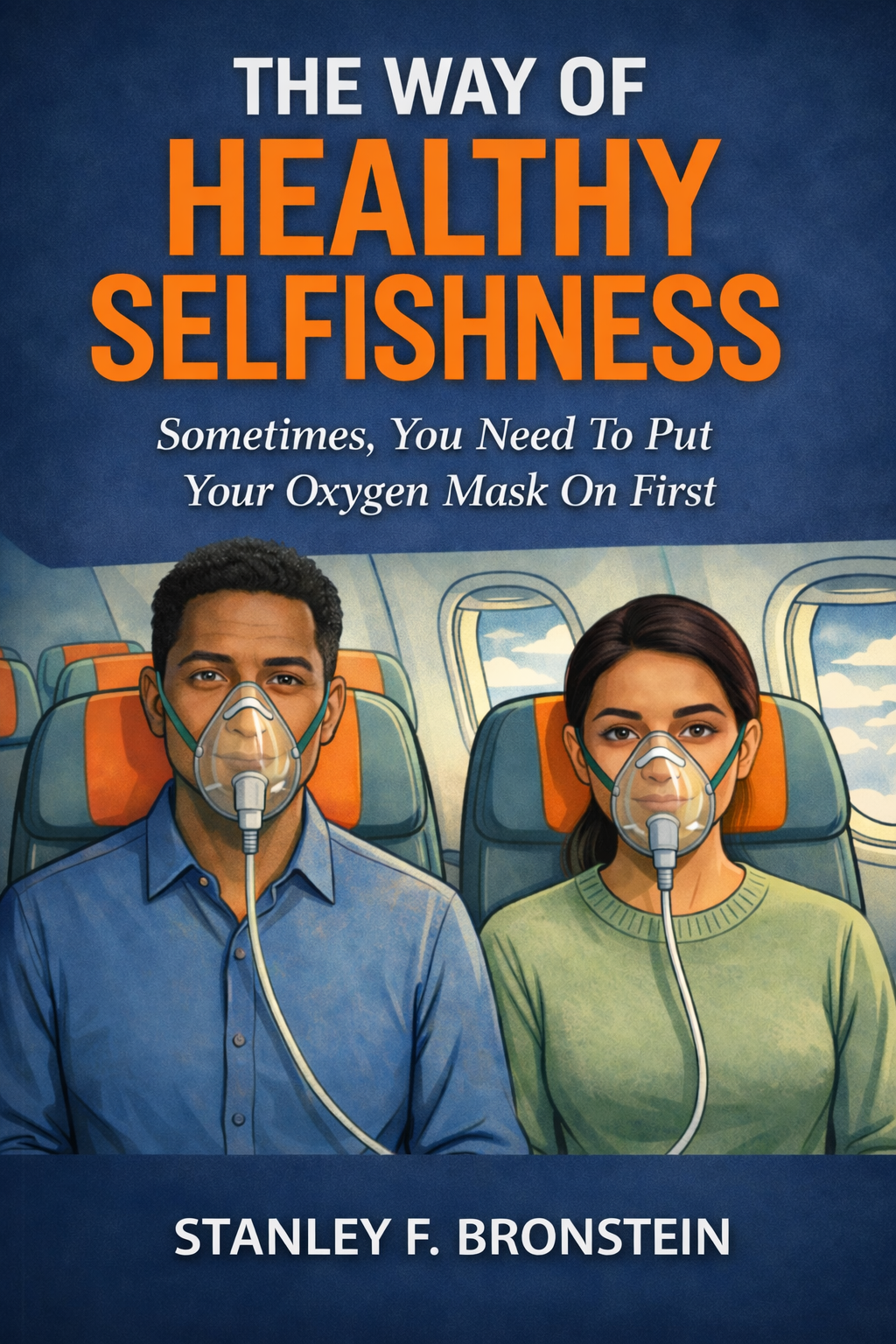
Sometimes, You Have To Put Your Oxygen Mask On First
By Stanley F. Bronstein – Creator of The Way of Excellence System
Click The Tabs Below To Read Each Chapter Of The Book Online
Or
📘 Download Your Free Copy In Your Preferred Format
The Way of Healthy Selfishness
by Stanley F. Bronstein
How to use this page:
Click a chapter title to open it then scroll down to read.
When you click the title of the next chapter, the previous one will close.
Take your time.
Read, reflect, and do the experiments and assignments before you move on.
EMPTY ITEM
Foreword
There are times in life when people are praised for giving, helping, sacrificing, and always being there for others. Those things can be beautiful. They can be noble. They can be loving. But they can also become dangerous when they are not balanced by wisdom, self-respect, and self-stewardship.
This book is about that balance.
It is about a truth that many people resist, misunderstand, or feel guilty even considering: sometimes, you need to put your oxygen mask on first.
That idea may sound selfish to some people at first. But only if they misunderstand what selfishness really is. There is a form of selfishness that is shallow, destructive, and corrosive. That kind of selfishness uses other people, neglects responsibility, and pursues short-term comfort or advantage at the expense of long-term wellbeing. That kind of selfishness damages relationships, weakens character, and harms both self and others.
But there is another kind of selfishness – a healthy kind – and that is what this book is about.
Healthy selfishness is strength. It is the discipline to protect your health, your peace, your energy, your focus, your values, and your future. It is the willingness to say no when saying yes would slowly destroy you. It is the wisdom to recognize that if you are depleted, unstable, resentful, unhealthy, exhausted, or emotionally frayed, you are no longer in the best position to help anyone else. You may still try. You may still mean well. But your capacity will be reduced, your judgment will suffer, and your ability to serve consistently will diminish.
That is not wisdom. That is self-neglect disguised as virtue.
For many people, this is a difficult lesson to learn. Some were raised to believe that putting themselves first is wrong under almost all circumstances. Some were taught that love means endless sacrifice. Some learned to measure their worth by how much they could endure, how much they could carry, or how many people they could rescue. Some became so used to being the strong one, the dependable one, or the giving one that they forgot they were human beings with limits, needs, responsibilities, and a life of their own to protect.
This book is written for those people.
It is written for people who are tired of confusing self-destruction with goodness.
It is written for people who have slowly traded their health for approval, their peace for obligation, and their future for the temporary comfort of not disappointing anyone.
It is written for people who know, deep down, that something has to change.
It is also written for people who are just getting started – people who know they need to make changes in how they live, eat, move, think, speak, set boundaries, or use their time, but who feel trapped by guilt, habit, expectation, or fear of what others might think.
This book will challenge that fear directly.
One of the recurring truths you will see throughout these pages is this:
Sometimes it doesn’t matter what others think. Sometimes, all that matters is what do you think?
That is not a call to arrogance. It is not permission to become careless, dismissive, or self-absorbed. It is a call to self-respect. It is a reminder that there are moments in life when you must be willing to do what is right for you, even if other people do not understand it, approve of it, or agree with it.
Sometimes your survival depends on that.
Sometimes your health depends on that.
Sometimes your future depends on that.
Sometimes your peace depends on that.
Sometimes your ability to become who you are meant to become depends on that.
This book is both practical and philosophical. It is practical because healthy selfishness must be lived, not merely admired. It must show up in daily habits, boundaries, choices, schedules, standards, and priorities. It must affect how you eat, how you move, how you rest, how you recover, how you say yes, how you say no, how you respond to pressure, and how you allocate your limited time, energy, and attention.
It is philosophical because beneath all of those daily actions lies a deeper question: what kind of life are you trying to live, and what kind of person are you trying to become?
You cannot answer that question well if you are constantly abandoning yourself.
You cannot become strong by repeatedly betraying your own needs.
You cannot build a meaningful life by living entirely for the approval, comfort, expectations, and demands of others.
At some point, you must choose.
You must decide that your life matters too.
You must decide that your health is not optional.
You must decide that your peace is worth protecting.
You must decide that boundaries are not cruelty.
You must decide that helping and rescuing are not the same thing.
You must decide that a little sacrifice may be noble, but too much sacrifice can become destructive.
You must decide that self-preservation is not selfish – it is essential.
This book also draws, where appropriate, from the principles of The Way of Excellence (TWOE). TWOE teaches that excellence requires awareness, long-term thinking, personal responsibility, balance, discipline, commitment, integrity, perspective, and the alignment of mind, body and spirit. Healthy selfishness fits naturally within that framework. In fact, without some measure of healthy selfishness, excellence becomes very difficult to sustain. A person who never protects their own foundation eventually weakens the very structure they are trying to build.
That is why this is not a book about selfishness in the ugly sense. It is a book about stewardship. It is a book about strength. It is a book about sustainability. It is a book about learning how to protect the instrument through which your life is lived.
Your mind matters.
Your body matters.
Your spirit matters.
Your future matters.
And if you do not protect them, no one else can fully do that work for you.
The pages ahead will ask you to look honestly at where you may be overgiving, overextending, overcommitting, overexplaining, overfunctioning, or quietly depleting yourself in the name of being good, helpful, needed, or liked. They will also ask you to consider a better way – a stronger way – a healthier way.
Not a perfect way.
A real way.
A sustainable way.
A way that allows you to live with greater clarity, greater peace, greater discipline, greater health, and greater power.
A way that allows you to serve others without disappearing yourself.
A way that allows you to contribute over the long term rather than burning yourself out in the short term.
A way that allows you to choose life more fully.
That is the invitation of this book.
If you are ready to stop treating your own wellbeing like an afterthought, if you are ready to let go of the guilt that comes from protecting what truly matters, and if you are ready to become stronger, steadier, and wiser in how you live, then this book is for you.
Sometimes, you need to put your oxygen mask on first.
INTRODUCTION TO PART I - THE TRUTH ABOUT SELFISHNESS
Most people have never been taught to think clearly about selfishness.
They have been taught to condemn it, fear it, or feel guilty about anything that sounds like putting themselves first. In many cases, they were raised to believe that goodness means always giving, always helping, always sacrificing, always being available, and always making sure everyone else is okay before they ever consider their own needs. That way of thinking may sound noble on the surface. Sometimes it is. But very often it creates exhausted, resentful, depleted people who are praised for how much they give while quietly falling apart inside.
That is one of the central problems this book is meant to address.
Before we can talk about boundaries, pressure, self-trust, sustainability, or strength, we have to deal with the word itself. We have to look directly at selfishness and ask what it really means. We have to separate what is healthy from what is destructive. We have to stop treating all selfishness as if it is the same.
It is not the same.
There is a kind of selfishness that is ugly. It is self-absorbed, manipulative, careless, greedy, and destructive. It takes without concern for others. It avoids responsibility. It demands comfort, attention, and advantage while disregarding the cost to the people around it. That kind of selfishness damages both the person living it and the people forced to deal with it.
But there is another kind of selfishness – the kind this book is about.
Healthy selfishness is not about using people. It is not about becoming cold, entitled, indifferent, or self-centered. It is not about making yourself the center of the universe. It is about self-stewardship. It is about protecting your health, peace, energy, judgment, and capacity so that you can live well and give well over the long term. It is about recognizing that if you constantly abandon yourself, you will eventually have less and less of value to offer anyone else.
That truth makes some people uncomfortable because it sounds like permission to put yourself first. In a sense, it is. But not in a shallow way. Not in a reckless way. Not in a way that ignores responsibility, love, or service. It is permission to stop destroying yourself in the name of being good. It is permission to stop confusing self-neglect with virtue. It is permission to stop acting as if your health, your peace, your future, and your life are somehow less important than everything everyone else wants from you.
This part of the book is about clearing away confusion.
It is about building a foundation.
It is about understanding that healthy selfishness is strength, while unhealthy selfishness is destructive. It is about learning that helping and rescuing are not the same thing. It is about seeing why so many good, caring, responsible people run themselves into the ground. It is about realizing that a little sacrifice may be noble, but too much sacrifice becomes harmful. And it is about beginning to understand why sometimes you really do need to put your oxygen mask on first.
If you have spent much of your life trying to be good by always putting yourself last, this part may challenge you.
Good.
That challenge is necessary.
Because if you do not first tell the truth about selfishness, you will never fully understand why protecting yourself is not a betrayal of others. You will continue to feel guilty for doing what is necessary. You will continue to second-guess healthy boundaries. You will continue to mistake depletion for love, overextension for virtue, and self-abandonment for moral strength.
This part is where that begins to change.
Sometimes, it does not matter what others think. Sometimes, all that matters is what do you think?
That question is not only for later in the book. It begins here.
What do you think about selfishness?
What have you been taught to believe about it?
What has it cost you to believe that?
And what might change if you learned to distinguish healthy selfishness from unhealthy selfishness at last?
That is where we begin.
Chapter 1 - What Healthy Selfishness Really Is
Most people hear the word selfish and immediately think of something ugly.
They think of greed. They think of arrogance. They think of someone who only cares about themselves, ignores the needs of others, and takes whatever they want without concern for the consequences. In that sense, selfishness deserves its bad reputation. That kind of selfishness is destructive. It harms relationships. It damages trust. It weakens character. It often leaves pain in its wake.
But that is not the only kind of selfishness that exists.
One of the central ideas of this book is that there is a very important difference between unhealthy selfishness and healthy selfishness. If you fail to make that distinction, you will likely spend much of your life feeling guilty for doing what is necessary to protect your health, your peace, your future, and your ability to contribute well over time.
That is too high a price to pay for confusion.
Healthy selfishness is not about becoming cold, self-absorbed, manipulative, or indifferent. It is not about using people. It is not about making yourself the center of the universe. It is not about refusing responsibility. It is not about demanding that other people orbit around your comfort, your moods, or your preferences.
Healthy selfishness is strength.
It is the strength to protect what must be protected.
It is the strength to care for yourself before you collapse.
It is the strength to say no when yes would destroy your peace.
It is the strength to stop confusing self-neglect with virtue.
It is the strength to recognize that your life matters too.
The Difference Between Healthy and Unhealthy Selfishness
Unhealthy selfishness takes.
Healthy selfishness protects.
Unhealthy selfishness ignores responsibility.
Healthy selfishness accepts responsibility, including responsibility for the care of your own mind, body, and spirit.
Unhealthy selfishness exploits others for short-term gain.
Healthy selfishness refuses to abandon the self in order to satisfy pressure, guilt, fear, or endless obligation.
Unhealthy selfishness says, “I matter, and no one else does.”
Healthy selfishness says, “I matter too.”
That difference is everything.
A person practicing unhealthy selfishness may hurt others without remorse. A person practicing healthy selfishness may disappoint others at times, but not because they are cruel. They do it because they understand that living in a constant state of depletion, resentment, and overextension does not help anyone in the long run.
This is where many people get confused.
They think that if other people are unhappy with their boundaries, then the boundaries must be wrong.
They think that if saying no makes someone uncomfortable, then saying no must be selfish in the bad sense.
They think that if they choose sleep, movement, peace, recovery, solitude, discipline, or a necessary limit over pleasing someone else, then they are failing some moral test.
They are not.
They are often doing the exact opposite.
They are finally beginning to act like a person who understands that strength requires maintenance.
Why This Distinction Matters
If you cannot distinguish healthy selfishness from unhealthy selfishness, then almost every necessary act of self-protection will feel suspect to you.
Rest will feel lazy.
Boundaries will feel rude.
Discipline will feel extreme.
Saying no will feel mean.
Stepping back will feel selfish.
Choosing your health will feel like betrayal.
Protecting your peace will feel unjustified.
And over time, that way of thinking can ruin a person.
A person who lives that way often becomes overcommitted, overstimulated, emotionally thin, physically run down, and quietly resentful. They may still look kind from the outside. They may still appear dependable. In fact, they may even be praised for how much they give. But inwardly, something important is eroding.
Their health may be suffering.
Their joy may be disappearing.
Their patience may be shrinking.
Their focus may be weakening.
Their sense of self may be fading.
And eventually, the very person who wanted to be good, helpful, and generous may become exhausted, bitter, reactive, or broken down.
That is not noble.
That is not wisdom.
That is not sustainable.
And it is not necessary.
You Cannot Give What You Do Not Have
This is one of the most important truths in the entire book.
You cannot sustainably give what you do not have.
You cannot give calm when you are chronically overwhelmed.
You cannot give patience when you are emotionally depleted.
You cannot give stability when your own life is in disorder.
You cannot give wise leadership when your thinking is clouded by exhaustion.
You cannot give clean love when your giving is fueled by resentment, guilt, fear, or self-erasure.
You may still attempt to give those things. Many people do. But what they offer will often be inconsistent, strained, or distorted by their depleted condition.
That is why healthy selfishness is not the opposite of love.
It is often one of the conditions that makes real love possible.
The same is true in leadership.
The same is true in parenting.
The same is true in friendship.
The same is true in service.
The same is true in business.
The same is true in health.
You cannot continuously run on empty and still expect to show up at your best.
Sooner or later, depletion shows.
Self-Stewardship Is Not Self-Absorption
Healthy selfishness is really a form of self-stewardship.
Stewardship means that something valuable has been placed in your care, and you have a responsibility to manage it wisely.
Your life has been placed in your care.
Your body has been placed in your care.
Your mind has been placed in your care.
Your spirit has been placed in your care.
Your time has been placed in your care.
Your energy has been placed in your care.
Your attention has been placed in your care.
If you manage those things recklessly, carelessly, or passively, there will be consequences. If you let everyone and everything drain them without limits, there will be consequences. If you never protect them because you are too busy trying to satisfy other people, there will be consequences.
Healthy selfishness says that those consequences matter.
It says that your internal condition matters.
It says that your energy is not infinite.
It says that your health is not optional.
It says that your peace is not worthless.
It says that your future should not be casually traded away.
That is not self-absorption.
That is stewardship.
Self-absorption is obsession with the self for vanity, comfort, or control.
Self-stewardship is care of the self for strength, responsibility, and sustainable living.
Those are not the same thing.
Why Good People Struggle With This
Many of the people who most need this message are good people.
They are caring people.
They are responsible people.
They are loyal people.
They are generous people.
They are the people others count on.
They are the people who show up.
They are the people who do not want to let anyone down.
And precisely because of those qualities, they are often the ones most likely to run themselves into the ground.
Why?
Because they have often been rewarded for overgiving.
They have often been praised for enduring too much.
They have often been conditioned to believe that love means availability, that goodness means self-denial, and that being needed means being valuable.
Some of them have spent so long being the strong one that they do not know how to stop.
Some have spent so long carrying everyone else that they no longer know what it feels like to carry themselves well.
Some are so afraid of being seen as selfish that they accept patterns that are slowly damaging them.
And many of them do not realize the cost until the cost becomes severe.
This is why the truth about healthy selfishness matters so much.
It offers another way.
It offers a better framework.
It gives good people permission to stop destroying themselves in order to prove that they care.
Healthy Selfishness Requires Honesty
A person cannot practice healthy selfishness without honesty.
You have to be honest about your limits.
You have to be honest about your condition.
You have to be honest about what drains you.
You have to be honest about what restores you.
You have to be honest about what you can carry and what you cannot carry.
You have to be honest about what belongs to you and what does not.
You have to be honest about the price you are paying for saying yes too often.
You have to be honest about the way fear, guilt, habit, or approval-seeking may be shaping your choices.
That honesty can be uncomfortable.
Sometimes very uncomfortable.
But without it, there is no real self-stewardship. There is only reaction, habit, and gradual depletion.
Healthy selfishness begins when you stop lying to yourself about what your current way of living is costing you.
It begins when you stop calling self-neglect love.
It begins when you stop calling exhaustion normal.
It begins when you stop calling resentment generosity.
It begins when you stop calling fear virtue.
It begins when you stop pretending that endless sacrifice has no consequences.
Truth is often the first boundary.
Healthy Selfishness and The Way of Excellence
The Way of Excellence (TWOE) fits naturally with this idea.
Excellence is not built on self-destruction.
Excellence requires awareness. It requires perspective. It requires personal responsibility. It requires balance. It requires discipline. It requires integrity. It requires the alignment of mind, body and spirit. A person who consistently abandons themselves weakens the very foundation on which excellence must stand.
TWOE is not about perfection. It is about living in a way that is stronger, wiser, more intentional, and more sustainable. Healthy selfishness supports that. It helps protect the inner and outer resources that excellence requires.
Without healthy selfishness, many people attempt excellence from a place of chronic depletion.
That rarely ends well.
Sooner or later, the body protests.
The emotions protest.
The mind protests.
The relationships protest.
The spirit protests.
And the person who might have gone far begins to falter because they never learned how to protect the instrument through which excellence had to be expressed.
Healthy selfishness is not separate from excellence.
In many cases, it is one of the conditions that makes excellence sustainable.
What Healthy Selfishness Looks Like in Real Life
Healthy selfishness is not just an idea. It has to take practical form.
It may look like going to bed when you need sleep instead of staying up to satisfy one more demand.
It may look like saying no to a commitment that would overload your schedule.
It may look like taking care of your health before a crisis forces your attention.
It may look like refusing to keep rescuing someone who will not take responsibility for themselves.
It may look like protecting your mornings, your workouts, your meals, your quiet time, your recovery, or your focus.
It may look like disappointing someone who expected unlimited access to your time and energy.
It may look like leaving a draining environment.
It may look like being willing to be misunderstood.
It may look like choosing long-term wellbeing over short-term approval.
These actions may not always feel comfortable.
They may not always look heroic.
They may not always make you popular.
But they may be exactly what wisdom requires.
The Real Question
In the end, the question is not whether you will ever be selfish.
You will.
Everyone is selfish in some form. The real question is what kind of selfishness will govern your life.
Will it be the unhealthy kind that damages yourself and others?
Or will it be the healthy kind that protects your life, strengthens your capacity, and allows you to contribute from a place of steadiness rather than depletion?
That is the question this book asks from the beginning.
And if you are willing to answer it honestly, it can change the way you think about your life.
Because once you understand what healthy selfishness really is, you will never again have to confuse self-protection with moral failure.
You will begin to see that protecting your health, your peace, your energy, your standards, and your future is not a betrayal of others.
It is often one of the wisest things you can do for yourself and for them.
Sometimes, you need to put your oxygen mask on first.
Assignment
Step 1 – Define The Two Kinds of Selfishness
Write your own short definition of unhealthy selfishness.
Then write your own short definition of healthy selfishness.
Do not worry about making the language perfect. What matters is clarity.
Step 2 – Identify Where You Have Been Confused
Ask yourself where you may have been treating healthy selfishness as if it were unhealthy selfishness.
Have you felt guilty for resting? For setting boundaries? For protecting your time? For taking care of your health? For saying no?
Write down specific examples.
Step 3 – Count the Cost
Make a list of the ways self-neglect may be costing you now.
Consider your health, peace, energy, mood, focus, relationships, and future.
Be honest.
Step 4 – Write One New Truth
Complete this sentence in writing:
“Healthy selfishness is not ____________________. Healthy selfishness is ____________________.”
Write your answer in a way that feels true and personal to you.
Step 5 – Choose One Immediate Act of Self-Stewardship
Pick one simple action you can take immediately that would reflect healthy selfishness in your own life.
Make it real.
Make it specific.
And do it.
Chapter 2 - Sometimes You Need To Put Your Oxygen Mask On First
Few instructions given in life are as simple, practical, and profound as this one:
Put your oxygen mask on first.
Most people have heard that instruction on an airplane. Parents are told to secure their own mask before helping their children. The reason is obvious. If they lose consciousness while trying to help someone else first, they may end up helping no one. What sounds selfish at first is actually wise, responsible, and necessary.
That same principle applies far beyond airplanes.
It applies to health.
It applies to relationships.
It applies to parenting.
It applies to leadership.
It applies to service.
It applies to emotional stability.
It applies to time and energy.
It applies to the daily decisions that determine whether a person lives from strength or from depletion.
This chapter is about understanding that principle in real life.
Sometimes you need to put your oxygen mask on first.
Not because you do not care about others.
Not because you are cold.
Not because you are indifferent.
Not because you want the world to revolve around you.
But because if you do not protect your own capacity, you will eventually lose the ability to function well, love well, lead well, and serve well.
That is not selfishness in the destructive sense.
That is wisdom.
The Principle Is About Capacity
At its core, the oxygen mask principle is about capacity.
Capacity is your ability to function well.
It is your ability to think clearly.
It is your ability to regulate your emotions.
It is your ability to stay patient under pressure.
It is your ability to make sound decisions.
It is your ability to respond instead of react.
It is your ability to keep your commitments without destroying yourself in the process.
It is your ability to show up with steadiness and strength over time.
When capacity is high, life tends to be handled better.
When capacity is low, everything becomes harder.
A tired person is easier to trigger.
A depleted person is less patient.
An overwhelmed person is more reactive.
A neglected body creates a burden for the mind.
A chaotic mind creates strain for the body.
A person running on empty often makes worse decisions, speaks more carelessly, tolerates more nonsense, and collapses faster under pressure.
This is why the oxygen mask principle matters so much.
If you do not protect your capacity, then the quality of everything you do begins to decline.
Your work declines.
Your judgment declines.
Your leadership declines.
Your patience declines.
Your relationships decline.
Your health declines.
And over time, your ability to contribute meaningfully declines too.
Depletion Changes More Than You Think
Many people underestimate what depletion does to them.
They think they are just tired.
They think they are just stressed.
They think they are just having a rough week, a rough month, or a rough season.
Sometimes that is true.
But many people are not just temporarily tired. They are chronically under-resourced.
They are under-rested.
They are under-recovered.
They are undernourished.
They are overstimulated.
They are overcommitted.
They are emotionally overloaded.
They are mentally scattered.
They are physically neglected.
And because this condition builds slowly, they may not fully realize what it is doing to them.
Depletion shrinks patience.
Depletion weakens discipline.
Depletion clouds perspective.
Depletion increases emotional reactivity.
Depletion makes small problems feel larger.
Depletion makes hard choices feel harder.
Depletion makes temptation stronger.
Depletion makes boundaries weaker.
Depletion often leads to mistakes that would have been avoided in a stronger condition.
A depleted person may still mean well. In many cases, they do mean well. But good intentions do not erase the effects of low capacity.
This matters because many people keep trying to solve external problems while ignoring the internal condition from which they are trying to solve them.
They want better relationships without rest.
They want better focus without recovery.
They want better health without standards.
They want better leadership without self-regulation.
They want better decisions while living in a fog of exhaustion and pressure.
That rarely works for long.
You Cannot Keep Giving From Empty
This truth is simple, but many people resist it.
You cannot keep giving from empty.
You can give from empty for a little while.
You can push through for a season.
You can override warning signs.
You can run on adrenaline.
You can keep saying yes.
You can ignore your body.
You can dismiss your emotions.
You can postpone recovery.
You can neglect sleep.
You can skip movement.
You can eat carelessly.
You can overextend your schedule.
You can carry things that were never yours to carry.
You can do that for a while.
But not forever.
Eventually the bill comes due.
Sometimes it comes due in the form of illness.
Sometimes it comes due in the form of burnout.
Sometimes it comes due in the form of anger.
Sometimes it comes due in the form of emotional numbness.
Sometimes it comes due in the form of anxiety.
Sometimes it comes due in the form of resentment toward the very people you were trying to help.
Sometimes it comes due in the form of poor decisions, broken focus, weakened relationships, or a quiet collapse that takes place behind a competent exterior.
That is why this principle matters.
It is not about protecting comfort.
It is about protecting function.
It is about protecting your ability to remain effective, steady, sane, and strong enough to live your life well.
Putting Your Oxygen Mask On First Is Not Abandoning Others
One reason people resist this principle is because they think it means abandoning others.
They imagine that if they choose their own health, peace, or recovery, they are somehow betraying the people they love.
That is a misunderstanding.
Putting your oxygen mask on first does not mean you never help.
It does not mean you stop caring.
It does not mean you become unavailable, detached, or indifferent.
It means you stop trying to help in ways that destroy your own ability to remain stable.
It means you understand that protecting yourself is part of responsible caring.
It means you stop confusing collapse with love.
A person who secures their own oxygen mask first is not refusing to help the child beside them.
They are making it possible to help the child effectively.
The same is true in ordinary life.
A parent who takes care of their own health is not abandoning the family. They are increasing the odds that they will be present, capable, and steady.
A leader who protects their peace, focus, and recovery is not selfish in the ugly sense. They are protecting the state from which wise leadership can come.
A caregiver who rests is not failing. They are honoring reality.
A person who sets limits on what they can carry is not cruel. They are being honest enough to prevent deeper damage.
This principle is not anti-love.
It is pro-sustainability.
It is pro-stability.
It is pro-responsibility.
It is pro-truth.
The Difference Between Urgency and Importance
Many people fail to put their oxygen mask on first because they are constantly reacting to urgency.
Everything feels immediate.
Everything feels like it must be handled now.
Every request feels pressing.
Every discomfort feels like something that must be relieved right away.
Every demand seems more important than the maintenance of the self.
That is a dangerous way to live.
Urgency and importance are not the same.
Something can feel urgent and still be less important than your health.
Someone else’s emotional reaction can feel urgent and still be less important than your stability.
A request can feel urgent and still not deserve your yes.
A short-term discomfort can feel urgent and still not justify abandoning a long-term standard.
This is one of the reasons healthy selfishness requires perspective.
Without perspective, you will keep sacrificing what matters most for whatever is shouting loudest in the moment.
You will trade long-term strength for short-term relief.
You will trade health for convenience.
You will trade peace for approval.
You will trade discipline for comfort.
You will trade sustainability for temporary emotional ease.
And you may not even realize what you are doing until the effects accumulate.
Putting your oxygen mask on first means learning to value what is deeply important even when something else feels urgent.
That takes maturity.
It takes discipline.
It takes clarity.
And often, it takes the willingness to let other people be disappointed.
This Principle Applies to More Than Physical Health
Many people hear the oxygen mask principle and think only about physical survival.
But in daily life, the principle applies in multiple dimensions.
It applies physically.
You need food that supports you, movement that strengthens you, sleep that restores you, and recovery that keeps you functional.
It applies mentally.
You need focus, mental space, and protection from constant overload.
It applies emotionally.
You need regulation, recovery from stress, and limits around drama, chaos, and needless conflict.
It applies spiritually.
You need meaning, alignment, and some sense that you are living in a way that honors what matters most.
If any one of these areas is neglected long enough, the others begin to suffer.
Physical neglect weakens emotional resilience.
Emotional chaos weakens focus.
Mental overload weakens judgment.
Spiritual emptiness weakens endurance.
The person begins to fray, and eventually their giving becomes strained, erratic, or unsustainable.
That is why putting your oxygen mask on first cannot be reduced to one act.
It is a way of living.
It is the practice of maintaining the conditions under which your life works better.
The Cost of Waiting Too Long
One of the great mistakes people make is waiting until they are already in crisis before they take care of themselves.
They wait until the diagnosis.
They wait until the breakdown.
They wait until the resentment spills over.
They wait until the relationship is damaged.
They wait until the exhaustion becomes unbearable.
They wait until something forces them to pay attention.
But wisdom does not wait for collapse.
Wisdom acts sooner.
Healthy selfishness says that your health and stability are not optional luxuries to be addressed only when everything is already falling apart.
They are non-negotiable assets.
They must be protected before crisis, not only during it.
This matters because prevention is usually less painful than repair.
A person who maintains their body often avoids bigger health problems later.
A person who protects their peace often avoids unnecessary conflict.
A person who builds boundaries early often avoids deeper resentment later.
A person who respects their own limits often avoids a more serious breakdown down the road.
Putting your oxygen mask on first is not only a crisis principle.
It is a prevention principle.
It asks you to maintain yourself while you are still able, not just after you are already damaged.
Why People Resist the Principle
If this principle is so wise, why do so many people resist it?
There are many reasons.
Some people feel guilty putting themselves first in any way.
Some were taught that goodness means endless sacrifice.
Some are afraid of looking selfish.
Some fear disappointing others.
Some have built their identity around being the one who always shows up, always fixes, always carries, always gives.
Some do not know who they are without being needed.
Some have become so used to neglecting themselves that self-care feels unnatural.
Some are addicted to urgency.
Some are addicted to approval.
Some do not believe they are worth protecting.
And some simply do not want to face the truth about what their current way of living is costing them.
All of those obstacles are real.
But none of them make self-neglect wise.
They only explain why wisdom is often difficult to practice.
This is why healthy selfishness requires courage.
It takes courage to rest when the world rewards overextension.
It takes courage to set boundaries when others expect constant access.
It takes courage to protect your health when people around you live carelessly.
It takes courage to stop rescuing.
It takes courage to disappoint.
It takes courage to honor your own limits.
It takes courage to choose sustainability over appearance.
Sometimes it takes courage to say, “I know this may not make sense to you, but I need to do this anyway.”
The Way of Excellence and the Oxygen Mask Principle
The Way of Excellence (TWOE) helps make this principle even clearer.
TWOE teaches that excellence requires awareness, long-term thinking, personal responsibility, balance, discipline, and the alignment of mind, body and spirit. All of those are supported by the oxygen mask principle.
Awareness helps you recognize when your capacity is dropping.
Long-term thinking helps you see that self-neglect today creates consequences tomorrow.
Personal responsibility reminds you that your condition is not someone else’s job to manage.
Balance keeps you from living at extremes.
Discipline helps you maintain the habits that protect capacity.
Alignment of mind, body and spirit keeps your life from fragmenting under pressure.
Without some version of this principle, many people attempt excellence while chronically depleted.
They want excellent performance without protecting the performer.
They want excellent judgment without protecting the mind that must produce it.
They want excellent service without maintaining the person who is doing the serving.
That is not sustainable.
TWOE is not built on exhaustion, chaos, or collapse.
Neither is a good life.
If you want excellence to last, you have to protect the conditions that make it possible.
What Putting Your Oxygen Mask On First Looks Like in Real Life
This principle may sound abstract until it reaches your schedule, your habits, and your choices.
In real life, it may look like this:
It may mean going to sleep instead of pushing yourself past the point of sense.
It may mean walking daily even when other people do not understand why it matters so much to you.
It may mean eating in a way that supports your health instead of pleasing a room full of people.
It may mean declining one more commitment because your current load is already too heavy.
It may mean protecting time for silence, exercise, reflection, recovery, or prayer.
It may mean stepping away from conversations that are draining and unproductive.
It may mean refusing to join chaos just because chaos is available.
It may mean saying, “I can help with this much, but not with that.”
It may mean no longer sacrificing your future to avoid present discomfort.
It may mean disappointing someone who expected unlimited access to you.
It may mean doing what is right for you even when other people think it is strange.
That last point matters.
Sometimes it does not matter what others think. Sometimes, all that matters is what do you think?
That is not always true in every circumstance. Wisdom still requires humility, conscience, and consideration. But there are absolutely times when other people’s opinions should not be allowed to override what you know is necessary for your health, your peace, your standards, and your future.
This principle gives you permission to live from that truth.
The Real Meaning of the Instruction
Put your oxygen mask on first.
It is a practical instruction, but it is also a philosophy.
It is a reminder that your life requires maintenance.
It is a reminder that capacity matters.
It is a reminder that depletion has consequences.
It is a reminder that caring for others does not require abandoning yourself.
It is a reminder that sustainable giving is stronger than dramatic overgiving.
It is a reminder that wise self-protection is not the same as selfish disregard.
Most of all, it is a reminder that if you collapse, the quality of everything you touch will change.
That is why this principle belongs at the center of this book.
Sometimes you need to put your oxygen mask on first.
Not because you are selfish in the destructive sense.
But because you are responsible enough to understand that your health, your peace, your strength, and your capacity matter.
And because they matter, they must be protected.
Assignment
Step 1 – Assess Your Current Capacity
Rate your current condition in each of these areas from 1 to 10:
Physical
Mental
Emotional
Spiritual
Be honest. Do not rate yourself based on how you want to be doing. Rate yourself based on how you are actually doing right now.
Step 2 – Identify Where You Are Running Low
Write down the one or two areas where your capacity is weakest right now.
Ask yourself what is contributing to that weakness.
Is it lack of sleep? Poor food choices? Too many commitments? Emotional overload? Constant distraction? Lack of movement? Lack of boundaries? Lack of recovery?
Name it clearly.
Step 3 – Identify What You Keep Trying To Give From Empty
Ask yourself where in your life you are trying to give from a place of depletion.
Is it in parenting? Work? leadership? Marriage? Friendship? Caregiving? Community service?
Write down at least one area where your giving is being weakened by your condition.
Step 4 – Choose One Oxygen Mask Practice
Select one practical action that would help you begin protecting your capacity immediately.
Make it simple and specific.
Examples might include:
-
going to bed earlier
-
taking a daily walk
-
protecting a quiet hour each morning
-
saying no to one unnecessary commitment
-
improving your eating schedule
-
stepping back from one draining situation
-
building in recovery time
Choose one and commit to it.
Step 5 – Finish This Sentence
Write this sentence and complete it honestly:
“If I do not start putting my oxygen mask on first, the cost will be ____________________.”
Then write a second sentence:
“If I do start putting my oxygen mask on first, the benefit will be ____________________.”
Let the truth guide you.
Chapter 3 - The Difference Between Helping and Rescuing
Many people confuse helping with rescuing.
At first glance, they can look similar. In both cases, one person steps in because another person is struggling. In both cases, care may be involved. Concern may be real. The desire to make things better may be sincere. But despite these similarities, helping and rescuing are not the same. In fact, the difference between them is one of the most important distinctions in this book.
Helping supports strength.
Rescuing often weakens it.
Helping respects the other person.
Rescuing often overrides them.
Helping can be loving.
Rescuing can feel loving, but over time it often becomes destructive.
If you do not understand this distinction, it becomes very difficult to practice healthy selfishness. You may keep pouring your energy into situations that slowly drain you while telling yourself that you are being kind. You may keep carrying things that were never meant to be yours while calling it generosity. You may keep interfering with other people’s growth while convincing yourself that you are helping them.
That creates damage for everyone involved.
This chapter is about learning to tell the difference.
What Helping Really Is
Helping means offering support in a way that strengthens another person’s ability to function, grow, decide, or carry responsibility for their own life.
Helping does not erase their responsibility.
Helping does not make you their substitute.
Helping does not require you to collapse in order to support them.
Helping says, “I care about you, and I want to support what is healthy, responsible, and constructive.”
Sometimes helping is practical.
You may provide useful information.
You may listen.
You may encourage.
You may teach.
You may lend a hand during a difficult season.
You may give someone a temporary boost while they regain footing.
Sometimes helping is emotional.
You may offer comfort.
You may sit with someone in pain.
You may be present without trying to control the outcome.
Sometimes helping is structural.
You may create better boundaries, better systems, or better expectations so that everyone can function more effectively.
The key is that real helping supports growth, responsibility, and dignity.
It does not replace them.
A person who is truly helping is not trying to become indispensable. They are not trying to create dependence. They are not trying to control the other person’s choices by solving everything for them. They are not trying to feel important by constantly stepping in.
They are simply offering support in a way that strengthens what should be strengthened.
That matters.
Because healthy help leaves people better able to stand.
What Rescuing Really Is
Rescuing is different.
Rescuing happens when you take over responsibility that belongs to someone else.
It happens when you rush in too quickly, carry too much, solve too much, absorb too much, or prevent another person from facing the consequences, discomfort, effort, or growth that their situation requires.
Rescuing often looks generous from the outside.
Sometimes it even feels noble from the inside.
But underneath, something unhealthy is usually happening.
The rescuer may be acting from guilt.
They may be acting from fear.
They may be acting from the need to be needed.
They may be acting from discomfort with watching someone struggle.
They may be acting from control.
They may be acting from habit.
They may be acting from the belief that love requires self-erasure.
Whatever the motive, the result is often the same: the rescuer carries more than is wise, and the other person carries less than they should.
That arrangement may relieve discomfort in the short term.
But over time, it creates weakness.
The rescuer becomes exhausted.
The other person becomes dependent, entitled, passive, or less capable.
The relationship becomes imbalanced.
Resentment begins to grow.
And what started as an attempt to help ends up damaging both people.
That is why rescuing is not the same as helping.
Helping strengthens.
Rescuing often substitutes.
Why Rescuing Feels So Tempting
Rescuing can be incredibly tempting because it offers immediate emotional relief.
Someone is struggling.
You feel uncomfortable watching it.
You step in.
For a moment, the tension drops.
You feel useful.
You feel needed.
You feel like a good person.
The other person may even feel grateful at first.
That short-term relief can be addictive.
It can make rescuing feel right even when it is not wise.
This is especially true for people who are highly responsible, highly sensitive, highly loyal, or deeply uncomfortable with conflict, struggle, or emotional distress. They may find it painful to watch someone else flounder. They may feel guilty if they do not intervene. They may tell themselves that stepping in is the loving thing to do.
Sometimes it is.
But often, it is simply the fastest way to reduce their own discomfort.
That is an important truth.
Not all rescuing is really about the other person.
Sometimes it is about the rescuer’s inability to tolerate watching another person face what they need to face.
Sometimes rescuing is an attempt to make the rescuer feel better.
Sometimes it is an attempt to avoid the awkwardness of saying no.
Sometimes it is an attempt to avoid being seen as uncaring.
Sometimes it is an attempt to maintain a role: the helper, the fixer, the strong one, the one who always comes through.
That is one reason rescuing can be so deceptive. It can hide under the appearance of love while actually being driven by fear, guilt, control, or identity.
The Cost to the Rescuer
Rescuing has a cost, and the rescuer usually pays it first.
They pay in time.
They pay in energy.
They pay in peace.
They pay in focus.
They pay in emotional strain.
They pay in lost capacity.
They pay in postponed rest.
They pay in neglected health.
They pay in hidden resentment.
And often, they pay in the slow erosion of their own life.
The rescuer may begin by telling themselves they are only stepping in this one time. But if the pattern repeats, they become the person who is always expected to absorb the chaos, fix the problem, carry the burden, or clean up the consequences.
That role is exhausting.
It is also dangerous because it can make self-neglect feel morally necessary.
The rescuer may stop asking what something is costing them.
They may stop asking whether the burden is theirs.
They may stop asking whether their involvement is actually helping.
They may only ask whether someone needs them.
That is not a healthy standard.
Need alone is not enough to determine responsibility.
Many things are needed that are not yours to carry.
Many people need to do work they do not want to do.
Many situations need consequences in order for growth to happen.
Many struggles need to be faced by the person living them.
If you try to rescue every need you see, you will eventually destroy your own capacity.
That is why healthy selfishness must include the ability to say, “I care, but this is not mine to carry for you.”
The Cost to the Other Person
Rescuing also costs the person being rescued.
That cost is often less visible at first, but it is very real.
When you repeatedly rescue someone, you may keep them from:
-
developing responsibility
-
building resilience
-
facing consequences
-
learning problem-solving skills
-
building confidence
-
feeling the connection between choices and outcomes
-
discovering their own strength
In other words, rescuing may protect them from the very experiences that could help them grow.
This does not mean people should never receive help. Of course they should. People need support. People need grace. People need encouragement. People need compassion. Healthy communities depend on people being willing to care for one another.
But there is a difference between support and substitution.
Support says, “I am with you while you do your work.”
Substitution says, “I will do your work for you.”
That difference matters.
A person who is continually substituted for may become weaker without realizing it. They may expect others to keep compensating. They may begin to avoid responsibility because they know someone else will step in. They may lose confidence in their own ability because they have not had to develop it. Or they may simply learn that someone else’s overfunctioning allows them to underfunction.
That is not kindness in the long run.
That is quiet damage.
Helping Respects Responsibility
One of the clearest ways to understand the difference is this:
Helping respects responsibility.
Rescuing often removes it.
If a person is capable of taking responsibility, then healthy help should support that capacity, not replace it.
That may mean asking questions instead of taking over.
It may mean offering guidance instead of control.
It may mean giving encouragement instead of constant intervention.
It may mean refusing to shield someone from the predictable results of their choices.
It may mean allowing discomfort to do its work.
It may mean letting the other person carry the weight that belongs to them.
This can feel hard, especially if you care deeply. But if you want your care to strengthen rather than weaken, you must respect the role of responsibility in growth.
A person who never carries responsibility never fully develops strength.
And a person who always removes responsibility from others will often end up exhausted, resentful, and confused about why their helping is not producing better outcomes.
Helping Can Be Firm
Many people assume that if help is loving, it must also be soft, endlessly available, and free of limits.
That is not true.
Sometimes the most helpful response is a firm one.
Sometimes the most loving response is “no.”
Sometimes the most useful support is refusing to participate in a destructive pattern.
Sometimes helping means saying, “I will talk with you, but I will not lie for you.”
Sometimes it means saying, “I will encourage you, but I will not keep paying for choices you refuse to change.”
Sometimes it means saying, “I will listen, but I will not let you keep making me responsible for your life.”
Sometimes it means saying, “I care about you too much to keep enabling this.”
Firmness is not the opposite of love.
Often, firmness protects love.
Without firmness, help can slide into enabling.
Without firmness, support can become self-betrayal.
Without firmness, care can become complicity.
Healthy selfishness understands this. It knows that love without boundaries often becomes messy, distorted, and unsustainable.
Real help may comfort, but it may also confront.
Real help may support, but it may also require.
Real help may stay close, but it does not have to carry what does not belong to it.
Rescuing and Identity
For some people, rescuing is not only a behavior. It is an identity.
They have become the rescuer.
They are the one who steps in.
They are the one who fixes.
They are the one who always says yes.
They are the one others rely on.
They are the one who cannot bear to see a problem go unresolved.
That identity can feel powerful. It can make a person feel valuable, necessary, and important. But it can also trap them.
If you build your identity around rescuing, then other people’s dysfunction can start to feel like your purpose.
Other people’s chaos can become the stage on which you prove your worth.
Other people’s helplessness can become the condition that keeps your role intact.
That is not a healthy dynamic.
It makes it hard to step back.
It makes it hard to set boundaries.
It makes it hard to let others grow.
It makes it hard to know who you are when you are not fixing something.
Healthy selfishness invites you to examine that identity honestly.
Do you help because it is wise?
Or because it feels unbearable not to?
Do you support because it strengthens others?
Or because being needed helps you feel secure?
These are not easy questions, but they matter.
Because sometimes the hardest part of stopping rescuing is not changing your behavior. It is letting go of the role you have built around it.
When Helping Becomes Enabling
Enabling is what happens when your help supports a harmful pattern instead of interrupting it.
You may think you are helping because you are reducing pain, avoiding conflict, or making things easier. But if your actions allow destructive behavior to continue without consequence, you may not be helping at all.
You may be enabling.
This can happen in families.
It can happen in friendships.
It can happen in marriages.
It can happen in workplaces.
It can happen with money.
It can happen with addiction.
It can happen with irresponsibility.
It can happen anywhere one person’s refusal to face reality is cushioned by another person’s refusal to stop compensating.
Enabling often grows out of good intentions. But good intentions do not make it healthy.
The question is not only, “Am I being kind?”
The deeper question is, “What is my kindness producing?”
If your kindness is producing more honesty, responsibility, maturity, growth, and strength, that is a good sign.
If it is producing more avoidance, dependence, denial, manipulation, and passivity, something is wrong.
That is why healthy selfishness is not selfish in the ugly sense. It is clear enough to ask what your involvement is really creating.
The Way of Excellence and This Distinction
The Way of Excellence (TWOE) helps clarify this entire issue.
TWOE values awareness, responsibility, integrity, respect, balance, and win-win thinking. All of those matter here.
Awareness helps you see when your helping is becoming rescuing.
Responsibility reminds you that each person must carry what belongs to them.
Integrity keeps you from lying to yourself about what your overinvolvement is costing.
Respect honors the dignity of the other person enough to let them do their own work.
Balance keeps you from swinging into cold detachment on one side or self-destructive overfunctioning on the other.
Win-win thinking reminds you that the healthiest relationships are not built on one person collapsing so the other can avoid discomfort.
TWOE does not support self-erasure.
It does not support chaos disguised as compassion.
It does not support enabling in the name of kindness.
Excellence requires clarity, and this distinction is part of that clarity.
If you want to live wisely, you must learn when your support is strengthening what is good and when it is feeding what is unhealthy.
What Healthy Helping Looks Like in Real Life
Healthy helping is not vague. It takes shape in specific ways.
It may look like teaching instead of taking over.
It may look like listening without absorbing all responsibility.
It may look like offering one step of support instead of becoming the entire solution.
It may look like helping someone think clearly instead of making their decision for them.
It may look like saying, “I can do this part, but not that part.”
It may look like telling the truth instead of making excuses for them.
It may look like encouraging accountability.
It may look like refusing to participate in repeated cycles of irresponsibility.
It may look like giving support with limits.
It may look like loving someone enough to stop making their dysfunction easier.
In all of these cases, the key is the same: the help should support life, growth, strength, and responsibility, not replace them.
A Question Worth Asking
Whenever you are unsure whether you are helping or rescuing, ask yourself a few simple questions.
Am I supporting this person’s growth, or am I preventing it?
Am I doing with them, or doing for them what they need to do themselves?
Am I acting from wisdom, or from guilt, fear, discomfort, or the need to be needed?
Is my involvement making them stronger, or making them more dependent?
Is my involvement costing me more than is healthy?
Those questions can reveal a great deal.
And if the answers are uncomfortable, that does not mean you are bad. It simply means you may need to change the way you care.
That is part of healthy selfishness.
It says, “I will support you, but I will not abandon myself to do it.”
It says, “I will care, but I will not carry what is yours to carry.”
It says, “I will help where help is wise, but I will not rescue in ways that damage us both.”
That is not cruelty.
That is wisdom.
That is clarity.
And often, that is love in a stronger form.
Assignment
Step 1 – Identify One Relationship Pattern
Think of one relationship in your life where you may be confusing helping with rescuing.
Write down the situation as clearly as you can.
Do not exaggerate. Do not minimize. Just tell the truth.
Step 2 – Answer the Hard Question
In that relationship, ask yourself:
Am I helping this person grow, or am I carrying something they need to carry themselves?
Write your answer honestly.
Step 3 – Count the Real Cost
List the ways this pattern may be costing you.
Consider your time, energy, peace, focus, emotions, health, and resentment.
Be specific.
Step 4 – Identify One Boundary
Write down one boundary that would allow you to support without rescuing.
It may be a limit on time, money, emotional labor, availability, or problem-solving.
Make it clear and realistic.
Step 5 – Finish This Sentence
Write this sentence and complete it:
“I can care about this person without ____________________.”
Then write a second one:
“Healthy help in this situation would look like ____________________.”
Let your answers guide your next step.
Chapter 4 - Why So Many Good People Run Themselves Into the Ground
One of the great ironies of life is that some of the people most admired by others are often the ones most quietly falling apart.
They are dependable.
They are generous.
They are loyal.
They are helpful.
They are responsible.
They are the ones people call when something goes wrong.
They are the ones who step in.
They are the ones who stay late, carry more, smooth things over, absorb tension, and keep things functioning.
From the outside, they can look strong.
From the inside, they may be exhausted.
This chapter is about those people.
It is about why so many decent, caring, responsible people end up depleted, resentful, worn down, or spiritually dimmed. It is about why good intentions are not enough to protect a person from collapse. And it is about why healthy selfishness is often most difficult for the very people who need it most.
At first glance, this can seem confusing. You might expect selfish, careless, irresponsible people to run themselves into the ground. Sometimes they do. But in many cases, the people who suffer the most from chronic overextension are not the careless ones. They are the conscientious ones.
Why?
Because conscience without boundaries can become self-destruction.
Generosity without limits can become depletion.
Responsibility without balance can become oppression.
Care without wisdom can become burnout.
That is the pattern we need to understand.
Goodness Can Be Misguided
Being a good person is not enough by itself.
That may sound harsh, but it is true.
Goodness matters. Kindness matters. Generosity matters. Reliability matters. These are beautiful qualities. They make life better. They make relationships stronger. They make families, communities, and organizations more humane.
But when those qualities are disconnected from perspective, boundaries, and self-stewardship, they can become dangerous.
A person can be good and still be unwise.
A person can be caring and still be overextended.
A person can be generous and still be slowly destroying themselves.
A person can be responsible and still be taking responsibility for things that do not belong to them.
Many good people assume that because their motives are sincere, their pattern must also be healthy.
That is not always true.
A person can sincerely want to help and still create dependency.
A person can sincerely want to love and still abandon themselves.
A person can sincerely want to be there for everyone and still wreck their own health.
A person can sincerely want peace and still become a prisoner of people-pleasing.
Motives matter, but results matter too.
And when a pattern consistently produces exhaustion, resentment, diminished health, and reduced capacity, something about that pattern needs to be examined, even if the intentions behind it are good.
That is one reason so many good people run themselves into the ground.
They think sincerity is enough.
It is not.
Wisdom is also required.
Many Good People Were Rewarded for Overgiving
A great many people did not become chronic overgivers by accident.
They were shaped into it.
In many homes, schools, families, and cultures, children learn early that being useful is how they become valued.
They learn that being easy is praised.
They learn that being low-maintenance is appreciated.
They learn that taking care of others gets approval.
They learn that suppressing their own needs keeps things calmer.
They learn that carrying extra responsibility makes adults happy.
They learn that saying yes earns love.
Over time, these lessons can sink deep.
The child becomes the adult who always adapts.
The child becomes the adult who handles everything.
The child becomes the adult who cannot relax because they are scanning for what needs to be fixed.
The child becomes the adult who feels guilty having needs.
The child becomes the adult who feels uneasy when not being useful.
That is not always visible on the surface.
What is visible is competence.
Reliability.
Helpfulness.
Strength.
But underneath, there may be a hidden belief:
If I stop giving, carrying, fixing, smoothing, rescuing, adjusting, and showing up, I may not feel valuable anymore.
That belief is powerful.
It can keep a person trapped in patterns that look admirable but are slowly draining the life out of them.
This is one reason healthy selfishness feels so unnatural to some people. It does not only challenge their habits. It challenges the way they learned to earn safety, praise, connection, or worth.
That is hard.
But it is necessary.
Because a person who was rewarded for overgiving may continue overgiving long after it has become destructive.
Usefulness Can Become a False Identity
For many good people, usefulness becomes identity.
They are the one who can be counted on.
The one who can handle it.
The one who never drops the ball.
The one who can absorb more.
The one who will make it work.
The one who will step in.
That identity can feel good.
It can feel honorable.
It can feel important.
It can even feel necessary.
But usefulness can become dangerous when it becomes the main way a person knows who they are.
If usefulness becomes identity, then rest can feel threatening.
Limits can feel shameful.
Saying no can feel like failure.
Being unavailable can feel like weakness.
Not fixing something can feel irresponsible.
And taking care of yourself can feel selfish in the bad sense, even when it is actually wise.
This is where many good people get trapped.
They are no longer simply helping when help is needed. They are maintaining an identity. They are preserving the role of the one who carries more than everyone else.
That role may win praise.
It may win appreciation.
It may win admiration.
But it can also quietly consume a person.
Because once usefulness becomes identity, life starts to revolve around proving your value through constant output, availability, sacrifice, and overfunctioning.
That is not freedom.
That is a burden.
And eventually, even the strongest person begins to feel the weight of it.
The Fear of Being Seen as Selfish
Many good people do not run themselves into the ground because they are unaware of their exhaustion.
They often know they are tired.
They know they are stretched.
They know something is off.
But they are afraid of what it means to change.
More specifically, they are afraid of how they will be seen.
They do not want to be seen as selfish.
They do not want to disappoint people.
They do not want to look difficult, distant, demanding, or uncaring.
They do not want others to say, “You have changed.”
Often they have.
But in a healthy direction.
Still, the fear remains.
So they keep saying yes.
They keep overexplaining.
They keep agreeing to things they do not have the capacity for.
They keep suppressing what they know.
They keep abandoning their own standards because they do not want anyone else to feel uncomfortable.
This is one of the central tragedies of overgiving.
A person can know exactly what they need and still refuse to do it because they are too concerned about how it will be perceived.
Sometimes it does not matter what others think. Sometimes, all that matters is what do you think?
That line matters here because it speaks directly to one of the deepest reasons good people burn out: they give too much authority to other people’s interpretations of their boundaries.
Someone may call them selfish.
Someone may act offended.
Someone may guilt them.
Someone may complain.
Someone may not understand.
And because they want to avoid all of that, they continue saying yes to what is quietly hurting them.
That is how external pressure becomes internal damage.
They Mistake Self-Neglect for Virtue
Another reason many good people run themselves into the ground is that they have confused self-neglect with virtue.
They believe that the more tired they are, the more noble they must be.
The more they sacrifice, the more loving they must be.
The more they carry, the better they must be.
The more they suppress their own needs, the more moral they must be.
But that logic is deeply flawed.
Exhaustion is not proof of goodness.
Neglect is not proof of love.
Depletion is not proof of virtue.
Collapse is not proof of character.
Sometimes it is simply proof that a person has been living in ways that are unsustainable.
This matters because people often attach moral meaning to patterns that are actually just unhealthy.
They romanticize the martyr.
They admire the one who gives until there is nothing left.
They praise the person who never stops, never complains, never rests, never asks for anything, and never sets limits.
But what happens next?
Often that same person becomes sick.
Or bitter.
Or emotionally raw.
Or depleted.
Or quietly numb.
Or unable to show up with the same steadiness they once had.
And then people are surprised.
They should not be.
The pattern was unsound from the beginning.
Self-neglect does not become wisdom just because it is done with a nice attitude.
If a way of living destroys the person living it, something is wrong.
Healthy selfishness begins when a person stops glorifying patterns that are obviously unsustainable.
They Ignore Small Signals Until the Cost Gets Big
Many people do not collapse all at once.
They deteriorate gradually.
That is part of what makes this so dangerous.
A little more fatigue.
A little more irritability.
A little more resentment.
A little less patience.
A little less energy.
A little less joy.
A little less focus.
A little more numbness.
A little more dread.
A little more emotional fragility.
At first, these signals may seem manageable.
Easy to dismiss.
Easy to explain away.
But over time, they accumulate.
And because good people are often used to pushing through, they keep going.
They tell themselves it is just a season.
They tell themselves things will calm down soon.
They tell themselves everyone is tired.
They tell themselves this is just what adulthood is.
They tell themselves they will rest later.
They tell themselves it is not that bad.
And so they keep paying the price.
What they fail to realize is that small signals are often mercy.
They are warnings.
They are invitations to adjust before the damage becomes harder to reverse.
A body that feels run down is saying something.
A mind that feels scattered is saying something.
An emotional life that feels thin and brittle is saying something.
A spirit that feels flat is saying something.
If those messages are continually ignored, the system often gets louder.
This is one reason good people run themselves into the ground. They are so used to endurance that they stop listening to early signs of depletion.
They wait until the signals become consequences.
That is a costly way to learn.
They Keep Solving Everyone Else’s Problems While Avoiding Their Own
Some people stay so busy helping others that they never stop long enough to deal with themselves.
They are always responding.
Always fixing.
Always assisting.
Always available.
Always occupied by someone else’s crisis, someone else’s need, someone else’s request, someone else’s emergency.
From the outside, that can look generous.
Sometimes it is.
But sometimes it is also avoidance.
It can be easier to solve other people’s problems than to confront your own fatigue.
It can be easier to organize someone else’s chaos than to deal with your own emotional reality.
It can be easier to keep moving than to admit how empty you feel.
It can be easier to be useful than to be honest.
This is a painful truth, but an important one.
Overfunctioning is not always just kindness. Sometimes it is distraction.
Sometimes it protects a person from having to face the condition of their own life.
As long as there is one more person to rescue, one more problem to solve, one more thing to carry, they do not have to sit with themselves.
They do not have to feel the depletion.
They do not have to reckon with what their current way of living is costing.
But avoidance always has a cost.
The problems you refuse to face in yourself do not disappear because you stay busy helping others.
They deepen.
And eventually they demand attention.
They Have Trouble Receiving
Many good people are better at giving than receiving.
In fact, receiving can make them uncomfortable.
Receiving help may make them feel weak.
Receiving care may make them feel exposed.
Receiving rest may make them feel unproductive.
Receiving kindness may even make them feel guilty.
They know how to pour out.
They do not know how to take in.
That imbalance matters.
Because a person who cannot receive eventually empties.
If you only give and never replenish, you weaken.
If you only serve and never restore, you diminish.
If you only support and never allow yourself to be supported, you become fragile under the surface even if you still look strong.
Some people resist receiving because they are proud.
Some resist because they are guarded.
Some resist because they have always had to be the strong one.
Some resist because they do not trust others to really show up.
Some resist because they believe their value comes from giving, not from simply being.
Whatever the reason, the result is often the same: they remain imbalanced.
Healthy selfishness includes the willingness to receive what strengthens you.
Rest.
Care.
Support.
Space.
Silence.
Help.
Recovery.
Encouragement.
Truth.
These are not indulgences.
They are part of sustaining a life.
They Live Without Boundaries
A person without boundaries eventually becomes available to everything.
And if they are available to everything, they will eventually be consumed by something.
This is one of the most practical reasons good people burn out.
They do not know where they end and someone else begins.
They do not know what is theirs to carry and what is not.
They do not know how to decline a request without guilt.
They do not know how to protect time, energy, health, or peace.
They do not know how to allow another person to be disappointed.
So they keep giving access.
Access to their time.
Access to their energy.
Access to their emotional bandwidth.
Access to their schedule.
Access to their attention.
Access to their stability.
At first, this may look like generosity.
Over time, it becomes leakage.
Everything leaks out.
Focus leaks out.
Health leaks out.
Peace leaks out.
Strength leaks out.
Then eventually the person wonders why they feel so weak, resentful, and overwhelmed.
The answer is often simple.
They never learned how to guard the gates.
Healthy selfishness is not only about saying yes to yourself. It is also about saying no to what depletes, distracts, overloads, and consumes you without good reason.
Without boundaries, good intentions are not enough.
The Way of Excellence and the Overgiving Trap
The Way of Excellence (TWOE) speaks directly to this problem.
TWOE requires awareness, long-term thinking, personal responsibility, perspective, balance, discipline, integrity, and the alignment of mind, body and spirit. These principles help explain why good people often suffer when they live without healthy selfishness.
Awareness helps a person notice what their current pattern is actually doing to them.
Long-term thinking helps them see that constant overgiving may feel noble in the moment while creating serious consequences over time.
Personal responsibility reminds them that they are responsible not only for what they do for others, but for how they care for themselves.
Perspective helps them stop mistaking exhaustion for virtue.
Balance prevents the swing into self-erasure.
Discipline helps them maintain standards that preserve health and peace.
Integrity requires honesty about what they can and cannot carry.
And alignment of mind, body and spirit reminds them that a fractured life is not an excellent life.
TWOE does not ask a person to destroy themselves in order to prove they care.
It asks for wiser living.
Healthier living.
Stronger living.
More sustainable living.
That is exactly what healthy selfishness supports.
Without it, excellence may begin, but it usually cannot last.
The Hidden Resentment of the Overgiver
One of the most overlooked consequences of chronic overgiving is resentment.
At first, the overgiver may not even recognize it.
They may just feel tired.
Irritated.
Impatient.
Less generous than they used to feel.
More easily annoyed by small requests.
More bothered by interruptions.
More inwardly angry when others expect what they have trained them to expect.
That is often resentment growing.
The person has been giving beyond wisdom for too long.
Part of them knows it.
Part of them wants relief.
Part of them is angry that no one seems to notice.
But because they have not changed the pattern, the resentment has nowhere to go.
So it leaks out sideways.
In tone.
In body language.
In withdrawal.
In passive frustration.
In emotional distance.
In hidden fantasies of escape.
This matters because chronic overgiving does not usually make a person more loving over time.
It often makes them more depleted and less free.
That does not mean the person is bad.
It means the pattern is bad.
Healthy selfishness interrupts that pattern before resentment becomes the emotional atmosphere of a person’s life.
What Good People Need To Learn
Good people do not need to become less good.
They need to become wiser.
They need to learn that generosity requires limits.
They need to learn that care requires discernment.
They need to learn that being needed is not the same as being called.
They need to learn that responsibility has boundaries.
They need to learn that exhaustion is not a badge of honor.
They need to learn that saying no can be an act of honesty.
They need to learn that rest is part of stewardship.
They need to learn that their life matters too.
They need to learn that protecting themselves is not a betrayal of others.
It is often what allows them to keep loving others cleanly, strongly, and sustainably.
The goal is not to become hard.
The goal is not to become selfish in the destructive sense.
The goal is not to stop caring.
The goal is to stop caring in ways that quietly destroy you.
That is the shift.
And for many good people, it is one of the most important shifts they will ever make.
Because once they stop running themselves into the ground, they can finally begin to live, love, and serve from a place of strength rather than chronic depletion.
Assignment
Step 1 – Identify Your Pattern
Write down the main way you tend to run yourself into the ground.
Is it overcommitting? Overhelping? Overworking? Overexplaining? Overfunctioning? People-pleasing? Lack of rest? Lack of boundaries?
Name the pattern clearly.
Step 2 – Tell the Truth About the Reward
Ask yourself what emotional reward this pattern gives you.
Does it make you feel useful? Needed? Safe? Valuable? In control? Good? Avoidant of conflict?
Write down the reward honestly.
Step 3 – Count the Hidden Cost
List the ways this pattern is costing you.
Consider your health, peace, time, energy, focus, relationships, mood, and future.
Be specific.
Step 4 – Challenge One False Belief
Write down one belief that may be keeping the pattern in place.
Examples:
“If I say no, I am selfish.”
“If I stop carrying this, everything will fall apart.”
“If I am not useful, I do not matter.”
“If I rest, I am lazy.”
Then write a healthier truth to replace it.
Step 5 – Choose One Protective Change
Choose one specific change you can begin making now so that you stop running yourself into the ground.
Make it clear.
Make it realistic.
And let it be an act of healthy selfishness.
Chapter 5 - A Little Sacrifice Is Noble. Too Much Is Destructive.
Sacrifice has a good reputation.
In many cases, it deserves one.
A parent sacrifices sleep to care for a child.
A spouse sacrifices comfort to support a partner through a hard season.
A friend sacrifices time to help someone in pain.
A leader sacrifices convenience to do what is right.
A person trying to improve their life sacrifices short-term pleasure for long-term gain.
All of that can be good.
All of that can be honorable.
All of that can be part of a life well lived.
This chapter is not an argument against sacrifice.
It is an argument against confusion.
Because while some sacrifice is noble, too much sacrifice becomes destructive. And many people do not realize when they have crossed that line until the damage is already well underway.
That is the problem.
A little sacrifice can strengthen character.
Too much sacrifice can slowly erase the self.
A little sacrifice can build a better future.
Too much sacrifice can destroy your capacity to live in that future well.
A little sacrifice can be loving.
Too much sacrifice can become self-abandonment.
A little sacrifice can be wise.
Too much sacrifice can become foolish.
Healthy selfishness requires knowing the difference.
Sacrifice Is Not the Enemy
Let us begin with an important truth.
You cannot live well without some sacrifice.
Anything worthwhile costs something.
Health costs comfort.
Discipline costs ease.
Growth costs familiarity.
Excellence costs convenience.
A strong relationship costs selfish impulses.
A meaningful life costs distraction.
A long-term vision costs short-term indulgence.
So this chapter is not suggesting that people should avoid sacrifice or arrange life so that they are never inconvenienced, challenged, or called upon to give.
That would be shallow.
That would be weak.
That would not produce depth, maturity, or excellence.
The issue is not whether sacrifice has value.
The issue is whether the sacrifice is wise.
Is it in service of something good, necessary, and sustainable?
Or is it part of a pattern that is slowly destroying you?
That is the line we must learn to see.
Because a person can sacrifice in ways that strengthen life.
And a person can sacrifice in ways that slowly ruin it.
Those are not the same.
When Sacrifice Is Noble
Sacrifice is noble when it serves something higher without destroying what should be protected.
That is an important definition.
Noble sacrifice is meaningful, intentional, and proportionate.
It is aligned with conscience, purpose, love, or responsibility.
It has a reason.
It has a limit.
It has context.
And it does not require the permanent destruction of the person making it.
A person may sacrifice comfort in order to build health.
That is noble.
A person may sacrifice time in order to care for someone who truly needs temporary support.
That is noble.
A person may sacrifice convenience in order to keep a promise.
That is noble.
A person may sacrifice a destructive habit in order to save their life.
That is noble.
A person may sacrifice popularity in order to tell the truth.
That is noble.
In each case, something is being given up, but the sacrifice serves life. It serves truth. It serves responsibility. It serves growth. It serves a future that is stronger than the present.
That kind of sacrifice is often necessary.
In fact, without it, very little of lasting value is ever built.
But noble sacrifice is not endless.
It is not mindless.
It is not compulsive.
It is not disconnected from wisdom.
And it does not become a permanent excuse for self-destruction.
When Sacrifice Turns Destructive
Sacrifice becomes destructive when it stops serving life and starts eroding it.
It becomes destructive when it is no longer occasional, purposeful, and bounded, but chronic, expected, and identity-driven.
It becomes destructive when it is demanded without limit.
It becomes destructive when it consistently costs you your health, your peace, your clarity, your energy, your stability, your joy, or your future.
It becomes destructive when you keep giving things up not because wisdom calls for it, but because guilt, fear, pressure, or habit will not let you stop.
That is the key.
Destructive sacrifice is often not chosen from strength.
It is repeated from compulsion.
A person may keep sacrificing sleep to keep others comfortable.
They may keep sacrificing health to avoid conflict.
They may keep sacrificing peace to stay available.
They may keep sacrificing money to rescue others from the consequences of their own choices.
They may keep sacrificing boundaries so no one will call them selfish.
They may keep sacrificing their own standards in order to fit in, keep the peace, or avoid disapproval.
After a while, the pattern no longer looks noble.
It looks expensive.
And it is.
It is expensive physically.
It is expensive emotionally.
It is expensive mentally.
It is expensive spiritually.
It can cost a person years of strength, clarity, and vitality.
And yet many people keep doing it because they have learned to confuse suffering with virtue.
That confusion must be broken.
A Pattern of Chronic Self-Deprivation Is Not Wisdom
Some people live in a near-constant state of self-deprivation.
They deny themselves rest.
They deny themselves time to recover.
They deny themselves boundaries.
They deny themselves healthy routines.
They deny themselves space to think.
They deny themselves the right to disappoint anyone.
They deny themselves what they need while telling themselves they are being good.
That is not goodness.
That is chronic self-deprivation.
And chronic self-deprivation is not wisdom.
It is not noble to keep running yourself down for everyone and everything.
It is not noble to treat your body like it does not matter.
It is not noble to treat your mind as a machine that should never need rest.
It is not noble to live as if your spirit can be endlessly drained without consequence.
It is not noble to give so much that your own life becomes weak, joyless, resentful, and unstable.
At some point, self-denial stops being discipline and starts becoming neglect.
That distinction matters.
Discipline strengthens you for the sake of what matters.
Neglect weakens you while pretending to be moral.
Discipline is chosen with purpose.
Neglect is often repeated without reflection.
Discipline protects the future.
Neglect often harms it.
A person practicing healthy selfishness learns to tell the difference.
The Hidden Pride Inside Excessive Sacrifice
This may be uncomfortable, but it needs to be said.
Sometimes excessive sacrifice is not only driven by goodness. Sometimes it is also driven by pride.
A person may secretly feel strong because they can endure more than everyone else.
They may feel morally superior because they are the one who always gives the most.
They may feel important because everything seems to depend on them.
They may feel validated by being indispensable.
They may even resist healthier patterns because endless sacrifice has become part of how they define themselves.
This is subtle, but it matters.
Not all overgiving is pure.
Sometimes it is tangled up with identity.
Sometimes it allows a person to feel like the hero.
Sometimes it keeps them from having to face their own emptiness, because they are always busy carrying everyone else.
Sometimes it becomes a way of proving something.
The point is not to condemn anyone for that. The point is to be honest.
If sacrifice has become your identity, you may defend patterns that are slowly harming you because they make you feel valuable.
That is dangerous.
Healthy selfishness asks you to become valuable in a different way.
Not by how much you can suffer.
Not by how much you can carry.
Not by how much you can endure.
But by how wisely, steadily, and sustainably you can live.
That is a stronger foundation.
Why People Applaud the Wrong Things
One reason destructive sacrifice is so common is that society often praises it.
People admire the person who never stops.
They admire the person who is always available.
They admire the person who gives until there is nothing left.
They admire the person who seems endlessly selfless.
They admire the martyr.
But applause does not prove wisdom.
A person can be admired and still be running themselves into the ground.
A person can be praised and still be slowly weakening.
A person can be celebrated for a pattern that will eventually cost them dearly.
This is why outside approval is such a poor standard.
People may compliment your overgiving while having no idea what it is costing you.
They may appreciate your endless availability because it benefits them.
They may call you amazing because you are doing what they would never want to do themselves.
They may tell you how selfless you are while you are quietly becoming more depleted, less peaceful, less healthy, and less free.
That is why you cannot use other people’s praise as proof that your sacrifice is healthy.
Sometimes it does not matter what others think. Sometimes, all that matters is what do you think?
Do you think this pattern is making you stronger or weaker?
Do you think it is building your future or draining it?
Do you think it is noble, or has it become destructive?
Those are better questions than whether anyone else approves.
The Cost of Too Much Sacrifice
Too much sacrifice always extracts payment.
Sometimes the payment is obvious.
Poor health.
Burnout.
Exhaustion.
Resentment.
Anxiety.
Loss of joy.
Sometimes the payment is quieter.
Diminished patience.
Loss of focus.
Emotional fragility.
Less creativity.
Less hope.
Less capacity to love cleanly.
Less ability to make good decisions.
Less desire to show up.
The person may keep functioning, but not well.
They may keep performing, but from depletion.
They may keep giving, but with more irritation than peace.
They may keep serving, but with less heart than before.
That is what destructive sacrifice does. It weakens the instrument through which life is lived.
And once the instrument is weakened, everything else begins to suffer.
Relationships suffer.
Work suffers.
Health suffers.
Peace suffers.
Purpose suffers.
This is why the line matters so much.
A little sacrifice may be part of wisdom.
Too much sacrifice eventually becomes a tax on the whole of your life.
Self-Preservation Is Not the Enemy of Love
Many people are afraid that if they stop sacrificing so much, they will become selfish in the destructive sense.
They worry that self-preservation will make them cold.
That is not true.
Self-preservation is not the enemy of love.
In many cases, it protects love.
A person who preserves their health is more available over time.
A person who preserves their peace is less reactive.
A person who preserves their energy is more steady.
A person who preserves their boundaries is less resentful.
A person who preserves their clarity is more trustworthy in their judgment.
A person who preserves their life is better able to keep showing up.
That is not coldness.
That is stewardship.
The problem is not self-preservation.
The problem is self-preservation without conscience, without responsibility, and without care for others.
That would be unhealthy selfishness.
But healthy selfishness does not choose the self at the cruel expense of others. It protects the self so that life can be lived well and contribution can continue.
That is a very different thing.
A person who never protects themselves does not become more loving forever. Eventually they become more depleted.
And depletion has consequences for everyone around them.
So no, self-preservation is not selfish in the ugly sense.
It is essential for a full and happy life.
The Way of Excellence and the Wisdom of Proportion
The Way of Excellence (TWOE) offers a very useful framework here.
TWOE values awareness, long-term thinking, personal responsibility, balance, discipline, commitment, and the alignment of mind, body and spirit. Those principles help us understand sacrifice in the right proportion.
Awareness helps a person notice when sacrifice is strengthening life and when it is draining it.
Long-term thinking asks what this pattern will cost over time.
Personal responsibility reminds you that you are responsible not only for what you do for others, but for the state of your own life.
Balance prevents sacrifice from becoming extremism.
Discipline helps you choose meaningful short-term discomfort for a worthy long-term gain.
Commitment helps you stay true to what matters.
And alignment of mind, body and spirit reminds you that wisdom cannot require the endless fracturing of the self.
TWOE does not glorify chaos.
It does not glorify depletion.
It does not glorify martyrdom as a lifestyle.
Excellence requires proportion.
It requires sacrifice in the right places, for the right reasons, in the right measure.
Too little sacrifice and a person becomes weak, indulgent, and undisciplined.
Too much sacrifice and a person becomes depleted, imbalanced, and unsustainable.
The aim is not zero sacrifice.
The aim is wise sacrifice.
Sacrifice for Life, Not Against It
A very practical test is this:
Does this sacrifice serve life, or work against it?
If a sacrifice serves life, it may cost comfort now but build strength later.
If a sacrifice serves life, it may require discipline now but create freedom later.
If a sacrifice serves life, it may ask something real of you without leaving you chronically diminished.
If a sacrifice works against life, it may keep costing you while producing less and less good.
It may be praised, but it is draining.
It may look generous, but it is weakening.
It may feel familiar, but it is destructive.
A person needs the courage to ask this question honestly.
Does this sacrifice serve life, or does it slowly take life from me?
There are times when a difficult season demands more from you. That is real. Life is not always balanced in a neat way. But even hard seasons need truth. They need limits. They need recovery. They need consciousness. They need an understanding that a temporary stretch is not meant to become a permanent identity.
Healthy selfishness keeps that truth in view.
What a Better Standard Looks Like
A better standard is not, “How much can I give up before I break?”
A better standard is, “What level of sacrifice is wise, meaningful, and sustainable here?”
That is a different way of thinking.
It asks about proportion.
It asks about purpose.
It asks about cost.
It asks about sustainability.
It asks about truth.
Sometimes the answer will call for a real sacrifice.
Sometimes it will call for restraint.
Sometimes it will call for saying yes.
Sometimes it will call for saying no.
Sometimes it will call for a season of extra effort.
Sometimes it will call for rest and recovery.
The point is not to avoid all cost.
The point is to stop glorifying needless self-destruction.
You do not need to become less caring.
You need to become more discerning.
You do not need to stop giving.
You need to stop giving in ways that ruin you.
You do not need to stop sacrificing.
You need to stop sacrificing beyond wisdom.
That is the shift.
And once a person begins making that shift, they often feel something surprising.
Relief.
Not guilt.
Not failure.
Relief.
Because somewhere deep down, they knew the old pattern was too much.
They just needed permission to tell the truth about it.
This chapter is that permission.
A little sacrifice is noble.
Too much is destructive.
And wisdom requires knowing when one has turned into the other.
Assignment
Step 1 – Identify One Noble Sacrifice
Write down one sacrifice in your life that you believe is healthy, wise, and worthwhile.
Explain why it is noble.
What good does it serve?
What strength does it build?
Step 2 – Identify One Destructive Sacrifice
Write down one area where sacrifice may no longer be serving you well.
Be honest.
Where have you been giving up too much of your health, peace, energy, time, joy, or stability?
Step 3 – Count the Cost
For that destructive sacrifice, list the actual costs.
Consider your body, emotions, focus, relationships, and future.
Write down what it is taking from you.
Step 4 – Test the Pattern
Answer these questions in writing:
Does this sacrifice serve life, or work against it?
Is it strengthening me, or weakening me?
Is it temporary and purposeful, or chronic and automatic?
Is it wise, or am I calling it noble because I am afraid to change it?
Answer honestly.
Step 5 – Choose One Boundary of Proportion
Write down one concrete boundary or adjustment you can make so that your sacrifice becomes wiser and more sustainable.
Make it specific.
Let it reflect healthy selfishness, not guilt.
INTRODUCTION TO PART II - THE MOMENT I CHOSE MYSELF
There are moments in life when a person stops drifting and starts deciding.
There are moments when denial breaks.
There are moments when excuses lose their power.
There are moments when the future stops feeling abstract and starts feeling personal.
There are moments when a person looks honestly at the path they are on and finally admits where it leads.
This part of the book is about one of those moments.
It is about the moment I chose myself.
That phrase can be misunderstood if read carelessly. It does not mean I decided that no one else mattered. It does not mean I became cold, indifferent, or self-absorbed. It does not mean I stopped caring about the people around me. It means I reached a point where continuing to abandon myself was no longer an option. It means I understood that if I did not choose life, health, and change, the consequences would be severe. It means I understood that my survival could no longer depend on comfort, habit, approval, or whether anyone else liked the changes I knew I had to make.
That is what this part explores.
Part I dealt with ideas. It established the distinction between healthy selfishness and unhealthy selfishness. It showed why helping and rescuing are not the same. It showed why good people so often run themselves into the ground. It showed why a little sacrifice can be noble while too much becomes destructive.
But ideas alone do not change a life.
At some point, the ideas have to become personal.
At some point, the truth has to land hard enough that action begins.
At some point, a person has to say, “Enough.”
That is what happened for me.
I was not moving toward life. I was moving toward death.
I was slowly eating and drinking myself to death. I call that Slowicide. That may sound harsh, but it was true. It was not dramatic language for effect. It was the plainest and most honest description I could give to the direction I was heading.
And then one morning, I asked myself a question that changed everything:
Where will I be five years from now if I keep doing what I’m doing?
The answer came back immediately.
Dead.
And right then, I decided I did not want to be dead.
That was not a small realization.
It was not a motivational moment.
It was not a temporary burst of inspiration.
It was a confrontation with truth.
And truth, when faced honestly, has the power to divide a life into before and after.
This part is about that dividing line.
It is about My Rebirth Day.
It is about recognizing that I was committing Slowicide.
It is about asking where my path was taking me and having the courage to answer honestly.
It is about realizing that my life could not depend on the approval of others.
It is about doing what I knew was right for me, even when other people did not understand it.
That is why this part matters so much.
Healthy selfishness is not only an idea to be explained. It is a choice to be made. Sometimes that choice is dramatic. Sometimes it is quiet. Sometimes it is made in one decisive moment. Sometimes it is reinforced over and over through smaller acts of courage, discipline, and self-trust.
But however it happens, there is usually a point where a person must stop living according to what is comfortable, expected, or approved, and start living according to what is true.
That is what happened here.
And for many readers, this part will matter because even if your story is different from mine, the structure of the moment may feel familiar.
You may not call it rebirth.
You may not call it Slowicide.
You may not be facing the exact same circumstances.
But you may know what it feels like to realize that the path you are on is taking you somewhere you do not want to go.
You may know what it feels like to understand that something has to change.
You may know what it feels like to sense that waiting longer is no longer wise.
You may know what it feels like to understand that if you keep living the same way, the future will not improve on its own.
That is the kind of moment this part is about.
It is the moment a person stops handing their life over to habit.
It is the moment a person stops negotiating with what is harming them.
It is the moment a person chooses truth over denial, life over drift, and self-respect over self-abandonment.
It is the moment they choose themselves.
Sometimes it does not matter what others think. Sometimes, all that matters is what do you think?
That question becomes very real in this part.
What do you think about the path you are on?
What do you think it is costing you?
What do you think will happen if nothing changes?
And what do you think might become possible if you finally choose yourself in a healthy way?
That is where we go next.
Chapter 6 - My Rebirth Day
There are certain days in life that divide everything into before and after.
Most days come and go without much ceremony. They blend into each other. They carry habits forward. They preserve routines. They keep life moving in the same general direction. But every so often, a day arrives that changes the meaning of all the others. It becomes a marker. A turning point. A line in the sand. A day you look back on and say, “That is when it changed.”
For me, that day was February 1, 2009.
I call it my Rebirth Day.
I still celebrate it every year.
I call it that because something in me was reborn that day. Or maybe it would be more accurate to say that something in me finally woke up. Something that had been buried under habit, food, alcohol, fatigue, denial, and years of living in ways that were not serving my life finally stood up and said, “Enough.”
That is what this chapter is about.
It is about the day I stopped drifting toward destruction and began moving toward life.
It is about the day I chose myself in a healthy way.
It is about what I now look back on as my first real moment of Healthy Selfishness.
The Life I Could No Longer Keep Living
By the time I reached that day, I had already been living for a long time in ways that were not sustainable.
I was not taking care of myself the way I needed to.
I was eating in ways that were hurting me.
I was drinking in ways that were hurting me.
I was living in a body and a pattern that were taking me somewhere I did not want to go.
On My Rebirth Day, I weighed 320 pounds. That was not my previous maximum of 367 pounds, but it was still bad. It was still far beyond where I needed to be. It was still a clear sign that the direction of my life was dangerous and unsustainable.
At the time, I had a little over four months until my fiftieth birthday. That mattered to me. Milestones have a way of sharpening thought. They make it harder to pretend that time is standing still. They make it harder to hide from trajectory. They make it harder to act as if today’s habits are disconnected from tomorrow’s outcome.
Something inside me knew I could not keep going the way I had been going.
I had reached a point where continuing the same life no longer felt neutral. It no longer felt like one option among many. It felt dangerous. It felt urgent. It felt like I was running out of room to keep pretending that things would somehow work themselves out later.
That is the thing about a destructive pattern. For a long time, it can feel survivable. It can feel normal enough. It can feel manageable enough. It can feel like something you will deal with eventually.
Until one day it does not.
Until one day you realize eventually is a fantasy.
Until one day you realize the pattern is not waiting for you to get ready.
It is taking you somewhere now.
That realization is uncomfortable.
But it is also powerful.
Because there comes a point when truth becomes stronger than denial.
That day was that point for me.
The Question That Changed Everything
On the morning of February 1, 2009, I asked myself a question.
It was not a complicated question.
It was not philosophical in some abstract sense.
It was brutally practical.
Where will I be five years from now if I keep doing what I’m doing?
I did not have to think long about the answer.
Dead.
That was the answer.
Dead.
Not struggling.
Not somewhat worse.
Not still trying to figure it out.
Dead.
That answer came to me with a clarity that left no room for polite avoidance. It was not melodrama. It was not a rhetorical flourish. It was an honest assessment of the path I was on. I could see where the trajectory led, and for the first time, I did not look away from it.
And right then, I made a decision.
I did not want to be dead.
That may sound obvious, but sometimes the most important truths are the simplest ones. In that moment, I knew something with total clarity: if I wanted to live, I had to change. Not eventually. Not after one more season. Not when it was more convenient. Not when everyone around me was comfortable with it. Now.
That is the kind of moment that changes a life.
It is the moment when a person stops negotiating with what is destroying them.
It is the moment when a person stops pretending they can keep living the same way and somehow arrive somewhere different.
It is the moment when self-preservation becomes more important than comfort.
It is the moment when choosing yourself stops feeling optional.
That was my moment.
The Decision Began Immediately
One of the most important things about My Rebirth Day is that I did not turn it into a future plan.
I began immediately.
That matters.
Many people have moments of clarity, but then they postpone action. They say they will start Monday. Or next month. Or after the holidays. Or once things calm down. Or once they feel more prepared. Or once everyone else is on board.
That was not my approach that day.
I had reached the point where delay no longer felt wise.
I knew I had to make positive changes in my life starting right then.
And I did.
I quit drinking.
I began changing the way I ate.
I began walking daily.
Those three things were not random. They were direct acts of life. They were practical, immediate changes that moved me away from destruction and toward survival, health, and strength. I did not need to understand every future detail before I began. I simply needed to begin.
That is an important lesson.
You do not always need a perfect master plan in order to save your life.
Sometimes what you need first is a truthful decision, followed by immediate action.
That is what happened for me.
The Conversation With My Wife
That same day, I had an important discussion with my wife.
I told her that I was going to be making some positive changes in my life, starting right now.
I also told her something else.
I told her she might not like some of these changes, but I had to make them, or I was soon going to be dead.
That was the truth as I saw it.
This was not a minor adjustment.
This was not a hobby.
This was not a phase.
This was survival.
I told her I was going on a journey, and I was inviting her to come along with me. I told her I hoped she would. But I also told her that if she did not like it, I was going to do it anyway, because I had to, if I wanted to survive.
That was one of the most important statements I have ever made.
It was not a rejection of my wife.
It was not an act of cruelty.
It was not me choosing myself in order to diminish her.
It was me choosing life even if it meant risking discomfort, misunderstanding, or tension.
That is a critical distinction.
Healthy selfishness is not about abandoning the people you love. It is about refusing to abandon yourself in order to keep other people comfortable.
That is what I was doing that day.
I was saying, in effect, “I love you. I want you with me. I hope you come along. But whether you do or not, I cannot keep living the way I have been living. I have to choose life.”
That is strength.
That is truth.
That is what healthy selfishness sometimes looks like in real life.
Sometimes it looks like saying yes to life even when someone close to you may not fully understand what the change will require.
Fortunately for me, my wife chose to come along for the ride, and she stuck with me. We are still married. That matters to me, and it adds an important dimension to this story. My choosing myself in that moment was not the end of the marriage. It became part of a new beginning for my life, and thankfully, for our life together as well.
Why This Was Healthy Selfishness
At first glance, some people might hear this story and think it sounds selfish in the bad sense.
They might think, “You were just deciding to do what you wanted no matter what anyone else thought.”
But that is not what was happening at all.
I was not chasing pleasure.
I was not ignoring responsibility.
I was not becoming reckless, indulgent, or indifferent.
I was making life-preserving changes because I had come to understand that my current path was leading to death.
That is not shallow selfishness.
That is healthy selfishness.
Healthy selfishness says: I matter too.
Healthy selfishness says: My life is not expendable.
Healthy selfishness says: I do not need permission to stop destroying myself.
Healthy selfishness says: I can invite others to come with me, but I cannot make my survival dependent on whether they approve.
That last point matters a great deal.
If your survival, health, peace, growth, or future can move forward only when everyone around you agrees with it, then you are not really living your own life. You are living at the mercy of other people’s comfort.
That is not strength.
That is dependence.
My Rebirth Day was the day I broke that dependence.
Not because I stopped caring about anyone else.
But because I finally cared enough about my own life to stop handing authority over it to comfort, habit, and possible disapproval.
That is why I call it my first moment of Healthy Selfishness.
I Invited. I Did Not Beg.
There is something else in this story that matters.
I invited my wife to come along.
I did not demand that she become me.
I did not insist that she immediately agree with everything.
I did not say that for me to change, she had to change first.
I simply made clear what I was going to do.
That is an important form of maturity.
Healthy selfishness does not require controlling other people. It does not require forcing them to approve. It does not require turning your growth into their obligation. It simply requires that you stop making your growth dependent on their response.
That distinction matters in all kinds of relationships.
A person can say, “This is the path I need to take.”
A person can say, “I hope you will support me.”
A person can say, “I would love for you to come with me.”
And a person can also say, “But whether you do or not, I still need to do this.”
That is not cruelty.
That is clarity.
That is one of the most important lessons in this chapter.
Sometimes healthy selfishness means being willing to move forward without emotional permission from everyone around you.
The Courage To Begin Without Guarantees
When I began that day, I did not have guarantees.
I did not know exactly what the journey would look like.
I did not know every challenge that would come.
I did not know how everyone around me would respond over time.
I did not know every lesson I would learn.
I just knew I had to begin.
That is often how real change works.
People like certainty.
They like full plans.
They like guaranteed outcomes.
They like to feel sure before they act.
But many life-changing decisions do not come with that kind of comfort. They come with clarity before they come with certainty. They come with truth before they come with guarantees.
That was true for me.
I did not know everything.
But I knew enough.
I knew the path I was on was leading somewhere deadly.
I knew I did not want to go there.
I knew what I had to start changing.
That was enough to begin.
And sometimes, that is all a person really needs.
My Rebirth Day Was Not About Perfection
It is important to say this clearly.
My Rebirth Day was not the day I became perfect.
It was the day I became willing to PERMANENTLY change.
It was the day I became honest.
It was the day I stopped pretending that I could keep living destructively and somehow arrive at a healthy destination.
It was the day I began moving in a different direction.
That matters because too many people think transformation begins only when they have everything figured out. It does not. Transformation often begins with one truthful decision and one non-negotiable step.
Then another.
Then another.
Then another.
That is how a life changes.
Not by magic.
Not by motivational talk alone.
Not by wishing.
By decision.
By action.
By repeated alignment with what you know is true.
That is what February 1, 2009 became for me.
It became the first day of a different direction.
Why I Still Celebrate It
I celebrate My Rebirth Day every year because I never want to forget what that day meant.
I never want to forget the clarity of that morning.
I never want to forget the question that changed everything.
I never want to forget the courage it took to say, “I am making these changes now.”
I never want to forget what it meant to choose life over drift.
Celebrating it is not about sentimentality.
It is about remembrance.
It is about honoring the day I stopped treating my life like something disposable.
It is about remembering that there was a real before and after.
It is about staying connected to the truth that change began when I finally stopped negotiating with what was harming me.
That is worth remembering.
In fact, many people would benefit from identifying their own version of a Rebirth Day. Maybe it is not a single date yet. Maybe it is still ahead of them. But the principle matters. A person’s life can change when they decide that continuing the old way is no longer acceptable.
That is not grandiosity.
That is responsibility.
The Way of Excellence and My Rebirth Day
The Way of Excellence (TWOE) helps explain why this day mattered so much.
TWOE teaches that excellence requires awareness, long-term thinking, personal responsibility, willingness, belief, discipline, commitment, and the alignment of mind, body and spirit. My Rebirth Day was full of those elements, even if I did not yet have all the language for them in the moment.
Awareness was there when I saw honestly where my life was headed.
Long-term thinking was there when I asked where I would be five years from now.
Personal responsibility was there when I stopped waiting for someone else to save me.
Willingness was there when I decided to change immediately.
Belief was there when I acted as though a different future was possible.
Discipline began that day through concrete action.
Commitment began that day when I made the changes non-negotiable.
And alignment of mind, body and spirit began that day when I stopped living in open contradiction to what life required of me.
That is one of the reasons I see My Rebirth Day as so important. It was not only a health decision. It was an alignment decision. It was the day I began trying to bring my life into greater agreement with truth.
Healthy selfishness fits perfectly within that. Because sometimes excellence begins when a person finally decides that they matter enough to be protected.
What This Chapter Means Beyond My Story
This chapter is personal, but it is not only about me.
Its deeper meaning is broader.
At some point, many people come to a moment when they know the current path cannot continue.
It may be about health.
It may be about addiction.
It may be about relationships.
It may be about peace.
It may be about work.
It may be about boundaries.
It may be about self-respect.
But the structure of the moment is often similar.
You see the truth.
You realize the cost.
You understand where the path leads.
You know that waiting longer is dangerous.
And you decide.
That is what I want readers to understand.
A turning point is possible.
A Rebirth Day is possible.
A first moment of Healthy Selfishness is possible.
But it requires honesty.
It requires courage.
It requires action.
And it may require the willingness to say, “I hope you will come with me, but even if you do not, I still have to do this.”
That sentence carries a lot of power.
For some people, it may be the sentence that saves their life.
The Real Meaning of Choosing Yourself
When I chose myself on February 1, 2009, I was not choosing isolation.
I was not choosing selfishness in the ugly sense.
I was not choosing to care less about others.
I was choosing to stop participating in my own destruction.
I was choosing life.
I was choosing health.
I was choosing responsibility.
I was choosing a future.
I was choosing to stop acting as though my own survival was negotiable.
That is the real meaning of choosing yourself in a healthy way.
Sometimes it means being willing to disappoint people.
Sometimes it means being willing to be misunderstood.
Sometimes it means beginning before everyone is comfortable.
Sometimes it means saying no to the life that is slowly killing you.
That is what My Rebirth Day was for me.
It was the day I did that.
And because I did, everything changed.
Assignment
Step 1 – Identify Your Rebirth Question
Write down the most honest question you need to ask yourself right now about the path you are on.
Do not make it vague.
Make it direct.
Make it real.
It may begin with:
“If I keep living the way I am living now, where will I be in five years?”
Or it may take another form that better fits your situation.
Step 2 – Answer Without Flinching
Write down your honest answer.
Do not soften it.
Do not improve it to protect your feelings.
Tell the truth.
What direction is your current path really taking you?
Step 3 – Name One Immediate Change
What is one meaningful change you know you need to begin immediately?
Not eventually.
Not when conditions are perfect.
Immediately.
Write it down clearly.
Step 4 – Identify the Person Whose Approval You May Be Waiting For
Ask yourself whether you are unconsciously waiting for someone else’s comfort, agreement, or support before you act.
Who is that person?
Write down their name or role.
Then ask yourself whether your life can afford that delay.
Step 5 – Complete This Sentence
Write this sentence and finish it honestly:
“My first moment of Healthy Selfishness will be when I ____________________.”
Then sit with your answer.
You may be closer to your own Rebirth Day than you think.
Chapter 7 - I Was Committing "Slowicide"
One of the most important things that happened in my life was that I finally told myself the truth.
Not a softened version of the truth.
Not a dressed-up version.
Not a version with excuses attached.
The truth.
I was committing Slowicide.
That is the word I use, and I use it deliberately.
I was slowly eating and drinking myself to death.
That was not poetry.
That was not exaggeration.
That was not emotional drama.
That was the clearest description of what I was doing to myself.
Sometimes people hear a word like that and feel uncomfortable. Good. Some truths should make us uncomfortable. Discomfort is not always a problem. Sometimes it is a wake-up call. Sometimes it is a sign that the truth has finally pierced through denial.
That is what happened to me.
I did not wake up one morning and decide I wanted to use a strong word because it sounded memorable. I woke up one morning and realized that the direction of my life was so serious, so dangerous, and so unsustainable that only a strong word would tell the truth accurately enough.
Slowicide.
Once I saw it, I could not unsee it.
And once I named it honestly, I could no longer keep pretending I was just having a little too much fun, or just struggling a bit, or just going through a phase, or just living like a lot of other people live.
No.
I was participating in my own destruction.
Slowly.
Daily.
Habit by habit.
Choice by choice.
That is what this chapter is about.
It is about the power of naming destructive behavior honestly.
It is about what happens when you stop using polite language for patterns that are quietly killing you.
And it is about why healthy selfishness sometimes begins with a hard, uncompromising truth.
The Danger of Soft Language
One of the reasons people stay trapped in destructive patterns is because they describe them too gently.
They say they are indulging.
They say they are treating themselves.
They say they are just stressed.
They say they are just tired.
They say they are coping.
They say they are blowing off steam.
They say they are only human.
Sometimes those statements contain partial truth. But partial truth can still be used to hide whole reality.
That is the danger.
Soft language can become a shield against honest recognition.
If the language remains mild, the urgency often stays mild too.
If the behavior sounds harmless, it is easier to keep repeating it.
If the pattern can be disguised as something normal, temporary, understandable, or socially acceptable, then a person can keep participating in it without having to face what it is really doing.
That is why naming matters.
Words shape perception.
Perception shapes urgency.
Urgency shapes action.
When I called what I was doing Slowicide, I was forcing myself to stop minimizing it.
I was refusing to hide behind softer labels.
I was refusing to act as though a pattern leading toward death was merely inconvenient.
That clarity changed everything.
Because once you see that a thing is killing you, it becomes much harder to keep negotiating with it.
Slow Destruction Is Still Destruction
One of the reasons Slowicide is such an important term is that it captures something many people do not want to face.
Destruction does not always happen dramatically.
Sometimes it happens gradually.
Sometimes it happens through repetition.
Sometimes it happens through accumulation.
Sometimes it happens so slowly that the person living it almost gets used to it.
That is part of what makes it so dangerous.
If someone is standing on the edge of a cliff, the danger is obvious.
If someone is running into a burning building, the danger is obvious.
But if someone is slowly weakening themselves over years through what they eat, what they drink, how they rest, how they think, how they neglect themselves, and how they keep repeating patterns they know are damaging them, the danger can be easier to ignore.
Not because it is less real.
Because it is less immediate.
That is why people tolerate it.
That is why they postpone change.
That is why they say they will deal with it later.
That is why they convince themselves that nothing terrible is happening yet.
But later has a way of arriving.
And what is repeated daily becomes a direction.
That is one of the central truths of this chapter.
Slow destruction is still destruction.
Just because something is not happening all at once does not mean it is not happening.
Just because the consequences are delayed does not mean they are not coming.
Just because a person is still standing does not mean they are not weakening.
Slowicide is not less serious because it is slow.
In some ways, it is more dangerous because the slowness makes denial easier.
I Had To Stop Pretending
There comes a point in a person’s life when pretending becomes more dangerous than truth.
For me, that point came when I understood where my patterns were leading.
I had to stop pretending that I was merely struggling.
I had to stop pretending that I had endless time to correct the course later.
I had to stop pretending that because I had survived up to that point, I would somehow keep surviving indefinitely without major change.
I had to stop pretending that being overweight, out of alignment, and trapped in destructive habits was somehow morally neutral.
It was not neutral.
It was not harmless.
It was not sustainable.
It was not okay.
And because it was not okay, it had to be named.
That was a turning point.
Many people do not change because they are still pretending.
They are pretending they do not know.
They are pretending the consequences are not that serious.
They are pretending there is no rush.
They are pretending their patterns are not really patterns.
They are pretending the future will somehow forgive the present.
But truth does not disappear because it is ignored.
Reality does not soften because it is avoided.
A path still leads where it leads, whether you admit it or not.
This chapter is about the moment I stopped pretending.
That moment did not solve everything instantly.
But it did something essential.
It removed the lies.
And once the lies are removed, real change becomes possible.
The Brutal Mercy of Honest Language
There is a kind of mercy in brutal honesty.
At first that may sound strange. Mercy is usually associated with gentleness. But sometimes the kindest thing a person can do for themselves is refuse to soften the truth any longer.
That is what I mean by brutal mercy.
It is mercy because it serves life.
It is brutal because it does not let you hide.
Calling my pattern Slowicide was an act of brutal mercy.
It hurt.
It was uncomfortable.
It stripped away excuses.
It exposed the seriousness of the situation.
But it also served my life.
Because once I named it truthfully, I could stop negotiating with it as though it were small.
I could stop treating it like something to maybe work on someday.
I could stop discussing it with myself as though it were optional.
That is the power of brutal mercy.
It does not flatter you.
It frees you.
It does not make you feel better in the moment.
It helps save you.
Many people need more of that kind of honesty.
Not cruelty.
Not condemnation.
Not shame for its own sake.
But truth strong enough to break denial.
Truth strong enough to interrupt self-destruction.
Truth strong enough to force a reckoning.
That is what Slowicide did for me.
Why People Resist Naming the Truth
Most people resist naming destructive behavior honestly for understandable reasons.
It is painful.
It is humbling.
It is frightening.
It threatens identity.
It threatens comfort.
It threatens routine.
It threatens the stories people tell themselves.
If a person admits that what they are doing is destructive, then they may also have to admit that they need to change now, not later. They may have to admit that they are not in control in the way they imagined. They may have to admit that their habits are not harmless. They may have to admit that they have been lying to themselves.
That is hard.
So they soften the truth.
They keep the language blurry.
They leave themselves escape routes.
They describe serious things in casual terms.
They talk around reality instead of facing it directly.
That makes change less likely.
Because a person rarely acts with urgency against a problem they have not named honestly.
This is true far beyond eating and drinking.
A person may be committing Slowicide through chronic stress and zero recovery.
A person may be committing Slowicide through the endless trading of sleep for pressure and approval.
A person may be committing Slowicide through constant overwork.
A person may be committing Slowicide through emotional chaos.
A person may be committing Slowicide through people-pleasing that is eating their peace alive.
A person may be committing Slowicide through a relationship pattern that is slowly crushing their spirit.
The exact form can vary.
The principle does not.
If a person is slowly participating in their own destruction, truth matters.
And the clearer the truth, the clearer the decision becomes.
Healthy Selfishness Begins With Refusal
One way to understand healthy selfishness is this:
It often begins with refusal.
Refusal to keep participating in what is killing you.
Refusal to keep negotiating with what is clearly destructive.
Refusal to keep abandoning yourself in the name of comfort, habit, pressure, or fear.
That is what naming Slowicide made possible for me.
Before I named it clearly, I could still bargain with it.
I could still say maybe later.
I could still pretend the danger was vague.
I could still tell myself I had more time than I probably did.
But once the truth was named, the moral and practical situation changed.
A person can only keep participating in something called Slowicide for so long before the absurdity becomes impossible to ignore.
That is one reason the word mattered so much.
It forced a refusal.
And refusal is powerful.
Many people wait for motivation.
Motivation comes and goes.
Refusal can be stronger.
Refusal says, “This ends here.”
Refusal says, “I am not doing this to myself anymore.”
Refusal says, “Whatever else is uncertain, this much is now non-negotiable.”
That kind of refusal is often the beginning of real change.
It was for me.
There Is a Difference Between Shame and Clarity
I want to make an important distinction here.
Naming destructive behavior honestly is not the same as drowning in shame.
Shame says, “I am worthless.”
Clarity says, “What I am doing is destructive.”
Shame attacks the person.
Clarity exposes the pattern.
Shame tends to produce paralysis.
Clarity can produce action.
This matters because some people hear strong language and immediately assume it is self-condemnation. It does not have to be.
When I called what I was doing Slowicide, I was not saying I was beyond hope.
I was not saying I was worthless.
I was not saying I should be despised.
I was saying the pattern was deadly and I had to stop.
That is a very important distinction.
Healthy selfishness is not built on self-hatred.
It is built on self-respect.
It says: I matter enough to tell myself the truth.
It says: I matter enough to stop participating in my own harm.
It says: I matter enough to protect myself from what I have been normalizing.
That is not shame.
That is clarity serving life.
The Day the Pattern Lost Its Cover
Destructive patterns often survive because they still have cover.
They have rationalizations.
They have social acceptance.
They have temporary pleasures attached to them.
They have habits protecting them.
They have denial protecting them.
They have vague language protecting them.
They have delay protecting them.
But once a pattern loses its cover, something shifts.
That is what happened on My Rebirth Day.
The pattern lost its cover.
The language changed.
The seriousness became visible.
The future became real.
The cost became undeniable.
And once that happened, continuing the same way became much harder to justify.
This is one reason truth is so threatening to destructive habits.
Truth removes camouflage.
It exposes consequences.
It narrows your excuses.
It makes drift harder.
That does not mean change becomes effortless. It usually does not. But it does mean the inner argument changes. The person can no longer honestly say they do not know.
And that matters.
Because once you know, you are being invited to choose.
That was the invitation in front of me.
Keep participating in Slowicide.
Or stop.
That was it.
And once framed that clearly, the answer became obvious.
The Way of Excellence and Truthful Awareness
The Way of Excellence (TWOE) helps explain why this moment mattered so much.
TWOE begins with awareness. Not selective awareness. Not convenient awareness. Real awareness.
Real awareness tells the truth.
Real awareness notices patterns.
Real awareness sees direction.
Real awareness does not hide behind pleasant language when the reality is dangerous.
This chapter is really about awareness at a deep and honest level.
TWOE also emphasizes personal responsibility, long-term thinking, perspective, and integrity. All of those were present in this moment.
Personal responsibility meant admitting that my life was my responsibility.
Long-term thinking meant asking where my current path was leading.
Perspective meant seeing that repeated daily choices were creating a future.
Integrity meant refusing to lie to myself about the seriousness of the pattern.
Without those things, excellence becomes impossible.
A person cannot build a strong life while protecting the lies that are weakening it.
That is why truthful naming matters so much.
Without it, the foundation stays cracked.
With it, at least repair can begin.
What Readers Need To Ask Themselves
This chapter is not only about my story.
It is also an invitation to readers.
Not necessarily to use the word Slowicide in the exact same way, though some may need to.
But certainly to ask themselves where they may be participating in slow destruction.
Where are you repeatedly doing what weakens you?
Where are you trading the future for temporary relief?
Where are you normalizing what should concern you?
Where are you speaking too gently about something that is costing too much?
Where are you waiting because the damage has not yet become dramatic enough to force your hand?
These are hard questions.
But hard questions can save a life.
That is one reason I believe in them.
Sometimes the turning point is not that someone gave you a new technique.
Sometimes the turning point is that someone gave you stronger language for what you already knew but had not fully admitted.
That is what this word gave me.
It gave me language sharp enough to cut through denial.
And once denial was cut, life had a chance.
I Was Not Beyond Change
This is also important to say.
Even though I was committing Slowicide, I was not beyond change.
The pattern was deadly.
The direction was terrible.
The truth was severe.
But the story was not over.
That matters, because some people delay honesty because they are afraid that if they tell the truth, the truth will crush them.
Sometimes the opposite is true.
Sometimes the truth is the first thing that gives you a real chance.
The lie keeps you trapped.
The truth gives you a path.
The lie keeps you drifting.
The truth lets you decide.
The lie preserves comfort.
The truth creates possibility.
That was true for me.
I was not helped by minimizing the problem.
I was helped by finally seeing it clearly enough that action became unavoidable.
That is what this chapter is really about.
Not hopelessness.
Hope through honesty.
Not condemnation.
Liberation through clarity.
Not despair.
Decision.
The Beginning of a Different Life
When I named what I was doing as Slowicide, I was not simply criticizing the past.
I was opening the door to a different future.
That is what truthful naming can do.
It can take what has been vague and make it specific.
It can take what has been tolerated and make it intolerable.
It can take what has been hidden and bring it into the light.
Once that happens, a person can choose differently.
That is what I did.
I did not want to be dead.
I did not want to keep moving in that direction.
I did not want to keep telling myself softened lies.
So I stopped.
Not perfectly.
Not magically.
But decisively.
And that is often how a different life begins.
It begins when a person tells the truth strongly enough that going back to sleep is no longer possible.
I was committing Slowicide.
Once I admitted that, the next step became clear.
I had to choose life.
Assignment
Step 1 – Name the Pattern Honestly
Write down one pattern in your life that may be slowly harming you.
Do not soften it.
Describe it as truthfully as you can.
If your usual language has been too gentle, choose clearer language now.
Step 2 – Identify the Cover
Ask yourself what has been protecting this pattern.
Is it denial? Habit? Social approval? Temporary pleasure? Fear? Delay? Excuses? Soft language?
Write down what has been giving the pattern cover.
Step 3 – Face the Direction
Complete this sentence in writing:
“If I keep repeating this pattern, it is leading me toward ____________________.”
Be honest.
Do not edit the truth to make it easier to read.
Step 4 – Separate Shame From Clarity
Write down the difference between attacking yourself and telling the truth about a destructive pattern.
Then write this sentence:
“Telling myself the truth is not self-hatred. It is ____________________.”
Finish it in your own words.
Step 5 – Make One Refusal
Write one sentence of refusal.
Something clear. Something direct. Something non-negotiable.
For example:
“I refuse to keep participating in ____________________.”
Write your own version.
Then read it out loud.
Chapter 8 - Where Will I Be Five Years From Now?
There are certain questions that do not merely invite thought. They demand truth.
Some questions are casual. Some are interesting. Some are hypothetical. But every once in a while, a question appears that cuts through distraction, excuses, and denial. It does not leave much room to hide. It forces a person to look at the direction of their life and reckon with where it is actually going.
For me, one of those questions was this:
Where will I be five years from now if I keep doing what I’m doing?
That question changed my life.
It was simple.
It was direct.
It was brutally honest.
And it forced me to think in a way I could no longer avoid.
I was a little over four months away from my fiftieth birthday. On My Rebirth Day, I weighed 320 pounds. That was not my highest weight of 367 pounds, but it was still bad. More importantly, it was not just a number. It was evidence of a direction. It reflected habits, patterns, and a way of living that I knew was not sustainable. So when I asked myself that question, I was not asking it in theory. I was asking it in the context of a very real trajectory.
And the answer that came back was immediate.
Dead.
That was the answer.
Not maybe.
Not possibly.
Not if things got a little worse.
Dead.
That realization mattered because it took the problem out of the present tense and projected it into the future. It forced me to stop looking only at what I was doing today and start looking at where today was leading.
That is what this chapter is about.
It is about the power of long-term thinking.
It is about the difference between intention and trajectory.
It is about what happens when a person stops asking, “How do I feel right now?” and starts asking, “Where is this path taking me?”
That is a very different question.
And often, it is the question that changes everything.
Most People Think About Decisions Too Narrowly
One reason people stay stuck is that they think too narrowly about their choices.
They think about tonight.
They think about today.
They think about this week.
They think about what feels easiest right now.
They think about what brings relief in the moment.
They think about what avoids discomfort today.
What they often do not think about is direction.
They do not think enough about where a pattern leads if repeated for years.
They do not think enough about what today becomes if it is multiplied.
They do not think enough about what kind of future is quietly being built by the ordinary choices they keep making.
That is understandable. Human beings are easily captured by the immediate. The present is loud. The future is quiet. Today’s cravings, pressures, routines, habits, and emotions feel real in a way that five years from now often does not.
But that is exactly why long-term thinking matters so much.
Without it, people let the immediate dominate the important.
Without it, they trade the future for the present again and again.
Without it, they remain trapped in patterns that only make sense when viewed one day at a time.
A single bad meal may not seem like much.
A single missed walk may not seem like much.
A single night of excess may not seem like much.
A single compromise may not seem like much.
But that is not how life works.
Life is not made mostly by single moments in isolation.
It is made by repeated moments that create a direction.
And direction, over time, becomes destiny.
That is why this question mattered so much to me.
It pulled me out of the day-to-day trance and forced me to look at the road.
Trajectory Matters More Than Intention
One of the most important truths in this chapter is this:
Trajectory matters more than intention.
A person may intend to get healthier someday.
A person may intend to rest more someday.
A person may intend to stop drinking someday.
A person may intend to set boundaries someday.
A person may intend to get serious someday.
But intention without change does not alter direction.
Good intentions do not cancel bad trajectories.
Hopeful thoughts do not reverse repeated behavior.
Wishful thinking does not interrupt momentum.
A person can sincerely mean well and still be moving toward disaster.
That is why the question was so important.
It did not ask me what I wanted.
It asked me where I was going.
That is a different level of honesty.
If I had answered from intention, I might have said I wanted to live. I wanted to get healthier. I wanted to improve. I wanted a better future.
But if I answered from trajectory, the answer was dead.
That gap between intention and trajectory is where many people lose years of their lives.
They keep comforting themselves with what they mean to do while ignoring what they are actually doing.
They tell themselves that because they care, the future will somehow reflect their caring.
Not if the pattern does not change.
The future is shaped more by repeated action than by repeated intention.
That is not cruel. It is simply true.
And once a person understands that, they begin asking better questions.
Not just, “What do I want?”
But, “What direction am I creating?”
That is a much more powerful question.
Five Years Is Long Enough To Tell the Truth
Why five years?
Because five years is long enough for the truth to show itself.
A shorter timeframe might still allow denial to hide.
A person can often get away with destructive living for a while.
A person can tell themselves they are fine for another week, another month, another season.
But five years is long enough for the likely direction to become much clearer.
Five years reveals the consequences of repetition.
Five years exposes the cost of pattern.
Five years removes some of the illusion that today does not matter.
Five years is long enough for a neglected body to reveal the price of neglect.
Five years is long enough for overwork to show its strain.
Five years is long enough for unresolved stress to deepen.
Five years is long enough for a relationship pattern to harden.
Five years is long enough for self-betrayal to become a way of life.
That is why the question worked.
It gave me enough distance to see clearly.
It did not ask me to imagine some distant, abstract old age. It asked me to picture a future close enough to feel real and far enough to reveal direction.
And that future was terrifying.
Dead.
That answer was not based on panic. It was based on truth.
It was the answer that appears when denial runs out of places to hide.
The Future Is Built in the Present
Many people act as though the future will arrive separately from the present.
It will not.
The future is built in the present.
Not all at once.
Not dramatically every day.
But steadily.
Quietly.
Habit by habit.
Choice by choice.
Pattern by pattern.
Every day you repeat something, you are casting a vote for a certain future.
Every day you neglect something, you are shaping a certain future.
Every day you honor something, you are strengthening a certain future.
This is true physically.
It is true mentally.
It is true emotionally.
It is true spiritually.
The future version of you is not going to appear out of nowhere. That future self is being formed now.
That is why long-term thinking is not some abstract philosophical luxury. It is practical. It is protective. It is often lifesaving.
When I asked where I would be in five years, I was really asking what kind of future my present was building.
The answer was horrifying, but it was also clarifying.
If my present was building death, then I had to build a different present.
That was the beginning of change.
That is often how change begins.
Not with some dramatic external event, but with the internal recognition that the future is already being made.
The Question Exposes What Comfort Conceals
Comfort can be deceptive.
Comfort says, “You can deal with this later.”
Comfort says, “One more time will not matter.”
Comfort says, “You still have time.”
Comfort says, “It is not that bad.”
Comfort says, “You can start when conditions are better.”
Comfort says, “Do not be so dramatic.”
Comfort says many things that help preserve the pattern.
But a strong question can interrupt comfort.
A strong question can expose what comfort conceals.
Where will I be five years from now if I keep doing what I’m doing?
That question exposed the truth that comfort had been helping me avoid.
It took the immediate soothing voice and replaced it with a larger reckoning.
That is one reason good questions matter so much. They disrupt the little lies that make present-tense comfort feel harmless.
Many people need better questions.
Not more excuses.
Not more soothing.
Not more vague hopes.
Better questions.
Questions that force perspective.
Questions that reveal direction.
Questions that ask not only how something feels now, but what it becomes if repeated.
Healthy selfishness is often strengthened by better questions.
It asks not only, “What will keep everyone comfortable today?”
It asks, “What kind of future am I building if I keep living this way?”
That is a different standard.
And it is a much wiser one.
This Question Was an Act of Healthy Selfishness
At first glance, some people might not think of a question as an act of healthy selfishness.
But it was.
Because the question itself was an act of self-protection.
It was me refusing to remain trapped in the immediate.
It was me insisting on looking at the truth of my own life.
It was me valuing my future enough to ask where my current habits were leading.
That matters.
Healthy selfishness is not always dramatic.
Sometimes it begins with a hard question honestly asked.
Sometimes it begins with the refusal to keep living inside a narrow time horizon.
Sometimes it begins with caring enough about your future to stop sacrificing it to the comfort of the present.
That is what this question represented for me.
It was a refusal to keep living as though the consequences were far away.
It was a refusal to keep treating the future like a vague abstraction.
It was a refusal to keep handing tomorrow over to today’s destructive habits.
That is healthy selfishness.
It says: my future matters enough for me to face the truth now.
Long-Term Thinking Creates Urgency Without Panic
There is a difference between panic and urgency.
Panic is chaotic.
Urgency is clear.
Panic overwhelms.
Urgency focuses.
Panic reacts.
Urgency decides.
The question I asked did not create panic in me. It created urgency.
That is important.
Once I saw the answer, I did not spin in circles.
I did not collapse into despair.
I did not turn the truth into helplessness.
I turned it into a decision.
I did not want to be dead.
So I had to change.
That is the healthy function of long-term thinking. It creates urgency without requiring panic. It helps a person see the seriousness of the situation clearly enough to act.
Many people delay because they are afraid that if they really think about the future, they will feel overwhelmed. Sometimes that happens. But often, if the truth is faced honestly, it produces something cleaner than panic.
It produces resolve.
It produces direction.
It produces a willingness to stop bargaining with what is obviously unsustainable.
That is what happened for me.
The Way of Excellence and Long-Term Thinking
The Way of Excellence (TWOE) fits naturally into this chapter because long-term thinking is one of its central principles.
TWOE asks a person to look beyond immediate impulse, beyond short-term comfort, beyond passing emotional weather, and beyond what feels easiest right now. It asks the deeper question: what kind of future is this building?
That principle mattered deeply on My Rebirth Day.
Long-term thinking gave me perspective.
Perspective gave me truth.
Truth gave me urgency.
Urgency gave me action.
That is one of the ways TWOE works in real life.
It helps a person stop evaluating life only by present emotion and start evaluating it by present direction.
TWOE also emphasizes awareness, personal responsibility, vision, discipline, and commitment. All of those are tied to this question.
Awareness notices the current path.
Personal responsibility refuses to blame fate for a direction created by repeated choices.
Vision imagines a different future.
Discipline begins the daily work of moving toward that future.
Commitment keeps going after the first emotional moment has passed.
Without long-term thinking, a person is much more likely to stay trapped in short-term living.
And short-term living is often how people slowly lose their future without fully realizing it.
This question was one of the clearest moments of long-term thinking in my life.
It was one of the moments that helped save me.
Many Lives Are Lost One Day at a Time
One of the saddest truths in life is that many lives are not ruined all at once.
They are lost one day at a time.
One compromise at a time.
One indulgence at a time.
One ignored signal at a time.
One postponed decision at a time.
One repeated excuse at a time.
One neglected responsibility at a time.
That is what makes long-term thinking so valuable. It helps a person see what is being lost before the loss becomes irreversible.
It helps a person understand that a future is being built whether they are paying attention or not.
It helps them realize that what looks like a small choice may be part of a very large direction.
That was certainly true for me.
My life was not heading toward death because of one meal or one drink or one bad day. It was heading there because of a pattern. A pattern repeated enough times becomes a trajectory. A trajectory followed long enough becomes an outcome.
That is the logic of this chapter.
And once a person truly sees that, they often stop asking, “How bad is this one moment?” and start asking, “What is this one moment part of?”
That is a far better question.
The Question Can Be Asked in Many Areas of Life
Although this chapter grows out of my experience with health, the question applies much more broadly.
Where will I be five years from now if I keep speaking to my spouse this way?
Where will I be five years from now if I keep saying yes to everything?
Where will I be five years from now if I never rest?
Where will I be five years from now if I keep rescuing people who refuse to grow?
Where will I be five years from now if I keep trading my peace for approval?
Where will I be five years from now if I keep ignoring my body?
Where will I be five years from now if I keep numbing instead of healing?
Where will I be five years from now if I keep living at war with my own needs?
These are not questions for fear. They are questions for truth.
They are questions that help a person stop drifting.
They are questions that bring the future into the room.
And sometimes that is exactly what is needed.
Because once the future is in the room, the present can no longer pretend to be isolated.
The Answer Must Lead to Action
A powerful question is not enough by itself.
The answer must lead to action.
That is what happened for me.
Once the answer was dead, the next step became obvious.
I had to change.
Not admire the question.
Not sit with the question forever.
Not merely reflect on the question.
Act.
The whole point of long-term thinking is to create better present action.
If it does not change the present, then it becomes just another interesting thought.
That is not enough.
A strong question should rearrange something.
It should clarify.
It should sharpen.
It should simplify.
It should reveal what is no longer negotiable.
That is what this question did for me.
It made my current pattern intolerable.
It made immediate change necessary.
It made self-preservation urgent.
That is why it belongs in this book.
Sometimes healthy selfishness begins when you ask a question honest enough to make drift impossible.
What the Question Really Asked
On the surface, the question was:
Where will I be five years from now if I keep doing what I’m doing?
But underneath, it was really asking something deeper.
Do you want the future your present is creating?
That is the real question.
Do you want the outcome that belongs to this pattern?
Do you want the life your current habits are shaping?
Do you want the consequences attached to this direction?
Do you want to keep paying the price this path requires?
In my case, the answer was no.
I did not want that future.
So I had to build another one.
That is the invitation in this chapter.
To stop pretending your present is disconnected from your future.
To stop evaluating life one small moment at a time with no regard for direction.
To stop comforting yourself with intention while ignoring trajectory.
And to start asking the question that reveals truth:
Where will I be five years from now if I keep doing what I’m doing?
If the answer is unacceptable, then the time to change is now.
Not because panic is wise.
But because truth is.
Assignment
Step 1 – Ask the Question in Writing
Write this question at the top of a page:
“Where will I be five years from now if I keep doing what I’m doing?”
Do not answer it casually.
Sit with it.
Let it become real.
Step 2 – Apply It to One Specific Area
Choose one area of your life where the question matters most right now.
It may be health, boundaries, work, relationships, emotional stability, sleep, stress, eating, drinking, overgiving, or something else.
Write down that area clearly.
Step 3 – Tell the Truth About the Direction
Write an honest answer about where your current pattern is leading.
Do not answer from intention.
Answer from trajectory.
What future is this pattern actually building?
Step 4 – Identify the First Change
Write down one immediate change that would begin to alter the direction.
Make it specific.
Make it real.
Make it something you can begin now.
Step 5 – Complete These Two Sentences
“If I keep doing what I’m doing, five years from now I will likely be ____________________.”
“If I begin changing now, five years from now I could be ____________________.”
Read both sentences carefully.
Then decide which future you are willing to build.
Chapter 9 - I Realized My Life Could Not Depend On The Approval Of Others
There are many things in life that can be negotiated.
Approval is not one of them.
At least, it cannot be if you are serious about protecting your health, your peace, your standards, your future, and your life.
One of the most important realizations I had on my journey was this: my life could not depend on the approval of others.
That realization did not make me rebellious for the sake of rebellion.
It did not make me cold.
It did not make me indifferent to the feelings of others.
It did not make me arrogant.
What it did was force me to see that if I waited for everyone else to understand, approve, support, applaud, or feel comfortable with the changes I needed to make, I might never make them at all.
And in my case, that was too dangerous.
There are moments in life when approval becomes a luxury you cannot afford to chase.
There are moments when the truth of what you need to do matters more than whether other people like it.
There are moments when hesitation becomes costly, and delay becomes destructive.
This chapter is about that realization.
It is about why so many people remain trapped because they are too dependent on the reactions of others.
It is about how approval can quietly become a prison.
And it is about why healthy selfishness often requires the courage to say, “I am going to do what is right for me, whether everyone else understands it or not.”
That is not always an easy way to live.
But it is often a necessary one.
Approval Can Become a Hidden Master
Many people do not realize how much of their life is governed by approval.
They think they are making independent decisions.
They think they are choosing freely.
They think they are simply being considerate.
Sometimes they are.
But often, beneath the surface, something else is happening.
They are asking invisible questions all day long.
Will people like this?
Will they understand?
Will they think I am strange?
Will they be disappointed?
Will they judge me?
Will they think I am selfish?
Will they pull away?
Will they be uncomfortable?
These questions may not be spoken aloud, but they can shape a life.
They can shape what a person wears.
They can shape what a person eats.
They can shape whether they go to the gym.
They can shape whether they rest.
They can shape whether they set a boundary.
They can shape whether they say no.
They can shape whether they tell the truth.
They can shape whether they remain stuck in patterns that are quietly harming them.
Approval, when given too much authority, becomes a hidden master.
It does not have to shout.
It simply has to be feared enough.
And once a person begins organizing their life around avoiding disapproval, they slowly lose contact with something essential.
Their own judgment.
Their own truth.
Their own standards.
Their own direction.
That is dangerous.
Because if you are always looking outward to determine whether your choices are acceptable, you may never fully live from what you know is necessary.
Why Approval Feels So Powerful
Approval matters because human beings are social.
We are affected by belonging.
We are affected by acceptance.
We are affected by rejection.
We are affected by being seen, included, and understood.
That is normal.
That is not weakness.
But something becomes dangerous when the desire for approval is allowed to outrank what you know is true.
That is when a normal human need becomes a controlling force.
Approval feels powerful for many reasons.
It may be tied to childhood.
It may be tied to safety.
It may be tied to love.
It may be tied to identity.
It may be tied to conflict avoidance.
It may be tied to fear of abandonment.
It may be tied to the simple discomfort of being misunderstood.
Whatever the roots, the effect is often the same.
A person hesitates.
A person second-guesses.
A person postpones.
A person softens their own standards.
A person tells themselves that maybe what they know is necessary can wait until it is more convenient for everyone else.
That is how approval begins to shape outcomes.
Not always through dramatic control.
Often through quiet delay.
And delay, when repeated, becomes a form of surrender.
There Are Times When Approval Is Too Expensive
One of the things I had to learn was that approval can come at too high a price.
If keeping people comfortable requires you to keep hurting yourself, the price is too high.
If being liked requires you to abandon your standards, the price is too high.
If fitting in requires you to neglect your health, the price is too high.
If avoiding criticism requires you to keep living in a way that is harming you, the price is too high.
If maintaining peace requires you to stay at war with yourself, the price is too high.
This is the kind of truth many people do not want to face because it asks them to stop treating approval as if it were always a good thing.
Approval is not always good.
Sometimes approval is simply the reward you get for staying small, predictable, compliant, and self-abandoning.
Sometimes people approve of the version of you that makes their life easier, even if that version is quietly ruining yours.
That is important to understand.
Not all approval is healthy.
Not all approval is wise.
Not all approval deserves obedience.
A person can be praised for being endlessly available and still be exhausted.
A person can be admired for being selfless and still be depleted.
A person can be liked for being agreeable and still be betraying themselves.
That is why approval cannot be your highest standard.
Sometimes it does not matter what others think. Sometimes, all that matters is what do you think?
That line matters here because it restores the authority of inner judgment.
Not always.
Not in every situation.
Not in a way that ignores conscience, wisdom, or responsibility.
But there are absolutely times when what you know to be necessary must outrank what others happen to prefer.
My Life Could Not Wait for Permission
On My Rebirth Day, I understood something clearly.
My life could not wait for permission.
I did not have the luxury of saying, “I will change once everyone agrees.”
I did not have the luxury of saying, “I will start once nobody feels uncomfortable.”
I did not have the luxury of saying, “I will save myself, but only after I am sure everyone else approves of the process.”
That was not realistic.
And more importantly, it was not safe.
If I had made my future dependent on widespread approval, I might still have been waiting.
That realization matters because many people are waiting in exactly that way.
They are waiting for a spouse to fully understand.
They are waiting for friends to stop teasing them.
They are waiting for family to stop questioning them.
They are waiting for coworkers to stop being annoyed.
They are waiting for social pressure to disappear.
They are waiting for their need to make sense to everyone else.
And while they wait, their life is still moving.
Their health is still being shaped.
Their peace is still being spent.
Their future is still being built.
That is why there comes a time when a person must stop asking for emotional permission to do what truth already requires.
That is not harshness.
That is maturity.
That is the shift from living reactively to living deliberately.
Approval Addiction Keeps People Stuck
Some people are not simply appreciative of approval. They are addicted to it.
Approval becomes emotional oxygen.
It becomes proof they are okay.
It becomes proof they are good.
It becomes proof they belong.
And because they need that proof so badly, they begin organizing their behavior around getting it and keeping it.
That is a trap.
Approval addiction makes people weaker.
It makes them more vulnerable to guilt.
More vulnerable to manipulation.
More vulnerable to social pressure.
More vulnerable to self-betrayal.
A person addicted to approval will often say yes when they need to say no.
They will often hide what they really think.
They will often soften standards they know they need.
They will often overexplain healthy decisions as though they are asking forgiveness for them.
They will often delay necessary change because they are terrified of being seen as difficult, selfish, extreme, or different.
That is no way to live.
It is exhausting.
It is unstable.
And it gives away too much power.
Healthy selfishness breaks that addiction by reminding a person that being approved of is not the same thing as being well.
A person can be approved of and still be unwell.
A person can be approved of and still be trapped.
A person can be approved of and still be dying inside.
That is why approval cannot be the final measure.
Disapproval Is Not Always a Sign You Are Wrong
This is one of the most important lessons in the chapter.
Disapproval is not always a sign you are wrong.
Sometimes it is a sign that you have changed.
Sometimes it is a sign that you have become less available for patterns that were unhealthy.
Sometimes it is a sign that someone else preferred the old version of you because that version was easier for them to use, predict, or depend on.
Sometimes it is a sign that your boundary has interrupted another person’s convenience.
Sometimes it is a sign that your standards now challenge the people around you.
Sometimes it is simply a sign that people do not understand what you are doing.
None of that automatically means you are wrong.
Of course, disapproval can sometimes be a helpful signal. It can point to arrogance, blindness, selfishness in the destructive sense, or lack of wisdom. That is why conscience and humility still matter. But many people overcorrect in the other direction. They treat any disapproval as proof that they must be off track.
That is a serious mistake.
A boundary can be right and still be disliked.
A health decision can be right and still be mocked.
A disciplined choice can be right and still be misunderstood.
A necessary change can be right and still inconvenience others.
Wisdom is not proven by universal applause.
In many important areas of life, if you wait until everyone approves, you will never move.
The Pressure to Be Normal
Another reason approval holds so much power is that people want to feel normal.
They do not want to stand out.
They do not want to be questioned.
They do not want to be the one who eats differently, lives differently, schedules differently, or says no when everyone else says yes.
They do not want to be the person who appears unusual.
So they conform.
Even when conformity is costing them.
Even when conformity is weakening them.
Even when conformity is obviously incompatible with the life they say they want.
This is especially true in health.
A person may know they need to change how they eat, drink, move, or rest.
But they worry how it will look.
They worry it will seem strange.
They worry they will be teased.
They worry they will be judged.
They worry they will not fit in.
That pressure is real.
But it is also one of the ways people surrender their future to the preferences of the crowd.
Normal is not always healthy.
Normal is not always wise.
Normal is not always alive.
A person must sometimes be willing to be unusual in order to become well.
That is part of healthy selfishness.
It is the willingness to do what is right for you even when it does not match what is common around you.
Inner Approval Matters More
If you cannot live with your own choices, other people’s approval will never be enough.
That is another important truth.
A person may gain approval and still lose self-respect.
They may keep everyone else happy and still feel empty.
They may avoid criticism and still know, deep down, that they are betraying themselves.
That is why inner approval matters more.
Can you respect your own decisions?
Can you look honestly at the way you are living and feel aligned with it?
Can you say that your life reflects what you know to be true?
Can you say that your patterns support the future you want to build?
These questions matter far more than whether some group of people happens to understand or applaud what you are doing.
Because you are the one living your life.
You are the one living in your body.
You are the one paying the price of your patterns.
You are the one building your future.
That is why your own judgment matters so much.
Not because you are infallible.
Not because other perspectives never matter.
But because at the end of the day, you are responsible for what you choose.
And responsibility requires ownership.
Healthy selfishness strengthens that ownership.
It says: I will listen, I will think, I will weigh things carefully, but I will not surrender my life to the approval economy.
The Way of Excellence and Independent Judgment
The Way of Excellence (TWOE) helps make this principle even clearer.
TWOE requires awareness, long-term thinking, personal responsibility, perspective, belief, integrity, and respect. All of those support the ability to live without being ruled by approval.
Awareness helps you notice when you are being shaped more by outside reaction than by truth.
Long-term thinking reminds you that approval today may cost too much tomorrow.
Personal responsibility keeps the authority in the right place. Your life is your responsibility.
Perspective helps you see that other people’s reactions are often about them, not simply about you.
Belief gives you the inner steadiness to act even when affirmation is absent.
Integrity requires that you live in alignment with what you know to be right.
Respect includes self-respect, not only the endless accommodation of others.
TWOE is not a system for performing your life so that others will clap.
It is a system for living more wisely, more truthfully, and more sustainably.
That includes the willingness to tolerate misunderstanding when necessary.
Without that willingness, excellence becomes fragile because it remains dependent on applause.
And applause is unstable.
Truth is a better foundation.
The Courage To Be Misunderstood
Many people think courage only shows up in dramatic situations.
But one of the most practical forms of courage is the courage to be misunderstood.
Not recklessly misunderstood.
Not carelessly misunderstood.
Not because you are trying to provoke people.
But because you have decided that truth matters more than image.
That kind of courage is often required when a person begins setting boundaries, changing habits, protecting health, or refusing patterns that once defined them.
Someone may say you have changed.
They may mean it as criticism.
You probably have changed.
That may be the point.
Someone may say you are extreme.
Perhaps compared to their standard of neglect.
Someone may say you are selfish.
Perhaps because your new standard no longer serves their convenience.
Someone may say they do not get it.
That may be true.
They do not have to.
The question is not whether everyone understands.
The question is whether you are living in a way that is true, wise, and life-giving.
Sometimes it does not matter what others think. Sometimes, all that matters is what do you think?
That line comes back here because it is a line of courage.
It reminds you that misunderstanding is survivable.
Disapproval is survivable.
What may not be survivable is continuing to betray yourself in order to avoid them.
Approval Cannot Be the Price of Entry
There are some doors in life you will never walk through if approval is required first.
You will not set serious boundaries.
You will not protect your health consistently.
You will not overcome social pressure.
You will not hold your standards when others mock them.
You will not live from conviction.
You will keep waiting.
And waiting.
And waiting.
That is what makes approval such a costly standard.
It delays action that may need to happen now.
It asks your future to wait on other people’s comfort.
It asks your health to wait.
It asks your peace to wait.
It asks your growth to wait.
Sometimes that wait becomes a form of self-destruction.
That is why there comes a time when a person must say: approval is not the price of entry to my own life.
Understanding is welcome.
Support is appreciated.
Encouragement is beautiful.
But none of those can be made the condition for doing what is necessary.
That is one of the great shifts toward healthy selfishness.
What This Realization Changed
When I realized my life could not depend on the approval of others, something important changed.
I stopped treating disapproval as an emergency.
I stopped acting as though misunderstanding automatically meant I needed to retreat.
I stopped organizing my future around other people’s comfort.
That did not mean I never cared what anyone thought.
It meant I stopped giving those thoughts final authority.
That is a much healthier way to live.
It leaves room for love, but not surrender.
It leaves room for humility, but not self-erasure.
It leaves room for relationship, but not dependence.
It leaves room for listening, but not endless delay.
That is the point of this chapter.
Approval may feel powerful.
But your life is too important to be built on it.
There are moments when you must decide that truth matters more.
That health matters more.
That peace matters more.
That your future matters more.
That you matter enough to act even without applause.
That is not selfishness in the destructive sense.
That is healthy selfishness.
That is strength.
Assignment
Step 1 – Identify Where Approval Has Too Much Power
Write down one area of your life where you are too influenced by what other people might think.
Be specific.
It may be health, boundaries, work, relationships, appearance, social pressure, or something else.
Step 2 – Name the Cost
What is your dependence on approval costing you in that area?
Write down the cost honestly.
Consider your peace, progress, health, confidence, standards, and future.
Step 3 – Identify the Fear
What exactly are you afraid people will think, say, or do?
Name the fear clearly.
Do not leave it vague.
Step 4 – Write the Truth You Need
Finish this sentence in writing:
“My life cannot depend on the approval of ____________________.”
Then write a second sentence:
“What I know I need to do is ____________________.”
Step 5 – Take One Small Independent Action
Choose one specific action you can take this week that reflects your own judgment rather than the anticipated reaction of others.
Do it quietly if needed.
Do it clearly.
Let it be one act of healthy selfishness.
Chapter 10 - Don't Let My "Craziness" Become Yours
One of the clearest lessons I learned on my journey was that sometimes doing what is right for you will look strange to other people.
Not wrong.
Not harmful.
Not foolish.
Just strange.
And if you are not prepared for that, social pressure can quietly pull you away from what you know you need to do.
This chapter is about one of those moments in my own life.
It is about a simple boundary I set.
It is about how that boundary collided with family expectations.
It is about how I responded.
And it is about one of the most important lessons in healthy selfishness: you do not need everyone else to understand your standard in order for your standard to be right for you.
When I began changing my eating habits, I made a decision that I did not want to eat late at night. Specifically, I set an eating deadline of 5:00 PM. I decided I was not going to eat past 5:00 PM.
That was my standard.
The problem was that my mother-in-law liked to take the family out to dinner, and those dinners were usually around 7:30 at night.
So I had a choice.
I could bend my standard in order to fit in and avoid awkwardness.
Or I could keep my standard, join the family, and not eat.
I chose the second option.
That decision became one of the clearest examples in my life of what healthy selfishness looks like in practice.
A Personal Standard Is Still a Standard Even When Other People Do Not Like It
Many people are good at setting standards in private and abandoning them in public.
They know what they want to do.
They know what they need to do.
They know what works for them.
But as soon as another person questions it, laughs at it, dislikes it, or does not understand it, the standard begins to wobble.
That is how many people lose themselves.
Not always through dramatic failure.
Often through social compromise.
One dinner.
One exception.
One awkward moment they do not want to navigate.
One explanation they get tired of giving.
One look from somebody else that makes them feel self-conscious.
And then the standard starts to fade.
I did not want that.
I had made up my mind that the 5:00 PM cutoff mattered for me. I was not trying to make everybody else live by it. I was not trying to convert the entire family. I was not trying to become the food police. I was simply doing what I believed was right for me.
That distinction matters.
Healthy selfishness does not require that everyone else adopt your standard.
It requires that you stop abandoning your standard just because everyone else has a different one.
That is a big difference.
The Dinner Table Is Often a Test of Conviction
Food is rarely just food.
It is habit.
It is culture.
It is comfort.
It is family.
It is identity.
It is routine.
It is emotion.
That is one reason social pressure around food can be so strong. When you change how you eat, when you stop eating at certain times, when you begin saying no in situations where you used to say yes, people often react as though you are doing something much bigger than adjusting a personal habit.
To them, it can feel like disruption.
To them, it can feel like judgment.
To them, it can feel like rejection of the shared pattern.
That is why the dinner table becomes a test of conviction for many people.
It is not just about hunger.
It is about whether you will hold your line under social pressure.
For me, those dinners became one of those tests.
I still went.
I still joined the family.
I still showed up.
I just did not eat.
That is important.
I was not isolating myself.
I was not withdrawing in bitterness.
I was not making the whole evening about me.
I was simply refusing to violate my own standard in order to make everyone else more comfortable.
That is mature healthy selfishness.
It says: I can participate without surrendering myself.
When My Mother-in-Law Thought I Was Crazy
When I told my mother-in-law that I was joining the family for dinner but that I was not going to eat because it was past 5:00 PM, she told me she thought I was crazy.
That moment is important because it captures exactly what many people fear.
They fear being seen as weird.
They fear being judged.
They fear that someone will think they are being extreme.
They fear that someone will say out loud the thing they most do not want to hear.
In my case, that happened.
She thought I was crazy.
And what did I say?
I told her, “That’s my craziness. Don’t let my craziness become your craziness.”
I love that line because it says so much in so few words.
It was light.
It was calm.
It was firm.
It had humor in it.
And underneath it was a very important principle.
I was not asking her to live my way.
I was not asking her to agree with me.
I was not trying to make my standard her standard.
I was saying, in effect, “You do not have to understand this. You do not have to adopt it. You do not have to make it yours. But I am still going to live by it.”
That is a powerful form of independence.
Sometimes healthy selfishness is simply the refusal to make your choices contingent on universal agreement.
Humor Can Help You Hold the Line
One of the reasons I think this story matters is that it shows that holding your ground does not always have to be harsh.
It does not always have to be tense.
It does not always have to be confrontational.
Sometimes humor is part of wisdom.
I also told my mother-in-law to think of me as a cheap date and to be happy because I was saving her money on the restaurant bill.
That mattered.
Not because the joke itself was profound, but because it kept me from becoming defensive. It kept the exchange human. It showed that I was not angry. I was not threatened. I was not ashamed. I was simply settled in my decision.
That is a powerful place to be.
When you are settled, you do not need to fight as much.
When you are settled, you do not need to overexplain.
When you are settled, you do not need to convince everyone.
When you are settled, you can smile and still hold the boundary.
That is one of the underrated strengths in healthy selfishness.
The goal is not to become rigid and hostile.
The goal is to become clear enough that you can remain calm while others react.
That calmness communicates something important.
It says: this is not a temporary mood. This is not a performance. This is not me seeking approval. This is simply how I have chosen to live.
I Stuck to My Guns
This did not happen once or twice.
It went on for a few years.
That matters.
Because many people can hold a boundary briefly.
Many people can stay firm for a week, a month, or a few uncomfortable moments.
But time reveals what is real.
Time reveals whether a choice is a passing experiment or a settled conviction.
I stuck to my guns.
That phrase matters because it captures something important about standards. A standard that only survives easy situations is not much of a standard. A real standard has to survive repetition. It has to survive questions. It has to survive pressure. It has to survive social friction. It has to survive time.
Mine did.
I kept showing up.
I kept not eating.
I kept holding the line.
And eventually, something interesting happened.
My mother-in-law told me one day, “I still think you’re a little nuts, but I think what you’ve done is amazing, and I’m proud of you.”
There is a real lesson in that.
People do not always understand at the beginning.
Sometimes they do not understand for a long time.
But consistency has a way of earning respect, even when full agreement never comes.
That does not mean you should live for eventual approval. That would miss the point. The point is not, “Stay true to yourself so that other people will eventually clap.”
The point is, “Stay true to yourself because it is right for you.”
But it is still worth noticing that over time, results speak. Consistency speaks. Integrity speaks. Discipline speaks.
And sometimes the very people who once questioned you begin to see the value in what you were doing.
All That Mattered Was What I Thought
The deepest lesson from this story is simple.
I did what I knew was right for me, and I did not give a damn what anyone else thought.
That sentence may sound blunt, but sometimes bluntness is appropriate.
Because this is exactly where many people fail.
They know what is right for them.
Then they start imagining what everyone else thinks.
They start worrying how it looks.
They start wondering whether they seem difficult.
They start fearing that they appear obsessive, weird, antisocial, or extreme.
And before long, they begin to negotiate away the very thing they knew they needed.
That is not wisdom.
That is surrender.
I was not willing to surrender.
And the reason is simple: I had already paid too high a price for living carelessly. I was no longer interested in handing authority over my life to the passing opinions of other people.
Sometimes it does not matter what others think. Sometimes, all that matters is what do you think?
This story is one of the clearest living examples of that line in the entire book.
What my mother-in-law thought was her business.
What I thought was mine.
And because I was the one living in my body, building my future, and trying to save my life, my judgment had to matter more.
That is the point.
This Was Not About Controlling Anyone Else
There is another important lesson here.
Healthy selfishness does not mean trying to control other people.
I did not tell anyone else not to eat.
I did not tell anyone else they were wrong.
I did not make the dinner revolve around my food rules.
I did not turn the whole thing into a moral lecture.
I let everyone else do what they wanted to do.
That is important because sometimes people resist boundaries because they assume boundaries create conflict automatically. They do not.
Boundaries often create tension only because people confuse personal conviction with judgment.
A personal standard says, “This is what I am going to do.”
Control says, “This is what you must do.”
Those are not the same thing.
Healthy selfishness is usually about the first one.
It is about governing yourself well.
It is about living by standards that protect your life.
It is about not abandoning those standards because other people have different ones.
That is not controlling.
That is responsible.
What Social Pressure Really Tests
Social pressure does not only test whether you know what you want to do.
It tests whether you trust yourself enough to keep doing it when approval is missing.
That is a much deeper issue.
Most people do not fail because they lack information.
They fail because they lack self-trust under pressure.
They do not trust themselves enough to remain steady when someone questions them.
They do not trust themselves enough to withstand awkwardness.
They do not trust themselves enough to survive being thought strange.
They do not trust themselves enough to keep going without social reinforcement.
That is why this chapter matters so much.
It is not really about eating after 5:00 PM.
It is about self-trust.
It is about whether your standards belong to you strongly enough that they can survive another person’s disapproval.
That is one of the markers of maturity.
A mature person can hear, “I think you are crazy,” and still calmly do what they know is right.
Not because they are stubborn for the sake of being stubborn.
But because they have already done the inner work to know what matters.
That is strength.
That is one of the things healthy selfishness builds.
The Way of Excellence and Holding Your Standard
The Way of Excellence (TWOE) fits this story perfectly.
TWOE teaches awareness, long-term thinking, discipline, persistence, integrity, commitment, and respect. All of those show up here.
Awareness means knowing what works for you and why it matters.
Long-term thinking means valuing the future benefits of a standard more than the short-term comfort of social conformity.
Discipline means living by the standard consistently.
Persistence means holding it over time, not just in easy moments.
Integrity means refusing to act against what you know to be right for you.
Commitment means staying the course even when you are questioned.
Respect means letting others live their way while still insisting on your own right to live yours.
That is excellence in a very practical form.
Not flashy.
Not loud.
But real.
TWOE is not only about grand ideals. It is also about daily standards lived consistently. This story is exactly that. It shows what excellence can look like at a family dinner table.
People May Think You Are Nuts
There is something freeing about accepting this truth:
People may think you are nuts.
Fine.
Let them.
They may think your health standard is strange.
They may think your boundary is inconvenient.
They may think your discipline is excessive.
They may think your habits are unusual.
They may think your schedule is odd.
They may think your choices are unnecessary.
That does not automatically mean anything is wrong.
Sometimes it simply means you are no longer living by the average standard.
And the average standard is not always a healthy one.
This matters because one of the biggest obstacles to real change is the fear of looking different. But different is often exactly what is required if the old normal was not working.
I had already learned enough by then to understand that I could not afford to live by the crowd’s comfort.
I had to live by what I believed was helping save my life.
That is why “Don’t let my craziness become yours” is such a useful line.
It gives people room to disagree without giving them control.
It says: you do not have to become me, but I do not have to become you either.
That is a powerful principle for life.
What This Chapter Means Beyond My Story
This story is personal, but its meaning goes far beyond one dinner schedule.
Every reader will have some version of this issue.
It may not be food.
It may be exercise.
It may be sleep.
It may be alcohol.
It may be boundaries.
It may be money.
It may be work hours.
It may be saying no.
It may be the decision not to participate in some pattern everyone else treats as normal.
The specific content will vary.
The deeper test is the same.
Will you hold your standard when someone else thinks it is strange?
Will you do what you believe is right for you even if it earns a raised eyebrow?
Will you trust yourself enough to remain steady when understanding is absent?
That is the heart of this chapter.
And in many cases, that is where a person’s future is decided.
Not in dramatic moments.
In repeated small moments where they either hold their line or surrender it.
What I Learned
I learned that it is possible to stay warm and firm at the same time.
I learned that I did not need everyone else to approve of what I was doing.
I learned that humor can sometimes help carry conviction.
I learned that consistency earns a kind of respect that argument never will.
I learned that my standards had to matter more to me than other people’s opinions.
And I learned that sometimes doing what is right for you means being willing to let someone think you are a little nuts.
That is fine.
Let them think it.
You still have your life to live.
You still have your health to protect.
You still have your future to build.
And if a standard truly serves you, then it is worth holding, even across a restaurant table, even across years, and even across someone else’s disbelief.
That is what I did.
And I am glad I did.
Assignment
Step 1 – Identify One Standard You Keep Relaxing Under Social Pressure
Write down one personal standard you know is right for you, but which tends to weaken when other people are around.
Be specific.
Step 2 – Name the Pressure
What kind of social pressure makes you want to give it up?
Is it fear of judgment? Awkwardness? Family expectations? Wanting to fit in? Not wanting to explain yourself?
Write it down clearly.
Step 3 – Clarify Why the Standard Matters
Write down why this standard matters to you.
How does it protect your health, peace, future, or self-respect?
Do not answer for other people.
Answer for yourself.
Step 4 – Practice One Calm Response
Write one simple sentence you can use the next time someone questions your standard.
Keep it calm.
Keep it light if you want.
But make it clear.
It might sound like:
“That works for you, but this works for me.”
Or:
“I am good, but thank you.”
Or:
“This is what I have decided to do.”
Write your own version.
Step 5 – Finish This Sentence
Complete this sentence in writing:
“I do not need everyone else to understand ____________________ in order for it to be right for me.”
Then read it back to yourself slowly.
INTRODUCTION TO PART III - BOUNDARIES, PRESSURE, AND REAL LIFE
It is one thing to understand healthy selfishness in theory.
It is another thing to live it in the real world.
It is one thing to agree that you need to protect your health, your peace, your time, your energy, and your future.
It is another thing to do that when other people are watching.
When they question you.
When they misunderstand you.
When they pressure you.
When they expect access.
When they expect agreement.
When they expect the old version of you to keep showing up.
That is where this part of the book begins.
The first two parts laid the foundation.
Part I told the truth about selfishness. It showed that healthy selfishness is strength and that unhealthy selfishness is destructive. It distinguished helping from rescuing. It examined why so many good people run themselves into the ground. It made clear that while a little sacrifice can be noble, too much sacrifice becomes destructive.
Part II became deeply personal. It told the story of My Rebirth Day. It named Slowicide for what it was. It explored the question that changed my life – where I would be five years from now if I kept doing what I was doing. And it showed why I eventually realized that my life could not depend on the approval of others.
Now we move into the place where these ideas meet everyday life.
Because that is where many people struggle.
They may understand the principles.
They may even agree with them.
But when the moment comes to actually live them, things get harder.
Much harder.
It is one thing to say you believe in boundaries.
It is another thing to disappoint someone.
It is one thing to say you value your health.
It is another thing to act on that value in public when you feel judged.
It is one thing to say you should not trade your peace for approval.
It is another thing to hold your line when disapproval shows up in real time.
That is what Part III is about.
This is the part of the book where healthy selfishness stops being mostly conceptual and becomes deeply practical.
It is about social pressure.
It is about approval.
It is about self-trust.
It is about boundaries.
It is about health wealth.
It is about protecting your peace and power.
It is about learning how to live differently in a world that often rewards overextension, conformity, and self-abandonment.
That world is real.
And the pressure it applies is real.
Many people know exactly what they need to do until another person’s opinion enters the room.
Then doubt enters.
Then hesitation enters.
Then guilt enters.
Then the old pattern begins to pull again.
That is why this part matters so much.
Healthy selfishness is not proven in isolation. It is proven under pressure.
It is proven when there is social cost.
It is proven when there is awkwardness.
It is proven when there is misunderstanding.
It is proven when you feel the pull to betray yourself in order to make everything smoother for everyone else.
That is where self-trust becomes essential.
Self-trust does not mean arrogance.
It does not mean refusing all outside wisdom.
It does not mean assuming you are always right.
It means that after honest reflection, you are willing to live by what you know is true for you, even when that truth is not popular, convenient, or immediately affirmed.
That is a major step in maturity.
So is the ability to tolerate pressure without collapsing.
Pressure reveals a great deal.
It reveals what your standards really are.
It reveals where you are still vulnerable to approval.
It reveals where your boundaries are weak.
It reveals where you still fear being misunderstood more than you value being aligned.
And it reveals where more growth is needed.
This part will look directly at those places.
It will ask hard but necessary questions.
Why does social pressure hold so much power over so many people?
Why do people abandon standards they know are good for them simply because others may not approve?
Why do so many people keep trading health for approval, peace for availability, and self-respect for comfort?
Why do boundaries feel cruel to people who desperately need them?
And how does a person begin to live with more steadiness, more clarity, and more courage in ordinary life?
Those are the questions in front of us now.
The answers matter because this is where many lives are shaped.
Not only in dramatic turning points.
Not only in great moments of crisis or awakening.
But in repeated daily situations where a person either honors what they know or surrenders it.
A meal.
A conversation.
A request.
An invitation.
A comment.
A schedule.
A boundary.
A moment of social discomfort.
These moments may seem small, but they are often where a person’s future is either strengthened or weakened.
That is why this part is so practical.
And it is why this part matters so much.
Sometimes it does not matter what others think. Sometimes, all that matters is what do you think?
That line belongs here as much as anywhere in the book because this is where the conflict becomes real.
What do you think when someone else thinks your standard is excessive?
What do you think when someone does not like your boundary?
What do you think when your peaceful choice makes someone else uncomfortable?
What do you think when the crowd leans one way and your health, your sanity, or your future requires you to lean another?
Those are not abstract questions.
They are real-life questions.
And how you answer them shapes your life.
This part is about learning to answer them better.
It is about becoming strong enough to live by what is true.
It is about becoming wise enough to protect what matters.
And it is about becoming steady enough that you no longer need every outside voice to approve before you can do what you already know needs to be done.
That is where we go next.
Chapter 11 - Social Pressure, Approval, and Self-Trust
Many people do not fail because they lack information.
They fail because they feel watched.
They know what they should do.
They know what would help them.
They know what would make them stronger, healthier, calmer, or more aligned.
But then another person enters the picture.
Or a room full of people enters the picture.
Or an imagined audience enters the picture.
And suddenly what seemed clear in private becomes much harder in public.
This is one of the great hidden forces in human life.
Social pressure.
It shapes choices more than many people realize.
It keeps people silent when they should speak.
It keeps people eating what they do not want to eat.
It keeps people drinking what they do not want to drink.
It keeps people saying yes when they need to say no.
It keeps people avoiding the gym.
It keeps people abandoning standards.
It keeps people betraying themselves in small, socially acceptable ways that add up over time.
That is why this chapter matters.
If you do not understand social pressure, you will keep underestimating one of the biggest forces working against healthy selfishness.
And if you do not build self-trust, you will remain too vulnerable to the opinions, reactions, assumptions, and expectations of others.
This chapter is about that struggle.
It is about approval.
It is about fear of judgment.
It is about how imagined opinions can become stronger than inner truth.
And it is about why a person who wants to live well must eventually become strong enough to trust themselves under pressure.
Social Pressure Is Often Quiet, But Powerful
When people think of pressure, they often imagine something loud.
They imagine direct criticism.
They imagine open conflict.
They imagine somebody standing in front of them and demanding that they do something.
Sometimes pressure does look like that.
But often it is much quieter.
A raised eyebrow.
A teasing comment.
A family habit.
A tone of voice.
A look across the table.
A sense that you are expected to go along.
A subtle fear of being thought strange.
A private worry that someone may think less of you.
That kind of pressure can be incredibly powerful because it works from the inside.
No one may be forcing you.
But you still feel pulled.
You feel the desire to fit.
You feel the discomfort of standing apart.
You feel the temptation to make the moment easier by abandoning what you know.
That is why social pressure is so dangerous.
It does not always have to overpower you from the outside.
It can recruit your own fear, your own insecurity, and your own approval-seeking from the inside.
Once that happens, the pressure does not even need to speak loudly.
You will begin policing yourself.
You will begin softening your own standard.
You will begin editing your choices before anyone else says a word.
That is how deeply social pressure can shape a life.
The Fear of Looking Bad
One of the most common forms of social pressure is the fear of looking bad.
This shows up everywhere, but it shows up especially clearly in health and change.
People tell themselves they want to improve.
They want to go to the gym.
They want to start walking.
They want to eat better.
They want to set boundaries.
They want to speak more honestly.
They want to live differently.
But then a simple thought enters the mind:
What will people think?
What if I look awkward?
What if I look out of place?
What if I look fat?
What if I look weak?
What if I do not know what I am doing?
What if people judge me?
That fear stops a great many people.
I have seen it again and again.
People who are just getting started often ask me about this very issue. They are reluctant to go to the gym because they think they look bad and they are concerned about what other people might think.
My answer is simple.
It does not matter what others think. All that matters is, what do you think?
Or, to put it in the recurring language of this book:
Sometimes it does not matter what others think. Sometimes, all that matters is what do you think?
That is not a casual line.
It is a liberating one.
Because if a person is serious about change, then there will almost certainly be moments where they feel awkward, uncertain, visible, or different. If they make other people’s imagined judgments more important than their own growth, they will stay stuck.
That is the truth.
A person does not need to look impressive to begin.
They need to begin.
Imagined Judgment Can Be More Powerful Than Real Judgment
One of the strangest things about social pressure is that imagined judgment is often stronger than actual judgment.
People build elaborate stories in their heads.
Everyone will stare at me.
Everyone will think I do not belong.
Everyone will think I look ridiculous.
Everyone will notice my body.
Everyone will judge my decisions.
And in many cases, none of that is true to the degree they imagine.
Most people are too busy thinking about themselves.
Most people are not paying nearly as much attention as you think.
Most people who do notice move on quickly.
And even when some people do judge, their judgment usually matters far less than the fearful mind makes it seem.
But the imagination can make the social threat feel enormous.
That is one reason people remain trapped.
They are not only dealing with real pressure. They are dealing with fantasy pressure amplified by insecurity.
That does not mean the fear feels fake. It feels very real. But it does mean the fear is not always telling the truth.
This is why self-trust matters so much.
A person who lacks self-trust is highly vulnerable to imagined judgment.
They let hypothetical reactions shape real choices.
They let fantasy audiences control real decisions.
They let insecurity override action.
That is a poor bargain.
You give away a real future because of an imagined crowd.
Approval Feels Safer Than Growth
Another reason social pressure holds so much power is that approval often feels safer than growth.
Growth is uncertain.
Growth can be awkward.
Growth can make you stand out.
Growth can change your relationships.
Growth can force you to say no.
Growth can require new standards.
Growth can make other people uncomfortable because your choices begin to expose their own lack of change.
Approval, by contrast, feels easier.
Approval says stay familiar.
Approval says stay predictable.
Approval says do not make waves.
Approval says do what everyone else is doing.
Approval says keep things smooth.
That is why people so often choose social comfort over personal development.
Not because they truly want stagnation, but because in the moment, approval feels safer than transformation.
The trouble is that what feels safe in the short term can become destructive in the long term.
A person may gain approval and lose self-respect.
A person may avoid awkwardness and lose momentum.
A person may stay socially comfortable and remain physically miserable.
A person may stay acceptable to the crowd and remain unacceptable to themselves.
That is too high a price.
Sometimes growth requires social discomfort.
Sometimes change requires being misunderstood.
Sometimes health requires saying no to what others say yes to.
Sometimes becoming stronger requires being willing to look unimpressive at first.
That is simply reality.
The Beginning of Self-Trust
Self-trust begins when you stop treating outside reaction as the final authority over your choices.
That does not mean you stop listening.
It does not mean you stop learning.
It does not mean you become arrogant.
It means that after reflection, you begin to trust your own judgment enough to act on what you know.
That is a major shift.
A person without self-trust is always shaky.
Always checking.
Always adjusting.
Always wondering whether they should abandon what they know because someone else may not like it.
A person with self-trust is steadier.
Not perfect.
Not stubborn for its own sake.
But steadier.
They can hear another opinion without falling apart.
They can withstand a raised eyebrow.
They can survive being thought unusual.
They can do what they know is right even when approval is absent.
That is strength.
And the interesting thing is this: self-trust usually does not arrive before action.
It is built through action.
A person trusts themselves more by doing what they know is right and seeing that they survive.
They trust themselves more by holding a boundary and seeing that the world does not end.
They trust themselves more by going to the gym despite discomfort and discovering that they can handle it.
They trust themselves more by staying aligned under pressure.
Self-trust is not built by endless thinking.
It is built by lived proof.
Why Beginners Feel So Exposed
Beginners often feel a special kind of pressure.
They feel exposed because they are not yet confident.
They do not yet have a track record.
They do not yet have results.
They do not yet have the settled identity of someone who has been living the standard for years.
So they feel fragile.
They feel visible.
They feel uncertain.
This is especially true with physical change.
A beginner at the gym may feel that their body is on display.
A beginner walking into a new environment may feel clumsy.
A beginner setting new boundaries may feel guilty and unnatural.
A beginner changing food habits at family gatherings may feel like the odd one out.
All of that is normal.
But normal does not mean final.
Beginnings often feel exposed because the new self is not yet fully formed. The person is in transition. They are not who they were, but they do not yet fully feel like who they are becoming.
That in-between space can feel socially vulnerable.
This is where compassion matters.
And courage.
A person has to understand that awkward beginnings are not signs of failure. They are signs of movement.
Growth often looks awkward before it looks admirable.
That is one of the great truths people need to remember.
The people you admire for their discipline, confidence, strength, or consistency were once beginners too.
They were once awkward too.
They were once uncertain too.
The difference is that they kept going.
What Other People Think Is Not Always Relevant
One of the central lessons of this chapter is that other people’s opinions are not always relevant.
Sometimes they are.
Sometimes outside feedback is useful.
Sometimes correction is needed.
Sometimes wisdom comes from listening.
But sometimes what other people think has very little to do with what is right for you.
Someone may think your eating standard is strange.
Someone may think your bedtime is excessive.
Someone may think your boundary is rude.
Someone may think your gym routine is obsessive.
Someone may think your quietness is weird.
Someone may think your refusal to drink is no fun.
Someone may think your decision to protect your peace is selfish.
That does not automatically mean anything is wrong.
It may simply mean you are no longer living according to their standard.
This is where many people get confused.
They treat all outside opinion as equally important.
It is not.
The real question is not, “Does someone have an opinion?”
Of course they do.
The real question is, “Does their opinion deserve authority over my life?”
That is a much better question.
And often the honest answer is no.
Sometimes it does not matter what others think. Sometimes, all that matters is what do you think?
That question returns again here because it is one of the keys to freedom.
Social Pressure Exposes Weak Spots
There is another reason this subject matters.
Social pressure exposes where you are still weak.
That is not an insult. It is a diagnostic truth.
If a teasing comment makes you instantly abandon your standard, there is a weak spot.
If a little awkwardness makes you betray what you know is right, there is a weak spot.
If the fear of looking foolish keeps you from acting in your own best interest, there is a weak spot.
That is useful information.
Pressure reveals where more strengthening is needed.
It reveals where your self-trust is still fragile.
It reveals where your need for approval is still too strong.
It reveals where your standards are not yet rooted deeply enough.
That is one reason social pressure should not only be feared. It should also be studied.
Where do you wobble?
Where do you seek permission?
Where do you get embarrassed too easily?
Where do you hand your authority away?
Those are important questions.
Not because you should shame yourself, but because you should know where you need more inner strength.
A person becomes freer when they can identify those weak spots honestly and work on them deliberately.
The Way of Excellence and Self-Trust Under Pressure
The Way of Excellence (TWOE) helps make sense of this entire issue.
TWOE teaches awareness, belief, willingness, perspective, discipline, integrity, and commitment. All of those are essential when dealing with social pressure.
Awareness helps you notice when you are reacting more to pressure than to truth.
Belief helps you trust that a different way of living is possible and worth defending.
Willingness helps you take action even when discomfort is present.
Perspective helps you shrink other people’s reactions down to their proper size.
Discipline helps you hold your standard repeatedly.
Integrity keeps you aligned with what you know is right.
Commitment helps you continue after the first awkward moment has passed.
Without these qualities, social pressure can become a master.
With them, it becomes something else.
A test.
A training ground.
An opportunity to become steadier.
TWOE is not about performing for approval. It is about living with greater truth, alignment, and strength. That includes learning how to hold yourself together when others do not immediately understand what you are doing.
Freedom Often Begins With Indifference to Certain Opinions
This may sound strong, but it is true.
A great deal of freedom begins when you become indifferent to certain opinions.
Not all opinions.
Not wise counsel.
Not moral truth.
Not legitimate correction.
But the shallow, reflexive, socially pressured opinions that keep people small.
A person becomes freer when they no longer need everyone to think they are normal.
They become freer when they no longer need universal approval before making healthy choices.
They become freer when they can tolerate being thought strange.
They become freer when they stop rehearsing other people’s imagined judgments all day.
This is not because they have become hard.
It is because they have become clearer.
They know what matters more.
Health matters more.
Peace matters more.
Truth matters more.
Growth matters more.
Future matters more.
And when those things matter more, certain opinions begin to lose their grip.
That is one of the great benefits of healthy selfishness.
It reorders priorities.
What Real Self-Trust Looks Like
Real self-trust is not loud.
It does not need to announce itself constantly.
It does not need to win every argument.
It often looks very simple.
It looks like going anyway.
It looks like staying with your standard.
It looks like not explaining more than necessary.
It looks like tolerating awkwardness.
It looks like beginning before you feel fully confident.
It looks like saying, “This is what I need to do.”
It looks like letting another person think what they want while you keep living what you know.
That kind of self-trust is powerful because it stabilizes a life.
Without it, every outside reaction becomes a possible detour.
With it, a person becomes harder to knock off center.
That does not mean they are emotionless.
It means they are anchored.
And an anchored person can grow far more steadily than an approval-dependent one.
This Is About More Than the Gym
Although the gym example is an important one, this chapter is about much more than that.
It is about every place in life where fear of judgment tries to keep you from becoming who you need to become.
It is about the conversation you are afraid to have.
It is about the drink you do not want but feel pressured to accept.
It is about the food choice you know you need to make.
It is about the bedtime you know you need to honor.
It is about the boundary you know you need to set.
It is about the quiet you need to protect.
It is about the life you know you need to build.
All of these can be weakened by social pressure if self-trust is absent.
That is why this chapter matters so much.
It is not a chapter about embarrassment.
It is a chapter about authority.
Who gets authority over your choices?
The crowd?
The imagined audience?
The person with the strongest reaction?
Or your own honest judgment after reflection?
That question matters enormously.
And the answer shapes the quality of a life.
Assignment
Step 1 – Identify One Area of Social Pressure
Write down one area of your life where social pressure has too much influence over your choices.
Be specific.
It may be the gym, food, alcohol, boundaries, appearance, rest, or something else.
Step 2 – Name the Imagined Judgment
What are you afraid other people might think?
Write it down clearly.
Do not leave it vague.
Step 3 – Tell the Truth About What You Think
Now write your own answer to this question:
What do I think is right for me in this situation?
Answer honestly.
This is the most important part of the exercise.
Step 4 – Choose One Act of Self-Trust
Pick one simple action you can take this week that reflects your own judgment instead of social pressure.
Make it real.
Make it specific.
Then do it.
Step 5 – Complete These Two Sentences
“When I let social pressure rule me, I become ____________________.”
“When I act from self-trust, I become ____________________.”
Read your answers back to yourself slowly.
Chapter 12 - Boundaries Are Not Cruel
Many people know they need boundaries long before they begin living by them.
They know they are too available.
They know they are too exhausted.
They know they say yes too often.
They know they give access too easily.
They know they are carrying too much.
They know resentment is building.
They know peace is leaking out of their life.
They know something has to change.
And yet they hesitate.
Why?
Because boundaries are often misunderstood.
They are misunderstood by the people resisting them.
They are misunderstood by the person trying to set them.
And they are misunderstood by a culture that often confuses constant availability with love, endless tolerance with kindness, and self-abandonment with virtue.
This chapter is about correcting that misunderstanding.
Boundaries are not cruel.
They are not coldness.
They are not rejection.
They are not meanness.
They are not proof that you do not care.
Boundaries are wisdom.
Boundaries are stewardship.
Boundaries are structure.
Boundaries are one of the main ways healthy selfishness becomes practical in real life.
Without them, even the best intentions will eventually be drained.
Without them, love can become enabling.
Without them, generosity can become depletion.
Without them, responsibility can become overfunctioning.
Without them, a good person can quietly disappear under the weight of what everyone else is allowed to take.
That is why boundaries matter so much.
What a Boundary Really Is
A boundary is a limit that protects what matters.
It defines where your responsibility begins and where it ends.
It clarifies what you will and will not do.
It marks what you will and will not tolerate.
It governs how your time, energy, body, peace, attention, and emotional capacity will be used.
A boundary is not merely a preference.
It is not merely a suggestion.
It is not merely something you hope others will honor if they happen to be in the mood.
A real boundary is a standard backed by action.
It is a decision.
It is a line.
It is a form of self-respect made visible.
This matters because many people say they have boundaries when what they really have are wishes. They hope people will stop asking so much. They hope others will become more considerate. They hope the pressure will go down. They hope things will improve.
That is not a boundary.
A boundary says, “This is what I will do.”
A boundary says, “This is what I will no longer participate in.”
A boundary says, “This is the limit.”
That clarity is powerful.
Not because it controls everyone else.
But because it governs you.
And self-government is one of the foundations of a strong life.
Why Boundaries Feel So Hard
If boundaries are so wise, why do they feel so hard for so many people?
Because boundaries create friction.
They interrupt patterns.
They disappoint expectations.
They reduce access.
They change dynamics.
They reveal who has benefited from your lack of limits.
That is uncomfortable.
A person who has always said yes may feel guilty saying no.
A person who has always been available may feel selfish becoming less available.
A person who has always absorbed other people’s emotions may feel cruel refusing to keep doing that.
A person who has built identity around being needed may feel uncertain when they stop overfunctioning.
All of that is normal.
Boundaries feel hard not because they are wrong, but because they challenge old conditioning, old roles, and old relationships to access.
Many people were never taught that they were allowed to have limits.
Many were taught the opposite.
They were taught to be agreeable.
To be accommodating.
To be easy.
To be useful.
To not make things difficult.
To keep the peace.
To not upset people.
To not be selfish.
So when they finally begin setting boundaries, it can feel like they are doing something morally suspicious.
They are not.
They are often doing something long overdue.
Boundaries Protect More Than Time
When people think about boundaries, they often think only about time.
That is part of it, but only part.
Boundaries protect time, yes.
But they also protect energy.
Peace.
Focus.
Health.
Emotional stability.
Physical wellbeing.
Mental clarity.
Spiritual alignment.
A person without boundaries does not only lose hours. They lose themselves in smaller ways too.
Their attention gets scattered.
Their rest gets interrupted.
Their emotions get pulled in too many directions.
Their body gets neglected.
Their standards get softened.
Their life begins to belong more to reaction than to intention.
That is why boundaries matter so much. They protect the conditions under which a person can remain steady.
A boundary might protect your sleep.
A boundary might protect your eating schedule.
A boundary might protect your exercise time.
A boundary might protect your morning quiet.
A boundary might protect you from a draining conversation.
A boundary might protect you from taking on responsibilities that are not yours.
A boundary might protect your peace from chronic chaos.
All of those are legitimate.
All of those matter.
And none of them are cruel.
Weak Boundaries Produce Resentment
One of the clearest signs that boundaries are needed is resentment.
Resentment is often what grows when a person keeps saying yes after wisdom has already said no.
They do the thing.
They show up.
They take the call.
They solve the problem.
They absorb the extra burden.
They keep giving access.
And outwardly they may look fine.
But inwardly something is changing.
They are getting irritated.
Tired.
Bothered.
Withdrawn.
Sharp in tone.
Quietly angry.
Not always because the other person is terrible, though sometimes that may be part of it. Often the deeper issue is that the person has kept allowing what should have been limited.
This is important.
Resentment is often not only a relationship problem.
It is a boundary problem.
A person keeps crossing their own internal line and then wonders why their giving no longer feels clean.
Of course it does not feel clean. It is no longer aligned.
It is no longer chosen freely.
It is no longer flowing from capacity.
It is flowing from pressure, habit, guilt, fear, or overextension.
That is why boundaries are not the enemy of love. They often protect love from being poisoned by resentment.
A person with stronger boundaries can often give more cleanly because they are no longer giving under silent protest.
Saying No Is Not Rejection
Many people equate no with rejection.
That is one reason boundaries feel cruel to them.
They think if they say no, they are hurting someone.
They think if they limit access, they are withdrawing love.
They think if they protect their time or peace, they are being unkind.
But no is not always rejection.
Sometimes no is simply allocation.
You have limited time.
Limited energy.
Limited focus.
Limited emotional bandwidth.
Limited health.
Limited life.
To say no to one thing is often to say yes to something else.
Yes to sleep.
Yes to health.
Yes to peace.
Yes to family.
Yes to recovery.
Yes to truth.
Yes to what matters more.
That is not rejection.
That is stewardship.
A person who understands this stops treating every request like a moral claim on their life.
A request is a request.
It is not automatically an obligation.
Someone else’s desire is not automatically your duty.
Someone else’s urgency is not automatically your emergency.
A boundary lets you sort those things more wisely.
It lets you ask, “Do I actually have the capacity for this? Is this mine to carry? Is this a wise use of my life right now?”
Those are healthy questions.
And sometimes the healthy answer is no.
That no may disappoint someone.
But disappointment is not the same as harm.
That distinction matters.
Boundaries Clarify Responsibility
One of the greatest gifts of boundaries is that they clarify responsibility.
Without boundaries, responsibility gets muddy.
You begin carrying what belongs to others.
You begin solving what others should face.
You begin absorbing moods, needs, consequences, and burdens that are not actually yours.
Then life gets heavy very quickly.
Boundaries help sort what belongs to you and what does not.
Your health belongs to you.
Your schedule belongs to you.
Your body belongs to you.
Your standards belong to you.
Your peace belongs to you.
Your responsibilities belong to you.
Other people’s choices belong to them.
Other people’s emotions belong to them.
Other people’s reactions belong to them.
Other people’s lack of planning belongs to them.
Other people’s refusal to grow belongs to them.
Of course relationships involve care, flexibility, and mutual support. This is not an argument for cold detachment. It is an argument for clarity.
A person who lacks clarity about responsibility will be pulled everywhere.
A person with healthier boundaries can care without collapsing.
They can support without substituting.
They can love without losing themselves.
That is one of the great powers of boundaries.
They make responsibility more honest.
People Who Benefit From Your Lack of Boundaries May Resist Them
This is an uncomfortable truth, but an important one.
Some people will not like your boundaries because your lack of boundaries was useful to them.
Your availability was useful.
Your overfunctioning was useful.
Your inability to say no was useful.
Your guilt was useful.
Your willingness to absorb was useful.
Your endless flexibility was useful.
When you begin setting limits, those people may react.
They may call you selfish.
They may say you have changed.
They may act wounded.
They may increase pressure.
They may question your motives.
That does not automatically mean your boundary is wrong.
It may simply mean the old arrangement no longer serves them.
This is why boundaries require courage.
They do not only protect you from strangers. Often they require you to change patterns with familiar people.
That can be hard.
Especially if you are used to keeping the peace.
Especially if you fear being misunderstood.
Especially if you have long been rewarded for access, usefulness, and compliance.
But this is where healthy selfishness becomes real.
It says: I am not cruel for limiting what should never have been unlimited.
It says: your displeasure is not always proof that I am wrong.
It says: I can care about you and still say no.
That is maturity.
Boundaries Create Better Giving
One of the lies many people believe is that boundaries reduce love.
Often the opposite is true.
Boundaries can create better giving.
Cleaner giving.
Truer giving.
More sustainable giving.
When you are not constantly overextended, you can be more present.
When you are not filled with resentment, you can be more generous.
When you are not leaking energy everywhere, you can show up more fully where it truly matters.
When you are not reacting to every demand, you can choose your contributions more wisely.
This is one reason healthy selfishness is not selfish in the destructive sense. It protects your ability to give well rather than merely give endlessly.
A boundary does not say, “I do not care.”
A healthy boundary says, “I want my care to remain true, clean, and sustainable.”
That is stronger than compulsive availability.
That is wiser than constant accommodation.
That is more loving than resentful overgiving.
Boundaries and the Body
Some of the most important boundaries a person ever sets are with their own body.
When will I eat?
What will I eat?
When will I sleep?
How will I move?
What will I stop putting into my body?
What kind of rest do I require?
What kind of physical care can I no longer postpone?
These are boundaries too.
And they matter because many people think of boundaries only as relational. But a person also needs boundaries around how they treat themselves.
A person without bodily boundaries may let stress eat their schedule.
They may let convenience eat their health.
They may let social pressure eat their standards.
They may let fatigue eat their discipline.
That is why boundaries are part of self-stewardship.
They help a person stop treating the body as negotiable.
They make health practices more real.
A standard around food is a boundary.
A standard around alcohol is a boundary.
A standard around sleep is a boundary.
A standard around daily movement is a boundary.
All of that belongs here.
Because the body cannot thrive without some lines being drawn.
Boundaries Are a Form of Self-Respect
At a deeper level, boundaries are a form of self-respect.
They say: my time matters.
My health matters.
My peace matters.
My body matters.
My life matters.
My energy is not infinite.
My mind is not public property.
My future should not be casually traded away.
That is not arrogance.
That is dignity.
A person with no boundaries often lives as though everything is more important than they are.
Every request.
Every pressure.
Every reaction.
Every demand.
Every preference of everyone else.
That is no way to live.
It weakens the self.
It teaches others how to treat you.
And it slowly erodes the sense that your life has shape, purpose, and rightful limits.
Boundaries push back against that erosion.
They restore form.
They restore dignity.
They restore the sense that your life is not a public hallway through which everyone may wander at will.
That is a healthy thing.
A necessary thing.
The Way of Excellence and Boundaries
The Way of Excellence (TWOE) strongly supports the need for boundaries.
TWOE teaches awareness, allocation of resources, balance, respect, integrity, discipline, and the alignment of mind, body and spirit. All of those point toward healthy boundaries.
Awareness helps you notice where your life is leaking.
Allocation of resources reminds you that time, energy, health, and attention are limited and must be used wisely.
Balance keeps you from swinging into self-erasure.
Respect includes respect for self, not only accommodation of others.
Integrity requires that you live according to what you know to be true.
Discipline helps you hold the line consistently.
And alignment of mind, body and spirit becomes very difficult when your whole life is subject to constant invasion, pressure, and reaction.
TWOE is not a system for chaotic living.
It is a system for wiser living.
And wiser living requires boundaries.
Without them, even a good intention toward excellence will be swallowed by disorganization, resentment, fatigue, and overload.
What a Boundary Sounds Like
Sometimes people struggle with boundaries because they imagine they must sound harsh.
Not necessarily.
A boundary can be calm.
Simple.
Clear.
It can sound like:
“I am not available for that.”
“I cannot do that.”
“That does not work for me.”
“I can help with this part, but not that part.”
“I am going to leave now.”
“I do not discuss that.”
“I need to protect that time.”
“I am not eating after 5:00 PM.”
“I am not drinking.”
“I cannot take that on.”
“I am going to do something different.”
Notice what these have in common.
They are clear.
They are not begging.
They are not overexplaining.
They are not trying to manipulate.
They are not angry by necessity.
They are simply truthful.
That is often enough.
A boundary does not need a long defense in order to be valid.
Sometimes the more a person overexplains, the more it signals uncertainty.
Clarity is often stronger.
Boundaries Help You Stay on Your Own Side
One of the simplest ways to understand boundaries is this: they help you stay on your own side.
Your side includes your choices.
Your words.
Your health.
Your standards.
Your responsibilities.
Your actions.
The other side includes what belongs to others.
Their reactions.
Their emotions.
Their opinions.
Their choices.
Their discomfort.
Their interpretations.
A boundary helps you stay responsible for your side without becoming consumed by theirs.
This is deeply freeing.
Because many people live as though they are responsible for everyone’s side.
They think they must manage how others feel.
They think they must make everything acceptable.
They think they must reduce every discomfort.
They think they must prevent all disappointment.
They cannot.
And trying will exhaust them.
A healthy boundary says: I am responsible for being truthful, respectful, and clear. I am not responsible for controlling your response.
That is one of the most important things a person can learn.
Boundaries Make Real Life More Livable
This chapter is not about abstract theory.
It is about making life more livable.
A life with no boundaries becomes chaotic.
A life with no boundaries becomes reactive.
A life with no boundaries becomes heavy.
A life with no boundaries often becomes resentful.
Boundaries do not remove all difficulty.
But they make difficulty more manageable.
They create structure.
They reduce leakage.
They preserve capacity.
They make peace more possible.
They make health more protectable.
They make relationships cleaner.
They make decisions more honest.
That is why boundaries are not cruel.
They are compassionate in a deeper way.
They are compassionate toward the self.
And because they protect the self from chronic depletion, they often make compassion toward others cleaner too.
That is wisdom.
That is healthy selfishness.
And for many people, that is the beginning of a far better life.
Assignment
Step 1 – Identify One Area With Weak Boundaries
Write down one area of your life where your boundaries are too weak right now.
It may be time, health, emotional labor, family, work, availability, phone access, food, sleep, or something else.
Step 2 – Name the Cost
What is the lack of a boundary costing you in that area?
Consider your peace, energy, health, focus, mood, resentment, and future.
Write it down honestly.
Step 3 – Clarify the Line
Complete this sentence:
“A healthier boundary for me would be ____________________.”
Make it specific.
Make it practical.
Step 4 – Write One Boundary Statement
Write one sentence you can actually say out loud when the moment comes.
Keep it clear and calm.
No long explanation.
Just clarity.
Step 5 – Finish This Sentence
“Setting this boundary is not cruel. It is ____________________.”
Complete it in your own words.
Then read it back slowly until it feels more true than the guilt.
Chapter 13 - Stop Trading Your Health for Approval
Many people are not destroyed by one dramatic decision.
They are worn down by small bargains.
A little less sleep here.
A little extra stress there.
A little more food to keep the peace.
A little less movement because other people’s schedules come first.
A little more drinking because it is what everyone else is doing.
A little more yes when the wiser answer is no.
A little more self-betrayal in the name of being liked, included, approved of, or understood.
Those bargains can look harmless in isolation.
They are not.
Because over time, they add up.
And what they often add up to is this: a person slowly trades their health for approval.
That trade is far more common than most people realize.
It happens when someone knows what would help them, but they do not do it because they are worried about how it will look.
It happens when someone gives up their eating standard because they do not want to seem difficult.
It happens when someone stays up too late because they do not want to disappoint another person.
It happens when someone ignores their body because they are too busy trying to keep everyone else comfortable.
It happens when someone lets social pressure outrank physical truth.
It happens when someone wants acceptance more than they want alignment.
That is what this chapter is about.
It is about one of the most expensive trades a person can make.
Because approval may feel good for a moment, but your body still pays the price.
Your mind still pays the price.
Your peace still pays the price.
Your future still pays the price.
And after enough of those trades, a person may wake up and realize they have been sacrificing the very thing that supports everything else.
Their health.
That is too high a price.
Approval Often Looks Cheaper Than It Is
One reason this trade happens so often is that approval looks cheap in the moment.
A person says yes to the meal.
Yes to the drink.
Yes to the late night.
Yes to the extra obligation.
Yes to the social expectation.
Yes to what does not really serve them.
And in the short term, the cost seems small.
No awkward conversation.
No raised eyebrows.
No teasing.
No questions.
No need to explain.
No need to be different.
That feels easier.
So the person takes the easier route.
What they often do not see is that they have not avoided a cost.
They have only delayed and relocated it.
The social discomfort may have been avoided for the moment, but the physical cost remains.
The emotional cost remains.
The mental cost remains.
The future cost remains.
Approval often looks cheaper than it is because the bill does not arrive immediately.
But it does arrive.
That is the problem.
A person may think, “This one time does not matter.”
Sometimes that is true.
But this chapter is not about one unusual moment handled consciously. It is about repeated surrender. It is about a pattern of trading health for approval again and again until the pattern becomes normal.
That is when the cost compounds.
That is when the body remembers what the social moment has already forgotten.
People Pleasing Is Often Hard on the Body
People usually think of people pleasing as emotional.
And it is.
But it is also physical.
A person who lives to keep others comfortable often pays for it in the body.
They lose sleep.
They skip exercise.
They eat at the wrong times.
They overeat to be social.
They drink to fit in.
They carry stress they never process.
They ignore warning signs.
They stay in environments that keep them tense.
They live in a way that puts chronic pressure on the system.
Then eventually they wonder why they feel bad.
Why their energy is low.
Why their patience is thin.
Why their body feels heavier, weaker, or more burdened.
Why their mind feels foggier.
Why their peace feels farther away.
One of the reasons may be simple.
They have been using their body as the place where social comfort gets financed.
That is a terrible financing strategy.
It means your body becomes the thing that absorbs the cost of your fear of disapproval.
It means your health becomes the sacrifice you offer to keep everyone else at ease.
It means your future becomes collateral for today’s social smoothness.
That is not wisdom.
That is self-abandonment wearing a polite face.
The Body Does Not Care Whether Other People Approve
This is one of the clearest truths in the chapter.
Your body does not care whether other people approve.
Your body responds to what you repeatedly do.
Not to whether your family liked it.
Not to whether your coworkers understood it.
Not to whether your friends approved.
Not to whether your choices looked normal.
Not to whether the room stayed comfortable.
The body responds to patterns.
It responds to food.
To sleep.
To movement.
To alcohol.
To recovery.
To stress.
To neglect.
To care.
To discipline.
To chaos.
To consistency.
That matters because many people act as though social approval somehow softens physical reality.
It does not.
Other people may clap while you neglect yourself.
Other people may praise your availability while your nervous system stays overloaded.
Other people may approve of your flexibility while your health keeps weakening.
Other people may think you are easygoing while your body continues paying the bill.
The body is not persuaded by applause.
It is shaped by action.
That is why this trade is so dangerous.
You may get approval in the room while quietly damaging the body you have to live in long after the room is gone.
Trying To Be Easy Can Make Life Hard
Many people trade health for approval because they want to be easy.
Easy to deal with.
Easy to include.
Easy to host.
Easy to work with.
Easy to like.
Easy to accommodate.
So they keep making themselves smaller, softer, more flexible, and more self-denying in situations where a healthier person would simply hold the line.
They say yes because they do not want to be the difficult one.
They go along because they do not want to be the strange one.
They abandon what they need because they do not want to be the inconvenient one.
But over time, trying to be easy for everyone else can make life very hard for you.
That is the irony.
You make the social moment easier.
But the private consequences become heavier.
You make the dinner smoother.
But your body loses.
You make the request easier to grant.
But your energy loses.
You make the relationship less tense in the moment.
But your peace loses.
You make the group more comfortable.
But your self-respect loses.
That is not a good trade.
A person has to ask, “Easy for whom?”
If being easy for everyone else requires being hard on yourself, it is not wise.
Health Wealth Can Be Spent Foolishly
In this book, health wealth matters.
Your health is not just a condition.
It is an asset.
It is one of the foundational assets of your life.
It affects your mood.
Your focus.
Your patience.
Your judgment.
Your endurance.
Your resilience.
Your ability to love well.
Your ability to lead well.
Your ability to think clearly.
Your ability to live your purpose.
That means health wealth can be invested wisely or spent foolishly.
Many people spend it foolishly in the pursuit of approval.
They spend it to avoid awkwardness.
They spend it to stay included.
They spend it to avoid being misunderstood.
They spend it to keep other people from feeling uncomfortable.
They spend it because they are afraid to stand apart.
What they fail to realize is that health wealth is not infinite.
You can run it down.
You can weaken it.
You can burn through it.
And once it is diminished, many other parts of life become harder too.
That is why healthy selfishness says: stop spending your health wealth on things that do not deserve it.
Approval is one of those things.
Not all approval, and not always. But certainly the kind of approval that asks you to betray what your body, mind, and future clearly need.
That kind of approval is far too expensive.
The Need To Be Understood Can Become Dangerous
Some people do not only want approval. They want understanding.
They want everyone to get it.
They want everyone to see why they are eating differently, resting differently, training differently, saying no differently, living differently.
That desire is understandable.
But it can become dangerous.
Because if you make full understanding the condition for action, you may never act.
Some people are not going to understand.
Some people are not going to get why you need to protect your sleep.
Some people are not going to get why you stopped drinking.
Some people are not going to get why you leave early, eat earlier, walk daily, or guard your peace.
Some people are not going to get why you have changed.
And if your health is waiting on their understanding, your health is in trouble.
This is where maturity matters.
A mature person can say, “I would prefer to be understood, but I do not require it in order to live wisely.”
That is a strong position.
It protects action from endless delay.
It protects health from social negotiation.
It protects standards from becoming dependent on outside permission.
Sometimes it does not matter what others think. Sometimes, all that matters is what do you think?
That line belongs here because approval and understanding are often cousins. Both can keep people stuck. Both can make people hesitate. Both can tempt a person to keep bargaining away what they know they need.
This chapter is a call to stop bargaining.
The Price Is Often Hidden at First
Another reason this trade is so dangerous is that the cost is often hidden at first.
A person does not usually feel the full damage of one social compromise.
They feel it after many.
After the repeated late nights.
After the repeated ignored walks.
After the repeated food choices that were easier socially but worse physically.
After the repeated yeses that crowded out rest and recovery.
After the repeated decision to keep everyone else comfortable while their own needs kept going unmet.
That is how the price accumulates.
Quietly.
Then one day the person feels more tired than they used to.
More inflamed.
More burdened.
More scattered.
More impatient.
More emotionally thin.
And they are tempted to think it happened out of nowhere.
It did not.
The cost was being paid gradually.
This is why awareness matters so much.
You have to learn to recognize the quiet costs before they become larger consequences.
You have to learn to see the pattern early.
You have to stop measuring decisions only by whether they avoided awkwardness today.
You have to start measuring them by what they are building over time.
That is a much better standard.
A Person Can Look Generous While Quietly Becoming Depleted
This is one of the most deceptive parts of the whole issue.
A person can look generous while quietly becoming depleted.
From the outside, they look flexible.
Kind.
Helpful.
Easygoing.
Unselfish.
Pleasant.
Reasonable.
From the inside, they may be getting weaker.
Tireder.
Heavier.
More resentful.
More foggy.
Less disciplined.
Less calm.
Less alive.
That contrast matters because the world often rewards the appearance of generosity without understanding the private cost. People may praise how easy you are to be around while having no idea that you are slowly trading away your health to maintain that image.
That is not a sustainable arrangement.
And it is not noble simply because it looks nice from the outside.
One of the goals of this book is to help expose these hidden arrangements.
Because many people are suffering from patterns that look good socially.
This is one of them.
Self-Betrayal in Small Forms Is Still Self-Betrayal
Many people imagine self-betrayal only in dramatic forms.
A massive lie.
A shocking decision.
A catastrophic compromise.
But self-betrayal often happens in much smaller ways.
You know you need rest, but you ignore it.
You know you should leave, but you stay.
You know you do not want the drink, but you accept it.
You know the meal does not serve you, but you eat it to fit in.
You know the conversation is draining you, but you keep participating.
You know the request is too much, but you say yes anyway.
These moments may seem small.
But if repeated often enough, they shape identity.
A person starts becoming someone who does not back themselves.
Someone who does not trust their own knowing enough to act on it.
Someone who repeatedly sides against themselves when social pressure shows up.
That is destructive.
Because the deepest damage is not only physical. It is also relational. Your relationship with yourself weakens when you keep showing yourself that outside pressure matters more than inner truth.
That is why healthy selfishness matters so much.
It repairs that relationship.
It says: I am going to stop siding against myself in these moments.
That is a powerful shift.
The Way of Excellence and the Cost of Approval
The Way of Excellence (TWOE) sheds a lot of light on this chapter.
TWOE teaches perspective, long-term thinking, integrity, discipline, allocation of resources, balance, and the alignment of mind, body and spirit. All of these help explain why trading health for approval is so destructive.
Perspective asks whether the social moment deserves the authority you are giving it.
Long-term thinking asks what this pattern costs over time.
Integrity asks whether you are acting against what you know is right.
Discipline helps you hold your line under pressure.
Allocation of resources reminds you that health, time, energy, and peace are limited and should not be spent carelessly.
Balance keeps you from becoming either rigid or self-erasing.
And alignment of mind, body and spirit reminds you that when you repeatedly act against your own truth, your life begins to fracture.
TWOE does not support spending foundational assets in exchange for passing approval.
It supports wiser living.
Stronger living.
More truthful living.
More sustainable living.
That is exactly what healthy selfishness supports too.
What It Looks Like To Stop Making the Trade
So what does it look like to stop trading health for approval?
It looks like eating according to your standard even when the room has another standard.
It looks like going to sleep when you need sleep, even if someone wishes you would stay up.
It looks like declining the drink without apology.
It looks like walking daily because your body matters, not because it looks impressive.
It looks like leaving when the environment is draining and staying is costing too much.
It looks like saying no to what overloads you.
It looks like protecting your mornings, your evenings, your meals, your recovery, your exercise, your peace.
It looks like not turning every healthy decision into a committee discussion.
It looks like not waiting for everyone else to understand.
It looks like not needing everyone else to approve.
In other words, it looks like living from stewardship instead of social dependence.
That is not always easy.
But it is far wiser.
The Better Standard
A better standard is not, “Will people approve of this?”
A better standard is, “Is this wise for my health, peace, and future?”
That does not mean you become inconsiderate.
It means you stop making social comfort the final judge of your life.
Some people will not understand.
Some may not approve.
Some may question you.
That is fine.
Their confusion is often less costly than your self-betrayal.
That is the lesson.
Stop trading what is foundational for what is passing.
Stop trading what is real for what is social.
Stop trading your health for approval.
It costs too much.
And in the long run, it often leaves you with neither the health you need nor the peace you hoped approval would buy.
The better path is stronger.
It is clearer.
It is cleaner.
And it begins when a person decides that their body, mind, peace, and future matter too much to keep bargaining away.
Assignment
Step 1 – Identify One Place You Trade Health for Approval
Write down one specific situation where you tend to make choices against your health in order to keep other people comfortable or approving.
Be concrete.
Step 2 – Name the Approval You Are Seeking
What exactly are you trying to gain or avoid in that moment?
Approval? Inclusion? Ease? No awkwardness? No teasing? No questions?
Write it down clearly.
Step 3 – Count the Real Cost
What is that pattern costing your body, mind, peace, energy, or future?
List the cost honestly.
Step 4 – Write the Better Standard
Complete this sentence:
“My health matters more than ____________________.”
Then write a second sentence:
“In this situation, wisdom would look like ____________________.”
Step 5 – Make One Different Choice
Choose one upcoming situation where you will stop making the old trade.
Decide now what you are going to do instead.
Then do it without turning it into a debate.
Chapter 14 - Health Wealth
Most people do not think about health as wealth until they begin to lose it.
As long as the body is functioning reasonably well, as long as energy is good enough, as long as pain is manageable, as long as the mind can still keep up with the demands of life, many people assume health will simply remain there in the background. They treat it as normal. Automatic. Expected. They may appreciate it in a vague way, but they do not really value it until something changes.
Then suddenly they understand.
They understand when the body begins to struggle.
They understand when energy drops.
They understand when daily life becomes harder.
They understand when simple tasks feel heavier.
They understand when peace becomes more difficult because the body is under strain.
They understand when the loss of health begins affecting everything else.
That is why this chapter matters.
Health is wealth.
Not in a poetic sense only.
In a practical sense.
In a daily sense.
In a deeply consequential sense.
Health is one of the foundational assets of life. It affects how clearly you think, how patiently you respond, how well you endure, how steadily you lead, how effectively you work, how deeply you enjoy life, and how fully you are able to live your purpose. If that asset is strong, many other things become easier. If it is weak, many other things become harder.
This chapter is about learning to see health for what it truly is.
Not a side issue.
Not a cosmetic issue.
Not a luxury.
Not something to address only after everything else is handled.
But one of the central forms of wealth a person possesses.
Why Health Is Foundational
Health matters because it supports everything else.
A person with better health usually has more usable energy.
More resilience.
More patience.
More focus.
More clarity.
More stability.
More ability to recover from pressure.
More capacity to remain steady under stress.
That does not mean healthy people never struggle. Of course they do. It does mean they often have a stronger platform from which to face those struggles.
This is what many people miss.
They think of health as one category among many.
Work is one category.
Family is one category.
Money is one category.
Health is one category.
That is not quite right.
Health is more foundational than that.
Health affects how you show up in every other category.
It affects the quality of your work.
It affects the quality of your relationships.
It affects the quality of your emotions.
It affects the quality of your decisions.
It affects the quality of your endurance.
It affects the quality of your future.
That is why treating health as secondary is such a costly mistake.
When a foundational asset is treated like an afterthought, the whole structure becomes more unstable.
That is true in finance.
That is true in engineering.
And it is certainly true in life.
Health Wealth Can Be Built or Eroded
Like other forms of wealth, health wealth can be built.
It can also be eroded.
It can be strengthened through wise choices.
It can be weakened through careless ones.
It can grow through consistency.
It can shrink through neglect.
This is important because many people think about health too passively. They treat it like something they either have or do not have. They think in fixed categories.
I am healthy.
I am unhealthy.
I have good genes.
I have bad luck.
I am getting older.
It is too late.
Those thoughts can become excuses for passivity.
But health wealth is often shaped by what is repeated.
What do you eat most of the time?
How much do you move?
How well do you sleep?
How do you handle stress?
What do you drink?
How often do you recover?
How often do you override what your body needs?
How often do you protect your peace?
How often do you trade long-term wellbeing for short-term comfort?
These questions matter because the body responds to pattern.
The body keeps score.
The body remembers.
The body reflects repetition.
That is why health wealth is not usually built by one dramatic decision and lost by one dramatic mistake. It is built and eroded over time, often quietly, through the accumulation of daily choices.
That can sound intimidating, but it is actually good news.
It means that daily choices matter.
It means your efforts matter.
It means your standards matter.
It means your future is not shaped only by what has already happened. It is also shaped by what you do now.
The Wealth That Supports Other Wealth
People often chase money while ignoring health.
That is a dangerous form of blindness.
Money matters. Of course it does. Financial security is important. But what good is building financial wealth while recklessly spending health wealth to get it?
A person can make a lot of money and still feel awful in their own body.
A person can build a successful career and still have very little peace.
A person can win socially and lose physically.
A person can appear prosperous while quietly becoming weaker.
That is not real success.
Or at least it is not complete success.
Because health wealth supports the ability to enjoy other forms of wealth.
It supports the ability to use them well.
It supports the ability to sustain them.
A person with money but no energy lives differently than a person with money and vitality.
A person with accomplishment but no peace lives differently than a person with accomplishment and steadiness.
A person with status but constant physical burden lives differently than a person whose body supports their life instead of fighting against it.
This is why health is so foundational.
It does not replace all other forms of wealth, but it supports the meaningful use of them.
Without it, many other achievements become harder to enjoy.
That is why sacrificing health for other forms of gain is often a terrible trade.
You may win one thing while weakening the very instrument through which everything else must be lived.
Health Affects More Than the Body
When people hear health, they often think only of the body.
The body matters greatly, but health wealth is broader than that.
Physical health matters, certainly.
But so do mental clarity, emotional regulation, nervous system stability, stress recovery, and inner peace.
A person can be physically functioning and still be mentally overloaded.
A person can be physically active and still be emotionally chaotic.
A person can look fine from the outside and still be spiritually drained.
That is why a full understanding of health wealth must include the whole person.
Your mind matters.
Your emotions matter.
Your stress level matters.
Your sleep matters.
Your focus matters.
Your environment matters.
Your habits matter.
Your patterns of thought matter.
Your spiritual condition matters.
All of these influence your real level of health wealth.
And they influence each other.
A chronically stressed mind affects the body.
A neglected body affects the mind.
An overloaded schedule affects emotional stability.
Lack of rest affects judgment.
Lack of movement affects energy.
Lack of peace affects everything.
This is why wise self-stewardship cannot be fragmented. A person must learn to think more holistically.
Health wealth is not only about one number, one lab test, one meal, or one workout.
It is about the larger condition of a life.
You Protect What You Truly Value
One of the clearest indicators of what a person truly values is what they protect.
People protect what they consider important.
They protect money.
They protect reputations.
They protect property.
They protect schedules.
They protect opportunities.
But many people do not protect their health with the same seriousness.
They leave it exposed.
Exposed to stress.
Exposed to poor habits.
Exposed to pressure.
Exposed to neglect.
Exposed to convenience.
Exposed to endless postponement.
Then they wonder why it weakens.
A person who truly begins to see health as wealth starts protecting it differently.
They stop treating sleep as optional.
They stop treating food casually.
They stop treating movement as something to get around to if there is time.
They stop treating recovery as laziness.
They stop treating peace as unimportant.
They stop treating overextension as normal.
In other words, they begin acting like a steward.
That is one of the great shifts this chapter is inviting.
Not merely to admire health.
To protect it.
Because what is valuable but unprotected is often eventually diminished.
Poor Health Is Expensive
Health wealth matters in part because poor health is expensive.
It is expensive physically.
It is expensive emotionally.
It is expensive mentally.
It is expensive relationally.
It is expensive practically.
Poor health can cost energy.
It can cost peace.
It can cost confidence.
It can cost mobility.
It can cost focus.
It can cost endurance.
It can cost freedom.
It can cost joy.
It can cost time.
It can cost money.
It can cost possibility.
The cost may arrive gradually, but it is still real.
This is one reason the chapter matters so much. Many people do not realize how much they are spending by neglecting health. They see the cost of healthy choices. They see the effort. They see the time. They see the inconvenience. But they do not see the much larger cost of the alternative.
That is a failure of perspective.
Walking may cost time.
Preparing better food may cost effort.
Going to bed earlier may cost some evening entertainment.
Saying no to certain habits may cost social ease.
But neglecting health costs far more.
The price is simply delayed.
And because it is delayed, many people underestimate it until it becomes much harder to reverse.
Energy Is a Form of Wealth
One of the clearest signs of health wealth is usable energy.
Not frantic energy.
Not adrenaline.
Not fake stimulation.
Real energy.
Steady energy.
Reliable energy.
The kind of energy that lets you move through life with more strength, more patience, more focus, and more resilience.
That kind of energy is precious.
A person with greater energy can often do more with less suffering.
They can endure better.
Recover better.
Think better.
Show up better.
Respond better.
Love better.
Lead better.
That is why energy should not be treated lightly.
Many people burn through it carelessly.
They overload their days.
Ignore their body.
Overstimulate their mind.
Neglect recovery.
And keep telling themselves they will rest later.
That approach usually ends badly.
Energy is not infinite.
It has to be protected, built, and restored.
That is why healthy selfishness values it so much.
A person who protects their energy is not being indulgent.
They are protecting one of the core assets that makes the rest of life more livable.
Health Wealth Requires Standards
You do not build health wealth accidentally.
You build it through standards.
Standards around food.
Standards around movement.
Standards around sleep.
Standards around stress.
Standards around alcohol.
Standards around recovery.
Standards around what you will and will not repeatedly do to your body.
That is important because many people say health matters to them, but their standards say otherwise.
They say health is important.
But they do not protect the time required for it.
They say health is important.
But they repeatedly let social pressure overrule it.
They say health is important.
But they keep spending their health wealth on approval, convenience, distraction, and habit.
That is not stewardship.
A standard is where value becomes visible.
If something matters, eventually it must take structural form.
It must show up on a calendar.
In a schedule.
In a boundary.
In a repeated choice.
In a protected routine.
Otherwise it remains mostly sentimental.
Health wealth requires more than appreciation.
It requires practical protection.
The Body Is the Instrument
One of the deepest reasons health wealth matters is that your body is the instrument through which your life is lived.
You think through it.
Move through it.
Work through it.
Love through it.
Serve through it.
Speak through it.
Build through it.
Express purpose through it.
If the instrument is neglected, everything becomes harder.
That does not mean the body must be perfect. This book is not about perfection. It is about stewardship. It is about recognizing that if you damage the instrument, you limit the expression.
That truth has moral weight.
Not because a person in poor health is less worthy. Not at all.
But because a person who knowingly and repeatedly neglects the instrument of their own life is making everything more difficult than it needs to be.
Healthy selfishness understands this. It says: I am going to care for the instrument through which my life is expressed.
That is not vanity.
That is wisdom.
The Way of Excellence and Health Wealth
The Way of Excellence (TWOE) fits naturally into this chapter.
TWOE teaches allocation of resources, discipline, balance, long-term thinking, personal responsibility, and the alignment of mind, body and spirit. All of these speak directly to health wealth.
Allocation of resources matters because your body, time, energy, and attention are limited and must be used wisely.
Discipline matters because health is often built through repeated choices, not emotional bursts.
Balance matters because extremes often destabilize the system.
Long-term thinking matters because health wealth is usually accumulated or diminished over time.
Personal responsibility matters because no one else can fully steward your body for you.
And alignment of mind, body and spirit matters because real health cannot be fully understood in fragments.
TWOE does not treat the body as irrelevant.
It does not treat exhaustion as excellence.
It does not treat self-neglect as wisdom.
It supports the kind of living that protects the whole person over the long term.
That is exactly what this chapter is arguing for.
What Investing in Health Wealth Looks Like
So what does it mean to invest in health wealth?
It means eating in ways that support life rather than undermine it.
It means moving regularly.
It means honoring sleep.
It means reducing unnecessary stress where possible.
It means recovering on purpose.
It means building routines that strengthen instead of weaken.
It means saying no to patterns you know are hurting you.
It means listening to your body sooner.
It means taking warning signs seriously.
It means not treating peace as expendable.
It means respecting the body enough to stop asking it to absorb every form of chaos without protest.
It means recognizing that simple repeated choices matter.
This does not have to look glamorous.
Often it looks ordinary.
A walk.
A bedtime.
A boundary.
A meal.
A pause.
A refusal.
A pattern of consistency.
That is how wealth is often built.
Not only by dramatic moments.
By repeated wise stewardship.
Your Future Self Is Living Off Today’s Choices
One of the most practical ways to think about health wealth is this:
Your future self is going to live off what you build now.
That future self will inherit your standards.
Your habits.
Your discipline.
Your neglect.
Your care.
Your recovery.
Your repeated choices.
That makes this very real.
What kind of inheritance are you creating for the future version of you?
More burden?
More weakness?
More depletion?
Or more strength?
More stability?
More peace?
More capacity?
That is the real question.
Because health wealth is not abstract.
It is tomorrow’s experience being shaped by today’s living.
And once a person begins to understand that, they often stop seeing health as something optional.
They begin seeing it as one of the most responsible investments they can make.
Assignment
Step 1 – Define Health Wealth for Yourself
Write your own definition of health wealth.
Make it personal.
What does health wealth mean in your life?
Step 2 – Assess Your Current Investment Pattern
Ask yourself honestly:
Am I currently building health wealth, protecting health wealth, or spending it down?
Write your answer and explain why.
Step 3 – Identify One Leak
Where is your health wealth leaking right now?
Is it sleep? Food? Stress? Lack of movement? Overwork? Lack of boundaries? Social pressure? Recovery?
Name the leak clearly.
Step 4 – Choose One Investment
Write down one specific action you can begin taking immediately that would strengthen your health wealth.
Make it simple.
Make it real.
Make it repeatable.
Step 5 – Complete These Sentences
“My health is a foundational asset because ____________________.”
“If I protect my health wealth more wisely, my life will become ____________________.”
Write your answers carefully.
Then start living them.
Chapter 15 - Protect Your Peace, Protect Your Power
Peace is often misunderstood.
Some people think peace is softness.
Some think it is passivity.
Some think it is withdrawal.
Some think it is the absence of difficulty.
Some think it is only for quiet people, spiritual people, or people with simpler lives.
That is not how I see it.
Peace is power.
Not loud power.
Not dramatic power.
Not performative power.
Real power.
Steady power.
Usable power.
The kind of power that helps you think clearly, respond wisely, stay disciplined, and remain centered when life is trying to pull you in ten different directions at once.
That is why this chapter matters.
If you do not protect your peace, you will steadily lose power.
You may still look functional.
You may still get things done.
You may still appear responsible.
But internally, something important begins to weaken.
Your thinking gets more scattered.
Your patience gets thinner.
Your emotions get more reactive.
Your focus becomes easier to break.
Your standards become harder to hold.
Your health becomes harder to protect.
Your life becomes easier to hijack.
This chapter is about why peace must be treated as something valuable, something worth guarding, and something directly connected to your strength.
Healthy selfishness includes the protection of peace.
Not because peace is more important than love, responsibility, or contribution.
But because without peace, those things become harder to sustain wisely.
Peace Is a Resource
Most people think of peace as a feeling.
It is that, but it is more than that.
Peace is a resource.
It is a condition that supports better thinking, better decisions, better emotional regulation, better health, and better action.
A peaceful person is not always relaxed, but they are often less fragmented.
Less internally chaotic.
Less jerked around by every impulse, every interruption, every emotional wave, and every outside demand.
That matters.
Because fragmentation is expensive.
A person whose peace is constantly broken often has to keep recovering from needless disruption.
Recovering from drama.
Recovering from overload.
Recovering from unnecessary conflict.
Recovering from overstimulation.
Recovering from emotional turbulence they did not need to absorb in the first place.
That recovery takes energy.
Time.
Attention.
Patience.
It drains power.
This is why peace should not be treated as some vague luxury.
It is a real support for a strong life.
A person with more peace usually has more usable strength.
That is worth protecting.
Chaos Is Expensive
One of the most important truths in this chapter is this:
Chaos is expensive.
It is expensive mentally.
It is expensive emotionally.
It is expensive physically.
It is expensive spiritually.
It may not always look expensive in the moment. Sometimes it looks exciting. Sometimes it looks normal. Sometimes it looks familiar. Sometimes it even looks productive.
But chaos takes a toll.
Constant noise takes a toll.
Constant urgency takes a toll.
Constant reaction takes a toll.
Constant drama takes a toll.
Constant emotional turbulence takes a toll.
Constant overstimulation takes a toll.
A person living in chaos may still function for a while, especially if they are strong. But strength used without protection eventually becomes strain.
That is what many people miss.
They think they can just keep handling it.
And sometimes they can.
Until they cannot.
Until their body begins to protest.
Until their mind becomes foggy.
Until their patience shrinks.
Until their temper shortens.
Until their joy gets dimmer.
Until they no longer feel like themselves.
That is often what chaos does.
It erodes peace.
And when peace erodes, power follows.
Protecting Peace Is Not Weakness
Many people feel guilty protecting their peace.
They think it means they are delicate.
They think it means they cannot handle life.
They think it means they are selfish in the bad sense.
They think it means they are avoiding responsibility.
That is not true.
Protecting peace is not weakness.
It is wisdom.
It is not the same as hiding from life.
It is not the same as refusing difficulty.
It is not the same as needing everything to be easy.
It means recognizing that your internal condition matters, and that not every source of disturbance deserves access to your nervous system, your attention, your emotions, or your energy.
That is maturity.
A mature person does not prove strength by letting every form of chaos enter unchecked.
A mature person proves strength by choosing what deserves entry and what does not.
That is a boundary.
That is stewardship.
That is healthy selfishness.
It says: I am not required to give every noise, every demand, every emotional storm, and every pointless conflict equal access to my peace.
That is not fragility.
That is discernment.
Peace Makes Discipline Easier
A peaceful life is often a more disciplined life.
That may seem surprising at first, but it is true.
Discipline becomes harder when the mind is scattered.
Discipline becomes harder when emotions are constantly stirred up.
Discipline becomes harder when the day is overloaded with noise, reaction, and pressure.
Discipline becomes harder when peace is continually being broken.
That is because discipline is not only a matter of willpower. It is also affected by environment, mental state, nervous system load, and emotional condition.
A person who is constantly thrown off center has a harder time holding standards.
A person who is constantly overstimulated has a harder time focusing.
A person who is constantly drained by other people’s chaos has a harder time protecting their own health.
That is why peace matters so much.
Peace supports discipline.
Peace supports focus.
Peace supports recovery.
Peace supports wise action.
If you want to become stronger, one of the best things you can do is reduce the unnecessary chaos that keeps weakening your capacity.
That is not avoidance.
That is intelligent design.
Not Every Fight Deserves Your Energy
One of the ways people lose peace most quickly is by giving their energy to battles that do not deserve it.
Every irritation gets a response.
Every comment gets internalized.
Every disagreement becomes a struggle.
Every bit of nonsense gets analyzed.
Every provocation gets entertained.
Every emotional invitation gets accepted.
That is exhausting.
And it is often unnecessary.
Not every fight deserves your energy.
Not every opinion deserves your attention.
Not every misunderstanding deserves a full defense.
Not every criticism deserves a response.
Not every emotional storm deserves your participation.
A person becomes stronger when they learn to ask, “Does this actually deserve my energy?”
That is a powerful question.
Because many things that steal peace are not truly important. They are merely loud. They are merely annoying. They are merely tempting. They are merely habitual.
Peace is lost when a person cannot distinguish between what matters and what merely intrudes.
Healthy selfishness teaches that distinction.
It says: my energy is limited, and I am not going to spend it on everything that asks for it.
That is wise.
That is strong.
That is how peace begins to stay more intact.
Emotional Regulation Protects Power
A person who cannot regulate emotion is much easier to destabilize.
That is true in relationships.
It is true in business.
It is true in parenting.
It is true in health.
It is true in everyday life.
This is not about becoming emotionless.
It is about becoming less easily hijacked.
If every frustration throws you.
If every inconvenience rattles you.
If every difficult person captures your inner world for hours.
If every bit of tension takes up too much space in your mind.
Then your peace is not well protected.
And when peace is not well protected, power keeps leaking out.
Emotional regulation is one of the ways a person protects peace.
It lets you feel without drowning.
Respond without exploding.
Notice without absorbing everything.
Stay present without becoming enslaved to every passing emotional wave.
That is strength.
And it matters because people who do not protect their emotional state often become easier to control, easier to provoke, and easier to pull off center.
That is a costly way to live.
Healthy selfishness includes emotional responsibility. It includes learning not to hand your inner world away so cheaply.
Your Attention Is Part of Your Peace
Peace is not only about emotions.
It is also about attention.
Where your attention goes, your internal life often follows.
A person who gives attention to everything rarely feels peaceful.
A person who is constantly checking, reacting, scrolling, comparing, responding, and mentally switching is often living in a fragmented state.
That fragmentation weakens peace.
And weakened peace weakens power.
Attention is one of your most valuable resources.
It shapes your thinking.
It shapes your mood.
It shapes your focus.
It shapes your experience of life.
That is why protecting peace requires protecting attention.
What are you giving your mind to?
How often are you interrupting yourself?
How often are you allowing noise into your day that does not help you?
How often are you choosing stimulation over steadiness?
These questions matter.
Because peace does not survive well in an environment where attention is always being broken apart.
A peaceful life usually includes some simplicity of attention.
Some protection of focus.
Some refusal to let every distraction become a guest in the mind.
That is not rigid.
It is wise.
Peace Is Not the Same as Comfort
This distinction matters.
Peace is not the same as comfort.
Comfort may avoid challenge.
Peace can exist in the middle of challenge.
Comfort may prefer ease.
Peace can hold steady through difficulty.
Comfort may avoid truth.
Peace often depends on truth.
Comfort may say, “Do whatever feels easiest right now.”
Peace may say, “Do what is aligned, even if it is not easy.”
That is why protecting peace does not mean avoiding hard things.
Sometimes protecting peace means having the hard conversation.
Sometimes it means leaving the draining environment.
Sometimes it means setting the boundary you have been postponing.
Sometimes it means saying no.
Sometimes it means disappointing someone.
Sometimes it means turning down the noise.
Sometimes it means changing your pattern.
That may not feel comfortable at first.
But peace is often found on the other side of truthful action.
That is why a person should not confuse temporary discomfort with a loss of peace. In many cases, temporary discomfort is what opens the door to deeper peace later.
Healthy selfishness understands that.
It chooses what protects long-term steadiness, not merely what avoids short-term friction.
Protecting Peace in Relationships
Some of the greatest threats to peace come through relationships.
Not because relationships are bad.
But because relationships are powerful.
The right relationships strengthen peace.
The wrong patterns inside relationships can steadily destroy it.
Constant drama destroys peace.
Manipulation destroys peace.
Endless emotional dumping destroys peace.
Chaotic communication destroys peace.
Repeated guilt pressure destroys peace.
Lack of boundaries destroys peace.
That is why protecting peace in relationships matters so much.
A person who wants to live wisely must pay attention to how relationships affect their inner state.
Not every difficult season is toxic, of course. Real relationships involve friction, repair, growth, sacrifice, and patience. This is not a call to avoid all challenge. It is a call to stop normalizing patterns that repeatedly destabilize you without producing anything healthy.
Some people bring out more truth, calm, strength, and clarity in you.
Some people pull you toward confusion, reactivity, fatigue, and emotional noise.
That difference matters.
Healthy selfishness gives you permission to take that difference seriously.
Peace and the Body
Peace lives in the body too.
A person may think of peace as mental or spiritual, but the body is involved.
The nervous system is involved.
Stress is involved.
Breathing is involved.
Sleep is involved.
Movement is involved.
Recovery is involved.
That means protecting peace is not only about saying no to dramatic people. It is also about taking better care of the body that carries your peace.
A chronically under-rested body makes peace harder.
A chronically overstressed body makes peace harder.
A body fed in careless ways often makes peace harder.
A body never given recovery often makes peace harder.
That is why peace must be thought of more holistically.
It is not just a thought.
It is a condition.
And the condition is influenced by how you live.
If you want more peace, you often need more than a better attitude.
You need better rhythms.
Better boundaries.
Better sleep.
Better movement.
Better recovery.
Better stewardship.
That is part of protecting peace too.
The Way of Excellence and Protecting Peace
The Way of Excellence (TWOE) has a lot to say about this chapter, even when not directly named.
TWOE teaches focus on the possible, perspective, balance, discipline, long-term thinking, and the alignment of mind, body and spirit. Each of these supports the protection of peace.
Focus on the possible keeps you from wasting energy on endless mental chaos.
Perspective helps you shrink problems down to their proper size.
Balance keeps you from living in extremes.
Discipline helps you maintain the practices that support peace.
Long-term thinking helps you see that today’s chaos has tomorrow’s consequences.
And alignment of mind, body and spirit reminds you that peace is not just a mood. It is part of a more integrated way of living.
TWOE does not glorify frantic living.
It does not glorify avoidable chaos.
It does not glorify emotional instability as though it were depth.
It values steadiness.
And steadiness requires peace.
That is why peace is not a side issue.
It is one of the supports of excellence.
What Protecting Peace Looks Like in Real Life
Protecting peace is not mysterious.
It often looks practical.
It may look like saying no to one more unnecessary commitment.
It may look like turning off the noise.
It may look like leaving the argument before it becomes useless.
It may look like walking instead of stewing.
It may look like getting enough sleep.
It may look like not checking one more thing at night.
It may look like not taking the bait.
It may look like refusing to explain yourself endlessly.
It may look like limiting access to people who repeatedly drain you.
It may look like creating quiet in your mornings.
It may look like protecting your body from needless stress.
It may look like choosing not to carry what is not yours.
It may look like not answering immediately.
It may look like breathing before reacting.
These may seem like small things.
They are not.
They are how peace is either protected or lost.
And because peace protects power, these small things matter greatly.
A Peaceful Person Is Harder To Control
This is worth saying clearly.
A peaceful person is harder to control.
Harder to provoke.
Harder to manipulate.
Harder to rush.
Harder to scatter.
Harder to throw off center.
That is one reason peace is powerful.
A person who protects peace becomes more stable under pressure.
They do not give away their center as easily.
They do not panic as quickly.
They do not get baited as easily.
They do not waste as much energy.
That does not mean they are passive.
It means they are harder to destabilize.
That is strength.
And it is one of the great fruits of healthy selfishness.
When you protect your peace, you protect your ability to remain yourself.
That may be one of the most valuable protections of all.
Assignment
Step 1 – Identify One Major Peace Disruptor
Write down one recurring source of chaos, noise, or emotional disruption that keeps stealing your peace.
Be specific.
Step 2 – Name the Cost
What is this costing you?
Consider your focus, mood, patience, discipline, health, sleep, relationships, and energy.
Write the cost honestly.
Step 3 – Clarify What Peace Would Require
Complete this sentence:
“To protect my peace in this area, I need to ____________________.”
Make it practical.
Make it clear.
Step 4 – Choose One Immediate Protective Action
Pick one action you can take right away that would reduce unnecessary chaos or protect your peace more effectively.
Keep it simple.
Do it soon.
Step 5 – Complete These Sentences
“My peace is valuable because ____________________.”
“When I protect my peace, I protect my ____________________.”
Write your answers slowly.
Then begin treating peace like the resource it truly is.
INTRODUCTION TO PART IV - STRENGTH FOR THE LONG TERM
It is one thing to make a change.
It is another thing to sustain it.
It is one thing to wake up.
It is another thing to stay awake.
It is one thing to choose yourself in a moment of clarity.
It is another thing to keep choosing yourself wisely over the long term.
That is where this part of the book begins.
The earlier parts of this book have already done important work.
Part I told the truth about selfishness. It separated healthy selfishness from unhealthy selfishness. It made clear that healthy selfishness is strength, while unhealthy selfishness is destructive – both to yourself and to others. It showed why helping and rescuing are not the same, why so many good people run themselves into the ground, and why a little sacrifice may be noble while too much becomes destructive.
Part II became personal. It told the story of My Rebirth Day. It named Slowicide for what it was. It examined the question that changed my life – where I would be five years from now if I kept doing what I was doing. And it showed why I eventually realized that my life could not depend on the approval of others.
Part III brought these ideas into real life. It dealt with social pressure, self-trust, boundaries, approval, health wealth, and peace. It explored what it actually takes to live by these principles in a world full of pressure, noise, misunderstanding, and demands.
Now we come to the long-term question.
What kind of life can be built when healthy selfishness becomes a stable way of living?
What happens when a person stops treating self-care as an emergency measure and starts treating self-stewardship as a way of life?
What happens when protecting your health, your peace, your standards, your energy, and your future becomes normal rather than occasional?
That is what this part is about.
This part is about sustainability.
It is about strength that lasts.
It is about contribution without self-destruction.
It is about relationships that are cleaner because they are not built on self-erasure.
It is about leadership that is steadier because it is not built on depletion.
It is about the courage to disappoint people when necessary.
It is about protecting the instrument of your purpose so that you can live, love, and serve well over the long term.
That phrase matters – over the long term.
Because one of the central ideas of this book is that healthy selfishness is not merely about surviving today. It is about remaining strong enough to live tomorrow well too. It is about not burning up your future just to satisfy the present. It is about refusing to live in ways that may look noble for a moment but are destructive across time.
That is why healthy selfishness belongs in the long-term conversation.
A person who constantly abandons themselves may still be able to produce short bursts of effort, service, love, or sacrifice. But that kind of living is usually hard to sustain. Eventually something begins to break down.
The body protests.
The mind protests.
The emotions protest.
The relationships protest.
The spirit protests.
Sooner or later, the cost comes due.
But a person who learns to live with healthy selfishness protects against that outcome. They build more wisely. They love more cleanly. They give more sustainably. They choose more carefully. They live with more steadiness, more integrity, and more endurance.
That is not because life becomes easy.
It does not.
It is because the person becomes stronger.
Stronger in judgment.
Stronger in boundaries.
Stronger in self-respect.
Stronger in emotional steadiness.
Stronger in the ability to stay aligned under pressure.
Stronger in the ability to protect what matters.
That is the strength this part of the book explores.
It also addresses a misunderstanding that many people still carry.
They believe that if they protect themselves more, they will somehow love less.
That if they set firmer boundaries, they will become colder.
That if they take themselves more seriously, they will become more selfish in the ugly sense.
That if they disappoint people sometimes, they will become less good.
This part argues the opposite.
When healthy selfishness is practiced wisely, it usually makes relationships better, not worse.
It makes giving cleaner, not meaner.
It makes leadership steadier, not harsher.
It makes service more sustainable, not less generous.
It makes love more honest, not less caring.
Why?
Because when a person is no longer chronically overextended, resentful, depleted, and self-betraying, they can often show up with more truth and more steadiness. They are not giving from panic. They are not giving from guilt. They are not giving from compulsion. They are giving from greater strength.
That kind of giving is different.
It is less dramatic.
Less chaotic.
Less performative.
But it is often far more real.
This part also matters because the long term exposes everything.
Time reveals whether a pattern is wise.
Time reveals whether a person’s boundaries are real.
Time reveals whether discipline has depth.
Time reveals whether a life is being built on truth or on appearance.
Time reveals whether what looked loving was actually enabling.
Time reveals whether what looked selfless was actually self-destructive.
Time reveals whether a person is protecting the instrument through which their purpose must be lived.
That is why this part is not an afterthought.
It is where the deeper fruit of healthy selfishness becomes visible.
A person who learns to live this way becomes harder to knock off center.
Harder to manipulate.
Harder to exhaust unnecessarily.
Harder to pressure into self-betrayal.
Harder to pull away from what they know is true.
That does not mean they become rigid.
It means they become anchored.
And an anchored person can do a great deal of good over the long term.
That is what this part is moving toward.
Not selfishness in the shallow sense.
Not self-absorption.
Not indifference.
Not isolation.
Strength.
Real strength.
The kind of strength that can sustain relationships.
The kind of strength that can sustain leadership.
The kind of strength that can endure misunderstanding.
The kind of strength that can protect peace.
The kind of strength that can keep showing up year after year without having to destroy itself in the process.
Sometimes it does not matter what others think. Sometimes, all that matters is what do you think?
That question still belongs here.
Because the long term is often built by repeated decisions made in the face of other people’s reactions.
Will you keep protecting your health even when others do not understand?
Will you keep protecting your peace even when others would prefer constant access?
Will you keep your standards even when they are inconvenient to someone else?
Will you keep choosing what is sustainable instead of what merely looks good in the moment?
Will you protect the instrument of your purpose so that your life can remain strong, clear, and useful over time?
Those are long-term questions.
And how you answer them shapes the kind of life you will be able to build.
This part is about answering them well.
It is about strength for the long term.
It is about building a life you can actually keep living with peace, health, dignity, and integrity.
And it is about learning that sometimes the wisest thing you can do for the people you love, the work you care about, and the life you hope to live is this:
Protect yourself well enough that you are still strong enough to show up tomorrow.
Chapter 16 - Healthy Selfishness in Relationships
Relationships are one of the places where healthy selfishness is most needed and most misunderstood.
Many people hear the phrase healthy selfishness and immediately assume it must damage relationships. They assume it means becoming more self-centered, less giving, less tolerant, less patient, less loving. They assume it means putting yourself first in a way that leaves other people behind.
That is not what this chapter is about.
In reality, healthy selfishness often improves relationships.
It makes them cleaner.
More honest.
More stable.
More sustainable.
More respectful.
Not because it removes sacrifice, care, patience, or generosity. It does not. It improves relationships because it removes something else that quietly damages them over time: self-abandonment.
A relationship built on self-abandonment may look loving for a while. It may look generous. It may even look loyal and devoted. But underneath, something unhealthy is often growing. Resentment begins to form. Truth begins to disappear. One person becomes too accommodating, too available, too responsible, too flexible, too afraid to disappoint. The other person may or may not realize what is happening, but the relationship begins to tilt.
Once that tilt becomes normal, both people are affected.
One person begins disappearing.
The other begins relating to a version of them that is less and less real.
That is why healthy selfishness matters so much in relationships.
It protects truth.
It protects dignity.
It protects emotional cleanliness.
It protects the conditions under which love can remain honest instead of quietly becoming distorted.
A Relationship Cannot Stay Healthy If One Person Keeps Disappearing
One of the great dangers in relationships is that a person can vanish slowly without ever physically leaving.
They are still there.
Still participating.
Still showing up.
Still helping.
Still smiling.
Still saying yes.
Still doing what needs to be done.
But less and less of their real self remains present.
Their real preferences get buried.
Their real limits get ignored.
Their real exhaustion gets hidden.
Their real resentment gets swallowed.
Their real needs get delayed.
Their real truth gets edited so that the relationship can stay smooth on the surface.
This happens more often than many people realize.
It happens in marriages.
It happens in families.
It happens in friendships.
It happens in caregiving relationships.
It happens anywhere one person starts believing that keeping the relationship intact requires continually betraying themselves.
That is not healthy love.
That is erosion.
And erosion is dangerous because it often happens quietly. No dramatic explosion. No obvious betrayal. Just a long pattern of small self-abandonments that gradually make the relationship less honest and less alive.
A healthy relationship cannot be built on one person’s slow disappearance.
Eventually there is too little truth left.
Too little freshness.
Too little freedom.
Too little real presence.
Healthy selfishness pushes back against that disappearance.
It says: I am still here too.
My needs matter too.
My boundaries matter too.
My peace matters too.
My health matters too.
That is not selfishness in the destructive sense.
That is one of the ways a relationship remains real.
Love Without Boundaries Often Turns Messy
Many people confuse love with unlimited access.
They think if they love someone, they should always be available, always understanding, always flexible, always forgiving, always ready to absorb one more thing.
That sounds noble.
Often it is not.
Because love without boundaries often becomes messy.
It becomes unclear.
It becomes imbalanced.
It becomes emotionally overcrowded.
It becomes harder to tell where one person ends and the other begins.
And once that happens, unhealthy patterns start thriving.
Guilt thrives.
Manipulation thrives.
Dependence thrives.
Resentment thrives.
Overfunctioning thrives.
Emotional confusion thrives.
A relationship with no boundaries is rarely more loving for long. It is usually just more chaotic.
Boundaries do not damage love.
They give it shape.
They help it breathe.
They help it remain voluntary instead of compulsive.
They help it stay honest instead of performative.
They help care remain clean instead of tangled up with silent anger, exhaustion, and pressure.
This matters because many people are trying to save relationships by giving more and more without limit. In reality, what the relationship may need most is not more access. It may need more truth, more clarity, and healthier structure.
That is where healthy selfishness becomes a gift.
Resentment Is Often a Warning Signal
One of the clearest signs that healthy selfishness is missing from a relationship is resentment.
Resentment is what often grows when a person keeps giving beyond wisdom.
They keep saying yes when they want to say no.
They keep taking on more than is fair.
They keep absorbing emotions that are not theirs to regulate.
They keep carrying burdens that should be shared.
They keep tolerating what should be addressed.
Outwardly, they may still look kind.
Inwardly, they are becoming less free.
That is the problem.
Resentment usually does not come out of nowhere. It often grows in the soil of weak boundaries, unclear responsibility, and self-betrayal.
This does not mean every resentment is automatically justified. People can certainly become resentful for unhealthy reasons too. But very often in relationships, resentment is trying to tell the truth before the person has fully said it aloud.
It is saying:
Something is off.
Something is too much.
Something is being allowed that should not be allowed.
Something is being carried that should not be carried.
Something is being given without enough truth.
Healthy selfishness listens to that signal.
Not to become harsh.
Not to become accusatory.
But to become honest.
Because a relationship built on quiet resentment is not truly healthy, even if it still looks functional from the outside.
Healthy Selfishness Makes Giving Cleaner
One of the great strengths of healthy selfishness in relationships is that it makes giving cleaner.
Cleaner giving is giving that is more honest, more chosen, less resentful, less compulsive, and less entangled with fear or guilt.
That kind of giving feels different.
It does not come from panic.
It does not come from the need to manage someone else’s mood.
It does not come from the fear that saying no will make you a bad person.
It comes from a more stable place.
From capacity.
From truth.
From willingness.
From care that has not been polluted by chronic self-betrayal.
That kind of giving is far more sustainable.
And it is often more meaningful too.
Because when a person is no longer giving under pressure, they can give more freely. They can be more present. More sincere. More relaxed. More loving.
This is one of the reasons healthy selfishness does not weaken relationships. It often removes the hidden toxins from them.
It removes giving that is secretly fueled by guilt.
It removes helping that is secretly fueled by fear.
It removes accommodation that is secretly fueled by the inability to tolerate conflict.
What remains has a better chance of being real.
You Can Care Deeply Without Carrying Everything
Many people in relationships assume that caring deeply means carrying everything.
That is not true.
You can care deeply and still refuse to carry what is not yours.
You can care deeply and still let another person face their consequences.
You can care deeply and still maintain limits.
You can care deeply and still protect your health.
You can care deeply and still need rest, recovery, space, or peace.
This is one of the places where helping and rescuing become especially important.
Some people believe that if they truly love someone, they should remove as much discomfort as possible from that person’s life.
That is not always love.
Sometimes that is rescue.
Sometimes that is enabling.
Sometimes that is an attempt to manage the relationship by preventing tension at any cost.
Healthy selfishness allows another person to remain a person.
It allows them to have responsibility.
It allows them to have their own work to do.
It allows them to have feelings that are not instantly fixed by you.
That is not indifference.
That is respect.
Respect is one of the deepest forms of love.
It respects the other person enough not to erase them by overfunctioning for them.
And it respects you enough not to erase yourself in the process.
Truth Strengthens Relationships More Than Performance Does
Many relationships are held together by performance longer than people realize.
One person performs patience.
One performs constant cheerfulness.
One performs endless understanding.
One performs availability.
One performs agreement.
One performs being “fine.”
This may keep the relationship looking stable for a while.
But performance is expensive.
And over time, it weakens the relationship because the relationship is no longer being built with reality. It is being built with edited versions of reality.
That is fragile.
Healthy selfishness helps bring more truth back into the relationship.
It allows a person to say:
I cannot do that.
I need rest.
That does not work for me.
I need more balance here.
I care about you, but I cannot keep doing it this way.
I am willing to help, but not in that form.
These are not destructive statements.
They are relational truth.
And truth, while sometimes uncomfortable at first, usually gives the relationship a better chance in the long run than endless performance does.
A relationship with some honest discomfort is often healthier than one with polished dishonesty.
That is an important lesson.
Because many people think protecting the relationship means avoiding discomfort at all costs. Often what actually protects the relationship is the courage to bring truth into it sooner.
Healthy Selfishness Helps Prevent Emotional Scorekeeping
When a person is always giving too much, always bending too much, always sacrificing too much, they often begin keeping score internally.
Maybe not openly.
Maybe not consciously at first.
But it starts.
I did this for you.
I gave that up for you.
I showed up again.
I carried that again.
I let that go again.
I absorbed that again.
This internal accounting system is often a sign that giving is no longer clean.
Something in the relationship has become too imbalanced.
Healthy selfishness helps interrupt that imbalance before scorekeeping becomes the emotional atmosphere of the relationship.
It helps a person say no sooner.
Clarify sooner.
Adjust sooner.
Rest sooner.
Speak sooner.
That matters because scorekeeping is often what happens when truth was delayed too long.
It is what happens when one person kept making withdrawals from themselves and hoped the relationship would somehow stay emotionally balanced anyway.
It usually does not.
Healthier selfishness keeps the account cleaner by protecting against needless overwithdrawal from the self.
Relationships Improve When Both People Are More Real
A strong relationship is not one where one person becomes easier and easier to use.
It is one where both people become more real.
More honest.
More responsible.
More respectful.
More able to carry themselves well.
That kind of relationship is stronger because it is not built on distortion.
Each person has a self.
Each person has limits.
Each person has responsibility.
Each person has truth.
Each person has a life that should not be erased in order to keep the relationship functioning.
This is especially important because some people think a relationship becomes more loving as the individuals inside it become less distinct. In reality, healthy closeness usually depends on two real people, not one whole person and one disappearing person.
Healthy selfishness protects that reality.
It makes room for both people to exist.
That is a much better foundation.
The Way of Excellence and Healthy Relationships
The Way of Excellence (TWOE) fits naturally here.
TWOE teaches respect, win-win thinking, integrity, balance, personal responsibility, and the alignment of mind, body and spirit. All of these strengthen relationships when healthy selfishness is present.
Respect includes respect for self and respect for the other person.
Win-win thinking does not mean one person loses themselves so the other can feel comfortable. It means both lives matter.
Integrity requires honesty.
Balance prevents self-erasure.
Personal responsibility keeps each person connected to what is theirs to carry.
And alignment of mind, body and spirit makes it much harder to live in chronic contradiction inside a relationship.
TWOE does not support a version of love built on self-destruction.
It supports wiser, cleaner, stronger ways of living and relating.
That includes the kind of healthy selfishness that protects a person from vanishing inside the relationship they are trying to preserve.
Healthy Selfishness Does Not Mean Less Love
This is worth saying plainly.
Healthy selfishness does not mean less love.
It often means less chaos.
Less resentment.
Less enabling.
Less performance.
Less overfunctioning.
Less emotional confusion.
And because there is less of all that, there is often more room for something better.
More truth.
More freedom.
More clean care.
More real presence.
More respect.
More sustainability.
That is not less love.
That is often a better kind of love.
A stronger kind.
A more honest kind.
A kind that has a better chance of lasting because it is not built on one person’s exhaustion.
What Healthy Selfishness Looks Like in Relationships
In practice, healthy selfishness in relationships may look like:
Telling the truth sooner
Saying no when you need to
Not overexplaining every boundary
Refusing to keep rescuing
Protecting your sleep, health, or recovery
Not making someone else’s emotions your full-time job
Being willing to disappoint instead of silently resent
Asking for what you need
Stopping patterns that are hurting both people
Remaining warm without becoming endlessly available
Letting support be mutual instead of one-sided
These are not acts of cruelty.
They are acts of relational maturity.
They protect the self, yes.
But they also protect the relationship from becoming distorted by chronic imbalance.
That is one of the central lessons of this chapter.
Healthy selfishness in relationships is not selfishness against love.
It is selfishness in service of healthier love.
Assignment
Step 1 – Identify One Relationship Where You Disappear Too Much
Write down one relationship where you tend to become less real, less honest, or less boundaried than you should be.
Be specific.
Step 2 – Name the Pattern
What do you usually do in that relationship?
Overgive? Overaccommodate? Overexplain? Rescue? Hide your truth? Avoid conflict? Carry too much?
Write the pattern clearly.
Step 3 – Count the Cost
What is this pattern costing you emotionally, physically, mentally, or relationally?
Write it down honestly.
Step 4 – Clarify One Healthier Truth
Complete this sentence:
“In this relationship, healthy selfishness would mean ____________________.”
Make it practical and real.
Step 5 – Choose One Cleaner Action
Pick one action you can take that would make your giving, honesty, or boundaries cleaner in this relationship.
Do not make it dramatic.
Make it true.
Chapter 17 - Healthy Selfishness in Leadership, Parenting, and Service
One of the great mistakes people make is thinking that self-neglect is somehow a leadership virtue.
They think that if they are leading, parenting, helping, serving, teaching, building, mentoring, or carrying responsibility for others, then their own needs should move farther and farther down the list. They assume that the more they pour out, the more admirable they become. They assume that exhaustion is proof of devotion. They assume that depletion is the cost of caring.
Sometimes it is the cost of caring badly.
That is the truth this chapter is meant to face.
Healthy selfishness matters in leadership, parenting, and service because the state of the person leading, guiding, or giving affects everyone around them. Your condition is not private in its consequences. You may think you are only managing your own stress, your own fatigue, your own emotional life, your own health, your own peace. But the truth is that other people often live downstream from your condition.
If you are depleted, they feel it.
If you are reactive, they feel it.
If you are scattered, they feel it.
If you are resentful, they feel it.
If you are overextended, they feel it.
If you are grounded, they feel it too.
If you are steady, they feel that.
If you are clear, they feel that.
If you are disciplined, they feel that.
If you are peaceful, they feel that.
This is one of the reasons healthy selfishness is not selfish in the ugly sense. It is not merely about protecting your own experience. It is about protecting the quality of what you bring into the lives of others.
That matters a great deal.
Because a leader does not only give instructions.
A parent does not only give rules.
A servant does not only give effort.
All of them also give atmosphere.
They give energy.
They give tone.
They give example.
They give emotional climate.
That is why this chapter matters.
People Take Their Cues From Your State
Whether you realize it or not, people are always taking cues from your state.
Children do this constantly.
Teams do this constantly.
Families do this constantly.
Clients do this constantly.
Communities do this constantly.
If the leader is frantic, the group gets more frantic.
If the parent is reactive, the children get more reactive.
If the helper is anxious, the interaction fills with more anxiety.
If the one serving others is secretly resentful, that resentment often leaks into tone, timing, energy, and presence.
This is not because human beings are weak. It is because human beings are relational. We respond to each other. We absorb signals from each other. We are affected by the nervous systems, moods, rhythms, and patterns of the people around us, especially the people in positions of responsibility.
That is why self-stewardship matters so much for anyone who influences others.
You are not only giving your effort.
You are giving your condition.
And the better your condition, the cleaner your influence tends to be.
That is not perfection.
It is simply reality.
A tired parent still loves their child. Of course. A stressed leader may still care deeply. A burdened helper may still have good intentions. But good intentions do not erase the effect of condition. A frayed inner life still affects what comes out of you.
That is why healthy selfishness belongs in this conversation.
It says: if I want to lead, parent, or serve well, I must pay attention to the state from which I am doing it.
A Depleted Leader Spreads Depletion
Leadership is not only about words, plans, decisions, and vision.
Leadership is also about energy.
The energy of the leader often becomes part of the environment.
A depleted leader may still get things done.
They may still be competent.
They may still be productive.
But depletion has a way of spreading.
It spreads through impatience.
Through rushed decisions.
Through shorter tempers.
Through inconsistency.
Through emotional leakage.
Through diminished presence.
Through overreaction to small problems.
Through a subtle atmosphere of strain.
People feel that.
They may not always know how to name it, but they feel it.
A depleted leader can create a depleted culture.
The same is true in smaller environments too.
A depleted parent can create a more tense home.
A depleted caregiver can create a more brittle emotional space.
A depleted servant can bring exhaustion into what was meant to be an act of love.
This is one reason martyr-style leadership is so often overrated. It may look impressive for a while. It may even earn praise. But if the person in charge is chronically running on empty, the quality of their leadership will eventually suffer, and the people under that leadership often suffer with it.
That is not noble.
That is costly.
Healthy selfishness says: before I ask what I am giving others, I must also ask what condition I am giving it from.
That is a wise question.
A Reactive Parent Spreads Anxiety
Parenting makes this issue especially clear.
Children do not only listen to what a parent says. They respond to the parent’s tone, pace, tension, regulation, steadiness, and emotional state.
A parent who is chronically overstimulated, sleep-deprived, overloaded, resentful, or physically depleted may still love their children with all their heart. But children are deeply affected by the parent’s regulation, or lack of it.
A reactive parent often spreads anxiety without meaning to.
They may rush too much.
Snap too quickly.
Overcontrol small things.
Struggle to stay calm.
Struggle to stay patient.
Struggle to distinguish between what is actually serious and what simply feels serious because their own system is overloaded.
This is not condemnation. It is reality.
And it is one reason self-care in parenting is not a luxury. It is part of responsible parenting.
A parent who protects sleep, peace, recovery, emotional steadiness, and physical health is not being selfish in the ugly sense. They are protecting the very conditions that make wiser parenting more possible.
This matters because many parents feel guilty for taking care of themselves. They think every moment spent on their own health, exercise, peace, boundaries, or recovery is somehow taken away from the children.
Sometimes the opposite is true.
Sometimes protecting yourself is one of the best things you can do for your children because it changes what kind of parent they experience.
It changes what kind of tone fills the home.
It changes how much steadiness is available when stress comes.
That is not selfishness.
That is stewardship in service of the family.
A Resentful Helper Does Not Help Cleanly
Service can be deeply beautiful.
Helping people matters.
Giving matters.
Showing up matters.
But service becomes distorted when it is built on chronic self-neglect.
A helper who never protects themselves may eventually become resentful.
And resentment has a way of contaminating service.
Not always openly.
Sometimes subtly.
Through tone.
Through delay.
Through inner resistance.
Through emotional fatigue.
Through the quiet feeling of being too available for too long.
When a helper becomes resentful, the service may continue externally, but something cleaner and more generous has started to drain away.
This is important because many people in service roles think they are supposed to ignore their own condition. They think if they are truly committed, they should just keep pouring out. They think the cost to themselves is proof that they are doing it right.
Not necessarily.
Sometimes the cost is proof that they are giving without wisdom.
A person serving others must ask not only, “Am I helping?” but also, “Am I helping from strength or from depletion?”
That question matters because the quality of service is affected by the state of the servant.
Healthy selfishness does not weaken service. It often keeps service from becoming polluted by bitterness, burnout, and hidden emotional debt.
Modeling Matters More Than Many People Think
One of the strongest arguments for healthy selfishness in leadership, parenting, and service is this:
People learn from what you model.
You may tell people to rest, but if you never rest, they learn something else.
You may tell people to value health, but if you constantly neglect your body, they learn something else.
You may tell people to set boundaries, but if you let everyone invade your time and peace, they learn something else.
You may tell people to respect themselves, but if you always abandon yourself, they learn something else.
Modeling is powerful because it communicates what is truly normal.
Children especially learn this way.
Teams learn this way too.
Communities do as well.
People often follow what is embodied more than what is merely spoken.
That is why your relationship with yourself matters so much when others look to you.
If you model chronic exhaustion, you may unintentionally teach that exhaustion is just part of being responsible.
If you model self-erasure, you may unintentionally teach that love means disappearing.
If you model the refusal to rest, you may unintentionally teach that worth comes only through constant output.
That is dangerous.
Healthy selfishness offers a better model.
It says health matters.
Peace matters.
Boundaries matter.
Recovery matters.
Steadiness matters.
Self-respect matters.
And because these matter, they are worth protecting.
That is a powerful lesson for other people to see embodied.
You Cannot Lead Well If You Are Always Running on Empty
Some people pride themselves on always pushing through.
They are always available.
Always working.
Always sacrificing.
Always stretching.
Always carrying one more thing.
That may create the appearance of strength for a while.
But it usually comes with a hidden weakness.
A person always running on empty becomes less wise.
Less clear.
Less stable.
Less patient.
Less discerning.
Less able to tell the difference between what is urgent and what is truly important.
That affects leadership badly.
A leader on empty may make short-term decisions because they no longer have the bandwidth for deeper thought.
They may become less creative.
Less measured.
Less calm.
More vulnerable to unnecessary drama.
More vulnerable to emotional decision-making.
More vulnerable to confusion and fatigue.
That does not mean leaders should avoid effort. Of course not. Leadership often requires sacrifice, hard work, and difficult seasons. But sustainable leadership requires more than effort. It requires stewardship.
The leader has to protect the instrument of leadership too.
Their body.
Their peace.
Their attention.
Their judgment.
Their recovery.
Without that, leadership may continue for a while, but its quality degrades.
That is not a good gift to give those you lead.
Service Is Stronger When It Comes From Capacity
A person with greater capacity serves differently.
They have more patience.
More clarity.
More perspective.
More emotional room.
More ability to listen well.
More ability to make wise decisions.
More resilience when things get hard.
More steadiness under strain.
This is one reason healthy selfishness matters so much for service. It builds capacity.
A person who eats better, sleeps better, moves better, sets boundaries better, protects peace better, and recovers better often has more to give in a cleaner way.
That is not a small thing.
It means their service is less likely to come with invisible damage attached.
Less likely to be driven by guilt.
Less likely to produce resentment.
Less likely to create dependence.
Less likely to collapse under pressure.
This does not mean a person must wait until they feel perfect before serving others. That would be absurd. It simply means that a person should not glorify chronic depletion as though it were the ideal condition for contribution.
It is not.
Capacity matters.
And healthy selfishness protects it.
The Courage To Stop Being the Bottomless Well
Some people in leadership, parenting, or service roles begin to feel that they must be a bottomless well.
Always ready.
Always available.
Always giving.
Always absorbing.
Always strong.
Always able to take more.
That is an impossible standard.
And it is a dangerous one.
No human being is a bottomless well.
No body is endless.
No nervous system is endless.
No emotional bandwidth is endless.
No schedule is endless.
No mind is endless.
Trying to live as though you are endless is a fast way to become depleted, resentful, and less effective.
Healthy selfishness requires the courage to stop pretending you are infinite.
It requires the courage to say:
I need rest.
I need recovery.
I need health.
I need boundaries.
I need peace.
I need to say no here.
I need to step back from this.
That is not weakness.
It is truth.
And truth is much stronger than the performance of endlessness.
The Way of Excellence and Responsible Influence
The Way of Excellence (TWOE) speaks powerfully into this chapter.
TWOE teaches vision, action, integrity, discipline, balance, long-term thinking, personal responsibility, and the alignment of mind, body and spirit. All of these matter deeply in leadership, parenting, and service.
Vision matters because influence should be guided by something bigger than short-term survival.
Action matters because good intentions do not create a healthy environment by themselves.
Integrity matters because the inner condition of the leader must increasingly match the values they claim to hold.
Discipline matters because self-stewardship requires repeated action.
Balance matters because without it, care for others easily turns into self-neglect.
Long-term thinking matters because the person influencing others must remain strong enough to keep showing up over time.
Personal responsibility matters because your condition is part of your responsibility.
And alignment of mind, body and spirit matters because influence becomes unstable when the person influencing others is deeply fragmented within themselves.
TWOE does not support leadership built on chaos, parenting built on depletion, or service built on self-erasure.
It supports wiser, steadier, more sustainable forms of strength.
That is exactly what healthy selfishness helps create.
Healthy Selfishness Is Part of Responsible Influence
This may be the central idea of the chapter:
Healthy selfishness is part of responsible influence.
If people live downstream from your condition, then you have a responsibility to care for that condition.
If children are shaped by your regulation, then your regulation matters.
If teams are affected by your steadiness, then your steadiness matters.
If the people you serve are receiving not only your effort but your atmosphere, then your atmosphere matters.
This is not about becoming obsessed with yourself.
It is about recognizing that self-stewardship is part of the ethical responsibility of influence.
That is a strong idea.
And it should be.
Because too many people think responsibility means endlessly pouring out. Often real responsibility means pouring out wisely enough that the quality of what you pour out stays cleaner over time.
That is a better standard.
What Healthy Selfishness Looks Like in Leadership, Parenting, and Service
In real life, healthy selfishness may look like this:
A leader protects time to think clearly before making major decisions.
A parent goes to bed instead of staying up in needless depletion.
A helper says no to one more demand because their capacity is already strained.
A caregiver asks for support instead of pretending to be endless.
A team leader protects health and boundaries instead of glorifying burnout.
A parent leaves the room to regulate before speaking further.
A servant stops overfunctioning for people who refuse to carry their part.
A person in responsibility chooses steadiness over drama.
These may look small.
They are not.
They are the practical acts through which influence becomes cleaner and more sustainable.
That is what this chapter is trying to protect.
Not selfishness in the destructive sense.
But the kind of healthy selfishness that keeps a person strong enough to lead well, parent well, and serve well over time.
Assignment
Step 1 – Identify Where Others Live Downstream From Your Condition
Write down one area of your life where your inner state strongly affects other people.
It may be parenting, marriage, leadership, caregiving, coaching, work, or service.
Be specific.
Step 2 – Tell the Truth About Your Current State
In that area, are you mostly leading, parenting, or serving from strength, or from depletion?
Write the honest answer.
Then explain why.
Step 3 – Name the Cost of Depletion
If you are depleted in this area, how does that depletion affect the people around you?
Consider tone, patience, clarity, emotional climate, decision-making, steadiness, and presence.
Write it down honestly.
Step 4 – Choose One Act of Responsible Self-Stewardship
Write down one specific action you can begin taking that would improve the condition from which you lead, parent, or serve.
Make it practical.
Make it real.
Step 5 – Complete These Sentences
“The people around me are affected by my ____________________.”
“One way I can serve them better is by protecting my ____________________.”
Then begin living like your condition matters, because it does.
Chapter 18 - The Courage to Disappoint People
Many people are willing to work hard.
Many people are willing to suffer.
Many people are willing to sacrifice.
Many people are willing to stay busy, stay tired, stay overloaded, and stay frustrated.
But far fewer people are willing to disappoint someone.
That is one of the great hidden weaknesses in human life.
People will endure all kinds of unnecessary pain in order to avoid another person’s displeasure.
They will overcommit.
Overexplain.
Overhelp.
Overfunction.
Overschedule.
Overextend.
They will abandon sleep, peace, standards, and health.
They will say yes when every part of them knows the wiser answer is no.
They will stay silent when truth is needed.
They will keep carrying what is not theirs.
And often, at the root of all of it is one simple fear:
I do not want to disappoint anyone.
This chapter is about that fear.
It is about why the inability to disappoint people keeps so many lives trapped in patterns of self-betrayal.
It is about why healthy selfishness requires more courage than many people realize.
And it is about the fact that if you are going to live truthfully, protect your health, hold your standards, maintain boundaries, and build a sustainable life, you will sometimes disappoint people.
There is no way around that.
The question is not whether you will ever disappoint people.
The question is whether you will be strong enough to do it when wisdom requires it.
Disappointment Is Often the Price of Truth
One of the first things a person has to understand is that disappointment is not always a sign that something has gone wrong.
Sometimes it is a sign that truth has entered the relationship.
If you have always said yes and now say no, someone may be disappointed.
If you have always been endlessly available and now protect your time, someone may be disappointed.
If you stop rescuing, someone may be disappointed.
If you stop eating, drinking, agreeing, attending, absorbing, or participating in the same old ways, someone may be disappointed.
That does not automatically mean your decision is wrong.
It may simply mean reality has changed.
More specifically, it may mean your access is no longer unlimited.
Your compliance is no longer automatic.
Your self-abandonment is no longer available as a resource.
That can disappoint people who had become comfortable with the old arrangement.
But disappointment is not destruction.
Disappointment is not cruelty.
Disappointment is not abuse.
Disappointment is often just the emotional experience another person has when life does not continue on the terms they preferred.
That is important to understand.
Because many people treat disappointment as though it were unbearable, immoral, or proof that they have failed.
It is not.
Sometimes disappointing others is part of finally being honest with yourself.
People Who Benefit From the Old Version of You May Resist the New One
When a person begins practicing healthy selfishness, not everyone celebrates.
Some do.
Some respect it.
Some are relieved by it.
But others resist it.
Why?
Because the old version of you may have been easier for them.
The old version said yes more.
The old version absorbed more.
The old version stayed available longer.
The old version tolerated more.
The old version explained less.
The old version asked for less.
The old version carried more than was fair.
The old version did not make them confront their dependence on your lack of boundaries.
That old version may have been damaging to you, but it may have been convenient for them.
So when you begin changing, they may not call it wisdom.
They may call it selfishness.
They may call it harshness.
They may call it unnecessary.
They may call it a phase.
They may call it overreaction.
They may say you have changed.
They may mean that as criticism.
You probably have changed.
That may be the point.
Growth often disappoints people who were comfortable with your old patterns.
That is not a reason not to grow.
It is simply one of the costs of becoming more honest.
Why Disappointing People Feels So Hard
Disappointing people feels hard because most human beings are relationally wired.
We want harmony.
We want connection.
We want peace.
We want belonging.
We do not naturally enjoy causing discomfort.
That is healthy in many ways.
But for some people, this sensitivity becomes excessive. They do not merely care about disappointing others. They fear it too much. They organize their life around avoiding it. They begin treating another person’s disappointment as though it were a moral emergency.
That is where things go wrong.
Because once disappointment is treated like an emergency, truth starts getting postponed.
Boundaries start getting softened.
Standards start getting negotiated.
Health starts getting traded away.
Time starts getting surrendered.
The person begins asking not, “What is wise?” but, “How do I keep everyone from being upset with me?”
That is a dangerous question to build a life around.
It gives far too much authority to other people’s reactions.
And it usually leads to chronic self-betrayal.
That is why courage matters here.
A mature person has to learn that another person’s disappointment is sometimes simply part of life.
Not every disappointment can be prevented.
And not every disappointment should be prevented.
The Fear of Disappointing Others Often Hides the Fear of Being Judged
Very often, the problem is not only that a person does not want to disappoint someone.
The deeper fear is this:
What will they think of me if I do?
Will they think I am selfish?
Will they think I am uncaring?
Will they think I am difficult?
Will they think I am weak?
Will they think I am rude?
Will they think I do not love them?
Will they think I have changed for the worse?
This is why the issue is tied so closely to approval.
A person is not only trying to avoid someone else’s discomfort. They are trying to protect their own image in that other person’s eyes.
That is understandable.
But if protecting your image requires repeated self-betrayal, the cost is too high.
A person has to learn that it is possible to be misunderstood and still be right.
Possible to be judged and still be wise.
Possible to be criticized and still be acting with integrity.
That is one of the marks of maturity.
And it is one of the reasons healthy selfishness requires inner strength.
Without that strength, a person will keep paying for approval with their own life.
You Cannot Build a Strong Life While Needing Universal Approval
There are some things you simply cannot do if universal approval is required first.
You cannot hold a difficult boundary.
You cannot stop rescuing.
You cannot protect your health consistently.
You cannot say no cleanly.
You cannot disappoint the people who benefited from your weakness.
You cannot change patterns that others preferred.
You cannot become more honest.
You cannot become more free.
Not in any lasting way.
Because at every step, someone, somewhere, will prefer the easier, older, more compliant version of you.
That is the truth.
If you need everyone to approve, you will remain stuck in some version of the old life.
A strong life is not built on universal approval.
It is built on truth, stewardship, courage, and repeated alignment with what matters.
That does not mean becoming reckless or indifferent.
It means understanding that disapproval and disappointment are sometimes unavoidable side effects of wisdom.
A person who cannot tolerate that side effect will remain trapped.
Sometimes the Most Loving Thing You Can Do Is Disappoint Someone
This is one of the hardest truths in the chapter.
Sometimes the most loving thing you can do is disappoint someone.
You may disappoint them by not rescuing them again.
You may disappoint them by not enabling their irresponsibility.
You may disappoint them by refusing to keep lying for them, covering for them, financing them, soothing them, or protecting them from reality.
You may disappoint them by requiring them to carry what belongs to them.
That disappointment may be painful for them.
It may be uncomfortable for you.
But it may still be the loving thing.
Because love is not the same as endless relief from discomfort.
Sometimes love tells the truth.
Sometimes love holds the line.
Sometimes love stops making dysfunction easier.
Sometimes love says, “No, I am not going to keep participating in this pattern.”
That is not cruelty.
That is strength guided by conscience.
Many people never learn this because they think kindness means preventing disappointment at all costs.
It does not.
Sometimes preventing disappointment today creates bigger destruction tomorrow.
Healthy selfishness understands this.
It does not confuse immediate emotional relief with deeper love.
Disappointing Others Is Often Kinder Than Silently Resenting Them
There are many people who rarely disappoint others outwardly, but disappoint them inwardly all the time.
They smile.
They agree.
They help.
They show up.
They say yes.
And inside, resentment grows.
That is not cleaner than honest disappointment.
In many cases, it is worse.
Because now the relationship contains hidden anger, hidden fatigue, hidden reluctance, hidden emotional debt.
The other person may not know it yet, but the atmosphere is already changing.
This is why it is often kinder to disappoint someone honestly than to keep saying yes while silently growing bitter.
Honest disappointment has clarity in it.
Hidden resentment has poison in it.
A clean no may sting for a moment.
A resentful yes can distort a relationship for a very long time.
That is why courage matters so much here.
Sometimes the more loving choice is not the one that keeps the moment smooth. Sometimes it is the one that tells the truth soon enough to prevent deeper damage later.
The Ability To Disappoint Is a Form of Freedom
A person becomes much freer when they no longer treat disappointment as a catastrophe.
They can say no.
They can protect time.
They can protect health.
They can leave what is draining.
They can refuse what is unwise.
They can stop overexplaining.
They can stop trying to manage every emotional reaction around them.
That is real freedom.
Not selfishness in the destructive sense.
Freedom through self-respect.
Freedom through clearer responsibility.
Freedom through the refusal to keep arranging life around the constant avoidance of discomfort.
Many people do not realize how trapped they are until they start trying to disappoint people in small healthy ways.
Only then do they discover how much fear, guilt, and conditioning has been governing them.
That discovery is uncomfortable.
But it is also valuable.
Because once you see the trap, you can begin walking out of it.
Sometimes It Does Not Matter What Others Think
This is one of the places where the recurring line of the book becomes especially important.
Sometimes it does not matter what others think. Sometimes, all that matters is what do you think?
That line matters here because another person’s disappointment is often tied to their thoughts about you.
They may think you are selfish.
They may think you are unreasonable.
They may think you have changed.
They may think you are making too much of it.
They may think you are difficult.
Sometimes those thoughts are relevant.
Often they are not.
Sometimes what others think is not the deciding factor.
Sometimes the deciding factor is whether what you are doing is wise, life-giving, truthful, and necessary.
That is what matters.
A person who learns this becomes much harder to pressure into self-betrayal.
They still care.
They still listen.
They still reflect.
But they no longer hand final authority to another person’s immediate reaction.
That is a major shift.
And it is one of the things that makes healthy selfishness possible.
The Way of Excellence and the Courage To Hold the Line
The Way of Excellence (TWOE) speaks directly into this issue.
TWOE teaches Willingness, Belief, Commitment, Integrity, Perspective, Long-Term Thinking, and Respect. Each of these matters deeply when it comes to disappointing people wisely.
Willingness matters because a person must be willing to tolerate discomfort.
Belief matters because a person must believe that truth and stewardship are worth holding onto even without applause.
Commitment matters because the line often has to be held more than once.
Integrity matters because you must act in alignment with what you know is right.
Perspective helps you keep another person’s reaction in proper proportion.
Long-Term Thinking helps you see that disappointing someone today may prevent greater damage tomorrow.
Respect includes respect for self, not only endless accommodation of others.
TWOE does not teach a person to build a life around applause.
It teaches a person to build a life around wiser principles.
That is what this chapter is about.
Not becoming hard.
Becoming strong enough to hold the line when truth requires it.
What the Courage To Disappoint Looks Like in Real Life
In real life, the courage to disappoint may look like this:
Saying No to one more commitment when your schedule is already overloaded.
Saying No to eating, drinking, or participating in something you know is hurting you.
Refusing To Rescue someone again when they need to face their own responsibility.
Leaving A conversation that has become pointless, manipulative, or draining.
Protecting Your Sleep even when someone wishes you would stay up.
Protecting Your Peace even when someone wants more access to your emotions than is healthy.
Holding Your Boundary without turning it into a debate.
Stopping A pattern that has been harming both you and the other person.
These actions may disappoint someone.
That is not always a sign to stop.
Sometimes it is simply the cost of finally being clear.
Disappointment Is Often Temporary. Self-Betrayal Can Become a Lifestyle
Another important truth is this:
Disappointment is often temporary.
Self-betrayal can become a lifestyle.
A person may be upset with your boundary today.
Fine.
That emotion may pass.
They may adjust.
They may not.
Either way, the disappointment is usually not eternal.
But if you keep betraying yourself to avoid moments like that, the damage can become chronic.
That is a terrible bargain.
Temporary discomfort in a relationship is often far less costly than permanent erosion of self-respect, health, peace, and truth.
A person needs to understand that.
Otherwise they will keep choosing the shorter pain for others over the longer pain for themselves.
Healthy selfishness says that your life matters too much for that bargain to continue indefinitely.
What This Chapter Is Really Asking
This chapter is asking a serious question:
Are you willing to disappoint someone in order to stop disappointing yourself?
That is the deeper issue.
Because many people have become experts at disappointing themselves.
They disappoint their body.
They disappoint their peace.
They disappoint their future.
They disappoint their standards.
They disappoint their own inner knowing.
And they do it all in the name of not disappointing other people.
That pattern cannot continue forever without cost.
At some point, a person has to reverse it.
Not by becoming cruel.
Not by becoming careless.
Not by becoming selfish in the destructive sense.
But by becoming strong enough to let another person feel what they feel while still doing what is wise.
That is not easy.
But it is necessary.
And in the long run, it is often one of the most loving and life-giving shifts a person can make.
Assignment
Step 1 – Identify One Person You Are Afraid To Disappoint
Write down one person whose disappointment has too much power over your choices right now.
Be honest.
Step 2 – Name What You Keep Doing To Avoid Their Disappointment
What are you saying yes to, tolerating, carrying, explaining, or abandoning in order to keep them from being upset?
Write it down clearly.
Step 3 – Count the Cost to Yourself
What is this costing your health, peace, time, standards, energy, or future?
Be specific.
Step 4 – Write the Truth You Need To Hold
Complete this sentence:
“If I keep avoiding this person’s disappointment, I will keep disappointing ____________________.”
Then write a second sentence:
“The wiser choice here would be ____________________.”
Step 5 – Choose One Courageous Act
Pick one small but real action that would reflect the courage to disappoint wisely.
Make it clear.
Make it clean.
And let it be an act of healthy selfishness.
Chapter 19 - Protect the Instrument of Your Purpose
Every person lives through an instrument.
That instrument is not a machine in the cold, mechanical sense. It is living. It feels. It responds. It carries memory. It absorbs stress. It requires maintenance. It can be strengthened, neglected, overused, restored, disciplined, damaged, and renewed.
That instrument is you.
Your mind.
Your body.
Your spirit.
Your nervous system.
Your energy.
Your attention.
Your emotional life.
Your ability to think, choose, endure, love, lead, create, and serve.
All of it forms the instrument through which your life is expressed.
That is why this chapter matters.
Many people talk about purpose as though purpose exists separately from the person trying to live it. It does not. Purpose is expressed through a human being. And if the human being is chronically depleted, physically neglected, mentally overloaded, emotionally unstable, spiritually drained, or constantly self-betraying, the expression of that purpose becomes weaker, less sustainable, and more fragile.
This chapter is about understanding that truth.
It is about why healthy selfishness includes the responsibility to protect the instrument of your purpose.
It is about why self-stewardship is not vanity.
It is not indulgence.
It is not optional.
It is part of the work.
Because if the instrument breaks down, the expression suffers.
That is simply reality.
You Live Through What You Maintain
A person does not live only through ideas.
A person does not live only through intentions.
A person does not live only through hopes, values, or dreams.
A person lives through what they are able to embody.
Through what they are able to carry.
Through what they are able to sustain.
Through what their condition allows them to express with consistency.
This matters because many people speak of their goals, their mission, their family, their calling, their work, or their desire to help others while neglecting the very instrument through which all of those things must be lived.
They want to do meaningful work, but they ignore their sleep.
They want to lead others well, but they ignore their peace.
They want to love well, but they ignore their health.
They want to show up with patience, but they ignore their recovery.
They want to serve over the long term, but they live as though the instrument can be endlessly overdriven.
That is not sustainable.
The quality of what you can bring into the world is deeply affected by the condition of the one bringing it.
That is why maintenance matters.
You live through what you maintain.
And what you neglect eventually limits what you can express.
Purpose Without Stewardship Becomes Fragile
Many people think that passion is enough.
It is not.
Passion matters. Belief matters. Vision matters. But without stewardship, even strong purpose becomes fragile.
A person may care deeply about something and still wear themselves down.
A person may be highly committed and still neglect their own capacity.
A person may have something meaningful to give and still live in ways that steadily weaken their ability to keep giving it.
This is one of the reasons so many well-intentioned people burn out. They care deeply, but they do not steward deeply. They want to pour out, but they do not rebuild. They want to produce, but they do not protect. They want to serve, but they do not sustain the servant.
That is dangerous.
Purpose without stewardship often becomes a short burst instead of a long life of meaningful expression.
That is not what this book is arguing for.
This book is arguing for strength over time.
Strength that lasts.
Contribution that lasts.
Clarity that lasts.
Service that lasts.
Love that lasts.
And if something is going to last, the instrument has to be protected.
That protection is not a distraction from purpose.
It is part of it.
The Mind Matters
A scattered mind weakens purpose.
A foggy mind weakens purpose.
A mind overloaded with noise, chaos, distraction, and unresolved tension becomes less able to think clearly, decide wisely, remain disciplined, and hold steady under pressure.
This matters because the mind is one of the central parts of the instrument.
How you think shapes how you live.
How clearly you think affects how well you lead, speak, create, decide, and endure.
If your mind is constantly fractured, constantly overstimulated, constantly rushed, constantly reacting, then even good intentions begin to suffer.
That is why protecting the instrument of your purpose includes protecting the mind.
Protecting Attention.
Protecting Focus.
Protecting Mental Space.
Protecting Perspective.
Protecting Recovery From Overload.
These are not luxuries.
They are forms of stewardship.
A mind that is continually invaded cannot think as well.
A mind that never rests cannot process as well.
A mind that is always reacting becomes easier to destabilize.
Healthy selfishness says that your mind matters enough to be guarded.
That is not selfish in the destructive sense.
That is responsibility.
The Body Matters
The body is not a side issue.
The body is not merely the container you happen to be carrying around while the “real” life happens elsewhere.
The body is part of the real life.
It is how you move through the world.
It is how you carry out your intentions.
It is how you show up for your work, your family, your responsibilities, your service, and your purpose.
A neglected body limits expression.
A burdened body changes mood.
A tired body changes patience.
A depleted body changes clarity.
A body under chronic strain changes capacity.
That is why protecting the body is not shallow.
It is not vanity.
It is not self-absorption.
It is stewardship of the instrument.
This includes Food.
This includes Movement.
This includes Sleep.
This includes Recovery.
This includes Boundaries Around What You Put Into Your Body.
This includes Taking Warning Signs Seriously.
This includes Not Asking the Body To Absorb Endless Chaos Without Support.
A person who treats the body carelessly may still have purpose.
But they make that purpose harder to live.
That is not wise.
Healthy selfishness refuses to pretend the body is expendable.
The Spirit Matters
There is also a spiritual dimension to the instrument.
A person can be physically functional and still spiritually thinning out.
They can still be showing up, doing the work, checking the boxes, meeting obligations, and continuing the routines while inwardly losing contact with meaning, alignment, gratitude, peace, reverence, and depth.
That is a dangerous kind of depletion because it often hides beneath competence.
The person still appears productive.
Still appears responsible.
Still appears committed.
But something central is draining.
Their spirit is losing oxygen.
This matters because purpose is not only about output.
It is also about alignment.
About depth.
About sincerity.
About whether what you are doing still feels connected to what matters.
A spiritually depleted person can keep moving for a long time, but often with less joy, less clarity, less peace, and less life in the movement itself.
That is why protecting the instrument includes protecting the spirit.
Protecting Silence.
Protecting Meaning.
Protecting Reflection.
Protecting Inner Alignment.
Protecting Time To Reconnect With What Matters Most.
Without this, a person may continue acting while becoming more and more internally disconnected.
That is not a strong way to live.
The Instrument Can Be Misused in the Name of Goodness
One of the great dangers in life is that a person can misuse the instrument while telling themselves they are doing it for good reasons.
For family.
For work.
For service.
For responsibility.
For love.
For necessity.
Sometimes those reasons contain truth.
But truth in motive does not erase damage in method.
A person can say they are doing it all for noble reasons while chronically ignoring what the instrument needs.
They can burn through peace in the name of responsibility.
Burn through health in the name of productivity.
Burn through emotional capacity in the name of caregiving.
Burn through mental clarity in the name of helping everyone else.
That does not become wise just because the motive sounds honorable.
The instrument still pays the price.
And eventually, so does everyone depending on that instrument.
That is why this chapter must be honest.
You do not protect the instrument by admiring its importance.
You protect it by changing how you live.
Strength Over Time Requires Maintenance
Anything you want to keep strong over time must be maintained.
A house.
A vehicle.
A business.
A relationship.
A body.
A mind.
A life.
This should not be controversial, but many people still live as though the most important instrument they have requires the least deliberate maintenance.
They maintain appearances more than health.
They maintain obligations more than peace.
They maintain productivity more than energy.
They maintain usefulness more than alignment.
That is backwards.
If you want strength over time, you need maintenance over time.
Not once.
Not only in crisis.
Not only when things fall apart.
Repeatedly.
Intentionally.
Patiently.
This is one of the deepest meanings of healthy selfishness.
It says: I am going to maintain the instrument before collapse forces my attention.
That is wisdom.
That is long-term thinking.
That is one of the great differences between drama-driven living and stewardship-driven living.
You Are Responsible for the Condition From Which You Live
This truth has weight.
You are responsible for the condition from which you live.
Not responsible for everything that has ever happened to you.
Not responsible for every wound, every hardship, every challenge, every injustice, or every burden life has handed you.
But responsible for how you now steward what has been placed in your care.
Responsible for the condition from which you speak.
From which you decide.
From which you love.
From which you serve.
From which you lead.
From which you endure.
That responsibility matters because your condition shapes your expression.
A person who ignores that truth may keep blaming circumstances for outcomes that are also tied to neglect.
A person who accepts that truth begins to live differently.
They begin asking:
What condition am I living from?
What condition am I leading from?
What condition am I parenting from?
What condition am I serving from?
What condition am I building from?
Those are powerful questions.
Because sometimes the problem is not only what you are doing.
It is the condition from which you are doing it.
And the condition often deserves more attention than people give it.
The Way of Excellence and Protecting the Instrument
The Way of Excellence (TWOE) speaks directly into this chapter.
TWOE teaches Long-Term Thinking, Discipline, Commitment, Personal Responsibility, Balance, Integrity, and the Alignment of Mind, Body and Spirit. Every one of those matters here.
Long-Term Thinking asks what kind of condition your current patterns are building over time.
Discipline helps you maintain the practices that protect the instrument.
Commitment keeps you from abandoning those practices when emotion changes.
Personal Responsibility reminds you that the stewardship of your instrument belongs to you.
Balance keeps you from swinging into extremism or neglect.
Integrity requires that you stop pretending the instrument is fine when it is clearly under strain.
And Alignment of Mind, Body and Spirit reminds you that a divided, fragmented life is a weakened instrument.
TWOE does not support careless living.
It does not glorify depletion.
It does not treat self-neglect as strength.
It supports wiser living, stronger living, and more sustainable living.
That is exactly what this chapter is calling for.
Not obsession with the self.
Stewardship of the self in service of excellence and enduring contribution.
Protecting the Instrument Is Not a Detour From Service
Some people still feel guilty protecting themselves.
They think if they focus on sleep, peace, movement, food, recovery, mental clarity, or spiritual renewal, they are stepping away from the real work.
That is not true.
Protecting the instrument is not a detour from service.
It is part of service.
It is part of leadership.
It is part of parenting.
It is part of responsibility.
It is part of contribution.
Because if the instrument is neglected, then what you bring to all of those roles becomes thinner, shakier, and less sustainable.
A person with more peace serves differently.
A person with more health serves differently.
A person with more regulation serves differently.
A person with more clarity serves differently.
That difference matters.
And it does not happen by accident.
It happens because the person took stewardship seriously.
That is not selfishness in the destructive sense.
That is wisdom in service of the larger mission.
The Long-Term Life Requires Long-Term Protection
A short-term life can live off reaction for a while.
Off adrenaline.
Off pressure.
Off improvisation.
Off desperation.
A long-term life cannot.
A long-term life requires rhythms.
Standards.
Boundaries.
Maintenance.
Recovery.
Sustainability.
That is because long-term living is not won in one burst.
It is won through repeated wise stewardship over time.
This is one of the great ideas in the book.
The point is not to do one heroic thing and then collapse.
The point is to live and contribute with strength for years.
To remain clear.
To remain useful.
To remain grounded.
To remain capable of love, service, leadership, creativity, and growth.
That kind of life has to be protected.
And the instrument through which that life is lived has to be protected too.
What Protecting the Instrument Looks Like in Real Life
Protecting the instrument may look like this:
Getting Enough Sleep.
Walking Daily.
Eating According to a Standard That Supports Life.
Reducing Needless Chaos.
Guarding Attention.
Saying No to What Overloads You.
Leaving Draining Patterns Sooner.
Building Recovery Into the Structure of Life.
Protecting Peace.
Choosing Rhythms That Support the Body and Mind.
Telling the Truth About What Is Costing You Too Much.
Treating the Self as a Stewardship Responsibility Rather Than an Afterthought.
None of these actions are glamorous.
That is part of the point.
Much of real strength is built in ordinary maintenance.
Quiet maintenance.
Repeated maintenance.
The kind that does not always impress the outside world, but steadily strengthens the capacity of the person living it.
That is what this chapter is calling for.
Protect the Instrument, Protect the Expression
In the end, protecting the instrument is about protecting the expression.
Protect the mind, and thinking improves.
Protect the body, and capacity improves.
Protect the spirit, and depth improves.
Protect peace, and steadiness improves.
Protect recovery, and endurance improves.
Protect attention, and focus improves.
Protect the instrument, and the life expressed through it becomes stronger.
This is not selfishness in the ugly sense.
It is self-stewardship in the service of purpose.
It is healthy selfishness at one of its deepest levels.
Because what you are really protecting is not only yourself.
You are protecting the quality and sustainability of what your life can continue to bring into the world.
That is worth taking seriously.
Very seriously.
Assignment
Step 1 – Define Your Instrument
Write down what makes up the instrument through which your life is expressed.
Think in terms of Mind, Body, Spirit, Energy, Attention, Emotional Stability, and Physical Health.
Write your own description.
Step 2 – Assess the Current Condition
Ask yourself honestly:
What condition is my instrument in right now?
Strong? Overloaded? Neglected? Depleted? Improving? Fragmented?
Write the truth.
Step 3 – Identify One Area of Neglect
Where are you currently failing to protect the instrument well enough?
Is it sleep? Food? Peace? Recovery? Boundaries? Focus? Spiritual alignment? Emotional regulation?
Name one area clearly.
Step 4 – Choose One Act of Stewardship
Write down one immediate act of stewardship you can begin now that would strengthen the instrument of your purpose.
Make it specific.
Make it practical.
Make it real.
Step 5 – Complete These Sentences
“The instrument of my purpose matters because ____________________.”
“If I protect the instrument more wisely, I will be able to ____________________.”
Write your answers slowly.
Then begin living like the instrument truly matters.
Chapter 20 - Sometimes, You Need To Put Your Oxygen Mask On First
There are times in life when a person must choose what is foundational over what is immediate.
Foundational over convenient.
Foundational over socially comfortable.
Foundational over temporarily pleasing.
Foundational over outwardly impressive.
Foundational over what keeps everyone else at ease.
That is what this book has been about from the beginning.
It has been about the truth that sometimes, you need to put your oxygen mask on first.
Not always in the literal sense.
But in the deeper sense.
In the sense of securing your own health, stability, peace, clarity, capacity, and inner life before trying to carry everything and everyone else.
In the sense of recognizing that if you collapse, what you can offer collapses with you.
In the sense of understanding that what looks selfish at first may actually be the most responsible choice available.
This chapter brings everything together.
It is not introducing a new idea.
It is returning to the central one and seeing it more clearly after the journey we have taken through the rest of the book.
Because by now, the meaning of the oxygen mask should be deeper.
It is not only a metaphor for emergencies.
It is a metaphor for life.
A metaphor for self-stewardship.
A metaphor for boundaries.
A metaphor for sustainability.
A metaphor for the difference between helping and rescuing.
A metaphor for the courage to disappoint people.
A metaphor for the wisdom of protecting the instrument through which your purpose is lived.
And perhaps most of all, it is a metaphor for the truth that healthy selfishness is strength.
Healthy Selfishness Is Strength
This has been one of the central claims of the book, and it is worth repeating clearly.
Healthy selfishness is strength.
It is not weakness.
It is not indulgence.
It is not self-absorption.
It is not the ugly kind of selfishness that uses people, neglects responsibility, and treats the whole world as though it exists for one person’s comfort.
That kind of selfishness is destructive.
This book has never defended that.
Healthy selfishness is different.
Healthy selfishness is the discipline to protect your health before crisis forces your attention.
It is the willingness to say no when yes would weaken you.
It is the refusal to keep participating in your own destruction.
It is the wisdom to distinguish helping from rescuing.
It is the maturity to let another person be disappointed rather than silently betraying yourself again.
It is the courage to hold your standards when others do not understand them.
It is the strength to value your future enough to stop sacrificing it for the comfort of the present.
That is not shallow selfishness.
That is self-stewardship.
That is self-respect.
That is a stronger way to live.
Unhealthy Selfishness Is Destructive
At the same time, this book has insisted on an equally important distinction.
Unhealthy selfishness is destructive.
It is destructive to the self.
And it is destructive to others.
It ignores responsibility.
It exploits.
It manipulates.
It demands.
It consumes.
It takes without regard for cost.
It refuses accountability.
It treats other people as tools, obstacles, or resources to be used.
That is not what this book has been advocating.
That kind of selfishness erodes character and damages relationships.
It weakens trust.
It weakens conscience.
It weakens love.
That is why the distinction matters so much.
Without that distinction, many people hear the word selfishness and assume all forms are equally wrong.
They are not.
There is a profound difference between using other people for your comfort and protecting yourself from chronic depletion.
There is a profound difference between irresponsible self-centeredness and wise self-stewardship.
There is a profound difference between selfishness that damages life and selfishness that preserves the conditions under which life can be lived well.
The whole book has been about learning to see that difference more clearly.
Putting Your Oxygen Mask On First Is a Moral Act of Wisdom
Many people hear the oxygen mask principle and think only in practical terms.
It is practical, certainly.
But it is also moral wisdom.
Why?
Because it honors reality.
Reality says that capacity matters.
Reality says that depletion changes the quality of what you bring into the world.
Reality says that exhaustion weakens judgment.
Reality says that a body under strain affects mood, patience, and endurance.
Reality says that a person who never protects their peace becomes easier to destabilize.
Reality says that overgiving without limits often leads to resentment, not cleaner love.
Reality says that a person cannot sustainably give what they do not have.
To live against those realities is not noble.
It is foolish.
Sometimes it is tragic.
That is why putting your oxygen mask on first is not just a useful life hack. It is a wiser way of honoring the truth about being human.
You are limited.
Your energy is limited.
Your attention is limited.
Your body is limited.
Your nervous system is limited.
Your time is limited.
Your peace is vulnerable.
Your health can be built or eroded.
Your future is shaped by your patterns.
Once you understand those truths, putting your oxygen mask on first stops sounding selfish in the bad sense. It begins to sound responsible.
Because it is.
Self-Preservation Is Not Selfish
This is another truth worth repeating near the end of the book.
Self-preservation is not selfish.
It is essential.
Essential for a full life.
Essential for a stable life.
Essential for a peaceful life.
Essential for a life that can continue giving, serving, loving, building, and contributing over time.
Many people have spent years treating self-preservation as though it were something suspect.
They treat rest with guilt.
Boundaries with hesitation.
Health with delay.
Peace with apology.
Recovery with embarrassment.
Saying no with dread.
That way of living weakens a person.
And a weakened person has less to offer the world, not more.
This is why self-preservation deserves a better name in the minds of many people.
It deserves to be seen as stewardship.
As responsibility.
As strength.
As one of the conditions that makes a meaningful life sustainable.
This book has not argued for protecting yourself so that you can disappear into private comfort and contribute nothing.
It has argued for protecting yourself so that you do not disappear while trying to contribute everything.
That is a very different thing.
Overgiving Without Self-Stewardship Leads to Depletion
Another lesson woven throughout these chapters has been this:
Overgiving without self-stewardship does not produce the best version of love, leadership, or service.
It produces depletion.
Then resentment.
Then diminished clarity.
Then reduced capacity.
Then weaker judgment.
Then an emotional and physical price that keeps spreading outward.
A person may begin overgiving from sincere motives.
Love.
Loyalty.
Responsibility.
Devotion.
Fear.
Guilt.
A desire to help.
But sincere motives do not erase destructive outcomes.
If the pattern produces chronic depletion, then something about the pattern needs to be challenged.
That is one reason the oxygen mask principle matters so much.
It interrupts the idea that goodness requires collapse.
It interrupts the idea that the best way to care is to abandon yourself.
It interrupts the belief that being needed is the same as being wise.
It invites a stronger form of care.
A cleaner one.
One that gives from greater capacity instead of from chronic self-erasure.
That is not only better for the self.
It is often better for others too.
Sometimes It Does Not Matter What Others Think
This line has appeared throughout the book because it captures something many people desperately need to remember:
Sometimes it does not matter what others think. Sometimes, all that matters is what do you think?
That is not a call to arrogance.
It is not permission to become reckless, insensitive, or morally careless.
It is a call to self-trust under the right conditions.
A call to recognize that there are moments when another person’s opinion should not outrank what you know is necessary for your health, peace, standards, and future.
If you are always governed by what others think, you will remain vulnerable to pressure.
To hesitation.
To self-betrayal.
To the temptation to abandon what is right for you in order to preserve comfort in the room.
That is too expensive.
There are times when wisdom requires being misunderstood.
Times when truth requires disappointing someone.
Times when growth requires looking different.
Times when protecting your life requires that you stop asking for emotional permission from people who do not have to live with the consequences of your choices.
That has been one of the strongest themes in the book because it is one of the strongest forces working against healthy selfishness.
Fear of judgment traps many people.
This line helps set them free.
The Better Life Is the More Sustainable Life
One of the major ideas running through all of this is that the better life is often the more sustainable life.
Not always the most dramatic.
Not always the most admired.
Not always the most obviously sacrificial.
Not always the one that gets the most applause.
But the one you can actually keep living with greater health, clarity, dignity, peace, and integrity over time.
That matters.
Because many people are chasing a life that looks noble from the outside while becoming increasingly unsustainable on the inside.
They are running on empty.
Performing generosity.
Performing strength.
Performing availability.
Performing patience.
And quietly deteriorating.
That is not the better life.
The better life is not the one where you collapse in service of appearances.
It is the one where you build standards, rhythms, boundaries, and habits strong enough to support your life over the long term.
That kind of life may look less dramatic.
It may even look less impressive to people who only understand urgency, chaos, and performance.
But it is usually stronger.
And strength over time matters more than short bursts of unsustainable intensity.
The Way of Excellence and the Final Integration
The Way of Excellence (TWOE) belongs here because this whole book has connected naturally to it.
TWOE teaches Awareness.
Long-Term Thinking.
Personal Responsibility.
Perspective.
Balance.
Willingness.
Belief.
Discipline.
Commitment.
Integrity.
Respect.
And the Alignment of Mind, Body and Spirit.
All of those principles support the oxygen mask idea.
Awareness helps you recognize what your current patterns are doing to you.
Long-Term Thinking helps you see where the road leads if you keep going as you are.
Personal Responsibility reminds you that the stewardship of your life is your responsibility.
Perspective helps shrink other people’s reactions down to the size they deserve.
Balance keeps you from swinging between indulgence and self-erasure.
Willingness helps you take the necessary steps.
Belief gives you the courage to trust that another future is possible.
Discipline helps you build health, peace, and capacity through repeated action.
Commitment keeps you going after the emotional moment fades.
Integrity keeps you aligned with truth.
Respect includes respect for the self as well as the other.
And Alignment of Mind, Body and Spirit reminds you that excellence becomes very difficult when the whole person is living in fragmentation and neglect.
Healthy selfishness does not compete with TWOE.
It strengthens the conditions under which TWOE can be lived more sustainably.
That is why the two fit so naturally together.
What This Book Has Really Been Asking of You
Beneath all the stories, principles, and distinctions, this book has been asking something serious of the reader.
It has been asking you to stop treating yourself like an afterthought.
To stop treating your life as though everything else deserves protection more than you do.
To stop trading foundational assets for passing approval.
To stop calling collapse goodness.
To stop confusing overgiving with love and self-neglect with virtue.
To stop participating in patterns that are quietly weakening you.
It has also been asking you to choose something better.
A stronger way.
A cleaner way.
A more truthful way.
A more sustainable way.
A way that allows you to remain present in your own life.
A way that lets you keep giving without disappearing.
A way that protects the instrument of your purpose.
A way that strengthens relationships instead of poisoning them with hidden resentment.
A way that allows leadership, parenting, and service to come from greater steadiness.
A way that gives your future a better chance.
That is what the oxygen mask principle has really been pointing toward all along.
The Choice Remains Daily
The final truth is that this is not a one-time decision only.
Yes, there may be turning points.
Rebirth Days.
Moments of clarity.
Moments when the truth lands hard enough to divide life into before and after.
Those moments matter.
But after them comes the daily life.
And in daily life, the choice remains.
Will you protect your health today?
Will you protect your peace today?
Will you hold your boundary today?
Will you tell the truth sooner today?
Will you stop rescuing today?
Will you stop trading health for approval today?
Will you act from self-trust today?
Will you protect the instrument of your purpose today?
That is where the real life of this book is lived.
Not only in major insights.
In repeated action.
In repeated truth.
In repeated refusal to abandon yourself.
Sometimes that action will feel dramatic.
Often it will not.
Often it will look like ordinary stewardship.
A walk.
A bedtime.
A refusal.
A boundary.
A better meal.
A pause.
A no.
A truth told sooner.
A standard held quietly.
That is how a strong life is often built.
The Final Reminder
So let us return one last time to the central truth:
Sometimes, you need to put your oxygen mask on first.
Because capacity matters.
Because peace matters.
Because health matters.
Because your body matters.
Because your future matters.
Because your mind matters.
Because your spirit matters.
Because your life matters too.
Because love is weakened by chronic self-betrayal.
Because service is weakened by depletion.
Because leadership is weakened by chaos.
Because relationships are weakened by self-erasure.
Because contribution is weakened when the contributor is never protected.
And because in the end, wise self-stewardship is not the enemy of a meaningful life.
It is one of the things that makes a meaningful life possible.
If this book has done its job, it has not made you less caring.
It has made you more discerning.
Less likely to confuse guilt with goodness.
Less likely to confuse endless sacrifice with wisdom.
Less likely to confuse someone else’s comfort with your responsibility.
Less likely to abandon what is foundational.
More willing to protect what matters.
More willing to live with strength.
More willing to say no when no is wise.
More willing to choose the long term over the immediate.
More willing to become the kind of person who can stay strong enough to keep showing up.
That is the invitation.
Not selfishness in the ugly sense.
Healthy selfishness.
Self-stewardship.
Strength.
Wisdom.
Sustainability.
A life built with enough truth and enough courage that you are still here, still strong, still clear, still peaceful, still capable of love, and still able to contribute well tomorrow.
That is the deeper meaning of putting your oxygen mask on first.
And sometimes, it is exactly what life requires.
Assignment
Step 1 – Summarize the Core Lesson
Write one paragraph in your own words describing what “Sometimes, You Need To Put Your Oxygen Mask On First” now means to you after reading this book.
Make it personal.
Make it clear.
Step 2 – Identify Your Foundational Asset
Ask yourself what foundational asset in your life most needs better protection right now.
Is it Health?
Peace?
Sleep?
Boundaries?
Self-Respect?
Recovery?
Focus?
Truth?
Write down your answer.
Step 3 – Name the Old Pattern You Are Leaving Behind
Complete this sentence:
“I am no longer willing to ____________________.”
Write the answer honestly.
This is your line in the sand.
Step 4 – Name the New Standard
Complete this sentence:
“Going forward, I will protect myself more wisely by ____________________.”
Make your answer practical and specific.
Step 5 – Write Your Final Commitment
Write a short commitment statement to yourself beginning with these words:
“Because my life matters too, I will ____________________.”
Then sign and date it.
Not as a performance.
As a decision.
Conclusion
At the heart of this book is a simple truth that many people resist for far too long:
Sometimes, you need to put your oxygen mask on first.
Not because you are selfish in the destructive sense.
Not because other people do not matter.
Not because love, service, generosity, and responsibility have no place in a meaningful life.
But because if you do not protect your own health, peace, strength, and stability, you eventually weaken the very life through which all of those things must be expressed.
That is the truth this book has tried to make clear from many angles.
Healthy selfishness is strength.
Unhealthy selfishness is destructive.
Those two ideas are not in conflict. They belong together. The first protects life. The second damages it. The first preserves capacity. The second consumes it. The first is self-stewardship. The second is self-absorption. The first makes wiser love, wiser service, and wiser leadership more possible. The second corrupts them.
Learning to see that distinction clearly changes everything.
Once you understand it, you can stop treating every act of self-protection like a moral failure. You can stop feeling guilty for resting. You can stop apologizing for boundaries. You can stop treating peace like a luxury, recovery like laziness, and self-preservation like betrayal. You can begin to understand that in many cases, protecting yourself is one of the most responsible things you can do.
That is because your life has structure.
Your mind matters.
Your body matters.
Your spirit matters.
Your nervous system matters.
Your health matters.
Your peace matters.
Your future matters.
And if you do not take those things seriously, you do not simply harm yourself. You often diminish the quality of what you are able to bring into the lives of others as well.
That is why this book has never been an argument for shallow selfishness. It has been an argument for stewardship.
It has been an argument for the kind of self-respect that tells the truth.
The kind of self-respect that says no when yes would be destructive.
The kind of self-respect that distinguishes helping from rescuing.
The kind of self-respect that understands that a little sacrifice may be noble, but too much sacrifice becomes destructive.
The kind of self-respect that protects health wealth.
The kind of self-respect that refuses to keep trading peace, sleep, strength, and standards for approval.
The kind of self-respect that understands that some people may be disappointed when you change, and that this does not automatically mean you are wrong.
This book has also been an argument for courage.
Because healthy selfishness takes courage.
It takes courage to tell yourself the truth.
It takes courage to stop committing Slowicide.
It takes courage to ask where your present path is taking you.
It takes courage to realize that your life cannot depend on the approval of others.
It takes courage to let people think you are strange.
It takes courage to stop rescuing.
It takes courage to disappoint people when wisdom requires it.
It takes courage to protect your peace in a noisy world.
It takes courage to maintain standards when social pressure says it would be easier to let them go.
And it takes courage to protect the instrument of your purpose instead of treating yourself like something expendable.
That courage is worth developing.
Because the alternative is costly.
The alternative is to keep living under the pressure of other people’s expectations, other people’s reactions, and other people’s convenience while your own health, peace, and future quietly deteriorate.
The alternative is to keep saying yes when your life needs a no.
The alternative is to keep helping in ways that become rescuing.
The alternative is to keep giving until resentment grows.
The alternative is to keep performing goodness while becoming weaker inside.
The alternative is to keep waiting for universal approval before doing what you already know needs to be done.
That is too high a price.
This book has also been an argument for long-term living.
A better life is not built only by one dramatic breakthrough. It is built by repeated acts of wise stewardship. A walk. A boundary. A bedtime. A better meal. A calmer response. A refusal to participate in what is destructive. A truth told sooner. A standard held in the face of pressure. A daily choice to stop betraying yourself in the name of comfort, guilt, fear, or approval.
That is how a stronger life is built.
That is how a more peaceful life is built.
That is how a more sustainable life is built.
And that is how a person becomes more able to live, love, lead, serve, and contribute well over time.
The Way of Excellence (TWOE) has been present throughout this book because healthy selfishness fits naturally within that framework. TWOE teaches awareness, long-term thinking, personal responsibility, balance, discipline, commitment, integrity, respect, and the alignment of mind, body and spirit. Healthy selfishness strengthens all of those. It helps protect the conditions under which excellence can actually be lived. Without it, many people attempt excellence from depletion, and that rarely lasts. With it, a person has a far better chance of living more wisely and more sustainably over time.
That is one of the deepest lessons of this book.
If you want to live well over the long term, you must stop treating yourself as an afterthought.
You must stop treating your foundational assets as negotiable.
You must stop arranging your life around the endless avoidance of other people’s disappointment.
You must stop calling self-neglect virtue.
You must stop romanticizing patterns that are clearly unsustainable.
And you must begin telling yourself a stronger truth:
My life matters too.
That sentence matters.
It does not mean only your life matters.
It means your life matters too.
Your health matters too.
Your peace matters too.
Your needs matter too.
Your standards matter too.
Your limits matter too.
Your future matters too.
That is not selfishness in the ugly sense.
That is clarity.
That is dignity.
That is the beginning of wiser living.
If there is one line in this book that deserves to echo after the final page, it is this:
Sometimes it does not matter what others think. Sometimes, all that matters is what do you think?
There are moments in life when that question becomes decisive.
What do you think about the path you are on?
What do you think it is costing you?
What do you think will happen if nothing changes?
What do you think is wise for your health, peace, and future?
What do you think you need to stop doing?
What do you think you need to start protecting?
These are not casual questions.
They are life questions.
And how you answer them will shape the direction of your life.
My hope is that this book has helped you answer them more honestly.
My hope is that it has helped you stop confusing self-destruction with goodness.
My hope is that it has helped you see that boundaries are not cruel, that self-preservation is not selfish, that health wealth must be protected, and that peace is power.
My hope is that it has helped you understand that your future is being built now, and that you are allowed to protect the conditions under which a strong, meaningful, and sustainable life can be lived.
Most of all, my hope is that this book has helped you choose yourself in the healthy sense.
Not because other people do not matter.
But because you do.
And because you do, your life deserves stewardship.
Your body deserves stewardship.
Your mind deserves stewardship.
Your spirit deserves stewardship.
Your future deserves stewardship.
You do not need to become hard.
You do not need to become cold.
You do not need to become self-absorbed.
You simply need to become stronger, clearer, and wiser about what you are willing to keep sacrificing and what you are no longer willing to surrender.
That is the work.
That is the shift.
And that is the invitation.
Sometimes, you need to put your oxygen mask on first.
Sometimes, that is how you save your life.
Sometimes, that is how you protect your peace.
Sometimes, that is how you stop disappearing.
Sometimes, that is how you become strong enough to love more cleanly, serve more sustainably, and live more truthfully.
Sometimes, that is exactly what wisdom requires.
Choose wisely.
Choose courageously.
Choose life.
And when necessary, choose yourself in the healthy way.