
The Way of Conscious Intention

START HERE BY READING
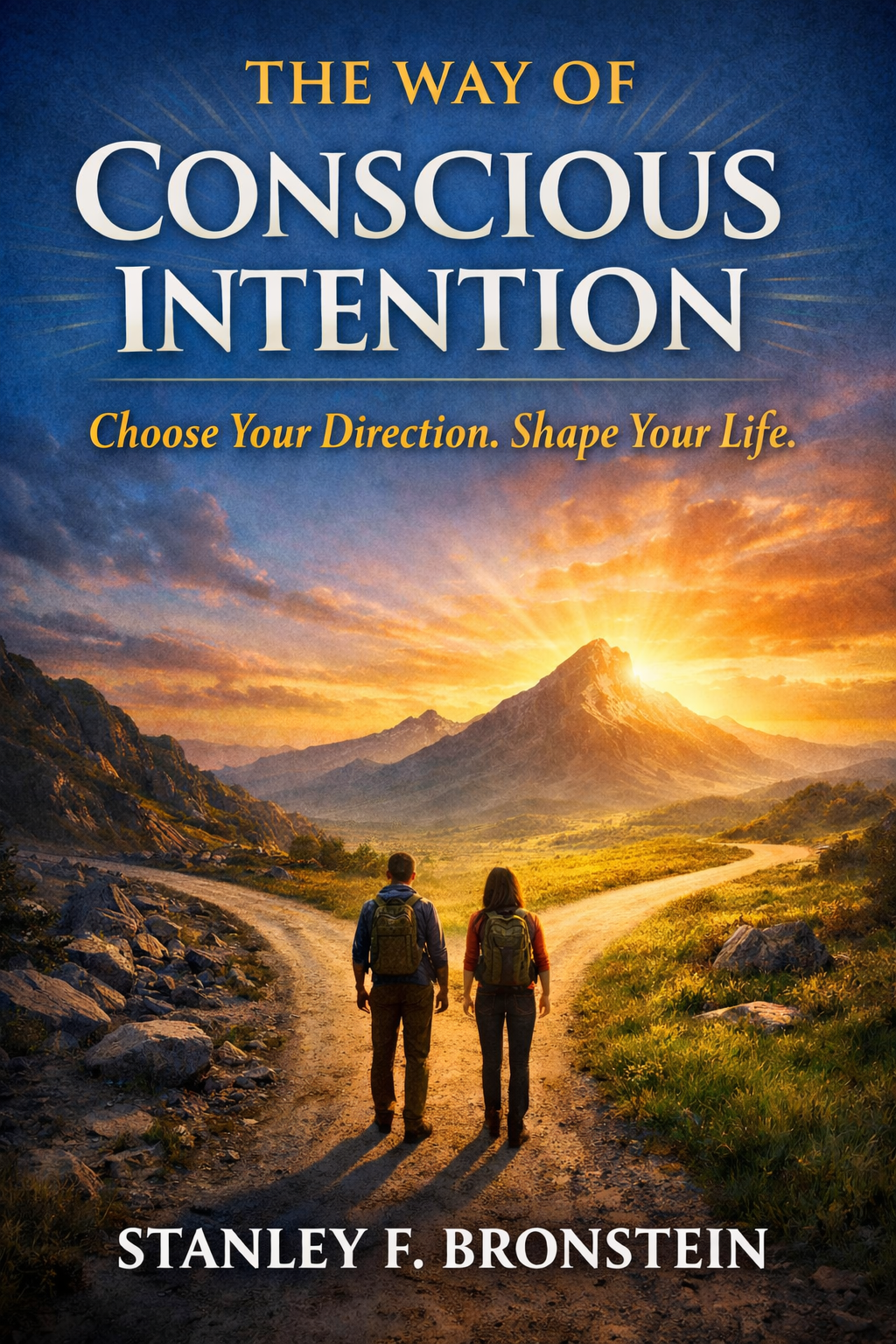
The Way of Conscious Intention
Choose Your Direction. Shape Your Life.
By Stanley F. Bronstein – Creator of The Way of Excellence System
Click The Tabs Below To Read Each Chapter Of The Book Online
Or
📘 Download Your Free Copy In Your Preferred Format
The Way of Conscious Intention
by Stanley F. Bronstein
How to use this page:
Click a chapter title to open it then scroll down to read.
When you click the title of the next chapter, the previous one will close.
Take your time.
Read, reflect, and do the experiments and assignments before you move on.
EMPTY ITEM
Foreword
Most people do not consciously create their lives.
They may think they do. They may say they do. They may even want to. But in reality, many people drift. They drift into routines, reactions, habits, assumptions, obligations, relationships, careers, distractions, and patterns of thought that slowly, quietly, and steadily shape the course of their lives. Years pass. Sometimes decades pass. And one day they wake up and realize they are living a life they never consciously chose.
That is one of the great tragedies of human existence.
The life so many people say they want is not something they are going to accidentally find. It is not something they are going to stumble upon while reacting to circumstance, following the crowd, numbing themselves with distraction, or allowing the expectations and agendas of others to determine their direction. It is not something that simply appears because they wish for it, talk about it, or hope that someday things will somehow be different.
The life they truly want is something they must consciously and intentionally create.
That is what this book is about.
It is about waking up from drift.
It is about recognizing that if we do not consciously shape our lives, they will often be shaped for us – by habit, fear, social conditioning, cultural expectations, short-term thinking, marketing, manipulation, and the influence of people and institutions that may not have our best interests at heart. It is about understanding that an unguarded life becomes easy to direct. And it is about reclaiming authorship of our own existence.
This book is not based on the idea that we can control everything. We cannot. Life will always contain uncertainty. Circumstances will change. Pain will come. Surprises will come. Losses will come. Delays, disappointments, setbacks, and unexpected turns will come. But even within that reality, we still possess something powerful – the ability to become more conscious, more intentional, more honest, more disciplined, more responsible, and more aligned in the way we live.
We may not control every circumstance, but we can increasingly influence the direction of our lives.
We can choose what we focus on.
We can choose what we believe.
We can choose what we value.
We can choose how we respond.
We can choose who we want to become.
We can choose whether we are going to drift or create.
That choice matters more than many people realize.
One of the most important truths in this book is that conscious intention is not merely about getting things. It is not just about achieving goals, acquiring possessions, or crossing items off a list. Those things may or may not matter. But the deeper issue is this: what kind of person are you becoming, and are you consciously participating in that process?
Your life is always being shaped.
The real question is whether you are helping shape it.
A life of conscious intention begins with awareness. It requires us to tell the truth about where we are, how we got here, what is working, what is not, what we actually want, and what must change if we are ever going to experience a different result. It asks us to take responsibility for our own lives rather than endlessly blaming the past, other people, or present circumstances. It requires long-term thinking in a world that constantly tempts us to live for the moment. It demands that we stop waiting for permission and start making choices consistent with the lives we say we want.
It also requires willingness.
Many people want better outcomes, but they do not want the ongoing changes those outcomes require. They want the result, but not the process. They want the destination, but not the path. They want transformation, but only on terms that do not disturb their comfort, habits, or identity. That does not work. Unless and until we become permanently willing to permanently change, for the rest of our hopefully very long, hopefully very happy, hopefully very healthy lives, we are not going to permanently get what we want.
That is not punishment. That is reality.
At the same time, this book is not meant to feel harsh or heavy. Yes, it is honest. Yes, it is direct. Yes, it calls for responsibility. But beneath all of that is something hopeful, empowering, and deeply life-affirming.
Conscious intention is not a burden.
It is a privilege.
That shift in perspective changes everything.
We do not have to consciously create our lives.
We get to.
We get to think.
We get to choose.
We get to imagine.
We get to build.
We get to change.
We get to become.
We get to participate in the ongoing creation of a life that is more aligned with our values, our vision, our purpose, and the person we truly want to be.
That is an extraordinary opportunity.
This book invites you to take that opportunity seriously.
It invites you to look honestly at the forces that have been shaping your life.
It invites you to examine where you have drifted.
It invites you to stop handing over authorship of your future to fear, distraction, impulse, habit, and outside influence.
It invites you to think beyond the moment.
It invites you to dream bigger.
It invites you to act more consistently.
It invites you to build a life on purpose.
And most of all, it invites you to become the kind of person who lives this way – consciously, intentionally, persistently, and with increasing alignment of mind, body, and spirit.
You do not need to do this perfectly.
You do need to do it honestly.
You do not need to have every answer before you begin.
You do need to begin.
You do not need to know exactly how the entire path will unfold.
You do need to choose a direction.
Then, step by step, choice by choice, action by action, you begin shaping your life.
That is the journey ahead.
Let us begin.
PART I - WAKING UP FROM DRIFT
Most people do not wake up one morning and consciously decide to create a life they do not want.
That is not how it happens.
What usually happens is quieter than that. It happens little by little. It happens through inattention, habit, fear, distraction, comfort, busyness, social conditioning, and short-term thinking. It happens when people stop asking themselves where they are going and why. It happens when they spend more time reacting than choosing. It happens when they surrender authorship of their lives without ever meaning to do so.
They drift.
Drift is one of the most powerful and dangerous forces in human life precisely because it is so subtle. It rarely announces itself. It does not usually arrive as a dramatic collapse or a single bad decision. More often, it shows up as unexamined routines, repeated compromises, delayed decisions, misplaced priorities, tolerated dissatisfaction, and the gradual acceptance of a life that is less than what a person truly wants.
Years can be shaped that way.
Lives can be shaped that way.
That is why this part of the book matters so much.
Before a person can consciously and intentionally create a better life, that person must first wake up to the possibility that he or she has been drifting. There must be a willingness to look honestly at what has been happening. There must be enough awareness to see the patterns. There must be enough courage to tell the truth. And there must be enough personal responsibility to stop waiting for life to fix itself.
This first part is about that awakening.
It is about recognizing that the life you truly want will not happen by accident. It is about seeing how easy it is to drift into a life you never consciously chose. It is about identifying the outside forces that compete to shape your direction. It is about learning to tell yourself the truth. And it is about taking responsibility for your own life so that you can begin moving from passive existence to conscious creation.
This is where intentional living begins.
It does not begin with perfection.
It does not begin with having everything figured out.
It begins with awareness.
It begins with honesty.
It begins with ownership.
It begins with waking up.
If you can do that, then everything starts to change.
Chapter 1 - The Life You Want Will Not Happen By Accident
Many people live as if the life they say they want is something they are eventually going to stumble across and find.
They think that if they just keep going, keep waiting, keep reacting, keep hoping, keep enduring, and keep making it through one more week, one more month, one more year, things will somehow fall into place. They assume that clarity will eventually arrive on its own. They assume that the life they want will somehow emerge from motion, even if that motion is aimless. They assume that if they are busy enough, responsible enough, or patient enough, the life they desire will eventually reveal itself to them.
That is not usually how life works.
The life you truly want is not something you are going to accidentally discover. It is not something you are going to find lying around like a lost object waiting to be picked up. It is not something that appears simply because you are older, wiser, more tired of your current situation, or more dissatisfied than you used to be. It is not something you get merely because you want it, talk about it, or envy it in other people.
The life you truly want is something you must consciously and intentionally create.
That statement may sound obvious at first, but if it were truly obvious in practice, far more people would be living lives they intentionally chose. Instead, many people spend years, and sometimes decades, drifting into routines, relationships, obligations, patterns, habits, and identities that slowly shape their lives without ever having been consciously chosen. They are not necessarily bad people. They are not necessarily lazy people. They are not necessarily weak people. In many cases, they are hardworking, caring, intelligent, capable people. But they are living reactively rather than intentionally. They are responding more than directing. They are enduring more than creating.
There is a difference between existing and creating.
There is a difference between reacting to life and shaping life.
There is a difference between hoping for a better future and intentionally building one.
Those differences matter.
A person can spend a great deal of time in motion without ever being truly directed. A person can be busy every day and still be drifting. A person can fulfill obligations, handle responsibilities, meet deadlines, respond to messages, care for others, and appear outwardly productive, while inwardly living without clear intention. Motion is not the same as direction. Busyness is not the same as purpose. Survival is not the same as creation.
Many people confuse activity with progress.
They tell themselves they are moving forward because they are doing something. But doing something is not the same as doing what matters. Working hard is not the same as working in the right direction. Filling time is not the same as building a life. It is entirely possible to spend years climbing a ladder only to discover it is leaning against the wrong wall.
That is one of the quiet dangers of life. It does not always punish drift immediately. Sometimes it allows drift to feel normal. Sometimes it allows drift to feel productive. Sometimes it allows drift to feel safe. Sometimes it even rewards drift in the short term with comfort, approval, familiarity, and temporary relief. But over time, the cost becomes clearer. The person who drifts eventually looks around and wonders how life became what it is. He or she wonders where the years went. He or she wonders why so much effort produced so little meaning, peace, alignment, or fulfillment.
That kind of realization can be painful.
It can also be powerful.
It can become the beginning of waking up.
One of the first truths you must understand is that your life is always being shaped. The only real question is whether it is being shaped consciously or unconsciously. No one stands still in a permanent sense. Every decision, every repeated thought, every habit, every response, every compromise, every use of time, every acceptance of less than what you truly want, every tolerated distraction, and every avoided truth is helping shape the life you are living.
You are always creating something.
The issue is whether you are doing it on purpose.
This is where awareness becomes so important. Many people assume that the major decisions in life are the ones that matter most. Certainly they matter. But lives are often shaped more quietly than that. They are shaped by daily habits. They are shaped by recurring thoughts. They are shaped by whether a person consistently chooses what is comfortable or what is meaningful. They are shaped by whether a person keeps promises to himself or herself. They are shaped by what a person repeatedly pays attention to. They are shaped by what a person tolerates. They are shaped by what a person continues postponing.
The life you want is not waiting for one giant breakthrough.
It is being built, or neglected, in small ways every day.
That is important because it means the life you desire is not created only through dramatic change. It is also created through repeated, intentional choice. It is created when you begin telling yourself the truth. It is created when you stop pretending that reaction is enough. It is created when you stop surrendering your future to mood, impulse, or convenience. It is created when you begin choosing what matters rather than merely responding to what is urgent. It is created when your actions increasingly align with your values, your vision, and the person you want to become.
This is one reason so many people remain dissatisfied for so long. They are waiting for life to change without fully understanding that life usually changes because people do. A better life is not merely found. It is built. It is built by different thinking, different choices, different priorities, different actions, and a different willingness to take responsibility for one’s direction. It is built through conscious intention.
That does not mean everything is within your control. It is not. Life will always contain uncertainty, loss, difficulty, delay, surprise, and pain. There will always be circumstances you did not ask for and would not have chosen. There will always be limits. There will always be external realities that must be faced. Conscious intention is not about denying that truth. It is not about pretending you can control every outcome. It is not about guaranteeing that life will always go your way.
It is about something else.
It is about refusing to live entirely by default.
It is about deciding that although you may not control everything, you can still consciously influence the direction of your life. You can decide what you value. You can decide what kind of person you want to become. You can decide what you will focus on. You can decide how you will use your time, energy, and resources. You can decide what standards you are willing to live by. You can decide what changes are necessary. You can decide what you are no longer willing to tolerate. You can decide that the life you want is too important to leave to accident.
That shift is enormous.
The moment a person stops waiting to stumble into life and starts taking part in creating it, something begins to change internally. That person moves from passive to active. From victim-like thinking to ownership. From vague wishing to intentional effort. From drifting through existence to participating in it more fully and consciously.
That shift does not happen all at once.
It begins with a realization.
The realization is this: if I do not consciously shape my life, it will still be shaped, just not necessarily in the ways I truly want.
That shaping may come from habit. It may come from fear. It may come from comfort. It may come from distraction. It may come from social conditioning. It may come from family patterns. It may come from the culture around you. It may come from the influence of people and institutions that benefit when you remain reactive, distracted, impulsive, and dependent. But if you do not step in and participate intentionally, something else will step in to fill that space.
An unchosen life does not remain empty.
It gets filled.
That is one of the reasons conscious intention matters so much. It is not simply about personal ambition. It is not just about accomplishing more. It is not just about getting what you want. It is about authorship. It is about becoming more deliberate in the creation of your own life. It is about refusing to hand over the shaping of your future to random forces, repeated impulses, or outside agendas. It is about becoming more awake, more honest, more responsible, and more intentional.
This does not mean you need to have every detail figured out before you begin. Many people delay change because they think they need perfect clarity first. They think they must know exactly what the entire future should look like before they can start moving in a better direction. That is not true. You do not need to know everything. But you do need to stop pretending that drift will somehow produce the life you deeply want.
You do need to understand that if you keep living by accident, you will keep getting accidental results.
You do need to accept that conscious creation starts with conscious choice.
You do need to realize that a meaningful life is usually made, not found.
This is where personal responsibility begins to enter the picture. Not as blame. Not as shame. Not as harshness. But as power. When you acknowledge that the life you want will not happen by accident, you are also acknowledging that you must begin participating in its creation. That is not bad news. It is liberating news. It means you are not required to passively wait and see what life hands you. It means you can begin choosing more consciously. You can begin responding differently. You can begin changing patterns. You can begin thinking longer-term. You can begin dreaming bigger. You can begin acting with more consistency. You can begin moving toward a life that is more aligned with your values, your vision, and your true desires.
This is where perspective matters.
Some people hear all of this and feel pressure. They hear responsibility and think burden. They hear intentionality and think more work. They hear conscious creation and think one more demand in an already demanding world.
But there is another way to see it.
You do not have to consciously create your life.
You get to.
You get to think about what matters to you.
You get to choose your direction.
You get to decide what kind of person you want to become.
You get to stop drifting.
You get to participate in building a life that is more aligned, more deliberate, more meaningful, and more fully yours.
That is not a burden. That is a privilege.
It is a privilege to have the opportunity to choose.
It is a privilege to have the ability to change.
It is a privilege to have the chance to become more conscious and more intentional.
It is a privilege to realize that life does not have to remain on autopilot.
That shift in perspective is crucial, because people sustain what they experience as meaningful much more effectively than what they experience as oppressive. If conscious intention is framed only as pressure, many people will avoid it. If it is framed as privilege, possibility, and participation in the creation of one’s own life, people are more likely to embrace it.
The truth is that you are already shaping your life, whether you realize it or not. The deeper question is whether you are satisfied leaving that process largely unattended. Are you content to let years pass in reaction? Are you content to let convenience, comfort, fear, impulse, distraction, outside influence, and unexamined habit determine what your life becomes? Are you content to hope for outcomes your daily choices do not support? Are you content to wish for a different life without participating in the work of creating it?
If the answer is no, then that is where conscious intention begins.
It begins when you stop assuming the life you want will happen by accident.
It begins when you stop mistaking motion for direction.
It begins when you stop calling drift progress.
It begins when you stop waiting to stumble into a life you must instead build.
It begins when you accept that the future you want is not merely something to be discovered, but something to be created.
That realization can change everything.
It can change the way you look at your time.
It can change the way you look at your habits.
It can change the way you look at your relationships.
It can change the way you look at your work.
It can change the way you look at your choices.
It can change the way you look at yourself.
Because once you understand that the life you want will not happen by accident, you can no longer honestly pretend that drifting is enough.
And that is where the real work begins.
Assignment
Step 1 – Describe the life you say you want.
Write a clear description of the kind of life you say you want to live. Include the kind of person you want to become, the values you want to live by, the way you want to feel, the quality of your health, your relationships, your work, your daily rhythm, and the level of peace, meaning, and alignment you want your life to reflect.
Step 2 – Compare your stated desires to your current direction.
Ask yourself whether your current habits, priorities, and repeated choices are actually moving you toward that life. Be honest. Do not answer based on what you hope is true. Answer based on what your life currently shows.
Step 3 – Identify where you may be drifting.
List the areas of your life where you may be operating on autopilot. Consider your thinking, habits, health, relationships, work, use of time, emotional patterns, and responses to stress. Notice where drift may already be shaping your future.
Step 4 – Complete this sentence in writing.
“The life I truly want will not happen by accident. If I want it, I must begin consciously and intentionally creating it by __________.”
Fill in the blank with the first honest actions you know you need to take.
Step 5 – Reframe the work.
Write this sentence and reflect on it slowly:
“I do not have to consciously create my life. I get to.”
Let that become part of the way you see the journey ahead.
Chapter 2 - How We Drift Into Lives We Never Meant To Live
Very few people consciously choose a life they do not want.
They do not sit down one day, think carefully, and decide to live beneath their potential, neglect what matters most, ignore their deeper desires, and slowly move in a direction that leaves them frustrated, unfulfilled, disconnected, or lost. That is almost never the way it happens.
What usually happens is much quieter.
A person drifts.
That drift does not usually feel dramatic. It often feels normal. It feels familiar. It feels reasonable. It feels explainable. It feels temporary. It feels like something that can always be corrected later. But while a person is busy explaining it, justifying it, tolerating it, postponing change, and assuming there will be more time, the drift continues. And over time, that drift begins to shape a life.
This is one of the most important truths to understand if you want to live with conscious intention: most unsatisfying lives are not created by one catastrophic choice. They are created by a thousand small moments of inattention, avoidance, compromise, fear, distraction, and passive acceptance.
That is how drift works.
It is gradual.
It is subtle.
It is often socially acceptable.
And because it is rarely dramatic at first, it is easy to ignore.
Drift often begins with the absence of awareness. A person moves through days, weeks, months, and years without regularly stepping back to ask the deeper questions. Where am I going? Why am I doing what I am doing? Is this the life I truly want? Are my daily patterns creating the future I say I want, or are they quietly taking me somewhere else? Without that kind of awareness, life easily becomes reactive. The urgent replaces the important. The familiar replaces the meaningful. The immediate replaces the long-term. And once that happens, a person can remain busy without being truly directed.
Many people drift because they are simply too distracted to notice it happening.
Distraction is one of the greatest engines of unconscious living. Modern life offers an endless stream of things to look at, respond to, consume, chase, fear, compare, scroll through, buy, avoid, and think about. A person can spend enormous amounts of time being mentally occupied without ever becoming meaningfully engaged with his or her own life. In that state, there is plenty of stimulation, but very little reflection. Plenty of movement, but very little direction. Plenty of activity, but very little intention.
A distracted person is easy to steer.
Not necessarily because someone is physically forcing that person to do anything, but because a distracted life is rarely a deeply examined life. And when a life is not being consciously examined, it is often being unconsciously shaped by whatever is loudest, easiest, most immediate, most emotionally gripping, or most socially reinforced. Distraction does not merely waste time. It weakens authorship.
Another major cause of drift is habit.
Human beings are creatures of repetition. Much of life is lived not through conscious decision, but through established pattern. That is not always a bad thing. Good habits can be powerful allies. But bad habits, unconscious habits, inherited habits, and misaligned habits can slowly direct a person into a life he or she never deliberately chose.
A person does not become disconnected from health in a single moment. It often happens through repeated choices that seem small at the time. A person does not usually become financially careless in one day. That too tends to happen through repeated patterns. A person does not usually wake up in a deeply unsatisfying life and trace it back to one isolated decision. More often, it is the result of hundreds of unexamined habits that quietly became normal.
Habit is powerful because it reduces the need for conscious thought. That can be helpful when the pattern is aligned with your values and your direction. But when the pattern is not aligned, habit can automate drift. A person can keep doing what no longer serves him or her simply because it has become familiar. And what is familiar often feels safe, even when it is quietly destructive.
Comfort is another major force behind drift.
Many people do not choose what is best. They choose what is easiest to continue. They choose what disturbs them the least in the short term. They choose what allows them to avoid discomfort, uncertainty, challenge, confrontation, or change. The problem is that comfort, while not inherently wrong, becomes dangerous when it is allowed to dominate decision-making.
Growth is often uncomfortable.
Honesty is often uncomfortable.
Change is often uncomfortable.
Discipline is often uncomfortable.
Taking responsibility is often uncomfortable.
Saying no is often uncomfortable.
Leaving behind what no longer fits is often uncomfortable.
Because of that, many people drift not because they are incapable of change, but because they are unwilling to tolerate the discomfort that conscious change often requires. They keep the familiar because it is familiar. They keep the pattern because it is known. They keep delaying because delay feels easier than disruption. But the discomfort they avoid in the short term often becomes the dissatisfaction they must live with in the long term.
Fear also plays a central role in drift.
Fear makes people hesitate.
Fear makes people shrink.
Fear makes people compromise with mediocrity.
Fear makes people tell themselves stories about why now is not the time, why the risk is too great, why the dream is unrealistic, why they are not ready, why they should wait, why this is good enough, why change can happen later.
Fear can disguise itself as practicality. It can disguise itself as patience. It can disguise itself as realism. But often it is simply fear. Fear of failure. Fear of rejection. Fear of success. Fear of judgment. Fear of discomfort. Fear of losing approval. Fear of not knowing what comes next.
Fear does not always stop people outright.
Often it just keeps them drifting.
And drift, when stretched over years, becomes its own kind of decision.
Another reason people drift is social conditioning. Human beings are influenced by what they see around them. They absorb assumptions from family, culture, institutions, peer groups, media, and the broader environment. They learn what is normal, what is rewarded, what is expected, what is admired, what is feared, what is supposedly realistic, and what is considered acceptable. Much of this happens long before a person has developed the awareness to question it.
As a result, many people build lives based on scripts they never consciously chose.
They chase goals they inherited.
They pursue definitions of success they absorbed.
They adopt patterns that were modeled for them.
They accept limitations they were taught.
They internalize fears that do not belong to them.
They seek approval from standards they never consciously examined.
Then, because the pattern is common, they mistake it for truth.
This is one of the reasons drift can be so hard to detect. When everyone around you is also drifting, drift looks normal. When a culture rewards busyness, distraction, comparison, impulsiveness, short-term thinking, and external validation, those patterns can feel like ordinary life rather than misdirection. A person may not realize how unconscious much of life has become until he or she begins stepping back and asking deeper questions.
Short-term thinking also contributes heavily to drift.
Many people sacrifice the life they truly want for immediate comfort, immediate gratification, immediate relief, immediate approval, or immediate convenience. They do not necessarily mean to trade away the future, but that is often what happens. One short-term choice may seem small. Another may also seem small. But over time, those choices compound.
This is one of the great truths of life: small repeated choices create large future realities.
A person who continually lives for the moment often wakes up years later facing consequences that were built slowly and quietly. The issue is not that short-term pleasure is always wrong. The issue is that when short-term thinking becomes the dominant mode of living, it almost always undermines long-term intention. It becomes difficult to build a meaningful life when the immediate always overrules the important.
People also drift because they avoid truth.
Truth has a cost.
Once you honestly admit that something is not working, you create pressure to deal with it. Once you honestly admit that your habits are misaligned, your direction is unclear, your priorities are out of order, your relationships are unhealthy, your health is deteriorating, your work no longer fits, your standard is too low, or your life is being shaped by forces you have not consciously chosen, then it becomes harder to keep pretending. It becomes harder to remain passive.
So many people avoid truth because truth creates responsibility.
They sense, often unconsciously, that real honesty would require change. And because they are not yet willing to change, they settle for partial truths, surface-level explanations, rationalizations, and delay. They distract themselves from what they already know at some level. They fill their minds and schedules so they do not have to listen too closely to the quiet voice inside that says this is not the life I truly want.
Avoided truth fuels drift.
So does divided desire.
Many people want different things at the same time, and those desires compete with each other. They want growth, but they also want comfort. They want change, but they also want familiarity. They want discipline, but they also want indulgence. They want a meaningful life, but they also want to avoid the cost of building one. They want the results, but not the repeated actions. They want the better future, but not the necessary disruption.
This inner division creates inconsistency. And inconsistency makes drift almost inevitable.
A person cannot move clearly in a chosen direction while continuously negotiating with every impulse, every mood, every fear, every distraction, and every craving for comfort. When desire is divided, energy is scattered. When energy is scattered, action weakens. When action weakens, drift takes over.
Drift is also fueled by the belief that there will always be more time.
That belief is one of the most dangerous illusions in life.
People postpone change because they imagine there will be a better season for it later. They postpone honesty. They postpone action. They postpone difficult conversations. They postpone discipline. They postpone decisions. They postpone healing. They postpone building the life they say they want because they assume time will remain available.
Sometimes it does.
Sometimes it does not.
Either way, that assumption is risky. Time has a way of moving whether a person is conscious of it or not. Years pass. Seasons change. Energy shifts. Opportunities come and go. Habits deepen. Patterns harden. The longer drift continues, the more normal it can feel and the more difficult it can become to interrupt. That does not mean change is impossible later. It does mean later is not guaranteed.
The truth is that people rarely drift because they are evil, hopeless, or incapable. They drift because unconscious living is easy. It is easy to react. It is easy to stay distracted. It is easy to follow established patterns. It is easy to do what everyone else is doing. It is easy to let fear set the limits. It is easy to postpone. It is easy to accept what is merely familiar. It is easy to let days pass without stepping back and asking whether those days are actually adding up to the life you want.
But easy now often becomes costly later.
This is why awareness is such a powerful turning point. The moment you begin to see how drift works, you also begin to weaken its hold over you. Once you recognize the patterns, they become harder to ignore. Once you see how distraction, habit, comfort, fear, conditioning, short-term thinking, avoidance, and postponement have been shaping your life, you become more capable of interrupting them. You begin moving from unconscious participation to conscious authorship.
That does not mean drift ends all at once.
It means it becomes visible.
And once it becomes visible, it can be challenged.
This is one of the most hopeful truths in the entire process. The fact that you may have drifted does not mean you are doomed to keep drifting. It means you have something to wake up from. It means you have something to correct. It means you have the opportunity to become more honest, more aware, more intentional, and more aligned. It means the future does not have to be a continuation of the past.
But it does require courage.
It requires the courage to stop calling drift normal.
It requires the courage to stop pretending distraction is harmless.
It requires the courage to admit that familiar does not always mean right.
It requires the courage to tell the truth about the patterns shaping your life.
And it requires the courage to accept that what you repeatedly do matters far more than what you casually say you want.
Many people remain stuck because they keep waiting for motivation to save them. They hope they will someday feel inspired enough, energized enough, clear enough, or ready enough to finally interrupt the drift. But drift is not usually overcome by waiting for the perfect feeling. It is overcome by growing awareness, telling the truth, taking responsibility, and beginning to make more conscious choices even before everything feels easy or fully resolved.
That is how change begins.
Not with a dramatic declaration.
Not with instant perfection.
But with awareness.
With honest recognition.
With the willingness to say, “This is how drift has been happening in my life, and I do not want to keep living this way.”
That kind of honesty is powerful because it turns vague dissatisfaction into meaningful understanding. It gives shape to what previously felt confusing. It reveals the real forces at work. And once those forces are seen, a person becomes far more capable of choosing differently.
You cannot fully stop drift until you understand how it works.
Now you do.
Drift is not random.
It has patterns.
It has causes.
It has reinforcements.
It has consequences.
And if it is left unattended, it has momentum.
But awareness interrupts momentum.
And awareness is where conscious intention begins.
Assignment
Step 1 – Identify the main ways drift shows up in your life.
Write down the specific forces that most often pull you off course. Consider distraction, habit, comfort, fear, short-term thinking, avoidance, social conditioning, divided desire, and postponement. Be honest and specific.
Step 2 – Look at what has become normal.
List the patterns in your life that feel normal but may actually be taking you in the wrong direction. Include repeated thoughts, habits, routines, reactions, and uses of time that you may have stopped questioning.
Step 3 – Notice the cost of unconscious living.
Write about where drift may already be costing you something important. Consider your health, peace of mind, relationships, work, energy, self-respect, sense of direction, and future possibilities.
Step 4 – Complete these two sentences in writing.
“I have been drifting most in the area of __________.”
“The main forces contributing to that drift are __________.”
Fill in the blanks with direct and truthful answers.
Step 5 – Interrupt one pattern immediately.
Choose one small but meaningful pattern of drift you can interrupt today. Do not choose something vague. Choose one specific action that begins to move you from unconscious reaction to conscious intention.
Chapter 3 - The Forces Competing To Shape Your Life
If you do not consciously shape your life, it will still be shaped.
That is one of the most important truths in this book.
Many people assume that if they do not actively choose a direction, they are somehow remaining neutral. They imagine they are simply keeping their options open, taking life as it comes, or waiting until the right moment to become more deliberate. But life does not work that way. A life left unguarded does not remain empty and untouched. It gets influenced. It gets directed. It gets molded. It gets filled with the priorities, messages, expectations, and agendas that are already pressing in from all sides.
There are forces competing to shape your life whether you think about them or not.
Some of those forces are obvious.
Some are subtle.
Some are loud and direct.
Some are quiet and persistent.
Some come from outside of you.
Some operate through weaknesses, fears, desires, and vulnerabilities already inside of you.
But together they create a powerful reality: if you are not intentional, you are likely to be influenced more than you realize.
This is not paranoia.
It is awareness.
A conscious life begins with recognizing that not every voice around you is neutral, not every message is harmless, and not every influence has your best interests at heart. Many of the forces surrounding you are not simply offering information. They are trying to direct your attention, shape your desires, influence your decisions, capture your loyalty, alter your standards, and affect how you spend your time, money, energy, thought, and life.
That is why conscious intention matters so much.
It is not only about deciding what kind of life you want to create. It is also about recognizing what is constantly trying to create a life for you.
One of the most powerful shaping forces in modern life is marketing.
Marketing is everywhere. It is not limited to advertisements in the traditional sense. It appears in your devices, your news feeds, your inbox, your entertainment, your conversations, your search results, your cultural environment, and even your self-image. It is woven into modern life so deeply that many people no longer recognize how often they are being pitched, nudged, steered, and emotionally manipulated.
Marketing does not merely try to sell products.
It often tries to sell identities.
It tries to tell you what success looks like.
It tries to tell you what beauty looks like.
It tries to tell you what matters.
It tries to tell you what you should fear.
It tries to tell you what you should want next.
It tries to create dissatisfaction so it can then offer a solution.
It often works by first making you feel incomplete.
That is important to understand. Many marketing systems are built on the deliberate creation of discomfort. They magnify insecurity, comparison, inadequacy, urgency, or fear, and then position a product, service, status symbol, ideology, or lifestyle as the answer. If a person is not aware of that dynamic, he or she can begin unconsciously organizing life around problems that were intensified or manufactured by people trying to profit from them.
This does not mean all marketing is evil. It does mean much of it is persuasive by design. It is trying to affect your choices. And if you are not paying attention, it often will.
Another major shaping force is media in the broader sense.
Media does not only inform. It frames. It selects. It emphasizes. It repeats. It normalizes. It dramatizes. It omits. It prioritizes. It tells you what to notice, what to care about, what to fear, what to admire, what to mock, what to outrage over, and what to accept as ordinary. Even when the information itself is technically accurate, the framing of it still shapes perception.
This matters because perception influences direction.
If your attention is constantly being pulled toward noise, conflict, urgency, entertainment, outrage, comparison, and emotional stimulation, it becomes harder to think clearly about your own life. It becomes harder to hear your own deeper values. It becomes harder to distinguish what is important from what is merely loud. It becomes harder to remain grounded in what you consciously want to build.
A mind that is constantly occupied with the priorities of others rarely has enough quiet to clarify its own.
Social pressure is another major force.
Human beings are deeply influenced by the people around them. We care about belonging. We care about approval. We care about acceptance. We care about being seen as normal, competent, desirable, successful, or admirable. These concerns are understandable. They are part of being human. But they also make us vulnerable to distortion.
Many people do not choose based on truth.
They choose based on what will be accepted.
They shape their lives around what will make them look successful, rather than around what will make them live meaningfully.
They remain in environments that no longer fit them because leaving would disappoint someone.
They suppress dreams because the people around them would not understand.
They adopt standards that are socially approved, even when those standards are shallow, unhealthy, or misaligned.
They perform identities instead of building authentic lives.
This is one of the quieter tragedies of life. A person can spend years trying to look right to others while feeling increasingly wrong inside. He or she may gain approval and lose alignment at the same time.
That is not a good trade.
Cultural expectations also shape life in powerful ways. Every culture carries scripts. It communicates assumptions about success, productivity, status, gender, age, ambition, beauty, health, wealth, relationships, and the sequence in which life is supposed to unfold. These scripts are often absorbed passively. A person grows up hearing certain messages, seeing certain models, and internalizing certain assumptions long before becoming aware enough to question them.
As a result, many people confuse what is common with what is right.
They confuse what is expected with what is meaningful.
They confuse what is rewarded with what is wise.
They confuse what is admired with what is worth becoming.
But common is not always correct. Expected is not always best. Rewarded is not always healthy. Admired is not always admirable.
A consciously created life requires the courage to question inherited scripts.
Another powerful force competing to shape your life is your environment.
Environment influences behavior more than many people realize. Your physical setting, your routines, your inputs, your relationships, your digital spaces, your work culture, your level of noise, your level of temptation, and the norms around you all affect your thoughts and choices. A person may think he or she is acting independently when, in fact, many decisions are being heavily shaped by what the environment makes easy, difficult, visible, invisible, familiar, or expected.
An environment filled with distraction makes distraction easier.
An environment filled with unhealthy norms makes unhealthy behavior feel ordinary.
An environment filled with low standards makes mediocrity feel acceptable.
An environment filled with noise makes reflection more difficult.
An environment filled with pressure makes clarity harder to hold onto.
This is why intentional living is not only about internal willpower. It is also about recognizing the shaping power of what surrounds you. If you are trying to build a life on purpose, you must begin paying closer attention to whether your environment supports or undermines the direction you want to go.
Another force competing to shape your life is your own unexamined desire.
Not every desire deserves authority.
That is a difficult truth in a culture that often treats desire as self-justifying. But if you are going to live consciously, you must learn to distinguish between passing impulse and meaningful desire, between manipulative craving and authentic aspiration, between what feels good in the moment and what leads to a life you actually respect.
Some desires are borrowed.
Some are conditioned.
Some are reactionary.
Some are compensatory.
Some are rooted in insecurity, loneliness, fear, envy, or the need to impress.
If you do not examine your desires, you can easily end up serving them without understanding them. And when that happens, you may think you are pursuing what you want while actually being driven by forces you never consciously chose.
Fear also competes to shape your life.
Fear is not always loud. Often it is quiet, rational-sounding, and persuasive. It tells you to wait. It tells you to be careful. It tells you not to risk embarrassment. It tells you not to disrupt what is familiar. It tells you to stay where approval is predictable. It tells you to lower the dream, soften the standard, postpone the change, and settle for what feels manageable.
Fear often pretends to be wisdom.
Sometimes it is.
Often it is not.
Sometimes fear is a signal that something is dangerous.
Other times it is simply a signal that something matters.
A person who does not consciously examine fear can end up building an entire life around avoidance. He or she may choose based on what minimizes discomfort rather than what creates meaning, growth, truth, contribution, or alignment. In that case, fear becomes one of the hidden architects of life.
Comfort can shape life in similar ways.
Comfort is seductive because it rarely feels harmful in the moment. It feels soothing. It feels easy. It feels deserved. It feels understandable. But when comfort becomes the ruling principle of decision-making, life begins to shrink. Standards soften. Courage weakens. Discipline declines. Growth slows. Excuses multiply. The future quietly gets traded away for present ease.
A person who always lets comfort decide will usually end up with a life that reflects comfort’s priorities, not the priorities of vision, purpose, growth, health, integrity, contribution, or excellence.
That too is a form of being shaped.
So is urgency.
Urgency is one of the most deceptive forces in modern life because it so often disguises itself as importance. Emails feel urgent. Messages feel urgent. Demands feel urgent. Disruptions feel urgent. Small fires feel urgent. Other people’s priorities feel urgent. And because they feel urgent, they repeatedly steal attention from what is actually important.
This is one reason so many people lose ownership of their lives. They become professional responders. They become highly skilled at handling what is next, but less skilled at protecting what matters most. They spend their days serving the immediate. They spend their energy on what is loudest. They give their lives away one reaction at a time.
Urgency has a place.
But a life ruled by urgency is rarely a life ruled by conscious intention.
Comparison is another force that competes to shape your life.
Comparison distorts perspective. It pulls attention away from your path and toward someone else’s. It tempts you to want what looks impressive rather than what is actually right for you. It encourages performance, insecurity, envy, status chasing, and discontent. It can make genuine progress feel invisible because someone else appears to be further ahead. It can also make borrowed goals seem desirable simply because they are socially celebrated.
A person trapped in comparison often loses touch with inner direction.
That person no longer asks, “What kind of life is truly right for me?”
Instead, the questions become, “How do I measure up? How do I look? Am I ahead enough? Do others approve?”
Those are dangerous questions if allowed to rule a life.
Unresolved pain can also compete to shape your life.
Pain that is not examined does not disappear. Often it redirects behavior from underneath the surface. It may shape what you fear, what you avoid, what you tolerate, what you cling to, what you sabotage, what you expect, what you believe you deserve, and what kind of future you secretly think is available to you. In this way, old wounds can become hidden forces in present decisions.
A person may think he or she is freely choosing when, in reality, a painful past is quietly setting the limits.
This is why conscious intention requires honesty. You cannot fully shape your life in the present if you are being unconsciously governed by forces from the past that you refuse to acknowledge.
Then there is inertia.
Inertia shapes life because movement tends to continue in the direction it has already been going. Once habits form, they reinforce themselves. Once a lifestyle becomes normal, it gathers momentum. Once a person identifies with a certain pattern, change begins to feel harder. Inertia is not a dramatic external force. It is the power of continuation. It is the tendency of the current pattern to keep going simply because it is already in motion.
This is why drift becomes more dangerous over time. The longer an unchosen pattern continues, the more normal it feels and the more effort it may seem to require to interrupt it. That does not make change impossible. It does make awareness urgent.
If you want to consciously create your life, you must first understand this: there are always forces competing to decide what you will notice, what you will value, what you will desire, what you will fear, what you will accept, and how you will live.
Some of those forces are external.
Some are internal.
Some are commercial.
Some are cultural.
Some are social.
Some are emotional.
Some are habitual.
Some are spiritual.
But all of them matter.
This does not mean you must become rigid, suspicious, or isolated. It does not mean you must reject all influence. Influence is part of life. We all learn from others. We all respond to environment. We are all shaped to some degree by the world around us. The goal is not to become unreachable. The goal is to become more conscious.
The question is not whether you will be influenced.
You will.
The question is whether you will be aware of what is influencing you, and whether you will consciously decide what deserves authority in your life.
That is where personal responsibility becomes real.
You cannot control the existence of competing influences. But you can become more aware of them. You can question them. You can refuse to hand them unlimited access to your mind, your energy, your identity, and your future. You can examine the messages you receive. You can challenge inherited assumptions. You can protect your attention. You can choose your standards more carefully. You can reduce unnecessary noise. You can create environments more aligned with who you want to become. You can decide that not every voice deserves equal weight.
That is part of what it means to reclaim authorship of your life.
It means you stop living as if your mind is public property.
It means you stop giving every message automatic entry.
It means you stop assuming that what is common is wise.
It means you stop acting as if the loudest influence should decide your direction.
It means you begin choosing more carefully what you expose yourself to, what you believe, what you repeat, what you normalize, and what you allow to shape you.
This is especially important because the world is full of people and systems that benefit when you remain distracted, insecure, impulsive, reactive, and unclear. A distracted person is easier to market to. An insecure person is easier to manipulate. A reactive person is easier to direct. A person without clear intention is more vulnerable to being pulled by every outside force.
Conscious intention changes that.
It creates friction against manipulation.
It creates resistance to drift.
It creates distance between impulse and choice.
It creates clarity where there used to be absorption.
It creates authorship where there used to be passive influence.
That does not happen automatically.
It requires awareness.
It requires perspective.
It requires discipline.
It requires the willingness to tell yourself the truth about what has been shaping you.
And it requires the courage to say, “Not everything competing for my attention deserves my life.”
That is a powerful sentence.
Because your life is the deeper issue.
Not just your thoughts.
Not just your purchases.
Not just your schedule.
Your life.
What you repeatedly give your attention to will affect your thinking.
What affects your thinking will affect your choices.
What affects your choices will affect your habits.
What affects your habits will affect your character.
What affects your character will affect your direction.
And what affects your direction will affect the life you end up living.
That is why this chapter matters.
The forces competing to shape your life are real.
Some of them are obvious.
Some of them are disguised.
Some of them are profitable to others.
Some of them are inherited from the past.
Some of them are built into your environment.
Some of them are operating inside your own unexamined patterns.
But whether they come from outside or inside, the principle remains the same:
If you do not consciously choose what gets to shape your life, something else will choose for you.
That is too important to ignore.
The good news is that awareness gives you a choice.
Once you begin to see the forces at work, you are no longer as easily captured by them. You begin noticing what once slipped past you. You begin questioning what once controlled you quietly. You begin protecting what once leaked away unnoticed. You begin choosing more deliberately what belongs in your mind, in your environment, in your routine, in your identity, and in your future.
That is how authorship grows.
Not by pretending there are no competing forces.
But by seeing them clearly and choosing consciously anyway.
Assignment
Step 1 – Identify the strongest outside influences in your life.
Write down the people, systems, messages, media, environments, and expectations that most strongly affect the way you think, feel, choose, and live. Be specific. Include both obvious and subtle influences.
Step 2 – Notice who or what benefits from your distraction or insecurity.
Ask yourself where you may be receiving messages designed to make you feel inadequate, fearful, impulsive, dependent, or unclear. Notice where someone else may benefit when you do not live consciously.
Step 3 – Examine your internal shaping forces.
Write honestly about the internal forces that may also be shaping your life, including fear, comfort, urgency, comparison, unresolved pain, habit, and unexamined desire. Identify which ones affect you most.
Step 4 – Protect one area of attention.
Choose one specific way to begin protecting your mind and attention. This could involve reducing unnecessary media input, limiting exposure to certain voices, changing part of your environment, or creating more quiet and reflection in your day.
Step 5 – Complete this sentence in writing.
“If I do not consciously choose what gets to shape my life, __________ will shape it for me.”
Fill in the blank with the most honest answer you can.
Chapter 4 - Learning To Tell Yourself The Truth
Conscious intention begins with truth.
Not preference.
Not performance.
Not appearance.
Not what sounds good.
Not what is convenient to believe.
Truth.
If you are going to consciously and intentionally create the kind of life you truly want, you must first be willing to tell yourself the truth about the life you are currently living. You must be willing to see clearly what is working, what is not working, what you are doing, what you are avoiding, what you are pretending not to know, and what your life is actually revealing through your repeated choices. Without that kind of honesty, conscious intention becomes little more than a pleasant idea.
A person cannot build a better life on a false foundation.
That is one of the reasons so many people remain stuck. It is not always because they lack intelligence, ability, opportunity, or desire. Often it is because they are trying to move forward without first becoming honest. They want change without truth. They want progress without accurate self-assessment. They want a new direction without clearly acknowledging where they actually are.
That does not work.
Truth is the doorway.
If you will not walk through it, you will keep trying to create a better life while standing inside distorted perception.
Many people resist truth because truth is uncomfortable.
Truth exposes.
Truth clarifies.
Truth removes excuses.
Truth confronts illusion.
Truth reveals patterns that can no longer be easily denied.
And once something is clearly seen, it becomes much harder to keep pretending it is not there.
That is precisely why truth matters so much.
Self-deception is one of the most effective ways to remain trapped.
A person can lie to others and still change. But when a person lies to himself or herself, change becomes much harder, because the very awareness needed to create something different has been compromised. If you keep telling yourself that everything is basically fine when it is not, if you keep calling avoidance patience, if you keep calling fear practicality, if you keep calling drift busyness, if you keep calling inconsistency effort, if you keep calling indulgence self-care, if you keep calling resignation peace, then you rob yourself of the clarity required to choose a different path.
Truth names things accurately.
And accurate naming is powerful.
It is powerful because it stops confusion from hiding inside vague language. Many people stay stuck because they describe their lives in ways that are emotionally comfortable but practically misleading. They soften hard realities. They explain away destructive patterns. They protect themselves from discomfort by avoiding precise language. They say they are “just tired” when they are actually deeply disconnected. They say they are “busy” when they are scattered. They say they are “waiting for the right time” when they are afraid. They say they are “doing their best” when they know they have been tolerating less than they are capable of. They say they are “fine” because the truth feels too disruptive.
But the truth remains.
Calling something by a softer name does not change what it is.
That is why conscious intention requires a certain kind of courage. It requires the courage to stop hiding from reality behind language that protects comfort more than it protects growth. It requires the courage to say, “This is what is actually happening.” Not what you wish were happening. Not what sounds more flattering. Not what would make you feel temporarily better. What is actually happening.
This is where Awareness becomes so important.
You cannot intentionally shape what you refuse to see.
You cannot meaningfully change what you will not accurately identify.
You cannot consciously direct your life while remaining unconscious about the patterns already directing it.
This is why telling yourself the truth is not negativity. It is not self-attack. It is not pessimism. It is not harshness for the sake of harshness. It is clarity. And clarity is an act of respect.
You respect yourself enough to stop lying.
You respect your future enough to stop pretending.
You respect your life enough to look at it honestly.
Many people avoid truth because they think it will crush them. They believe that if they really admitted what is wrong, how far they have drifted, how inconsistent they have been, how much time they have wasted, how many excuses they have made, how often they have betrayed their own standards, or how misaligned their current life is with what they say they want, the emotional weight of that realization would be too much.
Sometimes truth does hurt.
Sometimes it stings deeply.
Sometimes it brings grief, regret, embarrassment, sadness, anger, or disappointment.
But truth also liberates.
It liberates because what is hidden governs from the dark, while what is seen can finally be addressed. What is denied keeps repeating. What is named can begin to change. What is avoided keeps quietly shaping life. What is faced creates the possibility of transformation.
Painful truth is often healthier than comforting illusion.
Illusion may feel safer in the moment, but it delays growth. It keeps a person in a false relationship with reality. It creates a gap between what is so and what is acknowledged. That gap is dangerous because life is still responding to what is real, not to what you prefer to believe.
Your body responds to what is real.
Your finances respond to what is real.
Your relationships respond to what is real.
Your habits respond to what is real.
Your future responds to what is real.
Life does not negotiate with self-deception.
It reflects it.
That is why the truth matters so much.
If you are inconsistent, the truth matters.
If you are exhausted, the truth matters.
If you are resentful, the truth matters.
If your priorities are out of order, the truth matters.
If your attention is being hijacked, the truth matters.
If your habits are quietly undermining your future, the truth matters.
If you are living in a way that does not align with what you say you want, the truth matters.
Not because truth is cruel, but because truth is usable.
Truth gives you something solid to work with.
This chapter is not asking you to become self-condemning. It is asking you to become honest. Those are not the same thing. Self-condemnation says, “I see what is wrong, and therefore I am hopeless.” Honesty says, “I see what is wrong, and therefore I can begin dealing with it.” Condemnation collapses identity into failure. Honesty separates the person from the pattern and makes change possible.
That distinction matters.
You are not required to hate yourself in order to tell yourself the truth.
You are required to stop protecting the lie.
Many people have built elaborate systems of avoidance around the truths they most need to face. Some distract themselves constantly. Some overwork. Some numb themselves. Some stay endlessly entertained. Some keep talking about what they intend to do someday. Some repeatedly restart without ever examining why they keep stopping. Some keep surrounding themselves with voices that reassure them without ever challenging them. Some blame circumstances. Some blame other people. Some blame the timing. Some blame their past. Some hide inside comparison. Some hide inside perfectionism. Some hide inside vague plans. Some hide inside spiritual language. Some hide inside intellectual explanation.
But whatever form it takes, avoidance is still avoidance.
And avoidance always has a cost.
It costs clarity.
It costs momentum.
It costs authorship.
It costs self-respect.
It costs time.
It costs the future.
Telling yourself the truth interrupts that cost.
It begins with simple but powerful questions.
What is actually true about my life right now?
Where am I not aligned?
What am I doing consistently?
What am I saying I want but not acting toward?
What am I tolerating that I know should change?
Where am I using language to soften reality?
Where am I making excuses that sound reasonable but are no longer serving me?
What do I already know that I keep avoiding?
Those questions matter because they bring truth out of hiding.
And most people already know more than they admit.
At some level, they know where they have drifted.
They know where they are divided.
They know where they are compromised.
They know where fear has been making decisions.
They know where distraction has become normal.
They know where comfort has replaced growth.
They know where they are saying one thing and living another.
They know where the gap is.
The problem is not always lack of knowledge.
Often the problem is lack of willingness to fully acknowledge what is already known.
That is why conscious intention requires more than intelligence. It requires courage. It requires the willingness to let reality be reality, even when it is inconvenient, humbling, or painful. It requires the willingness to stop negotiating with obvious truth.
Once truth is allowed in, something powerful happens.
The fog begins to lift.
Confusion begins to reduce.
You start seeing patterns more clearly.
You start understanding why certain results keep recurring.
You start noticing the difference between your stated desires and your demonstrated priorities.
You start recognizing where your time, energy, and attention have actually been going.
You start understanding what is really shaping your life.
That clarity does not solve everything instantly, but it changes the quality of your relationship with yourself. You are no longer operating from illusion. You are no longer asking life to change while refusing to honestly examine how you have been living. You are no longer hiding behind emotionally padded interpretations of reality. You are standing on more solid ground.
That is where genuine change becomes possible.
Truth also helps you reclaim responsibility. When things remain vague, responsibility often stays vague. A person says, “I just feel off,” “things have been hard,” “life is a lot right now,” or “I have been struggling.” Those statements may be partly true, but they are often too broad to create meaningful correction. Specific truth creates usable responsibility.
It is one thing to say, “I am off track.”
It is another to say, “I have been spending hours each day in distraction, avoiding difficult decisions, neglecting my health, and telling myself I will fix it later.”
The second statement is more uncomfortable.
It is also more useful.
That is the kind of truth that gives you something concrete to work with.
This is especially important because drift often survives inside vagueness. People stay lost because they keep describing themselves in ways that do not force precision. But precision matters. If you are going to consciously create your life, you need to know what is actually happening. You need to know what patterns are active. You need to know where your energy is going. You need to know what you keep tolerating. You need to know what you repeatedly do when no one is watching. You need to know what your life currently reflects, whether you like that reflection or not.
This is why self-inventory is so powerful.
A person who never pauses to examine life honestly is far more likely to remain shaped by unconscious patterns. But a person who regularly takes inventory begins building a much different relationship with reality. That person notices earlier. Corrects sooner. Tolerates less drift. Sees patterns faster. And because awareness is higher, authorship becomes stronger.
Telling yourself the truth is not something you do once.
It is a way of living.
It is a discipline.
It is a form of self-respect.
It is part of what it means to stay conscious.
If you only tell yourself the truth when life is already falling apart, you are waiting too long. Truth works best as a regular practice. It helps you recalibrate before misalignment becomes full-blown crisis. It keeps you from getting too far away from yourself. It keeps your inner world from becoming crowded with comforting lies. It keeps your life connected to reality.
This matters because reality is the place where intentional creation happens.
Not fantasy.
Not denial.
Not performance.
Reality.
You can only shape the life you are actually living.
And that means you must be willing to see the life you are actually living.
One of the great gifts of truth is that it simplifies. It cuts through rationalization. It cuts through emotional fog. It cuts through inflated stories and soft excuses. It helps a person say, “Here is what is true. Here is what is not working. Here is what must change. Here is what I have been pretending not to know.”
That kind of clarity can feel almost shocking at first.
But it is also energizing.
Because once you stop wasting energy protecting illusion, more energy becomes available for change.
The truth may humble you.
But it can also focus you.
It may expose where you have been inconsistent.
But it can also reveal where your power still is.
It may show you where you have drifted.
But it also shows you where you need to begin.
And beginning matters.
Many people think they need confidence first.
Often what they really need is truth first.
Confidence built on illusion is fragile.
Confidence built on truth can become resilient, because it is grounded in reality. It knows what it is working with. It has stopped pretending. It has stopped bargaining with what is obvious. It has become more honest, and therefore more capable.
That is what this chapter is inviting you to do.
Not to become brutal with yourself.
Not to become hopeless.
Not to sit in regret.
But to become truthful.
To stop dressing up reality in language that protects your comfort more than your future.
To stop calling drift something else.
To stop softening the cost of misalignment.
To stop pretending that what you repeatedly do does not matter.
To stop hiding from what you already know.
Because until you are willing to tell yourself the truth, conscious intention will remain weak.
But once you begin telling yourself the truth, even imperfectly, even painfully, even reluctantly, something begins to change. You become more awake. More grounded. More accurate. More responsible. More capable of making decisions that are based on reality instead of avoidance.
And that is where a consciously created life begins to take shape.
Not in denial.
Not in illusion.
In truth.
Assignment
Step 1 – Tell the truth about your current reality.
Write a clear and honest description of your life as it is right now. Focus on what is actually true, not what you hope is true, not what sounds good, and not what you wish other people believed about you.
Step 2 – Identify where you may be softening reality.
List the areas where you may be using vague, flattering, or emotionally protective language instead of accurate language. Ask yourself where you may be minimizing, rationalizing, or avoiding what you already know.
Step 3 – Complete these sentences in writing.
“The truth I have been avoiding is __________.”
“The pattern I most need to honestly acknowledge is __________.”
“What I keep pretending not to know is __________.”
Answer all three as directly as possible.
Step 4 – Take inventory of one important life area.
Choose one area such as health, work, relationships, finances, time use, emotional patterns, or discipline. Describe what is actually happening in that area. Be precise. Tell the truth about your choices, habits, standards, and results.
Step 5 – Practice one sentence of honest clarity.
Write one simple sentence that names a truth you need to stop avoiding. Make it direct, specific, and real. Then read it slowly and let yourself sit with it without arguing, softening, or explaining it away.
Chapter 5 - Taking Responsibility For Your Own Life
At some point, if you want your life to change, you must stop waiting for someone else to do the changing for you.
That does not mean other people never matter.
They do.
It does not mean circumstances do not matter.
They do.
It does not mean you caused everything that happened to you.
You did not.
It does not mean life has been fair.
Often it has not been.
It does not mean pain, injustice, bad luck, loss, disappointment, neglect, betrayal, or difficult beginnings are imaginary.
They are not.
But even after all of that is acknowledged, one truth remains:
If your life is going to move in a better direction, you must take responsibility for your own life.
That truth is not always easy to accept because many people have spent years, sometimes decades, thinking in ways that weaken ownership. They may not even realize they are doing it. They explain their condition almost entirely through other people. They explain their lack of progress through timing. They explain their stuckness through unfairness. They explain their misalignment through exhaustion. They explain their inconsistency through stress. They explain their future through their past. And while some of those explanations may contain truth, they do not create change unless they eventually lead to responsibility.
Explanation is not the same as transformation.
Understanding why things are the way they are can be helpful. Sometimes it is very helpful. But insight without ownership only produces more sophisticated stuckness. A person can become extremely articulate about why life is difficult while still failing to take meaningful responsibility for what happens next.
That is a dangerous trap.
Because if you continually place the power for change outside yourself, you also place the future outside yourself.
Taking responsibility is how you begin reclaiming that future.
Responsibility is often misunderstood. Some people hear the word and think blame. They think accusation. They think guilt. They think condemnation. They think being told everything is their fault. That is not what I mean here.
Blame asks, “Whose fault is this?”
Responsibility asks, “What am I going to do about it now?”
That is a profound difference.
Blame is backward-looking.
Responsibility is forward-moving.
Blame tries to assign guilt.
Responsibility tries to create change.
Blame often leaves a person emotionally stuck.
Responsibility restores agency.
This distinction matters because many people resist responsibility for reasons that are understandable. They fear that if they take responsibility, they are admitting they deserved what happened, caused what happened, or are somehow to blame for everything. But that is not true. There is a difference between being responsible for what happened and being responsible for what you do next.
You may not have been responsible for your upbringing.
You may not have been responsible for what others did to you.
You may not have been responsible for every hardship, limitation, injustice, or wound that entered your life.
But you are still responsible for your response.
You are responsible for your healing.
You are responsible for your standards.
You are responsible for your direction.
You are responsible for your choices.
You are responsible for your habits.
You are responsible for your willingness to change.
You are responsible for whether you continue surrendering authorship of your life or begin reclaiming it.
That is not harsh.
That is empowering.
In fact, one of the great lies people sometimes believe is that responsibility is heavy while helplessness is easier. In reality, helplessness is far heavier. Helplessness drains energy. It collapses possibility. It turns a person into a passive observer of his or her own life. It creates resentment without progress. It invites endless waiting. It makes change seem dependent on someone or something else finally doing the right thing.
Responsibility does something very different.
Responsibility says, “Regardless of what has happened, what now belongs to me?”
That question changes everything.
It shifts attention away from fantasy and toward action.
It shifts attention away from resentment and toward creation.
It shifts attention away from what cannot now be changed and toward what still can.
That is where power begins to return.
Taking responsibility for your own life does not mean you suddenly control everything. You do not. There will always be circumstances beyond your control. There will always be other people with free will. There will always be uncertainty. There will always be obstacles. Responsibility is not about total control. It is about rightful ownership. It is about accepting stewardship over the parts of life that do belong to you.
Your choices belong to you.
Your responses belong to you.
Your standards belong to you.
Your effort belongs to you.
Your focus belongs to you.
Your willingness belongs to you.
Your beliefs can increasingly be examined by you.
Your habits can increasingly be changed by you.
Your direction can increasingly be chosen by you.
This is important because the quality of a person’s life often begins changing long before the external results fully change. Why? Because ownership changes the internal posture first. A person who takes responsibility stops standing outside life as a commentator and starts standing inside life as a participant. That person stops waiting to be rescued by motivation, timing, luck, approval, or ideal circumstances. That person begins asking better questions.
What do I need to change?
What am I tolerating?
What choices keep reinforcing this pattern?
Where have I been passive?
Where have I been inconsistent?
Where have I been telling the truth incompletely?
What part of this is now mine to address?
Those are responsibility questions.
And responsibility questions are powerful because they restore movement.
Many people remain stuck because they spend too much time asking the wrong kinds of questions.
Why is this happening to me?
Why are other people like this?
Why is life so unfair?
Why did this have to happen?
Those questions may have emotional reality, but they often do not create direction. They may help express pain. They may help acknowledge hurt. But if a person lives in those questions too long, they can become traps. They can become loops. They can become ways of circling pain without moving toward authorship.
Responsibility asks different questions.
Given reality, what is mine to do?
Given what is true, what must I now own?
Given where I am, what step is now mine?
Those questions create movement because they bring the future back into relationship with personal action.
This is why taking responsibility is one of the great turning points in life. It marks the shift from passive dissatisfaction to conscious participation. It does not solve everything overnight, but it changes the direction of the process. Instead of standing outside your life describing it, you begin standing inside it shaping it.
That is a major shift.
A person who does not take responsibility often lives in reaction. That person waits for feelings to improve, for conditions to become ideal, for other people to change, for energy to appear, for clarity to arrive, for the past to stop mattering, for motivation to finally take over. Meanwhile, life continues.
A responsible person may still struggle.
A responsible person may still feel fear.
A responsible person may still have wounds, fatigue, grief, limitations, confusion, and difficult circumstances.
But a responsible person increasingly chooses not to make passivity the governing strategy.
That person begins to act anyway.
This is where personal responsibility connects directly to conscious intention. You cannot intentionally create your life while refusing responsibility for your role in its creation. If you keep thinking of yourself primarily as someone to whom life is happening, you will have difficulty becoming someone who is consciously shaping life. The shift does not require arrogance. It does not require denial of pain. It does not require pretending circumstances are irrelevant. It simply requires ownership.
Ownership says, “This is my life.”
Not my parents’ life.
Not my culture’s life.
Not my past’s life.
Not my fear’s life.
Not the marketers’ life.
Not the distractors’ life.
Not the critics’ life.
Not the crowd’s life.
My life.
And because it is my life, I must increasingly take responsibility for how I live it.
That statement may seem simple, but it is deeply important. Many people have never fully made that shift internally. They still live as if someone else is supposed to decide the direction, approve the choice, remove the obstacle, create the discipline, or guarantee the outcome. Responsibility interrupts that dependence. It reminds you that while help may be valuable, authorship cannot be outsourced.
No one else can permanently live your life for you.
No one else can permanently choose for you.
No one else can permanently discipline you from the outside.
No one else can permanently make you willing.
No one else can permanently create your future.
Other people can support you.
Encourage you.
Teach you.
Challenge you.
Inspire you.
Love you.
Help you.
But they cannot replace your responsibility.
This is why responsibility must eventually become personal. It must stop being theoretical. It must stop being something you admire in principle while avoiding in practice. It must show up in daily life.
It shows up when you stop blaming the schedule and start taking ownership of how you use time.
It shows up when you stop blaming circumstances entirely and start making better decisions within them.
It shows up when you stop waiting for better feelings and begin acting with better standards.
It shows up when you stop pretending you do not know what needs to change.
It shows up when you stop making the same excuse repeatedly.
It shows up when you stop saying you want something while behaving as though you do not.
It shows up when you say, “This part is mine.”
That last sentence matters.
“This part is mine.”
Not all of it, necessarily.
But this part.
This choice.
This standard.
This habit.
This response.
This boundary.
This decision.
This use of time.
This level of honesty.
This next step.
Responsibility often becomes manageable the moment it becomes specific.
Many people are overwhelmed by the thought of taking responsibility for their whole lives because they imagine it all at once. But the real practice of responsibility is often simpler and more direct than that. It happens in the next truthful acknowledgment. The next consistent choice. The next needed boundary. The next better use of time. The next decision to stop tolerating what should no longer be tolerated. The next act of alignment.
That is how lives change.
Not through vague admiration of responsibility, but through repeated ownership in real moments.
Of course, one of the hardest things about responsibility is that it removes some of the emotional shelter people build around excuses. Excuses often feel protective. They reduce discomfort. They preserve self-image. They make inconsistency sound more understandable. They soften the confrontation between stated desire and actual behavior. But excuses also weaken authorship. Every excuse that repeatedly replaces ownership becomes a small surrender of power.
That does not mean you should become cruel toward yourself.
It does mean you should become more honest.
There is a difference between compassion and indulgence.
Compassion says, “This is hard, and I will deal with it honestly.”
Indulgence says, “This is hard, so I will continue avoiding what I need to do.”
Compassion and responsibility work well together.
Indulgence and responsibility do not.
You can be kind to yourself and still hold yourself accountable.
You can acknowledge pain and still take ownership.
You can have grace and still refuse excuses.
In fact, that combination is often one of the strongest ways to live. It prevents responsibility from becoming harshness, and it prevents kindness from becoming drift.
Another reason responsibility matters is that it protects dignity. A person who lives without responsibility often becomes more fragmented internally. He or she says one thing and does another. Knows something and avoids it. Wants something and acts against it. Over time, that creates internal conflict. Self-trust weakens. Self-respect erodes. The person begins to feel less solid inside.
Responsibility begins repairing that.
When you take responsibility, even imperfectly, you begin restoring congruence. Your words and actions start coming closer together. Your standards begin to mean more because you begin honoring them. Your future starts feeling less abstract because you are participating in it more directly. That creates dignity. Not because you are perfect, but because you are becoming more truthful and more aligned.
This chapter is not asking you to become superhuman.
It is asking you to stop standing outside the life that only you can increasingly shape.
It is asking you to stop acting as if awareness alone is enough.
Awareness matters.
Truth matters.
But at some point they must lead to ownership.
Otherwise they remain interesting ideas rather than transforming forces.
This is where willingness enters the picture as well. Many people understand responsibility intellectually before they are truly willing to live it. They can explain it. They can admire it. They can recommend it to others. But when responsibility becomes inconvenient, disruptive, demanding, or uncomfortable, they retreat. They want the benefits of ownership without the cost of living like an owner.
That is not enough.
Responsibility means accepting that your life will not change meaningfully if you keep trying to hand off your part of the process. It means becoming willing to take ownership not once, but repeatedly. It means recognizing that every day presents opportunities either to strengthen authorship or weaken it. The more often you say yes to responsibility, the stronger your capacity becomes.
And here again, Perspective matters.
Some people hear responsibility and think, “One more burden.”
But there is another way to see it.
It is a privilege to be able to take responsibility for your own life.
It is a privilege to be capable of change.
It is a privilege to be able to choose a response.
It is a privilege to be able to interrupt a pattern.
It is a privilege to be able to say, “This is mine to address.”
That is not a curse.
That is an opportunity.
You do not have to take responsibility for your own life.
You get to.
That shift matters because it turns ownership from punishment into participation. It changes the emotional tone. It reminds you that responsibility is not life pressing down on you. It is life inviting you to step into your rightful place within it.
When people refuse responsibility, they often end up more shaped by the agendas of others, the force of circumstance, the momentum of old habits, and the weakness of their own avoidance. When people embrace responsibility, they begin strengthening the muscles required to consciously shape a life.
That is what this chapter is really about.
Not blame.
Not shame.
Not pretending life is simple.
Not denying pain.
But saying yes to ownership.
Saying yes to authorship.
Saying yes to the truth that no one else can permanently live your life for you.
And saying yes to the next step that is yours.
That is where responsibility becomes real.
Not when you merely agree with it.
When you live it.
When you stop waiting.
When you stop explaining without changing.
When you stop outsourcing what belongs to you.
When you stop calling passivity patience.
When you stop treating your future as something someone else is supposed to build.
When you begin saying, in real ways and not merely in theory:
This is my life.
And I will take increasing responsibility for how I live it.
That is not the end of the journey.
It is one of the most important beginnings.
Assignment
Step 1 – Separate fault from responsibility.
Write down one or more difficult situations, patterns, or life conditions you are dealing with. Then ask yourself two different questions:
“What part of this may not have been my fault?”
“What part of this is now my responsibility?”
Answer both honestly. Do not confuse them.
Step 2 – Identify where you have been waiting instead of owning.
List the areas of your life where you may have been waiting for someone else, better timing, better feelings, or different circumstances to do the work that actually belongs to you.
Step 3 – Complete these sentences in writing.
“The part of my life I most need to take responsibility for right now is __________.”
“What I keep hoping will change without my ownership is __________.”
“The next step that is clearly mine is __________.”
Fill in each blank with a direct and specific answer.
Step 4 – Take ownership of one pattern today.
Choose one specific area where you have been reactive, passive, inconsistent, or excuse-driven. Take one concrete step today that reflects ownership. Keep it simple, real, and measurable.
Step 5 – Write this sentence and reflect on it slowly.
“No one else can permanently live my life for me. This is my life, and I must take increasing responsibility for how I live it.”
Read it more than once. Let it sink in.
PART II - CHOOSING YOUR DIRECTION
Waking up is essential.
But waking up is not enough.
A person can become painfully aware of drift, clearly see the forces that have been shaping life, tell the truth about what is happening, and even accept personal responsibility, yet still remain stuck. Why? Because awareness without direction can leave a person standing still. It can create clarity without movement. It can expose what is wrong without yet establishing what is right. It can awaken dissatisfaction without yet producing a chosen path forward.
That is why this part of the book matters so much.
Once you wake up from drift, the next step is to choose your direction.
This is where life begins to shift from reaction to creation.
Many people never make that shift. They spend years responding to whatever is in front of them. They react to demands, obligations, emotions, distractions, fears, opportunities, crises, expectations, and the agendas of others. Their lives become collections of responses rather than expressions of conscious direction. Even when they work hard, they are often still reacting more than choosing.
But a consciously created life requires more than reaction.
It requires direction.
It requires vision.
It requires deciding who you want to become and what kind of life you want to build.
It requires thinking beyond the moment, beyond the pressure of the immediate, beyond the limits of your current circumstances, and beyond the smallness that fear often tries to impose. It requires the willingness to imagine more, to expect more, and to move toward something greater than mere survival or passive acceptance.
This is also where one of the most important struggles takes place – the struggle between limiting thought and conscious choice.
Sometimes, the thing holding you back is all in your head.
Sometimes the barriers are not as fixed or as absolute as they seem. Sometimes what is really stopping you is a set of limiting thoughts, limiting beliefs, and limiting internal stories that have been repeated so often they now feel like facts. A person can begin to believe he or she is too old, too late, too damaged, too ordinary, too overwhelmed, too stuck, too unqualified, too afraid, or too far behind. And once those thoughts settle in deeply enough, they begin shaping behavior, reducing possibility, weakening action, and shrinking vision.
That is why choosing your direction is not only about choosing goals.
It is also about choosing thoughts.
It is about becoming more conscious of what is happening inside your own mind and deciding that you are no longer willing to let limiting internal messages quietly govern your future. It is about replacing thoughts that weaken you with thoughts that strengthen you. Not fantasy. Not denial. Not pretending everything is easy. But thoughts that are more truthful, more empowering, and more aligned with the life you want to create.
This part of the book is about that shift.
It is about moving from reaction to creation.
It is about dreaming bigger than your current circumstances.
It is about choosing who you want to become.
It is about thinking long-term.
It is about recognizing that consciously creating your life is not a burden, but a privilege.
Once you begin choosing your direction, life starts to change in a deeper way. You are no longer merely waking up to what has been happening. You are beginning to participate in what will happen next.
That is where creation becomes real.
Chapter 6 - From Reaction To Creation
Many people live their lives in reaction mode.
They react to emails.
They react to demands.
They react to stress.
They react to fear.
They react to urgency.
They react to other people’s expectations.
They react to discomfort.
They react to whatever is loudest, newest, most pressing, most emotionally charged, or most immediately inconvenient.
And because reaction becomes normal, they often mistake it for living.
But reaction is not the same as creation.
It may involve activity.
It may involve effort.
It may involve responsibility.
It may even involve survival.
But it is still fundamentally different from consciously and intentionally creating a life.
That difference matters more than many people realize.
A reactive life is largely shaped by what shows up.
A creative life is increasingly shaped by what is chosen.
A reactive person spends much of life responding to circumstances as they arise. That does not automatically make that person weak or irresponsible. In many cases, reactive people are hard-working, capable, dependable, and resilient. They may be carrying enormous weight. They may be handling many legitimate obligations. They may be doing the best they know how to do. But if most of life is still being lived as a series of responses, there is a danger that authorship begins to shrink. The person becomes highly skilled at dealing with what is happening, but less skilled at consciously deciding what should happen next.
That is where life begins to feel crowded, scattered, and externally driven.
A reactive life often feels like this:
There is always something else to handle.
There is always something else demanding attention.
There is always something else pulling energy away.
There is always something else that feels urgent.
There is always something else that makes deeper reflection seem less practical.
Over time, this creates a pattern in which the immediate repeatedly overrules the important. The person keeps dealing with life, but rarely steps back enough to shape life. He or she may become extremely good at coping while becoming increasingly disconnected from conscious direction.
That is not the same thing as living on purpose.
Creation is different.
Creation begins when a person stops merely asking, “What do I need to respond to today?” and starts also asking, “What am I intentionally building?”
That question changes the quality of life.
It changes the way a person looks at time.
It changes the way a person looks at choices.
It changes the way a person looks at effort.
It changes the way a person looks at daily life itself.
Because once you begin seeing yourself not merely as a responder, but as a creator, you stop viewing your days only as things to get through. You begin viewing them as materials. You begin understanding that your life is being built out of repeated choices, repeated thoughts, repeated responses, repeated standards, repeated allocations of time, and repeated acts of either intention or surrender.
In other words, your life is not only happening.
It is being made.
That realization can be unsettling at first.
It can also be deeply empowering.
One reason many people remain stuck in reaction is that reaction feels necessary. Sometimes it is necessary. There are real responsibilities in life. There are bills to pay, obligations to meet, people to care for, problems to solve, and circumstances that do require response. A consciously created life does not ignore that. Creation is not the denial of practical reality. It is not the fantasy that responsibilities disappear if you think positively enough. It is not the idea that you can live entirely free from response.
You cannot.
Life requires response.
But a life of conscious intention refuses to make response the whole story.
It says, “Yes, there are things I must respond to. But I will not allow response alone to determine the shape of my life.”
That is a critical distinction.
Because the moment you accept reaction as your default operating system, your future begins getting shaped by whatever happens to reach you first, hit you hardest, or stir you most immediately. The outside world begins exercising too much authority over your inner direction. Your life becomes heavily determined by interruption, environment, pressure, and outside agendas.
Creation interrupts that pattern.
Creation says, “I will still handle what must be handled. But I will also decide what I am building. I will decide what kind of person I am becoming. I will decide what matters enough to protect. I will decide what deserves my time, energy, attention, and effort.”
That is how authorship begins to strengthen.
The difference between reaction and creation is not that one involves action and the other does not.
Both involve action.
The difference is that reaction is mostly driven from the outside in, while creation is increasingly driven from the inside out.
A reactive person often acts because something outside him or her demands action.
A creative person increasingly acts because something inside him or her has chosen direction.
That internal shift is extremely important. It means a person begins living less as a passive receiver of life and more as an active participant in its shaping. It means values begin to matter more than mood. It means vision begins to matter more than convenience. It means identity begins to matter more than impulse. It means chosen direction begins to matter more than immediate distraction.
This does not happen all at once.
Most people do not move from deeply reactive living to deeply intentional creation in one giant leap. It usually happens gradually. It begins with awareness. It begins when a person starts noticing how much of life has been driven by response, urgency, habit, fear, pressure, and outside influence. It deepens when that person begins making more room for conscious choice. And it strengthens when repeated intentional action begins replacing repeated passive reaction.
That process is worth understanding, because many people mistakenly believe that creation starts with a dramatic breakthrough. Sometimes it does. More often, it starts more quietly. It starts with one person deciding not to let every feeling decide. It starts with one person protecting time for reflection. It starts with one person clarifying values. It starts with one person asking better questions. It starts with one person choosing a direction rather than merely reacting to the day.
Those shifts may look small.
They are not small.
They are foundational.
One reason creation is so powerful is that it brings direction to energy. Many people have energy, intelligence, talent, and desire, but their effort is scattered. Their attention is fragmented. Their choices are divided. Their actions are inconsistent. They are moving, but they are not always moving in a coherent direction. Creation begins gathering the scattered pieces. It helps a person direct thought, effort, time, habit, and action toward something chosen rather than something merely encountered.
This is where Vision becomes so important.
A person cannot create meaningfully without some sense of direction. That direction does not need to be perfect. It may evolve. It may deepen. It may become clearer over time. But something must begin to replace passive reaction. There must be some sense of what kind of life you want to build and what kind of person you want to become. Otherwise, creation remains weak, because there is no chosen target pulling effort together.
This is also where limiting thought becomes especially dangerous.
Sometimes, the thing holding you back is all in your head.
That does not mean every obstacle is imaginary.
It does mean that some of the strongest barriers in life are internal.
A person may begin shifting from reaction to creation, only to be held back by limiting thoughts that quietly weaken initiative. Thoughts like these:
I am too late.
I am too old.
I have already wasted too much time.
This is probably not realistic for me.
People like me do not do things like that.
I am not ready.
I am not capable enough.
I am too far behind.
I will probably fail.
It is safer not to try.
Those thoughts matter because they do not merely pass through the mind. They shape action. They influence what a person attempts, what a person postpones, what a person believes is possible, what standard a person lives by, and what kind of future a person allows himself or herself to imagine.
In that way, limiting thoughts can quietly keep a person trapped in reaction.
Why?
Because reaction requires less inner courage than creation.
Reaction lets life set the terms.
Creation requires you to consciously choose the terms.
If limiting thoughts convince you that meaningful creation is not available to you, then reaction begins to feel safer, more practical, and more familiar. You remain busy. You remain occupied. You remain engaged in life at some level. But you do not fully step into authorship.
That is why conscious intention must also become conscious thought.
You must begin paying closer attention to the internal messages that are either strengthening or weakening your ability to create.
What are you repeatedly telling yourself?
What assumptions are you carrying?
What thoughts have become so familiar that you no longer question them?
What internal stories are quietly limiting your direction?
And which of those stories are actually true?
These are not small questions.
A great deal of life is shaped by what goes unquestioned in the mind.
If you want to move from reaction to creation, you cannot merely change behavior. You must also increasingly challenge thoughts that keep reinforcing passivity, fear, smallness, and hesitation. You must begin consciously replacing limiting thoughts with thoughts that are more truthful, more empowering, and more aligned with the life you want to create.
Not fantasies.
Not empty slogans.
Not denial.
Truthful empowerment.
For example, instead of “I am too late,” perhaps the more truthful thought is, “I still have time to change direction, and beginning now is better than continuing to drift.”
Instead of “I am too far behind,” perhaps the more truthful thought is, “I may be behind where I wanted to be, but I can still make meaningful progress from where I am.”
Instead of “This is probably not realistic for me,” perhaps the more truthful thought is, “I do not yet know what is fully possible for me if I become more intentional, disciplined, and committed.”
Those kinds of thoughts do not guarantee results.
They do create a better foundation for action.
And action matters, because creation is not merely mental.
It must become practical.
A person does not create a life simply by having preferences. A person creates a life by aligning thought, choice, action, repetition, and direction. That is why Taking Consistent Action matters so much. Creation is built through daily expression. It is built when your actions increasingly reflect what you say matters. It is built when your calendar, attention, habits, and effort start matching your stated desires. It is built when what you repeatedly do begins moving in the same direction as what you claim to want.
This is where many people struggle.
They want the created life, but they are still living reactively.
They want the meaningful future, but their days are still being consumed by whatever happens to show up.
They want greater alignment, but they keep allowing urgency, distraction, comfort, and outside pressure to decide how energy gets used.
They want to build something better, but they do not yet consistently create space for the better thing to be built.
That gap matters.
Because life responds more to repeated action than to occasional desire.
A person may genuinely want a better life and still fail to create it if that desire is not embodied through consistent choices. Creation requires participation. It requires that values move out of abstraction and into structure. It requires that dreams become linked to discipline. It requires that direction become linked to behavior.
It also requires Belief.
Not naive belief.
Not magical thinking.
But the kind of belief that allows a person to act as though meaningful change is possible. People rarely create what they have already decided cannot happen. If they believe deeply that nothing significant can change, they will usually live accordingly. They may talk about wanting more, but their actions will often remain constrained by the limits they have accepted in their own minds.
That is why a shift from reaction to creation often begins with a shift in belief.
A person begins considering the possibility that life does not have to remain as it has been.
That current conditions do not have to be permanent.
That inherited patterns do not have to be final.
That drift does not have to continue.
That a different future may be possible.
And that he or she has a role in building it.
That belief may start small.
It is still powerful.
Because creation often begins before there is proof. It begins when a person decides that the future does not have to be just a continuation of the past. It begins when a person stops assuming that reaction is all there is. It begins when a person starts participating in a life that is being consciously shaped rather than passively endured.
This is where Commitment also matters. It is one thing to have a moment of clarity about wanting to create a better life. It is another thing to keep choosing that direction when life becomes inconvenient, distracting, or difficult. Reaction will always be available. It is often easier. It is often more automatic. Creation requires more presence. More choice. More persistence. More willingness to keep building even after the excitement fades.
That is why moving from reaction to creation is not a one-time decision.
It is an ongoing practice.
It is a repeated return.
It is the continuing act of remembering, “I am not only here to react. I am also here to create.”
That reminder matters because life will constantly tempt you back into purely reactive living. Urgency will call for you. Distraction will call for you. fear will call for you. comfort will call for you. old habits will call for you. The expectations of others will call for you. The unfinished business of the day will call for you.
Some of those things must be handled.
But they must not be allowed to own you.
If they own you, then your life begins getting shaped more by demand than by direction.
That is too high a price.
A consciously created life is not a life with no response.
It is a life in which response is increasingly guided by intention.
It is a life in which you do not merely ask what the day wants from you, but also what the day is helping you build.
It is a life in which you stop giving total authority to whatever is immediate.
It is a life in which you begin shaping yourself, your thoughts, your actions, your habits, and your future with greater deliberateness.
That is what it means to move from reaction to creation.
And here again, Perspective changes everything.
If this sounds heavy, remember: this is not something you have to do.
It is something you get to do.
You get to create.
You get to choose.
You get to build.
You get to decide that your life will not be shaped only by interruption, urgency, outside pressure, and default pattern.
You get to become more intentional.
You get to become more conscious.
You get to become more aligned with the life you truly want.
That is not a burden.
That is a privilege.
And once you begin living from that place, even imperfectly, even gradually, even inconsistently at first, something important begins to happen.
You stop seeing life only as something that happens to you.
You begin seeing it also as something you are helping shape.
That is where conscious intention becomes real.
That is where authorship deepens.
That is where the future starts changing.
Not all at once.
But directionally.
Choice by choice.
Thought by thought.
Action by action.
From reaction to creation.
Assignment
Step 1 – Identify where you are mostly reacting.
Write down the areas of your life where you are mainly living in response mode. Consider work, health, relationships, finances, emotional patterns, time use, and daily routines. Notice where you are mostly reacting to what shows up instead of consciously shaping direction.
Step 2 – Ask what you are actually building.
Choose one important area of life and answer this question in writing:
“What am I intentionally building here?”
If you do not have a clear answer, be honest about that.
Step 3 – Notice the limiting thoughts that may be keeping you reactive.
Write down the internal thoughts or beliefs that may be stopping you from creating more consciously. Pay attention to thoughts such as “it is too late,” “I am too far behind,” “this is not realistic for me,” or any other repeated message that weakens direction.
Step 4 – Replace one limiting thought.
Choose one limiting thought you have been carrying. Then write a more truthful, more empowering replacement thought that supports conscious intention rather than drift or passivity.
Step 5 – Take one creative action today.
Do one specific thing today that reflects creation rather than reaction. Let it be something chosen, intentional, and aligned with the life or identity you want to build.
Chapter 7 - Dreaming Bigger Than Your Current Circumstances
Many people do not allow themselves to dream very big.
Not because they have no desires.
Not because they have no imagination.
Not because they have no inner sense that life could be more than it is.
But because somewhere along the way, they began allowing their current circumstances to set the boundaries of their vision.
That is one of the quietest and most damaging ways people shrink their lives.
They look at where they are, and then they decide what is possible.
They look at their age, their bank account, their past mistakes, their present limitations, their disappointments, their responsibilities, their fatigue, their lack of momentum, or their history of inconsistency, and then they build a vision that fits inside those conditions.
In other words, they do not dream from possibility.
They dream from limitation.
And when that happens, the future often becomes little more than an extension of the present.
That is not how conscious intention is meant to work.
If you are going to consciously and intentionally create the kind of life you truly want, then at some point you must stop allowing your current circumstances to have the final word over your vision. You must become willing to imagine more than what is currently visible. You must become willing to consider that where you are right now is real, but it is not necessarily final. You must become willing to let possibility speak more loudly than present limitation.
This is not about fantasy.
It is not about pretending that circumstances do not matter.
They do matter.
It is not about ignoring obstacles.
They are real.
It is not about denying the work, discipline, persistence, change, and responsibility that meaningful creation requires.
All of those things are necessary.
It is about something else.
It is about refusing to let the present define the limits of the future.
That distinction matters.
Because many people quietly build their lives around an unspoken assumption: this is probably about as good as it gets for me. They may never say those words directly, but their thoughts, habits, expectations, and behavior often reflect them. They stop imagining boldly. They stop asking for more. They stop reaching. They stop building. They stop consciously choosing direction at the level they once might have. They settle inwardly first, and then over time their outer lives begin reflecting that inner settlement.
That is one of the reasons dreaming bigger matters so much.
A bigger dream does not automatically create a bigger life.
But the absence of a bigger dream often guarantees a smaller one.
Vision matters because it influences direction. It affects what you tolerate, what you pursue, what you believe is worth building, what you are willing to change, and what kind of future you begin organizing your life around. A person with no real vision is much more vulnerable to drift, distraction, outside influence, and short-term thinking. That person may still work hard, but the effort often becomes scattered, reactive, or overly dependent on what is happening in the moment.
A person with a larger vision has something different.
That person has a horizon.
That person has an inner sense that life can be more intentional, more aligned, more meaningful, more disciplined, more whole, more peaceful, more healthy, more purposeful, more contributive, more true.
That horizon changes behavior.
It does not make effort unnecessary.
It makes effort directional.
This is one reason so many people remain trapped in cycles they claim they want to escape. It is not only that they lack discipline or courage. Sometimes they lack vision. They have not given themselves permission to imagine a life beyond the one they have grown used to. They are still making choices inside a mental frame that is too small.
And sometimes, the thing holding them back is all in their head.
Sometimes the greatest obstacle is not reality itself, but the limiting thoughts they have accepted as reality. Thoughts such as:
This is just who I am.
People like me do not get to have that kind of life.
It is too late for me.
I missed my chance.
I should be more realistic.
I have already drifted too far.
I am too old to start over.
I am too behind to dream that big.
I should not want that much.
Those thoughts are powerful, not because they are always true, but because they are often believed. Once they are believed, they begin functioning like internal ceilings. They reduce effort before effort begins. They weaken courage before courage is tested. They shrink vision before vision has a chance to expand. A person may think he or she is being practical, when in fact he or she is simply being ruled by limiting thought.
That is why dreaming bigger is not merely about wanting more. It is about thinking differently. It is about consciously challenging the internal limits that have been placed on what you believe is possible. It is about asking whether the future you have been allowing yourself to imagine is truly your vision, or merely your current limitations translated into expectation.
That question matters.
Because if your vision is only a rearranged version of your present conditions, then your life is likely to remain much smaller than it needs to be.
A consciously created life requires more than reaction.
It requires vision.
It requires the willingness to imagine a future that is not yet visible.
It requires the courage to let possibility into the room before you have full proof.
That is not irrational.
It is necessary.
No meaningful creation happens without some form of vision first. A building is envisioned before it is built. A journey is chosen before it is traveled. A life is imagined before it is lived more fully. This does not mean the vision must be perfect. It can evolve. It can mature. It can deepen. But it must exist. There must be something in you that says, “I believe life can become more than this, and I am willing to begin moving in that direction.”
Many people are afraid to dream bigger because a bigger dream increases emotional risk. If you dream bigger, you may have to face how far you currently are from what you want. You may have to face the changes that will be required. You may have to face the fears you have been avoiding. You may have to risk disappointment. You may have to outgrow people, patterns, environments, and assumptions that have become comfortable. You may have to acknowledge that the smaller dream was not humility. It was self-protection.
That can be uncomfortable.
But it can also be liberating.
Because a small dream often costs more than people realize. It costs possibility. It costs energy. It costs growth. It costs direction. It costs vitality. It costs the sense of aliveness that comes when a person begins moving toward something deeply meaningful. When people shrink their vision too much, they often do not become more peaceful. They become duller. They become less alive. They become less engaged. They settle into patterns that may feel safe, but do not feel deeply true.
A bigger dream can reawaken a person.
It can call forth willingness.
It can awaken belief.
It can activate discipline.
It can clarify what matters.
It can create a standard that makes drift less acceptable.
That is why Vision is so important in this book. If you are going to consciously shape your life, you must have some sense of what you are trying to shape it toward. Otherwise, you will remain vulnerable to whatever is immediate, convenient, familiar, or externally imposed. Vision helps you lift your eyes above the moment. It helps you think beyond what is currently happening. It helps you organize your choices around something more meaningful than mere reaction.
This is where Focusing On The Possible also matters greatly.
Many people spend too much time thinking about why something cannot be done, why it might not work, why it is difficult, why the odds are not ideal, why now is not the perfect time, why their past disqualifies them, why their present is too messy, why their resources are too limited, or why they should not expect too much. None of those thoughts necessarily creates direction. Most of them simply reinforce paralysis.
Focusing On The Possible does not mean ignoring difficulty.
It means refusing to let difficulty become the only thing you see.
It means asking better questions.
Instead of asking, “Why can this not happen?” ask, “What might be possible if I become more conscious, more intentional, more willing, more disciplined, more committed, and more consistent?”
Instead of asking, “Why is this probably too much for me?” ask, “What if my current thinking is too small for what is actually available to me?”
Instead of asking, “What if I fail?” ask, “What if I keep drifting because I was too afraid to build?”
Those are very different questions.
And different questions often create different lives.
Dreaming bigger than your current circumstances does not mean you become reckless or disconnected from reality. It means you stop using current conditions as permanent definitions. A person can acknowledge reality and still refuse to be imprisoned by it. In fact, that may be one of the healthiest ways to live. You tell the truth about where you are, but you do not let where you are become the full measure of where you can go.
That balance matters.
Because truth without possibility can become despair.
And possibility without truth can become fantasy.
What you need is both.
You need to tell the truth about your current circumstances.
And you need to dream beyond them.
That combination is powerful because it keeps you grounded while still moving you forward. It allows you to say, “This is where I am. This is what is real. These are the challenges. These are the limitations. But this is not all there can ever be. I am allowed to imagine more. I am allowed to want more. I am allowed to build toward more.”
That is a deeply important inner permission.
Many people have never fully given it to themselves.
They have allowed fear, conditioning, disappointment, criticism, comparison, age, past failure, present fatigue, or the low expectations of others to quietly revoke their right to dream boldly. They may still function well. They may still get through the day. They may still be competent and responsible. But inside, something has gone dim. The inner horizon has narrowed. The future no longer feels open. It feels predetermined.
That is one of the things conscious intention is meant to interrupt.
It is meant to help you reopen the future.
Not by promising that everything will be easy.
Not by guaranteeing every outcome.
But by restoring the truth that you are not required to let your current circumstances define the outer edge of your vision.
This is especially important because larger vision often changes the present before the larger results even arrive. The moment a person begins dreaming bigger, choices begin to shift. Standards begin to rise. Tolerance for drift begins to decline. Excuses begin to sound weaker. The person starts noticing what no longer fits. Energy begins reorganizing. Attention begins getting used differently. A larger vision begins exerting pressure on present behavior.
That is good pressure.
It is the kind of pressure that calls you upward.
Of course, dreaming bigger also requires Belief. Not necessarily complete certainty, but enough belief to say, “I do not know exactly how all of this will unfold, but I no longer accept the idea that my present life is the final measure of what is possible for me.” That kind of belief is essential because vision without any belief behind it tends to collapse quickly. A person may briefly imagine something better, then immediately talk himself or herself out of it.
This is where conscious thought matters again. If you allow limiting thoughts to dominate the inner conversation, bigger vision will struggle to survive. You will keep shrinking the dream back down to match fear, habit, and current circumstance. That is why you must become more active in the way you think. You must begin noticing the internal messages that say “too late,” “too much,” “too unrealistic,” “too far behind,” or “not for me.” And then you must begin consciously replacing them with thoughts that are more truthful and more empowering.
For example:
“I am too late” can become, “I still have time to move in a better direction.”
“I have already drifted too far” can become, “Drift does not have to continue.”
“My current life proves what is possible for me” can become, “My current life reflects what I have built so far, not all that I can still build.”
“People like me do not get to dream that big” can become, “I have the right to imagine a better future and work toward it.”
These thoughts do not remove all difficulty.
They do remove some of the unnecessary mental chains.
And sometimes those chains are the very thing that has been holding a person back.
One of the most tragic ways people remain small is by calling their own limiting thought realism. They lower the dream and then congratulate themselves for being practical. They settle inwardly and then call it maturity. They abandon possibility and then call it wisdom. Sometimes those decisions may indeed reflect maturity. But often they reflect disappointment, fear, fatigue, or conditioning that has not been fully challenged.
This is why you must examine your own mental limits carefully.
Are they really wisdom?
Or are they wounds talking?
Are they really realism?
Or are they fear trying to sound intelligent?
Are they really maturity?
Or are they resignation trying to sound noble?
Those questions can be uncomfortable.
They can also be transformative.
Because once you begin asking them honestly, you may realize that some of what has felt like truth is actually just a smaller story you have been telling yourself.
And if it is just a smaller story, then it can be changed.
That matters.
Because a consciously created life depends in part on the stories you allow yourself to live inside.
If your story is small, your future will often become smaller.
If your story expands, your life may begin expanding with it.
This does not mean every dream will unfold exactly as imagined. Life remains unpredictable. Some paths change. Some doors close. Some outcomes differ from what was expected. But even then, dreaming bigger is still worth it, because it lifts the quality of your life. It calls forth greater intention. It draws out more courage. It deepens commitment. It strengthens persistence. It keeps you from living entirely inside the narrow box of current circumstances.
And that matters deeply.
Because your current circumstances are not your full identity.
They are not your full story.
They are not your full future.
They are part of your reality.
But they do not get to be the final authority over your vision unless you hand that authority to them.
Do not hand it over so easily.
Dream bigger.
Dream more truthfully.
Dream more courageously.
Dream more consciously.
Dream beyond the limits of your present condition.
Dream toward the person you want to become.
Dream toward the life you want to create.
Dream toward the contribution you want to make.
Dream toward the peace, health, alignment, purpose, strength, and wholeness you want your life to reflect.
And as you do, remember this:
You do not have to dream bigger.
You get to.
You get to imagine more than what is immediately visible.
You get to consider that the future may hold more than the present suggests.
You get to stop letting current limitations act like permanent definitions.
You get to build with vision instead of merely survive by reaction.
That is not foolish.
That is one of the privileges of conscious intention.
Because once you begin dreaming bigger than your current circumstances, you stop letting the present imprison the future.
And that is where creation begins to expand.
Assignment
Step 1 – Describe the life you would dream of if your current circumstances did not get the final word.
Write freely and honestly about the kind of life you would want to create if you were not allowing your present conditions to define the limits of your vision.
Step 2 – Identify the limiting thoughts that may be shrinking your vision.
List the thoughts that most often cause you to reduce the size of your dream. Pay special attention to phrases such as “too late,” “too far behind,” “too unrealistic,” “not for me,” or any other repeated message that makes the future feel smaller.
Step 3 – Ask whether your vision is coming from possibility or limitation.
Choose one important area of life and answer this question in writing:
“Am I imagining this future from possibility, or am I imagining it from my current limitations?”
Be honest.
Step 4 – Replace one inner ceiling.
Choose one limiting thought that has become an internal ceiling for you. Then write a more truthful, more empowering thought to replace it. Use words that feel strong, believable, and aligned with conscious intention.
Step 5 – Give yourself permission in writing.
Complete this sentence:
“I am allowed to dream bigger than my current circumstances in the area of __________, and one reason that matters is __________.”
Let your answer reflect both courage and truth.
Chapter 8 - Choosing Who You Want To Become
Many people spend far more time thinking about what they want than thinking about who they want to become.
They think about the income they want.
The body they want.
The business they want.
The relationship they want.
The peace they want.
The lifestyle they want.
The success they want.
The freedom they want.
And there is nothing inherently wrong with wanting those things. Desire matters. Goals matter. Results matter. Outcomes matter. But if conscious intention is going to go deep enough to truly shape a life, then it cannot remain focused only on what you want to have. It must also become focused on who you want to be.
That is one of the most important shifts in this book.
Because lives are not ultimately shaped only by outcomes.
They are shaped by identity.
They are shaped by character.
They are shaped by standards.
They are shaped by values.
They are shaped by the person you are becoming through your repeated choices.
This matters because a person can chase outcomes while neglecting identity. That person may be highly motivated, highly ambitious, highly active, and even highly productive, yet still remain unclear about who he or she is trying to become. When that happens, life can become externally driven. It can become a collection of achievements without enough inner coherence. It can become a pursuit of things without enough thought given to the kind of person who is doing the pursuing.
That often leads to a hollow kind of progress.
A person may get some of what he or she wanted and still feel unsettled.
Why?
Because getting is not the same as becoming.
Having is not the same as being.
Accomplishing is not the same as growing into a more aligned, more grounded, more disciplined, more truthful, more integrated human being.
This chapter is about that deeper layer.
It is about understanding that if you want to consciously create your life, then one of the most important questions you can ask is not merely, “What do I want?” but “Who do I want to become?”
That question reaches further.
It goes deeper.
It changes the quality of decision-making.
It affects how you define success.
It affects what you tolerate.
It affects what you pursue.
It affects what you are willing to change.
It affects how you use your time.
It affects how you respond when life gets difficult.
It affects what kind of future you are actually building.
Because every choice is not only producing results.
It is also shaping you.
That truth is easy to overlook.
People often think of choices mainly in terms of consequences outside themselves. If I make this decision, what will happen? If I do this, what will I get? If I avoid this, what pain will I escape? Those questions matter. But they are incomplete. Every repeated decision also asks a quieter question: What kind of person am I becoming through this pattern?
That is a powerful question.
A person who repeatedly chooses comfort over growth is not just preserving comfort. He or she is becoming a person increasingly shaped by comfort.
A person who repeatedly chooses honesty over image is not just telling the truth. He or she is becoming a more honest person.
A person who repeatedly keeps promises to himself or herself is not just getting tasks done. He or she is becoming more trustworthy internally.
A person who repeatedly acts with discipline is not just making progress. He or she is becoming more disciplined.
A person who repeatedly tolerates misalignment is not just postponing change. He or she is becoming more accustomed to living out of alignment.
This is why identity matters so much.
Whether you realize it or not, you are always becoming someone.
The real question is whether you are becoming that person consciously.
Many people are not.
They are becoming by drift.
They are becoming by reaction.
They are becoming by habit.
They are becoming by outside influence.
They are becoming by repeated compromise.
They are becoming by the standards of the culture around them.
They are becoming by what they repeatedly tolerate.
They are becoming by what they repeatedly think.
They are becoming by what they repeatedly do.
That is one more reason conscious intention matters so deeply. It reminds you that life is not just about managing circumstances or collecting outcomes. It is also about participating in the formation of your own character, your own standards, your own inner life, your own way of being.
And that formation deserves conscious choice.
This is where values become especially important.
If you are going to choose who you want to become, you must become clearer about what matters to you. Not what the crowd says should matter. Not what sounds impressive. Not what gains the most approval. Not what is trendy, marketable, or easy to explain. What actually matters to you at the level of truth.
What kind of person do you respect?
What kind of inner qualities do you want your life to reflect?
What kind of standards do you want to live by when no one is watching?
What kind of character do you want to build over time?
Do you want to become more honest?
More disciplined?
More balanced?
More courageous?
More thoughtful?
More responsible?
More peaceful?
More focused?
More kind?
More persistent?
More aligned?
More wise?
More intentional?
These questions matter because without them, people often end up letting circumstance shape identity. They become whoever life has most recently reinforced. They become whoever their environment most easily supports. They become whoever gets the most immediate reward. They become whoever feels most convenient to be in a given moment. That is not the same as consciously choosing who to become.
A consciously created life requires more than wanting good conditions.
It requires wanting a stronger self.
This is one reason the statement “who you want to become” is so important. It shifts the focus from possession to personhood. It reminds you that the deeper work is not merely getting a different life, but becoming the kind of person who can create, sustain, and live that life well.
That distinction matters because sometimes people want outcomes that their current identity is not yet prepared to support. They want peace, but they are still living in ways that feed chaos. They want health, but they are still choosing in ways that reinforce decline. They want purpose, but they are still scattering attention. They want stronger relationships, but they are still operating with weak communication, weak boundaries, or weak self-awareness. They want a better future, but they have not yet fully committed to becoming the kind of person who can build it.
This is not meant as criticism.
It is meant as clarity.
A better life often requires a better self.
Not a perfect self.
A more conscious self.
A more intentional self.
A more responsible self.
A more willing self.
A more disciplined self.
A more aligned self.
And that process begins with choosing who you want to become.
This choice is not always easy, because it often exposes a gap between desire and current reality. A person may realize, perhaps painfully, that the person he or she has been becoming is not fully the person he or she truly wants to become. That realization can sting. It can bring regret. It can expose inconsistency. It can reveal how much life has been shaped by reaction, fear, comfort, distraction, outside influence, or unexamined habit.
But that truth is valuable.
Because once the gap is seen, it can be addressed.
You cannot intentionally become someone different while remaining vague about who that someone is.
This is where Vision becomes personal.
In the previous chapter, we explored the importance of dreaming bigger than current circumstances. Here the vision narrows and deepens. It becomes less about the broad life picture and more about the person living that life. It asks: when all the noise is stripped away, who do I want to be? What kind of human being do I want to become? What inner qualities do I want to develop? What standards do I want to live by? What kind of presence do I want to bring into the world?
Those are identity questions.
And identity questions shape life in powerful ways.
If you see yourself as someone weak, helpless, disorganized, too late, too damaged, too undisciplined, too scattered, or too inconsistent to change, then your choices will often reflect that self-concept. This is another place where the thought that “sometimes, the thing holding you back is all in your head” becomes highly relevant.
Sometimes the biggest obstacle to becoming who you want to become is not external at all.
Sometimes it is the story you have accepted about yourself.
A person may carry thoughts such as:
I am just not that disciplined.
I have always been this way.
I am not the kind of person who follows through.
I am too emotional.
I am too scattered.
I am too weak.
I am too broken.
I always start and stop.
I cannot really change that much.
These thoughts are dangerous because they do not stay in the realm of thought. They become identity statements. They become internal definitions. And once they become definitions, they begin shaping behavior. A person starts acting in accordance with the identity he or she has accepted.
That is why conscious intention must include conscious identity work.
You must begin examining the thoughts you are using to define yourself.
Which of them are true?
Which of them are distortions?
Which of them are outdated?
Which of them are rooted in past failure rather than present possibility?
Which of them are merely repeated internal stories that have never been challenged strongly enough?
Because if the thing holding you back is partly in your head, then that means one of the ways forward is also in your head. You can begin consciously rejecting limiting identity stories and replacing them with thoughts that are more truthful, more empowering, and more aligned with who you want to become.
Not fantasy.
Not pretending.
Truthful empowerment.
For example:
“I always start and stop” might become, “I have been inconsistent, but I can become more consistent through conscious practice.”
“I am just not disciplined” might become, “Discipline is a quality I can strengthen through repeated action.”
“I have always been this way” might become, “My past patterns do not have to define my future identity.”
“I am too broken” might become, “I may be wounded, but I am still capable of growth, healing, and intentional becoming.”
Those shifts matter.
They do not instantly solve everything.
They do help loosen the inner chains that keep a person trapped in old identity.
And until those inner chains are challenged, a person may continue living inside a smaller version of self than is necessary.
Choosing who you want to become also requires standards.
Identity cannot remain vague if it is going to shape real life. If you say you want to become more disciplined, what does that mean in practice? If you say you want to become more honest, what does that require? If you say you want to become more balanced, what needs to change? If you say you want to become more intentional, what standards must be adopted in daily life?
This is where becoming moves out of theory.
The person you want to become is built through repeated standards in action.
A person becomes more disciplined by living more disciplined days.
A person becomes more honest by telling the truth more consistently.
A person becomes more balanced by making wiser choices about time, energy, and attention.
A person becomes more focused by reducing distraction and protecting what matters.
A person becomes more courageous by doing difficult things rather than endlessly thinking about them.
In other words, identity is not only declared.
It is practiced.
That is why conscious intention is so practical. It does not leave becoming at the level of aspiration. It insists that the person you want to become must increasingly show up in how you live. Otherwise, identity remains sentimental instead of formative.
This is where Personal Responsibility becomes crucial as well. No one else can ultimately choose who you become for you. Other people influence you. Environments affect you. Circumstances shape you in some ways. But at the deepest level, you still have growing responsibility for the kind of person you are becoming through your repeated choices. You cannot outsource that work permanently. No one else can think for you, choose for you, discipline you from the inside, or become for you.
That work is yours.
That does not make it a burden.
It makes it a privilege.
You get to choose who you want to become.
You get to decide what kind of person you are building.
You get to stop letting old patterns act like final definitions.
You get to interrupt inherited identity.
You get to challenge limiting thoughts.
You get to choose stronger standards.
You get to participate more consciously in your own becoming.
That is a remarkable privilege.
Many people never fully claim it.
They go on letting circumstances, criticism, disappointment, fear, and habit write the script. They keep telling themselves the same old story. They keep living inside old definitions. They keep reinforcing identities that no longer deserve authority.
But that does not have to continue.
You are allowed to choose differently.
You are allowed to say, “I do not want to keep becoming this version of myself.”
You are allowed to say, “I want to become someone more aligned, more disciplined, more truthful, more peaceful, more focused, more balanced, more courageous, more consistent, more integrated.”
You are allowed to say, “This is the person I want to build.”
That kind of clarity is powerful because it changes the meaning of daily choices. Choices stop being isolated events. They become bricks in identity. They become votes for the person you are becoming. They become part of the ongoing construction of self.
That means even small choices matter more than they seem.
The way you start your morning matters.
The way you respond to discomfort matters.
The way you use your time matters.
The way you speak to yourself matters.
The standards you honor or ignore matter.
The promises you keep or break matter.
The distractions you allow matter.
The truth you tell or avoid matters.
Because each of these is not only affecting results.
Each is also shaping you.
That is why becoming deserves conscious intention.
Without it, a person may achieve and still feel fragmented.
May succeed and still feel hollow.
May accumulate and still feel lost.
May get what he or she wanted and still not particularly like who he or she has become in the process.
That is too high a price.
A consciously created life should not separate outcomes from identity.
It should integrate them.
It should ask not only, “What am I trying to build?” but also, “Who am I becoming as I build it?”
That question protects depth.
It protects integrity.
It protects alignment.
It protects the soul of the journey.
In the end, choosing who you want to become is one of the most important acts of conscious intention you can make. Because once that choice becomes clearer, many other decisions begin to clarify with it. The standards make more sense. The habits make more sense. The boundaries make more sense. The discipline makes more sense. The sacrifices make more sense. The long-term vision makes more sense.
Why?
Because the choices are no longer floating disconnected in space.
They are connected to identity.
They are connected to becoming.
And becoming is powerful.
Because while goals may be reached and replaced, the person you are becoming goes with you everywhere.
Choose carefully.
Choose consciously.
Choose truthfully.
Choose courageously.
Choose who you want to become.
Then begin living in ways that help make that choice real.
Assignment
Step 1 – Describe who you want to become.
Write a clear description of the kind of person you want to become. Focus on identity, character, inner qualities, standards, values, and presence, not just outcomes or achievements.
Step 2 – Identify the limiting identity thoughts in your head.
Write down the thoughts or inner labels that may be defining you too narrowly. Pay special attention to statements such as “I have always been this way,” “I am just not that disciplined,” or any other repeated thought that may be holding you back.
Step 3 – Replace one limiting identity story.
Choose one limiting thought you have been using to define yourself. Then write a more truthful, more empowering replacement thought that supports the person you want to become.
Step 4 – Clarify the standards of that identity.
Ask yourself, “If I truly became this person, how would I think, choose, act, speak, and live differently?” Write your answers clearly and specifically.
Step 5 – Take one identity-based action today.
Choose one action that the person you want to become would take today, and then take it. Let that action be a vote for your future self.
Chapter 9 - Thinking Beyond The Moment
One of the greatest reasons people fail to create the lives they truly want is that they keep allowing the moment to have too much power.
The moment has a voice.
Sometimes it is loud.
Sometimes it is seductive.
Sometimes it is emotional.
Sometimes it is urgent.
Sometimes it is exhausting.
Sometimes it is comforting.
Sometimes it feels overwhelmingly important.
And because it feels so immediate, many people allow it to make decisions that should never have been handed to it.
That is a dangerous way to live.
Because the moment does not always care about the future.
The moment often cares about relief.
About ease.
About comfort.
About pleasure.
About avoidance.
About impulse.
About escape.
About what feels emotionally manageable right now.
And while there is nothing inherently wrong with wanting relief, comfort, or pleasure, a life governed too heavily by the moment will usually drift away from the deeper future a person says he or she wants.
That is why long-term thinking matters so much.
If you are going to consciously and intentionally create the kind of life you truly want, then you must learn to think beyond the moment. You must become willing to ask not only, “What do I feel like doing right now?” but also, “What kind of future is this choice helping create?” You must become willing to stop letting immediate feeling, immediate difficulty, immediate appetite, immediate pressure, and immediate convenience act like the highest authority in your life.
That is not always easy.
The moment is persuasive.
It tells you that this one time does not matter.
It tells you that you can deal with it later.
It tells you that the future is far away.
It tells you that one small compromise is insignificant.
It tells you that comfort now is wiser than discipline now.
It tells you that relief now is more important than alignment later.
It tells you that you can begin tomorrow.
And because those messages are repeated so often, many people keep surrendering the future in small installments.
That is one of the most important truths in this chapter:
The future is often not lost all at once.
It is lost gradually.
It is lost in the repeated triumph of the moment over the meaningful.
It is lost when short-term thinking becomes normal.
It is lost when a person keeps choosing what feels best now over what matters most later.
That happens in every area of life.
It happens in health.
A person knows what kind of physical life he or she wants to create, but repeatedly lets the moment decide what to eat, whether to move, whether to rest wisely, whether to remain disciplined, whether to honor the body. The moment wants convenience. The future may require something else.
It happens in finances.
The moment wants the purchase, the indulgence, the display, the immediate hit of gratification. The future may require restraint, patience, planning, and wiser stewardship.
It happens in relationships.
The moment wants to avoid the hard conversation, defend the ego, win the argument, numb the discomfort, or retreat into silence. The future may require honesty, humility, courage, tenderness, or patient effort.
It happens in work and purpose.
The moment wants distraction, delay, entertainment, low-friction tasks, or emotional avoidance. The future may require focus, depth, consistency, and discomfort.
It happens in identity.
The moment wants to stay familiar. The future may require change.
This is why thinking beyond the moment is not just a practical skill.
It is one of the great disciplines of conscious intention.
A person who cannot think beyond the moment will find it very difficult to build much of anything meaningful. That person may still have desire. May still have talent. May still have good intentions. But if immediate feeling keeps overriding chosen direction, the deeper life remains weakly built. The future gets repeatedly traded away for smaller satisfactions, smaller comforts, smaller emotional negotiations.
And often, that trade is not even fully conscious.
That is part of what makes short-term living so dangerous.
It often feels harmless.
It often feels understandable.
It often feels small.
But small repeated choices create large future realities.
That is one of the great laws of life.
A person may think, “This one choice does not matter very much.”
Sometimes that is true in isolation.
But life is not lived in isolation.
Life is lived in patterns.
And patterns compound.
A thought repeated becomes a mindset.
A choice repeated becomes a habit.
A habit repeated becomes a lifestyle.
A lifestyle repeated becomes a future.
That is why long-term thinking is so powerful. It interrupts the illusion that the moment is all there is. It reminds you that your life is not only the sum of what you feel now, but also the result of what you repeatedly choose over time. It helps you see beyond the immediate sensation and into the direction being created.
That directional awareness changes everything.
Because once you begin asking, “Where is this taking me?” many choices look different.
A certain indulgence may feel different.
A certain excuse may feel different.
A certain delay may feel different.
A certain relationship pattern may feel different.
A certain use of time may feel different.
A certain internal thought may feel different.
Why?
Because the issue is no longer just what this choice feels like right now.
The issue becomes what kind of future this choice is helping create.
That is a much deeper question.
Many people resist long-term thinking because it feels less emotional, less exciting, or less immediately rewarding. The moment offers intensity. The future often requires imagination. The moment offers sensation. The future often requires vision. The moment offers instant feedback. The future often requires patience.
And patience is not always easy.
Especially in a world built to reward immediacy.
Modern life trains people to expect speed.
Fast answers.
Fast delivery.
Fast stimulation.
Fast entertainment.
Fast reaction.
Fast comfort.
But meaningful life creation rarely works that way. A stronger body is built over time. A disciplined mind is built over time. A healthier relationship is built over time. A more integrated life is built over time. Character is built over time. Self-trust is built over time. Peace is often built over time. Excellence is built over time.
That means if you are going to live consciously, you must become more comfortable with the long game.
You must become more willing to do things whose full value may not show up immediately.
You must become more willing to honor what compounds.
You must become more willing to let time work for you rather than against you.
That is one reason so many people sabotage themselves. They underestimate compounding. They underestimate how much repeated small action matters. And they underestimate how costly repeated small compromise can be. They think in terms of isolated moments instead of directional momentum.
But your life is directional.
Your thinking is directional.
Your habits are directional.
Your relationships are directional.
Your health is directional.
Your self-respect is directional.
Nothing stays static for very long. It is either being strengthened or weakened, built or eroded, aligned or misaligned, nourished or neglected.
That is why thinking beyond the moment matters so deeply.
It helps you see life as direction, not just event.
This also connects strongly to the idea that sometimes the thing holding you back is all in your head. Many people remain trapped in short-term thinking because of the internal messages they keep believing. Thoughts such as:
I need this right now.
I will deal with the consequences later.
One time will not matter.
I can always fix it tomorrow.
I deserve this.
It is too hard to think about the long term right now.
I need relief more than I need direction.
Those thoughts can feel persuasive in the moment.
But they are often not telling the whole truth.
The more truthful perspective may be something like this:
What I repeatedly do matters.
Relief is not always the same as wisdom.
Tomorrow is built by today.
This moment is not the whole story.
I do not need to keep surrendering the future for short-term comfort.
That is the kind of thought shift that strengthens long-term thinking. It does not deny present difficulty. It simply refuses to let difficulty act like the final authority.
This is where Perspective matters too.
A person who sees long-term thinking only as deprivation will usually resist it. That person will feel as if he or she is constantly being asked to give things up, deny impulses, and delay gratification with no emotional reward. But if long-term thinking is seen differently, it becomes far more sustainable.
Long-term thinking is not merely about saying no.
It is about saying yes to something larger.
It is about protecting what matters most.
It is about refusing to let the moment steal what the future could become.
It is about honoring your deeper desires more than your passing impulses.
It is about recognizing that the life you truly want is usually built not by occasional intensity, but by repeated thoughtful choice over time.
That is a powerful shift.
Because once you see long-term thinking as an act of self-respect rather than as punishment, it becomes more attractive. You realize that you are not depriving yourself. You are investing in yourself. You are protecting a future version of your life that deserves better than constant surrender to the immediate.
This is also where self-discipline and persistence begin to make more sense. Without long-term thinking, discipline feels arbitrary. It feels like effort with no context. But when you are thinking beyond the moment, discipline becomes purposeful. It becomes the bridge between current action and future outcome. Persistence becomes more meaningful too, because you are no longer expecting everything to happen quickly. You understand that meaningful progress is often slower than the moment would prefer and more powerful than the moment can see.
Many people struggle because they keep evaluating everything through immediate emotional payoff. If they do not feel better quickly, they assume the choice is not working. If results do not arrive fast, they become discouraged. If growth feels slow, they begin doubting the direction. But life often does not reveal its deeper results on the timetable of impulse. A person who thinks long-term learns to stay with the process longer. That person becomes less vulnerable to emotional impatience.
That is an enormous advantage.
Because impatience is one of the great destroyers of good beginnings.
People begin something meaningful, but because the full result is not immediate, they retreat. They wanted progress, but they did not want the timeline. They wanted change, but they did not want the season of becoming. They wanted the harvest, but they did not want to keep planting, watering, and tending.
Long-term thinking protects against that kind of self-sabotage.
It reminds you that what matters often takes time.
That is not a flaw.
That is reality.
And reality becomes easier to work with once you stop fighting it.
This chapter is also about emotional maturity. A mature person does not let every moment decide everything. That person may still feel temptation, fatigue, frustration, sadness, anger, boredom, or discomfort, but those feelings do not automatically get total authority. There is enough inner steadiness to say, “This is what I feel right now, but this moment does not get to choose the future for me.”
That is a powerful form of freedom.
Because the person who cannot think beyond the moment is often ruled by the moment. He or she may not realize it, but immediate feeling becomes a kind of master. And anything that becomes your master begins shaping your life.
A consciously created life requires something better.
It requires the ability to step back.
To pause.
To see the larger picture.
To remember what matters.
To remember who you want to become.
To remember what you are building.
To remember that this choice is not just about now.
That practice of remembering is one of the keys to long-term living. In many ways, short-term thinking is a form of forgetting. You forget your deeper aim. You forget your standards. You forget the future. You forget the cost. You forget the vision. Long-term thinking is a form of remembering. It brings the future back into the present. It helps the person you want to become have a voice in the choice you are making now.
That is a beautiful thing when you think about it.
The future does not have to stay silent.
You can let it speak.
You can ask:
What would my future self thank me for?
What choice today would create more peace, strength, health, integrity, balance, or alignment later?
What am I building with this pattern?
What would happen if I kept living this way for the next five years?
What would happen if I changed this pattern and stayed with the change?
Those are long-term questions.
They create long-term lives.
This is especially important because many people live as though the moment is large and the future is vague. Conscious intention reverses that. It teaches you to see the future more clearly and the moment more accurately. The moment becomes just one moment, not the ruler of all things. The future becomes something worth honoring, not something endlessly postponed.
That shift helps you create a better relationship with time itself.
Instead of always consuming time, you begin investing time.
Instead of always reacting inside time, you begin shaping through time.
Instead of always surrendering to what is immediate, you begin building through what is repeated.
That is where much of life changes.
And here again, this is not something you have to do.
It is something you get to do.
You get to think beyond the moment.
You get to protect your future from your passing impulses.
You get to become the kind of person who is not constantly ruled by what feels easiest right now.
You get to invest in a life that grows stronger over time.
You get to let your deeper values speak louder than temporary discomfort.
That is not punishment.
That is privilege.
It is a privilege to be able to step back and choose with the future in mind.
It is a privilege to be able to say, “This moment matters, but it does not get to own me.”
It is a privilege to be able to create a life through long-term thought rather than through endless short-term reaction.
When you learn to think beyond the moment, you become harder to derail.
Harder to manipulate.
Harder to distract.
Harder to tempt away from what matters most.
Not because you become rigid, but because you become clearer.
You understand more fully that the life you want is not built in one giant moment. It is built across thousands of moments. And those moments matter most when they are seen in relationship to the future they are helping create.
That is how conscious intention becomes stronger.
That is how drift loses power.
That is how discipline gains meaning.
That is how persistence gains traction.
That is how a person stops living mostly for now and starts living more wisely for what could be.
Think beyond the moment.
The life you truly want will almost certainly require it.
Assignment
Step 1 – Identify where the moment has too much power.
Write down the areas of your life where immediate feeling, comfort, convenience, urgency, or impulse most often overrides what you know matters in the long term.
Step 2 – Ask where your current patterns are taking you.
Choose one important area of life and answer this question in writing:
“If I keep living this way for the next five years, where is this likely to take me?”
Be honest and specific.
Step 3 – Notice the short-term thoughts that weaken your future.
Write down the thoughts you most often believe in the moment that lead you away from your deeper direction. Then ask yourself whether those thoughts are fully true, or only emotionally persuasive.
Step 4 – Replace one short-term thought with a long-term thought.
Choose one thought that keeps pulling you toward immediate comfort or avoidance. Then write a more truthful, more future-oriented replacement thought that supports conscious intention.
Step 5 – Make one future-honoring choice today.
Do one specific thing today that your future self would likely thank you for. Let it be a choice that values long-term direction over momentary impulse.
Chapter 10 - A Privilege, Not A Burden
Many people resist intentional living for a very simple reason.
It feels heavy.
It feels like pressure.
It feels like one more thing to manage.
One more standard to live up to.
One more responsibility to carry.
One more demand in a world that already feels full of demands.
And because it feels that way, people often pull back from the very process that could help them create a better life. They hear words like responsibility, discipline, commitment, conscious choice, and intentional living, and instead of feeling empowered, they feel tired. Instead of feeling invited, they feel weighed down. Instead of feeling hopeful, they feel judged.
That reaction is understandable.
But it is not the only way to see things.
In fact, one of the most important shifts in this entire book is a shift in perspective.
You do not have to consciously and intentionally create your life.
You get to.
That sentence may seem simple, but it changes everything.
It changes the emotional tone of the work.
It changes the meaning of effort.
It changes the way responsibility feels.
It changes the way discipline is interpreted.
It changes the way a person experiences the process of becoming.
Because when something is framed only as obligation, it often drains energy. But when that same thing is seen as opportunity, privilege, participation, and possibility, it begins to feel very different. The work may still be real. The effort may still be required. The changes may still be demanding. But the emotional posture shifts. The heart becomes more open. The mind becomes less resistant. The spirit becomes more willing.
That is the power of Perspective.
Perspective does not always change what must be done.
It often changes how we experience what must be done.
And that matters greatly.
Two people can face the same reality and experience it in completely different ways depending on the perspective they bring to it. One sees burden. Another sees opportunity. One sees pressure. Another sees privilege. One sees deprivation. Another sees investment. One sees an unwanted demand. Another sees a chance to participate more consciously in life.
The external reality may look similar.
The internal experience can be entirely different.
That is why perspective is so powerful.
It helps determine whether a person feels crushed by life or engaged with life. It helps determine whether change feels like punishment or possibility. It helps determine whether responsibility feels like a sentence or a source of power. It helps determine whether effort feels like oppression or contribution. And when it comes to conscious intention, that distinction can determine whether a person keeps going or retreats.
Many people live as though intentional living is something being imposed upon them from the outside. It becomes another harsh rule. Another standard. Another way to feel inadequate. Another reason to notice where they are falling short. Another ideal they are supposed to somehow live up to.
That is not how I want you to see it.
I want you to see it differently.
I want you to see it as a privilege.
It is a privilege to be alive.
It is a privilege to be able to think.
It is a privilege to be able to choose.
It is a privilege to be able to reflect.
It is a privilege to be able to change direction.
It is a privilege to be able to learn.
It is a privilege to be able to become more conscious.
It is a privilege to be able to build.
It is a privilege to be able to participate in the ongoing shaping of your own life.
None of that is guaranteed.
The fact that you can think about your life, examine your direction, question your habits, challenge your thoughts, choose your standards, alter your patterns, and build toward a future you care about is extraordinary. Many people overlook how extraordinary it is because they get so used to the pressure of living that they forget the privilege of participating in life at all.
That forgetting has consequences.
When people forget the privilege, they often experience only the weight.
They see only what is required, not what is possible.
They see only the effort, not the opportunity.
They see only the discipline, not the freedom it creates.
They see only the responsibility, not the power it restores.
They see only what they must give up, not what they may gain.
That is a costly way to see things.
Because perspective affects willingness.
If the journey is experienced as endless burden, then a person will naturally resist it. He or she may start, but will often retreat. May understand the truth intellectually, but still pull back emotionally. May admire conscious intention in theory, but avoid it in practice. Why? Because burden is hard to sustain unless there is a compelling reason or a deeper way of seeing it.
Privilege changes that.
Privilege creates gratitude.
Privilege creates energy.
Privilege creates engagement.
Privilege makes effort more meaningful.
Privilege does not remove the challenge.
It redeems it.
This is particularly important in a book like this one because conscious intention does require effort. It requires awareness. It requires honesty. It requires responsibility. It requires change. It requires self-examination. It requires discipline. It requires commitment. It requires the willingness to challenge limiting thoughts, confront drift, choose direction, and build with more consistency than many people are used to.
That is real.
But what is also real is that none of these things needs to be experienced only as burden.
You get to become more aware.
You get to tell yourself the truth.
You get to take responsibility for your own life.
You get to choose who you want to become.
You get to think beyond the moment.
You get to challenge limiting thoughts in your own head.
You get to stop surrendering your life to fear, distraction, habit, or outside influence.
You get to participate more consciously in your own becoming.
That is not merely hard work.
That is a privilege.
One of the reasons this perspective matters so much is that people often perform better, persist longer, and suffer less internally when they can connect their effort to meaning. Meaning changes effort. Two people can do the same thing, but the one who sees meaning in it experiences it differently. The work may still be tiring. It may still require sacrifice. But when it is connected to something deeply worthwhile, it begins to feel less like pointless strain and more like intentional investment.
This is true in almost every area of life.
A person who sees movement only as exercise may resist it.
A person who sees movement as a privilege of an able body may approach it differently.
A person who sees difficult conversations only as emotional burden may avoid them.
A person who sees them as opportunities for truth and deeper connection may step into them more courageously.
A person who sees discipline only as restriction may resent it.
A person who sees discipline as one of the ways a better life is built may embrace it more willingly.
Perspective does not erase effort.
It changes its meaning.
And meaning changes experience.
This is especially important when life is difficult. It is easy to speak about privilege when things are going well. It can feel harder when life is painful, messy, uncertain, disappointing, or exhausting. In those times, burden often feels more visible than privilege. The demands are obvious. The losses are obvious. The frustrations are obvious. The effort is obvious. The privilege can feel hidden.
But even there, perspective still matters.
It still matters because it helps protect the spirit from becoming crushed by the weight of everything. It helps a person remember that even in the midst of difficulty, there is still agency somewhere. There is still choice somewhere. There is still meaning somewhere. There is still the possibility of growth, honesty, response, learning, and deeper becoming somewhere. The circumstances may be hard. The pain may be real. But there can still be privilege within the difficulty.
It may be the privilege of responding with courage.
The privilege of learning something deeper.
The privilege of refusing to become bitter.
The privilege of choosing integrity under pressure.
The privilege of becoming stronger through honest struggle.
The privilege of discovering what matters most.
That does not romanticize pain.
It simply recognizes that perspective can help transform the meaning of an experience.
This is where the thought that “sometimes, the thing holding you back is all in your head” becomes relevant once again. Sometimes what makes intentional living feel unbearable is not only the work itself, but the way the work is being framed in the mind. A person may be carrying thoughts such as:
This is too much.
Why does everything have to be so hard?
I should not have to do all this.
This feels exhausting.
I am tired of having to work on myself.
Why can life not just get easier?
Those thoughts are understandable.
But they can also become limiting if they are left unexamined. They can turn meaningful work into emotional punishment. They can make growth feel oppressive. They can drain energy before action even begins.
That is why the frame matters.
Sometimes the wiser and more empowering thought is not, “Why do I have to do this?” but “What a privilege that I get to do this.”
Not because everything is easy.
Not because the work disappears.
But because that thought reconnects you to possibility.
It reconnects you to agency.
It reconnects you to gratitude.
It reconnects you to meaning.
It reminds you that you are not merely being burdened by life. You are being invited to participate in it more consciously.
That is a very different experience.
It is also a much stronger foundation for persistence.
A person can endure burden for a while.
But a person can build a life from privilege.
That is because privilege strengthens willingness. It makes a person more likely to say yes not out of guilt, but out of appreciation. Not out of fear, but out of choice. Not out of feeling trapped, but out of recognizing the gift inside the work.
And there is a gift inside the work.
The gift is that you are not powerless.
The gift is that your choices matter.
The gift is that your direction can be changed.
The gift is that the future is not entirely fixed.
The gift is that thought can be challenged.
The gift is that identity can be reshaped.
The gift is that patterns can be interrupted.
The gift is that drift does not have to continue.
The gift is that you can become more aligned, more intentional, more whole, more conscious, more truthful, more disciplined, more balanced, and more integrated over time.
That is a remarkable gift.
It deserves to be seen as such.
This also changes the way you look at responsibility. In the previous chapter, we explored the importance of taking responsibility for your own life. Responsibility can feel heavy if it is viewed only as one more obligation. But when seen through the right perspective, responsibility becomes something else. It becomes the privilege of participating in your own life instead of standing outside it. It becomes the privilege of not having to remain passive. It becomes the privilege of being able to respond, to choose, to change, to build, and to influence what comes next.
That is a much healthier way to hold it.
Because the deeper truth is that conscious intention is not about making life smaller.
It is about making life more yours.
It is about reclaiming authorship.
It is about refusing to drift through your one life as though choice does not matter.
It is about saying yes to the extraordinary reality that you can think, choose, build, and become.
That is not a burden.
That is an invitation.
A privilege perspective also protects against resentment. When people experience growth only as pressure, they often become resentful of the very process that could help them most. They begin seeing truth as attack, discipline as deprivation, responsibility as punishment, and change as loss. That resentment slowly weakens their willingness. It makes them pull back. It makes them negotiate with every demand. It makes them long for a version of life where they can somehow have the results without the process.
But when the same things are experienced as privilege, the emotional tone shifts. A person can still feel tired, but not resentful. Can still be challenged, but not poisoned by the challenge. Can still struggle, but not define the struggle as evidence that life is unfairly targeting him or her. The person becomes more capable of embracing the process, because the process is connected to something larger than effort alone.
This chapter is not saying that you must always feel grateful, positive, inspired, or emotionally uplifted.
You will not.
Some days will feel heavy.
Some days will feel frustrating.
Some days will feel difficult.
Some days you may not want to do the work.
That is part of life.
But even on those days, perspective can still help guide you. It can remind you that the work you are doing matters. It can remind you that the opportunity to do it is not small. It can remind you that you are not merely stuck carrying life. You are also being given the privilege of shaping it.
And if you can remember that, the process becomes more livable.
This is also where the integration of mind, body, and spirit begins to matter more. A burden-only mindset often fragments a person. The mind resists. The body tenses. The spirit grows discouraged. But a privilege perspective can begin to bring those parts back into better relationship. The mind becomes more cooperative. The body experiences effort with less resentment. The spirit becomes more open to meaning. The whole person becomes more able to engage.
That is important because conscious intention is not only a mental activity.
It is a whole-person activity.
It involves the way you think.
The way you feel.
The way you choose.
The way you act.
The way you hold your own life inwardly.
And if the whole process is held only as burden, it becomes much harder to sustain. If it is increasingly held as privilege, something inside you begins to soften and strengthen at the same time.
That is a powerful combination.
Soft enough to stay open.
Strong enough to keep going.
This chapter, then, is really an invitation to a different way of seeing.
Not a denial of effort.
Not a denial of difficulty.
Not a denial of reality.
A different way of seeing reality.
A way that says:
Yes, the work is real.
Yes, the changes are real.
Yes, the demands are real.
And yes, the privilege is real too.
It is a privilege to be able to participate consciously in your own life.
It is a privilege to be able to build rather than merely drift.
It is a privilege to be able to challenge the limiting thoughts in your own head.
It is a privilege to be able to choose the person you want to become.
It is a privilege to be able to think beyond the moment.
It is a privilege to be able to align your life more fully with truth, vision, and meaning.
It is a privilege to be alive enough, aware enough, and capable enough to do this work at all.
Do not overlook that.
Because when you see conscious intention through the lens of privilege, it becomes less of a burden to carry and more of an opportunity to embrace.
That perspective can change everything.
Assignment
Step 1 – Identify where you are viewing growth as burden.
Write down the parts of intentional living that currently feel heavy, frustrating, or oppressive to you. Be honest about where you may be experiencing responsibility, discipline, truth, or change mainly as pressure.
Step 2 – Ask what privilege may be hidden inside the pressure.
Choose one area that feels burdensome and ask yourself, “What is the privilege here? What opportunity, agency, or meaningful participation is available to me inside this challenge?”
Write your answer clearly.
Step 3 – Notice the burden-based thoughts in your head.
List the thoughts that make intentional living feel heavier than it needs to feel. Pay attention to thoughts such as “I have to do this,” “this is too much,” or any repeated inner message that frames growth only as strain.
Step 4 – Replace one burden thought with a privilege thought.
Choose one limiting thought that turns meaningful work into emotional weight. Then write a more truthful, more empowering replacement thought that reflects privilege, agency, and conscious choice.
Step 5 – Write and reflect on these sentences slowly.
“I do not have to consciously create my life. I get to.”
“It is a privilege to be able to think, choose, change, and become.”
Read them more than once. Let them begin reshaping the way you experience the journey.
PART III - BUILDING A LIFE ON PURPOSE
Choosing your direction matters.
But choosing is not enough.
A person can wake up from drift, begin telling the truth, take responsibility, challenge limiting thoughts, think beyond the moment, dream bigger than current circumstances, choose who to become, and even adopt a healthier perspective, yet still fail to create the life he or she truly wants. Why? Because direction without construction remains unfinished. Vision without implementation remains unrealized. Intention without action remains largely theoretical.
At some point, the life you want must begin taking practical form.
It must begin showing up in the way you live.
It must begin showing up in what you change, what you protect, what you prioritize, what you repeatedly do, and what you are willing to keep doing after the excitement wears off.
That is what this part of the book is about.
It is about building.
This is where conscious intention moves more fully from inner decision to outer practice. It is where desire starts becoming structure. It is where vision starts becoming daily life. It is where values begin showing up in choices, habits, standards, and the wise use of time, energy, and attention. It is where the life you say you want starts getting built not just in your imagination, but in your actions.
That matters because a consciously created life is not built through occasional inspiration.
It is built through repeated alignment.
It is built through change.
It is built through wiser allocation.
It is built through consistent action.
It is built through self-discipline.
It is built through persistence.
And it is built through the willingness to keep choosing the deeper future over the easier moment.
This is also where another important truth becomes even more practical: sometimes, the thing holding you back is all in your head. Sometimes the obstacle is not only outside you. Sometimes it is the limiting thought that says change is too hard, discipline is too restrictive, consistency is unrealistic, or progress is no longer available to you. Those thoughts matter because they influence whether intention ever becomes construction. That is why building a life on purpose requires more than external effort. It also requires consciously choosing thoughts that support action rather than weaken it.
This part of the book is where the work becomes more visible.
It is where you begin changing what no longer fits.
It is where you begin allocating your resources more wisely.
It is where your daily behavior starts reflecting your stated desires.
It is where discipline and habit begin supporting your future.
It is where persistence keeps you moving after novelty fades.
In other words, this is where the life you want stops being merely something you admire and starts becoming something you build.
That is a powerful shift.
Because once you begin building on purpose, you are no longer merely hoping for a different life.
You are participating in its construction.
Chapter 11 - Change Starts With You
Many people want a different life.
They want more peace.
More health.
More clarity.
More purpose.
More alignment.
More freedom.
More strength.
More fulfillment.
More meaning.
More consistency.
More joy.
More self-respect.
More of whatever they feel is missing.
And there is nothing wrong with wanting those things. In many cases, wanting them is the beginning of waking up. It is the moment a person realizes that something in life needs to be different. It is the moment dissatisfaction becomes more honest. It is the moment the heart begins reaching for something more.
But wanting a different life and being willing to become different are not the same thing.
That is one of the most important truths in this chapter.
Many people want better outcomes while quietly resisting the inner and outer changes those outcomes require. They want the new life, but they want to remain largely the same. They want the harvest, but they do not want the planting, the watering, the tending, the waiting, or the growth. They want the destination, but they do not want the transformation required by the path.
That does not work.
If your life is going to change meaningfully, then at some point you must become willing to change meaningfully.
That is not punishment.
It is reality.
A different life usually requires a different self.
Not a different self in the sense that you become fake, forced, or disconnected from who you really are. Not a different self in the sense that you become someone else entirely. A different self in the sense that you grow. You strengthen. You shed patterns that no longer serve you. You outgrow habits, beliefs, excuses, comforts, and identities that are incompatible with the life you say you want. You become more aligned with what is true, more disciplined in what matters, more responsible in your choices, and more intentional in the way you live.
That is the kind of change this chapter is about.
It is about recognizing that conscious intention does not merely ask you to want differently.
It asks you to become differently.
This is where many people get stuck. They keep focusing on the life they want without paying enough attention to the changes that life requires of them. They imagine the peace, but not the inner reordering. They imagine the health, but not the disciplined choices. They imagine the purpose, but not the focused action. They imagine the stronger relationship, but not the humility, honesty, and communication. They imagine the greater self-respect, but not the patterns of self-betrayal that must end.
So they remain in conflict.
They want the result, but resist the requirement.
They want the future, but protect the pattern.
They want change, but keep negotiating with what must be changed.
That conflict drains energy. It creates frustration. It creates inconsistency. It makes progress weaker than it could be. Because a divided person rarely moves very powerfully in one direction.
This is why it is so important to understand that change starts with you.
Not with your circumstances changing first.
Not with other people changing first.
Not with the culture becoming easier to resist.
Not with life suddenly becoming less demanding.
Not with everything finally feeling ideal.
With you.
With your willingness.
With your standards.
With your choices.
With your thoughts.
With your patterns.
With your identity.
With the ways you have been living that are either helping create the life you want or quietly preventing it.
That does not mean external realities do not matter.
They do matter.
Some circumstances are genuinely difficult.
Some people are genuinely harmful.
Some environments are genuinely limiting.
Some challenges are very real.
But even after all of that is acknowledged, one truth remains: if your life is going to move in a better direction, the change process must begin somewhere inside your own participation. It must begin in how you respond, what you think, what you choose, what you tolerate, what you stop excusing, what you stop postponing, and what you become willing to change.
That is why change starts with you.
It starts with the person who must live the life.
Many people delay change because they keep imagining it as something that will happen to them rather than something they will participate in. They wait for the insight that will make everything easy. They wait for the motivation that will make discipline feel natural. They wait for the season that will make change more convenient. They wait for pain to decrease, for confidence to increase, for energy to return, for circumstances to improve, for clearer permission, for certainty, for the perfect plan, for a better time.
But while they wait, life continues.
Patterns deepen.
Habits harden.
Drift strengthens.
And the future gets built anyway.
That is one reason change must become more conscious.
You cannot keep waiting for change to arrive from the outside as though it were a package being delivered to your life. It is something you increasingly choose, build, reinforce, and embody. It begins when you stop asking only, “When will things change?” and begin asking, “What in me must change if my life is going to change?”
That question is powerful.
It shifts attention away from passive hope and toward active participation.
It moves the focus from demand to authorship.
It transforms vague desire into a more serious kind of self-examination.
And often, the answers are not mysterious.
You may already know what in you must change.
You may know that your current thinking is too small.
You may know that your habits are too weak.
You may know that your use of time is too careless.
You may know that your standards have become too soft.
You may know that your excuses have become too familiar.
You may know that you are tolerating too much distraction.
You may know that you are negotiating too often with what matters most.
You may know that your fear has been making too many decisions.
You may know that your comfort has been costing you your future.
You may know that your internal story has been limiting you.
That is why the thought you added earlier matters so much here: sometimes, the thing holding you back is all in your head.
Sometimes the biggest obstacle is not the world around you.
Sometimes it is the repeated internal thought that keeps telling you you cannot really change, you are too far gone, you are too inconsistent, you are too late, you are too damaged, or you are just the kind of person who will always struggle this way.
Those thoughts are powerful because they do not stay in the mind as harmless words. They affect what you attempt. They affect what you endure. They affect how long you persist. They affect what kind of effort you are willing to sustain. They affect whether change feels possible or pointless.
That is why change must also happen in thought.
If the story in your head keeps reinforcing the life you say you want to leave behind, then even good intentions will struggle. You will keep trying to move forward while internally speaking the language of limitation.
That creates friction.
That weakens action.
That makes the process heavier than it needs to be.
So yes, change starts with you, but not only at the level of outward behavior. It also starts with what you are willing to believe, question, and replace inside your own mind. It starts when you consciously choose to stop rehearsing limiting thoughts and start strengthening thoughts that are more truthful, more empowering, and more aligned with the life you want to build.
For example:
“I am just not good at changing” can become, “I may have struggled to change in the past, but I can become better at change through conscious practice.”
“I always go back to old patterns” can become, “Old patterns may be familiar, but they do not have to remain in charge.”
“This is probably too hard for me” can become, “This may be hard, but hard does not mean impossible.”
“I am too far behind” can become, “I may not be where I want to be, but I can still move in a better direction from here.”
Those are not magical phrases.
They are better frameworks for action.
They create room.
They reduce inner resistance.
They weaken the story that change is unavailable.
And that matters because people rarely build what they have already decided is impossible.
Another reason change starts with you is that life reflects repeated pattern more than occasional intention. A person can have wonderful insights and still remain largely unchanged if the actual pattern of living stays the same. If the way you think, choose, spend, eat, move, respond, speak, focus, avoid, and repeat does not meaningfully shift, then life will tend to keep reflecting more of the same.
This is why change must become embodied.
It must move into daily life.
It must begin showing up in what you no longer tolerate.
In how you use your time.
In what you repeatedly say yes to.
In what you repeatedly say no to.
In what you allow into your mind.
In what you remove from your environment.
In what standards you begin honoring.
In what habits you begin building.
In what patterns you begin interrupting.
Change that never reaches behavior remains weak.
At the same time, behavior alone is not enough if the heart remains unconvinced. A person can force himself or herself through some degree of external change for a while, but lasting transformation usually requires more than external compliance. It requires inner participation. It requires willingness. It requires at least some level of agreement with the direction of change. Otherwise, the person often remains split, doing the right thing externally while inwardly longing to return to the old pattern.
That is why change must involve mind, body, and spirit.
The mind must increasingly see clearly.
The body must increasingly act consistently.
The spirit must increasingly say yes to the deeper direction.
That integration matters because change is hard enough without internal civil war.
Many people also resist change because they interpret it as loss.
And in some ways, it is loss.
You may lose certain comforts.
Certain excuses.
Certain identities.
Certain coping strategies.
Certain patterns.
Certain familiar ways of being.
Certain forms of approval.
Certain relationships.
Certain pleasures.
Certain emotional habits.
Certain environments.
That can feel painful.
But what matters is what kind of loss this is.
Often it is not the loss of something precious.
It is the loss of something limiting.
It is the loss of what no longer fits.
It is the loss of what has been quietly costing you your future.
That perspective matters.
Because if change is seen only as deprivation, it becomes much harder to embrace. But if it is seen more truthfully as the release of what has been holding you back, then it begins to feel different. It becomes less about losing yourself and more about freeing yourself. Less about punishment and more about participation in a better life.
This is where Embracing Change matters so deeply. Change is not your enemy. Change is not the interruption of life. Change is part of how life grows. Change is part of how drift ends. Change is part of how health returns, direction strengthens, identity deepens, and alignment becomes more possible. Without change, the future is often just a continuation of the present. With change, new outcomes become possible.
That does not mean change is always comfortable.
It does mean it is often necessary.
And often worthwhile.
A different life requires different patterns.
Different priorities.
Different responses.
Different thoughts.
Different standards.
Different choices.
That is not a flaw in the process.
That is the process.
This chapter is also about honesty. Sometimes people say they want change when what they really want is relief. Those are not the same thing. Relief wants the discomfort to go away. Change wants life to become different. Relief can be temporary. Change is structural. Relief may happen without much growth. Change usually requires growth.
It is important to know which one you really want.
Because if what you truly want is just relief, then you may keep choosing what soothes the moment rather than what reshapes the future. You may keep reaching for what feels easier instead of what creates something better. But if what you truly want is change, then you begin living differently. You become more willing to endure discomfort for the sake of deeper transformation.
That willingness changes the process.
So does responsibility.
Because change starts with you, responsibility also stays with you. No one else can do your changing for you. People can encourage you. Support you. Teach you. Love you. Challenge you. Model what is possible. But they cannot become willing for you. They cannot think for you. They cannot practice for you. They cannot repeatedly choose for you. They cannot do the internal work of replacing limiting thoughts for you. They cannot live inside your standards for you. That part remains yours.
Again, that is not a burden.
It is a privilege.
You get to change.
You get to grow.
You get to outgrow what has limited you.
You get to interrupt what has been hurting you.
You get to stop letting old patterns run your life.
You get to challenge the story in your head that says this is all you will ever be.
You get to become more aligned with the life you say you want.
That is a privilege, not a punishment.
This perspective is especially important because many people unconsciously make change harder by treating it as something oppressive. They say, in effect, “Now I have to give all this up. Now I have to be different. Now I have to work harder. Now I have to fix myself.” That way of framing it breeds resistance.
A better framing is, “I get to stop living this way. I get to stop reinforcing what is hurting me. I get to become stronger. I get to become freer. I get to choose better. I get to create a life that is more aligned with what matters.”
The work may be similar.
The spirit is different.
And spirit matters.
Because meaningful change is easier to sustain when the heart is not constantly arguing with it.
That is one reason you should be careful about how you speak to yourself during change. If your inner voice is always harsh, hopeless, impatient, or cynical, you will make the process heavier. If your inner voice begins becoming more truthful, more encouraging, more disciplined, and more aligned with possibility, then your internal environment becomes more supportive of transformation.
Not soft in the sense of permissive.
Supportive in the sense of strengthening.
This is where Belief begins to connect more strongly as well. You do not need perfect confidence to change. But you do need enough belief to stop treating change as impossible. You need enough belief to act as though a different life might genuinely be built. Enough belief to take the next step. Enough belief to challenge the limiting thought. Enough belief to practice the new pattern. Enough belief to stop assuming that past failure must dictate future identity.
That kind of belief matters because change often begins before there is proof. The proof often comes later, after repeated action. But the action usually requires at least some initial belief that something better is possible.
That is one reason people who want change must guard their thinking carefully. If every new effort is immediately met with inner thoughts like “This will not last,” “You always fail,” “Why bother?” or “This is just temporary,” then progress becomes much harder. Those thoughts may feel realistic. Often they are simply old patterns trying to preserve themselves.
You do not have to keep believing them.
That is part of what it means to change.
In the end, change starts with you because you are the one living the life. You are the one choosing the thoughts. You are the one practicing the habits. You are the one building or weakening the standards. You are the one either reinforcing the old identity or participating in a new one. You are the one deciding whether drift will continue or whether a new direction will be built.
That is an extraordinary responsibility.
And an extraordinary privilege.
So do not wait for change to happen to you.
Do not wait for life to rearrange itself without your participation.
Do not wait for perfect conditions.
Do not wait for the old pattern to give you permission to leave it.
Do not wait for the limiting thoughts in your head to disappear before you begin.
Begin with you.
Begin with what you think.
Begin with what you choose.
Begin with what you stop excusing.
Begin with what you stop rehearsing mentally.
Begin with what you start replacing.
Begin with what you start practicing.
Begin with what you become willing to change.
Because if your life is going to change, then somewhere inside that process, you must change too.
And that is not bad news.
That is the beginning of authorship.
Assignment
Step 1 – Identify the life change you say you want most.
Write clearly about one area of life you most want to change right now. Be specific about what you want to become different.
Step 2 – Ask what in you must change for that life to change.
Complete this sentence in writing:
“If this area of my life is going to change meaningfully, then what must change in me is __________.”
Be direct and honest.
Step 3 – Identify the limiting thoughts in your head that may be resisting change.
Write down the internal thoughts or repeated mental stories that may be holding you back. Notice where the obstacle may be partly in your own thinking.
Step 4 – Replace one limiting thought with one empowering thought.
Choose one thought that weakens your willingness to change. Then write a more truthful, more empowering replacement thought that supports growth, action, and possibility.
Step 5 – Take one change-supporting action today.
Choose one concrete action that reflects the version of you that is willing to change. Let it be simple, real, and aligned with the life you say you want to build.
Chapter 12 - Allocating Your Time, Energy and Attention
One of the clearest ways to tell what a person is truly building is to look at how that person allocates time, energy, and attention.
Not what the person says matters.
Not what the person intends to do someday.
Not what the person wishes were true.
What the person repeatedly gives time to.
What the person repeatedly gives energy to.
What the person repeatedly gives attention to.
That is often where the truth becomes visible.
This chapter matters because many people say they want one kind of life while repeatedly allocating their resources toward a very different one. They say they want peace, but keep feeding chaos. They say they want health, but keep strengthening patterns of decline. They say they want purpose, but keep scattering attention. They say they want stronger relationships, but keep giving the best of themselves to distraction, exhaustion, and divided focus. They say they want to consciously create their lives, but keep spending their days in ways that make conscious creation far less likely.
That disconnect matters.
Because life is built not only by desire, but by allocation.
What you repeatedly allocate your resources toward becomes part of what you are creating.
And your resources are not unlimited.
That is one of the deepest truths of human life. You do not have unlimited time. You do not have unlimited energy. You do not have unlimited attention. You do not have unlimited emotional strength. You do not have unlimited focus. You do not have unlimited years. You do not have unlimited capacity to keep postponing what matters while assuming it can simply be recovered later.
Because your resources are limited, your allocation matters tremendously.
If you are going to consciously and intentionally create the kind of life you truly want, then you must become wiser about how you use what you have. You must become more conscious of where your time is going, where your energy is going, where your attention is going, and whether those allocations are consistent with the life you say you want to build.
This is where many people lose authorship.
Not always through one dramatic decision.
Often through leakage.
Time leaks.
Energy leaks.
Attention leaks.
Life leaks.
It leaks into distraction, urgency, noise, emotional reactivity, unnecessary drama, digital overload, shallow stimulation, low-value habits, repeated avoidance, unexamined commitments, disorganized environments, and patterns of thought that consume far more than they create.
A person may think he or she is simply getting through the day.
But if enough leakage continues for long enough, the deeper life begins to weaken.
That is why wise allocation is so important.
It is not just about productivity.
It is about stewardship.
It is about respect.
It is about recognizing that the life you want must be built with limited materials, and therefore those materials deserve to be used well.
This is especially true of time.
Time is one of the few resources that is always being spent whether you are conscious of it or not. You can save money. You can rebuild strength. You can restore attention to some degree. But time keeps moving. Once a day is gone, it is gone. Once a year is gone, it is gone. Once a season of life has passed, it cannot simply be reclaimed intact.
That is why how you spend time matters so deeply.
Your calendar is not just a schedule.
It is a statement.
It reveals what is actually being honored.
It reveals what is actually being chosen.
It reveals where life is actually going.
That may be uncomfortable to admit, but it is important. Many people say their life priorities are one thing while their actual use of time suggests something else. This is not always because they are dishonest. Sometimes it is because they are unconscious. They do not realize how much time is being consumed by reactive living, by low-value habit, by digital absorption, by avoidance, by unstructured thought, by emotional noise, or by commitments that no longer deserve such authority.
That is why a conscious life requires regular examination of time use.
Not occasional guilt.
Not vague frustration.
Examination.
Where is my time actually going?
What is being strengthened by the way I spend my days?
What am I repeatedly investing in?
What am I repeatedly neglecting?
What am I giving my life to?
Those questions matter because they expose the truth of allocation.
The same is true of energy.
Many people think mostly in terms of time, but energy is just as important. You can technically have time available while having no usable energy because it has already been drained by stress, disorganization, emotional friction, poor boundaries, poor health habits, unresolved resentment, excessive stimulation, or constant reaction. In those cases, the issue is not merely that there is not enough time. The issue is that the available energy has been consumed poorly.
A consciously created life requires more respect for energy than many people currently give it.
Energy is not infinite.
Your mental energy is limited.
Your emotional energy is limited.
Your physical energy is limited.
Your spiritual energy is limited.
And when those forms of energy are wasted carelessly, life becomes harder to build well.
This is why some activities cost far more than the clock suggests. A certain conversation may last 10 minutes but drain hours of peace. A certain online habit may take 20 minutes but scatter the mind for the rest of the evening. A certain unresolved issue may occupy only a little calendar space but consume enormous emotional bandwidth. A certain environment may not look demanding on paper, yet quietly deplete strength every day.
This is why wise allocation requires more than counting hours.
It requires noticing what drains and what strengthens.
What depletes and what renews.
What fragments and what focuses.
What scatters and what aligns.
And once those things become clearer, better choices become possible.
Attention may be the most overlooked resource of all.
Attention is powerful because it influences everything else. What you repeatedly attend to affects what you think about. What you think about affects what you feel. What you feel affects what you choose. What you choose affects what you repeat. What you repeat affects what you build. In that sense, attention is not a small matter. It is one of the central shaping forces of life.
That is why attention must be protected.
But in the modern world, attention is constantly under attack. It is being pulled, interrupted, monetized, manipulated, stimulated, fragmented, and redirected. Entire systems are designed to capture it. Entire industries profit from scattering it. Entire platforms depend on preventing it from resting in one place long enough for deeper thought to emerge.
This is not a minor issue.
A person who cannot protect attention will struggle to protect direction.
Because what keeps stealing your attention keeps weakening your authorship.
You cannot build a deep life with endlessly shallow attention.
You cannot build meaningful self-direction while constantly surrendering your mind to whatever is loudest.
You cannot create consciously while living in a permanent state of fragmentation.
That is why wise allocation is not only about saying yes to the right things.
It is also about saying no to the wrong things.
No to needless distraction.
No to patterns that consume more than they create.
No to environments that constantly scatter the mind.
No to commitments that repeatedly drain what should be invested elsewhere.
No to the assumption that all demands deserve equal access to your life.
That last point matters greatly. Not everything that calls for your time deserves your time. Not everything that captures your attention deserves your attention. Not everything that drains your energy deserves that level of access. If you are going to build a life on purpose, you must become better at deciding what gets entrance and what does not.
This is where boundaries become part of wise allocation.
A boundary is not only a relational tool.
It is a stewardship tool.
It protects time.
It protects energy.
It protects attention.
It protects direction.
Without boundaries, a person often becomes overly available to interruption, overly responsive to external pressure, overly accommodating to the priorities of others, and increasingly disconnected from the deeper work of building a life that is actually aligned.
That kind of overexposure weakens creation.
One of the most practical and powerful things a person can do in this area is to set aside at least 15 minutes of quiet, alone time every single day. Not someday. Not occasionally. Every day.
That quiet time is not wasted time.
It is investment time.
It is time to think about where you are, where you have been, where you want to go, and what needs to be done to get from where you are to where you want to be.
That kind of daily reflection is extremely important because it interrupts drift. It creates space for awareness. It allows you to step back from reaction and reconnect with direction. It helps you remember what matters. It helps you assess whether your current allocation is serving your deeper vision or quietly undermining it.
And the cumulative effect is much greater than many people realize.
If a person sets aside 15 minutes a day, that amounts to more than 90 hours over the course of a year.
More specifically, 15 minutes a day becomes 105 minutes a week. Over a year, that becomes 5,460 minutes, which is 91 hours.
That is more than two full 40-hour work weeks.
Just imagine what you could do if you had two extra work weeks in a year and you spent that time on yourself, and on things you wanted to spend it on. Imagine what could happen if that time were used for reflection, direction, planning, self-examination, problem-solving, vision, course correction, and more conscious creation.
That is not a small thing.
That is one of the clearest examples of how a modest daily practice can create major annual value.
And that is one of the deepest lessons in this chapter: wise allocation is often less about dramatic overhaul and more about consistent, intentional investment. Small daily choices, repeated over time, create large cumulative effects.
The same is true in reverse.
Small daily waste, repeated over time, also creates large cumulative loss.
That is why this chapter is not calling you merely to become more efficient.
It is calling you to become more conscious.
You do not need to turn life into an obsession with measurement. But you do need to stop treating time, energy, and attention as if they are endlessly replaceable. They are not. And the better you understand that, the more thoughtfully you will begin using them.
This is also where the idea that sometimes the thing holding you back is all in your head becomes relevant in a new way. Many people do not allocate wisely because they are living inside certain limiting thoughts. Thoughts like these:
I do not really have time to think.
I can just keep pushing.
Reflection is a luxury.
I need to stay busy all the time.
Rest is laziness.
If I slow down, I will fall behind.
I will think about my life later.
Those thoughts are dangerous because they quietly justify poor stewardship. They make constant reaction sound noble. They make reflection sound optional. They make busy look like productive even when it is not. They make self-neglect sound responsible.
But those thoughts are not necessarily true.
A more truthful and empowering perspective might sound like this:
If I do not make time to think, I may spend much more time cleaning up what better thought could have prevented.
Reflection is not indulgence. It is direction.
15 quiet minutes can save hours of confusion.
A well-directed life is built through wise pause, not only through constant push.
Those are stronger thoughts.
They support better allocation.
They protect against a life in which constant activity replaces conscious direction.
This is where Long-Term Thinking also matters deeply. A person who thinks only short-term often allocates poorly because the short-term rewards of distraction, ease, and constant reaction can feel more compelling than the long-term rewards of reflection, restraint, focus, and intentional choice. But a person who thinks long-term sees things differently. That person begins asking:
What is this use of time creating over years?
What will this pattern do to my peace if repeated?
What will this habit do to my future if it stays in place?
What might this daily quiet time build in me over the next decade?
Those questions help turn allocation into a long-term act of creation.
So does Balance. Wise allocation is not about overworking yourself in the name of intention. It is not about becoming rigid, narrow, or obsessive. It is not about turning life into a sterile exercise in optimization. It is about creating a life that is strong, aligned, and sustainable. That means time must be allocated not only to work, but also to health, relationships, reflection, rest, renewal, and what nourishes the deeper self.
An unbalanced life can be highly scheduled and still poorly built.
That is important to understand.
Wise allocation is not merely about control.
It is about harmony.
It is about giving the right amount of attention and energy to what truly matters, rather than letting everything compete with equal authority.
This chapter is also about honesty. If your stated desires and your actual allocations are far apart, then something must change. You cannot keep saying the life you want matters deeply while repeatedly giving your best time, your best energy, and your best attention to things that weaken that life. At some point, the truth must be faced.
What you repeatedly give your life to is helping determine the life you get.
That is not harsh.
It is clarifying.
And clarity is useful.
Because once you see the truth of your allocations, you can begin adjusting them. You can begin reclaiming time from waste. You can begin protecting attention from needless capture. You can begin reducing avoidable drains on energy. You can begin setting aside daily quiet time. You can begin creating more space for what matters most. You can begin giving your deeper life more of your actual resources, not just your verbal support.
That is where wise allocation becomes powerful.
It turns intention into structure.
It gives shape to desire.
It protects direction.
It creates conditions in which the life you want can actually be built.
This is one reason wise allocation is such an important part of conscious intention. A person may have good values, meaningful goals, strong desires, and even powerful insights, but without resource alignment, those things remain weaker than they could be. Life is not only shaped by what matters in your heart. It is also shaped by what matters in your schedule, your energy patterns, your attention habits, your boundaries, and your repeated investments.
That is why stewardship is so important.
You are a steward of your time.
A steward of your energy.
A steward of your attention.
And how well you steward those things affects the quality of the life you build.
This is not meant to create anxiety.
It is meant to create intention.
Because the good news is that better allocation does not always require a total reinvention of life. Sometimes it begins with one protected block of quiet. One boundary. One removed distraction. One clearer priority. One restructured morning. One more truthful look at what is draining you. One recurring decision to give your best attention to what matters before giving it away to everything else.
Small changes in allocation can create large changes in direction.
And direction is what this book is really about.
So ask yourself honestly:
What am I actually investing my life in?
What keeps draining what should be used differently?
What deserves more of me?
What deserves less of me?
Where is my attention being stolen?
Where is my energy being wasted?
Where is my time leaking away?
And what would happen if I became wiser, more protective, and more intentional with all 3?
Those are powerful questions.
Because when time, energy, and attention begin aligning with truth, vision, and conscious intention, life becomes more buildable.
More coherent.
More directed.
More honest.
More alive.
And more your own.
Assignment
Step 1 – Track where your time is actually going.
Take an honest look at how you have been spending your days. Write down where your time is going now, not where you hope it is going. Look for patterns of investment, waste, distraction, reaction, and neglect.
Step 2 – Identify the biggest drains on your energy and attention.
List the people, habits, environments, thoughts, platforms, commitments, and patterns that most regularly drain your usable energy or fragment your attention. Be specific.
Step 3 – Begin the daily 15 minute practice.
Set aside at least 15 minutes of quiet, alone time every day. Use that time to think about where you are, where you have been, where you want to go, and what needs to be done to get from where you are to where you want to be.
Step 4 – Complete this sentence in writing.
“If I continue allocating my time, energy, and attention the way I am now, the life I am most likely to create is __________.”
Answer honestly.
Step 5 – Reallocate one resource today.
Choose one specific adjustment you can make immediately. Protect a block of time, reduce one distraction, set one boundary, remove one drain, or redirect one portion of your attention toward something that better supports the life you want to build.
Chapter 13 - Aligning Daily Action With Stated Desire
Many people say they want one kind of life while repeatedly living in ways that create another.
They say they want peace, but keep feeding chaos.
They say they want health, but keep strengthening habits of decline.
They say they want deeper relationships, but keep giving their best attention elsewhere.
They say they want purpose, but keep scattering effort.
They say they want self-respect, but keep making choices that weaken it.
They say they want a consciously created life, but keep living in ways that are largely reactive, fragmented, and inconsistent.
This is one of the great tensions of human life.
What we say we want and what we repeatedly do are not always the same.
And when they are not the same, life tends to respond more to what we repeatedly do.
That is one of the central truths of this chapter.
Desire matters.
Intention matters.
Vision matters.
But if daily action does not increasingly align with stated desire, then the life you say you want will remain weakly built, delayed, or largely imaginary.
Because life responds to pattern more than preference.
A person may sincerely want something better. That desire may be real. The longing may be real. The dissatisfaction may be real. The vision may even be clear. But if action repeatedly moves in another direction, then action will keep shaping reality more powerfully than stated desire.
That is not harsh.
It is clarifying.
And clarity is useful.
Because once you understand that daily action is where desire becomes real or remains unrealized, you can begin addressing the gap more honestly.
This chapter is about that gap.
It is about the space between what you say you want and what your life currently supports.
It is about the difference between verbal intention and behavioral alignment.
It is about understanding that the life you truly want is not built only in your heart or in your head. It is built in your days. It is built in your routines. It is built in your repeated choices. It is built in what you do when you are tired, busy, distracted, tempted, pressured, discouraged, or not particularly in the mood.
That is where the real construction happens.
Many people underestimate the importance of daily action because daily action often feels small. A person thinks, “This one day is not everything.” And in isolation, that may be true. But life is not lived in isolation. Life is lived in repeated days. The day you are living today may not determine everything by itself, but repeated days in the same direction shape an enormous amount.
That is why daily action matters so much.
It is not because every single day must be perfect.
It is because repeated daily direction creates future reality.
The person who keeps making aligned choices does not always feel dramatic progress immediately, but alignment compounds.
The person who keeps making misaligned choices may not feel the full cost immediately, but misalignment compounds too.
That is why this chapter matters.
It helps you see that the issue is not only what you want.
The issue is whether your daily life is increasingly cooperating with what you want.
This is where many people get stuck. They keep treating desire as though it should count for more than it does. They deeply want to be healthier, calmer, more focused, more disciplined, more balanced, more purposeful, more prosperous, or more aligned. They want those things sincerely. But they do not yet consistently act in ways that support them. So they end up frustrated, confused, or ashamed. They wonder why wanting is not enough.
Wanting is important.
But wanting is not the same as aligning.
A person can want peace and still keep choosing what destroys peace.
A person can want health and still keep choosing what weakens health.
A person can want clarity and still keep filling life with noise.
A person can want change and still keep protecting the pattern that prevents change.
A person can want a different future and still keep repeating the actions that recreate the past.
This is why Taking Consistent Action matters so much in conscious intention. A consciously created life cannot remain only a matter of preferred outcomes. It must increasingly become a matter of repeated behavior. Otherwise, desire stays sentimental while life stays largely the same.
This is not a criticism of desire.
It is a call to strengthen desire through embodiment.
If your actions do not increasingly support your desires, then your desires remain undernourished.
They remain unsupported dreams rather than active directions.
That is why alignment is so powerful.
Alignment brings integrity to desire.
It says, “If I truly want this, then my life must increasingly begin reflecting that truth.”
Not perfectly.
But increasingly.
This word matters.
Increasingly does not mean instantly.
It does not mean flawlessly.
It does not mean you never struggle, never fail, never backslide, never get tired, never lose momentum, never make mistakes, and never have difficult days.
It means the overall direction begins changing.
It means more and more of your daily behavior begins moving in the same direction as your stated desire.
It means your life starts cooperating with your vision instead of quietly working against it.
That is where real change begins to strengthen.
One of the reasons alignment is so difficult is that daily action is where hidden conflict becomes visible. It is easy to say you want something. It is much harder to repeatedly act in support of it when there are competing desires, fears, comforts, habits, pressures, and distractions operating at the same time.
A person may want health, but also want comfort, convenience, and indulgence.
A person may want peace, but also keep feeding stimulation, overcommitment, and emotional chaos.
A person may want purpose, but also keep giving in to distraction and short-term relief.
A person may want stronger relationships, but also keep withholding honesty or avoiding difficult conversations.
A person may want a more disciplined life, but also keep negotiating with every passing impulse.
This is why daily action is so revealing.
It exposes what is actually winning.
Not what sounds noble.
Not what looks good in theory.
What is actually winning in practice.
That can be uncomfortable to face.
It can also be transformative.
Because once you see the pattern clearly, you stop being confused about why life is not changing more meaningfully. You begin understanding that the issue may not be lack of desire, but lack of daily congruence. And once that becomes clear, the work becomes more direct.
You begin asking:
What actions would actually support what I say I want?
What daily behaviors are quietly working against my stated desire?
Where is my life out of alignment?
What am I repeatedly doing that contradicts what I claim to value?
What one shift in daily action would begin bringing my life into greater integrity?
Those are powerful questions.
Because they move the issue out of abstraction and into reality.
This is where Personal Responsibility matters again. It is tempting to treat misalignment as something mysterious or unfair. But often, at least in part, it is built through repeated choices. Not always easy choices. Not always obvious choices. But still choices. Responsibility helps you say, “If my daily behavior is not aligned with what I say I want, then that is something I must increasingly address.”
That is not blame.
That is authorship.
And authorship is necessary if the life you want is ever going to become more than a wish.
This is also where the idea you added becomes especially important: sometimes, the thing holding you back is all in your head.
Sometimes the greatest barrier to aligned daily action is not external. Sometimes it is the thought system inside you. Sometimes it is the limiting belief that says:
This will not make a difference.
I can start later.
I am too inconsistent anyway.
I never keep things going.
One day does not matter.
I will do better when I feel more ready.
This is probably not going to last.
Why even try?
Those thoughts are dangerous because they weaken action before action has a chance to become a pattern. They drain the meaning out of daily effort. They make small aligned steps feel pointless. They train a person to keep betraying stated desire in the name of emotional convenience.
That is why conscious intention must include conscious thinking about action.
You must begin challenging the thoughts that undermine alignment.
Instead of “One day does not matter,” perhaps the more truthful thought is, “One day may not determine everything, but repeated days create my life.”
Instead of “I never keep things going,” perhaps the more truthful thought is, “I have been inconsistent, but I can strengthen consistency through repeated aligned action.”
Instead of “This will not make a difference,” perhaps the more truthful thought is, “Small actions, repeated over time, often make an enormous difference.”
Instead of “I can start later,” perhaps the more truthful thought is, “Later is often built by what I choose now.”
Those are stronger thoughts.
They support stronger behavior.
And stronger behavior creates stronger lives.
This is one reason daily action should never be dismissed as small. Daily action is where identity gets reinforced. It is where self-trust gets built or weakened. It is where your future either receives support or gets postponed again. It is where the person you say you want to become either gets voted for or quietly voted against.
That last idea matters deeply.
Each action is not only producing an external effect.
It is also casting a vote for a version of you.
When you act in alignment with what you say you want, you strengthen identity. You strengthen self-trust. You strengthen internal coherence. You begin becoming someone who does not merely admire a better life, but increasingly cooperates with it.
When you repeatedly act out of alignment, you weaken that process. You teach yourself that your words and your life do not have to match. You weaken self-respect. You weaken momentum. You reinforce the painful gap between intention and practice.
That is why aligned action matters so much emotionally and spiritually, not just practically.
It helps you live in greater integrity.
And integrity is energizing.
A divided life drains energy.
An aligned life strengthens it.
This is also where wise use of time, energy, and attention connects directly to daily action. If your time is going elsewhere, your energy is being drained elsewhere, and your attention is being scattered elsewhere, then aligned action becomes much harder to sustain. That is why Chapter 12 matters so much. Better allocation creates better conditions for alignment. When you protect time, reduce leakage, and strengthen attention, you make it more likely that your daily behavior will support what you say you want.
Action does not happen in a vacuum.
It happens in a life structure.
That is why conscious intention requires not only desire and discipline, but wise design.
Another important truth is this: aligned daily action is often less dramatic than people expect. Many people are drawn to intensity. They want huge breakthroughs, major declarations, radical turning points, dramatic reinventions. Sometimes those things have a place. But most meaningful life construction happens more quietly. It happens through repeated acts of congruence.
You said health matters, so you honored health today.
You said reflection matters, so you made time to think today.
You said truth matters, so you told the truth today.
You said discipline matters, so you followed through today.
You said peace matters, so you reduced unnecessary noise today.
You said becoming matters, so you acted like the person you want to become today.
Those may seem small.
They are not small.
They are life-building.
This is where many people misjudge the process. They are looking for intensity when what they really need is congruence. They are waiting for a dramatic emotional shift when what they really need is a better repeated choice. They are hoping for a big future while underestimating the power of a well-aligned day.
A well-aligned day matters.
Not because it solves everything at once.
But because it strengthens the pattern that eventually changes much more.
This also means you must be careful not to use perfectionism as an excuse for misalignment. Some people fail to align daily action because they imagine that if they cannot do everything perfectly, the effort barely counts. That is a damaging way to think. It causes discouragement. It turns progress into all-or-nothing thinking. It makes a person more likely to give up after one imperfect day.
That is not wise.
The goal is not perfect daily action.
The goal is increasingly aligned daily action.
A person can miss the mark and still return.
Can stumble and still continue.
Can have a difficult day and still re-enter alignment.
Can lose momentum and still rebuild it.
The issue is not whether you ever fall short.
The issue is whether you keep returning to what you say matters.
That is where Persistence begins to matter as well. Alignment is not a one-time event. It is a repeated return. It is the discipline of bringing behavior back into line with desire again and again and again. Some days that will feel easier. Some days it will feel harder. But the return itself is powerful. It teaches you that misalignment does not have to become abandonment. It teaches you that you can come back. It teaches you that the life you want is still worthy of cooperation.
This is one reason a consciously created life becomes stronger over time. At first, the gap between stated desire and daily action may be wide. But as awareness increases, responsibility deepens, thought improves, boundaries strengthen, and aligned action gets practiced more consistently, that gap begins to narrow. The life you say you want and the life you are actually supporting begin moving closer together.
That is a beautiful process.
Because once those two start coming into better relationship, life becomes less internally divided.
You stop feeling like you are constantly saying one thing and living another.
You stop losing so much energy to contradiction.
You stop undermining your own deeper desires every day.
You begin building with more integrity.
With more self-respect.
With more peace.
With more authorship.
And here again, Perspective matters.
This is not something you have to do.
It is something you get to do.
You get to bring your life into greater alignment.
You get to support what matters to you.
You get to stop living in constant contradiction.
You get to choose daily actions that honor the life you say you want.
You get to become more congruent.
You get to become more internally whole.
That is not burden.
That is privilege.
It is a privilege to be able to take desire seriously enough to support it with action.
It is a privilege to be able to build self-trust by following through.
It is a privilege to be able to say, “What I say matters will increasingly show up in how I live.”
That is a strong way to live.
Not perfect.
But strong.
Not flashy.
But real.
Not dramatic every day.
But deeply effective over time.
The life you truly want will not be built only by what you admire, feel, intend, or announce.
It will be built by what you increasingly support through daily action.
So let your life begin cooperating with your desire.
Let your behavior begin supporting your vision.
Let your repeated choices begin reinforcing what you say matters.
Let your daily actions become more aligned with the person you want to become and the life you want to create.
That is where desire becomes structure.
That is where intention becomes lived.
That is where authorship becomes visible.
Assignment
Step 1 – Identify one area where your daily actions are not aligned with what you say you want.
Be specific. Name the desire clearly, and then name the repeated behavior that is currently working against it.
Step 2 – Tell the truth about the gap.
Complete this sentence in writing:
“What I say I want is __________, but what I am repeatedly doing is __________.”
Answer honestly.
Step 3 – Identify the limiting thought that may be undermining action.
Notice whether the thing holding you back may be partly in your head. Write down the thought, belief, or internal story that keeps weakening your daily follow-through.
Step 4 – Replace one undermining thought with one strengthening thought.
Choose one limiting thought and write a more truthful, more empowering replacement thought that supports aligned action.
Step 5 – Take one daily action that matches your stated desire.
Choose one action you can take today that clearly supports what you say you want. Keep it real, specific, and aligned. Then do it.
Chapter 14 - The Power Of Self-Discipline And Habit
Many people want a better life, but they do not always want the daily structure that helps create one.
They want the result.
They want the outcome.
They want the peace, the health, the order, the self-respect, the strength, the clarity, the direction, the consistency, and the sense of progress.
But they often resist the repeated discipline that makes those things more likely.
That is one of the reasons so many people remain frustrated.
They admire what self-discipline produces while quietly resisting what self-discipline requires.
That does not work for very long.
Because whether a person likes it or not, life is heavily shaped by what gets repeated. And what gets repeated is often governed not by occasional inspiration, but by discipline and habit.
That is why this chapter matters.
If you are going to consciously and intentionally create the kind of life you truly want, then you must develop a healthier relationship with self-discipline and with habit. You must stop seeing them merely as restriction, pressure, or inconvenience and begin seeing them more truthfully – as tools of creation.
Self-discipline is not punishment.
It is self-respect in action.
That sentence is worth sitting with for a moment.
Many people think of discipline as something external and harsh. They imagine rules, deprivation, pressure, rigidity, or control. They think discipline means forcing themselves to do things they do not want to do while living under some grim internal authority figure that never relaxes. No wonder they resist it.
But that is a distorted view of discipline.
True self-discipline is not primarily about harshness.
It is about alignment.
It is about helping your behavior cooperate with what you say matters.
It is about refusing to let every mood, every impulse, every distraction, every passing desire, and every moment of resistance decide the shape of your life.
It is about strengthening your ability to act in accordance with your deeper values and your chosen direction, even when the moment would prefer something easier.
That is not cruelty.
That is care.
It is one of the ways you care for your future.
It is one of the ways you protect what matters.
It is one of the ways you stop betraying your own stated desires.
That is why self-discipline is better understood as self-respect in action. It says, “What I say matters will not be abandoned every time something easier presents itself.” It says, “The life I want is worth supporting through repeated choice.” It says, “My future deserves more than my constant surrender to the moment.”
That is a very different tone.
And it is a much healthier one.
This chapter also matters because discipline and habit are deeply connected. Discipline often helps establish what habit later helps sustain. In the beginning, a person may need significant conscious effort to make a better choice. But as that better choice is repeated over time, it can begin to become more natural, more familiar, more embodied. What initially required frequent self-discipline can begin turning into habit.
That is important because habit is powerful.
Habit either automates drift or automates intention.
There is no real neutral ground here.
The habits you currently have are helping shape your life whether you are thinking about them or not. They are helping shape your health, your focus, your peace, your relationships, your productivity, your energy, your self-respect, your environment, your standards, and your future.
That is why habit deserves more respect than many people give it.
People often think in terms of dramatic decisions, but life is often shaped more quietly than that. It is shaped by what becomes normal. It is shaped by what gets repeated without much thought. It is shaped by what is done daily, weekly, automatically, and habitually. That is one reason a person can drift into a life never consciously chosen. Habit carries life in a direction, even when awareness is low.
If the habits are weak, life weakens with them.
If the habits are strong and aligned, life becomes far more buildable.
This is why you must become more conscious not only of your big choices, but also of your repeated ones.
What do you do automatically?
What do you do when no one is watching?
What do you do when you are tired?
What do you do when you are stressed?
What do you do with unstructured time?
What do you reach for first?
What patterns have become so normal that you no longer question them?
Those are important questions because they reveal the habits that are helping build your life.
And sometimes they also reveal the habits that are helping weaken it.
Many people fail to create the lives they truly want not because they lack vision, but because their habits are quietly working against their vision every day. They want a certain future, but their repeated routines are cooperating with a different one. They want clarity, but keep feeding distraction. They want health, but keep reinforcing decline. They want peace, but keep rehearsing agitation. They want discipline, but keep normalizing inconsistency. They want greater self-trust, but keep breaking small promises to themselves.
That is why habit matters so much.
It turns repeated action into a kind of ongoing vote.
Each habit is casting a vote for a version of your life.
Each habit is casting a vote for a version of you.
That can work in your favor or against it.
A habit of reflection strengthens consciousness.
A habit of distraction strengthens drift.
A habit of movement strengthens vitality.
A habit of avoidance strengthens passivity.
A habit of telling the truth strengthens integrity.
A habit of excuse-making strengthens self-deception.
A habit of follow-through strengthens self-trust.
A habit of inconsistency weakens it.
This is not meant to sound harsh.
It is meant to sound true.
Because truth is useful.
Once you see the shaping power of habit, you stop treating repeated behavior as casual. You begin realizing that your habits are not just little routines. They are quietly constructing a life.
This is also where the thought you wanted woven through the remainder of the book becomes especially important: sometimes, the thing holding you back is all in your head.
Sometimes people resist self-discipline because of what they believe discipline means.
They think:
I am just not a disciplined person.
I have never been good at habits.
I always start and stop.
Structure makes me feel trapped.
If I cannot do it perfectly, there is no point.
I should be able to do this without needing so much discipline.
Those thoughts are not harmless.
They quietly weaken effort.
They shape identity.
They make discipline feel foreign, punitive, or unrealistic.
And when that happens, people often keep surrendering to impulse while telling themselves a story that makes surrender sound inevitable.
That story must be challenged.
Because if the thing holding you back is partly in your head, then one of the things that must change is the way you think about discipline and habit.
Instead of “I am just not a disciplined person,” perhaps the more truthful thought is, “Discipline is something I can strengthen through repeated practice.”
Instead of “I always start and stop,” perhaps the more empowering thought is, “I have been inconsistent, but I can become more consistent by building better patterns.”
Instead of “Structure makes me feel trapped,” perhaps the more truthful thought is, “The right structure can create more freedom, not less.”
Instead of “If I cannot do it perfectly, there is no point,” perhaps the wiser thought is, “Imperfect repetition still builds far more than no repetition at all.”
Those are stronger thoughts.
They support stronger behavior.
And stronger behavior builds stronger lives.
This is one reason self-discipline must be understood properly.
Self-discipline is not your enemy.
It is one of your allies.
It is what helps you do what matters when feeling alone is not enough.
And feeling alone is often not enough.
This is something many people must learn the hard way. They wait until they feel inspired, ready, energized, clear, motivated, or emotionally supportive of the right action. Sometimes those feelings show up. Often they do not show up consistently enough to build a life upon.
That is why self-discipline matters.
It helps you continue when emotion is unstable.
It helps you act when motivation is low.
It helps you follow through when novelty has faded.
It helps you protect what matters from your own inconsistency.
That is not a small thing.
It is one of the great strengths of a consciously created life.
Without self-discipline, people often become too dependent on mood. If they feel like it, they act. If they do not feel like it, they delay. If they feel inspired, they move. If they feel tired, they negotiate. If they feel positive, they commit. If they feel discouraged, they retreat. That creates a life governed too heavily by emotional weather.
Self-discipline creates something steadier.
It says, “My life will not be governed only by how I feel in this moment.”
That is a powerful sentence.
Because many lives are weakened by the opposite.
Many lives are shaped by the constant triumph of feeling over direction.
Self-discipline interrupts that pattern. It does not deny feeling. It simply refuses to give feeling final authority.
That is one reason discipline creates freedom rather than merely restricting it. This may sound strange to people who have always viewed discipline as confinement, but it is true. The undisciplined person is often not free in any deep sense. He or she may appear spontaneous, unstructured, or flexible, but is often heavily governed by impulse, distraction, inconsistency, emotional volatility, appetite, avoidance, or external pressure. That is not real freedom. That is often another form of being ruled.
Discipline creates a different kind of freedom.
Freedom from constant inner negotiation.
Freedom from endless postponement.
Freedom from being jerked around by every distraction.
Freedom from the cost of repeated self-betrayal.
Freedom from living in ways that quietly undermine what matters most.
Freedom to build.
Freedom to focus.
Freedom to follow through.
Freedom to cooperate with your deeper desires.
That is a much more meaningful freedom.
And habit strengthens it.
Because once certain good actions become more natural, life requires less constant internal battle. A person who has built a habit of daily reflection does not have to reinvent that choice every day. A person who has built a habit of movement, reading, truth-telling, planning, or order has reduced friction. The right habits make the right things easier to continue.
That matters greatly.
Because the life you want cannot be built only by heroic effort. Heroic effort may help at times, but daily life must become more livable than that. This is where habit becomes a gift. It takes what once required constant decision and begins turning it into pattern. And pattern has power.
Of course, habits can also work against you.
A habit of excuse-making makes discipline harder.
A habit of overconsumption makes clarity harder.
A habit of distraction makes depth harder.
A habit of staying up too late makes energy harder.
A habit of tolerating disorder makes focus harder.
A habit of postponement makes trust in yourself harder.
This is why conscious intention requires honest habit review.
You must tell the truth about what is normal in your life.
What have you normalized that should no longer be normal?
What routine is weakening you?
What repeated behavior is costing you more than you admit?
What habit is carrying you in the wrong direction?
And what new habit might help carry you toward the life you say you want?
Those are important questions because life often changes more through habit replacement than through dramatic declaration.
This is where structure matters too.
Many people fail not because they lack desire, but because they lack structure. They have no repeated rhythm supporting what they say matters. They are constantly improvising. Constantly deciding from scratch. Constantly negotiating with every moment. Constantly leaving important things to chance.
That is exhausting.
It is also inefficient.
Structure reduces unnecessary decision fatigue.
It protects attention.
It strengthens consistency.
It creates a container in which better actions can happen more reliably.
That is why structure should not be viewed as the enemy of freedom. At its best, structure serves freedom. It helps create the conditions in which the life you want can actually be lived.
This does not mean life should become rigid, joyless, or mechanical.
That would be another distortion.
The goal is not to become robotic.
The goal is to become reliable.
The goal is to become more trustworthy to yourself.
The goal is to build rhythms that support your values rather than constantly working against them.
That is a very different thing.
This chapter is also about self-respect in a deeper sense. Every time you repeatedly do what you know supports your deeper life, you strengthen self-trust. You begin proving to yourself that your words mean something. You begin narrowing the gap between what you say matters and what your behavior reveals. That builds dignity.
Every time you repeatedly abandon what matters at the first sign of inconvenience, you teach yourself a different lesson. You teach yourself that your deeper desires are negotiable. That your standards do not really hold. That your promises to yourself are fragile. Over time, that weakens self-respect.
This is one reason discipline matters emotionally, not just practically.
It helps heal internal contradiction.
It helps repair self-trust.
It helps a person live with more congruence.
That is deeply valuable.
And again, this is not about perfection.
Perfectionism destroys more discipline than many people realize. It creates all-or-nothing thinking. It makes a person feel that if the pattern is broken once, the whole effort has failed. It makes one imperfect day feel like a reason to collapse the whole structure. That is not wise.
Real discipline is not brittle.
It is resilient.
Real habit-building is not about never missing.
It is about returning.
Returning quickly.
Returning honestly.
Returning without drama.
Returning without turning one imperfect moment into a permanent excuse.
That is where persistence and discipline begin working together. Discipline helps establish the pattern. Persistence helps restore it when life disrupts it. Both matter.
This also connects to long-term thinking. Good habits often feel small in the moment. Their value is not always dramatic immediately. But over time, they compound. The same is true of bad habits. A person who thinks only in the short term may underestimate both. But a person who thinks long-term begins seeing habit differently. That person asks:
What will this repeated action create over the next year?
What kind of life will this habit support over the next decade?
What kind of person am I becoming through this pattern?
Those are powerful questions.
They give discipline meaning.
They show that habit is not merely a behavioral detail. It is a future-shaping force.
And this is where Perspective matters once more.
You do not have to develop more self-discipline and better habits.
You get to.
You get to become stronger than your impulses.
You get to build patterns that support the life you say you want.
You get to stop living in constant contradiction.
You get to reduce the power of distraction, inconsistency, and emotional drift.
You get to create more structure, more trust, more steadiness, more freedom, and more alignment in your life.
That is not a burden.
That is a privilege.
It is a privilege to be able to practice discipline.
It is a privilege to be able to shape habit.
It is a privilege to be able to train your life in a better direction.
It is a privilege to become someone who can increasingly be trusted – by others, yes, but also by yourself.
That is no small thing.
Because when discipline and habit begin serving your deeper life rather than undermining it, the entire process of conscious intention becomes more powerful. Your values stop depending so heavily on emotional weather. Your daily life starts cooperating more with your stated desire. The person you want to become begins showing up more consistently in how you live.
That is how a life gets built.
Not only through vision.
Not only through desire.
Not only through insight.
But through repeated alignment supported by self-discipline and strengthened by habit.
If you want a better life, learn to respect these forces.
Learn to work with them.
Learn to see them clearly.
And learn to remember that the habits you build will, in many ways, help build you.
Assignment
Step 1 – Identify one area where lack of discipline is weakening your stated desire.
Write down one part of your life where you know your behavior has not been strong enough, steady enough, or structured enough to support what you say you want.
Step 2 – Tell the truth about the habit pattern.
Complete this sentence in writing:
“The habit or repeated pattern that is most quietly working against the life I want is __________.”
Be honest and specific.
Step 3 – Identify the limiting thought in your head about discipline or habit.
Write down the internal story that makes discipline or consistency harder for you. Pay attention to thoughts such as “I am just not that disciplined,” “I always start and stop,” or anything similar.
Step 4 – Replace one limiting thought with one strengthening thought.
Choose one weakening thought and write a more truthful, more empowering replacement thought that supports discipline, structure, and follow-through.
Step 5 – Build one small habit on purpose.
Choose one small, specific action you can repeat daily or regularly that supports the life you want. Keep it simple enough to begin now, and meaningful enough to matter. Then begin.
Chapter 15 - Persistence Is What Will Keep You Going When The Excitement Fades
Almost anyone can begin.
Beginning is important.
Beginning takes courage.
Beginning matters.
But beginning is not what separates those who merely want a better life from those who actually build one.
Persistence does.
That is one of the great truths of conscious intention.
A great many people have good ideas.
Good intentions.
Strong desires.
Temporary motivation.
Moments of insight.
Short bursts of discipline.
A fresh start.
A new plan.
A renewed promise to themselves.
And all of that can be valuable.
But none of it matters nearly as much if a person does not keep going when the excitement fades.
Because the excitement always fades.
That is not a flaw in the process.
That is part of the process.
Novelty fades.
Emotion settles.
The glow of a new beginning softens.
The dramatic energy of “starting over” weakens.
And sooner or later, what remains is not excitement, but choice.
Not inspiration, but repetition.
Not emotional momentum, but the quieter question: will you keep going anyway?
That is where persistence becomes decisive.
Persistence is what carries intention beyond the emotional highs.
Persistence is what protects vision from temporary discouragement.
Persistence is what keeps discipline alive when motivation is low.
Persistence is what allows daily aligned action to become a life rather than a brief phase.
Persistence is what makes long-term thinking practical rather than theoretical.
Without persistence, people often confuse motion with progress. They start many times. They feel inspired many times. They announce many times. They mean it many times. But because they do not persist, they keep building almost nothing durable. The cycle becomes familiar: intensity, effort, hope, fade, drift, regret, restart. And over time, that pattern does damage. It weakens self-trust. It weakens confidence. It weakens willingness. It tempts a person to stop believing in his or her own capacity to follow through.
That is why persistence matters so much.
It is not merely about staying busy longer.
It is about staying with what matters long enough for it to take root.
This chapter matters because the life you truly want will almost certainly require more time than your emotions initially prefer. It will require you to continue after the newness is gone. It will require you to continue when progress feels slow. It will require you to continue when nobody is applauding. It will require you to continue when the work becomes ordinary. It will require you to continue when you are disappointed, distracted, tired, tempted, impatient, or not particularly impressed with where you are.
And if you can continue then, you become dangerous in the best possible way.
Because most people stop too early.
They stop when the feelings change.
They stop when the difficulty rises.
They stop when the timeline stretches.
They stop when the results are not immediate enough.
They stop when the process becomes repetitive.
They stop when life interrupts.
They stop when a bad day feels like proof that the whole thing is failing.
But a consciously created life is almost never built by people who stop every time the emotional weather changes.
It is built by people who persist.
This is where it helps to understand what persistence actually is.
Persistence is not blind stubbornness.
It is not pointless repetition without awareness.
It is not clinging to every idea forever, no matter what.
It is not rigidly refusing adjustment.
Real persistence is more thoughtful than that.
Persistence is the willingness to keep moving in a worthy direction despite difficulty, delay, discomfort, imperfection, and emotional fluctuation.
That is different.
It allows wisdom.
It allows course correction.
It allows adaptation.
It allows learning.
But it refuses to let every obstacle become a stopping point.
This matters because life will test every meaningful intention.
Not because life is cruel, but because reality is real. Building anything worthwhile usually takes longer than impulse prefers. It usually requires more repetition than excitement enjoys. It usually demands more steadiness than the dramatic part of the mind finds entertaining. That is why persistence is so important. It helps you stay in the process long enough for something deeper to be built.
Many people underestimate how much of success, growth, healing, strength, peace, discipline, clarity, and transformation comes not from brilliance, but from staying with the process.
Staying with the process.
That phrase matters.
Because when people fail to persist, they often do so not because the direction was wrong, but because they got tired of the timeline. They wanted the result, but not the season of becoming. They wanted the harvest, but not the continued tending. They wanted visible proof, but not repeated daily faithfulness without immediate applause.
That is a dangerous misunderstanding.
Because the most important things in life often require exactly that kind of faithfulness.
Health requires it.
Character requires it.
Self-trust requires it.
Balanced living requires it.
A stronger mind requires it.
A better relationship with time requires it.
A better relationship with self requires it.
A more consciously created life requires it.
This is why persistence is one of the great protectors of your future. It prevents your life from being endlessly interrupted by your own impatience. It helps protect good beginnings from becoming abandoned beginnings. It helps protect vision from collapse. It helps protect your deeper desires from short-term emotion.
And emotion does matter here.
Because one of the great enemies of persistence is emotional dependence. Many people unknowingly depend too much on feeling right in order to continue doing what is right. If they feel inspired, they continue. If they feel discouraged, they slow down. If they feel excited, they commit. If they feel bored, they drift. If they feel strong, they follow through. If they feel weak, they negotiate.
That creates fragility.
Because feelings change constantly.
A person who depends too heavily on emotional momentum will often stop when emotion stops cooperating.
Persistence creates something sturdier.
It says, “The fact that my feelings have changed does not mean my direction should.”
That is a powerful sentence.
It does not deny emotion.
It simply refuses to let emotion act like the final authority.
This also connects directly to the thought you wanted carried throughout the book: sometimes, the thing holding you back is all in your head.
Sometimes what stops a person is not reality itself, but the thoughts that arise once the excitement is gone. Thoughts like these:
This is taking too long.
Maybe this is not really working.
I knew I would not stick with this.
I have already messed up, so what is the point now?
I am tired of trying.
This should be easier by now.
Maybe I am just not the kind of person who can keep going.
Those thoughts are dangerous because they sound persuasive precisely when the emotional energy is low. They try to reinterpret ordinary difficulty as failure. They try to turn delay into disqualification. They try to make one setback feel like final proof.
But those thoughts are not always true.
Very often, they are simply the voice of discomfort trying to escape the process.
That is why persistence requires conscious thought as well as conscious action. You must begin recognizing the internal messages that try to talk you out of the direction you already know matters. And you must challenge them.
Instead of “This is taking too long,” perhaps the more truthful thought is, “Meaningful things often take longer than I would like.”
Instead of “Maybe this is not working,” perhaps the wiser thought is, “Results may be slower than I hoped, but staying with the process still matters.”
Instead of “I already messed up, so what is the point now?” perhaps the stronger thought is, “One imperfect day does not erase the value of returning.”
Instead of “Maybe I am just not the kind of person who can keep going,” perhaps the more empowering thought is, “Persistence is something I can strengthen by continuing one more time.”
Those thoughts matter.
Because persistence is often lost first in the mind, before it is lost in behavior.
A person tells himself or herself a certain story, and that story begins shaping what happens next.
This is one reason persistence and belief are so closely connected. If you do not believe continued effort matters, you will struggle to continue. If you do not believe progress is still possible, you will find it harder to persist through slow seasons. If you do not believe one more day of aligned action has value, you will become far more vulnerable to surrender.
This does not mean you need perfect confidence.
It does mean you need enough belief to keep taking the next step.
And that is often all persistence requires.
Not that you see the entire path clearly.
Not that you feel inspired every day.
Not that you know exactly when the breakthrough will come.
Just that you keep taking the next honest step.
That is how many worthwhile lives are built.
Not by giant heroics every day.
By continued return.
By repeated follow-through.
By staying in relationship with the process.
This is also why persistence matters more than intensity.
Intensity can help you begin.
Persistence helps you continue.
Intensity can create a dramatic start.
Persistence creates enduring structure.
Intensity can impress people.
Persistence builds a life.
This distinction is extremely important because many people overvalue intensity and undervalue consistency. They are drawn to the emotional charge of dramatic effort. They like feeling all in. They like the excitement of the fresh beginning. They like the sense of transformation that comes with a powerful start. But when the intensity becomes unsustainable or the emotional high fades, they often struggle.
That is where persistence must take over.
Because the life you want will probably not be built through intensity alone.
It will be built through repeated, often ordinary faithfulness.
Through returning to the habit.
Returning to the reflection.
Returning to the standard.
Returning to the truth.
Returning to the daily action.
Returning to the deeper direction.
And this is where persistence becomes deeply dignifying. Every time you return, you teach yourself something powerful. You teach yourself that difficulty is not the end. You teach yourself that boredom is not the end. You teach yourself that one mistake is not the end. You teach yourself that a slow season is not the end. You teach yourself that your life does not have to be governed by the constant cycle of all-in and all-out.
That builds self-trust.
And self-trust is one of the quiet rewards of persistence.
People often think persistence is only about external results. It certainly affects results. But it also changes the person who persists. It makes a person steadier. Less fragile. Less dependent on novelty. Less easily discouraged. More grounded. More trustworthy inwardly.
That is one of the reasons persistence is such an important trait in a consciously created life. A person who persists becomes much harder to derail.
Harder to distract.
Harder to manipulate.
Harder to stop with a single setback.
Harder to talk out of what matters.
That is strength.
This chapter is also about how you relate to setbacks. Many people fail to persist because they interpret setbacks poorly. They assume a setback means they are back at the beginning. They assume it means the effort did not count. They assume it means they are not really changing. They assume it means they should be discouraged.
That is not a wise interpretation.
A setback does not necessarily mean the direction is wrong.
A setback does not necessarily mean progress is fake.
A setback often means you are human.
The real question is not whether you will ever stumble.
You will.
The real question is what you do next.
Do you turn the stumble into surrender?
Do you turn one imperfect moment into a new excuse?
Do you let a bad day become a broken season?
Or do you return?
That return is persistence.
And persistence matters far more than uninterrupted perfection.
A person who returns consistently will often build much more than a person who starts intensely but repeatedly disappears.
This is where long-term thinking matters again. If you think only in terms of immediate results, persistence will often seem unreasonable. But if you think in terms of years, decades, and the deeper compounding of repeated action, then persistence begins making much more sense. You start seeing that many of the most meaningful things in life are not won in a moment. They are built through continued cooperation over time.
That includes health.
It includes discipline.
It includes character.
It includes peace.
It includes focus.
It includes meaningful relationships.
It includes a more integrated life.
And it includes the kind of self-respect that comes from knowing you did not stop when things became ordinary.
That matters.
It matters because ordinary is where much of life is lived.
And if you cannot persist through the ordinary, you will struggle to build anything lasting.
This is also why persistence must be tied to meaning. If you are going to keep going after the excitement fades, you need something deeper than excitement to keep you connected. You need a reason. You need vision. You need values. You need perspective. You need to remember why this matters. You need to remember what you are building. You need to remember who you are becoming. Otherwise, ordinary difficulty will keep feeling pointless instead of purposeful.
This is where daily reflection can help. A person who regularly steps back, remembers the larger direction, and reconnects to meaning is often far more capable of persistence than a person who stays lost in the noise of the immediate. Reflection strengthens remembrance. Remembrance strengthens persistence.
And Perspective strengthens it too.
Because if persistence is seen only as burden, it becomes much harder to sustain. A person starts feeling as though he or she is endlessly carrying a heavy load with no emotional reward. But if persistence is seen as privilege, the emotional tone changes.
You do not have to keep going.
You get to keep going.
You get to continue building.
You get to return after a setback.
You get to prove to yourself that one difficult moment does not own your future.
You get to stay with what matters.
You get to keep cooperating with the life you say you want.
That is not punishment.
That is privilege.
It is a privilege to be able to persist.
It is a privilege to be able to return.
It is a privilege to be able to continue after the excitement fades.
It is a privilege to be able to build a life strong enough to outlast your own moods.
That is one of the deepest forms of freedom.
Because a person who persists becomes less governed by emotion, less vulnerable to distraction, less dependent on novelty, and less fragile in the face of delay. That person becomes stronger. More stable. More able to create over time rather than only react in bursts.
And that is exactly the kind of person who can build a consciously intentional life.
So when the excitement fades, do not be surprised.
When the process becomes ordinary, do not assume something is wrong.
When progress feels slower than you hoped, do not immediately retreat.
When you stumble, do not make one moment larger than the whole direction.
And when the voice in your head begins telling you that you are done, that this is too hard, that you have already failed, that you may as well stop, recognize it for what it often is – a thought, not a destiny.
Then return.
Return to the direction.
Return to the standard.
Return to the practice.
Return to the action.
Return to what matters.
Because persistence is what will keep you going when the excitement fades.
And if you can do that, you will build far more than many people ever do.
Assignment
Step 1 – Identify where you tend to stop when the excitement fades.
Write down the areas of your life where you often begin well but struggle to keep going once the novelty is gone.
Step 2 – Tell the truth about what usually pulls you off course.
Complete this sentence in writing:
“When I stop too early, the thing that usually pulls me away is __________.”
Be specific.
Step 3 – Identify the limiting thought that weakens your persistence.
Write down the internal thought or story that most often shows up when things become harder, slower, or more ordinary.
Step 4 – Replace one discouraging thought with one strengthening thought.
Choose one thought that makes you want to quit or drift. Then write a more truthful, more empowering replacement thought that supports persistence and return.
Step 5 – Return once more today.
Choose one area where you have recently lost momentum, drifted, or become discouraged. Do one concrete thing today that represents return. Let that action remind you that persistence is built one more time, and then one more time again.
PART IV - BECOMING THE KIND OF PERSON WHO LIVES WITH CONSCIOUS INTENTION
By now, the pattern should be clear.
A consciously created life does not happen by accident.
It does not happen through wishful thinking.
It does not happen through occasional insight alone.
It does not happen through desire without alignment.
It does not happen through vision without construction.
It does not happen through excitement without persistence.
It is built.
It is built through awareness.
Through truth.
Through responsibility.
Through vision.
Through wise allocation.
Through daily action.
Through self-discipline.
Through persistence.
And yet, even that is not the whole story.
Because a consciously intentional life is not sustained only by what you do.
It is sustained by who you become.
That is what this part of the book is about.
It is about becoming the kind of person who can live this way, not temporarily, not when it is exciting, not only when conditions are favorable, but steadily, deeply, and with increasing integrity over time.
That matters because many people can do the right thing for a little while. They can be motivated for a season. They can act with discipline during a surge of energy. They can make meaningful changes when life feels urgent enough. But if the deeper inner qualities are not strengthened, the pattern often does not hold. Eventually the old thinking, the old identity, the old negotiation, the old fears, and the old habits begin pulling them back.
That is why the final stage of this journey must go deeper.
It must move beyond action into identity.
Beyond behavior into character.
Beyond temporary effort into the kind of person you are becoming.
This is where willingness becomes essential.
This is where belief becomes essential.
This is where commitment becomes essential.
This is where balance becomes essential.
This is where the integration of mind, body, and spirit becomes essential.
Because the life you truly want will not be sustained by surface-level change alone. It will be sustained by becoming someone who increasingly thinks, chooses, acts, and lives in harmony with that life. Someone who does not merely visit conscious intention from time to time, but grows into it. Someone who no longer sees it as a temporary project, but as a way of living.
This is also where one of the most important truths in the entire book becomes even more personal: sometimes, the thing holding you back is all in your head.
Sometimes the greatest barrier is not the lack of opportunity, but the lack of inner permission.
Not the absence of possibility, but the presence of limiting belief.
Not the absence of a path, but the presence of an old identity that keeps whispering, “This is not really who you are.”
That is why becoming matters so much.
You must become willing to permanently change.
You must become someone who believes more deeply in what is possible.
You must become more committed than merely interested.
You must become more balanced so that what you build can last.
And you must become more integrated so that your mind, body, and spirit are not constantly pulling in different directions.
This part of the book is about that deeper becoming.
It is about becoming the kind of person who can keep choosing this path.
The kind of person who does not merely admire a consciously intentional life, but increasingly lives one.
That is where the work becomes even more powerful.
Because once becoming catches up with vision, life starts to feel less like constant effort against yourself and more like increasing alignment within yourself.
And that changes everything.
Chapter 16 - The Permanent Willingness To Change
Many people are temporarily willing.
Temporarily willing to eat better.
Temporarily willing to think better.
Temporarily willing to be more disciplined.
Temporarily willing to reflect.
Temporarily willing to set boundaries.
Temporarily willing to reduce distraction.
Temporarily willing to change a habit.
Temporarily willing to live differently for a little while.
And for a little while, that temporary willingness can create visible results.
A person can feel inspired.
Can get serious.
Can make a plan.
Can change behavior.
Can feel progress.
Can begin experiencing some of the benefits of living with more conscious intention.
But then something happens.
The novelty fades.
The inconvenience becomes real.
The effort becomes repetitive.
Life becomes difficult.
Comfort begins calling again.
Old habits begin offering familiarity.
Old thoughts begin reappearing.
And the person who was temporarily willing begins negotiating.
That is where so many people lose what they say they want.
Because temporary willingness cannot sustain a permanently different life.
That is one of the central truths of this chapter.
Unless and until you become permanently willing to permanently change, for the rest of your hopefully very long, hopefully very happy, hopefully very healthy life, you are not going to permanently get what you want.
That is not a dramatic statement.
It is a practical one.
If the life you want requires ongoing thoughtfulness, ongoing discipline, ongoing honesty, ongoing alignment, ongoing wise allocation, ongoing better choices, ongoing relationship with truth, ongoing responsibility, and ongoing intention, then a short burst of willingness will never be enough. It may begin the process. It may create early movement. It may give you a glimpse of what is possible. But it will not be enough to build a life that lasts.
Because what lasts usually requires a willingness that lasts.
That is why willingness matters so much.
Willingness is deeper than preference.
Deeper than interest.
Deeper than excitement.
Deeper than agreement.
A person can agree with everything in this book and still not be truly willing. A person can admire conscious intention, speak about it intelligently, recommend it to others, even begin practicing parts of it, and still not be fully willing. Why? Because willingness is not measured by how good an idea sounds. It is measured by what you are prepared to live.
That is the test.
What are you truly willing to live?
What are you truly willing to stop doing?
What are you truly willing to endure?
What are you truly willing to release?
What are you truly willing to repeat?
What are you truly willing to protect?
What are you truly willing to become?
Those questions matter because willingness always reveals itself in life, not just in language.
Many people say they want change, but what they really want is selective change. They want the parts that feel good. The parts that feel empowering. The parts that feel hopeful. The parts that produce visible results. But they are not yet fully willing for the parts that feel costly. The repeated self-discipline. The emotional discomfort. The daily structure. The letting go of certain habits. The changing of certain relationships. The challenging of certain beliefs. The refusal to keep living by old patterns. The quiet faithfulness when nobody is applauding. The loss of some forms of comfort. The end of some familiar excuses.
That is where willingness becomes real.
Because real willingness is not merely the willingness to enjoy the result.
It is the willingness to live the requirement.
And the requirement is usually ongoing.
That is why the word permanent matters so much here.
Temporary willingness creates temporary change.
Permanent willingness creates the possibility of permanent change.
If your willingness disappears every time the process becomes inconvenient, then your change will usually disappear too. If your willingness depends on easy conditions, high emotion, visible progress, or ideal timing, then it is fragile. It may still help you start, but it will not help you build something durable.
A consciously created life requires something stronger.
It requires a deeper yes.
A more rooted yes.
A yes that survives changing moods.
A yes that survives ordinary days.
A yes that survives delayed results.
A yes that survives discomfort.
A yes that survives the return of old temptations and old patterns.
A yes that survives life being life.
That is what permanent willingness looks like.
It is not loud all the time.
It is not dramatic all the time.
It is not emotional all the time.
It is not even exciting all the time.
But it is steady.
It says, “This is how I live now.”
It says, “I am no longer treating this like a short experiment.”
It says, “I am not negotiating with what I already know matters.”
It says, “I am willing not just for the beginning, but for the life.”
That is a very different level of seriousness.
And seriousness matters.
Because many people unintentionally keep conscious intention in the category of project rather than lifestyle. They relate to it as something they are trying for now. Something they are working on. Something they are experimenting with. Something they hope to do better for a while. That mindset weakens persistence because it leaves the door open to quiet retreat. It leaves room for the old life to return as the assumed default.
Permanent willingness closes that door more firmly.
It says, “This is no longer temporary.”
Not because you will never struggle.
Not because you will never have hard days.
Not because you will never need to regroup.
But because the direction is no longer up for casual debate.
That matters deeply.
Because one of the great reasons people stop is that they keep treating important change like a negotiable arrangement. They keep leaving too much room for old habits to come back and take authority. They keep speaking to themselves as if the old life is still the real life and the new direction is just a hopeful visitor. That is not a strong foundation.
Permanent willingness changes the relationship.
It says the new direction is no longer the visitor.
It is becoming the home.
This is where the thought you wanted included throughout the remainder of the book becomes especially powerful: sometimes, the thing holding you back is all in your head.
Sometimes the problem is not that change is impossible.
Sometimes the problem is that you are still mentally relating to change as temporary.
Sometimes you are still thinking things like:
I will do this for a while.
I hope I can keep this up.
Let me see how long I last.
This is probably too much to maintain.
I will try to be good for now.
Maybe later I can relax back into the old pattern.
Those thoughts matter.
Because they quietly undermine permanence.
They frame the new life as a short-term phase rather than a long-term identity.
They keep the old way alive in the imagination.
They preserve an escape hatch.
And when a person keeps preserving an escape hatch mentally, that person is often much more likely to use it behaviorally.
That is why permanent willingness must also become permanent thought.
You must begin speaking to yourself differently.
Not “I will do this for now.”
But “This is how I live.”
Not “Let me see how long I can keep this up.”
But “I am building a life, not surviving a short challenge.”
Not “Maybe later I can go back.”
But “Going back is not the goal. Living better is the goal.”
Those thought shifts matter because they strengthen identity. They help move willingness from mood into meaning. They help the person stop treating conscious intention as a temporary effort and begin treating it as a chosen way of life.
This does not mean rigidity.
It means decision.
It means a deeper internal settlement.
Many people remain exhausted because they keep renegotiating what they already know. Every day becomes a new argument. Every moment becomes a fresh debate. Every discomfort becomes an excuse to reconsider what should already be settled. That constant negotiation drains enormous energy.
Permanent willingness reduces that drain.
It does not eliminate all inner tension, but it reduces needless argument. It says, “This part is decided.” And once that part is decided, energy can go into living the decision rather than endlessly debating it.
That is a gift.
It creates clarity.
It creates direction.
It creates stability.
It creates less internal fragmentation.
And it makes long-term follow-through much more likely.
This is one reason willingness is so foundational. Before stronger habits, stronger discipline, stronger consistency, and stronger persistence can fully take hold, willingness must deepen. Because if willingness remains shallow, then every other quality remains easier to abandon.
A person may have a great plan, but without willingness, the plan weakens quickly.
A person may have strong insight, but without willingness, insight stays intellectual.
A person may even have strong belief for a while, but without willingness, belief does not fully become embodied.
Willingness is what makes the person say yes to the ongoing reality of the path.
Not just once.
Repeatedly.
And eventually, more permanently.
This chapter is also about honesty. Many people do not like confronting their own lack of willingness. It feels uncomfortable. It sounds harsh. It seems easier to say the circumstances are wrong, the timing is wrong, the process is too hard, the plan is too strict, the world is too distracting, or the pressure is too high. Sometimes those things are partly true. But often, underneath them, the more important question remains:
Am I truly willing?
Am I willing to live differently on an ongoing basis?
Am I willing to stop repeating what is hurting me?
Am I willing to change not only when it feels exciting, but when it feels ordinary?
Am I willing not only to begin, but to continue?
Am I willing not only for improvement, but for permanence?
Those questions can be confronting.
They can also be liberating.
Because once you face them honestly, you stop being confused about why certain patterns keep returning. You begin understanding that the issue may not be lack of knowledge. It may not be lack of insight. It may not even be lack of opportunity. It may be lack of permanent willingness.
And if that is the issue, then that is exactly where the work must deepen.
This is also where perspective matters profoundly.
If permanent willingness is seen only as endless deprivation, it will feel heavy and oppressive. A person will resist it. He or she will feel trapped by the very idea of having to keep choosing differently forever. The mind will say, “That is too much.” The heart will pull back.
But that is not the only way to see it.
You do not have to become permanently willing to permanently change.
You get to.
You get to stop living at the mercy of old patterns.
You get to stop returning to what weakens you.
You get to stop treating drift as inevitable.
You get to build a life strong enough to last.
You get to live with greater integrity over time.
You get to become more aligned, more conscious, more disciplined, more truthful, and more free.
That is not punishment.
That is privilege.
It is a privilege to be able to choose a better way of living and keep choosing it.
It is a privilege to be able to say yes to a stronger future and mean it beyond the first few days.
It is a privilege to be able to stop relating to your life like a temporary experiment and start relating to it like a worthy creation.
That changes the emotional tone of willingness.
It turns it from burden into participation.
From strain into meaning.
From external pressure into internal yes.
And that internal yes matters because it affects everything that follows.
The permanently willing person is still human.
Still imperfect.
Still capable of discouragement.
Still capable of fatigue.
Still capable of mistakes.
But the permanently willing person is no longer casually available for retreat.
The deeper direction has been chosen.
The life is being built.
The return path to unconscious living is no longer being protected in the same way.
That is powerful.
Because it means the person has crossed an inner threshold.
Not into perfection.
Into seriousness.
Into steadiness.
Into a more enduring form of intention.
And that is where the life you truly want becomes much more buildable.
This is one reason willingness belongs near the end of the book rather than near the beginning. At the beginning, people often think willingness simply means being open to change. By now, you can see it more clearly. Willingness is not merely openness. It is readiness to live differently. Readiness to keep living differently. Readiness to let the chosen direction become a real way of life.
That is deeper.
And it is necessary.
Because without permanent willingness, the life of conscious intention stays vulnerable to the repeated return of the old life. With permanent willingness, a stronger foundation is laid. The person stops saying, “I hope I can keep this going,” and begins saying, “This is the way I am choosing to live.”
That difference changes everything.
It changes how you think.
It changes how you decide.
It changes how you respond to discomfort.
It changes how you interpret setbacks.
It changes how much room you leave for regression.
It changes how seriously your own words begin to matter to you.
And it changes what becomes possible over time.
So if you want a permanently different life, ask yourself honestly whether you are still operating with temporary willingness.
If you are, do not condemn yourself.
Tell yourself the truth.
Then deepen the yes.
Deepen the decision.
Deepen the willingness.
And stop treating permanent change like a short-term visitor.
Because unless and until you become permanently willing to permanently change, for the rest of your hopefully very long, hopefully very happy, hopefully very healthy life, you are not going to permanently get what you want.
That may be one of the most important truths in this entire book.
Assignment
Step 1 – Tell the truth about where your willingness is still temporary.
Write down one or more areas of your life where you may still be relating to change as a short-term effort rather than a lasting way of living.
Step 2 – Complete this sentence in writing.
“If I am honest, the area where I am still only temporarily willing is __________.”
Be direct and specific.
Step 3 – Identify the thoughts that keep weakening permanence.
Write down the internal thoughts that make lasting change feel temporary, negotiable, or too heavy. Pay attention to phrases such as “for now,” “let me see how long I can keep this up,” or any similar inner language.
Step 4 – Replace one temporary thought with one permanent thought.
Choose one thought that weakens your long-term willingness and write a more truthful, more empowering replacement thought that reflects permanence, identity, and chosen direction.
Step 5 – Write your deeper yes.
Write a short statement that reflects permanent willingness in one important area of your life. Begin with the words:
“I am willing…”
Then finish the sentence in a way that reflects not a temporary experiment, but a chosen way of living.
Chapter 17 - Believing A Different Life Is Truly Possible
People rarely build what they have already decided cannot happen.
That is one of the most important truths in this chapter.
A person may want a different life.
May long for a different life.
May envy people who seem to be living differently.
May admire strength, peace, discipline, health, purpose, clarity, balance, or conscious intention in others.
May even start taking steps in that direction.
But if deep down that person does not truly believe a different life is possible, the effort will almost always remain weaker than it could be. The actions will be more hesitant. The standards will be less stable. The persistence will be more fragile. The willingness will be more conditional. The inner voice will keep undermining the outer effort.
That is why belief matters so much.
Belief is not everything.
But without it, many other things stay smaller than they should.
This chapter is not about magical thinking.
It is not about pretending reality is whatever you wish it to be.
It is not about denying difficulty, obstacles, pain, history, or limitation.
It is not about living in fantasy.
It is about something much more practical than that.
It is about whether you believe enough in possibility to keep participating in the creation of a different future.
That matters because belief quietly shapes behavior. It affects what you attempt, what you avoid, what you persist in, what standard you live by, how you interpret setbacks, how quickly you give up, how seriously you take your own potential, and how much of yourself you actually bring to the process.
If you believe meaningful change is possible, you tend to act differently.
If you believe it is probably not possible, you tend to act differently too.
That is why belief is not just an internal feeling.
It is a life-shaping force.
Many people misunderstand belief because they think of it as vague positivity. They hear the word and imagine wishful slogans, empty optimism, or exaggerated confidence. That is not what I mean here. The kind of belief this chapter is talking about is more grounded than that. It is the belief that says:
My life does not have to stay as it has been.
My past does not have to be the final authority over my future.
My current circumstances do not necessarily define the outer edge of what is possible for me.
Growth is possible.
Change is possible.
Strength is possible.
Healing is possible.
Greater alignment is possible.
A more consciously created life is possible.
That kind of belief does not guarantee an outcome.
It does create a stronger foundation for action.
And action is where belief begins becoming visible.
One of the great tragedies of life is that many people quietly stop believing long before they stop functioning. They go through the motions. They handle responsibilities. They do what is necessary. They may even look fairly normal from the outside. But somewhere inside, belief has narrowed. The horizon has shrunk. The future has become smaller. The imagination has become cautious. The inner story has become something like this:
This is probably about as good as it gets for me.
I should not expect too much.
Maybe this is just who I am.
Maybe I am the kind of person who will always struggle this way.
Maybe a truly different life is for other people, not for me.
Those beliefs may not always be spoken aloud.
But they are often lived.
That is what makes them so important.
A person may never directly say, “I do not believe a different life is possible,” and yet the belief may be operating quietly underneath many decisions. It may show up in how little that person protects time for what matters. It may show up in how quickly he or she gives up after a setback. It may show up in the kind of future he or she allows himself or herself to imagine. It may show up in a constant return to the same pattern because somewhere inside the mind a conclusion has already been reached: this probably is not really going to change.
That conclusion is costly.
Because belief often acts like permission.
When belief expands, effort often expands with it.
When belief collapses, effort often collapses with it.
This is why the thought you wanted woven through the book is especially powerful here: sometimes, the thing holding you back is all in your head.
Sometimes the barrier is not only external.
Sometimes it is the thought that says:
I am too late.
I am too old.
I have already drifted too far.
I always go back to old patterns.
People like me do not really change.
I can improve a little, but not that much.
I can do this for a while, but not for life.
This works for others, but probably not for me.
Those thoughts matter because they become beliefs if they are repeated often enough and challenged rarely enough. And once they become beliefs, they begin shaping reality through behavior. They do not create reality out of nothing, but they do strongly influence what you will and will not do. They influence whether you take the next step, whether you return after failure, whether you keep learning, whether you let one hard season redefine the whole process, and whether you keep participating in the building of the life you say you want.
That is why belief must be examined.
Not every thought deserves to become a belief.
Not every internal conclusion deserves to be trusted.
Not every story you have repeated in your own head is true.
This is one of the most important forms of awareness in the whole journey. You must begin noticing what you have come to believe about yourself, about change, about time, about your future, about your potential, about your identity, and about what is available to you if you live with greater conscious intention.
What do you actually believe?
Do you believe you can become more disciplined?
Do you believe you can build a stronger mind?
Do you believe you can live more truthfully?
Do you believe you can sustain better patterns?
Do you believe you can create a more aligned life?
Do you believe you can become the kind of person who lives with conscious intention?
Your answers matter.
Because people usually act in ways that are at least somewhat consistent with what they deeply believe.
This is why Henry Ford’s famous observation carries so much practical force: believe you can or believe you cannot, either way you are probably going to be right. Not because belief is magic, but because belief shapes participation. The person who believes change is possible tends to keep participating in it longer. The person who believes it is not possible tends to stop investing deeply enough for change to become visible.
That difference compounds over time.
This chapter is also about the relationship between belief and evidence. Many people think they need complete evidence before belief is reasonable. But life does not always work that way. Often, some belief must come before much evidence. Not blind belief. Not certainty without basis. But enough belief to continue the process before all the proof has arrived.
That is how many meaningful things are built.
A person begins acting toward health before the full harvest of health is visible.
Begins practicing discipline before discipline feels natural.
Begins living more intentionally before the results of that intention have fully arrived.
Begins speaking differently to himself or herself before the internal story has fully changed.
If a person waits for complete proof before permitting belief, that person may remain stuck for a very long time. Sometimes belief must go first, not fully, not perfectly, but enough to support action.
This is one reason belief and persistence work together so powerfully. Belief helps you keep going before the outcomes are obvious. It helps you continue through ordinary days, slow seasons, setbacks, and periods in which the deeper results are still being formed. Without belief, persistence weakens. Without persistence, belief never gets enough lived evidence to become stronger.
That is a cycle worth understanding.
Belief helps action.
Action creates evidence.
Evidence strengthens belief.
Stronger belief supports more action.
And over time, a life begins changing.
This is also where belief and identity intersect. Many limiting beliefs are identity-based. They are not merely thoughts about a single action. They are conclusions about who you are.
I am not disciplined.
I am not the kind of person who follows through.
I am always going to struggle with this.
I am too scattered.
I am too weak.
I am too broken.
I am too inconsistent.
Those beliefs are especially powerful because they do not just affect one decision. They shape the whole self-concept. And once a person begins living inside that self-concept, life often starts organizing itself around it.
That is why these beliefs must be challenged.
Not with denial.
Not with fantasy.
With more truthful alternatives.
For example:
“I am not disciplined” can become, “Discipline is a quality I can build through repeated practice.”
“I always go back to old patterns” can become, “Old patterns may still call to me, but I can learn to return more quickly to better ones.”
“I am too late” can become, “I still have time to move in a better direction, and beginning now is stronger than continuing to drift.”
“I am too broken” can become, “I may be wounded, but I am still capable of healing, growth, and intentional becoming.”
Those thoughts are not childish.
They are corrective.
They are an effort to bring belief closer to truth rather than leaving it trapped in old distortion.
This matters because sometimes the problem is not that you are incapable. Sometimes the problem is that you keep speaking to yourself in ways that make capability harder to access. You keep narrating yourself into weakness. You keep interpreting difficulty as proof of limitation. You keep treating past inconsistency as permanent identity. And then you wonder why belief is weak.
Belief cannot grow well in an environment of constant inner sabotage.
That is why your inner language matters so much.
Belief also matters because it changes how you interpret setbacks. A person with weak belief often treats setbacks as proof that change is not really happening. A person with stronger belief is more likely to treat setbacks as part of the process rather than as the end of it. The event may be the same. The interpretation is different.
That difference is huge.
Because how you interpret a setback often determines what happens next.
If you interpret it as failure, you may stop.
If you interpret it as data, you may learn.
If you interpret it as proof you are not capable, you may retreat.
If you interpret it as part of growth, you may continue.
Belief shapes interpretation.
Interpretation shapes action.
Action shapes life.
That is why belief deserves serious attention.
It is not fluff.
It is not decoration.
It is infrastructure.
This is also where Focusing On The Possible matters. A person with weak belief tends to spend too much attention on why something will not work, why it is too hard, why the odds are too uncertain, why the past is too heavy, why the current situation is too limiting, or why the future should be kept small. None of that necessarily produces a better life. It often simply reinforces passivity.
A person who focuses more on the possible does not deny difficulty, but also does not let difficulty dominate vision. That person asks better questions.
What might still be possible for me if I become more intentional?
What might change if I keep going longer than I usually do?
What kind of life could I begin building if I stopped speaking to myself in such limiting ways?
What might happen if I actually believed that greater alignment, deeper peace, stronger discipline, and a more intentional life were available to me?
Those are belief-strengthening questions.
And the questions you live inside matter.
This chapter is also about humility in a healthy sense. Some people resist belief because they think believing in more is arrogant. They think lowering expectation is wiser, safer, or more mature. Sometimes caution is wise. But sometimes what looks like humility is really fear. Sometimes it is disappointment trying to protect itself from hope. Sometimes it is old pain trying to avoid another risk. Sometimes it is self-protection disguised as realism.
That should be examined carefully.
Because if you have quietly mistaken fear for wisdom, you may be living inside a smaller life than necessary.
Belief is not arrogance when it is rooted in possibility, responsibility, and participation. It is not the claim that everything will come easily. It is not the demand that life obey you. It is the recognition that meaningful change may still be available if you continue to cooperate with it.
That is a sane and strong position.
It is also one of the reasons belief matters so much in this book. The whole book is built on the idea that a consciously intentional life can be created. But that idea remains abstract if you do not believe it can be true for you. You may admire it, study it, and agree with it intellectually, yet still hold yourself at a distance from it emotionally.
That distance must close.
You must begin letting the possibility become personal.
Not just “A consciously created life is possible.”
But “A consciously created life is possible for me.”
Not just “People can change.”
But “I can change.”
Not just “A stronger life can be built.”
But “I can build a stronger life.”
Not because it will be easy.
Not because it is guaranteed.
But because belief must eventually become personal if it is going to change how you live.
This is where Perspective matters again.
You do not have to believe in the possibility of a different life.
You get to.
You get to stop defining yourself entirely by your past.
You get to stop treating your current circumstances like the final word.
You get to challenge the limiting thoughts in your own head.
You get to open the future again.
You get to become someone who expects more of life because you are willing to bring more to life.
That is not burden.
That is privilege.
It is a privilege to be able to believe that growth is still possible.
It is a privilege to be able to challenge despair.
It is a privilege to be able to replace weakening beliefs with strengthening ones.
It is a privilege to be able to say, “The future does not have to be only a repetition of the past.”
That is a powerful privilege.
And it strengthens everything else.
Willingness grows stronger when belief grows stronger.
Discipline becomes easier to respect when belief grows stronger.
Persistence becomes easier to sustain when belief grows stronger.
Action becomes easier to repeat when belief grows stronger.
Because belief gives meaning to effort.
It says the work is not pointless.
It says the direction is not empty.
It says the future is not closed.
It says your participation matters.
And that is exactly what a consciously intentional life requires.
So if you want to build a different life, tell yourself the truth about what you currently believe. Notice the beliefs that weaken you. Notice the ones that shrink possibility, reduce effort, and protect limitation. Notice the identity statements you have accepted without enough examination. Notice where the thing holding you back may indeed be all in your head.
Then begin changing the conversation.
Begin strengthening the thought.
Begin widening the horizon.
Begin living as though a different life is truly possible.
Because if you cannot believe that, you will struggle to build it.
But if you can begin believing it more deeply, more honestly, and more personally, you may find that much more starts changing than you expected.
Assignment
Step 1 – Tell the truth about what you currently believe is possible for you.
Write honestly about what you truly believe regarding your future, your growth, your capacity for change, and your ability to live with greater conscious intention.
Step 2 – Identify the limiting beliefs in your head.
List the beliefs that most weaken your effort, shrink your vision, or make meaningful change feel unlikely. Be especially honest about identity-based beliefs.
Step 3 – Complete this sentence in writing.
“If I am honest, the belief that most often holds me back is __________.”
Fill in the blank with the clearest truth you can.
Step 4 – Replace one limiting belief with one strengthening belief.
Choose one weakening belief and write a more truthful, more empowering replacement belief that supports growth, possibility, and conscious intention.
Step 5 – Act once in support of the stronger belief.
Take one specific action today that reflects the belief that a different life is truly possible for you. Let your action begin reinforcing your new belief.
Chapter 18 - Commitment - Going All In On The Life You Truly Want
Many people are interested.
Far fewer are committed.
That distinction matters more than most people realize.
An interested person likes the idea.
Likes the possibility.
Likes the inspiration.
Likes the potential result.
Likes the conversation.
Likes the vision of a better life.
But a committed person is different.
A committed person has crossed an inner line.
A committed person is no longer merely admiring the idea of change.
A committed person has decided.
That is what this chapter is about.
Because if you are going to consciously and intentionally create the kind of life you truly want, then at some point you must move beyond interest. You must move beyond attraction. You must move beyond preference. You must move beyond “I would like that” and into “I am going to build that.”
That is commitment.
Commitment is what turns desire into decision.
It is what turns possibility into direction.
It is what turns vague hope into something far more serious.
And seriousness matters.
Because the life you truly want will rarely be built by people who are only partially in. It will rarely be built by people who are endlessly considering, endlessly hoping, endlessly dabbling, endlessly restarting, endlessly negotiating, endlessly flirting with change without fully marrying it. A consciously created life requires something stronger.
It requires commitment.
This chapter comes after willingness and belief for a reason. A person may be willing. A person may believe. Both are important. But commitment takes things a step further. It says, “I am not merely open to this. I am not merely persuaded by this. I am not merely hopeful about this. I am choosing this.”
That matters because once something is chosen at the level of commitment, the inner relationship changes. The person stops treating the life he or she wants like a nice option among many. It becomes the chosen path. The chosen standard. The chosen direction. And that reduces a great deal of inner confusion.
Many people live divided lives because they are not truly committed. They want one thing, but they also want to preserve too many competing alternatives. They want the peace, but also the chaos. They want the strength, but also the indulgence. They want the clarity, but also the distraction. They want the better future, but also the old comfort. They want the deeper life, but also the easier life. They want the more aligned identity, but also the parts of themselves that keep sabotaging that identity.
That internal division is costly.
It weakens action.
It weakens discipline.
It weakens persistence.
It weakens self-trust.
It weakens authorship.
Because divided intention produces divided results.
That is one of the core truths of this chapter.
If too much of you is still reserved for the old pattern, the new pattern will struggle to take root.
If too much of you is still negotiating with what you already know weakens you, then what strengthens you will remain under-supported.
If too much of you is still keeping the door open to retreat, then forward movement will remain fragile.
This is why commitment matters so much.
Commitment closes some doors.
Not because life becomes narrow.
Because life becomes clearer.
That is an important distinction. Some people resist commitment because they fear it will make life smaller. They fear it will trap them, burden them, or remove flexibility. In some unhealthy forms, commitment can indeed become rigid. But true commitment in the sense we are discussing here does something healthier than that. It reduces unnecessary negotiation. It protects what matters. It gives structure to desire. It frees a person from having to decide the same important thing over and over and over again.
That is a gift.
It creates direction.
It creates steadiness.
It creates less internal debate.
It creates more usable energy.
Think about how exhausting it is when nothing is fully decided. A person wakes up every day and re-argues with himself or herself about the same things. Will I live by this standard today? Will I honor this priority today? Will I go back on what I know matters today? Will I return to the old pattern today? Will I let the easier option talk me out of what I said yesterday I wanted?
That kind of repeated negotiation drains life.
Commitment reduces that drain.
It says, “This is decided.”
That sentence has enormous power.
It does not mean there will never be difficulty.
It does not mean there will never be temptation.
It does not mean there will never be fatigue or frustration or doubt.
It does mean the deeper decision has already been made.
And once the deeper decision has been made, many smaller decisions become easier to align around it.
That is why commitment is one of the great protectors of conscious intention.
It keeps a person from living too casually with what matters most.
Many people struggle because they remain at the level of preference. Preference is weak. Preference says, “I would like this if conditions cooperate.” Preference says, “I hope this works out.” Preference says, “This would be nice.” Preference says, “I am drawn to this.” Preference may even say, “I really want this.” But preference often disappears under enough pressure because it was never fully anchored in decision.
Commitment is different.
Commitment says, “This matters enough that I am going to organize my life around it.”
That is a different level of participation.
And it changes behavior.
A committed person still has human moments.
Still gets tired.
Still struggles.
Still has imperfect days.
Still has to return after setbacks.
But a committed person is less casual about drift.
Less casual about compromise.
Less casual about repeated self-betrayal.
Less casual about the forces that keep pulling life off course.
Why?
Because the chosen direction matters too much to be treated lightly.
This is also where your recurring theme belongs again: sometimes, the thing holding you back is all in your head.
Sometimes people are not lacking ability as much as they are lacking inner commitment. They are still mentally leaving too much room for escape. They are still telling themselves things like:
I will try.
Let me see how this goes.
I hope I can keep this up.
Maybe I will do better this time.
I am interested, but I do not know if I am really ready.
I want this, but I also want to keep my options open.
Those thoughts sound harmless.
Often they are not.
They keep change at arm’s length.
They keep the life you want in the category of experiment rather than decision.
They preserve a kind of mental vagueness that weakens action.
They allow the person to remain emotionally noncommittal while still feeling somewhat involved.
But a consciously created life is rarely built by emotional noncommitment.
It is built by people who eventually say, “No. This is not just an interesting possibility. This is my chosen direction.”
That is why your internal language matters so much here.
Instead of “I will try,” a more committed thought may be, “I am choosing this.”
Instead of “Let me see how this goes,” a stronger thought may be, “I am building this deliberately.”
Instead of “I hope I can keep this up,” a more grounded thought may be, “I am organizing my life to support this.”
Instead of “Maybe I will do better this time,” a more committed thought may be, “This time I am going all in on the life I truly want.”
Those shifts matter.
Because commitment is reinforced by the way you think, speak, decide, and frame your own life.
This is also where commitment and identity begin merging. Once a person is truly committed, the direction starts becoming part of self-concept. The person no longer thinks, “This is something I am trying right now.” The person increasingly thinks, “This is who I am becoming. This is how I live. This is how I choose. This is what I am building.”
That change is significant.
Because once commitment becomes identity-linked, it becomes more resilient. It is no longer merely about isolated acts. It is about being in right relationship with yourself and your chosen life.
That is one reason commitment is so powerful. It helps the person stop living as though the better life is optional. It moves the person into a more all-in relationship with what matters.
And all-in matters.
Because a partially committed life often remains partially built.
A person who is half committed to peace will keep tolerating unnecessary chaos.
A person who is half committed to discipline will keep negotiating with impulse.
A person who is half committed to truth will keep protecting certain lies.
A person who is half committed to conscious intention will keep leaving too much room for unconscious living.
That is not a judgment.
It is a reality check.
The life you truly want deserves more than half-hearted cooperation.
It deserves commitment.
This does not mean obsession.
It does not mean harshness.
It does not mean becoming joyless or rigid.
It means wholeheartedness.
It means letting what matters matter enough.
It means being done with casual self-sabotage.
It means no longer treating your deeper desires as though they are secondary to every passing mood or distraction.
This is also why commitment must be connected to purpose. If you do not know why something matters deeply, commitment will weaken under enough pressure. You need more than surface preference. You need a reason. A real reason. A reason connected to who you want to become, the kind of life you want to build, the kind of peace you want to live in, the kind of future you want to create, and the cost of not committing.
That last part matters too.
The cost of not committing.
Many people think mostly about the cost of going all in. They think about what they may have to give up, change, face, or release. Those are real considerations. But they often spend too little time thinking about the cost of staying half in and half out.
That cost can be enormous.
The cost of repeated drift.
The cost of ongoing internal contradiction.
The cost of continued self-distrust.
The cost of knowing what matters while not fully honoring it.
The cost of years lost to hesitation and divided intention.
The cost of a future built by weaker choices because no stronger commitment was ever made.
Those costs deserve to be faced honestly.
Because sometimes seeing the cost of noncommitment is what helps a person become more fully committed.
This is where commitment and persistence also connect. Commitment does not mean every day will feel easy. It does not mean you will never need to return. It does not mean you will never be tested. What it does mean is that when those tests come, the deeper direction remains chosen. The person may need to regroup, but the commitment remains. That gives persistence something to stand on.
Without commitment, persistence becomes much harder. Why keep going when things get hard if nothing was ever deeply decided? But when commitment is present, persistence becomes more possible because the person is no longer asking from scratch whether this matters. That question has already been answered.
That is powerful.
This chapter is also about maturity. A mature person understands that some of the most important things in life must be chosen with seriousness. Not because life becomes grim, but because life becomes coherent. There are times when openness is good, experimentation is good, exploration is good. But there are also times when a person must stop endlessly evaluating and start committing.
Otherwise, the future gets wasted in endless maybe.
That is not a strong way to live.
Conscious intention asks for something stronger.
It asks you to decide whether the life you say you want is merely attractive or truly chosen.
That is the question.
Is this attractive to you?
Or is it chosen by you?
The difference between those two is the difference between admiration and construction.
Between hope and authorship.
Between possibility and path.
And it matters tremendously.
This is also where perspective once again transforms the emotional tone.
You do not have to commit more deeply to the life you truly want.
You get to.
You get to stop dividing your energy between competing loyalties.
You get to stop living in endless negotiation.
You get to stop treating what matters most like a casual preference.
You get to go all in on the life you truly want.
That is not a burden.
That is a privilege.
It is a privilege to be able to decide.
It is a privilege to be able to say yes with your whole self.
It is a privilege to be able to stop dithering and start building.
It is a privilege to be able to live with more coherence, more integrity, and more wholeheartedness.
That is one of the gifts of commitment.
It makes life simpler in some important ways.
Not easier in every respect.
But clearer.
And clarity is strength.
Because once you stop negotiating so much with what you already know, your energy can go into living, building, and returning, rather than endlessly debating.
That is one reason commitment is such a crucial chapter in this book. It is the chapter where admiration must become decision. Where the better life must stop being a distant ideal and become a chosen path. Where the person must stop standing with one foot in the old world and one foot in the new, and instead begin stepping more fully into the life he or she actually wants to create.
That does not happen by accident.
It happens by commitment.
So ask yourself honestly:
Am I interested?
Or am I committed?
Am I still leaving too much room for retreat?
Am I still mentally treating conscious intention like an experiment?
Am I still preserving old loyalties that weaken the life I say I want?
Am I all in?
Those questions may be uncomfortable.
They may also be exactly what you need.
Because the life you truly want will rarely be built by partial commitment.
It will be built by people who eventually decide that drifting is too costly, divided intention is too exhausting, and half-hearted cooperation is no longer enough.
It will be built by people who go all in.
Assignment
Step 1 – Tell the truth about where you are still only interested, not committed.
Write down one or more areas of your life where you may still be admiring change, hoping for change, or preferring change without fully deciding on it.
Step 2 – Complete this sentence in writing.
“If I am honest, the area where I am still more interested than committed is __________.”
Be specific.
Step 3 – Identify the thought that keeps your commitment weak.
Write down the internal thought or mental language that keeps your chosen life in the category of experiment rather than decision.
Step 4 – Replace one weak commitment thought with one strong commitment thought.
Choose one limiting thought and write a more truthful, more empowering replacement thought that reflects decision, direction, and wholeheartedness.
Step 5 – Make one all-in choice today.
Choose one specific action today that reflects real commitment in an important area of your life. Let it be a choice that says, in effect, “This is not just something I admire. This is something I am choosing.”
Chapter 19 - Creating A Life That Is Balanced, Whole And Sustainable
Many people want a better life, but they do not always stop to ask an equally important question:
Will the life I am building actually be sustainable?
That question matters.
Because a person can create change and still create imbalance.
Can make progress and still become fragmented.
Can achieve more and still lose peace.
Can become disciplined and still become rigid.
Can become productive and still become depleted.
Can build something impressive and still build it in a way that costs too much.
That is why this chapter matters.
A consciously intentional life should not only be stronger.
It should also be more balanced, more whole, and more sustainable.
Otherwise, one form of unconscious living may simply be replaced by another.
A person may stop drifting and start forcing.
May stop living passively and start living obsessively.
May stop under-functioning and start overdriving.
May stop neglecting life and start managing it so tightly that joy, rest, relationship, flexibility, and deeper peace begin disappearing.
That is not the goal.
The goal is not merely to create more.
The goal is to create well.
And to create in a way that you can continue living.
That is what balance is about.
Balance is often misunderstood. Some people hear the word and think weakness, compromise, or lack of seriousness. They imagine balance means not caring enough, not working hard enough, or not being fully committed. But that is not what healthy balance means.
Healthy balance means living in a way that allows the important parts of life to be honored without constantly destroying each other.
It means your work does not devour your health.
It means your goals do not devour your peace.
It means your discipline does not devour your humanity.
It means your service does not devour your renewal.
It means your ambition does not devour your relationships.
It means your effort does not devour your soul.
That is balance.
And balance matters because an unbalanced life is often unstable, even when it looks successful from the outside.
This chapter comes after commitment for a reason. Commitment is vital. Going all in matters. Wholehearted living matters. But wholeheartedness must not be confused with imbalance. A person can be deeply committed without becoming one-dimensional. In fact, a more mature form of commitment often includes commitment to balance itself. It includes commitment to creating a life that can endure, a life that can breathe, a life that can hold depth without collapsing into distortion.
That is important because many people, once they become serious about change, swing too far. They go from careless to controlling. From passive to excessive. From scattered to rigid. From unconscious to over-tightened. That kind of swing can feel powerful at first, but it often becomes difficult to sustain.
The problem is not seriousness.
The problem is imbalance.
Imbalance quietly creates new problems while a person is still celebrating progress in another area.
A person may be doing better physically while becoming emotionally exhausted.
May be more productive while becoming relationally absent.
May be more disciplined while becoming inwardly harsh.
May be more focused while becoming spiritually dry.
May be making progress while slowly losing the wholeness that makes progress worth having.
That is too high a price.
A consciously created life should become more integrated, not less.
That is why you must think not only about what you are building, but also about the shape and feel of the life you are building. Does it have room for rest? For joy? For relationship? For reflection? For health? For purpose? For meaningful work? For renewal? For the deeper parts of yourself that are not merely productive, but alive?
Those questions matter.
Because many people know how to chase.
Fewer know how to build a life that remains deeply livable.
This is where long-term thinking becomes especially important. If you only think short-term, imbalance can look impressive. Overwork can look noble. Constant pressure can look productive. Relentless striving can look admirable. Extreme intensity can look like commitment. But if you think longer-term, the cracks become more visible.
What happens to your mind if you keep living this way for 5 years?
What happens to your body?
What happens to your relationships?
What happens to your joy?
What happens to your spirit?
What happens to the person you are becoming?
These are important questions because sustainability matters. The life you truly want is not something you should only be able to hold for a short burst. It should become something that can be lived. Breathed. Continued. Sustained. That does not mean every day will feel easy. It does mean the structure of the life should support enduring alignment rather than constant depletion.
This is also where wise allocation of time, energy, and attention comes back into view. A balanced life is not created accidentally. It is created by how resources are distributed. If all of your best time goes in one direction and everything else gets leftovers, imbalance often follows. If all of your emotional energy is consumed in one arena and none is reserved for anything else, imbalance often follows. If attention is always captured by what feels urgent while what is deeply important keeps being postponed, imbalance often follows.
So balance is not merely a feeling.
It is a pattern of allocation.
It is a structure.
It is a way of deciding what gets room in your life and in what proportion.
That means balance requires consciousness.
It requires you to notice where too much is being poured out, where too little is being invested, where some important part of life has quietly been starved, and where your current pattern may be producing success in one area at the cost of harm in another.
This is why balance is not softness.
It is wisdom.
It is the wisdom to understand that if your health collapses, your work suffers.
If your relationships erode, your life weakens.
If your spirit dries out, your effort eventually thins.
If your mind is constantly overloaded, clarity diminishes.
If your body is neglected, energy declines.
If your life becomes all output and no renewal, sustainability begins disappearing.
That is reality.
And reality deserves respect.
This chapter is also about wholeness. A whole life is not a perfect life. It is a life in which the major parts are increasingly in right relationship with one another. The person is not living as though only one aspect of life matters. Work matters, but so does health. Health matters, but so do relationships. Relationships matter, but so does purpose. Purpose matters, but so does rest. Rest matters, but so does responsibility. Reflection matters, but so does action.
Wholeness means these things are not treated as enemies.
They are held together more wisely.
That is one reason balance is so hard. It requires ongoing discernment. There is no universal formula that applies mechanically every day. Different seasons of life have different demands. Sometimes work requires more. Sometimes healing requires more. Sometimes relationships require more. Sometimes rest requires more. Sometimes effort intensifies. Sometimes renewal must intensify. Balance is not always equal distribution. It is wiser proportion.
That is an important distinction.
A balanced life is not necessarily a perfectly symmetrical life.
It is a rightly ordered life.
And right order is what allows sustainability.
This is also where the theme you wanted woven throughout the latter part of the book becomes especially relevant: sometimes, the thing holding you back is all in your head.
Sometimes people resist balance because of what they believe about it.
They think:
If I slow down, I will fall behind.
If I rest, I am being lazy.
If I am not pushing hard all the time, I am not serious enough.
If I focus on relationships or renewal, I am wasting time.
If I make room for peace, I will lose momentum.
If I do not stay intense, I will become weak.
Those thoughts are dangerous because they make imbalance sound virtuous. They train people to glorify depletion. They make unsustainable living feel like strength. They turn renewal into guilt. They quietly separate a person from the very rhythms that help life remain whole.
Those thoughts need to be challenged.
A more truthful perspective might sound like this:
Rest is not weakness. It is part of wise stewardship.
Balance is not lack of commitment. It is what helps commitment endure.
Renewal is not wasted time. It is part of how strength is restored.
A life built at the cost of wholeness is not being built wisely.
Those are healthier thoughts.
They support a more sustainable life.
And sometimes that is exactly what must change first – not only the schedule, but the story in your head about what balance means.
This chapter is also about self-respect. A person who respects himself or herself does not continually build a life that destroys what matters most. Such a person does not keep sacrificing the deeper self on the altar of urgency, image, or achievement. Self-respect says, “The life I am building should not require me to abandon my humanity.” It says, “My body matters. My relationships matter. My peace matters. My spirit matters. My long-term sustainability matters.”
That is not indulgence.
It is sanity.
And it is one of the strongest forms of wisdom.
Because many people know how to drive themselves.
Fewer know how to lead themselves.
Driving can produce results for a while.
Leading creates a life.
A life that is balanced, whole, and sustainable is usually led better. It is built with more awareness, more perspective, more honesty about limits, more respect for renewal, and more understanding that time, energy, and attention must be used in ways that strengthen the whole person rather than constantly extracting from one part while ignoring the rest.
This is especially important because the life you truly want is not just about outer results. It is also about how you live while creating those results. If you become stronger but not kinder, something is missing. If you become more productive but less peaceful, something is missing. If you become more disciplined but less human, something is missing. If you become more successful but more inwardly divided, something is missing.
The goal is not simply output.
It is integrity.
And integrity includes wholeness.
This also means you must learn to notice the warning signs of imbalance. Irritability. Exhaustion. Loss of joy. Growing disconnection. Chronic overwhelm. Shallow relationships. Neglected health. Constant tension. Lack of reflection. Increasing harshness. Inability to rest without guilt. These can all be signs that something important has fallen out of proportion.
Those signs should not automatically be ignored just because some visible progress is being made elsewhere.
Sometimes the very progress you are proud of is being built on an unsustainable foundation.
That deserves correction.
Correction is not failure.
It is wisdom in action.
This is another place where perspective changes everything. Some people hear all this and think balance means lowering standards. It does not. Proper balance can actually support higher standards over time because it prevents self-destruction. A person who is balanced often becomes more reliable, more sustainable, more emotionally grounded, more able to persist, more able to relate well, more able to think clearly, and more able to build over decades rather than only in bursts.
That is real strength.
This is why balance should be seen as part of excellence, not as an alternative to excellence. True excellence is not a life that burns brightly for a moment and collapses. True excellence is a life that can continue creating value, meaning, health, contribution, and alignment over the long term.
That kind of life must be sustainable.
And sustainability requires balance.
This chapter also prepares the way for the final chapter on integration of mind, body, and spirit. Because ultimately, a balanced and whole life is not just externally organized. It is internally integrated. The mind is not racing in one direction while the body is collapsing in another and the spirit is starving in another. The major parts of life are being brought into better harmony. Not perfectly. But increasingly.
That is what makes a life feel inhabitable.
That is what makes a life feel less like performance and more like truth.
That is what makes a life feel less like endless management and more like a way of being.
And here again, this is not something you have to create.
It is something you get to create.
You get to build a life that does not constantly tear itself apart.
You get to build a life that honors your work and your health.
Your action and your reflection.
Your purpose and your renewal.
Your commitment and your peace.
Your discipline and your humanity.
That is not weakness.
That is privilege.
It is a privilege to build a life that is strong and livable.
It is a privilege to create something you can actually continue.
It is a privilege to stop glorifying imbalance and start honoring wholeness.
It is a privilege to build in a way that nourishes rather than merely extracts.
That is part of what conscious intention is ultimately for.
Not just to help you create more.
But to help you create better.
To help you create a life that is balanced enough to endure, whole enough to feel true, and sustainable enough to remain worth living.
So ask yourself honestly:
Is the life I am building sustainable?
Is it whole?
Is it balanced?
Or am I creating new imbalance while trying to escape old drift?
Am I honoring the major parts of life, or am I starving one part to feed another?
What needs to be rebalanced now so that the life I build can remain strong over time?
Those are important questions.
Because success without wholeness is too expensive.
Progress without balance is too fragile.
And a consciously created life should not only move forward.
It should also hold together.
Assignment
Step 1 – Identify where your life may currently be out of balance.
Write down the areas where too much of your time, energy, or attention is being poured into one part of life while another important part is being neglected.
Step 2 – Complete this sentence in writing.
“If I keep living this way, the part of my life most likely to suffer is __________.”
Be honest and specific.
Step 3 – Identify the limiting thought in your head about balance.
Write down the thought or belief that makes balance harder for you. Notice whether you are glorifying depletion, intensity, or overdrive in a way that is not actually wise.
Step 4 – Replace one imbalance-producing thought with one sustaining thought.
Choose one limiting thought and write a more truthful, more empowering replacement thought that supports balance, wholeness, and long-term sustainability.
Step 5 – Rebalance one part of your life today.
Take one specific action that begins restoring better proportion. Rest where you have been overdriving. Reconnect where you have been neglecting relationship. Reflect where you have been pushing without thinking. Nourish one area of life that needs more honest care.
Chapter 20 - Living As An Integrated Whole
A consciously created life is not built only in the mind.
It is not built only through planning.
Not only through vision.
Not only through good intentions.
Not only through discipline.
Not only through belief.
Not only through commitment.
All of those matter.
But if they remain fragmented from the rest of who you are, the life you build will often remain fragmented too.
That is why this final chapter matters so much.
The life you truly want will not be fully built until your mind, body, and spirit begin working together more harmoniously.
That is what integration is about.
Integration is about wholeness.
It is about alignment.
It is about the major parts of your life no longer constantly pulling in different directions.
It is about reducing inner contradiction.
It is about becoming one person, not several competing versions of yourself living under the same roof.
Because many people live fragmented lives.
Their mind says one thing.
Their body does another.
Their spirit longs for something deeper.
Their actions go somewhere else.
Their values point one way.
Their habits point another.
Their stated desires point upward.
Their repeated patterns pull downward.
They know what matters, but they do not consistently live it.
They want peace, but keep feeding agitation.
They want health, but keep undermining the body.
They want depth, but keep living on the surface.
They want conscious intention, but keep living in ways that divide them internally.
That fragmentation is costly.
It weakens clarity.
It weakens peace.
It weakens consistency.
It weakens self-trust.
It weakens the power of everything else in this book.
Because a divided person usually struggles to build an integrated life.
This chapter is about ending that division as much as possible.
Not perfectly.
But increasingly.
The phrase mind, body, and spirit can mean different things to different people. But in the context of this book, it points to three major dimensions of human life that must increasingly come into better relationship if conscious intention is going to become durable.
The mind includes your thoughts, beliefs, interpretations, perspectives, mental habits, imagination, and inner language.
The body includes your physical health, energy, movement, rest, nervous system, daily rhythms, and the practical reality of how you physically live.
The spirit includes meaning, values, deeper purpose, conscience, inner life, connection to what is sacred, and the part of you that longs not merely to function, but to live truthfully and deeply.
If these parts are pulling against one another, life becomes harder than it needs to be.
If the mind is filled with limiting thought, it weakens action.
If the body is neglected, it weakens energy and clarity.
If the spirit is ignored, life begins losing meaning, depth, and inner vitality.
And if all three are misaligned, then even sincere effort can start feeling like strain.
That is why integration matters.
An integrated life is not necessarily an easy life.
But it is a stronger life.
A more coherent life.
A more inhabitable life.
A life in which thought, action, health, values, and meaning increasingly support one another instead of constantly undermining one another.
This is one reason so many people remain stuck. They may be trying hard in one area while ignoring another area that is weakening the whole. They work on their thinking, but neglect the body. They work on their habits, but neglect meaning. They pursue goals, but neglect peace. They become more disciplined, but remain inwardly divided. They improve their outer structure while keeping an inner story that still whispers limitation, fear, or unworthiness.
That does not hold well over time.
Because the whole person must increasingly participate in the change.
This chapter draws together much of what has already been explored in the book.
Awareness matters because you must notice fragmentation before you can correct it.
Long-term thinking matters because integration is not built in a day.
Personal responsibility matters because no one else can integrate your life for you.
Embracing change matters because old ways of living often keep mind, body, and spirit out of alignment.
Focusing on the possible matters because many people have stopped believing wholeness is available to them.
Perspective matters because the work of integration is not something you have to do, but something you get to do.
Vision matters because you must be able to imagine a whole life, not just a productive one.
Allocating your time, energy, and attention wisely matters because fragmentation often hides inside poor stewardship.
Taking consistent action matters because integration must become lived, not merely admired.
Persistence matters because wholeness is strengthened over time.
Balance matters because an integrated life is, by nature, more balanced.
Willingness, belief, discipline, and commitment all matter because integration requires them all.
This final chapter is where those themes begin to come together.
Because ultimately, a consciously intentional life is not merely about fixing isolated areas.
It is about becoming a more whole human being.
That is the deeper work.
This is also where the theme you wanted woven into the latter part of the book becomes especially important: sometimes, the thing holding you back is all in your head.
In this chapter, that truth takes on even greater depth.
Sometimes your mind is still telling a story that your life is trying to outgrow.
Sometimes your actions are moving forward, but your internal language is still speaking backward.
Sometimes you are trying to build a better life while quietly repeating thoughts such as:
I am still the old version of me.
This is probably not really who I am.
I may be doing better, but it will not last.
I can improve some things, but I will probably never really become whole.
I have always been fragmented.
I do not know if peace is really possible for me.
Those thoughts matter.
Because they keep the mind out of alignment with the future you are trying to build.
And when the mind keeps resisting what the rest of your life is trying to create, integration weakens.
That is why the mind must be trained toward truth, not just left alone to repeat whatever old script comes most naturally.
Your thoughts matter.
Your beliefs matter.
Your internal narrative matters.
If you want to live as an integrated whole, then the story in your head must increasingly cooperate with the life in your hands.
That does not mean pretending.
It does mean telling a deeper truth.
A truth such as:
I can become more whole than I have been.
I can live with greater alignment.
My mind does not have to remain an enemy of my deeper life.
My body deserves to be part of the life I am building, not sacrificed to it.
My spirit deserves room, not neglect.
The old fragmentation does not have to remain my permanent identity.
Those are stronger thoughts.
They create room for integration.
But integration is not only mental.
The body matters too.
Many people try to live highly intentional lives while treating the body as secondary, inconvenient, or purely functional. They think of the body mostly in terms of appearance, performance, or problem. But the body is not merely a vehicle for your plans. It is part of your life. Part of your daily experience. Part of your energy. Part of your clarity. Part of your peace. Part of your capacity to act.
If you neglect the body long enough, it will affect everything else.
Energy weakens.
Mood often weakens.
Focus weakens.
Discipline weakens.
Stress increases.
Recovery decreases.
The mind becomes harder to steady.
And even the spirit can begin feeling harder to access when the whole physical system is run down.
This is one reason integration requires a more respectful relationship with the body. Rest matters. Movement matters. Nourishment matters. Physical care matters. Not because the body is everything, but because it is part of the whole. A consciously intentional life should not be built by abusing the body in the name of higher goals. That is not integration. That is fragmentation disguised as dedication.
The body should increasingly become an ally in the life you are building.
Not a casualty of it.
Then there is the spirit.
This may be the most neglected area in the lives of many people, especially in environments that reward speed, performance, production, and constant stimulation. A person can become highly efficient and still feel empty. Can become more organized and still feel disconnected. Can become more disciplined and still feel spiritually thin. Can get more done and still feel like something essential is missing.
That missing dimension is often the spirit.
Again, people may describe this differently. For some, it is relationship with God. For others, it is connection to conscience, meaning, reverence, truth, love, service, inner stillness, or the sense that life is about something deeper than output. However it is described, the point remains the same: if the spirit is starved, the life can become mechanically efficient but inwardly unsatisfied.
That is too high a price.
The spirit needs room.
Room for stillness.
Room for reflection.
Room for prayer, contemplation, or gratitude.
Room for truth.
Room for beauty.
Room for service.
Room for remembering what really matters.
Room for living in a way that is not merely effective, but deeply aligned.
This is one reason your daily quiet time matters so much. It is not only productive. It is integrative. It helps the mind slow down, the body settle, and the spirit speak. It creates space in which the deeper self can re-enter the conversation. It interrupts the fragmentation of constant reaction. It gives you a chance to remember not only what you need to do, but who you are, where you are going, and what kind of life you are actually trying to live.
That kind of space is not a luxury.
It is part of wholeness.
Many people live so externally that they lose contact with themselves. Integration reverses that. It brings the person back into deeper relationship with the whole of life.
This chapter is also about congruence. Congruence means your inner and outer life are increasingly in agreement. What you believe, what you value, what you say, what you do, and how you live begin coming into closer harmony. That is one of the most strengthening experiences a person can have. It reduces inner friction. It reduces self-betrayal. It reduces the exhausting strain of living in contradiction.
A congruent life feels different.
It feels more peaceful.
More solid.
More trustworthy.
More coherent.
Not because everything is perfect, but because the major parts are no longer fighting each other so intensely.
That is why integration is so healing. It reduces fragmentation at the level of identity itself.
A person no longer feels like someone who keeps thinking one thing, doing another, valuing another, and longing for another. Instead, the person begins bringing those realms closer together. That is powerful.
It is also practical.
An integrated person often becomes more effective not because he or she is obsessively optimizing, but because less energy is being wasted in contradiction. The mind is less divided. The body is less abused. The spirit is less neglected. And when those three begin working together, life gains force.
That does not happen automatically.
It requires ongoing attention.
You must ask:
What is my mind repeatedly feeding?
What is my body repeatedly experiencing?
What is my spirit repeatedly receiving?
Are these parts cooperating?
Or are they in conflict?
Am I building a life my whole self can increasingly live?
Or am I forcing one part of me to carry the cost of what another part is chasing?
These are serious questions.
And they deserve serious reflection.
This chapter is also connected to the idea of moral alignment, even if some readers may use different language for it. Human beings do not thrive by living far out of alignment with what is true, what is right, and what is life-giving. A person can ignore that for a while, but eventually the costs tend to show up – inwardly, relationally, physically, emotionally, spiritually, or all of the above.
If people live out of alignment with their responsibilities to each other, to themselves, and to the natural order of life, suffering tends to follow. Not always instantly. Not always dramatically. But over time, fragmentation has consequences. A different choice is always available, but it must be consciously made.
That is part of what this whole book has been about.
Choosing.
Creating.
Aligning.
Becoming.
Living not by accident, but by conscious intention.
And now, in this final chapter, living with the whole self involved.
This also means accepting that integration is ongoing. You do not reach a point where you are forever perfectly aligned. Life changes. Seasons change. Pressures change. Responsibilities shift. The mind can drift. The body can be neglected. The spirit can get crowded. So integration is not a one-time accomplishment. It is a way of living attentively. A way of noticing sooner when something is falling out of harmony and responding more wisely.
That is where maturity grows.
A mature person notices misalignment sooner.
Corrects more honestly.
Returns more intentionally.
And becomes less willing to remain fragmented for long.
That is a powerful way to live.
It is also a more compassionate way to live. Because integration is not about perfectionism. It is about wholeness. It is not about demanding flawless performance from every part of yourself. It is about bringing the parts into better relationship. It is about leading yourself more wisely. It is about honoring reality more deeply.
This is where perspective matters one last time.
You do not have to live as an integrated whole.
You get to.
You get to bring your mind into better alignment with truth.
You get to care for your body as part of the life you are building.
You get to make room for spirit, meaning, stillness, and deeper purpose.
You get to reduce the fragmentation that has been draining you.
You get to build a life that feels more inhabitable from the inside.
That is not burden.
That is privilege.
It is a privilege to become more whole.
It is a privilege to live with greater alignment.
It is a privilege to stop living as though your thoughts, your body, and your spirit are unrelated.
It is a privilege to build a life that does not constantly tear the self apart.
That is one of the deepest privileges of conscious intention.
Not merely that you can create more.
But that you can become more whole while creating.
And when that begins to happen, something beautiful becomes possible.
Your thinking becomes more supportive.
Your body becomes more cooperatively cared for.
Your spirit becomes less neglected.
Your actions become more congruent.
Your life becomes more balanced.
Your direction becomes more stable.
Your self-trust becomes stronger.
Your peace becomes more available.
Not because life is suddenly easy.
But because more of you is finally moving together.
That is what it means to live as an integrated whole.
And that is one of the strongest foundations upon which a consciously intentional life can stand.
Assignment
Step 1 – Tell the truth about where your life feels fragmented.
Write honestly about where your mind, body, and spirit feel out of alignment with one another. Be specific.
Step 2 – Complete this sentence in writing.
“The part of me that is currently most neglected is __________.”
Then write why.
Step 3 – Identify the thought in your head that keeps reinforcing fragmentation.
Write down the limiting thought, belief, or internal story that makes wholeness feel less possible or keeps one part of your life disconnected from the others.
Step 4 – Replace one fragmenting thought with one integrating thought.
Choose one weakening thought and write a more truthful, more empowering replacement thought that supports wholeness, congruence, and better integration.
Step 5 – Take one integrative action today.
Choose one specific action that brings your mind, body, and spirit into better relationship. It could involve reflection, movement, rest, prayer, journaling, honest conversation, nourishment, or any other practice that helps the whole person move together more harmoniously.
Conclusion - Choose Your Direction. Shape Your Life.
The life you truly want is not something you are going to accidentally find.
It is not something you are going to stumble into while drifting.
It is not something you are going to create by wishful thinking alone.
It is not something you are going to build by reacting to life one day at a time without conscious direction.
It is not something that appears simply because you admire it, talk about it, or hope that someday it will somehow arrive.
The life you truly want is something you must consciously and intentionally create.
That is the central truth of this book.
And once you really understand that truth, it becomes much harder to keep living casually.
Because then you begin to see what is actually at stake.
You begin to see that drift has a cost.
That distraction has a cost.
That fear has a cost.
That short-term thinking has a cost.
That divided intention has a cost.
That inconsistency has a cost.
That unexamined thought has a cost.
That poor allocation of time, energy, and attention has a cost.
That living beneath your deeper values has a cost.
That allowing the agendas of others, the noise of the culture, and the momentum of old patterns to shape your life has a cost.
And that cost is not only measured in external results.
It is measured in years.
In peace.
In health.
In self-trust.
In purpose.
In becoming.
In the quiet knowledge that a life is being shaped, but not consciously enough by you.
That is why conscious intention matters so much.
It is not just about productivity.
It is not just about improvement.
It is not just about getting more done or becoming more efficient or achieving more visible results.
It is about authorship.
It is about becoming more awake in your own life.
It is about reclaiming the right and the responsibility to choose your direction rather than merely inherit it, drift into it, or surrender it to other forces.
It is about saying, “This is my life, and I will participate more consciously in shaping it.”
That is a powerful way to live.
Throughout this book, we have explored what that requires.
It requires waking up from drift.
It requires learning to tell yourself the truth.
It requires taking responsibility for your own life.
It requires moving from reaction to creation.
It requires dreaming bigger than your current circumstances.
It requires choosing who you want to become.
It requires thinking beyond the moment.
It requires seeing conscious creation not as burden, but as privilege.
It requires change.
It requires wiser use of time, energy, and attention.
It requires aligning daily action with stated desire.
It requires self-discipline and better habit.
It requires persistence after the excitement fades.
It requires permanent willingness.
It requires belief.
It requires commitment.
It requires balance.
And it requires greater integration of mind, body, and spirit.
All of these things matter because the life you say you want will not be built through fragments.
It will be built through repeated alignment.
It will be built through consciousness made practical.
It will be built through the accumulation of thought, choice, action, reflection, correction, return, and deeper becoming.
That is how a life gets shaped.
That is how a person becomes more intentional.
That is how the future starts changing.
Not always dramatically.
Often directionally.
One thought at a time.
One decision at a time.
One day at a time.
One act of return at a time.
One more honest choice at a time.
One more aligned action at a time.
One more refusal to drift at a time.
That is why you should never underestimate the power of the ordinary. Many people wait for a dramatic transformation while overlooking the quiet strength of repeated direction. But repeated direction is how lives are built. The life you truly want will almost certainly not be created by one giant moment. It will be created by many moments in which you choose more consciously than before.
That is good news.
Because it means you do not need to wait for some perfect future version of yourself to begin.
You can begin where you are.
You can begin with the truth.
You can begin with one area of drift.
You can begin with one stronger thought.
You can begin with one clearer boundary.
You can begin with one better use of time.
You can begin with one act of discipline.
You can begin with one decision to return.
You can begin with one deeper yes.
You can begin with one more aligned day.
And then another.
And then another.
That is how change becomes life.
One of the most important truths in this book is that sometimes, the thing holding you back is all in your head.
That does not mean all obstacles are imaginary.
They are not.
It does mean that many people are carrying limiting thoughts, limiting beliefs, limiting identity statements, and limiting internal stories that weaken effort, shrink vision, distort possibility, and quietly keep them tied to smaller lives than necessary.
That is why conscious intention must include conscious thought.
You must pay attention to what you are telling yourself.
You must notice the stories you are living inside.
You must challenge the thoughts that keep saying too late, too hard, too far gone, too unrealistic, too much, not for me.
You must replace them with thoughts that are more truthful, more empowering, and more aligned with the life you want to create.
Because if your thinking keeps working against your future, your future becomes harder to build.
But if your thinking begins cooperating with what is true, what is possible, and what you are choosing to create, then something powerful begins to happen. Your inner life and your outer life start coming into better relationship. Effort becomes stronger. Direction becomes clearer. Persistence becomes more meaningful. The future begins opening again.
That matters.
And so does perspective.
If there is one thread I especially hope you carry with you from this book, it is this:
You do not have to consciously and intentionally create your life.
You get to.
You get to think.
You get to choose.
You get to reflect.
You get to imagine.
You get to change.
You get to grow.
You get to become.
You get to challenge the old thoughts in your own head.
You get to interrupt the patterns that have been weakening you.
You get to stop handing authorship of your life to fear, distraction, habit, impulse, comfort, or outside influence.
You get to build more consciously.
That is not burden.
That is privilege.
It is a privilege to be able to shape your direction.
It is a privilege to be able to become more aware.
It is a privilege to be able to tell the truth and then respond to it.
It is a privilege to be able to challenge your thinking.
It is a privilege to be able to choose who you want to become.
It is a privilege to be able to stop drifting and start creating.
And when you really begin to see that, intentional living no longer feels like punishment.
It feels like participation.
It feels like authorship.
It feels like life being lived with more clarity, more gratitude, more seriousness, and more possibility.
That is one of the deepest forms of freedom available to you.
Not freedom from effort.
Not freedom from responsibility.
Not freedom from limitation.
But freedom from unconscious living.
Freedom from endless drift.
Freedom from the constant surrender of your future to whatever is immediate, loud, easy, or externally imposed.
Freedom to choose.
Freedom to build.
Freedom to become.
That is real freedom.
This does not mean the path ahead will always be easy.
It will not.
There will still be difficult days.
There will still be setbacks.
There will still be moments of doubt.
There will still be emotional lows, slow seasons, frustrations, disappointments, fatigue, and times when the old life calls to you again.
That is part of being human.
But even then, the path remains available.
You can return.
You can remember.
You can realign.
You can tell yourself the truth again.
You can choose again.
You can begin again.
You can keep building.
That is one of the most hopeful truths in this whole journey.
You do not need to do it perfectly.
You do need to do it consciously.
You do not need to have all the answers before you begin.
You do need to choose a direction.
You do not need to know exactly how the whole future will unfold.
You do need to stop treating your life as though it will shape itself into what you truly want without your participation.
It will not.
But with your participation, much more becomes possible.
So now the question becomes simple.
What kind of life do you truly want?
Who do you truly want to become?
What is currently shaping your life that should no longer have that authority?
What must change?
What must be protected?
What must be released?
What must be strengthened?
What must be chosen more clearly?
What must be lived more consistently?
These are not small questions.
They are life questions.
And your answers matter.
Because the future you live into will be shaped in large part by what you now choose to do with them.
This book has given you a framework.
A lens.
A challenge.
An invitation.
But now the life itself must be lived.
Now the thought must become practice.
Now the vision must become action.
Now the desire must become structure.
Now the person you want to become must begin showing up in how you live.
Now the direction must be chosen and shaped.
That work belongs to you.
And that is not bad news.
That is the privilege.
So choose your direction.
Then shape your life.
Do it consciously.
Do it intentionally.
Do it honestly.
Do it persistently.
Do it with perspective.
Do it with greater willingness, deeper belief, stronger discipline, fuller commitment, wiser balance, and increasing integration.
Do it imperfectly if necessary, but do it.
Because the life you truly want is not going to happen by accident.
But it can be created.
And that creation begins the moment you stop drifting, start choosing, and begin participating more consciously in the life that is yours to build.