
The Way of Effortless Action

START HERE BY READING
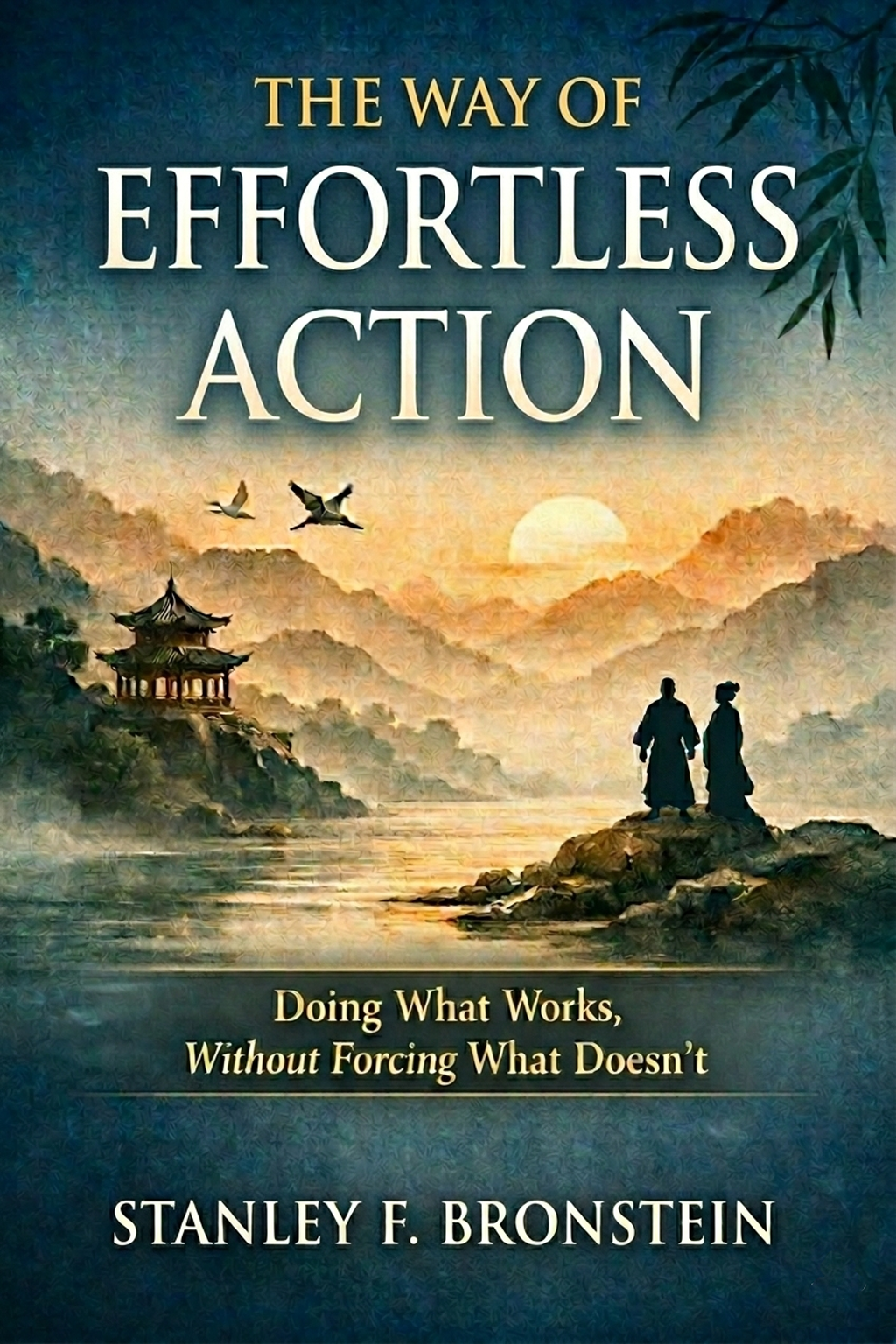
The Way of Effortless Action
Doing What Works,
Without Forcing What Doesn’t
By Stanley F. Bronstein – Creator of The Way of Excellence System
Click The Tabs Below To Read Each Chapter Of The Book Online
Or
📘 Download Your Free Copy In Your Preferred Format
The Way of Effortless Action
by Stanley F. Bronstein
How to use this page:
Click a chapter title to open it then scroll down to read.
When you click the title of the next chapter, the previous one will close.
Take your time.
Read, reflect, and do the experiments and assignments before you move on.
EMPTY ITEM
Foreword
Why This Book Exists
Most people are not failing because they are weak. They are failing because they are forcing.
They push when they should pause. They insist when they should listen. They hustle when they should simplify. They chase outcomes that cannot be chased, and then wonder why they feel exhausted, frustrated, and stuck.
This book is about a different approach.
It is about doing what works, without forcing what does not.
The Plain English Meaning of Effortless Action
Effortless action does not mean effortless results.
It does not mean you never work hard. It does not mean life stops being life. It does not mean you avoid difficulty.
Effortless action means you stop wasting effort.
You stop fighting reality. You stop arguing with what is true. You stop trying to win battles that do not matter. You stop using intensity as a substitute for wisdom.
You learn to make the smallest effective move, at the right time, for the right reason, and then let it work.
That is the kind of effort that looks calm and feels clean.
Wu-Wei, Explained Without Confusion
This book is heavily influenced by an ancient Chinese concept called Wu-Wei.
Wu-Wei is often translated as “non-action,” which sounds like doing nothing. That translation has confused people for a long time.
Wu-Wei does not mean doing nothing.
It means not forcing.
It means acting in a way that fits the situation. It means responding instead of reacting. It means moving with reality instead of trying to dominate it.
Here is the simplest way to remember it:
Wu-Wei is not doing nothing.
Wu-Wei is doing what works, without forcing what does not.
Why This Matters So Much Right Now
We live in a culture that praises force.
Push harder. Grind more. Power through. Never slow down. Never show weakness. Never stop moving.
Sometimes, that approach works for a short time. But it often creates a long list of problems.
It creates burnout. It creates strained relationships. It creates resentment. It creates health decline. It creates decisions made from urgency, not wisdom.
Effortless action is not soft.
It is precise.
It is the ability to do the right thing in the right way, without self-inflicted damage.
Water Is The Teacher
Daoist teachings often use the image of water.
Water does not force, but it is powerful.
Water yields, yet it wears down stone.
Water takes the lowest places, yet it nourishes everything.
Water is patient. Water is persistent. Water is effective.
Effortless action is not about being passive. It is about being effective the way water is effective.
The Hidden Engine: Naturalness
Another useful Chinese concept is ziran, often translated as naturalness.
Naturalness is what you return to when you stop performing, stop straining, and stop trying to be someone you are not.
When you are being natural, Wu-Wei becomes easier.
You are not forcing an identity. You are not forcing an outcome. You are not forcing a moment to be different than it is.
You are present, clear, and capable of decisive action.
Effortless Action Is A Skill, Not A Mood
Some people think this is about staying calm.
Calm can help, but that is not the point.
Effortless action is a skill.
It is situational intelligence. It is perception. It is timing. It is restraint. It is knowing when a door will not open and having the wisdom to look for the window, or build a new door.
This skill improves through practice.
The effort often happens early.
Preparation. Repetition. Training. Discipline.
Then, when it is time to act, the action becomes smoother. The mind becomes quieter. The body becomes ready. The choice becomes obvious.
That is the paradox.
The work is real. The forcing is optional.
How This Book Is Built
This book is built around twenty concepts, organized into four parts.
Each chapter takes one concept and shows what it looks like through the lens of effortless action.
In plain English, each chapter answers four questions:
What does this concept mean?
How do people usually force it?
What does it look like without forcing?
What should I do next?
Each chapter ends with an assignment, because insight without application is not enough.
A Simple Method You Will See Again And Again
Throughout the book, I will keep coming back to a simple practice.
Notice resistance.
Name the natural constraint.
Find the smallest effective action.
Act, then release.
This is one of the clearest ways to practice Wu-Wei in modern life.
It turns a philosophy into a method.
It turns a concept into results.
What I Hope This Does For You
I hope this book gives you relief, but not the kind that makes you passive.
The kind that makes you clear.
I hope it helps you stop fighting battles you do not need to fight.
I hope it helps you stop forcing conversations, outcomes, and identities.
I hope it helps you act with calm authority.
Most of all, I hope it helps you become the kind of person for whom the right action is natural.
Not because life gets easier, but because you get better.
You become more precise.
You become more consistent.
You become more effective.
You learn the art of effortless action.
INTRODUCTION TO PART I - SEEING CLEARLY
Why Seeing Clearly Comes First
Effortless action begins before action.
It begins with perception.
Most forcing is not a character flaw. It is a clarity problem. When you do not see clearly, you push. You guess. You overcorrect. You argue with reality. You try to overpower what you do not understand.
When you see clearly, the next move often becomes obvious.
You do not need to create pressure. You need to remove confusion.
The Cost Of Forcing
Forcing usually looks like effort.
It feels like commitment. It feels like intensity. It feels like taking life seriously.
But forcing has a hidden price.
It creates resistance. It drains energy. It damages relationships. It turns small problems into bigger ones. It replaces precision with impatience.
Forcing is often what we do when we want control more than we want results.
The problem is that control is not the goal. Outcomes are the goal. Integrity is the goal. Health is the goal. Peace is the goal. Progress is the goal.
Seeing clearly helps you separate what is controllable from what is not.
That one distinction reduces enormous waste.
Wu-Wei, The Practical Lens
Wu-Wei is an ancient Chinese idea that can be explained in one modern sentence:
Wu-Wei is doing what works, without forcing what does not.
In Part I, we focus on the “doing what works” part, which starts with seeing what is true.
If you act on wishful thinking, your action will be noisy.
If you act on clarity, your action will be clean.
Wu-Wei is not passive. It is precise. It is responsive. It is aligned with reality.
That alignment starts here.
The Difference Between Facts And Stories
Seeing clearly requires one skill above all others.
The ability to separate facts from stories.
Facts are what happened.
Stories are the meaning you add.
Stories are not always wrong. They are often useful. But if you confuse stories with facts, you will push on the wrong things.
You will try to force someone to understand you when they are not open.
You will try to force a timeline that is not realistic.
You will try to force your body to do something it is not ready to do yet.
Seeing clearly means you can say, “Here is what is true,” before you say, “Here is what I want.”
That order matters.
Natural Constraints Are Not Enemies
Part of seeing clearly is accepting that every situation has constraints.
Time is a constraint.
Energy is a constraint.
Other people’s choices are constraints.
Your current health is a constraint.
Your current skills are constraints.
A constraint is not an insult. It is information.
Forcing is what happens when you treat a constraint as something you can overpower.
Effortless action begins when you treat constraints as something you can work with.
You do not fight the shape of the situation.
You use the shape of the situation.
The Water Metaphor, Again
Daoist teachings return to water for a reason.
Water is realistic.
It does not pretend the rock is not there.
It does not scream at the rock.
It does not argue with the rock.
It moves around it, over it, under it, and eventually through it.
Water sees clearly.
Then it acts.
This is the spirit of Part I.
The Four Moves Of Effortless Action
You will see a simple method throughout this book.
It is not complicated, because complicated systems are easy to avoid.
This is the method:
Notice resistance.
Name the natural constraint.
Find the smallest effective action.
Act, then release.
Seeing clearly begins with the first two moves.
If you skip them, you will act from emotion, urgency, or ego.
If you do them, your action becomes simpler and more effective.
What This Part Will Do For You
Part I will help you build the foundation.
You will learn how to notice what is true without self-attack.
You will learn how to think in the long term without losing your ability to act today.
You will learn how to take responsibility without falling into blame or guilt.
You will learn how to embrace change without drama.
You will learn how to find possibilities when your mind wants to stay trapped in negativity.
These are not abstract ideas.
They are practical skills.
They create the inner conditions for effortless action.
What To Do As You Read Part I
Do not rush.
Read each chapter as a tool, not as entertainment.
When you feel resistance, do not force your way past it. Pause and ask:
What is true right now?
What am I trying to force?
What is the smallest effective move?
That is how you turn this book into a practice.
When you are ready, begin with Chapter 1.
Effortless awareness is the first doorway.
Chapter 1: Effortless Awareness
What Awareness Is
Awareness is the ability to see what is true right now.
It is noticing what you are doing, what you are thinking, what you are feeling, and what is happening around you, without distortion.
Awareness is not a philosophy. It is a skill.
It is the starting point of all change, because you cannot improve what you refuse to see.
Why Awareness Matters
When awareness is low, people force.
They talk too much. They repeat themselves. They push harder. They overreact. They make promises they cannot keep. They try to control outcomes that cannot be controlled.
When awareness is high, people choose.
They pause. They see patterns. They notice what is working and what is not. They make smaller, cleaner moves.
Effortless action begins with awareness because awareness prevents wasted effort.
What Low Awareness Looks Like
Low awareness shows up in predictable ways.
You might recognize yourself in some of these.
-
You feel tense, but you do not notice it until later.
-
You say yes, then resent it.
-
You eat when you are not hungry.
-
You speak to be right instead of to be effective.
-
You keep trying the same approach even though it keeps failing.
-
You confuse urgency with importance.
-
You keep scrolling, and you do not even know why.
None of this means you are broken.
It means your awareness dropped.
That happens to everyone.
The goal is not to be perfect.
The goal is to recover awareness quickly.
Wu-Wei And Awareness
Wu-Wei is doing what works, without forcing what does not.
That begins with seeing what is true.
When you are unaware, you cannot do what works because you do not know what is happening. You guess. You react. You push.
Awareness is the opposite of forcing.
It is the quiet act of looking at reality before you try to move reality.
Wu-Wei does not ask you to stop acting.
It asks you to stop acting blindly.
Effortless Awareness Is Not Forced Calm
Many people try to become aware by forcing themselves to be calm.
That does not work.
Forced calm is just another form of forcing.
Effortless awareness is not a mood.
It is a willingness to notice.
You can notice tension without trying to remove it.
You can notice anger without turning it into a speech.
You can notice fear without making it your boss.
Awareness does not demand that you feel good.
It demands that you tell the truth.
The First Clue Is Always The Body
Your body often knows before your mind admits it.
Effortless awareness begins with simple body signals.
-
Tight jaw
-
Shallow breathing
-
Raised shoulders
-
Restless legs
-
Fast talking
-
A feeling of being chased
-
A need to hurry
These are not problems.
They are signals.
They are your body saying, “You are trying to force something.”
If you learn to catch these signals early, you can change your behavior before damage is done.
The Second Clue Is Repetition
Repetition is a clear sign that awareness is low.
If you keep repeating an argument, a request, a plan, or a habit, one of two things is true.
Either the situation is closed, or your approach is wrong.
Awareness asks a simple question:
Is my effort producing results, or resistance?
If it is producing resistance, the wise move is rarely to push harder.
The wise move is to pause and adjust.
The Third Clue Is The Urge To Control
Control is often the disguise of fear.
You want to control the timeline.
You want to control what people think.
You want to control the outcome.
You want to control how you feel.
The desire for control is understandable.
But when it becomes compulsive, it creates forcing.
Awareness does not remove uncertainty.
It removes the illusion that you can eliminate uncertainty.
That is a major freedom.
A Simple Awareness Practice You Can Use All Day
Here is a practice that takes less than one minute.
It is not spiritual. It is practical.
-
Pause.
-
Breathe once, slowly.
-
Ask: What is true right now?
-
Ask: What am I trying to force?
-
Ask: What is the smallest effective move?
Then do that move.
Then stop pushing.
This is Wu-Wei in modern language.
It is one good move, then stillness.
Awareness In Real Life
Effortless awareness changes everything because it changes timing.
Here are simple examples.
-
You are about to send an emotional text. Awareness catches the heat. You wait ten minutes. You send one clean sentence instead, or you do not send it at all.
-
You are about to eat. Awareness notices you are not hungry, you are stressed. You drink water, walk, or simply wait.
-
You are about to argue. Awareness notices the need to win. You ask one good question instead.
-
You are about to quit a habit. Awareness notices that you are tired, not defeated. You rest and return.
Awareness does not eliminate challenge.
It eliminates unnecessary struggle.
Common Mistakes With Awareness
There are a few predictable ways people misuse this.
-
They judge themselves for what they notice.
-
They use awareness as an excuse to overthink.
-
They demand instant change instead of practicing noticing.
-
They try to be aware of everything, which becomes exhausting.
Effortless awareness is not intense.
It is consistent.
A small amount of honest noticing, repeated daily, will change your life.
The Point Of Awareness
The point of awareness is not to become hyper-aware.
The point is to become effective.
Awareness helps you stop doing the wrong thing.
It helps you stop doing the right thing the wrong way.
It helps you notice openings.
It helps you choose better timing.
It helps you stop forcing.
Effortless action starts here.
Assignment: The Awareness Reset
This assignment is designed to help you build the habit of noticing, without turning it into a heavy project.
Step 1 – Choose Three Daily Checkpoints
Pick three moments that already happen every day. For example:
-
when you wake up
-
before your first meal
-
before bed
Write them down.
Step 2 – Do A 30-Second Truth Scan At Each Checkpoint
At each checkpoint, pause and answer these questions:
-
What am I feeling in my body right now?
-
What emotion is present right now?
-
What is the main thought running in my mind right now?
Do not fix anything yet. Just notice.
Step 3 – Identify One Forcing Pattern
At the end of the day, answer this:
-
Where did I try to force something today?
Be specific. For example: forcing a conversation, forcing productivity, forcing yourself to eat perfectly, forcing someone to agree.
Step 4 – Choose One Small Adjustment For Tomorrow
Answer this:
-
What is one small change I will make tomorrow to reduce forcing?
Examples:
-
speak once, then stop
-
take a five-minute walk before deciding
-
prepare healthy food earlier in the day
-
ask one question instead of giving a speech
-
go to bed thirty minutes earlier
Step 5 – Reflection Question
Write one sentence:
-
If I saw clearly in the moment, what would I have done differently?
Chapter 2: Effortless Long-Term Thinking
What Long-Term Thinking Is
Long-term thinking is the ability to make decisions today that your future self will thank you for.
It is choosing actions that compound.
It is also refusing actions that feel good now but cost you later.
Long-term thinking is not complicated.
It is simply the habit of asking, “Where does this lead?”
Why People Avoid Long-Term Thinking
Most people are not stupid. They are not lazy. They are not weak.
They are distracted.
Short-term pressure is loud.
Long-term consequences are quiet.
A craving feels urgent. A long-term goal feels distant.
A conflict feels immediate. A relationship’s health is gradual.
A purchase feels exciting. Financial freedom is slow.
When you are tired, stressed, rushed, or emotional, you will almost always choose the short term unless you have trained yourself otherwise.
That is why this chapter is in Part I.
You cannot practice effortless action if you are constantly reacting to the loudest moment.
Wu-Wei And Time
Wu-Wei is doing what works, without forcing what does not.
One of the biggest forms of forcing is trying to rush time.
People force results.
They force weight loss.
They force relationships.
They force business growth.
They force healing.
They force learning.
Then they feel frustrated because reality does not obey urgency.
Long-term thinking is a form of Wu-Wei because it respects how life actually works.
Life compounds. Life takes time. Life responds to consistency more than intensity.
You do not need to force time.
You need to cooperate with it.
The Difference Between Intensity And Consistency
Intensity has a place.
It can create a breakthrough. It can create a turning point. It can create momentum.
But intensity is not a strategy.
Consistency is a strategy.
Consistency is what builds a body, a business, a marriage, a reputation, a skill, and a peaceful mind.
Effortless long-term thinking replaces dramatic pushes with steady standards.
It also replaces panic decisions with patient direction.
A Simple Filter: Ten Minutes Or Ten Months
Here is one of the most useful questions you can learn.
Will this choice help me in ten minutes, or in ten months?
Sometimes you can have both.
Often, you are choosing one.
If you repeatedly choose ten minutes, your life will shrink.
If you repeatedly choose ten months, your life will grow.
This is not moral. It is mechanical.
The direction of your life is a simple accumulation of choices.
Another Filter: Does This Compound Or Does It Cost
Some choices compound.
-
walking daily
-
eating real food
-
sleeping enough
-
telling the truth
-
saving money
-
building skills
-
keeping your word
-
staying calm in conflict
-
reading and reflecting
Some choices cost.
-
junk food as a habit
-
constant scrolling
-
overspending
-
lying to avoid discomfort
-
staying up late to escape
-
avoiding hard conversations
-
living in resentment
-
quitting when progress is slow
Effortless long-term thinking is simply choosing the compounding side more often.
Not perfectly. Just more often.
Long-Term Thinking Without Rigidity
Long-term thinking does not mean rigid planning.
Rigid planning is often fear disguised as structure.
It is the belief that if you can control every detail, you can avoid uncertainty.
But uncertainty is part of life.
Wu-Wei does not demand that you eliminate uncertainty.
It asks you to reduce unnecessary struggle.
The long-term approach is not a prison.
It is a direction.
You can adjust your path without abandoning your destination.
The Long-Term Mindset That Reduces Forcing
If you want one sentence that changes your behavior, use this:
I do not need to win today. I need to build.
Building is slower than forcing, but it works.
Building is less dramatic, but it lasts.
Building is what you do when you stop trying to prove yourself and start trying to become yourself.
Effortless Long-Term Thinking In Health
People try to force health outcomes.
They choose extremes.
They start hard, burn out, then quit.
They demand immediate results, then feel discouraged.
A long-term approach asks a different question:
What can I do every day for the next ten years?
The answer is usually simple.
Walk.
Eat real food.
Sleep.
Drink water.
Reduce processed food.
Stop negotiating with yourself.
This is not glamorous.
It is effective.
Long-term thinking makes health feel lighter because it removes the pressure to transform overnight.
Effortless Long-Term Thinking In Relationships
Relationships are built through small choices repeated.
Tone.
Respect.
Truth.
Boundaries.
Listening.
Repair after conflict.
People force relationships by trying to get immediate emotional outcomes.
They push for closeness.
They push for agreement.
They push for validation.
Long-term thinking asks:
What behavior builds trust over time?
Trust is the real currency of relationships.
If you protect trust, closeness follows.
If you damage trust, closeness cannot be forced.
Effortless Long-Term Thinking In Work And Money
In work, forcing often looks like chasing quick wins, chasing praise, chasing constant activity.
But value compounds.
Skills compound.
Reputation compounds.
So does debt, stress, and poor health.
Long-term thinking helps you become the person who creates value consistently.
It also helps you avoid deals and commitments that drain your future.
One practical question:
Is this a one-time gain, or is it building a system?
Systems outperform willpower.
A Simple Practice: Pre-Decide The Basics
The long term becomes easy when you remove daily debate.
Debate creates forcing.
Pre-decisions reduce forcing.
Here are examples of useful pre-decisions.
-
I walk every day.
-
I eat real food most of the time.
-
I do not negotiate sleep.
-
I do not send emotional messages.
-
I do not make important decisions when I am exhausted.
-
I speak the truth, calmly.
When these are pre-decided, your life becomes simpler.
You stop making the same decision over and over.
You move forward without drama.
Common Mistakes With Long-Term Thinking
Long-term thinking gets misused in predictable ways.
-
You turn it into perfectionism.
-
You over-plan and never act.
-
You use it to delay hard conversations.
-
You become rigid and refuse to adjust.
-
You confuse patience with passivity.
Effortless long-term thinking still acts.
It simply acts with perspective.
It makes small moves that compound.
The Point Of Long-Term Thinking
The point is not to be endlessly patient.
The point is to be effective.
Long-term thinking helps you choose actions that reduce future problems.
It helps you trade short-term impulse for long-term freedom.
It helps you stop forcing outcomes and start building them.
Effortless action becomes possible when your mind is not enslaved to the moment.
Assignment: The Compounding Choice Plan
This assignment will help you build long-term thinking into your daily decisions, without making it complicated.
Step 1 – Pick One Area Where You Are Most Tempted By The Short Term
Choose one:
-
health
-
money
-
relationships
-
work
-
time and attention
Write it down.
Step 2 – Identify One Short-Term Pattern That Costs You Later
Write one sentence:
-
The short-term choice I keep making is: ________
Be specific.
Step 3 – Write The Ten Months Version Of You
Write three sentences describing what you want ten months from now in that area.
Keep it simple and realistic.
Step 4 – Choose One Daily Action That Compounds
Pick one action you can do daily that supports your ten-month outcome.
Examples:
-
walk 20 minutes
-
prepare one healthy meal
-
save a set amount
-
have one honest conversation
-
spend 30 minutes on a skill
-
turn off screens at a set time
Write it down.
Step 5 – Create A Pre-Decision
Write one clear rule that removes debate.
Example:
-
I walk 20 minutes every day before noon.
-
I do not buy food at a drive-through.
-
I do not respond to conflict texts immediately.
Your rule should be simple enough to follow on your worst day.
Step 6 – Reflection Question
Answer this in writing:
-
If I stopped trying to force results and focused on compounding, what would I do differently this week?
Chapter 3: Effortless Personal Responsibility
What Personal Responsibility Is
Personal responsibility is the decision to own your life.
It is the willingness to say, “This is mine to deal with,” even when you did not cause the problem.
Responsibility is not blame.
Responsibility is power.
It is the ability to influence what happens next.
Why This Chapter Matters
If you do not take responsibility, you will still act.
You will just act from a weaker position.
You will complain. You will blame. You will wait. You will hope someone else fixes it.
That is not effortless action.
That is helplessness.
Effortless personal responsibility is the opposite.
It is a calm, direct willingness to make the next right move.
Responsibility Is Not Self-Attack
Many people avoid responsibility because they confuse it with guilt.
They think responsibility means saying, “It’s my fault.”
That is not what responsibility means.
Responsibility means saying, “It’s my move.”
Fault looks backward.
Responsibility looks forward.
Fault creates shame.
Responsibility creates leverage.
If you have a problem in your life, your best path is almost always to find the part you can influence and take ownership of it.
That is how life improves.
Wu-Wei And Responsibility
Wu-Wei is doing what works, without forcing what does not.
Blame is one of the biggest forms of forcing.
It is an attempt to force reality to be different by arguing with the past.
Blame says, “This should not have happened.”
Responsibility says, “This did happen. Now what?”
Wu-Wei respects reality.
Responsibility respects reality.
Both are rooted in the same principle.
Stop fighting what is true. Start shaping what is next.
The Blame Trap
Blame feels powerful for a moment.
It gives you a target.
It gives you a story.
It gives you a sense of being right.
But it quietly steals your future.
Here is why.
When you blame, you hand over your power.
You say, “My situation is caused by someone else, therefore the solution must come from someone else.”
That is rarely true.
Even when someone else caused damage, you still have choices.
You still have a next step.
Effortless responsibility is the willingness to take that step without drama.
The Victim Story Is Resistance
Sometimes the victim story is accurate.
Sometimes you really were treated unfairly.
Sometimes you really did not deserve what happened.
Acknowledging that is human.
Staying there is costly.
The victim story becomes resistance when it turns into identity.
When you build your identity around what happened to you, you stop building your future.
Wu-Wei does not deny pain.
Wu-Wei refuses unnecessary struggle.
Effortless responsibility allows you to feel what you feel, and still move forward.
The Clean Question That Changes Everything
If you want one question that instantly shifts your position, use this:
What part of this is mine?
This question does not mean you are guilty.
It means you are willing to be effective.
Even in a situation that is mostly someone else’s doing, there is usually something you can own.
Your response.
Your boundaries.
Your standards.
Your choices.
Your next conversation.
Your preparation.
Your willingness to walk away.
Your willingness to persist.
Responsibility Is A Practice
Responsibility is not a one-time decision.
It is a way of living.
It shows up in small moments.
-
You do not blame your schedule. You set a better one.
-
You do not blame your mood. You take a walk, drink water, sleep, and reset.
-
You do not blame other people for misunderstanding you. You communicate more clearly or you stop arguing.
-
You do not blame circumstances for your lack of progress. You take one small effective step.
Responsibility is quiet.
It does not make speeches.
It makes moves.
Effortless Responsibility In Relationships
Relationships often break down because both people want the other person to move first.
That is forcing.
Effortless responsibility asks:
What is my part?
Maybe it is your tone.
Maybe it is your defensiveness.
Maybe it is your avoidance.
Maybe it is your lack of appreciation.
Maybe it is your inability to set boundaries.
Maybe it is your refusal to apologize.
When you take responsibility for your part, the relationship often improves.
Even if the other person does not change immediately, you are no longer trapped.
You are acting from integrity.
Effortless Responsibility In Health
Health is one of the clearest examples.
Blame is easy.
The food industry.
Genetics.
Age.
Stress.
A busy schedule.
All of those factors are real.
But responsibility is still the path.
You do not need to control everything.
You need to control your next step.
Wu-Wei does not ask you to force your body.
It asks you to cooperate with your body.
It asks you to build health through consistent, realistic actions that fit your life.
That is responsibility.
Effortless Responsibility In Work And Life Decisions
In work, responsibility often means stopping the habit of waiting.
Waiting for clarity.
Waiting for permission.
Waiting for confidence.
Waiting for the perfect plan.
Effortless responsibility says:
I will take the next right step, even with incomplete information.
I will make the smallest effective move and learn from the response.
That is how adults live.
That is how leaders lead.
The Responsibility Shift: From Emotion To Action
There is a simple sequence that helps.
-
Acknowledge what you feel.
-
Name what is true.
-
Identify what you can influence.
-
Choose the smallest effective action.
-
Do it, then stop pushing.
This is not cold.
It is healthy.
It prevents emotional thrashing.
It creates forward motion.
Common Mistakes With Personal Responsibility
People tend to make these errors.
-
They confuse responsibility with harshness.
-
They use responsibility to beat themselves up.
-
They try to take responsibility for other people’s emotions.
-
They take on too much and become controlling.
-
They expect instant results and get discouraged.
Effortless responsibility is balanced.
You own your part.
You release the rest.
That is Wu-Wei.
The Point Of Personal Responsibility
The point is not to become rigid.
The point is to become free.
Responsibility is the doorway to freedom because it returns power to you.
If you can influence the next step, you are not trapped.
If you can influence the next step, you can build a different future.
Effortless action requires responsibility because you cannot act effectively while blaming.
Assignment: The Responsibility Inventory
This assignment is designed to build the habit of owning your part, without guilt and without self-attack.
Step 1 – Choose One Ongoing Frustration
Pick one situation that has been bothering you.
Keep it specific.
Examples:
-
a recurring conflict
-
a health habit you keep breaking
-
a work problem that drains you
-
a financial pattern
-
a relationship tension
Write it down.
Step 2 – Write The Facts Only
Write 5 to 10 short sentences describing what is true.
No interpretation.
No insults.
No labels.
Just facts.
This step is important because facts reduce forcing.
Step 3 – Identify Your Part
Answer these questions in writing:
-
What did I do that contributed to this?
-
What did I not do that contributed to this?
-
What boundary did I fail to set or enforce?
-
What truth did I avoid saying?
Be honest and calm.
Step 4 – Identify What You Can Influence Right Now
Write three things you can influence in the next seven days.
Examples:
-
your tone
-
your schedule
-
your food environment
-
your communication
-
your sleep
-
your boundaries
-
one conversation
-
one decision you have been postponing
Step 5 – Choose The Smallest Effective Action
Pick one action that improves the situation by 10 percent.
Write it as a single sentence beginning with “I will.”
Example:
-
I will schedule the conversation and speak clearly without attacking.
-
I will remove the trigger foods from the house.
-
I will go to bed by 10:00 pm for the next seven days.
-
I will stop explaining and ask one clean question.
Step 6 – Reflection Question
Answer this:
-
If I fully owned this situation without blame, what would I do next?
Chapter 4: Effortless Change
What Change Really Is
Change is not an event.
Change is a process.
It is what happens when you repeatedly choose a new action, a new standard, or a new identity, long enough for it to become normal.
Change is not primarily willpower.
Willpower is helpful, but it is unreliable.
Effortless change is built by shaping conditions so the right choice becomes easier and the wrong choice becomes harder.
Why People Struggle With Change
Most people struggle with change for one simple reason.
They try to force the outcome instead of building the process.
They want fast results, so they choose extreme actions.
They push hard, then burn out.
They miss once, then they quit.
They feel discouraged, then they spiral.
None of this means they lack potential.
It means their approach is built on forcing.
Wu-Wei And Change
Wu-Wei is doing what works, without forcing what does not.
In change, forcing often looks like aggression toward yourself.
You demand perfection.
You demand speed.
You demand constant motivation.
Then you feel disappointed because you are human.
Wu-Wei offers a better path.
You stop trying to overpower your nature.
You work with it.
You create an environment that supports your goal.
You build habits that are realistic.
You focus on consistency, not intensity.
You do the smallest effective thing, and you repeat it.
That is effortless change.
The Most Important Truth About Change
Change starts with honesty.
If you do not tell the truth about what you are doing, you cannot change it.
That is why awareness is Chapter 1.
Change begins when you see reality clearly.
Then it continues when you design your life so the better choice is easier.
Change Is Often Subtractive
Many people think change is about adding.
Adding a new routine. Adding discipline. Adding a new plan.
Sometimes that is true.
But effortless change is often subtractive.
You remove what makes the wrong behavior easy.
You remove triggers.
You remove friction from the right behavior.
You remove commitments that drain you.
You remove clutter.
You remove drama.
Wu-Wei often looks like removing what blocks the natural movement forward.
A river flows when you stop damming it.
The Four Levers Of Effortless Change
There are four levers that make change easier.
You do not need all four at once.
But you should understand them.
Lever 1 – Environment
Environment is the silent force shaping your behavior.
If your environment makes the wrong behavior easy, you will eventually do it.
If your environment makes the right behavior easy, you will eventually do it.
Environment includes:
-
what food is in your house
-
what apps are on your phone
-
who you spend time with
-
what you see when you wake up
-
what is within arm’s reach
-
what you do when you are stressed
If you want effortless change, start with the environment.
It is the most underused lever.
Lever 2 – Identity
Change becomes durable when it becomes identity.
Not identity as an image.
Identity as a standard.
“I am a person who walks every day.”
“I am a person who tells the truth.”
“I am a person who keeps my word.”
“I am a person who eats food that supports my health.”
Identity reduces debate.
Debate creates forcing.
When something is part of who you are, you do not negotiate it every day.
Lever 3 – Repetition
Repetition is the engine.
You do not need heroic effort.
You need repeated effort.
Small daily actions beat big occasional actions.
A little bit every day creates a new normal.
This is one of the core paradoxes of effortless action.
The action becomes easier because you stop making it new every time.
You make it familiar.
Lever 4 – Recovery
Recovery is part of the process, not a failure.
Most people force change by refusing recovery.
They stay up late. They overwork. They push through exhaustion.
Then they collapse, and the habit breaks.
Effortless change respects energy.
It recognizes that a depleted person will make short-term decisions.
Recovery is not weakness.
Recovery is strategy.
The Real Enemy: The Restart Mentality
One of the most damaging habits is the “restart” mentality.
“I blew it today, so I will start again Monday.”
“I ate poorly, so the week is ruined.”
“I missed a workout, so I am off track.”
This is forcing.
It is emotional.
It turns one mistake into a pattern.
Effortless change uses a different rule:
Return quickly, without drama.
A stumble is not a collapse.
It is a signal to adjust and continue.
Change And Timing
Effortless action is deeply connected to timing.
When you are exhausted, hungry, lonely, or stressed, your decision-making suffers.
That is not weakness.
That is biology.
One of the most “Wu-Wei” skills you can develop is learning when not to decide.
If you are emotionally flooded, do not decide.
If you are sleep deprived, do not decide.
If you are in conflict, do not decide.
Rest. Eat. Walk. Sleep.
Then decide.
This is not avoidance.
This is intelligence.
Practical Examples Of Effortless Change
Health
Forcing looks like extreme dieting, punishment workouts, and constant self-criticism.
Effortless change looks like:
-
walking daily
-
eating mostly real, whole foods
-
removing trigger foods from the environment
-
preparing in advance
-
building a simple routine you can repeat
-
returning quickly after mistakes
Relationships
Forcing looks like pushing someone to change, lecturing, controlling, and keeping score.
Effortless change looks like:
-
changing your own behavior first
-
setting clean boundaries
-
being consistent
-
letting time reveal the truth
-
stopping the need to win every moment
Work And Productivity
Forcing looks like grinding through exhaustion and chasing constant urgency.
Effortless change looks like:
-
defining the next smallest action
-
working in focused blocks
-
removing distractions
-
stopping when effectiveness drops
-
returning when effectiveness rises
Common Mistakes With Change
People tend to fall into the same traps.
-
They try to change everything at once.
-
They choose a plan they cannot sustain.
-
They rely on motivation.
-
They punish themselves for setbacks.
-
They demand fast results.
-
They ignore environment and then blame willpower.
Effortless change is slower at first, but it lasts.
It builds the kind of life that makes health and character automatic.
The Point Of Change
The point is not to become a different person overnight.
The point is to become the person you already know you can be, through consistent actions that fit reality.
Change is not supposed to be a war.
It is supposed to be a process.
Wu-Wei gives you a way to change without self-inflicted damage.
Assignment: The Friction Removal Plan
This assignment will help you create one meaningful change by removing friction, not by forcing willpower.
Step 1 – Choose One Change You Want Most
Pick one area:
-
nutrition
-
movement
-
sleep
-
stress management
-
relationships
-
productivity
Write it down as one sentence.
Example: “I want to walk daily.”
Step 2 – Identify The Biggest Friction Point
Answer this:
-
What makes this change hard right now?
Be specific.
Examples:
-
no time blocked
-
clothes not ready
-
food environment is chaotic
-
too many commitments
-
fatigue from poor sleep
-
no plan for stress moments
Step 3 – Remove One Barrier
Choose one barrier and remove it today.
Examples:
-
set walking shoes by the door
-
schedule a daily walking time
-
remove trigger foods from the house
-
prep one simple meal in advance
-
set a bedtime alarm
-
cancel one draining commitment
This should be a real change, not a wish.
Step 4 – Add One Support
Add one small support that makes the right behavior easier.
Examples:
-
a calendar reminder
-
a visible checklist
-
a prepared grocery list
-
a walking route you enjoy
-
a simple rule like “no screens after 9:00”
Step 5 – Define A Minimum Daily Standard
Write one minimum you can do even on a hard day.
Examples:
-
walk 20 minutes
-
eat one fully whole-food meal
-
go to bed 30 minutes earlier
-
do 5 minutes of stretching
-
write one clean text instead of arguing
Minimum standards prevent the all-or-nothing trap.
Step 6 – Reflection Question
Answer this in writing:
-
If I stopped forcing myself and started shaping conditions, what would change first?
Chapter 5: Effortless Possibilities
What Possibilities Are
Possibilities are options.
They are the alternative paths you can take when the current path is not working.
Most people think possibilities are something you find.
In reality, possibilities are something you create.
You create them through how you think, how you frame situations, and what actions you take.
Possibilities are not fantasies.
They are real options that appear when you stop locking yourself into one story.
Why Possibilities Matter
When you believe there is only one path, you feel trapped.
When you feel trapped, you force.
You push the wrong conversation. You chase the wrong outcome. You hold onto the wrong plan. You insist when you should pivot.
Effortless action requires possibilities because possibilities reduce desperation.
Desperation is the fuel of forcing.
Possibilities bring calm.
Calm brings precision.
Wu-Wei And Possibilities
Wu-Wei is doing what works, without forcing what does not.
When a door will not open, forcing makes you push harder.
Wu-Wei makes you step back and ask:
Is there another door?
Is there a window?
Is there a different path?
Is there a smaller move that changes the situation?
Possibilities are often the “without forcing” solution.
The most powerful move is frequently not a stronger push.
It is a better option.
Why People Miss Possibilities
People miss possibilities for predictable reasons.
Negativity
Negativity narrows attention.
It makes you see threats, not openings.
It makes you see what is missing, not what is available.
Negativity is not realism.
Negativity is a filter.
Certainty Addiction
Some people would rather be certain and stuck than uncertain and free.
They cling to one plan because uncertainty feels uncomfortable.
But life is uncertain.
Effortless action does not eliminate uncertainty.
It uses uncertainty as information.
Fear Of Looking Stupid
Possibilities require experimentation.
Experimentation involves not knowing.
Not knowing can feel embarrassing.
So people pretend.
They keep forcing the same approach because it protects their ego.
That is expensive.
Attachment To One Outcome
Attachment is the belief that only one outcome will make you okay.
That belief creates forcing.
It also creates anxiety.
Possibilities loosen attachment.
You still care, but you stop clinging.
That is strength.
The Possibilities Shift: From “What’s Wrong” To “What’s Possible”
This shift does not mean pretending everything is great.
It means asking better questions.
“What’s wrong?” is sometimes useful.
But if you stay there, you become blind.
Effortless possibilities ask:
What can I do from here?
What is still workable?
What is the smallest change that improves this?
What is the alternative?
This is not optimism.
It is problem-solving.
A Simple Rule: Always Generate Alternatives
One of the most practical habits you can develop is this:
Never let yourself have only one option.
When you have one option, you force it.
When you have three options, you can choose.
This is the core of effortless possibilities.
The Three Alternatives Rule
When you feel stuck, do this.
Write down three alternatives.
They do not have to be perfect.
They just have to be different.
Alternative 1 is usually the obvious one.
Alternative 2 is usually a variation.
Alternative 3 is usually where creativity begins.
The third option is often the one you would not see if you stayed emotional.
Possibilities In Real Life
Health
You want to eat better, but your schedule is chaotic.
Forcing says: “I need a perfect plan.”
Possibilities say:
-
What is one meal per day I can make whole-food, no matter what?
-
What is one grocery list I can repeat weekly?
-
What is one simple rule that reduces damage?
-
What is the minimum daily standard I can keep even on hard days?
A possibility is often one good rule and one prepared environment.
Relationships
You want someone to understand you.
Forcing says: “I need to convince them.”
Possibilities say:
-
Can I say it in one clean sentence and stop?
-
Can I ask one question and listen?
-
Can I change the timing of this conversation?
-
Can I set a boundary instead of demanding agreement?
-
Can I let time reveal what is true instead of forcing clarity today?
Possibilities reduce conflict because they reduce pressure.
Work And Money
You want a better outcome, but your current approach is not working.
Forcing says: “I need to push harder.”
Possibilities say:
-
Is there a different customer?
-
Is there a simpler offer?
-
Is there a smaller first step?
-
Is there something to subtract?
-
Is there a better system?
Often, the breakthrough is not more effort.
It is a better direction.
Conflict
Forcing says: “I need to win.”
Possibilities say:
-
What is the real issue under the surface?
-
What would a win-win alternative look like?
-
Can I step out of the frame?
-
Can I end this cleanly?
Possibilities are how you stop wasting energy.
Effortless Possibilities Are Not Wishful Thinking
This matters.
Possibilities are not daydreams.
They require action.
A possibility becomes real when you test it.
Effortless action is always practical.
It is not “think positive.”
It is “think clearly, then choose wisely.”
The Relationship Between Possibilities And Timing
Some possibilities are about action.
Some are about timing.
There are moments when a situation is closed.
Pushing in a closed moment is forcing.
Effortless possibilities include the option to wait without anxiety.
Waiting is not doing nothing.
Waiting can be the most effective move when the moment is not open.
Water does not rush.
Water moves when the path is there.
Common Mistakes With Possibilities
People tend to miss the point in a few ways.
-
They use possibilities to avoid making a decision.
-
They keep brainstorming and never act.
-
They choose options that violate their values.
-
They confuse “possible” with “easy.”
-
They keep returning to the same option because it feels safe.
Effortless possibilities are not endless.
They exist to create a better next move.
Then you move.
The Point Of Possibilities
The point is freedom.
Possibilities reduce forcing because they reduce desperation.
When you have options, you can stay calm.
When you stay calm, you can see more.
When you see more, you make better decisions.
Effortless possibilities are one of the greatest forms of strength.
Assignment: The Alternatives Generator
This assignment will train you to create options when you feel stuck, without overthinking.
Step 1 – Identify One Situation Where You Feel Stuck
Write one sentence describing it.
Example: “I keep eating poorly at night.”
Step 2 – Write The Forcing Approach You Have Been Using
Write one sentence:
-
The way I have been forcing this is: ________
Be honest. No shame.
Step 3 – Name The Constraint
Write one sentence:
-
The natural constraint I cannot change right now is: ________
Examples:
-
limited time
-
stress level
-
someone else’s attitude
-
budget
-
current health limitations
-
a fixed deadline
Constraints are not enemies. They are information.
Step 4 – Generate Three Alternatives
Write three different options that respect the constraint.
Use this format:
-
Alternative 1: ________
-
Alternative 2: ________
-
Alternative 3: ________
At least one alternative should be smaller than you think you need.
Step 5 – Choose The Smallest Effective Action
Pick one alternative and define the smallest action that starts it today.
Write it as one sentence beginning with “I will.”
Step 6 – Act, Then Release
Do the action.
Then stop pushing.
Observe what changes.
Step 7 – Reflection Question
Answer this in writing:
-
What changed in my mood and my results when I created options instead of forcing one outcome?
INTRODUCTION TO PART II - PRACTICING EFFORTLESS ACTION
From Clarity To Practice
In Part I, you built the foundation.
You learned to see clearly.
You learned how forcing begins, how it wastes energy, and how it creates resistance.
Now we move into the practical heart of the book.
Part II is where effortless action becomes a daily method, not just a concept.
This is where you learn how to act with less strain and better results.
Effortless Action Is Not Passivity
Effortless action is not sitting back and hoping life works out.
It is not “doing nothing.”
It is not drifting.
Effortless action is the ability to make the right move with the least wasted effort.
Sometimes the right move is decisive.
Sometimes the right move is small.
Sometimes the right move is to stop doing something that is not working.
Sometimes the right move is to wait because the moment is closed.
All of these can be Wu-Wei when they are aligned with reality.
The Paradox: The Work Happens Before The Moment
One reason people misunderstand Wu-Wei is because they see the final result.
They see a person act smoothly.
They see calm execution.
They see confidence that looks natural.
They assume it must be effortless in the sense of “no effort.”
That is not how it works.
The effort often happens earlier.
Practice.
Repetition.
Preparation.
Standards.
Learning.
Training your mind and body to do the right thing without debate.
Then the action later becomes smoother.
In plain English, this is what effortless action really is:
You train now, so you do not have to force later.
One Good Move, Then Stillness
A central idea in Wu-Wei is that forcing often comes after the move.
You make a decision, then you keep talking.
You do the task, then you keep worrying.
You set the boundary, then you keep justifying it.
You send the message, then you keep re-reading it.
In Part II, you will practice a better rhythm.
Make one good move.
Then stop pushing.
Observe what changes.
This reduces wasted effort and increases effectiveness.
The Practice You Will Use Again And Again
Part II is built around a simple repeatable method.
You have seen it already, but now we use it in more active situations.
Notice resistance.
Name the natural constraint.
Find the smallest effective action.
Act, then release.
This is how effortless action becomes practical.
It turns complexity into clarity.
It turns anxiety into a next step.
It turns stuckness into motion.
Why The Next Five Concepts Matter
The next five chapters are the core of daily execution.
They teach you how to choose wisely and act cleanly.
-
Perspective keeps you from reacting blindly.
-
Vision keeps you moving in the right direction.
-
Giving and receiving keep your relationships clean and strong.
-
Resource management protects your time, energy, and attention.
-
Action is where you stop thinking and start doing.
If you master these five, forcing becomes less and less necessary.
You begin to operate with calm power.
You become more like water.
Not passive.
Effective.
What To Do As You Read Part II
Do not treat these chapters as ideas to agree with.
Treat them as practices to test.
When you feel pressure, do not push harder.
Pause and ask:
What is the smallest effective move right now?
Then make that move.
Then stop forcing the rest.
This is how the practice grows.
You do not become effortless by reading about it.
You become effortless by practicing it.
When you are ready, begin with Chapter 6.
Effortless perspective is how you regain control of your mind without forcing your mind.
Chapter 6: Effortless Perspective
What Perspective Is
Perspective is the ability to see a situation in its proper size.
It is the difference between reacting and responding.
When perspective is low, everything feels personal, urgent, and dangerous.
When perspective is high, you can see options, timing, and the real issue beneath the noise.
Perspective is not pretending.
Perspective is accurate scale.
Why Perspective Matters
If you cannot change your perspective, you will try to change reality by force.
You will push harder when you should pause.
You will argue when you should clarify.
You will panic when you should plan.
You will make decisions from emotion instead of wisdom.
Effortless action depends on perspective because the right move is usually obvious only after you stop exaggerating the moment.
Wu-Wei And Perspective
Wu-Wei is doing what works, without forcing what does not.
A lack of perspective creates forcing because it makes the present moment feel like everything.
Wu-Wei pulls you out of that trance.
It returns you to reality.
It asks, “What is actually happening?”
It also asks, “What is the smallest effective move that fits what is actually happening?”
Perspective is the mental space where Wu-Wei becomes possible.
Two Ways People Lose Perspective
They zoom in too far
They stare at one detail and turn it into the whole story.
One comment becomes rejection.
One mistake becomes failure.
One bad meal becomes “I blew it.”
One disagreement becomes “we have a terrible relationship.”
This is emotional magnification.
It is understandable, but it is not accurate.
They make it personal
They assume everything is about them.
They assume intent where there may be none.
They assume disrespect where there may be stress.
They assume sabotage where there may be incompetence.
Sometimes things are personal.
Often, they are not.
Perspective helps you stop guessing.
The Difference Between Facts, Meaning, And Identity
Here is a simple framework.
-
Facts are what happened.
-
Meaning is what you think it means.
-
Identity is what you make it say about you.
Most suffering comes from jumping from facts to identity.
Fact: I missed my walk.
Meaning: I was tired.
Identity: I am inconsistent.
That last jump creates forcing because it creates shame.
Shame never produces clean action.
Perspective keeps you in facts and meaning, not identity.
It keeps the problem small enough to solve.
Effortless Perspective Is A Return To Scale
The goal is not to be positive.
The goal is to be accurate.
Sometimes things are hard.
Sometimes you are wrong.
Sometimes you need to change your behavior.
Perspective does not deny reality.
It removes distortion.
That is why it is effortless.
It stops the unnecessary mental strain that comes from exaggeration, catastrophizing, and story-building.
The Two Questions That Restore Perspective
When you feel pressure rising, ask these two questions.
What is the real problem here?
What is the real next step?
Most people never ask these questions.
They stay in reaction.
Perspective is the pause that makes these questions possible.
The Water Metaphor Applied
Water does not dramatize a rock.
Water does not label the rock as unfair.
Water does not collapse because of the rock.
Water adjusts.
It flows around it.
It wears it down over time.
Water keeps moving.
That is perspective.
The rock is real.
The response is intelligent.
Five Practical Perspective Tools
Tool 1 – Zoom Out
Ask:
Will this matter in ten days?
Will this matter in ten months?
Will this matter in ten years?
Most daily stress disappears under that light.
If it will not matter in ten months, it is rarely worth forcing today.
Tool 2 – Name The Pattern
Instead of obsessing over the moment, ask:
What pattern is this showing me?
The pattern is usually the real issue.
The moment is just the messenger.
Tool 3 – Replace “Always” And “Never”
“Always” and “never” are forcing words.
They create drama.
They create hopelessness.
Replace them with accurate language.
“This happens sometimes.”
“This has happened three times.”
“This is a pattern we need to address.”
Accuracy creates calm.
Calm creates effectiveness.
Tool 4 – Separate Urgency From Importance
Urgency shouts.
Importance whispers.
A ringing phone can feel urgent.
Your health is important.
A complaint can feel urgent.
Your integrity is important.
Perspective helps you choose importance over urgency.
Tool 5 – Ask “What Else Could This Mean?”
This question is powerful because it breaks certainty.
Certainty is often false.
Certainty creates forcing.
“What else could this mean?” creates space for alternatives.
Space reduces conflict.
Space reduces anxiety.
Space reveals the real issue.
Perspective In Real Life
Health
You step on a scale and see a number you do not like.
Low perspective says: “This is proof I am failing.”
Effortless perspective says: “This is one data point.”
Then it asks: “What is the pattern, and what is the smallest effective move today?”
That move might be a walk, a simple meal, and an earlier bedtime.
No drama required.
Relationships
Someone speaks sharply.
Low perspective says: “They do not respect me.”
Effortless perspective says: “They may be stressed, tired, or triggered.”
Then it asks: “What is the real issue?”
Sometimes the move is to address it.
Sometimes the move is to wait and talk later.
Sometimes the move is to set a boundary.
Perspective prevents forcing an emotional conversation in a closed moment.
Work And Productivity
A project stalls.
Low perspective says: “This is a disaster.”
Effortless perspective says: “This is a constraint.”
Then it asks: “Where is the leverage?”
Often, one small clarification, one decision, or one removal of friction restores flow.
Conflict
Someone disagrees with you.
Low perspective says: “I must win.”
Effortless perspective says: “I want a good outcome.”
Winning is often not the same as a good outcome.
Perspective helps you choose what works over what feels satisfying in the moment.
Common Mistakes With Perspective
Perspective is sometimes misused.
-
People use it to avoid hard conversations.
-
People use it as “everything is fine” when it is not.
-
People use it to minimize real harm.
-
People use it to stay passive when action is required.
Effortless perspective is not avoidance.
It is clarity.
It is seeing what matters, what does not, and what to do next.
The Point Of Perspective
The point is to act from wisdom instead of emotion.
Perspective lowers the noise.
It returns you to the right scale.
It makes the next move simpler.
Effortless action is often a small, calm move made from a clear mind.
Perspective is how you get the clear mind.
Assignment: The Perspective Shift Drill
This assignment trains you to regain perspective quickly in the moments you usually lose it.
Step 1 – Choose One Trigger Situation
Pick one situation that commonly spikes your stress.
Examples:
-
criticism
-
conflict
-
a health setback
-
feeling behind on work
-
a money worry
-
a difficult conversation
Write it down.
Step 2 – Write The Immediate Story Your Mind Usually Tells
Write one sentence.
Example: “This means I’m failing.”
This step is important because it makes the story visible.
Step 3 – Write The Facts Only
Write 5 to 10 facts.
No interpretation.
No labels.
Just what is true.
Step 4 – Use The Zoom Out Questions
Answer these in writing:
-
Will this matter in ten days?
-
Will this matter in ten months?
-
Will this matter in ten years?
Even if the answer is “yes,” your mind will calm because it is looking at scale.
Step 5 – Ask “What Else Could This Mean?”
Write three alternative meanings.
At least one should be generous.
Example: “They may be stressed.”
Step 6 – Choose The Smallest Effective Action
Write one sentence beginning with “I will.”
Example: “I will ask one clarifying question and then stop talking.”
Step 7 – Reflection Question
Answer this:
-
When I regained perspective, what changed in my mood, my tone, and my results?
Chapter 7: Effortless Vision
What Vision Is
Vision is a clear picture of where you are going.
It is not vague hope.
It is not fantasy.
It is direction.
Vision answers a simple question:
What am I building?
When you have vision, your choices become simpler because you have a standard for decision-making.
Does this move me toward what I am building, or away from it?
Why Vision Matters
Without vision, you default to the moment.
You do what is loud, not what is right.
You chase what is urgent, not what is important.
You say yes to things that cost you your future.
You drift.
Drifting is not restful.
Drifting creates anxiety because you feel life happening to you.
Effortless action requires vision because effortless action is not random action.
It is aligned action.
Vision is the alignment point.
Wu-Wei And Vision
Wu-Wei is doing what works, without forcing what does not.
Vision is not forcing the future.
Vision is choosing direction, then letting consistent actions build it.
Forcing says, “I need it now.”
Vision says, “I will build it.”
Wu-Wei respects timing.
Vision respects timing.
You move steadily, you adjust wisely, and you stop panicking about speed.
Effortless vision is calm direction.
The Difference Between Vision And Fantasy
Fantasy feels exciting because it has no constraints.
Fantasy says, “Everything will work out because I want it.”
Vision is different.
Vision respects reality.
It includes constraints.
It includes time.
It includes effort.
Vision is a future you are willing to earn.
If you want a simple test:
If your “vision” requires you to change overnight, it is fantasy.
If your vision can be built through daily actions, it is vision.
Visionaries See The Future Finished In Advance
There is a powerful way to use vision.
See the future finished in advance.
That means you imagine the result as real, then you ask:
What would I be doing daily if this were already my life?
Not once in a while.
Daily.
The purpose is not to daydream.
The purpose is to reverse-engineer.
Vision becomes practical when it leads to standards and habits.
Vision Creates Clean Choices
A strong vision gives you a filter.
It reduces debate.
It reduces distraction.
It reduces the need to force.
When you know what you are building, you can say no without guilt.
You can stop explaining.
You can stop negotiating.
You can stop chasing outcomes that do not fit.
Vision makes your life quieter.
That quiet is power.
Effortless Vision Starts With One Area
Many people fail with vision because they try to create a vision for everything at once.
They create a complicated life plan.
They overwhelm themselves.
They quit.
Effortless vision starts with one area.
Health.
Relationships.
Work.
Service.
Inner life.
Pick one area first.
Build clarity there.
Then expand.
The Five Elements Of A Usable Vision
A usable vision is not long.
It is clear.
Here are five elements that make vision practical.
Element 1 – A direction, not a detailed map
You do not need to know every step.
You need to know where you are headed.
Element 2 – A standard you can live by
Vision becomes real through standards.
Standards are how you show up daily.
Element 3 – A small set of priorities
If everything matters, nothing matters.
Effortless action requires focus.
Element 4 – A time horizon
Long-term thinking matters.
You are building.
You are not rushing.
Element 5 – A next step
Vision without a next step becomes fantasy.
Effortless vision always ends in a next step.
The Relationship Between Vision And Identity
Vision is not only about what you want.
It is about who you become.
If your vision is “I want to be healthy,” the deeper vision is:
I become a person who lives in a healthy way.
If your vision is “I want a better relationship,” the deeper vision is:
I become a person who communicates with respect and truth.
Effortless action is not chasing goals.
It is building identity.
Vision Without Forcing
People force vision in two ways.
They force speed.
They force certainty.
They demand a perfect plan, then they hesitate because they cannot guarantee outcomes.
Effortless vision accepts uncertainty.
It makes the best next move, then observes.
It adjusts.
It does not demand perfection.
It demands direction.
It demands consistency.
That is the Wu-Wei approach.
Effortless Vision In Real Life
Health
A clear health vision is not “lose weight fast.”
A clear health vision is:
I eat real food.
I move daily.
I sleep enough.
I stay consistent.
I live in a body I respect.
Then the next step becomes simple.
A walk today.
A whole-food meal today.
An earlier bedtime today.
That is how vision becomes real.
Relationships
A relationship vision might be:
We speak respectfully.
We tell the truth.
We repair quickly.
We build trust.
Then the next step might be:
I will stop bringing up the past.
I will apologize cleanly.
I will ask one question and listen.
That is vision becoming practice.
Work And Service
A work vision might be:
I build value.
I protect my health.
I do work that matters.
I operate with integrity.
Then the next step might be:
I block one hour of focused work daily.
I remove distractions.
I simplify one process.
Effortless action always comes down to one clean move.
Common Mistakes With Vision
Vision is often misunderstood.
-
People make it too complicated.
-
People confuse excitement with clarity.
-
People set visions based on ego and image.
-
People demand certainty before action.
-
People change visions constantly, so nothing compounds.
Effortless vision is stable.
It evolves, but it does not wobble daily.
The Point Of Vision
The point is not to predict the future.
The point is to choose a direction that makes your daily choices easier.
Vision reduces forcing because it reduces confusion.
When you know where you are going, you stop chasing distractions.
You stop negotiating with yourself.
You stop forcing outcomes.
You build.
Assignment: The Vision To Action Map
This assignment turns vision into a daily method.
Step 1 – Choose One Area For Your Vision
Pick one:
-
health
-
relationships
-
work
-
personal growth
-
service
Write it down.
Step 2 – Write A “Future Finished” Paragraph
Write 6 to 10 sentences describing your life in that area as if it is already true.
Keep it simple and concrete.
Focus on what you do, not what you wish.
Step 3 – Extract Three Standards
From your paragraph, pull out three standards you will live by.
Examples:
-
I walk daily.
-
I speak respectfully.
-
I protect my sleep.
-
I tell the truth.
-
I focus on what matters.
Write them down.
Step 4 – Choose One Priority For The Next 30 Days
Pick one standard to emphasize for the next 30 days.
Not all three.
One.
Effortless action prefers focus.
Step 5 – Define The Next Smallest Action
Write one action you will do today that supports your 30-day priority.
Make it small and specific.
Example: “I will walk 20 minutes after lunch.”
Step 6 – Create A Simple Tracking Method
Choose one:
-
a daily checkbox
-
a calendar mark
-
a short note in a journal
Tracking is not pressure.
Tracking is awareness.
Step 7 – Reflection Question
Answer this:
-
If I stopped forcing outcomes and simply lived my standards daily, what would change over the next year?
Chapter 8: Effortless Giving and Receiving
What Giving And Receiving Really Are
Giving is contributing value without trying to control the return.
Receiving is allowing support, kindness, feedback, and help without pride, guilt, or suspicion.
Most people understand giving.
Fewer people understand receiving.
But giving and receiving are a single system.
If you cannot receive, you often give in distorted ways.
If you cannot give cleanly, you often receive with discomfort.
Effortless giving and receiving means the exchange is honest, respectful, and free of pressure.
Why This Chapter Matters
This chapter is where Wu-Wei becomes visible in relationships.
Forcing often shows up as “helping.”
Forcing often shows up as “giving.”
Forcing often shows up as “needing.”
People push love. They push advice. They push support. They push closeness.
Then they feel frustrated when the other person does not respond the way they want.
Effortless giving and receiving is about clean exchange.
It is about doing your part, then releasing control.
That is Wu-Wei.
Wu-Wei And Exchange
Wu-Wei is doing what works, without forcing what does not.
In relationships, forcing looks like trying to make someone feel something.
Trying to make them appreciate you.
Trying to make them agree.
Trying to make them change.
Trying to make them respond.
Trying to make them validate you.
Effortless exchange does not try to dominate the moment.
It offers, asks, and responds.
It does not push.
The Two Distortions: Giving To Get, And Refusing To Receive
Giving to get
This is not always conscious.
It can look generous on the surface.
But inside, it has an agenda.
It says, “I gave you this, therefore you owe me.”
This creates resentment.
It also creates pressure.
Pressure creates resistance.
Refusing to receive
Some people cannot receive.
They reject compliments.
They refuse help.
They feel guilty when someone gives.
They believe they must earn everything.
This creates an imbalance.
It also blocks connection.
Receiving is not weakness.
Receiving is allowing reality to include support.
That is part of living in harmony with life.
Effortless Giving
Effortless giving has three qualities.
It is clean
You give because it is right, not because you are trying to manipulate outcomes.
It is bounded
You give within your capacity.
Overgiving is not virtue.
Overgiving is usually a lack of boundaries.
It becomes resentment later.
It is released
You give, and you let go.
You do not hover.
You do not keep checking.
You do not keep reminding.
You do not keep score.
You do your part and release the rest.
Effortless Receiving
Effortless receiving also has three qualities.
It is gracious
A simple “thank you” is often enough.
You do not minimize.
You do not explain it away.
You let the gift land.
It is honest
If something does not work for you, you can say so respectfully.
Receiving does not mean accepting everything.
It means being open, not defensive.
It is reciprocal over time
Not in the moment.
Not as a transaction.
Over time.
Healthy relationships are reciprocal.
They do not need immediate balance, but they do require long-term fairness.
The Skill Of The Clean Offer
One of the best relationship skills is the clean offer.
A clean offer is an offer with no hidden hook.
It sounds like this:
“I can help with that if you want.”
“If it would be useful, I can do this.”
“I’m available if you’d like support.”
Then you stop talking.
You do not sell your offer.
You do not pressure.
You give the other person room to say yes or no.
Room is respectful.
Room is Wu-Wei.
The Skill Of The Clean Request
Many people either demand or hint.
Neither is clean.
A clean request is clear, respectful, and specific.
It sounds like this:
“Can you do X by Y time?”
“Would you be willing to help me with this?”
“I need support. Can I talk with you for ten minutes?”
Then you stop.
If the answer is no, you accept it without punishment.
If the answer is yes, you receive it without guilt.
Giving Without Overhelping
Overhelping is a subtle form of forcing.
It is giving that removes someone else’s responsibility.
It is giving that keeps someone dependent.
It is giving that is really about your need to feel needed.
Effortless giving respects the other person’s agency.
Sometimes the best help is not doing it for them.
Sometimes the best help is encouragement, clarity, or a boundary.
Water nourishes.
It does not control.
Receiving Without Losing Yourself
Some people fear receiving because they fear obligation.
They think, “If I accept, I owe.”
That is sometimes true in unhealthy relationships.
But in healthy relationships, receiving is part of connection, not a trap.
You can receive without surrendering your boundaries.
You can receive and still say no to what does not fit.
Effortless receiving is open and grounded.
Effortless Giving And Receiving In Real Life
In Marriage And Family
Forcing looks like:
-
giving advice when it was not requested
-
doing more and more, then resenting it
-
pushing closeness when the other person needs space
Effortless exchange looks like:
-
asking what would be helpful
-
offering cleanly
-
receiving appreciation without deflecting
-
setting boundaries early, not late
In Friendship
Forcing looks like:
-
chasing people
-
keeping score
-
giving to earn loyalty
Effortless exchange looks like:
-
showing up consistently
-
letting people reveal who they are
-
appreciating what is given
-
releasing what is not returned
In Business
Forcing looks like:
-
giving away too much to win approval
-
pushing offers onto people who are not ready
-
resenting clients
Effortless exchange looks like:
-
giving value that fits your standards
-
making clean offers
-
respecting no
-
receiving payment and praise without discomfort
Common Mistakes With Giving And Receiving
These are the usual traps.
-
Giving to avoid rejection.
-
Giving to control.
-
Giving too much, then resenting.
-
Refusing to receive because of pride.
-
Refusing to receive because of guilt.
-
Accepting help, then feeling obligated to overpay immediately.
Effortless exchange stays balanced over time.
It stays clean in the moment.
The Point Of Giving And Receiving
The point is connection without pressure.
The point is contribution without manipulation.
The point is support without dependence.
Effortless action in relationships means you stop trying to force people.
You show up with integrity, offer what is true, receive what is given, and release the rest.
That is how strong relationships are built.
Assignment: The Clean Exchange Practice
This assignment will help you practice giving and receiving in a way that reduces forcing and increases trust.
Step 1 – Choose One Relationship To Practice With
Pick one relationship: spouse, family member, friend, colleague, or client.
Write the person’s name.
Step 2 – Identify One Place Where Exchange Feels Unclean
Answer this:
-
Where do I feel pressure, resentment, guilt, or avoidance in this relationship?
Write one sentence.
Step 3 – Make One Clean Offer
Write a clean offer you will make within the next 48 hours.
Use one of these formats:
-
“If you want, I can ________.”
-
“Would it help if I ________?”
-
“I’m available to ________ if that would be useful.”
Then stop. No selling.
Step 4 – Make One Clean Request
Write a clean request you will make within the next 48 hours.
Use one of these formats:
-
“Would you be willing to ________?”
-
“Can you ________ by ________?”
-
“I need ________. Can you help?”
Then stop. No hinting.
Step 5 – Practice Receiving
Choose one thing you will receive cleanly.
Examples:
-
a compliment
-
help
-
feedback
-
appreciation
-
kindness
Your rule is simple: say “Thank you” and do not deflect.
Step 6 – Reflection Question
Answer this in writing:
-
When I gave and received cleanly, what changed in the tone of the relationship and in my own stress level?
Chapter 9: Effortless Resource Management
What Resource Management Really Means
Resource management is the skill of protecting and allocating what is limited.
Your primary resources are not just money.
They are:
-
time
-
energy
-
attention
-
health
-
emotional capacity
-
focus
-
relationships
-
money
Effortless resource management means you stop living as if these resources are unlimited.
You protect the source.
You plan with reality in mind.
You make choices that prevent burnout and regret.
Why This Chapter Matters
Most forcing is a resource problem.
When you are low on energy, you force.
When you are behind on time, you force.
When your attention is scattered, you force.
When your health is poor, you force.
You try to make up for depletion with intensity.
Intensity can work briefly.
Then it breaks you.
Effortless action requires resource management because sustainable effort beats heroic effort.
Wu-Wei And Resources
Wu-Wei is doing what works, without forcing what does not.
If you ignore limits, you will inevitably force.
You will try to do too much.
You will try to push through exhaustion.
You will try to solve problems with more output instead of better choices.
Wu-Wei respects reality.
Reality includes limits.
Effortless resource management is simply living in harmony with limits.
That is not restriction.
That is intelligence.
The Great Mistake: Treating Energy Like It Is Infinite
Many people treat time as limited, but they treat energy as unlimited.
That creates a predictable cycle.
They overcommit.
They run hard.
They ignore recovery.
They crash.
Then they scramble to recover.
Then they repeat.
This is not a character issue.
It is a system issue.
Effortless resource management breaks the cycle by treating energy as a budget.
You spend it intentionally.
You replenish it intentionally.
The Resource Hierarchy
Not all resources are equal.
Health is a foundational resource.
Energy is built on health.
Focus is built on energy.
Time is used well only when focus is present.
Money is easier to earn and protect when your time, focus, and energy are managed well.
If you damage the foundation, everything else becomes harder.
Effortless resource management starts with the foundation.
Sleep.
Nutrition.
Movement.
Recovery.
The Four Leaks That Drain Resources
If you want to improve your life quickly, look for leaks.
Leaks are where your resources disappear without producing value.
Here are four common leaks.
Leak 1 – Overcommitment
Saying yes too often is a silent destroyer.
Every yes is a no to something else.
Overcommitment forces you into rushed decisions and low-quality living.
Effortless management means fewer commitments, kept consistently.
Leak 2 – Distraction
Distraction is not a small issue.
Distraction steals attention, and attention is a resource.
If your attention is constantly split, your output drops and your stress rises.
Effortless action requires focus.
Focus requires boundaries.
Leak 3 – Drama
Drama is a resource leak.
Arguments that go nowhere.
Worry that changes nothing.
Explaining yourself repeatedly.
Trying to get validation.
Carrying resentment.
All of this consumes energy.
Effortless action reduces drama by choosing clean communication and releasing what you cannot control.
Leak 4 – Poor Recovery
Lack of sleep and lack of recovery makes everything harder.
It lowers perspective.
It lowers patience.
It lowers discipline.
It increases cravings.
It increases emotional reactivity.
If you want effortless action, recovery is not optional.
The Subtraction Principle
One of the most practical rules in this book is:
Subtract before you add.
When you feel overwhelmed, your mind often says, “I need a new system.”
Sometimes you do.
But often you need less.
Less commitments.
Less noise.
Less clutter.
Less screen time.
Less social friction.
Less unnecessary spending.
Less food that drains energy.
Less explaining.
Wu-Wei often looks like removal.
Remove what blocks the natural forward motion.
Then the system runs.
Minimum Effective Dose
Effortless resource management is not about doing everything.
It is about doing what works.
That requires the minimum effective dose mindset.
What is the smallest amount of effort that produces real results?
In health, it might be walking daily and eating real food most of the time.
In work, it might be one focused block daily on the most important task.
In relationships, it might be one honest conversation, cleanly delivered.
Minimum effective dose prevents you from forcing your way into burnout.
It keeps the system sustainable.
Protecting Attention
Attention is the modern battleground.
Most people spend attention like it does not matter.
Then they wonder why they feel anxious and scattered.
Effortless action requires attention protection.
Practical examples:
-
turn off non-essential notifications
-
schedule focus blocks
-
separate deep work from shallow tasks
-
avoid arguing on the internet
-
stop consuming information that makes you angry and helpless
-
have a shutdown ritual at night
You do not need to become a monk.
You need to become intentional.
Effortless Resource Management In Real Life
Health
If you manage resources well, you do not rely on motivation.
You rely on standards.
You manage sleep.
You prepare food.
You build movement into your day.
You stop burning energy with extreme plans.
You build the simplest system that works.
Relationships
You stop spending energy on repeat arguments.
You stop explaining yourself to people who are not listening.
You invest in relationships that are reciprocal.
You stop trying to buy love through overgiving.
That is resource management.
Work
You stop doing everything.
You do what matters.
You protect focus.
You stop saying yes to projects that drain you.
You build systems that reduce repeated decision-making.
Money
Money management becomes easier when your time and energy are stable.
You make better decisions.
You do not spend emotionally.
You do not chase short-term thrills.
You build long-term stability.
Common Mistakes With Resource Management
People tend to make these mistakes.
-
They confuse busyness with importance.
-
They overcommit, then resent.
-
They treat recovery as optional.
-
They try to solve energy problems with caffeine and willpower.
-
They refuse to set boundaries because they want to be liked.
-
They keep adding strategies without removing leaks.
Effortless management is simpler.
It is honesty about limits, followed by clean choices.
The Point Of Resource Management
The point is sustainability.
The point is becoming consistent without forcing.
When your resources are managed well, you do not need dramatic pushes.
You become steady.
You become calm.
You become effective.
Effortless action becomes normal.
Assignment: The Resource Reset
This assignment will help you identify your biggest resource leak and make a clean correction.
Step 1 – Choose Your Most Limited Resource Right Now
Pick one:
-
time
-
energy
-
attention
-
money
-
emotional capacity
Write it down.
Step 2 – Identify Your Biggest Leak
Answer this:
-
What is draining this resource without producing value?
Be specific.
Examples:
-
saying yes too often
-
late nights and poor sleep
-
constant phone checking
-
a repeated argument
-
an unrealistic schedule
-
junk food that drains energy
-
worry that changes nothing
Step 3 – Subtract One Thing This Week
Choose one subtraction you will make for seven days.
Examples:
-
no screens after 9:00 pm
-
remove one recurring commitment
-
turn off notifications
-
stop one low-value conversation thread
-
delete one distracting app
-
stop buying one unnecessary item
Write your subtraction as a clear rule.
Step 4 – Add One Support
Add one small support that makes the subtraction easy.
Examples:
-
a reminder
-
a replacement activity
-
a scheduled walk
-
a grocery list
-
a bedtime alarm
-
a simple boundary statement you rehearse
Step 5 – Protect One Daily Block
Choose one block of time to protect for seven days.
It can be as small as 20 minutes.
Use it for something that improves your foundation: movement, sleep, planning, focused work, or a key relationship.
Write the time down.
Step 6 – Reflection Question
Answer this in writing:
-
When I respected my limits and managed my resources, what became easier and what became clearer?
Chapter 10: Effortless Action
What Action Really Is
Action is the smallest move that changes reality.
Action is not thinking about doing something.
Action is not talking about doing something.
Action is not planning forever.
Action is doing the next thing that matters.
Effortless action is not a personality trait.
It is a practice.
It is the ability to move without drama, without delay, and without forcing.
Why People Struggle With Action
People struggle with action for predictable reasons.
They wait for motivation.
They wait for confidence.
They wait for clarity that only comes after movement.
They want a guarantee.
They want to avoid discomfort.
They want to avoid being judged.
So they think.
They plan.
They gather information.
They talk.
They consume content.
And nothing changes.
This is not laziness.
It is hesitation disguised as preparation.
Wu-Wei And Action
Wu-Wei is doing what works, without forcing what does not.
In action, forcing shows up in two opposite ways.
Some people force by pushing too hard.
They overdo it.
They sprint.
They burn out.
Other people force by trying to force certainty before they move.
They freeze.
Both are forms of forcing.
Effortless action sits in the middle.
It moves with reality.
It makes the smallest effective move.
Then it releases control and watches what happens.
The One Sentence Rule
If you want a single sentence that captures this chapter, use this:
Effortless action is one good move, then stillness.
Most people do the move, then they keep forcing.
They keep talking.
They keep worrying.
They keep checking.
They keep controlling.
The skill is to do the move, then stop pushing.
Let reality respond.
Then choose the next move.
The Action Sequence That Works
Effortless action is not random.
It follows a simple sequence.
Notice resistance.
Name the natural constraint.
Choose the smallest effective action.
Do it.
Release.
Observe.
Adjust.
This is how you avoid both overpush and paralysis.
You do not need to predict the entire future.
You need to take the next step and learn.
Small Actions Beat Big Plans
Big plans are emotionally satisfying.
They create the feeling of progress.
But small actions create progress.
If you want results, you need movement.
The most common mistake is choosing actions that are too big.
Too big creates avoidance.
Effortless action chooses the smallest step that you will actually do.
That step creates momentum.
Momentum creates clarity.
Clarity creates better steps.
This is how progress compounds.
The Difference Between Motion And Progress
Motion is activity.
Progress is movement toward your goal.
Motion can be busy.
Progress is focused.
Effortless action asks one question:
What is the smallest move that moves this forward?
If your action does not move the needle, it is motion, not progress.
Effortless action is allergic to waste.
Timing Is Part Of Action
Sometimes the most effective action is not immediate.
Sometimes the situation is closed.
Sometimes your nervous system is flooded.
Sometimes you are exhausted.
Effortless action includes the wisdom to pause.
But it does not pause forever.
It pauses with purpose.
It pauses to regain clarity, not to avoid discomfort.
A simple rule:
Do not make important decisions when you are exhausted, hungry, angry, lonely, or stressed.
Rest.
Walk.
Eat.
Sleep.
Then act.
That is not weakness.
That is intelligence.
Stop Rules: When To Stop Pushing
You need stop rules.
Stop rules prevent forcing.
Here are common stop rules.
-
If your effort produces repeated resistance, stop and change approach.
-
If you have explained yourself twice, stop and ask a question.
-
If your focus is gone, stop and reset instead of grinding.
-
If the conversation is escalating, stop and reschedule or end it cleanly.
-
If your body is depleted, stop and recover.
Stop rules keep your actions clean.
They keep you from turning effort into damage.
Effortless Action In Real Life
Health
Effortless action is not a perfect week.
Effortless action is walking today.
It is making one whole-food meal.
It is going to bed earlier.
It is not negotiating with yourself for an hour.
It is doing the smallest effective thing and repeating it.
Relationships
Effortless action is not winning an argument.
Effortless action is one honest sentence, calmly delivered.
It is one clean boundary.
It is one apology without justification.
It is one question that changes the conversation.
Then you stop pushing.
Work
Effortless action is not multitasking.
Effortless action is one focused block on the highest value task.
It is removing one distraction.
It is making one decision that unlocks the next step.
It is simplifying one process.
When You Feel Stuck
Most stuckness is not a lack of ability.
It is a lack of a next step.
Effortless action solves stuckness by reducing the action.
If the step feels heavy, it is too big.
Make it smaller.
If it still feels heavy, make it smaller again.
Eventually you arrive at something you can do right now.
That is the doorway.
Common Mistakes With Action
People tend to fall into these traps.
-
They wait for motivation.
-
They overplan.
-
They take action that is too large.
-
They do too many actions at once.
-
They confuse urgency with progress.
-
They do the move, then keep forcing.
Effortless action is simpler.
One move.
Then release.
Then the next move.
The Point Of Action
The point is to live as a person who moves.
Not a person who talks about moving.
Not a person who thinks about moving.
A person who moves.
Effortless action makes you consistent because it removes drama.
It removes perfectionism.
It removes the need for a perfect mood.
It replaces all of that with the next right step.
Assignment: The One-Move Rule
This assignment will train you to stop overthinking and start moving in a clean, repeatable way.
Step 1 – Choose One Thing You Have Been Avoiding
Pick one task, decision, or habit you have been postponing.
Write it down.
Step 2 – Identify The Resistance
Answer this:
-
What am I trying to force, or what am I trying to avoid?
Write one sentence.
Step 3 – Name The Constraint
Answer this:
-
What is true here that I cannot change right now?
Examples: time limit, budget, someone else’s decision, current energy level.
Write it down.
Step 4 – Define The Smallest Effective Action
Write one action that improves the situation by 10 percent.
It must be small enough to do today.
Examples:
-
send one message
-
schedule the meeting
-
write the first paragraph
-
take a 20-minute walk
-
remove one trigger item from your environment
-
make one phone call
-
do five minutes of prep
Write it as one sentence beginning with “I will.”
Step 5 – Do It Now
Do the action immediately after you finish writing it, if possible.
If not, schedule it within the next 24 hours.
Step 6 – Release And Observe
After you act, stop pushing.
Observe what changes.
Write one sentence:
-
After the one move, what changed?
Step 7 – Reflection Question
Answer this:
-
If I practiced one good move and then stillness every day for a month, what would improve in my life?
INTRODUCTION TO PART III - LIVING WITH CHARACTER
Why Character Is The Real Shortcut
Character is not a moral accessory.
Character is a practical advantage.
When your character is strong, your life becomes simpler.
You waste less time cleaning up messes.
You waste less energy managing impressions.
You waste less attention debating what you already know is right.
Character reduces inner conflict.
Inner conflict is one of the biggest forms of resistance.
When resistance drops, action becomes effortless.
Wu-Wei And Character
Wu-Wei is doing what works, without forcing what does not.
Character is what makes “what works” predictable.
Without character, people act based on mood.
They become inconsistent.
They make promises they do not keep.
They chase short-term relief and then pay for it later.
With character, you act based on standards.
Standards reduce forcing because they reduce decision fatigue.
When you already know what you do and what you do not do, you stop negotiating with yourself.
That is calm power.
Why Relationships Reveal Who We Are
You can hide a lack of character for a while.
You can perform.
You can impress.
You can talk.
But relationships reveal the truth.
Relationships reveal how you handle stress.
Relationships reveal how you handle disagreement.
Relationships reveal whether you keep your word.
Relationships reveal whether you respect people when you are tired, frustrated, or not getting what you want.
Part III is where effortless action meets real life with other human beings.
This is where you stop forcing people, and you start leading yourself.
The Quiet Strength Of Principle
Principles are not rigid rules.
They are anchors.
They keep you steady when emotions rise.
They keep you from reacting in ways you regret.
They keep you from chasing outcomes that violate your values.
When you live by principle, you become hard to manipulate and easy to trust.
That is a rare combination.
It also makes your actions more effective, because people can feel when you are clean.
They can feel when you are not trying to force them.
The Next Five Chapters
Part III focuses on five concepts that define character in daily life.
-
Persistence is how you stay steady without strain.
-
Integrity is how you eliminate internal contradiction.
-
Respect is how you create trust and dignity in every interaction.
-
Win-Win thinking is how you reduce conflict and increase outcomes.
-
Balance is how you avoid extremes and sustain your life long term.
These are not abstract virtues.
They are practical tools.
They make your life more stable and your relationships more durable.
Character Makes Life Easier
This is worth stating plainly.
When your character is strong, you do not need to force outcomes as much.
People trust you.
Your word matters.
You recover faster from mistakes.
You spend less time defending yourself.
You make clearer decisions.
You keep your life cleaner.
That cleanliness is not about perfection.
It is about fewer self-inflicted problems.
How To Read Part III
As you read, do not focus on whether you agree.
Focus on where you resist.
Resistance is information.
If a chapter makes you uncomfortable, do not force yourself past it.
Pause and ask:
What truth is this pointing at?
Where do I keep creating the same problems?
What would a person with strong character do here, without forcing?
Then choose one small practice and apply it immediately.
Part III is not meant to be admired.
It is meant to be lived.
When you are ready, begin with Chapter 11.
Effortless persistence is where character becomes real.
Chapter 11: Effortless Persistence
What Persistence Is
Persistence is steady forward motion over time.
It is continuing when progress is slow.
It is returning quickly after setbacks.
It is keeping your standards even when your feelings change.
Persistence is not intensity.
Persistence is consistency.
Why Persistence Matters
Most people do not fail because they are incapable.
They fail because they stop.
They stop because they get discouraged.
They stop because they demand fast proof.
They stop because they interpret slow progress as a sign it is not working.
Persistence is the bridge between intention and results.
Without persistence, nothing compounds.
Without persistence, you keep restarting.
Restarting feels hopeful, but it produces very little.
Persistence produces everything.
Wu-Wei And Persistence
Wu-Wei is doing what works, without forcing what does not.
Many people misunderstand persistence.
They think persistence means pushing hard all the time.
That is forcing.
That leads to burnout.
Effortless persistence is different.
It is aligned repetition.
It is the ability to keep moving without strain.
It is the ability to do the work, then release the need for instant validation.
Water is persistent.
It does not rush.
It does not quit.
It keeps moving.
That is the model.
The Difference Between Persistence And Stubbornness
Persistence is not stubbornness.
Stubbornness is pushing the wrong approach longer than necessary.
Persistence is staying committed while adjusting approach as needed.
Stubbornness says, “I will force this to work.”
Persistence says, “I will keep going, and I will do what works.”
The difference is awareness.
The difference is flexibility.
The difference is ego.
Effortless persistence is not ego-driven.
It is outcome-driven.
The Real Skill: Returning Without Drama
If you want one skill that changes your life, it is this:
Return quickly, without drama.
Most people miss once and turn it into identity.
They miss a walk, then label themselves inconsistent.
They eat poorly once, then say they failed.
They have a hard day, then quit the week.
This is not persistence.
This is emotional exaggeration.
Effortless persistence treats setbacks as normal.
You adjust.
You return.
You continue.
No speeches required.
Small Daily Standards Beat Big Occasional Effort
A small daily standard is more powerful than a big occasional burst.
Big bursts are satisfying.
They also create a false sense of progress.
Then you crash.
Then you quit.
Effortless persistence uses minimum daily standards.
A minimum daily standard is the smallest version of your habit that still counts.
It protects momentum.
It prevents the “restart” trap.
It keeps you in the game.
The Two Forms Of Persistence
Persistence in action
You keep doing the right behaviors.
You repeat what works.
You stay steady.
Persistence in restraint
You persist in not doing what harms you.
You persist in not reacting.
You persist in not returning to old habits.
This form is often harder.
It is also often more powerful.
Wu-Wei includes restraint.
Not forcing includes not reacting.
That is persistence too.
Persistence And Identity
Persistence becomes effortless when it becomes identity.
When you identify as a person who persists, you stop debating.
You stop negotiating.
You do what you do.
“I am a person who walks daily.”
“I am a person who eats real food most of the time.”
“I am a person who keeps my word.”
“I am a person who returns quickly.”
Identity creates stability.
Stability creates persistence.
Persistence Requires Recovery
If you want persistence, you must protect recovery.
Most persistence failures are not moral failures.
They are depletion failures.
When you are depleted, your discipline drops.
Your patience drops.
Your perspective drops.
You become more reactive.
Then you force.
Then you quit.
Effortless persistence is built on sustainable energy.
That means sleep, nutrition, movement, and rest.
If you ignore recovery, you will eventually break consistency.
Effortless Persistence In Real Life
Health
Persistence is not a perfect month.
Persistence is walking today.
It is eating one clean meal.
It is returning immediately after a mistake.
It is staying in the process when the scale is slow.
It is being loyal to your standards, not your moods.
Relationships
Persistence is not arguing harder.
Persistence is staying respectful.
It is being consistent in love.
It is repairing after conflict.
It is maintaining boundaries without aggression.
It is showing up again and again without needing constant reassurance.
Work
Persistence is not grinding constantly.
It is steady effort.
It is doing the important work even when it is boring.
It is building skills quietly.
It is not quitting because recognition is slow.
Effortless persistence turns work into a system.
Common Mistakes With Persistence
People tend to fall into these traps.
-
They expect fast proof.
-
They do too much too soon.
-
They ignore recovery.
-
They interpret setbacks as failure.
-
They try to persist through the wrong approach instead of adjusting.
-
They turn persistence into punishment.
Effortless persistence is not punishment.
It is loyalty to what works.
The Point Of Persistence
The point is compounding.
The point is becoming the kind of person who finishes.
The point is building a life where progress is inevitable because you do not quit.
Persistence is the quiet power that defeats chaos.
It is also one of the clearest examples of Wu-Wei.
No forcing.
No drama.
Just steady motion.
Assignment: The Persistence System
This assignment will help you build persistence as a system, not a mood.
Step 1 – Choose One Habit You Want To Persist With
Pick one habit that would improve your life if it became consistent.
Examples:
-
walking daily
-
eating whole foods most of the time
-
going to bed earlier
-
writing daily
-
practicing a skill
-
having one respectful conversation per day
Write it down.
Step 2 – Define Your Minimum Daily Standard
Write the smallest version of the habit that still counts.
Examples:
-
walk 20 minutes
-
eat one clean meal
-
write 200 words
-
stretch 5 minutes
-
go to bed by 10:30 pm
It must be small enough to do on a hard day.
Step 3 – Identify Your Two Most Common Disruptors
Write two things that usually break your consistency.
Examples:
-
travel
-
stress
-
late nights
-
social situations
-
fatigue
-
negative moods
Awareness prevents surprise.
Step 4 – Create Two “Return Plans”
For each disruptor, write a simple return plan.
Examples:
-
If I travel, I will walk 20 minutes in the morning.
-
If I have a stressful day, I will still do the minimum standard, then rest.
Return plans reduce drama.
Step 5 – Track For Seven Days
Use a simple check mark system for seven days.
No analysis.
Just a check mark.
Tracking builds identity.
Step 6 – Reflection Question
Answer this in writing:
-
What changed in my confidence and my results when I focused on returning quickly instead of being perfect?
Chapter 12: Effortless Integrity
What Integrity Is
Integrity is inner alignment.
It means your actions match your values.
It means your words match your deeds.
It means you can trust yourself.
Integrity is not a performance for other people.
It is a private standard that makes your public life stronger.
Why Integrity Matters
Integrity reduces friction.
When you lack integrity, you carry mental weight.
You manage contradictions.
You justify.
You rationalize.
You hide things.
You fear being exposed.
That fear is a form of resistance.
Resistance creates forcing.
When integrity is strong, life gets simpler.
You do not need to remember what you said.
You do not need to protect an image.
You do not need to live in double meanings.
You are clean.
That cleanliness makes action effortless.
Wu-Wei And Integrity
Wu-Wei is doing what works, without forcing what does not.
Integrity is what works in every context.
You can force short-term results through manipulation, exaggeration, or cutting corners.
But those choices create future resistance.
They create distrust.
They create stress.
They create consequences.
Integrity is effortless in the deepest sense because it eliminates the need to force outcomes through deception.
When your life is clean, you can move with calm power.
You do not have to push as hard because people trust you.
You also trust you.
Integrity Is Not Perfection
Integrity does not mean you never make mistakes.
Integrity means you correct mistakes.
It means you tell the truth when it would be easier to hide.
It means you repair when you cause harm.
It means you take responsibility for your part.
Integrity is not being flawless.
Integrity is being whole.
The Hidden Cost Of “Small” Compromises
Small compromises are not small.
They are seeds.
They grow.
A small lie becomes a pattern.
A small shortcut becomes a habit.
A small broken promise becomes identity.
People do not lose integrity all at once.
They lose it through repeated little exceptions.
Effortless integrity is the refusal to build a life on exceptions.
Integrity Begins With Self-Honesty
The first level of integrity is self-honesty.
If you cannot be honest with yourself, nothing else matters.
Self-honesty is seeing what is true without self-attack.
“I did not follow my standard.”
“I avoided that conversation.”
“I said yes to be liked.”
“I overate because I was stressed.”
“I wasted time because I was tired.”
This is not condemnation.
This is awareness.
Self-honesty is the doorway to change.
Integrity Is Keeping Your Word To Yourself
Many people are more loyal to promises made to others than promises made to themselves.
They cancel their own standards easily.
They break their own commitments quietly.
That breaks trust.
And when self-trust breaks, forcing begins.
Because now you need motivation, hype, and pressure to do what you said you would do.
Effortless integrity means you treat your own word with respect.
You do what you said you would do, or you renegotiate honestly before you break it.
The Integrity Rule: Either Keep It Or Renegotiate It
Here is a simple rule that will change your life:
If you cannot keep your word, renegotiate it before you break it.
That means you speak truth early.
You do not hide.
You do not disappear.
You do not stall.
You do not make excuses after the fact.
You address it before it becomes damage.
This applies in relationships.
This applies in business.
This applies in health.
This applies in everything.
Integrity is proactive truth.
Effortless Integrity In Communication
Integrity is not only about what you do.
It is also about how you communicate.
Effortless integrity means:
-
you say what you mean
-
you do not exaggerate
-
you do not manipulate
-
you do not hint and hope
-
you do not hide behind vagueness
-
you do not use guilt to get what you want
You speak cleanly.
You let the truth land.
That is Wu-Wei in human terms.
Effortless Integrity In Health
Health is built on integrity because health is built on daily choices.
If you lie to yourself, you sabotage yourself.
If you negotiate your standards every day, you create chaos.
Effortless integrity in health looks like:
-
choosing standards you can actually live by
-
being honest about what you eat and how you move
-
returning quickly after mistakes
-
refusing to pretend that shortcuts will produce long-term results
Integrity is not harsh.
It is steady.
It is realistic.
Effortless Integrity In Relationships
In relationships, integrity creates safety.
People relax when they trust you.
They stop bracing.
They stop guessing.
They stop reading between the lines.
Effortless integrity is not cruelty.
It is truth with respect.
It is the ability to say hard things without attacking.
It is the ability to apologize without defending.
It is the ability to keep promises, and to renegotiate honestly when life changes.
Integrity Reduces Forcing
This is the main point.
Integrity reduces forcing because:
-
you stop manipulating
-
you stop hiding
-
you stop performing
-
you stop trying to control perception
-
you stop needing to “sell” your story
-
you stop creating future consequences you have to manage
When you are clean, you can act cleanly.
Effortless action flows from a life that is not divided.
Common Mistakes With Integrity
People often misunderstand integrity.
-
They confuse integrity with being harsh or blunt.
-
They use “truth” as a weapon.
-
They refuse to admit mistakes because of pride.
-
They keep vague standards so they can always claim they are fine.
-
They demand integrity from others while excusing themselves.
Effortless integrity begins with you.
It is quiet.
It is consistent.
It is grounded.
The Point Of Integrity
The point is wholeness.
The point is self-trust.
The point is a life that does not require constant management.
When integrity is strong, you do not need to force as much.
Your energy is not divided.
Your mind is not noisy.
Your actions become simpler because your values are clear.
That is effortless power.
Assignment: The Integrity Standards
This assignment will help you define and strengthen integrity in a practical way.
Step 1 – Choose One Area Where You Want Stronger Integrity
Pick one:
-
health
-
relationships
-
work
-
money
-
time and attention
Write it down.
Step 2 – Write Three Standards You Will Live By
Write three clear standards that apply to that area.
Examples in health:
-
I walk daily.
-
I eat real food most of the time.
-
I go to bed at a consistent time.
Examples in relationships:
-
I speak respectfully.
-
I tell the truth calmly.
-
I repair quickly after conflict.
Keep them realistic.
Integrity requires standards you can keep.
Step 3 – Identify One Recent Compromise
Answer this:
-
Where did I recently violate one of these standards?
Write the fact, not the story.
No self-attack.
Just truth.
Step 4 – Write The Fix
Write one action that restores integrity.
Examples:
-
apologize cleanly
-
correct a misleading statement
-
renegotiate a commitment
-
remove a trigger from your environment
-
create a boundary
-
schedule the task you keep avoiding
Choose the smallest effective action.
Step 5 – Create A Renegotiation Rule
Write one sentence:
-
If I cannot keep my word, I will renegotiate it before I break it.
Then write what that means in your life.
For example: “I will communicate early, clearly, and respectfully.”
Step 6 – Reflection Question
Answer this in writing:
-
When my life is clean and aligned, what becomes easier and what stops draining me?
Chapter 13: Effortless Respect
What Respect Is
Respect is how you treat what matters.
It is how you treat people.
It is how you treat yourself.
It is how you treat time, boundaries, truth, and responsibility.
Respect is not something you demand.
It is something you practice.
Effortless respect means you do not have to force dignity into a situation.
You bring it.
Why Respect Matters
Respect is the foundation of trust.
Without respect, relationships become tense.
People become defensive.
Communication becomes distorted.
Small problems become big conflicts.
Respect reduces friction.
Friction creates forcing.
When respect is present, people relax.
When people relax, solutions become easier.
Effortless action in relationships depends on respect because respect keeps the channel open.
Wu-Wei And Respect
Wu-Wei is doing what works, without forcing what does not.
In relationships, forcing often looks like trying to get respect.
You argue for it.
You demand it.
You punish when you do not feel it.
But respect cannot be forced.
You can force compliance, but not respect.
Wu-Wei teaches a different approach.
You behave with respect first.
You speak cleanly.
You set boundaries calmly.
You stop chasing validation.
You let behavior reveal truth.
Respect becomes the field you create, not the prize you chase.
Respect Starts With Self-Respect
Self-respect is not ego.
Self-respect is standards.
It is doing what you know is right even when you do not feel like it.
It is keeping your word.
It is living with integrity.
It is taking care of your health.
It is choosing what you allow and what you do not allow.
When you lack self-respect, you tend to tolerate what you should not tolerate.
You also tend to seek respect from others through approval, pleasing, or conflict.
Self-respect eliminates those games.
Respect Must Be Given Before It Can Be Received
This is one of the most practical truths in life.
If you want respect, give it first.
Not as a tactic.
As a standard.
Giving respect first does not mean you become a doormat.
It means you lead with dignity.
It means you speak to the best in people, even when you are addressing something difficult.
You stay calm.
You stay clear.
You avoid contempt.
Contempt is the quickest way to destroy relationships.
Effortless respect refuses contempt.
Respect Is Not Agreement
You can respect someone and disagree with them.
You can respect someone and set a boundary.
You can respect someone and say no.
You can respect someone and end a relationship.
Respect is not surrender.
Respect is how you handle difference.
Effortless respect makes disagreement less toxic.
It makes boundaries less dramatic.
It makes truth easier to deliver.
The Three Forms Of Respect
Respect for people
Speak calmly.
Listen.
Do not interrupt.
Do not attack character.
Do not use humiliation.
Do not use sarcasm as a weapon.
Do not treat people like tools.
Respect for yourself
Keep your standards.
Do not abandon your values to be liked.
Do not tolerate chronic disrespect.
Do not make promises you will resent.
Do not betray yourself quietly.
Respect for reality
Do not argue with what is true.
Do not demand that life be different before you act wisely.
Work with constraints.
Work with timing.
This is Wu-Wei.
Effortless Respect In Communication
Respect shows up most clearly in speech.
Effortless respect uses a simple formula:
Say it once. Say it clean. Then stop pushing.
Most forcing in conversation comes from repetition.
You explain and explain.
You try to convince.
You keep talking because you want control of the outcome.
Effortless respect delivers truth without domination.
It allows the other person space to respond.
Space is respectful.
Space reduces resistance.
Space increases the chance of a real conversation.
Effortless Respect And Boundaries
Boundaries are one of the highest forms of respect.
They respect you.
They respect the other person.
They clarify what is acceptable.
They prevent resentment.
People who do not set boundaries often end up forcing later.
They explode.
They punish.
They withdraw.
Effortless respect sets boundaries early.
It says no calmly.
It does not apologize for standards.
It does not attack.
It simply states what is true.
Respect Does Not Mean Tolerating Disrespect
This matters.
Respect is not weakness.
If someone repeatedly disrespects you, the respectful move may be distance.
The respectful move may be a firm boundary.
The respectful move may be ending the relationship or changing the terms.
Wu-Wei does not force connection.
Wu-Wei does not force closeness.
Wu-Wei allows people to reveal who they are.
Then you respond wisely.
Effortless Respect In Real Life
In Marriage And Family
Respect often breaks down because of tone.
People say the truth with contempt.
Or they avoid the truth until it comes out as anger.
Effortless respect speaks early.
It speaks calmly.
It asks for what it needs.
It listens.
It repairs.
It stops keeping score.
In Work And Business
Respect shows up as professionalism.
Keeping your word.
Being clear.
Not overpromising.
Treating people fairly.
Respect also shows up as not wasting people’s time.
Clarity is respect.
Preparation is respect.
Follow-through is respect.
In Conflict
Respect is the difference between problem-solving and war.
When respect is present, conflict can produce progress.
When respect is absent, conflict produces damage.
Effortless respect keeps the fight out of the conversation.
It focuses on the issue, not the person.
Common Mistakes With Respect
People often misunderstand respect.
-
They confuse respect with being nice.
-
They use respect as a mask for avoidance.
-
They tolerate disrespect because they fear conflict.
-
They demand respect while acting disrespectfully.
-
They use control and intimidation to get compliance.
Effortless respect is stronger than all of this.
It is calm.
It is clear.
It is consistent.
The Point Of Respect
The point is dignity.
The point is trust.
The point is clean relationships and clean outcomes.
Respect makes life easier because it reduces friction.
It reduces defensiveness.
It reduces drama.
It creates a field where solutions can appear.
Effortless action with other people is built on respect.
Assignment: The Respect Rebuild
This assignment helps you practice respect in a way that reduces forcing and increases trust.
Step 1 – Choose One Relationship That Needs More Respect
Pick one relationship.
Write the person’s name.
Step 2 – Identify The Main Respect Breakdown
Answer this:
-
Where is respect missing most often in this relationship?
Examples: tone, interruptions, sarcasm, avoidance, broken promises, boundary violations.
Write one sentence.
Step 3 – Choose One Respect Standard You Will Practice For Seven Days
Pick one:
-
I will speak calmly, even when I disagree.
-
I will not interrupt.
-
I will not use sarcasm or contempt.
-
I will keep my word or renegotiate early.
-
I will set one clear boundary and hold it.
Write your standard down.
Step 4 – Use The “Say It Once, Say It Clean” Method
Write one sentence you will use in a real moment.
Examples:
-
“I want to talk about this, but not in this tone.”
-
“I hear you. I need to think, and I will respond later.”
-
“I’m not available for that.”
-
“I can do that by Friday.”
Say it once. Then stop.
Step 5 – Practice Self-Respect In One Area
Choose one self-respect action you will do daily for seven days.
Examples:
-
walk 20 minutes
-
go to bed earlier
-
eat one whole-food meal
-
protect one focus block
-
stop one draining behavior
Self-respect supports outward respect.
Step 6 – Reflection Question
Answer this in writing:
-
When I practiced respect consistently, what changed in the relationship and in my own inner calm?
Chapter 14: Effortless Win-Win Thinking
What Win-Win Thinking Is
Win-Win thinking is the ability to look for outcomes where both sides benefit.
It is not naive.
It is not people-pleasing.
It is strategic.
Win-Win thinking refuses the idea that every disagreement must produce a winner and a loser.
It looks for alignment.
It looks for alternatives.
It looks for creative solutions that reduce conflict and increase value.
Why Win-Win Thinking Matters
Zero-sum thinking creates forcing.
If you believe there is only one winner, you will push.
You will argue.
You will defend your position.
You will try to dominate.
That approach often “wins” the moment while damaging the relationship, the trust, and the long-term outcome.
Win-Win thinking reduces forcing because it expands the frame.
When the frame expands, new options appear.
When options appear, pressure drops.
When pressure drops, solutions become easier.
Wu-Wei And Win-Win Thinking
Wu-Wei is doing what works, without forcing what does not.
Forcing in conflict usually looks like trying to force agreement.
Trying to force admission.
Trying to force apology.
Trying to force the other person to see things your way.
Wu-Wei changes the goal.
The goal is not agreement.
The goal is the best outcome.
Win-Win thinking is often the best outcome because it reduces resistance and creates durable solutions.
The Core Principle: The Law Of Alternatives
There is a simple rule that makes Win-Win thinking real.
Always look for the alternative.
When people argue, they usually fight over one of two positions.
Your way or my way.
That is a narrow frame.
The alternative is the third option.
The alternative is a different structure.
The alternative is a different timing.
The alternative is a different trade.
The alternative is a different definition of success.
If you can train yourself to look for alternatives, you will reduce conflict dramatically.
You will also increase your power.
Because the person with the best alternatives is rarely forced.
Win-Win Is Not Compromise
Many people confuse Win-Win with compromise.
Compromise is splitting the difference.
That can be useful.
But Win-Win is better.
Win-Win is creating a solution where both sides get what they truly need.
That often requires creativity.
It often requires asking deeper questions.
What do you really want here?
What do I really want here?
What needs are underneath our positions?
When you find the underlying needs, you can often build a solution that satisfies both without splitting the difference.
The Three Layers Of Any Conflict
Most conflicts have three layers.
Layer 1 – Positions
What people say they want.
“I want this.”
“I want that.”
Layer 2 – Interests
Why they want it.
“I need security.”
“I need respect.”
“I need time.”
“I need control.”
“I need fairness.”
Layer 3 – Values and identity
What it means to them.
“This proves I matter.”
“This proves I’m safe.”
“This proves I’m not being used.”
Effortless Win-Win thinking moves the conversation from positions to interests.
That is where options exist.
That is where leverage exists.
That is where solutions exist.
The Win-Win Questions That Change Everything
Here are a few questions that consistently move people toward Win-Win outcomes.
-
What would make this easy?
-
What problem are we actually trying to solve?
-
What are you protecting?
-
What do you need most here?
-
What do I need most here?
-
What is one option that would satisfy both needs?
-
What would a fair outcome look like?
-
What are the alternatives if we cannot agree?
These questions reduce drama.
They increase clarity.
They open doors.
Effortless Win-Win Thinking Is Calm
Win-Win thinking does not work when you are emotionally flooded.
If you are reactive, you will go to war.
If you are calm, you can think.
This is why Part I and Part II mattered.
Awareness, perspective, and resource management are what make Win-Win possible.
You cannot do Win-Win thinking if you are depleted and angry.
Effortless action requires calm strength.
Win-Win Does Not Mean You Always Say Yes
This is important.
Sometimes Win-Win means a respectful no.
Sometimes Win-Win means ending a negotiation that is not aligned.
Sometimes Win-Win means walking away rather than forcing agreement.
You can be respectful and firm.
Wu-Wei is not about surrender.
It is about effectiveness.
Walking away from a bad deal is often the most effective move.
Win-Win In Real Life
In Marriage And Family
Positions: “I want you to do this.”
Interests: “I need help. I need support. I need appreciation.”
Win-Win often comes from shifting the conversation to the underlying need.
Instead of fighting over a task, you build a system.
Instead of fighting over who is right, you build a plan.
The alternative is often structure, not argument.
In Business
Positions: price, terms, timing.
Interests: risk, certainty, reputation, resources.
Win-Win often comes from trade-offs.
If the buyer wants a lower price, maybe the seller wants faster closing.
If one side wants more certainty, maybe the other side wants more flexibility.
The alternative is often a different structure that protects both.
In Conflict
Positions create fighting.
Interests create options.
Win-Win often looks like moving the conversation to the real issue.
Sometimes the real issue is not the topic.
Sometimes the real issue is tone, respect, or trust.
If you solve the real issue, the surface issue often resolves.
The Common Win-Lose Traps
People fall into predictable traps.
-
Needing to be right.
-
Keeping score.
-
Using the past as a weapon.
-
Assuming bad intent.
-
Arguing positions instead of exploring interests.
-
Rejecting alternatives because they are unfamiliar.
These traps create forcing.
They also create damage.
Effortless Win-Win thinking refuses these traps.
The Point Of Win-Win Thinking
The point is not to be nice.
The point is to be effective.
The point is durable outcomes, not short-term victories.
Win-Win thinking reduces forcing because it reduces combat.
It replaces combat with creativity.
It replaces pressure with options.
It replaces ego with outcomes.
Assignment: The Alternatives Plan
This assignment trains you to create Win-Win outcomes by using the Law of Alternatives.
Step 1 – Choose One Conflict Or Negotiation In Your Life
Pick one situation where there is tension or disagreement.
Write it down.
Step 2 – Write The Two Positions
Write one sentence for each side.
-
My position is: ________
-
Their position is: ________
Keep it neutral.
Step 3 – Identify The Underlying Interests
Answer these questions:
-
What do I really need here?
-
What might they really need here?
Write 2 to 3 interests for each side.
Step 4 – Generate Three Alternatives
Write three options that could satisfy the interests.
Use this format:
-
Alternative 1: ________
-
Alternative 2: ________
-
Alternative 3: ________
At least one alternative should involve changing structure, not just splitting the difference.
Examples of structural changes: different timing, different responsibilities, different boundaries, a trial period, a phased approach.
Step 5 – Choose The Smallest Test
Pick one alternative and choose a small test.
Examples:
-
propose a trial run
-
ask one clarifying question
-
offer a trade
-
schedule a calm conversation
Write the test as one sentence beginning with “I will.”
Step 6 – Reflection Question
Answer this in writing:
-
When I stopped trying to win and started looking for alternatives, what changed in the conversation and in the outcome?
Chapter 15: Effortless Balance
What Balance Is
Balance is the ability to live in a way that is sustainable.
Balance is not a perfect split.
Balance is not a static condition.
Balance is a continuous adjustment.
It is knowing when to increase what is deficient and decrease what is excessive.
Balance is what keeps your life from swinging between extremes.
Why Balance Matters
Most forcing is an imbalance.
Too much work, not enough recovery.
Too much giving, not enough boundaries.
Too much intensity, not enough consistency.
Too much consumption, not enough creation.
Too much perfectionism, not enough patience.
Imbalance creates strain.
Strain creates forcing.
Effortless action requires balance because effortless action is meant to be sustainable, not heroic.
Wu-Wei And Balance
Wu-Wei is doing what works, without forcing what does not.
Forcing is often an attempt to fix imbalance with more imbalance.
You feel behind, so you push harder.
You feel stressed, so you escape harder.
You feel guilty, so you punish harder.
That creates a cycle.
Wu-Wei offers a different approach.
You notice what is excessive.
You notice what is deficient.
Then you correct with the smallest effective move.
Water always seeks balance.
It flows to the low places.
It distributes.
It adjusts.
Balance is built into nature.
Effortless balance is living the way nature works.
Balance Is A Skill Of Calibration
Think of balance as calibration.
You do not calibrate once.
You calibrate repeatedly.
Your life changes.
Your energy changes.
Your responsibilities change.
The season changes.
Your body changes.
Balance is the ongoing practice of noticing and adjusting without drama.
This is why awareness and perspective are so important.
You cannot calibrate what you do not see.
The Two Extremes That Destroy Balance
Excess
Excess is too much of something.
Too much work.
Too much food that drains you.
Too much screen time.
Too much talking.
Too much spending.
Too much control.
Excess often comes from anxiety.
It is an attempt to soothe discomfort through more.
Deficiency
Deficiency is too little of something.
Too little sleep.
Too little movement.
Too little honest communication.
Too little quiet.
Too little preparation.
Too little meaning.
Deficiency often comes from neglect.
It is what happens when you keep postponing what matters.
Effortless balance requires honesty about both.
Increase The Deficient, Decrease The Excessive
This is the simplest balance rule.
If your energy is low, increase recovery.
If your stress is high, decrease commitments.
If your health is declining, increase movement and whole foods.
If your relationships feel cold, increase appreciation and presence.
If your life feels chaotic, decrease complexity.
This is not complicated.
But it requires honesty.
It also requires the willingness to correct without self-attack.
Balance Is Not “Do Everything In Moderation”
Moderation is not always the answer.
Some things should be eliminated.
Some things should be limited strongly.
Some things should be emphasized.
Effortless balance is not a slogan.
It is a practical adjustment based on outcomes.
If something repeatedly harms your health, moderation may not be wise.
If something repeatedly improves your life, increasing it may be wise.
Balance is not equal amounts.
Balance is correct amounts.
Effortless Balance In Health
Health is one of the clearest domains for balance.
People often swing between extremes.
Strict dieting, then bingeing.
Hard workouts, then quitting.
Overcontrol, then rebellion.
Effortless balance builds sustainable standards.
It uses minimum daily standards instead of extreme rules.
It uses consistency instead of punishment.
It corrects quickly without shame.
A balanced health system often looks boring.
That is good.
Boring is sustainable.
Sustainable wins.
Effortless Balance In Work And Productivity
Many people force productivity by overworking.
Then they burn out.
Burnout is an imbalance.
Effortless balance means you manage output and recovery like a system.
You protect focus blocks.
You limit distractions.
You stop when effectiveness drops.
You rest without guilt.
Then you return.
This is how high performers actually operate, even if they do not talk about it.
Effortless Balance In Relationships
Relationships require balance too.
Giving and receiving.
Speaking and listening.
Closeness and space.
Truth and kindness.
Boundaries and openness.
Imbalance creates resentment.
Resentment creates forcing.
Effortless balance means you correct early.
You communicate.
You set boundaries.
You appreciate.
You do not keep score, but you do pay attention to patterns.
Balanced relationships are reciprocal over time.
Balance Requires Subtraction
Most people try to fix imbalance by adding.
Adding new habits.
Adding new commitments.
Adding new goals.
Often the correct move is subtraction.
Subtract what drains you.
Subtract what is unnecessary.
Subtract what creates chaos.
Subtraction is a form of Wu-Wei.
It removes resistance.
It restores flow.
The Weekly Calibration Practice
Balance is easier when you review.
You do not need a complex system.
You need a simple check-in.
Once a week, ask:
What is excessive right now?
What is deficient right now?
What is one small correction I will make this week?
That is balance.
Not perfection.
Correction.
Common Mistakes With Balance
People tend to miss the point in a few ways.
-
They treat balance as a feeling instead of a practice.
-
They use balance as an excuse to avoid standards.
-
They swing between extremes because they demand fast results.
-
They try to balance everything at once and overwhelm themselves.
-
They refuse to subtract because they fear missing out.
Effortless balance is simpler.
One correction at a time.
The Point Of Balance
The point is sustainability.
The point is a life you can live without constant strain.
Balance reduces forcing because it reduces desperation.
When your life is balanced, you are not constantly trying to recover.
You are steady.
You are calm.
You are effective.
Effortless action requires a balanced system.
Assignment: The Balance Calibration
This assignment will help you correct imbalance with one simple weekly practice.
Step 1 – Choose The Area Where You Need More Balance
Pick one:
-
health
-
relationships
-
work
-
money
-
time and attention
Write it down.
Step 2 – Identify One Excess
Answer this:
-
What am I doing too much of right now?
Be specific.
Examples: staying up late, overeating, overcommitting, scrolling, arguing, spending, working without rest.
Step 3 – Identify One Deficiency
Answer this:
-
What am I doing too little of right now?
Be specific.
Examples: sleep, walking, meal prep, quiet time, honest communication, planning, gratitude, recovery.
Step 4 – Choose One Correction For Seven Days
Make one adjustment that increases the deficient or decreases the excessive.
Keep it small and realistic.
Examples:
-
go to bed 30 minutes earlier
-
walk 20 minutes daily
-
remove one commitment
-
turn off screens at a set time
-
have one calm conversation
-
eat one whole-food meal daily
Write your correction as a clear rule.
Step 5 – Track With One Simple Mark
Use a check mark each day.
No analysis.
Just a mark.
Step 6 – Reflection Question
Answer this in writing:
-
When I corrected one imbalance without forcing, what became easier and what improved naturally?
INTRODUCTION TO PART IV - BECOMING CONSISTENT
Why Consistency Is The Whole Game
Most people do not need more information.
They need more consistency.
They already know many of the right things to do.
They simply do not do them steadily enough for results to compound.
This is not a shame statement.
It is a clarity statement.
Consistency is how you turn a good idea into a good life.
Consistency Is Not A Mood
Many people treat consistency as if it depends on how they feel.
If they feel motivated, they act.
If they feel tired, they quit.
If they feel discouraged, they drift.
That is normal human behavior, but it is not effective.
Effortless action becomes real when you stop building your life around moods.
You build it around standards.
Standards create consistency.
Consistency creates results.
Results create belief.
Belief strengthens standards.
This is a virtuous cycle.
Wu-Wei And Consistency
Wu-Wei is doing what works, without forcing what does not.
Consistency is not forcing when it is built correctly.
Forcing is intensity without sustainability.
Consistency is sustainable repetition.
Wu-Wei is often misunderstood as soft.
But Wu-Wei includes discipline.
It includes training.
It includes repeating what works.
The difference is that Wu-Wei removes waste.
It removes drama.
It removes self-inflicted resistance.
It is disciplined without being harsh.
It is committed without being frantic.
It is strong without being tight.
The Four Inner Factors
Part IV is built around four inner factors that determine whether you become consistent.
Willingness.
Belief.
Discipline.
Commitment.
These are not motivational words.
They are practical forces that shape behavior.
When they are weak, people negotiate with themselves.
When they are strong, people act.
Effortless action becomes consistent when these factors are trained.
The Real Problem: Negotiating With Yourself
Most inconsistency comes from one habit.
Negotiating.
You debate whether to do what you already know you should do.
You argue with yourself.
You delay.
You rationalize.
This inner debate is exhausting.
It is also unnecessary.
Part IV will show you how to reduce debate and increase follow-through.
The goal is not to become rigid.
The goal is to become reliable.
The Hidden Secret Of Consistency
Consistency is not created by big decisions.
It is created by small daily standards.
Small standards remove drama.
Small standards keep you in motion.
Small standards protect identity.
When you protect identity, you stop quitting.
This is the most practical path to consistency.
Minimum daily standards are the bridge between who you are today and who you become next.
Consistency Requires A Life That Supports It
You cannot build consistency in a life that is constantly depleted.
You cannot live with standards if your schedule is chaos.
You cannot maintain discipline if you do not protect recovery.
This is why Parts I through III mattered.
Awareness, perspective, vision, resource management, integrity, respect, and balance create the conditions for consistency.
Part IV now strengthens the inner engine that keeps you steady.
Becoming The Kind Of Person For Whom The Right Action Is Natural
This is the deeper meaning of Wu-Wei.
At first, the right action feels like effort.
You must remember.
You must choose.
You must practice.
Over time, the right action becomes more natural.
Not because life becomes easy.
Because you become trained.
Your habits become aligned.
Your identity becomes clear.
Your standards become normal.
That is what mastery looks like.
How To Read Part IV
Read slowly.
These chapters are not meant to be inspirational.
They are meant to be operational.
As you read, watch for one thing.
Where do I negotiate with myself?
That is your work.
Do not try to fix everything.
Choose one standard.
Choose one minimum.
Return daily.
This is how consistency is built.
When you are ready, begin with Chapter 16.
Effortless willingness is the doorway to everything that follows.
Chapter 16: Effortless Willingness
What Willingness Is
Willingness is the decision to do what is required.
Not someday.
Now.
Willingness is the doorway.
Without willingness, nothing changes.
With willingness, everything becomes possible.
Willingness does not guarantee success immediately.
It guarantees that you will not quit on yourself.
Why Willingness Matters
Most people do not fail because they lack knowledge.
They fail because they keep negotiating.
They bargain with themselves.
They delay.
They wait for a better mood.
They wait for less stress.
They wait for life to be easier.
Then life stays the same.
Willingness ends the negotiation.
It says, “I will do what works, even when it is not comfortable.”
That is the beginning of consistency.
Wu-Wei And Willingness
Wu-Wei is doing what works, without forcing what does not.
Willingness is not forcing.
It is not emotional intensity.
It is not a dramatic speech.
Effortless willingness is quiet.
It is the simple choice to cooperate with reality.
Reality includes effort.
Reality includes discomfort.
Reality includes repetition.
Willingness means you stop arguing with those facts.
You accept them.
Then you act.
That is Wu-Wei.
It is not tight.
It is clean.
Willingness Is Not Motivation
This is crucial.
Motivation rises and falls.
Willingness is stable.
Willingness is a decision, not a feeling.
You do not need to feel like walking to be willing to walk.
You do not need to feel like eating well to be willing to eat well.
You do not need to feel like having a hard conversation to be willing to have it.
Willingness is what you do when you stop waiting for motivation.
What Unwillingness Looks Like
Unwillingness has many disguises.
-
“I’m too busy.”
-
“I’ll start Monday.”
-
“I need more information.”
-
“I’m not ready.”
-
“I’m waiting for the right time.”
-
“I tried before.”
-
“This is just who I am.”
Some of these statements may be partly true.
But they often function as delays.
They protect comfort.
They protect ego.
They protect the current identity.
Willingness is the willingness to stop protecting the old self.
Effortless Willingness Means Small, Immediate Action
If willingness becomes too big, it turns into forcing.
People make huge declarations.
They take on extreme plans.
They create pressure.
Then they collapse.
Effortless willingness is smaller.
It chooses the smallest action that proves willingness.
It proves willingness today.
Not in theory.
Today.
Willingness is not measured by speeches.
It is measured by action.
The Clean Test Of Willingness
Here is a simple test.
If I had to prove my willingness in the next ten minutes, what would I do?
Your answer reveals the next move.
It also reveals your avoidance.
Willingness is often one small step.
Put on the shoes.
Fill the water bottle.
Write the first paragraph.
Send the message.
Schedule the appointment.
Make the meal.
One move.
Then stillness.
Willingness And Identity
Willingness becomes effortless when it becomes identity.
You become the kind of person who does what is required.
Not perfectly.
But consistently.
This identity is built through repeated proof.
Every time you do the right thing when you do not feel like it, you strengthen identity.
Identity reduces debate.
Debate is the enemy of consistency.
Willingness is how you end debate.
The Difference Between Willingness And Harshness
Some people think willingness means being hard on yourself.
That is not necessary.
Harshness is not strength.
Harshness creates resistance.
Resistance creates forcing.
Willingness can be firm and kind at the same time.
It can sound like:
“I don’t feel like doing this, but I’m doing it anyway.”
“I’m tired, so I will do the minimum and then recover.”
“I’m stressed, so I will walk and reset instead of escaping.”
That is willingness without self-attack.
That is sustainable.
Willingness In Real Life
Health
Effortless willingness in health is not an extreme plan.
It is the decision to do the minimum daily standard.
Walk 20 minutes.
Eat one whole-food meal.
Go to bed earlier.
Do the next right thing.
Willingness makes health predictable.
Relationships
Willingness is being willing to tell the truth calmly.
Willingness is being willing to listen.
Willingness is being willing to apologize.
Willingness is being willing to set a boundary.
Most relationship problems persist because someone is unwilling to do one hard thing.
Effortless willingness does the hard thing cleanly.
Then it stops pushing.
Work
Willingness is doing the meaningful work when it is boring.
Willingness is making the call.
Willingness is sending the proposal.
Willingness is starting the project.
Most careers stall because of avoidance.
Effortless willingness breaks avoidance with one small action.
Common Mistakes With Willingness
People often misunderstand willingness.
-
They treat it as a burst of motivation.
-
They make it too big and burn out.
-
They use it to punish themselves.
-
They confuse willingness with urgency.
-
They assume willingness means doing everything at once.
Effortless willingness is simple.
It is daily proof.
It is steady action without drama.
The Point Of Willingness
The point is to end the negotiation.
The point is to become reliable.
The point is to stop letting moods run your life.
Willingness is the first inner factor because nothing else matters without it.
If you are willing, you can learn.
If you are willing, you can practice.
If you are willing, you can change.
Effortless action begins again here.
With willingness.
Assignment: The Willingness Decision
This assignment will help you prove willingness in a small, practical way.
Step 1 – Choose One Area Where You Keep Negotiating
Pick one:
-
health
-
relationships
-
work
-
money
-
time and attention
Write it down.
Step 2 – Name The Negotiation Sentence
Write the sentence you tell yourself that delays action.
Examples:
-
“I’ll start tomorrow.”
-
“I’m too tired.”
-
“I don’t have time.”
-
“It won’t matter anyway.”
Be honest.
Step 3 – Define Your Minimum Proof Of Willingness
Write one action you can do today that proves willingness.
It must be small enough to do even if you are not in the mood.
Examples:
-
walk 20 minutes
-
prepare one meal
-
send one message
-
write one paragraph
-
schedule one appointment
-
remove one distraction
Write it as one sentence beginning with “I will.”
Step 4 – Do It Within 24 Hours
Schedule it now, or do it immediately.
No more debate.
Step 5 – Release
After you do it, stop pushing.
Do not add five more tasks.
Let the proof stand.
Step 6 – Reflection Question
Answer this in writing:
-
When I proved willingness with one small action, what changed in my confidence and my mood?
Chapter 17: Effortless Belief
What Belief Is
Belief is the conviction that something is possible for you.
Belief is not wishful thinking.
Belief is not hype.
Belief is the inner permission to act.
Without belief, you hesitate.
You delay.
You rationalize.
You quit early.
Belief is what makes effort feel worthwhile.
Why Belief Matters
People rarely persist toward what they believe will not work.
If you secretly believe you will fail, you will act in ways that create failure.
You will take half steps.
You will stop too soon.
You will look for proof that confirms your doubt.
Belief does not guarantee success.
But lack of belief almost guarantees inconsistency.
Belief is the second inner factor because willingness alone is not enough.
You can be willing for a day.
Belief helps you stay willing for a year.
Wu-Wei And Belief
Wu-Wei is doing what works, without forcing what does not.
Belief becomes forcing when it turns into denial.
When you pretend.
When you declare certainty without evidence.
When you ignore reality.
That is not belief.
That is fantasy.
Effortless belief is different.
Effortless belief is grounded.
It respects reality and still moves forward.
It is confident without being delusional.
It is calm because it is built on proof.
Belief Is Built, Not Announced
Many people try to create belief by declaring it.
They make big statements.
They post it.
They repeat slogans.
Sometimes that helps briefly.
But durable belief is built through evidence.
Evidence comes from action.
Small wins.
Repeated proof.
Tracking progress.
Returning after setbacks.
When you build evidence, belief becomes natural.
You do not have to force it.
The Three Levels Of Belief
Level 1 – “It might be possible.”
This is where most change begins.
You do not need certainty.
You need possibility.
Level 2 – “I’m proving it.”
This is where belief becomes action.
You are collecting evidence.
You are building momentum.
Level 3 – “This is who I am now.”
This is identity.
Belief becomes a stable self-image because you have proven it repeatedly.
Effortless belief is a journey through these levels.
The Enemy Of Belief: Emotional Reasoning
Emotional reasoning is when you treat feelings as facts.
“I feel discouraged, therefore it’s hopeless.”
“I feel tired, therefore I can’t.”
“I feel behind, therefore I’m failing.”
Feelings are real.
But feelings are not always accurate.
Effortless belief respects feelings without obeying them.
It uses facts.
It uses evidence.
It uses standards.
The Belief Rule: Do Not Decide Your Future In A Bad State
Your belief drops when your state drops.
When you are exhausted, belief drops.
When you are stressed, belief drops.
When you are lonely, belief drops.
When you are hungry, belief drops.
If you decide in a bad state, you will often decide against yourself.
Effortless belief includes a simple rule:
When your state is low, do not make final conclusions.
Rest.
Eat.
Walk.
Sleep.
Then reassess.
This is Wu-Wei.
It is acting with the grain of reality.
Reality includes biology.
Belief And The Power Of Proof
Belief grows when you see yourself keeping your word.
Every time you do the minimum daily standard, you produce proof.
Every time you return quickly, you produce proof.
Every time you do the right thing when you do not feel like it, you produce proof.
Proof changes identity.
Identity changes behavior.
Behavior produces results.
Results reinforce belief.
This is the upward cycle.
Belief In Real Life
Health
Many people think belief means believing they will be thin.
That is too big.
Effortless belief starts smaller.
It believes in the next action.
“I can walk today.”
“I can eat one clean meal.”
“I can go to bed earlier.”
You do that repeatedly.
Then belief grows naturally because you have evidence.
Health belief is not a speech.
It is a streak.
Relationships
Belief in relationships means believing that repair is possible.
Believing that respect can be restored.
Believing that you can speak differently.
Believing you can set boundaries calmly.
It is built through small moments of truth and consistency.
One clean apology.
One calm boundary.
One respectful conversation.
Those are proof.
Work And Goals
Belief in work means believing you can learn, build, and improve.
It is often not belief in a perfect outcome.
It is belief in your ability to act, adjust, and persist.
Effortless belief says:
I don’t need certainty. I need proof.
Then it takes the next step.
Common Mistakes With Belief
Belief gets distorted in predictable ways.
-
People try to force belief with slogans.
-
People confuse belief with certainty.
-
People think belief means never feeling doubt.
-
People wait for belief before they act.
-
People compare their beginning to someone else’s middle.
Effortless belief accepts doubt.
It acts anyway.
It builds proof.
It becomes stable.
The Point Of Belief
The point of belief is not to feel good.
The point of belief is to act.
Belief is the inner foundation that supports consistency.
Belief is what prevents you from quitting when progress is slow.
Belief is what keeps you returning without drama.
Effortless belief is the confidence that comes from repeated proof.
Assignment: The Belief Builder
This assignment will help you build belief through evidence, not hype.
Step 1 – Choose One Area Where Your Belief Is Weak
Pick one:
-
health
-
relationships
-
work
-
money
-
personal growth
Write it down.
Step 2 – Write The Doubt Sentence
Write the sentence you tell yourself that weakens belief.
Examples:
-
“I always fail.”
-
“It’s too late.”
-
“I can’t stay consistent.”
-
“Nothing works for me.”
Write it honestly.
Step 3 – Define A Seven-Day Proof Standard
Choose one minimum daily standard you can do for seven days.
Examples:
-
walk 20 minutes daily
-
eat one whole-food meal daily
-
write 200 words daily
-
no screens after 9:00 pm
-
one honest conversation daily
Write it down.
Step 4 – Track Proof, Not Feelings
For seven days, record one thing only:
Did I do the standard today?
Check mark or no check mark.
No speeches.
No judgment.
Proof is the focus.
Step 5 – Collect Evidence
At the end of seven days, write three sentences:
-
Here is what I proved: ________
-
Here is what changed: ________
-
Here is what I will prove next: ________
Step 6 – Reflection Question
Answer this:
-
If I built belief through proof for the next 90 days, what would become possible that feels impossible right now?
Chapter 18: Effortless Discipline
What Discipline Is
Discipline is the ability to do what you decided to do, whether you feel like it or not.
Discipline is not punishment.
Discipline is not harshness.
Discipline is structure that protects your future.
Discipline is also freedom, because it removes daily debate.
When you are disciplined, you do not have to argue with yourself constantly.
You act.
Why Discipline Matters
Willingness opens the door.
Belief keeps you moving.
Discipline is what turns movement into a dependable system.
Without discipline, you live at the mercy of mood.
You rely on motivation.
You start and stop.
You repeat the same cycle.
Discipline is what breaks the cycle.
It makes progress predictable.
Wu-Wei And Discipline
Some people think Wu-Wei and discipline are opposites.
They are not.
Wu-Wei is not “no effort.”
Wu-Wei is “no forcing.”
Discipline becomes forcing when it is built on harshness, unrealistic standards, and constant pressure.
Discipline becomes effortless when it is built on systems, preparation, and minimum daily standards.
In plain English:
You do the work early, so the action later is smooth.
That is the Wu-Wei version of discipline.
Discipline Is Something You Get To Do
This idea matters.
If discipline feels like oppression, you will resist it.
Resistance creates forcing.
Effortless discipline changes the relationship.
Discipline becomes a privilege.
It becomes a form of self-respect.
It becomes a way of saying, “I am building my future.”
You get to build your body.
You get to build your mind.
You get to build your character.
You get to become consistent.
That is discipline.
The Real Enemy Of Discipline: Daily Negotiation
Most people do not lack discipline.
They lack structure.
They renegotiate every day.
They ask themselves over and over:
Should I do it?
Do I feel like it?
Do I have enough time?
Can I skip just once?
This debate drains energy.
Then they become more likely to skip.
Effortless discipline removes the debate.
It makes the decision once.
Then it executes.
Three Principles Of Effortless Discipline
Principle 1 – Make it small enough to repeat
If your standard is too big, you will resist it.
Effortless discipline starts with a minimum daily standard.
Small enough to do on your worst day.
Big enough to matter over time.
Principle 2 – Make it automatic
Automation reduces willpower.
Same time.
Same trigger.
Same routine.
Discipline becomes a habit.
Habit becomes identity.
Identity becomes effortless.
Principle 3 – Make it supported
Discipline fails when the environment works against you.
Effortless discipline designs the environment.
Food prepared.
Shoes ready.
Calendar blocked.
Distractions removed.
Support makes discipline lighter.
Discipline Is A System, Not A Personality Trait
Some people believe discipline is something you either have or you do not.
That is false.
Discipline is a system.
Systems can be built.
Systems can be improved.
The right system makes discipline feel natural.
The wrong system makes discipline feel like war.
This book is about building the right system.
Effortless Discipline In Health
Health discipline fails when it is extreme.
Extreme plans demand heroic willpower.
Heroic willpower is not sustainable.
Effortless discipline in health looks like:
-
minimum daily movement
-
mostly whole foods
-
a simple repeated grocery list
-
a default breakfast or lunch
-
early bedtime protection
-
quick return after a mistake
It is boring.
It is predictable.
It works.
Effortless Discipline In Relationships
Discipline in relationships looks like:
-
speaking respectfully even when you are frustrated
-
listening without interrupting
-
apologizing quickly when you are wrong
-
keeping your word
-
not using contempt or sarcasm
-
holding boundaries calmly
This is not about being “nice.”
It is about being trustworthy.
Discipline makes relationships stable.
Stability makes love easier.
Effortless Discipline In Work
Work discipline is not grinding all day.
It is focused execution.
One protected block.
One priority.
One next step.
Discipline is doing the important work even when it is not exciting.
It is also stopping work when effectiveness drops and returning later.
That is Wu-Wei.
It respects energy.
The Discipline Loop
Here is a simple loop you can rely on.
Decide the standard.
Prepare the environment.
Do the minimum daily action.
Track it.
Return quickly if you miss.
This loop builds identity.
Identity strengthens discipline.
Discipline produces results.
Results strengthen belief.
The loop becomes self-reinforcing.
Common Mistakes With Discipline
People often get discipline wrong.
-
They make standards too big.
-
They try to rely on motivation.
-
They punish themselves for mistakes.
-
They do not prepare the environment.
-
They try to be disciplined in ten areas at once.
-
They treat discipline like a prison instead of a privilege.
Effortless discipline is simpler.
One standard.
One system.
One day at a time.
The Point Of Discipline
The point is freedom.
Freedom from mood.
Freedom from inconsistency.
Freedom from regret.
Freedom from starting over.
Discipline is how you become the person you said you wanted to become.
Effortless discipline makes that process sustainable.
Assignment: The Minimum Standard
This assignment will help you build discipline as a simple system you can actually keep.
Step 1 – Choose One Area Where Discipline Would Change Everything
Pick one:
-
health
-
relationships
-
work
-
money
-
time and attention
Write it down.
Step 2 – Define Your Minimum Daily Standard
Write a minimum action you can do every day, even on a hard day.
Examples:
-
walk 20 minutes
-
eat one whole-food meal
-
go to bed by a set time
-
write 200 words
-
one focused 30-minute work block
-
one respectful conversation
-
no screens after 9:00 pm
Write it down as a clear sentence.
Step 3 – Choose Your Trigger
Pick a consistent trigger that will remind you.
Examples:
-
after waking up
-
after lunch
-
before dinner
-
after work
-
before bed
Write it down.
Step 4 – Prepare The Environment
Choose one preparation step that makes the standard easy.
Examples:
-
shoes by the door
-
food prepped
-
calendar blocked
-
phone in another room
-
checklist visible
Write it down.
Step 5 – Track For Seven Days
Use a simple check mark each day.
No analysis.
Just a mark.
Step 6 – Create A Return Rule
Write one sentence:
-
If I miss, I return the next day without drama.
This protects identity.
Step 7 – Reflection Question
Answer this:
-
When I made discipline small, automatic, and supported, what became easier and what stopped feeling like a battle?
Chapter 19: Effortless Commitment
What Commitment Is
Commitment is the decision to be all-in.
It is the decision to stop leaving yourself an exit.
Commitment is not a mood.
Commitment is not a speech.
Commitment is a settled decision that shows up in behavior.
Commitment is what turns standards into identity.
Why Commitment Matters
Many people are willing.
Many people believe.
Many people even have discipline for a while.
Then they drift because they are still half-in.
They still negotiate.
They still keep the option to quit open in their mind.
Half-in living creates constant internal friction.
Internal friction creates forcing.
Effortless action becomes consistent when you remove the exits.
That is commitment.
Wu-Wei And Commitment
Wu-Wei is doing what works, without forcing what does not.
Commitment becomes forcing when it turns into drama.
People announce commitments loudly.
They build pressure.
They make extreme vows.
Then they break them and feel ashamed.
That cycle is forcing.
Effortless commitment is quieter.
It is a calm decision.
It is steady follow-through.
It is doing what you said you would do, without needing applause.
Wu-Wei commitment looks like water.
It does not threaten.
It moves.
It keeps moving.
Commitment Is A Pre-Decision
Effortless commitment is a pre-decision.
A pre-decision is when you decide once, ahead of time, and you stop debating.
For example:
-
I walk every day.
-
I eat real food most of the time.
-
I do not quit on myself.
-
I keep my word.
-
I tell the truth calmly.
Pre-decisions remove daily negotiation.
Negotiation drains energy.
Pre-decisions create stability.
Stability creates results.
Commitment Is About Identity
People often think commitment is about goals.
It is deeper than that.
Commitment is about identity.
When you are committed, you become a certain kind of person.
A person who keeps going.
A person who returns.
A person who follows through.
A person who lives by standards.
Goals can change.
Identity endures.
Effortless commitment builds identity through repeated action.
The Difference Between Interest And Commitment
Interest is something you do when it is convenient.
Commitment is something you do when it is inconvenient.
Interest says, “I like this.”
Commitment says, “This is who I am.”
Interest fades when stress rises.
Commitment holds when stress rises.
This is why commitment is one of the Four Factors.
It is what prevents you from quitting when things get hard.
Commitment Does Not Require Constant Intensity
Commitment is often misunderstood as constant high energy.
That is not sustainable.
Effortless commitment is steady.
It is the decision to keep the minimum daily standard no matter what.
Commitment is not always heroic.
Most of the time, it is ordinary.
It is showing up.
It is doing the small thing again.
It is being consistent without drama.
Commitment And Boundaries
Commitment requires boundaries.
If you are committed to your health, you must set boundaries around sleep, food, and movement.
If you are committed to integrity, you must set boundaries around what you will and will not do.
If you are committed to a relationship, you must set boundaries around respect and communication.
Boundaries protect commitment.
Without boundaries, commitment becomes a wish.
Effortless commitment sets boundaries early, calmly, and clearly.
Effortless Commitment In Health
Health commitment is not a perfect plan.
It is a stable identity.
“I am a person who takes care of my health.”
That identity is built through standards:
-
daily movement
-
mostly whole foods
-
recovery protected
-
quick return after setbacks
If you are committed, you do not quit because of a bad day.
You correct and continue.
That is the whole difference.
Effortless Commitment In Relationships
Commitment in relationships is not forcing closeness.
It is showing up with character.
It is being consistent in respect.
It is repairing after conflict.
It is telling the truth.
It is keeping your word.
It is refusing contempt.
It is holding boundaries.
Commitment in relationships is calm reliability.
It creates safety.
Safety creates depth.
Effortless Commitment In Work And Purpose
Work commitment is not grinding.
It is consistent value creation.
It is doing the important work repeatedly.
It is building skill.
It is protecting focus.
It is staying aligned with your standards.
It is not chasing every shiny opportunity.
It is choosing a direction and building it.
The Commitment Practice: Remove The Exits
If you want commitment to become real, remove the exits.
Exits are not only physical.
They are mental.
They sound like:
-
“If this gets hard, I’ll stop.”
-
“I’ll do it when I feel like it.”
-
“I’ll commit after I see results.”
-
“I’ll try, but no promises.”
Effortless commitment replaces these with:
-
“This is what I do.”
-
“I return quickly.”
-
“I keep my standards.”
-
“I do not negotiate the basics.”
Removing exits reduces forcing because you stop debating.
You act.
Common Mistakes With Commitment
People often misunderstand commitment.
-
They treat commitment as a public performance.
-
They make extreme vows instead of sustainable standards.
-
They confuse commitment with urgency.
-
They punish themselves when they slip.
-
They do not set boundaries, then blame willpower.
-
They try to commit to too many things at once.
Effortless commitment is simpler.
One primary commitment.
One set of standards.
One day at a time.
The Point Of Commitment
The point is reliability.
The point is becoming the person you can trust.
Commitment is the final inner factor because it locks everything in.
Willingness opens the door.
Belief keeps you moving.
Discipline builds the system.
Commitment removes the exits.
Then consistency becomes natural.
Effortless action becomes who you are.
Assignment: The All-in Contract
This assignment will help you turn commitment into a clear pre-decision with boundaries.
Step 1 – Choose One Commitment That Matters Most Right Now
Pick one area:
-
health
-
relationships
-
work
-
money
-
time and attention
Write it down.
Step 2 – Write Your Commitment In One Sentence
Use this format:
-
“I am committed to ________.”
Example: “I am committed to living in a healthy way.”
Step 3 – Define Three Non-Negotiable Standards
Write three standards that express your commitment.
Examples in health:
-
I walk daily.
-
I eat real food most of the time.
-
I protect my sleep.
Examples in relationships:
-
I speak respectfully.
-
I tell the truth calmly.
-
I repair quickly.
Keep them realistic.
Standards must be livable.
Step 4 – Identify Two Exits You Need To Remove
Write two things that keep you half-in.
Examples:
-
late nights
-
trigger foods in the house
-
vague scheduling
-
people-pleasing commitments
-
doom scrolling
-
skipping when stressed
Write them down.
Step 5 – Create One Boundary For Each Exit
Write one boundary that removes each exit.
Examples:
-
no screens after 9:00 pm
-
no trigger foods in the house
-
walk happens before noon
-
one focus block scheduled daily
-
limit one draining relationship interaction
Boundaries protect commitment.
Step 6 – Track For Seven Days
Use a simple check mark system for seven days.
Track your three standards, not your feelings.
Step 7 – Reflection Question
Answer this in writing:
-
When I removed the exits and lived my standards, what became easier and what did I stop forcing?
Chapter 20: Effortless Integration of Mind, Body and Spirit
What Integration Is
Integration is wholeness.
It is when your mind, body, and spirit are working together instead of pulling against each other.
Integration means you are not living in compartments.
You are not one person at work and another person at home.
You are not saying one thing and doing another.
You are not trying to build health while living in habits that destroy health.
You are not chasing peace while feeding conflict.
Integration is the end of inner division.
It is the beginning of effortless power.
Why Integration Matters
Most forcing comes from fragmentation.
Part of you wants one thing.
Another part of you wants the opposite.
You want health, but you also want comfort in the moment.
You want better relationships, but you also want to win arguments.
You want long-term success, but you also want short-term relief.
This inner conflict creates resistance.
Resistance creates strain.
Strain creates forcing.
Integration reduces forcing because it reduces inner contradiction.
When you are whole, you move cleanly.
Wu-Wei And Integration
Wu-Wei is doing what works, without forcing what does not.
Wu-Wei is easier when you are integrated.
When you are fragmented, you try to force yourself.
You push.
You bargain.
You punish.
You collapse.
When you are integrated, action becomes more natural.
You do not need as much pressure because your direction is clear.
You do not need as much willpower because your life supports your standards.
You do not need as much drama because your identity is stable.
This is the deeper meaning of Wu-Wei.
You become the kind of person for whom the right action arises naturally.
Not because you are perfect.
Because you are aligned.
Mind, Body And Spirit In Plain English
Mind
Your mind is your thoughts, beliefs, perspective, and attention.
It is your ability to see clearly and choose wisely.
Body
Your body is your physical health, energy, movement, nutrition, sleep, and recovery.
It is the vehicle you live in.
Spirit
Spirit does not need to be mystical.
In plain English, spirit is meaning.
It is purpose.
It is conscience.
It is the deeper reason you do what you do.
It is your inner compass.
When these three are aligned, life becomes simpler.
When they are not aligned, life becomes harder.
What Fragmentation Looks Like
Fragmentation often hides in normal life.
-
You say health matters, but you neglect sleep.
-
You say relationships matter, but you speak with contempt.
-
You say integrity matters, but you make small exceptions.
-
You say you want peace, but you feed drama.
-
You say you want growth, but you avoid discomfort.
Fragmentation is not a reason for shame.
It is a signal.
It is awareness.
Awareness is always the first step.
Integration Is A Practice, Not A Finish Line
Integration is not something you “achieve” and then keep forever.
Life changes.
Stress happens.
Seasons shift.
You will drift out of alignment at times.
Integration is the practice of returning.
Returning without drama.
Returning with clarity.
Returning with one clean move.
That is effortless action at its highest level.
The Three Alignments That Create Integration
Alignment 1 – Values and behavior
Your actions match what you say matters.
This is integrity.
Alignment 2 – Energy and lifestyle
Your daily habits support your energy instead of draining it.
This is resource management and balance.
Alignment 3 – Purpose and priorities
Your time is spent on what matters, not just what shouts.
This is vision and long-term thinking.
When these alignments improve, forcing decreases.
Integration Is The Real Definition Of Consistency
Consistency is not doing the same thing every day.
Consistency is living by the same standards across situations.
You are the same person when no one is watching.
You are the same person under stress.
You are the same person in success and in setback.
That is integration.
When you are integrated, you do not need to reinvent yourself every morning.
You wake up as yourself.
That is freedom.
Effortless Integration In Real Life
Health
Integrated health means your mind respects your body.
You stop treating your body like a machine you punish.
You cooperate with it.
You eat in a way that supports life.
You move because movement is part of being human.
You sleep because recovery is part of effectiveness.
Health becomes a way of living, not a temporary project.
Relationships
Integrated relationships mean your character shows up consistently.
You speak respectfully.
You tell the truth calmly.
You set boundaries.
You do not force closeness.
You do not force agreement.
You create trust through consistency.
Work And Purpose
Integrated work means you build value without sacrificing your health and your integrity.
You do meaningful work.
You protect your energy.
You stay aligned with your standards.
You are productive without being frantic.
The Integration Check
If you want a simple way to measure integration, ask:
Is my life becoming simpler, cleaner, and calmer?
Not easier.
Clearer.
If your life is becoming more chaotic and more strained, something is out of alignment.
That is not a reason to panic.
It is a reason to recalibrate.
The Highest Form Of Wu-Wei
Earlier in the book, you practiced “one good move, then stillness.”
Integration is where that becomes a way of being.
You see clearly.
You choose wisely.
You act cleanly.
You release.
You return.
This is not passive.
It is powerful.
It is calm power.
It is the art of effortless action.
Closing Synthesis
This book has been built around a simple promise.
Do what works, without forcing what does not.
That promise is not a trick.
It is a way of living.
You now have a set of concepts and practices to support it.
Effortless awareness keeps you honest.
Effortless long-term thinking keeps you patient.
Effortless responsibility keeps you powerful.
Effortless change keeps you moving.
Effortless possibilities keep you free.
Effortless perspective keeps you calm.
Effortless vision keeps you directed.
Effortless giving and receiving keeps your relationships clean.
Effortless resource management keeps you sustainable.
Effortless action keeps you moving.
Effortless persistence keeps you steady.
Effortless integrity keeps you whole.
Effortless respect keeps you dignified.
Effortless win-win thinking keeps you effective with others.
Effortless balance keeps your system healthy.
Effortless willingness opens the door.
Effortless belief keeps you in motion.
Effortless discipline builds the structure.
Effortless commitment removes the exits.
And integration makes all of it one life.
You are not here to force life.
You are here to live it wisely.
When you stop forcing and start aligning, your actions become cleaner.
Your results become better.
Your life becomes simpler.
That is effortless action.
Assignment: The Integration Ritual
This assignment is designed to help you live as one person, with one set of standards, in one integrated life.
Step 1 – Do A Three-Part Check-In
Set aside ten minutes.
Answer these questions in writing.
Mind: What is my mind focused on most right now?
Body: What does my body need most right now?
Spirit: What matters most right now, and am I honoring it?
Step 2 – Identify One Misalignment
Write one sentence:
-
The main place I am out of alignment is: ________
Be specific.
Examples: sleep, boundaries, food, workload, resentment, avoidance, distraction.
Step 3 – Choose One Small Correction
Write one action that corrects the misalignment by 10 percent.
Examples:
-
go to bed 30 minutes earlier
-
walk 20 minutes
-
remove one distraction
-
have one honest conversation
-
set one boundary
-
prepare one healthy meal
-
end one draining commitment
Write it as one sentence beginning with “I will.”
Step 4 – Act, Then Release
Do the correction.
Then stop pushing.
Let it work.
Observe what changes.
Step 5 – Create A Weekly Integration Appointment
Choose a time once per week for this check-in.
Put it on your calendar.
Integration is not a one-time insight.
It is a weekly practice.
Step 6 – Reflection Question
Answer this in writing:
-
When I live as one integrated person, what stops draining me and what becomes effortless?