
The Way of Win-Win

START HERE BY READING
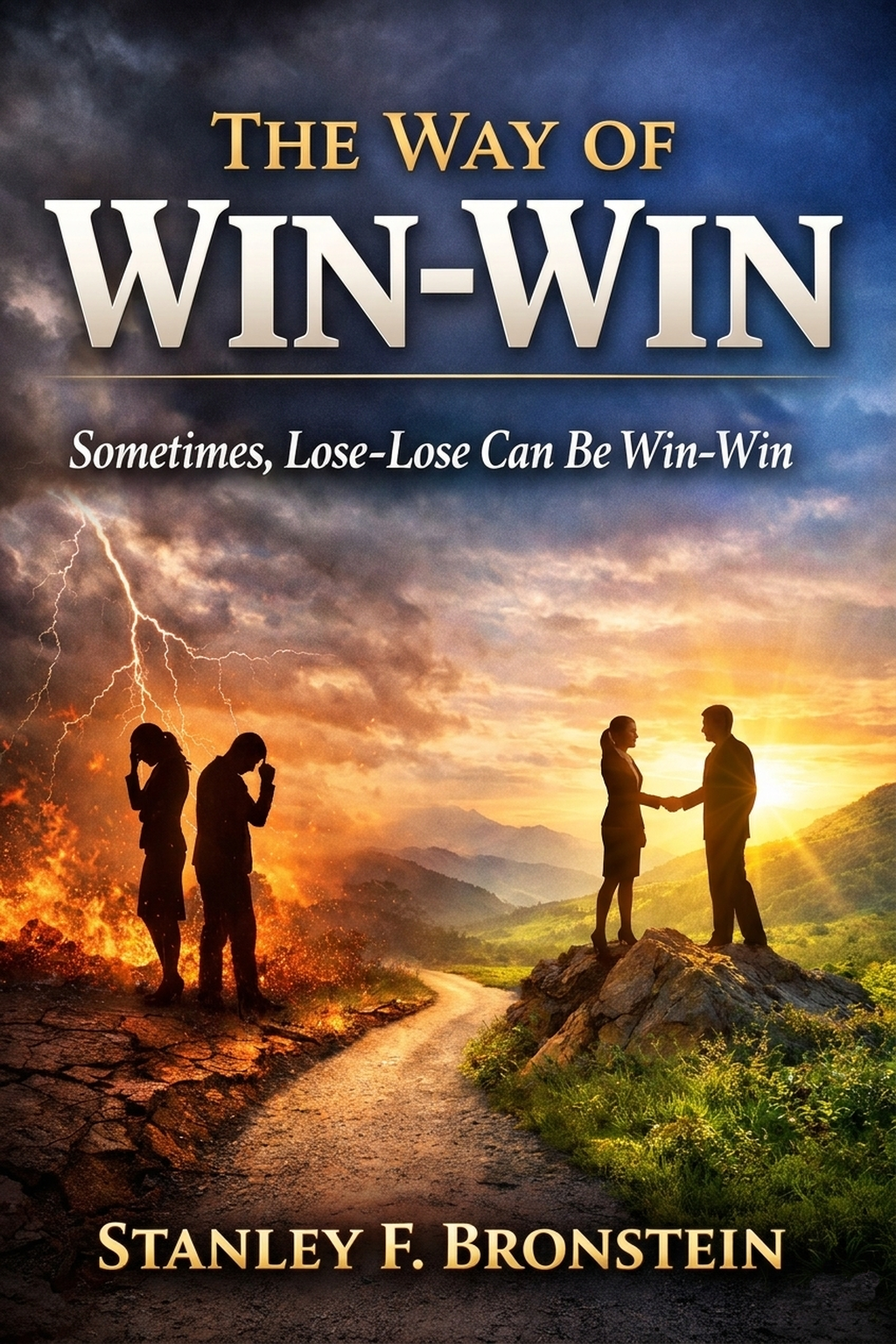
The Way of Win-Win
Sometimes,
Lose-Lose Can Be Win-Win
By Stanley F. Bronstein – Creator of The Way of Excellence System
Click The Tabs Below To Read Each Chapter Of The Book Online
Or
📘 Download Your Free Copy In Your Preferred Format
The Way of Win-Win
by Stanley F. Bronstein
How to use this page:
Click a chapter title to open it then scroll down to read.
When you click the title of the next chapter, the previous one will close.
Take your time.
Read, reflect, and do the experiments and assignments before you move on.
EMPTY ITEM
Foreword
This book is about one of the most important skills you can develop – learning to think Win-Win.
Most people do not actually live in Win-Win. They live in Win-Lose, Lose-Win, or Lose-Lose. They argue to win. They negotiate to win. They criticize to win. They keep score. They escalate. And then they act surprised when relationships break, deals fall apart, families fracture, teams underperform, and peace disappears.
Lose-Lose is everywhere. And it is expensive.
This book is written for people who want something better.
Not perfect. Better.
Win-Win Is Not Soft
Win-Win is not weakness. It is not being passive. It is not giving in. It is not pretending everything is fine. It is not “going along to get along.”
Win-Win is strength with discipline.
Win-Win is the ability to hold your position while still respecting the other person.
Win-Win is the ability to pursue what you want without needing to destroy someone else to get it.
That is why Win-Win requires respect. If you cannot respect someone, you will eventually try to defeat them. And once you move into defeat mode, you are no longer solving a problem – you are creating a future enemy.
Long-Term Thinking Creates Real Wins
The subtitle of this book is not a cute phrase. It is a reality:
Sometimes, Lose-Lose Can Be Win-Win.
How can that be true?
Because some of the most valuable outcomes in life require short-term sacrifice by both sides.
Sometimes both people give up something. Sometimes both people walk away with less than they wanted. Sometimes both sides have to surrender pride, comfort, control, speed, or certainty.
In the short-term, it can look like Lose-Lose.
But in the long-term, it can produce trust, peace, stability, health, freedom, and cooperation. It can prevent years of conflict. It can prevent lawsuits, divorces, broken partnerships, destroyed reputations, and endless stress.
Long-term thinking turns a temporary loss into a permanent win.
Respect Is The Foundation
Respect is not a bonus. It is the foundation.
Respect does not mean you agree. Respect means you recognize the humanity of the other person. It means you do not humiliate them. It means you do not treat them as disposable. It means you do not try to crush them just because you can.
If you want Win-Win, you must give respect first.
Win-Win is not built on cleverness. It is built on dignity.
Do Not Obliterate The Enemy
There is an old strategic idea that belongs in every modern relationship, every business negotiation, every family disagreement, and every conflict where the future still matters:
Win what you came to win – but do not create unnecessary destruction.
When you obliterate someone, you do not end conflict. You often delay it and intensify it.
You may win the moment, but you lose the future.
This book will show you how to pursue outcomes without creating permanent enemies. That single shift – from conquest to victory – is one of the most powerful changes a person can make.
Simplicity Makes Win-Win Possible
A Win-Win life must be simple enough to live.
Complicated solutions are fragile. They break under stress. They require constant maintenance. They depend on perfect behavior from imperfect people.
Simplicity is not laziness. It is clarity.
In this book, you will repeatedly be brought back to a standard that matters:
Choose the simplest solution that gets the job done – in an excellent manner.
When you combine Win-Win thinking with simplicity, something powerful happens. You stop performing. You stop posturing. You stop escalating. You stop trying to win every sentence.
You focus on what matters.
You solve the real problem.
You keep your life and relationships from turning into a constant repair project.
What This Book Will Do For You
This is a practical book. It is designed to be used.
You will learn how to:
-
Recognize when you are drifting into Win-Lose or Lose-Lose.
-
Redefine problems so new options appear.
-
Find alternatives that neither side can see while they are emotional.
-
Speak with strength and respect at the same time.
-
Protect dignity so agreements do not turn into resentment.
-
Use patience and time as strategic advantages.
-
Build trust by giving trust.
-
Make Win-Win a personal standard, not a situational tactic.
Most importantly, you will learn how to escape the trap of “being right” when being right costs too much.
A Final Word Before We Begin
Win-Win is not about making everyone happy.
Win-Win is about creating outcomes that work – and keep working.
It is about solving problems without breaking people.
It is about respect first, long-term always, and simplicity as the method.
Sometimes, the path to Win-Win requires both sides to give something up. That is not failure. That is maturity. That is discipline. That is excellence.
Let’s begin.
INTRODUCTION TO PART I - WHAT WIN-WIN REALLY MEANS
Most people believe they understand Win-Win.
They do not.
They think Win-Win is an attitude you put on when you want something.
They think it is a negotiation trick.
They think it is a polite way of saying, “Let’s split the difference.”
They think it is a soft version of conflict.
Win-Win is none of those things.
Win-Win is a way of thinking. It is a way of seeing. It is a way of living.
It is the decision to pursue what you want without needing someone else to lose for you to win.
It is the decision to solve the problem without crushing the person.
It is the decision to protect the future while you handle the present.
Part I lays the foundation for everything that comes next.
You are going to learn what Win-Win really means, why it matters, and why it is rarer than most people think.
You are also going to learn something that may challenge you at first.
Sometimes, Lose-Lose Can Be Win-Win.
That sentence is not saying you should accept bad outcomes. It is saying that some of the most valuable outcomes require sacrifice by both sides.
In a short-term mindset, sacrifice looks like losing.
In a long-term mindset, sacrifice can be the price of peace, trust, and stability.
That is why Long-Term Thinking is essential. If you cannot think long-term, you will not have the patience to build real Win-Win outcomes. You will grab for the immediate win, even when that win creates future cost.
Respect is equally essential. Respect is the bridge between disagreement and cooperation.
When respect is missing, every disagreement becomes personal.
When respect is present, disagreement can remain productive.
Respect is also what prevents you from doing unnecessary damage when you have leverage. If you humiliate people, corner them, or try to obliterate them, you may win today, but you are building resistance tomorrow.
The goal is victory, not conquest.
This is where simplicity matters.
Win-Win does not need to be complicated. In fact, complicated agreements often fail because they are difficult to live and hard to maintain. A good Win-Win solution is usually clear, direct, and stable.
The simplest solution that gets the job done – in an excellent manner – is often the best solution.
In Part I, you will build the mental framework that makes Win-Win possible:
-
You will define Win-Win as a personal standard.
-
You will see the real cost of Lose-Lose.
-
You will learn why respect is the starting line.
-
You will understand why long-term thinking changes everything.
-
You will adopt a strategic approach that seeks victory without creating permanent enemies.
This is not theory. It is practical. It is usable. It is meant to improve your life immediately.
The goal of Part I is simple.
By the time you finish it, you will know what Win-Win actually is, what it is not, and why it is one of the most powerful ideas you can ever apply.
Let’s begin with the first step.
Win-Win is a way of thinking.
Chapter 1: Win-Win Is A Way Of Thinking
Win-Win is not a tactic.
It is not something you turn on when you want a deal to go your way.
It is not a smile, a handshake, and a polite phrase.
Win-Win is a way of thinking.
It is a standard you bring to every relationship, every negotiation, every disagreement, and every decision where other people are involved.
When you think Win-Win, you start with a simple belief:
I can pursue what I want without needing you to lose for me to win.
That belief changes everything.
It changes how you listen.
It changes what you say.
It changes what you ask for.
It changes what you are willing to give.
It changes how you handle conflict.
It changes the kind of person you become.
Most People Do Not Think Win-Win
Most people think in one of three patterns:
Win-Lose
This is conquest thinking. It is dominance. It is control. It is humiliation disguised as “strength.” The objective is not to solve the problem. The objective is to defeat the other person.
Win-Lose thinking creates enemies, resentment, and revenge.
It wins the moment and risks losing the future.
Lose-Win
This is surrender thinking. It is people-pleasing. It is avoiding conflict by giving up. It is agreeing to things you do not agree with because you do not want discomfort.
Lose-Win thinking might avoid short-term pain, but it creates long-term bitterness, passive aggression, and quiet withdrawal.
It looks peaceful. It is not.
Lose-Lose
This is collision thinking. It is escalation. It is ego. It is the refusal to step back. It is “If I do not get what I want, you will not either.”
Lose-Lose thinking is common because it feels fair to people who are angry.
It is also one of the most expensive mindsets on Earth.
Win-Win is different.
Win-Win is the refusal to play those games.
Win-Win is the search for a better alternative.
Win-Win Begins With Respect
You cannot think Win-Win if you do not respect people.
If you see people as objects, obstacles, or enemies, Win-Win becomes impossible. Even if you pretend to be cooperative, your real goal will leak through your words, your tone, and your behavior.
Respect does not mean agreement.
Respect means dignity.
Respect means you do not humiliate.
Respect means you do not corner someone and then act shocked when they become hostile.
Respect means you want the problem solved without damaging the person.
If you want Win-Win, respect is the starting line.
Win-Win Requires Long-Term Thinking
Win-Win is not always the fastest path.
Win-Lose often feels faster because it is force.
Lose-Win often feels faster because it is surrender.
Lose-Lose often happens fast because it is emotional.
Win-Win can take longer because it requires thought, patience, and discipline.
That is why long-term thinking is essential.
If you only care about the immediate moment, you will be tempted to “win” in ways that damage the relationship, damage your reputation, damage trust, and damage the future.
Long-term thinking asks a different question:
What outcome do I want one year from now?
What kind of relationship do I want after this is over?
What costs am I creating for later?
Win-Win protects the future while you handle the present.
Win-Win Is Not Perfect
Win-Win is not fantasy.
It is not “everyone gets everything they want.”
Sometimes Win-Win is simply the best achievable outcome, with both sides leaving with dignity and stability.
Sometimes the only path to true Win-Win requires both sides to give up something. In the short-term, that can look like Lose-Lose.
But if both sides sacrifice in a way that protects the relationship, protects trust, and prevents future conflict, the long-term result can be a genuine win for both.
This is why the subtitle of this book is true:
Sometimes, Lose-Lose Can Be Win-Win.
Simplicity Is Part Of Win-Win
A real Win-Win solution is usually simple enough to live.
Complicated solutions are fragile. They rely on perfect behavior from imperfect people. They require constant maintenance. They create loopholes and misunderstandings.
Simplicity keeps agreements stable.
Simplicity keeps solutions repeatable.
Simplicity keeps relationships from becoming constant repair projects.
As a standard, you want this:
Choose the simplest solution that gets the job done – in an excellent manner.
Win-Win does not need to be clever. It needs to work.
A Practical Definition You Can Use
Here is a simple working definition:
Win-Win means I will pursue what I want in a way that respects you, protects the future, and searches for an alternative that works for both of us.
Notice what is inside that definition:
-
Respect
-
Long-term thinking
-
Alternatives
-
Practical outcomes
Win-Win is not a mood. It is a method.
How Win-Win Looks In Real Life
Win-Win shows up as decisions like these:
-
I will be direct, but I will not be disrespectful.
-
I will defend my interests, but I will not try to destroy yours.
-
I will ask hard questions, but I will not attack your character.
-
I will seek a solution, not a victory parade.
-
I will leave you a path to agreement, not a corner to die in.
-
I will aim for results that keep working, not wins that create revenge.
This is not weakness.
This is discipline.
This is maturity.
This is excellence.
Win-Win is a way of thinking.
And once you adopt it as a standard, you will start seeing alternatives you did not see before.
You will start solving problems that used to trap you.
You will start building relationships that are stronger, calmer, and more productive.
You will start winning without making enemies.
That is the power of Win-Win.
Assignment: Your Win-Win Definition
The purpose of this assignment is to help you turn Win-Win from a vague idea into a personal standard you can use.
Step 1 – Write your definition
In one to three sentences, write your personal definition of Win-Win.
Use the three anchors from this chapter: respect, long-term thinking, and alternatives.
Step 2 – Identify your default pattern
When conflict shows up, which pattern do you drift into most often – Win-Lose, Lose-Win, or Lose-Lose?
Write one example from your life where this pattern showed up.
Step 3 – Rewrite the moment
Take that example and write a short paragraph describing how you would have handled it using Win-Win thinking.
Focus on what you would say, what you would ask for, and what outcome you would seek.
Step 4 – Choose one Win-Win standard
Write one clear sentence you will use as a personal rule going forward. Examples:
-
“I will seek a solution, not a conquest.”
-
“I will protect the future while handling the present.”
-
“I will give respect first.”
Reflection Question
What is one relationship or situation in your life that would immediately improve if you consistently thought Win-Win?
Chapter 2: Lose-Lose And The Hidden Cost Of Being Right
Lose-Lose rarely starts as a plan.
It usually starts as a reaction.
Someone says something that feels unfair.
Someone takes a tone that feels disrespectful.
Someone threatens your interests.
Someone pushes a button.
And in that moment, the focus shifts.
It stops being about the problem.
It becomes about being right.
It becomes about not letting them “get away with it.”
It becomes about winning the moment.
That is how Lose-Lose begins.
Lose-Lose is not just a bad outcome. It is a mindset. It is the belief that if you do not get what you want, the other person should not get what they want either.
It is the emotional logic of escalation.
And once escalation begins, both sides start paying.
The Moment You Choose Being Right, You Usually Give Up Something Bigger
Being right feels good in the short term.
It feels like control.
It feels like self-protection.
It feels like strength.
But there is a hidden cost.
When you prioritize being right over resolving the issue, you often sacrifice one or more of the following:
-
trust
-
peace
-
momentum
-
time
-
reputation
-
relationships
-
health
-
long-term opportunity
Most people do not see the cost while it is happening, because the emotion of the moment is loud.
But the bill always arrives.
Lose-Lose Has A Pattern
Lose-Lose tends to follow a predictable sequence.
Step 1 – Interpretation
You interpret the other person’s behavior as an attack. Sometimes it is. Sometimes it is not. But your nervous system hears “danger.”
Step 2 – Defense
You defend. You justify. You push back. You raise your tone. You sharpen your words.
Step 3 – Escalation
They defend. They justify. They push back. They raise their tone. They sharpen their words.
Step 4 – Identity
Now it becomes personal. It is not “this issue.” It is “you always do this.” It is “this is who you are.” The conflict spreads.
Step 5 – Damage
People say things they cannot unsay. They do things they cannot undo. They win a point and lose a person.
That is Lose-Lose.
The Hidden Cost Is Often Pride
Pride is not confidence. Pride is the inability to back down without feeling smaller.
Pride is the need to prove something.
Pride makes the moment more important than the outcome.
Pride makes the argument more important than the relationship.
Pride is the reason people would rather be right than be free.
Lose-Lose is often pride dressed up as principle.
That does not mean principles do not matter. They do.
But if you cannot protect your principles while staying respectful, you are not being principled. You are being reactive.
Win-Win requires discipline.
Lose-Lose requires only ego.
Why Lose-Lose Feels Fair
Lose-Lose has emotional appeal.
It feels fair because it feels like punishment.
“If I am suffering, you should suffer too.”
It feels like justice.
“If you hurt me, I will hurt you back.”
It feels like strength.
“I am not going to let you win.”
But the emotional logic is short-term. It ignores the future.
That is why long-term thinking is the antidote.
Long-term thinking asks:
What happens after I “win” this moment?
What happens to the relationship?
What happens to the deal?
What happens to trust?
What happens to my peace?
Respect Changes The Trajectory
Respect is not a polite extra.
Respect is a strategic advantage.
Respect keeps the conflict about the issue instead of turning it into a war.
Respect prevents humiliation, and humiliation is one of the fastest ways to create a permanent enemy.
If you want to avoid Lose-Lose, you must protect dignity – theirs and yours.
That does not mean you tolerate bad behavior.
It means you do not respond with the same bad behavior.
It means you do not become what you dislike.
Do Not Obliterate The Enemy
Sometimes you have leverage.
Sometimes you have the upper hand.
Sometimes you could crush the other side.
The temptation in those moments is to go for total victory.
But total victory often creates long-term problems.
When you humiliate someone, corner them, or destroy them, you do not end conflict. You often plant the seeds of future conflict.
You may win today, but you lose the future.
This is why disciplined strength matters.
Seek victory, not conquest.
Win what you came to win, but do not create unnecessary destruction.
Simplicity Helps You Avoid Lose-Lose
Lose-Lose often becomes complicated.
More words. More arguments. More emails. More texts. More explanations. More defenses. More accusations.
Complexity becomes a hiding place. It keeps you in motion without solving anything.
Simplicity pulls you back to what matters.
The simplest question is often the best one:
What is the real problem we are trying to solve?
When you can answer that honestly, you often see a clean path forward.
The Win-Win Alternative
The purpose of this chapter is not to shame you. Everyone drifts into Lose-Lose at times.
The purpose is to help you recognize the moment it starts, so you can stop it early.
The earlier you interrupt Lose-Lose, the cheaper it is.
Lose-Lose is expensive.
Win-Win is profitable – not just in money, but in peace, trust, reputation, and relationships.
Assignment: The Cost Of Being Right Audit
The purpose of this assignment is to make the hidden cost visible, so you can change your default behavior.
Step 1 – Identify one recurring conflict
Choose one situation in your life where conflict shows up repeatedly.
This can be with a spouse, family member, friend, business partner, coworker, client, neighbor, or anyone else.
Step 2 – Write what “being right” looks like
In 3 to 6 sentences, describe how you usually act when you feel you are right.
Be honest. This is private.
Step 3 – List the costs
Write a list of at least five costs you have paid because of this pattern.
Examples: lost time, stress, damaged trust, sleep loss, lingering resentment, missed opportunities, awkwardness, money.
Step 4 – Choose the bigger outcome
Write one sentence answering this question:
What do I want more than being right?
Examples:
-
“I want peace.”
-
“I want a stable relationship.”
-
“I want a solution that lasts.”
-
“I want respect on both sides.”
-
“I want to protect my health and energy.”
Step 5 – Create a simple interruption phrase
Write one sentence you will use to interrupt yourself when you feel escalation beginning. Examples:
-
“Pause. What is the real problem?”
-
“This is not about winning. This is about solving.”
-
“Protect the future.”
-
“Respect first.”
Reflection Question
What would change in your life if you stopped paying the price of “being right” in situations that do not deserve that cost?
Chapter 3: Respect Is The Starting Line
If you want Win-Win, you must start with respect.
Not after you get what you want.
Not after the other person proves they deserve it.
Not after they calm down, apologize, or change their tone.
Respect is the starting line.
Without respect, Win-Win becomes impossible. You can say the words, but you will not mean them. And even if you try to mean them, your behavior will eventually reveal what you actually believe.
Respect is not a tactic. It is a standard.
It is the decision to treat people as human beings, even when you disagree with them, even when they disappoint you, even when they are difficult, and even when you have leverage.
Respect Is Not Agreement
Many people reject respect because they confuse it with agreement.
Respect does not mean you approve.
Respect does not mean you accept bad behavior.
Respect does not mean you surrender your boundaries.
Respect means you keep the conversation clean.
Respect means you protect dignity.
Respect means you do not treat a disagreement like a license to humiliate.
You can be firm and respectful at the same time.
In fact, the most effective firmness is respectful firmness.
Respect Lowers The Temperature
Conflict becomes destructive when it overheats.
When people feel disrespected, their nervous system moves into defense.
They stop listening.
They stop thinking clearly.
They start preparing to attack.
Respect lowers the temperature.
It keeps the issue in focus.
It turns down the noise of ego and fear.
Respect does not guarantee agreement, but it increases the chance of it. Even more importantly, it reduces the likelihood of escalation.
Respect is one of the simplest ways to prevent Lose-Lose.
Respect Prevents You From Creating A Permanent Enemy
Sometimes you will have leverage.
You will be right.
You will have evidence.
You will have authority.
You will have the ability to press hard and win hard.
That is exactly when respect matters most.
When you crush someone, you do not just defeat them. You damage the future.
You create humiliation, resentment, and a desire for payback.
A person who has been humiliated may comply, but they will not cooperate.
They may sign, but they will not support.
They may say yes, but they will quietly work against you later.
The goal is victory, not conquest.
Respect helps you win without creating an enemy.
Respect Is A Form Of Strength
Respect is often misunderstood as softness.
It is not.
It takes strength to control yourself.
It takes strength to stay calm when you feel provoked.
It takes strength to remain courteous when someone is not.
It takes strength to keep your standards without turning into a bully.
Anyone can react.
Anyone can lash out.
Anyone can throw a verbal punch.
Respect is what you do when you are strong enough to stay disciplined.
Respect Creates The Conditions For Alternatives
Win-Win is built on alternatives.
You cannot find alternatives when people are defensive, embarrassed, or angry.
Respect creates psychological safety.
Psychological safety allows honesty.
Honesty allows creativity.
Creativity produces alternatives.
This is one of the hidden engines of Win-Win. The better you are at respect, the more likely you are to discover a third option that neither side saw at the beginning.
When respect is present, the conversation becomes solvable.
When respect is missing, the conversation becomes a contest.
Respect Is Also Self-Respect
This chapter is not only about how you treat other people.
It is also about how you treat yourself.
When you act with respect, you protect your own identity.
You can walk away from difficult conversations without shame.
You can look back later and know you did the right thing.
You can be proud of your behavior, even if the outcome was not perfect.
Self-respect is a form of inner stability.
And inner stability is a major part of long-term success.
Simplicity And Respect Go Together
Respect also creates simplicity.
Disrespect creates complexity.
Disrespect creates more arguments, more emails, more explanations, more defensive behavior, more meetings, more rules, more paperwork, more “proof,” and more enforcement.
Respect reduces friction.
When friction is low, things work.
When friction is high, everything becomes a battle.
If you want simple solutions that last, respect must be part of the system.
Respect is often the simplest strategy in the room, and one of the most powerful.
How To Practice Respect In Real Time
Respect is not just a belief. It is a set of behaviors.
Here are some practical ways to show respect during disagreement:
-
Speak to the issue, not the person.
-
Ask questions before you make accusations.
-
State what you want clearly, without insults.
-
Do not interrupt.
-
Do not mock.
-
Do not use sarcasm as a weapon.
-
Do not threaten unless you are prepared to follow through.
-
Avoid absolute language like always and never.
-
Admit what you did wrong quickly.
-
Protect the other person’s dignity, especially in front of others.
These are simple. They are not easy.
But they are learnable.
And they change your results.
Respect First Is A Life Standard
When you adopt respect as a starting point, you gain a powerful advantage.
You become harder to manipulate.
You become harder to provoke.
You become more persuasive.
You become more stable.
You become more effective.
You become a person who can resolve conflict without creating unnecessary damage.
And that is exactly what Win-Win requires.
Respect is the starting line.
Everything else in this book builds on that.
Assignment: Respect First Practice
The purpose of this assignment is to help you make respect a repeatable habit, especially in moments when it is difficult.
Step 1 – Choose one relationship or situation
Pick one person or situation where disrespect, tension, or friction shows up often.
Step 2 – Identify your respect leaks
Write down 3 ways you tend to leak disrespect when you feel stressed. Examples:
-
interrupting
-
raising your voice
-
sarcasm
-
making assumptions
-
trying to win by embarrassing the other person
-
keeping score
Step 3 – Write a respectful opening line
Write one opening line you can use the next time conflict starts. Examples:
-
“I want to solve this with you.”
-
“I respect you, and I want us to handle this in a good way.”
-
“Let’s keep this focused on the issue.”
Make it sound like you.
Step 4 – Choose one respect behavior
Pick one behavior you will practice for the next seven days in any disagreement. Examples:
-
ask one question before making a statement
-
pause for three seconds before responding
-
do not interrupt
-
lower your volume
-
restate their point before stating yours
Write it down as a single sentence.
Step 5 – Use the dignity rule
Before you speak in a tense moment, ask yourself:
“Will what I am about to say protect dignity, or damage it?”
If it will damage dignity, rewrite it.
Reflection Question
Where in your life would Win-Win become easier immediately if you gave respect first, even when you did not feel like it?
Chapter 4: Long-Term Thinking Changes Everything
Win-Win is not built in the moment.
It is built across time.
That is why long-term thinking changes everything.
Most people live in short-term thinking by default. They react to what they feel. They chase immediate relief. They seek quick wins. They want the argument to end, the discomfort to stop, and the other person to give in.
Short-term thinking creates short-term behavior.
Short-term behavior often creates long-term problems.
Win-Win requires a different mindset.
It requires you to think beyond the moment you are in and into the future you are creating.
Short-Term Wins Often Create Long-Term Costs
A short-term win can feel powerful.
You get your way.
You prove your point.
You win the argument.
You make them look wrong.
You force the outcome.
But then the cost arrives.
Trust decreases.
Respect decreases.
Cooperation decreases.
Resistance increases.
Relationships become tense.
The next negotiation becomes harder.
The next conflict starts with baggage.
You might win today and lose tomorrow.
Long-term thinking prevents you from celebrating victories that damage the future.
It keeps you from winning the moment and losing the relationship.
Long-Term Thinking Asks Better Questions
When you are emotional, you ask one question:
How do I win this?
Long-term thinking asks a better set of questions:
What outcome do I want one year from now?
How do I want this relationship to look after this is over?
What is the simplest solution that will still work six months from now?
What is the cost of escalation?
What will this conflict turn into if I handle it poorly?
What am I teaching the other person to expect from me?
These questions pull you out of reactive behavior and into strategic behavior.
Win-Win is strategic behavior.
Sometimes, Lose-Lose Can Be Win-Win
Here is the idea that sits at the heart of this book.
Sometimes, a situation looks like Lose-Lose in the short term because both sides must give something up.
Both sides compromise.
Both sides accept discomfort.
Both sides let go of pride.
Both sides accept less than perfect.
Both sides choose restraint.
In the moment, it can feel like a loss.
But if those short-term concessions prevent future damage, prevent escalation, preserve trust, and keep the relationship intact, the long-term result can be a true win for both.
This is not weakness.
This is maturity.
This is long-term thinking.
A Win-Win life is built by people who are willing to trade what they want now for what they want most.
The Best Long-Term Wins Usually Require Restraint
There is a reason disciplined people outperform emotional people over time.
Discipline creates stability.
Stability creates trust.
Trust creates opportunity.
One of the most important forms of discipline in Win-Win is restraint.
Restraint means you do not overreact.
Restraint means you do not punish when you could.
Restraint means you do not humiliate.
Restraint means you do not try to obliterate the other person.
Restraint is strength under control.
If the future matters, restraint is often the smartest move you can make.
Seek victory, not conquest.
Long-Term Thinking Makes Simplicity Possible
Short-term thinking often produces complicated solutions.
People add rules.
People add conditions.
People add paragraphs.
People add threats.
People add meetings.
People add endless explanations.
They do it because they do not trust the other person, and they do not trust the future.
Long-term thinking allows you to simplify.
It pushes you to choose solutions that are stable, clear, and sustainable.
A simple agreement that works is better than a complicated agreement that collapses.
A simple habit that is repeatable is better than an elaborate plan that never gets executed.
Simplicity is not about doing less.
It is about doing what matters, in an excellent manner, without unnecessary complexity.
Long-Term Thinking Helps You See The Real Objective
In conflict, people often confuse the objective.
They think the objective is to win the argument.
They think the objective is to make the other person admit they were wrong.
They think the objective is to dominate.
Long-term thinking clarifies the objective.
The real objective is usually one of these:
-
solve the problem
-
protect the relationship
-
protect trust
-
protect peace
-
protect your time and energy
-
protect your reputation
-
create a workable agreement
-
prevent future conflict
Once you know the real objective, Win-Win becomes easier.
Because you stop wasting time fighting for things that do not matter.
The Long-Term Advantage Of Respect
Respect is not only moral. It is practical.
Respect creates a better future.
When people feel respected, they are more likely to cooperate.
When people feel respected, they are more likely to be honest.
When people feel respected, they are more likely to accept a compromise.
When people feel respected, they are more likely to stay engaged for the long term.
Disrespect creates short-term drama and long-term damage.
Respect creates short-term calm and long-term results.
A Simple Long-Term Rule To Live By
Here is a rule you can use in almost any conflict:
Protect the future while handling the present.
That one sentence will change how you speak.
It will change what you ask for.
It will change what you are willing to tolerate.
It will change what you are willing to sacrifice.
It will change the kind of outcomes you create.
Win-Win is not just about today.
It is about the life you are building.
Long-term thinking changes everything.
Assignment: Trade Now For Later Map
The purpose of this assignment is to help you see where you are choosing short-term relief over long-term results, and to replace that habit with long-term thinking.
Step 1 – Choose one active situation
Pick one current conflict, negotiation, or tension in your life.
Something real, not theoretical.
Step 2 – Write the short-term win you want
In one sentence, write what you want right now.
Examples: “I want them to admit they were wrong.” “I want this to end today.” “I want to get my way.”
Step 3 – Identify the long-term outcome you want most
In one sentence, write what you want most over the next year.
Examples: “I want a stable relationship.” “I want trust.” “I want a deal that lasts.” “I want peace.”
Step 4 – List the trade options
Write three possible actions you could take next.
For each one, write the likely long-term consequence.
Option A:
Option B:
Option C:
Do not worry about being perfect. This is about clarity.
Step 5 – Choose the disciplined move
Pick the action that best protects the long-term outcome, even if it costs you something in the short term.
Write your choice as a single sentence:
“I choose to do _______ because I want _______ long-term.”
Reflection Question
Where in your life are you trying to win the moment at the expense of the future – and what would change if you reversed that pattern?
Chapter 5: The First Move - Seek Victory - Not Conquest
The first move in Win-Win is not a sentence.
It is not a technique.
It is not a clever negotiation strategy.
The first move is a decision.
You decide what you are trying to do.
Are you trying to solve the problem?
Or are you trying to destroy the person?
That distinction is the difference between victory and conquest.
Victory is winning the objective.
Conquest is obliterating the other side.
Win-Win requires victory.
Win-Lose and Lose-Lose drift toward conquest.
Conquest Creates Long-Term Problems
Conquest can feel satisfying.
You press hard.
You prove your power.
You make them submit.
You leave no doubt who won.
But conquest has a hidden cost.
Conquest creates humiliation.
Humiliation creates resentment.
Resentment creates revenge, even if it takes time.
You may win the moment, but you increase the chance of future conflict.
You create a permanent enemy.
If you want a peaceful future, conquest is a poor strategy.
Long-term thinking sees that clearly.
Victory Is A Higher Standard
Victory is different.
Victory is the disciplined pursuit of the outcome you want without unnecessary damage.
Victory focuses on results.
Victory focuses on the real objective.
Victory protects the future.
Victory keeps the door open to cooperation.
Victory leaves a path for the other side to step into agreement without losing their dignity.
Victory is strong.
It is also controlled.
That control is what makes it excellent.
Respect Is The Boundary Line
Respect is what keeps victory from turning into conquest.
Respect says:
I will be firm, but I will not humiliate you.
I will protect my interests, but I will not destroy yours just because I can.
I will pursue what I want, but I will not turn you into my enemy.
Respect does not mean you accept unacceptable behavior.
Respect means you remain disciplined.
Respect means you do not lower your standards.
Respect means you do not become careless with power.
The Most Dangerous Moment Is When You Have Leverage
When you have leverage, you have options.
You can be fair.
You can be disciplined.
Or you can be destructive.
This is where people reveal their character.
When people are weak, they may behave well because they have no choice.
When people have leverage, they show what is inside.
Win-Win requires you to handle leverage with discipline.
If you use leverage to crush, you will be paid back later.
If you use leverage to solve, you build trust.
Trust is one of the most profitable long-term assets you can own.
Simplicity Matters In Conflict
In tense situations, people overcomplicate.
They talk too much.
They write long messages.
They stack arguments.
They add threats.
They add conditions.
They add extra demands because they are emotional, not because they are necessary.
Simplicity is a form of strength.
Simplicity says:
Here is the issue.
Here is what I need.
Here is what I can offer.
Here is what happens next.
A simple, clear position creates more respect than a complicated emotional performance.
A simple solution that works is better than an elaborate solution that collapses.
Victory Requires Clarity About The Objective
You cannot seek victory if you are unclear about what you actually want.
Many conflicts drag on because the objective keeps changing.
First it is about the issue.
Then it is about tone.
Then it is about respect.
Then it is about the past.
Then it is about who started it.
Then it is about who is more at fault.
Then it becomes a contest.
If you want to avoid conquest, you must keep returning to one question:
What is the real objective?
When you know the objective, you can pursue it directly.
That is Win-Win thinking.
A Simple Victory Checklist
Here is a checklist you can use in real time:
-
What do I want as an outcome?
-
What is the simplest path to that outcome?
-
How do I protect dignity while being firm?
-
How do I avoid creating a permanent enemy?
-
What would this look like if I cared about the long-term future?
If you can answer those questions, you are thinking strategically.
You are seeking victory, not conquest.
Sometimes Victory Looks Like Giving Something Up
This is where your subtitle shows up again.
Sometimes victory is not getting everything you want.
Sometimes victory is ending a conflict cleanly.
Sometimes victory is leaving with dignity.
Sometimes victory is accepting a short-term compromise to prevent long-term damage.
Sometimes both sides give something up.
In the short term, it can look like Lose-Lose.
But in the long term, it becomes Win-Win because the future is protected.
Victory is not always dramatic.
Sometimes the best victory is quiet.
It is simply the outcome that keeps working.
The Way Of Win-Win Starts Here
Everything in this book builds on this principle.
If you can learn to seek victory without conquest, you will improve your outcomes in every area of life:
-
relationships
-
business
-
leadership
-
negotiation
-
family
-
friendships
-
community
The first move is deciding that you do not need to destroy people to succeed.
You need to win what matters.
You need to protect the future.
You need to stay respectful.
You need to keep it simple.
That is excellence.
That is Win-Win.
Assignment: Victory Statement Rewrite
The purpose of this assignment is to help you clarify what you really want, and to replace conquest language with victory language.
Step 1 – Choose one conflict or negotiation
Pick one current or recent conflict. Something specific.
Step 2 – Write your conquest statement
Write one sentence that reflects what you want when you are emotional. Examples:
-
“I want to crush this.”
-
“I want them to pay.”
-
“I want to prove they are wrong.”
-
“I want to show them who is in charge.”
Be honest. This is private.
Step 3 – Write your victory statement
Now rewrite it as a victory objective that protects the future. Examples:
-
“I want this resolved in a way that prevents future problems.”
-
“I want a fair agreement that works long-term.”
-
“I want clear boundaries and mutual respect.”
-
“I want the simplest solution that gets the job done.”
Write your victory statement in one sentence.
Step 4 – Identify the dignity rule
Write one sentence describing how you will protect dignity while pursuing victory. Examples:
-
“I will be firm without humiliating.”
-
“I will keep the focus on the issue, not the person.”
-
“I will not corner them. I will leave a path to agreement.”
Step 5 – Choose one simple next action
Write the simplest next action you can take that moves toward victory. Examples:
-
ask one clear question
-
propose one clean alternative
-
request a short meeting
-
write a short message
-
pause and wait
Reflection Question
Where in your life do you tend to pursue conquest instead of victory – and what would change if you made victory your standard?
INTRODUCTION TO PART II - THE WIN-WIN TOOLKIT
By now, you understand the foundation.
Win-Win is a way of thinking.
Respect is the starting line.
Long-term thinking protects the future.
Victory matters. Conquest creates enemies.
Simplicity keeps solutions stable.
Now it is time to get practical.
Part II is the toolkit.
This is where Win-Win moves from a philosophy to a repeatable method.
A lot of people say they want Win-Win, but when conflict shows up, they do not know what to do next. They either push, surrender, or escalate. They drift into the habits they have always had.
Tools prevent drift.
Tools give you a structure you can rely on when emotions are high.
Win-Win is not about being inspirational. It is about being effective.
Part II will give you a set of skills that work across almost any situation:
-
a business negotiation
-
a family disagreement
-
a leadership issue
-
a conflict with a neighbor
-
a partnership problem
-
a personal boundary conversation
These tools are simple, but they are powerful.
They work because they are built on reality, not wishful thinking.
Tool #1 – Redefine The Problem
Many conflicts stay stuck because people are solving the wrong problem.
They argue about positions instead of interests.
They fight about the surface issue while ignoring the real issue underneath.
When you redefine the problem accurately, new solutions appear.
Sometimes the conflict disappears because you realize you were never truly in conflict at all.
Tool #2 – The Law Of Alternatives
Win-Win almost always requires alternatives.
When people feel trapped between two bad choices, they become emotional. They either fight or freeze.
The Law Of Alternatives is the habit of asking:
What else could work?
When the road splits in two, take the third path.
This is not optimism. This is disciplined creativity.
Tool #3 – Fix The Problem, Not The Blame
Blame feels satisfying.
It also keeps problems unsolved.
Blame creates defensiveness, and defensiveness kills cooperation.
If you want to resolve conflict, your focus must be on the problem and the solution, not on punishment.
Win-Win is not built by proving fault. It is built by creating outcomes.
Tool #4 – Use Soft Words And Hard Arguments
Strength does not require disrespect.
Clarity does not require aggression.
In this book, you will learn how to be direct, firm, and persuasive without turning conversations into wars.
This is respectful strength.
This is how you protect dignity while still protecting your interests.
Tool #5 – Listening Creates Leverage
Most people think talking creates leverage.
It does not.
Listening creates leverage.
When you truly understand the other person’s interests, you can solve the real problem. You can propose solutions that land. You can remove resistance without force.
Communication is not enough.
Comprehension is the goal.
Why This Toolkit Works
This toolkit works because it is built on the three Concepts driving this book.
It is Win-Win thinking in action.
It is Long-Term Thinking applied to real decisions.
It is Respect expressed through disciplined behavior.
And it is built around simplicity.
These tools are not complicated. They are meant to be used.
If you have to memorize something complex to do Win-Win, you will not do it when you are stressed.
Simplicity matters because stress is real and emotions are real.
The point is to create a method you can return to again and again.
A method that works when you are tired.
A method that works when you are frustrated.
A method that works when you are disappointed.
A method that works when you have leverage.
A method that works when you do not.
That is what Part II will give you.
The goal is not to become a perfect communicator.
The goal is to become a person who can consistently create better outcomes.
Let’s begin with the first tool.
Redefine the problem.
Chapter 6: Redefine The Problem
Most conflicts stay stuck for one simple reason.
People are arguing about the wrong problem.
They are fighting over positions instead of interests.
They are debating details instead of clarifying objectives.
They are reacting to tone instead of addressing substance.
They are trying to win a moment instead of solving a situation.
Win-Win requires a skill that is both simple and powerful.
Redefine the problem.
When you redefine the problem accurately, the entire conversation changes. New options appear. Emotions cool down. People become more reasonable. And sometimes, what looked like a serious conflict turns out to be a misunderstanding that only needed clarity.
Why Problems Stay Unsolved
A problem stays unsolved when people keep repeating the same arguments.
You have heard it before:
-
“Yes, but…”
-
“That’s not the point.”
-
“You’re not listening.”
-
“You always do this.”
-
“We already tried that.”
When you hear those phrases, it is often a sign the real problem is still unclear.
People are speaking from their own perspective, but they have not defined the shared problem in a way both sides can accept.
If you cannot define the problem together, you cannot solve it together.
The Difference Between Positions And Interests
A position is what someone says they want.
An interest is why they want it.
Positions collide.
Interests create room.
Here is a simple example.
Position: “I need you to stop doing that.”
Interest: “I need to feel respected and safe.”
Position: “I need a lower price.”
Interest: “I need to reduce risk.”
Position: “I want you to admit you were wrong.”
Interest: “I need accountability, and I do not want this to happen again.”
When you focus on positions, you get tug-of-war.
When you focus on interests, you get options.
Redefining the problem often means shifting from positions to interests.
The Real Problem Is Often Emotional, Not Logical
Many conflicts look logical on the surface, but the engine underneath is emotional.
People are not only trying to solve an issue. They are trying to protect dignity.
They are trying to avoid feeling powerless.
They are trying to avoid being embarrassed.
They are trying to prevent a repeat of an old pattern.
That is why respect matters here.
When people feel respected, they can talk about the real issue without feeling threatened.
When people feel disrespected, they will fight about the surface issue while guarding the deeper issue.
Redefining the problem is not just a mental skill. It is also a respect skill.
The Simplicity Filter
One of the best ways to redefine a problem is to simplify it.
Conflict creates mental clutter.
People add extra issues.
They bring in the past.
They pile on unrelated grievances.
They start using long speeches to justify themselves.
Simplicity cuts through that.
Ask a simple question:
What is the real problem we are trying to solve?
Then ask a second simple question:
What would a simple solution look like if we cared about the long term?
If the solution requires constant maintenance, constant policing, or perfect behavior from imperfect people, it is probably not the right solution.
A simple solution that works is better than a complicated solution that collapses.
Redefine The Problem Without Creating An Enemy
Sometimes the conflict feels intense because the other person has been cast as an enemy.
Once you do that, your brain stops looking for solutions and starts looking for weapons.
This is where the discipline of victory matters.
Seek victory, not conquest.
When you redefine the problem, you are making a decision to solve without destroying.
You are saying:
“I want a result. I do not want a war.”
That decision alone changes your tone, your questions, and your next move.
Three Powerful Redefinitions
Here are three redefinitions that unlock Win-Win quickly.
Redefinition 1 – From “Who is wrong?” to “What needs to be true going forward?”
This moves you out of blame and into design.
Redefinition 2 – From “What do I demand?” to “What do we both need?”
This forces you to identify interests instead of ultimatums.
Redefinition 3 – From “How do I win?” to “How do we solve this without creating future problems?”
This is long-term thinking in action.
Each redefinition shifts the conversation away from collision and toward cooperation.
A Simple Method You Can Use Immediately
When you feel conflict building, do this:
-
State the shared goal, even if it is small.
-
Name the problem in neutral language.
-
Ask a question that reveals interests.
-
Propose a simple next step.
This is not complicated.
It is disciplined.
And discipline is what creates Win-Win outcomes.
Examples Of Neutral Problem Statements
Neutral language matters because it keeps the conversation solvable.
Here are examples you can borrow.
-
“It seems like we have different expectations. I want to align them.”
-
“We are both trying to protect something important. Let’s clarify what that is.”
-
“We agree on the outcome, but we disagree on the approach.”
-
“We are stuck in positions. Let’s talk about what we each need.”
Notice what these statements do not do.
They do not accuse.
They do not insult.
They do not assume bad intent.
They keep dignity intact, which keeps options available.
Redefinition Creates The Space For Alternatives
This chapter is the doorway.
Once the problem is defined clearly, you are ready for the next step.
Alternatives.
That is where Win-Win becomes practical and powerful.
But alternatives only appear after the problem is defined correctly.
If you redefine the problem poorly, the alternatives will be poor.
If you redefine the problem well, the alternatives often surprise you.
That is the point.
Assignment: Redefinition Worksheet
The purpose of this assignment is to train your mind to redefine problems quickly, so you can escape the trap of positions and move toward Win-Win.
Step 1 – Choose one real situation
Pick a current conflict, tension, or negotiation in your life.
Step 2 – Write the surface problem
In one sentence, write the problem the way you normally describe it when you are frustrated.
Step 3 – Identify the positions
Write the position you are taking and the position you believe the other person is taking.
My position:
Their position:
Step 4 – Identify the interests
Now write the interest behind each position.
My interest:
Their interest:
If you are not sure about their interest, write your best guess and then write a question you can ask to confirm it.
Step 5 – Write a neutral problem statement
Write one sentence that describes the problem without blame or emotional language.
Use this structure if it helps:
“The challenge is _______. The goal is _______.”
Step 6 – Apply the simplicity test
Write the simplest next step that could move the situation forward in an excellent manner.
Reflection Question
If you redefine this problem correctly, what new options might become possible that you cannot see right now?
Chapter 7: The Law Of Alternatives
Win-Win is impossible when you believe you have only two choices.
Fight or surrender.
Win or lose.
My way or your way.
That kind of thinking creates pressure, and pressure creates poor decisions.
The moment you feel trapped, you become more emotional, less creative, and more likely to drift into Win-Lose or Lose-Lose.
Win-Win requires a different habit.
You look for alternatives.
Not someday.
Now.
Not when it is convenient.
When it is uncomfortable.
Law #14 – The Law Of Alternatives
There are always alternatives. ALWAYS. One must open their mind to the possibility of said alternatives and look for them at every opportunity. There is always a way around. There is always a way over. There is always a way through. Look for the win-win at every opportunity.
That is not a motivational statement.
It is a practical law.
It is also a discipline.
Because alternatives do not appear for people who are locked inside their own position.
Alternatives appear for people who are willing to think.
Why Alternatives Create Win-Win
Alternatives do three important things.
First, they reduce pressure.
When you know there is another option, you stop forcing a bad option.
Second, they reduce conflict.
Many conflicts are not true conflicts. They are two people stuck inside two limited choices.
Third, they create leverage without aggression.
The person with more alternatives is rarely desperate.
And desperation is what makes people push, manipulate, threaten, and overreact.
The Third Path
Most people assume the choices are:
Option A – I win.
Option B – You win.
The Law Of Alternatives says there is usually an Option C.
A third path.
A way to structure the situation differently.
A way to change the variables.
A way to separate issues that have been incorrectly bundled together.
A way to trade different things.
A way to slow down.
A way to simplify.
A way to create a result neither side could see while stuck in the fight.
The third path is often the real Win-Win.
Alternatives Are Easier To Find When You Think In Interests
Positions create dead ends.
Interests create options.
When you know why someone wants what they want, you can often meet the interest in more than one way.
A few examples:
-
One person wants speed, the other wants quality. Alternative: define a simple minimum standard and deliver in phases.
-
One person wants certainty, the other wants flexibility. Alternative: create a clear commitment with one or two agreed adjustment points.
-
One person wants respect, the other wants accountability. Alternative: a clean apology plus a simple future standard.
Win-Win is not always found by splitting the difference.
Win-Win is often found by trading different kinds of value.
Simplicity Makes Alternatives Practical
Some alternatives are clever and useless.
They require too many steps.
They require constant enforcement.
They require perfect behavior from imperfect people.
That is not Win-Win. That is a fragile arrangement waiting to break.
A true Win-Win alternative is usually simple enough to live.
If you want a quick filter, use this:
The best alternative is the simplest one that both sides will support.
If the alternative requires ongoing pressure, manipulation, or policing, it is not simple. It is control. Control creates resistance. Resistance creates future problems.
Simplicity is not a side topic. It is part of the Win-Win method.
The Three Barriers That Block Alternatives
If alternatives are always available, why do people miss them?
Because of three common barriers.
Barrier 1 – Ego
Ego says, “My position is the only reasonable position.”
Ego makes you blind.
Barrier 2 – Emotion
Emotion says, “I need relief now.”
Emotion makes you impulsive.
Barrier 3 – Unwillingness
Unwillingness says, “I do not want to feel the discomfort of doing the simple thing.”
So people choose complicated behavior to avoid simple discomfort.
They argue, manipulate, delay, or punish instead of asking a clean question or offering a clean alternative.
This is one reason Lose-Lose keeps repeating. The simple alternative is available, but someone is unwilling to take it.
How To Generate Alternatives In Real Time
When you feel stuck, do not try to be brilliant.
Be disciplined.
Use questions.
Here are five questions that reliably produce alternatives:
-
What is the real objective?
-
What is the real concern on each side?
-
What could we trade that would cost us little but matter to them?
-
What would a simple solution look like that we could both support?
-
If we could not do Option A or Option B, what would we do?
That last question is one of the best in the entire book.
It forces your mind to stop clinging.
It opens the door.
Alternatives Prevent Unnecessary Destruction
When people feel trapped, they tend to escalate.
They threaten.
They punish.
They try to crush the other person.
That is conquest.
The Law Of Alternatives is one of the most practical ways to avoid conquest.
If you can see a way around, over, or through, you do not need to obliterate anyone.
You can pursue victory without creating an enemy.
You can solve the problem without leaving a trail of damage.
Win-Win Becomes A Habit
The Law Of Alternatives is not something you use once.
It is a way of approaching life.
When you practice it consistently, you become the person who can find options others miss.
You become calmer under pressure.
You become more persuasive.
You become more effective.
You become a builder instead of a fighter.
That is Win-Win.
And it begins with a simple discipline:
Look for the alternative.
Always.
Assignment: Third Path Brainstorm
The purpose of this assignment is to train your mind to find alternatives quickly, especially when you feel stuck.
Step 1 – Choose one stuck situation
Pick one situation in your life that feels locked into two bad choices.
Step 2 – Write the two obvious options
Write Option A and Option B as clearly as possible.
Option A:
Option B:
Step 3 – Identify interests, not positions
Write what you believe each side actually needs.
My interests:
Their interests:
If you are unsure, write one question you can ask to confirm their interests.
Step 4 – Create at least five alternatives
Write five possible alternatives. Do not judge them yet.
Alternative 1:
Alternative 2:
Alternative 3:
Alternative 4:
Alternative 5:
If you get stuck, use this prompt:
“If Option A and Option B were impossible, what would we do?”
Step 5 – Apply the simplicity test
Circle the alternative that is simplest and most sustainable, even if it is not perfect.
Then write one sentence explaining why it is the best Win-Win choice.
Reflection Question
Where in your life are you acting as if there are only two choices – and what might change if you started looking for the third path?
Chapter 8: Fix The Problem, Not The Blame
Blame feels productive.
It feels like you are doing something.
It feels like accountability.
It feels like justice.
But most of the time, blame is not productive.
It is a distraction.
Blame keeps people stuck because blame focuses on the past, while solutions live in the future.
Win-Win is not built by proving who is wrong.
Win-Win is built by fixing what is wrong.
That requires a mindset shift.
Fix the problem, not the blame.
Why Blame Blocks Win-Win
Blame does three things that destroy Win-Win.
First, blame triggers defensiveness.
When people feel blamed, they stop listening. They start protecting themselves. They start justifying. They start counterattacking.
Even if you are correct, defensiveness reduces the chance of progress.
Second, blame turns the issue into a personal battle.
Now it is not about what happened.
It is about who is at fault.
It is about identity.
It is about pride.
That is how Lose-Lose begins.
Third, blame creates fear.
Fear makes people hide information.
Fear makes people avoid responsibility.
Fear makes people resist change.
You cannot build Win-Win in a climate of fear.
Accountability Is Not The Same As Blame
This is an important distinction.
Blame says:
-
“You are the problem.”
-
“You always do this.”
-
“This is your fault.”
-
“You should be ashamed.”
Accountability says:
-
“This happened.”
-
“This is the impact.”
-
“This needs to change.”
-
“Here is the standard going forward.”
Accountability is future focused.
Accountability is solution focused.
Accountability is respectful.
Blame is emotional.
Blame is personal.
Blame is often about punishment.
You can hold people accountable without blaming them.
In fact, real accountability is more effective when it is respectful.
Respect Keeps Accountability Clean
Respect is not optional here.
If your goal is progress, you must protect dignity.
Dignity does not mean you avoid hard conversations.
It means you handle hard conversations with discipline.
When you respect someone, you keep the focus on behavior, outcomes, and standards.
You do not attack their character.
You do not humiliate them.
You do not corner them.
You leave a path forward.
That is how you fix the problem without creating an enemy.
Long-Term Thinking Changes The Conversation
Short-term thinking wants a quick emotional payoff.
It wants a confession.
It wants an apology.
It wants the other person to feel pain.
Long-term thinking asks a better question:
What outcome do we want going forward?
If you want lasting change, you need clarity, standards, and follow-through, not a blame festival.
Sometimes people do apologize. Sometimes they do not.
But either way, you still need a solution.
The future cannot depend on a perfect emotional moment.
The future depends on a workable system.
Simplicity Is A Solution Strategy
When people blame, they often overcomplicate.
They rehash.
They argue.
They bring in extra examples.
They pile on.
They write long messages.
They try to win by volume.
That is not progress.
Simplicity brings the conversation back to reality.
A simple problem statement.
A simple impact statement.
A simple request.
A simple standard.
A simple next step.
The simplest solution that gets the job done, in an excellent manner, is often the best path.
Complicated solutions often collapse because they are too hard to maintain.
Simplicity creates stability.
Stability creates trust.
Trust creates Win-Win.
A Practical Method: The Four-Part Fix
Here is a simple method you can use in almost any situation.
Part 1 – What happened
State what happened in neutral language.
Part 2 – The impact
Describe the impact in practical terms.
Part 3 – The standard
State the standard going forward.
Part 4 – The next step
Propose a simple next step.
Here is how it sounds:
“This happened. Here is the impact. Here is what needs to be true going forward. Here is the next step.”
Notice what is missing.
No insults.
No character attacks.
No need to win.
Just clarity.
That is problem solving.
Blame Is Often A Cover For Helplessness
Sometimes people blame because they do not know how to solve the issue.
Blame is easier than designing a solution.
It is easier to be angry than to think.
It is easier to punish than to build.
But you are reading this book because you want better outcomes.
Better outcomes require problem solving.
That is a skill you can learn.
It starts with this habit:
Stop asking, “Who is wrong?”
Start asking, “What needs to be fixed?”
When Blame Is Necessary
There is one situation where blame feels unavoidable.
When someone has repeatedly refused accountability.
When someone has lied.
When someone has harmed you intentionally.
When someone has shown a pattern of disrespect.
Even then, the most effective path is usually not emotional blame.
It is boundaries.
It is consequences.
It is distance.
It is ending the relationship or changing the structure.
That is still problem solving.
Because the problem is not the one event.
The problem is the pattern.
Fixing the pattern may require you to change the relationship.
Win-Win does not mean you tolerate the intolerable.
Win-Win means you pursue outcomes without unnecessary destruction.
Sometimes the most respectful thing you can do is to end the situation cleanly.
That is still a form of long-term thinking.
Win-Win Moves Forward
Win-Win lives in the future.
Blame lives in the past.
If you want Win-Win, you must become a forward-moving person.
Fix the problem.
Protect dignity.
Use simple language.
Set clear standards.
Take the next step.
That is how Win-Win becomes real.
Assignment: Problem-Only Conversation Plan
The purpose of this assignment is to help you prepare a difficult conversation that focuses on solutions, not blame.
Step 1 – Choose a situation that needs fixing
Pick one issue in your life that keeps repeating.
Step 2 – Write the blame version
Write 2 to 4 sentences of what you want to say when you are frustrated.
Do not send it. This is just to get it out of your system.
Step 3 – Rewrite it using the Four-Part Fix
Now write a clean, respectful version using this structure:
-
What happened:
-
The impact:
-
The standard going forward:
-
The next step:
Keep each line simple.
Step 4 – Add one question
Write one question that invites cooperation. Examples:
-
“What do you need so we can meet this standard?”
-
“How do you see it?”
-
“What would a workable solution look like to you?”
Step 5 – Decide on a boundary
Write one sentence describing what you will do if the standard is not met.
Do not threaten. Just be clear.
Reflection Question
Where in your life are you blaming because it feels good, when what you really need is a clear standard and a simple next step?
Chapter 9: Use Soft Words And Hard Arguments
Win-Win does not require you to be weak.
It requires you to be disciplined.
A lot of people think strength means intensity.
They think strength means a raised voice.
They think strength means pressure, dominance, and force.
That is not strength.
That is emotion.
Real strength is control.
And one of the clearest signs of control is this ability:
You can make a hard point with soft words.
You can be firm without being harsh.
You can be direct without being disrespectful.
You can hold your position without humiliating the other person.
That is Win-Win communication.
Soft words and hard arguments.
Soft Words Are Not People-Pleasing
Soft words do not mean you are afraid.
Soft words do not mean you avoid conflict.
Soft words do not mean you water down truth.
Soft words mean you choose language that keeps the conversation solvable.
They mean you protect dignity.
They mean you lower the temperature.
They mean you remove unnecessary friction.
Soft words are a strategic choice.
They keep you in victory mode, not conquest mode.
Hard Arguments Are Not Personal Attacks
A hard argument is clarity.
A hard argument is logic.
A hard argument is facts.
A hard argument is a clear standard.
A hard argument is a boundary.
Hard arguments are about the issue, not the person.
Hard arguments are how you protect your interests.
Hard arguments are how you avoid surrendering in the name of peace.
Win-Win requires both.
Soft words protect dignity.
Hard arguments protect outcomes.
Why This Matters In Win-Win
Win-Win is built on cooperation.
Cooperation cannot be forced.
It can be invited.
It can be earned.
It can be made easier.
Soft words make cooperation easier.
Hard arguments make progress real.
Without soft words, your arguments may be correct but rejected.
Without hard arguments, your words may be polite but ineffective.
The combination is powerful.
Respect Shows Up In Tone
Respect is not only what you say.
It is how you say it.
Tone is part of respect.
So is timing.
So is body language.
So is how you handle disagreement without turning it into a personal war.
If you want Win-Win, you must treat respect as a practical skill, not an abstract value.
The goal is not to sound nice.
The goal is to be effective while protecting dignity.
The Simplicity Advantage
When people are emotional, they talk too much.
They overexplain.
They repeat.
They try to win by volume.
They add extra points that weaken their position.
Simplicity gives you an advantage.
A simple statement is often stronger than a long speech.
A simple request is often clearer than a complicated justification.
A simple boundary is often more persuasive than a dramatic threat.
Simplicity is not about saying less because you have less to say.
It is about saying only what matters.
In an excellent manner.
Four Examples Of Soft Words With Hard Arguments
Here are examples you can use.
Example 1 – A boundary
Soft words: “I respect you.”
Hard argument: “This does not work for me.”
Combined: “I respect you, and this does not work for me. I need it handled this way going forward.”
Example 2 – A disagreement
Soft words: “I see it differently.”
Hard argument: “Here are the facts.”
Combined: “I see it differently. Here are the facts I’m using, and here is why I think we need to change course.”
Example 3 – A problem to fix
Soft words: “I want us to solve this.”
Hard argument: “This is the impact.”
Combined: “I want us to solve this. This is the impact it is having, and this needs to change.”
Example 4 – A negotiation
Soft words: “I’m open to options.”
Hard argument: “This is my standard.”
Combined: “I’m open to options. Here is my standard, and here is what I can agree to.”
Notice what these statements do not include.
They do not include insults.
They do not include sarcasm.
They do not include humiliation.
They keep the conversation focused on the issue.
That is how you win without creating enemies.
Hard Does Not Mean Harsh
Many people confuse “hard” with “harsh.”
They think if they soften their words, they lose power.
The opposite is often true.
Harshness makes people defensive.
Defensiveness reduces cooperation.
Cooperation is leverage.
So harshness often reduces leverage.
Soft words increase leverage because they keep the other person engaged.
Hard arguments protect your position because they keep you clear.
This combination is not weak.
It is intelligent.
What To Avoid
If you want to communicate with disciplined strength, avoid these habits:
-
sarcasm as a weapon
-
interrupting
-
“always” and “never”
-
character attacks
-
humiliation, especially in front of others
-
piling on extra issues
-
raising your voice to create pressure
-
explaining the same point ten times
These habits are signs of emotion, not strength.
They create Lose-Lose outcomes.
A Simple Script You Can Use
Here is a simple script that fits Win-Win communication.
-
“I respect you.”
-
“Here is the issue.”
-
“Here is the impact.”
-
“Here is what I need going forward.”
-
“What is a workable solution for you?”
That script is short.
It is respectful.
It is clear.
It is firm.
It is Win-Win.
Long-Term Thinking Belongs In Your Words
One more element strengthens this communication style.
Long-term thinking.
You can build it into your language by using phrases like:
-
“going forward”
-
“long-term”
-
“so this stays solved”
-
“so we do not repeat this”
-
“so this works for both of us”
Those phrases quietly shift the conversation from the moment to the future.
They reduce heat.
They increase cooperation.
They invite maturity.
Win-Win language is future language.
Assignment: Tone Upgrade Script
The purpose of this assignment is to help you practice disciplined language so you can be firm without becoming harsh.
Step 1 – Choose one conversation you need to have
Pick a real conversation you have been avoiding or handling poorly.
Step 2 – Write your harsh version
Write 2 to 4 sentences of what you want to say when you are frustrated.
Do not censor yourself. This is private.
Step 3 – Extract the hard argument
Now write the hard argument as one clear sentence.
This is the core point, without emotion.
Step 4 – Add soft words
Rewrite the message using soft words while keeping the hard argument intact.
Use this structure if helpful:
-
“I respect you, and I want us to solve this.”
-
“Here is what is happening.”
-
“Here is the impact.”
-
“Here is what I need going forward.”
-
“What is a workable solution for you?”
Step 5 – Apply the simplicity test
Remove any sentence that does not directly support the outcome.
Keep it short. Keep it clear.
Reflection Question
In what area of your life would your results improve immediately if you learned to be firm without being harsh?
Chapter 10: Listening Creates Leverage
Most people believe talking creates leverage.
It does not.
Talking can clarify, persuade, and explain. But talking alone rarely changes a conflict.
Listening creates leverage.
Why?
Because leverage comes from understanding what is actually driving the other person.
When you understand what they truly want, what they fear, and what they are trying to protect, you can solve the real problem.
And when you can solve the real problem, you can create Win-Win.
That is the power of listening.
Communication Is Not The Goal
Most people think communication is the goal.
It is not.
Comprehension is the goal.
You can communicate all day and still not understand.
You can exchange hundreds of messages and still miss the point.
Win-Win requires comprehension.
If you do not understand the other person, you will fight their position and miss their interest. You will push where they are sensitive. You will propose solutions they cannot accept. And you will create resistance without knowing why.
Listening prevents that.
Listening reveals the problem behind the problem.
Listening Is Respect In Action
Respect is not only how you speak.
Respect is also whether you listen.
Listening tells someone:
“You matter.”
“I am taking you seriously.”
“I care about understanding you.”
Even if you disagree, listening protects dignity.
And dignity is the foundation of cooperation.
When people feel disrespected, they defend.
When people feel heard, they soften.
That does not mean they give in.
It means the conversation becomes solvable.
Listening reduces the likelihood of Lose-Lose.
Listening Reduces The Need For Force
When you do not understand people, you tend to use pressure.
You repeat yourself.
You argue harder.
You add threats.
You raise your voice.
You try to overpower them.
That is conquest behavior.
Listening is a victory behavior.
It helps you reach the objective without unnecessary destruction.
When you listen well, you often discover that you do not need to push at all.
You need to adjust the structure.
You need to address a concern.
You need to offer an alternative.
That is Win-Win.
The Three Levels Of Listening
Most people only know Level 1.
Win-Win requires Level 3.
Level 1 – Waiting to talk
This is not listening. This is preparing your response.
You are silent, but your mind is rehearsing.
Level 2 – Hearing words
You hear what they say, but you do not fully process what they mean.
You catch the surface, not the message.
Level 3 – Listening for interests
You listen for what matters most.
You listen for needs, fears, values, and constraints.
You listen for the reason behind the position.
Level 3 is where Win-Win becomes possible.
The Best Win-Win Question
If you want one question that will change your results, use this:
“What matters most to you here?”
That question does several things at once.
It shows respect.
It reduces defensiveness.
It reveals interests.
It invites alternatives.
And it often exposes the real problem.
When you know what matters most, you can design a solution.
Simplicity Makes Listening Powerful
People overcomplicate conflict.
They talk too much.
They pile on points.
They throw in extra issues.
They use long explanations as armor.
Listening is a simplicity tool.
Instead of adding more words, you ask one clean question.
Then you listen.
A simple question asked with genuine interest is often more powerful than a long speech delivered with frustration.
This is part of the simplicity standard.
Do what works, in an excellent manner, without unnecessary complexity.
Listening is often the simplest and most effective move available.
How To Listen Without Agreeing
Some people resist listening because they think it means agreement.
It does not.
Listening means you are collecting accurate information.
You can listen and still disagree.
You can listen and still hold your boundary.
You can listen and still say no.
In fact, listening makes your no stronger, because it is informed.
When you listen well, you can say:
“I understand what matters to you, and here is what I can and cannot do.”
That is respectful strength.
That is Win-Win communication.
The Face-Saving Effect
Listening also protects dignity.
When people feel heard, they are less likely to fight for face.
Many arguments are not about the issue. They are about identity.
People fight because they feel dismissed.
They fight because they feel small.
They fight because they feel ignored.
Listening prevents that.
It gives people a sense of dignity, which makes compromise possible later.
It also keeps the conversation in victory mode, not conquest mode.
A Simple Listening Framework
Here is a framework you can use in almost any difficult conversation.
-
Ask one open question.
-
Let them answer without interruption.
-
Repeat back what you heard, in your own words.
-
Ask, “Did I get that right?”
-
Ask, “What matters most to you?”
-
Only then, share your position and propose alternatives.
This framework is simple.
It is respectful.
It is practical.
And it works.
Listening Creates Alternatives
Notice what happens when you listen for interests.
You start seeing options.
You hear a constraint and you adjust the structure.
You hear a fear and you reduce risk.
You hear a value and you design around it.
That is exactly what Chapter 7 taught you.
Alternatives are always available.
But you often cannot see them until you listen.
Listening is one of the fastest ways to discover the third path.
Assignment: Listen For Interests Exercise
The purpose of this assignment is to build your ability to listen for interests instead of reacting to positions.
Step 1 – Choose one person or situation
Pick one relationship or situation where you often feel stuck, reactive, or misunderstood.
Step 2 – Write their position
Write one sentence describing what the other person says they want.
Step 3 – Guess their interest
Write one sentence describing what you believe they actually need or fear.
If you are unsure, write: “I’m not sure.”
Step 4 – Write three questions
Write three questions that would help you understand their interests.
Examples:
-
“What matters most to you here?”
-
“What are you trying to protect?”
-
“What would a good outcome look like for you?”
-
“What are you afraid will happen if we do not solve this?”
Step 5 – Practice one conversation
In your next interaction, use one of those questions and then do this:
-
do not interrupt
-
repeat back what you heard
-
ask, “Did I get that right?”
Reflection Question
What might change in your life if you became the kind of person who listens so well that others feel understood, even when you disagree?
INTRODUCTION TO PART III - SOMETIMES LOSE-LOSE BECOMES WIN-WIN
Part I gave you the foundation.
Part II gave you the tools.
Now we move into the part of this book that most people miss.
This is where the subtitle becomes real.
Sometimes, Lose-Lose Can Be Win-Win.
If you only think short-term, that sentence sounds wrong.
Lose-Lose sounds like failure.
Lose-Lose sounds like compromise you regret.
Lose-Lose sounds like getting less than you deserve.
Lose-Lose sounds like weakness.
But Part III is not about weakness.
It is about discipline.
It is about maturity.
It is about long-term thinking.
It is about understanding that some of the best outcomes in life require both sides to give something up.
Not because they are forced.
Because they are wise.
Because they care about the future.
Because they care about peace.
Because they care about trust.
Because they want a result that keeps working.
In Part III, you will learn how to do that without resentment, without humiliation, and without creating permanent enemies.
The Win-Win Price
Win-Win has a price.
The price is not money.
The price is not cleverness.
The price is not words.
The price is what both sides must give up to get something better.
That can include:
-
pride
-
ego
-
the need to be right
-
control
-
immediate gratification
-
the desire to punish
-
the desire to win every point
Sometimes both sides give up something they want.
In the short term, it can look like Lose-Lose.
In the long term, it becomes Win-Win because the future is protected.
That is long-term thinking.
Respect Keeps The Trade Clean
When people give something up, resentment is always a risk.
Resentment usually comes from one of two things:
-
the person feels humiliated
-
the person feels taken advantage of
Respect prevents both.
Respect protects dignity.
Respect prevents conquest.
Respect ensures that compromise is a choice, not a surrender.
If you can protect dignity, you can build agreements that hold.
If you destroy dignity, you may get compliance, but you will lose cooperation.
Victory Without Conquest
Part III is also where we apply one of the most important strategic principles in life.
Seek victory, not conquest.
You can win what matters without obliterating the other person.
You can be firm without being cruel.
You can protect your interests without destroying someone else’s future.
In fact, if you want peace, that is exactly what you must do.
Conquest creates enemies.
Victory creates outcomes.
Simplicity Makes It Sustainable
A Win-Win outcome must be simple enough to live.
If the agreement requires constant maintenance, constant policing, and constant emotional energy, it will not last.
Complexity is fragile.
Simplicity is stable.
So in this part of the book, you will repeatedly be brought back to a simple question:
What is the simplest solution that both sides can support – in an excellent manner – that protects the future?
That question is more powerful than it looks.
Because it forces you to stop performing and start solving.
What You Will Learn In Part III
In Part III, you will learn how to:
-
understand the real price of Win-Win
-
compromise without resentment
-
protect dignity by letting people save face
-
break escalation by returning hostility with kindness
-
use patience and time as strategic allies
These are not abstract ideas.
They are practical skills.
They are also rare.
But once you learn them, they will change your outcomes in business, relationships, and life.
Part III is where Win-Win becomes a personal standard under pressure.
This is where you learn to win the objective while keeping the future intact.
Let’s begin with the first truth:
Win-Win has a price.
And it is worth paying.
Chapter 11: The Win-Win Price - What Both Sides Must Give Up
Win-Win is not free.
It has a price.
Not a money price.
A personal price.
A discipline price.
A maturity price.
Most people say they want Win-Win, but what they actually want is Win with a friendly label.
They want to get what they want, keep everything they have, give up nothing, and still have the other person feel good about it.
That is not Win-Win.
That is fantasy.
Real Win-Win usually requires both sides to give something up.
That is why your subtitle is true.
Sometimes, Lose-Lose Can Be Win-Win.
It looks like Lose-Lose in the short term because both sides are sacrificing something.
But if the sacrifices protect trust, protect peace, prevent escalation, and create a stable future, the long-term outcome becomes a genuine win for both.
Win-Win has a price.
And if you are unwilling to pay it, you will drift into Win-Lose, Lose-Win, or Lose-Lose.
The Win-Win Price Is Usually Not What You Think
People assume the price is giving up what they want.
Sometimes it is.
But more often, the price is giving up something internal.
The price can include:
-
the need to be right
-
the need to be praised
-
the need to control
-
the need to punish
-
the need to “win the moment”
-
the need to prove a point
-
the need to protect ego at all costs
Win-Win is not difficult because solutions are rare.
Win-Win is difficult because discipline is rare.
The First Thing Both Sides Must Give Up Is Conquest
If you want Win-Win, you must give up the desire to obliterate the other person.
You must give up humiliation.
You must give up revenge.
You must give up the fantasy that crushing them will create peace.
It will not.
Conquest creates enemies.
Enemies create future conflict.
If you care about the long term, conquest is a bad investment.
This is why the strongest people do not need to destroy anyone.
They seek victory, not conquest.
They win what matters.
They protect the future.
They leave a path for the other side to step into agreement with dignity.
That is not weakness.
That is disciplined strength.
The Second Thing Both Sides Must Give Up Is The Need For Immediate Relief
Win-Win often requires patience.
It often requires a pause.
It often requires time to think.
It often requires time to cool down.
It often requires time to explore alternatives.
Many people sabotage Win-Win because they want emotional relief now.
They want to say what they want to say now.
They want to punish now.
They want to force a decision now.
But forcing a decision often creates a decision that breaks later.
Long-term thinking is the willingness to delay gratification in order to create a better outcome.
Win-Win is delayed gratification.
The Third Thing Both Sides Must Give Up Is Complexity As A Shield
When people feel uncomfortable, they overcomplicate.
They use long explanations to hide fear.
They use extra demands to feel powerful.
They use complicated agreements to avoid trust.
They use endless points to avoid making one clear decision.
Complexity can become a hiding place.
Simplicity is the way out.
A Win-Win agreement must be simple enough to live.
If it requires constant maintenance, constant policing, and constant emotional energy, it is not stable.
The simplest solution that gets the job done, in an excellent manner, is often the best Win-Win outcome.
The Law Of Alternatives Is How You Pay The Price Intelligently
This is where the Law Of Alternatives becomes practical.
If both sides must give something up, the key is to find an alternative that makes the trade worth it.
Many compromises fail because they are not intelligent trades.
They are emotional surrenders.
They are “fine, whatever.”
They are resentful bargains.
A Win-Win trade is different.
A Win-Win trade uses alternatives to reduce sacrifice.
It asks:
-
What can I give that costs me little but matters to them?
-
What can they give that costs them little but matters to me?
-
What can we restructure so we both gain something we value more?
That is the discipline.
That is the craft.
That is where Win-Win becomes real.
Win-Win Trades Different Kinds Of Value
This is an important idea.
Many people think the only thing you can trade is the thing you are fighting about.
That is why they get stuck.
But most situations contain multiple forms of value.
Examples:
-
time
-
money
-
certainty
-
flexibility
-
speed
-
quality
-
public credit
-
privacy
-
control
-
responsibility
-
risk
-
future opportunity
-
reputation
-
peace
When you identify what each side values most, you can often trade different kinds of value.
That is how you find the third path.
That is how you reduce pain.
That is how you turn a painful compromise into a stable agreement.
The True Win-Win Price Is Often Humility
Humility is the willingness to say:
“I might be missing something.”
“I could be wrong about part of this.”
“I care more about the outcome than my ego.”
Humility lowers the temperature.
It creates alternatives.
It invites cooperation.
It protects dignity.
Humility is not weakness.
It is intelligence.
It is self-control.
It is excellence.
Without humility, people turn every conflict into a contest.
With humility, people turn conflicts into design problems.
Design problems have solutions.
Contests often create damage.
When Lose-Lose Is Actually Win-Win
Now we can say it clearly.
A short-term Lose-Lose becomes long-term Win-Win when three things are true:
-
Both sides are giving something up by choice, not by humiliation.
-
Both sides are protecting dignity, not trying to punish.
-
The outcome reduces future conflict and keeps working over time.
When those conditions exist, short-term sacrifice becomes long-term gain.
That is long-term thinking in action.
That is the Win-Win price.
And it is worth paying.
Assignment: Concession With Dignity Plan
The purpose of this assignment is to help you make a short-term concession without resentment, and to structure it as a Win-Win trade.
Step 1 – Choose one situation requiring a trade
Pick one negotiation, disagreement, or relationship issue where you believe both sides will have to give something up.
Step 2 – Write what you want most long-term
In one sentence, write the long-term outcome you care about most.
Step 3 – Identify what you can give up
Write one thing you could give up that would not destroy your long-term outcome.
Be specific.
Step 4 – Identify what you need in return
Write one thing you need in return to make the trade fair and sustainable.
Step 5 – Generate two alternatives
Write two alternative structures for the agreement that could reduce sacrifice for both sides.
Alternative 1:
Alternative 2:
Keep them simple.
Step 6 – Write the dignity rule
Write one sentence describing how you will protect the other person’s dignity while negotiating this.
Examples:
-
“I will be firm without humiliating.”
-
“I will leave a path to agreement.”
-
“I will focus on the issue, not the person.”
Reflection Question
Where in your life would you get better results if you stopped trying to win everything and instead focused on winning what matters long-term?
Chapter 12: Compromise Without Resentment
Compromise is unavoidable.
If you live with people, work with people, build with people, negotiate with people, and share a world with people, compromise will be part of your life.
The real issue is not whether you will compromise.
The real issue is whether you will compromise with resentment.
Resentment is the poison that turns a reasonable compromise into a future conflict.
Resentment is what makes people comply on the surface but resist underneath.
Resentment is what makes people keep score.
Resentment is what makes people punish later.
If you want Win-Win outcomes that last, you must learn a skill most people never learn:
Compromise without resentment.
Why Resentment Happens
Resentment usually comes from one of three sources.
Source 1 – Humiliation
A person feels they were forced to give in.
They feel cornered.
They feel disrespected.
They feel small.
Even if the compromise is “fair” on paper, humiliation poisons it.
Source 2 – Unclear expectations
People agree to something vague.
They assume different meanings.
Then the agreement breaks and everyone feels betrayed.
Resentment grows because the agreement was never clear.
Source 3 – Unequal sacrifice
One person gives up more than they can sustain.
They say yes, but they cannot carry the cost.
So they begin to resent the other person and resent themselves.
This is why the Win-Win price must be paid intelligently.
The goal is not to give up as much as possible.
The goal is to give up what you can sustain while protecting what matters most.
Resentment Is Often A Problem Of Self-Respect
Some resentment is aimed at the other person.
But much of it is aimed inward.
People resent themselves because they did not speak up.
They did not set a boundary.
They did not ask for what they needed.
They agreed to something they knew was not workable.
They made peace in the short term and created anger in the long term.
If you want to avoid resentment, you must protect self-respect.
Self-respect means:
I will not agree to what I cannot sustain.
Win-Win requires mutual respect, including respect for yourself.
The Respect Requirement
Respect is the foundation of clean compromise.
Respect protects dignity.
Respect prevents conquest.
Respect prevents humiliation.
Respect keeps the conversation about the issue, not the person.
If you want compromise without resentment, you must keep dignity intact on both sides.
That includes how you speak.
It includes how you disagree.
It includes how you handle leverage.
If you pressure someone into a compromise, they may comply, but you lose cooperation.
You might win a signature and lose a relationship.
That is not Win-Win.
Long-Term Thinking Is The Antidote
Resentment is often short-term thinking.
People agree to get relief now, and then pay later.
Long-term thinking asks:
Can I live with this?
Will this agreement still feel fair three months from now?
Will this agreement still work when we are tired, stressed, or busy?
Is this stable, or is it fragile?
Long-term thinking prevents you from making agreements that collapse.
It also prevents you from demanding agreements that the other person cannot sustain.
An agreement that cannot be sustained will not survive.
Simplicity Keeps Agreements Alive
The more complicated the compromise, the more fragile it becomes.
Complicated agreements require constant maintenance.
They require constant interpretation.
They create loopholes and misunderstandings.
Simplicity is stability.
A simple agreement is easier to remember.
A simple agreement is easier to follow.
A simple agreement is easier to enforce.
A simple agreement is easier to sustain.
If you want compromise without resentment, keep it simple.
The simplest solution that gets the job done, in an excellent manner, is often the best solution.
The Win-Win Compromise Checklist
Here is a practical checklist for clean compromise.
Item 1 – The objective is clear
Both sides can state the goal in one sentence.
Item 2 – The trade is explicit
Both sides know what they are giving and what they are getting.
Item 3 – The agreement is sustainable
Neither side is agreeing to something they cannot maintain.
Item 4 – Dignity is protected
No humiliation. No public shaming. No cornering.
Item 5 – The agreement is simple
Few moving parts. Easy to follow. Easy to maintain.
If those five items are present, resentment is much less likely.
If one of them is missing, resentment is more likely.
How To Make The Trade Feel Fair
Fairness is not always equal.
Fairness is about sustainability and dignity.
One person may give more in one area and receive more in another.
That is why alternatives matter.
If you cannot make the trade feel fair, you should not force it.
You should expand the options.
Look for a third path.
Look for a different form of value to trade.
Look for a structure that reduces pain.
The Law Of Alternatives is always available, and it is especially valuable here.
Resentment often means there is a better alternative you have not found yet.
A Simple Rule: No Secret Deals
Many resentments are created because people agree outwardly while disagreeing inwardly.
They tell themselves a story:
“I will say yes, but I will make them pay later.”
Or:
“I will say yes, but I will not really follow through.”
That is not compromise.
That is deception.
Deception always leads to conflict.
If you agree, agree.
If you cannot agree, say so respectfully and keep looking for alternatives.
This is where honesty becomes a form of respect.
Sometimes You Must Accept Imperfection
A perfect compromise rarely exists.
A workable compromise often exists.
Win-Win is not perfection.
Win-Win is excellence.
Excellence means you choose the best workable path and execute it well.
Sometimes that best workable path includes both sides giving something up.
If it protects dignity, protects the future, and reduces future conflict, it is a good compromise.
And it will feel better over time, not worse.
Assignment: Clean Compromise Checklist
The purpose of this assignment is to help you structure a compromise that is clear, respectful, simple, and sustainable.
Step 1 – Choose one situation
Pick a relationship, negotiation, or recurring disagreement where compromise is needed.
Step 2 – Write the objective in one sentence
What outcome are you both trying to achieve?
Step 3 – List the trade clearly
Write what you will give and what you need.
-
What I will give:
-
What I need in return:
Step 4 – Test sustainability
Write one sentence answering:
“Can I live with this for the next 90 days without resentment?”
If the answer is no, rewrite the trade.
Step 5 – Protect dignity
Write one sentence describing how you will keep the compromise respectful.
Examples:
-
“No humiliation.”
-
“No threats.”
-
“Private discussion, not public pressure.”
-
“Focus on behavior, not character.”
Step 6 – Simplify it
Remove any moving part that is not necessary.
Then rewrite the compromise in no more than three sentences.
Reflection Question
What compromise in your life would become easier if you stopped seeking perfection and focused on a simple, sustainable agreement that protects dignity?
Chapter 13: Let People Save Face
Most people do not lose conflicts because they lack arguments.
They lose conflicts because they damage dignity.
They humiliate.
They corner.
They force the other person to surrender publicly.
They try to win so completely that the other person has no way to recover.
That might look like strength in the moment.
It is not.
It is short-term thinking.
Because humiliation creates a permanent enemy.
If you want Win-Win, you must learn a skill that feels simple, but is powerful:
Let people save face.
Face is dignity.
Face is self-respect.
Face is the ability to walk away from a disagreement without feeling crushed.
When you protect face, you protect the future.
Why Face Matters
A person who loses face rarely becomes cooperative.
They might comply, but they will resist.
They might agree outwardly, but they will sabotage.
They might smile, but they will remember.
Face matters because human beings have pride, identity, and social standing.
When those things are threatened, logic loses.
People will fight to protect their identity even when the fight makes no sense.
This is why so many conflicts escalate.
The issue becomes secondary.
The real issue becomes dignity.
If you can protect dignity, you can often solve the original issue quickly.
If you destroy dignity, you can turn a small issue into a war.
Saving Face Is Not Lying
Letting someone save face does not mean you pretend they were right.
It does not mean you deny reality.
It does not mean you surrender your standards.
It means you structure the situation so the other person can move toward a solution without humiliation.
It means you leave a path forward.
It means you seek victory, not conquest.
Victory achieves the objective.
Conquest creates enemies.
Saving face keeps you on the side of victory.
The Long-Term Payoff
Long-term thinking sees what short-term thinking misses.
Short-term thinking wants the other person to suffer.
It wants a confession.
It wants a public defeat.
It wants the satisfaction of watching the other person squirm.
Long-term thinking wants something better.
It wants an outcome that works.
It wants trust.
It wants cooperation.
It wants stability.
It wants peace.
If you humiliate someone, you may win today, but you damage tomorrow.
If you let someone save face, you increase the chance of cooperation tomorrow.
That is a long-term win.
Saving Face Is Respect In Action
Respect is not abstract.
Respect is practical.
Respect shows up in how you handle disagreement.
Respect shows up in whether you protect dignity.
Respect shows up in whether you corner people or leave them room.
When you let someone save face, you communicate:
“I want a solution, not your destruction.”
That message reduces resistance.
It lowers defensiveness.
It creates cooperation.
It is one of the fastest ways to move from Lose-Lose to Win-Win.
The Simplest Way To Save Face
Simplicity matters here.
You do not need a complex speech.
You do not need to perform.
Often the simplest approach is best:
-
correct privately, not publicly
-
focus on the future, not the past
-
separate the person from the problem
-
give credit where you can
-
allow them to participate in the solution
That last point is important.
People support what they help create.
When you invite someone into the solution, you give them dignity.
Dignity reduces resistance.
Practical Ways To Let People Save Face
Here are several practical strategies you can use.
Strategy 1 – Give a future-focused exit
Instead of saying, “You were wrong,” you say:
“Going forward, let’s do it this way.”
That shifts the focus from blame to solution.
Strategy 2 – Share responsibility when appropriate
If you contributed, own your piece.
That lowers the temperature immediately.
It also models accountability, not blame.
Strategy 3 – Allow them to keep their identity
Instead of making them look incompetent, frame the issue as an understandable mistake.
People will correct mistakes faster when they do not feel their identity is being attacked.
Strategy 4 – Offer choices
Choices create dignity.
When people feel they have a choice, they feel respected.
When people feel trapped, they fight.
Strategy 5 – Let the idea be theirs
You can guide the solution without making it a contest.
You do not need credit.
You need results.
If the outcome matters more than your ego, you can let the other person feel ownership of part of the solution.
That is not manipulation.
That is leadership.
When Saving Face Feels Hardest
Saving face is hardest when you are angry.
It is hardest when you feel disrespected.
It is hardest when you believe the other person deserves humiliation.
That is the moment to remember the core principle of this book:
Protect the future while handling the present.
If you humiliate someone, you may feel satisfaction now, but you create problems later.
If you let them save face, you may give up a short-term emotional win, but you gain a long-term relationship advantage.
Sometimes, Lose-Lose Can Be Win-Win.
This is one of those places.
Both sides give up something.
You give up the satisfaction of humiliation.
They give up part of their position.
The long-term result is peace, cooperation, and a solved problem.
That is Win-Win.
How This Relates To Victory Without Conquest
This chapter is the human version of a strategic principle.
When you have leverage, do not obliterate.
When you can crush, restrain.
When you can humiliate, choose dignity.
You win what matters.
You keep the future intact.
That is victory, not conquest.
Assignment: Face-Saving Rewrite
The purpose of this assignment is to help you turn a conflict that could become personal into a solution-focused conversation that protects dignity.
Step 1 – Choose one situation
Pick one conflict where you feel tempted to prove the other person wrong.
Step 2 – Write your “corner them” version
Write 2 to 4 sentences of what you want to say when you are angry.
Do not send it. This is private.
Step 3 – Identify the objective
Write one sentence describing what you want to be true going forward.
Step 4 – Rewrite with a face-saving approach
Rewrite your message using this structure:
-
“I want us to handle this in a good way.”
-
“Here is what I need going forward.”
-
“Here is a simple way we can do that.”
-
“What would work for you?”
Keep it short.
Keep it respectful.
Step 5 – Choose one dignity action
Pick one action that protects dignity. Examples:
-
talk privately instead of publicly
-
remove sarcasm
-
remove accusations
-
offer two choices
-
share responsibility where appropriate
-
invite them to help design the solution
Write that action as one sentence.
Reflection Question
Where in your life are you tempted to win by humiliation, and what long-term outcome are you risking when you do that?
Chapter 14: Disarm The Cycle - Return Hostility With Kindness
Hostility is contagious.
One sharp comment creates another.
One insult invites another.
One aggressive message triggers an aggressive reply.
And before you know it, the original issue disappears and the conflict becomes a cycle.
This is how Lose-Lose grows.
Lose-Lose is rarely about the first problem.
It becomes about pride, identity, and retaliation.
If you want Win-Win, you must learn how to disarm the cycle.
One of the most effective ways to do that is also one of the hardest:
Return hostility with kindness.
Kindness does not mean weakness.
Kindness does not mean surrender.
Kindness means discipline.
Kindness means you refuse to escalate.
Kindness means you choose victory, not conquest.
The Cycle Has A Predictable Shape
The cycle usually looks like this:
-
They push.
-
You push back.
-
They push harder.
-
You push harder.
-
Tone rises.
-
Words sharpen.
-
Respect collapses.
-
The future gets damaged.
This is the moment where most people say, “I had no choice.”
They did have a choice.
The choice was discipline.
The choice was restraint.
The choice was to refuse to mirror the hostility.
Kindness Is A Strategic Decision
Kindness is often misunderstood.
People hear “kindness” and assume it means:
-
tolerate bad behavior
-
avoid hard conversations
-
give up your boundary
-
pretend everything is fine
That is not kindness.
That is avoidance.
Real kindness can be firm.
Real kindness can be direct.
Real kindness can say no.
Real kindness can enforce a standard.
Kindness is not about letting people do whatever they want.
Kindness is about refusing to add unnecessary damage.
It is about keeping the situation solvable.
It is about protecting the future while handling the present.
That is long-term thinking.
Why Kindness Works
Kindness works because it breaks expectation.
Most people expect hostility to be returned with hostility.
So when you respond with calm respect, the other person often loses momentum.
It also changes the emotional tone in the room.
It lowers defensiveness.
It signals control.
It signals maturity.
It creates space for alternatives.
Kindness does not guarantee the other person will become kind.
But it improves your odds.
And even when it does not change them, it protects you.
Because you do not become what you dislike.
Respect Is The Foundation Here
Returning hostility with kindness is respect under pressure.
It is refusing to humiliate.
It is refusing to corner.
It is refusing to punish.
It is maintaining dignity, even when you do not feel like it.
Respect is the difference between disarming and escalating.
If you disrespect someone in return, you may feel justified, but you create a larger problem.
Lose-Lose loves justification.
Win-Win requires discipline.
Simplicity Makes De-Escalation Possible
When people escalate, they overcomplicate.
They bring up the past.
They list every grievance.
They write long messages.
They try to win by volume.
They create a tangle that becomes harder to unwind.
Simplicity helps you disarm the cycle.
A simple, calm sentence can stop escalation faster than a long argument.
Examples:
-
“I want to solve this, not fight.”
-
“I hear you. Let’s keep this respectful.”
-
“I’m open to a solution. I’m not open to hostility.”
-
“Let’s focus on the issue.”
-
“We can discuss this when we’re both calm.”
These sentences are not magic.
They are a discipline.
They create a boundary without creating a war.
The Kindness Boundary
There is a key idea you must understand:
Kindness is not permission.
Kindness is not compliance.
Kindness can be paired with a boundary.
In fact, the most effective kindness is kindness with a boundary.
Here is what that looks like:
-
“I respect you, and I’m not willing to be spoken to that way.”
-
“I want to solve this, and I’m going to pause this conversation if the tone stays hostile.”
-
“I’m open to hearing your concerns. I’m not open to insults.”
This is how you maintain self-respect and other-respect at the same time.
That is Win-Win behavior.
When Kindness Feels Like Losing
Returning hostility with kindness can feel like losing.
It can feel like you are letting them “win.”
It can feel like you are not defending yourself.
It can feel unfair.
This is where long-term thinking matters.
Sometimes you give up a short-term emotional win to gain a long-term practical win.
You give up the satisfaction of a sharp reply.
You gain peace.
You gain control.
You gain credibility.
You gain the ability to steer the conversation toward solutions.
Sometimes, Lose-Lose Can Be Win-Win.
This is one of those places.
You may feel like you are losing something in the moment.
But you are actually buying a better future.
That is a trade worth making.
Do Not Obliterate The Enemy
This is also where the victory versus conquest principle shows up again.
When someone is hostile, it is tempting to crush them.
It is tempting to embarrass them.
It is tempting to teach them a lesson.
That is conquest.
Conquest creates enemies.
Enemies create future conflict.
Victory is different.
Victory says:
“I will not destroy you. I will solve what needs solving.”
Returning hostility with kindness is one of the cleanest forms of victory.
It is strength under control.
A Practical De-Escalation Method
Here is a simple method you can use in real time.
-
Pause before responding.
-
Lower your volume.
-
Use one calm sentence to name the goal.
-
Use one calm sentence to set a boundary.
-
Ask one question that invites solutions.
Example:
“I want to solve this. I’m not willing to do it with hostility. What would a workable solution look like to you?”
Simple.
Direct.
Respectful.
Firm.
Win-Win.
Assignment: The One Calm Response
The purpose of this assignment is to prepare a calm response you can use when hostility appears, so you do not get pulled into the cycle.
Step 1 – Identify your trigger
Write one situation where you tend to react with hostility.
Be specific.
Step 2 – Write the hostile response you normally want to give
Write 1 to 3 sentences you want to say when you are triggered.
Do not send it. This is private.
Step 3 – Create your One Calm Response
Write one calm response that includes:
-
respect
-
a boundary
-
the goal of solving
Use this structure:
“I respect you. I want to solve this. I’m not willing to continue if the tone stays hostile. Let’s focus on the issue.”
Rewrite it so it sounds like you.
Step 4 – Add one solution question
Add one question that invites problem solving.
Examples:
-
“What matters most to you here?”
-
“What would make this workable?”
-
“What is the simplest next step?”
Step 5 – Practice once
Use your One Calm Response one time this week, even in a small situation.
The goal is practice, not perfection.
Reflection Question
What would change in your life if you stopped returning hostility with hostility and became the person who disarms the cycle instead?
Chapter 15: Patience And Time - The Two Most Powerful Allies
Most people do not fail at Win-Win because they lack intelligence.
They fail because they lack patience.
They rush.
They force.
They pressure.
They demand closure before clarity exists.
They want relief now, even if the price is future conflict.
If you want Win-Win outcomes that last, you must understand a truth that is easy to say and harder to live:
Patience and time are two of your most powerful allies.
They reduce emotion.
They increase clarity.
They create space for alternatives.
They allow trust to grow.
They allow people to calm down and become reasonable again.
They turn short-term conflict into long-term progress.
Why People Rush
People rush for predictable reasons.
-
They hate discomfort.
-
They fear losing control.
-
They want certainty.
-
They want the tension to end.
-
They want to prove a point.
-
They want to win the moment.
Rushing creates pressure.
Pressure creates defensiveness.
Defensiveness destroys cooperation.
Win-Win requires cooperation, even if it is limited cooperation.
So if you want Win-Win, you must learn how to slow down without stalling.
That distinction matters.
Slowing down is strategic.
Stalling is avoidance.
Time Lowers The Temperature
Emotions distort perception.
When people are emotional, they assume intent.
They exaggerate.
They get dramatic.
They speak in absolutes.
They say things they do not mean.
They hear things that were not said.
Time reduces distortion.
Time lowers intensity.
Time gives you the chance to return to simplicity.
When the temperature drops, the conversation becomes solvable again.
Sometimes the best move you can make is not a message.
It is a pause.
A calm pause.
A pause that prevents you from escalating.
A pause that protects dignity.
A pause that protects the future.
Patience Is Not Passivity
Patience does not mean you do nothing.
Patience means you act without panic.
Patience means you refuse to force a poor solution.
Patience means you refuse to create unnecessary damage.
Patience means you stay in victory mode instead of conquest mode.
This is disciplined strength.
In a world full of impulsive reactions, patience is leverage.
The person who can stay calm often has more control than the person who is trying to control everything.
Why Time Creates Better Alternatives
This is where Chapter 7 becomes real again.
Alternatives often appear over time.
Not because time is magic, but because time allows three important things:
-
you gather more information
-
you see patterns more clearly
-
you stop being trapped in two false choices
When people are rushed, they default to Option A or Option B.
When they slow down, Option C appears.
The third path becomes visible.
This is one reason Win-Win outcomes are often not immediate.
You are not only solving a problem.
You are also allowing the best solution to emerge.
Sometimes, Lose-Lose Can Be Win-Win
Patience is one of the clearest examples of the subtitle.
When you choose patience, you often give up something in the short term.
You give up immediate relief.
You give up the satisfaction of a fast win.
You give up the feeling of control that comes from forcing a decision.
The other person may also give up something.
They may give up their demand for speed.
They may give up the ability to pressure you.
They may give up the fantasy that they can rush you into surrender.
In the short term, it can feel like both sides are giving something up.
It can look like Lose-Lose.
But in the long term, patience can create a better agreement, reduce future conflict, and preserve trust.
That is long-term thinking in action.
Respect Uses Time Well
Respect and patience are connected.
When you respect someone, you do not force them into humiliation.
You do not corner them.
You do not demand immediate emotional performance.
You allow time for reflection.
You allow time for calm.
You allow time for dignity.
That does not mean you allow endless delay.
But it does mean you give time when time will improve the outcome.
Respect knows when to push and when to pause.
Simplicity Is The Patience Skill
Simplicity helps you be patient.
If your mind is full of complicated arguments, you will feel pressure to deliver them.
If your plan is full of moving parts, you will feel pressure to manage them.
Simplicity reduces pressure.
A simple plan is easier to hold.
A simple boundary is easier to enforce.
A simple message is easier to deliver.
A simple next step is easier to take.
The simplest solution that gets the job done, in an excellent manner, is often the best long-term solution.
Patience gives you time to find that solution.
A Practical Rule: Do Not Negotiate With Heat
Here is a practical rule that will save you from many Lose-Lose situations:
Do not negotiate when the temperature is high.
When people are heated, they make extreme statements.
When people are heated, they interpret everything as an attack.
When people are heated, they remember less and regret more.
If you want Win-Win, wait until the temperature drops.
This is not avoidance.
This is strategy.
This is how you protect the future.
How To Use Time Without Losing Momentum
Patience is not endless waiting.
Win-Win still requires movement.
Here is how to use time without losing momentum:
-
Pause the argument, not the relationship.
-
Set a clear time to revisit the issue.
-
Ask one question during the pause that moves clarity forward.
-
Keep your next step simple.
Example:
“Let’s pause this and revisit tomorrow afternoon when we are both calm. Before we do, what matters most to you here?”
That creates time and progress at the same time.
Patience Builds Trust
One of the hidden benefits of patience is trust.
When you are patient, you signal stability.
When you are stable, people feel safer.
When people feel safer, they become more honest.
When honesty increases, solutions improve.
Win-Win is built on truth.
Patience makes truth easier.
Assignment: Patience Plan For One Issue
The purpose of this assignment is to help you use patience and time as strategic tools, without drifting into avoidance.
Step 1 – Choose one situation where you feel rushed or reactive
Pick a conflict, decision, negotiation, or relationship issue where you feel pressure to act immediately.
Step 2 – Name the pressure
Write one sentence describing what is pushing you to rush.
Examples: “I hate the tension.” “I want control.” “I want to prove my point.” “I fear losing the deal.”
Step 3 – Choose a calm pause
Write one sentence you can use to create time without escalating.
Examples:
-
“I want to solve this. I’m going to think about it and get back to you tomorrow.”
-
“Let’s pause and revisit this when we are both calm.”
-
“I’m open to solutions, but I’m not deciding under pressure.”
Step 4 – Set a time and a simple next step
Write when you will revisit the issue and what the next step will be.
Keep it simple.
Step 5 – Use one clarifying question
Write one question you will ask that helps reveal interests and create alternatives.
Examples:
-
“What matters most to you here?”
-
“What are you trying to protect?”
-
“What would a workable solution look like?”
Reflection Question
Where in your life would you get better long-term outcomes if you stopped forcing speed and started using patience and time as allies?
INTRODUCTION TO PART IV - MAKING WIN-WIN A STANDARD
Up to this point, you have learned the mindset, the tools, and the deeper discipline that makes Win-Win real under pressure.
Now comes the most important step.
Making Win-Win a standard.
Many people can think Win-Win when life is calm.
Many people can do Win-Win once in a while.
But the goal of this book is not occasional Win-Win.
The goal is consistent Win-Win.
Consistent Win-Win requires standards.
Standards are what you return to when emotions rise, when stress increases, when people disappoint you, and when the easy path is to drift back into old habits.
Win-Win becomes a life practice when you decide:
This is how I live.
This is how I lead.
This is how I negotiate.
This is how I handle conflict.
This is how I treat people.
This is how I protect the future.
Part IV is about building that consistency.
It is about making Win-Win a repeatable way of operating, not a situational technique.
Win-Win Must Become Automatic
When pressure rises, you do not rise to your hopes.
You fall to your habits.
So if you want Win-Win to show up in your life regularly, it must become a habit.
Habits are built through repetition and simplicity.
That is why this book has emphasized simple tools you can use again and again.
If Win-Win requires a complex process, you will not use it consistently.
If Win-Win is simple and clear, you can use it even when you are tired.
The goal is to make Win-Win your default.
Part IV Is About Trust
Win-Win lives on trust.
Not blind trust.
Practical trust.
Trust built through consistent behavior.
Trust built through respect.
Trust built through long-term thinking.
Trust built through fairness and follow-through.
When trust is high, life becomes simpler.
When trust is low, life becomes complicated.
People add rules.
People add contracts.
People add enforcement.
People add suspicion.
Trust is a simplifier.
That is why Part IV starts with trust.
Part IV Is About Shared Fate
Win-Win becomes easier when you understand a simple truth.
In many relationships, your outcomes are connected.
Your fate is tied together.
That is true in families.
It is true in teams.
It is true in partnerships.
It is true in communities.
When people act like they are on separate teams, they create friction.
When people act like they are on the same team, they create solutions.
Shared fate is one of the strongest foundations of Win-Win behavior.
Part IV Is About Choosing The Bigger Win
If you want Win-Win as a standard, you must be willing to give up small victories to win what matters most.
You must be willing to lose a battle to win a war.
This is not surrender.
This is strategy.
This is long-term thinking applied at a higher level.
Part IV will show you how to choose the bigger win consistently.
Part IV Is About A Simple Framework You Can Use Anytime
Standards are easiest to live when they are simple.
Part IV will give you a repeatable conversation framework you can use in almost any conflict.
Not to manipulate.
To solve.
Not to perform.
To progress.
Not to conquer.
To achieve victory and protect the future.
When you have a simple framework, you no longer need to improvise under pressure.
You can return to what works.
The Goal Of Part IV
The goal of Part IV is not to make you perfect.
It is to make you consistent.
It is to help you become the kind of person who creates better outcomes, more often, with less damage, and less stress.
Win-Win is not a slogan.
It is a way of living.
Part IV is where you make it a standard.
Let’s begin with trust.
Chapter 16: Build Trust By Giving Trust
Trust is one of the most powerful forces in human relationships.
It is also one of the most misunderstood.
Most people think trust is something you wait for.
They think trust is something other people must earn.
They think trust is a reward that comes after proof.
Sometimes that is true.
But if you want Win-Win as a standard, you must understand a deeper truth:
Trust grows when someone gives it first.
Not blindly.
Not foolishly.
But intentionally.
Trust is one of the strongest builders of Win-Win because trust reduces friction. And when friction is low, solutions become simpler.
When trust is high, people cooperate.
When trust is low, people protect themselves.
When people protect themselves, they become defensive, suspicious, and rigid.
Rigid people do not create Win-Win.
Rigid people create conflict.
Trust Is A Practical Asset
Trust is not a feeling.
Trust is an operating environment.
When trust is present:
-
communication becomes faster
-
agreements become simpler
-
people assume good intent
-
mistakes get corrected without drama
-
cooperation becomes normal
When trust is missing:
-
everything takes longer
-
everything needs documentation
-
every disagreement becomes personal
-
people keep score
-
people look for hidden motives
Low trust creates complexity.
High trust creates simplicity.
This is one reason trust is one of the best long-term investments you can make.
Trust Does Not Mean Naivety
Giving trust does not mean you become a fool.
It does not mean you ignore patterns.
It does not mean you tolerate dishonesty.
Trust should be paired with standards.
Trust should be paired with boundaries.
Trust should be paired with clarity.
The Win-Win approach is not blind trust.
It is this:
Give trust where it is reasonable, and watch what happens.
If the person honors the trust, you build something strong.
If the person violates the trust, you adjust the structure.
That is still Win-Win thinking.
Because you are designing your life based on reality.
Respect Is The Soil Trust Grows In
Trust does not grow in disrespect.
Disrespect signals danger.
Danger creates defensiveness.
Defensiveness prevents trust.
Respect signals safety.
Safety makes honesty possible.
Honesty makes trust possible.
Respect is not only a moral idea.
It is a practical tool.
If you want trust, you must start with respect.
Respect is the starting line.
Trust is what gets built after the starting line.
Long-Term Thinking Makes Trust Rational
Short-term thinking says:
“I will protect myself now.”
Long-term thinking says:
“I will build something stable.”
Trust is a long-term decision.
When you build trust, you reduce the number of future battles you have to fight.
You reduce the need for enforcement.
You reduce the need for constant explanation.
You reduce the amount of emotional energy required to do life.
Trust creates freedom.
That is why trust is a Win-Win tool.
It produces long-term returns.
Why People Refuse To Give Trust
People refuse to give trust for understandable reasons.
They have been betrayed.
They have been lied to.
They have been disappointed.
They have been taken advantage of.
So they protect themselves by withholding trust.
That makes sense.
But it also creates a problem.
If you never give trust first, trust rarely grows.
And without trust, Win-Win becomes difficult.
Life becomes a constant negotiation.
Relationships become constant friction.
Everything becomes heavy.
The solution is not to become naive.
The solution is to become intelligent about trust.
Give trust in a way that is reasonable, gradual, and connected to standards.
Trust Is Often The Simplest Alternative
Many people try to solve trust problems with complexity.
They add rules.
They add oversight.
They add documentation.
They add pressure.
They add consequences.
Sometimes those things are necessary.
But often, the simplest alternative is trust itself.
Sometimes the best way to build trust is to offer it.
A small trust deposit.
A reasonable assumption of good intent.
A fair opportunity.
A chance to do the right thing.
Trust is often the simplest way to move a relationship from guarded to cooperative.
And when people become cooperative, Win-Win becomes easier.
How To Give Trust Without Losing Control
Here is a practical method.
Step 1 – Start with a small deposit
Give a small amount of trust first.
Not your entire life.
A small deposit.
Step 2 – Make expectations clear
Trust grows faster when standards are clear.
Clarity prevents misunderstandings.
Step 3 – Watch behavior
Words are cheap.
Behavior is truth.
Step 4 – Increase trust gradually
If the trust is honored, increase it.
If it is violated, adjust the structure.
That is rational trust.
That is disciplined trust.
That is long-term thinking in action.
Trust Changes The Tone Of Negotiation
Trust changes how you negotiate.
When you trust someone, you do not have to posture.
You can be direct.
You can be simple.
You can be honest.
You can say what you need.
You can ask what they need.
You can look for alternatives without suspicion.
Trust lowers the temperature.
It creates space for creativity.
It reduces the desire to conquer.
It moves you toward victory.
This is why trust is one of the most powerful Win-Win forces.
The Win-Win Trust Standard
Here is a simple standard you can adopt:
Give trust first, in a reasonable way, and require behavior that earns more trust over time.
This is not weakness.
This is leadership.
This is excellence.
This is how relationships improve.
This is how teams become strong.
This is how partnerships become profitable.
Trust is built by people who are willing to make the first deposit.
Assignment: One Trust Deposit
The purpose of this assignment is to help you build trust in a practical way, without being naive.
Step 1 – Choose one relationship
Pick one relationship where trust could improve.
This can be personal or professional.
Step 2 – Identify one small trust deposit
Write one simple action that shows trust without creating major risk.
Examples:
-
delegate one task
-
share one piece of honest feedback respectfully
-
assume good intent and ask a clarifying question
-
offer a fair option first
-
give someone responsibility with a clear standard
Step 3 – Define the standard
Write one sentence describing what behavior will honor that trust.
Step 4 – Make the deposit
Do the action within the next seven days.
Keep it simple.
Step 5 – Review the result
After you do it, write two sentences:
-
What happened?
-
What did I learn?
Reflection Question
Where in your life are you withholding trust to protect yourself, while unintentionally creating more friction and complexity than you want?
Chapter 17: Make The Fate Of The Individual The Fate Of The Unit
Win-Win becomes easier when people stop acting like opponents.
It becomes easier when people recognize a simple truth:
In many situations, your outcomes are connected.
When one person suffers, the group suffers.
When one person wins unfairly, the group pays later.
When one person is humiliated, the relationship weakens.
When one person is supported, the whole system strengthens.
This chapter is about a mindset shift that turns conflict into cooperation.
Make the fate of the individual the fate of the unit.
When you do that, you move from me versus you to us versus the problem.
And that shift changes everything.
What Shared Fate Really Means
Shared fate does not mean everyone gets the same thing.
It does not mean everyone agrees.
It does not mean the group becomes soft.
Shared fate means the unit is designed so people succeed together.
It means the system is built so one person cannot win by harming the whole.
It means you stop rewarding short-term selfishness that creates long-term damage.
Shared fate means:
If we are connected, we must act like it.
Families are connected.
Teams are connected.
Partnerships are connected.
Communities are connected.
If you ignore that connection, you create friction.
If you honor that connection, you create Win-Win.
Why People Drift Into Me Versus You
People drift into me versus you for understandable reasons.
-
fear
-
ego
-
past betrayal
-
insecurity
-
competition
-
stress
When people feel threatened, they protect themselves.
Protection often looks like aggression, defensiveness, control, and suspicion.
That is how Win-Win breaks down.
Shared fate is an antidote to that.
It reduces fear.
It increases cooperation.
It makes solutions easier to find.
Respect Is The Glue Of Shared Fate
Shared fate cannot exist without respect.
If you disrespect people, you communicate that you do not care about their outcome.
And if you do not care about their outcome, you should not be surprised when they do not care about yours.
Respect makes people willing to cooperate.
Respect makes people willing to sacrifice in the short term for the long term.
Respect makes people willing to stay engaged.
Respect is the starting line, and it remains the glue.
If you want a unit to function, protect dignity.
Long-Term Thinking Makes Shared Fate Logical
Short-term thinking says:
“I will take what I can.”
Long-term thinking says:
“I will build what lasts.”
Shared fate is long-term thinking applied to relationships and groups.
If you win by harming the unit, you create a future where the unit cannot support you.
If you build the unit, you build your own future.
This is why the best leaders think long-term.
They build systems that protect the whole, because protecting the whole protects everyone.
Including them.
Shared Fate Creates Better Alternatives
When people see themselves on the same side, alternatives appear faster.
Why?
Because people are no longer trying to win points.
They are trying to solve.
They are willing to share information.
They are willing to be honest about constraints.
They are willing to trade different kinds of value.
They are willing to simplify.
This is Win-Win in action.
Shared fate creates the environment where the Law of Alternatives becomes easy to live, because people are actively looking for solutions instead of weapons.
Simplicity Is A Shared Fate Advantage
A unit falls apart when the rules are complicated and the expectations are unclear.
Complexity creates loopholes.
Loopholes create mistrust.
Mistrust creates policing.
Policing creates resentment.
Resentment creates conflict.
Simplicity prevents that.
Simple goals.
Simple standards.
Simple roles.
Simple agreements.
Simple accountability.
The simplest solution that gets the job done, in an excellent manner, is not only a personal standard. It is a group standard.
Groups perform better when the system is clear.
Clarity reduces friction.
Friction reduction is a form of Win-Win.
Examples Of Shared Fate In Real Life
Here are a few examples.
Family
If one person is exhausted, the family suffers. If responsibilities are shared fairly, the family becomes calmer and stronger.
Business partnership
If one partner wins by squeezing the other, the partnership weakens. If both protect the partnership, both benefit long-term.
Team
If one person hoards credit, the team becomes political. If the team rewards contribution and cooperation, performance rises.
Community
If neighbors treat each other as enemies, life becomes stressful. If neighbors treat each other with respect and fairness, the environment becomes safer and easier to live in.
Shared fate is not theory.
It is the practical reality of living with other people.
How To Create Shared Fate
Shared fate does not happen automatically.
It must be designed.
Here are four ways to design it.
Design 1 – Align goals
People cooperate when they have a shared objective.
If the objective is unclear, people default to personal objectives.
Design 2 – Define standards
Standards prevent chaos.
Standards also reduce resentment because expectations are clear.
Design 3 – Reward cooperation
What gets rewarded gets repeated.
If you reward selfish behavior, you get selfish behavior.
If you reward cooperation, you get cooperation.
Design 4 – Protect dignity
Dignity keeps people engaged.
Humiliation makes people withdraw or sabotage.
If you want shared fate, protect respect.
Sometimes Shared Fate Requires Short-Term Sacrifice
This is another place where the subtitle shows up.
Sometimes shared fate requires a short-term loss.
Someone gives up convenience.
Someone gives up control.
Someone takes on responsibility they do not feel like taking on.
Someone forgives.
Someone compromises.
In the short term, it can feel like giving something up.
In the long term, it strengthens the unit.
It reduces future conflict.
It makes life easier.
That is Win-Win.
Sometimes, Lose-Lose can be Win-Win because both sides are paying a price that protects the future.
A Simple Shared Fate Rule
Here is a rule you can use:
Do not do anything that makes the unit weaker.
If you keep that rule, many small decisions become easy.
You stop saying things that create permanent damage.
You stop taking actions that destroy trust.
You stop winning small battles that create big wars.
You choose the bigger win.
You protect the future.
That is the Way of Win-Win.
Assignment: Shared-Fate Agreement
The purpose of this assignment is to help you create a simple shared-fate structure in one relationship, team, or group.
Step 1 – Choose one unit
Pick one unit you are part of. Examples: family, marriage, team, business partnership, group of friends, community.
Step 2 – Define the shared objective
Write one sentence describing what the unit is trying to achieve long-term.
Step 3 – Identify one friction point
Write one sentence describing a recurring issue that creates conflict.
Step 4 – Create one simple standard
Write one standard that would reduce friction.
Examples:
-
“We address issues privately, not publicly.”
-
“We decide based on what helps the unit long-term.”
-
“We share responsibilities clearly.”
-
“We assume good intent and ask questions first.”
Step 5 – Define one next step
Write the simplest next action that moves the unit toward the standard.
Reflection Question
Where in your life are you acting as if you are on a separate team – and what would change if you started treating your fate and the other person’s fate as connected?
Chapter 18: Be Willing To Lose A Battle To Win The War
There are two kinds of wins.
The win you want now.
And the win you want most.
Most people sacrifice the win they want most for the win they want now.
They win a point and lose a relationship.
They win an argument and lose trust.
They win the moment and lose the future.
If you want Win-Win as a standard, you must develop one of the most powerful forms of discipline:
Be willing to lose a battle to win the war.
This does not mean you become passive.
It does not mean you surrender your standards.
It does not mean you let people walk on you.
It means you understand what matters most and you protect it.
It means you choose the outcome that keeps working.
That is long-term thinking applied to real life.
The Battle Versus The War
A battle is a moment.
It is a conversation.
It is a dispute.
It is a point of pride.
It is a single decision.
A war is the long-term outcome.
It is the relationship.
It is the reputation.
It is the trust.
It is the partnership.
It is the peace.
It is the future.
When people confuse battles for wars, they create Lose-Lose outcomes.
They fight hard over small issues and then act surprised when the big things collapse.
Win-Win requires you to keep your eye on the war.
Long-Term Thinking Is The War Skill
This chapter is built on Law #2.
Law #2 is about long-term thinking.
Long-term thinking asks:
What do I want this to become?
What will matter a year from now?
What costs am I creating for later?
What is the simplest path that protects the future?
This is why people who think long-term often appear calm.
They are not calm because they do not care.
They are calm because they know what they are protecting.
They are protecting the war.
Why People Fight Unnecessary Battles
People fight unnecessary battles for predictable reasons.
-
ego
-
insecurity
-
fear of losing control
-
a need to be right
-
a need to look strong
-
a desire to punish
These reasons feel powerful in the moment.
They also create future cost.
If you want Win-Win as a standard, you must become aware of your battle triggers.
If you do not, you will keep paying for battles you did not need to fight.
Respect Keeps You From Winning The Wrong Way
Some people win battles by humiliating.
They shame.
They embarrass.
They corner.
They prove the other person wrong publicly.
That is conquest behavior.
Conquest wins battles and creates wars.
If you want to win the war, you must protect dignity.
Respect is not only a moral choice.
It is a strategic choice.
When you protect dignity, you reduce future resistance.
When you humiliate, you create future enemies.
If the future matters, respect is leverage.
The Law Of Alternatives Makes War Wins Possible
Many people fight battles because they see only two options.
Option A: I win.
Option B: I lose.
So they fight.
The Law Of Alternatives says there is usually a third path.
If you can find an alternative, you can often avoid the battle entirely.
You can restructure the situation.
You can trade different forms of value.
You can simplify.
You can delay.
You can ask a better question.
You can separate issues that have been incorrectly tied together.
This is how you lose a battle and still win the war.
You choose an alternative that protects what matters most.
Simplicity Keeps You Focused On The War
Simplicity is a war skill.
Complexity pulls you into endless battles.
You argue about details.
You debate minor issues.
You get lost in long explanations.
You create policies for everything.
You manage symptoms instead of fixing the cause.
Simplicity keeps you focused.
Simplicity asks:
What matters most here?
What is the real objective?
What is the simplest solution that will still work long-term?
When you think this way, you stop fighting small battles that do not deserve your time and energy.
You become more effective.
You become more peaceful.
You become more respected.
When Losing A Battle Is The Smartest Move
Here are three examples.
Example 1 – Letting a point go
Sometimes you can prove you are right.
And it would accomplish nothing except inflaming the situation.
So you let it go.
Not because you are wrong.
Because the relationship matters more than the point.
Example 2 – Accepting a short-term concession
Sometimes you accept a short-term concession that looks like a loss.
You do it because it creates a stable long-term agreement.
Sometimes, Lose-Lose can be Win-Win.
Both sides give up something now to gain something better later.
Example 3 – Choosing calm over drama
Sometimes the battle is emotional intensity.
The war is peace.
So you choose calm.
You refuse to escalate.
You disarm the cycle.
You protect the future.
That is winning the war.
A Simple War Filter
If you want a practical tool, use this filter before you engage.
Ask yourself:
-
Will this matter in a year?
-
What is the cost of escalation?
-
What outcome do I want most?
-
Is there a third path?
-
What is the simplest next step that protects the future?
If you cannot answer these questions, pause.
If you can answer them, you will make better decisions.
This Is Excellence
Excellence is not perfection.
Excellence is disciplined choices that produce long-term results.
Being willing to lose a battle to win the war is one of the clearest expressions of excellence.
It is strength under control.
It is respect under pressure.
It is long-term thinking in action.
It is Win-Win as a life practice.
Assignment: Battle Or War Decision Tool
The purpose of this assignment is to help you choose your battles wisely and protect the long-term outcomes that matter most.
Step 1 – Choose one situation where you feel the urge to fight
Pick a current conflict, disagreement, or tension.
Step 2 – Name the battle
Write one sentence describing the battle you want to win right now.
Step 3 – Name the war
Write one sentence describing the long-term outcome you want most.
Step 4 – Apply the War Filter
Answer these questions in writing:
-
Will this matter in a year?
-
What is the cost of escalation?
-
Is there a third path?
-
What is the simplest next step that protects the future?
Step 5 – Choose the disciplined move
Write one sentence:
“I will _______ because I want _______ long-term.”
Reflection Question
Where in your life are you fighting battles that are costing you the war – and what would change if you started choosing the bigger win?
Chapter 19: The Win-Win Conversation Framework
Win-Win is not a personality trait.
It is a process.
When people fail at Win-Win, it is usually not because they do not care. It is because they do not have a framework to rely on when emotions rise.
In pressure, people improvise.
Improvisation under pressure usually produces the same old habits – pushing, surrendering, or escalating.
A framework prevents that.
A framework gives you a repeatable structure that keeps the conversation respectful, future focused, and solvable.
This chapter gives you that structure.
You can use it with a spouse, a family member, a coworker, a client, a business partner, or anyone else.
It is simple on purpose.
If it is too complicated, you will not use it.
Why A Framework Works
A framework works because it does three things:
-
It keeps you focused on the objective instead of emotions.
-
It protects dignity, which reduces defensiveness.
-
It forces you to look for alternatives instead of getting trapped in two bad choices.
It also helps you apply long-term thinking in the moment.
Instead of reacting, you design the outcome.
That is Win-Win.
Law #14 – The Law Of Alternatives
There are always alternatives. ALWAYS. One must open their mind to the possibility of said alternatives and look for them at every opportunity. There is always a way around. There is always a way over. There is always a way through. Look for the win-win at every opportunity.
This framework is built on that law.
Because Win-Win conversations are not about forcing agreement. They are about finding the alternative that works.
The Win-Win Conversation Framework
Use these steps in order.
Do not skip steps when the situation is tense.
Step 1 – Choose victory, not conquest
Before you speak, decide:
I want a solution. I do not want a war.
This one decision changes your tone instantly.
If you start with conquest, everything that follows becomes a fight.
If you start with victory, everything that follows becomes solvable.
Step 2 – State respect first
Start the conversation with dignity.
This does not need to be dramatic.
It can be simple:
-
“I respect you, and I want to solve this.”
-
“I want us to handle this in a good way.”
-
“I care about our relationship and the outcome.”
Respect is not fluff. It is a tool.
Respect lowers defensiveness and protects the future.
Step 3 – Define the problem in neutral language
Blame triggers defense.
Neutral language creates clarity.
Use this structure:
“The challenge is _______. The goal is _______.”
Or:
“We agree on _______. We are stuck on _______.”
When the problem is defined clearly, the conversation becomes focused.
If you cannot define the problem without blame, you are not ready to solve it yet.
Pause, then try again.
Step 4 – Ask for interests, not positions
Positions create dead ends.
Interests create options.
Ask questions like:
-
“What matters most to you here?”
-
“What are you trying to protect?”
-
“What would a good outcome look like for you?”
Then listen.
Real listening creates leverage because it reveals the real issue.
Step 5 – Share your interests and standards
Now you explain what matters to you.
Keep it simple.
Do not overexplain.
State:
-
what you need
-
why it matters
-
what your standard is going forward
Use soft words and hard arguments.
Firm, clear, respectful.
Step 6 – Generate alternatives together
This is where Win-Win is created.
Use the Law Of Alternatives intentionally.
Say something like:
“Let’s look for a third path that works for both of us.”
Then generate options without judging them at first.
If you get stuck, use this question:
“If Option A and Option B were impossible, what would we do?”
That question opens the door.
This is also where simplicity matters.
Look for alternatives that are simple enough to live.
The simplest solution that gets the job done, in an excellent manner, is often the best.
Step 7 – Choose the simplest workable agreement
A workable agreement has these qualities:
-
clear
-
fair enough to sustain
-
respectful
-
simple
-
designed to prevent repeat conflict
It does not need to be perfect.
It needs to work.
When you choose, state it in one to three sentences.
If the agreement takes a page to explain, it is probably too complex to survive real life.
Step 8 – Confirm and protect dignity
Before you end, make sure the other person can save face.
Ask:
-
“Does this feel fair enough to you?”
-
“Is there anything here that would make you resent this later?”
-
“What do you need so you can follow through?”
Then close respectfully.
A clean close protects the future.
When The Framework Fails
Sometimes the other person will not cooperate.
They may be too emotional.
They may be unwilling.
They may want conquest.
Do not force Win-Win.
Win-Win requires two willing participants.
If the conversation becomes hostile, return to Chapter 14.
Disarm the cycle.
Set a boundary.
Pause if needed.
Then revisit when the temperature drops.
Patience and time are allies.
A Simple Summary
If you want a short version you can remember, here it is:
Respect first. Define the problem. Find interests. Create alternatives. Choose the simplest workable agreement. Protect dignity. Protect the future.
That is Win-Win as a method.
And the more you use it, the more automatic it becomes.
Assignment: Your Next Win-Win Talk
The purpose of this assignment is to prepare a real conversation using the framework, so you can use it under pressure.
Step 1 – Choose one conversation you need to have
Pick a specific person and a specific issue.
Step 2 – Write your victory objective
In one sentence, write what you want to be true long-term.
Step 3 – Write your respect-first opening
Write one opening line that feels natural to you.
Step 4 – Define the problem neutrally
Write the problem using one of these structures:
-
“The challenge is _______. The goal is _______.”
-
“We agree on _______. We are stuck on _______.”
Step 5 – Write three interest questions
Write three questions you will ask to understand what matters most to them.
Step 6 – Write your interests and standard
Write 2 to 4 sentences stating what you need and what standard you want going forward.
Step 7 – List five alternatives
Write five possible alternatives, including at least one simple third-path option.
Step 8 – Choose the simplest workable agreement
Write the agreement in one to three sentences.
Reflection Question
What might change in your life if you stopped improvising in conflict and started using a simple Win-Win framework consistently?
Chapter 20: Conclusion - The Way Of Win-Win As A Life Practice
Win-Win is not a trick.
It is not a slogan.
It is not something you use only when it benefits you.
Win-Win is a way of living.
It is a standard.
It is a discipline.
And once you adopt it, it changes who you become.
This book has been built on three simple foundations:
Respect is the starting line.
Long-term thinking protects the future.
Alternatives are always available.
When you live those three principles, you stop creating unnecessary enemies. You stop paying the hidden cost of being right. You stop escalating. You stop forcing outcomes that break later.
You begin creating outcomes that work and keep working.
That is the Way of Win-Win.
Win-Win Is A Decision You Make Before The Conversation Starts
A lot of people try to do Win-Win after they are already emotional.
That is too late.
Win-Win begins before you speak.
You decide:
I will seek victory, not conquest.
I will solve the problem without damaging the person.
I will protect the future while handling the present.
That decision is a form of excellence.
It requires self-control.
It requires maturity.
It requires strength.
The Subtitle Is A Life Lesson
Sometimes, Lose-Lose Can Be Win-Win.
You now understand what that means.
Sometimes both sides must give something up.
Sometimes both sides must sacrifice pride, convenience, speed, control, or certainty.
Sometimes both sides must accept imperfection.
In the short term, it can look like Lose-Lose.
But if the trade protects dignity, prevents escalation, preserves trust, and creates a stable future, it becomes Win-Win.
That is long-term thinking in action.
It is the willingness to trade what you want now for what you want most.
Victory Without Conquest Is The Standard
If you remember one strategic idea from this book, remember this.
Seek victory, not conquest.
Conquest creates enemies.
Enemies create future conflict.
Victory solves the problem and keeps the future intact.
That is why protecting dignity matters.
That is why letting people save face matters.
That is why returning hostility with kindness matters.
Those choices are not weak.
They are disciplined strength.
They are the ability to win what matters without creating permanent damage.
Simplicity Keeps Win-Win Sustainable
A Win-Win life must be simple enough to live.
Complicated solutions break.
Complicated agreements collapse.
Complicated rules create loopholes and resentment.
Simplicity is stability.
So return to this standard:
Choose the simplest solution that gets the job done, in an excellent manner.
Simplicity reduces friction.
Friction reduction improves relationships.
Improved relationships create better outcomes.
Win-Win is often simpler than people think.
It just requires discipline.
Win-Win Creates A Better You
Win-Win does more than improve your outcomes.
It changes your character.
It trains you to be calm under pressure.
It trains you to be respectful when it is difficult.
It trains you to think long-term instead of reacting short-term.
It trains you to look for alternatives instead of forcing false choices.
Over time, you become someone people trust.
You become someone people want to work with.
You become someone who can handle conflict without creating damage.
That is real power.
A Final Practical Summary
Here is the Way of Win-Win in a few lines.
Respect first.
Define the problem.
Listen for interests.
Look for alternatives.
Choose the simplest workable agreement.
Protect dignity.
Protect the future.
Do that consistently, and your life will change.
Not because life becomes perfect.
Because you become excellent.
Assignment: Your Win-Win Code
The purpose of this final assignment is to help you turn this book into a personal operating standard you can use for the rest of your life.
Step 1 – Write your Win-Win standard
Write one sentence describing how you will approach conflict going forward.
Examples:
-
“I will seek victory, not conquest.”
-
“I will protect the future while handling the present.”
-
“I will give respect first and look for a third path.”
Write your own version.
Step 2 – Choose your three non-negotiables
Write three non-negotiable behaviors you will practice in conflict.
Examples:
-
“No humiliation.”
-
“No escalation.”
-
“No negotiating with heat.”
-
“I will ask what matters most.”
-
“I will keep solutions simple.”
Step 3 – Identify one relationship to practice on
Choose one relationship where Win-Win would improve your life immediately.
Write the person’s name.
Step 4 – Write your first action
Write the simplest next step you can take within the next seven days to bring Win-Win into that relationship.
Step 5 – Commit to repetition
Write one sentence:
“I will practice Win-Win consistently, because the future I want is worth it.”
Reflection Question
If you made Win-Win a life standard, what would change in your relationships, your peace of mind, and your future over the next year?