
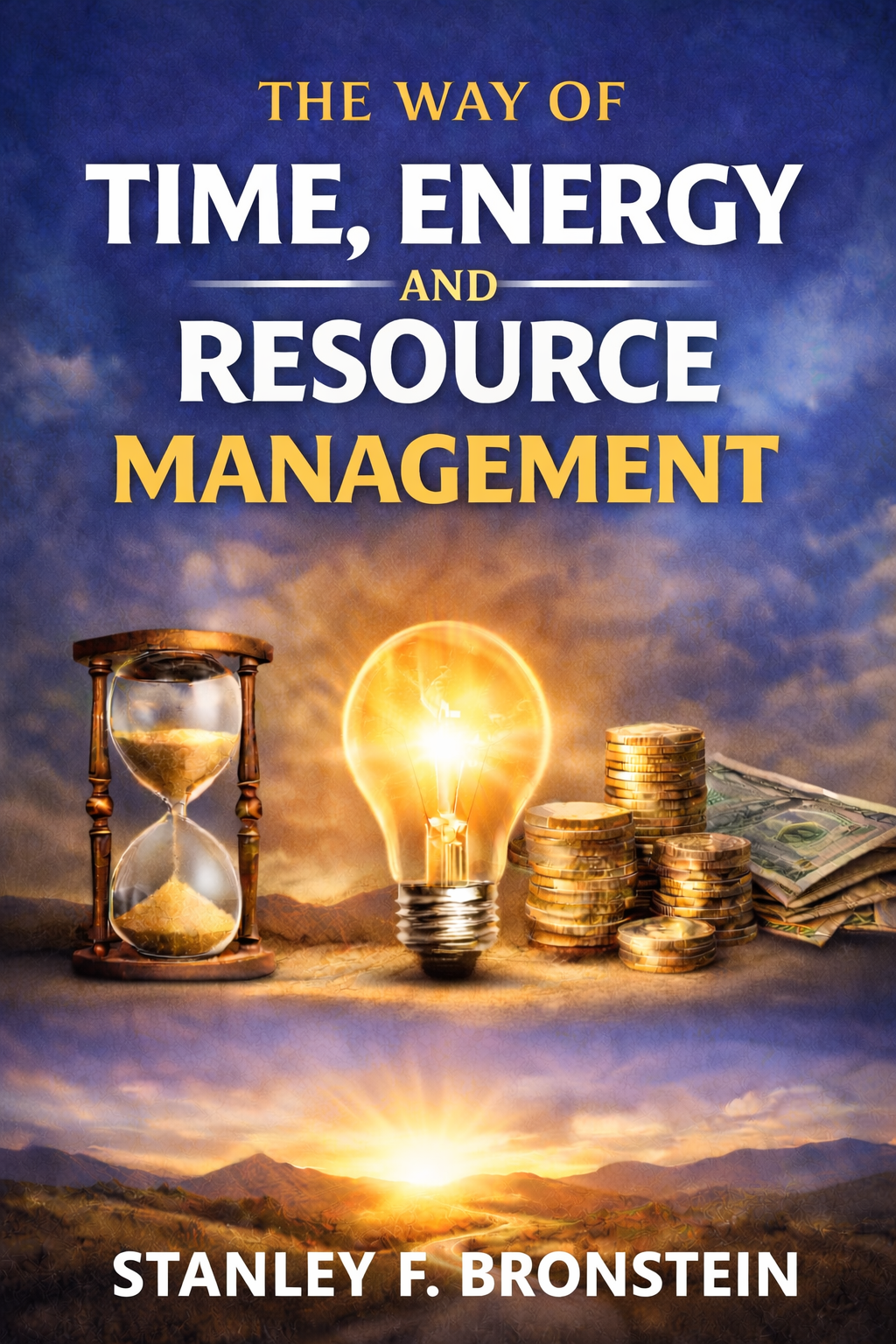
The Way of Time, Energy
and Resource Management

START HERE BY READING
The Way of Time, Energy and Resource Management
Your Time, Energy and Resources Are Limited
Learn To Use Them Wisely
By Stanley F. Bronstein – Creator of The Way of Excellence System
Click The Tabs Below To Read Each Chapter Of The Book Online
Or
📘 Download Your Free Copy In Your Preferred Format
The Way of Time, Energy and Resource Management
by Stanley F. Bronstein
How to use this page:
Click a chapter title to open it then scroll down to read.
When you click the title of the next chapter, the previous one will close.
Take your time.
Read, reflect, and do the experiments and assignments before you move on.
EMPTY ITEM
Foreword - Your Time, Energy, and Resources Are Limited
INTRODUCTION TO PART I - TIME - YOUR MOST LIMITED RESOURCE
Time Is Not Something You Have – It Is Something You Spend
Time is the one resource you cannot earn back, borrow, store, or recover.
You can lose money and make it back. You can lose opportunities and sometimes find new ones. You can even lose energy and rebuild it with rest and renewal.
But time is different.
Once it is gone, it is gone.
That is why time is not just a resource. Time is the foundation that every other resource sits on. Your energy is spent inside time. Your resources are used inside time. Your relationships grow or fade inside time. Your health is built or broken inside time.
If you want a better life, you need a better relationship with time.
Most People Do Not Waste Time On Purpose
Almost nobody wakes up and says, “Today I will waste my time.”
Time is usually wasted indirectly.
It is wasted by drifting instead of deciding. It is wasted by reacting instead of planning. It is wasted by saying yes without thinking. It is wasted by doing things that do not matter. It is wasted by doing things that matter, but doing them in a scattered, distracted way.
Most people do not have a time problem. They have an awareness problem.
They do not see where their time goes.
And because they do not see it, they cannot change it.
This part of the book is designed to help you see it.
You Cannot Manage What You Do Not Measure
One of the simplest ways to improve your use of time is to observe it.
When you observe time, you become more honest.
You begin to notice patterns.
You begin to see what drains your day.
You begin to realize how many small choices you make without thinking – and how those small choices add up to big outcomes.
That is why the assignments in Part I are practical. They are built around awareness, tracking, and simple rules. The goal is not to make you obsessive. The goal is to make you conscious.
Because conscious people live different lives than unconscious people.
The Goal Is Not To Do More
This book is not trying to turn you into a productivity machine.
It is trying to turn you into a wise steward.
Sometimes the best use of time is rest. Sometimes it is reflection. Sometimes it is doing nothing on purpose so you can recover your energy and regain clarity.
Time management is not about doing more.
It is about doing what matters.
And doing what matters requires that you first know what matters.
Part I will help you clarify that.
A Simple Standard For Time
Here is a standard you can carry with you throughout this book:
If something is not aligned with your highest priorities, it is costing you your future.
This does not mean you never relax or have fun. Relaxation and joy are priorities too when they are chosen intentionally.
But it does mean this:
You should not be surprised by where your time goes.
If your time is going somewhere consistently, it is either supporting your future or stealing from it.
Part I is about taking that steering wheel back.
What Part I Will Do For You
By the time you finish Part I, you will have four outcomes:
First, you will respect time more deeply, not as an idea, but as a daily reality.
Second, you will see the difference between being busy and being effective.
Third, you will learn to separate urgent from important, and you will start protecting what is important.
Fourth, you will begin eliminating time waste that you previously did not even notice.
This is where the transformation begins.
Not with a complicated system.
With awareness, honesty, and one better choice at a time.
What To Do As You Read Part I
Read each chapter slowly. Do not rush.
Do the assignment at the end of each chapter. That is where the change happens.
Keep your answers simple. This is not about writing perfect journal entries. It is about building a new habit of awareness and intentionality.
If you do that, you will be ready for Part II, where we focus on attention and focus, because focus is where time becomes power.
For now, begin with the foundation:
Time is your most limited resource.
Treat it that way.
Chapter 1: Time Is Life Time Is Not Something You Have - It Is Something You Spend
Time is not a concept. It is a daily reality.
You cannot save time. You cannot store it. You cannot borrow it from tomorrow. You can only spend it today.
And once it is spent, it is gone.
That is why time is not just a resource. Time is life. How you spend it is how you live it.
Time Becomes Real When You Do the Math
Every day you are given the same deposit of time.
You get 24 hours.
That is 1,440 minutes.
That is 86,400 seconds.
No matter who you are, that deposit arrives each day, and the clock starts spending it whether you are paying attention or not.
So here is a question that belongs at the center of this book:
You receive 86,400 seconds every day – do you use them wisely?
This is not a guilt question. It is a clarity question.
Because when you are clear about how time works, you stop treating it casually.
Why Most People Lose Time Without Noticing
Almost nobody wastes time on purpose.
People waste time indirectly.
They drift instead of decide. They react instead of plan. They say yes too quickly. They do things that do not matter. They do things that matter, but they do them in a scattered and distracted way.
The result is the same.
At the end of the day, the time is gone, and the life you intended to build did not receive your best attention.
Small Blocks Become Big Life Blocks
Most people underestimate what small daily decisions add up to because they only see them in the moment.
Fifteen minutes feels small.
But if you set aside 15 minutes every day for yourself, that is 105 minutes per week. Over the course of a year, that becomes more than 90 hours set aside for yourself.
That is over two full work weeks.
Two work weeks of reading, walking, stretching, writing, planning, learning, practicing, or building something that matters.
Now take it one level higher.
If you set aside one hour a day every day, that is 365 hours per year.
That equals more than nine standard 40 hour work weeks.
That is over two months of work days.
You can do a lot in that amount of time. You can transform a skill. You can reshape your health. You can build a meaningful project. You can change your direction.
This is one of the most important truths about time:
Your life changes when you stop thinking in days and start thinking in totals.
The Standard That Guides This Book
Here is a simple standard:
Your time should reflect your highest priorities.
That does not mean you never rest, never relax, or never have fun. Those can be priorities too when they are chosen intentionally.
It means you should not be surprised by where your time goes.
If your time is going somewhere consistently, it is either supporting your future or stealing from it.
What This Chapter Is Really Saying
You do not need more time to improve your life.
You need better use of the time you already have.
When you begin to respect time, you begin to respect yourself, because your time is your life.
Assignment: The Time Is Life Exercise
This assignment is designed to help you see your time clearly, without judgment, so you can start improving it.
Step 1: Track One Day
Write down how you spend one full day in 30 minute blocks.
Step 2: Circle the Leaks
Circle the blocks that did not move you forward, nourish you, or restore you.
Step 3: Identify One Upgrade
Choose one small change you can make tomorrow that improves how you spend your time.
Step 4: Write One Sentence
Complete this sentence in writing:
“My time is my life, and tomorrow I will spend more of it on ___________________.”
Chapter 2: Your Calendar Reveals Your Priorities Your Life Is What You Repeatedly Schedule
Most people believe their priorities are what they say they value.
That is not true.
Your priorities are what you repeatedly do.
And the simplest way to see what you repeatedly do is to look at your calendar.
Your calendar is not just a scheduling tool. It is a mirror. It reflects what you make time for. It also reveals what you do not make time for.
If someone asked you, “What matters most to you?” you could answer with words.
But if someone asked your calendar, it would answer with evidence.
Intentions Are Not Priorities
Many people have good intentions.
They intend to exercise. They intend to eat well. They intend to spend time with the people they love. They intend to read, learn, reflect, or build a meaningful project. They intend to rest and recharge.
But intention alone does not create a life.
A priority is not something you hope to do.
A priority is something you protect.
If something is truly important, it deserves a place on your calendar.
If it is not on your calendar, it is not a priority. It is only a wish.
Your Calendar Shows What You Serve
Your calendar also reveals something deeper.
It shows what you serve.
Do you serve your highest values, or do you serve other people’s demands?
Do you serve long-term goals, or do you serve short-term distractions?
Do you serve your health, your family, your growth, and your peace of mind?
Or do you serve the urgent, the noisy, and the never-ending list of tasks that feel important only because they are loud?
Many people live with an invisible calendar controlled by other people.
They are constantly reacting.
They are constantly available.
They are constantly busy.
But they are not building what they claim they want to build.
If you want your life to change, you must take control of your calendar.
Because if you do not control it, something else will.
A Simple Exercise That Reveals the Truth
Here is a truth that can change your life:
You can learn more about your priorities by looking at your last seven days than by listening to your words for seven minutes.
Look at your last week.
What did you give your best time to?
What did you give your leftover time to?
What did you say you cared about but did not schedule at all?
This is not about guilt. It is about honesty.
Because honesty is the first step toward improvement.
Scheduling Is Self-Respect
When you schedule what matters, you are not just managing time.
You are practicing self-respect.
You are saying, “My values deserve space.”
You are saying, “My health deserves time.”
You are saying, “My relationships deserve attention.”
You are saying, “My future deserves investment.”
When people do not schedule what matters, they often say they do not have time.
But most of the time, the real issue is not time.
The real issue is decision.
They have not decided that what matters most deserves protected time.
This chapter is your invitation to decide.
The Two Calendars You Must Build
To use your calendar wisely, you need two types of time.
You need committed time.
That is the time you must give to obligations and responsibilities.
And you need protected time.
That is the time you give to what builds your life.
Most people only schedule obligations. They schedule appointments, meetings, errands, and deadlines.
Then they wonder why their life is not improving.
Improvement requires protected time.
Protected time for health.
Protected time for learning.
Protected time for planning.
Protected time for relationships.
Protected time for meaningful work.
Protected time for rest and renewal.
A calendar that contains only obligations is not a life plan. It is a survival plan.
This book is about moving from survival to stewardship.
Assignment: The Calendar Truth Audit
This assignment is designed to help you align your calendar with what you say matters most.
Step 1: List Your Top Five Priorities
Write down your top five priorities in life right now. Keep it simple. Examples include health, family, work, spiritual growth, learning, service, or a meaningful project.
Step 2: Review Your Last Seven Days
Look at your calendar, your notes, and your memory. Write down how you actually spent your time over the last seven days.
Step 3: Score the Alignment
For each of your five priorities, give yourself a score from 1 to 10 based on how well your last seven days reflected that priority.
Step 4: Schedule One Protected Block
Choose the priority with the lowest score. Schedule one protected time block for it in the coming week. Put it on your calendar as a real appointment.
Step 5: Write One Commitment Sentence
Complete this sentence in writing:
“My calendar is a mirror. This week, I will prove that ___________________ matters by scheduling ___________________.”
Chapter 3: Urgent vs Important The Trap Most People Live In
Most people live in a state of urgency.
Their days are filled with things that feel pressing, immediate, and demanding. Messages arrive. Notifications appear. People want answers. Problems show up. Small fires need to be put out.
Urgency has a way of convincing you that it is the most important thing in the room.
But urgent does not mean important.
Urgent means something wants attention now.
Important means something creates real value, real progress, and real improvement over time.
If you confuse the two, you will stay busy forever and still feel behind.
Urgency Is Loud – Importance Is Quiet
Urgent things are usually loud.
They interrupt. They demand. They create pressure. They come with consequences if ignored.
Important things are often quiet.
They do not demand attention. They require you to choose them.
Important things include your health, your relationships, your long-term goals, your personal growth, your planning, your values, and your peace of mind.
These rarely scream.
They whisper.
That is why they are easy to neglect.
If You Always Handle the Urgent, You Will Never Build the Important
Here is a simple truth that explains why so many people feel stuck:
The urgent fills the space you do not protect.
If you do not intentionally schedule time for what is important, the urgent will take it.
If you do not protect your best energy for meaningful work, you will spend that energy reacting.
If you do not build boundaries, you will live inside other people’s calendars.
Urgency is not the enemy.
Lack of boundaries is.
Lack of clarity is.
Lack of standards is.
Urgent Things Feel Productive, Even When They Are Not
Urgent tasks often feel productive because you can complete them quickly.
You can clear an email. You can return a call. You can solve a small problem. You can put out a fire.
And sometimes those things truly matter.
But urgency can become a lifestyle.
A person can spend the entire day responding, handling, reacting, and solving, and still not move their life forward.
That is why you must learn a new question.
Not, “What needs my attention right now?”
But, “What matters most?”
The Important Is What Creates Your Future
The important is what builds the life you want.
It is the workout you do consistently.
It is the walk you take.
It is the food you prepare.
It is the book you read.
It is the skill you practice.
It is the hard conversation you have.
It is the project you work on steadily.
It is the planning session you do weekly.
The important rarely changes your life in one day.
It changes your life through repetition.
That is why it is easy to ignore, and why it must be protected.
How to Separate the Urgent From the Important
You do not need a complicated system to begin. You need a simple filter.
When something appears urgent, ask:
Does this truly need to be done today?
Does this truly need to be done by me?
If I handle this now, what important thing am I postponing?
What will I regret not doing if I keep responding like this for the next year?
Those questions shift you from reaction to stewardship.
And stewardship is what this book is really about.
The Rule That Changes Everything
Here is a rule worth repeating:
The urgent will never stop.
There will always be more messages, more tasks, more problems, and more requests.
So if you wait for life to calm down before you focus on what matters, you will wait forever.
Instead, you must do something that feels almost rebellious:
You must schedule important time first.
You must treat it as nonnegotiable.
You must protect it, even when the urgent is calling your name.
This is not selfish.
It is wise.
Because the important is what prevents the urgent from becoming unmanageable in the first place.
Assignment: The Urgent vs Important Filter
This assignment is designed to train your mind to separate what feels pressing from what actually matters.
Step 1: Write a List of Ten Current Tasks
Write down ten things that are pulling on you right now.
Step 2: Label Each One
Next to each item, write U for Urgent or I for Important. If something is both, write U and I.
Step 3: Choose One Important Item
Choose one Important item that you have been neglecting.
Step 4: Schedule It First
Put it on your calendar as a protected block of time within the next seven days.
Step 5: Create One Boundary
Write one boundary that protects this time. Examples: no phone, no email, no interruptions, or a closed door.
Reflection Prompt
If you keep responding to urgency the way you are right now, what important part of your life will suffer most over the next year?
Chapter 4: Deadlines, Speed, and Decision Timing Time Has a Hidden Rule
A decision can be correct and still fail if it is made too late.
Most people think failure comes from making the wrong decision.
Sometimes it does.
But many failures come from delay.
Delay turns solvable problems into emergencies. Delay turns small issues into large issues. Delay turns opportunities into missed chances.
That is why timing matters.
Speed matters.
Not frantic speed. Not panic speed.
Intentional speed.
Deadlines Are Not the Enemy
Many people dislike deadlines.
They feel pressure. They feel restrictive. They feel uncomfortable.
But deadlines are not automatically bad.
A deadline can be one of the most useful tools you have because it forces clarity and creates focus.
Without a deadline, many tasks remain vague. They stay in the world of “someday.”
And someday is one of the most dangerous words in time management.
Someday does not appear on the calendar.
Someday is where goals go to die.
A deadline turns intention into commitment.
A Task Without a Deadline Is Only a Discussion
When there is no deadline, a task becomes optional.
It becomes something you think about, talk about, and plan to do, but do not actually do.
This is why procrastination is so common.
Procrastination is not always laziness. It is often a lack of structure.
A deadline creates structure.
It creates a finish line.
And a finish line changes behavior.
Decision Timing Is a Skill
Some people wait because they want certainty.
They want more information. They want to feel more confident. They want to avoid risk. They want the perfect plan.
But certainty rarely arrives.
Life rewards people who can make good decisions with incomplete information, then adjust as they go.
This is what I mean by decision timing.
It is the ability to decide before fear and uncertainty convince you to delay.
It is the ability to move forward without needing perfection.
Because a good decision followed by action and adjustment will often outperform a perfect decision made too late.
Delay Has Costs Most People Ignore
When you delay, you pay costs.
You pay mental costs. The decision stays open in your mind. It drains energy.
You pay emotional costs. Delay creates stress, guilt, and self-doubt.
You pay practical costs. Problems worsen. Options narrow. People lose trust. Momentum dies.
Sometimes the greatest cost of delay is invisible.
It is the cost of becoming the kind of person who does not follow through.
And that cost is too high.
When Speed Is Wise and When Speed Is Dangerous
Not every decision should be made quickly.
Some decisions require patience, due diligence, and careful thought.
The key is to know which decisions require depth and which decisions require action.
A helpful rule is this:
If a decision is reversible, decide faster.
If a decision is irreversible, decide more carefully.
Many people treat reversible decisions as if they are irreversible, and they lose time.
They overthink.
They delay.
They create unnecessary stress.
Then they treat irreversible decisions casually, and they create real problems.
Wisdom is knowing the difference.
Use Deadlines to Protect the Important
Deadlines are not only for urgent tasks.
You can use deadlines to protect important tasks too.
If you want to improve your health, set deadlines for certain actions.
If you want to finish a project, set deadlines for milestones.
If you want to learn something new, set a deadline for daily practice.
Deadlines are not chains. They are tools.
They help you convert what matters into scheduled action.
And scheduled action is how results are built.
Assignment: The Deadline Decision
This assignment is designed to help you stop delaying one important task or decision.
Step 1: Identify One Delayed Item
Choose one decision or task you have been postponing. It should be something important, not a small distraction.
Step 2: Decide Whether It Is Reversible
Write R if it is reversible. Write IR if it is irreversible.
Step 3: Set a Deadline
If it is reversible, set a deadline within 48 hours.
If it is irreversible, set a deadline within 7 days, along with one time block for thinking and planning.
Step 4: Define the Next Concrete Step
Write one step that takes less than 30 minutes and moves the decision forward. Example: make a call, send an email, gather one piece of information, schedule a meeting.
Step 5: Take the Step Today
Do not wait for the deadline to arrive. Take the step today.
Reflection Prompt
What has delay already cost you in this situation – time, energy, stress, money, momentum, or peace of mind?
Chapter 5: Stop Wasting Time Without Noticing Most Time Waste Is Invisible
Almost nobody wastes time on purpose.
Time is usually wasted in small, ordinary ways that feel harmless in the moment.
A few minutes here.
A few minutes there.
A quick check of something that turns into twenty minutes.
A conversation that could have ended ten minutes earlier.
A task done twice because it was not done right the first time.
A decision delayed, then revisited again and again.
This is why time waste is so dangerous.
It hides inside your day.
And because it hides, it repeats.
Reminder: Small Leaks Create Big Losses
Every day you receive 86,400 seconds. The clock spends them whether you are intentional or not.
And when time is wasted in small ways, it is not wasted once. It is wasted repeatedly.
That is why a daily 15 minute leak is not a small problem. Over a year, 15 minutes a day becomes more than 90 hours. That is over two full work weeks.
A daily hour leak becomes 365 hours. That is over two months of work days.
You can do a lot in that amount of time.
Small leaks create big losses.
Seal the leaks, and you reclaim your life.
The Common Sources of Time Waste
Time waste often comes from a few predictable sources.
You do not need to fix everything. You just need to see what is happening, then fix what matters most.
Here are common sources of time waste:
Unplanned Distraction
Distraction is rarely a single event. It becomes a habit.
Once you get used to interrupting yourself, you begin to live in fragments.
Fragments feel busy, but fragments do not build much.
Poor Transitions
Many people lose time in the space between tasks.
They finish one thing, then drift into something random because there is no plan for what comes next.
Rework
Rework is a hidden time thief.
When something is not done carefully the first time, it must be fixed later.
That creates extra steps, extra stress, and extra wasted time.
Overcommitment
Overcommitment creates time waste because it forces you to rush.
Rushing creates mistakes.
Mistakes create rework.
Rework steals time and drains energy.
Decision Delay
When you delay decisions, they stay open in your mind.
They drain focus.
They create mental clutter.
They also create repeated thinking, repeated discussion, and repeated stress.
Often the time spent talking about a task becomes greater than the time it would have taken to do it.
Doing Things That Do Not Need To Be Done
One of the worst wastes of time is doing something very well that does not need to be done at all.
This often happens when people confuse activity with progress.
The goal is not to be busy.
The goal is to build what matters.
The First Goal Is Awareness
You cannot fix what you cannot see.
So the first goal of this chapter is not to eliminate every distraction or run your life like a machine.
The first goal is to become aware of the leaks.
Because once you see them, you can seal them.
And once you seal them, you regain time, energy, and peace of mind.
Seal the Leaks With Simple Rules
The best solution is rarely complicated.
Most people do not need a complex system.
They need simple rules.
Simple rules reduce decision fatigue.
Simple rules prevent drift.
Simple rules create consistency.
Examples of simple rules include:
-
No phone during meals
-
Check email only at set times
-
If a task takes less than two minutes, do it now
-
If it is not a clear yes, it is a no
-
Finish the current task before starting a new one
You will build your own rules as you go through this book.
Those rules will become part of your personal operating system.
Assignment: Seal One Time Leak
This assignment is designed to help you reclaim time quickly by fixing one repeating leak.
Step 1: Identify Your Biggest Daily Leak
Choose one repeating activity that steals time. It must be something you do often.
Examples: unnecessary phone use, unplanned internet browsing, extended conversations, checking email constantly, or procrastinating on one task.
Step 2: Measure It for Two Days
For the next two days, estimate how much time you spend on it each day.
Do not judge yourself. Just measure it.
Step 3: Create One Simple Rule
Create one rule that reduces the leak.
Examples:
-
“No social media until after lunch.”
-
“Email only at 11:00 and 4:00.”
-
“Phone stays in another room during focus work.”
Write the rule in one sentence.
Step 4: Test the Rule for Seven Days
Follow the rule for seven days.
Track how well you follow it and how much time you reclaim.
Step 5: Reinvest the Time
Decide in advance where the reclaimed time will go.
This is the key.
Reclaimed time must be assigned, or it will leak away again.
Reflection Prompt
If you reclaimed 15 minutes every day for the next year, what would you invest those 90 plus hours into that could genuinely improve your life?
INTRODUCTION TO PART II - FOCUS - WHERE YOUR TIME AND ATTENTION GO
Time Follows Attention
You can have the best intentions in the world and still waste your day if you cannot direct your attention.
Because time follows attention.
Where your attention goes, your time goes.
Where your attention goes, your energy goes.
Where your attention goes, your life goes.
This is why focus is not optional. Focus is the skill that turns time into results.
Part I helped you see time more clearly. It helped you recognize how easily time is spent without intention. It helped you begin protecting what matters.
Now we go one level deeper.
If time is the currency of life, attention is the steering wheel.
You Do Not Lose Focus in One Big Moment
Most people do not lose focus because of one dramatic distraction.
They lose it gradually.
They lose it through small interruptions.
A quick check of the phone.
A notification.
A message.
A thought that pulls them away.
A habit of switching tasks.
A pattern of starting and not finishing.
Over time, their life becomes fragmented.
They spend their days in pieces.
And when you live in pieces, you feel busy but you do not feel accomplished.
You feel tired but you do not know why.
You feel behind even when you never stop moving.
That is what fractured attention does.
Focus Is a Force Multiplier
When you are focused, you get more done in less time.
You think more clearly.
You make better decisions.
You produce higher quality work.
You finish things.
You also waste less energy because you are not constantly restarting.
That is why focus is a force multiplier.
It multiplies the value of the time you already have.
It is not about squeezing more into your schedule.
It is about using what you already have more wisely.
The Real Enemy Is Not Work – It Is Drift
Many people assume they struggle because they have too much to do.
Sometimes that is true.
But often the real issue is drift.
They start the day with a plan, then drift into reaction.
They begin a task, then drift into distraction.
They intend to do what matters, then drift into what is easy.
Drift is dangerous because it feels harmless.
It is not a crisis. It is not a catastrophe.
It is just small choices that gradually pull your life away from what matters most.
Part II is designed to help you stop drifting.
You Need More Than Willpower
Some people try to solve focus problems with willpower.
They tell themselves to “try harder.”
They blame themselves when they get distracted.
They think focus is a personality trait.
It is not.
Focus is a skill.
Skills can be trained.
But training requires structure.
It requires environment.
It requires boundaries.
It requires standards.
This is why Part II will emphasize simple tools that make focus easier.
Because a good environment often beats a strong personality.
What Part II Will Do For You
By the time you finish Part II, you will have five outcomes:
First, you will understand why attention is one of your most valuable resources.
Second, you will see the hidden costs of distraction and multitasking.
Third, you will learn how to protect your best hours for what matters most.
Fourth, you will strengthen your ability to say no, because focus requires elimination.
Fifth, you will learn how simplicity reduces friction, and friction is one of the greatest drains of time and energy.
These skills will help you build a life that feels less scattered and more intentional.
How To Use Part II
Do not try to apply everything at once.
Pick one focus practice at a time.
Test it.
Make it a standard.
Then add the next one.
You are building a personal operating system, and operating systems are built through repetition.
Part II will help you make focus normal, not rare.
Because when focus becomes normal, progress becomes predictable.
Now let’s begin with the foundation:
Attention is your power.
And you get to decide where it goes.
Chapter 6: Attention Is Your Power Attention Is the Real Currency
Most people believe time is their most valuable asset.
Time is incredibly valuable, but attention is what decides how your time is spent.
If time is the currency of life, attention is the hand that spends it.
You can sit at your desk for two hours and accomplish almost nothing if your attention is scattered.
You can also accomplish more in thirty focused minutes than you can in three distracted hours.
This is why attention is power.
It is the power to direct your life.
You Spend Your Attention Before You Spend Your Time
Every day, you make thousands of small attention decisions.
You choose what you look at.
You choose what you listen to.
You choose what you think about.
You choose what you respond to.
And these choices happen so quickly that you often do not notice you are making them.
But whether you notice them or not, they determine everything.
They determine what gets done.
They determine what gets delayed.
They determine how you feel.
They determine how much energy you have left at the end of the day.
The person who controls their attention controls their life.
Distraction Is Not Free
Distraction feels harmless because it is often small.
A quick glance.
A quick check.
A quick response.
But distraction has a hidden cost.
The cost is not only the time of the interruption.
The cost is the recovery time.
When you shift your attention, you lose momentum. You lose clarity. You lose progress. You often have to restart your thinking.
That restarting drains energy.
This is why distraction is exhausting.
Many people feel tired not because they worked too hard, but because their attention was pulled in too many directions all day.
Attention Creates Quality
Attention is not only about productivity.
Attention is about quality.
When you give full attention, you create better work.
When you give full attention, you listen better.
When you give full attention, you connect better.
When you give full attention, you experience life more deeply.
Half-attention creates half-results.
Half-attention creates half-relationships.
Half-attention creates half-joy.
This is why attention is not a small issue.
It affects everything.
The Real Problem Is Not That You Get Distracted
Everyone gets distracted.
The real problem is that many people have become trained to distract themselves.
They have built habits of interruption.
They have built habits of checking.
They have built habits of filling every quiet moment with stimulation.
Over time, their mind becomes less comfortable with stillness.
It becomes less comfortable with depth.
It becomes less comfortable with one thing at a time.
The good news is that attention can be retrained.
Just like a muscle.
The Most Powerful Attention Skill
Here is a skill that changes everything:
The ability to notice that your attention has drifted, and gently bring it back.
That is the foundation of focus.
You do not build focus by never drifting.
You build focus by returning.
Returning again and again, without drama, without self-judgment, and without quitting.
Over time, the return becomes easier.
And your attention becomes stronger.
How to Strengthen Your Attention Daily
You do not need complicated methods.
You need a simple daily practice.
Pick one small exercise that trains your attention.
Examples include:
-
Sit quietly and focus on your breath for five minutes
-
Read for ten minutes without checking your phone
-
Take a walk without headphones and observe your surroundings
-
Do one task for thirty minutes with no interruptions
The purpose is not perfection.
The purpose is practice.
Because what you practice, you strengthen.
Assignment: The Attention Training Practice
This assignment is designed to strengthen your attention in a simple, consistent way.
Step 1: Choose One Daily Practice
Choose one of the following, or create your own:
-
Five minutes of focusing on your breath
-
Ten minutes of reading with no phone
-
One thirty minute uninterrupted work block
-
A ten minute quiet walk with no audio
Pick something achievable. The goal is consistency.
Step 2: Choose a Time and Place
Decide exactly when you will do it each day and where you will do it.
Step 3: Remove One Distraction
Before you begin, remove one distraction. Put your phone in another room or turn off notifications.
Step 4: Practice for Seven Days
Do the practice every day for seven days.
If you miss a day, do not quit. Resume the next day.
Step 5: Write a Short Reflection
After seven days, write a short answer to this question:
What changed when I trained my attention for just a few minutes a day?
Chapter 7: Single-Tasking Beats Multitasking Multitasking Is Not a Skill - It Is a Tax
Most people believe multitasking is a sign of productivity.
It is not.
Multitasking is usually task-switching, and task-switching comes with costs.
Those costs include lost time, lost attention, lost quality, and lost energy.
When you switch tasks, your mind has to shut one thing down and spin another thing up. That transition has a price. Most people do not notice the price because it is paid in small amounts.
But those small amounts add up.
Multitasking is not free. It is expensive.
Context Switching Costs You Time
Every time you stop one task and start another, you lose momentum.
You lose clarity.
You often need to reread, reorient, and restart.
That is why a ten minute interruption does not only cost ten minutes.
It can cost much more.
The interruption breaks your flow, and flow is where work becomes efficient and enjoyable.
When you protect flow, you protect your time.
Context Switching Costs You Energy
Task-switching also drains energy.
This is one of the reasons people feel tired even when they did not do anything physically demanding.
A scattered mind is a tired mind.
A mind that is constantly switching, checking, responding, and restarting becomes exhausted.
This is not weakness.
This is biology.
Your brain uses energy.
And every unnecessary switch burns more of it.
If you want more usable energy, one of the simplest steps is to stop interrupting yourself.
Multitasking Can Also Waste Resources
When your attention is divided, mistakes increase.
Mistakes lead to rework.
Rework costs time, and it can also cost money.
A wrong order. A missed detail. A forgotten step. A rushed decision. A duplicated purchase. A late fee. A preventable repair. A problem created by inattention.
These are not rare events.
They are common outcomes of distraction.
Single-tasking protects more than your schedule.
It protects your resources.
Single-Tasking Is a Form of Respect
When you single-task, you respect the moment.
You respect the work.
You respect the person you are with.
You respect your own mind.
You are telling yourself, “This deserves my full attention.”
That simple standard changes how you live.
It changes the quality of your work and the quality of your relationships.
If you want to feel more present, more calm, and more effective, single-tasking is one of the best habits you can build.
The Simple Rule That Builds Single-Tasking
Single-tasking is not complicated.
It is one decision:
One thing at a time.
Then another.
Then another.
It sounds almost too simple, which is why many people ignore it.
But simple does not mean easy.
The mind is trained to reach for stimulation.
It is trained to check.
It is trained to switch.
Single-tasking retrains the mind to stay.
And staying is where results come from.
How to Make Single-Tasking Easier
You do not need to rely on willpower alone.
You can make single-tasking easier with structure.
Here are a few practical supports:
-
Decide what your one task is before you begin
-
Remove obvious distractions before you start
-
Set a short time block so your mind knows there is an endpoint
-
Keep a notepad nearby to capture stray thoughts so you do not chase them
-
Close tabs, silence notifications, and reduce visual clutter
Structure protects attention, and protected attention becomes productive time.
Energy Builders That Support Focus
Single-tasking is easier when your energy is stronger.
If you are sleep-deprived, dehydrated, poorly nourished, or overstimulated, focus becomes harder.
So while this book is not a health manual, it is important to say this clearly:
Healthy nutrition, daily movement, rest, and quiet time are not just good for your body.
They are fuel for focus.
Even small improvements can make single-tasking easier.
A short walk. Better hydration. A healthier meal. Ten minutes of quiet breathing. A consistent bedtime.
These are energy investments.
And energy investments improve your ability to direct attention, which improves your use of time.
Assignment: The Single-Task Standard
This assignment is designed to help you experience the difference between scattered attention and focused attention.
Step 1: Choose One Important Task
Pick one task that matters. Not something trivial. Something that will move your life forward.
Step 2: Create a Single-Task Block
Schedule one uninterrupted block of 45 minutes.
If 45 minutes feels too long, choose 30 minutes. The key is uninterrupted time.
Step 3: Remove Distractions
Turn off notifications. Close extra tabs. Put your phone out of reach. Clear your workspace of anything unrelated.
Step 4: Work on One Thing Only
During the block, do not switch tasks. If another thought appears, write it down and return to the task.
Step 5: Protect Resources by Doing It Right Once
Before you end the session, take two minutes to review what you did.
Ask: Did I do this carefully enough that I will not need to redo it?
This protects time, energy, and often money.
Reflection Prompt
When you single-tasked, what changed – the quality of your work, the speed of completion, your stress level, and your energy at the end of the session?
Chapter 8: Protect Your Best Hours Not All Hours Are Equal
Most people treat time as if every hour of the day has the same value.
It does not.
Your energy rises and falls throughout the day. Your clarity rises and falls. Your patience rises and falls. Your motivation rises and falls.
That means some hours are naturally more valuable than others.
If you use your best hours on low-value work, you will feel behind all day.
If you use your best hours on what matters most, you will feel progress even if the day gets messy later.
This is one of the simplest upgrades you can make:
Put your best work in your best hours.
Your Best Hours Are a Resource
Your best hours are a limited resource.
They are the hours when your mind is sharp, your energy is higher, and your focus is easier.
Many people spend those hours on distractions, interruptions, meetings, or other people’s priorities.
Then they try to do what matters most late in the day when energy is lower.
That creates frustration.
It also creates a false story:
“I can’t get anything done.”
The truth is usually:
“I spent my best hours on the wrong things.”
Identify Your Peak Window
Most people have a peak window, even if they do not realize it.
It might be early morning.
It might be mid-morning.
It might be late night.
The specific time is less important than the principle:
When are you most clear and most energized?
That is the window you protect.
Because that window is where your important work should live.
Use Peak Hours for High-Value Work
High-value work is work that improves your life, builds your future, and creates results.
Examples include:
-
Planning and strategy
-
Writing and creation
-
Learning and studying
-
Working on an important project
-
Having an important conversation
-
Building a skill
-
Doing the daily actions that protect health
This last one matters more than most people realize.
If you use your best hours to build your health, you create more energy for everything else.
Nutrition, movement, sleep, and stress reduction are not separate from productivity.
They are the foundation of it.
Protect Energy Builders First
One reason people feel they do not have enough energy is that they schedule their energy builders last.
They hope they will “fit them in.”
They fit them in only if the day goes perfectly.
The day rarely goes perfectly.
So the energy builders disappear.
Then energy drops.
Then discipline drops.
Then the urgent takes over again.
To break that cycle, treat energy building as important work.
Schedule it.
Protect it.
Even small daily actions build capacity.
A daily walk.
A few minutes of quiet breathing.
Healthy food preparation.
Strength training a few times a week.
A consistent sleep routine.
These are not extras.
They are investments.
They create more usable energy, which gives you more usable time.
Protecting Your Best Hours Requires Boundaries
If you do not protect your best hours, other people will use them.
This is not because people are bad. It is because people have needs, and requests tend to expand until they meet resistance.
Boundaries are that resistance.
A boundary is simply a rule that protects what matters.
Examples include:
-
No meetings before a certain time
-
Phone off during the first hour of the day
-
Email only at set times
-
A closed door during focus blocks
-
A daily health block that is nonnegotiable
These boundaries are not about controlling others.
They are about stewarding your life.
The Smallest Change That Creates the Biggest Result
You do not need to redesign your entire schedule.
Start with one change:
Protect your first best hour.
If you protect one hour a day and use it well, you will begin to feel the difference quickly.
Because you will stop living on leftovers.
You will stop giving your best hours away.
You will start investing them.
Assignment: The Best Hours Protection Plan
This assignment is designed to help you identify your peak hours and use them intentionally.
Step 1: Identify Your Best Two Hours
Think about the last few weeks. When are you usually most clear and energized?
Write down your best two-hour window.
Step 2: Choose One High-Value Activity
Choose one high-value activity to place in that window for the next five days.
This can be a project, a skill, planning, or an energy builder such as walking, exercise, meditation, or healthy meal preparation.
Step 3: Block It on Your Calendar
Schedule it for five consecutive days.
Treat it like an appointment you do not cancel.
Step 4: Build One Boundary Around It
Choose one boundary that protects the block.
Examples: phone in another room, no email, no meetings, or a specific location where you can focus.
Step 5: Track the Result
After five days, write down what changed.
Did you feel more progress?
Did you feel more energy?
Did you feel more calm?
Did your day feel more controlled?
Reflection Prompt
If your best hours are one of your most valuable resources, what is the biggest change you could make to stop spending them on low-value work?
Chapter 9: The Power of No Every Yes Spends Something You Cannot Replace
Every time you say yes, you spend something.
You spend time.
You spend attention.
You spend energy.
Often you also spend money or other resources.
Many people say yes as if it costs nothing.
But yes always has a price.
The price is not only the time required for the commitment.
The price is what you will not do because of that commitment.
That is the hidden cost.
That is the cost most people ignore.
No Is Not Negative – No Is a Boundary
Many people avoid saying no because they do not want to disappoint others.
They want to be liked. They want to be helpful. They want to avoid conflict.
But a life without no is a life without direction.
No is how you protect what matters.
No is how you create space for your priorities.
No is how you protect your health.
No is how you protect your relationships.
No is how you protect your peace of mind.
No is not rudeness. No is stewardship.
When you say no to what does not matter, you are saying yes to what does.
Overcommitment Is a Form of Time Theft
Overcommitment steals your time in two ways.
First, it fills your schedule.
Second, it drains your energy.
When you are overcommitted, you rush.
When you rush, you make mistakes.
When you make mistakes, you create rework.
Rework steals more time and drains more energy.
Overcommitment also creates a constant low-level stress.
That stress becomes an energy leak.
This is why people feel tired even when they are not doing anything extreme.
They are carrying too much.
No is how you stop carrying too much.
No Protects Your Resources Too
Saying yes too easily can also cost money.
You commit to things you do not truly value.
You buy things to support commitments you should not have made.
You agree to events, services, subscriptions, projects, and obligations that drain your resources.
Then you wonder why you feel stretched.
Many people do not have a money problem.
They have a decision problem.
They are spending resources without clarity.
A strong no protects your bank account, your schedule, and your energy.
No Makes Your Yes More Powerful
A yes that follows too many yeses becomes meaningless.
It becomes automatic.
It becomes obligation.
But when you have strong boundaries, your yes becomes intentional.
It becomes honest.
It becomes powerful.
The people who respect you most are often the people who respect your no.
They can trust that when you say yes, you mean it.
The Simple Test for Saying Yes
Here is a helpful test.
Before you say yes, ask yourself:
Is this aligned with my highest priorities?
Do I have the time and energy for this without sacrificing what matters most?
If I say yes, what am I saying no to?
Will I be glad I did this one year from now?
If you cannot answer these clearly, the safest answer is often no.
Or not now.
Or yes, but with a smaller commitment.
No Can Be Simple and Kind
You do not need long explanations.
You do not need to defend your life choices.
You do not need to argue.
A clean no is respectful.
A clean no is clear.
Here are examples:
-
“Thank you for asking. I’m going to pass.”
-
“I can’t take that on right now.”
-
“That doesn’t fit my schedule.”
-
“I’m focusing on a few priorities this season.”
-
“I can’t commit to that, but I wish you well.”
You can say no without drama.
And you can say no without guilt.
Protect Your Health With No
One of the most important reasons to say no is health.
Many people sacrifice sleep, movement, nutrition, and recovery because they are overcommitted.
Then energy drops.
Then focus drops.
Then they become less effective.
Then they need more time to do the same work.
It becomes a loop.
Sometimes the highest form of responsibility is protecting your energy, so you can show up fully for what truly matters.
No helps you do that.
Assignment: The Strategic No
This assignment is designed to help you reclaim time, protect energy, and reduce unnecessary commitments.
Step 1: Identify One Commitment That Costs Too Much
Choose one ongoing obligation that is draining you.
It can be an event, a responsibility, a favor pattern, a meeting, a habit of availability, or something you keep agreeing to.
Step 2: Name the True Cost
Write down what it is costing you in each category:
-
Time
-
Energy
-
Attention
-
Money or resources
Step 3: Choose Your Response
Decide one of these options:
-
Say no completely
-
Reduce the commitment
-
Renegotiate the terms
-
Put a clear boundary around it
Step 4: Use a Simple Script
Write a one or two sentence message that communicates your decision clearly and kindly.
Step 5: Reinvest What You Reclaim
Decide where the reclaimed time and energy will go.
Choose something important: health, rest, learning, a project, or relationships.
Schedule it.
Reflection Prompt
What would change in your life if you said no to one unnecessary commitment each month for the next year?
Chapter 10: Simplify to Multiply Complexity Is a Hidden Tax
Most people think the problem is a lack of time.
Often the real problem is unnecessary complexity.
Complexity creates friction.
Friction slows you down.
Friction drains energy.
Friction increases mistakes.
Mistakes create rework.
Rework steals time.
This is why complexity is expensive.
It taxes your time, your energy, and your resources.
Simplicity is not about doing less carelessly.
Simplicity is about removing what is unnecessary so you can do what matters in an excellent manner.
Friction Explains Why Good Intentions Fail
Many people have good intentions.
They intend to eat better.
They intend to exercise.
They intend to plan their week.
They intend to read and learn.
They intend to manage money wisely.
But intentions often fail because the process is too complicated.
If something requires too many steps, too many decisions, or too much setup, most people will not do it consistently.
They may do it once or twice.
Then they stop.
Not because they are weak.
Because the system is heavy.
A heavy system drains energy and creates resistance.
A light system gets used.
Simplicity Creates More Usable Time
When you simplify, you remove decisions.
You remove steps.
You remove clutter.
You remove friction.
This creates more usable time.
Not because the day has more hours, but because you stop bleeding minutes to unnecessary complexity.
This is also one of the fastest ways to reduce stress.
Stress often comes from mental clutter.
Too many commitments.
Too many options.
Too many unfinished tasks.
Too many tools.
Too many piles.
Simplicity reduces the load.
And when the load is reduced, energy returns.
Simplicity Protects Energy
Energy is a resource.
If you drain it early in the day on small decisions, you will have less discipline later.
This is why simplicity is not only a productivity strategy.
It is an energy strategy.
When you reduce the number of decisions you make, you reduce decision fatigue.
When you reduce decision fatigue, you protect willpower.
When you protect willpower, you follow through more consistently.
Simplicity makes discipline easier.
Simplicity Protects Money and Other Resources
Complexity often costs money.
You buy tools you do not use.
You subscribe to services you forgot about.
You order food because meal prep is complicated.
You replace items because you cannot find them.
You pay fees because you missed something.
You waste money because the system is cluttered.
Simplicity protects resources because it reduces waste.
It makes things easier to maintain.
It makes problems easier to notice.
It keeps you from constantly reacting.
Simplify Systems, Not Standards
Some people fear simplicity because they think it means lowering standards.
It does not.
In fact, simplicity allows you to keep standards high because you stop wasting energy on the unnecessary.
A simple system can still produce excellent results.
Examples include:
-
A simple weekly planning ritual
-
A simple meal routine with a few repeat meals
-
A simple morning routine that protects focus
-
A simple budget rule that prevents impulse spending
-
A simple exercise plan you actually follow
High standards with simple systems is one of the best combinations in life.
Where to Simplify First
You do not need to simplify everything at once.
Start where you feel friction most.
Look for the areas that create repeated stress and repeated waste.
Common places include:
-
Morning routines
-
Meal decisions
-
Email and notifications
-
Scheduling and overcommitment
-
Cluttered workspaces
-
Too many apps and tools
-
Financial leakage like unused subscriptions
-
Household systems that create daily annoyance
When you simplify one high-friction area, you feel relief quickly.
Relief creates momentum.
Momentum makes further improvement easier.
Assignment: Simplify One High-Friction Area
This assignment is designed to help you remove one source of friction that wastes time, drains energy, and often costs money.
Step 1: Identify Your Highest-Friction Area
Choose one area of your life that repeatedly feels harder than it should.
Write it down in one sentence.
Step 2: List the Friction Points
Write a short list of the specific things that create friction.
Examples: too many steps, too many choices, clutter, poor layout, unclear rules, or missing tools.
Step 3: Remove One Step, One Choice, or One Item
Choose one simplification you can do immediately.
Examples:
-
Create one default meal you repeat often
-
Reduce the number of apps or tabs you use for the same task
-
Cancel one unused subscription
-
Clear one surface and keep it clear
-
Create a simple rule for email times
-
Put one frequently used item where it belongs permanently
Step 4: Create a Simple Rule
Write one rule that keeps the simplification in place.
Example: “I check email at 11:00 and 4:00 only.”
Step 5: Measure the Benefit for Seven Days
For seven days, notice what changes.
Do you save time?
Do you feel less stressed?
Do you have more energy?
Do you spend less money?
Reflection Prompt
If you simplified just one area of your life each month for the next year, what would your days feel like by this time next year?
INTRODUCTION TO PART III - SYSTEMS - HOW TO TURN INTENTIONS INTO RESULTS
Why Systems Matter
By now, you have seen two truths clearly.
First, time is limited, and it must be spent intentionally.
Second, attention is powerful, and it must be directed deliberately.
But there is a third truth that determines whether anything you learn in this book will actually change your life:
Good intentions do not run your life.
Systems do.
A system is simply a repeatable way of doing something.
It is the structure that turns a good idea into a daily reality.
Without systems, you rely on mood.
Without systems, you rely on motivation.
Without systems, you rely on memory.
And those three things are unreliable.
That is why people know what to do but still do not do it.
They do not lack information.
They lack structure.
A System Creates Consistency
The goal of this book is not to help you have one good week.
The goal is to help you create a better life.
A better life is built through consistency.
Consistency is not created by willpower alone.
Consistency is created by systems that make good behavior easier and bad behavior harder.
That is what systems do.
They reduce friction.
They reduce confusion.
They reduce decision fatigue.
They protect your focus.
They protect your energy.
They protect your resources.
They keep you from reinventing your life every morning.
Why Systems Protect Energy and Resources
A well-designed system saves you more than time.
It saves energy because you stop making the same decisions over and over.
It saves resources because you reduce mistakes, rework, and waste.
It also reduces stress, because you stop living in constant reaction.
Stress is expensive.
It drains energy.
It clouds thinking.
It leads to poor decisions.
A simple system can reduce stress dramatically.
That is why systems are not a luxury.
They are stewardship.
Systems Are Not Complicated
When people hear the word system, they often think of something complex.
They imagine a rigid schedule, a complicated productivity app, or an overwhelming set of rules.
That is not what this part is about.
This part is about simple systems.
Systems you can actually use.
Systems you can maintain.
Systems that fit real life.
The best systems are often small.
A weekly planning ritual.
A checklist for recurring tasks.
A simple batching routine.
A rule for how you handle email.
A default meal plan that reduces decision fatigue.
A simple method for finishing what you start.
These are systems.
And these are the kinds of systems that change lives.
The Shift From Reaction to Design
In Parts I and II, you began to take back control.
You began to notice where time goes.
You began to protect attention.
You began to simplify.
Now Part III helps you make a deeper shift:
From reacting to designing.
When you design your systems, you stop being at the mercy of the day.
You stop being surprised by life.
You stop constantly catching up.
You begin building a life that runs on purpose.
What Part III Will Do For You
Part III will help you:
-
Choose effectiveness over pointless efficiency
-
Plan your work in a way that prevents false emergencies
-
Create checklists and repeatable processes that remove mental clutter
-
Batch work to reduce setup time and protect flow
-
Finish what you start so open loops stop draining your energy
These are practical, real-world tools.
You do not need to use every tool.
But you do need to use some.
Because the person with systems wins.
Not because they are better, but because they are consistent.
How To Use Part III
Keep it simple.
Pick one system at a time.
Test it.
Improve it.
Then make it a standard.
The goal is not to build a perfect machine.
The goal is to build a dependable life.
Now let’s begin with a distinction that will save you years of wasted effort:
Efficiency is doing the job right.
Effectiveness is doing the right job.
Chapter 11: Efficiency vs Effectiveness
The Most Dangerous Kind of Productivity
There is a kind of productivity that looks impressive and still destroys your life.
It is being efficient at the wrong things.
It is efficiently doing that which should not be done at all.
You can fill your days with activity, handle dozens of tasks, respond quickly, and stay busy from morning to night.
And still make little progress.
Because the real question is not, “How much did I do?”
The real question is, “Did I do what matters?”
That is the difference between efficiency and effectiveness.
Efficiency is doing the job right.
Effectiveness is doing the right job.
High-Quality Waste Is Still Waste
One of the worst wastes of time is doing something very well that does not need to be done at all.
This happens every day.
People perfect presentations that should not exist.
They attend meetings that should not happen.
They answer messages that do not deserve an answer.
They solve problems that are not theirs to solve.
They keep improving something that is no longer important.
They spend energy polishing details that do not move the outcome.
This is high-quality waste.
It is waste that feels productive, but it produces little value.
The solution is not to become less capable.
The solution is to become more selective.
Effectiveness Protects Energy
Efficiency can still drain you if the work you are doing is not aligned.
Effectiveness protects energy because it reduces inner conflict.
When you are doing work that matters, energy is used in a way that feels clean.
When you are doing work that does not matter, you often feel resistance.
You may not even notice it at first, but it shows up as fatigue, irritation, procrastination, and dread.
That is not a character flaw.
That is a signal.
Your energy is telling you something is off.
Effectiveness listens to that signal and chooses wisely.
Effectiveness Protects Resources, Including Money
Doing the wrong work costs more than time.
It costs resources.
It costs money when you buy tools to support work you should not be doing.
It costs money when you pay for services, subscriptions, and solutions that exist only because you are scattered.
It costs money when you solve a problem the hard way instead of the simple way.
It costs money when you keep “maintaining” a lifestyle that is built around unnecessary complexity.
Effectiveness reduces waste.
Waste is expensive.
The Three Questions of Effectiveness
When you feel overwhelmed, you do not need to work harder.
You need to ask better questions.
Here are three questions that can change your day:
What matters most right now?
What can I eliminate?
What can I delegate, automate, or simplify?
These questions move you from activity to impact.
They also protect your energy because they reduce overload.
And they protect your resources because they reduce waste.
Beware of the Easy Work
Easy work feels satisfying because it gives quick wins.
You clear messages.
You organize files.
You do small tasks.
You “stay on top of things.”
But easy work can become a trap.
It keeps you busy while the important work is avoided.
Important work often requires focus, thought, and sometimes discomfort.
It might be planning.
It might be a difficult conversation.
It might be building a skill.
It might be working on a long-term project.
Effectiveness is having the courage to do the important work first.
A Practical Rule for Choosing the Right Work
Here is a simple rule:
Do not start your day by asking, “What can I get done quickly?”
Start your day by asking, “What one thing would make today a win?”
Then do that one thing first.
This simple shift changes your use of time, your energy, and your resources.
Because it forces alignment.
Assignment: The Effectiveness Filter
This assignment is designed to help you eliminate waste and redirect your time, energy, and resources toward what matters.
Step 1: List Ten Current Tasks or Commitments
Write down ten tasks, responsibilities, or commitments that are on your mind right now.
Step 2: Apply the Three Labels
Label each item as one of these:
-
Keep – it truly matters
-
Eliminate – it does not need to be done
-
Reduce – it needs to be done, but with less time and perfection
Step 3: Choose Two Items to Remove Waste
Choose two items that you will either eliminate or reduce this week.
Be specific about what you will stop doing or do with a lighter touch.
Step 4: Identify One Delegation or Automation Opportunity
Pick one task you can delegate, automate, or simplify.
Even if you cannot delegate it today, write down the first step toward making that happen.
Step 5: Reinvest the Time, Energy, and Money
Decide where the reclaimed resources will go.
Choose something that builds your future: health, learning, planning, relationships, or a meaningful project.
Schedule it.
Reflection Prompt
If you stopped doing just one unnecessary thing each day, what would you do with the reclaimed time and energy over the next year?
Chapter 12: Plan Your Work and Work Your Plan
Planning Is a Force Multiplier
Planning is not a luxury.
Planning is how you protect your time, your energy, and your resources.
Without a plan, you drift.
Without a plan, you react.
Without a plan, the urgent takes over.
And when the urgent takes over, you spend your best hours on low-value work, you make rushed decisions, and you waste resources cleaning up avoidable problems.
A plan is not about controlling life.
A plan is about reducing chaos.
Poor Planning Creates False Emergencies
Many emergencies are not real emergencies.
They are avoidable emergencies.
They are created by delay, disorganization, and unclear priorities.
When you do not plan, you are more likely to forget important tasks, miss deadlines, rush at the last minute, and make mistakes.
Those mistakes cost time.
They drain energy.
They often cost money.
Planning prevents that cycle.
Planning turns stress into structure.
Planning Is Thinking Time, Not Idle Time
Some people avoid planning because it feels like they are not “doing enough.”
But thinking time is not idle time.
Thinking time is productive time.
Planning is the act of deciding what matters before the day begins.
It is the act of choosing where your attention will go.
It is the act of assigning your resources instead of letting them disappear.
A plan is how you stop living by accident.
Your Plan Must Include You
Most people plan their work.
They schedule appointments, tasks, meetings, and obligations.
But they do not plan themselves.
They do not plan their energy.
They do not plan their health habits.
They do not plan recovery.
They do not plan reflection.
Then they wonder why they feel depleted and inconsistent.
A strong personal system includes healthy living.
Not as a separate project.
As part of the plan.
Healthy nutrition.
Healthy movement.
Healthy mindset.
These are not extras.
They are the foundation that makes follow-through possible.
If your plan ignores your energy, your plan will eventually fail.
The Weekly Plan Is the Most Powerful Planning Tool
Daily planning is helpful.
Weekly planning is transformational.
A weekly plan helps you step back and ask:
What matters most this week?
What needs to be protected?
What needs to be completed?
Where are the risks?
Where are the opportunities?
It also helps you allocate resources, including money.
Many people spend money reactively because they did not plan.
They eat out because they did not plan meals.
They pay fees because they did not plan ahead.
They buy convenience because they did not build a system.
A weekly plan reduces these leaks.
The Simple Weekly Planning Process
A weekly plan does not have to take long.
It only needs to be consistent.
A simple weekly planning process includes:
-
Review what happened last week
-
Identify what matters most this week
-
Choose a small number of outcomes
-
Schedule the outcomes first
-
Add obligations second
-
Build in health and recovery
-
Leave space for life
The goal is not to schedule every minute.
The goal is to schedule what matters.
Working Your Plan Is a Discipline
Planning is valuable, but it is not enough.
You must work your plan.
That means honoring what you scheduled.
That means protecting the blocks you claimed were important.
That means not trading your future for a moment of distraction.
This is where discipline comes in.
Discipline is the power to follow through on what you said matters.
When you plan well and work the plan, you reduce stress.
You increase progress.
You gain control.
Assignment: The Weekly Planning Ritual
This assignment is designed to help you create a simple planning system that protects time, energy, and resources.
Step 1: Set a Weekly Planning Appointment
Choose a consistent day and time each week. Most people choose Sunday or Monday.
Schedule 20 minutes.
Step 2: Review Last Week
Write down three things:
-
What worked?
-
What did not work?
-
What did I learn?
Step 3: Choose Three Outcomes for This Week
Choose three outcomes that would make this week a success.
Keep them clear and specific.
Step 4: Schedule Your Outcomes First
Put the work blocks for those outcomes on your calendar before anything else.
Protect your best hours if possible.
Step 5: Schedule Your Energy Foundations
Schedule at least one block for each:
-
Healthy nutrition – meal prep, grocery planning, or a default healthy meal routine
-
Healthy movement – walking, exercise, stretching
-
Healthy mindset – quiet time, reflection, meditation, or gratitude
These do not need to be long.
They need to be consistent.
Step 6: Identify One Resource Leak and Seal It
Pick one money or resource leak to address this week.
Examples: cancel an unused subscription, plan meals to reduce impulse spending, or set a simple spending rule for the week.
Reflection Prompt
If you planned your week every week for the next year, what would improve most – your time, your stress level, your health, your finances, or your sense of control?
Chapter 13: Build Checklists and Repeatable Processes
Repetition Deserves a System
If something happens more than once, it deserves a process.
Most people waste time because they keep reinventing the same task.
They keep relying on memory.
They keep “figuring it out” again.
That is exhausting.
It drains time.
It drains energy.
It also increases mistakes, which creates rework.
A checklist is one of the simplest tools for turning chaos into consistency.
Checklists Reduce Mental Load
Your mind is not designed to hold everything.
When you try to remember too much, you create mental clutter.
Mental clutter creates stress.
Stress drains energy.
This is why checklists are not just productivity tools.
They are energy tools.
A checklist takes the burden off your mind and puts it on paper.
When the burden is off your mind, you feel lighter.
When you feel lighter, you perform better.
Checklists Protect Resources, Including Money
Mistakes often have a cost.
You forget an item and make an extra trip.
You miss a deadline and pay a fee.
You skip a step and need a repair later.
You buy something you already have because you cannot find it.
You waste food because you did not plan meals or store things properly.
These are resource leaks.
A simple checklist can prevent many of them.
Checklists are a form of stewardship.
They help you use what you have wisely.
Processes Create Freedom
Some people resist processes because they think systems will make life rigid.
The opposite is usually true.
A good process removes friction.
It saves time.
It saves energy.
It saves resources.
It also creates confidence, because you know what to do next.
That confidence reduces hesitation and procrastination.
And it reduces stress, which protects energy.
Processes create freedom because they reduce chaos.
Where Checklists Are Most Useful
The best checklists are the ones you actually use.
Start with something practical and repeatable.
Examples include:
-
Morning routine checklist
-
Evening shutdown checklist
-
Weekly planning checklist
-
Grocery and meal planning checklist
-
Exercise preparation checklist
-
Work project startup checklist
-
Travel packing checklist
-
Monthly bills and money review checklist
-
House reset checklist
Notice what happens when you create a grocery and meal planning checklist.
You save time at the store.
You reduce decision fatigue during the week.
You waste less food.
You spend less money on impulse purchases.
You also support healthy nutrition because you are prepared.
That is how a checklist becomes a time, energy, and resource tool all at once.
A Process Is Just a Sequence You Can Repeat
A process does not need to be complicated.
A process is simply:
What do I do first?
What do I do next?
What do I do last?
Then you repeat it.
The goal is not perfection.
The goal is reliability.
When you make your most common tasks reliable, life becomes calmer.
And when life is calmer, you have more energy for what matters.
Make the Checklist Short and Clear
If a checklist is too long, you will not use it.
Keep it simple.
Five to ten steps is often enough.
Also, make it visible.
A checklist that is hidden is not a checklist.
It is a document you forgot.
Put it where you will use it.
Print it.
Pin it.
Save it as a note.
Make it easy.
Ease is what makes systems stick.
Assignment: Create One Checklist That Saves Time, Energy, and Money
This assignment is designed to help you build one repeatable tool you will use again and again.
Step 1: Choose One Repeating Activity
Pick one activity you do at least once per week.
Examples: weekly planning, grocery shopping, meal prep, exercise prep, house reset, or paying bills.
Step 2: Write the Checklist in 5 to 10 Steps
Write each step as a short action phrase.
Keep it simple and in the correct order.
Step 3: Add One “Energy Builder” Step
Include one step that supports healthy living.
Examples: add vegetables to the grocery list, prep a healthy default meal, schedule a daily walk, or set out workout clothes the night before.
This turns the checklist into a capacity builder, not just a task tool.
Step 4: Use It Twice This Week
Use the checklist two times.
Notice what improves.
Notice what steps are missing or unnecessary.
Step 5: Improve It and Keep It Visible
Make one improvement based on what you learned.
Then place it somewhere you will actually see it.
Reflection Prompt
What would change in your life if the most common tasks you do were handled with calm consistency instead of last-minute stress?
Chapter 14: Batching, Grouping, and Flow
Why You Feel Busy but Not Productive
Many people work hard and still feel behind.
One reason is that they keep breaking their day into tiny fragments.
They answer one email.
Then they switch to a different task.
Then they take a call.
Then they handle a quick request.
Then they go back to the original task.
Then they check something else.
This constant switching feels like work, but it destroys momentum.
It also wastes time, drains energy, and increases mistakes.
Batching is one of the simplest solutions.
Batching Means Grouping Similar Work Together
Batching is the practice of doing similar tasks in one block of time.
Instead of spreading them throughout the day, you group them.
This reduces setup time.
It reduces mental transitions.
It protects focus.
It protects energy.
It also helps you get into flow.
Flow is the state where work becomes smoother, faster, and more enjoyable because your mind is fully engaged.
Setup Time Is a Hidden Leak
Every type of work has setup time.
You prepare your mind.
You open files.
You gather information.
You get into the right context.
When you switch tasks, you pay setup time again.
And again.
And again.
That is a hidden time leak.
Batching reduces that leak by paying setup time once, then staying in the same context long enough to produce meaningful results.
Batching Protects Energy
Every switch drains energy.
Not because the task is hard, but because the mind is being forced to reset.
That constant resetting creates fatigue.
Batching reduces fatigue because it reduces switching.
A batched day feels calmer.
It feels more controlled.
It often feels less stressful even when you accomplish more.
That is the power of grouping.
Batching Protects Resources, Including Money
Batching also protects resources because it reduces errors.
When you rush and switch, you forget things.
You miss details.
You duplicate effort.
You make avoidable purchases.
You create rework.
For example:
If you batch meal planning and grocery shopping, you waste less food, you spend less money on impulse choices, and you support healthy nutrition with less effort.
If you batch errands, you reduce driving time and fuel costs.
If you batch financial tasks, you reduce missed payments, late fees, and unnecessary charges.
Batching is not only a time strategy.
It is a resource strategy.
Where Batching Works Best
Batching works best with tasks that repeat.
Examples include:
-
Email and messages
-
Phone calls
-
Admin work
-
Errands
-
Meal planning and food prep
-
Cleaning and home maintenance
-
Workout scheduling and preparation
-
Money management tasks like bill pay and review
-
Content creation, writing, or planning
The goal is not to batch everything.
The goal is to batch enough to reduce fragmentation.
Flow Requires Protection
Flow does not happen by accident.
Flow happens when you protect a block of time from interruption.
Flow is one of the most valuable states you can enter because it multiplies the value of time.
When you are in flow, your mind is clear.
Your work is higher quality.
Your effort feels more efficient.
You also often feel more energized afterward because you experienced progress instead of fragmentation.
If you want to do high-value work, flow is worth protecting.
A Simple Rule for Batching
Here is a simple rule:
Handle shallow work in batches.
Protect deep work in blocks.
Shallow work includes messages, admin tasks, quick requests, and small maintenance tasks.
Deep work includes creation, strategy, learning, planning, and important projects.
When you batch shallow work, it stops invading the entire day.
When you protect deep work, important results become possible.
Assignment: Batch One Category This Week
This assignment is designed to help you reduce fragmentation and reclaim time, energy, and resources.
Step 1: Choose One Task Category to Batch
Pick one category from this list:
-
Email and messages
-
Calls
-
Errands
-
Admin tasks
-
Meal planning and grocery shopping
-
Money tasks
-
Exercise preparation
Step 2: Schedule One or Two Batch Blocks
Schedule one or two blocks this week for that category.
Example: email at 11:00 and 4:00.
Example: errands on Tuesday afternoon.
Example: meal planning and groceries on Sunday.
Step 3: Create a Start List
Before the batch block begins, write a simple list of what you will handle.
This prevents wandering.
Step 4: Stay in the Category
During the block, do not switch to unrelated work.
Stay in the category until the block ends.
Step 5: Notice the Result
At the end, write down what changed.
Did you feel calmer?
Did you save time?
Did you have more energy?
Did you spend less money or waste fewer resources?
Reflection Prompt
If you batched one repeating category of work every week for the next year, what would become easier in your life?
Chapter 15: Finish What You Start
Unfinished Work Has a Cost
Most people think unfinished work is only a time problem.
It is not.
Unfinished work is a time problem, an energy problem, and often a resource problem.
When you do not finish what you start, it stays in your mind.
It becomes an open loop.
Open loops create mental clutter.
Mental clutter creates stress.
Stress drains energy.
This is why unfinished work can make you feel tired even when you are not doing much.
Your mind is carrying what you did not complete.
Open Loops Steal Attention
Unfinished tasks keep pulling on your attention.
Even when you are doing something else, a part of you is thinking:
“I still need to finish that.”
That low-level mental noise makes it harder to focus.
It also makes it harder to relax.
It reduces the quality of your work and the quality of your life.
Finishing closes the loop.
Closing the loop restores attention.
Unfinished Work Often Creates Rework
When something sits unfinished, it becomes harder to complete later.
You forget where you left off.
You lose the context.
You have to reread, recheck, and restart.
That is rework.
Rework steals time and drains energy.
It can also waste money and resources.
For example, unfinished paperwork can lead to late fees.
Unfinished maintenance can lead to repairs.
Unfinished financial decisions can lead to poor outcomes.
Unfinished health habits can lead to preventable issues.
Finishing is a form of protection.
Finishing Is a Discipline
Many people think finishing is about motivation.
It is not.
Finishing is about standards.
A standard is what you do consistently, regardless of mood.
If you adopt a finishing standard, you become the kind of person who closes loops.
That identity matters.
Because identity drives behavior.
When you believe “I finish what I start,” you begin acting like it.
Why People Do Not Finish
People do not finish for a few common reasons.
They take on too much.
They start too many things at once.
They underestimate the final steps.
They get distracted.
They chase novelty.
They feel overwhelmed.
They avoid discomfort.
They lack a clear next step.
The solution is not to judge yourself.
The solution is to build a system that supports finishing.
The Power of Completion Momentum
Completion creates momentum.
Momentum creates energy.
When you finish something, you feel progress.
When you feel progress, you are more likely to start and finish the next thing.
This is why finishing small things matters.
Finishing builds trust with yourself.
It also frees mental space.
And when mental space is freed, your focus improves.
How to Finish More Consistently
Here are a few practical methods that work:
-
Reduce the number of active projects
-
Define the next step clearly
-
Create a finish line before you start
-
Schedule the final steps, not just the beginning
-
Use batching so you can stay in the same context
-
Protect your energy so you can follow through
-
Simplify the process so you do not stall
Healthy living supports finishing too.
When your energy is better because of nutrition, movement, sleep, and mindset, finishing becomes easier.
Low energy makes everything feel harder.
Higher energy makes finishing feel possible.
Finishing Protects Your Resources
When you finish what you start, you reduce waste.
You reduce duplicate work.
You reduce abandoned purchases.
You reduce forgotten subscriptions.
You reduce half-used tools.
You reduce the cost of chaos.
Finishing is a resource discipline.
It protects time, energy, and money.
Assignment: The Completion Sprint
This assignment is designed to help you feel the immediate benefits of finishing.
Step 1: Make a List of Ten Open Loops
Write down ten unfinished items.
Include small items as well as medium ones.
Examples: phone calls, emails, paperwork, repairs, errands, decisions, short projects, or health-related commitments.
Step 2: Choose Five to Finish This Week
Choose five items that you can realistically complete in one week.
Step 3: Schedule Two Completion Blocks
Schedule two blocks of time this week to finish them.
One block can be 60 minutes.
The second can be 60 minutes.
If needed, choose 30 minutes.
The key is protected time.
Step 4: Finish and Close the Loop
During each block, finish the items completely.
Do not start anything new.
Finish, then close the loop.
Step 5: Reinforce Energy and Mindset
At the end of each completion block, take a short walk, stretch, or do five minutes of quiet breathing.
This links completion with renewal and builds a sustainable rhythm.
Reflection Prompt
How did your stress level, energy level, and focus change after you finished a handful of open loops?
INTRODUCTION TO PART IV - ENERGY AND RESOURCES - HOW TO SUSTAIN THE SYSTEM
A System Is Only as Strong as the Person Living It
By now, you have built a foundation.
You learned to respect time.
You learned to protect attention.
You learned to simplify, plan, batch, and finish.
Those tools can change your life.
But there is one reality that determines whether these tools will last.
You are not a machine.
You live inside a body.
You live inside a mind.
You live inside relationships.
You live inside limits.
That is why this final part exists.
Because the goal is not short-term performance.
The goal is long-term excellence.
Energy Is the Fuel
Time is the container.
Attention is the steering wheel.
Energy is the fuel.
If your fuel is low, everything becomes harder.
You procrastinate more.
You make poorer decisions.
You become more reactive.
You fall back into urgency.
You waste time because you cannot focus.
You waste resources because you seek convenience and quick comfort.
This is not a moral issue.
It is a fuel issue.
When you protect and build energy, you make everything else easier.
That is why healthy living belongs inside your personal system.
Healthy nutrition.
Healthy movement.
Healthy mindset.
These are not separate goals.
They are the foundation of sustainable follow-through.
Resources Must Be Managed, Not Hoped For
Resources are anything limited that must be allocated wisely.
Money is a resource.
Attention is a resource.
Health is a resource.
Support is a resource.
Tools are resources.
Relationships are resources.
Even your emotional capacity is a resource.
If you do not allocate resources intentionally, they get consumed by default.
By distraction.
By stress.
By impulsive choices.
By other people’s demands.
By habits that feel harmless but add up over time.
This part will help you manage resources with intention.
Not perfectly.
Wisely.
Simplicity Makes Sustainability Possible
Sustainability is not created by complexity.
It is created by simplicity.
The simpler your system is, the more likely you will follow it.
The more likely you follow it, the more energy you conserve.
The more energy you conserve, the more consistent you become.
The more consistent you become, the more your life improves.
Simplicity is not just a style.
It is a survival tool.
And it is one of the keys to long-term success.
Rigid Flexibility Is the Key to Staying on Track
Life will interrupt you.
Some days you will not have your normal time.
Some days your energy will be lower.
Some days surprises will show up.
That is why you must learn a powerful way of operating:
Be rigid about your standards.
Be flexible about your methods.
If you miss a day, you do not quit.
You adjust.
If a plan breaks, you do not abandon the goal.
You redesign the path.
This is how people succeed long-term.
Not by perfect execution.
By resilient execution.
Constant and Never-Ending Improvement
The goal is not to build a perfect system.
The goal is to build a system you constantly improve.
Small improvements, repeated consistently, create massive change.
One better meal.
One more walk.
One earlier bedtime.
One fewer impulse purchase.
One stronger boundary.
One reclaimed hour each week.
These improvements compound.
This is how you build a better life without needing a dramatic overhaul.
Long-Term Thinking Creates a Different Life
Short-term thinking asks, “What do I feel like doing today?”
Long-term thinking asks, “What kind of life am I building?”
Long-term thinking is what makes you protect your health.
It is what makes you invest instead of consume.
It is what makes you choose standards over moods.
It is what makes you say no to what drains you and yes to what builds you.
This part will help you think in a way that supports the future you want.
Because your future is not something you find.
Your future is something you make.
Possibilities Appear When You Build Capacity
When you have more energy, more clarity, and more resources, you have more options.
Options create freedom.
Freedom creates possibilities.
Most people do not lack dreams.
They lack capacity.
They are too drained to pursue what matters.
This part is about building capacity.
So possibilities can return.
Focusing on the Positive Is a Strategy
Focusing on the positive does not mean denying reality.
It means choosing what you reinforce.
It means noticing what works and repeating it.
It means learning from mistakes without living inside them.
It means building momentum through progress.
Positive focus is fuel.
It helps you keep going.
Our Future Is What We Make It
Everything you do to manage time, energy, and resources is personal.
But it is never only personal.
The way you live affects the people around you.
When you build standards, you raise standards.
When you protect health, you inspire health.
When you live intentionally, you give others permission to do the same.
That is how personal excellence becomes shared progress.
Gratitude Grounds the Entire System
Gratitude is not just a feeling.
It is a stabilizer.
It helps you see what you have.
It reduces the sense of scarcity.
It increases stewardship.
It turns your daily habits into daily appreciation.
When you are grateful for your time, you waste less of it.
When you are grateful for your energy, you protect it.
When you are grateful for your resources, you use them wisely.
Gratitude keeps you grounded while you build.
Now we begin the final part of the book.
This is where your system becomes sustainable.
This is where your capacity grows.
This is where you move from improvement to transformation – one wise day at a time.
Chapter 16: Energy Is a Daily Budget
Energy Is Not Unlimited
Most people treat energy like it should always be there.
They assume they will have the same drive, focus, patience, and stamina every day.
But energy does not work that way.
Energy is a daily budget.
You wake up with a certain amount.
You spend it all day long.
And if you spend it poorly, you feel it.
Focus becomes harder. Discipline becomes harder. Kindness becomes harder. Decision-making becomes harder.
That is why energy management belongs inside your personal system.
If you do not manage energy, time management eventually fails.
Energy Determines the Quality of Your Time
Two people can have the same 24 hours.
One uses those hours wisely and feels progress.
The other feels scattered, drained, and behind.
Often the difference is not intelligence.
It is energy.
When your energy is higher, you do better work in less time.
You make better decisions.
You waste less time on distraction and procrastination.
You also waste fewer resources because you are less likely to choose convenience over wisdom.
Energy turns time into results.
Simplicity Protects Energy
One of the fastest ways to increase usable energy is to reduce complexity.
Complexity creates friction.
Friction drains energy.
Too many decisions.
Too many commitments.
Too many options.
Too many unfinished tasks.
Simplicity is not only a time strategy.
It is an energy strategy.
Simplify your routines, and you protect your fuel.
The Four Common Energy Leaks
Most people lose energy in predictable ways.
If you learn to see them, you can fix them.
Poor Sleep Habits
Sleep is not laziness. Sleep is fuel.
When sleep is inconsistent, everything becomes harder.
Poor Nutrition Choices
Food can build energy or drain it.
When you eat in a way that creates crashes, your day becomes a roller coaster.
Lack of Movement
The body is designed to move.
Daily movement increases circulation, mood, and mental clarity.
A short daily walk can change your entire day.
Mental and Emotional Drain
Stress, resentment, worry, and negativity drain energy.
So does constant exposure to noise, conflict, and overstimulation.
Energy is not only physical.
It is mental and emotional too.
Energy Builders That Belong in Your Personal System
Healthy living is not a side project.
It is part of your operating system.
Here are three foundations that build energy consistently:
Healthy Nutrition
Simple beats complicated.
A few repeat meals you can rely on.
More whole foods.
Less junk.
More hydration.
Less impulse.
You do not need perfection.
You need consistency.
Healthy Movement
Movement builds energy.
Walking counts.
Strength work counts.
Stretching counts.
The standard is simple: move every day.
Healthy Mindset
Mindset is not positive thinking.
Mindset is the practice of directing your attention, choosing your interpretation, and returning to what is constructive.
Quiet time, breathing, reflection, meditation, gratitude – these are not soft habits.
They are energy habits.
Rigid Flexibility With Energy
Some days your energy will be high.
Some days it will be lower.
The mistake is to treat a low-energy day as a reason to quit.
Instead, use rigid flexibility.
Be rigid about the standard.
Be flexible about the method.
If you cannot do a full workout, do a walk.
If you cannot do a long walk, do a short walk.
If you cannot do a full planning session, do five minutes.
If you cannot do everything, do something.
This is how people stay consistent for the long-term.
Constant and Never-Ending Improvement Builds Capacity
Energy improves through small upgrades.
Not through one dramatic change.
One better meal.
One earlier bedtime.
One more glass of water.
One less negative loop.
One short daily walk.
Over time, these improvements compound.
That is how you build capacity.
And when you build capacity, you create possibilities.
You become capable of more.
Long-Term Thinking Makes Energy a Priority
Short-term thinking spends energy recklessly.
Long-term thinking protects it.
Long-term thinking asks:
What choice today will make tomorrow easier?
What habit will make next year better?
What standard will protect my health for the next decade?
This is why energy management is not selfish.
It is stewardship.
Your future is what you make it.
And your energy is one of the tools you use to make it.
Focusing on the Positive Without Denying Reality
Focusing on the positive does not mean pretending life is perfect.
It means building momentum.
It means noticing what works and repeating it.
It means acknowledging what is hard without living inside it.
If you measure only what is wrong, you drain yourself.
If you also measure what is improving, you fuel yourself.
Progress is positive fuel.
Our Future Is What We Make It
When you manage energy well, you become easier to live with.
You become more patient.
More present.
More consistent.
The people around you benefit.
Energy is not only personal.
It is relational.
Your habits influence your home, your work, and your community.
Gratitude Is an Energy Habit
Gratitude stabilizes energy.
It reduces the sense of scarcity.
It shifts attention from what is missing to what is present.
It does not erase problems.
It strengthens you while you solve them.
Gratitude is not a slogan.
It is a practice.
And it belongs in your daily system.
Assignment: The Energy Audit
This assignment is designed to help you see how you spend energy, where you leak it, and how to build more of it.
Step 1: Identify Your Top Five Energizers
Write down five things that reliably increase your energy. Examples: walking, healthy meals, good sleep, quiet time, sunlight, meaningful work, positive conversations.
Step 2: Identify Your Top Five Drainers
Write down five things that reliably drain your energy. Examples: late nights, junk food, too much screen time, negativity, clutter, overcommitment, unresolved conflict.
Step 3: Choose One Simple Upgrade
Choose one energizer to increase and one drainer to reduce this week.
Keep it simple.
Step 4: Schedule the Energizer
Put the energizer on your calendar for at least five days this week, even if it is only 10 to 20 minutes.
Step 5: Add a Gratitude Practice
Each day for seven days, write down three things you are grateful for.
Keep it simple and real.
Reflection Prompt
If you treated your energy like a daily budget for the next year, what would you stop spending it on, and what would you start investing it in?
Chapter 17: Boundaries Protect Your Time and Energy
Boundaries Are Stewardship
Boundaries are not walls.
Boundaries are guardrails.
They protect what matters most so you can live with intention instead of living in constant reaction.
If you do not set boundaries, other people will set them for you.
Not because they are bad people, but because requests expand until they meet resistance.
A boundary is that resistance.
A boundary is how you protect your time, your energy, and your resources.
Boundaries Protect More Than Time
Many people think boundaries are only about scheduling.
They are not.
Boundaries protect:
-
Your physical energy
-
Your mental and emotional energy
-
Your attention and focus
-
Your relationships
-
Your money and other resources
-
Your health habits
-
Your peace of mind
If you allow constant interruption, your attention is drained.
If you allow constant drama, your emotional energy is drained.
If you allow constant requests, your schedule becomes someone else’s plan.
If you allow constant spending without standards, your money disappears by default.
Boundaries are how you stop living by default.
Simplicity Makes Boundaries Easier
The simplest boundaries are the most effective boundaries.
Long explanations invite debate.
Overly complex rules are hard to follow.
Simple boundaries work because they are clear.
Examples:
-
“I don’t take calls before 10:00.”
-
“I check email twice a day.”
-
“I’m not available on Sundays.”
-
“I go to bed at the same time most nights.”
-
“I don’t discuss certain topics by text.”
-
“I don’t make impulse purchases.”
Simplicity reduces stress, and stress is an energy leak.
Rigid Flexibility With Boundaries
Be rigid about the standard.
Be flexible about the details.
For example:
Be rigid about protecting your daily walk.
Be flexible about whether it is morning or evening.
Be rigid about your need for recovery.
Be flexible about whether recovery is a nap, a walk, stretching, meditation, or quiet time.
Be rigid about not overcommitting.
Be flexible about how you say no with kindness.
Rigid flexibility turns boundaries into a lifestyle, not a battle.
Boundaries Create Possibilities
A life with no boundaries becomes packed.
A packed life has no space.
No space means no creativity.
No space means no growth.
No space means no new opportunities.
Boundaries create space.
Space creates possibilities.
This is why boundaries are not restrictive.
They are liberating.
Boundaries Protect Healthy Living
If healthy living belongs in your personal system, then boundaries are what protect it.
Healthy nutrition requires boundaries around what you buy, what you keep in the house, and what you regularly eat.
Healthy movement requires boundaries around time and consistency.
Healthy mindset requires boundaries around what you consume mentally and emotionally.
If your phone steals your peace, that is a boundary issue.
If constant availability steals your sleep, that is a boundary issue.
If stress pushes you toward convenience choices that drain energy, that is a boundary issue.
Boundaries protect your fuel.
Boundaries Also Protect Money
Money leaks often come from a lack of boundaries.
Impulse spending.
Subscription creep.
Convenience spending because there was no plan.
Late fees because there was no process.
Retail therapy because energy is low and stress is high.
A simple money boundary can change your life.
Not because money is everything, but because waste is expensive.
And waste always drains more than the resource you are wasting.
Focusing on the Positive Changes Boundary Conversations
Many people avoid boundaries because they fear conflict.
A positive focus helps.
Instead of framing boundaries as rejection, frame them as protection.
You are not pushing people away.
You are protecting what matters.
You are protecting health.
You are protecting priorities.
You are protecting the future.
You can be kind and still be clear.
Clarity is kindness.
Constant and Never-Ending Improvement in Boundaries
You do not need perfect boundaries.
You need improving boundaries.
Each month, strengthen one boundary.
Remove one energy leak.
Protect one priority more effectively.
Over time, your life becomes calmer.
And calm creates capacity.
Long-Term Thinking Makes Boundaries Nonnegotiable
Short-term thinking says yes to avoid discomfort.
Long-term thinking says no to protect the future.
Long-term thinking understands that every unprotected yes becomes a tax paid later.
Paid in stress.
Paid in fatigue.
Paid in lost health.
Paid in missed opportunities.
Your future is what you make it.
Boundaries are one of the tools you use to make it.
Our Future Is What We Make It
Your boundaries impact other people.
When you model boundaries, you teach others that time and energy matter.
You also become more dependable, because your yes becomes trustworthy.
A person with no boundaries often cannot follow through.
A person with boundaries can.
That influences families, workplaces, and communities.
Gratitude Makes Boundaries Easier
Gratitude reduces guilt.
When you are grateful for your time and energy, you protect them.
When you are grateful for your relationships, you set boundaries that keep them healthy.
Gratitude helps you say no without anger.
It helps you say yes without resentment.
It brings calm to what could feel tense.
Assignment: The Boundary Upgrade
This assignment is designed to help you protect a priority that is currently being drained.
Step 1: Identify One Area Where You Feel Drained
Choose one area that consistently drains you.
Examples: phone use, email, family demands, work availability, overspending, lack of sleep, negativity, or constant interruptions.
Step 2: Write the Boundary in One Sentence
Keep it simple.
Examples:
-
“I will not check email after 6:00.”
-
“I will walk for 20 minutes every day before I sit down at night.”
-
“I will not make purchases online without waiting 24 hours.”
-
“I will not accept meetings during my best two hours.”
Step 3: Decide the Consequence
A boundary without a consequence is a wish.
Decide what you will do if the boundary is challenged.
Examples: delay response, reschedule, leave the room, or repeat the boundary calmly.
Step 4: Communicate or Enforce It Once This Week
You do not need a big speech.
Be clear and calm.
Step 5: Reinforce It With a Positive Replacement
What will you do with the time, energy, or money you protect?
Choose something that builds your future: healthy nutrition, movement, mindset, learning, planning, or rest.
Schedule it.
Reflection Prompt
What boundary, if you maintained it consistently for the next year, would most improve your time, your energy, and your peace of mind?
Chapter 18: Rest, Recovery, and Renewal
Rest Is Not a Reward – It Is a Requirement
Many people treat rest like something they earn only after everything is done.
But everything is never done.
There is always more to do, more to fix, more to respond to, and more to handle.
So if you wait until life calms down before you rest, you will not rest.
Rest is not a reward.
Rest is fuel.
Rest is a requirement for sustainable excellence.
Recovery Protects Time
When you are well-rested, you think more clearly.
You make fewer mistakes.
You move with less friction.
You waste less time.
When you are depleted, you slow down.
You forget things.
You procrastinate.
You make poor decisions.
You create rework.
So rest is not only about feeling good.
Rest is a time strategy.
Rest protects the quality of your time.
Recovery Protects Resources
Recovery also protects resources.
When energy is low, people spend money for convenience.
They order food instead of preparing something healthy.
They buy quick comfort.
They make impulsive choices.
They skip planning and pay for it later.
Low energy makes expensive decisions.
Good recovery improves decision-making.
Better decisions protect resources.
Simplicity Makes Recovery Possible
Many people do not rest because their lives are too complicated.
Too many commitments.
Too much clutter.
Too many late nights.
Too many unfinished tasks.
Simplicity is what creates room for renewal.
A simpler schedule.
A simpler evening routine.
A simpler food routine.
A simpler approach to obligations.
Simplicity reduces the load.
And when the load is reduced, rest becomes easier.
Rigid Flexibility With Rest
Life will interrupt your routines.
Some days will be harder.
Some nights will be shorter.
This is where rigid flexibility matters.
Be rigid about the standard: recovery is part of the system.
Be flexible about the method: recovery can look different on different days.
Sometimes recovery is sleep.
Sometimes it is a walk.
Sometimes it is a nap.
Sometimes it is quiet breathing.
Sometimes it is stretching.
Sometimes it is turning off the noise and doing nothing on purpose.
The key is that you do not abandon recovery.
You adjust and continue.
Constant and Never-Ending Improvement in Renewal
You do not need to overhaul your life to improve recovery.
Small upgrades compound.
One earlier bedtime.
One less screen before sleep.
One healthier evening meal.
One short walk after dinner.
One five minute reset between tasks.
One day per week with a slower pace.
This is how recovery becomes a lifestyle.
Not a vacation.
Long-Term Thinking Makes Recovery Wise
Short-term thinking says, “Push through.”
Long-term thinking says, “Sustain.”
Long-term thinking understands that exhaustion is not a badge of honor.
It is a warning.
A sustainable system protects the body and mind that must live the system.
If your goal is long-term excellence, recovery is not optional.
Your future is what you make it, and the future is easier to build with a rested mind and a strong body.
Healthy Nutrition, Movement, and Mindset Support Recovery
Recovery is not only sleep.
It includes how you live.
Healthy nutrition supports stable energy.
Healthy movement improves mood and sleep quality.
Healthy mindset reduces stress and helps you recover emotionally.
If you want more energy, recovery must be built into your habits, not treated as an afterthought.
Focusing on the Positive Builds Energy
Many people drain themselves by focusing on what is wrong all day long.
That does not mean you ignore problems.
It means you do not live inside them.
Positive focus is a form of renewal.
It restores hope.
It creates momentum.
It reminds you of progress.
A simple practice of noticing what went well can change the emotional tone of your day.
That shift protects energy.
Possibilities Expand When You Are Rested
When you are depleted, the world feels small.
Everything feels hard.
You do not see options.
When you are rested, possibilities return.
Creativity returns.
Patience returns.
Perspective returns.
This is another reason recovery matters.
Recovery is not only restoration.
It is expansion.
Our Future Is What We Make It
The way you recover affects the people around you.
A depleted person is often less patient and less present.
A renewed person is calmer, clearer, and more consistent.
When you protect your recovery, you improve your relationships.
You also model something important:
Health is not optional.
Sustainability is not weakness.
It is wisdom.
Gratitude Is a Form of Renewal
Gratitude calms the nervous system.
It shifts attention away from scarcity.
It reduces stress.
It helps you sleep better because the mind is not spinning as much.
Gratitude is not pretending life is perfect.
It is grounding yourself in what is real and good, even when life is hard.
That is renewal.
Assignment: Build a Renewal Rhythm
This assignment is designed to help you create a sustainable rhythm of daily and weekly recovery.
Step 1: Choose One Daily Renewal Habit
Choose one habit that takes 5 to 20 minutes.
Examples: evening walk, stretching, meditation, breathing, reading, journaling, or a quiet cup of tea with no phone.
Step 2: Choose One Sleep Standard
Write one simple sleep standard you will aim for most nights.
Examples: consistent bedtime, no screens 30 minutes before sleep, or a short wind-down routine.
Step 3: Choose One Weekly Renewal Block
Schedule one block each week that is designed for recovery.
Examples: a longer walk, time in nature, a slow morning, a meal prep session that reduces stress, or a social connection that restores you.
Step 4: Practice Rigid Flexibility
If you miss a day, do not quit.
Adjust the method and continue the standard.
Step 5: Add a Gratitude Close
For seven days, write down three things you are grateful for before bed.
Keep it simple.
Reflection Prompt
If you treated recovery as a nonnegotiable part of your personal system for the next year, what would improve most in your life?
Chapter 19: Allocate Resources Toward Tomorrow
Resources Decide Your Options
Your life is shaped by what you allocate.
You allocate time.
You allocate energy.
You allocate attention.
You allocate money.
You allocate relationships, effort, and focus.
Every allocation is a vote for the future you are building.
Most people do not allocate intentionally.
They allocate by default.
They spend what they have on what is loud, urgent, and convenient.
Then they wonder why the future they want never arrives.
This chapter is about stepping out of default spending and into intentional allocation.
Because your future is what you make it.
Stop Spending Your Best Resources on Yesterday
It is easy to spend resources cleaning up yesterday’s problems.
Some of that is necessary.
But many people spend too much of their time, money, and energy reacting to the past.
They keep paying for disorganization.
They keep paying for poor habits.
They keep paying for unfinished decisions.
They keep paying for lack of planning.
They keep paying for avoidable health issues.
This becomes a loop.
The way out is simple:
Allocate less to the problems of yesterday and more to the opportunities of tomorrow.
Simplicity Reduces Waste
One reason people struggle to invest in the future is that their present is too expensive.
Not only financially.
Mentally and emotionally too.
Too many commitments.
Too many purchases.
Too many subscriptions.
Too much clutter.
Too many obligations that drain energy.
Simplicity reduces waste.
And when waste is reduced, resources become available for better use.
Simplicity is one of the fastest ways to create room for investment.
Money Is a Resource, Not a Scorecard
Money is a tool.
It is a resource that can be used wisely or wasted.
The purpose of money is not only comfort today.
It is stability and freedom tomorrow.
That means you need standards.
Standards for spending.
Standards for saving.
Standards for investing.
Standards for avoiding leaks.
Many people do not have a money problem.
They have a leakage problem.
Small leaks.
Impulse purchases.
Convenience spending when energy is low.
Subscription creep.
Late fees because there was no system.
The solution is rarely complicated.
It is simple rules applied consistently.
Energy Is a Resource Too
Energy is often the hidden resource behind poor allocation.
When energy is low, people spend money for convenience.
They buy what is quick.
They avoid effort.
They skip planning.
They choose short-term comfort.
Then they pay for it later.
This is why healthy living is not separate from resource management.
Healthy nutrition, movement, sleep, and mindset protect energy.
Protected energy leads to better decisions.
Better decisions protect money and time.
Everything connects.
Rigid Flexibility With Investing in Tomorrow
Be rigid about the standard: you will invest in your future.
Be flexible about the amount and the method.
Some seasons you will have more time and money.
Some seasons you will have less.
The key is that you do not stop investing.
You adjust and continue.
Ten minutes a day still matters.
A small weekly savings still matters.
A short daily walk still matters.
A simple meal routine still matters.
The future is built through consistency, not dramatic bursts.
Constant and Never-Ending Improvement Creates Compound Results
Most people underestimate what small improvements do over time.
One better spending rule.
One fewer impulse purchase.
One weekly review of finances.
One more healthy meal.
One more walk.
One more hour of focused learning each week.
These are small improvements.
But they compound.
This is how the future is built.
Not through perfection.
Through consistent upgrades.
Long-Term Thinking Changes What You Value
Long-term thinking asks a better question than “What do I want right now?”
It asks:
What will I be grateful I did a year from now?
What will my future self thank me for?
What choices today increase my freedom later?
Long-term thinking turns resource allocation into a life strategy.
It helps you stop trading tomorrow for today.
Possibilities Require Investment
Possibilities do not appear out of thin air.
They are created by capacity.
Capacity is built through wise allocation.
When you protect energy, you gain options.
When you save money, you gain options.
When you invest time into learning, you gain options.
When you simplify and reduce waste, you gain options.
Options create possibilities.
This is not theory.
It is practical.
Focusing on the Positive Without Being Naive
A resource mindset can become negative if you focus only on scarcity.
That drains energy and leads to poor choices.
Positive focus means noticing progress.
Noticing what you have.
Noticing what is improving.
Noticing what is working.
This does not deny reality.
It strengthens you to act.
Positive focus is fuel.
Our Future Is What We Make It
Your allocation decisions affect other people.
If you manage money and energy well, you reduce stress in your home.
If you build healthy habits, you become more present.
If you invest in learning and growth, you bring more value to others.
If you reduce waste, you create stability.
This is personal.
And it is shared.
Gratitude Shifts You From Consumption to Stewardship
Gratitude changes how you treat resources.
When you appreciate what you have, you waste less.
When you appreciate your health, you protect it.
When you appreciate your time, you invest it.
Gratitude does not make you passive.
It makes you intentional.
It turns “more” into “enough,” and “enough” into wise choices.
Assignment: The Tomorrow Allocation Plan
This assignment is designed to help you redirect resources from short-term drains to long-term gains.
Step 1: Identify Three Current Resource Leaks
Write down three leaks, one from each category:
-
Time leak
-
Energy leak
-
Money or resource leak
Examples: unplanned screen time, late nights, impulse spending, unused subscriptions, poor meal planning, overcommitment.
Step 2: Choose One Leak to Reduce This Week
Pick one leak to reduce by a specific amount.
Examples: 30 fewer minutes of screen time, one earlier bedtime, cancel one subscription, or set a 24 hour pause rule before purchases.
Step 3: Choose One Investment in Tomorrow
Pick one investment that builds your future.
Examples: daily walk, meal prep, weekly planning, reading 15 minutes a day, saving a set amount weekly, or learning a skill.
Step 4: Schedule It and Make It Simple
Put it on your calendar.
Make it achievable.
Simplicity makes it stick.
Step 5: Add One Gratitude Practice
Each day this week, write one sentence:
“Today I invested in my future by ___________________.”
Then write one thing you are grateful for.
Reflection Prompt
If you invested just one hour a day into your future for the next year, what would be possible that is not possible today?
Chapter 20: Conclusion: Learn To Use Them Wisely
This Was Never Only About Time
At the beginning of this book, we treated time as the most limited resource.
That is true.
But the deeper message is larger.
Your time, your energy, and your resources are limited.
And the quality of your life is largely determined by how wisely you use them.
This is not meant to create pressure.
It is meant to create clarity.
Because clarity is power.
The Whole System in One Sentence
Here is the operating system you have been building:
Choose what matters, protect it with standards, support it with simple systems, and improve it continually.
That one sentence contains everything.
It includes time.
It includes attention.
It includes energy.
It includes money and resources.
It also includes the character and discipline required to make it real.
Simplicity Is the Secret to Sustainability
Most people do not fail because they lack desire.
They fail because their systems are too complicated to maintain.
Simplicity is what you can repeat.
Simplicity reduces friction.
Simplicity protects energy.
Simplicity reduces waste.
Simplicity makes excellence sustainable.
If you want a system that lasts, keep it simple.
Rigid Flexibility Keeps You in the Game
Life will interrupt you.
Plans will break.
Energy will fluctuate.
Surprises will happen.
This is where rigid flexibility becomes essential.
Be rigid about your standards.
Be flexible about your methods.
Do not quit because the day was imperfect.
Adjust and continue.
A missed day does not matter nearly as much as quitting.
The only true failure is abandoning the standard.
Constant and Never-Ending Improvement
Excellence is not a finish line.
It is a direction.
Small improvements compound.
One better rule.
One better boundary.
One better meal.
One more walk.
One earlier bedtime.
One smarter spending decision.
One less distraction.
One more hour protected for what matters.
Over time, those small improvements become a different life.
This is how people change without needing to become someone else.
They simply become a better version of who they already are.
Long-Term Thinking Turns Days Into Decades
Your life is built in days, but it is revealed in years.
Long-term thinking is how you stop trading tomorrow for today.
It is how you choose health over short-term comfort.
It is how you choose savings and stability over impulse.
It is how you choose meaningful work over endless distraction.
It is how you become the kind of person who builds something lasting.
When you think long-term, the right choices become clearer.
Possibilities Expand When You Build Capacity
When you manage time well, you create room.
When you protect energy, you create strength.
When you manage money and resources wisely, you create options.
Options create freedom.
Freedom creates possibilities.
Most people do not lack dreams.
They lack capacity.
This book was designed to help you build capacity.
So possibilities return.
So progress becomes normal.
Focusing on the Positive Builds Momentum
Focusing on the positive is not denial.
It is direction.
You become what you reinforce.
If you reinforce progress, you build momentum.
If you reinforce failure, you drain yourself.
Notice what works.
Repeat what works.
Improve what does not.
That is the path.
Your Future Is What You Make It
Your future is not something you wait for.
It is something you build.
You build it with your daily choices.
You build it with your standards.
You build it with your systems.
You build it with what you repeatedly protect.
If you want a better future, choose wisely today.
Then repeat.
Our Future Is What We Make It
The way you live affects other people.
When you protect your health, you model what is possible.
When you manage resources wisely, you reduce stress for the people around you.
When you live with standards, you raise standards.
When you live intentionally, you give others permission to do the same.
Personal excellence spreads.
It becomes family excellence.
It becomes community excellence.
It becomes a culture of better choices.
Gratitude Grounds the Whole Journey
Gratitude is not the final chapter because it is an afterthought.
It is the foundation that keeps you grounded.
Gratitude helps you value what you have.
It helps you waste less.
It helps you feel enough.
It helps you keep going.
It also reminds you that time is a gift, energy is a gift, and resources are tools.
When you treat them that way, you naturally use them more wisely.
A Final Reminder
Every day you receive 86,400 seconds.
You will spend them no matter what.
The question is not whether you will spend them.
The question is whether you will spend them wisely.
Even 15 minutes a day, invested well, becomes more than 90 hours in a year.
That is over two full work weeks.
An hour a day becomes 365 hours.
That is over two months of work days.
You can do a lot in that amount of time.
And that time is available to you.
Not by adding more hours to the day.
By choosing better how you use the hours you already have.
Assignment: The 30 Day Commitment
This final assignment is designed to turn this book into a living system.
Step 1: Choose Three Standards for the Next 30 Days
Choose three simple standards, one in each category:
-
Time and focus
-
Energy and health
-
Money or resources
Examples: protected first hour, daily 20 minute walk, no impulse purchases.
Step 2: Make Them Simple and Clear
Write each standard in one sentence.
Simplicity makes it sustainable.
Step 3: Schedule the Weekly Review
Schedule one weekly review appointment for the next four weeks.
In the review, ask:
What worked?
What did not work?
What will I improve next week?
Step 4: Use Rigid Flexibility
If you miss a day, do not quit.
Adjust and continue.
Protect the standard.
Flex the method.
Step 5: End Each Day With Gratitude
Each night for 30 days, write down one thing you are grateful for and one way you invested in your future that day.
Reflection Prompt
If you followed three simple standards for the next 30 days, what would you prove to yourself about what is possible in your life?