
The Way of Us

START HERE BY READING
The Way of Us
Finding Us – Becoming Us – Optimizing Us
By Stanley F. Bronstein – Creator of The Way of Excellence System
Click The Tabs Below To Read Each Chapter Of The Book Online
Or
📘 Download Your Free Copy In Your Preferred Format
The Way of Us
by Stanley F. Bronstein
How to use this page:
Click a chapter title to open it then scroll down to read.
When you click the title of the next chapter, the previous one will close.
Take your time.
Read, reflect, and do the experiments and assignments before you move on.
EMPTY ITEM
Foreword
When I first began taking my own growth seriously, I wasn’t thinking about Us. I was thinking about me. I knew something in my life didn’t match what I believed was possible for me, and I went to work on my own habits, my own health, my own mindset. I didn’t yet see that underneath my personal struggles was a much bigger question: How are we living together, and what is that doing to all of us.
Like a lot of people, I tried fixing things on the surface. I changed what I ate. I changed how I moved. I experimented with routines, systems, and structures. Some of it worked. Much of it didn’t. What I didn’t understand back then was this: I wasn’t just trying to change what I did. I was trying to change the way I lived in relation to everyone and everything around me.
Over time, through a lot of trial and error, I discovered that real, long-term change is not just an individual project. You can transform your own life and still be embedded in families, workplaces, communities, and systems that are pulling in the opposite direction. If you want a different life, you eventually run into a bigger set of questions: What kind of Inner Circle am I part of. What kind of Community am I helping to create. What kind of impact are we, together, having on Humanity.
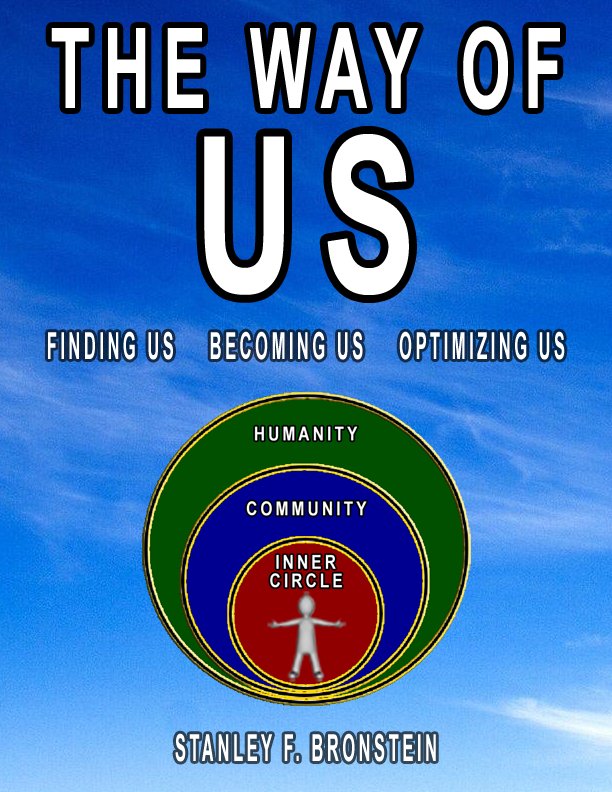
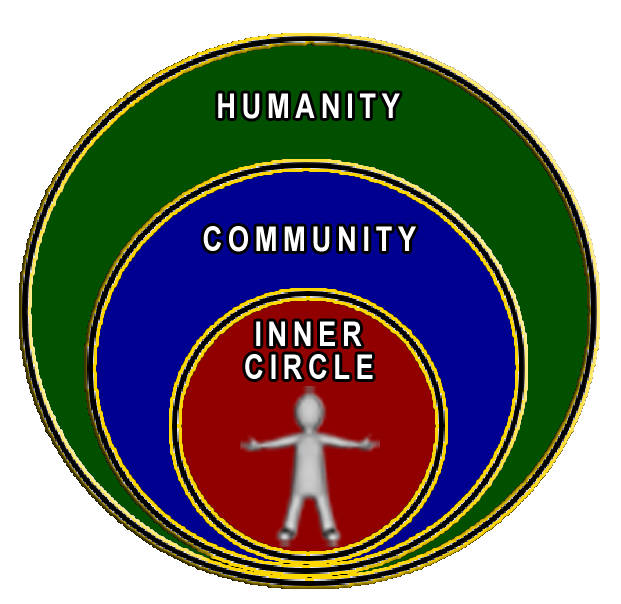
I came to see that the quality of our lives is shaped not only by who we are as individuals, but also by how we show up in the three rings of our shared existence: our Inner Circle, our Community, and our Humanity. In other words, it is shaped by the way of us.
I have spent years creating and refining The Way of Excellence. That system is the foundation behind everything I write and teach. One of my other books, The Way of You took that system and applied it to a single human life, helping you find yourself, become yourself, and optimize yourself. But even as I wrote that book, one truth kept getting louder: excellence cannot stop at the edge of our own skin. If we truly want to live excellently, we have to ask what excellence looks like in our Inner Circle, in our Community, and in our shared life as Humanity.
That is what this book is about. The Way of Us is my attempt to answer a simple but urgent question: What happens when we apply The Way of Excellence not just to “me,” but to “we.”
This is not a book of quick fixes, hacks, or clever slogans. It is an invitation to look honestly at how we are living together and to take responsibility for our part in that. It is about learning to live in a way that honors your Inner Circle, strengthens your Community, and contributes to Humanity, instead of quietly accepting the stories and habits that keep us divided, exhausted, and afraid.
Along the way, I have discovered some steady truths about Us:
- That all too often, all too many of us care only about ourselves, and we underestimate how much damage that does to our Inner Circle, our Community, and our future as Humanity.
• That most people are not cruel or broken; they are overwhelmed, scared, busy, and stuck in systems that reward short-term, Win-Lose thinking instead of long-term, Win-Win excellence.
• That you do not have to fix the entire world to make a real difference; you can start with your Inner Circle, expand into your Community, and let your concern slowly grow to include Humanity.
• That the same Concepts, Untils, Laws, and Benefits that help an individual live excellently can also guide how we build families, teams, neighborhoods, organizations, and movements.
You will see three big sections throughout this book: Finding Us, Becoming Us, and Optimizing Us.
Finding Us is about waking up from autopilot and telling the truth about how we are living together right now. It asks you to look honestly at your Inner Circle, your Community, and the larger patterns you see in Humanity. Where are we generous, and where are we selfish. Where are we honest, and where are we hiding. Where are we building Win-Win, and where are we playing Win-Lose and pretending it will all work out somehow.
Becoming Us is about choosing who we want to be together and beginning to live that choice. It is where you start to bring The Way of Excellence into the conversations, agreements, and systems you are already part of. You begin to practice integrity, discipline, and long-term thinking not just for yourself, but with and for the people around you. You learn how to strengthen your Inner Circle, contribute to your Community, and relate to Humanity in a way that feels more aligned with your deepest values.
Optimizing Us is about going further. It is about refining, integrating, and deepening what we have built so far, and beginning to redesign systems so they better reflect who we want to be as Us. It asks bigger questions about how we educate, how we work, how we govern, how we care for the planet, and how we treat people we may never meet. It invites you to see yourself as part of a larger human project and to become all-in for building a more excellent world, starting exactly where you are.
Just like The Way of You, this book is meant to walk beside you. Each chapter will offer Experiments and Assignments you can try in your Inner Circle, in your Community, and in your view of Humanity. You are not expected to get it perfect. You are simply invited to keep showing up, to keep telling the truth, and to keep practicing better ways of being Us.
If you stay with this work, something remarkable can happen. Your closest relationships begin to feel more honest and supportive. Your Community starts to feel less like a collection of strangers and more like a shared project. You begin to care about Humanity in a way that does not drown you in guilt or fear, but motivates you to contribute in ways that are real and sustainable. You start to see that your daily choices are not small; they are part of a larger pattern of who we are becoming together.
You realize you are not just trying to fix isolated pieces of your life. You are learning how to live as part of an Inner Circle, a Community, and a Humanity that reflect your highest understanding of excellence.
So let us begin. Take this book one chapter at a time. Reflect. Experiment. Talk about what you are learning with the people around you. Come back to it as often as you need.
I will be right here with you, as together we keep discovering – and living – The Way of Us.
– Stanley F. Bronstein
How to Use This Book: Experiments, Assignments, and the TWOE System
This is not a book you read once, nod your head at, and then forget. My intention is for The Way of Us to become a book you work with – a companion you return to as your life changes, as your Inner Circle shifts, as your role in your Community evolves, and as your understanding of Humanity deepens. To get the most from it, it helps to know how it is designed and how I suggest you use it.
- Read it in order the first time
The structure of this book is intentional. It mirrors the three movements I talked about in the Foreword:
• Finding Us
• Becoming Us
• Optimizing Us
You will see these three movements as:
• Part I – Finding Us
• Part II – Becoming Us
• Part III – Optimizing Us
On your very first read, I strongly recommend you go in order:
- Foreword
- How to Use This Book (this section)
- Part I – Finding Us (Chapters 1-6)
- Part II – Becoming Us (Chapters 7-12)
- Part III – Optimizing Us (Chapters 13-18)
You may be tempted to skip ahead to the “action” chapters – the systems, experiments, and collective work. I understand that impulse. But those chapters will mean far more (and work far better) if you have first:
• Looked honestly at how your Inner Circle, your Community, and your relationship to Humanity are actually functioning today.
• Understood how your current beliefs and habits about Us have been shaping your choices.
• Begun to see the story of “how we live together” not as something fixed, but as training that can be improved.
Once you have taken one full pass through the book, you can absolutely jump around and revisit the sections that fit your current season. But for now, give yourself the gift of seeing the whole picture first.
- Think of this book as three interlocking journeys
Each part of the book has its own “job”:
- Part I – Finding Us
Helps you wake up from autopilot and tell the truth about how we are living together right now. You will look at your Inner Circle, your Community, and Humanity with clearer eyes. You will learn to see the real starting line – not where you wish we were, but where we actually are. - Part II – Becoming Us
Helps you choose who you want to be as part of Us. You will explore what it means to live a We-first identity, to strengthen and heal your Inner Circle, to contribute consciously to your Community, and to expand your sense of responsibility to Humanity. This is where you begin building shared practices, agreements, and cultures that reflect The Way of Excellence. - Part III – Optimizing Us
Helps you refine and deepen the way we live together. You will begin to look at systems, structures, and long-term patterns. You will explore how to design environments, policies, routines, and traditions that support Win-Win outcomes for the Inner Circle, the Community, and Humanity. You will think more intentionally about long-term stewardship and collective excellence.
These journeys are not strictly linear. You do not “finish” Finding Us and never return to it. You will:
• Find Us at a deeper level.
• Become a better version of Us in your corner of the world.
• Optimize that version by improving the systems and habits that support it.
• Then, at some later point, discover that it is time to Find Us again at an even deeper level.
The book is designed so you can move through it cyclically over the course of your life.
- Understand the difference between Experiments and Assignments
Most chapters will end with two kinds of practical invitations:
• Experiments
• Assignments
They are both important, but they are not the same thing.
Experiments: low-pressure tests
An Experiment is something you try, not something you promise.
Experiments are designed to:
• Help you see your Inner Circle, your Community, and your role in Humanity more clearly.
• Help you gather information about what actually happens when you change something in how you show up with others.
• Let you interact with the ideas in the chapter in a concrete way, without the pressure of “I must now do this perfectly forever.”
Examples of Experiments might include:
• Paying attention for one day to how you speak about “them” versus “us” in your everyday conversations.
• Noticing how decisions are made in one Community you belong to, and writing an honest snapshot of what is really happening.
• Trying a small change in how your Inner Circle meets, shares, or checks in for a week, and noticing what shifts.
You cannot “fail” an Experiment. Whatever happens, you learn something. Experiments are about discovery.
Assignments: self-chosen commitments
An Assignment is different. It is something you decide to commit to, for a defined period of time, because you believe it will move your Inner Circle, your Community, or your contribution to Humanity in the direction of excellence.
Assignments are where you begin to activate:
• Your Discipline.
• Your Commitment.
• Your willingness to think and act for the long-term.
• Your Personal Responsibility for what comes next in your shared life with others.
Examples of Assignments might include:
• Hosting a regular Inner Circle conversation every week for the next 90 days to talk honestly about what is working and what is not.
• Volunteering in your Community in a specific, concrete way for the next three months.
• Choosing one Win-Win principle from TWOE and applying it to a particular relationship, team, or project for a season.
You are always in charge of what becomes an Assignment. Do not turn everything into an Assignment. That is a great way to overwhelm yourself and quit.
A good rule of thumb:
• Use Experiments to explore, learn, and tell yourself the truth about Us.
• Use Assignments to build a better Us, brick by brick.
Both are important. Experiments show you reality. Assignments reshape it.
- Keep TWOE in the background as your operating system
Behind this book sits a system: The Way of Excellence (TWOE).
TWOE is built around:
• 20 Concepts
• 20 Untils
• 20 Laws
• 20 Benefits
The entire TWOE system is outlined in detail on the master website TheWayOfExcellence.com and in The Way of Excellence Journal, which you can download for free from that website.
You do not need to memorize all of TWOE to move forward with this book, but it is important to know that every chapter you are about to read is grounded in that structure.
When I talk about excellence, responsibility, integrity, long-term thinking, persistence, telling it like it is, Win-Win, being all-in, and integrating mind, body, and spirit, I am drawing directly from TWOE.
You can think of it this way:
• TWOE is the operating system – the underlying logic of how excellence works.
• The Way of Us is an application – a specific way that operating system gets installed and lived out in our shared life: in your Inner Circle, in your Community, and in our responsibilities to Humanity.
If you have not already done so, I strongly recommend that you study The Way of Excellence system on TheWayOfExcellence.com and in The Way of Excellence Journal as you work through The Way of Us. Let the two works support each other:
• This book will help you apply excellence to the way you live with others.
• TWOE and The Way of Excellence Journal will give you the full, detailed framework behind everything we are doing here.
You can go back and forth between them at whatever pace feels right to you.
- Use a journal to capture your journey with Us
You will get far more value from this book if you do not just think about the ideas, but also write with them.
I encourage you to pick one place to capture everything related to The Way of Us:
• A physical notebook.
• A document on your computer.
• A note-taking app – whatever you will actually use.
Use it to:
• Answer the reflection questions at the end of chapters.
• Record your Experiments and what you noticed in your Inner Circle, your Community, and your view of Humanity.
• List your Assignments and track how well you followed through.
• Capture key insights about your patterns in relationships, your role in groups, your beliefs about Us, and your progress over time.
Your journal will become your personal record of:
• How you Found Us – how you saw clearly the state of your Inner Circle, your Community, and our shared world at this stage of your life.
• How you Chose to Become a different kind of presence inside those rings.
• How you Optimized that presence by improving your habits, your systems, and your contributions.
Months or years from now, reading back through those pages will show you just how far you and the people around you have come.
- Set a pace that respects your life and still stretches you
There is no single “correct” pace for reading and using this book.
Some people will want to:
• Read one chapter per day, doing a light version of the exercises, then come back later for a deeper pass with their Inner Circle or Community.
Others will want to:
• Take one chapter per week or even one chapter per month, fully working through the Experiments and Assignments before moving on.
You know your life, your responsibilities, and your current energy level. I suggest choosing a pace that meets two criteria:
- You can realistically sustain it for at least a few months.
- It challenges you enough that you are genuinely growing, not just coasting.
If it feels too easy, you are probably skimming.
If it feels impossible, you are probably trying to do too much, too fast.
You are free to adjust the pace as you go.
- Expect to come back to this book again and again
You are not meant to “finish” The Way of Us one time and be done.
As your life unfolds, you will encounter:
• New situations.
• New challenges.
• New opportunities.
• New versions of yourself and new versions of Us.
Each time that happens, you can come back to this book with new eyes:
• During a major transition in your Inner Circle, you might revisit Part I – Finding Us to take a fresh inventory and see your shared story clearly from where you are now.
• When you feel ready to help your Community grow into a better version of itself, you might spend more time in Part II – Becoming Us.
• When you want to refine what is already working and deepen your contribution to Humanity, you might live for a while in Part III – Optimizing Us.
Think of this book not as a one-time event, but as a manual for our shared life that you can keep on your desk, your nightstand, or your device, and return to whenever you need clarity, structure, or a nudge to live more excellently together.
- Above all, treat yourself and others with honesty and respect
The real power of this work does not come from reading my words. It comes from the way you choose to live with yourself and with others as you read them.
My invitation is simple:
• Be as honest with yourself as you can.
• Be as honest with your Inner Circle as you can.
• Be as kind with yourself and with others as you can.
• Be as committed to our shared excellence as you can.
If you do that, this book will not just be something you have read. It will become part of The Way of Us.
INTRODUCTION TO PART I - FINDING US
Awakening, Truth, and the Real State of Our Shared Life
Before we can build a better Us, we have to be willing to see the Us we already have. That is the work of this first part of the book. Finding Us is about waking up from autopilot and telling the truth about how we are actually living together right now – in our Inner Circle, in our Community, and in Humanity. It is about stepping back far enough to see the patterns we are part of and the climate we are helping to create, whether we meant to or not.
For a long time, most of my own growth focused on “me.” I needed it to. I had to tell the truth about my life, my health, my habits, my identity. I had to face my own excuses and my own lack of integrity in certain areas. That personal work was not optional, and I will never diminish its importance. But as I continued to walk The Way of Excellence, I began to see that my life did not exist in a vacuum. Everything I was doing – the food I ate, the miles I walked, the work I did, the way I handled my emotions and my time – was affecting the people around me. It was shaping the tone of my Inner Circle. It was influencing the culture of the Communities I touched. It was contributing, in a very small but very real way, to what we are becoming as Humanity.
That realization changed the questions I was asking. I was no longer asking only “Who am I and what kind of life do I want to live.” I was also asking “Who are we and what kind of life are we creating together.” Once you start asking that second question, you cannot unsee it. You notice things you used to overlook. You notice when me-first thinking shows up in your Inner Circle. You notice when your Community reacts from fear instead of from wisdom. You notice how easy it is for all of us to talk about big problems while quietly avoiding our own role in them.
Finding Us begins by bringing those patterns into the light. In this part of the book, I am going to ask you to look honestly at three levels of your life: your Inner Circle, your Community, and Humanity.
Your Inner Circle is made up of the people whose lives you affect most directly – partners, family, close friends, key teammates, and anyone you interact with frequently in a meaningful way. This is where your lived values are most obvious. It is also where your unresolved issues and habits tend to show up the loudest. If you want to know what you truly believe about love, respect, responsibility, and excellence, pay attention to how you behave with your Inner Circle when you are tired, stressed, or disappointed.
Your Community includes the groups, organizations, neighborhoods, and networks you are part of. It might be your workplace, your local community, your religious or spiritual community, your professional groups, or the online spaces where you spend time. Communities have cultures – shared norms, stories, and unwritten rules. Some of those cultures are healthy and life-giving. Some are unhealthy and quietly corrosive. Most are a mix of both. In this part of the book, I want you to see more clearly which is which.
Humanity is the largest circle – the human family as a whole. It can feel abstract, but it is not. What happens to Humanity shows up in the news, in the environment, in the economy, in global tension, and in the opportunities or lack of opportunities people have. You and I may not be able to control what happens at that scale, but we are not separate from it either. Humanity is the backdrop – and the container – for everything else we do.
In Part I, I am not asking you to fix these three circles. Not yet. I am asking you to see them. I am asking you to notice where things are working and where they are not. I am asking you to be willing to tell the truth – not the polished, public truth, but the quiet, private truth about the real state of your shared life.
That means asking questions like:
• What is the actual tone of my Inner Circle right now. Are we honest with each other. Are we kind. Are we living Win-Win, or are we quietly keeping score and protecting ourselves.
• What is the real culture of my Community. Are people encouraged to speak the truth and take responsibility, or is blame, avoidance, or pretending the norm.
• How do I really feel about Humanity. Do I see other people as “us,” as “them,” or as background noise in my personal story.
These questions are not comfortable. They are not meant to be. The Way of Excellence teaches us that telling it like it is is a starting point, not a destination. You cannot build genuine excellence on top of denial. In The Way of You, that meant being honest about your habits, your health, your identity, and your story. In The Way of Us, it means being honest about how you and the people around you are actually living together.
In this part of the book, you will learn to notice the invisible rules that shape your Inner Circle and your Community. You will explore how we became so separate – not just personally, but socially and culturally. You will begin to map where you fit inside the three rings and how your own choices are influencing what Us feels like for the people around you.
You may discover things you are proud of. You may see ways that you and your Inner Circle already live The Way of Us more than you realized. You may also see areas where you have been looking away, numbing out, or telling yourself partial truths because the full truth felt too heavy to carry. All of that is part of the process.
My request is simple: as you move through Part I, bring as much honesty and as little judgment as you possibly can. You are not on trial here. Neither is your family, your Community, or Humanity. You are gathering information. You are learning to see the terrain clearly before you try to change it. When you find dysfunction, acknowledge it. When you find beauty and strength, acknowledge that too. Both matter. Both will shape the path forward.
Each chapter in this part will end with Questions for Reflection, Experiments, and Assignments. The Questions will help you slow down and notice. The Experiments will invite you to test what happens when you shift your awareness. The Assignments will gently begin to move you from passive observation to active responsibility. You do not have to do everything. You do not have to do it perfectly. You simply have to be willing to look, to learn, and to take the next honest step.
Finding Us is not about blaming yourself for everything that is wrong in the world. It is about reclaiming your power to influence the world you actually live in – your Inner Circle, your Community, and your piece of Humanity. Before we design better systems, seek bigger solutions, or dream of large-scale change, we start here, with clear eyes and a truthful baseline.
Take your time with this part. Let it work on you. Let it show you things you have been too busy or too afraid to see. This is the real starting line. Once you know where we are, you can begin to choose, with much greater clarity, who you want to help us become.
Chapter 1 - The Number One Problem in the World
I am convinced that the number one problem in the world today is not a lack of resources, intelligence, or potential. It is something much simpler and much harder to face. All too often, all too many of us care only about ourselves. We may not say it out loud. Most people would not describe themselves as selfish. Yet if you look closely at how we live, decide, spend, argue, and vote, a pattern shows up again and again. We treat our own immediate wants and fears as more real and more important than the well-being of our Inner Circle, our Community, and certainly of Humanity.
You can see this almost anywhere you look. A driver weaves through traffic, cutting people off to gain a few car lengths, risking the safety of others for the illusion of getting there faster. A company maximizes short-term profit while quietly burning out employees and damaging the environment that their children will inherit. A family avoids a hard but necessary conversation, allowing resentment to build rather than doing the uncomfortable work of repair. A Community turns away from its most vulnerable members, insisting that someone else should handle the problem. On a global level, nations compete for advantage while the planet shows clear signs that our collective way of living is not sustainable. Different scenes, same root issue. Me first. Us later, if at all.
I am not saying this to shame you or to shame anyone. I include myself in this pattern, because I have lived it too. For many years, even as I was working hard on my own growth, my focus was mostly on my own life: my health, my habits, my mindset, my results. In many ways that was necessary. I needed to get my own house in order. But as I kept walking the path of excellence, I could not avoid a simple realization. If my personal excellence does not eventually translate into better experiences for my Inner Circle, my Community, and Humanity, then I am leaving most of my potential on the table.
The Way of Us starts right here, with an honest look at the culture of “me first” that we all swim in. We live in systems that reward speed over wisdom, noise over depth, image over integrity, short-term gain over long-term consequence. It is easy, in that environment, to shrink our sense of responsibility down to the smallest possible circle. As long as I and maybe a few of “my people” are doing okay, the story goes, then I am doing my part. The rest is somebody else’s problem. That story is understandable. It is also slowly destroying us.
When you zoom out and look at the patterns, the cost of a me-first world is enormous. At the Inner Circle level, families fracture, friendships erode, and trust becomes fragile. People feel more alone and more misunderstood, even when they are surrounded by others. At the Community level, we see polarization, blame, and a constant search for enemies. Instead of asking how we can solve problems together, we default to asking who is to blame and how we can beat them. At the level of Humanity, we see a planet under strain, massive inequality, and a growing sense that our technology has outpaced our wisdom. None of this is an accident. It is what happens when billions of small, self-focused choices add up over time.
If that were the whole story, this would be a very depressing chapter. Fortunately, it is not. The same human beings who are capable of selfishness are also capable of extraordinary generosity, courage, and cooperation. You have seen this too. You have seen families rally around a loved one in crisis, Communities come together after a disaster, and people stand up for strangers they will never meet. These moments are not rare because we are broken. They are rare because we have not yet built a way of living that makes them normal. That is what The Way of Us is about.
At the heart of this book are three simple but powerful circles. The first is your Inner Circle – the people closest to you, the ones whose lives you directly touch every day. The second is your Community – the groups, organizations, neighborhoods, and networks you are part of. The third is Humanity – the larger human family to which we all belong, whether we think about it or not. You are always living inside all three rings. You may not always feel it, but you are. Your words, your choices, your habits, and your silence echo outward in ways you cannot fully see.
Most of us were not taught to think this way. We were taught to believe that our choices are mostly personal. What I eat, how I spend my time, how I treat my body, how I use my money, what I say online, how I drive, how I vote, how I listen or fail to listen – all of that feels like it belongs to “me.” In reality, every one of those choices is shaping the experience of your Inner Circle, your Community, and Humanity. Every time you model excellence or indifference, every time you choose Win-Win or Win-Lose, every time you act with integrity or cut a corner, the rings around you feel it.
The number one problem in the world, then, is not that people are bad. It is that we rarely stop to see our lives through the lens of Us. We react from habit and fear. We chase comfort and control. We assume that if we do not intend harm, we are innocent, even when the ripple effects of our choices tell a different story. We forget that we are always creating a climate around us – in our homes, in our workplaces, in our Communities, and on this planet. The question is not whether we are creating a climate. The question is what kind.
The Way of Excellence was my attempt to answer the question, “How does excellence work inside a human life.” The Way of You took that operating system and installed it at the personal level. The Way of Us asks a different but connected question. What would happen if we brought those same Concepts, Untils, Laws, and Benefits to the way we live together. What if we treated our Inner Circle, our Community, and Humanity as an arena for excellence, instead of a backdrop to our personal story.
To move in that direction, we first have to tell the truth about where we are. That is what Finding Us is about. Before you try to change the world, you need to see clearly how you are already participating in it. You need to see how often you default to me-first without even noticing. You need to see the stories you have inherited about who counts as “us” and who is safely labeled as “them.” You need to see where your Inner Circle is strong and where it is fragile. You need to see where your Community is generous and where it is indifferent. You need to see how you really feel about Humanity – not the version you would like to post online, but the one that surfaces when you are tired, scared, or overwhelmed.
This kind of seeing is not comfortable. It is much easier to point to “those people” out there who are clearly the problem. It is easier to blame politicians, corporations, institutions, or entire groups of people who do not see the world the way you do. There may be truth in some of that blame, but it is incomplete. Excellence does not begin with blame. It begins with responsibility. The question at the center of this book is not, “Why are they like that.” It is, “What am I willing to do, with my one life, to help create a better Us.”
In the chapters ahead, I am going to ask you to look at some hard things. I am also going to ask you to honor some beautiful things that may be easier for you to ignore – the moments when you or the people around you have already lived The Way of Us, even if you did not have that language at the time. This work is not about tearing everything down. It is about seeing clearly what is broken and what is already good, so you can put more of your energy into building what you want to see in your Inner Circle, your Community, and in Humanity.
You are going to see the words Inner Circle, Community, and Humanity a lot in this book. I am doing that on purpose. I want those three rings to become part of how you think. When you make a decision, I want you to start asking, “What does this do to my Inner Circle. What does this do to my Community. What does this do to Humanity.” You will not always know the exact answer, but the act of asking the question will begin to change you.
One person cannot fix all the problems in the world. I cannot and you cannot. But one person can change the way they show up in their Inner Circle. One person can shift the tone and direction of the Communities they are part of. One person can decide to act as if Humanity matters, even when nobody is watching. When enough people do that, consistently, over time, the world changes. Not all at once and not without resistance, but it changes.
Finding Us starts with a simple, brave act. You look around and you tell the truth about how we are doing. You look at yourself and you tell the truth about how you are contributing. You do not stop there, but you start there. In a me-first world, that alone is a radical act of excellence.
At the end of each chapter, I will offer you Experiments and Assignments. The Experiments will help you see more clearly. The Assignments will help you build new patterns. For now, I want you to treat Chapter 1 as your invitation to step into a different way of looking at your life. Not just “How am I doing,” but “How are we doing” and “What can I do about it.” That question is where The Way of Us begins.
Questions for Reflection
- When you hear the statement “All too often, all too many of us care only about ourselves,” what emotions come up for you – agreement, resistance, defensiveness, sadness, hope, something else.
- Where do you already see the impact of me-first thinking in your own Inner Circle, in your Community, and in Humanity. Be specific.
- When you think about your own life, how often do you consider the impact of your choices on your Inner Circle, your Community, and Humanity. How would you describe your current level of awareness on a scale from 1 to 10.
- What are some moments from your past where you or others clearly acted from a We-first mindset. What did those moments feel like.
Experiments
Experiment 1 – A Day of Noticing Me-First and We-First
For one day, simply pay attention to the me-first and We-first patterns you see around you and in yourself. Do not try to change anything yet. Just notice. When someone cuts in line, when a driver is kind or unkind on the road, when a co-worker helps someone without being asked, when a family member dismisses another’s feelings – mentally label it as me-first or We-first. At the end of the day, write down what you noticed. How common is each pattern in your Inner Circle, in your Community, and in the wider world you observe.
Experiment 2 – Three Rings Check-In
Choose one decision you are making today. It can be small, like how you spend your evening, or larger, like how you respond to a conflict. Before you act, pause and ask three questions: “How will this affect my Inner Circle. How will this affect my Community. How will this affect Humanity, even in a tiny way.” You do not need to have a perfect answer. Just do your best and act with that awareness in mind. Afterwards, reflect on how it felt to make a decision with the three rings in view.
Assignments
Assignment 1 – An Honest Snapshot of Us
Set aside at least 30 minutes this week to write a brutally honest snapshot of how you see your Inner Circle, your Community, and Humanity right now. Describe what is working and what is not. Describe where you feel hopeful and where you feel discouraged. Do not edit yourself. Do not try to sound wise or positive. Just tell the truth as you see it. When you are done, underline or highlight any sentences that surprise you. Those surprises are clues about where your work may be.
Assignment 2 – A Simple Commitment to We-First Awareness
Choose one simple, concrete way you will remind yourself to think about Us for the next 30 days. For example, you might put a small note where you will see it often that says “Inner Circle – Community – Humanity,” or set a daily reminder on your phone that asks, “How did I live The Way of Us today.” Your assignment is not to be perfect. Your assignment is to bring We-first awareness into your daily life often enough that it starts to become part of how you think. At the end of 30 days, review what you wrote, what you noticed, and how you feel about the three rings now.
Chapter 2 - Inner Circle, Community, Humanity: The Three Rings of Us
In Chapter 1, I asked you to consider a hard idea: that all too often, all too many of us care only about ourselves. In this chapter, I want to show you something equally important and far more hopeful. You are never just “a person living a solo life.” You are always living inside three rings at the same time: your Inner Circle, your Community, and Humanity. Whether you think about them or not, those rings are already shaping you, and you are already shaping them.
Once you begin to see your life through these three rings, the world looks different. You realize that your choices are not just “personal.” They are constantly sending signals into your Inner Circle, into your Community, and into Humanity. You also realize that you are not helpless in the face of “the world.” You have specific arenas where you can practice The Way of Us, one choice at a time, and those choices matter more than you might think.
In this chapter, I want to define those three rings clearly, help you see where you are already standing inside them, and begin to show you how they interact. If Chapter 1 described the problem, Chapter 2 gives you the map.
Your Inner Circle: Where The Way of Us Begins
Your Inner Circle is the smallest, closest ring. These are the people whose lives you directly touch, day in and day out. They see who you are when you are tired, stressed, unfiltered, and unedited. They feel the real impact of your habits, your moods, your choices, and your values.
Your Inner Circle typically includes:
• Family or chosen family who are part of your daily or weekly life.
• Close friends who know your story and your struggles.
• Partners or spouses.
• Key teammates or collaborators you work with consistently and closely.
• Anyone you interact with regularly in a way that meaningfully affects both of you.
You can tell who is in your Inner Circle by asking a simple question: whose life gets noticeably better or worse depending on how I show up this week. If the answer is “this person would absolutely feel it if I changed how I behaved,” they are likely part of your Inner Circle.
The Inner Circle is where The Way of Us begins because it is where your beliefs and values get most honestly tested. It is one thing to talk about love, respect, responsibility, and Win-Win in theory. It is another thing to live them with the people you are closest to when money is tight, when you are exhausted, when you do not get your way, or when someone disappoints you.
If you want an honest readout on who you really are, look at how you behave inside your Inner Circle when nobody is watching, when there is nothing to gain, and when doing the right thing costs you something. That is your true baseline for The Way of Us.
The good news is that small changes in your Inner Circle often produce big results. One honest conversation, one repaired apology, one new shared ritual, one act of generosity or patience can shift the tone of an entire household or team. We will explore that more deeply in later chapters, but for now I want you to recognize this: you do not have to start with the whole world. You can start with the people right in front of you.
Your Community: The Culture You Help Create
Your Community is the middle ring. These are the groups, organizations, neighborhoods, and networks you belong to. You may not be as close to each person in these circles as you are to your Inner Circle, but together they exert a powerful influence on how you think, what you consider normal, and how you behave.
Your Community can include:
• Your workplace or places you volunteer.
• Your local neighborhood or town.
• Religious, spiritual, or cultural communities you are part of.
• Professional or interest-based groups.
• Online spaces where you consistently show up and participate.
Each Community has a culture. That culture is the sum of its stories, habits, norms, and unwritten rules. It answers questions like:
• What do we reward here.
• What do we tolerate here.
• What do we quietly discourage or punish here.
• Who is included and who is left out.
• How do we handle conflict.
• How do we treat success and failure.
You are influenced by these cultures every day. You may find yourself lowering your standards in one Community and raising them in another, without ever deciding to do so. You may feel more generous in one setting and more guarded in another. You may feel free to tell the truth in one group and feel pressure to pretend in another.
At the same time, you are also influencing your Communities. Your presence, your words, your tone, your integrity, your willingness to speak up, your silence, your effort, and your example are all part of the culture. Even if you do not have a formal title or position, you are never neutral. You are always either reinforcing the current culture or nudging it in a different direction.
When we talk about The Way of Us at the Community level, we are talking about the deliberate choice to practice excellence in how we participate in and shape the cultures we are part of. That might mean holding yourself to a higher standard than “everyone else.” It might mean starting small improvements where you are instead of waiting for someone in authority to do it. It might mean being the person who models Win-Win thinking in a Win-Lose environment.
Communities are where many of the big problems of the world become concrete. Issues like fairness, justice, inclusion, and responsibility are not just abstract debates. They show up in hiring decisions, in how people are treated in meetings, in whose voice gets heard and whose gets ignored, in how resources are shared, and in what behavior is quietly accepted. Part of The Way of Us is learning to see your Communities clearly and then bring The Way of Excellence into them intentionally.
Humanity: The Largest Circle We All Share
Humanity is the outer ring. It includes everyone, everywhere. It includes people you will never meet, cultures you have never heard of, and generations that are not even born yet. Because it is so large and so abstract, it is easy to treat Humanity as an idea instead of a reality.
You see Humanity when you read the news, when you look at global trends, when you hear about wars, disasters, breakthroughs, and movements. You see Humanity in the state of the planet, in the global economy, in migration, in technological change, and in the energy that moves across the world through media and culture.
It is tempting to feel either numb or overwhelmed by Humanity. The problems can feel too large, too complex, and too far beyond your direct control. Many people respond by turning away or by confining their concern to a small circle of people who seem more real and more manageable. That response is understandable, but it comes with a cost.
When we stop thinking about Humanity, we stop asking important questions like:
• What kind of world are we building for people we will never meet.
• How do our collective choices affect children on the other side of the planet.
• How do the systems we support with our time, money, and attention impact the vulnerable.
• What does it mean to live as if every person has inherent worth, not just the people who look, think, or live like we do.
The Way of Us does not require you to fix global problems single-handedly. It does ask you to remember that Humanity is real and that you are part of it. Your daily choices, multiplied by millions of people, shape the trajectory of our species. Your vote, your consumption habits, your work, your voice, and your silence all contribute to the kind of world Humanity experiences.
Seeing Humanity as one of your rings is not meant to crush you. It is meant to expand your sense of responsibility and possibility. When you act with integrity in your Inner Circle and your Community, you are not just “being a good person.” You are doing your small but real part in building a different kind of world.
How the Three Rings Interact
These three rings are not separate compartments. They constantly influence each other. What happens in one ring ripples into the others.
Here are a few simple examples:
• Inner Circle to Community: If you learn to handle conflict in your family with honesty and respect, you are more likely to bring those skills into your workplace, your neighborhood, or any group you are part of. Your Community benefits from the excellence you practice at home.
• Community to Inner Circle: If you are part of a healthy Community that values truth, kindness, and long-term thinking, you are more likely to carry those values back into your Inner Circle. Your closest relationships benefit from the culture you immerse yourself in outside the home.
• Community to Humanity: Communities that practice fairness, inclusion, and responsibility create models that can spread to other Communities. Over time, those models can influence policies, norms, and expectations at the level of Humanity.
• Humanity to Inner Circle: Large-scale events and trends – economic shifts, environmental changes, political decisions, global crises – can place pressure on your Inner Circle. A war across the world can show up as stress in your household through prices, uncertainty, and fear.
You live in the middle of all these interactions. You are not just an observer. Every time you internalize a story from Humanity, it can change how you treat your Community and your Inner Circle. Every time you strengthen your Inner Circle, you are building capacity that can flow outward into your Community and Humanity.
It is easy to see the influences that move from the outside in. The news, the economy, and the culture can feel powerful and overwhelming. It is harder to notice the influences that move from the inside out. Yet that is where your greatest leverage often lies. It is much easier to change how you show up in your Inner Circle than to rewrite global systems directly. But over time, those inner changes can stack up and become part of a larger pattern of change for Humanity.
Locating Yourself Inside the Rings
Before we go any further in this book, I want you to have a clear sense of where you currently stand inside each ring. Think of this as creating a map. You cannot navigate to a better place if you do not know where you are starting from.
Start with your Inner Circle. Ask yourself:
• Who are the five to ten people whose lives are most affected by my daily choices.
• Who do I see or speak with most often in a way that matters to both of us.
• Who depends on me and who do I depend on.
Write their names down. This is your Inner Circle. You may notice that some people you thought of as “background” are actually central. You may also notice that some people you give a lot of mental energy to are not really part of your Inner Circle at all. That awareness alone can shift how you use your time and attention.
Next, map your Communities. Ask yourself:
• What are the main groups, organizations, or spaces I am part of right now.
• Where do I spend my time, energy, and attention outside my Inner Circle.
• Which Communities have the most influence on my thinking, my mood, and my behavior.
List them. Your list might include your workplace, your neighborhood, a faith community, a sports league, a professional group, a volunteer organization, or recurring online spaces. Some Communities will feel healthy and energizing. Others may feel draining or conflicted. We are not judging them yet. We are simply noticing where you are embedded.
Finally, reflect on Humanity. This is less about listing names and more about noticing how you relate to the big picture. Ask yourself:
• When I hear about global issues, how do I usually respond – numb, angry, hopeful, overwhelmed, dismissive.
• Which parts of Humanity do I feel most connected to. Which parts feel distant or invisible to me.
• How often do I consider the long-term impact of my choices beyond my lifetime.
You might jot down a few words or phrases that describe your current relationship with Humanity. You might also notice what stories or beliefs you carry about “people” in general. Those beliefs will shape how you think about what is possible for Us.
Common Distortions in the Three Rings
Most of us do not grow up with a clear, balanced view of Inner Circle, Community, and Humanity. We pick up distortions along the way. Here are a few common patterns you may recognize:
- Inner Circle Only: People in this pattern care deeply about their Inner Circle but pay little attention to their Community or Humanity. Their motto, spoken or unspoken, is “As long as my people are okay, that is what matters.” They can be loving and generous at home but indifferent to larger issues or to people outside their immediate circle.
- Community Without Inner Circle: Some people pour themselves into Community work but neglect their Inner Circle. They may be admired as leaders or helpers in public while their closest relationships are strained or distant. Their motto might be “I am here for everyone” while the people closest to them quietly feel ignored.
- Humanity Without Roots: Some people care passionately about global issues but have weak Inner Circle and Community connections. They may spend hours thinking about the world and arguing about big ideas while struggling to build stable, healthy relationships in their own life. Their concern for Humanity is real, but it can become ungrounded if it is not anchored in actual, everyday practice with real people.
- Me Without Us: This is the pattern we talked about in Chapter 1. The focus is primarily on the self. Inner Circle, Community, and Humanity become scenery in the background of a personal story. Other people matter when they are useful, entertaining, supportive, or in agreement. When they are not, they get pushed away, avoided, or blamed.
The goal of The Way of Us is not to shame you for any pattern you might recognize. It is to invite you into a more integrated way of living. Inner Circle, Community, and Humanity all matter. Neglecting any one of them will eventually weaken the others. You do not have to fix every ring overnight, but you can begin to move toward a healthier balance.
Bringing TWOE Into the Three Rings
The Way of Excellence was built to answer questions like: What does it mean to tell it like it is. What does responsibility really look like. How do I think for the long-term. What is a Win-Win life. What happens when I go all-in on excellence.
The Way of Us asks you to bring those same questions into the three rings:
• What does it mean to tell it like it is in my Inner Circle, in my Community, and when I think about Humanity.
• What does responsibility look like in my closest relationships, in the groups I belong to, and in the systems I support.
• What would long-term thinking mean for my family, my workplace, my city, and the planet.
• What does Win-Win look like when we design policies, agreements, and cultures, not just personal goals.
• What would it mean to go all-in on building a better Us, starting exactly where I am.
As you move through the rest of this book, I want you to keep the three rings in mind whenever you read a concept or a practice. Ask yourself, “How does this apply to my Inner Circle, my Community, and Humanity.” Over time, that habit will become one of your greatest tools for living The Way of Us.
Questions for Reflection
- When you think about your current Inner Circle, who is in it, and how would you describe the overall tone of that circle right now – peaceful, tense, distant, connected, something else.
- Which Communities have the most influence on you at this stage of your life. How do you feel in those spaces – seen, ignored, energized, drained, respected, afraid.
- What is your honest, instinctive reaction when you hear the word Humanity. Does it feel inspiring, overwhelming, distant, irrelevant, or something else.
- Which of the common distortions in the three rings do you recognize most in yourself right now – Inner Circle only, Community without Inner Circle, Humanity without roots, or Me without Us. What makes you say that.
Experiments
Experiment 1 – Mapping Your Rings
Take 15 to 30 minutes to create a simple visual map of your three rings. On a piece of paper, draw three concentric circles. Label the innermost one “Inner Circle,” the middle one “Community,” and the outer one “Humanity.” In the Inner Circle, write the names of the people whose lives are most directly affected by your daily choices. In the Community ring, write the names of the groups, organizations, and spaces you are part of. In the Humanity ring, write a few words or phrases that capture how you currently feel about the world and the future. When you are done, step back and look at the page. What surprises you. What feels empty. What feels crowded.
Experiment 2 – Three Rings Lens For One Day
For one day, carry the idea of the three rings with you. As you move through your day, pause a few times and ask, “Which ring am I mostly living in right now.” For example, when you are talking with a family member, you are in your Inner Circle. When you are at work or in a community setting, you are in your Community. When you are reading the news or thinking about global events, you are engaging with Humanity. At the end of the day, write a few sentences about which ring you spent the most time in, which ring you neglected, and what that teaches you about your current patterns.
Assignments
Assignment 1 – Clarifying Your Inner Circle
Over the next week, set aside time to clarify your Inner Circle. Using the map you created, choose one person in your Inner Circle and write a one-page reflection about your relationship with them. How are you currently affecting their life. How are they affecting yours. Where are you living The Way of Us with this person, and where are you living me-first. Do this for at least three people over the course of the week. At the end, review what you wrote and notice any patterns.
Assignment 2 – Choosing One Community To Watch
Choose one Community that you are part of and decide to observe it more consciously for the next 30 days. Your assignment is not to fix anything yet. It is to watch. Pay attention to how people treat each other, how decisions are made, who speaks and who stays quiet, what is rewarded, and what is ignored. Keep a few notes each week about what you notice. At the end of 30 days, ask yourself, “What kind of culture are we creating here, and how am I contributing to it.” This assignment will prepare you for later chapters, where you will begin to bring The Way of Excellence into your Communities more deliberately.
Chapter 3 - Learning To Tell It Like It Is About Us
In The Way of Excellence, Concept #1 – Learning To Tell It Like It Is – sits at the very beginning of the entire system for a reason. If we are not willing to see reality clearly, nothing else we do will last. We can talk about goals, habits, love, community, or Humanity, but if we are building on denial, wishful thinking, or half-truths, the structure will eventually collapse. That is true for an individual life. It is just as true for our Inner Circle, our Community, and Humanity.
In TWOE, Concept #1 is paired with Until #1 – Until We Tell It Like It Is:
“Until we start ‘telling it like it is’ and then begin adjusting our actions accordingly, we will never achieve our maximum potential and evolve as a species.”
Law #1 – The Law Of Actuality – takes it even further:
“No living person or system can remain in existence for very long without first having arrived at a level of full, realistic awareness of their own existence, sensations, thoughts and surroundings and then responding accordingly after having done so.”
And Benefit #1 is simple and powerful:
“Living In The Real World.”
When you put those pieces together, you get a clear message. If we want to live excellently, we have to live in the real world. Not the world we wish we had. Not the story we tell ourselves to avoid discomfort. The actual world. The same is true for our Inner Circle, our Community, and Humanity. If we are not willing to tell it like it is about Us, then The Way of Us will never be more than a nice idea.
What It Means To Tell It Like It Is About Us
Learning To Tell It Like It Is about Us is not about being harsh, cruel, or cynical. It is not about shaming people, attacking groups, or proving that you are right and they are wrong. At its core, it is about alignment with reality. It means looking at our Inner Circle, our Communities, and our larger human family and being willing to say, “This is how it actually is right now,” even when that truth is inconvenient or uncomfortable.
When we avoid that kind of honesty, we usually do it for reasons that seem understandable at the time. We do not want to hurt someone’s feelings. We do not want to upset the status quo. We do not want to start a conflict we are not sure we can handle. We do not want to admit our own role in the problem. We tell ourselves that it is kinder to look the other way, to soften the truth, or to wait for “the right time” that never comes.
The problem is that reality does not go away just because we refuse to look at it. If there is an unspoken tension in your Inner Circle, it is already affecting everyone, whether you talk about it or not. If there is a pattern of disrespect, avoidance, or fear in your Community, people are already living inside that pattern, whether anyone names it or not. If there are real dangers and injustices facing Humanity, they are already shaping lives and futures, whether or not we feel ready to face them.
Learning To Tell It Like It Is about Us is the decision to stop pretending. It is the choice to value truth more than comfort, clarity more than image, growth more than temporary peace. It does not mean we lose compassion. It means we care enough about our Inner Circle, our Community, and Humanity to stop lying to ourselves.
Blame Is Irrelevant, But Truth Is Not
In TWOE, Concept #3 – Taking Personal Responsibility – contains a line that is essential for this chapter: “Blame is irrelevant.” Until #3 – Until We Stop Blaming – puts it plainly:
“Blame is irrelevant. Until we stop blaming others (and ourselves for that matter) and start fixing our problems, we will never achieve our maximum potential and evolve as a species.”
When we start telling the truth about Us, it is very tempting to slide straight into blame. We may want to blame our parents, our partners, our bosses, our neighbors, certain groups, certain leaders, or entire systems. We may also want to blame ourselves and drown in shame. None of that helps. It keeps us stuck.
Learning To Tell It Like It Is about Us means separating truth from blame. We can say, “This is what is actually happening,” without turning it into, “This is why you are terrible,” or, “This is proof that I am hopeless.” We can acknowledge real harm without getting lost in resentment. We can admit our own contribution without erasing our dignity.
Blame looks backward and gets stuck there. Responsibility looks at reality and asks, “What am I going to do now.” When we apply The Law Of Actuality and The Law Of Personal ResponseAbility to our Inner Circle, our Community, and Humanity, we are not trying to win an argument. We are trying to live in the real world so we can change it.
Telling It Like It Is In Your Inner Circle
Your Inner Circle is the first and most immediate arena where you can practice Learning To Tell It Like It Is about Us. That might sound simple, but it is often one of the hardest places to be honest. The stakes feel higher. The history is deeper. The emotions are closer to the surface.
There are many ways we avoid telling it like it is in the Inner Circle:
• We say “It is fine” when it is not fine.
• We pretend we are not hurt to avoid a difficult conversation.
• We keep quiet about patterns that are damaging the relationship because we are afraid of conflict.
• We walk on eggshells around someone instead of naming the issue and giving them a chance to grow.
• We hide parts of ourselves to avoid rejection or judgment.
On the surface, this can look like kindness or peacekeeping. Underneath, it slowly erodes trust. People sense that important things are not being said. Resentments build. Distance grows. The relationship becomes more about avoiding landmines than about real connection.
Telling it like it is in your Inner Circle might look like:
• Saying, “I feel distant from you and I do not want to stay this way. Can we talk.”
• Naming a pattern: “When we talk about money, we both get defensive and shut down. I think this is hurting us.”
• Admitting your own part: “I have been avoiding you instead of being honest about what is bothering me.”
• Asking for truth: “I would rather hear the real truth from you, even if it is uncomfortable, than have us pretend everything is okay.”
This is not about dumping every thought or criticism that passes through your mind. It is about being real about the things that matter. It is about aligning your Inner Circle with The Law Of Actuality so that you are living in the real world together, not in a shared illusion.
Telling It Like It Is In Your Community
Communities are often filled with unspoken truths. There is the official story of who we are and what we stand for, and then there is the lived reality of what actually happens. When those two drift too far apart, people lose trust. They may stay physically present while emotionally checking out, or they may leave altogether.
Avoiding the truth in Community can look like:
• Ignoring obvious problems because “that is just how things are here.”
• Pretending that everyone has a voice when only a few people are really heard.
• Looking the other way when someone is treated unfairly because you do not want to rock the boat.
• Keeping quiet about burnout, disrespect, or unethical behavior because you are afraid of consequences.
Telling it like it is in Community might look like:
• Asking, “Who is not in the room and why,” when important decisions are being made.
• Saying, “We say we value honesty, but people here are afraid to disagree. Something is off.”
• Naming a harmful norm: “We joke about people behind their backs and call it bonding, but I think it is hurting our culture.”
• Bringing data or concrete examples to a conversation instead of vague complaints.
Learning To Tell It Like It Is in Community does not mean you become the constant critic. It means you care enough about the health of the group to refuse to live in denial. It means you are willing to name gaps between what we say and what we actually do, and to start conversations about how to close those gaps.
Telling It Like It Is About Humanity
When it comes to Humanity, telling it like it is can feel overwhelming. There is so much pain, conflict, injustice, and risk in the world that it can be tempting to numb out or look away. At the same time, there is so much beauty, resilience, creativity, and progress that it can be tempting to focus only on the positive and ignore the rest.
Neither extreme is The Way of Us. Telling it like it is about Humanity means acknowledging both the danger and the possibility. It means admitting that some of our current systems are unsustainable and unjust, while also recognizing that human beings are capable of extraordinary change and cooperation when we decide to be.
On a practical level, this might mean:
• Paying attention to credible information about global issues instead of avoiding them or only consuming headlines that confirm your existing beliefs.
• Admitting that your own comfort may be connected to systems that harm others, without collapsing into guilt or defensiveness.
• Recognizing the real risks Humanity faces and allowing those to inform how you live, vote, spend, and serve.
• Noticing and honoring the ways people around the world are already practicing The Way of Us in their own contexts.
Telling it like it is about Humanity is not about doom or denial. It is about maturity. It is about being willing to live in the real world, with open eyes and an open heart, and then asking, “Given what is true, what is my role.”
Truth, Compassion, And The Law Of Actuality
The Law Of Actuality does not say “Be brutal.” It says “Be real.” We can tell it like it is about Us with compassion. We can name problems while still honoring the humanity of the people involved. We can acknowledge harm without dehumanizing anyone. We can admit where we have fallen short while still believing in our capacity to do better.
When you combine Learning To Tell It Like It Is with The Law Of Personal ResponseAbility, you get a powerful formula:
• See reality as clearly as you can.
• Drop blame as quickly as you can.
• Ask, “What can I do, in my Inner Circle, my Community, and my piece of Humanity, to move this in the direction of excellence.”
That is The Way of Us.
Questions for Reflection
- When you think about Learning To Tell It Like It Is, which ring feels hardest for you to be honest about right now – your Inner Circle, your Community, or Humanity. Why.
- Where are you currently softening, hiding, or avoiding the truth in your Inner Circle in the name of “keeping the peace.” What might be the real cost of that avoidance.
- In one Community you belong to, what is something “everyone knows” but rarely says out loud. What would change if that truth were acknowledged respectfully and openly.
- When you look at the state of Humanity, what truths do you tend to avoid because they feel too heavy, and what truths do you cling to because they feel safer. How might you hold both more honestly.
Experiments
Experiment 1 – One Honest Sentence
Choose one person in your Inner Circle and identify something true that you have been avoiding saying. It does not have to be huge. It might be as simple as, “I have been feeling distant from you lately,” or, “I am more stressed than I have been willing to admit.” Your Experiment is to speak one honest sentence to that person this week, with kindness and without blame. Afterwards, write a few lines about how it felt to say it and how they responded.
Experiment 2 – Naming The Gap In A Community
Think of one Community you are part of. Ask yourself, “Where is there a gap between what we say and what we actually do.” Your Experiment is to name that gap in a low-stakes, constructive way. This could be in a one-on-one conversation with a trusted person in that Community, or in a small group setting where honest discussion is welcomed. Use language like, “I notice that we say X, but often we do Y. I wonder what is going on there.” Afterwards, reflect on what happened and what you learned about the culture and about yourself.
Assignments
Assignment 1 – A Brutally Honest Snapshot Of Us
Set aside 45 to 60 minutes this week to write a brutally honest snapshot of your Inner Circle, your Community, and Humanity as you currently see them. Divide a page or document into three sections: Inner Circle, Community, Humanity. In each section, answer three questions: “What is working,” “What is not working,” and “What am I pretending not to see.” Do not worry about sounding wise or fair. Just tell it like it is, from your perspective today. When you are done, underline or highlight the sentences that feel the most uncomfortable. Those are places where Learning To Tell It Like It Is is already beginning to do its work.
Assignment 2 – A Personal Truth-Telling Standard
For the next 30 days, choose one simple standard for truth-telling about Us that you will commit to. For example: “I will not say ‘It is fine’ when it is not fine,” or, “If something bothers me more than 24 hours, I will name it kindly,” or, “When I notice a harmful pattern in a Community I care about, I will at least have one honest conversation about it.” Write your standard down and put it somewhere you will see it daily. At the end of the 30 days, review your experiences. Where did you follow through. Where did you default to old patterns. What changed in your Inner Circle, your Community, or your own sense of integrity as a result of living closer to The Law Of Actuality.
Chapter 4 - How We Became So Separate
If we are going to build a better Us, we need to understand how we ended up so divided in the first place. We did not wake up one morning as a species and suddenly decide, “Let us all care only about ourselves.” The separation we see in our Inner Circles, our Communities, and Humanity grew over time. It grew from stories we were told, fears we absorbed, systems we built, and wounds that never fully healed. This chapter is not about blaming the past. It is about understanding it, so we can stop unconsciously repeating it.
In The Way of Excellence, Concept #1 – Learning To Tell It Like It Is – reminds us that we cannot change what we refuse to see. Until we are willing to look honestly at the forces that shaped us, we will drag them into every Inner Circle we join and every Community we help create. Telling it like it is about Us includes telling the truth about how we became so separate, even when part of us would rather skip ahead to the “solutions.”
The Story We Inherited About “Me” And “Us”
From an early age, most of us were taught some version of the same basic story. Be strong. Be independent. Take care of yourself. Look out for your own. Do not be weak. Do not need too much. Do not trust too easily. In some ways, there is wisdom in those messages. Self-respect and personal responsibility matter. The problem is what often gets left out. We are rarely taught, with equal force and clarity, how to belong, how to rely on others in healthy ways, how to carry each other, and how to think beyond our own immediate interests.
In many cultures, success is defined primarily in individual terms. A “successful” life is often described as having certain personal achievements, income levels, possessions, or status markers. We celebrate personal victories far more loudly than quiet acts of service or collective wins. We ask children, “What do you want to be when you grow up,” but rarely, “What kind of Us do you want to help build.” Over time, this shapes how we see ourselves. We begin to think of life as an individual competition instead of a shared project.
Inside our Inner Circle, that story can sound like, “I have to carry everything myself,” or, “If I do not protect myself, no one will.” In Community, it can sound like, “I will get what I can out of this place and move on,” instead of, “How can I help make this place better for everyone.” At the level of Humanity, it can sound like, “Those problems are not my concern,” or, “That is just how the world is.”
When you put all of that together, you get a powerful narrative: you are on your own, your primary job is to secure your own comfort and safety, and anything you do for others is optional, extra, or heroic. That narrative did not start with you, but if you do not examine it, you will pass it on.
Fear, Scarcity, And Survival Mode
Underneath much of our separation is fear. For generations, people have faced real scarcity of food, safety, money, opportunity, and stability. Even in times and places where there is enough, the memory of “not enough” lingers in families, cultures, and systems. Our nervous systems are wired to pay attention to danger. When we sense threat or scarcity, we naturally tighten up. We become more cautious, more suspicious, and more focused on survival.
In survival mode, the circle of concern shrinks. When you feel like you are barely keeping your head above water, it is hard to think about Humanity. It can even be hard to think about Community. The brain starts asking, “What do I need to do to get through today,” not “What can I do to make things better for Us.” This is not a moral failure. It is a human response. But if we live in survival mode for too long, our world gets very small.
Modern life often keeps people hovering near this edge. Economic uncertainty, rising costs, job instability, health fears, and constant media noise can all send the message that danger is everywhere and that you are on your own. Even when we are physically safe, our minds can be flooded with signals that say, “You are behind, you are not enough, you have to hustle harder or you will be left out.” In that state, me-first thinking feels like self-defense.
If we want to live The Way of Us, we have to recognize when fear and scarcity are driving our choices. We have to learn to tell it like it is about our internal state. Am I truly in danger right now, or am I reacting as if I am. Am I making this decision because it is aligned with my values, or because I am afraid there will not be enough for me. Those questions help us step out of automatic survival mode and back into conscious choice.
The Speed And Noise Of Modern Life
Another reason we became so separate is simpler: we are busy and distracted. Our days are full of tasks, messages, alerts, entertainment, and responsibilities. Technology has made it possible to be connected to everything and everyone at all times, but that constant connection often leaves us feeling more scattered and less present.
It is hard to see your Inner Circle clearly when you are always half somewhere else, glancing at a screen, thinking about the next obligation, or mentally spinning about the future. It is hard to be deeply engaged in Community when you are exhausted, overcommitted, or emotionally numb from too much input. It is hard to care about Humanity when you are skimming headlines between other tasks and never pausing to let anything land.
The speed and noise of modern life make it easy to stay on autopilot. We move from one thing to the next, reacting instead of choosing. Relationships become transactional. Conversations become shallow. Communities become places we “use” rather than spaces we co-create. Humanity becomes a blur of stories that wash over us without changing how we live.
The Way of Excellence invites us to slow down enough to think for the long-term and to act with intention. The Way of Us extends that invitation to our shared life. Slowing down is not just a personal wellness choice. It is a foundational practice for seeing each other again. When we create space in our days to actually notice our Inner Circle, to be fully present in Community, and to reflect on Humanity, we begin to interrupt the drift toward separation.
Systems That Reward Me-First Thinking
We also became separate because we built systems that reward me-first behavior. Many workplaces reward short-term wins, individual performance metrics, and visible achievements more than quiet collaboration, mentoring, or long-term investments in people. Many markets reward cost-cutting and profit-maximizing more than stewardship and responsibility. Many media systems reward outrage, division, and attention-grabbing content more than thoughtful, nuanced, We-first conversation.
When people are embedded in systems like this, me-first or “my group first” behavior can feel not just tempting, but necessary. If telling the truth puts your job at risk, if pushing for fairness costs you a promotion, if choosing long-term responsibility makes you less competitive in the short run, you will feel pressure to compromise. It can start to seem naive to aim for Win-Win outcomes when the game appears to be structured for Win-Lose.
At the Community level, this can show up as politics, cliques, and turf wars. Instead of working together for shared goals, different parts of the Community fight to protect their own interests. At the level of Humanity, nations or groups may pursue policies that benefit their own people in the short term while ignoring the impact on others or on the planet.
The Way of Excellence does not pretend systems are neutral. It acknowledges reality. At the same time, it calls us to personal responsibility and long-term thinking anyway. The Way of Us asks us to bring that same courage into our shared spaces. We may not be able to redesign every system we are part of, but we can show up differently inside them, and we can begin creating better models in the places where we have influence.
Wounds That Never Healed
Separation is not only about culture, fear, and systems. It is also about pain. Most people carry wounds from their Inner Circle, Community, or Humanity-level experiences. They have been betrayed, rejected, neglected, misunderstood, or harmed. They have faced prejudice, exclusion, or abuse. They have watched institutions they trusted fail them.
When those wounds are not acknowledged and healed, they often turn into protective patterns. Someone who was shamed or dismissed in their family may shut down emotionally in later relationships. Someone who was mocked in a Community may decide never to be vulnerable in groups again. Someone who experienced injustice at the hands of authorities may develop a deep distrust of any larger system.
These protective patterns make sense. They are attempts to avoid being hurt again. But over time, they can harden into walls. We begin to see everyone through the lens of our past. We assume that people will not show up for us, so we do not let them try. We assume that Communities will always be unfair, so we stay on the edges. We assume that Humanity is hopeless, so we give up on any meaningful contribution.
The Way of Us does not ask you to pretend you were never hurt. It does not ask you to minimize real harm or to trust people or systems that have not earned it. It asks you to tell the truth about your wounds and to recognize how they may be contributing to separation now. It invites you to begin healing, not just for your own sake, but for the sake of everyone your life touches.
The Illusion Of Separation
When you zoom out, it becomes obvious that total separation is an illusion. Your Inner Circle, your Community, and Humanity are interconnected in ways that no amount of me-first thinking can erase. The food you eat, the air you breathe, the technology you use, the clothes you wear, the news you consume, the economy you participate in, and the climate you live in are all products of countless other people’s choices and actions.
Yet on a day-to-day level, it can still feel like you are mostly alone, or mostly responsible for “your own.” That illusion is reinforced every time we divide the world into “us” and “them,” every time we dehumanize someone we disagree with, every time we reduce complex people to simple labels, and every time we treat strangers as obstacles or background noise instead of as fellow human beings.
The illusion of separation allows us to do things we would never do if we fully felt our connection. It becomes easier to ignore suffering at a distance. It becomes easier to dismiss entire groups. It becomes easier to justify actions that benefit us in the short-term while harming others in the long-term. It becomes easier to treat the planet as a resource instead of a shared home.
Part of The Way of Us is simply remembering what has always been true: we rise or fall together. What happens in one part of the world eventually affects other parts. What happens in your Inner Circle eventually ripples into your Community. What happens in your Community eventually contributes to the patterns of Humanity. We are not separate islands. We are parts of a single, complex, interwoven system.
Why Understanding How We Got Here Matters
You might wonder, “Why spend time on all of this. Why not skip straight to what we are supposed to do now.” The answer goes back to Concept #1 – Learning To Tell It Like It Is. If we do not understand how we became so separate, we will try to build The Way of Us on top of unexamined stories, fears, systems, and wounds. We will find ourselves repeating old patterns in new packaging.
When you see that your tendency to pull back from your Inner Circle is tied to fear or past hurt, you can bring compassion and intention to that pattern instead of shame. When you see that your Community is shaped by larger systems that reward me-first behavior, you can stop taking everything personally and start thinking strategically about where you can make a difference. When you see that your numbness about Humanity is a response to overwhelm, you can find healthier ways to stay informed and engaged instead of shutting down.
Understanding how we became so separate is not an excuse. It is context. It helps you see that you are not broken for struggling with connection, and neither is anyone else. We have all been shaped by forces bigger than us. The fact that separation has been normal does not mean it has to remain normal. Once you see the forces clearly, you can begin to choose differently, one decision at a time.
The rest of this book is about Becoming Us and Optimizing Us. It is about practicing The Way of Excellence in your Inner Circle, bringing it into your Communities, and letting it shape how you relate to Humanity. But before we move into that work, I want you to carry one simple truth with you: the separation you see today is not inevitable. It is the result of stories, fears, systems, and wounds. Those can be questioned. They can be healed. They can be changed. And you can be part of that change.
Questions for Reflection
- What messages did you receive growing up about looking out for yourself versus caring for others. How have those messages shaped the way you relate to your Inner Circle and your Community today.
- When do you notice yourself slipping into survival mode. How does that state affect your ability to think about Us instead of only about yourself.
- In one Community you belong to, how do the existing systems and norms reward me-first behavior or We-first behavior. What examples come to mind.
- What is one unhealed wound from your Inner Circle or Community experience that still influences how much you trust or open up to others. How might acknowledging that wound change the way you see your current relationships.
Experiments
Experiment 1 – Noticing Your Separation Scripts
For the next three days, pay attention to the “scripts” that run through your mind that encourage separation. These might sound like, “I do not have time for this,” “People are too much trouble,” “That is not my problem,” or, “Nothing will ever change.” Any time you notice one of these thoughts, simply label it as a separation script and write it down later that day. At the end of the three days, review your list. Which scripts show up the most. In which situations. How do they affect the way you treat your Inner Circle, your Community, and Humanity.
Experiment 2 – Slowing Down To See People
Choose one everyday setting where you normally move quickly or stay on autopilot, such as a grocery store, a commute, a workplace hallway, or an online meeting. For one day, practice intentionally slowing down your awareness in that setting. Notice the people around you. Silently remind yourself, “Everyone here has an Inner Circle, a Community, and a history I know nothing about.” If it feels appropriate and safe, offer one small human gesture, such as a genuine greeting, a moment of eye contact, or a simple act of courtesy. Afterwards, reflect on how this shift in awareness felt. Did it change your sense of separation or connection, even slightly.
Assignments
Assignment 1 – A Timeline Of Connection And Separation
Set aside 45 to 60 minutes this week to create a simple timeline of your life focused on connection and separation. Draw a line across a page and mark key ages or stages. For each stage, write a few notes about your Inner Circle, your Communities, and your sense of Humanity at that time. When did you feel most connected. When did you feel most alone or guarded. What events, messages, or experiences seemed to move you toward Us or away from Us. When you are done, step back and look at the patterns. What do you learn about how you became who you are in relation to others.
Assignment 2 – One Small Repair In The Inner Circle Or Community
Think of one relationship in your Inner Circle or one connection in your Community where separation has grown. It might be a conversation that never happened, a misunderstanding that lingers, or a distance that appeared over time. Your assignment is to take one small step toward repair within the next seven days. This could be sending a sincere message, inviting a conversation, offering an apology, or expressing appreciation that has gone unsaid. You are not responsible for the other person’s response. Your responsibility is to act in alignment with The Way of Us instead of staying frozen in old patterns. Afterward, reflect on how it felt to move, even a little, in the direction of connection.
Chapter 5 - The Hidden Rules of Us
In every Inner Circle, every Community, and every part of Humanity, there are rules. Some of them are written down. Most are not. The written rules are easy to see – laws, policies, codes of conduct, official values statements. The hidden rules are harder. They live in the spaces between what people say and what they actually do. They live in the patterns, the habits, the looks, the silences, the traditions, and the phrases that start with, “That is just how things are around here.”
If you want to understand why your Inner Circle, your Community, or your corner of Humanity looks the way it does, you have to look beyond the official story. You have to start noticing the hidden rules. These rules decide who gets attention, who gets ignored, who gets forgiven, who gets blamed, what is celebrated, what is quietly punished, what we pretend not to see, and what we are allowed to talk about.
In The Way of Excellence, integrity is not just about keeping promises you say out loud. It is about alignment between what you claim to believe and how you actually live. Hidden rules often reveal where that alignment breaks down. On the surface, an Inner Circle or Community might say, “We are honest with each other,” or “We are all in this together.” Underneath, the hidden rules might say, “Do not bring up real problems,” or “Take care of yourself first, because no one else will.”
The Way of Us requires us to get honest about these hidden rules. If we do not see them, they will keep running our lives in the background. If we do see them and choose not to question them, we will keep reinforcing patterns that may be hurting our Inner Circle, our Community, and Humanity. This chapter is about learning to notice, name, and evaluate the hidden rules of Us.
What Are Hidden Rules
A hidden rule is an unwritten expectation about how things are supposed to work in a group. No one had to teach you these rules explicitly. You absorbed them. You watched what happened when someone followed them or broke them. You felt which behaviors earned connection and which earned disapproval. Over time, you learned what was “safe” and what was not.
Hidden rules often show up as:
• What we really do, compared to what we say.
• What happens over and over again, even when everyone claims they want something different.
• The patterns people warn each other about privately.
• The topics that create tension or silence.
• The phrases that get repeated when someone questions the norm, like “That is just how it is,” or “Do not make a big deal out of it.”
Here are a few simple examples:
• An Inner Circle might officially say, “We can talk about anything,” but the hidden rule is, “We do not talk about money or feelings.”
• A Community might claim, “Everyone’s voice matters,” but the hidden rule is, “If you disagree with certain people, there will be consequences.”
• A society might declare, “All people are created equal,” but the hidden rule is, “Some groups will still be treated as more valuable than others.”
These hidden rules are powerful because they are often invisible until you consciously look for them. You can spend years inside an Inner Circle or Community feeling frustrated, confused, or stuck without realizing that you are bumping into an unwritten rule that nobody has named out loud. Once you see the rule, everything starts to make more sense.
Hidden Rules In The Inner Circle
Your Inner Circle is where you first learned how Us works. Long before you read books, took classes, or heard speeches about relationships, you were absorbing hidden rules from the people closest to you. Those early lessons often stay with you, even if you do not agree with them intellectually.
Consider some common Inner Circle hidden rules:
• Rules about emotions: “We do not cry,” “Anger is not allowed,” “You can be angry, but never sad,” “You can be sad, but never angry,” “Only certain people get to express emotions.”
• Rules about truth: “We keep secrets to protect the family,” “We do not talk about anything that might cause conflict,” “We act like everything is fine in public, no matter what is happening at home.”
• Rules about roles: “One person carries all the responsibility,” “One person is always the fixer,” “One person is always the problem,” “Some people’s needs are more important than others.”
• Rules about power: “Whoever makes the most money gets the final say,” “Whoever yells the loudest wins,” “We avoid certain people because they make everything harder.”
You may recognize some of these. You may also notice different ones in your own Inner Circle today. These rules can be carried forward unconsciously, even when everyone involved would say they want something healthier. For example, two people might genuinely want more openness and Win-Win problem solving, but if the hidden rule is still “We avoid conflict at all costs,” they will keep running in circles.
The Way of Us invites you to notice these rules without judgment. You did not invent most of them. They were passed down. They may have even served a purpose at some point – for example, keeping the peace in a volatile household or protecting someone from a dangerous person. But if those conditions have changed and the rules have not, the rules may now be keeping you stuck.
Hidden Rules In Community
Communities are full of hidden rules. The larger and older the group, the more layers of unwritten norms it tends to have. Some of these rules are obvious to insiders and invisible to newcomers. Others are barely conscious to anyone until something or someone disrupts them.
Examples of Community hidden rules might include:
• “We say we welcome everyone, but we actually make it hard for new people to truly belong.”
• “We say we value feedback, but we quietly punish anyone who points out problems.”
• “We say we are a team, but we reward individual competition more than collaboration.”
• “We say we respect boundaries, but we expect people to be available at all times.”
• “We say we want innovation, but we shut down any idea that challenges how we have always done things.”
These rules show up in how meetings are run, who speaks and who stays quiet, who gets promoted, who gets overlooked, how resources are allocated, what jokes are considered acceptable, and how conflict is handled.
You can often spot hidden rules in Community by listening for phrases like:
• “We tried that once and it did not work.”
• “You do not understand how things work around here.”
• “We cannot say that out loud.”
• “That is above your pay grade.”
• “This is just the way it has always been.”
The Way of Us does not require every Community to be perfect. That is not realistic. It does call on you to become more aware of the hidden rules you are participating in. When you see a rule that clearly conflicts with The Way of Excellence – for example, a rule that rewards Win-Lose behavior or punishes truth-telling – you now have a choice. You can quietly go along with it, or you can begin, in whatever ways are possible and wise, to question and shift it.
Hidden Rules At The Level Of Humanity
At the level of Humanity, hidden rules show up as large, deeply rooted narratives about who counts, who does not, how power should be used, and what is considered “normal.” These rules are woven into culture, media, education, laws, and global systems.
Some examples of Humanity-level hidden rules might be:
• “People who look, believe, or live like us are more valuable than people who do not.”
• “Economic growth matters more than long-term environmental health.”
• “Violence is an acceptable way to solve certain problems if the right side is using it.”
• “Some parts of the world are expected to sacrifice more than others.”
• “People are mostly motivated by self-interest, so systems should be built around that assumption.”
You can hear these rules in the way global events are discussed, in which stories get covered and which do not, in who is described as a “threat” and who is described as a “hero,” and in the assumptions that rarely get questioned in mainstream conversations.
As one person, you may not be able to rewrite these rules on your own. But you can refuse to swallow them whole. You can notice when they show up in your own thinking and ask whether they align with The Way of Excellence and The Way of Us. You can choose to live by different rules in your Inner Circle and Community, even when the larger culture pulls in another direction.
How Hidden Rules Keep Us From Win-Win
The Way of Excellence is built around Win-Win. A Win-Win life looks for solutions and patterns that allow everyone involved to benefit in the long-term, even if it takes more work, more patience, and more creativity up front. Hidden rules often undermine this.
For example:
• If the hidden rule in your Inner Circle is “We do not admit when we are wrong,” then healthy repair is almost impossible. People will protect their image instead of working toward Win-Win outcomes.
• If the hidden rule in your Community is “We protect our in-group first, no matter what,” then fairness and inclusion will always take a back seat. The group will choose short-term security over long-term excellence.
• If the hidden rule at the level of Humanity is “Some lives are worth more than others,” then policies and systems will reflect that, no matter what the official values statements say.
When Win-Win is the goal, hidden rules have to be brought into the light and evaluated. The question becomes, “Does this rule help us create Win-Win results for our Inner Circle, our Community, and Humanity, or does it keep us stuck in Win-Lose or Lose-Lose patterns.”
Surfacing The Hidden Rules
You cannot change what you do not see. The first step is simply to get curious. Start paying attention to the patterns in your Inner Circle and Community. Instead of asking only, “What are people doing,” ask, “What must the hidden rule be for this to make sense.”
Some useful prompts:
• “In this group, what seems to get people more acceptance, attention, or power.”
• “What do people avoid talking about.”
• “What happens when someone disagrees with the majority.”
• “What do we quietly tolerate that we say we do not tolerate.”
• “Who is allowed to make mistakes without lasting damage, and who is not.”
You may find it helpful to listen for “always” and “never” statements:
• “We always have to keep certain people happy.”
• “You never challenge that person.”
• “We always stay late, even if we say we value work-life balance.”
• “We never bring up that topic with Dad.”
These phrases often hint at a hidden rule, even if people laugh when they say them.
Once you start seeing patterns, you can turn them into draft statements and test them:
• “It seems like one hidden rule in our Inner Circle is that we pretend everything is fine when guests are around, no matter what is happening.”
• “It seems like one hidden rule in our Community is that people who work the hardest are expected to say yes to everything.”
You do not have to announce these observations right away. At first, it may be enough to write them down for yourself and watch to see if they hold true over time. If you keep seeing evidence, you have likely found a real rule.
Checking Hidden Rules Against TWOE
Once a hidden rule is visible, you can evaluate it through the lens of The Way of Excellence. Ask questions like:
• Does this rule help us tell it like it is, or does it keep us in denial.
• Does this rule support taking personal responsibility, or does it encourage blame and avoidance.
• Does this rule reflect long-term thinking, or does it sacrifice the future for short-term comfort or advantage.
• Does this rule move us toward Win-Win, or does it lock us into Win-Lose or Lose-Lose.
• Does this rule honor the Integration of Mind, Body and Spirit, or does it ask us to disconnect from part of ourselves to belong.
If a rule consistently fails these tests, it is not a rule of excellence. It may be a rule of survival, fear, habit, or convenience. It may have been the best people could do at the time. But now that you can see it, you have the opportunity to choose differently.
Beginning To Shift The Rules
Changing hidden rules is delicate work. These rules are often attached to people’s sense of safety. If you try to rip them out overnight, you will likely trigger resistance or backlash. The goal is not to attack the rules or the people who follow them. The goal is to gently, persistently invite a better way.
Some starting points:
• Name the rule gently: “I have noticed that we tend to avoid talking about money, even when it is clearly stressing us out. I wonder if we have an unspoken rule about that.”
• Ask curious questions: “We say we value honesty, but it seems like people are afraid to disagree in meetings. What do you think is going on.”
• Offer alternatives: “What if, just for this conversation, we tried a different rule – that it is safe to say what is really on our minds without attacking each other.”
• Model new behavior: Instead of waiting for the group to change first, you can begin living by a healthier rule. Over time, people often notice and some will follow.
You will not succeed every time. Some hidden rules are deeply entrenched. Some Communities are not yet ready to examine them. Some people are deeply invested in keeping things as they are. But every time you surface and question a hidden rule, you create a crack where light can get in. You remind yourself that you are not helpless. You remind others that a different way is possible.
Questions for Reflection
- Think about your current Inner Circle. What is one hidden rule you suspect is operating there. How does that rule help and how does it hurt your relationships.
- In one Community you are part of, what is a phrase or pattern that hints at a hidden rule. What do you think that rule might be.
- When you pay attention to how global issues are talked about in your environment, what hidden rule about Humanity do you notice underneath the surface.
- Which hidden rule in your life feels most out of alignment with The Way of Excellence and The Way of Us. What emotions come up when you think about questioning that rule.
Experiments
Experiment 1 – Hidden Rules Diary
For the next seven days, keep a small “Hidden Rules Diary.” Each day, write down at least one situation in your Inner Circle or Community that stands out to you. Ask yourself, “If there were a hidden rule behind what just happened, what would it be.” Write your best guess as a simple sentence, like, “We do not talk about hard things at dinner,” or, “We praise people for overworking but rarely for resting.” At the end of the week, review your list. Which rules show up repeatedly. Which ones surprise you. Which ones feel most important to examine further.
Experiment 2 – Testing A Tiny Rule Change
Choose one small hidden rule that you feel safe experimenting with. For example, if the rule seems to be “We always keep our feelings to ourselves,” your tiny change might be to share one honest feeling this week in a calm, non-blaming way. If the rule is “We always stay late,” your tiny change might be to leave on time one day and notice what happens. Treat this as an Experiment, not a revolution. You are gathering data. Afterwards, reflect: How did it feel to act as if a different rule might be possible. How did others respond. What did you learn about the strength of the original rule.
Assignments
Assignment 1 – Writing The Hidden Rule List For Your Inner Circle
Set aside 45 to 60 minutes this week to create a written list of hidden rules for your Inner Circle. On a page or document, write the heading “Inner Circle Hidden Rules.” Then complete sentences like: “In our Inner Circle, we always…,” “In our Inner Circle, we never…,” “In our Inner Circle, it is safe to…,” “In our Inner Circle, it is not safe to….” Do not worry about being perfectly accurate. Write what feels true. When you are done, choose three rules that feel most important. For each one, ask: “Does this rule align with The Way of Excellence and The Way of Us, or does it keep us from Win-Win.” Make a few notes about what you discover.
Assignment 2 – A Conversation About One Community Rule
Choose one Community you care about and one hidden rule you have noticed there. Your assignment is to have one respectful conversation about that rule with someone else who is part of that Community within the next 14 days. You are not trying to convince them or force change. You are simply bringing the rule into the light. You might say something like, “I have noticed that we all say we want feedback, but people seem scared to share it. Do you see that too.” Listen to their perspective. Be curious. Afterwards, write a short reflection on what you learned about the rule, about the Community, and about your own willingness to live The Way of Us even when it means naming what has been hidden.
Chapter 6 - Finding Your Place In The Three Rings
Up to this point, we have been looking outward at Us. We have talked about the number one problem in the world, the three rings of Inner Circle, Community, and Humanity, the need to tell it like it is, how we became so separate, and the hidden rules that quietly shape our shared life. In this chapter, we turn the lens back toward you in a very specific way. Not just “Who am I,” but “Where am I, and what is my place in these three rings.”
Finding Us is not only about understanding patterns and systems. It is about understanding your position inside those patterns and systems. You are not floating outside the three rings as a neutral observer. You occupy real space in each one. You have roles, responsibilities, limitations, influence, and unique contributions. Until you find your place honestly, it is very hard to practice The Way of Us in a grounded, sustainable way.
This chapter will help you map your place in the three rings more clearly so that when we move into Becoming Us and Optimizing Us, you will know where to begin and where your energy can matter most.
Why Your Place Matters
The Way of Excellence is built on personal responsibility and long-term thinking. You cannot take responsibility in a vague, fuzzy way. Responsibility always attaches to something specific. You are responsible for certain relationships in your Inner Circle, certain roles and commitments in your Communities, and certain choices that ripple into Humanity.
When you do not know your place clearly, several problems show up:
• You may feel responsible for everything and everyone, which leads to exhaustion and resentment.
• You may feel responsible for almost nothing, which leads to apathy or quiet despair.
• You may invest heavily in arenas where you actually have very little influence, while neglecting arenas where your presence makes a huge difference.
• You may carry guilt for outcomes you cannot control and ignore the changes you actually could make.
Finding your place is not about inflating your importance or shrinking it. It is about seeing clearly where you are actually standing and what that position makes possible. It is about living The Law Of Personal ResponseAbility in a focused, realistic way: “Respond-ing appropriately to what is truly yours to respond to.”
Your Roles In The Inner Circle
Start with the smallest ring. In your Inner Circle, you play specific roles. You might be a partner, parent, child, sibling, friend, caregiver, mentor, employer, team member, or some combination of these. Each role carries expectations, stated or unstated. Some of those expectations align with The Way of Excellence. Some do not.
To find your place in the Inner Circle, ask yourself:
• In each close relationship, what do people actually expect from me, and what have I allowed them to expect.
• Which roles do I gladly embrace, and which roles do I quietly resent.
• Where am I over-functioning – doing more than is healthy or necessary.
• Where am I under-functioning – avoiding responsibilities that are mine to carry.
You might find, for example, that in your Inner Circle you have become “the fixer” who rushes in to solve everyone’s problems, often at the cost of your own health and boundaries. Or you might find that you tend to withdraw and let others make all the decisions, even when those decisions affect you deeply.
Neither pattern is aligned with Win-Win. In a Win-Win Inner Circle, responsibilities and power are shared in ways that honor everyone. No one person is always the savior. No one person is always the child, even if they are an adult. No one person is always the villain. Finding your place means noticing where you are standing in that dynamic now so you can move toward a more excellent, more balanced position.
Sometimes, your place in the Inner Circle needs to be strengthened. You may need to step up, speak up, or show up more consistently. Sometimes, your place needs to be right-sized. You may need to step back, let others carry what is theirs, and stop taking on weight that does not belong to you. Both moves require clarity about where you actually stand.
Your Roles In Community
In your Communities, you also play roles. You might be an employee, leader, volunteer, neighbor, organizer, member, coach, or informal influencer. You might be someone people look to for wisdom, someone they come to for help, someone they barely notice, or someone they quietly follow.
To find your place in a Community, ask yourself:
• What formal roles or titles do I hold here.
• What informal roles do I play, even without a title. Am I the encourager, the truth-teller, the peacemaker, the challenger, the loyal worker, the quiet observer.
• How much influence do I actually have. Not how much I wish I had, but how much I clearly do have based on people’s behavior.
• Where do people naturally listen to me, and where do they consistently ignore or override me.
• What commitments have I made to this Community, and how seriously am I honoring them.
You may discover that in one Community, you are central, and in another, you are peripheral. In one, you are seen as a leader. In another, you are still earning trust. In one, you have real decision-making power. In another, you are mainly there to learn or support. All of that is information about your place.
The Way of Us does not require you to be a formal leader everywhere. It does invite you to be a person of excellence wherever you are placed. Knowing your place helps you see where you can initiate change, where you can influence culture, and where your best contribution might be to support and strengthen others who are in positions you do not hold.
Your Place In Humanity
At the level of Humanity, your place can feel abstract, but it is real. You are a human being living at a particular time, in a particular set of circumstances, with access to particular resources, freedoms, and constraints that many others do not share. Your place in Humanity is shaped by things like where you live, your economic situation, your education, your health, your identity, your work, and your networks.
You did not choose many of these factors, but they influence what is possible for you. They also influence your responsibilities. For example:
• If you have access to education and information, you may have more responsibility to seek truth and not spread misinformation.
• If you have economic stability, you may have more room to think long-term instead of living in constant survival mode.
• If you have social or professional influence, you may have more responsibility to speak up for those whose voices are ignored.
• If you have lived experience with certain forms of injustice, you may have a unique place in helping Humanity see those issues more clearly, if and when you choose to share.
You are not responsible for Humanity as a whole. That would crush anyone. But you are responsible for the ways your particular place in Humanity intersects with your daily choices. The key is to see that place clearly and honestly instead of pretending you are “just one person who does not matter” or, on the other hand, pretending it is all on you.
Circles Of Responsibility, Concern, And Interest
One useful way to find your place in the three rings is to distinguish between what you are interested in, what you are concerned about, and what you are actually responsible for.
- Circle of Interest: Things you find interesting or notice in the world. These might include far away events, ideas, trends, or people you follow.
• Circle of Concern: Things that emotionally matter to you. You care about them. You feel something when you hear about them. They may affect you indirectly or affect people you care about.
• Circle of Responsibility: Things that are truly yours to act on. These are the relationships, commitments, roles, and spaces where your choices directly change outcomes.
Many of us spend a lot of time in the Circle of Interest and Circle of Concern while neglecting our Circle of Responsibility. We worry about Humanity and argue about global issues while ignoring the state of our Inner Circle. We debate what leaders should do while avoiding the actions we could take in our Communities.
The Way of Us invites you to reverse that pattern. You do not stop caring about Humanity. You simply anchor your care in your Circle of Responsibility. You ask, “Given who I am, where I live, what I know, and what I can actually do, what is mine to carry in the Inner Circle, in Community, and in my piece of Humanity.”
When you live this way, your concern becomes fuel for action instead of fuel for anxiety. You allow yourself to care deeply, but you channel that care into places where you have real leverage.
Influence, Control, And Stewardship
Finding your place also means being honest about the difference between control and influence. There are very few things in any of the three rings that you can control. You cannot control other people’s thoughts, feelings, or choices. You cannot control every outcome in your Inner Circle or Community. You certainly cannot control Humanity.
What you do have is influence. Influence is the power of example, presence, words, decisions, boundaries, and persistence over time. You influence people every day by how you listen, how you respond, how you handle conflict, how you keep or break promises, how you show up when things are hard.
Stewardship is what happens when you take your influence seriously but do not confuse it with control. A steward says, “I will take excellent care of what has been entrusted to me, even though I cannot guarantee every result.” In the three rings, stewardship looks like:
• In the Inner Circle: being a consistent, truthful, caring presence, even when others are inconsistent.
• In Community: bringing your best effort and integrity to the roles you hold, even when systems are imperfect.
• In Humanity: making long-term, responsible choices with your resources, time, and voice, even when you cannot see all the ripple effects.
When you see your place as stewardship instead of control, you can be all-in without being crushed by what you cannot change. That is The Way of Excellence applied to The Way of Us.
Your Unique Contribution In Each Ring
Finding your place is not only about responsibility. It is also about contribution. You are not a generic person. You have particular strengths, experiences, and perspectives that, when aligned with excellence, become gifts to your Inner Circle, your Community, and Humanity.
Ask yourself:
• In my Inner Circle, what do I naturally bring that makes things better when I am at my best. Is it calm, clarity, humor, direction, empathy, practicality, courage.
• In my Communities, where do I consistently add value. Do I see connections others miss. Do I support people behind the scenes. Do I organize, teach, encourage, challenge, create.
• In relation to Humanity, what issues or causes do I feel most deeply drawn to, and how might my life experience position me to contribute there in some small but real way.
You do not have to be everything to everyone. You are not meant to be. The Way of Us becomes sustainable when each person finds their place and brings their best contributions there, instead of scattering themselves thinly across every possible need.
Edges Of Growth – Where You Are Needed Next
Finally, finding your place includes identifying your edges of growth. These are the places where The Way of Us is inviting you to grow next. They often show up as:
• A relationship in your Inner Circle you have been avoiding.
• A conversation in a Community you have been postponing.
• A way of engaging with Humanity you have been postponing, such as learning more, changing a habit, or taking a stand.
Your edge is rarely in the area where you already feel most comfortable. It is usually at the boundary between what you are already good at and what scares you a little. Finding your place means being honest about where that edge is and being willing to take one step toward it.
You do not have to leap into every edge at once. The Way of Excellence is long-term. The Way of Us is long-term. But you do need to choose something. Otherwise, “finding your place” becomes an intellectual exercise instead of a lived one.
Questions For Reflection
- In your current Inner Circle, what roles are you actually playing right now. Which of those roles feel aligned with The Way of Us, and which feel distorted or heavy.
- Think about one Community you are part of. How would you describe your place there in one sentence. Is it accurate, or is it a story you have outgrown.
- When you consider your place in Humanity, what do you notice about your resources, freedoms, and constraints. How might these shape your responsibilities.
- Where do you see yourself consistently over-functioning or under-functioning in any of the three rings. What might a more Win-Win place look like instead.
Experiments
Experiment 1 – Three One-Sentence Descriptions
Write three one-sentence descriptions, one for each ring:
• “In my Inner Circle, my current place is…”
• “In my Community, my current place is…”
• “In Humanity, my current place feels like…”
Do not try to make these noble. Make them honest. Then, for each one, write a second sentence: “The place I would like to grow toward is…” Notice the gap between the two sentences. You are not trying to close it today. You are just making it visible.
Experiment 2 – Circle Of Responsibility Check
Choose one situation that is currently bothering you. It could be in your Inner Circle, Community, or something connected to Humanity. On a page, draw three small headings: “Interest,” “Concern,” and “Responsibility.” Under “Interest,” write what you find interesting about this situation. Under “Concern,” write what you are worried or upset about. Under “Responsibility,” write only what you can actually do. Even if the list is short, let it be short and real. For the next week, experiment with focusing your energy only on the “Responsibility” items. Notice what happens to your stress and your sense of agency.
Assignments
Assignment 1 – Inner Circle Role Inventory
Set aside 45 to 60 minutes to do an Inner Circle role inventory. Make a list of the key people in your Inner Circle. For each person, answer three questions in writing:
• “What role do I currently play in this person’s life.”
• “What role do they expect me to play, based on their behavior.”
• “What role do I believe The Way of Us is inviting me to play with this person going forward.”
When you are done, look for patterns. Are you always the fixer, always the one who backs down, always the invisible one, always the emotional caretaker. Choose one relationship where you will experiment with showing up slightly closer to the role you believe is aligned with The Way of Us. Write down one concrete behavior that would reflect that shift and practice it over the next two weeks.
Assignment 2 – Choosing A Primary Community Arena
Look at the list of Communities you are part of. Choose one Community to treat as your primary arena for practicing The Way of Us over the next 60 to 90 days. This does not mean you ignore the others. It means you intentionally focus your growth there. In your journal, answer:
• “Why this Community, and not another, for this season.”
• “What is my current place here, and what is one step toward a more excellent place.”
• “What does stewardship look like for me in this Community.”
Commit to one specific action in that Community each week that reflects The Way of Us – a conversation, a contribution, a boundary, a practice. At the end of the 60 to 90 days, review what changed in your sense of place, your influence, and your connection in that Community.
As you complete this chapter, remember: finding your place is not about locking yourself into a fixed identity. It is about seeing clearly where you are standing in the three rings today so that you can move with intention tomorrow. Once you know your place, you can begin the deeper work of Becoming Us.
INTRODUCTION TO PART II - BECOMING US
Identity, Design, and Collective Practice
Finding Us is about seeing clearly where we are. Becoming Us is about choosing, on purpose, who we want to be together and how we want to live in our Inner Circle, our Community, and as part of Humanity. If Part I held up a mirror, Part II puts tools in your hands. This is where The Way of Excellence moves from analysis into design.
When I first started working with TWOE, most of my focus was on the individual. Who am I. What do I believe. How do I act with more integrity. How do I think for the Long-Term. How do I move from talk to action. Over time, I realized something important. No matter how much I grew personally, my life was still shaped every day by the quality of my Us. By the tone of my Inner Circle. By the culture of the Communities I belonged to. By the stories and systems Humanity is living inside.
That realization changed the questions I was asking. It was no longer enough to ask, “What kind of person do I want to be.” I also had to ask, “What kind of Inner Circle do I want to help build. What kind of Community do I want to help shape. What kind of contribution do I want my life to make to Humanity.” Becoming Us is where those questions live.
In this part of the book, we are going to move from description to creation. We will take the three rings you have been mapping and begin to redesign how you show up inside them. Not in a vague, feel good way, but in concrete, daily practices that reflect TWOE Concepts like telling it like it is, taking Personal Responsibility, thinking for the Long-Term, choosing Win-Win, and going all-in on excellence.
Becoming Us is not about forcing other people to change so that you can finally feel good. It is about changing the way you live, speak, listen, and decide so that you are consistently bringing excellence into every Us you are part of. That may invite others to grow with you. Sometimes it will. Sometimes it will not. Either way, you will know that you are living in alignment with who you have chosen to be.
In your Inner Circle, Becoming Us will mean things like:
- Having the conversations you have been avoiding and learning how to repair instead of retreat.
- Creating shared agreements about how you will treat each other, especially when you disagree.
- Moving from hidden rules and silent expectations to clear standards that are rooted in Win-Win.
- Shifting from “who is right” to “what serves our shared excellence in the Long-Term.”
In your Communities, Becoming Us will mean:
- Owning your role as a culture shaper, no matter what your job title is.
- Bringing TWOE principles into how you meet, decide, include, and problem solve.
- Learning when to challenge the status quo and when to support what is already healthy.
- Choosing to be a person who raises the level of integrity, not someone who silently adapts to the lowest common denominator.
In relation to Humanity, Becoming Us will mean:
- Letting your concern for the larger human family show up in specific, realistic choices.
- Aligning your time, money, attention, and work more closely with your values.
- Refusing to dehumanize people you disagree with, even when the culture around you normalizes it.
- Asking how your life can be a small, steady force for Win-Win at a global level, instead of assuming you are too small to matter.
One thing I want you to understand before we go any further: Becoming Us will be messy. There is no version of this work where you get everything right, everyone applauds, and nobody gets uncomfortable. Any time you shift patterns in your Inner Circle or Community, some people will feel relief and some will feel threatened. Any time you change your own behavior, you will bump into your old habits, fears, and separation scripts. That is normal.
The Way of Excellence is not perfection. It is a Long-Term commitment to live closer to truth, responsibility, integrity, Win-Win, and Integration of Mind, Body and Spirit today than you did yesterday. The Way of Us is the same commitment expressed in your shared life. In Part II, I am not asking you to fix every relationship, transform every Community, or solve every problem facing Humanity. I am asking you to pick specific places where you are willing to practice.
Each chapter in this part will give you frameworks, questions, Experiments, and Assignments to help you:
- Design healthier patterns in your Inner Circle.
- Shape more excellent cultures in your Communities.
- Let your daily life reflect your care for Humanity in practical ways.
You will learn how to create new agreements, how to set and honor boundaries that support Win-Win, how to have hard conversations without losing connection, how to align your shared life with Long-Term thinking, and how to stay all-in on excellence without burning yourself out.
As you move through Part II, remember the three rings. Inner Circle. Community. Humanity. At every step, ask yourself, “What does Becoming Us look like here. In this conversation. In this decision. In this conflict. In this opportunity.” You will not always get it right, but the act of asking the question will begin to reshape how you live.
Finding Us showed you the real starting line. Becoming Us is where you begin to take the next step, and the next, and the next. Not alone, but as part of something larger than yourself. This is where The Way of Excellence becomes, very deliberately, The Way of Us.
Chapter 7 - Designing Who We Choose To Be: The Shared Character Blueprint
If Becoming Us is about anything, it is about moving from accidental Us to intentional Us. Most Inner Circles and Communities are not designed. They just happen. People bring their personalities, histories, wounds, habits, and preferences into the same space and hope it works out. Sometimes it does well enough. Often it does not. You get pockets of connection and long stretches of frustration. You get good intentions constantly colliding with old patterns and hidden rules.
In The Way of Excellence, you learn to design who you choose to be as a person. You create a character blueprint instead of letting your past or your impulses run the show. The Way of Us invites you to do something similar at the collective level. Instead of letting your Inner Circle, your Community, and your relationship to Humanity drift, you begin to ask a different question: Who do we choose to be together.
That is what this chapter is about. Designing a shared character blueprint for your Inner Circle and for at least one key Community you are part of, rooted in TWOE and aligned with The Way of Us. This is not about creating a vague list of nice words to hang on the wall. It is about defining, in practical terms, the kind of Inner Circle and Community you are committed to becoming, so your daily choices can begin to match that commitment.
From Accidental Us To Chosen Us
Every group has a character, whether it knows it or not. Your Inner Circle has a character. Your Communities have a character. That character shows up in how you handle pressure, how you talk to each other, how you repair after conflict, how you make decisions, and how you treat those who are weaker, newer, or different.
In an accidental Us, that character emerges by default. People copy what they saw growing up, respond to whatever feels urgent, and adapt to the loudest or most powerful personalities in the room. The hidden rules you explored in the last chapter take over, and the group becomes whatever the combination of history, habit, and unexamined fear produces.
In a chosen Us, the group steps back and asks:
- What kind of Inner Circle do we want to be.
- What kind of Community do we want to be.
- What kind of contribution do we want our shared life to make to Humanity in the Long-Term.
Then you translate those answers into concrete standards and practices. You are not trying to control every person or outcome. You are designing a shared direction, a character blueprint that everyone can hold up and say, “This is what we are aiming for together.”
Using TWOE As The Backbone Of Our Shared Identity
The Way of Excellence gives you a tested backbone for personal character: Concepts like Learning To Tell It Like It Is, Taking Personal Responsibility, Thinking For The Long-Term, Choosing Win-Win, and the Integration of Mind, Body and Spirit. Becoming Us means asking, “What does it look like when we apply those to a group.”
For example:
- Learning To Tell It Like It Is, together, might become: In this Inner Circle or Community, we tell the truth kindly, even when it is uncomfortable. We do not hide patterns that are harming us.
- Taking Personal Responsibility, together, might become: In this Inner Circle or Community, we own our part instead of blaming, and we each look for how we can contribute to a solution.
- Thinking For The Long-Term, together, might become: In this Inner Circle or Community, we make decisions that support our Long-Term health and integrity, not just what feels easiest today.
- Choosing Win-Win, together, might become: In this Inner Circle or Community, we do our best to find solutions that work for everyone involved, and we do not accept “I win, you lose” as a way of life.
- Integration of Mind, Body and Spirit, together, might become: In this Inner Circle or Community, we respect each person as a whole human being, and we create space for emotional honesty, physical well-being, and deeper meaning.
You are not inventing a new philosophy from scratch. You are installing an operating system you already know into the shared spaces you live inside every day.
Designing A Shared Character Blueprint For Your Inner Circle
Start with the Inner Circle, because that is where change is both hardest and most powerful. A shared character blueprint for an Inner Circle answers questions like:
- How do we want to treat each other, especially when things are hard.
- What do we want to be known for as a family, partnership, or core group.
- What standards do we want to hold ourselves to in how we speak, listen, decide, and repair.
You do not need to create a perfect document. In fact, it is better if you start simple. A good blueprint might include:
- 3 to 7 core qualities you want your Inner Circle to embody, expressed in plain language.
- 1 or 2 specific behaviors under each quality that show what it looks like in real life.
- A simple agreement about how you will handle it when someone falls short, because everyone will.
For example, an Inner Circle might decide that part of its shared character is:
- Honesty: We tell each other the truth about what matters, even when we are afraid, and we do not punish each other for speaking up respectfully.
- Responsibility: We own our actions and their impact. We apologize and repair when we hurt each other, instead of pretending nothing happened.
- Win-Win: We do our best to find solutions where everyone’s needs are considered. We do not make decisions that benefit one person while quietly damaging another.
- Long-Term: We make choices that support our Long-Term health, finances, energy, and connection, even when it means saying no to short-term comfort or convenience.
Those words are not magic. The power is in the conversations you have to arrive at them, and in the daily choices you make to live them.
If it is not yet realistic to sit everyone down and design this together, you can still begin by clarifying your own part. You can decide, “This is the character I am committed to bringing into this Inner Circle, regardless of what anyone else does.” Often, that personal clarity becomes the seed for broader shared clarity later.
Designing A Shared Character Blueprint For A Community
In Community, the process is similar but scaled up. A Community character blueprint answers questions like:
- What kind of culture are we building here, on purpose, not just by accident.
- What does excellence look like in how we work, relate, decide, and include.
- How do we want people to feel when they are part of this Community.
You may already have official values statements hanging on a wall or written on a website. The key question is: Are they real. Do they actually shape behavior. A Community blueprint rooted in The Way of Us will translate broad values into concrete expectations that people can see and feel.
For example, a Community might identify character qualities like:
- Integrity: We do what we say we will do. When we fall short, we admit it, fix it, and learn.
- Respect: We treat every person as someone who matters, regardless of role, background, or status.
- Responsibility: We do not blame “the system” or “leadership” for everything. Each of us looks for our part in making things better.
- Win-Win: We look for solutions that work for the whole Community, not just for a small group.
- Growth: We expect to learn, change, and improve together over time.
Then, under each quality, the Community names specific practices: how meetings are run, how feedback is given, how decisions are communicated, how conflict is handled, how new people are welcomed, how mistakes are treated. This is where Becoming Us stops being a slogan and starts being a lived reality.
You may not be in charge of creating such a blueprint for an entire organization. That is okay. You can still bring this level of clarity into the teams, groups, or circles where you do have influence. Even a small team inside a larger Community can choose to live by a different, more excellent character blueprint, and over time that can influence the broader culture.
How Shared Identity Shifts Daily Behavior
A shared character blueprint is only useful if it changes behavior. The goal is not to craft beautiful sentences. The goal is to make daily decisions easier and more aligned with excellence. When you are clear on who you have chosen to be together, questions like these become easier to answer:
- In our Inner Circle, do we ignore this issue, or do we sit down and talk it through.
- In our Community, do we keep rewarding people who operate in a Win-Lose way, or do we change what we celebrate.
- In our shared life, do we keep rushing from crisis to crisis, or do we slow down enough to think for the Long-Term.
When a conflict arises, you can say, “Given who we have chosen to be, how do we handle this.” When you face a hard choice, you can ask, “Which option is most aligned with our shared character.” You will not always agree. You will not always get it right. But you will have a compass.
Over time, this shared identity creates a sense of belonging that is deeper than convenience. People know what they are part of. They know what is expected. They know what they can count on from each other. That does not erase individuality. It gives individuality a container where it can thrive without tearing the group apart.
Dealing With Misalignment And Resistance
Any time you start designing a shared character blueprint, you will encounter misalignment and resistance. Some people will say they want honesty but panic when real truths are spoken. Some will say they want Win-Win but cling to old advantages. Some will say they want Long-Term thinking but resist any short-term discomfort.
This is normal. Becoming Us means surfacing places where the old accidental Us is still pulling hard. When that happens, your job is not to shame people or force agreement. Your job is to:
- Keep telling it like it is: “We say we want this, but we are doing that.”
- Keep taking responsibility for your own alignment: “Here is how I am committed to living this value, regardless of what others do.”
- Keep thinking Long-Term: “We may not see full alignment right away, but every time we act in the direction of our chosen character, we are strengthening it.”
Some relationships or Communities will not be willing to move with you. When that becomes clear, you will face hard decisions about how much of your time, energy, and heart you continue to invest there. We will talk about that more in later chapters. For now, it is enough to notice that designing a shared character blueprint often clarifies where you truly belong and where you do not.
Questions For Reflection
- When you think about your current Inner Circle, what three words best describe its actual character right now. Be honest, not idealistic.
- If you could choose three words to describe the character of your Inner Circle five years from now, what would they be. How different are they from your current three.
- Think of one Community you are part of. What is the unwritten character of this Community today, in one sentence. How does that sentence make you feel.
- Where do you see the biggest gap between the character your Inner Circle or Community claims to have and the character it actually lives.
Experiments
Experiment 1 – Drafting A One-Line Identity For Your Inner Circle
Without overthinking, write one sentence that begins, “We are the kind of Inner Circle that…” and finish it with how you want it to be, not just how it is. For example, “We are the kind of Inner Circle that tells each other the truth kindly and always comes back to repair.” Put this sentence somewhere you will see it for a week. During that week, notice moments when your actual behavior matches the sentence and moments when it does not. You are not judging. You are gathering information about the distance between your current Us and your chosen Us.
Experiment 2 – A Micro Blueprint For One Community Circle
Choose one small circle inside a Community you are part of – a team, a committee, a group you meet with regularly. On your own, draft a tiny character blueprint: 3 qualities you would love this circle to embody, with one specific behavior under each. For example, “Respect – we start and end meetings on time,” or “Honesty – we say when we are overwhelmed instead of silently shutting down.” If it feels appropriate and safe, share your micro blueprint with at least one person in that circle and ask, “Does this feel like something worth moving toward.” Pay attention to their response and to how it feels to name a chosen Us, even in a small way.
Assignments
Assignment 1 – A First-Pass Inner Circle Character Blueprint
Set aside 60 to 90 minutes this week to create a first-pass character blueprint for your Inner Circle. You can do this alone, or, if others are willing, as a shared exercise.
- List 5 to 10 moments in the past where your Inner Circle was at its best – times you felt connected, supported, proud, or deeply at peace together. For each moment, write a few words about what made it excellent.
- Look for patterns. What qualities show up again and again in those best moments. Honesty, patience, humor, courage, flexibility, steadiness, generosity, something else.
- Choose 3 to 7 core qualities that you want your Inner Circle to be known for. Write each as a short phrase, such as “Honest and kind,” “Win-Win problem solvers,” “Long-Term thinkers,” “All-in supporters.”
- Under each quality, write 1 or 2 specific behaviors that would show that quality in daily life. Make them concrete. For example, under “Honest and kind” you might write, “We say what is really going on without attacking each other, and we listen until the other person feels heard.”
- When you are done, read the whole blueprint out loud. Notice how your body and emotions respond. Does it feel real and inspiring. Does it feel fake and impossible. Adjust until it feels like a stretch, but not a fantasy.
Keep this blueprint somewhere accessible. You will refine it over time. For now, your assignment is to choose one behavior from the blueprint and consciously practice it in your Inner Circle over the next two weeks, regardless of what anyone else does. At the end of that time, reflect on what changed in you and in the tone of the Inner Circle.
Assignment 2 – Naming And Sharing One Community Character Commitment
Choose one Community where you are ready to start Becoming Us more intentionally. Your assignment is to name and share one clear character commitment you are personally making inside that Community, rooted in TWOE.
- In your journal, complete this sentence: “In this Community, I commit to being the kind of person who…” and fill in a specific, excellence-based behavior. For example, “…tells the truth respectfully, even when it would be easier to stay quiet,” or “…looks for Win-Win solutions instead of quietly resenting decisions,” or “…thinks for the Long-Term when we are deciding how to use our resources.”
- Write a few sentences about why this commitment matters to you and how it reflects The Way of Excellence and The Way of Us.
- Within the next 14 days, share this commitment with at least one other person in that Community. You might say, “I have been thinking about the kind of culture I want to help build here, and I realized I want to commit to…” Then live that commitment as consistently as you can for the next month.
At the end of that month, reflect: How did this clear, chosen identity shape your behavior. Did anyone notice. Did it change how you felt about your place in that Community.
Designing who you choose to be together is not a one-time exercise. It is an ongoing practice. But once you have even a simple shared character blueprint for your Inner Circle and at least one Community, you are no longer drifting. You are Becoming Us on purpose.
Chapter 8 - Aligning Our Direction With Our Shared Identity
In the last chapter, you began to design who you choose to be together. You drafted a shared character blueprint for your Inner Circle and at least one Community, rooted in The Way of Excellence. That was about identity: the kind of Us you want to be. This chapter is about direction: where that Us is heading and how you will move in that direction on purpose instead of drifting.
Identity without direction leads to frustration. You can say, “We are honest, responsible, Win-Win people,” but if your days, decisions, and commitments are still organized around old priorities, not much will change. Direction without identity leads to confusion. You can set goals and make plans, but if they are not anchored in who you have chosen to be, you will constantly be pulled back into me-first patterns and short-term thinking.
Becoming Us means bringing identity and direction together. We are this kind of Inner Circle, this kind of Community, this kind of contributor to Humanity. Therefore, we move in this direction, not that one. We say yes here and no there. We are willing to make these sacrifices and not those. We are playing the Long-Term game of Us.
From “What Do I Want” To “Where Are We Going”
Most of us are used to asking individual questions like, “What do I want. What are my goals. What kind of life do I want to build.” Those questions matter, and The Way of You helps you answer them.
The Way of Us adds new questions:
- Given who we have chosen to be together, where are we heading as an Inner Circle.
- What kind of future do we want our Community to create for the people inside it and the people it touches.
- What kind of impact do we want our shared life to have on Humanity and on the generations that follow us.
These are not abstract questions. They show up in very practical ways:
- How you spend evenings and weekends as a family or core group.
- What your Community invests time, attention, and money in.
- How your shared decisions affect people outside the room, including people you will never meet.
If you do not ask and answer these questions intentionally, your direction will be set by habit, urgency, fear, and whatever is loudest in the moment. You will still be moving, but you may not like where you end up.
Direction In The Inner Circle: What Are We Building Together
In your Inner Circle, direction is the answer to, “What are we building together over the next 5 to 10 years, and how will our daily choices support that.” Not just individually, but as an Us.
Some examples of Inner Circle direction questions:
- What kind of emotional climate do we want in our home or closest relationships.
- What kind of financial stability and freedom are we aiming for, and how will we get there together.
- How do we want to handle health, rest, and energy as a group, not just as individuals.
- What kind of relationships do we want between the generations in our family or core group.
- How do we want to be known by people who know us well.
When you clarify direction, you stop treating every decision as random and separate. You see that the way you handle this conversation, this purchase, this evening, this holiday, this conflict is either moving you toward or away from your chosen future.
For example, if your Inner Circle decides that your direction includes being a calm, honest, supportive place where people can tell the truth without being punished, that direction will shape:
- How you respond when someone admits a mistake.
- How you talk about each other when someone is not in the room.
- How you handle stress and disagreement.
You will not be perfect, but you will have a North Star. Over time, repeated choices in that direction reshape the actual experience of living in that Inner Circle.
Direction In Community: What Are We Here To Do Together
In Community, direction is the answer to, “What are we here to do together, and for whom.” It goes beyond mission statements on a website. It is about the real, lived purpose of the group.
Some examples of Community direction questions:
- Who is this Community for, and how do we want people to be changed by being part of it.
- What problems are we here to help solve, and for which people.
- What kind of culture do we want to contribute to the wider world through the way we operate.
- If this Community were wildly successful in a Long-Term, excellence-based way, what would be different for the people it serves.
When direction is unclear, Communities drift into survival mode. The quiet mission becomes “keep the doors open,” “hit the numbers,” or “avoid conflict.” When direction is clear and aligned with your shared identity, you can ask, again and again, “Does this decision move us toward our purpose or away from it.”
For example, if a Community decides that its direction includes developing people, not just using them, that will shape:
- How workloads are set.
- How feedback is given.
- How opportunities are distributed.
- How mistakes are handled.
Over time, that direction will attract people who want to grow and repel people who only want to take. That is a good thing. A clear direction filters.
Direction And Humanity: How Does Our Us Serve The Larger Us
At the level of Humanity, direction is the answer to, “How does our shared life contribute to the larger human story.” Most Inner Circles and Communities never ask this question directly. They might occasionally respond to a crisis or join a cause, but the link between daily life and Humanity stays vague.
The Way of Us invites you to bring Humanity into your direction on purpose. That does not mean your Inner Circle or Community has to take on every global issue. It means you choose a few specific ways your Us will matter beyond itself.
Some examples:
- An Inner Circle may decide that part of its direction is to live as a model of Win-Win, Long-Term thinking for younger people in their extended family or neighborhood.
- A Community may decide that part of its direction is to operate in ways that reduce harm to the environment and support fairness in its supply chains, even when no one is watching.
- A family business might decide that part of its direction is to mentor and support people who do not usually get access to certain opportunities.
When you specify how your Us will serve Humanity, decisions gain new weight. It is no longer just about your convenience or internal comfort. It is about whether your shared life is aligned with the kind of Humanity you want to help build.
Using TWOE To Aim Long-Term
TWOE insists on Long-Term thinking. It reminds you that excellence requires you to look beyond today’s feelings into tomorrow’s consequences. The same is true for Us. Becoming Us means asking, over and over:
- If we keep living this way as an Inner Circle for the next 5 or 10 years, what will that produce.
- If this Community keeps rewarding what it is currently rewarding, where will we end up.
- If enough Inner Circles and Communities around the world lived like we do, what kind of Humanity would that create.
These are sobering questions, but they are also empowering. They expose the gap between your current trajectory and your chosen direction. That gap is where your work lives.
You do not need to predict the future perfectly. You do need to pause long enough to notice whether your daily patterns match your stated direction. If they do not, you have a choice. You can adjust the direction, or you can adjust the behavior. But doing nothing while hoping for a different result is not The Way of Excellence.
From Vague Goals To Shared Commitments
Direction becomes powerful when it is translated into shared commitments. Vague goals like “We want to be closer” or “We want to serve our community more” do not change much by themselves. Shared commitments sound more like:
- “As an Inner Circle, we commit to one device-free meal together three times per week, where we actually talk and listen.”
- “As a Community, we commit that every major decision will be filtered through a Win-Win question: How does this affect the people with the least power here.”
- “As a family, we commit that a percentage of our income and time will go to supporting causes that reflect our values, and we will choose those causes together once a year.”
These commitments are concrete. They are rooted in your identity and direction. They can be practiced, evaluated, and refined. They also give you something to return to when you drift.
Aligning Personal And Shared Direction
One challenge in Becoming Us is that people are at different stages in their personal journeys. You may be deeply engaged with TWOE and The Way of Us while others in your Inner Circle or Community are not. Their direction may still be mostly me-first or survival focused.
Alignment does not mean everyone suddenly wants the same things at the same time. It means:
- You are clear on your personal direction and your commitment to The Way of Us.
- You communicate that direction calmly and consistently.
- You invite others into conversations about shared direction, without forcing or manipulating.
- You pay attention to where there is natural alignment already, even if it is small.
- You adjust your expectations based on reality rather than fantasy.
Sometimes, alignment will grow slowly as people experience the benefits of Win-Win, honesty, and Long-Term thinking. Sometimes, you will need to accept that certain people or Communities will not come with you. We will explore those harder decisions later. For now, focus on finding the overlap between your personal direction and what is possible in each ring right now.
Living Direction One Decision At A Time
Ultimately, direction lives in decisions. You can write beautiful statements about who you want to be and where you want to go, but The Way of Us is built in moments like:
- Do I have this hard conversation or avoid it.
- Do we spend this money on short-term comfort or Long-Term stability.
- Do we accept this opportunity that would harm someone else, or do we walk away.
- Do we treat this person as an obstacle, a resource, or a human being.
When you face a decision, large or small, you can ask:
- Does this move us toward or away from our chosen Inner Circle identity and direction.
- Does this move our Community toward or away from the culture and purpose we say we want.
- Does this move Humanity, in however small a way, toward or away from the world we want to leave behind.
You will not always know for sure. But asking the question trains your mind to think in terms of Us instead of only Me. Over time, that habit becomes part of who you are and how you live.
Questions For Reflection
- If you are honest, what direction has your Inner Circle actually been moving in over the last 3 to 5 years. How does that compare with the direction you say you want.
- Choose one Community you care about. In one sentence, describe its current direction. In another sentence, describe the direction you believe would reflect The Way of Us more accurately.
- When you think about Humanity, what small but real ways could your Inner Circle or Community contribute to a better Long-Term future, given your current resources and limitations.
- Where do you feel the greatest tension between your personal direction and the direction of an Inner Circle or Community you belong to. What is that tension trying to tell you.
Experiments
Experiment 1 – The Five Year Projection
Choose one ring: Inner Circle or Community. On a piece of paper or in a document, write two short paragraphs. In the first, describe what you think this Inner Circle or Community will look and feel like in five years if you simply keep living exactly as you are now. Be specific about relationships, patterns, energy, and impact. In the second paragraph, describe what it could look and feel like in five years if you consistently lived your shared character blueprint and a clear, excellence-based direction. Compare the two. Notice which sentences energize you and which ones bother you. Let that discomfort guide where you focus your efforts next.
Experiment 2 – One Direction Question Per Day
For the next seven days, pick one decision each day that involves at least one other person in your Inner Circle or Community. Before you decide, pause and ask, “Which option best matches the direction we say we want.” You do not have to pick the perfect option. You just have to take that question seriously and let it influence your choice. At the end of the week, write a few sentences about what you noticed. Did the question change anything about how you acted or how you felt.
Assignments
Assignment 1 – Drafting A Simple Inner Circle Direction Statement
Set aside 45 to 60 minutes to write a first-pass direction statement for your Inner Circle. Answer these prompts in writing:
- “In five to ten years, if we live The Way of Us in our Inner Circle, this is what our daily life will feel like…”
- “These are the kinds of challenges we will be equipped to handle well…”
- “This is how people who know us well will describe us…”
Then, from what you wrote, extract 3 to 5 simple direction phrases that begin with “We are moving toward…” For example, “We are moving toward calm honesty instead of silent tension,” or “We are moving toward Long-Term financial stability instead of constant crisis.” Put these phrases somewhere visible. Over the next month, choose one phrase each week and make one concrete decision that moves you closer to it.
Assignment 2 – Choosing One Humanity-Facing Commitment As A Group
With your Inner Circle or a key Community, choose one small but meaningful way your shared life will serve Humanity more directly. This might be related to health, environment, justice, education, or any area that matters to you. Your commitment should be:
- Specific: you can describe what it looks like in action.
- Realistic: it fits your current season and resources.
- Repeatable: it can become part of your ongoing life, not just a one-time gesture.
Examples include adopting a regular volunteering rhythm, setting a giving plan, changing a consumption habit, or mentoring people outside your immediate circles. Write this commitment down in one sentence beginning with, “As part of Humanity, we commit to…” Share it with everyone involved. Then take the first step within the next 30 days. At the end of that time, reflect on how it feels to have even one piece of your shared direction clearly pointed beyond yourselves.
Direction is not about predicting the future. It is about choosing the path you are willing to walk together. When your shared identity and your direction line up, The Way of Us stops being an idea and starts becoming a lived reality, one decision, one day, and one ring at a time.
Chapter 9 - Building Identity-Based Habits Of Excellence Together
In Chapter 7, you began to design who you choose to be together. In Chapter 8, you started to align your direction with that shared identity. Now we come to the part where everything either holds or falls apart: habits.
Your Inner Circle, your Communities, and your corner of Humanity are not primarily shaped by what you say you believe. They are shaped by what you repeatedly do. The real character of Us lives in the patterns that happen over and over, especially on ordinary days when nobody is making a big speech about values.
The Way of Excellence is full of ideas like Discipline, Commitment, Persistence, Thinking For The Long-Term, Choosing Win-Win, and going all-in. Those are not one-time decisions. They are habits of mind and action. The Way of Us asks a simple, demanding question:
If this is who we say we are together, what do people like us actually do, over and over, in our Inner Circle, our Community, and in service to Humanity.
This chapter is about answering that question.
What Identity-Based Habits Of Us Really Are
Identity-based habits are actions that flow out of a chosen identity. You do them because “this is who we are,” not just because “we feel like it today.” When you apply this to Us, you get identity-based habits of Us. These are the small, repeated, predictable ways your Inner Circle and Communities behave that express who you have chosen to be together.
For example:
- If your Inner Circle identity includes “We tell the truth kindly and repair when we hurt each other,” then an identity-based habit might be that after any significant conflict, you always come back together within 24 or 48 hours to talk, apologize where needed, and reset.
- If your Community identity includes “We are Win-Win problem solvers,” then an identity-based habit might be that before any major decision, you always ask, “How does this affect the people with the least power here,” and you actually adjust based on the answer.
- If your shared Humanity identity includes “We take Long-Term responsibility for our impact,” then an identity-based habit might be that once a year your Inner Circle or Community reviews how your choices are affecting the wider world and makes at least one concrete adjustment.
These habits are not decorations. They are the practical expression of TWOE in your shared life. Without them, your character blueprint and your direction stay theoretical. With them, The Way of Us becomes something people can see and feel.
The Difference Between Aspirations And Habits
Most groups have aspirations. “We want to communicate better.” “We want to be more supportive.” “We want to serve more.” Those are fine starting points, but they do not change anything by themselves. The gap between “We want to” and “We actually do” is where habits live.
An aspiration is a hope. A habit is a pattern.
An aspiration feels good to talk about. A habit often feels ordinary, even boring, to practice.
An aspiration is easy to claim. A habit requires Discipline, Commitment, and Long-Term thinking.
TWOE reminds us that if we are serious about excellence, we cannot rely on motivation alone. Feelings come and go. Conditions change. Habits are how you keep showing up as your chosen self when emotions and circumstances fluctuate. Identity-based habits of Us are how your Inner Circle and Community keep moving in the direction you chose in Chapter 8, even on days when nobody feels especially inspired.
Three Levels Of Habits In The Three Rings
Identity-based habits of Us operate at three levels in each ring.
- Micro habits: Small, repeatable actions that take minutes but happen often.
- Rhythms and rituals: Regular practices that anchor your days, weeks, and seasons.
- Structural habits: Built-in ways your Inner Circle or Community is organized that keep you aligned with excellence.
You can design all three levels in each ring.
- In your Inner Circle, micro habits might include a daily check-in question, a habit of saying “thank you” for small things, or a short nightly review. Rhythms and rituals might include weekly planning, shared meals, or standing times to talk. Structural habits might include how decisions are made or how money is handled.
- In a Community, micro habits might include how meetings start, how people greet each other, or how often leaders ask for feedback. Rhythms and rituals might include regular reviews, celebrations, and learning sessions. Structural habits might include who is involved in which decisions, how information flows, and how new people are welcomed.
- In relation to Humanity, micro habits might include how you consume news, how you talk about people who are different from you, or small daily choices that reduce harm. Rhythms might include seasonal giving or service. Structural habits might include formal commitments to certain causes or standards.
As you read this chapter, keep asking: What small things do people like Us do every day. What weekly or monthly rhythms would make it almost automatic for us to live our chosen identity. What structures would quietly support The Way of Us instead of fighting it.
Designing Habits From Your Shared Identity
The most powerful habits are designed backward from identity. Instead of asking, “What habits should we have,” you start with, “Given who we say we are, what do people like us do regularly.”
A simple process:
- Choose one quality from your Inner Circle or Community character blueprint, such as “Honest and kind,” “Win-Win problem solvers,” or “Long-Term thinkers.”
- Ask, “If we really were this kind of Inner Circle or Community, what would be obviously true in our daily or weekly behavior.”
- Brainstorm small, concrete actions that would reflect that quality.
- Choose one or two to start practicing as habits.
Examples:
- Quality: Honest and kind. Inner Circle habit: Once a week, you have a short “truth-telling” check-in where each person can share one thing that has been on their mind, and others agree to listen without interrupting or fixing.
- Quality: Win-Win problem solvers. Community habit: In meetings where decisions are made, you reserve the last 10 minutes to ask, “Who is not in this room that will be affected by this decision, and what might this look like from their point of view.”
- Quality: Long-Term thinkers. Inner Circle habit: Once a month, you review one part of your life together – finances, health, time, relationships – and ask, “If we keep going like this for the next five years, where will we end up,” then agree on one small adjustment.
The key is that the habit is specific, repeatable, and clearly connected to who you have chosen to be.
Keystone Habits Of Us
Some habits have an outsized impact. When you install them, they quietly shift many other things without you having to chase each change individually. You can think of these as keystone habits of Us. They hold up large parts of the structure.
A few examples of keystone habits in the three rings:
Inner Circle:
- A habit of calm debrief after conflict. Every time there is a significant disagreement, you come back later to talk about what happened, what each person learned, and how you want to handle similar situations in the future. This builds honesty, responsibility, and Win-Win problem solving all at once.
- A habit of weekly planning. Once a week, you sit down for 20 to 30 minutes to review schedules, commitments, and needs. This prevents many crises, reduces resentment, and supports Long-Term thinking.
Community:
- A habit of structured feedback. On a regular basis, people are invited to share what is working and what is not, and that feedback is actually used. This supports Learning To Tell It Like It Is, Taking Personal Responsibility, and ongoing improvement.
- A habit of celebrating Win-Win. When someone models Win-Win behavior, you name it and celebrate it. Over time, people learn that excellence is noticed, not just tolerated.
Humanity:
- A habit of conscious consumption. Before major purchases or commitments, your Inner Circle or Community pauses to ask, “How does this affect people we will never meet and the environment we all share.” This anchors Long-Term responsibility in everyday life.
- A habit of regular contribution. You schedule time and resources to support causes aligned with your values, turning concern for Humanity into consistent action.
You do not need many keystone habits. A few well chosen patterns can reshape the entire feel of Us.
Making Habits Small Enough To Succeed
Because The Way of Us is a big vision, it is easy to overreach when designing habits. You might decide that from now on your Inner Circle will have an hour long deep conversation every night, or your Community will radically overhaul every process in a month. Those intentions are admirable, but if they are not realistic for your current season, they will collapse quickly.
TWOE is about Long-Term excellence, not short bursts of intensity. Identity-based habits of Us should be:
- Small enough to do on your worst reasonable day.
- Clear enough that everyone knows when they have done them.
- Consistent enough to become part of the background of life.
For example, instead of “We will have perfect, uninterrupted family dinners every night,” you might start with “Three times a week, we will sit together for at least 15 minutes without devices and each share one highlight and one challenge from our day.”
Instead of “Our Community will solve all communication issues,” you might start with “In every meeting, we will reserve 5 minutes at the end to clarify who is doing what by when, and we will type it up and share it.”
Starting small is not weakness. It is wisdom. When you design habits that are doable, you build credibility with yourself and with each other. Discipline and Commitment grow over time as you experience the benefits.
Attaching Habits To Existing Rhythms
Habits become much easier when you attach them to things you already do. You do not have to create entirely new time slots for every habit. You can often link identity-based habits of Us to existing activities.
Examples:
- After dinner: “After we finish eating, we take 10 minutes to do our weekly or nightly check-in.”
- Before meetings: “At the start of each meeting, we take one minute to reconnect with our shared identity or purpose.”
- After paydays or monthly income: “Each time we receive income, we automatically allocate a set percentage to savings, giving, or a shared Humanity facing commitment.”
- At the end of the week: “On Fridays, we review one Win-Win decision we made and one we wish we had handled differently.”
By linking habits to existing rhythms, you reduce the friction of remembering and deciding. You simply attach new patterns to old anchors. This is one of the most practical ways to honor The Law Of Actuality and The Law Of Personal ResponseAbility in your daily life together.
Auditing Your Current Habits Of Us
Before you add new habits, it is helpful to see the ones you already have. Many of your current patterns are identity-based habits of Us, even if you never named them that. The problem is that some of them reflect an identity you no longer want.
In your Inner Circle, you might notice habits like:
- Going straight to screens after being together instead of checking in.
- Avoiding certain topics every time they come up.
- Making jokes at each other’s expense and calling it “just having fun.”
In your Community, you might notice habits like:
- Starting meetings late and ending them late, no matter what the agenda says.
- Letting the same few people carry most of the load.
- Talking about people instead of to them when there is a problem.
At the level of Humanity, you might notice habits like:
- Skimming headlines with a sense of dread but not doing anything with what you learn.
- Speaking about entire groups as if they are all the same.
- Ignoring how your choices affect people and places you never see.
These habits are not neutral. They are training you and everyone around you in a particular kind of Us. Auditing them honestly is not about shame. It is about seeing the real starting point so you can choose better patterns.
Supporting Habits With Environment And Agreements
Habits do not live in the air. They live in environments and agreements. If your environment fights your habits, you will be exhausted. If your agreements are vague, everyone will quietly drift back to old patterns.
You can support identity-based habits of Us by:
- Adjusting the environment. If you want more device-free connection, create a place where devices go during certain times. If you want more shared reflection, put a journal on the table where you meet. If you want more calm conversations, choose a time and place when people are not rushed.
- Making simple agreements. Instead of saying, “We should communicate better,” agree on something like, “When something bothers us for more than 24 hours, we bring it up kindly,” or, “In meetings, we do not interrupt each other, and if we do, we apologize and reset.”
- Clarifying roles. Agree on who will initiate certain habits and what counts as “done.” For example, “On Sundays, I will start our weekly planning by asking these three questions,” or, “At the end of each meeting, this person will read back the action list.”
These supports are not complicated, but they make it much more likely that your habits will stick. They also embody TWOE ideas like Taking Personal Responsibility and thinking for the Long-Term instead of hoping things magically improve.
Handling Missed Habits Without Shame
No Inner Circle or Community will practice identity-based habits perfectly. You will miss days. You will forget. Old scripts will resurface. The danger in those moments is not the missed habit itself. It is the story you tell about it.
If you turn every miss into proof that “we will never change,” you will give up. If you use missed habits as opportunities to tell it like it is and recommit, they can actually strengthen The Way of Us.
A simple approach:
- Notice without drama: “We said we would have a weekly check-in and we have missed the last two.”
- Tell it like it is: “We are letting urgency and distraction win over our commitments right now.”
- Take responsibility, not blame: “Here is my part in that. Here is what I am willing to do differently this week.”
- Restart small: “Let us do one check-in this week and see what we learn.”
This approach honors TWOE from the inside out. You are living The Law Of Actuality, The Law Of Personal ResponseAbility, Discipline, and Long-Term thinking in the middle of imperfection. That is excellence.
Questions For Reflection
- When you look at your Inner Circle, what are three habits you already have that clearly express the kind of Us you want to be, and three habits that clearly express a version of Us you are ready to outgrow.
- In one Community you belong to, what are two daily or weekly patterns that quietly train people to live in a way that does not match your shared identity. How do you feel when you notice them.
- Which quality from your Inner Circle or Community character blueprint feels most under expressed right now, not because people disagree with it, but because you have not yet built habits around it.
- When habits slip or are missed in your Inner Circle or Community, what is your usual internal story. Do you move toward shame and giving up, or toward honesty and recommitment.
Experiments
Experiment 1 – One Micro Habit For Your Inner Circle
Choose one quality from your Inner Circle character blueprint that matters deeply to you, such as honesty, patience, Win-Win, or Long-Term thinking. Design one micro habit that:
- Takes 5 minutes or less.
- Happens at least three times in the coming week.
- Is clearly linked to that quality.
Examples:
- If the quality is honesty, your micro habit might be that at dinner three times this week, each person answers, “One thing I have been thinking but not saying is…”
- If the quality is Win-Win, your micro habit might be that whenever a conflict arises this week, you ask out loud, “What would a Win-Win outcome look like here.”
Run the habit for one week. At the end of the week, reflect in writing on what you noticed about yourself, the others, and the tone of the Inner Circle.
Experiment 2 – One Identity Reminder In A Community
Choose one Community where you have at least a little influence. Design a simple identity reminder habit tied to that group. For example:
- At the start of each meeting you are part of, you read a one sentence summary of who you choose to be together, such as, “We are a team that tells the truth kindly and looks for Win-Win solutions.”
- At the end of each meeting, you ask one identity question, like, “Where did we live our values today, and where did we drift.”
Try this for the next three meetings. Notice whether it changes the tone, even slightly. Pay attention to your own internal experience when you hear or speak the reminder.
Assignments
Assignment 1 – Habit Audit And Upgrade For Your Inner Circle
Set aside 60 to 90 minutes to do a habit audit for your Inner Circle.
- On one page, list “Current Habits That Support The Way of Us” and write down at least five patterns you already have that you want to keep and strengthen.
- On another page, list “Current Habits That Undermine The Way of Us” and write down at least five patterns that clearly pull you away from your chosen identity and direction.
- For each undermining habit, write a sentence that starts with, “If we keep doing this for the next five years, it will probably lead to…” Be honest. Let the Long-Term consequences sink in.
- Choose one undermining habit that feels both important and changeable. Design a replacement habit that is:
- Smaller than your first impulse.
- Connected to your character blueprint.
- Attached to an existing rhythm.
For example, if the undermining habit is “We all go to separate screens after work and rarely talk,” the replacement habit might be “Three nights a week, before anyone picks up a device, we sit together for 10 minutes and each share one thing about our day.”
Agree with yourself, and with others if they are willing, to practice this replacement habit for the next 30 days. At the end of that time, review what shifted and what still needs attention.
Assignment 2 – Designing A Keystone Habit For One Community
Choose one Community where you are ready to practice The Way of Us more intentionally. Your assignment is to design and propose one keystone habit that could, over time, shift the culture toward your shared identity and direction.
- In your journal, answer:
- “If this Community truly lived our best identity, what is one small practice that would obviously be in place.”
- “What existing rhythm could we attach that practice to.”
- Turn your answer into a clear habit proposal. For example, “At the end of every team meeting, we will spend 5 minutes asking how this decision affects people with the least power here, and we will adjust accordingly when needed,” or, “Once a month, we will have a structured space where anyone can safely share concerns and ideas, and we will publicly share what we did with that input.”
- Share this proposal with at least one other person in the Community who might be open to it. Explain why it matters to you, how it connects to TWOE principles like Win-Win and Long-Term thinking, and why you believe it is small enough to be realistic but big enough to matter.
- If you receive a green or even a yellow light, pilot the habit for 30 to 60 days in whatever part of the Community you can influence. Observe what changes.
At the end of that period, reflect on what you learned about habits, about resistance, and about the real character of that Community. Whatever the outcome, you will have taken a concrete step toward building identity-based habits of excellence together.
Habits are how Us becomes real. When you design small, repeatable patterns that match who you have chosen to be and where you have chosen to go, The Way of Us stops being an idea and becomes the way you actually live, one practice, one rhythm, and one structure at a time.
Chapter 10 - Boundaries, Standards, and Protecting The New Us (The Declaration Of Collective Response-Ability)
In the last chapter, we talked about identity-based habits of excellence and how they turn our shared character and direction into lived reality. But habits need protection. Without boundaries and standards, even the best Inner Circle or Community slowly slides back into old patterns. The gravity of me-first culture is strong.
This chapter is about how you protect the New Us you are building. Not with control or perfectionism, but with clear, living agreements about what is and is not acceptable in your Inner Circle, your Communities, and in how you show up for Humanity. Think of this as your Declaration Of Collective Response-Ability – a shared commitment to respond excellently to what is truly yours to carry together.
The Way of Excellence includes Concept #3 – Taking Personal Responsibility and Law #3 – The Law Of Personal Response-Ability: blame is irrelevant; what matters is what you are going to do to fix the problem. In The Way of Us, we extend that logic from “me” to “we”. We stop blaming “them” for everything wrong in our Inner Circle, our Communities, and Humanity, and we start setting and keeping boundaries and standards that reflect the kind of world we are actually willing to build.
Why Us Needs Boundaries As Much As Individuals Do
Many people think of boundaries as purely individual: “my boundaries, your boundaries.” But Inner Circles and Communities also have boundaries. They have shared lines that say, “This is how we treat each other here,” and “This is something we will not allow in our shared space.”
Without boundaries and standards, several things happen:
• The most reactive or aggressive people set the tone.
• Old, unhealthy scripts and hidden rules quietly return.
• People who want excellence burn out because nothing is protecting the New Us.
• Short-term comfort keeps winning over Long-Term integrity.
Boundaries and standards are not about becoming rigid or unkind. They are how you honor Concept #12 – Building A Foundation Of Integrity and Concept #15 – Creating A Balanced Life at the group level. They create a container where healthy connection, Win-Win solutions, and Long-Term thinking can actually survive.
Three Kinds Of Collective Boundaries
There are three main kinds of boundaries that matter for The Way of Us:
- Boundaries about how we treat each other inside the Inner Circle.
- Boundaries about how our Community operates – its standards.
- Boundaries about how our Us will and will not participate in the larger culture of Humanity.
You do not need a perfect list in each category. You do need to start naming the lines that matter most right now.
Inner Circle Boundaries: Protecting Safety, Truth, And Connection
In the Inner Circle, boundaries are about protecting the emotional, physical, and relational safety of everyone involved. They answer questions like:
• What will we not do to each other, even when we are angry, tired, or afraid.
• How will we handle conflict so that it does not become abuse, neglect, or endless cold war.
• What topics or behaviors do we need to stop tolerating because they violate who we have chosen to be.
Examples of Inner Circle boundaries might include:
• No name-calling, contempt, or threats – ever.
• No using sensitive information as weapons in future arguments.
• No silent treatment that lasts for days. We can take space, but we must say so and agree to return.
• No big financial decisions that affect everyone made unilaterally.
• No jokes that punch down at someone’s identity, body, or history.
When you set these boundaries, you are not pretending you will never get upset. You are saying, “Even when we are upset, this is what we will not do, because the health of our Inner Circle matters more than winning this moment.” That is Collective Response-Ability in action.
Inner Circle standards go the next step. They say not only what you will not do, but what you will consistently aim to do. For example:
• We will tell each other the truth about important things, even when it is uncomfortable.
• We will repair after conflict, not just move on as if nothing happened.
• We will check in about how each person is doing, not just about logistics.
You will not live these perfectly, but naming them gives you something to return to when you drift.
Community Standards: What We Allow, Reward, And Refuse
Every Community already has standards. The question is whether they are conscious, aligned with TWOE, and actually enforced. Community standards answer questions like:
• What behavior is acceptable here, and what is not, regardless of a person’s status.
• What gets rewarded – honesty or spin, contribution or politics, Win-Win or win-lose.
• How do we respond when someone violates our values.
Examples of Community standards that reflect The Way of Us:
• We do not tolerate harassment, bullying, or discrimination, no matter who it comes from.
• We do not reward people who consistently win at the expense of others.
• We do not make important decisions in secret that deeply affect people who had no voice.
• We do not punish people for respectfully telling the truth about problems.
On the positive side:
• We do recognize and appreciate people who act with integrity, even when it costs them.
• We do give credit publicly and feedback privately.
• We do invite perspectives from people who are usually quiet or marginalized.
• We do correct mistakes with clarity and respect, not shame and gossip.
Community standards are a group expression of Law #12 – The Law Of Integrity and Law #13 – The Law Of Respect. They make it harder for a few powerful people to quietly distort the culture while acting like everything is fine.
You may not be able to rewrite your whole Community’s code of conduct. Still, you can start by clarifying the standards in the circles you influence – your team, your department, your small group, your project. The more clear and lived those standards become, the more they either spread or reveal where deeper misalignment truly is.
Boundaries With The Larger Culture: What We Decline To Normalize
At the Humanity level, boundaries show up in what your Inner Circle and Community will and will not normalize or participate in, even if “everyone else” seems to accept it. They answer questions like:
• What kinds of entertainment, information, or speech do we simply not bring into our shared space.
• What kinds of business practices or social dynamics do we refuse, even if they are legal and profitable.
• Where will we say, “No, this may be normal, but it is not The Way of Us.”
Examples:
• Choosing not to entertain ourselves with media that dehumanizes people or glorifies cruelty.
• Refusing to participate in economic arrangements that exploit workers, communities, or the environment, even when those arrangements are common.
• Declining to join in conversations, online or offline, that reduce whole groups of people to stereotypes or enemies.
These are not about being morally superior. They are about living Law #5 – The Law Of Focus and Law #6 – The Law Of Perspective together. Whatever you focus on expands. Whatever you normalize shapes your view of what is possible and acceptable for Humanity. Boundaries at this level keep your Inner Circle and Community from quietly becoming part of the problem you say you want to help solve.
From Vague Discomfort To Clear Standards
Often, you already feel where boundaries and standards are needed. There is a knot in your stomach when someone talks a certain way, a heaviness after certain interactions, a quiet dread around specific situations. That discomfort is a signal, but it is not yet a standard.
To move from vague discomfort to clear standards, you can ask:
• What exactly is happening that does not sit right with me.
• If I imagine our Inner Circle or Community living The Way of Us fully, would this behavior fit.
• What would a specific, simple boundary or standard look like here.
For example, instead of “I hate how negative things feel,” you might name, “Right now we have a pattern of constantly talking about people who are not in the room. Our standard needs to be that if we have a problem with someone, we talk to them, not just about them.”
Once you have a specific standard, you can begin living it, inviting others into it, and naming gently when you or others drift. That is the heart of a Declaration Of Collective Response-Ability.
The Cost Of Not Having Boundaries
It is important to be honest about the cost of not setting and keeping boundaries and standards. Without them:
• Resentment grows underground while everyone pretends things are fine.
• People who care about excellence either go numb or eventually leave.
• Harm continues unchecked, especially to those with less power.
• Your carefully crafted identity, direction, and habits slowly erode under pressure.
The cost of having boundaries is also real. You may face conflict, pushback, or even loss of certain relationships or roles. People who benefit from the old, unclear system will often resist clarity. But The Way of Excellence and The Way of Us both insist on this: you cannot have Long-Term integrity, Win-Win solutions, or real Integration Of Mind, Body & Spirit without the courage to set and keep boundaries.
Making Boundaries Win-Win Instead Of Weapons
Boundaries can become weapons when they are used to punish, control, or humiliate people. The Way of Us calls for boundaries that are rooted in respect and Win-Win, not in domination.
Win-Win boundaries sound like:
• “I care about this relationship and our Inner Circle, and this behavior is not something I can participate in. Here is what I am willing to do instead.”
• “In this Community, we are committed to everyone’s dignity. That means we do not allow jokes that target someone’s identity. If you slip, we will remind you, and we expect you to adjust.”
These boundaries are firm but not cruel. They are clear without being contemptuous. They leave room for growth, apology, and repair. They are guided by Law #14 – The Law Of Alternatives: there are always alternatives. Instead of either chaos or control, The Way of Us searches for boundaries that preserve dignity and safety for everyone involved.
Questions For Reflection
- In your Inner Circle, what is one behavior that you have quietly tolerated that clearly does not match the New Us you are trying to build. What has it cost you and others to let it continue.
- In one Community you belong to, what is a “standard” that exists in practice but has never been named out loud. Does that standard support or undermine The Way of Us.
- Where do you feel most pressure from the larger culture to participate in something that goes against your Inner Circle or Community values. How have you been responding so far.
- When you think about setting boundaries, what fears come up. How much of that fear is about others’ reactions, and how much is about your own discomfort with conflict.
Experiments
Experiment 1 – Naming One Inner Circle Boundary Out Loud
Choose one area in your Inner Circle where you feel a persistent knot of discomfort. Ask yourself: “If we were truly living The Way of Us, what boundary would exist here.” Write one clear sentence that begins, “In our Inner Circle, we will not…” followed by the specific behavior.
If it feels safe, share this sentence with at least one person in your Inner Circle and say, “This matters to me because…” Then observe what happens over the next week. You are not trying to enforce a new rule overnight. You are experimenting with what changes when a boundary is spoken instead of silently carried.
Experiment 2 – A Micro Standard In One Community Space
Pick one small Community space you are part of: a recurring meeting, group chat, or regular gathering. Design a micro standard that you alone can begin to live and gently invite others into. For example:
• “In this meeting, I will not talk about people who are not here without also making a plan to talk to them directly.”
• “In this group, if someone is interrupted, I will say, ‘I want to hear the rest of what you were saying’ and give them the floor back.”
Practice this micro standard for the next three times you are in that space. Notice any shifts in tone or behavior, even if they are small.
Assignments
Assignment 1 – Drafting A Declaration Of Collective Response-Ability For Your Inner Circle
Set aside 60 to 90 minutes to write a simple, first-pass Declaration Of Collective Response-Ability for your Inner Circle. Alternatively, you may use the sample Declaration of Collective Responsibility form included at the end of this chapter.
- On one page, list three to five ways your Inner Circle most often drifts away from who you want to be together. Be specific: patterns of speaking, conflict, time, money, attention.
- For each drift, write a boundary sentence beginning with “We will not…” For example, “We will not insult each other’s character when we are angry,” or “We will not make major financial decisions without discussion.”
- Then, for each drift, write a standard sentence beginning with “We will…” For example, “We will come back to repair within 48 hours after a major conflict,” or “We will review big money decisions together once a week.”
- When you are done, you will have a short declaration made of paired “We will not…” and “We will…” statements. Read it out loud. Adjust any language that feels fake or impossible. It should feel challenging but human.
If it is appropriate and safe, share this declaration with the others in your Inner Circle and invite conversation. Even if you are the only one who fully embraces it at first, commit to living your side of these boundaries and standards for the next 30 days. At the end of that time, review what has shifted in you and in the tone of the Inner Circle.
Assignment 2 – Proposing One Clear Standard In A Community You Care About
Choose one Community where you have at least some influence and where you would like to see The Way of Us take deeper root. Your assignment is to identify one specific standard that, if named and honored, would meaningfully improve the health of that Community.
- In your journal, complete these sentences:
“The behavior that quietly harms this Community the most is…”
• “If we really lived The Way of Us here, we would no longer tolerate…” - Turn your insight into a clear standard that begins, “In this Community, we do not…” followed by the harmful behavior, and “In this Community, we do…” followed by a replacement behavior. For example, “In this Community, we do not punish people for telling the truth about problems. In this Community, we do thank them, investigate, and respond.”
- Identify one person or small group who might be receptive to this conversation. Share your proposed standard and why it matters to you. Be honest that you are not trying to control everything, but you are committed to Collective Response-Ability and would like to see this standard become real.
- If you receive any level of openness, work together to pilot this standard for a defined period – 30, 60, or 90 days – in whatever scope you can. Document what happens, including both successes and resistance.
Whether your proposal is adopted widely or not, you will have taken a courageous step in protecting the New Us. You are no longer just hoping for a better culture. You are setting and living boundaries and standards that reflect The Way of Excellence and The Way of Us in real time.
SAMPLE - Declaration of Collective Response-Ability
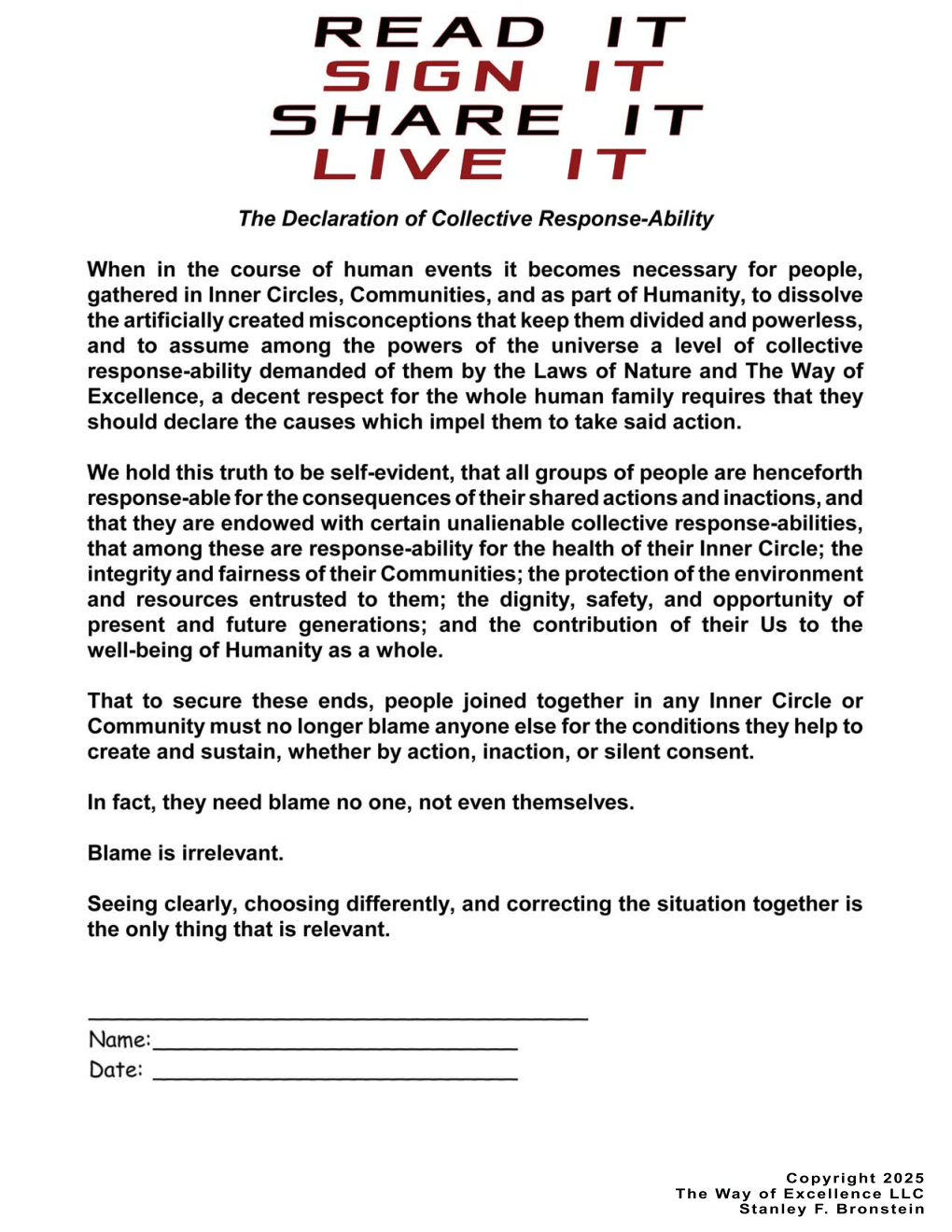
Chapter 11 - Navigating Collective Resistance, Fear, and Self-Sabotage (The Collective Resistance Map)
By this point in the journey, you have begun to design a New Us. You have clarified a shared identity, chosen a direction, started building identity-based habits, and drafted boundaries and standards to protect what you are creating together. Now you meet the next unavoidable reality. The moment you start changing Us, resistance shows up.
It shows up as jokes that cut the new ideas down to size. It shows up as rolling eyes and heavy sighs. It shows up as forgotten commitments, sudden busyness, misplaced documents, missed meetings, and the quiet return of old habits. Sometimes it shows up as open conflict. Sometimes it shows up as polite agreement on the surface and quiet sabotage underneath.
None of this means you are failing. It means you are touching real patterns. The Way of Excellence has always recognized resistance inside the individual. The Way of Us recognizes that groups have resistance too. Inner Circles, Communities, and even Humanity develop their own ways of avoiding change. If you do not know how to navigate that resistance, the gravity of the old Us will pull you back every time.
This chapter is about learning to see collective resistance clearly, understanding what it is trying to protect, and responding in a way that reflects TWOE instead of collapsing back into blame, frustration, or despair. You will learn how to create a simple Collective Resistance Map so you can say, “This is what is happening right now,” and choose your response with clarity instead of confusion.
What Collective Resistance Really Is
Collective resistance is not a mysterious force. It is the combined effect of many individual nervous systems, beliefs, habits, and fears reacting at the same time to the possibility of change. It often looks irrational from the outside, yet it makes a kind of sense from the inside.
At its core, collective resistance is usually protecting at least one of three things:
• A sense of safety.
• A sense of belonging.
• A sense of identity or power.
When your Inner Circle or Community has survived for a long time with certain patterns, those patterns start to feel like safety, even when they are painful. When you introduce a New Us, some part of the group worries, “If this changes, will I still belong. Will I still know who I am. Will I lose control or status.”
That fear rarely comes out directly. Instead, it expresses itself as behaviors that slow, distort, or derail the change. If you only react to the behavior, you will end up fighting symptoms. If you can see the fear underneath, you can respond with both firmness and compassion. That is The Way of Excellence applied to Us.
Common Forms Of Resistance In The Inner Circle
Every Inner Circle has its favorite resistance moves. You may recognize some of these.
Minimizing and joking. Someone brings up a serious pattern that needs to change. Another person says, “You are overreacting,” or turns it into a joke. Everyone laughs a little too loudly, and the conversation ends.
Endless delay. Everyone agrees that “we should talk about this” or “we should really start that new habit,” but somehow the right time never comes. Schedules stay full. Energy is always too low. Other priorities always win.
Shifting the topic. When a real issue comes up, the conversation quickly moves to side topics, old stories, or other people’s behavior. The actual problem is never addressed long enough to change.
Scapegoating. Instead of looking at the system, the Inner Circle pins everything on one person: the “difficult” partner, the “rebellious” child, the “controlling” elder. As long as that person can be blamed, the group avoids seeing its own part.
Silent withdrawal. A person nods along in conversations about change but quietly pulls back. They stop bringing energy, stop engaging, and wait for the New Us to fade so things can return to normal.
None of these patterns make anyone a villain. They are simply the Inner Circle’s way of trying to protect itself from uncertainty. The problem is that they also protect the very problems that brought you to this work in the first place.
Common Forms Of Resistance In Community
In Communities, resistance becomes more complex because there are more people, more roles, and more layers of history. You might see patterns like:
The meeting after the meeting. People smile and agree in the official meeting, then gather in small clusters afterward to say what they really think and to vent. Real decisions get made in the shadows instead of in the room.
Procedural fog. Every attempt at change gets buried in processes, committees, and reviews. On paper everyone supports the idea. In practice, nothing ever quite makes it out of the fog.
Polite sabotage. People say, “Great idea, let me know how I can help,” then quietly withhold information, delay approvals, or fail to follow through on key tasks. No one openly opposes the New Us, yet it keeps stalling.
Weaponized incompetence. Someone in a key role says, “I do not know how to do that,” and never learns. Other people pick up the slack until they are too exhausted to push for change. The message becomes, “It is easier to keep doing it the old way.”
Story capture. A small group controls the official story of what is happening. When problems surface, the story is spun so that those in power remain heroes, and those asking for change are labeled troublemakers, ungrateful, or unrealistic.
Again, these behaviors are not random. They are ways the Community protects its familiar identity and the comfort of those most invested in the status quo.
Resistance At The Level Of Humanity
At the Humanity level, resistance shows up as cultural habits and narratives that keep us from taking collective responsibility. For example:
Cynicism. “Nothing will ever change,” “People are just selfish,” “It is all rigged anyway.” Cynicism feels wise and safe, but it quietly gives us permission to stop trying.
Polarization. Issues are framed as us versus them. People who disagree are turned into enemies instead of fellow humans. This allows each side to avoid seeing its own part in the problem.
Distraction. Endless entertainment and outrage cycles keep our attention moving so fast that we never stay with a hard truth long enough to act.
Bystander mentality. We treat large problems as someone else’s responsibility. “The government should fix it,” “Companies should fix it,” “Someone should do something,” rarely followed by, “Here is what I can do today.”
These patterns are not just “out there.” They seep into your Inner Circle and Community unless you consciously choose a different way.
The Collective Resistance Map
To navigate all this, it helps to have a simple map. The Collective Resistance Map is not a rigid theory. It is a tool to help you name what is happening and choose your response. At its simplest, most collective resistance falls into four broad zones.
- Numbness and avoidance. “We do not see it.” Problems are minimized, joked about, or ignored. People change the subject or stay busy.
- Fear and defensiveness. “We feel threatened.” People argue, justify, attack, or shut down when change is mentioned.
- Passive agreement and hidden sabotage. “We say yes, but we do no.” Outwardly there is support. Underneath, old habits continue and key actions never happen.
- Honest engagement. “We see the problem, feel the fear, and still show up.” People acknowledge their reactions and begin working through them in service of the New Us.
When you notice resistance, you can ask, “Which zone are we in right now.” That question alone can reduce confusion. You are not crazy. You are simply in a particular part of the map.
For example, if your Inner Circle keeps joking every time a real issue arises, you are in Numbness and avoidance. If your team meeting explodes into arguments the moment someone suggests a change, you are in Fear and defensiveness. If everyone nods enthusiastically and then nothing happens, you are in Passive agreement and hidden sabotage.
Your goal is not to eliminate resistance. It is to move gradually toward Honest engagement, where fear and discomfort can be named, explored, and worked with instead of pretending they are not there.
Using TWOE To Respond To Each Zone
The Way of Excellence gives you the tools to respond to each resistance zone differently.
Numbness and avoidance calls for Concept #1 – Learning To Tell It Like It Is. You gently but firmly name what you are seeing. “I notice that whenever we bring up this topic, we all crack jokes and move on. I think we might be avoiding something important.” You do not attack. You simply shine a light.
Fear and defensiveness calls for Concept #15 – Creating A Balanced Life and the Integration of Mind, Body and Spirit. You slow the pace. You acknowledge that change is scary. You encourage people to breathe, to feel what they are feeling, and to remember that you are on the same side. You keep the focus on the issue, not on attacking each other.
Passive agreement and hidden sabotage calls for Concept #3 – Taking Personal Responsibility and Law #3 – The Law Of Personal ResponseAbility. You shift from vague talk to clear commitments. “We have said yes to this three times now, and we are still not doing it. What is really going on. What are we each willing to own and change.”
Honest engagement calls for Concept #7 – Persistence and Concept #10 – Thinking For The Long-Term. You recognize that you are in a good, if uncomfortable place. People are telling the truth. You keep going, knowing that meaningful change takes time and repetition.
In each zone, the key is to respond with excellence instead of reacting from old scripts. You will not do this perfectly. That is okay. Every attempt strengthens the New Us.
Recognizing Your Own Role In Resistance
It is always easier to see other people’s resistance than your own. Yet part of The Way of Us is recognizing that you are not separate from the patterns you are trying to change. You are in them.
Ask yourself:
• Where do I personally slip into numbness, avoidance, defensiveness, or quiet sabotage when our Inner Circle or Community starts to change.
• What am I afraid of losing if the New Us becomes real. Control, comfort, predictability, a familiar identity.
• How might my behavior be signaling to others that it is safer to stay the same.
This is not about blaming yourself for everything. It is about living what you are asking others to live. When you are willing to see and own your own resistance, you gain credibility. You become safer for others to be honest with. You demonstrate that The Way of Excellence is more than words.
Staying Grounded When Others Resist
Watching people you care about resist change can be painful. You may feel impatient, angry, or heartbroken. You may want to push harder, convince, or give up.
To stay grounded, remember:
• Resistance is often a sign that you are touching something real.
• People have reasons for their fear, even if you do not agree with those reasons.
• You cannot force someone to embrace The Way of Us. You can only invite, model, and protect what needs protecting.
• Long-term change is usually slower and less dramatic than you hope, yet deeper and more solid when it comes.
When you feel yourself getting pulled into frustration, pause and return to TWOE. Tell it like it is to yourself. Take responsibility for your next choice, not for other people’s entire journey. Think long-term. Ask what a Win-Win response looks like in this moment, not forever.
Questions For Reflection
- When you think about your Inner Circle, which resistance zone shows up most often right now: numbness and avoidance, fear and defensiveness, passive agreement and hidden sabotage, or honest engagement. What evidence do you see.
- In a Community you care about, what is one specific situation where you have seen polite sabotage or endless delay. If you imagine the fear underneath, what might it be.
- Which kind of resistance annoys you the most when you see it in others. What does that reaction reveal about your own values and your own fears.
- When your Inner Circle or Community begins to change, what is your personal default resistance move. How might you begin to respond differently next time.
Experiments
Experiment 1 – Mapping Resistance In One Real Situation
Choose one current situation where you are trying to bring The Way of Us into your Inner Circle or Community and it feels like you are running into a wall.
- In your journal, describe what is happening in simple, factual terms.
- Ask, “Which zone of the Collective Resistance Map are we in right now.” Numbness and avoidance, fear and defensiveness, passive agreement and hidden sabotage, or honest engagement.
- Once you have named the zone, write one small action you could take this week that matches TWOE for that zone. For example, naming what you see, slowing down and acknowledging fear, asking for clear commitments, or appreciating honest engagement.
Then take that one action. You are not trying to fix everything. You are simply practicing using the map instead of guessing in the dark.
Experiment 2 – Owning Your Personal Resistance Out Loud
The next time a conversation about change comes up in your Inner Circle or Community and you notice your own resistance rising, pause and tell the truth about it in a simple way. For example:
• “Part of me wants to change this, and part of me is scared we will just fight about it.”
• “I notice that I keep wanting to change the subject right now. I think I am uncomfortable with where this conversation might go.”
Do not make a long speech. Just name your internal experience and stay in the conversation. Notice what happens when you bring your own resistance into the light instead of secretly acting it out.
Assignments
Assignment 1 – Creating A Collective Resistance Map For Your Inner Circle
Set aside 60 to 90 minutes to create a simple Collective Resistance Map specifically for your Inner Circle.
- On a blank page, draw four labeled sections: Numbness and avoidance, Fear and defensiveness, Passive agreement and hidden sabotage, Honest engagement.
- Under each heading, list specific behaviors you have seen in your Inner Circle that fit that zone. Be concrete. For example, under Numbness you might write, “We joke when someone brings up money,” under Passive agreement you might write, “We say we will budget but never actually sit down to do it.”
- Next to each behavior, write one TWOE-aligned response you could try. For example, “Name the pattern kindly,” “Ask what people are afraid of,” “Request a specific commitment and date,” “Express appreciation when someone is honest.”
- Keep this map somewhere you can see it. Over the next month, when resistance shows up, glance at the map and ask, “Which zone is this, and what response am I willing to try.”
At the end of the month, review what you learned about your Inner Circle’s favorite resistance moves and about which responses were most effective.
Assignment 2 – Facilitating One Honest Engagement Conversation In A Community
Choose one Community where resistance to change has been strong but where at least a few people are open to growth. Your assignment is to initiate one structured conversation focused on Honest engagement.
- Invite a small group of people who care about the Community to a short meeting or discussion. Let them know ahead of time that the purpose is to talk honestly about what helps and what gets in the way when you try to improve things.
- At the beginning of the conversation, briefly explain the four zones of the Collective Resistance Map in your own words. Emphasize that resistance is normal and not about blaming individuals.
- Ask questions such as:
“When we try to change things here, what usually happens first.”
• “Where do you see us avoiding, getting defensive, or saying yes without follow through.”
• “What do you think we are afraid of losing.” - Listen more than you speak. Take notes. When appropriate, gently connect what you hear back to TWOE principles like telling it like it is, personal responsibility, Win-Win, and long-term thinking.
- Before you end, ask, “What is one small step toward Honest engagement we are willing to take together in the next month.” Capture that step clearly.
After the conversation, reflect on what you learned about the Community’s resistance patterns and about your own capacity to hold space for Honest engagement. Whatever the outcome, you have taken a concrete step toward bringing The Way of Us into a place where old patterns have been strong.
Resistance is not a sign that The Way of Us is impossible. It is a sign that The Way of Us matters. When you can see collective resistance clearly and respond with excellence instead of blame, you turn opposition into information and fear into an opportunity for deeper courage, truth, and connection.
Chapter 12 - The Bridge To Integration And Alignment: Unifying Inner Circle, Community, And Humanity
By this point in Becoming Us, you have done a lot of work. You have begun to design who you choose to be together. You have clarified direction. You have started building identity-based habits. You have named boundaries and standards and learned how to navigate resistance when it appears.
Now we come to a different kind of challenge. It is possible for your Inner Circle, your Communities, and your connection to Humanity to each improve on their own, yet still feel strangely disconnected from each other. You can have a loving Inner Circle but show up small or silent in Community. You can serve passionately in Community while neglecting the people closest to you. You can care deeply about Humanity while living in patterns at home that quietly contradict what you say you believe.
This chapter is about Integration and alignment at the level of Us. In TWOE, Concept #20 is the Integration of Mind, Body and Spirit. When those three are aligned, the whole person moves with more clarity, power, and peace. In TWOU, the three rings of Inner Circle, Community, and Humanity are the social version of that integration. When they are aligned, your life stops feeling like separate compartments and starts feeling like one coherent Way of Us.
Why The Rings Must Feed Each Other
The TWOU symbol shows Inner Circle, Community, and Humanity nested together for a reason. They are not three separate projects. They are three dimensions of the same life. What happens in one ring eventually affects the others.
If your Inner Circle is full of bitterness, fear, or quiet disrespect, it will be hard to bring consistent excellence into your Communities. You might perform well in public, but the strain at home will leak through in your energy, your decisions, and your ability to stay grounded.
If your Communities are unhealthy or exploitative, they will drain your Inner Circle. You may bring stress, resentment, or habits of harshness home without realizing it. You may spend the best of your attention and energy on systems that are not aligned with the world you want to build for your loved ones.
If your connection to Humanity is shallow or cynical, your Inner Circle and Communities can become small, inward facing bubbles. You might care deeply for “your own” while ignoring the impact your choices have on people you will never meet. Over time, that smallness eats away at meaning and purpose.
Integration means the rings feed each other instead of draining or contradicting each other. Growth in one ring supports growth in the others. Courage in one ring inspires courage in the others. Boundaries and standards in one ring raise your expectations in the others. That is what we are aiming for.
Three Common Forms Of Misalignment
Before you can build Integration, it helps to see where you are misaligned now. Most of us fall into at least one of these patterns.
Inner-circle only. In this pattern, almost all of your care, attention, and responsibility flows toward your Inner Circle. You love your people fiercely. You may be incredibly generous and loyal at home. But Community and Humanity barely register. Civic engagement is minimal. Larger issues feel like “someone else’s problem.” The risk here is that your Inner Circle becomes overprotected and under-challenged, and the gifts you could offer the world never leave the house.
Community-only. In this pattern, you pour yourself into work, organizations, causes, or teams. You are the reliable one, the volunteer, the leader, the fixer. People praise you for your dedication. At the same time, your Inner Circle runs on leftovers. The people closest to you get your fatigue more than your presence. The risk here is deep burnout and quiet betrayal. You end up succeeding in public while failing the very relationships that matter most.
Humanity-only (in theory). In this pattern, you think and talk a lot about global issues. You may be very vocal online. You might identify strongly with certain causes. But on the ground, your Inner Circle and Community relationships are chaotic, neglected, or full of unresolved conflict. There is a gap between the compassion you have for Humanity in the abstract and the patience you show with the actual humans sitting at your table or working beside you.
None of these patterns make you a bad person. They are simply ways your three rings have drifted apart. Integration begins when you are willing to tell it like it is and say, “This is where my life is lopsided right now.”
Alignment Test: The Three Simple Questions
A practical way to check Integration is to use three simple questions whenever you are making a significant choice.
- How does this affect my Inner Circle.
- How does this affect my Community.
- How does this affect Humanity, even in a small way.
Most people are already asking at least one of these questions some of the time. Integration means you start asking all three more often, especially for decisions that involve major commitments of time, money, energy, or identity.
For example, imagine you are considering a new job or role.
- Inner Circle: Will this choice create more stability and growth for us, or will it constantly pull me away from the relationships I say are most important.
- Community: Will this role allow me to contribute to a healthier culture in the places I serve, or will it require me to support patterns that go against TWOE.
- Humanity: Does this kind of work, done in an excellent Win-Win way, make the world a bit better or a bit worse over the Long-Term.
You will not always find a perfect answer. Real life is full of tradeoffs. Integration is not about finding perfection, but about refusing to make decisions as if only one ring exists.
Building Two-Way Bridges Between The Rings
Integration happens when you intentionally build bridges so that what you learn and practice in one ring flows into the others. Here are some examples of two-way bridges you can begin to create.
From Inner Circle to Community.
- If your Inner Circle has developed a powerful habit of honest repair after conflict, bring that skill into your teams and groups. You might be the first to say, “I handled that meeting poorly. I want to repair and do better,” and invite others to do the same.
- If you have created clear standards at home about respect or time boundaries, let those shape what you are willing to tolerate at work or in other Communities.
From Community to Inner Circle.
- If your Community has good systems for planning, communication, or feedback, adapt a simple version for your Inner Circle. Many families never use tools they already know from work life because they never think to bring them home.
- If you are part of a Community that models healthy diversity and inclusion, talk with your Inner Circle about what you are learning and how you want your shared life to reflect similar values.
From Humanity to Inner Circle and Community.
- If you are moved by a global issue, do not just post about it. Ask, “What is a small version of this issue that we can do something about here.” For example, if you care about food insecurity globally, your Inner Circle and Community might begin supporting a local food bank or reducing food waste.
- Let your concern for Humanity shape your everyday consumption and scheduling decisions. You might decide as an Inner Circle, “We will keep our lifestyle at a level that lets us give consistently,” or as a Community, “We will choose vendors and partners whose practices do not violate our values.”
From Inner Circle and Community to Humanity.
- When your Inner Circle or Community discovers something that works, consider how you might share it. This could be as simple as helping another family with a habit that transformed you, or sharing a process with another group that is struggling. Your lived example becomes a small gift to Humanity.
These bridges do not need to be grand gestures. They need to be real. Over time, they knit the three rings together into one Way of Us.
Integration As A Filter For Opportunities
As you grow, you will face more invitations and opportunities. Some will be truly aligned with The Way of Us. Others will sound good but subtly pull you back into fragmentation.
Integration gives you a filter. You can ask:
- Does this opportunity strengthen all three rings, or does it obviously strengthen one while consistently undermining another.
- If it does put temporary stress on one ring, is that stress part of a Long-Term Win-Win, or is it simply sacrificing one area for another indefinitely.
- Can we adjust this opportunity so that it aligns better with the three rings, or is the misalignment built in.
Sometimes you will say yes and reshape your life around a new opportunity. Sometimes you will say no, even to something exciting, because it would blow a hole in your Inner Circle or require you to compromise your standards in a Community. Each time you make that choice from a place of Integration, you strengthen The Way of Us.
Living The Same Person In All Three Rings
Another side of Integration is personal. Many people live as slightly different versions of themselves in each ring. They are one person at home, another in the workplace, another online or in public discussions about Humanity. Some difference is natural. Context matters. But if the gaps are too big, you end up living three partial lives instead of one whole one.
The Way of Excellence invites you to be the same core person everywhere: honest, responsible, Long-Term focused, Win-Win oriented, integrating Mind, Body and Spirit. The Way of Us invites you to bring that same core person into every ring. That means:
- You do not practice compassion for Humanity while being cruel to your Inner Circle.
- You do not preach integrity in Community while lying to yourself at home.
- You do not champion justice publicly while ignoring small injustices you benefit from in your own circles.
You will not do this perfectly, but each time you close the gap between your roles, you experience more peace. You do not need to remember which version of yourself to be. You are simply you, living The Way of Us as best you can wherever you stand.
Questions For Reflection
- When you look at your life honestly, which ring currently receives most of your energy and care: Inner Circle, Community, or Humanity. Which ring receives the least.
- Which of the three misalignment patterns describes you most right now: Inner-circle only, Community-only, or Humanity-only (in theory). What evidence do you see.
- Think of one recent major decision. If you apply the three Integration questions to it now, how did it affect your Inner Circle, your Community, and Humanity. Would you choose anything differently with that wider lens.
- Where do you notice the biggest gap between who you are at home, who you are in your Communities, and who you are in your beliefs about Humanity. What would a small step toward being more unified look like.
Experiments
Experiment 1 – One Decision Through Three Lenses
In the coming week, choose one meaningful decision that involves your time, money, or emotional energy. Before you decide, sit down with a blank page and write three headings: Inner Circle, Community, Humanity.
Under each heading, write a few sentences answering: “If I say yes to this, how will it affect this ring positively and negatively. If I say no, how will that affect this ring.”
You do not have to make the “perfect” choice. The experiment is to force yourself to slow down and see the decision through all three lenses. After you decide and live with the result for a while, write a short reflection about how it felt to use this process.
Experiment 2 – Building One Simple Bridge Between Rings
Identify one area where you feel a positive difference between rings. For example, your Inner Circle might be much more honest than your workplace, or your workplace might be much more organized than your home.
Ask, “What is one small practice from the stronger ring that I could bring into the weaker ring this month.” Make it specific and doable. For example:
- If your team has a great weekly review process, adapt a simplified version for your Inner Circle.
- If your Inner Circle does a good job of checking in emotionally, bring a shortened check-in question to a Community meeting you lead.
Run this bridge practice for four weeks. Notice what shifts and how people respond.
Assignments
Assignment 1 – Three-Ring Integration Inventory
Set aside 60 to 90 minutes for a structured Integration inventory.
- Create three columns labeled Inner Circle, Community, Humanity.
- In each column, list:
- What is working well here when it comes to The Way of Us.
- What feels out of alignment with TWOE principles like truth, responsibility, Win-Win, Long-Term thinking, and Integration.
- Circle one strength in each column and one misalignment in each column.
- For each misalignment, write one sentence beginning with, “If we keep living this way for the next five years, it will probably lead to…” Be honest. Let the Long-Term consequences be clear.
- Then, choose one misalignment from any column that feels both important and changeable. Design a small, concrete next step that would move you toward better alignment in that ring. Commit to taking that step within the next seven days.
This assignment does not solve everything. It does give you a clear picture of where the three rings stand and where one meaningful move toward Integration might be.
Assignment 2 – Drafting A Personal Three-Ring Commitment Statement
Your second assignment is to write a one-page commitment that links your personal life, your Inner Circle, your Communities, and Humanity into one integrated Way of Us.
- Begin with a short paragraph about who you are choosing to be as a person, using TWOE language that resonates with you.
- Write a paragraph beginning with, “In my Inner Circle, I commit to…” and describe how you intend to live The Way of Us there. Focus on qualities and practices, not perfection.
- Write a paragraph beginning with, “In my Communities, I commit to…” and describe how you will bring TWOE and TWOU into the groups, teams, or organizations you are part of.
- Write a paragraph beginning with, “As part of Humanity, I commit to…” and describe the small but real ways you will let your choices reflect your care for the larger human family and the planet we share.
- End with a sentence that ties it all together, such as, “I am one person living in three rings, and I choose to let my Inner Circle, my Communities, and my place in Humanity strengthen, not contradict, each other.”
Sign and date this statement. Keep it somewhere you will see it regularly. Revisit it every few months and update it as your understanding of The Way of Us deepens.
Integration is not a one-time achievement. It is an ongoing practice of alignment. Each time you let the rings inform and strengthen each other, you move closer to a life where your relationships, your work, and your contribution to Humanity all tell the same story. That is the heart of The Way of Us.
INTRODUCTION TO PART III - OPTIMIZING US
Refinement, Mastery, Integration, and Contribution
Finding Us was about waking up. Becoming Us was about choosing and building. Optimizing Us is about deepening, refining, and sustaining what you have started so that The Way of Us becomes stronger than the forces that try to pull you back to the old way of living. This is where the work you have done in your Inner Circle, your Communities, and your connection to Humanity begins to mature.
When I think about optimization, I do not think about perfection. I think about alignment. I think about taking something that already exists and asking, “How do we make this truer to who we really are. How do we make this more consistent with The Way of Excellence. How do we make this more Win-Win, more Long-Term, more integrated in Mind, Body, and Spirit.” Optimizing Us is not about polishing the image of your Inner Circle or your Communities so they look good from the outside. It is about making the inside healthier, cleaner, clearer, and more effective over time.
By the time you reach this part of the book, you have already done something rare. You have told the truth about your Inner Circle, your Communities, and your place in Humanity. You have started to design who you choose to be together. You have begun to align direction, build identity-based habits, set boundaries and standards, and map out resistance. Most people never get that far. They drift. You have chosen not to drift. Now the question becomes, “How do we keep this going for the Long-Term, and how do we let our shared excellence ripple outward.”
Optimizing Us is where you shift from short-term change to long-term craft. In this part of the book, we will talk about how to refine the environments you live in so that they support The Way of Us instead of fighting it. We will look at how to keep strengthening the bonds in your Inner Circle without becoming insular, how to grow Communities that can adapt and improve without losing their soul, and how to let your care for Humanity move from occasional gestures into a consistent part of how you live.
We will also talk about legacy. Not in the sense of your name being remembered, but in the sense of the patterns you leave behind. Every Inner Circle, every Community, every generation leaves tracks. Optimizing Us means becoming conscious of the tracks you are leaving. Are you passing down fear, fragmentation, and cynicism, or courage, connection, and responsibility. Are you teaching the people who come after you that they are victims of Us, or stewards of Us.
Throughout this part of the book, I will keep reminding you of something important. You do not optimize Us alone. Even if you are the one who is most aware of The Way of Excellence right now, optimization is a shared journey. Sometimes you will lead. Sometimes you will follow. Sometimes you will simply hold the vision while others find their footing. Your job is not to control people. Your job is to keep living The Way of Us as clearly and consistently as you can, to keep inviting others into it, and to keep shaping the spaces you touch so that excellence is easier and compromise is harder.
The chapters that follow will help you refine your environment, deepen integration across the three rings, cultivate a culture of ongoing learning and improvement, and let your shared life become a quiet but powerful contribution to Humanity. They will give you tools to stay grounded when things are working, and when they are not. They will help you remember that you are playing a long game, and that every step you take in the direction of a healthier Us matters more than you may ever see.
You have already answered the call to move beyond Me. You have begun the work of becoming a New Us. Now it is time to learn how to tend that Us, strengthen it, and let it shine. That is what Optimizing Us is all about.
Chapter 13 - What Optimization Really Means: Alignment, Not Obsession
When people hear the word “optimize,” they often picture pressure. They imagine endless tweaking, constant monitoring, never being satisfied, always looking for the next improvement. In a lot of environments, optimization has been twisted into a code word for burnout: do more, faster, with less, forever. No wonder so many people tense up when they hear it.
That is not what Optimizing Us means.
In The Way of Us, optimization is not about squeezing every ounce of productivity out of your Inner Circle, your Communities, or Humanity. It is not about turning your life into a project where you analyze and grade everyone all the time. Optimization, in this framework, means something much quieter and much deeper: bringing your shared life into closer alignment with who you have chosen to be together.
If Finding Us showed you the truth about where you are, and Becoming Us helped you design a New Us and start living it, Optimizing Us is about stewarding that New Us over the Long-Term. It is about closing the gap between your best values and your actual daily patterns. It is about making excellence easier and self-sabotage harder, not through force, but through wise design and ongoing refinement.
What Optimization Is Not
Before we go any further, it helps to clear away a few distortions. Optimizing Us is not:
- You will never reach a point where every conversation in your Inner Circle is flawless, every Community decision is ideal, and every choice you make for Humanity is perfectly informed. That is not the goal.
- Optimization is not about micromanaging people. You cannot “optimize” your loved ones or colleagues into behaving exactly how you want. That is manipulation, not excellence.
- Constant criticism. If you use optimization as an excuse to point out what is wrong with everyone all the time, you will poison the very Us you are trying to strengthen.
- Endless urgency. Optimization is not a frantic race. It is a Long-Term craft. If your attempts to optimize leave you and everyone around you exhausted, something is off.
The Way of Excellence teaches that excellence is a direction, not a destination. The same is true here. Optimizing Us means walking steadily in that direction together, not obsessing over every step.
Optimization As Alignment And Stewardship
At its heart, optimization is about alignment and stewardship.
Alignment means that your Inner Circle, your Communities, and your relationship to Humanity increasingly match the identity, direction, habits, and standards you have chosen. When you say, “We are committed to Win-Win,” your decisions, schedules, and systems begin to reflect that. When you say, “We think for the Long-Term,” your financial choices, your time commitments, and the way you handle conflict start to show it.
Stewardship means recognizing that your Us is something you are responsible for. Not in a heavy, self-punishing way, but in a mature, clear-eyed way. The people in your Inner Circle, the Communities you touch, the part of Humanity you affect through your choices and influence – all of these are things you have been entrusted with. Optimizing Us is how you take care of that trust.
In TWOE terms, optimization is where concepts like Taking Personal Responsibility, Thinking For The Long-Term, Choosing Win-Win, and Integration of Mind, Body and Spirit move from ideas into the ongoing maintenance of your shared life. You are not just reacting to crises anymore. You are tending the garden.
When Us Is Ready For Optimization Work
Not every season is an optimization season. If your Inner Circle is in immediate crisis or your Community is on the edge of collapse, your first job is stabilization and safety, not refinement. Once there is a basic level of safety and some shared understanding, then you are ready for optimization.
Signs that your Us is ready include:
- You have at least some shared language about identity, direction, and standards, even if it is simple.
- You are no longer pretending everything is fine when it is not. Hard truths have been named.
- There is at least a little trust that people are willing, in good faith, to try something different.
- The biggest emergencies have settled enough that you can think beyond this week.
If that is where you are, optimization becomes both possible and powerful.
Three Layers Of Optimizing Us
You can think of optimization as happening on three main layers.
- Optimizing patterns – refining the habits, rituals, and boundaries you already have.
- Optimizing environments – shaping physical, digital, and relational spaces so they support The Way of Us.
- Optimizing contribution – aligning the way your Inner Circle and Communities give to Humanity so that your efforts are focused and sustainable.
This chapter introduces the mindset behind all three. Later chapters will give you more detailed tools.
Optimizing patterns means asking questions like:
- Which of our identity-based habits are working so well that we want to strengthen them.
- Which habits need a small adjustment to serve us better now that life has changed.
- Which habits were helpful in one season but are now keeping us stuck.
Optimizing environments means asking:
- How does our physical space affect the way we treat each other.
- How does our schedule affect our ability to live our values.
- How do our tools, technology, and information flows either help or hinder The Way of Us.
Optimizing contribution means asking:
- Are we scattering our efforts across too many causes, or are we focused enough to make a real difference.
- Are we giving from overflow, or are we giving in ways that quietly deplete our Inner Circle.
- Are we choosing forms of service that match our strengths and values, or are we just reacting to whatever shouts the loudest.
You do not have to answer all these at once. Optimization is about steady, repeated passes. Each time you circle back, you see more and refine a bit further.
Avoiding The Trap Of Turning People Into Projects
One of the biggest dangers in optimization work is slipping into the mindset that people are projects. You start seeing your partner, your children, your colleagues, or your Community members as checklists: things to improve, issues to fix, performance to monitor.
The Way of Us refuses that approach. In this book, you are invited to optimize systems, environments, agreements, and your own behavior. You are not authorized to redesign other people. They are not raw material for your vision. They are human beings with their own journeys.
This does not mean you never ask for change or give feedback. It means you respect agency. You create conditions where excellence is easier and where people are invited, not forced, to grow. You focus on what you can actually control: your choices, your contributions, the structures you help create, and the standards you are willing to uphold.
Whenever you feel yourself drifting into “project mode” with people, come back to TWOE. Tell yourself the truth. Take responsibility for your urge to control. Return to Win-Win and Long-Term thinking. Ask, “How can I optimize the way I show up and the systems I participate in, instead of trying to engineer other people’s evolution.”
Optimization As Gentle, Relentless Course Correction
Think of Optimizing Us as gentle, relentless course correction. A pilot does not set the plane’s direction once and then relax, assuming the winds will never change. They monitor, adjust, and nudge the course back toward the destination again and again.
Your Inner Circle and Communities will drift. That is normal. Stress, change, new seasons, and old habits will pull you off center. Optimization is the practice of noticing the drift sooner and correcting with less drama.
Course correction can sound like:
- “We said we wanted calmer evenings. Lately our screens have crept back in. What small adjustment can we make this week to honor our original intention.”
- “We agreed that this Community values honesty. I notice we are back to having the meeting after the meeting. How can we bring more of that energy into the actual room.”
- “We decided as a family to contribute to this cause consistently. We lost track over the last few months. How do we restart in a manageable way.”
No blame. No panic. Just clear seeing and a willingness to adjust. That is the spirit of optimization.
The Optimization Question: “Is This Still Serving Us”
A simple, powerful optimization question you can ask in any ring is: “Is this still serving The Way of Us.”
- Is this habit still serving us.
- Is this rule still serving us.
- Is this schedule, this tradition, this commitment, this system still serving us.
Sometimes the answer will be yes. Sometimes it will be no. Sometimes it will be “It did for a while, but not anymore.” Your job is not to keep everything forever. Your job is to carry forward what serves and gracefully release what no longer does, in light of your current identity, direction, and responsibilities.
This question is especially important for Communities and long-standing Inner Circles, where traditions can become sacred simply because they have been around for a long time. The Way of Excellence respects tradition but does not worship it. If a tradition violates Win-Win, Long-Term health, or integrity, it is a candidate for change.
Questions For Reflection
- When you hear the phrase “Optimizing Us,” what is your first emotional reaction. Excitement, pressure, resistance, confusion, something else. What experiences from your past might be shaping that reaction.
- In your Inner Circle, what is one pattern that used to serve you well but now feels misaligned with the Us you are trying to build. What changed.
- In one Community you care about, what is a tradition, habit, or structure that no one ever questions but that may no longer be serving The Way of Us. What would it take even to have that conversation.
- Where are you most tempted to treat people as projects in the name of “improvement.” How could you shift that energy toward optimizing systems and your own behavior instead.
Experiments
Experiment 1 – The “Still Serving Us” Scan
Choose one of the three rings to focus on this week: Inner Circle, Community, or Humanity-facing contribution.
- Make a short list of 5 to 10 recurring patterns in that ring: routines, meetings, traditions, rules, or expectations.
- For each one, quietly ask yourself, “Is this still serving The Way of Us as we understand it now.”
- Mark each item with one of three symbols:
- A plus sign for “Yes, this clearly serves us.”
- A question mark for “I am not sure.”
- A minus sign for “No, this seems to be working against us.”
You are not trying to fix everything yet. You are simply noticing. At the end of the week, pick one plus item and appreciate it consciously. Pick one minus or question mark item and jot down a few ideas for how it might be adjusted or replaced.
Experiment 2 – One Course Correction Conversation
Identify a place where your Inner Circle or a Community you belong to has clearly drifted from an intention you set earlier. It might be a habit you abandoned, a standard that has been slipping, or a commitment you stopped honoring.
Initiate one short conversation that sounds something like this:
- “We once agreed that [insert intention]. I notice that lately we have slipped back into [insert current reality]. I am not blaming anyone. I just want to ask, is that original intention still important to us. If so, what small adjustment can we make this week to move in that direction again.”
Keep the tone light but serious. Focus on shared responsibility and small next steps. Pay attention to how people respond and how it feels to treat drift as normal and correctable instead of as failure.
Assignments
Assignment 1 – Designing A Simple Optimization Plan For Your Inner Circle
Set aside 60 to 90 minutes to create a first-pass optimization plan for your Inner Circle.
- In your journal or a document, divide a page into three sections labeled Patterns, Environment, Contribution.
- Under Patterns, list the key habits, rituals, and boundaries you are currently using. Under Environment, list aspects of your physical and time environment that strongly shape your days. Under Contribution, list the main ways your Inner Circle currently serves others outside itself.
- For each section, circle one item that is clearly serving you well and one item that feels misaligned or stale.
- For each circled item, answer:
- “What makes this so helpful or harmful right now.”
- “What is one small way we could strengthen or adjust this over the next 30 days.”
You will end up with a handful of specific, modest optimization moves. Choose one from each section that feels realistic and commit, as an Inner Circle if possible, to testing them for a month. Put a simple reminder on your calendar to review at the end of that period what improved, what did not, and what you learned.
Assignment 2 – Creating An Optimization Filter For New Commitments
Your second assignment is to design a simple filter you can use any time a new opportunity, invitation, or idea for improvement comes along.
- Write down the three Integration questions from the previous chapter:
- “How does this affect our Inner Circle.”
- “How does this affect our Community.”
- “How does this affect Humanity, even in a small way.”
- Add two optimization questions:
- “Does this move us closer to or farther from the Us we say we want to be.”
- “Can we sustain this at a healthy pace for the Long-Term.”
- Put all five questions together in a place you will see whenever you are deciding about a new project, role, or commitment. This might be a note on your phone, a card in your wallet, or a page taped near your desk.
Over the next 60 days, every time a significant opportunity arises, pause and run it through this filter. You may still say yes or no for many different reasons, but you will be deciding as a steward of your Us, not as someone reacting on impulse. At the end of those 60 days, review a few of your decisions and ask, “Did this filter help us live The Way of Us more consistently.”
Optimization is not about squeezing more out of life. It is about drawing your Inner Circle, your Communities, and your connection to Humanity into closer, steadier alignment with who you have chosen to be together. When you approach it as alignment and stewardship rather than obsession and control, Optimizing Us becomes a source of peace and strength, not pressure and exhaustion.
Chapter 14 - Deep Integration: When Inner Circle, Community, And Humanity Move As One
In earlier chapters, you began weaving the three rings together. You named your Inner Circle, clarified which Communities matter most, and started to think about your place in Humanity. You have already done important integration work. You are not living three completely separate lives anymore.
This chapter is about going deeper.
Deep integration is what happens when your Inner Circle, your Communities, and your relationship to Humanity stop feeling like separate categories and start feeling like one coherent Way of Us. It is the social version of TWOE Concept #20 – Integration Of Mind, Body & Spirit. When mind, body, and spirit are integrated, you move through life with more clarity, less inner conflict, and a steady sense of power and peace. When Inner Circle, Community, and Humanity are integrated, Us begins to move that way too.
You will still make mistakes. You will still have conflicts and contradictions. But more and more, you recognize them quickly and return to alignment. You become the same core Us wherever you go.
From Patchwork To Coherence
Most of us start with a patchwork life. We have:
- One self at home.
- Another self in our Communities.
- Yet another self when we talk or think about Humanity.
Those selves may not fully contradict each other, but they often do not talk to each other either. Values that are clear in one ring are fuzzy in another. Courage that shows up in one context disappears in the next. We tolerate behavior in some spaces that we would never accept in others.
Deep integration is not about making every context identical. You will always speak differently to a small child than to a board of directors. It is about coherence underneath the differences. The same core principles, the same commitment to The Way of Excellence, the same respect for Inner Circle, Community, and Humanity show up everywhere.
When you reach deeper integration, you no longer feel like you are switching masks all day. You feel more like yourself in every ring. People who know you in different contexts would recognize the same person underneath.
Signs Of Deep Integration In The Inner Circle
In the Inner Circle, deep integration shows up as:
- Consistency between your private and public values. You do not preach justice, kindness, or Win-Win in public while living harsh, selfish, or win-lose patterns at home. Your Inner Circle becomes a place where your best principles are tested, refined, and lived, not suspended.
- Shared language. People in your Inner Circle recognize words like Win-Win, Long-Term thinking, and Integration Of Mind, Body & Spirit. They may not use TWOE language all the time, but there is a common understanding of what you are trying to build together.
- Natural spillover. The way you handle conflict, make decisions, and set boundaries at home begins to feel similar to the way you handle those things in Communities. You do not have to remember which rules apply where. You are simply living The Way of Us with the people you love most.
- Alignment between care and impact. The way you talk about Humanity with your Inner Circle actually affects what you do. You are not asking your children or partners to care about the world while modeling apathy. You are not talking about responsibility while avoiding it in your own shared life.
This does not mean your Inner Circle is perfect. It means that when misalignment shows up, you treat it as information, not identity, and you work together to bring things back into line with who you have chosen to be.
Signs Of Deep Integration In Community
In Communities, deep integration looks like:
- Values in action, not just on the wall. The words on the website or mission statement match the lived culture. When a Community says it cares about inclusion, there are real structures, behaviors, and decisions that back that up. When it says it values honesty, people can tell the truth without being punished.
- Coherence across levels. How leaders act, how teams operate, and how people treat each other in informal spaces all tell the same story. You do not have a caring public face with a fearful, punishing internal culture. You do not have inspiring speeches with exploitative practices.
- Healthy pressure. People in the Community feel gently called up to a higher standard of Us, not pushed down or shamed. Excellence is expected and supported, not demanded and weaponized.
- Connection to Humanity built in. The Community does not exist only for itself or its own survival. There is a clear, lived understanding of how its work affects people outside the room, and that understanding shapes real choices.
Deep integration in Community does not mean everyone agrees on everything. It means that even when there is disagreement, people recognize a shared commitment to Win-Win, Long-Term truth-telling, and Integration Of Mind, Body & Spirit in how decisions are made and how people are treated.
Signs Of Deep Integration With Humanity
At the level of Humanity, deep integration shows up less as grand gestures and more as a steady tone underneath your life. You might notice:
- Less cynicism. You no longer talk about Humanity as if you are separate from it. Instead of saying, “People are awful,” you are more likely to say, “We have serious problems to address, and I am part of the We that needs to address them.”
- Aligned consumption and contribution. The way your Inner Circle spends money, time, and attention increasingly matches your stated care for Humanity. You are not perfect, but you are no longer comfortable with extreme gaps between what you say matters and what you actually support.
- Grounded hope. You are aware of suffering and injustice, but you are not paralyzed by it. You have chosen some specific ways your Inner Circle and Communities will contribute, and you are acting on them steadily.
- A sense of belonging to something larger. You feel connected not only to your own Inner Circle and Communities, but also to the broader human story. That sense of connection does not float above daily life. It informs how you talk to strangers, how you vote, how you work, and how you show up in public spaces.
Deep integration with Humanity is not idealism. It is a mature acceptance that you are part of Us, and that your behavior, multiplied by millions of others, is shaping the future.
The Feel Of Deep Integration
Deep integration has a particular feel.
Inside, there is less chronic tension between your roles. You still feel pulled in different directions at times, but you no longer feel like you are betraying one ring every time you attend to another. You can say yes and no more cleanly because you are choosing from a clear set of priorities instead of shifting stories.
In your Inner Circle and Communities, there is more trust. People might not always like your decisions, but they know roughly what to expect. They have seen you act with similar integrity in different settings. Your yes means something. Your no means something.
In your relationship to Humanity, there is a quieter conscience. You may still feel grief, anger, or urgency about the state of the world, but you also feel that your life is at least pointed in the right direction. You are not sitting on the sidelines of Us. You are in the game, at your scale.
Deep integration feels less like perfection and more like a steady hum of coherence under imperfect days.
Practices That Deepen Integration
Deep integration does not arrive all at once. It grows through repeated practices that link the rings together. Some of those practices include:
- Shared reflection across rings. On a regular basis, you set aside time alone or with your Inner Circle to ask, “What have we learned in our Inner Circle that we could bring into our Communities. What have we learned in our Communities that we could bring home. How has our connection to Humanity changed the way we want to live here.”
- Cross-ring storytelling. You tell stories that connect the rings instead of keeping them separate. For example, you might share with your Inner Circle a story about how a win-win decision at work helped someone, or you might tell colleagues how something you learned from your family changed the way you lead.
- One set of non-negotiables. You decide on a small set of non-negotiable principles that apply in every ring. For example, “We tell the truth kindly,” “We do not intentionally harm people for profit or convenience,” “We think for the long-term,” “We look for Win-Win solutions.” You then use those principles as filters wherever you go.
- Regular three-ring reviews. Periodically, you review your life through the lenses of Inner Circle, Community, and Humanity, asking, “Where are we most aligned with The Way of Us right now. Where are we most out of alignment. What one small step will move us closer to integration.”
You do not need many practices. You need a few that you actually repeat.
Handling Tensions Between Rings Without Splitting Us
Even with deep integration, real tensions will arise between the rings. You will face choices where:
- A change that is good for your Community creates strain in your Inner Circle.
- A commitment to Humanity-level impact limits your personal comfort.
- Protecting your Inner Circle requires you to say no to a Community you care about.
The goal is not to eliminate these tensions. The goal is to navigate them without splitting Us back into separate worlds.
When tensions arise, you can:
- Name the tension explicitly. “This decision is good for our Community but puts stress on our Inner Circle. Let’s talk honestly about that instead of pretending it does not exist.”
- Return to your non-negotiables. “Given who we choose to be, what options honor our core principles in all three rings as much as possible.”
- Look for creative Win-Win or Win-Win-Later solutions. Sometimes you can adjust timing, structure, or roles to reduce the conflict.
- Accept real tradeoffs when necessary. Sometimes integration means saying, “We will let go of this opportunity because it would damage our Inner Circle too deeply,” or, “We will stretch in this season for Humanity, but only with clear boundaries and a time limit.”
What matters is that you make these decisions consciously, as stewards of all three rings, not as people who only see one slice of Us at a time.
Letting Integration Be A Slow Spiral
Integration is not a straight line. It is a spiral. You will:
- Integrate a bit more.
- Hit a new season or challenge.
- Discover new fractures.
- Integrate again at a deeper level.
Each pass through the spiral gives you more wisdom. You see old patterns faster. You recover from misalignment more quickly. You become more honest about what you can and cannot carry.
If you expect integration to be a one-time event, you will be discouraged. If you accept it as a lifelong practice, you can celebrate every step, however small, that brings your Inner Circle, your Communities, and your relationship to Humanity into closer harmony.
Questions For Reflection
- When you compare how you live in your Inner Circle, in your Communities, and in your beliefs about Humanity, where do you feel the biggest gap right now. What does that gap look like in daily behavior.
- Think of someone who knows you well in one ring but not in the others. If they saw you in another context, what might surprise them most about how you act or what you tolerate there.
- Which of the three rings currently feels most integrated with your values and with TWOE. Which ring feels most out of sync. What is one concrete example from the last month that shows this.
- When tensions arise between the needs of your Inner Circle, your Communities, and Humanity, what is your usual pattern. Do you sacrifice one ring reflexively. Which one, and why.
Experiments
Experiment 1 – One Day As One Person In Three Rings
Choose a day in the next week when you know you will move through at least two of the three rings, ideally all three.
At the start of the day, write a simple sentence like, “Today I choose to be the same core person in my Inner Circle, in my Communities, and in how I relate to Humanity.”
As you move through the day:
- In your Inner Circle, notice when you are tempted to act differently from how you say you want to be in public.
- In your Communities, notice when you are tempted to violate the standards you hold at home.
- When you encounter news, strangers, or public issues, notice whether you respond in ways that reflect how you talk about Humanity with the people you love.
At the end of the day, write a short reflection: Where did you feel most integrated. Where did you feel most divided. What did you learn about the adjustments that might be needed.
Experiment 2 – A Three-Ring Story Share
Pick one positive experience from the last month where you lived The Way of Us well in one ring. It might be a conflict handled well at home, a win-win decision in a Community, or a small action you took for Humanity.
Share that story with someone in a different ring than where it happened. For example:
- Tell your Inner Circle about the win-win decision at work and how it reflected your shared values.
- Tell a colleague about a way your family is practicing responsibility or service and how it has affected you.
- Share with a friend how something you did for Humanity changed the way you see your Inner Circle or Community.
Notice how people respond. Notice how it feels to let the rings talk to each other through your stories instead of keeping everything in separate boxes.
Assignments
Assignment 1 – Creating A Three-Ring Alignment Statement For Your Inner Circle
Set aside 60 to 90 minutes to write a Three-Ring Alignment Statement with or for your Inner Circle.
- Start with three headings on a single page: Inner Circle, Community, Humanity.
- Under Inner Circle, write a short paragraph completing this sentence: “As an Inner Circle, we choose to live The Way of Us by…” Describe the kind of relationships, habits, and standards you want to embody together.
- Under Community, write a paragraph beginning, “In the Communities we belong to, we choose to…” Describe how you want your Inner Circle to show up in workplaces, organizations, and groups, based on TWOE and TWOU.
- Under Humanity, write a paragraph beginning, “As part of Humanity, we choose to…” Describe the specific ways you intend to keep Humanity in view as you make decisions about money, time, energy, and attention.
- Finish with a single sentence that ties all three together, such as, “We are one Inner Circle living in many circles, and we choose to let our care for each other, our Communities, and Humanity move in the same direction.”
Share and refine this statement until it feels honest and challenging but not fake. Post it somewhere visible in your shared space and revisit it at least once a quarter to see where you are aligned and where you are drifting.
Assignment 2 – Designing A Simple Three-Ring Review Ritual
Your second assignment is to create a small ritual you can use monthly or quarterly to deepen integration across the rings.
- Choose a realistic rhythm: once a month or once every three months.
- Decide who will participate. It might be just you, you and one other person, or your whole Inner Circle if they are willing.
- Create three simple questions for each ring, such as:
- Inner Circle: “What went well here this period. Where did we act like the Us we want to be. Where did we drift.”
- Community: “Where did we contribute to healthier culture. Where did we go along with patterns that do not match our values. What is one small step for next time.”
- Humanity: “How did our choices affect people we will never meet. Where did we show up. Where did we look away. What is one small adjustment we are willing to make.”
- Schedule your first review. Keep it to a realistic length, perhaps 30 to 60 minutes, and keep the tone honest but not shaming.
- At the end of each review, choose one concrete step for the next period that will move you toward deeper integration, and write it down where you will see it.
Over time, this ritual will become one of the quiet engines of deep integration. It will help you keep asking, again and again, “Are Inner Circle, Community, and Humanity moving together, or are we drifting apart” and “What is the next small step toward one coherent Way of Us.”
Chapter 15 - Refining Our Shared Environments For Excellence (The Collective Environmental Audit)
By now you have done a lot of work on the inside of Us. You have clarified identity, chosen direction, built habits, set standards, and begun to integrate Inner Circle, Community, and Humanity. In this chapter, we shift attention to something that quietly shapes all of that work every day: the environments we live in together.
Environment is the invisible partner in every Us. The spaces you inhabit, the schedules you keep, the way information and noise flow through your life, the systems and defaults of your Communities – all of these either support The Way of Us or slowly erode it. You can have the best intentions in the world, but if you are living in environments that reward reactivity, isolation, and short-term thinking, you will always feel like you are swimming upstream.
TWOE reminds us that excellence is not just about willpower, it is about design. The Integration of Mind, Body and Spirit happens more easily when the places you live, work, and gather are aligned with your values. The Way of Us applies that same principle to Inner Circle, Community, and Humanity. This chapter will help you see your shared environments clearly and begin a Collective Environmental Audit so that you can gradually shape them to make excellence easier and self-sabotage harder.
Environment – The Invisible Hand Of Us
Most people underestimate how much their environment shapes their behavior. We tell stories like “I am lazy” or “We are disorganized” when, very often, the environment is simply pulling everyone in that direction.
If your Inner Circle lives in a space where there is nowhere comfortable to sit and talk but plenty of screens in every room, you will not magically become a deeply conversational family. If your Community holds meetings in loud, rushed, distracting settings with no clear agenda, it is no surprise that people leave confused and exhausted. If your news and social media environment is a constant drip of outrage and despair, your sense of Humanity will be distorted.
Environment does not control you, but it constantly nudges you. Optimizing Us means you stop ignoring those nudges. You start asking, “What is this environment making easy. What is it making hard. Does that match the Us we are trying to build.”
Three Layers Of Shared Environment
For the purposes of TWOU, it helps to think of environment in three overlapping layers that exist in all three rings:
- Physical space – the actual rooms, objects, layout, and sensory feel of the places you share.
- Time and rhythm – how your days and weeks are structured, when things happen, how rushed or spacious your life feels.
- Relational and digital environment – the patterns of communication, the tools and platforms you use, and the kinds of messages and media that fill your shared attention.
In your Inner Circle, physical environment might be your home, cars, and regular gathering spots. Time environment is your schedule, routines, and sleep patterns. Relational and digital environment includes how you talk to each other, your group chats, and the content you all consume.
In Communities, physical environment is offices, meeting rooms, online spaces, and events. Time environment is calendars, deadlines, and the pace of work or activity. Relational and digital environment includes email patterns, messaging channels, social norms in meetings, and the way information flows.
At the level of Humanity, your environment includes the neighborhoods, cities, and ecosystems you inhabit, the media ecosystems you plug into, and the cultural patterns you participate in or resist.
You do not control all of this. But you almost always control more of it than you think. The Collective Environmental Audit is about taking responsibility for the part you can shape.
Inner Circle Environments – Home As Training Ground
Your Inner Circle lives in a training ground. Every day, your physical, time, and digital environment is training you in a particular Way of Us, whether you intend it or not.
Look around your physical space. What is it set up for. Is there a place where people can sit comfortably and talk without distraction. Is there a clear, calm spot where important papers can be handled and decisions made. Is there a visible reminder of your commitments or is everything hidden inside devices and piles.
Think about your time environment. Are your days so packed that there is no margin for a real conversation, no room to repair after conflict, no space to breathe. Do your rhythms support sleep, healthy food, movement, and connection, or do they constantly push those things to “later.”
Consider your relational and digital environment. Are devices present at every meal and conversation. Is the television or some other screen always on in the background. Are your shared conversations mostly about schedules and complaints, or do you have regular time for gratitude, planning, and truth-telling.
This is not about making your home look like a magazine. It is about asking, “Does this environment match the Inner Circle we say we want to be. If not, what small changes could support The Way of Us more fully.”
Community Environments – Culture Built Into Systems
In Communities, the environment is often even more powerful, because it affects large numbers of people at once. Culture is not just what leaders say, it is what the environment rewards.
Physical space sends signals: crowded, windowless rooms with no privacy send one message, open spaces with thought given to noise, light, and accessibility send another. Where people sit, who has offices, how easy it is to bump into each other or find quiet all shape how Us feels.
Time environment shows up in how meetings are scheduled, how often emergencies appear, how deadlines are set, and whether rest is respected. A Community that constantly runs at the edge of exhaustion is creating an environment where short-term, fear-based decisions will dominate, no matter what the mission statement says.
Relational and digital environment is shaped by how communication channels are used. Are emails and messages clear or frantic and unclear. Are there designated times to talk about problems, or does everything leak into every channel at all hours. Are the tools you use making collaboration easier or simply layering more noise on top of noise.
When you begin a Collective Environmental Audit at the Community level, you are asking, “What is our environment teaching people about what really matters here. Does our space, schedule, and communication make it easier to live our stated values, or harder.”
Humanity Level – The Wider Environment We Participate In
At the level of Humanity, environment can feel too large to touch. You cannot personally redesign your city, your country, or the whole planet. You cannot fix every media system. But you can make conscious choices about where you live, where you plug your attention, and which parts of the wider environment you reinforce or resist.
For example:
- The media you consume is part of your Humanity environment. If your feeds are filled only with outrage, conflict, and worst-case stories, you will start to see Humanity through that lens. If you intentionally include sources that show real solutions, examples of courage, and perspectives different from your own, your sense of Humanity becomes more balanced.
- The physical places you choose to frequent – parks, local businesses, community centers, or isolated big box routines – shape how connected you feel to your neighbors and to the shared life around you.
- The systems you support with your money and time – businesses, organizations, causes – either strengthen environments that align with The Way of Us or environments that contradict it.
You cannot do everything, but you can choose to be more intentional. Part of Optimizing Us is seeing yourself as a participant in the wider human environment, not just a passive consumer of whatever is handed to you.
The Collective Environmental Audit – A Simple Process
A Collective Environmental Audit is a structured way to look at your shared environments and ask, “What here is aligned with The Way of Us, what is not, and what small changes will make the biggest difference.”
A simple version of the process looks like this:
- Choose a ring – Inner Circle or a specific Community – and a scope that feels manageable.
- Walk through the three layers of environment: physical space, time and rhythm, relational and digital.
- For each layer, ask three questions:
- “What in this environment clearly supports the Us we are trying to build.”
- “What in this environment clearly undermines or distracts from that Us.”
- “What in this environment feels neutral but might be adjusted to help us more.”
- From your answers, choose one or two small changes to test for a defined period, such as 30 days.
You do not need to overhaul everything at once. In fact, trying to do so will probably trigger resistance and exhaustion. Start with changes that are visible, specific, and likely to have ripple effects, such as:
- In the Inner Circle, creating one screen-free zone or time block each day.
- In a Community, restructuring one recurring meeting to better reflect your values.
- In your Humanity environment, choosing one news or social media habit to change so that your attention is not constantly hijacked.
The goal is to build momentum. As people experience the benefits of even small environmental changes, they become more open to further refinement.
Designing Environments That Make Excellence Easier
When you refine environments for excellence, you are essentially doing three things:
- Making aligned behaviors easier and more obvious.
- Making misaligned behaviors less convenient and less automatic.
- Building in reminders of identity, direction, and standards.
Examples in the Inner Circle:
- If you want more honest conversations, arrange seating in a way that supports eye contact and comfort instead of always facing a screen.
- If you want healthier eating, make it easier to see and reach nourishing food and a little harder to reach impulse foods.
- If you want better rest, remove devices from bedrooms or set simple charging spots outside sleeping areas.
Examples in Communities:
- If you want focused meetings, use clear agendas, time limits, and simple rules like “No multitasking during this gathering.”
- If you want more participation from quieter voices, design the environment so that people have smaller group discussions or written input, not just large group debate.
- If you want better long-term planning, schedule regular, non-urgent review sessions instead of only meeting in crisis mode.
Every time you adjust an environment this way, you are respecting Law #5 – The Law Of Focus and Law #6 – The Law Of Perspective. You are acknowledging that what people see, hear, and feel shapes what they believe is possible.
Questions For Reflection
- When you look around your Inner Circle’s physical space, what is one thing that clearly reflects The Way of Us, and one thing that obviously pulls you away from it.
- How would you describe the time environment of your Inner Circle or a key Community: spacious, frantic, inconsistent, rigid. How does that time environment affect your ability to live your shared values.
- What is one pattern in your digital or media environment that leaves you feeling more reactive, fearful, or cynical about Humanity. What might be underneath your attachment to that pattern.
- If you could change one small aspect of the environment in one Community you belong to, what would it be and why.
Experiments
Experiment 1 – A 7 Day Inner Circle Micro Environment Shift
Choose one small environmental change you could make in your Inner Circle that would support The Way of Us. Examples:
- A device-free dinner three times a week.
- A clear, uncluttered spot at home where important conversations or planning naturally happen.
- A simple visual reminder of your Inner Circle commitments on a wall or whiteboard.
Commit to this change for 7 days. At the end of the week, reflect briefly: What shifted in tone, connection, or stress. Did anyone behave differently without being asked. What did you learn about the power of environment in your Inner Circle.
Experiment 2 – One Community Space Reimagined
Think of one recurring Community space you are part of – a weekly meeting, a regular group, or a shared workspace. Choose one environmental tweak you can make or influence. Examples:
- Starting meetings with a brief values reminder and a moment to breathe.
- Reorganizing seating so that hierarchy is softened and conversations are easier.
- Turning off non-essential notifications in a shared channel during an important project period.
Implement the change once or for a few cycles. Pay attention to how it affects energy, participation, and clarity. Even if the change is small, notice whether people seem more able to live the values you say matter.
Assignments
Assignment 1 – Inner Circle Collective Environmental Audit
Set aside 60 to 90 minutes to perform a first-pass Collective Environmental Audit for your Inner Circle.
- Draw three sections on a page: Physical Space, Time and Rhythm, Relational and Digital.
- Under Physical Space, list the main rooms or areas where your Inner Circle spends time. Next to each, note one way that space supports The Way of Us and one way it undermines or distracts from it.
- Under Time and Rhythm, list your typical weekday and weekend patterns. Note where there is hidden time that could be repurposed and where constant urgency crowds out connection or rest.
- Under Relational and Digital, list your main channels of communication and media habits. Notice where they create understanding and where they create noise or distance.
- From the entire audit, circle one item in each section that feels both important and realistically changeable in the next 30 days. Design a specific, small action for each, such as “Move this chair and small table to create a natural conversation space,” “Block off 20 minutes on Sunday for a weekly check-in,” or “Turn off notifications after a certain hour.”
Share your findings with your Inner Circle if appropriate. Commit to testing these three small changes for 30 days and schedule a check-in at the end of that period to see what has changed.
Assignment 2 – A Community Environmental Conversation
Choose one Community where you have at least some influence and where you would like to see The Way of Us take deeper root. Your assignment is to initiate a simple environmental conversation.
- Invite one or two people who care about the Community to a short discussion focused specifically on environment. Let them know you are not there to blame anyone, but to ask, “Is our environment helping or hindering the culture we want.”
- Use the three layers as a framework. Ask:
- “In our physical space, what is one thing that quietly supports our values, and one thing that undermines them.”
- “In our time environment, what makes excellence almost impossible because of constant urgency or confusion.”
- “In our relational and digital environment, what patterns of communication are aligned with our values and which ones are not.”
- From this conversation, identify one small, concrete environmental change you can actually implement in the near term. Agree on who will do what by when.
- After the change has been in place for a few weeks, circle back and ask, “What difference did this make. What did we learn about the relationship between environment and The Way of Us here.”
Whether the change is large or small, you will have taken a real step in Optimizing Us. You will have moved from simply enduring your environments to consciously shaping them so that your Inner Circle, your Communities, and your connection to Humanity can all move more easily in the direction of excellence.
Chapter 16 - Mastery, Excellence, and The Long-Term Craft Of Us
By the time you reach this chapter, you have done something most Inner Circles and Communities never do. You have told the truth about where you are. You have begun to design who you choose to be together. You have started building identity-based habits, clarifying standards, refining environments, and integrating Inner Circle, Community, and Humanity.
Now we turn to a different question.
How do you keep going for the Long-Term.
In TWOE, excellence is not a one-time achievement. It is a way of living. It is a craft. The same is true for The Way of Us. Mastery at the level of Us is not about one big breakthrough moment when everything changes forever. It is about years and decades of practicing the same core principles in many different seasons, learning from mistakes, and letting your shared life become a kind of living art form.
This chapter is about seeing The Way of Us as a Long-Term craft and understanding what mastery looks like when you are dealing with real human beings, not idealized versions of them.
Mastery Is Not Magic, It Is Repetition With Learning
When people talk about mastery, they often imagine special talent, lucky circumstances, or dramatic transformation. In reality, mastery looks much more ordinary and much more demanding.
Mastery is repetition with learning.
At the level of Us, that means:
• Having the same kinds of conversations, but with a little more honesty and a little less defensiveness each time.
• Facing similar conflicts across the years, but recovering more quickly and doing less damage as you do.
• Confronting new challenges with familiar core principles instead of panic and blame.
Concept #7 – Persistence and Concept #10 – Taking Consistent Action are essential here. The Inner Circle or Community that reaches mastery is not the one that never stumbles. It is the one that keeps coming back to the work, keeps applying TWOE, keeps adjusting, and keeps going.
Mastery is not a straight line upward. It is a long, looping path where you revisit the same themes again and again, each time a little wiser, a little less reactive, and a little more aligned with The Way of Us.
Excellence Versus Heroics
One of the biggest obstacles to mastery is the belief that you need constant heroics. In many cultures, we glorify the big gesture: the one huge sacrifice, the intense weekend retreat, the dramatic apology, the grand act of charity. Those moments can be powerful, but they are not what builds lasting excellence at the level of Us.
Excellence is quieter.
Excellence in an Inner Circle can look like:
• Showing up for a weekly check in even when you are tired.
• Choosing to listen fully rather than win the argument.
• Bringing up a small drift in values before it becomes a major problem.
Excellence in a Community can look like:
• Running one recurring meeting in a way that consistently reflects your standards.
• Following through on small commitments when no one is watching.
• Saying, “I was wrong, and here is how we are going to correct it,” without drama.
Heroics feel exciting and often attract attention. Excellence looks boring from the outside, but it quietly changes everything. Mastery in The Way of Us comes from excellence, not from occasional heroics that are not backed up by daily patterns.
The Long-Term Craft Of Inner Circle Mastery
In the Inner Circle, mastery means that over time, the way you handle life together becomes more stable, more honest, and more kind, even when circumstances are hard.
Signs of Inner Circle mastery might include:
• Conflict that still hurts but does not destroy trust. You know how to repair.
• Patterns of support that are reliable. People can count on each other without needing perfection.
• Shared language and rituals that have grown over years and still feel alive, not forced.
• The ability to face change, loss, and aging together without pretending or collapsing.
Mastery does not mean you never argue, never feel lonely, never disappoint each other. It means that when those things happen, your default response has shifted. Instead of blame and withdrawal, your default is more likely to be curiosity, responsibility, and Win-Win problem solving.
You earn that shift through many small cycles of noticing, apologizing, adjusting, and trying again.
The Long-Term Craft Of Community Mastery
At the Community level, mastery shows up as a culture that can absorb shocks, adapt to new conditions, and still remain true to its core identity and values.
Signs of Community mastery might include:
• Turnover or leadership changes that do not completely derail the mission or destroy the culture.
• The ability to learn from mistakes openly, without scapegoating or denial.
• Structures that support ongoing improvement instead of one-time initiatives that fade.
• A reputation, over years, for integrity and fairness, not just for talk.
Law #10 – Law Of Action and Law #15 – The Law Of Balance show up here. A masterful Community takes real action aligned with its values, and it does so in a way that remains balanced enough to last. It does not constantly burn people out in the name of progress, nor does it use balance as an excuse to do nothing.
Mastery at this level is also visible in how a Community handles power. Over time, a masterful Community learns to share power more wisely, to check abuses, and to make decisions that consider Inner Circles and Humanity, not just short-term gains for a few.
Mastery And Our Relationship With Humanity
At the level of Humanity, mastery is not about single great achievements. It is about the steady arc of your Inner Circle and Communities living as if they are responsible for their part of the human story.
Signs of emerging mastery in your relationship with Humanity might include:
• A consistent pattern of contribution that lasts for years, not just occasional bursts of giving.
• A thoughtful approach to news and global issues that balances awareness with action, rather than swinging between obsession and avoidance.
• A growing ability to hold grief and hope together, without collapsing into cynicism on one side or denial on the other.
• Decisions about work, money, and lifestyle that increasingly reflect your concern for people beyond your immediate circle.
Once again, the key is Long-Term thinking. You are not trying to save the world in a weekend. You are crafting a way of living where your care for Humanity shows up in small, repeated choices over decades.
From Early Practice To Mature Craft
Every craft has stages. In the early stages of The Way of Us, you are often focused on basic skills: telling the truth, having hard conversations, clarifying identity and direction, setting first boundaries, and learning to see resistance. It can feel awkward and exhausting, like learning a new language.
Over time, if you stay with the work, several things begin to change:
• The core principles become second nature. You do not have to think as hard to apply them.
• The tools you have practiced start to show up under pressure, not just when you are calm.
• The people around you know what to expect from you, and trust grows deeper.
• You spend less time repairing preventable damage and more time creating and contributing.
This is the shift from early practice to mature craft. It does not mean you are done learning. It means that The Way of Us has become the default setting of your life, not the exception you have to force.
Falling Short Without Quitting
One of the marks of mastery is how you respond when you fall short. In early stages, a setback can feel like proof that you are not cut out for this. At the craft stage, you expect setbacks. You use them.
When your Inner Circle or Community fails to live up to its own standards, you:
• Tell the truth about what happened.
• Take responsibility for your part.
• Ask what this experience is teaching you about your systems, your environment, or your habits.
• Make clear adjustments and move forward.
You do not excuse serious harm. You do not pretend everything is fine. But you also do not collapse into permanent shame or give up on The Way of Us. You recognize that excellence includes failure handled excellently.
Law #3 – The Law Of Personal ResponseAbility applies here. Blame is irrelevant. What matters is what you are going to do, together, to fix the problem and learn from it.
Mastery Across Generations
The deepest level of mastery in The Way of Us is generational. It is one thing to build a healthier Inner Circle or Community for a few years. It is another to pass on patterns, stories, and structures that help the people who come after you continue the work.
Generational mastery might look like:
• Children who grow up with a lived experience of honesty, responsibility, and Win-Win thinking, not just lectures about them.
• New members of a Community who quickly sense that this culture is different because the environment, expectations, and stories all point in the same direction.
• Successors who are better equipped than you were, because you have shared not only your victories, but also your mistakes and how you recovered from them.
You may never see the full impact of this in your lifetime. That is part of the humility of Long-Term craft. You are building something that may bear its richest fruit long after you are gone.
Questions For Reflection
- When you think about your Inner Circle, what is one pattern where you can clearly see that you handle it better now than you did five years ago. What changed in how you respond.
- In one Community you care about, where do you see signs of early mastery, even if they are small. What has that Community been practicing for a long time.
- How do you usually respond when your Inner Circle or Community falls short of its values. Do you tend toward denial, blame, or giving up. What would a more masterful response look like.
- If you imagine someone from a younger generation describing the way your Inner Circle or Community lived twenty years from now, what do you hope they will say. What are you doing now to make that hope realistic.
Experiments
Experiment 1 – Track One Small Craft Over Thirty Days
Choose one specific practice that reflects The Way of Us in your Inner Circle or a Community. It could be:
• A brief daily check in.
• A weekly review and planning session.
• A simple gratitude or appreciation ritual.
For the next thirty days, track how often you actually do this practice. Do not aim for perfection. Aim for honesty. At the end of the thirty days, look at the record and ask:
• How did this feel at the beginning compared to the end.
• What obstacles showed up.
• What did I learn about what makes it easier or harder to practice this consistently.
You are not only building a habit. You are training yourself to see practice as craft, not as a pass or fail test.
Experiment 2 – One Masterful Recovery
The next time your Inner Circle or Community clearly fails to live up to its own standards in some situation, treat it as an opportunity to practice a masterful recovery.
- Name the failure plainly, without exaggeration or excuses.
- Invite the people involved to share how it affected them. Listen without defense.
- Identify at least one specific change to a system, habit, or environment that could reduce the chances of this happening in the same way again.
- Agree on a simple action and a time to revisit it.
Notice how it feels to handle the failure this way. Notice how others respond. You are practicing the craft of falling short without quitting.
Assignments
Assignment 1 – A Long-Term Craft Vision For Your Inner Circle
Set aside 60 to 90 minutes to write a Long-Term craft vision for your Inner Circle.
- Imagine your Inner Circle ten years from now if you continue to practice The Way of Us. Write a short, concrete description of what daily life looks like. How do you handle conflict. How do you make decisions. How do you relate to your Communities and to Humanity.
- Identify three specific practices you believe will be essential to becoming that version of your Inner Circle. They might be habits you already have or habits you need to build.
- For each practice, write:
Why it matters for your Long-Term vision.
• What a beginner version looks like.
• What a masterful version might look like ten years from now. - Choose one of these practices to focus on for the next ninety days. Design a simple, sustainable plan for practicing it, and decide how you will review your progress.
This assignment is not about predicting the future. It is about committing to the craft of Inner Circle mastery over time.
Assignment 2 – A Mastery Pathway For One Community
Choose one Community where you have influence and where you want to see The Way of Us grow steadily over the next several years. Your assignment is to sketch a simple mastery pathway.
- List three to five qualities that would define mastery for this Community if they were lived consistently ten years from now. For example, “We tell the truth about problems quickly,” “We make decisions with Win-Win in mind,” “We develop new leaders instead of overloading a few.”
- For each quality, describe what the Community is doing now and what it might look like at a more masterful level. Be honest about the gap.
- Identify one small practice or structure you could introduce in the next twelve months that would move the Community one step closer to mastery in each area. For example, a regular learning review, a new way to handle feedback, a simple mentoring pattern.
- Share this pathway with at least one other person in the Community who cares about its future. Ask for their input and adjust the plan together.
You are not responsible for forcing the Community to follow this pathway. You are responsible for being one of the people who holds a Long-Term vision of mastery and takes concrete steps in that direction.
Mastery in The Way of Us is not about having everything figured out. It is about becoming the kind of Inner Circle and the kind of Community that keeps learning, keeps aligning, and keeps practicing excellence together for the Long-Term, for your own sake and for the sake of Humanity.
Chapter 17 - From Us To Humanity: The Way Of Us Feeds The Way Of Humanity
Earlier in this book, I said I believe the number one problem in the world today is that all too often, all too many of us care only about ourselves. We might say we care about Humanity, but our actual choices, day after day, are organized around Me. The Way of Us is my answer to that problem. It is a direct attempt to shift from a Me-first way of living to a We-first way of living – not just in our Inner Circle, not just in our Communities, but in how we show up for Humanity as a whole.
By the time you reach this chapter, you have already done a lot of work. You have begun to heal and strengthen your Inner Circle. You have started to bring TWOE into your Communities. You have thought more about how your life fits into the larger story of Humanity. Now we are going to make that last part explicit. This chapter is about the ripple effect – how The Way of Us, lived honestly and consistently, can feed The Way of Humanity.
You may never be famous. You may never hold public office or lead a large organization. That does not matter. The way you handle Us still shapes the world. Humanity is not an abstract thing floating somewhere else. Humanity is made of Inner Circles and Communities just like yours. When you change Us, you are changing part of Humanity, whether you see it or not.
From Me-First Culture To We-First Practice
We live in a culture that encourages Me-first behavior almost everywhere. Advertising tells you to put your comfort first. Many workplaces reward people who win at the expense of others. Political and media systems often make money by stoking fear, outrage, and division, turning Us into smaller and smaller tribes.
In that environment, it is easy to believe that caring deeply about Humanity is naive. It is easy to say, “People are just selfish,” “Nothing will ever change,” or “That is not my problem.” That is collective cynicism, and it is one of the strongest forces working against The Way of Us.
The Way of Excellence cuts through that cynicism with Concept #3 – Taking Personal Responsibility and Law #3 – The Law Of Personal Response-Ability: blame is irrelevant; what matters is what you are going to do to fix the problem. TWOU extends that logic to Humanity. We can spend the rest of our lives blaming “them” – politicians, corporations, other countries, other generations – or we can say, “We are part of Humanity. We are response-able for our part of this story. What are we going to do.”
A We-first practice does not mean you ignore your own needs or sacrifice your Inner Circle in the name of some abstract cause. It means you keep all three rings in view – Inner Circle, Community, Humanity – and you ask, “How do we live in a way that honors all three as much as possible, especially over the long-term.”
The Ripple Principle: How Inner Circle And Community Shape Humanity
Every choice you make as an Inner Circle or a Community sends a ripple into the world. Most of those ripples are small. None of them are meaningless. The ripple principle is simple:
- Whatever you normalize in your Inner Circle, you export into your Communities.
• Whatever your Communities normalize, they export into Humanity.
If your Inner Circle normalizes contempt, constant sarcasm, or win-lose thinking, do not be surprised when those same patterns show up in the way you vote, the way you treat co-workers and neighbors, and the way you talk about people you disagree with.
If your Communities normalize cutting corners, using people, or looking the other way when something is wrong, those ripples spread further. Customers, clients, members, students, and partners all carry that experience forward into the world.
The reverse is also true. If your Inner Circle normalizes repair after conflict, honest conversations, Win-Win solutions, and long-term thinking, those patterns follow you into your Communities. When your Communities begin to normalize integrity, fairness, and respect, people who pass through them carry that experience into other spaces.
You are not powerless. You are a source. The question is not whether you are sending ripples into Humanity. The question is what kind of ripples you are sending.
Everyday Choices That Touch Humanity
It is easy to think of “impact on Humanity” only in terms of big causes and global crises. Those matter, and we will talk about them. But most of the time, your impact is carried by everyday choices that seem small in the moment. For example:
- How you treat people who cannot do anything for you – service workers, support staff, strangers.
• How you handle disagreements about politics, culture, or belief inside your Inner Circle and Communities. - How you use your voice online – whether you add more noise and contempt, or more clarity and respect.
• How you earn and spend money – whether you quietly support systems that exploit people, or you move, as you are able, toward Win-Win arrangements.
• How you respond when you witness harm, unfairness, or dishonesty in your immediate environment.
These choices may not make headlines, but they shape the atmosphere of Humanity in the only place you can actually touch it – right where you are. When The Way of Us becomes your default, these choices start to shift. You stop saying, “It is just business,” “It is just a joke,” or “It is not my problem,” and you start asking, “Is this The Way of Us. Is this aligned with who we have chosen to be together and the kind of Humanity we want to help build.”
Domains Of Collective Impact
To make this more concrete, it can help to look at a few domains where your Inner Circle and Communities almost always have some impact on Humanity, even if it seems small.
Money and economics. Where you choose to bank, invest, shop, and give all send signals into larger systems. You may not control those systems, but you do participate in them. Over time, you can move more of your money toward arrangements that reflect Win-Win and away from arrangements that obviously violate your values.
Work and organizations. The way you lead, follow, or contribute at work shapes the experience of many people. Do you treat colleagues as tools or as humans. Do you speak up when something is wrong, or stay silent. Do you push for long-term value creation or quick wins at any cost.
Civic and community life. How you show up as a neighbor, citizen, or community member influences trust and cohesion. Do you only complain about decisions, or do you also participate in processes that shape those decisions when you can. Do you learn from people outside your bubble, or do you stay sealed inside people who already agree with you.
Information and media. The content you consume and share affects not only your own perspective, but also the tone of your circles. Do you amplify outrage and unverified claims, or do you choose sources and messages that are truthful, nuanced, and constructive.
Environment and future generations. The way your Inner Circle and Communities use resources, handle waste, and make decisions about consumption affects the physical world your children and grandchildren will inherit. You may not be able to fix global problems alone, but you can refuse to pretend your choices do not matter.
In each of these domains, you can ask, “If every Inner Circle and Community lived the way we are living in this area, what kind of Humanity would we end up with over the next fifty years.” The answer to that question is a mirror.
From Opinions To Participation
Many people feel strongly about Humanity level issues but remain stuck at the level of opinion. They talk, post, complain, and debate. Very little changes in how they live. TWOU invites you to take one more step – from opinion to participation.
Participation does not mean you must become a full-time activist or expert. It means you ask, “Given who we are, where we live, and what we have, how can our Inner Circle and our Communities participate in making this specific part of Humanity healthier.”
That might look like:
- Supporting one local organization consistently instead of scattering attention across dozens.
• Building fair, humane policies in your workplace that become a model others can copy.
• Hosting small conversations that help people with different backgrounds or beliefs actually listen to each other.
• Choosing one issue that matters to you and committing to learn about it from multiple perspectives before you act.
The key is focus and follow-through. Anyone can have opinions. The Way of Us is measured by what you actually do. Law #10 – The Law Of Action and Law #5 – The Law Of Focus both matter here. You cannot do everything, but you can do something, and you can do it well.
Scaling Without Losing Soul
As your Inner Circle and Communities begin to live The Way of Us more deeply, you may find that your influence grows. People notice. They ask questions. Opportunities arise to scale what you are doing – more people, more projects, more visibility.
Scaling impact can be good. It can also be dangerous if you are not careful. Many efforts to “change the world” have lost their soul because they scaled faster than their integrity. The systems got bigger, but the Way of Us inside them got weaker.
To scale without losing soul, you can ask:
- Are we strengthening our Inner Circle as we grow, or neglecting it.
• Are we reinforcing our core TWOE principles in every new layer of our work, or quietly compromising them to move faster.
• Are we choosing Win-Win arrangements, or are we drifting into using people as means to an end.
• Are we thinking for the long-term, or chasing short-term numbers and attention.
If the answer in any area is uncomfortable, that is information, not shame. You can slow down, correct course, and remember that your first responsibility is to live The Way of Us, not to look impressive. A small, deeply aligned Us is more valuable than a large, hollow one.
The Quiet Power Of Example
You may never know how far your example travels. A child growing up in your Inner Circle may carry the Way of Us into a profession or country you will never see. Someone who passes through your Community for one season may take a memory of fairness and respect into a future leadership role. A stranger watching you interact kindly in a moment when you could have been harsh may make a different choice later because of what they saw.
You cannot trace all those lines. You are not meant to. Your job is to live in such a way that, if someone copied your Inner Circle, your Community, and your patterns of participation in Humanity, the world would be a little healthier, a little braver, a little more excellent.
That is what it means for The Way of Us to feed The Way of Humanity. You are not just trying to have a good life inside a broken world. You are accepting that you are part of the world, and that how you do Us either reinforces the problem or becomes part of the solution.
Questions For Reflection
- When you look honestly at your Inner Circle and Communities, what kind of ripples are you sending into Humanity right now in the areas of money, work, civic life, media, and the environment. Which ripple feels most aligned with The Way of Us. Which feels least aligned.
- Where do you notice the biggest gap between what you say you care about at the Humanity level and what your Inner Circle or Community actually does. What stories or fears keep that gap in place.
- Think of one person or group outside your Inner Circle who has been positively affected by the way you live together. What did you do that made a difference for them. What does that teach you about your potential impact.
- When you see something painful or unfair happening in the world, what is your usual pattern – outrage, withdrawal, sarcastic humor, over-responsibility. How might The Way of Us invite you to respond differently.
Experiments
Experiment 1 – One Issue, One Concrete Participation Step
Choose one Humanity level issue that genuinely moves you. It might be related to health, justice, environment, poverty, education, or something else.
- In your journal, briefly answer: “Why does this matter to me and to us. How does it connect to our values as an Inner Circle or Community.”
- List three ways people commonly respond that stay mostly at the level of opinion – arguing online, sharing headlines, making jokes or complaining.
- Now list at least three concrete participation steps that are realistic for your Inner Circle or a Community you are part of. These could include learning more from reliable sources, giving a small recurring donation, volunteering, changing a consumption habit, or supporting someone who is already doing effective work.
- Choose one participation step and commit to testing it for the next 30 days. At the end of that time, reflect on how it felt and what you learned.
You are not trying to solve the whole problem. You are practicing moving from opinion to participation in a way that fits The Way of Us.
Experiment 2 – A Humanity Lens On One Week Of Choices
For the next seven days, carry a simple question with you: “How does this choice touch Humanity.”
You do not need to ask it about everything. Choose a few categories – money spent, media consumed, how you treat people you do not know, how you interact online. Each time you make a choice in one of those categories, pause and ask your question.
Do not try to be perfect. Just notice. At the end of the week, write a short reflection:
- Where were you surprisingly aligned with The Way of Us.
• Where did you notice patterns that clearly work against the kind of Humanity you want to help build.
• Which one pattern feels most ready for a small adjustment.
You are training yourself to remember that every ring – including Humanity – is present in your daily life, not just in abstract conversations.
Assignments
Assignment 1 – Designing A Humanity Contribution Plan For Your Inner Circle
Set aside 60 to 90 minutes to create a simple Humanity Contribution Plan for your Inner Circle.
- Together or on your own, list causes, issues, or areas of Humanity that matter most to you. Circle no more than three to focus on over the next year.
- For each focus area, answer three questions:
“What can we learn” – identify specific books, documentaries, or people you can learn from so that your contribution is informed, not just emotional.
• “What can we support” – identify organizations, projects, or individuals who are already doing good work that you could support financially or practically.
• “What can we embody” – identify one small way your Inner Circle can live the values of that cause in your own daily life. - Choose one action from each category (learn, support, embody) that is realistic for the next 90 days. Write them down as clear, simple commitments.
- Put a reminder on your calendar to review your Humanity Contribution Plan at the end of those 90 days. Ask what worked, what did not, and what you want to adjust for the next period.
This assignment is not about doing everything. It is about focusing your care for Humanity into a few concrete, sustainable channels that match The Way of Us.
Assignment 2 – Creating A Way Of Us Statement For Public Life
Your second assignment is to write a short statement that captures how you intend to live The Way of Us in your public and civic life – at work, in your local community, and as a participant in Humanity.
- Begin with the sentence, “As part of Humanity, we choose to…” and complete it in one paragraph. Focus on qualities and behaviors, not on perfection or grand promises.
- Add a paragraph for each of these areas:
Work and organizations – “In the organizations we are part of, we will…”
• Civic and community life – “In our local community, we will…”
• Information and media – “In the way we consume and share information, we will…” - For each paragraph, include at least one specific, observable behavior. For example, “We will not share stories we have not checked,” or “We will look for Win-Win solutions when making policies that affect others.”
- When you are done, read the whole statement out loud. Adjust any language that feels fake or too vague until it sounds like a real commitment you can grow into over time.
Keep this statement somewhere you will see it when you are at work, online, or making decisions about civic participation. Over time, as you grow, you can refine it. It is not a contract of perfection. It is your public version of The Way of Us.
When you accept that The Way of Us feeds The Way of Humanity, your life gains a new kind of meaning. You are no longer just trying to create a small pocket of goodness for yourself in a broken world. You are recognizing that you are part of Us at every level, and you are choosing, again and again, to let your Inner Circle and Communities become a living demonstration of the kind of Humanity you believe we can be.
CONCLUSION - Chapter 18 - Living The Way Of Us For The Rest Of Our Excellent Lives (The Collective Manifesto)
You have come a long way.
You have told the truth about where we are as Inner Circles, as Communities, and as part of Humanity. You have begun to design a New Us, instead of just drifting along with whatever patterns we inherited. You have started building identity-based habits, setting boundaries and standards, refining environments, and thinking in three rings instead of one: Inner Circle, Community, Humanity.
This chapter is a wrap-up and a beginning at the same time. It is where we gather the threads, name what we are really doing, and write a simple manifesto you can carry with you long after you finish this book.
I do not expect you to remember every chapter or every tool. I do hope you remember this: The Way of Us is not a theory. It is a way of living that you will keep growing into for the rest of your excellent life.
What You Have Really Been Doing
On the surface, this book has been about concepts, experiments, assignments, and structures. Underneath all of that, you have been doing three deeper things.
You have been shifting from Me to We. Instead of organizing your life around individual comfort, you have been learning to see Inner Circle, Community, and Humanity as a connected whole. You have begun to ask, “What is good for Us over the Long-Term,” not only, “What feels good for Me right now.”
You have been reclaiming responsibility. Instead of waiting for someone else to fix things, you have begun to accept that you are response-able for your part of the story. You cannot control everything. You can always choose something: your next conversation, your next habit, your next boundary, your next act of contribution.
You have been learning to live by design, not just by default. Instead of accepting whatever environments, schedules, and cultures you happened to inherit, you have been learning to shape them. You have started to see that Inner Circles and Communities can be built on purpose, using The Way of Excellence as a blueprint.
That is no small thing. Most people never make those shifts. They stay in Me-first, blame-first, default-first mode for their entire lives. You chose something different.
The Heart Of The Way Of Us: A Simple Manifesto
There are many ideas in this book. If you want something short to hold onto, something you could almost tape to a wall and read every day, this is it.
The Way of Us says:
We choose to tell the truth about Us, even when it is uncomfortable, so that we can build something real instead of living inside polite denial.
We choose to take responsibility for our part in what Us has become, without drowning in blame or shame, because blame is irrelevant and response-ability is everything.
We choose to think for the Long-Term, even in a short-term world, and to ask how our decisions affect our Inner Circle, our Communities, and Humanity over time.
We choose Win-Win wherever possible, refusing to accept a world where one person or group must be crushed for another to thrive. When true Win-Win is not possible in the moment, we still move as close to it as we honestly can.
We choose to Integrate Mind, Body and Spirit at the level of Us, treating Inner Circle, Community, and Humanity as three rings of one life, not three separate worlds that never touch.
We choose to design environments, schedules, and structures that make excellence easier and self-sabotage harder, instead of depending on willpower alone.
We choose to repair when we break trust, to apologize when we fall short, and to adjust our systems so that we learn from our mistakes instead of repeating them.
We choose to let our Inner Circle be a training ground for the kind of Communities and Humanity we want to see, not a hiding place from the world’s pain.
We choose to participate rather than only have opinions, to take at least one concrete action in the areas of Humanity that matter most to us.
We choose to leave tracks that make it easier, not harder, for the people who come after us to live with courage, connection, responsibility, and hope.
You do not need to recite all of this every day. But if you let these lines sink in and guide you, you will be living The Way of Us.
How To Keep Using This Book And This Work
When you close this book, nothing magical happens. There is no automatic upgrade. What changes your Inner Circle, your Communities, and your impact on Humanity is what you do next, and next, and next.
Here is how I suggest you keep using this work.
Come back to the three phases. From time to time, ask, “Where are we right now.” Are we in a Finding Us season, where we need more truth and inventory. Are we in a Becoming Us season, where we need to make new decisions and build new habits. Are we in an Optimizing Us season, where we need to refine environments and deepen mastery. Your answer will tell you which part of the book to revisit.
Keep a small set of core practices alive. You do not need to use every tool. Choose a few that fit your life: maybe a regular Inner Circle check in, a simple Community review ritual, and one ongoing Humanity contribution. Practice those until they feel normal. Then, if you want, add more.
Let The Way of Excellence stay in the background as your operating system. TWOU is built on TWOE. The Concepts, Untils, Laws, and Benefits are not just theory. They are the logic underneath everything in this book. When in doubt, return to TWOE. Ask, “What does excellence look like here. What does responsibility look like. What does Win-Win, Long-Term thinking look like in this moment.”
Expect to cycle, not to graduate. You will not reach a point where you can say, “We are done with The Way of Us.” Life will change. People will join and leave your Inner Circles and Communities. The world will shift. Each time it does, you will go back through Finding, Becoming, and Optimizing at a new level. That is not failure. That is growth.
You Are Part Of A Quiet Revolution
You may never see yourself as a revolutionary. You may feel like you are simply trying to love your people better, handle conflict more honestly, run a healthier team, or contribute something small to a world that often feels overwhelming.
But make no mistake. Every Inner Circle that lives The Way of Us is quietly defying the Me-first culture. Every Community that chooses fairness and responsibility over convenience is quietly rewriting the script. Every person who refuses to dehumanize “the other side” and instead looks for Win-Win, even in conflict, is quietly strengthening Humanity.
You do not need to wait for permission. You do not need to be perfect. You do not need a title or a platform. You already have the three rings. You already have the tools in this book. You already have more power than you think.
If enough Inner Circles and Communities choose to live this way, the story of Humanity changes. Not all at once, not in a straight line, and not without pain, but it changes. The point is not to control that story. The point is to live your part of it with excellence.
Questions For Reflection
- Looking back over this book, what is the single most important shift you have made in how you see Inner Circle, Community, and Humanity.
- Which idea or tool do you already know will stay with you, even if you forget many of the details. Why that one.
- If your Inner Circle fully embraced The Way of Us over the next ten years, what would be the most visible differences in how you live together.
- If one Community you belong to fully embraced The Way of Us, what kind of impact could it have on the people who move through it and on Humanity.
Experiments
Experiment 1 – Writing Your Own Way Of Us Statement
Take 20 to 30 minutes to write a short personal version of The Way of Us, in your own words.
- Begin with “For me, The Way of Us means…” and write without editing for a full page.
- Then, on a new page, boil it down to 5 to 10 lines that begin with “We choose…” or “We refuse…” or “We commit…”
- Read it out loud. Notice how it feels.
You can refine this over time, but for now, the experiment is to translate the ideas of this book into your own language so they feel alive and real to you.
Experiment 2 – A 30 Day Way Of Us Check In
For the next 30 days, choose a simple question to carry with you, such as, “Is this decision The Way of Us,” or “How does this choice affect Inner Circle, Community, and Humanity.”
Each evening, take two minutes to jot down one moment that day when you clearly lived The Way of Us and one moment when you did not. No drama, no judgment, just honest observation.
At the end of 30 days, read back through your notes. You will see patterns. You will see progress. You will see where the work is. That is what you need in order to keep growing.
Assignments
Assignment 1 – Our Inner Circle Manifesto
Set aside 60 to 90 minutes with your Inner Circle, if they are willing, to create a simple Way of Us Manifesto for your shared life.
- On a blank page, write “In our Inner Circle, The Way of Us means…”
- Invite each person to contribute at least one line that begins with “We choose…” or “We do not…” or “We will…” Encourage honesty over perfection.
- Together, narrow the list down to 7 to 12 lines that feel true, challenging, and doable over the Long-Term.
- Write or print the final version and place it somewhere you will see it regularly.
This is not a contract you will never break. It is a living declaration of who you are choosing to be together, which you can revisit and refine as you grow.
Assignment 2 – One Community Commitment For The Next Year
Choose one Community where you have influence and commit to practicing The Way of Us there in a focused way for the next 12 months.
- Write a short paragraph answering, “If this Community lived The Way of Us more fully, what would be different one year from now.”
- Identify one or two specific practices from this book that you will bring into that Community. It might be a regular review ritual, a new way of handling conflict, an environmental change, or a clearer shared standard.
- Decide what you are personally willing to do to support those practices, even if no one else picks them up right away.
- Mark a date on your calendar 12 months from now and plan to review what has changed, what has not, and what you have learned about The Way of Us in that space.
You may not transform the Community completely. That is not your job. Your job is to be a consistent, excellent presence, to live The Way of Us as clearly as you can, and to let your example and your structures make it easier for others to join you.
You are part of Inner Circles. You are part of Communities. You are part of Humanity.
The Way of Excellence gave you the operating system. The Way of You helped you apply it personally. The Way of Us invites you to live it together.
If you keep choosing truth, responsibility, Win-Win, Long-Term thinking, and Integration in these three rings, you will not only change your own life. You will help change the story of who we are, and of who we can become, as Us.